Modern Web and
Mobile Application
Architecture
Explore the latest advancements in web and mobile application
architecture, including microservices, serverless computing, and
containerization. Gain insights into building scalable, flexible, and
efficient applications for the modern digital landscape.
by Comdet Phudphut
Introduction to
modern application
architectures
Explore the evolving landscape of web and mobile application
design, focusing on the latest architectural patterns and
technologies that are shaping the future of digital experiences.
Overview of Web
Application
Architecture
Explore the foundational architectural patterns that underpin
modern web applications, encompassing client-side, server-side,
and data storage components. Understand how these elements
work together to create dynamic, scalable, and responsive digital
experiences.
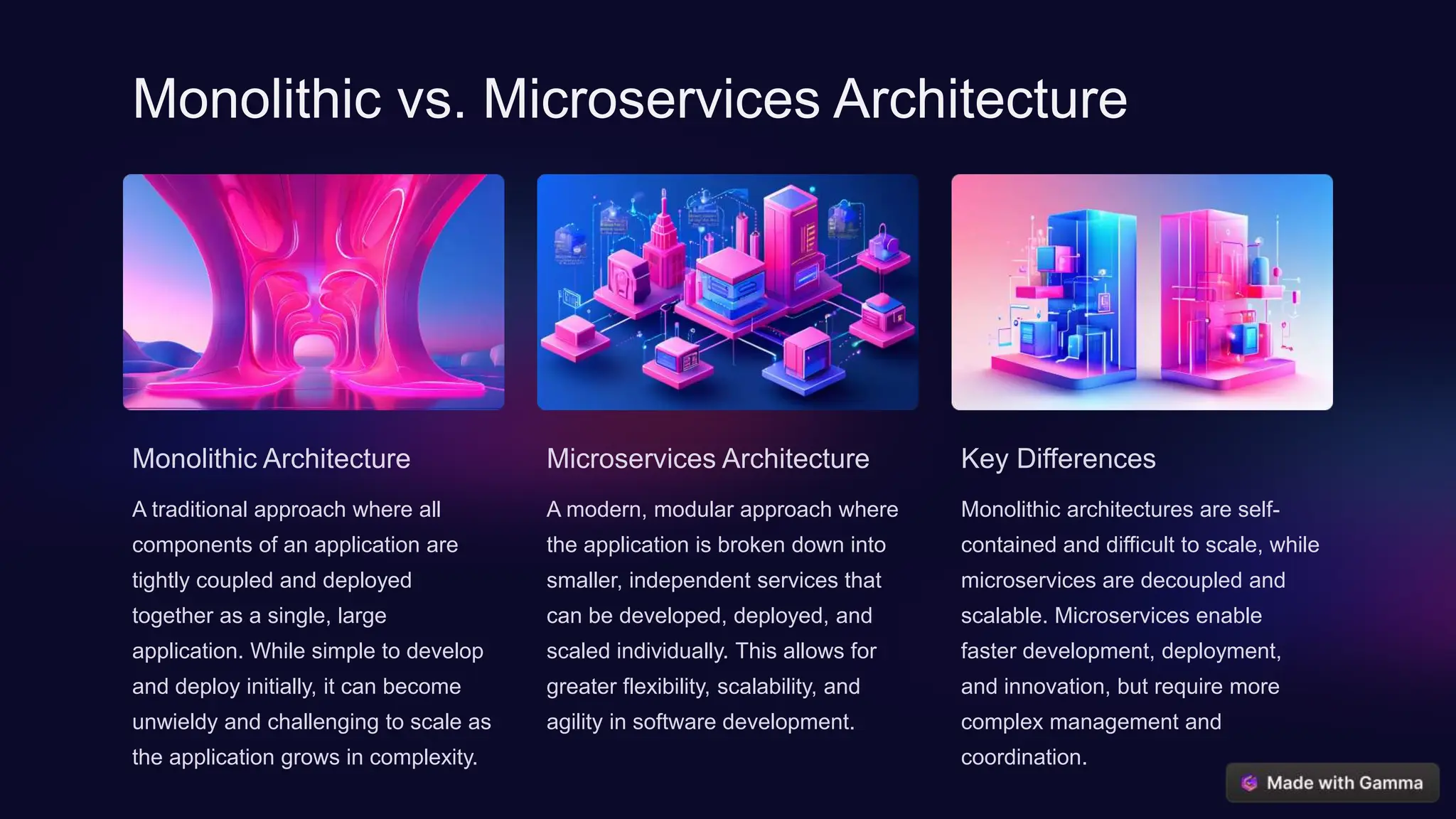
Monolithic vs. Microservices Architecture
Monolithic Architecture
A traditional approach where all
components of an application are
tightly coupled and deployed
together as a single, large
application. While simple to develop
and deploy initially, it can become
unwieldy and challenging to scale as
the application grows in complexity.
Microservices Architecture
A modern, modular approach where
the application is broken down into
smaller, independent services that
can be developed, deployed, and
scaled individually. This allows for
greater flexibility, scalability, and
agility in software development.
Key Differences
Monolithic architectures are self-
contained and difficult to scale, while
microservices are decoupled and
scalable. Microservices enable
faster development, deployment,
and innovation, but require more
complex management and
coordination.
Serverless Computing and Function-as-a-
Service (FaaS)
Scalable and Flexible
Serverless computing automatically scales
infrastructure up and down, allowing developers to
focus on building applications without worrying about
provisioning or managing servers.
Event-Driven Architecture
Serverless platforms execute code in response to
specific events or triggers, enabling a more modular
and reactive application design.
Cost-Effective
Developers only pay for the compute resources they
use, leading to potential cost savings compared to
traditional server-based deployments.
Reduced Operational Overhead
Serverless computing eliminates the need to manage
the underlying infrastructure, allowing teams to focus
on building and deploying features quickly.
Microservices and Serverless
Modular Design
Microservices architecture breaks
down applications into smaller,
independent services that can be
developed, deployed, and scaled
individually.
Rapid Scaling
Serverless computing
automatically scales infrastructure
up and down, allowing developers
to focus on building applications
without managing servers.
Flexible Integration
Microservices and serverless
technologies enable developers to
easily integrate different
components and services,
fostering flexibility and innovation.
Microservices Architecture
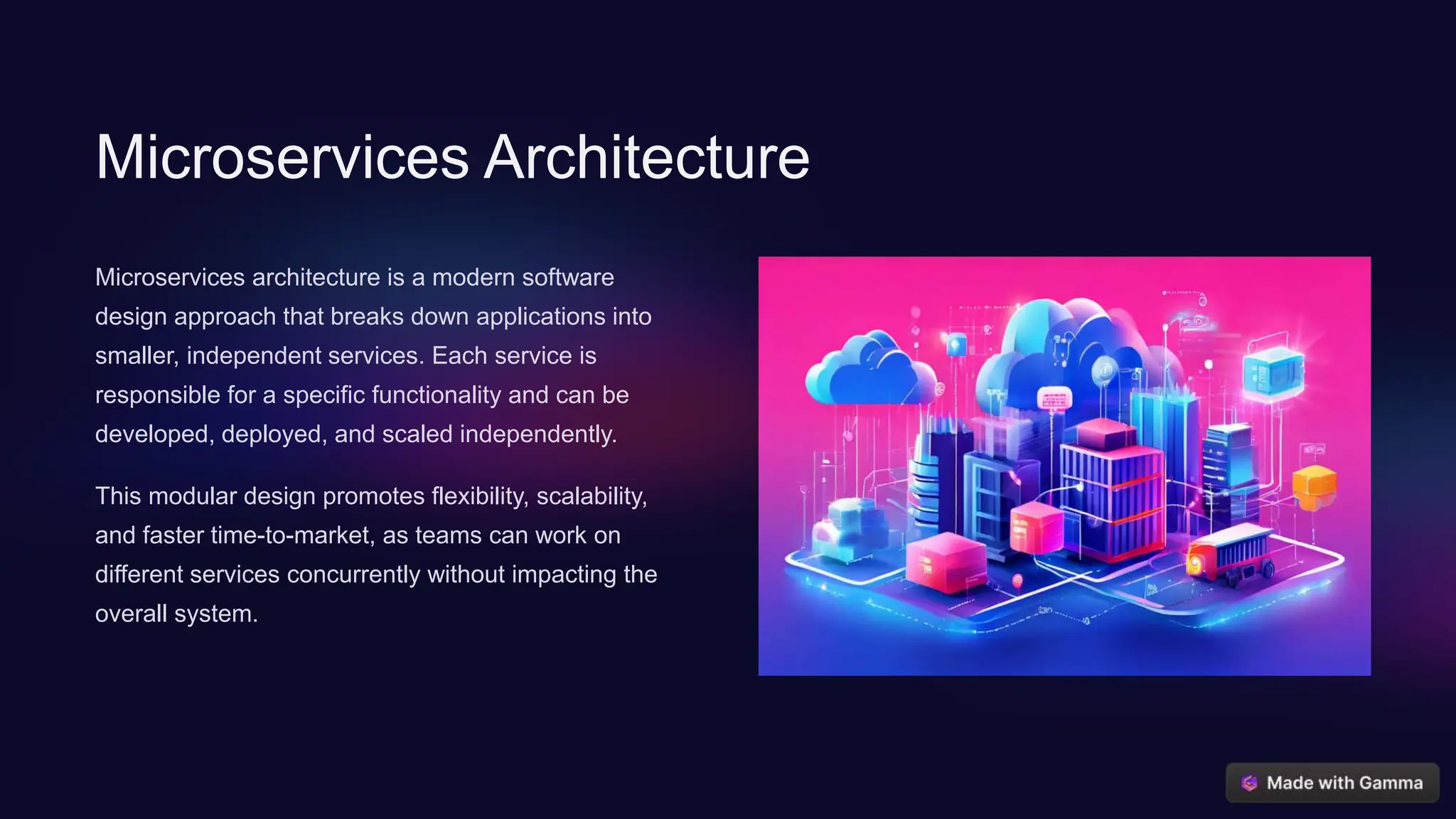
Microservices architecture is a modern software
design approach that breaks down applications into
smaller, independent services. Each service is
responsible for a specific functionality and can be
developed, deployed, and scaled independently.
This modular design promotes flexibility, scalability,
and faster time-to-market, as teams can work on
different services concurrently without impacting the
overall system.
Serverless Architecture
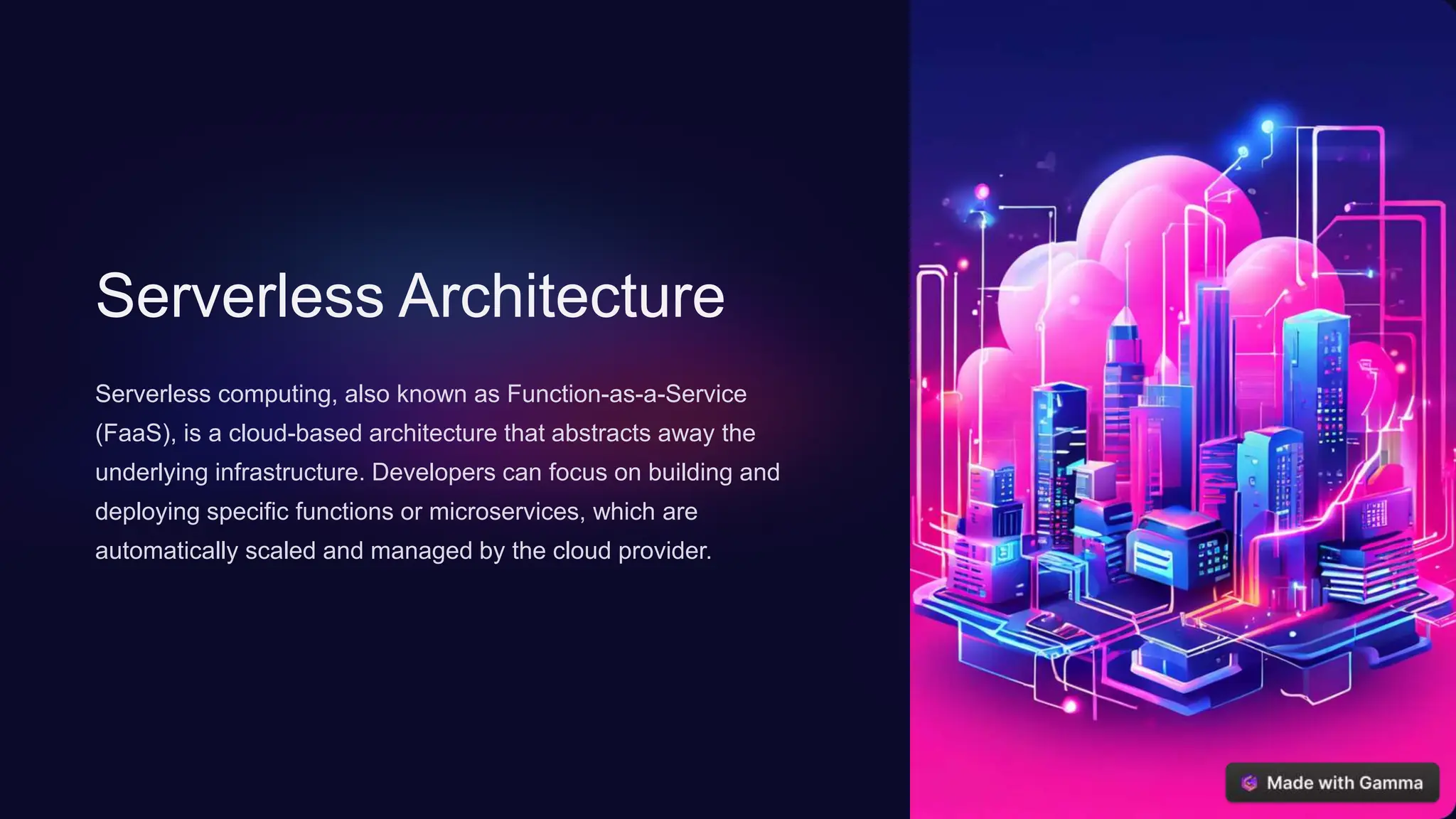
Serverless computing, also known as Function-as-a-Service
(FaaS), is a cloud-based architecture that abstracts away the
underlying infrastructure. Developers can focus on building and
deploying specific functions or microservices, which are
automatically scaled and managed by the cloud provider.
Containerization and Orchestration with Docker
and Kubernetes
Containerization 🐳
Containerization, exemplified by Docker, packages applications and their dependencies into isolated,
portable, and reproducible environments, enabling consistent deployment across different platforms.
Orchestration 🚢
Kubernetes, an open-source container orchestration system, automates the deployment, scaling, and
management of containerized applications, providing scalability, high availability, and fault tolerance.
Scalability 🔍
Kubernetes can automatically scale container deployments up or down based on resource utilization,
ensuring optimal performance and efficient use of computing resources.
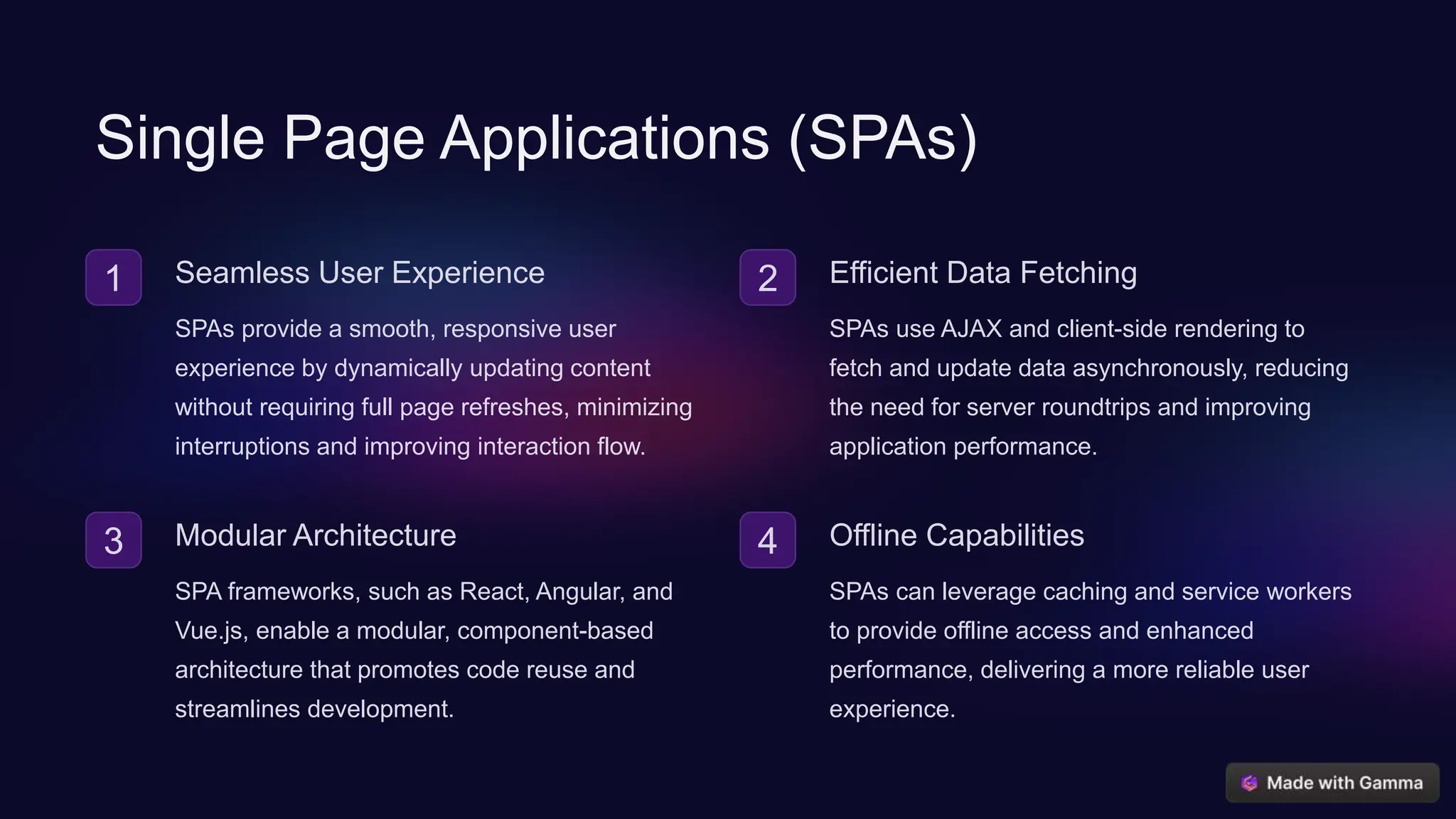
Single Page Applications (SPAs)
1 Seamless User Experience
SPAs provide a smooth, responsive user
experience by dynamically updating content
without requiring full page refreshes, minimizing
interruptions and improving interaction flow.
2 Efficient Data Fetching
SPAs use AJAX and client-side rendering to
fetch and update data asynchronously, reducing
the need for server roundtrips and improving
application performance.
3 Modular Architecture
SPA frameworks, such as React, Angular, and
Vue.js, enable a modular, component-based
architecture that promotes code reuse and
streamlines development.
4 Offline Capabilities
SPAs can leverage caching and service workers
to provide offline access and enhanced
performance, delivering a more reliable user
experience.

Modern-Web-and-Mobile-Application-Architecture.pptx

  • 1.
    Modern Web and MobileApplication Architecture Explore the latest advancements in web and mobile application architecture, including microservices, serverless computing, and containerization. Gain insights into building scalable, flexible, and efficient applications for the modern digital landscape. by Comdet Phudphut
  • 2.
    Introduction to modern application architectures Explorethe evolving landscape of web and mobile application design, focusing on the latest architectural patterns and technologies that are shaping the future of digital experiences.
  • 3.
    Overview of Web Application Architecture Explorethe foundational architectural patterns that underpin modern web applications, encompassing client-side, server-side, and data storage components. Understand how these elements work together to create dynamic, scalable, and responsive digital experiences.
  • 4.
    Monolithic vs. MicroservicesArchitecture Monolithic Architecture A traditional approach where all components of an application are tightly coupled and deployed together as a single, large application. While simple to develop and deploy initially, it can become unwieldy and challenging to scale as the application grows in complexity. Microservices Architecture A modern, modular approach where the application is broken down into smaller, independent services that can be developed, deployed, and scaled individually. This allows for greater flexibility, scalability, and agility in software development. Key Differences Monolithic architectures are self- contained and difficult to scale, while microservices are decoupled and scalable. Microservices enable faster development, deployment, and innovation, but require more complex management and coordination.
  • 5.
    Serverless Computing andFunction-as-a- Service (FaaS) Scalable and Flexible Serverless computing automatically scales infrastructure up and down, allowing developers to focus on building applications without worrying about provisioning or managing servers. Event-Driven Architecture Serverless platforms execute code in response to specific events or triggers, enabling a more modular and reactive application design. Cost-Effective Developers only pay for the compute resources they use, leading to potential cost savings compared to traditional server-based deployments. Reduced Operational Overhead Serverless computing eliminates the need to manage the underlying infrastructure, allowing teams to focus on building and deploying features quickly.
  • 6.
    Microservices and Serverless ModularDesign Microservices architecture breaks down applications into smaller, independent services that can be developed, deployed, and scaled individually. Rapid Scaling Serverless computing automatically scales infrastructure up and down, allowing developers to focus on building applications without managing servers. Flexible Integration Microservices and serverless technologies enable developers to easily integrate different components and services, fostering flexibility and innovation.
  • 7.
    Microservices Architecture Microservices architectureis a modern software design approach that breaks down applications into smaller, independent services. Each service is responsible for a specific functionality and can be developed, deployed, and scaled independently. This modular design promotes flexibility, scalability, and faster time-to-market, as teams can work on different services concurrently without impacting the overall system.
  • 8.
    Serverless Architecture Serverless computing,also known as Function-as-a-Service (FaaS), is a cloud-based architecture that abstracts away the underlying infrastructure. Developers can focus on building and deploying specific functions or microservices, which are automatically scaled and managed by the cloud provider.
  • 9.
    Containerization and Orchestrationwith Docker and Kubernetes Containerization 🐳 Containerization, exemplified by Docker, packages applications and their dependencies into isolated, portable, and reproducible environments, enabling consistent deployment across different platforms. Orchestration 🚢 Kubernetes, an open-source container orchestration system, automates the deployment, scaling, and management of containerized applications, providing scalability, high availability, and fault tolerance. Scalability 🔍 Kubernetes can automatically scale container deployments up or down based on resource utilization, ensuring optimal performance and efficient use of computing resources.
  • 10.
    Single Page Applications(SPAs) 1 Seamless User Experience SPAs provide a smooth, responsive user experience by dynamically updating content without requiring full page refreshes, minimizing interruptions and improving interaction flow. 2 Efficient Data Fetching SPAs use AJAX and client-side rendering to fetch and update data asynchronously, reducing the need for server roundtrips and improving application performance. 3 Modular Architecture SPA frameworks, such as React, Angular, and Vue.js, enable a modular, component-based architecture that promotes code reuse and streamlines development. 4 Offline Capabilities SPAs can leverage caching and service workers to provide offline access and enhanced performance, delivering a more reliable user experience.