Edited by
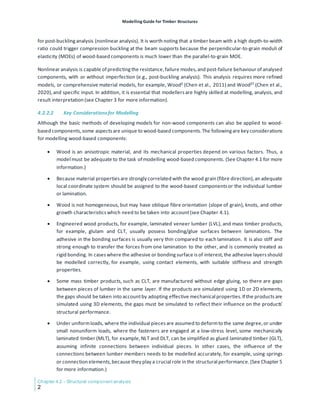
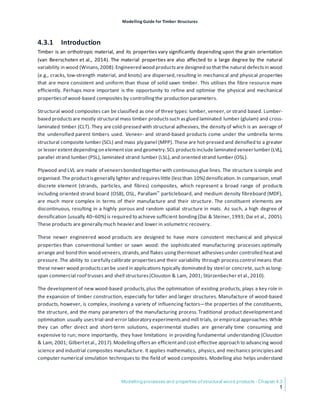
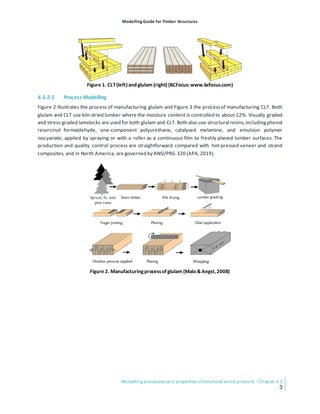
Zhiyong Chen
Dorian Tung
Erol Karacabeyli
Special Publication SP-544
Modelling Guide
for Timber Structures
2022 - First Edition
Modelling Guidefor
Timber
Structures
Special PublicationSP-544
Edited by
Zhiyong Chen
Dorian Tung
Erol Karacabeyli
2022
Pointe-Claire, Que.
© 2022 FPInnovations. All rights reserved. Copying and redistribution prohibited.
FPInnovations® and logo are trademarks of FPInnovations.
No part of this published work may be reproduced, published, or transmitted for commercial purposes, in any form or by any
means, electronic, mechanical, photocopying, recording or otherwise, whether or not in translated form, without the prior
written permission ofFPInnovations.
The information contained in this work represents current research results and technical information made available from many
sources, including researchers, design professionals, manufacturers, and software developers. The information has been
reviewed by professionals in wood structure design including professors, practicing engineers, wood product and connection
manufacturers, and structural analysis software developers. While every reasonable effort has been made to ensurethe accuracy
of the information presented, and special effort has been made to assure that the information reflects the state-of-the-art, none
of the above-mentioned parties make any warranty, expressed or implied, or assume any legal liability or responsibility for the
use, application of, and/or reference to opinions, findings, conclusions, or recommendations included in this published work, nor
assume any responsibility for the accuracy or completeness ofthe information or its fitness for any particular purpose.
This published work is designed to provide accurate, authoritative information but is not intended to provideprofessional advice.
It is the responsibility ofusers to exercise professional knowledge and judgment in the use of the information.
Modelling Guide for Timber Structures
Special Publication SP-544
ISBN 978-0-86488-613-2 (print)
ISBN 978-0-86488-612-5 (electronic)
Please submit inquiries about this document to:
FPInnovations
570 Saint-Jean Blvd
Pointe-Claire, QC
Canada H9R 3J9
info@fpinnovations.ca
Follow us:
Front cover:Artistic rendering of2150 KeithDrive building,Vancouver,Canada courtesy ofimages provided byDIALOG andCadMakers..
Back cover: Image ofbuilding courtesy ofCadMakers.
ACKNOWLEDGEMENTS
The Modelling Guidefor Timber Structures was financially supported by Natural ResourcesCanada through the
Expanding Wood Use Towards 2025 project and the Green Construction through Wood (GCWood) program.
We also acknowledge the financial contribution fromMinistère des Forêtsde la Faune et desParcsdu Québec.
The contributors to this guide include researchers who are well versed in computer modelling of timber
structural engineering, progressive collapse, wind engineering, and earthquake engineering; practising
engineerswho have applied computer modelling to timber structures; manufacturersof timber products and
connections; and structural analysis software developerswith an interestin structural analysis of timber-based
structural systems. The time and effort that the contributors invested in the development of the guide are
greatly appreciated.
A special acknowledgementgoesto our copyeditors,Anne Godlewski,BlazejSzpakowicz, and Joanna Odrowaz,
as well as to FPInnovations’ Communications team for its contributions to this guide.
Finally, the advice received from the advisory group for the development of this guide, comprising
Mohammad Mohammad, Robert Jonkman, Philip Line,Conroy Lum, and Marjan Popovski, was invaluable and
is gratefully acknowledged.
CONTRIBUTORS
Government Entities and Associations
APA – The Engineered Wood Association Borjen Yeh USA
American Wood Council (AWC) Philip Line USA
Canadian Construction Materials Centre (CCMC) Jasmine McFadden Canada
Canadian Wood Council (CWC) Ali Mikael Canada
RobertJonkman Canada
Forestry Innovation Investment (FII) Antje Wahl Canada
Sonya Zeitler Fletcher Canada
National Lumber Grades Authority (NLGA) Richard Desjardins Canada
Natural ResourcesCanada (NRCan) Mohammad Mohammad Canada
WoodWorks Scott Breneman USA
Research Institutes
Chalmers University of Technology RobertJockwer Sweden
Clemson University WeichiangPang USA
Colorado School of Mines Shiling Pei USA
Colorado State University John van de Lindt USA
Czech Technical University in Prague Petr Kabele Czech Republic
FPInnovations Christian Dagenais Canada
Chun Ni Canada
Conroy Lum Canada
Dorian Tung Canada
Erol Karacabeyli Canada
Jieying Wang Canada
Lin Hu Canada
Marjan Popovski Canada
Rod Stirling Canada
Samuel Cuerrier Auclair Canada
Sylvain Gagnon Canada
Zhiyong Chen Canada
Griffith University Benoit Gilbert Australia
KTH Royal Institute of Technology Roberto Crocetti Sweden
Kyoto University Hiroshi Isoda Japan
Laval University Alexander Salenikovich Canada
LinnaeusUniversity Thomas Bader Sweden
McMaster University Lydell Andree Wiebe Canada
TNO Jan Niederwestberg Netherlands
TU Wien Markus Lukacevic Austria
University of Alberta Lei Zhang Canada
Ying Hei Chui Canada
University of Auckland Ashkan Hashemi New Zealand
Nicholas Chan New Zealand
Pierre Quenneville New Zealand
University of Bologna LucaPozza Italy
University of British Columbia Chunping Dai Canada
Kate Semple Canada
Meiling Chen Canada
University of Canterbury Minghao Li New Zealand
University of Illinois Md Abdul Hamid Mirdad USA
University of Liverpool Zhongwei Guan United Kingdom
University of Nevada Keri Ryan USA
University of Northern British Columbia Asif Iqbal Canada
Thomas Tannert Canada
University of Ottawa Ghasan Doudak Canada
University of Technology Sydney Keith Crews Australia
University of Toronto Frank Vecchio Canada
Washington State University Daniel Dolan USA
Western University Girma Bitsuamlak Canada
Matiyas Bezabeh Canada
Consultants
Arup Maja Belic Australia
Sebastian Kaminski United Kingdom
Vincenzo Reale United Kingdom
CadMakers Kai Yang Canada
Nicolas Cantin Canada
Vasco Chan Canada
dedaLEGNO Maurizio Follesa Italy
DIALOG Cameron Ritchie Canada
Douglas Consultants Inc. Kevin Below Canada
Elema Jake Estok Canada
Fast + Epp Carla Dickof Canada
RobertJackson Canada
KPFF Consulting Engineers Reid Zimmerman USA
L2C Experts Jean-Philippe Carrier Canada
Moelven Rune Abrahamsen Norway
Moses Structural Engineers David Moses Canada
Mott MacDonald Seifu Bekele Australia
MTC Solutions Jean-Philippe Letarte Canada
PTL Andy Buchanan New Zealand
Daniel Moroder New Zealand
Francesco Sarti New Zealand
RWD Conseils Richard Desjardins Canada
Stonewood Structural Engineers Scott Nyseth USA
StructureCraftBuilders Brandon Sullivan Canada
Gerald Epp Canada
Justin Brown Canada
LucasEpp Canada
Pietro Vinco da Sesso Canada
Shasan Chokshi Canada
SWECO Magne Aanstad Bjertnæs Norway
Timber Engineering Hercend Mpidi Bita Canada
RobertMalczyk Canada
Time for Timber Richard Harris United Kingdom
TTW Alex Zecevic Australia
Vistek Structural Engineers Jeremy Church Australia
Nathan Benbow Australia
Companies - Timber Products and Connections
Australian Sustainable Hardwoods Nathan Benbow Australia
Henkel William Nguegang Nkeuwa USA
Nordic Structures Keven Durand Canada
Structurlam Nicholas Sills Canada
Tectonus Ashkan Hashemi New Zealand
Timberlab Hans-Eric Blomgren USA
Timberlink Jeremy Church Australia
West Fraser William Nguegang Nkeuwa Canada
Companies - Software
Altair Marinos Stylianou USA
Dlubal Software Amy Heilig USA
Bastian Kuhn Germany
Gerhard Rehm Germany
WoodWorks® Software Yang Du Canada
EXECUTIVE SUMMARY
Due to the awareness of the importance of reducing environmental footprint and the rising costs of
construction, timber structures have been increasingly attracting attention and, subsequently, adoption for
beingbuilt taller and larger.Computer modelling plays a crucial role in the analysis and design of large and tall
timber structures, and in the development of wood-based products, connections, and systems. A survey by
FPInnovations showed that practising engineersare typically unfamiliar with timber structure modelling, and
researchers generally lack resources for advanced modelling of timber systems. Therefore, in 2020,
FPInnovations initiated a projectto develop aguide that would supportthe application of numerical modelling
on the analysis and design of timber structures, and the development and optimisation of wood-based
productsand systems. The Modelling Guide for Timber Structures is the result of a global effortinvolving over
100 collaborators, including experts from research institutes, consulting firms, manufacturers, software
companies, governmententities, and associations.
This guide brings together the experience gained from recently built timber projects, and the latest research
development in the modelling of timber structures. It includes a wide range of practical and
advanced modelling topics, such as key modelling principles, methods, and techniques specific to timber
structures; modelling approaches and considerations for wood-based components, connections, and
assemblies; and analytical approaches and considerations for timber structures during progressive
collapse, wind, and earthquake events. It also presents the differences in the modelling approaches to
timber, steel, and concrete structures.
The information presented in this guide is intended to assist practising engineersto apply computer modelling
to timber structures, enrich researchers’resourcesfor advanced computer modelling of timber systems, and
assist software companies in identifying knowledge gaps so that they may upgrade programs accordingly to
accommodate the advanced computer modellingof timber structures.
CONTENTS
Chapter 1: Introduction
1.1 Background and Objectives
1.2 Scope
1.3 Content and Organisation
1.4 References
Chapter 2: Structural Behaviour and Modelling Emphases of Timber, Steel, and Concrete Structures
2.1 Introduction
2.2 General Comparisons
2.3 Comparisons of Selected Lateral Load-Resisting Systems
2.4 Summary
2.5 References
Chapter 3: ModellingPrinciples, Methods, and Techniques
3.1 Introduction
3.2 Principles
3.3 Methods
3.4 Techniques
3.5 Summary
3.6 Acknowledgements
3.7 References
Chapter 4: Components
4.1 Constitutive Models and Key Influencing Factors
4.1.1 Introduction
4.1.2 Material (Stress-Strain) Models
4.1.3 Key InfluencingFactors
4.1.4 Summary
4.1.5 References
4.2 Structural ComponentAnalysis
4.2.1 Introduction
4.2.2 Analysis Methods and Key Considerations for Modelling
4.2.3 Tension Components
4.2.4 Compression Components
4.2.5 Bending Components
4.2.6 Summary
4.2.7 References
4.3 Modelling Processesand Propertiesof Structural Wood Products
4.3.1 Introduction
4.3.2 Lumber-based Products
4.3.3 Veneer-based Products
4.3.4 Strand-based Products
4.3.5 Summary and Conclusions
4.3.6 Acknowledgements
4.3.7 References
Chapter 5: Connections
5.1 Introduction
5.2 Design and Analysis of Connectionsin Timber Structures
5.3 Developmentand Optimisation of Connections
5.4 Summary
5.5 References
Chapter 6: Floors and Diaphragms
6.1 Floors and Roofs
6.1.1 Introduction
6.1.2 Light Wood-Frame Systems
6.1.3 Mass Timber and Composite Systems
6.1.4 Summary
6.1.5 Acknowledgements
6.1.6 Nomenclature
6.1.7 References
Appendix A – Gamma Method
Appendix B– Progressive YieldingMethod
Appendix C – Discrete Bond Model
6.2 Diaphragms
6.2.1 Introduction
6.2.2 Diaphragm Analysis
6.2.3 Wood Frame Diaphragms
6.2.4 Mass Timber Diaphragms
6.2.5 Timber-Concrete Composite Diaphragms
6.2.6 Connectionswithin Diaphragms, and Connectionsto Lateral Load-Resisting Systems
6.2.7 Summary
6.2.8 References
Chapter 7: Load-Resisting Systems
7.1 Light Wood-Frame Structures
7.1.1 Introduction
7.1.2 Behaviour and Mechanisms
7.1.3 Analytical Models
7.1.4 Numerical Models
7.1.5 Summary
7.1.6 References
7.2 Mass Timber Structures
7.2.1 Introduction
7.2.2 Gravity Load-Resisting Systems
7.2.3 Lateral Load-Resisting Systems
7.2.4 Additional Modelling Considerations
7.2.5 Summary
7.2.6 References
Appendix A – Mass Timber Products
7.3 Hybrid Timber Structures
7.3.1 Introduction
7.3.2 Examples of Hybrid Buildings and Connections
7.3.3 Special Structural and Modelling Considerations
7.3.4 Special Analysis Considerations
7.3.5 Summary
7.3.6 References
7.4 Timber Structureswith Advanced Seismic Protection
7.4.1 Introduction
7.4.2 Controlled Rocking Systems
7.4.3 Timber Systems with RSFJ Connections
7.4.4 Seismic Isolation and Applications
7.4.5 Summary
7.4.6 References
7.5 Long-Span Timber Structures
7.5.1 Introduction to Long-Span Timber Structures
7.5.2 General Aspectsof Long-Span Structure Analysis
7.5.3 Influence of the Span on Structural Design
7.5.4 Analysis and Modelling of Typical Structural Types
7.5.5 Summary
7.5.6 References
Chapter 8: Progressive/Disproportionate Collapse
8.1 Introduction to Progressive Collapse of Timber Buildings
8.2 Design and Analysis Methods and Strategies for Robustness
8.3 Shear Wall Systems
8.4 Post-and-Beam Systems
8.5 Other Systems
8.6 Summary
8.7 References
Chapter 9: Wind-InducedResponse Analysis
9.1 Introduction
9.2 Introduction to Davenport’s Wind Loading Chain
9.3 Aerodynamicsof Tall Buildings
9.4 Response of Wind-Excited Tall Buildings
9.5 Building Design Criteria
9.6 Dynamic Propertiesof Tall Mass-Timber Buildings
9.7 Prediction of Wind Load Effects Using the NBCC
9.8 Wind Tunnel Method
9.9 Design and Dynamic Response of 30- and 40-Storey Tall Mass-Timber Buildings for Wind
9.10 Wind Load Estimation Based on Computational Fluid Dynamics for Preliminary Design
9.11 Mitigation Strategies for Excessive Wind-Induced Motions in Tall Mass-Timber Buildings
9.12 Introduction to Performance-based Wind Design of Tall Mass-Timber Buildings
9.13 References
Chapter 10: Seismic Response Analysis
10.1 Introduction
10.2 Static Analysis
10.3 Response SpectrumAnalysis
10.4 Dynamic Timber History Analysis
10.5 Summary
10.6 Acknowledgements
10.7 References
CHAPTER 1
Introduction
Authors
Zhiyong Chen
DorianTung
Erol Karacabeyli
Conroy Lum
MarjanPopovski
Reviewers
MohammadMohammad
Robert Jonkman
Philip Line
Modelling Guide for Timber Structures
Chapter 1 - Introduction
ii
TABLE OF CONTENTS
1.1 BACKGROUND AND OBJECTIVES ...........................................................................................................................1
1.2 SCOPE........................................................................................................................................................................1
1.3 CONTENT AND ORGANISATION.............................................................................................................................2
1.4 REFERENCES..............................................................................................................................................................3
Modelling Guide for Timber Structures
Introduction – Chapter 1
1
1.1 BACKGROUNDANDOBJECTIVES
Computer modelling is essential for analysing and designing mid- and high-rise buildings and long-span
structures where traditional engineering hand calculations or spreadsheets typically adopted by designers for
low-rise timber buildings are not adequate. It is also a valuable tool for optimising wood-based products,
connections, and systems that improve structural performance. A survey by FPInnovations (Chen,
Karacabeyli, & Lum, 2017) showed that practising engineers are relatively unfamiliar with modelling of timber
structures, and that researchers generally lack resources for advanced modelling of timber systems. Further,
wood design features currently available in some structural analysis software packages are usually not
suitable for modelling complex or hybrid timber structures. This will hinder the application and development
of timber construction given that timber structures increasingly require demonstration of performance or
equivalency through computer modelling, regardless of whether prescriptive or performance-based design
proceduresare used.
This guide focuses on the modelling and analysis of timber structures. The objectives of the guide are to help
engineers apply computer modelling concepts to the design of timber constructions, enrich researchers’
resources for advanced computer modelling of timber systems, and assist software companies in identifying
the gaps and upgrading programs accordingly to accommodate advanced computer modelling of timber
structures.
1.2 SCOPE
This modelling guide has been developed to:
• Establish the basic principles for applying computer modelling in timber structure analysis,
includingmodelling assumptions and validating the assumptions and results; and
• Guide the selection of efficient modelling methodologies, appropriate analysis methods, and
robust evaluation criteriafor timber structures.
This is a free downloadable and printable publication developed by more than 40 experts from countries
around the world. The author team is composed of:
• Researchers who are well versed in computer modelling of timber structural engineering,
progressive collapse,wind engineering,and seismic engineering;
• Practising engineerswho have applied computer modellingto timber structures;
• Manufacturersof timber productsand connections; and
• Software companies with an interestin the analysis of timber-based structural systems.
This modelling guide complements the overview of the analysis and design of tall wood buildings in
FPInnovations’ Technical Guide for the Design and Construction of Tall Wood Buildings in Canada (Karacabeyli
& Lum, 2022) and the fundamental information and knowledge related to timber system modelling in the
Canadian Wood Council’s Advanced Wood Design Manual (in press).
Modelling Guide for Timber Structures
Chapter 1 - Introduction
2
1.3 CONTENT ANDORGANISATION
This modelling guide has been written with practising engineers and researchers in mind. It has been
developed with the understanding that computer modelling of timber structures is a specialty to which many
engineers and researchers have limited exposure in either education or practice. The guide consists of three
parts: Part A – Introduction (appears in green in Figure 1), Part B – Modelling (in red), and Part C – Analyses
(in blue).
Figure 1. Organisationofthismodellingguide
The subjectscovered in Part A are as follows:
Chapter 1 introducesthe background,objectives,scope, content,and organisation of the guide.
Chapter 2 compares timber structures with other structures in terms of structural behaviour and the
approaches to modelling, including assumptions. This chapter helps those unfamiliar with modelling of
timber structures learn more about the major differences and similarities between timber and other
commonly used construction materials.
Chapter 3 introduces modelling principles, methods, and techniques. It also provides general rules for
structural modelling and specific rulesfor timber-based systems.
Modelling Guide for Timber Structures
Introduction – Chapter 1
3
The subjectscovered in Part B are as follows:
Chapter 4 highlights the key mechanical characteristics of wood for modelling. It introduces advanced
and practical modelling solutions for the analysis and design of wood-based products. Moreover, this
chapter providesmodelling solutions for optimising wood-based products and experimental test plans.
Chapter 5 highlights the key roles and influencing factors of connections in timber systems. It presents
advanced and practical modelling solutions for analysing and designing timber connections. It also
discussesmodelling solutions for optimising connections.
Chapter 6 introduces modelling methods for the analysis and design of different types of floor and roof
assemblies, such as light wood-frame, mass timber, and composite floor systems. It also discusses the
modelling of floor and roof assemblies under gravity loads in out-of-plane directions, in terms of
strengths, deflections, and vibration, along with modelling under lateral (in-plane) loads for properties
such as strength and deflection.
Chapter 7 discusses the advanced and practical modelling solutions for light wood-frame, mass timber,
hybrid timber, advanced timber, and long-span timber structures. This chapter also introduces general
modelling considerationsfor gravity systems.
The subjectscovered in Part C are as follows:
Chapter 8 introduces the approaches to collapse analysis for timber structures and advanced and
practical modelling solutions for shear wall and post-and-beam structures. This chapter also introduces
key modelling considerations for progressive collapse analysis of hybrid systems, long-span structures,
and prefabricated modular structures.
Chapter 9 introduces the behaviour and mechanism of timber buildings under wind loads and the
application of computational fluid dynamics for modelling wind environments and determining cladding
wind loads. It also presents advanced and practical modelling solutions for estimating the wind-induced
response of timber structures.
Chapter 10 introduces the behaviour and mechanism of timber buildings under earthquake loads,
selection and scaling methods of ground motions, and advanced and practical modelling solutions for
estimating the seismic response of timber structures.
1.4 REFERENCES
Canadian Wood Council.(in press). Advanced wood design manual.
Chen, Z., Karacabeyli, E., & Lum, C. (2017).A survey on modelling of mass timber. FPInnovations.
Karacabeyli,E., & Lum, C. (2022).Technical guide for the design and construction of tall wood buildingsin
Canada (2nd ed.). FPInnovations.
CHAPTER 2
Structural behaviour and modelling emphases of
timber, steel, and concrete structures
Authors
Zhiyong Chen
Lydell Wiebe
Frank Vecchio
Reviewers
SebastianKaminski
Kevin Below
Modelling Guide for Timber Structures
Chapter 2 - Structural behaviour and modelling emphases of timber, steel, and concrete structures
ii
TABLE OF CONTENTS
2.1 INTRODUCTION........................................................................................................................................................1
2.2 GENERAL COMPARISONS .......................................................................................................................................1
2.2.1 Material Behaviour................................................................................................................................1
2.2.2 Structural Behaviour.............................................................................................................................2
2.2.3 Modelling Emphases.............................................................................................................................3
2.3 COMPARISONS OF SELECTED LATERAL LOAD-RESISTING SYSTEMS ................................................................4
2.3.1 Shear Walls.............................................................................................................................................4
2.3.2 Braced Frames........................................................................................................................................6
2.3.3 Moment-Resisting Frames ...................................................................................................................9
2.4 SUMMARY...............................................................................................................................................................11
2.5 REFERENCES............................................................................................................................................................12
Modelling Guide for Timber Structures
Structural behaviour and modelling emphases of timber, steel, and concrete structures - Chapter 2
1
2.1 INTRODUCTION
Every structural material has unique mechanical characteristics. Correspondingly, different design strategies
have been adopted for structural systems using different materials to optimise the material use. The
structural behaviour and modelling emphases of structural systems with different materials vary accordingly.
Currently, most practising engineers and researchers are more familiar with steel and concrete structures
than with timber structures, especially mass timber structures. As such, to help these practitioners become
acquainted with timber structures, this chapter compares timber structural systems with analogous ones
from steel and concrete,in terms of their structural behaviour and modelling emphases.
2.2 GENERAL COMPARISONS
2.2.1 MaterialBehaviour
Steel (Figure 1[a]) is an iron alloy with a controlled level of carbon. It is generally considered to be a
homogeneous, isotropic, elastoplastic material with equal strength in tension and compression. It is also a
ductile material, which behaves elastically until it reaches yield, at which point it becomes plastic, and fails in
a ductile manner with large strains before fracture.
(a) (b)
Figure 1. Typical(a)steelelementsand (b)reinforced concrete
Concrete is a mixture of water, cement, and aggregates. The proportion of these components is important to
create a concrete mix of a desired compressive strength. When reinforcing steel bars are added into concrete
in bending, such as the panels shown in Figure 1(b), the two materials work together, with concrete providing
the compressive strength, and steel providing the tensile strength primarily. Conventional (plain,
unreinforced) concrete is a nonlinear, nonelastic, and generally brittle material. It is strong in compression
and weak in tension. Due to its weakness in tension capacity, concrete fails suddenly and in a brittle manner
under flexural (bending) or tensile force unless adequately reinforced with steel (Maekawa et al., 2008).
Reinforced concrete (RC) is concrete into which steel reinforcement bars, plates, or fibres have been
incorporated to strengthen a material that would otherwise be brittle.
Wood (Figure 2) has characteristic anisotropy due to its fibrous structure, which can be considered as
producing three-dimensional orthotropy (Hirai, 2005). Its stiffness and strength properties vary as a function
of grain orientation among the longitudinal, radial, and tangential directions (Chen et al., 2020; Chen et al.,
2011; Sandhaas et al., 2012). The failure modes and the stress-strain relationships of wood depend on the
Modelling Guide for Timber Structures
Chapter 2 - Structural behaviour and modelling emphases of timber, steel, and concrete structures
2
direction of the load relative to the grain and on the type of load (tension, compression, or shear). For wood
in tension and shear, the stress-strain relationship is typically linear, and the failure is brittle, while for wood
in compression, the stress-strain relationship is typically nonlinear, and the failure is ductile (Forest Products
Laboratory, 2010). When loaded in tension and shear, wood elements behave in a brittle manner. On the
other hand, in compression parallel and perpendicular to the grain, wood elements show a degree of inelastic
behaviour and ductility, except under buckling, when wood is very brittle. When loaded in bending, the
ductility in wood elements is generally related to plasticisation in the compression zone, as the tension zone
tends to fail in a brittle manner. Therefore, ductility in bending is difficult to achieve in practice, and it is
recorded in tests only when the strength of the tension area is considerably higher than that of the
compression area. Similarly, shear failure of wood elements, which can happen in short, tapered beams, in
beams with end splits, or where there is stress concentration (e.g., close to notches or around holes), is
brittle, characterised by a sliding of the fibresand thus crackingparallel to the grain.
Figure 2. Threemain axesofwood withrespect tograin direction:longitudinal(L),radial(R),and tangential(T)
(Mokdad & Missoum,2013)
2.2.2 StructuralBehaviour
Due to their high strength-to-weight ratio, steel elements are, in general, relatively slender (Figure 1[a]).
Under tension, steel elements can provide excellent stiffness, strength, and ductility. However, two main
areas that require attention in the design of steel structures are buckling and connections. In compression
and bending, stability (global or local buckling) is often a concern, so the design should account for the
buckling resistance of slender steel compression and bending elements. Connections can also be a point of
relative weakness in steel structures. As such, care is needed to ensure that connections do not unduly
influence the overall response of a steel structure, especially for seismic design, where ductility is of primary
importance. In other words, connections that are not intended to yield should be capacity-protected, while
connections that are intended to yield should be designed to ensure that yielding does not progress to failure
under repeated cyclesof seismic loading.
Detailing of reinforcement, particularly for seismic conditions, is a key design aspect for RC structures. As a
composite material, RC (Figure 1[b]) resists not only compression but also bending and other direct tensile
actions. The reinforcement in an RC structure, such as a steel bar, must be able to undergo the same strain or
deformation as the surrounding concrete to prevent discontinuity, slip, or separation of the two materials
under load. Maintaining composite action requires the transfer of load between the concrete and steel. The
direct stress is transferred from the concrete to the bar at the interface to change the tensile stress in the
Modelling Guide for Timber Structures
Structural behaviour and modelling emphases of timber, steel, and concrete structures - Chapter 2
3
reinforcing bar along its length. This load transfer is achieved by means of bond (anchorage) and is idealised
as a continuous stress field that develops in the vicinity of the steel-concrete interface. The RC element acts
like a rigid element.
Because of their anisotropic mechanical properties, timber elements (Figure 2) possess much higher stiffness
and strength in the parallel-to-grain direction than in the perpendicular directions. Due to the presence of
growth characteristics (e.g., knots), which significantly impair the tension and shear strength of wood, timber
elements are most suitable for use in resisting compression parallel to the grain, followed by bending.
Tension strength parallel-to-grain is as good or better than compression strength parallel-to-grain; however,
the tension connections are prone to brittle failure. Tension perpendicular to the grain should be avoided or
minimised in timber elements whenever possible because the capacity of wood in this direction is limited,
and any splits effectively remove this capacity altogether. The main area that requires attention in the design
of timber structures is connections. Timber connections typically govern the strength of timber structures,
either light wood-frame structures or mass timber structures, and can contribute significantly to the stiffness
of the structures. In mass timber structures, the timber elements are typically designed with higher capacity
than the connectionsdue to the complex mechanical propertiesand limited ductility in timber elements.
2.2.3 Modelling Emphases
To model steel elements and connections, material models must simulate the homogeneous, isotropic, and
elastoplastic behaviour of steel. Depending on the level of complexity required of the model, an elastic model
may be adequate. More sophisticated models may include yielding and strain hardening under uniaxial
loading, or even full hysteretic loops that capture various phenomena observed under cyclic loading, such as
the Bauschinger effect, kinematic and isotropic strain hardening, and cyclic strength and stiffness
degradation. Fatigue can also be considered for elementssubjected to many loading cycles.
For simple or equivalent models, RC elements can be simulated using elastic material models with effective
stiffness, while an inelastic mechanism can be simulated using plastic hinges. With respect to complex or
detailed models, typically, the constitutive response of the concrete and reinforcement comprising the RC are
modelled separately. The material model for uncracked or confined concrete typically consists of an
isotropically hardening yield surface that is active when the stress is dominantly compressive; an
independent ‘crack detection surface’ may be used in tandem to determine whether a point fails by cracking.
For cracked concrete, orthotropic damage-based models are commonly used in which the effects of cracking
are ‘smeared’ (Maekawa et al., 2008). Reinforcing bars can be modelled discretely using one-dimensional
strain theory elements (i.e., truss elements) or, where appropriate, as a unidirectional smeared field of
reinforcement; an elastoplastic-with-strain-hardening constitutive response is typically assumed. With this
modelling approach, the behaviour of the concrete is considered largely independent of the behaviour of the
reinforcement. However, the interaction effects associated with the reinforcement-concrete interface, such
as tension stiffening, bond slip, and dowel action, can have a significant influence on the composite
behaviour; these can be accounted for either by modifying the element constitutive models or by including
specialized elements in the structural model (e.g., bond link elements). Defining the reinforcement and
associated interaction effects can be tedious in complex problems; however, it is important that this be done
accurately,since not doingso may cause an analysis to determine key failure mechanisms improperly.
Modelling Guide for Timber Structures
Chapter 2 - Structural behaviour and modelling emphases of timber, steel, and concrete structures
4
Timber elements generally can be simulated using orthotropic elastic material models. In some cases, such as
balloon-type mass timber walls, elastoplastic behaviour of timber elements must be included in the material
models at the wall bottom that connects to the foundation. Compared to other connections, timber
connections are much more complex due to the highly variable anisotropic mechanical properties of wood,
existing growth characteristics such as splits and knots, and other effects, such as moisture content and
temperature. Various types of failure modes can occur in timber connections, and they should have ductile
failure modes, such as yielding, rather than brittle modes, such as splitting. Where possible, the yielding
should happen in the parts of a connection that are made from a material other than wood, such as steel.
Reale et al. (2020) recommend that (a) connections with steel fasteners yielding in Johansen plastic hinge
mode that are very ductile be essential for seismic design; (b) connections with timber crushing locally that
possess limited ductility not be permitted in seismic design; and (c) connections with brittle failure, such as
splitting, not be acceptable in any cases, since the connections have effectively failed, and the load-carrying
capacity has lost once the brittle failure occurs. When properly designed, timber connections can be
simulated using models that represent the connection stiffness and strength. For analysing timber systems
under cyclic loading, suitable hysteretic models are required to accurately reflect the structural response of
timber connections and assemblies, as these may possess highly pinched hysteresis and degradation of
strength and stiffness.
In summary, the design and modelling of timber structural elements, connections, assemblies, and systems
differ from that of steel and concrete in ways that are important and usually more complex.
2.3 COMPARISONS OF SELECTEDLATERAL LOAD-RESISTING SYSTEMS
2.3.1 ShearWalls
Shear walls of cross-laminated timber (CLT) (Karacabeyli & Gagnon, 2019) are the latest lateral load-resisting
system of timber structures accepted by codes and standards around the world, such as the Engineering
design in wood standard (CSA, 2019) and the National Design Specification for Wood Construction standards
(American Wood Council, 2018), while RC shear walls are a system made of other materials that is most
similar to CLT shear walls. Both types of shear walls may take the form of isolated planar walls, flanged walls,
and larger three-dimensional assemblies such as building cores.
The structural behaviour of RC shear walls is often categorised as slender (flexure-governed) or squat (shear-
governed), according to the governing mode of damage and failure (Figure 3). Slender RC shear walls detailed
to current seismic design requirements, having low axial stress and designed with sufficient shear strength to
avoid shear failure, perform similarly to RC beam-columns. Ductile flexural behaviour with stable hysteresis
can develop up to hinge rotation limits that are a function of axial load and shear in the hinge region. Simple
slender walls (including coupled walls) can be modelled with reasonable accuracy and computational
efficiency as vertical beam-column elements with lumped flexural plastic hinges at the ends. The modelling
parameters and plastic rotation limits of the Seismic Evaluation and Retrofit of Existing Buildings standard
(American Society of Civil Engineers [ASCE], 2017) may be used for guidance. Fibre-type models are
commonly used to model slender walls, in which the wall cross-section is discretised into a number of
concrete and steel fibres. With appropriate material nonlinear axial stress-strain characteristics, the fibre wall
models can capture with reasonable accuracy the variation of axial and flexural stiffness due to concrete
Modelling Guide for Timber Structures
Structural behaviour and modelling emphases of timber, steel, and concrete structures - Chapter 2
5
cracking and steel yielding under varying axial and bending loads. Advanced modelling of RC, using detailed
two-dimensional membrane, three-dimensional shell, or solid elements with smeared or explicit
representation of reinforcement and concrete cracking, is useful for assessing walls where there is a strong
interaction between shear and flexure, such as in flexural hinge regions where the shear force demand is
close to the shear capacity. It is also useful in situations where nonlinear stress and strain fields violate the
assumptions of idealised hinge or fibre models. Squat shear walls fail in shear rather than flexure and present
significant modelling challenges. Monotonic tests show greater displacement ductility than can be relied on
in cyclic loading, where degradation of stiffness and strength is observed. These behaviours are not easily
captured using beam-column or fibre-type elements. Some analysis platforms contain suitable formulations
comprising in-series nonlinear shear and flexure springs. In addition, detailed nonlinear finite element (FE)
formulations for RC are available in some platforms and can reproduce most observed features of behaviour
(Cortés-Puentes& Palermo,2020; Palermo & Vecchio,2007).
(a) (b) (c)
(d) (e)
Figure 3. Typicalfailure mechanismsofRC walls(Tang&Su, 2014): (a)shear slidingfailure,(b)flexure failure,
(c) diagonaltension failure,(d)diagonalcompressionfailure (crushingofweb or boundaryelements),and
(e)hinge slidingfailure
Unlike RC shear walls, CLT shear walls are typically made of CLT panels connected to the foundation or floors
using hold-downs to resist vertical uplift forces, and shear connectors, shear keys, or both to resist the shear
forces. For coupled walls, vertical joints are used to connect the adjacent panels. According to existing studies
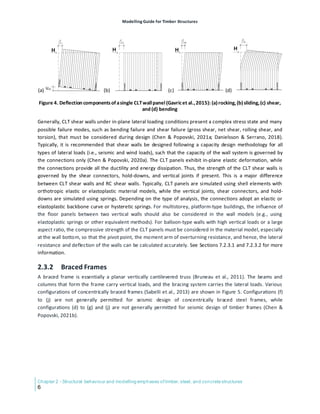
(Chen & Popovski, 2020a; Gavric et al., 2015), the stiffness and lateral load-carrying capacity of CLT shear
walls is governed by (a) the rocking of the panel due to crushing of the timber in compression and stretching
of the hold-down in tension, (b) the slip of the wall relative to the foundation due to the shear flexibility of
the hold-down and shear connectors, (c) the shear deformation of the panel, and (d) the bending
deformation of the panel (Figure 4).
Modelling Guide for Timber Structures
Chapter 2 - Structural behaviour and modelling emphases of timber, steel, and concrete structures
6
(a) (b) (c) (d)
Figure 4. Deflection componentsofasingle CLTwallpanel(Gavricet al.,2015): (a)rocking,(b)sliding,(c) shear,
and (d) bending
Generally, CLT shear walls under in-plane lateral loading conditions present a complex stress state and many
possible failure modes, such as bending failure and shear failure (gross shear, net shear, rolling shear, and
torsion), that must be considered during design (Chen & Popovski, 2021a; Danielsson & Serrano, 2018).
Typically, it is recommended that shear walls be designed following a capacity design methodology for all
types of lateral loads (i.e., seismic and wind loads), such that the capacity of the wall system is governed by
the connections only (Chen & Popovski, 2020a). The CLT panels exhibit in-plane elastic deformation, while
the connections provide all the ductility and energy dissipation. Thus, the strength of the CLT shear walls is
governed by the shear connectors, hold-downs, and vertical joints if present. This is a major difference
between CLT shear walls and RC shear walls. Typically, CLT panels are simulated using shell elements with
orthotropic elastic or elastoplastic material models, while the vertical joints, shear connectors, and hold-
downs are simulated using springs. Depending on the type of analysis, the connections adopt an elastic or
elastoplastic backbone curve or hysteretic springs. For multistorey, platform-type buildings, the influence of
the floor panels between two vertical walls should also be considered in the wall models (e.g., using
elastoplastic springs or other equivalent methods). For balloon-type walls with high vertical loads or a large
aspect ratio, the compressive strength of the CLT panels must be considered in the material model, especially
at the wall bottom, so that the pivot point, the moment arm of overturning resistance, and hence, the lateral
resistance and deflection of the walls can be calculated accurately. See Sections 7.2.3.1 and 7.2.3.2 for more
information.
2.3.2 Braced Frames
A braced frame is essentially a planar vertically cantilevered truss (Bruneau et al., 2011). The beams and
columns that form the frame carry vertical loads, and the bracing system carries the lateral loads. Various
configurations of concentrically braced frames (Sabelli et al., 2013) are shown in Figure 5. Configurations (f)
to (j) are not generally permitted for seismic design of concentrically braced steel frames, while
configurations (d) to (g) and (j) are not generally permitted for seismic design of timber frames (Chen &
Popovski, 2021b).
Modelling Guide for Timber Structures
Structural behaviour and modelling emphases of timber, steel, and concrete structures - Chapter 2
7
(a) (b) (c) (d) (e)
(f) (g) (h) (i) (j)
Figure 5. Concentricallybracedframeconfigurations:(a,b,c) X-braced frames; (d,e)inverted V-bracedand V-
braced frames,also known asinvertedchevron-bracedand chevron-braced frames,respectively;(f,g)K-braced
and double K-braced frames;(h,i)single diagonalbraced frames;and (j)knee-braced frame
Under seismic loads, steel concentrically braced frames are expected to yield and dissipate energy through
post-buckling hysteretic behaviour of the bracing elements in compression followed by yielding of the braces
in tension (Figure 6), potentially with some contribution from the brace connections. The design strategy is to
ensure that plastic deformation occurs only in the braces and their connections, capacity-protecting the
columns and beams to enable the structure to survive strong earthquakes without losing its gravity-load
resistance. Modelling inelastic brace behaviour is complicated by the interactive effects of yielding, overall
element buckling, local buckling, and fracture. Several alternatives exist for modelling this nonlinear buckling
response of braces. A commonly used approach is modelling the brace with fibre beam-column elements,
which capture yielding, overall buckling, and concentration of plastic rotation in the buckled hinge, provided
the number of elements along the length of the brace is adequate. Local buckling and fracture can be
inferred from the plastic rotation and strains in the hinges (Uriz & Mahin, 2008). In an alternative modelling
approach, the brace can be represented by a uniaxial phenomenological spring to capture brace yielding and
overall buckling (Tang & Goel, 1989; Uriz & Mahin, 2008). While this type of element is simple to use, it can
be more challenging to define and is limited by the tests available to calibrate it. In a more fundamental
(though computationally expensive) analysis approach, the brace can be modelled with continuum FEs to
directly simulate yielding, overall buckling, and local buckling (Schachter & Reinhorn, 2007). With appropriate
material formulation, FE models can also simulate fracture initiation (Fell et al., 2010). In all cases, although
the brace and its connections are the primary location of expected inelastic response, the surrounding beams
and columns are also often modelled in a way that can capture some nonlinear behaviour.
Modelling Guide for Timber Structures
Chapter 2 - Structural behaviour and modelling emphases of timber, steel, and concrete structures
8
(a) (b)
Figure 6. Cyclictestingofasteelbrace (Felletal.,2010): (a)experimentalset-up,and (b) measured axial
force-deformation response
Unlike braced steel frames, braced timber frames are expected to yield and dissipate energy primarily
through energy-dissipative connections at the ends of the diagonal braces (Chen & Popovski, 2020b, 2021b).
Therefore, for braced timber frames with energy-dissipative connections, the end connections of diagonal
braces must be specially designed to sustain plastic deformation and dissipate hysteretic energy in a stable
manner through successive cycles. The design strategy is to ensure that plastic deformation occurs only in the
energy-dissipative connections, leaving the columns, braces, and beams undamaged, thus allowing the
structure to survive earthquakes without losing its gravity-load resistance. To model the behaviour of the
diagonal brace assemblies, each including a diagonal brace with two end connections (Figure 7[a]), an
equivalent nonlinear connector (spring) element can be used to simulate the total performance of the whole
diagonal brace assembly (Figure 7[b]). A continuous-column model, in which the columns are modelled using
beam elements continuously from the top to the bottom, should be ensured through design and adopted for
modelling braced timber frames (Chen et al., 2019). This can prevent underestimating the stiffness,
frequency, strength, and ductility of braced frame buildings (Bruneau et al., 2011; MacRae, 2010; MacRae et
al., 2004; Wada et al., 2009), which would occur in a pinned connection model, where the columns are
modelled using truss elements. The horizontal beams can be modelled using truss elements and pinned to
the columns, which are also connected to the ground using pin connections. See Section 7.2.3.3 for more
information.
Modelling Guide for Timber Structures
Structural behaviour and modelling emphases of timber, steel, and concrete structures - Chapter 2
9
(a) (b)
Figure 7. Testingofaglued laminated (glulam)brace with riveted connections(Popovski,2004): (a)experimental
set-up,and (b)measuredaxialforce-deformation
2.3.3 Moment-Resisting Frames
Moment-resisting frames, which can be constructed using timber, steel, and concrete, are rectilinear
assemblages of beams and columns, with the beams rigidly connected to the columns. The lateral load
resistance is provided primarily by rigid frame action—that is, by the development of bending moment and
shear force in the frame elements and joints. By virtue of the rigid beam-column connections, a moment
frame cannot displace laterally without bending the beams or columns. The bending rigidity and strength of
the frame elementsis therefore the primary source of lateral stiffness and strength for the entire frame.
For non-timber systems that use capacity design principles, such as special concrete and steel moment
frames (Hamburger et al., 2016; Moehle & Hooper, 2016), the inelastic deformation should occur primarily in
flexural hinges in the beams and the column bases. In frames that do not meet special moment-frame
requirements, inelastic effects may occur in other locations, including element shear yielding, connection
failure, and element instability due to local or lateral-torsional buckling. Beam-columns are commonly
modelled using either concentrated hinges, fibre-type elements, or layered elements (Guner & Vecchio,
2010a, 2010b, 2011, 2012). Whatever the model type, the analysis should be capable of reproducing (under
cyclic loading) the element cyclic envelope curves that are similar to those from tests or other published
criteria, such as in the Seismic Evaluation and Retrofit of Existing Buildings standard (ASCE, 2017) and
Modelling and Acceptance Criteria for Seismic Design and Analysis of Tall Buildings (Applied Technology
Council, 2010). The inelastic response of flexural beams and columns is often linked to the response of the
connections and the joint panels between them. The inelastic behaviour in the beams, columns, connections,
and panel zone (Figure 8[a]) can be modelled through idealised springs, as shown in Figure 8(b). Alternatively,
it can be modelled through properly defined continuum behaviour (in equivalent fibre/layer models), along
with appropriate consideration of a finite-size panel and how its deformation affects the connected
elements. In steel structures, the yielding regions (i.e., beams, panel zones, and possibly columns and
Modelling Guide for Timber Structures
Chapter 2 - Structural behaviour and modelling emphases of timber, steel, and concrete structures
10
connections) tend to deform independently, except insofar as the strength of one element may limit the
maximum forces in an adjacent element. On the other hand, in concrete frames, the inelastic deformation in
the beams and columns can be coupled with the panel zone behaviour, due to the bond slip of longitudinal
beam and column bars in the joint region. Thus, for concrete frames, the flexural hinge parameters should
consider how the deformation due to bond slip is accounted for—either in the beam and column hinges or in
the joint panel spring. Depending on the specific software implementation, the finite-size joint panel may be
modelled using kinematic constraint equations, equivalent bar-spring assemblies, or approximate rigid end
offsets (ASCE, 2017; Charney & Marshall, 2006).
(a) (b)
Figure 8. Beam-to-columnconnection (Deierlein etal.,2010):(a)hingingregion ofbeamsand columnsand
deformable panelzone,and (b)idealised analysismodel
Timber moment-resisting frames consist of beams and columns that are connected using moment
connections with (Figure 9) or without (Figure 10) inserted steel plates. The fasteners (e.g., bolts) can be
arranged in a circular pattern (Blaß & Schädle, 2011; Branco & Neves, 2011; Negrão et al., 2016). The stiffness
and strength of the connections can be adjusted by varying the radius of the fastener pattern, the number of
fasteners, the thickness of the side and middle timber, the quality of the timber (embedment strength), the
diameter of the fastener, and the quality of the fastener. According to the European yield model (European
Committee for Standardization, 2004), there are three failure modes for the three-element connections:
embedment of the side or middle timber, one plastic hinge in the fastener, or two plastic hinges in the
fastener. Moment connections with the third failure mode should be applied in seismic areas because this
results in the highest energy dissipation. According to Rinaldin et al. (2013), it is known that in a timber
structure, most of the dissipative capacity takes place in the steel fasteners as timber behaves mostly
elastically with only little plasticization in compression, parallel and perpendicular to the grain (for
connections that are not reinforced). Timber connections with slender or semirigid fasteners have a higher
equivalent energy ratio than those with nonslender or rigid fasteners. In slender-fastener timber
connections, the steel fastener must deform plastically before the timber element fails. One of the brittle
failure mechanisms (Van der Put, 1975) that can occur when using the moment connection is splitting of the
timber near the connection.
Modelling Guide for Timber Structures
Structural behaviour and modelling emphases of timber, steel, and concrete structures - Chapter 2
11
(a) (b)
Figure 9. A timber moment-resistingframe (Chui&Ni,1995):(a)elevation,and (b) detailA
Figure 10. A moment-transmittingconnection(Fokkens,2017)
Unlike in steel and concrete moment-resisting frames, there is no deformable panel zone in timber moment-
resisting frames, but the nonlinearity and failure of the moment-resisting connections are concentrated in
the connection area. Typically, linear or nonlinear springs are used to simulate the connections, while elastic
beam elements are used for the beam-columns. For detailed FE models, a specific material model of wood
that can represent the anisotropic behaviour and also predict various failure modes, such as WoodST (Chen et
al., 2020),should be adopted. For more information, refer to Chapter 5 and Section 7.2.3.4.
2.4 SUMMARY
In this chapter, different structural systems using timber, steel, and concrete are compared in terms of
structural behaviour and modelling emphases. The following are some of the most important points of
comparison:
• As construction materials, wood is anisotropic, steel is isotropic, and RC is composite. Depending on
the level of complexity that is required in a structural model, these behaviours may be adequately
approximated through elastic material models in certain cases, whereas more sophisticated models
may include factors such as yielding, brittle failure, and hysteretic behaviour. In this regard, this
chapter presentskey considerationsfor various structural configurations.
• Unlike RC shear walls, CLT panels are typically capacity-designed, and the connections govern the
capacity of the CLT shear walls. CLT panels can be modelled as orthotropic plates, and the
connections must be simulated using specific models to represent their stiffness, strength, plastic
deformation, and even the hysteretic behaviour.
Modelling Guide for Timber Structures
Chapter 2 - Structural behaviour and modelling emphases of timber, steel, and concrete structures
12
• Unlike braced steel frames, braced timber frames yield and dissipate energy primarily through
energy-dissipative connections. The diagonal brace assemblies, each including a diagonal brace and
two end connections, must be modelled with equivalent spring elements that can represent their
stiffness, strength, plastic deformation, and hysteretic behaviour, while other timber elements can
be modelled as elastic truss or beam elements.
• Unlike in moment-resisting frames using steel or concrete, the inelasticity of timber moment-
resisting frames is typically concentrated in the beam-to-column connection area due to the
nonlinear response of the connections. The beams and columns can be simulated using elastic beam
elements, while the connectionsare modelled using linear or nonlinear spring elements.
The comparisons presented in this chapter are intended to help practising engineers become more
acquainted with modelling timber structures. More specific and detailed methods are provided in other
chapters.
2.5 REFERENCES
American Society of Civil Engineers.(2017).Seismicevaluationandretrofitof existingbuildings(ASCE/SEI,41-17).
Applied Technology Council. (2010). Modeling and acceptance criteria for seismic design and analysis of tall
buildings (PEER/ATC-72-1).
American Wood Council. (2018).National design specification for wood construction.
Blaß, H. J., & Schädle, P. (2011). Ductility aspects of reinforced and non-reinforced timber joints. Engineering
Structures, 33(11),3018-3026.https://doi.org/10.1016/j.engstruct.2011.02.001
Branco, J. M., & Neves, L. A. C. (2011). Robustness of timber structures in seismic areas. Engineering
Structures, 33(11),3099-3105.
Bruneau,M., Uang, C.-M., & Sabelli, R. (2011).Ductile design of steel structures (2nd ed.). McGraw-Hill.
Charney, F., & Marshall, J. (2006). A comparison of the Krawinkler and Scissors models for including beam
column joint deformations in the analysis of moment resisting steel frames. Engineering Journal, 43,
31-48.
Chen, Z., Ni, C., Dagenais, C., & Kuan, S. (2020). WoodST: A temperature-dependent plastic-damage
constitutive model used for numerical simulation of wood-based materials and connections. Journal
of Structural Engineering, 146(3),4019225.https://doi.org/10.1061/(ASCE)ST.1943-541X.0002524
Chen, Z., & Popovski, M. (2020a). Mechanics-based analytical models for balloon-type cross-laminated timber
(CLT) shear walls under lateral loads. Engineering Structures, 208, 109916.
https://doi.org/10.1016/j.engstruct.2019.109916
Chen, Z., & Popovski, M. (2020b). Connection and system ductility relationship for braced timber frames.
Journal of Structural Engineering, 146(12), 4020257. https://doi.org/10.1061/(ASCE)ST.1943-
541X.0002839
Chen, Z., & Popovski, M. (2021a). Seismic performance of CLT balloon walls made of Larch in mid-rise and
high-rise construction in Korea – Year 1. FPInnovations.
Chen, Z., & Popovski, M. (2021b). Expanding wood use towards 2025: Performance and draft design
guidelines for braced timber frames under lateral loads. FPInnovations.
Chen, Z., Popovski, M., & Symons, P. (2019). Solutions for upper mid-rise and high-rise mass timber
construction: Seismic performance of braced mass timber frames – Year 1. FPInnovations.
Modelling Guide for Timber Structures
Structural behaviour and modelling emphases of timber, steel, and concrete structures - Chapter 2
13
Chen, Z., Zhu, E., & Pan, J. (2011). Numerical simulation of wood mechanical properties under complex state
of stress. Chinese Journal of Computational Mechanics, 28(4),629-634,640.
Chui, Y. H., & Ni, C. (1995, June 5–7). Dynamic response of timber frames with semi-rigid moment connections
[Conference presentation].Canadian Conference on Earthquake Engineering,Montreal, Canada.
Cortés-Puentes, W. L., & Palermo, D. (2020). Modeling of concrete shear walls retrofitted with SMA tension
braces. Journal of Earthquake Engineering, 24(4), 555-578.
https://doi.org/10.1080/13632469.2018.1452804
CSA Group.(2019).Engineering design in wood (CSA O86:19).
Danielsson, H., & Serrano, E. (2018). Cross laminated timber at in-plane beam loading – Prediction of shear
stresses in crossing areas. Engineering Structures, 171, 921-927.
https://doi.org/10.1016/j.engstruct.2018.03.018
Deierlein, G. G., Reinhorn, A. M., & Willford, M. R. (2010). NEHRP Seismic Design Technical Brief No. 4 –
Nonlinear structural analysis for seismic design: A guide for practicing engineers (NIST GCR 10-917-5).
National Institute of Standards and Technology.
European Committee for Standardization. (2004). Eurocode 5: Design of timber structures - Part 1-1: General -
Common rules and rules for buildings (EN 1995-1-1:2004).
Fell, B., Kanvinde, A. M., & Deierlein, G. G. (2010). Large-scale testing and simulation of earthquake induced
ultra low cycle fatigue in bracing members subjected to cyclic inelastic buckling (Technical Report No.
172).http://purl.stanford.edu/ry357sg5506
Fokkens, T. J. H. (2017). Behaviour timber moment connections with dowel-type fasteners reinforced with self-
tapping screws in seismic areas (Document No. A-2017.188). [Master’s thesis, Eindhoven University
of Technology].
Forest Products Laboratory. (2010). Wood handbook: Wood as an engineering material (General Technical
ReportFPL-GTR-190). U.S. Department of Agriculture.
Gavric, I., Fragiacomo, M., & Ceccotti, A. (2015). Cyclic behavior of CLT wall systems: Experimental tests and
analytical prediction models. Journal of Structural Engineering, 141(11), 4015034.
https://doi.org/10.1061/(ASCE)ST.1943-541X.0001246
Guner, S., & Vecchio, F. J. (2010a). Pushover analysis of shear-critical frames: Formulation. ACI Structural
Journal, 107(1),63-71.https://doi.org/10.14359/51663389
Guner, S., & Vecchio, F. J. (2010b). Pushover analysis of shear-critical frames: Verification and application. ACI
Structural Journal, 107(1),72-81.https://doi.org/10.14359/51663390
Guner, S., & Vecchio, F. J. (2011). Analysis of shear-critical reinforced concrete plane frame elements under
cyclic Loading. Journal of Structural Engineering, 137(8), 834-843.
https://doi.org/10.1061/(ASCE)ST.1943-541X.0000346
Guner, S., & Vecchio, F. J. (2012). Simplified method for nonlinear dynamic analysis of shear-critical frames.
ACI Structural Journal, 109(5),727-738.https://doi.org/10.14359/51684050
Hamburger, R. O., Krawinkler, H., Malley, J. O., & Adan, S. M. (2016). NEHRP Seismic Design Technical Brief
No. 2 – Seismic design of steel special moment frames: A guide for practicing engineers (NIST GCR 16-
917-41) (2nd ed.). National Institute of Standards and Technology.
https://doi.org/10.6028/NIST.GCR.16-917-41
Hirai, T. (2005). Anisotropy of wood and wood-based materials and rational structural design of timber
constructions. Proceedings of Design & Systems Conference, 15, 19-22.
https://doi.org/10.1299/jsmedsd.2005.15.19
Modelling Guide for Timber Structures
Chapter 2 - Structural behaviour and modelling emphases of timber, steel, and concrete structures
14
Karacabeyli,E., & Gagnon, S. (Eds.). (2019).Canadian CLTHandbook (2nd ed.) FPInnovations.
MacRae, G. A. (2010, March 3–5). The development and use of the continuous column concept [Conference
presentation]. Joint Proceeding of the 7th International Conference on Urban Earthquake
Engineeringand the 5th International Conference on Earthquake Engineering, Tokyo, Japan.
MacRae, G. A., Kimura, Y., & Roeder, C. (2004). Effect of column stiffness on braced frame seismic behavior.
Journal of Structural Engineering, 130(3), 381-391. https://doi.org/10.1061/(ASCE)0733-
9445(2004)130:3(381)
Maekawa, K., Vecchio, F., & Foster, S. (2008). Practitioners' guide to finite element modelling of reinforced
concrete structures (Bulletin No. 45).FIB International.
Moehle, J. P., & Hooper, J. D. (2016). NEHRP Seismic Design Technical Brief No. 1 – Seismic design of reinforced
concrete special moment frames: A guide for practicing engineers (NIST GCR 16-917-40) (2nd ed.).
National Institute of Standardsand Technology.https://doi.org/10.6028/NIST.GCR.16-917-40
Mokdad, F., & Missoum, S. (2013, August 4–7). A fully parameterized finite element model of a grand piano
soundboard for sensitivity analysis of the dynamic behavior [Conference presentation]. ASME 2013
International Design Engineering Technical Conferences and Computers and Information in
EngineeringConference,Portland,USA.
Negrão, J. H., Brito, L. D., Dias, A. G., Júnior, C. C., & Lahr, F. R. (2016). Numerical and experimental study of
small-scale moment-resistant reinforced concrete joints for timber frames. Construction and Building
Materials, 118,89-103.
Palermo, D., & Vecchio, F. J. (2007). Simulation of cyclically loaded concrete structures based on the finite-
element method. Journal of Structural Engineering, 133(5), 728-738.
https://doi.org/10.1061/(ASCE)0733-9445(2007)133:5(728)
Popovski, M. (2004).Structural systems with riveted connections for non-residential buildings.FPInnovations.
Reale, V., Kaminski, S., Lawrence, A., Grant, D., Fragiacomo, M., Follesa, M., & Casagrande, D. (2020). A
review of the state-of-the-art international guidelines for seismic design of timber structures
[Conference presentation].World Conference on Earthquake Engineering,Sendai, Japan.
Rinaldin, G., Amadio, C., & Fragiacomo, M. (2013). A component approach for the hysteretic behaviour of
connections in cross-laminated wooden structures. Earthquake Engineering & Structural Dynamics,
42(13),2023-2042.https://doi.org/10.1002/eqe.2310
Sabelli, R., Roeder, C. W., & Hajjar, J. F. (2013). NEHRP Seismic Design Technical Brief No. 8 – Seismic design of
steel special concentrically braced frame systems: A guide for practicing engineers (NIST GCR 13-917-
24). National Institute of Standards and Technology.
Sandhaas, C., Van de Kuilen, J.-W., & Blass, H. J. (2012, July 15–19). Constitutive model for wood based on
continuum damage mechanics [Conference presentation]. World Conference on Timber Engineering,
Auckland,New Zealand. http://resolver.tudelft.nl/uuid:55c1c5e5-9902-43ad-a724-62bb063c3c80
Schachter, M., & Reinhorn, A. M. (2007). Three-dimensional modeling of inelastic buckling in frame structures
(Technical ReportMCEER-07-0016). Multidisciplinary Center for Earthquake EngineeringResearch.
Tang, T. O., & Su, R. K. L. (2014). Shear and flexural stiffnesses of reinforced concrete shear walls subjected to
cyclic loading. The Open Construction and Building Technology Journal, 8, 104-121.
Tang, X., & Goel, S. C. (1989). Brace fractures and analysis of phase I structure. Journal of Structural
Engineering, 115(8),1960-1976.https://doi.org/10.1061/(ASCE)0733-9445(1989)115:8(1960)
Uriz, P., & Mahin, S. (2008). Towards earthquake-resistant design of concentrically braced steel-frame
structures. Pacific Earthquake EngineeringResearch Center.
Modelling Guide for Timber Structures
Structural behaviour and modelling emphases of timber, steel, and concrete structures - Chapter 2
15
Van der Put, T. V. d. (1975). Proeven op stiftverbindingen hout op hout en staal op hout horizontaal
gelamineerd houten in constructiehout.
Wada, A., Qu, Z., Ito, H., Motoyui, S., Sakata, H., & Kasai, K. (2009). Seismic retrofit using rocking walls and
steel dampers. In B. Goodno (Ed.), Improving the seismic performance of existing buildings and other
structures (pp. 1010-1021). American Society of Civil Engineers.
https://doi.org/10.1061/41084(364)92
CHAPTER 3
Modelling principles, methods, and techniques
Authors
Zhiyong Chen
Vincenzo Reale
SebastianKaminski
Lucas Epp
Marinos Stylianou
Reviewers
Conroy Lum
Scott Nyseth
Nicolas Cantin
Kai Yang
Vasco Chan
Image courtesy of Kai Yang, CadMakers
Modelling Guide for Timber Structures
Chapter 3 - Modelling principles, methods, and techniques
ii
TABLE OF CONTENTS
3.1 INTRODUCTION........................................................................................................................................................1
3.2 PRINCIPLES................................................................................................................................................................1
3.2.1 Modelling Process..................................................................................................................................1
3.2.2 Model Development.............................................................................................................................2
3.2.2.1 Understanding the Structure and Planning the Modelling Process................................2
3.2.2.2 Software Selection..................................................................................................................6
3.2.2.3 Principles of Model Development........................................................................................7
3.2.3 Model Validation and Result Verification ........................................................................................13
3.2.3.1 Model Validation...................................................................................................................13
3.2.3.2 Result Verification.................................................................................................................14
3.2.3.3 Sensitivity Check....................................................................................................................15
3.2.4 Model Interpretation ..........................................................................................................................16
3.2.5 Competence of Modellers..................................................................................................................17
3.3 METHODS................................................................................................................................................................17
3.3.1 Mechanics-based Modelling..............................................................................................................17
3.3.2 FE Modelling.........................................................................................................................................18
3.3.3 Hybrid Simulation ................................................................................................................................20
3.3.4 Material-based Modelling..................................................................................................................22
3.4 TECHNIQUES ...........................................................................................................................................................24
3.4.1 SFEM......................................................................................................................................................24
3.4.2 Computational Structural Design and Optimisation ......................................................................27
3.4.2.1 Introduction to Computational Design ..............................................................................27
3.4.2.2 Parametric Analysis...............................................................................................................31
3.4.2.3 Structural Optimisation........................................................................................................37
3.4.3 BIM.........................................................................................................................................................41
3.4.3.1 Introduction to BIM..............................................................................................................41
3.4.3.2 Beyond BIM: A Perspective – Digital Twin and DfMA .....................................................47
3.5 SUMMARY...............................................................................................................................................................51
3.6 ACKNOWLEDGEMENTS .........................................................................................................................................52
3.7 REFERENCES............................................................................................................................................................52
Modelling Guide for Timber Structures
Modelling principles, methods, and techniques - Chapter 3
1
3.1 INTRODUCTION
Structural analysis models are precise but inherently inaccurate. The very word model makes this clear: as
engineers, we create these models to approximate reality. While analysis models cannot reflect reality
perfectly, creating models (by hand or computer) that are sufficiently accurate to reflect our best
understanding of the materials with which we build, and the loads to which they are subjected, is
fundamental to the art of structural engineering. This statement may sound surprising, but as structural
engineers, we are employed to model structures we do not fully understand, with techniques that have not
yet been perfected.
The emphasis of early structural modelling was on how to achieve the mathematical solution, and the model
development process was a minor issue (MacLeod, 2010). Currently, access to software packages capable of
carrying out complex analysis is ubiquitous. However, developing appropriate models, using the tools
available properly, and understanding the results and the limits of the analyses carried out by software have
all become essential skills for structural engineers. Modelling techniques, assumptions, and analysis
algorithms for steel and concrete structures are well established. Steel and concrete structures have the
ability to mobilise different load paths due to the ability of steel rebar and shapes to yield and redistribute
stresses to different parts of the structure. This tends to make modelling of steel and concrete structures
more forgiving of small modelling mistakes. However, this is less true for timber structures, in which an
intrinsically brittle and anisotropic material is used and where connections with discreet elements and
complex local interactionsplay a very important role in the stability of the structure.
This chapter introduces principles that underpin the modelling of timber structures, available methods, and
techniquesthat are suitable to properly set up analyses for timber structures.
3.2 PRINCIPLES
To obtain the best possible analysis results, it is important that engineers follow a formal modelling process
that is based on sound engineeringand finite element (FE) analysis principlessuch as the onesthat follow.
3.2.1 Modelling Process
To reduce risk in structural analysis, a formal modelling process based on sound engineering and FE analysis
principles should always be adopted. What is meant by formal is that a written record of the process
activities should be produced. A formal modelling process is one that has been thought through before sitting
in front of a computer to model a structure. It is one that is maintained and updated with lessons learned by
engineers with years of practising structural analysis and design. Such a process can minimise some of the
risks inherent in building a model for structural analysis and design, and avoid omission of important
activities and aspects.
As for other types of structures, the process of modelling a timber structure depends on multiple factors,
including:
• Project stage (e.g., conceptual, preliminary, schematic, detail; these stages are generally defined in
detail by appropriate national or international standards or regulatory bodies);
Modelling Guide for Timber Structures
Chapter 3 - Modelling principles, methods, and techniques
2
• Projectlocation (e.g., projectsin a seismic area will require additional checks);
• Project use (depending on the scale and function of the structure, specific analysis tasks will be
required; e.g.,robustnessanalysis, fire safety analysis, vibration analysis); and
• Constraints (which, for example, can be included in the project’s brief or may emerge from
discussion with the clientor any other disciplinesinvolved in the design).
Making the process formal provides evidence of the use of good practices. A typical modelling process
includesthe following key elements:
• Understanding the structure and planning the modellingprocess;
• Selectingthe software;
• Developingthe analysis model;
• Verifying the results;
• Performinga sensitivity analysis; and
• Decidingon the accepted model and results.
It is important to understand that the process, although presented here linearly, may involve a significant
amount of looping, as during the process, the assumptions and project specifications may change in light of
the resultsfrom the analyses.
During structure design, a general calculation plan should always be laid out first, and the specific analyses to
be carried out, the tools required, and the formal review process should all be preliminarily defined and
agreed on. As always, the specificsof a projectmay greatly influence the choicesof a designer.
3.2.2 ModelDevelopment
3.2.2.1 Understanding the Structure and Planning the Modelling Process
Certain preliminary steps should be carried out when modelling a structural design, the first of which are
correctly understandingthe design brief and carefully planning the overall modelling process.
Multiple factors influence the design of a structural timber project.Among them are:
• Availability of material. Sourcing timber and timber composites may not be as simple as for other
traditionally used materials. For example, the lack of availability of a specific type of timber
composite, such as cross-laminated timber (CLT), and the high cost of importing it to a specific
country may mean that the project will have to be developed without that material, focusing on
others, such as a light wood-frame structure made of solid timber elements.
• Climate and exposure. Because timber is a natural material, it is susceptible to rot and insect attack.
Depending on the project location, the use of timber in a building may require specific measures,
such as protection from rain or separation from the ground, which would inevitably influence the
choicesfor the projectand the final structure that is developed.
Modelling Guide for Timber Structures
Modelling principles, methods, and techniques - Chapter 3
3
• Level of craftsmanship of site contractors. Timber is a material that can be easily formed using
traditional methods, but it can also be engineered and formed to high degrees of accuracy using
computer numerical control (CNC) machines. Depending on the project location, budget, and
experience of the local contractors, some details may not be economically achievable. The
limitations due to manufacturing techniques and local contractors should then be considered early
on in the project: just because one type of connection can be modelled and designed, it does not
mean that it will be possible to fabricate it satisfactorily.
Once the process has been determined, designers should define the structural options that are feasible
within the project’s constraints. The outcome of this phase is generally choosing one or more systems that
can be successively modelled and analysed. The choice of one system over another will have implications on
the overall modelling, as different systems have different behaviours that may require a different analysis
approach. Some of the most common timber systems include:
• Light wood-frame buildings
• Mass timber buildings (CLT, mass plywood panels, nail-laminated timber, etc.)
• Braced timber buildings
• Moment-framed timber buildings
Different options would also behave differently in different contexts. For example, in highly seismic areas,
where a certain degree of ductility is required of a structure, some options will not be acceptable by national
and international codes, or would be greatly penalised in terms of structural capacity. Designers should be
aware of the possible modelling implications of each option and evaluate the one that is most suitable for the
design’s brief.
Other considerations include the required performance of the building and the required accuracy of the
results. Other such considerations depend on the context and, especially, the degree of risk involved, both
with respectto the consequencesof failure and to the degree of innovation involved.
Once the options have been defined for each structural system considered, an analysis should be carried out
to understand how the loads (vertical and horizontal) are applied to the structure, distributed within the
structure, and transferred to the foundations. This modelling step is usually referred to as load path analysis.
Understanding the correct path of the structure will inform every further modelling assumption; it is
therefore critical that this process is thoroughly carried out and reviewed. The load path analysis should start
from the point of application of the loads (e.g., external surfaces for wind, as shown in Figure 1, or centre of
mass for seismic forces) and follow the transfer of these forces from one element to another. As always in
timber buildings, the analysis of the transfer of the forces from one member to another through connections
is vital to understanding the behaviour and capacity of a building. It is usually advised that these connections
be sketched or drawn to scale, even at preliminary stages, as the geometry of the different members and
their connectors, with their 3D properties and eccentricities (Figure 2), will influence the forces and moments
each element is subjected to.
Modelling Guide for Timber Structures
Chapter 3 - Modelling principles, methods, and techniques
4
(a) (b)
(c) (d)
(e) (f)
Figure 1. Example ofthewind load path for aCLTbuilding: (a)wind load isapplied to the facade; (b)the load is
distributedfromthe facade bytributaryareasto thediaphragms; (c)the rigid diaphragmsdistributetheloadsto
the verticalresistingsystem(walls)based on their relativestiffnesswherealleccentricitiesoftheloadsor the
resistingsystemare resolved; (d)each walltransfersthehorizontaland verticalloadsfrom thediaphragmsto
the floor below throughshear and force couple; (e)the wallstransferthe loadsto thefloor below together with
the tributaryloadsfrom thefacade associated with thefloor;and (f)the loadsfinallycontinue to be transferred
to the levelsbelow untiltheyreach thefoundation level,wheretheyare ultimatelytransferred to theground
Modelling Guide for Timber Structures
Modelling principles, methods, and techniques - Chapter 3
5
(a) (b)
(c) (d)
(e)
Figure 2.Exampleofthe load path intoatimberconnection and influenceofeccentricities: (a)thecornerrafter
of atimber roofisin net tensionundersomeload combinations; (b)thetension load fromtherafter is
transferred through steelconnectorsto asteelplate,wheretheeccentricitybetweenthecentreline oftherafter
and that ofthe plate generateamoment that hasto be taken in push-pullbythe screwsofthe plate; (c)the
verticalcomponentofthe forceapplied to the plateisresisted byatie offset dueto thewallbelow,which
generatesafurthermomentthat isresisted in push-pullbythe screwsofthe plate; (d)thehorizontal
component oftheforce appliedto theplate isresisted bytheside plates; and (e)thein-plane forceofthe side
platesisresisted bythe screwsfixed intotheside timberbeamswheretheeccentricityofthe resistingforces
generatesamoment thathasto be taken in push-pullbythescrewsofthe plate
Modelling Guide for Timber Structures
Chapter 3 - Modelling principles, methods, and techniques
6
Based on the load path, along with simple calculations and rules of thumb, the structural elements of the
structure can be assigned a preliminary size. In timber structure design, it is always important to carry out the
preliminary sizing of the structural elements together with the preliminary design of their connections, which
may generally govern and inform the overall required dimensions of the different members. After this step,
the structural designer can not only communicate and discuss material quantities and geometric constraints
with the other parties involved, but will also have a starting model capturing the overall weight distribution,
stiffness, and mass of the building, which will be the base for further and more refined structural checks.
Once the designer has achieved a general understanding of the building behaviour and has sized all the main
elements, more sophisticated or specialistic analysis can be carried out. Taking care to follow best practices
and recommendations, the designer should consider whether a specific part of the building or the overall
structure requires digital modelling. Before starting to develop these models, the designer should be clear on
the model’s assumptions, limits, and expected outputs. Examples of such models could include a general
model of the structure to carry out a spectrum analysis or a simple isolated model of a floor plate and its
supports to run a footfall analysis and understand vibration performance.
It is worth stressing again that when digital models are required, the parameters informing them may change
depending on the objectives each try to fulfil. For example, connections may be modelled differently if the
analysis deals with vibration versus long-term loads. In fact, while in the former the connection between a
floor plate and its supporting structure can be considered fully fixed, in the latter it should be modelled as
pinned. This is because for the purposes of the limited displacements accounted for in a serviceability state
vibration check, the connections do not experience the significant movements and rotations to be accounted
for under longer-termand higher ultimate state loading.
Moreover, because of the many uncertainties in modelling timber buildings (due to the aforementioned
specifics of the material and construction technology), the model developed may require several runs with
different properties (e.g., connection stiffness) for different elements within the system. These sensitivity
analyses are required to capture the possible bounds of behaviour that a loaded structure can exhibit.
3.2.2.2 Software Selection
During this stage, should general or specific digital analyses be required, the designer must choose software
that is suitable for the different tasks. Numerous commercial software packages are available that can help
engineers develop linear and nonlinear FE numerical models of buildings (Chen et al., 2017). Examples
include Abaqus, ADINA, Ansys, DRAIN-3DX, Dlubal, ETABS, midas Gen, NONLIN, NONLIN-Pro, OpenSees,
P-FRAME, PERFORM-3D, RAM, RISA, S-FRAME, S-TIMBER, SAFI, SAP2000, SeismoStruct, SOFiSTiK,
ST STRUDEL, STAAD, and many others. The key to choosing a suitable analysis program in design practice or
research is to look for the characteristics of the specific engineering problems related to the structure to be
modelled, and whether the program can provide a suitable model to replicate the structure and its
performance accordingto its use.
All software packages used in design practice and research can be divided into two main categories: general-
purpose programs and design-oriented programs. General-purpose programs such as Abaqus and Ansys are
suitable for more advanced analyses. For special engineering problems, such as seismic, blast, and fire,
general-purpose programs are the right option as they have extensive material modes, elements, and
Modelling Guide for Timber Structures
Modelling principles, methods, and techniques - Chapter 3
7
different solvers (e.g., explicit or implicit solvers). With Abaqus, many researchers have developed user
subroutines that can model the unique structural behaviour of wood-based components, connections,
assemblies, and even entire building structures, which are unavailable in most software packages. This has
resulted in many consultant companies using this type of software in their design practice in recent years. For
a conventional structural analysis, design-oriented software packages such as SAP2000, ETABS, S-FRAME, and
Dlubal are the best options. However, they usually have limited capacity to model certain types of structures
and have limited types of FEs compared to general-purpose programs. Their advantage is their capacity to
more easily model structures commonly found in the architecture, engineering, and construction industry
and to carry out design checks based on any codes and standards that have been preprogrammed. They can
therefore quickly post-process the analysis results and design the structure according to codes of practice.
Currently, more and more structural design programs have preliminary added wood modules, such as Dlubal,
S-FRAME, SAFI, and RISA, and some have been specifically developed for modelling, analysis, and design of
wood structures, such as S-TIMBER. These software programs provide a more user-friendly function for
practising engineersto design timber structures.
3.2.2.3 Principles of Model Development
A useful strategy in the early part of modelling is to draw up an issue or feature list to help in making
decisions about the model. The features are the factors that may need to be considered in relation to the
model, in terms of material behaviour, loading, boundary conditions, etc. The next step is to develop a
computational model incorporating the means of achieving a solution, such as the type of FE scheme to be
used and the degree of mesh refinement. In some cases where new structures are to be analysed, it may be
best not to develop just one model but to investigate a few options, evaluate them, and choose the one to be
used. The general rules for structural model development of timber structures are listed below. Specific
principlesand considerationsfor timber structuresare indicated by [√].
• Start with a simple model and refine it step by step. If you decide to move into an area of analysis
that is unfamiliar, build experience by starting with simple (smaller) elastic models and load cases for
which solutions are known, if practical. If using nonlinear analysis, start with an elastic model, then
move into separate nonlinear material and nonlinear geometry models, and then combine them. At
each stage, reviewthe resultsto assess whether they are acceptable.
• Keep the model at a level as simple as practical. More precise and complicated modelling should
focus on key structural components and connections, while simplifications can be made on parts of
the structure that are of secondary importance.
• Ensure that the modelis sufficiently detailed and realistic, but not overly complicated.
• Select a suitable type of model (1D, 2D versus 3D) based on the analysis problem and the
characteristicsof the structure.
• Use symmetry to reduce computation/analysis resource demand. If a structure has an axis of
symmetry, then the order of solution can be reduced. While the need to reduce the size of models is
now less important due to the high level of computing power available, there may be circumstances
in which the use of a symmetric model is disadvantageous, such as in frequency analysis (any
unsymmetric modes that actually exist in the full model cannot be represented). For mirror
symmetry to be satisfied, all geometric and material properties and all loading must be the same at
Modelling Guide for Timber Structures
Chapter 3 - Modelling principles, methods, and techniques
8
corresponding points on either side of the axis of symmetry. The cross-sectional properties of the
member on the axis of symmetry of the symmetrical (antisymmetric ally) equivalent model are half
of those for the complete frame.
• [√] Remember that the structural and material behaviour of timber structures is different from
that of other types of structures, such as steel or concrete, and the modelling is correspondingly
different. See Chapter 2 for more information.
• Choose appropriate elements for the structural components. Usually, there are many types of
elements to choose from. The choice is often obvious, but consider the following guidelines and pick
the onesmost suitable based on the conventional rulesand the output requirements.
o Line elements(these are for memberswith length-to-width ratios that are sufficiently high):
 Bar/truss elements: Straight, with only one axial degree of freedom at each end. Such
elementsare typically used to model pin-connected struts.
 Beam elements: Include (a) a plane frame (2D beam) element incorporating a single plane of
bending plus axial effects with three degrees of freedom per node; (b) a grillage element
incorporating a single plane of bending and torsional effects; and (c) 3D beam element
incorporating bending in two planes, axial and torsional actions, with six degrees of freedom
at each node. In all cases, the bending component may include shear deformation (thick
beam) or neglectshear deformation (thin beam).
o Surface elements:
 Plane stress (membrane) elements: No stress and no restraint to movement in the out-of-
plane direction.
 Plane strain elements: No strain, but there is stress in the out-of-plane direction.
 Plane bending elements (basic components of traditional flat shell elements): To model flat
plates that are subjected only to out-of-plane bending actions. The boundary between thin
and thick plate bending theories is a span-to-depth ratio of 10:1. A small deflection
assumption is validated when the maximum deflection is less than the plate depth for thin
plates.
 Shell elements: To model curved surfaces and flat plates for which in-plane and out-of-plane
actions need to be factored in. Shell elements tend to have six degrees of freedom at each
node, taking into account in-plane (membrane) and out-of-plane (bending) actions. They can
be flat or curved.
o Volume elements (3D elements, or brick elements): Tend to be used more in advanced structural
analysis and mass structuresof nonlinear and elastic soils.
• Conduct convergence analysis to assess the meshing strategies for FE models. Convergence for
mesh refinement implies that as mesh density is increased, the results will converge towards the
exact solutions. The rate of convergence depends on the type of element, the number of elements in
the mesh, and the loading type. Meshing principlesare listed below.
o FE meshing is more of an art than a science. The more we experiment with it, the better we
become.
Modelling Guide for Timber Structures
Modelling principles, methods, and techniques - Chapter 3
9
o Mesh density: A basic principle is to choose a mesh density at which the convergence curve
starts to flatten off. The challenge,of course,is that there is rarely a convergence curve.
o Quadrilateral versus triangular: Quadrilateral elements are more accurate and should always be
preferred over triangular ones. Modern meshing algorithms primarily use quadrilateral elements
and triangular ones only when absolutely necessary due to geometric constraints.
o Element shape: The ideal shape for a quadrilateral element is a square and for a triangular
element an equilateral triangle. As the shapes of these elements deviate from the ideal shapes,
so does their accuracy. Many structural analysis programs issue a warning when the element
shape is distorted to the point where its accuracy is questionable. An accurate mesh usually
looks good to the eye. If a mesh looks ugly to you, you should probably replace it with another
mesh. Automatic meshing is available in many structural analysis programs and should be used
to improve the quality of meshes.
o Curved boundaries: Typically, a larger number of elements is needed to accurately represent a
curved boundary (circular, elliptic, etc.) than a straight boundary. As a rule of thumb, some
element boundaries can be curved. Accuracy for these elements decreases as the sides’ offset
from straight increases.
o Stress gradients: A good strategy is to have a finer mesh in areas of a high stress gradient and a
coarser mesh where the stress gradient is low. However, for models with a large number of
elements it may be best to investigate stress concentrations in separate detailed models (e.g.,
using sub-modelling to study the detailed stress distribution in the area of an important
connection).
• [√] Choose appropriate material models for structural components. In structural analysis the
constitutive relationships tend to have the following two assumptions: (1) a definition of material
behaviour (e.g., linear elastic behaviour or plasticity); and (2) assumptions with regard to the stress
distribution within the differential element types. For example, for the plane stress condition,
stresses are defined in a plane with zero stress at right angles to the plane; for bending elements
(such as beams and shells), the stresses are assumed to vary linearly within the depth of the
element. Wood is an anisotropic material with a different stress-strain response in different
directions or under different loading conditions in the same directions (Chen et al., 2011, 2020). Such
complex response induces various types of failure modes in the wood components and connections.
Therefore, the material constitutive model should be chosen to meet the model requirements.
Correct material models can help predict specific yield and failure modes of wood components and
connections.See Chapter 4 for more information.
• [√] Choose appropriate elements for connections. Select pinned, rigid, or semirigid types according
to the structure you are investigating. Joint elements, which are used for modelling plastic hinges
and semirigid connections, normally consist of a set of springs that connect two nodes or two
freedoms (e.g., linear elastic spring and elastoplastic spring). The depths of beams or columns and
eccentricities need to be modelled properly. For timber structures, the connections typically play a
key role in the structural response (e.g., deformation and resistance). Therefore, it is crucial to model
the timber connections using an appropriate method (Chen & Chui, 2017; Chen et al., 2013; Reale et
al., 2020). For capacity-based design timber structures, the timber components can be simulated as
elastic material, while the energy-dissipative connections should be simulated with elastoplastic
Modelling Guide for Timber Structures
Chapter 3 - Modelling principles, methods, and techniques
10
behaviour. Also note that timber connections have high variability in stiffness and strength (Jockwer
& Jorissen, 2018).See Chapter 5 for more information.
One very important part of the detailed analyses is the design of connections. As it is extremely
complex to model the anisotropy of timber given the imperfections of the material, these analyses
should involve careful calculation that factors in all of the different failure modes (e.g., splitting and
block shearing) as defined and codified by the most up-to-date standards and guidance, such as
Eurocode 5 (European Committee for Standardization, 2004).
• [√] Choose appropriate force-deformation models for assemblies if macroelements are used.
Timber assemblies, such as shear walls, respond differently from steel and concrete assemblies (e.g.,
pinching effect); the force-deformation models should be chosen to meet the model requirements.
See Chapters 6 and 7 for more information.
• Adopt appropriate model input. The required model input varies according to the modelling
situation: (a) analysis objectives: design values are needed for practising design while test results are
preferred for research; and (b) analysis types: less input for elastic or static analyses and more for
nonlinear or dynamic analyses. The necessary parameters for the models and how they can be
derived are discussed in Chapters4 to 10.
• Choose appropriate types of constraints on the structural components and assemblies. Constraints
are conditions imposed on the deformation of a structure—effectively a compatibility condition.
Constraints can be incorporated into the model using constraint equations, a rigid link, and a beam
element.
• Choose appropriate types of loads applied to the structural components and assemblies. A point
load usually induces a stress concentration issue. Such an issue, however, can be avoided by applying
the load on a certain area. Judge whether the effect of finite widths of members at the connections
can be neglected.
• Choose appropriate types of support applied to the structural components and assemblies. An
analysis model of a structure must be defined in relation to a frame of reference. It must be fixed in
space; it must be supported. A reaction force corresponds to each restrained freedom of the
structure. These reaction forces must at least form a set that is statically determinate. Conventional
restraints include a horizontal roller, pin, fixed restraint, vertical roller (nonrotation, at axis of
symmetry), and translational and rotational springs. Neglecting fixity where there is a degree of
restraint tends to be conservative for estimates of deformation and internal forces. The assumption
that a column is fully restrained at its base may result in an overestimate of stiffness and an
underestimate of the maximum frame moments. Issues to be considered when validating a fixed
column support include (a) whether the stiffness of the frame is a critical issue; and (b) the detailing
at the support (i.e., is the foundation sufficiently massive that the rotational stiffness at the support
will be negligible?).
Modelling Guide for Timber Structures
Modelling principles, methods, and techniques - Chapter 3
11
• Choose an appropriate type of foundation model for the structure. In this context the structure
includes the superstructure and the foundation, and the ground that is below the foundation,
including soil and rock. The model of a structure is more likely to be realistic if the deformation of a
rock support is included than if the effect of a soil support is neglected. Four basic ways of defining
the supports for a structure (Figure 3) are:
o Support fixity model: Deformations of the ground are ignored and the nodes for the structure at
the contact with the ground are given fixed restraints.
o Winkler model: The ground is modelled by linear elastic springs at the structure-soil interface.
The springs are not coupled (i.e., when one spring deforms, the other springs are unaffected by
shear transfer in the ground).
o Half-space model: The ground is modelled by coupled springs at the structure-soil interface
(i.e., shear transfer in the ground is factored in).
o Element model for the ground: The ground is modelled using FEs that have fixities adequately far
away from the superstructure.
(a) (b) (c) (d)
Figure 3. Modelsfor structuresupport(MacLeod,2010): (a)supportfixitymodel,(b)Winkler spring
model,(c)half-space model,and (d)element modelofground
Soil tends to be nonhomogeneous, with mechanical properties that may be time-dependent,
functions of water content, and nonlinear in relation to stress and strain. Addressing these features
requires advanced analysis that is outside the scope of this guide. Taking account of the structure
and the ground in a single analysis is known as soil-structure interaction. This is very difficult to
model accurately. While ‘garbage in, garbage out’ needs to be avoided, using approximate models
(such as the Winkler model) is better than completely ignoring the impact foundations can have on
the behaviour of a superstructure.See Chapters7 to 10 for more information.
• [√] Develop appropriate load paths in the structure. Ensure that proper load paths have been
designed into the structure and that the models can reflect the corresponding load paths (Reale et
al., 2020). Understanding how vertical and lateral load is distributed in a structure is an essential
feature in modelling. It depends on the continuity (simply-supported versus continuous) and stiffness
(flexible versus rigid) of the member directly resisting the loads, and the stiffness (flexible versus
rigid) of the members supporting the former. The load paths are especially important for structures
with load-resisting elements/assemblies with significant stiffness (e.g., hybrid timber structures). See
Chapters 8 to 10 for more information.
Modelling Guide for Timber Structures
Chapter 3 - Modelling principles, methods, and techniques
12
• Consider nonstructural elements and non–lateral load-resisting elements according to engineering
judgment. Also carefully consider the actual stiffness and strength of all possible lateral load-
resisting structures in all directions. Secondary, facade, or nonstructural walls or structures may all
carry significant loads, and beams may provide unintended coupling action between shear walls. See
Chapters 7 to 10 for more information.
• Consider nonlinear geometry in the models, if necessary. When a structure is loaded, the geometry
changes. The change in geometry causes the relationship between loads and displacements to be
nonlinear,and hence this is described as geometric nonlinearity.
Criterion for neglecting nonlinear geometry effects: The critical load ratio (λ), the ratio between the
axial load and the elastic critical load, is the main parameter for assessing the potential effects of
nonlinear geometry. If λ is less than 0.1, then the nonlinear geometry effects can be ignored;
otherwise, they should be accounted for in the models. Apart from the level of the applied load, the
main factor affecting the nonlinear geometry effect is the stiffness of the structure. This depends on
several parameters, including the material properties, such as Young’s and shear moduli, connection
types, support conditions, restraints, and cross-sectional properties. During the sizing of members,
the minimum slender ratio should be considered as specified in the design standards. In some cases,
elastic limits may be exceeded before a critical condition is reached, and nonlinear material
behaviour must be factored in. See Chapters8 to 10 for more information.
• Consider appropriate loading conditions in the models. The term loading can imply the general
concept of external action on the structure. In this context it implies dead load, live load, snow loads,
wind loads, and seismic loads. In bridge design in particular, it is important to manipulate loads
whose position on the structure is not fixed (e.g., moving loads). The influence line is the main
technique used to identify critical positions of moving loads. The best pattern of loading must be
considered for bridges,floors, and roofs. See Chapters6 and 8 to 10 for more information.
• [√] Consider both local and resultant stresses in modelling of timber structures, if necessary. For
example, for a simply-supported beam under two-point loading, the horizontal direct stress
(i.e., compression and tension) is the resultant stress due to the bending moment, while the local
effect is compression perpendicular to the grain in the vicinity of the point loads and supports.
Unlike with steel and concrete, the compression strength perpendicular to the grain of wood-based
materials is an order of magnitude lower than the strength parallel to the grain. Therefore, whereas
the local effect can be ignored in a steel structure, it must be accounted for when modelling timber
structures.
• [√] Develop a good model based on the knowledge of the investigated members, connections, and
structures. The observance of physical behaviour is one of the most important strategies for
developing a good understanding of a structure’s behaviour, which can help in developing more
accurate models. This is especially important for timber structures.
Modelling Guide for Timber Structures
Modelling principles, methods, and techniques - Chapter 3
13
3.2.3 ModelValidation andResult Verification
3.2.3.1 Model Validation
Model validation may not be critical for common structural designs, but it is essential for new and innovative
structural designs in which a plethora of experience may be lacking or where the risk of consequences is high.
To validate a model, it is necessary to understand the assumptions made in creating it and to relate these to
the behaviour of the structure being modelled. The process involves listing the assumptions, performing an
analysis, and comparing the results and behaviour with those of the real structure. Is the model capable of
representing the real behaviour? The validation process can identify the need for modelling adjustments.
Information about the validity of the models may be gained from studying:
• Existing recordsof material testing;
• Existing recordsof testing and performance (includingfailures) of similar structures;
• Latest research publicationsand experimental work; and
• Sensitivity analysis.
Typically, a range of acceptance criteria must be used. Typical outcomes that may result from a validation of
an analysis model include:
• Criterion satisfied: A check against a stated criterion is positive; for example, the span-to-depth ratio,
L/d, of a beam is greater than the minimum (L/d > 10 for using bending theory, while L/d < 10 for
includingshear deformation).
• Conventional assumption: The assumption is standard practice for the type of structure being
modelled; for example, the finite depthsof members are neglected in a timber frame analysis.
• Later stage requirement: The modelling issue will be satisfied by later actions (e.g., by designing the
structure to a code of practice); it is important that such requirements are implemented at the later
stages.
• Sensitivity analysis: Acceptance isbased on information in a sensitivity analysis.
• To be resolved: The final validation decision must await further research or use of the model.
A risk-based validation method is recommended since it provides an efficient approach to distinguish the
important criteria or outcomes using different degrees of uncertainty. Risk is normally defined as the
combination of the likelihood and the consequences of an event that can cause failure and harm. Here, risk is
defined as the combination of the degree of uncertainty of an assumption and its importance. The levels of
uncertainty and the importance are given values (normally qualitatively assessed) ranging from 1 to 5, where
5 means high uncertainty or high importance (Table 1). The objective is to ensure that no assumption falls
within the shaded areas of the table.
Modelling Guide for Timber Structures
Chapter 3 - Modelling principles, methods, and techniques
14
Table 1. Risk matrix for model validation
Degree ofuncertainty(1 = low,5 = high)
1 2 3 4 5
Importance of
assumption
(1 = low, 5 = high)
5
4
3
2
1
3.2.3.2 Result Verification
In verification, error tends to be the main consideration, and in validation, uncertainty tends to dominate. It is
important to appreciate the difference between error and uncertainty because the tolerance in acceptability is
likely to be much greater for uncertainty than for error.
• In defining stiffness for lumber, a deviation (uncertainty) of 15% could be satisfactory.
• In the solutions of the equations in an FE model, an error check for equilibrium or symmetry is of the
order of 10–12.
As for the risk-based validation method, the acceptance criteria for results can be based on risk principles
(i.e., on considering the combination of likelihood of modelling errors and the consequence of a resulting
structural failure). The questions that should be asked in a result verification are: Do the results correspond
to what is expected from the model? Or have any errors been made in performing the analysis (hand
calculations, ad hoc spreadsheets)? General items for the result verification of the timber structure model are
listed as follows:
• Check and addressall warnings and errorsissued by the software.
• Check input data (dimensions, sectional properties,material properties,supports, constraints, loads).
• Check that the units used in dimensions, loads, and material properties are correctly assigned.
• Verify the numerical models for the components, connections,and assemblies against the available
test result data. This is paramount to ensure that equivalentpropertiesand model assumptions are
used in the static and dynamic analyses and that produced resultsare trustworthy.
• Carry out a qualitative analysis of the results by looking at the deflected shape and the distribution of
elementforces(load path) and stresses.Do these conformwith what is expected?
o Are the reactions equal to the total applied loads? (Overall equilibriumcheck.)
o Is the meshing too large or too small?
o Are the chosen meshing elements excessively longor short in some locations?
o Are there too many or not enough restraints applied?
o Is there over- or under-release in bendingmoment of structural components?
Modelling Guide for Timber Structures
Modelling principles, methods, and techniques - Chapter 3
15
o Are there any inappropriate offsets?
o Are all loads presentor are some missing (e.g., torsion)? Are they applied correctly?
o If the structure is symmetric, then it is worth applying a symmetric loading case and checking the
corresponding deformation (or force actions) in relation to a pair of symmetric degrees of
freedom.
• Check the resultsfrom the developed numerical modelsagainst:
o Simplified methods of calculation or test results. For example, the fundamental periods of the
tall wood buildings computed by modal analysis should be compared with available empirical
formulas (Karacabeyli & Lum, 2022) and any available similar test data to ensure the results are
not biased.
o Analysis results of a checking model that is a simplified version of the main model but has
adequate accuracy for checkingpurposes.
o If a static analysis is being performed, a free vibration analysis should also be run, and vice versa.
Do the resultsmake sense?
• Check the specific timber structural models, including:
o Components: elasticity, yielding, and local failure.
o Connections: energy-dissipative and non-dissipative connections.
3.2.3.3 Sensitivity Check
A sensitivity analysis investigates the effects of different values for features or parameters. The need for a
sensitivity analysis depends on the degree of uncertainty of key model parameters (dimensions, material
properties, section properties, loads [e.g., combinations and patterns], among others). When working on an
unusual structural design, a sensitivity analysis may be essential to gain a better understanding of the general
behaviour of the model and to increase confidence in the model. The following issues are relevant to
sensitivity analysis:
• Work from a reference model, changing one variable at a time and reverting to the reference model
after each change. As the designer gains understanding, it may be better to change the reference
model, but if the changes are compounded it becomes difficult to make sensible comparisons. This
can lead to an overwhelmingly large number of permutations, and formal procedures may be
required to properly interpret the results. This topic is dealt with in the study of robust design,
design of experiments, and optimisation. Some structural analysis programs are beginning to offer
rudimentary tools to assist the designer (e.g., the multiple scenarios feature in S-FRAME, which
allows the designer to evaluate multiple modellinginstances of the same structure in a single run).
• Make comparisons with indicative parameters (i.e., parameters that tend to exemplify the
behaviour).Typical indicative parametersinclude:
o Maximum deflection in the direction of the main loading;
o Deflection in the line of a single-point load used as a checkingload case;
Modelling Guide for Timber Structures
Chapter 3 - Modelling principles, methods, and techniques
16
o Maximum bendingmoment, shear force,axial force,or torque in the structure; and
o Value of the fundamental natural frequency.
• Make the results nondimensional (i.e., comparing percentage changes to those obtained from the
reference models).Wheneverpossible,make the independentvariablesnondimensional.
A sensitivity analysis can lead to deeper understanding of the model behaviour and thus to a better
interpretation of analysis results. The sensitivity analysis can show if some characteristics can be ignored or
simplified. Conduct a rigorous sensitivity analysis, varying the different connection and element stiffness
within their realistic bounds. Combinations of upper and lower bound values should be checked; however,
use engineering judgment to reduce the number of permutations. Brittle elements should be designed with
appropriate overstrength factors for the envelope of the load paths based on all the different sensitivity
analyses that have been carried out.
3.2.4 ModelInterpretation
Reflective consideration of analysis results is a more effective source of understanding than numerical
processing (MacLeod, 2010). A qualitative study of the analysis results in animation (even for static results)
should be part of every verification process. Engineers can often spot irregularities more quickly when
observing the structural behaviour in animation than from studying numerical values. Based on the model
validation and resultverification, the designer can understand the models better.
When assumptions are made for the analysis model, they should be incorporated into the member sizing
processes. For example, for a triangulated frame, if bending of the members is considered in the analysis
model, then it must also be considered in the member sizing process. All the internal forces from an analysis
model should be considered in the member sizing process. If any are ignored, then the internal forces used
for the design will not be in equilibrium with the applied load. The structure after sizing would not behave as
expected.
When comparing models, it is crucial not to judge prematurely. Some models may coincidentally yield a good
correlation in a certain condition as a result of compensating assumptions and may not be more reasonable
than other models. An example of compensating assumptions for the lateral stiffness of a timber frame could
be when the column bases are assumed to be pinned, which is less stiff than in the real situation, and the
connections connecting the beam to the column are assumed to be fully fixed, which is stiffer than in the real
situation.
The designer should be able to predict if the computed results would be higher or lower than the test results
based on the assumptions adopted. If the models would potentially underestimate or overestimate the
response of the structures, the sensitivity analysis can lead to deeper understanding of how the structure
behavesand can thus help to better interpretthe analysis results.
Modelling Guide for Timber Structures
Modelling principles, methods, and techniques - Chapter 3
17
3.2.5 Competence ofModellers
Modelling is a powerful tool for helping designers and researchers understand and predict the response of
components, connections, assemblies, and structures under various actions; this would otherwise be difficult
to achieve using hand calculations or experimental methods. No matter how sophisticated the model is, it
requires exercising engineering judgment. In fact, the more advanced the modelling is, the more judgment is
required. Therefore, the intent of modelling is not to replace or rely less on engineering judgment but to have
a reliable numerical measure or relative performance given the conditions assumed.
The effective use of modelling requirescompetency in the following areas:
• Understanding the basic principles of structural mechanics, including equilibrium, compatibility, and
force-deformation relationships;
• Using the modelling process(e.g., Section 3.2.1);
• Understanding conceptually the behaviour of the structure being modelled; and
• Understanding the solutions process.
Furthermore, construction details should be specified to ensure that the structures behave as designed and
modelled.
3.3 METHODS
Various numerical modelling methods are available for simulating the behaviour of structures under different
loading conditions. This section introducesfour types of modelling approaches.
3.3.1 Mechanics-basedModelling
Mechanics-based modelling, also called analytical modelling, is used to calculate the forces and deformation
in a structure induced by various actions through applying engineering principles and fundamental
mechanics. It usually involves establishing and solving equilibrium, compatibility, and constitutive equations.
Hand calculation or any engineering calculation software can be adopted depending on the complexity of the
equations.
Mechanics-based models provide simple methods that help understand and predict the performance of
structures. Such models are suitable for conceptual designs and for verifying the results obtained from
complex FE models. Several analytical models have been developed to predict the deflection and resistance
of platform (Gavric et al., 2015; Nolet et al., 2019; Reynolds et al., 2017; Sandoli et al., 2016; Sustersic &
Dujic, 2012; Tamagnone et al., 2018) and balloon-type (Chen & Popovski, 2020a) mass timber buildings with
CLT. Figure 4 shows two mechanics-based models developed for balloon-type CLT walls by Chen and Popovski
(2020a). Once such models are developed, the analysis of corresponding structures with various key
parameters (e.g., sensitivity analysis) is straightforward. These types of models are more suitable for
analysing relatively simple problems (e.g., static performance) of uncomplicated structures (e.g., elastic
material behaviour and/or boundary conditions). With respect to structures for which mechanics-based
models do not exist or their developmentoutweighs the benefit,FE modelling is a more efficientapproach.
Modelling Guide for Timber Structures
Chapter 3 - Modelling principles, methods, and techniques
18
(a) (b)
Figure 4. Mechanics-based modelsfor (a)single- and (b)coupled-panelballoon-type CLTshear walls
3.3.2 FE Modelling
In this modelling approach, the major structural components and connections are developed using any FE-
type software previously mentioned. The software develops and solves equilibrium equations, compatibility
equations, and constitutive equations. Problems ranging from simple to complex (e.g., time-history analysis)
and models with different levels of complexity (e.g., nonlinear material behaviour and boundary conditions)
can be analysed by FE modelling, which is usually limited by software capacity (e.g., material models) (Chen
et al., 2017).
In terms of model scale, two types of models are available: microscale and macroscale. Microscale models
form a broad class of computational models that simulate fine-scale details. In contrast, macroscale models
amalgamate the details into selected coarse-scale categories. The goals and complexities of the models
determine which modelling scale is used for a specific work. In the area of structural engineering, microscale
models are commonly used in analyses of structural components (Chen et al., 2011; Martínez-Martínez et al.,
2018) and connections (Chen et al., 2020), with testing results of materials as model input. These models
focus on how the behaviour of the modelled object is influenced by its geometric and material properties. In
contrast, macroscale models are widely used in the analyses of structural assemblies (Christovasilis &
Filiatrault, 2010; Di Gangi et al., 2018; Pozza et al., 2017; Rinaldin & Fragiacomo, 2016; Xu & Dolan, 2009a; E.
Zhu et al., 2010) and entire buildings (Chen & Ni, 2020; Filiatrault et al., 2003; Xu & Dolan, 2009b). Figure 5
shows a 6-storey light wood-frame building with portal frames using macro-wall elements (Chen, Chui, Ni, &
Modelling Guide for Timber Structures
Modelling principles, methods, and techniques - Chapter 3
19
Xu, 2014) and a 19-storey mass timber building on a concrete podium using macro-connection elements
(Chen, Chui, & Popovski,2015; Chen,Li et al., 2015).
(a) (b)
Figure 5. FEmodelsfor timber structures: (a)6-storeylight wood-framebuildingand (b)19-storeymasstimber
building(Checker building)on aconcretepodium(not shown)
In the FE modelling approach, the major structural components and connections should be developed using
any type of software (Chen et al., 2017). Typically, beam elements should be used to model structural
components in bending or under a combination of bending and axial loads (e.g., columns and beams). Truss
or bar elements should be used to model axial structural components in situations when it is deemed that
bending can be ignored (e.g., webs in a truss structure). Shell elements should be adopted to model
structural components with a thickness that is significantly smaller than the other two dimensions, such as
floors and walls. Because of the anisotropic material characteristics of wood (Chen et al., 2011), orthotropic
material properties are required for the 2D or 3D model input for wood-based products. When the capacity
design is used, the timber structural components that are capacity-protected can be modelled as orthotropic
elastic members.
Connections play a critical role in any timber structural model in terms of stiffness, ductility, and energy
dissipation of the entire system. Connections that experience semirigid behaviour can be modelled using
spring or connection elements. In cases of conducting nonlinear analyses (pushover or nonlinear dynamic
analysis), suitable backbone curve models that can represent the yielding and post-yield behaviour of the
Modelling Guide for Timber Structures
Chapter 3 - Modelling principles, methods, and techniques
20
connections, as well as hysteretic models that can represent the energy dissipation and the pinching effect of
timber connections, must be used. As timber connections have high variability in stiffness and strength, the
ranges of these parameters have to be established during modelling, and the lower and upper bounds of the
connection mechanical properties should be considered. Specific key connections should be considered as
semirigid joints when calculating the deformation or stiffness and the natural period of vibration of the
building. Upper bound limits should also be used when analysing the natural period of vibration of the
buildings because simplified numerical models can easily produce unrealistically high and therefore
nonconservative natural vibration periods.
Floor and roof diaphragms as horizontal assemblies distribute the gravity and lateral loads to load-resisting
assemblies underneath. Diaphragm flexibility is a key factor affecting the lateral load distribution to the walls
and other elements below (Chen, Chui, Mohammad et al., 2014; Chen, Chui, Ni et al., 2014; Chen & Ni, 2021).
It is suggested that diaphragms be modelled in the structural models according to their stiffness and
deformability characteristics. Nonstructural components, such as gypsum wallboard, provide considerable
additional stiffness to lateral load-resisting systems (Chen, Chui, Doudak, & Nott, 2016; Lafontaine et al.,
2017). Engineers must exercise judgment about whether the contribution of nonstructural components
should be considered in the model.
For structures where the storey shear deformation is the major component induced by lateral loads, such as
low-rise light wood-frame buildings, mass-spring-damper models can be used to simulate the entire building
or the main lateral load-resisting assemblies at each storey (Chen & Ni, 2020; Xu & Dolan, 2009b). When
bending deformation cannot be ignored under lateral loads (e.g., balloon-type mass timber shear wall
structures), mass-spring-damper models are no longer suitable, and the lateral load-resisting assemblies
must be modelled in a relatively more detailed approach. The connections in these assemblies, however, can
be simulated using suitable nonlinear hysteretic springs (Xu & Dolan, 2009a; E. Zhu et al., 2010).
3.3.3 Hybrid Simulation
Evaluation of structure performance has traditionally been explored using either experimental or modelling
methods. Full-scale testing is generally viewed as the most realistic method for evaluating structural
components, assemblies, or even entire structures. The testing methods, however, require a full-scale testing
set-up (e.g., strong floor and strong wall testing facilities, or a shaking table), which is available only at some
universities and institutes, and is mostly out of reach for most design practitioners. Furthermore, issues of
size, equipment capacity, and availability of research funding continue to limit the use of full-scale testing of
structures. Numerical modelling, on the other hand, is limited to solving specific types of problems and in
some cases fails to capture complex behaviours or failure modes of structures or some components.
Combining experimental and modelling tools in a single simulation while taking advantage of what each tool
has to offer is referred to as hybrid simulation (Kwon, 2017; Schellenberg et al., 2009; Yang et al., 2017).
Figure 6 schematically shows the hybrid simulation for a braced timber frame structure.
Modelling Guide for Timber Structures
Modelling principles, methods, and techniques - Chapter 3
21
Figure 6. Schematicdiagram ofhybrid simulation for braced timberframes
In hybrid simulation of timber buildings, the entire structure is simulated and analysed by structural analysis
software or general-purpose FE software, while key structural components, connections, or assemblies are
tested in a laboratory. At each time step of the numerical integration of the equations of motion, the trial
displacement calculated by the software is applied to the specimen. The force feedback of the specimen is
then used by the software to check equilibrium before proceeding to the next time step. This way, the
dynamic response of the entire building can be obtained with the real input from the tested components,
connections,or assemblies. Hybrid simulation can provide many significant advantages, including:
• Experimental costs can be reduced because only aportion of the structure is tested in a laboratory;
• Specimens can be tested on a large scale because most of the structural components are modelled
numerically;
• Testing configurationscan be complex because most of the loads are simulated; and
• Large and/or complex structures can be tested using geographically distributed laboratories, which
means that resources such as lab space, testing equipment, and research personnel from different
laboratories can be shared.
Force
Displacement
Modelling Guide for Timber Structures
Chapter 3 - Modelling principles, methods, and techniques
22
Hybrid simulation is suitable for complex timber buildings, particularly resilient buildings with structural
fuses, because nonlinearity is typically concentrated at connections that are complex and can be tested in a
laboratory without significant effort. The remaining structure, which is capacity-designed and therefore
considered to behave linearly, can be easily modelled with accuracy. Hybrid simulation frameworks, such as
UI-SimCor (Kwon, 2008) and OpenFresco (Schellenberg et al., 2008), provide an interface between a
numerical integration scheme and a few analysis packages, such as Abaqus, OpenSees, VecTor Suite,
S-FRAME, etc.(Huang & Kwon, 2020).
3.3.4 Material-based Modelling
Over the past several decades, digital progress has transformed the entire construction industry, ushering in
a technological era now known as the fourth industrial revolution. New digital technologies, including
building information modelling (BIM) and artificial intelligence (e.g., machine learning), have begun to enter
the industry, gradually changing how infrastructure, residential, and nonresidential buildings are designed,
constructed, operated, and maintained. More refined models, which are capable of exchanging construction
details among different areas such as architecture, fabrication, and construction, and reducing or even
eliminating the need for large-scale tests and calibrations, are desired for design and analysis of structural
assemblies or entire structures. Rapid development of high-performance computing (e.g., cloud computing),
more comprehensive constitutive models for the material behaviour (Chen et al., 2011; Sandhaas et al.,
2012), and more accurate contact models provide a solid foundation for using more refined structure models.
To fulfil the new demand of the construction industry, a material-based modelling method was developed
(Chen & Popovski, 2020b) that simulates the seismic response of post-tensioned shear walls. The material-
based models possess necessary details and parameters to support the design information exchange
between BIM and structural modelling while providing strategic simplifications to reduce the computation
cost. If there are sufficient details on the material and geometric properties, and boundary conditions have
been considered, the developed model can accurately predict the behaviour of the modelled structures
without calibration. Only the material (physical and mechanical) and geometric properties of the components
and connections are required as input for the material-based models. Key points of the material-based
modelling method are listed below.
• Structural components:
o Structural components should be categorised as main or secondary, based on the structural
contribution and influence. The main components are modelled with as much detail as possible,
while the secondary components are modelled with more strategic simplifications to reduce the
unnecessary details.
o Geometric models of the structural components should be developed with the necessary design
information.
o Constitutive models that are capable of fully describing the key material behaviour should be
selected.
o Structural components should be meshed using elements that are compatible with the
geometric and constitutive models. The mesh should be dense in the key spots and can be looser
in other locations.
Modelling Guide for Timber Structures
Modelling principles, methods, and techniques - Chapter 3
23
• Connections:
o Connections can be simple or more complex components. Some can be treated like a structural
component, while othersmust be modelled using microscale models.
o Developing geometric and constitutive models and the element mesh for the connections should
follow the same rules as those for the structural componentsmentioned above.
• Contact zones (constraints and interactions):
o Constraints can be grouped as rigid, semirigid, and of pinned type. It is straightforward to model
the first and the last types. Attention should be paid, however, to make sure that no unrealistic
stress concentration is developed in the components due to the constraints. In the case of
semirigid constraints, specific elements and modelling techniques should be adopted to properly
simulate the stiffness and strength of such constraints.
o Interactions between two components can be classified as having either ‘hard’ or ‘softened’
contact in the normal direction of the contact area, and with or without friction in the tangential
direction.Appropriate interaction models should be selected for each case.
The material-based modelling method was adopted in the modelling of post-tensioned CLT walls (Figure 7).
With this modelling method, the parametric structural design can be done more easily, and the gap between
BIM and other areas of modelling can be bridged,while expendingthe virtual design and construction.
Figure 7. Material-based modelfor post-tensioned coupled CLT
This modelling guide provides mechanics-based modelling and FE modelling solutions to wood-based
components, connections,assemblies, and structures. See Chapters4 to 10 for more information.
Modelling Guide for Timber Structures
Chapter 3 - Modelling principles, methods, and techniques
24
3.4 TECHNIQUES
Various numerical modelling techniques are available for simulation problems. This section introduces the
stochastic finite elementmethod (SFEM), computational structural design and optimisation, and BIM.
3.4.1 SFEM
From a structural point of view, wood and timber can be considered a natural unidirectional fibre composite
with highly anisotropic properties. For specific species, geographical location, and local growth conditions,
the material properties depend on factors such as age, presence of potential strength-reducing growth
characteristics, and the location of timber within the tree; these factors contribute to the high variability in
strength and stiffness. One of the consequences of this variability is a phenomenon known as the size effect,
a regressive course of strength with increasing volume (Brandner & Schickhofer, 2014). The Weibull size
effect law (Weibull, 1939) is the most common model used for describing size effects on the strength of
timber in its brittle failure modes. According to this model, a structural member fails when the stress level
reaches the strength at a single material point. In current practice using the Weibull size effect law, a Weibull
distribution is fitted to data obtained from experiments on specimens with standardised dimensions. The
Weibull size effect law is then used to predict the strength of pieces of timber either with higher volumes
(Madsen, 1990; Madsen & Tomoi, 1991), such as timber beams, or lower volumes (Clouston & Lam, 2002;
Tannert et al., 2012), which are usually small elements considered in FE analyses of timber structures.
However, experimental data from the literature (Tannert et al., 2012; Zhu et al., 2001) shows that this
procedure can result in relative errors in predicting the size effect on timber strength as high as 400%. This is
attributed to the fact that the spatial correlation in the strength field is neglected in the Weibull size effect
law. The finite element method (FEM) with consideration of variable wood properties is desired (Kandler et
al., 2015; Kandler etal., 2018; Moshtaghin etal., 2016).
The FEM is deterministic by nature and is therefore limited to describing the general characteristics of a
structure. It cannot directly study a structure’s reliability or failure probabilities. To compensate for
uncertainty with a deterministic approach, a common practice in engineering is to use safety factors. Safety
factors cannot quantify or predict the influence and sources of randomness in a structure (Moens &
Vandepitte, 2006). Timber structures require the engineer to have a deeper understanding of the physical
phenomena to comprehend and assess reliability. To represent the stochastic nature of a structure, random
fields are introduced to the classic FEM to capture and create different stochastic scenarios. The influence of
the random fluctuations is evaluated by calculating the statistical information of the response variables and
evaluating the probability of an outcome of the structure, such as failure. Civil engineering has started to
adopt the SFEM as a tool to assess the reliability of foundations and structures.
The SFEM is an extension of FEM that accounts for the uncertainty of a structure that occurs as a result of
variations in geometry, materials, or loading condition (Arregui-Mena et al., 2016) (Figure 8). Different
sources of uncertainty arise in the study of complex phenomena. These include human error (Hughes & Hase,
2010), dynamic loading (Schuëller, 2006), inherent randomness of the material (Hurtado & Barbat, 1998), and
lack of data (Moens & Vandepitte, 2006). In practice, a researcher who uses the deterministic FEM is typically
restricted to the average values of loads and material properties applied to a model with an idealised
geometry, thus reducing the physical significance of the model. For significant variations and randomness,
the average values of the properties of a physical structure are only a rough representation of the structure.
Modelling Guide for Timber Structures
Modelling principles, methods, and techniques - Chapter 3
25
For timber structures, the wood-based products and the connections possess high variability in mechanical
properties. It is important to consider the influence of the variation of material properties and connection
propertieson the structural behaviour of timber structures.
Figure 8. Stochasticvariablesconsidered in the SFEM
To study the uncertainty and inherent randomness of a structure, the SFEM adopts different approaches.
Each uses the mean, variance, and correlation coefficients of the response variables to assess a quantity of
interest, such as the probability of failure of a structure. Several variants of the SFEM have been developed.
The following three are the most commonly used and accepted: Monte Carlo simulation (Astill et al., 1972),
perturbation method (Liu et al., 1986), and the spectral SFEM (Ghanem & Spanos, 1991). Each method
adopts a different approach to represent, solve, and study the randomness of a structure. The following
sections discuss the main methodology of each variant and the general structure of each method. For a
concise evaluation of the advantages and disadvantages of each method, refer to the report by Sudret and
Der Kiureghian (2000).
Monte Carlo simulation is the most general and direct approach for the SFEM (Hurtado & Barbat, 1998;
Schuëller & Pradlwarter, 2009). The Monte Carlo FEM merges the Monte Carlo simulation technique with the
deterministic FEM. It proceedsasfollows:
• Determine the set of random and deterministic variables;
• Characterise the density function and correlation parametersof the random variables;
• Use a random field generator to produce aset of random fields;
• Calculate the solution of each realisation with the deterministic FEM;
• Gather and analyse the information of the simulations; and
• Verify the accuracy of the procedure (Figure 9) (Haldar & Mahadevan, 2000).
SFEM model
Stochastic geometric
parameters
Stochastic material
properties
Stochastic loading
conditions
Modelling Guide for Timber Structures
Chapter 3 - Modelling principles, methods, and techniques
26
Figure 9. GeneralprocedureofMonteCarlo simulation (Arregui-Menaetal.,2016)
Monte Carlo simulation is the most simple and direct approach. In general, of all the methods, this one
requires the most computational power, especially with structures that have great variability and involve
complex models that include several random variables. Even with this disadvantage, Monte Carlo simulation
is widely accepted and is often used to validate the perturbation method and the spectral SFEM. In several
cases, the latter two approaches are complemented or merged with the Monte Carlo simulation.
Furthermore, alternative procedures have been proposed to reduce the computational effort to calculate the
response variables and the probability of failure of a structure by reducing the population of the required
samples (Hurtado & Barbat, 1998).
The perturbation method is another popular branch of the SFEM (Ariaratnam et al., 1988; Elishakoff & Ren,
2003; Kleiber & Tran Duong, 1992). This method uses Taylor series expansions to introduce randomness into
the structure. In general, the perturbation method is limited to values of random variables that are not large
compared to their mean values. The coefficient of variation is usually set at 10 to 15% of the mean value of
the variable of interest. However, studies using higher coefficients of variation do exist (Elishakoff & Ren,
2003). The perturbation method is a popular and simple approach that can be useful to generate reasonable
estimates of the statistical moments of the response variables. This method offers a balance between
complexity and computational effort to estimate the influence of the mean, standard deviation, and
covariance of response variables on the behaviour of a structure.
The spectral SFEM (Ghanem & Spanos, 1991) is mainly concerned with representing the random material
properties of a structure. To introduce the random parameters, the method uses the Karhunen-Loève
expansion. The representation of the random parameters in this form seeks to reduce the computational
power used in other methodologies, such as the Monte Carlo simulation. To increase the efficiency of the
spectral SFEM, the solution space is mapped with Fourier-type series. The spectral SFEM and the spectral
representation of random variables have received more attention recently, because the purpose of the
methodology is to reduce the computational power required to analyse a stochastic process compared to the
Monte Carlo simulation. Since its inception, further developments in efficient algorithms have improved the
capabilities and performance of the original spectral SFEM.
Modelling Guide for Timber Structures
Modelling principles, methods, and techniques - Chapter 3
27
The three variants of the SFEM share a common component that describes the inherent randomness of a
structure, namely, random fields. An ideal random field should capture the main attributes of the random
structure by taking into account the minimum number of meaningful and measurable parameters of a
structure. A random field can be described as a set of indexed random variables that depict the random
nature of a structure. The index represents the position of the random variable in space or time or both
(Vanmarcke, 1983). Random fields are characterised by the main statistical information of the variable of
interest, such as the mean, variance, probability distribution, and autocorrelation function, among other
statistical parameters. Several random field representation methods that determine the properties of a
material can be found in literature, namely, the local average method (Vanmarcke & Grigoriu, 1983), turning-
bands method (Matheron, 1973), Fourier transform method (Yaglom, 1962), and the local average
subdivision method (Fenton & Vanmarcke, 1990).
Several software developers have incorporated SFEM algorithms or created specialised SFEM solvers and
reliability tools to study structures with random variations (Pellissetti & Schuëller, 2006), such as COSSAN
(Pradlwarter et al., 2005) and NESSUS (Southwest Research Institute, 2020). They are general-purpose
software packages capable of handling a wide range of applications and have additional tools for studying the
reliability of a structure. They offer various procedures to calculate the reliability of a structure, such as the
Monte Carlo simulation, advanced Monte Carlo simulation (Pradlwarter & Schuëller, 1997), response surface
method (Schuëller et al., 1991), first-order reliability method, and second-order reliability method (Haldar &
Mahadevan, 2000; Melchers& Beck,2017).
3.4.2 ComputationalStructuralDesign andOptimisation
3.4.2.1 Introduction to Computational Design
Computational design, depending on the how it is defined, arguably started even before the first computer-
aided design (CAD) software—Ivan Sutherland’s Sketchpad (1963). In the architecture, engineering, and
construction industry today, the term computational design typically implies using computing to influence or
enable the exploration of design space (Epp, 2018). Throughout the past decade, the field of computational
design has gained significant practical application in the construction industry, especially in complex
structures but now even in the design of more standard structures. The fairly brilliant ascent of this new
worldview among designers can be largely attributed to the development of new user-friendly software
tools, which empower the creation of parametric scripts without requiring computer programming skills.
Applying computational design has become expected in leading architectural and engineering practices
around the world, especially in geometrically complex or free-formstructures.
Early visual programming tools for parametric CAD (e.g., Bentley Systems’ GenerativeComponents) initially
began acquiring prominence in the early 2000s, especially in the architectural community in London, England.
With David Rutten’s 2007 release of Grasshopper, which is a plug-in to the Rhinoceros 3D modelling
software, it immediately turned into the standard for parametric modelling and computational design in
architecture, engineering, and construction. Other software tools, such as Ian Keough’s Dynamo for Autodesk
Revit, have developed on the achievement of Grasshopper. These tools utilise a straightforward node-based
interface called visual programming. Each node on the canvas (Figure 10) is called a component and is the
container for a small algorithm. Each component conducts an operation, obtaining inputs on the left, running
the algorithm internal to the component, and exporting outputs on the right. For instance, a Line node would
Modelling Guide for Timber Structures
Chapter 3 - Modelling principles, methods, and techniques
28
take two points as inputs, or a Structural Beam node would take a collection of Lines, a Cross Section, and a
Material as inputs. Each component can be connected by means of ‘wires’, and the topology of the wires
linking the componentscharacterise the data flow and algorithm logic, creating a script.
Figure 10. Typicallayout ofacomponent
Modelling and analysing a structure in a parametric environment first requires breaking down the end goal
into a series of typically linear operations. The required process to achieve the desired outcome can be
schematised and divided into smaller operations which either exist as predefined components in the
computational design program or can be sourced from external libraries. For example, a task to model and
analyse a simply-supported beam in a parametric environment could be divided into three steps: creation of
1D geometry, structural property definition and FE analysis, and result visualisation (Figure 11). Each step can
be further divided into smaller operations until a preexisting component is found that performs the desired
operation.
Modelling Guide for Timber Structures
Modelling principles, methods, and techniques - Chapter 3
29
Figure 11. Exampleofatypicalprocessofstructuralanalysisin aparametricenvironment: structuralanalysisof
a simply-supportedbeam usingGrasshopper and Karamba3D
Computational design tools (e.g., Grasshopper) support a design approach that specifies the geometry of
structures parametrically; the guiding geometric principles of a design are revealed as parameters, which can
be changed anytime during the design. This allows rapid examination of variations on a certain design or
geometry. Critical advances in software design enable real-time analysis to be conducted as the geometric
parameters are altered. For instance, this implies that while altering the geometry of a truss, a designer can
watch in real time as the structural forces change. Engineers can apply many different variables and
constraints in creating the geometry and analysis model, and using optimisation techniques, they can find the
solution that best meets the design objectives. Figure 12 illustrates a more complex task: to determine the
optimal geometry for a hybrid timber-steel truss that meets architectural, structural, fabrication, and
shipping requirements while minimising material use. The parametric workflow leaves the position of truss
joints and cross-sections as variable parameters. Exploring the solution space with optimisation algorithms
enable the most suitable geometry to be found. This is a step change from traditional analysis methods,
which involve transferring geometry to separate analysis software and then running the analyses, often
taking minutes or hours. The design-performance feedback loop hasthus been reduced significantly.
Modelling Guide for Timber Structures
Chapter 3 - Modelling principles, methods, and techniques
30
(a)
(b)
(c)
Figure 12. Structuraland cost optimisation ofatimber-steelhybrid trussspanning130ft.over an ice arena:
(a) possible geometricconfigurationsand required sectionsizes; (b)optimalsolutionoverlaid with all
geometriesstudied; and (c)completedstructure (North SurreySports&Ice Complex)
Modelling Guide for Timber Structures
Modelling principles, methods, and techniques - Chapter 3
31
In the advancement of computational software tools (e.g., Grasshopper and Dynamo), vigorous user
communities have contributed custom plug-ins facilitating various kinds of computation and analyses,
varying from geometric to mathematical to machine learning. The performance attributes of structures
that can be assessed are broad. They include daylighting and building energy modelling, people movement,
structural FE analysis, CNC robotic modelling and toolpath generation, geometric analysis, optimisation
(such as for free-form facade panel planarity), form-finding (such as Gaudi’s hanging chains), and physics
simulation, including computational fluid dynamics.
The potential uses of computational design in structures are practically boundless; they are not restricted to
parametric geometric and structural investigation of form and can be applied to real generative design,
where an algorithm creates the forms by observing specific guidelines. Nevertheless, computational design in
architecture and engineering has essentially been centred around the parametric definition of geometric
form, and the performative assessment of such forms. The capability to rapidly evaluate the performance
attributes of designs while changing design parameters can significantly benefitdesign selection.
Computational design has experienced early implementation in complex projects, but the principles of
computation are not restricted to those that are complex. Utilising node-based visual programming,
computational design approaches can be applied easily to a wide range of issues. Interest in incorporating
timber in structures both complex and simple is expanding. An emphasis on off-site and modular techniques
in timber construction makes computational design appropriate to this field, and its utilisation will keep
expandingsubstantially in North Americaand abroad.
3.4.2.2 Parametric Analysis
Parametric design refers to a process in which the designer develops a general algorithmic rule that
generates different design outputs by varying the inputs (parameters); in conventional design, a fixed
geometry is defined, analysed, and subsequently amended. It is often used for investigating and optimising
the geometry or topology of a structure, often to help achieve architecturally interesting forms with a goal of
attaining the most structurally efficient or lowest-cost structure. This parametric process generating different
options based on input parameters can often be linked simultaneously to calculation spreadsheets and
structural analysis software. For example, after having set up a structural grid that can be altered
parametrically (with inputs such as bay dimension, number of bays, loading, etc.), the designer can generate
an algorithm that allows for the members to be automatically sized and connections drawn, outputting not
only the required dimensions but also the calculations. Similarly, when looking at a specific connection, by
altering input forces and geometric constraints, a different arrangement of connectors could be produced by
the process. After the structural analysis has been run, the resulting structural forces can be used
downstream to automatically size the elements and calculate material usage or cost. This gives the designer
immediate feedback on important attributes of the structural configuration.
While generally these parametric workflows could be developed for any type of structure with any type of
material, it is the emphasis on geometric constraints in timber design that makes them powerful for the analysis
of timber structures. The geometric and dimensional constraints play an important role in the design of a timber
building. This is due to several factors. First, the sizing of timber elements is often governed by the size of their
connections, where steel connectors have to be placed in a specific number and at specific distances. Second,
the limitation on sizes of the timber elements, which—unlike concrete—are formed off site, require
Modelling Guide for Timber Structures
Chapter 3 - Modelling principles, methods, and techniques
32
transportation, and generally come in specific dimensions (particularly solid timber elements). Furthermore,
even composite products, such as glued laminated timber (glulam) and CLT, have limitations that are linked to
the geometry of the constituting elements (e.g., the thickness of the laminates influences the geometric shapes
achievable for glulam elements). Because of the influence of these geometric considerations, the use of widely
available parametric tools, such as the Grasshopper plug-in for Rhinoceros 3D, for generating and analysing
different viable options becomes useful to the designer. Parametric design and analysis can be used for
anything, from helping to determine optimal column grids or structural configurations to automating the
creation of 4D models (construction of a structure through time), simulating CNC machine toolpaths, or simply
parsing and displaying data about the geometry or structure of a building in a graphic and interactive manner.
Figure 13 showsthe resultsof a parametric analysisof bay size on floor vibration response.
Figure 13. Parametricanalysisofbaysize on floor vibration responsefactors,usingcustomC# modalanalysis
componentsin Grasshopper
The geometry of a structure can be imported from a CAD format (e.g., .dwg or .3dm) or from a structural
analysis model (e.g., Dlubal RFEM or Oasys GSA) and stored within specific components (hexagonal-shaped
components). Alternatively, the structural geometry can be generated through a parametric set-up: constraints,
1D and 2D members, and loads can be defined through coordinates and values. These values can be adjusted
easily, allowing for the model to be updated in real time. The adjustable inputcan be specified via other panels,
through number sliders, or be retrieved from external spreadsheets. The different components designers use in
the projectcan also be customised usingscriptinglanguagessuch asPython,C#, or Visual Basic.
Once the model has been set up, its geometry and properties can be streamed directly into a structural
analysis package. The structural calculations can be performed completely within the Grasshopper
environment (e.g., with plug-ins such as Karamba3D), or the content of the model can be imported to other
software packages and then eventually the structural results retrieved (e.g., through plug-ins such as Oasys
GSA-Grasshopper or GeometryGym). Figure 14 shows an example of a structural workflow in Oasys GSA-
Grasshopper for the analysis of a floor structure.
Modelling Guide for Timber Structures
Modelling principles, methods, and techniques - Chapter 3
33
Figure 14. Grasshopperdefinitionwith OasysGSA-Grasshopper,modelling,and analysisofa floor plate
structure. (CourtesyofKristjan Nielsen,Arup)
As mentioned, the possibility for high customisation of the shape of timber structural members, thanks to
numerical control machining and timber composites, has led to an increased use of parametric software for
designing timber structures. Initially, parametric tools were used mostly to define structural geometries of
complex timber buildings; for example, the model in Figure 15 was developed using Rhinoceros 3D combined
with scripting to extrapolate the complex geometry of the Centre Pompidou-Metz, France. However, the
iterative and interactive processbetween modelling and analysing is increasingly becoming more seamless.
Figure 15. Definingthe structureofthe Rhinoceros3Dmodelofthe CentrePompidou-Metz,France,and the
resultingstructuralmodelderived with parametrictechniques
Modelling Guide for Timber Structures
Chapter 3 - Modelling principles, methods, and techniques
34
As a relatively recent example, Arup structural engineers were involved in developing a schematic diagram of
a building whose outer perimeter would be supported by curved glulam columns (Figure 16). Because the
maximum curvature that is allowed for a glulam element depends on the thickness of its laminate layers, the
overall geometry had to be constrained by the input properties of the columns. A parametric definition was
defined in Grasshopper to allow the maximum curvature of the elements, for a given laminate thickness, to
define the options available, while other parameters, such as the spacing of columns and interstorey height,
could be controlled.
(a)
(b)
Figure 16. Timber structurewithcurvedglulam columns:(a)parametricmodeland (b)structuralmodel
Modelling Guide for Timber Structures
Modelling principles, methods, and techniques - Chapter 3
35
While the parametric definition developed would allow for generating geometries compliant with the timber
element properties, it would also output a GSA model that could be analysed by structural software for
understanding the building performance. The process was quite efficient as any architectural changes to the
initial shape could be checked easily just by altering the parameters of the definition, allowing for a
geometric and structural check without having to remodel the building completely. Also, the analysis results
could flag any excessive stressand in turn inform the modification of the original parameters.
Parametric definition of geometry of the timber gridshell domes on the recently completed Taiyuan Botanical
Garden, China, was central to achieving an efficient structure (Figure 17). Geometry generation, structural
analysis, element design, level of development (LOD) 400 model creation, CNC file generation, and piece
drawings were all performed and created in a custom Rhinoceros 3D/Grasshopper workflow using Branch, a
software platform for engineering,designing, and manufacturing timber structures.
(a)
(b)
Figure 17. Taiyuan BotanicalGarden,China: (a)element designand ultilisation and (b)bucklinganalysis
Modelling Guide for Timber Structures
Chapter 3 - Modelling principles, methods, and techniques
36
Computational design was critical in enabling the 3D geometry creation, structural analysis, CNC milling, and
fabrication drawings for developing a free-form soffit for a new public library in Calgary, Canada (Figure 18).
Custom algorithms were written to randomise the position of batten joints across the soffit while respecting
fabrication constraints, such as the maximum overlap between panels. A parametric 3D modelling approach
allowed rule sets for the prefabricated panels and battens to be established and then 3D models and
fabrication information for all 170 panels automatically produced. Computational design on this project
enabled a vertically integrated approach, linking design, engineering, and fabrication information. As the
overall geometry of the surface changed throughout the design, structural analysis and generation of
fabrication information was automatically updated.
(a)
(b)
Figure 18. Woodensoffit ofCalgaryCentralLibrary,Canada: (a)entrance and (b)3Dmodel
Modelling Guide for Timber Structures
Modelling principles, methods, and techniques - Chapter 3
37
3.4.2.3 Structural Optimisation
Structural optimisation entails using numerical techniques to investigate and optimise the performance of a
structure within given boundary conditions and constraints. In contemporary design practice, structural
optimisation is predominantly used to find the balance between various aspects, such as structural
performance, constructability, material usage, durability, environmental impact, cost, and desired spatial
experience.
3.4.2.3.1 Optimisation
Beyond structural engineering, optimisation is used in disciplines such as climate design, facade design,
architectural design, urban design, project management, sustainability design, etc., to optimise various
aspects. So, in a current multidisciplinary environment, the complexity of engineering a structure has grown
due to the diversity of objectives (sometimes conflicting) from different disciplines for a particular design.
This is where the optimisation process comes into the picture. Historically, it was a prolonged task to find a
design that would meet various objectives, but with modern computational power, this has become swift and
versatile, and can be much more intricate.
To understand optimisation, you must understand the following key definitions:
• Parameters: The variables that can be changed during the optimisation process;
• Objective: The value, or result,that must be minimised or maximised by changing the parameters;
• Constraint: The minimum or maximum range within which the objective value is expected;
• Fitness criteria: The criteriadefined to establish the performance,or fitness, of each solution;
• Fitness function or value(s): A single value, often defined by a formula combining multiple fitness
criteria with different weighting factors. In true multi-objective optimisation, all defined fitness
criteriacan be optimised for simultaneously, with differentweightings on each;
• Fitness landscape: The fitness values plotted across the range of possible solutions and parameters.
This is also known as the solution space;
• Solution: The resultof an objective for a particular set of parameter values; and
• Pareto optimal (nondominated) solutions: In the case of more than one objective, it is possible that
there is more than an optimal solution which is not dominated by others. This means that no
objective value can be improved without losing the other objective.
The optimisation process in general can be divided into two types: single-objective optimisation and multi-
objective optimisation. Single-objective optimisation optimises the design for one objective. Similarly, multi-
objective optimisation optimises the design for more than one objective. Usually, single-objective
optimisation provides one result which is best for that objective, but it is not necessarily true in multi-
objective optimisation. With more than one objective, there is a possibility that objectives can conflict with
each other (while one objective is improved, another worsens for the same parameter values), and thus,
multi-objective optimisation does not provide a single optimal solution. However, it often helps to find the
solutions that are close to the optimal result. Some tools offer the possibility of applying weight on the
Modelling Guide for Timber Structures
Chapter 3 - Modelling principles, methods, and techniques
38
objectives to indicate their importance. This usually improves the chance of finding an optimal solution based
on the requirements.
3.4.2.3.2 Types of structural optimisation
There are multiple ways to optimise the geometry of a structure (Figure 19), three of which follow and focus
on material optimisation:
1. Size optimisation: This changes the cross-section size or length of an individual element or a group of
elementsto improve structural performance and reduce material.
2. Shape optimisation: This changes the shape of the overall structure or a smaller section of it to
improve performance and reduce material.
3. Topology optimisation: This changes the surface geometry of structural elements and removes non-
useful regions from the geometry to improve structural performance.
(a)
(b)
(c)
Figure 19. Typesofstructuraloptimisation:(a)size optimisation,(b)shape optimisation,and
(c) topologyoptimisation
A designer can choose the type of optimisation as necessary for the design requirements. However, size
optimisation is usually performed for structural details with 1D geometry and variation in cross-section size,
while shape and topology optimisation techniquesare useful for optimising details with 2D or 3D geometry.
The following principlesare recommended for structural optimisation:
• Set up the problem properly. Check boundary conditions and assumptions, and thoroughly check the
possible structural arrangements that will be generated duringoptimisation.
• Define the parameter ranges and limit them strongly to ranges that are realistic or viable, as this will
help with the speed of the optimisation convergence and with the next principle.
• Ensure the analysis runs and gives expected results in the edge cases (i.e., at the edges of the
parameter rangesthat have been defined).
• Check the fitness values and fitness function by manually changing and investigating input
parameters, ensuringthat the fitness function is behaving as desired.
Modelling Guide for Timber Structures
Modelling principles, methods, and techniques - Chapter 3
39
Many optimisation techniques can be used to investigate the effects of changing parameters on the fitness
value. Three common types of optimisation algorithms are summarised as follows:
1. Analytical optimisation techniques (function minimisation or gradient descent algorithms): These
algorithms use approximations of the first derivative (gradient descent) or second derivative
(Newton-Raphson) of the fitness function to determine local optima in the fitness function. These
algorithms optimise towards a solution by changing parameters in the direction of the ‘steepest’
improvement relative to the current solution; they rely on the fitness function being differentiable
(continuous). These optimisation techniques are poor at addressing problems with a noisy or
discontinuous solution space and complex multidimensional optimisation problems.
2. Heuristic optimisation techniques (simplex or probabilistic algorithms): These algorithms include
binary search, simulated annealing, Nelder-Mead, and others. They iterate towards optimal solutions
using various methods, including constructive methods and local search methods. These algorithms
can solve some problems more efficiently than analytical optimisation techniques by adjusting
optimality, accuracy,or precision to increase speed.
3. Genetic algorithms: These heuristic algorithms use evolutionary principles to investigate the broad
solution space by mating ‘fit’ solutions with each other and using the process of mutation and
survival of the fittest to arrive at optimal solutions. These algorithms are very forgiving but often
have long run times; they are great at finding optimal solutions to complex or poorly defined
optimisation problems.
The solution space for any given optimisation can be quite complex: there may be multiple local optima,
areas where the fitness function is undefined, or areas of very jagged peaks and valleys, like the one shown in
Figure 20. Choosing an appropriate optimisation algorithm is key to achievinggood optimisation results.
Figure 20. Fitnesslandscape illustrated for an optimisationproblemwith two variables(Rutten,2011)
As a simple example of structural optimisation, consider a simply-supported Vierendeel truss (Figure 21) with
densely spaced webs, each of which can be turned on or off.
• Parameters: density of the webs, controlled by the active state of each web element
• Fitness criteria: 𝑀𝑀, mass of the system; 𝛿𝛿, deflection of the system
Modelling Guide for Timber Structures
Chapter 3 - Modelling principles, methods, and techniques
40
• Fitness function:
𝑓𝑓(𝛿𝛿,𝑀𝑀) = �𝑀𝑀2
, 𝛿𝛿 > 1.25 ∗ 𝛿𝛿𝑖𝑖𝑖𝑖𝑖𝑖𝑖𝑖𝑖𝑖𝑖𝑖𝑖𝑖
𝑀𝑀, 𝑜𝑜𝑜𝑜ℎ𝑒𝑒𝑒𝑒𝑒𝑒𝑒𝑒𝑒𝑒𝑒𝑒
In other words, this fitness function will minimise the mass in the system by removing webs while not
increasingthe deformation by more than 25% from the initial solution with all websactive.
Figure 21. Optimisation ofasimply-supportedVierendeeltruss
The optimisation problem would naturally start with all webs active and then proceed to actively remove
webs, measuring the mass and deflection of the structural system in each solution or configuration of webs
investigated. To illustrate the performance of a direct search optimisation technique, a Nelder-Mead
optimisation algorithm was used in Figure 21. This technique works by extrapolating the behaviour of the
fitness function at a measured point and taking steps in the direction of minimising the function. In
optimisation problems which have an obvious fitness goal with few trade-offs, direct search techniques
provide a quick and efficient means to determine an optimal solution. In this example, using a genetic
algorithm to achieve the same resultwould have taken approximately 10 to 15 times longer.
Figure 22 shows an example of a structural workflow implementing a genetic algorithm to iteratively
changing the structure and minimising the amount of structural material using Grasshopper. There are
several ways to run geometry and section optimisation; one solver that can be used that is native to the
Grasshopper environment is Galapagos. With a set goal objective (e.g., minimum structural material) and
parameters that can be altered (e.g., shape of the building, spans), Galapagos allows optimisation of these
Modelling Guide for Timber Structures
Modelling principles, methods, and techniques - Chapter 3
41
parameters to minimise the objective function. This is carried out using a genetic optimisation algorithm,
which means that Galapagos will not run all the possible combinations of the input parameters but will rather
build different families (genomes), evaluate them, and then try to learn from these values the right direction
to reach the goal objective. This process is significantly faster than running all possible combinations, but the
designer should always carry out a sanity check to avoid a local minimum of the optimisation solution.
Figure 22. Grasshopperdefinitionwith aKaramba3Danalysislinked to aGalapagoscomponent,allowingfor
materialoptimisation.(CourtesyofJim Yip,Arup)
3.4.3 BIM
3.4.3.1 Introduction to BIM
BIM is a technology-driven integrated digital process that uses intelligent geometric and data models to
provide coordinated, reliable information about a project throughout its entire life cycle (Abanda et al., 2015)
(Figure 23). BIM implementation represents a major change in the tools and processes used to design,
construct, and manage buildings and infrastructure. When properly implemented, it delivers major
performance improvements in designer efficiency, design quality, constructability, waste reduction,
environmental performance, and capital and operational cost management (Eastman et al., 2008; Lu et al.,
2017; Porwal & Hewage, 2013).
Modelling Guide for Timber Structures
Chapter 3 - Modelling principles, methods, and techniques
42
Figure 23. The interrelationship ofBIMwith variousaspectsofabuilding. (Source:BIMMDA)
The main benefits of using BIM in construction projects are as follows:
• Providing 3D model–aided visualisation: BIM generates 3D images and simulations, which can
significantly aid in client design reviews, including approving the design intent, analysing the logistic
and environmental impacts, identifying the cost implications, and making upfront decisions,
minimising design changesduring the construction stage.
• Accelerating design clash detection: All modelled building systems can be monitored according to a
predefined matrix of building systems (architectural, structural, HVAC, gas, drain, fire suspension,
water supply, fire alarm, lighting, power, low voltage, lightning protection, and telecommunication).
BIM software (e.g., Autodesk Navisworks) can be used to run independent clash detection and track
specific clash sets.
• Supporting validation of the bill of quantity and tender analysis: The main purpose of validating the
bill of quantity is to determine the consultants’ major quantities by identifying major discrepancies
between those quantities and the quantity take-offs of the elements modelled in BIM. In the tender
phase, the BIM environment provides a transparent and efficient method for quantity and cost
analysis for the contractors, quantity surveyors, and the client to ensure consistency across the
Modelling Guide for Timber Structures
Modelling principles, methods, and techniques - Chapter 3
43
proposals. The suppliers can use the model developed by the design team to undertake their cost
assessment, typically assisting to reduce the tenderingperiod.
• Providing 4D-enabled constructability analysis and planning: 4D-enabled constructability analysis can
help the project team resolve constructability issues earlier in the process, the results of which allow
the progression of the construction model (floor-by-floor) and help accelerate the production of
effective and efficient delivery schedules. 4D modelling (Figure 24) is used to clarify the week-by-
week and day-by-day scope of work, the on-time involvement of the subcontractors as they are
required,and the ‘just-in-time’ material submittals and delivery.
• Providing an as-built model for facility management: This final model (i.e., LOD 500) should have
captured as-built information and can thus assist the client in its facility management operations
after integration with the organisation’s existing asset management practice.
Figure 24. 4Dsequencing model for a mass timber structure
Modelling Guide for Timber Structures
Chapter 3 - Modelling principles, methods, and techniques
44
Owing to the acclaimed benefits of BIM, public client organisations and private clients have mandated the
use of BIM to improve the performance of construction projects. For example, the UK government has set up
a BIM Task Group and agreed on a BIM strategy that requires using collaborative 3D BIM to reduce the
capital expenditure on all public sector projects by 20% starting in 2016 (British Standards Institution, 2013).
Also, a government-driven BIM mandate has already been enforced in several other countries, such as the
US, Norway, Finland, South Korea, Singapore, and Australia (Chartered Institute of Building, 2014; Wong et
al., 2011).
The effectiveness of working with BIM depends on the degree of sophistication involved in developing the
model contents and the way it is coordinated and managed across the life cycle of a project, a concept called
BIM maturity levels (Bew & Richards, 2008. BIM implementation can be divided into several tiers of maturity,
namely, levels 0,1, 2, and 3 (Figure 25).
Figure 25. An updated BIMmaturitymodelfrom CADto buildinglife cycle management.
(CourtesyofMartyRozmanith,AECCaféBlogs)
A BIM maturity level refers to the technology-enabled processes and collaborative BIM applications in a
project. Level 0 BIM maturity reflects unmanaged CAD in two dimensions, which is represented and
exchanged in paper documents (including electronic documents). The collaboration at level 0 is minimal, as
information is exchanged using ad hoc methods that offer little or no chance of information integration to
support collaborative working. Level 1 denotes a managed CAD environment that uses 2D and 3D
representations of building information. The information content at level 1 is created using standardised
Modelling Guide for Timber Structures
Modelling principles, methods, and techniques - Chapter 3
45
approaches to data structures (CAD standards), and is stored in standard formats that can be exchanged
between different CAD applications. Also, level 1 replaces the ad hoc information exchange mechanisms with
the introduction of a common data environment (CDE), which is used to share and exchange CAD files
between various project participants. However, traditional CAD information still consists of drawings and
documents without any embedded intelligence, which can offer opportunities for information integration by
unlocking the potential of collaborative working. Level 2 denotes a managed BIM environment that contains
intelligent BIM models held in separate disciplines (discipline models), shared and coordinated using a
structured approach in a CDE, and integrated using proprietary or customised middleware for design (e.g.,
architectural, structural), analysis (e.g., energy analysis, clash detection), project management (e.g., 4D, 5D),
and maintenance purposes (e.g., construction operations building information exchange). Level 2 BIM is most
desired by client organisations, as it can be achieved without fundamental changes to business practices and
can provide significant improvements in project delivery. Level 3 BIM denotes fully integrated and
collaborative BIM, which is enabled by web services to facilitate collaborative building information using
open standards (e.g., industry foundation class [IFC]) without interoperability issues. It also extends the use
of BIM applications towards the life cycle management of building projects.
To achieve high-performing, low-cost built environments, BIM adoption requires a higher level of
collaborative work among construction disciplines beyond the traditional work boundaries and restricted
contractual relationships. Also, early project stages are critical for establishing comprehensive BIM
development and implementation strategies that can facilitate integration and collaboration among team
members through the entire project(Porwal & Hewage, 2013).
Various BIM software packages are provided by different companies (e.g., Autodesk, Bentley, ArchiCAD).
Using these software packages, designers from different disciplines working on a project can generate
detailed digital representations of a building or infrastructure and allow for coordination from the early
design stages. At the same time, because the objects modelled are not solely geometric but also embed
different properties, several evaluations (e.g., material quantities, energy characteristics, schedules of
elements) can be extracted from the model. In addition, BIM software packages generally allow detailed
construction drawings to be extracted directly from the model and remain up-to-date throughout the process
and capture all the changes, with limited interaction required from the drawing technicians. Figure 26
presents a typical framework of a CDE, developed by Shafiq (2019) using Bentley’s ProjectWise, which
coordinated with the BIM (architecture, structure, mechanical, electrical, and plumbing) developed using
Autodesk Revit Suite. ProjectWise is a model collaboration platform that supports native Revit model
exchanges, providing document management services with model-based project management support. The
BIM models were developed using the Autodesk Revit platform (i.e., Revit architecture; Revit mechanical,
electrical, and plumbing; and Revit structure), which used inputs from 2D documents and drawings. All the
models were exchanged using the CDE through ProjectWise. Moreover, Navisworks was used to create 4D
models (taking a feed from a Primavera P6 schedule and LOD 300 Revit model), and Autodesk BIM 360 Glue
was used for document management and cloud-enabled information for synchronisation and collaboration.
The interoperability issueswere resolved using the IFC format and the xBIM IFC viewer and analyser.
Modelling Guide for Timber Structures
Chapter 3 - Modelling principles, methods, and techniques
46
Figure 26. The structureofaproject CDE(Shafiq,2019)
All the project participants should agree to follow the implementation of the LOD as defined by a specific
protocol (e.g., the LOD specification by BIMForum [2020]). The model will be progressively developed from
LOD 100 to LOD 300 at the design stage (Table 2), which is used to generate collaborative design reviews and
clash detection, and constructability reviews. The methodology and nomenclature of the BIMForum’s LOD
specification are used to control the information sharing and collaboration tasks (i.e., work in progress,
shared, published, and archived). Further, the fully coordinated clash-free BIM model (LOD 300) is handed
over to the successful bidder at the tender stage to further develop the LOD 400 model. The LOD 400 model
is used to perform construction clash detection (e.g., clearances) and 4D simulations to support the planning
process. It is the contractor’s responsibility to update the LOD 400 model with the as-built information (floor
by floor) and submit it to the client with the required information for the facility management tasks, thus
deliveringan as-built model (LOD 500) at the projecthandover.
Modelling Guide for Timber Structures
Modelling principles, methods, and techniques - Chapter 3
47
Table 2. Example of graphical part representation of information about the specific element
processed in BIM by using the LOD specification by BIMForum (adapted from
BIMForum, 2020)
100a
200 300 350 400 500b
Note:
a Assumptions for foundations are included in other modelled elements such as an architectural floor element or volumetric
mass that contains layer for assumed structural framing depth. Or, schematic elements that are not distinguishable by type
or material. Assembly depth/thickness and locations still flexible (BIMForum, 2020, p. 18)
b The Model Element is a field verified representation in terms ofsize, shape, location, quantity, and orientation. Non-graphic
information may also be attached to the Model Elements (BIMForum, 2020, p. 246)
There are clear benefits of adapting the BIM process for timber design. The rapid construction techniques
using timber and the efficient workflows of the BIM environment complement each other in that BIM
enables interdisciplinary coordination and 4D planning of the site, and the model can be adopted by the
fabricator to reduce lead-in time. Moreover, coordination between structure, architecture, and mechanical
systems is carried outfrom an early stage, allowing a smooth processand avoiding issues on site.
3.4.3.2 Beyond BIM: A Perspective –Digital Twin and DfMA
BIM has become ubiquitous in the architecture,engineering, and construction industry; however, despite the
move from 2D to 3D, countless studies on construction efficiency have shown that current processes for
constructing buildings are fundamentally flawed. Modern methods of construction provide techniques
purported to address this issue of construction efficiency. Modular construction in its current form provides
answers for certain building types (Figure 27) but leaves a large proportion of buildings unaddressed.
Manufacturers’ systems often limit creativity and provide only region-specific solutions. What is needed is an
industry-wide change in the design and procurement process—a reconnection of design to both
manufacturing and construction.
Modelling Guide for Timber Structures
Chapter 3 - Modelling principles, methods, and techniques
48
Figure 27. Prefabrication of mass timber lends to high LOD BIM models
With the BIM revolution, the focus has been on the M—modelling: creating accurate and highly detailed
models and drawings which represent the design, effectively creating digital twins. Figure 28 and Figure 29
show examples of digital twins for two buildings. However, the building industry does not merely need
increasingly more detailed 3D models; it needs a design for manufacture and assembly (DfMA) process to
increase design and on-site efficiency while systematically reducingconstruction change orders.
(a) (b)
(c)
Figure 28. Digital twins: (a) fabrication of LOD 400 BIM model of mass timber structure,(b) construction,
and (c) finished building (The Soto, San Antonio, US)
Modelling Guide for Timber Structures
Modelling principles, methods, and techniques - Chapter 3
49
Figure 29. Digital twin model of Brock Commons Tallwood House, Vancouver, Canada, with an overview of
some studiesand outputsdeveloped (Yang, 2019)
As a new construction material, mass timber has become a catalyst for design and construction firms to
question the somewhat disjointed design-bid-manufacture-construct process that is prevalent in the
construction industry (Epp, 2021). Vertically integrated companies are disrupting the traditional procurement
model by bringing the control of manufacturing and assembly processes directly into designers’ hands. Mass
timber uniquely encourages this—allowing designers to integrate DfMA into their design processes
(Figure 30). As a result, designers embed the manufacturing and assembly process into their designs. Material
availability, milling processes, shipping, and prefabrication techniques then become design mandates, not
peripheral considerations talked about briefly and then left for post-tender. With DfMA constraints
embedded into design software, more rapid customisation and design exploration can be performed without
significant cost and schedule implications to projects.
Modelling Guide for Timber Structures
Chapter 3 - Modelling principles, methods, and techniques
50
Figure 30. Coordination of mechanical, electrical, and plumbing servicing with a mass timber model
(T3 West Midtown building, Atlanta, US)
Modelling Guide for Timber Structures
Modelling principles, methods, and techniques - Chapter 3
51
This new paradigm will be enabled by the advent of design software, which takes this thinking out of the
realm of specific companies and brings it to the wider design community. The software platform Branch
provides real-time structural analysis and manufacturing and assembly feedback to designers, connecting the
entirety of the design-manufacture-assemble process. Analysis, design, connection detailing, CNC file
generation, logistics, and assembly are incorporated into a single Rhinoceros 3D-based platform, enabling
direct integration with the site and building performance analysis tools readily available within the
Rhinoceros3D ecosystem.
Mass timber as the newest (and perhaps oldest) building material is central to this revolution in the building
design process. Its ability to enable mass customisation is driving a new kind of design software, design
processes, and delivery models across the industry. Design—not manufacturing processes, robots, or
drones—is the key to creating efficiency in the architecture, engineering, and construction industry. The next
challenge is creating design software and tools which are both manufacturing- and construction-aware, led
by vertically integrated companies that are focused on enabling real-time data flow between all stakeholders,
whether designers, machinists, or foremen. Perhaps the industry will move back to the master-builder
paradigm from where it originated, back to a place where architectsand engineersare also builders.
3.5 SUMMARY
This chapter introduces modelling principles, methods, and techniques, and provides general rules for
structural modelling and specific rules for timber-based systems. The following are some of the most
important points:
• General and specific principles, in terms of the modelling process, model development, model
validation, result verification, model interpretation, and competence are introduced. Following these
principles,the bestpossible analysis resultsof timber structurescan be achieved.
• Four types of modelling methods, namely, mechanics-based modelling, FE modelling, hybrid
simulation, and material-based modelling, are introduced for simulating the behaviour of timber
structures under different loading conditions. This modelling guide, however, focuses on the first
two modelling methods for timber structures.
• The SFEM is introduced to quantify or predict the influence and sources of randomness in timber
structureswhich are complex due to the highly variable anisotropic mechanical propertiesof wood.
• Computational structural design, including parametric analysis, structural optimisation, and form-
finding, is introduced. Its application will dramatically improve the efficiency of identifying the best
solutions for the structural design of geometrically complex or free-formtimber structures.
• BIM, which uses intelligent geometric and data models that can provide coordinated, reliable
information about a project throughout its entire life cycle, is introduced, along with the concept of
digital twin and DfMA.
The information presented in this chapter is intended to help practising engineers and researchers become
more familiar with the modellingprinciples,methods, and techniques for timber structures.
Modelling Guide for Timber Structures
Chapter 3 - Modelling principles, methods, and techniques
52
3.6 ACKNOWLEDGEMENTS
The authors would like to acknowledge Ms. Maja Belic for her contributionsto Section 3.4.3.
3.7 REFERENCES
Abanda, F. H., Vidalakis, C., Oti, A. H., & Tah, J. H. M. (2015). A critical analysis of building information
modelling systems used in construction projects. Advances in Engineering Software, 90, 183-201.
https://doi.org/10.1016/j.advengsoft.2015.08.009
Ariaratnam, S. T., Schuëller, G. I., & Elishakoff, I. (Eds.). (1988). Stochastic structural dynamics: Progress in
theory and applications.Elsevier Applied Science.
Arregui-Mena, J. D., Margetts, L., & Mummery, P. M. (2016). Practical application of the stochastic finite
element method. Archives of Computational Methods in Engineering, 23(1), 171-190.
https://doi.org/10.1007/s11831-014-9139-3
Astill, C. J., Imosseir, S. B., & Shinozuka, M. (1972). Impact loading on structures with random properties.
Journal of Structural Mechanics, 1(1),63-77.https://doi.org/10.1080/03601217208905333
Bew, M., & Richards, M. (2008). BIM maturity model [Paper presentation]. Construct IT Autumn 2008
Members’ Meeting, Brighton, UK.
BIMForum. (2020). Level of development (LOD) specification: Part I & commentary for building information
models and data.
Brandner, R., & Schickhofer, G. (2014). Length effects on tensile strength in timber members with and
without joints. In S. Aicher, H. W. Reinhardt, & Garrecht (Eds.), Materials and Joints in Timber
Structures (pp. 751-760). RILEM Bookseries, Vol. 9. Springer, Dordrecht.
https://doi.org/10.1007/978-94-007-7811-5_67
British Standards Institution. (2013). Specification for information management for the capital/delivery phase
of construction projects using building information modelling (PAS 1192-2:2013).
Chen, Z., & Chui, Y.-H. (2017). Lateral load-resisting system using mass timber panel for high-rise buildings.
Frontiers in Built Environment, 3(40). https://doi.org/10.3389/fbuil.2017.00040
Chen, Z., Chui, Y.-H., Doudak, G., & Nott, A. (2016). Contribution of type-x gypsum wall board to the racking
performance of light-frame wood shear walls. Journal of Structural Engineering, 142(5), 4016008.
https://doi.org/10.1061/(ASCE)ST.1943-541X.0001468
Chen, Z., Chui, Y. H., Mohammad, M., Doudak, G., & Ni, C. (2014, August 10–14). Load distribution in lateral
load resisting elements of timber structures [Conference presentation]. World Conference on Timber
Engineering,Quebec City, Canada.
Chen, Z., Chui, Y. H., Ni, C., Doudak, G., & Mohammad, M. (2014). Load distribution in timber structures
consisting of multiple lateral load resisting elements with different stiffness. Journal of Performance
of Constructed Facilities, 28(6).https://doi.org/10.1061
Chen, Z., Chui, Y. H., Ni, C., & Xu, J. (2014). Seismic response of midrise light wood-frame buildings with portal
frames. Journal of Structural Engineering, 140(8), A4013003. https://doi.org/10.1061/(ASCE)ST.1943-
541X.0000882
Chen, Z., Chui, Y. H., & Popovski, M. (2015). Development of lateral load resisting system. In Y. H. Chui (Ed.),
Application of analysis tools from NEWBuildS research network in design of a high-rise wood building
(pp. 15-36).
Modelling Guide for Timber Structures
Modelling principles, methods, and techniques - Chapter 3
53
Chen, Z., Karacabeyli, E., & Lum, C. (2017).A survey on modelling of mass timber buildings.FPInnovations.
Chen, Z., Li, M., Chui, Y. H., & Popovski, M. (2015). Analysis and design of gravity load resisting system. In Y. H.
Chui (Ed.), Application of analysis tools from NEWBuildS research network in design of a high-rise
wood building (pp.37-47).
Chen, Z., & Ni, C. (2020). Criterion for applying two-step analysis procedure to seismic design of wood-frame
buildings on concrete podium. Journal of Structural Engineering, 146(1), 4019178.
https://doi.org/10.1061/(ASCE)ST.1943-541X.0002405
Chen, Z., & Ni, C. (2021). Seismic force-modification factors for mid-rise wood-frame buildings with
shearwalls using wood screws. Bulletin of Earthquake Engineering, 19, 1337-1364.
https://doi.org/10.1007/s10518-020-01031-7
Chen, Z., Ni, C., Dagenais, C., & Kuan, S. (2020). WoodST: A temperature-dependent plastic-damage
constitutive model used for numerical simulation of wood-based materials and connections. Journal
of Structural Engineering, 146(3),4019225.https://doi.org/10.1061/(ASCE)ST.1943-541X.0002524
Chen, Z., & Popovski, M. (2020a). Mechanics-based analytical models for balloon-type cross-laminated timber
(CLT) shear walls under lateral loads. Engineering Structures, 208, 109916.
https://doi.org/10.1016/j.engstruct.2019.109916
Chen, Z., & Popovski, M. (2020b). Material-based models for post-tensioned shear wall system with energy
dissipators. Engineering Structures, 213,110543.https://doi.org/10.1016/j.engstruct.2020.110543
Chen, Z., Zhu, E., & Pan, J. (2011). Numerical simulation of wood mechanical properties under complex state
of stress. Chinese Journal of Computational Mechanics, 28(4),629-634,640.
Chen, Z., Zhu, E., & Pan, J. (2013). Lateral structural performance of Yingxian wood pagoda based on refined
FE models. Journal of Building Structures, 34(9), 150-158.
Christovasilis, I., & Filiatrault, A. (2010). A two-dimensional numerical model for the seismic collapse
assessment of light-frame wood structures In S. Senapathi, K. Casey, & M. Hoit (Eds.), Proceedings of
the 2010 Structures Congress (pp. 832-843). American Society of Civil Engineers.
https://doi.org/10.1061/41130(369)76
Clouston, P. L., & Lam, F. (2002). A stochastic plasticity approach to strength modeling of strand-based wood
composites. Composites Science and Technology, 62(10-11), 1381-1395.
https://doi.org/10.1016/S0266-3538(02)00086-6
Construction Manager. (2014, January 19). EU votes ‘yes’ to BIM-friendly procurement shake-up. Chartered
Institute of Building. https://constructionmanagermagazine.com/eu-votes-embed-bim-europe-wide-
procurement-rules/
Di Gangi, G., Demartino, C., Quaranta, G., Vailati, M., Monti, G., & Liotta, M. A. (2018). Timber shear walls:
Numerical assessment of the equivalent viscous damping.
Eastman, C., Teicholz, P., Sacks, R., & Liston, K. (2008). BIM handbook: A guide to building information
modeling for owners, managers, designers, engineers and contractors. Wiley.
Elishakoff, I., & Ren, Y. (2003). Finite element methods for structures with large stochastic variations. Oxford
University Press.
Epp, L. (2018).Computational design with timber. Wood Design & Building,78, 39-43.
Epp, L.(2021).Isparametric design the answer? Itdependson the question.Wood Design & Building,88,10-13.
European Committee for Standardization. (2004). Eurocode 5: Design of timber structures - Part 1-1: General -
Common rules and rules for buildings (EN 1995-1-1:2004).
Modelling Guide for Timber Structures
Chapter 3 - Modelling principles, methods, and techniques
54
Fenton, G. A., & Vanmarcke, E. H. (1990). Simulation of random fields via local average subdivision. Journal of
Engineering Mechanics, 116(8), 1733-1749. https://doi.org/10.1061/(ASCE)0733-
9399(1990)116:8(1733)
Filiatrault, A., Isoda, H., & Folz, B. (2003). Hysteretic damping of wood framed buildings. Engineering
Structures, 25(4),461-471.https://doi.org/10.1016/S0141-0296(02)00187-6
Gavric, I., Fragiacomo, M., & Ceccotti, A. (2015). Cyclic behavior of CLT wall systems: Experimental tests and
analytical prediction models. Journal of Structural Engineering, 141(11), 4015034.
https://doi.org/10.1061/(ASCE)ST.1943-541X.0001246
Ghanem, R. G., & Spanos, P. D. (1991).Stochastic finite elements: A spectral approach.Springer-Verlag.
Haldar, A., & Mahadevan, S. (2000).Reliability assessment using stochastic finite element analysis.Wiley.
Huang, X., & Kwon, O.-S. (2020). A generalized numerical/experimental distributed simulation framework.
Journal of Earthquake Engineering, 24(4),682-703.https://doi.org/10.1080/13632469.2018.1423585
Hughes, I., & Hase, T. (2010). Measurements and their uncertainties: A practical guide to modern error
analysis. Oxford University Press.
Hurtado, J. E., & Barbat, A. H. (1998). Monte Carlo techniques in computational stochastic mechanics.
Archives of Computational Methods in Engineering, 5(1),3. https://doi.org/10.1007/BF02736747
Jockwer, R., & Jorissen, A. (2018). Load-deformation behaviour and stiffness of lateral connections with
multiple dowel type fasteners. In R. Gorlacher (Ed.), Proceedings of the International Network on
Timber Engineering Research (pp. 141-158).Timber Scientific Publishing.
Kandler, G., Füssl, J., & Eberhardsteiner, J. (2015). Stochastic finite element approaches for wood-based
products: Theoretical framework and review of methods. Wood Science and Technology, 49(5), 1055-
1097.https://doi.org/10.1007/s00226-015-0737-5
Kandler, G., Lukacevic, M., Zechmeister, C., Wolff, S., & Füssl, J. (2018). Stochastic engineering framework for
timber structural elements and its application to glued laminated timber beams. Construction and
Building Materials, 190, 573-592.https://doi.org/10.1016/j.conbuildmat.2018.09.129
Karacabeyli, E., & Lum, C. (2022). Technical guide for the design and construction of tall wood buildings in
Canada (2nd ed.). FPInnovations.
Kleiber, M., & Tran Duong, H. (1992). The stochastic finite element method: Basic perturbation technique and
computer implementation. Wiley.
Koo, K. (2013).A study on historical tall-wood buildings in Toronto and Vancouver. FPInnovations.
Kwon, O.-S. (2008). A framework for distributed analytical and hybrid simulations. Structural Engineering and
Mechanics, 30(3),331-350.https://doi.org/10.12989/SEM.2008.30.3.331
Kwon, O.-S. (2017). Multi-platform hybrid (experiment-analysis) simulations. In A. G. Sextos & G. D. Manolis
(Eds.), Dynamic response of infrastructure to environmentally induced loads: Analysis,
measurements, testing, and design (pp. 37-63).Springer International Publishing.
Lafontaine, A., Chen, Z., Doudak, G., & Chui, Y. H. (2017). Lateral behavior of light wood-frame shear walls
with gypsum wall board. Journal of Structural Engineering, 143(8), 4017069.
https://doi.org/10.1061/(ASCE)ST.1943-541X.0001798
Liu, W. K., Belytschko, T., & Mani, A. (1986). Random field finite elements. International Journal for Numerical
Methods in Engineering, 23(10),1831-1845.https://doi.org/10.1002/nme.1620231004
Lu, W., Webster, C., Chen, K., Zhang, X., & Chen, X. (2017). Computational building information modelling for
construction waste management: Moving from rhetoric to reality. Renewable and Sustainable Energy
Reviews, 68, 587-595.https://doi.org/10.1016/j.rser.2016.10.029
Modelling Guide for Timber Structures
Modelling principles, methods, and techniques - Chapter 3
55
MacLeod,I. A. (2010).Modern structural analysis: Modelling process and guidance.Thomas Telford.
Madsen, B. (1990). Size effects in defect-free Douglas fir. Canadian Journal of Civil Engineering, 17(2), 238-
242.https://doi.org/10.1139/l90-029
Madsen, B., & Tomoi, M. (1991). Size effects occurring in defect-free spruce – pine – fir bending specimens.
Canadian Journal of Civil Engineering, 18(4),637-643.https://doi.org/10.1139/l91-078
Martínez-Martínez, J. E., Alonso-Martínez, M., Álvarez Rabanal, F. P., & del Coz Díaz, J. J. (2018). Finite
element analysis of composite laminated timber (CLT). Proceedings of the 2nd International Research
Conference on Sustainable Energy, Engineering, Materials and Environment, 2(23), 1454.
https://doi.org/10.3390/proceedings2231454
Matheron, G. (1973). The intrinsic random functions and their applications. Advances in Applied Probability,
5(3), 439-468.https://doi.org/10.2307/1425829
Melchers,R. E., & Beck,A. T. (2017).Structural reliability: Analysisand prediction. Wiley.
Moens, D., & Vandepitte, D. (2006). Recent advances in non-probabilistic approaches for non-deterministic
dynamic finite element analysis. Archives of Computational Methods in Engineering, 13(3), 389-464.
https://doi.org/10.1007/BF02736398
Moshtaghin, A. F., Franke, S., Keller, T., & Vassilopoulos, A. P. (2016). Random field-based modeling of size
effect on the longitudinal tensile strength of clear timber. Structural Safety, 58, 60-68.
https://doi.org/10.1016/j.strusafe.2015.09.002
Nolet, V., Casagrande, D., & Doudak, G. (2019). Multipanel CLT shearwalls: An analytical methodology to
predict the elastic-plastic behaviour. Engineering Structures, 179, 640-654.
https://doi.org/10.1016/j.engstruct.2018.11.017
Pellissetti, M. F., & Schuëller, G. I. (2006). On general purpose software in structural reliability – An overview.
Structural Safety, 28(1),3-16.https://doi.org/10.1016/j.strusafe.2005.03.004
Porwal, A., & Hewage, K. N. (2013). Building information modeling (BIM) partnering framework for public
construction projects. Automation in Construction, 31, 204-214.
https://doi.org/10.1016/j.autcon.2012.12.004
Pozza, L., Savoia, M., Franco, L., Saetta, A., & Talledo, D. (2017). Effect of different modelling approaches on
the prediction of the seismic response of multi-storey CLT buildings. The International Journal of
Computational Methods and Experimental Measurements, 5(6), 953-965.
https://doi.org/10.2495/cmem-v5-n6-953-965
Pradlwarter, H. J., Pellissetti, M. F., Schenk, C. A., Schuëller, G. I., Kreis, A., Fransen, S., Calvi, D., & Klein, M.
(2005). Realistic and efficient reliability estimation for aerospace structures. Computer Methods in
Applied Mechanics and Engineering, 194(12),1597-1617.https://doi.org/10.1016/j.cma.2004.05.029
Pradlwarter, H. J., & Schuëller, G. I. (1997). On advanced Monte Carlo simulation procedures in stochastic
structural dynamics. International Journal of Non-Linear Mechanics, 32(4), 735-744.
https://doi.org/10.1016/S0020-7462(96)00091-1
Reale, V., Kaminski, S., Lawrence, A., Grant, D., Fragiacomo, M., Follesa, M., & Casagrande, D. (2020,
September 13–18). A review of the state-of-the-art international guidelines for seismic design of
timber structures [Conference presentation]. 17th World Conference on Earthquake Engineering,
Sendai, Japan.
Reynolds, T., Foster, R., Bregulla, J., Chang, W.-S., Harris, R., & Ramage, M. (2017). Lateral-load resistance of
cross-laminated timber shear walls. Journal of Structural Engineering, 143(12), 06017006.
https://doi.org/10.1061/(ASCE)ST.1943-541X.0001912
Modelling Guide for Timber Structures
Chapter 3 - Modelling principles, methods, and techniques
56
Rinaldin, G., & Fragiacomo, M. (2016). Non-linear simulation of shaking-table tests on 3- and 7-storey X-Lam
timber buildings. Engineering Structures, 113, 133-148.
https://doi.org/10.1016/j.engstruct.2016.01.055
Rutten, D. (2011, March 4). Evolutionary principles applied to problem solving. I eat bugs for breakfast.
https://ieatbugsforbreakfast.wordpress.com/2011/03/04/epatps01/
Sandhaas, C., Van de Kuilen, J.-W., & Blass, H. J. (2012, July 15–19). Constitutive model for wood based on
continuum damage mechanics [Conference presentation]. World Conference on Timber Engineering,
Auckland,New Zealand. http://resolver.tudelft.nl/uuid:55c1c5e5-9902-43ad-a724-62bb063c3c80
Sandoli, A., Moroder, D., Pampanin, S., & Calderoni, B. (2016, August 22–25). Simplified analytical models for
coupled CLT walls [Conference presentation]. World Conference on Timber Engineering, Vienna,
Austria.
Schellenberg, A., Huang, Y., & Mahin, S. A. (2008, October 12–17). Structural FE-software coupling through
the experimental software framework, OpenFresco [Conference presentation]. World Conference on
Earthquake Engineering,Beijing, China.
Schellenberg, A. H., Mahin, S. A., & Fenves, G. L. (2009). Advanced implementation of hybrid simulation
(2009/104).Pacific Earthquake EngineeringResearch Center.
Schuëller, G. I. (2006). Developments in stochastic structural mechanics. Archive of Applied Mechanics,
75(10),755-773.https://doi.org/10.1007/s00419-006-0067-z
Schuëller, G. I., & Pradlwarter, H. J. (2009). Uncertain linear systems in dynamics: Retrospective and recent
developments by stochastic approaches. Engineering Structures, 31(11), 2507-2517.
https://doi.org/10.1016/j.engstruct.2009.07.005
Schuëller, G. I., Pradlwarter, H. J., & Bucher, C. G. (1991). Efficient computational procedures for reliability
estimates of MDOF-systems. International Journal of Non-Linear Mechanics, 26(6), 961-974.
https://doi.org/10.1016/0020-7462(91)90044-T
Shafiq, M. T. (2019, June 12–15). A case study of client-driven early BIM collaboration [Conference
presentation]. Canadian Society for Civil EngineeringAnnual Conference,Laval,Canada.
Southwest Research Institute. (2020).NESSUS User's manual,version 9.9.
Sudret, B., & Der Kiureghian, A. (2000). Stochastic finite element methods and reliability: A state-of-the-art
report (Report No. UCB/SEMM-200/08). University of California, Berkeley.
Sustersic, I., & Dujic, B. (2012). Simplified cross-laminated timber wall modelling for linear-elastic seismic
analysis [Paper presentation]. Working Commission W18 under the International Council for Building
Research and Innovation, Växjö, Sweden.
Sutherland, I. E. (1963). Sketchpad: A man-machine graphical communication system (pp. 329-346). In
Proceedings of the May 21–23, 1963, Spring Joint Computer Conference.
https://doi.org/10.1145/1461551.1461591
Tamagnone, G., Rinaldin, G., & Fragiacomo, M. (2018). A novel method for non-linear design of CLT wall
systems. Engineering Structures, 167,760-771.https://doi.org/10.1016/j.engstruct.2017.09.010
Tannert, T., Vallée, T., & Hehl, S. (2012). Probabilistic strength prediction of adhesively bonded timber joints.
Wood Science and Technology, 46(1),503-513.https://doi.org/10.1007/s00226-011-0424-0
Vanmarcke, E. (1983).Randomfields: Analysisand synthesis. MIT Press.
Vanmarcke, E., & Grigoriu, M. (1983). Stochastic finite element analysis of simple beams. Journal of
Engineering Mechanics, 109(5), 1203-1214. https://doi.org/10.1061/(ASCE)0733-
9399(1983)109:5(1203)
Modelling Guide for Timber Structures
Modelling principles, methods, and techniques - Chapter 3
57
Weibull, W. (1939). A statistical theory of the strength of materials. Royal Swedish Institute of Engineering
Research,Stockholm, Sweden.
Wong, A. K. D., Wong, F. K. D., Nadeem, A. (2011). Government roles in implementing building information
modelling systems: Comparison between Hong Kong and the United States. Construction Innovation,
11(1),61-76.https://doi.org/10.1108/14714171111104637
Xu, J., & Dolan, J. D. (2009a). Development of nailed wood joint element in ABAQUS. Journal of Structural
Engineering, 135(8).https://doi.org/10.1061/(ASCE)ST.1943-541X.0000030
Xu, J., & Dolan, J. D. (2009b). Development of a wood-frame shear wall model in ABAQUS. Journal of
Structural Engineering, 135(8).https://doi.org/10.1061/(ASCE)ST.1943-541X.0000031
Yaglom, A. M. (1962). An introduction to the theory of stationary random functions (R. A. Silverman, Ed. &
Trans.). Dover Publications, Inc. (Original work published in 1962)
Yang, K. (2019, October 28–November 2). Building tall with mass timber – The digital twin approach
[Conference presentation]. Council on Tall Buildings and Urban Habitat 10th World Congress,
Chicago, USA.
Yang, T. Y., Tung, D. P., Li, Y., Lin, J. Y., Li, K., & Guo, W. (2017). Theory and implementation of switch-based
hybrid simulation technology for earthquake engineering applications. Earthquake Engineering &
Structural Dynamics, 46(14),2603-2617.https://doi.org/10.1002/eqe.2920
Zhu, E., Chen, Z., Chen, Y., & Yan, X. (2010). Testing and FE modelling of lateral resistance of shearwalls in
light wood frame structures. Journal of Harbin Institute of Technology, 42(10),1548-1554.
Zhu, J., Kudo, A., Takeda, T., & Tokumoto, M. (2001). Methods to estimate the length effect on tensile
strength parallel to the grain in Japanese larch. Journal of Wood Science, 47(4), 269-274.
https://doi.org/10.1007/BF00766712
CHAPTER 4
Components
Modelling Guide for Timber Structures
Chapter 4 - Components
ii
TABLE OF CONTENTS
4.1 CONSTITUTIVE MODELS AND KEY INFLUENCING FACTORS
4.2 STRUCTURAL COMPONENT ANALYSIS
4.3 MODELLING PROCESSES AND PROPERTIES OF STRUCTURAL WOOD PRODUCTS
CHAPTER 4.1
Constitutive models and key influencing factors
Authors
Zhiyong Chen
Chun Ni
ChristianDagenais
Jieying Wang
Reviewers
Thomas Bader
Petr Kabele
Modelling Guide for Timber Structures
Chapter 4.1 - Constitutive models and key influencing factors
ii
TABLE OF CONTENTS
4.1.1 Introduction............................................................................................................................................1
4.1.2 Material (Stress-Strain) Models...........................................................................................................1
4.1.2.1 Elastic Behaviour.....................................................................................................................2
4.1.2.2 Failure Modes and Strength Criteria....................................................................................3
4.1.2.3 Post-strength Behaviour of Quasi-Brittle Failure...............................................................8
4.1.2.4 Post-strength Behaviour of Ductile Failure.......................................................................10
4.1.2.5 Densification Perpendicular to Grain.................................................................................12
4.1.2.6 Typical Constitutive Modes.................................................................................................12
4.1.2.7 Model Input...........................................................................................................................15
4.1.3 Key Influencing Factors.......................................................................................................................17
4.1.3.1 Growth Characteristics.........................................................................................................17
4.1.3.2 Temperature and Fire...........................................................................................................17
4.1.3.3 Moisture Content..................................................................................................................19
4.1.3.4 Creep.......................................................................................................................................21
4.1.3.5 Duration of Load ...................................................................................................................23
4.1.4 Summary ...............................................................................................................................................24
4.1.5 References............................................................................................................................................24
Modelling Guide for Timber Structures
Constitutive models and key influencing factors - Chapter 4.1
1
4.1.1 Introduction
Wood is an anisotropic material. Because of its inherent characteristics, the mechanical behaviour of wood
depends on the direction of the grain and the load type (Chen et al., 2011; Chen et al., 2020). The mechanical
properties of wood change as temperature, moisture, and loading time change (Mackerle, 2005). Moreover,
growth characteristics such as slope of grain and knots significantly affect the mechanical behaviour of wood-
based products.
These aspects may pose significant challenges for modelling of wood-based products. This chapter introduces
constitutive models suitable for simulating the structural behaviour of wood-based products under various
loads along with specific modelling considerationsfor key influencingfactors.
4.1.2 Material(Stress-Strain) Models
The anisotropic characteristics of wood are a result of its fibrous structure and its 3D orthotropic nature
(Figure 1) (Hirai, 2005). The stiffness and strength of wood vary as a function of the three main grain
orientations: longitudinal (L), radial (R), and tangential (T).
Figure 1. 3Dstresscomponentsand orthogonalmaterialdirectionsfor atimberelement(Gharib et al.,2017)
The failure modes and the stress-strain relationships of wood depend on the direction of the load relative to
the grain and the type of load (tension, compression, or shear). As illustrated in Figure 2, for wood subjected
to tension or shear, the stress-strain relationship is typically linear elastic and the failure is quasi-brittle; for
wood in compression, the stress-strain relationship is typically nonlinear and the failure is ductile (Chen et al.,
2011; Chen etal., 2020).
To model the mechanical behaviour of wood-based products under various forces, the constitutive model
should include the following components: (a) elastic properties; (b) strength criterion; (c) post-peak softening
for quasi-brittle failure modes; (d) plastic flow and hardening rule for yielding failure modes; and (e) second
hardening (densification) perpendicular to grain. Depending on the modelling complexities, scenarios, and
demands, different constitutive models with various combinations of these components can be adopted. For
example, a constitutive model consisting of elastic properties is usually sufficient to determine the deflection
and stress distribution of a wood-based element when the load is small; however, strength criterion needs to
be included in the constitutive model when the load-carrying capacity, failure mode, or both are required. If
Modelling Guide for Timber Structures
Chapter 4.1 - Constitutive models and key influencing factors
2
the post-strength behaviour is of interest, the post-peak softening, hardening, and yielding—or all—are
required in the constitutive model.
Figure 2. Typicalstress-strain behaviour ofwood
Note: 𝜎𝜎𝑖𝑖𝑖𝑖 is the axial strength in the 𝑖𝑖 direction [MPa]; 𝜎𝜎𝑖𝑖𝑖𝑖,𝑇𝑇 and 𝜎𝜎𝑖𝑖𝑖𝑖,𝐶𝐶 are the tensile strength and the
compressive strength in the 𝑖𝑖 direction [MPa]; 𝜎𝜎𝑖𝑖𝑖𝑖𝑖𝑖 is the shear strength in the 𝑖𝑖 − 𝑗𝑗 plane [MPa]; 𝑁𝑁𝑖𝑖 and𝑛𝑛𝑖𝑖
are parameters to determine the initial and final ultimate yield surface, respectively; 𝜀𝜀𝐿𝐿𝐿𝐿 is the initial damage
strain for compression parallel to grain; 𝜀𝜀𝑅𝑅𝑅𝑅 and 𝜀𝜀𝑇𝑇𝑇𝑇 are the initial second-hardening strain for compression
perpendicular to grain.
4.1.2.1 Elastic Behaviour
The elasticity of a material defines its strain, εij, response to applied stresses, σij. Commonly, wood is
simplified into orthotropic material, so nine independent material parameters are needed to replicate its
orthotropy: three moduli of elasticity (EL, ER, and ET), three shear moduli (GLR, GLT, and GRT), and three
Poisson’s ratios (νLR, νLT, and νRT). For common species of wood, these parameters have been measured and
are recorded in handbooks, for example, Wood Handbook – Wood as an Engineering Material (FPL, 2010).
The nine material parameters together define a constitutive relation for wood in the form of a 3D generalised
Hooke’s law.
⎣
⎢
⎢
⎢
⎢
⎡
𝝈𝝈𝑳𝑳
𝝈𝝈𝑹𝑹
𝝈𝝈𝑻𝑻
𝝈𝝈𝑳𝑳𝑳𝑳
𝝈𝝈𝑹𝑹𝑹𝑹
𝝈𝝈𝑻𝑻𝑻𝑻 ⎦
⎥
⎥
⎥
⎥
⎤
=
⎣
⎢
⎢
⎢
⎢
⎢
⎢
⎡
𝑬𝑬𝑳𝑳
(𝟏𝟏−𝝂𝝂𝑹𝑹𝑹𝑹𝝂𝝂𝑻𝑻𝑻𝑻
)
𝜰𝜰
𝑬𝑬𝑳𝑳
(𝝂𝝂𝑹𝑹𝑹𝑹+𝝂𝝂𝑻𝑻𝑻𝑻𝝂𝝂𝑹𝑹𝑹𝑹
)
𝜰𝜰
𝑬𝑬𝑳𝑳
(𝝂𝝂𝑻𝑻𝑻𝑻+𝝂𝝂𝑹𝑹𝑹𝑹𝝂𝝂𝑻𝑻𝑻𝑻
)
𝜰𝜰
𝟎𝟎
𝟎𝟎
𝟎𝟎
𝑬𝑬𝑳𝑳
(𝝂𝝂𝑹𝑹𝑹𝑹+𝝂𝝂𝑻𝑻𝑻𝑻𝝂𝝂𝑹𝑹𝑹𝑹
)
𝜰𝜰
𝑬𝑬𝑹𝑹
(𝟏𝟏−𝝂𝝂𝑳𝑳𝑳𝑳𝝂𝝂𝑻𝑻𝑻𝑻
)
𝜰𝜰
𝑬𝑬𝑹𝑹
(𝝂𝝂𝑻𝑻𝑻𝑻+𝝂𝝂𝑳𝑳𝑳𝑳𝝂𝝂𝑻𝑻𝑻𝑻
)
𝜰𝜰
𝟎𝟎
𝟎𝟎
𝟎𝟎
𝑬𝑬𝑳𝑳
(𝝂𝝂𝑻𝑻𝑻𝑻+𝝂𝝂𝑹𝑹𝑹𝑹𝝂𝝂𝑻𝑻𝑻𝑻
)
𝜰𝜰
𝑬𝑬𝑹𝑹
(𝝂𝝂𝑻𝑻𝑻𝑻+𝝂𝝂𝑳𝑳𝑳𝑳𝝂𝝂𝑻𝑻𝑻𝑻
)
𝜰𝜰
𝑬𝑬𝑻𝑻
(𝟏𝟏−𝝂𝝂𝑳𝑳𝑳𝑳𝝂𝝂𝑹𝑹𝑹𝑹
)
𝜰𝜰
𝟎𝟎
𝟎𝟎
𝟎𝟎
𝟎𝟎
𝟎𝟎
𝟎𝟎
𝟐𝟐𝟐𝟐𝑳𝑳𝑳𝑳
𝟎𝟎
𝟎𝟎
𝟎𝟎
𝟎𝟎
𝟎𝟎
𝟎𝟎
𝟐𝟐𝟐𝟐𝑹𝑹𝑹𝑹
𝟎𝟎
𝟎𝟎
𝟎𝟎
𝟎𝟎
𝟎𝟎
𝟎𝟎
𝟐𝟐𝟐𝟐𝑳𝑳𝑳𝑳
⎦
⎥
⎥
⎥
⎥
⎥
⎥
⎤
⎣
⎢
⎢
⎢
⎢
⎡
𝜺𝜺𝑳𝑳
𝜺𝜺𝑹𝑹
𝜺𝜺𝑻𝑻
𝜺𝜺𝑳𝑳𝑳𝑳
𝜺𝜺𝑹𝑹𝑹𝑹
𝜺𝜺𝑻𝑻𝑻𝑻 ⎦
⎥
⎥
⎥
⎥
⎤
[1]
𝜰𝜰 = 𝟏𝟏 − 𝝂𝝂𝑳𝑳𝑳𝑳 𝝂𝝂𝑹𝑹𝑹𝑹 − 𝝂𝝂𝑹𝑹𝑹𝑹 𝝂𝝂𝑻𝑻𝑻𝑻 − 𝝂𝝂𝑻𝑻𝑻𝑻𝝂𝝂𝑳𝑳𝑳𝑳 − 𝟐𝟐𝝂𝝂𝑹𝑹𝑹𝑹 𝝂𝝂𝑻𝑻𝑻𝑻𝝂𝝂𝑳𝑳𝑳𝑳 [2]
Modelling Guide for Timber Structures
Constitutive models and key influencing factors - Chapter 4.1
3
𝝂𝝂𝑹𝑹𝑹𝑹 = 𝝂𝝂𝑳𝑳𝑳𝑳
(𝑬𝑬𝑹𝑹 𝑬𝑬𝑳𝑳
⁄ ) [3]
𝝂𝝂𝑻𝑻𝑻𝑻 = 𝝂𝝂𝑳𝑳𝑳𝑳
(𝑬𝑬𝑻𝑻 𝑬𝑬𝑳𝑳
⁄ ) [4]
𝝂𝝂𝑻𝑻𝑻𝑻 = 𝝂𝝂𝑹𝑹𝑹𝑹
(𝑬𝑬𝑻𝑻 𝑬𝑬𝑹𝑹
⁄ ) [5]
If the difference in the mechanical properties between the radial and tangential direction are not significant,
transverse isotropy can also be adopted. Thus, the number of independent parameters can be reduced to
five by assuming:
𝑬𝑬𝑹𝑹 = 𝑬𝑬𝑻𝑻 [6]
𝑮𝑮𝑳𝑳𝑳𝑳 = 𝑮𝑮𝑳𝑳𝑳𝑳 [7]
𝑮𝑮𝑹𝑹𝑹𝑹 =
𝑬𝑬𝑻𝑻
𝟐𝟐(𝟏𝟏+𝝂𝝂𝑹𝑹𝑹𝑹
)
[8]
𝝂𝝂𝑳𝑳𝑳𝑳 = 𝝂𝝂𝑳𝑳𝑳𝑳 [9]
As a result, any specific elastic property perpendicular to grain can be taken as the average of the
corresponding property in the radial and tangential direction. However, this assumption leads to gross
overestimation of the rolling shear modulus (Akter et al., 2021), and this simplification may not be suitable
where rollingshear is one of the main modelling parameters.
4.1.2.2 Failure Modes and StrengthCriteria
Wood behaves elastically under tensions or shear, and fails quasi-brittlely once the stresses reach the failure
strengths. It performs nonlinearly under compression and yields in a ductile manner once the stresses reach
the yield strengths. Typical failure modes of clear wood in tension or compression parallel or perpendicular to
grain are illustrated in Figures 3 to 6. The idealised stress-strain behaviour of wood under tension,
compression,or shear is illustrated in Figure 2.
(a) (b) (c) (d)
Figure 3. Failure typesofclear wood in tension parallelto grain (Bodig&Jayne,1982): (a)splinteringtension;
(b)combined tension and shear; (c)diagonalshear; and (d)brittle tension
Modelling Guide for Timber Structures
Chapter 4.1 - Constitutive models and key influencing factors
4
(a) (b) (c)
Figure 4. Failure typesofclear wood in tension perpendicular tograin (Bodig&Jayne,1982):(a)tension failure
of earlywood;(b)shearingalongagrowthring; and (c)tension failureofwood rays
(a) (b) (c)
Figure 5. Failure typesofnon-bucklingclear wood in compression parallelto grain (Bodig&Jayne,1982):
(a) crushing; (b)wedge splitting;and (c)shearing
(a) (b) (c)
Figure 6. Failure typesofclear wood in compressionperpendicular to grain (Bodig&Jayne,1982):(a)crushingof
an earlywood zone;(b)shearingalongagrowth ring; and (c)bucklingofthe growth rings
Unlike steel, which is an isotropic material, wood has significantly different strengths in the longitudinal,
radial, and tangential directions. The strength in the longitudinal direction is greater than that in the radial
and tangential directions. In other words, the compression strength parallel to grain is about 10 times the
compression strength perpendicular to grain. Radial and tangential strengths are generally similar, and wood
is usually referred to as transversely isotropic. Longitudinal strength is popularly known as the parallel-to-
grain strength, whereas radial and tangential strengths are generally categorised as perpendicular-to-grain
strength (CSA Group, 2019; Winandy, 1994). Moreover, the strengths of wood under tension differ from the
strengths under either parallel-to-grain or perpendicular-to-grain compression.
Modelling Guide for Timber Structures
Constitutive models and key influencing factors - Chapter 4.1
5
Various strength criteria (Cabrero et al., 2021) have been developed for predicting localised material failure
due to stress caused by static load (Nahas, 1986). A brief summary of typical strength criteria is given below
and a comparison of these criteriais in Table 1.
Maximum stress:
�𝝈𝝈𝒊𝒊𝒊𝒊 � = 𝝈𝝈𝒊𝒊𝒊𝒊𝒊𝒊 [10]
This is one of the most commonly applied limit theories. Failure occurs when any component of stress
exceedsitscorrespondingstrength.
Coulomb-Mohr (Coulomb, 1773; Mohr,1900):
±
𝝈𝝈𝒊𝒊−𝝈𝝈𝒋𝒋
𝟐𝟐
=
𝝈𝝈𝒊𝒊−𝝈𝝈𝒋𝒋
𝟐𝟐
𝒔𝒔𝒔𝒔𝒔𝒔(∅) + 𝒄𝒄 ∙ 𝒄𝒄𝒄𝒄𝒄𝒄(∅) [11]
where 𝜎𝜎𝑖𝑖 and 𝜎𝜎𝑗𝑗 are principal stresses; 𝑐𝑐 is the intercept of the failure envelope with the τ axis, also called the
cohesion; and ∅ is the angle of internal friction. This is the most common strength criterion used in
geotechnical engineering. It is used to determine the failure load as well as the angle of fracture in
geomaterials (rock and soil), concrete and other similar materials with internal friction. Coulomb’s friction
hypothesis is used to determine the combination of shear and normal stress that will cause a fracture of the
material. Mohr’s circle is used to determine which principal stresses that will produce this combination of
shear and normal stress, and the angle of the plane in which it will occur. According to the principle of
normality the stress introduced at failure will be perpendicular to the line describing the fracture condition.
Generally, the theory applies to materials for which the compressive strength far exceeds the tensile
strength.
Von Mises (1913),maximum distortion strain energy:
�
𝟏𝟏
𝟐𝟐
��𝝈𝝈𝒌𝒌 − 𝝈𝝈𝒋𝒋 �
𝟐𝟐
+ �𝝈𝝈𝒋𝒋 − 𝝈𝝈𝒌𝒌 �
𝟐𝟐
+ (𝝈𝝈𝒌𝒌 − 𝝈𝝈𝒊𝒊
)𝟐𝟐 + 𝟔𝟔�𝝈𝝈𝒊𝒊𝒊𝒊
𝟐𝟐
+ 𝝈𝝈𝒋𝒋𝒋𝒋
𝟐𝟐
+ 𝝈𝝈𝒌𝒌𝒌𝒌
𝟐𝟐 �� = 𝝈𝝈𝒐𝒐 [12]
where 𝜎𝜎𝑜𝑜 is the yield strength of material. In this theory, a ductile material under a general stress state yields
when its shear distortional energy reaches the criteria shear distortional energy under simple tension. Von
Mises criterion is usually used as the initial yield criterion for metals.
Tresca (1864),maximum shear stress:
𝑴𝑴𝑴𝑴𝑴𝑴��𝝈𝝈𝒊𝒊 − 𝝈𝝈𝒋𝒋 �,�𝝈𝝈𝒋𝒋 − 𝝈𝝈𝒌𝒌 �, |𝝈𝝈𝒌𝒌 − 𝝈𝝈𝒊𝒊
|� = 𝝈𝝈𝒐𝒐 [13]
The material remains elastic when all three principal stresses are roughly equivalent (a hydrostatic pressure),
no matter how much it is compressed or stretched. If one of the principal stresses becomes smaller or larger
than the others, the material is subject to shearing. In such situations, if the shear stress reaches the yield
limit, then the material enters the plastic domain. This is a special case for Coulomb-Mohr criterion with the
coefficientof internal friction equal to zero.
Hill (1950):
𝑨𝑨(𝝈𝝈𝑳𝑳 − 𝝈𝝈𝑹𝑹
)𝟐𝟐
+ 𝑩𝑩(𝝈𝝈𝑹𝑹 − 𝝈𝝈𝑻𝑻
)𝟐𝟐
+ 𝑪𝑪(𝝈𝝈𝑻𝑻 − 𝝈𝝈𝑳𝑳
)𝟐𝟐
+ 𝑫𝑫𝝈𝝈𝑳𝑳𝑳𝑳
𝟐𝟐
+ 𝑬𝑬𝝈𝝈𝑹𝑹𝑹𝑹
𝟐𝟐
+ 𝑭𝑭𝝈𝝈𝑳𝑳𝑳𝑳
𝟐𝟐
= 𝟏𝟏 [14]
Modelling Guide for Timber Structures
Chapter 4.1 - Constitutive models and key influencing factors
6
where 𝐴𝐴 to 𝐹𝐹 are coefficients determined from uniaxial and pure shear tests. This theory is a generalisation
of von Mises theory for orthotropic materials. It considers ‘interaction’ between the failure strengths as
forming a smooth failure envelope.
Tsai-Wu (Tsai & Wu, 1971),originally developed for anisotropic material:
𝑭𝑭𝟏𝟏𝝈𝝈𝑳𝑳 + 𝑭𝑭𝟐𝟐
(𝝈𝝈𝑹𝑹 + 𝝈𝝈𝑻𝑻
) + 𝑭𝑭𝟏𝟏𝟏𝟏 𝝈𝝈𝑳𝑳
𝟐𝟐
+ 𝑭𝑭𝟐𝟐𝟐𝟐 �𝝈𝝈𝑹𝑹
𝟐𝟐
+ 𝝈𝝈𝑻𝑻
𝟐𝟐
+ 𝟐𝟐𝝈𝝈𝑹𝑹𝑹𝑹
𝟐𝟐 � + 𝑭𝑭𝟔𝟔𝟔𝟔 �𝝈𝝈𝑳𝑳𝑳𝑳
𝟐𝟐
+ 𝝈𝝈𝑳𝑳𝑳𝑳
𝟐𝟐 � + 𝟐𝟐𝑭𝑭𝟏𝟏𝟏𝟏
(𝝈𝝈𝑳𝑳𝝈𝝈𝑹𝑹 + 𝝈𝝈𝑳𝑳𝝈𝝈𝑻𝑻
)
+𝟐𝟐𝑭𝑭𝟐𝟐𝟐𝟐 �𝝈𝝈𝑹𝑹𝑹𝑹
𝟐𝟐
− 𝝈𝝈𝑹𝑹 𝝈𝝈𝑻𝑻 � = 1 [15]
where 𝐹𝐹
𝑖𝑖 and 𝐹𝐹
𝑖𝑖𝑖𝑖 are coefficients determined from uniaxial, biaxial, and shear tests. Seven coefficients must
be defined for transversely isotropic applications. The non-interaction coefficients that contain one
component of stress are determined from measured uniaxial and pure shear strengths. The interaction
coefficients that have two or more components of stress multiplied together are determined from measured
biaxial strengths.
Hoffman (1967):
𝑨𝑨(𝝈𝝈𝑳𝑳 − 𝝈𝝈𝑹𝑹
)𝟐𝟐
+ 𝑩𝑩(𝝈𝝈𝑹𝑹 − 𝝈𝝈𝑻𝑻
)𝟐𝟐
+ 𝑪𝑪(𝝈𝝈𝑻𝑻 − 𝝈𝝈𝑳𝑳
)𝟐𝟐
+ 𝑫𝑫𝝈𝝈𝑳𝑳𝑳𝑳
𝟐𝟐
+ 𝑬𝑬𝝈𝝈𝑹𝑹𝑹𝑹
𝟐𝟐
+ 𝑭𝑭𝝈𝝈𝑳𝑳𝑳𝑳
𝟐𝟐
+ 𝑮𝑮𝝈𝝈𝑳𝑳 + 𝑯𝑯𝝈𝝈𝑹𝑹 + 𝑰𝑰𝝈𝝈𝑻𝑻 = 𝟏𝟏 [16]
where 𝐴𝐴 to 𝐼𝐼 are coefficients determined from uniaxial and pure shear tests. Hoffman extended Hill’s
criterion for orthotropic materials to account for different strengths in tension and compression. Six
coefficientsare determined from uniaxial stressand pure shear tests. Biaxial strengths are not needed.
Norris(1962):
𝝈𝝈𝒊𝒊
𝟐𝟐
𝝈𝝈𝒊𝒊𝒊𝒊
𝟐𝟐 −
𝝈𝝈𝒊𝒊𝝈𝝈𝒋𝒋
𝝈𝝈𝒊𝒊𝒊𝒊𝝈𝝈𝒋𝒋𝒋𝒋
+
𝝈𝝈𝒋𝒋
𝟐𝟐
𝝈𝝈𝒋𝒋𝒋𝒋
𝟐𝟐 +
𝝈𝝈𝒊𝒊𝒊𝒊
𝟐𝟐
𝝈𝝈𝒊𝒊𝒊𝒊𝒊𝒊
𝟐𝟐 = 𝟏𝟏 [17]
Norris developed one failure criterion consisting of three equations for mutually orthogonal i–j planes. Each
equation contains quadratic stress terms (no linear terms). Nine coefficients are determined from uniaxial
and pure shear tests. Tensile strengths are used when the corresponding stresses are tensile. Compressive
strengths are used when the correspondingstresses are compressive.
Modified Hashin (1980):
𝝈𝝈𝑳𝑳
𝟐𝟐
𝝈𝝈∥𝒐𝒐
𝟐𝟐 +
�𝝈𝝈𝑳𝑳𝑳𝑳
𝟐𝟐
+𝝈𝝈𝑳𝑳𝑳𝑳
𝟐𝟐 �
𝑺𝑺∥𝒐𝒐
𝟐𝟐 = 𝟏𝟏 [18a]
(𝝈𝝈𝑹𝑹+𝝈𝝈𝑻𝑻
)𝟐𝟐
𝝈𝝈⊥𝒐𝒐
𝟐𝟐 +
�𝝈𝝈𝑹𝑹𝑹𝑹
𝟐𝟐
−𝝈𝝈𝑹𝑹𝝈𝝈𝑻𝑻�
𝑺𝑺⊥𝒐𝒐
𝟐𝟐 +
�𝝈𝝈𝑳𝑳𝑳𝑳
𝟐𝟐
+𝝈𝝈𝑳𝑳𝑳𝑳
𝟐𝟐 �
𝑺𝑺⊥𝒐𝒐
𝟐𝟐 = 𝟏𝟏 [18b]
where 𝑆𝑆∥𝒐𝒐 and 𝑆𝑆⊥𝒐𝒐 are the shear strength parallel to grain and perpendicular to grain, respectively. Hashin
(1980) formulated a quadratic stress polynomial in terms of the invariants of a transversely isotropic
material. Separate formulations are identified for longitudinal, radial, and tangential modes by assuming that
failure is produced by the normal and shear stresses acting on the failure plane. In addition, the longitudinal,
radial, and tangential modes are subdivided into tensile and compressive modes. The assumptions are that
(1) biaxial compressive strength perpendicular to the grain is much greater than the uniaxial compressive
Modelling Guide for Timber Structures
Constitutive models and key influencing factors - Chapter 4.1
7
strength, and (2) shear stress does not contribute to compressive failure parallel to the grain. All coefficients
are determined from six uniaxial and shear strengths.
Extended Yamada-Sun (Yamada & Sun, 1978):
𝝈𝝈𝒊𝒊
𝟐𝟐
𝝈𝝈𝒊𝒊𝒊𝒊
𝟐𝟐 +
𝝈𝝈𝒊𝒊𝒊𝒊
𝟐𝟐
𝝈𝝈𝒊𝒊𝒊𝒊𝒊𝒊
𝟐𝟐 +
𝝈𝝈𝒊𝒊𝒊𝒊
𝟐𝟐
𝝈𝝈𝒊𝒊𝒊𝒊𝒊𝒊
𝟐𝟐 = 𝟏𝟏 [19]
Three yield equations are reported for mutually orthogonal planes. Each criterion predicts that the normal
and shear stresses are mutually weakened. Nine strengths are determined from uniaxial and pure shear tests.
Table 1. Comparison ofvariousstrength criteria
Based on the descriptionsprovided above:
• The von Mises and Tresca strength (yield) criteria apply to very ductile isotropic materials, but
function poorly for all other materials.
• The Coulomb-Mohr criterion issuitable for brittle materials.
• The Hill strength (yield) criterion can be used for orthotropic materials; however, it is not directly
applicable to wood-based materials because it does not model different strengths in tension and
compression.
• The maximum stress criteria consider different strengths in tension and compression, but do not
include the interaction between the strengths.
• The Tsai-Wu and Hoffman interactive strength criteria predict when a given set of stresses will
produce failure,but they do not predictthe mode of failure.
• The Norrisapproach can predictthe failure in orthogonal planes rather than orthogonal axes.
Criterion
Ductile or
brittle material
Interaction
between the
strengths?
Indicate brittleor
ductile failure?
Account for different
strengthsin tension and
compression?
Maximumstress Both No Yes Yes
Coulomb-Mohr Brittle No No Yes
Von Mises Ductile No No No
Tresca Ductile No No No
Hill Ductile Yes No No
Tsai-Wu Both Yes No Yes
Hoffman Both Yes No Yes
Norris Both Yes Yes Yes
Hashin Both Yes Yes Yes
Extended Yamada-
Sun
Both Yes Yes Yes
Modelling Guide for Timber Structures
Chapter 4.1 - Constitutive models and key influencing factors
8
• Both Hashin and extended Yamada-Sun criteria are capable of predicting the failure modes caused
by tension or compression in differentaxes.
Compared to these criteria, the Tsai-Wu, Hoffman, Norris, Hashin, and extended Yamada-sum criteria are
more suitable for wood-based material. Although the maximum stress, Coulomb-Mohr, von Mises, Tresca,
and Hill criteria were originally developed for materials which behave very differently to wood-based
material, these criteria could be the only options in some programs. If that is the case, they can still be
utilised for wood-based material if using engineeringjudgments and necessary assumptions.
4.1.2.3 Post-strengthBehaviour of Quasi-Brittle Failure
Tension and shear stresses beyond the elastic limit (Figures 3, 4, and 6[b]) generate voids and microcracks in
the wood matrix which gradually degrade its mechanical properties, including its stiffness (Sirumbal-Zapata
et al., 2018). When further loads are applied, the microcracks grow and coalesce, producing macrocrack
zones and irreversible damage which eventually leads to failure (Khelifa et al., 2016). As the damage and
deformation increase, the material resistance to stress gradually decreases, that is, it softens (Figure 2). This
is called quasi-brittle failure.
Continuum damage mechanics (Matzenmiller et al., 1995), based on the thermodynamics of irreversible
processes theory, have been widely used for modelling the nonlinear behaviour of brittle materials such as
concrete, rock, and more recently, timber (Chen et al., 2011; Sandhaas et al., 2012). Strain-based damage
models of continuum damage mechanics rely on the concept of effective stress and the hypothesis of strain
equivalence. Effective stress is defined as the stress acting in the reduced undamaged net surface area of the
material, with no consideration given to the portion of area of the microcracks and voids. Taking into account
that the total force acting in the material body is constant, the magnitude of the effective stress acting in the
reduced undamaged area is higher than the magnitude of the Cauchy (true) stress acting over the total
nominal surface area. On the other hand, the hypothesis of strain equivalence states that the strain
associated with the Cauchy stress in the damaged state is equivalent to the strain associated with the
effective stressin the undamaged state (Simo & Ju, 1987).
Using continuum damage mechanics to model the degradation of properties, a scalar damage parameter,𝑑𝑑𝑖𝑖
(where 0 ≤ 𝑑𝑑𝑖𝑖 ≤ 1), transforms the stress tensor associated with the undamaged state, 𝜎𝜎
�𝑖𝑖𝑖𝑖, into the stress
tensor associated with the damaged state, 𝜎𝜎𝑖𝑖𝑖𝑖:
𝝈𝝈𝒊𝒊𝒊𝒊 = (𝟏𝟏 − 𝒅𝒅𝒊𝒊
)𝝈𝝈
�𝒊𝒊𝒊𝒊 = 𝑫𝑫𝒅𝒅𝜺𝜺𝒊𝒊𝒊𝒊 [20]
where 𝑫𝑫𝒅𝒅 is a reduced stiffness matrix with damage parameters. The damage parameter ranges from zero
for no damage to approaching unity for maximum damage. Thus, ‘1 − 𝑑𝑑𝑖𝑖’ is a reduction factor associated
with the amount of damage. Two advantages can be obtained by using this formulation: (1) stiffness is
degraded in conjunction with strength; and (2) progressive softening dependson subsequentloading.
Figure 7 shows how the damage parameter affects the stress-strain curve.
Modelling Guide for Timber Structures
Constitutive models and key influencing factors - Chapter 4.1
9
Figure 7. Schematicofcontinuumdamage mechanics
Damage formulations are typically based on strain, stress, or energy. Chen (2011) proposed an exponential
damage evolution based on the accumulating effectof strains:
𝒅𝒅𝒊𝒊 = 𝟏𝟏 − 𝒆𝒆𝒆𝒆𝒆𝒆 �
−�𝝉𝝉𝒊𝒊−𝝉𝝉𝒊𝒊,𝒐𝒐�
𝝉𝝉𝒊𝒊,𝒐𝒐
� [21]
where 𝜏𝜏𝑖𝑖,𝑜𝑜 and 𝜏𝜏𝑖𝑖 are the undamaged elastic strain-energy norms at the time when stresses meet the
strength criterion in the 𝑖𝑖 direction and beyond, respectively. The strain-based theory (Simo & Ju, 1987) can
be used to calculate the undamaged elastic strain energy based on the total strains and the undamaged
moduli of elasticity. Assuming that the damage parameters in the three major directions are independent of
each other, the undamaged elastic strain-energy norms, 𝜏𝜏𝑖𝑖, can be calculated using Equation 22:
𝝉𝝉𝒊𝒊 = �𝝈𝝈𝒊𝒊
∗
𝜺𝜺𝒊𝒊 + 𝟐𝟐�𝝈𝝈𝒊𝒊𝒊𝒊
∗
𝜺𝜺𝒊𝒊𝒊𝒊 + 𝝈𝝈𝒌𝒌𝒌𝒌
∗
𝜺𝜺𝒌𝒌𝒌𝒌� [22]
where 𝜎𝜎𝑖𝑖𝑖𝑖
∗
is undamaged stress.
Another issue is strength coupling, in which degradation in one direction affects degradation in another. If
failure occurs in the longitudinal modes, all six stress components degrade uniformly. This is because
longitudinal failure is catastrophic and renders the wood useless. The wood is not expected to carry load in
either the longitudinal or transverse (radial and tangential) direction once the wood fibres are broken. If
either the radial or tangential mode fail, only the transverse stress components degrade. This is because
neither radial nor tangential failure are catastrophic, and the wood is likely to be able to continue to carry the
load in the longitudinal direction.
Modelling Guide for Timber Structures
Chapter 4.1 - Constitutive models and key influencing factors
10
Based on these assumptions, the reduced stiffnessmatrix, 𝑫𝑫𝒅𝒅, can be expressed as follows:
𝑫𝑫𝒅𝒅 =
⎣
⎢
⎢
⎢
⎢
⎢
⎢
⎡ 𝛼𝛼
𝐸𝐸𝐿𝐿
(1−𝜈𝜈𝑅𝑅𝑅𝑅𝜈𝜈𝑇𝑇𝑇𝑇
)
Υ
𝛽𝛽
𝐸𝐸𝐿𝐿
(𝜈𝜈𝑅𝑅𝑅𝑅+𝜈𝜈𝑇𝑇𝑇𝑇𝜈𝜈𝑅𝑅𝑅𝑅
)
Υ
𝛾𝛾
𝐸𝐸𝐿𝐿(𝜈𝜈𝑇𝑇𝑇𝑇+𝜈𝜈𝑅𝑅𝑅𝑅𝜈𝜈𝑇𝑇𝑇𝑇)
Υ
0
0
0
𝛽𝛽
𝐸𝐸𝐿𝐿
(𝜈𝜈𝑅𝑅𝑅𝑅+𝜈𝜈𝑇𝑇𝑇𝑇𝜈𝜈𝑅𝑅𝑅𝑅
)
Υ
𝛽𝛽
𝐸𝐸𝑅𝑅
(1−𝜈𝜈𝐿𝐿𝐿𝐿𝜈𝜈𝑇𝑇𝑇𝑇
)
Υ
𝜂𝜂
𝐸𝐸𝑅𝑅(𝜈𝜈𝑇𝑇𝑇𝑇+𝜈𝜈𝐿𝐿𝐿𝐿𝜈𝜈𝑇𝑇𝑇𝑇)
Υ
0
0
0
𝛾𝛾
𝐸𝐸𝐿𝐿
(𝜈𝜈𝑇𝑇𝑇𝑇+𝜈𝜈𝑅𝑅𝑅𝑅𝜈𝜈𝑇𝑇𝑇𝑇
)
Υ
𝜂𝜂
𝐸𝐸𝑅𝑅
(𝜈𝜈𝑇𝑇𝑇𝑇+𝜈𝜈𝐿𝐿𝐿𝐿𝜈𝜈𝑇𝑇𝑇𝑇
)
Υ
𝛾𝛾
𝐸𝐸𝑇𝑇(1−𝜈𝜈𝐿𝐿𝐿𝐿𝜈𝜈𝑅𝑅𝑅𝑅)
Υ
0
0
0
0
0
0
2𝛽𝛽𝛽𝛽𝐿𝐿𝐿𝐿
0
0
0
0
0
0
2𝜂𝜂𝜂𝜂𝑅𝑅𝑅𝑅
0
0
0
0
0
0
2𝛾𝛾𝛾𝛾𝐿𝐿𝐿𝐿
⎦
⎥
⎥
⎥
⎥
⎥
⎥
⎤
[23]
where 𝛼𝛼 = 1 − 𝑑𝑑𝐿𝐿 , 𝛽𝛽 = 1 − 𝑑𝑑𝑅𝑅 , 𝛾𝛾 = 1 − 𝑑𝑑𝑇𝑇 , 𝜂𝜂 = 1 − 𝑚𝑚𝑚𝑚𝑚𝑚(𝑑𝑑𝑅𝑅,𝑑𝑑𝑇𝑇
), 𝑑𝑑𝐿𝐿 = 𝑑𝑑(𝜏𝜏𝐿𝐿
), 𝑑𝑑𝑅𝑅 = 𝑚𝑚𝑚𝑚𝑚𝑚[𝑑𝑑(𝜏𝜏𝐿𝐿
), 𝑑𝑑(𝜏𝜏𝑅𝑅
)],
and 𝑑𝑑𝑇𝑇 = 𝑚𝑚𝑚𝑚𝑚𝑚[𝑑𝑑(𝜏𝜏𝐿𝐿
), 𝑑𝑑(𝜏𝜏𝑇𝑇
)]. These factors take into account the coupling effect of damage. Once the scalar
damage parameter, 𝑑𝑑𝑖𝑖, reaches its maximum value, the corresponding element can be removed using the
elementdeletion techniquesavailable in advanced modellingtools or software.
4.1.2.4 Post-strengthBehaviour of Ductile Failure
Ductile yielding of wood under either parallel-to-grain or perpendicular-to-grain compression (Figures 5, 6[a] and
6[c]) occurs once the strength criterion is satisfied, based on the plastic flow and hardening evolution rule
(Sirumbal-Zapata et al., 2018). From a physical point of view, plasticity in compression occurs in the material
matrix, between voids and cracks, leading to local hardening behaviour (de Borst, 2001). Softening, similar to that
described in Section 4.1.2.3, is triggered when the compression strain parallel to grain reaches a specific criterion,
𝜀𝜀𝐿𝐿𝐿𝐿. A second hardening happens once the compression strain perpendicular to grain reaches a specific criterion,
𝜀𝜀𝑅𝑅𝑅𝑅 or 𝜀𝜀𝑇𝑇𝑇𝑇 (see Figure 2).
4.1.2.4.1 Plastic Flow
The plasticity algorithms limit the stress components once the strength criterion is satisfied. This is achieved
by bringing the stress state back to the yield surface. A typical approach for modelling plasticity is to partition
the stress and strain tensors into elastic and plastic parts:
∆𝜺𝜺𝒊𝒊𝒊𝒊 = ∆𝜺𝜺𝒊𝒊𝒊𝒊
𝒆𝒆
+ ∆𝜺𝜺𝒊𝒊𝒊𝒊
𝒑𝒑
= ∆𝜺𝜺𝒊𝒊𝒊𝒊
𝒆𝒆
+ ∆𝝀𝝀
𝝏𝝏𝝏𝝏
𝝏𝝏𝝈𝝈𝒊𝒊𝒊𝒊
[24]
where ∆𝜀𝜀𝑖𝑖𝑖𝑖, ∆𝜀𝜀𝑖𝑖𝑖𝑖
𝑒𝑒
, and ∆𝜀𝜀𝑖𝑖𝑖𝑖
𝑝𝑝
are total, elastic, and plastic strain increments, respectively; ∆𝜆𝜆 is the plastic flow
parameter increment; and 𝑔𝑔 is a plastic potential function. Partitioning is conducted with return mapping
algorithms that enforce the plastic consistency conditions. Such algorithms allow for the control of plastic
strain generation. In addition, return mapping algorithms with associated flow satisfy the second law of
thermodynamics. Radial-return algorithm (Lubliner, 2008) is typically used, and the plastic potential function,
𝑔𝑔, can be simplified to yield or strength function. The plastic flow parameter increment, which depends on
the yield function, can be derived by solving the plastic consistency condition. Where extended Yamada-Sun
criteria (Equation 19) are adopted as the yield function (Chen et al., 2011), the yield function and the
correspondingincrementof the plastic flow parameter ∆𝜆𝜆 can be expressed asfollows:
𝒇𝒇𝒊𝒊�𝝈𝝈𝒊𝒊 ,𝝈𝝈𝒊𝒊𝒊𝒊 , 𝝈𝝈𝒌𝒌𝒌𝒌� =
𝝈𝝈𝒊𝒊
𝟐𝟐
𝝈𝝈𝒊𝒊𝒊𝒊,𝑪𝑪
𝟐𝟐 +
𝝈𝝈𝒊𝒊𝒊𝒊
𝟐𝟐
𝝈𝝈𝒊𝒊𝒊𝒊𝒊𝒊
𝟐𝟐 +
𝝈𝝈𝒌𝒌𝒌𝒌
𝟐𝟐
𝝈𝝈𝒌𝒌𝒌𝒌𝒌𝒌
𝟐𝟐 − 𝟏𝟏 [25]
Modelling Guide for Timber Structures
Constitutive models and key influencing factors - Chapter 4.1
11
∆𝝀𝝀𝒊𝒊 =
𝒇𝒇𝒊𝒊
∗
𝟒𝟒
⁄
𝑬𝑬𝒊𝒊�𝟏𝟏−𝝂𝝂𝒋𝒋𝒋𝒋𝝂𝝂𝒌𝒌𝒌𝒌�
𝚼𝚼
𝝈𝝈𝒊𝒊
𝟐𝟐
𝝈𝝈𝒊𝒊𝒊𝒊,𝑪𝑪
𝟒𝟒 +𝟒𝟒𝑮𝑮𝒊𝒊𝒊𝒊
𝝈𝝈𝒊𝒊𝒊𝒊
𝟐𝟐
𝝈𝝈𝒊𝒊𝒊𝒊𝒊𝒊
𝟒𝟒 +𝟒𝟒𝟒𝟒𝒊𝒊𝒊𝒊
𝝈𝝈𝒊𝒊𝒊𝒊
𝟐𝟐
𝝈𝝈𝒌𝒌𝒌𝒌𝒌𝒌
𝟒𝟒
[26]
where 𝑓𝑓
𝑖𝑖
∗
is the value of the failure criterion calculated from the trail elastic stresses (Lubliner,2008).
4.1.2.4.2 HardeningRule
Wood exhibits pre-peak nonlinearity in parallel-to-grain and perpendicular-to-grain compression. A
translating yield-surface approach that simulates a gradual change in modulus of elasticity is typically
adopted to describe the post-yield portion of the stress-strain curve. The approach is to define initial yield
surfaces that harden (translate) until they coincide with the ultimate yield surfaces, as demonstrated in
Figure 8 for the longitudinal hardening. The location of the initial yield surface determines the onset of
plasticity. The rate of translation determinesthe extentof nonlinearity.
Figure 8. Hardeningin longitudinaldirection
The state variable that defines the translation of the yield surface is known as the backstress. The value of the
backstress is zero upon initial yield and is the total translation of the yield surface in stress space at ultimate
yield (in uniaxial compression). Either isotropic or kinematic hardening rule (Lubliner 2008) can be adopted to
define the growth of the backstress based on the stress and plastic strain. This is accomplished by defining
the incremental backstress.
When extended Yamada-Sun criteria (Equation 19) are adopted as the strength function (Chen et al., 2011),
the ultimate yield surface is described in Equation 25 and the initial yield surface is described in Equation 27:
𝒇𝒇𝒊𝒊�𝝈𝝈𝒊𝒊 ,𝝈𝝈𝒊𝒊𝒊𝒊 , 𝝈𝝈𝒌𝒌𝒌𝒌� =
𝝈𝝈𝒊𝒊
𝟐𝟐
𝝈𝝈𝒊𝒊𝒊𝒊,𝑪𝑪
𝟐𝟐 (𝟏𝟏−𝑵𝑵𝒊𝒊)𝟐𝟐 +
𝝈𝝈𝒊𝒊𝒊𝒊
𝟐𝟐
𝝈𝝈𝒊𝒊𝒊𝒊𝒊𝒊
𝟐𝟐 +
𝝈𝝈𝒌𝒌𝒌𝒌
𝟐𝟐
𝝈𝝈𝒌𝒌𝒌𝒌𝒌𝒌
𝟐𝟐 − 𝟏𝟏 [27]
where 𝑁𝑁𝑖𝑖 is a parameter to determine the initial yield surface. The corresponding incremental backstress,
∆𝛼𝛼𝑖𝑖, can be expressed as follows:
𝚫𝚫𝜶𝜶𝒊𝒊 = 𝑪𝑪𝜶𝜶,𝒊𝒊𝑮𝑮𝜶𝜶,𝒊𝒊
(𝝈𝝈𝒊𝒊 − 𝜶𝜶𝒊𝒊
)𝚫𝚫𝜺𝜺𝒊𝒊
𝒆𝒆𝒆𝒆𝒆𝒆
[28]
where Δ𝛼𝛼𝑖𝑖 and Δ𝜀𝜀𝑖𝑖
𝑒𝑒𝑒𝑒𝑒𝑒
are the increment of backstress and effective strain, respectively, in the 𝑖𝑖 direction, and
𝐶𝐶𝛼𝛼,𝑖𝑖 and 𝐺𝐺𝛼𝛼,𝑖𝑖 are hardening parameters in the 𝑖𝑖 direction. The parameter 𝐶𝐶𝛼𝛼,𝑖𝑖 determines the rate of
Modelling Guide for Timber Structures
Chapter 4.1 - Constitutive models and key influencing factors
12
hardening and must be calibrated from test data. The parameter 𝐺𝐺𝛼𝛼,𝑖𝑖 restricts the motion of the yield surface
so that It cannot translate outside the ultimate surface (Sandler et al., 1984).
4.1.2.5 Densification Perpendicular to Grain
Unlike for parallel-to-grain compression, where the stress drops (strain softening), as illustrated in Figure 2,
the stress increases sharply with strain in wood under perpendicular-to-grain compression beyond the plastic
region (Bodig, 1965; Easterling et al., 1982; Tabarsa & Chui, 2000, 2001). This rapid increase in stress is due to
the elimination of air voids and compression of the solid wood structure; hence, this region is termed the
densification region. Accordingly, when the perpendicular-to-grain compression strain reaches the criterion
𝜀𝜀𝑅𝑅𝑅𝑅 or 𝜀𝜀𝑇𝑇𝑇𝑇, a second hardening occurs, as shown in Figure 9. Like the hardening (Section 4.1.2.4.2), the
translating yield-surface approach can also be used for second hardening, in which the ultimate yield surface
will harden (translate) to the final ultimate yield surface.
Figure 9. Hardeningin perpendiculardirection
For example, when Chen et al. (2011) adopted extended Yamada-Sun criteria as the strength function, the
ultimate yield surface (Equation 25) hardens (translates) to final ultimate yield surface, as described by
Equation 29:
𝒇𝒇𝒊𝒊,𝒇𝒇𝒇𝒇�𝝈𝝈𝒊𝒊, 𝝈𝝈𝒊𝒊𝒊𝒊 , 𝝈𝝈𝒌𝒌𝒌𝒌� =
𝝈𝝈𝒊𝒊
𝟐𝟐
𝒏𝒏𝒊𝒊
𝟐𝟐
𝝈𝝈𝒊𝒊𝒊𝒊,𝑪𝑪
𝟐𝟐 +
𝝈𝝈𝒊𝒊𝒊𝒊
𝟐𝟐
𝝈𝝈𝒊𝒊𝒊𝒊𝒊𝒊
𝟐𝟐 +
𝝈𝝈𝒌𝒌𝒌𝒌
𝟐𝟐
𝝈𝝈𝒌𝒌𝒌𝒌𝒌𝒌
𝟐𝟐 − 𝟏𝟏 [29]
where 𝑛𝑛𝑖𝑖 is a parameter to determine the final ultimate yield surface. A strain-based hardening evolution is
developed to define the second backstress, 𝛽𝛽𝑖𝑖:
𝜷𝜷𝒊𝒊 = −(𝒏𝒏𝒊𝒊 − 𝟏𝟏)𝝈𝝈𝒊𝒊𝒊𝒊,𝑪𝑪�𝟏𝟏 − �
𝝈𝝈𝒊𝒊𝒊𝒊
𝟐𝟐
𝝈𝝈𝒊𝒊𝒊𝒊𝒊𝒊
𝟐𝟐 +
𝝈𝝈𝒌𝒌𝒌𝒌
𝟐𝟐
𝝈𝝈𝒌𝒌𝒌𝒌𝒌𝒌
𝟐𝟐 ��
𝜺𝜺𝒊𝒊
𝒆𝒆𝒆𝒆𝒆𝒆
+𝜺𝜺𝒊𝒊𝒊𝒊
𝟏𝟏+𝜺𝜺𝒊𝒊𝒊𝒊
�
𝟐𝟐
[30]
4.1.2.6 Typical Constitutive Modes
The constitutive models incorporated in existing finite element (FE) software packages are often limited,
making the general FE software unsuitable for accurately predicting the mechanical behaviour and failure
modes of wood-based materials. Some researchers have developed specific constitutive models for wood-
based members (e.g., Chen et al., 2011; Danielsson & Gustafsson, 2013; Khennane et al., 2014; Schmidt &
Modelling Guide for Timber Structures
Constitutive models and key influencing factors - Chapter 4.1
13
Kaliske, 2007, 2009; Zhu et al., 2005) and connections (e.g., Chen et al., 2020; Franke & Quenneville, 2011;
Kharouf et al., 2005; Khelifa et al., 2016; Oudjene & Khelifa, 2009; Resch & Kaliske, 2010; Sandhaas et al.,
2012; Sirumbal-Zapata etal., 2018; Xu et al., 2014; Zhu et al., 2010).
WoodS model, developed by Chen et al. (2011), is a structural orthotropic elastoplastic-damage constitutive
model for wood. The model incorporates the effects of orthotropic elasticity and linear softening (damage),
anisotropic plasticity with kinematic hardening, large plastic deformations, and densification. The constitutive
model takes into account eight types of brittle and ductile failure modes, each of which is associated with a
different failure criterion. WoodS is one of the first constitutive models capable of simulating the complete
stress-strain behaviour and various failure modes of wood-based members (Figure 10) under different
loading conditions, thus providing an important approach for the numerical modelling of wood. A similar
constitutive model was developed by Sandhaas et al. (2012).
(a) (b)
(c) (d)
Figure 10. Dou-Gongbracketsunderverticalload (Chen,2011): (a)Specimen installed in testingsetup;
(b)FE modellingusingWoodS; (c)typicalfailure modes;and (d)failure modesobtained frommodelling
The WoodS model has been recently upgraded to WoodST (Chen et al., 2020) for simulating the structural
response of wood-based members (Figure 11) and connections subjected to the thermal effectsof fire.
Modelling Guide for Timber Structures
Chapter 4.1 - Constitutive models and key influencing factors
14
(a)
(b)
(c)
Figure 11. Modellingofwood-framefloor exposed to fireusingWoodST (Chen &Dagenais,in press): (a)one-half
FE model; (b)charringstage(greyelementsrepresentthecharred wood); and (c)failure stage
As tall or large timber structures are becoming a viable option in the construction industry, the structural
elements and connections are becoming more complex, and the corresponding design is beyond the
compatibility of general design software packages. Designers can still carry out the design using any tools by
making more assumptions. The design as well as the assumptions must be verified by testing, numerical
simulation, or both. In such a scenario, general purpose FE software with a comprehensive constitutive
model of wood-based material is the first choice for the simulation. A comprehensive constitutive model can
predict potential failure modes, including those that may be overlooked in design, providing more reliable
analysis results to support the design. When the chosen software does not have comprehensive constitutive
models, engineers can select available constitutive models, whichever model is most suitable for the specific
design case based on suitable assumptions. Selecting constitutive models depends on the modelling scope
and objectives. With the appropriate constitutive model, the strength, stability, and deflection problems of
Modelling Guide for Timber Structures
Constitutive models and key influencing factors - Chapter 4.1
15
wood-based members can be investigated and evaluated. The outputs, however, need to be interpreted
more carefully using engineeringjudgment.
4.1.2.7 Model Input
The input fed into the constitutive models usually includes the elastic properties (e.g., E, G, and v; see
Section 4.1.2.1, Equations 1 to 9), strengths (e.g., tensile, compressive, and shear strength), key strain values,
parameters governing the curve shape (e.g., the hardening parameters), and others. Two types of mechanical
properties can be used to derive input for the timber structural modelling depending on the analysis purpose.
Test results (mean values) are often used to investigate the actual response of timber structures. With
respect to structural design, design values (also called characteristic values or lower bound properties) may
be used for the modelling. For limit states design (LSD), the specified strength design values of wood-based
products are found in CSA O86:19 Engineering Design in Wood (CSA Group, 2019). The strength values used
in analysis in allowable stress design (ASD) methodology, may be found in the National Design Specification
for Wood Construction (AWC, 2018). Whether the analysis is made per LSD or ASD, the strength and
modification factors based on the applicable wood design standard should be used.
Moreover, Strength and Related Properties of Woods Grown in Canada (Jessome, 2000) identifies some
tested mechanical properties of Canadian species of commercial importance and Wood Handbook – Wood as
an Engineering Material (FPL, 2010) does the same for some American species. The data were derived from
tests performed on small, clear specimens of lumber, free of growth characteristics such as knots, cross grain,
decay, checks, shakes, wane, or reaction wood. While these data could be used as input for the modelling of
wood-based components and connections, the effects of growth characteristics and other parameters should
be taken into account(Section 4.1.3).
Specified strength and allowable design stress can be converted to mean value using the schemes (Figure 12)
suggested by Chen et al. (2018).
(a) (b)
Figure 12. Schemesfor converting(a)allowable designstressand (b)specified strength tomean value
Modelling Guide for Timber Structures
Chapter 4.1 - Constitutive models and key influencing factors
16
Examples showing the derivation of the mean values of the tensile and compressive strength of laminated
veneer lumber (LVL) and glulam used in the variation are given in Example 1 and Example 2.
Example 1: To determine the mean values of the tensile and compressive strength of LVL based on allowable
design stress.
(a) Tensile strength
a) Fa = 14.8 MPa (3100Fb-2.0EVersa-Lam LVL)
b) S = 14.8 / (1/1.6) / (1/0.86) = 20.4 MPa (1.6 and 0.86 are factors for duration of load [DOL]
and
size effect)
c) X5th = 20.4 × 2.1 = 42.8 MPa (2.1 is adjustment factor)
d) 𝑋𝑋
� = 42.8 / (1 - 1.645 × 10%) = 51.2 MPa (10% is assumed coefficientof variation (COV) for LVL)
(b) Compressive strength
a) Fa = 20.7 MPa (3100Fb-2.0EVersa-Lam LVL)
b) S = 20.7 / (1/1.6) / (1/1.0) = 33.1 MPa (1.6 and 1.0 are factorsfor DOL and size effect)
c) X5th = 33.1 × 1.9 = 62.9 MPa (1.9 is adjustment factor)
d) 𝑋𝑋
� = 62.9 / (1 - 1.645 × 10%) = 75.3 MPa (10% is assumed COV for LVL)
This ASD conversion method is essentially the background on which the strength adjustment factor for fire
resistance (K) is based in National Design Specification (NDS). Following NDS, the average LVL tensile strength
is estimated as 58.1 MPa (S × K = 20.4 × 2.85), which is greater than the value of 51.2 MPa shown above. The
difference relies on the assumed COV. NDS assumes a COV of 16% for all wood products, whereas the
example shown above assumes a COV of 10% for LVL.
Example 2: To determine the mean values of the tensile and compressive strength of glulam based on
specified strength.
(a) Tensile strength
a) Rs = 17.0 MPa (20f-EX S-P glulam)
b) Rn = 17.0 / 0.8 = 21.3 MPa (0.8 is to convertto short-term DOL)
c) X5th = 21.3 / 1.05 = 20.2 MPa (1.05 is a reliability normalisation factor)
d) 𝑋𝑋
� = 20.2 / (1 - 1.645 × 15%) = 26.9 MPa (15% is assumed COV for glulam)
(b) Compressive strength
a) Rs = 25.2 MPa (20f-EX S-P glulam)
b) Rn = 25.2 / 0.8 = 31.5 MPa (0.8 is to convertto short-term DOL)
c) X5th = 31.5 / 0.98 = 32.2 MPa (0.98 is a reliability normalisation factor)
d) 𝑋𝑋
� = 32.2 / (1 - 1.645 × 15%) = 42.7 MPa (15% is assumed COV for glulam)
This LSD conversion method is essentially the background on which the strength adjustment factor for fire
resistance (Kfi) is based in CSA O86. If following CSA O86, the average glulam tensile strength is estimated as
Modelling Guide for Timber Structures
Constitutive models and key influencing factors - Chapter 4.1
17
22.9 MPa (Rs × Kfi = 17.0 × 1.35), which would then be adjusted for DOL (KD = 1.15) to 26.4 MPa. In contrast to
the NDS approach, the adjustment factor Kfi in CSA O86 implicitly considers various COV for wood products,
in which a COV of 15%is assumed for glulam (Dagenais & Osborne,2013).
4.1.3 Key InfluencingFactors
4.1.3.1 Growth Characteristics
Wood is a non-homogeneous material, containing oblique fibres (slope of grain), knots, etc. These growth
characteristics, which serve the needs of the tree, usually significantly reduce the strength of cut timber, and
it is used for other purposes (Thelandersson & Honfi, 2009). The slope of grain can be simulated by adjusting
the local coordinate system of material to follow the wood grain. Usually, a rectangular Cartesian axis system
is sufficient. A cylindrical axis system can be adopted to consider the location of pith. Two typical approaches
take into account the effect of knots and other local growth characteristics: an efficient approach is to use
test results as material input; these can be either be the results of full-scale tests conducted using
representative materials or the results of converting the design values, as discussed in Section 4.1.2.7. A
more sophisticated approach is to build the growth characteristics into the models using a stochastic
simulation method, as discussed in Section 3.4.1 and Chapter 4.3.
4.1.3.2 Temperature and Fire
In general, the moduli of elasticity, shear moduli, and strengths of wood decrease when heated or increase
when cooled (FPL, 2010). The change in properties that occurs when wood is quickly heated or cooled is
termed an ‘immediate’ effect. At temperatures below 100 °C, the immediate effect is essentially reversible,
meaning the property will return to the state at the original temperature if the temperature change is rapid.
At elevated temperatures, the effect is irreversible. This permanent effect is caused by degradation of the
wood, resulting in loss of weight and strength. The effects in most fire events are irreversible. Above 300 °C,
wood is fully converted into char and has no strength or stiffness.
Deriving realistic temperature-dependent mechanical properties requires taking into account complicated
algorithms, such as thermal transport by mass flow (e.g., moisture/air movement), the constantly changing
geometry, and the formation of cracks in charcoal by thermal stresses. The complexity of these problems
leads to a huge input effort, coupled simulations, and lengthy calculations. Simplified relationships between
the mechanical properties and the temperature are conventionally adopted to implicitly account for the
complex physical and chemical phenomena (European Committee for Standardization, 2004; Laplanche et al.,
2006). The local values of mechanical properties for wood-based members should be multiplied by a
temperature-dependent reduction factor, 𝑘𝑘𝑀𝑀𝑀𝑀. A multilinear reduction model, Equation 31, is usually used to
describe the effect of temperature on the modulus of elasticity, shear modulus, and strength of wood (see
Figure 13):
𝒌𝒌𝑴𝑴𝑴𝑴 =
⎩
⎪
⎨
⎪
⎧
𝒌𝒌𝑴𝑴𝑴𝑴 ,𝟏𝟏 𝑻𝑻 ≤ 𝑻𝑻𝟏𝟏
𝒌𝒌𝑴𝑴𝑴𝑴,𝟏𝟏 +
𝑻𝑻 −𝑻𝑻𝟏𝟏
𝑻𝑻𝟐𝟐−𝑻𝑻𝟏𝟏
�𝒌𝒌𝑴𝑴𝑴𝑴,𝟐𝟐 − 𝒌𝒌𝑴𝑴𝑴𝑴,𝟏𝟏 � 𝑻𝑻𝟏𝟏 < 𝑻𝑻 ≤ 𝑻𝑻𝟐𝟐
𝒌𝒌𝑴𝑴𝑴𝑴,𝟐𝟐 +
𝑻𝑻 −𝑻𝑻𝟐𝟐
𝑻𝑻𝟑𝟑−𝑻𝑻𝟐𝟐
�𝒌𝒌𝑴𝑴𝑴𝑴,𝟑𝟑 − 𝒌𝒌𝑴𝑴𝑴𝑴,𝟐𝟐 � 𝑻𝑻𝟐𝟐 < 𝑻𝑻 ≤ 𝑻𝑻𝟑𝟑
𝒌𝒌𝑴𝑴𝑴𝑴 ,𝟑𝟑 𝑻𝑻𝟑𝟑 < 𝑻𝑻
[31]
Modelling Guide for Timber Structures
Chapter 4.1 - Constitutive models and key influencing factors
18
where 𝑘𝑘𝑀𝑀𝑀𝑀 is the temperature reduction factor for mechanical properties, and 𝑘𝑘𝑀𝑀𝑀𝑀,𝑖𝑖 is the temperature
reduction factor for mechanical propertiesat differenttemperature, 𝑇𝑇𝑖𝑖 .
Figure 13. Reduction factorfor mechanicalpropertiesversustemperature
The critical temperatures and corresponding reduction factors for wood-based products are given in Table 2
(Chen et al., 2020). The reduction factors for the tension, compression, and shear strength, and the modulus
of elasticity parallel to grain of softwood in EN1995-1-2 (European Committee for Standardization, 2004) are
adopted for wood-based members exposed to a standard fire in CAN/ULC S101 (SCC, 2014), ASTM E119
(ASTM, 2016), and ISO 834-1 (ISO, 2012), as shown in Figure 14. According to EN1995-1-2, the same
reduction of strength as for compression parallel to grain may be applied to compression perpendicular to
grain; for shear with both stress components perpendicular to grain (rolling shear), the same reduction of
strength may be applied as for compression parallel to grain. Based on the Gerhards (1982) test results, it is
reasonable to apply the same reduction of modulus of elasticity parallel to grain to the modulus of elasticity
perpendicular to grain, and shear modulus parallel and perpendicular to grain, and the same reduction of
compressive strength parallel to grain to tensile and shear strength perpendicular to grain. Due to lack of
research data, the influence of temperature on other parameters for the constitutive model, for example,
Position’s ratios, hardening,and softening, can be neglected.
Table 2. Criticaltemperaturesand correspondingreduction factorsfor wood-basedproducts
Note: * 0.01 is suggested to avoid convergence problems in the analysis.
𝒊𝒊 𝑻𝑻𝒊𝒊 [°C]
𝒌𝒌𝑴𝑴𝑴𝑴,𝒊𝒊
𝑬𝑬𝑳𝑳, 𝑬𝑬𝑹𝑹, 𝑬𝑬𝑻𝑻, 𝑮𝑮𝑳𝑳, 𝑮𝑮𝑹𝑹, and 𝑮𝑮𝑻𝑻 𝝈𝝈𝑳𝑳𝑳𝑳,𝑻𝑻 𝝈𝝈𝑳𝑳𝑳𝑳,𝑪𝑪, 𝝈𝝈𝑹𝑹𝑹𝑹,𝑪𝑪, 𝝈𝝈𝑻𝑻𝑻𝑻,𝑪𝑪, 𝝈𝝈𝑹𝑹𝑹𝑹,𝑻𝑻, 𝝈𝝈𝑻𝑻𝑻𝑻,𝑻𝑻, and 𝝈𝝈𝑹𝑹𝑹𝑹𝑹𝑹
𝝈𝝈𝑳𝑳𝑳𝑳𝑳𝑳 and
𝝈𝝈𝑻𝑻𝑻𝑻𝑻𝑻
1 20 1.00 1.00 1.00 1.00
2 100 0.425 0.65 0.25 0.40
3 300 0.01* 0.01* 0.01* 0.01*
Modelling Guide for Timber Structures
Constitutive models and key influencing factors - Chapter 4.1
19
Figure 14. Standard time-temperature curves
Consequently, a simple conductive heat transfer analysis and thermal-mechanical analysis can be carried out
without needing to specifically model many of the physical complexities of timber combustion and charring.
Effects like moisture migration, transient thermal creep, formation of char, shrinking, and cracking of
charcoal are represented by adjusted ‘effective values’ rather than using measured material properties. The
literature contains many different proposals for the temperature-dependent mechanical properties of timber
(e.g., Buchanan, 2002; Cachim & Franssen, 2009; Frangi, 2001; Hopkin et al., 2011; König, 2006; König &
Walleij, 1999). A ‘k-ρ-c model’ (European Committee for Standardization, 2004), which implicitly takes into
account a moisture content of 12% in the density function and heat of vaporisation in the specific heat
function, is usually adopted to determine the thermophysical properties of timber under standard fire
exposure (Figure 14). Table 3 gives the thermal conductivity, specific heat, and ratio of density to dry density
of softwood with temperature (European Committee for Standardization, 2004). The thermal conductivity
perpendicular to grain listed in Table 3 is derived by scaling down the conductivity parallel to grain using an
average factor of 1.8 (FPL, 2010). Given that wood is converted into char at 300 °C, the properties beyond
that threshold are ‘effective values’, as explained by König and Walleij (1999). Average values for the thermal
expansion coefficient of oven-dry wood are 0.0038%/°C in the longitudinal direction and between 0.019%/°C
and 0.038%/°C in the transverse direction for most speciesof wood (FPL, 2010).
The modelling approach described in this section has been implemented in WoodST (Chen et al., 2020).
Figure 11 shows an application of WoodST on the modelling of a wood-frame floor exposed to fire.
4.1.3.3 Moisture Content
Wood can be characterised as a natural, cellular, polymer-based, hygrothermal viscoelastic material
(Mackerle, 2005). The effect of moisture content (mostly ambient humidity) on the mechanical behaviour of
timber structures is seen as swelling and shrinkage. Swelling and shrinkage create internal stresses that can
lead to shape distortion. The moisture content also affects the mechanical and rheological properties in
which the influence of moisture prevails. With increasing moisture content, the stiffness and strength
properties first increase slightly and then decrease until fibre saturation is reached, as shown in Figure 15.
Note that moisture affects perpendicular-to-grain propertiesmore than it doesparallel-to-grain properties.
Fibre saturation refers to saturation of the cell walls with water, but no liquid exists in the cell cavities. The
fibre saturation point of wood averages about 30% moisture content, but it can vary by several percentage
Modelling Guide for Timber Structures
Chapter 4.1 - Constitutive models and key influencing factors
20
points in different species and even pieces of wood (FPL, 2010). It is generally assumed that the mechanical
propertiesdo not change above the saturation point.
Table 3. Thermalpropertiesfor standard fireexposure
Note: Data can be derived using linear interpolation for empty cells. (a) ω is the moisture content; and
(b) data is added or modified on purpose to avoid convergence problem during the modelling.
Figure 15. Effect ofmoisture contentat about 20°C on modulusofelasticityparallelto grain (Gerhards,1982):
100% at 12%moisture content
In normal service environments (e.g., temperature below 50 °C), the effect of humidity on the mechanical
properties of timber structures is much more significant than temperature. Like the effect of temperature,
the influence of moisture content, for example, reduction factors, can be represented using a quadratic curve
Temperature[°C]
Thermalconductivity[W/(m·K)] Specificheat
[kJ/(kg·K)]
Ratio of densityto
drydensity(a)
Parallel Perpendicular
20 0.12 0.07 1.53 1+ω
99 1.77 1+ω
100b
13.60b
1+ω
120 13.50 1.00
121b
2.12b
1.00
200 0.15 0.08 2.00 1.00
250 1.62 0.93
300 0.71 0.76
350 0.07 0.04 0.85 0.52
400 1.00 0.38
500 0.09 0.05
600 1.40 0.28
800 0.35 0.19 1.65 0.26
1200 1.50 0.83 1.65 0.01(b)
Modelling Guide for Timber Structures
Constitutive models and key influencing factors - Chapter 4.1
21
or a multi-segment straight line derived by fitting the test results. The mechanical properties are often
considered to be constant above the fibre saturation point, equalling the values at the fibre saturation point.
The timber structures under changing moisture content conditions may be simply simulated by conducting
thermal-moisture analogy analysis. The moisture content [%] and the shrinkage coefficient [% length/%
moisture content] can be analogised as temperature [°C] and thermal expansion coefficient [% length/°C].
Average shrinkage values from green to oven-dry are 0.15% longitudinally and 6.0% transversely for most
species (FPL, 2010). Since wood becomes dimensionally stable beyond the fibre saturation point, that is, 30%,
the converted thermal expansion coefficient can be taken as 0.005%/°C in the longitudinal direction and
0.2%/°C in the perpendicular direction (Chen, 2019). In addition, the reduction factors representing the
influence of moisture content should be converted accordingly.
4.1.3.4 Creep
Wood is a rheological material and deforms depending upon the loading history and the elapsed time. The
creep of wood is a highly nonlinear and occurs in three phrases (Figure 16): primary, secondary, and tertiary.
Primary creep is a linear viscoelastic phase during which the rate of deformation accumulation decreases
with elapsed time. Secondary creep is a nonlinear viscoelastic phase during which the rate of deformation
accumulation is constant. Tertiary creep is a nonlinear viscoelastic phase during which the rate of
deformation accumulation increases with elapsed time. Wood is assumed to be linear viscoelastic, and
therefore, reversible up to a certain stress level (the ratio of applied load to the short-term strength), called
the ‘limit of linearity’ (Reichel & Kaliske, 2015). Beyond the limit of linearity, a disproportional increase of
irreversible deformation occurs that can lead to creep failure at high stress levels, as illustrated in Figure 16.
The terms ‘creep rupture’ and ‘static fatigue’ are synonymous and refer to a situation where tertiary
deformation has progressed to the point of failure. In addition to the stress level, types and directions of
loading significantly influence creep (Konopka et al., 2017). Deformations due to shear and torsional loading
are typically larger than those due to compressive loading, which in turn are larger than those of tensile
loading at the same stress level. Creep resulting from loading perpendicular to the grain is much more
noticeable than creep fromloading parallel to the grain.
Figure 16. Creep phaseswith dependencyon loading(Reichel&Kaliske,2015):LLindicatesthelimitoflinearity
In broad terms, the rheological behaviour is also a function of the thermal and moisture histories and of their
interaction with the loading history (Smith, Landis, & Gong, 2003). The dependency of viscoelastic creep
Modelling Guide for Timber Structures
Chapter 4.1 - Constitutive models and key influencing factors
22
behaviour on temperature is often considered by applying a time-temperature-equivalence hypothesis
(Dlouhá et al., 2009). A change in Young’s modulus with respect to temperature is equivalent to a shift in
time on the logarithmic timescale. However, the largest impact on the process of creep is caused by changing
moisture content, the so-called mechanosorptive effect (Toratti, 1992). This effect is often assumed to be
time-independentsince the influence of time is much smaller.
Models developed to describe the creep process can be categorised into three groups: structural models,
mechanical (rheological) models, and purely mathematical models. Structural models are based on molecular
features of the material (i.e., microscopic, submicroscopic) and aim to directly describe the material
behaviour. Combining the theory of hydrogen bond breaking and rebonding and a lenticular trellis model is
most suitable for simulating a creep process of wood (Hanhijärvi, 1995). What numerous phenomenological
approaches have in common is that their macroscopic parameters are calibrated to the results of specific
experiments. Mechanical and mathematical models are phenomenological approaches. Mathematical
approaches may be described as pure approximation functions with a potentially lower number of required
inputs and a good adaptability to experimental measurements. Utilising rheological models is a compromise
in complexity, number of input parameters, and representation of physical processes. Rheological models
provide a simpler physical interpretation, which is the most challenging for a mathematical approach.
Rheological models composed of the basic ‘spring’ (elastic behaviour) and ‘dashpot’ (viscous behaviour)
elements can describe linear viscoelastic behaviour. Within the Maxwell element, spring and dashpot are
connected serially; the parallel arrangement is called the Kelvin element. Both Maxwell and Kelvin elements
are frequently used to describe the mechanosorptive responsesof wood (Bažant, 1985).
At a higher level, a standard-solid body model consists of a spring connected in series to a Kelvin element
whereas a Burgers model combines one Kelvin element and one Maxwell element. The standard-solid body
model sufficiently captures primary creep, whereas a Burgers model produces a constant creep velocity and
thus adequately describes the secondary creep phase. These characterising models simply describe the
phenomena to a certain degree, but the extended standard-solid body model is more general and
comprehensive and captures all phases of the creep process, including mechanosorption and creep failure.
The extended standard-solid body model includes a serially connected Bingham element to describe the
secondary phase, that is, the viscoplastic deformation (Figure 17). Whereas the sum of strains due to
mechanical load, hygroexpansion and mechanosorption is captured in one equation with respect to the origin
of loads, the total strain (𝜀𝜀) corresponding to Figure 17, expressed as the structural response, is given as the
sum of elastic (𝜀𝜀𝑒𝑒𝑒𝑒
), viscoelastic (𝜀𝜀𝑣𝑣𝑣𝑣
) and viscoplastic strain (𝜀𝜀𝑣𝑣𝑣𝑣
):
𝜺𝜺 = 𝜺𝜺𝒆𝒆𝒆𝒆
+ 𝜺𝜺𝒗𝒗𝒗𝒗
+ 𝜺𝜺𝒗𝒗𝒗𝒗
[32]
Figure 17. Extended standard-solid bodymodel(one-dimensional)(Reichel&Kaliske,2015)
The tertiary creep and creep failure can be modelled using a strain-energy density approach. Depending on
the stress level,differenttime-strain functions might lead to creep failure at a high stress level (Figure 18).
Modelling Guide for Timber Structures
Constitutive models and key influencing factors - Chapter 4.1
23
Figure 18. Time-dependentdeformationofspruce woodin tangentialcompressiondependingon stresslevel
(Reichel&Kaliske, 2015)
4.1.3.5 Duration of Load
Strength of wood under constant loading decreases with time, as illustrated in Figure 19. This phenomenon is
known as duration of load (DOL). The DOL feature distinguishes timber engineering from the structural
engineering of other commonly used materials (e.g., steel), whose strength is little affected by the load
history. DOL also depends on the current climate and climate history. The combined action of load and
change in moisture contentfurther reduce load-carryingcapacity (Svensson,2009).
Figure 19. Relationofstrengthto duration ofload (FPL,2010)
Six types of models have been developed to predict the DOL effect of an arbitrary load on the strength of a
structural wood member. The first models for the stress level versus time to failure were linear and nonlinear
regression curves based on the FPL-Madison test results, called Madison curves. The hyperbolic Madison
curves (Pearson, 1972; Wood, 1947; Wood, 1951) were determined based on long-term constant load tests,
short-term ramp load tests, and impact tests.
Modelling Guide for Timber Structures
Chapter 4.1 - Constitutive models and key influencing factors
24
In Arrhenius type models, the natural logarithm of rate is proportional to the activation energy, under
isothermal conditions, or to the ratio of applied load and short-term capacity (Gerhards, 1977, 1979; Gerhards
& Link, 1987). Phenomenological type models (Foschi & Barrett, 1982; Foschi & Yao, 1986; Wood, 1951) are
damage accumulation models which state that damage accumulation (rate) is a function of load, capacity, and
load duration.
Fracture mechanics type models (Hilleborg, 1977; Nielsen, 1979) are based on the hypothesis that the
material contains ultracracks and that damage accumulates when the cracks grow. Failure starts when
ultracracks in a material region connect and form propagating microcracks. Strain energy-type models (Bach,
1973; Fotheringham & Cherry, 1978; Fridley et al., 1992; Liu & Schaffer, 1997) postulate that there is a limit
for the energy input or a defined fraction of the energy input, where energy input on or above this limit leads
a failure state. Deformation kinetics type models (Caulfield, 1985; Fish, 1983; van der Put, 1989) describe the
breaking and rebonding of bonds between molecules in wood cells under long-term effects. Failure as a
result of long-term loading is determined by a localised strain deformation, that is, strain limit.
These models can be incorporated into the material constitutive models. Alternatively, the strengths are
scaled up or down using one of the above-mentioned models before inputting them into the material
models.
4.1.4 Summary
Appropriate material models are the fundamental basis of reliable simulations, especially for timber
structures. In this chapter, sub-models for describing the elastic properties, strength criterion, post-peak
softening for quasi-brittle failure modes, plastic flow and hardening rule for yielding failure modes, and
densification perpendicular to grain are discussed. Depending on the modelling complexities, scenarios, and
demands, however, different constitutive models with various combinations of the sub-models can be
adopted. Typical constitutive models developed for wood-based materials and the derivation of model input
are introduced. The key influencing factors, including growth characteristics, temperature and fire, moisture
content, creep, and DOL are discussed along with corresponding modelling recommendations. The
information presented in this chapter is intended to help practising engineers and researchers become more
acquainted with the constitutive models of timber structures.
4.1.5 References
Akter, S., Serrano, E, & Bader, T. (2021). Numerical modelling of wood under combined loading of
compression perpendicular to the grian and rolling shear. Engineering Structures, 244, 112800.
https://doi.org/10.1016/j.engstruct.2021.112800
ASTM. (2016). ASTM E119: Standard test methods for fire tests of building construction and materials. West
Conshohocken: ASTMInternational.
AWC. (2018).National design specification for wood construction.American Wood Council.
Bach, L. (1973). Reiner–Weisenberg's theory applied to time-dependent fracture of wood subjected to
various modes of mechanical loading. Wood Science, 5(3),161-171.
Bažant, Z. P. (1985). Constitutive equation of wood at variable humidity and temperature. Wood Science and
Technology, 19(2),159-177.https://doi.org/10.1007/BF00353077
Bodig, J. (1965). The effect of anatomy on the initial stress-strain relationship in transverse compression.
Forest Products Journal, 15, 197-202.
Modelling Guide for Timber Structures
Constitutive models and key influencing factors - Chapter 4.1
25
Bodig, J., & Jayne, B. A.(1982).Mechanics of Wood and Wood Composites. New York: Van Nostrand Reinhold.
Buchanan, A. (2002).Structural Design for Fire Safety. John Wiley & Sons Ltd.
Cabrero, J., Blanco, C., Gebremedhin, K., & Martín-Meizoso, A. (2021). Assessment of phenomenological
failure criteriafor wood. European Journal of Wood and Wood Products, 70, 871-882.
Cachim, P., & Franssen, J. (2009). Comparison between the charring rate model and the conductive model of
Eurocode 5. Fire and Materials, 33,129-143.https://doi.org/10.1002/fam.985
Caulfield, D. F. (1985). A chemical kinetics approach to the duration-of-load problem in wood. Wood and
Fiber Science, (17),504–521.
Chen, Z. (2011). Behaviour of typical joints and the structure of Yingxian Wood Pagoda. [Doctoral dissertation,
Harbin Institute of Technology].
Chen, Z. (2019). Effects of spray polyurethane foam on the structural behaviour of metal plate connected roof
trusses: PhaseI - Preliminary study. Pointe-Claire,QC: FPInnovations.
Chen, Z., & Dagenais, C. (in press). Fire-resistance design of timber structures using coupled thermal-
mechanical model WoodST. Journal of Performance of Constructed Facilities.
Chen, Z., Ni, C., & Dagenais, C. (2018). Advanced wood-based solutions for mid-rise and high-rise construction:
Modelling of timber connections under force and fire. Pointe-Claire,QC: FPInnovations.
Chen, Z., Ni, C., Dagenais, C., & Kuan, S. (2020). WoodST: A temperature-dependent plastic-damage
constitutive model used for numerical simulation of wood-based materials and connections. Journal
of Structural Engineering, 146(3),04019225.https://doi.org/10.1061/(ASCE)ST.1943-541X.0002524
Chen, Z., Zhu, E., & Pan, J. (2011). Numerical simulation of wood mechanical properties under complex state
of stress. Chinese Journal of Computational Mechanics, 28(4),629-634,640.
Coulomb, C. A. (1773).Mémoiresde mathématique et de physique. L’Imprimerie Royale, 7, 343–382.
CSA Group.(2019).CSA O86:19 – Engineering design in wood. CSA Group.
Dagenais, C., & Osborne, L. (2013). Development of a Canadian fire-resistance design method for massive
wood members. Pointe-Claire,QC: FPInnovations.
Danielsson, H., & Gustafsson, P. J. (2013). A three dimensional plasticity model for perpendicular to grain
cohesive fracture in wood. Engineering Fracture Mechanics, 98, 137-152.
https://doi.org/10.1016/j.engfracmech.2012.12.008
De Borst, R. (2001). Some recent issues in computational failure mechanics. International Journal for
Numerical Methods in Engineering, 52(1‐2),63-95.https://doi.org/10.1002/nme.272
Dlouhá, J., Clair, B., Arnould, O., Horáček, P., & Gril, J. (2009). On the time-temperature equivalency in green
wood: Characterisation of viscoelastic properties in longitudinal direction. Holzforschung, 63(3), 327-
333.https://doi.org/10.1515/HF.2009.059
Easterling, K. E., Harryson, R., Gibson, L. J., & Ashby, M. F. (1982). On the mechanics of balsa and other
woods. Proceedings of the Royal Society of London. Series A, Mathematical and Physical Sciences,
(383),31-41.
European Committee for Standardization. (2004). Eurocode 5: Design of timber structures – Part 1-2: General
- structural fire design.
Fish, A. M. (1983). Thermodynamic model of creep at constant stresses and constant strain rates (US Army
Corps of Engineers, CRREL Rep. 83–33). https://erdc-
library.erdc.dren.mil/jspui/bitstream/11681/9285/1/CR-83-33.pdf
Foschi, R. O., & Barrett, J. D. (1982). Load-duration effects in Western Hemlock Lumber. Journal of the
Structural Division, 108(7),1494-1510.https://doi.org/10.1061/JSDEAG.0005984
Modelling Guide for Timber Structures
Chapter 4.1 - Constitutive models and key influencing factors
26
Foschi, R. O., & Yao, F. J. (1986, September). Another look at three duration of load models [Conference
presentation]. Council for Research and Innovation in Building and Construction CIB-W18/19-9-1,
Florence,Italy.
Fotheringham, D. G., & Cherry, B. W. (1978). Strain rate effects on the ratio of recoverable to nonrecoverable
strain in linear polyethylene. Journal of Material Science, 13(2), 231–238.
https://doi.org/10.1007/BF00647765
FPL.(2010).WoodHandbook– Woodasan EngineeringMaterial.Madison,WI: ForestProductsLaboratory (FPL).
Frangi, A. (2001). Brandverhalten von Holz-Beton-Verbunddecken. [Doctoral dissertation, Eidgenössische
Technische Hochschule Zürich].https://doi.org/10.3929/ethz-a-004228944
Franke, B., & Quenneville, P. (2011). Numerical modeling of the failure behavior of dowel connections in
wood. Journal of Engineering Mechanics, 137(3), 186-195. https://doi.org/10.1061/(ASCE)EM.1943-
7889.0000217
Fridley, K. J., Tang, R. C., & Soltis, L. A. (1992). Load-duration effects in structural lumber: strain energy
approach. Journal of Structural Engineering, 118(9), 2351-2369. https://doi.org/10.1061/(ASCE)0733-
9445(1992)118:9(2351)
Gerhards, C. (1977, October 10–12). Time-related effects of loads of strength of wood [Conference
presentation]. Conference on Environmental Degradation of Engineering Materials College of
Engineering,Blacksburg, VA, USA.
Gerhards, C. C. (1979). Time-related effects of loads of wood strength: A linear cumulative damage theory.
Wood science, 11(3), 139-144.
Gerhards, C. (1982). Effect of moisture content and temperature on the mechanical properties of wood: An
analysis of immediate effects. Wood and Fiber Science, 14,4-36.
Gerhards, C., & Link, C. L. (1987). A cumulative damage model to predict load duration characteristics in
lumber. Wood and Fiber Science, 19(2),147-164.
Gharib, M., Hassanieh, A., Valipour, H., & Bradford, M. A. (2017). Three-dimensional constitutive modelling of
arbitrarily orientated timber based on continuum damage mechanics. Finite Elements in Analysis and
Design, 135,79-90.https://doi.org/10.1016/j.finel.2017.07.008
Hanhijärvi, A. (1995). Modelling of creep deformation mechanisms in wood. [Doctoral dissertation, Helsinki
University of Technology].
Hashin, Z. (1980). Failure criteria for unidirectional fiber composites. Journal of Applied Mechanics, 47(2),
329-334.https://doi.org/10.1115/1.3153664
Hill, R. (1950).The mathematical theory of plasticity. Oxford,UK: Oxford University Press.
Hilleborg, A.(1977).Materialbrott [Material failure] (Rep. TVMB-3004). Lund,Sweden.
Hirai, T. (2005). Anisotropy of wood and wood-based materials and rational structural design of timber
constructions. The Proceedings of Design & Systems Conference, 2005.15, 19-22.
https://doi.org/10.1299/jsmedsd.2005.15.19
Hoffman, O. (1967). The brittle strength of orthotropic materials. Journal of Composite Materials, 1(2), 200-
206.
Hopkin, D. J., El-Rimawi, J., Silberschmidt, V., & Lennon, T. (2011). An effective thermal property framework
for softwood in parametric design fires: Comparison of the Eurocode 5 parametric charring approach
and advanced calculation models. Construction and Building Materials, 25(5), 2584-2595.
https://doi.org/10.1016/j.conbuildmat.2010.12.002
ISO. (2012).Fire-resistance tests: Elementsof buildingconstruction.Part1: General requirements.Geneva:ISO.
Modelling Guide for Timber Structures
Constitutive models and key influencing factors - Chapter 4.1
27
Jessome, A. (2000). Strength and related properties of woods grown in Canada (Publication SP-514E).
Vancouver: Forintek Canada Corporation.
Kharouf, N., McClure, G., & Smith, I. (2005). Postelastic behavior of single- and double-bolt timber
connections. Journal of Structural Engineering, 131(1), 188-196.
https://doi.org/10.1061/(ASCE)0733-9445(2005)131:1(188)
Khelifa, M., Khennane, A., El Ganaoui, M., & Celzard, A. (2016). Numerical damage prediction in dowel
connections of wooden structures. Materials and Structures, 49(5), 1829-1840.
https://doi.org/10.1617/s11527-015-0615-5
Khennane, A., Khelifa, M., Bleron, L., & Viguier, J. (2014). Numerical modelling of ductile damage evolution in
tensile and bending tests of timber structures. Mechanics of Materials, 68, 228-236.
https://doi.org/10.1016/j.mechmat.2013.09.004
König, J. (2006). Effective thermal actions and thermal properties of timber members in natural fires. Fire and
Materials, 30(1),51-63.https://doi.org/10.1002/fam.898
König, J., & Walleij, L. (1999). One-dimensional charring of timber exposed to standard and parametric fires in
initially unprotected and post-protection situations (ReportI 9908029).Stockholm: Trätek.
Konopka, D., Gebhardt, C., & Kaliske, M. (2017). Numerical modelling of wooden structures. Journal of
Cultural Heritage, 27, S93-102.https://doi.org/ 10.1016/j.culher.2015.09.008
Laplanche, K., Dhima, D., & Rachet, P. (2006, August 6–10). Thermo-mechanical analysis of the timber
connection under fire using a finite element model [Conference presentation]. World Conference on
Timber Engineering,Portland, USA.
Liu, J. Y., & Schaffer, E. L. (1997). Duration of constant and ramp loading on strength of wood. Journal of
Engineering Mechanics, 123(5),489-494.https://doi.org/10.1061/(ASCE)0733-9399(1997)123:5(489)
Lubliner,J. (2008).Plasticity theory. New York: Dover Publications.
Mackerle, J. (2005). Finite element analyses in wood research: a bibliography. Wood Science and Technology,
39(7),579-600.https://doi.org/10.1007/s00226-005-0026-9
Matzenmiller, A., Lubliner, J., & Taylor, R. L. (1995). A constitutive model for anisotropic damage in fiber-
composites. Mechanics of Materials, 20(2),125-152.https://doi.org/10.1016/0167-6636(94)00053-0
Mohr, O. (1900). Welche Umstände bedingen die Elastizitätsgrenze und den Bruch eines Materials. Zeitschrift
des Vereines deutscher Ingenieure, 46,1524-1530.
Nahas, M. (1986). Survey of failure and post-failure theories of laminated fiber-reinforced composites.
Journal of Composites, Technology and Research, 8(4), 138-153.https://doi.org/10.1520/CTR10335J
Nielsen, L. F. (1979, August 14–16). Crack failure of dead-, ramp- and combined loaded viscoelastic materials
[Conference presentation].The 1st International Conference on Wood Fracture.
Norris, C. B. (1962). Strength of orthotropic materials subjected to combined stresses. (U.S. Department of
Agriculture,Misc. Pub FPL-1816).
Oudjene, M., & Khelifa, M. (2009). Elasto-plastic constitutive law for wood behaviour under compressive
loadings. Construction and Building Materials, 23(11), 3359-3366.
https://doi.org/10.1016/j.conbuildmat.2009.06.034
Pearson, R. G. (1972). The effect of duration of load on the bending strength of wood. Holzforschung, 26(4),
153-158.https://doi.org/10.1515/hfsg.1972.26.4.153
Reichel, S., & Kaliske, M. (2015). Hygro-mechanically coupled modelling of creep in wooden structures, Part I:
Mechanics. International Journal of Solids and Structures, 77, 28-44.
https://doi.org/10.1016/j.ijsolstr.2015.07.019
Modelling Guide for Timber Structures
Chapter 4.1 - Constitutive models and key influencing factors
28
Resch, E., & Kaliske, M. (2010). Three-dimensional numerical analyses of load-bearing behavior and failure of
multiple double-shear dowel-type connections in timber engineering. Computers & Structures, 88(3),
165-177.https://doi.org/10.1016/j.compstruc.2009.09.002
Sandhaas, G., Kuilen, J.-W. d., & Blass, H. J. (2012, July 15–19). Constitutive model for wood based on
continuum damage mechanics [Conference presentation]. World Conference on Timber Engineering,
Auckland,New Zealand.
Sandler, I., DiMaggio, F., & Barron, M. (1984). An extension of the cap model inclusion of pore pressure
effects and kinematic hardening to represent an anisotropic wet clay. In Desai, C., & Gallagher, R.
(Eds.), Mechanics of engineering materials. New York: Wiley.
SCC. (2014). CAN/ULC-S101: Standard methods of fire endurance tests of building construction and materials.
Standards Council of Canada.
Schmidt, J., & Kaliske, M. (2007). Simulation of cracks in wood using a coupled material model for interface
elements. Holzforschung, 61(4),382-389.https://doi.org/10.1515/HF.2007.053
Schmidt, J., & Kaliske, M. (2009). Models for numerical failure analysis of wooden structures. Engineering
Structures, 31(2),571-579.https://doi.org/10.1016/j.engstruct.2008.11.001
Simo, J. C., & Ju, J. W. (1987). Strain- and stress-based continuum damage models—I. Formulation.
International Journal of Solids and Structures, 23(7), 821-840. https://doi.org/10.1016/0020-
7683(87)90083-7
Sirumbal-Zapata, L. F., Málaga-Chuquitaype, C., & Elghazouli, A. Y. (2018). A three-dimensional plasticity-
damage constitutive model for timber under cyclic loads. Computers & Structures, 195, 47-63.
https://doi.org/10.1016/j.compstruc.2017.09.010
Smith, I., Landis, E., & Gong, M. (2003).Fracture and fatigue in wood. John Wiley & Sons Ltd.
Svensson, S. (2009). Duration of load effects of solid wood: A review of methods and models. Wood Material
Science & Engineering, 4(3-4), 115-124.https://doi.org/10.1080/17480270903326157
Tabarsa, T., & Chui, Y. (2000). Stress-strain response of wood under radial compression. Part I. Test method
and influencesof cellular properties.Wood and Fiber Science, 32(2),144-152.
Tabarsa, T., & Chui, Y. (2001). Characterizing microscopic behavior of wood under transverse compression.
Part II. Effect of speciesand loading direction.Wood and Fiber Science, 33(2),223-232.
Thelandersson, S., & Honfi, D. (2009, September 21–22). Behaviour and modelling of timber structures with
reference to robustness [Conference presentation]. Joint Workshop of COST Actions TU0601 and E55,
Ljubljana, Slovenia.
Toratti, T. (1992). Creep of timber beams in a variable environment. [Doctoral dissertation, Helsinki University
of Technology].
Tresca, H. (1864). Mémoire sur l’écoulement des corps solides soumis à de fortes pressions. Paris: Gauthier-
Villars.
Tsai, S., & Wu, E. (1971). A general theory of strength for anisotropic materials. Journal of Composite
Materials, 5, 58-80.
van der Put, T. A. C. M. (1989). Deformation and damage processes in wood. [Doctoral dissertation, Delft
University Press].
Von Mises, R. (1913). Mechanik der festen Körper im plastischdeformablen Zustand [Mechanics of solid
bodies in plastic deformation state]. Nachrichten von der Gesellschaft der Wissenschaften zu
Göttingen (Mathematisch-physikalische Klasse), 4,582–592.
Modelling Guide for Timber Structures
Constitutive models and key influencing factors - Chapter 4.1
29
Winandy, J. E. (1994). Wood Properties. USDA-Forest Service, Forest Products Laboratory, Encyclopedia of
Agricultural Science, 4, 549-561.
Wood, L.W. (1947).Behavior of wood under continued loading. Engineering New Record, 139(24),113–119.
Wood, L. W. (1951). Relation of strength of wood to duration of load (U. S. Department of Agriculture, Rep.
No. 1916).
Xu, B.-H., Bouchaïr, A., & Racher, P. (2014). Appropriate wood constitutive law for simulation of nonlinear
behavior of timber joints. Journal of Materials in Civil Engineering, 26(6), 04014004.
https://doi.org/10.1061/(ASCE)MT.1943-5533.0000905
Yamada, S., & Sun, C. T. (1978). Analysis of laminate strength and its distribution. Journal of Composite
Materials, 12(3),275-284.https://doi.org/10.1177/002199837801200305
Zhu, E., Chen, Z., Pan, J., & Wang, L. (2010). Finite element modelling of the structural performance of Dou-
Gong brackets of Yingxian Wood Pagoda [Conference presentation]. World Conference on Timber
Engineering,Florence,Italy.
Zhu, E. C., Guan, Z. W., Rodd, P. D., & Pope, D. J. (2005). A constitutive model for OSB and its application in
finite element analysis. Holz als Roh- und Werkstoff, 63(2), 87-93. https://doi.org/10.1007/s00107-
004-0513-y
Reviewers
SylvainGagnon
Keven Durand
Zhongwei Guan
Authors
Zhiyong Chen
ChristianDagenais
Yang Du
Structural component analysis
CHAPTER 4.2
Modelling Guide for Timber Structures
Chapter 4.2 - Structural component analysis
ii
TABLE OF CONTENTS
4.2.1 Introduction............................................................................................................................................1
4.2.2 Analysis Methods and Key Considerations for Modelling...............................................................1
4.2.2.1 Analysis Methods....................................................................................................................1
4.2.2.2 Key Considerations for Modelling........................................................................................2
4.2.3 Tension Components............................................................................................................................3
4.2.3.1 Analytical Methods.................................................................................................................3
4.2.3.2 FE Methods..............................................................................................................................4
4.2.3.3 Tension Perpendicular to Grain............................................................................................5
4.2.4 Compression Components...................................................................................................................5
4.2.4.1 Analytical Methods.................................................................................................................6
4.2.4.2 FE Methods..............................................................................................................................8
4.2.5 Bending Components..........................................................................................................................10
4.2.5.1 Analytical Methods...............................................................................................................10
4.2.5.2 FE Methods............................................................................................................................14
4.2.6 Summary ...............................................................................................................................................16
4.2.7 References............................................................................................................................................16
Modelling Guide for Timber Structures
Structural component analysis - Chapter 4.2
1
4.2.1 Introduction
Analysis of timber componentsunder various loads is a classic topic. Numerous studies have been conducted
on traditional wood-based products such as lumber. Corresponding design software packages, for example,
WoodWorks®,are also available. However, there is little information on newer wood products such as cross-
laminated timber (CLT), nail-laminated timber (NLT), dowel-laminated timber (DLT), and other types of
composite components. This chapter introducesanalysis methods and key considerations for modelling wood-
based componentsas well as analytical and finite element(FE) methods that can be applied to various timber
components. Analysesof strength, stability, and deflection are also covered.
4.2.2 Analysis Methods andKey Considerations forModelling
4.2.2.1 Analysis Methods
Of the two approaches used in the analysis and design of timber components, analytical models are very
efficientfor the specific casesfor which the models have been developed.FE methods are capable of handling
complex casesand can provide resultsthatare more comprehensive than those provided by analytical methods.
Eigenvalue buckling, linear load-displacement, and nonlinear load-displacement analyses are usually adopted
to analyse timber components in FE modelling. Key input and output and applicable problems for different
analysis methods are given in Table 1.
Table 1. Typical analysis typesfor analysingtimbercomponents
Analysismethod Keyinput Keyoutput Applicable problem
Eigenvalue buckling Stiffness properties
Eigenvalues and buckling mode
shapes
Elastic stability
Linear Stiffness properties
Deformation, reaction, and
stresses
Deflection
Nonlinear
Stiffness and strength
properties
Deformation, stresses,
yield/failure resistance and
mode(s)
Strength and inelastic stability
Linear analysis is the most common method to determine the deformation, reaction, and stresses when an
element is in its elastic stage. With engineering adjustment, the lower bound of resistance and the
correspondingfailure mode of the componentscan be predicted manually based on the results of linear elastic
analysis, for example, stress distribution and the highest stress, for simple cases. On the other hand, in order
for the results to remain valid, linear analysis must ensure that the models are within the elastic range, that is,
the stress components or stress combinations are lower than the material strength. This is difficult for some
wood-based components with a complex composition because wood is anisotropic, with varyingstrengths and
stiffness in differentdirectionsand under differentload conditions (see Chapter 4.1).
Eigenvalue bucklinganalysis is commonly used to derive bucklingresistancesand mode shapes for beams and
columns. This analysis is best suited for walls, slender beams, and columns where the members are likely to
buckle in the elastic range. For beams and columns characterised by inelastic buckling, nonlinear analysis is
preferrable in order to take into account the material nonlinearity, geometric nonlinearity, or both. Often,
bucklingmodesobtained fromeigenvalue bucklinganalysiscan be used to generate imperfection in the models
Modelling Guide for Timber Structures
Chapter 4.2 - Structural component analysis
2
for post-bucklinganalysis (nonlinear analysis). It is worth noting that a timber beam with a high depth-to-width
ratio could trigger compression buckling at the beam supports because the perpendicular-to-grain moduli of
elasticity (MOEs) of wood-based components is much lower than the parallel-to-grain MOE.
Nonlinear analysis is capable of predictingthe resistance,failure modes,and post-failure behaviour of analysed
components, with or without imperfection (e.g., post-buckling analysis). This analysis requires more refined
models, or comprehensive material models, for example, WoodS (Chen et al., 2011) and WoodST (Chen et al.,
2020),and specific input. In addition, it is essential that modellersare highly skilled at modelling, analysis, and
result interpretation (see Chapter 3 for more information).
4.2.2.2 Key Considerationsfor Modelling
Although the basic methods of developing models for non-wood components can also be applied to wood-
based components,some aspectsare unique to wood-based components.The followingare key considerations
for modelling wood-based components:
• Wood is an anisotropic material, and its mechanical properties depend on various factors. Thus, a
model must be adequate to the task of modelling wood-based components. (See Chapter 4.1 for more
information.)
• Because material propertiesare strongly correlated with the wood grain (fibre direction),an adequate
local coordinate system should be assigned to the wood-based componentsor the individual lumber
or lamination.
• Wood is not homogeneous, but may have oblique fibre orientation (slope of grain), knots, and other
growth characteristicswhich need to be taken into account(see Chapter 4.1).
• Engineered wood products, for example, laminated veneer lumber (LVL), and mass timber products,
for example, glulam and CLT, usually possess bonding/glue surfaces between laminations. The
adhesive in the bonding surfaces is usually very thin compared to each lamination. It is also stiff and
strong enough to transfer the forces from one lamination to the other, and is commonly treated as
rigid bonding. In caseswhere the adhesive or bondingsurface is of interest,the adhesive layersshould
be modelled correctly, for example, using contact elements, with suitable stiffness and strength
properties.
• Some mass timber products, such as CLT, are manufactured without edge gluing, so there are gaps
between pieces of lumber in the same layer. If the products are simulated using 1D or 2D elements,
the gaps should be taken into accountby adopting effective mechanical properties.If the productsare
simulated using 3D elements, the gaps must be simulated to reflect their influence on the products’
structural performance.
• Under uniformloads, where the individual pieces are assumed to deformto the same degree,or under
small nonuniform loads, where the fasteners are engaged at a low-stress level, some mechanically
laminated timber (MLT), for example,NLT and DLT, can be simplified as glued laminated timber (GLT),
assuming infinite connections between individual pieces. In other cases, the influence of the
connections between lumber members needs to be modelled accurately, for example, using springs
or connection elements,because they play a crucial role in the structural performance.(See Chapter 5
for more information.)
Modelling Guide for Timber Structures
Structural component analysis - Chapter 4.2
3
4.2.3 Tension Components
Common tension (parallel to grain) components include webs and bottom chords of trusses (see Figure 1),
bottom flanges in wood I-joists, chord members in diaphragms, end studs of shear walls, and occasionally
bracingmembers. The bottom chordsof trusses are often loaded in axial tension combined with bending. This
section deals only with axially loaded members.
Figure 1. Timbertruss
4.2.3.1 Analytical Methods
Analysis of a component under axial tension is relatively straightforward. The tensile resistance, Tr, of the
componentcan be calculated using Equation 1:
𝑻𝑻𝒓𝒓 = 𝒇𝒇𝒕𝒕𝑨𝑨 [1]
where ft is the axial tensile strength of the component. This axial tensile strength must take into account the
load-duration effect,service condition effect, size effect,treatment effect,and system effectaccordingto the
testing results or design standards, such as CSA O86 (CSA Group, 2019). A is the cross-sectional area of the
component. More than one cross-section is typically assessed when the cross-sectional areaof components is
not uniform or when cross-sectionsare weakened by, for example, fasteners.
CSA O86 only takes into account the size effectof the cross-section for sawn lumber and not the length effect.
The design value of the gross section of glulam components has been decreased to compensate for the size
effect.The National Design Specification (NDS) (American Wood Council,2018) doestake the size effectof the
cross-section into accountfor sawn lumber,and both the size effectof the cross-section and the length effect,
called volume effect,for glulam. EN 1995-1-1 (CEN,2009) takesinto accountthe size effectof the cross-section
for sawn timber and for glulam, and both the size effectof the cross-section and the length effectfor LVL.
The deformation, Δ, of the component under axial tension force,F, can be calculated using Equation 2:
∆=
𝑭𝑭𝑭𝑭
𝑨𝑨𝑨𝑨
[2]
Modelling Guide for Timber Structures
Chapter 4.2 - Structural component analysis
4
where E is the MOE of the component. This MOE must be adjusted by the service condition effect and
treatment effectaccordingto the testing results or design standards, such as CSA O86 (CSA Group, 2019).L is
the length of the component.
For composite components made of timber plus another material, forces usually transfer between different
materials through specific mechanisms, such as, bonding. Such composite components can be simplified into
a multiple spring model (see Figure 2) which includes the spring of the timber, Ktimber, the spring of the other
material, Kother, and the springs of the mechanism transferring the forces, Ktran. If the force-transferring
mechanism is secured,it can be treated as rigid and the multiple springmodel further simplified into a spring-
in-parallel model.
Figure 2. Multiple springmodelfor acompositecomponent
4.2.3.2 FE Methods
Linear or nonlinear analysis can be conducted to analyse the deformation and resistance of components
solicited in axial tension. MOE and Poisson'sratios are sufficientfor the deformation analysis. Tension strength
parallel to grain is required if the resistance of the components is of interest. In such a scenario, a suitable
strength criterion and even a specific post-strength behaviour rule should be adopted.
Using FE models, the material properties can be homogeneous or assigned randomly according to a specific
distribution function. With the later approach,the influence of the variability of wood-based products can be
investigated directly using variousstochastic FE modelling methods (Taylor & Bender,1991) (see Chapter 3 for
more information). The former approach can still be utilised to estimate this influence by varying the material
input with the standard deviation of the material properties.
Tension components can be meshed with 3D solid, 2D plate/shell, and 1D bar elements, depending on the
analysis requirements. The complexity of the models increases as the degree of freedom of elements is
adopted. For components with notch(es) and/or opening(s), refined meshes should be applied to those
locations if they are critical to the analysed components.
For composite components, the force-transferring mechanism between the timber and the other material
must be modelled appropriately.To take as an example aglulam componentwith in-filled steel rods, the effect
associated with the rod-timber interface,such asbond slip, should be modelled using proper contactelements
or interaction models with specific stiffnessand strength properties.
Modelling Guide for Timber Structures
Structural component analysis - Chapter 4.2
5
Boundary conditions of the models should represent the actual restrained situation for the tension
components. The load should be applied to the designated area, rather than only at the single point (node)
where significant concentrated stressand strain occur.Multiple point constraints techniquescan be adopted.
As a practical or efficient solution, the multiple spring model (Figure 2) can be utilised for either pure wood
components(for the length effect) or composite components. A more detailed spring model can be developed
by combining a greater number of multiple spring models (as illustrated in Figure 3), each representing a
section of the component, to better simulate the force-transferring mechanics between the timber and the
other material.
Figure 3. Multiple springmodelsin series
4.2.3.3 Tension Perpendicular to Grain
Designs that induce tensile stress perpendicular to grain are best avoided. If tensile stress perpendicular to
grain cannot be avoided, mechanical reinforcement sufficient to resist all the resulting stresses should be
considered. Therefore, it is essential to have FE models to verify if the components could fail due to
perpendicular-to-grain tensile stress. Most of the rules for modelling timber components under parallel-to-
grain tension are valid for analysing the stress perpendicular to grain and the potential failure of the
components. MOE, Poisson's ratio, shear modulus, and tension strength perpendicular to grain are the
required input.Refined meshesshould be adopted where tension perpendicular to grain ismost likely to occur.
4.2.4 CompressionComponents
Common axial compression components include sawn lumber studs, posts, webs and top chords of trusses
(Figure 1), single member glulam and sawn timber columns (Figure 4), built-up sawn lumber columns, light
wood-frame walls, and mass timber walls. The top chordsof trussesare often loaded in compression combined
with bending.This section deals only with axially loaded compression members.
Modelling Guide for Timber Structures
Chapter 4.2 - Structural component analysis
6
Figure 4. Timberpostsand beams
4.2.4.1 Analytical Methods
Compression components are governed by strength, stability, or both, dependingon the length-to-width ratio
(as illustrated in Figure 5). Under an axial load, a short column, rather than buckling, is crushed by direct
compression, while a long column will buckle and bend in a characteristic lateral movement. Buckling due to
lateral deflection generally occurs before the axial compression stresses cause the material to fail.
Intermediate-length columns fail via a combination of crushing and buckling. The length-to-width ratio is
influenced by the boundary conditions and lateral supports of the components(Webber et al., 2015).Table 2
shows the influence of end restraints on the effective length.
Figure 5. Compression resistanceversusslenderness(Courtesyofwww.efunda.com).Note: F iscompression; A is
cross-sectionalarea;σu isthecompression strength; L iseffectivelength; andr istheradiusofgyration ofthe
cross-sectionalarea
Modelling Guide for Timber Structures
Structural component analysis - Chapter 4.2
7
Table 2. Minimum design valuesofeffective-length factor,Ke,for compression members(CSA Group,2019)
Degree ofend restraint ofcompression member Ke Symbol
Effectively held in position and restrained against rotation at both ends 0.65
Effectively held in position at both ends and restrained against rotation at
one end
0.80
Effectively held in position at both ends but not restrained against rotation 1.00
Effectively held in position and restrained against rotation at one end, and
restrained against rotation but not held in position at the other end
1.20
Effectively held in position and restrained against rotation at one end, and
partially restrained against rotation but not held in position at the other end
1.50
Effectively held in position but not restrained against rotation at one end,
and restrained against rotation but not held in position at the other end
2.00
Effectively held in position and restrained against rotation at one end but
not held in position or restrained against rotation at the other end
2.00
Note: Effective length L = KeLo, where Lo is the distance between the centres of lateral supports of the
compression member in the plane in which buckling is beingassessed.
Traditionally, the analysis and design of columns is in three parts: a constant crushing capacity for short
columns; an empirical curve for intermediate lengths; and a Euler formula for long columns (Johns, 2011).
Nowadays, a single curve for the column stability (or slenderness) factor, aimed at reducingdesign strengths
due to buckling, is typically adopted for all slendernessratios.Take the CSA O86,for example: a formula based
on the cubic Rankine-Gordon curve (Figure 6) isused to obtain the resistance of axial compression components.
Figure 6. Tangent cubicRankine-Gordon and Eulerformulaversuscolumn data(Zahn,1989)
The resistance,Pr, of the compression componentcan be calculated using Equation 3:
𝑷𝑷𝒓𝒓 = 𝒇𝒇𝒄𝒄𝑨𝑨𝑲𝑲𝒁𝒁𝒁𝒁𝑲𝑲𝑪𝑪 [3]
Modelling Guide for Timber Structures
Chapter 4.2 - Structural component analysis
8
where fc is the compressive strength of the component.This compressive strength must take into accountthe
load-duration effect, service condition effect, treatment effect, and system effect according to the testing
results or design standards, such as CSA O86. A is the cross-sectional area of the component.𝐾𝐾𝑍𝑍𝑍𝑍 and 𝐾𝐾𝐶𝐶 are
the size and slendernessfactors,respectively,and are determined usingdifferentequations dependingon the
product and design standards. The deformation, Δ, of the component before buckling under compression, F,
can also be calculated using Equation 2.
Composite components under compression can be analysed using a transformed section analysis method
(Brown & Suddarth,1977).After transferringthe non-timber material section into an equivalenttimber section,
a composite component can be treated as a pure timber component. Design standards such as CSA O86 and
NDS provide specific methods (e.g., using strength-reduction factors) to design built-up columns connected
with nails, bolts, and shear-plateswith certain configurations.Other built-up columns, such as those connected
using self-tapping screws, have to be analysed using FE methods.
4.2.4.2 FE Methods
Usually, eigenvalue bucklinganalysisis sufficientto determine the resistance of long compression components
governed by elastic buckling. MOE and Poisson’s ratios are the only required material input. With correct
boundary conditions, for example, restraints at the ends of components and loading conditions, eigenvalue
buckling analysis can be used to calculate the load magnitudes that cause buckling and associated buckling
modes. Theoretically,it is possible to calculate as many bucklingmodels as the number of degreesof freedom
in the model.Most often, though, only the firstbucklingmode and the associated buckling-load factor,through
which the buckling load is derived by multiplying the applying loads, need to be calculated. This is because
higher bucklingmodes have no chance of occurring: bucklingmostoften causescatastrophic failure or renders
the structure unusable.
Determining the resistance of intermediate and short compression components governed or affected by
material strength requires nonlinear analysis. The stiffness, tension, and compression strengths parallel to
grain are required asmaterial input. For some specific cases,for example, CLTpanels which include transverse
layers governed by rolling shear, shear strengths are also needed. Appropriate constitutive models such as
WoodST are best for such components. Moreover, geometric imperfection is required to determine the
resistance of compression components using nonlinear analysis.
In FE modelling, there are two ways to introduce initial geometric imperfections. One introduces the lowest
buckling mode or a linear combination of several buckling modes into the structure; the other introducesthe
initial geometric imperfections in an assumed form or in a random way. The amplitude of the imperfection is
considered to be 1‰ of the length, or the tolerance of straightness specified in the corresponding product
standards, for example, 6 mm for glulam equalsor is less than 6 m in length (CSA Group,2016).
The methods that take into account consideringthe influence of variability of wood-based products, and the
modelling considerations for selecting elements, meshing notches and openings, simulating the force
transferring mechanisms in composite components, and developing boundary conditions and loading
(discussed in Section 4.2.3.2) also apply to compression components.
As an example,a simulated Spruce-Pine 12c-Eglulamcolumn 3.4 m long with a cross-section of 342 × 365 mm
was analysed. The column was effectively held in position at both ends and restrained against rotation at the
Modelling Guide for Timber Structures
Structural component analysis - Chapter 4.2
9
top. A 3D FE model was developed using ABAQUS with WoodST. The first buckling mode obtained from
eigenvalue buckling analysis with an amplitude of 6 mm (CSA Group, 2016) was assigned to the model as
geometric imperfection.Under a vertical load, the column buckled and failed at about 1/3 of the height during
the nonlinear analysis. Figure 7 shows the bucklingdeformation and failure of the glulam column model. Using
material propertiesconverted fromthe design values of CSA O86 (accordingto Section 4.1.2.7), the predicted
compression resistance of the column was very close to the value estimated using the analytical method, with
a difference of about 5%.
Figure 7. Deformation (deformation scale factor = 3)ofaglulam column under averticalpoint load
Most columns and walls under in-plane compression develop global flexural buckling,as illustrated in Figure 7.
In some cases, like a long wall or a wall resisting both bendingand compression forces (for example, wind and
gravity loads) with low MOE in the loading direction (Pina et al., 2019), however,local buckling, e.g., the one
shown in Figure 8,can occur before the global flexural buckling.Asmentioned above, the column-bucklingcan
also occur at the supports of a deep beam.
Figure 8. Deformation oflog-wallsunderverticalloads(Bedon &Fragiacomo,2015)
Modelling Guide for Timber Structures
Chapter 4.2 - Structural component analysis
10
4.2.5 Bending Components
Common bending components, including beams (Figure 9), girders, joists, purlins, lintels, headers, sheathing,
and decking,typically have loads applied perpendicular to their long axis. Many wood-based products,such as
glulam, structural composite lumber, sawn lumber, built-up beams, and prefabricated wood I-joists, can be
used as common bendingcomponents.
Figure 9. Glulam beams
4.2.5.1 Analytical Methods
Bending components are governed by bending, shear, or deflection failure. Bending failure can be caused by
material strength, instability, or a combination of both, dependingon the slenderness of the component (see
Figure 10). The slenderness is influenced by the beam cross-section sizes and the effective length, as
determined by the type of load, lateral support spacing, and boundary conditions of the components (see
Table 3). A stocky beam subjected to bending will fail before the beam buckles, while a slender beam loaded
the same way will fail as a resultof elastic buckling(lateral-torsional buckling) manifested by lateral movement
and twist (or torsion) of the beamcross-section (Figure 11).For slender beams,bucklinggenerally occursbefore
the stresses can cause the material to fail and, in such instances, the moment resistance is determined by the
stiffness of the component. Beams with intermediate slenderness ratios fail as a result of inelastic buckling
where the moment resistance is affected by both componentstrength and stiffness.
Modelling Guide for Timber Structures
Structural component analysis - Chapter 4.2
11
Figure 10. Bendingresistance versusslenderness
Table 3. Effective length,Le,for bendingmembers(CSA Group,2019)
Type ofload
Intermediatesupport
Yes No
Beams
Any loading 1.92a 1.92𝑙𝑙𝑢𝑢
Uniformly distributed load 1.92a 1.92𝑙𝑙𝑢𝑢
Concentrated load at centre 1.11a 1.61𝑙𝑙𝑢𝑢
Concentrated loads at 1/3 points 1.68a –
Concentrated loads at 1/4 points 1.54a –
Concentrated loads at 1/5 points 1.68a –
Concentrated loads at 1/6 points 1.73a –
Concentrated loads at 1/7 points 1.78a –
Concentrated loads at 1/8 points 1.84a –
Cantilevers
Any loading – 1.92𝑙𝑙𝑢𝑢
Uniformly distributed load – 1.23𝑙𝑙𝑢𝑢
Concentrated load at free end – 1.69𝑙𝑙𝑢𝑢
Note: lu and a are the unsupported length and the maximum purlin spacing,respectively.
Modelling Guide for Timber Structures
Chapter 4.2 - Structural component analysis
12
Figure 11. Lateral-torsionalbucklingofasimplysupported beam (CourtesyofAmerican Wood Council)
Unlike compression components, bendingcomponents sometimes have narrow cross-sectionsto resist shear
forces, as in the case of prefabricated wood I-joists with oriented strand board (OSB) webs. The bending
componentsthen have to take into account global buckling(lateral-torsional buckling) as well as local buckling
in the webs (see Figure 12). Analytical methods can usually take into account global buckling, but only rarely
local buckling,which typically has to be analysed using FE methods.
(a) (b)
Figure 12. Two typicalbucklingmodesofI-joists(Zhu et al.,2005): (a)global; and (b)localbuckling
Typically, the analysis and design of the bendingresistance of beams (e.g., using CSA O86) fall under one of the
three parts: a constant material strength; a curve for the inelastic buckling; or a curve for linear buckling
(Hooley & Madsen, 1964). NDS has adopted a similar approach. The bending moment resistance, Mr, of
bendingcomponents can be calculated using Equation 4:
𝑴𝑴𝒓𝒓 = 𝒇𝒇𝒃𝒃𝑺𝑺𝑲𝑲𝒁𝒁𝒁𝒁𝑲𝑲𝑳𝑳 [4]
Modelling Guide for Timber Structures
Structural component analysis - Chapter 4.2
13
where fb is the bending strength of the component. This bending strength must take into account the load-
duration effect,service condition effect,treatmenteffect,and system effectaccordingto the testing results or
design standards (e.g., CSA O86). S is the section modulus of the component. 𝐾𝐾𝑍𝑍𝑍𝑍 and 𝐾𝐾𝐿𝐿 are the size factor
and lateral stability factor, respectively, and are determined using different equations depending on the
product type and design standards. Note that the KL factor was developed for simply-supported single-span
beams with rectangular sections and an E/G ratio (MOE divided by the shear modulus) of 16, without taking
into account the lateral bracing provided by sheathing or decking, under transverse loads applied on the top
flange. When design conditionsare not aligned with these assumptions, FE modelling is more favourable.
Aside from the bending resistance, the shear resistance of beams also needs to be analysed or verified. The
shear resistance, Vr, of bending componentscan be calculated using Equation 5:
𝑽𝑽𝒓𝒓 = 𝒇𝒇𝒗𝒗
𝟐𝟐𝑨𝑨𝒏𝒏
𝟑𝟑
𝑲𝑲𝒁𝒁𝒁𝒁 [5]
where fv is the shear strength of the component. This shear strength must take into accountthe load-duration
effect, service condition effect, treatment effect, and system effect accordingto the testing results or design
standards (e.g., CSA O86). 𝐴𝐴𝑛𝑛 is the net cross-sectional area of the component. 𝐾𝐾𝑍𝑍𝑍𝑍 is the size factor and is
determined using differentequations dependingon the producttype and design standards.
The deflection of the bending components can be calculated using engineering principles, for example, the
moment theorem method, or the equations provided by some design handbooks, for example, Wood Design
Manual 2020 (Canadian Wood Council,2021).When analysingmostof the wood materials used in construction,
deformation caused by shear is not commonly computed to simplify the analytical models. Except in special
cases, the shear modulus for concrete and steel is high enough to assume that the shear deformation is too
small to be relevantor worth computing. For most common wood products, the E/G ratio is approximately 16,
far above the ratio of 2 to 3 observed in concrete and steel.For this reason, design standards such as CSA O86
and NDS (American Wood Council, 2018) provide an apparent MOE, which is historically reduced from the
measured MOE to include shear deformation effects. These standards also specify how to get a shear-free (or
true) MOE. This apparent MOE applies to simple-span beams with a span-to-depth ratio between 17:1 and
21:1 (See American Wood Council, NDS-2018 Appendix F.3). Proportion between shear deformation and
bending deformation varies depending on loading and support conditions, beam geometry, span, and the
effective shear stiffness. In some cases, such as a deep beam or a cantilever, it is better to compute shear
deformations separately as the shear deformations calculated based on the apparent MOE may not be
accurate.
Shear deformation of wood productssuch as CLT panels is higher than for other products, mainly because of
the rolling shear of the transverse layers.The same is true of other engineered wood productswith a low shear
modulus. Both CSA O86 (Clause 8.5.2) and NDS (Clause 10.4.1) specify to compute both shear and bending
deformation, but do not provide guidance or equationsto cover all design cases. In addition, most of the beam
deformation equations in the literature are for bending-only deformations; it is rare for these equations to
show the shear part of the deformation. For these engineered wood products, it is important either to design
with analytical modelsthat include shear deformation or to use a software program capable of analysing shear
deformation of materials. In all cases, when a software program with user-defined materials computes shear
deformation, it is important to provide a shear-free MOEas an entry parameter.
Modelling Guide for Timber Structures
Chapter 4.2 - Structural component analysis
14
Composite components can also be analysed using the transformed section analysis method (Brown &
Suddarth, 1977). After transferring the non-timber material section into an equivalent timber section, a
composite componentcan be treated as a pure timber component.
Horizontal Holes in Beams
Horizontal holes in beams are often required to allow for multiple heating, ventilation, air conditioning,
plumbing and electricity pipes, ducts, and cables in multi-residential and industrial wood buildings. The
Engineered Wood Association (APA) has guidelines for designing openings in glulam beams. APA Form S560
(APA, 2020a) has guidelines for notching and drilling glulam when end-notching and drilling of horizontal
through-thicknessholescannotbe avoided.With mass timber structures,larger holesare required and adesign
check needs to be performed. APA Form V700 (APA, 2020b) includes an analytical tool for when horizontal
holes that exceed the guidance in S560 are necessary. However, this analytical procedure has limitations: it
covers only circular holes (rectangular holes are outside of the scope) 16 in. (406 mm) in diameter, and the
equations provided are limited to simple span and multiple span, subject to uniformload and/or concentrated
load. This analytical method can be useful for light-frame residential and commercial applications, but should
be used with caution for larger mass timber buildings. Similarly, APA Form G535 (APA,2011) and V900 (APA,
2021) provide guidance for openingsin LVL.
The analytical method does not provide guidance on how to compute splitting potentially occurringnear the
opening, a common failure mode observed while testing beams with unreinforced openings in bending. The
method also does not provide guidance on how to reinforce openings with self-tapping screws, which is a
common way to increase resistance to splitting near the openings. Of all the published standards, the most
complete method for designing holes in beams is provided by the German national annex of the Eurocode 5
(European Committee for Standardization, 2009). DIN EN 1995-1-1/NA:2013-08 (Deutsches Institut für
Normung e. V, 2013) providesguidance on the design of unreinforced openings (Clause NA.6.7) as well as on
the design and reinforcementof both circular and rectangular openings (Clause NA.6.8.4). The provision also
applies to LVL. This method is more conservative than the APA method.
4.2.5.2 FE Methods
Eigenvalue buckling analysis is sufficient to determine the resistance of slender beams governed by elastic
buckling, whereas the following three types of situations require nonlinear analysis: (1) stocky and
intermediate beams governed or affected by material strength; (2) beams with initial imperfections which
cannot be ignored; and (3) any beams where a detailed analysis is desired. The required material input,
constitutive models, boundary conditions,loading conditions,bucklingmodes, and imperfections(discussed in
Section 4.2.4.2) also apply to bending components.
The methods that take into account the influence of variability of wood-based products, and the modelling
considerations for selecting elements, meshing notches and openings, simulating the force-transferring
mechanisms in composite components, and developing boundary conditions and loading (discussed in
Section 4.2.3.2) also apply to bending components.
Figure 13 shows the global and local buckling modes of I-joists with openings, as analysed by Zhu et al. (2005).
In the FE models, the flanges and webs were meshed using solid and shell elements, respectively. Refined
meshes were adopted at the transition zones between the openings and the rest of the web. In the nonlinear
Modelling Guide for Timber Structures
Structural component analysis - Chapter 4.2
15
analysis of the I-joists (Guan & Zhu, 2009; Zhu etal., 2005),the top flange and the compression part of the OSB
web were treated as elastoplastic orthotropic material, while the bottom flange and the tension part of the
OSB web were treated as linear elastic orthotropic material. Hill’s yield criterion was used to judge if the
material yields, and Tsai-Hill criterion was used to judge if the material fails (cracks). The initial geometric
imperfection was introduced into the beams using either the lowest bucklingmode or a linear combination of
several buckling modes. An amplitude of 2.5% of flange width was introduced in the global buckling analysis,
and 10% of the web thickness was introduced in local web buckling analysis.
(a)
(b)
Figure 13. Two typicalbucklingmodesofI-joistswithopenings(Zhu et al.,2005):(a)globaland (b)local buckling
Figure 14 shows the stressdistributions, at ultimate load, around the square openingand the circular opening.
A comparison of experimentally failed modes and numerically simulated failed modes of a beam with circular
openingsor square openings is shown in Figure 15.
Figure 14. Principaltensile stress(SP3,N/mm2
)in an I-joist web at ultimateload (Guan &Zhu,2009)
Modelling Guide for Timber Structures
Chapter 4.2 - Structural component analysis
16
(a) (b)
Figure 15. Comparison ofexperimentalfailuremodesand numericallysimulatedfailure modes(Guan &Zhu,
2009): (a)I-joist with circular openings; and (b)I-joist with squareopenings
4.2.6 Summary
Analyses of timber components under various loads are essential for structural design and product
optimisation. In this chapter,analysis methods and key modellingconsiderationsfor wood-based components
are introduced. Classic analytical methods are appropriate for specific wood-based products with limited
configurations of loading and boundary conditions. FE methods can be utilised to analyse various wood-based
products under any conditions. Described are analytical and FE methods for analysing the deflection and
resistance, includingstrength and stability problems, of tension, compression, and bending components. The
information in this chapter is intended to help practising engineersand researchersbecome better acquainted
with analysis of wood-based components.
4.2.7 References
American Wood Council.(2018).National design specification (NDS) forwoodconstruction.American WoodCouncil.
https://www.awc.org/pdf/codes-standards/publications/nds/AWC-NDS2018-ViewOnly-171117.pdf
APA. (2011). EWS G535: Field notching and drilling of laminated veneer lumber. The Engineered Wood
Association (APA).
APA. (2020a).EWS S560J: Field notching and drilling of glued laminated timber beams. The Engineered Wood
Association (APA).
APA.(2020b).V700: Effect of large diameter horizontal holes on the bending and shear properties of structural
glued laminated timber. The Engineered Wood Association (APA).
APA.(2021).V900: Effect of large diameter horizontal holes on the bending and shear properties of laminated
veneer lumber. The Engineered Wood Association (APA).
Bedon, C., & Fragiacomo, M. (2015). Numerical and analytical assessment of the buckling behaviour of
Blockhaus log-walls under in-plane compression. Engineering Structures, 82, 134-150.
https://doi.org/10.1016/j.engstruct.2014.10.033
Brown, K. M., & Suddarth, S. K. (1977).A glued laminated beam analyzer for conventional or reliability based
engineering design. Purdue University Agricultural Experiment Station.
Modelling Guide for Timber Structures
Structural component analysis - Chapter 4.2
17
Canadian Wood Council.(2021).Wood design manual 2020.Canadian Wood Council.
Chen,Z., Ni, C., Dagenais, C., & Kuan,S. (2020).WoodST: A temperature-dependentplastic-damage constitutive
model used for numerical simulation of wood-based materials and connections. Journal of Structural
Engineering, 146(3),04019225.https://doi.org/10.1061/(ASCE)ST.1943-541X.0002524
Chen, Z., Zhu, E., & Pan, J. (2011). Numerical simulation of wood mechanical properties under complex state
of stresses. Chinese Journal of Computational Mechanics, 28(4),629-634,640.
CSA Group.(2016).CSA O122-16: Structural glued-laminated timber. CSA Group.
CSA Group.(2019).CSA O86:19: Engineering design in wood. CSA Group.
Deutsches Institut für Normung e. V. (2013). DIN EN 1995-1-1/NA: National Annex - Nationally determined
parameters - Eurocode 5: Design of timber structures - Part 1-1: General - Common rules and rules for
buildings.DIN DeutschesInstitut für Normung e.V.
European Committee for Standardization. (2009).EN 1995-1-1,2009.Eurocode 5: Design of timber structures
- Part 1-1: General - Common rules and rules for buildings.In. Brussels, Belgium: European Committee
for Standardization.
Guan, Z. W., & Zhu, E. C. (2009).Finite elementmodellingof anisotropic elasto-plastic timber composite beams
with openings.Engineering Structures, 31(2),394-403.https://doi.org/10.1016/j.engstruct.2008.09.007
Hooley,R. F., & Madsen, B.(1964).Lateral bucklingof glued laminated beams. Journal of theStructural Division,
90(ST3), 201-218.https://doi.org/10.1061/JSDEAG.0001088
Johns, K. (2011).A continuous design formula for timber columns. Canadian Journal of Civil Engineering, 18(4),
617-623.
Pina, J. C., Flores, E., I., S., & Saavedra, K. (2019). Numerical study on the elastic buckling of cross-laminated
timber walls subject to compression. Construction and Building Materials, 199, 82-91.
https://doi.org/10.1016/j.conbuildmat.2018.12.013
Taylor, S. E., & Bender, D. A. (1991). Stochastic-model for localized tensile-strength and modulus of elasticity
in lumber. Wood and Fiber Science, 23(4),501-519.
Webber,A.,Orr,J.J., Shepherd,P.,& Crothers,K.(2015).The effective length of columnsin multi-storey frames.
Engineering Structures, 102, 132-143.https://doi.org/10.1016/j.engstruct.2015.07.039
Zahn, J. J. (1989). Progress report to NFPA on column research at FPL. U.S. Department of Agriculture, Forest
Service,ForestProductsLaboratory.
Zhu, E. C.,Guan, Z. W., Rodd,P. D.,& Pope,D.J. (2005).Bucklingof oriented strand board webbed wood I-joists.
Journal of Structural Engineering, 131(10), 1629-1636. https://doi.org/10.1061/(ASCE)0733-
9445(2005)131:10(1629)
CHAPTER 4.3
Modelling processes and properties of structural
wood products
Authors
Chunping Dai
Zhiyong Chen
Reviewers
BorjenYeh
WilliamNguegangNkeuwa
Markus Lukacevic
Modelling Guide for Timber Structures
Chapter 4.3 - Modelling processes and properties of structural wood products
ii
TABLE OF CONTENTS
4.3.1 Introduction............................................................................................................................................1
4.3.2 Lumber-based Products........................................................................................................................2
4.3.2.1 Process Modelling...................................................................................................................3
4.3.2.2 Mechanical Models of Product Properties..........................................................................4
4.3.3 Veneer-based Products.......................................................................................................................12
4.3.3.1 Process Modelling.................................................................................................................13
4.3.3.2 Mechanical Modelling of Product Properties...................................................................25
4.3.4 Strand-based Products........................................................................................................................28
4.3.4.1 Modelling Structure-property Relationships....................................................................29
4.3.4.2 Process Modelling.................................................................................................................30
4.3.4.3 Mechanical Modelling of Product Properties...................................................................35
4.3.5 Summary and Conclusions.................................................................................................................42
4.3.6 Acknowledgements.............................................................................................................................43
4.3.7 References............................................................................................................................................43
Modelling Guide for Timber Structures
Modelling processes and properties of structural wood products - Chapter 4.3
1
4.3.1 Introduction
Timber is an orthotropic material, and its properties vary significantly depending upon the grain orientation
(van Beerschoten et al., 2014). The material properties are also affected to a large degree by the natural
variability in wood (Winans,2008).Engineered wood productsare designed so thatthe natural defectsin wood
(e.g., cracks, low-strength material, and knots) are dispersed,resulting in mechanical and physical properties
that are more consistent and uniform than those of solid sawn timber. This utilises the fibre resource more
efficiently. Perhaps more important is the opportunity to refine and optimise the physical and mechanical
propertiesof wood-based composites by controllingthe production parameters.
Structural wood composites can be classified as one of three types: lumber, veneer,or strand based. Lumber-
based productsare mostly structural mass timber products such asglued laminated lumber (glulam) and cross-
laminated timber (CLT). They are cold-pressed with structural adhesives, the density of which is an average of
the undensified parent timbers used. Veneer- and strand-based products come under the umbrella terms
structural composite lumber (SCL) and mass ply panel (MPP). These are hot-pressed and densified to a greater
or lesser extentdependingon elementsize and geometry.SCL productsinclude laminated veneerlumber (LVL),
parallel strand lumber (PSL), laminated strand lumber (LSL),and oriented strand lumber (OSL).
Plywood and LVL are made of veneersbonded together with continuousglue lines. The structure issimple and
organised.The productisgenerally lighter and requireslittle (lessthan 10%) densification.In comparison,small
discrete element (strands, particles, and fibres) composites, which represent a broad range of products
including oriented strand board (OSB), OSL, Parallam™ particleboard, and medium density fibreboard (MDF),
are much more complex in terms of their manufacture and their structure. The constituent elements are
discontinuous, resulting in a highly porous and random spatial structure in mats. As such, a high degree of
densification (usually 40–60%) is required to achieve sufficient bonding(Dai & Steiner,1993; Dai et al., 2005).
These products are generally much heavier and lower in volumetric recovery.
These newer engineered wood products are designed to have more consistent mechanical and physical
properties than conventional lumber or sawn wood: the sophisticated manufacturing processes optimally
arrange and bond thin wood veneers,strands,and flakes usingthermoset adhesivesunder controlled heatand
pressure.The ability to carefully calibrate propertiesand their variability through processcontrol means that
these newer wood productscan be used in applications typically dominated by steel or concrete,such aslong-
span commercial roof trusses and shell structures(Clouston & Lam, 2001; Stürzenbecher etal.,2010).
The developmentof new wood-based products,plus the optimisation of existing products, plays a key role in
the expansion of timber construction, especially for taller and larger structures. Manufacture of wood-based
products, however, is complex, involving a variety of influencing factors—the properties of the constituents,
the structure, and the many parameters of the manufacturing process.Traditional product developmentand
optimisation usually usestrial-and-error laboratory experimentsand mill trials, or empirical approaches.While
they can offer direct and short-term solutions, experimental studies are generally time consuming and
expensive to run; more importantly, they have limitations in providing fundamental understanding (Clouston
& Lam, 2001; Gilbertetal., 2017).Modellingoffersan efficientand cost-effective approach to advancing wood
science and industrial composites manufacture. It applies mathematics, physics,and mechanics principlesand
computer numerical simulation techniquesto the field of wood composites. Modelling also helps understand
Modelling Guide for Timber Structures
Chapter 4.3 - Modelling processes and properties of structural wood products
2
the complex manufacturingprocessand optimisesthe productperformance by reducingthe numberand scope
of experimental variables.
Three types of models have been developed for wood composites:
(1) Analytical models. Analytical models are based on elegant and often complex fundamental principles.
They are very useful for improving understandingof underlying mechanisms and they can effectively
tackle specific processing aspects and product properties. The solutions require knowing specific
material properties, which may not be available in the literature. Testing highly variable materials,
such as wood, is challenging, time consuming, and expensive. Processing can also exacerbate the
variability in the properties.For example, stranding can cause so much damage and uncertainty in the
grain angle in the cutstrands that the exactmechanical propertiesof OSBstrandshave probably never
been established.In addition, as the processevolves,the material structure and propertiescould easily
become too complex and variable to track mathematically. Because of this, most analytical models
often have limited practical uses. Most focus closely on only some individual aspects of manufacture
or product property.
(2) Computer simulation models. Although largely based on fundamental principles,computer simulation
models use numerical techniques such as the finite element method (FEM). Simulation also helps
understand the complex manufacturing processand optimises product performance by reducingthe
number and scope of experimental variables. Computational models have been developed for mass
timber and veneer as well as strand-based products.The most practical of these are simplified, semi-
empirical models that only take into account the most basic principles. Barnes (2000) developed a
good early example—an integrative foundation model for the effects of strand length, thickness, and
orientation effect and other process parameters, including resin and fines content, and density, on
mechanical propertiesof strand-based productssuch as PSL and OSB.
(3) Statistical models. These data-driven models are analogous to ‘black-box’ models (e.g., André et al.,
2008; Noffsinger, 2004). Other data-mining methods include neutral network modelling and artificial
intelligence.Although these modelsoffer little or no insight into the processingmechanismor product
performance,they have greatpotential for practical application, especially asmore data are becoming
available. As the big-data processing technology evolves, the statistical model will likely continue to
develop as a modern manufacturing tool.
This chapter summarises analytical and computer simulation models that describe key processingoperations
and propertiesof lumber-,veneer-,and strand-based products.Many of the veneer- and strand-based models
are a resultof nearly 20 yearsof research by FPInnovations; the remainder are from published literature.
4.3.2 Lumber-basedProducts
Glulam and CLT, a variant of glulam developed in Austria in the 1980sto produce structural panels (Brandner
et al., 2016, Wiesner et al., 2019), are thick laminate, cold-pressed bulk composites in which there is no
viscoelastic compression of the wood substrate (see Figure 1).
Modelling Guide for Timber Structures
Modelling processes and properties of structural wood products - Chapter 4.3
3
Figure 1. CLT(left)and glulam (right)(BCFocus:www.bcfocus.com)
4.3.2.1 Process Modelling
Figure 2 illustrates the process of manufacturing glulam and Figure 3 the processof manufacturing CLT. Both
glulam and CLT use kiln-dried lumber where the moisture content is controlled to about 12%. Visually graded
and stress-graded lamstocks are used for both glulam and CLT. Both also use structural resins,includingphenol
resorcinol formaldehyde, one-component polyurethane, catalysed melamine, and emulsion polymer
isocyanate, applied by spraying or with a roller as a continuous film to freshly planed lumber surfaces. The
production and quality control process are straightforward compared with hot-pressed veneer and strand
composites, and in North America, are governed by ANSI/PRG 320 (APA,2019).
Figure 2. Manufacturingprocessofglulam (Malo &Angst,2008)
Modelling Guide for Timber Structures
Chapter 4.3 - Modelling processes and properties of structural wood products
4
Figure 3. ManufacturingprocessofCLT(Karacabeyli&Gagnon,2019)
Lumber-based productsare largely a function of the lumber grades and layup arrangement of graded lumber;
the products are affected by species, density, and defects. Other important factors that influence the grades
and other quality indicators are the dimensions of the lumber and numbers of layers; adhesive types and
coverage; open assembly time; and pressure and pressing time (Wang et al., 2018).Although many structural
models have been developed for glulam and CLT, very few process models are available for these products.
Processmodels are needed to investigate the effectsof resin type and coverage,assembly time, and pressure
and time. The effectsof lumber grade and layup can be determined using mechanical models.
4.3.2.2 Mechanical Models of Product Properties
4.3.2.2.1 Glulam
The mechanical properties of glulam depend, in general, on: (1) the combination of lamination grades in the
beam layup; (2) the strength-reducing characteristics, such as knots and slope of grain, allowed in each
lamination grade; (3) the E-rating or proof-loadingor both of the individual laminations; (4) the strength and
location of end joints; (5) the thickness of the laminations; and (6) the size of the beam and the distribution of
stresses(Foschi & Barrett, 1980).The mechanical performance of glulambeams hasbeen modelled usingthree
major types of models: empirical models, probabilistic models, and advanced finite element(FE) models.
Modelling Guide for Timber Structures
Modelling processes and properties of structural wood products - Chapter 4.3
5
4.3.2.2.2.1 Empirical Models
One method for predictingbeam-bending strength is based on reducingthe flexural strength of clear wood by
a factor that takes into accountthe lamination gradesin the layup and the knotswithin each lamination (Wilson
& Cottingham, 1947; Freas& Selbo, 1954).Two moments of inertia are computed for the beam cross-section:
Ig, the grossmoment of inertia, and Ik, the sum of the moments of inertia for the knot areaswithin aprescribed
beam length. The strength-reducingfactor is expressed as a function of the ratio Ik/Ig.
A similar method has been developed to predict tensile strength of glued laminated beams (Freas & Selbo,
1954).This method uses a ratio, K/b, where K is a knot area parameter and b is the width of the laminations.
The Ik/Ig method is the basis for the industry standard, ASTM D 3737 (2018),and the GlulamAllowable Property
(GAP) program (Williamson & Yeh, 2007; Yeh, 1996). However, this method does not predict statistical
distributions of glulam beam strength and does not take into accountthe influence of end joints.
4.3.2.2.1.1 Probabilistic Models
Foschi and Barrett (1980) were among the first to model the performance of glulam beams using a stochastic
model, GLULAM(Figure 4). In their model,the laminations of the glulam beams were divided into elements, or
cells. Their input consisted of generating clear wood densities and knot sizes and assigning them to each cell.
Each cell was subsequently assigned a lumber modulus of elasticity (MOE) and tensile strength value that were
correlated to the assigned density and knot size.
Figure 4. GLULAMmodel(Foschi&Barrett,1980)
Several models have stemmed from the original Foschi and Barrett (1980) model. Ehlbeck et al. (1985)
developed a similar model called the Karlsruhe calculation model. The two major improvements to the Foschi
and Barrett(1980) model were the inclusion of end-jointeffectsand the ability to simulate progressive failures.
The propertiesof end jointswere simulated usinga regression approach that generated tensile strength of the
joints as a function of the lower density of the two jointed boards. Progressive failures were simulated by
checkingif the remainingadjacent cells, after the first failure, were able to supportthe redistributed stresses.
Colling (1990) extended the Karlsruhe calculation model so that it distinguishes between finger-joint failure
and failure within the lamellas themselves.
Another model that stemmed from Foschi and Barrett’s (1980) original was devised by Govindarajoo (1989).
Govindarajoo (1989) included astochastic lumber propertiesmodel developed by Kline etal.(1986) to simulate
Modelling Guide for Timber Structures
Chapter 4.3 - Modelling processes and properties of structural wood products
6
correlated valuesof localised MOE within a piece of lumber.Regression models were added to simulate clear
wood strength fromthe generated clear wood MOEvalues. Modelsdeveloped by Burk and Bender (1989) were
used to simulate end-joint stiffness and strength from the localised MOE values of the two jointed boards. Fink
et at. (2013) characterised the stiffness of wooden lamellas with a weak-zone approach’ (weak-zone model),
where the lamella is modelled by the clear wood sections and weak zones representingknotclusters.
Bender et al. (1985) developed amodel based on generating actual lumber propertiesrather than clear wood
properties.The distributions were obtained by fitting probability density functions to actual long-span lumber
MOE and using a regression approach to simulate lumber tensile strength. The long-span lumber tensile
strength values were adjusted for length by using an independentweakest-link approach. Bender etal. (1985)
modelled end-joint strengths using test data. Richburg(1988) refined the Bender etal. (1985) model in a pilot
study to observe the effects of spatial correlation between localised lumber properties. Taylor (1988)
developed amodel that simulated spatially correlated localised lumber properties.Models developed by Burk
(1988) were used to simulate end-joint propertiesas functions of the localised constituent lumber properties.
Hernandezet al. (1992) refined the Bender et al. (1985) model by adding new features to calculate the beam
stiffness, simulate the progressive failures, handle different loading conditions, and calculate the summary
statistics.
The GLULAM model was also expanded by Folz and Foschi (1995) into the ULAG model (Figure 5). The ULAG
model is used to predict the bending, shear, tension, and compression capacity of glulam using the tensile
strength test data of the laminae and finger joints and the correspondingMOEvalues.
Figure 5. ULAGmodel(Folz&Foschi,1995)
Below are the assumptions typically adopted in the probabilistic models:
• The laminae are assumed to be elastic.
• Although some compression failure can occur in the compression side of the beam, the models only
assume tension failure and do not take into accountthe influence of compression.
• Manufacturers might make a finger joint when a knot is larger than visual quality restraint or when
some seriousdefects/dryingproblemshould be removed.In the models, if there is a larger knot than
the predefined knotrestraint, the portion of the knot in a lamina is removed and finger-jointed.
• The glue bond in between the laminae is stiff and strong enough to avoid sliding and delamination.
Modelling Guide for Timber Structures
Modelling processes and properties of structural wood products - Chapter 4.3
7
• The material properties of each lamella are described by profiles that vary only in the longitudinal
direction.
The probabilistic models (Figure 6) usually contain three basic modules: (1) a module to reproduce the process
of fabricating glulam beams; (2) a module to generate and allocate the material properties in the timber
boards; and (3) a module to estimate the load-carrying capacity. In the first module, a geometric model is
developed by assembling and meshing the laminae. Sometimes, the location of finger joints is also determined
in this module. In the second module, the MOE and tensile strength of wood and finger joints are randomly
generated based on the properties of clear wood or lumber, and of finger joints, using either a discrete
parameter space approach or a continuous parameter space approach (Kandler, Füssl & Eberhardsteiner,
2015).The propertiesof laminae can be determined by conducting stress wave tests, static bending tests, or
machine grading (Lee & Kim, 2000). In the third module, the GLULAM model is analysed using either FEM or
the Transformed Section Analysis method (Brown & Suddarth, 1977) (Figure 7) based on beam theory. Monte
Carlo simulation is usually adopted in the probabilistic models to characterise the probability distributions of
beam strength and stiffness.
Figure 6. Developmentofprobabilisticmodels(Kandler,Füssl&Eberhardsteiner,2015)
Figure 7. Example oftheTransformed Section Analysismethod
Modelling Guide for Timber Structures
Chapter 4.3 - Modelling processes and properties of structural wood products
8
4.3.2.2.1.2 Advanced FE Models
Optical scanning devices can determine the orientation of fibre on the surface of lumber, as illustrated in
Figure 8. The information on fibre angle in combination with a micromechanical model for wood can be used
to generate longitudinal stiffness and strength profilesof each lamella. These property profilescan be used to
develop an advanced FE modelling method for predicting the mechanical performance of glulam. This
modellingapproach includesfour basic steps: (1) laser scanning; (2) reconstruction of 3D fibreand knotmodels;
(3) determination of stiffness and strength profiles; and (4) analysis.
Figure 8. Tracheid effectand itsexploitation in laser scanning(Kandler,Lukacevic,Zechmeister,et al.,2018):
(a) setup; (b)scanningthe woodensurface;(c)visualisation ofarecorded shape;(d)the wooden surface;(e)
fittingofthe ellipse; (f)estimatingtheout-of-planecomponent ofthefibre;and (g)resultantvector file offibre
angle measurements
The first step, laser scanning, describespropagation of light in wood, based on the tracheid effect.A simplified
setup comprisesalaser and a camera, as shown in Figure 8(a). Light travelsfurther in adirection parallel to the
fibre than perpendicular to the fibre in wood. Thus, projecting a laser dot onto a wooden surface and
decomposing the spread of the light reveals the major material axis (see Figures 8[d] and 8[e]). While the in-
plane fibre angle can be measured this way in principle only,Kandler,Füssl, Serrano & Eberhardsteiner (2015)
presented approaches to deduct the out-of-plane angle from the same dataset (see Figures 8[f] and 8[g]) by
using the ratio between the minor and major axes of the ellipse to estimate the out-of-plane component of
the fibre.
A weak-zone approach (Fink et al., 2013) is used to construct the laminae. Each lamina is modelled using
undisturbed,defect-free clearwood sections.These are interrupted by weak sectionsrepresentingknotgroups
and defects. To reconstruct knot morphology, the resulting fibre angle values are used to automatically
determine knot areas on all four surfaces of the board. The 3D knot geometry is reconstructed using an
automated algorithm where the knots are modelled asrotationally symmetric cones(illustrated in Figure 9[a]).
Modelling Guide for Timber Structures
Modelling processes and properties of structural wood products - Chapter 4.3
9
The clear wood section can be reconstructed usingamicromechanical multiscale model (Hofstetter etal.,2005)
with mass density, moisture content,and fibre directionsthe main input factors.
(a) (b)
(c)
Figure 9. FEmodelofan exemplaryknot group (Kandler,Lukacevic,Zechmeister,etal.,2018):(a)geometric
propertiesofthe knots; (b)usingtetrahedron FEmesh and geometricdisplacementboundaryconditions; and
(c) the effectivestiffnesscomputed fromtheresultantforcesand theresultingstressfield
The stiffness of individual weak sections with knot groups and knot-free sections can be determined using a
linear 3D FE model (see Figure 9). A model of each section is loaded in tension to estimate its effective tensile
stiffness. A numerically based stiffness profile is derived by combining the stiffness values of knot groups and
knot-free sections.With a 3D FE model, the tensile strength of an individual knot-free section isobtained using
a density-based Tsai-Wu criterion (Tsai & Wu 1971). For the knot group, properties such as knot-area-ratio
(Figure 10) can be used to estimate the tensile strength. Aswith the stiffness profile procedure,combiningthe
strength values of knot groupsand knot-free sectionsproducesastrength profile for each lamina.The resulting
stiffness profile sample is then used to determine arandom processmodel; this model can randomly generate
an arbitrary number of synthetic stiffness and strength profilesfor the laminae of glulam.
Figure 10. Designation ofgeometricparametersused to calculate indicatingproperties,where green areas
denote projected knotareasand red areasdenote projectedfibre deviation areas(Kandler,Lukacevic,
Zechmeister,etal.,2018)
Modelling Guide for Timber Structures
Chapter 4.3 - Modelling processes and properties of structural wood products
10
Within the mechanical model, the glulam is procedurally generated using a constructive solid geometry
method (Mäntylä, 1987). Because the available stiffness profiles have condensed the information into 1D
curves, 2D FE computation is sufficient to model stress redistribution effects around weak zones formed by
knot groups.As with the probabilistic models, the glue bondscan be ignored.The Tsai-Wu criterion (Tsai & Wu
1971) isalso used to assess the utilisation level and load-bearing capacity of the glulam. Figure 11 shows an FE
example of a glulam beam with an opening close to a support.
Figure 11. Resultsofthe mechanicalmodel(Kandler,Lukacevic,Zechmeister,et al.,2018): (a)spatialdistribution
of longitudinalstiffness;(b)resultingdisplacements;and (c)evaluation ofthe Tsai-Wu failure criterion
4.3.2.2.2 CLT
The mechanical properties of a CLT panel depend, in general, on (1) the combination of lamination grades in
the panel layup; (2) strength-reducing characteristics, such as knots and slope of grain, in each lamination
grade; (3) strength and location of finger joints; (4) thickness of the laminations; (5) width-to-thickness ratio of
lumber; (6) edge glue; and (7) the size of the panel and the particular distribution of stresses.Analytical models
and FE models can model the mechanical performance of CLT panels. To the best of our knowledge, no
probabilistic models have been developed for CLTpanels.However,the methods for derivingthe stiffness and
strength profiles for laminae of glulam apply to the lumber in CLT panels (Li et al., 2018). In other words,
probabilistic modelsof CLT panelscan be developed by addingmodulesthatuse the CLTpanel property profiles
as input to analytical or FE models.
Modelling Guide for Timber Structures
Modelling processes and properties of structural wood products - Chapter 4.3
11
4.3.2.2.2.2 Analytical Models
During the last two decades, various types of analytical models have been developed to evaluate the basic
mechanical propertiesof CLT panels or else existing models have been modified for use with CLT (Popovski et
al., 2019).The most common analytical approach used in Europe is based on the Mechanically Jointed Beams
theory, also called the γ (gamma) method. As the name suggests, this method was originally developed for
beams (e.g., I- or T-beams) connected usingmechanical fasteners of a certain stiffness uniformly spaced along
the length of the beams. Accordingto this method, the stiffness of the mechanically jointed beams is defined
using the effective bendingstiffness, (EI)eff, which dependson the propertiesof sectionsof the beams and the
connection efficiency factor, γ. Factor γ depends on the stiffness of the fasteners, with γ = 1 representing a
completely glued member and γ = 0 representing no connection at all. This approach only provides a closed
(exact) solution for the differential equation for simply supported beams or panels with a sinusoidal load
distribution; however,the differencesbetween the exact solution and those for uniformly distributed load or
point loads are minimal and therefore acceptable engineeringpractice.
The Shear Analogy method (Kreuzinger, 1999), developed in Europe, is applicable to solid panels with cross
layers. The methodology takes into account the shear deformation of the parallel and the cross layers and is
not limited to a specific number of layerswithin a panel. Like the Gamma method, the Shear Analogy method
also uses (EI)eff in calculating the bending stiffness. The shear deformation is introduced through a new shear
stiffness term, (GA)eff. Although this method does not provide a closed solution, it is adequate for CLT panels
and also fairly accurate; for these reasons, the Shear Analogy method is used to determine the stiffness of CLT
panels loaded perpendicular to the face in both the PRG 320 and CSA O86 standards.
Blass and Fellmoser (2004) applied the Composite theory (also called the k-method) to predict some of the
design properties of CLT. However, this method does not account for shear deformation in individual layers.
The k-method is reasonably accurate for panels with high span-to-depth ratio. Popovski et al. (2019) explain
these methods in more detail.
The narrowedge glue bondsaffect the structural performance of CLT panels,for example,stiffness and rolling
shear. Free narrow edge glue bonds cause stress concentrations that lower the stiffness and strength of CLT
panels under particular loads (Perretet al., 2019). To investigate CLT panels with narrow gaps and innovative
lightweight panels with wide gaps (Figure 12), Franzoni et al. (2018) derived simplified closed-form solutions
by applying a thick-plate homogenisation procedure. CLT and timber panels with gaps were modelled as a
space frame of beams connected with wooden blocks(Figure 13).The researchersconsidered the contribution
of both beams and blocks to the panel’s mechanical response. The closed-form expressions can predict the
panel’s stiffnesses and maximum longitudinal and rolling shear stresses.
Figure 12. CLTpanelwith narrow edge gaps(left)and innovative lightweighttimberpanelwith widegaps(right)
(Franzoniet al.,2018)
Modelling Guide for Timber Structures
Chapter 4.3 - Modelling processes and properties of structural wood products
12
Figure 13. Periodicunit celloftimber panelwith gapsmodelled asaspace frame ofbeamsconnected with
wooden blocks(Franzoniet al.,2018)
4.3.2.2.2.3 FE Models
To optimise CLTpanels, a refined FEmodel can be developed with all piecesof lumber,glue bonds, and narrow
edge gaps (if present). Comprehensive constitutive materials, which can accurately simulate the anisotropic
behaviour of wood, for example, WoodST (Chen et al., 2020),can be adopted. Contact elements, e.g., cohesive
elements(Kawecki & Podgorski,2018),can simulate the glue bondsbetween two piecesof lumber,since they
can simulate the stiffness, strength, and even the damage of glue layers. Figure 14 shows a refined FE model
for a CLT deck supported by two beams under two point-loads.
Figure 14. FEmodelfor aCLTdeck
Three-dimensional FE models are powerful but time consuming (Saavedra Flores et al., 2015, 2016).
Alternatively,2D models can be developed for some cases, such as the panels used in a single span floor.
4.3.3 Veneer-basedProducts
Veneer-based engineered products include plywood, LVL, and MPP. These products are made of veneers
arranged in a crosswise or parallel fashion thatare then glued and pressed together (seeFigures15,16,and 17).
Figure 15. Plywood (CourtesyofAPA – The EngineeredWood Association)
Modelling Guide for Timber Structures
Modelling processes and properties of structural wood products - Chapter 4.3
13
Figure 16. LVL(CourtesyofCanadian WoodCouncil)
Figure 17. Massplywood panel,MPP (CourtesyofFreresLumber Co.,Inc.)
4.3.3.1 Process Modelling
Several phases of veneer and veneer-based production require careful attention to material and process
control as these feed into and affect subsequentsteps as well as final product quality and performance.Such
processes include log conditioning/heating, peeling, defect and moisture detection, veneer-ribbon clipping,
veneer drying, glue application, panel layup, prepressing,and hot-pressing. Schematic representationsof the
processof plywood manufacture are shown in Figure 18.
Figure 18. Schematicflowchart oftypicalplywood manufacturingprocess
Modelling Guide for Timber Structures
Chapter 4.3 - Modelling processes and properties of structural wood products
14
Over the past 20 years, FPInnovations has developed aseriesof computer simulation and optimisation models
for almost all stages of the processof veneer and veneer-based productmanufacture—the logyard (modelling
of log freshness with time, stacking, and seasonal parameters), log conditioning (thawing, heating, and
softening for peeling), log peeling, veneer-clipping defect removal and optimal recovery, veneer drying, and
veneer gradingfor tailoringof plywood/LVL mechanical properties.Based on fundamental principlesgoverning
the manufacturing operations and calibrated using extensive lab and mill trial data, these models have been
widely used by mills acrossCanada for training, processoptimisation, and productdevelopment.
Table 1 shows a list of the processmodels for veneer production for which Forintek/FPInnovations holds the
copyright. Some of the models were the first simulation software packages developed anywhere in the world;
they were designed for use in mills according to their operating parameters to help understand and
progressively reduce operational inefficiencies.
Table 1. List ofprocessmodelsdevelopedfor veneerproductionoperationsin Canadaby
Forintek/FPInnovations
Process
Process
model
Manual/reference
Log drying DryLog
Defo, M., & Brunette, G. (2007). Application of a mathematical model to the analysis of the influence
of length and diameter on log drying rate. Wood and Fiber Science, 39(1), 16-27
Log conditioning LOGCON Dai, C., Chen, S., & Sallahuddin, U. (1996). LOGCON 2.0: Dynamic software for log conditioning
Log peeling
VPeel
VYield
SPINDLESS
Dai, C., Wang, B., & Chen, S. (1998). VPeel 2.0: Dynamic software for veneer peeling
Dai, C., & Wang, B. (1998). VYield 2.0: Computer software for veneer formation and recovery
Wang, B., & Dai, C. (1998). SPINDLESS 1.0: Dynamic software for spindless lathe peeling
Veneer clipping VClip
Wang, B., Chow, G., & Dai C. (2015). VClipTM
: Veneer clipping simulator
Dai, C., Semple, K., Chow, G., & Allison, B. (2017). Developing a veneer clip (VClip) simulator for
clipping optimization. Record #: FPIPRODUCT-173-1334
Veneer drying VDry
Dai, C., Yu, C., & Wang, B. (2003). VDry-L 1.0: Computer model of longitudinal veneer dryer
Dai, C., Yu, C., & Wang, B. (2003). VDry-J 1.0: Computer model of jet veneer dryer
Veneer grading VGrader Wang, B., & Dai, C. (2000). VGrader 1.0: Veneer grading and lay-up optimization
4.3.3.1.1 Log Dryingand Log Conditioning
In most plywood/LVL plants, logs are acquired and stored in the yard for between a few weeksand 12 months.
Keeping the logs fresh, that is, minimising moisture loss, is critical to the quality of veneer peeling and
subsequentprocessing.The DryLog(Defo & Brunette,2007) isan FE model based on the principlesof heat and
mass transfer. Extensive laboratory databases were developed to characterise the wood moisture–water
potential relationships for this model. DryLog takes into account the effects of log-pile dimensions and
alignments in relation to wind directions. One of the interesting features of this software is that it can use
meteorological reportsto predictthe change in log moisture content with time at a given plant.
Log conditioning or heating is another critical process. Logs are thawed in the winter and heated to the
temperaturesnecessary to soften the tissues and reduce the cutting forcesduringveneer peeling(Chen et al.,
2021). Building upon some of the early work by Steinhagen et al. (1987), Dai et al. (1996) developed the
LOGCON model based on the circular finite difference method and the assumption that heat is transferred
Modelling Guide for Timber Structures
Modelling processes and properties of structural wood products - Chapter 4.3
15
solely through conduction (i.e., no mass flow). Experiments found only superficial (the outer 25 mm) change
to the moisture contentof logs even after 24 hoursof hotwater heating(Dai et al., 1996).LOGCON2.0 software
can model and plot heating and cooling dynamics for logs of differentspeciesand diameters, combinations of
climatic and conditioning chamber temperatures, and time allowed for heating (a mill-throughput constraint).
The software can also design and optimise log-conditioningprocesses.The key conditioningparametersinclude
log speciesand diameter,heating temperature,weather temperature,and heating time. An example of typical
outputs fromLOGCON 2.0 is shown in Figure 19.
Figure 19. KeyoutputsfromLOGCON2.0log-conditioningsimulation software: (left)logcross-section
temperatureprofile; and (right)temperatureversustime
4.3.3.1.2 Veneer Peeling
Veneer peeling is arguably the most complex, mechanically dynamic process in the manufacture of veneer
products.In modern plywood-processingplants,the veneer iscutand movesat speedsashigh as7.6 m/s (1500
ft/min). Atsuch speeds,the peelinglathe components—the relative geometry of the knife,pressure/roller bar,
Heating
Cooling=
Equalization
Modelling Guide for Timber Structures
Chapter 4.3 - Modelling processes and properties of structural wood products
16
and log/veneer positions—have to be precisely controlled to minimise vibration and maximise veneer quality
and recovery.VPeel (Dai et al., 1998) isa Visual Basic program based on principlesof 2D geometry to simulate
the relative change of these lathe componentsat any given time duringpeeling.
Figure 20 isascreen shotof the VPeel interface showingthe nonlinear decrease of the bar contactarea(yellow)
with the log and inner knife-rubbing area (red) with the log during peeling. Both parameters need to be
adjusted to compensate for the change in geometry and log mass and the fact that the knife is also peeling
lower density, weaker juvenile core.Lab and mill trial data were generated to take into accountnongeometric
factors. The VPeel simulator can be used by mills to understand how veneer peeling works and to program
lathes by adjusting parameters such as knife pitch angle and bar gap to achieve best peelingquality. A similar
simulation software SPINDLESS was also developed to simulate the relative geometry between log, knife and
three spindles during peeling using a spindless lathe. The predicted geometry table can be used to program
the dynamic movement of each spindle in order to control peel thickness.
Figure 20. Exampleofinputsand outputsfromVPeellog-peelingsimulation software
To understand and predict veneer recovery, the VYield software package allows for prediction of volume,
ribbon length, and area yields of veneer (plus recovery/waste ratios per block volume) by adjusting input log
size (length, bottom, and top diameters), large- and small-end centring errors, veneer thickness, and core
diameter settings. Based on earlier work by Foschi (1976),the 3D geometric model simulates the veneer sheet
Modelling Guide for Timber Structures
Modelling processes and properties of structural wood products - Chapter 4.3
17
formation (veneer ribbon) on a Visual Basic platform with all input and output parametersconveniently listed
in a single page, as shown in Figure 21(a). Figure 21(b) depictsa typical drastic fall in veneer-to-block-volume
ratio (recovery) with larger centring inaccuracies.The effect is magnified with increase of diameter logs. This
theoretical model needs to be calibrated to estimate realistic veneer recovery for mill applications. As with
earlier models, extensive lab and mill trial data were collected to ensure the accuracy of the VYield model.
(a)
(b)
Figure 21. VYield veneer recoverysimulation software:(a)user interface; and (b)modelledeffectsofadjusting
small- and large-end centringerrorson recovery
4.3.3.1.3 Veneer ClippingOptimisation
Because of variations in log shape and defects, typical veneer ribbons contain defects such as knot holes or
solid knots, fishtails, splits, and wanes. Knowing the ribbon shape and visual defects is essential when
continuous sheets need to be cut into modular veneer size—typically 1.2 m by 2.4 m (4′ by 8’) for full sheets
Modelling Guide for Timber Structures
Chapter 4.3 - Modelling processes and properties of structural wood products
18
and 200 mm to 686 mm (8″ to 27″) for wide random sheets—for further processing. VClip software analyses
images of peeled ribbons taken by mills and runs simulations of volume outturns based on adjusting settings
of sheetlength and permissible defect(length along and acrossthe grain of the holesand edge defectstermed
fishtails). The veneer-clipping parameters include full sheet width, maximum hole size along and across the
grain, lead/trail ribbon length, and edge defeat(maximum size along and acrossthe grain). Figure 22 shows an
image of a veneer ribbon used by VClip to run simulations for calculating recovery.
Figure 22. Image ofaveneerribbon used byVClip to runsimulationsfor calculatingrecovery
Figure 23 shows an example of results of the VClip simulator examining the effectsof adjusting the mininum
allowable sheetwidth on recovery.The simulator and the mill trial data both show a 6% increase in recovery
as the minimum clipping width setting is reduced from24″to 12″.
(a) (b)
Figure 23. ExampleofusingVClip to estimatetheeffect ofminimumclipped sheetwidthbetween 12″and 24″
on (a) percent recovery,and (b)million square feet (MSF)of3/8″thicknessofveneer perlogvolume,with
resultscompared to datacollected fromamilltrial
Figure 24 shows an example of results of the VClip simulator modelling the effects of adjusting the allowable
defectsize for each mimimum clippingwidth setting. Asmight be expected,increasingthe allowable void size
increases recovery, and an overly conservative (too small) void size criterion is considerably magnified if the
minimum clippingwidth setting is too high. These simulations help mills understand the less obviouseffects of
adjusting setting combinations at the clipper station, helpingoptimise recovery and value returns.
Modelling Guide for Timber Structures
Modelling processes and properties of structural wood products - Chapter 4.3
19
Figure 24. Simulatedeffectsofallowable defeat void size and clippingwidth on veneer recovery
4.3.3.1.4 Veneer Drying
Aswith of all wood composites, dryingmakes wetveneer,which usually has ahighly variable moisture content,
more-or-lessuniformly dry (typically 2–4%). Low moisture contentis needed for proper gluing. Low moisture
content is also required to make sure less steam is generated duringhot-pressing.
Drying represents over 80% of plant energy consumption, a major capital cost. VDry consists of two sub-
models, VDry-J and VDry-L, simulating the physical and dynamic transport processes of veneer-drying
operations in a jet airflow dryer and longitudinal airflow dryer, respectively. Based on the principles of heat
and mass transfer, drying physics, and extensive experimental data, the models predict the in-situ variations
of air temperature, humidity, veneer temperature, and moisture content. They are convenient tools for
sensitivity analyses of key variables (such as veneer-sortingnumber,drying temperature, and feedingspeed)
on dryingproductivity and energy consumption.
As the jet dryer is the most commonly used dryer in the industry, the results presented here only focus on
VDry-J. Figure 25 shows the output of simulated moisture contentdistribution of veneer sheetsbased on input
species and the veneer thickness setting. The two peaks represent the moisture content of the average
heartwood portion (around 40–50%) and of fresh sapwood (140–150%).Selectingasettingfor aveneer-sorting
and dryingstrategy (such as feed-forward control of veneer drying) isbased on the moisture content statistics
and distribution for a set of four groups. Toggling the boundaries of these groups adjusts the ratios in each
batch.
Modelling Guide for Timber Structures
Chapter 4.3 - Modelling processes and properties of structural wood products
20
Figure 25. Green veneerMC (moisturecontent)sortingand classification component ofVDrysimulationpackage
The second componentof the VDry simulation software involvesinputof dryer configuration (width and height,
drying and coolingzone lengths); constraints (air velocity, stacker rate, dryer fill ratio, heat loss factor); dryer-
operating details (hours of run per year, current energy costs, mill production costs); and the veneer
parameters (sheetlength and width, target dry density), as shown in Figure 26.Once these settings have been
input, the simulator generates the percent volume of different prescribed dried moisture content groups
(overdry, target, refeed, or redry) based on different settings for a range of parameters including veneer
temperature inside the mill, ambient outside temperature, relative humidity, maximum attainable dryer
temperature (reduced in winter), feed speed, the boundary moisture content for each group (target, redry,
etc.), as well as toggles for temperature and relative humidity settings for the dryer zones(which can be preset
at, for example, 190 °C and 35%). Apart from the percentage dried veneer classification by moisture content
group, the output also includes estimates of production rate for dried veneer (m2/h or sq. ft/h per given
nominal thickness), and aspects of dryer energy consumption,efficiency,and production costs for the mill. An
example of how adjusting the feed rate influences the productivity based on balancing feed rate with redry
rates is shown in Figure 27. The VDry models have been used to help mills to understand and optimise the
dryingprocessand to design better dryers.Mill trials have shown that it is possible to consume less energy,be
more productive, have higher fibre recovery, and produce better quality products by manipulating the zone
temperatures,relative humidity, and percentagesof redry/post-dry hotstacking veneers.
Modelling Guide for Timber Structures
Modelling processes and properties of structural wood products - Chapter 4.3
21
(a)
(b)
Figure 26. VDrysimulationsoftware: (a)green MC (moisturecontent)classification; and (b)dryMC (moisture
content)classification
Modelling Guide for Timber Structures
Chapter 4.3 - Modelling processes and properties of structural wood products
22
Figure 27. Exampleofmodellingtheeffectoffeed rateon productionefficiencyusingVDry
4.3.3.1.5 Veneer Grading and ProductLayup
For structural plywood and LVL products,veneer stress-gradingiscritical to ensure productpropertiesconform
to industry standards APA PS-1 (2010) and ASTM D5456 (2021).The stress grade of veneer dependsmainly on
grain angle and wood density. These characteristics are available for download when using an industry
standard machine such as the Metriguard veneer scanner,which also measures veneer moisture content and
temperature.The VGrader model inputs the data collected by the Metriguard scanner for each sheet(density,
moisture content,temperature,ultrasonic propagation time [UPT]) to outputthe veneer MOEor E-grade based
on density and grain orientation, which is directly correlated to UPT(Wang & Dai, 2013).The VGrader software
also produces grade out-turn distributions based on input species, and E-grade or thresholds of UPT value
straight from the Metriguard data, as illustrated in Figure 28.
Modelling Guide for Timber Structures
Modelling processes and properties of structural wood products - Chapter 4.3
23
Figure 28. Schematicoflinkage betweenmilldatafrom Metriguard veneerscanningand VGradersimulation
software analyses: UPTstandsfor ultrasonicpropagation time,Temp for temperature,MOEfor modulusof
elasticity,MC for moisture content,Den for density,Ave for average,Min for minimum,and PLW forplywood
The VGrader simulator was designed to model the effects on average and variability (standard deviation, or
stdev) of veneer MOEby togglingbetween veneer visual grade or MOEgrade distributions(Figure 29[a]).Visual
grade isgenerally no indicator of the MOEof a veneer,which isbased on the UPTand density. Based on classical
lamination theory, the VGrader predictsthe product-bendingMOE and modulus of rupture (MOR) of plywood
or LVL by E-grade of veneer layersand their layup (Figure 29[b]).The standard practice isto locate the highest
(G1) veneers in the surface layers and the lowest (G3) veneers in the core to maximise the panel-bending
strength and usage of all veneer grades.
Modelling Guide for Timber Structures
Chapter 4.3 - Modelling processes and properties of structural wood products
24
(a)
(b)
Figure 29. ExamplesofapplicationsofVGrade simulationsoftware:(a)plottingthe average and stdev(standard
deviation)ofveneerMOEbyvisualor stressgrade;and (b)simulator estimatesofproductMOEand MORbased
on grade layup
Modelling Guide for Timber Structures
Modelling processes and properties of structural wood products - Chapter 4.3
25
All the models described in this section are stand-alone programs and have been utilised separately or in
combination for training, processoptimisation, and productdevelopment(Semple & Dai, 2016a,2016b,2017,
2018a,2018b, 2018c; Wang& Dai, 2014).Further work is needed to create a fully integrated model from the
processstages to the prediction of the final productmechanical propertiesand performance.
4.3.3.2 Mechanical Modelling of Product Properties
4.3.3.2.1 Plywood
Until fairly recently, comparatively little attention has been paid to the structural modelling of plywood,
possibly because its development predates computers. This is not the case for strand-based engineered
composites; modelling and computer simulation played a key role in their design and commercialisation.
Although plywood is a low-cost, lightweight, and highly versatile building material, it exhibits complex
progressive failure because of its non-isotropic layered biomaterials and combined polymer (resin) and
biomass interlayers(Ivanov et al., 2008).
The modelling approachesdescribed in this section also apply to MPP.
If only the elastic behaviour of plywood is of interest, it can usually be modelled two- or three-dimensionally
so that each laminate is assigned with the corresponding material properties (Cha & Pearson, 1994; Merhar,
2020).Examples of the simulations for flexural,torsional, and longitudinal beech plywood (Merhar, 2020) are
shown in Figure 30. Thick plywood, such as a 10-layer panel, can be modelled as single homogeneous,
anisotropic block; the propertiesof such thick plywood can be reliably estimated following the rule of mixtures
and classical lamination theory (De Oliveiraet al., 2018).To take into accountthe variability of wood, the early
VGrader simulator (Wang & Dai, 2013) (described in Section 4.3.3.1) combines classical lamination theory and
composite rule of mixtureswith stochastic modellingto predictthe elastic bendingmodulus of plywood or LVL
based on the known distribution and arrangement of veneer grades in the X-Y-Z directions. In effect, the
simulator predicts the veneer E-grades from the online Metriguard scanning data and their layup
configurations as the most important factorsfor governingthe final composite stiffness.
Modelling Guide for Timber Structures
Chapter 4.3 - Modelling processes and properties of structural wood products
26
(a) (b)
(c) (d)
Figure 30. CompositeFEmodelusingAnsyssoftware: (a)first layer with specimencoordinatesystem;(b)
relative deformation ofthefirst flexuralvibrationmode;(c)relative deformation ofthefirst torsionalvibration
mode; and (d)relativedeformation ofthefirst longitudinalvibration mode (Merhar,2020)
Apartfromits elastic properties,the strength propertiesof plywood are importantto simulate when the posted
strength behaviour is of interest. Ivanov et al. (2008) modelled plywood as a layered cross-ply unidirectional
fibre-reinforced composite akin to fibre-reinforced polymer-laminated composites.The researchersconducted
compact tension tests in the outer-ply fibre direction and in the perpendicular-to-load (90°) and oblique-to-
load (45°) directions,to categorise damage modes into fibre bundle rupture,matrix crackingalong fibres, and
delamination at the adhesive interlayers.FE modelling incorporatinga material damage sub-model accurately
simulated the experimental damage propagation behaviour in plywood specimens. The FE model can be
extended to layup optimisation and developmentof very efficient large-scale computational simulations, thus
avoiding the need for experimental fabrication.
Bondingis also an important aspectfor modelling (Vratuša etal., 2017).El Moustaphaoui etal. (2020) modelled
the stress-strain dynamics and fracture toughness at the bondlinesin plywood. From a seriesof experimental
tests for fracture toughness in modes I and II and mix mode delamination failure, the researchers employed
numerical modelling to establish onset criteriafor and identify a law governing propagation of delamination.
They compared experimental and numerical results and used the compliance method to calculate the critical
energy release rate and determine the resistance curve accordingto each mode of delamination.
Finally, little attention has been devoted to modelling dynamic loading of wood composites, despite that
plywood is a cost-effective core material for high-performance impact-resistant sandwich structures made
using higher density aluminium or fibre-reinforced polymer shells. Susainathan et al. (2020) used an explicit
nonlinear numerical model based on constituent volume elements with a cohesive interlayer to simulate the
Modelling Guide for Timber Structures
Modelling processes and properties of structural wood products - Chapter 4.3
27
low-velocity/low-energy impact behaviour of such structures. The researchersused a plastic wood behaviour
sub-model in associated composite type damage criteria. Comparisons with experiments in terms of layer
deformations and overall contact laws during impact provided good validation of numerical results, as shown
in Figure 31.
(a) (b)
Figure 31. Impact layer deformation in plywood: (a)experimental,and (b)numericalsimulation
(Susainathan et al.,2020)
4.3.3.2.2 LVL
There has been a large amount of recent research on modelling LVL, as this material has many high-
performance structural applications, increasingly replacing concrete and steel. The modelling approaches
described in Section 4.3.3.2.1 for plywood and MPP are also suitable for LVL, for example, the 3D orthotropic
elastic models of LVL developed by van Beerschoten etal. (2014).
Clouston and Lam (2001) combined classical elastoplastic constitutive equations with a probabilistic strength
prediction model of veneers to predict strength and stiffness distributions of veneer-based products. This
approach was only recently applied to predicting design values for new LVL and structural plywood products
based on information on the wood in the veneers; such information on wood is easier to obtain (Gilbert et al.,
2017). Gilbert (2018) developed a predictive model for bending strength of LVL as well as the compressive
strength for structural LVL products from a previously underutilised wood resource—early to mid-rotation
(juvenile) subtropical hardwood plantation logs—with very close agreementwith measured data.
Attempting to model stiffness parameters for LVL used in high-performance wind turbine towers, Ek and
Norbäck (2020) found that classical laminate theory alone was insufficient to model the materials’ elastic
responses,particularly at the upper limit and beyond the materials’ elastic response range to loading. Ek and
Norbäck (2020) proposed a3D linear-elastic FE model to accountfor variability in veneer propertiesand model
the knots as E = 0 or voids in the structure. They used Monte Carlo simulation—simulating many model
scenarios based on different statistically determined deviations in the material—to model the effects of size
for thick LVL cross-sections. Increasing the number of veneers magnified the effect of variation between
veneers and reduced the influence of knots. The researchers also concluded that wood and its laminated
composites can, to some extent,redistribute stresses when loaded above the yield limit. In other words, if the
yield stress is reached locally, it doesnot mean that the laminate will fail immediately.
Modelling Guide for Timber Structures
Chapter 4.3 - Modelling processes and properties of structural wood products
28
Where brittle failure governsthe structural performance of LVL (e.g.,acurved LVL arch),the constitutive model
of tensile and shear fracture can be adopted. Šmídová and Kabele (2018) conducted a nonlinear FE simulation
of a four-point bending test of a curved LVL arch. The simulation applied a 2D homogeneous orthotropic
constitutive model of tensile and shear fracture to the constituentyellow poplar wood. The model successfully
reproduced the load-displacement response and captured the most distinctive features of the crack
propagation pattern, as shown in Figure 32.
Figure 32. LVLarch crowncrackingunder four-point bendingin FEsimulation:primary(red)and secondary
(green) crack(Šmídová&Kabele,2018)
4.3.4 Strand-based Products
Strand-based composites, including LSL,PSL, and OSL (Figure 33), are far more complex in terms of structure
and processingthan lumber- and veneer-based products.Strand-based compositeshave many more layersand
interlayers and more varied element sizes and orientation, mat-forming parameters, and mat-consolidation
dynamics, particularly the development of vertical density profile during hot-pressing. The strand geometry
(size and shape) and its distribution are critically important to simulate and optimise the strand orientation.
Reliable models must take into accountthe variability within and acrossthe wood elements,their preparation
history (cutting and drying), and the processingstages (resin blending, mat forming, and hot-pressing).
(a) (b) (c)
Figure 33. (a)LSL,(b)PSL,and (c)OSL (CourtesyofCanadian Wood Council)
Modelling Guide for Timber Structures
Modelling processes and properties of structural wood products - Chapter 4.3
29
4.3.4.1 Modelling Structure-property Relationships
Figure 34 illustrates the links between three essential parameter sets on which integrative models can be
developed for the entire manufacturing process. The first parameter set defines the constituents from which
wood compositesare made: mainly wood, resin,and wax. The second parameter set definesthe structure (the
spatial organisation) of the constituents: density, strand orientation, porosity,and contact. The final parameter
set concernsmajor processingsteps: strand preparation, drying, blending, forming, and pressing. Developing
the mat structure model is a key to providing comprehensive modelling of the entire composite process and
all the properties.
Figure 34. Three parameter setsfor modellingwood composites
One of the earliest wood composite models is a conceptual model for particleboard structure by Suchsland
(1959).Other early mathematical models focussed on random fibre networksto characterise paper structures
(Dodson, 1971; Kallmes& Corte,1960).Based on some of these early conceptsand methods, subsequentwork
in the field involved developing a series of mathematical and computer models to characterise the mat
formation, consolidation, and bonding properties of the wood composite. While some of the models are still
in development,a summary of significant advancesin understanding the mat formation and its relationship to
productpropertiesfollows:
1. One of the early key discoveries was that the random mat formation in flakeboards (the precursor to
OSB) mathematically follows a Poisson distribution (Dai, 1994; Dai & Steiner,1994,1997).The Poisson
distribution allows for random overlapsof flakes(or longer strands) in a mat to be analytically defined.
The average and the variance of strand overlapsare simply determined by the product of mat/panel
compaction ratio and thickness ratio.
2. Defining the Poisson mat formation process has enabled analytical modelling of horizontal density
distribution, allowing for calculation of local mat densities as a function of strand dimensions, wood
density, panel density, and panel thickness (Dai & Steiner,1997).
3. Combining this with prior deformation models of cellular solids (Gibson & Ashby, 1988) and wood
(Wolcott, 1990) allows for the derivation of constitutive laws for mat consolidations based on
Structure
Process Constituents
• Contact
• Wood
• Resin
• Wax
• Density
• Porosity
• Furnish Preparation
• Drying
• Forming • Pressing
• Orientation
• Blending
Structure
Process Constituents
• Contact
• Wood
• Resin
• Wax
• Density
• Porosity
• Furnish Preparation
• Drying
• Forming • Pressing
• Orientation
• Blending
Modelling Guide for Timber Structures
Chapter 4.3 - Modelling processes and properties of structural wood products
30
mechanisms of transverse wood compression (Dai, 2001; Dai & Steiner,1993) and fibre bending(Zhou
et al., 2008).
4. The mat structure model allows mat porosity and permeability to be analytically defined,which in turn
leads to the ability to predictheat and mass transfer duringpressing (Dai & Yu, 2004; Dai et al., 2005;
Dai, Yu, & Zhou, 2007).
5. A mechanistic model was then developed to predict the internal bond strength of strand wood
composites based on the mechanisms of inter-element contact (Wang et al., 2006; Dai, Yu, & Zhou,
2007),resin distribution (Dai, Yu, Groves, et al., 2007),inter-elementbond strength (He et al., 2007),
and localised bond failures(Dai et al., 2008).
6. Micromechanicsmodelsare also beingdeveloped to predictthe elastic properties(bendingMOE) (Dai
et al., 2004) and the deflection/ultimate load of OSB under concentrated static loading (Dai & Yu,
2008).
7. Parallel to these analytical models, computer simulation models have been developed to simulate 2D
and 3D mat structuresand mat consolidations. These models,which use the discrete elementmethod,
Monte Carlo techniques,and 3D collision detection method between rigid bodies(van den Doel,2008),
complement the analytical models by permitting simulation of more realistic element shapes and
spatial organisation.
8. The computer simulation models described above (see #7) have been combined with the material
point method model to predict mechanical properties of strand composite products, such as OSL
(Nairn, 2003).There is close agreementbetween the predicted model and the experimental resultsof
flat bending MOE in the parallel direction. Both density profile and orientation play very significant
roles in determining the elastic property of the final product. The model is capable of predicting the
effectsof other variables, such as species,resin content, and strand dimensions.
4.3.4.2 Process Modelling
Various physical models have been developed to simulate strand cutting (from bamboo culms) (Semple &
Smith, 2017); particulate or strand drying (Kamke & Wilson, 1986; Noffsinger, 2004); resin blending (Dai, Yu,
Grovesetal., 2007; Smith,2005; Tsai & Smith, 2014); matformingand consolidation (Amini et al., 2017; Barnes,
2000; Dai & Chen,2016; Dai,Semple,etal., 2017; Dai & Steiner,1993; Lang& Wolcott,1996; Zhou etal.,2008);
and hot-pressing (Dai & Yu, 2004; Dai et al., 2005; Humphrey, 1989; Zombori et al., 2003). Table 2 shows the
processmodels developed for strand-based composites at Forintek/FPInnovations.
Modelling Guide for Timber Structures
Modelling processes and properties of structural wood products - Chapter 4.3
31
Table 2. List ofcomputersimulation modelsfor strand-based compositesdevelopedat Forintek/FPInnovations
Process Simulation model/research report
Resin blending
Wang, X., Groves, K., & Chow, G. (2016). BlenderSim 1.0: Simulation of resin spray distribution in a rotary
blender.
Mat formation/orientation
Dai, C., Wang, B., & Chen, S. (2000). MatForm 3.0: A 2D computer simulation model of OSB mat formation.
van den Doel, K., & Dai, C. (2014). SOS: Strand orientation simulator.
Dai, C., van den Doel, K., Semple, K., Groves, K., Greig, G., & Perraud, F. (2017). Development of strand
orienting simulator (SOS) for engineered wood products.
Mat pressing
Dai, C., Yu, C., & Wang, B. (2004). MatPress 3.0: A 3D computer simulation of composite hot-pressing
processes.
Dai, C., Yu, C., & Wang, B. (2004). ContiPress 1.0: Computer model for continuous pressing.
Mechanical properties
Dai, C., C. Yu, B. Wang and H. Xu. (2004). OSB-Pro 1.0: Computer model for OSB mechanical properties.
Forintek.
Dai, C., & Chen, Z. (2016). OSB-Pro 2.0: Computer model for OSB/LSL mechanical properties.
4.3.4.2.1 Mat Formation
In strand-based wood composites, the presence and distribution of macro-voids (those between strands)
critically influence the structural and physical propertiesand are generally governed by the random lengths of
the wood strands and their partial random deposition during the formation process. Based on rigid body
collision physics (Coumans, 2005, 2010), researchers developed a 3D strand orienting simulator (SOS) (Dai et
al. 2017) to simulate the dynamic disc-strand forming and orienting processes (Figure 35). While the general
angle distribution follows the von Mises distribution (Harris & Johnson, 1982),SOS predicts,for the first time,
the orientation distribution as a function of former settings, for example, former height (strand free-fall
distance), disc spacing, and strand dimensions. This relationship is essential for predictingthe impact of strand
length, width, and thickness on the final productmechanical properties of the final product.
(a) (b)
Figure 35. Dynamicsimulation,usingSOS,of(a)strand orienting,and (b)mat-formingprocess
Figure 36 shows an experimental strand mat and a 2D computer simulation package for laying down OSB mats
(Dai et al., 2005).This simulation buildsup a stochastic network of strands and overlaps fromwhich horizontal
density profilescan be generated (Pinedaet al., 2021).
Modelling Guide for Timber Structures
Chapter 4.3 - Modelling processes and properties of structural wood products
32
Figure 36. Realand modelled strand distributionsand prediction ofthe horizontaldensityprofilein strand mats
4.3.4.2.2 Mat Consolidation
Drolet and Dai (2010) developed a 3D mat consolidation model to illustrate strand compression or bending
behaviour in a mat under pressure (Figure 37). Strand composite mats before pressingare usually very loose,
containing a high percentage of void spaces. As wood is a cellular material, pores exist inside strands (cell
lumens) and between strands. Figure 38 shows the structure of the predicted between-strand porosity in a
consolidated strand mat where clear pathways exist despite the high degree of mat densification. The
Modelling Guide for Timber Structures
Modelling processes and properties of structural wood products - Chapter 4.3
33
connected spaces remain, largely because voids along the strand edges are very difficult to eliminate during
pressing. This type of pore structure makes strand-based composites very permeable to gases during hot-
pressing (Dai et al., 2005). Optimum mat densification is needed to create intimate strand-to-strand contact
for bond developmentwith minimum volumetric loss (Dai, Yu, Groves, et al., 2007).These predictionslay the
ground for modelling of mat hot-pressingand of bonding development(Dai et al., 2008).
(a) (b)
Figure 37. MatPresssimulationofstrand mat consolidation:(a)3Dmat consolidationmodel; and b)simulated
cross-section ofamat under progressivecompression (Drolet&Dai,2010)
(a) (b)
Figure 38. Mat consolidationsimulation: (a)simulated pore structure(void connectivity)in aconsolidated strand
board mat (Drolet &Dai,2010);and (b)predictedporositychanges.Note: φt istotalporosity;φi isinside-strand
porosity; φb isbetween-strand porosityand volumetriclossofwoodduringmat consolidation (Daiet al.,2005)
Modelling Guide for Timber Structures
Chapter 4.3 - Modelling processes and properties of structural wood products
34
4.3.4.2.3 Hot-pressing
Humphrey and Bolton (1989) pioneered the developmentof a heat-and-mass-transfer model for hot-pressing
of wood composites (particleboard). Carvalho and Costa (1998) and Thoemen and Humphrey (2003) used
similar approachesto develop modelsfor MDF, as did Zombori etal. (2003) for strand boards. Hot-pressing of
wood composites is a dynamic, interactive process involving three primary principles: (1) heat and mass
transfer (physical); (2) mat consolidation (mechanical); and (3) resin curing(chemical process).
MatPress is a finite difference model based on these principles. It pays special attention to porous mat
structure and permeability duringformation and consolidation (Dai & Yu, 2004; Dai etal., 2000; Dai etal., 2005;
Yu et al., 2007; Dai, Yu, Xu et al., 2007; Zhou et al., 2010). Figure 39 shows the MatPress-predicted spatial
variations in temperature,moisture content,gas (air and steam), and density in an OSBmat duringhot-pressing
(Dai & Yu, 2004; Dai,Yu, Xu et al., 2007; Dai etal., 2005).The simulations are snapshots of MatPresspredictions
when reachingthe target thicknessduring pressing. All profileschange with pressing time, and the degreesto
which they change depend highly upon the parameters and the stage of pressing. While the density and
temperature history have a strong impact on bonding, the gas/steam pressure needs to be carefully
manipulated to minimise blows and delamination.
(a) (b)
(c) (d)
Figure 39. MatPresssimulationofstrand compositehot-pressingprocess—variation ofenvironment and
densification from thecentreposition tothe edge ofpanel:(a)temperature,(b)moisturecontent,(c)steam
pressure,and (d)verticaldensityprofile(VDP)
Modelling Guide for Timber Structures
Modelling processes and properties of structural wood products - Chapter 4.3
35
4.3.4.3 Mechanical Modelling of Product Properties
4.3.4.3.1 FE Models
Most early modelling for strand-based composites focussed on predicting MOE and its distribution for design
purposes, without taking into account strength. These models focus on the wood element properties and
distribution. Earliest modelsfor strand composites were for the precursor to OSB,that is, random and oriented
flakeboards. Modelling by Hunt and Suddarth (1974) predicted tensile MOE and shear modulus of rigidity for
flakeboard, while Shaler and Blankenhorn (1990) predicted the flexural MOE of oriented flakeboard.
Subsequentstudies have attempted to incorporate both elasticity and strength. For example, Triche and Hunt
(1993) developed a linear-elastic FE model capable of predicting the tensile strength and MOE for a parallel-
aligned strand composite. They used multiaxial failure criteria, includingmaximum stress theory and the Tsai-
Wu theory (Tsai & Wu, 1971).
Several constitutive models have subsequently been developed for parallel strip-and-strand-based SCL based
on the measured, known properties (mostly tensile strength and MOE) of the individual wood elements. For
example, Wang and Lam (1998) developed a 3D nonlinear stochastic FE model to estimate the probabilistic
distribution of the tensile strength of parallel-aligned wood strand composites based fundamentally upon
longitudinal tensile strength and stiffness data of the individual strands.
Clouston and Lam (2001,2002) developed early nonlinear stochastic models for the stress-strain behaviour in
PSL based on the orthotropic and spatially variable constitutive propertiesof wood strands using probabilistic
plasticity theory and the Tsai-Wu yield criterion. Their method combines classical composite mechanics
modelling with stochastic modelling. Fromthis, Clouston (2007) developed aconstitutive model that predicted
a materially nonlinear stress-strain curve for tension, compression, and bending in PSL, which was also based
on the nonlinear constitutive properties of the individual strands, characterised within the framework of
orthotropic elastoplasticity.
Bejo and Lang (2004) developed a probability-based model to study the effectof change in elastic properties
on the performance of PSL,modellingthe orthotropic behaviour of wood constituents relative to their position
in the composite using theoretical and empirical equations. Winans (2008) used a probabilistic approach to
model effective strength of PSL, accounting for grain angle variation within strips, the strip dimensions and
effective properties of each element, biological defects such as voids, and the species mix in a PSL member.
Arwade et al. (2009,2010) proposed further modelsfor spatial variation of MOE within a PSL member and for
compressive strength in PSL (see Figure 40. Their computational models include adjustable factors for strand
length, grain angle within strands, elastic constants, and parameters of the Tsai-Hill failure criterion.
Modelling Guide for Timber Structures
Chapter 4.3 - Modelling processes and properties of structural wood products
36
Figure 40. Actualand idealised PSLmesostructure (Arwadeetal.,2010).Note: ϴ isgrain orientationangle
4.3.4.3.2 Integrated Model for Strand-based Products
Barnes (2000) developed a foundational semi-empirical model to predict the strength properties of oriented
strand and particleboardsusing input wood properties(density, MOE, MOR) and eight parameters related to
process: wood content; strand length; strand thickness; in-plane strand orientation; fines content; resin
content; gaps between disc orienteer vanes; and strand free-fall distance from former surface to mat surface.
Strand length and thicknessinteract strongly to affect the efficiency of the composite as it reachessolid parent
wood strength (Figure 41[a]), showing how a high slendernessratio is most effective,and the practical upper
range of strand length is 6″ (152 mm). The grain angle orientation in the mat is the other adjustable parameter
that significantly affectsthe ability of the composites to approach parent wood MOE (Figure 41[b]). The model
doesnot incorporate aVDP effect.
( a) ( b )
Figure 41. Examplesofkeyprocessparameter effectson OSBcompositeefficiency: (a)strand length and
thickness,and (b)in-plane orientation angle in mat (Barnes,2000)
Building on these process models, FPInnovations developed OSB-Pro, an integrated model for predicting the
mechanical properties of strand composites of OSB/LSL. Key steps and factors involving strand preparation,
strand orientation, mat forming, and mat consolidation in thismodel and the finished strand productare shown
in the flowchart in Figure 42. The model contains nine modules including the input and output modules. For
the model input, specific parameters related to raw materials and production processes are required:
dimensions, density, and moisture content of panels; dimensions, density, and MOE of strands; number of
layers; average angle of strands in each layer; VDP parameters; resin content; and fines content. Ultimately,
the model can calculate mean values of axial, flatwise, and edgewise (in the case of LSL) bending MOEs.
Modelling Guide for Timber Structures
Modelling processes and properties of structural wood products - Chapter 4.3
37
Figure 42. Schematicdiagramofan integrated modelfor predictingtheMOEofLSL
Using OSB-Pro, a 3D panel mesh was first generated using Monte Carlo simulations to derive statistical MOE
values. The random variables are the location and the orientation of strands. These were assumed to either be
uniform or correspond to a von Mises distribution (Harris & Johnson, 1982).
The parameters of the angle distribution were derived using the mat parameters, includingnumber of layers
and average angle of strands in each layer. The horizontal density profile in each layer was calculated once the
strands were distributed to the panel mesh. The process model components also included VDP parameters,
resin content, and fines content. In addition to strand orientation, the lap joints between strands, resin
distribution, and fines contentplay a critical role in influencingthe performance of LSL.
To account for these parameters, other sub-models incorporated a modified Hankinson equation (Barnes,
2000) for the strand overlaps,an inter-elementcontactmodel and a resin distribution model based on Dai, Yu,
Grovesetal. (2007),and aregression model for fineseffectbased on Han etal.(2007).OSB-Pro used amodified
cosine function with two peaks to model VDP, and adjusted the average density of each layer according to
empirical VDP data. Outputs include the mean values of MOE in axial, flatwise, and edgewise bending.
Governed by the close correlation between density and MOE, a 3D MOE profile was generated based on the
density profiles.Averagingand springanalogy methods were used to estimate the MOE of the model LSL under
axial loads.
For the spring analogy method, the composite is seen as a series of springs (elements) connected in parallel
and in series; the MOE of LSL is estimated based on calculating the average system stiffness. The process
models have determined that parameters related to wood density, sieving, and classification (i.e., reducing
Modelling Guide for Timber Structures
Chapter 4.3 - Modelling processes and properties of structural wood products
38
variation in strand size and removing fines), strand size (particularly length) and orientation, and mat forming
are the most important factorsgoverningproductperformance indicators.In production,the two main process
bottlenecksare drying the wood elements and pressing the product(be it plywood/LVL,strand composites, or
even particleboard). Accomplishing this as quickly as possible underpins mill productivity. Models of these
processesneed to be further expanded to balance production efficiency with quality.
Of particular note is the incorporation of SOS into the FPInnovations OSB-Pro model. SOS enables predicting
the practical effect of strand dimensions and former design/settings on orientation and hence final product
properties. This is a significant advance compared with some of the early empirical models (Barnes, 2000).
Figure 43 shows a good agreementbetween the model prediction and experimental data.
Figure 43. Comparingpredicted and measured flat bendingMOEasaffected bystrand alignmentand VDP
(Datafrom Lau,1980)
Mills have used the OSB-Pro model to conduct sensitivity analyses of key parameters such as strand
orientation, fines content, and product density in the developmentof LSL products (Figure 44). The SOS sub-
model facilitates design and optimise the orienter system. The integrated model also helps mills minimise the
number of trials and expedite the productdevelopmentprocess.
Modelling Guide for Timber Structures
Modelling processes and properties of structural wood products - Chapter 4.3
39
(a) (b)
(c)
Figure 44. NumericalsimulationsofedgewisebendingMOEofLSL productswith(a)average strandangle,
(b)product density,and (c)finescontent
4.3.4.3.3 Multiscale Modelling
In the last decade or so, the multiscale composite property approach has struck a balance between accuracy
and efficiency and has been adapted and extended to wood composites. Having predictive tools capable of
relating the material properties at micromechanic scales to large wood composite structures under complex
loading conditions helps account for the fundamental and practical material properties of the structures
(Gereke etal., 2012; Malek,Nadot-Martin et al., 2019; Stürzenbecheretal., 2010).
A multiscale model for strand boards (Stürzenbecher et al., 2010) was built up in two steps. In the first step,
the elastic properties of homogeneous strand board material are estimated by means of continuum
micromechanicsfromstrand shape, strand orientation,elastic propertiesof the raw material, and mean board
density. In the second step, also a homogenisation step, the effective stiffness of multilayer strand boards is
determined based on classical laminate theory,which factorsin the VDP and assembly of differentlayers(e.g.,
oriented surface layers,randomcore).Further refinementsuse multiscale modellingincorporatingthe material
properties at different strategic scales (Gereke et al., 2012). Advances in multiscale modelling in other
composites are well reviewed (Kanouté et al., 2009; Geers et al., 2010), and analytical micromechanics
equations have been used successfully to predictthe effective elastic propertiesof wood composites based on
solid unidirectional circular fibresaswell as rectangular strands or veneers(Malek, Nadot-Martin etal., 2019).
Applications in the field of wood and bamboo strand composites have been growing over the past decade
(Dixon etal., 2017).
Several researchers have applied the multiscale modelling approach to OSB. Figure 45 shows an example of
multiscaling and the cell definition for rectangular resin-strand elements in PSL (Gereke et al., 2012; Malek,
Nadot-Martin et al., 2019). The model developed by Malekmohammadi et al. (2014) incorporatesdiscretized
units within each strand as well as voids(incomplete resin coverage).Malekmohammadi etal. (2015) extended
Modelling Guide for Timber Structures
Chapter 4.3 - Modelling processes and properties of structural wood products
40
the Gereke et al. (2012) multiscale model for OSB by developing a more comprehensive multiscale analytical
framework for predictingelastic response of strand-based composites under bending. They took into account
several parameters, including wood species and their combination; strand dimensions, orientation,
compaction, and density profile; void content; fines content; and resin type, content, and distribution. Dixon
et al. (2017) applied the same methodology to laboratory-made bamboo OSB (Semple, Zhang, & Smith, 2015;
Semple, Zhang, Smola, & Smith, 2015) to predict their flexural MOE by accounting for the different
microstructures and properties of wood and bamboo. Malek, Zobeiry et al. (2019) developed a multiscale
model with a sublaminate-based damage model to simulate the damage response of notched OSB panels, an
approach that can be used to help tailor the propertiesof the area where holes or notches are machined for
high-performance fasteners.A strain-softening approach was shown to be capable of accurately modellingthe
damage progression in notched OSB samples with acceptable agreement between the FEM simulations and
experimental data.
Figure 45. Multiscale modellingscheme:(a)PSL beam;(b)PSL cross-section;(c)idealised microstructure,
staggered array; (d)discretized unitcell,staggered array;(e)idealised microstructure,regular array; (f)
discretized unit cell,regulararray; (g)macroscopichomogenised element;(h)discretized PSLbeamwith
randomlydistributed grain orientation,θ(Gerekeetal.,2012)
The multiscale modellingapproach is needed to predictthe effective viscoelastic propertiesof compositesover
time under load (creep) or where one phase could become softer than the other, because of, for example,
decay or temperature increase. Malek et al. (2018) proposed a 3D multiscale modelling approach (Figure 46)
that allows engineers to simulate and predict the time-dependent viscoelastic behaviour of large, complex
orthotropic composite structures (such as PSL) that consist of at least one viscoelastic phase under various
loads at the macroscale (metres) using input parameters from micromechanical analyses at the microscale
(millimetres). The example used in Figure 46 is an analysis of the time-dependent (creep) response of an
orthotropic PSL beam under three-point loading. The approach is based on a computational homogenisation
technique and a differential form of viscoelasticity proposed recently by Malek et al. (2018) for modelling the
response of isotropic and transversely isotropic materials. FEMs were developed for different length scales
using ABAQUS, incorporating the effect of microstructural parameters (such as wood strand size and
orientation distributions, as well as resin area coverage,volume fraction, and relaxation modulus).
Modelling Guide for Timber Structures
Modelling processes and properties of structural wood products - Chapter 4.3
41
Figure 46. Schematicofthe multiscale modellingapproach for simulatingthestructuralbehaviour ofPSL
(Maleket al.,2018)
Malek, Nadot-Martin, et al. (2019) tested the morphological approach,developed for highly filled composites
(Nadot-Martin et al., 2008; Dartois et al., 2013; Gereke et al., 2012; Malek et al., 2015, Malek, 2014).
Morphological model predictionswere found to be closer to the numerical reference solutionsthan previous
analytical estimates for wood composites. The approach is a valuable alternative for computing the effective
properties of strand-based composites made up of rectangular orthotropic strands or other large structural
composites made from differentwood or bamboo strands using less restrictive unit cells.
To incorporate intra-wood element microstructural variability and predict delaminations, Zerbst et al. (2020)
developed apredictive microstructural FEmodel for moulded veneer products(see Figure 47).The researchers
used a mapping tool, Envyo, to map digital greyscale images and discretize the oblique earlywood to latewood
transitions in veneer surfacesthat are prone to delaminating. These maps were converted to FE meshes. Local
failure and damage modes were taken into account in simulating the veneer hot-moulding process. The
numerical simulations provide very good agreement with the behaviour of measured tensile failure
longitudinally and transversely to fibre orientation. The approach can be applied to incorporate material
inhomogeneity into numerical simulations of larger bulk composites.
Modelling Guide for Timber Structures
Chapter 4.3 - Modelling processes and properties of structural wood products
42
(a) (b) (c)
Figure 47. (a)Original*pgmimage for mapping; (b)FEmeshwith allocatedearlywood(green)and latewood
(yellow); and (c)bordersofearlywood and latewoodon meshand image (Zerbst etal.,2020)
4.3.5 Summaryand Conclusions
This chapter introduces the process models and property models for lumber-, veneer-, and strand-based
products. Modelling of lumber-based products mainly focussed on predicting the mechanical properties of
lumber given the influence of defects (e.g., knots and slope of grain) and the end/finger joints in each
lamination. The modelshave evolved fromsimple empirical and probabilistic methods to advanced FE methods
that incorporate laser scanning and knot reconstruction technology. The modelling of veneer- and strand-
based products has largely addressed the manufacturing processes. The veneer-based models developed at
Forintek/FPInnovations simulate the processes of log conditioning, veneer peeling, veneer clipping, veneer
drying, and veneer grading as well as the elastic propertiesof plywood and LVL products.Built upon the early
analytical and computer simulation models developed by the senior author, the Forintek/FPInnovations
models simulate and provide further insightinto most stages of the strand-based wood composite production
process,includingmat formation, strand orientation, heat and mass transfer,and mat consolidation processes
for strand-based wood composites. Structural models have also developed to specifically predict resin
distribution, bonding strength, and mechanical propertiesof strand or short-fibre based wood composites.
The know-how in creating the veneer- and strand-based process models is built on nearly two decades of
research by Forintek/FPInnovations. Based on fundamental principles and calibrated using extensive lab and
mill trial data, these models have been widely used by engineered wood product mills across Canada for
training, process optimisation, and product development. Mill trials have shown that the processing and
product models can lead to significant benefits, including lower energy consumption, higher fibre recovery,
greater productivity, better productquality, and less time spent in newproduct development.
In recent years, various multiscale models have been developed and described in the literature. They
incorporate micromechanical equations for viscoelastic and other propertiesof the wood, resin components,
and discretization of unitvariations within wood elementsbased on earlywood and latewood zones, or bonding
interfaces. This evolution has further increased the precision with which engineers can apply numerical
simulations to predictthe behaviour of large composite members in less costly and less time-consuming trials
and tests. The processand productmodels have allowed wood composites to be engineered,manufactured,
and designed for structural applications where material propertiesand variability need to be strictly controlled.
Modelling Guide for Timber Structures
Modelling processes and properties of structural wood products - Chapter 4.3
43
Future models should focuson accurately characterisingmaterial propertiesbased on the structural, physical,
and mechanical variations in raw materials, cutting-induced damage to wood constituents, and bonding and
failure mechanism of the final products. Better knowledge in these areas will lead to more accurate model
inputs and validations. Data-driven modelling, which we do not discuss in detail here, has great potential for
practical applications, particularly in processoptimisation.
4.3.6 Acknowledgements
The authors would like to acknowledge Dr. Kate Semple and Dr. Meiling Chen for their contributions to this
chapter.
4.3.7 References
Amini, A., Arwade, S. R., & Clouston, P. L. (2017). Modeling the effect of void shapes on the compressive
behavior of parallel-strand lumber. Journal of Materials in Civil Engineering, 29(9), 04017129.
https://doi.org/10.1061/(ASCE)MT.1943-5533.0001980
André,N., Cho, H. W., Baek, S. H., Jeong, M. K., & Young, T. M. (2008).Prediction of internal bond strength in
a medium density fiberboard process using multivariate statistical methods and variable selection.
Wood Science and Technology, 42(7),521-534.https://doi.org/10.1007/s00226-008-0204-7
APA. (2019). ANSI/APA PRG 320: Standard for performance-rated cross-laminated timber. The Engineered
Wood Association (APA).
Arwade, S. R., Clouston, P. L., & Winans, R. (2009). Measurement and stochastic computational modeling of
the elastic properties of parallel strand lumber. Journal of Engineering Mechanics, 135(9), 897-905.
https://doi.org/10.1061/(ASCE)EM.1943-7889.0000020
Arwade, S. R., Winans, R., & Clouston, P. L. (2010). Variability of the compressive strength of parallel strand
lumber. Journal of Engineering Mechanics, 136(4),405-412.https://doi.org/10.1061/(ASCE)EM.1943-
7889.0000079
APA.(2010).APA PS 1 Voluntary productstandard, Structural plywood. Engineered Wood Association (APA).
ASTM. (2018).ASTM D3737-18e1: Standard practice for establishing allowable properties for structural glued
laminated timber (glulam). ASTM International. https://doi.org/10.1520/D3737-18E01
ASTM. (2021). ASTM D5456-21e1: Standard specification for evaluation of structural composite lumber
products. ASTM International.
Barnes, D. (2000). An integrated model of the effect of processing parameters on the strength properties of
oriented strand wood products. Forest Products Journal, 50(11/12),33-42.
Bejo, L., & Lang, E. M. (2004). Simulation based modeling of the elastic properties of structural composite
lumber. Wood and Fiber Science, 36(3),395-410.
Bender, D. A., Woestee, F. E., Schaffera, L., Marx, N. (1985). Reliability formulation for the strength and fire
endurance of glued-laminated beams. Research paper FPL-460,U.S.D.A. Forest Products Laboratory.
Blass H. J., & Fellmoser, P. (2004, June 14–17). Design of solid wood panels with cross layers [Conference
presentation]. World Conference on Timber Engineering,Lahti, Finland.
Brandner, R., Flatscher, G., Ringhofer, A., Schickhofer, G., & Thiel, A. (2016). Cross laminated timber (CLT):
overviewand development.Holz als Roh- und Werkstoff, 74(3),331-351.
Brown, K. M., & Suddarth, S. K. (1977).A glued laminated beam analyzer for conventional or reliability based
engineering design. Purdue University Agricultural Experiment Station.
Burk, A. G. (1988). Reliability models for finger joint strength and stiffness properties in Douglas-fir visual
laminating grades. [Master’s thesis, Texas A&M University].
Modelling Guide for Timber Structures
Chapter 4.3 - Modelling processes and properties of structural wood products
44
Burk, A. G., & D. A.Bender.(1989).Simulating finger-joint performance based on localized constituent lumber
properties.Forest Products Journal, 39(3),45-50.
Carvalho, L. M. H., & Costa, C. A. V. (1998) Modeling and simulation of the hot-pressing process in the
production of medium density fibreboard (MDF).Chemical Engineering Communications,170(1),1-21.
https://doi.org/10.1080/00986449808912732
Cha, J. K., & Pearson,R. G. (1994).Stressanalysis and prediction in 3-layer laminated veneer lumber: Response
to crack and grain angle. Wood and Fiber Science, 26(1),97-106.
Chen,M., Troughton, G., & Dai, C. (2021).Optimumveneer peelingtemperaturesfor selected softwood species
usingbig roller bars.HolzalsRoh- und Werkstoff,79(1),151-159.https://doi.org/10.1007/s00107-020-
01619-5
Chen,Z., Ni, C., Dagenais, C., & Kuan,S. (2020).WoodST: A temperature-dependentplastic-damage constitutive
model used for numerical simulation of wood-based materials and connections. Journal of Structural
Engineering, 146(3),A04019225.https://doi.org/10.1061/(ASCE)ST.1943-541X.0002524
Clouston, P. (2007). Characterization and strength modeling of parallel-strand lumber. Wood Research and
technology, 61(4),394-399.https://doi.org/10.1515/HF.2007.052
Clouston, P. L., & Lam, F. (2001). Computational modeling of strand-based wood composites. Journal of
Engineering Mechanics, 127(8),844-851.https://doi.org/10.1061/(ASCE)0733-9399(2001)127:8(844)
Clouston, P. L., & Lam, F. (2002).A stochastic plasticity approach to strength modeling of strand-based wood
composites. Composites Science and Technology, 62(10-11), 1381-1395.
https://doi.org/10.1016/S0266-3538(02)00086-6
Colling, F. (1990). Biegefestigkeit von brettschichtholzträgern in abhängigkeit von den festigkeitsrelevanten
einflußgrößen [Bendingstrength of glulam beams. Development of a statistical model]. Holz als Roh-
und Werkstoff, 48, 269-273.https://doi.org/10.1007/BF02626515
Coumans, E. (2010).Bullet2.76 PhysicsSDK Manual. Bullet PhysicsLibrary.http://bulletphysics.org
Coumans, E. (2015, August 9–11). Bullet Physics Simulation: Introduction to rigid body dynamics and collision
detection [Conference presentation]. 42nd International Conference and Exhibition on Computer
Graphics and Interactive Techniques,Los Angeles,California, USA.
Dai, C. (1994).Modelling structure and processing characteristics of a randomly-formed wood-flakecomposite
mat. [Doctoral thesis, University of British Columbia].
Dai, C. (2001). Viscoelastic behavior of wood composite mats during consolidation. Wood and Fibre Science,
33(3),353-363.
Dai, C., Chen, S . and Sallahuddin, U. 1996. LOGCON 2.0: Dynamic software for log conditioning.
Forintek copyright.
Dai, C., & Steiner, P. R. (1993). Compression behavior of randomly formed wood flake mats. Wood and Fiber
Science, 25(4), 349-358.
Dai, C., & Steiner,P. R. (1994).Spatial structure of wood compositesin relation to processingand performance
characteristics.Wood Science and Technology, 28(3),229-239.https://doi.org/10.1007/BF00193331
Dai, C., & Steiner,P. R. (1997).On horizontal density variation in randomly-formed short-fibre wood composite
boards. Composites. Part A: Applied Science and Manufacturing, 28(1), 57-64.
https://doi.org/10.1016/S1359-835X(96)00094-2
Dai, C., & Yu, C. (2004).Heatand mass transfer in wood composite panelsduringhot-pressing: PartI.A physical-
mathematical model. Wood and Fiber Science, 36(4),585-597.
Modelling Guide for Timber Structures
Modelling processes and properties of structural wood products - Chapter 4.3
45
Dai, C., & Yu, C. (2008). Modeling concentrated static load (CSL) properties of OSB. FPInnovations-Forintek
report#4568.FPInnovations.
Dai, C., Semple, K., Chow, G., & Allison, B. (2017). Developing a veneer clip (VClip) simulator for clipping
optimization. Record #: FPIPRODUCT-173-1334.FPInnovations.
Dai, C., van den Doel,K., Semple,K., Groves,K., Greig,G., & Perraud,F.(2017).Development of strand orienting
simulator (SOS) for engineered wood products. Record #: FPIPRODUCT-173-1358.FPInnovations.
Dai, C., Yu, C., Groves, K., & Lohrasebi, H. (2007). Theoretical modeling of bonding characteristics and
performance of wood composites: Part 2. Resin distribution. Wood and Fiber Science, 39(1),56-70.
Dai, C., Yu, C.,& Hubert,P.(2000,December 10–13).Modeling vertical density profilein wood compositeboards
[Conference presentation].Pacific Rim Bio-based Composites Symposium, Canberra,Australia.
Dai, C., Yu, C., & Jin, Q. (2008). Theoretical modeling of bonding characteristics and performance of wood
composites: Part IV. Internal bond strength. Wood and Fiber Science, 40(2),146-160.
Dai, C., Yu, C., Wang,B., & Xu, H. (2004).Physical and mechanical modelsfor wood strand composites.Canadian
Forest Services.
Dai, C., Yu, C., Xu, C., & He, G. (2007).Heat and mass transfer in wood composite panels during hot pressing:
Part IV. Experimental investigation and model validation. Holzforschung, 61(1), 83-88.
https://doi.org/10.1515/HF.2007.013
Dai, C., Yu, C., & Zhou, C. (2007). Theoretical modeling of bonding characteristics and performance of wood
composites. Part I. Inter-elementcontact. Wood and Fiber Science, 39(1),48-55.
Dai, C., Yu, C., & Zhou, X. (2005).Heat and mass transfer in wood composite panels duringhot pressing. Part II.
Modeling void formation and mat permeability. Wood and Fiber Science, 37(2),242-257.
Dartois, S., Nadot-Martin, C., Halm, D., Dragon, A., Fanget, A., & Contesse, G. (2013). Micromechanical
modelling of damage evolution in highly filled particulate composites–Induced effects at different
scales. International Journal of Damage Mechanics, 22(7), 927-966.
https://doi.org/10.1177/1056789512468916
de Oliveira, S. J. C., Bolmin, O., Arrigoni, M., & Jochum, C. (2018). Plywood experimental investigation and
modeling approach for static and dynamic structural applications. In A.Öchsner & H. Altenbach (Eds.),
Improved performance of materials. Springer.
Defo, M., & Brunette,G. (2007).Application of a mathematical model to the analysis of the influence of length
and diameter on log dryingrate. Wood and Fiber Science, 39(1),16-27.
Dixon, P. G., Malek, S., Semple, K. E., Zhang, P. K., Smith, G. D., & Gibson, L. J. (2017).Multiscale modelling of
moso bamboo oriented strand board. BioResources, 12(2), 3166-3181.
https://doi.org/10.15376/biores.12.2.3166-3181
Dodson, C. T. J. (1971). Spatial variability and the theory of sampling in random fibrous networks. Journal of
the Royal Statistical Society: Series B. Methodological, 33(1), 88-94. https://doi.org/10.1111/j.2517-
6161.1971.tb00859.x
Drolet, F., & Dai, C. (2010).Three-dimensional modelingof the structure formation and consolidation of wood
composites. Holzforschung, 64(5), 619-626.https://doi.org/10.1515/hf.2010.080
Ehlbeck, J., Colling, F., & Görlacher, R. (1985). Einfluß keilgezinkter lamellen auf die biegefestigkeit von
brettschichtholzträgern [Influence of fingerjointed lamellae on the bendingstrength of glulambeams].
Holz als Roh-und Werkstoff, 43,333-337.https://doi.org/10.1007/BF02607817
Ek, J., & Norbäck, V. (2020).Modeling of laminated veneer lumber: A study of the material properties for thick
structural elements. [Master’s thesis, Chalmers University of Technology].
Modelling Guide for Timber Structures
Chapter 4.3 - Modelling processes and properties of structural wood products
46
El Moustaphaoui, A., Chouaf, A., Kimakh, K., & Chergui, M. H. (2020). Determination of the onset and
propagation criteria of delamination of Ceiba plywood by an experimental and numerical
analysis. Wood Material Science and Engineering, 16(5), 1-11.
https://doi.org/10.1080/17480272.2020.1737963
Fink,G., Frangi,A., & Kohler,J.(2013,August26–29).Modellingthe bendingstrength of glued laminated timber
- considering the natural growth characteristics of timber [Conference presentation]. W018 Meeting
on Timber Structures,Vancouver,Canada.
Folz, B., & Foschi, R. O. (1995). ULAG: Ultimate load analysis of Glulam – User’s manual, Version 1.0.
Department of Civil Engineering,The University of British Columbia.
Foschi, R.O. (1976).Log centeringerrorsand veneer yield.Forest Products Journal,26(2), 52-56.
Foschi,R. O., & Barrett,J. D. (1980).Glued-laminated beam strength: amodel. Journal of theStructural Division,
106(ST8),1735-1754.https://doi.org/10.1061/JSDEAG.0005496
Franzoni,L., Lebée,A.,Lyon,F.,& Forêt,G. (2017).Elastic behavior of crosslaminated timber and timber panels
with regular gaps: Thick-plate modeling and experimental validation. Engineering Structures, 141,402-
416.https://doi.org/10.1016/j.engstruct.2017.03.010
Freas, A. D., & Selbo, M. L. (1954). Fabrication and design of glued laminated wood structural members.
Technical Bulletin No. 1069.U.S.D.A. Forest Products Laboratory.
Geers,M. G., Kouznetsova, V. G., & Brekelmans, W. A. M. (2010).Multi-scale computational homogenization:
Trends and challenges. Journal of Computational and Applied Mathematics, 234(7), 2175-2182.
https://doi.org/10.1016/j.cam.2009.08.077
Gereke,T., Malekmohammadi, S., Nadot-Martin, C., Dai, C., Ellyin, F., & Vaziri, R. (2012).Multiscale stochastic
modeling of the elastic properties of strand-based wood composites. Journal of Engineering
Mechanics, 138(7),791-799.https://doi.org/10.1061/(ASCE)EM.1943-7889.0000381
Gibson, L. J., & Ashby M. F. (1988). Cellular solids: Structure and Properties. Pergamon Press.
https://doi.org/10.1002/adv.1989.060090207
Gilbert,B. P. (2018).Compressive strength prediction of veneer-based structural products.Journal of Materials
in Civil Engineering, 30(9),04018225.https://doi.org/10.1061/(ASCE)MT.1943-5533.0002417
Gilbert, B. P., Bailleres, H., Zhang, H., & McGavin, R. L. (2017).Strength modelling of laminated veneer lumber
(LVL) beams. Construction and Building Materials, 149, 763-777.
https://doi.org/10.1016/j.conbuildmat.2017.05.153
Govindarajoo, R. (1989). Simulation modeling and analyes of straight horizontally-laminated timber beams.
[Doctoral dissertation, Purdue University].
Harris, R. A., & Johnson, J. A. (1982). Characterization of flake orientation in flakeboard by the von Mises
probability distribution function. Wood and Fiber Science, 14(4),254-266.
Han, G., Wu, Q., & Lu, J. Z. (2007). The influence of fines content and panel density on properties of mixed
hardwood oriented strandboard. Wood and Fiber Science, 39(1),2-15.
He, G., Yu, C., & Dai, C. (2007). Theoretical modeling of bonding characteristics and performance of wood
composites. Part 3: Bonding strength between two wood elements. Wood and Fiber Science, 39(4),
566-577.
Hernandez, R., Bender, D. A., Richburg, B. A., & Kline, K. S. (1992). Probabilistic modeling of glued-laminated
timber beams. Wood and Fiber Science, 24(3), 294-306.
Modelling Guide for Timber Structures
Modelling processes and properties of structural wood products - Chapter 4.3
47
Hofstetter, K., Hellmich, C., & Eberhardsteiner, J. (2005). Development and experimental validation of a
continuum micromechanics model for the elasticity of wood. European Journal of Mechanics –
A/Solids,24(6), 1030-1053.https://doi.org/10.1016/j.euromechsol.2005.05.006
Humphrey,P.E. (1989).The hotpressingof dry-formed wood-based composites.Part II. A simulation model for
heat and moisture transfer, and typical results. Holzforschung, 43(3), 199-206.
https://doi.org/10.1515/hfsg.1989.43.3.199
Hunt, M. O., & Suddarth, S. K. (1974).Prediction of elastic constants of particleboard.Forest Products Journal,
24(5),52-57.
Ivanov, I. V., Sadowski, T., Filipiak, M., & Knec,M. (2008).Experimental and numerical investigation of plywood
progressive failure in CTtests. Budownictwo i Architectura, 2(1),79-94.https://doi.org/10.35784/bud-
arch.2313
Karacabeyli, E., & Gagnon, S. (2019).Canadian CLTHandbook 2019 Edition. FPInnovations. Special publication
SP-532E.
Kallmes, O., & Corte, H. (1960).The structure of paper, I. The statistical geometry of an ideal two dimensional
fiber network. Tappi Journal,43(9), 737-752.
Kamke, F. A., & Wilson, J. B. (1986). Computer simulation of a rotary dryer. Part II: Heat and mass transfer.
AIChE Journal, 32(2),269-275.https://doi.org/10.1002/aic.690320214
Kandler, G., Füssl, J., & Eberhardsteiner, J. (2015). Stochastic finite element approaches for wood-based
products: theoretical framework and review of methods. Wood Science and Technology, 49, 1055-
1097.https://doi.org/10.1007/s00226-015-0737-5
Kandler,G., Füssl, J., Serrano,E., & Eberhardsteiner,J.(2015).Effective stiffnessprediction of GLTbeams based
on stiffness distributions of individual lamellas. Wood Science and Technology, 49, 1101-1121.
https://doi.org/10.1007/s00226-015-0745-5
Kandler, G., Lukacevic,M., & Füssl, J. (2018).Experimental study on glued laminated timber beams with well-
known knot morphology. Holz als Roh- und Werkstoff, 76, 1435-1452.
https://doi.org/10.1007/s00107-018-1328-6
Kandler, G., Lukacevic,M., Zechmeister,C., Wolff, S., & Füssl, J. (2018).Stochastic engineeringframework for
timber structural elements and its application to glued laminated timber beams. Construction and
Building Materials, 190, 573-592.https://doi.org/10.1016/j.conbuildmat.2018.09.129
Kanouté, P., Boso, D. P.,Chaboche,J. L., & Schrefler,B.A.(2009).Multiscale methods for composites: a review.
Archives of Computational Methodsin Engineering,16(1),31-75.https://doi.org/10.1007/s11831-008-
9028-8
Kawecki, B., & Podgorski,J. (2018).Numerical model of glulam beam delamination in dependence on cohesive
strength. AIP Conference Proceedings, 1922(1),050005 (2018).https://doi.org/10.1063/1.5019059
Kline,D. E., Woeste,F. E., & Bendtsen,B. A. (1986).Stochastic model for modulus of elasticity of lumber.Wood
and Fiber Science, 18(2),228-238.
Kreuzinger H. (1999). Platten, scheiben und schalen—ein berechnungsmodell für gängige statikprogramme.
Bauen mit Holz, 1, 34-39.
Lang, E. M., & Wolcott, M. P. (1996).A model for viscoelastic consolidation of wood-strand mats. Part II: Static
Stress-Strain behavior of the mat. Wood and Fiber Science, 28(3),369-379.
Lee,J. J., & Kim, G. C. (2000).Study on the estimation of the strength propertiesof structural glued laminated
timber I: determination of optimum MOE as input variable. Journal of Wood Science, 46, 115-121.
https://doi.org/10.1007/BF00777357
Modelling Guide for Timber Structures
Chapter 4.3 - Modelling processes and properties of structural wood products
48
Li, M., Füssl, J., Lukacevic,M., Martin, C., & Eberhardsteiner,J. (2018). Bending strength predictionsof cross-
laminated timber plates subjected to concentrated loading using 3D finite-element-based limit
analysis approaches. Composite Structures, 220, 912-925.
https://doi.org/10.1016/j.compstruct.2019.02.101
Malek, S. (2014). Efficient multi-scale modelling of viscoelastic composites with different microstructures.
[Doctoral dissertation, University of British Columbia].
Malek, S., Gereke, T., Zobeiry, N., & Vaziri, R. (2018, January 31–February 2). Multi-scale modelling of time-
dependent response of composite structures made of orthotropic viscoelastic materials [Conference
presentation]. 13th International Conference on Steel, Space and Composite Structures, Perth,
Australia.
Malek, S., Nadot-Martin, C., Tressou, B., Dai, C., & Vaziri, R. (2019). Micromechanical modeling of effective
orthotropic elastic and viscoelastic properties of parallel strand lumber using the morphological
approach. Journal of Engineering Mechanics, 145(9), 04019066.
https://doi.org/10.1061/(ASCE)EM.1943-7889.0001631
Malek, S., Zobeiry, N., Dai, C., & Vaziri, R. (2019). Strain-softening response and failure prediction in notched
oriented strand board. Journal of Materials in Civil Engineering, 31(6), 04019094.
https://doi.org/10.1061/(ASCE)MT.1943-5533.0002737
Malek, S., Zobeiry, N., Gereke, T., Tressou, B., & Vaziri, R. (2015). A comprehensive multi-scale analytical
modelling framework for predicting the mechanical properties of strand-based composites. Wood
Science and Technology, 49(1),59-81.https://doi.org/10.1007/s00226-014-0682-8
Malekmohammadi, S., Tressou, B., Nadot-Martin, C., Ellyin, F., & Vaziri, R. (2014). Analytical micromechanics
equations for elastic and viscoelastic properties of strand-based composites. Journal of Composite
Materials, 48(15),1857-1874.https://doi.org/10.1177/0021998313490977
Malo, K.A. & Angst, V. (2008).Glued laminated timber. In Leonardo da Vinci Pilot Project,Handbook 1 - Timber
Structures, CZ/06/B/F/PP/168007.
Mäntylä, M. (1988).An introduction to solid modelling. In Principlesof computer science principles,Computer
Science Press.
Merhar, M. (2020). Determination of elastic properties of beech plywood by analytical, experimental and
numerical methods. Forests, 11(11),1221.https://doi.org/10.3390/f11111221
Nadot‐Martin, C., Touboul, M., Dragon, A., & Fanget, A. (2008).Directscale transition approach for highly‐filled
viscohyperelastic particulate composites: Computational study. In: Cazacu O (Ed.) Multiscale modeling
of heterogenous materials: From microstructure to macro-scale properties, London: ISTE/Wiley.
Nairn, J. A. (2003).Material point method calculations with explicitcracks. Computer Modeling in Engineering
and Sciences,4(6),649-664.
Noffsinger, J.R. (2004). Modeling the oriented strandboard manufacturing process and the oriented
strandboard continuous rotary drying system. [Doctoral thesis, West Virginia University].
https://doi.org/10.33915/etd.2104
Perret, O., Lebée, A., Douthe, C., & Sab, K. (2019). Equivalent stiffness of timber used in CLT: closed-form
estimates and numerical validation. Holz als Roh- und Werkstoff, 77, 367-379.
https://doi.org/10.1007/s00107-019-01395-x
Pineda,H., Hu,Y., Semple,K., Chen,M., & Dai, C. (2021).Computer simulation of the mat formation of bamboo
fibre composites. Composites Part A: Applied Science and Manufacturing, 149, 106542.
https://doi.org/10.1016/j.compositesa.2021.106542
Modelling Guide for Timber Structures
Modelling processes and properties of structural wood products - Chapter 4.3
49
Popovski, M., Gagnon, S., Mohammad, M., & Chen,Z. (2019).Chapter 3: Structural design of cross-laminated
timber elements. In E. Karacabeyli & S. Gagnon (Eds.), Canadian CLThandbook.FPInnovations.
Richburg, B. A. (1988.) Optimization of glued-laminated beam performance. [Undergraduate fellows thesis,
Texas A&M University].
Saavedra Flores, E., Dayyani, I., Ajaj, R. M., Castro-Triguero, R., DiazDelaO, F. A., Das, R., & González Soto, P.
(2015). Analysis of cross-laminated timber by computational homogenisation and experimental
validation. Composite Structures, 121, 386-394.https://doi.org/10.1016/j.compstruct.2014.11.042
Saavedra Flores, E., Saavedra, K., Hinojosa, J., Chandra, Y., & Das, R. (2016). Multi-scale modelling of rolling
shear failure in cross-laminated timber structures by homogenisation and cohesive zone models.
International Journal of Solids and Structures, 81, 219-232.
https://doi.org/10.1016/j.ijsolstr.2015.11.027
Semple,K., & Dai, C. (2016a).Log temperature conditioning simulationsforDouglasfir and sprucepeeler blocks.
FPInnovations.
Semple, K., & Dai, C. (2016b). LogConTM log conditioning time study for Lodgepole pine peeler logs.
FPInnovations.
Semple, K., & Dai, C. (2017). Moisture evaluation and veneer peeling of Douglas fir and spruce logs from
different mills and log yard age inventories. Record #: FPIPRODUCT-173-1271.FPInnovations.
Semple, K. & Dai, C. (2018a). Mill trial of log storage age effects on veneer productivity and using LogdryTM to
predict Douglasfir residual moisture levels. FPInnovations.
Semple,K., & Dai, C. (2018b).Analysesand comparison of historic mill production data from two plywood mills.
FPInnovations.
Semple, K., & Dai, C. (2018c). Log conditioning relating theoretical data to real time data from mills and
comparing conditioning systems between two mills by species and season. FPInnovations.
Semple, K. E., & Smith, G. D. (2017). Recovery modeling for OSB strand production from hollow bamboo
culms. BioResources, 12(4),7841-7858.
Semple, K. E., Zhang, P. K., & Smith, G. D. (2015). Hybrid oriented strand boards made from Moso bamboo
(Phyllostachys pubescens Mazel) and Aspen (Populus tremuloides Michx.): Species-separated three-
layer boards. Holz als Roh- und Werkstoff, 73(4),527-536.https://doi.org/10.1007/s00107-015-0914-
0
Semple, K. E., Zhang, P. K., Smola, M., & Smith, G. D. (2015).Hybrid oriented strand boards made from Moso
bamboo (Phyllostachys pubescens Mazel) and Aspen (Populus tremuloides Michx.): uniformly mixed
single layer uni-directional boards. Holz als Roh- und Werkstoff, 73(4), 515-525.
https://doi.org/10.1007/s00107-015-0913-1
Shaler, S. M., & Blankenhorn, P. R. (1990).Composite model prediction of elastic moduli for flakeboard. Wood
and Fiber Science, 22(3),246-261.
Šmídová E, & Kabele P. (2018).Constitutive model for timber fracture used for FE simulation of LVL arch. Acta
Polytechnica CTU Proceedings, 15, 109-13.https://doi.org/10.14311/APP.2018.15.0109
Smith, G. D. (2005).Directobservation of the tumbling of OSB strands in an industrial scale coil blender.Wood
and Fiber Science, 37(1),147-159.
Steinhagen, H. P., Lee, H. W. & Loehnertz, S.P. (1987). LOGHEAT: a computer program for determining log
heating times for frozen and nonfrozen logs. Forest Products Journal, 37(11/12),60-64.
Modelling Guide for Timber Structures
Chapter 4.3 - Modelling processes and properties of structural wood products
50
Stürzenbecher, R., Hofstetter, K., Schickhofer, G., & Eberhardsteiner, J. (2010). Development of high-
performance strand boards: multiscale modeling of anisotropic elasticity. Wood Science and
Technology, 44(2),205-223.https://doi.org/10.1007/s00226-009-0259-0
Suchsland, O. (1959).An analysis of the particle board process.Michigan Quarterly Bulletin, 42(2),350-372.
Susainathan, J., Eyma, F., De Luycker,E., Cantarel, A., & Castanie, B. (2020).Numerical modeling of impact on
wood-based sandwich structures. Mechanics of Advanced Materials and Structures, 27(18), 1583-
1598.https://doi.org/10.1080/15376494.2018.1519619
Taylor, S. E. (1988). Modeling spatially correlated localized lumber properties. [Doctoral dissertation, Texas
A&M University].
Thoemen, H., Humphrey, P. E. (2003). Modeling continuous pressing for wood-based composites. Wood and
Fiber Science, 35,456-468.
Triche, M. H., & Hunt, M. O. (1993). Modeling of parallel-aligned wood strand composites. Forest Products
Journal, 43(11/12),33-44.
Tsai, S. W., & Wu, E. M. (1971). A general theory of strength for anisotropic materials. Journal of Composite
Materials, 5(1), 58-80.https://doi.org/10.1177/002199837100500106
Tsai, Y-L., & Smith, G. (2014, June 4–7). The impact of different strand configurations on the surging for a
discrete element model of oriented strand board rotary drum blender [Conference presentation].
BIOCOMP 2014,Beijing, China.
van Beerschoten,W. A., Carradine,D. M., & Carr,A. (2014).Development of constitutive model for laminated
veneer lumber using digital image correlation technique. Wood Science and Technology, 48(4), 755-
772.https://doi.org/10.1007/s00226-014-0638-z
van den Doel, K., & Dai, C. (2014).SOS: Strand orientation simulator. FPInnovations.
Vratuša, S., Kariž, M., Ayrilmis, N., & Kuzman, M. K. (2017). Finite element simulations of the loading and
deformation of plywood seat shells. Holz als Roh- und Werkstoff, 75(5), 729-738.
https://doi.org/10.1007/s00107-017-1160-4
Wang, B., & Dai, C. (2013). Development of structural laminated veneer lumber from stress graded short-
rotation hem-fir veneer. Construction and Building Material, 47, 902-909.
https://doi.org/10.1016/j.conbuildmat.2013.05.096
Wang, B., & Dai, C. (2014). Optimum log conditioning temperature pertaining to veneer peeling for four
softwood species.Research report.W-3123 Record #: FPIPRODUCT-1-7015.FPInnovations.
Wang, B. J., Ellis, S., & Dai, C. (2006).Veneer surface roughnessand compressibility pertainingto plywood/LVL
manufacturing. Part II. Optimum panel densification. Wood and Fiber Science, 38(4),727-735.
Wang, J. B., Wei, P., Gao, Z., & Dai, C. (2018). The evaluation of panel bond quality and durability of hem-fir
cross-laminated timber (CLT). Holz als Roh- und Werkstoff, 76(3),833-841.
Wang, Y-T., & Lam, F. (1998). Computational modeling of material failure for parallel-aligned strand based
wood composites. Computational Materials Science, 11(3),157-165.
Wiesner,F.,Bisby,L. A.,Bartlett, A.I., Hidalgo, J.P., Santamaria, S., Deeny,S.,& Hadden,R.M. (2019).Structural
capacity in fire of laminated timber elements in compartments with exposed timber surfaces.
Engineering Structures, 179, 284-295.https://doi.org/10.1016/j.engstruct.2018.10.084
Williamson, T., & Yeh, B. (2007, August 27–30). Standard practice for the derivation of design properties of
structural glued laminated timber in the United States [Conference presentation]. International
Council for Research and Innovation in Building and Construction, Bled,Slovenia.
Modelling Guide for Timber Structures
Modelling processes and properties of structural wood products - Chapter 4.3
51
Wilson, T. R. C., & W. S. Cottingham. (1947). Tests of glued-laminated wood beams and columns and
developmentof principle of design. Report No. R1687,U.S.D.A. Forest Products Laboratory.
Winans, R.S. (2008).Measurement and computational modeling of themechanical properties of parallel strand
lumber. [Master’s theses, University of Massachusetts Amherst].
Yeh, B. J. (1996, October 28–31). Using computer models to predict the performance of structural glued
laminated timber [Conference presentation]. International Wood Engineering Conference, New
Orleans,Louisiana, USA.
Yu, C., Dai, C., & Wang, B. (2007).Heat and mass transfer in wood composite panels duringhot pressing: Part
III. Predicted variations and interactions of the pressing variables. Holzforschung, 61, 74-82.
https://doi.org/10.1515/HF.2007.012
Zerbst, D., Liebold,C., Gereke,T., Haufe, A., Clauß, S., & Cherif,C. (2020).Modelling inhomogeneity of veneer
laminates with a finite element mapping method based on arbitrary grayscale images. Materials,
13(13),2993.https://doi.org/10.3390/ma13132993
Zhou, C., Dai, C., & Smith, G. D. (2008). A generalized mat consolidation model for wood composites.
Holzforschung, 62(2),201-208.https://doi.org/10.1515/HF.2008.053
Zhou, C., Smith, G., & Dai, C. (2010). Characterizing hydro-thermal compression behavior of aspen wood
strands. Holzforschung, 63(5),609-617.
Zombori, B. G., Kamke, F. A., & Watson, L. T. (2003). Simulation of the internal conditions during the hot-
pressingprocess.Wood and Fiber Science, 35(1), 2-23.
CHAPTER 5
Connections
Authors
Pierre Quenneville
Zhiyong Chen
Carla Dickof
MohammadMohammad
Reviewers
Alexander Salenikovich
Chun Ni
Jean-Philippe Letarte
Jake Estok
Image courtesy of González Fueyo et al. (2009)
Modelling Guide for Timber Structures
Chapter 5 - Connections
ii
TABLE OF CONTENTS
5.1 INTRODUCTION........................................................................................................................................................1
5.2 DESIGN AND ANALYSIS OF CONNECTIONS IN TIMBER STRUCTURES ..............................................................1
5.2.1 Introduction to Timber Connections..................................................................................................1
5.2.2 Modelling of Connections in Timber Structures...............................................................................5
5.2.2.1 Connections in Gravity Load-Resisting Systems.................................................................5
5.2.2.2 Connections in an LLRS...........................................................................................................6
5.2.2.3 Rigidity of Moment-Resisting Connections.........................................................................8
5.2.2.4 Backbone Curves and HysteresisLoops...............................................................................9
5.2.2.5 Innovative Connections........................................................................................................11
5.2.2.6 Sensitivity Studies for Connection Failure Modes...........................................................15
5.3 DEVELOPMENT AND OPTIMISATION OF CONNECTIONS.................................................................................16
5.3.1 Steel Dowel Type Connections under Shear....................................................................................17
5.3.1.1 Behaviour and Mechanism..................................................................................................17
5.3.1.2 Modelling Methods..............................................................................................................20
5.3.2 Screw and Glued-in-Rod Connections under Withdrawal.............................................................26
5.4 SUMMARY...............................................................................................................................................................29
5.5 REFERENCES............................................................................................................................................................29
Modelling Guide for Timber Structures
Connections - Chapter 5
1
5.1 INTRODUCTION
Connections play a crucial role in the integrity and load-resisting mechanism of structures. Due to the
inherent characteristics of wood, timber connections are sensitive to construction details and various actions
(e.g., gravity and lateral loads, fire, and moisture aspects) which may result in various failure modes, including
some undesired ones. Timber connections are complex systems and include wood-based and non–wood-
based components and fasteners. Well-designed connections with mechanical fasteners are usually
characterised by highly nonlinear behaviour, strength and stiffness degradation, and pinching effect on their
hysteresis loops. All these aspects may pose significant challenges for modelling of timber connections and
how they interact with other elements in the structure. This chapter introduces the common concepts for
modelling of timber connections in the design and analysis of timber structures, and the development and
optimisation of timber connections,along with specific modelling considerationsfor key influencingfactors.
5.2 DESIGN ANDANALYSIS OF CONNECTIONSIN TIMBER STRUCTURES
5.2.1 Introductionto TimberConnections
Timber and hybrid structures always include connections between members and to the supporting
foundation, making the approach to the transfer of forces at these connections a critical part of timber
engineering. Timber member sizes and lengths are impacted by manufacturing and shipping limits, which also
impact the number and types of connections required. Various connection typologies exist to provide
efficientforce transfer using factory prefabrication and on-site assembly.
Timber structures have been used since the beginning of time, and builders have devised very clever means
of transferring forces between structural members and between timber parts forming a structural element.
Before the advent of steel on an industrial scale and structural adhesives that enabled timber to be
assembled into bigger members, carpentry joints were used to transfer axial forces and shear along the grain.
Moments were transferred with triangular systems (as braces). With the industrial revolution, nails, screws,
bolts, and other metal connectors became more common, which encouraged the development of
connection details to transfer larger forcesand achieve greater spans.
It is important to consider all the forces and moments transferred at a connection (Figure 1). Detailing the
transfer of large forces and moments or geometrically complex connections can be costly. Designing to
simplify connections (e.g., pinned versus fixed moment transfer connections) is desirable for simple and cost-
effective structures. To model a timber structure, a structural analysis is done either through a simple hand
calculation or a sophisticated software package. In its simplest form, a timber connection is modelled as a
connection that transfers axial and shear forces. Moment connections in timber structures are not
impossible; however, this needs to be done through proper detailing to minimise costs and avoid wood
splitting. If a moment connection is needed in a structural model, one should first get an appreciation of what
this connection would look like in a real structure. Figure 2 shows various examples of pinned and moment
connectionsthat have been used in practice.
Modelling Guide for Timber Structures
Chapter 5 - Connections
2
Figure 1. Load transfer offorcesat connections
(a) (b)
(c) (d)
Figure 2. (a) Bridge glued laminated timber (glulam) pinned support connection. (b) A moment connection
between a glulam rafter and columns using dowels in a circular pattern. (c) A pinned truss connection using the
reduction in moment of inertia. (d) A moment connection where the tensile force from a force couple is taken
bya rivet connection (rivetsto be installed).(Photo courtesyofTimberSystems.)
Modelling Guide for Timber Structures
Connections - Chapter 5
3
It is also important to take into account the effect of the service conditions on the connecting members and
the connections. High moisture content in the wood members in service can result in localised decay
(Figure 3) and significantly reduced resistance and stiffness of a connection. Swelling and shrinkage will
induce dimensional changes that can result in stress concentrations that can in turn lead to localised failures
or cracks that can compromise the long-term performance of the connections even if they are not significant
(Figure 4).
Figure 3. Moistureand the absence ofprotection lead to the demiseofaconnection
Figure 4. Shrinkage ofthisglulam beamunderservice conditions,combined with therestraint imposedbyatall
and stiff internalsteelplate,resultedin localised cracksin line with the dowels
In some cases, timber members are designed as brittle elements while the connections can be designed to
provide a certain amount of ductility to the structural system. Attention to detail is important as timber
connections have the potential to fail in either a ductile or a brittle manner, depending on the configurations
of connections and types of fasteners. If the connections are to provide ductility to the overall structural
system, then it is imperative that the connection details be such that each connection can accommodate a
relatively large deformation without failing. Ultimately, there is a limit to the ductility of a structure that can
be provided by timber connections,even if they are designed to be ductile (Chen & Popovski, 2020).
Modelling Guide for Timber Structures
Chapter 5 - Connections
4
The resistance of a dowel type connection is governed by either the brittle resistance of the wood fibres
engaged in resisting the load (in longitudinal shear, transverse or longitudinal tension, or a combination of
the two) or the ductile resistance which is associated with bending of the fasteners and localised crushing of
the wood fibres at the fasteners. As Figure 5 shows, the former results in a brittle failure, while the latter
results in a ductile behaviour prior to failure. However, following the onset of crushing of the fibres and
bending of the fasteners, there is always a possibility that a brittle failure occurs after large deformation. The
occurrence of this secondary failure (the brittle failure following the ductile failure) governs the amount of
ductility that the connection can provide to the structure and can also govern the maximum load that a
connection can be designed for.
(a) (b) (c)
Figure 5. Load deformation curvesfor brittle([a]and [b])and ductile (c)connection failure. The amountof
ductilityin a connection isgovernedbythe onset ofthesecondarybrittle failure
With the development of advanced seismic engineering concepts and analysis, a designer must identify the
hierarchy of structural elements that would provide the ductility in a structure. The seismic fuses or energy-
dissipative elements must be designed to provide the targeted ductility in the system. The energy-dissipation
capacity of connections can be compromised by the inherent variability in the performance of wood
elements resulting from variations in material characteristics (i.e., the 5th percentile resistance is used in the
design) and variations in construction tolerances (stronger dissipative elements are used during construction
instead of the ones specified). This is because the targeted seismic fuse behaviour may be triggered at a
much higher load and may change the behaviour of the entire system. To prevent the failure of non-
dissipative structural elements, all structural elements and connections that are not part of the hierarchy of
the identified seismic fuses must be capacity-protected. Capacity-protected elements must be designed to
accommodate the full deformation of the dissipative elements; this is commonly achieved by ensuring their
design resistance is higher than the ultimate resistance of the seismic fuse by multiplying by an overstrength
factor. The value of the overstrength factor depends on the variability of the load that triggers the seismic
fuse. It should be noted that within a dissipating fuse, it is also important to capacity-protect brittle failure
modes.
Modelling Guide for Timber Structures
Connections - Chapter 5
5
5.2.2 Modelling of Connections in TimberStructures
Connections are a critical component of structural systems, particularly those involving timber. Most of the
designer’s time is often spent designing and detailing timber connections to meet strength, stiffness,
ductility, and geometric requirements. In any mass timber buildings, connections are typically found in two
types of locations:
(1) Continuous connectionsbetween mass timber panels(e.g., splines, drag straps, and chords); or
(2) Localised connectionsof liner members (e.g., glulam member connections).
Where finite element (FE) models are used, connections can be implemented in various ways. While in some
cases timber connections are considered either fully fixed or fully released, in other cases it is important to
provide accurate hysteretic forms for connections, including the yield strength and deformation, probable
ultimate strength and deformation, and mode of failure. The extent of connection modellingdependson:
• The intended use of the model (gravity design, footfall vibration, seismic design, connection design
or review);
• The intended use of the connection (dissipative or non-dissipative connection, primary gravity
connection,etc.); and
• The type of analysis being performed (linear versus nonlinear analysis, static versus dynamic
analysis).
When implementing connection modelling in an FE method, it is important to determine how best to
evaluate the behaviour of the connection. In some cases, connections can be modelled using link elements
with the relevant nonlinear or linear properties of the connection. In other cases, connections can be
incorporated with nodal releases at the ends of member elements or line releases at the ends of shell
elements.
When determining how to model the connection, it is critical to understand what information is required for
a given FE model (e.g., the results that can be extracted from the analysis). For example, several programs
model rigid link elements by assigning one node as the slave to another, preventing the extraction of specific
forces transferred by such elements. In cases where the specific forces transferred is a key output, the
required link elementwould need to be modelled with a specified stiffness – even if very high or very low.
It is also important to assess whether linear, nonlinear, or fully hysteretic behaviour should be incorporated
in the connection element. Depending on the analysis software, there may be limitations on the
implementation of nonlinear or hysteretic behaviour in releases. In most cases, it is possible to implement
nonlinear and hysteretic behaviour into specialised link elements. The following sections discuss specific
considerationsfor modelling connectionsin gravity and lateral load-resisting systems (LLRS).
5.2.2.1 Connections in Gravity Load-Resisting Systems
Typical gravity connections in mass timber construction include traditional post-and-beam construction
joints, such as beam-column connections, as well as cross-laminated timber (CLT) panel construction (i.e.,
panel-beam connections or floor-wall connections). For more information on typical CLT floor and wall
connections,refer to the Canadian CLTHandbook (Karacabeyli & Gagnon, 2019).
Modelling Guide for Timber Structures
Chapter 5 - Connections
6
FE models intended for gravity analysis for ultimate limit states and serviceability limit states typically use a
simplified approach for connection modelling. Depending on the type of stress, connections may be modelled
as either fully rigid or fully released. For example, beam-column connections (e.g., beam-column hangers) are
typically modelled as rigidly connected for shear and axial loads, and fully released for rotation (i.e., pinned).
This allows a reasonable estimation of the stresses in the members and deflections of the system. This is a
common approach for gravity modelling and for gravity elements in LLRS modelling. It is, however, important
to ensure that the connections can tolerate lateral drifts associated with wind or seismic loadings, as noted in
the National Building Code of Canada (National Research Council of Canada, 2020), Clause 4.1.8.3.5: “All
structural framing elements not considered to be part of the SFRS must be investigated and shown to behave
elastically or to have sufficient non-linear capacity to support their gravity loads while undergoing
earthquake-induced deformations.” Regardless of the connection type, including traditional bearing hangers,
dowelled hangers, or proprietary form-fitted hangers (Figure 6), it is important to assess the drift capacity of
these connectors.
(a) (b)
Figure 6. (a)Hanger connector (imagecourtesyofMTC Solutions),and (b)typicalconnection behaviour
Similarly, beam-panel connections in floors are often modelled as fully released (i.e., no composite action).
This can be done by providing an axial release in the shear direction between the elements. However, it is
more commonly approached by simulating the floors using modified shell elements that capture the
combined stiffness of the noncomposite panel and beam. For FE models intended for footfall vibration
analysis, on the other hand, either the average stiffness of connections is used or connections are assumed
fully rigid, as a higher stiffness provides for the worst-case scenarios. See Chapter 6.1 for more discussion of
modelling practicesfor mass timber in vibration.
5.2.2.2 Connections in an LLRS
In a timber LLRS, connections typically contribute significant deformation to the system and are the only
source of energy dissipation. Therefore, it is important that the connections provide sufficient stiffness,
ductility, and post-elastic yield to the system. For models used in wind design, it is critical that the stiffness of
connections is taken into account; for seismic design, the energy-dissipative connections should be modelled
accurately with post-elastic behaviour.
Modelling Guide for Timber Structures
Connections - Chapter 5
7
Depending on the analysis approach and intended application, several options are proposed for dissipative
connections,among them:
• For linear analysis,dissipative connections should be modelled with an accurate stiffness; nonlinear post-
yield information is not required. This type of modelling applies to FE models used in any equivalent static
force proceduredesign,modal responsespectrumanalysis,or lineartime-historyanalysis.
• For nonlinear analysis, it is important to provide accurate backbone curves and the hysteretic form
for the dissipative connections. These dissipative connections must account for the stiffness and
post-strength behaviour of the connection in all 6 degrees of freedom. This type of modelling applies
to FE models used in pushover or nonlinear time-history analysis.
For connections that are not intended to dissipate energy, the need to model the connection will vary depending
on the intent of the model and the level of accuracy required. These can be grouped into two categories:
connectionsthatdo notformpartof the LLRSand connectionsthatare capacity-protected within an LLRS.
Although connections that do not form part of the LLRS often contribute in a small way to the overall
stiffness of a building, they are often simplified in a model to ease calculation and to ensure that the LLRS is
designed to carry the entirety of the lateral loads of the building and to provide the most conservative
estimate of overall drift in the building. A classic example is providing rotational releases at beam ends of
gravity frames and at column endseven though most connectionsprovide some stiffness.
Connections that are not intended to dissipate energy but do form part of the vertical LLRS must be designed
to be capacity-protected. The most accurate models include the elastic stiffness of these connections but
often do not include the overall hysteretic behaviour. Because the design resistance of these connections is
based on the probable ultimate capacity of the dissipative connections, it is generally not necessary to
include their nonlinear behaviour. However, it is important to ensure that analysis results fall within the
design strength and deformation capacity of these connections. In cases where a connection is engaged
primarily in only one direction (e.g., a column bearing on a foundation in compression but held down with a
dowelled connection in tension), it is necessary to provide a bilinear connection to capture the difference in
stiffness in the two directions(tension and compression) (Figure 7).
(a) (b)
Figure 7. (a)Timber connection and (b)load-deformation model
Modelling Guide for Timber Structures
Chapter 5 - Connections
8
Connections in horizontal diaphragms are typically capacity-protected similar to non-dissipative components
of a vertical LLRS. Where complex models are used to evaluate the diaphragm behaviour, the connections
should be modelled elastically, similar to vertical LLRS non-dissipative connections.These typically apply to:
• Spline connectionsbetween panels (in-plane axial and shear loads);
• Connectionsbetween chord and diaphragm; and
• Connectionsbetween diaphragm and the vertical LLRS.
The spline connections between panels may need to be represented as axially elastic in tension (i.e., panels
pulling apart) but rigid in compression (i.e., panels pushing together), requiring a bilinear connection at these
locations, like that discussed for a vertical LLRS.
5.2.2.3 Rigidity of Moment-Resisting Connections
In structural systems that are indeterminate, the rigidity of the connections affect the deformations and
forces in the systems. For example, in the case of a portal frame with moment connections, for
computational simplicity of the structural analysis, it is often assumed that the structural members are
connected with a rigid moment connection to determine member forces and system deformations. In doing
so, a rotational stiffness of the moment connection much higher than the bending stiffness of the adjoining
members is assumed. In reality, a timber moment connection exhibits a nonrigid behaviour; its rotational
flexibility results in larger system deformations and different member forces and moments. Figure 8
illustrates two types of models for portal frames. The portal frame model shown in Figure 8(a), assuming that
the moment connections are infinitely rigid, will have smaller deformations and smaller moments at the knee
connections, while the model shown in Figure 8(b), assuming that the moment connections have some
flexibility, will have larger deformations, smaller apex moment, and larger moments at the knee connections.
(a) (b)
Figure 8. Modelsfor portalframeswith moment connectionswith (a)infiniterigidityand (b)someflexibility
For example, portal frames with laminated veneer lumber (LVL) rafters are common in Australasia. To speed
the erection process, moment connections using rods within screwed LVL sleeves are utilised. This type of
connection permits the transfer of moments between the LVL and a steel column (Figure 9). That connection
system, with the rotational stiffness as a function of the sum of the axial deformations from the rod, sleeve,
and screw connection system, has been studied by Scheibmair and Quenneville (2014). If detailed correctly,
this moment connection can develop a moment greater than the actual LVL moment capacity, with a purely
ductile failure mode if the rods are designed to be the weak link in the system.
Modelling Guide for Timber Structures
Connections - Chapter 5
9
(a) (b) (c)
Figure 9. Portalframe with LVLrafterand momentconnection
5.2.2.4 Backbone Curves and Hysteresis Loops
The calculated design resistance of the system can often be much lower than the yield resistance determined
from test data. Depending on the purpose of the model, it may be necessary to model the response of the
connections, providing upper and lower bounds, particularly for the yielding resistance. These are often built-
in to typical backbone curve forms provided in analysis software. Figure 10 shows an example of the idealised
curve profile commonly used in ETABS. When considering modelling stability, it is often useful to implement a
post-failure tail to ensure model stability. For model stability, it can also be useful to include a slight post-
yield slope.
Figure 10. Idealisedmonotonicbackbone curve. (Computersand Structures,Inc.,2021)
Where a nonlinear time-history analysis is required, it is also important to properly implement the correct
hysteresis form. Figure 11 shows some examples; pinching is typically an accurate representation of a
dowelled dissipative connection. In comparison, a nondegrading hysteresis is commonly used for steel yield,
and buckling is commonly used for buckling steel braces. If using modelling software with limited built-in
hysteresis forms, it is important to choose the modelling software suitable to implement the correct
hysteresis form. Some software programs, such as ETABS, cannot implement the pinched hysteresis form
required for these common hysteresis shapes. Software such as Abaqus, Ansys, SAP2000, and OpenSees
provide more extensive hysteresisforms, or in some cases, the ability to create custom forms.
Modelling Guide for Timber Structures
Chapter 5 - Connections
10
Figure 11. Hysteresisloop types.(Computersand Structures,Inc.,2021)
Figure 12 shows the typical hysteresis loops obtained during a reversed cyclic test on a nailed timber
connection. The main features shown in Figure 12 include (a) nonlinear connection behaviour, (b) slightly
asymmetric loops, (c) indistinct yield point, (d) stiffness degradation with increasing load cycles, (e) relatively
fat initial hysteresis loops that imply large amounts of energy dissipation, (f) narrowed loop areas (pinching
effect) in the middle of the hysteretic loops after the first load cycle, (g) strength degradation at the same
deformation level for repeating loading cycles, (h) strength degradation for larger deformations, and (i)
relatively high values of ductility.
Figure 12. Experimentalload deformation hysteresisloopsofanailed connection (Liet al.,2012)
The so-called pinching effect is due to the formation of a cavity around the fasteners resulting from the
irrecoverable crushing of wood. This effect occurs after the first loading cycle at each deformation level, as
the connection stiffness at that point is reduced due to the sole contribution of the metallic fasteners. As
soon as the contact with the surrounding wood is re-established at higher deformation levels, the stiffness
rapidly increases, which leads to the typical pinched shape of hysteretic curves. Therefore, a hysteretic model
capable of predicting stiffness and strength degradation, along with the pinching effect, is desirable for
timber connections. During the past several decades, various types of hysteretic models have been
developed for dynamic analysis of timber connections and structures. Generally, they can be categorised as
three major types: mechanics-based models, piecewise linear functions models, and mathematical models.
Chapter 7.1 discusses the model types in more detail.
Modelling Guide for Timber Structures
Connections - Chapter 5
11
5.2.2.5 Innovative Connections
Innovative fasteners and connectors are constantly being proposed to overcome some of the limitations of
generic timber connections. These proprietary solutions typically target an increase in stiffness, strength,
ductility, constructability, prefabrication, and aesthetics, or any combination of the six. Over the last two to
three decades, fasteners such as self-tapping screws and self-drilling dowels have been used extensively in
timber construction (Figure 13).
(a) (b) (c)
Figure 13. (a)Hanger connector(SherpaConnection Systems,2019),(b)self-drillingdowel,and
(c) self-tappingscrew
Self-tapping screws are made of high-strength steel and are furnished with proprietary tips and threads; they
come in many lengths and are typically larger in diameter than common wood screws but smaller in diameter
than lag screws and offer significantly higher withdrawal resistance. Self-drilling dowels are made of ductile
steel and are furnished with proprietary tips intended to self-drill through internal steel plates of a limited
thickness. Their slenderness and ductile steel properties allow significant deformation to take place when
used in shear to provide a desirable ductile load-deformation response.
These fasteners can offer significant advantages in the fabrication and erection of timber structures. Their
impact on design has been limited as current North American design standards do not capture the full
strength and ductility advantages. For example, self-tapping screws show a significant increase in resistance
compared to the design standard approach for lag screws as a result of the rope effect. Another advantage of
self-tapping screws has been their greater length, allowing large timbers to be connected together or
reinforced against splitting, longitudinal shear, or compression perpendicular to the grain. They provide this
advantage while behaving in a ductile manner. Note that self-tapping screws can be designed to be engaged
primarily in tension by being installed parallel to the load direction or at an angle to the load (i.e., inclined
screws). The high withdrawal capacity of these screws results in a performance governed by the strength of
the screw steel; they provide a stronger and stiffer connection than that achieved using screws loaded in
shear, but with very little ductility. Self-tapping screws may be ductile when loaded laterally.
Plate connectors, such as wood-concrete composite (HBV) or wood-steel composite (HSK) plates (Figure 14),
or form-fitted connectors, such as Sherpa (Figure 15) or Knapp (Figure 6) connectors, have also been
developed to allow for quick on-site erection and provide a concealed connection, which also enhances the
Modelling Guide for Timber Structures
Chapter 5 - Connections
12
fire performance of the assembly (Figure 13[a]). These types of connectors are generally proprietary and
their design and behaviour should be provided by the supplier or confirmed through testing.
(a) (b)
Figure 14. (a)HBV used in atimber-concretecompositefloor (TiComTecGmbH,2011),and (b)HSKused asa
hold-down in ashear wall(Zhanget al.,2018)
Figure 15. Hangerconnection system(SherpaConnectionSystems,2019)
Note that not all connections in a structure require ductility. Energy-dissipative connections require ductility,
but other connections need to meet only the strength, stiffness, and drift requirements to accommodate the
response induced by gravity and lateral loads.
Because the height of timber structures is constantly increasing with innovation, it is necessary to adapt to
the higher seismic demands in earthquake-prone zones and decrease the earthquake loadings by increasing
ductility, energy dissipation, or both, through adopting different systems. As these systems are beyond the
standard design solutions covered by timber design codes, they are defined as alternative solutions and
require special attention. Examples of such innovative systems are buckling-restrained braces and resilient
(or not) friction dampers. These systems are used to increase the timber structure’s resilience and decrease
the earthquake load demand. Figure 16 shows examples of these systems with their associated load-
deformation responses.
Modelling Guide for Timber Structures
Connections - Chapter 5
13
(a)
(b)
Figure 16. (a)Friction damperand (b)resilientfrictiondamper,withtheir respectiveload-deformation responses
Analysis of timber structures incorporating these innovative energy-dissipative connection systems becomes
an iterative process. These systems increase resilience as their behaviour is nonlinear. Some of the systems
provide nonlinearity through material nonlinearity, others through geometric nonlinearity. Regardless, the
analysis process is somewhat the same. As with any nonlinear system, the ability to reach the optimised
solution using the fewest iterations depends on the accuracy of the first assumption. Whatever the system is,
a possible procedure to achieve a solution to the structural analysis with an earthquake loading is as follows
(Hashemi et al., 2020):
(1) Model the structure assuming rigid connections and estimate the earthquake loadings using a force-
based method. Analyse the rigid structure subjected to these loads and determine the demands of
the membersand connectionsfrom the earthquake loads.
(2) Modify the rigid model by inserting the nonlinear systems as links. The loadings obtained at step (1)
provide a good assessment of the maximum load demands on the systems. It is best to assume no
limit to the displacement at this point.
(3) Analyse the nonlinear model using either a pushover analysis or a nonlinear time-history analysis.
Appropriate scaled earthquake records should be considered. From these results, verify that the
structure’s target drift is respected. Make adjustments to the systems’ characteristics by optimising
the strength, stiffness, and displacementcharacteristicsof the membersand connections.
Modelling Guide for Timber Structures
Chapter 5 - Connections
14
Depending on the overall model structural response, one may need to increase the system’s strength or
secondary stiffness, or both. More than one iteration is usually required, but an optimised solution is often
achieved within two or three iterations.
With regard to seismic dampers and any other defined energy-dissipative device available on the market, it is
of the utmost importance that they be connected to the timber structural element with the stiffest and
strongest connections possible. This is to ensure that any deformation is concentrated in the damper and
that the maximum earthquake energy is absorbed. A poorly detailed connection will result in slack and will
decrease the efficiency of the damping system. For this reason, in any structural analysis that looks at the
effect of seismic dampers on a structural response, it is advisable to connect the structural element of the
seismic fuse (usually using a link having a distinct load-deformation response) to another link that accounts
for the actual stiffness of the connection between the damper and the remaining timber structural element
(Figure 17).
(a) (b)
Figure 17. (a)RockingCLTshear wallwith aseismicdamperat itsbottom cornerand adowelled connection
linkingthe damper to theCLTpanel,with(b)itsnumericalmodelequivalent
Modelling Guide for Timber Structures
Connections - Chapter 5
15
5.2.2.6 Sensitivity Studies for Connection Failure Modes
Timber connections fail in two distinctive manners: ductile or brittle, depending on the configuration, and
connections may show a combination of both. Figure 18 illustrates various modes of failure for connections
with dowels installed perpendicular to the face of a wood member. The bearing failure is specific to a
dowelled connection and can occur at any angle to the grain; brittle wood failure can occur with any type of
fastener. Typical brittle failure modes include splitting failure, which occurs only when a load perpendicular
(or at an angle) to the grain is applied, while row shear, group tear-out, and net tension occur under a tensile
load parallel to the grain. For a dowelled connection, only bearing failure can represent a ductile failure
mode. A ductile failure provides the highest load for the number of dowelled fasteners specified. It also
requires the greatest volume of wood with regard to fastener spacing, edge and end distance, and thickness
of the member to preventa wood shear or tension failure.
Figure 18. Variousfailure modes(ductile and brittle)in atimber connection withdowels: rowshear(RS),group
tear-out (GT),net tension (T),bearing(B),and splitting(S)
When modelling the hysteresis of a connection, a designer assumes that a ductile fastener bearing mode will
govern the connection. However, this may not always be the case, as discussed in Section 5.2.1 and shown in
Figure 5. It is also important to understand that the design strength resistance of a connection as determined
from design standards is often significantly lower than its ultimate resistance. If a sensitivity study on the
influence of the types of failures that may occur in a timber structure is to be carried out using structural
analysis software, a link can be used at the connection, and the load-deformation curves shown in Figure 5
can be replicated. This type of analysis would allow an investigation of the robustness of a structural system
under collapse or seismic events.
It is also important to understand that timber failure can be complex (Chen et al., 2020; Chen et al., 2011;
Sandhaas et al., 2012). It is not necessary to look at complicated moment-resisting connections to start
realising that even simple timber-to-timber connections can become somewhat complicated to analyse. For
example, in the case of the connection shown in Figure 19, between a middle vertical member and two
horizontal side members, there are several potential yield modes that can be predicted using the European
yield model (EYM) (European Committee for Standardization, 2004) and up to four brittle failure modes in
the side and middle members.
Modelling Guide for Timber Structures
Chapter 5 - Connections
16
Figure 19. Potentialductileand brittlefailuremodes
For dissipative connections, brittle failure modes within the connection should be capacity-protected, like the
surrounding non-dissipative elements and connections. Refer to Section 5.2.2.2 for further discussion of
capacity protection.
5.3 DEVELOPMENT ANDOPTIMISATIONOF CONNECTIONS
A variety of connections, including generic and innovative connections, are available for timber structures.
They can be categorised as (a) steel dowel type without threads (e.g., dowels, nails, bolts, tight-fit pins, drift
pines, and rivets), (b) steel dowel type with threads (e.g., wood screws, lag screws, and self-tapping or self-
drilling screws), (c) glued-in-rod type, (d) steel plate type (e.g., HSK, HBV, perforated plate, and shear fuses),
(e) steel bar type (e.g., axial energy dissipator, buckling-restrained braces), and (f) slip friction type, among
others. The focus of this section is on the steel dowel type and glued-in-rod type connections, which involve
timber and steel materials and are more complex than the other types of connections composed primarily of
steel. However, the modelling approaches discussed in this section also apply to other types of connections,
with additional considerations.
This section discusses how to analyse a connection configuration and predict load-deformation behaviour,
taking into account all possible modes of failure, and how to determine the maximum resistance and
deformation capacity (Figure 20).
Modelling Guide for Timber Structures
Connections - Chapter 5
17
Figure 20. Comparison ofexperimentalload-deformationcurvesand one obtainedthrough anumericalmodel
incorporatingrealisticmaterialbehaviours
5.3.1 SteelDowel Type Connections underShear
Dowel type connections using steel fasteners loaded in shear are probably the most common in
contemporary timber structures. They vary from the simplest of nail or common bolt connections to tight-
fitting pins, lag bolts, rivets, and screws. Numerous other proprietary fasteners that more or less have the
shape of a dowel behave in a similar manner. Because all these fasteners load the surrounding timber in a
similar way, the following section on their modelling, analysis, and optimisation appliesto all of them.
5.3.1.1 Behaviour and Mechanism
The behaviour of timber connections loaded in shear is affected by many variables, including size and shape,
embedment length, withdrawal strength, wood density, and construction method. A combination of the
bearing, withdrawal, and friction determine the resistance of the connection; the resistance components are
also impacted by the construction method, as predrilled holes offer different characteristics compared to
fasteners hammered or screwed without a predrilled hole. For example, rivets provide the highest initial
connection stiffness. Conversely, bolted connections require a larger construction tolerance in the hole
through wood and the steel plate members to facilitate erection of the structure on site. The result is an
initial slip (i.e., take-off) in the connection leading to a smaller effective stiffness as the oversized hole results
in only a portion of the bolt bearing on the wood fibres at the start. Figure 21 shows a typical experimental
load-deformation curve. This is the result of the experimental conditions in which the load on the timber
connection is applied gradually from zero to the maximum, and the bolt is bearing on a small portion of its
circumference at first until enough bearing deformation develops in the wood to allow the full bearing. This
initial deformation, or slip, is more pronounced for fasteners that require larger tolerance for erection, such
as bolts through steel plates.
Modelling Guide for Timber Structures
Chapter 5 - Connections
18
Figure 21. Schematicforce-deformation curvefor afastener with afabrication tolerance
Total deformations are smaller for connections that fail in a brittle manner and can be significant for
connections that fail in a ductile manner. Connection deformations in the order of 40 mm have been
observed for ductile bolted connections with a very large volume of wood surrounding the fasteners.
Typically, small dowel type fasteners such as nails, screws, rivets, and self-tapping screws exhibit a load-
deformation curve that reaches a maximum and then show a decrease in capacity (Figure 22). The reduced
load resistance is the result of the excessive bending of the fastener and the pull-out of the fastener point
end from the timber or steel side members. In addition, the stiffness of connections loaded perpendicular to
the grain is generally smaller than that of connectionsloaded parallel to the grain.
Figure 22. Typicalload-deformation curvefor fastenersthat can pullout ofatimber main member following
excessive deformation
If the fastener resists separation of the side and main members, the rope effect can be developed (using
bolts, screws, and nails with a deep penetration in the point side member) to increase the residual ultimate
resistance (Figure 23). In European design equations, the resistance developed when the rope effect is
mobilised is smaller or equal to the resistance determined from the yield modes. However, in laboratory tests
this resistance can be considerably higher as friction can be developed between members. As this friction is
Modelling Guide for Timber Structures
Connections - Chapter 5
19
somewhat unreliable due to potential shrinkage in the wood members, it is normally not relied on. Thus, the
resistance of mode 1 in which the side member yieldsunder crushingis then the upper bound of the EYM.
Figure 23. Potentialload-deformation curvesfor fastenerswithand without theropeeffect
Traditionally, timber connections designed to act as seismic fuses are detailed with small dowel type
fasteners. This design philosophy has the advantage of providing a residual strength and stiffness to the
connection after each subsequent displacement cycle during a seismic event, as the bending dowels would
ultimately crush the timber fibres. Typically, the resistance of dowel type fasteners with a small diameter is
governed by the yield modes (EYM model 3) characterised by one or two plastic hinges developed in the
fastener per connection shear plane combined with the crushing of timber, depending on the connection
configuration. As shown in Figure 5, it is imperative to ensure that the secondary brittle failure in the seismic
fuse connection is avoided before a non-dissipative structural element fails. This is achieved by ensuring that
the connection detailing allows the connection resistance to reach EYM mode 1 by increasing spacing
between fasteners and avoiding timber failure in shear, tension, or a combination of both. Figure 24
illustrates the required design targets for energy-dissipative connectionsin timber structures.
Modelling Guide for Timber Structures
Chapter 5 - Connections
20
Figure 24. Energy-dissipativeconnection resistancetargets
5.3.1.2 Modelling Methods
5.3.1.2.1 Efficient Model for Ductile Failure Modes
In general, bolts, dowels, nails, tight-fit pins, and screws behave like dowel type fasteners. Wood design
standards, such as CSA O86:19 (CSA Group, 2019), approach the design methodology of all of these
connectorsusingthe EYM as shown in Figure 25.
(a)
(b)
(c)
(d)
(e)
(f)
(g)
Figure 25. Yieldmodesofdoweltype connectionsspecifiedin CSA O86 (CSA Group,2019)
In general, modes (d), (e), and (g) provide some ductility in a connection, with mode (g) providing the highest
amount, resulting from a larger number of hinges per shear plane developed in the steel fastener. Dowel
type fasteners yielding in other modes show more severe pinching of the hysteretic loops, resulting from
localised embedment/crushing failure of the timber at the fasteners. In general, a slender fastener results in
Modelling Guide for Timber Structures
Connections - Chapter 5
21
a more ductile controlling mode, and more small-diameter fasteners provide more ductility than fewer large-
diameter fasteners.
Additionally, where connection slack (Figure 21) may occur, such as any steel-wood connection where the
hole through the plate may be oversized, it is important to include the slack separately. When modelling, this
initial slack can be incorporated separately with a specific nonlinear curve or a linear line with an effective
stiffness accounting for the initial slip.
Load-deformation curves for connections failing in a ductile manner can be obtained using a simple 2D model
(Figure 26). In this model, line elements are used to represent the fastener and the wood fibres. The material
definitions for the wood and the steel elements are defined as elastoplastic. To represent the rope effect,
restraints can be imposed along the axis of the fastener. Good results have been obtained using this
approach (Erki, 1991). However, the model is incapable of accounting for brittle failure due to a wood failure
in shear or tension.
Figure 26. Two-dimensionalmodelwith line elementstodetermine the load-deformationresponseofafastener
with aductile behaviour. Both thefastener(F)and the wood (W)have elastoplasticbehaviours
5.3.1.2.2 Advanced FE Models
To account for all key characteristics of wood (ductile and brittle), a 3D FE model of the connection is
required, with the material defined for all loading directions. Timber and steel connection parts are modelled
separately and interact using contact elements that are triggered when displacements fill the gaps
(Figure 27). This is an important part of a connection model as parts are typically fabricated “loose” to allow
the connection installation, and thus, not all surfaces are in contact in the same proportion at the onset of
loading.
Modelling Guide for Timber Structures
Chapter 5 - Connections
22
Figure 27. Examplewherecontact elementsare used between fastener and timber
These gaps are an intrinsic part of a connection and influence the load distribution among different fasteners
of a connection. Optimising the model to the next level, gap sizes can be randomised and their effects
analysed to determine the resulting variability in connection behaviour. Advanced FE software allows for this
type of randomised model definition, and it is now possible to carry out multiple models with random
features. Of course, the model should be simplified as much as possible to reduce the number of elements.
This can be done by modelling only one-half of a volume if there is a plane of symmetry. However, one must
use caution if there is a potential failure plane that can occur on this plane of symmetry.
When modelling a connection with a certain type of fastener, it is important to understand the potential
modes of failure so that the modelling features allow all the failure modes to occur and that the connection
behaviour is as realistic as possible. There is no point in modelling a connection if the occurrence of the
brittle or ductile failure modes is prevented by using material characteristics that only assume an elastic
behaviour.
A timber connection poses a structural problem where bearing stress parallel and perpendicular to the grain
interacts with stress in tension perpendicular to the grain and shear stress parallel to the grain. The
effectiveness of the FE model depends on how close to reality the materials are defined. Steel is easily
modelled as an isotropic elastoplastic material. Wood, an anisotropic material, is normally modelled as an
orthotropic material. However, not only is there different stiffness in three (longitudinal, radial, and
tangential) directions, the resistance in tension and compression in each direction is different. At best, timber
material will be defined as elastoplastic in compression in each direction with the stiffness and resistance
being different, and the tension characteristic will be as an elastic-brittle material, again very different in the
longitudinal and transverse directions. In addition to the normal stress, the material definition needs to
consider the effect of shear stress. Table 1 lists all the material characteristics that must be taken into
accountto accurately model a connection.
Modelling Guide for Timber Structures
Connections - Chapter 5
23
Table 1. Material characteristics to be used in modelling
Material Loadingdirection Materialcharacteristic Load-deformation curve
Steel Any Elastoplastic
Timber
Longitudinal
Compression Elastoplastic
Tension Elastic-brittle
Shear Elastic-brittlea
Transverse
Compression Elastoplastic
Tension Elastic-brittleb
Shear Elastic-brittle
a In elements with cohesive material definition for shear
b In elements with cohesive material definition for tension perpendicular to the grain
The constitutive models incorporated in commercial FE software packages are often limited, which renders
the general FE software unsuitable for modelling of wood-based materials. Without appropriate constitutive
models, FE models cannot accurately predict the mechanical behaviour and failure modes. As a result,
researchers have developed specific constitutive models for wood-based materials (Chen et al., 2011;
Danielsson & Gustafsson, 2013; Franke & Quenneville, 2011; Khelifa et al., 2016; Khennane et al., 2014;
Sandhaas et al., 2012). Among the developed models, the WoodS model developed by Chen et al. (2011) is a
structural orthotropic elastoplastic damage constitutive model for wood. The model incorporates the effects
of orthotropic elasticity and linear softening (damage), anisotropic plasticity with kinematic hardening, large
plastic deformation, and densification. The constitutive model takes into account eight types of brittle and
ductile failure modes, each associated with a different failure criterion. WoodS is one of the first constitutive
models capable of simulating the complete stress-strain behaviour and various failure modes of wood-based
members under different loading conditions, thus providing an important approach for numerical modelling
of timber connections. The WoodS model has recently been upgraded to WoodST for simulating the structural
response of wood-based members and connections subjected to the thermal effects of fire (Chen et al.,
2020).
When a comprehensive constitutive model is unavailable, an elastoplastic material behaviour must be used
to capture the potential ductile failure modes as per the EYM; however, it is still not sufficient to capture the
Modelling Guide for Timber Structures
Chapter 5 - Connections
24
brittle failure modes. Alternatively, various techniques can capture the brittle longitudinal shear or tension
perpendicular-to-grain failures, including using strategically located elements with a cohesive material
definition (Figure 28). These elements are finite in their dimensions, and their existence is solely to allow a
brittle failure to be generated at that location if it is to occur. Thus, prior knowledge of connection failure
modes is necessary to save time. Otherwise, an elastic model needs to be analysed, and highly stressed
elements in tension perpendicular to the grain and longitudinal shear must be identified. Figure 29 shows a
bolted connection in an LVL beam loaded perpendicular to the grain failing by splitting. All timber elements
can be assigned an elastoplastic material behaviour if cohesive material elements are located along the splits.
Figure 28. Modelusingstrategicallypositioned elementswith cohesivematerialdefinitionsto capture brittle
failure (row shear and/orsplitting). Elementsin 1 would be checked forlongitudinalshear failure and elements
in 2 would be checked for tension perpendicularto thegrain. The remainingtimberelementswouldhave an
elastoplasticmaterialbehaviour
Modelling Guide for Timber Structures
Connections - Chapter 5
25
(a)
(b)
Figure 29. Radiatapine LVLbeamloaded perpendicular to thegrain withsplittingfailure.The splittingindicates
where thecohesivematerialelementsshouldbe located in anumericalmodel
To observe the potential variability of a connection, material properties that are within a potential range
should be assigned to the numerical model. It is typically implemented by establishing the average of all
material properties and the variability within them, and then programming the numerical analysis to conduct
multiple runs with randomly assigned material properties. Results of each run are then compiled, and the
cumulative average response and variation are monitored. It is then possible to allow the runs to continue
until the average and variability of the results converge (Figure 30). For added reliability to the previous
results, further analyses with different starting random material definitions should be run and the results
compared with the previous ones. If results are not changing, it can be concluded that the model is capturing
all the randomness of the gaps and material variability.
Modelling Guide for Timber Structures
Chapter 5 - Connections
26
Figure 30. Averageconnection maximumload and coefficient ofvariation versusnumber ofnumericalanalyses
In a connection with multiple fasteners, the variability of the wood density surrounding each fastener and the
tolerance between the fastener and the hole (e.g., for a bolted connection) influences the overall connection
load deformation. There is an element of randomness in the load transfer between the fasteners and the
timber, and only a numerical analysis in which the randomness of the parameters is taken into account could
reveal the possible average load-deformation response of a group of fasteners. Bickerdike (2006) conducted
such an analysis and assessed the sensitivity of the connection response to differentvariables.
In cases where the load-deformation response of the fasteners in a connection is highly variable as a result of
the connection configuration (e.g., the moment connection shown in Figure 2[b]), each dowel has a distinct
load-deformation relationship. The ends of the dowels are loading the column, and the middle is loading the
rafter. The column and rafter being at more or less 90 degrees to each other, and each dowel loading the
column and rafter at a specific angle to the grain, make the numerical analysis somewhat elaborated. Chui
and Li (2005) studied a similar connection geometry assuming a purely ductile behaviour with some success
but without considering the potential for any brittle wood failure (splitting or shear) to occur. Ultimately, one
would need to either consider the potential failure of the wood in the column or the rafter to be the result of
tension perpendicular to the grain stress or plainly prevent this by reinforcing the column and rafter
members to preventsplitting.
5.3.2 Screwand Glued-in-RodConnections underWithdrawal
Self-tapping screws and glued-in-rods loaded in withdrawal are types of fasteners with a significant axial
resistance. In this section, screws that resist lateral shear are not covered as these connections would be
modelled in the same manner as steel dowels, discussed in Section 5.3.1. This section covers the axial
resistance of the fasteners. The considerations discussed in this section and Section 5.3.1 should be applied
to screws which are loaded laterally and axially.
There are three types of screws used in wood construction in general: wood screws, lag screws, and
proprietary self-tapping screws (Figure 31). The design rules for wood screws and lag screws are included in
the current Canadian wood design standard (CSA O86:19). Proprietary self-tapping screws are not covered in
the current standard, but provisions are currently in development for potential inclusion in the 2024 edition.
Modelling Guide for Timber Structures
Connections - Chapter 5
27
Before the new provisions are adopted, it has been recommended that self-tapping screws be designed
based on the lag screw provisions, with some adjustments to account for the characteristics of the self-
tapping screws.
(a) (b) (c)
Figure 31. Different typesofscrews: (a)wood screw,(b)lagscrew,and (c)self-tappingscrew
Screws are often implemented in either shear (Figure 32[a]) or withdrawal (Figure 32[b]). Although using lag
screws or wood screws in pure withdrawal is uncommon, using self-tapping screws in withdrawal
configurations is common and reliable. This application results in a brittle failure mode, either in withdrawal
for shorter threaded embedment lengths, or screw steel failure in tension for longer threaded embedment
lengths. One common approach is to use inclined self-tapping screws to provide a stronger and stiffer shear
connection than a typical shear connection. Fully threaded self-tapping screws can be used to reinforce wood
in areas of high stress perpendicular to the grain as well, although no provisions for this are currently
provided in Canadian standards.
(a) (b) (c)
Figure 32. (a)Self-tappingwood screw,(b)screwin withdrawal,and (c)inclined screw in withdrawal
Glued-in rods (Serrano, 2001) are used for primarily two purposes in timber engineering: to join structural
elements (Figure 33) or to reinforce wood in areas of high tensile stress perpendicular to the grain, similar to
fully threaded self-tapping screws. Glued-in rods have been used for many years, especially for glulam — in
Europe, mainly in Nordic countries, Germany, and Russia. A glued-in-rod connection makes it possible to
obtain strong and stiff joints with excellent performance in load transfer without the need for large metal
plates (i.e., often used for other dowel type fasteners). Architects prefer concealed connection hardware for
aesthetic reasonsand for enhancingthe fire resistance of the assembly.
Modelling Guide for Timber Structures
Chapter 5 - Connections
28
Figure 33. Common configurationsusingglued-in steelrods(Fragiacomoet al.,2010)
Similar to the discussion of modelling shear-loaded dowel type connections, it is imperative that the potential
failures, both brittle and ductile, are accounted for. The potential modes of failure are the yielding of the
glued-in steel rod or shank of the screw, followed by the brittle failure at the interface of the wood block and
the steel shank, and then brittle failure of the wood (tensile and splitting failure). For the screw, the fibres
surrounding the threads fail in shear, either in the longitudinal or transverse direction, depending on the
orientation of the screwin the timber.Forthe glued-inrod,thegluedinterface separatesfromthe timberfibres.
For a 2D efficient model similar to that discussed in Section 5.3.1.2.1, the general assumption is that the
governing failure mode would be that of the steel in the rod or screw shank. It is the designer’s responsibility
to ensure that the screw withdrawal strength or glue interface strength is sufficient to prevent this type of
failure, similar to all other brittle timber failure modes.
For more detailed 3D models, similar to those discussed in Section 5.3.1.2.2, for screw and glued dowelled
connections, the interface between the steel shank and the fibres surrounding the fastener is the component
that requires the modeller’s attention. The steel and the timber away from the fastener can be modelled and
defined as elastoplastic and elastic materials, respectively. The interface between the screw threads and the
timber and between the glue of the glued-in rod and the timber fibres is best modelled using cohesive
material defined to capture the failure of these two interfaces. These cohesive material elements should be
located on the outside diameter of the screw or rod threads or on the outside of the glue diameter. As for the
steel rod modelling, these special elements are finite in size. Figure 34 shows a possible FE model of a glued-
in rod with differentmaterial elements.
Figure 34. FEmodelofaglued-in rod with different materials(end view)
Modelling Guide for Timber Structures
Connections - Chapter 5
29
5.4 SUMMARY
Connections are essential elements for timber structures. This chapter discusses the structural behaviour,
failure mechanism, and design considerations of timber connections. Modelling methods and key
considerations are introduced for generic and innovative timber connections in structures that resist gravity
and lateral loads. Efficient analytical and advanced FE modelling methods are discussed for analysing
deflection, resistance, and failure modes of dowel type connections under shear, and screw and glued-in-rod
connections under withdrawal. The information presented in this chapter is intended to help practising
engineersand researchersbecome more acquainted with the analysis of timber connections.
5.5 REFERENCES
Bickerdike, M. (2006). Predicting the row shear failure mode and strength of bolted timber connections
loaded parallel-to-grain [Unpublished master’s thesis]. Royal Military College of Canada.
Chen, Z., & Popovski, M. (2020). Connection and system ductility relationship for braced timber frames.
Journal of Structural Engineering, 146(12), 4020257. https://doi.org/10.1061/(ASCE)ST.1943-
541X.0002839
Chen, Z., Ni, C., Dagenais, C., & Kuan, S. (2020). WoodST: A temperature-dependent plastic-damage
constitutive model used for numerical simulation of wood-based materials and connections. Journal
of Structural Engineering, 146(3),04019225.https://doi.org/10.1061/(ASCE)ST.1943-541X.0002524
Chen, Z., Zhu, E., & Pan, J. (2011). Numerical simulation of wood mechanical properties under complex state
of stress. Chinese Journal of Computational Mechanics, 28(4),629-634,640.
Chui, Y. H., & Li, Y. (2005). Modeling timber moment connection under reversed cyclic loading, Journal of
Structural Engineering, 131(11).https://doi.org/10.1061/(ASCE)0733-9445(2005)131:11(1757)
Computers and Structures, Inc. (2021). Material nonlinearity. Retrieved from
https://wiki.csiamerica.com/display/kb/Material+nonlinearity
CSA Group.(2019).Engineering design in wood (CSA O86:19).
Danielsson, H., & Gustafsson, P. J. (2013). A three dimensional plasticity model for perpendicular to grain
cohesive fracture in wood. Engineering Fracture Mechanics, 98, 137-152.
https://doi.org/10.1016/j.engfracmech.2012.12.008
Erki, M.-A. (1991). Modelling the load-slip behaviour of timber joints with mechanical fasteners. Canadian
Journal of Civil Engineering, 18(4).https://doi.org/10.1139/l91-074
European Committee for Standardization. (2004). Eurocode 5: Design of timber structures - Part 1-1: General -
Common rules and rules for buildings (EN 1995-1-1:2004).
Fragiacomo, M., Batchelar, M. L., Wallington, C., & Buchanan, A. (2010, June 20–24). Moment joints in timber
frames using glued-in steel rods: experimental investigation of long-term performance [Conference
presentation]. World Conference on Timber Engineering,Riva del Garda, Italy.
Franke, B., & Quenneville, P. (2011). Numerical modeling of the failure behavior of dowel connections in
wood. Journal of Engineering Mechanics, 137(3), 186-195. https://doi.org/10.1061/(ASCE)EM.1943-
7889.0000217
González Fueyo, J. L, Dominguez, M., Cabezas, J. A., & Rubio, M. P. (2009). Design of connections with metal
dowel-type fasteners in double shear. Materials and Structures, 42, 385-397.
https://doi.org/10.1617/s11527-008-9389-3
Modelling Guide for Timber Structures
Chapter 5 - Connections
30
Hashemi, A., Bagheri, H., Yousef-Beik, S. M. M., Mohammadi Darani, F., Valadbeigi, A., Zarnani, P., &
Quenneville, P. (2020). Enhanced seismic performance of timber structures using resilient
connections: Full-scale testing and design procedure. Journal of Structural Engineering, 146(9).
https://doi.org/10.1061/(ASCE)ST.1943-541X.0002749
Karacabeyli,E., & Gagnon, S. (Eds.) (2019).Canadian CLThandbook (2nd ed.).FPInnovations.
Khelifa, M., Khennane, A., El Ganaoui, M., & Celzard, A. (2016). Numerical damage prediction in dowel
connections of wooden structures. Materials and Structures, 49(5), 1829-1840.
https://doi.org/10.1617/s11527-015-0615-5
Khennane, A., Khelifa, M., Bleron, L., & Viguier, J. (2014). Numerical modelling of ductile damage evolution in
tensile and bending tests of timber structures. Mechanics of Materials, 68, 228-236.
https://doi.org/10.1016/j.mechmat.2013.09.004
Li, M., Foschi, R. O., & Lam, F. (2012). Modeling hysteretic behavior of wood shear walls with a protocol-
independent nail connection algorithm. Journal of Structural Engineering, 138(1), 99-108.
https://doi.org/10.1061/(ASCE)ST.1943-541X.0000438
National Research Council of Canada. (2020).National Building Codeof Canada.
Sandhaas, G., Van de Kuilen, J.-W., & Blass, H. J. (2012, July 15–19). Constitutive model for wood based on
continuum damage mechanics [Conference presentation]. World Conference on Timber Engineering,
Auckland,New Zealand. http://resolver.tudelft.nl/uuid:55c1c5e5-9902-43ad-a724-62bb063c3c80
Scheibmair, F., & Quenneville, P. (2014). Moment connection for quick assembly of timber portal frame
buildings: Theory and validation. Journal of Structural Engineering, 140(1).
https://doi.org/10.1061/(ASCE)ST.1943-541X.0000728
Serrano, E. (2001). Glued-in rods for timber structures — A 3D model and finite element parameter studies.
International Journal of Adhesion and Adhesives, 21(2), 115-127. https://doi.org/10.1016/S0143-
7496(00)00043-9
Sherpa Connection Systems. (2019). Design Guide. Retrieved from https://www.sherpa-
connector.com/data/082019_Bemessungsguide_EN_web.pdf
TiComTec GmbH. (2011). Load bearing constructions using wood-concrete-composite technique with glued-in
HBV-shear connectors (Technical Dossier).
Zhang, X., Popovski, M., & Tannert, T. (2018). High-capacity hold-down for mass-timber buildings. Construction
and Building Materials,164,688-703.https://doi.org/10.1016/j.conbuildmat.2018.01.019
CHAPTER 6
Floors and diaphragms
Modelling Guide for Timber Structures
Chapter 6 – Floors and diaphragms
ii
TABLE OF CONTENTS
6.1 FLOORS AND ROOFS
6.2 DIAPHRAGMS
CHAPTER 6.1
Floors and roofs
Authors
Ying Hei Chui
Zhiyong Chen
Reviewers
Samuel Cuerrier Auclair
DavidMoses
Keith Crews
Lin Hu
Image courtesy of Hercend Mpidi Bita, Timber Engineering Inc.
Modelling Guide for Timber Structures
Chapter 6.1 - Floors and roofs
ii
TABLE OF CONTENTS
6.1.1 Introduction...............................................................................................................................................1
6.1.2 Light Wood-Frame Systems....................................................................................................................2
6.1.2.1 Behaviour and Mechanism.......................................................................................................2
6.1.2.2 Analytical Methods....................................................................................................................4
6.1.2.2.1 Beam Models.....................................................................................................................4
6.1.2.2.2 Ribbed-Plate Model........................................................................................................10
6.1.2.3 Numerical Methods.................................................................................................................16
6.1.2.3.1 Computer-based Models...............................................................................................16
6.1.2.3.2 FE Models.........................................................................................................................17
6.1.3 Mass Timber and Composite Systems.................................................................................................21
6.1.3.1 Behaviour and Mechanism.....................................................................................................23
6.1.3.1.1 Systems with Dowel-type Fasteners............................................................................24
6.1.3.1.2 Systems with Notched Connections.............................................................................26
6.1.3.2 Analytical Methods..................................................................................................................30
6.1.3.2.1 Continuous Bond Models...............................................................................................30
6.1.3.2.2 Discrete Bond Models....................................................................................................36
6.1.3.3 Numerical Methods.................................................................................................................47
6.1.3.3.1 General Rules...................................................................................................................47
6.1.3.3.2 Framework or Truss Model...........................................................................................48
6.1.3.3.3 Space-Exact Element Model..........................................................................................49
6.1.3.3.4 Case Study........................................................................................................................50
6.1.4 Summary ..................................................................................................................................................52
6.1.5 Acknowledgements................................................................................................................................52
6.1.6 Nomenclature .........................................................................................................................................52
6.1.7 References...............................................................................................................................................57
Appendix A – Gamma Method ............................................................................................................................63
Appendix B – Progressive Yielding Method.......................................................................................................64
Appendix C – Discrete Bond Model....................................................................................................................66
Modelling Guide for Timber Structures
Floors and roofs- Chapter 6.1
1
6.1.1 Introduction
Floorsand roofshave numerousstructural and nonstructural functions. Structural functionsinclude resistance
against permanent dead load, loads due to use and occupancy,and snow accumulation.
The nonstructural functions of roofs include thermal insulation and building envelope protection. The
nonstructural functionsof floorsinclude sound insulation and fire separation.Construction detailing to address
these nonstructural issues may impact the structural performance of floor and roof systems and should be
accounted for when determining the system response to the structural loads. For instance, an acoustic mat
placed between a concrete slab and a mass timber panel (MTP) in a composite floor affects the stiffness of the
shear connection between the concrete slab and timber panel, reducing the effective bendingstiffness of the
composite floor system.
From a structural loading perspective, out-of-plane loads on floors arise from live loads due to use and
occupancy as well as self-weight of the structure and any permanent attachments. In the case of roofs, snow
and wind are also major sources of out-of-plane loading. Figure 1 illustrates the action of out-of-plane snow,
dead and wind loads on a roof and of out-of-plane dead and live loads on a floor. Under out-of-plane loading,
the primary concerns in the design of roof and floor systems are the stresses in materials, forces in
connections, and deflections of structural assemblies. For floor systems, an additional serviceability design
check to ensure that the floor does not vibrate excessively under normal service conditions can prevent
occupant discomfort.
(a) (b)
Figure 1. Action ofout-of-plane (a)staticloadson floorsand aroof; and (b)dynamicwind loadson a roof
Timber-based roofs and floors, whether light wood-frame or mass timber systems, are complex structures to
analyse despite their relatively simple construction. This is because they are constructed with multiple
components and, in some cases (e.g., timber-concrete composite floors), multiple materials that are often
connected by mechanical fasteners, leading to semi-rigid connectionsbetween components.
This chapter introduces analytical models for timber-based floors and roofs that are subject to out-of-plane
loads. The focus is on floors, but the methods also apply to roofs. The types of system this chapter covers
include lightwood-frame, mass timber, and composite systems. These modelsallow usersto calculate stresses
in materials, forces in connections, deflections, and dynamic properties (such as fundamental natural
Modelling Guide for Timber Structures
Chapter 6.1 - Floors and roofs
2
frequencies) of the full assemblies when subjected to out-of-plane loads. In addition, given the increased use
of finite element (FE) models in design, this chapter introduces FE modelling approaches for roof and floor
systems.
6.1.2 Light Wood-Frame Systems
6.1.2.1 Behaviour and Mechanism
Light wood-frame floor (LWFF) systems are among the most common floor systems in residential and
nonresidential sectorsthe world over (Leichti et al., 1990). In most cases, LWFFs consist of wood-based joists,
equally spaced over the width of the floor, that span one or more fields. A sheathing material is connected to
the top of the joists by mechanical fasteners(see Figure 2).Differenttypesof topping and ceiling materials may
also be used to improve acoustic and fire performance. This system may be further reinforced in the across-
joist direction with lateral components, such as blocking, strongback, cross bridging, bracing, and strapping
(Jiang et al., 2004), as shown in Figure 3. These lateral reinforcements are usually attached to joists by
mechanical fasteners.
Figure 2. LWFF (Fitzgerald,2017): (a)tongueand groovejointsbetween panels;(b) panelgap; and
(c) nail spacing
Modelling Guide for Timber Structures
Floors and roofs- Chapter 6.1
3
Figure 3. Typicallateralreinforcements(Jianget al.,2004):(a)blocking; (b)strongback; (c)crossbridging;
(d)diagonal bracing; and (e)strapping
The main function of joists in LWFFsis to resistout-of-plane loading such as gravity load. Dependingmainly on
the loads and spans, floor joists can be installed with or without lateral bracingmembers. In braced floors,the
joists are braced against each other to increase their lateral stability and assist in load sharing. Joists are either
sawn lumber or engineered wood products, for example, laminated strand lumber (LSL), laminated veneer
lumber (LVL), wood I-joists (wooden flanges with structural panel web), or parallel chord trusses (wooden
chords with diagonal lumber or light-gauge steel elements). The selection of floor joists depends on the
strength and stiffness, with stiffness being the more dominant property in most cases due to the fact that
serviceability criteriaoften dictate the allowable floor span. Differentfloor layoutsare considered for efficiency
and cost-effectiveness.For example, 2 × 10 lumber joists are twice as stiff as 2 × 8 lumber joists and use 25%
more lumber for the same span and spacing. Conversely,2 × 10 lumber joists at 610 mm (24″) spacing are 38%
stiffer and use 16% less lumber than 2 × 8 lumber joists at 406 mm (16″) spacing (Jones & Spies, 1978).
Sheathing transfers and spreads out-of-plane loading to more floor joists. Common sheathing materials are
oriented strand board (OSB) and plywood, but diagonally arranged lumber boards can also be used. The
connections between sheathing and joists ensure loads are transferred between the different components
through composite actions and without excessive deformation. Spacing of fasteners (e.g., nails) is one of the
key factors affecting the strength, stiffness, and dynamic characteristicsof LWFFs.
Under out-of-plane loading, floors must be designed to withstand bendingand shear stresses, strain, and out-
of-plane deformation. In addition, dynamic out-of-plane loading leadsto vibrational excitation, which must be
limited. Design criteria are relatively straightforward for floor systems with regular and homogeneous cross-
sections.As mentioned above,LWFF systems commonly consist of equally spaced joists and sheathingmaterial
connected to the joists by some type of connections. In most cases, sheathing material is placed on top of the
joists (Figure 4[a]), but box-type assemblies (Figure 4[b]), where sheathingmaterial is positioned under and on
top of the joists, are not uncommon. The assembly of different materials leads to a composite cross-section
with flexible,semi-rigid, or rigid connectionsbetween the individual components. The stiffness and strengths
of the different components and the connections have to be considered as they influence the stress
distribution and stiffness of the composite cross-section.
Modelling Guide for Timber Structures
Chapter 6.1 - Floors and roofs
4
Figure 4. LWFF systems: (a)T-beam;(b)I-beam;and (c)ribbed plate
These flooring systems are most often designed to be beam-like one-way systems where loadsare transferred
to supports along the main direction of the joists. LWFF systems can also be designed as two-way systems, for
example,ribbed-plate systems (Figure 4[c]),but these are lesscommon. Besidesthe joist-and-sheathing-based
LWFFs, wooden crossover jointed laminated systems, that is, raised wood accessfloors (Bocquetet al., 2007),
can be used to form LWFFs.
The following sectionsaddress the analysis of joist-and-sheathing-based LWFFsin out-of-plane loading. Typical
types of such joist-and-sheathing-based LWFFs, shown in Figure 4, are:
• Joists with a sheathing layer installed on top of the joists, treated as a seriesof T-beams;
• Joists with sheathinglayersinstalled on top of and beneath the joists,treated asa seriesof I-beams; and
• Joists with sheathing layer installed on top of joists with lateral bracing elements running
perpendicular to the joists, treated as a ribbed plate.
Analytical methods are described in Section 6.1.2.2 and numerical modelling (FE modelling approaches) in
Section 6.1.2.3. Using either of these methods will provide more accurate and detailed results, especially for
composite systems, like the sandwich panels, when there is a composite action with flanges and web.
Alternatively,a simple and conservative design can be obtained by ignoringthe composite action.
6.1.2.2 Analytical Methods
The following sections describe 1D composite beam models and 2D ribbed-plate models.
6.1.2.2.1 Beam Models
6.1.2.2.1.1 Overview of Beam Models
There are two main categories of beam models in composite systems: continuous bond models and discrete
bond models. The continuousbond models, where the connectionsare modelled asevenly distributed,include
the Gamma method (Möhler, 1956) and the Shear Analogy method (Kreuzinger, 1999), among others. The
discrete bond models, where the connectionsare modelled as individual members, include beam models with
rigid-perfectly plastic connections(Frangi & Fontana, 2003) or elastic-perfectly plastic connections(also called
progressive yielding model [Zhang & Gauvreau, 2015], release-and-restore method [Zhang, Zhang & Chui,
2021],etc.). Continuous bond models are more suited for composite systems with continuous connectionsor
uniformly distributed connectionsthatare closely spaced,for example, LWFFs,while the discrete bond models
are more suited for discontinuous connections. Because of their complexity and efficiency, discrete bond
models are usually applied to composite systems with nonuniformly and widely spaced distributed
Modelling Guide for Timber Structures
Floors and roofs- Chapter 6.1
5
connections, for example, timber-concrete composite (TCC) floors. Continuous bond models are discussed in
this section because they can be applied to light wood-frame systems with great accuracy and are more
efficient.For more information on discrete bond models, see Section 6.1.3.
The most common analytical method for LWFF design isthe Gamma method (Möhler,1956),modified versions
of which have since been adopted into various design standards, for example, Eurocode 5 (European
Committee for Standardization, 2004) and the German timber design standard DIN 1052 (Deutsches Institut
für Normung e. V., 2008).In the Gamma method, a gamma (𝛾𝛾) factor representsthe influence of the load-slip
behavioursof the connectionsbetween the differentsections of the composite on the overall stiffness of the
composite.The Gamma method appliesto both T-shape and I-shape beamfloor systems. Note that the Gamma
method only yields the exact solution for simply supported beams with sinusoidal loading; however, the
accuracy of solutions is acceptable for almost all other loading situations for a simply supported beam.
The Shear Analogy method, developed by Kreuzinger (1999), has been adopted by national standards such as
the German national annex to Eurocode 5 (DeutschesInstitute für Normung e. V., 2013).In the Shear Analogy
method, composite structures are modelled as two beam elements (beams A and B) connected to each other
over the length of the beams by rigid truss elements pinned to the beams (see Figure 5). Beam A represents
the stiffness values of the differentlayersand is considered to be shear rigid; beam B representsthe inertiaof
the layersas well astheir shear stiffness. The influence of the connectors isincorporated into the shear stiffness
of beam B. The coupling of the two beams achieved through the truss elements ensures that the beams
experience the same deflection during loading. For systems where the connections between the different
layersare rigid,the Shear Analogy method can produce analytical resultsusingfairly simple equations. Because
of the flexibility of the connections in LWFFs and the truss elements in the idealised beam structure, the
resulting system is statically indeterminate and usually requirescomputation.
Figure 5. Illustrationofthe ShearAnalogymodel: EA and EB are the modulusofelasticityofbeam A and B,
respectively,and SXY isthe section modulus
Compared to the Shear Analogy method, the Gamma method (discussed in detail in Section 6.1.2.2.1.2)
analyses the deflections and stresses more efficiently. Moreover, the gamma factor allows a convenient
qualification and comparison of the couple effectof differentconnections.
6.1.2.2.1.2 Gamma Method
According to the Gamma method, the effective bending stiffness of the full cross-section is calculated by
summing the bending stiffness of each individual layer and adding the bending stiffness given by the parallel
axis theoremfactored by the gamma factor, which is directly related to the degree of connection between the
layers. Deformations and stresses are calculated using the effective bendingstiffness of the full cross-section.
The differentstepsof an LWFF analysis usingthe Gamma method are shown next.The equations are applicable
to both T-beam and I-beam floor sections(Figure 6). For T-beam calculations, the variablesassociated with the
bottom section (indicated by subscript3) are set to zero.
Modelling Guide for Timber Structures
Chapter 6.1 - Floors and roofs
6
Figure 6. Cross-sectionsand bendingstressdistributionsofaT-beam (left)and an I-beam (right)
(European Committee for Standardization,2004)
(1) Effective Bending Stiffness, (𝐸𝐸𝐸𝐸)𝑒𝑒𝑒𝑒𝑒𝑒
The load-slip behaviour of the connectorsbetween the components influencesthe effective bendingstiffness
of the cross-section.This is addressed by the gamma factor (𝛾𝛾). The effective bendingstiffness, (𝐸𝐸𝐸𝐸)𝑒𝑒𝑒𝑒𝑒𝑒 , of the
cross-sectionsshown in Figure 6 can be calculated using Equation 1:
(𝑬𝑬𝑬𝑬)𝒆𝒆𝒆𝒆𝒆𝒆 = ∑ (𝑬𝑬𝒊𝒊𝑰𝑰𝒊𝒊 + 𝜸𝜸𝒊𝒊𝑬𝑬𝒊𝒊𝑨𝑨𝒊𝒊𝒂𝒂𝒊𝒊
𝟐𝟐)
𝟑𝟑
𝒊𝒊=𝟏𝟏 [1]
where
(𝐸𝐸𝐸𝐸)𝑒𝑒𝑒𝑒𝑒𝑒 = Effective bending stiffness of T-beam or I-beam with width equal to the joist spacing
𝐸𝐸𝑖𝑖 = Modulus of elasticity of layer 𝑖𝑖
For T-sections 𝐸𝐸3 = 0
𝐼𝐼𝑖𝑖 = Second moment of inertia of layer 𝑖𝑖
=
𝑏𝑏𝑖𝑖ℎ𝑖𝑖
3
12
with
𝑏𝑏𝑖𝑖 = Width of layer 𝑖𝑖
𝑏𝑏1 is the joist spacing
ℎ𝑖𝑖 = Height of layer 𝑖𝑖
For T-sections 𝐼𝐼3 = 0
𝛾𝛾𝑖𝑖 = Gamma factor
= 1 for 𝑖𝑖 = 2
= �1 +
𝜋𝜋2𝐸𝐸𝑖𝑖 𝐴𝐴𝑖𝑖𝑠𝑠𝑖𝑖
𝐾𝐾𝑖𝑖𝐿𝐿2
�
−1
for 𝑖𝑖 = 1 and 3
with
𝑠𝑠𝑖𝑖 = Connector spacing of connection 𝑖𝑖
For unequally spaced connectors
𝑠𝑠𝑖𝑖,𝑒𝑒𝑒𝑒𝑒𝑒 = 0.75𝑠𝑠𝑚𝑚𝑚𝑚𝑚𝑚 + 0.25𝑠𝑠𝑚𝑚𝑚𝑚𝑚𝑚
𝐾𝐾𝑖𝑖 = Slip modulus of connection 𝑖𝑖 (𝐾𝐾𝑖𝑖 can depend on serviceability or ultimate limit state)
𝐿𝐿 = Span of joists
For T-sections 𝛾𝛾3 = 0
Modelling Guide for Timber Structures
Floors and roofs- Chapter 6.1
7
𝐴𝐴𝑖𝑖 = Cross-sectional area of layer 𝑖𝑖
= 𝑏𝑏𝑖𝑖ℎ𝑖𝑖
For T-sections 𝐴𝐴3 = 0
𝑎𝑎𝑖𝑖 = Distance of the centroid of layer 𝑖𝑖 to the neutral axis
The distance of the centroid of layer 2 to the neutral axis can be calculated based on
=
𝛾𝛾1 𝐸𝐸1𝐴𝐴1
(ℎ1+ℎ2
)−𝛾𝛾3𝐸𝐸3𝐴𝐴3
(ℎ2+ℎ3
)
2 ∑ 𝛾𝛾𝑖𝑖𝐸𝐸𝑖𝑖𝐴𝐴𝑖𝑖
3
𝑖𝑖=1
(0 ≤ 𝑎𝑎2 ≤ ℎ2 2
⁄ )
The distances of layer 1 (and 3) to the neutral axis can be determined based on the
geometry of the floor shown in Figure 6.
Appendix A shows an example of this calculation.
If differentslip moduli (𝐾𝐾𝑖𝑖) are used for serviceability limit state and ultimate limit state designs, two different
gamma factors and, thereby,two differenteffective bendingstiffness values are determined and used for the
respective designs.
(2) Maximum Stresses and Connection Forces
This section shows equations for determining the maximum stress levels within the cross-sections and the
forces on the connectors from the applied loads. These applied forces and bending moments need to be
checked against the cross-sectional strength and the connector resistance; these are provided in material
design standards such as CSA O86:19 (CSA Group, 2019).The following equations are based on ones that can
be found in the German timber design standard DIN 1052 (DeutschesInstitut für Normung e. V., 2008).
The maximum normal stresses within the cross-sections,𝜎𝜎𝑖𝑖, are at the outer fibres of the individual layers.
Because of the flexibility of the connections,the maximum normal stresseswithin the layerscannot simply be
determined based on stress equations for composite sections with rigid connections.Note that the maximum
bending stress within each individual layer is due to the combined stresses of the bending moment and the
axial forces. In Figure 6, 𝜎𝜎𝑀𝑀,𝑖𝑖 and 𝜎𝜎𝑀𝑀,𝑖𝑖 are the stresses due to bending moments and normal (axial) forces,
respectively.The gamma factors address the influence of the connections,which affect the magnitude of the
stresses due to normal loading component within the layers. The maximum normal stress of the individual
layers can be determined using Equation 2 where the following sign nomenclature is assumed: (a) a positive
bendingmoment inducestension in the bottom layer, and (b) a tension inducespositive stress.
𝝈𝝈𝒊𝒊 = ±
𝟎𝟎.𝟓𝟓𝑬𝑬𝒊𝒊𝒉𝒉𝒊𝒊𝑴𝑴
(𝑬𝑬𝑬𝑬)𝒆𝒆𝒆𝒆𝒆𝒆
±
𝜸𝜸𝒊𝒊𝑬𝑬𝒊𝒊𝒂𝒂𝒊𝒊𝑴𝑴
(𝑬𝑬𝑬𝑬)𝒆𝒆𝒆𝒆𝒆𝒆
[2]
where
𝜎𝜎𝑖𝑖 = Normal stress within layer 𝑖𝑖
𝑀𝑀 = Overall bendingmoment acting on the cross-section
Modelling Guide for Timber Structures
Chapter 6.1 - Floors and roofs
8
Alternatively,the bendingmoment can be assigned to the joist member (layer 2) only. This approach issimpler
but producesmore conservative results. The maximum shear stress in the joist (layer 2) of the LWFF (𝜏𝜏2,𝑚𝑚𝑚𝑚𝑚𝑚 )
caused by a shear force acting in a cross-section,V, can be calculated using Equation 3:
𝝉𝝉𝟐𝟐,𝒎𝒎𝒎𝒎𝒎𝒎 =
�𝜸𝜸𝟑𝟑 𝑬𝑬𝟑𝟑𝑨𝑨𝟑𝟑𝒂𝒂𝟑𝟑+𝟎𝟎.𝟓𝟓𝑬𝑬𝟐𝟐𝒃𝒃𝟐𝟐 𝒉𝒉𝟐𝟐�
(𝑬𝑬𝑬𝑬)𝒆𝒆𝒆𝒆𝒆𝒆𝒃𝒃𝟐𝟐
𝑽𝑽 [3]
where
𝜏𝜏2,𝑚𝑚𝑚𝑚𝑚𝑚 = Maximum shear stress in the joist
𝑉𝑉 = Shear force acting on the cross-section
ℎ = Height of the neutral axis in the joist,
ℎ2
2
+ 𝑎𝑎2 (see Figure 6)
The shear load resisted by a connector in layer i, 𝑃𝑃𝑖𝑖 , can be determined using Equation 4:
𝑷𝑷𝒊𝒊 = �
𝛾𝛾𝑖𝑖𝐸𝐸𝑖𝑖 𝐴𝐴𝑖𝑖𝑎𝑎𝑖𝑖𝑠𝑠𝑖𝑖
(𝐸𝐸𝐸𝐸)𝑒𝑒𝑒𝑒𝑒𝑒
𝑉𝑉 𝑖𝑖 = 1 and 3
0 𝑖𝑖 = 2
[4]
In Equation 4, 𝑉𝑉 is the shear force in the plane of the connectors.
(3) Deflection
The effective bending stiffness, (𝐸𝐸𝐸𝐸)𝑒𝑒𝑒𝑒𝑒𝑒 , is input into standard beam equations to calculate short-term
deflectionsof an LWFF that reflectthe loading applied onto the LWFF and its supportconditions. For example,
the mid-span deflection of a composite beam under a uniformly distributed load, 𝑤𝑤, can be calculated using
∆ =
𝟓𝟓𝟓𝟓𝑳𝑳𝟒𝟒
𝟑𝟑𝟑𝟑𝟑𝟑 (𝑬𝑬𝑬𝑬)𝒆𝒆𝒆𝒆𝒆𝒆
[5]
The long-term effects and behaviour of the LWFF systems is influenced by creep deformation, which can be
considered to be a reduction in the material properties and the connection stiffness. Eurocode 5 provides
guidance on the reduction of the material and connection properties via the long-term loading deformation
factor, which depends on the material as well as the service conditions, and via load combination factors
(European Committee for Standardization, 2004).The reduced modulus of elasticity and connection stiffness
influence the gamma factor and hence the overall effective bendingstiffness. Because the service conditions,
load combination factors, and materials referenced in Eurocode 5 are based on European classifications, a
direct transfer of the creep coefficients to North American standards and products is not possible.
Nevertheless,an adoption of the procedure in Eurocode 5 seems reasonable if designerschoose appropriate
creep coefficients.
Philpot et al. (1995) used various analytical models to investigate the reliability of wood joist floor systems in
terms of serviceability and strength as well as the effectsof creep.While creep doesnotaffectthe strength of
the components, it affects the load-carrying capacity of a floor system because of redistribution of loading,
increasing the probability of failure by over 50%. Fridley et al. (1997) studied the time-dependent deflection
and time-dependent load distribution behaviour of wood floor systems in tests. While the components
themselves experienced asignificant increase in deformation due to creep (lumber,10–60%; sheathing, 18%;
no significant increase in nail connections),deformation in the assembled floors was less time-dependent(9–
21%). The researchers concluded that system effects reduced the creep effects as well as the variability. The
Modelling Guide for Timber Structures
Floors and roofs- Chapter 6.1
9
associated time-dependent load distribution changed by 7–12%compared to the initial elastically distributed
load (Fridley et al., 1997). Wisniewski and Manbeck (2003) conducted a long-term test of a full-scale floor
system made from composite wood I-joists and OSB sheathing under a uniformly distributed load. They
recorded deflections of the individual joists and the environmental conditions for 508 days. The authors
reported that the creep deflection stabilised after 168 days regardless of environmental condition changes.
They reported afinal creep deflection to initial deflection ratio of 1.66,which was higher than those considered
in most design standards.
(4) Floor Vibration
The fundamental natural frequency, in Hz, of a simply supported composite beam can be determined using
Equation 6:
𝒇𝒇 =
𝟗𝟗 .𝟖𝟖𝟖𝟖
𝟐𝟐𝟐𝟐 𝑳𝑳𝟐𝟐 �
(𝑬𝑬𝑬𝑬)𝒆𝒆𝒆𝒆𝒆𝒆
𝒎𝒎𝒂𝒂
[6]
where
𝐿𝐿 = Span of floor in m
𝑚𝑚𝑎𝑎 = Mass per metre length of LWFF with the width taken to be the joist spacing (includingself-
weight) in kg/m
The natural frequenciesof LWFF systemsshould be controlled to preventtroublesome vibrationsundernormal
service conditions. If the natural frequenciesof an LWFF are too close to the excitation frequency induced by
the occupants,the vibration of the floor can be amplified, leadingto discomfort for the occupants.At least the
first natural frequency of an LWFF should be above 4–8 Hz, the range of human perception. Other higher
vibration modes may also lead to LWFF problemsas human comfortand tolerability is related to accelerations
and velocities of motions as well as frequency (Ohlsson, 1988). Furthermore, it is important that the natural
frequencies of the LWFF system do not match the excitation frequencies of external impacts (e.g., heavy
machinery) as this would cause resonance and potential damage to the structure.
Design criteria involve limiting the static deflection under a 1 kN concentrated load at the centre of the floor
to either a deflection of 1 mm (Foschi & Gupta, 1987) or a ratio of the deflection to the floor span (Onysko,
1988).Ohlsson (1991) proposed a three-stipulation approach, with a static deflection limit of 1.5 mm/kN for a
concentrated load at mid-span, a minimum natural frequency of 8 Hz, and a peak velocity that is dependent
on the damping of the floor.After testinghuman perception of floor behaviours,and evaluatingand correlating
the results, Hu and Chui (2006) proposed a design criterion based on the natural frequency of the floor and its
static deflection under a1 kN concentrated load at mid-span, as shown in Equation 7:
𝒇𝒇
𝒅𝒅𝟏𝟏𝟏𝟏𝟏𝟏
𝟎𝟎.𝟒𝟒𝟒𝟒 > 𝟏𝟏𝟏𝟏.𝟕𝟕 [7]
where
𝑑𝑑1𝑘𝑘𝑘𝑘 = Calculated static deflection under a1 kN concentrated load at mid-span.
It is worth noting that the frequency and deflection were calculated using a ribbed-plate mode (presented in
Section 6.1.2.2.2). This design criterion was revised by using the calculated frequency and deflection from
simple beam models that accountfor the stiffness contribution from lateral stiffness of the floor components,
Modelling Guide for Timber Structures
Chapter 6.1 - Floors and roofs
10
see CSA O86 Clause A.5.4.5 for the calculations of the frequency and deflection. The revised design criterion
along with the simple beam equationsfor the frequency and deflection formthe final design method for LWFF
floors. This design method isnow in the CSA O86:19 standard for evaluating vibrational serviceability of joisted
floor systems (CSA Group, 2019).
The nonstructural aspects of the overall building may also affect floor vibration behaviour.Weckendorf etal.
(2014) investigated the influence of construction methods and floor location within a structure on floor
vibrations and found that architectural and construction detailing significantly influence floor vibration
serviceability performance. Energy transmission between different areas can occur if no enhanced
construction details are used.
(5) Toppings
Toppings (e.g., concrete) can be added to the floor systems in three differentways: as a floating topping; as a
structural topping directly connected to the joists with the subfloor; or as a structural topping connected only
to the subfloor, which in turn is connected to the joists.
While a floating topping does not connect structurally to the floor system, it affects natural frequencies
because of the added weight; damping also has an effect. A floating topping can also contribute to floor
stiffness, especially in the secondary direction, because of the generally low stiffness of the floor in this
direction.
The effects of toppings that are directly connected to the joist elements via the subfloor can be considered
using the Gamma method. Here the stiffness of the subfloor is usually ignored because its contribution to the
overall stiffness is marginal compared to that of the topping, which usually has a significantly higher
compression stiffness. Note that the connection stiffnessis often affected when connectinga topping to a joist
element through a subfloor. Jorge et al. (2011) showed that interlayers,such as subfloors, reduce connection
stiffness in timber-lightweight aggregate concrete composite structures.Berardinucci etal. (2017) and Mirdad
and Chui (2019) made similar observations. The Gamma method can be used in cases where each layer is
structurally connected to the adjacent layers.
Structural toppings also add weight to the floor. As with the floating topping, the additional weight reduces
the floor frequency.Human perception of floor vibration is a function of frequency: the lower the frequency,
the lower the occupant’stolerance to floor vibration. Thus, a topping has a positive effecton floor vibration in
that it increasesstiffness, but also a negative effect,in that it increasesmass and reducesthe floor frequency.
The final effecton the floor vibration is a summation of the negative and positive effects.
6.1.2.2.2 Ribbed-Plate Model
An LWFF can be analysed as a 2D system to account for its two-way action. As part of the research work to
develop design methods that address vibration problems in LWFF systems, Chui (2002) developed analytical
modelsto predictstatic deflection under apointload and fundamental natural frequency,based on the ribbed-
plate theory proposed by Timoshenko and Woinowsky-Krieger (1959).The derivation of thisanalytical solution
was based on representation of the deflected shape of the floor by a Fourier series. The ribbed-plate model
(Figure 7) is effective at accounting for the contributions of lateral bracing elements because the ribs in the
ribbed-plate system can run along the span (the joists) and across the span (the lateral bracingmembers).
Modelling Guide for Timber Structures
Floors and roofs- Chapter 6.1
11
Khokhar and Chui (2019) applied the ribbed-plate model to evaluate the effectiveness of lateral bracing
members such as crossbridging and lumber blocking. The assumptions made in the derivation of the ribbed-
plate models presented in this section are summarised below:
• All four sides of the floor are simply supported.
• The sheathing is thin relative to the depth of the joists.
• The sheathing is semi-rigidly connected to the joists.
• The rotational stiffness of the bracing elements,such as blocking, is taken into account.
Figure 7. Ribbed-platemodelofatypicalwood-based floor systemshowingjoists,floor deckingcomposed of
toppingand subfloor,and lateralbracing
(1) Deflection, ∆
For the LWFF shown in Figure 7, the static deflection,∆, at floor centre under apoint load 𝑃𝑃 can be calculated
using the series-type solution shown in Equation 8. It can be implemented in a Microsoft Excel spreadsheetor
a simple computer program.
∆=
𝟒𝟒𝟒𝟒
𝑳𝑳𝑳𝑳𝝅𝝅𝟒𝟒
∑ ∑ �
𝟏𝟏
𝑫𝑫𝒙𝒙�
𝒎𝒎
𝑳𝑳
�
𝟒𝟒
+𝟒𝟒𝟒𝟒𝒙𝒙𝒙𝒙�
𝒎𝒎𝒎𝒎
𝑳𝑳𝑳𝑳
�
𝟐𝟐
+𝑫𝑫𝒚𝒚�
𝒏𝒏
𝒃𝒃
�
𝟒𝟒�
𝒏𝒏=𝟏𝟏,𝟑𝟑,𝟓𝟓..
𝒎𝒎=𝟏𝟏,𝟑𝟑,𝟓𝟓.. [8]
where
∆ = Deflection of the floor at the centre in m
𝑃𝑃 = Point load at the centre of the floor in N
𝐿𝐿 = Span of the floor in m
𝑏𝑏 = Width of the floor in m
(for the floor design application, assume an aspect ratio of approximately one, i.e., 𝑏𝑏 is equal
to a multiple of joist spacing and with a value close to 𝐿𝐿).
𝑚𝑚 = Convergence term; itis recommended that 3 terms be used for 𝑚𝑚 = 1, 3, and 5
𝑛𝑛 = Convergence term; itis recommended that 17 terms be used for 𝑛𝑛 = 1,3,5,⋯, and 33
Modelling Guide for Timber Structures
Chapter 6.1 - Floors and roofs
12
𝐷𝐷𝑥𝑥 = Bending stiffness of the system in the 𝑥𝑥 (span) direction of the floor in N∙m
=
(𝐸𝐸𝐸𝐸)𝐶𝐶𝐶𝐶
𝑏𝑏𝐽𝐽
with
(𝐸𝐸𝐸𝐸)𝐶𝐶𝐶𝐶 = Composite bendingstiffness of the joists in N∙m2, can be calculated using the
Gamma method or the procedure in CSA O86:19 (CSA Group,2019)
𝑏𝑏𝐽𝐽 = Spacing of the joists in m
𝐷𝐷𝑦𝑦 = Bending stiffness of the system in the 𝑦𝑦 (width) direction of the floor in N∙m
=
∑ (𝐸𝐸𝐸𝐸)𝑏𝑏,𝑖𝑖
𝑗𝑗
𝑖𝑖
𝐿𝐿
+
(𝐸𝐸𝐸𝐸)𝑝𝑝𝑏𝑏𝐽𝐽
𝑏𝑏𝐽𝐽−𝑡𝑡+(ℎ𝑑𝑑 𝐻𝐻
⁄ )3𝑡𝑡
with
(𝐸𝐸𝐸𝐸)𝑏𝑏,𝑖𝑖 = Bendingstiffness of i-th lateral bracingmember in N∙m2
𝑗𝑗 = Total number of rows of lateral bracingelements
(𝐸𝐸𝐸𝐸)𝑝𝑝 = Bendingstiffness of multilayered floor deck in N∙m2
𝑡𝑡 = Width of the joists in m
ℎ𝑑𝑑 = Thicknessof multilayer floor deck in m
𝐻𝐻 = Height of floor system (joist depth + floor deck thickness) in m
𝐷𝐷𝑥𝑥𝑥𝑥 = Shear and torsional stiffness of the system in N∙m
=
𝐺𝐺𝑝𝑝 ℎ𝑑𝑑
3
12
+
𝐶𝐶
2𝑏𝑏𝐽𝐽
with
𝐺𝐺𝑝𝑝 = Shear modulus of multilayered floor deck in N/m2
𝐶𝐶 = Joist torsional constant in N∙m2
(2) Fundamental Natural Frequency, f
The fundamental natural frequency of an LWFF system (𝑓𝑓), in Hz, can be calculated using Equation 9:
𝒇𝒇 =
𝝅𝝅
𝟐𝟐�𝒎𝒎𝒇𝒇
�𝑫𝑫𝒙𝒙 �
𝟏𝟏
𝑳𝑳
�
𝟒𝟒
+ 𝟒𝟒𝟒𝟒𝒙𝒙𝒙𝒙 �
𝟏𝟏
𝑳𝑳𝑳𝑳
�
𝟐𝟐
+ 𝑫𝑫𝒚𝒚 �
𝟏𝟏
𝒃𝒃
�
𝟒𝟒
[9]
where
𝑚𝑚𝑓𝑓 = Mass per square metre of the LWFF
=
𝑚𝑚𝐽𝐽
𝑏𝑏𝐽𝐽
+ 𝜌𝜌𝑠𝑠 𝑡𝑡𝑠𝑠 + 𝜌𝜌𝑐𝑐 𝑡𝑡𝑐𝑐
with
𝑚𝑚𝐽𝐽 = Mass per unit length of joists in kg/m
𝑏𝑏𝐽𝐽 = Spacing of the joists in m
𝜌𝜌𝑠𝑠 = Density of subfloor in kg/m3
𝑡𝑡𝑠𝑠 = Thicknessof subfloor in m (see Figure 8)
𝜌𝜌𝑐𝑐 = Density of topping in kg/m3
𝑡𝑡𝑐𝑐 = Thicknessof topping in m
Modelling Guide for Timber Structures
Floors and roofs- Chapter 6.1
13
Figure 8. NomenclatureofaT-beam section
(3) Bending Stiffness of Lateral Bracing Member, (𝐸𝐸𝐸𝐸)𝑏𝑏
Using the ribbed-plate theory, a row of lateral bracing members can be treated as a beam running
perpendicular to the joists. There are two types of bracing members: discrete bracing members, for example,
cross bridging and blocking; and continuous bracing elements, for example, strapping and strongback. Both
types of bracing member are fastened to the joists using mechanical fasteners. The derivation of bracing
member bending stiffness is shown below.
Discrete Bracing Systems
For a discrete-element type bracing member, one row of the elements can be treated as a rib and the
equivalentbending stiffness, (𝐸𝐸𝐸𝐸)𝑏𝑏 can be determined using Equation 10:
(𝑬𝑬𝑬𝑬)𝒃𝒃,𝒊𝒊 = 𝑲𝑲𝒓𝒓𝒃𝒃𝑱𝑱 [10]
where
(𝐸𝐸𝐸𝐸)𝑏𝑏,𝑖𝑖 = Equivalent bendingstiffness of i-th lateral bracingmember in N∙m2
𝐾𝐾𝑟𝑟 = Rotational stiffness of single bracingelement, defined as the bendingmoment required to
rotate a single elementby a unit angle relative to the joist
Figure 9 illustrates a test method developed by Khokhar (2004) to measure the rotational stiffness of a bracing
element. By applying a load at the centre of the test specimen, the rotational stiffness, 𝐾𝐾𝑟𝑟, can be calculated
from the measured deflection,rotation, and applied load, as shown in Equation 11 (Khokhar & Chui, 2019):
𝑲𝑲𝒓𝒓 = 𝑷𝑷 �
∆
𝜃𝜃
� [11]
where
𝑃𝑃 = Applied point load in N
∆ = Deflection at the centre of the test specimen at load 𝑃𝑃 in m
𝜃𝜃 = Rotation of the bracingelementat load 𝑃𝑃
Modelling Guide for Timber Structures
Chapter 6.1 - Floors and roofs
14
Figure 9. Test set-up to measure rotationalstiffness,𝑲𝑲𝒓𝒓 (top: unloadedjoist; bottom:loaded joist)
Note that the rotational stiffness measured in this manner is applicable to the specific connection details, joist,
and joist depth. The 𝐾𝐾𝑟𝑟 and (𝐸𝐸𝐸𝐸)𝑏𝑏 values for some common lateral bracing elements are shown in Table 1.
These are based on the work by Khokhar and Chui (2019).
Table 1. Rotationalstiffness𝑲𝑲𝒓𝒓 and equivalent bendingstiffness(𝑬𝑬𝑬𝑬)𝒃𝒃 ofselected crossbridgingand solid
blocking
Type ofelement
Joist spacing
(mm)
Joist depth
(mm)
Construction details
Kr
(kN∙m)
(EI)b
(kN∙m2)
Cross bridging 610 241
38 mm × 51 mm lumber toenailed to joist using
two 4.19 mm × 63 mm nails at each end
73.8 45
Solid blocking 610 241
38 mm × 241 mm lumber toenailed to joist
using two 4.19 mm × 63 mm nails at each end
93.4 57
Continuousbracing system
Strongback is effective when the joists are open-web trusses that allow a continuous lumber member to pass
through the open web. With this type of construction, bendingstiffness of the transverse rib can be taken as
the bendingstiffness of the lumber strongback member.
Equation 12,derived from Smith (1980),can be used to estimate bendingstiffness of thin lumber strapping of
sectional size (𝑏𝑏𝑠𝑠 × 𝑡𝑡𝑐𝑐𝑐𝑐) semi-rigidly connected to the bottom of the joists, taking into consideration the load-
slip modulus of the nailed connection:
(𝑬𝑬𝑬𝑬)𝒃𝒃 =
𝑬𝑬𝒔𝒔𝒔𝒔𝒔𝒔𝒔𝒔𝒔𝒔𝑰𝑰𝒔𝒔
𝟏𝟏−
𝒁𝒁𝟐𝟐
�𝜷𝜷+
𝝅𝝅𝟐𝟐
𝑲𝑲𝒄𝒄𝒍𝒍𝒔𝒔𝒔𝒔𝒔𝒔𝒔𝒔𝒔𝒔
𝟐𝟐
�𝑬𝑬𝒔𝒔𝒔𝒔𝒔𝒔𝒔𝒔𝒔𝒔𝑰𝑰𝒔𝒔
[12]
Modelling Guide for Timber Structures
Floors and roofs- Chapter 6.1
15
where
(𝐸𝐸𝐸𝐸)𝑏𝑏 = Equivalent bendingstiffness of strapping in N∙m2
𝐸𝐸𝑠𝑠𝑠𝑠𝑠𝑠𝑠𝑠𝑠𝑠 = Modulus of elasticity of the strapping material in N/m2
𝐼𝐼𝑠𝑠 = Second moment of inertia of section 𝑖𝑖 in m4
=
𝑏𝑏𝑠𝑠𝑡𝑡𝑐𝑐𝑐𝑐
3
12
with
𝑏𝑏𝑠𝑠 = Width of strapping in m
𝑡𝑡𝑐𝑐𝑐𝑐 = Height of strapping in m
𝑍𝑍 = (𝑑𝑑 + 𝑡𝑡𝑐𝑐𝑐𝑐
) 2
⁄
with
𝑑𝑑 = Joist depth in m
𝛽𝛽 =
1
𝐸𝐸𝑠𝑠𝑠𝑠𝑠𝑠𝑠𝑠𝑠𝑠𝑏𝑏𝑠𝑠𝑡𝑡𝑐𝑐𝑐𝑐
+
𝑍𝑍2
𝐸𝐸𝑠𝑠𝑠𝑠𝑠𝑠𝑠𝑠𝑠𝑠𝐼𝐼𝑠𝑠
𝐾𝐾𝑐𝑐 = Load-slip modulus of strapping-to-joist connection in N/m/m
𝑙𝑙𝑠𝑠𝑠𝑠𝑠𝑠𝑠𝑠𝑠𝑠 = Length of the shortest strapping in m
In research on lateral bracing elements from more than 20 laboratory floors, Hu (2002) reported mechanical
data on strongback, lumber strapping, and varioustypes of bridging.
(4) Bending Stiffness and Shear Rigidity of Multilayered Floor Deck
Assuming there is no composite action between subfloor and topping, they can be treated as separate.
Equation 13 gives the bending stiffness of the multilayer deck,(𝐸𝐸𝐸𝐸)𝑝𝑝:
(𝑬𝑬𝑬𝑬)𝒑𝒑 =
𝑬𝑬𝒄𝒄𝒕𝒕𝒄𝒄
𝟑𝟑
𝟏𝟏𝟏𝟏
+ (𝑬𝑬𝑬𝑬)𝒔𝒔‖ [13]
where
(𝐸𝐸𝐸𝐸)𝑝𝑝 = Bending stiffness of multilayered floor deck bendingstiffness in N∙m
𝐸𝐸𝑐𝑐 = Modulus of elasticity of the topping material in N/m2
𝑡𝑡𝑐𝑐 = Thicknessof the topping in m
(𝐸𝐸𝐸𝐸)𝑠𝑠‖ = Unit bendingstiffness of subfloor across joists, i.e., parallel to major panel axis, in N∙m
The shear rigidity of the multilayer deck,(𝐺𝐺𝑝𝑝ℎ𝑑𝑑
3
12
⁄ ), can be obtained by summing the individual contribution
from subfloor and topping, as shown in Equation 14:
𝑮𝑮𝒑𝒑𝒉𝒉𝒅𝒅
𝟑𝟑
𝟏𝟏𝟏𝟏
=
𝑮𝑮𝒄𝒄𝒕𝒕𝒄𝒄
𝟑𝟑
𝟏𝟏𝟏𝟏
+
𝑮𝑮𝒔𝒔𝒕𝒕𝒔𝒔
𝟑𝟑
𝟏𝟏𝟏𝟏
[14]
where
𝐺𝐺𝑐𝑐 = Shear modulus of topping material in N/m2
𝐺𝐺𝑝𝑝 = Shear modulus of multilayered floor deck in N∙m
𝐺𝐺𝑠𝑠 = Shear modulus of subfloor material in N/m2
𝑡𝑡𝑐𝑐 = Thicknessof the topping in m
𝑡𝑡𝑠𝑠 = Thicknessof the subfloor in m
Modelling Guide for Timber Structures
Chapter 6.1 - Floors and roofs
16
(5) Torsional rigidity of joist, 𝐶𝐶
The torsional rigidity of the joist, 𝐶𝐶, can be calculated using Equation 15:
𝑪𝑪 = 𝑮𝑮𝒇𝒇𝑱𝑱𝒑𝒑 [15]
where
𝐺𝐺𝑓𝑓 = Shear modulus of the joist material in N/m2
≈ 𝐸𝐸𝑓𝑓 16
⁄
with
𝐸𝐸𝑓𝑓 = modulus of elasticity of the joist (flange of I-joist) material in N/m2
𝐽𝐽𝑝𝑝 = Torsional constant in m4
For a rectangular cross-section,the following approximate equation can be used:
𝐽𝐽𝑝𝑝 =
𝑑𝑑𝑏𝑏3
3
with
𝑑𝑑 = Depth in m
𝑏𝑏 = Width in m
For joist productsconsisting of two flanges (see Figure 10) such as wood I-joists or
parallel chord trusses,Jp can be estimated using the following equation:
𝐽𝐽𝑝𝑝 =
2𝑏𝑏𝑓𝑓𝑐𝑐𝑓𝑓
3
3
with
𝑏𝑏𝑓𝑓 = Flange width in m
𝑐𝑐𝑓𝑓 = Flange thicknessin m
Figure 10. Nomenclaturefor cross-sectionaldimensionsofflanges
6.1.2.3 Numerical Methods
6.1.2.3.1 Computer-based Models
Before commercial FE programs had become widely available, a number of computer-based modelling
programshad been developed.Thompson etal.(1977) developed an FEprogramcalled FEAFLO (Finite Element
Analysis of FLOors).FEAFLO is based on the analysis of a crossbeam with T-beam elementsconnected to each
other by a sheathing strip. The model takes into account the variability of individual beams as well as the load-
sharingand two-way action due to the sheathing panelsthat connectthe beamselements.The sheathing beam
can include gaps and can consist of one or two layers depending on the floor configurations. The approach
Modelling Guide for Timber Structures
Floors and roofs- Chapter 6.1
17
ignores the contribution of the torsional stiffness of the sheathing, which the authors felt was reasonable
because of the ratios of modulus of elasticity to shear modulus of wood-based materials. Foschi (1982)
developed a combined Fourier seriesand FE analysis procedure that addressed the lateral and torsional joist
deformations. This procedure allows for the influence of joist bridging on deformation behaviour and stress
distribution. The program also considersthe plate behaviour of the sheathing.
Further developingthe T-beam method, McCutcheon (1984) presented abeam-springfloor model. The model
consists of a beam, representing the sheathing running across the joists, resting on vertical springs, which
representthe bendingbehaviour of the T-section of the joists and sheathing at mid-span. The time-dependent
behaviour of wood floor systems can be modelled using viscoelastic springs as the support of the sheathing
beam (Fridley et al., 1998),see Figure 11.
(a)
(b)
Figure 11. Idealisationofviscoelasticsystemmodel(Fridleyet al.,1998): (a)intermediatemodel;and
(b)final model
6.1.2.3.2 FE Models
While most LWFFs can be designed using the analytical approaches and the computer-based tools described
in Section 6.1.2.3.1, more complicated floor layouts might require advanced methods like FE modelling. FE
modelling is the most common numerical method used in construction and engineering today. Because they
are capable of predictingthe stresses, deflections,and natural frequenciesof wood-based floor structures, FE
models are used as a design tool as well as for benchmarkingthe simplified design equations design engineers
routinely use. Furthermore, these models are powerful tools for the development of innovative floor
componentsand systems. When used to determine the behaviour of LWFFs, it is important that the FE models
Modelling Guide for Timber Structures
Chapter 6.1 - Floors and roofs
18
developed represent the LWFF characteristics accurately. Because several commercial FE programs can be
used to model LWFFs, this section describes critical elements of FE models of LWFFs rather than a detailed
step-by-step guide for the developmentof such models.
To develop an FE model that represents an LWFF system, it is critical to determine the type of LWFF system
and its components, the boundary and support conditions, and the desired output of the FE model. While the
type of LWFF system and its particular components and boundary conditionsdirectly influence the behaviour
of the LWFF,the desired outputof the FE model influenceshowdetailed such amodel hasto be.A well-defined
desired output can therefore help to reduce the time needed to develop an FE model and the associated
computational time. For example,if the only goal of an FE model is to determine the deflection and/or natural
frequency of an LWFF system, it might be feasible to model the floor as a beam or plate with dimensions and
equivalent stiffness propertiesof the LWFF system. These stiffness propertiescould be determined using the
methods described in Section 6.1.2.2.On the other hand,if the desired outputrelatesto componentcapacities
and failure modes or local stresses and deformations, a correspondingFE model would require a significantly
higher level of detail to be able to predictthese failuresor local behavioursaccurately.
As mentioned above, the type of LWFF system and its components directly influence the behaviour of the
LWFF. The overall system selected determines if the floor acts as a beam-like structure with a one-way load
transfer or if the floor is able to transfer loads in both directions of the panel (such as ribbed plates).
Accordingly,an FE model must be capable of simulating these behaviours.Depending on the desired output,
beam-like structures can be modelled by a single beam element or as multiple beam elements that are
connected to each other by connectors and the sheathing.LWFF systemsthat allow for atwo-way load transfer
can be modelled as solid plate elementsor as a grid of beam elementsconnected to each other by appropriate
connector elements.For both type of systems, material propertiesor equivalentpropertieshave to be used in
order to allowthe FEmodel to predictthe behaviour of the floor systems. Here the term‘equivalentproperties’
represents the overall behaviour of an FE element that is equivalent to the behaviour of one or several floor
components, such as effective bending stiffness, (EI)eff. Note that input properties should be appropriate for
the design purpose, for example, ultimate limit state design or serviceability limit state design. These
equivalentpropertiesare obtained either from testing or from modelling of the subsystem or assembly.
As with material properties, appropriate connection properties should be used. In either beam- or plate-like
structures, the connections between the different floor components influence the behaviour of the floor
because they influence itscomposite behaviour.Therefore,the connection elements chosen for the FE model
should accurately represent the behaviour of the connections (including yielding and failure loads). These
behaviours may include the bending and axial behaviour of a fastener (e.g., for a nail connection between a
beam and sheathing), and rotational behaviour (e.g., for an angle bracketconnectingtwo perpendicular beam
elements in a ribbed-plate floor). While some commercial FE programs provide connector elements to which
the desired propertiescan be assigned,connectorsin FEprogramsare generally nonlinear springs(axial,lateral,
and/or rotational) reflectingthe behaviour of the connections.Input propertiesfor materials and connections
can be found in the literature or can be determined based on testing.
In addition, information on the contact between different elements needs to be provided. This information
representshowdifferentelementsinteractwith each other when they are in contact. Contact information can
include behaviour normal to the elements, indicatingthe transfer of compression forces,and tangential to the
Modelling Guide for Timber Structures
Floors and roofs- Chapter 6.1
19
elements, indicating friction forces. Information on all contacts (beam-to-sheathing and sheathing-to-
sheathing) should be provided.Figure 12 shows the connectorsand contact conditionsfor a T-beam floor and
a ribbed-plate model.
Figure 12. LWFFswith indicationsofconnector elementsand contact conditionsfor FEmodels: (a)T-beam;and
(b)ribbed plate
Besidesthe LWFF structural system, the boundary conditions are important as they directly affect the internal
forces and stresses as well as deformations. The boundary conditions should be selected based on the given
structural system and additional conditions. Based on the structural system, that is, beam- or plate-like
behaviour, the FE model should reflect the locations and restrains of support elements. In most cases, the
boundary conditions associated with idealised conditions such as simple supports are sufficient for the design
of LWFFs. More complex boundary conditions may be required to accurately reflectthe support conditions in
the real structure.Complex conditions that may need to be taken into account include support flexibility and
the need for additional restrainingconditionsthat increase rotational stiffnessat the supportfromconnections
between the floor and the supports or from wall elements installed on top of the floor elements. In platform
construction, loads from walls above could add rotational restraint to the floor, leading to a semi- or fully
clamped supportinstead of a simple support.
In addition, symmetry conditionscan be applied to reduce the size of an FEmodel. Because of the large number
of componentsin an LWFF system, the size of an FE model can be reduced to half (for beam-like structures) or
a quarter (for plate-like structures) if symmetry in terms of structural system and loading is applied. Such
reductionsin size can help to reduce the computational effort, especially for a highly detailed FE model. Note
that the symmetry conditionsshould be used with caution in a frequency analysis,because they will ignore any
asymmetric modes that actually existin the full model.
Asprocessesin FE calculationsare hard to follow, validation proceduresshould be implemented to check if the
results are reasonable.The developmentof an FE model generally follows the following steps:
• Determine the desired output of the FE model and the required level of detail of the model.
• Determine the structural system, boundary conditions (e.g., one-way beam versus two-way plate and
eventual additional boundary conditions), and loading action.
• Adopt the appropriate material model with necessary propertiesor equivalentproperties.
Modelling Guide for Timber Structures
Chapter 6.1 - Floors and roofs
20
• Adoptthe appropriate connection model with propertieswhich can be based on analytical models, FE
models, and tests. The size effect and spacing effect of connections should be considered when
modelling or testing the connection.
• Adopt the appropriate contact properties.
• Check if symmetry conditions can be used and if they are beneficial.
• Develop the FE model with required level of detail based on the desired output.
• Selectthe appropriate type and size of elementsfor the floor components, especially the connectors.
• Conductconvergence studieson the elementtypes and sizes, and the connector propertiesto finalise
the element types and size, and the connector properties as input. Also note that a more refined FE
mesh leads to a closer agreement to the fully converged result. In reality, a fully converged result is
not achievable, and users should apply judgement to determine if the accuracy of the model results
are acceptable.
• Verify the results with the test data.
Figure 13 shows an example of a detailed FE model of a T-beam floor with I-joists and sheathing. (Note that
such a detailed model is usually not needed and is only shown here for illustration purposes.) The model was
built in the commercial software Abaqus 2020 (Dassault Systèmes, 2019).The figure shows I-joists around the
boundaries of the floor as well as sheathing elements on top of the I-joists. For the purpose of illustration,
some sheathing elements are not shown. The green checks in Figure 13 represent connector elements along
the edges and within the sheathing elements. The four side I-joists bear on supports; the internal I-joists are
supported at their endsby the end joists. Pressure isapplied to the top surface of the sheathing. Besidesinput
propertiesof the materials, material orientation, and behaviour of the connectorsin the differentdirections,
the contacts between elements need to be precisely defined. In a model like the one shown in Figure 13,
contact and contact surfacesbetween the following have to be defined:
• Joists that are oriented perpendicular to each other;
• Joist surfacesand adjacent sheathing surfaces; and
• Edge surfacesof sheathing elements and adjacent sheathing elements.
Figure 13. A T-beam FEfloor modelwith I-joistsand sheathing(somesheathingelementsare notshown)
Modelling Guide for Timber Structures
Floors and roofs- Chapter 6.1
21
After creatingand determiningthe response of the FE model to applied loads, varioustypes of information can
be extracted from FE model output. Figure 14 shows the displacement field of the modelled floor; for
illustration purposes,only half of the floor is shown. Figure 15 shows the first three natural vibrational modes
of the modelled floor. Other possible results can include stresses and strain as well as connector forces and
displacements.
Figure 14. Displacement field ofmodelled floor underuniformsurface pressure: Onlyhalfofthe floor is
displayed,and deflection isamplified for illustration purposes
(a) (b) (c)
Figure 15. Vibrationmodesofmodelled floor: (a) first; (b)second; and (c)third
6.1.3 Mass Timberand Composite Systems
With the developmentof new engineered wood products, especially the mass timber products,more options
have become available for floors and roofs. MTPs that have been used in floors and roofs include cross-
laminated timber (CLT), glued laminated timber (GLT, or Glulam), nail-laminated timber (NLT), dowel-
laminated timber (DLT), LVL, and LSL,among others(Figure 16).
Modelling Guide for Timber Structures
Chapter 6.1 - Floors and roofs
22
(a) (b)
(c) (d)
(e) (f)
Figure 16. Masstimber floors(Jackson et al.,2017): (a)CLT; (b)Glulam; (c)NLT;(d)DLT; (e)LVL; and (f)LSL
MTPs can be used in floors with decking (hardwood, ceramic, floating, carpet, etc.) alone or with a concrete
topping 50 to 125 mm thick plus decking. Mass timber floors with a concrete topping are more common
because they are more cost-effective,and the focusof this section is on TCC systems (Figure 17).However,the
analytical models and numerical modelling methodscan be easily applied to mass timber systems with flooring
alone by replacing the properties of concrete with those of the flooring materials. Alternatively, the mass
timber floors and roofs can be conservatively analysed using the traditional beam theory without taking into
accountcomposite actions.
Modelling Guide for Timber Structures
Floors and roofs- Chapter 6.1
23
(a) (b)
(c)
Figure 17. MassTCC floor system: (a)dowel-type mechanicalconnectors(Rothoblaas,2021); (b)HBV mesh
(Setragian &Kusuma,2018); and (c)notchedconnection (CourtesyoftheUniversityofMelbourne)
6.1.3.1 Behaviour and Mechanism
TCC is a timber-based hybrid system in which mass timber beams (e.g., glulam), MTPs (e.g., CLT, DLT, NLT,
massive plywood panel, etc.), or structural composite lumber (SCL, e.g., oriented strand lumber,LSL, LVL,etc.)
are connected to a reinforced concrete slab with mechanical connection. There may be a gap between the
timber and concrete because of soft insulation layers or rigid timber planks. The majority of the timber-
concrete shear connectionscan be classified into the following categories:
a) Dowel-type fasteners: Dowel-type fasteners include nails, bolts, dowels, wood screws, coach/lag
screws, steel rebars, steel rebars with hooks, self-tapping screws (STSs), and shear stud connectors
with crampons (Cuerrier-Auclair, 2020; Dias et al., 2018; Yeoh, Fragiacomo, De Franceschi, & Heng
Boon, 2011). Dowel-type fasteners are the most common connection systems used for TCC system
because of its high ductility.
b) Longitudinal connectors: The types of longitudinal connectors are one-sided truss plates; nail plates
bent at 90°; double-sided nail plates; perforated steel plates glued to timber; and steel mesh plates
glued to timber (HBV mesh). The HBV (Holz–Beton–Verbund) mesh has the advantage of depending
less on the properties of the wood and has a high stiffness (Gerber, 2016; Hong, 2017). Longitudinal
connectors have the advantage of limiting local stresses; this increases the potential stiffness and
strength of the shear connector because there is less deformation with the wood. Longitudinal
connectorscan be continuous along the beam, if required.
c) Notched connections: Notches are cut directly into the timber beam or slab, and the concrete fillsthe
notches upon casting, creating a tight-fitting connection, with the concrete bearing directly on the
timber in the parallel-to-grain direction. These connectionsare recommended for their high strength
Modelling Guide for Timber Structures
Chapter 6.1 - Floors and roofs
24
and stiffness, but they are often governed by brittle failure modes. To preventbrittle failure and uplift
of the concrete,adowel-type fastener (e.g., lag/coach screwsor STSs) may be needed ateach notch.
d) Glued connections: Glued connectionsin TCC are simple and convenientsolutionsthat provide almost
full composite action. The major disadvantages are the brittle behaviour,sensitivity to hydrothermal
and temperature changes, and uncertainty under long-term loading. The moisture content of wood
and freshly poured concrete also strongly influences the performance of the glue, and detailed
inspection of the effectiveness of this connection is necessary (Loulou, 2013; Negrão, et al., 2010;
Pham, 2007).
For illustration purpose,alongitudinal section of a TCC system with dowel, notched,or proprietary connections
is shown in Figure 18. These TCC systems are efficientin the construction of modern multi-storey mass timber
buildings because of their higher strength and stiffness-to-weight ratios, larger span-to-total depth ratios,
higher in-plane rigidity, and acoustic, thermal, and fire performances when compared with the conventional
timber-only system (Ceccotti, 2002; Dias et al., 2016, 2018; Yeoh, Fragiacomo, De Franceschi & Heng Boon,
2011).In this section, the focus is on TCC systems with dowel-type fastenersor notched connections because
longitudinal connectorsare mostly proprietary productsand glued connections are uncommon.
Figure 18. LongitudinalsectionofaTCC system with dowel,notched,and proprietaryconnectors
6.1.3.1.1 Systems with Dowel-type Fasteners
The mechanical shear connectors connect the concrete slab to the timber element, which allows for partial
shear transfer and therefore partial composite behaviour of the system. The connectors must be strong, stiff,
and ductile enough to transfer the shear force between the timber and concrete components in order to
provide an adequate partial composite action. The structural efficiency of this composite system largely
dependson the performance of the shear connections.By avoiding failuresin the connections,it is possible to
maximise the load-carrying capacity and increase the effective bending stiffness of the system (Deam et al.,
2008; Dias etal., 2007,2010,2018).
Allowable floor spans for TCC systems are often governed by serviceability performance requirements,such as
deflection and vibration, which depend directly on effective bending stiffness. A layer sandwiched between
the concrete slab and MTP or SCL is often insulation used to enhance acoustic or thermal performance of aTCC
system. This interlayer negatively affects the strength and stiffness of the connection (Mirdad & Chui, 2019).
Due to the flexibility of the mechanical shear connectors, relative slip between the bottom fibre of concrete
and the top fibre of timber will occur. This violates the Euler-Bernoulli beam theory assumption that ’plane
sections remain plane’. Therefore, the transformed section method, from the conventional principle of
structural analysis for determining composite bending stiffness and stress distribution, widely used for
reinforced concrete,cannotbe used in the design of TCC beams. Also, in such a partial composite system, the
interlayer slip leads to two neutral axes (see Figure 19).
Modelling Guide for Timber Structures
Floors and roofs- Chapter 6.1
25
Figure 19. Approximation ofaTCC system asastrain distributionwith two neutralaxesbased on the Gamma
method (Hadigheh et al.,2021)
The most common dowel-type fastener used in modern mass timber construction, including composite floor
systems, is STS (Dietsch & Brandner,2015).Fully threaded screwswith wide countersunk headsare efficientin
TCC systems, as the full thread provides a better load transfer in timber and better bonding with concrete,
while the countersunk head provides pull-out resistance in concrete (Mirdad & Chui, 2019). Besides, several
screwswith cylindrical countersunk heads(ETA-Danmark,2019) or hexagonal heads(ETA-Danmark,2018) have
been developed specifically for TCC systems. Many experimental and theoretical studies of STS concrete-to-
timber connectionshave concluded thatthe strength and stiffness of an STS connection increasessubstantially
if the screwis installed at an angle (e.g., 45° or 30°) to the surface of the timber member,instead of the normal
perpendicular (90°) to the surface (Gerber,2016; Kavaliauskas et al., 2007; Marchi et al., 2017).For concrete-
to-timber STS connections,Mirdad and Chui (2019) experimentally and analytically (2020a; 2020b) provedthat
there is a significant increase in strength and stiffness of the connection when the screws are inserted at a 30°
angle to the timber member surface compared to a 45°angle.
Figure 20 shows a few potential failure modes of TCC with dowel-type fasteners. They include (a) a timber
fracture in the tension zone; (b) withdrawal of fasteners when there is thick insulation; (c) a rolling shear in
CLT; and (d) crackingof concrete.The behaviour of joints with inclined mechanical connectorsis more complex
because load transfer involvesbendingof the fastenersand embedment of the wood as well as the withdrawal
resistance of the fastenersand the friction between the elements (see Figure 21).
Modelling Guide for Timber Structures
Chapter 6.1 - Floors and roofs
26
(a) (b)
(c) (d)
Figure 20. TCC systemfailuremodes:(a)timberfracturein the bendingzone;(b)withdrawaloffastenerswhere
there isthickinsulation; (c)rollingshear in aCLTspecimen;and (d)crackingofconcrete
(a) (b) (c)
Figure 21. Stressdistributionsin concrete-to-timber connectionswith an inclined dowel-typefastener:
(a) embedmentoffastener;(b)embedmentoffastener plussingle plastichinge;and (c)embedmentoffastener
plusdouble plastichinge
6.1.3.1.2 Systems with Notched Connections
Notched connections in TCC floors are mechanical connections that provide shear resistance from the
compression between timber and concrete.Notched connections are usually made by cutting grooves in the
timber and filling them with concrete. The grooves can also be made by gluing timber blocks on the top of
timber panels or beams (Dias et al., 2018). Grooving the timber element to distribute the shear force on a
Modelling Guide for Timber Structures
Floors and roofs- Chapter 6.1
27
larger surface increases the stiffness and the strength of the shear connection. Notched connections in two
types of TCC floor systems are shown in Figure 22.
(a) Ribbed ceilingsystem (b) Flat slab system
Figure 22. Notched connectionsin twotypesofTCC floors(Zhanget al.,2020)
Compared with steel fasteners and adhesives,notched connections are cost-effective and labour-saving when
constructingTCC floor systems. Notches can be rectangular (Zhang et al., 2020),triangular (Yeoh, Fragiacomo,
De Franceschi & Buchanan, 2011; Yeoh, Fragiacomo & Deam, 2011),trapezoidal (Gutkowski et al., 2008),and
round (Cuerrier-Auclair et al., 2016a) shapes. The notches are cut in certain sizes and spaced regularly along
the composite floor. The spacing of the notched connections in the composite floor is usually larger than that
for steel fasteners such as STS. One of the most important characteristics of the TCC floors with notched
connections is that timber and concrete layers are discretely connected; thus, the shear forces are only
transmitted at these discrete locations.However,notched connectionscan also be cutasa continuousnotched
curve (Boccadoro & Frangi, 2014) or continuous minor notches (Müller & Frangi, 2018). In the case of micro
notches, the notches act as friction that bonds timber and concrete together (Müller & Frangi, 2018).
The notched connections are usually very stiff and effective at resistingshear forcesgenerated at the interface
of timber and concrete,butthey have little or no capacity to preventthe timber and concrete fromseparating
vertically. Other reinforcingtechniques are therefore often used in the notchesto preventthe concrete from
uplifting. The existing reinforcingtechniques includeSTSs(Zhangetal., 2020),coach screwsor lagscrews(Jiang
& Crocetti,2019; Yeoh,Fragiacomo, De Franceschi & Buchanan, 2011; Yeoh,Fragiacomo & Deam, 2011),post-
tensioned dowel connectors (Gutkowski et al., 2008; LeBorgne & Gutkowski, 2010), and end-to-end rods
(Boccadoro et al., 2017) (see Figure 23).
Modelling Guide for Timber Structures
Chapter 6.1 - Floors and roofs
28
(a) (b)
(c)
(d)
Figure 23. Reinforcingtechniquesfor TCC floorswith notches:(a)STSs; (b)lagscrewsand stirrup (Jiang&
Crocetti,2019); (c)post-tensioned dowels(LeBorgne&Gutkowski,2010);and (d)end-to-end rods
(Boccadoro et al.,2017)
The STSs and lag screws are cost-effective and relatively easy to install. The post-tensioned dowels and end-
to-end rods facilitate deconstruction because the post-tension can be removed and removing the concrete
from the timber is easier.These connectionsare more efficient in restricting gap openings but are expensive
and lesspractical during installation. Irrespective of which type of steel fastener is used,when the number and
size of steel fasteners are small compared with the configuration of the notch, the steel fasteners only
contribute to the axial load-carryingcapacity with negligible shear resistance.
Irrespective of the notch shape, the stress concentration effect always exists at the notched corners. Thus,
cracking of concrete under the shear load can be expected in the serviceability limit state. If the load keeps
increasing, the notched connection can fail in one of the following ways: (a) longitudinal shear failure in the
timber in front of the notch; (b) longitudinal compression failure in the timber in front of the notch; (c) shear
Modelling Guide for Timber Structures
Floors and roofs- Chapter 6.1
29
failure in the concrete as a result of shear crack propagation; and (d) compression failure in the concrete
(Schönborn etal., 2011; see Figure 24).
(a) (b)
(c) (d)
Figure 24. Typicalfailure modesofnotchedconnections:(a)longitudinalshear failurein the timber in frontof
the notch; (b)longitudinalcompression failurein the timber in frontofthe notch; (c)shear failure in the
concrete becauseofshear crackpropagation;and (d)compression failurein the concrete
All these failure modes, exceptcompression failure in timber, are brittle and should be avoided. Shear failure
of timber can be prevented by spacingthe notched connectionsfar apart. Compression failure of concrete can
be prevented by choosing a higher-grade concrete and controlling material quality during concrete casting.
Shear failure of concrete can often be prevented by providing sufficient notch width—at least 150 mm,
accordingto Dias etal. (2018)—and adding additional steel fastenersto the notch.
Failure of a composite floor under an external load doesnot necessarily happen at the notched connections.If
the notched connections are overly reinforced, or the connections are too flexible to provide enough
composite action, the timber and concrete componentscan fail under bendingbefore the notched connection
failure. The components of composite floors with notched connections have slightly different failure
characteristics: bending failure of timber often happens around the notched regions where the cross-section
of the timber isreduced,asshown in Figure 25(a); or shear failure of the concrete componentcan be triggered
by the shear cracksdeveloped around notches,asshown in Figure 25(b).The ideal failure pattern of composite
floors is the notched connection ductile failure, that is, timber compression failure at the contact area of the
notch, followed by failure of the generally brittle components (timber or concrete).
Modelling Guide for Timber Structures
Chapter 6.1 - Floors and roofs
30
(a) (b)
Figure 25. Two typicalcomponent failuremodesofTCC floorswith notches:(a)bendingfailureoftimber
underneath thenotch;and (b)shear failure ofconcrete
6.1.3.2 Analytical Methods
Mass timber and TCC floors are usually analysed as one-way action systems although they can behave as two-
way action systems. This is because experimentally supported analytical models for the two-way action of this
composite system have not been well developed.The focusof this section is the one-way action systems. Two-
way action systems can be analysed using numerical methods. The application of continuousbond models and
discrete bond modelsto TCC floor systemsare discussed in Section 6.1.3.2.1 and Section 6.1.3.2.2,respectively.
6.1.3.2.1 Continuous Bond Models
As discussed in Section 6.1.2.2.1, the continuous bond models such as Gamma method, Newmark’s composite
beam model (Newmark et al., 1951),and the frozen shear force model (Van der Linden,1999) are suitable for
composite systems with continuous connections or uniformly distributed closely spaced connections, for
example, TCC floor systems with longitudinal connectors or dowel-type fasteners. Grosse and colleagues
(Grosse, Hartnack, Lehmann & Rautenstrauch, 2003; Grosse,Hartnack & Rautenstrauch, 2003) suggested that
the distance between discrete connectorsshould not exceed 3%of the beam span if a continuous bond is to
be assumed. Because of its simplicity and efficiency, this category of models can also be applied to TCC floor
systems with discontinuous connections,for example, TCC floor systems with notched connections,if certain
simplifications are applied.
The Gamma method presented in Eurocode 5 (European Committee for Standardization, 2004) is the most
widely used simplified design method for partial composite systems. In certain conditions, the Gamma method
can be safely used to estimate the deflection of floors with discrete connections,especially when the floor is
simply supported and has closely spaced connections. The Gamma method should be used with caution to
estimate the stressdistribution in composite floors with discrete connectionsas it can underestimate stresses
in the floors. The Gamma method for LWFFs was described in detail in Section 6.1.2.2.1.2; precautions for
applying the Gamma method to TCC systems are summarised below.
(1) Effective Bending Stiffness, (𝐸𝐸𝐸𝐸)𝑒𝑒𝑒𝑒𝑒𝑒
The effective bendingstiffness, (𝐸𝐸𝐸𝐸)𝑒𝑒𝑒𝑒𝑒𝑒 , of TCC floor systems based on the Gamma method can be calculated
using Equation 1, with the effective width, effective connector spacing,modulus of elasticity of concrete,and
concrete cracking taken into account, as discussed below. Figure 26 shows a longitudinal section, a cross-
section with timber beam, and a cross-section with MTP/SCL of a TCC system with dowel-type fasteners. The
Modelling Guide for Timber Structures
Floors and roofs- Chapter 6.1
31
primary geometric and material parameters are defined as follows: ℎ, depth; 𝐴𝐴, cross-sectional area; 𝐼𝐼,
moment of inertia; 𝐸𝐸, modulus of elasticity; 𝐿𝐿, span; and 𝑏𝑏, width of the cross-section of the concrete slab,
insulation, and timber with the subscript 𝑐𝑐, 𝑖𝑖𝑖𝑖, and 𝑡𝑡, respectively.
(a)
(b) (c)
Figure 26. TCC systemwith dowel-typemechanicalfasteners:(a)longitudinalsection; (b)cross-sectionwith
timber beam; and (c)cross-sectionwithMTP/SCL
(a) Effective Width, 𝑏𝑏𝑐𝑐
In the case of TCC with MTP at the bottom, the effective width, 𝑏𝑏𝑐𝑐, of the concrete slab equals the width of the
MTP and needs to be designed to a standard unit width. In the case of TCC with timber beams, the effective
width of the concrete slab may be based on the Canadian steel design standard CSA S16-14 (CSA Group,2014a).
This is considered to be conservative because of the lower composite action in TCC compared to steel-concrete
composite. The effective width of the concrete slab is calculated, based on Cuerrier-Auclair (2020), using
Equations 16 and 17 as follows:
𝒃𝒃𝒄𝒄,𝒆𝒆 = 𝐦𝐦𝐦𝐦𝐦𝐦(𝟎𝟎. 𝟏𝟏𝑳𝑳; 𝟏𝟏𝟏𝟏𝒉𝒉𝒄𝒄 ; 𝒃𝒃𝐞𝐞) [16]
𝒃𝒃𝒄𝒄,𝒊𝒊 = 𝐦𝐦𝐦𝐦𝐦𝐦(𝟎𝟎. 𝟐𝟐𝟐𝟐𝑳𝑳; 𝟐𝟐𝟐𝟐𝒉𝒉𝒄𝒄 ; 𝒃𝒃𝐦𝐦) [17]
where
𝑏𝑏𝑐𝑐,𝑒𝑒 = Effective width of an edge beam in mm
𝑏𝑏𝑐𝑐,𝑖𝑖 = Effective width of an internal beam in mm
𝐿𝐿 = Span of system in mm
ℎ𝑐𝑐 = Thicknessof the concrete slab in mm
𝑏𝑏𝑒𝑒 = The sum of the spacing between edge beam and internal beam, and half width of the edge
beam in mm
𝑏𝑏𝑚𝑚 = Actual spacing of the middle beams in mm
Modelling Guide for Timber Structures
Chapter 6.1 - Floors and roofs
32
The effective widths of concrete slabsin TCC with timber beams is illustrated in Figure 27.
Figure 27. Effectivewidth ofconcrete slab in TCC with timberbeams
(b) Effective Connector Spacing, 𝒔𝒔𝒆𝒆𝒆𝒆𝒆𝒆
For uniformly distributed connectors, the effective spacing is considered to be the actual spacing. For
nonuniformly distributed connectors, typical for a single-span TCC floor, the spacing is smaller at the end
quarters of the single-span beam and larger in the middle. The effective spacing, 𝑠𝑠𝑒𝑒𝑒𝑒𝑒𝑒 , of nonuniformly
distributed connectorscan be calculated as
𝒔𝒔𝒆𝒆𝒆𝒆𝒆𝒆 = 𝟎𝟎. 𝟕𝟕𝟕𝟕𝒔𝒔𝒎𝒎𝒎𝒎𝒎𝒎 + 𝟎𝟎. 𝟐𝟐𝟐𝟐𝒔𝒔𝒎𝒎𝒎𝒎𝒎𝒎 [18]
where
𝑠𝑠𝑚𝑚𝑚𝑚𝑚𝑚 = Minimum connector spacing,e.g., at the ends, in mm
𝑠𝑠𝑚𝑚𝑚𝑚𝑚𝑚 = Maximum connector spacing,e.g., in the middle of the beam, in mm
(c) Modulus of Elasticity of Concrete,𝑬𝑬𝒄𝒄
The modulus of elasticity of concrete,𝐸𝐸𝑐𝑐 , is an input parameter for the Gamma method. It can be determined
according to tests or standards. The following is an example for determining 𝐸𝐸𝑐𝑐 in accordance with the
Canadian concrete design standard, CSA-A23.3-14 (CSA Group, 2014b). The modulus of elasticity of normal
density concrete with compressive strength (𝑓𝑓
𝑐𝑐
′
) between 20 and 40 MPa can be calculated as
𝑬𝑬𝒄𝒄 = 𝟒𝟒𝟒𝟒𝟒𝟒𝟒𝟒�𝒇𝒇𝒄𝒄
′ [19]
For concrete density (𝜌𝜌𝑐𝑐 ) between 1500 and 2500 kg/m3, the modulus of elasticity accordingto CSA-A23.3-14
(CSA Group,2014b) can be calculated as
𝑬𝑬𝒄𝒄 = (𝟑𝟑𝟑𝟑𝟑𝟑𝟑𝟑�𝒇𝒇𝒄𝒄
′ + 𝟔𝟔𝟔𝟔𝟔𝟔𝟔𝟔)�
𝝆𝝆𝒄𝒄
𝟐𝟐𝟐𝟐𝟐𝟐𝟐𝟐
�
𝟏𝟏.𝟓𝟓
[20]
(d) Concrete Cracking
Concrete cracks that develop during curing as a result of shrinkage are usually controlled with the minimum
reinforcementspecified in codes.In the case of CSA-A23.3-14 (CSA Group, 2014b),for example, the minimum
reinforcementis 0.2% of the gross area of concrete. Cracks can also appear after the load is applied, with the
concrete starting to crack and the neutral axis moving towards the geometric centroid of the remaining cross-
section, where the cracked portion is neglected,resultingin a decrease in the bending stiffness of the system
Modelling Guide for Timber Structures
Floors and roofs- Chapter 6.1
33
and an increase in deflection (Mirdad, 2020).Cracking of concrete in the TCC system is important and should
be considered in the design. Cuerrier-Auclair et al. (2016b) present a moment-curvature method to account
for the influence of concrete cracking on the load-carrying capacity of a TCC beam. This method is based on a
1D FE analysis of the composite beam where the stiffness parametersof the concrete are updated ateach load
increment using a secant method by assuming a material law, that is, the stress-strain relationship, for the
concrete and the steel reinforcement.
More practical methods to account for the influence of concrete cracking are given in material design
standards, for example, CSA A23.3-14 (CSA Group, 2014b) and CSA S16-14 (CSA Group, 2014a). CSA A23.3-14
provides a simple empirical procedure to consider concrete cracking without reducing the concrete area by
excluding concrete in tension. For normal weight concrete, the steel standard CSA S16-14 neglects the
contribution of the tensile resistance of concrete when calculating the strength and stiffness of steel-concrete
composite beams. A similar approach can be used in TCC beam design. Accordingto CSA A23.3-14,the gross
moment of inertia (𝐼𝐼𝑔𝑔) of concrete is permitted in elastic analysis to check ultimate limit state designs. To
accountfor reduced capacity after concrete cracking,areduction factor of 0.35 isapplied to the gross moment
of inertia, as shown in Equation 21,
𝑰𝑰𝒄𝒄 = 𝟎𝟎. 𝟑𝟑𝟑𝟑𝑰𝑰𝒈𝒈 [21]
where
𝐼𝐼𝑐𝑐 = Reduced second moment of inertia of cracked concrete
𝐼𝐼𝑔𝑔 = Gross second moment of inertia of concrete
This factor was conservatively enforced by various standards to account for capacity loss due to concrete
cracking.A similar approach to accountfor concrete crackingcan be adopted for TCC systems.
(2) Maximum Stressesand Connection Forces
The maximum normal stressesin a TCC system can be calculated using Equation 2. Figure 28 shows the stress
distribution in a TCC system with beams. The shear stress in the wood-based panel or beams can be estimated
using Equation 3. The stress limit needsto be checked for timber and concrete resistance.
Figure 28. Stressdistributions of TCC system based on Gamma method
Modelling Guide for Timber Structures
Chapter 6.1 - Floors and roofs
34
Taking the Canadian concrete standard CSA A23.3-14 (CSA Group,2014b) asan example,the top extreme fibre
stress of concrete in compression must not be greater than its factored compressive strength, as follows:
𝝈𝝈𝒄𝒄,𝒄𝒄 ≤ 𝟎𝟎. 𝟗𝟗𝝓𝝓𝒄𝒄 𝒇𝒇𝒄𝒄
′
[22]
where
𝜎𝜎𝑐𝑐,𝑐𝑐 = Concrete compressive stressat the top in N/mm2
𝜙𝜙𝑐𝑐 = Resistance factor for concrete
𝑓𝑓
𝑐𝑐
′ = Specified compressive strength of concrete in N/mm2
No specific verification needsto be made for the concrete in tension because its contributions are neglected.
If the designer wants to minimise the concrete crackingin tension,the bottom extreme fibre stressof concrete
in tension can be limited to its factored modulus of rupture,as follows:
𝝈𝝈𝒄𝒄,𝒕𝒕 ≤ 𝝓𝝓𝒄𝒄 (𝟎𝟎.𝟔𝟔𝟔𝟔�𝒇𝒇𝒄𝒄
′ ) [23]
where
𝜎𝜎𝑐𝑐,𝑡𝑡 = Concrete tensile stress at bottom in N/mm2
𝜆𝜆 = Modification factor for concrete density accordingto CSA A23.3-14 (CSA Group,2014b)
Based on CSA A23.3-14, the resistance of the concrete needs to be checked to determine whether there is a
small tensile stress or full compressive stress in the concrete (CSA Group, 2014b). For the design load, it is
necessary to ensure that the concrete has sufficient compressive strength to avoid failure before the
connectorsfail, that is, that the compressive resistance of the concrete exceedsthe sum of shear forcesin all
the connectorsbetween the zero and the maximum bending moment locations.
The concrete resistance for each possible case is shown in Figure 29 and can be calculated as follows:
Case 1: The neutral axis is in the cross-section,𝑦𝑦𝑐𝑐 ≤ ℎ𝑐𝑐 , that is, a tensile stressis induced in the bottom portion:
𝑿𝑿𝒔𝒔𝒔𝒔𝒔𝒔 ≤ 𝜶𝜶𝟏𝟏𝜷𝜷𝟏𝟏𝒃𝒃𝒄𝒄 𝒚𝒚𝒄𝒄 𝒇𝒇𝒄𝒄
′
[24]
Case 2: The neutral axis is beyond the cross-section,𝑦𝑦𝑐𝑐 > ℎ𝑐𝑐 , that is, full compressive stress is induced in the
cross-section:
𝑿𝑿𝒔𝒔𝒔𝒔𝒔𝒔 ≤ 𝜶𝜶𝟏𝟏𝜷𝜷𝟏𝟏𝒃𝒃𝒄𝒄𝒉𝒉𝒄𝒄𝒇𝒇𝒄𝒄
′
[25]
where
ℎ𝑐𝑐 = Concrete thicknessin mm
𝑦𝑦𝑐𝑐 = Distance of the neutral axis of concrete to the compression edge in mm
=
ℎ𝑐𝑐 (𝜎𝜎𝑐𝑐,𝑁𝑁 + 𝜎𝜎𝑐𝑐,𝐵𝐵)
2𝜎𝜎𝑐𝑐,𝐵𝐵
with
𝜎𝜎𝑐𝑐,𝑁𝑁 = compressive stress in concrete induced by axial force in N/mm2
𝜎𝜎𝑐𝑐,𝐵𝐵 = tensile stress of concrete atbottom in N/mm2
𝛼𝛼1 = 0.85 − 0.0015𝑓𝑓
𝑐𝑐
′
𝛽𝛽1 = 0.97 − 0.0025𝑓𝑓
𝑐𝑐
′
Modelling Guide for Timber Structures
Floors and roofs- Chapter 6.1
35
𝑏𝑏𝑐𝑐 = Width of concrete in mm
𝑓𝑓𝑐𝑐
′
= Compressive strength of concrete in N/mm2
𝑋𝑋𝑠𝑠𝑠𝑠𝑠𝑠 = Sum of shear forcesin all the connectorsbetween the zero and the maximum bending
moment locations, in N
Figure 29. Stressdistributions in concrete
The shear load on a connector can be determined usingEquation 4. It should be smaller than the yield
capacity of the connector.
(3) Deflection
For mid- to large-span TCC systems, the short- and long-term deflections related to serviceability limit state
are usually the most critical principles.The short-term deflection of the TCC system can be estimated using the
standard beam equations, for example, Equation 5, with the effective bending stiffness calculated using
Equation 1 as input. In the extended service period of the system, long-term behaviour such as creep,
mechanosorptive creep,and shrinkage may occur; these will influence the internal forcesand stresses on the
components.
Shrinkage in concrete inducestensile stress in the concrete slab, which is usually balanced by compression in
the timber element. This tensile stress can propagate cracksin concrete,which reducesthe deflection due to
shrinkage. In the long term, the stress due to shrinkage can be relaxed due to the creep phenomena, which
also reducesthe deflection due to shrinkage. Accountingfor all these phenomena is complex and, to promote
this system with a more realistic implication, conservative creep adjustment factors can be applied for the
effective long-term modulus of each component by neglecting shrinkage. The long-term deflection due to
shrinkage of concrete can be reduced by shoring the TCC system before casting the concrete in the
prefabrication or on-site application (Fragiacomo & Lukaszewska, 2015).Accordingto Cuerrier-Auclair (2020),
the specified modulusof elasticity of the concrete,𝐸𝐸𝑐𝑐,𝐿𝐿𝐿𝐿 , modulus of elasticity of timber, 𝐸𝐸𝑡𝑡,𝐿𝐿𝐿𝐿 , and stiffness of
the shear connectors,𝑘𝑘𝐿𝐿𝐿𝐿 , may be multiplied by the creep adjustment factor for long-term load duration for
both serviceability and ultimate limit states, as follows:
𝑬𝑬𝒄𝒄,𝑳𝑳𝑳𝑳 = 𝟎𝟎. 𝟑𝟑𝟑𝟑𝑬𝑬𝒄𝒄 [26]
𝑬𝑬𝒕𝒕,𝑳𝑳𝑳𝑳 = 𝟎𝟎. 𝟓𝟓𝑬𝑬𝒕𝒕 [27]
𝒌𝒌𝑳𝑳𝑳𝑳 = 𝟎𝟎. 𝟐𝟐𝟐𝟐𝟐𝟐 [28]
Modelling Guide for Timber Structures
Chapter 6.1 - Floors and roofs
36
In the case of a soft insulation and thin timber planks, the bending stiffness, 𝐸𝐸𝑖𝑖𝑖𝑖 𝐼𝐼𝑖𝑖𝑖𝑖, is small compared with
those of concrete and timber and can be ignored in the design.
(4) Vibration
TCC floorsshould be evaluated to preventobjectionable vibrations.Accordingto Hu etal. (2016),the vibration-
controlled span of a TCC floor can be directly calculated using Equation 29:
𝑳𝑳 ≤ 𝟎𝟎.𝟑𝟑𝟑𝟑𝟑𝟑
((𝑬𝑬𝑬𝑬)𝒆𝒆𝒆𝒆𝒆𝒆
𝟏𝟏𝟏𝟏)𝟎𝟎.𝟐𝟐𝟐𝟐𝟐𝟐
�𝒎𝒎𝒂𝒂
𝟏𝟏𝟏𝟏�
𝟎𝟎.𝟐𝟐𝟐𝟐𝟐𝟐 [29]
where
(𝐸𝐸𝐸𝐸)𝑒𝑒𝑒𝑒𝑒𝑒
1𝑚𝑚 = Effective bending stiffness of a 1 m wide strip composite beam in N∙m2
𝑚𝑚𝑎𝑎
1𝑚𝑚 = Mass per unit length of a 1 m wide strip of TCC beam in kg/m
(5) Limitations of Gamma method for TCC systems
This simplified method is particularly accurate for predicting the structural performance of the composite
beams in which all materials remain linear-elastic (Yeoh, Fragiacomo, De Franceschi, & Heng Boon, 2011).
However,there are some limitations in the application:
• The shear forcesbetween timber and concrete are assumed to be uniformly transferred,which isvalid
for continuous connections such as adhesives, continuous HBV plates, and closely spaced STSs. The
connections must be uniformly stiff and equally spaced so that the connection stiffness can be
smeared along the beam axis. For widely spaced connections, this assumption could lead to
unacceptable errors.
• This method assumes a simply supported beam subjected to a sinusoidal distributed load with a
deflection also in a sinusoidal shape. For other supportingconditionsand load forms, this method may
yield predictionsthat are nonconservative.
• This method is based on the theory of linear elasticity; cracking of concrete and plasticity of
connectionsare therefore notconsidered.Van der Linden (1999) modified the Gamma method to the
frozen shear force model by considering,in part, the ductility of the connection.Once the applied load
approaches the elastic limit load, the connectors closest to the support yield first. At this point, the
model assumes the entire system has yielded. This approach significantly underestimates the load-
carryingcapacity of composite systems.
To overcome these limitations, discrete bond models (discussed in Section 6.1.3.2.2) can be suitable
alternatives.
6.1.3.2.2 Discrete Bond Models
6.1.3.2.2.1 Overview of Discrete Bond Models
For a composite floor with widely spaced connections, the components are only connected at discrete
locations. Using a continuous bond model may lead to unacceptable errors,and discrete bond models should
Modelling Guide for Timber Structures
Floors and roofs- Chapter 6.1
37
be used instead. The following composite beam models can be used to model the discrete connected
composite floors.
(1) Composite Beam Model with Rigid-Perfectly Plastic Connections(Frangi & Fontana, 2003)
In this model, the connections are assumed to be rigid-perfectly plastic. In the elastic stage, the connections
are assumed to be rigid and the relative slip between two layers is assumed to be zero.After the ultimate load-
carrying capacity of the connection has been reached, the connection will sustain a fixed load without
unloading. Since most of the connections cannot be perfectly rigid, this composite beam model tends to
overestimate the stiffness of the composite floorsunder the serviceability limit state and the resistance under
the ultimate limit state.
(2) Progressive YieldingModels (Mirdad, Chui & Tomlinson, 2021; Mirdad,Chui, Tomlinson & Chen,
2021; Zhang& Gauvreau, 2015)
This model can predictthe structural performance of discrete connected composite beams at the elastic stage
and after the connections have yielded. The connections are assumed to be elastic-perfectly plastic, yielding
consecutively under the shear load. The model can only be applied to simple support conditions, and the
connections in the composite floor must be identical and symmetrically spaced about the mid-span. The
progressive yielding method is suitable for the design of different composite floor systems with mechanical
connectors.
(3) Release-and-Restore Model (Byfield, 2002; Zhang,Zhang & Chui, 2021)
This composite beam model isbuilt with the release-and-restore method,which issimilar to the force method
in structural analysis. The connections in the composite floors can be randomly spaced and have different
stiffness. The boundary conditions and load forms of the composite beam are not restricted. The composite
beam model can be further extended to the post-elastic stage. The release-and-restore method issuitable for
the design of differentcomposite floor system with notched connections.
Sections 6.1.3.2.2.2 and 6.1.3.2.2.3, respectively,describe in detail the use of a progressive yielding model to
analyse TCC with mechanical connections and a release-and-restore model to analyse TCC with notched
connections.The precautionsrecommended for modelling TCC—effective width, effective connector spacing,
modulus of elasticity of concrete,concrete cracking,and long-term deflection—discussed in Section 6.1.3.2.1
also apply to discrete bond models.
6.1.3.2.2.2 Application of Progressive Yielding Method in Analysis TCC with Mechanical Connections
The progressive yielding model developed by Mirdad (2020) and Mirdad and colleagues (Mirdad, Chui &
Tomlinson, 2021; Mirdad, Chui, Tomlinson & Chen, 2021) can, based on superposition and compatibility
conditions, predict the load-carrying capacity and effective bending stiffness of TCC floor systems with the
following conditions:
• The beam is simply supported in one-way action under uniformly distributed load.
• The cross-section consists of mass timber beams or MTPs at the bottom and a concrete slab at the
top, possibly with insulation layers or planks between the timber and the concrete slab.
Modelling Guide for Timber Structures
Chapter 6.1 - Floors and roofs
38
• The concrete and timber exhibit linear-elastic behaviour and remain in contact with the shear
connectionsat all points along the beam.
• The horizontal load transfer between timber and concrete is entirely by the linear elastic-perfectly
plastic mechanical fastenersarranged symmetrically from the mid-span.
Accordingto the superposition method, a simply supported TCC beam under auniform load can be subdivided
into two fictitious subsystems, as shown in Figure 30.For subsystem 1,after releasingthe connectors,the fully
noncomposite system is analysed under a uniformly applied load equal to the real uniformly applied load. In
subsystem 2, the connectorsare replaced by a redundant shear force that acts opposite to the slip caused by
the subsystem 1. The unknown shear force between concrete and timber is found by applying compatibility
conditions when the two subsystems are combined. In Figure 30,a uniformload 𝑤𝑤 is applied over the span 𝐿𝐿.
The distance between the connectors is 𝑛𝑛𝑖𝑖 . Based on the superposition and compatibility conditions, the
unknown shear forces in 𝑟𝑟 pairs of shear connectors arranged symmetrically about the mid-span can be
calculated based on the slipsin subsystem 1 and subsystem 2.Here,the index of the outermost connector pair
can be referred to as “1”, and the index will increase with decrease in connector distance from the mid-span.
Similarly, the vertical deflection of TCC at mid-span due to the applied load can be calculated using the
superposition method based on subsystem 1 and subsystem 2.
Figure 30. TCC systemresponse:primarysystemwith uniformload (top); subsystem 1 with fullynoncomposite
action (middle); and subsystem 2 with unknown shearforces(bottom)
Modelling Guide for Timber Structures
Floors and roofs- Chapter 6.1
39
Under the external applied load, the connectorsnear the support will reach their yield strength first because
of the higher shear forces, given that all connectors are of the same type. Once the connectors near the
supports yield,the load will be redistributed to the remainingelastic connectorsuntil they also yield. A yielded
connector does not contribute to resisting a load greater than its yield load, which is the basis for an
incremental method to calculate the shear force in the concrete-timber connection.Asa result, the nonlinear
calculation for the connector force can be performed by combining the linear calculation with incremental
loading. The incremental loading and deflection can be calculated because of the load redistributions in the
system after each connector hasyielded.
(1) Effective Bending Stiffness, (EI)𝒆𝒆𝒆𝒆𝒆𝒆
The effective bending stiffness, (𝐸𝐸𝐸𝐸)𝑒𝑒𝑒𝑒𝑒𝑒 , of the TCC system can be directly calculated from the closed-form
solution shown in Equation 30.
(EI)𝒆𝒆𝒆𝒆𝒆𝒆 =
𝑳𝑳𝟒𝟒(𝑬𝑬𝒄𝒄𝑰𝑰𝒄𝒄+𝑬𝑬𝒕𝒕𝑰𝑰𝒕𝒕
)𝟐𝟐��
(𝑬𝑬𝒄𝒄𝑨𝑨𝒄𝒄+𝑬𝑬𝒕𝒕𝑨𝑨𝒕𝒕)
𝟐𝟐𝑬𝑬𝒄𝒄𝑨𝑨𝒄𝒄𝑬𝑬𝒕𝒕𝑨𝑨𝒕𝒕
+
𝑯𝑯𝟐𝟐−𝒉𝒉𝒊𝒊
𝟐𝟐
𝟖𝟖(𝑬𝑬𝒄𝒄𝑰𝑰𝒄𝒄+𝑬𝑬𝒕𝒕𝑰𝑰𝒕𝒕)
� ∑ 𝒏𝒏𝒊𝒊
𝒓𝒓
𝒊𝒊=𝟏𝟏 +𝟏𝟏
𝒌𝒌
� �
𝑳𝑳𝟒𝟒(𝑬𝑬𝒄𝒄𝑰𝑰𝒄𝒄+𝑬𝑬𝒕𝒕𝑰𝑰𝒕𝒕)��
(𝑬𝑬𝒄𝒄𝑨𝑨𝒄𝒄+𝑬𝑬𝒕𝒕𝑨𝑨𝒕𝒕)
𝟐𝟐𝑬𝑬𝒄𝒄𝑨𝑨𝒄𝒄𝑬𝑬𝒕𝒕𝑨𝑨𝒕𝒕
+
𝑯𝑯𝟐𝟐−𝒉𝒉𝒊𝒊𝒊𝒊
𝟐𝟐
𝟖𝟖(𝑬𝑬𝒄𝒄𝑰𝑰𝒄𝒄+𝑬𝑬𝒕𝒕𝑰𝑰𝒕𝒕)
� ∑ 𝒏𝒏𝒊𝒊
𝒓𝒓
𝒊𝒊=𝟏𝟏 +𝟏𝟏
𝒌𝒌
� �−𝟎𝟎.𝟎𝟎𝟎𝟎𝟎𝟎𝟎𝟎𝟎𝟎(𝑯𝑯+𝒉𝒉𝒊𝒊𝒊𝒊)(𝟐𝟐𝟐𝟐𝟐𝟐𝟏𝟏 −𝒏𝒏𝟏𝟏
𝟐𝟐
)�𝟑𝟑𝟑𝟑𝟐𝟐𝒏𝒏𝟏𝟏−𝒏𝒏𝟏𝟏
𝟑𝟑�
[30]
where
𝐸𝐸𝑐𝑐 = Modulus of elasticity of concrete in N/mm2
𝐸𝐸𝑡𝑡 = Modulus of elasticity of timber in N/mm2
𝐼𝐼𝑐𝑐 = Moment of inertia of concrete in mm4
𝐼𝐼𝑡𝑡 = Moment of inertia of timber in mm4
𝐴𝐴𝑐𝑐 = Cross-sectional area of concrete in mm2
𝐴𝐴𝑡𝑡 = Cross-sectional area of timber in mm2
𝐻𝐻 = Height of TCC section includingtimber, concrete,and insulation gap, in mm
ℎ𝑖𝑖𝑖𝑖 = Thicknessof insulation gap in mm
𝑛𝑛𝑖𝑖 = Distance of the connector frommid-span in mm
𝑛𝑛1 = Distance of the first connector frommid-span in mm
𝑟𝑟 = Number of connector rowsfrom mid-span to the support
𝑘𝑘 = Stiffness of the connector obtained from testing or from the analytical model, in N/mm
For timber-concrete joints with inclined mechanical connectors, for example, STSs, the analytical models
developed by Mirdad and Chui (2020a; 2020b) can be used to estimate the stiffness and strength. If the slip
modulus (ku) for ultimate limit states calculation is required,it can be assumed as two-thirds of the initial slip
modulus (European Committee for Standardization, 2004).
(2) Connector Forces
The effective force of the first outermost connector,𝐹𝐹𝑦𝑦,𝑒𝑒𝑒𝑒𝑒𝑒 , can be calculated as follows:
𝑭𝑭𝒚𝒚,𝒆𝒆𝒆𝒆𝒆𝒆 = 𝑿𝑿𝟏𝟏 =
𝒘𝒘𝒘𝒘�𝟑𝟑𝟑𝟑𝟐𝟐 𝒏𝒏𝟏𝟏−𝒏𝒏𝟏𝟏
𝟑𝟑�
𝟕𝟕𝟕𝟕.𝟖𝟖(𝑬𝑬𝒄𝒄𝑰𝑰𝒄𝒄+𝑬𝑬𝒕𝒕𝑰𝑰𝒕𝒕)��
(𝑬𝑬𝒄𝒄𝑨𝑨𝒄𝒄+𝑬𝑬𝒕𝒕𝑨𝑨𝒕𝒕)
𝟐𝟐𝑬𝑬𝒄𝒄𝑨𝑨𝒄𝒄𝑬𝑬𝒕𝒕𝑨𝑨𝒕𝒕
+
𝑯𝑯𝟐𝟐−𝒉𝒉𝒊𝒊𝒊𝒊
𝟐𝟐
𝟖𝟖(𝑬𝑬𝒄𝒄𝑰𝑰𝒄𝒄+𝑬𝑬𝒕𝒕𝑰𝑰𝒕𝒕)
� ∑ 𝒏𝒏𝒊𝒊
𝒓𝒓
𝒊𝒊=𝟏𝟏 +𝟏𝟏
𝒌𝒌
� �
[31]
Modelling Guide for Timber Structures
Chapter 6.1 - Floors and roofs
40
The sum of shear forces in all the connectors between the mid-span and a support, 𝑋𝑋𝑠𝑠𝑠𝑠𝑠𝑠 , is equal to the
resultant normal force at a given cross-section under applied load 𝑤𝑤. 𝑋𝑋𝑠𝑠𝑠𝑠𝑠𝑠 for a given load can be calculated
using the closed-formformula shown in Equation 32:
𝑿𝑿𝒔𝒔𝒔𝒔𝒔𝒔 = ∑ 𝑿𝑿𝒊𝒊
𝒓𝒓
𝒊𝒊=𝟏𝟏 =
𝒓𝒓𝒓𝒓𝒓𝒓�𝟑𝟑𝟑𝟑𝟐𝟐 𝒏𝒏𝟏𝟏−𝒏𝒏𝟏𝟏
𝟑𝟑�
𝟏𝟏𝟏𝟏𝟏𝟏(𝑬𝑬𝒄𝒄𝑰𝑰𝒄𝒄+𝑬𝑬𝒕𝒕𝑰𝑰𝒕𝒕)��
(𝑬𝑬𝒄𝒄𝑨𝑨𝒄𝒄+𝑬𝑬𝒕𝒕𝑨𝑨𝒕𝒕)
𝟐𝟐𝑬𝑬𝒄𝒄𝑨𝑨𝒄𝒄𝑬𝑬𝒕𝒕𝑨𝑨𝒕𝒕
+
𝑯𝑯𝟐𝟐−𝒉𝒉𝒊𝒊𝒊𝒊
𝟐𝟐
𝟖𝟖(𝑬𝑬𝒄𝒄𝑰𝑰𝒄𝒄+𝑬𝑬𝒕𝒕𝑰𝑰𝒕𝒕)
� ∑ 𝒏𝒏𝒊𝒊
𝒓𝒓
𝒊𝒊=𝟏𝟏 +𝟏𝟏
𝒌𝒌
� �
[32]
This sum of the shear forces, 𝑋𝑋𝑠𝑠𝑠𝑠𝑠𝑠 , is required to calculate the stresses in the TCC components and the
deflection under load, w.
(3) Maximum Stressesin Timber and Concrete
The stressesin concrete and timber under the applied load (e.g.,concrete compression,timber tension,and/or
shear) should be checked to determine if either fails before the yieldingof the first outermost connectors.As
illustrated in Figures31 and 32,the total stress at each position in a cross-section can be calculated by summing
the axial stress fromsubsystem 1 due to bendingand the axial stressfromsubsystem 2 due to the normal force
and bending.
Figure 31. Stressdistributionsin TCC systemswith masstimberbeamand concrete slab
Figure 32. Stressdistributionsin TCC systemswith MTP or SCL and concrete slabs
Modelling Guide for Timber Structures
Floors and roofs- Chapter 6.1
41
Accordingto the equilibriumcondition,the resultantnormal force applied in the timber and concrete atagiven
cross-section is equal to the sum of shear forces, 𝑋𝑋𝑠𝑠𝑠𝑠𝑠𝑠 , in all the connectors between the mid-span and
support. Therefore,the axial stress in the members is
𝝈𝝈𝒕𝒕,𝑵𝑵 =
𝑿𝑿𝒔𝒔𝒔𝒔𝒔𝒔
𝑨𝑨𝒕𝒕
[33]
𝝈𝝈𝒄𝒄,𝑵𝑵 =
𝑿𝑿𝒔𝒔𝒔𝒔𝒔𝒔
𝑨𝑨𝒄𝒄
[34]
where
𝜎𝜎𝑡𝑡,𝑁𝑁 = Tensile stress in timber induced by axial forces in N/mm2
The resultant axial stress due to bending at a position in the cross-section is the sum of the bending stresses
obtained from the two subsystems, as shown below:
𝝈𝝈𝒕𝒕,𝑩𝑩 = 𝝈𝝈𝟏𝟏,𝒕𝒕 + 𝝈𝝈𝟐𝟐,𝒕𝒕 [35]
𝝈𝝈𝒄𝒄,𝑩𝑩 = 𝝈𝝈𝟏𝟏,𝒄𝒄 + 𝝈𝝈𝟐𝟐,𝒄𝒄 [36]
where
𝜎𝜎𝑡𝑡,𝐵𝐵 = Normal stress in timber induced by bendingmoment in timber
𝜎𝜎𝑐𝑐,𝐵𝐵 = Normal stress in concrete induced by bendingmoment in concrete
𝜎𝜎𝑖𝑖,𝑡𝑡 = Bending stressin timber in subsystem i in N/mm2
𝜎𝜎𝑖𝑖,𝑐𝑐 = Bending stressin concrete in subsystem i in N/mm2
In subsystem 1, the normal stress in the member is caused by the bendingmoment assuming the concrete and
timber are unconnected,while in subsystem 2, the normal stress iscaused by the bendingmoment induced by
the eccentric normal force.The stresses can be written as follows,
𝝈𝝈𝟏𝟏,𝒕𝒕 =
𝟑𝟑𝟑𝟑∙𝑬𝑬𝒕𝒕𝑰𝑰𝒕𝒕�𝑳𝑳𝟐𝟐−𝒏𝒏𝒊𝒊
𝟐𝟐�
𝟒𝟒𝒃𝒃𝒕𝒕𝒉𝒉𝒕𝒕
𝟐𝟐(𝑬𝑬𝒄𝒄𝑰𝑰𝒄𝒄+𝑬𝑬𝒕𝒕𝑰𝑰𝒕𝒕)
[37]
𝝈𝝈𝟏𝟏,𝒄𝒄 =
𝟑𝟑𝟑𝟑∙𝑬𝑬𝒄𝒄𝑰𝑰𝒄𝒄�𝑳𝑳𝟐𝟐−𝒏𝒏𝒊𝒊
𝟐𝟐�
𝟒𝟒𝒃𝒃𝒄𝒄𝒉𝒉𝒄𝒄
𝟐𝟐(𝑬𝑬𝒄𝒄𝑰𝑰𝒄𝒄+𝑬𝑬𝒕𝒕𝑰𝑰𝒕𝒕)
[38]
𝝈𝝈𝟐𝟐,𝒕𝒕 =
𝟑𝟑𝟑𝟑𝒔𝒔𝒔𝒔𝒔𝒔𝑬𝑬𝒕𝒕𝑰𝑰𝒕𝒕(𝑯𝑯+𝒉𝒉𝒊𝒊𝒊𝒊)
𝒃𝒃𝒕𝒕𝒉𝒉𝒕𝒕
𝟐𝟐
(𝑬𝑬𝒄𝒄𝑰𝑰𝒄𝒄+𝑬𝑬𝒕𝒕𝑰𝑰𝒕𝒕)
[39]
𝝈𝝈𝟐𝟐,𝒄𝒄 =
𝟑𝟑𝟑𝟑𝒔𝒔𝒔𝒔𝒔𝒔𝑬𝑬𝒄𝒄𝑰𝑰𝒄𝒄(𝑯𝑯+𝒉𝒉𝒊𝒊𝒊𝒊)
𝒃𝒃𝒄𝒄𝒉𝒉𝒄𝒄
𝟐𝟐(𝑬𝑬𝒄𝒄𝑰𝑰𝒄𝒄+𝑬𝑬𝒕𝒕𝑰𝑰𝒕𝒕)
[40]
The total axial stress for the member is the sum of the stressesin the subsystems and can be written as
𝝈𝝈𝒕𝒕,𝒛𝒛 = 𝝈𝝈𝒕𝒕,𝑵𝑵 + 𝝈𝝈𝒕𝒕,𝑩𝑩 [41]
𝝈𝝈𝒄𝒄,𝒛𝒛 = 𝝈𝝈𝒄𝒄,𝑵𝑵 + 𝝈𝝈𝒄𝒄,𝑩𝑩 [42]
where
𝜎𝜎𝑡𝑡,𝑧𝑧 = Total tensile stress 𝜎𝜎𝑡𝑡,𝑡𝑡 or total compressive stress𝜎𝜎𝑡𝑡,𝑐𝑐 of timber in N/mm2
𝜎𝜎𝑐𝑐,𝑧𝑧 = Total tensile stress 𝜎𝜎𝑐𝑐,𝑡𝑡 or total compressive stress𝜎𝜎𝑐𝑐,𝑐𝑐 of concrete in N/mm2
Modelling Guide for Timber Structures
Chapter 6.1 - Floors and roofs
42
The shear stress is most critical in the timber member, and the maximum stress happensat the neutral axis of
the timber member where flexural stress is zero. The shear stress of timber, 𝜏𝜏𝑡𝑡, can be calculated using the
neutral axis of timber, as shown in Equation 43:
𝝉𝝉𝒕𝒕 =
𝒉𝒉𝒕𝒕
𝟐𝟐
(𝝈𝝈𝒕𝒕,𝑵𝑵+𝝈𝝈𝒕𝒕,𝑩𝑩)𝟐𝟐𝑬𝑬𝒕𝒕𝑽𝑽
𝟖𝟖𝝈𝝈𝒕𝒕,𝑩𝑩
𝟐𝟐
(𝑬𝑬𝑬𝑬)𝒆𝒆𝒆𝒆𝒆𝒆
[43]
where
ℎ𝑡𝑡 = Height of timber in mm
𝑉𝑉 = Shear force in the composite cross-section of interestin N
Note that the neutral axes move further apart from each other and towards the centroid of each member as
the degree of composite action decreases.
The superposition method can also be applied to mass timber floors. The stress distribution of a ribbed-plate
system is shown in Figure 33.In the case of a ribbed-plate system with timber beams and MTP, the stressesin
the MTP as well as the timber beams need to be checked separately.
Figure 33. Stressdistributionsin compositesystemswith masstimber beamsand MTP or SCL
(4) Deflection,∆
The vertical deflection of the TCC system under a uniformly distributed load, 𝑤𝑤, can be calculated using
Equation 44:
∆=
𝟓𝟓𝟓𝟓𝑳𝑳𝟒𝟒−𝟏𝟏𝟏𝟏.𝟐𝟐𝑿𝑿𝒔𝒔𝒔𝒔𝒔𝒔𝒏𝒏𝟏𝟏(𝟐𝟐𝟐𝟐−𝒏𝒏𝒓𝒓)(𝑯𝑯+𝒉𝒉𝒊𝒊𝒊𝒊)
𝟑𝟑𝟑𝟑𝟑𝟑(𝑬𝑬𝒄𝒄𝑰𝑰𝒄𝒄+𝑬𝑬𝒕𝒕𝑰𝑰𝒕𝒕)
[44]
To calculate the long-term deflection,the modulus of elasticity of the concrete (𝐸𝐸𝑐𝑐 ,𝐿𝐿𝐿𝐿 ),modulus of elasticity of
timber (𝐸𝐸𝑡𝑡,𝐿𝐿𝐿𝐿 ), and stiffness of the shear connectors (𝑘𝑘𝐿𝐿𝐿𝐿 ) may be multiplied by the creep adjustment factors
for long-term load duration for both serviceability and ultimate limit states, as given in Equations 26 to 28.
(5) Vibration
TCC floors should be evaluated to preventobjectionable vibrations, as shown in Equation 29. An example of a
TCC floor system with an MTP is shown in Appendix B.
Modelling Guide for Timber Structures
Floors and roofs- Chapter 6.1
43
6.1.3.2.2.3 Application of Release-and-Restore Method in Analysisof TCC with Notched Connections
The release-and-restore method developed by Zhang, Zhang and Chui (2021),based on a conceptof released
structure,can predictthe structural performance of TCC floor systems where the spacing between connectors
is large, as with notched connections.The underlyingassumptions for this model are as follows:
• There is no separation between concrete and timber. The vertical deflection and curvature for both
components are treated as equal.
• Friction between timber and concrete isneglected and all the shear forcesare resisted by the notched
connections.
• Euler-Bernoulli beam theory holds for timber and concrete componentsand their shear deformation
is thus not considered.
• Concrete isassumed to mainly resistcompression and crackingof concrete isnot considered.
• The size of the notch is considered to be small compared to the timber component, so the presence
of the notch is ignored when calculating the overall sectional propertiesof the timber. However,the
presence of the notch should be considered when calculating the shear strength capacity of the
timber.
The analytical solution can be used for cases without restriction on the boundary conditions, loading
conditions, connection stiffness, and connection locations.
The release-and-restore method has four steps: partition, release, restore, and combine. The first step is to
partition the composite beam in accordance with the positions of bearingsurfacesin the notched connections
(see Figure 34).Itis assumed that the composite beam isdivided into 𝑛𝑛 segments. In most cases,the composite
beams with notches are not connected at the supports, but for universality and consistency of the solution,
the two ends of the beam are assumed to be connected. Thus, 𝑛𝑛+1 connections exist in the beam. The free-
body diagram for each segment under the external load is illustrated in Figure 34.In the second step, the axial
forces in timber and concrete in each segment are released. Since friction is neglected, the two components
can have free slip under the external load.Since no separation between timber and concrete isconsidered,the
curvature of timber and concrete at any point along the beam is assumed to be equal. In the third step, the
axial forcesacting on timber and concrete are considered.Timber is assumed to resist tension and concrete is
subjectto compression.The axial forcesinduce bendingmoment in the composite cross-section.In the fourth
step, the internal forcesof the segment fromthe release-and-restore stepsare combined to calculate itsactual
internal forces.The partitioned segments then need to be assembled to formthe continuousbeam by applying
the compatibility conditions. The slips at two sides of each segment should be compatible with the slips of the
adjacent segments. When combining adjacent segments, the connections (in this case, notches) have to be
taken into account.
Modelling Guide for Timber Structures
Chapter 6.1 - Floors and roofs
44
Figure 34. Solvingtheinternalactionsin the compositebeamwithdiscreteconnectionsusingtherelease-and-
restore method(Zhang,Zhang&Chui,2021)
where
𝐴𝐴𝑖𝑖 = Cross-sectional area of concrete or timber layer
𝑑𝑑𝑖𝑖 = Relative slip at two sides of the restored segment between timber and concrete
𝐸𝐸𝑖𝑖 = Modulus of elasticity of concrete or timber layer
𝑒𝑒 = Eccentricity of axial forcesin the restored segment
𝐼𝐼𝑖𝑖 = Second moment of inertia of concrete or timber
ℎ𝑖𝑖 = Height of concrete or timber layer in the composite beam
𝑘𝑘𝑖𝑖 = Connection stiffness
𝑙𝑙𝑖𝑖 = Length of each segment
𝐿𝐿 = Beam span
𝑀𝑀i = Overall external bendingmoment acting on the beam
𝑀𝑀
�𝑖𝑖 = Average external moment in partitioned segment 𝑖𝑖
𝑁𝑁𝑖𝑖 = Axial force in the i-th partitioned segment
q = Line load
𝑠𝑠𝑖𝑖1 = Relative slip at the left side of the released segment between timber and concrete
𝑠𝑠𝑖𝑖2 = Relative slip at the right side of the released segment between timber and concrete
Vi = Shear force
Modelling Guide for Timber Structures
Floors and roofs- Chapter 6.1
45
This release-and-restore method was conducted using the matrix method. Presented beloware the governing
equations and solution for a TCC beam with simple supports, as illustrated in Figure 34. For supportconditions
other than the simple support, see Zhang, Zhang and Chui (2021).
The unknown slip vectorsare
{𝑺𝑺𝟏𝟏
} = [𝒔𝒔𝟏𝟏𝟏𝟏, 𝒔𝒔𝟐𝟐𝟐𝟐, 𝒔𝒔𝟑𝟑𝟑𝟑, … , 𝒔𝒔𝒏𝒏𝒏𝒏
]𝑻𝑻
[45]
{𝑺𝑺𝟐𝟐
} = [𝒔𝒔𝟏𝟏𝟏𝟏, 𝒔𝒔𝟐𝟐𝟐𝟐, 𝒔𝒔𝟑𝟑𝟑𝟑, … , 𝒔𝒔𝒏𝒏𝒏𝒏
]𝑻𝑻
[46]
{𝑫𝑫} = [𝒅𝒅𝟏𝟏, 𝒅𝒅𝟐𝟐 , 𝒅𝒅𝟑𝟑, … , 𝒅𝒅𝒏𝒏
]𝑻𝑻
[47]
Under the simple support conditions, the slip vector {S1} can be solved and expressed as
{𝑺𝑺𝟏𝟏
} = [(𝑾𝑾𝟐𝟐 − 𝑾𝑾𝟏𝟏
) + (𝑾𝑾𝟏𝟏 + 𝑾𝑾𝟐𝟐
)(𝟐𝟐𝟐𝟐 + 𝜣𝜣𝜣𝜣)−𝟏𝟏
𝜣𝜣𝜣𝜣]−𝟏𝟏
𝑾𝑾𝟐𝟐
{𝜦𝜦} [48]
where 𝐼𝐼 is the identity matrix
𝑰𝑰 =
⎣
⎢
⎢
⎢
⎡
𝟏𝟏
𝟏𝟏
𝟏𝟏
⋱
𝟏𝟏 ⎦
⎥
⎥
⎥
⎤
𝒏𝒏×𝒏𝒏
[49]
Vector {𝛬𝛬} is
{𝜦𝜦} = [𝝀𝝀𝟏𝟏, 𝝀𝝀𝟐𝟐, 𝝀𝝀𝟑𝟑 , … , 𝝀𝝀𝒏𝒏
]𝑻𝑻
[50]
in which 𝜆𝜆𝑖𝑖, the difference of length change between the bottom of the concrete and the top of timber in the
released segment,
𝝀𝝀𝒊𝒊 =
(𝒉𝒉𝒄𝒄+𝒉𝒉𝒕𝒕)
𝟐𝟐(𝑬𝑬𝒄𝒄𝑰𝑰𝒄𝒄+𝑬𝑬𝒕𝒕𝑰𝑰𝒕𝒕)
𝒍𝒍𝒊𝒊𝑴𝑴
�𝒊𝒊 [51]
and 𝑀𝑀
�𝑖𝑖 is the average external bendingmoment in segment 𝑖𝑖
𝑴𝑴
�𝒊𝒊 =
𝟏𝟏
𝒍𝒍𝒊𝒊
∫ 𝑴𝑴(𝒙𝒙)𝒅𝒅𝒅𝒅
𝒙𝒙𝒊𝒊+𝒍𝒍𝒊𝒊
𝒙𝒙𝒊𝒊
[52]
Matrix 𝛩𝛩 is the parameter matrix
𝜣𝜣 =
⎣
⎢
⎢
⎢
⎡
𝜽𝜽𝟏𝟏
𝜽𝜽𝟐𝟐
𝜽𝜽𝟑𝟑
⋱
𝜽𝜽𝒏𝒏⎦
⎥
⎥
⎥
⎤
𝒏𝒏×𝒏𝒏
[53]
in which
𝜽𝜽𝒊𝒊 =
𝒍𝒍𝒊𝒊
𝑬𝑬𝒕𝒕
�
�
𝒉𝒉𝒕𝒕
𝟐𝟐
+𝒆𝒆�𝒉𝒉𝒕𝒕
𝟐𝟐𝑰𝑰𝒕𝒕
+
𝟏𝟏
𝑨𝑨𝒕𝒕
� +
𝒍𝒍𝒊𝒊
𝑬𝑬𝒄𝒄
�
�
𝒉𝒉𝒄𝒄
𝟐𝟐
+𝒆𝒆�𝒉𝒉𝒄𝒄
𝟐𝟐𝑰𝑰𝒄𝒄
+
𝟏𝟏
𝑨𝑨𝒄𝒄
� [54]
Modelling Guide for Timber Structures
Chapter 6.1 - Floors and roofs
46
and 𝑒𝑒 is the eccentricity of axial forcesin the restored segment
𝒆𝒆 =
𝑬𝑬𝒕𝒕𝑰𝑰𝒕𝒕𝒉𝒉𝒄𝒄−𝑬𝑬𝒄𝒄𝑰𝑰𝒄𝒄𝒉𝒉𝒕𝒕
𝟐𝟐(𝑬𝑬𝒄𝒄𝑰𝑰𝒄𝒄+𝑬𝑬𝒕𝒕𝑰𝑰𝒕𝒕)
[55]
The stiffness matrix 𝐾𝐾 can be expressed as
𝑲𝑲 =
⎣
⎢
⎢
⎢
⎡
𝒌𝒌𝟏𝟏
𝒌𝒌𝟏𝟏
𝒌𝒌𝟏𝟏
⋮
𝒌𝒌𝟏𝟏
𝒌𝒌𝟐𝟐
𝒌𝒌𝟐𝟐
⋮
𝒌𝒌𝟐𝟐
𝒌𝒌𝟑𝟑
⋮
𝒌𝒌𝟑𝟑
⋱
⋯ 𝒌𝒌𝒏𝒏⎦
⎥
⎥
⎥
⎤
𝒏𝒏×𝒏𝒏
[56]
Matrices 𝑊𝑊1 and 𝑊𝑊2 are expressed as
𝑾𝑾𝟏𝟏 =
⎣
⎢
⎢
⎢
⎡
𝟎𝟎
𝟎𝟎
⋮
𝟎𝟎
𝒌𝒌𝟏𝟏
𝟏𝟏
𝟎𝟎
⋮
𝟎𝟎
𝒌𝒌𝟐𝟐
𝟎𝟎
𝟏𝟏
⋮
𝟎𝟎
𝒌𝒌𝟑𝟑
⋯
⋯
⋱
⋯
⋯
𝟎𝟎
𝟎𝟎
⋮
𝟏𝟏
𝒌𝒌𝒏𝒏⎦
⎥
⎥
⎥
⎤
𝒏𝒏×𝒏𝒏
[57]
𝑾𝑾𝟐𝟐 =
⎣
⎢
⎢
⎢
⎡
𝟏𝟏
𝟏𝟏
⋱
𝟏𝟏
−𝒌𝒌𝒏𝒏−𝟏𝟏⎦
⎥
⎥
⎥
⎤
𝒏𝒏×𝒏𝒏
[58]
The slip vectors{𝑆𝑆2
} and {𝐷𝐷} can be determined from
{𝑺𝑺𝟐𝟐
} = {𝜦𝜦} − {𝑺𝑺𝟏𝟏
} [59]
{𝑫𝑫} = (𝟐𝟐𝟐𝟐 + 𝜣𝜣𝜣𝜣)−𝟏𝟏
𝜣𝜣𝜣𝜣{𝑺𝑺𝟏𝟏
} [60]
The axial forcesin each segment can be determined from
{𝑵𝑵} = [𝑵𝑵𝟏𝟏, 𝑵𝑵𝟐𝟐, 𝑵𝑵𝟑𝟑, … , 𝑵𝑵𝒏𝒏
]𝑻𝑻
= 𝟐𝟐𝜣𝜣−𝟏𝟏{𝑫𝑫} [61]
The bendingmoments in the timber and concrete in each segment are given as
𝑴𝑴𝒄𝒄
(𝒙𝒙) =
𝑬𝑬𝒄𝒄𝑰𝑰𝒄𝒄
𝑬𝑬𝒄𝒄𝑰𝑰𝒄𝒄+𝑬𝑬𝒕𝒕𝑰𝑰𝒕𝒕
𝑴𝑴(𝒙𝒙) − 𝑵𝑵𝒊𝒊 �
𝒉𝒉𝒄𝒄
𝟐𝟐
− 𝒆𝒆� [62]
𝑴𝑴𝒕𝒕
(𝒙𝒙) =
𝑬𝑬𝒕𝒕𝑰𝑰𝒕𝒕
𝑬𝑬𝒄𝒄𝑰𝑰𝒄𝒄+𝑬𝑬𝒕𝒕𝑰𝑰𝒕𝒕
𝑴𝑴(𝒙𝒙) − 𝑵𝑵𝒊𝒊 �
𝒉𝒉𝒕𝒕
𝟐𝟐
− 𝒆𝒆� [63]
The shear forcesin the timber and concrete can be stated as
𝑽𝑽𝒄𝒄
(𝒙𝒙) =
𝑬𝑬𝒄𝒄𝑰𝑰𝒄𝒄
𝑬𝑬𝒄𝒄𝑰𝑰𝒄𝒄+𝑬𝑬𝒕𝒕𝑰𝑰𝒕𝒕
𝑽𝑽(𝒙𝒙) [64]
𝑽𝑽𝒕𝒕
(𝒙𝒙) =
𝑬𝑬𝒕𝒕𝑰𝑰𝒕𝒕
𝑬𝑬𝒄𝒄𝑰𝑰𝒄𝒄+𝑬𝑬𝒕𝒕𝑰𝑰𝒕𝒕
𝑽𝑽(𝒙𝒙) [65]
Modelling Guide for Timber Structures
Floors and roofs- Chapter 6.1
47
Stressesat the top and bottom of the concrete are
𝜎𝜎𝑐𝑐,𝑐𝑐
(𝒙𝒙) = −
𝑬𝑬𝒄𝒄𝒉𝒉𝒄𝒄𝑴𝑴(𝒙𝒙)
𝟐𝟐(𝑬𝑬𝒄𝒄𝑰𝑰𝒄𝒄+𝑬𝑬𝒕𝒕𝑰𝑰𝒕𝒕)
+
𝑵𝑵𝒊𝒊�
𝒉𝒉𝒄𝒄
𝟐𝟐
−𝒆𝒆�𝒉𝒉𝒄𝒄
𝟐𝟐𝑰𝑰𝒄𝒄
−
𝑵𝑵𝒊𝒊
𝑨𝑨𝒄𝒄
[66]
𝜎𝜎𝑐𝑐,𝑡𝑡
(𝒙𝒙) =
𝑬𝑬𝒄𝒄𝒉𝒉𝒄𝒄𝑴𝑴(𝒙𝒙)
𝟐𝟐(𝑬𝑬𝒄𝒄𝑰𝑰𝒄𝒄+𝑬𝑬𝒕𝒕𝑰𝑰𝒕𝒕
)
−
𝑵𝑵𝒊𝒊�
𝒉𝒉𝒄𝒄
𝟐𝟐
−𝒆𝒆�𝒉𝒉𝒄𝒄
𝟐𝟐𝑰𝑰𝒄𝒄
−
𝑵𝑵𝒊𝒊
𝑨𝑨𝒄𝒄
[67]
Stressesat the top and bottom of the timber are
𝜎𝜎𝑡𝑡,𝑐𝑐
(𝒙𝒙) = −
𝑬𝑬𝒕𝒕𝒉𝒉𝒕𝒕𝑴𝑴(𝒙𝒙)
𝟐𝟐(𝑬𝑬𝒄𝒄𝑰𝑰𝒄𝒄+𝑬𝑬𝒕𝒕𝑰𝑰𝒕𝒕)
+
𝑵𝑵𝒊𝒊�
𝒉𝒉𝒕𝒕
𝟐𝟐
−𝒆𝒆�𝒉𝒉𝒕𝒕
𝟐𝟐𝑰𝑰𝒕𝒕
+
𝑵𝑵𝒊𝒊
𝑨𝑨𝒕𝒕
[68]
𝜎𝜎𝑡𝑡,𝑡𝑡
(𝒙𝒙) =
𝑬𝑬𝒕𝒕𝒉𝒉𝒕𝒕𝑴𝑴(𝒙𝒙)
𝟐𝟐(𝑬𝑬𝒄𝒄𝑰𝑰𝒄𝒄+𝑬𝑬𝒕𝒕𝑰𝑰𝒕𝒕)
−
𝑵𝑵𝒊𝒊�
𝒉𝒉𝒕𝒕
𝟐𝟐
−𝒆𝒆�𝒉𝒉𝒕𝒕
𝟐𝟐𝑰𝑰𝒕𝒕
+
𝑵𝑵𝒊𝒊
𝑨𝑨𝒕𝒕
[69]
The deflection of the beam can be determined using the Mohr integral method
∆(𝒕𝒕) = ∫
𝑴𝑴
�(𝒙𝒙,𝒕𝒕)𝑴𝑴𝒕𝒕𝒕𝒕𝒕𝒕(𝒙𝒙)
𝑬𝑬𝒄𝒄𝑰𝑰𝒄𝒄+𝑬𝑬𝒕𝒕𝑰𝑰𝒕𝒕
𝒅𝒅𝒅𝒅
𝑳𝑳
𝟎𝟎 [70]
where 𝑀𝑀
�(𝑥𝑥, 𝑡𝑡) is the moment distribution when a unit force is acting at the position of 𝑥𝑥 = 𝑡𝑡, and 𝑀𝑀𝑡𝑡𝑡𝑡𝑡𝑡(𝑥𝑥) is
the sum of moments in timber and concrete under the external load. The sum of moments in timber and
concrete is
𝑴𝑴𝒕𝒕𝒕𝒕𝒕𝒕(𝒙𝒙) = 𝑴𝑴(𝒙𝒙) −
(𝒉𝒉𝒄𝒄+𝒉𝒉𝒕𝒕)
𝟐𝟐
𝑵𝑵(𝒙𝒙) [71]
6.1.3.3 Numerical Methods
6.1.3.3.1 General Rules
While most TCC and mass timber floor systems can be analysed using the analytical methods described in
Section 6.1.3.2, advanced modellingmethods such as FE models can be used for casesbeyond the scope of the
analytical methods and the system development and optimisation. The modelling guidelines discussed in
Section 6.1.2.3, for light wood-frame systems, apply to the numerical modelling of TCC and mass timber floor
systems. In addition, the following additional guidelines are applicable:
• Adoptappropriate or equivalentmaterial propertiesfor concrete and timber based on experimentsor
appropriate literature, and accountfor concrete crackingin the material model.
• Consider the orthotropic nature of timber and the constitutive model to describe the nonlinear
behaviour.See, for example, WoodS (Chen et al., 2011) or WoodST (Chen et al., 2020).
• Model shear connectorsusingthe smeared or discrete contactelements,dependingon the connection
type and the layout of shear connectors.
• Adopt appropriate connection properties (load-slip response) based on experimental results or
modelling (for example, Mirdad & Chui, 2019).
Several researchershave conducted FEmodelling of TCC floor systems to evaluate their behaviour under out-
of-plane load (Fragiacomo, 2005; Fragiacomo & Ceccotti,2006; Fragiacomo etal., 2014; Gutkowski etal., 2010;
Khorsandnia etal., 2014; Liu,2016; Lopesetal., 2012; Lukaszewskaet al., 2010; Persaud & Symons, 2006; Van
Modelling Guide for Timber Structures
Chapter 6.1 - Floors and roofs
48
der Linden, 1999). Similar approaches can be adopted to study the specific composite floor system, such as
concrete -timber beam/MTP or ribbed-plate system connected by dowel-type fasteners. Figure 35 shows an
FE model of a TCC system developed by Liu (2016) usingVector-2.
Figure 35. FEmodelofaTCC system developedusingVector-2(Liu,2016)
The composite floors with notched connections can be modelled with 2D or 3D solid elements or simplified
beam elements. When using solid elements, the notched connections are often easier to model than
mechanical steel fasteners as the exact geometries of notches can easily be meshed (Jiang & Crocetti, 2019;
Monteiro et al., 2013). The nonlinear behaviours of the composite system can be directly implemented into
the constitutive laws of timber and concrete. However, the interaction between timber and concrete at the
interface should be defined precisely.The contactstiffness between timber and concrete needsto be carefully
calibrated to prevent the elements from penetrating into each other. Any penetration would cause low
connection stiffness, while overly stiff contact would induce unrealistically high stiffness. The solid-element
model is suitable for modelling local nonlinear behaviours of notched connections, such as timber plasticity
and concrete cracking.The crackingof timber can be modelled by a cohesive layer that can take into account
the occurrence of longitudinal shear or fracture in tension perpendicular to the grain. Accurate calibration of
the input parameters, however, is necessary for realistic FE predictions. The plasticity of and damage to
concrete are often modelled by the concrete-damaged plasticity model (Bedon & Fragiacomo, 2017).
The simplicity of the notched connection motivates its popularity. However, the standardisation of notched
connections is not well developed because the notch geometries and reinforcing techniques vary. The
variability of the notched connection properties arises from (1) the material properties of the concrete and
timber; (2) the geometry and sizes of the notches; and (3) the presence of additional mechanical fasteners.
There are no well-accepted modelsfor accurately predictingthe stiffnessand strength of notched connections.
Refined FE modelling with suitable constitutive models of wood, for example, WoodST (Chen et al., 2020),and
reinforcing concrete can be adopted. Conducting laboratory connection tests would be desirable to validate
prediction models.
6.1.3.3.2 Framework or Truss Model
When a large composite floor is to be modelled and the overall behaviour of the system is of interest, a solid-
element model is often overly complicated and inefficient. Another way to model the composite floors with
discrete notched connections is the framework model (Grosse, Hartnack, Lehmann & Rautenstrauch, 2003;
Grosse, Hartnack & Rautenstrauch, 2003). The framework model is built with a rigorous analytical derivation
that is easier to implement than solid-element models. Timber and concrete components in the framework
model are represented with beam elements located at the centresof two components, as shown in Figure 36.
Support Region
Load Region
Timber Region
Concrete Region
Connection Region
Modelling Guide for Timber Structures
Floors and roofs- Chapter 6.1
49
Figure 36. Frameworkmodel
The shear connections are represented by hinged cantilevers that are rigidly connected to the timber and
concrete. The shear stiffness of the original connection is mimicked by adjusting the bending stiffness of the
cantilevers.As shown in Figure 37, the bending stiffness of cantileverscan be determined from:
(𝑬𝑬𝑬𝑬)𝒄𝒄𝒄𝒄𝒄𝒄𝒄𝒄𝒄𝒄𝒄𝒄𝒄𝒄𝒄𝒄𝒄𝒄𝒄𝒄 =
𝒌𝒌
𝟑𝟑
(𝒆𝒆𝟏𝟏
𝟑𝟑
+ 𝒆𝒆𝟐𝟐
𝟑𝟑) [72]
where
Figure 37. Shearconnection representedbyhinged cantileversin the frameworkmodel
Closely spaced shortstruts need to be builtin the framework model to connecttimber and concrete and ensure
the same vertical displacement of the two layers. The struts should be modelled as rigid bars that cannot
deformunder the vertical (axial) load.
6.1.3.3.3 Space-Exact Element Model
Nguyen et al. (2010; 2011) proposed an exact FE model for the linear static analysis of two-layer beams with
an interlayer slip. The layers are connected discontinuously and therefore the shear connections are modelled
using concentrated spring elements at each connector location (Figure 38[a]). It is assumed that no uplift can
occur at the top layer. Thus, both layers have the same transversal deflection but different rotations and
curvatures. The effect of friction at the interface is accounted for by assuming that the friction force is
proportional to the normal force at the interface. Based on these key assumptions, the governing equations
are established and an original closed-form solution is derived. From the analytical expressions for the
displacement and force fields, the space-exact stiffness matrix (Figure 38[b]) for a generic two-layer beam
element can be deduced and incorporated into any displacement-based FE code for the linear static analysis
(𝐸𝐸𝐸𝐸)𝑐𝑐𝑐𝑐𝑐𝑐𝑐𝑐𝑐𝑐𝑐𝑐𝑐𝑐𝑐𝑐𝑐𝑐𝑐𝑐 = Bending stiffness of the cantilever
𝑘𝑘 = Shear stiffness of the original connection
𝑒𝑒1 = Distance between the centroid of concrete to the joint
𝑒𝑒2 = Distance between the centroid of timber to the joint
Modelling Guide for Timber Structures
Chapter 6.1 - Floors and roofs
50
of two-layer beams with an interlayer slip and arbitrary loading and support conditions. The model can also
incorporate a time-discretised solution to consider the effects of time, such as creep and shrinkage of the
concrete slab.
(a)
(b)
Figure 38. (a)FEmodel; and (b)correspondingstiffnessassemblyprocedure foraconnected composite beam
element(Nguyen etal.,2010):Ke and Kare the stiffnessmatrix oftheconnectedand unconnectedcomposite
beam element,respectively;Kst1 and Kst2 are the stiffnessmatrix ofconnector elements
6.1.3.3.4 Case Study
Zhang, Zhang and Chui (2021) provide an example of numerical and analytical modelling on an MTP–concrete
composite floor strip with notched connections.The dimensions, material propertiesof timber and concrete,
and magnitude of the load are shown in Figure 39.The notched connections are 25 mm deep and the stiffness
was assumed to be 600 kN/mm. Appendix C shows the procedure for determiningthe deflection,relative slip,
and stress distributions in the composite floor accordingto the discrete bond model.
Figure 39. MTP–concretecompositefloor strip
A 2D model was built in the general purpose FE modelling software, Abaqus 2020 (Dassault Systèmes, 2019),
to compare with the discrete bond model. Only half of the floor was built in the model because the floor was
symmetric. Four-node bilinear plane stress quadrilateral (CPS4) elements were used to model timber and
concrete. The nominal element size was about 10 mm in most of the areas, while a denser mesh with 5 mm
nominal element size was used in the region of concrete protrusions.A frictionlessbehaviour between timber
Modelling Guide for Timber Structures
Floors and roofs- Chapter 6.1
51
and concrete was defined in the tangential direction,and a hard contact was defined in the normal direction.
However,to reduce the elementpenetration effectand mesh sensitivity issues,the stiffness scale factor in the
normal direction was adjusted to 5. Figure 40 comparesthe discrete bond model results with the FE modelling
results.
(a)
0 1000 2000 3000 4000 5000 6000
-8
-4
0
Discrete bond method
Finite Element model
Deflection
(mm)
Distance from the left support (mm)
(b) -0.15
0.00
0.15
Slip
(mm)
(c)
-4
-3
-2
-1
0
Stress
at
top
of
concrete
(MPa)
(d)
-2
0
2
4
Stress
at
bottom
of
concrete
(MPa)
(e)
-2
0
2
Stress
at
top
of
timber
(MPa)
(f) 0
1
2
3
Stress
at
bottom
of
timber
(MPa)
Figure 40. Comparison ofFEand analyticalmodellingresults:(a)Deflection; (b)relativeslip between timber and
concrete; (c)stressat top ofconcrete;(d)stressat bottom ofconcrete; (e)stressat top oftimber;and (f)stress
at bottom oftimber
The two models yielded very similar resultsin termsof deflection,relative slip,and stressdistributions. Relative
slip doesnot uniformly increase from mid-span to the supports; rather,it is constrained at the regions around
the notched connections and released atlocations far away fromconnections.Note that the stressdistribution
in the composite floor fluctuates around the connections because of the discontinuity of axial forces in the
floor. The FE model generatespeak stress values around the notch as a result of stress singularity of the sharp
corners.
Modelling Guide for Timber Structures
Chapter 6.1 - Floors and roofs
52
6.1.4 Summary
In this chapter,the behaviour and mechanism of the light wood-frame, mass timber, and TCC floor systems are
discussed. Generally speaking, most of the timber floors and roofs are complex composite systems of which
the connectorsor connectionsplay an essential role in governingthe composite effectamong differentlayers
of materials. Continuous bond models, discrete bond models, and ribbed-plate models for analysing the
stresses, deformations, and frequencies of composite floor systems are introduced along with specific
applications for differenttypes of floor systems. Computer-based models, FE models, framework/truss model,
and space-exact element model are also introduced. General rules and specific consideration for developing
FE models for differenttypes of floor systems are also provided. The information presented in this chapter is
intended to help practising engineers and researchers become more acquainted with the modelling and
analysis of timber floors and roofs subjectto the out-of-plane loads.
6.1.5 Acknowledgements
The authors would like to acknowledge Dr. Jan Niederwestberg,Dr.Md Abdul Hamid Mirdad, and Dr.Lei Zhang
for their contributionsto this chapter.
6.1.6 Nomenclature
𝐴𝐴𝑖𝑖 Cross-sectional area of layer 𝑖𝑖 in a composite beam/floor, 𝑖𝑖 = 1,2,3
𝐴𝐴𝑐𝑐 Cross-sectional area of concrete in timber-concrete composite floor/beam
𝐴𝐴𝑡𝑡 Cross-sectional area of timber in timber-concrete composite floor/beam
𝑎𝑎𝑖𝑖 Distance between the centre of layer 𝑖𝑖 in a composite floor/beam to the neutral axis of the
composite cross-section,𝑖𝑖 = 1,2,3
𝑏𝑏 Width of the floor/beam
𝑏𝑏𝑐𝑐 Width of concrete in the composite floor
𝑏𝑏𝑐𝑐,𝑒𝑒 Effective width of an edge beam in the composite floor
𝑏𝑏𝑐𝑐,𝑖𝑖 Effective width of an internal beam in the composite floor
𝑏𝑏𝑒𝑒 The sumof the spacingbetween edgebeamand internal beam,and half width of the edge
beam
𝑏𝑏𝑓𝑓 Width of the flange
𝑏𝑏𝑖𝑖 Width of layer 𝑖𝑖 in a composite beam/floor, 𝑖𝑖 = 1,2,3
𝑏𝑏𝑖𝑖𝑖𝑖 Width of insulation in the composite floor
𝑏𝑏𝐽𝐽 Spacing of the joists in the composite floor
𝑏𝑏𝑚𝑚 Actual spacing of the middle beams
𝑏𝑏𝑠𝑠 Width of strapping in the ribbed plate
𝑏𝑏𝑡𝑡 Width of timber in the composite floor
𝐶𝐶 Joist torsional constant
𝑐𝑐𝑓𝑓 Thicknessof the flange
𝐷𝐷 Slip vector
𝐷𝐷𝑥𝑥 Bending stiffness of the ribbed floor in the span (x) direction
𝐷𝐷𝑦𝑦 Bending stiffness of the ribbed floor in the width (y) direction
𝐷𝐷𝑥𝑥𝑥𝑥 Shear and torsional stiffness of the ribbed floor system
𝑑𝑑 Joist depth
Modelling Guide for Timber Structures
Floors and roofs- Chapter 6.1
53
𝑑𝑑1𝑘𝑘𝑘𝑘 Calculated static deflection of floor under 1 kN concentrated load at mid-span
𝑑𝑑𝑖𝑖 Relative slip at two sides of the restored segment between timber and concrete in the
release-and-restore model
𝐸𝐸 Modulus of elasticity
𝐸𝐸𝐴𝐴 Modulus of elasticity of beam A in Shear Analogy model
𝐸𝐸𝐵𝐵 Modulus of elasticity of beam B in Shear Analogy model
𝐸𝐸𝑐𝑐 Modulus of elasticity of concrete/topping
𝐸𝐸𝑐𝑐,𝐿𝐿𝐿𝐿 Modulus of elasticity of concrete in the long term
𝐸𝐸𝑓𝑓 Modulus of elasticity of the flange material
𝐸𝐸𝑖𝑖 Modulus of elasticity of layer 𝑖𝑖 in a composite floor/beam, 𝑖𝑖 = 1,2,3
𝐸𝐸𝑖𝑖𝑖𝑖 Modulus of elasticity of insulation
𝐸𝐸𝑡𝑡 Modulus of elasticity of timber
𝐸𝐸𝑡𝑡,𝐿𝐿𝐿𝐿 Modulus of elasticity of timber in the long term
𝐸𝐸𝑠𝑠𝑠𝑠𝑠𝑠𝑠𝑠𝑠𝑠 Modulus of elasticity of the strapping material in the ribbed plate
𝑒𝑒 Eccentricity of axial forcesin the restored segment in the release-and-restore model
𝑒𝑒1 Distance between the centroid of concrete to the joint in the framework model
𝑒𝑒2 Distance between the centroid of timber to the joint in the framework model
(𝐸𝐸𝐸𝐸)𝑏𝑏 Equivalent bendingstiffness of strapping
(𝐸𝐸𝐸𝐸)𝑏𝑏,𝑖𝑖 Bending stiffness of the i-th lateral bracingmember in the ribbed plate
(𝐸𝐸𝐸𝐸)𝑐𝑐𝑐𝑐𝑐𝑐𝑐𝑐𝑐𝑐𝑐𝑐𝑐𝑐𝑐𝑐𝑐𝑐𝑐𝑐 Bending stiffness of the cantilever in the framework model
(𝐸𝐸𝐸𝐸)𝐶𝐶𝐶𝐶 Composite bending stiffness of the joist in the ribbed plate
(𝐸𝐸𝐸𝐸)𝑒𝑒𝑒𝑒𝑒𝑒 Effective bending stiffness of a composite cross-section
(𝐸𝐸𝐸𝐸)𝑒𝑒𝑒𝑒𝑒𝑒
1𝑚𝑚 Effective bending stiffness of a 1 m wide strip composite beam
(𝐸𝐸𝐸𝐸)𝑝𝑝 Bending stiffness of multilayered floor deck in the ribbed plate
(𝐸𝐸𝐸𝐸)𝑠𝑠|| Unit bendingstiffness of subfloor across joists
𝐹𝐹
𝑐𝑐𝑐𝑐 Compression in concrete
𝐹𝐹
𝑐𝑐𝑐𝑐 Tension in concrete
𝐹𝐹
𝑦𝑦 Yield strength of one row of connectors
𝐹𝐹
𝑦𝑦 ,𝑒𝑒𝑒𝑒𝑒𝑒 Effective connector force
𝑓𝑓 Fundamental natural frequency
𝑓𝑓
𝑐𝑐
′ Specified compressive strength of concrete
𝑓𝑓
𝑏𝑏 Timber bendingstrength
𝑓𝑓
𝑣𝑣 Timber shear strength
𝐺𝐺𝑐𝑐 Shear modulus of topping material
𝐺𝐺𝑓𝑓 Shear modulus of the joist material
𝐺𝐺𝑝𝑝 Shear modulus of multilayered floor deck in the ribbed plate
𝐺𝐺𝑠𝑠 Shear modulus of subfloor material
𝐻𝐻 Total height of floor system
ℎ Height of the neutral axis in the joist
ℎ𝑐𝑐 Thicknessof concrete
ℎ𝑑𝑑 Thicknessof multilayer floor deck in the ribbed plate
ℎ𝑖𝑖 Height of layer 𝑖𝑖 in the composite beam/floor, 𝑖𝑖 = 1,2,3
Modelling Guide for Timber Structures
Chapter 6.1 - Floors and roofs
54
ℎ𝑖𝑖𝑖𝑖 Thicknessof the insulation layer
ℎ𝑡𝑡 Thicknessof timber
𝐼𝐼 Identity matrix
𝐼𝐼𝑐𝑐 Second moment of inertia of concrete
𝐼𝐼𝑔𝑔 Gross second moment of inertia of concrete
𝐼𝐼𝑖𝑖 Second moment of inertia of layer 𝑖𝑖 in a composite floor/beam, 𝑖𝑖 = 1,2,3
𝐼𝐼𝑖𝑖𝑖𝑖 Second moment of inertia of insulation
𝐼𝐼𝑠𝑠 Second moment of inertia of strapping in ribbed plate
𝐼𝐼𝑡𝑡 Second moment of inertia of timber
𝐽𝐽𝑝𝑝 Torsional constant
𝑗𝑗 Total number of rows of lateral bracingelements in the ribbed plate
𝐾𝐾 Stiffness matrix in the release-and-restore model
𝐾𝐾𝑐𝑐 Load-slip modulus of strapping-to-joist connection
𝐾𝐾𝑖𝑖 Slip modulus of connectionsin layer 𝑖𝑖 in a composite floor/beam, 𝑖𝑖 = 1,3
𝐾𝐾𝑟𝑟 Rotational stiffness of single bracingelement in a ribbed plate
𝑘𝑘 Shear stiffness of the original connection
𝑘𝑘𝑖𝑖 Connection stiffness of the i-th connection counted from left to right
𝑘𝑘𝐿𝐿𝐿𝐿 Long-termconnection stiffness
𝐿𝐿 Span of beam/joist/floor/system
𝑙𝑙𝑖𝑖 Length of the i-th partitioned segment in the release-and-restore model
𝑙𝑙𝑠𝑠𝑠𝑠𝑠𝑠𝑠𝑠𝑠𝑠 Length of the shortest strapping in the ribbed plate
𝑀𝑀 Overall external bendingmoment acting on the floor/beam
𝑀𝑀𝑐𝑐 Bending moment in concrete
𝑀𝑀𝑡𝑡 Bending moment in timber
𝑀𝑀𝑡𝑡𝑡𝑡𝑡𝑡 Sum of bending moments in timber and concrete
𝑀𝑀
� Moment distribution when a unit force isacting on the beam/floor
𝑀𝑀
�𝑖𝑖 Average external bendingmoment in the partitioned segment 𝑖𝑖
𝑚𝑚 Convergence term
𝑚𝑚𝑎𝑎 Mass per unit length
𝑚𝑚𝑎𝑎
1𝑚𝑚 Mass per unit length of a 1 m wide strip of timber-concrete composite floor
𝑚𝑚𝑓𝑓 Mass per square metre of the floor
𝑚𝑚𝐽𝐽 Mass per unit length of joist
𝑁𝑁 Axial force vector
𝑁𝑁𝑖𝑖 Axial force in the i-th partitioned segment in the release-and-restore model
𝑛𝑛 Convergence term
𝑛𝑛𝑖𝑖 Distant between a pair of connectorsthat are symmetric about the mid-span
𝑃𝑃 Point load
𝑃𝑃𝑖𝑖 Shear load on connector in layer 𝑖𝑖, 𝑖𝑖 = 1,3
q Line load
𝑟𝑟 Number of connector rowsfrom mid-span to the support
𝑆𝑆1 Slip vector at the left side of the released segment
𝑆𝑆2 Slip vector at the right side of the released segment
𝑆𝑆𝑐𝑐 Section modulus of concrete
Modelling Guide for Timber Structures
Floors and roofs- Chapter 6.1
55
𝑆𝑆𝑡𝑡 Section modulus of timber
𝑆𝑆𝑋𝑋𝑋𝑋 Section modulus in Shear Analogy model
𝑠𝑠𝑒𝑒𝑒𝑒𝑒𝑒 Effective spacing of nonuniformly spaced connectors
𝑠𝑠𝑖𝑖 Connector spacing in layer 𝑖𝑖 in a composite floor/beam, 𝑖𝑖 = 1,3
𝑠𝑠𝑖𝑖1 Relative slip at the left side of the released segment between timber and concrete in the
release-and-restore model
𝑠𝑠𝑖𝑖2 Relative slip at the right side of the released segment between timber and concrete in the
release-and-restore model
𝑠𝑠𝑚𝑚𝑚𝑚𝑚𝑚 Maximum connector spacing
𝑠𝑠𝑚𝑚𝑚𝑚𝑚𝑚 Minimal connector spacing
𝑡𝑡 Width of the joists in ribbed plate
𝑡𝑡𝑐𝑐 Thicknessof topping
𝑡𝑡𝑐𝑐𝑐𝑐 Height of strapping in the ribbed plate
𝑡𝑡𝑠𝑠 Thicknessof subfloor
𝑉𝑉 Overall shear force in the cross-section
𝑉𝑉
𝑐𝑐 Shear force in concrete
𝑉𝑉
𝑡𝑡 Shear force in timber
𝑊𝑊1 Coefficientmatrix
𝑊𝑊2 Coefficientmatrix
𝑤𝑤 Uniformly distributed load
𝑋𝑋𝑖𝑖 Shear force in connector 𝑖𝑖
𝑋𝑋𝑠𝑠𝑠𝑠𝑠𝑠 Sum of shear forcesin all the connectorsbetween mid-span and the support
𝑦𝑦𝑐𝑐 Distance of the neutral axis of concrete to the compression edge
𝑦𝑦𝑡𝑡 Distance of the neutral axis of cross-section to the tension edge
𝑍𝑍 Parameter in the ribbed-plate model
𝛼𝛼1 Parameter for calculating concrete compression force
𝛽𝛽1 Parameter for calculating concrete compression force
𝛽𝛽 Parameter in the ribbed-plate model
𝛾𝛾𝑖𝑖 Gamma factor for layer 𝑖𝑖 in a composite floor/beam
∆ Deflection of the beam/floor
∆𝑎𝑎 Deflection limit
𝛿𝛿 Relative slip between timber and concrete
𝜀𝜀𝑐𝑐,𝑡𝑡 Normal strain at top of concrete
𝜀𝜀𝑐𝑐,𝑏𝑏 Normal strain at bottom of concrete
𝜀𝜀𝑡𝑡,𝑡𝑡 Normal strain at top of timber
𝜀𝜀𝑡𝑡,𝑏𝑏 Normal strain at bottom of timber
𝛩𝛩 Parameter matrix
𝜃𝜃 Rotation
𝜃𝜃𝑖𝑖 Parameter in the release-and-restore model
𝛬𝛬 Parameter vector in the release-and-restore model
𝜆𝜆 Modification factor for concrete density
𝜆𝜆𝑖𝑖 Difference of length change between the bottom of concrete and top of timber in the
released segment 𝑖𝑖 in the release-and-restore model
Modelling Guide for Timber Structures
Chapter 6.1 - Floors and roofs
56
𝜌𝜌𝑐𝑐 Density of topping/concrete
𝜌𝜌𝑠𝑠 Density of subfloor
𝜌𝜌𝑡𝑡 Density of timber
𝜎𝜎𝑐𝑐,𝐵𝐵 Normal stress in concrete induced by bendingmoment in concrete
𝜎𝜎𝑐𝑐,𝑐𝑐 Concrete compressive stressat top
𝜎𝜎𝑐𝑐,𝑁𝑁 Compressive stress in concrete induced by axial force
𝜎𝜎𝑐𝑐,𝑡𝑡 Concrete tensile stress at bottom
𝜎𝜎𝑐𝑐,𝑧𝑧 Total tensile stress or total compressive stressof concrete
𝜎𝜎𝑖𝑖 Normal stress at the top or bottom of layer 𝑖𝑖 in the composite floor/beam
𝜎𝜎𝑖𝑖,𝑐𝑐 Bending stressof concrete in subsystem 𝑖𝑖
𝜎𝜎𝑖𝑖,𝑡𝑡 Bending stressof timber in subsystem 𝑖𝑖
𝜎𝜎𝑀𝑀,𝑖𝑖 Maximum normal stress induced by bending moment in layer 𝑖𝑖 of a composite
beam/floor
𝜎𝜎𝑁𝑁,𝑖𝑖 Normal stress induced by axial force in layer 𝑖𝑖 of a composite beam/floor
𝜎𝜎𝑡𝑡,𝐵𝐵 Normal stress in timber induced by bendingmoment in timber
𝜎𝜎𝑡𝑡,𝑐𝑐 Timber compressive stressat top
𝜎𝜎𝑡𝑡,𝑁𝑁 Tensile stress in timber induced by axial forces
𝜎𝜎𝑡𝑡,𝑡𝑡 Timber tensile stress at bottom
𝜎𝜎𝑡𝑡,𝑧𝑧 total tensile stress or total compressive stressof timber
𝜏𝜏𝑡𝑡 Shear stress in timber
𝜏𝜏𝑖𝑖,𝑚𝑚𝑚𝑚𝑚𝑚 Maximum shear stress in layer 𝑖𝑖 in a composite cross-section
𝜙𝜙𝑐𝑐 Resistance factor for concrete
Modelling Guide for Timber Structures
Floors and roofs- Chapter 6.1
57
6.1.7 References
Bedon,C., & Fragiacomo,M. (2017).Three-dimensional modellingof notched connectionsfor timber–concrete
composite beams. Structural Engineering International, 27(2), 184-196.
https://doi.org/10.2749/101686617X14881932435295
Berardinucci, B., Di Nino, S., Gregori, A., & Fragiacomo, M. (2017). Mechanical behavior of timber–concrete
connectionswith inclined screws. International Journal of Computational Methods and Experimental
Measurements, 5(6), 807-820.https://doi.org/10.2495/CMEM-V5-N6-807-820
Boccadoro, L., & Frangi, A. (2014). Experimental analysis of the structural behavior of timber-concrete
composite slabs made of beech-laminated veneer lumber. Journal of Performance of Constructed
Facilities, 28(6),A4014006.https://doi.org/10.1061/(ASCE)CF.1943-5509.0000552
Boccadoro, L., Zweidler, S., Steiger, R., & Frangi, A. (2017). Bending tests on timber-concrete composite
members made of beech laminated veneer lumber with notched connection.Engineering Structures,
132,14-28.https://doi.org/10.1016/j.engstruct.2016.11.029
Bocquet, J. F., Pizzi, A., & Resch,L. (2007).Full-scale industrial wood floor assembly and structuresby welded-
through dowels.HolzalsRoh- undWerkstoff,65(2),149-155.https://doi.org/10.1007/s00107-006-0170-4
Byfield,M. P. (2002).Analysisof composite beam with widely spaced shear connectors. Structural Engineering,
80(13):31-3.
CSA Group.(2014a). CSA S16-14: Design of steel structures. CSA Group.
CSA Group.(2014b).CSA-A23.3-14: Design of concrete structures. CSA Group.
CSA Group.(2019).CSA O86:19: Engineering design in wood. CSA Group.
Ceccotti, A. (2002). Composite concrete-timber structures. Progress in Structural Engineering and Materials,
2002(4),264-275.https://doi.org/10.1002/pse.126
Chen, Z., Zhu, E., & Pan, J. (2011). Numerical simulation of wood mechanical properties under complex state
of stress. Chinese Journal of Computational Mechanics, 28(04),629-634,640.
Chen,Z., Ni, C., Dagenais, C., & Kuan,S. (2020).WoodST: A temperature-dependentplastic-damage constitutive
model used for numerical simulation of wood-based materials and connections. Journal of Structural
Engineering, 146(3): A04019225.https://doi.org/10.1061/(ASCE)ST.1943-541X.0002524
Chui, Y. H. (2002). Application of ribbed-plate theory to predict vibrational serviceability of timber floor
systems. In Majid, W., M., W., A., Ahmad, Z., & Malik, A., R., A (Eds.), Proceedings of 7th World
Conference on Timber Engineering, WCTE 2002.
Cuerrier-Auclair, S. (2020). Design guide for timber-concrete composite floors in Canada. Special Publication
SP-540E.FPInnovations.
Cuerrier-Auclair, S., Sorelli, L., & Salenikovich, A. (2016a). A new composite connector for timber-concrete
composite structures. Construction and Building Materials, 112, 84-92.
https://doi.org/10.1016/j.conbuildmat.2016.02.025
Cuerrier-Auclair, S., Sorelli, L., & Salenikovich, A. (2016b). Simplified nonlinear model for timber-concrete
composite beams. International Journal of Mechanical Sciences, 117, 30-42.
https://doi.org/10.1016/j.ijmecsci.2016.07.019
Dassault Systèmes. (2019).Abaqus 2020.[Computer software].
Deam, B. L.,Fragiacomo,M., & Buchanan,A.H. (2008).Connectionsforcomposite concreteslab and LVL flooring
systems. Materials and Structures, 41(3),495-507.https://doi.org/10.1617/s11527-007-9261-x
DeutschesInstitut für Normung e. V. (2008).DIN 1052:2008-12: Design of timber structures - General rules and
rules for buildings.DIN DeutschesInstitut für Normung e. V.
Modelling Guide for Timber Structures
Chapter 6.1 - Floors and roofs
58
Dias, A.M. P. G., Cruz,H. M. P., Lopes, S. M. R., & van de Kuilen,J. W. (2010).Stiffnessof dowel-type fasteners
in timber-concrete joints. Structures and Buildings, 163(4), 257-266.
https://doi.org/10.1680/stbu.2010.163.4.257
Dias, A. M. P. G., Lopes, S. M. R., Van de Kuilen, J. W. G., & Cruz, H. M. P. (2007). Load-carrying capacity of
timber-concrete jointswith dowel-type fasteners. Journal of Structural Engineering, 133(5),720–727.
https://doi.org/10.1061/(ASCE)0733-9445(2007)133:5(720)
Dias, A.M. P. G., Schänzlin, J., & Dietsch,P. (2018).Design of timber-concrete composite structures: A state-of-
the-art report by COSTAction FP1402/WG4. Shaker Verlag. https://doi.org/10.2370/9783844061451
Dias, A., Skinner, J., Crews, K., & Tannert, T. (2016). Timber-concrete-compositesincreasingthe use of timber
in construction. European Journal of Wood and Wood Products, 74, 443-451.
https://doi.org/10.1007/s00107-015-0975-0
Dietsch,P., & Brandner,R. (2015).Self-tappingscrewand threaded rodsas reinforcementfor structural timber
elements—A state-of-the-art report. Construction and Building Materials, 97, 78-89.
https://doi.org/10.1016/j.conbuildmat.2015.04.028
European Committee for Standardization. (2004).EN 1995-1-1:2004 + A2:2014 - Eurocode 5: Design of timber
structure. European Committee for Standardization.
ETA-Danmark. (2018).SFS VB Screws, SFS vb screws as fasteners in wood-concrete composite slab kit. European
Technical Assessment, ETA-13/0699.
ETA-Danmark. (2019). Rotho Blaas CTC Screw, Self-Tapping Screws for use in Wood-Concrete Slab Kits.
European Technical Assessment ETA-19/0244.
Fitzgerald, S. (2017, August 09). Floor System Sizes and Materials - ppt video online download. Slideplayer.
https://slideplayer.com/slide/11413043/
Foschi, R. O. (1982).Structural analysis of wood floor systems. Journal of the Structural Division, 108(7),1557-
1574.https://doi.org/10.1061/JSDEAG.0005988
Foschi, R. O., & Gupta, A. (1987). Reliability of floors under impact vibration. Canadian Journal of Civil
Engineering, 14(5), 683-689.https://doi.org/10.1139/l87-098
Fragiacomo, M. (2005). A finite element model for long-term analysis of timber-concrete composite beams.
Structural Engineering and Mechanics, 20(2),173-189.https://doi.org/10.12989/sem.2005.20.2.173
Fragiacomo, M., & Ceccotti, A. (2006). Long-term behavior of timber-concrete composite beams. I: Finite
element modeling and validation. Journal of Structural Engineering, 132(1),13-22.
https://doi.org/10.1061/(ASCE)0733-9445(2006)132:1(13)
Fragiacomo, M., & Lukaszewska, E. (2015).Influence of the construction method on the long-term behavior of
timber-concrete composite beams. Journal of Structural Engineering, 141(10), 04015013.
https://doi.org/10.1061/(ASCE)ST.1943-541X.0001247
Fragiacomo, M., Balogh, J., To, L., & Gutkowski, R. M. (2014). Three-dimensional modeling of long-term
structural behavior of wood-concrete composite beams. Journal of Structural Engineering, 140(8),
A4014006.https://doi.org/10.1061/(ASCE)ST.1943-541X.000090
Frangi, A., & Fontana, M. (2003). Elasto-plastic model for timber-concrete composite beams with ductile
connection. Structural Engineering International, 13, 47-57.
https://doi.org/10.2749/101686603777964856
Fridley, K. J., Hong, P., & Rosowsky, D. V. (1997). Time-dependent service-load behavior of wood floors:
Experimental results. Journal of Structural Engineering, 123(6), 836-843.
https://doi.org/10.1061/(ASCE)0733-9445(1997)123:6(836)
Modelling Guide for Timber Structures
Floors and roofs- Chapter 6.1
59
Fridley, K. J., Rosowsky, D. V., & Hong, P. (1998). Time-dependent service-load behavior of wood floors:
Analytical model. Computers & Structures, 66(6), 847-860.https://doi.org/10.1016/S0045-
7949(97)00074-6
Gerber,A. R. (2016).Timber-concrete composite connectors in flat-plate engineered wood products. [Master’s
thesis, University of British Columbia]. https://doi.org/10.14288/1.0300229
Grosse, M., Hartnack, R., Lehmann, S., & Rautenstrauch, K. (2003). Modellierung von diskontinuierlich
verbundenen Holz-Beton-Verbundkonstruktionen / Teil 1: Kurzzeittragverhalten [Modelling of
discontinuously connected wood-concrete composite structures / Part 1: Short-term load-bearing
behavior].Bautechnik, 80(8),534-541.https://doi.org/10.1002/bate.200304120
Grosse, M., Hartnack, R., & Rautenstrauch, K. (2003). Modellierung von diskontinuierlich verbundenen Holz-
Beton-Verbunddecken / Teil 2: Langzeittragverhalten [Modellingof discontinuously connected wood-
concrete composite structures / Part 1: Long-term load-bearing behavior]. Bautechnik, 80(10), 693-
701.https://doi.org/10.1002/bate.200305110
Gutkowski, R. M., Balogh, J., & To, L. G. (2010). Finite-element modeling of short-term field response of
composite wood-concrete floors/decks. Journal of Structural Engineering, 136(6), 707-714.
https://doi.org/10.1061/(ASCE)ST.1943-541X.0000117
Gutkowski, R. M., Brown, K., Shigidi, A., & Natterer, J. (2008). Laboratory tests of composite wood–concrete
beams. Construction and Building Materials, 22(6), 1059-1066.
https://doi.org/10.1016/j.conbuildmat.2007.03.013
Hadigheh, S. A., McDougall, R., Wiseman, C., & Reid, L. (2021). Evaluation of composite action in cross
laminated timber-concrete composite beams with CFRP reinforcing bar and plate connectors using
Digital Image Correlation (DIC). Engineering Structures, 232: 111791.
https://doi.org/10.1016/j.engstruct.2020.111791
Hong, K. E. M. (2017). Structural performance of nail-laminated timber-concrete composite floors. [Master’s
thesis, University of British Columbia].
Hu, L.(2002).Implementation of a new serviceability design procedure for wood based floors.Canadian Forest
Service Report No. 9. Forintek Canada Corp.
Hu, L.J., & Chui, Y. H. (2006).Developmentof a design method to control vibrations induced by normal walking
action in wood-based floors.In Proceedings of the 8th World Conference on Timber Engineering (Vol. 2,
pp. 217-222).
Hu, L., Audair, S. C., Chui, Y. H., Ramzi, R., Gagnon, S., Mohammad, M., Ni, C., & Popovski, M. (2016). Design
method for controlling vibrations of wood-concrete composite floor systems. In Proceedings of World
Conference on Timber Engineering.
Jackson, R., Luthi, T., and Boyle, I. (2017). Mass timber: Knowing your options. STRUCTURE magazine: 22-25.
https://www.structuremag.org/?p=10916
Jiang, L., Hu, L., & Chui, Y. H. (2004).Finite-elementmodel for wood-based floors with lateral reinforcements.
Journal of Structural Engineering, 130(7), 1097-1107. https://doi.org/10.1061/(ASCE)0733-
9445(2004)130:7(1097)
Jiang, Y., & Crocetti, R. (2019).CLT-concrete composite floorswith notched shear connectors.Construction and
Building Materials, 195, 127-139.https://doi.org/10.1016/j.conbuildmat.2018.11.066
Jones, R. A., & Spies, H. R. (1978).Wood frame floor systems. Council Notes, 03(01),2-8.
Modelling Guide for Timber Structures
Chapter 6.1 - Floors and roofs
60
Jorge,L.F. C.,Lopes,S. M.R., & Cruz,H. M.P. (2011).Interlayer influence on timber-LWAC composite structures
with screw connections. Journal of Structural Engineering, 137(5), 618-624.
https://doi.org/10.1061/(ASCE)ST.1943-541X.0000299
Kavaliauskas, S., Kazimieras Kvedaras, A., & Valiunas, B. (2007). Mechanical behaviour of timber-to-concrete
connections with inclined screws. Journal of Civil Engineering and Management, 13(3), 193-199.
https://doi.org/10.3846/13923730.2007.9636437
Khorsandnia, N., Valipour, H., & Crews, K. (2014). Structural response of timber-concrete composite beams
predicted by finite element models and manual calculations. Advances in Structural Engineering,
17(11),1601-1621.https://doi.org/10.1260/1369-4332.17.11.1601
Khokhar, A. M. (2004). Influence of bracing stiffness on performance of wooden floors. [Master’s thesis,
University of New Brunswick].
Khokhar, A., & Chui, Y. H. (2019). Ribbed-plate approach to predict static and dynamic responses of timber
floor with between-joist bracing. In Proceedings of World Conference of Timber Engineering, WCTE
2016.
Kreuzinger, H. (1999). Platten, scheiben und schalen–ein berechnungsmodell für gängige statikprogramme.
Bauen mit Holz, 1, 34-39.
LeBorgne, M. R., & Gutkowski, R. M. (2010). Effects of various admixtures and shear keys in wood–concrete
composite beams. Construction and Building Materials, 24(9), 1730-1738.
https://doi.org/10.1016/j.conbuildmat.2010.02.016
Leichti, R. J., Falk, R. H., & Laufenberg, T. L. (1990). Prefabricated wood I-Joists: An industry overview. Forest
Products Journal, 40(3), 15-20.
Liu, C. (2016).Modelling of timber-concrete composite structures subjected to short-term monotonic loading.
[Master’s thesis, University of Toronto].
Lopes, S., Jorge, L., & Cruz, H. (2012). Evaluation of non-linear behavior of timber–concrete composite
structures using FE Model. Materials and Structures, 45(5), 653-662.
https://doi.org/10.1617/s11527-011-9787-9
Loulou,L. (2013).Durability of a mixed wood-concrete assembly bonded underwater loading.[Doctoral thesis,
Université Paris-Es].
Lukaszewska, E., Fragiacomo, M., & Johnsson, H. (2010). Laboratory tests and numerical analyses of
prefabricated timber-concrete composite floors. Journal of Structural Engineering, 136(1), 46-55.
https://doi.org/10.1061/(ASCE)ST.1943-541X.0000080
Marchi, L., Scotta, R., & Pozza, L. (2017). Experimental and theoretical evaluation of TCC connections with
inclined self-tapping screws. Materials and Structures, 50(3):180.
https://doi.org/10.1617/s11527-017-1047-1
McCutcheon, W. J. (1984). Defections of uniformly loaded floors: A beam-spring analog. Research Paper
FPL449,U.S.D.A. ForestProductLaboratory.
Mirdad, M. A. H. (2020).Structural performance of mass timber panel-concrete (MTPC) composite floor system
with inclined self-tapping screws and an insulation layer. [Doctoral thesis, University of Alberta].
Mirdad, M. A.H., & Chui, Y. H. (2019).Load-slip performance of mass timber panel-concrete (MTPC) composite
connection with self-tapping screws and insulation layer. Construction and Building Materials, 213,
696-708.https://doi.org/10.1016/j.conbuildmat.2019.04.117
Modelling Guide for Timber Structures
Floors and roofs- Chapter 6.1
61
Mirdad, M. A. H., & Chui, Y. H. (2020a). Strength prediction of mass-timber panel-concrete composite
connection with inclined screws and a gap. Journal of Structural Engineering, 146(8), 04020140.
https://doi.org/10.1061/(ASCE)ST.1943-541X.0002678
Mirdad, M. A. H., & Chui, Y. H. (2020b).stiffness prediction of mass timber panel-concrete (MTPC) composite
connection with inclined screws and a gap. Engineering Structures, 207, 110215
https://doi.org/10.1016/j.engstruct.2020.110215
Mirdad,M. A. H., Chui,Y. H. & Tomlinson, D.(2021).Capacity and failure mode prediction of masstimber panel-
concrete composite floor system with mechanical connectors. Journal of Structural Engineering,
147(2),04020338.https://doi.org/10.1061/(ASCE)ST.1943-541X.0002909
Mirdad, M. A.H., Chui, Y. H., Tomlinson, D., & Chen, Y. (2021). Bending stiffness and load-deflection response
prediction of mass timber panel-concrete composite floor system with mechanical connectors.
Journal of Performance of Constructed Facilities, 35, 04021052.
https://doi.org/10.1061/(ASCE)CF.1943-5509.0001620
Möhler, K. (1956). Über das Tragverhalten von Biegeträgern und Druckstäben mit zusammengesetzten
Querschnitten und nachgiebigen Verbindungsmitteln. Technical University of Karlsruhe.
Monteiro, S. R. S., Dias, A. M. P. G., & Negrão, J. H. J. O. (2013). Assessment of timber-concrete connections
made with glued notches: test set-up and numerical modeling. Experimental Techniques, 37(2),50-65.
https://doi.org/10.1111/j.1747-1567.2011.00804.x
Müller, K., & Frangi, A. (2018).4-Point bending tests of timber-concrete composite slabs with micro-notches.
In Proceedings of World Conference on Timber Engineering, WCTE 2018.
Negrão, J.H. J., Leitão de Oliveira,C.A., Maia de Oliveira,F.M., & Cachim, P.B. (2010).Glued composite timber-
concrete beams. I: Interlayer connection specimen tests. Journal of Structural Engineering, 136(10),
1236-1245.https://doi.org/10.1061/(ASCE)ST.1943-541X.0000228
Newmark, N. M., Siess, C. P., & Viest, I. M. (1951). Test and analysis of composite beams with incomplete
interaction. Proceedings of the Society for Experimental Stress Analysis, 9(1),75-92.
Nguyen, Q. H., Hjiaj, M., & Aribert, J. M. (2010). A space-exact beam element for time-dependent analysis of
composite memberswith discrete shear connection. Journal of Constructional Steel Research, 66(11),
1330-1338.https://doi.org/10.1016/j.jcsr.2010.04.007
Nguyen, Q. H., Hjiaj, M., & Guezouli, S. (2011). Exact finite element model for shear-deformable two-layer
beams with discrete shear connection. Finite Elements in Analysis and Design, 47(7), 718-727.
https://doi.org/10.1016/j.finel.2011.02.003
Ohlsson, S.V. (1988). Springiness and human induced floor vibration: A design guide: Document no. D-12.
Swedish Council for Building Research.
Ohlsson, S. V. (1991).Serviceability criteria– Especially floor vibration criteria. In J. Marcroft (Ed.), Proceedings
of the 1991 International Timber Engineering Conference, Volume I. TRADA Technology Ltd.
Onysko, D. M. (1988). Performance and acceptability of wood floors – Forintek Studies. National Research
Council of Canada.Publication 28822,Forintek Canada Corp.
Persaud, R., & Symons, D. (2006). Design and testing of a composite timber and concrete floor system. The
Structural Engineer, 21, 22-30.
Pham, H. S. (2007). Optimization and fatigue behavior of the wood-UHPFRC connection for new composite
bridges, s.l. [Doctoral thesis, École nationale desponts et chaussées].
Modelling Guide for Timber Structures
Chapter 6.1 - Floors and roofs
62
Philpot, T. A., Rosowsky, D. V., & Fridley,K. J. (1995).Reliability of wood joist floor systems with creep.Journal
of Structural Engineering, 121(6), 946-954. https://doi.org/10.1061/(ASCE)0733-
9445(1995)121:6(946)
Rothoblaas. (2021). Silent floor-resilient underscreed foil made of bitumen and polyester felt. Rothoblaas.
https://www.rothoblaas.com/products/soundproofing/soundproofing-layers/silent-floor
Setragian, Z. B. & Kusuma, C. C. (2018). Moisture safety evaluation of CLT-concrete composite slab. [Master's
thesis, Chalmers University of Technology].
Schönborn, F., Flach, M., & Feix, J. (2011). Bemessungsregeln und ausführungshinweise für schubkerven im
holz-beton-verbundbau [Design rules and details for construction of grooves in timber-concrete-
composite constructions]. Beton- und Stahlbetonbau, 106(6), 385-393.
https://doi.org/10.1002/best.201100013
Smith, I. (1980). Series type solutions for built-up beams with semi-rigid connections. In Proceedings of
Institution of Civil Engineers. Part 2, 69(3):707-719.https://doi.org/10.1680/iicep.1980.2372
Thompson,E. G., Vanderbilt,M.D., & Goodman, J. R. (1977).FEAFLO:A programfor the analysisof layered wood
systems. Computers& Structures, 7(2),237-248.https://doi.org/10.1016/0045-7949(77)90042-6
Timoshenko, S., & Woinowsky-Krieger,S. (1959).Theory of plates and shells. McGraw Hill.
Van der Linden,M., L.,R. (1999).Timber-concrete composite floor systems. [Doctoral thesis, DelftUniversity of
Technology]. http://resolver.tudelft.nl/uuid:6b2807c2-258b-45b0-bb83-31c7c3d8b6cd
Weckendorf,J.,Hafeez,G., Doudak,G., & Smith, I. (2014).Floor vibration serviceability problemsin wood light-
frame buildings. Journal of Performance of Constructed Facilities, 28(6), A4014003.
https://doi.org/10.1061/(ASCE)CF.1943-5509.0000538
Wisniewski, B., & Manbeck, H. B. (2003). Residential floor systems: Wood I-Joist creep behavior. Journal of
Architectural Engineering, 9(1), 41-45.https://doi.org/10.1061/(ASCE)1076-0431(2003)9:1(41)
Yeoh, D., Fragiacomo, M., & Deam, B. (2011).Experimental behaviour of LVL–concrete composite floor beams
at strength limit state. Engineering Structures, 33(9), 2697-2707.
https://doi.org/10.1016/j.engstruct.2011.05.021
Yeoh,D., Fragiacomo,M., De Franceschi,M.,& Buchanan, A.H. (2011).Experimental tests of notched and plate
connectors for LVL-concrete composite beams. Journal of Structural Engineering, 137(2), 261-269.
https://doi.org/10.1061/(ASCE)ST.1943-541X.0000288
Yeoh, D., Fragiacomo, M., De Franceschi, M., & Heng Boon, K. (2011). State of the art on timber-concrete
composite structures: Literature review. Journal of Structural Engineering, 137(10), 1085-1095.
https://doi.org/10.1061/(ASCE)ST.1943-541X.0000353
Zhang, C., & Gauvreau, P. (2015). Timber-concrete composite system with ductile connections. Journal of
Structural Engineering, 141(7),04014179.https://doi.org/10.1061/(ASCE)ST.1943-541X.0001144
Zhang, L., Chui, Y. H., & Tomlinson, D. (2020). Experimental investigation on the shear properties of notched
connections in mass timber panel-concrete composite floors. Construction and Building Materials,
234,117375.https://doi.org/10.1016/j.conbuildmat.2019.117375
Zhang, L., Zhang, S., & Chui, Y. H. (2021). Analytical evaluation to the timber-concrete composite beam
connected with notched connections. Engineering Structures, 227, 111466.
https://doi.org/10.1016/j.engstruct.2020.111466
Modelling Guide for Timber Structures
Floors and roofs- Chapter 6.1
63
Appendix A – GammaMethod
Effective bending stiffness (Section 6.1.2.2.1.2)
The following is an example showing the determination of the effective bending stiffness of a 6 m long LWFF
with a T-section:
Floor length:
𝐿𝐿 = 6000 mm
Sheathing: Canadian softwood plywood 6 ply
𝑏𝑏1 = 610 mm; ℎ1 = 18.5 mm
𝐸𝐸1𝐼𝐼1 = 1.3 × 10⁶
MPa mm
⁄ ∙ 610 mm = 7.9 × 10⁸
N ∙ mm2
𝐸𝐸1𝐴𝐴1 = 47 000 N mm
⁄ ∙ 610 mm = 2.9 × 10⁷
N
Joist: Lumber SPF No. 2, 2x10,spaced at 610 mm
𝐸𝐸2 = 9500MPa; 𝑏𝑏2 = 38 mm; ℎ2 = 235 mm
𝐴𝐴2 = 𝑏𝑏2ℎ2 = 4940 mm2
; 𝐼𝐼2 = 𝑏𝑏2ℎ2
3
12
⁄ = 7.0 × 10⁶
mm4
𝐸𝐸2𝐼𝐼2 = 3.9 × 10¹¹
N ∙ mm2
𝐸𝐸2𝐴𝐴2 = 8.5× 10⁷
N
Connection: Nails
𝑠𝑠1 = 300 mm; 𝐾𝐾1 = 3680 N mm
⁄
Gamma factor:
𝛾𝛾1 = �1 +
𝜋𝜋2
𝐸𝐸1𝐴𝐴1𝑠𝑠1
𝐾𝐾1𝑙𝑙2
�
−1
= �1 +
𝜋𝜋2(2.9 × 10⁷
N)(300 mm)
(3680 N mm
⁄ )(6000 mm)2
�
−1
= 0.6
Distance of the centre of the sectionsto the neutral axis:
𝑎𝑎2 =
𝛾𝛾1 𝐸𝐸1𝐴𝐴1(ℎ1+ℎ2)
2 ∑ 𝛾𝛾𝑖𝑖𝐸𝐸𝑖𝑖 𝐴𝐴𝑖𝑖
2
𝑖𝑖=1
= 21.7 mm; 𝑎𝑎1 =
(ℎ1+ℎ2)
2
− 𝑎𝑎2 = 105.1 mm
Effective bending stiffness:
(𝐸𝐸𝐸𝐸)𝑒𝑒𝑒𝑒𝑒𝑒 = �(𝐸𝐸𝑖𝑖 𝐼𝐼𝑖𝑖 + 𝛾𝛾𝑖𝑖𝐸𝐸𝑖𝑖 𝐴𝐴𝑖𝑖𝑎𝑎𝑖𝑖
2) = 6.2 × 10¹¹
N ∙ mm2
3
𝑖𝑖 =1
This is equal to:
(𝐸𝐸𝐸𝐸)𝑒𝑒𝑒𝑒𝑒𝑒 =
6.2×10¹¹
N∙mm2
0.61 m
= 1.0 × 10¹²
N ∙ mm2
m
⁄
Modelling Guide for Timber Structures
Chapter 6.1 - Floors and roofs
64
Appendix B – Progressive Yielding Method
Timber-concrete composite floor system design with mechanical connectors (Section 6.1.3.2.2.2)
This appendix shows an example of designing a timber-concrete composite (TCC) system with mass timber
panels (MTP) according to the progressive yielding method for long-term load duration, taking into account
creep.This is described in Section 6.1.3.2.2.2, with the numerical values of geometric and material properties
accordingto Figures26 and 30.
Span and connector spacing:
Number of connector rowsfrom mid-span, 𝑟𝑟 = 4, at 500 mm spacing of span, 𝐿𝐿 = 4000 mm
Therefore, 𝑛𝑛1 = 3500 mm,𝑛𝑛2 = 2500 mm, 𝑛𝑛3 = 1500 mm, 𝑛𝑛4 = 500 mm
Concrete:
Dimensions: ℎ𝑐𝑐 = 100 mm, 𝑏𝑏𝑐𝑐 = 600 mm
Therefore,𝐴𝐴𝑐𝑐 = 60000 mm2
,𝐼𝐼𝑐𝑐 = 17.5 × 10⁶
mm4
(including crackingfactor), 𝑆𝑆𝑐𝑐 = 10 × 105
mm3
,
Properties: 𝑓𝑓
𝑐𝑐
′
= 35 MPa,𝐸𝐸𝑐𝑐 = 26 622 × 0.35 = 9318 MPa
Insulation thickness: ℎ𝑖𝑖𝑖𝑖 = 0 mm (no insulation)
Mass timber:
Dimensions: ℎ𝑡𝑡 = 130 mm, 𝑏𝑏𝑡𝑡 = 600 mm
Therefore,𝐴𝐴𝑡𝑡 = 78 000 mm2
,𝐼𝐼𝑡𝑡 = 110 × 106
mm4
, 𝑆𝑆𝑡𝑡 = 16.9 × 10⁵
mm3
Properties: 𝑓𝑓
𝑏𝑏 = 18.3 MPa,𝑓𝑓
𝑣𝑣 = 1.5N mm2
⁄ , 𝐸𝐸𝑡𝑡 = 9500 × 0.25 = 4750 MPa
Connectors:
2 Cross-pairsof screws(𝑛𝑛 = 4) at an insertion angle of 45° and penetration length of 100 mm in the width of
the beam. The yield force per screwis 15.3 kN, accordingto Mirdad and Chui (2019).
Therefore,the yield force 𝐹𝐹
𝑦𝑦 = 4 × 15.3 kN = 61.4 kN,
and the elastic stiffness 𝑘𝑘 = 4 × 0.25 × 15.2 kN mm
⁄ = 15.2kN mm
⁄ .
Load:
Total factored load (dead and live load) is 𝑤𝑤 = 7.5 kN m
⁄ .
Solution with the progressive yieldingmethod:
The effective bendingstiffness of the TCC system can be calculated using Equation 30 of the progressive
yieldingmethod: 𝐸𝐸𝐸𝐸𝑒𝑒𝑒𝑒𝑒𝑒 = 1300.3 kNm2
.
Deflection limit:
For the specified load 𝑤𝑤 = 7.5kN m
⁄ , based on Equation 32, the sum of all the connector forcesat cross-
section, 𝑋𝑋𝑠𝑠𝑠𝑠𝑠𝑠 = 65.3 kN.
Accordingto Equation 44, the vertical deflection of TCC under a specified load is ∆ = 19.2 mm. This is less
than the deflection limit of ∆𝑎𝑎 = 𝐿𝐿 180
⁄ = 22.2 mm. Therefore,the deflection of TCC is within the allowable
limit.
Modelling Guide for Timber Structures
Floors and roofs- Chapter 6.1
65
Connector capacity:
The effective connector force based on Equation 31 is 𝐹𝐹
𝑦𝑦,𝑒𝑒𝑒𝑒𝑒𝑒 = 𝑋𝑋1 = 25.5 kN < 𝐹𝐹
𝑦𝑦 = 61.4 kN. Therefore,
the first outermost connector will not yield for the specified applied load.
Member stress:
Based on Equations 33 to 42, the stresses in the concrete and timber are as follows:
Timber compression stress, 𝜎𝜎𝑡𝑡,𝑐𝑐 = −0.96N mm2
⁄ ,
Timber tension stress, 𝜎𝜎𝑡𝑡,𝑡𝑡 = 2.64 N mm2
⁄ ,
Concrete compression stress, 𝜎𝜎𝑐𝑐,𝑐𝑐 = −2.04N mm2
,
⁄ and
Concrete tension stress, 𝜎𝜎𝑐𝑐,𝑡𝑡 = −0.14 N mm2
⁄ (still in compression).
Timber resistance:
Bottom extreme fibre stress of timber, 𝜎𝜎𝑡𝑡,𝑡𝑡 = 2.64 N mm2
⁄ is less than the timber bendingstrength, 𝑓𝑓
𝑏𝑏 =
11.8N mm2
⁄ . Therefore,the tensile stress of timber is within the limit of specified bendingstrength of
timber.
Based on Equation 43, the shear stress of timber, 𝜏𝜏𝑡𝑡 = 0.22 N mm2
,
⁄ is less than the timber shear strength,
𝑓𝑓
𝑣𝑣 = 1.5N mm2
⁄ . Therefore,the shear stress of timber is within the limit of specified shear strength of
timber.
Concrete resistance:
Based on Equations 22 and 23,the top extreme fibre stress of concrete,𝜎𝜎𝑐𝑐,𝑐𝑐 = −2.04N mm2
⁄ , isless than
the specified compressive strength of concrete,𝑓𝑓
𝑐𝑐
′
= −35 N mm2
⁄ ,and the bottom extreme fibre stress of
concrete,𝜎𝜎𝑐𝑐,𝑡𝑡 = −0.14N mm2
⁄ < 0.6𝜆𝜆�𝑓𝑓
𝑐𝑐
′ = 3.55N mm2
⁄ .Therefore,the concrete compression and
tension stress are within the limit of specified compression and modulus of rupture strength.
The distance of the neutral axis of concrete to the compression edge,𝑦𝑦𝑐𝑐 = 107.2 mm > ℎ𝑐𝑐 = 100 mm.
Therefore,the concrete will be compressed at the bottom and will follow Case 2.
Accordingto Equation 25, the resistance of concrete against the connector force,𝑋𝑋𝑠𝑠𝑠𝑠𝑠𝑠 = 65.3 kN <
𝛼𝛼1𝛽𝛽1𝑏𝑏𝑐𝑐 ℎ𝑐𝑐𝑓𝑓
𝑐𝑐
′
= 1029.9 kN. As a result, the concrete will not crack under the normal force of the connector.
Vibration limit:
Accordingto Equation 29, the allowable vibration control span is 5.4 m, which is larger than the designed TCC
span of 4 m. Therefore,the TCC span under specified load is within the vibration limit.
Comparison with the Gamma method:
If the Gamma method is used to calculate the effective bendingstiffness, based on Equation 1 𝐸𝐸𝐸𝐸𝑒𝑒𝑒𝑒𝑒𝑒 =
1219.7 kNm2
, which is within 6% of the effective bendingstiffness calculated using the progressive yielding
method.
Based on the calculated effective bendingstiffness, the mid-span deflection can be calculated using Equation
5, the stressesin the member using Equation 2, and the connector capacity using Equation 4.
Modelling Guide for Timber Structures
Chapter 6.1 - Floors and roofs
66
Appendix C – Discrete Bond Model
Internalactions in discrete connected composite floors (Section 6.1.3.3.4)
The procedure used to solve the deflection,relative slip,and internal actionsin the composite floor in Figure 39
is shown here using the discrete bond model (Zhang, Zhang & Chui, 2021). The geometry and material
propertiesof timber, concrete,and connectionsare as follows:
Timber Concrete Connections
𝐸𝐸𝑡𝑡 = 12 000 MPa 𝐸𝐸𝑐𝑐 = 29 500 MPa 𝑘𝑘1 = 0
ℎ𝑡𝑡 = 130 mm ℎ𝑐𝑐 = 90 mm 𝑘𝑘2−7 = 6 × 10⁵
N mm
⁄
𝐴𝐴𝑡𝑡 = 78 000 mm2
𝐴𝐴𝑐𝑐 = 54 000 mm2
𝑘𝑘8 = 0
𝐼𝐼𝑡𝑡 = 1.0985 × 10⁸
mm4
𝐼𝐼𝑐𝑐 = 3.645 × 10⁷
mm4
The floor span is 𝐿𝐿 = 6000 mm.
As the floor has six connections,it can be partitioned into seven segments, as shown in Figure 41. The lengths
for the segments are as follows:
𝑙𝑙1 = 550 mm, 𝑙𝑙2 = 700 mm, 𝑙𝑙3 = 700 mm, 𝑙𝑙4 = 2100 mm,
𝑙𝑙5 = 700 mm, 𝑙𝑙6 = 700 mm, 𝑙𝑙7 = 550 mm
Figure 41. Partitioningofthe composite beamwith notches
The uniformly distributed load acting on the floor strip is
𝑤𝑤 = 3 N mm
⁄
The bendingmoment distribution along the floor under the uniformly distributed load can be expressed as
𝑀𝑀(𝑥𝑥) =
𝑤𝑤𝑤𝑤
2
(𝐿𝐿 − 𝑥𝑥)
The average external bendingmoment in each segment can be determined as follows:
𝑀𝑀1 =
1
𝑙𝑙1
� 𝑀𝑀(𝑥𝑥)𝑑𝑑𝑑𝑑 = 2.32 × 10⁶
N/mm,
𝑙𝑙1
0
𝑀𝑀2 =
1
𝑙𝑙2
� 𝑀𝑀(𝑥𝑥)𝑑𝑑𝑑𝑑 = 6.82 × 10⁶
N/mm,
𝑙𝑙2
𝑙𝑙1
𝑀𝑀3 =
1
𝑙𝑙3
� 𝑀𝑀(𝑥𝑥)𝑑𝑑𝑑𝑑 = 10.50 × 10⁶
N/mm,
𝑙𝑙3
𝑙𝑙2
𝑀𝑀4 =
1
𝑙𝑙4
� 𝑀𝑀(𝑥𝑥)𝑑𝑑𝑑𝑑 = 12.95 × 10⁶
N/mm,
𝑙𝑙4
𝑙𝑙3
𝑀𝑀5 =
1
𝑙𝑙5
� 𝑀𝑀(𝑥𝑥)𝑑𝑑𝑑𝑑 = 10.50 × 10⁶
N/mm,
𝑙𝑙5
𝑙𝑙4
𝑀𝑀6 =
1
𝑙𝑙6
� 𝑀𝑀(𝑥𝑥)𝑑𝑑𝑑𝑑 = 6.82 × 10⁶
N/mm,
𝑙𝑙6
𝑙𝑙5
Modelling Guide for Timber Structures
Floors and roofs- Chapter 6.1
67
𝑀𝑀7 =
1
𝑙𝑙7
� 𝑀𝑀(𝑥𝑥)𝑑𝑑𝑑𝑑 = 2.32 × 10⁶
N/mm
𝑙𝑙7
𝑙𝑙6
The eccentricity of axial forcesis
𝑒𝑒 =
𝐸𝐸𝑡𝑡𝐼𝐼𝑡𝑡ℎ𝑐𝑐 − 𝐸𝐸𝑐𝑐 𝐼𝐼𝑐𝑐 ℎ𝑡𝑡
2(𝐸𝐸𝑐𝑐 𝐼𝐼𝑐𝑐 + 𝐸𝐸𝑡𝑡 𝐼𝐼𝑡𝑡
)
= −4.42 mm
The parameter matrix 𝛩𝛩 can be determined as
𝛩𝛩 =
⎣
⎢
⎢
⎢
⎢
⎢
⎡
3.71
4.73
4.73
14.18
4.73
4.73
3.71⎦
⎥
⎥
⎥
⎥
⎥
⎤
× 10−6
mm
N
The vector {𝛬𝛬} can be determined as
{𝛬𝛬} = [0.059 0.220 0.338 1.250 0.338 0.220 0.059]𝑇𝑇
mm
The matrices 𝑊𝑊1 and 𝑊𝑊2 can be expressed as
𝑊𝑊1 =
⎣
⎢
⎢
⎢
⎢
⎢
⎡
0
0
0
0
0
0
0
1
0
0
0
0
0
6 × 10⁵
0
1
0
0
0
0
6 × 10⁵
0
0
1
0
0
0
6 × 10⁵
0
0
0
1
0
0
6 × 10⁵
0
0
0
0
1
0
6 × 10⁵
0
0
0
0
0
1
6 × 10⁵⎦
⎥
⎥
⎥
⎥
⎥
⎤
𝑊𝑊2 =
⎣
⎢
⎢
⎢
⎢
⎢
⎡
1
1
1
1
1
1
−6 × 10⁵⎦
⎥
⎥
⎥
⎥
⎥
⎤
The stiffness matrix 𝐾𝐾 is
𝐾𝐾 =
⎣
⎢
⎢
⎢
⎢
⎢
⎡
0
0
0
0
0
0
0
1
1
1
1
1
1
1
1
1
1
1
1
1
1
1
1
1
1
1
1 1 ⎦
⎥
⎥
⎥
⎥
⎥
⎤
× 6 × 10⁵
N mm
⁄
Accordingto Equations 48, 59,and 60, the slip vectorsS1,S2, and D can be solved as
{𝑆𝑆1
} = [0.1275 0.1663 0.2047 0.6249 0.1330 0.0532 − 0.0688]𝑇𝑇
mm
Modelling Guide for Timber Structures
Chapter 6.1 - Floors and roofs
68
{𝑆𝑆2
} = [−0.0688 0.0532 0.1330 0.6249 0.2047 0.1663 0.1275]𝑇𝑇
mm
{𝐷𝐷} = [0 0.0975 0.1604 0.5975 0.1604 0.0975 0]𝑇𝑇
mm
The axial forcesin each segment can be determined using Equation 61 as
{𝑁𝑁} = [0 41274 67873 84285 67873 41274 0]𝑇𝑇
N
Once the axial forces in the segments have been determined, the sum of bending moments in timber and
concrete 𝑀𝑀𝑡𝑡𝑡𝑡𝑡𝑡 (𝑥𝑥) can be determined using Equation 71. The deflection of the floor can then be determined
using Equation 70 where the moment distribution of the floor under a unitforce acting at the location of 𝑥𝑥 = 𝑡𝑡
is expressed as
𝑀𝑀
�(𝑥𝑥, 𝑡𝑡) = �
(𝐿𝐿 − 𝑡𝑡)𝑥𝑥 𝐿𝐿,
⁄ 0 ≤ 𝑥𝑥 ≤ 𝑡𝑡
(𝐿𝐿 − 𝑥𝑥)𝑡𝑡 𝐿𝐿,
⁄ 𝑡𝑡 ≤ 𝑥𝑥 ≤ 𝐿𝐿
The mid-span deflection of the floor is
∆(𝐿𝐿 2
⁄ ) = �
𝑀𝑀
�(𝑥𝑥, 𝐿𝐿 2
⁄ )𝑀𝑀𝑡𝑡𝑡𝑡𝑡𝑡 (𝑥𝑥)
𝐸𝐸𝑐𝑐 𝐼𝐼𝑐𝑐 + 𝐸𝐸𝑡𝑡𝐼𝐼𝑡𝑡
𝑑𝑑𝑑𝑑
𝐿𝐿
0
= 6.4 mm
The relative slip between two layersat the left end of the floor is
𝛿𝛿(0) = 𝑆𝑆11 − 𝐷𝐷1 = 0.128 mm
The relative slip between timber and concrete at any location along the floor is
𝛿𝛿(𝑡𝑡) = 𝛿𝛿(0) −
ℎ𝑐𝑐 + ℎ𝑡𝑡
2(𝐸𝐸𝑐𝑐 𝐼𝐼𝑐𝑐 + 𝐸𝐸𝑡𝑡𝐼𝐼𝑡𝑡
)
� 𝑀𝑀(𝑥𝑥)𝑑𝑑𝑑𝑑 + �
1
𝐸𝐸𝑐𝑐 𝐴𝐴𝑐𝑐
+
1
𝐸𝐸𝑡𝑡𝐴𝐴𝑡𝑡
+
�
ℎ𝑐𝑐
2
− 𝑒𝑒� ℎ𝑐𝑐
2𝐸𝐸𝑐𝑐 𝐼𝐼𝑐𝑐
+
�
ℎ𝑡𝑡
2
− 𝑒𝑒� ℎ𝑡𝑡
2𝐸𝐸𝑡𝑡 𝐼𝐼𝑡𝑡
�� 𝑁𝑁
𝑡𝑡
0
𝑡𝑡
0
(𝑥𝑥)𝑑𝑑𝑑𝑑
The moment distributions in timber and concrete can be determined usingEquations 62 and 63,and the stress
distributions in timber and concrete can be determined using Equations 66,67, 68,and 69.
Z
X
Y
CHAPTER 6.2
Diaphragms
Authors
Daniel Moroder
Zhiyong Chen
Reviewers
Philip Line
GhasanDoudak
Hans-Eric Blomgren
Jeremy Church
Andy Buchanan
Modelling Guide for Timber Structures
Chapter 6.2 - Diaphragms
ii
TABLE OF CONTENTS
6.2.1 Introduction............................................................................................................................................1
6.2.2 Diaphragm Analysis...............................................................................................................................2
6.2.2.1 Diaphragms and Components...............................................................................................2
6.2.2.2 Diaphragm Loads.....................................................................................................................5
6.2.2.3 Complexities in the Wind Design of Diaphragms...............................................................6
6.2.2.4 Complexities in the Seismic Design of Diaphragms...........................................................7
6.2.2.5 Synopsis of Diaphragm Analysis Methods.........................................................................11
6.2.3 Wood Frame Diaphragms...................................................................................................................14
6.2.3.1 Behaviour...............................................................................................................................14
6.2.3.2 Analytical Methods...............................................................................................................15
6.2.3.3 FE Methods............................................................................................................................22
6.2.3.4 Component Capacity ............................................................................................................26
6.2.3.5 Diaphragm Deflection ..........................................................................................................27
6.2.4 Mass Timber Diaphragms...................................................................................................................30
6.2.4.1 Behaviour...............................................................................................................................30
6.2.4.2 Analytical Methods...............................................................................................................32
6.2.4.3 FE Methods............................................................................................................................35
6.2.4.4 Component Capacity ............................................................................................................37
6.2.4.5 Diaphragm Deflection ..........................................................................................................37
6.2.5 Timber-Concrete Composite Diaphragms........................................................................................38
6.2.5.1 Behaviour...............................................................................................................................38
6.2.5.2 Analytical Methods...............................................................................................................38
6.2.5.3 FE Methods............................................................................................................................42
6.2.5.4 Component Capacity ............................................................................................................43
6.2.6 Connections within Diaphragms, and Connections to Lateral Load-Resisting Systems............43
6.2.6.1 Connections with Mass Timber Diaphragms ....................................................................43
6.2.6.2 Connections of Diaphragms to Walls.................................................................................46
6.2.6.3 Connections of Diaphragms to Timber Frames................................................................51
6.2.6.4 Connections with Timber-Concrete Composite Diaphragms.........................................54
6.2.7 Summary ...............................................................................................................................................57
6.2.8 References............................................................................................................................................57
Modelling Guide for Timber Structures
Diaphragms - Chapter 6.2
1
6.2.1 Introduction
Floorsand roofs mainly carry gravity loads by providingout-of-plane strength and stiffness (Chapter 6.1).They
typically also possess in-plane strength and stiffness to allow for diaphragm action, thus being called
diaphragms. Diaphragms are critical components of all buildings. They play a fundamental role in the
framework of a structure, independentof the material used and the type of external action. Diaphragms not
only transfer any horizontal load to the vertical lateral load-resisting system (LLRS) but also tie all structural
and nonstructural elements together, providing integrity to a building. A loss of diaphragm action could lead
to the partial or total collapse of a building due to instabilities among vertical load-resisting elements or due
to a lack of horizontal load distribution into the LLRS. The following list summarises the roles of diaphragms
(Moehle et al., 2010; StandardsNew Zealand, 2015),shown graphically in Figure 1.
Figure 1. Rolesofdiaphragms(Moehle etal.,2010)
The rolesof diaphragms are to
• Transfer horizontal forces to the lateral load-resisting system—such forcescan be generated by wind
actions or the seismic acceleration of floor masses or other elements connected to the floors;
• Provide lateral support for vertical elements to prevent columns buckling and walls running over
several stories, as well as the torsional bucklingof gravity beams;
• Resist wall and façade out-of-plane forces from the inertial forcesgenerated by the mass within the
elements, as well as wind pressuresactingon the façade and other componentsattached to it;
• Resist horizontal thrust from inclined columns, ramps, and stairs;
• Resist transfer forces fromdisplacement incompatibilities in the LLRS or due to changesin the vertical
geometry of the structure,like setbacks or podiums, as well as concentrated forces;
Modelling Guide for Timber Structures
Chapter 6.2 - Diaphragms
2
• Provide pull-back forces to gravity- and lateral load-resisting elements during earthquake reversal;
and
• Resist soil loads from walls bearingagainst slopes, or levelsbelowgrade.
This chapter introduces analytical models for wood-based diaphragms (i.e., wood frame, mass timber, and
composite diaphragms) subjected to in-plane loads. These models allow users to assess the performance of
the system and determine forcesin the connectionsand deflections of the full assemblies when subjected to
in-plane loads. Also, given the increased use of finite element(FE) models in design, this chapter additionally
introducesappropriate FE modelling approachesfor diaphragms.
6.2.2 Diaphragm Analysis
6.2.2.1 Diaphragms and Components
Diaphragms can typically be categorised by their construction materials, as summarised in Figure 2. In the
presence of concrete topping, which is typically monolithically poured in the field, diaphragms are typically
categorised by the contribution of the concrete toppingto the diaphragm action, as shown in Table 1.
Figure 2. Diaphragmscategorised bymaterials
Table 1. Diaphragmscategorised byconcrete topping
Nonstructuraltopping Structuraltopping
The concrete topping does not provide any diaphragm action and is
merely used to add mass (i.e., to increase acoustic and vibration
performance), to incorporate services, or to provide a level surface
The concrete topping resists the diaphragm action. Normally,
the presence of concrete is used with composite action to resist
gravity forces
Past and currenttimber diaphragm types include
• Transverse single boards (traditional): boardsrun perpendicular to the framingelements and are fixed
with at least two nails at each crossing;
• Diagonal boards (traditional): same as above, but the boards are inclined at 45° with respect to the
framing elements.The board orientation and the use of two or more nails make this kind of diaphragm
stronger and stiffer;
• Double diagonal boards (traditional): boards are placed in two layers, the second running at 90° to
the first. This layout providesmuch higher stiffness and strength than single diagonal boards;
Timber diaphragms
• Wooden boards
(traditional)
• Wood frame with
wood sheathing
• Mass timber panels
Concrete diaphragms
• Cast-in-situ
• Pre-castconcrete
Steel diaphrams
• Steel decks (mostly
roofs)
Compositediaphrams
• Timber-concrete
composite
• Steel-concrete
composite
Modelling Guide for Timber Structures
Diaphragms - Chapter 6.2
3
• Wood sheathing: large plywood panels or Oriented Strand Board (OSB) nailed to framing elements,
commonly known as light wood framing.
• Mass timber panels: engineered wood panels like Cross-Laminated Timber (CLT), Glued Laminated
Timber (glulam), Laminated Veneer Lumber (LVL), Nail-Laminated Lumber (NLT), and Dowel-
Laminated Lumber (DLT).Larger elementdimensionsand high strength values make these diaphragms
well suited for multi-storey timber buildings.
• Timber-concrete composite: timber floorsmade of wood panelson joists or mass timber panelswith
a concrete topping, which act together as a diaphragm.
Framing elements of the above-mentioned diaphragms can be made of sawn lumber, glulam, or structural
composite lumber, as well as built-up members like I-beams, trusses, etc. Individual panels are connected by
metal fastenerslike nails, screws,and staples; by adhesives; or by acombination of both. Information regarding
the performance and design principles of traditional diaphragms, which are not the focus of this chapter,
appears in Elliott (1979), Jephcott and Dewdney (1979), and Dean (1982). However, some of the modelling
methods and considerationsdiscussed in this chapter also apply to traditional diaphragms.
The recentavailability of engineered mass timber products has led to new diaphragm systems, referred to in
the following pages as ‘mass timber’ diaphragms. Wood frame diaphragms involve nailing individual boards or
sheeting panels to framing elements (Figure 3, left), while mass timber diaphragms connect together large
mass timber panels (Figure 3,right). The mass timber panelscarry both gravity and horizontal loads and do not
require additional framing elements to resist vertical loads, to transfer shear forces between panels, or to
introduce axial loads into a diaphragm. For the diaphragm action, panels can be connected via a myriad of
connection details (refer to Section 6.2.6; Karacabeyli & Gagnon, 2019). Because of their larger available size
and increased strength and stiffness,mass timber panelsopen the possibility of buildinglarger and taller timber
buildings.
Figure 3. Examplesofwood framediaphragm(Courtesyofwww.continuingeducation.construction.com)and
masstimber diaphragm(Courtesyofwww.xlam.co.nz),withschematiccrosssections
Diaphragms can be made frommany differentmaterials (Figure 2),but their main componentscan be grouped
as follows (see Figures 4 and 5): (a) plate elements, e.g., panels; (b) chord beams; (c) collectors; (d) drag/strut
beams; and (e) connections to the lateral load-resisting system. These diaphragm components are best
explained on the basis of the horizontal girder analogy (Figure 6), where the ‘web’of the girder ismade of plate
Modelling Guide for Timber Structures
Chapter 6.2 - Diaphragms
4
elements and the ‘flanges’ consist of the chord beams. The plate elements, with possible openings, transfer
the unit shear forces (forces per unit length), while the chord beams resist bending in the diaphragm via
compression and tension forces. Timber diaphragms made of several single panels need to be connected by
fastenersto guarantee the force transfer.
Figure 4. Definitionsofdiaphragm components
Figure 5. Irregularfloor geometrywithtypicaldiaphragmcomponents
column
column
chord beam
chord beam
chord beam
chord beam
collector
beam
strut beam
opening
strut beam
collector
beam
collector
beam
chord/strut beam
strut
strut
discontinous diaphragm
chord
discontinous
diaphragm chord
re-entrant corner
Shearwalls
Modelling Guide for Timber Structures
Diaphragms - Chapter 6.2
5
Figure 6. Beam analogyfor adiaphragm (Ghosh et al.,2017)
Around openings and re-entrant corners, strut (or drag) beams collect shear forces from the disturbed area
and anchor themto adjacentparts of the diaphragm. These parts are commonly referred to assub-diaphragms
or transfer diaphragms, as shown in Figure 7 (not to be confused with diaphragms which resist transfer forces
from displacement incompatibilities. See Diekmann, 1995; Malone and Rice, 2012; Fanella and Mota, 2018;
and Section 6.2.2.4). Irregularitiesoften require reduced fastener spacing,increased reinforcement,or the use
of thicker framing elements, but the sub-diaphragms are essentially designed as regular diaphragms. The
resultant shear forcesin the diaphragm have to be collected and transferred to the LLRS via the collectors(i.e.,
collector regionsor beams). The connectionsof the collector to the LLRS must be designed properly,as it is an
essential part of the load path into the foundations.
Figure 7. Force distribution in adiaphragm withan opening(Fanellaand Mota,2018)
6.2.2.2 Diaphragm Loads
Typically, diaphragm loads can be categorised as seismic loads, wind loads, or transfer forces, as well as
concentrated forcesfrominclined columnsor fromthe restraintof vertical elementsin general.Transfer forces
can be treated like imposed displacements from the LLRS and have the same effects as concentrated forces.
One can further differentiate these actions by the type of load application: area(surface) loads, line loads, and
concentrated loads. When using FE models, the actual force application should be modelled. Table 2
summarises how to model common loads on diaphragms for purposesof analysis.
Modelling Guide for Timber Structures
Chapter 6.2 - Diaphragms
6
Table 2. Sourcesofloadson diaphragmswith correspondingidealised load type on diaphragm
Load type
Concentrated loads
[force]
Uniformlydistributedline load 1)
[force per length]
Uniformlydistributedareaload
[force per area]
Seismic action √ √
Transfer/Compatibility √ 2)
Wind √ √
Soil/water pressure √ √
Buckling restrain √ 2)
Sloping columns √ 2)
1)
Uniformly distributed line loads applied on the compression and/or tension edge of the diaphragm. Some standards, like ASCE 7-16
(American Society of Civil Engineers, 2016), specifically require windloads to beappliedat both thetensionandcompressionedges.
2)
If the force is introducedviaa collector beam, thenit can be idealisedas auniformly distributedlineload along theendsof thediaphragm.
A comparative study by Moroder (2016) shows that in wood frame diaphragms, the type of load application
doesnot influence the load path as longas forcesare introduced and distributed viathe framing members(see
Section 6.2.2.3). In mass timber diaphragms, force introductions along the diaphragm edges generate
longitudinal stresses in the diaphragm panelsand create force componentsperpendicular to the panel edges,
to be resisted by the connections.Also, longitudinal stresses must be transferred along the panels to activate
diaphragm portions away from the point of force introduction.
6.2.2.3 Complexities in the Wind Design of Diaphragms
Loadsapplied to a diaphragm edge,from acombination of wind suction and internal pressure,for example,do
not necessarily activate the whole diaphragm. The load paths between framing elementsmust be guaranteed,
as otherwise the force components perpendicular to the panel edges can pull the diaphragm elements apart.
Establishing load paths fromthe diaphragm edgesinto the diaphragm body can be done in one of the following
ways, as illustrated in Figure 8:
(a) (b)
Figure 8. Force transferofwind loadsin the diaphragmvia(a)chord beam and (b) panels
Modelling Guide for Timber Structures
Diaphragms - Chapter 6.2
7
Force transfer via chord beam (wood frame diaphragms only) (see Figure 8[a]):
The chord beam resists the forces in bending (in the diaphragm in-plane direction) and transfers these
forces into the framing members parallel to the load direction. Since this force can act in both tension and
compression, there must also be a tension connection between the chord beam and the framing members.
The framing elements continuously transfer the axial load into the sheathing panels. Splices in the joists
or blocking elements are designed to account for the demand from both the tension and compression
forces.
Force transfer via sheathing panels (wood frame and mass timber diaphragms) (see Figure 8[b]):
Force is introduced from the chord beam directly into the sheathing panels, requiring the fasteners to resist
forces perpendicular to the panel edges. Since the fasteners already need to resist the unit shear force (blue
arrows) fromthe diaphragm action, it isnecessary to check if they can also resistthe additional load component
(red arrows) from the direct load introduction. The additional force component normally also requires an
increased edge distance among the fasteners. This mechanism also createsnormal panel stresses, which need
to be accounted for in design.
A simple approach to account for the resultant force, which covers both the unit shear force and the
additional transfer force component, is to reduce the diagram depth and therefore increase the unit shear
force in the panel fasteners. The National Appendix to Eurocode 5 (Deutsches Institut für Normung, 2010)
adopts this approach, which requiresthe reduction of the effective diaphragm depth to half the actual depth
for force introductions along one edge or to a quarter of the actual depth for force introduction along both
edges.
6.2.2.4 Complexities in the Seismic Design of Diaphragms
Table 3 summarises the three key aspects of the seismic design of timber diaphragms according to loading
codesand timber design standards for differentjurisdictions.
Modelling Guide for Timber Structures
Chapter 6.2 - Diaphragms
8
Table 3. Comparison ofdesign codesfor theseismicdesign oftimberdiaphragms
Europe
EN 1995:2008
and
EN 1998:2010
Italy
NTC 2018
Switzerland
SIA 265:2003
and
SIA 261:2003
New Zealand
NZS3603:1993
and NZS1170.5:
2004
Canada
O86-19 and
NBCC 2015
USA
ASCE 7-16, IBC 2021
and SDPWS 2021
Elastic/
yielding
diaphragms
No explicit
provisions
Allows diaphragms to
be designed to yield, as
long as diaphragm
fasteners follow ductile
behaviour (provides
prescriptive rules to
achieve this)
No explicit
provisions
Elastic only Elastic only Elastic and yielding
Capacity
design
provisions
No explicit
overstrength
factors
Overstrength factors
for high and medium
ductile structures
Overstrength
factor of 1.2
Overstrength
factor of 1.6
No explicit
overstrength
factors
Overstrength
factors for collector
beams 2); special
provisions for the
anchorage details
Flexible
diaphragm
definition 1)
∆diaphragm ≥ 1.1 ∆LLRS
No
information
provided
∆diaphragm ≥
2 ∆LLRS
No information
provided
∆diaphragm ≥
2 ∆LLRS
1)
∆diaphragm = deformation of the diaphragm at the storey of interest; ∆LLRS = interstorey deformation of the LLRS at the storey of interest;
2)
Structures with light-frame shear walls are exempt from this rule, i.e., collector beams are designed with the standard load combination.
Elastic or ductile diaphragm design
In most countries, as indicated in Table 3, diaphragms should be designed elastically. This implies that they
should be able to resist probable design loads and redistribute these loads within themselves in a manner
compatible with the assumptions used for LLRS design. Some localised plasticity in the diaphragm may be
acceptable, if it does not alter the basic assumption of the diaphragm mechanism and if the gravity resisting
functions of the diaphragm elementsare not compromised to preventprogressive collapse.
Capacity design
All the above codesand standards require the application of capacity design principlesfor the design of seismic
resistant buildings, but do not always provide specific overstrength factors(Table 3).
To guarantee that local plasticity in diaphragms occursin ductile elements only if needed and does not cause
any detrimental effects,all non-ductile diaphragmcomponents(wooden sheathing,chord and collector beams,
connections with stocky bolts or cold drawn/hardened steel like type 17 screws, etc.) must theoretically be
designed based on capacity design principles (i.e., for the overstrength of the ductile fasteners of the
diaphragm panel splices). However, the practical application of these principles is complex. Therefore, there
should be some margins between the ductile sheathing fasteners and the non-ductile capacity-protected
elements, even if not adhering to strict capacity design principles.To do this, either 1.2 times the value of the
ductile floor forces or the full elastic floor forces, whichever are less, can help establish the demand on non-
ductile diaphragm components. Using this second level of capacity protection might lead to high demand in
Modelling Guide for Timber Structures
Diaphragms - Chapter 6.2
9
the capacity protected diaphragm elements. This demand need not be larger than that derived froman elastic
analysis.
Diaphragm flexibility
The definition of flexible and rigid floor diaphragm behaviour (Figure 9) has always been a point of discussion,
especially for wood frame construction.The flexibility of the floor diaphragm can change the dynamic response
of the whole building (Chen, Chui, & Ni, 2013; Moroder, 2016), as well as the impacts on the distribution of
lateral forces into the LLRS, as known from first principles (Chen, Chui, Mohammad et al., 2013; Chen, Chui,
Mohammad et al., 2014; Chen, Chui, Ni et al., 2014). The standard assumption is that flexible diaphragms
distribute loads in proportion to tributary areas, whereas rigid diaphragms distribute loads to the lateral load-
resisting elements in proportion to their stiffness. For the latter, one must also consider torsional effects
because of possible eccentricitiesbetween the centre of stiffnessand the centre of mass.Figure 9 schematically
shows the diaphragm behaviour as rigid, flexible, or semirigid, as a function of its deflection relative to the
vertical LLRS.
(a) (b)
(c) (d)
Figure 9. Diaphragm behaviour: (a)diaphragmloading,(b)flexible diaphragm(Δdiap ≫ΔLLRS),(c)rigid diaphragm
(Δdiap ≪ ΔLLRS),and (d)semirigid diaphragm(Δdiap ≅ ΔLLRS)
Definitions of diaphragm flexibility vary widely (see Table 3 and Figure 10), and the rationales for the limits are
mostly unknown (Sadashiva et al., 2012).Some timber design standards provide prescriptive detailingrulesfor
rigid diaphragms, but they do not necessarily apply to modern floor materials and panel layouts. Since
interstorey drifts and individual diaphragm deflections vary along the height of a building, diaphragms could
be defined as flexible for some storeys and rigid for others. This causes some complexity in designing taller
structures,and its actual application by practitionersis questionable.It is also unclear for which force demand
to calculate the diaphragm deflections, considering that a static analysis normally under-predicts the values
determined from nonlinear time history analysis. Code provisions typically apply to single-storey structures,
with more sophisticated analysis methods required to analyse taller ones. A possible alternative is a global
definition of diaphragm stiffness based on the diaphragm deflection and interstorey drift at the mid-height of
the structure,as suggested by Fleischman and Farrow(2001).Thisprovidesan average value of flexibility which
could be used for design.
Modelling Guide for Timber Structures
Chapter 6.2 - Diaphragms
10
A diaphragmisflexibleif
ASCE7-16,NZS 1170.5:2004:
∆diaphragm ≥ 2 ∆LLRS
Eurocode8,NTC 2008:
∆diaphragm ≥ 1.1 ∆LLRS
Figure 10. Diaphragmflexibilityaccordingto internationalseismiccodes
Since the force distribution in the diaphragm and the LLRS is affected by the diaphragm flexibility, both
stiffnesses must be assessed and the forces distributed as mentioned above. Timber diaphragms normally
behave in asemirigid manner and can be designed by either an envelope method (Karacabeyli & Gagnon,2019;
Karacabeyli & Lum, 2022) or a specific analysis (Chen,Chui, Mohammad, et al., 2014).
In addition to the three key aspects mentioned above,higher mode effects, transfer forces,and displacement
incompatibilities must also be considered in the design and analysis of diaphragms.
Higher mode effects
One difficulty in determining the inertial force demand in diaphragms is that static methods are based on a
first mode response and therefore are unable to predict the effects of higher modes. Hence, higher mode
effectsare often ignored,or in the bestcase,accounted for with amplification factors providingpeak responses
along the building height (Rodriguez et al., 2002; Standards New Zealand, 2006; Priestley et al., 2007). More
research is still required to define dynamic amplification factors for taller timber buildings. Meanwhile,
designersmust depend on more sophisticated analysis methods, like modal response spectrumor time history
analysis, to adequately consider these effects, or alternatively rely on the limited literature available to
determine any amplification factors. For example,the pseudo equivalentstatic analysis described in Standards
New Zealand (2004b) considers the effect of higher modes by multiplying the equivalent static forces by the
building overstrength for upper storeys and the peak ground acceleration for lower storeys.
Transfer forces and displacement incompatibilities
In seismic design, most forces are generated by the inertia of the diaphragms and contents. Inertial forces,
however, are not the only action to be considered in diaphragms. Structures with nonuniform LLRSs up the
building heightcan generate large transfer forcesin diaphragms. These arise from the force redistribution and
displacement incompatibilities between LLRSs with different stiffnesses. This effect is visible in podium
structures, structureswith dual LLRSs with walls and frames (see Figure 11), structureswith walls of different
lengths at differentlevels, or structureswhere walls are horizontally offset or missing between one floor and
the next. Transfer forces cannot be determined directly from peak inertial forces using a modal response
spectrum or time history analysis, since the obtained forces are not in equilibrium and do not maintain their
sign. At the time of writing, there are no generally accepted diaphragm design methods which consider all the
factors mentioned above. The few existing methods have yetto be validated for timber structures.
∆diaphragm
∆LLRS
Modelling Guide for Timber Structures
Diaphragms - Chapter 6.2
11
(a) (b)
Figure 11. Deformationshape ofaframe and awall: (a)under equivalentstaticearthquake loadsand relative
displacements,and (b)with thediaphragmactingasalink element
Researchers have been investigating the effects of displacement incompatibilities between LLRSs and
reinforced concrete diaphragms for many years (Fenwick and Fong, 1979; Matthews et al., 2003; Bull, 2004;
Fenwick et al., 2010). Such incompatibilities can come from multiple sources: double curvature deflection of
frame beams versus the simply supported beam deflection of the floors, beam elongation in frame beams,
uplift and rockingor raking of walls, torsion of frame beams, etc. These incompatibilities could potentially lead
to damage to the floors, including column separation or column push-out, and hence loss of support; wide
cracks along the diaphragm perimeters; diaphragm topping delamination; and failure of diaphragm
reinforcement.They can also preventwallsfrom rockingor raking,thus creatingastiffer structure and allowing
for larger seismic loads. While these issues are prevalent in stiff diaphragms, such as those in concrete, they
are of less importance in timber diaphragms, which tend to have enough local flexibility for localised
displacement demands (Moroder, 2016; Moroder et al., 2014). Section 6.2.6 provides more information on
diaphragm connectionsto the LLRS and associated displacementincompatibilities.
6.2.2.5 Synopsis of Diaphragm Analysis Methods
Several different analysis methods and approaches listed in this guide can serve to analyse diaphragms.
Designersneed to decide which approach best suits the given problemand what level of accuracy is required.
Table 4 provides a quick overview of available analysis methods applicable to timber diaphragms and the
featuresthat can be accounted for.
Frame Wall Diaphragm
Modelling Guide for Timber Structures
Chapter 6.2 - Diaphragms
12
Table 4. Requirements,allowed irregularities,and deformation estimation ofdifferentanalysismethods
Analysis
method
Continuouschord
beams
Unsupportededges
Concentrated
loads
Openings/re-
entrant corners
Deformations
Deep
beam/girder
analogy
Required
Typically not allowed (certain
standards provide specific
guidance or tabulated reduced
capacities)
Allowed Not allowed
Calculated through
equation for uniformly
distributed loads
Shear field
analogy
Required
Allowed under certain
circumstances
Not allowed Allowed Not determined
Truss analogy Required
Allowed under certain
circumstances
Allowed Allowed Determined
FE analysis
Not required (panel
elements can transfer
chord forces)
Allowed Allowed Allowed Determined
Simplified diaphragm analysis according to the deep beam or girder analogy
Both timber and concrete diaphragms are normally analysed according to the deep beam or girder analogy
(shown schematically in Figure 12 and discussed further in Sections 6.2.3.2.1 and 6.2.5.2.1 for timber and
concrete diaphragms, respectively). Such simplified analysis methods provide satisfactory results, as long as
the floor is rectangular and does not contain substantial irregularities, such as floor openings, re-entrant
corners, and concentrated forces. These influence the load path, leading to stress concentrations, and
therefore require more specific designs. Although it is well known to engineers that steel and timber beams
with openings, cut outs, concentrated forces,etc.(see Figure 12[b] and [c]),need local reinforcementbecause
of stress concentrations, such effects in the design of irregular diaphragms are often neglected by designers.
Like irregular beams, diaphragms need collector and strut beams to redistribute stresses to other parts of the
diaphragms, as shown in Figure 12(d).In addition, such diaphragms are weakened and therefore more flexible,
another effectoften neglected in design.
(a) (b)
(c) (d)
Figure 12. Beamanalogy(modifiedand adapted fromScarry[2015]):(a)steelbeam; (b)reinforced timberbeam
and (c) reinforced steelwith notches,openings,and concentrated forces; and (d)timberdiaphragmwithre-
entrant corners,openings,and concentratedforces,aswellasrespectivedrag/strutbeams
Modelling Guide for Timber Structures
Diaphragms - Chapter 6.2
13
Some irregular diaphragmscan easily be solved with rational engineeringmethods,like subdividingdiaphragms
into regular sub-diaphragms or using the superposition of the forces from an equivalent regular diaphragm
while adding forcesfrom irregularitiesand discrete force introductions. Multiple irregularities will soon make
this too complex,and more sophisticated analysis methods will be required.
Shear field analogy
The shear field analogy originates in aeronautical engineeringand has been subsequently introduced into civil
engineering. Nielsen introduced the method in 1979 for use with concrete walls (Kærn, 1979). Schulze and
Schönhoff (1989) further applied its principles to the calculation of wood frame diaphragms. Eurocode 5
(European Committee for Standardization, 2008), its German National Appendix (Deutsches Institut für
Normung, 2010),and the Swiss Timber Code SIA 265 (Swiss Society of Engineersand Architects,2003b) are all
explicitly based on the shear field analogy. Both the report by Kessel and Schönhoff (2001) and the
Commentary on the former German Timber Standard DIN1052:2004 (Blaß etal., 2004) explain the method and
its advantages and provide some practical examples.
Equivalent trussmodel
Before the widespread availability of FE software packages,there were several attempts to develop equivalent
truss models to analyse diaphragms. The advantages of a truss model are that they allow the modelling of
irregularitiesand concentrated forcesand can accountfor the stiffness of the diaphragm.
Early methods for the analysis of diaphragms and shear walls with wooden sheathing panelsassumed that the
panel could act as a tension tie. These methods were later abandoned and refined through the shear field
analogy, as described in Section 6.2.3.2.3; this, however, does not fall under the definition of a truss model.
Further attempts have used equivalent tension or compression diagonals which simulate the panel shear
stiffness, as well as the stiffness of the fasteners used in the panel splices. This leads to more realistic load
paths, but requires the back-calculation of the shear forces in the individual sheathing panels from the axial
forcesin the diagonals. This method was later extended by Moroder (2016) for use in mass timber panels, by
subdividing the larger panelswith orthogonal and diagonal members; see Section 6.2.3.2.4.
Equivalent truss models have had a wider uptake in the analysis of concrete diaphragms than for timber. As
early as the 1940s,Hrennikoff (1940) proposed the first method for such models: a grillage model, discussed
in greater detail in Section 6.2.5.2.3. The approach is based on what is nowadays known as strut-and-tie
analysis, an approach that found more widespread application only after its publication by Schlaich etal.(1987)
and its subsequent adoption in concrete design standards (American Concrete Institute, 2019; European
Committee for Standardization, 2005; Standards Australia, 2009; Standards New Zealand, 2006).
Strut-and-tie and grillage models consist of orthogonal and diagonal members, simulating concrete
compression members and reinforcing steel resisting tension. Whereas simple strut-and-tie models can be
carried out as desktop studies, more complex diaphragms soon need more refined grillage models, typically
requiring analysis software. As a lower-bound kinematic model, the strut-and-tie analysis guarantees
equilibrium, but the diaphragm might have undergone significant deformation, with concrete cracking and
steel yielding, to reach the load path assumed in the model. The only approach that better approximates this
nonlinear behaviour is nonlinear FE analysis.
Modelling Guide for Timber Structures
Chapter 6.2 - Diaphragms
14
FE analysis
FE analysis of diaphragms provides the most realistic load path and information on the general performance
of the diaphragms, but it also requires a high degree of knowledge about the specific software package and a
larger number of input parameters. Any FE analysis also requires a certain degree of post-processing to
adequately determine the forcesand displacement of components and connections.
For both concrete and timber diaphragms, a designer must determine the level of analysis required for the
specific diaphragm. For timber diaphragms, this can range from elastic models with homogenous material
parametersthat have reduced shear stiffnessto accountfor fastener stiffness to orthotropic panelsconnected
with discrete nonlinear linksto model the individual fasteners. Similarly, one can analyse concrete diaphragms
elastically, typically leadingto conservative results,or with multi-layered shell elementswhich also accountfor
the nonlinear behaviour of both the concrete and the steel bars.
Although FE analysis is now commonly used in design offices,it is good design practice to predictor check the
load paths and magnitude of forceswith simplified desktop studies to ensure the analysis providesreasonable
answers.
6.2.3 Wood Frame Diaphragms
6.2.3.1 Behaviour
Typical wood frame floor assemblies consist of joists supported by main beams, which are then covered with
wooden panels. Under diaphragm action, the typical assumption is that bendingis taken by the chord beams
acting as flanges and shear is resisted by the panels (diaphragm sheathing acting as webs). Experimental
evidence has shown that assumed constant shear distribution along the depth of the diaphragm, as opposed
to a parabolic constant shear distribution found according to first principles, is appropriate for the design of
timber diaphragms (Applied Technology Council, 1981; Smith et al., 1986). To guarantee that the sheathing
panels work as a splicing plate, all panel edges need to be connected to each other (blocked diaphragm).
Typically, these connectionsuse metallic fasteners like nails, screws,or staples in framing elements or specific
blocking elements. Unblocked diaphragms withstand loads with a completely different mechanism, like the
‘moment couple series’ normally used to design diaphragms made of transverse boardsbased on a Vierendeel
truss analogy.
The aspect ratios (span to width) of diaphragms normally range from 1 to 5. For aspect ratios smaller than 1,
sheathing panels and joists substantially contribute to bending resistance. Because of the high diaphragm
depth,however,the resultingtension and compression forceswill be relatively small,yieldingto aconservative
design (Prion & Lam, 2003). The upper limit of the aspect ratio normally aims to limit flexible diaphragm
designs, rather than to set a limit to the analysis method itself.
The limiting factor in many timber diaphragms is the design of the sheathing-to-framing connections. These
connectionsdetermine the ability of the diaphragm to resist loads and transfer them to the vertical LLRS.The
fasteners in the panel splices can contribute to about 80% of diaphragm deflection and hence influence the
load distribution in both the diaphragmand vertical LLRS (refer to Section 6.2.3.5).Forcesin chord and collector
beams are typically small, especially as compared to the out-of-plane gravity loads carried by the same
members. Any splices, however,must still be detailed to transfer axial loads from diaphragm action.
Modelling Guide for Timber Structures
Diaphragms - Chapter 6.2
15
6.2.3.2 Analytical Methods
6.2.3.2.1 Girder Analogy
The deep beam or girder analogy commonly servesto analyse timber diaphragms with regular geometries. In
this approach,the chord beams runningalong the diaphragm edges perpendicular to the load direction resist
flexural tension and compression forces,while the diaphragm panelsresist shear forces,asshown in Figure 13.
Figure 13. Girder analogy
The number, nature, and size of diaphragm irregularities, which would make this simplified method
nonconservative, are seldom defined or quantified. In general, the diaphragm must be free of re-entrant
corners, concentrated loads, big openings, or other irregularities causing stress concentrations for the girder
analogy to fully apply. In spite of this, the girder analogy is commonly applied to irregular diaphragms, leading
to local or global diaphragm damage due to stress concentrationsand excessive diaphragm deformations.
The following equation determinesthe tension and compression forcesin the chord beams:
𝑻𝑻 = 𝑪𝑪 =
𝑴𝑴
𝑯𝑯
=
𝒘𝒘𝑳𝑳𝟐𝟐
𝟖𝟖𝟖𝟖
[1]
where Tisthe tension force in the chord beam; C isthe compression force in the chord beam; wisthe uniformly
distributed load; L is the diaphragm span; H is the diaphragm depth; and M is the moment from the uniformly
distributed load.
The unit shear force,defined as the shear force per unit length (or shear flow), can be calculated as
𝒗𝒗 =
𝑽𝑽
𝑯𝑯
=
𝒘𝒘𝒘𝒘
𝟐𝟐𝟐𝟐
[2]
where v is the unit shear force; and V is the shear force at diaphragm supports.
supports (LLRS)
Modelling Guide for Timber Structures
Chapter 6.2 - Diaphragms
16
These equations can be modified to account for loads different from the uniformly distributed load. For
diaphragms with a limited number of irregularities,hand methods based on first principlesare still a feasible
way to determine unit shear forcesand axial forcesin framing elements. Refer to Malone and Rice (2012) for
the analysis of irregular wood frame diaphragms fromfirst principles.
Limitations of the girder analogy
A large majority of structuresrequire far fromregular floor geometries.Setbacks,openings,re-entrantcorners,
concentrated force introduction, etc., limit the use of the deep beam analogy. Because of the lack of simple
analysis methods and the fact that many designers pay little attention to diaphragm design, however, this
procedure isstill applied to most diaphragm designs, thereby ignoring stressconcentrations.
One can account for openings and other irregularities by additional calculations based on first principles. A
number of publications (Dean et al., 1984; Diekmann,1982; Elliott, 1979; Jephcott& Dewdney,1979; Kessel &
Schönhoff, 2001; Prion & Lam, 2003; Tissell & Elliott, 2004) provide the theory and methods for openings in
timber diaphragms. Not all methods have been verified against experimental evidence,and some can quickly
become complex,dependingon the number of equations involved.
6.2.3.2.2 Shear Field Analogy
The shear field analogy overcomes the disadvantages of the ‘diagonal analogy’ referred to in the former
German Timber Standard DIN1052:1988 (DeutschesInstitutfür Normung,1988) and the strut-and-tie methods
(Schlaich et al., 1987).Timber diaphragms cannot provide node force transfer, as assumed by these methods
(see Section 6.2.3.2.3). The shear field analogy also calculates the constant unit shear force along the
diaphragm edges and the linear force distribution along the frame and boundary beams, which the girder
analogy does not explain.
Figure 14 shows the derivation of the shear field analogy from the superposition of several equivalent
trusses. All diagonals inclined in one direction have the same force in tension, and the diagonals inclined in
the other direction have the same force in compression. The resultant forces along the panel edge are
constant and parallel to it. The framing elements therefore only transfer axial loads, which are linearly
distributed in the ideal case of an infinite number of equivalent diagonals. Since the fasteners are only loaded
by shear forces parallel to the panel edge, the use of the minimum nailing distances for unloaded edges is
acceptable.
Modelling Guide for Timber Structures
Diaphragms - Chapter 6.2
17
Figure 14. Derivationofthe shear fieldanalogyasa superpositionoftrussmodels(modified fromKesseland
Schönhoff[2001])
The requirementsand basic assumptions of the shear field analogy can be summarised as follows:
• The diaphragm must consist of sheathing panels fixed using metallic fasteners to framing elements
along all edges(blocked wood frame diaphragm);
• Loads can only be introduced alongthe framing elements parallel to the load direction;
• The fastener stiffness must be smaller than the shear stiffness of the sheathing panels and the axial
stiffness of the framing elements;
• The capacity of the diaphragms is dictated by the (ductile) failure of the connections.
Limitations of the shear field theory
The shear field analogy provides a reasonably easy method to analyse wood frame diaphragms with
irregularities like openings or re-entrant corners. As the number of irregularities increases, however, this
method, based on hand calculations, soon becomestoo complex. The assumptions of the shear field analogy
are very often violated in real structures.Loads not applied via the framing elements in their axial direction,as
well as displacement incompatibilities, cause inconsistenciesin the method. Such incongruencies include the
following:
• The actual axial and shear stiffness of the framing elements and sheathing panels are not considered;
• Because of floor irregularitiesand load applications perpendicular to the framing elements, fasteners
are activated perpendicular to the panel edge. Because fasteners normally provide strength and
stiffness in this direction,framing elements activated in bending and sheathing panels need to resist
axial stresses;
Modelling Guide for Timber Structures
Chapter 6.2 - Diaphragms
18
• Framing elements, especially chord beams, are continuous over several panels and are activated in
bendingbecause of the displacementrelative to adjacent panels;
• Connectionsbetween framing elementsare activated under the deformation of the panels, providing
additional stiffness;
• Framing elements are not continuous over the whole diaphragm because of limited commercially
available lengths or because they are interrupted by orthogonal elements. The analogy does not
consider the stiffness of splices;
• Under larger deformations, panel edges can touch each other,thus providinga wedging effectwhich
makes the diaphragm notably stiffer.
Construction economy often dictates that not all panel edges are connected to each other (unblocked
diaphragm), and therefore that they cannottransfer the shear forces.This createsan additional force demand
in the remaining fastenersand generatesforce componentsperpendicular to the framing elements, as shown
in Figure 15 (blue arrows). Meyer (2006) showed that concentrated fastenerscan partially solve this problem.
However,the fastener spacing must increase accordingly and the torsional shear of the framing elementneeds
to be taken into account. Because of the high loads, the fastenersat the unsupported edge might yield,leading
to large deflections. Unblocked diaphragms should thus only be used for limited span and reduced loads. The
German National Appendix to Eurocode 5 (Deutsches Institut für Normung, 2010) allows for unblocked
diaphragms under certain geometric conditionsand load limitations by reducingits nominal strength by 33%.
Blocked
diaphragm
Unblocked
diaphragm
Diaphragm layout
Fastener demand on sheathing
panels
Fastener demand on framing
elements
Figure 15. Blocked (top)and unblocked (bottom)diaphragms,and fastener demandson sheathingpanelsand
framingelements(modified fromKesseland Schönhoff[2001])
There is a very similar method for concrete diaphragms, known as the stringer-panel method (Blaauwendraad
& Hoogenboom, 1996). The method is not well known, has therefore found little application, and is not
discussed herein.
6.2.3.2.3 Equivalent Truss Method
The former German Timber Standard DIN1052:1988 (Deutsches Institut für Normung, 1988) allowed for the
design of wood frame walls and diaphragms by using equivalent tension diagonals. In this initial form of an
equivalent truss, the sheathing panel was verified by only consideringa relatively narrow strip of it, as shown
in Figure 16. The tension force was assumed to be connected to the surroundingframing elements along the
Modelling Guide for Timber Structures
Diaphragms - Chapter 6.2
19
full length of the panel edges.The fastener capacity was verified by consideringthe force componentsparallel
to the framing members. Not only was the fastener check not compatible with the statical model chosen, but
the principlesof the ‘tension-field theory’ were notadmissible for wood frame diaphragms (Colling, 2011).This
theory, introduced by Wagner (1929), only applies to thin webbed members after buckling occurs, which
generally does not happen in designs with standard panel thicknesses and spacing of framing elements.
Furthermore,the force demand in a panel joint, as shown in Figure 16(b), is very difficult to design. The shear
field analogy discussed previously could show that such force transfer does not occur in wood frame
diaphragms.
(a) (b)
Figure 16. Basictrussmodelfor walls,accordingto DIN 1052:1988(DeutschesInstitutfür Normung,1988)
(modified from Kesseland Schönhoff[2001])
By using the same basic assumptions as in the shear field analogy, Kamiya (1990) derived the stiffness of an
equivalent diagonal to reproduce the membrane effectof wood frame walls. Kessel & Schönhoff (2001) later
fully elaborated upon and explained this idea. In this analogy, the stiffness of the equivalent diagonal
representsboth the sheathing panel stiffness and the fastener stiffness and can therefore serve as the actual
stiffness of the diaphragm. Kamiya and Itani (1998) compared the deflections of a tested wood frame
diaphragm and the truss analysis, observingan error of 28%.
Limitations of the truss analogy
The truss analogy can be seen as a compromise between a simple approach like the girder analogy and a
sophisticated FE analysis. It allows for irregular geometriesand providesaclear force path through all involved
members. Complex geometries might need a refined mesh, resulting in a number of different diagonals.
Because the forces are introduced as concentrated loads in the nodes, some calculated results (like the axial
force in framing members) require post-processingto accountfor the real force distribution alongthe member
length.
For timber diaphragms, the diagonal stiffness dependson fastener stiffness and spacing. These values need to
be iterated on an initial assumption. To obtain shear stresses and axial forces in framing members, some
additional calculations are necessary.
Modelling Guide for Timber Structures
Chapter 6.2 - Diaphragms
20
6.2.3.2.4 Modified Equivalent Truss Method
For blocked light wood framing and mass timber diaphragms, the equivalent truss method is recommended.
The truss analogy allows the analysis of statically indeterminate diaphragms in the presence of irregularities
and concentrated forces.If the deflected shape of the LLRSsis imposed on the diaphragm, it is also possible to
evaluate transfer forces.
(a) (b) (c)
Figure 17. Trussmodelsolutionsfor ashear panelwithmultiple sheathingpanels: a)shear panelwith multiple
sheathingpanelsconnected on blockingelements; b)trussmodelwithone diagonalfor thewholeshear panel
(implicitlyconsidersthe internalconnection stiffness);and c)trussmodelwith one diagonalfor each sheathing
panel
With the equivalenttruss method, the horizontal diaphragm is modelled by a grillage of elementsrepresenting
framing elements and beams, as well as the axial stiffness of each panel, which in turn includes the fastener
stiffness perpendicular to the panel edges. For each panel, the shear stiffness and fastener flexibility are
modelled by equivalentdiagonals, characterised by the following properties:
(𝑮𝑮𝑮𝑮)𝒆𝒆𝒆𝒆 =
𝟏𝟏
𝟏𝟏
𝑮𝑮𝑮𝑮
+
𝟐𝟐𝟐𝟐
𝑲𝑲𝒔𝒔𝒔𝒔𝒔𝒔 ||
�
𝟏𝟏
𝒃𝒃
+
𝟏𝟏
𝒉𝒉
�
[3]
𝑬𝑬𝒆𝒆𝒆𝒆 =
(𝑮𝑮𝑮𝑮)𝒆𝒆𝒆𝒆 𝒍𝒍𝟐𝟐
𝒉𝒉𝒉𝒉
[4]
𝑨𝑨𝒆𝒆𝒆𝒆 = 𝒍𝒍 = �𝒉𝒉𝟐𝟐 + 𝒃𝒃𝟐𝟐 [5]
where (Gd)ef is the equivalent shear through thickness rigidity of the panel; G is the shear modulus of the
sheathing panel; d is the sheathing panel thickness; Eef is the equivalent modulus of elasticity of the diagonal;
Aef is the equivalent cross-sectional area of the diagonal; Kser || is the slip modulus of the fastener parallel to
the panel edge; sisthe fastener spacing; b isthe panel width; h isthe panel height; and 𝑙𝑙 is the diagonal length.
Modelling Guide for Timber Structures
Diaphragms - Chapter 6.2
21
Figure 18. Shearpanelwithfastenerstiffnessand equivalenttrussdiagonal
By mathematically setting the equivalent diagonal cross-sectional area Aef equal to the diagonal length l (this
step does not have any physical meaning, but somewhat simplifies the method), it is possible to calculate the
unit shear force tin the panel (that is, the shear force per length) as the normal stress in the diagonal:
𝒗𝒗 = 𝝈𝝈 =
𝑭𝑭𝒅𝒅𝒅𝒅𝒅𝒅𝒅𝒅𝒅𝒅𝒅𝒅𝒅𝒅𝒅𝒅
𝑨𝑨𝒆𝒆𝒆𝒆
=
𝑭𝑭𝒅𝒅𝒅𝒅𝒅𝒅𝒅𝒅𝒅𝒅𝒅𝒅𝒅𝒅𝒅𝒅
𝒍𝒍
[6]
where v is the unit shear force in the panel; σ is the axial stress in the diagonal; Fdiagonal is the force in the
diagonal; and Aef is the diagonal area, which equals to the diagonal length l.
To obtain the tension/compression forcesin the chord and collectorbeams,add the integration of the unitshear
forcesalongthe elementlength (i.e.,the resultof multiplyingthe unitshear forceby the length alongthe framing
element) to the axial forcesfromthe trusselements.Thisisbecause the diagonal introducesthe equivalentpanel
force in the nodes,even though,in reality,it is introduced gradually through the fastenersalongthe panel edge.
Although typically not required in wood frame diaphragms due to the limited size of the sheathing panels, the
equivalent trusses can also be subdivided into sub-diagonals with the procedure and equations used in Section
6.2.4.2.
For the transverse truss element (along the panel width b) not correspondingto beams or framing elements,
the stiffness of the tributary panel strip is summed (in series) with the fastener stiffness perpendicular to the
panel edge (Kser ⊥). Considering a common subdivision of two diagonals along the panel width, the equivalent
stiffness (in force per length) of the transverse member for a wood frame diaphragm is
𝑲𝑲𝒆𝒆𝒆𝒆,𝒕𝒕𝒕𝒕𝒕𝒕𝒕𝒕𝒕𝒕𝒕𝒕𝒕𝒕𝒕𝒕𝒕𝒕𝒕𝒕 𝒕𝒕𝒕𝒕𝒕𝒕𝒕𝒕𝒕𝒕 =
𝟏𝟏
𝟏𝟏
𝑬𝑬𝟗𝟗𝟗𝟗𝑨𝑨′
𝒃𝒃′
+
𝟏𝟏
𝒏𝒏′ 𝑲𝑲𝒔𝒔𝒔𝒔𝒔𝒔 ⊥
[7]
where E90 is the panel stiffness perpendicular to the panel direction; A′ is the tributary cross section of the
transverse truss element = h′d; d is the panel thickness; b′ is the tributary width of the longitudinal truss
element = (bi + bi+1)/2; h′ is the tributary width of the transverse truss element = (hi + hi+1)/2; n′ is the number
Modelling Guide for Timber Structures
Chapter 6.2 - Diaphragms
22
of fasteners along h′; and Kser ⊥ is the slip modulus of the fasteners perpendicular to the panel edge.Refer to
Figure 26 for an explanation of the annotations used in the equation above.
6.2.3.3 FE Methods
6.2.3.3.1 Modelling Techniquesand Software
FE analysis can provide a very powerful tool to describe the behaviour of wood-framed structural assemblies
loaded in-plane. Stresses in the sheathing panels and framing elements, as well as forces in the connections
and the deformation of all the elements involved, can be determined under monotonic and cyclic loading.
However,the accuracy of the results is in proportion to the model complexity, which in turn is in proportion to
the knowledge and time required to set up the model and post-processthe results.
Foschi (1977) and Falk and Itani (1989) conducted pioneeringwork in the use of computer analysisfor panelised
structures.A seriesof stand-alone analysis programsor subroutinesfor commercial software have since arisen
to solve timber diaphragms. Table 5 provides a non-exhaustive list of specialised software for the analysis of
wood frame systems.
Table 5. Specialised FEMmodelsor routinesfor theanalysisofwood frameshear wallsand diaphragms
Name Description Reference
DAP-3D
Diaphragm analysis program for wooden houses subjected to wind loads,
later extended by including the pinching effects of nails.
Foschi (1999)
HYST
Studies the hysteretic behaviour of connections in light-frame wood
construction.
Foschi (2000), expanded by Li
et al. (2012)
CASHEW Cyclic analysis of shear walls. Folz and Filiatrault (2000a)
SAWS Seismic analysis of wood frame structures. Folz and Filiatrault (2000b)
LightFrame3D
Nonlinear finite-element model to study 3D timber light-frame buildings
under static loading conditions.
He et al. (2001)
FLOOR2D
Analysis of light wood frame diaphragms under static cyclic loading with
smeared connections.
Li and Foschi (2004)
WoodFrameMesh,
WoodFrameSolver
Meshes and solves wood frame structures. Pathak (2008)
M-Cashew2 Extended version of CASHEW (Matlab routine). Pang and Hassanzadeh (2010)
SAPWood
Nonlinear seismic structural analysis and loss analysis of wood frame
structures.
Lindt et al. (2010)
Aside from the above-mentioned specialised software tools, commercially available software like Dlubal RFem
(Dlubal, 2016), SAP2000 (CSI, 2004), or Abaqus (Dassault Systèmes HQ, 2011) and research software like
OpenSees (McKenna et al., 2000) or Ruaumoko (Carr, 2006) can model wood-framed structures. Although
membrane and beam elementscan model panel and frame elements, respectively,fastenersare still the weak
point in the model definition. Commonly, each fastener is modelled using a linear or nonlinear link element
with stiffnesses obtained by code provisions or fitted from experimental data. Research by Judd and Fonseca
(2005) and Winkel (2006) shows that uncoupled spring pairs overestimate model stiffness. To overcome this,
Modelling Guide for Timber Structures
Diaphragms - Chapter 6.2
23
one could consider oriented springs which follow the orientation of the resultant force in the element, but
these are not available in most software packages.
6.2.3.3.2 Simplified FE Approach with Single Membrane and Equivalent Shear Stiffness
For most diaphragm designs, a simplified approach is of use when modelling diaphragms with commercial FE
software. Since a diaphragm’s behaviour is governed by itsstiffness and the largest source of flexibility is in the
diaphragm panel splices, one must consider the connection behaviour. Unless a more specific diaphragm
analysis is warranted, a single shell or membrane elementwith an equivalent shear stiffness, which accounts
for the panel splices, serves to analyse the load path in diaphragms and the load demand in the various
diaphragm components. The base assumptions and procedure for this method are explained in the following
paragraphs.
Figure 19. Simplified diaphragm model,with asingle membrane with reduced shear stiffnessand
collectors/chords
Defining the equivalent shear stiffness of timber diaphragms
Although timber has orthotropic properties, these are typically not required in timber diaphragms, as the
material (i.e., plywood, glulam, LVL,or CLT) hasapproximately the same shear strength and stiffnessin the two
plane directions. The axial stiffnesses in the longitudinal and transverse directions do not typically affect the
analysis. As a rule, joists in plywood diaphragms do not participate in diaphragm action, instead preventing
shear buckling of the plywood panels. Joists only need to be considered if they participate in transferringaxial
loads, as chords or collectors. It is best, however, to verify these assumptions on a case-by-case basis and
consider a sensitivity analysis.
Exceptfor CLT (as will be discussed in Section 6.2.4.3),the shear stiffness of the shell elementshould be taken
as the shear modulus of the base timber material, as provided in the relevant material standard or from the
manufacturer’s literature.The largest sourcesof flexibility in timber diaphragms are the panel fastenersin the
sheathing panel splices; hence,the in-plane stiffnessneedsto be reduced accordingly.Thisreduced or effective
shear stiffness can be determined by Equation 3.
The slip modulus Kser is typically taken as an elastic stiffness value of a specific fastener, as, for example,
provided in Eurocode 5 (European Committee for Standardization, 2008). For the simplified analysis, it is not
possible to use a nonlinear force-displacementcurve,asprovided in some material standards,like the Canadian
diaphragm
depth
diaphragm length
Modelling Guide for Timber Structures
Chapter 6.2 - Diaphragms
24
and New Zealand timber design standards, or from test data. In these cases, consider a linearization with a
secant stiffness instead. The secant stiffness can be taken from the origin point to the yield point or at the
design capacity of the fastener. This approach is a rough approximation of the fastener’s force-displacement
behaviour, but it provides a workable value, given the large uncertainties that arise when determining the
stiffness properties of fasteners in timber joints in general (Jockwer & Jorissen, 2018). When considering the
stiffness of connections,it is always prudent to consider a sensitivity analysis. When structural glue has been
used, one can assume the connectionsare rigid.
Typically, the effective shear stiffness of wood-framed diaphragms with panel sheathing is in the range of 20%
to 40% of the timber shear stiffness. This range is affected by the diaphragm geometry, as well as the timber
material and fastener selection.
FE modelling of the diaphragm
All relevant beam elements (chord and collector beams) can be modelled with their real section sizes and
material properties.The panel elementsare modelled as a membrane elementby using the in-plane effective
shear stiffness, defined as above. Panel splices and the connections between the panels and the beam
elements need not be modelled separately and can instead be meshed together. The reduced shear stiffness
already considersthe connection stiffness between the panel and beams.
After running the structural analysis with appropriate loads and load combinations, it is possible to directly
read the shear force per metre (unit shear force or shear flow) from the model output. This value can help
verify the sheathing panel thicknessor type and the type and spacing of fasteners.
Dealing with axial stressesor forcesin the two principal directionsrequiressome post-processingof the model
output, as well as a degree of engineering judgment. In regular timber diaphragms, the chord and collector
beams resist most or all axial forces in the form of tension and compression forces. Since the membrane
elementwith its timber propertieshas an intrinsic axial stiffness, the computer model will show that it assists
in transferringand resistingaxial forces.Unless panel splicesare designed to carry these forces,all axial forces
in the panel should be resisted only by the chordsand collector beams.Most software packagesallow usersto
integrate the resultant axial stresses in a certain area or section of the structure,thus allowing them to quickly
determine the additional force demand to be assigned to the beam elements.
If there is no dedicated beam elementto carry the axial forces,or when axial stresses occur in the membrane
element due to diaphragm irregularities, these forces need to be resisted by the panel elements themselves
and transferred over any panel splices.After determiningthe resultantforce in the affected area,one can verify
the axial load demand in the panel element and design any force transfer over the splice. The panel splices
themselvescan resistthis force transfer,aslong as they have sufficientcapacity for the additional load demand
and sufficient edge distance for a load perpendicular to the panel edge. Alternatively, tension loads can be
assigned to discrete or continuous steel straps or brackets. Compression loads are usually transferable via
compression and bearing, but this might require additional blocking members for diaphragms with thinner
panels, like plywood and OSB.
Note that if the fastener diameter or spacing needsto be changed during the design,it is necessary to update
the equivalentshear stiffness of the shell and run the model again. This processcould require afew iterations.
Modelling Guide for Timber Structures
Diaphragms - Chapter 6.2
25
6.2.3.3.3 ‘Complex’ Modelling with Individual Panels and Fasteners, Each with Respective Stiffness
When there is a need for a higher level of detail or a more accurate diaphragm analysis, one must model the
fastener properties (e.g., stiffness and strength) with greater detail. This allows the designer to capture the
idealised behaviour of the fastenersused to connectthe various diaphragm components. Typically, the panel-
to-panel and panel-to-beam connections are modelled with both their shear and axial stiffness. If the beam
elements(chordsor collectors) are spliced,one must then model the splice stiffness as well.
The orthotropic material properties should be used in specifying the shell element, while taking care to
consider the correctorientation of the panel direction,which will affect the orthotropic nature of the material.
Modelling the stiffness of the fasteners perpendicular to the shearingpanel edge makes it possible to account
for more realistic behaviour among any axial forces in the diaphragm. In all simplified diaphragm analysis
methods, the typical assumption is that any axial tension and compression forces are resisted by beam
elements rather than sheathing panels. This behaviour is typically appropriate for light wood framing
diaphragm, but mass timber diaphragms can attract significant axial forces.
It requires engineering judgment to decide the level of detail to which to model the connections. Depending
on the expected behaviour of the diaphragm (elastic or yielding), the force-displacement behaviour of the
connections needs to be modelled as linear or nonlinear springs. In the axial direction, one can use a higher
compression stiffness, to simulate the fact that the panelswill be bearingin contact after closing any tolerance
gaps. Depending on the software package used, continuous (line) hinges (see Figure 20) or discrete spring or
link elements (see Figure 21) can simulate the connection behaviour. The latter makes it possible to directly
model additional fasteners or different types of fasteners in specific regions of the diaphragm, as well as to
determine any force concentrationsin individual fasteners.The time required to setup and interpretthe model
is, however, also greatly increased when using individual fasteners. As mentioned above, most software
packages only include ‘orthogonal’ stiffness properties,not allowing for the orientation of the resultant force
and hence for oriented springproperties.
Although the model can calculate both axial forces in beam elements and fastener forces, any stresses in the
shell element might require integration over the specific area under consideration. Some software packages
allow for the representation of force integrations over an ideal section through the shell element.
Figure 20. Diaphragmmodelwith line hingestomodelpanelsplicesand connectionsto chordsand collectors
Z
X
Y
diaphragm
depth
diaphragm length
Modelling Guide for Timber Structures
Chapter 6.2 - Diaphragms
26
Figure 21. Diaphragmmodelwith discretefastenersto modelpanelsplicesand connectionsto chordsand
collectors
6.2.3.4 Component Capacity
All diaphragm elements, like sheathing panels, fasteners, frame elements, and chord/collector/strut beams,
need to be verified,as does the connection of the collector beams to the LLRS. The latter must also allow for
displacement incompatibilities between the LLRS and the floor (see Section 6.2.6).
6.2.3.4.1 Sheathing Panels, Panel Connections and Framing Elements
Sheathing panels must resist the unit shear force in the diaphragm, which is a function of the panel thickness
and shear strength. Even though the panel is continuously fixed to framing members, one must also consider
panel shear buckling. Of all the codesreviewed in this guide, only the Canadian timber design standard (CSA,
2019) and the German National Appendix to Eurocode 5 (DeutschesInstitutfür Normung, 2010) consider panel
buckling.
The panel connection needs to be checked for fastener capacity and spacing. For load components
perpendicular to the panel edge,one must not only verify the resultant force against the fastener capacity but
also respectthe minimum distance to the loaded edge.
Frame elements do not normally need to be verified,since their axial load is generally relatively small. When
framing elements introduce large concentrated forcesinto the diaphragm (for example,large wind loads from
the façade), compression or tension checks might be required. Buckling can normally be ignored, since the
sheathing panels preventlateral displacements.
The German National Appendix to Eurocode 5 provides the most comprehensive guidance for the design of
panelised systems. Reduction factors account for the eccentricities between the centre of the framing
elementsand the mid-height of the panels, as well as for concentrated forcesapplied perpendicular to framing
elements. Another reduction factor allows unblocked diaphragms to consider the additional fastener demand
and increased flexibility. The Appendix also provides a number of prescriptive rules to prevent the lateral
bucklingof framing elements.
6.2.3.4.2 Chord Beams and Collector Beams
Tension and compression forcesin chord beams must be verified in accordance with code equations. Like the
frame elements, compression chordsare normally not subject to buckling, since the diaphragm restrains any
diaphragm
depth
diaphragm length
Modelling Guide for Timber Structures
Diaphragms - Chapter 6.2
27
lateral displacements. A conservative design is preferable for chord splices,since aloss in chord capacity could
compromise the whole building’s behaviour. Flexible splices can also significantly increase diaphragm
deflection and should therefore be avoided. Blaß et al. (2004) suggest designing the splice for a chord force
equal to 1.5 times the actual demand.
Collector and strut beams collectall shear forcesand either transfer them to the LLRS or redistribute them to
other parts of the diaphragm. Assuch,they carry tension and compression forces,somethingtheir design must
take into account.
The load demand from both gravity and horizontal forcesmust be used with the appropriate load combination
to verify any beam element.
6.2.3.4.3 Connection of the Diaphragm to the Lateral Load-Resisting System
There mustbe appropriate connection detailsto introduce forcesfromthe collector beamsinto the LLRS.These
details obviously depend on the material and the structural system adopted with guidance provided in
Section 6.2.6.
6.2.3.4.4 Dependency of the Design Capacity and Load Direction
It is common practice to consider horizontal loads alongthe two principal directionsof the building. For certain
analysis methods or expected structural ductility levels,some codesrequire the application of a full load in one
direction and 30% of the load in the orthogonal direction (Consiglio Superiore dei Lavori Pubblici, 2008;
European Committee for Standardization, 2004; StandardsNewZealand, 2004a).Also,consideringthe reversal
action of wind and seismic loads, as well as the natural and accidental torsional eccentricitiesof structures,one
must consider a number of load combinations when designing the LLRS.
Panels and panel fasteners must be able to handle for the maximum unit shear force from all combinations.
Depending on the loading direction considered (i.e., one of the two principal directions of the building), the
functions of chord and collector beams are reversed.For load applications in an arbitrary direction, boundary
beams must resist both chord and collector actions.
6.2.3.5 Diaphragm Deflection
The first comprehensive publication about the design of timber diaphragms was the Guidelines for the Design
of Horizontal Wood Diaphragms (Applied Technology Council, 1981). It contains some considerations about
diaphragm deflectionsand shows the derivation of a four-term deflection equation. The deflection equation,
based on first principles,is still in use in a number of timber design codes,as shown below. The deflection of a
diaphragm derives from the following four contributions: bending deformation (of the chord beams), shear
deformation (of the sheathing panels), fastener slip, and chord splice slip.
As when evaluating the strength of the diaphragm, the assumption is that the chord beams resist all bending
of the diaphragm and that the sheathing panelshave negligible axial stiffness. Likewise,the shear deformations
are purely attributed to the sheathing elements. The fastener slip providesthe largest deflection contribution,
as discussed in Section 6.2.3.5.1. Because of the limited available beam lengths, chordsneed to be spliced. An
additional term can account for the splice slip on the diaphragm deflection. To prevent large deformation
contributions from the chord splice, the former German Timber Standard DIN1052:2008 (Deutsches Institut
Modelling Guide for Timber Structures
Chapter 6.2 - Diaphragms
28
für Normung, 2008) required chord splicesto be designed as stiff as possible by increasingthe chord demand
by 1.5.
For regular diaphragms spanning two supports, the mid-span deflection Δ is
𝜟𝜟 = 𝜟𝜟𝒃𝒃𝒃𝒃𝒃𝒃𝒃𝒃𝒃𝒃𝒃𝒃𝒃𝒃 + 𝜟𝜟𝒔𝒔𝒔𝒔𝒔𝒔𝒔𝒔𝒔𝒔 + 𝜟𝜟𝒇𝒇𝒇𝒇𝒇𝒇𝒇𝒇𝒇𝒇𝒇𝒇𝒇𝒇𝒇𝒇 𝒔𝒔𝒍𝒍𝒍𝒍𝒍𝒍 + 𝜟𝜟𝒔𝒔𝒔𝒔𝒔𝒔𝒔𝒔𝒔𝒔𝒔𝒔 [8]
where Δbending isthe flexural deflection of the diaphragm, consideringthe chords acting as a moment-resisting
couple; Δshear is the deflection of the diaphragm resulting from the shear deformation of the sheathing panel;
Δfastener slip isthe deflection of the diaphragm due to fastener slip; and Δsplice is the deflection of the diaphragm
due to chord connection slip.
𝜟𝜟𝒃𝒃𝒃𝒃𝒃𝒃𝒃𝒃𝒃𝒃𝒃𝒃𝒃𝒃 =
𝟓𝟓𝟓𝟓𝑳𝑳𝟑𝟑
𝟏𝟏𝟏𝟏𝟏𝟏𝟏𝟏𝟏𝟏𝑯𝑯𝟐𝟐
[9]
𝜟𝜟𝒔𝒔𝒔𝒔𝒔𝒔𝒔𝒔𝒔𝒔 =
𝑾𝑾𝑾𝑾
𝟖𝟖𝟖𝟖𝟖𝟖𝟖𝟖
[10]
𝜟𝜟𝒇𝒇𝒇𝒇𝒇𝒇𝒇𝒇𝒇𝒇𝒇𝒇𝒇𝒇𝒇𝒇 𝒔𝒔𝒔𝒔𝒔𝒔𝒔𝒔 =
𝟏𝟏
𝟐𝟐
𝜹𝜹(𝟏𝟏 + 𝜶𝜶)𝒎𝒎 [11]
𝜟𝜟𝒔𝒔𝒔𝒔𝒔𝒔𝒔𝒔𝒔𝒔𝒔𝒔 =
∑ 𝜹𝜹𝒔𝒔𝒙𝒙
𝟐𝟐𝟐𝟐
[12]
where W is the lateral uniformly distributed load applied to the diaphragm; L is the span of the diaphragm; E
is the modulus of elasticity of the chord members; A is the cross-sectional areaof one chord; H is the
distance between chord members (diaphragm height); d is the sheathing panel thickness; G is the shear
modulus of the sheathing; m is the number of sheathing panelsalong the length of the chord member; αis the
sheathing panel aspect ratio, α = b/h (where b is the length in chord direction); δ is the fastener slip of the
panel-to-panel connection at the diaphragm support, from code provisions or experimental data; x is the
distance of the splice from the origin; and δs is the splice slip in the chord.
Equations 9 and 10 are identical in the timber design standards used in New Zealand (Standards New Zealand,
1993),Canada (Standards Council of Canada, 2014),and the US (American Wood Council,2008). Equation 11
is specific to the New Zealand timber design standard NZS3603 (Standards New Zealand (1993), with other
international standards having a more simplified term. This fastener slip term in the New Zealand standard
providesthe most general equation, as it is possible to choose the panel dimension arbitrarily. It is dependent
on the slip of the single fastener en, and also on the panel aspect ratio α = b/h (where b = panel length along
the chord beam). This accounts for the fastener slip on both the vertical and horizontal joints of the single
panels. Using standard plywood sizes of 1.2x2.5m (i.e., 4 x 8 feet) allows the derivation of the equation in the
Canadian standard:
𝜟𝜟𝒇𝒇𝒇𝒇𝒇𝒇𝒇𝒇𝒇𝒇𝒇𝒇𝒇𝒇𝒇𝒇 𝒔𝒔𝒔𝒔𝒔𝒔𝒔𝒔 = 𝟎𝟎. 𝟎𝟎𝟎𝟎𝟎𝟎𝟎𝟎𝟎𝟎𝟎𝟎 𝑳𝑳 𝒆𝒆𝒏𝒏 [13]
Similarly, the term in the Special Design Provisionsfor Wind and Seismic SDPWS 2008 is
𝜟𝜟𝒇𝒇𝒇𝒇𝒇𝒇𝒇𝒇𝒇𝒇𝒇𝒇𝒇𝒇𝒇𝒇 𝒔𝒔𝒔𝒔𝒔𝒔𝒔𝒔 = 𝟎𝟎. 𝟏𝟏𝟏𝟏𝟏𝟏 𝑳𝑳 𝒆𝒆𝒏𝒏 [14]
Modelling Guide for Timber Structures
Diaphragms - Chapter 6.2
29
which is equivalent to the Canadian standard, except for use of the imperial units. Converted to SI units, the
fastener slip constant 0.188 from Equation 14 becomes 1/1,627, which is the value, 0.000614, used in
Equation 18. Although the New Zealand timber design standard provides the fastener slip en as a force-
displacementrelationship for nails, the North American codesprovide empirical formulasfor differentfastener
types, sizes, and sheathing materials.
The contribution of the chord splice term [12] appears only in the Canadian and US standards, but at the time
of writing is about to be introduced in the forthcoming update to the New Zealand timber design standard,
currently available as the draft standard DZ 1720.1 (Standards New Zealand, 2020).
6.2.3.5.1 Parameters Influencingthe Diaphragm Deflection
Consideringthe three fundamental deflection contributions of bending, shear, and fastener slip in their most
general form, as in Equation 8, leads to the following inverse linear relationships:
• the bendingstiffness is in proportion to the elastic modulus and the cross-sectional areaof the chord
material;
• the shear stiffness is in proportion to the shear modulus and the thickness of the sheathing panel
material; and
• the fastener slip is in proportion to the slip modulus and the spacing of the fasteners.
𝒖𝒖𝒅𝒅𝒅𝒅𝒅𝒅𝒅𝒅𝒅𝒅𝒅𝒅𝒅𝒅𝒅𝒅𝒅𝒅 =
𝟓𝟓
𝟏𝟏𝟏𝟏𝟏𝟏
𝑾𝑾
𝑬𝑬𝑬𝑬
𝑳𝑳𝟑𝟑
𝑯𝑯𝟐𝟐
+
𝟏𝟏
𝟖𝟖
𝑾𝑾
𝑮𝑮𝑮𝑮
𝑳𝑳
𝑯𝑯
+
𝟏𝟏
𝟒𝟒
𝑾𝑾𝑾𝑾
𝑲𝑲𝒔𝒔𝒔𝒔𝒔𝒔
�𝟏𝟏 +
𝒃𝒃
𝒉𝒉
�
𝟏𝟏
𝒃𝒃
𝑳𝑳
𝑯𝑯
[15]
Aside fromthese linear dependencies,the length-to-width ratio L/Hmost influencesthe diaphragmdeflection.
The ratio dependslinearly on the shear and fastener slip terms, but is nonlinearly proportional to the bending
term.
The graph shown in Figure 22 considers a typical blocked wood frame diaphragm with plywood sheathing
panels of 1.2 x 2.4 m and 2.8 mm diameter nails to evaluate the deflection contributions, with the additional
assumptions that the diaphragm is loaded with a uniformly distributed load and all fasteners are equally
spaced.
Figure 22 shows these values for a range of L/H values, consideringa diaphragm depth of 5 m.
Modelling Guide for Timber Structures
Chapter 6.2 - Diaphragms
30
Figure 22. Diaphragmpaneldeflection due topanelshear deformation,verticalconnector slip,and horizontal
connection
Although the shear deflection has a limited influence for all ratios, the bendingterm becomesmore dominant
for longer-span diaphragms. This is to be expected,since such diaphragms’behaviour movesaway from typical
deep beam behaviour.The figure also explains why diaphragm ratios are limited to an upper value of 5, where
diaphragm behaviour no longer adheresto the assumptions of a deep beamand excessive diaphragmflexibility
would be achieved.
The equivalenttruss method, outlined above, can directly determine the deflection of timber diaphragms.
6.2.3.5.2 Deflection of Unblocked Diaphragms
According to Kessel & Schönhoff (2001) and Schulze and Schönhoff (1989), unblocked diaphragms have a
displacement 4 times larger than an equivalentblocked diaphragm. The stiffness should therefore be taken as
25%of that of a blocked diaphragm. Research by the American Plywood Association similarly suggests that the
overall diaphragm deflection should be multiplied by 2.5 or 3, depending on the spacing of the framing
elements (APA – The Engineered Wood Association, 2007).Because of the high loads, the connectorsclose to
the unsupported edge might undergo extensive yielding,leading to large deformations. Eventually, the forces
are transferred by contact between the panels which are wedged together. This mechanism does not lead to
immediate brittle failure, but does lead to very large displacements.
6.2.4 Mass TimberDiaphragms
6.2.4.1 Behaviour
Wallner-Novak et al. (2013) discussthe design of diaphragms made from CLT panelsand refer also to the deep
beam analogy, as shown in Figure 23(a) and (b). The panels and panel connectionswhich resist the shear and
tension/compression forcesalong the edgesare resisted by chord beams or by appropriate panel connectors.
For loading perpendicular to the panel length (Figure 23[c]), one can assume the diaphragm works as a series
of beams in parallel.An FE analysis by Ashtari (2009) also confirmed the shear force distribution in Figure 23(a),
but it did not evaluate the tension and compression forcesin Figure 23(b) because the panels were connected
with rigid links perpendicular to the panel edges.Both documentsstudied regular diaphragms with one row of
panels.
0%
20%
40%
60%
80%
100%
0 1 2 3 4 5
Deformation
contribution
L/H
Total
Bending
Fastener slip
Shear
Modelling Guide for Timber Structures
Diaphragms - Chapter 6.2
31
(a) (b) (c)
Figure 23. Mechanismoffloor diaphragms:a)shear alongpanelconnection,b)chord forces,c)diaphragmsas
seriesofbeams(Wallner-Novaket al.,2013)
FE analysis comparisons by Moroder (2016) confirmthe deep beam behaviour of mass timber diaphragms in
termsof the unitshear distribution. Yet, resultsalso show that longitudinal stressesplay a major role for certain
load conditions. This behaviour becomeseven more obvious for diaphragms with multiple panel rows or with
irregularities.
Because mass timber diaphragms lack framing elements, panel axial forcesare activated in the load direction.
For forces applied to diaphragm edges, this is the only mechanism available to transfer the loads into the
diaphragm. In addition, the panels also contribute to the bending stiffness of the diaphragm, which activates
stresses perpendicular to the load direction.Such effectsshould not be neglected,since panels without cross
layers are activated in tension perpendicular to the grain, and fasteners also need to resist force components
perpendicular to the panel edge. In the absence of special reinforcing elements (i.e., drag/strut beams, metal
brackets, etc.), mass timber panels carry not only unit shear forcesbutalso additional longitudinal forces.
Wallner-Novak et al. (2013) suggested that tension and compression forcescan also be resisted by the panel
fasteners instead of the chord beams. Although this approach is technically feasible, as long as panels and
fasteners are designed for these forces, such diaphragms are not as efficient as those with chord beams.
Concentrated stresses must not be able to ‘unzip’ joints, so be mindful when averaging stresses / forces at
joints. Figure 24 shows the SAP2000 analysis results of a 1.2 m x 4.8 m diaphragm consisting of 8 CLT panels
with and without chord beams under a load of 3.5 kN/m2. Chord beams, if present, had a cross section of 189
mm x 400 mm, with a modulus of elasticity of 11,000 MPa. The panel fasteners were modelled with a stiffness
of 3,000 N/mm, increasing to infinity in compression after 1 mm of displacement when assuming the panels
bear against each other.For the diaphragm without chord beams, Figure 24 shows not only that the fasteners
are heavily loaded perpendicular to the panel edge (compared to the maximum fastener force from the unit
shear force of 2.5 kN), but that the diaphragm deflection also increases by 250%. Shear stresses compare
reasonably well,with a slightly lessuniformdistribution. The measured tension stressin the panels, 1.0 N/mm2,
reached the tension strength perpendicular to grain for some timber species.
Modelling Guide for Timber Structures
Chapter 6.2 - Diaphragms
32
(a) (b)
Figure 24. Simplysupported diaphragms(a)with and (b)without chordbeams
Despite the assumption that, in the presence of chord beams, the diaphragm panels do not resist any tension
and compression forces,asshown in Figure 25(a),connectionsmuststill carry nominal tension forces,as shown
in Figure 25(b).The analysis found a connection load componentperpendicular to the panel edge of about30%
of the unit shear force component.This effectcan also be seen in the chord forces,which are reduced by 15%
when compared to the value obtained by the girder analogy.
(a) (b)
Figure 25. Forcedistribution in diaphragmpanelconnectionswith masstimber panels:(a)idealised force
distribution,and (b)realforce distribution
Mass timber diaphragms can be analysed with the girder or shear field analogy, as long as the loads are
appropriately transferred into the diaphragm. This is always guaranteed for area loads, but panel connections
must be specifically designed for these longitudinal loads. Mass timber diaphragms without chord beams are
relatively flexible and require connectionsand panelsto be carefully designed,since high axial forcesarise from
the required bendingstrength.
6.2.4.2 Analytical Methods
6.2.4.2.1 Girder Analogy
As discussed above, the girder analogy can be used to analyse mass timber diaphragms, as their behaviour is
similar to that of wood frame diaphragms (Section 6.2.3.2.1).
[kN/m]
umax = 4.5 mm
0.8 kN, 0.3 mm
10.8 m
Unit
force
n
x
umax = 11.4 mm
Unit
shear
n
xy
6.5 kN, 2.2 mm
Modelling Guide for Timber Structures
Diaphragms - Chapter 6.2
33
6.2.4.2.2 Equivalent Truss Model for Mass Timber Diaphragms
As with the analysis of wood frame diaphragms, the truss analogy can be used for mass timber diaphragms.
Even though not all assumptions of the shear field analogy strictly apply to this kind of diaphragm, the same
procedure can be used to determine the effective shear through thickness rigidity. Dependingon the types of
connection between the individual panels and between the panels and beams, the equivalent shear through
thicknessrigidity (Gd)ef for mass timber diaphragms becomes
(𝑮𝑮𝑮𝑮)𝒆𝒆𝒆𝒆 =
𝟏𝟏
𝟏𝟏
𝑮𝑮𝑮𝑮
+
𝒔𝒔
𝑲𝑲𝒔𝒔𝒔𝒔𝒔𝒔
�
𝒄𝒄𝟏𝟏
𝒃𝒃
+
𝒄𝒄𝟐𝟐
𝒉𝒉
�
[16]
where (Gd)ef is the equivalentshear through thicknessrigidity of the panel; G is the shear modulus of the mass
timber panel; d is the mass timber panel thickness; Kser is the slip modulus of the fastener parallel to the panel
edge; ci isthe number of connectionsrowsalongthe sheathingpanel edge; c1 isthe number of linesof fasteners
between adjacentpanelsalong the sheathingpanel height h; and c2 is the number of linesof fastenersbetween
adjacent panels along the sheathing panel length b.
For mass timber panels, no framing elementsare necessary along the longitudinal panel edge; c1 is therefore
typically 1 (or, if a connection with a splice plate is used, 2). The heads of the panels sit normally on a beam,
requiringtwo lines of fastenersto transfer the forces; therefore c2 = 2.
- Mass timber diaphragm with lap joint and screws, c = 1
- Mass timber diaphragm with single spline joint and
screws/nails, c = 2
To derive the effective areaAef and modulusof elasticity Eef of the equivalentdiagonal, use the same equations
as for wood frame diaphragms, outlined in Section 6.2.3.2.4.
According to the shear field analogy for wood frame diaphragms, sheathing panels must connect to framing
elementswith flexible metallic fasteners. For mass timber panels, framing elementsare partly missing and the
high axial stiffness and thickness of the panel elements activates longitudinal stresses. Moroder (2016) and
Wallner-Novak etal.(2013) showthat the girder analogy still providesan adequate method to predictdemand
in mass timber diaphragms. To use the truss analogy for mass timber diaphragms, apply the assumptions and
modifications to the analogy shown in the nextparagraph.
Mass timber panels normally span two or more gravity beams and connect to them to guarantee diaphragm
action. These beams are the truss elementsrunning along the short length of the panels. An equivalent truss
element needs to be placed along the panel-to-panel edge. The stiffness of this element is the same as the
panel stiffness in this direction,and the cross-sectional areais the sum of half of the cross-section areasof each
of the two panels. In this way, the equivalent truss model can capture the longitudinal forces in the panel
direction.
Modelling Guide for Timber Structures
Chapter 6.2 - Diaphragms
34
Because mass timber panels possess relatively high axial stiffness compared to plywood panels, one must
accountfor normal stresses along the two main directions.Additionally, fasteners will transfer forcesnot only
parallel to the panel edges but also perpendicular to them. By dividing the panels into multiple diagonals, as
shown in Figure 26, the transverse truss elements (along the panel width b) can account for these effects by
includingthe fastener stiffness perpendicular to the panel edges.
Figure 26. Timber panelsand idealization thereofin theequivalenttrussmodelfor multiple diagonalsfor wood
frame and masstimberdiaphragms
Because of stiffness considerations,if panelsare subdivided into multiple diagonals, higher forcesare attracted
close to stiffer elements like beams or supports. In such cases, consider the average of all diagonals belonging
to one panel element.
The individual diaphragm panel can be subdivided in a regular pattern of m x n equivalent diagonals or by
diagonals with varying lengths, accordingto Table 6 and Figure 27.
Table 6. Diaphragmscategorised bymaterials
m x n regular diagonals irregular diagonals
𝐸𝐸𝑒𝑒𝑒𝑒,𝑚𝑚𝑚𝑚𝑚𝑚 = 𝑚𝑚𝑚𝑚
(𝐺𝐺𝐺𝐺)𝑒𝑒𝑒𝑒𝑙𝑙𝑚𝑚𝑚𝑚𝑚𝑚
2
𝑏𝑏ℎ
𝐸𝐸𝑒𝑒𝑒𝑒,𝑖𝑖𝑖𝑖 =
(𝐺𝐺𝐺𝐺)𝑒𝑒𝑒𝑒𝑙𝑙𝑖𝑖𝑖𝑖
2
𝑏𝑏𝑗𝑗ℎ𝑖𝑖
𝐴𝐴𝑒𝑒𝑒𝑒,𝑚𝑚𝑚𝑚𝑚𝑚 = 𝑙𝑙𝑚𝑚𝑚𝑚𝑚𝑚 = ��
𝑏𝑏
𝑛𝑛
�
2
+ �
ℎ
𝑚𝑚
�
2
𝐴𝐴𝑒𝑒𝑒𝑒,𝑖𝑖𝑖𝑖 = 𝑙𝑙𝑖𝑖𝑖𝑖 = �𝑏𝑏𝑖𝑖
2
+ ℎ𝑗𝑗
2
Modelling Guide for Timber Structures
Diaphragms - Chapter 6.2
35
(a) (b)
Figure 27. Shearpanelwithfastenerstiffnessand equivalenttrussdiagonal
All beams (collector,chord, strut) and framing elements, as well as other reinforcingelements, are modelled
with their real axial stiffness. The remaining longitudinal truss elements (along the panel height h) are to be
modelled with axial panel stiffness corresponding to the tributary width b′ of the truss element, as shown in
Figure 26.
For the transverse truss element (along the panel width b) not correspondingto beams or framing elements,
the stiffness of the tributary panel strip is summed (in series) with the fastener stiffness perpendicular to the
panel edge (Kser ⊥). For a mass timber diaphragm, the axial stiffness of the transverse truss element is much
greater than that of the fasteners and can normally be ignored. For a common subdivision of two diagonals
along the panel width, the equivalent stiffness of the transverse member in a mass timber panel can be
calculated as
𝑲𝑲𝒆𝒆𝒆𝒆,𝒕𝒕𝒕𝒕𝒕𝒕𝒕𝒕𝒕𝒕𝒕𝒕𝒕𝒕𝒕𝒕𝒕𝒕𝒕𝒕 𝒕𝒕𝒕𝒕𝒕𝒕𝒕𝒕𝒕𝒕,𝒎𝒎𝒎𝒎𝒎𝒎𝒎𝒎 =
𝟏𝟏
𝟏𝟏
𝑬𝑬𝟗𝟗𝟗𝟗𝑨𝑨′
𝒃𝒃′
+
𝟏𝟏
(𝟑𝟑−𝒄𝒄) 𝒏𝒏′ 𝑲𝑲𝒔𝒔𝒔𝒔𝒔𝒔 ⊥
≅ (𝟑𝟑 − 𝒄𝒄) 𝒏𝒏′
𝑲𝑲𝒔𝒔𝒔𝒔𝒔𝒔 ⊥ [17]
where c is the number of fastener lines that transfer the unit shear force fromone panel to the other.
6.2.4.3 FE Methods
FE analysis of mass timber diaphragms is very similar to the analysis of wood frame diaphragms. Three types
of models discussed by Breneman et al. (2016) can apply: homogenous models (Figure 28[a]), discrete panel
and lumped connection models (Figure 28[b], [c]), and discrete panel and distributed connection models
(Figure 28[d]).
Modelling Guide for Timber Structures
Chapter 6.2 - Diaphragms
36
(a) (b)
(c) (d)
Figure 28. Modelsfor diaphragms(Breneman etal.,2016):(a)homogenousmodel; (b)discretepanelmodelwith
2Dconnection zones; (c)discrete panelmodelwith cornerconnections;and (d)discretepanelmodelwith
spaced connections
For a simplified diaphragm analysis (Figure 28[a]), refer to the considerationsin Section 6.2.3.3.2, but with the
effective shear stiffness from Equation 16. For CLT diaphragms, one must also consider the reduced shear
stiffness of the crosswise glued laminates. The reduced shear modulus is typically provided by the supplier or
is calculable based on the geometry and panel layup (ProHolz, 2014). For the purposes of the simplified
diaphragm analysis, the following approximation can be used:
𝑮𝑮𝑪𝑪𝑪𝑪𝑪𝑪 = 𝟎𝟎. 𝟕𝟕𝟕𝟕 𝑮𝑮𝒎𝒎𝒎𝒎𝒎𝒎𝒎𝒎 [18]
GCLT can be used in Equation 16 to determine the effective shear stiffness. Note that when using GCLT, one can
use the gross area (or full depth) of the CLT when modelling diaphragms, as the reduction factor already
considersthe orthogonal orientation of laminates.
For more ‘complex’ FE analysis (Figure 28[b] to [d]), the same considerationsapply as in Section 6.2.3.3.3.For
mass timber diaphragms, the orthotropic material propertiescan have amore noticeable impacton diaphragm
behaviour than for wooden sheathing. This is because mass timber panels made of glulam or LVL have quite
substantial differences in stiffness in the two principal directions. This behaviour is less pronounced in CLT
panels, due to the crosswise orientation of the laminates; however, this affects the shear stiffness as noted
above. Some software packages, like Dlubal RFEM (Dlubal, 2016), have specific modules which determine the
orthotropic material propertiesof CLT based on the panel layup and laminate material properties.Line hinges
or discrete fasteners can serve to model panel splicesor connectionsto beam elements.
Modelling Guide for Timber Structures
Diaphragms - Chapter 6.2
37
Due to the significantly higher axial stiffness of mass timber panels, the respective fasteners between panels
will likely attract forces perpendicular to the panel edges. If these forces are to be transferred via the panel
fasteners, one also needs to consider the increased edge distance to the loaded edge. In addition, for large
force introductions into the panels around diaphragm irregularities, one must consider the low-tension
perpendicular to grain capacity for glulam or LVL panels.
6.2.4.4 Component Capacity
Mass timber diaphragms require the same design verification aswood frame diaphragms, with some additional
considerations. Spickler et al. (2015) provided a practical design method to determine the strength of a CLT
horizontal diaphragm due to lateral wind or seismic loads. Panel shear buckling can normally be ignored
because of the increased panel thickness. Due to the missing framing elements, only the mass timber panels
and their connections carry longitudinal forces.It is therefore important to check axial buckling. Panel splices
are typically executed as half lap joints or with wooden splines recessed into the tops of the panels. Typically,
screwed connections are preferable for mass timber diaphragms. For a more exhaustive list of mass timber
connection details, see the CLT Handbook (Karacabeyli & Gagnon, 2019).
Because there are both shear and axial forces,mass timber panels should be verified for this combined load.
This can involve a suitable constitutive model, e.g., WoodS (Chen et al., 2011) and WoodST (Chen et al., 2020),
or a simple strength criterion,e.g.,the Norriscriterion,which allows for the verification of ageneric stressstate
in a timber element (Thelandersson & Larsen, 2003). Stress levels are normally relatively small, making such
verification redundant. Brittle failures in tension perpendicular to the grain must be avoided independently
from the approach taken. Connectors must account for the forces parallel and perpendicular to the panel
edges, and increased minimum distances to the loaded edge must be respected.
6.2.4.5 Diaphragm Deflection
Assuming the same design assumptions apply to mass timber diaphragms as to wood frame diaphragms, it is
possible to assess their deflection based on the same first principles.Spickler etal. (2015) provided apractical
design method to determine the deflection of a CLT horizontal diaphragm due to lateral wind or seismic loads.
Aside fromthe thicknessof the panelsinvolved,the main difference between the two diaphragm typesare the
missing frame elements to connectthe individual sheathing panelstogether. For mass timber diaphragms, the
panel elements are most commonly directly connected to each other with screws.The deflection equation for
mass timber diaphragms is
𝒖𝒖 =
𝟓𝟓𝟓𝟓𝑳𝑳𝟑𝟑
𝟏𝟏𝟏𝟏𝟏𝟏𝟏𝟏𝟏𝟏𝑯𝑯𝟐𝟐 +
𝑾𝑾𝑾𝑾
𝟖𝟖𝟖𝟖𝟖𝟖𝟖𝟖
+
𝟏𝟏
𝟒𝟒
𝒆𝒆𝒏𝒏(𝒄𝒄𝟏𝟏 + 𝒄𝒄𝟐𝟐𝜶𝜶)𝒎𝒎 [19]
where the fastener slip term differs from Equation 11 to account for the fact that the unit shear force is
normally transferred fromone panel directly to the adjacentone. Thus, only the connection slip along one line
of fasteners needs to be considered; c1 is therefore typically 1. If, however, the mass timber panels are
connected by a strip of plywood, placed in a recess,and nailed to both panels, then the same equation can be
used as for wood frame diaphragms (c1 = 2).Mass timber diaphragms are normally supported by gravity beams
at their ends; the same beams also serve to transfer the shear force between adjacentpanels, resulting in c2 =
2. One can therefore account for the connection slip along the panel heads in the same manner as for wood
frame diaphragms. The fastener slip en is calculated for the maximum unit shear force at the support.
Modelling Guide for Timber Structures
Chapter 6.2 - Diaphragms
38
Add the deflection component Δsplice of the diaphragm due to chord connection, as used in Equation 12, if
appropriate.
6.2.5 Timber-Concrete Composite Diaphragms
6.2.5.1 Behaviour
For regular reinforced concrete floors, concrete diaphragms act as horizontal beams, spanning the load-
resisting walls. The resulting moment demand is resisted by the tension and compression couple. The forces
from the moment demand are resisted by the chord members, which consist of the steel reinforcing and
concrete. For timber-concrete composite floors, where the concrete is structurally connected to the timber,
the supporting timber members can transfer tension and compression forcesand therefore actas collector or
chord beams. The horizontal load is transferred to the LLRS via a uniformly distributed shear force along the
endsof the diaphragm.
Although this simplified model follows the deep beam or girder analogy, as described below, irregularities in
the floor plan will result in disturbed areas, requiring a more rigorous analysis. Strut-and-tie models can be
applied around this disturbed area, allowing an analysis of the load path in the diaphragm with tension and
compression struts.
6.2.5.2 Analytical Methods
6.2.5.2.1 Deep Beam Analogy
The design of timber-concrete composite diaphragms follows either classical beam theory, where plane
sections remain plane, or deep beam theory (Figure 29). In either case, chord beams, which consist of either
gravity beams or specially reinforced stripsin the slab itself, are designed usingEquation 1 to resist tension and
compression forces. The shear stress is considered constant along the end of the diaphragm and calculated
accordingto Equation 2.
(a) (b) (c) (d)
Figure 29. Deep beamanalogyfor atypicaltimber-concretecompositediaphragmwith aframe structure
(modified from Parketal. [1997]):(a)forces,(b)moments,(c)shear forces,and (d)internalforces
For usual diaphragm sizes, the concrete can resist most of the shear force,and the reinforcementrequired to
resist gravity loads or for crack control additionally contributesto the shear strength. For tension chords, one
must guarantee that the axial force can be resisted by the reinforcementprovided; this requiresappropriate
curtailment in case of splices.
Modelling Guide for Timber Structures
Diaphragms - Chapter 6.2
39
Limitations of the Deep Beam Analogy
Asfor the girder analogy for timber diaphragms described in Section 6.2.3.2.1,complex floor geometriescreate
irregular load paths and stress concentrations,which cannot be captured with the deep beam analogy.
For diaphragms in high seismic areas, where transfer forcesand other displacementincompatibilitiesare likely,
it is best not to use the deep beam analogy. This is because not all diaphragm forces can be accurately
predicted, and the assumed load distributions might not be compatible with the general building behaviour
(Bull, 2004).
Research hasshown that for topped and non-topped precastdiaphragms, the girder analogy requiresacertain
degree of plastic redistribution. To activate the flexural reinforcementin the chords,the shear reinforcement
(or connectors) in the web may need to undergo tensile stresses. This force combination cannot be predicted
with the deep beamanalogy and might cause premature failure in the diaphragm (International Federation for
Structural Concrete,2003).
6.2.5.2.2 Strut-and-Tie Method for Simple Diaphragms (Desktop Analysis)
The strut-and-tie method, developed for concrete members, relies on the compression strength of concrete
and the tensile strength of reinforcement bars. It has found wide application since its formal definition by
Schlaich et al. (1987),even though it found earlier use in the truss analogy for concrete beams(Mörsch, 1912;
Ritter, 1899). The method is especially suited for the study and detailing of disturbed regions (D-regions) in
reinforced concrete structures—that is, areas or sections where the Bernoulli hypothesis of plane sections
(beam theory) is no longer valid. The strut-and-tie method can serve to design entire members, given both
disturbed and Bernoulli regions.
The method guarantees equilibrium at each node and provides an admissible load path in the structural
elementby setting up a truss-like system. Compression struts and tension ties are assigned so as to guarantee
the shortest possible load path with the minimum strain energy (International Federation for Structural
Concrete,2011).This normally neglects the tension strength of concrete,and concrete struts do not intersect
except at nodes. For tension ties, there must be sufficient steel reinforcement; for compression struts, the
concrete cross section must be verified, taking into consideration possible transverse tensile strains (i.e., for
bottle struts, struts in tension regions).Verifyingnodesdependson the number of ties and/or struts connected
and isthe most delicate partof the procedure.Coefficientsnormally provide reduced concrete strength in case
of tensile stresses in the nodal area. Most international concrete codes (American Concrete Institute, 2019;
European Committee for Standardization, 2005; Standards Australia, 2009; Standards New Zealand, 2006)
provide guidelinesand provisions for the use of strut-and-tie models. In New Zealand, this model has been the
preferred method of design for concrete diaphragms over the last two decades(Bull, 2004; Park et al., 1997;
Paulay, 1996).
Modelling Guide for Timber Structures
Chapter 6.2 - Diaphragms
40
Most floor diaphragms are irregular and, due to typical aspects ratios, lack any Bernoulli regions. This means
all diaphragms are best considered as disturbed areas, to be designed with strut-and-tie models. There are no
unique strut-and-tie models for a given load combination, but one should consider the following when
analysing a diaphragm (Gardiner, 2011):
• The load path should be shortest possible, with the least amount of strain energy;
• Equilibrium at each node is to be maintained;
• Compression struts should never cross each other;
• Tension ties should be arranged following typical reinforcementlayouts.
Figure 30(a) is a representation of the force flow in a diaphragm, as assumed in the deep beam analogy. For
the load reversal in (b), struts and ties are similar to those for typical truss models. The models shown in (c)
and (d) assume diagonal tension fields,achieved by the rebarsin the floor.
(a) (b)
(c) (d)
Figure 30. Strut-and-tie modelsfor afloor diaphragm with openings:a)and b)usingcompression fields,c)and d)
usingtension fields(Parket al.,1997; Paulay,1996)
Tension ties often correspond to the tension chords or specially designed internal beams with continuous
reinforcement. Small tension forces are normally resisted by the reinforcement meshes required by gravity
design or for crack control.If the tension force becomestoo large,for example around floor openings, it might
be necessary to provide some additional ties in the form of drag bars.
Limitations of the strut-and-tie method
The choice of the strut-and-tie model geometry is not unique. Although forces prefer the load path with the
greatest stiffness, designers sometimes choose scenarios with a quite tortuous load path. Even though
statically admissible, such load paths imply force redistribution, which is often accompanied by extensive
cracking. This may lead to excessive diaphragm damage and the failure of other structural elements attached
to the diaphragm. One should therefore choose the mostappropriate and adequate strut-and-tie model,based
on stress trajectoriesfrom an elastic FE analysis, or on design experience.
Modelling Guide for Timber Structures
Diaphragms - Chapter 6.2
41
The localised tension ties may require concentrated reinforcement in specific positions. Diaphragm
reinforcement, however, normally consists of steel mesh or a grillage of reinforcement bars, providing
distributed reinforcementacrossthe diaphragm. This can influence the load path and in extreme caseslead to
bar yieldingbefore the activation of drag ties or chords.
One of the major disadvantages of the strut-and-tie method is that the chosen model geometry dependson a
specific applied load. A differentloading condition or even a load reversal might require a new analysis, with a
completely differentload path. This can result in multiple analyses of irregular floor geometrieswith a number
of loading conditions.
Because the strut-and-tie method is based on force equilibriumatthe nodes,it cannotdistribute the horizontal
loads as a function of the stiffness of the diaphragm and the LLRS.Designersmust decide the force distribution
method early in the design process, according to the assumption of a flexible or rigid diaphragm. This
assumption always needsverification,and the load path should be adjusted accordingly.
6.2.5.2.3 Grillage or Lattice (Refined Strut-and-tie) Method, after Hrennikoff (1940)
Ritter (1899) and Mörsch (1912) used lattice models in their earliest form in their truss analogy of concrete
beams; these models also found application in the ‘Framework Method’ by Hrennikoff (1941). The elastic
continuum was described as a framework of bars arranged in a specific pattern, to successfully represent
deformations, stresses, and unit shears. At that time, design software for such models did not exist; it only
became possible to verify the method with the developmentof FE methods. The framework method therefore
remained purely theoretical for many years,and practitionerspreferred simpler approaches,like the strut-and-
tie method.
Several researchershave used lattice modelsbased on beamor truss elementsto representconcrete elements
on a micro or macro scale. Ilgadi (2013) completed a comprehensive summary and study of such models with
various levels of complexity, including compression nonlinearity, tensile fracture, interaction with concrete
steel, concrete cracking,and loading complexities.
Equivalent trusses (sometimes described as grillages, meshes, etc.) have found a wider acceptance over the
last decadesin New Zealand. Based on Hrennikoff’swork, Gardiner (2011) showsthe applicability of equivalent
trusses to the design of irregular concrete diaphragms. Bull and Henry (2014) and Scarry (2014) have further
promoted the use of equivalent trusses to analyse diaphragms. Figure 31 shows a possible definition of
compression and tension elements, which can be implemented in any structural analysis program that can
solve trusses. The truss not only providestension and compression forcesfor any possible loading conditions
but also considersthe load distribution accordingto the diaphragm stiffness, and if modelled,the stiffness of
the LLRS.The struts and ties, as well as the nodal areas, can be designed as for the strut-and-tie method.
Modelling Guide for Timber Structures
Chapter 6.2 - Diaphragms
42
Orthogonal compression & tension width
a = ¾ grid spacing
Diagonal compression width
b = 0.4 grid spacing
Diagonal tension width
b = 0
Figure 31. Width oftrusselementsin concretediaphragms(modified fromBulland Henry[2014],based on
Hrennikoff[1940])
6.2.5.3 FE Methods
For simplified analyses, aconcrete floor can be modelled asalinear elastic and isotropic shell element, meshed
with smaller elements to guarantee accurate details. It is possible to obtain principal stresses and verify
maximum compression stressesagainst code values.Reinforcementisnecessary to accountfor tension forces.
Since floor diaphragms should remain elastic, this approach often provides satisfactory results for simple
designs. Note that this simple approach cannot account for displacement incompatibilities due to the ductile
behaviour of the LLRS or load redistribution because of crackingaround floor openings. Some limited research
has shown that elastic FE models provide a conservative comparison to an inelastic FE model in estimating
tension demands. Compression demand, however,isgenerally underestimated,asthe crackingof the concrete
changesthe strut angles. Yet, this istypically notof major concern,asthe compression strength of the concrete
struts typically exceedsthe demand (Gardiner,2011).The effectof crackingcan be considered by reducingthe
stiffness of the cracked concrete,asistypical for concrete beams.Nakaki (2000) suggests a stiffness reduction
of 0.15 to 0.5 to the in-plane gross section when analysing a building under ultimate limit state seismic events.
For a more comprehensive approach, one must model both concrete and reinforcingsteel with their relative
constitutive laws, to account for concrete cracking, tension stiffening, the nonlinear response of concrete in
compression, and the nonlinear behaviour of the reinforcement,includingstrain hardening. This can result in
a complex nonlinear model if predefined reinforced concrete elements are not provided in the analysis
software. It may require relatively small meshing, also necessitating a sensitive analysis to define the most
appropriate meshing size until convergence is achieved. This approach can be very time-consuming and
requiresan in-deep knowledge of the software package beingused.
FE analysis allows the modelling of the continuousnature of concrete diaphragms, in contrast to strut-and-tie
models which consider discrete tension and compression elements. FE methods also allow the study of the
(localised) stress concentrations around re-entrant corners and openings. The modelling approach and
considerations for the timber components and the connections between two components, discussed in
Sections6.2.3.3 and 6.2.4.3, also apply to composite diaphragms.
Modelling Guide for Timber Structures
Diaphragms - Chapter 6.2
43
6.2.5.4 Component Capacity
The design of the individual components of concrete slab diaphragms is strongly influenced by the structural
system. Chord and collector beams can be made of timber elements connected to the concrete slab or can be
integrated into the concrete slab itself. Depending on the solution adopted, the relevant material codes will
provide guidance for verifyingbeams.
When using the deep beam analogy, the concrete slab must carry the unit shear forces.This can be verified by
checkingthe concrete shear strength (with or without the contribution fromdiaphragm reinforcement/mesh).
Tension forcesin chord and collector beamscan be verified based on the tension capacity of the reinforcement
in the concrete.Compression forcesdo not typically govern the design of concrete,butshould be considered
for large forcesor very slender members(due to the risk of out-of-plane buckling).
When using the strut-and-tie model or a grillage analysis, one must verify the tension and compression forces
in the ties and struts, respectively,usingthe appropriate material standard. Nodal zones need to be designed
carefully,with special attention to reinforcementanchoring.
6.2.6 Connections within Diaphragms, andConnections to LateralLoad-
Resisting Systems
This section offersguidance for designing and modelling connectionsbetween diaphragm panels or between
diaphragms and gravity load-resisting systems or LLRSs. It focuses mainly on mass timber diaphragms.
6.2.6.1 Connections with Mass Timber Diaphragms
6.2.6.1.1 Connectionsbetween Single Mass Timber Diaphragm Elements
To connecttwo single wood panels together, use the typical connection systems shown in Figure 32:
(a) adjacent panels nailed with half-lapped joints;
(b) wooden spline in recessbetween panelswith screwsor nails;
(c) inclined fully threaded screwsor regular screws at 90° between floor joists;
(d) panel nailed to the next joist/framing member;
(e) double inclined screwsin shear between solid panels;
(f) tongue and groove with double inclined,fully threaded screws.
These connections show typical details designed in accordance with code provisions or the manufacturer’s
information to guarantee adequate shear transfer. Note that some configurations, e.g., those using inclined
screws,are not suitable for energy dissipative connections.In general,it is not recommended to rely on energy
dissipation from the diaphragm, as discussed in Section 6.2.2.4.
Modelling Guide for Timber Structures
Chapter 6.2 - Diaphragms
44
Direct connection between timber panels
(a) Half-lapped joint (b) Single surface spline (wooden strip in recess
between panels) with screws or nails
Connection between panels on joists/framing members
(c) Inclined fully threaded screws, or regular screws at
90° between joists
(d) Panel nailed/screwed to the next joist
Connection between structural insulated panels or mass timber panels
(e) Connection with double inclined, fully threaded
screws
(f) Internal spline with double inclined, fully threaded
screws
Figure 32. Connection detailsbetween floor elements
It is best not to glue diaphragm panels, as this would result in very brittle failure modes. If panels are glued to
the framing elements/joists, then the connection between the joints,at least, should be designed with metallic
fasteners (see Figure 32[c]). In general, use connections with yielding failure mechanisms to prevent brittle
diaphragm failure in cases of higher than predicted seismic loading, even if the diaphragms are not otherwise
designed to be energy dissipative.
Because of the possible displacement incompatibilities, as discussed in Section 6.2.6.3, special detailing for
floor panel connectionsclose to the beam-column joints of structural frames may be necessary.
6.2.6.1.2 Chord Beams
Chord beams must resist diaphragm bendingin the form of tension and compression forces.Any splicesin the
chord beams absolutely must be designed correctly for both tension and compression forces due to load
reversals.Chord splicesalso influence the diaphragm stiffnessand should be designed to be as stiff as possible.
For re-entrant corners or diaphragm setbacks, the forces in the chords need to be transferred via the panel
elements to the next chord or strut beam, as shown in Figure 33, to provide force continuity. Stress
Modelling Guide for Timber Structures
Diaphragms - Chapter 6.2
45
concentrationsin the panelsand the forcesin the beams can be determined with the equivalenttruss method.
Alternatively, it is possible to ignore the discontinuous chord and consider the nextcontinuous internal beam
acting as the chord. The internal chord beam needs to carry higher forces because of the smaller lever arm.
With this approach, one must consider higher displacements and therefore potential damage at the
discontinuities.
Figure 33. Chord discontinuities
6.2.6.1.3 Collector and Strut Beams
Collector beams collect the unit shear forces along the ends of the diaphragm and transfer them to the next
lateral load-resisting element. The collector beams therefore need to work in tension and compression.
Because of openings and other floor irregularities, additional strut/drag beams may be necessary to transfer
the forces from the disturbed areas to the remaining diaphragm. The forces in these members need to be
determined with rational analysis, like the equivalenttruss method.
The biggest challenge in designing these collector and strut beams is any potential intersection with other
members. Since it is of paramount importance to transfer the axial forces correctly, connections need to be
designed accordingly. Figure 34[a] shows a connection for smaller axial forces for two orthogonally running
beams. Tension forcesare transferred by the boltand the steel angles,and compression forcesby compression.
For mass timber panels, it is sometimes possible to avoid dedicated strut beams by transferringtension forces
trough a nailed steel strip to the adjacent panel or panels, as in Figure 34[b].For such cases, one must consider
possible tension forcesperpendicular to grain. Figure 35 shows two examplesof chord/strutbeam splices.
(a) (b)
Figure 34. Forcetransferin timber diaphragmsdueto irregularities: (a)connection for collectoror strut beams
with smallaxial forces,and (b)connection on masstimberpanelswith smallaxialforces
Modelling Guide for Timber Structures
Chapter 6.2 - Diaphragms
46
(a) (b)
Figure 35. Possibledetailsofachord/strutbeamsplice: a)sketch ofatimberQuick-Connectconnection
(Quenneville etal.,2011),and (b)steelconnection in the KaikouraDistrict CouncilBuilding
Dependingon the direction of the horizontal load application, chord and collector beams swap their functions,
i.e., collector beamsbecome parallel and chord beamsbecome perpendicular to the load applied.Itistherefore
necessary to determine the force demand in the elements from all possible load scenarios (line of attack and
direction), to determine appropriate section sizes and to design splices accordingly. Most collector and strut
beams also carry gravity loads, so their section size and connection design must arise from the respective load
combinations.
6.2.6.2 Connections of Diaphragms to Walls
All cantilevered shear walls, whether post-tensioned rocking walls, wood frame walls, mass timber walls with
ductile hold downs, or walls connected with ductile fasteners along their vertical joints, will rotate and uplift
under design earthquakes. Such behaviour is desired, as the resulting gap opening between wall and
foundation leads to the yielding of the hold-downs or the small dowel fasteners (nails, screws, staples) along
the vertical joints, providing the required ductile link in the LLRS. Because of their diaphragm-to-wall
connections, which are necessary to transfer the horizontal forces, floor diaphragms are often subjected to
out-of-plane bendingdue to rotation and uplift from the foundation, as shown in Figure 36.
Figure 36. Floor out-of-planebendingdue to wallrotation and uplift
In certain design situations, this imposed deformation demand may damage the floor slab, and as it also makes
the wall stronger and stiffer,this tends to increase axial forcesin the wall and other connected gravity-resisting
Modelling Guide for Timber Structures
Diaphragms - Chapter 6.2
47
elements. The out-of-plane flexibility of the floor and the flexibility of the connection can often accommodate
such displacement incompatibility. Ideally, releasing the rotational or vertical movement degreesof freedom
will remove incompatibilities.
6.2.6.2.1 Connection to Single Walls
For wall structures, the diaphragm (horizontal) forcesand possible gravity (vertical) forcesmay be transferred
via the collector beamto the LLRS,asshown in Figure 37.The diaphragmpanelsconnectdirectly to the collector
beam with nails or screws; see Section 6.2.6.3. The most appropriate connection between the collector beam
and the walls dependson the span direction and out-of-plane stiffness of the floor.
Figure 37. Schemeofatypicaldiaphragm to wallconnection
Floor elements runningparallel to the wall only have to transfer horizontal forces; otherwise,they would have
to resist gravity forces as well. To minimise the effects of displacement incompatibilities, the collector beam
should be connected to the wall by a single connection near the centre of the wall. An eccentric connection
will induce bigger rotations and uplifts in one direction as the wall rocks. Because the vertical displacement
incompatibility is normally much smaller than the deflection limit under serviceability loads, it generally does
not create any damage to structural or nonstructural elements.
For flexible floors with relatively low out-of-plane stiffness, one can use economical connectionswith closely
spaced bolts,inclined fully threaded screws,or large diameter dowels.For stiffer floors,asteel-to-steel solution
with a pin in a slotted hole will help avoid displacementincompatibilities. To minimise friction,use brass shims
or polytetrafluoroethylene (PTFL) pads at areas of contact. Boundary columns at each end of the wall can
reduce interaction between the floor diaphragmand the wall, in which case the collector beamsshould be pin-
connected to these boundary columns via closely spaced bolts or a large diameter dowel.
These solutions apply to all floor systems, including timber-only diaphragms and timber-concrete composite
diaphragms.Recommended solutionsare listed in Table 7 in orderof reduced interaction betweenwall and floor.
floor joist
sheeting panels
collector
beam
diaphragm to
wall connection
shear wall
Modelling Guide for Timber Structures
Chapter 6.2 - Diaphragms
48
Table 7. Possible connectionsbetween wallsand collectorbeams
Connection
type
Force transfer Displacement incompatibilities Comments
Large diameter
dowel
Horizontal shear and
gravity
Rotation is allowed
Uplift is not
allowed
Makes it necessary to determine embedment
strength carefully and avoid splitting of timber.
Closely spaced
bolts
Horizontal shear and
gravity
Rotation is partially
allowed 1)
Uplift is not
allowed
Simple and cost-effective solution; the flexibility
of the connection allows for some rotation.
Inclined fully
threaded screws
Horizontal force only Rotation is allowed Uplift is allowed
Screws might behave inelastically; damaged
screws can be replaced, or additional screws
added. Very economical solution.
Slotted steel
plate
Horizontal force only Rotation is allowed Uplift is allowed 2) Relatively expensive and laborious connection,
significantly reducing interaction.
Wall end-
columns and
pinned
connection
Horizontal shear and
gravity
Rotation is allowed Uplift is allowed
Essentially eliminates interaction; increases the
construction cost significantly.
1) Given the possibility ofusing oversized holes in timber and accounting for a relatively flexibledowel connection, itis normally
possible to accommodate wall rotation for limited drift ratios.
2) This requires special measures to reduce friction at the contact interface.
(a) (b) (c)
(d) (e)
Figure 38. Recommended beam-to-wallconnections: (a)closelyspaced bolts,(b)large diameter dowel,(c)steel
plateswith slotted hole and pin,(d)inclined fullythreaded screws,and (e)large diameterdowelin end-columns
Modelling Guide for Timber Structures
Diaphragms - Chapter 6.2
49
Without appropriate connection detailing to avoid displacement incompatibilities between the wall and the
diaphragms beams, one must consider the interaction between the two, since both the strength and the
stiffness of the LLRS will increase. This is because the beams counteract the imposed rotation and uplift,
providingadditional recentringforcesand moments to the wall, as shown in Figure 39.
(a) (b)
(c)
Figure 39. Wall-to-beam assemblywith staticalsystem:a)wall-beam-column system,b)wall-beam interaction,
and c) statical system
A number of software packagesallow pushover analysis of possible wall-to-beam assemblies, like those shown
in Figure 40. Although it is possible to model approximate compression stiffness with single compression
springs, to obtain realistic wall rotations and uplifts, one must model the wall-foundation interface with multi-
springs or other elements.
(a) (b) (c) (d)
Figure 40. Summaryofthree proposed wall-to-beamconnections:(a)translationaland rotationalinteraction,(b)
translationalinteraction,and (c)no interactionwith thecollector beam;(d)showsthecompletestaticalmodel
An analytical procedure can also provide a pushover analysis of the wall-to-beam system. For each imposed
rotation in the wall, obtain the force and moment equilibriumat the wall-foundation interface by iteration.For
the given deformed shape, determine the vertical force and moment at the wall-to-beam connection due to
the displacementincompatibility (Moroder,2016).These recentringactions,which are a function of the beam
bendingstiffness EI and the connection rotational and translational stiffness, kθ and kv respectively,need to be
considered in the equilibriumconditions.
θ
v
EI
kv
kθ
Modelling Guide for Timber Structures
Chapter 6.2 - Diaphragms
50
6.2.6.2.2 Connection to Core-Walls
The same design recommendations regarding the diaphragm-to-wall connections apply to core-wall systems
as to single walls. More attention must be paid to the displacement incompatibilities arising from the out-of-
plane rotations of the walls, however.
Because core-wall systems normally resisthorizontal loads in both principal directions,collector beamsin both
directions must connect to the walls, with connection details that allow for displacement incompatibilities.
Because of height constraints, collector beams are normally placed at the same height and need to be spliced
at their intersection at the core-wall. To allow for both the axial force transfer in the beams and the vertical
displacement imposed by the orthogonal walls, thin, out-of-plane flexible steel plates, as shown in Figure 41,
are preferable. Steel plates fixed at the tops and bottoms of the beams can be connected by nails, rivets, or
fasteners sufficiently far from the intersection to allow for the elastic bending of the plates. The flexibility of
the beam-to-wall connection, the bending of the beams, and the flexible splice plate must allow for the
expected displacements.
Figure 41. Collectorbeam connection without-of-planeflexiblesteelplates
The unit shear forcesfrom the diaphragm should be introduced to the collector beams at a distance from the
intersection point of the collector beams, because the relative vertical movement of the beams in these
disturbed areasmight pull out the panel fasteners.One should notrely on shear transfer in this areaand should
ideally avoid panel connections, as shown in Figure 42, by transferring forces to the collectors at remote
locations.
Modelling Guide for Timber Structures
Diaphragms - Chapter 6.2
51
Figure 42.Recommendedand prohibited areasforshear force transfer betweenthecoreand thefloordiaphragms
For rigid out-of-plane diaphragms, it is recommended to use a design solution with boundary columns at the
corner of the core-wall system. This reduces imposed vertical uplift and rotation from the rocking walls and
means the collector beam splicesneed only allow for the out-of-plane rotation of the walls.
6.2.6.3 Connections of Diaphragms to Timber Frames
This section considers timber diaphragms running perpendicular to the seismic and gravity frames. The
diaphragms transfer vertical gravity forces and horizontal shear forces to the frame beam, which acts as a
collector or strut. For diaphragms sitting between the beams, gravity loads can be transferred by a timber
corbel,a pocketin the main beam, or steel hanger brackets, as shown in Figure 43. The horizontal shear forces
in the diaphragm can be transferred directly by nailing or screwingthe sheetingpanels to the top of the beam.
(a) (b) (c)
Figure 43. Suggested floor to frameconnections(floor joistsflush with beam): (a)floor joist on corbel,(b)floor
joist in pocket,and (c)steelbracket/hanger
Where the floor panelssit atop the beams, gravity forcesare transferred by directcontact.Shear forcescan be
transferred by usinginclined fully threaded screwsor by connectingthe sheathingpanelsto blockingelements,
which again connectto the beam by screwsor steel plate elements (see Figure 44).
(a) (b) (c)
Figure 44. Suggested diaphragmto frame connections(floor joistson top ofbeam): (a)floor joist sitting–
additionalblockingrequired,(b)StructuralInsulatedPanel,and (c)solid timber floor
Modelling Guide for Timber Structures
Chapter 6.2 - Diaphragms
52
Independently of the seating detail, there must be enough bearingsurface in case of a gap opening at a beam
column interface due to geometric beam elongation.
Floor panel connections to accommodate frame elongation
Ductile timber frames will experience beamelongation under design earthquakesas geometric gapsopen (e.g.,
in post-tensioned Pres-Lamframes) or the steel elements(the glued rod, external steel plate, etc.) yield at the
beam-column interface. Although this effect is desirable, helping achieve ductility and/or damping, the
displacement demand may lead to the floor tearing, as shown in Figure 45.
Figure 45. Tearingofthefloor due toframeelongation
One must allow for this elongation of the floor without causing a brittle tear in the plate element, as that would
cause permanent damage and compromise the shear transfer. The flexibility of the timber elements and the
low stiffness of the steel connectionsallowfor two simple design solutions for engineered timber floor panels:
Solution 1 - Concentrated gap (see Figure 46):
Figure 46. Sampledesign for aconcentrated floorgap
As the required deformation at the floor level occurs only at the beam-column joint, a joint between two
adjacent floor panels should be positioned accordingly. All other panel joints further away can be designed
without any specific deformation considerations.
T-panels:
lower joist connection on
central column
diaphragm to beam
connection
concentrated gap
Massive panels:
inclined screws in beam
direction
Gap opening
Tearing of floor
Modelling Guide for Timber Structures
Diaphragms - Chapter 6.2
53
• For diaphragms with sheathing panels and slender joists, connect only the lower part of the joist, so
that it can bend up itsheightbut still guarantee shear transfer (see Figure 47[a]).Design the connection
between the sheathing panel and joist with sufficient capacity and appropriate minimum distances to
allow for the joist bending (i.e., the additional forces perpendicular to the joist edges need to be
considered in addition to the shear forcesacting parallel to the panel edges).
• For diaphragms with stiff joists, one can use special steel elements. These should allow the panels to
move apart from each other but still transfer shear forces (an example is shown in Figure 47[b]).
Provide seismic gaps in the floor finishing and wall linings to allow these deformations to occur.
• For adiaphragm with mass timber panelsrunningperpendicular to the frame direction,the connection
of the panelsto the transverse beamisthe main source of flexibility to accommodate the displacement
demand. This can involve a connection with inclined screws between the panel and the beam, as
shown in Figure 46. If a gap opens, the screws will deform elastically in dowel action but keep
transferringshear when the seismic action runsperpendicular to the frame direction.
(a) (b) (c)
Figure 47. Detailsfor aconcentrated floorgap: (a)lower joist connection,(b)connection with thin steelplate,
and (c) upper joist connection
Solution 2: Spread floor gaps and panel elongation (see Figure 48):
Figure 48. Sampledesign for aspread floorgap
An alternative to a concentrated gap at each column location is detailing for spread gaps. A number of small
panel gap openingsand the elongation of the sheetingpanel itself will accommodate the required deformation.
Two to three floor elements on each side of the beam-column joint should connectto each other via metallic
connectorslike nails or screws (for example, an upper joist connection,shown in Figure 47[c] or a connection
connection of all panel
elements with metallic
fasteners
diaphragm to beam
connection
small gaps and panel
elongation
Modelling Guide for Timber Structures
Chapter 6.2 - Diaphragms
54
with a nailed spline, as in Figure 47[b]). The connection needs to guarantee full shear transfer between the
elementsbut should be flexible enough to allow for a small displacement. Small gaps will hence open in several
panel joints, and the sheetingpanels will elongate. The panels close to the beam-column joint(s) should not be
connected to the beam to transfer diaphragm forces, as this would prevent floor gap openings and panel
elongations further away from the areaof interest.
Regardlessof the type of panel connection,there should be a tolerance gap in the panels around all the frame
columns to further preventinteraction and potential damage to the columns and/or floor elements. One can
estimate the size of the gap from the calculated gap openingat the beam column joint.
Another solution to avoid frame elongation on a multi-bay frame is to connectthe diaphragm only to one bay
and let it slide over the remaining beams. However, this might result in high shear forces at the connection
between the diaphragm and the beam and would require specific detailingto allow the diaphragm to slide in
respectto all other elements.
6.2.6.4 Connections with Timber-Concrete Composite Diaphragms
This section givesguidance for the design of timber-concrete composite diaphragms.In some cases,these may
be reinforced concrete toppingon plywood on wood frame floors or mass timber floors.
6.2.6.4.1 Connectionswithin Timber-Concrete Composite Diaphragms
Except for precast concrete panelswith discrete connectors,cast-in-situ concrete diaphragms do not require
any specific connections inside them. When using the deep beam analogy, diaphragm forces are transferred
via the shear capacity of the concrete,with the aid of the diaphragm reinforcementif required.Tension forces
in the chords and collector beams are transferred via the steel reinforcing, and compression forces via the
concrete.
With a strut-and-tie analysis, tension and compression struts are well defined and the corresponding forces
are resisted by the reinforcing steel and concrete, respectively. Many international concrete standards, like
Eurocode Eurocode 2 (European Committee for Standardization, 2005), NZS 3101 (Standards New Zealand,
2006),or ACI318 (American Concrete Institute,2014),provide specific provisionsfor the design of nodal zones.
6.2.6.4.2 Connection of Timber-Concrete Composite Diaphragms to Timber Walls
In general, do not to connect a concrete slab directly to the timber walls; instead, transfer horizontal forces
first along a timber collector beam. The force transfer thus occursbetween the wall and the collector beams
and the connections can be designed following the recommendationsdiscussed above.
The connection between aconcrete slab and a collector beamcan follow Figure 49.The diaphragm shear force
is introduced to the beam via notched connectionsused for the timber-concrete composite floor design (see
Gerber et al., 2012).If the concrete topping connectsto the beam directly,the beams have to be designed as
a composite section.
Modelling Guide for Timber Structures
Diaphragms - Chapter 6.2
55
Figure 49. Suggested connectionbetweentheconcretetoppingand the timber beam
The diaphragm force isthen transferred fromthe timber beam to the wall with the type of connection outlined
in Section 6.2.6.2.1. This results in a solution such as that outlined in Figure 50, which assumes a bolted
connection to act as a pin.
Figure 50. Conceptualconnection ofthe diaphragm tothe timberstrutbeamand itsconnectionto thewall
6.2.6.4.3 Connectionsto Accommodate Frame Elongation for Concrete Topping
The introduction of concrete toppingin a ductile timber frame structure requiresmore attention in diaphragm
design because displacement incompatibilities cannot be accommodated as in engineered timber. The low
tensile strength of concrete meansthat tearingforcesdue to frame elongation and bendingforcesdue to uplift
and wall rotation tend to crack the diaphragm topping. Large cracks can interrupt the force transfer and
compromise the diaphragm action (Bull, 2004).
For timber frame structures with timber-concrete composite floors, it is possible to accommodate the
displacement incompatibility required of the beam-column gap opening, like the concentrated floor gap
collector beam
or edge joist
ductile mesh
notched joist
connection
starter bars
drag bar
sheeting
panel
coach screw
starter bars
shear wall
strut beam
bolted
connection
Modelling Guide for Timber Structures
Chapter 6.2 - Diaphragms
56
solution already described for timber diaphragms. An example for hybrid concrete floorswith a concentrated
gap is shown in Figure 51.
Figure 51. Suggested detailingfor ahybrid timber-concretefloor in aframe system
To guarantee the shear transfer between the sub-diaphragms, which isneeded for the diaphragm action in the
transverse direction and to link the single sub-diaphragms together, place unbonded rebarsover the potential
crack line. Choose the unbonded length so as to have only elastic deformation if the crack opens along the
entire line. After a crack occurs and activating the shear-friction mechanism becomes impossible, the
reinforcing bars can still transfer shear in dowel action. As suggested in Figure 51, one should pre-crack the
concrete alongthe line of the beam-column joint.
Note that this solution for timber-concrete composite diaphragms is only based on theoretical considerations.
Even though already implemented in real constructions like the Trimble Navigation Building (Brown et al.,
2012),further investigation and some experimental testing is recommended.If large gaps open, dowel action
may not occur until a kinking effectallows for the shear transfer. However,this implies the plasticization of the
unbonded rebarsand, potentially, large deformations.
The diaphragms have to be tied appropriately to the timber collector beams. One way of doing this is shown
in Figure 49, with staggered starter bars cast into the concrete slab. This should guarantee the force transfer
fromthe diaphragm to the beamin the central portion of the beams, leavingit unconnected close to the beam-
column joints (in the disturbed areasshown in Figure 52).Frame elongation will thusnot compromise the force
transfer, which starts away from the disturbed areas where the displacement incompatibility is concentrated.
pre-cracked
concrete
unbonded rebars
over crack
connection between
diaphragm and beam
reinforcing (ductile mesh) over
whole diaphragm except for crack
Modelling Guide for Timber Structures
Diaphragms - Chapter 6.2
57
Figure 52. Sheartransfer betweentheconcrete toppingand beams
Take care if a floor gap opens along a collector or tie beam, as the cracking of the concrete can compromise
the force transfer.Ideally, place the pre-crack away from any connection to the beams.
For the design of all concrete diaphragms, consider the design recommendations given in Bull and Henry
(2014).
6.2.7 Summary
This chapter introducesthe types and componentsof diaphragms, along with their structural role. It highlights
and discusses the complexities in the design of diaphragms for wind and seismic loads. It summarises and
compares typical analysis methods for diaphragms, i.e., deep beam/girder analogy, shear field analogy, truss
analogy, and FE methods. For three types of diaphragms, i.e., light-wood frame, mass timber, and timber-
concrete composite diaphragms, it discussesfirst their behaviour and then the analytical and FE methods that
can help model them. It also introducesthe calculation of component capacity and diaphragm deflection and
discussesthe design and modelling of connectionswithin diaphragms and connectionsto lateral load-resisting
systems. The information presented in this chapter aims to help practisingengineersand researchersbecome
better acquainted with the modelling and analysis of timber diaphragms subject to in-plane loads.
6.2.8 References
American Concrete Institute. (2019). Building code requirements for structural concrete and commentary
(ACI CODE-318-19).
American Forest & Paper Association - American Wood Council (2021).Special design provisions for wind and
seismic with commentary (ANSI/AF&PA SDPWS-2021).
American Society of Civil Engineers(2016).Minimumdesign loadsforbuildingsand otherstructures (ASCE7-16).
American Wood Council. (2008). ASD/LRFD: Wind & seismic: special design provisions for wind and seismic
(ANSI/AF&PA SDPWS-2008).
APA – The Engineered Wood Association. (2007).Diaphragms and shear walls.
Applied Technology Council. (1981).Guidelines for the design of horizontal wood diaphragms (ATC 7).
Ashtari, S. (2009). In-plane stiffness of cross-laminated timber floors [Master’s Thesis, University of British
Columbia]. UBC Theses and Dissertations.
https://open.library.ubc.ca/soa/cIRcle/collections/ubctheses/ 24/items/1.0073342
disturbed area around
beam-column-joint
the whole shear force should
be transferred in a portion
away from disturbed areas
external column
and beam
frame beam
Modelling Guide for Timber Structures
Chapter 6.2 - Diaphragms
58
Blaauwendraad, J., & Hoogenboom, P. C. J. (1996). Stringer panel model for structural concrete design.
Structural Journal, 93(3),295–305.https://doi.org/10.14359/9689
Blaß, H. J., Ehlbeck, J., Kreuzinger, G., & Steck, G. (2004). Erläuterungen zur DIN 1052:2004-08. Entwurf,
Berechnung und Bemessung von Holzbauwerken [Commentary on the DIN 1052:2004-08. Design of
timber structures]. DGfH Innovations- und Service GmbH.
Breneman, S., McDonnell, E., & Zimmerman, R. (2016). An approach to CLT diaphragm modelling for seismic
design with application to a US high-rise project. In Eberhardsteiner, J., Winter, W., Fadai, A., & Pöll,
M. (Eds.). WCTE 2016 e-book : containing all full papers submitted to the World Conference on Timber
Engineering (WCTE 2016), August 22–25, 2016, Vienna, Austria. TU Verlag Wien.
https://resolver.obvsg.at/urn:nbn:at:at-ubtuw:3-2204
Brown, A., Lester,J., Pampanin, S., & Pietra, D. (2012).Pres-Lam in practice: A damage-limiting rebuild project
[Conference presentation].SESOC Conference 2012,Auckland,NewZealand.
Bull, D. (2004).Understanding the complexitiesof designing diaphragms in buildings for earthquakes. Bulletin
of the New Zealand Society for Earthquake Engineering, 37(2), 70–88.
https://doi.org/10.5459/bnzsee.37.2.70-88
Bull, D. & Henry,R. (2014).Strut & tie: Seminar notes (TR57). The New Zealand Concrete Society.
Carr, A. (2006).Ruaumoko 3D. Christchurch,New Zealand.
Chen,Z., Chui, Y., Ni, C., Doudak, G., & Mohammad, M. (2013).Influence of diaphragm flexibility on lateral load
distribution between shear walls in light wood frame buildings. In C. Brebbia & S. Hernández (Eds.),
Earthquake Resistant Engineering Structures IX (pp. 157–166).WITPress.
Chen, Z., Chui, Y. H., Mohammad, M., Doudak, G., & Ni, C. (2014). Load distribution in lateral load resisting
elements of timber structures [Conference presentation]. World Conference on Timber Engineering,
Québec City, Québec,Canada.
Chen, Z., Chui, Y. H., & Ni, C. (2013). Seismic performance of mid-rise hybrid light wood frame buildings and
influence of diaphragm flexibility. Structures Congress 2013, 1229-1241. https://doi.org/10.1061/
9780784412848.109
Chen, Z., Chui, Y. H., Ni, C., Doudak, G., & Mohammad, M. (2014). Load distribution in timber structures
consisting of multiple lateral load resisting elementswith differentstiffnesses. Journal of Performance
of Constructed Facilities, 28(6),A4014011.https://doi.org/10.1061/(ASCE)CF.1943-5509.0000587
Chen,Z., Ni, C., Dagenais, C., & Kuan,S. (2020).WoodST: A temperature-dependentplastic-damage constitutive
model used for numerical simulation of wood-based materials and connections. Journal of Structural
Engineering, 146(3),04019225.https://doi.org/10.1061/(ASCE)ST.1943-541X.0002524
Chen, Z., Zhu, E., & Pan, J. (2011). Numerical simulation of wood mechanical properties under complex state
of stress. Chinese Journal of Computational Mechanics, 28(4),629-634,640.
Colling, F. (2011). Building bracing for buildings in timber panel construction. Fundamentals, stresses,
verifications according to DIN and EUROCODE. Karlsruhe Ingenieurbüro Holzbau.
Consiglio Superiore dei Lavori Pubblici (2008).Norme tecnicheper le costruzioni ("Design code for structures"),
Rome, Italy.
Consiglio Superiore dei Lavori Pubblici (2018).Update of the "Technical standards for construction.Ordinary
supplement to the "Official Gazette" No. 42 of February 20,2018 - General Series.Ministero Delle
Infrastrutture E Dei Trasporti, Italy.
CSI. (2004).SAP2000: Static and Dynamic Finite Analysis of Structures.USA.
Dassault Systèmes HQ. (2011).AbaqusFEA. France.
Modelling Guide for Timber Structures
Diaphragms - Chapter 6.2
59
Dean, J.A. (1982).Sheathed Construction. Timber EngineeringSeminar.
Dean, J. A., Moss, P. J., & Stewart, W. (1984). A design procedure for rectangular openings in shearwalls and
diaphragms [Conference presentation]. Pacific Timber Engineering Conference, Auckland,
New Zealand.
DeutschesInstitutfür Normung(1988).Structural use of timber; design and construction (DIN 1052-1:1988-04).
DeutschesInstitut für Normung. (2008).Design of timber structures - general rules and rules for buildings (DIN
1052:2008-10).
Deutsches Institut für Normung. (2010). National Annex - Nationally determined parameters - Eurocode 5:
Design of timber structures. Part 1-1: General - Common rules and rules for buildings (DIN EN 1995-1-
1:NA:2010).
Diekmann, E. F. (1982).Design of wood diaphragms. Fourth Clark C. Heritage Memorial Workshop,University
of Madison.
Diekmann,E.F.(1995).Diaphragmsand Shear Walls.In K.F.Faherty and T.G. Williamson (Eds.),Wood Engineering
and ConstructionHandbook (8.1–8.68),McGraw-Hill.
Dlubal. (2016).RFEM Structural Analysis Software. Dlubal Software GmbH, Germany.
Elliott, J. R. (1979).Wood diaphragmtesting - past, present, planned.Paper presented atthe Proceedingson a
Workshop on Design of Horizontal wood diaphragms, Berkeley,California.
Eurocode 2 (2005).EN1992:2004.Design of concrete structures- Part1-1: General rulesand rulesforbuildings.
European Committee for Standardization.
Eurocode 8 (2004). EN 1998-1:2004/AC:2009. Design of structures for earthquake resistance. Part 1: General
rules,seismic actions and rules for buildings. European Committee for Standardization.
Eurocode National Annex - Nationally determined parameters - Eurocode 5: Design of timber structures. Part
1-1: General - Common rulesand rulesfor buildings, DIN EN 1995-1-1:NA:2010 C.F.R.(2010).
European Committee for Standardization. (2005).Eurocode 2: Design of concrete structures - Part 1-1: General
rules and rules for buildings (Eurocode Standard EN 1992:2004 C.F.R.).
European Committee for Standardization. (2008).Eurocode 5: Design of timber structures. Part 1-1: General -
Common rules and rules for buildings (Eurocode Standard EN 1995-1-1:2004/A1:2008).
European Committee for Standardization. (2004). Eurocode 8: Design of structures for earthquake resistance.
Part 1: General rules, seismic actions and rules for buildings (Eurocode Standard EN 1998-
1:2004/AC:2009).
Falk, R. H., & Itani, R. Y. (1989).Finite-elementmodelingof wood diaphragms. Journal of Structural Engineering-
ASCE, 115(3),543-559.https://doi.org/10.1061/(ASCE)0733-9445(1989)115:3(543)
Fanella, D. A., & Mota, M. (2018, April). Design of reinforced concrete diaphragms for wind. Structure.
www.structuremag.org/?p=12970.
Fenwick, R.C. and Fong, A. (1979).The Behaviour of Reinforced Concrete Beamsunder Cyclic Loading. Bulletin
of the New Zealand Society for Earthquake Engineering, 12(1): 158–167.
Fenwick, R., Bull, D.K. and Gardiner, D. (2010). Assessment of hollow-core floors for seismic performance.
Research Report,Civil and Natural ResourcesEngineering,University of Canterbury.
Fleischman, R.B. and Farrow,K.T. (2001).Dynamic behavior of perimeter lateral-system structureswith flexible
diaphragms. Earthquake Engineering & Structural Dynamics, 30(5): 745–763.
Folz, B., & Filiatrault, A. (2000a).CASHEW: A Computer Program for Cyclic Analysis of Wood Shear Walls. USA
Folz, B., & Filiatrault, A.(2000b).SAWS: A Computer Programfor Seismic Analysisof Woodframe Structures.USA
Modelling Guide for Timber Structures
Chapter 6.2 - Diaphragms
60
Foschi, R. O. (1977). Analysis of wood diaphragms and trusses. Part I: Diaphragms. Canadian Journal of Civil
Engineering, 4(3), 345–352.https://doi.org/10.1139/l77-043
Foschi, R. O. (1999).DAP3D shear wall/diaphragm analysis program. University of British Columbia. Canada
Foschi, R. O. (2000). Modeling the hysteretic response of mechanical connections for wood structures
[Conference presentation]. World Conference on Timber Engineering, Whistler, British Columbia,
Canada.
Gardiner,D. (2011). Design recommendations and methods for reinforced concrete floor diaphragms subjected
to seismic forces [Doctoral dissertation, University of Canterbury]. UC Research Repository.
http://hdl.handle.net/10092/6993
Gerber, C., Crews, K., & Shrestha, S. (2012). Design guide Australia and New Zealand: Timber concrete
composite floor systems. Structural Timber Innovation Company.
Ghosh, S. K., Cleland, N. M., & Naito, C. J. (2017). Seismic design of precast concrete diaphragms: A guide for
practicing engineers (GCR 17-917-47).National Institute of Standards and Technology,US Department
of Commerce.
He, M., Lam, F., & Foschi, R. O. (2001). Modeling three-dimensional timber light-frame buildings. Journal of
Structural Engineering-ASCE, 127(8), 901–913. https://doi.org/10.1061/(ASCE)0733-
9445(2001)127:8 (901)
Hrennikoff, A. P. (1940). Plane stress and bending of plates by method of articulated framework [Doctoral
dissertation, Massachusetts Institute of Technology]. DSpace.http://hdl.handle.net/1721.1/64833
Hrennikoff, A. P. (1941). Solution of problems of elasticity by the framework method. Journal of Applied
Mechanics, 8(4), A169–175.https://doi.org/10.1115/1.4009129
Ilgadi, O. B. (2013). Advanced three-dimensional analysis of concrete structures using nonlinear truss models
[Doctoral dissertation, Colorado School of Mines]. Mountain Scholar.
http://hdl.handle.net/11124/80357
International Code Council (2021).2021 International Building Code (IBC).
International Federation for Structural Concrete.(2003).Seismic design of precast concrete building structures:
state-of-art report (fib bulletin no. 27).
International Federation for Structural Concrete. (2011). Design examples for strut-and-tie models: technical
report (fib bulletin no. 61.).
Jephcott, D. K., & Dewdney, H. S. (1979).Analysis methods for horizontal wood diaphragms. Paper presented
at the Proceedingson a Workshop on Design of Horizontal wood diaphragms, Berkeley,California.
Jockwer R., & Jorissen A. (2018). Stiffness and deformation of connections with dowel-type fasteners. In C.
Sandhaas, J. Munch-Andersen,& P. Dietsch (Eds.), Design of connections in timber structures: A state-
of-the-art report by COST Action FP1402 / WG3 (pp. 95–126).Shaker Verlag.
Judd, J., & Fonseca, F. (2005).Analytical model for sheathing-to-framing connectionsin wood shear walls and
diaphragms. Journal of Structural Engineering, 131(2),345–352.https://doi.org/10.1061/(ASCE)0733-
9445(2005)131:2(345)
Kærn, J. C. (1979).The stringer method applied to discs with holes. Final Report,IABSE Colloquium, Plasticity in
Reinforced Concrete,Copenhagen,Denmark.
Kamiya, F. (1990). Horizontal plywood sheathed diaphragms with openings: static loading tests and analysis.
Proceedings of the 1990 International Timber Engineering Conference, Tokyo, Japan 2, 502–509.
Kamiya, F., & Itani, R. Y. (1998).Design of wood diaphragms with openings. Journal of Structural Engineering,
124(7),839–848.https://doi.org/10.1061/(ASCE)0733-9445(1998)124:7(839)
Modelling Guide for Timber Structures
Diaphragms - Chapter 6.2
61
Karacabeyli,E., & Gagnon, S. (Eds.). (2019).CLT handbook,2019 edition (Vols. 1–2).FPInnovations.
Karacabeyli, E., & Lum, C. (Eds.). (2022).Technical guidefor the design and construction of tall wood buildings
in Canada (2nd ed.). FPInnovations.
Kessel, M. H., & Schönhoff, T. (2001). Entwicklung eines Nachweisverfahrens für Scheiben auf der Grundlage
von Eurocode 5 und DIN 1052 neu [Development of a design methodology for diaphragms based on
Eurocode 5 and DIN 1052],TU Braunschweig, Institut für Baukonstruktion und Holzbau.
Li, M., Foschi, R. O., & Lam, F. (2012). Modeling hysteretic behavior of wood shear walls with a protocol-
independent nail connection algorithm. Journal of Structural Engineering, 138(1), 99–108.
https://doi.org/10.1061/(ASCE)ST.1943-541X.0000438
Li, M., & Foschi, R. O. (2004).FLOOR2D User's Manual. University of British Columbia. Vancouver, Canada
Malone, R.T. & Rice, R.W. (2012). The analysis of irregular shaped structures: Diaphragms and shear walls.
McGraw Hill.
Matthews, J.G., Bull, D.K. and Mander,J.B. (2003).Preliminary resultsfrom the testing of a precasthollowcore
floor slab building. Proceedings, 2003 Pacific Conference on Earthquake Engineering, Christchurch,
New Zealand.
McKenna, F., Fenves, G. L., Scott, M. H., & Jeremic, B. (2000). Open System for Earthquake Engineering
Simulation (OpenSees).Berkeley,USA.
Meyer, M. (2006). Deckentafeln mit freien Plattenrändern [Diaphragms with unsupported edges]. Paper
presented at the Forschungskolloqium,Holzbau Forschungund Praxis, Stuttgart, Germany.
Moehle, J.P., Hooper, J.D., Kelly, D.J. and Meyer, T.R. (2010). Seismic design of cast-in-place concrete
diaphragms, chords, and collectors: a guide for practicing engineers. NEHRP Seismic Design Technical
Brief No. 3. National Institute of Standards and Technology, US Department of Commerce.
Moroder, D. (2016). Floor diaphragms in multi-storey timber buildings [Doctoral dissertation, University of
Canterbury].UC Research Repository.http://hdl.handle.net/10092/11893
Moroder, D., Smith, T., Simonetti, M., Ponzo, F.C., Cesare, A.D., Nigro, D., Pampanin, S. and Buchanan, A.H.
(2014). Experimental behaviour of diaphragms in post-tensioned timber frame buildings. European
Conference on Earthquake Engineeringand Seismology, Istanbul, Turkey.
Mörsch, E. (1912). Der Eisenbetonbau, seine Theorie und Anwendung [Reinforced concrete, theory and
application]. Verlag Konrad Wittwer.
Nakaki, S.D. (2000).Design guidelines for precast and cast-in-place concrete diaphragms. NEHRP Professional
Fellowship Report. Earthquake EngineeringResearch Institute.
Pang, W.,& Hassanzadeh, M. (2010).Nextgeneration numerical model fornon-linearin-planeanalysisof wood-
frame shear walls [Conference presentation]. World Conference on Timber Engineering, Riva del
Garda, Italy.
Park, R., Bull, D. K., & Paulay, T. (1997). Seismic design of reinforced concrete structures (Technical reportno.
21). New Zealand Concrete Society.
Pathak, R. (2008).Theeffects of diaphragmflexibility on the seismic performance of light frame wood structures
[Doctoral dissertation, Virginia Polytechnic Institute and State University]. VTechWorks.
Paulay, T. (1996). Seismic design of concrete structures: the present needs of societies (Paper No 2001)
[Conference presentation].World Conference on Earthquake Engineering,Acapulco,Mexico.
Prion, H. G. L., & Lam, F. (2003).Shear walls and diaphragms. In S. Thelandersson & H. J. Larsen (Eds.), Timber
engineering (pp. 383–408).Wiley.
Modelling Guide for Timber Structures
Chapter 6.2 - Diaphragms
62
Quenneville, P., Franke, S., & Swager, T. (2011). Design guide New Zealand: Timber portal frames. Structural
Timber Innovation Company.
Ritter, W. (1899, February 18). Die Bauweise Hennebique [The Hennebique System]. Schweizerische
Bauzeitung, XXXIII(7), 59–61.
Rodriguez, M.E., Restrepo, J.I. and Carr, A.J. (2002). Earthquake-induced floor horizontal accelerations in
buildings. Earthquake Engineering & Structural Dynamics, 31(3): 693–718.
Sadashiva, V.K., MacRae, G.A., Deam, B.L. and Spooner, M.S. (2012). Quantifying the seismic response of
structureswith flexible diaphragms.EarthquakeEngineering & Structural Dynamics,41(10):1365–1389.
Scarry, J. M. (2014). Floor diaphragms – Seismic bulwark or Achilles’ heel [Conference presentation]. New
Zealand Society for Earthquake EngineeringConference 2014,Wellington,NewZealand.
Scarry,J.M. (2015).Floor Diaphragms and a TrussMethod for their Analysis.Bulletin of theNew Zealand Society
for Earthquake Engineering, 48(1): 41–62.
Schlaich,J., Schafer,K.,& Jennewein,M. (1987).Toward a consistent design of structural concrete. Prestressed
Concrete Institute Journal,32(3), 74–150.
Schulze, H., & Schönhoff, T. (1989). Bemessungsvorschläge für Deckenscheiben in Holzbauart mit dreiseitiger
Lagerung [Design recommendations for timber diaphragmswith three-sided support]. IRB-Verlag.
Smith, P. C., Dowrick, D. J., & Dean, J. A. (1986). Horizontal timber diaphragms for wind and earthquake
resistance. Bulletin of the New Zealand Society for Earthquake Engineering, 19(2), 135–142.
https://doi.org/10.5459/bnzsee.19.2.135-142
Spickler, K., Closen, M., Line, P., and Pohll, M. (2015). Cross laminated timber: Horizontal diaphragm design
example [White paper]. Structurlam. https://www.structurlam.com/wp-
content/uploads/2016/10/Structurlam-CrossLam-CLT-White-Paper-on-Diaphragms-SLP-Oct-2015.pdf
Standards Australia (2009).Concrete Structures (AS 3600).
Standards Council of Canada (2014).O86-14.Engineeringdesign in wood, Ottawa, Canada.
Standards New Zealand. (1993).Timber structures standard (NZS 3603).
Standards New Zealand. (2004a). Structural design actions part 5: Earthquake actions - New Zealand
(NZS 1170.5).
Standards New Zealand. (2004b). Supp structural design actions part 5: Earthquake actions - New Zealand –
commentary (NZS 1170.5).
Standards New Zealand. (2006).Concrete structures standard: The design of concrete structures (NZS 3101).
Standards New Zealand (2015). Structural Design Actions – Part 5: Earthquake actions – New Zealand
Commentary (DZ 1170.5 Commentary A1 - Public Comment Draft NZS 1170.5 Supp1:2004).
Standards New Zealand. (2020). Timber structures - Part 1: Design methods. Public consultation draft - New
Zealand (DZ NZS AS 1720.1/V6.0.).
Steel Deck Institute. (2016).Diaphragmdesign manual - No. DDM04 (4th ed.).
STIC (2013). Design Guide Australia and New Zealand - Post-Tensioned Timber Buildings. Structural Timber
Innovation Company, Christchurch,New Zealand.
Swiss Society of Engineersand Architects.(2003a).Actions on structures (SIA 261:2003).
Swiss Society of Engineersand Architects.(2003b).Timber structures (SIA 265:2003).
Thelandersson,S., & Larsen,H. J. (Eds.) (2003).Timber engineering. Wiley.
Tissell, J.R. & Elliott, J.R. (2004). Plywood diaphragms (Research Report 138). APA - The Engineered Wood
Association.
van de Lindt, J. and Pei, S. (2010).SAPWood.https://nees.org/resources/sapwood.
Modelling Guide for Timber Structures
Diaphragms - Chapter 6.2
63
Wagner, H. (1929). Ebene Blechwandträger mit dünnem Stegblech [Flat sheet metal girders with very thin
metal webs] (4 parts). Zeitschrift für Flugtechnik und Motorluftschiffahrt, 20(8-12). NASA Technical
Reports Server,ReportsNACA-TM 604,605 and 606,1931.
Wallner-Novak, M., Koppelhuber,J., & Pock, K. (2013).Brettsperrholz Bemessung - Grundlagen für Statik und
Konstruktion nach Eurocode [Cross laminated timber design - Construction and design according to
Eurocode]. proHolz Austria.
Winkel, M. H. (2006). Behaviour of light-frame walls subject to combined in-plane and out of plane loads
[Master’s Thesis, The University of New Brunswick].
CHAPTER 7
Load-resisting systems
Modelling Guide for Timber Structures
Chapter 7 – Load-resisting systems
ii
TABLE OF CONTENTS
7.1 LIGHT WOOD-FRAMESTRUCTURES
7.2 MASS TIMBER STRUCTURES
7.3 HYBRID TIMBER STRUCTURES
7.4 TIMBER STRUCTURES WITH ADVANCED SEISMIC PROTECTION
7.5 LONG-SPAN TIMBER STRUCTURES
CHAPTER 7.1
Light wood-frame structures
Authors
Zhiyong Chen
Daniel Dolan
DavidMoses
Reviewers
Chun Ni
Robert Jonkman
Minghao Li
Weichiang Pang
Modelling Guide for Timber Structures
Chapter 7.1 - Light wood-frame structures
ii
TABLE OF CONTENTS
7.1.1 Introduction............................................................................................................................................1
7.1.2 Behaviour and Mechanisms.................................................................................................................1
7.1.2.1 Whole Buildings.......................................................................................................................1
7.1.2.2 Shear Walls...............................................................................................................................4
7.1.2.3 Platform and Balloon Framing ..............................................................................................8
7.1.3 Analytical Models................................................................................................................................10
7.1.3.1 Elastic Models........................................................................................................................11
7.1.3.2 Plastic Models........................................................................................................................13
7.1.3.3 Sheathing Buckling................................................................................................................16
7.1.3.4 Deflection...............................................................................................................................17
7.1.4 Numerical Models...............................................................................................................................18
7.1.4.1 General Considerations........................................................................................................18
7.1.4.2 Advanced FE Methods..........................................................................................................19
7.1.4.3 Practical FE Methods............................................................................................................40
7.1.5 Summary ...............................................................................................................................................41
7.1.6 References............................................................................................................................................41
Modelling Guide for Timber Structures
Light wood-frame structures - Chapter 7.1
1
7.1.1 Introduction
Wood-frame construction isthe dominant structural system for single- and multi-family housing in low-rise (up
to 4 storeys) buildingsin North America(Ni & Popovski, 2015).Commonly,these buildingsare engineered using
hand calculations or spreadsheets. However, since building codes have increased the maximum allowable
number of storeys in wood-frame buildings, they now require more complex modelling techniques. Updates
to standards, such as CSA O86 (Canadian Standards Association (CSA), 2019), provide additional analytical
requirementsfor designing mid-rise light wood-frame buildings and wood-frame buildings on podiums (Chen
& Ni, 2017). Numerical modelling for both types of buildings serves to model the added complexity of these
structures while accounting for irregularities. This chapter discusses the behaviour and mechanisms of light
wood-frame structures under lateral loading, including analytical models, advanced and practical finite
element(FE) models for shear walls, and key modelling and analysis considerations.
7.1.2 Behaviourand Mechanisms
7.1.2.1 Whole Buildings
Light wood-frame buildings are constructed using dimensional lumber framing and wood-based sheathing
connected to each other with metal fasteners, e.g., nails. Figure 1 shows a light wood-frame building under
construction. Wood framing has a dual purpose, supporting both gravity and lateral loads. Gravity loads are
resisted in light wood-frame buildings by floor and roof plates made from sheathing on joists or on trusses
which transfer their loads into vertical wall elementsmade from studs and sheathing. Lateral loads (from wind
or seismic events) are resisted using these same systems: the floor and roof plates are diaphragms and the wall
assemblies are shear walls. This chapter focuses on modelling wall behaviour under lateral loads. Chapter 6
introducesand discussesthe analysis and modelling of floorsand roofs under in-plane and out-of-plane loads.
Figure 1. A light wood-framebuildingunder construction
Modelling Guide for Timber Structures
Chapter 7.1 - Light wood-frame structures
2
The lateral load path for alight-frame timber building(Figure 2) ismodelled with forcesconcentratedatthe floor
and roof levelsfromseismic inertial force or wind blowingon the windward wall of the building.Note that in an
actual construction, wind would exert pressures on all exterior and interior walls; in the figure, the concept is
simplified to windward walls only.The windward wall sheathingactsasa one-way plate between the studsin the
wall to distribute pressure to the studs as a line load. The studs then act as simply supported,vertically oriented
beamsthat distribute the load (beamreactions) to the edgesof the floor or roof diaphragms.Assumingthe studs
are simply supported will transfer50%of the load up to the diaphragmabove the studsand 50%to the diaphragm
below the studs. Since the studs are numerous and closely spaced, the loads on the diaphragms are effectively
uniformline loadsalong the edge of the diaphragm,similar to what is illustrated in Figure 3.
Figure 2. Conceptoflateralload path under seismic(or wind)loadingfor light-frametimber buildings(Building
SeismicSafetyCouncil(BSSC),2006)
Figure 3. Application ofuniformline load on the edgeofthe (a)roofand (b)floor diaphragmsresultingfrom
lateralearthquake(or wind)reactionsfrom wallstudsattachedto thediaphragm(BSSC,2006)
Modelling Guide for Timber Structures
Light wood-frame structures - Chapter 7.1
3
The diaphragm in turn acts as a simply supported deep beam that spans horizontally between the shear walls
below. The loads from the shear walls are added to the diaphragm below, while the shear walls supportingthe
diaphragm from below resist its reactions (Figure 4). The deep beam behaviour of the diaphragm allows its
edgesto transfer its loads as uniformly distributed tractions to the shear walls belowit.
Figure 4. Load distribution alongthe topofashear wallsupportingadiaphragm underwind or seismicloads:
(a) second-storeywalland (b)first-storeywall
Notice that the resultant force from the upper level across the transfer is equal (but opposite in direction) to
the resultant force below, to keep the forcesin equilibrium. These reactions from the ends of the diaphragm
are based on the simply supported deep beam assumption. However,Wagemann Herrera(2021) has recently
shown that there are certain structural requirements for realising these assumptions in practice. First, as
outlined in ASCE 7 (American Society of Civil Engineers (ASCE), 2016) and other load design standards used
around the world, the assumption that the loads are distributed accordingto the tributary area of the wall is
only valid if the diaphragm is flexible in relation to the wall lines supportingit. This assumption is common for
light-frame wood structures, but modern structures of this type utilise adhesives between the diaphragm
sheathing and framing to eliminate floor squeaks. This in turn significantly increases the stiffness of the
diaphragm, beyond the flexible diaphragm assumption. As the stiffness of the diaphragm increases, the
reactionsat the supports will be related to the stiffness thereof (that is the stiffness of the shear walls). If the
diaphragm is relatively stiff, then use either a full elastic analysis or a rigid diaphragm analysis to accountfor
the actual stiffness of the diaphragm and shear walls. However, simply assuming either flexible or rigid
diaphragm analysis will under- or overestimate the loadsdistributed to the wall linesby as much as 60%(Chen,
Chui, Mohammad, et al., 2014; Chen, Chui, Ni, Doudak, & Mohammad, 2014a; Wagemann Herrera, 2021).
Therefore,diaphragms should be modelled in a way that properly reflectstheir stiffness using whole building
models.
A second assumption made in the design of diaphragms that also adversely affects the load path analysis lies
in the design of the struts used to distribute the loads from the diaphragms to the wall linesand in turn to the
individual wall piers in the wall line. Most designers only assume that the strut can act as a simple beam
between wall piers and that it will distribute the load equally to the two adjacent wall piers. This is a mistake if
the wall piers have different stiffnesses, in which case the analysis should be made as if the strut were a
continuous beam along the entire length of the wall line and the loading a uniformly distributed axial traction
along the length of the strut. The reaction forcesfor the strut are the individual wall piers,and each wall pier
Modelling Guide for Timber Structures
Chapter 7.1 - Light wood-frame structures
4
has a different stiffness depending on the length, sheathing type, and fastening schedule. This provides a
significantly differentdistribution of forcesto the individual wall piers.
An additional standard design assumption is that all the wall piers in the wall line will displace equally when
subjected to the loads from the diaphragm. In light wood-frame shear walls, this might be close to correct,but
if the axial stiffness of the strut is not at least 60% of the lateral stiffness of the shear wall pier with the lowest
aspectratio (height/length), the assumption is incorrect.In thiscase, there will again be a significant additional
error,of as much as 40%, in the loads applied to the wall line and individual piers, in addition to the error from
the incorrectassumption about the diaphragm’s flexibility (Wagemann Herrera,2021).
So, the designer should be aware when designing light-frame buildings that the effective stiffness of the
diaphragm and the axial stiffness of the strut element are important considerations to accurately determine
the loads in the shear walls. When modelling the entire building, the modeller must accurately tie the
mechanical propertiesused to the experimental data about the conditions beingconsidered.The mostdifficult
parameter to model correctly will be the diaphragm stiffness, especially if adhesivesare used but not counted
as structural adhesives.The reinforcingeffecton the diaphragmcan increase itsstiffnessby as much as afactor
of 10.
7.1.2.2 Shear Walls
Light wood-frame shear walls (LWFSWs) consist of dimensional lumber framing and wood structural panels
(WSPs, plywood or oriented strand board). The WSPs are fastened to the framing using nails, or occasionally
wood screws(Chen & Ni, 2021).The components and assembly of a typical LWFSW are illustrated in Figure 5.
Figure 5. Example ofLWFSW nailsfor wood-basedsheathingand screwsfor gypsumwallboards(FEMA,2006)
The mechanical response of an LWFSW isvery well understood due to the large database of experimental tests
on and numerical models of this structure (Chen et al., 2016; Serrette et al., 1997). The response of a typical
LWFSW is mainly controlled by the connectionsbetween the sheathing and the framing. When the shear wall
is loaded in plane, the wall framing will distort into a parallelogram, and the WSPs will rotate about the
Modelling Guide for Timber Structures
Light wood-frame structures - Chapter 7.1
5
individual panel centre if the sheathing is symmetrically nailed around its perimeter,as illustrated in Figure 6.
The deformation of the sheathing-to-framing connectionsprovidesenergy dissipation in the shear walls.
Figure 6. Rotation ofsheathingpanelsin ashear wallwithouthold-downs
Wood-frame shear walls are characterised by their strength and deformation behaviour. This behaviour is
highly dependenton the use of sheathing-to-framing connectionsand the hold-downs at the bottom corners
at the ends of the shear wall.
Strength behaviour
Hold-downs help limit deflections in shear walls, but their most significant contribution is increasing the
strength of these walls (Ni & Karacabeyli,2011). For example, shear walls with WSP sheathing attached using
nails at 150 mm (6 inches) have a lateral design strength of around 391 N/m (440 plf) when hold-down
connections resist the overturning forces. The same wall without hold-downs would have a design strength
reduction of around 75%, to approximately 89 N/m (100 plf). To further strengthen shear walls, one can
increase the nail density around the perimeter of the sheet of sheathing and use larger nails. For example, a
shear wall with hold-downs and tighter perimeter nail spacing could achieve a capacity of approximately 925
N/m (1040 plf), more than double that of standard nail spacing. Note that the capacity of a shear wall without
hold-downs isseverely limited even with tighter nail spacingbecause the nails resistboth the lateral forcesand
the overturningforces,as discussed in the following paragraphs.
Hold-downs to resist uplift are installed by attaching them to the end studs (the chords) and to the foundation
or shear wall belowthis level,as shown in Figure 7. When applyingthe lateral load to the top of the shear wall,
the resulting uplift force on the chord is transferred through the hold-down to resist the uplift. The nail in the
sheathing only resists the racking (shear) forces in the wall. As the hold-down becomes engaged, the chord
elementlifts and the nails attached to the chord element transfer the overturningforce into the sheathing, as
shown in Figure 7.
Modelling Guide for Timber Structures
Chapter 7.1 - Light wood-frame structures
6
Figure 7. Load path ofashear wallwith hold-downsto resist overturningforcesthat limitload transferin nails;
δx and δy representthe deformationsofacorner nail
With no hold-down, the nails along the bottom plate resist both the lateral and uplift forces, as shown in
Figure 8. This causesearly failure of the nails along the bottom plate of the wall as they tear out the sheathing,
resultingin significant strength loss. Increasingthe edge distance of the nails along the bottom plate to 19 mm
(¾-inch) significantly improves the displacementcapacity of the wall, but not its strength.
Figure 8. Load path ofashear wallwithout hold-downsand withnailed connectionsresistingthe
overturningforces
Modelling Guide for Timber Structures
Light wood-frame structures - Chapter 7.1
7
Deformation behaviour
The deformation behaviour of shear walls is the resultof contributionsfrom four components, listed in order
of significance: sheathing connections, hold-downs, wood-frame bending, and the shear of the sheathing.
Design codes and models for shear wall behaviour account for these four factors, as discussed in detail in
Section 7.1.3.4.
Connections between the sheathing and the framing are the primary factor controlling shear wall behaviour.
Nails typically attach the WSP to the framing, while screws attach the gypsum wallboard sheathing on the
opposite side, as shown in Figure 5. In this discussion, the WSP side of the wall controls the deformation
behaviour at loads close to design. The second most important factor is whether there are mechanical hold-
downs (in the form of either individual hold-down connectionsor continuousrod hold-downs). The third and
fourth main components contributing to deformation are the bending of the framing elements and the shear
deformation of the wood sheathing panels. It is typically assumed that the connectionsbetween the floor or
roof diaphragms and the top and bottom plate elementsof the framing are sufficiently strong and stiff to fully
transfer the loads into the shear wall at the top and out of it at the bottom, without slippage.
Note that the compression of the top and bottom plates also contributes to the deformation of the wood-
frame shear wall. Since the top and bottom plates are compressed under the compression chord of the shear
wall, the bottom plate will deformin compression perpendicular to grain.This compression isoften considered
a secondary effectin the overall displacement.However,narrow shear walls see the compression deformation
of the bottom plate become pronounced.For instance, a wall with a 2:1 aspect ratio (wall height/length = 2)
will experience lateral deflections that are twice the vertical compression displacement of the bottom plate
under the chord element(end studs).For example,if the compressive deformation in the bottom plate is6 mm
(0.25 inch), the lateral displacement of the wall due to the bottom plate will be 12 mm (0.5 inch). In this
example of a 2:1 aspect ratio shear wall, the bottom plate could account for 21% of the allowable drift limit of
2.5% storey height in a typical light-frame shear wall design.
Other wood-frame shear wall configurations
Typically, WSPs are nailed to one or both sides of the framing in a standard light-frame shear wall, as shown in
Figure 9(a). Another configuration of wood-frame shear walls is the Midply shear wall, where the framing is
nailed to both sides of WSPs. Midply shear walls, shown in Figure 9(b), were developed in the 1990s by
researchersatForintek CanadaCorp.(the predecessor of FPInnovations) and the University of British Columbia
(Varoglu et al., 2006; Varoglu et al., 2007).There is now also a new configuration of Midply shear walls (Chen
et al., 2020; Ni & Chen, 2021), as shown in Figure 9(c). Midply is a high-capacity lateral load resisting system
suitable for high wind and seismic loads. Midply shear walls consist of structural components used in standard
shear walls, but re-arranged so the lateral resistance and the dissipated energy of the system significantly
exceed those in standard shear wall arrangements.The nailed connectionsin Midply shear walls work in double
shear, as shown in Figure 10. This results in approximately double the lateral resistance of a standard
single-sided wood-frame shear wall with the same nailing schedule and wall length (Varoglu et al., 2006;
Varoglu et al., 2007).
Modelling Guide for Timber Structures
Chapter 7.1 - Light wood-frame structures
8
(a)
(b)
(c)
Figure 9. Cross-sectionsof(a)a standard shear wall,(b)and (c)Midplyshear walls
Figure 10. Nailedconnection workingin single shear in standard shear wall(left)and doubleshear in
Midply(right)
7.1.2.3 Platform and Balloon Framing
Platform and balloon framing are framing techniquesused for light wood-frame construction,as illustrated in
Figure 11.Platform construction isthe predominanttechnique in most of the world. In this approach,the order
of assembly after the foundations are placed is to start by building the first floor (platform) and then erecting
its walls. The second-floor platform is then constructed on top of the first-floor walls, followed by the walls for
the second floor. This processis then repeated until the building is completed. This became the predominant
form of light-frame construction in the late nineteenth and early twentieth centuries to simplify shipping with
uniform standard material lengths. Balloon framing, used prior to the adoption of platform construction,
follows a different procedure. After completing the foundation, the walls of the building are erected to their
full heightand then the floors are constructed by hanging them on the side of the walls, as shown in Figure 11.
Modelling Guide for Timber Structures
Light wood-frame structures - Chapter 7.1
9
Figure 11. Comparison ofPlatform(left)and Balloon (right)framingin light wood-frameconstruction
Shear walls behave differently in these two framing types. In platform construction, they behave as described
in Section 7.1.2.2. The behaviour of balloon frame shear walls is similar, except for the influence of the
intermediate floor(s) and the wall sheathing layout. The attachment of the intermediate floor level to the wall
studs affects the lateral translation of the framing. Since sheathing is not manufactured in lengthssufficient to
extend from the foundation to the roof (the full height of the balloon frame), the discontinuity at the
intermediate floor level will affect the behaviour of the walls. Modelsmust reflectthe interaction between the
intermediate floor diaphragm(s) and the shear wall, as well as the effectof the sheathing layout.
The authors are unaware of any analysis of or experimental tests on balloon-framed shear walls to aid in this
type of modelling. This chapter will focus on platform shear walls. Modelling balloon-framed shear walls
requiresthe following additional considerations:
1) Allow the continuouswall studs to translate horizontally and develop reverse bending.
2) Apply a pinned-fixed translation to the studs on the firstfloor, a fixed-fixed one between intermediate
floors, and a fixed-pinned one on the top floor.
3) Allow the sheathing to deflect, with each sheet initially rotating around its centre due to the
symmetrical nailing at the perimeter.
4) Account for the fact that horizontally stacked sheathing increases the shear wall stiffness due to the
reverse bendingof the studs. Horizontally staggered sheathing will likely impinge on adjacent panels
as they rotate under a load (similar to the behaviour of large diaphragms) and significantly increase
the stiffness and strength of the shear wall. This may occur as the centre of rotation of the staggered
panels moves for each panel, thereby changing the lever arms from the centre of rotation to the
individual nails.
Modelling Guide for Timber Structures
Chapter 7.1 - Light wood-frame structures
10
7.1.3 AnalyticalModels
There has been extensive research on lightwood-frame shear walls since the late 1920s.Analytical modelsfor
hand calculations (Åkerlund,1984; Burgess,1976; Easley etal.,1982; Källsner,1984; McCutcheon,1985; Tuomi
& McCutcheon, 1978) account for nail spacing and the global displacement and rotation of the shear wall, as
shown in Figure 12. These models are often based on semiempirical assumptions. Most assume elastic
behaviour,with the full anchorage of the wall to the floor/foundation and with the studs connected by pins to
the top and bottom plates. They further assume the framing members and sheathing are rigid. There are
proposed formulationsbased on both linear elastic and nonlinear elastic-plastic properties.While mostmodels
apply only to shear walls fully anchored to the floor/foundation, a few, like that developed by Salenikovich
(2000),allow for the uplift of the studs and/or bottom plate. Ni and Karacabeyli (2000) and Ni and Karacabeyli
(2002) developed a mechanics-based method to account for the effects of vertical loads and perpendicular
walls on the performance of shear walls without hold-down connections. Other shear wall models include a
truss system (Steinmetz, 1988) or a composite cantilever with partial interaction (Henrici,1984).
(a) (b)
Figure 12. (a)A shear wallunit built from wood framingand asheathingpanel;(b)astaticmodelofafully
anchored shear wallunit in adeformedstate: γ isthe rotation ofverticalframe membersand θ isthe rotation of
sheathing. (Källsner &Girhammar,2009b)
This section will focus on analytical techniqueswhich explicitly model nailed connections.
Modelling Guide for Timber Structures
Light wood-frame structures - Chapter 7.1
11
7.1.3.1 Elastic Models
Elastic modelsdeveloped by Källsner and others(Åkerlund,1984;Källsner,1984;Källsner & Girhammar,2009a)
can analyse statically loaded fully anchored shear wallswithout openings.These modelsare based on the linear
elastic properties of the mechanical sheathing-to-framing connections of the shear walls. The method of
minimum potential energy servesto derive expressionsfor both the horizontal load-carryingcapacity and the
horizontal displacement of the shear walls, based on the following assumptions:
(1) Framing members and sheathing are rigid bodies.
(2) There is no contact between adjacent sheets or between sheets and surrounding structures (that is
sheathing is free to rotate).
(3) Framing joints act as hinges.
(4) Sheathing-to-framing connections have linear elastic load-slip characteristics up to failure. The slip
modulus (stiffness) of the connections is constant and the same in all joints. Connection stiffness is
independent of the force direction and of the orientation of the sheathing relative to the framing
members.
(5) Displacements of the wall are smaller than the width and height of the sheathing.
(6) The edge distances of the sheathing-to-framing connectionsare smaller than the width and height of
the sheathing, that is the fasteners are approximately located along the edges of the sheathing.
Figure 13 illustrates the force distribution on the sheathing panel, while Figure 14 shows the stress distribution
on the sheathing and framing members in a fully anchored shear wall, in accordance with linear elastic theory.
Figure 13. Forcedistribution on thesheathingpanelin afullyanchored shear wall,in accordance with linear
elastictheory(Girhammar&Källsner,2008)
Modelling Guide for Timber Structures
Chapter 7.1 - Light wood-frame structures
12
Figure 14. Stressdistributionon asheathingpaneland framingmembersin afullyanchored shear wall,in
accordance with linear elastictheory(Girhammar &Källsner,2008)
The horizontal shear capacity of a wall unit, 𝐻𝐻, is calculated as follows:
𝑯𝑯 =
𝑭𝑭𝒗𝒗
𝒉𝒉��
𝒙𝒙
�𝒄𝒄𝒄𝒄𝒄𝒄𝒄𝒄𝒄𝒄𝒄𝒄
∑ 𝒙𝒙
�
𝒊𝒊
𝟐𝟐
𝒏𝒏
𝒊𝒊=𝟏𝟏
�
𝟐𝟐
+�
𝒚𝒚
�𝒄𝒄𝒄𝒄𝒄𝒄𝒄𝒄𝒄𝒄𝒄𝒄
∑ 𝒚𝒚
�
𝒊𝒊
𝟐𝟐
𝒏𝒏
𝒊𝒊=𝟏𝟏
�
𝟐𝟐
, [1]
where 𝐹𝐹
𝑣𝑣 is the shear capacity of a single nailed connection; h is the height of the wall unit; 𝑥𝑥
�𝑖𝑖 and 𝑦𝑦
�𝑖𝑖 are the
coordinatesof each nail in the coordinate axesrelative to the centresof the fasteners; and 𝑥𝑥
�𝑐𝑐𝑐𝑐𝑐𝑐𝑐𝑐𝑐𝑐𝑐𝑐 and 𝑦𝑦
�𝑐𝑐𝑐𝑐𝑐𝑐𝑐𝑐𝑐𝑐𝑐𝑐
are half of the width and height of the wall unit, respectively. The load-carrying capacity of a shear wall
consisting of several wall units (wall segments) is the sum of the load-carryingcapacity of the individual parts.
For shear walls with sheathingof the same type and thicknesson both sides, assume the load-carryingcapacity
is the sum of the calculated contributions.
Modelling Guide for Timber Structures
Light wood-frame structures - Chapter 7.1
13
The horizontal displacementof the top plate of a wall unit, 𝑢𝑢𝑓𝑓𝑓𝑓𝑓𝑓𝑓𝑓𝑓𝑓 , is calculated as follows:
𝒖𝒖𝒇𝒇𝒇𝒇𝒇𝒇𝒇𝒇𝒇𝒇 =
𝑯𝑯𝒉𝒉𝟐𝟐
𝒌𝒌
�
𝟏𝟏
∑ 𝒙𝒙
�𝒊𝒊
𝟐𝟐
𝒏𝒏
𝒊𝒊=𝟏𝟏
+
𝟏𝟏
∑ 𝒚𝒚
�𝒊𝒊
𝟐𝟐
𝒏𝒏
𝒊𝒊=𝟏𝟏
� [2]
where 𝑘𝑘 is the stiffness of one nailed connection.
A common observation in the full-scale testing of shear walls is the sinusoidal bending of the vertical framing
members (studs) (Chen et al., 2016).This is especially true when the spacing between the fasteners is small or
when the sheathing is nailed to both sides of a shear wall. The rigid member assumption leads to an
overprediction of shear wall stiffness in the elastic model. Assuming rigid sheathing in the elastic model is a
good approximation in the ultimate limit state. However, to more accurately predict deformations for
serviceability limit states requiresshear deformationsof the sheathing.
Since framing joints should act as hinges, significant shear forcesmust be transmitted in the framing joints of
the vertical studs where two sheets meet. These forces become significant in shear walls with sheathing on
both faces. All studs subjected to tensile forcesshould be fully anchored to the floor or foundation. Hinges in
the model preventhorizontal and vertical displacement, meaning that the elastic model predictshigh stiffness.
Since the true behaviour of the sheathing-to-framing connections is nonlinear, one can improve model
predictionsof displacementsusing the secant slip modulus of the connections.
7.1.3.2 Plastic Models
Tests of nailed connectionsshow that load-slip curvesare characterised by plastic deformations. Methods for
determiningthe upper and lower boundsof the plastic load-carryingcapacity of shear walls appear in Källsner
and Girhammar (2009b),Källsner et al. (2001),and Källsner and Lam (1995).
The upper bound method is based on the kinematic theorem and gives load-carrying capacities higher than or
equal to the exact plastic load-carrying capacity. The lower bound method is based on the static theorem and
gives capacities lower than or equal to the exact value (Neal, 1978). Both models assume that the load-
displacement relationships of the sheathing-to-framing connections are completely plastic. Most of the
assumptionsof the elastic model (Section 7.1.3.1) also apply to the plastic methods,with the followingexception:
• Sheathing-to-framing connectionsare completely plastic,with identical propertiesfor all connections:
they are independentof the force direction and of the orientation of the sheathing panels relative to
the framing members.
Upper Bound Method – Kinematic Theorem
The kinematic theoremfor determiningan upper bound to plastic load-carryingcapacity isbased on choosinga
geometrically possible pattern of deformations.The principle of virtual work servesto make the internal work of
all the fasteners equal to the work of the external forces. In the formulation of the internal work, each timber
member can be regarded asarigid body rotatingaround itsown centre of rotation (CR) relativeto the sheathing.
For a wall unit, as shown in Figure 12(a), and for the same wall segment in a deformed state, as illustrated in
Figure 12(b),it is possible to develop the force distribution.This isdemonstrated in Figure 15,which shows the
Modelling Guide for Timber Structures
Chapter 7.1 - Light wood-frame structures
14
assumed positions of the CR and the matching fastener forces,with the following subscripts: r representsthe
horizontal top and bottom plates (rails), ps represents the perimeter studs, and is represents the vertical
intermediate studs. All connectionswith shear capacity, Fv, are assumed to have reached the plastic capacity,
Fv = Fp. The true plastic load-carrying capacity of the shear wall is obtained when the internal work of all the
fastenersreachesits minimum value.
Figure 15. Forcedistribution on thesheathingpanelaccordingto theplasticupperboundtheory(Källsner &
Girhammar,2009b)
The horizontal load-carryingcapacity of a wall unit, 𝐻𝐻, is
𝑯𝑯 =
𝟐𝟐𝑭𝑭𝒑𝒑 ∑ 𝒓𝒓𝒓𝒓,𝒊𝒊
𝒓𝒓 +𝑭𝑭𝒑𝒑
𝟐𝟐𝒓𝒓𝒓𝒓,𝟎𝟎
𝒉𝒉
�𝟐𝟐∑ 𝒓𝒓𝒑𝒑𝒑𝒑,𝒊𝒊
𝒑𝒑𝒑𝒑 +∑ 𝒓𝒓𝒊𝒊𝒊𝒊,𝒊𝒊
𝒊𝒊𝒊𝒊 �
𝒉𝒉�𝟏𝟏+
𝟐𝟐𝒓𝒓𝒓𝒓,𝟎𝟎
𝒉𝒉
�
[3]
where 𝑟𝑟𝑖𝑖 is the distance fromeach fastener to its CR along the differentframingmembers, Σr is the summation
of the fastener distancesin the horizontal top and bottom plates, Σps isthe summation of the fastener distances
in the vertical perimeter studs, and Σis is the summation of the fastener distances in the vertical intermediate
studs. The unknown quantity 𝑟𝑟𝑟𝑟,0 ℎ
⁄ must be estimated before calculating the capacity H. For a reasonable
estimate of 𝑟𝑟𝑟𝑟,0 ℎ
⁄ , determine the centresof rotation for elastic conditions, that is use the 𝛾𝛾 𝜃𝜃
⁄ -value from the
elastic model accordingto Källsner and Girhammar (2009a) and then calculate 𝑟𝑟𝑟𝑟,0 ℎ
⁄ using
𝜸𝜸
𝜽𝜽
= 𝟏𝟏 +
𝟐𝟐𝒓𝒓𝒓𝒓,𝟎𝟎
𝒉𝒉
[4]
The positions of the other CRs can be determined graphically, as shown in Figure 15. Given all the CRs, it
becomespossible to calculate the force H.
The horizontal displacementof the top plate of a wall unit, 𝑢𝑢𝑓𝑓𝑓𝑓𝑓𝑓𝑓𝑓𝑓𝑓 , can be calculated as
Modelling Guide for Timber Structures
Light wood-frame structures - Chapter 7.1
15
𝒖𝒖𝒇𝒇𝒇𝒇𝒇𝒇𝒇𝒇𝒇𝒇 = 𝟐𝟐𝒖𝒖𝒄𝒄𝒄𝒄𝒄𝒄𝒄𝒄𝒄𝒄𝒄𝒄 + 𝟐𝟐
𝒉𝒉
𝒃𝒃
𝒗𝒗𝒄𝒄𝒄𝒄𝒄𝒄𝒄𝒄𝒄𝒄𝒄𝒄 [5]
where 𝑢𝑢corner and 𝑣𝑣corner are the displacements of the corner fasteners in the horizontal and vertical
directions, respectively.
Lower Bound Method – Static Theorem
To obtain the lower bound of the plastic load-carryingcapacity of ashear wall, assume a force distribution that
fulfils the conditions of force and moment equilibriumand where the force on each fastener is at most equal
to the plastic capacity of the fastener. At the same time, the constituent materials in the structure (wood
members, sheathing, and connections) must be able to transfer the internal and external forces without
exceedingthe strength and deformation limits of the materials.
The lower bound model assumes the framing members are completely flexible. This implies that the force
distribution along the perimeter fastenerswill be parallel to the framing members,as shown in Figure 16.Each
edge fastener, except those in the corners, may be assumed to carry the same plastic load fp parallel to the
edge.The model assumes each corner fastener carriesaload Fp/2 (Fp = fp × Sr) parallel to each of the associated
sides of the sheathing, and that the nails in the centre stud(s) do not carry any load. For the chosen force
distribution, there are no force components perpendicular to the length or grain direction of the wood
members. Consequently, there is no demand on any of the framing joints between the wood members to
transfer the sheathing forcestransferred by the sheathing-to-framing connections.
(a) (b)
Figure 16. (a)Force distribution on thesheathingpaneland (b)stressdistribution on thesheathingand the
framingmembersin afullyanchored shear wallaccordingto the plasticlowerbound theory,assumingpure
shear flow (fp)(Källsner &Girhammar,2009b)
Modelling Guide for Timber Structures
Chapter 7.1 - Light wood-frame structures
16
With the chosen force distribution, which correspondsto a pure shear flow along the edges of the sheathing,
fp, the horizontal load-carryingcapacity, H, is
𝑯𝑯 = 𝒇𝒇𝒑𝒑𝒃𝒃 [6]
It is evidentthat the elastic capacity is almost the same as the plastic capacity that uses a lower bound method
(Källsner & Girhammar, 2009b).The load-carryingcapacity of a shear wall consistingof several wall units is the
sum of the load-carryingcapacity of the individual parts. For shear walls with the same sheathingon both sides,
one can assume the load-carrying capacity is the sum of the calculated contributions. Design standards, for
example CSA O86:2019 (CSA,2019),use the plastic capacity calculated accordingto the lower bound method.
The horizontal displacementof the top plate of a wall unit, 𝑢𝑢𝑓𝑓𝑓𝑓𝑓𝑓𝑓𝑓𝑓𝑓 , can be calculated as
𝒖𝒖𝒇𝒇𝒇𝒇𝒇𝒇𝒇𝒇𝒇𝒇 = 𝟐𝟐 �𝟏𝟏 +
𝒉𝒉
𝒃𝒃
�
𝒔𝒔𝒓𝒓
𝒃𝒃
𝑯𝑯
𝒌𝒌
[7]
where sr is the nail spacing in the top and bottom plates.
Summary
All assumptions for the elastic and plastic models are the same, exceptfor the propertiesof the sheathing-to-
framing connections. Elastic models assume that all connections have the same stiffness properties and that
this stiffness is independentof the load direction and of the orientation between the sheathing relative to the
framing members. In addition to the comments at the end of Section 7.1.3.1.for elastic models, plastic models
require the sheathing-to-framing connectionsto be modelled as plastic. Also, calculating the displacements of
the shear wall requires the secant modulus of the sheathing-to-framing connections for both the elastic and
plastic models. Note that the force distribution in the plastic lower bound model resultsin there beingno force
component perpendicular to the length or grain direction of the wood members; therefore, there are no
shearingforcesto be transferred by the framing joints between the wood members.
Many design standards, for example CSA O86 (CSA, 2019), Eurocode 5 (European Committee for
Standardization <CEN>, 2004), and NZS 3603 (Standards New Zealand, 1993), use the lower bound method
with an added requirementto consider the bucklingof the sheathing.
7.1.3.3 Sheathing Buckling
A possible failure mode in shear walls under lateral load is for the sheathing panels to buckle before the nailed
connections along the panel edges reach their capacities. For an orthotropic, homogeneous, and elastic
sheathing material like plywood, the critical shear stress for a sheet with simply supported boundaries along
all edges subjected to uniformin-plane shear stress along the panel edgesis
𝝉𝝉𝒄𝒄𝒄𝒄 = 𝒌𝒌𝝉𝝉,𝒐𝒐𝒐𝒐𝒐𝒐
𝝅𝝅𝟐𝟐
𝟑𝟑
�𝑬𝑬𝒙𝒙𝑬𝑬𝒚𝒚
𝟑𝟑
𝟒𝟒
�
𝒕𝒕
𝒃𝒃 𝟐𝟐
⁄
�
𝟐𝟐
, [8]
where t and b are the thickness and width of the sheet, respectively; Ex and Ey are the axial stiffness of the
panel in the x and y directions, respectively; and 𝑘𝑘𝜏𝜏,𝑜𝑜𝑜𝑜𝑜𝑜 is the panel buckling factor, which depends on the
length-to-width ratio of the panel and boundary conditions. For shear walls, in practice, the boundary
conditionsof the sheathingare somewhere between simply supported and clamped alongall four edges.𝑘𝑘𝜏𝜏,𝑜𝑜𝑜𝑜𝑜𝑜
Modelling Guide for Timber Structures
Light wood-frame structures - Chapter 7.1
17
appears in, for example, von Halász and Cziesielski (1966),Larsson and Wästlund (1953),Dekker et al. (1978).
This method ignoresthe contribution of the intermediate stud support and is therefore conservative.Various
standards use it, e.g., CSA O86 (CSA, 2019) and Eurocode 5 (CEN, 2018).
7.1.3.4 Deflection
The above-mentioned elastic models (Section 7.1.3.1) and plastic models (Section 7.1.3.2) can calculate the
lateral deflection of single-storey shear walls. However,three- (AWC,2018) or four-termformulas (APA – The
Engineered Wood Association,2001; AppliedTechnology Council,1981;Carradine,2019; CSA,2019;International
Code Council, 2021; Newfield et al., 2013a, 2013c) are more common to estimate deflections in design
standards. The three- and four-term formulas consider the four deformation components described briefly in
Section 7.1.2.2: connections, hold-downs, wood-frame bending, and the shear of the sheathing, though the
three-termformula combines the sheathing shear deformation and the slip of connectionsinto one term. As
noted in Section 7.1.2.2, deformations for most shear walls occur due to connection slip and anchorage
deformation.
In CSA O86 (CSA,2019),for example,the static deflection atthe top of a blocked shear wall segmentwith WSPs
and gypsum, ∆sw, is calculated with four terms, respectively representing chord bending deformation, shear
deformation, connection slip, and anchorage deformation, as follows:
∆𝒔𝒔𝒔𝒔=
𝟐𝟐𝟐𝟐𝑯𝑯𝒔𝒔
𝟑𝟑
𝟑𝟑𝟑𝟑𝟑𝟑𝑳𝑳𝒔𝒔
+
𝒗𝒗𝑯𝑯𝒔𝒔
𝑩𝑩𝒗𝒗
+ 𝟎𝟎. 𝟎𝟎𝟎𝟎𝟎𝟎𝟎𝟎𝑯𝑯𝒔𝒔𝒆𝒆𝒏𝒏 +
𝑯𝑯𝒔𝒔
𝑳𝑳𝒔𝒔
𝒅𝒅𝒂𝒂 [9]
where 𝑣𝑣 is maximum shear due to the specified loads at the top of the wall; 𝐻𝐻𝑠𝑠 is the height of the shear wall
segment; E is the modulus of elasticity of the vertical boundary framing members; A is the cross-sectional area
of the chord member; Ls is the horizontal length of the shear wall segment; Bv is the shear-through-thickness
rigidity of the sheathing; en is the sheathing-to-framing connection deformation; and da is the total vertical
elongation of the system for wall overturning restraint (including fastener slip, hold-down device elongation,
and anchor or rod elongation).
To derive the deflection of an unblocked shear wall segment with WSPs, scale the deflection calculated by the
above equation using an adjustment factor (CSA, 2019).
For multi-storey shear walls, models must consider the multi-storey effects on shear wall deflection. One
methodology is based on engineeringmechanics,with the assumption that the shear wall is cantilevered from
its base and stacked for the full height of the building (Newfield et al., 2013c).Deflection due to bending and
wall anchorage system elongation, which represent flexural behaviour, will result in a rotation at the top of
each wall segment. This in turn causes an increase in lateral drifts and deflections for each storey above, as
shown in Figure 17. For more information, see Newfield et al. (2013c) and CSA O86 (CSA,2019).
Modelling Guide for Timber Structures
Chapter 7.1 - Light wood-frame structures
18
(a) (b)
Figure 17. (a)Cumulative rotation due tobendingand (b)cumulative rotation dueto wallanchorage system
elongation (CSA,2019)
7.1.4 NumericalModels
7.1.4.1 General Considerations
Computer-based numerical models, usually involvingthe FE method, have existed since the late 1960s.Studies
have proposed a number of methods to model shear walls in light wood-frame platform construction. The
choice of model dependson whether a static or dynamic analysis is necessary to achieve the intended goal.
If only a static analysis is required, it can be limited to investigating the force and stress distribution within a
wall elementor expanded to account for the overall load distribution between diaphragms and shear walls. If
the goal is a detailed distribution of the forces and stresses within a wall element, then a detailed FE model
would be appropriate.If aiming for afull-building response,then amacro model is more appropriate,assuming
the macro elements can be calibrated to simulate individual wall panels or entire wall lines based on
experimental resultsand simplified assumptions related to aspect ratio and wall segment lengths.
If a dynamic analysis is necessary,then,as with static modelling, one can develop either a detailed or a macro
model. However, any model used must also include mass distribution characteristics in the components. One
can address this issue with simple assumptions about stiffness, strength, mass, redundancy, etc., as well as
their respective distribution in the structure.Most designersassume that the mass islumped at the diaphragm
Modelling Guide for Timber Structures
Light wood-frame structures - Chapter 7.1
19
levels(floors and roof) and that the mass associated with the walls is distributed, with 50% added to the floor
below and 50% to the roof or floor above for each level of the building. If the walls and general building
configuration are somewhat uniform (which is usually the case), then the mass can be uniformly distributed
across the diaphragm.
For general analysis (static or dynamic), one should first decide whether linear elastic analysiswill be sufficient,
or if nonlinear (sometimes called plastic) analysis is required. Elastic analysis applies only up to design load
levels.An analysis of performance above design levelsmust be nonlinear.
For reference,there are currently no commercial programs that reasonably simulate the hysteretic response
of timber connections or assemblies. Commercial software can achieve reasonable results if modelling
monotonic linear or nonlinear behaviour, but not for hysteretic behaviour. Advanced commercial software,
such as ABAQUS (Dassault Systèmes, 2016),allows the user to define the nonlinear and hysteretic response of
elements and connections. Otherwise, without hysteric models, the analysis can only be approximate. Some
noncommercial software packages incorporate hysteretic behaviour for wood construction, such as CASHEW
(Cyclic Analysis of wood SHEar Walls; Folz and Filiatrault, 2002a,2002b),SAPWood (Seismic Analysis Program
for Woodframe buildings; Pei and van de Lindt,2010),Timber 3D (Pang,2015),and MCASHEW2 (Pang& Shirazi,
2010). This software packages have been developed primarily for research purposes rather than design level
investigations, and are capable of both detailed and full-structural analysis.
7.1.4.2 AdvancedFE Methods
Advanced FE methods usually include two types of models: detailed models and macro-element models. The
force-displacement relationships of connection elements in a detailed model or macro-spring elements in a
macro-element model are key to the structural behaviour of shear walls. Sections7.1.4.2.1 through 7.1.4.2.4
introduce detailed and macro-element models for light wood-frame shear walls, along with their respective
force-displacementrelationships(that is backbone curvesand hysteresis loops).
7.1.4.2.1 Detailed Models
An accurate model of shear walls must consider all element behaviours. The more detailed the analysis goal,
the more important the individual element models. A detailed FE model for light wood-frame shear walls, as
illustrated in Figure 18, typically includesshell elements for sheathing, beam elements for framing members,
and spring elements for connections (Christovasilis & Filiatrault, 2010; Di Gangi et al., 2018; Rinaldin &
Fragiacomo, 2016; Xu & Dolan, 2009b; Zhu et al., 2010).These models can be created on both commercial FE
software, e.g., ABAQUS, and noncommercial computer programs, e.g., MCASHEW2 (Pang & Shirazi, 2010).
Figure 19 and Figure 20 respectively illustrate connection models using springs and a deformed shear wall,
both modelled in MCASHEW2.
Modelling Guide for Timber Structures
Chapter 7.1 - Light wood-frame structures
20
Figure 18. Detailed numericalmodelofalight wood-frame shearwall(Christovasilis&Filiatrault,2010)
(a) (b) (c)
Figure 19. Connection (spring)elements(Pang&Shirazi,2010):(a)sheathing-to-framing;(b)framing-to-framing;
and (c) panel-to-panel
Modelling Guide for Timber Structures
Light wood-frame structures - Chapter 7.1
21
Figure 20. Deformedshear wallin MCASHEW2(Pang&Shirazi,2010)
Sheathing-to-framing nailed connections are crucial to the performance of light wood-frame structuresunder
various loading conditions. In most cases, especially for seismic loads, connections are the weakest points of
the structural system and thus govern its stiffness, strength, deformation, and ductility. Therefore,an analysis
must include detailed load-displacement (slip) models. Figure 21 shows typical hysteresis loopsobtained from
a reversed cyclic test on a nailed connection. A nonlinear FE analysis using this behaviour for each nailed
connection will provide realistic results. The main features of hysteresis loops, as shown in Figure 21, include
(a) nonlinear connection behaviour; (b) slightly asymmetric loops; (c) indistinct yield points; (d) stiffness
degradation with increasing load cycles; (e) relatively fat initial hysteresis loops that imply large amounts of
energy dissipation; (f) narrowed loop areas (that is the ‘pinching effect’) in the middle of hysteretic loopsafter
the first load cycle; (g) strength degradation at the same deformation level for repeating loading cycles; (h)
strength degradation for larger deformations; and (i) relatively high ductility. The so-called pinching effect
refersto loops narrowing after multiple cyclesand occursdue to the formation of gaps around the fasteners
(nails) because of the irreparable crushing of wood (mainly in the framing member). This effect occurs after
the first loading cycle at each deformation level, as the sole contribution of the fasteners reduces the
connection stiffness at that point. As soon as contact with the surrounding wood is re-established at higher
deformation levels, the stiffness rapidly increases, leading to the typical pinched shape of hysteretic curves.
For linear analyses, an equivalentstiffness can be used as input for the springs; nonlinear analyses, meanwhile,
requiresa backbone curve model or even a hysteretic model which can representthe hysteretic behaviour of
nailed connections.Sections7.1.4.2.4 and 7.1.4.2.3 discuss specific options for hysteresisloops and backbone
curves,respectively.
Modelling Guide for Timber Structures
Chapter 7.1 - Light wood-frame structures
22
Figure 21. Experimentalload-deformation hysteresisloopsfor anailed connection (Lietal.,2012)
If using commercial software to investigate the forces and stresses within a shear wall, then the spring
elements, as shown in Figure 19,will be located at the positions of the individual nails in the physical wall. The
springs connect the nodes of the shell elements (representing the sheathing) to the beam elements
(representing the framing). Most commercial software packages require mesh refinement for the local
sheathing and framing around these nodes. All framing connections (for vertical studs to the horizontal top
and bottom plates) can be modelled as pinned connections,since the physical connections involved are usually
smooth-shank nails driven into the end grain of the stud.
Boundary conditionsmust be provided for anchoringthe framing. If modellingconventional construction,then
there will be no hold-down connections present to resist the uplift of the end studs (chords). The anchorage
consists of bolts or nails distributed along the bottom plate and nails connecting the top of the wall to the
upper floor or roof diaphragm—it is possible to model this using pinned boundary restraints. It is very difficult
to constructafixed connection in wood,and designers very rarely attemptto do so. Most connectionsbetween
structural elements involve either nails or bolts, modelled as pins in FE analysis. Models of engineered
construction must include the hold-down connectors.If the goal isa detailed response within the wall element,
it is important to locate the connection between the hold-down anchor and the end stud of the wall segment
at the proper heightand on the correctside of the chord element.Proprietary testinghas shown that attaching
the hold-down connection in such a way results in significant bendingstresses in the chord element,since the
hold-down cannot rotate as the wall segment racks under load. In such a scenario, the spring or connector
elements for the hold-down should provide both axial and bending stiffness. The sheathing-to-framing nail
connection and the rotation of the connector itself counter the induced moment in the chord. To model
continuous rod hold-downs, use additional elements with material properties representing steel rods.
MCASHEW2 (Pang & Shirazi, 2010) also assigns nonlinear behaviour to non-sheathing-to-framing connections
for more detailed and sophisticated models.
Modelling Guide for Timber Structures
Light wood-frame structures - Chapter 7.1
23
7.1.4.2.2 Macro-Wall Element Models
Models of full structures serve to investigate full-building response, including modes of vibration, natural
frequencies,force distributionsamong shear walls, and deformations. Wall segments are usually modelled as
horizontal- or diagonal-spring elements attaching the upper diaphragm to the lower one (Chen & Ni, 2020;
Filiatrault, Isoda, & Folz, 2003; Xu & Dolan, 2009a), as in Figure 22. A typical macro-wall element consists of
three rigid truss framing elementsand one or two spring elementspinned to each other. To consider rotation,
one can add two more springs to the bottom of the rigid truss element, as shown in Figure 23. The spring
constants must have mechanical propertiesthat representthe lateral stiffness and nonlinear behaviour of the
wall element (Chen, Chui, Ni, Doudak, & Mohammad, 2014b). The boundary conditions are usually pinned-
pinned, and the models can adjust the stiffness to represent either the engineered or the conventional
construction condition. Figure 24 shows a tested two-storey light wood-frame building and its mode, while
Figure 25 shows a 6-storey light wood-frame building with portal frames using macro-wall elements (Chen,
Chui, Ni, & Xu, 2014).
(a) (b)
Figure 22. Macro-elementmodelsfor wood-frameshear walls(Xu &Dolan,2009a): (a)single-springmodeland
(b)diagonal-springmodel
Figure 23. Macro-elementmodelsfor wood-frameshear wallsmodified toconsiderrotation (Chen,Chui,Ni,
Doudak,& Mohammad,2014b)
Modelling Guide for Timber Structures
Chapter 7.1 - Light wood-frame structures
24
(a)
(b)
Figure 24. Two-storeywood-frame test structure(Filiatrault etal.,2003):(a)test structure; and
(b)Pancake model
Modelling Guide for Timber Structures
Light wood-frame structures - Chapter 7.1
25
Figure 25. FEmodelofa6-storeylight wood-frame building(Chen,Chui,Ni,&Xu,2014)
The lateral behaviour of light wood-frame buildings is similar to that of the nailed connections that make up
the shear walls. As shown in Figure 26,the hysteresis loops of a wood-frame shear wall are similar to those of
the sheathing-to-framing connections shown in Figure 21. Krawinkler et al. (2000) defined four deterioration
modes for wood-frame shear walls, namely basic strength deterioration, post-peak strength deterioration,
unloadingstiffness degradation,and accelerated reloadingstiffnessdegradation.Therefore,ahysteretic model
capable of predicting stiffness and strength degradation, along with the pinching effect, is desirable for the
nonlinear dynamic analysis, e.g., seismic response analysis, of light wood-frame buildings. For linear analysis,
the equivalent stiffness of the shear wall is sufficient for each spring; a backbone curve model which can
representthe envelope of load-displacementcurvesisrequired for nonlinear static analysis. Sections7.1.4.2.3
and 7.1.4.2.4 discussspecific hysteretic models and backbone curve models,respectively.
Figure 26. Experimentalhysteresisloopsofawood-frameshear wall(Liet al.,2012)
One important issue to consider is whether the model represents the nonstructural sheathing materials
correctly.Experimental results for both wall and full-building testing, such as Chen et al. (2016),Fischer et al.
(2001), Gatto and Uang (2002), McMullin and Merrick (2002), Mosalam et al. (2003), Deierlein and Kanvinde
(2003), and Pardoen et al. (2003) report that finish materials such as gypsum wallboard and stucco increase
the stiffness of the wall segments by as much as a factor of 10. However, the incompatibility of the stiffness
and failure mechanism of the finish materials and WSPs mean that the finish materials control performance
Modelling Guide for Timber Structures
Chapter 7.1 - Light wood-frame structures
26
until they begin to fail. As a result, the WSP response at the location where the finish material fails must resist
the local deflection demands that result from the sudden drop in local stiffness. Therefore, linear models
should not be used to simulate behaviour past the point at which the more brittle finish materials begin to fail.
The Federal Emergency ManagementAgency (FEMA; 2012) and Chen et al. (2016) proposed combination rules
for wood-frame shear walls that incorporate differentsheathingmaterials.
Three-dimensional models of light wood-frame buildings assume the diaphragms to be either rigid elements
or shell elements with equivalent in-plane stiffness (not fully rigid). With respect to the 2D modelling of light
wood-frame buildings, which analyses shear walls in a selected line of resistance,one can consider the effect
of diaphragm flexibility in the out-of-plane direction by adding either a rigid linking beam, if the diaphragm is
assumed to be rigid, or a pinned rigid link bar, if the diaphragm is assumed to be flexible (Chen & Ni, 2021).
This is illustrated in Figure 27.
(a)
(b)
Figure 27. Lightwood-framebuildingmodelswith (a)rigid or (b)flexible diaphragmsin out-of-plane direction
(Chen &Ni,2021)
7.1.4.2.3 Hysteresis Loops
Nonlinear dynamic (response history) analysis involves the explicitmodelling of inelastic response,accounting
for stiffness and strength degradation, hysteretic energy dissipation, the inclusion of viscous damping and
second-order effects,and the selection and scaling of earthquake ground motions. Hysteretic models are the
essential parts for such an analysis. The past several decades have seen various types of hysteretic models
developed for the dynamic analysis of timber connections and structures. Generally, these models can be
categorised into three major types, discussed in the following sections: mechanics-based models, empirical
models, and mathematical (phenomenological) models.
Modelling Guide for Timber Structures
Light wood-frame structures - Chapter 7.1
27
Mechanics-based models
Mechanics-based modelsrepresentfastenersand wood membersusingspecific structural elements.For nailed
connections,for example,as shown in Figure 28 and Figure 29(a),Chui et al. (1998) and Foschi (2000) modelled
the nail and the wood as an elastoplastic beam on a nonlinear foundation. There are also analysis techniques
based on large displacement theory.
Figure 28. Assemblageofelementsto modelanailed wood joint (Chuiet al.,1998)
(a) (b)
Figure 29. HYSTpanel-framenailed connection(Foschi,2000;Liet al.,2012):(a)SchematicsofHYSTmodel; and
(b)Embedment propertiesofwoodmedium
In Foschi’s (2000) HYST algorithm, the nail shank is modelled using elastoplastic beam elements, with each
node having five degreesof freedom(DOFs).If u = the axial displacementof the cross-sectional centroid of the
beam and w = the lateral displacement, the DOFs used at each node are u and its derivative u′, w, the rotation
w′, and the curvature w″. Thus, the shape functions of u and w are cubic and fifth-order polynomials,
respectively.Thisrepresentation minimises the number of required elementsand is computationally efficient,
given that the connection model is for a multiple connection model of a frame or wall.
Modelling Guide for Timber Structures
Chapter 7.1 - Light wood-frame structures
28
The hysteresis of the steel nail shank should obey a simple elastoplastic constitutive relation that considers
strain hardening. When the nail deforms laterally, it compresses but cannot pull the wood medium. As shown
in Figure 29(a), thisbehaviour ismodelled by a bed of continuous,compression-only nonlinear springssmeared
along the nail shank. Equation 10 representsthe relationship between the applied pressure p(w) and the wood
deformation w, corresponding to a monotonic increase in w. This assumes that the compressive behaviour
shows a peak Pmax, (Equation 11),followed by a softening trend. The pressure p(w) is thus represented by two
exponential curves connected at the peak load, as shown in Figure 29(b). K0 is the initial stiffness of the
embedment relationship; Q0 and Q1 are, respectively, the intercept and the slope of the asymptote that the
deformation w approachesasit nearsinfinity. However,w isconstrained to not exceed Dmax,the value atwhich
the pressure p(w) reaches the maximum Pmax. Q2 gives the fraction of Dmax at which the pressure drops to
80%Pmax during the softening phase. Q3 can be calculated using Equation 12.
𝒑𝒑(𝒘𝒘) = �
(𝑸𝑸𝟎𝟎 + 𝑸𝑸𝟏𝟏𝒘𝒘)�𝟏𝟏 − 𝒆𝒆−𝑲𝑲𝟎𝟎𝒘𝒘 𝑸𝑸𝟎𝟎
⁄ � 𝒊𝒊𝒊𝒊 𝒘𝒘 ≤ 𝑫𝑫𝒎𝒎𝒎𝒎𝒎𝒎
𝑷𝑷𝒎𝒎𝒎𝒎𝒎𝒎𝒆𝒆𝑸𝑸𝟑𝟑(𝒘𝒘−𝑫𝑫𝒎𝒎𝒎𝒎𝒎𝒎)𝟐𝟐
𝒊𝒊𝒊𝒊 𝒘𝒘 > 𝑫𝑫𝒎𝒎𝒎𝒎𝒎𝒎
[10]
𝑷𝑷𝒎𝒎𝒎𝒎𝒎𝒎 = (𝑸𝑸𝟎𝟎 + 𝑸𝑸𝟏𝟏𝑫𝑫𝒎𝒎𝒂𝒂𝒙𝒙)�𝟏𝟏 − 𝒆𝒆−𝑲𝑲𝟎𝟎𝑫𝑫𝒎𝒎𝒎𝒎𝒎𝒎 𝑸𝑸𝟎𝟎
⁄ � [11]
𝑸𝑸𝟑𝟑 =
𝒍𝒍𝒍𝒍𝒍𝒍(𝟎𝟎.𝟖𝟖)
[(𝑸𝑸𝟐𝟐−𝟏𝟏.𝟎𝟎)𝑫𝑫𝒎𝒎𝒎𝒎𝒎𝒎]𝟐𝟐
[12]
Figure 29(b) also shows how to implement loading and reloading in the HYST algorithm. If the wood medium
isunloaded at A,the pressure decreasesfollowingline AB,with aconstant unloadingstiffness which is assumed
as equal to the initial K0.Further unloading, or a further decrease in the displacementw, proceedsfromBto O
at zero pressure.That is, the nail shank releasesfromthe wood surface and travels through a gap of magnitude
D0. This gap remains, and duringthe reloading, the shank will travel through it until it touchesthe wood again
at Point B. A further increase in w will require a further increase in pressure. The pressure should increase
linearly,with the same stiffness K0,until it reachesPointA. Further increasesin w correspond to the pressures
along the softening path from point A.The HYST algorithm has been included in a shear wall model (Figure 30)
by Dolan (1989) and a 3D building model, LightFrame3D, by He (2002).
Figure 30. Dolan model(Dolan,1989)
Modelling Guide for Timber Structures
Light wood-frame structures - Chapter 7.1
29
The HYST model has since been upgraded by Li et al. (2012),who reduced the number of DOFs to the standard
three per node (u, w, and w′), with linear and cubic polynomial shape functions for u and w, respectively.This
showed that computational efficiency can be greatly improved without significantly affecting numerical
accuracy, if one models the nail shank with a sufficient number of beam elements (e.g., 10). The parameters
that characterise the embedment’s load-deformation relationship can be calibrated by an optimization
algorithm usingthe test results of the nail connectionsunder either monotonic or cyclic loading.The reloading
assumption now represents strength and stiffness degradation. The modified HYST, as shown in Figure 31,
assumes that reloading from Point B also follows a straight line, but now with reduced stiffness KRL, which is
related to the initial K0 and the gap size D0. It also adds the effectof nail withdrawal.
Figure 31. Loadingand unloadingofwood mediumin modifiedHYSTalgorithm(Liet al.,2012)
The model developed by Chui et al. (1998) is similar to the HYST model, with the addition of an empirical set
of rulesfor the loading and unloadingpaths of the wood medium, as illustrated in Figure 32.The model’s input
properties include the load-embedment behaviour of the wood and the nail bending properties. It also
considersthe effectsof the cyclic response of the fastener material, the shear deformation in the fastener,the
friction between fastener and wood, and the withdrawal effectof the fastener. These rulesimplicitly embody
the formation of gaps, which was not explicitly considered, and require fitting the parameters as in a full
empirical model.
Modelling Guide for Timber Structures
Chapter 7.1 - Light wood-frame structures
30
(a) (b)
Figure 32. Path rulesfor theload-embedmentresponsesofwood,proposed byChuiet al. (1998): (a)whenthe
load direction reversesduringloading; and (b)when theload reversesdirection at Dduringunloadingbeforeit
reachesthe zero slip location
Empirical Models
Empirical hysteretic models, also called piecewise linear function models or parameter hysteretic models, are
commonly used in structural engineering.They function by specifying a set of rules for loading and unloading
paths. These rules usually involve a set of parameters which are calibrated to the observed experimental
response of a connection or assembly for a given load or displacement history. There have been a number of
attempts to empirically model timber connectionsand structuresunder reversed cyclicloading,e.g., the Kivell
model (Kivell et al., 1981) (Figure 33), Stewart model (Stewart, 1987) (Figure 34), Ceccotti model (Ceccotti &
Vignoli, 1990) (Figure 35); Modified Stewart model or MSTEW model (Folz & Filiatrault, 2001b) (Figure 36),
Rinaldin model (Rinaldin et al., 2013) (Figure 37); and Pinching4 model (Lowes etal.,2003; Mazzoni etal.,2006)
(Figure 38). For deformations larger than those already occurringin the connection, all the models follow the
envelope or skeleton curve describingthe behaviour of the connection under static loading. Other researchers
have used improved versions of these models in their work.
Figure 33. Kivellmodel(Kivelletal.,1981)
Modelling Guide for Timber Structures
Light wood-frame structures - Chapter 7.1
31
Figure 34. Stewart model(Stewart,1987)
Figure 35. Ceccottimodel(Ceccotti&Vignoli,1990)
Figure 36. ModifiedStewartmodel,MSTEW (Folz&Filiatrault,2001a)
Modelling Guide for Timber Structures
Chapter 7.1 - Light wood-frame structures
32
Figure 37. Rinaldin model(Rinaldin et al.,2013):Left – Shear hysteresislaw; Right – Axialhysteresislaw
Figure 38. Pinching4model(Loweset al.,2003;Mazzoniet al.,2006)
Empirical hysteretic modelstypically use a seriesof piecewise linear or exponential functionsfor the backbone
or envelope curve, the loading path, and the unloading path. This involves straight segments between any
changes in the displacement direction.For example, the MSTEW model (Folz & Filiatrault, 2001b) (Figure 36),
which is widely accepted in both the wood engineeringand research communities (Pang et al., 2007),consists
of a nonlinear path for the envelope curve and a seriesof linear segments to model the loading and unloading
Modelling Guide for Timber Structures
Light wood-frame structures - Chapter 7.1
33
paths off the envelope curve.Itrequiresatotal of 10 parameters(Table 1) to capture the nonlinear hysteretic
responsesof timber structures.
Table 1. Definition of hysteretic parameters of MSTEW model
Parameter Definition
K0 Initial stiffness
F0 Force intercept of the asymptotic stiffness at ultimate strength
FI Zero-displacement load intercept
Δu Displacement at ultimate load
r1 Asymptotic stiffness ratio under monotonic load
r2 Post-capping strength stiffness ratio under monotonic load
r3 Unloading stiffness ratio
r4 Reloading pinched stiffness ratio
α Hysteretic parameter for stiffness degradation
b Hysteretic parameter for stiffness and strength degradation
F0 Initial stiffness
The modelling of the monotonic pushover response of the shear wall combines an exponential and a linear
function. These two functions (Equation 13) define the ascending and descending envelopes for the lateral
load-displacement relation of the shear wall (Figure 36).
𝑭𝑭(∆) = �
sgn(∆)(𝑭𝑭𝟎𝟎 + 𝒓𝒓𝟏𝟏𝑲𝑲𝟎𝟎|∆|)�𝟏𝟏− 𝒆𝒆−𝑲𝑲𝟎𝟎|∆| 𝑭𝑭𝟎𝟎
⁄ � 𝒊𝒊𝒊𝒊 |∆| ≤ |∆𝒖𝒖|
sgn(∆)𝑭𝑭𝒖𝒖 + 𝒓𝒓𝟐𝟐𝑲𝑲𝟎𝟎[∆− sgn(∆)∆𝒖𝒖] 𝒊𝒊𝒊𝒊 |∆| > |∆𝒖𝒖|
[13]
The envelope curve is defined by five physically identifiable static parameters: 𝐾𝐾0 , 𝐹𝐹
0 , 𝑟𝑟1 , 𝑟𝑟2 , and ∆𝑢𝑢 ; see
Table 1. Phenomenologically,Equation 13 capturesthe crushingof the framing members and sheathing, along
with the yielding of the connectors. Beyond the displacement∆𝑢𝑢, which is associated with the ultimate load
𝐹𝐹
𝑢𝑢, the load-carryingcapacity decreases.
For a shear wall under cyclic loading, as illustrated in Figure 39,the load-displacementPaths OA and CD follow
the monotonic envelope curve,Equation 13.All other paths are assumed to exhibita linear load-displacement
relationship. Unloading off the envelope curve followsapath such as ABwith a stiffnessof 𝑟𝑟3 𝐾𝐾0. Here,the wall
unloads elastically. Under continued unloading,the response movesonto Path BC, which has reduced stiffness
𝑟𝑟
4 𝐾𝐾0. The low stiffness along this path exemplifiesthe pinched hysteretic response displayed by wood-frame
shear walls under cyclic loading. This occursbecause of the previously induced crushing of the wood material
of the framing members in the sheathing-to-framing nailed connections (Path BC). Loading in the opposite
direction for the firsttime forcesthe response onto the Envelope Curve CD.Unloadingoff this curve isassumed
to be elastic along Path DE, followed by a pinched response along Path EF which passes through the zero-
displacementintercept𝐹𝐹𝐼𝐼 with slope 𝑟𝑟
4 𝐾𝐾0. Continued reloadingfollowsPath FG with degrading stiffness 𝐾𝐾𝑝𝑝, as
given by
𝑲𝑲𝒑𝒑 = 𝑲𝑲𝟎𝟎 �
∆𝟎𝟎
∆𝒎𝒎𝒎𝒎𝒎𝒎
�
𝜶𝜶
[14]
Modelling Guide for Timber Structures
Chapter 7.1 - Light wood-frame structures
34
with ∆0= 𝐹𝐹
0 𝐾𝐾0
⁄ . Note (fromEquation 14) that 𝐾𝐾𝑝𝑝 is a function of the previousloading history through the last
unloading displacement ∆𝑢𝑢𝑢𝑢 off the envelope curve (correspondingto PointA in Figure 39).Thus,
∆𝒎𝒎𝒎𝒎𝒎𝒎= 𝜷𝜷∆𝒖𝒖𝒖𝒖 [15]
Figure 39. Force-displacement response ofashear wallunder cyclicloading(Folz&Filiatrault,2001b,2002a)
If the shear wall is displaced to ∆𝑢𝑢𝑢𝑢 during another cycle, then the corresponding force will be less than 𝐹𝐹
𝑢𝑢𝑢𝑢,
the value that was previously achieved. This strength degradation is shown in Figure 39 by comparing the
respective force levels reached at points A and G. In this model, under continued cycling to the same
displacement level, the force and energy dissipated per cycle is assumed to stabilise. To obtain the 10
parameters (Table 1), fit the model to a connection or to the shear wall test data by using trial-and-error
methods or specific tools, e.g., the CASHEW (Cyclic Analysis of wood SHEar Walls) program (Folz & Filiatrault,
2000).
The empirical hysteretic models with static parameters discussed above cannot capture the damage process
in timber structures. Richard et al. (2002) proposed a strength reduction based on a cumulative factor
calculated in one direction with respect to the previously achieved strength in the opposite direction. Collins
et al. (2005) defined a similar damage calculation process. Although most of these constitutive laws use
exponential functionsfor the pre-peak backbone curve and hysteresisloops,thatof Ayoub (2007) usestrilinear
functions. This model describes the damage process in detail, dividing it into four degradation phenomena:
strength reduction,decrease in unloading stiffness, decrease in accelerated stiffness, and cap degradation.
The Pang et al. (2007) evolutionary parameter hysteretic model (EPHM, Figure 40) is only defined by
exponential functions (pre and post-peak backbone; unloading and loading hysteretic loops); damage is not
cumulative. The Humbert (2010) model (Figure 41) can be considered an improvement of the Richard et al.
(2002) and Yasumura et al. (2006) models and is capable of modelling asymmetric behaviour (Humbert et al.,
2014).
Modelling Guide for Timber Structures
Light wood-frame structures - Chapter 7.1
35
Figure 40. EPHM16-parameter hystereticmodel(Pei&van de Lindt,2008)
Figure 41. Humbertmodel(Humbert,2010)
The empirical hysteresiscan use piecewise linear segmentsor exponential curves.In mostcommercial software
packages, such as Ansys, SAP2000,and DRAIN-2DX, piecewise linear segments serve to define the hysteresis.
Other software, such as CASHEW (Filiatrault et al., 2003), has adopted the Stewart model. SAWS (Seismic
Analysis of Woodframe Structures; Folz & Filiatrault, 2001b),SAPWood (Pei & van de Lindt, 2007; 2008),and
Timber3D (Pang et al., 2012) all use the Stewart model and MSTEW. OpenSees includes the MSTEW and
Pinching4 models (Franco et al., 2019; Lowesetal., 2003; Mazzoni et al., 2006).
Modelling Guide for Timber Structures
Chapter 7.1 - Light wood-frame structures
36
Mathematical Models
Mathematical models are also called semi-physical or phenomenological models (Ismail et al., 2009; Ma et al.,
2004). In general, they do not involve a detailed analysis of the physical behavior of a system through its
hysteresisloops; instead, they combine some physical understandingof the hysteretic system with some form
of black-box modelling(Ismail etal., 2009).The past fewdecadeshave seen proposalsfor variousmathematical
models of hysteresis. One of the most widely accepted is a differential model originally proposed by Bouc
(1967) and subsequently generalised by Wen (1976) and other researchers.This model is known as the Bouc–
Wen model and has seen extensive use to mathematically describe the hysteretic behavior of componentsand
devices in civil and mechanical engineering. It connects the restoring force and deformation through a first-
order nonlinear differential equation with unspecified parameters. By choosing suitable parameters, it is
possible to generate a large variety of different shapes for the hysteresis loops to account for strength
degradation, stiffness degradation, and even the pinching characteristics of an inelastic structure. Foliente
(1995) modified the Bouc–Wen–Baber–Noori (BWBN) model to characterise the general features of the
hysteretic behaviour of wood joints and structural systems.
Figure 42. Schematicdiagramofan inelasticsystem (Foliente,1993; Maet al.,2004)
The basis of the modified BWBN model (Figure 42) is the mass-normalised equation of motion for a single
degree of freedomsystem consisting of a mass connected in parallel to a nonlinear hysteretic spring, a linear
spring, and a viscous damper (see Equation 16):
𝒖𝒖̈ (𝒕𝒕) + 𝟐𝟐 ∙ 𝝃𝝃𝟎𝟎 ∙ 𝝎𝝎 ∙ 𝒖𝒖̇ (𝒕𝒕) + 𝜶𝜶 ∙ 𝝎𝝎𝟐𝟐 ∙ 𝒖𝒖(𝒕𝒕) + (𝟏𝟏 − 𝜶𝜶) ∙ 𝝎𝝎𝟐𝟐 ∙ 𝒛𝒛(𝒕𝒕) = 𝒇𝒇(𝒕𝒕) [16]
where 𝑢𝑢 is relative displacement of the mass to the base; 𝜉𝜉0 is the linear viscous damping ratio, which equals
𝑐𝑐𝑐𝑐𝑐𝑐 2
⁄ , where 𝑐𝑐 is linear viscous damping coefficient,𝑚𝑚 is mass, 𝜔𝜔 is the pseudo-natural frequency of the
nonlinear system, and 𝜔𝜔2
is mass-normalised stiffness; 𝛼𝛼 is arigidity ratio that determinesthe ratio of the final
asymptote tangent stiffness to the initial stiffness; 𝑓𝑓(𝑡𝑡) = 𝐹𝐹(𝑡𝑡)/𝑚𝑚, where 𝐹𝐹(𝑡𝑡) is the force applied to the
mass; and 𝑧𝑧(𝑡𝑡) is hysteretic displacement,expressed with the differential equation shown in Equation 17:
𝒛𝒛̇(𝒕𝒕) =
𝒖𝒖̇ (𝒕𝒕)−𝒗𝒗�𝜷𝜷∙|𝒖𝒖̇ (𝒕𝒕)|∙|𝒛𝒛(𝒕𝒕)|𝒏𝒏−𝟏𝟏∙𝒛𝒛(𝒕𝒕)+𝜸𝜸∙𝒖𝒖̇ (𝒕𝒕)∙|𝒛𝒛(𝒕𝒕)|𝒏𝒏�
𝜼𝜼
𝒉𝒉(𝒛𝒛) [17]
Modelling Guide for Timber Structures
Light wood-frame structures - Chapter 7.1
37
where 𝛽𝛽 and 𝛾𝛾 act as a couple and determine whether the curve is hardening or softening; n is a parameter
which determinesthe sharpnessof the transition from the initial slope to the slope of the asymptote; 𝜂𝜂 and 𝑣𝑣
are the linearly energy-based stiffness and strength degradation parameters, respectively; and ℎ(𝑧𝑧) is the
pinchingfunction given in Equation 18:
𝒉𝒉(𝒛𝒛) = 𝟏𝟏 − 𝝃𝝃𝟏𝟏 ∙ 𝒆𝒆
�−�𝒛𝒛∙𝒔𝒔𝒔𝒔𝒔𝒔�𝒖𝒖̇ (𝒕𝒕)�−𝒒𝒒∙𝒛𝒛𝒖𝒖�
𝟐𝟐
𝝃𝝃𝟐𝟐
𝟐𝟐
� �
[18]
where 𝑠𝑠𝑠𝑠𝑠𝑠 is the signum function; 𝜉𝜉1 and 𝜉𝜉2 control the pinching stiffness and pinching range, respectively;
and 𝑞𝑞 controlsthe residual force.This model can therefore representawide variety of hardeningor softening
hysteresis loops with a considerable range of cyclic energy dissipation. It includes the system degradation
(stiffness and/or strength) as a function of the hysteretic energy dissipation and pinching.
This modified BWBN model of the hysteretic behaviour of timber connectionsand structuresisgoverned by 13
differentidentifiable parametersin Eqs.(16) to (18) (Chen etal., 2014; Xu and Dolan, 2009a,b).It calibratesthe
BWBN parameters by using the response to a particular cyclic displacement history, and then evaluates the
responses for other histories or seismic excitations. Identifying the Bouc–Wen model parameters involves
proposingasignal input(or several) and an identification algorithmthat usesthe measured outputof the model
along with this input to determine the unknown model parameters. This question has stirred a lot of research
due to itsdifficulty as a nonlinear and nondifferentiable problem.Some proposed identification methodsinvolve
a rigorous analysis of the convergence of the parameters to their true values, while others rely on numerical
simulations and experimentation. Available options (Ismail et al., 2009) include (a) Least-squares identification;
(b) Kalman filter identification; (c) Geneticalgorithmidentification;(d) Gauss-Newton iterative Identification; (e)
Bootstrap filter identification; (f) Identification using periodic signals; (f) Simplex method identification; (g)
Supportvector regression identification;and (h) Constrained nonlinear optimization identification.
To simulate the highly asymmetric hysteresis of specific timber connections, e.g., hold-downs, Aloisio et al.
(2020) developed an extended energy-dependentgeneralised Bouc–Wen model (Song& Kiureghian, 2006) by
adding two energy-based parameters.Structural analysissoftware like SAP2000 and OpenSees implementsthe
Bouc–Wen,Baber–Noori–Wen,and BWBN models, in a simplified form, to predictthe nonlinear responsesof
springelements (Mazzoni et al., 2006).They have also been incorporated into the general-purpose FEsoftware
ABAQUS through subroutines (Xu & Dolan, 2009a,2009b),and also into MATLAB(Aloisio et al., 2021).
Model Comparison
Although each has its own features, most models of the same type share similar advantages and limitations.
Table 2comparesthe three major types of hysteretic modelsfor timber structures,discussed in the preceding
pages of this section and summarised below.
Modelling Guide for Timber Structures
Chapter 7.1 - Light wood-frame structures
38
Table 2. Comparison of three major types of hysteretic models and their use
Item Mechanics-based model Empiricalmodel Mathematicalmodel
Input/parameter acquisition Engineering material properties Curve fitting Curve fitting
Challenging part Solution of a nonlinear problem at each time step Parameter acquisition Parameter acquisition
Pushover analysis Yes Yes No
Cyclic analysis Yes Yes Yes
Dynamic analysis Yes Yes Yes
Protocol dependency No Yes Yes
Loading rate sensitivity No No Yes
Mechanics-based models rely on the basic material properties of the fastener and the embedment
characteristicsof the surroundingwood medium. They provide fair fitting accuracy for the hysteresisloops of
timber connections and structures. Instead of calibration parameters, to which it may sometimes be difficult
to assign a physical meaning, this approach uses constraints with which engineersare more familiar: moduli of
elasticity, yield stress, etc. Such models automatically adapt to any input history, whether force or
displacement, and develop pinching loops as the gaps form, which makes the models protocol independent.
The more general procedureused in mechanics-based modelsismore computationally intensive than the fitted
tools in other models, since it requiresthe solution of a nonlinear problem at each time step.
Empirical models provide good fitting accuracy for the hysteresisloops of timber connectionsand structures,
but do not rely on mechanical properties. Although they do depend on physical parameters, e.g.,
displacements, forces, and stiffnesses, the model parameters must derive from calibration to existing test
results, that is hysteresis loops. This implies that most models can only be used in specified cases where the
hysteretic behaviour of timber connections and/or structures is known. It is also uncertain whether the fitted
set of parametersproperly representsloopsfor historiesother than the one used in the calibration, given that
this loop representsa specific structural response to a correspondingloadinghistory.
Mathematical models provide good fitting accuracy for the hysteresis loops of timber connections and
structures, but do not directly rely on mechanical propertiesand physical parameters. The model parameters
must be calibrated to the test results, that is force and displacement history. Although the computation time
is very short, the processof calibrating the parameters may be lengthy. If the experimental displacements do
not provide sufficient information, such as pinching or stiffness degradation, the parameterscontrolling them
may not be properly calibrated.
7.1.4.2.4 Backbone Curves
For nonlinear static analysis (pushover), the structure is subjected to gravity loads with monotonically
increasing lateral loading until reaching the model’s maximum capacity to deform. This requires a backbone
curve accounting for the elastic and plastic behaviour of nailed connections or shear walls, as well as residual
strength and displacement.
The nonlinear analysis provisionsof ASCE 41 (ASCE, 2017) involve modelling light wood-frame shear walls that
incorporate certain nonlinear force-deformation characteristics. The generalised ASCE 41 backbone curve
accounts for strength degradation and residual strength and is defined in terms of elastic and plastic regions.
Modelling Guide for Timber Structures
Light wood-frame structures - Chapter 7.1
39
Figure 43 providesa schematic representation of this curve,for which PointB is the yield drift (∆y) point, Point
C is the onset of strength degradation, and Point E is the maximum deformation point. For deformation levels
larger than drifts corresponding to Point E, the shear wall strength is assumed to be zero. Parameter c,
identified in the plot of Figure 43, refers to the residual strength of the system, parameter d represents the
ultimate drift (∆u) until the onset of strength degradation (Point C), and parameter e refers to the maximum
drift up to failure of the shear wall at Point E. The ASCE 41 documentation providesvalues for the parameters
c, d, and e for differentsheathing combinations of shear walls. The parameters that constructthe ASCE curve
(e.g., ∆y, ∆u, c, d, and e) are based on the judgment of engineersand researchersinvolved in the development
of this standard. A recent extensive study of short-period buildings focused on the effects of the residual
strength of light wood-frame shear walls on the collapse performance of a wide range of light wood-frame
archetypes (FEMA, 2020). The characterisation of these parameters is extremely important if modelling the
performance of walls or buildings past the peak resistance. Currently,there is little data for the wall testing of
high displacements due to restrictions on the stroke length of most laboratory actuators. More data is
becomingavailable as laboratories add longer stroke actuators to their testing equipment.
Figure 43. Generalised force-deformationrelation perASCE41 for light-frame wood systems(Koliou et al.,2018)
Koliou et al. (2018) proposed an envelope curve to model light wood-frame shear walls by connecting the
parameters of the generalised force-deformation relationship to those of the hysteretic model used in the
CUREE-Caltech Woodframe project (Fischer et al., 2001). Figure 44. Schematically shows the shape of the
proposed envelope backbone curve from cyclic data. The parameters that define the shape of this curve are
well aligned with a few of the parameters of the hysteretic model (Fo, ko, r1, r2, and δu) (see Section 7.1.4.2.3).
Koliou et al. (2018) identified the parameters of the proposed backbone curves for shear walls with different
material combinations.
Modelling Guide for Timber Structures
Chapter 7.1 - Light wood-frame structures
40
Figure 44. Monotonicbackbonecurve envelope for modellinglight wood-frameshear walls,proposedby
Koliou et al. (2018)
An important aspectof the proposed envelope curve isthatit includesresidual strength and displacementsfor
the wood-frame shear walls as a factor of the ultimate displacement(∆u,max). The inclusion of residual strength
and displacements in the range of 6–7% (γ∆u,max) drift for WSPs is based on a number of reversed cyclic tests
and shake-table testing that demonstrated that these drift levels are achievable even without considering
bearing and building system-level effects (considering the building as a system rather than focusing on a
component, e.g., wall response) (Pei et al., 2013).Taking into account buildingeffects, drifts can easily exceed
10% (van de Lindt et al., 2016).WSPs ideally require a γ factor of 1.4–1.5; while for other panels, a γ factor of
1.2–1.5 will suffice.
7.1.4.3 Practical FE Methods
The structural linear analysis of light wood-frame buildings usually adopts practical FE Methods. Two typical
examples are a wall model comprising a stick element and a rotational springand a wall model consisting of a
beam element. Such models are usually adopted for linear dynamic analysis.
7.1.4.3.1 Stick and Rotational Spring Model
Carradine (2019) introduced a model comprising stick elements and rotational springs, as illustrated in
Figure 45.The stick elementshave an effective flexural stiffnessto accountfor chord shorteningand elongation
(due to the bendingof the wall) and an effective shear stiffnessto accountfor panel stiffness and fastener slip.
Rotational springs at the base of each wall represent the stiffness of the anchorage system. The principal of
equivalence can help determine the equivalent flexural stiffness, effective shear stiffness, and rotational wall
stiffness (Carradine, 2019) based on the corresponding deformations, estimated using the analytical models
discussed in Section 7.1.3.
Modelling Guide for Timber Structures
Light wood-frame structures - Chapter 7.1
41
Figure 45. Springand stickrepresentation ofalight wood-frameshear wall(Carradine,2019)
7.1.4.3.2 Equivalent Beam Model
The equivalent beam model (Newfield et al., 2013b, 2014; Ni & Popovski, 2015) is simpler than the stick and
rotational spring model because it removesthe rotational spring at the bottom (Figure 45).The model has an
effective flexural stiffness to account for chord shortening and elongation (due to the bending of the wall),
bearing compression in wood plates, and anchorage slip, as well as an effective shear stiffness to accountfor
panel stiffness and fastener slip. Compared with the stick and spring model, the equivalent beam model
accountsfor the bendingcompression in wood plates and anchorage slip in the effective flexural stiffness.The
principle of equivalence can help determine the effective flexural stiffness and effective shear stiffness
(Newfield et al., 2013b,2014; Ni & Popovski,2015) based on the correspondingdeformations,estimated using
the analytical models discussed in Section 7.1.3.
7.1.5 Summary
Light wood-frame buildings are the most common timber structures. This chapter discusses their behaviour
and mechanisms at the system level (entire structures) and assembly level (shear walls). It summarises
analytical models,both elastic and plastic, along with methodsfor calculatingthe sheathing bucklingand lateral
deflection. It provides advanced and practical FE modelling with corresponding recommendations and
considerations. The information presented in this chapter is intended to help practising engineers and
researchersbecome better acquainted with the modellingof light wood-frame buildings.
The hysteretic models and backbone curve modelsdiscussed in this chapter can be of use in differenttypes of
timber connectionsdiscussed in Chapter 5 and in timber structuresdiscussed in Chapters7.2 to 7.5.
7.1.6 References
Åkerlund,S. (1984).A simple calculation model for sheathed wood-framed shear walls. Bygg Teknik, 1:45–48.
Aloisio, A., Alaggio, R., & Fragiacomo, M. (2021). Equivalent viscous damping of cross-laminated timber
structural archetypes. Journal of Structural Engineering, 147(4), 04021012.
https://doi.org/10.1061/(ASCE)ST.1943-541X.0002947
Aloisio, A., Alaggio, R., & Fragiacomo, M. (2020). Extension of generalized Bouc–Wen hysteresis modeling of
wood joints and structural systems. Journal of Engineering Mechanics, 146(3), 04020001 .
https://doi.org/10.1061/(ASCE)EM.1943-7889.0001722
Modelling Guide for Timber Structures
Chapter 7.1 - Light wood-frame structures
42
American Society of Civil Engineers(ASCE). (2016).Minimum design loads and associated criteria for buildings
and other structures.
American Society of Civil Engineers (ASCE). (2017). Seismic evaluation and retrofit of existing buildings
(ASCE/SEI, 41-17).
American Wood Council (AWC).(2018).National design specification for wood construction.
APA – The Engineered Wood Association.(2001).Wood structural panel shear wall and diaphragm - Allowable
stress design manual for engineered wood construction.
Applied Technology Council (ATC). (1981).Guidelines for the design of horizontal wood diaphragms (ATC-07).
Ayoub, A. (2007). Seismic analysis of wood building structures. Engineering Structures, 29(2), 213–223.
https://doi.org/10.1016/j.engstruct.2006.04.011
Bouc, R. (1967).Force vibration of mechanical systems with hysteresis [Conference presentation].4th Conf. on
Nonlinear Oscillation, Prague,Czechoslovakia.
Building Seismic Safety Council (BSSC). (2006). Homebuilders’ guide to earthquake resistance design and
construction – FEMA P-232. Reportprepared for the Federal Emergency ManagementAgency (FEMA)
of the United States Department of Homeland Security. National Institute of Building Sciences,
Washington, D.C.
Burgess, H. J. (1976).Derivation of the wall racking formulae in TRADA's design guide for timber frame housing
(Research ReportE/RR/36). Timber Research and DevelopmentAssociation (TRADA).
Carradine, D. M. (2019). Multi-storey light timber-framed buildings in New Zealand - Engineering design.
Building Research Association of New Zealand (BRANZ).
Ceccotti, A., & Vignoli, A.(1990).Engineered timber structures: An evaluation of their seismic behaviour. In H.
Sugiyama (ed)., Proceedings of the International Timber Engineering Conference, Tokyo, Japan (pp.
946–953).
Chen, Z., Chui, Y.-H., Doudak, G., & Nott, A. (2016). Contribution of type-X gypsum wall board to the racking
performance of light-frame wood shear walls. Journal of Structural Engineering, 142(5), 04016008.
https://doi.org/10.1061/(ASCE)ST.1943-541X.0001468
Chen, Z., Chui, Y. H., Mohammad, M., Doudak, G., & Ni, C. (2014). Load distribution in lateral load resisting
elements of timber structures [Conference presentation]. World Conference on Timber Engineering,
Québec City, Québec,Canada.
Chen, Z., Chui, Y. H., Ni, C., Doudak, G., & Mohammad, M. (2014a). Load distribution in timber structures
consisting of multiple lateral load resisting elementswith differentstiffnesses. Journal of Performance
of Constructed Facilities, 28(6),A4014011.https://doi.org/10.1061/(ASCE)CF.1943-5509.0000587
Chen,Z., Chui, Y. H., Ni, C., Doudak, G., & Mohammad, M. (2014b).Simulation of the lateral driftof multi-storey
light wood frame buildings based on a modified macro-elementmodel. In A. Salenikovich (Ed.), World
Conference on Timber Engineering (WCTE 2014).
Chen, Z., Chui, Y. H., Ni, C., & Xu, J. (2014).Seismic response of midrise wood light-frame buildings with portal
frames. Journal of Structural Engineering, 140(8),A4013003.https://doi.org/10.1061/(ASCE)ST.1943-
541X.0000882
Chen, Z., & Ni, C. (2017).Seismic response of mid-rise wood-frame buildingson podium. FPInnovations.
Chen, Z., & Ni, C. (2020). Criterion for applying two-step analysis procedure to seismic design of wood-frame
buildings on concrete podium. Journal of Structural Engineering, 146(1), 04019178.
https://doi.org/10.1061/(ASCE)ST.1943-541X.0002405
Modelling Guide for Timber Structures
Light wood-frame structures - Chapter 7.1
43
Chen, Z., & Ni, C. (2021).Seismic force-modification factorsfor mid-rise wood-frame buildings with shearwalls
using wood screws. Bulletin of Earthquake Engineering, 19, 1337–1364.
https://doi.org/10.1007/s10518-020-01031-7
Chen, Z., Ni, C., Karacabeyli, E., Yeh, B., & Line, P. (2020). Expanding wood use towards 2025: Seismic
performance of midply shear walls. FPInnovations.
Christovasilis, I., & Filiatrault, A. (2010). A two-dimensional numerical model for the seismic collapse
assessment of light-frame wood structures. In S. Senapathi, K. Casey, & M. Hoit (eds.), Structures
Congress 2010 (pp. 832–843).
Chui, Y. H., Ni, C., & Jiang, L. (1998). Finite-element model for nailed wood joints under reversed cyclic load.
Journal of Structural Engineering, 124(1), 96–103. https://doi.org/10.1061/(ASCE)0733-
9445(1998)124:1(96)
Collins, M., Kasal, B., Paevere, P., & Foliente, G. C. (2005). Three-dimensional model of light frame wood
buildings. I: Model description. Journal of Structural Engineering, 131(4), 676–683.
https://doi.org/10.1061/(ASCE)0733-9445(2005)131:4(676)
Canadian Standards Association (CSA). (2019).Engineering Design in Wood.(CSA O86:19).
Dassault Systèmes. (2016).Abaqusanalysis user’s manual.
Deierlein,G., & Kanvinde, A. (2003).Woodframe project report W-23: Seismic performance of gypsum walls -
Analytical investigation. Consortium of Universitiesfor Research in Earthquake Engineering(CUREE).
Dekker,J., Kuipers,J., & Ploos van Amstel, H. (1978).Buckling strength of plywood, resultsof tests and design
recommendations. HERON, 23(4),5–59.
Di Gangi, G., Demartino, C., Quaranta, G., Vailati, M., & Liotta, M. A. (2018). Timber shear walls: Numerical
assessment of the equivalent viscous damping. In G. R. Liu & P. Trovalusci (Ed.), Proceedings of the
International Conference on Computation Methods, vol.5, 2018 (pp. 929–938).
Dolan, J. D. (1989). The dynamic response of timber shear walls. [Doctoral dissertation, University of British
Columbia]. UBC Theses and Dissertations. https://dx.doi.org/10.14288/1.0062552
Easley, J. T., Foomani, M., & Dodds, R. H. (1982). Formulas for wood shear walls. Journal of the Structural
Division, 108(11),2460–2478.https://doi.org/10.1061/JSDEAG.0006075
European Committee for Standardization (CEN). (2004). Eurocode 5: Design of timber structures – Part 1-2:
General rules – structural fire design. (Eurocode Standard EN 1995-1-2).
European Committee for Standardization (CEN). (2018). Eurocode 5: Design of timber structures - Part 1-1:
General - Common rules and rules for buildings.(Eurocode Standard EN 1995-1-1)
Federal Emergency Management Agency (FEMA). (2006).Homebuilders' guideto earthquake-resistant design
and construction. FEMA 232.https://nehrpsearch.nist.gov/static/files/FEMA/PB2007111287.pdf
Federal Emergency Management Agency (FEMA). (2012). Seismic evaluation and retrofit of multi-unit wood-
frame buildings with weak first stories. FEMA P-807.
https://store.atcouncil.org/index.php?dispatch=products.view&product_id=241
Federal Emergency Management Agency (FEMA) (2020). Short-period building collapse performance and
recommendations forimproving seismic design: Volume2 - Study of one-to-fourstory wood light-frame
buildings.FEMA P-2139-2.https://atcouncil.org/docman/fema/293-fema-p-2139-2-wood/file
Filiatrault, A.,Isoda, H., & Folz, B. (2003).Hysteretic dampingof wood framed buildings. Engineering Structures,
25(4),461–471.https://doi.org/10.1016/S0141-0296(02)00187-6
Modelling Guide for Timber Structures
Chapter 7.1 - Light wood-frame structures
44
Fischer, D., Filiatrault, A., Folz, B., Uang, C.-M., & Seible, F. (2001). CUREE woodframe project report W-06:
Shake table tests of a two-story woodframe house. Consortium of Universities for Research in
Earthquake Engineering(CUREE).
Foliente, G. C. (1993).Stochastic dynamic response of wood structural systems [Doctoral dissertation, Virginia
Polytechnic Institute and State University]. VTechWorks. http://hdl.handle.net/10919/27532
Foliente, G. C. (1995). Hysteresis modeling of wood joints and structural systems. Journal of Structural
Engineering, 121(6),1013–1022.https://doi.org/10.1061/(ASCE)0733-9445(1995)121:6(1013)
Folz, B., & Filiatrault, A. (2000). CASHEW - Version 1.0: A computer program for cyclic analysis of wood shear
walls. University of California, San Diego.
Folz, B., & Filiatrault, A. (2001a).Cyclic analysis of wood shear walls. Journal of Structural Engineering, 127(4),
433–441.https://doi.org/10.1061/(ASCE)0733-9445(2001)127:4(433)
Folz, B., & Filiatrault, A.(2001b).SAWS - Version 1.0: A computer program forthe seismic analysisof woodframe
structures. University of California, San Diego.
Folz, B., & Filiatrault, A.(2002a).A computer programfor seismic analysisof woodframe structures. Consortium
of Universitiesfor Research in Earthquake Engineering. (CUREE)
Folz, B., & Filiatrault, A. (2002b). CASHEW: A computer program for the cyclic analysis of wood shear walls.
Consortium of Universities for Research in Earthquake Engineering(CUREE).
Foschi, R. (2000). Modeling the hysteretic response of mechanical connections for wood structures. In WCTE
2000: World Conference on Timber Engineering, Whistler Resort, British Columbia, Canada, July 31–
August3, 2000.
Franco,L.,Pozza, L., Saetta, A., Savoia, M., & Talledo, D. (2019).Strategiesfor structural modellingof CLTpanels
under cyclic loading conditions. Engineering Structures, 198(1), 109476.
https://doi.org/10.1016/j.engstruct.2019.109476
Gatto, K., & Uang, C.-M. (2002). Woodframe project report W-13: Cyclic response of woodframe shearwalls:
Loading protocol and rate of loading effects. Consortium of Universities for Research in Earthquake
Engineering(CUREE).
Girhammar, U. A., & Källsner, B. (2008). Analysis of influence of imperfections on stiffness of fully anchored
light-frame timber shear walls—elastic model. Materials and Structures, 42(3), 321.
https://doi.org/10.1617/s11527-008-9458-7
He, M. (2002). Numerical modeling of three-dimensional light wood-framed buildings [Doctoral dissertation,
University of British Columbia]. UBC Theses and Dissertations. http://hdl.handle.net/2429/13092
Henrici,D. (1984).Zur Bemessung Windaussteifender Hölzerner Wandscheibe [On the design of wind-bracing
wooden wall slabs]. Bauen mit holz, 86(12),873–877.
Humbert, J. (2010). Characterization of the behavior of timber structures with metal fasteners undergoing
seismic loadings[Doctoral dissertation, Grenoble University].
Humbert,J., Boudaud, C., Baroth,J., Hameury,S., & Daudeville,L.(2014).Jointsand wood shear walls modelling
I: Constitutive law, experimental testsand FE model under quasi-static loading. Engineering Structures,
65, 52–61.https://doi.org/10.1016/j.engstruct.2014.01.047
International Code Council (ICC). (2021).The International Building Code (IBC).
Ismail, M., Ikhouane, F., & Rodellar, J. (2009). The hysteresis Bouc–Wen model, a survey. Archives of
Computational Methods in Engineering, 16(2),161–188.https://doi.org/10.1007/s11831-009-9031-8
Källsner,B. (1984).Skivor som vindstabiliserandeelement vid träregelväggar [Panelsas wind-bracingelements
in timber-framed walls]. TräteknikRapport no. 56.TräteknikCentrum.
Modelling Guide for Timber Structures
Light wood-frame structures - Chapter 7.1
45
Källsner, B., & Girhammar, U. A. (2009a). Analysis of fully anchored light-frame timber shear walls—Elastic
model. Materials and Structures, 42(3),301–320.https://doi.org/10.1617/s11527-008-9463-x
Källsner,B., & Girhammar, U. A. (2009b).Plastic models for analysis of fully anchored light-frame timber shear
walls. Engineering Structures, 31(9),2171–2181.https://doi.org/10.1016/j.engstruct.2009.03.023
Källsner,B., Girhammar, U. A., & Wu,L.(2001).A simplified plastic model for design of partially anchored wood-
framed shear walls. In CIB-W18, Meeting Thirty-Four, Venice, Italy, August2001.
Källsner, B., & Lam, F. (1995). Diaphragms and shear walls. Holzbauwerke nach Eurocode 5 - STEP 3.
ArbeitsgemeinschaftHolz.
Kivell, B. T., Moss, P. J., & Carr, A. J. (1981). Hysteretic modelling of moment-resisting nailed timber joints.
Bulletin of the New Zealand National Society for Earthquake Engineering, 14(4), 233–245.
https://doi.org/10.5459/bnzsee.14.4.233-243
Koliou, M., van de Lindt, J. W., & Hamburger, R. O. (2018). Nonlinear modeling of wood-frame shear wall
systems for performance-based earthquake engineering: Recommendationsfor the ASCE41 standard.
Journal of Structural Engineering, 144(8), 04018095. https://doi.org/10.1061/(ASCE)ST.1943-
541X.0002083
Krawinkler, H., Parisi, F., Ibarra, L., Ayoub, A., & Medina, R. (2000). Woodframe project report W-02:
Development of a testing protocol for woodframe structures. Consortium of Universities for Research
in Earthquake Engineering(CUREE).
Larsson, G., & Wästlund, G. (1953). Plywood som konstruktionsmaterial [Plywood as a structural material].
Statens kommitté för byggnadsforskning, Bulletin 21. Petterson.
Li, M., Foschi, R. O., & Lam, F. (2012). Modeling hysteretic behavior of wood shear walls with a protocol-
independent nail connection algorithm. Journal of Structural Engineering, 138(1), 99–108.
https://doi.org/10.1061/(ASCE)ST.1943-541X.0000438
Lowes, L. N., Mitra, N., & Altoontash, A. (2003). A beam-column joint model for simulating the earthquake
response of reinforced concrete frames (PEER Report2003/10).Pacific Earthquake EngineeringCenter
(PEER), University of California, Berkeley.
Ma, F., Zhang , H., Bockstedte, A., Foliente , G. C., & Paevere,P. (2004). Parameter analysis of the differential
model of hysteresis. Journal of Applied Mechanics, 71(3), 342–349.
https://doi.org/10.1115/1.1668082
Mazzoni, S., McKenna, F., Scott, M. H., & Fenves, G. L. (2006). The open system for earthquake engineering
simulation (OpenSEES) usercommand-languagemanual.Pacific Earthquake EngineeringCenter (PEER),
University of California, Berkeley.
McCutcheon,W.J. (1985).Rackingdeformationsin wood shear walls. Journal of Structural Engineering, 111(2),
257–269.https://doi.org/10.1061/(ASCE)0733-9445(1985)111:2(257)
McMullin, K. & Merrick, D. (2002). Woodframe project report W-15: Seismic performance of gypsum walls:
Experimental test program. Consortium of Universities for Research in Earthquake Engineering
(CUREE).
Mosalam, K.M., Machado, C., Gliniorz,K.-U., Naito, C., Kunzel,E., & Mahin,S. (2003).Woodframeproject report
W-19: Seismic evaluation of an asymmetric three-story woodframe building. Consortium of
Universities for Research in Earthquake Engineering(CUREE).
Neal, B. G. (Ed.) (1978).Plastic methods of structural analysis (3rd ed.). Chapman and Hall.
Newfield,G., Ni, C., & Wang, J.(2013a).Design example: Design of stacked multi-storey wood-based shear walls
using a mechanics-based approach.FPInnovations and Canadian Wood Council.
Modelling Guide for Timber Structures
Chapter 7.1 - Light wood-frame structures
46
Newfield, G., Ni, C., & Wang, J. (2013b). Linear dynamic analysis for wood-based shear walls and podium
structures. FPInnovations and Canadian Wood Council.
Newfield, G., Ni, C., & Wang, J. (2013c). A mechanics-based approach for determining deflections of stacked
multi-storey wood-based shear walls. FPInnovations and Canadian Wood Council.
Newfield,G.,Ni, C.,& Wang,J. (2014).Design of wood frame and podiumstructuresusinglineardynamic analysis.
In, A.Salenikovich (Ed.),World Conferenceon Timber Engineering (WCTE2014) (pp.1426–1433).
Ni, C., & Chen,Z. (2021).Expandingwood usetowards 2025: Seismicperformance of midply shear wall - Year 2.
FPInnovations.
Ni, C.,& Karacabeyli,E.(2000).Effectof overturningrestrainton performanceof shearwalls.In WCTE2000: World
Conferenceon Timber Engineering,WhistlerResort, British Columbia,Canada,July 31–August3,2000.
Ni, C., & Karacabeyli,E. (2002).Capacity of shear wall segmentswithout hold-downs.Wood Design Focus, 12(2),
10–17.
Ni, C., & Karacabeyli,E. (2005).Design of shear walls without hold-downs (CIB-W18/38-15-4).CIB-W18 Meeting
Thirty-Eight, Karlsruhe,Germany, August 2005.
Ni, C., & Popovski, M. (2015).Mid-rise wood-frame construction handbook.FPInnovations.
Pang, W. (2015).Timber3D: Dynamic finite element analysisfor timber structures. Clemson University.
Pang, W.,& Shirazi,M. (2010).Nextgeneration numerical model for non-linear in-plane analysisof wood-frame
shear walls. In 11th World Conference on Timber Engineering 2010 (WCTE 2010) (pp. 2255–2260).
Pang, W., Ziaei, E., & Filiatrault, A. (2012). A 3d Model for Collapse Analysis of Soft-Story Light-Frame Wood
Buildings. Proceedingsof the World Conference on Timber Engineering, Auckland,New Zealand.
Pang, W. C., Rosowsky, D. V., Pei,S., & van de Lindt, J. W. (2007).Evolutionary parameter hysteretic model for
wood shear walls. Journal of Structural Engineering, 133(8), 1118–1129.
https://doi.org/10.1061/(ASCE)0733-9445(2007)133:8(1118)
Pardoen, G., Waltman, A., Kazanjy, R., Freund, E., & Hamilton, C. (2003). Woodframe project report W-25:
Testing and analysis of one-story and two-story shear walls under cyclic loading. Consortium of
Universities for Research in Earthquake Engineering(CUREE).
Pei, S., van de Lindt, J. W., Wehbe, N., & Liu, H. (2013). Experimental study of collapse limits for wood frame
shear walls. Journal of Structural Engineering, 139(9), 1489–1497.
https://doi.org/10.1061/(ASCE)ST.1943-541X.0000730
Pei, S., & van de Lindt, J. W. (2007). Seismic analysis package for woodframe structures – Version 1.0, users
manual for SAPWood for Windows. Department of Civil and Environmental Engineering, Colorado
State University.
Pei, S., & van de Lindt, J. W. (2008).SAPWood: Seismic analysisprogram for woodframe buildings.
Pei,S., & van de Lindt, J. W.(2010).SAPWood forWindows,seismic analysis package for woodframe structures.
Colorado State University.
Richard, N., Daudeville, L., Prion, H., & Lam, F. (2002). Timber shear walls with large openings: Experimental
and numerical prediction of the structural behaviour. Canadian Journal of Civil Engineering, 29, 713–
724.https://doi.org/10.1139/L02-050
Rinaldin, G., Amadio, C., & Fragiacomo, M. (2013). A component approach for the hysteretic behaviour of
connectionsin cross-laminated wooden structures. Earthquake Engineering and Structural Dynamics,
42(13),2023–2042.https://doi.org/10.1002/eqe.2310
Rinaldin,G.,& Fragiacomo,M.(2016).Non-linearsimulationof shaking-table testson 3-and 7-storeyX-Lamtimber
buildings.Engineering Structures,113,133–148.https://doi.org/10.1016/j.engstruct.2016.01.055
Modelling Guide for Timber Structures
Light wood-frame structures - Chapter 7.1
47
Salenikovich, A. J. (2000). The racking performance of light-frame shear walls [Doctoral dissertation, Virginia
Polytechnic and State University]. VTechWorks. http://hdl.handle.net/10919/28963
Serrette,R.L.,Encalada, J., Juadines,M., & Nguyen, H. (1997).Static rackingbehavior of plywood,OSB,gypsum,
and FiberBond walls with metal framing. Journal of Structural Engineering, 123(8), 1079–1086.
https://doi.org/10.1061/(ASCE)0733-9445(1997)123:8(1079)
Song, J., & Der Kiureghian,A. (2006).Generalized Bouc–Wen model for highly asymmetric hysteresis. Journal
of Engineering Mechanics, 132(6), 610–618. https://doi.org/10.1061/(ASCE)0733-
9399(2006)132:6(610)
Standards New Zealand. (1993).Timber Structures Standard (NZS 3603).
Steinmetz, D. (1988). Die Aussteifung von Holzhäusern am Beispiel des Holzrahmenbaus [The bracing of
wooden housesusing the example of timber frame construction].Bauen mit holz, 90(12),842–851.
Stewart, W. (1987). The seismic design of plywood sheathed shear walls [Doctoral dissertation, University of
Canterbury].UC Research Repository.http://hdl.handle.net/10092/2458
Tuomi, R. L., & McCutcheon,W. J. (1978).Racking strength of light-frame nailed walls. Journal of the Structural
Division, 104(7),1131–1140.https://doi.org/10.1061/JSDEAG.0004955
van de Lindt, J. W., Bahmani, P., Mochizuki,G., Pryor,S. E., Gershfeld,M., Tian, J., Symans, M.D., & Rammer, D.
(2016). Experimental seismic behavior of a full-scale four-story soft-story wood-frame building with
retrofits. II: Shake table test results. Journal of Structural Engineering, 142(4), E4014004.
https://doi.org/10.1061/(ASCE)ST.1943-541X.0001206
Varoglu, E., Karacabeyli, E., Stiemer, S., & Ni, C. (2006). Midply wood shear wall system: Concept and
performance in static and cyclic testing. Journal of Structural Engineering, 132(9), 1417–1425.
https://doi.org/10.1061/(ASCE)0733-9445(2006)132:9(1417)
Varoglu, E., Karacabeyli,E., Stiemer,S., Ni, C., Buitelaar, M., & Lungu,D.(2007).Midply wood shear wall system:
Performance in dynamic testing. Journal of Structural Engineering, 133(7), 1035–1042.
https://doi.org/10.1061/(ASCE)0733-9445(2007)133:7(1035)
von Halász, R., & Cziesielski, E. (1966). Berechnung und Konstruktion geleimter Träger mit Stegen aus
Furnierplatten [Calculation and design of glued beams with webs of veneer panels]. Berichte aus der
Bauforschung, 47.
Wagemann Herrera,M.A.(2021).Effectof diaphragmflexibility and strut axial stiffnesson the load distribution
in the lateral force resisting system [Master’s thesis, Universidad de Concepción]. Repositorio
Bibliotecas UdeC. http://repositorio.udec.cl/jspui/handle/11594/6534
Wen, Y.-K. (1976). Method for random vibration of hysteretic systems. Journal of the Engineering Mechanics
Division 102(2),249–263.https://doi.org/10.1061/JMCEA3.0002106
Xu, J., & Dolan, J. D. (2009a).Developmentof a wood-frame shear wall model in ABAQUS. Journal of Structural
Engineering, 135(8),977–984.https://doi.org/10.1061/(ASCE)ST.1943-541X.0000031
Xu, J., & Dolan, J. D. (2009b). Development of nailed wood joint element in ABAQUS. Journal of Structural
Engineering, 135(8),968–976.https://doi.org/10.1061/(ASCE)ST.1943-541X.0000030
Yasumura, M., Kamada, T., Imura, Y., Uesugi, M., & Daudeville,L.(2006).Pseudodynamic tests and earthquake
response analysis of timber structures II: Two-level conventional wooden structures with plywood
sheathed shear walls. Journal of Wood Science, 52(1), 69–74. https://doi.org/10.1007/s10086-005-
0729-4
Zhu, E., Chen, Z., Chen, Y., & Yan, X. (2010).Testing and FE modelling of lateral resistance of shearwalls in light
wood frame structures.Journal of Harbin Institute of Technology, 42(10),1548–1554.
CHAPTER 7.2
Mass timber structures
Authors
Zhiyong Chen
MarjanPopovski
Robert Jackson
Lucas Epp
Dlubal Software
Reviewers
Scott Breneman
Maurizio Follesa
Nicholas Sills
Jean-Philippe Carrier
Image courtesy of Rinaldin & Fragiacomo (2016)
Modelling Guide for Timber Structures
Chapter 7.2 - Mass timber structures
ii
TABLE OF CONTENTS
7.2.1 Introduction............................................................................................................................................1
7.2.2 Gravity Load-Resisting Systems...........................................................................................................1
7.2.2.1 Compounding Deflections.....................................................................................................1
7.2.2.2 Multispan Panel Load Amplification ....................................................................................2
7.2.2.3 Human-Induced Vibrations....................................................................................................3
7.2.2.4 End Conditions and Connections..........................................................................................4
7.2.2.5 Support Conditions.................................................................................................................4
7.2.3 Lateral Load-Resisting Systems............................................................................................................5
7.2.3.1 Platform-Type Shear Walls....................................................................................................5
7.2.3.2 Balloon-Type Shear Walls....................................................................................................17
7.2.3.3 Braced Frames.......................................................................................................................23
7.2.3.4 Moment Frames....................................................................................................................30
7.2.4 Additional Modelling Considerations...............................................................................................36
7.2.4.1 Nonstructural Elements.......................................................................................................36
7.2.4.2 Structural Non-SFRS elements............................................................................................37
7.2.4.3 Diaphragm Stiffness Effects.................................................................................................37
7.2.4.4 Supports and Foundation Effects .......................................................................................40
7.2.5 Summary ...............................................................................................................................................40
7.2.6 References............................................................................................................................................41
Appendix A – Mass Timber Products..................................................................................................................47
Modelling Guide for Timber Structures
Mass timber structures - Chapter 7.2
1
7.2.1 Introduction
Global interest in using engineered wood productsin residential and commercial buildings has increased due
to their ‘green’credentialsand high strength-to-weight ratio. Mass timber (MT) products(Appendix A),e.g.,
• Cross-laminated timber (CLT)
• Dowel-laminated timber (DLT)
• Glued laminated timber (glulam or GLT)
• Laminated strand lumber (LSL)
• Laminated veneer lumber (LVL)
• Mass plywood panels(MPP)
• Nail-laminated timber (NLT)
• Parallel strand lumber (PSL)
provide options for creative and cost-efficient structural systems as alternatives to concrete and steel
construction. While post and beam timber frame buildings have been around for centuries,new mass timber
products have begun to change how we build with timber. Practising engineers, however, are not always
familiar with the structural performance and use of models for analysing mass timber structural systems,
leaving these efficient systems out of the market space. This chapter introduces the promising structural
systems built from MT products, as well as the corresponding analytical and numerical models that assist in
their analysis and design, to provide technical information to convince engineersto adopt them.
7.2.2 Gravity Load-ResistingSystems
Mass timber can involve many potential gravity load-resisting systems, the most common of which are the
following:
• Timber post and beam frames
• Hybrid post and beam frames
• Wall systems
The following sections identify key modelling considerations for these gravity systems, while additional
commentary on the progressive collapse of gravity systems appears in Chapter 8.
7.2.2.1 Compounding Deflections
Compounding deflectionscan be a critical issue in longer-span timber post and beam frame systems. A typical
gravity load-resisting frame consists of a girder, purlin, and deck system, with the final deflection at the
midspan of the grid bay compoundingthe respective deflectionsof the girder,the purlins,and the deck itself.
Standard component-by-component design in software that treats each component separately, like
WoodWorksSizer (CWC, 2020),usually ignoresthis phenomenon.A 3D model with appropriate panel splices,
panel hinges, and beam-end hinges, as shown in Figure 1 below, is highly recommended to fully understand
compounding deflections. This will often control the final sizing of the members, given specific performance
criteria.
Modelling Guide for Timber Structures
Chapter 7.2 - Mass timber structures
2
Figure 1. Out-of-plane deflection in an MT floor showing compounding deflections (Red and blue indicate
minimum and maximum deflection, respectively, while other colours represent transition zones)
7.2.2.2 Multispan Panel Load Amplification
Most MT floor and roof panels are between 20 ft. (6.1 m) and 60 ft. (18.3 m) long. Such long panelsreduce the
need for connectionsand allow their use in multispan applications. This is highly desirable,improving overall
deflection and vibration performance, sometimes reducing bending moments, and providing better overall
redundancy.However,simple engineeringmechanics mean that multispan panelsalso increase the loading on
central supporting members such as purlins or walls, as shown in Figure 2 below. This is often lost or ignored
in simple component-based software that determine the size of the members based on tributary width alone.
This issue can also become pronounced because panel ends are often staggered, creating multiple reaction
loads on supporting elementsacross their lengths.
Figure 2. Multispan panel load amplification (Reaction Forces for Decks)
Modelling Guide for Timber Structures
Mass timber structures - Chapter 7.2
3
As with the compounding deflection issue described above, models for even simple gravity systems should
consider seamsand staggered panel layouts. Such modelscan help engineersproperly understand the intensity
of the bendingmoments and shear forcesin a system. Asseen in Figure 2,some common conditionscan result
in middle purlinshaving a 25% higher load than that calculated using a simplified component-based analysis.
7.2.2.3 Human-Induced Vibrations
Human-induced vibrations are often a controllingfactor in mass timber floor designs and are best understood
through detailed modelling. More on this can be found in Chapter 6 of thisguide, as well as the US Mass Timber
Vibration Design Guide (WoodWorks– Wood ProductsCouncil, 2021).
Basic dynamic modelling often ignores the conventional screwed connection between mass timber decksand
supporting members. However, accounting for it can slightly increase overall stiffness by creating a series of
‘T’ beams, which engages the panel as a compression flange. This is particularly suitable for CLT, as support is
possible from both purlins and girders either parallel or perpendicular to the deck span. To appropriately
capture this stiffness, one should set the member eccentricities as shown in Figure 3 below, so members sit
directly below mass timber panel surfaces. When eccentricities are paired with line springs quantifying the
stiffness of the screwed connections,overall system stiffness and vibration performance can increase.
Figure 3. Member eccentricity in Dlubal RFEM
Modelling Guide for Timber Structures
Chapter 7.2 - Mass timber structures
4
7.2.2.4 End Conditions and Connections
When modelling gravity systems, appropriate hinges or end releases are one of the simplest but perhapsthe
most important consideration. For most timber-to-timber connections, one should idealise them within a
model setting as pins. When it comes to the specific design of the connection, one must carefully consider
eccentricities from the shear load to the member shear centre. Chapter 5 further discusses modelling
considerationsfor connections.
7.2.2.5 Support Conditions
In a model setting,most beam,purlin,and column supportconditionscan beidealised assimple ‘nodal supports’,
and most panel support conditions as simple ‘line supports’. However, ‘surface supports’ should sometimes be
utilised for the latter,particularly in point-supported CLTsystems,to avoid singularitiesatnodal supports.Dividing
the panel surface atthe location of the supportand addinga‘surface support’to the panel,with aspringstiffness
equal to the stiffness of the member below (the bending stiffness of a steel plate, for example), as shown in
Figure 4,can drastically impact the concentrated forcedistribution around these supportpoints.Finite Element
Mesh Refinement zones are also highly recommended in instances like this, where panel stresses are
concentrated in atightregion.
Figure 4. Spring surface supports in point-supported CLT panels
Modelling Guide for Timber Structures
Mass timber structures - Chapter 7.2
5
7.2.3 LateralLoad-ResistingSystems
Most modern mass timber buildings are hybrid in nature. Very often, a mass timber gravity system is paired
with a lateral system of cast-in-place reinforced concrete shear wallsor steel braced frames. However,several
‘pure’mass timber lateral load-resisting systems exist:
• Platform-type shear walls
• Balloon-type shear walls
• Braced frames
• Moment frames
The following sections offer some key modelling recommendationsfor these systems.
7.2.3.1 Platform-Type ShearWalls
7.2.3.1.1 Structural Behaviour and Mechanisms
MT structuresare typically built using a platform-type approach, with the floor at each storey used as a base
for erectingthe MT walls of the storey above, as illustrated in Figure 5. The height of the MT walls is therefore
equal to the storey height. At each storey, gravity loads are transferred through MT floor panels. Because
gravity loads are cumulative, the maximum building height usually depends on the perpendicular-to-grain
compression resistance of the MT floor panelsat the lowest storey.Otherwise,there must be specific solutions
to efficiently transfer gravity loads between wall panels in adjacent storeys. Figure 6 shows a typical storey of
a multistorey platform-type CLT building.
Figure 5. Platform-type system with typical connections (Sandoli et al., 2021)
Modelling Guide for Timber Structures
Chapter 7.2 - Mass timber structures
6
Figure 6. CLT shear walls with floors in Murray Grove (Photo: Will Pryce. Courtesyof
Waugh Thistleton Architects)
As illustrated in Figure 5, the MT walls connectto the foundation or MT floors using metal brackets, which act
mostly as shear connectors,and hold-downs. Both connectorstypically use fasteners such as nails or screws.
The uplift forces induced by the overturning moments are mostly resisted by the hold-downs. Typical shear
connectors also provide some uplift resistance, although not all models account for their contribution. With
special designs, like the one shown in Figure 7, the shear connectors can resist only pure shear forces, thus
avoiding shear-uplift interaction. Vertical joints (Figure 5) or splines with fasteners usually connect panels
together to form a longer shear wall.
Figure 7. Shear connectorwithovalised holesto resist onlypureshearforces(Hashemietal.,2018)
To quantify the performance of platform-type MT shear walls, FPInnovations has conducted a series of
monotonic and cyclic tests of CLT walls with various configurations and connection details (Popovski et al.,
2010),as have other research institutions (Gavric et al., 2015; van de Lindt et al., 2020; Vassallo et al., 2018).
As illustrated in Figure 8, the lateral load-carryingcapacity and deflection of CLT shear walls depend on (a) the
rigid rocking of the panel over the corners, along with the partial crushing of the timber in compression and
the extension of the hold-down in tension, (b) the slip of the wall relative to the foundation due to the shear
flexibility of the hold-downs and shear stiffness of the bracket connectors, (c) the shear deformation of the
panel,(d) the bendingdeformation of the panel,and (e) the slip in the vertical jointsbetween panels.The shear
and bending deformations of the panel are generally negligible, except in walls with openings. Since the
connection deformation providesthe greatest contribution to shear wall deflection,stiffer connectionslead to
Modelling Guide for Timber Structures
Mass timber structures - Chapter 7.2
7
better wind-induced response on the part of the MT shear wall system (Chen & Chui, 2017; Chen etal., 2015).
Note that without specific solutionsto efficiently transfer gravity loadsbetween wall panelsin adjacentstoreys,
MT floor panelswould reduce the lateral deformation of the storeys due to compression perpendicular-to-grain.
(a) (b) (c)
(d) (e)
Figure 8. Deflection componentsofplatform-typeCLTwalls(Gavricet al.,2015): (a)rocking; (b)sliding; (c)shear;
(d)bending; and (e)slip
For coupled-panel CLT shear walls, there are three possible types of kinematic behaviour: (a) coupled-wall
behaviour,when each wall panel (segment) rocksabout its lower corner asan independent,individual panel;
(b) single-coupled wall behaviour, when the wall panels behave as partly fixed panels with semirigid
connections between them; and (c) single wall behaviour, when the wall panels behave as a single wall with
rigid connections between them. In the first case, the vertical joint between wall panels is less stiff than the
anchoring connections, thus allowing the necessary slip between individual wall panels. When loaded with
lateral forces, connected panels behave like individual panels, rocking about each individual lower corner
(Figure 9[a]).The second possibility is an intermediate or combined behaviour: asvertical connectionsbetween
coupled-wall panelsare semirigid,small deformations(slip) of the vertical connection are possible (Figure 9[b]).
Conversely, if the vertical connection between coupled-wall panels is very stiff, the coupled walls behave
virtually the same as a single, monolithic wall panel (Figure 9[c]).
a) b) c)
Figure 9. Typesofbehaviour for adjacentwallpanels(Gavricet al.,2015): (a)coupled-panelbehaviour;
(b)combined single–coupledpanelbehaviour;and (c)single-panelbehaviour
Modelling Guide for Timber Structures
Chapter 7.2 - Mass timber structures
8
Figure 10 shows potential failure modes of CLT shear walls, which include brittle failure, like cracking at an
opening; CLTblock-shear failure; bracketfracture;and ductile yielding,i.e.,fastener yieldingand wood crushing
in hold-downs and shear connectors. MT shear walls under seismic loads should use the capacity design
approach, where panels and the nondissipative parts of connections are capacity protected (Follesa et al.,
2018),while the energy dissipative parts of the connectionsshould yield and dissipate energy.The resistance
and energy dissipation capacity of the MT shear walls will then be governed by the energy dissipative
connections, i.e., hold-downs, shear connectors, and vertical joints (if present). Therefore, connections with
high resistance and a large ductility and/or decent energy dissipation capacity can improve the seismic
response of an MT shear wall system.
(a) (b) (c)
(d)
Figure 10. Potentialfailure modesofCLTwalls: (a)crackingat opening; (b)CLTblock-shear failure;(c)bracket
fracture; and (d)fastener yieldingand wood crushingin hold-down and shearconnector
7.2.3.1.2 Analytical Methods
There exist several analytical methods that can evaluate the design parameters of CLT shear walls, including
internal forcesin connectorsand the rotation and lateral displacementof the walls (Lukacset al., 2019).
LateralResistance
With respect to strength assessment, the analytical models generally fall into three groups: (a) tension-
compression couple models, Figure 11; (b) rectangular-pattern uplift-force models, Figure 12; and (c)
triangular-pattern uplift-deformation models, Figure 13. All these methods are mainly based on static
equilibriumequations, and most consider the wall panel to be rigid,i.e., they disregard the deformation of the
CLT panel itself in favour of the connections. Tension-compression couple models only consider the internal
level arm between the tensile bracing and the compression zone, whose length mainly varies depending on
the size of the compression zone. To consider the effect of the compression zone, one can use a reduction
coefficient zone (Casagrande, et al., 2018; Casagrande et al., 2016; Nolet et al., 2019), a rectangular ‘stress
Modelling Guide for Timber Structures
Mass timber structures - Chapter 7.2
9
block’ (Tomasi, 2014; Wallner-Novak et al., 2013),or a triangular compression zone (Schickhofer etal., 2010).
In rectangular-pattern uplift-force models, hold-downs and shear connectors within the ‘tensile zone’
(Figure 12[a]) or outside the compression zone (Figure 12[b]) can resist uplift forces equal to the tensile
strength of the hold-down. Triangular-pattern uplift-deformation models consider a triangular distribution of
the connector displacement, based on the displacement when the hold-down reaches its strength. Analyses
can either consider (Reynolds et al., 2017; Tamagnone et al., 2018) or ignore (Gavric et al., 2015; Gavric &
Popovski, 2014; Masroor etal., 2020; Pei et al., 2013) the compression zone.
(a) (b) (c)
(d) (e)
Figure 11. Tension-compressioncouple models:(a)Casagrande etal. (2016);(b)Tomasi(2014);(c)Wallner-
Novaket al. (2013);(d)GSchickhofer et al. (2010),modelI; and (e)GSchickhofer et al.,modelII(2010)
(a) (b)
Figure 12. Rectangular-pattern uplift-force models(a)with and (b)withouttensilezone (Reynoldsetal.,2017)
Modelling Guide for Timber Structures
Chapter 7.2 - Mass timber structures
10
(a) (b) (c)
Figure 13. Triangular-pattern uplift-deformationmodels: (a) Peiet al. (2013);(b)Reynoldsetal. (2017);and (c)
Gavric and Popovski(2014)
Typically, the load-carrying capacity of single-panel walls is that arising either from the pure rotation or from
the pure translation of the wall, whichever is less. The tension-compression couple models consider only the
hold-downs as resisting rotation (uplift) and design shear connectors as exclusively resisting sliding. The
rectangular-pattern uplift-force models and triangular-pattern uplift-deformation models, in addition to an
internal lever arm, also consider the vertical capacity of the shear connectors.Few models consider the shear-
uplift interaction of the forces specifically in the shear connectors (Gavric & Popovski, 2014), friction as an
addition to the shear capacity (Gavric et al., 2015; Reynolds et al., 2017; Wallner-Novak et al., 2013), or a
nonrigid base (Ringhofer,2010; Gerhard Schickhofer & Ringhofer,2012),e.g.,adeformable CLT flooringunder
the wall. For coupled- (Figure 14) or multipanel (Figure 15) CLT shear walls, the load-carrying capacity must
also account for the shear resistance of the vertical joints. Models developed by Casagrande et al. (2018),
Flatscher and Schickhofer (2016), Gavric et al. (2015), Masroor et al. (2020), and Nolet et al. (2019) can help
evaluate load-carrying capacity. Note that different models define single-panel behaviour slightly differently.
For example, Gavric et al. (2015) defined single-panel behaviour as what occurswhen there is no or almost no
slip in the vertical joints connectingtwo panels (Figure 9[c]), while Masroor et al. (2020) define it as only one
panel touchingthe foundation at the corner (Figure 15[b]).
Modelling Guide for Timber Structures
Mass timber structures - Chapter 7.2
11
(a) (b)
Figure 14. Schematicofcoupled-wallmodels(Gavricet al.,2015):(a)coupled-wallbehaviour; (b)combined
single–coupled behaviour
(a)
(b)
Figure 15. CLTmultipanelshearwalls(Masroor et al.,2020): (a)coupled-panelbehaviour;
(b)single-panelbehaviour
Modelling Guide for Timber Structures
Chapter 7.2 - Mass timber structures
12
LateralDeflection
The total lateral deflection of CLT walls is the sum of the rocking(anchorage deformation),sliding, panel shear,
panel bending,and slip in the vertical joints (for coupled walls only),as shown in Figure 8.
Some models to determine lateral resistance, like the triangular-pattern uplift-deformation models, can also
derive the rocking, sliding, and slip deformation in shear walls under lateral loads, if they account for the
stiffness of connections. Note, however, that the model developed by Flatscher and Schickhofer (2016) is a
displacement-based method. Thus, unlike with the force-based methods used in other models, one must
analyse the sliding and rocking behaviour together, as illustrated in Figure 16(a). Meanwhile, the model
developed by Hummel, Seim, and Otto (2016) considers the increased panel flexibility due to an elastic
foundation, as shown in Figure 16(b).
(a) (b)
Figure 16. (a)Rockingand slidingdeformationin displacement-based method (Flatscher &Schickhofer,2016);
(b)a CLTwall showingdifferent foundations(Left– CLT;Right – concrete) (Hummelet al.,2016)
Fundamental engineeringmechanics can help determine the bendingand shear deformation in the panels,i.e.,
by using the deformation calculation of a cantilever beam under a point load. The bendingand shear stiffness
properties play a key role in the calculation. Several proposed methods can help estimate these two
parameters (Popovski et al., 2019),including the simplified design method (Gavric et al., 2015) and k method
(composite theory) (Blass & Fellmoser, 2004) for the effective bending stiffness of CLT panels; and the
simplified design method (Gavric etal., 2015) and representative volume elementmethod (Moosbrugger etal.,
2006) for effective shear stiffness. Gavric et al. (2015) considered ashape reduction factor of 1.2 for the shear
deformation, though other models have not followed suit (Casagrande et al., 2016; Flatscher & Schickhofer,
2016; Hummel et al., 2016; Wallner-Novak et al., 2013).
Modelling Guide for Timber Structures
Mass timber structures - Chapter 7.2
13
7.2.3.1.3 Finite Element Methods
Different types of FE models have been proposed for modelling CLT shear walls (Pozza et al., 2017; Rinaldi,
Casagrande, Cimini, Follesa, Sciomenta, et al., 2021; Tran & Jeong, 2021). These can be as simple as using a
single translational or rotational spring (Figure 17) for the entire wall or as complex as using numerous shell
elementsfor panels and multiple springs for connections(Figure 18).
(a) (b)
Figure 17. Macro models: (a)Translationalspring;(b)Rotationalspring
Figure 18. Component-based modelfor acoupled-panelCLTwall
Modelling Guide for Timber Structures
Chapter 7.2 - Mass timber structures
14
The models shown in Figure 17 are called macro, super element,or phenomenological models. Their aim is to
faithfully reproduce the global response of the shear walls (Chen & Popovski,2021c).Consequently,usersmust
calibrate the spring of the model to test results for a shear wall or to simulation results for a detailed wall
model. Different analyses require different input properties: an equivalent stiffness for linear analyses,
parametersdescribingabackbone curve for static pushover analyses, and those describinghysteresisloopsfor
nonlinear dynamic analyses. Chapter 7.1 discusses backbone curve models or hysteretic models that can be
used in the springs. A macro model with a transitional spring (Figure 17[a]) issuitable for shear walls with a low
aspect ratio or limited storeys without a prominent wall rotational effect, while one with a rotational spring
(Figure 17[b]) can consider the wall rotational effect.The advantages of such macro models are simplicity and
efficiency. The main drawback is that the representativeness of the model is limited to the specific wall
configuration used to calibrate the model.
The model shown in Figure 18 is called a micro or component-based model. Since it incorporates all
components, such a model can reproduce the global response of the shear walls based on individual
component response. These models must calibrate the constitutive law for each component based on the
resultsfrom experimental testsor on proper analytical assessments. As illustrated in Figure 18,it simulates CLT
panelsusing multi-layer or homogenousequivalentshell elements; shear connectors,hold-downs,and vertical
joints using spring elements; and the connections between the wall and the upper floor using rigid or elastic
springs. The modelling input relies on many factors, such as modelling objectives and types of analysis.
Generally, CLT panels are assigned orthotropic elastic properties (Popovski et al., 2019) because they are
designed to be capacity protected, while the connections require input on stiffness and strength.
FPInnovations’ CLT Handbook providesCLT material properties(Karacabeyli & Gagnon, 2019), which are also
available in some design software programs, e.g., Dlubal (Dlubal Software, 2021).The stiffness and strength of
a connection can be obtained by either calibrating the test resultsor using the equations provided by material
standards, e.g., CSA O86 (CSA, 2019b) and Eurocode 5 (CEN, 2018). Nonlinear time-history analysis of timber
connections requires a hysteretic model (see Chapter 7.1) capable of predicting the stiffness and strength
degradation, as well as the pinching effect.These types of models generally require an accurate calibration of
the elements that reproduce the structural behaviour of the connections. After calibration, it is possible to
simulate the structural behaviour of any structure assembled with the calibrated connections, regardless of
the geometrical configuration of the wall and the arrangement of the connections.The main drawback is the
need for numerous input parametersthat may not be available.
Other existing models are more or less similar to the component-based model, albeit with various
simplifications. For example, one can model panels as an isotropic material, with an equivalent modulus of
elasticity (Polastri et al., 2016; Pozza & Scotta, 2015) derived from the weighted mean values of the moduli
both parallel to and perpendicular to the grain, correspondingto the glued crosswise-alternated timber of the
panel; the panels are modelled using one or two springs or truss elements within a hinged frame (Mestar et
al., 2020; Pozza et al., 2015), as shown in Figure 19. The literature has proposed three main ways to simplify
the connections. As shown in Figure 19, a set of springs can simulate multiple shear connectors or vertical
joints. Figure 20 shows how all connections can be simulated using vertical and horizontal truss elements
(Follesa et al., 2013), while in Figure 21, connection zones with shell elements simulate the connections in
specific zones (Christovasilis et al., 2020; Rinaldi, Casagrande, Cimini, Follesa, & Fragiacomo, 2021). The
connection zone models can assign orthotopic material properties to these zones. With the zone for bottom
connections,for example,the equivalent shear modulus considersthe sliding deformation of the connections
Modelling Guide for Timber Structures
Mass timber structures - Chapter 7.2
15
(e.g., shear connections), whereas the modulus of elasticity in the vertical direction considers the uplift
deformation of the connections(e.g., hold-downs). To derive the equivalentstiffness of the truss elements in
Figure 20 and the connection zones in Figure 21, one can use the equations provided by Follesa et al. (2013)
and Rinaldi, Casagrande, Cimini, Follesa,and Fragiacomo (2021),respectively.Note thatthe rockingmechanism
in these two models is limited due to the nature of the modelling strategies.
Figure 19. Trussanalogypanelmodelfor acoupled CLTshear wall
Modelling Guide for Timber Structures
Chapter 7.2 - Mass timber structures
16
Figure 20. Trussanalogyconnectionmodelfor acoupled CLTshear wall
Figure 21. Connection zonemodelfor acoupled CLTshear wall
Modelling Guide for Timber Structures
Mass timber structures - Chapter 7.2
17
The friction between the walls and the floor panels (or the foundation) should be ignored in most cases, as
earthquakes usually have vertical components that can reduce this effect.If this is impossible, the developed
modelsshould include these friction effectsin the stiffnessof either the shear connectionsor the vertical joints.
For multistorey buildings, wall models should also consider the influence of the floor panels between two
vertical walls, e.g., using elastoplastic springs or other equivalent methods, in order to account for the
compression deformation in the floor panels.Not doing so may lead to an overestimate of the lateral deflection
of the multistorey walls, resulting in an uneconomical design.
7.2.3.2 Balloon-Type Shear Walls
7.2.3.2.1 Structural Behaviour and Mechanisms
Besides the platform-type method discussed in the previous section (Figure 5 and Figure 22[a]), another
common approach to constructing MT buildings is the balloon-type method (Figure 22[b]) (Chen & Popovski,
2020c).Here,walls are continuousover multiple storeysand floor panels are attached to the sides of the walls
at each storey. This alleviates the accumulation of compression perpendicular-to-grain on the floor panels. It
also takes advantage of MT panels,which are manufactured at up to 20 m in length.Figure 23 shows a balloon-
type CLT buildingunder construction.
(a) (b)
Figure 22. Simplified schematicsof(a)platform-type and (b)balloon-typeCLTwalls
Modelling Guide for Timber Structures
Chapter 7.2 - Mass timber structures
18
Figure 23. Balloon-typeCLTbuildingunder construction (CourtesyofNordicStructures)
Aswith platform-type MT shear walls, balloon-type MT shear walls connectto the foundation (Figure 24) using
hold-downs and shear connectors with fasteners, which resist the shear and uplift force induced by the
overturningmoment. Asshown in Figure 23 and illustrated in Figure 24,vertical joints connectpanelstogether
to form a longer shear wall, while panel extension connectionsform a taller shear wall.
Modelling Guide for Timber Structures
Mass timber structures - Chapter 7.2
19
(a) (b)
Figure 24. Simplified schematicsof(a)asingle- and (b)coupled-panelballoon-type CLTwalls
FPInnovations has conducted a series of monotonic and cyclic tests of MT connectionsand walls with various
configurationsand parameters(Chen et al., 2018; Chen & Popovski,2020c),ashave other research institutions
(Shahnewaz et al., 2021),to quantify the seismic performance of balloon-type single-panel and coupled-panel
MT shear walls (Figure 24). The total lateral deflection at any height is comprised of bending, shear, rocking,
sliding, and slip (for coupled-panel walls only), as illustrated in Figure 25. Rocking and bending are the major
contributors to the total deflection of a single-panel balloon-type wall, while slip and bending dominate the
deflection of coupled-panel walls (Chen & Popovski, 2020c).The contribution of bendingdeflection increases
with the aspectratio (heightto length) of the panel (Chen & Popovski,2021b).Asin platform-type construction,
stiffer connections can improve the wind-induced response of a balloon-type MT shear wall system (Chen &
Chui, 2017; Chen etal., 2015; Chen & Popovski, 2021b).
Modelling Guide for Timber Structures
Chapter 7.2 - Mass timber structures
20
(a) (b)
(c) (d) (e)
Figure 25. Componentscontributingtothe lateraldeflection ofballoon-type walls: (a)bending; (b)shear;
(c) rocking; (d)sliding; and (e)slip
Modelling Guide for Timber Structures
Mass timber structures - Chapter 7.2
21
Failure modes similar to those for platform-type CLTshear walls (Figure 10) can also occur in balloon-type CLT
shear walls. For seismic design, balloon-type MT shear walls should follow the capacity design approach. The
panelsand the nondissipative partof the connectionsshould be capacity protected to avoid brittle failure, e.g.,
crackingatopenings,CLTblock-shear failure,or bracketfracture.The energy dissipative partof the connections
should be yielding in order to dissipate the seismic input energy, as shown in Figure 10 and Figure 26.
Correspondingly, the resistance and energy dissipation capacity of the MT shear walls are governed by the
energy dissipative connections,i.e., the hold-downs and vertical joints (if present).As with the platform-type
MT shear wall, connectionswith high strength and a large ductility and energy dissipation capacity can improve
the seismic response of a balloon-type MT shear wall system.
(a) (b)
Figure 26. Failuremodesofballoon-type CLTshear walls: (a)yieldingofhold-downsin asingle-panelwall; and
(b)yieldingofhold-downsand verticaljointsin acoupled-panelwall
7.2.3.2.2 Analytical Methods
FPInnovations has developed two analytical models (rigid base and elastic base) (Chen & Popovski, 2020c,
2021d) based on engineeringprinciplesand mechanicsto predictthe lateral deflection and resistance of single-
and coupled-panel balloon-type CLT shear walls, as illustrated in Figure 27.
(a) (b)
Figure 27. Analyticalmodelsof(a)single- and (b)coupled-panelballoon-type CLTshear walls
Modelling Guide for Timber Structures
Chapter 7.2 - Mass timber structures
22
Lateral Deflection
As with platform-type CLT shear walls, one can assume the total lateral deflection of balloon-type CLT shear
walls (Figure 27) comprises five deflection components: panel bending, panel shear, rotation (hold-down
deformation), sliding, and slip in vertical joints (for coupled-panel wall only); see Figure 25.
Fundamental engineeringmechanics can help determine the bendingand shear deformation in the panels,i.e.,
by using the deformation calculation of a cantilever beam under multiple point loads. As is the case for
platform-type walls, there are various methods of estimating the bendingand shear stiffness of the panels: (a)
the simplified design method (Gavric et al., 2015) and k method (composite theory) (Blass & Fellmoser,2004),
for the effective bendingstiffness of CLT panels; and (b) the simplified design method (Gavric et al., 2015) and
representative volume element method (Moosbrugger et al., 2006), for the effective shear stiffness. The
deflectionsinduced by the sliding of the shear walls and the slip in the vertical joints (for coupled-panel walls
only) consider not only the stiffness of the connections but also the friction between the wall panel and the
foundation or the floor, or between panels.
The deflection due to the rigid-body rotation of timber shear walls can be derived in various ways by assuming
differentbehaviour atthe base of the panel.Models for calculatingthe rotation deformation of the shear walls
assume either a ‘rigid panel base’, where the bottoms of CLT panels are also not deformable, or an ‘elastic
panel base’, where the bottoms of CLT panels deform elastically under compression. With the former
assumption, the CLT panel is free to rotate about its corner under lateral loads. To calculate the rotation
deformation, one solvessetsof force equilibriumequations,deformation coordination equations,and material
constitutive equations. With the latter assumption, a certain length of CLT panel will be compressed and the
wall panel will rotate around a certain point along the length of the wall. The length of the compression area
decreasesand the location of the zero-compression point moves from one end of the wall to the other as the
lateral load increases.There are several cases to analyse, with differentconnectionsdependingon the lateral
and vertical loads. Upon determiningthe case for a specific lateral and vertical load using trial and error,it is
possible to derive the rotation deformation of a CLT shear wall accordingly.
Lateral Resistance
The developed models assume that the lateral resistance of balloon-type CLT shear walls is governed by the
strength of the hold-downs, the shear connector(s),the wood in contact with the shear keys, and the vertical
joints (if present). In such cases, one can assume the lateral resistance of this system to be the minimum
resistance derived in the three scenarios (i.e., shear failure of connections at the bottom of the wall,
overturning failure of single-panel walls, and overturning failure of coupled-panel walls). The friction and bi-
axial behaviour of the connections(Izzi et al., 2018) help determine the lateral resistance.
7.2.3.2.3 FE Methods
The modelling approaches for platform-type CLT shear walls (discussed in Section 7.2.3.1.3) can also apply to
balloon-type shear walls. Figure 28 illustrates a component-based model of a coupled-panel balloon-type CLT
shear wall. Shell elements simulate CLT panels, while connector or spring elements simulate shear connectors,
hold-downs,and vertical joints.In general,CLTpanelshave orthotropicelastic propertiesbecause they arecapacity
designed,whilethe connectionsrequirestiffnessand strength.For thetimberconnections,anonlineartime-history
analysis should use a hysteretic model that can account for stiffness and strength deterioration, as well as for
pinching effect. For walls with high gravity loads or a large aspect ratio, it is also necessary to consider the
compressive strength of the CLT panels in the material model, especially at the bottom of the wall, in order to
Modelling Guide for Timber Structures
Mass timber structures - Chapter 7.2
23
accuratelycalculatethe pivotpoint,the momentarmof overturningresistance,and hencethe lateral resistanceand
deflectionof the walls.
Figure 28. Finiteelementmodelsof(a)single- and (b)coupled-panelballoon-type CLTshear walls
7.2.3.3 Braced Frames
7.2.3.3.1 Structural Behaviour and Mechanisms
Braced MT frames(BMTFs) are essentially vertically cantilevered planar trusses(Bruneau etal., 2011).Because
of their high strength and stiffness to resist lateral loads, BMTFs are one of the most efficient seismic force–
resisting systems (SFRSs). Recent constructions have incorporated BMTFs into tall timber structures in high
wind areas (e.g., the 18-storey Mjøstårnet building in Brumunddal, Norway) and high seismic zones (e.g., the
UBC Earth SciencesBuildingin Vancouver,Canada), as shown in Figure 29.
Modelling Guide for Timber Structures
Chapter 7.2 - Mass timber structures
24
(a) (b)
Figure 29. Braced frame buildings: (a)Mjøstårnet (Abrahamsen,2018)and (b)Earth SciencesBuilding(Courtesy
of naturallywood.com)
BMTFs consist of columns, beams, and bracesthat attach to each other using connections.Dependingon the
configuration, BMTFs can mainly be classified into concentrically braced frames(CBFs) (NIST, 2013),Figure 30,
buckling-restrained braced frames (BRBFs) (NIST, 2015), Figure 31, and eccentrically braced frames (EBFs)
(Bruneau et al., 2011),Figure 32.
(a) (b) (c) (d) (e)
(f) (g) (h) (i) (j)
Figure 30. Concentricallybraced frame configurations: (aand b)single diagonalbraced frames;(cto e)X-braced
frames; (fand g)inverted V-bracedframes(inverted chevron and chevron braced frames,respectively);(h and i)
K-braced and double K-braced frames,respectively; and (j)knee-bracedframes
Modelling Guide for Timber Structures
Mass timber structures - Chapter 7.2
25
(a) (b) (c) (d) (d)
Figure 31. TypicalBRBF configurationswith BRBs: (a)Diagonalbracing(one way); (b)Diagonalbracing(zig-zag);
(c) MultistoreyX-bracing; (d)Inverted V-bracing(chevron);and (e)V-bracing
(a) (b) (c) (d) (e)
Figure 32. Eccentricallybraced frameconfigurations:thelinkisdesignated byalength,e.
Concentrically Braced Frames
CBFs (Figure 30) resist lateral loads through a vertical concentric truss system where the longitudinal axes of
the membersalign concentrically atthe joints. CBFs provide high stiffness in the linear range of their response,
thus reducingdeformations for serviceability limit state design. This is why they were originally developed to
resist wind loads. Single diagonal braced frames (Figure 30[a] and [b]) and X-braced frames (Figure 30[c] to
[e]), with energy dissipative connectionsat both endsof the braces, can usually take seismic loads, while the
configurations in Figure 30(f) to (j) are usually not recommended for seismic regions because they exhibit
relatively poor cyclic inelastic response or induce undesirable demandsin beamor column elements.From the
perspective of seismic design, the diagonal bracesin V or inverted-V(chevron) frame configurations, as well as
those in K or double K configurations, impose large,concentrated loads on the beams or columns that need to
be capacity protected. For X-braces, the capacity loads imposed on the beams from the brace tensile and
compressive resistance imbalance are usually minimal and can thus be ignored.This is especially true when the
cross-sectionsof the bracesare uniform for every two storeys or more.
All members of CBFs should be triangularly connected, with the diagonal braces within 30° to 60° of the
horizontal beam. Where possible, diagonal braces should be inclined at approximately 45°. This provides an
efficient system with lower member forces than other arrangements. Narrow braced frames with steeply
inclined braces are less stiff and are more sensitive to bending-type deformations of the entire frame. Wider
braced frames on the other hand are more stable structuresbut have more shear-type response under lateral
loads.
FPInnovations has conducted aseriesof monotonic and cyclic testsof braceswith end connections,mechanics
analysis of connection and system ductility, and seismic response analysis of BMTFs with various design
Modelling Guide for Timber Structures
Chapter 7.2 - Mass timber structures
26
parameters (Chen & Popovski, 2020a, 2020b; Chen et al., 2019). As the concept of capacity design is signally
important for the seismic design of any SFRS, all nonlinear deformations and energy dissipation for BMTFs
should occur in the connections at both ends of a brace. These connections should be able to yield by a
combination of wood crushingand fastener bending. Brace connectionson the column side, as well as other
connections,should remain elastic, with strength higher than the probable strength of the energy dissipative
zones.
Correspondingly, the primary source of lateral drift capacity in BTFs is the introduction of ductile energy
dissipative connections.Proportioningand detailing rules for connections can ensure adequate axial ductility
in the braces,which translates into lateral driftcapacity for the entire system. Special design and detailing rules
for connections,beams, and columns can preventless ductile modes of response that might resultin reduced
lateral drift capacity (Chen & Popovski, 2021a).
Buckling-Restrained Braced Frames
With increasing emphasis on performance-based design, the diagonal braces of CBFs can be replaced by
buckling-restrained bars(BRBs) to achieve higher levelsof ductility and energy dissipation (Figure 31).BRBs act
as replaceable fuses,which minimise damage to other elementsand can be replaced if damaged after a major
seismic event (Dong et al. 2021). Such BRBFs are primarily used in steel structures and provide economical
installation, with bolted or pinned connections to the rest of the frame. BRBFs also offer design flexibility
because both the strength and the stiffness of the bracesiseasily tuned. Furthermore,itisalso simple to model
the cyclic behaviour of BRBs for inelastic analysis. Due to their enhanced energy dissipation and ductility
capacity, steel BRBFs have higher seismic force modification factors for seismic design in the National Building
Code of Canada (NBCC; NRC, 2022), thus leading to smaller member sections. BRBFs are of potential use in
timber-based systems where all components except the BRBs are made of timber. However, there are also
some innovative hybrid timber–steel BRBs, as shown Figure 33 (Blomgren etal., 2016).
(a) (b)
Figure 33. (a)Hybrid-timberBRB,(b)asused in a BMTF (Blomgren et al.,2016)
Modelling Guide for Timber Structures
Mass timber structures - Chapter 7.2
27
Eccentrically Braced Frames
EBFs (Figure 32) in steel structurescombine the advantages of high elastic stiffness and ductility at large storey
drifts(Fujimoto et al., 1972; Tanabashi etal., 1974).An EBF is aframing system in which the axial forcesinduced
in the bracesare transferred eitherto acolumn or another brace through shear and bendingin asmall segment
of the beam. This type of framing system dissipates seismic energy by controlled shear or flexural yielding in
those same small segments of the beams, called ‘links’. Architecturally, EBFs also provide more freedom for
door opening than CBFs and BRBRs. Figure 32(e) shows an EBF without links on every floor. The links in
Figure 32(d) are oriented vertically; therefore,unlike in other configurations,they are not integral parts of the
beams.
EBFs are best avoided in pure timber BTFs because the wood componentscannot act as links to dissipate the
seismic energy.However,they can be considered for hybrid BTFsin which the linksor the beams with links are
steel elements. The links in Figure 32(b) and (c) connectto the columns. Bruneau etal. (2011) have shown that
beam-to-column moment connectionsare vulnerable to brittle fracture.Meanwhile, link-to-column moment
connections are subject to both high moments and shear forces, making them even more vulnerable to the
same failure mode. It is thus highly desirable to avoid these two configurations.
In a CBF, either the diagonal bracesthemselvesor their end connectionsare designed and detailed to dissipate
energy.For an EBF, however,linksmust be properly designed and detailed for adequate strength and ductility.
All other structural components (beams outside the links, braces, columns, and connections) follow capacity
design principles(capacity protected) to remain essentially elastic during seismic response.
This chapter addresses the modelling of BTFs in typical building applications. While the emphasis here is on
CBFs and BRBRs, which will be discussed below, some aspects also apply to other types of BTFs.
7.2.3.3.2 Analytical Methods
There are no specific analytical models for braced timber frames, especially when considering the bending
stiffness of columns. However,the matrix method can analyse the forcesand deflection of the braced frames
(Chen & Popovski, 2021a),e.g., in MATLAB(Chandrasekaran, 2019). Given the availability of various software,
includinggeneral-purpose finite element(FE) software and design-oriented structural analysissoftware, the FE
methods discussed below(Section 7.2.3.3.3) are recommended for the analysisof braced timber frames. If one
needs to develop analytical models for such frames, e.g., when there is a need to analyse the repetitive
modellingof numerousconfigurations,some considerationsdiscussed in Section 7.2.3.3.3,e.g.,howto account
for the stiffness of connections,can also apply to the developmentof analytical models.
7.2.3.3.3 FE Methods
Chen et al. (2019) proposed two types of FE models for braced timber frames (Figure 34),a continuouscolumn
model and a pinned connection model.The continuous column model (Figure 34[a]) assumes the columns are
continuouselementsfrom the top to the bottom. It modelsthe columnsand horizontal beams using beam and
truss elements, respectively,both with linear elastic propertiesbecause they are typically capacity protected.
For the brace assemblies, each including a diagonal brace and two end connections, the model uses springs
with equivalent mechanical properties determined using springs in series theory. The horizontal beams are
pinned to the columns. Meanwhile, the pinned connection model (Figure 34[b]) useselastic truss elementsfor
both columns and horizontal beams, while modelling the brace assemblies with equivalent springs.
Modelling Guide for Timber Structures
Chapter 7.2 - Mass timber structures
28
Intersections among all members are modelled as pins. The columns in both models connect to the ground
using pin connections.The analysis results (Chen & Popovski,2020a; Chen etal., 2019) showed that the pinned
connection model underestimated the stiffness and fundamental frequency of the braced frames due to the
structural characteristics of the model itself, and that it concentrated the failure in a single storey/tier, thus
underestimating the strength and ductility of the BTFs. Similar findings occur in the analyses of braced steel
frames by Bruneau et al. (2011),MacRae et al. (2004),MacRae (2010),and Wada et al. (2009).Consequently,
one should use models with continuous columns (Figure 34[a]) to analyse and design BTFs. These models can
estimate the potential drift concentration in framesof differentheights, which in turn can estimate the column
stiffness required to achieve the desired performance. For preliminary analyses or an initial sizing of the
components, the pinned connection model can still be an efficientsolution.
(a) (b)
Figure 34. Schematicsofthe FEmodelsfor multistoreyBTFs: (a)continuouscolumn modeland
(b)pinned connection model
The brace assemblies play a key role in the structural performance of braced timber frames. Linear analyses,
which ignore the displacement in the energy dissipators, would provide relatively conservative results, e.g.,
lower period, higher seismic loads, and higher component forces/stresses. Nonlinear analyses, which do
consider the displacement in the energy dissipators, would provide more reliable and accurate results,
including the interstorey drift and the P-Delta effects. A conventional modelling approach for nonlinear
analyses models the brace using a linear elastic truss element, with a nonlinear spring for the connection at
each end.The material propertiesand geometric parameters of the brace serve asinput for the truss element,
and the full backbone curves or hysteresis loops of the connections provide input for the nonlinear springs.
The two end connections are usually assumed to behave identically, e.g., to yield at the same time. The test
results for a brace with riveted connections (4 × 5 rivets of 65 mm length) at two ends (Popovski, 2004),
Figure 35, however, have shown that the top and bottom connections of the brace experience significantly
differentdeformation levelsdue to a number of factors, includingvariability in wood strength properties.Once
nonlinear deformations started to develop in one of the connections, its reduced stiffness increased the
deformation demand on it, leading to a failure of that particular connection,usually referred to as ‘the weak
connection’.Neither failure nor any large deformation occurred in the other brace connection,often referred
to as the ‘strong connection’,or in the brace member itself. Figure 36 shows the hysteresis loops of the weak
connection, the strong connection, and the brace member of a typical glulam brace with two riveted
connections.To more accurately model the behaviour of the three components,one should use an equivalent
Modelling Guide for Timber Structures
Mass timber structures - Chapter 7.2
29
nonlinear spring element to simulate the performance of a brace assembly. One first scales the backbone
curvesor hysteresis loops of the brace and end connections, then combines them at the same load level.The
combined hysteresisloops will serve as the input for the springrepresentingthe whole brace assembly.
Figure 35. Testingofaglulam brace with riveted connections
(a) (b)
(c) (d)
Figure 36. Hysteresisloopsfor (a)the weakconnection; (b)thestrongconnection;(c)the brace member;and
(d)a combination ofallthree,each for aglulam brace with riveted connections
Modelling Guide for Timber Structures
Chapter 7.2 - Mass timber structures
30
Unlike the conventional bracesdiscussed in previousparagraph,buckling-restrained bracesare straightforward
to model with uniaxial linear or nonlinear springs, dependingon the analysis type and brace properties.Yield
strength, cyclic strain hardening,and low-cycle fatigue endurance data are generally available from the brace
manufacturers or from experiments(Murphy et al., 2021).Bilinear force-deformation models are sufficiently
accurate to capture their behaviour.Acceptance criteriafor the brace elements, based on peak deformations
and cumulative deformations, can be extrapolated from the qualification testing requirements for buckling
restrained braces,e.g., AISC 341 (AISC, 2016).
In models that assume diaphragms to be rigid, it is also important to consider the isolation of the SFRS from
the diaphragms to adequately model the axial force distribution in the collectors. This can be done, for
example, by using gap-contact elements at each floor level to attach the braced frame to the adjacent nodes
that form part of the rigid floor system.
7.2.3.4 Moment Frames
7.2.3.4.1 Structural Behaviour and Mechanism
Moment-resisting frames(moment frames for short), shown in Figure 37,are rectilinear assemblagesof beams
and columns which rigidly connectto each other. Moment frames typically carry vertical and horizontal loads
in the same plane (2-D),however,three-dimensional arrangements, where beamsand columns are connected
in two orthogonal directions,are also possible. The lateral load resistance is provided primarily by rigid frame
action—that is, by the developmentof bendingmoment and shear forcesin the frame elements and joints. By
virtue of the rigid beam-column connections, a moment frame cannot displace laterally without bending the
beams, columns, and connections.The bendingrigidity of the frame elementsand connections istherefore the
primary source of lateral stiffness for the entire frame, while the connection resistance governs the strength
of the frames.
Figure 37. Momentframesusingcircular pattern ofdowelsin LVL beamand columns(CourtesyofMetsäWood)
Modelling Guide for Timber Structures
Mass timber structures - Chapter 7.2
31
In general, moment-resisting frames have more deformation capacity and less stiffness than other structural
systems, such as shear walls and braced frames. In some cases, therefore, the deformation requirements,
rather than the strength requirements, can govern the design, especially in multistorey frames. Since they
allow for larger movements during an earthquake, inflexible elements attached to the frame, such as the
cladding, must accommodate this additional movement to avoid damage.
The analysis and design of moment-resisting connections in timber is usually complex, and such connections
may be expensive to construct. Consequently, the design process must carefully account for the connection
strength, stiffness,and rotational ductility. Common connectionsfor momentframesare dowel-type fasteners,
e.g., dowels(Figure 37 and Figure 38); nails (Figure 39[a]); rivets(Figure 39[b] and [c]); steel tubes (Figure 40),
with or without insert or gusset plate(s); and glued-in rod connections(Figure 41). Some special connections,
like steel nail plates (Figure 42), quick-connect moment connections (Figure 43), and self-tapping screws
(Figure 44),can also help reduce the time and resourcesrequired for assembly.There are also hybrid solutions
(Figure 45 to Figure 47) where timber elementsconnectto each other through a steel part with higher stiffness
and ductility. This chapter,however,will focuson moment-resisting connectionswith dowel-type fasteners.
(a) (b)
Figure 38. Beam-to-column momentconnectionswith (a)dowelsand (b)steelside plates(Gohlich,2015)
(a) (b) (c)
Figure 39. Portalframeconnectionswith (a)nailsand plywood gusset platesand (b)rivetsand steelgusset
platesfor the knee connection; and (c)the apex connection. (CourtesyofDr. Minghao Li)
Modelling Guide for Timber Structures
Chapter 7.2 - Mass timber structures
32
(a) (b)
Figure 40. (a)Densified veneerwood reinforcedtimberconnection with expanded tubefastenersbeforeand
after assembly(van Bakelet al. 2017); (b)Cut-open specimen ofsteeltubeinserted intoglulam,with densified
veneer wood(Leijten et al.,2006)
(a) (b)
Figure 41. Common configurationsofglued-in rod connectionsfor (a) portalframes(Fragiacomoand Batchelar,
2012)and (b)multistoreybuildings(Buchanan and Fairweather,1993)
Figure 42. Glulam connection with steelnailplates(Buchanan and Fairweather,1993)
Modelling Guide for Timber Structures
Mass timber structures - Chapter 7.2
33
(a) (b)
Figure 43. (a)Quick-connectmomentconnection between thecolumnand arafter in aportalframe;and (b)its
application in the NetballCentralfacilityin New South Wales,Australia,usingLVLportals
Figure 44. Heavytimber frame beam-columnconnection,view and details(Kasalet al.,2014)
Figure 45. Epoxied dowelled connection (Buchanan and Fairweather,1993)
Modelling Guide for Timber Structures
Chapter 7.2 - Mass timber structures
34
(a) (b)
Figure 46. Typicalhybrid connection details: (a)type A,with 45°STS,and type B,with 30°STSwith ZD-plates; (b)
the test setup (Gohlich et.al.,2018)
(a) (b)
Figure 47. (a)The metalbox connectionused in UBC BioenergyResearch Demonstration Facility,and (b)
Common configurationsofglued-inrod connectionsforportalframes(Fragiacomo and Batchelar,2012)
When moment connections use steel dowels, they should be placed in one or more circular patterns around
the centre of the connection (Blaß & Schädle,2011; Branco & Neves,2011;).To adjustthe stiffnessand strength
of the connections, one should vary the radius and number of the circular fastener patterns, the number of
fasteners, the thickness of the side and middle timber, the quality of the timber (embedment strength), and
the diameter and material propertiesof the fasteners. Designersshould be aware that stressesperpendicular
to the grain can develop in moment connectionsof this type, and a careful design is necessary to preventthe
timber members from splitting. Cracking perpendicular-to-grain may also occur due to induced swelling or
shrinkage acrossthe confined connection section. To reduce the stresses near the end-grain of the members,
it is possible to control the mechanical behaviour of the connection by positioning a high-diameter bolt or rod
in the centre of the connection. Note that placing the fasteners in rectangular pattern causes a worse
combination of shear and tension perpendicular-to-grain stresses in the members; be certain to avoid such
arrangements.
In all cases, dowelled connections should fail in yielding mode. According to the European yield model (CEN,
2004),there are three failure modes for three-elementconnections: embedmentof the side or middle timber
Modelling Guide for Timber Structures
Mass timber structures - Chapter 7.2
35
member, one plastic hinge in the fastener or two plastic hinges in the fastener along with timber crushing.
Moment connectionswith two plastic hinges as a failure mode are ideal for seismic areas because they result
in the highest energy dissipation. Timber connections with slender or semirigid fasteners have a higher
equivalent energy ratio than those with nonslender or rigid fasteners (Rinaldin et al., 2013). In timber
connectionswith slender fasteners,the steel fastenersmust deformplastically before the timber elementfails.
One brittle failure mechanism that can occur when using a moment connection is for the timber near the
connection to split.
If moment connections serve as part of an SFRS in a seismically active region, the design must use capacity
design procedures.Accordingto these design principles,the moment connectionsshould serve as the ductile
part of the structure (dissipative zones), while all other members should have sufficient overstrength to allow
a ductile response in them. The moment connections should fail in ductile failure mode and should possess
sufficient deformation capability for the SFRS to reach its assumed deformation capacity. The moment
connection and SFRS ductility are closely linked, as a capacity for connection rotational ductility is necessary
for system ductility; the former is usually much higher in numerical terms than the latter, and is also, in most
cases, the highest of all types of ductility (Chen & Popovski, 2020a).
Moment connections need to minimise the initial slip and provide adequate stiffness during the elastic
response. This is especially important for tall timber buildings, whose design is usually governed by the wind
serviceability limit state. In these cases, connections with inadequate elastic stiffness can govern the overall
design under lateral loads. Regardless of the building height, excessive elastic deformations can lead to
unintended load paths in the structure,which may violate the stability limit state.
7.2.3.4.2 Analytical Methods
As with braced timber frames, there are no specific analytical models for moment timber frames, especially
ones that account for the bending stiffness of the beam-column connections. However, software such as
MATLAB can use the matrix method to analyse the forces and deflection of the moment frames
(Chandrasekaran, 2019).Given the availability of general-purpose FE software and design-oriented structural
analysis software, the FEmethods discussed below(Section 7.2.3.4.3) are the bestoption for analysingmoment
timber frames, though one can also develop other analytical modelsthat apply some considerationsdiscussed
in Section 7.2.3.4.3.
7.2.3.4.3 FE Methods
The beams and columns in moment frames typically follow capacity design principlesto avoid inelastic effects,
such as elementshear failure,bendingfailure, and elementinstability due to local or lateral-torsional buckling.
Inelastic deformations should occur primarily in the beam-column connections. The modelling of beams and
columns commonly involvesbeam elementswith linear elastic mechanical properties.While the columns are
typically pinned to the ground, the beam-column connections are modelled using multiple spring sets, each
composed of a rotational spring(Kθ) for the bendingresistance,a horizontal spring(KH) for the axial resistance,
and a vertical spring (KV) for the shear resistance, as illustrated in Figure 48(a). Usually, it is safe to omit the
two axial degreesof freedom(DOF) and focus entirely on the rotational DOF with a single spring, as shown in
Figure 48(b). In other cases, one can expressthe rotational DOF as coupled axial springs (KT and KB), as seen in
Figure 48(c).For linear analyses, stiffness is the only input for the springmodels; for nonlinear analyses, spring
modelshave to reproduce the backbone curvesor hysteresisloopsof connections.More information regarding
Modelling Guide for Timber Structures
Chapter 7.2 - Mass timber structures
36
the backbone curve and hysteresisloops modelsappearsin Chapter 7.1.For detailed FE models of wood-based
components, one should adopt a specific material model of wood that can representits anisotropic behaviour
and predict various failure modes, such as WoodS (Chen et al., 2011) or WoodST (Chen et al., 2020); see
Chapter 4.1.
(a) (b) (c)
Figure 48. Modelsfor beam-column connections:(a)multiplespringset; (b)single spring;(c)coupled springs
7.2.4 AdditionalModellingConsiderations
7.2.4.1 Nonstructural Elements
Nonstructural components are often ignored when modelling structural systems; however, there are cases
where they should be considered.
The last few cyclesof building codeshave had increasingrequirementsfor the performance of nonstructural
(secondary) components. There is a long history of such responsibilities being delegated to secondary
(supporting) structural engineers,leavingthese components forgotten or disorganised. However,the primary
structural engineersof record now bear more responsibility for addressing this issue. This is primarily related
to the seismic restraint of ceiling-hung mechanical and electrical services: nonstructural components falling
from ceilingsare a key cause of harm to building occupantsin a seismic event.
Also, nonstructural partition wall and façade elements add stiffness to the SFRS and decrease a building’s
fundamental period (Chen et al., 2016; FEMA, 2012; Lafontaine et al., 2017; Niederwestberg et al., 2021). In
addition to the stiffness, these components can also impact the damping propertiesof a building. The stiffness
of the partition walls and façade elements is quite hard to quantify, so it is common practice to ignore them
when designing an SFRS. However, the design community generally understands that partition walls and
façadescan impact the building period,especially for longbuildings with lots of them in one direction.Chen et
al. (2016) and FEMA (2012) have proposed specific methodsto include the contributionsof nonstructural walls.
In addition, one should carefully consider the damping value assigned when reviewingdynamic wind-induced
vibrations for aserviceability limit state, particularly in taller timber buildings; this can control the design of the
SFRS. Research and monitoringare underway to determine the actual, in-situ fundamental period and damping
values of built mass timber structures through Ambient Vibration Testing (service wind loads) with
accelerometers. This will hopefully clarify the reasons for the differences between structural models and in-
situ building performance.
Modelling Guide for Timber Structures
Mass timber structures - Chapter 7.2
37
7.2.4.2 Structural Non-SFRS elements
It is critical to consider structural components that resist gravity loads, such as mass timber panels, glulam
beams, glulam columns, and all their associated connections, when designing an SFRS. Review gravity
components for interstorey drift compatibility, so that the members themselves, and more specifically their
connections,can handle imparted rotations due to the overall buildinginterstorey driftwhile maintaining their
gravity load-carrying capacity under any relevant load case. This requirement is clearly laid out in the 2020
NBCC (NRC, 2022),Clause 4.1.8.3.5: ‘all structural framing elementsnot considered to be partof the SFRS must
be investigated and shown to behave elastically or to have sufficientnonlinear capacity to support their gravity
loads while undergoingearthquake induced deformations’.
In addition to maintaining their gravity load-carrying capacity, in some cases, beam-to-column connections
which should be pinned can have significant rotational capacity—something the designers may need to
consider.For instance, if a beam-to-column connection with some nominal rotational capacity is modelled as
a spring, it can engage some modest moment frame behaviour, particularly in longer frames. This moment
frame behaviour can in turn reduce the modal periodsof the global structure,and perhapseven the demands
within the primary SFRS components. This phenomenon can impact the—quite important—accuracy of the
design force within the ‘fuse’ component,and the 2020 NBCC (NRC, 2022),Clause 4.1.8.3.7,clearly laysout the
requirementto reviewit:
stiffness imparted to the structure from elements not part of the SFRS, other than those described in
sentence (6) [Walls], shall not be used to resist earthquake deflections, but shall be accounted for… a) in
calculating the period … b) in determiningthe irregularity of the structure … and c), in designingthe SFRS if
inclusion of the elementsnot part of the SFRS in the analysis has an adverse effecton the SFRS.
In practice,designersoften ignore this phenomenon of secondary stiffness added by the gravity load-resisting
frame or fail to give it the proper attention. It is certainly important to consider when heavy beam-end
connectionshave moment capacity and, in turn, can alter the lateral demand in the primary SFRS. While this
may seem onerous to consider, there is certainly precedent for such a check in standard Canadian and US
structural engineering practice. For example, there are similar provisions in the concrete material standard,
CSA A23.3-19 (CSA,2019a),under Clause 21.11,which outlinesthe requirementsfor ‘MembersNotConsidered
Part of the Seismic-Force-Resting-System Rd=1.5, 2.0, 2.5, 3.5, or 4.0)’. Clause 21.11.3 outlines requirements
for gravity load-resisting frames, and Clause 21.11.3.4 outlines requirementsfor slab-to-column connections.
Some primary requirementsare related to the aspectratiosof members,ensuringthey do notattract too much
load from the primary SFRS components,and to the ductility requirementsin detailing, to avoid brittle failures
in these gravity load-resisting components. There is very little commentary on this issue in the currentversion
of CSA O86-19 (CSA, 2019b). Clarity must be added in CSA O86, to bring it in line with the NBCC provisionson
how to explicitly consider this issue in the modelling and design of timber components and connections.
7.2.4.3 Diaphragm Stiffness Effects
For more detailed information on the modelling of various diaphragm effects, see Chapter 6.2. The structural
engineeringcommunity has long discussed the complex issue of the stiffness of mass timber diaphragms. The
assumptions underlying the modelling of the diaphragm can drastically impact the vertical SFRS components,
as they directly affectthe distribution of forces.For modelling/analysis purposes,the options are essentially as
follows:
Modelling Guide for Timber Structures
Chapter 7.2 - Mass timber structures
38
• Option 1: Fully Flexible
• Option 2: Semirigid Shells
• Option 3: Fully Rigid Shells
• Option 4: Enveloped Flexible and Rigid
• Option 5: Enveloped Semirigid and Rigid
• Option 6: Semirigid Shellswith Detailed Modellingof Splines
Unfortunately, the choice of modellingsoftware will constrain many of these approaches.
Option 1, the fully flexible approach, assumes that the forcesare based on tributary area. This would apply to
most light wood-frame diaphragms sheathed with plywood or OSB, including those with sheathing over NLT,
DLT, or GLT decks.The latter diaphragms should be considered ‘blocked’.
For large mass timber panelswith higher in-plane shear capacity, such as those with CLT, MPP,and TCC, Option
5 often providesa pragmatic approach with engineeringjudgement. The idea is to model the diaphragms first
as rigid and then as semirigid, givingthe appropriate EA and GA valuesto the homogenousmembrane surface,
and then to take an envelope of the forcesimparted into the vertical SFRS components. This approach fails to
consider the yieldingof the fastenersin the splines,but itis very efficientfromamodellingperspective because
it uses one homogenous membrane or shell element,as shown in Figure 49 (Breneman etal., 2016).
Figure 49. Homogeneousdiaphragmsurfacemodelwithoutsprings
Option 6 (Figure 50) is perhapsthe most accurate,but can be difficult to use in a full-scale model. Its use also
dependson the choice of modelling software. Breneman et al. (2016) provide an overviewof several different
methods for modelling CLT diaphragms. Utilizing in-plane springs at the spline locations is perhaps the most
reasonable choice, especially when using the Dlubal RFEM software for lateral analysis. See Chapter 6.2 for a
more detailed discussion of the modelling of timber diaphragms.
Modelling Guide for Timber Structures
Mass timber structures - Chapter 7.2
39
Figure 50. Diaphragmsurface modelwith paneldelineationand line-typesprings
When linear line-type springs represent the stiffness of CLT spline, CLT-to-steel drag, or CLT-to-chord
connections,itis important to specifically revieweach connection.One method for determiningthe stiffnesses
of these connections is to use the slip information for screwed connections in Eurocode 5 (EN 1995-1-
1:2004+A1),asdescribed in clause 7 (CEN, 2004),which determinesthe stiffness of the connection Kser based
on the density of the timber material ρm and the diameter of the fastener d, as shown in Equation 1:
𝐾𝐾𝑠𝑠𝑠𝑠𝑠𝑠 = ρ𝑚𝑚
1.5
d/23 [1]
One should define the line springs relative to the panel’s local axes, in the same locations where the flexural
hinge or release will be defined.Figure 51 shows an example RFEM dialog box.
Figure 51. RFEMline springelementinput
Finally, note that there has been much debate on this topic, particularly for the design of CLT diaphragms.
New, simplified guidance on the issue appears in the updated 2021 Special Provisions for the Design of Wind
and Seismic (SPDWS) with Commentary (AWC, 2021). Section 4.5 of the SPDWS offers a simplified approach
with a nominal shear capacity (kN/m or kip/ft) for the diaphragm that considers dowel-type fastener
connections between the CLT panels. These fasteners require ductile failure behaviour. The SPDWS also
states that wood elements, steel drags, and chord members are to be designed for 2.0 times the forces
induced from design loads for capacity protection. These provisions however do not clarify how to model
Modelling Guide for Timber Structures
Chapter 7.2 - Mass timber structures
40
the diaphragm. ASCE-7-16 (ASCE, 2016) and IBC 2021 (ICC,2021) provide recommendationson modelling, but
essentially refer to engineeringmechanics.
7.2.4.4 Supports and Foundation Effects
A restraint is a limit placed on the movement corresponding to a specific DOF of a model, in relation to the
reference system.For a fixed restraint, the movement is set to zero,whereas a spring restraint normally has a
linear elastic spring connection to the fixed reference system.A reaction force correspondsto each restrained
DOF in the structure. These reaction forces must at least form a statically determinate set. Conventional
restraints include horizontal rollers, pins, fixed/rigid, vertical rollers (nonrotation, at axis of symmetry), and
translational and rotational springs. Neglecting fixity where there is a degree of restraint will provide a
conservative estimate of the deformation and internal forces. Friction in the roller and pin supports can
generate some forces(induce partial restraint), even if the supports are real pins or rollers.
The two main types of ‘ground’ that the modelsoffer are soil and rock.The model of a structure is more likely
to be realistic if it neglectsthe deformation of a rock supportthan if it neglectsthe effectof a soil support. Soil
tends to be nonhomogeneous,with potentially time-dependentmechanical properties.Its propertiesare also
dependenton the water content and are nonlinear in relation to stress and strain. To address these features
requiresadvanced analysis outside the scope of this document. Taking into account the structure and the soil
in a single analysis is known as conductingan analysis that includessoil-structure interaction properties.
There are four basic ways of definingthe supports for a structure:
• Support fixity model – this ignores deformations of the ground and shows the nodesfor the structure
that are in contact with the ground fixed restraints.
• Winkler model – this models the ground using linear elastic springsat the structure-soil interface.The
springs are not coupled, i.e., when one spring deforms, the other springs are not affected by shear
transfer in the ground.
• Half space model – this modelsthe ground using coupled springsat the structure-soil interface,i.e., it
considersshear transfer in the ground.
• Element model for the ground – thismodel the ground asfinite elementswith fixitiesat distancesfrom
the structure.
While ‘garbage in, garbage out’ needs to be avoided in soil-structure interaction modelling, an approximate
model (such as the Winkler model) may be better than no model at all.
7.2.5 Summary
This chapter introduces key modelling considerations for gravity load-resisting systems. It also discusses the
behaviour and mechanism of specific mass timber lateral load-resisting systems, i.e., platform- and balloon-
type shear walls, braced frames,and moment frames. It providesanalytical modelsand advanced and practical
FE models, accompanied by corresponding recommendations and considerations. Finally, Appendix A will
briefly introduce various mass timber products. The information presented in this chapter is intended to help
practising engineersand researchersbecome better acquainted with the modelling of mass timber structures.
Modelling Guide for Timber Structures
Mass timber structures - Chapter 7.2
41
7.2.6 References
Abrahamsen, R. (2018).Mjøstårnet – 18 storey timber building completed. Internationales Holzbau-Forum IHF
2018.https://www.forum-holzbau.com/pdf/32_IHF2018_Abrahamsen.pdf
American Institute of Steel Construction (AISC). (2016). Seismic provisions for structural steel buildings
(ANSI/AISC 341-16).
American Society of Civil Engineers(ASCE). (2016).Minimum design loads and associated criteria for buildings
and other structures (ASCE/SEI 7-16).
American Wood Council (AWC). (2021). Special design provisions for wind and seismic with commentary
(ANSI/AWC SDPWS-2021).
ANSI & APA. (2019).Standard for performance-rated cross-laminated timber (ANSI/APA PRG 320-2019).
Blass, H. J., & Fellmoser, P. (2004).Design of solid wood panels with cross layers.
Blass, H., & Schädle, P. (2011). Ductility aspects of reinforced and non-reinforced timber joints. Engineering
Structures, 33(11),3018–3026.
Blomgren, H.-E., Koppitz, J.-P., Valdés, A., & Ko, E. (2016).The heavy timber buckling-restrained braced frame
as a solution for commercial buildingsin regions of high seismicity [Conference presentation].World
Conference on Timber Engineering,Vienna, Austria.
Branco,J. M., & Neves,L. A.C. (2011).Robustnessof timber structuresin seismic areas. Engineering Structures,
33(11),3099–3105.
Breneman, S., McDonnell, E., & Zimmerman, R. (2016). An approach to CLT diaphragm modelling for seismic
design with application to a US high-rise project.In J. Eberhardsteiner,W.Winter, A. Fadai, & M. Pöll.
(Eds.), WCTE 2016 e-book: containing all full papers submitted to the World Conference on Timber
Engineering (WCTE 2016), August 22–25, 2016, Vienna, Austria. TU Verlag Wien.
https://resolver.obvsg.at/urn:nbn:at:at-ubtuw:3-2204
Bruneau,M., Uang, C.-M., & Sabelli, R. (2011).Ductile design of steel structures (2nd ed.). McGraw-Hill.
Buchanan, A. H. & Fairweather R. H. (1993). Seismic design of glulam structures, Bulletin of the New Zealand
National Society for Earthquake Engineering, 26(4), 415–436.
http://dx.doi.org/10.5459/bnzsee.26.4.415-436
Canadian Standards Association (CSA). (2016).Structural glued-laminated timber (CAN/CSA-O122-16).
Canadian Standards Association (CSA). (2019a).Design of concrete structures (CSA A23.3:19).
Canadian Standards Association (CSA). (2019b).Engineering design in wood (CSA O86:19).
Canadian Wood Council (CWC). (2020).WoodWorksSizer (Version 2020,v. 11).
Casagrande, D., Doudak, G., Mauro, L., & Polastri, A. (2018). Analytical approach to establishing the elastic
behavior of multipanel CLT shear walls subjected to lateral loads. Journal of Structural Engineering,
144(2),Article 04017193.https://doi.org/10.1061/(ASCE)ST.1943-541X.0001948
Casagrande, D., Rossi, S., Sartori, T., & Tomasi, R. (2016).Proposal of an analytical procedure and a simplified
numerical model for elastic response of single-storey timber shear-walls. Construction and Building
Materials, 102(2),1101–1112.https://doi.org/10.1016/j.conbuildmat.2014.12.114
Chandrasekaran, S. (2019).Advanced structural analysiswith MATLAB. CRC Press.
Chen, Z., & Chui, Y.-H. (2017). Lateral load-resisting system using mass timber panel for high-rise buildings.
Frontiers in Built Environment, 3(40). https://doi.org/10.3389/fbuil.2017.00040
Chen, Z., Chui, Y.-H., Doudak, G., & Nott, A. (
Modelling Guide for Timber Structures - FPInnovations

Modelling Guide for Timber Structures - FPInnovations

  • 1.
    Edited by Zhiyong Chen DorianTung Erol Karacabeyli Special Publication SP-544 Modelling Guide for Timber Structures 2022 - First Edition
  • 2.
    Modelling Guidefor Timber Structures Special PublicationSP-544 Editedby Zhiyong Chen Dorian Tung Erol Karacabeyli 2022 Pointe-Claire, Que.
  • 3.
    © 2022 FPInnovations.All rights reserved. Copying and redistribution prohibited. FPInnovations® and logo are trademarks of FPInnovations. No part of this published work may be reproduced, published, or transmitted for commercial purposes, in any form or by any means, electronic, mechanical, photocopying, recording or otherwise, whether or not in translated form, without the prior written permission ofFPInnovations. The information contained in this work represents current research results and technical information made available from many sources, including researchers, design professionals, manufacturers, and software developers. The information has been reviewed by professionals in wood structure design including professors, practicing engineers, wood product and connection manufacturers, and structural analysis software developers. While every reasonable effort has been made to ensurethe accuracy of the information presented, and special effort has been made to assure that the information reflects the state-of-the-art, none of the above-mentioned parties make any warranty, expressed or implied, or assume any legal liability or responsibility for the use, application of, and/or reference to opinions, findings, conclusions, or recommendations included in this published work, nor assume any responsibility for the accuracy or completeness ofthe information or its fitness for any particular purpose. This published work is designed to provide accurate, authoritative information but is not intended to provideprofessional advice. It is the responsibility ofusers to exercise professional knowledge and judgment in the use of the information. Modelling Guide for Timber Structures Special Publication SP-544 ISBN 978-0-86488-613-2 (print) ISBN 978-0-86488-612-5 (electronic) Please submit inquiries about this document to: FPInnovations 570 Saint-Jean Blvd Pointe-Claire, QC Canada H9R 3J9 info@fpinnovations.ca Follow us: Front cover:Artistic rendering of2150 KeithDrive building,Vancouver,Canada courtesy ofimages provided byDIALOG andCadMakers.. Back cover: Image ofbuilding courtesy ofCadMakers.
  • 4.
    ACKNOWLEDGEMENTS The Modelling GuideforTimber Structures was financially supported by Natural ResourcesCanada through the Expanding Wood Use Towards 2025 project and the Green Construction through Wood (GCWood) program. We also acknowledge the financial contribution fromMinistère des Forêtsde la Faune et desParcsdu Québec. The contributors to this guide include researchers who are well versed in computer modelling of timber structural engineering, progressive collapse, wind engineering, and earthquake engineering; practising engineerswho have applied computer modelling to timber structures; manufacturersof timber products and connections; and structural analysis software developerswith an interestin structural analysis of timber-based structural systems. The time and effort that the contributors invested in the development of the guide are greatly appreciated. A special acknowledgementgoesto our copyeditors,Anne Godlewski,BlazejSzpakowicz, and Joanna Odrowaz, as well as to FPInnovations’ Communications team for its contributions to this guide. Finally, the advice received from the advisory group for the development of this guide, comprising Mohammad Mohammad, Robert Jonkman, Philip Line,Conroy Lum, and Marjan Popovski, was invaluable and is gratefully acknowledged.
  • 5.
    CONTRIBUTORS Government Entities andAssociations APA – The Engineered Wood Association Borjen Yeh USA American Wood Council (AWC) Philip Line USA Canadian Construction Materials Centre (CCMC) Jasmine McFadden Canada Canadian Wood Council (CWC) Ali Mikael Canada RobertJonkman Canada Forestry Innovation Investment (FII) Antje Wahl Canada Sonya Zeitler Fletcher Canada National Lumber Grades Authority (NLGA) Richard Desjardins Canada Natural ResourcesCanada (NRCan) Mohammad Mohammad Canada WoodWorks Scott Breneman USA Research Institutes Chalmers University of Technology RobertJockwer Sweden Clemson University WeichiangPang USA Colorado School of Mines Shiling Pei USA Colorado State University John van de Lindt USA Czech Technical University in Prague Petr Kabele Czech Republic FPInnovations Christian Dagenais Canada Chun Ni Canada Conroy Lum Canada Dorian Tung Canada Erol Karacabeyli Canada Jieying Wang Canada Lin Hu Canada Marjan Popovski Canada Rod Stirling Canada Samuel Cuerrier Auclair Canada Sylvain Gagnon Canada Zhiyong Chen Canada Griffith University Benoit Gilbert Australia KTH Royal Institute of Technology Roberto Crocetti Sweden Kyoto University Hiroshi Isoda Japan Laval University Alexander Salenikovich Canada LinnaeusUniversity Thomas Bader Sweden McMaster University Lydell Andree Wiebe Canada TNO Jan Niederwestberg Netherlands TU Wien Markus Lukacevic Austria
  • 6.
    University of AlbertaLei Zhang Canada Ying Hei Chui Canada University of Auckland Ashkan Hashemi New Zealand Nicholas Chan New Zealand Pierre Quenneville New Zealand University of Bologna LucaPozza Italy University of British Columbia Chunping Dai Canada Kate Semple Canada Meiling Chen Canada University of Canterbury Minghao Li New Zealand University of Illinois Md Abdul Hamid Mirdad USA University of Liverpool Zhongwei Guan United Kingdom University of Nevada Keri Ryan USA University of Northern British Columbia Asif Iqbal Canada Thomas Tannert Canada University of Ottawa Ghasan Doudak Canada University of Technology Sydney Keith Crews Australia University of Toronto Frank Vecchio Canada Washington State University Daniel Dolan USA Western University Girma Bitsuamlak Canada Matiyas Bezabeh Canada Consultants Arup Maja Belic Australia Sebastian Kaminski United Kingdom Vincenzo Reale United Kingdom CadMakers Kai Yang Canada Nicolas Cantin Canada Vasco Chan Canada dedaLEGNO Maurizio Follesa Italy DIALOG Cameron Ritchie Canada Douglas Consultants Inc. Kevin Below Canada Elema Jake Estok Canada Fast + Epp Carla Dickof Canada RobertJackson Canada KPFF Consulting Engineers Reid Zimmerman USA L2C Experts Jean-Philippe Carrier Canada Moelven Rune Abrahamsen Norway Moses Structural Engineers David Moses Canada Mott MacDonald Seifu Bekele Australia MTC Solutions Jean-Philippe Letarte Canada
  • 7.
    PTL Andy BuchananNew Zealand Daniel Moroder New Zealand Francesco Sarti New Zealand RWD Conseils Richard Desjardins Canada Stonewood Structural Engineers Scott Nyseth USA StructureCraftBuilders Brandon Sullivan Canada Gerald Epp Canada Justin Brown Canada LucasEpp Canada Pietro Vinco da Sesso Canada Shasan Chokshi Canada SWECO Magne Aanstad Bjertnæs Norway Timber Engineering Hercend Mpidi Bita Canada RobertMalczyk Canada Time for Timber Richard Harris United Kingdom TTW Alex Zecevic Australia Vistek Structural Engineers Jeremy Church Australia Nathan Benbow Australia Companies - Timber Products and Connections Australian Sustainable Hardwoods Nathan Benbow Australia Henkel William Nguegang Nkeuwa USA Nordic Structures Keven Durand Canada Structurlam Nicholas Sills Canada Tectonus Ashkan Hashemi New Zealand Timberlab Hans-Eric Blomgren USA Timberlink Jeremy Church Australia West Fraser William Nguegang Nkeuwa Canada Companies - Software Altair Marinos Stylianou USA Dlubal Software Amy Heilig USA Bastian Kuhn Germany Gerhard Rehm Germany WoodWorks® Software Yang Du Canada
  • 8.
    EXECUTIVE SUMMARY Due tothe awareness of the importance of reducing environmental footprint and the rising costs of construction, timber structures have been increasingly attracting attention and, subsequently, adoption for beingbuilt taller and larger.Computer modelling plays a crucial role in the analysis and design of large and tall timber structures, and in the development of wood-based products, connections, and systems. A survey by FPInnovations showed that practising engineersare typically unfamiliar with timber structure modelling, and researchers generally lack resources for advanced modelling of timber systems. Therefore, in 2020, FPInnovations initiated a projectto develop aguide that would supportthe application of numerical modelling on the analysis and design of timber structures, and the development and optimisation of wood-based productsand systems. The Modelling Guide for Timber Structures is the result of a global effortinvolving over 100 collaborators, including experts from research institutes, consulting firms, manufacturers, software companies, governmententities, and associations. This guide brings together the experience gained from recently built timber projects, and the latest research development in the modelling of timber structures. It includes a wide range of practical and advanced modelling topics, such as key modelling principles, methods, and techniques specific to timber structures; modelling approaches and considerations for wood-based components, connections, and assemblies; and analytical approaches and considerations for timber structures during progressive collapse, wind, and earthquake events. It also presents the differences in the modelling approaches to timber, steel, and concrete structures. The information presented in this guide is intended to assist practising engineersto apply computer modelling to timber structures, enrich researchers’resourcesfor advanced computer modelling of timber systems, and assist software companies in identifying knowledge gaps so that they may upgrade programs accordingly to accommodate the advanced computer modellingof timber structures.
  • 9.
    CONTENTS Chapter 1: Introduction 1.1Background and Objectives 1.2 Scope 1.3 Content and Organisation 1.4 References Chapter 2: Structural Behaviour and Modelling Emphases of Timber, Steel, and Concrete Structures 2.1 Introduction 2.2 General Comparisons 2.3 Comparisons of Selected Lateral Load-Resisting Systems 2.4 Summary 2.5 References Chapter 3: ModellingPrinciples, Methods, and Techniques 3.1 Introduction 3.2 Principles 3.3 Methods 3.4 Techniques 3.5 Summary 3.6 Acknowledgements 3.7 References Chapter 4: Components 4.1 Constitutive Models and Key Influencing Factors 4.1.1 Introduction 4.1.2 Material (Stress-Strain) Models 4.1.3 Key InfluencingFactors 4.1.4 Summary 4.1.5 References 4.2 Structural ComponentAnalysis 4.2.1 Introduction 4.2.2 Analysis Methods and Key Considerations for Modelling 4.2.3 Tension Components 4.2.4 Compression Components 4.2.5 Bending Components 4.2.6 Summary 4.2.7 References
  • 10.
    4.3 Modelling ProcessesandPropertiesof Structural Wood Products 4.3.1 Introduction 4.3.2 Lumber-based Products 4.3.3 Veneer-based Products 4.3.4 Strand-based Products 4.3.5 Summary and Conclusions 4.3.6 Acknowledgements 4.3.7 References Chapter 5: Connections 5.1 Introduction 5.2 Design and Analysis of Connectionsin Timber Structures 5.3 Developmentand Optimisation of Connections 5.4 Summary 5.5 References Chapter 6: Floors and Diaphragms 6.1 Floors and Roofs 6.1.1 Introduction 6.1.2 Light Wood-Frame Systems 6.1.3 Mass Timber and Composite Systems 6.1.4 Summary 6.1.5 Acknowledgements 6.1.6 Nomenclature 6.1.7 References Appendix A – Gamma Method Appendix B– Progressive YieldingMethod Appendix C – Discrete Bond Model 6.2 Diaphragms 6.2.1 Introduction 6.2.2 Diaphragm Analysis 6.2.3 Wood Frame Diaphragms 6.2.4 Mass Timber Diaphragms 6.2.5 Timber-Concrete Composite Diaphragms 6.2.6 Connectionswithin Diaphragms, and Connectionsto Lateral Load-Resisting Systems 6.2.7 Summary 6.2.8 References
  • 11.
    Chapter 7: Load-ResistingSystems 7.1 Light Wood-Frame Structures 7.1.1 Introduction 7.1.2 Behaviour and Mechanisms 7.1.3 Analytical Models 7.1.4 Numerical Models 7.1.5 Summary 7.1.6 References 7.2 Mass Timber Structures 7.2.1 Introduction 7.2.2 Gravity Load-Resisting Systems 7.2.3 Lateral Load-Resisting Systems 7.2.4 Additional Modelling Considerations 7.2.5 Summary 7.2.6 References Appendix A – Mass Timber Products 7.3 Hybrid Timber Structures 7.3.1 Introduction 7.3.2 Examples of Hybrid Buildings and Connections 7.3.3 Special Structural and Modelling Considerations 7.3.4 Special Analysis Considerations 7.3.5 Summary 7.3.6 References 7.4 Timber Structureswith Advanced Seismic Protection 7.4.1 Introduction 7.4.2 Controlled Rocking Systems 7.4.3 Timber Systems with RSFJ Connections 7.4.4 Seismic Isolation and Applications 7.4.5 Summary 7.4.6 References 7.5 Long-Span Timber Structures 7.5.1 Introduction to Long-Span Timber Structures 7.5.2 General Aspectsof Long-Span Structure Analysis 7.5.3 Influence of the Span on Structural Design 7.5.4 Analysis and Modelling of Typical Structural Types 7.5.5 Summary 7.5.6 References
  • 12.
    Chapter 8: Progressive/DisproportionateCollapse 8.1 Introduction to Progressive Collapse of Timber Buildings 8.2 Design and Analysis Methods and Strategies for Robustness 8.3 Shear Wall Systems 8.4 Post-and-Beam Systems 8.5 Other Systems 8.6 Summary 8.7 References Chapter 9: Wind-InducedResponse Analysis 9.1 Introduction 9.2 Introduction to Davenport’s Wind Loading Chain 9.3 Aerodynamicsof Tall Buildings 9.4 Response of Wind-Excited Tall Buildings 9.5 Building Design Criteria 9.6 Dynamic Propertiesof Tall Mass-Timber Buildings 9.7 Prediction of Wind Load Effects Using the NBCC 9.8 Wind Tunnel Method 9.9 Design and Dynamic Response of 30- and 40-Storey Tall Mass-Timber Buildings for Wind 9.10 Wind Load Estimation Based on Computational Fluid Dynamics for Preliminary Design 9.11 Mitigation Strategies for Excessive Wind-Induced Motions in Tall Mass-Timber Buildings 9.12 Introduction to Performance-based Wind Design of Tall Mass-Timber Buildings 9.13 References Chapter 10: Seismic Response Analysis 10.1 Introduction 10.2 Static Analysis 10.3 Response SpectrumAnalysis 10.4 Dynamic Timber History Analysis 10.5 Summary 10.6 Acknowledgements 10.7 References
  • 13.
    CHAPTER 1 Introduction Authors Zhiyong Chen DorianTung ErolKaracabeyli Conroy Lum MarjanPopovski Reviewers MohammadMohammad Robert Jonkman Philip Line
  • 14.
    Modelling Guide forTimber Structures Chapter 1 - Introduction ii TABLE OF CONTENTS 1.1 BACKGROUND AND OBJECTIVES ...........................................................................................................................1 1.2 SCOPE........................................................................................................................................................................1 1.3 CONTENT AND ORGANISATION.............................................................................................................................2 1.4 REFERENCES..............................................................................................................................................................3
  • 15.
    Modelling Guide forTimber Structures Introduction – Chapter 1 1 1.1 BACKGROUNDANDOBJECTIVES Computer modelling is essential for analysing and designing mid- and high-rise buildings and long-span structures where traditional engineering hand calculations or spreadsheets typically adopted by designers for low-rise timber buildings are not adequate. It is also a valuable tool for optimising wood-based products, connections, and systems that improve structural performance. A survey by FPInnovations (Chen, Karacabeyli, & Lum, 2017) showed that practising engineers are relatively unfamiliar with modelling of timber structures, and that researchers generally lack resources for advanced modelling of timber systems. Further, wood design features currently available in some structural analysis software packages are usually not suitable for modelling complex or hybrid timber structures. This will hinder the application and development of timber construction given that timber structures increasingly require demonstration of performance or equivalency through computer modelling, regardless of whether prescriptive or performance-based design proceduresare used. This guide focuses on the modelling and analysis of timber structures. The objectives of the guide are to help engineers apply computer modelling concepts to the design of timber constructions, enrich researchers’ resources for advanced computer modelling of timber systems, and assist software companies in identifying the gaps and upgrading programs accordingly to accommodate advanced computer modelling of timber structures. 1.2 SCOPE This modelling guide has been developed to: • Establish the basic principles for applying computer modelling in timber structure analysis, includingmodelling assumptions and validating the assumptions and results; and • Guide the selection of efficient modelling methodologies, appropriate analysis methods, and robust evaluation criteriafor timber structures. This is a free downloadable and printable publication developed by more than 40 experts from countries around the world. The author team is composed of: • Researchers who are well versed in computer modelling of timber structural engineering, progressive collapse,wind engineering,and seismic engineering; • Practising engineerswho have applied computer modellingto timber structures; • Manufacturersof timber productsand connections; and • Software companies with an interestin the analysis of timber-based structural systems. This modelling guide complements the overview of the analysis and design of tall wood buildings in FPInnovations’ Technical Guide for the Design and Construction of Tall Wood Buildings in Canada (Karacabeyli & Lum, 2022) and the fundamental information and knowledge related to timber system modelling in the Canadian Wood Council’s Advanced Wood Design Manual (in press).
  • 16.
    Modelling Guide forTimber Structures Chapter 1 - Introduction 2 1.3 CONTENT ANDORGANISATION This modelling guide has been written with practising engineers and researchers in mind. It has been developed with the understanding that computer modelling of timber structures is a specialty to which many engineers and researchers have limited exposure in either education or practice. The guide consists of three parts: Part A – Introduction (appears in green in Figure 1), Part B – Modelling (in red), and Part C – Analyses (in blue). Figure 1. Organisationofthismodellingguide The subjectscovered in Part A are as follows: Chapter 1 introducesthe background,objectives,scope, content,and organisation of the guide. Chapter 2 compares timber structures with other structures in terms of structural behaviour and the approaches to modelling, including assumptions. This chapter helps those unfamiliar with modelling of timber structures learn more about the major differences and similarities between timber and other commonly used construction materials. Chapter 3 introduces modelling principles, methods, and techniques. It also provides general rules for structural modelling and specific rulesfor timber-based systems.
  • 17.
    Modelling Guide forTimber Structures Introduction – Chapter 1 3 The subjectscovered in Part B are as follows: Chapter 4 highlights the key mechanical characteristics of wood for modelling. It introduces advanced and practical modelling solutions for the analysis and design of wood-based products. Moreover, this chapter providesmodelling solutions for optimising wood-based products and experimental test plans. Chapter 5 highlights the key roles and influencing factors of connections in timber systems. It presents advanced and practical modelling solutions for analysing and designing timber connections. It also discussesmodelling solutions for optimising connections. Chapter 6 introduces modelling methods for the analysis and design of different types of floor and roof assemblies, such as light wood-frame, mass timber, and composite floor systems. It also discusses the modelling of floor and roof assemblies under gravity loads in out-of-plane directions, in terms of strengths, deflections, and vibration, along with modelling under lateral (in-plane) loads for properties such as strength and deflection. Chapter 7 discusses the advanced and practical modelling solutions for light wood-frame, mass timber, hybrid timber, advanced timber, and long-span timber structures. This chapter also introduces general modelling considerationsfor gravity systems. The subjectscovered in Part C are as follows: Chapter 8 introduces the approaches to collapse analysis for timber structures and advanced and practical modelling solutions for shear wall and post-and-beam structures. This chapter also introduces key modelling considerations for progressive collapse analysis of hybrid systems, long-span structures, and prefabricated modular structures. Chapter 9 introduces the behaviour and mechanism of timber buildings under wind loads and the application of computational fluid dynamics for modelling wind environments and determining cladding wind loads. It also presents advanced and practical modelling solutions for estimating the wind-induced response of timber structures. Chapter 10 introduces the behaviour and mechanism of timber buildings under earthquake loads, selection and scaling methods of ground motions, and advanced and practical modelling solutions for estimating the seismic response of timber structures. 1.4 REFERENCES Canadian Wood Council.(in press). Advanced wood design manual. Chen, Z., Karacabeyli, E., & Lum, C. (2017).A survey on modelling of mass timber. FPInnovations. Karacabeyli,E., & Lum, C. (2022).Technical guide for the design and construction of tall wood buildingsin Canada (2nd ed.). FPInnovations.
  • 18.
    CHAPTER 2 Structural behaviourand modelling emphases of timber, steel, and concrete structures Authors Zhiyong Chen Lydell Wiebe Frank Vecchio Reviewers SebastianKaminski Kevin Below
  • 19.
    Modelling Guide forTimber Structures Chapter 2 - Structural behaviour and modelling emphases of timber, steel, and concrete structures ii TABLE OF CONTENTS 2.1 INTRODUCTION........................................................................................................................................................1 2.2 GENERAL COMPARISONS .......................................................................................................................................1 2.2.1 Material Behaviour................................................................................................................................1 2.2.2 Structural Behaviour.............................................................................................................................2 2.2.3 Modelling Emphases.............................................................................................................................3 2.3 COMPARISONS OF SELECTED LATERAL LOAD-RESISTING SYSTEMS ................................................................4 2.3.1 Shear Walls.............................................................................................................................................4 2.3.2 Braced Frames........................................................................................................................................6 2.3.3 Moment-Resisting Frames ...................................................................................................................9 2.4 SUMMARY...............................................................................................................................................................11 2.5 REFERENCES............................................................................................................................................................12
  • 20.
    Modelling Guide forTimber Structures Structural behaviour and modelling emphases of timber, steel, and concrete structures - Chapter 2 1 2.1 INTRODUCTION Every structural material has unique mechanical characteristics. Correspondingly, different design strategies have been adopted for structural systems using different materials to optimise the material use. The structural behaviour and modelling emphases of structural systems with different materials vary accordingly. Currently, most practising engineers and researchers are more familiar with steel and concrete structures than with timber structures, especially mass timber structures. As such, to help these practitioners become acquainted with timber structures, this chapter compares timber structural systems with analogous ones from steel and concrete,in terms of their structural behaviour and modelling emphases. 2.2 GENERAL COMPARISONS 2.2.1 MaterialBehaviour Steel (Figure 1[a]) is an iron alloy with a controlled level of carbon. It is generally considered to be a homogeneous, isotropic, elastoplastic material with equal strength in tension and compression. It is also a ductile material, which behaves elastically until it reaches yield, at which point it becomes plastic, and fails in a ductile manner with large strains before fracture. (a) (b) Figure 1. Typical(a)steelelementsand (b)reinforced concrete Concrete is a mixture of water, cement, and aggregates. The proportion of these components is important to create a concrete mix of a desired compressive strength. When reinforcing steel bars are added into concrete in bending, such as the panels shown in Figure 1(b), the two materials work together, with concrete providing the compressive strength, and steel providing the tensile strength primarily. Conventional (plain, unreinforced) concrete is a nonlinear, nonelastic, and generally brittle material. It is strong in compression and weak in tension. Due to its weakness in tension capacity, concrete fails suddenly and in a brittle manner under flexural (bending) or tensile force unless adequately reinforced with steel (Maekawa et al., 2008). Reinforced concrete (RC) is concrete into which steel reinforcement bars, plates, or fibres have been incorporated to strengthen a material that would otherwise be brittle. Wood (Figure 2) has characteristic anisotropy due to its fibrous structure, which can be considered as producing three-dimensional orthotropy (Hirai, 2005). Its stiffness and strength properties vary as a function of grain orientation among the longitudinal, radial, and tangential directions (Chen et al., 2020; Chen et al., 2011; Sandhaas et al., 2012). The failure modes and the stress-strain relationships of wood depend on the
  • 21.
    Modelling Guide forTimber Structures Chapter 2 - Structural behaviour and modelling emphases of timber, steel, and concrete structures 2 direction of the load relative to the grain and on the type of load (tension, compression, or shear). For wood in tension and shear, the stress-strain relationship is typically linear, and the failure is brittle, while for wood in compression, the stress-strain relationship is typically nonlinear, and the failure is ductile (Forest Products Laboratory, 2010). When loaded in tension and shear, wood elements behave in a brittle manner. On the other hand, in compression parallel and perpendicular to the grain, wood elements show a degree of inelastic behaviour and ductility, except under buckling, when wood is very brittle. When loaded in bending, the ductility in wood elements is generally related to plasticisation in the compression zone, as the tension zone tends to fail in a brittle manner. Therefore, ductility in bending is difficult to achieve in practice, and it is recorded in tests only when the strength of the tension area is considerably higher than that of the compression area. Similarly, shear failure of wood elements, which can happen in short, tapered beams, in beams with end splits, or where there is stress concentration (e.g., close to notches or around holes), is brittle, characterised by a sliding of the fibresand thus crackingparallel to the grain. Figure 2. Threemain axesofwood withrespect tograin direction:longitudinal(L),radial(R),and tangential(T) (Mokdad & Missoum,2013) 2.2.2 StructuralBehaviour Due to their high strength-to-weight ratio, steel elements are, in general, relatively slender (Figure 1[a]). Under tension, steel elements can provide excellent stiffness, strength, and ductility. However, two main areas that require attention in the design of steel structures are buckling and connections. In compression and bending, stability (global or local buckling) is often a concern, so the design should account for the buckling resistance of slender steel compression and bending elements. Connections can also be a point of relative weakness in steel structures. As such, care is needed to ensure that connections do not unduly influence the overall response of a steel structure, especially for seismic design, where ductility is of primary importance. In other words, connections that are not intended to yield should be capacity-protected, while connections that are intended to yield should be designed to ensure that yielding does not progress to failure under repeated cyclesof seismic loading. Detailing of reinforcement, particularly for seismic conditions, is a key design aspect for RC structures. As a composite material, RC (Figure 1[b]) resists not only compression but also bending and other direct tensile actions. The reinforcement in an RC structure, such as a steel bar, must be able to undergo the same strain or deformation as the surrounding concrete to prevent discontinuity, slip, or separation of the two materials under load. Maintaining composite action requires the transfer of load between the concrete and steel. The direct stress is transferred from the concrete to the bar at the interface to change the tensile stress in the
  • 22.
    Modelling Guide forTimber Structures Structural behaviour and modelling emphases of timber, steel, and concrete structures - Chapter 2 3 reinforcing bar along its length. This load transfer is achieved by means of bond (anchorage) and is idealised as a continuous stress field that develops in the vicinity of the steel-concrete interface. The RC element acts like a rigid element. Because of their anisotropic mechanical properties, timber elements (Figure 2) possess much higher stiffness and strength in the parallel-to-grain direction than in the perpendicular directions. Due to the presence of growth characteristics (e.g., knots), which significantly impair the tension and shear strength of wood, timber elements are most suitable for use in resisting compression parallel to the grain, followed by bending. Tension strength parallel-to-grain is as good or better than compression strength parallel-to-grain; however, the tension connections are prone to brittle failure. Tension perpendicular to the grain should be avoided or minimised in timber elements whenever possible because the capacity of wood in this direction is limited, and any splits effectively remove this capacity altogether. The main area that requires attention in the design of timber structures is connections. Timber connections typically govern the strength of timber structures, either light wood-frame structures or mass timber structures, and can contribute significantly to the stiffness of the structures. In mass timber structures, the timber elements are typically designed with higher capacity than the connectionsdue to the complex mechanical propertiesand limited ductility in timber elements. 2.2.3 Modelling Emphases To model steel elements and connections, material models must simulate the homogeneous, isotropic, and elastoplastic behaviour of steel. Depending on the level of complexity required of the model, an elastic model may be adequate. More sophisticated models may include yielding and strain hardening under uniaxial loading, or even full hysteretic loops that capture various phenomena observed under cyclic loading, such as the Bauschinger effect, kinematic and isotropic strain hardening, and cyclic strength and stiffness degradation. Fatigue can also be considered for elementssubjected to many loading cycles. For simple or equivalent models, RC elements can be simulated using elastic material models with effective stiffness, while an inelastic mechanism can be simulated using plastic hinges. With respect to complex or detailed models, typically, the constitutive response of the concrete and reinforcement comprising the RC are modelled separately. The material model for uncracked or confined concrete typically consists of an isotropically hardening yield surface that is active when the stress is dominantly compressive; an independent ‘crack detection surface’ may be used in tandem to determine whether a point fails by cracking. For cracked concrete, orthotropic damage-based models are commonly used in which the effects of cracking are ‘smeared’ (Maekawa et al., 2008). Reinforcing bars can be modelled discretely using one-dimensional strain theory elements (i.e., truss elements) or, where appropriate, as a unidirectional smeared field of reinforcement; an elastoplastic-with-strain-hardening constitutive response is typically assumed. With this modelling approach, the behaviour of the concrete is considered largely independent of the behaviour of the reinforcement. However, the interaction effects associated with the reinforcement-concrete interface, such as tension stiffening, bond slip, and dowel action, can have a significant influence on the composite behaviour; these can be accounted for either by modifying the element constitutive models or by including specialized elements in the structural model (e.g., bond link elements). Defining the reinforcement and associated interaction effects can be tedious in complex problems; however, it is important that this be done accurately,since not doingso may cause an analysis to determine key failure mechanisms improperly.
  • 23.
    Modelling Guide forTimber Structures Chapter 2 - Structural behaviour and modelling emphases of timber, steel, and concrete structures 4 Timber elements generally can be simulated using orthotropic elastic material models. In some cases, such as balloon-type mass timber walls, elastoplastic behaviour of timber elements must be included in the material models at the wall bottom that connects to the foundation. Compared to other connections, timber connections are much more complex due to the highly variable anisotropic mechanical properties of wood, existing growth characteristics such as splits and knots, and other effects, such as moisture content and temperature. Various types of failure modes can occur in timber connections, and they should have ductile failure modes, such as yielding, rather than brittle modes, such as splitting. Where possible, the yielding should happen in the parts of a connection that are made from a material other than wood, such as steel. Reale et al. (2020) recommend that (a) connections with steel fasteners yielding in Johansen plastic hinge mode that are very ductile be essential for seismic design; (b) connections with timber crushing locally that possess limited ductility not be permitted in seismic design; and (c) connections with brittle failure, such as splitting, not be acceptable in any cases, since the connections have effectively failed, and the load-carrying capacity has lost once the brittle failure occurs. When properly designed, timber connections can be simulated using models that represent the connection stiffness and strength. For analysing timber systems under cyclic loading, suitable hysteretic models are required to accurately reflect the structural response of timber connections and assemblies, as these may possess highly pinched hysteresis and degradation of strength and stiffness. In summary, the design and modelling of timber structural elements, connections, assemblies, and systems differ from that of steel and concrete in ways that are important and usually more complex. 2.3 COMPARISONS OF SELECTEDLATERAL LOAD-RESISTING SYSTEMS 2.3.1 ShearWalls Shear walls of cross-laminated timber (CLT) (Karacabeyli & Gagnon, 2019) are the latest lateral load-resisting system of timber structures accepted by codes and standards around the world, such as the Engineering design in wood standard (CSA, 2019) and the National Design Specification for Wood Construction standards (American Wood Council, 2018), while RC shear walls are a system made of other materials that is most similar to CLT shear walls. Both types of shear walls may take the form of isolated planar walls, flanged walls, and larger three-dimensional assemblies such as building cores. The structural behaviour of RC shear walls is often categorised as slender (flexure-governed) or squat (shear- governed), according to the governing mode of damage and failure (Figure 3). Slender RC shear walls detailed to current seismic design requirements, having low axial stress and designed with sufficient shear strength to avoid shear failure, perform similarly to RC beam-columns. Ductile flexural behaviour with stable hysteresis can develop up to hinge rotation limits that are a function of axial load and shear in the hinge region. Simple slender walls (including coupled walls) can be modelled with reasonable accuracy and computational efficiency as vertical beam-column elements with lumped flexural plastic hinges at the ends. The modelling parameters and plastic rotation limits of the Seismic Evaluation and Retrofit of Existing Buildings standard (American Society of Civil Engineers [ASCE], 2017) may be used for guidance. Fibre-type models are commonly used to model slender walls, in which the wall cross-section is discretised into a number of concrete and steel fibres. With appropriate material nonlinear axial stress-strain characteristics, the fibre wall models can capture with reasonable accuracy the variation of axial and flexural stiffness due to concrete
  • 24.
    Modelling Guide forTimber Structures Structural behaviour and modelling emphases of timber, steel, and concrete structures - Chapter 2 5 cracking and steel yielding under varying axial and bending loads. Advanced modelling of RC, using detailed two-dimensional membrane, three-dimensional shell, or solid elements with smeared or explicit representation of reinforcement and concrete cracking, is useful for assessing walls where there is a strong interaction between shear and flexure, such as in flexural hinge regions where the shear force demand is close to the shear capacity. It is also useful in situations where nonlinear stress and strain fields violate the assumptions of idealised hinge or fibre models. Squat shear walls fail in shear rather than flexure and present significant modelling challenges. Monotonic tests show greater displacement ductility than can be relied on in cyclic loading, where degradation of stiffness and strength is observed. These behaviours are not easily captured using beam-column or fibre-type elements. Some analysis platforms contain suitable formulations comprising in-series nonlinear shear and flexure springs. In addition, detailed nonlinear finite element (FE) formulations for RC are available in some platforms and can reproduce most observed features of behaviour (Cortés-Puentes& Palermo,2020; Palermo & Vecchio,2007). (a) (b) (c) (d) (e) Figure 3. Typicalfailure mechanismsofRC walls(Tang&Su, 2014): (a)shear slidingfailure,(b)flexure failure, (c) diagonaltension failure,(d)diagonalcompressionfailure (crushingofweb or boundaryelements),and (e)hinge slidingfailure Unlike RC shear walls, CLT shear walls are typically made of CLT panels connected to the foundation or floors using hold-downs to resist vertical uplift forces, and shear connectors, shear keys, or both to resist the shear forces. For coupled walls, vertical joints are used to connect the adjacent panels. According to existing studies (Chen & Popovski, 2020a; Gavric et al., 2015), the stiffness and lateral load-carrying capacity of CLT shear walls is governed by (a) the rocking of the panel due to crushing of the timber in compression and stretching of the hold-down in tension, (b) the slip of the wall relative to the foundation due to the shear flexibility of the hold-down and shear connectors, (c) the shear deformation of the panel, and (d) the bending deformation of the panel (Figure 4).
  • 25.
    Modelling Guide forTimber Structures Chapter 2 - Structural behaviour and modelling emphases of timber, steel, and concrete structures 6 (a) (b) (c) (d) Figure 4. Deflection componentsofasingle CLTwallpanel(Gavricet al.,2015): (a)rocking,(b)sliding,(c) shear, and (d) bending Generally, CLT shear walls under in-plane lateral loading conditions present a complex stress state and many possible failure modes, such as bending failure and shear failure (gross shear, net shear, rolling shear, and torsion), that must be considered during design (Chen & Popovski, 2021a; Danielsson & Serrano, 2018). Typically, it is recommended that shear walls be designed following a capacity design methodology for all types of lateral loads (i.e., seismic and wind loads), such that the capacity of the wall system is governed by the connections only (Chen & Popovski, 2020a). The CLT panels exhibit in-plane elastic deformation, while the connections provide all the ductility and energy dissipation. Thus, the strength of the CLT shear walls is governed by the shear connectors, hold-downs, and vertical joints if present. This is a major difference between CLT shear walls and RC shear walls. Typically, CLT panels are simulated using shell elements with orthotropic elastic or elastoplastic material models, while the vertical joints, shear connectors, and hold- downs are simulated using springs. Depending on the type of analysis, the connections adopt an elastic or elastoplastic backbone curve or hysteretic springs. For multistorey, platform-type buildings, the influence of the floor panels between two vertical walls should also be considered in the wall models (e.g., using elastoplastic springs or other equivalent methods). For balloon-type walls with high vertical loads or a large aspect ratio, the compressive strength of the CLT panels must be considered in the material model, especially at the wall bottom, so that the pivot point, the moment arm of overturning resistance, and hence, the lateral resistance and deflection of the walls can be calculated accurately. See Sections 7.2.3.1 and 7.2.3.2 for more information. 2.3.2 Braced Frames A braced frame is essentially a planar vertically cantilevered truss (Bruneau et al., 2011). The beams and columns that form the frame carry vertical loads, and the bracing system carries the lateral loads. Various configurations of concentrically braced frames (Sabelli et al., 2013) are shown in Figure 5. Configurations (f) to (j) are not generally permitted for seismic design of concentrically braced steel frames, while configurations (d) to (g) and (j) are not generally permitted for seismic design of timber frames (Chen & Popovski, 2021b).
  • 26.
    Modelling Guide forTimber Structures Structural behaviour and modelling emphases of timber, steel, and concrete structures - Chapter 2 7 (a) (b) (c) (d) (e) (f) (g) (h) (i) (j) Figure 5. Concentricallybracedframeconfigurations:(a,b,c) X-braced frames; (d,e)inverted V-bracedand V- braced frames,also known asinvertedchevron-bracedand chevron-braced frames,respectively;(f,g)K-braced and double K-braced frames;(h,i)single diagonalbraced frames;and (j)knee-braced frame Under seismic loads, steel concentrically braced frames are expected to yield and dissipate energy through post-buckling hysteretic behaviour of the bracing elements in compression followed by yielding of the braces in tension (Figure 6), potentially with some contribution from the brace connections. The design strategy is to ensure that plastic deformation occurs only in the braces and their connections, capacity-protecting the columns and beams to enable the structure to survive strong earthquakes without losing its gravity-load resistance. Modelling inelastic brace behaviour is complicated by the interactive effects of yielding, overall element buckling, local buckling, and fracture. Several alternatives exist for modelling this nonlinear buckling response of braces. A commonly used approach is modelling the brace with fibre beam-column elements, which capture yielding, overall buckling, and concentration of plastic rotation in the buckled hinge, provided the number of elements along the length of the brace is adequate. Local buckling and fracture can be inferred from the plastic rotation and strains in the hinges (Uriz & Mahin, 2008). In an alternative modelling approach, the brace can be represented by a uniaxial phenomenological spring to capture brace yielding and overall buckling (Tang & Goel, 1989; Uriz & Mahin, 2008). While this type of element is simple to use, it can be more challenging to define and is limited by the tests available to calibrate it. In a more fundamental (though computationally expensive) analysis approach, the brace can be modelled with continuum FEs to directly simulate yielding, overall buckling, and local buckling (Schachter & Reinhorn, 2007). With appropriate material formulation, FE models can also simulate fracture initiation (Fell et al., 2010). In all cases, although the brace and its connections are the primary location of expected inelastic response, the surrounding beams and columns are also often modelled in a way that can capture some nonlinear behaviour.
  • 27.
    Modelling Guide forTimber Structures Chapter 2 - Structural behaviour and modelling emphases of timber, steel, and concrete structures 8 (a) (b) Figure 6. Cyclictestingofasteelbrace (Felletal.,2010): (a)experimentalset-up,and (b) measured axial force-deformation response Unlike braced steel frames, braced timber frames are expected to yield and dissipate energy primarily through energy-dissipative connections at the ends of the diagonal braces (Chen & Popovski, 2020b, 2021b). Therefore, for braced timber frames with energy-dissipative connections, the end connections of diagonal braces must be specially designed to sustain plastic deformation and dissipate hysteretic energy in a stable manner through successive cycles. The design strategy is to ensure that plastic deformation occurs only in the energy-dissipative connections, leaving the columns, braces, and beams undamaged, thus allowing the structure to survive earthquakes without losing its gravity-load resistance. To model the behaviour of the diagonal brace assemblies, each including a diagonal brace with two end connections (Figure 7[a]), an equivalent nonlinear connector (spring) element can be used to simulate the total performance of the whole diagonal brace assembly (Figure 7[b]). A continuous-column model, in which the columns are modelled using beam elements continuously from the top to the bottom, should be ensured through design and adopted for modelling braced timber frames (Chen et al., 2019). This can prevent underestimating the stiffness, frequency, strength, and ductility of braced frame buildings (Bruneau et al., 2011; MacRae, 2010; MacRae et al., 2004; Wada et al., 2009), which would occur in a pinned connection model, where the columns are modelled using truss elements. The horizontal beams can be modelled using truss elements and pinned to the columns, which are also connected to the ground using pin connections. See Section 7.2.3.3 for more information.
  • 28.
    Modelling Guide forTimber Structures Structural behaviour and modelling emphases of timber, steel, and concrete structures - Chapter 2 9 (a) (b) Figure 7. Testingofaglued laminated (glulam)brace with riveted connections(Popovski,2004): (a)experimental set-up,and (b)measuredaxialforce-deformation 2.3.3 Moment-Resisting Frames Moment-resisting frames, which can be constructed using timber, steel, and concrete, are rectilinear assemblages of beams and columns, with the beams rigidly connected to the columns. The lateral load resistance is provided primarily by rigid frame action—that is, by the development of bending moment and shear force in the frame elements and joints. By virtue of the rigid beam-column connections, a moment frame cannot displace laterally without bending the beams or columns. The bending rigidity and strength of the frame elementsis therefore the primary source of lateral stiffness and strength for the entire frame. For non-timber systems that use capacity design principles, such as special concrete and steel moment frames (Hamburger et al., 2016; Moehle & Hooper, 2016), the inelastic deformation should occur primarily in flexural hinges in the beams and the column bases. In frames that do not meet special moment-frame requirements, inelastic effects may occur in other locations, including element shear yielding, connection failure, and element instability due to local or lateral-torsional buckling. Beam-columns are commonly modelled using either concentrated hinges, fibre-type elements, or layered elements (Guner & Vecchio, 2010a, 2010b, 2011, 2012). Whatever the model type, the analysis should be capable of reproducing (under cyclic loading) the element cyclic envelope curves that are similar to those from tests or other published criteria, such as in the Seismic Evaluation and Retrofit of Existing Buildings standard (ASCE, 2017) and Modelling and Acceptance Criteria for Seismic Design and Analysis of Tall Buildings (Applied Technology Council, 2010). The inelastic response of flexural beams and columns is often linked to the response of the connections and the joint panels between them. The inelastic behaviour in the beams, columns, connections, and panel zone (Figure 8[a]) can be modelled through idealised springs, as shown in Figure 8(b). Alternatively, it can be modelled through properly defined continuum behaviour (in equivalent fibre/layer models), along with appropriate consideration of a finite-size panel and how its deformation affects the connected elements. In steel structures, the yielding regions (i.e., beams, panel zones, and possibly columns and
  • 29.
    Modelling Guide forTimber Structures Chapter 2 - Structural behaviour and modelling emphases of timber, steel, and concrete structures 10 connections) tend to deform independently, except insofar as the strength of one element may limit the maximum forces in an adjacent element. On the other hand, in concrete frames, the inelastic deformation in the beams and columns can be coupled with the panel zone behaviour, due to the bond slip of longitudinal beam and column bars in the joint region. Thus, for concrete frames, the flexural hinge parameters should consider how the deformation due to bond slip is accounted for—either in the beam and column hinges or in the joint panel spring. Depending on the specific software implementation, the finite-size joint panel may be modelled using kinematic constraint equations, equivalent bar-spring assemblies, or approximate rigid end offsets (ASCE, 2017; Charney & Marshall, 2006). (a) (b) Figure 8. Beam-to-columnconnection (Deierlein etal.,2010):(a)hingingregion ofbeamsand columnsand deformable panelzone,and (b)idealised analysismodel Timber moment-resisting frames consist of beams and columns that are connected using moment connections with (Figure 9) or without (Figure 10) inserted steel plates. The fasteners (e.g., bolts) can be arranged in a circular pattern (Blaß & Schädle, 2011; Branco & Neves, 2011; Negrão et al., 2016). The stiffness and strength of the connections can be adjusted by varying the radius of the fastener pattern, the number of fasteners, the thickness of the side and middle timber, the quality of the timber (embedment strength), the diameter of the fastener, and the quality of the fastener. According to the European yield model (European Committee for Standardization, 2004), there are three failure modes for the three-element connections: embedment of the side or middle timber, one plastic hinge in the fastener, or two plastic hinges in the fastener. Moment connections with the third failure mode should be applied in seismic areas because this results in the highest energy dissipation. According to Rinaldin et al. (2013), it is known that in a timber structure, most of the dissipative capacity takes place in the steel fasteners as timber behaves mostly elastically with only little plasticization in compression, parallel and perpendicular to the grain (for connections that are not reinforced). Timber connections with slender or semirigid fasteners have a higher equivalent energy ratio than those with nonslender or rigid fasteners. In slender-fastener timber connections, the steel fastener must deform plastically before the timber element fails. One of the brittle failure mechanisms (Van der Put, 1975) that can occur when using the moment connection is splitting of the timber near the connection.
  • 30.
    Modelling Guide forTimber Structures Structural behaviour and modelling emphases of timber, steel, and concrete structures - Chapter 2 11 (a) (b) Figure 9. A timber moment-resistingframe (Chui&Ni,1995):(a)elevation,and (b) detailA Figure 10. A moment-transmittingconnection(Fokkens,2017) Unlike in steel and concrete moment-resisting frames, there is no deformable panel zone in timber moment- resisting frames, but the nonlinearity and failure of the moment-resisting connections are concentrated in the connection area. Typically, linear or nonlinear springs are used to simulate the connections, while elastic beam elements are used for the beam-columns. For detailed FE models, a specific material model of wood that can represent the anisotropic behaviour and also predict various failure modes, such as WoodST (Chen et al., 2020),should be adopted. For more information, refer to Chapter 5 and Section 7.2.3.4. 2.4 SUMMARY In this chapter, different structural systems using timber, steel, and concrete are compared in terms of structural behaviour and modelling emphases. The following are some of the most important points of comparison: • As construction materials, wood is anisotropic, steel is isotropic, and RC is composite. Depending on the level of complexity that is required in a structural model, these behaviours may be adequately approximated through elastic material models in certain cases, whereas more sophisticated models may include factors such as yielding, brittle failure, and hysteretic behaviour. In this regard, this chapter presentskey considerationsfor various structural configurations. • Unlike RC shear walls, CLT panels are typically capacity-designed, and the connections govern the capacity of the CLT shear walls. CLT panels can be modelled as orthotropic plates, and the connections must be simulated using specific models to represent their stiffness, strength, plastic deformation, and even the hysteretic behaviour.
  • 31.
    Modelling Guide forTimber Structures Chapter 2 - Structural behaviour and modelling emphases of timber, steel, and concrete structures 12 • Unlike braced steel frames, braced timber frames yield and dissipate energy primarily through energy-dissipative connections. The diagonal brace assemblies, each including a diagonal brace and two end connections, must be modelled with equivalent spring elements that can represent their stiffness, strength, plastic deformation, and hysteretic behaviour, while other timber elements can be modelled as elastic truss or beam elements. • Unlike in moment-resisting frames using steel or concrete, the inelasticity of timber moment- resisting frames is typically concentrated in the beam-to-column connection area due to the nonlinear response of the connections. The beams and columns can be simulated using elastic beam elements, while the connectionsare modelled using linear or nonlinear spring elements. The comparisons presented in this chapter are intended to help practising engineers become more acquainted with modelling timber structures. More specific and detailed methods are provided in other chapters. 2.5 REFERENCES American Society of Civil Engineers.(2017).Seismicevaluationandretrofitof existingbuildings(ASCE/SEI,41-17). Applied Technology Council. (2010). Modeling and acceptance criteria for seismic design and analysis of tall buildings (PEER/ATC-72-1). American Wood Council. (2018).National design specification for wood construction. Blaß, H. J., & Schädle, P. (2011). Ductility aspects of reinforced and non-reinforced timber joints. Engineering Structures, 33(11),3018-3026.https://doi.org/10.1016/j.engstruct.2011.02.001 Branco, J. M., & Neves, L. A. C. (2011). Robustness of timber structures in seismic areas. Engineering Structures, 33(11),3099-3105. Bruneau,M., Uang, C.-M., & Sabelli, R. (2011).Ductile design of steel structures (2nd ed.). McGraw-Hill. Charney, F., & Marshall, J. (2006). A comparison of the Krawinkler and Scissors models for including beam column joint deformations in the analysis of moment resisting steel frames. Engineering Journal, 43, 31-48. Chen, Z., Ni, C., Dagenais, C., & Kuan, S. (2020). WoodST: A temperature-dependent plastic-damage constitutive model used for numerical simulation of wood-based materials and connections. Journal of Structural Engineering, 146(3),4019225.https://doi.org/10.1061/(ASCE)ST.1943-541X.0002524 Chen, Z., & Popovski, M. (2020a). Mechanics-based analytical models for balloon-type cross-laminated timber (CLT) shear walls under lateral loads. Engineering Structures, 208, 109916. https://doi.org/10.1016/j.engstruct.2019.109916 Chen, Z., & Popovski, M. (2020b). Connection and system ductility relationship for braced timber frames. Journal of Structural Engineering, 146(12), 4020257. https://doi.org/10.1061/(ASCE)ST.1943- 541X.0002839 Chen, Z., & Popovski, M. (2021a). Seismic performance of CLT balloon walls made of Larch in mid-rise and high-rise construction in Korea – Year 1. FPInnovations. Chen, Z., & Popovski, M. (2021b). Expanding wood use towards 2025: Performance and draft design guidelines for braced timber frames under lateral loads. FPInnovations. Chen, Z., Popovski, M., & Symons, P. (2019). Solutions for upper mid-rise and high-rise mass timber construction: Seismic performance of braced mass timber frames – Year 1. FPInnovations.
  • 32.
    Modelling Guide forTimber Structures Structural behaviour and modelling emphases of timber, steel, and concrete structures - Chapter 2 13 Chen, Z., Zhu, E., & Pan, J. (2011). Numerical simulation of wood mechanical properties under complex state of stress. Chinese Journal of Computational Mechanics, 28(4),629-634,640. Chui, Y. H., & Ni, C. (1995, June 5–7). Dynamic response of timber frames with semi-rigid moment connections [Conference presentation].Canadian Conference on Earthquake Engineering,Montreal, Canada. Cortés-Puentes, W. L., & Palermo, D. (2020). Modeling of concrete shear walls retrofitted with SMA tension braces. Journal of Earthquake Engineering, 24(4), 555-578. https://doi.org/10.1080/13632469.2018.1452804 CSA Group.(2019).Engineering design in wood (CSA O86:19). Danielsson, H., & Serrano, E. (2018). Cross laminated timber at in-plane beam loading – Prediction of shear stresses in crossing areas. Engineering Structures, 171, 921-927. https://doi.org/10.1016/j.engstruct.2018.03.018 Deierlein, G. G., Reinhorn, A. M., & Willford, M. R. (2010). NEHRP Seismic Design Technical Brief No. 4 – Nonlinear structural analysis for seismic design: A guide for practicing engineers (NIST GCR 10-917-5). National Institute of Standards and Technology. European Committee for Standardization. (2004). Eurocode 5: Design of timber structures - Part 1-1: General - Common rules and rules for buildings (EN 1995-1-1:2004). Fell, B., Kanvinde, A. M., & Deierlein, G. G. (2010). Large-scale testing and simulation of earthquake induced ultra low cycle fatigue in bracing members subjected to cyclic inelastic buckling (Technical Report No. 172).http://purl.stanford.edu/ry357sg5506 Fokkens, T. J. H. (2017). Behaviour timber moment connections with dowel-type fasteners reinforced with self- tapping screws in seismic areas (Document No. A-2017.188). [Master’s thesis, Eindhoven University of Technology]. Forest Products Laboratory. (2010). Wood handbook: Wood as an engineering material (General Technical ReportFPL-GTR-190). U.S. Department of Agriculture. Gavric, I., Fragiacomo, M., & Ceccotti, A. (2015). Cyclic behavior of CLT wall systems: Experimental tests and analytical prediction models. Journal of Structural Engineering, 141(11), 4015034. https://doi.org/10.1061/(ASCE)ST.1943-541X.0001246 Guner, S., & Vecchio, F. J. (2010a). Pushover analysis of shear-critical frames: Formulation. ACI Structural Journal, 107(1),63-71.https://doi.org/10.14359/51663389 Guner, S., & Vecchio, F. J. (2010b). Pushover analysis of shear-critical frames: Verification and application. ACI Structural Journal, 107(1),72-81.https://doi.org/10.14359/51663390 Guner, S., & Vecchio, F. J. (2011). Analysis of shear-critical reinforced concrete plane frame elements under cyclic Loading. Journal of Structural Engineering, 137(8), 834-843. https://doi.org/10.1061/(ASCE)ST.1943-541X.0000346 Guner, S., & Vecchio, F. J. (2012). Simplified method for nonlinear dynamic analysis of shear-critical frames. ACI Structural Journal, 109(5),727-738.https://doi.org/10.14359/51684050 Hamburger, R. O., Krawinkler, H., Malley, J. O., & Adan, S. M. (2016). NEHRP Seismic Design Technical Brief No. 2 – Seismic design of steel special moment frames: A guide for practicing engineers (NIST GCR 16- 917-41) (2nd ed.). National Institute of Standards and Technology. https://doi.org/10.6028/NIST.GCR.16-917-41 Hirai, T. (2005). Anisotropy of wood and wood-based materials and rational structural design of timber constructions. Proceedings of Design & Systems Conference, 15, 19-22. https://doi.org/10.1299/jsmedsd.2005.15.19
  • 33.
    Modelling Guide forTimber Structures Chapter 2 - Structural behaviour and modelling emphases of timber, steel, and concrete structures 14 Karacabeyli,E., & Gagnon, S. (Eds.). (2019).Canadian CLTHandbook (2nd ed.) FPInnovations. MacRae, G. A. (2010, March 3–5). The development and use of the continuous column concept [Conference presentation]. Joint Proceeding of the 7th International Conference on Urban Earthquake Engineeringand the 5th International Conference on Earthquake Engineering, Tokyo, Japan. MacRae, G. A., Kimura, Y., & Roeder, C. (2004). Effect of column stiffness on braced frame seismic behavior. Journal of Structural Engineering, 130(3), 381-391. https://doi.org/10.1061/(ASCE)0733- 9445(2004)130:3(381) Maekawa, K., Vecchio, F., & Foster, S. (2008). Practitioners' guide to finite element modelling of reinforced concrete structures (Bulletin No. 45).FIB International. Moehle, J. P., & Hooper, J. D. (2016). NEHRP Seismic Design Technical Brief No. 1 – Seismic design of reinforced concrete special moment frames: A guide for practicing engineers (NIST GCR 16-917-40) (2nd ed.). National Institute of Standardsand Technology.https://doi.org/10.6028/NIST.GCR.16-917-40 Mokdad, F., & Missoum, S. (2013, August 4–7). A fully parameterized finite element model of a grand piano soundboard for sensitivity analysis of the dynamic behavior [Conference presentation]. ASME 2013 International Design Engineering Technical Conferences and Computers and Information in EngineeringConference,Portland,USA. Negrão, J. H., Brito, L. D., Dias, A. G., Júnior, C. C., & Lahr, F. R. (2016). Numerical and experimental study of small-scale moment-resistant reinforced concrete joints for timber frames. Construction and Building Materials, 118,89-103. Palermo, D., & Vecchio, F. J. (2007). Simulation of cyclically loaded concrete structures based on the finite- element method. Journal of Structural Engineering, 133(5), 728-738. https://doi.org/10.1061/(ASCE)0733-9445(2007)133:5(728) Popovski, M. (2004).Structural systems with riveted connections for non-residential buildings.FPInnovations. Reale, V., Kaminski, S., Lawrence, A., Grant, D., Fragiacomo, M., Follesa, M., & Casagrande, D. (2020). A review of the state-of-the-art international guidelines for seismic design of timber structures [Conference presentation].World Conference on Earthquake Engineering,Sendai, Japan. Rinaldin, G., Amadio, C., & Fragiacomo, M. (2013). A component approach for the hysteretic behaviour of connections in cross-laminated wooden structures. Earthquake Engineering & Structural Dynamics, 42(13),2023-2042.https://doi.org/10.1002/eqe.2310 Sabelli, R., Roeder, C. W., & Hajjar, J. F. (2013). NEHRP Seismic Design Technical Brief No. 8 – Seismic design of steel special concentrically braced frame systems: A guide for practicing engineers (NIST GCR 13-917- 24). National Institute of Standards and Technology. Sandhaas, C., Van de Kuilen, J.-W., & Blass, H. J. (2012, July 15–19). Constitutive model for wood based on continuum damage mechanics [Conference presentation]. World Conference on Timber Engineering, Auckland,New Zealand. http://resolver.tudelft.nl/uuid:55c1c5e5-9902-43ad-a724-62bb063c3c80 Schachter, M., & Reinhorn, A. M. (2007). Three-dimensional modeling of inelastic buckling in frame structures (Technical ReportMCEER-07-0016). Multidisciplinary Center for Earthquake EngineeringResearch. Tang, T. O., & Su, R. K. L. (2014). Shear and flexural stiffnesses of reinforced concrete shear walls subjected to cyclic loading. The Open Construction and Building Technology Journal, 8, 104-121. Tang, X., & Goel, S. C. (1989). Brace fractures and analysis of phase I structure. Journal of Structural Engineering, 115(8),1960-1976.https://doi.org/10.1061/(ASCE)0733-9445(1989)115:8(1960) Uriz, P., & Mahin, S. (2008). Towards earthquake-resistant design of concentrically braced steel-frame structures. Pacific Earthquake EngineeringResearch Center.
  • 34.
    Modelling Guide forTimber Structures Structural behaviour and modelling emphases of timber, steel, and concrete structures - Chapter 2 15 Van der Put, T. V. d. (1975). Proeven op stiftverbindingen hout op hout en staal op hout horizontaal gelamineerd houten in constructiehout. Wada, A., Qu, Z., Ito, H., Motoyui, S., Sakata, H., & Kasai, K. (2009). Seismic retrofit using rocking walls and steel dampers. In B. Goodno (Ed.), Improving the seismic performance of existing buildings and other structures (pp. 1010-1021). American Society of Civil Engineers. https://doi.org/10.1061/41084(364)92
  • 35.
    CHAPTER 3 Modelling principles,methods, and techniques Authors Zhiyong Chen Vincenzo Reale SebastianKaminski Lucas Epp Marinos Stylianou Reviewers Conroy Lum Scott Nyseth Nicolas Cantin Kai Yang Vasco Chan Image courtesy of Kai Yang, CadMakers Image courtesy of Kai Yang, CadMakers
  • 36.
    Modelling Guide forTimber Structures Chapter 3 - Modelling principles, methods, and techniques ii TABLE OF CONTENTS 3.1 INTRODUCTION........................................................................................................................................................1 3.2 PRINCIPLES................................................................................................................................................................1 3.2.1 Modelling Process..................................................................................................................................1 3.2.2 Model Development.............................................................................................................................2 3.2.2.1 Understanding the Structure and Planning the Modelling Process................................2 3.2.2.2 Software Selection..................................................................................................................6 3.2.2.3 Principles of Model Development........................................................................................7 3.2.3 Model Validation and Result Verification ........................................................................................13 3.2.3.1 Model Validation...................................................................................................................13 3.2.3.2 Result Verification.................................................................................................................14 3.2.3.3 Sensitivity Check....................................................................................................................15 3.2.4 Model Interpretation ..........................................................................................................................16 3.2.5 Competence of Modellers..................................................................................................................17 3.3 METHODS................................................................................................................................................................17 3.3.1 Mechanics-based Modelling..............................................................................................................17 3.3.2 FE Modelling.........................................................................................................................................18 3.3.3 Hybrid Simulation ................................................................................................................................20 3.3.4 Material-based Modelling..................................................................................................................22 3.4 TECHNIQUES ...........................................................................................................................................................24 3.4.1 SFEM......................................................................................................................................................24 3.4.2 Computational Structural Design and Optimisation ......................................................................27 3.4.2.1 Introduction to Computational Design ..............................................................................27 3.4.2.2 Parametric Analysis...............................................................................................................31 3.4.2.3 Structural Optimisation........................................................................................................37 3.4.3 BIM.........................................................................................................................................................41 3.4.3.1 Introduction to BIM..............................................................................................................41 3.4.3.2 Beyond BIM: A Perspective – Digital Twin and DfMA .....................................................47 3.5 SUMMARY...............................................................................................................................................................51 3.6 ACKNOWLEDGEMENTS .........................................................................................................................................52 3.7 REFERENCES............................................................................................................................................................52
  • 37.
    Modelling Guide forTimber Structures Modelling principles, methods, and techniques - Chapter 3 1 3.1 INTRODUCTION Structural analysis models are precise but inherently inaccurate. The very word model makes this clear: as engineers, we create these models to approximate reality. While analysis models cannot reflect reality perfectly, creating models (by hand or computer) that are sufficiently accurate to reflect our best understanding of the materials with which we build, and the loads to which they are subjected, is fundamental to the art of structural engineering. This statement may sound surprising, but as structural engineers, we are employed to model structures we do not fully understand, with techniques that have not yet been perfected. The emphasis of early structural modelling was on how to achieve the mathematical solution, and the model development process was a minor issue (MacLeod, 2010). Currently, access to software packages capable of carrying out complex analysis is ubiquitous. However, developing appropriate models, using the tools available properly, and understanding the results and the limits of the analyses carried out by software have all become essential skills for structural engineers. Modelling techniques, assumptions, and analysis algorithms for steel and concrete structures are well established. Steel and concrete structures have the ability to mobilise different load paths due to the ability of steel rebar and shapes to yield and redistribute stresses to different parts of the structure. This tends to make modelling of steel and concrete structures more forgiving of small modelling mistakes. However, this is less true for timber structures, in which an intrinsically brittle and anisotropic material is used and where connections with discreet elements and complex local interactionsplay a very important role in the stability of the structure. This chapter introduces principles that underpin the modelling of timber structures, available methods, and techniquesthat are suitable to properly set up analyses for timber structures. 3.2 PRINCIPLES To obtain the best possible analysis results, it is important that engineers follow a formal modelling process that is based on sound engineeringand finite element (FE) analysis principlessuch as the onesthat follow. 3.2.1 Modelling Process To reduce risk in structural analysis, a formal modelling process based on sound engineering and FE analysis principles should always be adopted. What is meant by formal is that a written record of the process activities should be produced. A formal modelling process is one that has been thought through before sitting in front of a computer to model a structure. It is one that is maintained and updated with lessons learned by engineers with years of practising structural analysis and design. Such a process can minimise some of the risks inherent in building a model for structural analysis and design, and avoid omission of important activities and aspects. As for other types of structures, the process of modelling a timber structure depends on multiple factors, including: • Project stage (e.g., conceptual, preliminary, schematic, detail; these stages are generally defined in detail by appropriate national or international standards or regulatory bodies);
  • 38.
    Modelling Guide forTimber Structures Chapter 3 - Modelling principles, methods, and techniques 2 • Projectlocation (e.g., projectsin a seismic area will require additional checks); • Project use (depending on the scale and function of the structure, specific analysis tasks will be required; e.g.,robustnessanalysis, fire safety analysis, vibration analysis); and • Constraints (which, for example, can be included in the project’s brief or may emerge from discussion with the clientor any other disciplinesinvolved in the design). Making the process formal provides evidence of the use of good practices. A typical modelling process includesthe following key elements: • Understanding the structure and planning the modellingprocess; • Selectingthe software; • Developingthe analysis model; • Verifying the results; • Performinga sensitivity analysis; and • Decidingon the accepted model and results. It is important to understand that the process, although presented here linearly, may involve a significant amount of looping, as during the process, the assumptions and project specifications may change in light of the resultsfrom the analyses. During structure design, a general calculation plan should always be laid out first, and the specific analyses to be carried out, the tools required, and the formal review process should all be preliminarily defined and agreed on. As always, the specificsof a projectmay greatly influence the choicesof a designer. 3.2.2 ModelDevelopment 3.2.2.1 Understanding the Structure and Planning the Modelling Process Certain preliminary steps should be carried out when modelling a structural design, the first of which are correctly understandingthe design brief and carefully planning the overall modelling process. Multiple factors influence the design of a structural timber project.Among them are: • Availability of material. Sourcing timber and timber composites may not be as simple as for other traditionally used materials. For example, the lack of availability of a specific type of timber composite, such as cross-laminated timber (CLT), and the high cost of importing it to a specific country may mean that the project will have to be developed without that material, focusing on others, such as a light wood-frame structure made of solid timber elements. • Climate and exposure. Because timber is a natural material, it is susceptible to rot and insect attack. Depending on the project location, the use of timber in a building may require specific measures, such as protection from rain or separation from the ground, which would inevitably influence the choicesfor the projectand the final structure that is developed.
  • 39.
    Modelling Guide forTimber Structures Modelling principles, methods, and techniques - Chapter 3 3 • Level of craftsmanship of site contractors. Timber is a material that can be easily formed using traditional methods, but it can also be engineered and formed to high degrees of accuracy using computer numerical control (CNC) machines. Depending on the project location, budget, and experience of the local contractors, some details may not be economically achievable. The limitations due to manufacturing techniques and local contractors should then be considered early on in the project: just because one type of connection can be modelled and designed, it does not mean that it will be possible to fabricate it satisfactorily. Once the process has been determined, designers should define the structural options that are feasible within the project’s constraints. The outcome of this phase is generally choosing one or more systems that can be successively modelled and analysed. The choice of one system over another will have implications on the overall modelling, as different systems have different behaviours that may require a different analysis approach. Some of the most common timber systems include: • Light wood-frame buildings • Mass timber buildings (CLT, mass plywood panels, nail-laminated timber, etc.) • Braced timber buildings • Moment-framed timber buildings Different options would also behave differently in different contexts. For example, in highly seismic areas, where a certain degree of ductility is required of a structure, some options will not be acceptable by national and international codes, or would be greatly penalised in terms of structural capacity. Designers should be aware of the possible modelling implications of each option and evaluate the one that is most suitable for the design’s brief. Other considerations include the required performance of the building and the required accuracy of the results. Other such considerations depend on the context and, especially, the degree of risk involved, both with respectto the consequencesof failure and to the degree of innovation involved. Once the options have been defined for each structural system considered, an analysis should be carried out to understand how the loads (vertical and horizontal) are applied to the structure, distributed within the structure, and transferred to the foundations. This modelling step is usually referred to as load path analysis. Understanding the correct path of the structure will inform every further modelling assumption; it is therefore critical that this process is thoroughly carried out and reviewed. The load path analysis should start from the point of application of the loads (e.g., external surfaces for wind, as shown in Figure 1, or centre of mass for seismic forces) and follow the transfer of these forces from one element to another. As always in timber buildings, the analysis of the transfer of the forces from one member to another through connections is vital to understanding the behaviour and capacity of a building. It is usually advised that these connections be sketched or drawn to scale, even at preliminary stages, as the geometry of the different members and their connectors, with their 3D properties and eccentricities (Figure 2), will influence the forces and moments each element is subjected to.
  • 40.
    Modelling Guide forTimber Structures Chapter 3 - Modelling principles, methods, and techniques 4 (a) (b) (c) (d) (e) (f) Figure 1. Example ofthewind load path for aCLTbuilding: (a)wind load isapplied to the facade; (b)the load is distributedfromthe facade bytributaryareasto thediaphragms; (c)the rigid diaphragmsdistributetheloadsto the verticalresistingsystem(walls)based on their relativestiffnesswherealleccentricitiesoftheloadsor the resistingsystemare resolved; (d)each walltransfersthehorizontaland verticalloadsfrom thediaphragmsto the floor below throughshear and force couple; (e)the wallstransferthe loadsto thefloor below together with the tributaryloadsfrom thefacade associated with thefloor;and (f)the loadsfinallycontinue to be transferred to the levelsbelow untiltheyreach thefoundation level,wheretheyare ultimatelytransferred to theground
  • 41.
    Modelling Guide forTimber Structures Modelling principles, methods, and techniques - Chapter 3 5 (a) (b) (c) (d) (e) Figure 2.Exampleofthe load path intoatimberconnection and influenceofeccentricities: (a)thecornerrafter of atimber roofisin net tensionundersomeload combinations; (b)thetension load fromtherafter is transferred through steelconnectorsto asteelplate,wheretheeccentricitybetweenthecentreline oftherafter and that ofthe plate generateamoment that hasto be taken in push-pullbythe screwsofthe plate; (c)the verticalcomponentofthe forceapplied to the plateisresisted byatie offset dueto thewallbelow,which generatesafurthermomentthat isresisted in push-pullbythe screwsofthe plate; (d)thehorizontal component oftheforce appliedto theplate isresisted bytheside plates; and (e)thein-plane forceofthe side platesisresisted bythe screwsfixed intotheside timberbeamswheretheeccentricityofthe resistingforces generatesamoment thathasto be taken in push-pullbythescrewsofthe plate
  • 42.
    Modelling Guide forTimber Structures Chapter 3 - Modelling principles, methods, and techniques 6 Based on the load path, along with simple calculations and rules of thumb, the structural elements of the structure can be assigned a preliminary size. In timber structure design, it is always important to carry out the preliminary sizing of the structural elements together with the preliminary design of their connections, which may generally govern and inform the overall required dimensions of the different members. After this step, the structural designer can not only communicate and discuss material quantities and geometric constraints with the other parties involved, but will also have a starting model capturing the overall weight distribution, stiffness, and mass of the building, which will be the base for further and more refined structural checks. Once the designer has achieved a general understanding of the building behaviour and has sized all the main elements, more sophisticated or specialistic analysis can be carried out. Taking care to follow best practices and recommendations, the designer should consider whether a specific part of the building or the overall structure requires digital modelling. Before starting to develop these models, the designer should be clear on the model’s assumptions, limits, and expected outputs. Examples of such models could include a general model of the structure to carry out a spectrum analysis or a simple isolated model of a floor plate and its supports to run a footfall analysis and understand vibration performance. It is worth stressing again that when digital models are required, the parameters informing them may change depending on the objectives each try to fulfil. For example, connections may be modelled differently if the analysis deals with vibration versus long-term loads. In fact, while in the former the connection between a floor plate and its supporting structure can be considered fully fixed, in the latter it should be modelled as pinned. This is because for the purposes of the limited displacements accounted for in a serviceability state vibration check, the connections do not experience the significant movements and rotations to be accounted for under longer-termand higher ultimate state loading. Moreover, because of the many uncertainties in modelling timber buildings (due to the aforementioned specifics of the material and construction technology), the model developed may require several runs with different properties (e.g., connection stiffness) for different elements within the system. These sensitivity analyses are required to capture the possible bounds of behaviour that a loaded structure can exhibit. 3.2.2.2 Software Selection During this stage, should general or specific digital analyses be required, the designer must choose software that is suitable for the different tasks. Numerous commercial software packages are available that can help engineers develop linear and nonlinear FE numerical models of buildings (Chen et al., 2017). Examples include Abaqus, ADINA, Ansys, DRAIN-3DX, Dlubal, ETABS, midas Gen, NONLIN, NONLIN-Pro, OpenSees, P-FRAME, PERFORM-3D, RAM, RISA, S-FRAME, S-TIMBER, SAFI, SAP2000, SeismoStruct, SOFiSTiK, ST STRUDEL, STAAD, and many others. The key to choosing a suitable analysis program in design practice or research is to look for the characteristics of the specific engineering problems related to the structure to be modelled, and whether the program can provide a suitable model to replicate the structure and its performance accordingto its use. All software packages used in design practice and research can be divided into two main categories: general- purpose programs and design-oriented programs. General-purpose programs such as Abaqus and Ansys are suitable for more advanced analyses. For special engineering problems, such as seismic, blast, and fire, general-purpose programs are the right option as they have extensive material modes, elements, and
  • 43.
    Modelling Guide forTimber Structures Modelling principles, methods, and techniques - Chapter 3 7 different solvers (e.g., explicit or implicit solvers). With Abaqus, many researchers have developed user subroutines that can model the unique structural behaviour of wood-based components, connections, assemblies, and even entire building structures, which are unavailable in most software packages. This has resulted in many consultant companies using this type of software in their design practice in recent years. For a conventional structural analysis, design-oriented software packages such as SAP2000, ETABS, S-FRAME, and Dlubal are the best options. However, they usually have limited capacity to model certain types of structures and have limited types of FEs compared to general-purpose programs. Their advantage is their capacity to more easily model structures commonly found in the architecture, engineering, and construction industry and to carry out design checks based on any codes and standards that have been preprogrammed. They can therefore quickly post-process the analysis results and design the structure according to codes of practice. Currently, more and more structural design programs have preliminary added wood modules, such as Dlubal, S-FRAME, SAFI, and RISA, and some have been specifically developed for modelling, analysis, and design of wood structures, such as S-TIMBER. These software programs provide a more user-friendly function for practising engineersto design timber structures. 3.2.2.3 Principles of Model Development A useful strategy in the early part of modelling is to draw up an issue or feature list to help in making decisions about the model. The features are the factors that may need to be considered in relation to the model, in terms of material behaviour, loading, boundary conditions, etc. The next step is to develop a computational model incorporating the means of achieving a solution, such as the type of FE scheme to be used and the degree of mesh refinement. In some cases where new structures are to be analysed, it may be best not to develop just one model but to investigate a few options, evaluate them, and choose the one to be used. The general rules for structural model development of timber structures are listed below. Specific principlesand considerationsfor timber structuresare indicated by [√]. • Start with a simple model and refine it step by step. If you decide to move into an area of analysis that is unfamiliar, build experience by starting with simple (smaller) elastic models and load cases for which solutions are known, if practical. If using nonlinear analysis, start with an elastic model, then move into separate nonlinear material and nonlinear geometry models, and then combine them. At each stage, reviewthe resultsto assess whether they are acceptable. • Keep the model at a level as simple as practical. More precise and complicated modelling should focus on key structural components and connections, while simplifications can be made on parts of the structure that are of secondary importance. • Ensure that the modelis sufficiently detailed and realistic, but not overly complicated. • Select a suitable type of model (1D, 2D versus 3D) based on the analysis problem and the characteristicsof the structure. • Use symmetry to reduce computation/analysis resource demand. If a structure has an axis of symmetry, then the order of solution can be reduced. While the need to reduce the size of models is now less important due to the high level of computing power available, there may be circumstances in which the use of a symmetric model is disadvantageous, such as in frequency analysis (any unsymmetric modes that actually exist in the full model cannot be represented). For mirror symmetry to be satisfied, all geometric and material properties and all loading must be the same at
  • 44.
    Modelling Guide forTimber Structures Chapter 3 - Modelling principles, methods, and techniques 8 corresponding points on either side of the axis of symmetry. The cross-sectional properties of the member on the axis of symmetry of the symmetrical (antisymmetric ally) equivalent model are half of those for the complete frame. • [√] Remember that the structural and material behaviour of timber structures is different from that of other types of structures, such as steel or concrete, and the modelling is correspondingly different. See Chapter 2 for more information. • Choose appropriate elements for the structural components. Usually, there are many types of elements to choose from. The choice is often obvious, but consider the following guidelines and pick the onesmost suitable based on the conventional rulesand the output requirements. o Line elements(these are for memberswith length-to-width ratios that are sufficiently high):  Bar/truss elements: Straight, with only one axial degree of freedom at each end. Such elementsare typically used to model pin-connected struts.  Beam elements: Include (a) a plane frame (2D beam) element incorporating a single plane of bending plus axial effects with three degrees of freedom per node; (b) a grillage element incorporating a single plane of bending and torsional effects; and (c) 3D beam element incorporating bending in two planes, axial and torsional actions, with six degrees of freedom at each node. In all cases, the bending component may include shear deformation (thick beam) or neglectshear deformation (thin beam). o Surface elements:  Plane stress (membrane) elements: No stress and no restraint to movement in the out-of- plane direction.  Plane strain elements: No strain, but there is stress in the out-of-plane direction.  Plane bending elements (basic components of traditional flat shell elements): To model flat plates that are subjected only to out-of-plane bending actions. The boundary between thin and thick plate bending theories is a span-to-depth ratio of 10:1. A small deflection assumption is validated when the maximum deflection is less than the plate depth for thin plates.  Shell elements: To model curved surfaces and flat plates for which in-plane and out-of-plane actions need to be factored in. Shell elements tend to have six degrees of freedom at each node, taking into account in-plane (membrane) and out-of-plane (bending) actions. They can be flat or curved. o Volume elements (3D elements, or brick elements): Tend to be used more in advanced structural analysis and mass structuresof nonlinear and elastic soils. • Conduct convergence analysis to assess the meshing strategies for FE models. Convergence for mesh refinement implies that as mesh density is increased, the results will converge towards the exact solutions. The rate of convergence depends on the type of element, the number of elements in the mesh, and the loading type. Meshing principlesare listed below. o FE meshing is more of an art than a science. The more we experiment with it, the better we become.
  • 45.
    Modelling Guide forTimber Structures Modelling principles, methods, and techniques - Chapter 3 9 o Mesh density: A basic principle is to choose a mesh density at which the convergence curve starts to flatten off. The challenge,of course,is that there is rarely a convergence curve. o Quadrilateral versus triangular: Quadrilateral elements are more accurate and should always be preferred over triangular ones. Modern meshing algorithms primarily use quadrilateral elements and triangular ones only when absolutely necessary due to geometric constraints. o Element shape: The ideal shape for a quadrilateral element is a square and for a triangular element an equilateral triangle. As the shapes of these elements deviate from the ideal shapes, so does their accuracy. Many structural analysis programs issue a warning when the element shape is distorted to the point where its accuracy is questionable. An accurate mesh usually looks good to the eye. If a mesh looks ugly to you, you should probably replace it with another mesh. Automatic meshing is available in many structural analysis programs and should be used to improve the quality of meshes. o Curved boundaries: Typically, a larger number of elements is needed to accurately represent a curved boundary (circular, elliptic, etc.) than a straight boundary. As a rule of thumb, some element boundaries can be curved. Accuracy for these elements decreases as the sides’ offset from straight increases. o Stress gradients: A good strategy is to have a finer mesh in areas of a high stress gradient and a coarser mesh where the stress gradient is low. However, for models with a large number of elements it may be best to investigate stress concentrations in separate detailed models (e.g., using sub-modelling to study the detailed stress distribution in the area of an important connection). • [√] Choose appropriate material models for structural components. In structural analysis the constitutive relationships tend to have the following two assumptions: (1) a definition of material behaviour (e.g., linear elastic behaviour or plasticity); and (2) assumptions with regard to the stress distribution within the differential element types. For example, for the plane stress condition, stresses are defined in a plane with zero stress at right angles to the plane; for bending elements (such as beams and shells), the stresses are assumed to vary linearly within the depth of the element. Wood is an anisotropic material with a different stress-strain response in different directions or under different loading conditions in the same directions (Chen et al., 2011, 2020). Such complex response induces various types of failure modes in the wood components and connections. Therefore, the material constitutive model should be chosen to meet the model requirements. Correct material models can help predict specific yield and failure modes of wood components and connections.See Chapter 4 for more information. • [√] Choose appropriate elements for connections. Select pinned, rigid, or semirigid types according to the structure you are investigating. Joint elements, which are used for modelling plastic hinges and semirigid connections, normally consist of a set of springs that connect two nodes or two freedoms (e.g., linear elastic spring and elastoplastic spring). The depths of beams or columns and eccentricities need to be modelled properly. For timber structures, the connections typically play a key role in the structural response (e.g., deformation and resistance). Therefore, it is crucial to model the timber connections using an appropriate method (Chen & Chui, 2017; Chen et al., 2013; Reale et al., 2020). For capacity-based design timber structures, the timber components can be simulated as elastic material, while the energy-dissipative connections should be simulated with elastoplastic
  • 46.
    Modelling Guide forTimber Structures Chapter 3 - Modelling principles, methods, and techniques 10 behaviour. Also note that timber connections have high variability in stiffness and strength (Jockwer & Jorissen, 2018).See Chapter 5 for more information. One very important part of the detailed analyses is the design of connections. As it is extremely complex to model the anisotropy of timber given the imperfections of the material, these analyses should involve careful calculation that factors in all of the different failure modes (e.g., splitting and block shearing) as defined and codified by the most up-to-date standards and guidance, such as Eurocode 5 (European Committee for Standardization, 2004). • [√] Choose appropriate force-deformation models for assemblies if macroelements are used. Timber assemblies, such as shear walls, respond differently from steel and concrete assemblies (e.g., pinching effect); the force-deformation models should be chosen to meet the model requirements. See Chapters 6 and 7 for more information. • Adopt appropriate model input. The required model input varies according to the modelling situation: (a) analysis objectives: design values are needed for practising design while test results are preferred for research; and (b) analysis types: less input for elastic or static analyses and more for nonlinear or dynamic analyses. The necessary parameters for the models and how they can be derived are discussed in Chapters4 to 10. • Choose appropriate types of constraints on the structural components and assemblies. Constraints are conditions imposed on the deformation of a structure—effectively a compatibility condition. Constraints can be incorporated into the model using constraint equations, a rigid link, and a beam element. • Choose appropriate types of loads applied to the structural components and assemblies. A point load usually induces a stress concentration issue. Such an issue, however, can be avoided by applying the load on a certain area. Judge whether the effect of finite widths of members at the connections can be neglected. • Choose appropriate types of support applied to the structural components and assemblies. An analysis model of a structure must be defined in relation to a frame of reference. It must be fixed in space; it must be supported. A reaction force corresponds to each restrained freedom of the structure. These reaction forces must at least form a set that is statically determinate. Conventional restraints include a horizontal roller, pin, fixed restraint, vertical roller (nonrotation, at axis of symmetry), and translational and rotational springs. Neglecting fixity where there is a degree of restraint tends to be conservative for estimates of deformation and internal forces. The assumption that a column is fully restrained at its base may result in an overestimate of stiffness and an underestimate of the maximum frame moments. Issues to be considered when validating a fixed column support include (a) whether the stiffness of the frame is a critical issue; and (b) the detailing at the support (i.e., is the foundation sufficiently massive that the rotational stiffness at the support will be negligible?).
  • 47.
    Modelling Guide forTimber Structures Modelling principles, methods, and techniques - Chapter 3 11 • Choose an appropriate type of foundation model for the structure. In this context the structure includes the superstructure and the foundation, and the ground that is below the foundation, including soil and rock. The model of a structure is more likely to be realistic if the deformation of a rock support is included than if the effect of a soil support is neglected. Four basic ways of defining the supports for a structure (Figure 3) are: o Support fixity model: Deformations of the ground are ignored and the nodes for the structure at the contact with the ground are given fixed restraints. o Winkler model: The ground is modelled by linear elastic springs at the structure-soil interface. The springs are not coupled (i.e., when one spring deforms, the other springs are unaffected by shear transfer in the ground). o Half-space model: The ground is modelled by coupled springs at the structure-soil interface (i.e., shear transfer in the ground is factored in). o Element model for the ground: The ground is modelled using FEs that have fixities adequately far away from the superstructure. (a) (b) (c) (d) Figure 3. Modelsfor structuresupport(MacLeod,2010): (a)supportfixitymodel,(b)Winkler spring model,(c)half-space model,and (d)element modelofground Soil tends to be nonhomogeneous, with mechanical properties that may be time-dependent, functions of water content, and nonlinear in relation to stress and strain. Addressing these features requires advanced analysis that is outside the scope of this guide. Taking account of the structure and the ground in a single analysis is known as soil-structure interaction. This is very difficult to model accurately. While ‘garbage in, garbage out’ needs to be avoided, using approximate models (such as the Winkler model) is better than completely ignoring the impact foundations can have on the behaviour of a superstructure.See Chapters7 to 10 for more information. • [√] Develop appropriate load paths in the structure. Ensure that proper load paths have been designed into the structure and that the models can reflect the corresponding load paths (Reale et al., 2020). Understanding how vertical and lateral load is distributed in a structure is an essential feature in modelling. It depends on the continuity (simply-supported versus continuous) and stiffness (flexible versus rigid) of the member directly resisting the loads, and the stiffness (flexible versus rigid) of the members supporting the former. The load paths are especially important for structures with load-resisting elements/assemblies with significant stiffness (e.g., hybrid timber structures). See Chapters 8 to 10 for more information.
  • 48.
    Modelling Guide forTimber Structures Chapter 3 - Modelling principles, methods, and techniques 12 • Consider nonstructural elements and non–lateral load-resisting elements according to engineering judgment. Also carefully consider the actual stiffness and strength of all possible lateral load- resisting structures in all directions. Secondary, facade, or nonstructural walls or structures may all carry significant loads, and beams may provide unintended coupling action between shear walls. See Chapters 7 to 10 for more information. • Consider nonlinear geometry in the models, if necessary. When a structure is loaded, the geometry changes. The change in geometry causes the relationship between loads and displacements to be nonlinear,and hence this is described as geometric nonlinearity. Criterion for neglecting nonlinear geometry effects: The critical load ratio (λ), the ratio between the axial load and the elastic critical load, is the main parameter for assessing the potential effects of nonlinear geometry. If λ is less than 0.1, then the nonlinear geometry effects can be ignored; otherwise, they should be accounted for in the models. Apart from the level of the applied load, the main factor affecting the nonlinear geometry effect is the stiffness of the structure. This depends on several parameters, including the material properties, such as Young’s and shear moduli, connection types, support conditions, restraints, and cross-sectional properties. During the sizing of members, the minimum slender ratio should be considered as specified in the design standards. In some cases, elastic limits may be exceeded before a critical condition is reached, and nonlinear material behaviour must be factored in. See Chapters8 to 10 for more information. • Consider appropriate loading conditions in the models. The term loading can imply the general concept of external action on the structure. In this context it implies dead load, live load, snow loads, wind loads, and seismic loads. In bridge design in particular, it is important to manipulate loads whose position on the structure is not fixed (e.g., moving loads). The influence line is the main technique used to identify critical positions of moving loads. The best pattern of loading must be considered for bridges,floors, and roofs. See Chapters6 and 8 to 10 for more information. • [√] Consider both local and resultant stresses in modelling of timber structures, if necessary. For example, for a simply-supported beam under two-point loading, the horizontal direct stress (i.e., compression and tension) is the resultant stress due to the bending moment, while the local effect is compression perpendicular to the grain in the vicinity of the point loads and supports. Unlike with steel and concrete, the compression strength perpendicular to the grain of wood-based materials is an order of magnitude lower than the strength parallel to the grain. Therefore, whereas the local effect can be ignored in a steel structure, it must be accounted for when modelling timber structures. • [√] Develop a good model based on the knowledge of the investigated members, connections, and structures. The observance of physical behaviour is one of the most important strategies for developing a good understanding of a structure’s behaviour, which can help in developing more accurate models. This is especially important for timber structures.
  • 49.
    Modelling Guide forTimber Structures Modelling principles, methods, and techniques - Chapter 3 13 3.2.3 ModelValidation andResult Verification 3.2.3.1 Model Validation Model validation may not be critical for common structural designs, but it is essential for new and innovative structural designs in which a plethora of experience may be lacking or where the risk of consequences is high. To validate a model, it is necessary to understand the assumptions made in creating it and to relate these to the behaviour of the structure being modelled. The process involves listing the assumptions, performing an analysis, and comparing the results and behaviour with those of the real structure. Is the model capable of representing the real behaviour? The validation process can identify the need for modelling adjustments. Information about the validity of the models may be gained from studying: • Existing recordsof material testing; • Existing recordsof testing and performance (includingfailures) of similar structures; • Latest research publicationsand experimental work; and • Sensitivity analysis. Typically, a range of acceptance criteria must be used. Typical outcomes that may result from a validation of an analysis model include: • Criterion satisfied: A check against a stated criterion is positive; for example, the span-to-depth ratio, L/d, of a beam is greater than the minimum (L/d > 10 for using bending theory, while L/d < 10 for includingshear deformation). • Conventional assumption: The assumption is standard practice for the type of structure being modelled; for example, the finite depthsof members are neglected in a timber frame analysis. • Later stage requirement: The modelling issue will be satisfied by later actions (e.g., by designing the structure to a code of practice); it is important that such requirements are implemented at the later stages. • Sensitivity analysis: Acceptance isbased on information in a sensitivity analysis. • To be resolved: The final validation decision must await further research or use of the model. A risk-based validation method is recommended since it provides an efficient approach to distinguish the important criteria or outcomes using different degrees of uncertainty. Risk is normally defined as the combination of the likelihood and the consequences of an event that can cause failure and harm. Here, risk is defined as the combination of the degree of uncertainty of an assumption and its importance. The levels of uncertainty and the importance are given values (normally qualitatively assessed) ranging from 1 to 5, where 5 means high uncertainty or high importance (Table 1). The objective is to ensure that no assumption falls within the shaded areas of the table.
  • 50.
    Modelling Guide forTimber Structures Chapter 3 - Modelling principles, methods, and techniques 14 Table 1. Risk matrix for model validation Degree ofuncertainty(1 = low,5 = high) 1 2 3 4 5 Importance of assumption (1 = low, 5 = high) 5 4 3 2 1 3.2.3.2 Result Verification In verification, error tends to be the main consideration, and in validation, uncertainty tends to dominate. It is important to appreciate the difference between error and uncertainty because the tolerance in acceptability is likely to be much greater for uncertainty than for error. • In defining stiffness for lumber, a deviation (uncertainty) of 15% could be satisfactory. • In the solutions of the equations in an FE model, an error check for equilibrium or symmetry is of the order of 10–12. As for the risk-based validation method, the acceptance criteria for results can be based on risk principles (i.e., on considering the combination of likelihood of modelling errors and the consequence of a resulting structural failure). The questions that should be asked in a result verification are: Do the results correspond to what is expected from the model? Or have any errors been made in performing the analysis (hand calculations, ad hoc spreadsheets)? General items for the result verification of the timber structure model are listed as follows: • Check and addressall warnings and errorsissued by the software. • Check input data (dimensions, sectional properties,material properties,supports, constraints, loads). • Check that the units used in dimensions, loads, and material properties are correctly assigned. • Verify the numerical models for the components, connections,and assemblies against the available test result data. This is paramount to ensure that equivalentpropertiesand model assumptions are used in the static and dynamic analyses and that produced resultsare trustworthy. • Carry out a qualitative analysis of the results by looking at the deflected shape and the distribution of elementforces(load path) and stresses.Do these conformwith what is expected? o Are the reactions equal to the total applied loads? (Overall equilibriumcheck.) o Is the meshing too large or too small? o Are the chosen meshing elements excessively longor short in some locations? o Are there too many or not enough restraints applied? o Is there over- or under-release in bendingmoment of structural components?
  • 51.
    Modelling Guide forTimber Structures Modelling principles, methods, and techniques - Chapter 3 15 o Are there any inappropriate offsets? o Are all loads presentor are some missing (e.g., torsion)? Are they applied correctly? o If the structure is symmetric, then it is worth applying a symmetric loading case and checking the corresponding deformation (or force actions) in relation to a pair of symmetric degrees of freedom. • Check the resultsfrom the developed numerical modelsagainst: o Simplified methods of calculation or test results. For example, the fundamental periods of the tall wood buildings computed by modal analysis should be compared with available empirical formulas (Karacabeyli & Lum, 2022) and any available similar test data to ensure the results are not biased. o Analysis results of a checking model that is a simplified version of the main model but has adequate accuracy for checkingpurposes. o If a static analysis is being performed, a free vibration analysis should also be run, and vice versa. Do the resultsmake sense? • Check the specific timber structural models, including: o Components: elasticity, yielding, and local failure. o Connections: energy-dissipative and non-dissipative connections. 3.2.3.3 Sensitivity Check A sensitivity analysis investigates the effects of different values for features or parameters. The need for a sensitivity analysis depends on the degree of uncertainty of key model parameters (dimensions, material properties, section properties, loads [e.g., combinations and patterns], among others). When working on an unusual structural design, a sensitivity analysis may be essential to gain a better understanding of the general behaviour of the model and to increase confidence in the model. The following issues are relevant to sensitivity analysis: • Work from a reference model, changing one variable at a time and reverting to the reference model after each change. As the designer gains understanding, it may be better to change the reference model, but if the changes are compounded it becomes difficult to make sensible comparisons. This can lead to an overwhelmingly large number of permutations, and formal procedures may be required to properly interpret the results. This topic is dealt with in the study of robust design, design of experiments, and optimisation. Some structural analysis programs are beginning to offer rudimentary tools to assist the designer (e.g., the multiple scenarios feature in S-FRAME, which allows the designer to evaluate multiple modellinginstances of the same structure in a single run). • Make comparisons with indicative parameters (i.e., parameters that tend to exemplify the behaviour).Typical indicative parametersinclude: o Maximum deflection in the direction of the main loading; o Deflection in the line of a single-point load used as a checkingload case;
  • 52.
    Modelling Guide forTimber Structures Chapter 3 - Modelling principles, methods, and techniques 16 o Maximum bendingmoment, shear force,axial force,or torque in the structure; and o Value of the fundamental natural frequency. • Make the results nondimensional (i.e., comparing percentage changes to those obtained from the reference models).Wheneverpossible,make the independentvariablesnondimensional. A sensitivity analysis can lead to deeper understanding of the model behaviour and thus to a better interpretation of analysis results. The sensitivity analysis can show if some characteristics can be ignored or simplified. Conduct a rigorous sensitivity analysis, varying the different connection and element stiffness within their realistic bounds. Combinations of upper and lower bound values should be checked; however, use engineering judgment to reduce the number of permutations. Brittle elements should be designed with appropriate overstrength factors for the envelope of the load paths based on all the different sensitivity analyses that have been carried out. 3.2.4 ModelInterpretation Reflective consideration of analysis results is a more effective source of understanding than numerical processing (MacLeod, 2010). A qualitative study of the analysis results in animation (even for static results) should be part of every verification process. Engineers can often spot irregularities more quickly when observing the structural behaviour in animation than from studying numerical values. Based on the model validation and resultverification, the designer can understand the models better. When assumptions are made for the analysis model, they should be incorporated into the member sizing processes. For example, for a triangulated frame, if bending of the members is considered in the analysis model, then it must also be considered in the member sizing process. All the internal forces from an analysis model should be considered in the member sizing process. If any are ignored, then the internal forces used for the design will not be in equilibrium with the applied load. The structure after sizing would not behave as expected. When comparing models, it is crucial not to judge prematurely. Some models may coincidentally yield a good correlation in a certain condition as a result of compensating assumptions and may not be more reasonable than other models. An example of compensating assumptions for the lateral stiffness of a timber frame could be when the column bases are assumed to be pinned, which is less stiff than in the real situation, and the connections connecting the beam to the column are assumed to be fully fixed, which is stiffer than in the real situation. The designer should be able to predict if the computed results would be higher or lower than the test results based on the assumptions adopted. If the models would potentially underestimate or overestimate the response of the structures, the sensitivity analysis can lead to deeper understanding of how the structure behavesand can thus help to better interpretthe analysis results.
  • 53.
    Modelling Guide forTimber Structures Modelling principles, methods, and techniques - Chapter 3 17 3.2.5 Competence ofModellers Modelling is a powerful tool for helping designers and researchers understand and predict the response of components, connections, assemblies, and structures under various actions; this would otherwise be difficult to achieve using hand calculations or experimental methods. No matter how sophisticated the model is, it requires exercising engineering judgment. In fact, the more advanced the modelling is, the more judgment is required. Therefore, the intent of modelling is not to replace or rely less on engineering judgment but to have a reliable numerical measure or relative performance given the conditions assumed. The effective use of modelling requirescompetency in the following areas: • Understanding the basic principles of structural mechanics, including equilibrium, compatibility, and force-deformation relationships; • Using the modelling process(e.g., Section 3.2.1); • Understanding conceptually the behaviour of the structure being modelled; and • Understanding the solutions process. Furthermore, construction details should be specified to ensure that the structures behave as designed and modelled. 3.3 METHODS Various numerical modelling methods are available for simulating the behaviour of structures under different loading conditions. This section introducesfour types of modelling approaches. 3.3.1 Mechanics-basedModelling Mechanics-based modelling, also called analytical modelling, is used to calculate the forces and deformation in a structure induced by various actions through applying engineering principles and fundamental mechanics. It usually involves establishing and solving equilibrium, compatibility, and constitutive equations. Hand calculation or any engineering calculation software can be adopted depending on the complexity of the equations. Mechanics-based models provide simple methods that help understand and predict the performance of structures. Such models are suitable for conceptual designs and for verifying the results obtained from complex FE models. Several analytical models have been developed to predict the deflection and resistance of platform (Gavric et al., 2015; Nolet et al., 2019; Reynolds et al., 2017; Sandoli et al., 2016; Sustersic & Dujic, 2012; Tamagnone et al., 2018) and balloon-type (Chen & Popovski, 2020a) mass timber buildings with CLT. Figure 4 shows two mechanics-based models developed for balloon-type CLT walls by Chen and Popovski (2020a). Once such models are developed, the analysis of corresponding structures with various key parameters (e.g., sensitivity analysis) is straightforward. These types of models are more suitable for analysing relatively simple problems (e.g., static performance) of uncomplicated structures (e.g., elastic material behaviour and/or boundary conditions). With respect to structures for which mechanics-based models do not exist or their developmentoutweighs the benefit,FE modelling is a more efficientapproach.
  • 54.
    Modelling Guide forTimber Structures Chapter 3 - Modelling principles, methods, and techniques 18 (a) (b) Figure 4. Mechanics-based modelsfor (a)single- and (b)coupled-panelballoon-type CLTshear walls 3.3.2 FE Modelling In this modelling approach, the major structural components and connections are developed using any FE- type software previously mentioned. The software develops and solves equilibrium equations, compatibility equations, and constitutive equations. Problems ranging from simple to complex (e.g., time-history analysis) and models with different levels of complexity (e.g., nonlinear material behaviour and boundary conditions) can be analysed by FE modelling, which is usually limited by software capacity (e.g., material models) (Chen et al., 2017). In terms of model scale, two types of models are available: microscale and macroscale. Microscale models form a broad class of computational models that simulate fine-scale details. In contrast, macroscale models amalgamate the details into selected coarse-scale categories. The goals and complexities of the models determine which modelling scale is used for a specific work. In the area of structural engineering, microscale models are commonly used in analyses of structural components (Chen et al., 2011; Martínez-Martínez et al., 2018) and connections (Chen et al., 2020), with testing results of materials as model input. These models focus on how the behaviour of the modelled object is influenced by its geometric and material properties. In contrast, macroscale models are widely used in the analyses of structural assemblies (Christovasilis & Filiatrault, 2010; Di Gangi et al., 2018; Pozza et al., 2017; Rinaldin & Fragiacomo, 2016; Xu & Dolan, 2009a; E. Zhu et al., 2010) and entire buildings (Chen & Ni, 2020; Filiatrault et al., 2003; Xu & Dolan, 2009b). Figure 5 shows a 6-storey light wood-frame building with portal frames using macro-wall elements (Chen, Chui, Ni, &
  • 55.
    Modelling Guide forTimber Structures Modelling principles, methods, and techniques - Chapter 3 19 Xu, 2014) and a 19-storey mass timber building on a concrete podium using macro-connection elements (Chen, Chui, & Popovski,2015; Chen,Li et al., 2015). (a) (b) Figure 5. FEmodelsfor timber structures: (a)6-storeylight wood-framebuildingand (b)19-storeymasstimber building(Checker building)on aconcretepodium(not shown) In the FE modelling approach, the major structural components and connections should be developed using any type of software (Chen et al., 2017). Typically, beam elements should be used to model structural components in bending or under a combination of bending and axial loads (e.g., columns and beams). Truss or bar elements should be used to model axial structural components in situations when it is deemed that bending can be ignored (e.g., webs in a truss structure). Shell elements should be adopted to model structural components with a thickness that is significantly smaller than the other two dimensions, such as floors and walls. Because of the anisotropic material characteristics of wood (Chen et al., 2011), orthotropic material properties are required for the 2D or 3D model input for wood-based products. When the capacity design is used, the timber structural components that are capacity-protected can be modelled as orthotropic elastic members. Connections play a critical role in any timber structural model in terms of stiffness, ductility, and energy dissipation of the entire system. Connections that experience semirigid behaviour can be modelled using spring or connection elements. In cases of conducting nonlinear analyses (pushover or nonlinear dynamic analysis), suitable backbone curve models that can represent the yielding and post-yield behaviour of the
  • 56.
    Modelling Guide forTimber Structures Chapter 3 - Modelling principles, methods, and techniques 20 connections, as well as hysteretic models that can represent the energy dissipation and the pinching effect of timber connections, must be used. As timber connections have high variability in stiffness and strength, the ranges of these parameters have to be established during modelling, and the lower and upper bounds of the connection mechanical properties should be considered. Specific key connections should be considered as semirigid joints when calculating the deformation or stiffness and the natural period of vibration of the building. Upper bound limits should also be used when analysing the natural period of vibration of the buildings because simplified numerical models can easily produce unrealistically high and therefore nonconservative natural vibration periods. Floor and roof diaphragms as horizontal assemblies distribute the gravity and lateral loads to load-resisting assemblies underneath. Diaphragm flexibility is a key factor affecting the lateral load distribution to the walls and other elements below (Chen, Chui, Mohammad et al., 2014; Chen, Chui, Ni et al., 2014; Chen & Ni, 2021). It is suggested that diaphragms be modelled in the structural models according to their stiffness and deformability characteristics. Nonstructural components, such as gypsum wallboard, provide considerable additional stiffness to lateral load-resisting systems (Chen, Chui, Doudak, & Nott, 2016; Lafontaine et al., 2017). Engineers must exercise judgment about whether the contribution of nonstructural components should be considered in the model. For structures where the storey shear deformation is the major component induced by lateral loads, such as low-rise light wood-frame buildings, mass-spring-damper models can be used to simulate the entire building or the main lateral load-resisting assemblies at each storey (Chen & Ni, 2020; Xu & Dolan, 2009b). When bending deformation cannot be ignored under lateral loads (e.g., balloon-type mass timber shear wall structures), mass-spring-damper models are no longer suitable, and the lateral load-resisting assemblies must be modelled in a relatively more detailed approach. The connections in these assemblies, however, can be simulated using suitable nonlinear hysteretic springs (Xu & Dolan, 2009a; E. Zhu et al., 2010). 3.3.3 Hybrid Simulation Evaluation of structure performance has traditionally been explored using either experimental or modelling methods. Full-scale testing is generally viewed as the most realistic method for evaluating structural components, assemblies, or even entire structures. The testing methods, however, require a full-scale testing set-up (e.g., strong floor and strong wall testing facilities, or a shaking table), which is available only at some universities and institutes, and is mostly out of reach for most design practitioners. Furthermore, issues of size, equipment capacity, and availability of research funding continue to limit the use of full-scale testing of structures. Numerical modelling, on the other hand, is limited to solving specific types of problems and in some cases fails to capture complex behaviours or failure modes of structures or some components. Combining experimental and modelling tools in a single simulation while taking advantage of what each tool has to offer is referred to as hybrid simulation (Kwon, 2017; Schellenberg et al., 2009; Yang et al., 2017). Figure 6 schematically shows the hybrid simulation for a braced timber frame structure.
  • 57.
    Modelling Guide forTimber Structures Modelling principles, methods, and techniques - Chapter 3 21 Figure 6. Schematicdiagram ofhybrid simulation for braced timberframes In hybrid simulation of timber buildings, the entire structure is simulated and analysed by structural analysis software or general-purpose FE software, while key structural components, connections, or assemblies are tested in a laboratory. At each time step of the numerical integration of the equations of motion, the trial displacement calculated by the software is applied to the specimen. The force feedback of the specimen is then used by the software to check equilibrium before proceeding to the next time step. This way, the dynamic response of the entire building can be obtained with the real input from the tested components, connections,or assemblies. Hybrid simulation can provide many significant advantages, including: • Experimental costs can be reduced because only aportion of the structure is tested in a laboratory; • Specimens can be tested on a large scale because most of the structural components are modelled numerically; • Testing configurationscan be complex because most of the loads are simulated; and • Large and/or complex structures can be tested using geographically distributed laboratories, which means that resources such as lab space, testing equipment, and research personnel from different laboratories can be shared. Force Displacement
  • 58.
    Modelling Guide forTimber Structures Chapter 3 - Modelling principles, methods, and techniques 22 Hybrid simulation is suitable for complex timber buildings, particularly resilient buildings with structural fuses, because nonlinearity is typically concentrated at connections that are complex and can be tested in a laboratory without significant effort. The remaining structure, which is capacity-designed and therefore considered to behave linearly, can be easily modelled with accuracy. Hybrid simulation frameworks, such as UI-SimCor (Kwon, 2008) and OpenFresco (Schellenberg et al., 2008), provide an interface between a numerical integration scheme and a few analysis packages, such as Abaqus, OpenSees, VecTor Suite, S-FRAME, etc.(Huang & Kwon, 2020). 3.3.4 Material-based Modelling Over the past several decades, digital progress has transformed the entire construction industry, ushering in a technological era now known as the fourth industrial revolution. New digital technologies, including building information modelling (BIM) and artificial intelligence (e.g., machine learning), have begun to enter the industry, gradually changing how infrastructure, residential, and nonresidential buildings are designed, constructed, operated, and maintained. More refined models, which are capable of exchanging construction details among different areas such as architecture, fabrication, and construction, and reducing or even eliminating the need for large-scale tests and calibrations, are desired for design and analysis of structural assemblies or entire structures. Rapid development of high-performance computing (e.g., cloud computing), more comprehensive constitutive models for the material behaviour (Chen et al., 2011; Sandhaas et al., 2012), and more accurate contact models provide a solid foundation for using more refined structure models. To fulfil the new demand of the construction industry, a material-based modelling method was developed (Chen & Popovski, 2020b) that simulates the seismic response of post-tensioned shear walls. The material- based models possess necessary details and parameters to support the design information exchange between BIM and structural modelling while providing strategic simplifications to reduce the computation cost. If there are sufficient details on the material and geometric properties, and boundary conditions have been considered, the developed model can accurately predict the behaviour of the modelled structures without calibration. Only the material (physical and mechanical) and geometric properties of the components and connections are required as input for the material-based models. Key points of the material-based modelling method are listed below. • Structural components: o Structural components should be categorised as main or secondary, based on the structural contribution and influence. The main components are modelled with as much detail as possible, while the secondary components are modelled with more strategic simplifications to reduce the unnecessary details. o Geometric models of the structural components should be developed with the necessary design information. o Constitutive models that are capable of fully describing the key material behaviour should be selected. o Structural components should be meshed using elements that are compatible with the geometric and constitutive models. The mesh should be dense in the key spots and can be looser in other locations.
  • 59.
    Modelling Guide forTimber Structures Modelling principles, methods, and techniques - Chapter 3 23 • Connections: o Connections can be simple or more complex components. Some can be treated like a structural component, while othersmust be modelled using microscale models. o Developing geometric and constitutive models and the element mesh for the connections should follow the same rules as those for the structural componentsmentioned above. • Contact zones (constraints and interactions): o Constraints can be grouped as rigid, semirigid, and of pinned type. It is straightforward to model the first and the last types. Attention should be paid, however, to make sure that no unrealistic stress concentration is developed in the components due to the constraints. In the case of semirigid constraints, specific elements and modelling techniques should be adopted to properly simulate the stiffness and strength of such constraints. o Interactions between two components can be classified as having either ‘hard’ or ‘softened’ contact in the normal direction of the contact area, and with or without friction in the tangential direction.Appropriate interaction models should be selected for each case. The material-based modelling method was adopted in the modelling of post-tensioned CLT walls (Figure 7). With this modelling method, the parametric structural design can be done more easily, and the gap between BIM and other areas of modelling can be bridged,while expendingthe virtual design and construction. Figure 7. Material-based modelfor post-tensioned coupled CLT This modelling guide provides mechanics-based modelling and FE modelling solutions to wood-based components, connections,assemblies, and structures. See Chapters4 to 10 for more information.
  • 60.
    Modelling Guide forTimber Structures Chapter 3 - Modelling principles, methods, and techniques 24 3.4 TECHNIQUES Various numerical modelling techniques are available for simulation problems. This section introduces the stochastic finite elementmethod (SFEM), computational structural design and optimisation, and BIM. 3.4.1 SFEM From a structural point of view, wood and timber can be considered a natural unidirectional fibre composite with highly anisotropic properties. For specific species, geographical location, and local growth conditions, the material properties depend on factors such as age, presence of potential strength-reducing growth characteristics, and the location of timber within the tree; these factors contribute to the high variability in strength and stiffness. One of the consequences of this variability is a phenomenon known as the size effect, a regressive course of strength with increasing volume (Brandner & Schickhofer, 2014). The Weibull size effect law (Weibull, 1939) is the most common model used for describing size effects on the strength of timber in its brittle failure modes. According to this model, a structural member fails when the stress level reaches the strength at a single material point. In current practice using the Weibull size effect law, a Weibull distribution is fitted to data obtained from experiments on specimens with standardised dimensions. The Weibull size effect law is then used to predict the strength of pieces of timber either with higher volumes (Madsen, 1990; Madsen & Tomoi, 1991), such as timber beams, or lower volumes (Clouston & Lam, 2002; Tannert et al., 2012), which are usually small elements considered in FE analyses of timber structures. However, experimental data from the literature (Tannert et al., 2012; Zhu et al., 2001) shows that this procedure can result in relative errors in predicting the size effect on timber strength as high as 400%. This is attributed to the fact that the spatial correlation in the strength field is neglected in the Weibull size effect law. The finite element method (FEM) with consideration of variable wood properties is desired (Kandler et al., 2015; Kandler etal., 2018; Moshtaghin etal., 2016). The FEM is deterministic by nature and is therefore limited to describing the general characteristics of a structure. It cannot directly study a structure’s reliability or failure probabilities. To compensate for uncertainty with a deterministic approach, a common practice in engineering is to use safety factors. Safety factors cannot quantify or predict the influence and sources of randomness in a structure (Moens & Vandepitte, 2006). Timber structures require the engineer to have a deeper understanding of the physical phenomena to comprehend and assess reliability. To represent the stochastic nature of a structure, random fields are introduced to the classic FEM to capture and create different stochastic scenarios. The influence of the random fluctuations is evaluated by calculating the statistical information of the response variables and evaluating the probability of an outcome of the structure, such as failure. Civil engineering has started to adopt the SFEM as a tool to assess the reliability of foundations and structures. The SFEM is an extension of FEM that accounts for the uncertainty of a structure that occurs as a result of variations in geometry, materials, or loading condition (Arregui-Mena et al., 2016) (Figure 8). Different sources of uncertainty arise in the study of complex phenomena. These include human error (Hughes & Hase, 2010), dynamic loading (Schuëller, 2006), inherent randomness of the material (Hurtado & Barbat, 1998), and lack of data (Moens & Vandepitte, 2006). In practice, a researcher who uses the deterministic FEM is typically restricted to the average values of loads and material properties applied to a model with an idealised geometry, thus reducing the physical significance of the model. For significant variations and randomness, the average values of the properties of a physical structure are only a rough representation of the structure.
  • 61.
    Modelling Guide forTimber Structures Modelling principles, methods, and techniques - Chapter 3 25 For timber structures, the wood-based products and the connections possess high variability in mechanical properties. It is important to consider the influence of the variation of material properties and connection propertieson the structural behaviour of timber structures. Figure 8. Stochasticvariablesconsidered in the SFEM To study the uncertainty and inherent randomness of a structure, the SFEM adopts different approaches. Each uses the mean, variance, and correlation coefficients of the response variables to assess a quantity of interest, such as the probability of failure of a structure. Several variants of the SFEM have been developed. The following three are the most commonly used and accepted: Monte Carlo simulation (Astill et al., 1972), perturbation method (Liu et al., 1986), and the spectral SFEM (Ghanem & Spanos, 1991). Each method adopts a different approach to represent, solve, and study the randomness of a structure. The following sections discuss the main methodology of each variant and the general structure of each method. For a concise evaluation of the advantages and disadvantages of each method, refer to the report by Sudret and Der Kiureghian (2000). Monte Carlo simulation is the most general and direct approach for the SFEM (Hurtado & Barbat, 1998; Schuëller & Pradlwarter, 2009). The Monte Carlo FEM merges the Monte Carlo simulation technique with the deterministic FEM. It proceedsasfollows: • Determine the set of random and deterministic variables; • Characterise the density function and correlation parametersof the random variables; • Use a random field generator to produce aset of random fields; • Calculate the solution of each realisation with the deterministic FEM; • Gather and analyse the information of the simulations; and • Verify the accuracy of the procedure (Figure 9) (Haldar & Mahadevan, 2000). SFEM model Stochastic geometric parameters Stochastic material properties Stochastic loading conditions
  • 62.
    Modelling Guide forTimber Structures Chapter 3 - Modelling principles, methods, and techniques 26 Figure 9. GeneralprocedureofMonteCarlo simulation (Arregui-Menaetal.,2016) Monte Carlo simulation is the most simple and direct approach. In general, of all the methods, this one requires the most computational power, especially with structures that have great variability and involve complex models that include several random variables. Even with this disadvantage, Monte Carlo simulation is widely accepted and is often used to validate the perturbation method and the spectral SFEM. In several cases, the latter two approaches are complemented or merged with the Monte Carlo simulation. Furthermore, alternative procedures have been proposed to reduce the computational effort to calculate the response variables and the probability of failure of a structure by reducing the population of the required samples (Hurtado & Barbat, 1998). The perturbation method is another popular branch of the SFEM (Ariaratnam et al., 1988; Elishakoff & Ren, 2003; Kleiber & Tran Duong, 1992). This method uses Taylor series expansions to introduce randomness into the structure. In general, the perturbation method is limited to values of random variables that are not large compared to their mean values. The coefficient of variation is usually set at 10 to 15% of the mean value of the variable of interest. However, studies using higher coefficients of variation do exist (Elishakoff & Ren, 2003). The perturbation method is a popular and simple approach that can be useful to generate reasonable estimates of the statistical moments of the response variables. This method offers a balance between complexity and computational effort to estimate the influence of the mean, standard deviation, and covariance of response variables on the behaviour of a structure. The spectral SFEM (Ghanem & Spanos, 1991) is mainly concerned with representing the random material properties of a structure. To introduce the random parameters, the method uses the Karhunen-Loève expansion. The representation of the random parameters in this form seeks to reduce the computational power used in other methodologies, such as the Monte Carlo simulation. To increase the efficiency of the spectral SFEM, the solution space is mapped with Fourier-type series. The spectral SFEM and the spectral representation of random variables have received more attention recently, because the purpose of the methodology is to reduce the computational power required to analyse a stochastic process compared to the Monte Carlo simulation. Since its inception, further developments in efficient algorithms have improved the capabilities and performance of the original spectral SFEM.
  • 63.
    Modelling Guide forTimber Structures Modelling principles, methods, and techniques - Chapter 3 27 The three variants of the SFEM share a common component that describes the inherent randomness of a structure, namely, random fields. An ideal random field should capture the main attributes of the random structure by taking into account the minimum number of meaningful and measurable parameters of a structure. A random field can be described as a set of indexed random variables that depict the random nature of a structure. The index represents the position of the random variable in space or time or both (Vanmarcke, 1983). Random fields are characterised by the main statistical information of the variable of interest, such as the mean, variance, probability distribution, and autocorrelation function, among other statistical parameters. Several random field representation methods that determine the properties of a material can be found in literature, namely, the local average method (Vanmarcke & Grigoriu, 1983), turning- bands method (Matheron, 1973), Fourier transform method (Yaglom, 1962), and the local average subdivision method (Fenton & Vanmarcke, 1990). Several software developers have incorporated SFEM algorithms or created specialised SFEM solvers and reliability tools to study structures with random variations (Pellissetti & Schuëller, 2006), such as COSSAN (Pradlwarter et al., 2005) and NESSUS (Southwest Research Institute, 2020). They are general-purpose software packages capable of handling a wide range of applications and have additional tools for studying the reliability of a structure. They offer various procedures to calculate the reliability of a structure, such as the Monte Carlo simulation, advanced Monte Carlo simulation (Pradlwarter & Schuëller, 1997), response surface method (Schuëller et al., 1991), first-order reliability method, and second-order reliability method (Haldar & Mahadevan, 2000; Melchers& Beck,2017). 3.4.2 ComputationalStructuralDesign andOptimisation 3.4.2.1 Introduction to Computational Design Computational design, depending on the how it is defined, arguably started even before the first computer- aided design (CAD) software—Ivan Sutherland’s Sketchpad (1963). In the architecture, engineering, and construction industry today, the term computational design typically implies using computing to influence or enable the exploration of design space (Epp, 2018). Throughout the past decade, the field of computational design has gained significant practical application in the construction industry, especially in complex structures but now even in the design of more standard structures. The fairly brilliant ascent of this new worldview among designers can be largely attributed to the development of new user-friendly software tools, which empower the creation of parametric scripts without requiring computer programming skills. Applying computational design has become expected in leading architectural and engineering practices around the world, especially in geometrically complex or free-formstructures. Early visual programming tools for parametric CAD (e.g., Bentley Systems’ GenerativeComponents) initially began acquiring prominence in the early 2000s, especially in the architectural community in London, England. With David Rutten’s 2007 release of Grasshopper, which is a plug-in to the Rhinoceros 3D modelling software, it immediately turned into the standard for parametric modelling and computational design in architecture, engineering, and construction. Other software tools, such as Ian Keough’s Dynamo for Autodesk Revit, have developed on the achievement of Grasshopper. These tools utilise a straightforward node-based interface called visual programming. Each node on the canvas (Figure 10) is called a component and is the container for a small algorithm. Each component conducts an operation, obtaining inputs on the left, running the algorithm internal to the component, and exporting outputs on the right. For instance, a Line node would
  • 64.
    Modelling Guide forTimber Structures Chapter 3 - Modelling principles, methods, and techniques 28 take two points as inputs, or a Structural Beam node would take a collection of Lines, a Cross Section, and a Material as inputs. Each component can be connected by means of ‘wires’, and the topology of the wires linking the componentscharacterise the data flow and algorithm logic, creating a script. Figure 10. Typicallayout ofacomponent Modelling and analysing a structure in a parametric environment first requires breaking down the end goal into a series of typically linear operations. The required process to achieve the desired outcome can be schematised and divided into smaller operations which either exist as predefined components in the computational design program or can be sourced from external libraries. For example, a task to model and analyse a simply-supported beam in a parametric environment could be divided into three steps: creation of 1D geometry, structural property definition and FE analysis, and result visualisation (Figure 11). Each step can be further divided into smaller operations until a preexisting component is found that performs the desired operation.
  • 65.
    Modelling Guide forTimber Structures Modelling principles, methods, and techniques - Chapter 3 29 Figure 11. Exampleofatypicalprocessofstructuralanalysisin aparametricenvironment: structuralanalysisof a simply-supportedbeam usingGrasshopper and Karamba3D Computational design tools (e.g., Grasshopper) support a design approach that specifies the geometry of structures parametrically; the guiding geometric principles of a design are revealed as parameters, which can be changed anytime during the design. This allows rapid examination of variations on a certain design or geometry. Critical advances in software design enable real-time analysis to be conducted as the geometric parameters are altered. For instance, this implies that while altering the geometry of a truss, a designer can watch in real time as the structural forces change. Engineers can apply many different variables and constraints in creating the geometry and analysis model, and using optimisation techniques, they can find the solution that best meets the design objectives. Figure 12 illustrates a more complex task: to determine the optimal geometry for a hybrid timber-steel truss that meets architectural, structural, fabrication, and shipping requirements while minimising material use. The parametric workflow leaves the position of truss joints and cross-sections as variable parameters. Exploring the solution space with optimisation algorithms enable the most suitable geometry to be found. This is a step change from traditional analysis methods, which involve transferring geometry to separate analysis software and then running the analyses, often taking minutes or hours. The design-performance feedback loop hasthus been reduced significantly.
  • 66.
    Modelling Guide forTimber Structures Chapter 3 - Modelling principles, methods, and techniques 30 (a) (b) (c) Figure 12. Structuraland cost optimisation ofatimber-steelhybrid trussspanning130ft.over an ice arena: (a) possible geometricconfigurationsand required sectionsizes; (b)optimalsolutionoverlaid with all geometriesstudied; and (c)completedstructure (North SurreySports&Ice Complex)
  • 67.
    Modelling Guide forTimber Structures Modelling principles, methods, and techniques - Chapter 3 31 In the advancement of computational software tools (e.g., Grasshopper and Dynamo), vigorous user communities have contributed custom plug-ins facilitating various kinds of computation and analyses, varying from geometric to mathematical to machine learning. The performance attributes of structures that can be assessed are broad. They include daylighting and building energy modelling, people movement, structural FE analysis, CNC robotic modelling and toolpath generation, geometric analysis, optimisation (such as for free-form facade panel planarity), form-finding (such as Gaudi’s hanging chains), and physics simulation, including computational fluid dynamics. The potential uses of computational design in structures are practically boundless; they are not restricted to parametric geometric and structural investigation of form and can be applied to real generative design, where an algorithm creates the forms by observing specific guidelines. Nevertheless, computational design in architecture and engineering has essentially been centred around the parametric definition of geometric form, and the performative assessment of such forms. The capability to rapidly evaluate the performance attributes of designs while changing design parameters can significantly benefitdesign selection. Computational design has experienced early implementation in complex projects, but the principles of computation are not restricted to those that are complex. Utilising node-based visual programming, computational design approaches can be applied easily to a wide range of issues. Interest in incorporating timber in structures both complex and simple is expanding. An emphasis on off-site and modular techniques in timber construction makes computational design appropriate to this field, and its utilisation will keep expandingsubstantially in North Americaand abroad. 3.4.2.2 Parametric Analysis Parametric design refers to a process in which the designer develops a general algorithmic rule that generates different design outputs by varying the inputs (parameters); in conventional design, a fixed geometry is defined, analysed, and subsequently amended. It is often used for investigating and optimising the geometry or topology of a structure, often to help achieve architecturally interesting forms with a goal of attaining the most structurally efficient or lowest-cost structure. This parametric process generating different options based on input parameters can often be linked simultaneously to calculation spreadsheets and structural analysis software. For example, after having set up a structural grid that can be altered parametrically (with inputs such as bay dimension, number of bays, loading, etc.), the designer can generate an algorithm that allows for the members to be automatically sized and connections drawn, outputting not only the required dimensions but also the calculations. Similarly, when looking at a specific connection, by altering input forces and geometric constraints, a different arrangement of connectors could be produced by the process. After the structural analysis has been run, the resulting structural forces can be used downstream to automatically size the elements and calculate material usage or cost. This gives the designer immediate feedback on important attributes of the structural configuration. While generally these parametric workflows could be developed for any type of structure with any type of material, it is the emphasis on geometric constraints in timber design that makes them powerful for the analysis of timber structures. The geometric and dimensional constraints play an important role in the design of a timber building. This is due to several factors. First, the sizing of timber elements is often governed by the size of their connections, where steel connectors have to be placed in a specific number and at specific distances. Second, the limitation on sizes of the timber elements, which—unlike concrete—are formed off site, require
  • 68.
    Modelling Guide forTimber Structures Chapter 3 - Modelling principles, methods, and techniques 32 transportation, and generally come in specific dimensions (particularly solid timber elements). Furthermore, even composite products, such as glued laminated timber (glulam) and CLT, have limitations that are linked to the geometry of the constituting elements (e.g., the thickness of the laminates influences the geometric shapes achievable for glulam elements). Because of the influence of these geometric considerations, the use of widely available parametric tools, such as the Grasshopper plug-in for Rhinoceros 3D, for generating and analysing different viable options becomes useful to the designer. Parametric design and analysis can be used for anything, from helping to determine optimal column grids or structural configurations to automating the creation of 4D models (construction of a structure through time), simulating CNC machine toolpaths, or simply parsing and displaying data about the geometry or structure of a building in a graphic and interactive manner. Figure 13 showsthe resultsof a parametric analysisof bay size on floor vibration response. Figure 13. Parametricanalysisofbaysize on floor vibration responsefactors,usingcustomC# modalanalysis componentsin Grasshopper The geometry of a structure can be imported from a CAD format (e.g., .dwg or .3dm) or from a structural analysis model (e.g., Dlubal RFEM or Oasys GSA) and stored within specific components (hexagonal-shaped components). Alternatively, the structural geometry can be generated through a parametric set-up: constraints, 1D and 2D members, and loads can be defined through coordinates and values. These values can be adjusted easily, allowing for the model to be updated in real time. The adjustable inputcan be specified via other panels, through number sliders, or be retrieved from external spreadsheets. The different components designers use in the projectcan also be customised usingscriptinglanguagessuch asPython,C#, or Visual Basic. Once the model has been set up, its geometry and properties can be streamed directly into a structural analysis package. The structural calculations can be performed completely within the Grasshopper environment (e.g., with plug-ins such as Karamba3D), or the content of the model can be imported to other software packages and then eventually the structural results retrieved (e.g., through plug-ins such as Oasys GSA-Grasshopper or GeometryGym). Figure 14 shows an example of a structural workflow in Oasys GSA- Grasshopper for the analysis of a floor structure.
  • 69.
    Modelling Guide forTimber Structures Modelling principles, methods, and techniques - Chapter 3 33 Figure 14. Grasshopperdefinitionwith OasysGSA-Grasshopper,modelling,and analysisofa floor plate structure. (CourtesyofKristjan Nielsen,Arup) As mentioned, the possibility for high customisation of the shape of timber structural members, thanks to numerical control machining and timber composites, has led to an increased use of parametric software for designing timber structures. Initially, parametric tools were used mostly to define structural geometries of complex timber buildings; for example, the model in Figure 15 was developed using Rhinoceros 3D combined with scripting to extrapolate the complex geometry of the Centre Pompidou-Metz, France. However, the iterative and interactive processbetween modelling and analysing is increasingly becoming more seamless. Figure 15. Definingthe structureofthe Rhinoceros3Dmodelofthe CentrePompidou-Metz,France,and the resultingstructuralmodelderived with parametrictechniques
  • 70.
    Modelling Guide forTimber Structures Chapter 3 - Modelling principles, methods, and techniques 34 As a relatively recent example, Arup structural engineers were involved in developing a schematic diagram of a building whose outer perimeter would be supported by curved glulam columns (Figure 16). Because the maximum curvature that is allowed for a glulam element depends on the thickness of its laminate layers, the overall geometry had to be constrained by the input properties of the columns. A parametric definition was defined in Grasshopper to allow the maximum curvature of the elements, for a given laminate thickness, to define the options available, while other parameters, such as the spacing of columns and interstorey height, could be controlled. (a) (b) Figure 16. Timber structurewithcurvedglulam columns:(a)parametricmodeland (b)structuralmodel
  • 71.
    Modelling Guide forTimber Structures Modelling principles, methods, and techniques - Chapter 3 35 While the parametric definition developed would allow for generating geometries compliant with the timber element properties, it would also output a GSA model that could be analysed by structural software for understanding the building performance. The process was quite efficient as any architectural changes to the initial shape could be checked easily just by altering the parameters of the definition, allowing for a geometric and structural check without having to remodel the building completely. Also, the analysis results could flag any excessive stressand in turn inform the modification of the original parameters. Parametric definition of geometry of the timber gridshell domes on the recently completed Taiyuan Botanical Garden, China, was central to achieving an efficient structure (Figure 17). Geometry generation, structural analysis, element design, level of development (LOD) 400 model creation, CNC file generation, and piece drawings were all performed and created in a custom Rhinoceros 3D/Grasshopper workflow using Branch, a software platform for engineering,designing, and manufacturing timber structures. (a) (b) Figure 17. Taiyuan BotanicalGarden,China: (a)element designand ultilisation and (b)bucklinganalysis
  • 72.
    Modelling Guide forTimber Structures Chapter 3 - Modelling principles, methods, and techniques 36 Computational design was critical in enabling the 3D geometry creation, structural analysis, CNC milling, and fabrication drawings for developing a free-form soffit for a new public library in Calgary, Canada (Figure 18). Custom algorithms were written to randomise the position of batten joints across the soffit while respecting fabrication constraints, such as the maximum overlap between panels. A parametric 3D modelling approach allowed rule sets for the prefabricated panels and battens to be established and then 3D models and fabrication information for all 170 panels automatically produced. Computational design on this project enabled a vertically integrated approach, linking design, engineering, and fabrication information. As the overall geometry of the surface changed throughout the design, structural analysis and generation of fabrication information was automatically updated. (a) (b) Figure 18. Woodensoffit ofCalgaryCentralLibrary,Canada: (a)entrance and (b)3Dmodel
  • 73.
    Modelling Guide forTimber Structures Modelling principles, methods, and techniques - Chapter 3 37 3.4.2.3 Structural Optimisation Structural optimisation entails using numerical techniques to investigate and optimise the performance of a structure within given boundary conditions and constraints. In contemporary design practice, structural optimisation is predominantly used to find the balance between various aspects, such as structural performance, constructability, material usage, durability, environmental impact, cost, and desired spatial experience. 3.4.2.3.1 Optimisation Beyond structural engineering, optimisation is used in disciplines such as climate design, facade design, architectural design, urban design, project management, sustainability design, etc., to optimise various aspects. So, in a current multidisciplinary environment, the complexity of engineering a structure has grown due to the diversity of objectives (sometimes conflicting) from different disciplines for a particular design. This is where the optimisation process comes into the picture. Historically, it was a prolonged task to find a design that would meet various objectives, but with modern computational power, this has become swift and versatile, and can be much more intricate. To understand optimisation, you must understand the following key definitions: • Parameters: The variables that can be changed during the optimisation process; • Objective: The value, or result,that must be minimised or maximised by changing the parameters; • Constraint: The minimum or maximum range within which the objective value is expected; • Fitness criteria: The criteriadefined to establish the performance,or fitness, of each solution; • Fitness function or value(s): A single value, often defined by a formula combining multiple fitness criteria with different weighting factors. In true multi-objective optimisation, all defined fitness criteriacan be optimised for simultaneously, with differentweightings on each; • Fitness landscape: The fitness values plotted across the range of possible solutions and parameters. This is also known as the solution space; • Solution: The resultof an objective for a particular set of parameter values; and • Pareto optimal (nondominated) solutions: In the case of more than one objective, it is possible that there is more than an optimal solution which is not dominated by others. This means that no objective value can be improved without losing the other objective. The optimisation process in general can be divided into two types: single-objective optimisation and multi- objective optimisation. Single-objective optimisation optimises the design for one objective. Similarly, multi- objective optimisation optimises the design for more than one objective. Usually, single-objective optimisation provides one result which is best for that objective, but it is not necessarily true in multi- objective optimisation. With more than one objective, there is a possibility that objectives can conflict with each other (while one objective is improved, another worsens for the same parameter values), and thus, multi-objective optimisation does not provide a single optimal solution. However, it often helps to find the solutions that are close to the optimal result. Some tools offer the possibility of applying weight on the
  • 74.
    Modelling Guide forTimber Structures Chapter 3 - Modelling principles, methods, and techniques 38 objectives to indicate their importance. This usually improves the chance of finding an optimal solution based on the requirements. 3.4.2.3.2 Types of structural optimisation There are multiple ways to optimise the geometry of a structure (Figure 19), three of which follow and focus on material optimisation: 1. Size optimisation: This changes the cross-section size or length of an individual element or a group of elementsto improve structural performance and reduce material. 2. Shape optimisation: This changes the shape of the overall structure or a smaller section of it to improve performance and reduce material. 3. Topology optimisation: This changes the surface geometry of structural elements and removes non- useful regions from the geometry to improve structural performance. (a) (b) (c) Figure 19. Typesofstructuraloptimisation:(a)size optimisation,(b)shape optimisation,and (c) topologyoptimisation A designer can choose the type of optimisation as necessary for the design requirements. However, size optimisation is usually performed for structural details with 1D geometry and variation in cross-section size, while shape and topology optimisation techniquesare useful for optimising details with 2D or 3D geometry. The following principlesare recommended for structural optimisation: • Set up the problem properly. Check boundary conditions and assumptions, and thoroughly check the possible structural arrangements that will be generated duringoptimisation. • Define the parameter ranges and limit them strongly to ranges that are realistic or viable, as this will help with the speed of the optimisation convergence and with the next principle. • Ensure the analysis runs and gives expected results in the edge cases (i.e., at the edges of the parameter rangesthat have been defined). • Check the fitness values and fitness function by manually changing and investigating input parameters, ensuringthat the fitness function is behaving as desired.
  • 75.
    Modelling Guide forTimber Structures Modelling principles, methods, and techniques - Chapter 3 39 Many optimisation techniques can be used to investigate the effects of changing parameters on the fitness value. Three common types of optimisation algorithms are summarised as follows: 1. Analytical optimisation techniques (function minimisation or gradient descent algorithms): These algorithms use approximations of the first derivative (gradient descent) or second derivative (Newton-Raphson) of the fitness function to determine local optima in the fitness function. These algorithms optimise towards a solution by changing parameters in the direction of the ‘steepest’ improvement relative to the current solution; they rely on the fitness function being differentiable (continuous). These optimisation techniques are poor at addressing problems with a noisy or discontinuous solution space and complex multidimensional optimisation problems. 2. Heuristic optimisation techniques (simplex or probabilistic algorithms): These algorithms include binary search, simulated annealing, Nelder-Mead, and others. They iterate towards optimal solutions using various methods, including constructive methods and local search methods. These algorithms can solve some problems more efficiently than analytical optimisation techniques by adjusting optimality, accuracy,or precision to increase speed. 3. Genetic algorithms: These heuristic algorithms use evolutionary principles to investigate the broad solution space by mating ‘fit’ solutions with each other and using the process of mutation and survival of the fittest to arrive at optimal solutions. These algorithms are very forgiving but often have long run times; they are great at finding optimal solutions to complex or poorly defined optimisation problems. The solution space for any given optimisation can be quite complex: there may be multiple local optima, areas where the fitness function is undefined, or areas of very jagged peaks and valleys, like the one shown in Figure 20. Choosing an appropriate optimisation algorithm is key to achievinggood optimisation results. Figure 20. Fitnesslandscape illustrated for an optimisationproblemwith two variables(Rutten,2011) As a simple example of structural optimisation, consider a simply-supported Vierendeel truss (Figure 21) with densely spaced webs, each of which can be turned on or off. • Parameters: density of the webs, controlled by the active state of each web element • Fitness criteria: 𝑀𝑀, mass of the system; 𝛿𝛿, deflection of the system
  • 76.
    Modelling Guide forTimber Structures Chapter 3 - Modelling principles, methods, and techniques 40 • Fitness function: 𝑓𝑓(𝛿𝛿,𝑀𝑀) = �𝑀𝑀2 , 𝛿𝛿 > 1.25 ∗ 𝛿𝛿𝑖𝑖𝑖𝑖𝑖𝑖𝑖𝑖𝑖𝑖𝑖𝑖𝑖𝑖 𝑀𝑀, 𝑜𝑜𝑜𝑜ℎ𝑒𝑒𝑒𝑒𝑒𝑒𝑒𝑒𝑒𝑒𝑒𝑒 In other words, this fitness function will minimise the mass in the system by removing webs while not increasingthe deformation by more than 25% from the initial solution with all websactive. Figure 21. Optimisation ofasimply-supportedVierendeeltruss The optimisation problem would naturally start with all webs active and then proceed to actively remove webs, measuring the mass and deflection of the structural system in each solution or configuration of webs investigated. To illustrate the performance of a direct search optimisation technique, a Nelder-Mead optimisation algorithm was used in Figure 21. This technique works by extrapolating the behaviour of the fitness function at a measured point and taking steps in the direction of minimising the function. In optimisation problems which have an obvious fitness goal with few trade-offs, direct search techniques provide a quick and efficient means to determine an optimal solution. In this example, using a genetic algorithm to achieve the same resultwould have taken approximately 10 to 15 times longer. Figure 22 shows an example of a structural workflow implementing a genetic algorithm to iteratively changing the structure and minimising the amount of structural material using Grasshopper. There are several ways to run geometry and section optimisation; one solver that can be used that is native to the Grasshopper environment is Galapagos. With a set goal objective (e.g., minimum structural material) and parameters that can be altered (e.g., shape of the building, spans), Galapagos allows optimisation of these
  • 77.
    Modelling Guide forTimber Structures Modelling principles, methods, and techniques - Chapter 3 41 parameters to minimise the objective function. This is carried out using a genetic optimisation algorithm, which means that Galapagos will not run all the possible combinations of the input parameters but will rather build different families (genomes), evaluate them, and then try to learn from these values the right direction to reach the goal objective. This process is significantly faster than running all possible combinations, but the designer should always carry out a sanity check to avoid a local minimum of the optimisation solution. Figure 22. Grasshopperdefinitionwith aKaramba3Danalysislinked to aGalapagoscomponent,allowingfor materialoptimisation.(CourtesyofJim Yip,Arup) 3.4.3 BIM 3.4.3.1 Introduction to BIM BIM is a technology-driven integrated digital process that uses intelligent geometric and data models to provide coordinated, reliable information about a project throughout its entire life cycle (Abanda et al., 2015) (Figure 23). BIM implementation represents a major change in the tools and processes used to design, construct, and manage buildings and infrastructure. When properly implemented, it delivers major performance improvements in designer efficiency, design quality, constructability, waste reduction, environmental performance, and capital and operational cost management (Eastman et al., 2008; Lu et al., 2017; Porwal & Hewage, 2013).
  • 78.
    Modelling Guide forTimber Structures Chapter 3 - Modelling principles, methods, and techniques 42 Figure 23. The interrelationship ofBIMwith variousaspectsofabuilding. (Source:BIMMDA) The main benefits of using BIM in construction projects are as follows: • Providing 3D model–aided visualisation: BIM generates 3D images and simulations, which can significantly aid in client design reviews, including approving the design intent, analysing the logistic and environmental impacts, identifying the cost implications, and making upfront decisions, minimising design changesduring the construction stage. • Accelerating design clash detection: All modelled building systems can be monitored according to a predefined matrix of building systems (architectural, structural, HVAC, gas, drain, fire suspension, water supply, fire alarm, lighting, power, low voltage, lightning protection, and telecommunication). BIM software (e.g., Autodesk Navisworks) can be used to run independent clash detection and track specific clash sets. • Supporting validation of the bill of quantity and tender analysis: The main purpose of validating the bill of quantity is to determine the consultants’ major quantities by identifying major discrepancies between those quantities and the quantity take-offs of the elements modelled in BIM. In the tender phase, the BIM environment provides a transparent and efficient method for quantity and cost analysis for the contractors, quantity surveyors, and the client to ensure consistency across the
  • 79.
    Modelling Guide forTimber Structures Modelling principles, methods, and techniques - Chapter 3 43 proposals. The suppliers can use the model developed by the design team to undertake their cost assessment, typically assisting to reduce the tenderingperiod. • Providing 4D-enabled constructability analysis and planning: 4D-enabled constructability analysis can help the project team resolve constructability issues earlier in the process, the results of which allow the progression of the construction model (floor-by-floor) and help accelerate the production of effective and efficient delivery schedules. 4D modelling (Figure 24) is used to clarify the week-by- week and day-by-day scope of work, the on-time involvement of the subcontractors as they are required,and the ‘just-in-time’ material submittals and delivery. • Providing an as-built model for facility management: This final model (i.e., LOD 500) should have captured as-built information and can thus assist the client in its facility management operations after integration with the organisation’s existing asset management practice. Figure 24. 4Dsequencing model for a mass timber structure
  • 80.
    Modelling Guide forTimber Structures Chapter 3 - Modelling principles, methods, and techniques 44 Owing to the acclaimed benefits of BIM, public client organisations and private clients have mandated the use of BIM to improve the performance of construction projects. For example, the UK government has set up a BIM Task Group and agreed on a BIM strategy that requires using collaborative 3D BIM to reduce the capital expenditure on all public sector projects by 20% starting in 2016 (British Standards Institution, 2013). Also, a government-driven BIM mandate has already been enforced in several other countries, such as the US, Norway, Finland, South Korea, Singapore, and Australia (Chartered Institute of Building, 2014; Wong et al., 2011). The effectiveness of working with BIM depends on the degree of sophistication involved in developing the model contents and the way it is coordinated and managed across the life cycle of a project, a concept called BIM maturity levels (Bew & Richards, 2008. BIM implementation can be divided into several tiers of maturity, namely, levels 0,1, 2, and 3 (Figure 25). Figure 25. An updated BIMmaturitymodelfrom CADto buildinglife cycle management. (CourtesyofMartyRozmanith,AECCaféBlogs) A BIM maturity level refers to the technology-enabled processes and collaborative BIM applications in a project. Level 0 BIM maturity reflects unmanaged CAD in two dimensions, which is represented and exchanged in paper documents (including electronic documents). The collaboration at level 0 is minimal, as information is exchanged using ad hoc methods that offer little or no chance of information integration to support collaborative working. Level 1 denotes a managed CAD environment that uses 2D and 3D representations of building information. The information content at level 1 is created using standardised
  • 81.
    Modelling Guide forTimber Structures Modelling principles, methods, and techniques - Chapter 3 45 approaches to data structures (CAD standards), and is stored in standard formats that can be exchanged between different CAD applications. Also, level 1 replaces the ad hoc information exchange mechanisms with the introduction of a common data environment (CDE), which is used to share and exchange CAD files between various project participants. However, traditional CAD information still consists of drawings and documents without any embedded intelligence, which can offer opportunities for information integration by unlocking the potential of collaborative working. Level 2 denotes a managed BIM environment that contains intelligent BIM models held in separate disciplines (discipline models), shared and coordinated using a structured approach in a CDE, and integrated using proprietary or customised middleware for design (e.g., architectural, structural), analysis (e.g., energy analysis, clash detection), project management (e.g., 4D, 5D), and maintenance purposes (e.g., construction operations building information exchange). Level 2 BIM is most desired by client organisations, as it can be achieved without fundamental changes to business practices and can provide significant improvements in project delivery. Level 3 BIM denotes fully integrated and collaborative BIM, which is enabled by web services to facilitate collaborative building information using open standards (e.g., industry foundation class [IFC]) without interoperability issues. It also extends the use of BIM applications towards the life cycle management of building projects. To achieve high-performing, low-cost built environments, BIM adoption requires a higher level of collaborative work among construction disciplines beyond the traditional work boundaries and restricted contractual relationships. Also, early project stages are critical for establishing comprehensive BIM development and implementation strategies that can facilitate integration and collaboration among team members through the entire project(Porwal & Hewage, 2013). Various BIM software packages are provided by different companies (e.g., Autodesk, Bentley, ArchiCAD). Using these software packages, designers from different disciplines working on a project can generate detailed digital representations of a building or infrastructure and allow for coordination from the early design stages. At the same time, because the objects modelled are not solely geometric but also embed different properties, several evaluations (e.g., material quantities, energy characteristics, schedules of elements) can be extracted from the model. In addition, BIM software packages generally allow detailed construction drawings to be extracted directly from the model and remain up-to-date throughout the process and capture all the changes, with limited interaction required from the drawing technicians. Figure 26 presents a typical framework of a CDE, developed by Shafiq (2019) using Bentley’s ProjectWise, which coordinated with the BIM (architecture, structure, mechanical, electrical, and plumbing) developed using Autodesk Revit Suite. ProjectWise is a model collaboration platform that supports native Revit model exchanges, providing document management services with model-based project management support. The BIM models were developed using the Autodesk Revit platform (i.e., Revit architecture; Revit mechanical, electrical, and plumbing; and Revit structure), which used inputs from 2D documents and drawings. All the models were exchanged using the CDE through ProjectWise. Moreover, Navisworks was used to create 4D models (taking a feed from a Primavera P6 schedule and LOD 300 Revit model), and Autodesk BIM 360 Glue was used for document management and cloud-enabled information for synchronisation and collaboration. The interoperability issueswere resolved using the IFC format and the xBIM IFC viewer and analyser.
  • 82.
    Modelling Guide forTimber Structures Chapter 3 - Modelling principles, methods, and techniques 46 Figure 26. The structureofaproject CDE(Shafiq,2019) All the project participants should agree to follow the implementation of the LOD as defined by a specific protocol (e.g., the LOD specification by BIMForum [2020]). The model will be progressively developed from LOD 100 to LOD 300 at the design stage (Table 2), which is used to generate collaborative design reviews and clash detection, and constructability reviews. The methodology and nomenclature of the BIMForum’s LOD specification are used to control the information sharing and collaboration tasks (i.e., work in progress, shared, published, and archived). Further, the fully coordinated clash-free BIM model (LOD 300) is handed over to the successful bidder at the tender stage to further develop the LOD 400 model. The LOD 400 model is used to perform construction clash detection (e.g., clearances) and 4D simulations to support the planning process. It is the contractor’s responsibility to update the LOD 400 model with the as-built information (floor by floor) and submit it to the client with the required information for the facility management tasks, thus deliveringan as-built model (LOD 500) at the projecthandover.
  • 83.
    Modelling Guide forTimber Structures Modelling principles, methods, and techniques - Chapter 3 47 Table 2. Example of graphical part representation of information about the specific element processed in BIM by using the LOD specification by BIMForum (adapted from BIMForum, 2020) 100a 200 300 350 400 500b Note: a Assumptions for foundations are included in other modelled elements such as an architectural floor element or volumetric mass that contains layer for assumed structural framing depth. Or, schematic elements that are not distinguishable by type or material. Assembly depth/thickness and locations still flexible (BIMForum, 2020, p. 18) b The Model Element is a field verified representation in terms ofsize, shape, location, quantity, and orientation. Non-graphic information may also be attached to the Model Elements (BIMForum, 2020, p. 246) There are clear benefits of adapting the BIM process for timber design. The rapid construction techniques using timber and the efficient workflows of the BIM environment complement each other in that BIM enables interdisciplinary coordination and 4D planning of the site, and the model can be adopted by the fabricator to reduce lead-in time. Moreover, coordination between structure, architecture, and mechanical systems is carried outfrom an early stage, allowing a smooth processand avoiding issues on site. 3.4.3.2 Beyond BIM: A Perspective –Digital Twin and DfMA BIM has become ubiquitous in the architecture,engineering, and construction industry; however, despite the move from 2D to 3D, countless studies on construction efficiency have shown that current processes for constructing buildings are fundamentally flawed. Modern methods of construction provide techniques purported to address this issue of construction efficiency. Modular construction in its current form provides answers for certain building types (Figure 27) but leaves a large proportion of buildings unaddressed. Manufacturers’ systems often limit creativity and provide only region-specific solutions. What is needed is an industry-wide change in the design and procurement process—a reconnection of design to both manufacturing and construction.
  • 84.
    Modelling Guide forTimber Structures Chapter 3 - Modelling principles, methods, and techniques 48 Figure 27. Prefabrication of mass timber lends to high LOD BIM models With the BIM revolution, the focus has been on the M—modelling: creating accurate and highly detailed models and drawings which represent the design, effectively creating digital twins. Figure 28 and Figure 29 show examples of digital twins for two buildings. However, the building industry does not merely need increasingly more detailed 3D models; it needs a design for manufacture and assembly (DfMA) process to increase design and on-site efficiency while systematically reducingconstruction change orders. (a) (b) (c) Figure 28. Digital twins: (a) fabrication of LOD 400 BIM model of mass timber structure,(b) construction, and (c) finished building (The Soto, San Antonio, US)
  • 85.
    Modelling Guide forTimber Structures Modelling principles, methods, and techniques - Chapter 3 49 Figure 29. Digital twin model of Brock Commons Tallwood House, Vancouver, Canada, with an overview of some studiesand outputsdeveloped (Yang, 2019) As a new construction material, mass timber has become a catalyst for design and construction firms to question the somewhat disjointed design-bid-manufacture-construct process that is prevalent in the construction industry (Epp, 2021). Vertically integrated companies are disrupting the traditional procurement model by bringing the control of manufacturing and assembly processes directly into designers’ hands. Mass timber uniquely encourages this—allowing designers to integrate DfMA into their design processes (Figure 30). As a result, designers embed the manufacturing and assembly process into their designs. Material availability, milling processes, shipping, and prefabrication techniques then become design mandates, not peripheral considerations talked about briefly and then left for post-tender. With DfMA constraints embedded into design software, more rapid customisation and design exploration can be performed without significant cost and schedule implications to projects.
  • 86.
    Modelling Guide forTimber Structures Chapter 3 - Modelling principles, methods, and techniques 50 Figure 30. Coordination of mechanical, electrical, and plumbing servicing with a mass timber model (T3 West Midtown building, Atlanta, US)
  • 87.
    Modelling Guide forTimber Structures Modelling principles, methods, and techniques - Chapter 3 51 This new paradigm will be enabled by the advent of design software, which takes this thinking out of the realm of specific companies and brings it to the wider design community. The software platform Branch provides real-time structural analysis and manufacturing and assembly feedback to designers, connecting the entirety of the design-manufacture-assemble process. Analysis, design, connection detailing, CNC file generation, logistics, and assembly are incorporated into a single Rhinoceros 3D-based platform, enabling direct integration with the site and building performance analysis tools readily available within the Rhinoceros3D ecosystem. Mass timber as the newest (and perhaps oldest) building material is central to this revolution in the building design process. Its ability to enable mass customisation is driving a new kind of design software, design processes, and delivery models across the industry. Design—not manufacturing processes, robots, or drones—is the key to creating efficiency in the architecture, engineering, and construction industry. The next challenge is creating design software and tools which are both manufacturing- and construction-aware, led by vertically integrated companies that are focused on enabling real-time data flow between all stakeholders, whether designers, machinists, or foremen. Perhaps the industry will move back to the master-builder paradigm from where it originated, back to a place where architectsand engineersare also builders. 3.5 SUMMARY This chapter introduces modelling principles, methods, and techniques, and provides general rules for structural modelling and specific rules for timber-based systems. The following are some of the most important points: • General and specific principles, in terms of the modelling process, model development, model validation, result verification, model interpretation, and competence are introduced. Following these principles,the bestpossible analysis resultsof timber structurescan be achieved. • Four types of modelling methods, namely, mechanics-based modelling, FE modelling, hybrid simulation, and material-based modelling, are introduced for simulating the behaviour of timber structures under different loading conditions. This modelling guide, however, focuses on the first two modelling methods for timber structures. • The SFEM is introduced to quantify or predict the influence and sources of randomness in timber structureswhich are complex due to the highly variable anisotropic mechanical propertiesof wood. • Computational structural design, including parametric analysis, structural optimisation, and form- finding, is introduced. Its application will dramatically improve the efficiency of identifying the best solutions for the structural design of geometrically complex or free-formtimber structures. • BIM, which uses intelligent geometric and data models that can provide coordinated, reliable information about a project throughout its entire life cycle, is introduced, along with the concept of digital twin and DfMA. The information presented in this chapter is intended to help practising engineers and researchers become more familiar with the modellingprinciples,methods, and techniques for timber structures.
  • 88.
    Modelling Guide forTimber Structures Chapter 3 - Modelling principles, methods, and techniques 52 3.6 ACKNOWLEDGEMENTS The authors would like to acknowledge Ms. Maja Belic for her contributionsto Section 3.4.3. 3.7 REFERENCES Abanda, F. H., Vidalakis, C., Oti, A. H., & Tah, J. H. M. (2015). A critical analysis of building information modelling systems used in construction projects. Advances in Engineering Software, 90, 183-201. https://doi.org/10.1016/j.advengsoft.2015.08.009 Ariaratnam, S. T., Schuëller, G. I., & Elishakoff, I. (Eds.). (1988). Stochastic structural dynamics: Progress in theory and applications.Elsevier Applied Science. Arregui-Mena, J. D., Margetts, L., & Mummery, P. M. (2016). Practical application of the stochastic finite element method. Archives of Computational Methods in Engineering, 23(1), 171-190. https://doi.org/10.1007/s11831-014-9139-3 Astill, C. J., Imosseir, S. B., & Shinozuka, M. (1972). Impact loading on structures with random properties. Journal of Structural Mechanics, 1(1),63-77.https://doi.org/10.1080/03601217208905333 Bew, M., & Richards, M. (2008). BIM maturity model [Paper presentation]. Construct IT Autumn 2008 Members’ Meeting, Brighton, UK. BIMForum. (2020). Level of development (LOD) specification: Part I & commentary for building information models and data. Brandner, R., & Schickhofer, G. (2014). Length effects on tensile strength in timber members with and without joints. In S. Aicher, H. W. Reinhardt, & Garrecht (Eds.), Materials and Joints in Timber Structures (pp. 751-760). RILEM Bookseries, Vol. 9. Springer, Dordrecht. https://doi.org/10.1007/978-94-007-7811-5_67 British Standards Institution. (2013). Specification for information management for the capital/delivery phase of construction projects using building information modelling (PAS 1192-2:2013). Chen, Z., & Chui, Y.-H. (2017). Lateral load-resisting system using mass timber panel for high-rise buildings. Frontiers in Built Environment, 3(40). https://doi.org/10.3389/fbuil.2017.00040 Chen, Z., Chui, Y.-H., Doudak, G., & Nott, A. (2016). Contribution of type-x gypsum wall board to the racking performance of light-frame wood shear walls. Journal of Structural Engineering, 142(5), 4016008. https://doi.org/10.1061/(ASCE)ST.1943-541X.0001468 Chen, Z., Chui, Y. H., Mohammad, M., Doudak, G., & Ni, C. (2014, August 10–14). Load distribution in lateral load resisting elements of timber structures [Conference presentation]. World Conference on Timber Engineering,Quebec City, Canada. Chen, Z., Chui, Y. H., Ni, C., Doudak, G., & Mohammad, M. (2014). Load distribution in timber structures consisting of multiple lateral load resisting elements with different stiffness. Journal of Performance of Constructed Facilities, 28(6).https://doi.org/10.1061 Chen, Z., Chui, Y. H., Ni, C., & Xu, J. (2014). Seismic response of midrise light wood-frame buildings with portal frames. Journal of Structural Engineering, 140(8), A4013003. https://doi.org/10.1061/(ASCE)ST.1943- 541X.0000882 Chen, Z., Chui, Y. H., & Popovski, M. (2015). Development of lateral load resisting system. In Y. H. Chui (Ed.), Application of analysis tools from NEWBuildS research network in design of a high-rise wood building (pp. 15-36).
  • 89.
    Modelling Guide forTimber Structures Modelling principles, methods, and techniques - Chapter 3 53 Chen, Z., Karacabeyli, E., & Lum, C. (2017).A survey on modelling of mass timber buildings.FPInnovations. Chen, Z., Li, M., Chui, Y. H., & Popovski, M. (2015). Analysis and design of gravity load resisting system. In Y. H. Chui (Ed.), Application of analysis tools from NEWBuildS research network in design of a high-rise wood building (pp.37-47). Chen, Z., & Ni, C. (2020). Criterion for applying two-step analysis procedure to seismic design of wood-frame buildings on concrete podium. Journal of Structural Engineering, 146(1), 4019178. https://doi.org/10.1061/(ASCE)ST.1943-541X.0002405 Chen, Z., & Ni, C. (2021). Seismic force-modification factors for mid-rise wood-frame buildings with shearwalls using wood screws. Bulletin of Earthquake Engineering, 19, 1337-1364. https://doi.org/10.1007/s10518-020-01031-7 Chen, Z., Ni, C., Dagenais, C., & Kuan, S. (2020). WoodST: A temperature-dependent plastic-damage constitutive model used for numerical simulation of wood-based materials and connections. Journal of Structural Engineering, 146(3),4019225.https://doi.org/10.1061/(ASCE)ST.1943-541X.0002524 Chen, Z., & Popovski, M. (2020a). Mechanics-based analytical models for balloon-type cross-laminated timber (CLT) shear walls under lateral loads. Engineering Structures, 208, 109916. https://doi.org/10.1016/j.engstruct.2019.109916 Chen, Z., & Popovski, M. (2020b). Material-based models for post-tensioned shear wall system with energy dissipators. Engineering Structures, 213,110543.https://doi.org/10.1016/j.engstruct.2020.110543 Chen, Z., Zhu, E., & Pan, J. (2011). Numerical simulation of wood mechanical properties under complex state of stress. Chinese Journal of Computational Mechanics, 28(4),629-634,640. Chen, Z., Zhu, E., & Pan, J. (2013). Lateral structural performance of Yingxian wood pagoda based on refined FE models. Journal of Building Structures, 34(9), 150-158. Christovasilis, I., & Filiatrault, A. (2010). A two-dimensional numerical model for the seismic collapse assessment of light-frame wood structures In S. Senapathi, K. Casey, & M. Hoit (Eds.), Proceedings of the 2010 Structures Congress (pp. 832-843). American Society of Civil Engineers. https://doi.org/10.1061/41130(369)76 Clouston, P. L., & Lam, F. (2002). A stochastic plasticity approach to strength modeling of strand-based wood composites. Composites Science and Technology, 62(10-11), 1381-1395. https://doi.org/10.1016/S0266-3538(02)00086-6 Construction Manager. (2014, January 19). EU votes ‘yes’ to BIM-friendly procurement shake-up. Chartered Institute of Building. https://constructionmanagermagazine.com/eu-votes-embed-bim-europe-wide- procurement-rules/ Di Gangi, G., Demartino, C., Quaranta, G., Vailati, M., Monti, G., & Liotta, M. A. (2018). Timber shear walls: Numerical assessment of the equivalent viscous damping. Eastman, C., Teicholz, P., Sacks, R., & Liston, K. (2008). BIM handbook: A guide to building information modeling for owners, managers, designers, engineers and contractors. Wiley. Elishakoff, I., & Ren, Y. (2003). Finite element methods for structures with large stochastic variations. Oxford University Press. Epp, L. (2018).Computational design with timber. Wood Design & Building,78, 39-43. Epp, L.(2021).Isparametric design the answer? Itdependson the question.Wood Design & Building,88,10-13. European Committee for Standardization. (2004). Eurocode 5: Design of timber structures - Part 1-1: General - Common rules and rules for buildings (EN 1995-1-1:2004).
  • 90.
    Modelling Guide forTimber Structures Chapter 3 - Modelling principles, methods, and techniques 54 Fenton, G. A., & Vanmarcke, E. H. (1990). Simulation of random fields via local average subdivision. Journal of Engineering Mechanics, 116(8), 1733-1749. https://doi.org/10.1061/(ASCE)0733- 9399(1990)116:8(1733) Filiatrault, A., Isoda, H., & Folz, B. (2003). Hysteretic damping of wood framed buildings. Engineering Structures, 25(4),461-471.https://doi.org/10.1016/S0141-0296(02)00187-6 Gavric, I., Fragiacomo, M., & Ceccotti, A. (2015). Cyclic behavior of CLT wall systems: Experimental tests and analytical prediction models. Journal of Structural Engineering, 141(11), 4015034. https://doi.org/10.1061/(ASCE)ST.1943-541X.0001246 Ghanem, R. G., & Spanos, P. D. (1991).Stochastic finite elements: A spectral approach.Springer-Verlag. Haldar, A., & Mahadevan, S. (2000).Reliability assessment using stochastic finite element analysis.Wiley. Huang, X., & Kwon, O.-S. (2020). A generalized numerical/experimental distributed simulation framework. Journal of Earthquake Engineering, 24(4),682-703.https://doi.org/10.1080/13632469.2018.1423585 Hughes, I., & Hase, T. (2010). Measurements and their uncertainties: A practical guide to modern error analysis. Oxford University Press. Hurtado, J. E., & Barbat, A. H. (1998). Monte Carlo techniques in computational stochastic mechanics. Archives of Computational Methods in Engineering, 5(1),3. https://doi.org/10.1007/BF02736747 Jockwer, R., & Jorissen, A. (2018). Load-deformation behaviour and stiffness of lateral connections with multiple dowel type fasteners. In R. Gorlacher (Ed.), Proceedings of the International Network on Timber Engineering Research (pp. 141-158).Timber Scientific Publishing. Kandler, G., Füssl, J., & Eberhardsteiner, J. (2015). Stochastic finite element approaches for wood-based products: Theoretical framework and review of methods. Wood Science and Technology, 49(5), 1055- 1097.https://doi.org/10.1007/s00226-015-0737-5 Kandler, G., Lukacevic, M., Zechmeister, C., Wolff, S., & Füssl, J. (2018). Stochastic engineering framework for timber structural elements and its application to glued laminated timber beams. Construction and Building Materials, 190, 573-592.https://doi.org/10.1016/j.conbuildmat.2018.09.129 Karacabeyli, E., & Lum, C. (2022). Technical guide for the design and construction of tall wood buildings in Canada (2nd ed.). FPInnovations. Kleiber, M., & Tran Duong, H. (1992). The stochastic finite element method: Basic perturbation technique and computer implementation. Wiley. Koo, K. (2013).A study on historical tall-wood buildings in Toronto and Vancouver. FPInnovations. Kwon, O.-S. (2008). A framework for distributed analytical and hybrid simulations. Structural Engineering and Mechanics, 30(3),331-350.https://doi.org/10.12989/SEM.2008.30.3.331 Kwon, O.-S. (2017). Multi-platform hybrid (experiment-analysis) simulations. In A. G. Sextos & G. D. Manolis (Eds.), Dynamic response of infrastructure to environmentally induced loads: Analysis, measurements, testing, and design (pp. 37-63).Springer International Publishing. Lafontaine, A., Chen, Z., Doudak, G., & Chui, Y. H. (2017). Lateral behavior of light wood-frame shear walls with gypsum wall board. Journal of Structural Engineering, 143(8), 4017069. https://doi.org/10.1061/(ASCE)ST.1943-541X.0001798 Liu, W. K., Belytschko, T., & Mani, A. (1986). Random field finite elements. International Journal for Numerical Methods in Engineering, 23(10),1831-1845.https://doi.org/10.1002/nme.1620231004 Lu, W., Webster, C., Chen, K., Zhang, X., & Chen, X. (2017). Computational building information modelling for construction waste management: Moving from rhetoric to reality. Renewable and Sustainable Energy Reviews, 68, 587-595.https://doi.org/10.1016/j.rser.2016.10.029
  • 91.
    Modelling Guide forTimber Structures Modelling principles, methods, and techniques - Chapter 3 55 MacLeod,I. A. (2010).Modern structural analysis: Modelling process and guidance.Thomas Telford. Madsen, B. (1990). Size effects in defect-free Douglas fir. Canadian Journal of Civil Engineering, 17(2), 238- 242.https://doi.org/10.1139/l90-029 Madsen, B., & Tomoi, M. (1991). Size effects occurring in defect-free spruce – pine – fir bending specimens. Canadian Journal of Civil Engineering, 18(4),637-643.https://doi.org/10.1139/l91-078 Martínez-Martínez, J. E., Alonso-Martínez, M., Álvarez Rabanal, F. P., & del Coz Díaz, J. J. (2018). Finite element analysis of composite laminated timber (CLT). Proceedings of the 2nd International Research Conference on Sustainable Energy, Engineering, Materials and Environment, 2(23), 1454. https://doi.org/10.3390/proceedings2231454 Matheron, G. (1973). The intrinsic random functions and their applications. Advances in Applied Probability, 5(3), 439-468.https://doi.org/10.2307/1425829 Melchers,R. E., & Beck,A. T. (2017).Structural reliability: Analysisand prediction. Wiley. Moens, D., & Vandepitte, D. (2006). Recent advances in non-probabilistic approaches for non-deterministic dynamic finite element analysis. Archives of Computational Methods in Engineering, 13(3), 389-464. https://doi.org/10.1007/BF02736398 Moshtaghin, A. F., Franke, S., Keller, T., & Vassilopoulos, A. P. (2016). Random field-based modeling of size effect on the longitudinal tensile strength of clear timber. Structural Safety, 58, 60-68. https://doi.org/10.1016/j.strusafe.2015.09.002 Nolet, V., Casagrande, D., & Doudak, G. (2019). Multipanel CLT shearwalls: An analytical methodology to predict the elastic-plastic behaviour. Engineering Structures, 179, 640-654. https://doi.org/10.1016/j.engstruct.2018.11.017 Pellissetti, M. F., & Schuëller, G. I. (2006). On general purpose software in structural reliability – An overview. Structural Safety, 28(1),3-16.https://doi.org/10.1016/j.strusafe.2005.03.004 Porwal, A., & Hewage, K. N. (2013). Building information modeling (BIM) partnering framework for public construction projects. Automation in Construction, 31, 204-214. https://doi.org/10.1016/j.autcon.2012.12.004 Pozza, L., Savoia, M., Franco, L., Saetta, A., & Talledo, D. (2017). Effect of different modelling approaches on the prediction of the seismic response of multi-storey CLT buildings. The International Journal of Computational Methods and Experimental Measurements, 5(6), 953-965. https://doi.org/10.2495/cmem-v5-n6-953-965 Pradlwarter, H. J., Pellissetti, M. F., Schenk, C. A., Schuëller, G. I., Kreis, A., Fransen, S., Calvi, D., & Klein, M. (2005). Realistic and efficient reliability estimation for aerospace structures. Computer Methods in Applied Mechanics and Engineering, 194(12),1597-1617.https://doi.org/10.1016/j.cma.2004.05.029 Pradlwarter, H. J., & Schuëller, G. I. (1997). On advanced Monte Carlo simulation procedures in stochastic structural dynamics. International Journal of Non-Linear Mechanics, 32(4), 735-744. https://doi.org/10.1016/S0020-7462(96)00091-1 Reale, V., Kaminski, S., Lawrence, A., Grant, D., Fragiacomo, M., Follesa, M., & Casagrande, D. (2020, September 13–18). A review of the state-of-the-art international guidelines for seismic design of timber structures [Conference presentation]. 17th World Conference on Earthquake Engineering, Sendai, Japan. Reynolds, T., Foster, R., Bregulla, J., Chang, W.-S., Harris, R., & Ramage, M. (2017). Lateral-load resistance of cross-laminated timber shear walls. Journal of Structural Engineering, 143(12), 06017006. https://doi.org/10.1061/(ASCE)ST.1943-541X.0001912
  • 92.
    Modelling Guide forTimber Structures Chapter 3 - Modelling principles, methods, and techniques 56 Rinaldin, G., & Fragiacomo, M. (2016). Non-linear simulation of shaking-table tests on 3- and 7-storey X-Lam timber buildings. Engineering Structures, 113, 133-148. https://doi.org/10.1016/j.engstruct.2016.01.055 Rutten, D. (2011, March 4). Evolutionary principles applied to problem solving. I eat bugs for breakfast. https://ieatbugsforbreakfast.wordpress.com/2011/03/04/epatps01/ Sandhaas, C., Van de Kuilen, J.-W., & Blass, H. J. (2012, July 15–19). Constitutive model for wood based on continuum damage mechanics [Conference presentation]. World Conference on Timber Engineering, Auckland,New Zealand. http://resolver.tudelft.nl/uuid:55c1c5e5-9902-43ad-a724-62bb063c3c80 Sandoli, A., Moroder, D., Pampanin, S., & Calderoni, B. (2016, August 22–25). Simplified analytical models for coupled CLT walls [Conference presentation]. World Conference on Timber Engineering, Vienna, Austria. Schellenberg, A., Huang, Y., & Mahin, S. A. (2008, October 12–17). Structural FE-software coupling through the experimental software framework, OpenFresco [Conference presentation]. World Conference on Earthquake Engineering,Beijing, China. Schellenberg, A. H., Mahin, S. A., & Fenves, G. L. (2009). Advanced implementation of hybrid simulation (2009/104).Pacific Earthquake EngineeringResearch Center. Schuëller, G. I. (2006). Developments in stochastic structural mechanics. Archive of Applied Mechanics, 75(10),755-773.https://doi.org/10.1007/s00419-006-0067-z Schuëller, G. I., & Pradlwarter, H. J. (2009). Uncertain linear systems in dynamics: Retrospective and recent developments by stochastic approaches. Engineering Structures, 31(11), 2507-2517. https://doi.org/10.1016/j.engstruct.2009.07.005 Schuëller, G. I., Pradlwarter, H. J., & Bucher, C. G. (1991). Efficient computational procedures for reliability estimates of MDOF-systems. International Journal of Non-Linear Mechanics, 26(6), 961-974. https://doi.org/10.1016/0020-7462(91)90044-T Shafiq, M. T. (2019, June 12–15). A case study of client-driven early BIM collaboration [Conference presentation]. Canadian Society for Civil EngineeringAnnual Conference,Laval,Canada. Southwest Research Institute. (2020).NESSUS User's manual,version 9.9. Sudret, B., & Der Kiureghian, A. (2000). Stochastic finite element methods and reliability: A state-of-the-art report (Report No. UCB/SEMM-200/08). University of California, Berkeley. Sustersic, I., & Dujic, B. (2012). Simplified cross-laminated timber wall modelling for linear-elastic seismic analysis [Paper presentation]. Working Commission W18 under the International Council for Building Research and Innovation, Växjö, Sweden. Sutherland, I. E. (1963). Sketchpad: A man-machine graphical communication system (pp. 329-346). In Proceedings of the May 21–23, 1963, Spring Joint Computer Conference. https://doi.org/10.1145/1461551.1461591 Tamagnone, G., Rinaldin, G., & Fragiacomo, M. (2018). A novel method for non-linear design of CLT wall systems. Engineering Structures, 167,760-771.https://doi.org/10.1016/j.engstruct.2017.09.010 Tannert, T., Vallée, T., & Hehl, S. (2012). Probabilistic strength prediction of adhesively bonded timber joints. Wood Science and Technology, 46(1),503-513.https://doi.org/10.1007/s00226-011-0424-0 Vanmarcke, E. (1983).Randomfields: Analysisand synthesis. MIT Press. Vanmarcke, E., & Grigoriu, M. (1983). Stochastic finite element analysis of simple beams. Journal of Engineering Mechanics, 109(5), 1203-1214. https://doi.org/10.1061/(ASCE)0733- 9399(1983)109:5(1203)
  • 93.
    Modelling Guide forTimber Structures Modelling principles, methods, and techniques - Chapter 3 57 Weibull, W. (1939). A statistical theory of the strength of materials. Royal Swedish Institute of Engineering Research,Stockholm, Sweden. Wong, A. K. D., Wong, F. K. D., Nadeem, A. (2011). Government roles in implementing building information modelling systems: Comparison between Hong Kong and the United States. Construction Innovation, 11(1),61-76.https://doi.org/10.1108/14714171111104637 Xu, J., & Dolan, J. D. (2009a). Development of nailed wood joint element in ABAQUS. Journal of Structural Engineering, 135(8).https://doi.org/10.1061/(ASCE)ST.1943-541X.0000030 Xu, J., & Dolan, J. D. (2009b). Development of a wood-frame shear wall model in ABAQUS. Journal of Structural Engineering, 135(8).https://doi.org/10.1061/(ASCE)ST.1943-541X.0000031 Yaglom, A. M. (1962). An introduction to the theory of stationary random functions (R. A. Silverman, Ed. & Trans.). Dover Publications, Inc. (Original work published in 1962) Yang, K. (2019, October 28–November 2). Building tall with mass timber – The digital twin approach [Conference presentation]. Council on Tall Buildings and Urban Habitat 10th World Congress, Chicago, USA. Yang, T. Y., Tung, D. P., Li, Y., Lin, J. Y., Li, K., & Guo, W. (2017). Theory and implementation of switch-based hybrid simulation technology for earthquake engineering applications. Earthquake Engineering & Structural Dynamics, 46(14),2603-2617.https://doi.org/10.1002/eqe.2920 Zhu, E., Chen, Z., Chen, Y., & Yan, X. (2010). Testing and FE modelling of lateral resistance of shearwalls in light wood frame structures. Journal of Harbin Institute of Technology, 42(10),1548-1554. Zhu, J., Kudo, A., Takeda, T., & Tokumoto, M. (2001). Methods to estimate the length effect on tensile strength parallel to the grain in Japanese larch. Journal of Wood Science, 47(4), 269-274. https://doi.org/10.1007/BF00766712
  • 94.
  • 95.
    Modelling Guide forTimber Structures Chapter 4 - Components ii TABLE OF CONTENTS 4.1 CONSTITUTIVE MODELS AND KEY INFLUENCING FACTORS 4.2 STRUCTURAL COMPONENT ANALYSIS 4.3 MODELLING PROCESSES AND PROPERTIES OF STRUCTURAL WOOD PRODUCTS
  • 96.
    CHAPTER 4.1 Constitutive modelsand key influencing factors Authors Zhiyong Chen Chun Ni ChristianDagenais Jieying Wang Reviewers Thomas Bader Petr Kabele
  • 97.
    Modelling Guide forTimber Structures Chapter 4.1 - Constitutive models and key influencing factors ii TABLE OF CONTENTS 4.1.1 Introduction............................................................................................................................................1 4.1.2 Material (Stress-Strain) Models...........................................................................................................1 4.1.2.1 Elastic Behaviour.....................................................................................................................2 4.1.2.2 Failure Modes and Strength Criteria....................................................................................3 4.1.2.3 Post-strength Behaviour of Quasi-Brittle Failure...............................................................8 4.1.2.4 Post-strength Behaviour of Ductile Failure.......................................................................10 4.1.2.5 Densification Perpendicular to Grain.................................................................................12 4.1.2.6 Typical Constitutive Modes.................................................................................................12 4.1.2.7 Model Input...........................................................................................................................15 4.1.3 Key Influencing Factors.......................................................................................................................17 4.1.3.1 Growth Characteristics.........................................................................................................17 4.1.3.2 Temperature and Fire...........................................................................................................17 4.1.3.3 Moisture Content..................................................................................................................19 4.1.3.4 Creep.......................................................................................................................................21 4.1.3.5 Duration of Load ...................................................................................................................23 4.1.4 Summary ...............................................................................................................................................24 4.1.5 References............................................................................................................................................24
  • 98.
    Modelling Guide forTimber Structures Constitutive models and key influencing factors - Chapter 4.1 1 4.1.1 Introduction Wood is an anisotropic material. Because of its inherent characteristics, the mechanical behaviour of wood depends on the direction of the grain and the load type (Chen et al., 2011; Chen et al., 2020). The mechanical properties of wood change as temperature, moisture, and loading time change (Mackerle, 2005). Moreover, growth characteristics such as slope of grain and knots significantly affect the mechanical behaviour of wood- based products. These aspects may pose significant challenges for modelling of wood-based products. This chapter introduces constitutive models suitable for simulating the structural behaviour of wood-based products under various loads along with specific modelling considerationsfor key influencingfactors. 4.1.2 Material(Stress-Strain) Models The anisotropic characteristics of wood are a result of its fibrous structure and its 3D orthotropic nature (Figure 1) (Hirai, 2005). The stiffness and strength of wood vary as a function of the three main grain orientations: longitudinal (L), radial (R), and tangential (T). Figure 1. 3Dstresscomponentsand orthogonalmaterialdirectionsfor atimberelement(Gharib et al.,2017) The failure modes and the stress-strain relationships of wood depend on the direction of the load relative to the grain and the type of load (tension, compression, or shear). As illustrated in Figure 2, for wood subjected to tension or shear, the stress-strain relationship is typically linear elastic and the failure is quasi-brittle; for wood in compression, the stress-strain relationship is typically nonlinear and the failure is ductile (Chen et al., 2011; Chen etal., 2020). To model the mechanical behaviour of wood-based products under various forces, the constitutive model should include the following components: (a) elastic properties; (b) strength criterion; (c) post-peak softening for quasi-brittle failure modes; (d) plastic flow and hardening rule for yielding failure modes; and (e) second hardening (densification) perpendicular to grain. Depending on the modelling complexities, scenarios, and demands, different constitutive models with various combinations of these components can be adopted. For example, a constitutive model consisting of elastic properties is usually sufficient to determine the deflection and stress distribution of a wood-based element when the load is small; however, strength criterion needs to be included in the constitutive model when the load-carrying capacity, failure mode, or both are required. If
  • 99.
    Modelling Guide forTimber Structures Chapter 4.1 - Constitutive models and key influencing factors 2 the post-strength behaviour is of interest, the post-peak softening, hardening, and yielding—or all—are required in the constitutive model. Figure 2. Typicalstress-strain behaviour ofwood Note: 𝜎𝜎𝑖𝑖𝑖𝑖 is the axial strength in the 𝑖𝑖 direction [MPa]; 𝜎𝜎𝑖𝑖𝑖𝑖,𝑇𝑇 and 𝜎𝜎𝑖𝑖𝑖𝑖,𝐶𝐶 are the tensile strength and the compressive strength in the 𝑖𝑖 direction [MPa]; 𝜎𝜎𝑖𝑖𝑖𝑖𝑖𝑖 is the shear strength in the 𝑖𝑖 − 𝑗𝑗 plane [MPa]; 𝑁𝑁𝑖𝑖 and𝑛𝑛𝑖𝑖 are parameters to determine the initial and final ultimate yield surface, respectively; 𝜀𝜀𝐿𝐿𝐿𝐿 is the initial damage strain for compression parallel to grain; 𝜀𝜀𝑅𝑅𝑅𝑅 and 𝜀𝜀𝑇𝑇𝑇𝑇 are the initial second-hardening strain for compression perpendicular to grain. 4.1.2.1 Elastic Behaviour The elasticity of a material defines its strain, εij, response to applied stresses, σij. Commonly, wood is simplified into orthotropic material, so nine independent material parameters are needed to replicate its orthotropy: three moduli of elasticity (EL, ER, and ET), three shear moduli (GLR, GLT, and GRT), and three Poisson’s ratios (νLR, νLT, and νRT). For common species of wood, these parameters have been measured and are recorded in handbooks, for example, Wood Handbook – Wood as an Engineering Material (FPL, 2010). The nine material parameters together define a constitutive relation for wood in the form of a 3D generalised Hooke’s law. ⎣ ⎢ ⎢ ⎢ ⎢ ⎡ 𝝈𝝈𝑳𝑳 𝝈𝝈𝑹𝑹 𝝈𝝈𝑻𝑻 𝝈𝝈𝑳𝑳𝑳𝑳 𝝈𝝈𝑹𝑹𝑹𝑹 𝝈𝝈𝑻𝑻𝑻𝑻 ⎦ ⎥ ⎥ ⎥ ⎥ ⎤ = ⎣ ⎢ ⎢ ⎢ ⎢ ⎢ ⎢ ⎡ 𝑬𝑬𝑳𝑳 (𝟏𝟏−𝝂𝝂𝑹𝑹𝑹𝑹𝝂𝝂𝑻𝑻𝑻𝑻 ) 𝜰𝜰 𝑬𝑬𝑳𝑳 (𝝂𝝂𝑹𝑹𝑹𝑹+𝝂𝝂𝑻𝑻𝑻𝑻𝝂𝝂𝑹𝑹𝑹𝑹 ) 𝜰𝜰 𝑬𝑬𝑳𝑳 (𝝂𝝂𝑻𝑻𝑻𝑻+𝝂𝝂𝑹𝑹𝑹𝑹𝝂𝝂𝑻𝑻𝑻𝑻 ) 𝜰𝜰 𝟎𝟎 𝟎𝟎 𝟎𝟎 𝑬𝑬𝑳𝑳 (𝝂𝝂𝑹𝑹𝑹𝑹+𝝂𝝂𝑻𝑻𝑻𝑻𝝂𝝂𝑹𝑹𝑹𝑹 ) 𝜰𝜰 𝑬𝑬𝑹𝑹 (𝟏𝟏−𝝂𝝂𝑳𝑳𝑳𝑳𝝂𝝂𝑻𝑻𝑻𝑻 ) 𝜰𝜰 𝑬𝑬𝑹𝑹 (𝝂𝝂𝑻𝑻𝑻𝑻+𝝂𝝂𝑳𝑳𝑳𝑳𝝂𝝂𝑻𝑻𝑻𝑻 ) 𝜰𝜰 𝟎𝟎 𝟎𝟎 𝟎𝟎 𝑬𝑬𝑳𝑳 (𝝂𝝂𝑻𝑻𝑻𝑻+𝝂𝝂𝑹𝑹𝑹𝑹𝝂𝝂𝑻𝑻𝑻𝑻 ) 𝜰𝜰 𝑬𝑬𝑹𝑹 (𝝂𝝂𝑻𝑻𝑻𝑻+𝝂𝝂𝑳𝑳𝑳𝑳𝝂𝝂𝑻𝑻𝑻𝑻 ) 𝜰𝜰 𝑬𝑬𝑻𝑻 (𝟏𝟏−𝝂𝝂𝑳𝑳𝑳𝑳𝝂𝝂𝑹𝑹𝑹𝑹 ) 𝜰𝜰 𝟎𝟎 𝟎𝟎 𝟎𝟎 𝟎𝟎 𝟎𝟎 𝟎𝟎 𝟐𝟐𝟐𝟐𝑳𝑳𝑳𝑳 𝟎𝟎 𝟎𝟎 𝟎𝟎 𝟎𝟎 𝟎𝟎 𝟎𝟎 𝟐𝟐𝟐𝟐𝑹𝑹𝑹𝑹 𝟎𝟎 𝟎𝟎 𝟎𝟎 𝟎𝟎 𝟎𝟎 𝟎𝟎 𝟐𝟐𝟐𝟐𝑳𝑳𝑳𝑳 ⎦ ⎥ ⎥ ⎥ ⎥ ⎥ ⎥ ⎤ ⎣ ⎢ ⎢ ⎢ ⎢ ⎡ 𝜺𝜺𝑳𝑳 𝜺𝜺𝑹𝑹 𝜺𝜺𝑻𝑻 𝜺𝜺𝑳𝑳𝑳𝑳 𝜺𝜺𝑹𝑹𝑹𝑹 𝜺𝜺𝑻𝑻𝑻𝑻 ⎦ ⎥ ⎥ ⎥ ⎥ ⎤ [1] 𝜰𝜰 = 𝟏𝟏 − 𝝂𝝂𝑳𝑳𝑳𝑳 𝝂𝝂𝑹𝑹𝑹𝑹 − 𝝂𝝂𝑹𝑹𝑹𝑹 𝝂𝝂𝑻𝑻𝑻𝑻 − 𝝂𝝂𝑻𝑻𝑻𝑻𝝂𝝂𝑳𝑳𝑳𝑳 − 𝟐𝟐𝝂𝝂𝑹𝑹𝑹𝑹 𝝂𝝂𝑻𝑻𝑻𝑻𝝂𝝂𝑳𝑳𝑳𝑳 [2]
  • 100.
    Modelling Guide forTimber Structures Constitutive models and key influencing factors - Chapter 4.1 3 𝝂𝝂𝑹𝑹𝑹𝑹 = 𝝂𝝂𝑳𝑳𝑳𝑳 (𝑬𝑬𝑹𝑹 𝑬𝑬𝑳𝑳 ⁄ ) [3] 𝝂𝝂𝑻𝑻𝑻𝑻 = 𝝂𝝂𝑳𝑳𝑳𝑳 (𝑬𝑬𝑻𝑻 𝑬𝑬𝑳𝑳 ⁄ ) [4] 𝝂𝝂𝑻𝑻𝑻𝑻 = 𝝂𝝂𝑹𝑹𝑹𝑹 (𝑬𝑬𝑻𝑻 𝑬𝑬𝑹𝑹 ⁄ ) [5] If the difference in the mechanical properties between the radial and tangential direction are not significant, transverse isotropy can also be adopted. Thus, the number of independent parameters can be reduced to five by assuming: 𝑬𝑬𝑹𝑹 = 𝑬𝑬𝑻𝑻 [6] 𝑮𝑮𝑳𝑳𝑳𝑳 = 𝑮𝑮𝑳𝑳𝑳𝑳 [7] 𝑮𝑮𝑹𝑹𝑹𝑹 = 𝑬𝑬𝑻𝑻 𝟐𝟐(𝟏𝟏+𝝂𝝂𝑹𝑹𝑹𝑹 ) [8] 𝝂𝝂𝑳𝑳𝑳𝑳 = 𝝂𝝂𝑳𝑳𝑳𝑳 [9] As a result, any specific elastic property perpendicular to grain can be taken as the average of the corresponding property in the radial and tangential direction. However, this assumption leads to gross overestimation of the rolling shear modulus (Akter et al., 2021), and this simplification may not be suitable where rollingshear is one of the main modelling parameters. 4.1.2.2 Failure Modes and StrengthCriteria Wood behaves elastically under tensions or shear, and fails quasi-brittlely once the stresses reach the failure strengths. It performs nonlinearly under compression and yields in a ductile manner once the stresses reach the yield strengths. Typical failure modes of clear wood in tension or compression parallel or perpendicular to grain are illustrated in Figures 3 to 6. The idealised stress-strain behaviour of wood under tension, compression,or shear is illustrated in Figure 2. (a) (b) (c) (d) Figure 3. Failure typesofclear wood in tension parallelto grain (Bodig&Jayne,1982): (a)splinteringtension; (b)combined tension and shear; (c)diagonalshear; and (d)brittle tension
  • 101.
    Modelling Guide forTimber Structures Chapter 4.1 - Constitutive models and key influencing factors 4 (a) (b) (c) Figure 4. Failure typesofclear wood in tension perpendicular tograin (Bodig&Jayne,1982):(a)tension failure of earlywood;(b)shearingalongagrowthring; and (c)tension failureofwood rays (a) (b) (c) Figure 5. Failure typesofnon-bucklingclear wood in compression parallelto grain (Bodig&Jayne,1982): (a) crushing; (b)wedge splitting;and (c)shearing (a) (b) (c) Figure 6. Failure typesofclear wood in compressionperpendicular to grain (Bodig&Jayne,1982):(a)crushingof an earlywood zone;(b)shearingalongagrowth ring; and (c)bucklingofthe growth rings Unlike steel, which is an isotropic material, wood has significantly different strengths in the longitudinal, radial, and tangential directions. The strength in the longitudinal direction is greater than that in the radial and tangential directions. In other words, the compression strength parallel to grain is about 10 times the compression strength perpendicular to grain. Radial and tangential strengths are generally similar, and wood is usually referred to as transversely isotropic. Longitudinal strength is popularly known as the parallel-to- grain strength, whereas radial and tangential strengths are generally categorised as perpendicular-to-grain strength (CSA Group, 2019; Winandy, 1994). Moreover, the strengths of wood under tension differ from the strengths under either parallel-to-grain or perpendicular-to-grain compression.
  • 102.
    Modelling Guide forTimber Structures Constitutive models and key influencing factors - Chapter 4.1 5 Various strength criteria (Cabrero et al., 2021) have been developed for predicting localised material failure due to stress caused by static load (Nahas, 1986). A brief summary of typical strength criteria is given below and a comparison of these criteriais in Table 1. Maximum stress: �𝝈𝝈𝒊𝒊𝒊𝒊 � = 𝝈𝝈𝒊𝒊𝒊𝒊𝒊𝒊 [10] This is one of the most commonly applied limit theories. Failure occurs when any component of stress exceedsitscorrespondingstrength. Coulomb-Mohr (Coulomb, 1773; Mohr,1900): ± 𝝈𝝈𝒊𝒊−𝝈𝝈𝒋𝒋 𝟐𝟐 = 𝝈𝝈𝒊𝒊−𝝈𝝈𝒋𝒋 𝟐𝟐 𝒔𝒔𝒔𝒔𝒔𝒔(∅) + 𝒄𝒄 ∙ 𝒄𝒄𝒄𝒄𝒄𝒄(∅) [11] where 𝜎𝜎𝑖𝑖 and 𝜎𝜎𝑗𝑗 are principal stresses; 𝑐𝑐 is the intercept of the failure envelope with the τ axis, also called the cohesion; and ∅ is the angle of internal friction. This is the most common strength criterion used in geotechnical engineering. It is used to determine the failure load as well as the angle of fracture in geomaterials (rock and soil), concrete and other similar materials with internal friction. Coulomb’s friction hypothesis is used to determine the combination of shear and normal stress that will cause a fracture of the material. Mohr’s circle is used to determine which principal stresses that will produce this combination of shear and normal stress, and the angle of the plane in which it will occur. According to the principle of normality the stress introduced at failure will be perpendicular to the line describing the fracture condition. Generally, the theory applies to materials for which the compressive strength far exceeds the tensile strength. Von Mises (1913),maximum distortion strain energy: � 𝟏𝟏 𝟐𝟐 ��𝝈𝝈𝒌𝒌 − 𝝈𝝈𝒋𝒋 � 𝟐𝟐 + �𝝈𝝈𝒋𝒋 − 𝝈𝝈𝒌𝒌 � 𝟐𝟐 + (𝝈𝝈𝒌𝒌 − 𝝈𝝈𝒊𝒊 )𝟐𝟐 + 𝟔𝟔�𝝈𝝈𝒊𝒊𝒊𝒊 𝟐𝟐 + 𝝈𝝈𝒋𝒋𝒋𝒋 𝟐𝟐 + 𝝈𝝈𝒌𝒌𝒌𝒌 𝟐𝟐 �� = 𝝈𝝈𝒐𝒐 [12] where 𝜎𝜎𝑜𝑜 is the yield strength of material. In this theory, a ductile material under a general stress state yields when its shear distortional energy reaches the criteria shear distortional energy under simple tension. Von Mises criterion is usually used as the initial yield criterion for metals. Tresca (1864),maximum shear stress: 𝑴𝑴𝑴𝑴𝑴𝑴��𝝈𝝈𝒊𝒊 − 𝝈𝝈𝒋𝒋 �,�𝝈𝝈𝒋𝒋 − 𝝈𝝈𝒌𝒌 �, |𝝈𝝈𝒌𝒌 − 𝝈𝝈𝒊𝒊 |� = 𝝈𝝈𝒐𝒐 [13] The material remains elastic when all three principal stresses are roughly equivalent (a hydrostatic pressure), no matter how much it is compressed or stretched. If one of the principal stresses becomes smaller or larger than the others, the material is subject to shearing. In such situations, if the shear stress reaches the yield limit, then the material enters the plastic domain. This is a special case for Coulomb-Mohr criterion with the coefficientof internal friction equal to zero. Hill (1950): 𝑨𝑨(𝝈𝝈𝑳𝑳 − 𝝈𝝈𝑹𝑹 )𝟐𝟐 + 𝑩𝑩(𝝈𝝈𝑹𝑹 − 𝝈𝝈𝑻𝑻 )𝟐𝟐 + 𝑪𝑪(𝝈𝝈𝑻𝑻 − 𝝈𝝈𝑳𝑳 )𝟐𝟐 + 𝑫𝑫𝝈𝝈𝑳𝑳𝑳𝑳 𝟐𝟐 + 𝑬𝑬𝝈𝝈𝑹𝑹𝑹𝑹 𝟐𝟐 + 𝑭𝑭𝝈𝝈𝑳𝑳𝑳𝑳 𝟐𝟐 = 𝟏𝟏 [14]
  • 103.
    Modelling Guide forTimber Structures Chapter 4.1 - Constitutive models and key influencing factors 6 where 𝐴𝐴 to 𝐹𝐹 are coefficients determined from uniaxial and pure shear tests. This theory is a generalisation of von Mises theory for orthotropic materials. It considers ‘interaction’ between the failure strengths as forming a smooth failure envelope. Tsai-Wu (Tsai & Wu, 1971),originally developed for anisotropic material: 𝑭𝑭𝟏𝟏𝝈𝝈𝑳𝑳 + 𝑭𝑭𝟐𝟐 (𝝈𝝈𝑹𝑹 + 𝝈𝝈𝑻𝑻 ) + 𝑭𝑭𝟏𝟏𝟏𝟏 𝝈𝝈𝑳𝑳 𝟐𝟐 + 𝑭𝑭𝟐𝟐𝟐𝟐 �𝝈𝝈𝑹𝑹 𝟐𝟐 + 𝝈𝝈𝑻𝑻 𝟐𝟐 + 𝟐𝟐𝝈𝝈𝑹𝑹𝑹𝑹 𝟐𝟐 � + 𝑭𝑭𝟔𝟔𝟔𝟔 �𝝈𝝈𝑳𝑳𝑳𝑳 𝟐𝟐 + 𝝈𝝈𝑳𝑳𝑳𝑳 𝟐𝟐 � + 𝟐𝟐𝑭𝑭𝟏𝟏𝟏𝟏 (𝝈𝝈𝑳𝑳𝝈𝝈𝑹𝑹 + 𝝈𝝈𝑳𝑳𝝈𝝈𝑻𝑻 ) +𝟐𝟐𝑭𝑭𝟐𝟐𝟐𝟐 �𝝈𝝈𝑹𝑹𝑹𝑹 𝟐𝟐 − 𝝈𝝈𝑹𝑹 𝝈𝝈𝑻𝑻 � = 1 [15] where 𝐹𝐹 𝑖𝑖 and 𝐹𝐹 𝑖𝑖𝑖𝑖 are coefficients determined from uniaxial, biaxial, and shear tests. Seven coefficients must be defined for transversely isotropic applications. The non-interaction coefficients that contain one component of stress are determined from measured uniaxial and pure shear strengths. The interaction coefficients that have two or more components of stress multiplied together are determined from measured biaxial strengths. Hoffman (1967): 𝑨𝑨(𝝈𝝈𝑳𝑳 − 𝝈𝝈𝑹𝑹 )𝟐𝟐 + 𝑩𝑩(𝝈𝝈𝑹𝑹 − 𝝈𝝈𝑻𝑻 )𝟐𝟐 + 𝑪𝑪(𝝈𝝈𝑻𝑻 − 𝝈𝝈𝑳𝑳 )𝟐𝟐 + 𝑫𝑫𝝈𝝈𝑳𝑳𝑳𝑳 𝟐𝟐 + 𝑬𝑬𝝈𝝈𝑹𝑹𝑹𝑹 𝟐𝟐 + 𝑭𝑭𝝈𝝈𝑳𝑳𝑳𝑳 𝟐𝟐 + 𝑮𝑮𝝈𝝈𝑳𝑳 + 𝑯𝑯𝝈𝝈𝑹𝑹 + 𝑰𝑰𝝈𝝈𝑻𝑻 = 𝟏𝟏 [16] where 𝐴𝐴 to 𝐼𝐼 are coefficients determined from uniaxial and pure shear tests. Hoffman extended Hill’s criterion for orthotropic materials to account for different strengths in tension and compression. Six coefficientsare determined from uniaxial stressand pure shear tests. Biaxial strengths are not needed. Norris(1962): 𝝈𝝈𝒊𝒊 𝟐𝟐 𝝈𝝈𝒊𝒊𝒊𝒊 𝟐𝟐 − 𝝈𝝈𝒊𝒊𝝈𝝈𝒋𝒋 𝝈𝝈𝒊𝒊𝒊𝒊𝝈𝝈𝒋𝒋𝒋𝒋 + 𝝈𝝈𝒋𝒋 𝟐𝟐 𝝈𝝈𝒋𝒋𝒋𝒋 𝟐𝟐 + 𝝈𝝈𝒊𝒊𝒊𝒊 𝟐𝟐 𝝈𝝈𝒊𝒊𝒊𝒊𝒊𝒊 𝟐𝟐 = 𝟏𝟏 [17] Norris developed one failure criterion consisting of three equations for mutually orthogonal i–j planes. Each equation contains quadratic stress terms (no linear terms). Nine coefficients are determined from uniaxial and pure shear tests. Tensile strengths are used when the corresponding stresses are tensile. Compressive strengths are used when the correspondingstresses are compressive. Modified Hashin (1980): 𝝈𝝈𝑳𝑳 𝟐𝟐 𝝈𝝈∥𝒐𝒐 𝟐𝟐 + �𝝈𝝈𝑳𝑳𝑳𝑳 𝟐𝟐 +𝝈𝝈𝑳𝑳𝑳𝑳 𝟐𝟐 � 𝑺𝑺∥𝒐𝒐 𝟐𝟐 = 𝟏𝟏 [18a] (𝝈𝝈𝑹𝑹+𝝈𝝈𝑻𝑻 )𝟐𝟐 𝝈𝝈⊥𝒐𝒐 𝟐𝟐 + �𝝈𝝈𝑹𝑹𝑹𝑹 𝟐𝟐 −𝝈𝝈𝑹𝑹𝝈𝝈𝑻𝑻� 𝑺𝑺⊥𝒐𝒐 𝟐𝟐 + �𝝈𝝈𝑳𝑳𝑳𝑳 𝟐𝟐 +𝝈𝝈𝑳𝑳𝑳𝑳 𝟐𝟐 � 𝑺𝑺⊥𝒐𝒐 𝟐𝟐 = 𝟏𝟏 [18b] where 𝑆𝑆∥𝒐𝒐 and 𝑆𝑆⊥𝒐𝒐 are the shear strength parallel to grain and perpendicular to grain, respectively. Hashin (1980) formulated a quadratic stress polynomial in terms of the invariants of a transversely isotropic material. Separate formulations are identified for longitudinal, radial, and tangential modes by assuming that failure is produced by the normal and shear stresses acting on the failure plane. In addition, the longitudinal, radial, and tangential modes are subdivided into tensile and compressive modes. The assumptions are that (1) biaxial compressive strength perpendicular to the grain is much greater than the uniaxial compressive
  • 104.
    Modelling Guide forTimber Structures Constitutive models and key influencing factors - Chapter 4.1 7 strength, and (2) shear stress does not contribute to compressive failure parallel to the grain. All coefficients are determined from six uniaxial and shear strengths. Extended Yamada-Sun (Yamada & Sun, 1978): 𝝈𝝈𝒊𝒊 𝟐𝟐 𝝈𝝈𝒊𝒊𝒊𝒊 𝟐𝟐 + 𝝈𝝈𝒊𝒊𝒊𝒊 𝟐𝟐 𝝈𝝈𝒊𝒊𝒊𝒊𝒊𝒊 𝟐𝟐 + 𝝈𝝈𝒊𝒊𝒊𝒊 𝟐𝟐 𝝈𝝈𝒊𝒊𝒊𝒊𝒊𝒊 𝟐𝟐 = 𝟏𝟏 [19] Three yield equations are reported for mutually orthogonal planes. Each criterion predicts that the normal and shear stresses are mutually weakened. Nine strengths are determined from uniaxial and pure shear tests. Table 1. Comparison ofvariousstrength criteria Based on the descriptionsprovided above: • The von Mises and Tresca strength (yield) criteria apply to very ductile isotropic materials, but function poorly for all other materials. • The Coulomb-Mohr criterion issuitable for brittle materials. • The Hill strength (yield) criterion can be used for orthotropic materials; however, it is not directly applicable to wood-based materials because it does not model different strengths in tension and compression. • The maximum stress criteria consider different strengths in tension and compression, but do not include the interaction between the strengths. • The Tsai-Wu and Hoffman interactive strength criteria predict when a given set of stresses will produce failure,but they do not predictthe mode of failure. • The Norrisapproach can predictthe failure in orthogonal planes rather than orthogonal axes. Criterion Ductile or brittle material Interaction between the strengths? Indicate brittleor ductile failure? Account for different strengthsin tension and compression? Maximumstress Both No Yes Yes Coulomb-Mohr Brittle No No Yes Von Mises Ductile No No No Tresca Ductile No No No Hill Ductile Yes No No Tsai-Wu Both Yes No Yes Hoffman Both Yes No Yes Norris Both Yes Yes Yes Hashin Both Yes Yes Yes Extended Yamada- Sun Both Yes Yes Yes
  • 105.
    Modelling Guide forTimber Structures Chapter 4.1 - Constitutive models and key influencing factors 8 • Both Hashin and extended Yamada-Sun criteria are capable of predicting the failure modes caused by tension or compression in differentaxes. Compared to these criteria, the Tsai-Wu, Hoffman, Norris, Hashin, and extended Yamada-sum criteria are more suitable for wood-based material. Although the maximum stress, Coulomb-Mohr, von Mises, Tresca, and Hill criteria were originally developed for materials which behave very differently to wood-based material, these criteria could be the only options in some programs. If that is the case, they can still be utilised for wood-based material if using engineeringjudgments and necessary assumptions. 4.1.2.3 Post-strengthBehaviour of Quasi-Brittle Failure Tension and shear stresses beyond the elastic limit (Figures 3, 4, and 6[b]) generate voids and microcracks in the wood matrix which gradually degrade its mechanical properties, including its stiffness (Sirumbal-Zapata et al., 2018). When further loads are applied, the microcracks grow and coalesce, producing macrocrack zones and irreversible damage which eventually leads to failure (Khelifa et al., 2016). As the damage and deformation increase, the material resistance to stress gradually decreases, that is, it softens (Figure 2). This is called quasi-brittle failure. Continuum damage mechanics (Matzenmiller et al., 1995), based on the thermodynamics of irreversible processes theory, have been widely used for modelling the nonlinear behaviour of brittle materials such as concrete, rock, and more recently, timber (Chen et al., 2011; Sandhaas et al., 2012). Strain-based damage models of continuum damage mechanics rely on the concept of effective stress and the hypothesis of strain equivalence. Effective stress is defined as the stress acting in the reduced undamaged net surface area of the material, with no consideration given to the portion of area of the microcracks and voids. Taking into account that the total force acting in the material body is constant, the magnitude of the effective stress acting in the reduced undamaged area is higher than the magnitude of the Cauchy (true) stress acting over the total nominal surface area. On the other hand, the hypothesis of strain equivalence states that the strain associated with the Cauchy stress in the damaged state is equivalent to the strain associated with the effective stressin the undamaged state (Simo & Ju, 1987). Using continuum damage mechanics to model the degradation of properties, a scalar damage parameter,𝑑𝑑𝑖𝑖 (where 0 ≤ 𝑑𝑑𝑖𝑖 ≤ 1), transforms the stress tensor associated with the undamaged state, 𝜎𝜎 �𝑖𝑖𝑖𝑖, into the stress tensor associated with the damaged state, 𝜎𝜎𝑖𝑖𝑖𝑖: 𝝈𝝈𝒊𝒊𝒊𝒊 = (𝟏𝟏 − 𝒅𝒅𝒊𝒊 )𝝈𝝈 �𝒊𝒊𝒊𝒊 = 𝑫𝑫𝒅𝒅𝜺𝜺𝒊𝒊𝒊𝒊 [20] where 𝑫𝑫𝒅𝒅 is a reduced stiffness matrix with damage parameters. The damage parameter ranges from zero for no damage to approaching unity for maximum damage. Thus, ‘1 − 𝑑𝑑𝑖𝑖’ is a reduction factor associated with the amount of damage. Two advantages can be obtained by using this formulation: (1) stiffness is degraded in conjunction with strength; and (2) progressive softening dependson subsequentloading. Figure 7 shows how the damage parameter affects the stress-strain curve.
  • 106.
    Modelling Guide forTimber Structures Constitutive models and key influencing factors - Chapter 4.1 9 Figure 7. Schematicofcontinuumdamage mechanics Damage formulations are typically based on strain, stress, or energy. Chen (2011) proposed an exponential damage evolution based on the accumulating effectof strains: 𝒅𝒅𝒊𝒊 = 𝟏𝟏 − 𝒆𝒆𝒆𝒆𝒆𝒆 � −�𝝉𝝉𝒊𝒊−𝝉𝝉𝒊𝒊,𝒐𝒐� 𝝉𝝉𝒊𝒊,𝒐𝒐 � [21] where 𝜏𝜏𝑖𝑖,𝑜𝑜 and 𝜏𝜏𝑖𝑖 are the undamaged elastic strain-energy norms at the time when stresses meet the strength criterion in the 𝑖𝑖 direction and beyond, respectively. The strain-based theory (Simo & Ju, 1987) can be used to calculate the undamaged elastic strain energy based on the total strains and the undamaged moduli of elasticity. Assuming that the damage parameters in the three major directions are independent of each other, the undamaged elastic strain-energy norms, 𝜏𝜏𝑖𝑖, can be calculated using Equation 22: 𝝉𝝉𝒊𝒊 = �𝝈𝝈𝒊𝒊 ∗ 𝜺𝜺𝒊𝒊 + 𝟐𝟐�𝝈𝝈𝒊𝒊𝒊𝒊 ∗ 𝜺𝜺𝒊𝒊𝒊𝒊 + 𝝈𝝈𝒌𝒌𝒌𝒌 ∗ 𝜺𝜺𝒌𝒌𝒌𝒌� [22] where 𝜎𝜎𝑖𝑖𝑖𝑖 ∗ is undamaged stress. Another issue is strength coupling, in which degradation in one direction affects degradation in another. If failure occurs in the longitudinal modes, all six stress components degrade uniformly. This is because longitudinal failure is catastrophic and renders the wood useless. The wood is not expected to carry load in either the longitudinal or transverse (radial and tangential) direction once the wood fibres are broken. If either the radial or tangential mode fail, only the transverse stress components degrade. This is because neither radial nor tangential failure are catastrophic, and the wood is likely to be able to continue to carry the load in the longitudinal direction.
  • 107.
    Modelling Guide forTimber Structures Chapter 4.1 - Constitutive models and key influencing factors 10 Based on these assumptions, the reduced stiffnessmatrix, 𝑫𝑫𝒅𝒅, can be expressed as follows: 𝑫𝑫𝒅𝒅 = ⎣ ⎢ ⎢ ⎢ ⎢ ⎢ ⎢ ⎡ 𝛼𝛼 𝐸𝐸𝐿𝐿 (1−𝜈𝜈𝑅𝑅𝑅𝑅𝜈𝜈𝑇𝑇𝑇𝑇 ) Υ 𝛽𝛽 𝐸𝐸𝐿𝐿 (𝜈𝜈𝑅𝑅𝑅𝑅+𝜈𝜈𝑇𝑇𝑇𝑇𝜈𝜈𝑅𝑅𝑅𝑅 ) Υ 𝛾𝛾 𝐸𝐸𝐿𝐿(𝜈𝜈𝑇𝑇𝑇𝑇+𝜈𝜈𝑅𝑅𝑅𝑅𝜈𝜈𝑇𝑇𝑇𝑇) Υ 0 0 0 𝛽𝛽 𝐸𝐸𝐿𝐿 (𝜈𝜈𝑅𝑅𝑅𝑅+𝜈𝜈𝑇𝑇𝑇𝑇𝜈𝜈𝑅𝑅𝑅𝑅 ) Υ 𝛽𝛽 𝐸𝐸𝑅𝑅 (1−𝜈𝜈𝐿𝐿𝐿𝐿𝜈𝜈𝑇𝑇𝑇𝑇 ) Υ 𝜂𝜂 𝐸𝐸𝑅𝑅(𝜈𝜈𝑇𝑇𝑇𝑇+𝜈𝜈𝐿𝐿𝐿𝐿𝜈𝜈𝑇𝑇𝑇𝑇) Υ 0 0 0 𝛾𝛾 𝐸𝐸𝐿𝐿 (𝜈𝜈𝑇𝑇𝑇𝑇+𝜈𝜈𝑅𝑅𝑅𝑅𝜈𝜈𝑇𝑇𝑇𝑇 ) Υ 𝜂𝜂 𝐸𝐸𝑅𝑅 (𝜈𝜈𝑇𝑇𝑇𝑇+𝜈𝜈𝐿𝐿𝐿𝐿𝜈𝜈𝑇𝑇𝑇𝑇 ) Υ 𝛾𝛾 𝐸𝐸𝑇𝑇(1−𝜈𝜈𝐿𝐿𝐿𝐿𝜈𝜈𝑅𝑅𝑅𝑅) Υ 0 0 0 0 0 0 2𝛽𝛽𝛽𝛽𝐿𝐿𝐿𝐿 0 0 0 0 0 0 2𝜂𝜂𝜂𝜂𝑅𝑅𝑅𝑅 0 0 0 0 0 0 2𝛾𝛾𝛾𝛾𝐿𝐿𝐿𝐿 ⎦ ⎥ ⎥ ⎥ ⎥ ⎥ ⎥ ⎤ [23] where 𝛼𝛼 = 1 − 𝑑𝑑𝐿𝐿 , 𝛽𝛽 = 1 − 𝑑𝑑𝑅𝑅 , 𝛾𝛾 = 1 − 𝑑𝑑𝑇𝑇 , 𝜂𝜂 = 1 − 𝑚𝑚𝑚𝑚𝑚𝑚(𝑑𝑑𝑅𝑅,𝑑𝑑𝑇𝑇 ), 𝑑𝑑𝐿𝐿 = 𝑑𝑑(𝜏𝜏𝐿𝐿 ), 𝑑𝑑𝑅𝑅 = 𝑚𝑚𝑚𝑚𝑚𝑚[𝑑𝑑(𝜏𝜏𝐿𝐿 ), 𝑑𝑑(𝜏𝜏𝑅𝑅 )], and 𝑑𝑑𝑇𝑇 = 𝑚𝑚𝑚𝑚𝑚𝑚[𝑑𝑑(𝜏𝜏𝐿𝐿 ), 𝑑𝑑(𝜏𝜏𝑇𝑇 )]. These factors take into account the coupling effect of damage. Once the scalar damage parameter, 𝑑𝑑𝑖𝑖, reaches its maximum value, the corresponding element can be removed using the elementdeletion techniquesavailable in advanced modellingtools or software. 4.1.2.4 Post-strengthBehaviour of Ductile Failure Ductile yielding of wood under either parallel-to-grain or perpendicular-to-grain compression (Figures 5, 6[a] and 6[c]) occurs once the strength criterion is satisfied, based on the plastic flow and hardening evolution rule (Sirumbal-Zapata et al., 2018). From a physical point of view, plasticity in compression occurs in the material matrix, between voids and cracks, leading to local hardening behaviour (de Borst, 2001). Softening, similar to that described in Section 4.1.2.3, is triggered when the compression strain parallel to grain reaches a specific criterion, 𝜀𝜀𝐿𝐿𝐿𝐿. A second hardening happens once the compression strain perpendicular to grain reaches a specific criterion, 𝜀𝜀𝑅𝑅𝑅𝑅 or 𝜀𝜀𝑇𝑇𝑇𝑇 (see Figure 2). 4.1.2.4.1 Plastic Flow The plasticity algorithms limit the stress components once the strength criterion is satisfied. This is achieved by bringing the stress state back to the yield surface. A typical approach for modelling plasticity is to partition the stress and strain tensors into elastic and plastic parts: ∆𝜺𝜺𝒊𝒊𝒊𝒊 = ∆𝜺𝜺𝒊𝒊𝒊𝒊 𝒆𝒆 + ∆𝜺𝜺𝒊𝒊𝒊𝒊 𝒑𝒑 = ∆𝜺𝜺𝒊𝒊𝒊𝒊 𝒆𝒆 + ∆𝝀𝝀 𝝏𝝏𝝏𝝏 𝝏𝝏𝝈𝝈𝒊𝒊𝒊𝒊 [24] where ∆𝜀𝜀𝑖𝑖𝑖𝑖, ∆𝜀𝜀𝑖𝑖𝑖𝑖 𝑒𝑒 , and ∆𝜀𝜀𝑖𝑖𝑖𝑖 𝑝𝑝 are total, elastic, and plastic strain increments, respectively; ∆𝜆𝜆 is the plastic flow parameter increment; and 𝑔𝑔 is a plastic potential function. Partitioning is conducted with return mapping algorithms that enforce the plastic consistency conditions. Such algorithms allow for the control of plastic strain generation. In addition, return mapping algorithms with associated flow satisfy the second law of thermodynamics. Radial-return algorithm (Lubliner, 2008) is typically used, and the plastic potential function, 𝑔𝑔, can be simplified to yield or strength function. The plastic flow parameter increment, which depends on the yield function, can be derived by solving the plastic consistency condition. Where extended Yamada-Sun criteria (Equation 19) are adopted as the yield function (Chen et al., 2011), the yield function and the correspondingincrementof the plastic flow parameter ∆𝜆𝜆 can be expressed asfollows: 𝒇𝒇𝒊𝒊�𝝈𝝈𝒊𝒊 ,𝝈𝝈𝒊𝒊𝒊𝒊 , 𝝈𝝈𝒌𝒌𝒌𝒌� = 𝝈𝝈𝒊𝒊 𝟐𝟐 𝝈𝝈𝒊𝒊𝒊𝒊,𝑪𝑪 𝟐𝟐 + 𝝈𝝈𝒊𝒊𝒊𝒊 𝟐𝟐 𝝈𝝈𝒊𝒊𝒊𝒊𝒊𝒊 𝟐𝟐 + 𝝈𝝈𝒌𝒌𝒌𝒌 𝟐𝟐 𝝈𝝈𝒌𝒌𝒌𝒌𝒌𝒌 𝟐𝟐 − 𝟏𝟏 [25]
  • 108.
    Modelling Guide forTimber Structures Constitutive models and key influencing factors - Chapter 4.1 11 ∆𝝀𝝀𝒊𝒊 = 𝒇𝒇𝒊𝒊 ∗ 𝟒𝟒 ⁄ 𝑬𝑬𝒊𝒊�𝟏𝟏−𝝂𝝂𝒋𝒋𝒋𝒋𝝂𝝂𝒌𝒌𝒌𝒌� 𝚼𝚼 𝝈𝝈𝒊𝒊 𝟐𝟐 𝝈𝝈𝒊𝒊𝒊𝒊,𝑪𝑪 𝟒𝟒 +𝟒𝟒𝑮𝑮𝒊𝒊𝒊𝒊 𝝈𝝈𝒊𝒊𝒊𝒊 𝟐𝟐 𝝈𝝈𝒊𝒊𝒊𝒊𝒊𝒊 𝟒𝟒 +𝟒𝟒𝟒𝟒𝒊𝒊𝒊𝒊 𝝈𝝈𝒊𝒊𝒊𝒊 𝟐𝟐 𝝈𝝈𝒌𝒌𝒌𝒌𝒌𝒌 𝟒𝟒 [26] where 𝑓𝑓 𝑖𝑖 ∗ is the value of the failure criterion calculated from the trail elastic stresses (Lubliner,2008). 4.1.2.4.2 HardeningRule Wood exhibits pre-peak nonlinearity in parallel-to-grain and perpendicular-to-grain compression. A translating yield-surface approach that simulates a gradual change in modulus of elasticity is typically adopted to describe the post-yield portion of the stress-strain curve. The approach is to define initial yield surfaces that harden (translate) until they coincide with the ultimate yield surfaces, as demonstrated in Figure 8 for the longitudinal hardening. The location of the initial yield surface determines the onset of plasticity. The rate of translation determinesthe extentof nonlinearity. Figure 8. Hardeningin longitudinaldirection The state variable that defines the translation of the yield surface is known as the backstress. The value of the backstress is zero upon initial yield and is the total translation of the yield surface in stress space at ultimate yield (in uniaxial compression). Either isotropic or kinematic hardening rule (Lubliner 2008) can be adopted to define the growth of the backstress based on the stress and plastic strain. This is accomplished by defining the incremental backstress. When extended Yamada-Sun criteria (Equation 19) are adopted as the strength function (Chen et al., 2011), the ultimate yield surface is described in Equation 25 and the initial yield surface is described in Equation 27: 𝒇𝒇𝒊𝒊�𝝈𝝈𝒊𝒊 ,𝝈𝝈𝒊𝒊𝒊𝒊 , 𝝈𝝈𝒌𝒌𝒌𝒌� = 𝝈𝝈𝒊𝒊 𝟐𝟐 𝝈𝝈𝒊𝒊𝒊𝒊,𝑪𝑪 𝟐𝟐 (𝟏𝟏−𝑵𝑵𝒊𝒊)𝟐𝟐 + 𝝈𝝈𝒊𝒊𝒊𝒊 𝟐𝟐 𝝈𝝈𝒊𝒊𝒊𝒊𝒊𝒊 𝟐𝟐 + 𝝈𝝈𝒌𝒌𝒌𝒌 𝟐𝟐 𝝈𝝈𝒌𝒌𝒌𝒌𝒌𝒌 𝟐𝟐 − 𝟏𝟏 [27] where 𝑁𝑁𝑖𝑖 is a parameter to determine the initial yield surface. The corresponding incremental backstress, ∆𝛼𝛼𝑖𝑖, can be expressed as follows: 𝚫𝚫𝜶𝜶𝒊𝒊 = 𝑪𝑪𝜶𝜶,𝒊𝒊𝑮𝑮𝜶𝜶,𝒊𝒊 (𝝈𝝈𝒊𝒊 − 𝜶𝜶𝒊𝒊 )𝚫𝚫𝜺𝜺𝒊𝒊 𝒆𝒆𝒆𝒆𝒆𝒆 [28] where Δ𝛼𝛼𝑖𝑖 and Δ𝜀𝜀𝑖𝑖 𝑒𝑒𝑒𝑒𝑒𝑒 are the increment of backstress and effective strain, respectively, in the 𝑖𝑖 direction, and 𝐶𝐶𝛼𝛼,𝑖𝑖 and 𝐺𝐺𝛼𝛼,𝑖𝑖 are hardening parameters in the 𝑖𝑖 direction. The parameter 𝐶𝐶𝛼𝛼,𝑖𝑖 determines the rate of
  • 109.
    Modelling Guide forTimber Structures Chapter 4.1 - Constitutive models and key influencing factors 12 hardening and must be calibrated from test data. The parameter 𝐺𝐺𝛼𝛼,𝑖𝑖 restricts the motion of the yield surface so that It cannot translate outside the ultimate surface (Sandler et al., 1984). 4.1.2.5 Densification Perpendicular to Grain Unlike for parallel-to-grain compression, where the stress drops (strain softening), as illustrated in Figure 2, the stress increases sharply with strain in wood under perpendicular-to-grain compression beyond the plastic region (Bodig, 1965; Easterling et al., 1982; Tabarsa & Chui, 2000, 2001). This rapid increase in stress is due to the elimination of air voids and compression of the solid wood structure; hence, this region is termed the densification region. Accordingly, when the perpendicular-to-grain compression strain reaches the criterion 𝜀𝜀𝑅𝑅𝑅𝑅 or 𝜀𝜀𝑇𝑇𝑇𝑇, a second hardening occurs, as shown in Figure 9. Like the hardening (Section 4.1.2.4.2), the translating yield-surface approach can also be used for second hardening, in which the ultimate yield surface will harden (translate) to the final ultimate yield surface. Figure 9. Hardeningin perpendiculardirection For example, when Chen et al. (2011) adopted extended Yamada-Sun criteria as the strength function, the ultimate yield surface (Equation 25) hardens (translates) to final ultimate yield surface, as described by Equation 29: 𝒇𝒇𝒊𝒊,𝒇𝒇𝒇𝒇�𝝈𝝈𝒊𝒊, 𝝈𝝈𝒊𝒊𝒊𝒊 , 𝝈𝝈𝒌𝒌𝒌𝒌� = 𝝈𝝈𝒊𝒊 𝟐𝟐 𝒏𝒏𝒊𝒊 𝟐𝟐 𝝈𝝈𝒊𝒊𝒊𝒊,𝑪𝑪 𝟐𝟐 + 𝝈𝝈𝒊𝒊𝒊𝒊 𝟐𝟐 𝝈𝝈𝒊𝒊𝒊𝒊𝒊𝒊 𝟐𝟐 + 𝝈𝝈𝒌𝒌𝒌𝒌 𝟐𝟐 𝝈𝝈𝒌𝒌𝒌𝒌𝒌𝒌 𝟐𝟐 − 𝟏𝟏 [29] where 𝑛𝑛𝑖𝑖 is a parameter to determine the final ultimate yield surface. A strain-based hardening evolution is developed to define the second backstress, 𝛽𝛽𝑖𝑖: 𝜷𝜷𝒊𝒊 = −(𝒏𝒏𝒊𝒊 − 𝟏𝟏)𝝈𝝈𝒊𝒊𝒊𝒊,𝑪𝑪�𝟏𝟏 − � 𝝈𝝈𝒊𝒊𝒊𝒊 𝟐𝟐 𝝈𝝈𝒊𝒊𝒊𝒊𝒊𝒊 𝟐𝟐 + 𝝈𝝈𝒌𝒌𝒌𝒌 𝟐𝟐 𝝈𝝈𝒌𝒌𝒌𝒌𝒌𝒌 𝟐𝟐 �� 𝜺𝜺𝒊𝒊 𝒆𝒆𝒆𝒆𝒆𝒆 +𝜺𝜺𝒊𝒊𝒊𝒊 𝟏𝟏+𝜺𝜺𝒊𝒊𝒊𝒊 � 𝟐𝟐 [30] 4.1.2.6 Typical Constitutive Modes The constitutive models incorporated in existing finite element (FE) software packages are often limited, making the general FE software unsuitable for accurately predicting the mechanical behaviour and failure modes of wood-based materials. Some researchers have developed specific constitutive models for wood- based members (e.g., Chen et al., 2011; Danielsson & Gustafsson, 2013; Khennane et al., 2014; Schmidt &
  • 110.
    Modelling Guide forTimber Structures Constitutive models and key influencing factors - Chapter 4.1 13 Kaliske, 2007, 2009; Zhu et al., 2005) and connections (e.g., Chen et al., 2020; Franke & Quenneville, 2011; Kharouf et al., 2005; Khelifa et al., 2016; Oudjene & Khelifa, 2009; Resch & Kaliske, 2010; Sandhaas et al., 2012; Sirumbal-Zapata etal., 2018; Xu et al., 2014; Zhu et al., 2010). WoodS model, developed by Chen et al. (2011), is a structural orthotropic elastoplastic-damage constitutive model for wood. The model incorporates the effects of orthotropic elasticity and linear softening (damage), anisotropic plasticity with kinematic hardening, large plastic deformations, and densification. The constitutive model takes into account eight types of brittle and ductile failure modes, each of which is associated with a different failure criterion. WoodS is one of the first constitutive models capable of simulating the complete stress-strain behaviour and various failure modes of wood-based members (Figure 10) under different loading conditions, thus providing an important approach for the numerical modelling of wood. A similar constitutive model was developed by Sandhaas et al. (2012). (a) (b) (c) (d) Figure 10. Dou-Gongbracketsunderverticalload (Chen,2011): (a)Specimen installed in testingsetup; (b)FE modellingusingWoodS; (c)typicalfailure modes;and (d)failure modesobtained frommodelling The WoodS model has been recently upgraded to WoodST (Chen et al., 2020) for simulating the structural response of wood-based members (Figure 11) and connections subjected to the thermal effectsof fire.
  • 111.
    Modelling Guide forTimber Structures Chapter 4.1 - Constitutive models and key influencing factors 14 (a) (b) (c) Figure 11. Modellingofwood-framefloor exposed to fireusingWoodST (Chen &Dagenais,in press): (a)one-half FE model; (b)charringstage(greyelementsrepresentthecharred wood); and (c)failure stage As tall or large timber structures are becoming a viable option in the construction industry, the structural elements and connections are becoming more complex, and the corresponding design is beyond the compatibility of general design software packages. Designers can still carry out the design using any tools by making more assumptions. The design as well as the assumptions must be verified by testing, numerical simulation, or both. In such a scenario, general purpose FE software with a comprehensive constitutive model of wood-based material is the first choice for the simulation. A comprehensive constitutive model can predict potential failure modes, including those that may be overlooked in design, providing more reliable analysis results to support the design. When the chosen software does not have comprehensive constitutive models, engineers can select available constitutive models, whichever model is most suitable for the specific design case based on suitable assumptions. Selecting constitutive models depends on the modelling scope and objectives. With the appropriate constitutive model, the strength, stability, and deflection problems of
  • 112.
    Modelling Guide forTimber Structures Constitutive models and key influencing factors - Chapter 4.1 15 wood-based members can be investigated and evaluated. The outputs, however, need to be interpreted more carefully using engineeringjudgment. 4.1.2.7 Model Input The input fed into the constitutive models usually includes the elastic properties (e.g., E, G, and v; see Section 4.1.2.1, Equations 1 to 9), strengths (e.g., tensile, compressive, and shear strength), key strain values, parameters governing the curve shape (e.g., the hardening parameters), and others. Two types of mechanical properties can be used to derive input for the timber structural modelling depending on the analysis purpose. Test results (mean values) are often used to investigate the actual response of timber structures. With respect to structural design, design values (also called characteristic values or lower bound properties) may be used for the modelling. For limit states design (LSD), the specified strength design values of wood-based products are found in CSA O86:19 Engineering Design in Wood (CSA Group, 2019). The strength values used in analysis in allowable stress design (ASD) methodology, may be found in the National Design Specification for Wood Construction (AWC, 2018). Whether the analysis is made per LSD or ASD, the strength and modification factors based on the applicable wood design standard should be used. Moreover, Strength and Related Properties of Woods Grown in Canada (Jessome, 2000) identifies some tested mechanical properties of Canadian species of commercial importance and Wood Handbook – Wood as an Engineering Material (FPL, 2010) does the same for some American species. The data were derived from tests performed on small, clear specimens of lumber, free of growth characteristics such as knots, cross grain, decay, checks, shakes, wane, or reaction wood. While these data could be used as input for the modelling of wood-based components and connections, the effects of growth characteristics and other parameters should be taken into account(Section 4.1.3). Specified strength and allowable design stress can be converted to mean value using the schemes (Figure 12) suggested by Chen et al. (2018). (a) (b) Figure 12. Schemesfor converting(a)allowable designstressand (b)specified strength tomean value
  • 113.
    Modelling Guide forTimber Structures Chapter 4.1 - Constitutive models and key influencing factors 16 Examples showing the derivation of the mean values of the tensile and compressive strength of laminated veneer lumber (LVL) and glulam used in the variation are given in Example 1 and Example 2. Example 1: To determine the mean values of the tensile and compressive strength of LVL based on allowable design stress. (a) Tensile strength a) Fa = 14.8 MPa (3100Fb-2.0EVersa-Lam LVL) b) S = 14.8 / (1/1.6) / (1/0.86) = 20.4 MPa (1.6 and 0.86 are factors for duration of load [DOL] and size effect) c) X5th = 20.4 × 2.1 = 42.8 MPa (2.1 is adjustment factor) d) 𝑋𝑋 � = 42.8 / (1 - 1.645 × 10%) = 51.2 MPa (10% is assumed coefficientof variation (COV) for LVL) (b) Compressive strength a) Fa = 20.7 MPa (3100Fb-2.0EVersa-Lam LVL) b) S = 20.7 / (1/1.6) / (1/1.0) = 33.1 MPa (1.6 and 1.0 are factorsfor DOL and size effect) c) X5th = 33.1 × 1.9 = 62.9 MPa (1.9 is adjustment factor) d) 𝑋𝑋 � = 62.9 / (1 - 1.645 × 10%) = 75.3 MPa (10% is assumed COV for LVL) This ASD conversion method is essentially the background on which the strength adjustment factor for fire resistance (K) is based in National Design Specification (NDS). Following NDS, the average LVL tensile strength is estimated as 58.1 MPa (S × K = 20.4 × 2.85), which is greater than the value of 51.2 MPa shown above. The difference relies on the assumed COV. NDS assumes a COV of 16% for all wood products, whereas the example shown above assumes a COV of 10% for LVL. Example 2: To determine the mean values of the tensile and compressive strength of glulam based on specified strength. (a) Tensile strength a) Rs = 17.0 MPa (20f-EX S-P glulam) b) Rn = 17.0 / 0.8 = 21.3 MPa (0.8 is to convertto short-term DOL) c) X5th = 21.3 / 1.05 = 20.2 MPa (1.05 is a reliability normalisation factor) d) 𝑋𝑋 � = 20.2 / (1 - 1.645 × 15%) = 26.9 MPa (15% is assumed COV for glulam) (b) Compressive strength a) Rs = 25.2 MPa (20f-EX S-P glulam) b) Rn = 25.2 / 0.8 = 31.5 MPa (0.8 is to convertto short-term DOL) c) X5th = 31.5 / 0.98 = 32.2 MPa (0.98 is a reliability normalisation factor) d) 𝑋𝑋 � = 32.2 / (1 - 1.645 × 15%) = 42.7 MPa (15% is assumed COV for glulam) This LSD conversion method is essentially the background on which the strength adjustment factor for fire resistance (Kfi) is based in CSA O86. If following CSA O86, the average glulam tensile strength is estimated as
  • 114.
    Modelling Guide forTimber Structures Constitutive models and key influencing factors - Chapter 4.1 17 22.9 MPa (Rs × Kfi = 17.0 × 1.35), which would then be adjusted for DOL (KD = 1.15) to 26.4 MPa. In contrast to the NDS approach, the adjustment factor Kfi in CSA O86 implicitly considers various COV for wood products, in which a COV of 15%is assumed for glulam (Dagenais & Osborne,2013). 4.1.3 Key InfluencingFactors 4.1.3.1 Growth Characteristics Wood is a non-homogeneous material, containing oblique fibres (slope of grain), knots, etc. These growth characteristics, which serve the needs of the tree, usually significantly reduce the strength of cut timber, and it is used for other purposes (Thelandersson & Honfi, 2009). The slope of grain can be simulated by adjusting the local coordinate system of material to follow the wood grain. Usually, a rectangular Cartesian axis system is sufficient. A cylindrical axis system can be adopted to consider the location of pith. Two typical approaches take into account the effect of knots and other local growth characteristics: an efficient approach is to use test results as material input; these can be either be the results of full-scale tests conducted using representative materials or the results of converting the design values, as discussed in Section 4.1.2.7. A more sophisticated approach is to build the growth characteristics into the models using a stochastic simulation method, as discussed in Section 3.4.1 and Chapter 4.3. 4.1.3.2 Temperature and Fire In general, the moduli of elasticity, shear moduli, and strengths of wood decrease when heated or increase when cooled (FPL, 2010). The change in properties that occurs when wood is quickly heated or cooled is termed an ‘immediate’ effect. At temperatures below 100 °C, the immediate effect is essentially reversible, meaning the property will return to the state at the original temperature if the temperature change is rapid. At elevated temperatures, the effect is irreversible. This permanent effect is caused by degradation of the wood, resulting in loss of weight and strength. The effects in most fire events are irreversible. Above 300 °C, wood is fully converted into char and has no strength or stiffness. Deriving realistic temperature-dependent mechanical properties requires taking into account complicated algorithms, such as thermal transport by mass flow (e.g., moisture/air movement), the constantly changing geometry, and the formation of cracks in charcoal by thermal stresses. The complexity of these problems leads to a huge input effort, coupled simulations, and lengthy calculations. Simplified relationships between the mechanical properties and the temperature are conventionally adopted to implicitly account for the complex physical and chemical phenomena (European Committee for Standardization, 2004; Laplanche et al., 2006). The local values of mechanical properties for wood-based members should be multiplied by a temperature-dependent reduction factor, 𝑘𝑘𝑀𝑀𝑀𝑀. A multilinear reduction model, Equation 31, is usually used to describe the effect of temperature on the modulus of elasticity, shear modulus, and strength of wood (see Figure 13): 𝒌𝒌𝑴𝑴𝑴𝑴 = ⎩ ⎪ ⎨ ⎪ ⎧ 𝒌𝒌𝑴𝑴𝑴𝑴 ,𝟏𝟏 𝑻𝑻 ≤ 𝑻𝑻𝟏𝟏 𝒌𝒌𝑴𝑴𝑴𝑴,𝟏𝟏 + 𝑻𝑻 −𝑻𝑻𝟏𝟏 𝑻𝑻𝟐𝟐−𝑻𝑻𝟏𝟏 �𝒌𝒌𝑴𝑴𝑴𝑴,𝟐𝟐 − 𝒌𝒌𝑴𝑴𝑴𝑴,𝟏𝟏 � 𝑻𝑻𝟏𝟏 < 𝑻𝑻 ≤ 𝑻𝑻𝟐𝟐 𝒌𝒌𝑴𝑴𝑴𝑴,𝟐𝟐 + 𝑻𝑻 −𝑻𝑻𝟐𝟐 𝑻𝑻𝟑𝟑−𝑻𝑻𝟐𝟐 �𝒌𝒌𝑴𝑴𝑴𝑴,𝟑𝟑 − 𝒌𝒌𝑴𝑴𝑴𝑴,𝟐𝟐 � 𝑻𝑻𝟐𝟐 < 𝑻𝑻 ≤ 𝑻𝑻𝟑𝟑 𝒌𝒌𝑴𝑴𝑴𝑴 ,𝟑𝟑 𝑻𝑻𝟑𝟑 < 𝑻𝑻 [31]
  • 115.
    Modelling Guide forTimber Structures Chapter 4.1 - Constitutive models and key influencing factors 18 where 𝑘𝑘𝑀𝑀𝑀𝑀 is the temperature reduction factor for mechanical properties, and 𝑘𝑘𝑀𝑀𝑀𝑀,𝑖𝑖 is the temperature reduction factor for mechanical propertiesat differenttemperature, 𝑇𝑇𝑖𝑖 . Figure 13. Reduction factorfor mechanicalpropertiesversustemperature The critical temperatures and corresponding reduction factors for wood-based products are given in Table 2 (Chen et al., 2020). The reduction factors for the tension, compression, and shear strength, and the modulus of elasticity parallel to grain of softwood in EN1995-1-2 (European Committee for Standardization, 2004) are adopted for wood-based members exposed to a standard fire in CAN/ULC S101 (SCC, 2014), ASTM E119 (ASTM, 2016), and ISO 834-1 (ISO, 2012), as shown in Figure 14. According to EN1995-1-2, the same reduction of strength as for compression parallel to grain may be applied to compression perpendicular to grain; for shear with both stress components perpendicular to grain (rolling shear), the same reduction of strength may be applied as for compression parallel to grain. Based on the Gerhards (1982) test results, it is reasonable to apply the same reduction of modulus of elasticity parallel to grain to the modulus of elasticity perpendicular to grain, and shear modulus parallel and perpendicular to grain, and the same reduction of compressive strength parallel to grain to tensile and shear strength perpendicular to grain. Due to lack of research data, the influence of temperature on other parameters for the constitutive model, for example, Position’s ratios, hardening,and softening, can be neglected. Table 2. Criticaltemperaturesand correspondingreduction factorsfor wood-basedproducts Note: * 0.01 is suggested to avoid convergence problems in the analysis. 𝒊𝒊 𝑻𝑻𝒊𝒊 [°C] 𝒌𝒌𝑴𝑴𝑴𝑴,𝒊𝒊 𝑬𝑬𝑳𝑳, 𝑬𝑬𝑹𝑹, 𝑬𝑬𝑻𝑻, 𝑮𝑮𝑳𝑳, 𝑮𝑮𝑹𝑹, and 𝑮𝑮𝑻𝑻 𝝈𝝈𝑳𝑳𝑳𝑳,𝑻𝑻 𝝈𝝈𝑳𝑳𝑳𝑳,𝑪𝑪, 𝝈𝝈𝑹𝑹𝑹𝑹,𝑪𝑪, 𝝈𝝈𝑻𝑻𝑻𝑻,𝑪𝑪, 𝝈𝝈𝑹𝑹𝑹𝑹,𝑻𝑻, 𝝈𝝈𝑻𝑻𝑻𝑻,𝑻𝑻, and 𝝈𝝈𝑹𝑹𝑹𝑹𝑹𝑹 𝝈𝝈𝑳𝑳𝑳𝑳𝑳𝑳 and 𝝈𝝈𝑻𝑻𝑻𝑻𝑻𝑻 1 20 1.00 1.00 1.00 1.00 2 100 0.425 0.65 0.25 0.40 3 300 0.01* 0.01* 0.01* 0.01*
  • 116.
    Modelling Guide forTimber Structures Constitutive models and key influencing factors - Chapter 4.1 19 Figure 14. Standard time-temperature curves Consequently, a simple conductive heat transfer analysis and thermal-mechanical analysis can be carried out without needing to specifically model many of the physical complexities of timber combustion and charring. Effects like moisture migration, transient thermal creep, formation of char, shrinking, and cracking of charcoal are represented by adjusted ‘effective values’ rather than using measured material properties. The literature contains many different proposals for the temperature-dependent mechanical properties of timber (e.g., Buchanan, 2002; Cachim & Franssen, 2009; Frangi, 2001; Hopkin et al., 2011; König, 2006; König & Walleij, 1999). A ‘k-ρ-c model’ (European Committee for Standardization, 2004), which implicitly takes into account a moisture content of 12% in the density function and heat of vaporisation in the specific heat function, is usually adopted to determine the thermophysical properties of timber under standard fire exposure (Figure 14). Table 3 gives the thermal conductivity, specific heat, and ratio of density to dry density of softwood with temperature (European Committee for Standardization, 2004). The thermal conductivity perpendicular to grain listed in Table 3 is derived by scaling down the conductivity parallel to grain using an average factor of 1.8 (FPL, 2010). Given that wood is converted into char at 300 °C, the properties beyond that threshold are ‘effective values’, as explained by König and Walleij (1999). Average values for the thermal expansion coefficient of oven-dry wood are 0.0038%/°C in the longitudinal direction and between 0.019%/°C and 0.038%/°C in the transverse direction for most speciesof wood (FPL, 2010). The modelling approach described in this section has been implemented in WoodST (Chen et al., 2020). Figure 11 shows an application of WoodST on the modelling of a wood-frame floor exposed to fire. 4.1.3.3 Moisture Content Wood can be characterised as a natural, cellular, polymer-based, hygrothermal viscoelastic material (Mackerle, 2005). The effect of moisture content (mostly ambient humidity) on the mechanical behaviour of timber structures is seen as swelling and shrinkage. Swelling and shrinkage create internal stresses that can lead to shape distortion. The moisture content also affects the mechanical and rheological properties in which the influence of moisture prevails. With increasing moisture content, the stiffness and strength properties first increase slightly and then decrease until fibre saturation is reached, as shown in Figure 15. Note that moisture affects perpendicular-to-grain propertiesmore than it doesparallel-to-grain properties. Fibre saturation refers to saturation of the cell walls with water, but no liquid exists in the cell cavities. The fibre saturation point of wood averages about 30% moisture content, but it can vary by several percentage
  • 117.
    Modelling Guide forTimber Structures Chapter 4.1 - Constitutive models and key influencing factors 20 points in different species and even pieces of wood (FPL, 2010). It is generally assumed that the mechanical propertiesdo not change above the saturation point. Table 3. Thermalpropertiesfor standard fireexposure Note: Data can be derived using linear interpolation for empty cells. (a) ω is the moisture content; and (b) data is added or modified on purpose to avoid convergence problem during the modelling. Figure 15. Effect ofmoisture contentat about 20°C on modulusofelasticityparallelto grain (Gerhards,1982): 100% at 12%moisture content In normal service environments (e.g., temperature below 50 °C), the effect of humidity on the mechanical properties of timber structures is much more significant than temperature. Like the effect of temperature, the influence of moisture content, for example, reduction factors, can be represented using a quadratic curve Temperature[°C] Thermalconductivity[W/(m·K)] Specificheat [kJ/(kg·K)] Ratio of densityto drydensity(a) Parallel Perpendicular 20 0.12 0.07 1.53 1+ω 99 1.77 1+ω 100b 13.60b 1+ω 120 13.50 1.00 121b 2.12b 1.00 200 0.15 0.08 2.00 1.00 250 1.62 0.93 300 0.71 0.76 350 0.07 0.04 0.85 0.52 400 1.00 0.38 500 0.09 0.05 600 1.40 0.28 800 0.35 0.19 1.65 0.26 1200 1.50 0.83 1.65 0.01(b)
  • 118.
    Modelling Guide forTimber Structures Constitutive models and key influencing factors - Chapter 4.1 21 or a multi-segment straight line derived by fitting the test results. The mechanical properties are often considered to be constant above the fibre saturation point, equalling the values at the fibre saturation point. The timber structures under changing moisture content conditions may be simply simulated by conducting thermal-moisture analogy analysis. The moisture content [%] and the shrinkage coefficient [% length/% moisture content] can be analogised as temperature [°C] and thermal expansion coefficient [% length/°C]. Average shrinkage values from green to oven-dry are 0.15% longitudinally and 6.0% transversely for most species (FPL, 2010). Since wood becomes dimensionally stable beyond the fibre saturation point, that is, 30%, the converted thermal expansion coefficient can be taken as 0.005%/°C in the longitudinal direction and 0.2%/°C in the perpendicular direction (Chen, 2019). In addition, the reduction factors representing the influence of moisture content should be converted accordingly. 4.1.3.4 Creep Wood is a rheological material and deforms depending upon the loading history and the elapsed time. The creep of wood is a highly nonlinear and occurs in three phrases (Figure 16): primary, secondary, and tertiary. Primary creep is a linear viscoelastic phase during which the rate of deformation accumulation decreases with elapsed time. Secondary creep is a nonlinear viscoelastic phase during which the rate of deformation accumulation is constant. Tertiary creep is a nonlinear viscoelastic phase during which the rate of deformation accumulation increases with elapsed time. Wood is assumed to be linear viscoelastic, and therefore, reversible up to a certain stress level (the ratio of applied load to the short-term strength), called the ‘limit of linearity’ (Reichel & Kaliske, 2015). Beyond the limit of linearity, a disproportional increase of irreversible deformation occurs that can lead to creep failure at high stress levels, as illustrated in Figure 16. The terms ‘creep rupture’ and ‘static fatigue’ are synonymous and refer to a situation where tertiary deformation has progressed to the point of failure. In addition to the stress level, types and directions of loading significantly influence creep (Konopka et al., 2017). Deformations due to shear and torsional loading are typically larger than those due to compressive loading, which in turn are larger than those of tensile loading at the same stress level. Creep resulting from loading perpendicular to the grain is much more noticeable than creep fromloading parallel to the grain. Figure 16. Creep phaseswith dependencyon loading(Reichel&Kaliske,2015):LLindicatesthelimitoflinearity In broad terms, the rheological behaviour is also a function of the thermal and moisture histories and of their interaction with the loading history (Smith, Landis, & Gong, 2003). The dependency of viscoelastic creep
  • 119.
    Modelling Guide forTimber Structures Chapter 4.1 - Constitutive models and key influencing factors 22 behaviour on temperature is often considered by applying a time-temperature-equivalence hypothesis (Dlouhá et al., 2009). A change in Young’s modulus with respect to temperature is equivalent to a shift in time on the logarithmic timescale. However, the largest impact on the process of creep is caused by changing moisture content, the so-called mechanosorptive effect (Toratti, 1992). This effect is often assumed to be time-independentsince the influence of time is much smaller. Models developed to describe the creep process can be categorised into three groups: structural models, mechanical (rheological) models, and purely mathematical models. Structural models are based on molecular features of the material (i.e., microscopic, submicroscopic) and aim to directly describe the material behaviour. Combining the theory of hydrogen bond breaking and rebonding and a lenticular trellis model is most suitable for simulating a creep process of wood (Hanhijärvi, 1995). What numerous phenomenological approaches have in common is that their macroscopic parameters are calibrated to the results of specific experiments. Mechanical and mathematical models are phenomenological approaches. Mathematical approaches may be described as pure approximation functions with a potentially lower number of required inputs and a good adaptability to experimental measurements. Utilising rheological models is a compromise in complexity, number of input parameters, and representation of physical processes. Rheological models provide a simpler physical interpretation, which is the most challenging for a mathematical approach. Rheological models composed of the basic ‘spring’ (elastic behaviour) and ‘dashpot’ (viscous behaviour) elements can describe linear viscoelastic behaviour. Within the Maxwell element, spring and dashpot are connected serially; the parallel arrangement is called the Kelvin element. Both Maxwell and Kelvin elements are frequently used to describe the mechanosorptive responsesof wood (Bažant, 1985). At a higher level, a standard-solid body model consists of a spring connected in series to a Kelvin element whereas a Burgers model combines one Kelvin element and one Maxwell element. The standard-solid body model sufficiently captures primary creep, whereas a Burgers model produces a constant creep velocity and thus adequately describes the secondary creep phase. These characterising models simply describe the phenomena to a certain degree, but the extended standard-solid body model is more general and comprehensive and captures all phases of the creep process, including mechanosorption and creep failure. The extended standard-solid body model includes a serially connected Bingham element to describe the secondary phase, that is, the viscoplastic deformation (Figure 17). Whereas the sum of strains due to mechanical load, hygroexpansion and mechanosorption is captured in one equation with respect to the origin of loads, the total strain (𝜀𝜀) corresponding to Figure 17, expressed as the structural response, is given as the sum of elastic (𝜀𝜀𝑒𝑒𝑒𝑒 ), viscoelastic (𝜀𝜀𝑣𝑣𝑣𝑣 ) and viscoplastic strain (𝜀𝜀𝑣𝑣𝑣𝑣 ): 𝜺𝜺 = 𝜺𝜺𝒆𝒆𝒆𝒆 + 𝜺𝜺𝒗𝒗𝒗𝒗 + 𝜺𝜺𝒗𝒗𝒗𝒗 [32] Figure 17. Extended standard-solid bodymodel(one-dimensional)(Reichel&Kaliske,2015) The tertiary creep and creep failure can be modelled using a strain-energy density approach. Depending on the stress level,differenttime-strain functions might lead to creep failure at a high stress level (Figure 18).
  • 120.
    Modelling Guide forTimber Structures Constitutive models and key influencing factors - Chapter 4.1 23 Figure 18. Time-dependentdeformationofspruce woodin tangentialcompressiondependingon stresslevel (Reichel&Kaliske, 2015) 4.1.3.5 Duration of Load Strength of wood under constant loading decreases with time, as illustrated in Figure 19. This phenomenon is known as duration of load (DOL). The DOL feature distinguishes timber engineering from the structural engineering of other commonly used materials (e.g., steel), whose strength is little affected by the load history. DOL also depends on the current climate and climate history. The combined action of load and change in moisture contentfurther reduce load-carryingcapacity (Svensson,2009). Figure 19. Relationofstrengthto duration ofload (FPL,2010) Six types of models have been developed to predict the DOL effect of an arbitrary load on the strength of a structural wood member. The first models for the stress level versus time to failure were linear and nonlinear regression curves based on the FPL-Madison test results, called Madison curves. The hyperbolic Madison curves (Pearson, 1972; Wood, 1947; Wood, 1951) were determined based on long-term constant load tests, short-term ramp load tests, and impact tests.
  • 121.
    Modelling Guide forTimber Structures Chapter 4.1 - Constitutive models and key influencing factors 24 In Arrhenius type models, the natural logarithm of rate is proportional to the activation energy, under isothermal conditions, or to the ratio of applied load and short-term capacity (Gerhards, 1977, 1979; Gerhards & Link, 1987). Phenomenological type models (Foschi & Barrett, 1982; Foschi & Yao, 1986; Wood, 1951) are damage accumulation models which state that damage accumulation (rate) is a function of load, capacity, and load duration. Fracture mechanics type models (Hilleborg, 1977; Nielsen, 1979) are based on the hypothesis that the material contains ultracracks and that damage accumulates when the cracks grow. Failure starts when ultracracks in a material region connect and form propagating microcracks. Strain energy-type models (Bach, 1973; Fotheringham & Cherry, 1978; Fridley et al., 1992; Liu & Schaffer, 1997) postulate that there is a limit for the energy input or a defined fraction of the energy input, where energy input on or above this limit leads a failure state. Deformation kinetics type models (Caulfield, 1985; Fish, 1983; van der Put, 1989) describe the breaking and rebonding of bonds between molecules in wood cells under long-term effects. Failure as a result of long-term loading is determined by a localised strain deformation, that is, strain limit. These models can be incorporated into the material constitutive models. Alternatively, the strengths are scaled up or down using one of the above-mentioned models before inputting them into the material models. 4.1.4 Summary Appropriate material models are the fundamental basis of reliable simulations, especially for timber structures. In this chapter, sub-models for describing the elastic properties, strength criterion, post-peak softening for quasi-brittle failure modes, plastic flow and hardening rule for yielding failure modes, and densification perpendicular to grain are discussed. Depending on the modelling complexities, scenarios, and demands, however, different constitutive models with various combinations of the sub-models can be adopted. Typical constitutive models developed for wood-based materials and the derivation of model input are introduced. The key influencing factors, including growth characteristics, temperature and fire, moisture content, creep, and DOL are discussed along with corresponding modelling recommendations. The information presented in this chapter is intended to help practising engineers and researchers become more acquainted with the constitutive models of timber structures. 4.1.5 References Akter, S., Serrano, E, & Bader, T. (2021). Numerical modelling of wood under combined loading of compression perpendicular to the grian and rolling shear. Engineering Structures, 244, 112800. https://doi.org/10.1016/j.engstruct.2021.112800 ASTM. (2016). ASTM E119: Standard test methods for fire tests of building construction and materials. West Conshohocken: ASTMInternational. AWC. (2018).National design specification for wood construction.American Wood Council. Bach, L. (1973). Reiner–Weisenberg's theory applied to time-dependent fracture of wood subjected to various modes of mechanical loading. Wood Science, 5(3),161-171. Bažant, Z. P. (1985). Constitutive equation of wood at variable humidity and temperature. Wood Science and Technology, 19(2),159-177.https://doi.org/10.1007/BF00353077 Bodig, J. (1965). The effect of anatomy on the initial stress-strain relationship in transverse compression. Forest Products Journal, 15, 197-202.
  • 122.
    Modelling Guide forTimber Structures Constitutive models and key influencing factors - Chapter 4.1 25 Bodig, J., & Jayne, B. A.(1982).Mechanics of Wood and Wood Composites. New York: Van Nostrand Reinhold. Buchanan, A. (2002).Structural Design for Fire Safety. John Wiley & Sons Ltd. Cabrero, J., Blanco, C., Gebremedhin, K., & Martín-Meizoso, A. (2021). Assessment of phenomenological failure criteriafor wood. European Journal of Wood and Wood Products, 70, 871-882. Cachim, P., & Franssen, J. (2009). Comparison between the charring rate model and the conductive model of Eurocode 5. Fire and Materials, 33,129-143.https://doi.org/10.1002/fam.985 Caulfield, D. F. (1985). A chemical kinetics approach to the duration-of-load problem in wood. Wood and Fiber Science, (17),504–521. Chen, Z. (2011). Behaviour of typical joints and the structure of Yingxian Wood Pagoda. [Doctoral dissertation, Harbin Institute of Technology]. Chen, Z. (2019). Effects of spray polyurethane foam on the structural behaviour of metal plate connected roof trusses: PhaseI - Preliminary study. Pointe-Claire,QC: FPInnovations. Chen, Z., & Dagenais, C. (in press). Fire-resistance design of timber structures using coupled thermal- mechanical model WoodST. Journal of Performance of Constructed Facilities. Chen, Z., Ni, C., & Dagenais, C. (2018). Advanced wood-based solutions for mid-rise and high-rise construction: Modelling of timber connections under force and fire. Pointe-Claire,QC: FPInnovations. Chen, Z., Ni, C., Dagenais, C., & Kuan, S. (2020). WoodST: A temperature-dependent plastic-damage constitutive model used for numerical simulation of wood-based materials and connections. Journal of Structural Engineering, 146(3),04019225.https://doi.org/10.1061/(ASCE)ST.1943-541X.0002524 Chen, Z., Zhu, E., & Pan, J. (2011). Numerical simulation of wood mechanical properties under complex state of stress. Chinese Journal of Computational Mechanics, 28(4),629-634,640. Coulomb, C. A. (1773).Mémoiresde mathématique et de physique. L’Imprimerie Royale, 7, 343–382. CSA Group.(2019).CSA O86:19 – Engineering design in wood. CSA Group. Dagenais, C., & Osborne, L. (2013). Development of a Canadian fire-resistance design method for massive wood members. Pointe-Claire,QC: FPInnovations. Danielsson, H., & Gustafsson, P. J. (2013). A three dimensional plasticity model for perpendicular to grain cohesive fracture in wood. Engineering Fracture Mechanics, 98, 137-152. https://doi.org/10.1016/j.engfracmech.2012.12.008 De Borst, R. (2001). Some recent issues in computational failure mechanics. International Journal for Numerical Methods in Engineering, 52(1‐2),63-95.https://doi.org/10.1002/nme.272 Dlouhá, J., Clair, B., Arnould, O., Horáček, P., & Gril, J. (2009). On the time-temperature equivalency in green wood: Characterisation of viscoelastic properties in longitudinal direction. Holzforschung, 63(3), 327- 333.https://doi.org/10.1515/HF.2009.059 Easterling, K. E., Harryson, R., Gibson, L. J., & Ashby, M. F. (1982). On the mechanics of balsa and other woods. Proceedings of the Royal Society of London. Series A, Mathematical and Physical Sciences, (383),31-41. European Committee for Standardization. (2004). Eurocode 5: Design of timber structures – Part 1-2: General - structural fire design. Fish, A. M. (1983). Thermodynamic model of creep at constant stresses and constant strain rates (US Army Corps of Engineers, CRREL Rep. 83–33). https://erdc- library.erdc.dren.mil/jspui/bitstream/11681/9285/1/CR-83-33.pdf Foschi, R. O., & Barrett, J. D. (1982). Load-duration effects in Western Hemlock Lumber. Journal of the Structural Division, 108(7),1494-1510.https://doi.org/10.1061/JSDEAG.0005984
  • 123.
    Modelling Guide forTimber Structures Chapter 4.1 - Constitutive models and key influencing factors 26 Foschi, R. O., & Yao, F. J. (1986, September). Another look at three duration of load models [Conference presentation]. Council for Research and Innovation in Building and Construction CIB-W18/19-9-1, Florence,Italy. Fotheringham, D. G., & Cherry, B. W. (1978). Strain rate effects on the ratio of recoverable to nonrecoverable strain in linear polyethylene. Journal of Material Science, 13(2), 231–238. https://doi.org/10.1007/BF00647765 FPL.(2010).WoodHandbook– Woodasan EngineeringMaterial.Madison,WI: ForestProductsLaboratory (FPL). Frangi, A. (2001). Brandverhalten von Holz-Beton-Verbunddecken. [Doctoral dissertation, Eidgenössische Technische Hochschule Zürich].https://doi.org/10.3929/ethz-a-004228944 Franke, B., & Quenneville, P. (2011). Numerical modeling of the failure behavior of dowel connections in wood. Journal of Engineering Mechanics, 137(3), 186-195. https://doi.org/10.1061/(ASCE)EM.1943- 7889.0000217 Fridley, K. J., Tang, R. C., & Soltis, L. A. (1992). Load-duration effects in structural lumber: strain energy approach. Journal of Structural Engineering, 118(9), 2351-2369. https://doi.org/10.1061/(ASCE)0733- 9445(1992)118:9(2351) Gerhards, C. (1977, October 10–12). Time-related effects of loads of strength of wood [Conference presentation]. Conference on Environmental Degradation of Engineering Materials College of Engineering,Blacksburg, VA, USA. Gerhards, C. C. (1979). Time-related effects of loads of wood strength: A linear cumulative damage theory. Wood science, 11(3), 139-144. Gerhards, C. (1982). Effect of moisture content and temperature on the mechanical properties of wood: An analysis of immediate effects. Wood and Fiber Science, 14,4-36. Gerhards, C., & Link, C. L. (1987). A cumulative damage model to predict load duration characteristics in lumber. Wood and Fiber Science, 19(2),147-164. Gharib, M., Hassanieh, A., Valipour, H., & Bradford, M. A. (2017). Three-dimensional constitutive modelling of arbitrarily orientated timber based on continuum damage mechanics. Finite Elements in Analysis and Design, 135,79-90.https://doi.org/10.1016/j.finel.2017.07.008 Hanhijärvi, A. (1995). Modelling of creep deformation mechanisms in wood. [Doctoral dissertation, Helsinki University of Technology]. Hashin, Z. (1980). Failure criteria for unidirectional fiber composites. Journal of Applied Mechanics, 47(2), 329-334.https://doi.org/10.1115/1.3153664 Hill, R. (1950).The mathematical theory of plasticity. Oxford,UK: Oxford University Press. Hilleborg, A.(1977).Materialbrott [Material failure] (Rep. TVMB-3004). Lund,Sweden. Hirai, T. (2005). Anisotropy of wood and wood-based materials and rational structural design of timber constructions. The Proceedings of Design & Systems Conference, 2005.15, 19-22. https://doi.org/10.1299/jsmedsd.2005.15.19 Hoffman, O. (1967). The brittle strength of orthotropic materials. Journal of Composite Materials, 1(2), 200- 206. Hopkin, D. J., El-Rimawi, J., Silberschmidt, V., & Lennon, T. (2011). An effective thermal property framework for softwood in parametric design fires: Comparison of the Eurocode 5 parametric charring approach and advanced calculation models. Construction and Building Materials, 25(5), 2584-2595. https://doi.org/10.1016/j.conbuildmat.2010.12.002 ISO. (2012).Fire-resistance tests: Elementsof buildingconstruction.Part1: General requirements.Geneva:ISO.
  • 124.
    Modelling Guide forTimber Structures Constitutive models and key influencing factors - Chapter 4.1 27 Jessome, A. (2000). Strength and related properties of woods grown in Canada (Publication SP-514E). Vancouver: Forintek Canada Corporation. Kharouf, N., McClure, G., & Smith, I. (2005). Postelastic behavior of single- and double-bolt timber connections. Journal of Structural Engineering, 131(1), 188-196. https://doi.org/10.1061/(ASCE)0733-9445(2005)131:1(188) Khelifa, M., Khennane, A., El Ganaoui, M., & Celzard, A. (2016). Numerical damage prediction in dowel connections of wooden structures. Materials and Structures, 49(5), 1829-1840. https://doi.org/10.1617/s11527-015-0615-5 Khennane, A., Khelifa, M., Bleron, L., & Viguier, J. (2014). Numerical modelling of ductile damage evolution in tensile and bending tests of timber structures. Mechanics of Materials, 68, 228-236. https://doi.org/10.1016/j.mechmat.2013.09.004 König, J. (2006). Effective thermal actions and thermal properties of timber members in natural fires. Fire and Materials, 30(1),51-63.https://doi.org/10.1002/fam.898 König, J., & Walleij, L. (1999). One-dimensional charring of timber exposed to standard and parametric fires in initially unprotected and post-protection situations (ReportI 9908029).Stockholm: Trätek. Konopka, D., Gebhardt, C., & Kaliske, M. (2017). Numerical modelling of wooden structures. Journal of Cultural Heritage, 27, S93-102.https://doi.org/ 10.1016/j.culher.2015.09.008 Laplanche, K., Dhima, D., & Rachet, P. (2006, August 6–10). Thermo-mechanical analysis of the timber connection under fire using a finite element model [Conference presentation]. World Conference on Timber Engineering,Portland, USA. Liu, J. Y., & Schaffer, E. L. (1997). Duration of constant and ramp loading on strength of wood. Journal of Engineering Mechanics, 123(5),489-494.https://doi.org/10.1061/(ASCE)0733-9399(1997)123:5(489) Lubliner,J. (2008).Plasticity theory. New York: Dover Publications. Mackerle, J. (2005). Finite element analyses in wood research: a bibliography. Wood Science and Technology, 39(7),579-600.https://doi.org/10.1007/s00226-005-0026-9 Matzenmiller, A., Lubliner, J., & Taylor, R. L. (1995). A constitutive model for anisotropic damage in fiber- composites. Mechanics of Materials, 20(2),125-152.https://doi.org/10.1016/0167-6636(94)00053-0 Mohr, O. (1900). Welche Umstände bedingen die Elastizitätsgrenze und den Bruch eines Materials. Zeitschrift des Vereines deutscher Ingenieure, 46,1524-1530. Nahas, M. (1986). Survey of failure and post-failure theories of laminated fiber-reinforced composites. Journal of Composites, Technology and Research, 8(4), 138-153.https://doi.org/10.1520/CTR10335J Nielsen, L. F. (1979, August 14–16). Crack failure of dead-, ramp- and combined loaded viscoelastic materials [Conference presentation].The 1st International Conference on Wood Fracture. Norris, C. B. (1962). Strength of orthotropic materials subjected to combined stresses. (U.S. Department of Agriculture,Misc. Pub FPL-1816). Oudjene, M., & Khelifa, M. (2009). Elasto-plastic constitutive law for wood behaviour under compressive loadings. Construction and Building Materials, 23(11), 3359-3366. https://doi.org/10.1016/j.conbuildmat.2009.06.034 Pearson, R. G. (1972). The effect of duration of load on the bending strength of wood. Holzforschung, 26(4), 153-158.https://doi.org/10.1515/hfsg.1972.26.4.153 Reichel, S., & Kaliske, M. (2015). Hygro-mechanically coupled modelling of creep in wooden structures, Part I: Mechanics. International Journal of Solids and Structures, 77, 28-44. https://doi.org/10.1016/j.ijsolstr.2015.07.019
  • 125.
    Modelling Guide forTimber Structures Chapter 4.1 - Constitutive models and key influencing factors 28 Resch, E., & Kaliske, M. (2010). Three-dimensional numerical analyses of load-bearing behavior and failure of multiple double-shear dowel-type connections in timber engineering. Computers & Structures, 88(3), 165-177.https://doi.org/10.1016/j.compstruc.2009.09.002 Sandhaas, G., Kuilen, J.-W. d., & Blass, H. J. (2012, July 15–19). Constitutive model for wood based on continuum damage mechanics [Conference presentation]. World Conference on Timber Engineering, Auckland,New Zealand. Sandler, I., DiMaggio, F., & Barron, M. (1984). An extension of the cap model inclusion of pore pressure effects and kinematic hardening to represent an anisotropic wet clay. In Desai, C., & Gallagher, R. (Eds.), Mechanics of engineering materials. New York: Wiley. SCC. (2014). CAN/ULC-S101: Standard methods of fire endurance tests of building construction and materials. Standards Council of Canada. Schmidt, J., & Kaliske, M. (2007). Simulation of cracks in wood using a coupled material model for interface elements. Holzforschung, 61(4),382-389.https://doi.org/10.1515/HF.2007.053 Schmidt, J., & Kaliske, M. (2009). Models for numerical failure analysis of wooden structures. Engineering Structures, 31(2),571-579.https://doi.org/10.1016/j.engstruct.2008.11.001 Simo, J. C., & Ju, J. W. (1987). Strain- and stress-based continuum damage models—I. Formulation. International Journal of Solids and Structures, 23(7), 821-840. https://doi.org/10.1016/0020- 7683(87)90083-7 Sirumbal-Zapata, L. F., Málaga-Chuquitaype, C., & Elghazouli, A. Y. (2018). A three-dimensional plasticity- damage constitutive model for timber under cyclic loads. Computers & Structures, 195, 47-63. https://doi.org/10.1016/j.compstruc.2017.09.010 Smith, I., Landis, E., & Gong, M. (2003).Fracture and fatigue in wood. John Wiley & Sons Ltd. Svensson, S. (2009). Duration of load effects of solid wood: A review of methods and models. Wood Material Science & Engineering, 4(3-4), 115-124.https://doi.org/10.1080/17480270903326157 Tabarsa, T., & Chui, Y. (2000). Stress-strain response of wood under radial compression. Part I. Test method and influencesof cellular properties.Wood and Fiber Science, 32(2),144-152. Tabarsa, T., & Chui, Y. (2001). Characterizing microscopic behavior of wood under transverse compression. Part II. Effect of speciesand loading direction.Wood and Fiber Science, 33(2),223-232. Thelandersson, S., & Honfi, D. (2009, September 21–22). Behaviour and modelling of timber structures with reference to robustness [Conference presentation]. Joint Workshop of COST Actions TU0601 and E55, Ljubljana, Slovenia. Toratti, T. (1992). Creep of timber beams in a variable environment. [Doctoral dissertation, Helsinki University of Technology]. Tresca, H. (1864). Mémoire sur l’écoulement des corps solides soumis à de fortes pressions. Paris: Gauthier- Villars. Tsai, S., & Wu, E. (1971). A general theory of strength for anisotropic materials. Journal of Composite Materials, 5, 58-80. van der Put, T. A. C. M. (1989). Deformation and damage processes in wood. [Doctoral dissertation, Delft University Press]. Von Mises, R. (1913). Mechanik der festen Körper im plastischdeformablen Zustand [Mechanics of solid bodies in plastic deformation state]. Nachrichten von der Gesellschaft der Wissenschaften zu Göttingen (Mathematisch-physikalische Klasse), 4,582–592.
  • 126.
    Modelling Guide forTimber Structures Constitutive models and key influencing factors - Chapter 4.1 29 Winandy, J. E. (1994). Wood Properties. USDA-Forest Service, Forest Products Laboratory, Encyclopedia of Agricultural Science, 4, 549-561. Wood, L.W. (1947).Behavior of wood under continued loading. Engineering New Record, 139(24),113–119. Wood, L. W. (1951). Relation of strength of wood to duration of load (U. S. Department of Agriculture, Rep. No. 1916). Xu, B.-H., Bouchaïr, A., & Racher, P. (2014). Appropriate wood constitutive law for simulation of nonlinear behavior of timber joints. Journal of Materials in Civil Engineering, 26(6), 04014004. https://doi.org/10.1061/(ASCE)MT.1943-5533.0000905 Yamada, S., & Sun, C. T. (1978). Analysis of laminate strength and its distribution. Journal of Composite Materials, 12(3),275-284.https://doi.org/10.1177/002199837801200305 Zhu, E., Chen, Z., Pan, J., & Wang, L. (2010). Finite element modelling of the structural performance of Dou- Gong brackets of Yingxian Wood Pagoda [Conference presentation]. World Conference on Timber Engineering,Florence,Italy. Zhu, E. C., Guan, Z. W., Rodd, P. D., & Pope, D. J. (2005). A constitutive model for OSB and its application in finite element analysis. Holz als Roh- und Werkstoff, 63(2), 87-93. https://doi.org/10.1007/s00107- 004-0513-y
  • 127.
    Reviewers SylvainGagnon Keven Durand Zhongwei Guan Authors ZhiyongChen ChristianDagenais Yang Du Structural component analysis CHAPTER 4.2
  • 128.
    Modelling Guide forTimber Structures Chapter 4.2 - Structural component analysis ii TABLE OF CONTENTS 4.2.1 Introduction............................................................................................................................................1 4.2.2 Analysis Methods and Key Considerations for Modelling...............................................................1 4.2.2.1 Analysis Methods....................................................................................................................1 4.2.2.2 Key Considerations for Modelling........................................................................................2 4.2.3 Tension Components............................................................................................................................3 4.2.3.1 Analytical Methods.................................................................................................................3 4.2.3.2 FE Methods..............................................................................................................................4 4.2.3.3 Tension Perpendicular to Grain............................................................................................5 4.2.4 Compression Components...................................................................................................................5 4.2.4.1 Analytical Methods.................................................................................................................6 4.2.4.2 FE Methods..............................................................................................................................8 4.2.5 Bending Components..........................................................................................................................10 4.2.5.1 Analytical Methods...............................................................................................................10 4.2.5.2 FE Methods............................................................................................................................14 4.2.6 Summary ...............................................................................................................................................16 4.2.7 References............................................................................................................................................16
  • 129.
    Modelling Guide forTimber Structures Structural component analysis - Chapter 4.2 1 4.2.1 Introduction Analysis of timber componentsunder various loads is a classic topic. Numerous studies have been conducted on traditional wood-based products such as lumber. Corresponding design software packages, for example, WoodWorks®,are also available. However, there is little information on newer wood products such as cross- laminated timber (CLT), nail-laminated timber (NLT), dowel-laminated timber (DLT), and other types of composite components. This chapter introducesanalysis methods and key considerations for modelling wood- based componentsas well as analytical and finite element(FE) methods that can be applied to various timber components. Analysesof strength, stability, and deflection are also covered. 4.2.2 Analysis Methods andKey Considerations forModelling 4.2.2.1 Analysis Methods Of the two approaches used in the analysis and design of timber components, analytical models are very efficientfor the specific casesfor which the models have been developed.FE methods are capable of handling complex casesand can provide resultsthatare more comprehensive than those provided by analytical methods. Eigenvalue buckling, linear load-displacement, and nonlinear load-displacement analyses are usually adopted to analyse timber components in FE modelling. Key input and output and applicable problems for different analysis methods are given in Table 1. Table 1. Typical analysis typesfor analysingtimbercomponents Analysismethod Keyinput Keyoutput Applicable problem Eigenvalue buckling Stiffness properties Eigenvalues and buckling mode shapes Elastic stability Linear Stiffness properties Deformation, reaction, and stresses Deflection Nonlinear Stiffness and strength properties Deformation, stresses, yield/failure resistance and mode(s) Strength and inelastic stability Linear analysis is the most common method to determine the deformation, reaction, and stresses when an element is in its elastic stage. With engineering adjustment, the lower bound of resistance and the correspondingfailure mode of the componentscan be predicted manually based on the results of linear elastic analysis, for example, stress distribution and the highest stress, for simple cases. On the other hand, in order for the results to remain valid, linear analysis must ensure that the models are within the elastic range, that is, the stress components or stress combinations are lower than the material strength. This is difficult for some wood-based components with a complex composition because wood is anisotropic, with varyingstrengths and stiffness in differentdirectionsand under differentload conditions (see Chapter 4.1). Eigenvalue bucklinganalysis is commonly used to derive bucklingresistancesand mode shapes for beams and columns. This analysis is best suited for walls, slender beams, and columns where the members are likely to buckle in the elastic range. For beams and columns characterised by inelastic buckling, nonlinear analysis is preferrable in order to take into account the material nonlinearity, geometric nonlinearity, or both. Often, bucklingmodesobtained fromeigenvalue bucklinganalysiscan be used to generate imperfection in the models
  • 130.
    Modelling Guide forTimber Structures Chapter 4.2 - Structural component analysis 2 for post-bucklinganalysis (nonlinear analysis). It is worth noting that a timber beam with a high depth-to-width ratio could trigger compression buckling at the beam supports because the perpendicular-to-grain moduli of elasticity (MOEs) of wood-based components is much lower than the parallel-to-grain MOE. Nonlinear analysis is capable of predictingthe resistance,failure modes,and post-failure behaviour of analysed components, with or without imperfection (e.g., post-buckling analysis). This analysis requires more refined models, or comprehensive material models, for example, WoodS (Chen et al., 2011) and WoodST (Chen et al., 2020),and specific input. In addition, it is essential that modellersare highly skilled at modelling, analysis, and result interpretation (see Chapter 3 for more information). 4.2.2.2 Key Considerationsfor Modelling Although the basic methods of developing models for non-wood components can also be applied to wood- based components,some aspectsare unique to wood-based components.The followingare key considerations for modelling wood-based components: • Wood is an anisotropic material, and its mechanical properties depend on various factors. Thus, a model must be adequate to the task of modelling wood-based components. (See Chapter 4.1 for more information.) • Because material propertiesare strongly correlated with the wood grain (fibre direction),an adequate local coordinate system should be assigned to the wood-based componentsor the individual lumber or lamination. • Wood is not homogeneous, but may have oblique fibre orientation (slope of grain), knots, and other growth characteristicswhich need to be taken into account(see Chapter 4.1). • Engineered wood products, for example, laminated veneer lumber (LVL), and mass timber products, for example, glulam and CLT, usually possess bonding/glue surfaces between laminations. The adhesive in the bonding surfaces is usually very thin compared to each lamination. It is also stiff and strong enough to transfer the forces from one lamination to the other, and is commonly treated as rigid bonding. In caseswhere the adhesive or bondingsurface is of interest,the adhesive layersshould be modelled correctly, for example, using contact elements, with suitable stiffness and strength properties. • Some mass timber products, such as CLT, are manufactured without edge gluing, so there are gaps between pieces of lumber in the same layer. If the products are simulated using 1D or 2D elements, the gaps should be taken into accountby adopting effective mechanical properties.If the productsare simulated using 3D elements, the gaps must be simulated to reflect their influence on the products’ structural performance. • Under uniformloads, where the individual pieces are assumed to deformto the same degree,or under small nonuniform loads, where the fasteners are engaged at a low-stress level, some mechanically laminated timber (MLT), for example,NLT and DLT, can be simplified as glued laminated timber (GLT), assuming infinite connections between individual pieces. In other cases, the influence of the connections between lumber members needs to be modelled accurately, for example, using springs or connection elements,because they play a crucial role in the structural performance.(See Chapter 5 for more information.)
  • 131.
    Modelling Guide forTimber Structures Structural component analysis - Chapter 4.2 3 4.2.3 Tension Components Common tension (parallel to grain) components include webs and bottom chords of trusses (see Figure 1), bottom flanges in wood I-joists, chord members in diaphragms, end studs of shear walls, and occasionally bracingmembers. The bottom chordsof trusses are often loaded in axial tension combined with bending. This section deals only with axially loaded members. Figure 1. Timbertruss 4.2.3.1 Analytical Methods Analysis of a component under axial tension is relatively straightforward. The tensile resistance, Tr, of the componentcan be calculated using Equation 1: 𝑻𝑻𝒓𝒓 = 𝒇𝒇𝒕𝒕𝑨𝑨 [1] where ft is the axial tensile strength of the component. This axial tensile strength must take into account the load-duration effect,service condition effect, size effect,treatment effect,and system effectaccordingto the testing results or design standards, such as CSA O86 (CSA Group, 2019). A is the cross-sectional area of the component. More than one cross-section is typically assessed when the cross-sectional areaof components is not uniform or when cross-sectionsare weakened by, for example, fasteners. CSA O86 only takes into account the size effectof the cross-section for sawn lumber and not the length effect. The design value of the gross section of glulam components has been decreased to compensate for the size effect.The National Design Specification (NDS) (American Wood Council,2018) doestake the size effectof the cross-section into accountfor sawn lumber,and both the size effectof the cross-section and the length effect, called volume effect,for glulam. EN 1995-1-1 (CEN,2009) takesinto accountthe size effectof the cross-section for sawn timber and for glulam, and both the size effectof the cross-section and the length effectfor LVL. The deformation, Δ, of the component under axial tension force,F, can be calculated using Equation 2: ∆= 𝑭𝑭𝑭𝑭 𝑨𝑨𝑨𝑨 [2]
  • 132.
    Modelling Guide forTimber Structures Chapter 4.2 - Structural component analysis 4 where E is the MOE of the component. This MOE must be adjusted by the service condition effect and treatment effectaccordingto the testing results or design standards, such as CSA O86 (CSA Group, 2019).L is the length of the component. For composite components made of timber plus another material, forces usually transfer between different materials through specific mechanisms, such as, bonding. Such composite components can be simplified into a multiple spring model (see Figure 2) which includes the spring of the timber, Ktimber, the spring of the other material, Kother, and the springs of the mechanism transferring the forces, Ktran. If the force-transferring mechanism is secured,it can be treated as rigid and the multiple springmodel further simplified into a spring- in-parallel model. Figure 2. Multiple springmodelfor acompositecomponent 4.2.3.2 FE Methods Linear or nonlinear analysis can be conducted to analyse the deformation and resistance of components solicited in axial tension. MOE and Poisson'sratios are sufficientfor the deformation analysis. Tension strength parallel to grain is required if the resistance of the components is of interest. In such a scenario, a suitable strength criterion and even a specific post-strength behaviour rule should be adopted. Using FE models, the material properties can be homogeneous or assigned randomly according to a specific distribution function. With the later approach,the influence of the variability of wood-based products can be investigated directly using variousstochastic FE modelling methods (Taylor & Bender,1991) (see Chapter 3 for more information). The former approach can still be utilised to estimate this influence by varying the material input with the standard deviation of the material properties. Tension components can be meshed with 3D solid, 2D plate/shell, and 1D bar elements, depending on the analysis requirements. The complexity of the models increases as the degree of freedom of elements is adopted. For components with notch(es) and/or opening(s), refined meshes should be applied to those locations if they are critical to the analysed components. For composite components, the force-transferring mechanism between the timber and the other material must be modelled appropriately.To take as an example aglulam componentwith in-filled steel rods, the effect associated with the rod-timber interface,such asbond slip, should be modelled using proper contactelements or interaction models with specific stiffnessand strength properties.
  • 133.
    Modelling Guide forTimber Structures Structural component analysis - Chapter 4.2 5 Boundary conditions of the models should represent the actual restrained situation for the tension components. The load should be applied to the designated area, rather than only at the single point (node) where significant concentrated stressand strain occur.Multiple point constraints techniquescan be adopted. As a practical or efficient solution, the multiple spring model (Figure 2) can be utilised for either pure wood components(for the length effect) or composite components. A more detailed spring model can be developed by combining a greater number of multiple spring models (as illustrated in Figure 3), each representing a section of the component, to better simulate the force-transferring mechanics between the timber and the other material. Figure 3. Multiple springmodelsin series 4.2.3.3 Tension Perpendicular to Grain Designs that induce tensile stress perpendicular to grain are best avoided. If tensile stress perpendicular to grain cannot be avoided, mechanical reinforcement sufficient to resist all the resulting stresses should be considered. Therefore, it is essential to have FE models to verify if the components could fail due to perpendicular-to-grain tensile stress. Most of the rules for modelling timber components under parallel-to- grain tension are valid for analysing the stress perpendicular to grain and the potential failure of the components. MOE, Poisson's ratio, shear modulus, and tension strength perpendicular to grain are the required input.Refined meshesshould be adopted where tension perpendicular to grain ismost likely to occur. 4.2.4 CompressionComponents Common axial compression components include sawn lumber studs, posts, webs and top chords of trusses (Figure 1), single member glulam and sawn timber columns (Figure 4), built-up sawn lumber columns, light wood-frame walls, and mass timber walls. The top chordsof trussesare often loaded in compression combined with bending.This section deals only with axially loaded compression members.
  • 134.
    Modelling Guide forTimber Structures Chapter 4.2 - Structural component analysis 6 Figure 4. Timberpostsand beams 4.2.4.1 Analytical Methods Compression components are governed by strength, stability, or both, dependingon the length-to-width ratio (as illustrated in Figure 5). Under an axial load, a short column, rather than buckling, is crushed by direct compression, while a long column will buckle and bend in a characteristic lateral movement. Buckling due to lateral deflection generally occurs before the axial compression stresses cause the material to fail. Intermediate-length columns fail via a combination of crushing and buckling. The length-to-width ratio is influenced by the boundary conditions and lateral supports of the components(Webber et al., 2015).Table 2 shows the influence of end restraints on the effective length. Figure 5. Compression resistanceversusslenderness(Courtesyofwww.efunda.com).Note: F iscompression; A is cross-sectionalarea;σu isthecompression strength; L iseffectivelength; andr istheradiusofgyration ofthe cross-sectionalarea
  • 135.
    Modelling Guide forTimber Structures Structural component analysis - Chapter 4.2 7 Table 2. Minimum design valuesofeffective-length factor,Ke,for compression members(CSA Group,2019) Degree ofend restraint ofcompression member Ke Symbol Effectively held in position and restrained against rotation at both ends 0.65 Effectively held in position at both ends and restrained against rotation at one end 0.80 Effectively held in position at both ends but not restrained against rotation 1.00 Effectively held in position and restrained against rotation at one end, and restrained against rotation but not held in position at the other end 1.20 Effectively held in position and restrained against rotation at one end, and partially restrained against rotation but not held in position at the other end 1.50 Effectively held in position but not restrained against rotation at one end, and restrained against rotation but not held in position at the other end 2.00 Effectively held in position and restrained against rotation at one end but not held in position or restrained against rotation at the other end 2.00 Note: Effective length L = KeLo, where Lo is the distance between the centres of lateral supports of the compression member in the plane in which buckling is beingassessed. Traditionally, the analysis and design of columns is in three parts: a constant crushing capacity for short columns; an empirical curve for intermediate lengths; and a Euler formula for long columns (Johns, 2011). Nowadays, a single curve for the column stability (or slenderness) factor, aimed at reducingdesign strengths due to buckling, is typically adopted for all slendernessratios.Take the CSA O86,for example: a formula based on the cubic Rankine-Gordon curve (Figure 6) isused to obtain the resistance of axial compression components. Figure 6. Tangent cubicRankine-Gordon and Eulerformulaversuscolumn data(Zahn,1989) The resistance,Pr, of the compression componentcan be calculated using Equation 3: 𝑷𝑷𝒓𝒓 = 𝒇𝒇𝒄𝒄𝑨𝑨𝑲𝑲𝒁𝒁𝒁𝒁𝑲𝑲𝑪𝑪 [3]
  • 136.
    Modelling Guide forTimber Structures Chapter 4.2 - Structural component analysis 8 where fc is the compressive strength of the component.This compressive strength must take into accountthe load-duration effect, service condition effect, treatment effect, and system effect according to the testing results or design standards, such as CSA O86. A is the cross-sectional area of the component.𝐾𝐾𝑍𝑍𝑍𝑍 and 𝐾𝐾𝐶𝐶 are the size and slendernessfactors,respectively,and are determined usingdifferentequations dependingon the product and design standards. The deformation, Δ, of the component before buckling under compression, F, can also be calculated using Equation 2. Composite components under compression can be analysed using a transformed section analysis method (Brown & Suddarth,1977).After transferringthe non-timber material section into an equivalenttimber section, a composite component can be treated as a pure timber component. Design standards such as CSA O86 and NDS provide specific methods (e.g., using strength-reduction factors) to design built-up columns connected with nails, bolts, and shear-plateswith certain configurations.Other built-up columns, such as those connected using self-tapping screws, have to be analysed using FE methods. 4.2.4.2 FE Methods Usually, eigenvalue bucklinganalysisis sufficientto determine the resistance of long compression components governed by elastic buckling. MOE and Poisson’s ratios are the only required material input. With correct boundary conditions, for example, restraints at the ends of components and loading conditions, eigenvalue buckling analysis can be used to calculate the load magnitudes that cause buckling and associated buckling modes. Theoretically,it is possible to calculate as many bucklingmodels as the number of degreesof freedom in the model.Most often, though, only the firstbucklingmode and the associated buckling-load factor,through which the buckling load is derived by multiplying the applying loads, need to be calculated. This is because higher bucklingmodes have no chance of occurring: bucklingmostoften causescatastrophic failure or renders the structure unusable. Determining the resistance of intermediate and short compression components governed or affected by material strength requires nonlinear analysis. The stiffness, tension, and compression strengths parallel to grain are required asmaterial input. For some specific cases,for example, CLTpanels which include transverse layers governed by rolling shear, shear strengths are also needed. Appropriate constitutive models such as WoodST are best for such components. Moreover, geometric imperfection is required to determine the resistance of compression components using nonlinear analysis. In FE modelling, there are two ways to introduce initial geometric imperfections. One introduces the lowest buckling mode or a linear combination of several buckling modes into the structure; the other introducesthe initial geometric imperfections in an assumed form or in a random way. The amplitude of the imperfection is considered to be 1‰ of the length, or the tolerance of straightness specified in the corresponding product standards, for example, 6 mm for glulam equalsor is less than 6 m in length (CSA Group,2016). The methods that take into account consideringthe influence of variability of wood-based products, and the modelling considerations for selecting elements, meshing notches and openings, simulating the force transferring mechanisms in composite components, and developing boundary conditions and loading (discussed in Section 4.2.3.2) also apply to compression components. As an example,a simulated Spruce-Pine 12c-Eglulamcolumn 3.4 m long with a cross-section of 342 × 365 mm was analysed. The column was effectively held in position at both ends and restrained against rotation at the
  • 137.
    Modelling Guide forTimber Structures Structural component analysis - Chapter 4.2 9 top. A 3D FE model was developed using ABAQUS with WoodST. The first buckling mode obtained from eigenvalue buckling analysis with an amplitude of 6 mm (CSA Group, 2016) was assigned to the model as geometric imperfection.Under a vertical load, the column buckled and failed at about 1/3 of the height during the nonlinear analysis. Figure 7 shows the bucklingdeformation and failure of the glulam column model. Using material propertiesconverted fromthe design values of CSA O86 (accordingto Section 4.1.2.7), the predicted compression resistance of the column was very close to the value estimated using the analytical method, with a difference of about 5%. Figure 7. Deformation (deformation scale factor = 3)ofaglulam column under averticalpoint load Most columns and walls under in-plane compression develop global flexural buckling,as illustrated in Figure 7. In some cases, like a long wall or a wall resisting both bendingand compression forces (for example, wind and gravity loads) with low MOE in the loading direction (Pina et al., 2019), however,local buckling, e.g., the one shown in Figure 8,can occur before the global flexural buckling.Asmentioned above, the column-bucklingcan also occur at the supports of a deep beam. Figure 8. Deformation oflog-wallsunderverticalloads(Bedon &Fragiacomo,2015)
  • 138.
    Modelling Guide forTimber Structures Chapter 4.2 - Structural component analysis 10 4.2.5 Bending Components Common bending components, including beams (Figure 9), girders, joists, purlins, lintels, headers, sheathing, and decking,typically have loads applied perpendicular to their long axis. Many wood-based products,such as glulam, structural composite lumber, sawn lumber, built-up beams, and prefabricated wood I-joists, can be used as common bendingcomponents. Figure 9. Glulam beams 4.2.5.1 Analytical Methods Bending components are governed by bending, shear, or deflection failure. Bending failure can be caused by material strength, instability, or a combination of both, dependingon the slenderness of the component (see Figure 10). The slenderness is influenced by the beam cross-section sizes and the effective length, as determined by the type of load, lateral support spacing, and boundary conditions of the components (see Table 3). A stocky beam subjected to bending will fail before the beam buckles, while a slender beam loaded the same way will fail as a resultof elastic buckling(lateral-torsional buckling) manifested by lateral movement and twist (or torsion) of the beamcross-section (Figure 11).For slender beams,bucklinggenerally occursbefore the stresses can cause the material to fail and, in such instances, the moment resistance is determined by the stiffness of the component. Beams with intermediate slenderness ratios fail as a result of inelastic buckling where the moment resistance is affected by both componentstrength and stiffness.
  • 139.
    Modelling Guide forTimber Structures Structural component analysis - Chapter 4.2 11 Figure 10. Bendingresistance versusslenderness Table 3. Effective length,Le,for bendingmembers(CSA Group,2019) Type ofload Intermediatesupport Yes No Beams Any loading 1.92a 1.92𝑙𝑙𝑢𝑢 Uniformly distributed load 1.92a 1.92𝑙𝑙𝑢𝑢 Concentrated load at centre 1.11a 1.61𝑙𝑙𝑢𝑢 Concentrated loads at 1/3 points 1.68a – Concentrated loads at 1/4 points 1.54a – Concentrated loads at 1/5 points 1.68a – Concentrated loads at 1/6 points 1.73a – Concentrated loads at 1/7 points 1.78a – Concentrated loads at 1/8 points 1.84a – Cantilevers Any loading – 1.92𝑙𝑙𝑢𝑢 Uniformly distributed load – 1.23𝑙𝑙𝑢𝑢 Concentrated load at free end – 1.69𝑙𝑙𝑢𝑢 Note: lu and a are the unsupported length and the maximum purlin spacing,respectively.
  • 140.
    Modelling Guide forTimber Structures Chapter 4.2 - Structural component analysis 12 Figure 11. Lateral-torsionalbucklingofasimplysupported beam (CourtesyofAmerican Wood Council) Unlike compression components, bendingcomponents sometimes have narrow cross-sectionsto resist shear forces, as in the case of prefabricated wood I-joists with oriented strand board (OSB) webs. The bending componentsthen have to take into account global buckling(lateral-torsional buckling) as well as local buckling in the webs (see Figure 12). Analytical methods can usually take into account global buckling, but only rarely local buckling,which typically has to be analysed using FE methods. (a) (b) Figure 12. Two typicalbucklingmodesofI-joists(Zhu et al.,2005): (a)global; and (b)localbuckling Typically, the analysis and design of the bendingresistance of beams (e.g., using CSA O86) fall under one of the three parts: a constant material strength; a curve for the inelastic buckling; or a curve for linear buckling (Hooley & Madsen, 1964). NDS has adopted a similar approach. The bending moment resistance, Mr, of bendingcomponents can be calculated using Equation 4: 𝑴𝑴𝒓𝒓 = 𝒇𝒇𝒃𝒃𝑺𝑺𝑲𝑲𝒁𝒁𝒁𝒁𝑲𝑲𝑳𝑳 [4]
  • 141.
    Modelling Guide forTimber Structures Structural component analysis - Chapter 4.2 13 where fb is the bending strength of the component. This bending strength must take into account the load- duration effect,service condition effect,treatmenteffect,and system effectaccordingto the testing results or design standards (e.g., CSA O86). S is the section modulus of the component. 𝐾𝐾𝑍𝑍𝑍𝑍 and 𝐾𝐾𝐿𝐿 are the size factor and lateral stability factor, respectively, and are determined using different equations depending on the product type and design standards. Note that the KL factor was developed for simply-supported single-span beams with rectangular sections and an E/G ratio (MOE divided by the shear modulus) of 16, without taking into account the lateral bracing provided by sheathing or decking, under transverse loads applied on the top flange. When design conditionsare not aligned with these assumptions, FE modelling is more favourable. Aside from the bending resistance, the shear resistance of beams also needs to be analysed or verified. The shear resistance, Vr, of bending componentscan be calculated using Equation 5: 𝑽𝑽𝒓𝒓 = 𝒇𝒇𝒗𝒗 𝟐𝟐𝑨𝑨𝒏𝒏 𝟑𝟑 𝑲𝑲𝒁𝒁𝒁𝒁 [5] where fv is the shear strength of the component. This shear strength must take into accountthe load-duration effect, service condition effect, treatment effect, and system effect accordingto the testing results or design standards (e.g., CSA O86). 𝐴𝐴𝑛𝑛 is the net cross-sectional area of the component. 𝐾𝐾𝑍𝑍𝑍𝑍 is the size factor and is determined using differentequations dependingon the producttype and design standards. The deflection of the bending components can be calculated using engineering principles, for example, the moment theorem method, or the equations provided by some design handbooks, for example, Wood Design Manual 2020 (Canadian Wood Council,2021).When analysingmostof the wood materials used in construction, deformation caused by shear is not commonly computed to simplify the analytical models. Except in special cases, the shear modulus for concrete and steel is high enough to assume that the shear deformation is too small to be relevantor worth computing. For most common wood products, the E/G ratio is approximately 16, far above the ratio of 2 to 3 observed in concrete and steel.For this reason, design standards such as CSA O86 and NDS (American Wood Council, 2018) provide an apparent MOE, which is historically reduced from the measured MOE to include shear deformation effects. These standards also specify how to get a shear-free (or true) MOE. This apparent MOE applies to simple-span beams with a span-to-depth ratio between 17:1 and 21:1 (See American Wood Council, NDS-2018 Appendix F.3). Proportion between shear deformation and bending deformation varies depending on loading and support conditions, beam geometry, span, and the effective shear stiffness. In some cases, such as a deep beam or a cantilever, it is better to compute shear deformations separately as the shear deformations calculated based on the apparent MOE may not be accurate. Shear deformation of wood productssuch as CLT panels is higher than for other products, mainly because of the rolling shear of the transverse layers.The same is true of other engineered wood productswith a low shear modulus. Both CSA O86 (Clause 8.5.2) and NDS (Clause 10.4.1) specify to compute both shear and bending deformation, but do not provide guidance or equationsto cover all design cases. In addition, most of the beam deformation equations in the literature are for bending-only deformations; it is rare for these equations to show the shear part of the deformation. For these engineered wood products, it is important either to design with analytical modelsthat include shear deformation or to use a software program capable of analysing shear deformation of materials. In all cases, when a software program with user-defined materials computes shear deformation, it is important to provide a shear-free MOEas an entry parameter.
  • 142.
    Modelling Guide forTimber Structures Chapter 4.2 - Structural component analysis 14 Composite components can also be analysed using the transformed section analysis method (Brown & Suddarth, 1977). After transferring the non-timber material section into an equivalent timber section, a composite componentcan be treated as a pure timber component. Horizontal Holes in Beams Horizontal holes in beams are often required to allow for multiple heating, ventilation, air conditioning, plumbing and electricity pipes, ducts, and cables in multi-residential and industrial wood buildings. The Engineered Wood Association (APA) has guidelines for designing openings in glulam beams. APA Form S560 (APA, 2020a) has guidelines for notching and drilling glulam when end-notching and drilling of horizontal through-thicknessholescannotbe avoided.With mass timber structures,larger holesare required and adesign check needs to be performed. APA Form V700 (APA, 2020b) includes an analytical tool for when horizontal holes that exceed the guidance in S560 are necessary. However, this analytical procedure has limitations: it covers only circular holes (rectangular holes are outside of the scope) 16 in. (406 mm) in diameter, and the equations provided are limited to simple span and multiple span, subject to uniformload and/or concentrated load. This analytical method can be useful for light-frame residential and commercial applications, but should be used with caution for larger mass timber buildings. Similarly, APA Form G535 (APA,2011) and V900 (APA, 2021) provide guidance for openingsin LVL. The analytical method does not provide guidance on how to compute splitting potentially occurringnear the opening, a common failure mode observed while testing beams with unreinforced openings in bending. The method also does not provide guidance on how to reinforce openings with self-tapping screws, which is a common way to increase resistance to splitting near the openings. Of all the published standards, the most complete method for designing holes in beams is provided by the German national annex of the Eurocode 5 (European Committee for Standardization, 2009). DIN EN 1995-1-1/NA:2013-08 (Deutsches Institut für Normung e. V, 2013) providesguidance on the design of unreinforced openings (Clause NA.6.7) as well as on the design and reinforcementof both circular and rectangular openings (Clause NA.6.8.4). The provision also applies to LVL. This method is more conservative than the APA method. 4.2.5.2 FE Methods Eigenvalue buckling analysis is sufficient to determine the resistance of slender beams governed by elastic buckling, whereas the following three types of situations require nonlinear analysis: (1) stocky and intermediate beams governed or affected by material strength; (2) beams with initial imperfections which cannot be ignored; and (3) any beams where a detailed analysis is desired. The required material input, constitutive models, boundary conditions,loading conditions,bucklingmodes, and imperfections(discussed in Section 4.2.4.2) also apply to bending components. The methods that take into account the influence of variability of wood-based products, and the modelling considerations for selecting elements, meshing notches and openings, simulating the force-transferring mechanisms in composite components, and developing boundary conditions and loading (discussed in Section 4.2.3.2) also apply to bending components. Figure 13 shows the global and local buckling modes of I-joists with openings, as analysed by Zhu et al. (2005). In the FE models, the flanges and webs were meshed using solid and shell elements, respectively. Refined meshes were adopted at the transition zones between the openings and the rest of the web. In the nonlinear
  • 143.
    Modelling Guide forTimber Structures Structural component analysis - Chapter 4.2 15 analysis of the I-joists (Guan & Zhu, 2009; Zhu etal., 2005),the top flange and the compression part of the OSB web were treated as elastoplastic orthotropic material, while the bottom flange and the tension part of the OSB web were treated as linear elastic orthotropic material. Hill’s yield criterion was used to judge if the material yields, and Tsai-Hill criterion was used to judge if the material fails (cracks). The initial geometric imperfection was introduced into the beams using either the lowest bucklingmode or a linear combination of several buckling modes. An amplitude of 2.5% of flange width was introduced in the global buckling analysis, and 10% of the web thickness was introduced in local web buckling analysis. (a) (b) Figure 13. Two typicalbucklingmodesofI-joistswithopenings(Zhu et al.,2005):(a)globaland (b)local buckling Figure 14 shows the stressdistributions, at ultimate load, around the square openingand the circular opening. A comparison of experimentally failed modes and numerically simulated failed modes of a beam with circular openingsor square openings is shown in Figure 15. Figure 14. Principaltensile stress(SP3,N/mm2 )in an I-joist web at ultimateload (Guan &Zhu,2009)
  • 144.
    Modelling Guide forTimber Structures Chapter 4.2 - Structural component analysis 16 (a) (b) Figure 15. Comparison ofexperimentalfailuremodesand numericallysimulatedfailure modes(Guan &Zhu, 2009): (a)I-joist with circular openings; and (b)I-joist with squareopenings 4.2.6 Summary Analyses of timber components under various loads are essential for structural design and product optimisation. In this chapter,analysis methods and key modellingconsiderationsfor wood-based components are introduced. Classic analytical methods are appropriate for specific wood-based products with limited configurations of loading and boundary conditions. FE methods can be utilised to analyse various wood-based products under any conditions. Described are analytical and FE methods for analysing the deflection and resistance, includingstrength and stability problems, of tension, compression, and bending components. The information in this chapter is intended to help practising engineersand researchersbecome better acquainted with analysis of wood-based components. 4.2.7 References American Wood Council.(2018).National design specification (NDS) forwoodconstruction.American WoodCouncil. https://www.awc.org/pdf/codes-standards/publications/nds/AWC-NDS2018-ViewOnly-171117.pdf APA. (2011). EWS G535: Field notching and drilling of laminated veneer lumber. The Engineered Wood Association (APA). APA. (2020a).EWS S560J: Field notching and drilling of glued laminated timber beams. The Engineered Wood Association (APA). APA.(2020b).V700: Effect of large diameter horizontal holes on the bending and shear properties of structural glued laminated timber. The Engineered Wood Association (APA). APA.(2021).V900: Effect of large diameter horizontal holes on the bending and shear properties of laminated veneer lumber. The Engineered Wood Association (APA). Bedon, C., & Fragiacomo, M. (2015). Numerical and analytical assessment of the buckling behaviour of Blockhaus log-walls under in-plane compression. Engineering Structures, 82, 134-150. https://doi.org/10.1016/j.engstruct.2014.10.033 Brown, K. M., & Suddarth, S. K. (1977).A glued laminated beam analyzer for conventional or reliability based engineering design. Purdue University Agricultural Experiment Station.
  • 145.
    Modelling Guide forTimber Structures Structural component analysis - Chapter 4.2 17 Canadian Wood Council.(2021).Wood design manual 2020.Canadian Wood Council. Chen,Z., Ni, C., Dagenais, C., & Kuan,S. (2020).WoodST: A temperature-dependentplastic-damage constitutive model used for numerical simulation of wood-based materials and connections. Journal of Structural Engineering, 146(3),04019225.https://doi.org/10.1061/(ASCE)ST.1943-541X.0002524 Chen, Z., Zhu, E., & Pan, J. (2011). Numerical simulation of wood mechanical properties under complex state of stresses. Chinese Journal of Computational Mechanics, 28(4),629-634,640. CSA Group.(2016).CSA O122-16: Structural glued-laminated timber. CSA Group. CSA Group.(2019).CSA O86:19: Engineering design in wood. CSA Group. Deutsches Institut für Normung e. V. (2013). DIN EN 1995-1-1/NA: National Annex - Nationally determined parameters - Eurocode 5: Design of timber structures - Part 1-1: General - Common rules and rules for buildings.DIN DeutschesInstitut für Normung e.V. European Committee for Standardization. (2009).EN 1995-1-1,2009.Eurocode 5: Design of timber structures - Part 1-1: General - Common rules and rules for buildings.In. Brussels, Belgium: European Committee for Standardization. Guan, Z. W., & Zhu, E. C. (2009).Finite elementmodellingof anisotropic elasto-plastic timber composite beams with openings.Engineering Structures, 31(2),394-403.https://doi.org/10.1016/j.engstruct.2008.09.007 Hooley,R. F., & Madsen, B.(1964).Lateral bucklingof glued laminated beams. Journal of theStructural Division, 90(ST3), 201-218.https://doi.org/10.1061/JSDEAG.0001088 Johns, K. (2011).A continuous design formula for timber columns. Canadian Journal of Civil Engineering, 18(4), 617-623. Pina, J. C., Flores, E., I., S., & Saavedra, K. (2019). Numerical study on the elastic buckling of cross-laminated timber walls subject to compression. Construction and Building Materials, 199, 82-91. https://doi.org/10.1016/j.conbuildmat.2018.12.013 Taylor, S. E., & Bender, D. A. (1991). Stochastic-model for localized tensile-strength and modulus of elasticity in lumber. Wood and Fiber Science, 23(4),501-519. Webber,A.,Orr,J.J., Shepherd,P.,& Crothers,K.(2015).The effective length of columnsin multi-storey frames. Engineering Structures, 102, 132-143.https://doi.org/10.1016/j.engstruct.2015.07.039 Zahn, J. J. (1989). Progress report to NFPA on column research at FPL. U.S. Department of Agriculture, Forest Service,ForestProductsLaboratory. Zhu, E. C.,Guan, Z. W., Rodd,P. D.,& Pope,D.J. (2005).Bucklingof oriented strand board webbed wood I-joists. Journal of Structural Engineering, 131(10), 1629-1636. https://doi.org/10.1061/(ASCE)0733- 9445(2005)131:10(1629)
  • 146.
    CHAPTER 4.3 Modelling processesand properties of structural wood products Authors Chunping Dai Zhiyong Chen Reviewers BorjenYeh WilliamNguegangNkeuwa Markus Lukacevic
  • 147.
    Modelling Guide forTimber Structures Chapter 4.3 - Modelling processes and properties of structural wood products ii TABLE OF CONTENTS 4.3.1 Introduction............................................................................................................................................1 4.3.2 Lumber-based Products........................................................................................................................2 4.3.2.1 Process Modelling...................................................................................................................3 4.3.2.2 Mechanical Models of Product Properties..........................................................................4 4.3.3 Veneer-based Products.......................................................................................................................12 4.3.3.1 Process Modelling.................................................................................................................13 4.3.3.2 Mechanical Modelling of Product Properties...................................................................25 4.3.4 Strand-based Products........................................................................................................................28 4.3.4.1 Modelling Structure-property Relationships....................................................................29 4.3.4.2 Process Modelling.................................................................................................................30 4.3.4.3 Mechanical Modelling of Product Properties...................................................................35 4.3.5 Summary and Conclusions.................................................................................................................42 4.3.6 Acknowledgements.............................................................................................................................43 4.3.7 References............................................................................................................................................43
  • 148.
    Modelling Guide forTimber Structures Modelling processes and properties of structural wood products - Chapter 4.3 1 4.3.1 Introduction Timber is an orthotropic material, and its properties vary significantly depending upon the grain orientation (van Beerschoten et al., 2014). The material properties are also affected to a large degree by the natural variability in wood (Winans,2008).Engineered wood productsare designed so thatthe natural defectsin wood (e.g., cracks, low-strength material, and knots) are dispersed,resulting in mechanical and physical properties that are more consistent and uniform than those of solid sawn timber. This utilises the fibre resource more efficiently. Perhaps more important is the opportunity to refine and optimise the physical and mechanical propertiesof wood-based composites by controllingthe production parameters. Structural wood composites can be classified as one of three types: lumber, veneer,or strand based. Lumber- based productsare mostly structural mass timber products such asglued laminated lumber (glulam) and cross- laminated timber (CLT). They are cold-pressed with structural adhesives, the density of which is an average of the undensified parent timbers used. Veneer- and strand-based products come under the umbrella terms structural composite lumber (SCL) and mass ply panel (MPP). These are hot-pressed and densified to a greater or lesser extentdependingon elementsize and geometry.SCL productsinclude laminated veneerlumber (LVL), parallel strand lumber (PSL), laminated strand lumber (LSL),and oriented strand lumber (OSL). Plywood and LVL are made of veneersbonded together with continuousglue lines. The structure issimple and organised.The productisgenerally lighter and requireslittle (lessthan 10%) densification.In comparison,small discrete element (strands, particles, and fibres) composites, which represent a broad range of products including oriented strand board (OSB), OSL, Parallam™ particleboard, and medium density fibreboard (MDF), are much more complex in terms of their manufacture and their structure. The constituent elements are discontinuous, resulting in a highly porous and random spatial structure in mats. As such, a high degree of densification (usually 40–60%) is required to achieve sufficient bonding(Dai & Steiner,1993; Dai et al., 2005). These products are generally much heavier and lower in volumetric recovery. These newer engineered wood products are designed to have more consistent mechanical and physical properties than conventional lumber or sawn wood: the sophisticated manufacturing processes optimally arrange and bond thin wood veneers,strands,and flakes usingthermoset adhesivesunder controlled heatand pressure.The ability to carefully calibrate propertiesand their variability through processcontrol means that these newer wood productscan be used in applications typically dominated by steel or concrete,such aslong- span commercial roof trusses and shell structures(Clouston & Lam, 2001; Stürzenbecher etal.,2010). The developmentof new wood-based products,plus the optimisation of existing products, plays a key role in the expansion of timber construction, especially for taller and larger structures. Manufacture of wood-based products, however, is complex, involving a variety of influencing factors—the properties of the constituents, the structure, and the many parameters of the manufacturing process.Traditional product developmentand optimisation usually usestrial-and-error laboratory experimentsand mill trials, or empirical approaches.While they can offer direct and short-term solutions, experimental studies are generally time consuming and expensive to run; more importantly, they have limitations in providing fundamental understanding (Clouston & Lam, 2001; Gilbertetal., 2017).Modellingoffersan efficientand cost-effective approach to advancing wood science and industrial composites manufacture. It applies mathematics, physics,and mechanics principlesand computer numerical simulation techniquesto the field of wood composites. Modelling also helps understand
  • 149.
    Modelling Guide forTimber Structures Chapter 4.3 - Modelling processes and properties of structural wood products 2 the complex manufacturingprocessand optimisesthe productperformance by reducingthe numberand scope of experimental variables. Three types of models have been developed for wood composites: (1) Analytical models. Analytical models are based on elegant and often complex fundamental principles. They are very useful for improving understandingof underlying mechanisms and they can effectively tackle specific processing aspects and product properties. The solutions require knowing specific material properties, which may not be available in the literature. Testing highly variable materials, such as wood, is challenging, time consuming, and expensive. Processing can also exacerbate the variability in the properties.For example, stranding can cause so much damage and uncertainty in the grain angle in the cutstrands that the exactmechanical propertiesof OSBstrandshave probably never been established.In addition, as the processevolves,the material structure and propertiescould easily become too complex and variable to track mathematically. Because of this, most analytical models often have limited practical uses. Most focus closely on only some individual aspects of manufacture or product property. (2) Computer simulation models. Although largely based on fundamental principles,computer simulation models use numerical techniques such as the finite element method (FEM). Simulation also helps understand the complex manufacturing processand optimises product performance by reducingthe number and scope of experimental variables. Computational models have been developed for mass timber and veneer as well as strand-based products.The most practical of these are simplified, semi- empirical models that only take into account the most basic principles. Barnes (2000) developed a good early example—an integrative foundation model for the effects of strand length, thickness, and orientation effect and other process parameters, including resin and fines content, and density, on mechanical propertiesof strand-based productssuch as PSL and OSB. (3) Statistical models. These data-driven models are analogous to ‘black-box’ models (e.g., André et al., 2008; Noffsinger, 2004). Other data-mining methods include neutral network modelling and artificial intelligence.Although these modelsoffer little or no insight into the processingmechanismor product performance,they have greatpotential for practical application, especially asmore data are becoming available. As the big-data processing technology evolves, the statistical model will likely continue to develop as a modern manufacturing tool. This chapter summarises analytical and computer simulation models that describe key processingoperations and propertiesof lumber-,veneer-,and strand-based products.Many of the veneer- and strand-based models are a resultof nearly 20 yearsof research by FPInnovations; the remainder are from published literature. 4.3.2 Lumber-basedProducts Glulam and CLT, a variant of glulam developed in Austria in the 1980sto produce structural panels (Brandner et al., 2016, Wiesner et al., 2019), are thick laminate, cold-pressed bulk composites in which there is no viscoelastic compression of the wood substrate (see Figure 1).
  • 150.
    Modelling Guide forTimber Structures Modelling processes and properties of structural wood products - Chapter 4.3 3 Figure 1. CLT(left)and glulam (right)(BCFocus:www.bcfocus.com) 4.3.2.1 Process Modelling Figure 2 illustrates the process of manufacturing glulam and Figure 3 the processof manufacturing CLT. Both glulam and CLT use kiln-dried lumber where the moisture content is controlled to about 12%. Visually graded and stress-graded lamstocks are used for both glulam and CLT. Both also use structural resins,includingphenol resorcinol formaldehyde, one-component polyurethane, catalysed melamine, and emulsion polymer isocyanate, applied by spraying or with a roller as a continuous film to freshly planed lumber surfaces. The production and quality control process are straightforward compared with hot-pressed veneer and strand composites, and in North America, are governed by ANSI/PRG 320 (APA,2019). Figure 2. Manufacturingprocessofglulam (Malo &Angst,2008)
  • 151.
    Modelling Guide forTimber Structures Chapter 4.3 - Modelling processes and properties of structural wood products 4 Figure 3. ManufacturingprocessofCLT(Karacabeyli&Gagnon,2019) Lumber-based productsare largely a function of the lumber grades and layup arrangement of graded lumber; the products are affected by species, density, and defects. Other important factors that influence the grades and other quality indicators are the dimensions of the lumber and numbers of layers; adhesive types and coverage; open assembly time; and pressure and pressing time (Wang et al., 2018).Although many structural models have been developed for glulam and CLT, very few process models are available for these products. Processmodels are needed to investigate the effectsof resin type and coverage,assembly time, and pressure and time. The effectsof lumber grade and layup can be determined using mechanical models. 4.3.2.2 Mechanical Models of Product Properties 4.3.2.2.1 Glulam The mechanical properties of glulam depend, in general, on: (1) the combination of lamination grades in the beam layup; (2) the strength-reducing characteristics, such as knots and slope of grain, allowed in each lamination grade; (3) the E-rating or proof-loadingor both of the individual laminations; (4) the strength and location of end joints; (5) the thickness of the laminations; and (6) the size of the beam and the distribution of stresses(Foschi & Barrett, 1980).The mechanical performance of glulambeams hasbeen modelled usingthree major types of models: empirical models, probabilistic models, and advanced finite element(FE) models.
  • 152.
    Modelling Guide forTimber Structures Modelling processes and properties of structural wood products - Chapter 4.3 5 4.3.2.2.2.1 Empirical Models One method for predictingbeam-bending strength is based on reducingthe flexural strength of clear wood by a factor that takes into accountthe lamination gradesin the layup and the knotswithin each lamination (Wilson & Cottingham, 1947; Freas& Selbo, 1954).Two moments of inertia are computed for the beam cross-section: Ig, the grossmoment of inertia, and Ik, the sum of the moments of inertia for the knot areaswithin aprescribed beam length. The strength-reducingfactor is expressed as a function of the ratio Ik/Ig. A similar method has been developed to predict tensile strength of glued laminated beams (Freas & Selbo, 1954).This method uses a ratio, K/b, where K is a knot area parameter and b is the width of the laminations. The Ik/Ig method is the basis for the industry standard, ASTM D 3737 (2018),and the GlulamAllowable Property (GAP) program (Williamson & Yeh, 2007; Yeh, 1996). However, this method does not predict statistical distributions of glulam beam strength and does not take into accountthe influence of end joints. 4.3.2.2.1.1 Probabilistic Models Foschi and Barrett (1980) were among the first to model the performance of glulam beams using a stochastic model, GLULAM(Figure 4). In their model,the laminations of the glulam beams were divided into elements, or cells. Their input consisted of generating clear wood densities and knot sizes and assigning them to each cell. Each cell was subsequently assigned a lumber modulus of elasticity (MOE) and tensile strength value that were correlated to the assigned density and knot size. Figure 4. GLULAMmodel(Foschi&Barrett,1980) Several models have stemmed from the original Foschi and Barrett (1980) model. Ehlbeck et al. (1985) developed a similar model called the Karlsruhe calculation model. The two major improvements to the Foschi and Barrett(1980) model were the inclusion of end-jointeffectsand the ability to simulate progressive failures. The propertiesof end jointswere simulated usinga regression approach that generated tensile strength of the joints as a function of the lower density of the two jointed boards. Progressive failures were simulated by checkingif the remainingadjacent cells, after the first failure, were able to supportthe redistributed stresses. Colling (1990) extended the Karlsruhe calculation model so that it distinguishes between finger-joint failure and failure within the lamellas themselves. Another model that stemmed from Foschi and Barrett’s (1980) original was devised by Govindarajoo (1989). Govindarajoo (1989) included astochastic lumber propertiesmodel developed by Kline etal.(1986) to simulate
  • 153.
    Modelling Guide forTimber Structures Chapter 4.3 - Modelling processes and properties of structural wood products 6 correlated valuesof localised MOE within a piece of lumber.Regression models were added to simulate clear wood strength fromthe generated clear wood MOEvalues. Modelsdeveloped by Burk and Bender (1989) were used to simulate end-joint stiffness and strength from the localised MOE values of the two jointed boards. Fink et at. (2013) characterised the stiffness of wooden lamellas with a weak-zone approach’ (weak-zone model), where the lamella is modelled by the clear wood sections and weak zones representingknotclusters. Bender et al. (1985) developed amodel based on generating actual lumber propertiesrather than clear wood properties.The distributions were obtained by fitting probability density functions to actual long-span lumber MOE and using a regression approach to simulate lumber tensile strength. The long-span lumber tensile strength values were adjusted for length by using an independentweakest-link approach. Bender etal. (1985) modelled end-joint strengths using test data. Richburg(1988) refined the Bender etal. (1985) model in a pilot study to observe the effects of spatial correlation between localised lumber properties. Taylor (1988) developed amodel that simulated spatially correlated localised lumber properties.Models developed by Burk (1988) were used to simulate end-joint propertiesas functions of the localised constituent lumber properties. Hernandezet al. (1992) refined the Bender et al. (1985) model by adding new features to calculate the beam stiffness, simulate the progressive failures, handle different loading conditions, and calculate the summary statistics. The GLULAM model was also expanded by Folz and Foschi (1995) into the ULAG model (Figure 5). The ULAG model is used to predict the bending, shear, tension, and compression capacity of glulam using the tensile strength test data of the laminae and finger joints and the correspondingMOEvalues. Figure 5. ULAGmodel(Folz&Foschi,1995) Below are the assumptions typically adopted in the probabilistic models: • The laminae are assumed to be elastic. • Although some compression failure can occur in the compression side of the beam, the models only assume tension failure and do not take into accountthe influence of compression. • Manufacturers might make a finger joint when a knot is larger than visual quality restraint or when some seriousdefects/dryingproblemshould be removed.In the models, if there is a larger knot than the predefined knotrestraint, the portion of the knot in a lamina is removed and finger-jointed. • The glue bond in between the laminae is stiff and strong enough to avoid sliding and delamination.
  • 154.
    Modelling Guide forTimber Structures Modelling processes and properties of structural wood products - Chapter 4.3 7 • The material properties of each lamella are described by profiles that vary only in the longitudinal direction. The probabilistic models (Figure 6) usually contain three basic modules: (1) a module to reproduce the process of fabricating glulam beams; (2) a module to generate and allocate the material properties in the timber boards; and (3) a module to estimate the load-carrying capacity. In the first module, a geometric model is developed by assembling and meshing the laminae. Sometimes, the location of finger joints is also determined in this module. In the second module, the MOE and tensile strength of wood and finger joints are randomly generated based on the properties of clear wood or lumber, and of finger joints, using either a discrete parameter space approach or a continuous parameter space approach (Kandler, Füssl & Eberhardsteiner, 2015).The propertiesof laminae can be determined by conducting stress wave tests, static bending tests, or machine grading (Lee & Kim, 2000). In the third module, the GLULAM model is analysed using either FEM or the Transformed Section Analysis method (Brown & Suddarth, 1977) (Figure 7) based on beam theory. Monte Carlo simulation is usually adopted in the probabilistic models to characterise the probability distributions of beam strength and stiffness. Figure 6. Developmentofprobabilisticmodels(Kandler,Füssl&Eberhardsteiner,2015) Figure 7. Example oftheTransformed Section Analysismethod
  • 155.
    Modelling Guide forTimber Structures Chapter 4.3 - Modelling processes and properties of structural wood products 8 4.3.2.2.1.2 Advanced FE Models Optical scanning devices can determine the orientation of fibre on the surface of lumber, as illustrated in Figure 8. The information on fibre angle in combination with a micromechanical model for wood can be used to generate longitudinal stiffness and strength profilesof each lamella. These property profilescan be used to develop an advanced FE modelling method for predicting the mechanical performance of glulam. This modellingapproach includesfour basic steps: (1) laser scanning; (2) reconstruction of 3D fibreand knotmodels; (3) determination of stiffness and strength profiles; and (4) analysis. Figure 8. Tracheid effectand itsexploitation in laser scanning(Kandler,Lukacevic,Zechmeister,et al.,2018): (a) setup; (b)scanningthe woodensurface;(c)visualisation ofarecorded shape;(d)the wooden surface;(e) fittingofthe ellipse; (f)estimatingtheout-of-planecomponent ofthefibre;and (g)resultantvector file offibre angle measurements The first step, laser scanning, describespropagation of light in wood, based on the tracheid effect.A simplified setup comprisesalaser and a camera, as shown in Figure 8(a). Light travelsfurther in adirection parallel to the fibre than perpendicular to the fibre in wood. Thus, projecting a laser dot onto a wooden surface and decomposing the spread of the light reveals the major material axis (see Figures 8[d] and 8[e]). While the in- plane fibre angle can be measured this way in principle only,Kandler,Füssl, Serrano & Eberhardsteiner (2015) presented approaches to deduct the out-of-plane angle from the same dataset (see Figures 8[f] and 8[g]) by using the ratio between the minor and major axes of the ellipse to estimate the out-of-plane component of the fibre. A weak-zone approach (Fink et al., 2013) is used to construct the laminae. Each lamina is modelled using undisturbed,defect-free clearwood sections.These are interrupted by weak sectionsrepresentingknotgroups and defects. To reconstruct knot morphology, the resulting fibre angle values are used to automatically determine knot areas on all four surfaces of the board. The 3D knot geometry is reconstructed using an automated algorithm where the knots are modelled asrotationally symmetric cones(illustrated in Figure 9[a]).
  • 156.
    Modelling Guide forTimber Structures Modelling processes and properties of structural wood products - Chapter 4.3 9 The clear wood section can be reconstructed usingamicromechanical multiscale model (Hofstetter etal.,2005) with mass density, moisture content,and fibre directionsthe main input factors. (a) (b) (c) Figure 9. FEmodelofan exemplaryknot group (Kandler,Lukacevic,Zechmeister,etal.,2018):(a)geometric propertiesofthe knots; (b)usingtetrahedron FEmesh and geometricdisplacementboundaryconditions; and (c) the effectivestiffnesscomputed fromtheresultantforcesand theresultingstressfield The stiffness of individual weak sections with knot groups and knot-free sections can be determined using a linear 3D FE model (see Figure 9). A model of each section is loaded in tension to estimate its effective tensile stiffness. A numerically based stiffness profile is derived by combining the stiffness values of knot groups and knot-free sections.With a 3D FE model, the tensile strength of an individual knot-free section isobtained using a density-based Tsai-Wu criterion (Tsai & Wu 1971). For the knot group, properties such as knot-area-ratio (Figure 10) can be used to estimate the tensile strength. Aswith the stiffness profile procedure,combiningthe strength values of knot groupsand knot-free sectionsproducesastrength profile for each lamina.The resulting stiffness profile sample is then used to determine arandom processmodel; this model can randomly generate an arbitrary number of synthetic stiffness and strength profilesfor the laminae of glulam. Figure 10. Designation ofgeometricparametersused to calculate indicatingproperties,where green areas denote projected knotareasand red areasdenote projectedfibre deviation areas(Kandler,Lukacevic, Zechmeister,etal.,2018)
  • 157.
    Modelling Guide forTimber Structures Chapter 4.3 - Modelling processes and properties of structural wood products 10 Within the mechanical model, the glulam is procedurally generated using a constructive solid geometry method (Mäntylä, 1987). Because the available stiffness profiles have condensed the information into 1D curves, 2D FE computation is sufficient to model stress redistribution effects around weak zones formed by knot groups.As with the probabilistic models, the glue bondscan be ignored.The Tsai-Wu criterion (Tsai & Wu 1971) isalso used to assess the utilisation level and load-bearing capacity of the glulam. Figure 11 shows an FE example of a glulam beam with an opening close to a support. Figure 11. Resultsofthe mechanicalmodel(Kandler,Lukacevic,Zechmeister,et al.,2018): (a)spatialdistribution of longitudinalstiffness;(b)resultingdisplacements;and (c)evaluation ofthe Tsai-Wu failure criterion 4.3.2.2.2 CLT The mechanical properties of a CLT panel depend, in general, on (1) the combination of lamination grades in the panel layup; (2) strength-reducing characteristics, such as knots and slope of grain, in each lamination grade; (3) strength and location of finger joints; (4) thickness of the laminations; (5) width-to-thickness ratio of lumber; (6) edge glue; and (7) the size of the panel and the particular distribution of stresses.Analytical models and FE models can model the mechanical performance of CLT panels. To the best of our knowledge, no probabilistic models have been developed for CLTpanels.However,the methods for derivingthe stiffness and strength profiles for laminae of glulam apply to the lumber in CLT panels (Li et al., 2018). In other words, probabilistic modelsof CLT panelscan be developed by addingmodulesthatuse the CLTpanel property profiles as input to analytical or FE models.
  • 158.
    Modelling Guide forTimber Structures Modelling processes and properties of structural wood products - Chapter 4.3 11 4.3.2.2.2.2 Analytical Models During the last two decades, various types of analytical models have been developed to evaluate the basic mechanical propertiesof CLT panels or else existing models have been modified for use with CLT (Popovski et al., 2019).The most common analytical approach used in Europe is based on the Mechanically Jointed Beams theory, also called the γ (gamma) method. As the name suggests, this method was originally developed for beams (e.g., I- or T-beams) connected usingmechanical fasteners of a certain stiffness uniformly spaced along the length of the beams. Accordingto this method, the stiffness of the mechanically jointed beams is defined using the effective bendingstiffness, (EI)eff, which dependson the propertiesof sectionsof the beams and the connection efficiency factor, γ. Factor γ depends on the stiffness of the fasteners, with γ = 1 representing a completely glued member and γ = 0 representing no connection at all. This approach only provides a closed (exact) solution for the differential equation for simply supported beams or panels with a sinusoidal load distribution; however,the differencesbetween the exact solution and those for uniformly distributed load or point loads are minimal and therefore acceptable engineeringpractice. The Shear Analogy method (Kreuzinger, 1999), developed in Europe, is applicable to solid panels with cross layers. The methodology takes into account the shear deformation of the parallel and the cross layers and is not limited to a specific number of layerswithin a panel. Like the Gamma method, the Shear Analogy method also uses (EI)eff in calculating the bending stiffness. The shear deformation is introduced through a new shear stiffness term, (GA)eff. Although this method does not provide a closed solution, it is adequate for CLT panels and also fairly accurate; for these reasons, the Shear Analogy method is used to determine the stiffness of CLT panels loaded perpendicular to the face in both the PRG 320 and CSA O86 standards. Blass and Fellmoser (2004) applied the Composite theory (also called the k-method) to predict some of the design properties of CLT. However, this method does not account for shear deformation in individual layers. The k-method is reasonably accurate for panels with high span-to-depth ratio. Popovski et al. (2019) explain these methods in more detail. The narrowedge glue bondsaffect the structural performance of CLT panels,for example,stiffness and rolling shear. Free narrow edge glue bonds cause stress concentrations that lower the stiffness and strength of CLT panels under particular loads (Perretet al., 2019). To investigate CLT panels with narrow gaps and innovative lightweight panels with wide gaps (Figure 12), Franzoni et al. (2018) derived simplified closed-form solutions by applying a thick-plate homogenisation procedure. CLT and timber panels with gaps were modelled as a space frame of beams connected with wooden blocks(Figure 13).The researchersconsidered the contribution of both beams and blocks to the panel’s mechanical response. The closed-form expressions can predict the panel’s stiffnesses and maximum longitudinal and rolling shear stresses. Figure 12. CLTpanelwith narrow edge gaps(left)and innovative lightweighttimberpanelwith widegaps(right) (Franzoniet al.,2018)
  • 159.
    Modelling Guide forTimber Structures Chapter 4.3 - Modelling processes and properties of structural wood products 12 Figure 13. Periodicunit celloftimber panelwith gapsmodelled asaspace frame ofbeamsconnected with wooden blocks(Franzoniet al.,2018) 4.3.2.2.2.3 FE Models To optimise CLTpanels, a refined FEmodel can be developed with all piecesof lumber,glue bonds, and narrow edge gaps (if present). Comprehensive constitutive materials, which can accurately simulate the anisotropic behaviour of wood, for example, WoodST (Chen et al., 2020),can be adopted. Contact elements, e.g., cohesive elements(Kawecki & Podgorski,2018),can simulate the glue bondsbetween two piecesof lumber,since they can simulate the stiffness, strength, and even the damage of glue layers. Figure 14 shows a refined FE model for a CLT deck supported by two beams under two point-loads. Figure 14. FEmodelfor aCLTdeck Three-dimensional FE models are powerful but time consuming (Saavedra Flores et al., 2015, 2016). Alternatively,2D models can be developed for some cases, such as the panels used in a single span floor. 4.3.3 Veneer-basedProducts Veneer-based engineered products include plywood, LVL, and MPP. These products are made of veneers arranged in a crosswise or parallel fashion thatare then glued and pressed together (seeFigures15,16,and 17). Figure 15. Plywood (CourtesyofAPA – The EngineeredWood Association)
  • 160.
    Modelling Guide forTimber Structures Modelling processes and properties of structural wood products - Chapter 4.3 13 Figure 16. LVL(CourtesyofCanadian WoodCouncil) Figure 17. Massplywood panel,MPP (CourtesyofFreresLumber Co.,Inc.) 4.3.3.1 Process Modelling Several phases of veneer and veneer-based production require careful attention to material and process control as these feed into and affect subsequentsteps as well as final product quality and performance.Such processes include log conditioning/heating, peeling, defect and moisture detection, veneer-ribbon clipping, veneer drying, glue application, panel layup, prepressing,and hot-pressing. Schematic representationsof the processof plywood manufacture are shown in Figure 18. Figure 18. Schematicflowchart oftypicalplywood manufacturingprocess
  • 161.
    Modelling Guide forTimber Structures Chapter 4.3 - Modelling processes and properties of structural wood products 14 Over the past 20 years, FPInnovations has developed aseriesof computer simulation and optimisation models for almost all stages of the processof veneer and veneer-based productmanufacture—the logyard (modelling of log freshness with time, stacking, and seasonal parameters), log conditioning (thawing, heating, and softening for peeling), log peeling, veneer-clipping defect removal and optimal recovery, veneer drying, and veneer gradingfor tailoringof plywood/LVL mechanical properties.Based on fundamental principlesgoverning the manufacturing operations and calibrated using extensive lab and mill trial data, these models have been widely used by mills acrossCanada for training, processoptimisation, and productdevelopment. Table 1 shows a list of the processmodels for veneer production for which Forintek/FPInnovations holds the copyright. Some of the models were the first simulation software packages developed anywhere in the world; they were designed for use in mills according to their operating parameters to help understand and progressively reduce operational inefficiencies. Table 1. List ofprocessmodelsdevelopedfor veneerproductionoperationsin Canadaby Forintek/FPInnovations Process Process model Manual/reference Log drying DryLog Defo, M., & Brunette, G. (2007). Application of a mathematical model to the analysis of the influence of length and diameter on log drying rate. Wood and Fiber Science, 39(1), 16-27 Log conditioning LOGCON Dai, C., Chen, S., & Sallahuddin, U. (1996). LOGCON 2.0: Dynamic software for log conditioning Log peeling VPeel VYield SPINDLESS Dai, C., Wang, B., & Chen, S. (1998). VPeel 2.0: Dynamic software for veneer peeling Dai, C., & Wang, B. (1998). VYield 2.0: Computer software for veneer formation and recovery Wang, B., & Dai, C. (1998). SPINDLESS 1.0: Dynamic software for spindless lathe peeling Veneer clipping VClip Wang, B., Chow, G., & Dai C. (2015). VClipTM : Veneer clipping simulator Dai, C., Semple, K., Chow, G., & Allison, B. (2017). Developing a veneer clip (VClip) simulator for clipping optimization. Record #: FPIPRODUCT-173-1334 Veneer drying VDry Dai, C., Yu, C., & Wang, B. (2003). VDry-L 1.0: Computer model of longitudinal veneer dryer Dai, C., Yu, C., & Wang, B. (2003). VDry-J 1.0: Computer model of jet veneer dryer Veneer grading VGrader Wang, B., & Dai, C. (2000). VGrader 1.0: Veneer grading and lay-up optimization 4.3.3.1.1 Log Dryingand Log Conditioning In most plywood/LVL plants, logs are acquired and stored in the yard for between a few weeksand 12 months. Keeping the logs fresh, that is, minimising moisture loss, is critical to the quality of veneer peeling and subsequentprocessing.The DryLog(Defo & Brunette,2007) isan FE model based on the principlesof heat and mass transfer. Extensive laboratory databases were developed to characterise the wood moisture–water potential relationships for this model. DryLog takes into account the effects of log-pile dimensions and alignments in relation to wind directions. One of the interesting features of this software is that it can use meteorological reportsto predictthe change in log moisture content with time at a given plant. Log conditioning or heating is another critical process. Logs are thawed in the winter and heated to the temperaturesnecessary to soften the tissues and reduce the cutting forcesduringveneer peeling(Chen et al., 2021). Building upon some of the early work by Steinhagen et al. (1987), Dai et al. (1996) developed the LOGCON model based on the circular finite difference method and the assumption that heat is transferred
  • 162.
    Modelling Guide forTimber Structures Modelling processes and properties of structural wood products - Chapter 4.3 15 solely through conduction (i.e., no mass flow). Experiments found only superficial (the outer 25 mm) change to the moisture contentof logs even after 24 hoursof hotwater heating(Dai et al., 1996).LOGCON2.0 software can model and plot heating and cooling dynamics for logs of differentspeciesand diameters, combinations of climatic and conditioning chamber temperatures, and time allowed for heating (a mill-throughput constraint). The software can also design and optimise log-conditioningprocesses.The key conditioningparametersinclude log speciesand diameter,heating temperature,weather temperature,and heating time. An example of typical outputs fromLOGCON 2.0 is shown in Figure 19. Figure 19. KeyoutputsfromLOGCON2.0log-conditioningsimulation software: (left)logcross-section temperatureprofile; and (right)temperatureversustime 4.3.3.1.2 Veneer Peeling Veneer peeling is arguably the most complex, mechanically dynamic process in the manufacture of veneer products.In modern plywood-processingplants,the veneer iscutand movesat speedsashigh as7.6 m/s (1500 ft/min). Atsuch speeds,the peelinglathe components—the relative geometry of the knife,pressure/roller bar, Heating Cooling= Equalization
  • 163.
    Modelling Guide forTimber Structures Chapter 4.3 - Modelling processes and properties of structural wood products 16 and log/veneer positions—have to be precisely controlled to minimise vibration and maximise veneer quality and recovery.VPeel (Dai et al., 1998) isa Visual Basic program based on principlesof 2D geometry to simulate the relative change of these lathe componentsat any given time duringpeeling. Figure 20 isascreen shotof the VPeel interface showingthe nonlinear decrease of the bar contactarea(yellow) with the log and inner knife-rubbing area (red) with the log during peeling. Both parameters need to be adjusted to compensate for the change in geometry and log mass and the fact that the knife is also peeling lower density, weaker juvenile core.Lab and mill trial data were generated to take into accountnongeometric factors. The VPeel simulator can be used by mills to understand how veneer peeling works and to program lathes by adjusting parameters such as knife pitch angle and bar gap to achieve best peelingquality. A similar simulation software SPINDLESS was also developed to simulate the relative geometry between log, knife and three spindles during peeling using a spindless lathe. The predicted geometry table can be used to program the dynamic movement of each spindle in order to control peel thickness. Figure 20. Exampleofinputsand outputsfromVPeellog-peelingsimulation software To understand and predict veneer recovery, the VYield software package allows for prediction of volume, ribbon length, and area yields of veneer (plus recovery/waste ratios per block volume) by adjusting input log size (length, bottom, and top diameters), large- and small-end centring errors, veneer thickness, and core diameter settings. Based on earlier work by Foschi (1976),the 3D geometric model simulates the veneer sheet
  • 164.
    Modelling Guide forTimber Structures Modelling processes and properties of structural wood products - Chapter 4.3 17 formation (veneer ribbon) on a Visual Basic platform with all input and output parametersconveniently listed in a single page, as shown in Figure 21(a). Figure 21(b) depictsa typical drastic fall in veneer-to-block-volume ratio (recovery) with larger centring inaccuracies.The effect is magnified with increase of diameter logs. This theoretical model needs to be calibrated to estimate realistic veneer recovery for mill applications. As with earlier models, extensive lab and mill trial data were collected to ensure the accuracy of the VYield model. (a) (b) Figure 21. VYield veneer recoverysimulation software:(a)user interface; and (b)modelledeffectsofadjusting small- and large-end centringerrorson recovery 4.3.3.1.3 Veneer ClippingOptimisation Because of variations in log shape and defects, typical veneer ribbons contain defects such as knot holes or solid knots, fishtails, splits, and wanes. Knowing the ribbon shape and visual defects is essential when continuous sheets need to be cut into modular veneer size—typically 1.2 m by 2.4 m (4′ by 8’) for full sheets
  • 165.
    Modelling Guide forTimber Structures Chapter 4.3 - Modelling processes and properties of structural wood products 18 and 200 mm to 686 mm (8″ to 27″) for wide random sheets—for further processing. VClip software analyses images of peeled ribbons taken by mills and runs simulations of volume outturns based on adjusting settings of sheetlength and permissible defect(length along and acrossthe grain of the holesand edge defectstermed fishtails). The veneer-clipping parameters include full sheet width, maximum hole size along and across the grain, lead/trail ribbon length, and edge defeat(maximum size along and acrossthe grain). Figure 22 shows an image of a veneer ribbon used by VClip to run simulations for calculating recovery. Figure 22. Image ofaveneerribbon used byVClip to runsimulationsfor calculatingrecovery Figure 23 shows an example of results of the VClip simulator examining the effectsof adjusting the mininum allowable sheetwidth on recovery.The simulator and the mill trial data both show a 6% increase in recovery as the minimum clipping width setting is reduced from24″to 12″. (a) (b) Figure 23. ExampleofusingVClip to estimatetheeffect ofminimumclipped sheetwidthbetween 12″and 24″ on (a) percent recovery,and (b)million square feet (MSF)of3/8″thicknessofveneer perlogvolume,with resultscompared to datacollected fromamilltrial Figure 24 shows an example of results of the VClip simulator modelling the effects of adjusting the allowable defectsize for each mimimum clippingwidth setting. Asmight be expected,increasingthe allowable void size increases recovery, and an overly conservative (too small) void size criterion is considerably magnified if the minimum clippingwidth setting is too high. These simulations help mills understand the less obviouseffects of adjusting setting combinations at the clipper station, helpingoptimise recovery and value returns.
  • 166.
    Modelling Guide forTimber Structures Modelling processes and properties of structural wood products - Chapter 4.3 19 Figure 24. Simulatedeffectsofallowable defeat void size and clippingwidth on veneer recovery 4.3.3.1.4 Veneer Drying Aswith of all wood composites, dryingmakes wetveneer,which usually has ahighly variable moisture content, more-or-lessuniformly dry (typically 2–4%). Low moisture contentis needed for proper gluing. Low moisture content is also required to make sure less steam is generated duringhot-pressing. Drying represents over 80% of plant energy consumption, a major capital cost. VDry consists of two sub- models, VDry-J and VDry-L, simulating the physical and dynamic transport processes of veneer-drying operations in a jet airflow dryer and longitudinal airflow dryer, respectively. Based on the principles of heat and mass transfer, drying physics, and extensive experimental data, the models predict the in-situ variations of air temperature, humidity, veneer temperature, and moisture content. They are convenient tools for sensitivity analyses of key variables (such as veneer-sortingnumber,drying temperature, and feedingspeed) on dryingproductivity and energy consumption. As the jet dryer is the most commonly used dryer in the industry, the results presented here only focus on VDry-J. Figure 25 shows the output of simulated moisture contentdistribution of veneer sheetsbased on input species and the veneer thickness setting. The two peaks represent the moisture content of the average heartwood portion (around 40–50%) and of fresh sapwood (140–150%).Selectingasettingfor aveneer-sorting and dryingstrategy (such as feed-forward control of veneer drying) isbased on the moisture content statistics and distribution for a set of four groups. Toggling the boundaries of these groups adjusts the ratios in each batch.
  • 167.
    Modelling Guide forTimber Structures Chapter 4.3 - Modelling processes and properties of structural wood products 20 Figure 25. Green veneerMC (moisturecontent)sortingand classification component ofVDrysimulationpackage The second componentof the VDry simulation software involvesinputof dryer configuration (width and height, drying and coolingzone lengths); constraints (air velocity, stacker rate, dryer fill ratio, heat loss factor); dryer- operating details (hours of run per year, current energy costs, mill production costs); and the veneer parameters (sheetlength and width, target dry density), as shown in Figure 26.Once these settings have been input, the simulator generates the percent volume of different prescribed dried moisture content groups (overdry, target, refeed, or redry) based on different settings for a range of parameters including veneer temperature inside the mill, ambient outside temperature, relative humidity, maximum attainable dryer temperature (reduced in winter), feed speed, the boundary moisture content for each group (target, redry, etc.), as well as toggles for temperature and relative humidity settings for the dryer zones(which can be preset at, for example, 190 °C and 35%). Apart from the percentage dried veneer classification by moisture content group, the output also includes estimates of production rate for dried veneer (m2/h or sq. ft/h per given nominal thickness), and aspects of dryer energy consumption,efficiency,and production costs for the mill. An example of how adjusting the feed rate influences the productivity based on balancing feed rate with redry rates is shown in Figure 27. The VDry models have been used to help mills to understand and optimise the dryingprocessand to design better dryers.Mill trials have shown that it is possible to consume less energy,be more productive, have higher fibre recovery, and produce better quality products by manipulating the zone temperatures,relative humidity, and percentagesof redry/post-dry hotstacking veneers.
  • 168.
    Modelling Guide forTimber Structures Modelling processes and properties of structural wood products - Chapter 4.3 21 (a) (b) Figure 26. VDrysimulationsoftware: (a)green MC (moisturecontent)classification; and (b)dryMC (moisture content)classification
  • 169.
    Modelling Guide forTimber Structures Chapter 4.3 - Modelling processes and properties of structural wood products 22 Figure 27. Exampleofmodellingtheeffectoffeed rateon productionefficiencyusingVDry 4.3.3.1.5 Veneer Grading and ProductLayup For structural plywood and LVL products,veneer stress-gradingiscritical to ensure productpropertiesconform to industry standards APA PS-1 (2010) and ASTM D5456 (2021).The stress grade of veneer dependsmainly on grain angle and wood density. These characteristics are available for download when using an industry standard machine such as the Metriguard veneer scanner,which also measures veneer moisture content and temperature.The VGrader model inputs the data collected by the Metriguard scanner for each sheet(density, moisture content,temperature,ultrasonic propagation time [UPT]) to outputthe veneer MOEor E-grade based on density and grain orientation, which is directly correlated to UPT(Wang & Dai, 2013).The VGrader software also produces grade out-turn distributions based on input species, and E-grade or thresholds of UPT value straight from the Metriguard data, as illustrated in Figure 28.
  • 170.
    Modelling Guide forTimber Structures Modelling processes and properties of structural wood products - Chapter 4.3 23 Figure 28. Schematicoflinkage betweenmilldatafrom Metriguard veneerscanningand VGradersimulation software analyses: UPTstandsfor ultrasonicpropagation time,Temp for temperature,MOEfor modulusof elasticity,MC for moisture content,Den for density,Ave for average,Min for minimum,and PLW forplywood The VGrader simulator was designed to model the effects on average and variability (standard deviation, or stdev) of veneer MOEby togglingbetween veneer visual grade or MOEgrade distributions(Figure 29[a]).Visual grade isgenerally no indicator of the MOEof a veneer,which isbased on the UPTand density. Based on classical lamination theory, the VGrader predictsthe product-bendingMOE and modulus of rupture (MOR) of plywood or LVL by E-grade of veneer layersand their layup (Figure 29[b]).The standard practice isto locate the highest (G1) veneers in the surface layers and the lowest (G3) veneers in the core to maximise the panel-bending strength and usage of all veneer grades.
  • 171.
    Modelling Guide forTimber Structures Chapter 4.3 - Modelling processes and properties of structural wood products 24 (a) (b) Figure 29. ExamplesofapplicationsofVGrade simulationsoftware:(a)plottingthe average and stdev(standard deviation)ofveneerMOEbyvisualor stressgrade;and (b)simulator estimatesofproductMOEand MORbased on grade layup
  • 172.
    Modelling Guide forTimber Structures Modelling processes and properties of structural wood products - Chapter 4.3 25 All the models described in this section are stand-alone programs and have been utilised separately or in combination for training, processoptimisation, and productdevelopment(Semple & Dai, 2016a,2016b,2017, 2018a,2018b, 2018c; Wang& Dai, 2014).Further work is needed to create a fully integrated model from the processstages to the prediction of the final productmechanical propertiesand performance. 4.3.3.2 Mechanical Modelling of Product Properties 4.3.3.2.1 Plywood Until fairly recently, comparatively little attention has been paid to the structural modelling of plywood, possibly because its development predates computers. This is not the case for strand-based engineered composites; modelling and computer simulation played a key role in their design and commercialisation. Although plywood is a low-cost, lightweight, and highly versatile building material, it exhibits complex progressive failure because of its non-isotropic layered biomaterials and combined polymer (resin) and biomass interlayers(Ivanov et al., 2008). The modelling approachesdescribed in this section also apply to MPP. If only the elastic behaviour of plywood is of interest, it can usually be modelled two- or three-dimensionally so that each laminate is assigned with the corresponding material properties (Cha & Pearson, 1994; Merhar, 2020).Examples of the simulations for flexural,torsional, and longitudinal beech plywood (Merhar, 2020) are shown in Figure 30. Thick plywood, such as a 10-layer panel, can be modelled as single homogeneous, anisotropic block; the propertiesof such thick plywood can be reliably estimated following the rule of mixtures and classical lamination theory (De Oliveiraet al., 2018).To take into accountthe variability of wood, the early VGrader simulator (Wang & Dai, 2013) (described in Section 4.3.3.1) combines classical lamination theory and composite rule of mixtureswith stochastic modellingto predictthe elastic bendingmodulus of plywood or LVL based on the known distribution and arrangement of veneer grades in the X-Y-Z directions. In effect, the simulator predicts the veneer E-grades from the online Metriguard scanning data and their layup configurations as the most important factorsfor governingthe final composite stiffness.
  • 173.
    Modelling Guide forTimber Structures Chapter 4.3 - Modelling processes and properties of structural wood products 26 (a) (b) (c) (d) Figure 30. CompositeFEmodelusingAnsyssoftware: (a)first layer with specimencoordinatesystem;(b) relative deformation ofthefirst flexuralvibrationmode;(c)relative deformation ofthefirst torsionalvibration mode; and (d)relativedeformation ofthefirst longitudinalvibration mode (Merhar,2020) Apartfromits elastic properties,the strength propertiesof plywood are importantto simulate when the posted strength behaviour is of interest. Ivanov et al. (2008) modelled plywood as a layered cross-ply unidirectional fibre-reinforced composite akin to fibre-reinforced polymer-laminated composites.The researchersconducted compact tension tests in the outer-ply fibre direction and in the perpendicular-to-load (90°) and oblique-to- load (45°) directions,to categorise damage modes into fibre bundle rupture,matrix crackingalong fibres, and delamination at the adhesive interlayers.FE modelling incorporatinga material damage sub-model accurately simulated the experimental damage propagation behaviour in plywood specimens. The FE model can be extended to layup optimisation and developmentof very efficient large-scale computational simulations, thus avoiding the need for experimental fabrication. Bondingis also an important aspectfor modelling (Vratuša etal., 2017).El Moustaphaoui etal. (2020) modelled the stress-strain dynamics and fracture toughness at the bondlinesin plywood. From a seriesof experimental tests for fracture toughness in modes I and II and mix mode delamination failure, the researchers employed numerical modelling to establish onset criteriafor and identify a law governing propagation of delamination. They compared experimental and numerical results and used the compliance method to calculate the critical energy release rate and determine the resistance curve accordingto each mode of delamination. Finally, little attention has been devoted to modelling dynamic loading of wood composites, despite that plywood is a cost-effective core material for high-performance impact-resistant sandwich structures made using higher density aluminium or fibre-reinforced polymer shells. Susainathan et al. (2020) used an explicit nonlinear numerical model based on constituent volume elements with a cohesive interlayer to simulate the
  • 174.
    Modelling Guide forTimber Structures Modelling processes and properties of structural wood products - Chapter 4.3 27 low-velocity/low-energy impact behaviour of such structures. The researchersused a plastic wood behaviour sub-model in associated composite type damage criteria. Comparisons with experiments in terms of layer deformations and overall contact laws during impact provided good validation of numerical results, as shown in Figure 31. (a) (b) Figure 31. Impact layer deformation in plywood: (a)experimental,and (b)numericalsimulation (Susainathan et al.,2020) 4.3.3.2.2 LVL There has been a large amount of recent research on modelling LVL, as this material has many high- performance structural applications, increasingly replacing concrete and steel. The modelling approaches described in Section 4.3.3.2.1 for plywood and MPP are also suitable for LVL, for example, the 3D orthotropic elastic models of LVL developed by van Beerschoten etal. (2014). Clouston and Lam (2001) combined classical elastoplastic constitutive equations with a probabilistic strength prediction model of veneers to predict strength and stiffness distributions of veneer-based products. This approach was only recently applied to predicting design values for new LVL and structural plywood products based on information on the wood in the veneers; such information on wood is easier to obtain (Gilbert et al., 2017). Gilbert (2018) developed a predictive model for bending strength of LVL as well as the compressive strength for structural LVL products from a previously underutilised wood resource—early to mid-rotation (juvenile) subtropical hardwood plantation logs—with very close agreementwith measured data. Attempting to model stiffness parameters for LVL used in high-performance wind turbine towers, Ek and Norbäck (2020) found that classical laminate theory alone was insufficient to model the materials’ elastic responses,particularly at the upper limit and beyond the materials’ elastic response range to loading. Ek and Norbäck (2020) proposed a3D linear-elastic FE model to accountfor variability in veneer propertiesand model the knots as E = 0 or voids in the structure. They used Monte Carlo simulation—simulating many model scenarios based on different statistically determined deviations in the material—to model the effects of size for thick LVL cross-sections. Increasing the number of veneers magnified the effect of variation between veneers and reduced the influence of knots. The researchers also concluded that wood and its laminated composites can, to some extent,redistribute stresses when loaded above the yield limit. In other words, if the yield stress is reached locally, it doesnot mean that the laminate will fail immediately.
  • 175.
    Modelling Guide forTimber Structures Chapter 4.3 - Modelling processes and properties of structural wood products 28 Where brittle failure governsthe structural performance of LVL (e.g.,acurved LVL arch),the constitutive model of tensile and shear fracture can be adopted. Šmídová and Kabele (2018) conducted a nonlinear FE simulation of a four-point bending test of a curved LVL arch. The simulation applied a 2D homogeneous orthotropic constitutive model of tensile and shear fracture to the constituentyellow poplar wood. The model successfully reproduced the load-displacement response and captured the most distinctive features of the crack propagation pattern, as shown in Figure 32. Figure 32. LVLarch crowncrackingunder four-point bendingin FEsimulation:primary(red)and secondary (green) crack(Šmídová&Kabele,2018) 4.3.4 Strand-based Products Strand-based composites, including LSL,PSL, and OSL (Figure 33), are far more complex in terms of structure and processingthan lumber- and veneer-based products.Strand-based compositeshave many more layersand interlayers and more varied element sizes and orientation, mat-forming parameters, and mat-consolidation dynamics, particularly the development of vertical density profile during hot-pressing. The strand geometry (size and shape) and its distribution are critically important to simulate and optimise the strand orientation. Reliable models must take into accountthe variability within and acrossthe wood elements,their preparation history (cutting and drying), and the processingstages (resin blending, mat forming, and hot-pressing). (a) (b) (c) Figure 33. (a)LSL,(b)PSL,and (c)OSL (CourtesyofCanadian Wood Council)
  • 176.
    Modelling Guide forTimber Structures Modelling processes and properties of structural wood products - Chapter 4.3 29 4.3.4.1 Modelling Structure-property Relationships Figure 34 illustrates the links between three essential parameter sets on which integrative models can be developed for the entire manufacturing process. The first parameter set defines the constituents from which wood compositesare made: mainly wood, resin,and wax. The second parameter set definesthe structure (the spatial organisation) of the constituents: density, strand orientation, porosity,and contact. The final parameter set concernsmajor processingsteps: strand preparation, drying, blending, forming, and pressing. Developing the mat structure model is a key to providing comprehensive modelling of the entire composite process and all the properties. Figure 34. Three parameter setsfor modellingwood composites One of the earliest wood composite models is a conceptual model for particleboard structure by Suchsland (1959).Other early mathematical models focussed on random fibre networksto characterise paper structures (Dodson, 1971; Kallmes& Corte,1960).Based on some of these early conceptsand methods, subsequentwork in the field involved developing a series of mathematical and computer models to characterise the mat formation, consolidation, and bonding properties of the wood composite. While some of the models are still in development,a summary of significant advancesin understanding the mat formation and its relationship to productpropertiesfollows: 1. One of the early key discoveries was that the random mat formation in flakeboards (the precursor to OSB) mathematically follows a Poisson distribution (Dai, 1994; Dai & Steiner,1994,1997).The Poisson distribution allows for random overlapsof flakes(or longer strands) in a mat to be analytically defined. The average and the variance of strand overlapsare simply determined by the product of mat/panel compaction ratio and thickness ratio. 2. Defining the Poisson mat formation process has enabled analytical modelling of horizontal density distribution, allowing for calculation of local mat densities as a function of strand dimensions, wood density, panel density, and panel thickness (Dai & Steiner,1997). 3. Combining this with prior deformation models of cellular solids (Gibson & Ashby, 1988) and wood (Wolcott, 1990) allows for the derivation of constitutive laws for mat consolidations based on Structure Process Constituents • Contact • Wood • Resin • Wax • Density • Porosity • Furnish Preparation • Drying • Forming • Pressing • Orientation • Blending Structure Process Constituents • Contact • Wood • Resin • Wax • Density • Porosity • Furnish Preparation • Drying • Forming • Pressing • Orientation • Blending
  • 177.
    Modelling Guide forTimber Structures Chapter 4.3 - Modelling processes and properties of structural wood products 30 mechanisms of transverse wood compression (Dai, 2001; Dai & Steiner,1993) and fibre bending(Zhou et al., 2008). 4. The mat structure model allows mat porosity and permeability to be analytically defined,which in turn leads to the ability to predictheat and mass transfer duringpressing (Dai & Yu, 2004; Dai et al., 2005; Dai, Yu, & Zhou, 2007). 5. A mechanistic model was then developed to predict the internal bond strength of strand wood composites based on the mechanisms of inter-element contact (Wang et al., 2006; Dai, Yu, & Zhou, 2007),resin distribution (Dai, Yu, Groves, et al., 2007),inter-elementbond strength (He et al., 2007), and localised bond failures(Dai et al., 2008). 6. Micromechanicsmodelsare also beingdeveloped to predictthe elastic properties(bendingMOE) (Dai et al., 2004) and the deflection/ultimate load of OSB under concentrated static loading (Dai & Yu, 2008). 7. Parallel to these analytical models, computer simulation models have been developed to simulate 2D and 3D mat structuresand mat consolidations. These models,which use the discrete elementmethod, Monte Carlo techniques,and 3D collision detection method between rigid bodies(van den Doel,2008), complement the analytical models by permitting simulation of more realistic element shapes and spatial organisation. 8. The computer simulation models described above (see #7) have been combined with the material point method model to predict mechanical properties of strand composite products, such as OSL (Nairn, 2003).There is close agreementbetween the predicted model and the experimental resultsof flat bending MOE in the parallel direction. Both density profile and orientation play very significant roles in determining the elastic property of the final product. The model is capable of predicting the effectsof other variables, such as species,resin content, and strand dimensions. 4.3.4.2 Process Modelling Various physical models have been developed to simulate strand cutting (from bamboo culms) (Semple & Smith, 2017); particulate or strand drying (Kamke & Wilson, 1986; Noffsinger, 2004); resin blending (Dai, Yu, Grovesetal., 2007; Smith,2005; Tsai & Smith, 2014); matformingand consolidation (Amini et al., 2017; Barnes, 2000; Dai & Chen,2016; Dai,Semple,etal., 2017; Dai & Steiner,1993; Lang& Wolcott,1996; Zhou etal.,2008); and hot-pressing (Dai & Yu, 2004; Dai et al., 2005; Humphrey, 1989; Zombori et al., 2003). Table 2 shows the processmodels developed for strand-based composites at Forintek/FPInnovations.
  • 178.
    Modelling Guide forTimber Structures Modelling processes and properties of structural wood products - Chapter 4.3 31 Table 2. List ofcomputersimulation modelsfor strand-based compositesdevelopedat Forintek/FPInnovations Process Simulation model/research report Resin blending Wang, X., Groves, K., & Chow, G. (2016). BlenderSim 1.0: Simulation of resin spray distribution in a rotary blender. Mat formation/orientation Dai, C., Wang, B., & Chen, S. (2000). MatForm 3.0: A 2D computer simulation model of OSB mat formation. van den Doel, K., & Dai, C. (2014). SOS: Strand orientation simulator. Dai, C., van den Doel, K., Semple, K., Groves, K., Greig, G., & Perraud, F. (2017). Development of strand orienting simulator (SOS) for engineered wood products. Mat pressing Dai, C., Yu, C., & Wang, B. (2004). MatPress 3.0: A 3D computer simulation of composite hot-pressing processes. Dai, C., Yu, C., & Wang, B. (2004). ContiPress 1.0: Computer model for continuous pressing. Mechanical properties Dai, C., C. Yu, B. Wang and H. Xu. (2004). OSB-Pro 1.0: Computer model for OSB mechanical properties. Forintek. Dai, C., & Chen, Z. (2016). OSB-Pro 2.0: Computer model for OSB/LSL mechanical properties. 4.3.4.2.1 Mat Formation In strand-based wood composites, the presence and distribution of macro-voids (those between strands) critically influence the structural and physical propertiesand are generally governed by the random lengths of the wood strands and their partial random deposition during the formation process. Based on rigid body collision physics (Coumans, 2005, 2010), researchers developed a 3D strand orienting simulator (SOS) (Dai et al. 2017) to simulate the dynamic disc-strand forming and orienting processes (Figure 35). While the general angle distribution follows the von Mises distribution (Harris & Johnson, 1982),SOS predicts,for the first time, the orientation distribution as a function of former settings, for example, former height (strand free-fall distance), disc spacing, and strand dimensions. This relationship is essential for predictingthe impact of strand length, width, and thickness on the final productmechanical properties of the final product. (a) (b) Figure 35. Dynamicsimulation,usingSOS,of(a)strand orienting,and (b)mat-formingprocess Figure 36 shows an experimental strand mat and a 2D computer simulation package for laying down OSB mats (Dai et al., 2005).This simulation buildsup a stochastic network of strands and overlaps fromwhich horizontal density profilescan be generated (Pinedaet al., 2021).
  • 179.
    Modelling Guide forTimber Structures Chapter 4.3 - Modelling processes and properties of structural wood products 32 Figure 36. Realand modelled strand distributionsand prediction ofthe horizontaldensityprofilein strand mats 4.3.4.2.2 Mat Consolidation Drolet and Dai (2010) developed a 3D mat consolidation model to illustrate strand compression or bending behaviour in a mat under pressure (Figure 37). Strand composite mats before pressingare usually very loose, containing a high percentage of void spaces. As wood is a cellular material, pores exist inside strands (cell lumens) and between strands. Figure 38 shows the structure of the predicted between-strand porosity in a consolidated strand mat where clear pathways exist despite the high degree of mat densification. The
  • 180.
    Modelling Guide forTimber Structures Modelling processes and properties of structural wood products - Chapter 4.3 33 connected spaces remain, largely because voids along the strand edges are very difficult to eliminate during pressing. This type of pore structure makes strand-based composites very permeable to gases during hot- pressing (Dai et al., 2005). Optimum mat densification is needed to create intimate strand-to-strand contact for bond developmentwith minimum volumetric loss (Dai, Yu, Groves, et al., 2007).These predictionslay the ground for modelling of mat hot-pressingand of bonding development(Dai et al., 2008). (a) (b) Figure 37. MatPresssimulationofstrand mat consolidation:(a)3Dmat consolidationmodel; and b)simulated cross-section ofamat under progressivecompression (Drolet&Dai,2010) (a) (b) Figure 38. Mat consolidationsimulation: (a)simulated pore structure(void connectivity)in aconsolidated strand board mat (Drolet &Dai,2010);and (b)predictedporositychanges.Note: φt istotalporosity;φi isinside-strand porosity; φb isbetween-strand porosityand volumetriclossofwoodduringmat consolidation (Daiet al.,2005)
  • 181.
    Modelling Guide forTimber Structures Chapter 4.3 - Modelling processes and properties of structural wood products 34 4.3.4.2.3 Hot-pressing Humphrey and Bolton (1989) pioneered the developmentof a heat-and-mass-transfer model for hot-pressing of wood composites (particleboard). Carvalho and Costa (1998) and Thoemen and Humphrey (2003) used similar approachesto develop modelsfor MDF, as did Zombori etal. (2003) for strand boards. Hot-pressing of wood composites is a dynamic, interactive process involving three primary principles: (1) heat and mass transfer (physical); (2) mat consolidation (mechanical); and (3) resin curing(chemical process). MatPress is a finite difference model based on these principles. It pays special attention to porous mat structure and permeability duringformation and consolidation (Dai & Yu, 2004; Dai etal., 2000; Dai etal., 2005; Yu et al., 2007; Dai, Yu, Xu et al., 2007; Zhou et al., 2010). Figure 39 shows the MatPress-predicted spatial variations in temperature,moisture content,gas (air and steam), and density in an OSBmat duringhot-pressing (Dai & Yu, 2004; Dai,Yu, Xu et al., 2007; Dai etal., 2005).The simulations are snapshots of MatPresspredictions when reachingthe target thicknessduring pressing. All profileschange with pressing time, and the degreesto which they change depend highly upon the parameters and the stage of pressing. While the density and temperature history have a strong impact on bonding, the gas/steam pressure needs to be carefully manipulated to minimise blows and delamination. (a) (b) (c) (d) Figure 39. MatPresssimulationofstrand compositehot-pressingprocess—variation ofenvironment and densification from thecentreposition tothe edge ofpanel:(a)temperature,(b)moisturecontent,(c)steam pressure,and (d)verticaldensityprofile(VDP)
  • 182.
    Modelling Guide forTimber Structures Modelling processes and properties of structural wood products - Chapter 4.3 35 4.3.4.3 Mechanical Modelling of Product Properties 4.3.4.3.1 FE Models Most early modelling for strand-based composites focussed on predicting MOE and its distribution for design purposes, without taking into account strength. These models focus on the wood element properties and distribution. Earliest modelsfor strand composites were for the precursor to OSB,that is, random and oriented flakeboards. Modelling by Hunt and Suddarth (1974) predicted tensile MOE and shear modulus of rigidity for flakeboard, while Shaler and Blankenhorn (1990) predicted the flexural MOE of oriented flakeboard. Subsequentstudies have attempted to incorporate both elasticity and strength. For example, Triche and Hunt (1993) developed a linear-elastic FE model capable of predicting the tensile strength and MOE for a parallel- aligned strand composite. They used multiaxial failure criteria, includingmaximum stress theory and the Tsai- Wu theory (Tsai & Wu, 1971). Several constitutive models have subsequently been developed for parallel strip-and-strand-based SCL based on the measured, known properties (mostly tensile strength and MOE) of the individual wood elements. For example, Wang and Lam (1998) developed a 3D nonlinear stochastic FE model to estimate the probabilistic distribution of the tensile strength of parallel-aligned wood strand composites based fundamentally upon longitudinal tensile strength and stiffness data of the individual strands. Clouston and Lam (2001,2002) developed early nonlinear stochastic models for the stress-strain behaviour in PSL based on the orthotropic and spatially variable constitutive propertiesof wood strands using probabilistic plasticity theory and the Tsai-Wu yield criterion. Their method combines classical composite mechanics modelling with stochastic modelling. Fromthis, Clouston (2007) developed aconstitutive model that predicted a materially nonlinear stress-strain curve for tension, compression, and bending in PSL, which was also based on the nonlinear constitutive properties of the individual strands, characterised within the framework of orthotropic elastoplasticity. Bejo and Lang (2004) developed a probability-based model to study the effectof change in elastic properties on the performance of PSL,modellingthe orthotropic behaviour of wood constituents relative to their position in the composite using theoretical and empirical equations. Winans (2008) used a probabilistic approach to model effective strength of PSL, accounting for grain angle variation within strips, the strip dimensions and effective properties of each element, biological defects such as voids, and the species mix in a PSL member. Arwade et al. (2009,2010) proposed further modelsfor spatial variation of MOE within a PSL member and for compressive strength in PSL (see Figure 40. Their computational models include adjustable factors for strand length, grain angle within strands, elastic constants, and parameters of the Tsai-Hill failure criterion.
  • 183.
    Modelling Guide forTimber Structures Chapter 4.3 - Modelling processes and properties of structural wood products 36 Figure 40. Actualand idealised PSLmesostructure (Arwadeetal.,2010).Note: ϴ isgrain orientationangle 4.3.4.3.2 Integrated Model for Strand-based Products Barnes (2000) developed a foundational semi-empirical model to predict the strength properties of oriented strand and particleboardsusing input wood properties(density, MOE, MOR) and eight parameters related to process: wood content; strand length; strand thickness; in-plane strand orientation; fines content; resin content; gaps between disc orienteer vanes; and strand free-fall distance from former surface to mat surface. Strand length and thicknessinteract strongly to affect the efficiency of the composite as it reachessolid parent wood strength (Figure 41[a]), showing how a high slendernessratio is most effective,and the practical upper range of strand length is 6″ (152 mm). The grain angle orientation in the mat is the other adjustable parameter that significantly affectsthe ability of the composites to approach parent wood MOE (Figure 41[b]). The model doesnot incorporate aVDP effect. ( a) ( b ) Figure 41. Examplesofkeyprocessparameter effectson OSBcompositeefficiency: (a)strand length and thickness,and (b)in-plane orientation angle in mat (Barnes,2000) Building on these process models, FPInnovations developed OSB-Pro, an integrated model for predicting the mechanical properties of strand composites of OSB/LSL. Key steps and factors involving strand preparation, strand orientation, mat forming, and mat consolidation in thismodel and the finished strand productare shown in the flowchart in Figure 42. The model contains nine modules including the input and output modules. For the model input, specific parameters related to raw materials and production processes are required: dimensions, density, and moisture content of panels; dimensions, density, and MOE of strands; number of layers; average angle of strands in each layer; VDP parameters; resin content; and fines content. Ultimately, the model can calculate mean values of axial, flatwise, and edgewise (in the case of LSL) bending MOEs.
  • 184.
    Modelling Guide forTimber Structures Modelling processes and properties of structural wood products - Chapter 4.3 37 Figure 42. Schematicdiagramofan integrated modelfor predictingtheMOEofLSL Using OSB-Pro, a 3D panel mesh was first generated using Monte Carlo simulations to derive statistical MOE values. The random variables are the location and the orientation of strands. These were assumed to either be uniform or correspond to a von Mises distribution (Harris & Johnson, 1982). The parameters of the angle distribution were derived using the mat parameters, includingnumber of layers and average angle of strands in each layer. The horizontal density profile in each layer was calculated once the strands were distributed to the panel mesh. The process model components also included VDP parameters, resin content, and fines content. In addition to strand orientation, the lap joints between strands, resin distribution, and fines contentplay a critical role in influencingthe performance of LSL. To account for these parameters, other sub-models incorporated a modified Hankinson equation (Barnes, 2000) for the strand overlaps,an inter-elementcontactmodel and a resin distribution model based on Dai, Yu, Grovesetal. (2007),and aregression model for fineseffectbased on Han etal.(2007).OSB-Pro used amodified cosine function with two peaks to model VDP, and adjusted the average density of each layer according to empirical VDP data. Outputs include the mean values of MOE in axial, flatwise, and edgewise bending. Governed by the close correlation between density and MOE, a 3D MOE profile was generated based on the density profiles.Averagingand springanalogy methods were used to estimate the MOE of the model LSL under axial loads. For the spring analogy method, the composite is seen as a series of springs (elements) connected in parallel and in series; the MOE of LSL is estimated based on calculating the average system stiffness. The process models have determined that parameters related to wood density, sieving, and classification (i.e., reducing
  • 185.
    Modelling Guide forTimber Structures Chapter 4.3 - Modelling processes and properties of structural wood products 38 variation in strand size and removing fines), strand size (particularly length) and orientation, and mat forming are the most important factorsgoverningproductperformance indicators.In production,the two main process bottlenecksare drying the wood elements and pressing the product(be it plywood/LVL,strand composites, or even particleboard). Accomplishing this as quickly as possible underpins mill productivity. Models of these processesneed to be further expanded to balance production efficiency with quality. Of particular note is the incorporation of SOS into the FPInnovations OSB-Pro model. SOS enables predicting the practical effect of strand dimensions and former design/settings on orientation and hence final product properties. This is a significant advance compared with some of the early empirical models (Barnes, 2000). Figure 43 shows a good agreementbetween the model prediction and experimental data. Figure 43. Comparingpredicted and measured flat bendingMOEasaffected bystrand alignmentand VDP (Datafrom Lau,1980) Mills have used the OSB-Pro model to conduct sensitivity analyses of key parameters such as strand orientation, fines content, and product density in the developmentof LSL products (Figure 44). The SOS sub- model facilitates design and optimise the orienter system. The integrated model also helps mills minimise the number of trials and expedite the productdevelopmentprocess.
  • 186.
    Modelling Guide forTimber Structures Modelling processes and properties of structural wood products - Chapter 4.3 39 (a) (b) (c) Figure 44. NumericalsimulationsofedgewisebendingMOEofLSL productswith(a)average strandangle, (b)product density,and (c)finescontent 4.3.4.3.3 Multiscale Modelling In the last decade or so, the multiscale composite property approach has struck a balance between accuracy and efficiency and has been adapted and extended to wood composites. Having predictive tools capable of relating the material properties at micromechanic scales to large wood composite structures under complex loading conditions helps account for the fundamental and practical material properties of the structures (Gereke etal., 2012; Malek,Nadot-Martin et al., 2019; Stürzenbecheretal., 2010). A multiscale model for strand boards (Stürzenbecher et al., 2010) was built up in two steps. In the first step, the elastic properties of homogeneous strand board material are estimated by means of continuum micromechanicsfromstrand shape, strand orientation,elastic propertiesof the raw material, and mean board density. In the second step, also a homogenisation step, the effective stiffness of multilayer strand boards is determined based on classical laminate theory,which factorsin the VDP and assembly of differentlayers(e.g., oriented surface layers,randomcore).Further refinementsuse multiscale modellingincorporatingthe material properties at different strategic scales (Gereke et al., 2012). Advances in multiscale modelling in other composites are well reviewed (Kanouté et al., 2009; Geers et al., 2010), and analytical micromechanics equations have been used successfully to predictthe effective elastic propertiesof wood composites based on solid unidirectional circular fibresaswell as rectangular strands or veneers(Malek, Nadot-Martin etal., 2019). Applications in the field of wood and bamboo strand composites have been growing over the past decade (Dixon etal., 2017). Several researchers have applied the multiscale modelling approach to OSB. Figure 45 shows an example of multiscaling and the cell definition for rectangular resin-strand elements in PSL (Gereke et al., 2012; Malek, Nadot-Martin et al., 2019). The model developed by Malekmohammadi et al. (2014) incorporatesdiscretized units within each strand as well as voids(incomplete resin coverage).Malekmohammadi etal. (2015) extended
  • 187.
    Modelling Guide forTimber Structures Chapter 4.3 - Modelling processes and properties of structural wood products 40 the Gereke et al. (2012) multiscale model for OSB by developing a more comprehensive multiscale analytical framework for predictingelastic response of strand-based composites under bending. They took into account several parameters, including wood species and their combination; strand dimensions, orientation, compaction, and density profile; void content; fines content; and resin type, content, and distribution. Dixon et al. (2017) applied the same methodology to laboratory-made bamboo OSB (Semple, Zhang, & Smith, 2015; Semple, Zhang, Smola, & Smith, 2015) to predict their flexural MOE by accounting for the different microstructures and properties of wood and bamboo. Malek, Zobeiry et al. (2019) developed a multiscale model with a sublaminate-based damage model to simulate the damage response of notched OSB panels, an approach that can be used to help tailor the propertiesof the area where holes or notches are machined for high-performance fasteners.A strain-softening approach was shown to be capable of accurately modellingthe damage progression in notched OSB samples with acceptable agreement between the FEM simulations and experimental data. Figure 45. Multiscale modellingscheme:(a)PSL beam;(b)PSL cross-section;(c)idealised microstructure, staggered array; (d)discretized unitcell,staggered array;(e)idealised microstructure,regular array; (f) discretized unit cell,regulararray; (g)macroscopichomogenised element;(h)discretized PSLbeamwith randomlydistributed grain orientation,θ(Gerekeetal.,2012) The multiscale modellingapproach is needed to predictthe effective viscoelastic propertiesof compositesover time under load (creep) or where one phase could become softer than the other, because of, for example, decay or temperature increase. Malek et al. (2018) proposed a 3D multiscale modelling approach (Figure 46) that allows engineers to simulate and predict the time-dependent viscoelastic behaviour of large, complex orthotropic composite structures (such as PSL) that consist of at least one viscoelastic phase under various loads at the macroscale (metres) using input parameters from micromechanical analyses at the microscale (millimetres). The example used in Figure 46 is an analysis of the time-dependent (creep) response of an orthotropic PSL beam under three-point loading. The approach is based on a computational homogenisation technique and a differential form of viscoelasticity proposed recently by Malek et al. (2018) for modelling the response of isotropic and transversely isotropic materials. FEMs were developed for different length scales using ABAQUS, incorporating the effect of microstructural parameters (such as wood strand size and orientation distributions, as well as resin area coverage,volume fraction, and relaxation modulus).
  • 188.
    Modelling Guide forTimber Structures Modelling processes and properties of structural wood products - Chapter 4.3 41 Figure 46. Schematicofthe multiscale modellingapproach for simulatingthestructuralbehaviour ofPSL (Maleket al.,2018) Malek, Nadot-Martin, et al. (2019) tested the morphological approach,developed for highly filled composites (Nadot-Martin et al., 2008; Dartois et al., 2013; Gereke et al., 2012; Malek et al., 2015, Malek, 2014). Morphological model predictionswere found to be closer to the numerical reference solutionsthan previous analytical estimates for wood composites. The approach is a valuable alternative for computing the effective properties of strand-based composites made up of rectangular orthotropic strands or other large structural composites made from differentwood or bamboo strands using less restrictive unit cells. To incorporate intra-wood element microstructural variability and predict delaminations, Zerbst et al. (2020) developed apredictive microstructural FEmodel for moulded veneer products(see Figure 47).The researchers used a mapping tool, Envyo, to map digital greyscale images and discretize the oblique earlywood to latewood transitions in veneer surfacesthat are prone to delaminating. These maps were converted to FE meshes. Local failure and damage modes were taken into account in simulating the veneer hot-moulding process. The numerical simulations provide very good agreement with the behaviour of measured tensile failure longitudinally and transversely to fibre orientation. The approach can be applied to incorporate material inhomogeneity into numerical simulations of larger bulk composites.
  • 189.
    Modelling Guide forTimber Structures Chapter 4.3 - Modelling processes and properties of structural wood products 42 (a) (b) (c) Figure 47. (a)Original*pgmimage for mapping; (b)FEmeshwith allocatedearlywood(green)and latewood (yellow); and (c)bordersofearlywood and latewoodon meshand image (Zerbst etal.,2020) 4.3.5 Summaryand Conclusions This chapter introduces the process models and property models for lumber-, veneer-, and strand-based products. Modelling of lumber-based products mainly focussed on predicting the mechanical properties of lumber given the influence of defects (e.g., knots and slope of grain) and the end/finger joints in each lamination. The modelshave evolved fromsimple empirical and probabilistic methods to advanced FE methods that incorporate laser scanning and knot reconstruction technology. The modelling of veneer- and strand- based products has largely addressed the manufacturing processes. The veneer-based models developed at Forintek/FPInnovations simulate the processes of log conditioning, veneer peeling, veneer clipping, veneer drying, and veneer grading as well as the elastic propertiesof plywood and LVL products.Built upon the early analytical and computer simulation models developed by the senior author, the Forintek/FPInnovations models simulate and provide further insightinto most stages of the strand-based wood composite production process,includingmat formation, strand orientation, heat and mass transfer,and mat consolidation processes for strand-based wood composites. Structural models have also developed to specifically predict resin distribution, bonding strength, and mechanical propertiesof strand or short-fibre based wood composites. The know-how in creating the veneer- and strand-based process models is built on nearly two decades of research by Forintek/FPInnovations. Based on fundamental principles and calibrated using extensive lab and mill trial data, these models have been widely used by engineered wood product mills across Canada for training, process optimisation, and product development. Mill trials have shown that the processing and product models can lead to significant benefits, including lower energy consumption, higher fibre recovery, greater productivity, better productquality, and less time spent in newproduct development. In recent years, various multiscale models have been developed and described in the literature. They incorporate micromechanical equations for viscoelastic and other propertiesof the wood, resin components, and discretization of unitvariations within wood elementsbased on earlywood and latewood zones, or bonding interfaces. This evolution has further increased the precision with which engineers can apply numerical simulations to predictthe behaviour of large composite members in less costly and less time-consuming trials and tests. The processand productmodels have allowed wood composites to be engineered,manufactured, and designed for structural applications where material propertiesand variability need to be strictly controlled.
  • 190.
    Modelling Guide forTimber Structures Modelling processes and properties of structural wood products - Chapter 4.3 43 Future models should focuson accurately characterisingmaterial propertiesbased on the structural, physical, and mechanical variations in raw materials, cutting-induced damage to wood constituents, and bonding and failure mechanism of the final products. Better knowledge in these areas will lead to more accurate model inputs and validations. Data-driven modelling, which we do not discuss in detail here, has great potential for practical applications, particularly in processoptimisation. 4.3.6 Acknowledgements The authors would like to acknowledge Dr. Kate Semple and Dr. Meiling Chen for their contributions to this chapter. 4.3.7 References Amini, A., Arwade, S. R., & Clouston, P. L. (2017). Modeling the effect of void shapes on the compressive behavior of parallel-strand lumber. Journal of Materials in Civil Engineering, 29(9), 04017129. https://doi.org/10.1061/(ASCE)MT.1943-5533.0001980 André,N., Cho, H. W., Baek, S. H., Jeong, M. K., & Young, T. M. (2008).Prediction of internal bond strength in a medium density fiberboard process using multivariate statistical methods and variable selection. Wood Science and Technology, 42(7),521-534.https://doi.org/10.1007/s00226-008-0204-7 APA. (2019). ANSI/APA PRG 320: Standard for performance-rated cross-laminated timber. The Engineered Wood Association (APA). Arwade, S. R., Clouston, P. L., & Winans, R. (2009). Measurement and stochastic computational modeling of the elastic properties of parallel strand lumber. Journal of Engineering Mechanics, 135(9), 897-905. https://doi.org/10.1061/(ASCE)EM.1943-7889.0000020 Arwade, S. R., Winans, R., & Clouston, P. L. (2010). Variability of the compressive strength of parallel strand lumber. Journal of Engineering Mechanics, 136(4),405-412.https://doi.org/10.1061/(ASCE)EM.1943- 7889.0000079 APA.(2010).APA PS 1 Voluntary productstandard, Structural plywood. Engineered Wood Association (APA). ASTM. (2018).ASTM D3737-18e1: Standard practice for establishing allowable properties for structural glued laminated timber (glulam). ASTM International. https://doi.org/10.1520/D3737-18E01 ASTM. (2021). ASTM D5456-21e1: Standard specification for evaluation of structural composite lumber products. ASTM International. Barnes, D. (2000). An integrated model of the effect of processing parameters on the strength properties of oriented strand wood products. Forest Products Journal, 50(11/12),33-42. Bejo, L., & Lang, E. M. (2004). Simulation based modeling of the elastic properties of structural composite lumber. Wood and Fiber Science, 36(3),395-410. Bender, D. A., Woestee, F. E., Schaffera, L., Marx, N. (1985). Reliability formulation for the strength and fire endurance of glued-laminated beams. Research paper FPL-460,U.S.D.A. Forest Products Laboratory. Blass H. J., & Fellmoser, P. (2004, June 14–17). Design of solid wood panels with cross layers [Conference presentation]. World Conference on Timber Engineering,Lahti, Finland. Brandner, R., Flatscher, G., Ringhofer, A., Schickhofer, G., & Thiel, A. (2016). Cross laminated timber (CLT): overviewand development.Holz als Roh- und Werkstoff, 74(3),331-351. Brown, K. M., & Suddarth, S. K. (1977).A glued laminated beam analyzer for conventional or reliability based engineering design. Purdue University Agricultural Experiment Station. Burk, A. G. (1988). Reliability models for finger joint strength and stiffness properties in Douglas-fir visual laminating grades. [Master’s thesis, Texas A&M University].
  • 191.
    Modelling Guide forTimber Structures Chapter 4.3 - Modelling processes and properties of structural wood products 44 Burk, A. G., & D. A.Bender.(1989).Simulating finger-joint performance based on localized constituent lumber properties.Forest Products Journal, 39(3),45-50. Carvalho, L. M. H., & Costa, C. A. V. (1998) Modeling and simulation of the hot-pressing process in the production of medium density fibreboard (MDF).Chemical Engineering Communications,170(1),1-21. https://doi.org/10.1080/00986449808912732 Cha, J. K., & Pearson,R. G. (1994).Stressanalysis and prediction in 3-layer laminated veneer lumber: Response to crack and grain angle. Wood and Fiber Science, 26(1),97-106. Chen,M., Troughton, G., & Dai, C. (2021).Optimumveneer peelingtemperaturesfor selected softwood species usingbig roller bars.HolzalsRoh- und Werkstoff,79(1),151-159.https://doi.org/10.1007/s00107-020- 01619-5 Chen,Z., Ni, C., Dagenais, C., & Kuan,S. (2020).WoodST: A temperature-dependentplastic-damage constitutive model used for numerical simulation of wood-based materials and connections. Journal of Structural Engineering, 146(3),A04019225.https://doi.org/10.1061/(ASCE)ST.1943-541X.0002524 Clouston, P. (2007). Characterization and strength modeling of parallel-strand lumber. Wood Research and technology, 61(4),394-399.https://doi.org/10.1515/HF.2007.052 Clouston, P. L., & Lam, F. (2001). Computational modeling of strand-based wood composites. Journal of Engineering Mechanics, 127(8),844-851.https://doi.org/10.1061/(ASCE)0733-9399(2001)127:8(844) Clouston, P. L., & Lam, F. (2002).A stochastic plasticity approach to strength modeling of strand-based wood composites. Composites Science and Technology, 62(10-11), 1381-1395. https://doi.org/10.1016/S0266-3538(02)00086-6 Colling, F. (1990). Biegefestigkeit von brettschichtholzträgern in abhängigkeit von den festigkeitsrelevanten einflußgrößen [Bendingstrength of glulam beams. Development of a statistical model]. Holz als Roh- und Werkstoff, 48, 269-273.https://doi.org/10.1007/BF02626515 Coumans, E. (2010).Bullet2.76 PhysicsSDK Manual. Bullet PhysicsLibrary.http://bulletphysics.org Coumans, E. (2015, August 9–11). Bullet Physics Simulation: Introduction to rigid body dynamics and collision detection [Conference presentation]. 42nd International Conference and Exhibition on Computer Graphics and Interactive Techniques,Los Angeles,California, USA. Dai, C. (1994).Modelling structure and processing characteristics of a randomly-formed wood-flakecomposite mat. [Doctoral thesis, University of British Columbia]. Dai, C. (2001). Viscoelastic behavior of wood composite mats during consolidation. Wood and Fibre Science, 33(3),353-363. Dai, C., Chen, S . and Sallahuddin, U. 1996. LOGCON 2.0: Dynamic software for log conditioning. Forintek copyright. Dai, C., & Steiner, P. R. (1993). Compression behavior of randomly formed wood flake mats. Wood and Fiber Science, 25(4), 349-358. Dai, C., & Steiner,P. R. (1994).Spatial structure of wood compositesin relation to processingand performance characteristics.Wood Science and Technology, 28(3),229-239.https://doi.org/10.1007/BF00193331 Dai, C., & Steiner,P. R. (1997).On horizontal density variation in randomly-formed short-fibre wood composite boards. Composites. Part A: Applied Science and Manufacturing, 28(1), 57-64. https://doi.org/10.1016/S1359-835X(96)00094-2 Dai, C., & Yu, C. (2004).Heatand mass transfer in wood composite panelsduringhot-pressing: PartI.A physical- mathematical model. Wood and Fiber Science, 36(4),585-597.
  • 192.
    Modelling Guide forTimber Structures Modelling processes and properties of structural wood products - Chapter 4.3 45 Dai, C., & Yu, C. (2008). Modeling concentrated static load (CSL) properties of OSB. FPInnovations-Forintek report#4568.FPInnovations. Dai, C., Semple, K., Chow, G., & Allison, B. (2017). Developing a veneer clip (VClip) simulator for clipping optimization. Record #: FPIPRODUCT-173-1334.FPInnovations. Dai, C., van den Doel,K., Semple,K., Groves,K., Greig,G., & Perraud,F.(2017).Development of strand orienting simulator (SOS) for engineered wood products. Record #: FPIPRODUCT-173-1358.FPInnovations. Dai, C., Yu, C., Groves, K., & Lohrasebi, H. (2007). Theoretical modeling of bonding characteristics and performance of wood composites: Part 2. Resin distribution. Wood and Fiber Science, 39(1),56-70. Dai, C., Yu, C.,& Hubert,P.(2000,December 10–13).Modeling vertical density profilein wood compositeboards [Conference presentation].Pacific Rim Bio-based Composites Symposium, Canberra,Australia. Dai, C., Yu, C., & Jin, Q. (2008). Theoretical modeling of bonding characteristics and performance of wood composites: Part IV. Internal bond strength. Wood and Fiber Science, 40(2),146-160. Dai, C., Yu, C., Wang,B., & Xu, H. (2004).Physical and mechanical modelsfor wood strand composites.Canadian Forest Services. Dai, C., Yu, C., Xu, C., & He, G. (2007).Heat and mass transfer in wood composite panels during hot pressing: Part IV. Experimental investigation and model validation. Holzforschung, 61(1), 83-88. https://doi.org/10.1515/HF.2007.013 Dai, C., Yu, C., & Zhou, C. (2007). Theoretical modeling of bonding characteristics and performance of wood composites. Part I. Inter-elementcontact. Wood and Fiber Science, 39(1),48-55. Dai, C., Yu, C., & Zhou, X. (2005).Heat and mass transfer in wood composite panels duringhot pressing. Part II. Modeling void formation and mat permeability. Wood and Fiber Science, 37(2),242-257. Dartois, S., Nadot-Martin, C., Halm, D., Dragon, A., Fanget, A., & Contesse, G. (2013). Micromechanical modelling of damage evolution in highly filled particulate composites–Induced effects at different scales. International Journal of Damage Mechanics, 22(7), 927-966. https://doi.org/10.1177/1056789512468916 de Oliveira, S. J. C., Bolmin, O., Arrigoni, M., & Jochum, C. (2018). Plywood experimental investigation and modeling approach for static and dynamic structural applications. In A.Öchsner & H. Altenbach (Eds.), Improved performance of materials. Springer. Defo, M., & Brunette,G. (2007).Application of a mathematical model to the analysis of the influence of length and diameter on log dryingrate. Wood and Fiber Science, 39(1),16-27. Dixon, P. G., Malek, S., Semple, K. E., Zhang, P. K., Smith, G. D., & Gibson, L. J. (2017).Multiscale modelling of moso bamboo oriented strand board. BioResources, 12(2), 3166-3181. https://doi.org/10.15376/biores.12.2.3166-3181 Dodson, C. T. J. (1971). Spatial variability and the theory of sampling in random fibrous networks. Journal of the Royal Statistical Society: Series B. Methodological, 33(1), 88-94. https://doi.org/10.1111/j.2517- 6161.1971.tb00859.x Drolet, F., & Dai, C. (2010).Three-dimensional modelingof the structure formation and consolidation of wood composites. Holzforschung, 64(5), 619-626.https://doi.org/10.1515/hf.2010.080 Ehlbeck, J., Colling, F., & Görlacher, R. (1985). Einfluß keilgezinkter lamellen auf die biegefestigkeit von brettschichtholzträgern [Influence of fingerjointed lamellae on the bendingstrength of glulambeams]. Holz als Roh-und Werkstoff, 43,333-337.https://doi.org/10.1007/BF02607817 Ek, J., & Norbäck, V. (2020).Modeling of laminated veneer lumber: A study of the material properties for thick structural elements. [Master’s thesis, Chalmers University of Technology].
  • 193.
    Modelling Guide forTimber Structures Chapter 4.3 - Modelling processes and properties of structural wood products 46 El Moustaphaoui, A., Chouaf, A., Kimakh, K., & Chergui, M. H. (2020). Determination of the onset and propagation criteria of delamination of Ceiba plywood by an experimental and numerical analysis. Wood Material Science and Engineering, 16(5), 1-11. https://doi.org/10.1080/17480272.2020.1737963 Fink,G., Frangi,A., & Kohler,J.(2013,August26–29).Modellingthe bendingstrength of glued laminated timber - considering the natural growth characteristics of timber [Conference presentation]. W018 Meeting on Timber Structures,Vancouver,Canada. Folz, B., & Foschi, R. O. (1995). ULAG: Ultimate load analysis of Glulam – User’s manual, Version 1.0. Department of Civil Engineering,The University of British Columbia. Foschi, R.O. (1976).Log centeringerrorsand veneer yield.Forest Products Journal,26(2), 52-56. Foschi,R. O., & Barrett,J. D. (1980).Glued-laminated beam strength: amodel. Journal of theStructural Division, 106(ST8),1735-1754.https://doi.org/10.1061/JSDEAG.0005496 Franzoni,L., Lebée,A.,Lyon,F.,& Forêt,G. (2017).Elastic behavior of crosslaminated timber and timber panels with regular gaps: Thick-plate modeling and experimental validation. Engineering Structures, 141,402- 416.https://doi.org/10.1016/j.engstruct.2017.03.010 Freas, A. D., & Selbo, M. L. (1954). Fabrication and design of glued laminated wood structural members. Technical Bulletin No. 1069.U.S.D.A. Forest Products Laboratory. Geers,M. G., Kouznetsova, V. G., & Brekelmans, W. A. M. (2010).Multi-scale computational homogenization: Trends and challenges. Journal of Computational and Applied Mathematics, 234(7), 2175-2182. https://doi.org/10.1016/j.cam.2009.08.077 Gereke,T., Malekmohammadi, S., Nadot-Martin, C., Dai, C., Ellyin, F., & Vaziri, R. (2012).Multiscale stochastic modeling of the elastic properties of strand-based wood composites. Journal of Engineering Mechanics, 138(7),791-799.https://doi.org/10.1061/(ASCE)EM.1943-7889.0000381 Gibson, L. J., & Ashby M. F. (1988). Cellular solids: Structure and Properties. Pergamon Press. https://doi.org/10.1002/adv.1989.060090207 Gilbert,B. P. (2018).Compressive strength prediction of veneer-based structural products.Journal of Materials in Civil Engineering, 30(9),04018225.https://doi.org/10.1061/(ASCE)MT.1943-5533.0002417 Gilbert, B. P., Bailleres, H., Zhang, H., & McGavin, R. L. (2017).Strength modelling of laminated veneer lumber (LVL) beams. Construction and Building Materials, 149, 763-777. https://doi.org/10.1016/j.conbuildmat.2017.05.153 Govindarajoo, R. (1989). Simulation modeling and analyes of straight horizontally-laminated timber beams. [Doctoral dissertation, Purdue University]. Harris, R. A., & Johnson, J. A. (1982). Characterization of flake orientation in flakeboard by the von Mises probability distribution function. Wood and Fiber Science, 14(4),254-266. Han, G., Wu, Q., & Lu, J. Z. (2007). The influence of fines content and panel density on properties of mixed hardwood oriented strandboard. Wood and Fiber Science, 39(1),2-15. He, G., Yu, C., & Dai, C. (2007). Theoretical modeling of bonding characteristics and performance of wood composites. Part 3: Bonding strength between two wood elements. Wood and Fiber Science, 39(4), 566-577. Hernandez, R., Bender, D. A., Richburg, B. A., & Kline, K. S. (1992). Probabilistic modeling of glued-laminated timber beams. Wood and Fiber Science, 24(3), 294-306.
  • 194.
    Modelling Guide forTimber Structures Modelling processes and properties of structural wood products - Chapter 4.3 47 Hofstetter, K., Hellmich, C., & Eberhardsteiner, J. (2005). Development and experimental validation of a continuum micromechanics model for the elasticity of wood. European Journal of Mechanics – A/Solids,24(6), 1030-1053.https://doi.org/10.1016/j.euromechsol.2005.05.006 Humphrey,P.E. (1989).The hotpressingof dry-formed wood-based composites.Part II. A simulation model for heat and moisture transfer, and typical results. Holzforschung, 43(3), 199-206. https://doi.org/10.1515/hfsg.1989.43.3.199 Hunt, M. O., & Suddarth, S. K. (1974).Prediction of elastic constants of particleboard.Forest Products Journal, 24(5),52-57. Ivanov, I. V., Sadowski, T., Filipiak, M., & Knec,M. (2008).Experimental and numerical investigation of plywood progressive failure in CTtests. Budownictwo i Architectura, 2(1),79-94.https://doi.org/10.35784/bud- arch.2313 Karacabeyli, E., & Gagnon, S. (2019).Canadian CLTHandbook 2019 Edition. FPInnovations. Special publication SP-532E. Kallmes, O., & Corte, H. (1960).The structure of paper, I. The statistical geometry of an ideal two dimensional fiber network. Tappi Journal,43(9), 737-752. Kamke, F. A., & Wilson, J. B. (1986). Computer simulation of a rotary dryer. Part II: Heat and mass transfer. AIChE Journal, 32(2),269-275.https://doi.org/10.1002/aic.690320214 Kandler, G., Füssl, J., & Eberhardsteiner, J. (2015). Stochastic finite element approaches for wood-based products: theoretical framework and review of methods. Wood Science and Technology, 49, 1055- 1097.https://doi.org/10.1007/s00226-015-0737-5 Kandler,G., Füssl, J., Serrano,E., & Eberhardsteiner,J.(2015).Effective stiffnessprediction of GLTbeams based on stiffness distributions of individual lamellas. Wood Science and Technology, 49, 1101-1121. https://doi.org/10.1007/s00226-015-0745-5 Kandler, G., Lukacevic,M., & Füssl, J. (2018).Experimental study on glued laminated timber beams with well- known knot morphology. Holz als Roh- und Werkstoff, 76, 1435-1452. https://doi.org/10.1007/s00107-018-1328-6 Kandler, G., Lukacevic,M., Zechmeister,C., Wolff, S., & Füssl, J. (2018).Stochastic engineeringframework for timber structural elements and its application to glued laminated timber beams. Construction and Building Materials, 190, 573-592.https://doi.org/10.1016/j.conbuildmat.2018.09.129 Kanouté, P., Boso, D. P.,Chaboche,J. L., & Schrefler,B.A.(2009).Multiscale methods for composites: a review. Archives of Computational Methodsin Engineering,16(1),31-75.https://doi.org/10.1007/s11831-008- 9028-8 Kawecki, B., & Podgorski,J. (2018).Numerical model of glulam beam delamination in dependence on cohesive strength. AIP Conference Proceedings, 1922(1),050005 (2018).https://doi.org/10.1063/1.5019059 Kline,D. E., Woeste,F. E., & Bendtsen,B. A. (1986).Stochastic model for modulus of elasticity of lumber.Wood and Fiber Science, 18(2),228-238. Kreuzinger H. (1999). Platten, scheiben und schalen—ein berechnungsmodell für gängige statikprogramme. Bauen mit Holz, 1, 34-39. Lang, E. M., & Wolcott, M. P. (1996).A model for viscoelastic consolidation of wood-strand mats. Part II: Static Stress-Strain behavior of the mat. Wood and Fiber Science, 28(3),369-379. Lee,J. J., & Kim, G. C. (2000).Study on the estimation of the strength propertiesof structural glued laminated timber I: determination of optimum MOE as input variable. Journal of Wood Science, 46, 115-121. https://doi.org/10.1007/BF00777357
  • 195.
    Modelling Guide forTimber Structures Chapter 4.3 - Modelling processes and properties of structural wood products 48 Li, M., Füssl, J., Lukacevic,M., Martin, C., & Eberhardsteiner,J. (2018). Bending strength predictionsof cross- laminated timber plates subjected to concentrated loading using 3D finite-element-based limit analysis approaches. Composite Structures, 220, 912-925. https://doi.org/10.1016/j.compstruct.2019.02.101 Malek, S. (2014). Efficient multi-scale modelling of viscoelastic composites with different microstructures. [Doctoral dissertation, University of British Columbia]. Malek, S., Gereke, T., Zobeiry, N., & Vaziri, R. (2018, January 31–February 2). Multi-scale modelling of time- dependent response of composite structures made of orthotropic viscoelastic materials [Conference presentation]. 13th International Conference on Steel, Space and Composite Structures, Perth, Australia. Malek, S., Nadot-Martin, C., Tressou, B., Dai, C., & Vaziri, R. (2019). Micromechanical modeling of effective orthotropic elastic and viscoelastic properties of parallel strand lumber using the morphological approach. Journal of Engineering Mechanics, 145(9), 04019066. https://doi.org/10.1061/(ASCE)EM.1943-7889.0001631 Malek, S., Zobeiry, N., Dai, C., & Vaziri, R. (2019). Strain-softening response and failure prediction in notched oriented strand board. Journal of Materials in Civil Engineering, 31(6), 04019094. https://doi.org/10.1061/(ASCE)MT.1943-5533.0002737 Malek, S., Zobeiry, N., Gereke, T., Tressou, B., & Vaziri, R. (2015). A comprehensive multi-scale analytical modelling framework for predicting the mechanical properties of strand-based composites. Wood Science and Technology, 49(1),59-81.https://doi.org/10.1007/s00226-014-0682-8 Malekmohammadi, S., Tressou, B., Nadot-Martin, C., Ellyin, F., & Vaziri, R. (2014). Analytical micromechanics equations for elastic and viscoelastic properties of strand-based composites. Journal of Composite Materials, 48(15),1857-1874.https://doi.org/10.1177/0021998313490977 Malo, K.A. & Angst, V. (2008).Glued laminated timber. In Leonardo da Vinci Pilot Project,Handbook 1 - Timber Structures, CZ/06/B/F/PP/168007. Mäntylä, M. (1988).An introduction to solid modelling. In Principlesof computer science principles,Computer Science Press. Merhar, M. (2020). Determination of elastic properties of beech plywood by analytical, experimental and numerical methods. Forests, 11(11),1221.https://doi.org/10.3390/f11111221 Nadot‐Martin, C., Touboul, M., Dragon, A., & Fanget, A. (2008).Directscale transition approach for highly‐filled viscohyperelastic particulate composites: Computational study. In: Cazacu O (Ed.) Multiscale modeling of heterogenous materials: From microstructure to macro-scale properties, London: ISTE/Wiley. Nairn, J. A. (2003).Material point method calculations with explicitcracks. Computer Modeling in Engineering and Sciences,4(6),649-664. Noffsinger, J.R. (2004). Modeling the oriented strandboard manufacturing process and the oriented strandboard continuous rotary drying system. [Doctoral thesis, West Virginia University]. https://doi.org/10.33915/etd.2104 Perret, O., Lebée, A., Douthe, C., & Sab, K. (2019). Equivalent stiffness of timber used in CLT: closed-form estimates and numerical validation. Holz als Roh- und Werkstoff, 77, 367-379. https://doi.org/10.1007/s00107-019-01395-x Pineda,H., Hu,Y., Semple,K., Chen,M., & Dai, C. (2021).Computer simulation of the mat formation of bamboo fibre composites. Composites Part A: Applied Science and Manufacturing, 149, 106542. https://doi.org/10.1016/j.compositesa.2021.106542
  • 196.
    Modelling Guide forTimber Structures Modelling processes and properties of structural wood products - Chapter 4.3 49 Popovski, M., Gagnon, S., Mohammad, M., & Chen,Z. (2019).Chapter 3: Structural design of cross-laminated timber elements. In E. Karacabeyli & S. Gagnon (Eds.), Canadian CLThandbook.FPInnovations. Richburg, B. A. (1988.) Optimization of glued-laminated beam performance. [Undergraduate fellows thesis, Texas A&M University]. Saavedra Flores, E., Dayyani, I., Ajaj, R. M., Castro-Triguero, R., DiazDelaO, F. A., Das, R., & González Soto, P. (2015). Analysis of cross-laminated timber by computational homogenisation and experimental validation. Composite Structures, 121, 386-394.https://doi.org/10.1016/j.compstruct.2014.11.042 Saavedra Flores, E., Saavedra, K., Hinojosa, J., Chandra, Y., & Das, R. (2016). Multi-scale modelling of rolling shear failure in cross-laminated timber structures by homogenisation and cohesive zone models. International Journal of Solids and Structures, 81, 219-232. https://doi.org/10.1016/j.ijsolstr.2015.11.027 Semple,K., & Dai, C. (2016a).Log temperature conditioning simulationsforDouglasfir and sprucepeeler blocks. FPInnovations. Semple, K., & Dai, C. (2016b). LogConTM log conditioning time study for Lodgepole pine peeler logs. FPInnovations. Semple, K., & Dai, C. (2017). Moisture evaluation and veneer peeling of Douglas fir and spruce logs from different mills and log yard age inventories. Record #: FPIPRODUCT-173-1271.FPInnovations. Semple, K. & Dai, C. (2018a). Mill trial of log storage age effects on veneer productivity and using LogdryTM to predict Douglasfir residual moisture levels. FPInnovations. Semple,K., & Dai, C. (2018b).Analysesand comparison of historic mill production data from two plywood mills. FPInnovations. Semple, K., & Dai, C. (2018c). Log conditioning relating theoretical data to real time data from mills and comparing conditioning systems between two mills by species and season. FPInnovations. Semple, K. E., & Smith, G. D. (2017). Recovery modeling for OSB strand production from hollow bamboo culms. BioResources, 12(4),7841-7858. Semple, K. E., Zhang, P. K., & Smith, G. D. (2015). Hybrid oriented strand boards made from Moso bamboo (Phyllostachys pubescens Mazel) and Aspen (Populus tremuloides Michx.): Species-separated three- layer boards. Holz als Roh- und Werkstoff, 73(4),527-536.https://doi.org/10.1007/s00107-015-0914- 0 Semple, K. E., Zhang, P. K., Smola, M., & Smith, G. D. (2015).Hybrid oriented strand boards made from Moso bamboo (Phyllostachys pubescens Mazel) and Aspen (Populus tremuloides Michx.): uniformly mixed single layer uni-directional boards. Holz als Roh- und Werkstoff, 73(4), 515-525. https://doi.org/10.1007/s00107-015-0913-1 Shaler, S. M., & Blankenhorn, P. R. (1990).Composite model prediction of elastic moduli for flakeboard. Wood and Fiber Science, 22(3),246-261. Šmídová E, & Kabele P. (2018).Constitutive model for timber fracture used for FE simulation of LVL arch. Acta Polytechnica CTU Proceedings, 15, 109-13.https://doi.org/10.14311/APP.2018.15.0109 Smith, G. D. (2005).Directobservation of the tumbling of OSB strands in an industrial scale coil blender.Wood and Fiber Science, 37(1),147-159. Steinhagen, H. P., Lee, H. W. & Loehnertz, S.P. (1987). LOGHEAT: a computer program for determining log heating times for frozen and nonfrozen logs. Forest Products Journal, 37(11/12),60-64.
  • 197.
    Modelling Guide forTimber Structures Chapter 4.3 - Modelling processes and properties of structural wood products 50 Stürzenbecher, R., Hofstetter, K., Schickhofer, G., & Eberhardsteiner, J. (2010). Development of high- performance strand boards: multiscale modeling of anisotropic elasticity. Wood Science and Technology, 44(2),205-223.https://doi.org/10.1007/s00226-009-0259-0 Suchsland, O. (1959).An analysis of the particle board process.Michigan Quarterly Bulletin, 42(2),350-372. Susainathan, J., Eyma, F., De Luycker,E., Cantarel, A., & Castanie, B. (2020).Numerical modeling of impact on wood-based sandwich structures. Mechanics of Advanced Materials and Structures, 27(18), 1583- 1598.https://doi.org/10.1080/15376494.2018.1519619 Taylor, S. E. (1988). Modeling spatially correlated localized lumber properties. [Doctoral dissertation, Texas A&M University]. Thoemen, H., Humphrey, P. E. (2003). Modeling continuous pressing for wood-based composites. Wood and Fiber Science, 35,456-468. Triche, M. H., & Hunt, M. O. (1993). Modeling of parallel-aligned wood strand composites. Forest Products Journal, 43(11/12),33-44. Tsai, S. W., & Wu, E. M. (1971). A general theory of strength for anisotropic materials. Journal of Composite Materials, 5(1), 58-80.https://doi.org/10.1177/002199837100500106 Tsai, Y-L., & Smith, G. (2014, June 4–7). The impact of different strand configurations on the surging for a discrete element model of oriented strand board rotary drum blender [Conference presentation]. BIOCOMP 2014,Beijing, China. van Beerschoten,W. A., Carradine,D. M., & Carr,A. (2014).Development of constitutive model for laminated veneer lumber using digital image correlation technique. Wood Science and Technology, 48(4), 755- 772.https://doi.org/10.1007/s00226-014-0638-z van den Doel, K., & Dai, C. (2014).SOS: Strand orientation simulator. FPInnovations. Vratuša, S., Kariž, M., Ayrilmis, N., & Kuzman, M. K. (2017). Finite element simulations of the loading and deformation of plywood seat shells. Holz als Roh- und Werkstoff, 75(5), 729-738. https://doi.org/10.1007/s00107-017-1160-4 Wang, B., & Dai, C. (2013). Development of structural laminated veneer lumber from stress graded short- rotation hem-fir veneer. Construction and Building Material, 47, 902-909. https://doi.org/10.1016/j.conbuildmat.2013.05.096 Wang, B., & Dai, C. (2014). Optimum log conditioning temperature pertaining to veneer peeling for four softwood species.Research report.W-3123 Record #: FPIPRODUCT-1-7015.FPInnovations. Wang, B. J., Ellis, S., & Dai, C. (2006).Veneer surface roughnessand compressibility pertainingto plywood/LVL manufacturing. Part II. Optimum panel densification. Wood and Fiber Science, 38(4),727-735. Wang, J. B., Wei, P., Gao, Z., & Dai, C. (2018). The evaluation of panel bond quality and durability of hem-fir cross-laminated timber (CLT). Holz als Roh- und Werkstoff, 76(3),833-841. Wang, Y-T., & Lam, F. (1998). Computational modeling of material failure for parallel-aligned strand based wood composites. Computational Materials Science, 11(3),157-165. Wiesner,F.,Bisby,L. A.,Bartlett, A.I., Hidalgo, J.P., Santamaria, S., Deeny,S.,& Hadden,R.M. (2019).Structural capacity in fire of laminated timber elements in compartments with exposed timber surfaces. Engineering Structures, 179, 284-295.https://doi.org/10.1016/j.engstruct.2018.10.084 Williamson, T., & Yeh, B. (2007, August 27–30). Standard practice for the derivation of design properties of structural glued laminated timber in the United States [Conference presentation]. International Council for Research and Innovation in Building and Construction, Bled,Slovenia.
  • 198.
    Modelling Guide forTimber Structures Modelling processes and properties of structural wood products - Chapter 4.3 51 Wilson, T. R. C., & W. S. Cottingham. (1947). Tests of glued-laminated wood beams and columns and developmentof principle of design. Report No. R1687,U.S.D.A. Forest Products Laboratory. Winans, R.S. (2008).Measurement and computational modeling of themechanical properties of parallel strand lumber. [Master’s theses, University of Massachusetts Amherst]. Yeh, B. J. (1996, October 28–31). Using computer models to predict the performance of structural glued laminated timber [Conference presentation]. International Wood Engineering Conference, New Orleans,Louisiana, USA. Yu, C., Dai, C., & Wang, B. (2007).Heat and mass transfer in wood composite panels duringhot pressing: Part III. Predicted variations and interactions of the pressing variables. Holzforschung, 61, 74-82. https://doi.org/10.1515/HF.2007.012 Zerbst, D., Liebold,C., Gereke,T., Haufe, A., Clauß, S., & Cherif,C. (2020).Modelling inhomogeneity of veneer laminates with a finite element mapping method based on arbitrary grayscale images. Materials, 13(13),2993.https://doi.org/10.3390/ma13132993 Zhou, C., Dai, C., & Smith, G. D. (2008). A generalized mat consolidation model for wood composites. Holzforschung, 62(2),201-208.https://doi.org/10.1515/HF.2008.053 Zhou, C., Smith, G., & Dai, C. (2010). Characterizing hydro-thermal compression behavior of aspen wood strands. Holzforschung, 63(5),609-617. Zombori, B. G., Kamke, F. A., & Watson, L. T. (2003). Simulation of the internal conditions during the hot- pressingprocess.Wood and Fiber Science, 35(1), 2-23.
  • 199.
    CHAPTER 5 Connections Authors Pierre Quenneville ZhiyongChen Carla Dickof MohammadMohammad Reviewers Alexander Salenikovich Chun Ni Jean-Philippe Letarte Jake Estok Image courtesy of González Fueyo et al. (2009)
  • 200.
    Modelling Guide forTimber Structures Chapter 5 - Connections ii TABLE OF CONTENTS 5.1 INTRODUCTION........................................................................................................................................................1 5.2 DESIGN AND ANALYSIS OF CONNECTIONS IN TIMBER STRUCTURES ..............................................................1 5.2.1 Introduction to Timber Connections..................................................................................................1 5.2.2 Modelling of Connections in Timber Structures...............................................................................5 5.2.2.1 Connections in Gravity Load-Resisting Systems.................................................................5 5.2.2.2 Connections in an LLRS...........................................................................................................6 5.2.2.3 Rigidity of Moment-Resisting Connections.........................................................................8 5.2.2.4 Backbone Curves and HysteresisLoops...............................................................................9 5.2.2.5 Innovative Connections........................................................................................................11 5.2.2.6 Sensitivity Studies for Connection Failure Modes...........................................................15 5.3 DEVELOPMENT AND OPTIMISATION OF CONNECTIONS.................................................................................16 5.3.1 Steel Dowel Type Connections under Shear....................................................................................17 5.3.1.1 Behaviour and Mechanism..................................................................................................17 5.3.1.2 Modelling Methods..............................................................................................................20 5.3.2 Screw and Glued-in-Rod Connections under Withdrawal.............................................................26 5.4 SUMMARY...............................................................................................................................................................29 5.5 REFERENCES............................................................................................................................................................29
  • 201.
    Modelling Guide forTimber Structures Connections - Chapter 5 1 5.1 INTRODUCTION Connections play a crucial role in the integrity and load-resisting mechanism of structures. Due to the inherent characteristics of wood, timber connections are sensitive to construction details and various actions (e.g., gravity and lateral loads, fire, and moisture aspects) which may result in various failure modes, including some undesired ones. Timber connections are complex systems and include wood-based and non–wood- based components and fasteners. Well-designed connections with mechanical fasteners are usually characterised by highly nonlinear behaviour, strength and stiffness degradation, and pinching effect on their hysteresis loops. All these aspects may pose significant challenges for modelling of timber connections and how they interact with other elements in the structure. This chapter introduces the common concepts for modelling of timber connections in the design and analysis of timber structures, and the development and optimisation of timber connections,along with specific modelling considerationsfor key influencingfactors. 5.2 DESIGN ANDANALYSIS OF CONNECTIONSIN TIMBER STRUCTURES 5.2.1 Introductionto TimberConnections Timber and hybrid structures always include connections between members and to the supporting foundation, making the approach to the transfer of forces at these connections a critical part of timber engineering. Timber member sizes and lengths are impacted by manufacturing and shipping limits, which also impact the number and types of connections required. Various connection typologies exist to provide efficientforce transfer using factory prefabrication and on-site assembly. Timber structures have been used since the beginning of time, and builders have devised very clever means of transferring forces between structural members and between timber parts forming a structural element. Before the advent of steel on an industrial scale and structural adhesives that enabled timber to be assembled into bigger members, carpentry joints were used to transfer axial forces and shear along the grain. Moments were transferred with triangular systems (as braces). With the industrial revolution, nails, screws, bolts, and other metal connectors became more common, which encouraged the development of connection details to transfer larger forcesand achieve greater spans. It is important to consider all the forces and moments transferred at a connection (Figure 1). Detailing the transfer of large forces and moments or geometrically complex connections can be costly. Designing to simplify connections (e.g., pinned versus fixed moment transfer connections) is desirable for simple and cost- effective structures. To model a timber structure, a structural analysis is done either through a simple hand calculation or a sophisticated software package. In its simplest form, a timber connection is modelled as a connection that transfers axial and shear forces. Moment connections in timber structures are not impossible; however, this needs to be done through proper detailing to minimise costs and avoid wood splitting. If a moment connection is needed in a structural model, one should first get an appreciation of what this connection would look like in a real structure. Figure 2 shows various examples of pinned and moment connectionsthat have been used in practice.
  • 202.
    Modelling Guide forTimber Structures Chapter 5 - Connections 2 Figure 1. Load transfer offorcesat connections (a) (b) (c) (d) Figure 2. (a) Bridge glued laminated timber (glulam) pinned support connection. (b) A moment connection between a glulam rafter and columns using dowels in a circular pattern. (c) A pinned truss connection using the reduction in moment of inertia. (d) A moment connection where the tensile force from a force couple is taken bya rivet connection (rivetsto be installed).(Photo courtesyofTimberSystems.)
  • 203.
    Modelling Guide forTimber Structures Connections - Chapter 5 3 It is also important to take into account the effect of the service conditions on the connecting members and the connections. High moisture content in the wood members in service can result in localised decay (Figure 3) and significantly reduced resistance and stiffness of a connection. Swelling and shrinkage will induce dimensional changes that can result in stress concentrations that can in turn lead to localised failures or cracks that can compromise the long-term performance of the connections even if they are not significant (Figure 4). Figure 3. Moistureand the absence ofprotection lead to the demiseofaconnection Figure 4. Shrinkage ofthisglulam beamunderservice conditions,combined with therestraint imposedbyatall and stiff internalsteelplate,resultedin localised cracksin line with the dowels In some cases, timber members are designed as brittle elements while the connections can be designed to provide a certain amount of ductility to the structural system. Attention to detail is important as timber connections have the potential to fail in either a ductile or a brittle manner, depending on the configurations of connections and types of fasteners. If the connections are to provide ductility to the overall structural system, then it is imperative that the connection details be such that each connection can accommodate a relatively large deformation without failing. Ultimately, there is a limit to the ductility of a structure that can be provided by timber connections,even if they are designed to be ductile (Chen & Popovski, 2020).
  • 204.
    Modelling Guide forTimber Structures Chapter 5 - Connections 4 The resistance of a dowel type connection is governed by either the brittle resistance of the wood fibres engaged in resisting the load (in longitudinal shear, transverse or longitudinal tension, or a combination of the two) or the ductile resistance which is associated with bending of the fasteners and localised crushing of the wood fibres at the fasteners. As Figure 5 shows, the former results in a brittle failure, while the latter results in a ductile behaviour prior to failure. However, following the onset of crushing of the fibres and bending of the fasteners, there is always a possibility that a brittle failure occurs after large deformation. The occurrence of this secondary failure (the brittle failure following the ductile failure) governs the amount of ductility that the connection can provide to the structure and can also govern the maximum load that a connection can be designed for. (a) (b) (c) Figure 5. Load deformation curvesfor brittle([a]and [b])and ductile (c)connection failure. The amountof ductilityin a connection isgovernedbythe onset ofthesecondarybrittle failure With the development of advanced seismic engineering concepts and analysis, a designer must identify the hierarchy of structural elements that would provide the ductility in a structure. The seismic fuses or energy- dissipative elements must be designed to provide the targeted ductility in the system. The energy-dissipation capacity of connections can be compromised by the inherent variability in the performance of wood elements resulting from variations in material characteristics (i.e., the 5th percentile resistance is used in the design) and variations in construction tolerances (stronger dissipative elements are used during construction instead of the ones specified). This is because the targeted seismic fuse behaviour may be triggered at a much higher load and may change the behaviour of the entire system. To prevent the failure of non- dissipative structural elements, all structural elements and connections that are not part of the hierarchy of the identified seismic fuses must be capacity-protected. Capacity-protected elements must be designed to accommodate the full deformation of the dissipative elements; this is commonly achieved by ensuring their design resistance is higher than the ultimate resistance of the seismic fuse by multiplying by an overstrength factor. The value of the overstrength factor depends on the variability of the load that triggers the seismic fuse. It should be noted that within a dissipating fuse, it is also important to capacity-protect brittle failure modes.
  • 205.
    Modelling Guide forTimber Structures Connections - Chapter 5 5 5.2.2 Modelling of Connections in TimberStructures Connections are a critical component of structural systems, particularly those involving timber. Most of the designer’s time is often spent designing and detailing timber connections to meet strength, stiffness, ductility, and geometric requirements. In any mass timber buildings, connections are typically found in two types of locations: (1) Continuous connectionsbetween mass timber panels(e.g., splines, drag straps, and chords); or (2) Localised connectionsof liner members (e.g., glulam member connections). Where finite element (FE) models are used, connections can be implemented in various ways. While in some cases timber connections are considered either fully fixed or fully released, in other cases it is important to provide accurate hysteretic forms for connections, including the yield strength and deformation, probable ultimate strength and deformation, and mode of failure. The extent of connection modellingdependson: • The intended use of the model (gravity design, footfall vibration, seismic design, connection design or review); • The intended use of the connection (dissipative or non-dissipative connection, primary gravity connection,etc.); and • The type of analysis being performed (linear versus nonlinear analysis, static versus dynamic analysis). When implementing connection modelling in an FE method, it is important to determine how best to evaluate the behaviour of the connection. In some cases, connections can be modelled using link elements with the relevant nonlinear or linear properties of the connection. In other cases, connections can be incorporated with nodal releases at the ends of member elements or line releases at the ends of shell elements. When determining how to model the connection, it is critical to understand what information is required for a given FE model (e.g., the results that can be extracted from the analysis). For example, several programs model rigid link elements by assigning one node as the slave to another, preventing the extraction of specific forces transferred by such elements. In cases where the specific forces transferred is a key output, the required link elementwould need to be modelled with a specified stiffness – even if very high or very low. It is also important to assess whether linear, nonlinear, or fully hysteretic behaviour should be incorporated in the connection element. Depending on the analysis software, there may be limitations on the implementation of nonlinear or hysteretic behaviour in releases. In most cases, it is possible to implement nonlinear and hysteretic behaviour into specialised link elements. The following sections discuss specific considerationsfor modelling connectionsin gravity and lateral load-resisting systems (LLRS). 5.2.2.1 Connections in Gravity Load-Resisting Systems Typical gravity connections in mass timber construction include traditional post-and-beam construction joints, such as beam-column connections, as well as cross-laminated timber (CLT) panel construction (i.e., panel-beam connections or floor-wall connections). For more information on typical CLT floor and wall connections,refer to the Canadian CLTHandbook (Karacabeyli & Gagnon, 2019).
  • 206.
    Modelling Guide forTimber Structures Chapter 5 - Connections 6 FE models intended for gravity analysis for ultimate limit states and serviceability limit states typically use a simplified approach for connection modelling. Depending on the type of stress, connections may be modelled as either fully rigid or fully released. For example, beam-column connections (e.g., beam-column hangers) are typically modelled as rigidly connected for shear and axial loads, and fully released for rotation (i.e., pinned). This allows a reasonable estimation of the stresses in the members and deflections of the system. This is a common approach for gravity modelling and for gravity elements in LLRS modelling. It is, however, important to ensure that the connections can tolerate lateral drifts associated with wind or seismic loadings, as noted in the National Building Code of Canada (National Research Council of Canada, 2020), Clause 4.1.8.3.5: “All structural framing elements not considered to be part of the SFRS must be investigated and shown to behave elastically or to have sufficient non-linear capacity to support their gravity loads while undergoing earthquake-induced deformations.” Regardless of the connection type, including traditional bearing hangers, dowelled hangers, or proprietary form-fitted hangers (Figure 6), it is important to assess the drift capacity of these connectors. (a) (b) Figure 6. (a)Hanger connector (imagecourtesyofMTC Solutions),and (b)typicalconnection behaviour Similarly, beam-panel connections in floors are often modelled as fully released (i.e., no composite action). This can be done by providing an axial release in the shear direction between the elements. However, it is more commonly approached by simulating the floors using modified shell elements that capture the combined stiffness of the noncomposite panel and beam. For FE models intended for footfall vibration analysis, on the other hand, either the average stiffness of connections is used or connections are assumed fully rigid, as a higher stiffness provides for the worst-case scenarios. See Chapter 6.1 for more discussion of modelling practicesfor mass timber in vibration. 5.2.2.2 Connections in an LLRS In a timber LLRS, connections typically contribute significant deformation to the system and are the only source of energy dissipation. Therefore, it is important that the connections provide sufficient stiffness, ductility, and post-elastic yield to the system. For models used in wind design, it is critical that the stiffness of connections is taken into account; for seismic design, the energy-dissipative connections should be modelled accurately with post-elastic behaviour.
  • 207.
    Modelling Guide forTimber Structures Connections - Chapter 5 7 Depending on the analysis approach and intended application, several options are proposed for dissipative connections,among them: • For linear analysis,dissipative connections should be modelled with an accurate stiffness; nonlinear post- yield information is not required. This type of modelling applies to FE models used in any equivalent static force proceduredesign,modal responsespectrumanalysis,or lineartime-historyanalysis. • For nonlinear analysis, it is important to provide accurate backbone curves and the hysteretic form for the dissipative connections. These dissipative connections must account for the stiffness and post-strength behaviour of the connection in all 6 degrees of freedom. This type of modelling applies to FE models used in pushover or nonlinear time-history analysis. For connections that are not intended to dissipate energy, the need to model the connection will vary depending on the intent of the model and the level of accuracy required. These can be grouped into two categories: connectionsthatdo notformpartof the LLRSand connectionsthatare capacity-protected within an LLRS. Although connections that do not form part of the LLRS often contribute in a small way to the overall stiffness of a building, they are often simplified in a model to ease calculation and to ensure that the LLRS is designed to carry the entirety of the lateral loads of the building and to provide the most conservative estimate of overall drift in the building. A classic example is providing rotational releases at beam ends of gravity frames and at column endseven though most connectionsprovide some stiffness. Connections that are not intended to dissipate energy but do form part of the vertical LLRS must be designed to be capacity-protected. The most accurate models include the elastic stiffness of these connections but often do not include the overall hysteretic behaviour. Because the design resistance of these connections is based on the probable ultimate capacity of the dissipative connections, it is generally not necessary to include their nonlinear behaviour. However, it is important to ensure that analysis results fall within the design strength and deformation capacity of these connections. In cases where a connection is engaged primarily in only one direction (e.g., a column bearing on a foundation in compression but held down with a dowelled connection in tension), it is necessary to provide a bilinear connection to capture the difference in stiffness in the two directions(tension and compression) (Figure 7). (a) (b) Figure 7. (a)Timber connection and (b)load-deformation model
  • 208.
    Modelling Guide forTimber Structures Chapter 5 - Connections 8 Connections in horizontal diaphragms are typically capacity-protected similar to non-dissipative components of a vertical LLRS. Where complex models are used to evaluate the diaphragm behaviour, the connections should be modelled elastically, similar to vertical LLRS non-dissipative connections.These typically apply to: • Spline connectionsbetween panels (in-plane axial and shear loads); • Connectionsbetween chord and diaphragm; and • Connectionsbetween diaphragm and the vertical LLRS. The spline connections between panels may need to be represented as axially elastic in tension (i.e., panels pulling apart) but rigid in compression (i.e., panels pushing together), requiring a bilinear connection at these locations, like that discussed for a vertical LLRS. 5.2.2.3 Rigidity of Moment-Resisting Connections In structural systems that are indeterminate, the rigidity of the connections affect the deformations and forces in the systems. For example, in the case of a portal frame with moment connections, for computational simplicity of the structural analysis, it is often assumed that the structural members are connected with a rigid moment connection to determine member forces and system deformations. In doing so, a rotational stiffness of the moment connection much higher than the bending stiffness of the adjoining members is assumed. In reality, a timber moment connection exhibits a nonrigid behaviour; its rotational flexibility results in larger system deformations and different member forces and moments. Figure 8 illustrates two types of models for portal frames. The portal frame model shown in Figure 8(a), assuming that the moment connections are infinitely rigid, will have smaller deformations and smaller moments at the knee connections, while the model shown in Figure 8(b), assuming that the moment connections have some flexibility, will have larger deformations, smaller apex moment, and larger moments at the knee connections. (a) (b) Figure 8. Modelsfor portalframeswith moment connectionswith (a)infiniterigidityand (b)someflexibility For example, portal frames with laminated veneer lumber (LVL) rafters are common in Australasia. To speed the erection process, moment connections using rods within screwed LVL sleeves are utilised. This type of connection permits the transfer of moments between the LVL and a steel column (Figure 9). That connection system, with the rotational stiffness as a function of the sum of the axial deformations from the rod, sleeve, and screw connection system, has been studied by Scheibmair and Quenneville (2014). If detailed correctly, this moment connection can develop a moment greater than the actual LVL moment capacity, with a purely ductile failure mode if the rods are designed to be the weak link in the system.
  • 209.
    Modelling Guide forTimber Structures Connections - Chapter 5 9 (a) (b) (c) Figure 9. Portalframe with LVLrafterand momentconnection 5.2.2.4 Backbone Curves and Hysteresis Loops The calculated design resistance of the system can often be much lower than the yield resistance determined from test data. Depending on the purpose of the model, it may be necessary to model the response of the connections, providing upper and lower bounds, particularly for the yielding resistance. These are often built- in to typical backbone curve forms provided in analysis software. Figure 10 shows an example of the idealised curve profile commonly used in ETABS. When considering modelling stability, it is often useful to implement a post-failure tail to ensure model stability. For model stability, it can also be useful to include a slight post- yield slope. Figure 10. Idealisedmonotonicbackbone curve. (Computersand Structures,Inc.,2021) Where a nonlinear time-history analysis is required, it is also important to properly implement the correct hysteresis form. Figure 11 shows some examples; pinching is typically an accurate representation of a dowelled dissipative connection. In comparison, a nondegrading hysteresis is commonly used for steel yield, and buckling is commonly used for buckling steel braces. If using modelling software with limited built-in hysteresis forms, it is important to choose the modelling software suitable to implement the correct hysteresis form. Some software programs, such as ETABS, cannot implement the pinched hysteresis form required for these common hysteresis shapes. Software such as Abaqus, Ansys, SAP2000, and OpenSees provide more extensive hysteresisforms, or in some cases, the ability to create custom forms.
  • 210.
    Modelling Guide forTimber Structures Chapter 5 - Connections 10 Figure 11. Hysteresisloop types.(Computersand Structures,Inc.,2021) Figure 12 shows the typical hysteresis loops obtained during a reversed cyclic test on a nailed timber connection. The main features shown in Figure 12 include (a) nonlinear connection behaviour, (b) slightly asymmetric loops, (c) indistinct yield point, (d) stiffness degradation with increasing load cycles, (e) relatively fat initial hysteresis loops that imply large amounts of energy dissipation, (f) narrowed loop areas (pinching effect) in the middle of the hysteretic loops after the first load cycle, (g) strength degradation at the same deformation level for repeating loading cycles, (h) strength degradation for larger deformations, and (i) relatively high values of ductility. Figure 12. Experimentalload deformation hysteresisloopsofanailed connection (Liet al.,2012) The so-called pinching effect is due to the formation of a cavity around the fasteners resulting from the irrecoverable crushing of wood. This effect occurs after the first loading cycle at each deformation level, as the connection stiffness at that point is reduced due to the sole contribution of the metallic fasteners. As soon as the contact with the surrounding wood is re-established at higher deformation levels, the stiffness rapidly increases, which leads to the typical pinched shape of hysteretic curves. Therefore, a hysteretic model capable of predicting stiffness and strength degradation, along with the pinching effect, is desirable for timber connections. During the past several decades, various types of hysteretic models have been developed for dynamic analysis of timber connections and structures. Generally, they can be categorised as three major types: mechanics-based models, piecewise linear functions models, and mathematical models. Chapter 7.1 discusses the model types in more detail.
  • 211.
    Modelling Guide forTimber Structures Connections - Chapter 5 11 5.2.2.5 Innovative Connections Innovative fasteners and connectors are constantly being proposed to overcome some of the limitations of generic timber connections. These proprietary solutions typically target an increase in stiffness, strength, ductility, constructability, prefabrication, and aesthetics, or any combination of the six. Over the last two to three decades, fasteners such as self-tapping screws and self-drilling dowels have been used extensively in timber construction (Figure 13). (a) (b) (c) Figure 13. (a)Hanger connector(SherpaConnection Systems,2019),(b)self-drillingdowel,and (c) self-tappingscrew Self-tapping screws are made of high-strength steel and are furnished with proprietary tips and threads; they come in many lengths and are typically larger in diameter than common wood screws but smaller in diameter than lag screws and offer significantly higher withdrawal resistance. Self-drilling dowels are made of ductile steel and are furnished with proprietary tips intended to self-drill through internal steel plates of a limited thickness. Their slenderness and ductile steel properties allow significant deformation to take place when used in shear to provide a desirable ductile load-deformation response. These fasteners can offer significant advantages in the fabrication and erection of timber structures. Their impact on design has been limited as current North American design standards do not capture the full strength and ductility advantages. For example, self-tapping screws show a significant increase in resistance compared to the design standard approach for lag screws as a result of the rope effect. Another advantage of self-tapping screws has been their greater length, allowing large timbers to be connected together or reinforced against splitting, longitudinal shear, or compression perpendicular to the grain. They provide this advantage while behaving in a ductile manner. Note that self-tapping screws can be designed to be engaged primarily in tension by being installed parallel to the load direction or at an angle to the load (i.e., inclined screws). The high withdrawal capacity of these screws results in a performance governed by the strength of the screw steel; they provide a stronger and stiffer connection than that achieved using screws loaded in shear, but with very little ductility. Self-tapping screws may be ductile when loaded laterally. Plate connectors, such as wood-concrete composite (HBV) or wood-steel composite (HSK) plates (Figure 14), or form-fitted connectors, such as Sherpa (Figure 15) or Knapp (Figure 6) connectors, have also been developed to allow for quick on-site erection and provide a concealed connection, which also enhances the
  • 212.
    Modelling Guide forTimber Structures Chapter 5 - Connections 12 fire performance of the assembly (Figure 13[a]). These types of connectors are generally proprietary and their design and behaviour should be provided by the supplier or confirmed through testing. (a) (b) Figure 14. (a)HBV used in atimber-concretecompositefloor (TiComTecGmbH,2011),and (b)HSKused asa hold-down in ashear wall(Zhanget al.,2018) Figure 15. Hangerconnection system(SherpaConnectionSystems,2019) Note that not all connections in a structure require ductility. Energy-dissipative connections require ductility, but other connections need to meet only the strength, stiffness, and drift requirements to accommodate the response induced by gravity and lateral loads. Because the height of timber structures is constantly increasing with innovation, it is necessary to adapt to the higher seismic demands in earthquake-prone zones and decrease the earthquake loadings by increasing ductility, energy dissipation, or both, through adopting different systems. As these systems are beyond the standard design solutions covered by timber design codes, they are defined as alternative solutions and require special attention. Examples of such innovative systems are buckling-restrained braces and resilient (or not) friction dampers. These systems are used to increase the timber structure’s resilience and decrease the earthquake load demand. Figure 16 shows examples of these systems with their associated load- deformation responses.
  • 213.
    Modelling Guide forTimber Structures Connections - Chapter 5 13 (a) (b) Figure 16. (a)Friction damperand (b)resilientfrictiondamper,withtheir respectiveload-deformation responses Analysis of timber structures incorporating these innovative energy-dissipative connection systems becomes an iterative process. These systems increase resilience as their behaviour is nonlinear. Some of the systems provide nonlinearity through material nonlinearity, others through geometric nonlinearity. Regardless, the analysis process is somewhat the same. As with any nonlinear system, the ability to reach the optimised solution using the fewest iterations depends on the accuracy of the first assumption. Whatever the system is, a possible procedure to achieve a solution to the structural analysis with an earthquake loading is as follows (Hashemi et al., 2020): (1) Model the structure assuming rigid connections and estimate the earthquake loadings using a force- based method. Analyse the rigid structure subjected to these loads and determine the demands of the membersand connectionsfrom the earthquake loads. (2) Modify the rigid model by inserting the nonlinear systems as links. The loadings obtained at step (1) provide a good assessment of the maximum load demands on the systems. It is best to assume no limit to the displacement at this point. (3) Analyse the nonlinear model using either a pushover analysis or a nonlinear time-history analysis. Appropriate scaled earthquake records should be considered. From these results, verify that the structure’s target drift is respected. Make adjustments to the systems’ characteristics by optimising the strength, stiffness, and displacementcharacteristicsof the membersand connections.
  • 214.
    Modelling Guide forTimber Structures Chapter 5 - Connections 14 Depending on the overall model structural response, one may need to increase the system’s strength or secondary stiffness, or both. More than one iteration is usually required, but an optimised solution is often achieved within two or three iterations. With regard to seismic dampers and any other defined energy-dissipative device available on the market, it is of the utmost importance that they be connected to the timber structural element with the stiffest and strongest connections possible. This is to ensure that any deformation is concentrated in the damper and that the maximum earthquake energy is absorbed. A poorly detailed connection will result in slack and will decrease the efficiency of the damping system. For this reason, in any structural analysis that looks at the effect of seismic dampers on a structural response, it is advisable to connect the structural element of the seismic fuse (usually using a link having a distinct load-deformation response) to another link that accounts for the actual stiffness of the connection between the damper and the remaining timber structural element (Figure 17). (a) (b) Figure 17. (a)RockingCLTshear wallwith aseismicdamperat itsbottom cornerand adowelled connection linkingthe damper to theCLTpanel,with(b)itsnumericalmodelequivalent
  • 215.
    Modelling Guide forTimber Structures Connections - Chapter 5 15 5.2.2.6 Sensitivity Studies for Connection Failure Modes Timber connections fail in two distinctive manners: ductile or brittle, depending on the configuration, and connections may show a combination of both. Figure 18 illustrates various modes of failure for connections with dowels installed perpendicular to the face of a wood member. The bearing failure is specific to a dowelled connection and can occur at any angle to the grain; brittle wood failure can occur with any type of fastener. Typical brittle failure modes include splitting failure, which occurs only when a load perpendicular (or at an angle) to the grain is applied, while row shear, group tear-out, and net tension occur under a tensile load parallel to the grain. For a dowelled connection, only bearing failure can represent a ductile failure mode. A ductile failure provides the highest load for the number of dowelled fasteners specified. It also requires the greatest volume of wood with regard to fastener spacing, edge and end distance, and thickness of the member to preventa wood shear or tension failure. Figure 18. Variousfailure modes(ductile and brittle)in atimber connection withdowels: rowshear(RS),group tear-out (GT),net tension (T),bearing(B),and splitting(S) When modelling the hysteresis of a connection, a designer assumes that a ductile fastener bearing mode will govern the connection. However, this may not always be the case, as discussed in Section 5.2.1 and shown in Figure 5. It is also important to understand that the design strength resistance of a connection as determined from design standards is often significantly lower than its ultimate resistance. If a sensitivity study on the influence of the types of failures that may occur in a timber structure is to be carried out using structural analysis software, a link can be used at the connection, and the load-deformation curves shown in Figure 5 can be replicated. This type of analysis would allow an investigation of the robustness of a structural system under collapse or seismic events. It is also important to understand that timber failure can be complex (Chen et al., 2020; Chen et al., 2011; Sandhaas et al., 2012). It is not necessary to look at complicated moment-resisting connections to start realising that even simple timber-to-timber connections can become somewhat complicated to analyse. For example, in the case of the connection shown in Figure 19, between a middle vertical member and two horizontal side members, there are several potential yield modes that can be predicted using the European yield model (EYM) (European Committee for Standardization, 2004) and up to four brittle failure modes in the side and middle members.
  • 216.
    Modelling Guide forTimber Structures Chapter 5 - Connections 16 Figure 19. Potentialductileand brittlefailuremodes For dissipative connections, brittle failure modes within the connection should be capacity-protected, like the surrounding non-dissipative elements and connections. Refer to Section 5.2.2.2 for further discussion of capacity protection. 5.3 DEVELOPMENT ANDOPTIMISATIONOF CONNECTIONS A variety of connections, including generic and innovative connections, are available for timber structures. They can be categorised as (a) steel dowel type without threads (e.g., dowels, nails, bolts, tight-fit pins, drift pines, and rivets), (b) steel dowel type with threads (e.g., wood screws, lag screws, and self-tapping or self- drilling screws), (c) glued-in-rod type, (d) steel plate type (e.g., HSK, HBV, perforated plate, and shear fuses), (e) steel bar type (e.g., axial energy dissipator, buckling-restrained braces), and (f) slip friction type, among others. The focus of this section is on the steel dowel type and glued-in-rod type connections, which involve timber and steel materials and are more complex than the other types of connections composed primarily of steel. However, the modelling approaches discussed in this section also apply to other types of connections, with additional considerations. This section discusses how to analyse a connection configuration and predict load-deformation behaviour, taking into account all possible modes of failure, and how to determine the maximum resistance and deformation capacity (Figure 20).
  • 217.
    Modelling Guide forTimber Structures Connections - Chapter 5 17 Figure 20. Comparison ofexperimentalload-deformationcurvesand one obtainedthrough anumericalmodel incorporatingrealisticmaterialbehaviours 5.3.1 SteelDowel Type Connections underShear Dowel type connections using steel fasteners loaded in shear are probably the most common in contemporary timber structures. They vary from the simplest of nail or common bolt connections to tight- fitting pins, lag bolts, rivets, and screws. Numerous other proprietary fasteners that more or less have the shape of a dowel behave in a similar manner. Because all these fasteners load the surrounding timber in a similar way, the following section on their modelling, analysis, and optimisation appliesto all of them. 5.3.1.1 Behaviour and Mechanism The behaviour of timber connections loaded in shear is affected by many variables, including size and shape, embedment length, withdrawal strength, wood density, and construction method. A combination of the bearing, withdrawal, and friction determine the resistance of the connection; the resistance components are also impacted by the construction method, as predrilled holes offer different characteristics compared to fasteners hammered or screwed without a predrilled hole. For example, rivets provide the highest initial connection stiffness. Conversely, bolted connections require a larger construction tolerance in the hole through wood and the steel plate members to facilitate erection of the structure on site. The result is an initial slip (i.e., take-off) in the connection leading to a smaller effective stiffness as the oversized hole results in only a portion of the bolt bearing on the wood fibres at the start. Figure 21 shows a typical experimental load-deformation curve. This is the result of the experimental conditions in which the load on the timber connection is applied gradually from zero to the maximum, and the bolt is bearing on a small portion of its circumference at first until enough bearing deformation develops in the wood to allow the full bearing. This initial deformation, or slip, is more pronounced for fasteners that require larger tolerance for erection, such as bolts through steel plates.
  • 218.
    Modelling Guide forTimber Structures Chapter 5 - Connections 18 Figure 21. Schematicforce-deformation curvefor afastener with afabrication tolerance Total deformations are smaller for connections that fail in a brittle manner and can be significant for connections that fail in a ductile manner. Connection deformations in the order of 40 mm have been observed for ductile bolted connections with a very large volume of wood surrounding the fasteners. Typically, small dowel type fasteners such as nails, screws, rivets, and self-tapping screws exhibit a load- deformation curve that reaches a maximum and then show a decrease in capacity (Figure 22). The reduced load resistance is the result of the excessive bending of the fastener and the pull-out of the fastener point end from the timber or steel side members. In addition, the stiffness of connections loaded perpendicular to the grain is generally smaller than that of connectionsloaded parallel to the grain. Figure 22. Typicalload-deformation curvefor fastenersthat can pullout ofatimber main member following excessive deformation If the fastener resists separation of the side and main members, the rope effect can be developed (using bolts, screws, and nails with a deep penetration in the point side member) to increase the residual ultimate resistance (Figure 23). In European design equations, the resistance developed when the rope effect is mobilised is smaller or equal to the resistance determined from the yield modes. However, in laboratory tests this resistance can be considerably higher as friction can be developed between members. As this friction is
  • 219.
    Modelling Guide forTimber Structures Connections - Chapter 5 19 somewhat unreliable due to potential shrinkage in the wood members, it is normally not relied on. Thus, the resistance of mode 1 in which the side member yieldsunder crushingis then the upper bound of the EYM. Figure 23. Potentialload-deformation curvesfor fastenerswithand without theropeeffect Traditionally, timber connections designed to act as seismic fuses are detailed with small dowel type fasteners. This design philosophy has the advantage of providing a residual strength and stiffness to the connection after each subsequent displacement cycle during a seismic event, as the bending dowels would ultimately crush the timber fibres. Typically, the resistance of dowel type fasteners with a small diameter is governed by the yield modes (EYM model 3) characterised by one or two plastic hinges developed in the fastener per connection shear plane combined with the crushing of timber, depending on the connection configuration. As shown in Figure 5, it is imperative to ensure that the secondary brittle failure in the seismic fuse connection is avoided before a non-dissipative structural element fails. This is achieved by ensuring that the connection detailing allows the connection resistance to reach EYM mode 1 by increasing spacing between fasteners and avoiding timber failure in shear, tension, or a combination of both. Figure 24 illustrates the required design targets for energy-dissipative connectionsin timber structures.
  • 220.
    Modelling Guide forTimber Structures Chapter 5 - Connections 20 Figure 24. Energy-dissipativeconnection resistancetargets 5.3.1.2 Modelling Methods 5.3.1.2.1 Efficient Model for Ductile Failure Modes In general, bolts, dowels, nails, tight-fit pins, and screws behave like dowel type fasteners. Wood design standards, such as CSA O86:19 (CSA Group, 2019), approach the design methodology of all of these connectorsusingthe EYM as shown in Figure 25. (a) (b) (c) (d) (e) (f) (g) Figure 25. Yieldmodesofdoweltype connectionsspecifiedin CSA O86 (CSA Group,2019) In general, modes (d), (e), and (g) provide some ductility in a connection, with mode (g) providing the highest amount, resulting from a larger number of hinges per shear plane developed in the steel fastener. Dowel type fasteners yielding in other modes show more severe pinching of the hysteretic loops, resulting from localised embedment/crushing failure of the timber at the fasteners. In general, a slender fastener results in
  • 221.
    Modelling Guide forTimber Structures Connections - Chapter 5 21 a more ductile controlling mode, and more small-diameter fasteners provide more ductility than fewer large- diameter fasteners. Additionally, where connection slack (Figure 21) may occur, such as any steel-wood connection where the hole through the plate may be oversized, it is important to include the slack separately. When modelling, this initial slack can be incorporated separately with a specific nonlinear curve or a linear line with an effective stiffness accounting for the initial slip. Load-deformation curves for connections failing in a ductile manner can be obtained using a simple 2D model (Figure 26). In this model, line elements are used to represent the fastener and the wood fibres. The material definitions for the wood and the steel elements are defined as elastoplastic. To represent the rope effect, restraints can be imposed along the axis of the fastener. Good results have been obtained using this approach (Erki, 1991). However, the model is incapable of accounting for brittle failure due to a wood failure in shear or tension. Figure 26. Two-dimensionalmodelwith line elementstodetermine the load-deformationresponseofafastener with aductile behaviour. Both thefastener(F)and the wood (W)have elastoplasticbehaviours 5.3.1.2.2 Advanced FE Models To account for all key characteristics of wood (ductile and brittle), a 3D FE model of the connection is required, with the material defined for all loading directions. Timber and steel connection parts are modelled separately and interact using contact elements that are triggered when displacements fill the gaps (Figure 27). This is an important part of a connection model as parts are typically fabricated “loose” to allow the connection installation, and thus, not all surfaces are in contact in the same proportion at the onset of loading.
  • 222.
    Modelling Guide forTimber Structures Chapter 5 - Connections 22 Figure 27. Examplewherecontact elementsare used between fastener and timber These gaps are an intrinsic part of a connection and influence the load distribution among different fasteners of a connection. Optimising the model to the next level, gap sizes can be randomised and their effects analysed to determine the resulting variability in connection behaviour. Advanced FE software allows for this type of randomised model definition, and it is now possible to carry out multiple models with random features. Of course, the model should be simplified as much as possible to reduce the number of elements. This can be done by modelling only one-half of a volume if there is a plane of symmetry. However, one must use caution if there is a potential failure plane that can occur on this plane of symmetry. When modelling a connection with a certain type of fastener, it is important to understand the potential modes of failure so that the modelling features allow all the failure modes to occur and that the connection behaviour is as realistic as possible. There is no point in modelling a connection if the occurrence of the brittle or ductile failure modes is prevented by using material characteristics that only assume an elastic behaviour. A timber connection poses a structural problem where bearing stress parallel and perpendicular to the grain interacts with stress in tension perpendicular to the grain and shear stress parallel to the grain. The effectiveness of the FE model depends on how close to reality the materials are defined. Steel is easily modelled as an isotropic elastoplastic material. Wood, an anisotropic material, is normally modelled as an orthotropic material. However, not only is there different stiffness in three (longitudinal, radial, and tangential) directions, the resistance in tension and compression in each direction is different. At best, timber material will be defined as elastoplastic in compression in each direction with the stiffness and resistance being different, and the tension characteristic will be as an elastic-brittle material, again very different in the longitudinal and transverse directions. In addition to the normal stress, the material definition needs to consider the effect of shear stress. Table 1 lists all the material characteristics that must be taken into accountto accurately model a connection.
  • 223.
    Modelling Guide forTimber Structures Connections - Chapter 5 23 Table 1. Material characteristics to be used in modelling Material Loadingdirection Materialcharacteristic Load-deformation curve Steel Any Elastoplastic Timber Longitudinal Compression Elastoplastic Tension Elastic-brittle Shear Elastic-brittlea Transverse Compression Elastoplastic Tension Elastic-brittleb Shear Elastic-brittle a In elements with cohesive material definition for shear b In elements with cohesive material definition for tension perpendicular to the grain The constitutive models incorporated in commercial FE software packages are often limited, which renders the general FE software unsuitable for modelling of wood-based materials. Without appropriate constitutive models, FE models cannot accurately predict the mechanical behaviour and failure modes. As a result, researchers have developed specific constitutive models for wood-based materials (Chen et al., 2011; Danielsson & Gustafsson, 2013; Franke & Quenneville, 2011; Khelifa et al., 2016; Khennane et al., 2014; Sandhaas et al., 2012). Among the developed models, the WoodS model developed by Chen et al. (2011) is a structural orthotropic elastoplastic damage constitutive model for wood. The model incorporates the effects of orthotropic elasticity and linear softening (damage), anisotropic plasticity with kinematic hardening, large plastic deformation, and densification. The constitutive model takes into account eight types of brittle and ductile failure modes, each associated with a different failure criterion. WoodS is one of the first constitutive models capable of simulating the complete stress-strain behaviour and various failure modes of wood-based members under different loading conditions, thus providing an important approach for numerical modelling of timber connections. The WoodS model has recently been upgraded to WoodST for simulating the structural response of wood-based members and connections subjected to the thermal effects of fire (Chen et al., 2020). When a comprehensive constitutive model is unavailable, an elastoplastic material behaviour must be used to capture the potential ductile failure modes as per the EYM; however, it is still not sufficient to capture the
  • 224.
    Modelling Guide forTimber Structures Chapter 5 - Connections 24 brittle failure modes. Alternatively, various techniques can capture the brittle longitudinal shear or tension perpendicular-to-grain failures, including using strategically located elements with a cohesive material definition (Figure 28). These elements are finite in their dimensions, and their existence is solely to allow a brittle failure to be generated at that location if it is to occur. Thus, prior knowledge of connection failure modes is necessary to save time. Otherwise, an elastic model needs to be analysed, and highly stressed elements in tension perpendicular to the grain and longitudinal shear must be identified. Figure 29 shows a bolted connection in an LVL beam loaded perpendicular to the grain failing by splitting. All timber elements can be assigned an elastoplastic material behaviour if cohesive material elements are located along the splits. Figure 28. Modelusingstrategicallypositioned elementswith cohesivematerialdefinitionsto capture brittle failure (row shear and/orsplitting). Elementsin 1 would be checked forlongitudinalshear failure and elements in 2 would be checked for tension perpendicularto thegrain. The remainingtimberelementswouldhave an elastoplasticmaterialbehaviour
  • 225.
    Modelling Guide forTimber Structures Connections - Chapter 5 25 (a) (b) Figure 29. Radiatapine LVLbeamloaded perpendicular to thegrain withsplittingfailure.The splittingindicates where thecohesivematerialelementsshouldbe located in anumericalmodel To observe the potential variability of a connection, material properties that are within a potential range should be assigned to the numerical model. It is typically implemented by establishing the average of all material properties and the variability within them, and then programming the numerical analysis to conduct multiple runs with randomly assigned material properties. Results of each run are then compiled, and the cumulative average response and variation are monitored. It is then possible to allow the runs to continue until the average and variability of the results converge (Figure 30). For added reliability to the previous results, further analyses with different starting random material definitions should be run and the results compared with the previous ones. If results are not changing, it can be concluded that the model is capturing all the randomness of the gaps and material variability.
  • 226.
    Modelling Guide forTimber Structures Chapter 5 - Connections 26 Figure 30. Averageconnection maximumload and coefficient ofvariation versusnumber ofnumericalanalyses In a connection with multiple fasteners, the variability of the wood density surrounding each fastener and the tolerance between the fastener and the hole (e.g., for a bolted connection) influences the overall connection load deformation. There is an element of randomness in the load transfer between the fasteners and the timber, and only a numerical analysis in which the randomness of the parameters is taken into account could reveal the possible average load-deformation response of a group of fasteners. Bickerdike (2006) conducted such an analysis and assessed the sensitivity of the connection response to differentvariables. In cases where the load-deformation response of the fasteners in a connection is highly variable as a result of the connection configuration (e.g., the moment connection shown in Figure 2[b]), each dowel has a distinct load-deformation relationship. The ends of the dowels are loading the column, and the middle is loading the rafter. The column and rafter being at more or less 90 degrees to each other, and each dowel loading the column and rafter at a specific angle to the grain, make the numerical analysis somewhat elaborated. Chui and Li (2005) studied a similar connection geometry assuming a purely ductile behaviour with some success but without considering the potential for any brittle wood failure (splitting or shear) to occur. Ultimately, one would need to either consider the potential failure of the wood in the column or the rafter to be the result of tension perpendicular to the grain stress or plainly prevent this by reinforcing the column and rafter members to preventsplitting. 5.3.2 Screwand Glued-in-RodConnections underWithdrawal Self-tapping screws and glued-in-rods loaded in withdrawal are types of fasteners with a significant axial resistance. In this section, screws that resist lateral shear are not covered as these connections would be modelled in the same manner as steel dowels, discussed in Section 5.3.1. This section covers the axial resistance of the fasteners. The considerations discussed in this section and Section 5.3.1 should be applied to screws which are loaded laterally and axially. There are three types of screws used in wood construction in general: wood screws, lag screws, and proprietary self-tapping screws (Figure 31). The design rules for wood screws and lag screws are included in the current Canadian wood design standard (CSA O86:19). Proprietary self-tapping screws are not covered in the current standard, but provisions are currently in development for potential inclusion in the 2024 edition.
  • 227.
    Modelling Guide forTimber Structures Connections - Chapter 5 27 Before the new provisions are adopted, it has been recommended that self-tapping screws be designed based on the lag screw provisions, with some adjustments to account for the characteristics of the self- tapping screws. (a) (b) (c) Figure 31. Different typesofscrews: (a)wood screw,(b)lagscrew,and (c)self-tappingscrew Screws are often implemented in either shear (Figure 32[a]) or withdrawal (Figure 32[b]). Although using lag screws or wood screws in pure withdrawal is uncommon, using self-tapping screws in withdrawal configurations is common and reliable. This application results in a brittle failure mode, either in withdrawal for shorter threaded embedment lengths, or screw steel failure in tension for longer threaded embedment lengths. One common approach is to use inclined self-tapping screws to provide a stronger and stiffer shear connection than a typical shear connection. Fully threaded self-tapping screws can be used to reinforce wood in areas of high stress perpendicular to the grain as well, although no provisions for this are currently provided in Canadian standards. (a) (b) (c) Figure 32. (a)Self-tappingwood screw,(b)screwin withdrawal,and (c)inclined screw in withdrawal Glued-in rods (Serrano, 2001) are used for primarily two purposes in timber engineering: to join structural elements (Figure 33) or to reinforce wood in areas of high tensile stress perpendicular to the grain, similar to fully threaded self-tapping screws. Glued-in rods have been used for many years, especially for glulam — in Europe, mainly in Nordic countries, Germany, and Russia. A glued-in-rod connection makes it possible to obtain strong and stiff joints with excellent performance in load transfer without the need for large metal plates (i.e., often used for other dowel type fasteners). Architects prefer concealed connection hardware for aesthetic reasonsand for enhancingthe fire resistance of the assembly.
  • 228.
    Modelling Guide forTimber Structures Chapter 5 - Connections 28 Figure 33. Common configurationsusingglued-in steelrods(Fragiacomoet al.,2010) Similar to the discussion of modelling shear-loaded dowel type connections, it is imperative that the potential failures, both brittle and ductile, are accounted for. The potential modes of failure are the yielding of the glued-in steel rod or shank of the screw, followed by the brittle failure at the interface of the wood block and the steel shank, and then brittle failure of the wood (tensile and splitting failure). For the screw, the fibres surrounding the threads fail in shear, either in the longitudinal or transverse direction, depending on the orientation of the screwin the timber.Forthe glued-inrod,thegluedinterface separatesfromthe timberfibres. For a 2D efficient model similar to that discussed in Section 5.3.1.2.1, the general assumption is that the governing failure mode would be that of the steel in the rod or screw shank. It is the designer’s responsibility to ensure that the screw withdrawal strength or glue interface strength is sufficient to prevent this type of failure, similar to all other brittle timber failure modes. For more detailed 3D models, similar to those discussed in Section 5.3.1.2.2, for screw and glued dowelled connections, the interface between the steel shank and the fibres surrounding the fastener is the component that requires the modeller’s attention. The steel and the timber away from the fastener can be modelled and defined as elastoplastic and elastic materials, respectively. The interface between the screw threads and the timber and between the glue of the glued-in rod and the timber fibres is best modelled using cohesive material defined to capture the failure of these two interfaces. These cohesive material elements should be located on the outside diameter of the screw or rod threads or on the outside of the glue diameter. As for the steel rod modelling, these special elements are finite in size. Figure 34 shows a possible FE model of a glued- in rod with differentmaterial elements. Figure 34. FEmodelofaglued-in rod with different materials(end view)
  • 229.
    Modelling Guide forTimber Structures Connections - Chapter 5 29 5.4 SUMMARY Connections are essential elements for timber structures. This chapter discusses the structural behaviour, failure mechanism, and design considerations of timber connections. Modelling methods and key considerations are introduced for generic and innovative timber connections in structures that resist gravity and lateral loads. Efficient analytical and advanced FE modelling methods are discussed for analysing deflection, resistance, and failure modes of dowel type connections under shear, and screw and glued-in-rod connections under withdrawal. The information presented in this chapter is intended to help practising engineersand researchersbecome more acquainted with the analysis of timber connections. 5.5 REFERENCES Bickerdike, M. (2006). Predicting the row shear failure mode and strength of bolted timber connections loaded parallel-to-grain [Unpublished master’s thesis]. Royal Military College of Canada. Chen, Z., & Popovski, M. (2020). Connection and system ductility relationship for braced timber frames. Journal of Structural Engineering, 146(12), 4020257. https://doi.org/10.1061/(ASCE)ST.1943- 541X.0002839 Chen, Z., Ni, C., Dagenais, C., & Kuan, S. (2020). WoodST: A temperature-dependent plastic-damage constitutive model used for numerical simulation of wood-based materials and connections. Journal of Structural Engineering, 146(3),04019225.https://doi.org/10.1061/(ASCE)ST.1943-541X.0002524 Chen, Z., Zhu, E., & Pan, J. (2011). Numerical simulation of wood mechanical properties under complex state of stress. Chinese Journal of Computational Mechanics, 28(4),629-634,640. Chui, Y. H., & Li, Y. (2005). Modeling timber moment connection under reversed cyclic loading, Journal of Structural Engineering, 131(11).https://doi.org/10.1061/(ASCE)0733-9445(2005)131:11(1757) Computers and Structures, Inc. (2021). Material nonlinearity. Retrieved from https://wiki.csiamerica.com/display/kb/Material+nonlinearity CSA Group.(2019).Engineering design in wood (CSA O86:19). Danielsson, H., & Gustafsson, P. J. (2013). A three dimensional plasticity model for perpendicular to grain cohesive fracture in wood. Engineering Fracture Mechanics, 98, 137-152. https://doi.org/10.1016/j.engfracmech.2012.12.008 Erki, M.-A. (1991). Modelling the load-slip behaviour of timber joints with mechanical fasteners. Canadian Journal of Civil Engineering, 18(4).https://doi.org/10.1139/l91-074 European Committee for Standardization. (2004). Eurocode 5: Design of timber structures - Part 1-1: General - Common rules and rules for buildings (EN 1995-1-1:2004). Fragiacomo, M., Batchelar, M. L., Wallington, C., & Buchanan, A. (2010, June 20–24). Moment joints in timber frames using glued-in steel rods: experimental investigation of long-term performance [Conference presentation]. World Conference on Timber Engineering,Riva del Garda, Italy. Franke, B., & Quenneville, P. (2011). Numerical modeling of the failure behavior of dowel connections in wood. Journal of Engineering Mechanics, 137(3), 186-195. https://doi.org/10.1061/(ASCE)EM.1943- 7889.0000217 González Fueyo, J. L, Dominguez, M., Cabezas, J. A., & Rubio, M. P. (2009). Design of connections with metal dowel-type fasteners in double shear. Materials and Structures, 42, 385-397. https://doi.org/10.1617/s11527-008-9389-3
  • 230.
    Modelling Guide forTimber Structures Chapter 5 - Connections 30 Hashemi, A., Bagheri, H., Yousef-Beik, S. M. M., Mohammadi Darani, F., Valadbeigi, A., Zarnani, P., & Quenneville, P. (2020). Enhanced seismic performance of timber structures using resilient connections: Full-scale testing and design procedure. Journal of Structural Engineering, 146(9). https://doi.org/10.1061/(ASCE)ST.1943-541X.0002749 Karacabeyli,E., & Gagnon, S. (Eds.) (2019).Canadian CLThandbook (2nd ed.).FPInnovations. Khelifa, M., Khennane, A., El Ganaoui, M., & Celzard, A. (2016). Numerical damage prediction in dowel connections of wooden structures. Materials and Structures, 49(5), 1829-1840. https://doi.org/10.1617/s11527-015-0615-5 Khennane, A., Khelifa, M., Bleron, L., & Viguier, J. (2014). Numerical modelling of ductile damage evolution in tensile and bending tests of timber structures. Mechanics of Materials, 68, 228-236. https://doi.org/10.1016/j.mechmat.2013.09.004 Li, M., Foschi, R. O., & Lam, F. (2012). Modeling hysteretic behavior of wood shear walls with a protocol- independent nail connection algorithm. Journal of Structural Engineering, 138(1), 99-108. https://doi.org/10.1061/(ASCE)ST.1943-541X.0000438 National Research Council of Canada. (2020).National Building Codeof Canada. Sandhaas, G., Van de Kuilen, J.-W., & Blass, H. J. (2012, July 15–19). Constitutive model for wood based on continuum damage mechanics [Conference presentation]. World Conference on Timber Engineering, Auckland,New Zealand. http://resolver.tudelft.nl/uuid:55c1c5e5-9902-43ad-a724-62bb063c3c80 Scheibmair, F., & Quenneville, P. (2014). Moment connection for quick assembly of timber portal frame buildings: Theory and validation. Journal of Structural Engineering, 140(1). https://doi.org/10.1061/(ASCE)ST.1943-541X.0000728 Serrano, E. (2001). Glued-in rods for timber structures — A 3D model and finite element parameter studies. International Journal of Adhesion and Adhesives, 21(2), 115-127. https://doi.org/10.1016/S0143- 7496(00)00043-9 Sherpa Connection Systems. (2019). Design Guide. Retrieved from https://www.sherpa- connector.com/data/082019_Bemessungsguide_EN_web.pdf TiComTec GmbH. (2011). Load bearing constructions using wood-concrete-composite technique with glued-in HBV-shear connectors (Technical Dossier). Zhang, X., Popovski, M., & Tannert, T. (2018). High-capacity hold-down for mass-timber buildings. Construction and Building Materials,164,688-703.https://doi.org/10.1016/j.conbuildmat.2018.01.019
  • 231.
  • 232.
    Modelling Guide forTimber Structures Chapter 6 – Floors and diaphragms ii TABLE OF CONTENTS 6.1 FLOORS AND ROOFS 6.2 DIAPHRAGMS
  • 233.
    CHAPTER 6.1 Floors androofs Authors Ying Hei Chui Zhiyong Chen Reviewers Samuel Cuerrier Auclair DavidMoses Keith Crews Lin Hu Image courtesy of Hercend Mpidi Bita, Timber Engineering Inc.
  • 234.
    Modelling Guide forTimber Structures Chapter 6.1 - Floors and roofs ii TABLE OF CONTENTS 6.1.1 Introduction...............................................................................................................................................1 6.1.2 Light Wood-Frame Systems....................................................................................................................2 6.1.2.1 Behaviour and Mechanism.......................................................................................................2 6.1.2.2 Analytical Methods....................................................................................................................4 6.1.2.2.1 Beam Models.....................................................................................................................4 6.1.2.2.2 Ribbed-Plate Model........................................................................................................10 6.1.2.3 Numerical Methods.................................................................................................................16 6.1.2.3.1 Computer-based Models...............................................................................................16 6.1.2.3.2 FE Models.........................................................................................................................17 6.1.3 Mass Timber and Composite Systems.................................................................................................21 6.1.3.1 Behaviour and Mechanism.....................................................................................................23 6.1.3.1.1 Systems with Dowel-type Fasteners............................................................................24 6.1.3.1.2 Systems with Notched Connections.............................................................................26 6.1.3.2 Analytical Methods..................................................................................................................30 6.1.3.2.1 Continuous Bond Models...............................................................................................30 6.1.3.2.2 Discrete Bond Models....................................................................................................36 6.1.3.3 Numerical Methods.................................................................................................................47 6.1.3.3.1 General Rules...................................................................................................................47 6.1.3.3.2 Framework or Truss Model...........................................................................................48 6.1.3.3.3 Space-Exact Element Model..........................................................................................49 6.1.3.3.4 Case Study........................................................................................................................50 6.1.4 Summary ..................................................................................................................................................52 6.1.5 Acknowledgements................................................................................................................................52 6.1.6 Nomenclature .........................................................................................................................................52 6.1.7 References...............................................................................................................................................57 Appendix A – Gamma Method ............................................................................................................................63 Appendix B – Progressive Yielding Method.......................................................................................................64 Appendix C – Discrete Bond Model....................................................................................................................66
  • 235.
    Modelling Guide forTimber Structures Floors and roofs- Chapter 6.1 1 6.1.1 Introduction Floorsand roofshave numerousstructural and nonstructural functions. Structural functionsinclude resistance against permanent dead load, loads due to use and occupancy,and snow accumulation. The nonstructural functions of roofs include thermal insulation and building envelope protection. The nonstructural functionsof floorsinclude sound insulation and fire separation.Construction detailing to address these nonstructural issues may impact the structural performance of floor and roof systems and should be accounted for when determining the system response to the structural loads. For instance, an acoustic mat placed between a concrete slab and a mass timber panel (MTP) in a composite floor affects the stiffness of the shear connection between the concrete slab and timber panel, reducing the effective bendingstiffness of the composite floor system. From a structural loading perspective, out-of-plane loads on floors arise from live loads due to use and occupancy as well as self-weight of the structure and any permanent attachments. In the case of roofs, snow and wind are also major sources of out-of-plane loading. Figure 1 illustrates the action of out-of-plane snow, dead and wind loads on a roof and of out-of-plane dead and live loads on a floor. Under out-of-plane loading, the primary concerns in the design of roof and floor systems are the stresses in materials, forces in connections, and deflections of structural assemblies. For floor systems, an additional serviceability design check to ensure that the floor does not vibrate excessively under normal service conditions can prevent occupant discomfort. (a) (b) Figure 1. Action ofout-of-plane (a)staticloadson floorsand aroof; and (b)dynamicwind loadson a roof Timber-based roofs and floors, whether light wood-frame or mass timber systems, are complex structures to analyse despite their relatively simple construction. This is because they are constructed with multiple components and, in some cases (e.g., timber-concrete composite floors), multiple materials that are often connected by mechanical fasteners, leading to semi-rigid connectionsbetween components. This chapter introduces analytical models for timber-based floors and roofs that are subject to out-of-plane loads. The focus is on floors, but the methods also apply to roofs. The types of system this chapter covers include lightwood-frame, mass timber, and composite systems. These modelsallow usersto calculate stresses in materials, forces in connections, deflections, and dynamic properties (such as fundamental natural
  • 236.
    Modelling Guide forTimber Structures Chapter 6.1 - Floors and roofs 2 frequencies) of the full assemblies when subjected to out-of-plane loads. In addition, given the increased use of finite element (FE) models in design, this chapter introduces FE modelling approaches for roof and floor systems. 6.1.2 Light Wood-Frame Systems 6.1.2.1 Behaviour and Mechanism Light wood-frame floor (LWFF) systems are among the most common floor systems in residential and nonresidential sectorsthe world over (Leichti et al., 1990). In most cases, LWFFs consist of wood-based joists, equally spaced over the width of the floor, that span one or more fields. A sheathing material is connected to the top of the joists by mechanical fasteners(see Figure 2).Differenttypesof topping and ceiling materials may also be used to improve acoustic and fire performance. This system may be further reinforced in the across- joist direction with lateral components, such as blocking, strongback, cross bridging, bracing, and strapping (Jiang et al., 2004), as shown in Figure 3. These lateral reinforcements are usually attached to joists by mechanical fasteners. Figure 2. LWFF (Fitzgerald,2017): (a)tongueand groovejointsbetween panels;(b) panelgap; and (c) nail spacing
  • 237.
    Modelling Guide forTimber Structures Floors and roofs- Chapter 6.1 3 Figure 3. Typicallateralreinforcements(Jianget al.,2004):(a)blocking; (b)strongback; (c)crossbridging; (d)diagonal bracing; and (e)strapping The main function of joists in LWFFsis to resistout-of-plane loading such as gravity load. Dependingmainly on the loads and spans, floor joists can be installed with or without lateral bracingmembers. In braced floors,the joists are braced against each other to increase their lateral stability and assist in load sharing. Joists are either sawn lumber or engineered wood products, for example, laminated strand lumber (LSL), laminated veneer lumber (LVL), wood I-joists (wooden flanges with structural panel web), or parallel chord trusses (wooden chords with diagonal lumber or light-gauge steel elements). The selection of floor joists depends on the strength and stiffness, with stiffness being the more dominant property in most cases due to the fact that serviceability criteriaoften dictate the allowable floor span. Differentfloor layoutsare considered for efficiency and cost-effectiveness.For example, 2 × 10 lumber joists are twice as stiff as 2 × 8 lumber joists and use 25% more lumber for the same span and spacing. Conversely,2 × 10 lumber joists at 610 mm (24″) spacing are 38% stiffer and use 16% less lumber than 2 × 8 lumber joists at 406 mm (16″) spacing (Jones & Spies, 1978). Sheathing transfers and spreads out-of-plane loading to more floor joists. Common sheathing materials are oriented strand board (OSB) and plywood, but diagonally arranged lumber boards can also be used. The connections between sheathing and joists ensure loads are transferred between the different components through composite actions and without excessive deformation. Spacing of fasteners (e.g., nails) is one of the key factors affecting the strength, stiffness, and dynamic characteristicsof LWFFs. Under out-of-plane loading, floors must be designed to withstand bendingand shear stresses, strain, and out- of-plane deformation. In addition, dynamic out-of-plane loading leadsto vibrational excitation, which must be limited. Design criteria are relatively straightforward for floor systems with regular and homogeneous cross- sections.As mentioned above,LWFF systems commonly consist of equally spaced joists and sheathingmaterial connected to the joists by some type of connections. In most cases, sheathing material is placed on top of the joists (Figure 4[a]), but box-type assemblies (Figure 4[b]), where sheathingmaterial is positioned under and on top of the joists, are not uncommon. The assembly of different materials leads to a composite cross-section with flexible,semi-rigid, or rigid connectionsbetween the individual components. The stiffness and strengths of the different components and the connections have to be considered as they influence the stress distribution and stiffness of the composite cross-section.
  • 238.
    Modelling Guide forTimber Structures Chapter 6.1 - Floors and roofs 4 Figure 4. LWFF systems: (a)T-beam;(b)I-beam;and (c)ribbed plate These flooring systems are most often designed to be beam-like one-way systems where loadsare transferred to supports along the main direction of the joists. LWFF systems can also be designed as two-way systems, for example,ribbed-plate systems (Figure 4[c]),but these are lesscommon. Besidesthe joist-and-sheathing-based LWFFs, wooden crossover jointed laminated systems, that is, raised wood accessfloors (Bocquetet al., 2007), can be used to form LWFFs. The following sectionsaddress the analysis of joist-and-sheathing-based LWFFsin out-of-plane loading. Typical types of such joist-and-sheathing-based LWFFs, shown in Figure 4, are: • Joists with a sheathing layer installed on top of the joists, treated as a seriesof T-beams; • Joists with sheathinglayersinstalled on top of and beneath the joists,treated asa seriesof I-beams; and • Joists with sheathing layer installed on top of joists with lateral bracing elements running perpendicular to the joists, treated as a ribbed plate. Analytical methods are described in Section 6.1.2.2 and numerical modelling (FE modelling approaches) in Section 6.1.2.3. Using either of these methods will provide more accurate and detailed results, especially for composite systems, like the sandwich panels, when there is a composite action with flanges and web. Alternatively,a simple and conservative design can be obtained by ignoringthe composite action. 6.1.2.2 Analytical Methods The following sections describe 1D composite beam models and 2D ribbed-plate models. 6.1.2.2.1 Beam Models 6.1.2.2.1.1 Overview of Beam Models There are two main categories of beam models in composite systems: continuous bond models and discrete bond models. The continuousbond models, where the connectionsare modelled asevenly distributed,include the Gamma method (Möhler, 1956) and the Shear Analogy method (Kreuzinger, 1999), among others. The discrete bond models, where the connectionsare modelled as individual members, include beam models with rigid-perfectly plastic connections(Frangi & Fontana, 2003) or elastic-perfectly plastic connections(also called progressive yielding model [Zhang & Gauvreau, 2015], release-and-restore method [Zhang, Zhang & Chui, 2021],etc.). Continuous bond models are more suited for composite systems with continuous connectionsor uniformly distributed connectionsthatare closely spaced,for example, LWFFs,while the discrete bond models are more suited for discontinuous connections. Because of their complexity and efficiency, discrete bond models are usually applied to composite systems with nonuniformly and widely spaced distributed
  • 239.
    Modelling Guide forTimber Structures Floors and roofs- Chapter 6.1 5 connections, for example, timber-concrete composite (TCC) floors. Continuous bond models are discussed in this section because they can be applied to light wood-frame systems with great accuracy and are more efficient.For more information on discrete bond models, see Section 6.1.3. The most common analytical method for LWFF design isthe Gamma method (Möhler,1956),modified versions of which have since been adopted into various design standards, for example, Eurocode 5 (European Committee for Standardization, 2004) and the German timber design standard DIN 1052 (Deutsches Institut für Normung e. V., 2008).In the Gamma method, a gamma (𝛾𝛾) factor representsthe influence of the load-slip behavioursof the connectionsbetween the differentsections of the composite on the overall stiffness of the composite.The Gamma method appliesto both T-shape and I-shape beamfloor systems. Note that the Gamma method only yields the exact solution for simply supported beams with sinusoidal loading; however, the accuracy of solutions is acceptable for almost all other loading situations for a simply supported beam. The Shear Analogy method, developed by Kreuzinger (1999), has been adopted by national standards such as the German national annex to Eurocode 5 (DeutschesInstitute für Normung e. V., 2013).In the Shear Analogy method, composite structures are modelled as two beam elements (beams A and B) connected to each other over the length of the beams by rigid truss elements pinned to the beams (see Figure 5). Beam A represents the stiffness values of the differentlayersand is considered to be shear rigid; beam B representsthe inertiaof the layersas well astheir shear stiffness. The influence of the connectors isincorporated into the shear stiffness of beam B. The coupling of the two beams achieved through the truss elements ensures that the beams experience the same deflection during loading. For systems where the connections between the different layersare rigid,the Shear Analogy method can produce analytical resultsusingfairly simple equations. Because of the flexibility of the connections in LWFFs and the truss elements in the idealised beam structure, the resulting system is statically indeterminate and usually requirescomputation. Figure 5. Illustrationofthe ShearAnalogymodel: EA and EB are the modulusofelasticityofbeam A and B, respectively,and SXY isthe section modulus Compared to the Shear Analogy method, the Gamma method (discussed in detail in Section 6.1.2.2.1.2) analyses the deflections and stresses more efficiently. Moreover, the gamma factor allows a convenient qualification and comparison of the couple effectof differentconnections. 6.1.2.2.1.2 Gamma Method According to the Gamma method, the effective bending stiffness of the full cross-section is calculated by summing the bending stiffness of each individual layer and adding the bending stiffness given by the parallel axis theoremfactored by the gamma factor, which is directly related to the degree of connection between the layers. Deformations and stresses are calculated using the effective bendingstiffness of the full cross-section. The differentstepsof an LWFF analysis usingthe Gamma method are shown next.The equations are applicable to both T-beam and I-beam floor sections(Figure 6). For T-beam calculations, the variablesassociated with the bottom section (indicated by subscript3) are set to zero.
  • 240.
    Modelling Guide forTimber Structures Chapter 6.1 - Floors and roofs 6 Figure 6. Cross-sectionsand bendingstressdistributionsofaT-beam (left)and an I-beam (right) (European Committee for Standardization,2004) (1) Effective Bending Stiffness, (𝐸𝐸𝐸𝐸)𝑒𝑒𝑒𝑒𝑒𝑒 The load-slip behaviour of the connectorsbetween the components influencesthe effective bendingstiffness of the cross-section.This is addressed by the gamma factor (𝛾𝛾). The effective bendingstiffness, (𝐸𝐸𝐸𝐸)𝑒𝑒𝑒𝑒𝑒𝑒 , of the cross-sectionsshown in Figure 6 can be calculated using Equation 1: (𝑬𝑬𝑬𝑬)𝒆𝒆𝒆𝒆𝒆𝒆 = ∑ (𝑬𝑬𝒊𝒊𝑰𝑰𝒊𝒊 + 𝜸𝜸𝒊𝒊𝑬𝑬𝒊𝒊𝑨𝑨𝒊𝒊𝒂𝒂𝒊𝒊 𝟐𝟐) 𝟑𝟑 𝒊𝒊=𝟏𝟏 [1] where (𝐸𝐸𝐸𝐸)𝑒𝑒𝑒𝑒𝑒𝑒 = Effective bending stiffness of T-beam or I-beam with width equal to the joist spacing 𝐸𝐸𝑖𝑖 = Modulus of elasticity of layer 𝑖𝑖 For T-sections 𝐸𝐸3 = 0 𝐼𝐼𝑖𝑖 = Second moment of inertia of layer 𝑖𝑖 = 𝑏𝑏𝑖𝑖ℎ𝑖𝑖 3 12 with 𝑏𝑏𝑖𝑖 = Width of layer 𝑖𝑖 𝑏𝑏1 is the joist spacing ℎ𝑖𝑖 = Height of layer 𝑖𝑖 For T-sections 𝐼𝐼3 = 0 𝛾𝛾𝑖𝑖 = Gamma factor = 1 for 𝑖𝑖 = 2 = �1 + 𝜋𝜋2𝐸𝐸𝑖𝑖 𝐴𝐴𝑖𝑖𝑠𝑠𝑖𝑖 𝐾𝐾𝑖𝑖𝐿𝐿2 � −1 for 𝑖𝑖 = 1 and 3 with 𝑠𝑠𝑖𝑖 = Connector spacing of connection 𝑖𝑖 For unequally spaced connectors 𝑠𝑠𝑖𝑖,𝑒𝑒𝑒𝑒𝑒𝑒 = 0.75𝑠𝑠𝑚𝑚𝑚𝑚𝑚𝑚 + 0.25𝑠𝑠𝑚𝑚𝑚𝑚𝑚𝑚 𝐾𝐾𝑖𝑖 = Slip modulus of connection 𝑖𝑖 (𝐾𝐾𝑖𝑖 can depend on serviceability or ultimate limit state) 𝐿𝐿 = Span of joists For T-sections 𝛾𝛾3 = 0
  • 241.
    Modelling Guide forTimber Structures Floors and roofs- Chapter 6.1 7 𝐴𝐴𝑖𝑖 = Cross-sectional area of layer 𝑖𝑖 = 𝑏𝑏𝑖𝑖ℎ𝑖𝑖 For T-sections 𝐴𝐴3 = 0 𝑎𝑎𝑖𝑖 = Distance of the centroid of layer 𝑖𝑖 to the neutral axis The distance of the centroid of layer 2 to the neutral axis can be calculated based on = 𝛾𝛾1 𝐸𝐸1𝐴𝐴1 (ℎ1+ℎ2 )−𝛾𝛾3𝐸𝐸3𝐴𝐴3 (ℎ2+ℎ3 ) 2 ∑ 𝛾𝛾𝑖𝑖𝐸𝐸𝑖𝑖𝐴𝐴𝑖𝑖 3 𝑖𝑖=1 (0 ≤ 𝑎𝑎2 ≤ ℎ2 2 ⁄ ) The distances of layer 1 (and 3) to the neutral axis can be determined based on the geometry of the floor shown in Figure 6. Appendix A shows an example of this calculation. If differentslip moduli (𝐾𝐾𝑖𝑖) are used for serviceability limit state and ultimate limit state designs, two different gamma factors and, thereby,two differenteffective bendingstiffness values are determined and used for the respective designs. (2) Maximum Stresses and Connection Forces This section shows equations for determining the maximum stress levels within the cross-sections and the forces on the connectors from the applied loads. These applied forces and bending moments need to be checked against the cross-sectional strength and the connector resistance; these are provided in material design standards such as CSA O86:19 (CSA Group, 2019).The following equations are based on ones that can be found in the German timber design standard DIN 1052 (DeutschesInstitut für Normung e. V., 2008). The maximum normal stresses within the cross-sections,𝜎𝜎𝑖𝑖, are at the outer fibres of the individual layers. Because of the flexibility of the connections,the maximum normal stresseswithin the layerscannot simply be determined based on stress equations for composite sections with rigid connections.Note that the maximum bending stress within each individual layer is due to the combined stresses of the bending moment and the axial forces. In Figure 6, 𝜎𝜎𝑀𝑀,𝑖𝑖 and 𝜎𝜎𝑀𝑀,𝑖𝑖 are the stresses due to bending moments and normal (axial) forces, respectively.The gamma factors address the influence of the connections,which affect the magnitude of the stresses due to normal loading component within the layers. The maximum normal stress of the individual layers can be determined using Equation 2 where the following sign nomenclature is assumed: (a) a positive bendingmoment inducestension in the bottom layer, and (b) a tension inducespositive stress. 𝝈𝝈𝒊𝒊 = ± 𝟎𝟎.𝟓𝟓𝑬𝑬𝒊𝒊𝒉𝒉𝒊𝒊𝑴𝑴 (𝑬𝑬𝑬𝑬)𝒆𝒆𝒆𝒆𝒆𝒆 ± 𝜸𝜸𝒊𝒊𝑬𝑬𝒊𝒊𝒂𝒂𝒊𝒊𝑴𝑴 (𝑬𝑬𝑬𝑬)𝒆𝒆𝒆𝒆𝒆𝒆 [2] where 𝜎𝜎𝑖𝑖 = Normal stress within layer 𝑖𝑖 𝑀𝑀 = Overall bendingmoment acting on the cross-section
  • 242.
    Modelling Guide forTimber Structures Chapter 6.1 - Floors and roofs 8 Alternatively,the bendingmoment can be assigned to the joist member (layer 2) only. This approach issimpler but producesmore conservative results. The maximum shear stress in the joist (layer 2) of the LWFF (𝜏𝜏2,𝑚𝑚𝑚𝑚𝑚𝑚 ) caused by a shear force acting in a cross-section,V, can be calculated using Equation 3: 𝝉𝝉𝟐𝟐,𝒎𝒎𝒎𝒎𝒎𝒎 = �𝜸𝜸𝟑𝟑 𝑬𝑬𝟑𝟑𝑨𝑨𝟑𝟑𝒂𝒂𝟑𝟑+𝟎𝟎.𝟓𝟓𝑬𝑬𝟐𝟐𝒃𝒃𝟐𝟐 𝒉𝒉𝟐𝟐� (𝑬𝑬𝑬𝑬)𝒆𝒆𝒆𝒆𝒆𝒆𝒃𝒃𝟐𝟐 𝑽𝑽 [3] where 𝜏𝜏2,𝑚𝑚𝑚𝑚𝑚𝑚 = Maximum shear stress in the joist 𝑉𝑉 = Shear force acting on the cross-section ℎ = Height of the neutral axis in the joist, ℎ2 2 + 𝑎𝑎2 (see Figure 6) The shear load resisted by a connector in layer i, 𝑃𝑃𝑖𝑖 , can be determined using Equation 4: 𝑷𝑷𝒊𝒊 = � 𝛾𝛾𝑖𝑖𝐸𝐸𝑖𝑖 𝐴𝐴𝑖𝑖𝑎𝑎𝑖𝑖𝑠𝑠𝑖𝑖 (𝐸𝐸𝐸𝐸)𝑒𝑒𝑒𝑒𝑒𝑒 𝑉𝑉 𝑖𝑖 = 1 and 3 0 𝑖𝑖 = 2 [4] In Equation 4, 𝑉𝑉 is the shear force in the plane of the connectors. (3) Deflection The effective bending stiffness, (𝐸𝐸𝐸𝐸)𝑒𝑒𝑒𝑒𝑒𝑒 , is input into standard beam equations to calculate short-term deflectionsof an LWFF that reflectthe loading applied onto the LWFF and its supportconditions. For example, the mid-span deflection of a composite beam under a uniformly distributed load, 𝑤𝑤, can be calculated using ∆ = 𝟓𝟓𝟓𝟓𝑳𝑳𝟒𝟒 𝟑𝟑𝟑𝟑𝟑𝟑 (𝑬𝑬𝑬𝑬)𝒆𝒆𝒆𝒆𝒆𝒆 [5] The long-term effects and behaviour of the LWFF systems is influenced by creep deformation, which can be considered to be a reduction in the material properties and the connection stiffness. Eurocode 5 provides guidance on the reduction of the material and connection properties via the long-term loading deformation factor, which depends on the material as well as the service conditions, and via load combination factors (European Committee for Standardization, 2004).The reduced modulus of elasticity and connection stiffness influence the gamma factor and hence the overall effective bendingstiffness. Because the service conditions, load combination factors, and materials referenced in Eurocode 5 are based on European classifications, a direct transfer of the creep coefficients to North American standards and products is not possible. Nevertheless,an adoption of the procedure in Eurocode 5 seems reasonable if designerschoose appropriate creep coefficients. Philpot et al. (1995) used various analytical models to investigate the reliability of wood joist floor systems in terms of serviceability and strength as well as the effectsof creep.While creep doesnotaffectthe strength of the components, it affects the load-carrying capacity of a floor system because of redistribution of loading, increasing the probability of failure by over 50%. Fridley et al. (1997) studied the time-dependent deflection and time-dependent load distribution behaviour of wood floor systems in tests. While the components themselves experienced asignificant increase in deformation due to creep (lumber,10–60%; sheathing, 18%; no significant increase in nail connections),deformation in the assembled floors was less time-dependent(9– 21%). The researchers concluded that system effects reduced the creep effects as well as the variability. The
  • 243.
    Modelling Guide forTimber Structures Floors and roofs- Chapter 6.1 9 associated time-dependent load distribution changed by 7–12%compared to the initial elastically distributed load (Fridley et al., 1997). Wisniewski and Manbeck (2003) conducted a long-term test of a full-scale floor system made from composite wood I-joists and OSB sheathing under a uniformly distributed load. They recorded deflections of the individual joists and the environmental conditions for 508 days. The authors reported that the creep deflection stabilised after 168 days regardless of environmental condition changes. They reported afinal creep deflection to initial deflection ratio of 1.66,which was higher than those considered in most design standards. (4) Floor Vibration The fundamental natural frequency, in Hz, of a simply supported composite beam can be determined using Equation 6: 𝒇𝒇 = 𝟗𝟗 .𝟖𝟖𝟖𝟖 𝟐𝟐𝟐𝟐 𝑳𝑳𝟐𝟐 � (𝑬𝑬𝑬𝑬)𝒆𝒆𝒆𝒆𝒆𝒆 𝒎𝒎𝒂𝒂 [6] where 𝐿𝐿 = Span of floor in m 𝑚𝑚𝑎𝑎 = Mass per metre length of LWFF with the width taken to be the joist spacing (includingself- weight) in kg/m The natural frequenciesof LWFF systemsshould be controlled to preventtroublesome vibrationsundernormal service conditions. If the natural frequenciesof an LWFF are too close to the excitation frequency induced by the occupants,the vibration of the floor can be amplified, leadingto discomfort for the occupants.At least the first natural frequency of an LWFF should be above 4–8 Hz, the range of human perception. Other higher vibration modes may also lead to LWFF problemsas human comfortand tolerability is related to accelerations and velocities of motions as well as frequency (Ohlsson, 1988). Furthermore, it is important that the natural frequencies of the LWFF system do not match the excitation frequencies of external impacts (e.g., heavy machinery) as this would cause resonance and potential damage to the structure. Design criteria involve limiting the static deflection under a 1 kN concentrated load at the centre of the floor to either a deflection of 1 mm (Foschi & Gupta, 1987) or a ratio of the deflection to the floor span (Onysko, 1988).Ohlsson (1991) proposed a three-stipulation approach, with a static deflection limit of 1.5 mm/kN for a concentrated load at mid-span, a minimum natural frequency of 8 Hz, and a peak velocity that is dependent on the damping of the floor.After testinghuman perception of floor behaviours,and evaluatingand correlating the results, Hu and Chui (2006) proposed a design criterion based on the natural frequency of the floor and its static deflection under a1 kN concentrated load at mid-span, as shown in Equation 7: 𝒇𝒇 𝒅𝒅𝟏𝟏𝟏𝟏𝟏𝟏 𝟎𝟎.𝟒𝟒𝟒𝟒 > 𝟏𝟏𝟏𝟏.𝟕𝟕 [7] where 𝑑𝑑1𝑘𝑘𝑘𝑘 = Calculated static deflection under a1 kN concentrated load at mid-span. It is worth noting that the frequency and deflection were calculated using a ribbed-plate mode (presented in Section 6.1.2.2.2). This design criterion was revised by using the calculated frequency and deflection from simple beam models that accountfor the stiffness contribution from lateral stiffness of the floor components,
  • 244.
    Modelling Guide forTimber Structures Chapter 6.1 - Floors and roofs 10 see CSA O86 Clause A.5.4.5 for the calculations of the frequency and deflection. The revised design criterion along with the simple beam equationsfor the frequency and deflection formthe final design method for LWFF floors. This design method isnow in the CSA O86:19 standard for evaluating vibrational serviceability of joisted floor systems (CSA Group, 2019). The nonstructural aspects of the overall building may also affect floor vibration behaviour.Weckendorf etal. (2014) investigated the influence of construction methods and floor location within a structure on floor vibrations and found that architectural and construction detailing significantly influence floor vibration serviceability performance. Energy transmission between different areas can occur if no enhanced construction details are used. (5) Toppings Toppings (e.g., concrete) can be added to the floor systems in three differentways: as a floating topping; as a structural topping directly connected to the joists with the subfloor; or as a structural topping connected only to the subfloor, which in turn is connected to the joists. While a floating topping does not connect structurally to the floor system, it affects natural frequencies because of the added weight; damping also has an effect. A floating topping can also contribute to floor stiffness, especially in the secondary direction, because of the generally low stiffness of the floor in this direction. The effects of toppings that are directly connected to the joist elements via the subfloor can be considered using the Gamma method. Here the stiffness of the subfloor is usually ignored because its contribution to the overall stiffness is marginal compared to that of the topping, which usually has a significantly higher compression stiffness. Note that the connection stiffnessis often affected when connectinga topping to a joist element through a subfloor. Jorge et al. (2011) showed that interlayers,such as subfloors, reduce connection stiffness in timber-lightweight aggregate concrete composite structures.Berardinucci etal. (2017) and Mirdad and Chui (2019) made similar observations. The Gamma method can be used in cases where each layer is structurally connected to the adjacent layers. Structural toppings also add weight to the floor. As with the floating topping, the additional weight reduces the floor frequency.Human perception of floor vibration is a function of frequency: the lower the frequency, the lower the occupant’stolerance to floor vibration. Thus, a topping has a positive effecton floor vibration in that it increasesstiffness, but also a negative effect,in that it increasesmass and reducesthe floor frequency. The final effecton the floor vibration is a summation of the negative and positive effects. 6.1.2.2.2 Ribbed-Plate Model An LWFF can be analysed as a 2D system to account for its two-way action. As part of the research work to develop design methods that address vibration problems in LWFF systems, Chui (2002) developed analytical modelsto predictstatic deflection under apointload and fundamental natural frequency,based on the ribbed- plate theory proposed by Timoshenko and Woinowsky-Krieger (1959).The derivation of thisanalytical solution was based on representation of the deflected shape of the floor by a Fourier series. The ribbed-plate model (Figure 7) is effective at accounting for the contributions of lateral bracing elements because the ribs in the ribbed-plate system can run along the span (the joists) and across the span (the lateral bracingmembers).
  • 245.
    Modelling Guide forTimber Structures Floors and roofs- Chapter 6.1 11 Khokhar and Chui (2019) applied the ribbed-plate model to evaluate the effectiveness of lateral bracing members such as crossbridging and lumber blocking. The assumptions made in the derivation of the ribbed- plate models presented in this section are summarised below: • All four sides of the floor are simply supported. • The sheathing is thin relative to the depth of the joists. • The sheathing is semi-rigidly connected to the joists. • The rotational stiffness of the bracing elements,such as blocking, is taken into account. Figure 7. Ribbed-platemodelofatypicalwood-based floor systemshowingjoists,floor deckingcomposed of toppingand subfloor,and lateralbracing (1) Deflection, ∆ For the LWFF shown in Figure 7, the static deflection,∆, at floor centre under apoint load 𝑃𝑃 can be calculated using the series-type solution shown in Equation 8. It can be implemented in a Microsoft Excel spreadsheetor a simple computer program. ∆= 𝟒𝟒𝟒𝟒 𝑳𝑳𝑳𝑳𝝅𝝅𝟒𝟒 ∑ ∑ � 𝟏𝟏 𝑫𝑫𝒙𝒙� 𝒎𝒎 𝑳𝑳 � 𝟒𝟒 +𝟒𝟒𝟒𝟒𝒙𝒙𝒙𝒙� 𝒎𝒎𝒎𝒎 𝑳𝑳𝑳𝑳 � 𝟐𝟐 +𝑫𝑫𝒚𝒚� 𝒏𝒏 𝒃𝒃 � 𝟒𝟒� 𝒏𝒏=𝟏𝟏,𝟑𝟑,𝟓𝟓.. 𝒎𝒎=𝟏𝟏,𝟑𝟑,𝟓𝟓.. [8] where ∆ = Deflection of the floor at the centre in m 𝑃𝑃 = Point load at the centre of the floor in N 𝐿𝐿 = Span of the floor in m 𝑏𝑏 = Width of the floor in m (for the floor design application, assume an aspect ratio of approximately one, i.e., 𝑏𝑏 is equal to a multiple of joist spacing and with a value close to 𝐿𝐿). 𝑚𝑚 = Convergence term; itis recommended that 3 terms be used for 𝑚𝑚 = 1, 3, and 5 𝑛𝑛 = Convergence term; itis recommended that 17 terms be used for 𝑛𝑛 = 1,3,5,⋯, and 33
  • 246.
    Modelling Guide forTimber Structures Chapter 6.1 - Floors and roofs 12 𝐷𝐷𝑥𝑥 = Bending stiffness of the system in the 𝑥𝑥 (span) direction of the floor in N∙m = (𝐸𝐸𝐸𝐸)𝐶𝐶𝐶𝐶 𝑏𝑏𝐽𝐽 with (𝐸𝐸𝐸𝐸)𝐶𝐶𝐶𝐶 = Composite bendingstiffness of the joists in N∙m2, can be calculated using the Gamma method or the procedure in CSA O86:19 (CSA Group,2019) 𝑏𝑏𝐽𝐽 = Spacing of the joists in m 𝐷𝐷𝑦𝑦 = Bending stiffness of the system in the 𝑦𝑦 (width) direction of the floor in N∙m = ∑ (𝐸𝐸𝐸𝐸)𝑏𝑏,𝑖𝑖 𝑗𝑗 𝑖𝑖 𝐿𝐿 + (𝐸𝐸𝐸𝐸)𝑝𝑝𝑏𝑏𝐽𝐽 𝑏𝑏𝐽𝐽−𝑡𝑡+(ℎ𝑑𝑑 𝐻𝐻 ⁄ )3𝑡𝑡 with (𝐸𝐸𝐸𝐸)𝑏𝑏,𝑖𝑖 = Bendingstiffness of i-th lateral bracingmember in N∙m2 𝑗𝑗 = Total number of rows of lateral bracingelements (𝐸𝐸𝐸𝐸)𝑝𝑝 = Bendingstiffness of multilayered floor deck in N∙m2 𝑡𝑡 = Width of the joists in m ℎ𝑑𝑑 = Thicknessof multilayer floor deck in m 𝐻𝐻 = Height of floor system (joist depth + floor deck thickness) in m 𝐷𝐷𝑥𝑥𝑥𝑥 = Shear and torsional stiffness of the system in N∙m = 𝐺𝐺𝑝𝑝 ℎ𝑑𝑑 3 12 + 𝐶𝐶 2𝑏𝑏𝐽𝐽 with 𝐺𝐺𝑝𝑝 = Shear modulus of multilayered floor deck in N/m2 𝐶𝐶 = Joist torsional constant in N∙m2 (2) Fundamental Natural Frequency, f The fundamental natural frequency of an LWFF system (𝑓𝑓), in Hz, can be calculated using Equation 9: 𝒇𝒇 = 𝝅𝝅 𝟐𝟐�𝒎𝒎𝒇𝒇 �𝑫𝑫𝒙𝒙 � 𝟏𝟏 𝑳𝑳 � 𝟒𝟒 + 𝟒𝟒𝟒𝟒𝒙𝒙𝒙𝒙 � 𝟏𝟏 𝑳𝑳𝑳𝑳 � 𝟐𝟐 + 𝑫𝑫𝒚𝒚 � 𝟏𝟏 𝒃𝒃 � 𝟒𝟒 [9] where 𝑚𝑚𝑓𝑓 = Mass per square metre of the LWFF = 𝑚𝑚𝐽𝐽 𝑏𝑏𝐽𝐽 + 𝜌𝜌𝑠𝑠 𝑡𝑡𝑠𝑠 + 𝜌𝜌𝑐𝑐 𝑡𝑡𝑐𝑐 with 𝑚𝑚𝐽𝐽 = Mass per unit length of joists in kg/m 𝑏𝑏𝐽𝐽 = Spacing of the joists in m 𝜌𝜌𝑠𝑠 = Density of subfloor in kg/m3 𝑡𝑡𝑠𝑠 = Thicknessof subfloor in m (see Figure 8) 𝜌𝜌𝑐𝑐 = Density of topping in kg/m3 𝑡𝑡𝑐𝑐 = Thicknessof topping in m
  • 247.
    Modelling Guide forTimber Structures Floors and roofs- Chapter 6.1 13 Figure 8. NomenclatureofaT-beam section (3) Bending Stiffness of Lateral Bracing Member, (𝐸𝐸𝐸𝐸)𝑏𝑏 Using the ribbed-plate theory, a row of lateral bracing members can be treated as a beam running perpendicular to the joists. There are two types of bracing members: discrete bracing members, for example, cross bridging and blocking; and continuous bracing elements, for example, strapping and strongback. Both types of bracing member are fastened to the joists using mechanical fasteners. The derivation of bracing member bending stiffness is shown below. Discrete Bracing Systems For a discrete-element type bracing member, one row of the elements can be treated as a rib and the equivalentbending stiffness, (𝐸𝐸𝐸𝐸)𝑏𝑏 can be determined using Equation 10: (𝑬𝑬𝑬𝑬)𝒃𝒃,𝒊𝒊 = 𝑲𝑲𝒓𝒓𝒃𝒃𝑱𝑱 [10] where (𝐸𝐸𝐸𝐸)𝑏𝑏,𝑖𝑖 = Equivalent bendingstiffness of i-th lateral bracingmember in N∙m2 𝐾𝐾𝑟𝑟 = Rotational stiffness of single bracingelement, defined as the bendingmoment required to rotate a single elementby a unit angle relative to the joist Figure 9 illustrates a test method developed by Khokhar (2004) to measure the rotational stiffness of a bracing element. By applying a load at the centre of the test specimen, the rotational stiffness, 𝐾𝐾𝑟𝑟, can be calculated from the measured deflection,rotation, and applied load, as shown in Equation 11 (Khokhar & Chui, 2019): 𝑲𝑲𝒓𝒓 = 𝑷𝑷 � ∆ 𝜃𝜃 � [11] where 𝑃𝑃 = Applied point load in N ∆ = Deflection at the centre of the test specimen at load 𝑃𝑃 in m 𝜃𝜃 = Rotation of the bracingelementat load 𝑃𝑃
  • 248.
    Modelling Guide forTimber Structures Chapter 6.1 - Floors and roofs 14 Figure 9. Test set-up to measure rotationalstiffness,𝑲𝑲𝒓𝒓 (top: unloadedjoist; bottom:loaded joist) Note that the rotational stiffness measured in this manner is applicable to the specific connection details, joist, and joist depth. The 𝐾𝐾𝑟𝑟 and (𝐸𝐸𝐸𝐸)𝑏𝑏 values for some common lateral bracing elements are shown in Table 1. These are based on the work by Khokhar and Chui (2019). Table 1. Rotationalstiffness𝑲𝑲𝒓𝒓 and equivalent bendingstiffness(𝑬𝑬𝑬𝑬)𝒃𝒃 ofselected crossbridgingand solid blocking Type ofelement Joist spacing (mm) Joist depth (mm) Construction details Kr (kN∙m) (EI)b (kN∙m2) Cross bridging 610 241 38 mm × 51 mm lumber toenailed to joist using two 4.19 mm × 63 mm nails at each end 73.8 45 Solid blocking 610 241 38 mm × 241 mm lumber toenailed to joist using two 4.19 mm × 63 mm nails at each end 93.4 57 Continuousbracing system Strongback is effective when the joists are open-web trusses that allow a continuous lumber member to pass through the open web. With this type of construction, bendingstiffness of the transverse rib can be taken as the bendingstiffness of the lumber strongback member. Equation 12,derived from Smith (1980),can be used to estimate bendingstiffness of thin lumber strapping of sectional size (𝑏𝑏𝑠𝑠 × 𝑡𝑡𝑐𝑐𝑐𝑐) semi-rigidly connected to the bottom of the joists, taking into consideration the load- slip modulus of the nailed connection: (𝑬𝑬𝑬𝑬)𝒃𝒃 = 𝑬𝑬𝒔𝒔𝒔𝒔𝒔𝒔𝒔𝒔𝒔𝒔𝑰𝑰𝒔𝒔 𝟏𝟏− 𝒁𝒁𝟐𝟐 �𝜷𝜷+ 𝝅𝝅𝟐𝟐 𝑲𝑲𝒄𝒄𝒍𝒍𝒔𝒔𝒔𝒔𝒔𝒔𝒔𝒔𝒔𝒔 𝟐𝟐 �𝑬𝑬𝒔𝒔𝒔𝒔𝒔𝒔𝒔𝒔𝒔𝒔𝑰𝑰𝒔𝒔 [12]
  • 249.
    Modelling Guide forTimber Structures Floors and roofs- Chapter 6.1 15 where (𝐸𝐸𝐸𝐸)𝑏𝑏 = Equivalent bendingstiffness of strapping in N∙m2 𝐸𝐸𝑠𝑠𝑠𝑠𝑠𝑠𝑠𝑠𝑠𝑠 = Modulus of elasticity of the strapping material in N/m2 𝐼𝐼𝑠𝑠 = Second moment of inertia of section 𝑖𝑖 in m4 = 𝑏𝑏𝑠𝑠𝑡𝑡𝑐𝑐𝑐𝑐 3 12 with 𝑏𝑏𝑠𝑠 = Width of strapping in m 𝑡𝑡𝑐𝑐𝑐𝑐 = Height of strapping in m 𝑍𝑍 = (𝑑𝑑 + 𝑡𝑡𝑐𝑐𝑐𝑐 ) 2 ⁄ with 𝑑𝑑 = Joist depth in m 𝛽𝛽 = 1 𝐸𝐸𝑠𝑠𝑠𝑠𝑠𝑠𝑠𝑠𝑠𝑠𝑏𝑏𝑠𝑠𝑡𝑡𝑐𝑐𝑐𝑐 + 𝑍𝑍2 𝐸𝐸𝑠𝑠𝑠𝑠𝑠𝑠𝑠𝑠𝑠𝑠𝐼𝐼𝑠𝑠 𝐾𝐾𝑐𝑐 = Load-slip modulus of strapping-to-joist connection in N/m/m 𝑙𝑙𝑠𝑠𝑠𝑠𝑠𝑠𝑠𝑠𝑠𝑠 = Length of the shortest strapping in m In research on lateral bracing elements from more than 20 laboratory floors, Hu (2002) reported mechanical data on strongback, lumber strapping, and varioustypes of bridging. (4) Bending Stiffness and Shear Rigidity of Multilayered Floor Deck Assuming there is no composite action between subfloor and topping, they can be treated as separate. Equation 13 gives the bending stiffness of the multilayer deck,(𝐸𝐸𝐸𝐸)𝑝𝑝: (𝑬𝑬𝑬𝑬)𝒑𝒑 = 𝑬𝑬𝒄𝒄𝒕𝒕𝒄𝒄 𝟑𝟑 𝟏𝟏𝟏𝟏 + (𝑬𝑬𝑬𝑬)𝒔𝒔‖ [13] where (𝐸𝐸𝐸𝐸)𝑝𝑝 = Bending stiffness of multilayered floor deck bendingstiffness in N∙m 𝐸𝐸𝑐𝑐 = Modulus of elasticity of the topping material in N/m2 𝑡𝑡𝑐𝑐 = Thicknessof the topping in m (𝐸𝐸𝐸𝐸)𝑠𝑠‖ = Unit bendingstiffness of subfloor across joists, i.e., parallel to major panel axis, in N∙m The shear rigidity of the multilayer deck,(𝐺𝐺𝑝𝑝ℎ𝑑𝑑 3 12 ⁄ ), can be obtained by summing the individual contribution from subfloor and topping, as shown in Equation 14: 𝑮𝑮𝒑𝒑𝒉𝒉𝒅𝒅 𝟑𝟑 𝟏𝟏𝟏𝟏 = 𝑮𝑮𝒄𝒄𝒕𝒕𝒄𝒄 𝟑𝟑 𝟏𝟏𝟏𝟏 + 𝑮𝑮𝒔𝒔𝒕𝒕𝒔𝒔 𝟑𝟑 𝟏𝟏𝟏𝟏 [14] where 𝐺𝐺𝑐𝑐 = Shear modulus of topping material in N/m2 𝐺𝐺𝑝𝑝 = Shear modulus of multilayered floor deck in N∙m 𝐺𝐺𝑠𝑠 = Shear modulus of subfloor material in N/m2 𝑡𝑡𝑐𝑐 = Thicknessof the topping in m 𝑡𝑡𝑠𝑠 = Thicknessof the subfloor in m
  • 250.
    Modelling Guide forTimber Structures Chapter 6.1 - Floors and roofs 16 (5) Torsional rigidity of joist, 𝐶𝐶 The torsional rigidity of the joist, 𝐶𝐶, can be calculated using Equation 15: 𝑪𝑪 = 𝑮𝑮𝒇𝒇𝑱𝑱𝒑𝒑 [15] where 𝐺𝐺𝑓𝑓 = Shear modulus of the joist material in N/m2 ≈ 𝐸𝐸𝑓𝑓 16 ⁄ with 𝐸𝐸𝑓𝑓 = modulus of elasticity of the joist (flange of I-joist) material in N/m2 𝐽𝐽𝑝𝑝 = Torsional constant in m4 For a rectangular cross-section,the following approximate equation can be used: 𝐽𝐽𝑝𝑝 = 𝑑𝑑𝑏𝑏3 3 with 𝑑𝑑 = Depth in m 𝑏𝑏 = Width in m For joist productsconsisting of two flanges (see Figure 10) such as wood I-joists or parallel chord trusses,Jp can be estimated using the following equation: 𝐽𝐽𝑝𝑝 = 2𝑏𝑏𝑓𝑓𝑐𝑐𝑓𝑓 3 3 with 𝑏𝑏𝑓𝑓 = Flange width in m 𝑐𝑐𝑓𝑓 = Flange thicknessin m Figure 10. Nomenclaturefor cross-sectionaldimensionsofflanges 6.1.2.3 Numerical Methods 6.1.2.3.1 Computer-based Models Before commercial FE programs had become widely available, a number of computer-based modelling programshad been developed.Thompson etal.(1977) developed an FEprogramcalled FEAFLO (Finite Element Analysis of FLOors).FEAFLO is based on the analysis of a crossbeam with T-beam elementsconnected to each other by a sheathing strip. The model takes into account the variability of individual beams as well as the load- sharingand two-way action due to the sheathing panelsthat connectthe beamselements.The sheathing beam can include gaps and can consist of one or two layers depending on the floor configurations. The approach
  • 251.
    Modelling Guide forTimber Structures Floors and roofs- Chapter 6.1 17 ignores the contribution of the torsional stiffness of the sheathing, which the authors felt was reasonable because of the ratios of modulus of elasticity to shear modulus of wood-based materials. Foschi (1982) developed a combined Fourier seriesand FE analysis procedure that addressed the lateral and torsional joist deformations. This procedure allows for the influence of joist bridging on deformation behaviour and stress distribution. The program also considersthe plate behaviour of the sheathing. Further developingthe T-beam method, McCutcheon (1984) presented abeam-springfloor model. The model consists of a beam, representing the sheathing running across the joists, resting on vertical springs, which representthe bendingbehaviour of the T-section of the joists and sheathing at mid-span. The time-dependent behaviour of wood floor systems can be modelled using viscoelastic springs as the support of the sheathing beam (Fridley et al., 1998),see Figure 11. (a) (b) Figure 11. Idealisationofviscoelasticsystemmodel(Fridleyet al.,1998): (a)intermediatemodel;and (b)final model 6.1.2.3.2 FE Models While most LWFFs can be designed using the analytical approaches and the computer-based tools described in Section 6.1.2.3.1, more complicated floor layouts might require advanced methods like FE modelling. FE modelling is the most common numerical method used in construction and engineering today. Because they are capable of predictingthe stresses, deflections,and natural frequenciesof wood-based floor structures, FE models are used as a design tool as well as for benchmarkingthe simplified design equations design engineers routinely use. Furthermore, these models are powerful tools for the development of innovative floor componentsand systems. When used to determine the behaviour of LWFFs, it is important that the FE models
  • 252.
    Modelling Guide forTimber Structures Chapter 6.1 - Floors and roofs 18 developed represent the LWFF characteristics accurately. Because several commercial FE programs can be used to model LWFFs, this section describes critical elements of FE models of LWFFs rather than a detailed step-by-step guide for the developmentof such models. To develop an FE model that represents an LWFF system, it is critical to determine the type of LWFF system and its components, the boundary and support conditions, and the desired output of the FE model. While the type of LWFF system and its particular components and boundary conditionsdirectly influence the behaviour of the LWFF,the desired outputof the FE model influenceshowdetailed such amodel hasto be.A well-defined desired output can therefore help to reduce the time needed to develop an FE model and the associated computational time. For example,if the only goal of an FE model is to determine the deflection and/or natural frequency of an LWFF system, it might be feasible to model the floor as a beam or plate with dimensions and equivalent stiffness propertiesof the LWFF system. These stiffness propertiescould be determined using the methods described in Section 6.1.2.2.On the other hand,if the desired outputrelatesto componentcapacities and failure modes or local stresses and deformations, a correspondingFE model would require a significantly higher level of detail to be able to predictthese failuresor local behavioursaccurately. As mentioned above, the type of LWFF system and its components directly influence the behaviour of the LWFF. The overall system selected determines if the floor acts as a beam-like structure with a one-way load transfer or if the floor is able to transfer loads in both directions of the panel (such as ribbed plates). Accordingly,an FE model must be capable of simulating these behaviours.Depending on the desired output, beam-like structures can be modelled by a single beam element or as multiple beam elements that are connected to each other by connectors and the sheathing.LWFF systemsthat allow for atwo-way load transfer can be modelled as solid plate elementsor as a grid of beam elementsconnected to each other by appropriate connector elements.For both type of systems, material propertiesor equivalentpropertieshave to be used in order to allowthe FEmodel to predictthe behaviour of the floor systems. Here the term‘equivalentproperties’ represents the overall behaviour of an FE element that is equivalent to the behaviour of one or several floor components, such as effective bending stiffness, (EI)eff. Note that input properties should be appropriate for the design purpose, for example, ultimate limit state design or serviceability limit state design. These equivalentpropertiesare obtained either from testing or from modelling of the subsystem or assembly. As with material properties, appropriate connection properties should be used. In either beam- or plate-like structures, the connections between the different floor components influence the behaviour of the floor because they influence itscomposite behaviour.Therefore,the connection elements chosen for the FE model should accurately represent the behaviour of the connections (including yielding and failure loads). These behaviours may include the bending and axial behaviour of a fastener (e.g., for a nail connection between a beam and sheathing), and rotational behaviour (e.g., for an angle bracketconnectingtwo perpendicular beam elements in a ribbed-plate floor). While some commercial FE programs provide connector elements to which the desired propertiescan be assigned,connectorsin FEprogramsare generally nonlinear springs(axial,lateral, and/or rotational) reflectingthe behaviour of the connections.Input propertiesfor materials and connections can be found in the literature or can be determined based on testing. In addition, information on the contact between different elements needs to be provided. This information representshowdifferentelementsinteractwith each other when they are in contact. Contact information can include behaviour normal to the elements, indicatingthe transfer of compression forces,and tangential to the
  • 253.
    Modelling Guide forTimber Structures Floors and roofs- Chapter 6.1 19 elements, indicating friction forces. Information on all contacts (beam-to-sheathing and sheathing-to- sheathing) should be provided.Figure 12 shows the connectorsand contact conditionsfor a T-beam floor and a ribbed-plate model. Figure 12. LWFFswith indicationsofconnector elementsand contact conditionsfor FEmodels: (a)T-beam;and (b)ribbed plate Besidesthe LWFF structural system, the boundary conditions are important as they directly affect the internal forces and stresses as well as deformations. The boundary conditions should be selected based on the given structural system and additional conditions. Based on the structural system, that is, beam- or plate-like behaviour, the FE model should reflect the locations and restrains of support elements. In most cases, the boundary conditions associated with idealised conditions such as simple supports are sufficient for the design of LWFFs. More complex boundary conditions may be required to accurately reflectthe support conditions in the real structure.Complex conditions that may need to be taken into account include support flexibility and the need for additional restrainingconditionsthat increase rotational stiffnessat the supportfromconnections between the floor and the supports or from wall elements installed on top of the floor elements. In platform construction, loads from walls above could add rotational restraint to the floor, leading to a semi- or fully clamped supportinstead of a simple support. In addition, symmetry conditionscan be applied to reduce the size of an FEmodel. Because of the large number of componentsin an LWFF system, the size of an FE model can be reduced to half (for beam-like structures) or a quarter (for plate-like structures) if symmetry in terms of structural system and loading is applied. Such reductionsin size can help to reduce the computational effort, especially for a highly detailed FE model. Note that the symmetry conditionsshould be used with caution in a frequency analysis,because they will ignore any asymmetric modes that actually existin the full model. Asprocessesin FE calculationsare hard to follow, validation proceduresshould be implemented to check if the results are reasonable.The developmentof an FE model generally follows the following steps: • Determine the desired output of the FE model and the required level of detail of the model. • Determine the structural system, boundary conditions (e.g., one-way beam versus two-way plate and eventual additional boundary conditions), and loading action. • Adopt the appropriate material model with necessary propertiesor equivalentproperties.
  • 254.
    Modelling Guide forTimber Structures Chapter 6.1 - Floors and roofs 20 • Adoptthe appropriate connection model with propertieswhich can be based on analytical models, FE models, and tests. The size effect and spacing effect of connections should be considered when modelling or testing the connection. • Adopt the appropriate contact properties. • Check if symmetry conditions can be used and if they are beneficial. • Develop the FE model with required level of detail based on the desired output. • Selectthe appropriate type and size of elementsfor the floor components, especially the connectors. • Conductconvergence studieson the elementtypes and sizes, and the connector propertiesto finalise the element types and size, and the connector properties as input. Also note that a more refined FE mesh leads to a closer agreement to the fully converged result. In reality, a fully converged result is not achievable, and users should apply judgement to determine if the accuracy of the model results are acceptable. • Verify the results with the test data. Figure 13 shows an example of a detailed FE model of a T-beam floor with I-joists and sheathing. (Note that such a detailed model is usually not needed and is only shown here for illustration purposes.) The model was built in the commercial software Abaqus 2020 (Dassault Systèmes, 2019).The figure shows I-joists around the boundaries of the floor as well as sheathing elements on top of the I-joists. For the purpose of illustration, some sheathing elements are not shown. The green checks in Figure 13 represent connector elements along the edges and within the sheathing elements. The four side I-joists bear on supports; the internal I-joists are supported at their endsby the end joists. Pressure isapplied to the top surface of the sheathing. Besidesinput propertiesof the materials, material orientation, and behaviour of the connectorsin the differentdirections, the contacts between elements need to be precisely defined. In a model like the one shown in Figure 13, contact and contact surfacesbetween the following have to be defined: • Joists that are oriented perpendicular to each other; • Joist surfacesand adjacent sheathing surfaces; and • Edge surfacesof sheathing elements and adjacent sheathing elements. Figure 13. A T-beam FEfloor modelwith I-joistsand sheathing(somesheathingelementsare notshown)
  • 255.
    Modelling Guide forTimber Structures Floors and roofs- Chapter 6.1 21 After creatingand determiningthe response of the FE model to applied loads, varioustypes of information can be extracted from FE model output. Figure 14 shows the displacement field of the modelled floor; for illustration purposes,only half of the floor is shown. Figure 15 shows the first three natural vibrational modes of the modelled floor. Other possible results can include stresses and strain as well as connector forces and displacements. Figure 14. Displacement field ofmodelled floor underuniformsurface pressure: Onlyhalfofthe floor is displayed,and deflection isamplified for illustration purposes (a) (b) (c) Figure 15. Vibrationmodesofmodelled floor: (a) first; (b)second; and (c)third 6.1.3 Mass Timberand Composite Systems With the developmentof new engineered wood products, especially the mass timber products,more options have become available for floors and roofs. MTPs that have been used in floors and roofs include cross- laminated timber (CLT), glued laminated timber (GLT, or Glulam), nail-laminated timber (NLT), dowel- laminated timber (DLT), LVL, and LSL,among others(Figure 16).
  • 256.
    Modelling Guide forTimber Structures Chapter 6.1 - Floors and roofs 22 (a) (b) (c) (d) (e) (f) Figure 16. Masstimber floors(Jackson et al.,2017): (a)CLT; (b)Glulam; (c)NLT;(d)DLT; (e)LVL; and (f)LSL MTPs can be used in floors with decking (hardwood, ceramic, floating, carpet, etc.) alone or with a concrete topping 50 to 125 mm thick plus decking. Mass timber floors with a concrete topping are more common because they are more cost-effective,and the focusof this section is on TCC systems (Figure 17).However,the analytical models and numerical modelling methodscan be easily applied to mass timber systems with flooring alone by replacing the properties of concrete with those of the flooring materials. Alternatively, the mass timber floors and roofs can be conservatively analysed using the traditional beam theory without taking into accountcomposite actions.
  • 257.
    Modelling Guide forTimber Structures Floors and roofs- Chapter 6.1 23 (a) (b) (c) Figure 17. MassTCC floor system: (a)dowel-type mechanicalconnectors(Rothoblaas,2021); (b)HBV mesh (Setragian &Kusuma,2018); and (c)notchedconnection (CourtesyoftheUniversityofMelbourne) 6.1.3.1 Behaviour and Mechanism TCC is a timber-based hybrid system in which mass timber beams (e.g., glulam), MTPs (e.g., CLT, DLT, NLT, massive plywood panel, etc.), or structural composite lumber (SCL, e.g., oriented strand lumber,LSL, LVL,etc.) are connected to a reinforced concrete slab with mechanical connection. There may be a gap between the timber and concrete because of soft insulation layers or rigid timber planks. The majority of the timber- concrete shear connectionscan be classified into the following categories: a) Dowel-type fasteners: Dowel-type fasteners include nails, bolts, dowels, wood screws, coach/lag screws, steel rebars, steel rebars with hooks, self-tapping screws (STSs), and shear stud connectors with crampons (Cuerrier-Auclair, 2020; Dias et al., 2018; Yeoh, Fragiacomo, De Franceschi, & Heng Boon, 2011). Dowel-type fasteners are the most common connection systems used for TCC system because of its high ductility. b) Longitudinal connectors: The types of longitudinal connectors are one-sided truss plates; nail plates bent at 90°; double-sided nail plates; perforated steel plates glued to timber; and steel mesh plates glued to timber (HBV mesh). The HBV (Holz–Beton–Verbund) mesh has the advantage of depending less on the properties of the wood and has a high stiffness (Gerber, 2016; Hong, 2017). Longitudinal connectors have the advantage of limiting local stresses; this increases the potential stiffness and strength of the shear connector because there is less deformation with the wood. Longitudinal connectorscan be continuous along the beam, if required. c) Notched connections: Notches are cut directly into the timber beam or slab, and the concrete fillsthe notches upon casting, creating a tight-fitting connection, with the concrete bearing directly on the timber in the parallel-to-grain direction. These connectionsare recommended for their high strength
  • 258.
    Modelling Guide forTimber Structures Chapter 6.1 - Floors and roofs 24 and stiffness, but they are often governed by brittle failure modes. To preventbrittle failure and uplift of the concrete,adowel-type fastener (e.g., lag/coach screwsor STSs) may be needed ateach notch. d) Glued connections: Glued connectionsin TCC are simple and convenientsolutionsthat provide almost full composite action. The major disadvantages are the brittle behaviour,sensitivity to hydrothermal and temperature changes, and uncertainty under long-term loading. The moisture content of wood and freshly poured concrete also strongly influences the performance of the glue, and detailed inspection of the effectiveness of this connection is necessary (Loulou, 2013; Negrão, et al., 2010; Pham, 2007). For illustration purpose,alongitudinal section of a TCC system with dowel, notched,or proprietary connections is shown in Figure 18. These TCC systems are efficientin the construction of modern multi-storey mass timber buildings because of their higher strength and stiffness-to-weight ratios, larger span-to-total depth ratios, higher in-plane rigidity, and acoustic, thermal, and fire performances when compared with the conventional timber-only system (Ceccotti, 2002; Dias et al., 2016, 2018; Yeoh, Fragiacomo, De Franceschi & Heng Boon, 2011).In this section, the focus is on TCC systems with dowel-type fastenersor notched connections because longitudinal connectorsare mostly proprietary productsand glued connections are uncommon. Figure 18. LongitudinalsectionofaTCC system with dowel,notched,and proprietaryconnectors 6.1.3.1.1 Systems with Dowel-type Fasteners The mechanical shear connectors connect the concrete slab to the timber element, which allows for partial shear transfer and therefore partial composite behaviour of the system. The connectors must be strong, stiff, and ductile enough to transfer the shear force between the timber and concrete components in order to provide an adequate partial composite action. The structural efficiency of this composite system largely dependson the performance of the shear connections.By avoiding failuresin the connections,it is possible to maximise the load-carrying capacity and increase the effective bending stiffness of the system (Deam et al., 2008; Dias etal., 2007,2010,2018). Allowable floor spans for TCC systems are often governed by serviceability performance requirements,such as deflection and vibration, which depend directly on effective bending stiffness. A layer sandwiched between the concrete slab and MTP or SCL is often insulation used to enhance acoustic or thermal performance of aTCC system. This interlayer negatively affects the strength and stiffness of the connection (Mirdad & Chui, 2019). Due to the flexibility of the mechanical shear connectors, relative slip between the bottom fibre of concrete and the top fibre of timber will occur. This violates the Euler-Bernoulli beam theory assumption that ’plane sections remain plane’. Therefore, the transformed section method, from the conventional principle of structural analysis for determining composite bending stiffness and stress distribution, widely used for reinforced concrete,cannotbe used in the design of TCC beams. Also, in such a partial composite system, the interlayer slip leads to two neutral axes (see Figure 19).
  • 259.
    Modelling Guide forTimber Structures Floors and roofs- Chapter 6.1 25 Figure 19. Approximation ofaTCC system asastrain distributionwith two neutralaxesbased on the Gamma method (Hadigheh et al.,2021) The most common dowel-type fastener used in modern mass timber construction, including composite floor systems, is STS (Dietsch & Brandner,2015).Fully threaded screwswith wide countersunk headsare efficientin TCC systems, as the full thread provides a better load transfer in timber and better bonding with concrete, while the countersunk head provides pull-out resistance in concrete (Mirdad & Chui, 2019). Besides, several screwswith cylindrical countersunk heads(ETA-Danmark,2019) or hexagonal heads(ETA-Danmark,2018) have been developed specifically for TCC systems. Many experimental and theoretical studies of STS concrete-to- timber connectionshave concluded thatthe strength and stiffness of an STS connection increasessubstantially if the screwis installed at an angle (e.g., 45° or 30°) to the surface of the timber member,instead of the normal perpendicular (90°) to the surface (Gerber,2016; Kavaliauskas et al., 2007; Marchi et al., 2017).For concrete- to-timber STS connections,Mirdad and Chui (2019) experimentally and analytically (2020a; 2020b) provedthat there is a significant increase in strength and stiffness of the connection when the screws are inserted at a 30° angle to the timber member surface compared to a 45°angle. Figure 20 shows a few potential failure modes of TCC with dowel-type fasteners. They include (a) a timber fracture in the tension zone; (b) withdrawal of fasteners when there is thick insulation; (c) a rolling shear in CLT; and (d) crackingof concrete.The behaviour of joints with inclined mechanical connectorsis more complex because load transfer involvesbendingof the fastenersand embedment of the wood as well as the withdrawal resistance of the fastenersand the friction between the elements (see Figure 21).
  • 260.
    Modelling Guide forTimber Structures Chapter 6.1 - Floors and roofs 26 (a) (b) (c) (d) Figure 20. TCC systemfailuremodes:(a)timberfracturein the bendingzone;(b)withdrawaloffastenerswhere there isthickinsulation; (c)rollingshear in aCLTspecimen;and (d)crackingofconcrete (a) (b) (c) Figure 21. Stressdistributionsin concrete-to-timber connectionswith an inclined dowel-typefastener: (a) embedmentoffastener;(b)embedmentoffastener plussingle plastichinge;and (c)embedmentoffastener plusdouble plastichinge 6.1.3.1.2 Systems with Notched Connections Notched connections in TCC floors are mechanical connections that provide shear resistance from the compression between timber and concrete.Notched connections are usually made by cutting grooves in the timber and filling them with concrete. The grooves can also be made by gluing timber blocks on the top of timber panels or beams (Dias et al., 2018). Grooving the timber element to distribute the shear force on a
  • 261.
    Modelling Guide forTimber Structures Floors and roofs- Chapter 6.1 27 larger surface increases the stiffness and the strength of the shear connection. Notched connections in two types of TCC floor systems are shown in Figure 22. (a) Ribbed ceilingsystem (b) Flat slab system Figure 22. Notched connectionsin twotypesofTCC floors(Zhanget al.,2020) Compared with steel fasteners and adhesives,notched connections are cost-effective and labour-saving when constructingTCC floor systems. Notches can be rectangular (Zhang et al., 2020),triangular (Yeoh, Fragiacomo, De Franceschi & Buchanan, 2011; Yeoh, Fragiacomo & Deam, 2011),trapezoidal (Gutkowski et al., 2008),and round (Cuerrier-Auclair et al., 2016a) shapes. The notches are cut in certain sizes and spaced regularly along the composite floor. The spacing of the notched connections in the composite floor is usually larger than that for steel fasteners such as STS. One of the most important characteristics of the TCC floors with notched connections is that timber and concrete layers are discretely connected; thus, the shear forces are only transmitted at these discrete locations.However,notched connectionscan also be cutasa continuousnotched curve (Boccadoro & Frangi, 2014) or continuous minor notches (Müller & Frangi, 2018). In the case of micro notches, the notches act as friction that bonds timber and concrete together (Müller & Frangi, 2018). The notched connections are usually very stiff and effective at resistingshear forcesgenerated at the interface of timber and concrete,butthey have little or no capacity to preventthe timber and concrete fromseparating vertically. Other reinforcingtechniques are therefore often used in the notchesto preventthe concrete from uplifting. The existing reinforcingtechniques includeSTSs(Zhangetal., 2020),coach screwsor lagscrews(Jiang & Crocetti,2019; Yeoh,Fragiacomo, De Franceschi & Buchanan, 2011; Yeoh,Fragiacomo & Deam, 2011),post- tensioned dowel connectors (Gutkowski et al., 2008; LeBorgne & Gutkowski, 2010), and end-to-end rods (Boccadoro et al., 2017) (see Figure 23).
  • 262.
    Modelling Guide forTimber Structures Chapter 6.1 - Floors and roofs 28 (a) (b) (c) (d) Figure 23. Reinforcingtechniquesfor TCC floorswith notches:(a)STSs; (b)lagscrewsand stirrup (Jiang& Crocetti,2019); (c)post-tensioned dowels(LeBorgne&Gutkowski,2010);and (d)end-to-end rods (Boccadoro et al.,2017) The STSs and lag screws are cost-effective and relatively easy to install. The post-tensioned dowels and end- to-end rods facilitate deconstruction because the post-tension can be removed and removing the concrete from the timber is easier.These connectionsare more efficient in restricting gap openings but are expensive and lesspractical during installation. Irrespective of which type of steel fastener is used,when the number and size of steel fasteners are small compared with the configuration of the notch, the steel fasteners only contribute to the axial load-carryingcapacity with negligible shear resistance. Irrespective of the notch shape, the stress concentration effect always exists at the notched corners. Thus, cracking of concrete under the shear load can be expected in the serviceability limit state. If the load keeps increasing, the notched connection can fail in one of the following ways: (a) longitudinal shear failure in the timber in front of the notch; (b) longitudinal compression failure in the timber in front of the notch; (c) shear
  • 263.
    Modelling Guide forTimber Structures Floors and roofs- Chapter 6.1 29 failure in the concrete as a result of shear crack propagation; and (d) compression failure in the concrete (Schönborn etal., 2011; see Figure 24). (a) (b) (c) (d) Figure 24. Typicalfailure modesofnotchedconnections:(a)longitudinalshear failurein the timber in frontof the notch; (b)longitudinalcompression failurein the timber in frontofthe notch; (c)shear failure in the concrete becauseofshear crackpropagation;and (d)compression failurein the concrete All these failure modes, exceptcompression failure in timber, are brittle and should be avoided. Shear failure of timber can be prevented by spacingthe notched connectionsfar apart. Compression failure of concrete can be prevented by choosing a higher-grade concrete and controlling material quality during concrete casting. Shear failure of concrete can often be prevented by providing sufficient notch width—at least 150 mm, accordingto Dias etal. (2018)—and adding additional steel fastenersto the notch. Failure of a composite floor under an external load doesnot necessarily happen at the notched connections.If the notched connections are overly reinforced, or the connections are too flexible to provide enough composite action, the timber and concrete componentscan fail under bendingbefore the notched connection failure. The components of composite floors with notched connections have slightly different failure characteristics: bending failure of timber often happens around the notched regions where the cross-section of the timber isreduced,asshown in Figure 25(a); or shear failure of the concrete componentcan be triggered by the shear cracksdeveloped around notches,asshown in Figure 25(b).The ideal failure pattern of composite floors is the notched connection ductile failure, that is, timber compression failure at the contact area of the notch, followed by failure of the generally brittle components (timber or concrete).
  • 264.
    Modelling Guide forTimber Structures Chapter 6.1 - Floors and roofs 30 (a) (b) Figure 25. Two typicalcomponent failuremodesofTCC floorswith notches:(a)bendingfailureoftimber underneath thenotch;and (b)shear failure ofconcrete 6.1.3.2 Analytical Methods Mass timber and TCC floors are usually analysed as one-way action systems although they can behave as two- way action systems. This is because experimentally supported analytical models for the two-way action of this composite system have not been well developed.The focusof this section is the one-way action systems. Two- way action systems can be analysed using numerical methods. The application of continuousbond models and discrete bond modelsto TCC floor systemsare discussed in Section 6.1.3.2.1 and Section 6.1.3.2.2,respectively. 6.1.3.2.1 Continuous Bond Models As discussed in Section 6.1.2.2.1, the continuous bond models such as Gamma method, Newmark’s composite beam model (Newmark et al., 1951),and the frozen shear force model (Van der Linden,1999) are suitable for composite systems with continuous connections or uniformly distributed closely spaced connections, for example, TCC floor systems with longitudinal connectors or dowel-type fasteners. Grosse and colleagues (Grosse, Hartnack, Lehmann & Rautenstrauch, 2003; Grosse,Hartnack & Rautenstrauch, 2003) suggested that the distance between discrete connectorsshould not exceed 3%of the beam span if a continuous bond is to be assumed. Because of its simplicity and efficiency, this category of models can also be applied to TCC floor systems with discontinuous connections,for example, TCC floor systems with notched connections,if certain simplifications are applied. The Gamma method presented in Eurocode 5 (European Committee for Standardization, 2004) is the most widely used simplified design method for partial composite systems. In certain conditions, the Gamma method can be safely used to estimate the deflection of floors with discrete connections,especially when the floor is simply supported and has closely spaced connections. The Gamma method should be used with caution to estimate the stressdistribution in composite floors with discrete connectionsas it can underestimate stresses in the floors. The Gamma method for LWFFs was described in detail in Section 6.1.2.2.1.2; precautions for applying the Gamma method to TCC systems are summarised below. (1) Effective Bending Stiffness, (𝐸𝐸𝐸𝐸)𝑒𝑒𝑒𝑒𝑒𝑒 The effective bendingstiffness, (𝐸𝐸𝐸𝐸)𝑒𝑒𝑒𝑒𝑒𝑒 , of TCC floor systems based on the Gamma method can be calculated using Equation 1, with the effective width, effective connector spacing,modulus of elasticity of concrete,and concrete cracking taken into account, as discussed below. Figure 26 shows a longitudinal section, a cross- section with timber beam, and a cross-section with MTP/SCL of a TCC system with dowel-type fasteners. The
  • 265.
    Modelling Guide forTimber Structures Floors and roofs- Chapter 6.1 31 primary geometric and material parameters are defined as follows: ℎ, depth; 𝐴𝐴, cross-sectional area; 𝐼𝐼, moment of inertia; 𝐸𝐸, modulus of elasticity; 𝐿𝐿, span; and 𝑏𝑏, width of the cross-section of the concrete slab, insulation, and timber with the subscript 𝑐𝑐, 𝑖𝑖𝑖𝑖, and 𝑡𝑡, respectively. (a) (b) (c) Figure 26. TCC systemwith dowel-typemechanicalfasteners:(a)longitudinalsection; (b)cross-sectionwith timber beam; and (c)cross-sectionwithMTP/SCL (a) Effective Width, 𝑏𝑏𝑐𝑐 In the case of TCC with MTP at the bottom, the effective width, 𝑏𝑏𝑐𝑐, of the concrete slab equals the width of the MTP and needs to be designed to a standard unit width. In the case of TCC with timber beams, the effective width of the concrete slab may be based on the Canadian steel design standard CSA S16-14 (CSA Group,2014a). This is considered to be conservative because of the lower composite action in TCC compared to steel-concrete composite. The effective width of the concrete slab is calculated, based on Cuerrier-Auclair (2020), using Equations 16 and 17 as follows: 𝒃𝒃𝒄𝒄,𝒆𝒆 = 𝐦𝐦𝐦𝐦𝐦𝐦(𝟎𝟎. 𝟏𝟏𝑳𝑳; 𝟏𝟏𝟏𝟏𝒉𝒉𝒄𝒄 ; 𝒃𝒃𝐞𝐞) [16] 𝒃𝒃𝒄𝒄,𝒊𝒊 = 𝐦𝐦𝐦𝐦𝐦𝐦(𝟎𝟎. 𝟐𝟐𝟐𝟐𝑳𝑳; 𝟐𝟐𝟐𝟐𝒉𝒉𝒄𝒄 ; 𝒃𝒃𝐦𝐦) [17] where 𝑏𝑏𝑐𝑐,𝑒𝑒 = Effective width of an edge beam in mm 𝑏𝑏𝑐𝑐,𝑖𝑖 = Effective width of an internal beam in mm 𝐿𝐿 = Span of system in mm ℎ𝑐𝑐 = Thicknessof the concrete slab in mm 𝑏𝑏𝑒𝑒 = The sum of the spacing between edge beam and internal beam, and half width of the edge beam in mm 𝑏𝑏𝑚𝑚 = Actual spacing of the middle beams in mm
  • 266.
    Modelling Guide forTimber Structures Chapter 6.1 - Floors and roofs 32 The effective widths of concrete slabsin TCC with timber beams is illustrated in Figure 27. Figure 27. Effectivewidth ofconcrete slab in TCC with timberbeams (b) Effective Connector Spacing, 𝒔𝒔𝒆𝒆𝒆𝒆𝒆𝒆 For uniformly distributed connectors, the effective spacing is considered to be the actual spacing. For nonuniformly distributed connectors, typical for a single-span TCC floor, the spacing is smaller at the end quarters of the single-span beam and larger in the middle. The effective spacing, 𝑠𝑠𝑒𝑒𝑒𝑒𝑒𝑒 , of nonuniformly distributed connectorscan be calculated as 𝒔𝒔𝒆𝒆𝒆𝒆𝒆𝒆 = 𝟎𝟎. 𝟕𝟕𝟕𝟕𝒔𝒔𝒎𝒎𝒎𝒎𝒎𝒎 + 𝟎𝟎. 𝟐𝟐𝟐𝟐𝒔𝒔𝒎𝒎𝒎𝒎𝒎𝒎 [18] where 𝑠𝑠𝑚𝑚𝑚𝑚𝑚𝑚 = Minimum connector spacing,e.g., at the ends, in mm 𝑠𝑠𝑚𝑚𝑚𝑚𝑚𝑚 = Maximum connector spacing,e.g., in the middle of the beam, in mm (c) Modulus of Elasticity of Concrete,𝑬𝑬𝒄𝒄 The modulus of elasticity of concrete,𝐸𝐸𝑐𝑐 , is an input parameter for the Gamma method. It can be determined according to tests or standards. The following is an example for determining 𝐸𝐸𝑐𝑐 in accordance with the Canadian concrete design standard, CSA-A23.3-14 (CSA Group, 2014b). The modulus of elasticity of normal density concrete with compressive strength (𝑓𝑓 𝑐𝑐 ′ ) between 20 and 40 MPa can be calculated as 𝑬𝑬𝒄𝒄 = 𝟒𝟒𝟒𝟒𝟒𝟒𝟒𝟒�𝒇𝒇𝒄𝒄 ′ [19] For concrete density (𝜌𝜌𝑐𝑐 ) between 1500 and 2500 kg/m3, the modulus of elasticity accordingto CSA-A23.3-14 (CSA Group,2014b) can be calculated as 𝑬𝑬𝒄𝒄 = (𝟑𝟑𝟑𝟑𝟑𝟑𝟑𝟑�𝒇𝒇𝒄𝒄 ′ + 𝟔𝟔𝟔𝟔𝟔𝟔𝟔𝟔)� 𝝆𝝆𝒄𝒄 𝟐𝟐𝟐𝟐𝟐𝟐𝟐𝟐 � 𝟏𝟏.𝟓𝟓 [20] (d) Concrete Cracking Concrete cracks that develop during curing as a result of shrinkage are usually controlled with the minimum reinforcementspecified in codes.In the case of CSA-A23.3-14 (CSA Group, 2014b),for example, the minimum reinforcementis 0.2% of the gross area of concrete. Cracks can also appear after the load is applied, with the concrete starting to crack and the neutral axis moving towards the geometric centroid of the remaining cross- section, where the cracked portion is neglected,resultingin a decrease in the bending stiffness of the system
  • 267.
    Modelling Guide forTimber Structures Floors and roofs- Chapter 6.1 33 and an increase in deflection (Mirdad, 2020).Cracking of concrete in the TCC system is important and should be considered in the design. Cuerrier-Auclair et al. (2016b) present a moment-curvature method to account for the influence of concrete cracking on the load-carrying capacity of a TCC beam. This method is based on a 1D FE analysis of the composite beam where the stiffness parametersof the concrete are updated ateach load increment using a secant method by assuming a material law, that is, the stress-strain relationship, for the concrete and the steel reinforcement. More practical methods to account for the influence of concrete cracking are given in material design standards, for example, CSA A23.3-14 (CSA Group, 2014b) and CSA S16-14 (CSA Group, 2014a). CSA A23.3-14 provides a simple empirical procedure to consider concrete cracking without reducing the concrete area by excluding concrete in tension. For normal weight concrete, the steel standard CSA S16-14 neglects the contribution of the tensile resistance of concrete when calculating the strength and stiffness of steel-concrete composite beams. A similar approach can be used in TCC beam design. Accordingto CSA A23.3-14,the gross moment of inertia (𝐼𝐼𝑔𝑔) of concrete is permitted in elastic analysis to check ultimate limit state designs. To accountfor reduced capacity after concrete cracking,areduction factor of 0.35 isapplied to the gross moment of inertia, as shown in Equation 21, 𝑰𝑰𝒄𝒄 = 𝟎𝟎. 𝟑𝟑𝟑𝟑𝑰𝑰𝒈𝒈 [21] where 𝐼𝐼𝑐𝑐 = Reduced second moment of inertia of cracked concrete 𝐼𝐼𝑔𝑔 = Gross second moment of inertia of concrete This factor was conservatively enforced by various standards to account for capacity loss due to concrete cracking.A similar approach to accountfor concrete crackingcan be adopted for TCC systems. (2) Maximum Stressesand Connection Forces The maximum normal stressesin a TCC system can be calculated using Equation 2. Figure 28 shows the stress distribution in a TCC system with beams. The shear stress in the wood-based panel or beams can be estimated using Equation 3. The stress limit needsto be checked for timber and concrete resistance. Figure 28. Stressdistributions of TCC system based on Gamma method
  • 268.
    Modelling Guide forTimber Structures Chapter 6.1 - Floors and roofs 34 Taking the Canadian concrete standard CSA A23.3-14 (CSA Group,2014b) asan example,the top extreme fibre stress of concrete in compression must not be greater than its factored compressive strength, as follows: 𝝈𝝈𝒄𝒄,𝒄𝒄 ≤ 𝟎𝟎. 𝟗𝟗𝝓𝝓𝒄𝒄 𝒇𝒇𝒄𝒄 ′ [22] where 𝜎𝜎𝑐𝑐,𝑐𝑐 = Concrete compressive stressat the top in N/mm2 𝜙𝜙𝑐𝑐 = Resistance factor for concrete 𝑓𝑓 𝑐𝑐 ′ = Specified compressive strength of concrete in N/mm2 No specific verification needsto be made for the concrete in tension because its contributions are neglected. If the designer wants to minimise the concrete crackingin tension,the bottom extreme fibre stressof concrete in tension can be limited to its factored modulus of rupture,as follows: 𝝈𝝈𝒄𝒄,𝒕𝒕 ≤ 𝝓𝝓𝒄𝒄 (𝟎𝟎.𝟔𝟔𝟔𝟔�𝒇𝒇𝒄𝒄 ′ ) [23] where 𝜎𝜎𝑐𝑐,𝑡𝑡 = Concrete tensile stress at bottom in N/mm2 𝜆𝜆 = Modification factor for concrete density accordingto CSA A23.3-14 (CSA Group,2014b) Based on CSA A23.3-14, the resistance of the concrete needs to be checked to determine whether there is a small tensile stress or full compressive stress in the concrete (CSA Group, 2014b). For the design load, it is necessary to ensure that the concrete has sufficient compressive strength to avoid failure before the connectorsfail, that is, that the compressive resistance of the concrete exceedsthe sum of shear forcesin all the connectorsbetween the zero and the maximum bending moment locations. The concrete resistance for each possible case is shown in Figure 29 and can be calculated as follows: Case 1: The neutral axis is in the cross-section,𝑦𝑦𝑐𝑐 ≤ ℎ𝑐𝑐 , that is, a tensile stressis induced in the bottom portion: 𝑿𝑿𝒔𝒔𝒔𝒔𝒔𝒔 ≤ 𝜶𝜶𝟏𝟏𝜷𝜷𝟏𝟏𝒃𝒃𝒄𝒄 𝒚𝒚𝒄𝒄 𝒇𝒇𝒄𝒄 ′ [24] Case 2: The neutral axis is beyond the cross-section,𝑦𝑦𝑐𝑐 > ℎ𝑐𝑐 , that is, full compressive stress is induced in the cross-section: 𝑿𝑿𝒔𝒔𝒔𝒔𝒔𝒔 ≤ 𝜶𝜶𝟏𝟏𝜷𝜷𝟏𝟏𝒃𝒃𝒄𝒄𝒉𝒉𝒄𝒄𝒇𝒇𝒄𝒄 ′ [25] where ℎ𝑐𝑐 = Concrete thicknessin mm 𝑦𝑦𝑐𝑐 = Distance of the neutral axis of concrete to the compression edge in mm = ℎ𝑐𝑐 (𝜎𝜎𝑐𝑐,𝑁𝑁 + 𝜎𝜎𝑐𝑐,𝐵𝐵) 2𝜎𝜎𝑐𝑐,𝐵𝐵 with 𝜎𝜎𝑐𝑐,𝑁𝑁 = compressive stress in concrete induced by axial force in N/mm2 𝜎𝜎𝑐𝑐,𝐵𝐵 = tensile stress of concrete atbottom in N/mm2 𝛼𝛼1 = 0.85 − 0.0015𝑓𝑓 𝑐𝑐 ′ 𝛽𝛽1 = 0.97 − 0.0025𝑓𝑓 𝑐𝑐 ′
  • 269.
    Modelling Guide forTimber Structures Floors and roofs- Chapter 6.1 35 𝑏𝑏𝑐𝑐 = Width of concrete in mm 𝑓𝑓𝑐𝑐 ′ = Compressive strength of concrete in N/mm2 𝑋𝑋𝑠𝑠𝑠𝑠𝑠𝑠 = Sum of shear forcesin all the connectorsbetween the zero and the maximum bending moment locations, in N Figure 29. Stressdistributions in concrete The shear load on a connector can be determined usingEquation 4. It should be smaller than the yield capacity of the connector. (3) Deflection For mid- to large-span TCC systems, the short- and long-term deflections related to serviceability limit state are usually the most critical principles.The short-term deflection of the TCC system can be estimated using the standard beam equations, for example, Equation 5, with the effective bending stiffness calculated using Equation 1 as input. In the extended service period of the system, long-term behaviour such as creep, mechanosorptive creep,and shrinkage may occur; these will influence the internal forcesand stresses on the components. Shrinkage in concrete inducestensile stress in the concrete slab, which is usually balanced by compression in the timber element. This tensile stress can propagate cracksin concrete,which reducesthe deflection due to shrinkage. In the long term, the stress due to shrinkage can be relaxed due to the creep phenomena, which also reducesthe deflection due to shrinkage. Accountingfor all these phenomena is complex and, to promote this system with a more realistic implication, conservative creep adjustment factors can be applied for the effective long-term modulus of each component by neglecting shrinkage. The long-term deflection due to shrinkage of concrete can be reduced by shoring the TCC system before casting the concrete in the prefabrication or on-site application (Fragiacomo & Lukaszewska, 2015).Accordingto Cuerrier-Auclair (2020), the specified modulusof elasticity of the concrete,𝐸𝐸𝑐𝑐,𝐿𝐿𝐿𝐿 , modulus of elasticity of timber, 𝐸𝐸𝑡𝑡,𝐿𝐿𝐿𝐿 , and stiffness of the shear connectors,𝑘𝑘𝐿𝐿𝐿𝐿 , may be multiplied by the creep adjustment factor for long-term load duration for both serviceability and ultimate limit states, as follows: 𝑬𝑬𝒄𝒄,𝑳𝑳𝑳𝑳 = 𝟎𝟎. 𝟑𝟑𝟑𝟑𝑬𝑬𝒄𝒄 [26] 𝑬𝑬𝒕𝒕,𝑳𝑳𝑳𝑳 = 𝟎𝟎. 𝟓𝟓𝑬𝑬𝒕𝒕 [27] 𝒌𝒌𝑳𝑳𝑳𝑳 = 𝟎𝟎. 𝟐𝟐𝟐𝟐𝟐𝟐 [28]
  • 270.
    Modelling Guide forTimber Structures Chapter 6.1 - Floors and roofs 36 In the case of a soft insulation and thin timber planks, the bending stiffness, 𝐸𝐸𝑖𝑖𝑖𝑖 𝐼𝐼𝑖𝑖𝑖𝑖, is small compared with those of concrete and timber and can be ignored in the design. (4) Vibration TCC floorsshould be evaluated to preventobjectionable vibrations.Accordingto Hu etal. (2016),the vibration- controlled span of a TCC floor can be directly calculated using Equation 29: 𝑳𝑳 ≤ 𝟎𝟎.𝟑𝟑𝟑𝟑𝟑𝟑 ((𝑬𝑬𝑬𝑬)𝒆𝒆𝒆𝒆𝒆𝒆 𝟏𝟏𝟏𝟏)𝟎𝟎.𝟐𝟐𝟐𝟐𝟐𝟐 �𝒎𝒎𝒂𝒂 𝟏𝟏𝟏𝟏� 𝟎𝟎.𝟐𝟐𝟐𝟐𝟐𝟐 [29] where (𝐸𝐸𝐸𝐸)𝑒𝑒𝑒𝑒𝑒𝑒 1𝑚𝑚 = Effective bending stiffness of a 1 m wide strip composite beam in N∙m2 𝑚𝑚𝑎𝑎 1𝑚𝑚 = Mass per unit length of a 1 m wide strip of TCC beam in kg/m (5) Limitations of Gamma method for TCC systems This simplified method is particularly accurate for predicting the structural performance of the composite beams in which all materials remain linear-elastic (Yeoh, Fragiacomo, De Franceschi, & Heng Boon, 2011). However,there are some limitations in the application: • The shear forcesbetween timber and concrete are assumed to be uniformly transferred,which isvalid for continuous connections such as adhesives, continuous HBV plates, and closely spaced STSs. The connections must be uniformly stiff and equally spaced so that the connection stiffness can be smeared along the beam axis. For widely spaced connections, this assumption could lead to unacceptable errors. • This method assumes a simply supported beam subjected to a sinusoidal distributed load with a deflection also in a sinusoidal shape. For other supportingconditionsand load forms, this method may yield predictionsthat are nonconservative. • This method is based on the theory of linear elasticity; cracking of concrete and plasticity of connectionsare therefore notconsidered.Van der Linden (1999) modified the Gamma method to the frozen shear force model by considering,in part, the ductility of the connection.Once the applied load approaches the elastic limit load, the connectors closest to the support yield first. At this point, the model assumes the entire system has yielded. This approach significantly underestimates the load- carryingcapacity of composite systems. To overcome these limitations, discrete bond models (discussed in Section 6.1.3.2.2) can be suitable alternatives. 6.1.3.2.2 Discrete Bond Models 6.1.3.2.2.1 Overview of Discrete Bond Models For a composite floor with widely spaced connections, the components are only connected at discrete locations. Using a continuous bond model may lead to unacceptable errors,and discrete bond models should
  • 271.
    Modelling Guide forTimber Structures Floors and roofs- Chapter 6.1 37 be used instead. The following composite beam models can be used to model the discrete connected composite floors. (1) Composite Beam Model with Rigid-Perfectly Plastic Connections(Frangi & Fontana, 2003) In this model, the connections are assumed to be rigid-perfectly plastic. In the elastic stage, the connections are assumed to be rigid and the relative slip between two layers is assumed to be zero.After the ultimate load- carrying capacity of the connection has been reached, the connection will sustain a fixed load without unloading. Since most of the connections cannot be perfectly rigid, this composite beam model tends to overestimate the stiffness of the composite floorsunder the serviceability limit state and the resistance under the ultimate limit state. (2) Progressive YieldingModels (Mirdad, Chui & Tomlinson, 2021; Mirdad,Chui, Tomlinson & Chen, 2021; Zhang& Gauvreau, 2015) This model can predictthe structural performance of discrete connected composite beams at the elastic stage and after the connections have yielded. The connections are assumed to be elastic-perfectly plastic, yielding consecutively under the shear load. The model can only be applied to simple support conditions, and the connections in the composite floor must be identical and symmetrically spaced about the mid-span. The progressive yielding method is suitable for the design of different composite floor systems with mechanical connectors. (3) Release-and-Restore Model (Byfield, 2002; Zhang,Zhang & Chui, 2021) This composite beam model isbuilt with the release-and-restore method,which issimilar to the force method in structural analysis. The connections in the composite floors can be randomly spaced and have different stiffness. The boundary conditions and load forms of the composite beam are not restricted. The composite beam model can be further extended to the post-elastic stage. The release-and-restore method issuitable for the design of differentcomposite floor system with notched connections. Sections 6.1.3.2.2.2 and 6.1.3.2.2.3, respectively,describe in detail the use of a progressive yielding model to analyse TCC with mechanical connections and a release-and-restore model to analyse TCC with notched connections.The precautionsrecommended for modelling TCC—effective width, effective connector spacing, modulus of elasticity of concrete,concrete cracking,and long-term deflection—discussed in Section 6.1.3.2.1 also apply to discrete bond models. 6.1.3.2.2.2 Application of Progressive Yielding Method in Analysis TCC with Mechanical Connections The progressive yielding model developed by Mirdad (2020) and Mirdad and colleagues (Mirdad, Chui & Tomlinson, 2021; Mirdad, Chui, Tomlinson & Chen, 2021) can, based on superposition and compatibility conditions, predict the load-carrying capacity and effective bending stiffness of TCC floor systems with the following conditions: • The beam is simply supported in one-way action under uniformly distributed load. • The cross-section consists of mass timber beams or MTPs at the bottom and a concrete slab at the top, possibly with insulation layers or planks between the timber and the concrete slab.
  • 272.
    Modelling Guide forTimber Structures Chapter 6.1 - Floors and roofs 38 • The concrete and timber exhibit linear-elastic behaviour and remain in contact with the shear connectionsat all points along the beam. • The horizontal load transfer between timber and concrete is entirely by the linear elastic-perfectly plastic mechanical fastenersarranged symmetrically from the mid-span. Accordingto the superposition method, a simply supported TCC beam under auniform load can be subdivided into two fictitious subsystems, as shown in Figure 30.For subsystem 1,after releasingthe connectors,the fully noncomposite system is analysed under a uniformly applied load equal to the real uniformly applied load. In subsystem 2, the connectorsare replaced by a redundant shear force that acts opposite to the slip caused by the subsystem 1. The unknown shear force between concrete and timber is found by applying compatibility conditions when the two subsystems are combined. In Figure 30,a uniformload 𝑤𝑤 is applied over the span 𝐿𝐿. The distance between the connectors is 𝑛𝑛𝑖𝑖 . Based on the superposition and compatibility conditions, the unknown shear forces in 𝑟𝑟 pairs of shear connectors arranged symmetrically about the mid-span can be calculated based on the slipsin subsystem 1 and subsystem 2.Here,the index of the outermost connector pair can be referred to as “1”, and the index will increase with decrease in connector distance from the mid-span. Similarly, the vertical deflection of TCC at mid-span due to the applied load can be calculated using the superposition method based on subsystem 1 and subsystem 2. Figure 30. TCC systemresponse:primarysystemwith uniformload (top); subsystem 1 with fullynoncomposite action (middle); and subsystem 2 with unknown shearforces(bottom)
  • 273.
    Modelling Guide forTimber Structures Floors and roofs- Chapter 6.1 39 Under the external applied load, the connectorsnear the support will reach their yield strength first because of the higher shear forces, given that all connectors are of the same type. Once the connectors near the supports yield,the load will be redistributed to the remainingelastic connectorsuntil they also yield. A yielded connector does not contribute to resisting a load greater than its yield load, which is the basis for an incremental method to calculate the shear force in the concrete-timber connection.Asa result, the nonlinear calculation for the connector force can be performed by combining the linear calculation with incremental loading. The incremental loading and deflection can be calculated because of the load redistributions in the system after each connector hasyielded. (1) Effective Bending Stiffness, (EI)𝒆𝒆𝒆𝒆𝒆𝒆 The effective bending stiffness, (𝐸𝐸𝐸𝐸)𝑒𝑒𝑒𝑒𝑒𝑒 , of the TCC system can be directly calculated from the closed-form solution shown in Equation 30. (EI)𝒆𝒆𝒆𝒆𝒆𝒆 = 𝑳𝑳𝟒𝟒(𝑬𝑬𝒄𝒄𝑰𝑰𝒄𝒄+𝑬𝑬𝒕𝒕𝑰𝑰𝒕𝒕 )𝟐𝟐�� (𝑬𝑬𝒄𝒄𝑨𝑨𝒄𝒄+𝑬𝑬𝒕𝒕𝑨𝑨𝒕𝒕) 𝟐𝟐𝑬𝑬𝒄𝒄𝑨𝑨𝒄𝒄𝑬𝑬𝒕𝒕𝑨𝑨𝒕𝒕 + 𝑯𝑯𝟐𝟐−𝒉𝒉𝒊𝒊 𝟐𝟐 𝟖𝟖(𝑬𝑬𝒄𝒄𝑰𝑰𝒄𝒄+𝑬𝑬𝒕𝒕𝑰𝑰𝒕𝒕) � ∑ 𝒏𝒏𝒊𝒊 𝒓𝒓 𝒊𝒊=𝟏𝟏 +𝟏𝟏 𝒌𝒌 � � 𝑳𝑳𝟒𝟒(𝑬𝑬𝒄𝒄𝑰𝑰𝒄𝒄+𝑬𝑬𝒕𝒕𝑰𝑰𝒕𝒕)�� (𝑬𝑬𝒄𝒄𝑨𝑨𝒄𝒄+𝑬𝑬𝒕𝒕𝑨𝑨𝒕𝒕) 𝟐𝟐𝑬𝑬𝒄𝒄𝑨𝑨𝒄𝒄𝑬𝑬𝒕𝒕𝑨𝑨𝒕𝒕 + 𝑯𝑯𝟐𝟐−𝒉𝒉𝒊𝒊𝒊𝒊 𝟐𝟐 𝟖𝟖(𝑬𝑬𝒄𝒄𝑰𝑰𝒄𝒄+𝑬𝑬𝒕𝒕𝑰𝑰𝒕𝒕) � ∑ 𝒏𝒏𝒊𝒊 𝒓𝒓 𝒊𝒊=𝟏𝟏 +𝟏𝟏 𝒌𝒌 � �−𝟎𝟎.𝟎𝟎𝟎𝟎𝟎𝟎𝟎𝟎𝟎𝟎(𝑯𝑯+𝒉𝒉𝒊𝒊𝒊𝒊)(𝟐𝟐𝟐𝟐𝟐𝟐𝟏𝟏 −𝒏𝒏𝟏𝟏 𝟐𝟐 )�𝟑𝟑𝟑𝟑𝟐𝟐𝒏𝒏𝟏𝟏−𝒏𝒏𝟏𝟏 𝟑𝟑� [30] where 𝐸𝐸𝑐𝑐 = Modulus of elasticity of concrete in N/mm2 𝐸𝐸𝑡𝑡 = Modulus of elasticity of timber in N/mm2 𝐼𝐼𝑐𝑐 = Moment of inertia of concrete in mm4 𝐼𝐼𝑡𝑡 = Moment of inertia of timber in mm4 𝐴𝐴𝑐𝑐 = Cross-sectional area of concrete in mm2 𝐴𝐴𝑡𝑡 = Cross-sectional area of timber in mm2 𝐻𝐻 = Height of TCC section includingtimber, concrete,and insulation gap, in mm ℎ𝑖𝑖𝑖𝑖 = Thicknessof insulation gap in mm 𝑛𝑛𝑖𝑖 = Distance of the connector frommid-span in mm 𝑛𝑛1 = Distance of the first connector frommid-span in mm 𝑟𝑟 = Number of connector rowsfrom mid-span to the support 𝑘𝑘 = Stiffness of the connector obtained from testing or from the analytical model, in N/mm For timber-concrete joints with inclined mechanical connectors, for example, STSs, the analytical models developed by Mirdad and Chui (2020a; 2020b) can be used to estimate the stiffness and strength. If the slip modulus (ku) for ultimate limit states calculation is required,it can be assumed as two-thirds of the initial slip modulus (European Committee for Standardization, 2004). (2) Connector Forces The effective force of the first outermost connector,𝐹𝐹𝑦𝑦,𝑒𝑒𝑒𝑒𝑒𝑒 , can be calculated as follows: 𝑭𝑭𝒚𝒚,𝒆𝒆𝒆𝒆𝒆𝒆 = 𝑿𝑿𝟏𝟏 = 𝒘𝒘𝒘𝒘�𝟑𝟑𝟑𝟑𝟐𝟐 𝒏𝒏𝟏𝟏−𝒏𝒏𝟏𝟏 𝟑𝟑� 𝟕𝟕𝟕𝟕.𝟖𝟖(𝑬𝑬𝒄𝒄𝑰𝑰𝒄𝒄+𝑬𝑬𝒕𝒕𝑰𝑰𝒕𝒕)�� (𝑬𝑬𝒄𝒄𝑨𝑨𝒄𝒄+𝑬𝑬𝒕𝒕𝑨𝑨𝒕𝒕) 𝟐𝟐𝑬𝑬𝒄𝒄𝑨𝑨𝒄𝒄𝑬𝑬𝒕𝒕𝑨𝑨𝒕𝒕 + 𝑯𝑯𝟐𝟐−𝒉𝒉𝒊𝒊𝒊𝒊 𝟐𝟐 𝟖𝟖(𝑬𝑬𝒄𝒄𝑰𝑰𝒄𝒄+𝑬𝑬𝒕𝒕𝑰𝑰𝒕𝒕) � ∑ 𝒏𝒏𝒊𝒊 𝒓𝒓 𝒊𝒊=𝟏𝟏 +𝟏𝟏 𝒌𝒌 � � [31]
  • 274.
    Modelling Guide forTimber Structures Chapter 6.1 - Floors and roofs 40 The sum of shear forces in all the connectors between the mid-span and a support, 𝑋𝑋𝑠𝑠𝑠𝑠𝑠𝑠 , is equal to the resultant normal force at a given cross-section under applied load 𝑤𝑤. 𝑋𝑋𝑠𝑠𝑠𝑠𝑠𝑠 for a given load can be calculated using the closed-formformula shown in Equation 32: 𝑿𝑿𝒔𝒔𝒔𝒔𝒔𝒔 = ∑ 𝑿𝑿𝒊𝒊 𝒓𝒓 𝒊𝒊=𝟏𝟏 = 𝒓𝒓𝒓𝒓𝒓𝒓�𝟑𝟑𝟑𝟑𝟐𝟐 𝒏𝒏𝟏𝟏−𝒏𝒏𝟏𝟏 𝟑𝟑� 𝟏𝟏𝟏𝟏𝟏𝟏(𝑬𝑬𝒄𝒄𝑰𝑰𝒄𝒄+𝑬𝑬𝒕𝒕𝑰𝑰𝒕𝒕)�� (𝑬𝑬𝒄𝒄𝑨𝑨𝒄𝒄+𝑬𝑬𝒕𝒕𝑨𝑨𝒕𝒕) 𝟐𝟐𝑬𝑬𝒄𝒄𝑨𝑨𝒄𝒄𝑬𝑬𝒕𝒕𝑨𝑨𝒕𝒕 + 𝑯𝑯𝟐𝟐−𝒉𝒉𝒊𝒊𝒊𝒊 𝟐𝟐 𝟖𝟖(𝑬𝑬𝒄𝒄𝑰𝑰𝒄𝒄+𝑬𝑬𝒕𝒕𝑰𝑰𝒕𝒕) � ∑ 𝒏𝒏𝒊𝒊 𝒓𝒓 𝒊𝒊=𝟏𝟏 +𝟏𝟏 𝒌𝒌 � � [32] This sum of the shear forces, 𝑋𝑋𝑠𝑠𝑠𝑠𝑠𝑠 , is required to calculate the stresses in the TCC components and the deflection under load, w. (3) Maximum Stressesin Timber and Concrete The stressesin concrete and timber under the applied load (e.g.,concrete compression,timber tension,and/or shear) should be checked to determine if either fails before the yieldingof the first outermost connectors.As illustrated in Figures31 and 32,the total stress at each position in a cross-section can be calculated by summing the axial stress fromsubsystem 1 due to bendingand the axial stressfromsubsystem 2 due to the normal force and bending. Figure 31. Stressdistributionsin TCC systemswith masstimberbeamand concrete slab Figure 32. Stressdistributionsin TCC systemswith MTP or SCL and concrete slabs
  • 275.
    Modelling Guide forTimber Structures Floors and roofs- Chapter 6.1 41 Accordingto the equilibriumcondition,the resultantnormal force applied in the timber and concrete atagiven cross-section is equal to the sum of shear forces, 𝑋𝑋𝑠𝑠𝑠𝑠𝑠𝑠 , in all the connectors between the mid-span and support. Therefore,the axial stress in the members is 𝝈𝝈𝒕𝒕,𝑵𝑵 = 𝑿𝑿𝒔𝒔𝒔𝒔𝒔𝒔 𝑨𝑨𝒕𝒕 [33] 𝝈𝝈𝒄𝒄,𝑵𝑵 = 𝑿𝑿𝒔𝒔𝒔𝒔𝒔𝒔 𝑨𝑨𝒄𝒄 [34] where 𝜎𝜎𝑡𝑡,𝑁𝑁 = Tensile stress in timber induced by axial forces in N/mm2 The resultant axial stress due to bending at a position in the cross-section is the sum of the bending stresses obtained from the two subsystems, as shown below: 𝝈𝝈𝒕𝒕,𝑩𝑩 = 𝝈𝝈𝟏𝟏,𝒕𝒕 + 𝝈𝝈𝟐𝟐,𝒕𝒕 [35] 𝝈𝝈𝒄𝒄,𝑩𝑩 = 𝝈𝝈𝟏𝟏,𝒄𝒄 + 𝝈𝝈𝟐𝟐,𝒄𝒄 [36] where 𝜎𝜎𝑡𝑡,𝐵𝐵 = Normal stress in timber induced by bendingmoment in timber 𝜎𝜎𝑐𝑐,𝐵𝐵 = Normal stress in concrete induced by bendingmoment in concrete 𝜎𝜎𝑖𝑖,𝑡𝑡 = Bending stressin timber in subsystem i in N/mm2 𝜎𝜎𝑖𝑖,𝑐𝑐 = Bending stressin concrete in subsystem i in N/mm2 In subsystem 1, the normal stress in the member is caused by the bendingmoment assuming the concrete and timber are unconnected,while in subsystem 2, the normal stress iscaused by the bendingmoment induced by the eccentric normal force.The stresses can be written as follows, 𝝈𝝈𝟏𝟏,𝒕𝒕 = 𝟑𝟑𝟑𝟑∙𝑬𝑬𝒕𝒕𝑰𝑰𝒕𝒕�𝑳𝑳𝟐𝟐−𝒏𝒏𝒊𝒊 𝟐𝟐� 𝟒𝟒𝒃𝒃𝒕𝒕𝒉𝒉𝒕𝒕 𝟐𝟐(𝑬𝑬𝒄𝒄𝑰𝑰𝒄𝒄+𝑬𝑬𝒕𝒕𝑰𝑰𝒕𝒕) [37] 𝝈𝝈𝟏𝟏,𝒄𝒄 = 𝟑𝟑𝟑𝟑∙𝑬𝑬𝒄𝒄𝑰𝑰𝒄𝒄�𝑳𝑳𝟐𝟐−𝒏𝒏𝒊𝒊 𝟐𝟐� 𝟒𝟒𝒃𝒃𝒄𝒄𝒉𝒉𝒄𝒄 𝟐𝟐(𝑬𝑬𝒄𝒄𝑰𝑰𝒄𝒄+𝑬𝑬𝒕𝒕𝑰𝑰𝒕𝒕) [38] 𝝈𝝈𝟐𝟐,𝒕𝒕 = 𝟑𝟑𝟑𝟑𝒔𝒔𝒔𝒔𝒔𝒔𝑬𝑬𝒕𝒕𝑰𝑰𝒕𝒕(𝑯𝑯+𝒉𝒉𝒊𝒊𝒊𝒊) 𝒃𝒃𝒕𝒕𝒉𝒉𝒕𝒕 𝟐𝟐 (𝑬𝑬𝒄𝒄𝑰𝑰𝒄𝒄+𝑬𝑬𝒕𝒕𝑰𝑰𝒕𝒕) [39] 𝝈𝝈𝟐𝟐,𝒄𝒄 = 𝟑𝟑𝟑𝟑𝒔𝒔𝒔𝒔𝒔𝒔𝑬𝑬𝒄𝒄𝑰𝑰𝒄𝒄(𝑯𝑯+𝒉𝒉𝒊𝒊𝒊𝒊) 𝒃𝒃𝒄𝒄𝒉𝒉𝒄𝒄 𝟐𝟐(𝑬𝑬𝒄𝒄𝑰𝑰𝒄𝒄+𝑬𝑬𝒕𝒕𝑰𝑰𝒕𝒕) [40] The total axial stress for the member is the sum of the stressesin the subsystems and can be written as 𝝈𝝈𝒕𝒕,𝒛𝒛 = 𝝈𝝈𝒕𝒕,𝑵𝑵 + 𝝈𝝈𝒕𝒕,𝑩𝑩 [41] 𝝈𝝈𝒄𝒄,𝒛𝒛 = 𝝈𝝈𝒄𝒄,𝑵𝑵 + 𝝈𝝈𝒄𝒄,𝑩𝑩 [42] where 𝜎𝜎𝑡𝑡,𝑧𝑧 = Total tensile stress 𝜎𝜎𝑡𝑡,𝑡𝑡 or total compressive stress𝜎𝜎𝑡𝑡,𝑐𝑐 of timber in N/mm2 𝜎𝜎𝑐𝑐,𝑧𝑧 = Total tensile stress 𝜎𝜎𝑐𝑐,𝑡𝑡 or total compressive stress𝜎𝜎𝑐𝑐,𝑐𝑐 of concrete in N/mm2
  • 276.
    Modelling Guide forTimber Structures Chapter 6.1 - Floors and roofs 42 The shear stress is most critical in the timber member, and the maximum stress happensat the neutral axis of the timber member where flexural stress is zero. The shear stress of timber, 𝜏𝜏𝑡𝑡, can be calculated using the neutral axis of timber, as shown in Equation 43: 𝝉𝝉𝒕𝒕 = 𝒉𝒉𝒕𝒕 𝟐𝟐 (𝝈𝝈𝒕𝒕,𝑵𝑵+𝝈𝝈𝒕𝒕,𝑩𝑩)𝟐𝟐𝑬𝑬𝒕𝒕𝑽𝑽 𝟖𝟖𝝈𝝈𝒕𝒕,𝑩𝑩 𝟐𝟐 (𝑬𝑬𝑬𝑬)𝒆𝒆𝒆𝒆𝒆𝒆 [43] where ℎ𝑡𝑡 = Height of timber in mm 𝑉𝑉 = Shear force in the composite cross-section of interestin N Note that the neutral axes move further apart from each other and towards the centroid of each member as the degree of composite action decreases. The superposition method can also be applied to mass timber floors. The stress distribution of a ribbed-plate system is shown in Figure 33.In the case of a ribbed-plate system with timber beams and MTP, the stressesin the MTP as well as the timber beams need to be checked separately. Figure 33. Stressdistributionsin compositesystemswith masstimber beamsand MTP or SCL (4) Deflection,∆ The vertical deflection of the TCC system under a uniformly distributed load, 𝑤𝑤, can be calculated using Equation 44: ∆= 𝟓𝟓𝟓𝟓𝑳𝑳𝟒𝟒−𝟏𝟏𝟏𝟏.𝟐𝟐𝑿𝑿𝒔𝒔𝒔𝒔𝒔𝒔𝒏𝒏𝟏𝟏(𝟐𝟐𝟐𝟐−𝒏𝒏𝒓𝒓)(𝑯𝑯+𝒉𝒉𝒊𝒊𝒊𝒊) 𝟑𝟑𝟑𝟑𝟑𝟑(𝑬𝑬𝒄𝒄𝑰𝑰𝒄𝒄+𝑬𝑬𝒕𝒕𝑰𝑰𝒕𝒕) [44] To calculate the long-term deflection,the modulus of elasticity of the concrete (𝐸𝐸𝑐𝑐 ,𝐿𝐿𝐿𝐿 ),modulus of elasticity of timber (𝐸𝐸𝑡𝑡,𝐿𝐿𝐿𝐿 ), and stiffness of the shear connectors (𝑘𝑘𝐿𝐿𝐿𝐿 ) may be multiplied by the creep adjustment factors for long-term load duration for both serviceability and ultimate limit states, as given in Equations 26 to 28. (5) Vibration TCC floors should be evaluated to preventobjectionable vibrations, as shown in Equation 29. An example of a TCC floor system with an MTP is shown in Appendix B.
  • 277.
    Modelling Guide forTimber Structures Floors and roofs- Chapter 6.1 43 6.1.3.2.2.3 Application of Release-and-Restore Method in Analysisof TCC with Notched Connections The release-and-restore method developed by Zhang, Zhang and Chui (2021),based on a conceptof released structure,can predictthe structural performance of TCC floor systems where the spacing between connectors is large, as with notched connections.The underlyingassumptions for this model are as follows: • There is no separation between concrete and timber. The vertical deflection and curvature for both components are treated as equal. • Friction between timber and concrete isneglected and all the shear forcesare resisted by the notched connections. • Euler-Bernoulli beam theory holds for timber and concrete componentsand their shear deformation is thus not considered. • Concrete isassumed to mainly resistcompression and crackingof concrete isnot considered. • The size of the notch is considered to be small compared to the timber component, so the presence of the notch is ignored when calculating the overall sectional propertiesof the timber. However,the presence of the notch should be considered when calculating the shear strength capacity of the timber. The analytical solution can be used for cases without restriction on the boundary conditions, loading conditions, connection stiffness, and connection locations. The release-and-restore method has four steps: partition, release, restore, and combine. The first step is to partition the composite beam in accordance with the positions of bearingsurfacesin the notched connections (see Figure 34).Itis assumed that the composite beam isdivided into 𝑛𝑛 segments. In most cases,the composite beams with notches are not connected at the supports, but for universality and consistency of the solution, the two ends of the beam are assumed to be connected. Thus, 𝑛𝑛+1 connections exist in the beam. The free- body diagram for each segment under the external load is illustrated in Figure 34.In the second step, the axial forces in timber and concrete in each segment are released. Since friction is neglected, the two components can have free slip under the external load.Since no separation between timber and concrete isconsidered,the curvature of timber and concrete at any point along the beam is assumed to be equal. In the third step, the axial forcesacting on timber and concrete are considered.Timber is assumed to resist tension and concrete is subjectto compression.The axial forcesinduce bendingmoment in the composite cross-section.In the fourth step, the internal forcesof the segment fromthe release-and-restore stepsare combined to calculate itsactual internal forces.The partitioned segments then need to be assembled to formthe continuousbeam by applying the compatibility conditions. The slips at two sides of each segment should be compatible with the slips of the adjacent segments. When combining adjacent segments, the connections (in this case, notches) have to be taken into account.
  • 278.
    Modelling Guide forTimber Structures Chapter 6.1 - Floors and roofs 44 Figure 34. Solvingtheinternalactionsin the compositebeamwithdiscreteconnectionsusingtherelease-and- restore method(Zhang,Zhang&Chui,2021) where 𝐴𝐴𝑖𝑖 = Cross-sectional area of concrete or timber layer 𝑑𝑑𝑖𝑖 = Relative slip at two sides of the restored segment between timber and concrete 𝐸𝐸𝑖𝑖 = Modulus of elasticity of concrete or timber layer 𝑒𝑒 = Eccentricity of axial forcesin the restored segment 𝐼𝐼𝑖𝑖 = Second moment of inertia of concrete or timber ℎ𝑖𝑖 = Height of concrete or timber layer in the composite beam 𝑘𝑘𝑖𝑖 = Connection stiffness 𝑙𝑙𝑖𝑖 = Length of each segment 𝐿𝐿 = Beam span 𝑀𝑀i = Overall external bendingmoment acting on the beam 𝑀𝑀 �𝑖𝑖 = Average external moment in partitioned segment 𝑖𝑖 𝑁𝑁𝑖𝑖 = Axial force in the i-th partitioned segment q = Line load 𝑠𝑠𝑖𝑖1 = Relative slip at the left side of the released segment between timber and concrete 𝑠𝑠𝑖𝑖2 = Relative slip at the right side of the released segment between timber and concrete Vi = Shear force
  • 279.
    Modelling Guide forTimber Structures Floors and roofs- Chapter 6.1 45 This release-and-restore method was conducted using the matrix method. Presented beloware the governing equations and solution for a TCC beam with simple supports, as illustrated in Figure 34. For supportconditions other than the simple support, see Zhang, Zhang and Chui (2021). The unknown slip vectorsare {𝑺𝑺𝟏𝟏 } = [𝒔𝒔𝟏𝟏𝟏𝟏, 𝒔𝒔𝟐𝟐𝟐𝟐, 𝒔𝒔𝟑𝟑𝟑𝟑, … , 𝒔𝒔𝒏𝒏𝒏𝒏 ]𝑻𝑻 [45] {𝑺𝑺𝟐𝟐 } = [𝒔𝒔𝟏𝟏𝟏𝟏, 𝒔𝒔𝟐𝟐𝟐𝟐, 𝒔𝒔𝟑𝟑𝟑𝟑, … , 𝒔𝒔𝒏𝒏𝒏𝒏 ]𝑻𝑻 [46] {𝑫𝑫} = [𝒅𝒅𝟏𝟏, 𝒅𝒅𝟐𝟐 , 𝒅𝒅𝟑𝟑, … , 𝒅𝒅𝒏𝒏 ]𝑻𝑻 [47] Under the simple support conditions, the slip vector {S1} can be solved and expressed as {𝑺𝑺𝟏𝟏 } = [(𝑾𝑾𝟐𝟐 − 𝑾𝑾𝟏𝟏 ) + (𝑾𝑾𝟏𝟏 + 𝑾𝑾𝟐𝟐 )(𝟐𝟐𝟐𝟐 + 𝜣𝜣𝜣𝜣)−𝟏𝟏 𝜣𝜣𝜣𝜣]−𝟏𝟏 𝑾𝑾𝟐𝟐 {𝜦𝜦} [48] where 𝐼𝐼 is the identity matrix 𝑰𝑰 = ⎣ ⎢ ⎢ ⎢ ⎡ 𝟏𝟏 𝟏𝟏 𝟏𝟏 ⋱ 𝟏𝟏 ⎦ ⎥ ⎥ ⎥ ⎤ 𝒏𝒏×𝒏𝒏 [49] Vector {𝛬𝛬} is {𝜦𝜦} = [𝝀𝝀𝟏𝟏, 𝝀𝝀𝟐𝟐, 𝝀𝝀𝟑𝟑 , … , 𝝀𝝀𝒏𝒏 ]𝑻𝑻 [50] in which 𝜆𝜆𝑖𝑖, the difference of length change between the bottom of the concrete and the top of timber in the released segment, 𝝀𝝀𝒊𝒊 = (𝒉𝒉𝒄𝒄+𝒉𝒉𝒕𝒕) 𝟐𝟐(𝑬𝑬𝒄𝒄𝑰𝑰𝒄𝒄+𝑬𝑬𝒕𝒕𝑰𝑰𝒕𝒕) 𝒍𝒍𝒊𝒊𝑴𝑴 �𝒊𝒊 [51] and 𝑀𝑀 �𝑖𝑖 is the average external bendingmoment in segment 𝑖𝑖 𝑴𝑴 �𝒊𝒊 = 𝟏𝟏 𝒍𝒍𝒊𝒊 ∫ 𝑴𝑴(𝒙𝒙)𝒅𝒅𝒅𝒅 𝒙𝒙𝒊𝒊+𝒍𝒍𝒊𝒊 𝒙𝒙𝒊𝒊 [52] Matrix 𝛩𝛩 is the parameter matrix 𝜣𝜣 = ⎣ ⎢ ⎢ ⎢ ⎡ 𝜽𝜽𝟏𝟏 𝜽𝜽𝟐𝟐 𝜽𝜽𝟑𝟑 ⋱ 𝜽𝜽𝒏𝒏⎦ ⎥ ⎥ ⎥ ⎤ 𝒏𝒏×𝒏𝒏 [53] in which 𝜽𝜽𝒊𝒊 = 𝒍𝒍𝒊𝒊 𝑬𝑬𝒕𝒕 � � 𝒉𝒉𝒕𝒕 𝟐𝟐 +𝒆𝒆�𝒉𝒉𝒕𝒕 𝟐𝟐𝑰𝑰𝒕𝒕 + 𝟏𝟏 𝑨𝑨𝒕𝒕 � + 𝒍𝒍𝒊𝒊 𝑬𝑬𝒄𝒄 � � 𝒉𝒉𝒄𝒄 𝟐𝟐 +𝒆𝒆�𝒉𝒉𝒄𝒄 𝟐𝟐𝑰𝑰𝒄𝒄 + 𝟏𝟏 𝑨𝑨𝒄𝒄 � [54]
  • 280.
    Modelling Guide forTimber Structures Chapter 6.1 - Floors and roofs 46 and 𝑒𝑒 is the eccentricity of axial forcesin the restored segment 𝒆𝒆 = 𝑬𝑬𝒕𝒕𝑰𝑰𝒕𝒕𝒉𝒉𝒄𝒄−𝑬𝑬𝒄𝒄𝑰𝑰𝒄𝒄𝒉𝒉𝒕𝒕 𝟐𝟐(𝑬𝑬𝒄𝒄𝑰𝑰𝒄𝒄+𝑬𝑬𝒕𝒕𝑰𝑰𝒕𝒕) [55] The stiffness matrix 𝐾𝐾 can be expressed as 𝑲𝑲 = ⎣ ⎢ ⎢ ⎢ ⎡ 𝒌𝒌𝟏𝟏 𝒌𝒌𝟏𝟏 𝒌𝒌𝟏𝟏 ⋮ 𝒌𝒌𝟏𝟏 𝒌𝒌𝟐𝟐 𝒌𝒌𝟐𝟐 ⋮ 𝒌𝒌𝟐𝟐 𝒌𝒌𝟑𝟑 ⋮ 𝒌𝒌𝟑𝟑 ⋱ ⋯ 𝒌𝒌𝒏𝒏⎦ ⎥ ⎥ ⎥ ⎤ 𝒏𝒏×𝒏𝒏 [56] Matrices 𝑊𝑊1 and 𝑊𝑊2 are expressed as 𝑾𝑾𝟏𝟏 = ⎣ ⎢ ⎢ ⎢ ⎡ 𝟎𝟎 𝟎𝟎 ⋮ 𝟎𝟎 𝒌𝒌𝟏𝟏 𝟏𝟏 𝟎𝟎 ⋮ 𝟎𝟎 𝒌𝒌𝟐𝟐 𝟎𝟎 𝟏𝟏 ⋮ 𝟎𝟎 𝒌𝒌𝟑𝟑 ⋯ ⋯ ⋱ ⋯ ⋯ 𝟎𝟎 𝟎𝟎 ⋮ 𝟏𝟏 𝒌𝒌𝒏𝒏⎦ ⎥ ⎥ ⎥ ⎤ 𝒏𝒏×𝒏𝒏 [57] 𝑾𝑾𝟐𝟐 = ⎣ ⎢ ⎢ ⎢ ⎡ 𝟏𝟏 𝟏𝟏 ⋱ 𝟏𝟏 −𝒌𝒌𝒏𝒏−𝟏𝟏⎦ ⎥ ⎥ ⎥ ⎤ 𝒏𝒏×𝒏𝒏 [58] The slip vectors{𝑆𝑆2 } and {𝐷𝐷} can be determined from {𝑺𝑺𝟐𝟐 } = {𝜦𝜦} − {𝑺𝑺𝟏𝟏 } [59] {𝑫𝑫} = (𝟐𝟐𝟐𝟐 + 𝜣𝜣𝜣𝜣)−𝟏𝟏 𝜣𝜣𝜣𝜣{𝑺𝑺𝟏𝟏 } [60] The axial forcesin each segment can be determined from {𝑵𝑵} = [𝑵𝑵𝟏𝟏, 𝑵𝑵𝟐𝟐, 𝑵𝑵𝟑𝟑, … , 𝑵𝑵𝒏𝒏 ]𝑻𝑻 = 𝟐𝟐𝜣𝜣−𝟏𝟏{𝑫𝑫} [61] The bendingmoments in the timber and concrete in each segment are given as 𝑴𝑴𝒄𝒄 (𝒙𝒙) = 𝑬𝑬𝒄𝒄𝑰𝑰𝒄𝒄 𝑬𝑬𝒄𝒄𝑰𝑰𝒄𝒄+𝑬𝑬𝒕𝒕𝑰𝑰𝒕𝒕 𝑴𝑴(𝒙𝒙) − 𝑵𝑵𝒊𝒊 � 𝒉𝒉𝒄𝒄 𝟐𝟐 − 𝒆𝒆� [62] 𝑴𝑴𝒕𝒕 (𝒙𝒙) = 𝑬𝑬𝒕𝒕𝑰𝑰𝒕𝒕 𝑬𝑬𝒄𝒄𝑰𝑰𝒄𝒄+𝑬𝑬𝒕𝒕𝑰𝑰𝒕𝒕 𝑴𝑴(𝒙𝒙) − 𝑵𝑵𝒊𝒊 � 𝒉𝒉𝒕𝒕 𝟐𝟐 − 𝒆𝒆� [63] The shear forcesin the timber and concrete can be stated as 𝑽𝑽𝒄𝒄 (𝒙𝒙) = 𝑬𝑬𝒄𝒄𝑰𝑰𝒄𝒄 𝑬𝑬𝒄𝒄𝑰𝑰𝒄𝒄+𝑬𝑬𝒕𝒕𝑰𝑰𝒕𝒕 𝑽𝑽(𝒙𝒙) [64] 𝑽𝑽𝒕𝒕 (𝒙𝒙) = 𝑬𝑬𝒕𝒕𝑰𝑰𝒕𝒕 𝑬𝑬𝒄𝒄𝑰𝑰𝒄𝒄+𝑬𝑬𝒕𝒕𝑰𝑰𝒕𝒕 𝑽𝑽(𝒙𝒙) [65]
  • 281.
    Modelling Guide forTimber Structures Floors and roofs- Chapter 6.1 47 Stressesat the top and bottom of the concrete are 𝜎𝜎𝑐𝑐,𝑐𝑐 (𝒙𝒙) = − 𝑬𝑬𝒄𝒄𝒉𝒉𝒄𝒄𝑴𝑴(𝒙𝒙) 𝟐𝟐(𝑬𝑬𝒄𝒄𝑰𝑰𝒄𝒄+𝑬𝑬𝒕𝒕𝑰𝑰𝒕𝒕) + 𝑵𝑵𝒊𝒊� 𝒉𝒉𝒄𝒄 𝟐𝟐 −𝒆𝒆�𝒉𝒉𝒄𝒄 𝟐𝟐𝑰𝑰𝒄𝒄 − 𝑵𝑵𝒊𝒊 𝑨𝑨𝒄𝒄 [66] 𝜎𝜎𝑐𝑐,𝑡𝑡 (𝒙𝒙) = 𝑬𝑬𝒄𝒄𝒉𝒉𝒄𝒄𝑴𝑴(𝒙𝒙) 𝟐𝟐(𝑬𝑬𝒄𝒄𝑰𝑰𝒄𝒄+𝑬𝑬𝒕𝒕𝑰𝑰𝒕𝒕 ) − 𝑵𝑵𝒊𝒊� 𝒉𝒉𝒄𝒄 𝟐𝟐 −𝒆𝒆�𝒉𝒉𝒄𝒄 𝟐𝟐𝑰𝑰𝒄𝒄 − 𝑵𝑵𝒊𝒊 𝑨𝑨𝒄𝒄 [67] Stressesat the top and bottom of the timber are 𝜎𝜎𝑡𝑡,𝑐𝑐 (𝒙𝒙) = − 𝑬𝑬𝒕𝒕𝒉𝒉𝒕𝒕𝑴𝑴(𝒙𝒙) 𝟐𝟐(𝑬𝑬𝒄𝒄𝑰𝑰𝒄𝒄+𝑬𝑬𝒕𝒕𝑰𝑰𝒕𝒕) + 𝑵𝑵𝒊𝒊� 𝒉𝒉𝒕𝒕 𝟐𝟐 −𝒆𝒆�𝒉𝒉𝒕𝒕 𝟐𝟐𝑰𝑰𝒕𝒕 + 𝑵𝑵𝒊𝒊 𝑨𝑨𝒕𝒕 [68] 𝜎𝜎𝑡𝑡,𝑡𝑡 (𝒙𝒙) = 𝑬𝑬𝒕𝒕𝒉𝒉𝒕𝒕𝑴𝑴(𝒙𝒙) 𝟐𝟐(𝑬𝑬𝒄𝒄𝑰𝑰𝒄𝒄+𝑬𝑬𝒕𝒕𝑰𝑰𝒕𝒕) − 𝑵𝑵𝒊𝒊� 𝒉𝒉𝒕𝒕 𝟐𝟐 −𝒆𝒆�𝒉𝒉𝒕𝒕 𝟐𝟐𝑰𝑰𝒕𝒕 + 𝑵𝑵𝒊𝒊 𝑨𝑨𝒕𝒕 [69] The deflection of the beam can be determined using the Mohr integral method ∆(𝒕𝒕) = ∫ 𝑴𝑴 �(𝒙𝒙,𝒕𝒕)𝑴𝑴𝒕𝒕𝒕𝒕𝒕𝒕(𝒙𝒙) 𝑬𝑬𝒄𝒄𝑰𝑰𝒄𝒄+𝑬𝑬𝒕𝒕𝑰𝑰𝒕𝒕 𝒅𝒅𝒅𝒅 𝑳𝑳 𝟎𝟎 [70] where 𝑀𝑀 �(𝑥𝑥, 𝑡𝑡) is the moment distribution when a unit force is acting at the position of 𝑥𝑥 = 𝑡𝑡, and 𝑀𝑀𝑡𝑡𝑡𝑡𝑡𝑡(𝑥𝑥) is the sum of moments in timber and concrete under the external load. The sum of moments in timber and concrete is 𝑴𝑴𝒕𝒕𝒕𝒕𝒕𝒕(𝒙𝒙) = 𝑴𝑴(𝒙𝒙) − (𝒉𝒉𝒄𝒄+𝒉𝒉𝒕𝒕) 𝟐𝟐 𝑵𝑵(𝒙𝒙) [71] 6.1.3.3 Numerical Methods 6.1.3.3.1 General Rules While most TCC and mass timber floor systems can be analysed using the analytical methods described in Section 6.1.3.2, advanced modellingmethods such as FE models can be used for casesbeyond the scope of the analytical methods and the system development and optimisation. The modelling guidelines discussed in Section 6.1.2.3, for light wood-frame systems, apply to the numerical modelling of TCC and mass timber floor systems. In addition, the following additional guidelines are applicable: • Adoptappropriate or equivalentmaterial propertiesfor concrete and timber based on experimentsor appropriate literature, and accountfor concrete crackingin the material model. • Consider the orthotropic nature of timber and the constitutive model to describe the nonlinear behaviour.See, for example, WoodS (Chen et al., 2011) or WoodST (Chen et al., 2020). • Model shear connectorsusingthe smeared or discrete contactelements,dependingon the connection type and the layout of shear connectors. • Adopt appropriate connection properties (load-slip response) based on experimental results or modelling (for example, Mirdad & Chui, 2019). Several researchershave conducted FEmodelling of TCC floor systems to evaluate their behaviour under out- of-plane load (Fragiacomo, 2005; Fragiacomo & Ceccotti,2006; Fragiacomo etal., 2014; Gutkowski etal., 2010; Khorsandnia etal., 2014; Liu,2016; Lopesetal., 2012; Lukaszewskaet al., 2010; Persaud & Symons, 2006; Van
  • 282.
    Modelling Guide forTimber Structures Chapter 6.1 - Floors and roofs 48 der Linden, 1999). Similar approaches can be adopted to study the specific composite floor system, such as concrete -timber beam/MTP or ribbed-plate system connected by dowel-type fasteners. Figure 35 shows an FE model of a TCC system developed by Liu (2016) usingVector-2. Figure 35. FEmodelofaTCC system developedusingVector-2(Liu,2016) The composite floors with notched connections can be modelled with 2D or 3D solid elements or simplified beam elements. When using solid elements, the notched connections are often easier to model than mechanical steel fasteners as the exact geometries of notches can easily be meshed (Jiang & Crocetti, 2019; Monteiro et al., 2013). The nonlinear behaviours of the composite system can be directly implemented into the constitutive laws of timber and concrete. However, the interaction between timber and concrete at the interface should be defined precisely.The contactstiffness between timber and concrete needsto be carefully calibrated to prevent the elements from penetrating into each other. Any penetration would cause low connection stiffness, while overly stiff contact would induce unrealistically high stiffness. The solid-element model is suitable for modelling local nonlinear behaviours of notched connections, such as timber plasticity and concrete cracking.The crackingof timber can be modelled by a cohesive layer that can take into account the occurrence of longitudinal shear or fracture in tension perpendicular to the grain. Accurate calibration of the input parameters, however, is necessary for realistic FE predictions. The plasticity of and damage to concrete are often modelled by the concrete-damaged plasticity model (Bedon & Fragiacomo, 2017). The simplicity of the notched connection motivates its popularity. However, the standardisation of notched connections is not well developed because the notch geometries and reinforcing techniques vary. The variability of the notched connection properties arises from (1) the material properties of the concrete and timber; (2) the geometry and sizes of the notches; and (3) the presence of additional mechanical fasteners. There are no well-accepted modelsfor accurately predictingthe stiffnessand strength of notched connections. Refined FE modelling with suitable constitutive models of wood, for example, WoodST (Chen et al., 2020),and reinforcing concrete can be adopted. Conducting laboratory connection tests would be desirable to validate prediction models. 6.1.3.3.2 Framework or Truss Model When a large composite floor is to be modelled and the overall behaviour of the system is of interest, a solid- element model is often overly complicated and inefficient. Another way to model the composite floors with discrete notched connections is the framework model (Grosse, Hartnack, Lehmann & Rautenstrauch, 2003; Grosse, Hartnack & Rautenstrauch, 2003). The framework model is built with a rigorous analytical derivation that is easier to implement than solid-element models. Timber and concrete components in the framework model are represented with beam elements located at the centresof two components, as shown in Figure 36. Support Region Load Region Timber Region Concrete Region Connection Region
  • 283.
    Modelling Guide forTimber Structures Floors and roofs- Chapter 6.1 49 Figure 36. Frameworkmodel The shear connections are represented by hinged cantilevers that are rigidly connected to the timber and concrete. The shear stiffness of the original connection is mimicked by adjusting the bending stiffness of the cantilevers.As shown in Figure 37, the bending stiffness of cantileverscan be determined from: (𝑬𝑬𝑬𝑬)𝒄𝒄𝒄𝒄𝒄𝒄𝒄𝒄𝒄𝒄𝒄𝒄𝒄𝒄𝒄𝒄𝒄𝒄𝒄𝒄 = 𝒌𝒌 𝟑𝟑 (𝒆𝒆𝟏𝟏 𝟑𝟑 + 𝒆𝒆𝟐𝟐 𝟑𝟑) [72] where Figure 37. Shearconnection representedbyhinged cantileversin the frameworkmodel Closely spaced shortstruts need to be builtin the framework model to connecttimber and concrete and ensure the same vertical displacement of the two layers. The struts should be modelled as rigid bars that cannot deformunder the vertical (axial) load. 6.1.3.3.3 Space-Exact Element Model Nguyen et al. (2010; 2011) proposed an exact FE model for the linear static analysis of two-layer beams with an interlayer slip. The layers are connected discontinuously and therefore the shear connections are modelled using concentrated spring elements at each connector location (Figure 38[a]). It is assumed that no uplift can occur at the top layer. Thus, both layers have the same transversal deflection but different rotations and curvatures. The effect of friction at the interface is accounted for by assuming that the friction force is proportional to the normal force at the interface. Based on these key assumptions, the governing equations are established and an original closed-form solution is derived. From the analytical expressions for the displacement and force fields, the space-exact stiffness matrix (Figure 38[b]) for a generic two-layer beam element can be deduced and incorporated into any displacement-based FE code for the linear static analysis (𝐸𝐸𝐸𝐸)𝑐𝑐𝑐𝑐𝑐𝑐𝑐𝑐𝑐𝑐𝑐𝑐𝑐𝑐𝑐𝑐𝑐𝑐𝑐𝑐 = Bending stiffness of the cantilever 𝑘𝑘 = Shear stiffness of the original connection 𝑒𝑒1 = Distance between the centroid of concrete to the joint 𝑒𝑒2 = Distance between the centroid of timber to the joint
  • 284.
    Modelling Guide forTimber Structures Chapter 6.1 - Floors and roofs 50 of two-layer beams with an interlayer slip and arbitrary loading and support conditions. The model can also incorporate a time-discretised solution to consider the effects of time, such as creep and shrinkage of the concrete slab. (a) (b) Figure 38. (a)FEmodel; and (b)correspondingstiffnessassemblyprocedure foraconnected composite beam element(Nguyen etal.,2010):Ke and Kare the stiffnessmatrix oftheconnectedand unconnectedcomposite beam element,respectively;Kst1 and Kst2 are the stiffnessmatrix ofconnector elements 6.1.3.3.4 Case Study Zhang, Zhang and Chui (2021) provide an example of numerical and analytical modelling on an MTP–concrete composite floor strip with notched connections.The dimensions, material propertiesof timber and concrete, and magnitude of the load are shown in Figure 39.The notched connections are 25 mm deep and the stiffness was assumed to be 600 kN/mm. Appendix C shows the procedure for determiningthe deflection,relative slip, and stress distributions in the composite floor accordingto the discrete bond model. Figure 39. MTP–concretecompositefloor strip A 2D model was built in the general purpose FE modelling software, Abaqus 2020 (Dassault Systèmes, 2019), to compare with the discrete bond model. Only half of the floor was built in the model because the floor was symmetric. Four-node bilinear plane stress quadrilateral (CPS4) elements were used to model timber and concrete. The nominal element size was about 10 mm in most of the areas, while a denser mesh with 5 mm nominal element size was used in the region of concrete protrusions.A frictionlessbehaviour between timber
  • 285.
    Modelling Guide forTimber Structures Floors and roofs- Chapter 6.1 51 and concrete was defined in the tangential direction,and a hard contact was defined in the normal direction. However,to reduce the elementpenetration effectand mesh sensitivity issues,the stiffness scale factor in the normal direction was adjusted to 5. Figure 40 comparesthe discrete bond model results with the FE modelling results. (a) 0 1000 2000 3000 4000 5000 6000 -8 -4 0 Discrete bond method Finite Element model Deflection (mm) Distance from the left support (mm) (b) -0.15 0.00 0.15 Slip (mm) (c) -4 -3 -2 -1 0 Stress at top of concrete (MPa) (d) -2 0 2 4 Stress at bottom of concrete (MPa) (e) -2 0 2 Stress at top of timber (MPa) (f) 0 1 2 3 Stress at bottom of timber (MPa) Figure 40. Comparison ofFEand analyticalmodellingresults:(a)Deflection; (b)relativeslip between timber and concrete; (c)stressat top ofconcrete;(d)stressat bottom ofconcrete; (e)stressat top oftimber;and (f)stress at bottom oftimber The two models yielded very similar resultsin termsof deflection,relative slip,and stressdistributions. Relative slip doesnot uniformly increase from mid-span to the supports; rather,it is constrained at the regions around the notched connections and released atlocations far away fromconnections.Note that the stressdistribution in the composite floor fluctuates around the connections because of the discontinuity of axial forces in the floor. The FE model generatespeak stress values around the notch as a result of stress singularity of the sharp corners.
  • 286.
    Modelling Guide forTimber Structures Chapter 6.1 - Floors and roofs 52 6.1.4 Summary In this chapter,the behaviour and mechanism of the light wood-frame, mass timber, and TCC floor systems are discussed. Generally speaking, most of the timber floors and roofs are complex composite systems of which the connectorsor connectionsplay an essential role in governingthe composite effectamong differentlayers of materials. Continuous bond models, discrete bond models, and ribbed-plate models for analysing the stresses, deformations, and frequencies of composite floor systems are introduced along with specific applications for differenttypes of floor systems. Computer-based models, FE models, framework/truss model, and space-exact element model are also introduced. General rules and specific consideration for developing FE models for differenttypes of floor systems are also provided. The information presented in this chapter is intended to help practising engineers and researchers become more acquainted with the modelling and analysis of timber floors and roofs subjectto the out-of-plane loads. 6.1.5 Acknowledgements The authors would like to acknowledge Dr. Jan Niederwestberg,Dr.Md Abdul Hamid Mirdad, and Dr.Lei Zhang for their contributionsto this chapter. 6.1.6 Nomenclature 𝐴𝐴𝑖𝑖 Cross-sectional area of layer 𝑖𝑖 in a composite beam/floor, 𝑖𝑖 = 1,2,3 𝐴𝐴𝑐𝑐 Cross-sectional area of concrete in timber-concrete composite floor/beam 𝐴𝐴𝑡𝑡 Cross-sectional area of timber in timber-concrete composite floor/beam 𝑎𝑎𝑖𝑖 Distance between the centre of layer 𝑖𝑖 in a composite floor/beam to the neutral axis of the composite cross-section,𝑖𝑖 = 1,2,3 𝑏𝑏 Width of the floor/beam 𝑏𝑏𝑐𝑐 Width of concrete in the composite floor 𝑏𝑏𝑐𝑐,𝑒𝑒 Effective width of an edge beam in the composite floor 𝑏𝑏𝑐𝑐,𝑖𝑖 Effective width of an internal beam in the composite floor 𝑏𝑏𝑒𝑒 The sumof the spacingbetween edgebeamand internal beam,and half width of the edge beam 𝑏𝑏𝑓𝑓 Width of the flange 𝑏𝑏𝑖𝑖 Width of layer 𝑖𝑖 in a composite beam/floor, 𝑖𝑖 = 1,2,3 𝑏𝑏𝑖𝑖𝑖𝑖 Width of insulation in the composite floor 𝑏𝑏𝐽𝐽 Spacing of the joists in the composite floor 𝑏𝑏𝑚𝑚 Actual spacing of the middle beams 𝑏𝑏𝑠𝑠 Width of strapping in the ribbed plate 𝑏𝑏𝑡𝑡 Width of timber in the composite floor 𝐶𝐶 Joist torsional constant 𝑐𝑐𝑓𝑓 Thicknessof the flange 𝐷𝐷 Slip vector 𝐷𝐷𝑥𝑥 Bending stiffness of the ribbed floor in the span (x) direction 𝐷𝐷𝑦𝑦 Bending stiffness of the ribbed floor in the width (y) direction 𝐷𝐷𝑥𝑥𝑥𝑥 Shear and torsional stiffness of the ribbed floor system 𝑑𝑑 Joist depth
  • 287.
    Modelling Guide forTimber Structures Floors and roofs- Chapter 6.1 53 𝑑𝑑1𝑘𝑘𝑘𝑘 Calculated static deflection of floor under 1 kN concentrated load at mid-span 𝑑𝑑𝑖𝑖 Relative slip at two sides of the restored segment between timber and concrete in the release-and-restore model 𝐸𝐸 Modulus of elasticity 𝐸𝐸𝐴𝐴 Modulus of elasticity of beam A in Shear Analogy model 𝐸𝐸𝐵𝐵 Modulus of elasticity of beam B in Shear Analogy model 𝐸𝐸𝑐𝑐 Modulus of elasticity of concrete/topping 𝐸𝐸𝑐𝑐,𝐿𝐿𝐿𝐿 Modulus of elasticity of concrete in the long term 𝐸𝐸𝑓𝑓 Modulus of elasticity of the flange material 𝐸𝐸𝑖𝑖 Modulus of elasticity of layer 𝑖𝑖 in a composite floor/beam, 𝑖𝑖 = 1,2,3 𝐸𝐸𝑖𝑖𝑖𝑖 Modulus of elasticity of insulation 𝐸𝐸𝑡𝑡 Modulus of elasticity of timber 𝐸𝐸𝑡𝑡,𝐿𝐿𝐿𝐿 Modulus of elasticity of timber in the long term 𝐸𝐸𝑠𝑠𝑠𝑠𝑠𝑠𝑠𝑠𝑠𝑠 Modulus of elasticity of the strapping material in the ribbed plate 𝑒𝑒 Eccentricity of axial forcesin the restored segment in the release-and-restore model 𝑒𝑒1 Distance between the centroid of concrete to the joint in the framework model 𝑒𝑒2 Distance between the centroid of timber to the joint in the framework model (𝐸𝐸𝐸𝐸)𝑏𝑏 Equivalent bendingstiffness of strapping (𝐸𝐸𝐸𝐸)𝑏𝑏,𝑖𝑖 Bending stiffness of the i-th lateral bracingmember in the ribbed plate (𝐸𝐸𝐸𝐸)𝑐𝑐𝑐𝑐𝑐𝑐𝑐𝑐𝑐𝑐𝑐𝑐𝑐𝑐𝑐𝑐𝑐𝑐𝑐𝑐 Bending stiffness of the cantilever in the framework model (𝐸𝐸𝐸𝐸)𝐶𝐶𝐶𝐶 Composite bending stiffness of the joist in the ribbed plate (𝐸𝐸𝐸𝐸)𝑒𝑒𝑒𝑒𝑒𝑒 Effective bending stiffness of a composite cross-section (𝐸𝐸𝐸𝐸)𝑒𝑒𝑒𝑒𝑒𝑒 1𝑚𝑚 Effective bending stiffness of a 1 m wide strip composite beam (𝐸𝐸𝐸𝐸)𝑝𝑝 Bending stiffness of multilayered floor deck in the ribbed plate (𝐸𝐸𝐸𝐸)𝑠𝑠|| Unit bendingstiffness of subfloor across joists 𝐹𝐹 𝑐𝑐𝑐𝑐 Compression in concrete 𝐹𝐹 𝑐𝑐𝑐𝑐 Tension in concrete 𝐹𝐹 𝑦𝑦 Yield strength of one row of connectors 𝐹𝐹 𝑦𝑦 ,𝑒𝑒𝑒𝑒𝑒𝑒 Effective connector force 𝑓𝑓 Fundamental natural frequency 𝑓𝑓 𝑐𝑐 ′ Specified compressive strength of concrete 𝑓𝑓 𝑏𝑏 Timber bendingstrength 𝑓𝑓 𝑣𝑣 Timber shear strength 𝐺𝐺𝑐𝑐 Shear modulus of topping material 𝐺𝐺𝑓𝑓 Shear modulus of the joist material 𝐺𝐺𝑝𝑝 Shear modulus of multilayered floor deck in the ribbed plate 𝐺𝐺𝑠𝑠 Shear modulus of subfloor material 𝐻𝐻 Total height of floor system ℎ Height of the neutral axis in the joist ℎ𝑐𝑐 Thicknessof concrete ℎ𝑑𝑑 Thicknessof multilayer floor deck in the ribbed plate ℎ𝑖𝑖 Height of layer 𝑖𝑖 in the composite beam/floor, 𝑖𝑖 = 1,2,3
  • 288.
    Modelling Guide forTimber Structures Chapter 6.1 - Floors and roofs 54 ℎ𝑖𝑖𝑖𝑖 Thicknessof the insulation layer ℎ𝑡𝑡 Thicknessof timber 𝐼𝐼 Identity matrix 𝐼𝐼𝑐𝑐 Second moment of inertia of concrete 𝐼𝐼𝑔𝑔 Gross second moment of inertia of concrete 𝐼𝐼𝑖𝑖 Second moment of inertia of layer 𝑖𝑖 in a composite floor/beam, 𝑖𝑖 = 1,2,3 𝐼𝐼𝑖𝑖𝑖𝑖 Second moment of inertia of insulation 𝐼𝐼𝑠𝑠 Second moment of inertia of strapping in ribbed plate 𝐼𝐼𝑡𝑡 Second moment of inertia of timber 𝐽𝐽𝑝𝑝 Torsional constant 𝑗𝑗 Total number of rows of lateral bracingelements in the ribbed plate 𝐾𝐾 Stiffness matrix in the release-and-restore model 𝐾𝐾𝑐𝑐 Load-slip modulus of strapping-to-joist connection 𝐾𝐾𝑖𝑖 Slip modulus of connectionsin layer 𝑖𝑖 in a composite floor/beam, 𝑖𝑖 = 1,3 𝐾𝐾𝑟𝑟 Rotational stiffness of single bracingelement in a ribbed plate 𝑘𝑘 Shear stiffness of the original connection 𝑘𝑘𝑖𝑖 Connection stiffness of the i-th connection counted from left to right 𝑘𝑘𝐿𝐿𝐿𝐿 Long-termconnection stiffness 𝐿𝐿 Span of beam/joist/floor/system 𝑙𝑙𝑖𝑖 Length of the i-th partitioned segment in the release-and-restore model 𝑙𝑙𝑠𝑠𝑠𝑠𝑠𝑠𝑠𝑠𝑠𝑠 Length of the shortest strapping in the ribbed plate 𝑀𝑀 Overall external bendingmoment acting on the floor/beam 𝑀𝑀𝑐𝑐 Bending moment in concrete 𝑀𝑀𝑡𝑡 Bending moment in timber 𝑀𝑀𝑡𝑡𝑡𝑡𝑡𝑡 Sum of bending moments in timber and concrete 𝑀𝑀 � Moment distribution when a unit force isacting on the beam/floor 𝑀𝑀 �𝑖𝑖 Average external bendingmoment in the partitioned segment 𝑖𝑖 𝑚𝑚 Convergence term 𝑚𝑚𝑎𝑎 Mass per unit length 𝑚𝑚𝑎𝑎 1𝑚𝑚 Mass per unit length of a 1 m wide strip of timber-concrete composite floor 𝑚𝑚𝑓𝑓 Mass per square metre of the floor 𝑚𝑚𝐽𝐽 Mass per unit length of joist 𝑁𝑁 Axial force vector 𝑁𝑁𝑖𝑖 Axial force in the i-th partitioned segment in the release-and-restore model 𝑛𝑛 Convergence term 𝑛𝑛𝑖𝑖 Distant between a pair of connectorsthat are symmetric about the mid-span 𝑃𝑃 Point load 𝑃𝑃𝑖𝑖 Shear load on connector in layer 𝑖𝑖, 𝑖𝑖 = 1,3 q Line load 𝑟𝑟 Number of connector rowsfrom mid-span to the support 𝑆𝑆1 Slip vector at the left side of the released segment 𝑆𝑆2 Slip vector at the right side of the released segment 𝑆𝑆𝑐𝑐 Section modulus of concrete
  • 289.
    Modelling Guide forTimber Structures Floors and roofs- Chapter 6.1 55 𝑆𝑆𝑡𝑡 Section modulus of timber 𝑆𝑆𝑋𝑋𝑋𝑋 Section modulus in Shear Analogy model 𝑠𝑠𝑒𝑒𝑒𝑒𝑒𝑒 Effective spacing of nonuniformly spaced connectors 𝑠𝑠𝑖𝑖 Connector spacing in layer 𝑖𝑖 in a composite floor/beam, 𝑖𝑖 = 1,3 𝑠𝑠𝑖𝑖1 Relative slip at the left side of the released segment between timber and concrete in the release-and-restore model 𝑠𝑠𝑖𝑖2 Relative slip at the right side of the released segment between timber and concrete in the release-and-restore model 𝑠𝑠𝑚𝑚𝑚𝑚𝑚𝑚 Maximum connector spacing 𝑠𝑠𝑚𝑚𝑚𝑚𝑚𝑚 Minimal connector spacing 𝑡𝑡 Width of the joists in ribbed plate 𝑡𝑡𝑐𝑐 Thicknessof topping 𝑡𝑡𝑐𝑐𝑐𝑐 Height of strapping in the ribbed plate 𝑡𝑡𝑠𝑠 Thicknessof subfloor 𝑉𝑉 Overall shear force in the cross-section 𝑉𝑉 𝑐𝑐 Shear force in concrete 𝑉𝑉 𝑡𝑡 Shear force in timber 𝑊𝑊1 Coefficientmatrix 𝑊𝑊2 Coefficientmatrix 𝑤𝑤 Uniformly distributed load 𝑋𝑋𝑖𝑖 Shear force in connector 𝑖𝑖 𝑋𝑋𝑠𝑠𝑠𝑠𝑠𝑠 Sum of shear forcesin all the connectorsbetween mid-span and the support 𝑦𝑦𝑐𝑐 Distance of the neutral axis of concrete to the compression edge 𝑦𝑦𝑡𝑡 Distance of the neutral axis of cross-section to the tension edge 𝑍𝑍 Parameter in the ribbed-plate model 𝛼𝛼1 Parameter for calculating concrete compression force 𝛽𝛽1 Parameter for calculating concrete compression force 𝛽𝛽 Parameter in the ribbed-plate model 𝛾𝛾𝑖𝑖 Gamma factor for layer 𝑖𝑖 in a composite floor/beam ∆ Deflection of the beam/floor ∆𝑎𝑎 Deflection limit 𝛿𝛿 Relative slip between timber and concrete 𝜀𝜀𝑐𝑐,𝑡𝑡 Normal strain at top of concrete 𝜀𝜀𝑐𝑐,𝑏𝑏 Normal strain at bottom of concrete 𝜀𝜀𝑡𝑡,𝑡𝑡 Normal strain at top of timber 𝜀𝜀𝑡𝑡,𝑏𝑏 Normal strain at bottom of timber 𝛩𝛩 Parameter matrix 𝜃𝜃 Rotation 𝜃𝜃𝑖𝑖 Parameter in the release-and-restore model 𝛬𝛬 Parameter vector in the release-and-restore model 𝜆𝜆 Modification factor for concrete density 𝜆𝜆𝑖𝑖 Difference of length change between the bottom of concrete and top of timber in the released segment 𝑖𝑖 in the release-and-restore model
  • 290.
    Modelling Guide forTimber Structures Chapter 6.1 - Floors and roofs 56 𝜌𝜌𝑐𝑐 Density of topping/concrete 𝜌𝜌𝑠𝑠 Density of subfloor 𝜌𝜌𝑡𝑡 Density of timber 𝜎𝜎𝑐𝑐,𝐵𝐵 Normal stress in concrete induced by bendingmoment in concrete 𝜎𝜎𝑐𝑐,𝑐𝑐 Concrete compressive stressat top 𝜎𝜎𝑐𝑐,𝑁𝑁 Compressive stress in concrete induced by axial force 𝜎𝜎𝑐𝑐,𝑡𝑡 Concrete tensile stress at bottom 𝜎𝜎𝑐𝑐,𝑧𝑧 Total tensile stress or total compressive stressof concrete 𝜎𝜎𝑖𝑖 Normal stress at the top or bottom of layer 𝑖𝑖 in the composite floor/beam 𝜎𝜎𝑖𝑖,𝑐𝑐 Bending stressof concrete in subsystem 𝑖𝑖 𝜎𝜎𝑖𝑖,𝑡𝑡 Bending stressof timber in subsystem 𝑖𝑖 𝜎𝜎𝑀𝑀,𝑖𝑖 Maximum normal stress induced by bending moment in layer 𝑖𝑖 of a composite beam/floor 𝜎𝜎𝑁𝑁,𝑖𝑖 Normal stress induced by axial force in layer 𝑖𝑖 of a composite beam/floor 𝜎𝜎𝑡𝑡,𝐵𝐵 Normal stress in timber induced by bendingmoment in timber 𝜎𝜎𝑡𝑡,𝑐𝑐 Timber compressive stressat top 𝜎𝜎𝑡𝑡,𝑁𝑁 Tensile stress in timber induced by axial forces 𝜎𝜎𝑡𝑡,𝑡𝑡 Timber tensile stress at bottom 𝜎𝜎𝑡𝑡,𝑧𝑧 total tensile stress or total compressive stressof timber 𝜏𝜏𝑡𝑡 Shear stress in timber 𝜏𝜏𝑖𝑖,𝑚𝑚𝑚𝑚𝑚𝑚 Maximum shear stress in layer 𝑖𝑖 in a composite cross-section 𝜙𝜙𝑐𝑐 Resistance factor for concrete
  • 291.
    Modelling Guide forTimber Structures Floors and roofs- Chapter 6.1 57 6.1.7 References Bedon,C., & Fragiacomo,M. (2017).Three-dimensional modellingof notched connectionsfor timber–concrete composite beams. Structural Engineering International, 27(2), 184-196. https://doi.org/10.2749/101686617X14881932435295 Berardinucci, B., Di Nino, S., Gregori, A., & Fragiacomo, M. (2017). Mechanical behavior of timber–concrete connectionswith inclined screws. International Journal of Computational Methods and Experimental Measurements, 5(6), 807-820.https://doi.org/10.2495/CMEM-V5-N6-807-820 Boccadoro, L., & Frangi, A. (2014). Experimental analysis of the structural behavior of timber-concrete composite slabs made of beech-laminated veneer lumber. Journal of Performance of Constructed Facilities, 28(6),A4014006.https://doi.org/10.1061/(ASCE)CF.1943-5509.0000552 Boccadoro, L., Zweidler, S., Steiger, R., & Frangi, A. (2017). Bending tests on timber-concrete composite members made of beech laminated veneer lumber with notched connection.Engineering Structures, 132,14-28.https://doi.org/10.1016/j.engstruct.2016.11.029 Bocquet, J. F., Pizzi, A., & Resch,L. (2007).Full-scale industrial wood floor assembly and structuresby welded- through dowels.HolzalsRoh- undWerkstoff,65(2),149-155.https://doi.org/10.1007/s00107-006-0170-4 Byfield,M. P. (2002).Analysisof composite beam with widely spaced shear connectors. Structural Engineering, 80(13):31-3. CSA Group.(2014a). CSA S16-14: Design of steel structures. CSA Group. CSA Group.(2014b).CSA-A23.3-14: Design of concrete structures. CSA Group. CSA Group.(2019).CSA O86:19: Engineering design in wood. CSA Group. Ceccotti, A. (2002). Composite concrete-timber structures. Progress in Structural Engineering and Materials, 2002(4),264-275.https://doi.org/10.1002/pse.126 Chen, Z., Zhu, E., & Pan, J. (2011). Numerical simulation of wood mechanical properties under complex state of stress. Chinese Journal of Computational Mechanics, 28(04),629-634,640. Chen,Z., Ni, C., Dagenais, C., & Kuan,S. (2020).WoodST: A temperature-dependentplastic-damage constitutive model used for numerical simulation of wood-based materials and connections. Journal of Structural Engineering, 146(3): A04019225.https://doi.org/10.1061/(ASCE)ST.1943-541X.0002524 Chui, Y. H. (2002). Application of ribbed-plate theory to predict vibrational serviceability of timber floor systems. In Majid, W., M., W., A., Ahmad, Z., & Malik, A., R., A (Eds.), Proceedings of 7th World Conference on Timber Engineering, WCTE 2002. Cuerrier-Auclair, S. (2020). Design guide for timber-concrete composite floors in Canada. Special Publication SP-540E.FPInnovations. Cuerrier-Auclair, S., Sorelli, L., & Salenikovich, A. (2016a). A new composite connector for timber-concrete composite structures. Construction and Building Materials, 112, 84-92. https://doi.org/10.1016/j.conbuildmat.2016.02.025 Cuerrier-Auclair, S., Sorelli, L., & Salenikovich, A. (2016b). Simplified nonlinear model for timber-concrete composite beams. International Journal of Mechanical Sciences, 117, 30-42. https://doi.org/10.1016/j.ijmecsci.2016.07.019 Dassault Systèmes. (2019).Abaqus 2020.[Computer software]. Deam, B. L.,Fragiacomo,M., & Buchanan,A.H. (2008).Connectionsforcomposite concreteslab and LVL flooring systems. Materials and Structures, 41(3),495-507.https://doi.org/10.1617/s11527-007-9261-x DeutschesInstitut für Normung e. V. (2008).DIN 1052:2008-12: Design of timber structures - General rules and rules for buildings.DIN DeutschesInstitut für Normung e. V.
  • 292.
    Modelling Guide forTimber Structures Chapter 6.1 - Floors and roofs 58 Dias, A.M. P. G., Cruz,H. M. P., Lopes, S. M. R., & van de Kuilen,J. W. (2010).Stiffnessof dowel-type fasteners in timber-concrete joints. Structures and Buildings, 163(4), 257-266. https://doi.org/10.1680/stbu.2010.163.4.257 Dias, A. M. P. G., Lopes, S. M. R., Van de Kuilen, J. W. G., & Cruz, H. M. P. (2007). Load-carrying capacity of timber-concrete jointswith dowel-type fasteners. Journal of Structural Engineering, 133(5),720–727. https://doi.org/10.1061/(ASCE)0733-9445(2007)133:5(720) Dias, A.M. P. G., Schänzlin, J., & Dietsch,P. (2018).Design of timber-concrete composite structures: A state-of- the-art report by COSTAction FP1402/WG4. Shaker Verlag. https://doi.org/10.2370/9783844061451 Dias, A., Skinner, J., Crews, K., & Tannert, T. (2016). Timber-concrete-compositesincreasingthe use of timber in construction. European Journal of Wood and Wood Products, 74, 443-451. https://doi.org/10.1007/s00107-015-0975-0 Dietsch,P., & Brandner,R. (2015).Self-tappingscrewand threaded rodsas reinforcementfor structural timber elements—A state-of-the-art report. Construction and Building Materials, 97, 78-89. https://doi.org/10.1016/j.conbuildmat.2015.04.028 European Committee for Standardization. (2004).EN 1995-1-1:2004 + A2:2014 - Eurocode 5: Design of timber structure. European Committee for Standardization. ETA-Danmark. (2018).SFS VB Screws, SFS vb screws as fasteners in wood-concrete composite slab kit. European Technical Assessment, ETA-13/0699. ETA-Danmark. (2019). Rotho Blaas CTC Screw, Self-Tapping Screws for use in Wood-Concrete Slab Kits. European Technical Assessment ETA-19/0244. Fitzgerald, S. (2017, August 09). Floor System Sizes and Materials - ppt video online download. Slideplayer. https://slideplayer.com/slide/11413043/ Foschi, R. O. (1982).Structural analysis of wood floor systems. Journal of the Structural Division, 108(7),1557- 1574.https://doi.org/10.1061/JSDEAG.0005988 Foschi, R. O., & Gupta, A. (1987). Reliability of floors under impact vibration. Canadian Journal of Civil Engineering, 14(5), 683-689.https://doi.org/10.1139/l87-098 Fragiacomo, M. (2005). A finite element model for long-term analysis of timber-concrete composite beams. Structural Engineering and Mechanics, 20(2),173-189.https://doi.org/10.12989/sem.2005.20.2.173 Fragiacomo, M., & Ceccotti, A. (2006). Long-term behavior of timber-concrete composite beams. I: Finite element modeling and validation. Journal of Structural Engineering, 132(1),13-22. https://doi.org/10.1061/(ASCE)0733-9445(2006)132:1(13) Fragiacomo, M., & Lukaszewska, E. (2015).Influence of the construction method on the long-term behavior of timber-concrete composite beams. Journal of Structural Engineering, 141(10), 04015013. https://doi.org/10.1061/(ASCE)ST.1943-541X.0001247 Fragiacomo, M., Balogh, J., To, L., & Gutkowski, R. M. (2014). Three-dimensional modeling of long-term structural behavior of wood-concrete composite beams. Journal of Structural Engineering, 140(8), A4014006.https://doi.org/10.1061/(ASCE)ST.1943-541X.000090 Frangi, A., & Fontana, M. (2003). Elasto-plastic model for timber-concrete composite beams with ductile connection. Structural Engineering International, 13, 47-57. https://doi.org/10.2749/101686603777964856 Fridley, K. J., Hong, P., & Rosowsky, D. V. (1997). Time-dependent service-load behavior of wood floors: Experimental results. Journal of Structural Engineering, 123(6), 836-843. https://doi.org/10.1061/(ASCE)0733-9445(1997)123:6(836)
  • 293.
    Modelling Guide forTimber Structures Floors and roofs- Chapter 6.1 59 Fridley, K. J., Rosowsky, D. V., & Hong, P. (1998). Time-dependent service-load behavior of wood floors: Analytical model. Computers & Structures, 66(6), 847-860.https://doi.org/10.1016/S0045- 7949(97)00074-6 Gerber,A. R. (2016).Timber-concrete composite connectors in flat-plate engineered wood products. [Master’s thesis, University of British Columbia]. https://doi.org/10.14288/1.0300229 Grosse, M., Hartnack, R., Lehmann, S., & Rautenstrauch, K. (2003). Modellierung von diskontinuierlich verbundenen Holz-Beton-Verbundkonstruktionen / Teil 1: Kurzzeittragverhalten [Modelling of discontinuously connected wood-concrete composite structures / Part 1: Short-term load-bearing behavior].Bautechnik, 80(8),534-541.https://doi.org/10.1002/bate.200304120 Grosse, M., Hartnack, R., & Rautenstrauch, K. (2003). Modellierung von diskontinuierlich verbundenen Holz- Beton-Verbunddecken / Teil 2: Langzeittragverhalten [Modellingof discontinuously connected wood- concrete composite structures / Part 1: Long-term load-bearing behavior]. Bautechnik, 80(10), 693- 701.https://doi.org/10.1002/bate.200305110 Gutkowski, R. M., Balogh, J., & To, L. G. (2010). Finite-element modeling of short-term field response of composite wood-concrete floors/decks. Journal of Structural Engineering, 136(6), 707-714. https://doi.org/10.1061/(ASCE)ST.1943-541X.0000117 Gutkowski, R. M., Brown, K., Shigidi, A., & Natterer, J. (2008). Laboratory tests of composite wood–concrete beams. Construction and Building Materials, 22(6), 1059-1066. https://doi.org/10.1016/j.conbuildmat.2007.03.013 Hadigheh, S. A., McDougall, R., Wiseman, C., & Reid, L. (2021). Evaluation of composite action in cross laminated timber-concrete composite beams with CFRP reinforcing bar and plate connectors using Digital Image Correlation (DIC). Engineering Structures, 232: 111791. https://doi.org/10.1016/j.engstruct.2020.111791 Hong, K. E. M. (2017). Structural performance of nail-laminated timber-concrete composite floors. [Master’s thesis, University of British Columbia]. Hu, L.(2002).Implementation of a new serviceability design procedure for wood based floors.Canadian Forest Service Report No. 9. Forintek Canada Corp. Hu, L.J., & Chui, Y. H. (2006).Developmentof a design method to control vibrations induced by normal walking action in wood-based floors.In Proceedings of the 8th World Conference on Timber Engineering (Vol. 2, pp. 217-222). Hu, L., Audair, S. C., Chui, Y. H., Ramzi, R., Gagnon, S., Mohammad, M., Ni, C., & Popovski, M. (2016). Design method for controlling vibrations of wood-concrete composite floor systems. In Proceedings of World Conference on Timber Engineering. Jackson, R., Luthi, T., and Boyle, I. (2017). Mass timber: Knowing your options. STRUCTURE magazine: 22-25. https://www.structuremag.org/?p=10916 Jiang, L., Hu, L., & Chui, Y. H. (2004).Finite-elementmodel for wood-based floors with lateral reinforcements. Journal of Structural Engineering, 130(7), 1097-1107. https://doi.org/10.1061/(ASCE)0733- 9445(2004)130:7(1097) Jiang, Y., & Crocetti, R. (2019).CLT-concrete composite floorswith notched shear connectors.Construction and Building Materials, 195, 127-139.https://doi.org/10.1016/j.conbuildmat.2018.11.066 Jones, R. A., & Spies, H. R. (1978).Wood frame floor systems. Council Notes, 03(01),2-8.
  • 294.
    Modelling Guide forTimber Structures Chapter 6.1 - Floors and roofs 60 Jorge,L.F. C.,Lopes,S. M.R., & Cruz,H. M.P. (2011).Interlayer influence on timber-LWAC composite structures with screw connections. Journal of Structural Engineering, 137(5), 618-624. https://doi.org/10.1061/(ASCE)ST.1943-541X.0000299 Kavaliauskas, S., Kazimieras Kvedaras, A., & Valiunas, B. (2007). Mechanical behaviour of timber-to-concrete connections with inclined screws. Journal of Civil Engineering and Management, 13(3), 193-199. https://doi.org/10.3846/13923730.2007.9636437 Khorsandnia, N., Valipour, H., & Crews, K. (2014). Structural response of timber-concrete composite beams predicted by finite element models and manual calculations. Advances in Structural Engineering, 17(11),1601-1621.https://doi.org/10.1260/1369-4332.17.11.1601 Khokhar, A. M. (2004). Influence of bracing stiffness on performance of wooden floors. [Master’s thesis, University of New Brunswick]. Khokhar, A., & Chui, Y. H. (2019). Ribbed-plate approach to predict static and dynamic responses of timber floor with between-joist bracing. In Proceedings of World Conference of Timber Engineering, WCTE 2016. Kreuzinger, H. (1999). Platten, scheiben und schalen–ein berechnungsmodell für gängige statikprogramme. Bauen mit Holz, 1, 34-39. LeBorgne, M. R., & Gutkowski, R. M. (2010). Effects of various admixtures and shear keys in wood–concrete composite beams. Construction and Building Materials, 24(9), 1730-1738. https://doi.org/10.1016/j.conbuildmat.2010.02.016 Leichti, R. J., Falk, R. H., & Laufenberg, T. L. (1990). Prefabricated wood I-Joists: An industry overview. Forest Products Journal, 40(3), 15-20. Liu, C. (2016).Modelling of timber-concrete composite structures subjected to short-term monotonic loading. [Master’s thesis, University of Toronto]. Lopes, S., Jorge, L., & Cruz, H. (2012). Evaluation of non-linear behavior of timber–concrete composite structures using FE Model. Materials and Structures, 45(5), 653-662. https://doi.org/10.1617/s11527-011-9787-9 Loulou,L. (2013).Durability of a mixed wood-concrete assembly bonded underwater loading.[Doctoral thesis, Université Paris-Es]. Lukaszewska, E., Fragiacomo, M., & Johnsson, H. (2010). Laboratory tests and numerical analyses of prefabricated timber-concrete composite floors. Journal of Structural Engineering, 136(1), 46-55. https://doi.org/10.1061/(ASCE)ST.1943-541X.0000080 Marchi, L., Scotta, R., & Pozza, L. (2017). Experimental and theoretical evaluation of TCC connections with inclined self-tapping screws. Materials and Structures, 50(3):180. https://doi.org/10.1617/s11527-017-1047-1 McCutcheon, W. J. (1984). Defections of uniformly loaded floors: A beam-spring analog. Research Paper FPL449,U.S.D.A. ForestProductLaboratory. Mirdad, M. A. H. (2020).Structural performance of mass timber panel-concrete (MTPC) composite floor system with inclined self-tapping screws and an insulation layer. [Doctoral thesis, University of Alberta]. Mirdad, M. A.H., & Chui, Y. H. (2019).Load-slip performance of mass timber panel-concrete (MTPC) composite connection with self-tapping screws and insulation layer. Construction and Building Materials, 213, 696-708.https://doi.org/10.1016/j.conbuildmat.2019.04.117
  • 295.
    Modelling Guide forTimber Structures Floors and roofs- Chapter 6.1 61 Mirdad, M. A. H., & Chui, Y. H. (2020a). Strength prediction of mass-timber panel-concrete composite connection with inclined screws and a gap. Journal of Structural Engineering, 146(8), 04020140. https://doi.org/10.1061/(ASCE)ST.1943-541X.0002678 Mirdad, M. A. H., & Chui, Y. H. (2020b).stiffness prediction of mass timber panel-concrete (MTPC) composite connection with inclined screws and a gap. Engineering Structures, 207, 110215 https://doi.org/10.1016/j.engstruct.2020.110215 Mirdad,M. A. H., Chui,Y. H. & Tomlinson, D.(2021).Capacity and failure mode prediction of masstimber panel- concrete composite floor system with mechanical connectors. Journal of Structural Engineering, 147(2),04020338.https://doi.org/10.1061/(ASCE)ST.1943-541X.0002909 Mirdad, M. A.H., Chui, Y. H., Tomlinson, D., & Chen, Y. (2021). Bending stiffness and load-deflection response prediction of mass timber panel-concrete composite floor system with mechanical connectors. Journal of Performance of Constructed Facilities, 35, 04021052. https://doi.org/10.1061/(ASCE)CF.1943-5509.0001620 Möhler, K. (1956). Über das Tragverhalten von Biegeträgern und Druckstäben mit zusammengesetzten Querschnitten und nachgiebigen Verbindungsmitteln. Technical University of Karlsruhe. Monteiro, S. R. S., Dias, A. M. P. G., & Negrão, J. H. J. O. (2013). Assessment of timber-concrete connections made with glued notches: test set-up and numerical modeling. Experimental Techniques, 37(2),50-65. https://doi.org/10.1111/j.1747-1567.2011.00804.x Müller, K., & Frangi, A. (2018).4-Point bending tests of timber-concrete composite slabs with micro-notches. In Proceedings of World Conference on Timber Engineering, WCTE 2018. Negrão, J.H. J., Leitão de Oliveira,C.A., Maia de Oliveira,F.M., & Cachim, P.B. (2010).Glued composite timber- concrete beams. I: Interlayer connection specimen tests. Journal of Structural Engineering, 136(10), 1236-1245.https://doi.org/10.1061/(ASCE)ST.1943-541X.0000228 Newmark, N. M., Siess, C. P., & Viest, I. M. (1951). Test and analysis of composite beams with incomplete interaction. Proceedings of the Society for Experimental Stress Analysis, 9(1),75-92. Nguyen, Q. H., Hjiaj, M., & Aribert, J. M. (2010). A space-exact beam element for time-dependent analysis of composite memberswith discrete shear connection. Journal of Constructional Steel Research, 66(11), 1330-1338.https://doi.org/10.1016/j.jcsr.2010.04.007 Nguyen, Q. H., Hjiaj, M., & Guezouli, S. (2011). Exact finite element model for shear-deformable two-layer beams with discrete shear connection. Finite Elements in Analysis and Design, 47(7), 718-727. https://doi.org/10.1016/j.finel.2011.02.003 Ohlsson, S.V. (1988). Springiness and human induced floor vibration: A design guide: Document no. D-12. Swedish Council for Building Research. Ohlsson, S. V. (1991).Serviceability criteria– Especially floor vibration criteria. In J. Marcroft (Ed.), Proceedings of the 1991 International Timber Engineering Conference, Volume I. TRADA Technology Ltd. Onysko, D. M. (1988). Performance and acceptability of wood floors – Forintek Studies. National Research Council of Canada.Publication 28822,Forintek Canada Corp. Persaud, R., & Symons, D. (2006). Design and testing of a composite timber and concrete floor system. The Structural Engineer, 21, 22-30. Pham, H. S. (2007). Optimization and fatigue behavior of the wood-UHPFRC connection for new composite bridges, s.l. [Doctoral thesis, École nationale desponts et chaussées].
  • 296.
    Modelling Guide forTimber Structures Chapter 6.1 - Floors and roofs 62 Philpot, T. A., Rosowsky, D. V., & Fridley,K. J. (1995).Reliability of wood joist floor systems with creep.Journal of Structural Engineering, 121(6), 946-954. https://doi.org/10.1061/(ASCE)0733- 9445(1995)121:6(946) Rothoblaas. (2021). Silent floor-resilient underscreed foil made of bitumen and polyester felt. Rothoblaas. https://www.rothoblaas.com/products/soundproofing/soundproofing-layers/silent-floor Setragian, Z. B. & Kusuma, C. C. (2018). Moisture safety evaluation of CLT-concrete composite slab. [Master's thesis, Chalmers University of Technology]. Schönborn, F., Flach, M., & Feix, J. (2011). Bemessungsregeln und ausführungshinweise für schubkerven im holz-beton-verbundbau [Design rules and details for construction of grooves in timber-concrete- composite constructions]. Beton- und Stahlbetonbau, 106(6), 385-393. https://doi.org/10.1002/best.201100013 Smith, I. (1980). Series type solutions for built-up beams with semi-rigid connections. In Proceedings of Institution of Civil Engineers. Part 2, 69(3):707-719.https://doi.org/10.1680/iicep.1980.2372 Thompson,E. G., Vanderbilt,M.D., & Goodman, J. R. (1977).FEAFLO:A programfor the analysisof layered wood systems. Computers& Structures, 7(2),237-248.https://doi.org/10.1016/0045-7949(77)90042-6 Timoshenko, S., & Woinowsky-Krieger,S. (1959).Theory of plates and shells. McGraw Hill. Van der Linden,M., L.,R. (1999).Timber-concrete composite floor systems. [Doctoral thesis, DelftUniversity of Technology]. http://resolver.tudelft.nl/uuid:6b2807c2-258b-45b0-bb83-31c7c3d8b6cd Weckendorf,J.,Hafeez,G., Doudak,G., & Smith, I. (2014).Floor vibration serviceability problemsin wood light- frame buildings. Journal of Performance of Constructed Facilities, 28(6), A4014003. https://doi.org/10.1061/(ASCE)CF.1943-5509.0000538 Wisniewski, B., & Manbeck, H. B. (2003). Residential floor systems: Wood I-Joist creep behavior. Journal of Architectural Engineering, 9(1), 41-45.https://doi.org/10.1061/(ASCE)1076-0431(2003)9:1(41) Yeoh, D., Fragiacomo, M., & Deam, B. (2011).Experimental behaviour of LVL–concrete composite floor beams at strength limit state. Engineering Structures, 33(9), 2697-2707. https://doi.org/10.1016/j.engstruct.2011.05.021 Yeoh,D., Fragiacomo,M., De Franceschi,M.,& Buchanan, A.H. (2011).Experimental tests of notched and plate connectors for LVL-concrete composite beams. Journal of Structural Engineering, 137(2), 261-269. https://doi.org/10.1061/(ASCE)ST.1943-541X.0000288 Yeoh, D., Fragiacomo, M., De Franceschi, M., & Heng Boon, K. (2011). State of the art on timber-concrete composite structures: Literature review. Journal of Structural Engineering, 137(10), 1085-1095. https://doi.org/10.1061/(ASCE)ST.1943-541X.0000353 Zhang, C., & Gauvreau, P. (2015). Timber-concrete composite system with ductile connections. Journal of Structural Engineering, 141(7),04014179.https://doi.org/10.1061/(ASCE)ST.1943-541X.0001144 Zhang, L., Chui, Y. H., & Tomlinson, D. (2020). Experimental investigation on the shear properties of notched connections in mass timber panel-concrete composite floors. Construction and Building Materials, 234,117375.https://doi.org/10.1016/j.conbuildmat.2019.117375 Zhang, L., Zhang, S., & Chui, Y. H. (2021). Analytical evaluation to the timber-concrete composite beam connected with notched connections. Engineering Structures, 227, 111466. https://doi.org/10.1016/j.engstruct.2020.111466
  • 297.
    Modelling Guide forTimber Structures Floors and roofs- Chapter 6.1 63 Appendix A – GammaMethod Effective bending stiffness (Section 6.1.2.2.1.2) The following is an example showing the determination of the effective bending stiffness of a 6 m long LWFF with a T-section: Floor length: 𝐿𝐿 = 6000 mm Sheathing: Canadian softwood plywood 6 ply 𝑏𝑏1 = 610 mm; ℎ1 = 18.5 mm 𝐸𝐸1𝐼𝐼1 = 1.3 × 10⁶ MPa mm ⁄ ∙ 610 mm = 7.9 × 10⁸ N ∙ mm2 𝐸𝐸1𝐴𝐴1 = 47 000 N mm ⁄ ∙ 610 mm = 2.9 × 10⁷ N Joist: Lumber SPF No. 2, 2x10,spaced at 610 mm 𝐸𝐸2 = 9500MPa; 𝑏𝑏2 = 38 mm; ℎ2 = 235 mm 𝐴𝐴2 = 𝑏𝑏2ℎ2 = 4940 mm2 ; 𝐼𝐼2 = 𝑏𝑏2ℎ2 3 12 ⁄ = 7.0 × 106 mm4 𝐸𝐸2𝐼𝐼2 = 3.9 × 10¹¹ N ∙ mm2 𝐸𝐸2𝐴𝐴2 = 8.5× 10⁷ N Connection: Nails 𝑠𝑠1 = 300 mm; 𝐾𝐾1 = 3680 N mm ⁄ Gamma factor: 𝛾𝛾1 = �1 + 𝜋𝜋2 𝐸𝐸1𝐴𝐴1𝑠𝑠1 𝐾𝐾1𝑙𝑙2 � −1 = �1 + 𝜋𝜋2(2.9 × 10⁷ N)(300 mm) (3680 N mm ⁄ )(6000 mm)2 � −1 = 0.6 Distance of the centre of the sectionsto the neutral axis: 𝑎𝑎2 = 𝛾𝛾1 𝐸𝐸1𝐴𝐴1(ℎ1+ℎ2) 2 ∑ 𝛾𝛾𝑖𝑖𝐸𝐸𝑖𝑖 𝐴𝐴𝑖𝑖 2 𝑖𝑖=1 = 21.7 mm; 𝑎𝑎1 = (ℎ1+ℎ2) 2 − 𝑎𝑎2 = 105.1 mm Effective bending stiffness: (𝐸𝐸𝐸𝐸)𝑒𝑒𝑒𝑒𝑒𝑒 = �(𝐸𝐸𝑖𝑖 𝐼𝐼𝑖𝑖 + 𝛾𝛾𝑖𝑖𝐸𝐸𝑖𝑖 𝐴𝐴𝑖𝑖𝑎𝑎𝑖𝑖 2) = 6.2 × 10¹¹ N ∙ mm2 3 𝑖𝑖 =1 This is equal to: (𝐸𝐸𝐸𝐸)𝑒𝑒𝑒𝑒𝑒𝑒 = 6.2×10¹¹ N∙mm2 0.61 m = 1.0 × 10¹² N ∙ mm2 m ⁄
  • 298.
    Modelling Guide forTimber Structures Chapter 6.1 - Floors and roofs 64 Appendix B – Progressive Yielding Method Timber-concrete composite floor system design with mechanical connectors (Section 6.1.3.2.2.2) This appendix shows an example of designing a timber-concrete composite (TCC) system with mass timber panels (MTP) according to the progressive yielding method for long-term load duration, taking into account creep.This is described in Section 6.1.3.2.2.2, with the numerical values of geometric and material properties accordingto Figures26 and 30. Span and connector spacing: Number of connector rowsfrom mid-span, 𝑟𝑟 = 4, at 500 mm spacing of span, 𝐿𝐿 = 4000 mm Therefore, 𝑛𝑛1 = 3500 mm,𝑛𝑛2 = 2500 mm, 𝑛𝑛3 = 1500 mm, 𝑛𝑛4 = 500 mm Concrete: Dimensions: ℎ𝑐𝑐 = 100 mm, 𝑏𝑏𝑐𝑐 = 600 mm Therefore,𝐴𝐴𝑐𝑐 = 60000 mm2 ,𝐼𝐼𝑐𝑐 = 17.5 × 106 mm4 (including crackingfactor), 𝑆𝑆𝑐𝑐 = 10 × 105 mm3 , Properties: 𝑓𝑓 𝑐𝑐 ′ = 35 MPa,𝐸𝐸𝑐𝑐 = 26 622 × 0.35 = 9318 MPa Insulation thickness: ℎ𝑖𝑖𝑖𝑖 = 0 mm (no insulation) Mass timber: Dimensions: ℎ𝑡𝑡 = 130 mm, 𝑏𝑏𝑡𝑡 = 600 mm Therefore,𝐴𝐴𝑡𝑡 = 78 000 mm2 ,𝐼𝐼𝑡𝑡 = 110 × 106 mm4 , 𝑆𝑆𝑡𝑡 = 16.9 × 105 mm3 Properties: 𝑓𝑓 𝑏𝑏 = 18.3 MPa,𝑓𝑓 𝑣𝑣 = 1.5N mm2 ⁄ , 𝐸𝐸𝑡𝑡 = 9500 × 0.25 = 4750 MPa Connectors: 2 Cross-pairsof screws(𝑛𝑛 = 4) at an insertion angle of 45° and penetration length of 100 mm in the width of the beam. The yield force per screwis 15.3 kN, accordingto Mirdad and Chui (2019). Therefore,the yield force 𝐹𝐹 𝑦𝑦 = 4 × 15.3 kN = 61.4 kN, and the elastic stiffness 𝑘𝑘 = 4 × 0.25 × 15.2 kN mm ⁄ = 15.2kN mm ⁄ . Load: Total factored load (dead and live load) is 𝑤𝑤 = 7.5 kN m ⁄ . Solution with the progressive yieldingmethod: The effective bendingstiffness of the TCC system can be calculated using Equation 30 of the progressive yieldingmethod: 𝐸𝐸𝐸𝐸𝑒𝑒𝑒𝑒𝑒𝑒 = 1300.3 kNm2 . Deflection limit: For the specified load 𝑤𝑤 = 7.5kN m ⁄ , based on Equation 32, the sum of all the connector forcesat cross- section, 𝑋𝑋𝑠𝑠𝑠𝑠𝑠𝑠 = 65.3 kN. Accordingto Equation 44, the vertical deflection of TCC under a specified load is ∆ = 19.2 mm. This is less than the deflection limit of ∆𝑎𝑎 = 𝐿𝐿 180 ⁄ = 22.2 mm. Therefore,the deflection of TCC is within the allowable limit.
  • 299.
    Modelling Guide forTimber Structures Floors and roofs- Chapter 6.1 65 Connector capacity: The effective connector force based on Equation 31 is 𝐹𝐹 𝑦𝑦,𝑒𝑒𝑒𝑒𝑒𝑒 = 𝑋𝑋1 = 25.5 kN < 𝐹𝐹 𝑦𝑦 = 61.4 kN. Therefore, the first outermost connector will not yield for the specified applied load. Member stress: Based on Equations 33 to 42, the stresses in the concrete and timber are as follows: Timber compression stress, 𝜎𝜎𝑡𝑡,𝑐𝑐 = −0.96N mm2 ⁄ , Timber tension stress, 𝜎𝜎𝑡𝑡,𝑡𝑡 = 2.64 N mm2 ⁄ , Concrete compression stress, 𝜎𝜎𝑐𝑐,𝑐𝑐 = −2.04N mm2 , ⁄ and Concrete tension stress, 𝜎𝜎𝑐𝑐,𝑡𝑡 = −0.14 N mm2 ⁄ (still in compression). Timber resistance: Bottom extreme fibre stress of timber, 𝜎𝜎𝑡𝑡,𝑡𝑡 = 2.64 N mm2 ⁄ is less than the timber bendingstrength, 𝑓𝑓 𝑏𝑏 = 11.8N mm2 ⁄ . Therefore,the tensile stress of timber is within the limit of specified bendingstrength of timber. Based on Equation 43, the shear stress of timber, 𝜏𝜏𝑡𝑡 = 0.22 N mm2 , ⁄ is less than the timber shear strength, 𝑓𝑓 𝑣𝑣 = 1.5N mm2 ⁄ . Therefore,the shear stress of timber is within the limit of specified shear strength of timber. Concrete resistance: Based on Equations 22 and 23,the top extreme fibre stress of concrete,𝜎𝜎𝑐𝑐,𝑐𝑐 = −2.04N mm2 ⁄ , isless than the specified compressive strength of concrete,𝑓𝑓 𝑐𝑐 ′ = −35 N mm2 ⁄ ,and the bottom extreme fibre stress of concrete,𝜎𝜎𝑐𝑐,𝑡𝑡 = −0.14N mm2 ⁄ < 0.6𝜆𝜆�𝑓𝑓 𝑐𝑐 ′ = 3.55N mm2 ⁄ .Therefore,the concrete compression and tension stress are within the limit of specified compression and modulus of rupture strength. The distance of the neutral axis of concrete to the compression edge,𝑦𝑦𝑐𝑐 = 107.2 mm > ℎ𝑐𝑐 = 100 mm. Therefore,the concrete will be compressed at the bottom and will follow Case 2. Accordingto Equation 25, the resistance of concrete against the connector force,𝑋𝑋𝑠𝑠𝑠𝑠𝑠𝑠 = 65.3 kN < 𝛼𝛼1𝛽𝛽1𝑏𝑏𝑐𝑐 ℎ𝑐𝑐𝑓𝑓 𝑐𝑐 ′ = 1029.9 kN. As a result, the concrete will not crack under the normal force of the connector. Vibration limit: Accordingto Equation 29, the allowable vibration control span is 5.4 m, which is larger than the designed TCC span of 4 m. Therefore,the TCC span under specified load is within the vibration limit. Comparison with the Gamma method: If the Gamma method is used to calculate the effective bendingstiffness, based on Equation 1 𝐸𝐸𝐸𝐸𝑒𝑒𝑒𝑒𝑒𝑒 = 1219.7 kNm2 , which is within 6% of the effective bendingstiffness calculated using the progressive yielding method. Based on the calculated effective bendingstiffness, the mid-span deflection can be calculated using Equation 5, the stressesin the member using Equation 2, and the connector capacity using Equation 4.
  • 300.
    Modelling Guide forTimber Structures Chapter 6.1 - Floors and roofs 66 Appendix C – Discrete Bond Model Internalactions in discrete connected composite floors (Section 6.1.3.3.4) The procedure used to solve the deflection,relative slip,and internal actionsin the composite floor in Figure 39 is shown here using the discrete bond model (Zhang, Zhang & Chui, 2021). The geometry and material propertiesof timber, concrete,and connectionsare as follows: Timber Concrete Connections 𝐸𝐸𝑡𝑡 = 12 000 MPa 𝐸𝐸𝑐𝑐 = 29 500 MPa 𝑘𝑘1 = 0 ℎ𝑡𝑡 = 130 mm ℎ𝑐𝑐 = 90 mm 𝑘𝑘2−7 = 6 × 10⁵ N mm ⁄ 𝐴𝐴𝑡𝑡 = 78 000 mm2 𝐴𝐴𝑐𝑐 = 54 000 mm2 𝑘𝑘8 = 0 𝐼𝐼𝑡𝑡 = 1.0985 × 108 mm4 𝐼𝐼𝑐𝑐 = 3.645 × 107 mm4 The floor span is 𝐿𝐿 = 6000 mm. As the floor has six connections,it can be partitioned into seven segments, as shown in Figure 41. The lengths for the segments are as follows: 𝑙𝑙1 = 550 mm, 𝑙𝑙2 = 700 mm, 𝑙𝑙3 = 700 mm, 𝑙𝑙4 = 2100 mm, 𝑙𝑙5 = 700 mm, 𝑙𝑙6 = 700 mm, 𝑙𝑙7 = 550 mm Figure 41. Partitioningofthe composite beamwith notches The uniformly distributed load acting on the floor strip is 𝑤𝑤 = 3 N mm ⁄ The bendingmoment distribution along the floor under the uniformly distributed load can be expressed as 𝑀𝑀(𝑥𝑥) = 𝑤𝑤𝑤𝑤 2 (𝐿𝐿 − 𝑥𝑥) The average external bendingmoment in each segment can be determined as follows: 𝑀𝑀1 = 1 𝑙𝑙1 � 𝑀𝑀(𝑥𝑥)𝑑𝑑𝑑𝑑 = 2.32 × 10⁶ N/mm, 𝑙𝑙1 0 𝑀𝑀2 = 1 𝑙𝑙2 � 𝑀𝑀(𝑥𝑥)𝑑𝑑𝑑𝑑 = 6.82 × 10⁶ N/mm, 𝑙𝑙2 𝑙𝑙1 𝑀𝑀3 = 1 𝑙𝑙3 � 𝑀𝑀(𝑥𝑥)𝑑𝑑𝑑𝑑 = 10.50 × 10⁶ N/mm, 𝑙𝑙3 𝑙𝑙2 𝑀𝑀4 = 1 𝑙𝑙4 � 𝑀𝑀(𝑥𝑥)𝑑𝑑𝑑𝑑 = 12.95 × 10⁶ N/mm, 𝑙𝑙4 𝑙𝑙3 𝑀𝑀5 = 1 𝑙𝑙5 � 𝑀𝑀(𝑥𝑥)𝑑𝑑𝑑𝑑 = 10.50 × 10⁶ N/mm, 𝑙𝑙5 𝑙𝑙4 𝑀𝑀6 = 1 𝑙𝑙6 � 𝑀𝑀(𝑥𝑥)𝑑𝑑𝑑𝑑 = 6.82 × 10⁶ N/mm, 𝑙𝑙6 𝑙𝑙5
  • 301.
    Modelling Guide forTimber Structures Floors and roofs- Chapter 6.1 67 𝑀𝑀7 = 1 𝑙𝑙7 � 𝑀𝑀(𝑥𝑥)𝑑𝑑𝑑𝑑 = 2.32 × 10⁶ N/mm 𝑙𝑙7 𝑙𝑙6 The eccentricity of axial forcesis 𝑒𝑒 = 𝐸𝐸𝑡𝑡𝐼𝐼𝑡𝑡ℎ𝑐𝑐 − 𝐸𝐸𝑐𝑐 𝐼𝐼𝑐𝑐 ℎ𝑡𝑡 2(𝐸𝐸𝑐𝑐 𝐼𝐼𝑐𝑐 + 𝐸𝐸𝑡𝑡 𝐼𝐼𝑡𝑡 ) = −4.42 mm The parameter matrix 𝛩𝛩 can be determined as 𝛩𝛩 = ⎣ ⎢ ⎢ ⎢ ⎢ ⎢ ⎡ 3.71 4.73 4.73 14.18 4.73 4.73 3.71⎦ ⎥ ⎥ ⎥ ⎥ ⎥ ⎤ × 10−6 mm N The vector {𝛬𝛬} can be determined as {𝛬𝛬} = [0.059 0.220 0.338 1.250 0.338 0.220 0.059]𝑇𝑇 mm The matrices 𝑊𝑊1 and 𝑊𝑊2 can be expressed as 𝑊𝑊1 = ⎣ ⎢ ⎢ ⎢ ⎢ ⎢ ⎡ 0 0 0 0 0 0 0 1 0 0 0 0 0 6 × 10⁵ 0 1 0 0 0 0 6 × 10⁵ 0 0 1 0 0 0 6 × 10⁵ 0 0 0 1 0 0 6 × 10⁵ 0 0 0 0 1 0 6 × 10⁵ 0 0 0 0 0 1 6 × 10⁵⎦ ⎥ ⎥ ⎥ ⎥ ⎥ ⎤ 𝑊𝑊2 = ⎣ ⎢ ⎢ ⎢ ⎢ ⎢ ⎡ 1 1 1 1 1 1 −6 × 10⁵⎦ ⎥ ⎥ ⎥ ⎥ ⎥ ⎤ The stiffness matrix 𝐾𝐾 is 𝐾𝐾 = ⎣ ⎢ ⎢ ⎢ ⎢ ⎢ ⎡ 0 0 0 0 0 0 0 1 1 1 1 1 1 1 1 1 1 1 1 1 1 1 1 1 1 1 1 1 ⎦ ⎥ ⎥ ⎥ ⎥ ⎥ ⎤ × 6 × 10⁵ N mm ⁄ Accordingto Equations 48, 59,and 60, the slip vectorsS1,S2, and D can be solved as {𝑆𝑆1 } = [0.1275 0.1663 0.2047 0.6249 0.1330 0.0532 − 0.0688]𝑇𝑇 mm
  • 302.
    Modelling Guide forTimber Structures Chapter 6.1 - Floors and roofs 68 {𝑆𝑆2 } = [−0.0688 0.0532 0.1330 0.6249 0.2047 0.1663 0.1275]𝑇𝑇 mm {𝐷𝐷} = [0 0.0975 0.1604 0.5975 0.1604 0.0975 0]𝑇𝑇 mm The axial forcesin each segment can be determined using Equation 61 as {𝑁𝑁} = [0 41274 67873 84285 67873 41274 0]𝑇𝑇 N Once the axial forces in the segments have been determined, the sum of bending moments in timber and concrete 𝑀𝑀𝑡𝑡𝑡𝑡𝑡𝑡 (𝑥𝑥) can be determined using Equation 71. The deflection of the floor can then be determined using Equation 70 where the moment distribution of the floor under a unitforce acting at the location of 𝑥𝑥 = 𝑡𝑡 is expressed as 𝑀𝑀 �(𝑥𝑥, 𝑡𝑡) = � (𝐿𝐿 − 𝑡𝑡)𝑥𝑥 𝐿𝐿, ⁄ 0 ≤ 𝑥𝑥 ≤ 𝑡𝑡 (𝐿𝐿 − 𝑥𝑥)𝑡𝑡 𝐿𝐿, ⁄ 𝑡𝑡 ≤ 𝑥𝑥 ≤ 𝐿𝐿 The mid-span deflection of the floor is ∆(𝐿𝐿 2 ⁄ ) = � 𝑀𝑀 �(𝑥𝑥, 𝐿𝐿 2 ⁄ )𝑀𝑀𝑡𝑡𝑡𝑡𝑡𝑡 (𝑥𝑥) 𝐸𝐸𝑐𝑐 𝐼𝐼𝑐𝑐 + 𝐸𝐸𝑡𝑡𝐼𝐼𝑡𝑡 𝑑𝑑𝑑𝑑 𝐿𝐿 0 = 6.4 mm The relative slip between two layersat the left end of the floor is 𝛿𝛿(0) = 𝑆𝑆11 − 𝐷𝐷1 = 0.128 mm The relative slip between timber and concrete at any location along the floor is 𝛿𝛿(𝑡𝑡) = 𝛿𝛿(0) − ℎ𝑐𝑐 + ℎ𝑡𝑡 2(𝐸𝐸𝑐𝑐 𝐼𝐼𝑐𝑐 + 𝐸𝐸𝑡𝑡𝐼𝐼𝑡𝑡 ) � 𝑀𝑀(𝑥𝑥)𝑑𝑑𝑑𝑑 + � 1 𝐸𝐸𝑐𝑐 𝐴𝐴𝑐𝑐 + 1 𝐸𝐸𝑡𝑡𝐴𝐴𝑡𝑡 + � ℎ𝑐𝑐 2 − 𝑒𝑒� ℎ𝑐𝑐 2𝐸𝐸𝑐𝑐 𝐼𝐼𝑐𝑐 + � ℎ𝑡𝑡 2 − 𝑒𝑒� ℎ𝑡𝑡 2𝐸𝐸𝑡𝑡 𝐼𝐼𝑡𝑡 �� 𝑁𝑁 𝑡𝑡 0 𝑡𝑡 0 (𝑥𝑥)𝑑𝑑𝑑𝑑 The moment distributions in timber and concrete can be determined usingEquations 62 and 63,and the stress distributions in timber and concrete can be determined using Equations 66,67, 68,and 69.
  • 303.
    Z X Y CHAPTER 6.2 Diaphragms Authors Daniel Moroder ZhiyongChen Reviewers Philip Line GhasanDoudak Hans-Eric Blomgren Jeremy Church Andy Buchanan
  • 304.
    Modelling Guide forTimber Structures Chapter 6.2 - Diaphragms ii TABLE OF CONTENTS 6.2.1 Introduction............................................................................................................................................1 6.2.2 Diaphragm Analysis...............................................................................................................................2 6.2.2.1 Diaphragms and Components...............................................................................................2 6.2.2.2 Diaphragm Loads.....................................................................................................................5 6.2.2.3 Complexities in the Wind Design of Diaphragms...............................................................6 6.2.2.4 Complexities in the Seismic Design of Diaphragms...........................................................7 6.2.2.5 Synopsis of Diaphragm Analysis Methods.........................................................................11 6.2.3 Wood Frame Diaphragms...................................................................................................................14 6.2.3.1 Behaviour...............................................................................................................................14 6.2.3.2 Analytical Methods...............................................................................................................15 6.2.3.3 FE Methods............................................................................................................................22 6.2.3.4 Component Capacity ............................................................................................................26 6.2.3.5 Diaphragm Deflection ..........................................................................................................27 6.2.4 Mass Timber Diaphragms...................................................................................................................30 6.2.4.1 Behaviour...............................................................................................................................30 6.2.4.2 Analytical Methods...............................................................................................................32 6.2.4.3 FE Methods............................................................................................................................35 6.2.4.4 Component Capacity ............................................................................................................37 6.2.4.5 Diaphragm Deflection ..........................................................................................................37 6.2.5 Timber-Concrete Composite Diaphragms........................................................................................38 6.2.5.1 Behaviour...............................................................................................................................38 6.2.5.2 Analytical Methods...............................................................................................................38 6.2.5.3 FE Methods............................................................................................................................42 6.2.5.4 Component Capacity ............................................................................................................43 6.2.6 Connections within Diaphragms, and Connections to Lateral Load-Resisting Systems............43 6.2.6.1 Connections with Mass Timber Diaphragms ....................................................................43 6.2.6.2 Connections of Diaphragms to Walls.................................................................................46 6.2.6.3 Connections of Diaphragms to Timber Frames................................................................51 6.2.6.4 Connections with Timber-Concrete Composite Diaphragms.........................................54 6.2.7 Summary ...............................................................................................................................................57 6.2.8 References............................................................................................................................................57
  • 305.
    Modelling Guide forTimber Structures Diaphragms - Chapter 6.2 1 6.2.1 Introduction Floorsand roofs mainly carry gravity loads by providingout-of-plane strength and stiffness (Chapter 6.1).They typically also possess in-plane strength and stiffness to allow for diaphragm action, thus being called diaphragms. Diaphragms are critical components of all buildings. They play a fundamental role in the framework of a structure, independentof the material used and the type of external action. Diaphragms not only transfer any horizontal load to the vertical lateral load-resisting system (LLRS) but also tie all structural and nonstructural elements together, providing integrity to a building. A loss of diaphragm action could lead to the partial or total collapse of a building due to instabilities among vertical load-resisting elements or due to a lack of horizontal load distribution into the LLRS. The following list summarises the roles of diaphragms (Moehle et al., 2010; StandardsNew Zealand, 2015),shown graphically in Figure 1. Figure 1. Rolesofdiaphragms(Moehle etal.,2010) The rolesof diaphragms are to • Transfer horizontal forces to the lateral load-resisting system—such forcescan be generated by wind actions or the seismic acceleration of floor masses or other elements connected to the floors; • Provide lateral support for vertical elements to prevent columns buckling and walls running over several stories, as well as the torsional bucklingof gravity beams; • Resist wall and façade out-of-plane forces from the inertial forcesgenerated by the mass within the elements, as well as wind pressuresactingon the façade and other componentsattached to it; • Resist horizontal thrust from inclined columns, ramps, and stairs; • Resist transfer forces fromdisplacement incompatibilities in the LLRS or due to changesin the vertical geometry of the structure,like setbacks or podiums, as well as concentrated forces;
  • 306.
    Modelling Guide forTimber Structures Chapter 6.2 - Diaphragms 2 • Provide pull-back forces to gravity- and lateral load-resisting elements during earthquake reversal; and • Resist soil loads from walls bearingagainst slopes, or levelsbelowgrade. This chapter introduces analytical models for wood-based diaphragms (i.e., wood frame, mass timber, and composite diaphragms) subjected to in-plane loads. These models allow users to assess the performance of the system and determine forcesin the connectionsand deflections of the full assemblies when subjected to in-plane loads. Also, given the increased use of finite element(FE) models in design, this chapter additionally introducesappropriate FE modelling approachesfor diaphragms. 6.2.2 Diaphragm Analysis 6.2.2.1 Diaphragms and Components Diaphragms can typically be categorised by their construction materials, as summarised in Figure 2. In the presence of concrete topping, which is typically monolithically poured in the field, diaphragms are typically categorised by the contribution of the concrete toppingto the diaphragm action, as shown in Table 1. Figure 2. Diaphragmscategorised bymaterials Table 1. Diaphragmscategorised byconcrete topping Nonstructuraltopping Structuraltopping The concrete topping does not provide any diaphragm action and is merely used to add mass (i.e., to increase acoustic and vibration performance), to incorporate services, or to provide a level surface The concrete topping resists the diaphragm action. Normally, the presence of concrete is used with composite action to resist gravity forces Past and currenttimber diaphragm types include • Transverse single boards (traditional): boardsrun perpendicular to the framingelements and are fixed with at least two nails at each crossing; • Diagonal boards (traditional): same as above, but the boards are inclined at 45° with respect to the framing elements.The board orientation and the use of two or more nails make this kind of diaphragm stronger and stiffer; • Double diagonal boards (traditional): boards are placed in two layers, the second running at 90° to the first. This layout providesmuch higher stiffness and strength than single diagonal boards; Timber diaphragms • Wooden boards (traditional) • Wood frame with wood sheathing • Mass timber panels Concrete diaphragms • Cast-in-situ • Pre-castconcrete Steel diaphrams • Steel decks (mostly roofs) Compositediaphrams • Timber-concrete composite • Steel-concrete composite
  • 307.
    Modelling Guide forTimber Structures Diaphragms - Chapter 6.2 3 • Wood sheathing: large plywood panels or Oriented Strand Board (OSB) nailed to framing elements, commonly known as light wood framing. • Mass timber panels: engineered wood panels like Cross-Laminated Timber (CLT), Glued Laminated Timber (glulam), Laminated Veneer Lumber (LVL), Nail-Laminated Lumber (NLT), and Dowel- Laminated Lumber (DLT).Larger elementdimensionsand high strength values make these diaphragms well suited for multi-storey timber buildings. • Timber-concrete composite: timber floorsmade of wood panelson joists or mass timber panelswith a concrete topping, which act together as a diaphragm. Framing elements of the above-mentioned diaphragms can be made of sawn lumber, glulam, or structural composite lumber, as well as built-up members like I-beams, trusses, etc. Individual panels are connected by metal fastenerslike nails, screws,and staples; by adhesives; or by acombination of both. Information regarding the performance and design principles of traditional diaphragms, which are not the focus of this chapter, appears in Elliott (1979), Jephcott and Dewdney (1979), and Dean (1982). However, some of the modelling methods and considerationsdiscussed in this chapter also apply to traditional diaphragms. The recentavailability of engineered mass timber products has led to new diaphragm systems, referred to in the following pages as ‘mass timber’ diaphragms. Wood frame diaphragms involve nailing individual boards or sheeting panels to framing elements (Figure 3, left), while mass timber diaphragms connect together large mass timber panels (Figure 3,right). The mass timber panelscarry both gravity and horizontal loads and do not require additional framing elements to resist vertical loads, to transfer shear forces between panels, or to introduce axial loads into a diaphragm. For the diaphragm action, panels can be connected via a myriad of connection details (refer to Section 6.2.6; Karacabeyli & Gagnon, 2019). Because of their larger available size and increased strength and stiffness,mass timber panelsopen the possibility of buildinglarger and taller timber buildings. Figure 3. Examplesofwood framediaphragm(Courtesyofwww.continuingeducation.construction.com)and masstimber diaphragm(Courtesyofwww.xlam.co.nz),withschematiccrosssections Diaphragms can be made frommany differentmaterials (Figure 2),but their main componentscan be grouped as follows (see Figures 4 and 5): (a) plate elements, e.g., panels; (b) chord beams; (c) collectors; (d) drag/strut beams; and (e) connections to the lateral load-resisting system. These diaphragm components are best explained on the basis of the horizontal girder analogy (Figure 6), where the ‘web’of the girder ismade of plate
  • 308.
    Modelling Guide forTimber Structures Chapter 6.2 - Diaphragms 4 elements and the ‘flanges’ consist of the chord beams. The plate elements, with possible openings, transfer the unit shear forces (forces per unit length), while the chord beams resist bending in the diaphragm via compression and tension forces. Timber diaphragms made of several single panels need to be connected by fastenersto guarantee the force transfer. Figure 4. Definitionsofdiaphragm components Figure 5. Irregularfloor geometrywithtypicaldiaphragmcomponents column column chord beam chord beam chord beam chord beam collector beam strut beam opening strut beam collector beam collector beam chord/strut beam strut strut discontinous diaphragm chord discontinous diaphragm chord re-entrant corner Shearwalls
  • 309.
    Modelling Guide forTimber Structures Diaphragms - Chapter 6.2 5 Figure 6. Beam analogyfor adiaphragm (Ghosh et al.,2017) Around openings and re-entrant corners, strut (or drag) beams collect shear forces from the disturbed area and anchor themto adjacentparts of the diaphragm. These parts are commonly referred to assub-diaphragms or transfer diaphragms, as shown in Figure 7 (not to be confused with diaphragms which resist transfer forces from displacement incompatibilities. See Diekmann, 1995; Malone and Rice, 2012; Fanella and Mota, 2018; and Section 6.2.2.4). Irregularitiesoften require reduced fastener spacing,increased reinforcement,or the use of thicker framing elements, but the sub-diaphragms are essentially designed as regular diaphragms. The resultant shear forcesin the diaphragm have to be collected and transferred to the LLRS via the collectors(i.e., collector regionsor beams). The connectionsof the collector to the LLRS must be designed properly,as it is an essential part of the load path into the foundations. Figure 7. Force distribution in adiaphragm withan opening(Fanellaand Mota,2018) 6.2.2.2 Diaphragm Loads Typically, diaphragm loads can be categorised as seismic loads, wind loads, or transfer forces, as well as concentrated forcesfrominclined columnsor fromthe restraintof vertical elementsin general.Transfer forces can be treated like imposed displacements from the LLRS and have the same effects as concentrated forces. One can further differentiate these actions by the type of load application: area(surface) loads, line loads, and concentrated loads. When using FE models, the actual force application should be modelled. Table 2 summarises how to model common loads on diaphragms for purposesof analysis.
  • 310.
    Modelling Guide forTimber Structures Chapter 6.2 - Diaphragms 6 Table 2. Sourcesofloadson diaphragmswith correspondingidealised load type on diaphragm Load type Concentrated loads [force] Uniformlydistributedline load 1) [force per length] Uniformlydistributedareaload [force per area] Seismic action √ √ Transfer/Compatibility √ 2) Wind √ √ Soil/water pressure √ √ Buckling restrain √ 2) Sloping columns √ 2) 1) Uniformly distributed line loads applied on the compression and/or tension edge of the diaphragm. Some standards, like ASCE 7-16 (American Society of Civil Engineers, 2016), specifically require windloads to beappliedat both thetensionandcompressionedges. 2) If the force is introducedviaa collector beam, thenit can be idealisedas auniformly distributedlineload along theendsof thediaphragm. A comparative study by Moroder (2016) shows that in wood frame diaphragms, the type of load application doesnot influence the load path as longas forcesare introduced and distributed viathe framing members(see Section 6.2.2.3). In mass timber diaphragms, force introductions along the diaphragm edges generate longitudinal stresses in the diaphragm panelsand create force componentsperpendicular to the panel edges, to be resisted by the connections.Also, longitudinal stresses must be transferred along the panels to activate diaphragm portions away from the point of force introduction. 6.2.2.3 Complexities in the Wind Design of Diaphragms Loadsapplied to a diaphragm edge,from acombination of wind suction and internal pressure,for example,do not necessarily activate the whole diaphragm. The load paths between framing elementsmust be guaranteed, as otherwise the force components perpendicular to the panel edges can pull the diaphragm elements apart. Establishing load paths fromthe diaphragm edgesinto the diaphragm body can be done in one of the following ways, as illustrated in Figure 8: (a) (b) Figure 8. Force transferofwind loadsin the diaphragmvia(a)chord beam and (b) panels
  • 311.
    Modelling Guide forTimber Structures Diaphragms - Chapter 6.2 7 Force transfer via chord beam (wood frame diaphragms only) (see Figure 8[a]): The chord beam resists the forces in bending (in the diaphragm in-plane direction) and transfers these forces into the framing members parallel to the load direction. Since this force can act in both tension and compression, there must also be a tension connection between the chord beam and the framing members. The framing elements continuously transfer the axial load into the sheathing panels. Splices in the joists or blocking elements are designed to account for the demand from both the tension and compression forces. Force transfer via sheathing panels (wood frame and mass timber diaphragms) (see Figure 8[b]): Force is introduced from the chord beam directly into the sheathing panels, requiring the fasteners to resist forces perpendicular to the panel edges. Since the fasteners already need to resist the unit shear force (blue arrows) fromthe diaphragm action, it isnecessary to check if they can also resistthe additional load component (red arrows) from the direct load introduction. The additional force component normally also requires an increased edge distance among the fasteners. This mechanism also createsnormal panel stresses, which need to be accounted for in design. A simple approach to account for the resultant force, which covers both the unit shear force and the additional transfer force component, is to reduce the diagram depth and therefore increase the unit shear force in the panel fasteners. The National Appendix to Eurocode 5 (Deutsches Institut für Normung, 2010) adopts this approach, which requiresthe reduction of the effective diaphragm depth to half the actual depth for force introductions along one edge or to a quarter of the actual depth for force introduction along both edges. 6.2.2.4 Complexities in the Seismic Design of Diaphragms Table 3 summarises the three key aspects of the seismic design of timber diaphragms according to loading codesand timber design standards for differentjurisdictions.
  • 312.
    Modelling Guide forTimber Structures Chapter 6.2 - Diaphragms 8 Table 3. Comparison ofdesign codesfor theseismicdesign oftimberdiaphragms Europe EN 1995:2008 and EN 1998:2010 Italy NTC 2018 Switzerland SIA 265:2003 and SIA 261:2003 New Zealand NZS3603:1993 and NZS1170.5: 2004 Canada O86-19 and NBCC 2015 USA ASCE 7-16, IBC 2021 and SDPWS 2021 Elastic/ yielding diaphragms No explicit provisions Allows diaphragms to be designed to yield, as long as diaphragm fasteners follow ductile behaviour (provides prescriptive rules to achieve this) No explicit provisions Elastic only Elastic only Elastic and yielding Capacity design provisions No explicit overstrength factors Overstrength factors for high and medium ductile structures Overstrength factor of 1.2 Overstrength factor of 1.6 No explicit overstrength factors Overstrength factors for collector beams 2); special provisions for the anchorage details Flexible diaphragm definition 1) ∆diaphragm ≥ 1.1 ∆LLRS No information provided ∆diaphragm ≥ 2 ∆LLRS No information provided ∆diaphragm ≥ 2 ∆LLRS 1) ∆diaphragm = deformation of the diaphragm at the storey of interest; ∆LLRS = interstorey deformation of the LLRS at the storey of interest; 2) Structures with light-frame shear walls are exempt from this rule, i.e., collector beams are designed with the standard load combination. Elastic or ductile diaphragm design In most countries, as indicated in Table 3, diaphragms should be designed elastically. This implies that they should be able to resist probable design loads and redistribute these loads within themselves in a manner compatible with the assumptions used for LLRS design. Some localised plasticity in the diaphragm may be acceptable, if it does not alter the basic assumption of the diaphragm mechanism and if the gravity resisting functions of the diaphragm elementsare not compromised to preventprogressive collapse. Capacity design All the above codesand standards require the application of capacity design principlesfor the design of seismic resistant buildings, but do not always provide specific overstrength factors(Table 3). To guarantee that local plasticity in diaphragms occursin ductile elements only if needed and does not cause any detrimental effects,all non-ductile diaphragmcomponents(wooden sheathing,chord and collector beams, connections with stocky bolts or cold drawn/hardened steel like type 17 screws, etc.) must theoretically be designed based on capacity design principles (i.e., for the overstrength of the ductile fasteners of the diaphragm panel splices). However, the practical application of these principles is complex. Therefore, there should be some margins between the ductile sheathing fasteners and the non-ductile capacity-protected elements, even if not adhering to strict capacity design principles.To do this, either 1.2 times the value of the ductile floor forces or the full elastic floor forces, whichever are less, can help establish the demand on non- ductile diaphragm components. Using this second level of capacity protection might lead to high demand in
  • 313.
    Modelling Guide forTimber Structures Diaphragms - Chapter 6.2 9 the capacity protected diaphragm elements. This demand need not be larger than that derived froman elastic analysis. Diaphragm flexibility The definition of flexible and rigid floor diaphragm behaviour (Figure 9) has always been a point of discussion, especially for wood frame construction.The flexibility of the floor diaphragm can change the dynamic response of the whole building (Chen, Chui, & Ni, 2013; Moroder, 2016), as well as the impacts on the distribution of lateral forces into the LLRS, as known from first principles (Chen, Chui, Mohammad et al., 2013; Chen, Chui, Mohammad et al., 2014; Chen, Chui, Ni et al., 2014). The standard assumption is that flexible diaphragms distribute loads in proportion to tributary areas, whereas rigid diaphragms distribute loads to the lateral load- resisting elements in proportion to their stiffness. For the latter, one must also consider torsional effects because of possible eccentricitiesbetween the centre of stiffnessand the centre of mass.Figure 9 schematically shows the diaphragm behaviour as rigid, flexible, or semirigid, as a function of its deflection relative to the vertical LLRS. (a) (b) (c) (d) Figure 9. Diaphragm behaviour: (a)diaphragmloading,(b)flexible diaphragm(Δdiap ≫ΔLLRS),(c)rigid diaphragm (Δdiap ≪ ΔLLRS),and (d)semirigid diaphragm(Δdiap ≅ ΔLLRS) Definitions of diaphragm flexibility vary widely (see Table 3 and Figure 10), and the rationales for the limits are mostly unknown (Sadashiva et al., 2012).Some timber design standards provide prescriptive detailingrulesfor rigid diaphragms, but they do not necessarily apply to modern floor materials and panel layouts. Since interstorey drifts and individual diaphragm deflections vary along the height of a building, diaphragms could be defined as flexible for some storeys and rigid for others. This causes some complexity in designing taller structures,and its actual application by practitionersis questionable.It is also unclear for which force demand to calculate the diaphragm deflections, considering that a static analysis normally under-predicts the values determined from nonlinear time history analysis. Code provisions typically apply to single-storey structures, with more sophisticated analysis methods required to analyse taller ones. A possible alternative is a global definition of diaphragm stiffness based on the diaphragm deflection and interstorey drift at the mid-height of the structure,as suggested by Fleischman and Farrow(2001).Thisprovidesan average value of flexibility which could be used for design.
  • 314.
    Modelling Guide forTimber Structures Chapter 6.2 - Diaphragms 10 A diaphragmisflexibleif ASCE7-16,NZS 1170.5:2004: ∆diaphragm ≥ 2 ∆LLRS Eurocode8,NTC 2008: ∆diaphragm ≥ 1.1 ∆LLRS Figure 10. Diaphragmflexibilityaccordingto internationalseismiccodes Since the force distribution in the diaphragm and the LLRS is affected by the diaphragm flexibility, both stiffnesses must be assessed and the forces distributed as mentioned above. Timber diaphragms normally behave in asemirigid manner and can be designed by either an envelope method (Karacabeyli & Gagnon,2019; Karacabeyli & Lum, 2022) or a specific analysis (Chen,Chui, Mohammad, et al., 2014). In addition to the three key aspects mentioned above,higher mode effects, transfer forces,and displacement incompatibilities must also be considered in the design and analysis of diaphragms. Higher mode effects One difficulty in determining the inertial force demand in diaphragms is that static methods are based on a first mode response and therefore are unable to predict the effects of higher modes. Hence, higher mode effectsare often ignored,or in the bestcase,accounted for with amplification factors providingpeak responses along the building height (Rodriguez et al., 2002; Standards New Zealand, 2006; Priestley et al., 2007). More research is still required to define dynamic amplification factors for taller timber buildings. Meanwhile, designersmust depend on more sophisticated analysis methods, like modal response spectrumor time history analysis, to adequately consider these effects, or alternatively rely on the limited literature available to determine any amplification factors. For example,the pseudo equivalentstatic analysis described in Standards New Zealand (2004b) considers the effect of higher modes by multiplying the equivalent static forces by the building overstrength for upper storeys and the peak ground acceleration for lower storeys. Transfer forces and displacement incompatibilities In seismic design, most forces are generated by the inertia of the diaphragms and contents. Inertial forces, however, are not the only action to be considered in diaphragms. Structures with nonuniform LLRSs up the building heightcan generate large transfer forcesin diaphragms. These arise from the force redistribution and displacement incompatibilities between LLRSs with different stiffnesses. This effect is visible in podium structures, structureswith dual LLRSs with walls and frames (see Figure 11), structureswith walls of different lengths at differentlevels, or structureswhere walls are horizontally offset or missing between one floor and the next. Transfer forces cannot be determined directly from peak inertial forces using a modal response spectrum or time history analysis, since the obtained forces are not in equilibrium and do not maintain their sign. At the time of writing, there are no generally accepted diaphragm design methods which consider all the factors mentioned above. The few existing methods have yetto be validated for timber structures. ∆diaphragm ∆LLRS
  • 315.
    Modelling Guide forTimber Structures Diaphragms - Chapter 6.2 11 (a) (b) Figure 11. Deformationshape ofaframe and awall: (a)under equivalentstaticearthquake loadsand relative displacements,and (b)with thediaphragmactingasalink element Researchers have been investigating the effects of displacement incompatibilities between LLRSs and reinforced concrete diaphragms for many years (Fenwick and Fong, 1979; Matthews et al., 2003; Bull, 2004; Fenwick et al., 2010). Such incompatibilities can come from multiple sources: double curvature deflection of frame beams versus the simply supported beam deflection of the floors, beam elongation in frame beams, uplift and rockingor raking of walls, torsion of frame beams, etc. These incompatibilities could potentially lead to damage to the floors, including column separation or column push-out, and hence loss of support; wide cracks along the diaphragm perimeters; diaphragm topping delamination; and failure of diaphragm reinforcement.They can also preventwallsfrom rockingor raking,thus creatingastiffer structure and allowing for larger seismic loads. While these issues are prevalent in stiff diaphragms, such as those in concrete, they are of less importance in timber diaphragms, which tend to have enough local flexibility for localised displacement demands (Moroder, 2016; Moroder et al., 2014). Section 6.2.6 provides more information on diaphragm connectionsto the LLRS and associated displacementincompatibilities. 6.2.2.5 Synopsis of Diaphragm Analysis Methods Several different analysis methods and approaches listed in this guide can serve to analyse diaphragms. Designersneed to decide which approach best suits the given problemand what level of accuracy is required. Table 4 provides a quick overview of available analysis methods applicable to timber diaphragms and the featuresthat can be accounted for. Frame Wall Diaphragm
  • 316.
    Modelling Guide forTimber Structures Chapter 6.2 - Diaphragms 12 Table 4. Requirements,allowed irregularities,and deformation estimation ofdifferentanalysismethods Analysis method Continuouschord beams Unsupportededges Concentrated loads Openings/re- entrant corners Deformations Deep beam/girder analogy Required Typically not allowed (certain standards provide specific guidance or tabulated reduced capacities) Allowed Not allowed Calculated through equation for uniformly distributed loads Shear field analogy Required Allowed under certain circumstances Not allowed Allowed Not determined Truss analogy Required Allowed under certain circumstances Allowed Allowed Determined FE analysis Not required (panel elements can transfer chord forces) Allowed Allowed Allowed Determined Simplified diaphragm analysis according to the deep beam or girder analogy Both timber and concrete diaphragms are normally analysed according to the deep beam or girder analogy (shown schematically in Figure 12 and discussed further in Sections 6.2.3.2.1 and 6.2.5.2.1 for timber and concrete diaphragms, respectively). Such simplified analysis methods provide satisfactory results, as long as the floor is rectangular and does not contain substantial irregularities, such as floor openings, re-entrant corners, and concentrated forces. These influence the load path, leading to stress concentrations, and therefore require more specific designs. Although it is well known to engineers that steel and timber beams with openings, cut outs, concentrated forces,etc.(see Figure 12[b] and [c]),need local reinforcementbecause of stress concentrations, such effects in the design of irregular diaphragms are often neglected by designers. Like irregular beams, diaphragms need collector and strut beams to redistribute stresses to other parts of the diaphragms, as shown in Figure 12(d).In addition, such diaphragms are weakened and therefore more flexible, another effectoften neglected in design. (a) (b) (c) (d) Figure 12. Beamanalogy(modifiedand adapted fromScarry[2015]):(a)steelbeam; (b)reinforced timberbeam and (c) reinforced steelwith notches,openings,and concentrated forces; and (d)timberdiaphragmwithre- entrant corners,openings,and concentratedforces,aswellasrespectivedrag/strutbeams
  • 317.
    Modelling Guide forTimber Structures Diaphragms - Chapter 6.2 13 Some irregular diaphragmscan easily be solved with rational engineeringmethods,like subdividingdiaphragms into regular sub-diaphragms or using the superposition of the forces from an equivalent regular diaphragm while adding forcesfrom irregularitiesand discrete force introductions. Multiple irregularities will soon make this too complex,and more sophisticated analysis methods will be required. Shear field analogy The shear field analogy originates in aeronautical engineeringand has been subsequently introduced into civil engineering. Nielsen introduced the method in 1979 for use with concrete walls (Kærn, 1979). Schulze and Schönhoff (1989) further applied its principles to the calculation of wood frame diaphragms. Eurocode 5 (European Committee for Standardization, 2008), its German National Appendix (Deutsches Institut für Normung, 2010),and the Swiss Timber Code SIA 265 (Swiss Society of Engineersand Architects,2003b) are all explicitly based on the shear field analogy. Both the report by Kessel and Schönhoff (2001) and the Commentary on the former German Timber Standard DIN1052:2004 (Blaß etal., 2004) explain the method and its advantages and provide some practical examples. Equivalent trussmodel Before the widespread availability of FE software packages,there were several attempts to develop equivalent truss models to analyse diaphragms. The advantages of a truss model are that they allow the modelling of irregularitiesand concentrated forcesand can accountfor the stiffness of the diaphragm. Early methods for the analysis of diaphragms and shear walls with wooden sheathing panelsassumed that the panel could act as a tension tie. These methods were later abandoned and refined through the shear field analogy, as described in Section 6.2.3.2.3; this, however, does not fall under the definition of a truss model. Further attempts have used equivalent tension or compression diagonals which simulate the panel shear stiffness, as well as the stiffness of the fasteners used in the panel splices. This leads to more realistic load paths, but requires the back-calculation of the shear forces in the individual sheathing panels from the axial forcesin the diagonals. This method was later extended by Moroder (2016) for use in mass timber panels, by subdividing the larger panelswith orthogonal and diagonal members; see Section 6.2.3.2.4. Equivalent truss models have had a wider uptake in the analysis of concrete diaphragms than for timber. As early as the 1940s,Hrennikoff (1940) proposed the first method for such models: a grillage model, discussed in greater detail in Section 6.2.5.2.3. The approach is based on what is nowadays known as strut-and-tie analysis, an approach that found more widespread application only after its publication by Schlaich etal.(1987) and its subsequent adoption in concrete design standards (American Concrete Institute, 2019; European Committee for Standardization, 2005; Standards Australia, 2009; Standards New Zealand, 2006). Strut-and-tie and grillage models consist of orthogonal and diagonal members, simulating concrete compression members and reinforcing steel resisting tension. Whereas simple strut-and-tie models can be carried out as desktop studies, more complex diaphragms soon need more refined grillage models, typically requiring analysis software. As a lower-bound kinematic model, the strut-and-tie analysis guarantees equilibrium, but the diaphragm might have undergone significant deformation, with concrete cracking and steel yielding, to reach the load path assumed in the model. The only approach that better approximates this nonlinear behaviour is nonlinear FE analysis.
  • 318.
    Modelling Guide forTimber Structures Chapter 6.2 - Diaphragms 14 FE analysis FE analysis of diaphragms provides the most realistic load path and information on the general performance of the diaphragms, but it also requires a high degree of knowledge about the specific software package and a larger number of input parameters. Any FE analysis also requires a certain degree of post-processing to adequately determine the forcesand displacement of components and connections. For both concrete and timber diaphragms, a designer must determine the level of analysis required for the specific diaphragm. For timber diaphragms, this can range from elastic models with homogenous material parametersthat have reduced shear stiffnessto accountfor fastener stiffness to orthotropic panelsconnected with discrete nonlinear linksto model the individual fasteners. Similarly, one can analyse concrete diaphragms elastically, typically leadingto conservative results,or with multi-layered shell elementswhich also accountfor the nonlinear behaviour of both the concrete and the steel bars. Although FE analysis is now commonly used in design offices,it is good design practice to predictor check the load paths and magnitude of forceswith simplified desktop studies to ensure the analysis providesreasonable answers. 6.2.3 Wood Frame Diaphragms 6.2.3.1 Behaviour Typical wood frame floor assemblies consist of joists supported by main beams, which are then covered with wooden panels. Under diaphragm action, the typical assumption is that bendingis taken by the chord beams acting as flanges and shear is resisted by the panels (diaphragm sheathing acting as webs). Experimental evidence has shown that assumed constant shear distribution along the depth of the diaphragm, as opposed to a parabolic constant shear distribution found according to first principles, is appropriate for the design of timber diaphragms (Applied Technology Council, 1981; Smith et al., 1986). To guarantee that the sheathing panels work as a splicing plate, all panel edges need to be connected to each other (blocked diaphragm). Typically, these connectionsuse metallic fasteners like nails, screws,or staples in framing elements or specific blocking elements. Unblocked diaphragms withstand loads with a completely different mechanism, like the ‘moment couple series’ normally used to design diaphragms made of transverse boardsbased on a Vierendeel truss analogy. The aspect ratios (span to width) of diaphragms normally range from 1 to 5. For aspect ratios smaller than 1, sheathing panels and joists substantially contribute to bending resistance. Because of the high diaphragm depth,however,the resultingtension and compression forceswill be relatively small,yieldingto aconservative design (Prion & Lam, 2003). The upper limit of the aspect ratio normally aims to limit flexible diaphragm designs, rather than to set a limit to the analysis method itself. The limiting factor in many timber diaphragms is the design of the sheathing-to-framing connections. These connectionsdetermine the ability of the diaphragm to resist loads and transfer them to the vertical LLRS.The fasteners in the panel splices can contribute to about 80% of diaphragm deflection and hence influence the load distribution in both the diaphragmand vertical LLRS (refer to Section 6.2.3.5).Forcesin chord and collector beams are typically small, especially as compared to the out-of-plane gravity loads carried by the same members. Any splices, however,must still be detailed to transfer axial loads from diaphragm action.
  • 319.
    Modelling Guide forTimber Structures Diaphragms - Chapter 6.2 15 6.2.3.2 Analytical Methods 6.2.3.2.1 Girder Analogy The deep beam or girder analogy commonly servesto analyse timber diaphragms with regular geometries. In this approach,the chord beams runningalong the diaphragm edges perpendicular to the load direction resist flexural tension and compression forces,while the diaphragm panelsresist shear forces,asshown in Figure 13. Figure 13. Girder analogy The number, nature, and size of diaphragm irregularities, which would make this simplified method nonconservative, are seldom defined or quantified. In general, the diaphragm must be free of re-entrant corners, concentrated loads, big openings, or other irregularities causing stress concentrations for the girder analogy to fully apply. In spite of this, the girder analogy is commonly applied to irregular diaphragms, leading to local or global diaphragm damage due to stress concentrationsand excessive diaphragm deformations. The following equation determinesthe tension and compression forcesin the chord beams: 𝑻𝑻 = 𝑪𝑪 = 𝑴𝑴 𝑯𝑯 = 𝒘𝒘𝑳𝑳𝟐𝟐 𝟖𝟖𝟖𝟖 [1] where Tisthe tension force in the chord beam; C isthe compression force in the chord beam; wisthe uniformly distributed load; L is the diaphragm span; H is the diaphragm depth; and M is the moment from the uniformly distributed load. The unit shear force,defined as the shear force per unit length (or shear flow), can be calculated as 𝒗𝒗 = 𝑽𝑽 𝑯𝑯 = 𝒘𝒘𝒘𝒘 𝟐𝟐𝟐𝟐 [2] where v is the unit shear force; and V is the shear force at diaphragm supports. supports (LLRS)
  • 320.
    Modelling Guide forTimber Structures Chapter 6.2 - Diaphragms 16 These equations can be modified to account for loads different from the uniformly distributed load. For diaphragms with a limited number of irregularities,hand methods based on first principlesare still a feasible way to determine unit shear forcesand axial forcesin framing elements. Refer to Malone and Rice (2012) for the analysis of irregular wood frame diaphragms fromfirst principles. Limitations of the girder analogy A large majority of structuresrequire far fromregular floor geometries.Setbacks,openings,re-entrantcorners, concentrated force introduction, etc., limit the use of the deep beam analogy. Because of the lack of simple analysis methods and the fact that many designers pay little attention to diaphragm design, however, this procedure isstill applied to most diaphragm designs, thereby ignoring stressconcentrations. One can account for openings and other irregularities by additional calculations based on first principles. A number of publications (Dean et al., 1984; Diekmann,1982; Elliott, 1979; Jephcott& Dewdney,1979; Kessel & Schönhoff, 2001; Prion & Lam, 2003; Tissell & Elliott, 2004) provide the theory and methods for openings in timber diaphragms. Not all methods have been verified against experimental evidence,and some can quickly become complex,dependingon the number of equations involved. 6.2.3.2.2 Shear Field Analogy The shear field analogy overcomes the disadvantages of the ‘diagonal analogy’ referred to in the former German Timber Standard DIN1052:1988 (DeutschesInstitutfür Normung,1988) and the strut-and-tie methods (Schlaich et al., 1987).Timber diaphragms cannot provide node force transfer, as assumed by these methods (see Section 6.2.3.2.3). The shear field analogy also calculates the constant unit shear force along the diaphragm edges and the linear force distribution along the frame and boundary beams, which the girder analogy does not explain. Figure 14 shows the derivation of the shear field analogy from the superposition of several equivalent trusses. All diagonals inclined in one direction have the same force in tension, and the diagonals inclined in the other direction have the same force in compression. The resultant forces along the panel edge are constant and parallel to it. The framing elements therefore only transfer axial loads, which are linearly distributed in the ideal case of an infinite number of equivalent diagonals. Since the fasteners are only loaded by shear forces parallel to the panel edge, the use of the minimum nailing distances for unloaded edges is acceptable.
  • 321.
    Modelling Guide forTimber Structures Diaphragms - Chapter 6.2 17 Figure 14. Derivationofthe shear fieldanalogyasa superpositionoftrussmodels(modified fromKesseland Schönhoff[2001]) The requirementsand basic assumptions of the shear field analogy can be summarised as follows: • The diaphragm must consist of sheathing panels fixed using metallic fasteners to framing elements along all edges(blocked wood frame diaphragm); • Loads can only be introduced alongthe framing elements parallel to the load direction; • The fastener stiffness must be smaller than the shear stiffness of the sheathing panels and the axial stiffness of the framing elements; • The capacity of the diaphragms is dictated by the (ductile) failure of the connections. Limitations of the shear field theory The shear field analogy provides a reasonably easy method to analyse wood frame diaphragms with irregularities like openings or re-entrant corners. As the number of irregularities increases, however, this method, based on hand calculations, soon becomestoo complex. The assumptions of the shear field analogy are very often violated in real structures.Loads not applied via the framing elements in their axial direction,as well as displacement incompatibilities, cause inconsistenciesin the method. Such incongruencies include the following: • The actual axial and shear stiffness of the framing elements and sheathing panels are not considered; • Because of floor irregularitiesand load applications perpendicular to the framing elements, fasteners are activated perpendicular to the panel edge. Because fasteners normally provide strength and stiffness in this direction,framing elements activated in bending and sheathing panels need to resist axial stresses;
  • 322.
    Modelling Guide forTimber Structures Chapter 6.2 - Diaphragms 18 • Framing elements, especially chord beams, are continuous over several panels and are activated in bendingbecause of the displacementrelative to adjacent panels; • Connectionsbetween framing elementsare activated under the deformation of the panels, providing additional stiffness; • Framing elements are not continuous over the whole diaphragm because of limited commercially available lengths or because they are interrupted by orthogonal elements. The analogy does not consider the stiffness of splices; • Under larger deformations, panel edges can touch each other,thus providinga wedging effectwhich makes the diaphragm notably stiffer. Construction economy often dictates that not all panel edges are connected to each other (unblocked diaphragm), and therefore that they cannottransfer the shear forces.This createsan additional force demand in the remaining fastenersand generatesforce componentsperpendicular to the framing elements, as shown in Figure 15 (blue arrows). Meyer (2006) showed that concentrated fastenerscan partially solve this problem. However,the fastener spacing must increase accordingly and the torsional shear of the framing elementneeds to be taken into account. Because of the high loads, the fastenersat the unsupported edge might yield,leading to large deflections. Unblocked diaphragms should thus only be used for limited span and reduced loads. The German National Appendix to Eurocode 5 (Deutsches Institut für Normung, 2010) allows for unblocked diaphragms under certain geometric conditionsand load limitations by reducingits nominal strength by 33%. Blocked diaphragm Unblocked diaphragm Diaphragm layout Fastener demand on sheathing panels Fastener demand on framing elements Figure 15. Blocked (top)and unblocked (bottom)diaphragms,and fastener demandson sheathingpanelsand framingelements(modified fromKesseland Schönhoff[2001]) There is a very similar method for concrete diaphragms, known as the stringer-panel method (Blaauwendraad & Hoogenboom, 1996). The method is not well known, has therefore found little application, and is not discussed herein. 6.2.3.2.3 Equivalent Truss Method The former German Timber Standard DIN1052:1988 (Deutsches Institut für Normung, 1988) allowed for the design of wood frame walls and diaphragms by using equivalent tension diagonals. In this initial form of an equivalent truss, the sheathing panel was verified by only consideringa relatively narrow strip of it, as shown in Figure 16. The tension force was assumed to be connected to the surroundingframing elements along the
  • 323.
    Modelling Guide forTimber Structures Diaphragms - Chapter 6.2 19 full length of the panel edges.The fastener capacity was verified by consideringthe force componentsparallel to the framing members. Not only was the fastener check not compatible with the statical model chosen, but the principlesof the ‘tension-field theory’ were notadmissible for wood frame diaphragms (Colling, 2011).This theory, introduced by Wagner (1929), only applies to thin webbed members after buckling occurs, which generally does not happen in designs with standard panel thicknesses and spacing of framing elements. Furthermore,the force demand in a panel joint, as shown in Figure 16(b), is very difficult to design. The shear field analogy discussed previously could show that such force transfer does not occur in wood frame diaphragms. (a) (b) Figure 16. Basictrussmodelfor walls,accordingto DIN 1052:1988(DeutschesInstitutfür Normung,1988) (modified from Kesseland Schönhoff[2001]) By using the same basic assumptions as in the shear field analogy, Kamiya (1990) derived the stiffness of an equivalent diagonal to reproduce the membrane effectof wood frame walls. Kessel & Schönhoff (2001) later fully elaborated upon and explained this idea. In this analogy, the stiffness of the equivalent diagonal representsboth the sheathing panel stiffness and the fastener stiffness and can therefore serve as the actual stiffness of the diaphragm. Kamiya and Itani (1998) compared the deflections of a tested wood frame diaphragm and the truss analysis, observingan error of 28%. Limitations of the truss analogy The truss analogy can be seen as a compromise between a simple approach like the girder analogy and a sophisticated FE analysis. It allows for irregular geometriesand providesaclear force path through all involved members. Complex geometries might need a refined mesh, resulting in a number of different diagonals. Because the forces are introduced as concentrated loads in the nodes, some calculated results (like the axial force in framing members) require post-processingto accountfor the real force distribution alongthe member length. For timber diaphragms, the diagonal stiffness dependson fastener stiffness and spacing. These values need to be iterated on an initial assumption. To obtain shear stresses and axial forces in framing members, some additional calculations are necessary.
  • 324.
    Modelling Guide forTimber Structures Chapter 6.2 - Diaphragms 20 6.2.3.2.4 Modified Equivalent Truss Method For blocked light wood framing and mass timber diaphragms, the equivalent truss method is recommended. The truss analogy allows the analysis of statically indeterminate diaphragms in the presence of irregularities and concentrated forces.If the deflected shape of the LLRSsis imposed on the diaphragm, it is also possible to evaluate transfer forces. (a) (b) (c) Figure 17. Trussmodelsolutionsfor ashear panelwithmultiple sheathingpanels: a)shear panelwith multiple sheathingpanelsconnected on blockingelements; b)trussmodelwithone diagonalfor thewholeshear panel (implicitlyconsidersthe internalconnection stiffness);and c)trussmodelwith one diagonalfor each sheathing panel With the equivalenttruss method, the horizontal diaphragm is modelled by a grillage of elementsrepresenting framing elements and beams, as well as the axial stiffness of each panel, which in turn includes the fastener stiffness perpendicular to the panel edges. For each panel, the shear stiffness and fastener flexibility are modelled by equivalentdiagonals, characterised by the following properties: (𝑮𝑮𝑮𝑮)𝒆𝒆𝒆𝒆 = 𝟏𝟏 𝟏𝟏 𝑮𝑮𝑮𝑮 + 𝟐𝟐𝟐𝟐 𝑲𝑲𝒔𝒔𝒔𝒔𝒔𝒔 || � 𝟏𝟏 𝒃𝒃 + 𝟏𝟏 𝒉𝒉 � [3] 𝑬𝑬𝒆𝒆𝒆𝒆 = (𝑮𝑮𝑮𝑮)𝒆𝒆𝒆𝒆 𝒍𝒍𝟐𝟐 𝒉𝒉𝒉𝒉 [4] 𝑨𝑨𝒆𝒆𝒆𝒆 = 𝒍𝒍 = �𝒉𝒉𝟐𝟐 + 𝒃𝒃𝟐𝟐 [5] where (Gd)ef is the equivalent shear through thickness rigidity of the panel; G is the shear modulus of the sheathing panel; d is the sheathing panel thickness; Eef is the equivalent modulus of elasticity of the diagonal; Aef is the equivalent cross-sectional area of the diagonal; Kser || is the slip modulus of the fastener parallel to the panel edge; sisthe fastener spacing; b isthe panel width; h isthe panel height; and 𝑙𝑙 is the diagonal length.
  • 325.
    Modelling Guide forTimber Structures Diaphragms - Chapter 6.2 21 Figure 18. Shearpanelwithfastenerstiffnessand equivalenttrussdiagonal By mathematically setting the equivalent diagonal cross-sectional area Aef equal to the diagonal length l (this step does not have any physical meaning, but somewhat simplifies the method), it is possible to calculate the unit shear force tin the panel (that is, the shear force per length) as the normal stress in the diagonal: 𝒗𝒗 = 𝝈𝝈 = 𝑭𝑭𝒅𝒅𝒅𝒅𝒅𝒅𝒅𝒅𝒅𝒅𝒅𝒅𝒅𝒅𝒅𝒅 𝑨𝑨𝒆𝒆𝒆𝒆 = 𝑭𝑭𝒅𝒅𝒅𝒅𝒅𝒅𝒅𝒅𝒅𝒅𝒅𝒅𝒅𝒅𝒅𝒅 𝒍𝒍 [6] where v is the unit shear force in the panel; σ is the axial stress in the diagonal; Fdiagonal is the force in the diagonal; and Aef is the diagonal area, which equals to the diagonal length l. To obtain the tension/compression forcesin the chord and collectorbeams,add the integration of the unitshear forcesalongthe elementlength (i.e.,the resultof multiplyingthe unitshear forceby the length alongthe framing element) to the axial forcesfromthe trusselements.Thisisbecause the diagonal introducesthe equivalentpanel force in the nodes,even though,in reality,it is introduced gradually through the fastenersalongthe panel edge. Although typically not required in wood frame diaphragms due to the limited size of the sheathing panels, the equivalent trusses can also be subdivided into sub-diagonals with the procedure and equations used in Section 6.2.4.2. For the transverse truss element (along the panel width b) not correspondingto beams or framing elements, the stiffness of the tributary panel strip is summed (in series) with the fastener stiffness perpendicular to the panel edge (Kser ⊥). Considering a common subdivision of two diagonals along the panel width, the equivalent stiffness (in force per length) of the transverse member for a wood frame diaphragm is 𝑲𝑲𝒆𝒆𝒆𝒆,𝒕𝒕𝒕𝒕𝒕𝒕𝒕𝒕𝒕𝒕𝒕𝒕𝒕𝒕𝒕𝒕𝒕𝒕𝒕𝒕 𝒕𝒕𝒕𝒕𝒕𝒕𝒕𝒕𝒕𝒕 = 𝟏𝟏 𝟏𝟏 𝑬𝑬𝟗𝟗𝟗𝟗𝑨𝑨′ 𝒃𝒃′ + 𝟏𝟏 𝒏𝒏′ 𝑲𝑲𝒔𝒔𝒔𝒔𝒔𝒔 ⊥ [7] where E90 is the panel stiffness perpendicular to the panel direction; A′ is the tributary cross section of the transverse truss element = h′d; d is the panel thickness; b′ is the tributary width of the longitudinal truss element = (bi + bi+1)/2; h′ is the tributary width of the transverse truss element = (hi + hi+1)/2; n′ is the number
  • 326.
    Modelling Guide forTimber Structures Chapter 6.2 - Diaphragms 22 of fasteners along h′; and Kser ⊥ is the slip modulus of the fasteners perpendicular to the panel edge.Refer to Figure 26 for an explanation of the annotations used in the equation above. 6.2.3.3 FE Methods 6.2.3.3.1 Modelling Techniquesand Software FE analysis can provide a very powerful tool to describe the behaviour of wood-framed structural assemblies loaded in-plane. Stresses in the sheathing panels and framing elements, as well as forces in the connections and the deformation of all the elements involved, can be determined under monotonic and cyclic loading. However,the accuracy of the results is in proportion to the model complexity, which in turn is in proportion to the knowledge and time required to set up the model and post-processthe results. Foschi (1977) and Falk and Itani (1989) conducted pioneeringwork in the use of computer analysisfor panelised structures.A seriesof stand-alone analysis programsor subroutinesfor commercial software have since arisen to solve timber diaphragms. Table 5 provides a non-exhaustive list of specialised software for the analysis of wood frame systems. Table 5. Specialised FEMmodelsor routinesfor theanalysisofwood frameshear wallsand diaphragms Name Description Reference DAP-3D Diaphragm analysis program for wooden houses subjected to wind loads, later extended by including the pinching effects of nails. Foschi (1999) HYST Studies the hysteretic behaviour of connections in light-frame wood construction. Foschi (2000), expanded by Li et al. (2012) CASHEW Cyclic analysis of shear walls. Folz and Filiatrault (2000a) SAWS Seismic analysis of wood frame structures. Folz and Filiatrault (2000b) LightFrame3D Nonlinear finite-element model to study 3D timber light-frame buildings under static loading conditions. He et al. (2001) FLOOR2D Analysis of light wood frame diaphragms under static cyclic loading with smeared connections. Li and Foschi (2004) WoodFrameMesh, WoodFrameSolver Meshes and solves wood frame structures. Pathak (2008) M-Cashew2 Extended version of CASHEW (Matlab routine). Pang and Hassanzadeh (2010) SAPWood Nonlinear seismic structural analysis and loss analysis of wood frame structures. Lindt et al. (2010) Aside from the above-mentioned specialised software tools, commercially available software like Dlubal RFem (Dlubal, 2016), SAP2000 (CSI, 2004), or Abaqus (Dassault Systèmes HQ, 2011) and research software like OpenSees (McKenna et al., 2000) or Ruaumoko (Carr, 2006) can model wood-framed structures. Although membrane and beam elementscan model panel and frame elements, respectively,fastenersare still the weak point in the model definition. Commonly, each fastener is modelled using a linear or nonlinear link element with stiffnesses obtained by code provisions or fitted from experimental data. Research by Judd and Fonseca (2005) and Winkel (2006) shows that uncoupled spring pairs overestimate model stiffness. To overcome this,
  • 327.
    Modelling Guide forTimber Structures Diaphragms - Chapter 6.2 23 one could consider oriented springs which follow the orientation of the resultant force in the element, but these are not available in most software packages. 6.2.3.3.2 Simplified FE Approach with Single Membrane and Equivalent Shear Stiffness For most diaphragm designs, a simplified approach is of use when modelling diaphragms with commercial FE software. Since a diaphragm’s behaviour is governed by itsstiffness and the largest source of flexibility is in the diaphragm panel splices, one must consider the connection behaviour. Unless a more specific diaphragm analysis is warranted, a single shell or membrane elementwith an equivalent shear stiffness, which accounts for the panel splices, serves to analyse the load path in diaphragms and the load demand in the various diaphragm components. The base assumptions and procedure for this method are explained in the following paragraphs. Figure 19. Simplified diaphragm model,with asingle membrane with reduced shear stiffnessand collectors/chords Defining the equivalent shear stiffness of timber diaphragms Although timber has orthotropic properties, these are typically not required in timber diaphragms, as the material (i.e., plywood, glulam, LVL,or CLT) hasapproximately the same shear strength and stiffnessin the two plane directions. The axial stiffnesses in the longitudinal and transverse directions do not typically affect the analysis. As a rule, joists in plywood diaphragms do not participate in diaphragm action, instead preventing shear buckling of the plywood panels. Joists only need to be considered if they participate in transferringaxial loads, as chords or collectors. It is best, however, to verify these assumptions on a case-by-case basis and consider a sensitivity analysis. Exceptfor CLT (as will be discussed in Section 6.2.4.3),the shear stiffness of the shell elementshould be taken as the shear modulus of the base timber material, as provided in the relevant material standard or from the manufacturer’s literature.The largest sourcesof flexibility in timber diaphragms are the panel fastenersin the sheathing panel splices; hence,the in-plane stiffnessneedsto be reduced accordingly.Thisreduced or effective shear stiffness can be determined by Equation 3. The slip modulus Kser is typically taken as an elastic stiffness value of a specific fastener, as, for example, provided in Eurocode 5 (European Committee for Standardization, 2008). For the simplified analysis, it is not possible to use a nonlinear force-displacementcurve,asprovided in some material standards,like the Canadian diaphragm depth diaphragm length
  • 328.
    Modelling Guide forTimber Structures Chapter 6.2 - Diaphragms 24 and New Zealand timber design standards, or from test data. In these cases, consider a linearization with a secant stiffness instead. The secant stiffness can be taken from the origin point to the yield point or at the design capacity of the fastener. This approach is a rough approximation of the fastener’s force-displacement behaviour, but it provides a workable value, given the large uncertainties that arise when determining the stiffness properties of fasteners in timber joints in general (Jockwer & Jorissen, 2018). When considering the stiffness of connections,it is always prudent to consider a sensitivity analysis. When structural glue has been used, one can assume the connectionsare rigid. Typically, the effective shear stiffness of wood-framed diaphragms with panel sheathing is in the range of 20% to 40% of the timber shear stiffness. This range is affected by the diaphragm geometry, as well as the timber material and fastener selection. FE modelling of the diaphragm All relevant beam elements (chord and collector beams) can be modelled with their real section sizes and material properties.The panel elementsare modelled as a membrane elementby using the in-plane effective shear stiffness, defined as above. Panel splices and the connections between the panels and the beam elements need not be modelled separately and can instead be meshed together. The reduced shear stiffness already considersthe connection stiffness between the panel and beams. After running the structural analysis with appropriate loads and load combinations, it is possible to directly read the shear force per metre (unit shear force or shear flow) from the model output. This value can help verify the sheathing panel thicknessor type and the type and spacing of fasteners. Dealing with axial stressesor forcesin the two principal directionsrequiressome post-processingof the model output, as well as a degree of engineering judgment. In regular timber diaphragms, the chord and collector beams resist most or all axial forces in the form of tension and compression forces. Since the membrane elementwith its timber propertieshas an intrinsic axial stiffness, the computer model will show that it assists in transferringand resistingaxial forces.Unless panel splicesare designed to carry these forces,all axial forces in the panel should be resisted only by the chordsand collector beams.Most software packagesallow usersto integrate the resultant axial stresses in a certain area or section of the structure,thus allowing them to quickly determine the additional force demand to be assigned to the beam elements. If there is no dedicated beam elementto carry the axial forces,or when axial stresses occur in the membrane element due to diaphragm irregularities, these forces need to be resisted by the panel elements themselves and transferred over any panel splices.After determiningthe resultantforce in the affected area,one can verify the axial load demand in the panel element and design any force transfer over the splice. The panel splices themselvescan resistthis force transfer,aslong as they have sufficientcapacity for the additional load demand and sufficient edge distance for a load perpendicular to the panel edge. Alternatively, tension loads can be assigned to discrete or continuous steel straps or brackets. Compression loads are usually transferable via compression and bearing, but this might require additional blocking members for diaphragms with thinner panels, like plywood and OSB. Note that if the fastener diameter or spacing needsto be changed during the design,it is necessary to update the equivalentshear stiffness of the shell and run the model again. This processcould require afew iterations.
  • 329.
    Modelling Guide forTimber Structures Diaphragms - Chapter 6.2 25 6.2.3.3.3 ‘Complex’ Modelling with Individual Panels and Fasteners, Each with Respective Stiffness When there is a need for a higher level of detail or a more accurate diaphragm analysis, one must model the fastener properties (e.g., stiffness and strength) with greater detail. This allows the designer to capture the idealised behaviour of the fastenersused to connectthe various diaphragm components. Typically, the panel- to-panel and panel-to-beam connections are modelled with both their shear and axial stiffness. If the beam elements(chordsor collectors) are spliced,one must then model the splice stiffness as well. The orthotropic material properties should be used in specifying the shell element, while taking care to consider the correctorientation of the panel direction,which will affect the orthotropic nature of the material. Modelling the stiffness of the fasteners perpendicular to the shearingpanel edge makes it possible to account for more realistic behaviour among any axial forces in the diaphragm. In all simplified diaphragm analysis methods, the typical assumption is that any axial tension and compression forces are resisted by beam elements rather than sheathing panels. This behaviour is typically appropriate for light wood framing diaphragm, but mass timber diaphragms can attract significant axial forces. It requires engineering judgment to decide the level of detail to which to model the connections. Depending on the expected behaviour of the diaphragm (elastic or yielding), the force-displacement behaviour of the connections needs to be modelled as linear or nonlinear springs. In the axial direction, one can use a higher compression stiffness, to simulate the fact that the panelswill be bearingin contact after closing any tolerance gaps. Depending on the software package used, continuous (line) hinges (see Figure 20) or discrete spring or link elements (see Figure 21) can simulate the connection behaviour. The latter makes it possible to directly model additional fasteners or different types of fasteners in specific regions of the diaphragm, as well as to determine any force concentrationsin individual fasteners.The time required to setup and interpretthe model is, however, also greatly increased when using individual fasteners. As mentioned above, most software packages only include ‘orthogonal’ stiffness properties,not allowing for the orientation of the resultant force and hence for oriented springproperties. Although the model can calculate both axial forces in beam elements and fastener forces, any stresses in the shell element might require integration over the specific area under consideration. Some software packages allow for the representation of force integrations over an ideal section through the shell element. Figure 20. Diaphragmmodelwith line hingestomodelpanelsplicesand connectionsto chordsand collectors Z X Y diaphragm depth diaphragm length
  • 330.
    Modelling Guide forTimber Structures Chapter 6.2 - Diaphragms 26 Figure 21. Diaphragmmodelwith discretefastenersto modelpanelsplicesand connectionsto chordsand collectors 6.2.3.4 Component Capacity All diaphragm elements, like sheathing panels, fasteners, frame elements, and chord/collector/strut beams, need to be verified,as does the connection of the collector beams to the LLRS. The latter must also allow for displacement incompatibilities between the LLRS and the floor (see Section 6.2.6). 6.2.3.4.1 Sheathing Panels, Panel Connections and Framing Elements Sheathing panels must resist the unit shear force in the diaphragm, which is a function of the panel thickness and shear strength. Even though the panel is continuously fixed to framing members, one must also consider panel shear buckling. Of all the codesreviewed in this guide, only the Canadian timber design standard (CSA, 2019) and the German National Appendix to Eurocode 5 (DeutschesInstitutfür Normung, 2010) consider panel buckling. The panel connection needs to be checked for fastener capacity and spacing. For load components perpendicular to the panel edge,one must not only verify the resultant force against the fastener capacity but also respectthe minimum distance to the loaded edge. Frame elements do not normally need to be verified,since their axial load is generally relatively small. When framing elements introduce large concentrated forcesinto the diaphragm (for example,large wind loads from the façade), compression or tension checks might be required. Buckling can normally be ignored, since the sheathing panels preventlateral displacements. The German National Appendix to Eurocode 5 provides the most comprehensive guidance for the design of panelised systems. Reduction factors account for the eccentricities between the centre of the framing elementsand the mid-height of the panels, as well as for concentrated forcesapplied perpendicular to framing elements. Another reduction factor allows unblocked diaphragms to consider the additional fastener demand and increased flexibility. The Appendix also provides a number of prescriptive rules to prevent the lateral bucklingof framing elements. 6.2.3.4.2 Chord Beams and Collector Beams Tension and compression forcesin chord beams must be verified in accordance with code equations. Like the frame elements, compression chordsare normally not subject to buckling, since the diaphragm restrains any diaphragm depth diaphragm length
  • 331.
    Modelling Guide forTimber Structures Diaphragms - Chapter 6.2 27 lateral displacements. A conservative design is preferable for chord splices,since aloss in chord capacity could compromise the whole building’s behaviour. Flexible splices can also significantly increase diaphragm deflection and should therefore be avoided. Blaß et al. (2004) suggest designing the splice for a chord force equal to 1.5 times the actual demand. Collector and strut beams collectall shear forcesand either transfer them to the LLRS or redistribute them to other parts of the diaphragm. Assuch,they carry tension and compression forces,somethingtheir design must take into account. The load demand from both gravity and horizontal forcesmust be used with the appropriate load combination to verify any beam element. 6.2.3.4.3 Connection of the Diaphragm to the Lateral Load-Resisting System There mustbe appropriate connection detailsto introduce forcesfromthe collector beamsinto the LLRS.These details obviously depend on the material and the structural system adopted with guidance provided in Section 6.2.6. 6.2.3.4.4 Dependency of the Design Capacity and Load Direction It is common practice to consider horizontal loads alongthe two principal directionsof the building. For certain analysis methods or expected structural ductility levels,some codesrequire the application of a full load in one direction and 30% of the load in the orthogonal direction (Consiglio Superiore dei Lavori Pubblici, 2008; European Committee for Standardization, 2004; StandardsNewZealand, 2004a).Also,consideringthe reversal action of wind and seismic loads, as well as the natural and accidental torsional eccentricitiesof structures,one must consider a number of load combinations when designing the LLRS. Panels and panel fasteners must be able to handle for the maximum unit shear force from all combinations. Depending on the loading direction considered (i.e., one of the two principal directions of the building), the functions of chord and collector beams are reversed.For load applications in an arbitrary direction, boundary beams must resist both chord and collector actions. 6.2.3.5 Diaphragm Deflection The first comprehensive publication about the design of timber diaphragms was the Guidelines for the Design of Horizontal Wood Diaphragms (Applied Technology Council, 1981). It contains some considerations about diaphragm deflectionsand shows the derivation of a four-term deflection equation. The deflection equation, based on first principles,is still in use in a number of timber design codes,as shown below. The deflection of a diaphragm derives from the following four contributions: bending deformation (of the chord beams), shear deformation (of the sheathing panels), fastener slip, and chord splice slip. As when evaluating the strength of the diaphragm, the assumption is that the chord beams resist all bending of the diaphragm and that the sheathing panelshave negligible axial stiffness. Likewise,the shear deformations are purely attributed to the sheathing elements. The fastener slip providesthe largest deflection contribution, as discussed in Section 6.2.3.5.1. Because of the limited available beam lengths, chordsneed to be spliced. An additional term can account for the splice slip on the diaphragm deflection. To prevent large deformation contributions from the chord splice, the former German Timber Standard DIN1052:2008 (Deutsches Institut
  • 332.
    Modelling Guide forTimber Structures Chapter 6.2 - Diaphragms 28 für Normung, 2008) required chord splicesto be designed as stiff as possible by increasingthe chord demand by 1.5. For regular diaphragms spanning two supports, the mid-span deflection Δ is 𝜟𝜟 = 𝜟𝜟𝒃𝒃𝒃𝒃𝒃𝒃𝒃𝒃𝒃𝒃𝒃𝒃𝒃𝒃 + 𝜟𝜟𝒔𝒔𝒔𝒔𝒔𝒔𝒔𝒔𝒔𝒔 + 𝜟𝜟𝒇𝒇𝒇𝒇𝒇𝒇𝒇𝒇𝒇𝒇𝒇𝒇𝒇𝒇𝒇𝒇 𝒔𝒔𝒍𝒍𝒍𝒍𝒍𝒍 + 𝜟𝜟𝒔𝒔𝒔𝒔𝒔𝒔𝒔𝒔𝒔𝒔𝒔𝒔 [8] where Δbending isthe flexural deflection of the diaphragm, consideringthe chords acting as a moment-resisting couple; Δshear is the deflection of the diaphragm resulting from the shear deformation of the sheathing panel; Δfastener slip isthe deflection of the diaphragm due to fastener slip; and Δsplice is the deflection of the diaphragm due to chord connection slip. 𝜟𝜟𝒃𝒃𝒃𝒃𝒃𝒃𝒃𝒃𝒃𝒃𝒃𝒃𝒃𝒃 = 𝟓𝟓𝟓𝟓𝑳𝑳𝟑𝟑 𝟏𝟏𝟏𝟏𝟏𝟏𝟏𝟏𝟏𝟏𝑯𝑯𝟐𝟐 [9] 𝜟𝜟𝒔𝒔𝒔𝒔𝒔𝒔𝒔𝒔𝒔𝒔 = 𝑾𝑾𝑾𝑾 𝟖𝟖𝟖𝟖𝟖𝟖𝟖𝟖 [10] 𝜟𝜟𝒇𝒇𝒇𝒇𝒇𝒇𝒇𝒇𝒇𝒇𝒇𝒇𝒇𝒇𝒇𝒇 𝒔𝒔𝒔𝒔𝒔𝒔𝒔𝒔 = 𝟏𝟏 𝟐𝟐 𝜹𝜹(𝟏𝟏 + 𝜶𝜶)𝒎𝒎 [11] 𝜟𝜟𝒔𝒔𝒔𝒔𝒔𝒔𝒔𝒔𝒔𝒔𝒔𝒔 = ∑ 𝜹𝜹𝒔𝒔𝒙𝒙 𝟐𝟐𝟐𝟐 [12] where W is the lateral uniformly distributed load applied to the diaphragm; L is the span of the diaphragm; E is the modulus of elasticity of the chord members; A is the cross-sectional areaof one chord; H is the distance between chord members (diaphragm height); d is the sheathing panel thickness; G is the shear modulus of the sheathing; m is the number of sheathing panelsalong the length of the chord member; αis the sheathing panel aspect ratio, α = b/h (where b is the length in chord direction); δ is the fastener slip of the panel-to-panel connection at the diaphragm support, from code provisions or experimental data; x is the distance of the splice from the origin; and δs is the splice slip in the chord. Equations 9 and 10 are identical in the timber design standards used in New Zealand (Standards New Zealand, 1993),Canada (Standards Council of Canada, 2014),and the US (American Wood Council,2008). Equation 11 is specific to the New Zealand timber design standard NZS3603 (Standards New Zealand (1993), with other international standards having a more simplified term. This fastener slip term in the New Zealand standard providesthe most general equation, as it is possible to choose the panel dimension arbitrarily. It is dependent on the slip of the single fastener en, and also on the panel aspect ratio α = b/h (where b = panel length along the chord beam). This accounts for the fastener slip on both the vertical and horizontal joints of the single panels. Using standard plywood sizes of 1.2x2.5m (i.e., 4 x 8 feet) allows the derivation of the equation in the Canadian standard: 𝜟𝜟𝒇𝒇𝒇𝒇𝒇𝒇𝒇𝒇𝒇𝒇𝒇𝒇𝒇𝒇𝒇𝒇 𝒔𝒔𝒔𝒔𝒔𝒔𝒔𝒔 = 𝟎𝟎. 𝟎𝟎𝟎𝟎𝟎𝟎𝟎𝟎𝟎𝟎𝟎𝟎 𝑳𝑳 𝒆𝒆𝒏𝒏 [13] Similarly, the term in the Special Design Provisionsfor Wind and Seismic SDPWS 2008 is 𝜟𝜟𝒇𝒇𝒇𝒇𝒇𝒇𝒇𝒇𝒇𝒇𝒇𝒇𝒇𝒇𝒇𝒇 𝒔𝒔𝒔𝒔𝒔𝒔𝒔𝒔 = 𝟎𝟎. 𝟏𝟏𝟏𝟏𝟏𝟏 𝑳𝑳 𝒆𝒆𝒏𝒏 [14]
  • 333.
    Modelling Guide forTimber Structures Diaphragms - Chapter 6.2 29 which is equivalent to the Canadian standard, except for use of the imperial units. Converted to SI units, the fastener slip constant 0.188 from Equation 14 becomes 1/1,627, which is the value, 0.000614, used in Equation 18. Although the New Zealand timber design standard provides the fastener slip en as a force- displacementrelationship for nails, the North American codesprovide empirical formulasfor differentfastener types, sizes, and sheathing materials. The contribution of the chord splice term [12] appears only in the Canadian and US standards, but at the time of writing is about to be introduced in the forthcoming update to the New Zealand timber design standard, currently available as the draft standard DZ 1720.1 (Standards New Zealand, 2020). 6.2.3.5.1 Parameters Influencingthe Diaphragm Deflection Consideringthe three fundamental deflection contributions of bending, shear, and fastener slip in their most general form, as in Equation 8, leads to the following inverse linear relationships: • the bendingstiffness is in proportion to the elastic modulus and the cross-sectional areaof the chord material; • the shear stiffness is in proportion to the shear modulus and the thickness of the sheathing panel material; and • the fastener slip is in proportion to the slip modulus and the spacing of the fasteners. 𝒖𝒖𝒅𝒅𝒅𝒅𝒅𝒅𝒅𝒅𝒅𝒅𝒅𝒅𝒅𝒅𝒅𝒅𝒅𝒅 = 𝟓𝟓 𝟏𝟏𝟏𝟏𝟏𝟏 𝑾𝑾 𝑬𝑬𝑬𝑬 𝑳𝑳𝟑𝟑 𝑯𝑯𝟐𝟐 + 𝟏𝟏 𝟖𝟖 𝑾𝑾 𝑮𝑮𝑮𝑮 𝑳𝑳 𝑯𝑯 + 𝟏𝟏 𝟒𝟒 𝑾𝑾𝑾𝑾 𝑲𝑲𝒔𝒔𝒔𝒔𝒔𝒔 �𝟏𝟏 + 𝒃𝒃 𝒉𝒉 � 𝟏𝟏 𝒃𝒃 𝑳𝑳 𝑯𝑯 [15] Aside fromthese linear dependencies,the length-to-width ratio L/Hmost influencesthe diaphragmdeflection. The ratio dependslinearly on the shear and fastener slip terms, but is nonlinearly proportional to the bending term. The graph shown in Figure 22 considers a typical blocked wood frame diaphragm with plywood sheathing panels of 1.2 x 2.4 m and 2.8 mm diameter nails to evaluate the deflection contributions, with the additional assumptions that the diaphragm is loaded with a uniformly distributed load and all fasteners are equally spaced. Figure 22 shows these values for a range of L/H values, consideringa diaphragm depth of 5 m.
  • 334.
    Modelling Guide forTimber Structures Chapter 6.2 - Diaphragms 30 Figure 22. Diaphragmpaneldeflection due topanelshear deformation,verticalconnector slip,and horizontal connection Although the shear deflection has a limited influence for all ratios, the bendingterm becomesmore dominant for longer-span diaphragms. This is to be expected,since such diaphragms’behaviour movesaway from typical deep beam behaviour.The figure also explains why diaphragm ratios are limited to an upper value of 5, where diaphragm behaviour no longer adheresto the assumptions of a deep beamand excessive diaphragmflexibility would be achieved. The equivalenttruss method, outlined above, can directly determine the deflection of timber diaphragms. 6.2.3.5.2 Deflection of Unblocked Diaphragms According to Kessel & Schönhoff (2001) and Schulze and Schönhoff (1989), unblocked diaphragms have a displacement 4 times larger than an equivalentblocked diaphragm. The stiffness should therefore be taken as 25%of that of a blocked diaphragm. Research by the American Plywood Association similarly suggests that the overall diaphragm deflection should be multiplied by 2.5 or 3, depending on the spacing of the framing elements (APA – The Engineered Wood Association, 2007).Because of the high loads, the connectorsclose to the unsupported edge might undergo extensive yielding,leading to large deformations. Eventually, the forces are transferred by contact between the panels which are wedged together. This mechanism does not lead to immediate brittle failure, but does lead to very large displacements. 6.2.4 Mass TimberDiaphragms 6.2.4.1 Behaviour Wallner-Novak et al. (2013) discussthe design of diaphragms made from CLT panelsand refer also to the deep beam analogy, as shown in Figure 23(a) and (b). The panels and panel connectionswhich resist the shear and tension/compression forcesalong the edgesare resisted by chord beams or by appropriate panel connectors. For loading perpendicular to the panel length (Figure 23[c]), one can assume the diaphragm works as a series of beams in parallel.An FE analysis by Ashtari (2009) also confirmed the shear force distribution in Figure 23(a), but it did not evaluate the tension and compression forcesin Figure 23(b) because the panels were connected with rigid links perpendicular to the panel edges.Both documentsstudied regular diaphragms with one row of panels. 0% 20% 40% 60% 80% 100% 0 1 2 3 4 5 Deformation contribution L/H Total Bending Fastener slip Shear
  • 335.
    Modelling Guide forTimber Structures Diaphragms - Chapter 6.2 31 (a) (b) (c) Figure 23. Mechanismoffloor diaphragms:a)shear alongpanelconnection,b)chord forces,c)diaphragmsas seriesofbeams(Wallner-Novaket al.,2013) FE analysis comparisons by Moroder (2016) confirmthe deep beam behaviour of mass timber diaphragms in termsof the unitshear distribution. Yet, resultsalso show that longitudinal stressesplay a major role for certain load conditions. This behaviour becomeseven more obvious for diaphragms with multiple panel rows or with irregularities. Because mass timber diaphragms lack framing elements, panel axial forcesare activated in the load direction. For forces applied to diaphragm edges, this is the only mechanism available to transfer the loads into the diaphragm. In addition, the panels also contribute to the bending stiffness of the diaphragm, which activates stresses perpendicular to the load direction.Such effectsshould not be neglected,since panels without cross layers are activated in tension perpendicular to the grain, and fasteners also need to resist force components perpendicular to the panel edge. In the absence of special reinforcing elements (i.e., drag/strut beams, metal brackets, etc.), mass timber panels carry not only unit shear forcesbutalso additional longitudinal forces. Wallner-Novak et al. (2013) suggested that tension and compression forcescan also be resisted by the panel fasteners instead of the chord beams. Although this approach is technically feasible, as long as panels and fasteners are designed for these forces, such diaphragms are not as efficient as those with chord beams. Concentrated stresses must not be able to ‘unzip’ joints, so be mindful when averaging stresses / forces at joints. Figure 24 shows the SAP2000 analysis results of a 1.2 m x 4.8 m diaphragm consisting of 8 CLT panels with and without chord beams under a load of 3.5 kN/m2. Chord beams, if present, had a cross section of 189 mm x 400 mm, with a modulus of elasticity of 11,000 MPa. The panel fasteners were modelled with a stiffness of 3,000 N/mm, increasing to infinity in compression after 1 mm of displacement when assuming the panels bear against each other.For the diaphragm without chord beams, Figure 24 shows not only that the fasteners are heavily loaded perpendicular to the panel edge (compared to the maximum fastener force from the unit shear force of 2.5 kN), but that the diaphragm deflection also increases by 250%. Shear stresses compare reasonably well,with a slightly lessuniformdistribution. The measured tension stressin the panels, 1.0 N/mm2, reached the tension strength perpendicular to grain for some timber species.
  • 336.
    Modelling Guide forTimber Structures Chapter 6.2 - Diaphragms 32 (a) (b) Figure 24. Simplysupported diaphragms(a)with and (b)without chordbeams Despite the assumption that, in the presence of chord beams, the diaphragm panels do not resist any tension and compression forces,asshown in Figure 25(a),connectionsmuststill carry nominal tension forces,as shown in Figure 25(b).The analysis found a connection load componentperpendicular to the panel edge of about30% of the unit shear force component.This effectcan also be seen in the chord forces,which are reduced by 15% when compared to the value obtained by the girder analogy. (a) (b) Figure 25. Forcedistribution in diaphragmpanelconnectionswith masstimber panels:(a)idealised force distribution,and (b)realforce distribution Mass timber diaphragms can be analysed with the girder or shear field analogy, as long as the loads are appropriately transferred into the diaphragm. This is always guaranteed for area loads, but panel connections must be specifically designed for these longitudinal loads. Mass timber diaphragms without chord beams are relatively flexible and require connectionsand panelsto be carefully designed,since high axial forcesarise from the required bendingstrength. 6.2.4.2 Analytical Methods 6.2.4.2.1 Girder Analogy As discussed above, the girder analogy can be used to analyse mass timber diaphragms, as their behaviour is similar to that of wood frame diaphragms (Section 6.2.3.2.1). [kN/m] umax = 4.5 mm 0.8 kN, 0.3 mm 10.8 m Unit force n x umax = 11.4 mm Unit shear n xy 6.5 kN, 2.2 mm
  • 337.
    Modelling Guide forTimber Structures Diaphragms - Chapter 6.2 33 6.2.4.2.2 Equivalent Truss Model for Mass Timber Diaphragms As with the analysis of wood frame diaphragms, the truss analogy can be used for mass timber diaphragms. Even though not all assumptions of the shear field analogy strictly apply to this kind of diaphragm, the same procedure can be used to determine the effective shear through thickness rigidity. Dependingon the types of connection between the individual panels and between the panels and beams, the equivalent shear through thicknessrigidity (Gd)ef for mass timber diaphragms becomes (𝑮𝑮𝑮𝑮)𝒆𝒆𝒆𝒆 = 𝟏𝟏 𝟏𝟏 𝑮𝑮𝑮𝑮 + 𝒔𝒔 𝑲𝑲𝒔𝒔𝒔𝒔𝒔𝒔 � 𝒄𝒄𝟏𝟏 𝒃𝒃 + 𝒄𝒄𝟐𝟐 𝒉𝒉 � [16] where (Gd)ef is the equivalentshear through thicknessrigidity of the panel; G is the shear modulus of the mass timber panel; d is the mass timber panel thickness; Kser is the slip modulus of the fastener parallel to the panel edge; ci isthe number of connectionsrowsalongthe sheathingpanel edge; c1 isthe number of linesof fasteners between adjacentpanelsalong the sheathingpanel height h; and c2 is the number of linesof fastenersbetween adjacent panels along the sheathing panel length b. For mass timber panels, no framing elementsare necessary along the longitudinal panel edge; c1 is therefore typically 1 (or, if a connection with a splice plate is used, 2). The heads of the panels sit normally on a beam, requiringtwo lines of fastenersto transfer the forces; therefore c2 = 2. - Mass timber diaphragm with lap joint and screws, c = 1 - Mass timber diaphragm with single spline joint and screws/nails, c = 2 To derive the effective areaAef and modulusof elasticity Eef of the equivalentdiagonal, use the same equations as for wood frame diaphragms, outlined in Section 6.2.3.2.4. According to the shear field analogy for wood frame diaphragms, sheathing panels must connect to framing elementswith flexible metallic fasteners. For mass timber panels, framing elementsare partly missing and the high axial stiffness and thickness of the panel elements activates longitudinal stresses. Moroder (2016) and Wallner-Novak etal.(2013) showthat the girder analogy still providesan adequate method to predictdemand in mass timber diaphragms. To use the truss analogy for mass timber diaphragms, apply the assumptions and modifications to the analogy shown in the nextparagraph. Mass timber panels normally span two or more gravity beams and connect to them to guarantee diaphragm action. These beams are the truss elementsrunning along the short length of the panels. An equivalent truss element needs to be placed along the panel-to-panel edge. The stiffness of this element is the same as the panel stiffness in this direction,and the cross-sectional areais the sum of half of the cross-section areasof each of the two panels. In this way, the equivalent truss model can capture the longitudinal forces in the panel direction.
  • 338.
    Modelling Guide forTimber Structures Chapter 6.2 - Diaphragms 34 Because mass timber panels possess relatively high axial stiffness compared to plywood panels, one must accountfor normal stresses along the two main directions.Additionally, fasteners will transfer forcesnot only parallel to the panel edges but also perpendicular to them. By dividing the panels into multiple diagonals, as shown in Figure 26, the transverse truss elements (along the panel width b) can account for these effects by includingthe fastener stiffness perpendicular to the panel edges. Figure 26. Timber panelsand idealization thereofin theequivalenttrussmodelfor multiple diagonalsfor wood frame and masstimberdiaphragms Because of stiffness considerations,if panelsare subdivided into multiple diagonals, higher forcesare attracted close to stiffer elements like beams or supports. In such cases, consider the average of all diagonals belonging to one panel element. The individual diaphragm panel can be subdivided in a regular pattern of m x n equivalent diagonals or by diagonals with varying lengths, accordingto Table 6 and Figure 27. Table 6. Diaphragmscategorised bymaterials m x n regular diagonals irregular diagonals 𝐸𝐸𝑒𝑒𝑒𝑒,𝑚𝑚𝑚𝑚𝑚𝑚 = 𝑚𝑚𝑚𝑚 (𝐺𝐺𝐺𝐺)𝑒𝑒𝑒𝑒𝑙𝑙𝑚𝑚𝑚𝑚𝑚𝑚 2 𝑏𝑏ℎ 𝐸𝐸𝑒𝑒𝑒𝑒,𝑖𝑖𝑖𝑖 = (𝐺𝐺𝐺𝐺)𝑒𝑒𝑒𝑒𝑙𝑙𝑖𝑖𝑖𝑖 2 𝑏𝑏𝑗𝑗ℎ𝑖𝑖 𝐴𝐴𝑒𝑒𝑒𝑒,𝑚𝑚𝑚𝑚𝑚𝑚 = 𝑙𝑙𝑚𝑚𝑚𝑚𝑚𝑚 = �� 𝑏𝑏 𝑛𝑛 � 2 + � ℎ 𝑚𝑚 � 2 𝐴𝐴𝑒𝑒𝑒𝑒,𝑖𝑖𝑖𝑖 = 𝑙𝑙𝑖𝑖𝑖𝑖 = �𝑏𝑏𝑖𝑖 2 + ℎ𝑗𝑗 2
  • 339.
    Modelling Guide forTimber Structures Diaphragms - Chapter 6.2 35 (a) (b) Figure 27. Shearpanelwithfastenerstiffnessand equivalenttrussdiagonal All beams (collector,chord, strut) and framing elements, as well as other reinforcingelements, are modelled with their real axial stiffness. The remaining longitudinal truss elements (along the panel height h) are to be modelled with axial panel stiffness corresponding to the tributary width b′ of the truss element, as shown in Figure 26. For the transverse truss element (along the panel width b) not correspondingto beams or framing elements, the stiffness of the tributary panel strip is summed (in series) with the fastener stiffness perpendicular to the panel edge (Kser ⊥). For a mass timber diaphragm, the axial stiffness of the transverse truss element is much greater than that of the fasteners and can normally be ignored. For a common subdivision of two diagonals along the panel width, the equivalent stiffness of the transverse member in a mass timber panel can be calculated as 𝑲𝑲𝒆𝒆𝒆𝒆,𝒕𝒕𝒕𝒕𝒕𝒕𝒕𝒕𝒕𝒕𝒕𝒕𝒕𝒕𝒕𝒕𝒕𝒕𝒕𝒕 𝒕𝒕𝒕𝒕𝒕𝒕𝒕𝒕𝒕𝒕,𝒎𝒎𝒎𝒎𝒎𝒎𝒎𝒎 = 𝟏𝟏 𝟏𝟏 𝑬𝑬𝟗𝟗𝟗𝟗𝑨𝑨′ 𝒃𝒃′ + 𝟏𝟏 (𝟑𝟑−𝒄𝒄) 𝒏𝒏′ 𝑲𝑲𝒔𝒔𝒔𝒔𝒔𝒔 ⊥ ≅ (𝟑𝟑 − 𝒄𝒄) 𝒏𝒏′ 𝑲𝑲𝒔𝒔𝒔𝒔𝒔𝒔 ⊥ [17] where c is the number of fastener lines that transfer the unit shear force fromone panel to the other. 6.2.4.3 FE Methods FE analysis of mass timber diaphragms is very similar to the analysis of wood frame diaphragms. Three types of models discussed by Breneman et al. (2016) can apply: homogenous models (Figure 28[a]), discrete panel and lumped connection models (Figure 28[b], [c]), and discrete panel and distributed connection models (Figure 28[d]).
  • 340.
    Modelling Guide forTimber Structures Chapter 6.2 - Diaphragms 36 (a) (b) (c) (d) Figure 28. Modelsfor diaphragms(Breneman etal.,2016):(a)homogenousmodel; (b)discretepanelmodelwith 2Dconnection zones; (c)discrete panelmodelwith cornerconnections;and (d)discretepanelmodelwith spaced connections For a simplified diaphragm analysis (Figure 28[a]), refer to the considerationsin Section 6.2.3.3.2, but with the effective shear stiffness from Equation 16. For CLT diaphragms, one must also consider the reduced shear stiffness of the crosswise glued laminates. The reduced shear modulus is typically provided by the supplier or is calculable based on the geometry and panel layup (ProHolz, 2014). For the purposes of the simplified diaphragm analysis, the following approximation can be used: 𝑮𝑮𝑪𝑪𝑪𝑪𝑪𝑪 = 𝟎𝟎. 𝟕𝟕𝟕𝟕 𝑮𝑮𝒎𝒎𝒎𝒎𝒎𝒎𝒎𝒎 [18] GCLT can be used in Equation 16 to determine the effective shear stiffness. Note that when using GCLT, one can use the gross area (or full depth) of the CLT when modelling diaphragms, as the reduction factor already considersthe orthogonal orientation of laminates. For more ‘complex’ FE analysis (Figure 28[b] to [d]), the same considerationsapply as in Section 6.2.3.3.3.For mass timber diaphragms, the orthotropic material propertiescan have amore noticeable impacton diaphragm behaviour than for wooden sheathing. This is because mass timber panels made of glulam or LVL have quite substantial differences in stiffness in the two principal directions. This behaviour is less pronounced in CLT panels, due to the crosswise orientation of the laminates; however, this affects the shear stiffness as noted above. Some software packages, like Dlubal RFEM (Dlubal, 2016), have specific modules which determine the orthotropic material propertiesof CLT based on the panel layup and laminate material properties.Line hinges or discrete fasteners can serve to model panel splicesor connectionsto beam elements.
  • 341.
    Modelling Guide forTimber Structures Diaphragms - Chapter 6.2 37 Due to the significantly higher axial stiffness of mass timber panels, the respective fasteners between panels will likely attract forces perpendicular to the panel edges. If these forces are to be transferred via the panel fasteners, one also needs to consider the increased edge distance to the loaded edge. In addition, for large force introductions into the panels around diaphragm irregularities, one must consider the low-tension perpendicular to grain capacity for glulam or LVL panels. 6.2.4.4 Component Capacity Mass timber diaphragms require the same design verification aswood frame diaphragms, with some additional considerations. Spickler et al. (2015) provided a practical design method to determine the strength of a CLT horizontal diaphragm due to lateral wind or seismic loads. Panel shear buckling can normally be ignored because of the increased panel thickness. Due to the missing framing elements, only the mass timber panels and their connections carry longitudinal forces.It is therefore important to check axial buckling. Panel splices are typically executed as half lap joints or with wooden splines recessed into the tops of the panels. Typically, screwed connections are preferable for mass timber diaphragms. For a more exhaustive list of mass timber connection details, see the CLT Handbook (Karacabeyli & Gagnon, 2019). Because there are both shear and axial forces,mass timber panels should be verified for this combined load. This can involve a suitable constitutive model, e.g., WoodS (Chen et al., 2011) and WoodST (Chen et al., 2020), or a simple strength criterion,e.g.,the Norriscriterion,which allows for the verification of ageneric stressstate in a timber element (Thelandersson & Larsen, 2003). Stress levels are normally relatively small, making such verification redundant. Brittle failures in tension perpendicular to the grain must be avoided independently from the approach taken. Connectors must account for the forces parallel and perpendicular to the panel edges, and increased minimum distances to the loaded edge must be respected. 6.2.4.5 Diaphragm Deflection Assuming the same design assumptions apply to mass timber diaphragms as to wood frame diaphragms, it is possible to assess their deflection based on the same first principles.Spickler etal. (2015) provided apractical design method to determine the deflection of a CLT horizontal diaphragm due to lateral wind or seismic loads. Aside fromthe thicknessof the panelsinvolved,the main difference between the two diaphragm typesare the missing frame elements to connectthe individual sheathing panelstogether. For mass timber diaphragms, the panel elements are most commonly directly connected to each other with screws.The deflection equation for mass timber diaphragms is 𝒖𝒖 = 𝟓𝟓𝟓𝟓𝑳𝑳𝟑𝟑 𝟏𝟏𝟏𝟏𝟏𝟏𝟏𝟏𝟏𝟏𝑯𝑯𝟐𝟐 + 𝑾𝑾𝑾𝑾 𝟖𝟖𝟖𝟖𝟖𝟖𝟖𝟖 + 𝟏𝟏 𝟒𝟒 𝒆𝒆𝒏𝒏(𝒄𝒄𝟏𝟏 + 𝒄𝒄𝟐𝟐𝜶𝜶)𝒎𝒎 [19] where the fastener slip term differs from Equation 11 to account for the fact that the unit shear force is normally transferred fromone panel directly to the adjacentone. Thus, only the connection slip along one line of fasteners needs to be considered; c1 is therefore typically 1. If, however, the mass timber panels are connected by a strip of plywood, placed in a recess,and nailed to both panels, then the same equation can be used as for wood frame diaphragms (c1 = 2).Mass timber diaphragms are normally supported by gravity beams at their ends; the same beams also serve to transfer the shear force between adjacentpanels, resulting in c2 = 2. One can therefore account for the connection slip along the panel heads in the same manner as for wood frame diaphragms. The fastener slip en is calculated for the maximum unit shear force at the support.
  • 342.
    Modelling Guide forTimber Structures Chapter 6.2 - Diaphragms 38 Add the deflection component Δsplice of the diaphragm due to chord connection, as used in Equation 12, if appropriate. 6.2.5 Timber-Concrete Composite Diaphragms 6.2.5.1 Behaviour For regular reinforced concrete floors, concrete diaphragms act as horizontal beams, spanning the load- resisting walls. The resulting moment demand is resisted by the tension and compression couple. The forces from the moment demand are resisted by the chord members, which consist of the steel reinforcing and concrete. For timber-concrete composite floors, where the concrete is structurally connected to the timber, the supporting timber members can transfer tension and compression forcesand therefore actas collector or chord beams. The horizontal load is transferred to the LLRS via a uniformly distributed shear force along the endsof the diaphragm. Although this simplified model follows the deep beam or girder analogy, as described below, irregularities in the floor plan will result in disturbed areas, requiring a more rigorous analysis. Strut-and-tie models can be applied around this disturbed area, allowing an analysis of the load path in the diaphragm with tension and compression struts. 6.2.5.2 Analytical Methods 6.2.5.2.1 Deep Beam Analogy The design of timber-concrete composite diaphragms follows either classical beam theory, where plane sections remain plane, or deep beam theory (Figure 29). In either case, chord beams, which consist of either gravity beams or specially reinforced stripsin the slab itself, are designed usingEquation 1 to resist tension and compression forces. The shear stress is considered constant along the end of the diaphragm and calculated accordingto Equation 2. (a) (b) (c) (d) Figure 29. Deep beamanalogyfor atypicaltimber-concretecompositediaphragmwith aframe structure (modified from Parketal. [1997]):(a)forces,(b)moments,(c)shear forces,and (d)internalforces For usual diaphragm sizes, the concrete can resist most of the shear force,and the reinforcementrequired to resist gravity loads or for crack control additionally contributesto the shear strength. For tension chords, one must guarantee that the axial force can be resisted by the reinforcementprovided; this requiresappropriate curtailment in case of splices.
  • 343.
    Modelling Guide forTimber Structures Diaphragms - Chapter 6.2 39 Limitations of the Deep Beam Analogy Asfor the girder analogy for timber diaphragms described in Section 6.2.3.2.1,complex floor geometriescreate irregular load paths and stress concentrations,which cannot be captured with the deep beam analogy. For diaphragms in high seismic areas, where transfer forcesand other displacementincompatibilitiesare likely, it is best not to use the deep beam analogy. This is because not all diaphragm forces can be accurately predicted, and the assumed load distributions might not be compatible with the general building behaviour (Bull, 2004). Research hasshown that for topped and non-topped precastdiaphragms, the girder analogy requiresacertain degree of plastic redistribution. To activate the flexural reinforcementin the chords,the shear reinforcement (or connectors) in the web may need to undergo tensile stresses. This force combination cannot be predicted with the deep beamanalogy and might cause premature failure in the diaphragm (International Federation for Structural Concrete,2003). 6.2.5.2.2 Strut-and-Tie Method for Simple Diaphragms (Desktop Analysis) The strut-and-tie method, developed for concrete members, relies on the compression strength of concrete and the tensile strength of reinforcement bars. It has found wide application since its formal definition by Schlaich et al. (1987),even though it found earlier use in the truss analogy for concrete beams(Mörsch, 1912; Ritter, 1899). The method is especially suited for the study and detailing of disturbed regions (D-regions) in reinforced concrete structures—that is, areas or sections where the Bernoulli hypothesis of plane sections (beam theory) is no longer valid. The strut-and-tie method can serve to design entire members, given both disturbed and Bernoulli regions. The method guarantees equilibrium at each node and provides an admissible load path in the structural elementby setting up a truss-like system. Compression struts and tension ties are assigned so as to guarantee the shortest possible load path with the minimum strain energy (International Federation for Structural Concrete,2011).This normally neglects the tension strength of concrete,and concrete struts do not intersect except at nodes. For tension ties, there must be sufficient steel reinforcement; for compression struts, the concrete cross section must be verified, taking into consideration possible transverse tensile strains (i.e., for bottle struts, struts in tension regions).Verifyingnodesdependson the number of ties and/or struts connected and isthe most delicate partof the procedure.Coefficientsnormally provide reduced concrete strength in case of tensile stresses in the nodal area. Most international concrete codes (American Concrete Institute, 2019; European Committee for Standardization, 2005; Standards Australia, 2009; Standards New Zealand, 2006) provide guidelinesand provisions for the use of strut-and-tie models. In New Zealand, this model has been the preferred method of design for concrete diaphragms over the last two decades(Bull, 2004; Park et al., 1997; Paulay, 1996).
  • 344.
    Modelling Guide forTimber Structures Chapter 6.2 - Diaphragms 40 Most floor diaphragms are irregular and, due to typical aspects ratios, lack any Bernoulli regions. This means all diaphragms are best considered as disturbed areas, to be designed with strut-and-tie models. There are no unique strut-and-tie models for a given load combination, but one should consider the following when analysing a diaphragm (Gardiner, 2011): • The load path should be shortest possible, with the least amount of strain energy; • Equilibrium at each node is to be maintained; • Compression struts should never cross each other; • Tension ties should be arranged following typical reinforcementlayouts. Figure 30(a) is a representation of the force flow in a diaphragm, as assumed in the deep beam analogy. For the load reversal in (b), struts and ties are similar to those for typical truss models. The models shown in (c) and (d) assume diagonal tension fields,achieved by the rebarsin the floor. (a) (b) (c) (d) Figure 30. Strut-and-tie modelsfor afloor diaphragm with openings:a)and b)usingcompression fields,c)and d) usingtension fields(Parket al.,1997; Paulay,1996) Tension ties often correspond to the tension chords or specially designed internal beams with continuous reinforcement. Small tension forces are normally resisted by the reinforcement meshes required by gravity design or for crack control.If the tension force becomestoo large,for example around floor openings, it might be necessary to provide some additional ties in the form of drag bars. Limitations of the strut-and-tie method The choice of the strut-and-tie model geometry is not unique. Although forces prefer the load path with the greatest stiffness, designers sometimes choose scenarios with a quite tortuous load path. Even though statically admissible, such load paths imply force redistribution, which is often accompanied by extensive cracking. This may lead to excessive diaphragm damage and the failure of other structural elements attached to the diaphragm. One should therefore choose the mostappropriate and adequate strut-and-tie model,based on stress trajectoriesfrom an elastic FE analysis, or on design experience.
  • 345.
    Modelling Guide forTimber Structures Diaphragms - Chapter 6.2 41 The localised tension ties may require concentrated reinforcement in specific positions. Diaphragm reinforcement, however, normally consists of steel mesh or a grillage of reinforcement bars, providing distributed reinforcementacrossthe diaphragm. This can influence the load path and in extreme caseslead to bar yieldingbefore the activation of drag ties or chords. One of the major disadvantages of the strut-and-tie method is that the chosen model geometry dependson a specific applied load. A differentloading condition or even a load reversal might require a new analysis, with a completely differentload path. This can result in multiple analyses of irregular floor geometrieswith a number of loading conditions. Because the strut-and-tie method is based on force equilibriumatthe nodes,it cannotdistribute the horizontal loads as a function of the stiffness of the diaphragm and the LLRS.Designersmust decide the force distribution method early in the design process, according to the assumption of a flexible or rigid diaphragm. This assumption always needsverification,and the load path should be adjusted accordingly. 6.2.5.2.3 Grillage or Lattice (Refined Strut-and-tie) Method, after Hrennikoff (1940) Ritter (1899) and Mörsch (1912) used lattice models in their earliest form in their truss analogy of concrete beams; these models also found application in the ‘Framework Method’ by Hrennikoff (1941). The elastic continuum was described as a framework of bars arranged in a specific pattern, to successfully represent deformations, stresses, and unit shears. At that time, design software for such models did not exist; it only became possible to verify the method with the developmentof FE methods. The framework method therefore remained purely theoretical for many years,and practitionerspreferred simpler approaches,like the strut-and- tie method. Several researchershave used lattice modelsbased on beamor truss elementsto representconcrete elements on a micro or macro scale. Ilgadi (2013) completed a comprehensive summary and study of such models with various levels of complexity, including compression nonlinearity, tensile fracture, interaction with concrete steel, concrete cracking,and loading complexities. Equivalent trusses (sometimes described as grillages, meshes, etc.) have found a wider acceptance over the last decadesin New Zealand. Based on Hrennikoff’swork, Gardiner (2011) showsthe applicability of equivalent trusses to the design of irregular concrete diaphragms. Bull and Henry (2014) and Scarry (2014) have further promoted the use of equivalent trusses to analyse diaphragms. Figure 31 shows a possible definition of compression and tension elements, which can be implemented in any structural analysis program that can solve trusses. The truss not only providestension and compression forcesfor any possible loading conditions but also considersthe load distribution accordingto the diaphragm stiffness, and if modelled,the stiffness of the LLRS.The struts and ties, as well as the nodal areas, can be designed as for the strut-and-tie method.
  • 346.
    Modelling Guide forTimber Structures Chapter 6.2 - Diaphragms 42 Orthogonal compression & tension width a = ¾ grid spacing Diagonal compression width b = 0.4 grid spacing Diagonal tension width b = 0 Figure 31. Width oftrusselementsin concretediaphragms(modified fromBulland Henry[2014],based on Hrennikoff[1940]) 6.2.5.3 FE Methods For simplified analyses, aconcrete floor can be modelled asalinear elastic and isotropic shell element, meshed with smaller elements to guarantee accurate details. It is possible to obtain principal stresses and verify maximum compression stressesagainst code values.Reinforcementisnecessary to accountfor tension forces. Since floor diaphragms should remain elastic, this approach often provides satisfactory results for simple designs. Note that this simple approach cannot account for displacement incompatibilities due to the ductile behaviour of the LLRS or load redistribution because of crackingaround floor openings. Some limited research has shown that elastic FE models provide a conservative comparison to an inelastic FE model in estimating tension demands. Compression demand, however,isgenerally underestimated,asthe crackingof the concrete changesthe strut angles. Yet, this istypically notof major concern,asthe compression strength of the concrete struts typically exceedsthe demand (Gardiner,2011).The effectof crackingcan be considered by reducingthe stiffness of the cracked concrete,asistypical for concrete beams.Nakaki (2000) suggests a stiffness reduction of 0.15 to 0.5 to the in-plane gross section when analysing a building under ultimate limit state seismic events. For a more comprehensive approach, one must model both concrete and reinforcingsteel with their relative constitutive laws, to account for concrete cracking, tension stiffening, the nonlinear response of concrete in compression, and the nonlinear behaviour of the reinforcement,includingstrain hardening. This can result in a complex nonlinear model if predefined reinforced concrete elements are not provided in the analysis software. It may require relatively small meshing, also necessitating a sensitive analysis to define the most appropriate meshing size until convergence is achieved. This approach can be very time-consuming and requiresan in-deep knowledge of the software package beingused. FE analysis allows the modelling of the continuousnature of concrete diaphragms, in contrast to strut-and-tie models which consider discrete tension and compression elements. FE methods also allow the study of the (localised) stress concentrations around re-entrant corners and openings. The modelling approach and considerations for the timber components and the connections between two components, discussed in Sections6.2.3.3 and 6.2.4.3, also apply to composite diaphragms.
  • 347.
    Modelling Guide forTimber Structures Diaphragms - Chapter 6.2 43 6.2.5.4 Component Capacity The design of the individual components of concrete slab diaphragms is strongly influenced by the structural system. Chord and collector beams can be made of timber elements connected to the concrete slab or can be integrated into the concrete slab itself. Depending on the solution adopted, the relevant material codes will provide guidance for verifyingbeams. When using the deep beam analogy, the concrete slab must carry the unit shear forces.This can be verified by checkingthe concrete shear strength (with or without the contribution fromdiaphragm reinforcement/mesh). Tension forcesin chord and collector beamscan be verified based on the tension capacity of the reinforcement in the concrete.Compression forcesdo not typically govern the design of concrete,butshould be considered for large forcesor very slender members(due to the risk of out-of-plane buckling). When using the strut-and-tie model or a grillage analysis, one must verify the tension and compression forces in the ties and struts, respectively,usingthe appropriate material standard. Nodal zones need to be designed carefully,with special attention to reinforcementanchoring. 6.2.6 Connections within Diaphragms, andConnections to LateralLoad- Resisting Systems This section offersguidance for designing and modelling connectionsbetween diaphragm panels or between diaphragms and gravity load-resisting systems or LLRSs. It focuses mainly on mass timber diaphragms. 6.2.6.1 Connections with Mass Timber Diaphragms 6.2.6.1.1 Connectionsbetween Single Mass Timber Diaphragm Elements To connecttwo single wood panels together, use the typical connection systems shown in Figure 32: (a) adjacent panels nailed with half-lapped joints; (b) wooden spline in recessbetween panelswith screwsor nails; (c) inclined fully threaded screwsor regular screws at 90° between floor joists; (d) panel nailed to the next joist/framing member; (e) double inclined screwsin shear between solid panels; (f) tongue and groove with double inclined,fully threaded screws. These connections show typical details designed in accordance with code provisions or the manufacturer’s information to guarantee adequate shear transfer. Note that some configurations, e.g., those using inclined screws,are not suitable for energy dissipative connections.In general,it is not recommended to rely on energy dissipation from the diaphragm, as discussed in Section 6.2.2.4.
  • 348.
    Modelling Guide forTimber Structures Chapter 6.2 - Diaphragms 44 Direct connection between timber panels (a) Half-lapped joint (b) Single surface spline (wooden strip in recess between panels) with screws or nails Connection between panels on joists/framing members (c) Inclined fully threaded screws, or regular screws at 90° between joists (d) Panel nailed/screwed to the next joist Connection between structural insulated panels or mass timber panels (e) Connection with double inclined, fully threaded screws (f) Internal spline with double inclined, fully threaded screws Figure 32. Connection detailsbetween floor elements It is best not to glue diaphragm panels, as this would result in very brittle failure modes. If panels are glued to the framing elements/joists, then the connection between the joints,at least, should be designed with metallic fasteners (see Figure 32[c]). In general, use connections with yielding failure mechanisms to prevent brittle diaphragm failure in cases of higher than predicted seismic loading, even if the diaphragms are not otherwise designed to be energy dissipative. Because of the possible displacement incompatibilities, as discussed in Section 6.2.6.3, special detailing for floor panel connectionsclose to the beam-column joints of structural frames may be necessary. 6.2.6.1.2 Chord Beams Chord beams must resist diaphragm bendingin the form of tension and compression forces.Any splicesin the chord beams absolutely must be designed correctly for both tension and compression forces due to load reversals.Chord splicesalso influence the diaphragm stiffnessand should be designed to be as stiff as possible. For re-entrant corners or diaphragm setbacks, the forces in the chords need to be transferred via the panel elements to the next chord or strut beam, as shown in Figure 33, to provide force continuity. Stress
  • 349.
    Modelling Guide forTimber Structures Diaphragms - Chapter 6.2 45 concentrationsin the panelsand the forcesin the beams can be determined with the equivalenttruss method. Alternatively, it is possible to ignore the discontinuous chord and consider the nextcontinuous internal beam acting as the chord. The internal chord beam needs to carry higher forces because of the smaller lever arm. With this approach, one must consider higher displacements and therefore potential damage at the discontinuities. Figure 33. Chord discontinuities 6.2.6.1.3 Collector and Strut Beams Collector beams collect the unit shear forces along the ends of the diaphragm and transfer them to the next lateral load-resisting element. The collector beams therefore need to work in tension and compression. Because of openings and other floor irregularities, additional strut/drag beams may be necessary to transfer the forces from the disturbed areas to the remaining diaphragm. The forces in these members need to be determined with rational analysis, like the equivalenttruss method. The biggest challenge in designing these collector and strut beams is any potential intersection with other members. Since it is of paramount importance to transfer the axial forces correctly, connections need to be designed accordingly. Figure 34[a] shows a connection for smaller axial forces for two orthogonally running beams. Tension forcesare transferred by the boltand the steel angles,and compression forcesby compression. For mass timber panels, it is sometimes possible to avoid dedicated strut beams by transferringtension forces trough a nailed steel strip to the adjacent panel or panels, as in Figure 34[b].For such cases, one must consider possible tension forcesperpendicular to grain. Figure 35 shows two examplesof chord/strutbeam splices. (a) (b) Figure 34. Forcetransferin timber diaphragmsdueto irregularities: (a)connection for collectoror strut beams with smallaxial forces,and (b)connection on masstimberpanelswith smallaxialforces
  • 350.
    Modelling Guide forTimber Structures Chapter 6.2 - Diaphragms 46 (a) (b) Figure 35. Possibledetailsofachord/strutbeamsplice: a)sketch ofatimberQuick-Connectconnection (Quenneville etal.,2011),and (b)steelconnection in the KaikouraDistrict CouncilBuilding Dependingon the direction of the horizontal load application, chord and collector beams swap their functions, i.e., collector beamsbecome parallel and chord beamsbecome perpendicular to the load applied.Itistherefore necessary to determine the force demand in the elements from all possible load scenarios (line of attack and direction), to determine appropriate section sizes and to design splices accordingly. Most collector and strut beams also carry gravity loads, so their section size and connection design must arise from the respective load combinations. 6.2.6.2 Connections of Diaphragms to Walls All cantilevered shear walls, whether post-tensioned rocking walls, wood frame walls, mass timber walls with ductile hold downs, or walls connected with ductile fasteners along their vertical joints, will rotate and uplift under design earthquakes. Such behaviour is desired, as the resulting gap opening between wall and foundation leads to the yielding of the hold-downs or the small dowel fasteners (nails, screws, staples) along the vertical joints, providing the required ductile link in the LLRS. Because of their diaphragm-to-wall connections, which are necessary to transfer the horizontal forces, floor diaphragms are often subjected to out-of-plane bendingdue to rotation and uplift from the foundation, as shown in Figure 36. Figure 36. Floor out-of-planebendingdue to wallrotation and uplift In certain design situations, this imposed deformation demand may damage the floor slab, and as it also makes the wall stronger and stiffer,this tends to increase axial forcesin the wall and other connected gravity-resisting
  • 351.
    Modelling Guide forTimber Structures Diaphragms - Chapter 6.2 47 elements. The out-of-plane flexibility of the floor and the flexibility of the connection can often accommodate such displacement incompatibility. Ideally, releasing the rotational or vertical movement degreesof freedom will remove incompatibilities. 6.2.6.2.1 Connection to Single Walls For wall structures, the diaphragm (horizontal) forcesand possible gravity (vertical) forcesmay be transferred via the collector beamto the LLRS,asshown in Figure 37.The diaphragmpanelsconnectdirectly to the collector beam with nails or screws; see Section 6.2.6.3. The most appropriate connection between the collector beam and the walls dependson the span direction and out-of-plane stiffness of the floor. Figure 37. Schemeofatypicaldiaphragm to wallconnection Floor elements runningparallel to the wall only have to transfer horizontal forces; otherwise,they would have to resist gravity forces as well. To minimise the effects of displacement incompatibilities, the collector beam should be connected to the wall by a single connection near the centre of the wall. An eccentric connection will induce bigger rotations and uplifts in one direction as the wall rocks. Because the vertical displacement incompatibility is normally much smaller than the deflection limit under serviceability loads, it generally does not create any damage to structural or nonstructural elements. For flexible floors with relatively low out-of-plane stiffness, one can use economical connectionswith closely spaced bolts,inclined fully threaded screws,or large diameter dowels.For stiffer floors,asteel-to-steel solution with a pin in a slotted hole will help avoid displacementincompatibilities. To minimise friction,use brass shims or polytetrafluoroethylene (PTFL) pads at areas of contact. Boundary columns at each end of the wall can reduce interaction between the floor diaphragmand the wall, in which case the collector beamsshould be pin- connected to these boundary columns via closely spaced bolts or a large diameter dowel. These solutions apply to all floor systems, including timber-only diaphragms and timber-concrete composite diaphragms.Recommended solutionsare listed in Table 7 in orderof reduced interaction betweenwall and floor. floor joist sheeting panels collector beam diaphragm to wall connection shear wall
  • 352.
    Modelling Guide forTimber Structures Chapter 6.2 - Diaphragms 48 Table 7. Possible connectionsbetween wallsand collectorbeams Connection type Force transfer Displacement incompatibilities Comments Large diameter dowel Horizontal shear and gravity Rotation is allowed Uplift is not allowed Makes it necessary to determine embedment strength carefully and avoid splitting of timber. Closely spaced bolts Horizontal shear and gravity Rotation is partially allowed 1) Uplift is not allowed Simple and cost-effective solution; the flexibility of the connection allows for some rotation. Inclined fully threaded screws Horizontal force only Rotation is allowed Uplift is allowed Screws might behave inelastically; damaged screws can be replaced, or additional screws added. Very economical solution. Slotted steel plate Horizontal force only Rotation is allowed Uplift is allowed 2) Relatively expensive and laborious connection, significantly reducing interaction. Wall end- columns and pinned connection Horizontal shear and gravity Rotation is allowed Uplift is allowed Essentially eliminates interaction; increases the construction cost significantly. 1) Given the possibility ofusing oversized holes in timber and accounting for a relatively flexibledowel connection, itis normally possible to accommodate wall rotation for limited drift ratios. 2) This requires special measures to reduce friction at the contact interface. (a) (b) (c) (d) (e) Figure 38. Recommended beam-to-wallconnections: (a)closelyspaced bolts,(b)large diameter dowel,(c)steel plateswith slotted hole and pin,(d)inclined fullythreaded screws,and (e)large diameterdowelin end-columns
  • 353.
    Modelling Guide forTimber Structures Diaphragms - Chapter 6.2 49 Without appropriate connection detailing to avoid displacement incompatibilities between the wall and the diaphragms beams, one must consider the interaction between the two, since both the strength and the stiffness of the LLRS will increase. This is because the beams counteract the imposed rotation and uplift, providingadditional recentringforcesand moments to the wall, as shown in Figure 39. (a) (b) (c) Figure 39. Wall-to-beam assemblywith staticalsystem:a)wall-beam-column system,b)wall-beam interaction, and c) statical system A number of software packagesallow pushover analysis of possible wall-to-beam assemblies, like those shown in Figure 40. Although it is possible to model approximate compression stiffness with single compression springs, to obtain realistic wall rotations and uplifts, one must model the wall-foundation interface with multi- springs or other elements. (a) (b) (c) (d) Figure 40. Summaryofthree proposed wall-to-beamconnections:(a)translationaland rotationalinteraction,(b) translationalinteraction,and (c)no interactionwith thecollector beam;(d)showsthecompletestaticalmodel An analytical procedure can also provide a pushover analysis of the wall-to-beam system. For each imposed rotation in the wall, obtain the force and moment equilibriumat the wall-foundation interface by iteration.For the given deformed shape, determine the vertical force and moment at the wall-to-beam connection due to the displacementincompatibility (Moroder,2016).These recentringactions,which are a function of the beam bendingstiffness EI and the connection rotational and translational stiffness, kθ and kv respectively,need to be considered in the equilibriumconditions. θ v EI kv kθ
  • 354.
    Modelling Guide forTimber Structures Chapter 6.2 - Diaphragms 50 6.2.6.2.2 Connection to Core-Walls The same design recommendations regarding the diaphragm-to-wall connections apply to core-wall systems as to single walls. More attention must be paid to the displacement incompatibilities arising from the out-of- plane rotations of the walls, however. Because core-wall systems normally resisthorizontal loads in both principal directions,collector beamsin both directions must connect to the walls, with connection details that allow for displacement incompatibilities. Because of height constraints, collector beams are normally placed at the same height and need to be spliced at their intersection at the core-wall. To allow for both the axial force transfer in the beams and the vertical displacement imposed by the orthogonal walls, thin, out-of-plane flexible steel plates, as shown in Figure 41, are preferable. Steel plates fixed at the tops and bottoms of the beams can be connected by nails, rivets, or fasteners sufficiently far from the intersection to allow for the elastic bending of the plates. The flexibility of the beam-to-wall connection, the bending of the beams, and the flexible splice plate must allow for the expected displacements. Figure 41. Collectorbeam connection without-of-planeflexiblesteelplates The unit shear forcesfrom the diaphragm should be introduced to the collector beams at a distance from the intersection point of the collector beams, because the relative vertical movement of the beams in these disturbed areasmight pull out the panel fasteners.One should notrely on shear transfer in this areaand should ideally avoid panel connections, as shown in Figure 42, by transferring forces to the collectors at remote locations.
  • 355.
    Modelling Guide forTimber Structures Diaphragms - Chapter 6.2 51 Figure 42.Recommendedand prohibited areasforshear force transfer betweenthecoreand thefloordiaphragms For rigid out-of-plane diaphragms, it is recommended to use a design solution with boundary columns at the corner of the core-wall system. This reduces imposed vertical uplift and rotation from the rocking walls and means the collector beam splicesneed only allow for the out-of-plane rotation of the walls. 6.2.6.3 Connections of Diaphragms to Timber Frames This section considers timber diaphragms running perpendicular to the seismic and gravity frames. The diaphragms transfer vertical gravity forces and horizontal shear forces to the frame beam, which acts as a collector or strut. For diaphragms sitting between the beams, gravity loads can be transferred by a timber corbel,a pocketin the main beam, or steel hanger brackets, as shown in Figure 43. The horizontal shear forces in the diaphragm can be transferred directly by nailing or screwingthe sheetingpanels to the top of the beam. (a) (b) (c) Figure 43. Suggested floor to frameconnections(floor joistsflush with beam): (a)floor joist on corbel,(b)floor joist in pocket,and (c)steelbracket/hanger Where the floor panelssit atop the beams, gravity forcesare transferred by directcontact.Shear forcescan be transferred by usinginclined fully threaded screwsor by connectingthe sheathingpanelsto blockingelements, which again connectto the beam by screwsor steel plate elements (see Figure 44). (a) (b) (c) Figure 44. Suggested diaphragmto frame connections(floor joistson top ofbeam): (a)floor joist sitting– additionalblockingrequired,(b)StructuralInsulatedPanel,and (c)solid timber floor
  • 356.
    Modelling Guide forTimber Structures Chapter 6.2 - Diaphragms 52 Independently of the seating detail, there must be enough bearingsurface in case of a gap opening at a beam column interface due to geometric beam elongation. Floor panel connections to accommodate frame elongation Ductile timber frames will experience beamelongation under design earthquakesas geometric gapsopen (e.g., in post-tensioned Pres-Lamframes) or the steel elements(the glued rod, external steel plate, etc.) yield at the beam-column interface. Although this effect is desirable, helping achieve ductility and/or damping, the displacement demand may lead to the floor tearing, as shown in Figure 45. Figure 45. Tearingofthefloor due toframeelongation One must allow for this elongation of the floor without causing a brittle tear in the plate element, as that would cause permanent damage and compromise the shear transfer. The flexibility of the timber elements and the low stiffness of the steel connectionsallowfor two simple design solutions for engineered timber floor panels: Solution 1 - Concentrated gap (see Figure 46): Figure 46. Sampledesign for aconcentrated floorgap As the required deformation at the floor level occurs only at the beam-column joint, a joint between two adjacent floor panels should be positioned accordingly. All other panel joints further away can be designed without any specific deformation considerations. T-panels: lower joist connection on central column diaphragm to beam connection concentrated gap Massive panels: inclined screws in beam direction Gap opening Tearing of floor
  • 357.
    Modelling Guide forTimber Structures Diaphragms - Chapter 6.2 53 • For diaphragms with sheathing panels and slender joists, connect only the lower part of the joist, so that it can bend up itsheightbut still guarantee shear transfer (see Figure 47[a]).Design the connection between the sheathing panel and joist with sufficient capacity and appropriate minimum distances to allow for the joist bending (i.e., the additional forces perpendicular to the joist edges need to be considered in addition to the shear forcesacting parallel to the panel edges). • For diaphragms with stiff joists, one can use special steel elements. These should allow the panels to move apart from each other but still transfer shear forces (an example is shown in Figure 47[b]). Provide seismic gaps in the floor finishing and wall linings to allow these deformations to occur. • For adiaphragm with mass timber panelsrunningperpendicular to the frame direction,the connection of the panelsto the transverse beamisthe main source of flexibility to accommodate the displacement demand. This can involve a connection with inclined screws between the panel and the beam, as shown in Figure 46. If a gap opens, the screws will deform elastically in dowel action but keep transferringshear when the seismic action runsperpendicular to the frame direction. (a) (b) (c) Figure 47. Detailsfor aconcentrated floorgap: (a)lower joist connection,(b)connection with thin steelplate, and (c) upper joist connection Solution 2: Spread floor gaps and panel elongation (see Figure 48): Figure 48. Sampledesign for aspread floorgap An alternative to a concentrated gap at each column location is detailing for spread gaps. A number of small panel gap openingsand the elongation of the sheetingpanel itself will accommodate the required deformation. Two to three floor elements on each side of the beam-column joint should connectto each other via metallic connectorslike nails or screws (for example, an upper joist connection,shown in Figure 47[c] or a connection connection of all panel elements with metallic fasteners diaphragm to beam connection small gaps and panel elongation
  • 358.
    Modelling Guide forTimber Structures Chapter 6.2 - Diaphragms 54 with a nailed spline, as in Figure 47[b]). The connection needs to guarantee full shear transfer between the elementsbut should be flexible enough to allow for a small displacement. Small gaps will hence open in several panel joints, and the sheetingpanels will elongate. The panels close to the beam-column joint(s) should not be connected to the beam to transfer diaphragm forces, as this would prevent floor gap openings and panel elongations further away from the areaof interest. Regardlessof the type of panel connection,there should be a tolerance gap in the panels around all the frame columns to further preventinteraction and potential damage to the columns and/or floor elements. One can estimate the size of the gap from the calculated gap openingat the beam column joint. Another solution to avoid frame elongation on a multi-bay frame is to connectthe diaphragm only to one bay and let it slide over the remaining beams. However, this might result in high shear forces at the connection between the diaphragm and the beam and would require specific detailingto allow the diaphragm to slide in respectto all other elements. 6.2.6.4 Connections with Timber-Concrete Composite Diaphragms This section givesguidance for the design of timber-concrete composite diaphragms.In some cases,these may be reinforced concrete toppingon plywood on wood frame floors or mass timber floors. 6.2.6.4.1 Connectionswithin Timber-Concrete Composite Diaphragms Except for precast concrete panelswith discrete connectors,cast-in-situ concrete diaphragms do not require any specific connections inside them. When using the deep beam analogy, diaphragm forces are transferred via the shear capacity of the concrete,with the aid of the diaphragm reinforcementif required.Tension forces in the chords and collector beams are transferred via the steel reinforcing, and compression forces via the concrete. With a strut-and-tie analysis, tension and compression struts are well defined and the corresponding forces are resisted by the reinforcing steel and concrete, respectively. Many international concrete standards, like Eurocode Eurocode 2 (European Committee for Standardization, 2005), NZS 3101 (Standards New Zealand, 2006),or ACI318 (American Concrete Institute,2014),provide specific provisionsfor the design of nodal zones. 6.2.6.4.2 Connection of Timber-Concrete Composite Diaphragms to Timber Walls In general, do not to connect a concrete slab directly to the timber walls; instead, transfer horizontal forces first along a timber collector beam. The force transfer thus occursbetween the wall and the collector beams and the connections can be designed following the recommendationsdiscussed above. The connection between aconcrete slab and a collector beamcan follow Figure 49.The diaphragm shear force is introduced to the beam via notched connectionsused for the timber-concrete composite floor design (see Gerber et al., 2012).If the concrete topping connectsto the beam directly,the beams have to be designed as a composite section.
  • 359.
    Modelling Guide forTimber Structures Diaphragms - Chapter 6.2 55 Figure 49. Suggested connectionbetweentheconcretetoppingand the timber beam The diaphragm force isthen transferred fromthe timber beam to the wall with the type of connection outlined in Section 6.2.6.2.1. This results in a solution such as that outlined in Figure 50, which assumes a bolted connection to act as a pin. Figure 50. Conceptualconnection ofthe diaphragm tothe timberstrutbeamand itsconnectionto thewall 6.2.6.4.3 Connectionsto Accommodate Frame Elongation for Concrete Topping The introduction of concrete toppingin a ductile timber frame structure requiresmore attention in diaphragm design because displacement incompatibilities cannot be accommodated as in engineered timber. The low tensile strength of concrete meansthat tearingforcesdue to frame elongation and bendingforcesdue to uplift and wall rotation tend to crack the diaphragm topping. Large cracks can interrupt the force transfer and compromise the diaphragm action (Bull, 2004). For timber frame structures with timber-concrete composite floors, it is possible to accommodate the displacement incompatibility required of the beam-column gap opening, like the concentrated floor gap collector beam or edge joist ductile mesh notched joist connection starter bars drag bar sheeting panel coach screw starter bars shear wall strut beam bolted connection
  • 360.
    Modelling Guide forTimber Structures Chapter 6.2 - Diaphragms 56 solution already described for timber diaphragms. An example for hybrid concrete floorswith a concentrated gap is shown in Figure 51. Figure 51. Suggested detailingfor ahybrid timber-concretefloor in aframe system To guarantee the shear transfer between the sub-diaphragms, which isneeded for the diaphragm action in the transverse direction and to link the single sub-diaphragms together, place unbonded rebarsover the potential crack line. Choose the unbonded length so as to have only elastic deformation if the crack opens along the entire line. After a crack occurs and activating the shear-friction mechanism becomes impossible, the reinforcing bars can still transfer shear in dowel action. As suggested in Figure 51, one should pre-crack the concrete alongthe line of the beam-column joint. Note that this solution for timber-concrete composite diaphragms is only based on theoretical considerations. Even though already implemented in real constructions like the Trimble Navigation Building (Brown et al., 2012),further investigation and some experimental testing is recommended.If large gaps open, dowel action may not occur until a kinking effectallows for the shear transfer. However,this implies the plasticization of the unbonded rebarsand, potentially, large deformations. The diaphragms have to be tied appropriately to the timber collector beams. One way of doing this is shown in Figure 49, with staggered starter bars cast into the concrete slab. This should guarantee the force transfer fromthe diaphragm to the beamin the central portion of the beams, leavingit unconnected close to the beam- column joints (in the disturbed areasshown in Figure 52).Frame elongation will thusnot compromise the force transfer, which starts away from the disturbed areas where the displacement incompatibility is concentrated. pre-cracked concrete unbonded rebars over crack connection between diaphragm and beam reinforcing (ductile mesh) over whole diaphragm except for crack
  • 361.
    Modelling Guide forTimber Structures Diaphragms - Chapter 6.2 57 Figure 52. Sheartransfer betweentheconcrete toppingand beams Take care if a floor gap opens along a collector or tie beam, as the cracking of the concrete can compromise the force transfer.Ideally, place the pre-crack away from any connection to the beams. For the design of all concrete diaphragms, consider the design recommendations given in Bull and Henry (2014). 6.2.7 Summary This chapter introducesthe types and componentsof diaphragms, along with their structural role. It highlights and discusses the complexities in the design of diaphragms for wind and seismic loads. It summarises and compares typical analysis methods for diaphragms, i.e., deep beam/girder analogy, shear field analogy, truss analogy, and FE methods. For three types of diaphragms, i.e., light-wood frame, mass timber, and timber- concrete composite diaphragms, it discussesfirst their behaviour and then the analytical and FE methods that can help model them. It also introducesthe calculation of component capacity and diaphragm deflection and discussesthe design and modelling of connectionswithin diaphragms and connectionsto lateral load-resisting systems. The information presented in this chapter aims to help practisingengineersand researchersbecome better acquainted with the modelling and analysis of timber diaphragms subject to in-plane loads. 6.2.8 References American Concrete Institute. (2019). Building code requirements for structural concrete and commentary (ACI CODE-318-19). American Forest & Paper Association - American Wood Council (2021).Special design provisions for wind and seismic with commentary (ANSI/AF&PA SDPWS-2021). American Society of Civil Engineers(2016).Minimumdesign loadsforbuildingsand otherstructures (ASCE7-16). American Wood Council. (2008). ASD/LRFD: Wind & seismic: special design provisions for wind and seismic (ANSI/AF&PA SDPWS-2008). APA – The Engineered Wood Association. (2007).Diaphragms and shear walls. Applied Technology Council. (1981).Guidelines for the design of horizontal wood diaphragms (ATC 7). Ashtari, S. (2009). In-plane stiffness of cross-laminated timber floors [Master’s Thesis, University of British Columbia]. UBC Theses and Dissertations. https://open.library.ubc.ca/soa/cIRcle/collections/ubctheses/ 24/items/1.0073342 disturbed area around beam-column-joint the whole shear force should be transferred in a portion away from disturbed areas external column and beam frame beam
  • 362.
    Modelling Guide forTimber Structures Chapter 6.2 - Diaphragms 58 Blaauwendraad, J., & Hoogenboom, P. C. J. (1996). Stringer panel model for structural concrete design. Structural Journal, 93(3),295–305.https://doi.org/10.14359/9689 Blaß, H. J., Ehlbeck, J., Kreuzinger, G., & Steck, G. (2004). Erläuterungen zur DIN 1052:2004-08. Entwurf, Berechnung und Bemessung von Holzbauwerken [Commentary on the DIN 1052:2004-08. Design of timber structures]. DGfH Innovations- und Service GmbH. Breneman, S., McDonnell, E., & Zimmerman, R. (2016). An approach to CLT diaphragm modelling for seismic design with application to a US high-rise project. In Eberhardsteiner, J., Winter, W., Fadai, A., & Pöll, M. (Eds.). WCTE 2016 e-book : containing all full papers submitted to the World Conference on Timber Engineering (WCTE 2016), August 22–25, 2016, Vienna, Austria. TU Verlag Wien. https://resolver.obvsg.at/urn:nbn:at:at-ubtuw:3-2204 Brown, A., Lester,J., Pampanin, S., & Pietra, D. (2012).Pres-Lam in practice: A damage-limiting rebuild project [Conference presentation].SESOC Conference 2012,Auckland,NewZealand. Bull, D. (2004).Understanding the complexitiesof designing diaphragms in buildings for earthquakes. Bulletin of the New Zealand Society for Earthquake Engineering, 37(2), 70–88. https://doi.org/10.5459/bnzsee.37.2.70-88 Bull, D. & Henry,R. (2014).Strut & tie: Seminar notes (TR57). The New Zealand Concrete Society. Carr, A. (2006).Ruaumoko 3D. Christchurch,New Zealand. Chen,Z., Chui, Y., Ni, C., Doudak, G., & Mohammad, M. (2013).Influence of diaphragm flexibility on lateral load distribution between shear walls in light wood frame buildings. In C. Brebbia & S. Hernández (Eds.), Earthquake Resistant Engineering Structures IX (pp. 157–166).WITPress. Chen, Z., Chui, Y. H., Mohammad, M., Doudak, G., & Ni, C. (2014). Load distribution in lateral load resisting elements of timber structures [Conference presentation]. World Conference on Timber Engineering, Québec City, Québec,Canada. Chen, Z., Chui, Y. H., & Ni, C. (2013). Seismic performance of mid-rise hybrid light wood frame buildings and influence of diaphragm flexibility. Structures Congress 2013, 1229-1241. https://doi.org/10.1061/ 9780784412848.109 Chen, Z., Chui, Y. H., Ni, C., Doudak, G., & Mohammad, M. (2014). Load distribution in timber structures consisting of multiple lateral load resisting elementswith differentstiffnesses. Journal of Performance of Constructed Facilities, 28(6),A4014011.https://doi.org/10.1061/(ASCE)CF.1943-5509.0000587 Chen,Z., Ni, C., Dagenais, C., & Kuan,S. (2020).WoodST: A temperature-dependentplastic-damage constitutive model used for numerical simulation of wood-based materials and connections. Journal of Structural Engineering, 146(3),04019225.https://doi.org/10.1061/(ASCE)ST.1943-541X.0002524 Chen, Z., Zhu, E., & Pan, J. (2011). Numerical simulation of wood mechanical properties under complex state of stress. Chinese Journal of Computational Mechanics, 28(4),629-634,640. Colling, F. (2011). Building bracing for buildings in timber panel construction. Fundamentals, stresses, verifications according to DIN and EUROCODE. Karlsruhe Ingenieurbüro Holzbau. Consiglio Superiore dei Lavori Pubblici (2008).Norme tecnicheper le costruzioni ("Design code for structures"), Rome, Italy. Consiglio Superiore dei Lavori Pubblici (2018).Update of the "Technical standards for construction.Ordinary supplement to the "Official Gazette" No. 42 of February 20,2018 - General Series.Ministero Delle Infrastrutture E Dei Trasporti, Italy. CSI. (2004).SAP2000: Static and Dynamic Finite Analysis of Structures.USA. Dassault Systèmes HQ. (2011).AbaqusFEA. France.
  • 363.
    Modelling Guide forTimber Structures Diaphragms - Chapter 6.2 59 Dean, J.A. (1982).Sheathed Construction. Timber EngineeringSeminar. Dean, J. A., Moss, P. J., & Stewart, W. (1984). A design procedure for rectangular openings in shearwalls and diaphragms [Conference presentation]. Pacific Timber Engineering Conference, Auckland, New Zealand. DeutschesInstitutfür Normung(1988).Structural use of timber; design and construction (DIN 1052-1:1988-04). DeutschesInstitut für Normung. (2008).Design of timber structures - general rules and rules for buildings (DIN 1052:2008-10). Deutsches Institut für Normung. (2010). National Annex - Nationally determined parameters - Eurocode 5: Design of timber structures. Part 1-1: General - Common rules and rules for buildings (DIN EN 1995-1- 1:NA:2010). Diekmann, E. F. (1982).Design of wood diaphragms. Fourth Clark C. Heritage Memorial Workshop,University of Madison. Diekmann,E.F.(1995).Diaphragmsand Shear Walls.In K.F.Faherty and T.G. Williamson (Eds.),Wood Engineering and ConstructionHandbook (8.1–8.68),McGraw-Hill. Dlubal. (2016).RFEM Structural Analysis Software. Dlubal Software GmbH, Germany. Elliott, J. R. (1979).Wood diaphragmtesting - past, present, planned.Paper presented atthe Proceedingson a Workshop on Design of Horizontal wood diaphragms, Berkeley,California. Eurocode 2 (2005).EN1992:2004.Design of concrete structures- Part1-1: General rulesand rulesforbuildings. European Committee for Standardization. Eurocode 8 (2004). EN 1998-1:2004/AC:2009. Design of structures for earthquake resistance. Part 1: General rules,seismic actions and rules for buildings. European Committee for Standardization. Eurocode National Annex - Nationally determined parameters - Eurocode 5: Design of timber structures. Part 1-1: General - Common rulesand rulesfor buildings, DIN EN 1995-1-1:NA:2010 C.F.R.(2010). European Committee for Standardization. (2005).Eurocode 2: Design of concrete structures - Part 1-1: General rules and rules for buildings (Eurocode Standard EN 1992:2004 C.F.R.). European Committee for Standardization. (2008).Eurocode 5: Design of timber structures. Part 1-1: General - Common rules and rules for buildings (Eurocode Standard EN 1995-1-1:2004/A1:2008). European Committee for Standardization. (2004). Eurocode 8: Design of structures for earthquake resistance. Part 1: General rules, seismic actions and rules for buildings (Eurocode Standard EN 1998- 1:2004/AC:2009). Falk, R. H., & Itani, R. Y. (1989).Finite-elementmodelingof wood diaphragms. Journal of Structural Engineering- ASCE, 115(3),543-559.https://doi.org/10.1061/(ASCE)0733-9445(1989)115:3(543) Fanella, D. A., & Mota, M. (2018, April). Design of reinforced concrete diaphragms for wind. Structure. www.structuremag.org/?p=12970. Fenwick, R.C. and Fong, A. (1979).The Behaviour of Reinforced Concrete Beamsunder Cyclic Loading. Bulletin of the New Zealand Society for Earthquake Engineering, 12(1): 158–167. Fenwick, R., Bull, D.K. and Gardiner, D. (2010). Assessment of hollow-core floors for seismic performance. Research Report,Civil and Natural ResourcesEngineering,University of Canterbury. Fleischman, R.B. and Farrow,K.T. (2001).Dynamic behavior of perimeter lateral-system structureswith flexible diaphragms. Earthquake Engineering & Structural Dynamics, 30(5): 745–763. Folz, B., & Filiatrault, A. (2000a).CASHEW: A Computer Program for Cyclic Analysis of Wood Shear Walls. USA Folz, B., & Filiatrault, A.(2000b).SAWS: A Computer Programfor Seismic Analysisof Woodframe Structures.USA
  • 364.
    Modelling Guide forTimber Structures Chapter 6.2 - Diaphragms 60 Foschi, R. O. (1977). Analysis of wood diaphragms and trusses. Part I: Diaphragms. Canadian Journal of Civil Engineering, 4(3), 345–352.https://doi.org/10.1139/l77-043 Foschi, R. O. (1999).DAP3D shear wall/diaphragm analysis program. University of British Columbia. Canada Foschi, R. O. (2000). Modeling the hysteretic response of mechanical connections for wood structures [Conference presentation]. World Conference on Timber Engineering, Whistler, British Columbia, Canada. Gardiner,D. (2011). Design recommendations and methods for reinforced concrete floor diaphragms subjected to seismic forces [Doctoral dissertation, University of Canterbury]. UC Research Repository. http://hdl.handle.net/10092/6993 Gerber, C., Crews, K., & Shrestha, S. (2012). Design guide Australia and New Zealand: Timber concrete composite floor systems. Structural Timber Innovation Company. Ghosh, S. K., Cleland, N. M., & Naito, C. J. (2017). Seismic design of precast concrete diaphragms: A guide for practicing engineers (GCR 17-917-47).National Institute of Standards and Technology,US Department of Commerce. He, M., Lam, F., & Foschi, R. O. (2001). Modeling three-dimensional timber light-frame buildings. Journal of Structural Engineering-ASCE, 127(8), 901–913. https://doi.org/10.1061/(ASCE)0733- 9445(2001)127:8 (901) Hrennikoff, A. P. (1940). Plane stress and bending of plates by method of articulated framework [Doctoral dissertation, Massachusetts Institute of Technology]. DSpace.http://hdl.handle.net/1721.1/64833 Hrennikoff, A. P. (1941). Solution of problems of elasticity by the framework method. Journal of Applied Mechanics, 8(4), A169–175.https://doi.org/10.1115/1.4009129 Ilgadi, O. B. (2013). Advanced three-dimensional analysis of concrete structures using nonlinear truss models [Doctoral dissertation, Colorado School of Mines]. Mountain Scholar. http://hdl.handle.net/11124/80357 International Code Council (2021).2021 International Building Code (IBC). International Federation for Structural Concrete.(2003).Seismic design of precast concrete building structures: state-of-art report (fib bulletin no. 27). International Federation for Structural Concrete. (2011). Design examples for strut-and-tie models: technical report (fib bulletin no. 61.). Jephcott, D. K., & Dewdney, H. S. (1979).Analysis methods for horizontal wood diaphragms. Paper presented at the Proceedingson a Workshop on Design of Horizontal wood diaphragms, Berkeley,California. Jockwer R., & Jorissen A. (2018). Stiffness and deformation of connections with dowel-type fasteners. In C. Sandhaas, J. Munch-Andersen,& P. Dietsch (Eds.), Design of connections in timber structures: A state- of-the-art report by COST Action FP1402 / WG3 (pp. 95–126).Shaker Verlag. Judd, J., & Fonseca, F. (2005).Analytical model for sheathing-to-framing connectionsin wood shear walls and diaphragms. Journal of Structural Engineering, 131(2),345–352.https://doi.org/10.1061/(ASCE)0733- 9445(2005)131:2(345) Kærn, J. C. (1979).The stringer method applied to discs with holes. Final Report,IABSE Colloquium, Plasticity in Reinforced Concrete,Copenhagen,Denmark. Kamiya, F. (1990). Horizontal plywood sheathed diaphragms with openings: static loading tests and analysis. Proceedings of the 1990 International Timber Engineering Conference, Tokyo, Japan 2, 502–509. Kamiya, F., & Itani, R. Y. (1998).Design of wood diaphragms with openings. Journal of Structural Engineering, 124(7),839–848.https://doi.org/10.1061/(ASCE)0733-9445(1998)124:7(839)
  • 365.
    Modelling Guide forTimber Structures Diaphragms - Chapter 6.2 61 Karacabeyli,E., & Gagnon, S. (Eds.). (2019).CLT handbook,2019 edition (Vols. 1–2).FPInnovations. Karacabeyli, E., & Lum, C. (Eds.). (2022).Technical guidefor the design and construction of tall wood buildings in Canada (2nd ed.). FPInnovations. Kessel, M. H., & Schönhoff, T. (2001). Entwicklung eines Nachweisverfahrens für Scheiben auf der Grundlage von Eurocode 5 und DIN 1052 neu [Development of a design methodology for diaphragms based on Eurocode 5 and DIN 1052],TU Braunschweig, Institut für Baukonstruktion und Holzbau. Li, M., Foschi, R. O., & Lam, F. (2012). Modeling hysteretic behavior of wood shear walls with a protocol- independent nail connection algorithm. Journal of Structural Engineering, 138(1), 99–108. https://doi.org/10.1061/(ASCE)ST.1943-541X.0000438 Li, M., & Foschi, R. O. (2004).FLOOR2D User's Manual. University of British Columbia. Vancouver, Canada Malone, R.T. & Rice, R.W. (2012). The analysis of irregular shaped structures: Diaphragms and shear walls. McGraw Hill. Matthews, J.G., Bull, D.K. and Mander,J.B. (2003).Preliminary resultsfrom the testing of a precasthollowcore floor slab building. Proceedings, 2003 Pacific Conference on Earthquake Engineering, Christchurch, New Zealand. McKenna, F., Fenves, G. L., Scott, M. H., & Jeremic, B. (2000). Open System for Earthquake Engineering Simulation (OpenSees).Berkeley,USA. Meyer, M. (2006). Deckentafeln mit freien Plattenrändern [Diaphragms with unsupported edges]. Paper presented at the Forschungskolloqium,Holzbau Forschungund Praxis, Stuttgart, Germany. Moehle, J.P., Hooper, J.D., Kelly, D.J. and Meyer, T.R. (2010). Seismic design of cast-in-place concrete diaphragms, chords, and collectors: a guide for practicing engineers. NEHRP Seismic Design Technical Brief No. 3. National Institute of Standards and Technology, US Department of Commerce. Moroder, D. (2016). Floor diaphragms in multi-storey timber buildings [Doctoral dissertation, University of Canterbury].UC Research Repository.http://hdl.handle.net/10092/11893 Moroder, D., Smith, T., Simonetti, M., Ponzo, F.C., Cesare, A.D., Nigro, D., Pampanin, S. and Buchanan, A.H. (2014). Experimental behaviour of diaphragms in post-tensioned timber frame buildings. European Conference on Earthquake Engineeringand Seismology, Istanbul, Turkey. Mörsch, E. (1912). Der Eisenbetonbau, seine Theorie und Anwendung [Reinforced concrete, theory and application]. Verlag Konrad Wittwer. Nakaki, S.D. (2000).Design guidelines for precast and cast-in-place concrete diaphragms. NEHRP Professional Fellowship Report. Earthquake EngineeringResearch Institute. Pang, W.,& Hassanzadeh, M. (2010).Nextgeneration numerical model fornon-linearin-planeanalysisof wood- frame shear walls [Conference presentation]. World Conference on Timber Engineering, Riva del Garda, Italy. Park, R., Bull, D. K., & Paulay, T. (1997). Seismic design of reinforced concrete structures (Technical reportno. 21). New Zealand Concrete Society. Pathak, R. (2008).Theeffects of diaphragmflexibility on the seismic performance of light frame wood structures [Doctoral dissertation, Virginia Polytechnic Institute and State University]. VTechWorks. Paulay, T. (1996). Seismic design of concrete structures: the present needs of societies (Paper No 2001) [Conference presentation].World Conference on Earthquake Engineering,Acapulco,Mexico. Prion, H. G. L., & Lam, F. (2003).Shear walls and diaphragms. In S. Thelandersson & H. J. Larsen (Eds.), Timber engineering (pp. 383–408).Wiley.
  • 366.
    Modelling Guide forTimber Structures Chapter 6.2 - Diaphragms 62 Quenneville, P., Franke, S., & Swager, T. (2011). Design guide New Zealand: Timber portal frames. Structural Timber Innovation Company. Ritter, W. (1899, February 18). Die Bauweise Hennebique [The Hennebique System]. Schweizerische Bauzeitung, XXXIII(7), 59–61. Rodriguez, M.E., Restrepo, J.I. and Carr, A.J. (2002). Earthquake-induced floor horizontal accelerations in buildings. Earthquake Engineering & Structural Dynamics, 31(3): 693–718. Sadashiva, V.K., MacRae, G.A., Deam, B.L. and Spooner, M.S. (2012). Quantifying the seismic response of structureswith flexible diaphragms.EarthquakeEngineering & Structural Dynamics,41(10):1365–1389. Scarry, J. M. (2014). Floor diaphragms – Seismic bulwark or Achilles’ heel [Conference presentation]. New Zealand Society for Earthquake EngineeringConference 2014,Wellington,NewZealand. Scarry,J.M. (2015).Floor Diaphragms and a TrussMethod for their Analysis.Bulletin of theNew Zealand Society for Earthquake Engineering, 48(1): 41–62. Schlaich,J., Schafer,K.,& Jennewein,M. (1987).Toward a consistent design of structural concrete. Prestressed Concrete Institute Journal,32(3), 74–150. Schulze, H., & Schönhoff, T. (1989). Bemessungsvorschläge für Deckenscheiben in Holzbauart mit dreiseitiger Lagerung [Design recommendations for timber diaphragmswith three-sided support]. IRB-Verlag. Smith, P. C., Dowrick, D. J., & Dean, J. A. (1986). Horizontal timber diaphragms for wind and earthquake resistance. Bulletin of the New Zealand Society for Earthquake Engineering, 19(2), 135–142. https://doi.org/10.5459/bnzsee.19.2.135-142 Spickler, K., Closen, M., Line, P., and Pohll, M. (2015). Cross laminated timber: Horizontal diaphragm design example [White paper]. Structurlam. https://www.structurlam.com/wp- content/uploads/2016/10/Structurlam-CrossLam-CLT-White-Paper-on-Diaphragms-SLP-Oct-2015.pdf Standards Australia (2009).Concrete Structures (AS 3600). Standards Council of Canada (2014).O86-14.Engineeringdesign in wood, Ottawa, Canada. Standards New Zealand. (1993).Timber structures standard (NZS 3603). Standards New Zealand. (2004a). Structural design actions part 5: Earthquake actions - New Zealand (NZS 1170.5). Standards New Zealand. (2004b). Supp structural design actions part 5: Earthquake actions - New Zealand – commentary (NZS 1170.5). Standards New Zealand. (2006).Concrete structures standard: The design of concrete structures (NZS 3101). Standards New Zealand (2015). Structural Design Actions – Part 5: Earthquake actions – New Zealand Commentary (DZ 1170.5 Commentary A1 - Public Comment Draft NZS 1170.5 Supp1:2004). Standards New Zealand. (2020). Timber structures - Part 1: Design methods. Public consultation draft - New Zealand (DZ NZS AS 1720.1/V6.0.). Steel Deck Institute. (2016).Diaphragmdesign manual - No. DDM04 (4th ed.). STIC (2013). Design Guide Australia and New Zealand - Post-Tensioned Timber Buildings. Structural Timber Innovation Company, Christchurch,New Zealand. Swiss Society of Engineersand Architects.(2003a).Actions on structures (SIA 261:2003). Swiss Society of Engineersand Architects.(2003b).Timber structures (SIA 265:2003). Thelandersson,S., & Larsen,H. J. (Eds.) (2003).Timber engineering. Wiley. Tissell, J.R. & Elliott, J.R. (2004). Plywood diaphragms (Research Report 138). APA - The Engineered Wood Association. van de Lindt, J. and Pei, S. (2010).SAPWood.https://nees.org/resources/sapwood.
  • 367.
    Modelling Guide forTimber Structures Diaphragms - Chapter 6.2 63 Wagner, H. (1929). Ebene Blechwandträger mit dünnem Stegblech [Flat sheet metal girders with very thin metal webs] (4 parts). Zeitschrift für Flugtechnik und Motorluftschiffahrt, 20(8-12). NASA Technical Reports Server,ReportsNACA-TM 604,605 and 606,1931. Wallner-Novak, M., Koppelhuber,J., & Pock, K. (2013).Brettsperrholz Bemessung - Grundlagen für Statik und Konstruktion nach Eurocode [Cross laminated timber design - Construction and design according to Eurocode]. proHolz Austria. Winkel, M. H. (2006). Behaviour of light-frame walls subject to combined in-plane and out of plane loads [Master’s Thesis, The University of New Brunswick].
  • 368.
  • 369.
    Modelling Guide forTimber Structures Chapter 7 – Load-resisting systems ii TABLE OF CONTENTS 7.1 LIGHT WOOD-FRAMESTRUCTURES 7.2 MASS TIMBER STRUCTURES 7.3 HYBRID TIMBER STRUCTURES 7.4 TIMBER STRUCTURES WITH ADVANCED SEISMIC PROTECTION 7.5 LONG-SPAN TIMBER STRUCTURES
  • 370.
    CHAPTER 7.1 Light wood-framestructures Authors Zhiyong Chen Daniel Dolan DavidMoses Reviewers Chun Ni Robert Jonkman Minghao Li Weichiang Pang
  • 371.
    Modelling Guide forTimber Structures Chapter 7.1 - Light wood-frame structures ii TABLE OF CONTENTS 7.1.1 Introduction............................................................................................................................................1 7.1.2 Behaviour and Mechanisms.................................................................................................................1 7.1.2.1 Whole Buildings.......................................................................................................................1 7.1.2.2 Shear Walls...............................................................................................................................4 7.1.2.3 Platform and Balloon Framing ..............................................................................................8 7.1.3 Analytical Models................................................................................................................................10 7.1.3.1 Elastic Models........................................................................................................................11 7.1.3.2 Plastic Models........................................................................................................................13 7.1.3.3 Sheathing Buckling................................................................................................................16 7.1.3.4 Deflection...............................................................................................................................17 7.1.4 Numerical Models...............................................................................................................................18 7.1.4.1 General Considerations........................................................................................................18 7.1.4.2 Advanced FE Methods..........................................................................................................19 7.1.4.3 Practical FE Methods............................................................................................................40 7.1.5 Summary ...............................................................................................................................................41 7.1.6 References............................................................................................................................................41
  • 372.
    Modelling Guide forTimber Structures Light wood-frame structures - Chapter 7.1 1 7.1.1 Introduction Wood-frame construction isthe dominant structural system for single- and multi-family housing in low-rise (up to 4 storeys) buildingsin North America(Ni & Popovski, 2015).Commonly,these buildingsare engineered using hand calculations or spreadsheets. However, since building codes have increased the maximum allowable number of storeys in wood-frame buildings, they now require more complex modelling techniques. Updates to standards, such as CSA O86 (Canadian Standards Association (CSA), 2019), provide additional analytical requirementsfor designing mid-rise light wood-frame buildings and wood-frame buildings on podiums (Chen & Ni, 2017). Numerical modelling for both types of buildings serves to model the added complexity of these structures while accounting for irregularities. This chapter discusses the behaviour and mechanisms of light wood-frame structures under lateral loading, including analytical models, advanced and practical finite element(FE) models for shear walls, and key modelling and analysis considerations. 7.1.2 Behaviourand Mechanisms 7.1.2.1 Whole Buildings Light wood-frame buildings are constructed using dimensional lumber framing and wood-based sheathing connected to each other with metal fasteners, e.g., nails. Figure 1 shows a light wood-frame building under construction. Wood framing has a dual purpose, supporting both gravity and lateral loads. Gravity loads are resisted in light wood-frame buildings by floor and roof plates made from sheathing on joists or on trusses which transfer their loads into vertical wall elementsmade from studs and sheathing. Lateral loads (from wind or seismic events) are resisted using these same systems: the floor and roof plates are diaphragms and the wall assemblies are shear walls. This chapter focuses on modelling wall behaviour under lateral loads. Chapter 6 introducesand discussesthe analysis and modelling of floorsand roofs under in-plane and out-of-plane loads. Figure 1. A light wood-framebuildingunder construction
  • 373.
    Modelling Guide forTimber Structures Chapter 7.1 - Light wood-frame structures 2 The lateral load path for alight-frame timber building(Figure 2) ismodelled with forcesconcentratedatthe floor and roof levelsfromseismic inertial force or wind blowingon the windward wall of the building.Note that in an actual construction, wind would exert pressures on all exterior and interior walls; in the figure, the concept is simplified to windward walls only.The windward wall sheathingactsasa one-way plate between the studsin the wall to distribute pressure to the studs as a line load. The studs then act as simply supported,vertically oriented beamsthat distribute the load (beamreactions) to the edgesof the floor or roof diaphragms.Assumingthe studs are simply supported will transfer50%of the load up to the diaphragmabove the studsand 50%to the diaphragm below the studs. Since the studs are numerous and closely spaced, the loads on the diaphragms are effectively uniformline loadsalong the edge of the diaphragm,similar to what is illustrated in Figure 3. Figure 2. Conceptoflateralload path under seismic(or wind)loadingfor light-frametimber buildings(Building SeismicSafetyCouncil(BSSC),2006) Figure 3. Application ofuniformline load on the edgeofthe (a)roofand (b)floor diaphragmsresultingfrom lateralearthquake(or wind)reactionsfrom wallstudsattachedto thediaphragm(BSSC,2006)
  • 374.
    Modelling Guide forTimber Structures Light wood-frame structures - Chapter 7.1 3 The diaphragm in turn acts as a simply supported deep beam that spans horizontally between the shear walls below. The loads from the shear walls are added to the diaphragm below, while the shear walls supportingthe diaphragm from below resist its reactions (Figure 4). The deep beam behaviour of the diaphragm allows its edgesto transfer its loads as uniformly distributed tractions to the shear walls belowit. Figure 4. Load distribution alongthe topofashear wallsupportingadiaphragm underwind or seismicloads: (a) second-storeywalland (b)first-storeywall Notice that the resultant force from the upper level across the transfer is equal (but opposite in direction) to the resultant force below, to keep the forcesin equilibrium. These reactions from the ends of the diaphragm are based on the simply supported deep beam assumption. However,Wagemann Herrera(2021) has recently shown that there are certain structural requirements for realising these assumptions in practice. First, as outlined in ASCE 7 (American Society of Civil Engineers (ASCE), 2016) and other load design standards used around the world, the assumption that the loads are distributed accordingto the tributary area of the wall is only valid if the diaphragm is flexible in relation to the wall lines supportingit. This assumption is common for light-frame wood structures, but modern structures of this type utilise adhesives between the diaphragm sheathing and framing to eliminate floor squeaks. This in turn significantly increases the stiffness of the diaphragm, beyond the flexible diaphragm assumption. As the stiffness of the diaphragm increases, the reactionsat the supports will be related to the stiffness thereof (that is the stiffness of the shear walls). If the diaphragm is relatively stiff, then use either a full elastic analysis or a rigid diaphragm analysis to accountfor the actual stiffness of the diaphragm and shear walls. However, simply assuming either flexible or rigid diaphragm analysis will under- or overestimate the loadsdistributed to the wall linesby as much as 60%(Chen, Chui, Mohammad, et al., 2014; Chen, Chui, Ni, Doudak, & Mohammad, 2014a; Wagemann Herrera, 2021). Therefore,diaphragms should be modelled in a way that properly reflectstheir stiffness using whole building models. A second assumption made in the design of diaphragms that also adversely affects the load path analysis lies in the design of the struts used to distribute the loads from the diaphragms to the wall linesand in turn to the individual wall piers in the wall line. Most designers only assume that the strut can act as a simple beam between wall piers and that it will distribute the load equally to the two adjacent wall piers. This is a mistake if the wall piers have different stiffnesses, in which case the analysis should be made as if the strut were a continuous beam along the entire length of the wall line and the loading a uniformly distributed axial traction along the length of the strut. The reaction forcesfor the strut are the individual wall piers,and each wall pier
  • 375.
    Modelling Guide forTimber Structures Chapter 7.1 - Light wood-frame structures 4 has a different stiffness depending on the length, sheathing type, and fastening schedule. This provides a significantly differentdistribution of forcesto the individual wall piers. An additional standard design assumption is that all the wall piers in the wall line will displace equally when subjected to the loads from the diaphragm. In light wood-frame shear walls, this might be close to correct,but if the axial stiffness of the strut is not at least 60% of the lateral stiffness of the shear wall pier with the lowest aspectratio (height/length), the assumption is incorrect.In thiscase, there will again be a significant additional error,of as much as 40%, in the loads applied to the wall line and individual piers, in addition to the error from the incorrectassumption about the diaphragm’s flexibility (Wagemann Herrera,2021). So, the designer should be aware when designing light-frame buildings that the effective stiffness of the diaphragm and the axial stiffness of the strut element are important considerations to accurately determine the loads in the shear walls. When modelling the entire building, the modeller must accurately tie the mechanical propertiesused to the experimental data about the conditions beingconsidered.The mostdifficult parameter to model correctly will be the diaphragm stiffness, especially if adhesivesare used but not counted as structural adhesives.The reinforcingeffecton the diaphragmcan increase itsstiffnessby as much as afactor of 10. 7.1.2.2 Shear Walls Light wood-frame shear walls (LWFSWs) consist of dimensional lumber framing and wood structural panels (WSPs, plywood or oriented strand board). The WSPs are fastened to the framing using nails, or occasionally wood screws(Chen & Ni, 2021).The components and assembly of a typical LWFSW are illustrated in Figure 5. Figure 5. Example ofLWFSW nailsfor wood-basedsheathingand screwsfor gypsumwallboards(FEMA,2006) The mechanical response of an LWFSW isvery well understood due to the large database of experimental tests on and numerical models of this structure (Chen et al., 2016; Serrette et al., 1997). The response of a typical LWFSW is mainly controlled by the connectionsbetween the sheathing and the framing. When the shear wall is loaded in plane, the wall framing will distort into a parallelogram, and the WSPs will rotate about the
  • 376.
    Modelling Guide forTimber Structures Light wood-frame structures - Chapter 7.1 5 individual panel centre if the sheathing is symmetrically nailed around its perimeter,as illustrated in Figure 6. The deformation of the sheathing-to-framing connectionsprovidesenergy dissipation in the shear walls. Figure 6. Rotation ofsheathingpanelsin ashear wallwithouthold-downs Wood-frame shear walls are characterised by their strength and deformation behaviour. This behaviour is highly dependenton the use of sheathing-to-framing connectionsand the hold-downs at the bottom corners at the ends of the shear wall. Strength behaviour Hold-downs help limit deflections in shear walls, but their most significant contribution is increasing the strength of these walls (Ni & Karacabeyli,2011). For example, shear walls with WSP sheathing attached using nails at 150 mm (6 inches) have a lateral design strength of around 391 N/m (440 plf) when hold-down connections resist the overturning forces. The same wall without hold-downs would have a design strength reduction of around 75%, to approximately 89 N/m (100 plf). To further strengthen shear walls, one can increase the nail density around the perimeter of the sheet of sheathing and use larger nails. For example, a shear wall with hold-downs and tighter perimeter nail spacing could achieve a capacity of approximately 925 N/m (1040 plf), more than double that of standard nail spacing. Note that the capacity of a shear wall without hold-downs isseverely limited even with tighter nail spacingbecause the nails resistboth the lateral forcesand the overturningforces,as discussed in the following paragraphs. Hold-downs to resist uplift are installed by attaching them to the end studs (the chords) and to the foundation or shear wall belowthis level,as shown in Figure 7. When applyingthe lateral load to the top of the shear wall, the resulting uplift force on the chord is transferred through the hold-down to resist the uplift. The nail in the sheathing only resists the racking (shear) forces in the wall. As the hold-down becomes engaged, the chord elementlifts and the nails attached to the chord element transfer the overturningforce into the sheathing, as shown in Figure 7.
  • 377.
    Modelling Guide forTimber Structures Chapter 7.1 - Light wood-frame structures 6 Figure 7. Load path ofashear wallwith hold-downsto resist overturningforcesthat limitload transferin nails; δx and δy representthe deformationsofacorner nail With no hold-down, the nails along the bottom plate resist both the lateral and uplift forces, as shown in Figure 8. This causesearly failure of the nails along the bottom plate of the wall as they tear out the sheathing, resultingin significant strength loss. Increasingthe edge distance of the nails along the bottom plate to 19 mm (¾-inch) significantly improves the displacementcapacity of the wall, but not its strength. Figure 8. Load path ofashear wallwithout hold-downsand withnailed connectionsresistingthe overturningforces
  • 378.
    Modelling Guide forTimber Structures Light wood-frame structures - Chapter 7.1 7 Deformation behaviour The deformation behaviour of shear walls is the resultof contributionsfrom four components, listed in order of significance: sheathing connections, hold-downs, wood-frame bending, and the shear of the sheathing. Design codes and models for shear wall behaviour account for these four factors, as discussed in detail in Section 7.1.3.4. Connections between the sheathing and the framing are the primary factor controlling shear wall behaviour. Nails typically attach the WSP to the framing, while screws attach the gypsum wallboard sheathing on the opposite side, as shown in Figure 5. In this discussion, the WSP side of the wall controls the deformation behaviour at loads close to design. The second most important factor is whether there are mechanical hold- downs (in the form of either individual hold-down connectionsor continuousrod hold-downs). The third and fourth main components contributing to deformation are the bending of the framing elements and the shear deformation of the wood sheathing panels. It is typically assumed that the connectionsbetween the floor or roof diaphragms and the top and bottom plate elementsof the framing are sufficiently strong and stiff to fully transfer the loads into the shear wall at the top and out of it at the bottom, without slippage. Note that the compression of the top and bottom plates also contributes to the deformation of the wood- frame shear wall. Since the top and bottom plates are compressed under the compression chord of the shear wall, the bottom plate will deformin compression perpendicular to grain.This compression isoften considered a secondary effectin the overall displacement.However,narrow shear walls see the compression deformation of the bottom plate become pronounced.For instance, a wall with a 2:1 aspect ratio (wall height/length = 2) will experience lateral deflections that are twice the vertical compression displacement of the bottom plate under the chord element(end studs).For example,if the compressive deformation in the bottom plate is6 mm (0.25 inch), the lateral displacement of the wall due to the bottom plate will be 12 mm (0.5 inch). In this example of a 2:1 aspect ratio shear wall, the bottom plate could account for 21% of the allowable drift limit of 2.5% storey height in a typical light-frame shear wall design. Other wood-frame shear wall configurations Typically, WSPs are nailed to one or both sides of the framing in a standard light-frame shear wall, as shown in Figure 9(a). Another configuration of wood-frame shear walls is the Midply shear wall, where the framing is nailed to both sides of WSPs. Midply shear walls, shown in Figure 9(b), were developed in the 1990s by researchersatForintek CanadaCorp.(the predecessor of FPInnovations) and the University of British Columbia (Varoglu et al., 2006; Varoglu et al., 2007).There is now also a new configuration of Midply shear walls (Chen et al., 2020; Ni & Chen, 2021), as shown in Figure 9(c). Midply is a high-capacity lateral load resisting system suitable for high wind and seismic loads. Midply shear walls consist of structural components used in standard shear walls, but re-arranged so the lateral resistance and the dissipated energy of the system significantly exceed those in standard shear wall arrangements.The nailed connectionsin Midply shear walls work in double shear, as shown in Figure 10. This results in approximately double the lateral resistance of a standard single-sided wood-frame shear wall with the same nailing schedule and wall length (Varoglu et al., 2006; Varoglu et al., 2007).
  • 379.
    Modelling Guide forTimber Structures Chapter 7.1 - Light wood-frame structures 8 (a) (b) (c) Figure 9. Cross-sectionsof(a)a standard shear wall,(b)and (c)Midplyshear walls Figure 10. Nailedconnection workingin single shear in standard shear wall(left)and doubleshear in Midply(right) 7.1.2.3 Platform and Balloon Framing Platform and balloon framing are framing techniquesused for light wood-frame construction,as illustrated in Figure 11.Platform construction isthe predominanttechnique in most of the world. In this approach,the order of assembly after the foundations are placed is to start by building the first floor (platform) and then erecting its walls. The second-floor platform is then constructed on top of the first-floor walls, followed by the walls for the second floor. This processis then repeated until the building is completed. This became the predominant form of light-frame construction in the late nineteenth and early twentieth centuries to simplify shipping with uniform standard material lengths. Balloon framing, used prior to the adoption of platform construction, follows a different procedure. After completing the foundation, the walls of the building are erected to their full heightand then the floors are constructed by hanging them on the side of the walls, as shown in Figure 11.
  • 380.
    Modelling Guide forTimber Structures Light wood-frame structures - Chapter 7.1 9 Figure 11. Comparison ofPlatform(left)and Balloon (right)framingin light wood-frameconstruction Shear walls behave differently in these two framing types. In platform construction, they behave as described in Section 7.1.2.2. The behaviour of balloon frame shear walls is similar, except for the influence of the intermediate floor(s) and the wall sheathing layout. The attachment of the intermediate floor level to the wall studs affects the lateral translation of the framing. Since sheathing is not manufactured in lengthssufficient to extend from the foundation to the roof (the full height of the balloon frame), the discontinuity at the intermediate floor level will affect the behaviour of the walls. Modelsmust reflectthe interaction between the intermediate floor diaphragm(s) and the shear wall, as well as the effectof the sheathing layout. The authors are unaware of any analysis of or experimental tests on balloon-framed shear walls to aid in this type of modelling. This chapter will focus on platform shear walls. Modelling balloon-framed shear walls requiresthe following additional considerations: 1) Allow the continuouswall studs to translate horizontally and develop reverse bending. 2) Apply a pinned-fixed translation to the studs on the firstfloor, a fixed-fixed one between intermediate floors, and a fixed-pinned one on the top floor. 3) Allow the sheathing to deflect, with each sheet initially rotating around its centre due to the symmetrical nailing at the perimeter. 4) Account for the fact that horizontally stacked sheathing increases the shear wall stiffness due to the reverse bendingof the studs. Horizontally staggered sheathing will likely impinge on adjacent panels as they rotate under a load (similar to the behaviour of large diaphragms) and significantly increase the stiffness and strength of the shear wall. This may occur as the centre of rotation of the staggered panels moves for each panel, thereby changing the lever arms from the centre of rotation to the individual nails.
  • 381.
    Modelling Guide forTimber Structures Chapter 7.1 - Light wood-frame structures 10 7.1.3 AnalyticalModels There has been extensive research on lightwood-frame shear walls since the late 1920s.Analytical modelsfor hand calculations (Åkerlund,1984; Burgess,1976; Easley etal.,1982; Källsner,1984; McCutcheon,1985; Tuomi & McCutcheon, 1978) account for nail spacing and the global displacement and rotation of the shear wall, as shown in Figure 12. These models are often based on semiempirical assumptions. Most assume elastic behaviour,with the full anchorage of the wall to the floor/foundation and with the studs connected by pins to the top and bottom plates. They further assume the framing members and sheathing are rigid. There are proposed formulationsbased on both linear elastic and nonlinear elastic-plastic properties.While mostmodels apply only to shear walls fully anchored to the floor/foundation, a few, like that developed by Salenikovich (2000),allow for the uplift of the studs and/or bottom plate. Ni and Karacabeyli (2000) and Ni and Karacabeyli (2002) developed a mechanics-based method to account for the effects of vertical loads and perpendicular walls on the performance of shear walls without hold-down connections. Other shear wall models include a truss system (Steinmetz, 1988) or a composite cantilever with partial interaction (Henrici,1984). (a) (b) Figure 12. (a)A shear wallunit built from wood framingand asheathingpanel;(b)astaticmodelofafully anchored shear wallunit in adeformedstate: γ isthe rotation ofverticalframe membersand θ isthe rotation of sheathing. (Källsner &Girhammar,2009b) This section will focus on analytical techniqueswhich explicitly model nailed connections.
  • 382.
    Modelling Guide forTimber Structures Light wood-frame structures - Chapter 7.1 11 7.1.3.1 Elastic Models Elastic modelsdeveloped by Källsner and others(Åkerlund,1984;Källsner,1984;Källsner & Girhammar,2009a) can analyse statically loaded fully anchored shear wallswithout openings.These modelsare based on the linear elastic properties of the mechanical sheathing-to-framing connections of the shear walls. The method of minimum potential energy servesto derive expressionsfor both the horizontal load-carryingcapacity and the horizontal displacement of the shear walls, based on the following assumptions: (1) Framing members and sheathing are rigid bodies. (2) There is no contact between adjacent sheets or between sheets and surrounding structures (that is sheathing is free to rotate). (3) Framing joints act as hinges. (4) Sheathing-to-framing connections have linear elastic load-slip characteristics up to failure. The slip modulus (stiffness) of the connections is constant and the same in all joints. Connection stiffness is independent of the force direction and of the orientation of the sheathing relative to the framing members. (5) Displacements of the wall are smaller than the width and height of the sheathing. (6) The edge distances of the sheathing-to-framing connectionsare smaller than the width and height of the sheathing, that is the fasteners are approximately located along the edges of the sheathing. Figure 13 illustrates the force distribution on the sheathing panel, while Figure 14 shows the stress distribution on the sheathing and framing members in a fully anchored shear wall, in accordance with linear elastic theory. Figure 13. Forcedistribution on thesheathingpanelin afullyanchored shear wall,in accordance with linear elastictheory(Girhammar&Källsner,2008)
  • 383.
    Modelling Guide forTimber Structures Chapter 7.1 - Light wood-frame structures 12 Figure 14. Stressdistributionon asheathingpaneland framingmembersin afullyanchored shear wall,in accordance with linear elastictheory(Girhammar &Källsner,2008) The horizontal shear capacity of a wall unit, 𝐻𝐻, is calculated as follows: 𝑯𝑯 = 𝑭𝑭𝒗𝒗 𝒉𝒉�� 𝒙𝒙 �𝒄𝒄𝒄𝒄𝒄𝒄𝒄𝒄𝒄𝒄𝒄𝒄 ∑ 𝒙𝒙 � 𝒊𝒊 𝟐𝟐 𝒏𝒏 𝒊𝒊=𝟏𝟏 � 𝟐𝟐 +� 𝒚𝒚 �𝒄𝒄𝒄𝒄𝒄𝒄𝒄𝒄𝒄𝒄𝒄𝒄 ∑ 𝒚𝒚 � 𝒊𝒊 𝟐𝟐 𝒏𝒏 𝒊𝒊=𝟏𝟏 � 𝟐𝟐 , [1] where 𝐹𝐹 𝑣𝑣 is the shear capacity of a single nailed connection; h is the height of the wall unit; 𝑥𝑥 �𝑖𝑖 and 𝑦𝑦 �𝑖𝑖 are the coordinatesof each nail in the coordinate axesrelative to the centresof the fasteners; and 𝑥𝑥 �𝑐𝑐𝑐𝑐𝑐𝑐𝑐𝑐𝑐𝑐𝑐𝑐 and 𝑦𝑦 �𝑐𝑐𝑐𝑐𝑐𝑐𝑐𝑐𝑐𝑐𝑐𝑐 are half of the width and height of the wall unit, respectively. The load-carrying capacity of a shear wall consisting of several wall units (wall segments) is the sum of the load-carryingcapacity of the individual parts. For shear walls with sheathingof the same type and thicknesson both sides, assume the load-carryingcapacity is the sum of the calculated contributions.
  • 384.
    Modelling Guide forTimber Structures Light wood-frame structures - Chapter 7.1 13 The horizontal displacementof the top plate of a wall unit, 𝑢𝑢𝑓𝑓𝑓𝑓𝑓𝑓𝑓𝑓𝑓𝑓 , is calculated as follows: 𝒖𝒖𝒇𝒇𝒇𝒇𝒇𝒇𝒇𝒇𝒇𝒇 = 𝑯𝑯𝒉𝒉𝟐𝟐 𝒌𝒌 � 𝟏𝟏 ∑ 𝒙𝒙 �𝒊𝒊 𝟐𝟐 𝒏𝒏 𝒊𝒊=𝟏𝟏 + 𝟏𝟏 ∑ 𝒚𝒚 �𝒊𝒊 𝟐𝟐 𝒏𝒏 𝒊𝒊=𝟏𝟏 � [2] where 𝑘𝑘 is the stiffness of one nailed connection. A common observation in the full-scale testing of shear walls is the sinusoidal bending of the vertical framing members (studs) (Chen et al., 2016).This is especially true when the spacing between the fasteners is small or when the sheathing is nailed to both sides of a shear wall. The rigid member assumption leads to an overprediction of shear wall stiffness in the elastic model. Assuming rigid sheathing in the elastic model is a good approximation in the ultimate limit state. However, to more accurately predict deformations for serviceability limit states requiresshear deformationsof the sheathing. Since framing joints should act as hinges, significant shear forcesmust be transmitted in the framing joints of the vertical studs where two sheets meet. These forces become significant in shear walls with sheathing on both faces. All studs subjected to tensile forcesshould be fully anchored to the floor or foundation. Hinges in the model preventhorizontal and vertical displacement, meaning that the elastic model predictshigh stiffness. Since the true behaviour of the sheathing-to-framing connections is nonlinear, one can improve model predictionsof displacementsusing the secant slip modulus of the connections. 7.1.3.2 Plastic Models Tests of nailed connectionsshow that load-slip curvesare characterised by plastic deformations. Methods for determiningthe upper and lower boundsof the plastic load-carryingcapacity of shear walls appear in Källsner and Girhammar (2009b),Källsner et al. (2001),and Källsner and Lam (1995). The upper bound method is based on the kinematic theorem and gives load-carrying capacities higher than or equal to the exact plastic load-carrying capacity. The lower bound method is based on the static theorem and gives capacities lower than or equal to the exact value (Neal, 1978). Both models assume that the load- displacement relationships of the sheathing-to-framing connections are completely plastic. Most of the assumptionsof the elastic model (Section 7.1.3.1) also apply to the plastic methods,with the followingexception: • Sheathing-to-framing connectionsare completely plastic,with identical propertiesfor all connections: they are independentof the force direction and of the orientation of the sheathing panels relative to the framing members. Upper Bound Method – Kinematic Theorem The kinematic theoremfor determiningan upper bound to plastic load-carryingcapacity isbased on choosinga geometrically possible pattern of deformations.The principle of virtual work servesto make the internal work of all the fasteners equal to the work of the external forces. In the formulation of the internal work, each timber member can be regarded asarigid body rotatingaround itsown centre of rotation (CR) relativeto the sheathing. For a wall unit, as shown in Figure 12(a), and for the same wall segment in a deformed state, as illustrated in Figure 12(b),it is possible to develop the force distribution.This isdemonstrated in Figure 15,which shows the
  • 385.
    Modelling Guide forTimber Structures Chapter 7.1 - Light wood-frame structures 14 assumed positions of the CR and the matching fastener forces,with the following subscripts: r representsthe horizontal top and bottom plates (rails), ps represents the perimeter studs, and is represents the vertical intermediate studs. All connectionswith shear capacity, Fv, are assumed to have reached the plastic capacity, Fv = Fp. The true plastic load-carrying capacity of the shear wall is obtained when the internal work of all the fastenersreachesits minimum value. Figure 15. Forcedistribution on thesheathingpanelaccordingto theplasticupperboundtheory(Källsner & Girhammar,2009b) The horizontal load-carryingcapacity of a wall unit, 𝐻𝐻, is 𝑯𝑯 = 𝟐𝟐𝑭𝑭𝒑𝒑 ∑ 𝒓𝒓𝒓𝒓,𝒊𝒊 𝒓𝒓 +𝑭𝑭𝒑𝒑 𝟐𝟐𝒓𝒓𝒓𝒓,𝟎𝟎 𝒉𝒉 �𝟐𝟐∑ 𝒓𝒓𝒑𝒑𝒑𝒑,𝒊𝒊 𝒑𝒑𝒑𝒑 +∑ 𝒓𝒓𝒊𝒊𝒊𝒊,𝒊𝒊 𝒊𝒊𝒊𝒊 � 𝒉𝒉�𝟏𝟏+ 𝟐𝟐𝒓𝒓𝒓𝒓,𝟎𝟎 𝒉𝒉 � [3] where 𝑟𝑟𝑖𝑖 is the distance fromeach fastener to its CR along the differentframingmembers, Σr is the summation of the fastener distancesin the horizontal top and bottom plates, Σps isthe summation of the fastener distances in the vertical perimeter studs, and Σis is the summation of the fastener distances in the vertical intermediate studs. The unknown quantity 𝑟𝑟𝑟𝑟,0 ℎ ⁄ must be estimated before calculating the capacity H. For a reasonable estimate of 𝑟𝑟𝑟𝑟,0 ℎ ⁄ , determine the centresof rotation for elastic conditions, that is use the 𝛾𝛾 𝜃𝜃 ⁄ -value from the elastic model accordingto Källsner and Girhammar (2009a) and then calculate 𝑟𝑟𝑟𝑟,0 ℎ ⁄ using 𝜸𝜸 𝜽𝜽 = 𝟏𝟏 + 𝟐𝟐𝒓𝒓𝒓𝒓,𝟎𝟎 𝒉𝒉 [4] The positions of the other CRs can be determined graphically, as shown in Figure 15. Given all the CRs, it becomespossible to calculate the force H. The horizontal displacementof the top plate of a wall unit, 𝑢𝑢𝑓𝑓𝑓𝑓𝑓𝑓𝑓𝑓𝑓𝑓 , can be calculated as
  • 386.
    Modelling Guide forTimber Structures Light wood-frame structures - Chapter 7.1 15 𝒖𝒖𝒇𝒇𝒇𝒇𝒇𝒇𝒇𝒇𝒇𝒇 = 𝟐𝟐𝒖𝒖𝒄𝒄𝒄𝒄𝒄𝒄𝒄𝒄𝒄𝒄𝒄𝒄 + 𝟐𝟐 𝒉𝒉 𝒃𝒃 𝒗𝒗𝒄𝒄𝒄𝒄𝒄𝒄𝒄𝒄𝒄𝒄𝒄𝒄 [5] where 𝑢𝑢corner and 𝑣𝑣corner are the displacements of the corner fasteners in the horizontal and vertical directions, respectively. Lower Bound Method – Static Theorem To obtain the lower bound of the plastic load-carryingcapacity of ashear wall, assume a force distribution that fulfils the conditions of force and moment equilibriumand where the force on each fastener is at most equal to the plastic capacity of the fastener. At the same time, the constituent materials in the structure (wood members, sheathing, and connections) must be able to transfer the internal and external forces without exceedingthe strength and deformation limits of the materials. The lower bound model assumes the framing members are completely flexible. This implies that the force distribution along the perimeter fastenerswill be parallel to the framing members,as shown in Figure 16.Each edge fastener, except those in the corners, may be assumed to carry the same plastic load fp parallel to the edge.The model assumes each corner fastener carriesaload Fp/2 (Fp = fp × Sr) parallel to each of the associated sides of the sheathing, and that the nails in the centre stud(s) do not carry any load. For the chosen force distribution, there are no force components perpendicular to the length or grain direction of the wood members. Consequently, there is no demand on any of the framing joints between the wood members to transfer the sheathing forcestransferred by the sheathing-to-framing connections. (a) (b) Figure 16. (a)Force distribution on thesheathingpaneland (b)stressdistribution on thesheathingand the framingmembersin afullyanchored shear wallaccordingto the plasticlowerbound theory,assumingpure shear flow (fp)(Källsner &Girhammar,2009b)
  • 387.
    Modelling Guide forTimber Structures Chapter 7.1 - Light wood-frame structures 16 With the chosen force distribution, which correspondsto a pure shear flow along the edges of the sheathing, fp, the horizontal load-carryingcapacity, H, is 𝑯𝑯 = 𝒇𝒇𝒑𝒑𝒃𝒃 [6] It is evidentthat the elastic capacity is almost the same as the plastic capacity that uses a lower bound method (Källsner & Girhammar, 2009b).The load-carryingcapacity of a shear wall consistingof several wall units is the sum of the load-carryingcapacity of the individual parts. For shear walls with the same sheathingon both sides, one can assume the load-carrying capacity is the sum of the calculated contributions. Design standards, for example CSA O86:2019 (CSA,2019),use the plastic capacity calculated accordingto the lower bound method. The horizontal displacementof the top plate of a wall unit, 𝑢𝑢𝑓𝑓𝑓𝑓𝑓𝑓𝑓𝑓𝑓𝑓 , can be calculated as 𝒖𝒖𝒇𝒇𝒇𝒇𝒇𝒇𝒇𝒇𝒇𝒇 = 𝟐𝟐 �𝟏𝟏 + 𝒉𝒉 𝒃𝒃 � 𝒔𝒔𝒓𝒓 𝒃𝒃 𝑯𝑯 𝒌𝒌 [7] where sr is the nail spacing in the top and bottom plates. Summary All assumptions for the elastic and plastic models are the same, exceptfor the propertiesof the sheathing-to- framing connections. Elastic models assume that all connections have the same stiffness properties and that this stiffness is independentof the load direction and of the orientation between the sheathing relative to the framing members. In addition to the comments at the end of Section 7.1.3.1.for elastic models, plastic models require the sheathing-to-framing connectionsto be modelled as plastic. Also, calculating the displacements of the shear wall requires the secant modulus of the sheathing-to-framing connections for both the elastic and plastic models. Note that the force distribution in the plastic lower bound model resultsin there beingno force component perpendicular to the length or grain direction of the wood members; therefore, there are no shearingforcesto be transferred by the framing joints between the wood members. Many design standards, for example CSA O86 (CSA, 2019), Eurocode 5 (European Committee for Standardization <CEN>, 2004), and NZS 3603 (Standards New Zealand, 1993), use the lower bound method with an added requirementto consider the bucklingof the sheathing. 7.1.3.3 Sheathing Buckling A possible failure mode in shear walls under lateral load is for the sheathing panels to buckle before the nailed connections along the panel edges reach their capacities. For an orthotropic, homogeneous, and elastic sheathing material like plywood, the critical shear stress for a sheet with simply supported boundaries along all edges subjected to uniformin-plane shear stress along the panel edgesis 𝝉𝝉𝒄𝒄𝒄𝒄 = 𝒌𝒌𝝉𝝉,𝒐𝒐𝒐𝒐𝒐𝒐 𝝅𝝅𝟐𝟐 𝟑𝟑 �𝑬𝑬𝒙𝒙𝑬𝑬𝒚𝒚 𝟑𝟑 𝟒𝟒 � 𝒕𝒕 𝒃𝒃 𝟐𝟐 ⁄ � 𝟐𝟐 , [8] where t and b are the thickness and width of the sheet, respectively; Ex and Ey are the axial stiffness of the panel in the x and y directions, respectively; and 𝑘𝑘𝜏𝜏,𝑜𝑜𝑜𝑜𝑜𝑜 is the panel buckling factor, which depends on the length-to-width ratio of the panel and boundary conditions. For shear walls, in practice, the boundary conditionsof the sheathingare somewhere between simply supported and clamped alongall four edges.𝑘𝑘𝜏𝜏,𝑜𝑜𝑜𝑜𝑜𝑜
  • 388.
    Modelling Guide forTimber Structures Light wood-frame structures - Chapter 7.1 17 appears in, for example, von Halász and Cziesielski (1966),Larsson and Wästlund (1953),Dekker et al. (1978). This method ignoresthe contribution of the intermediate stud support and is therefore conservative.Various standards use it, e.g., CSA O86 (CSA, 2019) and Eurocode 5 (CEN, 2018). 7.1.3.4 Deflection The above-mentioned elastic models (Section 7.1.3.1) and plastic models (Section 7.1.3.2) can calculate the lateral deflection of single-storey shear walls. However,three- (AWC,2018) or four-termformulas (APA – The Engineered Wood Association,2001; AppliedTechnology Council,1981;Carradine,2019; CSA,2019;International Code Council, 2021; Newfield et al., 2013a, 2013c) are more common to estimate deflections in design standards. The three- and four-term formulas consider the four deformation components described briefly in Section 7.1.2.2: connections, hold-downs, wood-frame bending, and the shear of the sheathing, though the three-termformula combines the sheathing shear deformation and the slip of connectionsinto one term. As noted in Section 7.1.2.2, deformations for most shear walls occur due to connection slip and anchorage deformation. In CSA O86 (CSA,2019),for example,the static deflection atthe top of a blocked shear wall segmentwith WSPs and gypsum, ∆sw, is calculated with four terms, respectively representing chord bending deformation, shear deformation, connection slip, and anchorage deformation, as follows: ∆𝒔𝒔𝒔𝒔= 𝟐𝟐𝟐𝟐𝑯𝑯𝒔𝒔 𝟑𝟑 𝟑𝟑𝟑𝟑𝟑𝟑𝑳𝑳𝒔𝒔 + 𝒗𝒗𝑯𝑯𝒔𝒔 𝑩𝑩𝒗𝒗 + 𝟎𝟎. 𝟎𝟎𝟎𝟎𝟎𝟎𝟎𝟎𝑯𝑯𝒔𝒔𝒆𝒆𝒏𝒏 + 𝑯𝑯𝒔𝒔 𝑳𝑳𝒔𝒔 𝒅𝒅𝒂𝒂 [9] where 𝑣𝑣 is maximum shear due to the specified loads at the top of the wall; 𝐻𝐻𝑠𝑠 is the height of the shear wall segment; E is the modulus of elasticity of the vertical boundary framing members; A is the cross-sectional area of the chord member; Ls is the horizontal length of the shear wall segment; Bv is the shear-through-thickness rigidity of the sheathing; en is the sheathing-to-framing connection deformation; and da is the total vertical elongation of the system for wall overturning restraint (including fastener slip, hold-down device elongation, and anchor or rod elongation). To derive the deflection of an unblocked shear wall segment with WSPs, scale the deflection calculated by the above equation using an adjustment factor (CSA, 2019). For multi-storey shear walls, models must consider the multi-storey effects on shear wall deflection. One methodology is based on engineeringmechanics,with the assumption that the shear wall is cantilevered from its base and stacked for the full height of the building (Newfield et al., 2013c).Deflection due to bending and wall anchorage system elongation, which represent flexural behaviour, will result in a rotation at the top of each wall segment. This in turn causes an increase in lateral drifts and deflections for each storey above, as shown in Figure 17. For more information, see Newfield et al. (2013c) and CSA O86 (CSA,2019).
  • 389.
    Modelling Guide forTimber Structures Chapter 7.1 - Light wood-frame structures 18 (a) (b) Figure 17. (a)Cumulative rotation due tobendingand (b)cumulative rotation dueto wallanchorage system elongation (CSA,2019) 7.1.4 NumericalModels 7.1.4.1 General Considerations Computer-based numerical models, usually involvingthe FE method, have existed since the late 1960s.Studies have proposed a number of methods to model shear walls in light wood-frame platform construction. The choice of model dependson whether a static or dynamic analysis is necessary to achieve the intended goal. If only a static analysis is required, it can be limited to investigating the force and stress distribution within a wall elementor expanded to account for the overall load distribution between diaphragms and shear walls. If the goal is a detailed distribution of the forces and stresses within a wall element, then a detailed FE model would be appropriate.If aiming for afull-building response,then amacro model is more appropriate,assuming the macro elements can be calibrated to simulate individual wall panels or entire wall lines based on experimental resultsand simplified assumptions related to aspect ratio and wall segment lengths. If a dynamic analysis is necessary,then,as with static modelling, one can develop either a detailed or a macro model. However, any model used must also include mass distribution characteristics in the components. One can address this issue with simple assumptions about stiffness, strength, mass, redundancy, etc., as well as their respective distribution in the structure.Most designersassume that the mass islumped at the diaphragm
  • 390.
    Modelling Guide forTimber Structures Light wood-frame structures - Chapter 7.1 19 levels(floors and roof) and that the mass associated with the walls is distributed, with 50% added to the floor below and 50% to the roof or floor above for each level of the building. If the walls and general building configuration are somewhat uniform (which is usually the case), then the mass can be uniformly distributed across the diaphragm. For general analysis (static or dynamic), one should first decide whether linear elastic analysiswill be sufficient, or if nonlinear (sometimes called plastic) analysis is required. Elastic analysis applies only up to design load levels.An analysis of performance above design levelsmust be nonlinear. For reference,there are currently no commercial programs that reasonably simulate the hysteretic response of timber connections or assemblies. Commercial software can achieve reasonable results if modelling monotonic linear or nonlinear behaviour, but not for hysteretic behaviour. Advanced commercial software, such as ABAQUS (Dassault Systèmes, 2016),allows the user to define the nonlinear and hysteretic response of elements and connections. Otherwise, without hysteric models, the analysis can only be approximate. Some noncommercial software packages incorporate hysteretic behaviour for wood construction, such as CASHEW (Cyclic Analysis of wood SHEar Walls; Folz and Filiatrault, 2002a,2002b),SAPWood (Seismic Analysis Program for Woodframe buildings; Pei and van de Lindt,2010),Timber 3D (Pang,2015),and MCASHEW2 (Pang& Shirazi, 2010). This software packages have been developed primarily for research purposes rather than design level investigations, and are capable of both detailed and full-structural analysis. 7.1.4.2 AdvancedFE Methods Advanced FE methods usually include two types of models: detailed models and macro-element models. The force-displacement relationships of connection elements in a detailed model or macro-spring elements in a macro-element model are key to the structural behaviour of shear walls. Sections7.1.4.2.1 through 7.1.4.2.4 introduce detailed and macro-element models for light wood-frame shear walls, along with their respective force-displacementrelationships(that is backbone curvesand hysteresis loops). 7.1.4.2.1 Detailed Models An accurate model of shear walls must consider all element behaviours. The more detailed the analysis goal, the more important the individual element models. A detailed FE model for light wood-frame shear walls, as illustrated in Figure 18, typically includesshell elements for sheathing, beam elements for framing members, and spring elements for connections (Christovasilis & Filiatrault, 2010; Di Gangi et al., 2018; Rinaldin & Fragiacomo, 2016; Xu & Dolan, 2009b; Zhu et al., 2010).These models can be created on both commercial FE software, e.g., ABAQUS, and noncommercial computer programs, e.g., MCASHEW2 (Pang & Shirazi, 2010). Figure 19 and Figure 20 respectively illustrate connection models using springs and a deformed shear wall, both modelled in MCASHEW2.
  • 391.
    Modelling Guide forTimber Structures Chapter 7.1 - Light wood-frame structures 20 Figure 18. Detailed numericalmodelofalight wood-frame shearwall(Christovasilis&Filiatrault,2010) (a) (b) (c) Figure 19. Connection (spring)elements(Pang&Shirazi,2010):(a)sheathing-to-framing;(b)framing-to-framing; and (c) panel-to-panel
  • 392.
    Modelling Guide forTimber Structures Light wood-frame structures - Chapter 7.1 21 Figure 20. Deformedshear wallin MCASHEW2(Pang&Shirazi,2010) Sheathing-to-framing nailed connections are crucial to the performance of light wood-frame structuresunder various loading conditions. In most cases, especially for seismic loads, connections are the weakest points of the structural system and thus govern its stiffness, strength, deformation, and ductility. Therefore,an analysis must include detailed load-displacement (slip) models. Figure 21 shows typical hysteresis loopsobtained from a reversed cyclic test on a nailed connection. A nonlinear FE analysis using this behaviour for each nailed connection will provide realistic results. The main features of hysteresis loops, as shown in Figure 21, include (a) nonlinear connection behaviour; (b) slightly asymmetric loops; (c) indistinct yield points; (d) stiffness degradation with increasing load cycles; (e) relatively fat initial hysteresis loops that imply large amounts of energy dissipation; (f) narrowed loop areas (that is the ‘pinching effect’) in the middle of hysteretic loopsafter the first load cycle; (g) strength degradation at the same deformation level for repeating loading cycles; (h) strength degradation for larger deformations; and (i) relatively high ductility. The so-called pinching effect refersto loops narrowing after multiple cyclesand occursdue to the formation of gaps around the fasteners (nails) because of the irreparable crushing of wood (mainly in the framing member). This effect occurs after the first loading cycle at each deformation level, as the sole contribution of the fasteners reduces the connection stiffness at that point. As soon as contact with the surrounding wood is re-established at higher deformation levels, the stiffness rapidly increases, leading to the typical pinched shape of hysteretic curves. For linear analyses, an equivalentstiffness can be used as input for the springs; nonlinear analyses, meanwhile, requiresa backbone curve model or even a hysteretic model which can representthe hysteretic behaviour of nailed connections.Sections7.1.4.2.4 and 7.1.4.2.3 discuss specific options for hysteresisloops and backbone curves,respectively.
  • 393.
    Modelling Guide forTimber Structures Chapter 7.1 - Light wood-frame structures 22 Figure 21. Experimentalload-deformation hysteresisloopsfor anailed connection (Lietal.,2012) If using commercial software to investigate the forces and stresses within a shear wall, then the spring elements, as shown in Figure 19,will be located at the positions of the individual nails in the physical wall. The springs connect the nodes of the shell elements (representing the sheathing) to the beam elements (representing the framing). Most commercial software packages require mesh refinement for the local sheathing and framing around these nodes. All framing connections (for vertical studs to the horizontal top and bottom plates) can be modelled as pinned connections,since the physical connections involved are usually smooth-shank nails driven into the end grain of the stud. Boundary conditionsmust be provided for anchoringthe framing. If modellingconventional construction,then there will be no hold-down connections present to resist the uplift of the end studs (chords). The anchorage consists of bolts or nails distributed along the bottom plate and nails connecting the top of the wall to the upper floor or roof diaphragm—it is possible to model this using pinned boundary restraints. It is very difficult to constructafixed connection in wood,and designers very rarely attemptto do so. Most connectionsbetween structural elements involve either nails or bolts, modelled as pins in FE analysis. Models of engineered construction must include the hold-down connectors.If the goal isa detailed response within the wall element, it is important to locate the connection between the hold-down anchor and the end stud of the wall segment at the proper heightand on the correctside of the chord element.Proprietary testinghas shown that attaching the hold-down connection in such a way results in significant bendingstresses in the chord element,since the hold-down cannot rotate as the wall segment racks under load. In such a scenario, the spring or connector elements for the hold-down should provide both axial and bending stiffness. The sheathing-to-framing nail connection and the rotation of the connector itself counter the induced moment in the chord. To model continuous rod hold-downs, use additional elements with material properties representing steel rods. MCASHEW2 (Pang & Shirazi, 2010) also assigns nonlinear behaviour to non-sheathing-to-framing connections for more detailed and sophisticated models.
  • 394.
    Modelling Guide forTimber Structures Light wood-frame structures - Chapter 7.1 23 7.1.4.2.2 Macro-Wall Element Models Models of full structures serve to investigate full-building response, including modes of vibration, natural frequencies,force distributionsamong shear walls, and deformations. Wall segments are usually modelled as horizontal- or diagonal-spring elements attaching the upper diaphragm to the lower one (Chen & Ni, 2020; Filiatrault, Isoda, & Folz, 2003; Xu & Dolan, 2009a), as in Figure 22. A typical macro-wall element consists of three rigid truss framing elementsand one or two spring elementspinned to each other. To consider rotation, one can add two more springs to the bottom of the rigid truss element, as shown in Figure 23. The spring constants must have mechanical propertiesthat representthe lateral stiffness and nonlinear behaviour of the wall element (Chen, Chui, Ni, Doudak, & Mohammad, 2014b). The boundary conditions are usually pinned- pinned, and the models can adjust the stiffness to represent either the engineered or the conventional construction condition. Figure 24 shows a tested two-storey light wood-frame building and its mode, while Figure 25 shows a 6-storey light wood-frame building with portal frames using macro-wall elements (Chen, Chui, Ni, & Xu, 2014). (a) (b) Figure 22. Macro-elementmodelsfor wood-frameshear walls(Xu &Dolan,2009a): (a)single-springmodeland (b)diagonal-springmodel Figure 23. Macro-elementmodelsfor wood-frameshear wallsmodified toconsiderrotation (Chen,Chui,Ni, Doudak,& Mohammad,2014b)
  • 395.
    Modelling Guide forTimber Structures Chapter 7.1 - Light wood-frame structures 24 (a) (b) Figure 24. Two-storeywood-frame test structure(Filiatrault etal.,2003):(a)test structure; and (b)Pancake model
  • 396.
    Modelling Guide forTimber Structures Light wood-frame structures - Chapter 7.1 25 Figure 25. FEmodelofa6-storeylight wood-frame building(Chen,Chui,Ni,&Xu,2014) The lateral behaviour of light wood-frame buildings is similar to that of the nailed connections that make up the shear walls. As shown in Figure 26,the hysteresis loops of a wood-frame shear wall are similar to those of the sheathing-to-framing connections shown in Figure 21. Krawinkler et al. (2000) defined four deterioration modes for wood-frame shear walls, namely basic strength deterioration, post-peak strength deterioration, unloadingstiffness degradation,and accelerated reloadingstiffnessdegradation.Therefore,ahysteretic model capable of predicting stiffness and strength degradation, along with the pinching effect, is desirable for the nonlinear dynamic analysis, e.g., seismic response analysis, of light wood-frame buildings. For linear analysis, the equivalent stiffness of the shear wall is sufficient for each spring; a backbone curve model which can representthe envelope of load-displacementcurvesisrequired for nonlinear static analysis. Sections7.1.4.2.3 and 7.1.4.2.4 discussspecific hysteretic models and backbone curve models,respectively. Figure 26. Experimentalhysteresisloopsofawood-frameshear wall(Liet al.,2012) One important issue to consider is whether the model represents the nonstructural sheathing materials correctly.Experimental results for both wall and full-building testing, such as Chen et al. (2016),Fischer et al. (2001), Gatto and Uang (2002), McMullin and Merrick (2002), Mosalam et al. (2003), Deierlein and Kanvinde (2003), and Pardoen et al. (2003) report that finish materials such as gypsum wallboard and stucco increase the stiffness of the wall segments by as much as a factor of 10. However, the incompatibility of the stiffness and failure mechanism of the finish materials and WSPs mean that the finish materials control performance
  • 397.
    Modelling Guide forTimber Structures Chapter 7.1 - Light wood-frame structures 26 until they begin to fail. As a result, the WSP response at the location where the finish material fails must resist the local deflection demands that result from the sudden drop in local stiffness. Therefore, linear models should not be used to simulate behaviour past the point at which the more brittle finish materials begin to fail. The Federal Emergency ManagementAgency (FEMA; 2012) and Chen et al. (2016) proposed combination rules for wood-frame shear walls that incorporate differentsheathingmaterials. Three-dimensional models of light wood-frame buildings assume the diaphragms to be either rigid elements or shell elements with equivalent in-plane stiffness (not fully rigid). With respect to the 2D modelling of light wood-frame buildings, which analyses shear walls in a selected line of resistance,one can consider the effect of diaphragm flexibility in the out-of-plane direction by adding either a rigid linking beam, if the diaphragm is assumed to be rigid, or a pinned rigid link bar, if the diaphragm is assumed to be flexible (Chen & Ni, 2021). This is illustrated in Figure 27. (a) (b) Figure 27. Lightwood-framebuildingmodelswith (a)rigid or (b)flexible diaphragmsin out-of-plane direction (Chen &Ni,2021) 7.1.4.2.3 Hysteresis Loops Nonlinear dynamic (response history) analysis involves the explicitmodelling of inelastic response,accounting for stiffness and strength degradation, hysteretic energy dissipation, the inclusion of viscous damping and second-order effects,and the selection and scaling of earthquake ground motions. Hysteretic models are the essential parts for such an analysis. The past several decades have seen various types of hysteretic models developed for the dynamic analysis of timber connections and structures. Generally, these models can be categorised into three major types, discussed in the following sections: mechanics-based models, empirical models, and mathematical (phenomenological) models.
  • 398.
    Modelling Guide forTimber Structures Light wood-frame structures - Chapter 7.1 27 Mechanics-based models Mechanics-based modelsrepresentfastenersand wood membersusingspecific structural elements.For nailed connections,for example,as shown in Figure 28 and Figure 29(a),Chui et al. (1998) and Foschi (2000) modelled the nail and the wood as an elastoplastic beam on a nonlinear foundation. There are also analysis techniques based on large displacement theory. Figure 28. Assemblageofelementsto modelanailed wood joint (Chuiet al.,1998) (a) (b) Figure 29. HYSTpanel-framenailed connection(Foschi,2000;Liet al.,2012):(a)SchematicsofHYSTmodel; and (b)Embedment propertiesofwoodmedium In Foschi’s (2000) HYST algorithm, the nail shank is modelled using elastoplastic beam elements, with each node having five degreesof freedom(DOFs).If u = the axial displacementof the cross-sectional centroid of the beam and w = the lateral displacement, the DOFs used at each node are u and its derivative u′, w, the rotation w′, and the curvature w″. Thus, the shape functions of u and w are cubic and fifth-order polynomials, respectively.Thisrepresentation minimises the number of required elementsand is computationally efficient, given that the connection model is for a multiple connection model of a frame or wall.
  • 399.
    Modelling Guide forTimber Structures Chapter 7.1 - Light wood-frame structures 28 The hysteresis of the steel nail shank should obey a simple elastoplastic constitutive relation that considers strain hardening. When the nail deforms laterally, it compresses but cannot pull the wood medium. As shown in Figure 29(a), thisbehaviour ismodelled by a bed of continuous,compression-only nonlinear springssmeared along the nail shank. Equation 10 representsthe relationship between the applied pressure p(w) and the wood deformation w, corresponding to a monotonic increase in w. This assumes that the compressive behaviour shows a peak Pmax, (Equation 11),followed by a softening trend. The pressure p(w) is thus represented by two exponential curves connected at the peak load, as shown in Figure 29(b). K0 is the initial stiffness of the embedment relationship; Q0 and Q1 are, respectively, the intercept and the slope of the asymptote that the deformation w approachesasit nearsinfinity. However,w isconstrained to not exceed Dmax,the value atwhich the pressure p(w) reaches the maximum Pmax. Q2 gives the fraction of Dmax at which the pressure drops to 80%Pmax during the softening phase. Q3 can be calculated using Equation 12. 𝒑𝒑(𝒘𝒘) = � (𝑸𝑸𝟎𝟎 + 𝑸𝑸𝟏𝟏𝒘𝒘)�𝟏𝟏 − 𝒆𝒆−𝑲𝑲𝟎𝟎𝒘𝒘 𝑸𝑸𝟎𝟎 ⁄ � 𝒊𝒊𝒊𝒊 𝒘𝒘 ≤ 𝑫𝑫𝒎𝒎𝒎𝒎𝒎𝒎 𝑷𝑷𝒎𝒎𝒎𝒎𝒎𝒎𝒆𝒆𝑸𝑸𝟑𝟑(𝒘𝒘−𝑫𝑫𝒎𝒎𝒎𝒎𝒎𝒎)𝟐𝟐 𝒊𝒊𝒊𝒊 𝒘𝒘 > 𝑫𝑫𝒎𝒎𝒎𝒎𝒎𝒎 [10] 𝑷𝑷𝒎𝒎𝒎𝒎𝒎𝒎 = (𝑸𝑸𝟎𝟎 + 𝑸𝑸𝟏𝟏𝑫𝑫𝒎𝒎𝒂𝒂𝒙𝒙)�𝟏𝟏 − 𝒆𝒆−𝑲𝑲𝟎𝟎𝑫𝑫𝒎𝒎𝒎𝒎𝒎𝒎 𝑸𝑸𝟎𝟎 ⁄ � [11] 𝑸𝑸𝟑𝟑 = 𝒍𝒍𝒍𝒍𝒍𝒍(𝟎𝟎.𝟖𝟖) [(𝑸𝑸𝟐𝟐−𝟏𝟏.𝟎𝟎)𝑫𝑫𝒎𝒎𝒎𝒎𝒎𝒎]𝟐𝟐 [12] Figure 29(b) also shows how to implement loading and reloading in the HYST algorithm. If the wood medium isunloaded at A,the pressure decreasesfollowingline AB,with aconstant unloadingstiffness which is assumed as equal to the initial K0.Further unloading, or a further decrease in the displacementw, proceedsfromBto O at zero pressure.That is, the nail shank releasesfromthe wood surface and travels through a gap of magnitude D0. This gap remains, and duringthe reloading, the shank will travel through it until it touchesthe wood again at Point B. A further increase in w will require a further increase in pressure. The pressure should increase linearly,with the same stiffness K0,until it reachesPointA. Further increasesin w correspond to the pressures along the softening path from point A.The HYST algorithm has been included in a shear wall model (Figure 30) by Dolan (1989) and a 3D building model, LightFrame3D, by He (2002). Figure 30. Dolan model(Dolan,1989)
  • 400.
    Modelling Guide forTimber Structures Light wood-frame structures - Chapter 7.1 29 The HYST model has since been upgraded by Li et al. (2012),who reduced the number of DOFs to the standard three per node (u, w, and w′), with linear and cubic polynomial shape functions for u and w, respectively.This showed that computational efficiency can be greatly improved without significantly affecting numerical accuracy, if one models the nail shank with a sufficient number of beam elements (e.g., 10). The parameters that characterise the embedment’s load-deformation relationship can be calibrated by an optimization algorithm usingthe test results of the nail connectionsunder either monotonic or cyclic loading.The reloading assumption now represents strength and stiffness degradation. The modified HYST, as shown in Figure 31, assumes that reloading from Point B also follows a straight line, but now with reduced stiffness KRL, which is related to the initial K0 and the gap size D0. It also adds the effectof nail withdrawal. Figure 31. Loadingand unloadingofwood mediumin modifiedHYSTalgorithm(Liet al.,2012) The model developed by Chui et al. (1998) is similar to the HYST model, with the addition of an empirical set of rulesfor the loading and unloadingpaths of the wood medium, as illustrated in Figure 32.The model’s input properties include the load-embedment behaviour of the wood and the nail bending properties. It also considersthe effectsof the cyclic response of the fastener material, the shear deformation in the fastener,the friction between fastener and wood, and the withdrawal effectof the fastener. These rulesimplicitly embody the formation of gaps, which was not explicitly considered, and require fitting the parameters as in a full empirical model.
  • 401.
    Modelling Guide forTimber Structures Chapter 7.1 - Light wood-frame structures 30 (a) (b) Figure 32. Path rulesfor theload-embedmentresponsesofwood,proposed byChuiet al. (1998): (a)whenthe load direction reversesduringloading; and (b)when theload reversesdirection at Dduringunloadingbeforeit reachesthe zero slip location Empirical Models Empirical hysteretic models, also called piecewise linear function models or parameter hysteretic models, are commonly used in structural engineering.They function by specifying a set of rules for loading and unloading paths. These rules usually involve a set of parameters which are calibrated to the observed experimental response of a connection or assembly for a given load or displacement history. There have been a number of attempts to empirically model timber connectionsand structuresunder reversed cyclicloading,e.g., the Kivell model (Kivell et al., 1981) (Figure 33), Stewart model (Stewart, 1987) (Figure 34), Ceccotti model (Ceccotti & Vignoli, 1990) (Figure 35); Modified Stewart model or MSTEW model (Folz & Filiatrault, 2001b) (Figure 36), Rinaldin model (Rinaldin et al., 2013) (Figure 37); and Pinching4 model (Lowes etal.,2003; Mazzoni etal.,2006) (Figure 38). For deformations larger than those already occurringin the connection, all the models follow the envelope or skeleton curve describingthe behaviour of the connection under static loading. Other researchers have used improved versions of these models in their work. Figure 33. Kivellmodel(Kivelletal.,1981)
  • 402.
    Modelling Guide forTimber Structures Light wood-frame structures - Chapter 7.1 31 Figure 34. Stewart model(Stewart,1987) Figure 35. Ceccottimodel(Ceccotti&Vignoli,1990) Figure 36. ModifiedStewartmodel,MSTEW (Folz&Filiatrault,2001a)
  • 403.
    Modelling Guide forTimber Structures Chapter 7.1 - Light wood-frame structures 32 Figure 37. Rinaldin model(Rinaldin et al.,2013):Left – Shear hysteresislaw; Right – Axialhysteresislaw Figure 38. Pinching4model(Loweset al.,2003;Mazzoniet al.,2006) Empirical hysteretic modelstypically use a seriesof piecewise linear or exponential functionsfor the backbone or envelope curve, the loading path, and the unloading path. This involves straight segments between any changes in the displacement direction.For example, the MSTEW model (Folz & Filiatrault, 2001b) (Figure 36), which is widely accepted in both the wood engineeringand research communities (Pang et al., 2007),consists of a nonlinear path for the envelope curve and a seriesof linear segments to model the loading and unloading
  • 404.
    Modelling Guide forTimber Structures Light wood-frame structures - Chapter 7.1 33 paths off the envelope curve.Itrequiresatotal of 10 parameters(Table 1) to capture the nonlinear hysteretic responsesof timber structures. Table 1. Definition of hysteretic parameters of MSTEW model Parameter Definition K0 Initial stiffness F0 Force intercept of the asymptotic stiffness at ultimate strength FI Zero-displacement load intercept Δu Displacement at ultimate load r1 Asymptotic stiffness ratio under monotonic load r2 Post-capping strength stiffness ratio under monotonic load r3 Unloading stiffness ratio r4 Reloading pinched stiffness ratio α Hysteretic parameter for stiffness degradation b Hysteretic parameter for stiffness and strength degradation F0 Initial stiffness The modelling of the monotonic pushover response of the shear wall combines an exponential and a linear function. These two functions (Equation 13) define the ascending and descending envelopes for the lateral load-displacement relation of the shear wall (Figure 36). 𝑭𝑭(∆) = � sgn(∆)(𝑭𝑭𝟎𝟎 + 𝒓𝒓𝟏𝟏𝑲𝑲𝟎𝟎|∆|)�𝟏𝟏− 𝒆𝒆−𝑲𝑲𝟎𝟎|∆| 𝑭𝑭𝟎𝟎 ⁄ � 𝒊𝒊𝒊𝒊 |∆| ≤ |∆𝒖𝒖| sgn(∆)𝑭𝑭𝒖𝒖 + 𝒓𝒓𝟐𝟐𝑲𝑲𝟎𝟎[∆− sgn(∆)∆𝒖𝒖] 𝒊𝒊𝒊𝒊 |∆| > |∆𝒖𝒖| [13] The envelope curve is defined by five physically identifiable static parameters: 𝐾𝐾0 , 𝐹𝐹 0 , 𝑟𝑟1 , 𝑟𝑟2 , and ∆𝑢𝑢 ; see Table 1. Phenomenologically,Equation 13 capturesthe crushingof the framing members and sheathing, along with the yielding of the connectors. Beyond the displacement∆𝑢𝑢, which is associated with the ultimate load 𝐹𝐹 𝑢𝑢, the load-carryingcapacity decreases. For a shear wall under cyclic loading, as illustrated in Figure 39,the load-displacementPaths OA and CD follow the monotonic envelope curve,Equation 13.All other paths are assumed to exhibita linear load-displacement relationship. Unloading off the envelope curve followsapath such as ABwith a stiffnessof 𝑟𝑟3 𝐾𝐾0. Here,the wall unloads elastically. Under continued unloading,the response movesonto Path BC, which has reduced stiffness 𝑟𝑟 4 𝐾𝐾0. The low stiffness along this path exemplifiesthe pinched hysteretic response displayed by wood-frame shear walls under cyclic loading. This occursbecause of the previously induced crushing of the wood material of the framing members in the sheathing-to-framing nailed connections (Path BC). Loading in the opposite direction for the firsttime forcesthe response onto the Envelope Curve CD.Unloadingoff this curve isassumed to be elastic along Path DE, followed by a pinched response along Path EF which passes through the zero- displacementintercept𝐹𝐹𝐼𝐼 with slope 𝑟𝑟 4 𝐾𝐾0. Continued reloadingfollowsPath FG with degrading stiffness 𝐾𝐾𝑝𝑝, as given by 𝑲𝑲𝒑𝒑 = 𝑲𝑲𝟎𝟎 � ∆𝟎𝟎 ∆𝒎𝒎𝒎𝒎𝒎𝒎 � 𝜶𝜶 [14]
  • 405.
    Modelling Guide forTimber Structures Chapter 7.1 - Light wood-frame structures 34 with ∆0= 𝐹𝐹 0 𝐾𝐾0 ⁄ . Note (fromEquation 14) that 𝐾𝐾𝑝𝑝 is a function of the previousloading history through the last unloading displacement ∆𝑢𝑢𝑢𝑢 off the envelope curve (correspondingto PointA in Figure 39).Thus, ∆𝒎𝒎𝒎𝒎𝒎𝒎= 𝜷𝜷∆𝒖𝒖𝒖𝒖 [15] Figure 39. Force-displacement response ofashear wallunder cyclicloading(Folz&Filiatrault,2001b,2002a) If the shear wall is displaced to ∆𝑢𝑢𝑢𝑢 during another cycle, then the corresponding force will be less than 𝐹𝐹 𝑢𝑢𝑢𝑢, the value that was previously achieved. This strength degradation is shown in Figure 39 by comparing the respective force levels reached at points A and G. In this model, under continued cycling to the same displacement level, the force and energy dissipated per cycle is assumed to stabilise. To obtain the 10 parameters (Table 1), fit the model to a connection or to the shear wall test data by using trial-and-error methods or specific tools, e.g., the CASHEW (Cyclic Analysis of wood SHEar Walls) program (Folz & Filiatrault, 2000). The empirical hysteretic models with static parameters discussed above cannot capture the damage process in timber structures. Richard et al. (2002) proposed a strength reduction based on a cumulative factor calculated in one direction with respect to the previously achieved strength in the opposite direction. Collins et al. (2005) defined a similar damage calculation process. Although most of these constitutive laws use exponential functionsfor the pre-peak backbone curve and hysteresisloops,thatof Ayoub (2007) usestrilinear functions. This model describes the damage process in detail, dividing it into four degradation phenomena: strength reduction,decrease in unloading stiffness, decrease in accelerated stiffness, and cap degradation. The Pang et al. (2007) evolutionary parameter hysteretic model (EPHM, Figure 40) is only defined by exponential functions (pre and post-peak backbone; unloading and loading hysteretic loops); damage is not cumulative. The Humbert (2010) model (Figure 41) can be considered an improvement of the Richard et al. (2002) and Yasumura et al. (2006) models and is capable of modelling asymmetric behaviour (Humbert et al., 2014).
  • 406.
    Modelling Guide forTimber Structures Light wood-frame structures - Chapter 7.1 35 Figure 40. EPHM16-parameter hystereticmodel(Pei&van de Lindt,2008) Figure 41. Humbertmodel(Humbert,2010) The empirical hysteresiscan use piecewise linear segmentsor exponential curves.In mostcommercial software packages, such as Ansys, SAP2000,and DRAIN-2DX, piecewise linear segments serve to define the hysteresis. Other software, such as CASHEW (Filiatrault et al., 2003), has adopted the Stewart model. SAWS (Seismic Analysis of Woodframe Structures; Folz & Filiatrault, 2001b),SAPWood (Pei & van de Lindt, 2007; 2008),and Timber3D (Pang et al., 2012) all use the Stewart model and MSTEW. OpenSees includes the MSTEW and Pinching4 models (Franco et al., 2019; Lowesetal., 2003; Mazzoni et al., 2006).
  • 407.
    Modelling Guide forTimber Structures Chapter 7.1 - Light wood-frame structures 36 Mathematical Models Mathematical models are also called semi-physical or phenomenological models (Ismail et al., 2009; Ma et al., 2004). In general, they do not involve a detailed analysis of the physical behavior of a system through its hysteresisloops; instead, they combine some physical understandingof the hysteretic system with some form of black-box modelling(Ismail etal., 2009).The past fewdecadeshave seen proposalsfor variousmathematical models of hysteresis. One of the most widely accepted is a differential model originally proposed by Bouc (1967) and subsequently generalised by Wen (1976) and other researchers.This model is known as the Bouc– Wen model and has seen extensive use to mathematically describe the hysteretic behavior of componentsand devices in civil and mechanical engineering. It connects the restoring force and deformation through a first- order nonlinear differential equation with unspecified parameters. By choosing suitable parameters, it is possible to generate a large variety of different shapes for the hysteresis loops to account for strength degradation, stiffness degradation, and even the pinching characteristics of an inelastic structure. Foliente (1995) modified the Bouc–Wen–Baber–Noori (BWBN) model to characterise the general features of the hysteretic behaviour of wood joints and structural systems. Figure 42. Schematicdiagramofan inelasticsystem (Foliente,1993; Maet al.,2004) The basis of the modified BWBN model (Figure 42) is the mass-normalised equation of motion for a single degree of freedomsystem consisting of a mass connected in parallel to a nonlinear hysteretic spring, a linear spring, and a viscous damper (see Equation 16): 𝒖𝒖̈ (𝒕𝒕) + 𝟐𝟐 ∙ 𝝃𝝃𝟎𝟎 ∙ 𝝎𝝎 ∙ 𝒖𝒖̇ (𝒕𝒕) + 𝜶𝜶 ∙ 𝝎𝝎𝟐𝟐 ∙ 𝒖𝒖(𝒕𝒕) + (𝟏𝟏 − 𝜶𝜶) ∙ 𝝎𝝎𝟐𝟐 ∙ 𝒛𝒛(𝒕𝒕) = 𝒇𝒇(𝒕𝒕) [16] where 𝑢𝑢 is relative displacement of the mass to the base; 𝜉𝜉0 is the linear viscous damping ratio, which equals 𝑐𝑐𝑐𝑐𝑐𝑐 2 ⁄ , where 𝑐𝑐 is linear viscous damping coefficient,𝑚𝑚 is mass, 𝜔𝜔 is the pseudo-natural frequency of the nonlinear system, and 𝜔𝜔2 is mass-normalised stiffness; 𝛼𝛼 is arigidity ratio that determinesthe ratio of the final asymptote tangent stiffness to the initial stiffness; 𝑓𝑓(𝑡𝑡) = 𝐹𝐹(𝑡𝑡)/𝑚𝑚, where 𝐹𝐹(𝑡𝑡) is the force applied to the mass; and 𝑧𝑧(𝑡𝑡) is hysteretic displacement,expressed with the differential equation shown in Equation 17: 𝒛𝒛̇(𝒕𝒕) = 𝒖𝒖̇ (𝒕𝒕)−𝒗𝒗�𝜷𝜷∙|𝒖𝒖̇ (𝒕𝒕)|∙|𝒛𝒛(𝒕𝒕)|𝒏𝒏−𝟏𝟏∙𝒛𝒛(𝒕𝒕)+𝜸𝜸∙𝒖𝒖̇ (𝒕𝒕)∙|𝒛𝒛(𝒕𝒕)|𝒏𝒏� 𝜼𝜼 𝒉𝒉(𝒛𝒛) [17]
  • 408.
    Modelling Guide forTimber Structures Light wood-frame structures - Chapter 7.1 37 where 𝛽𝛽 and 𝛾𝛾 act as a couple and determine whether the curve is hardening or softening; n is a parameter which determinesthe sharpnessof the transition from the initial slope to the slope of the asymptote; 𝜂𝜂 and 𝑣𝑣 are the linearly energy-based stiffness and strength degradation parameters, respectively; and ℎ(𝑧𝑧) is the pinchingfunction given in Equation 18: 𝒉𝒉(𝒛𝒛) = 𝟏𝟏 − 𝝃𝝃𝟏𝟏 ∙ 𝒆𝒆 �−�𝒛𝒛∙𝒔𝒔𝒔𝒔𝒔𝒔�𝒖𝒖̇ (𝒕𝒕)�−𝒒𝒒∙𝒛𝒛𝒖𝒖� 𝟐𝟐 𝝃𝝃𝟐𝟐 𝟐𝟐 � � [18] where 𝑠𝑠𝑠𝑠𝑠𝑠 is the signum function; 𝜉𝜉1 and 𝜉𝜉2 control the pinching stiffness and pinching range, respectively; and 𝑞𝑞 controlsthe residual force.This model can therefore representawide variety of hardeningor softening hysteresis loops with a considerable range of cyclic energy dissipation. It includes the system degradation (stiffness and/or strength) as a function of the hysteretic energy dissipation and pinching. This modified BWBN model of the hysteretic behaviour of timber connectionsand structuresisgoverned by 13 differentidentifiable parametersin Eqs.(16) to (18) (Chen etal., 2014; Xu and Dolan, 2009a,b).It calibratesthe BWBN parameters by using the response to a particular cyclic displacement history, and then evaluates the responses for other histories or seismic excitations. Identifying the Bouc–Wen model parameters involves proposingasignal input(or several) and an identification algorithmthat usesthe measured outputof the model along with this input to determine the unknown model parameters. This question has stirred a lot of research due to itsdifficulty as a nonlinear and nondifferentiable problem.Some proposed identification methodsinvolve a rigorous analysis of the convergence of the parameters to their true values, while others rely on numerical simulations and experimentation. Available options (Ismail et al., 2009) include (a) Least-squares identification; (b) Kalman filter identification; (c) Geneticalgorithmidentification;(d) Gauss-Newton iterative Identification; (e) Bootstrap filter identification; (f) Identification using periodic signals; (f) Simplex method identification; (g) Supportvector regression identification;and (h) Constrained nonlinear optimization identification. To simulate the highly asymmetric hysteresis of specific timber connections, e.g., hold-downs, Aloisio et al. (2020) developed an extended energy-dependentgeneralised Bouc–Wen model (Song& Kiureghian, 2006) by adding two energy-based parameters.Structural analysissoftware like SAP2000 and OpenSees implementsthe Bouc–Wen,Baber–Noori–Wen,and BWBN models, in a simplified form, to predictthe nonlinear responsesof springelements (Mazzoni et al., 2006).They have also been incorporated into the general-purpose FEsoftware ABAQUS through subroutines (Xu & Dolan, 2009a,2009b),and also into MATLAB(Aloisio et al., 2021). Model Comparison Although each has its own features, most models of the same type share similar advantages and limitations. Table 2comparesthe three major types of hysteretic modelsfor timber structures,discussed in the preceding pages of this section and summarised below.
  • 409.
    Modelling Guide forTimber Structures Chapter 7.1 - Light wood-frame structures 38 Table 2. Comparison of three major types of hysteretic models and their use Item Mechanics-based model Empiricalmodel Mathematicalmodel Input/parameter acquisition Engineering material properties Curve fitting Curve fitting Challenging part Solution of a nonlinear problem at each time step Parameter acquisition Parameter acquisition Pushover analysis Yes Yes No Cyclic analysis Yes Yes Yes Dynamic analysis Yes Yes Yes Protocol dependency No Yes Yes Loading rate sensitivity No No Yes Mechanics-based models rely on the basic material properties of the fastener and the embedment characteristicsof the surroundingwood medium. They provide fair fitting accuracy for the hysteresisloops of timber connections and structures. Instead of calibration parameters, to which it may sometimes be difficult to assign a physical meaning, this approach uses constraints with which engineersare more familiar: moduli of elasticity, yield stress, etc. Such models automatically adapt to any input history, whether force or displacement, and develop pinching loops as the gaps form, which makes the models protocol independent. The more general procedureused in mechanics-based modelsismore computationally intensive than the fitted tools in other models, since it requiresthe solution of a nonlinear problem at each time step. Empirical models provide good fitting accuracy for the hysteresisloops of timber connectionsand structures, but do not rely on mechanical properties. Although they do depend on physical parameters, e.g., displacements, forces, and stiffnesses, the model parameters must derive from calibration to existing test results, that is hysteresis loops. This implies that most models can only be used in specified cases where the hysteretic behaviour of timber connections and/or structures is known. It is also uncertain whether the fitted set of parametersproperly representsloopsfor historiesother than the one used in the calibration, given that this loop representsa specific structural response to a correspondingloadinghistory. Mathematical models provide good fitting accuracy for the hysteresis loops of timber connections and structures, but do not directly rely on mechanical propertiesand physical parameters. The model parameters must be calibrated to the test results, that is force and displacement history. Although the computation time is very short, the processof calibrating the parameters may be lengthy. If the experimental displacements do not provide sufficient information, such as pinching or stiffness degradation, the parameterscontrolling them may not be properly calibrated. 7.1.4.2.4 Backbone Curves For nonlinear static analysis (pushover), the structure is subjected to gravity loads with monotonically increasing lateral loading until reaching the model’s maximum capacity to deform. This requires a backbone curve accounting for the elastic and plastic behaviour of nailed connections or shear walls, as well as residual strength and displacement. The nonlinear analysis provisionsof ASCE 41 (ASCE, 2017) involve modelling light wood-frame shear walls that incorporate certain nonlinear force-deformation characteristics. The generalised ASCE 41 backbone curve accounts for strength degradation and residual strength and is defined in terms of elastic and plastic regions.
  • 410.
    Modelling Guide forTimber Structures Light wood-frame structures - Chapter 7.1 39 Figure 43 providesa schematic representation of this curve,for which PointB is the yield drift (∆y) point, Point C is the onset of strength degradation, and Point E is the maximum deformation point. For deformation levels larger than drifts corresponding to Point E, the shear wall strength is assumed to be zero. Parameter c, identified in the plot of Figure 43, refers to the residual strength of the system, parameter d represents the ultimate drift (∆u) until the onset of strength degradation (Point C), and parameter e refers to the maximum drift up to failure of the shear wall at Point E. The ASCE 41 documentation providesvalues for the parameters c, d, and e for differentsheathing combinations of shear walls. The parameters that constructthe ASCE curve (e.g., ∆y, ∆u, c, d, and e) are based on the judgment of engineersand researchersinvolved in the development of this standard. A recent extensive study of short-period buildings focused on the effects of the residual strength of light wood-frame shear walls on the collapse performance of a wide range of light wood-frame archetypes (FEMA, 2020). The characterisation of these parameters is extremely important if modelling the performance of walls or buildings past the peak resistance. Currently,there is little data for the wall testing of high displacements due to restrictions on the stroke length of most laboratory actuators. More data is becomingavailable as laboratories add longer stroke actuators to their testing equipment. Figure 43. Generalised force-deformationrelation perASCE41 for light-frame wood systems(Koliou et al.,2018) Koliou et al. (2018) proposed an envelope curve to model light wood-frame shear walls by connecting the parameters of the generalised force-deformation relationship to those of the hysteretic model used in the CUREE-Caltech Woodframe project (Fischer et al., 2001). Figure 44. Schematically shows the shape of the proposed envelope backbone curve from cyclic data. The parameters that define the shape of this curve are well aligned with a few of the parameters of the hysteretic model (Fo, ko, r1, r2, and δu) (see Section 7.1.4.2.3). Koliou et al. (2018) identified the parameters of the proposed backbone curves for shear walls with different material combinations.
  • 411.
    Modelling Guide forTimber Structures Chapter 7.1 - Light wood-frame structures 40 Figure 44. Monotonicbackbonecurve envelope for modellinglight wood-frameshear walls,proposedby Koliou et al. (2018) An important aspectof the proposed envelope curve isthatit includesresidual strength and displacementsfor the wood-frame shear walls as a factor of the ultimate displacement(∆u,max). The inclusion of residual strength and displacements in the range of 6–7% (γ∆u,max) drift for WSPs is based on a number of reversed cyclic tests and shake-table testing that demonstrated that these drift levels are achievable even without considering bearing and building system-level effects (considering the building as a system rather than focusing on a component, e.g., wall response) (Pei et al., 2013).Taking into account buildingeffects, drifts can easily exceed 10% (van de Lindt et al., 2016).WSPs ideally require a γ factor of 1.4–1.5; while for other panels, a γ factor of 1.2–1.5 will suffice. 7.1.4.3 Practical FE Methods The structural linear analysis of light wood-frame buildings usually adopts practical FE Methods. Two typical examples are a wall model comprising a stick element and a rotational springand a wall model consisting of a beam element. Such models are usually adopted for linear dynamic analysis. 7.1.4.3.1 Stick and Rotational Spring Model Carradine (2019) introduced a model comprising stick elements and rotational springs, as illustrated in Figure 45.The stick elementshave an effective flexural stiffnessto accountfor chord shorteningand elongation (due to the bendingof the wall) and an effective shear stiffnessto accountfor panel stiffness and fastener slip. Rotational springs at the base of each wall represent the stiffness of the anchorage system. The principal of equivalence can help determine the equivalent flexural stiffness, effective shear stiffness, and rotational wall stiffness (Carradine, 2019) based on the corresponding deformations, estimated using the analytical models discussed in Section 7.1.3.
  • 412.
    Modelling Guide forTimber Structures Light wood-frame structures - Chapter 7.1 41 Figure 45. Springand stickrepresentation ofalight wood-frameshear wall(Carradine,2019) 7.1.4.3.2 Equivalent Beam Model The equivalent beam model (Newfield et al., 2013b, 2014; Ni & Popovski, 2015) is simpler than the stick and rotational spring model because it removesthe rotational spring at the bottom (Figure 45).The model has an effective flexural stiffness to account for chord shortening and elongation (due to the bending of the wall), bearing compression in wood plates, and anchorage slip, as well as an effective shear stiffness to accountfor panel stiffness and fastener slip. Compared with the stick and spring model, the equivalent beam model accountsfor the bendingcompression in wood plates and anchorage slip in the effective flexural stiffness.The principle of equivalence can help determine the effective flexural stiffness and effective shear stiffness (Newfield et al., 2013b,2014; Ni & Popovski,2015) based on the correspondingdeformations,estimated using the analytical models discussed in Section 7.1.3. 7.1.5 Summary Light wood-frame buildings are the most common timber structures. This chapter discusses their behaviour and mechanisms at the system level (entire structures) and assembly level (shear walls). It summarises analytical models,both elastic and plastic, along with methodsfor calculatingthe sheathing bucklingand lateral deflection. It provides advanced and practical FE modelling with corresponding recommendations and considerations. The information presented in this chapter is intended to help practising engineers and researchersbecome better acquainted with the modellingof light wood-frame buildings. The hysteretic models and backbone curve modelsdiscussed in this chapter can be of use in differenttypes of timber connectionsdiscussed in Chapter 5 and in timber structuresdiscussed in Chapters7.2 to 7.5. 7.1.6 References Åkerlund,S. (1984).A simple calculation model for sheathed wood-framed shear walls. Bygg Teknik, 1:45–48. Aloisio, A., Alaggio, R., & Fragiacomo, M. (2021). Equivalent viscous damping of cross-laminated timber structural archetypes. Journal of Structural Engineering, 147(4), 04021012. https://doi.org/10.1061/(ASCE)ST.1943-541X.0002947 Aloisio, A., Alaggio, R., & Fragiacomo, M. (2020). Extension of generalized Bouc–Wen hysteresis modeling of wood joints and structural systems. Journal of Engineering Mechanics, 146(3), 04020001 . https://doi.org/10.1061/(ASCE)EM.1943-7889.0001722
  • 413.
    Modelling Guide forTimber Structures Chapter 7.1 - Light wood-frame structures 42 American Society of Civil Engineers(ASCE). (2016).Minimum design loads and associated criteria for buildings and other structures. American Society of Civil Engineers (ASCE). (2017). Seismic evaluation and retrofit of existing buildings (ASCE/SEI, 41-17). American Wood Council (AWC).(2018).National design specification for wood construction. APA – The Engineered Wood Association.(2001).Wood structural panel shear wall and diaphragm - Allowable stress design manual for engineered wood construction. Applied Technology Council (ATC). (1981).Guidelines for the design of horizontal wood diaphragms (ATC-07). Ayoub, A. (2007). Seismic analysis of wood building structures. Engineering Structures, 29(2), 213–223. https://doi.org/10.1016/j.engstruct.2006.04.011 Bouc, R. (1967).Force vibration of mechanical systems with hysteresis [Conference presentation].4th Conf. on Nonlinear Oscillation, Prague,Czechoslovakia. Building Seismic Safety Council (BSSC). (2006). Homebuilders’ guide to earthquake resistance design and construction – FEMA P-232. Reportprepared for the Federal Emergency ManagementAgency (FEMA) of the United States Department of Homeland Security. National Institute of Building Sciences, Washington, D.C. Burgess, H. J. (1976).Derivation of the wall racking formulae in TRADA's design guide for timber frame housing (Research ReportE/RR/36). Timber Research and DevelopmentAssociation (TRADA). Carradine, D. M. (2019). Multi-storey light timber-framed buildings in New Zealand - Engineering design. Building Research Association of New Zealand (BRANZ). Ceccotti, A., & Vignoli, A.(1990).Engineered timber structures: An evaluation of their seismic behaviour. In H. Sugiyama (ed)., Proceedings of the International Timber Engineering Conference, Tokyo, Japan (pp. 946–953). Chen, Z., Chui, Y.-H., Doudak, G., & Nott, A. (2016). Contribution of type-X gypsum wall board to the racking performance of light-frame wood shear walls. Journal of Structural Engineering, 142(5), 04016008. https://doi.org/10.1061/(ASCE)ST.1943-541X.0001468 Chen, Z., Chui, Y. H., Mohammad, M., Doudak, G., & Ni, C. (2014). Load distribution in lateral load resisting elements of timber structures [Conference presentation]. World Conference on Timber Engineering, Québec City, Québec,Canada. Chen, Z., Chui, Y. H., Ni, C., Doudak, G., & Mohammad, M. (2014a). Load distribution in timber structures consisting of multiple lateral load resisting elementswith differentstiffnesses. Journal of Performance of Constructed Facilities, 28(6),A4014011.https://doi.org/10.1061/(ASCE)CF.1943-5509.0000587 Chen,Z., Chui, Y. H., Ni, C., Doudak, G., & Mohammad, M. (2014b).Simulation of the lateral driftof multi-storey light wood frame buildings based on a modified macro-elementmodel. In A. Salenikovich (Ed.), World Conference on Timber Engineering (WCTE 2014). Chen, Z., Chui, Y. H., Ni, C., & Xu, J. (2014).Seismic response of midrise wood light-frame buildings with portal frames. Journal of Structural Engineering, 140(8),A4013003.https://doi.org/10.1061/(ASCE)ST.1943- 541X.0000882 Chen, Z., & Ni, C. (2017).Seismic response of mid-rise wood-frame buildingson podium. FPInnovations. Chen, Z., & Ni, C. (2020). Criterion for applying two-step analysis procedure to seismic design of wood-frame buildings on concrete podium. Journal of Structural Engineering, 146(1), 04019178. https://doi.org/10.1061/(ASCE)ST.1943-541X.0002405
  • 414.
    Modelling Guide forTimber Structures Light wood-frame structures - Chapter 7.1 43 Chen, Z., & Ni, C. (2021).Seismic force-modification factorsfor mid-rise wood-frame buildings with shearwalls using wood screws. Bulletin of Earthquake Engineering, 19, 1337–1364. https://doi.org/10.1007/s10518-020-01031-7 Chen, Z., Ni, C., Karacabeyli, E., Yeh, B., & Line, P. (2020). Expanding wood use towards 2025: Seismic performance of midply shear walls. FPInnovations. Christovasilis, I., & Filiatrault, A. (2010). A two-dimensional numerical model for the seismic collapse assessment of light-frame wood structures. In S. Senapathi, K. Casey, & M. Hoit (eds.), Structures Congress 2010 (pp. 832–843). Chui, Y. H., Ni, C., & Jiang, L. (1998). Finite-element model for nailed wood joints under reversed cyclic load. Journal of Structural Engineering, 124(1), 96–103. https://doi.org/10.1061/(ASCE)0733- 9445(1998)124:1(96) Collins, M., Kasal, B., Paevere, P., & Foliente, G. C. (2005). Three-dimensional model of light frame wood buildings. I: Model description. Journal of Structural Engineering, 131(4), 676–683. https://doi.org/10.1061/(ASCE)0733-9445(2005)131:4(676) Canadian Standards Association (CSA). (2019).Engineering Design in Wood.(CSA O86:19). Dassault Systèmes. (2016).Abaqusanalysis user’s manual. Deierlein,G., & Kanvinde, A. (2003).Woodframe project report W-23: Seismic performance of gypsum walls - Analytical investigation. Consortium of Universitiesfor Research in Earthquake Engineering(CUREE). Dekker,J., Kuipers,J., & Ploos van Amstel, H. (1978).Buckling strength of plywood, resultsof tests and design recommendations. HERON, 23(4),5–59. Di Gangi, G., Demartino, C., Quaranta, G., Vailati, M., & Liotta, M. A. (2018). Timber shear walls: Numerical assessment of the equivalent viscous damping. In G. R. Liu & P. Trovalusci (Ed.), Proceedings of the International Conference on Computation Methods, vol.5, 2018 (pp. 929–938). Dolan, J. D. (1989). The dynamic response of timber shear walls. [Doctoral dissertation, University of British Columbia]. UBC Theses and Dissertations. https://dx.doi.org/10.14288/1.0062552 Easley, J. T., Foomani, M., & Dodds, R. H. (1982). Formulas for wood shear walls. Journal of the Structural Division, 108(11),2460–2478.https://doi.org/10.1061/JSDEAG.0006075 European Committee for Standardization (CEN). (2004). Eurocode 5: Design of timber structures – Part 1-2: General rules – structural fire design. (Eurocode Standard EN 1995-1-2). European Committee for Standardization (CEN). (2018). Eurocode 5: Design of timber structures - Part 1-1: General - Common rules and rules for buildings.(Eurocode Standard EN 1995-1-1) Federal Emergency Management Agency (FEMA). (2006).Homebuilders' guideto earthquake-resistant design and construction. FEMA 232.https://nehrpsearch.nist.gov/static/files/FEMA/PB2007111287.pdf Federal Emergency Management Agency (FEMA). (2012). Seismic evaluation and retrofit of multi-unit wood- frame buildings with weak first stories. FEMA P-807. https://store.atcouncil.org/index.php?dispatch=products.view&product_id=241 Federal Emergency Management Agency (FEMA) (2020). Short-period building collapse performance and recommendations forimproving seismic design: Volume2 - Study of one-to-fourstory wood light-frame buildings.FEMA P-2139-2.https://atcouncil.org/docman/fema/293-fema-p-2139-2-wood/file Filiatrault, A.,Isoda, H., & Folz, B. (2003).Hysteretic dampingof wood framed buildings. Engineering Structures, 25(4),461–471.https://doi.org/10.1016/S0141-0296(02)00187-6
  • 415.
    Modelling Guide forTimber Structures Chapter 7.1 - Light wood-frame structures 44 Fischer, D., Filiatrault, A., Folz, B., Uang, C.-M., & Seible, F. (2001). CUREE woodframe project report W-06: Shake table tests of a two-story woodframe house. Consortium of Universities for Research in Earthquake Engineering(CUREE). Foliente, G. C. (1993).Stochastic dynamic response of wood structural systems [Doctoral dissertation, Virginia Polytechnic Institute and State University]. VTechWorks. http://hdl.handle.net/10919/27532 Foliente, G. C. (1995). Hysteresis modeling of wood joints and structural systems. Journal of Structural Engineering, 121(6),1013–1022.https://doi.org/10.1061/(ASCE)0733-9445(1995)121:6(1013) Folz, B., & Filiatrault, A. (2000). CASHEW - Version 1.0: A computer program for cyclic analysis of wood shear walls. University of California, San Diego. Folz, B., & Filiatrault, A. (2001a).Cyclic analysis of wood shear walls. Journal of Structural Engineering, 127(4), 433–441.https://doi.org/10.1061/(ASCE)0733-9445(2001)127:4(433) Folz, B., & Filiatrault, A.(2001b).SAWS - Version 1.0: A computer program forthe seismic analysisof woodframe structures. University of California, San Diego. Folz, B., & Filiatrault, A.(2002a).A computer programfor seismic analysisof woodframe structures. Consortium of Universitiesfor Research in Earthquake Engineering. (CUREE) Folz, B., & Filiatrault, A. (2002b). CASHEW: A computer program for the cyclic analysis of wood shear walls. Consortium of Universities for Research in Earthquake Engineering(CUREE). Foschi, R. (2000). Modeling the hysteretic response of mechanical connections for wood structures. In WCTE 2000: World Conference on Timber Engineering, Whistler Resort, British Columbia, Canada, July 31– August3, 2000. Franco,L.,Pozza, L., Saetta, A., Savoia, M., & Talledo, D. (2019).Strategiesfor structural modellingof CLTpanels under cyclic loading conditions. Engineering Structures, 198(1), 109476. https://doi.org/10.1016/j.engstruct.2019.109476 Gatto, K., & Uang, C.-M. (2002). Woodframe project report W-13: Cyclic response of woodframe shearwalls: Loading protocol and rate of loading effects. Consortium of Universities for Research in Earthquake Engineering(CUREE). Girhammar, U. A., & Källsner, B. (2008). Analysis of influence of imperfections on stiffness of fully anchored light-frame timber shear walls—elastic model. Materials and Structures, 42(3), 321. https://doi.org/10.1617/s11527-008-9458-7 He, M. (2002). Numerical modeling of three-dimensional light wood-framed buildings [Doctoral dissertation, University of British Columbia]. UBC Theses and Dissertations. http://hdl.handle.net/2429/13092 Henrici,D. (1984).Zur Bemessung Windaussteifender Hölzerner Wandscheibe [On the design of wind-bracing wooden wall slabs]. Bauen mit holz, 86(12),873–877. Humbert, J. (2010). Characterization of the behavior of timber structures with metal fasteners undergoing seismic loadings[Doctoral dissertation, Grenoble University]. Humbert,J., Boudaud, C., Baroth,J., Hameury,S., & Daudeville,L.(2014).Jointsand wood shear walls modelling I: Constitutive law, experimental testsand FE model under quasi-static loading. Engineering Structures, 65, 52–61.https://doi.org/10.1016/j.engstruct.2014.01.047 International Code Council (ICC). (2021).The International Building Code (IBC). Ismail, M., Ikhouane, F., & Rodellar, J. (2009). The hysteresis Bouc–Wen model, a survey. Archives of Computational Methods in Engineering, 16(2),161–188.https://doi.org/10.1007/s11831-009-9031-8 Källsner,B. (1984).Skivor som vindstabiliserandeelement vid träregelväggar [Panelsas wind-bracingelements in timber-framed walls]. TräteknikRapport no. 56.TräteknikCentrum.
  • 416.
    Modelling Guide forTimber Structures Light wood-frame structures - Chapter 7.1 45 Källsner, B., & Girhammar, U. A. (2009a). Analysis of fully anchored light-frame timber shear walls—Elastic model. Materials and Structures, 42(3),301–320.https://doi.org/10.1617/s11527-008-9463-x Källsner,B., & Girhammar, U. A. (2009b).Plastic models for analysis of fully anchored light-frame timber shear walls. Engineering Structures, 31(9),2171–2181.https://doi.org/10.1016/j.engstruct.2009.03.023 Källsner,B., Girhammar, U. A., & Wu,L.(2001).A simplified plastic model for design of partially anchored wood- framed shear walls. In CIB-W18, Meeting Thirty-Four, Venice, Italy, August2001. Källsner, B., & Lam, F. (1995). Diaphragms and shear walls. Holzbauwerke nach Eurocode 5 - STEP 3. ArbeitsgemeinschaftHolz. Kivell, B. T., Moss, P. J., & Carr, A. J. (1981). Hysteretic modelling of moment-resisting nailed timber joints. Bulletin of the New Zealand National Society for Earthquake Engineering, 14(4), 233–245. https://doi.org/10.5459/bnzsee.14.4.233-243 Koliou, M., van de Lindt, J. W., & Hamburger, R. O. (2018). Nonlinear modeling of wood-frame shear wall systems for performance-based earthquake engineering: Recommendationsfor the ASCE41 standard. Journal of Structural Engineering, 144(8), 04018095. https://doi.org/10.1061/(ASCE)ST.1943- 541X.0002083 Krawinkler, H., Parisi, F., Ibarra, L., Ayoub, A., & Medina, R. (2000). Woodframe project report W-02: Development of a testing protocol for woodframe structures. Consortium of Universities for Research in Earthquake Engineering(CUREE). Larsson, G., & Wästlund, G. (1953). Plywood som konstruktionsmaterial [Plywood as a structural material]. Statens kommitté för byggnadsforskning, Bulletin 21. Petterson. Li, M., Foschi, R. O., & Lam, F. (2012). Modeling hysteretic behavior of wood shear walls with a protocol- independent nail connection algorithm. Journal of Structural Engineering, 138(1), 99–108. https://doi.org/10.1061/(ASCE)ST.1943-541X.0000438 Lowes, L. N., Mitra, N., & Altoontash, A. (2003). A beam-column joint model for simulating the earthquake response of reinforced concrete frames (PEER Report2003/10).Pacific Earthquake EngineeringCenter (PEER), University of California, Berkeley. Ma, F., Zhang , H., Bockstedte, A., Foliente , G. C., & Paevere,P. (2004). Parameter analysis of the differential model of hysteresis. Journal of Applied Mechanics, 71(3), 342–349. https://doi.org/10.1115/1.1668082 Mazzoni, S., McKenna, F., Scott, M. H., & Fenves, G. L. (2006). The open system for earthquake engineering simulation (OpenSEES) usercommand-languagemanual.Pacific Earthquake EngineeringCenter (PEER), University of California, Berkeley. McCutcheon,W.J. (1985).Rackingdeformationsin wood shear walls. Journal of Structural Engineering, 111(2), 257–269.https://doi.org/10.1061/(ASCE)0733-9445(1985)111:2(257) McMullin, K. & Merrick, D. (2002). Woodframe project report W-15: Seismic performance of gypsum walls: Experimental test program. Consortium of Universities for Research in Earthquake Engineering (CUREE). Mosalam, K.M., Machado, C., Gliniorz,K.-U., Naito, C., Kunzel,E., & Mahin,S. (2003).Woodframeproject report W-19: Seismic evaluation of an asymmetric three-story woodframe building. Consortium of Universities for Research in Earthquake Engineering(CUREE). Neal, B. G. (Ed.) (1978).Plastic methods of structural analysis (3rd ed.). Chapman and Hall. Newfield,G., Ni, C., & Wang, J.(2013a).Design example: Design of stacked multi-storey wood-based shear walls using a mechanics-based approach.FPInnovations and Canadian Wood Council.
  • 417.
    Modelling Guide forTimber Structures Chapter 7.1 - Light wood-frame structures 46 Newfield, G., Ni, C., & Wang, J. (2013b). Linear dynamic analysis for wood-based shear walls and podium structures. FPInnovations and Canadian Wood Council. Newfield, G., Ni, C., & Wang, J. (2013c). A mechanics-based approach for determining deflections of stacked multi-storey wood-based shear walls. FPInnovations and Canadian Wood Council. Newfield,G.,Ni, C.,& Wang,J. (2014).Design of wood frame and podiumstructuresusinglineardynamic analysis. In, A.Salenikovich (Ed.),World Conferenceon Timber Engineering (WCTE2014) (pp.1426–1433). Ni, C., & Chen,Z. (2021).Expandingwood usetowards 2025: Seismicperformance of midply shear wall - Year 2. FPInnovations. Ni, C.,& Karacabeyli,E.(2000).Effectof overturningrestrainton performanceof shearwalls.In WCTE2000: World Conferenceon Timber Engineering,WhistlerResort, British Columbia,Canada,July 31–August3,2000. Ni, C., & Karacabeyli,E. (2002).Capacity of shear wall segmentswithout hold-downs.Wood Design Focus, 12(2), 10–17. Ni, C., & Karacabeyli,E. (2005).Design of shear walls without hold-downs (CIB-W18/38-15-4).CIB-W18 Meeting Thirty-Eight, Karlsruhe,Germany, August 2005. Ni, C., & Popovski, M. (2015).Mid-rise wood-frame construction handbook.FPInnovations. Pang, W. (2015).Timber3D: Dynamic finite element analysisfor timber structures. Clemson University. Pang, W.,& Shirazi,M. (2010).Nextgeneration numerical model for non-linear in-plane analysisof wood-frame shear walls. In 11th World Conference on Timber Engineering 2010 (WCTE 2010) (pp. 2255–2260). Pang, W., Ziaei, E., & Filiatrault, A. (2012). A 3d Model for Collapse Analysis of Soft-Story Light-Frame Wood Buildings. Proceedingsof the World Conference on Timber Engineering, Auckland,New Zealand. Pang, W. C., Rosowsky, D. V., Pei,S., & van de Lindt, J. W. (2007).Evolutionary parameter hysteretic model for wood shear walls. Journal of Structural Engineering, 133(8), 1118–1129. https://doi.org/10.1061/(ASCE)0733-9445(2007)133:8(1118) Pardoen, G., Waltman, A., Kazanjy, R., Freund, E., & Hamilton, C. (2003). Woodframe project report W-25: Testing and analysis of one-story and two-story shear walls under cyclic loading. Consortium of Universities for Research in Earthquake Engineering(CUREE). Pei, S., van de Lindt, J. W., Wehbe, N., & Liu, H. (2013). Experimental study of collapse limits for wood frame shear walls. Journal of Structural Engineering, 139(9), 1489–1497. https://doi.org/10.1061/(ASCE)ST.1943-541X.0000730 Pei, S., & van de Lindt, J. W. (2007). Seismic analysis package for woodframe structures – Version 1.0, users manual for SAPWood for Windows. Department of Civil and Environmental Engineering, Colorado State University. Pei, S., & van de Lindt, J. W. (2008).SAPWood: Seismic analysisprogram for woodframe buildings. Pei,S., & van de Lindt, J. W.(2010).SAPWood forWindows,seismic analysis package for woodframe structures. Colorado State University. Richard, N., Daudeville, L., Prion, H., & Lam, F. (2002). Timber shear walls with large openings: Experimental and numerical prediction of the structural behaviour. Canadian Journal of Civil Engineering, 29, 713– 724.https://doi.org/10.1139/L02-050 Rinaldin, G., Amadio, C., & Fragiacomo, M. (2013). A component approach for the hysteretic behaviour of connectionsin cross-laminated wooden structures. Earthquake Engineering and Structural Dynamics, 42(13),2023–2042.https://doi.org/10.1002/eqe.2310 Rinaldin,G.,& Fragiacomo,M.(2016).Non-linearsimulationof shaking-table testson 3-and 7-storeyX-Lamtimber buildings.Engineering Structures,113,133–148.https://doi.org/10.1016/j.engstruct.2016.01.055
  • 418.
    Modelling Guide forTimber Structures Light wood-frame structures - Chapter 7.1 47 Salenikovich, A. J. (2000). The racking performance of light-frame shear walls [Doctoral dissertation, Virginia Polytechnic and State University]. VTechWorks. http://hdl.handle.net/10919/28963 Serrette,R.L.,Encalada, J., Juadines,M., & Nguyen, H. (1997).Static rackingbehavior of plywood,OSB,gypsum, and FiberBond walls with metal framing. Journal of Structural Engineering, 123(8), 1079–1086. https://doi.org/10.1061/(ASCE)0733-9445(1997)123:8(1079) Song, J., & Der Kiureghian,A. (2006).Generalized Bouc–Wen model for highly asymmetric hysteresis. Journal of Engineering Mechanics, 132(6), 610–618. https://doi.org/10.1061/(ASCE)0733- 9399(2006)132:6(610) Standards New Zealand. (1993).Timber Structures Standard (NZS 3603). Steinmetz, D. (1988). Die Aussteifung von Holzhäusern am Beispiel des Holzrahmenbaus [The bracing of wooden housesusing the example of timber frame construction].Bauen mit holz, 90(12),842–851. Stewart, W. (1987). The seismic design of plywood sheathed shear walls [Doctoral dissertation, University of Canterbury].UC Research Repository.http://hdl.handle.net/10092/2458 Tuomi, R. L., & McCutcheon,W. J. (1978).Racking strength of light-frame nailed walls. Journal of the Structural Division, 104(7),1131–1140.https://doi.org/10.1061/JSDEAG.0004955 van de Lindt, J. W., Bahmani, P., Mochizuki,G., Pryor,S. E., Gershfeld,M., Tian, J., Symans, M.D., & Rammer, D. (2016). Experimental seismic behavior of a full-scale four-story soft-story wood-frame building with retrofits. II: Shake table test results. Journal of Structural Engineering, 142(4), E4014004. https://doi.org/10.1061/(ASCE)ST.1943-541X.0001206 Varoglu, E., Karacabeyli, E., Stiemer, S., & Ni, C. (2006). Midply wood shear wall system: Concept and performance in static and cyclic testing. Journal of Structural Engineering, 132(9), 1417–1425. https://doi.org/10.1061/(ASCE)0733-9445(2006)132:9(1417) Varoglu, E., Karacabeyli,E., Stiemer,S., Ni, C., Buitelaar, M., & Lungu,D.(2007).Midply wood shear wall system: Performance in dynamic testing. Journal of Structural Engineering, 133(7), 1035–1042. https://doi.org/10.1061/(ASCE)0733-9445(2007)133:7(1035) von Halász, R., & Cziesielski, E. (1966). Berechnung und Konstruktion geleimter Träger mit Stegen aus Furnierplatten [Calculation and design of glued beams with webs of veneer panels]. Berichte aus der Bauforschung, 47. Wagemann Herrera,M.A.(2021).Effectof diaphragmflexibility and strut axial stiffnesson the load distribution in the lateral force resisting system [Master’s thesis, Universidad de Concepción]. Repositorio Bibliotecas UdeC. http://repositorio.udec.cl/jspui/handle/11594/6534 Wen, Y.-K. (1976). Method for random vibration of hysteretic systems. Journal of the Engineering Mechanics Division 102(2),249–263.https://doi.org/10.1061/JMCEA3.0002106 Xu, J., & Dolan, J. D. (2009a).Developmentof a wood-frame shear wall model in ABAQUS. Journal of Structural Engineering, 135(8),977–984.https://doi.org/10.1061/(ASCE)ST.1943-541X.0000031 Xu, J., & Dolan, J. D. (2009b). Development of nailed wood joint element in ABAQUS. Journal of Structural Engineering, 135(8),968–976.https://doi.org/10.1061/(ASCE)ST.1943-541X.0000030 Yasumura, M., Kamada, T., Imura, Y., Uesugi, M., & Daudeville,L.(2006).Pseudodynamic tests and earthquake response analysis of timber structures II: Two-level conventional wooden structures with plywood sheathed shear walls. Journal of Wood Science, 52(1), 69–74. https://doi.org/10.1007/s10086-005- 0729-4 Zhu, E., Chen, Z., Chen, Y., & Yan, X. (2010).Testing and FE modelling of lateral resistance of shearwalls in light wood frame structures.Journal of Harbin Institute of Technology, 42(10),1548–1554.
  • 419.
    CHAPTER 7.2 Mass timberstructures Authors Zhiyong Chen MarjanPopovski Robert Jackson Lucas Epp Dlubal Software Reviewers Scott Breneman Maurizio Follesa Nicholas Sills Jean-Philippe Carrier Image courtesy of Rinaldin & Fragiacomo (2016)
  • 420.
    Modelling Guide forTimber Structures Chapter 7.2 - Mass timber structures ii TABLE OF CONTENTS 7.2.1 Introduction............................................................................................................................................1 7.2.2 Gravity Load-Resisting Systems...........................................................................................................1 7.2.2.1 Compounding Deflections.....................................................................................................1 7.2.2.2 Multispan Panel Load Amplification ....................................................................................2 7.2.2.3 Human-Induced Vibrations....................................................................................................3 7.2.2.4 End Conditions and Connections..........................................................................................4 7.2.2.5 Support Conditions.................................................................................................................4 7.2.3 Lateral Load-Resisting Systems............................................................................................................5 7.2.3.1 Platform-Type Shear Walls....................................................................................................5 7.2.3.2 Balloon-Type Shear Walls....................................................................................................17 7.2.3.3 Braced Frames.......................................................................................................................23 7.2.3.4 Moment Frames....................................................................................................................30 7.2.4 Additional Modelling Considerations...............................................................................................36 7.2.4.1 Nonstructural Elements.......................................................................................................36 7.2.4.2 Structural Non-SFRS elements............................................................................................37 7.2.4.3 Diaphragm Stiffness Effects.................................................................................................37 7.2.4.4 Supports and Foundation Effects .......................................................................................40 7.2.5 Summary ...............................................................................................................................................40 7.2.6 References............................................................................................................................................41 Appendix A – Mass Timber Products..................................................................................................................47
  • 421.
    Modelling Guide forTimber Structures Mass timber structures - Chapter 7.2 1 7.2.1 Introduction Global interest in using engineered wood productsin residential and commercial buildings has increased due to their ‘green’credentialsand high strength-to-weight ratio. Mass timber (MT) products(Appendix A),e.g., • Cross-laminated timber (CLT) • Dowel-laminated timber (DLT) • Glued laminated timber (glulam or GLT) • Laminated strand lumber (LSL) • Laminated veneer lumber (LVL) • Mass plywood panels(MPP) • Nail-laminated timber (NLT) • Parallel strand lumber (PSL) provide options for creative and cost-efficient structural systems as alternatives to concrete and steel construction. While post and beam timber frame buildings have been around for centuries,new mass timber products have begun to change how we build with timber. Practising engineers, however, are not always familiar with the structural performance and use of models for analysing mass timber structural systems, leaving these efficient systems out of the market space. This chapter introduces the promising structural systems built from MT products, as well as the corresponding analytical and numerical models that assist in their analysis and design, to provide technical information to convince engineersto adopt them. 7.2.2 Gravity Load-ResistingSystems Mass timber can involve many potential gravity load-resisting systems, the most common of which are the following: • Timber post and beam frames • Hybrid post and beam frames • Wall systems The following sections identify key modelling considerations for these gravity systems, while additional commentary on the progressive collapse of gravity systems appears in Chapter 8. 7.2.2.1 Compounding Deflections Compounding deflectionscan be a critical issue in longer-span timber post and beam frame systems. A typical gravity load-resisting frame consists of a girder, purlin, and deck system, with the final deflection at the midspan of the grid bay compoundingthe respective deflectionsof the girder,the purlins,and the deck itself. Standard component-by-component design in software that treats each component separately, like WoodWorksSizer (CWC, 2020),usually ignoresthis phenomenon.A 3D model with appropriate panel splices, panel hinges, and beam-end hinges, as shown in Figure 1 below, is highly recommended to fully understand compounding deflections. This will often control the final sizing of the members, given specific performance criteria.
  • 422.
    Modelling Guide forTimber Structures Chapter 7.2 - Mass timber structures 2 Figure 1. Out-of-plane deflection in an MT floor showing compounding deflections (Red and blue indicate minimum and maximum deflection, respectively, while other colours represent transition zones) 7.2.2.2 Multispan Panel Load Amplification Most MT floor and roof panels are between 20 ft. (6.1 m) and 60 ft. (18.3 m) long. Such long panelsreduce the need for connectionsand allow their use in multispan applications. This is highly desirable,improving overall deflection and vibration performance, sometimes reducing bending moments, and providing better overall redundancy.However,simple engineeringmechanics mean that multispan panelsalso increase the loading on central supporting members such as purlins or walls, as shown in Figure 2 below. This is often lost or ignored in simple component-based software that determine the size of the members based on tributary width alone. This issue can also become pronounced because panel ends are often staggered, creating multiple reaction loads on supporting elementsacross their lengths. Figure 2. Multispan panel load amplification (Reaction Forces for Decks)
  • 423.
    Modelling Guide forTimber Structures Mass timber structures - Chapter 7.2 3 As with the compounding deflection issue described above, models for even simple gravity systems should consider seamsand staggered panel layouts. Such modelscan help engineersproperly understand the intensity of the bendingmoments and shear forcesin a system. Asseen in Figure 2,some common conditionscan result in middle purlinshaving a 25% higher load than that calculated using a simplified component-based analysis. 7.2.2.3 Human-Induced Vibrations Human-induced vibrations are often a controllingfactor in mass timber floor designs and are best understood through detailed modelling. More on this can be found in Chapter 6 of thisguide, as well as the US Mass Timber Vibration Design Guide (WoodWorks– Wood ProductsCouncil, 2021). Basic dynamic modelling often ignores the conventional screwed connection between mass timber decksand supporting members. However, accounting for it can slightly increase overall stiffness by creating a series of ‘T’ beams, which engages the panel as a compression flange. This is particularly suitable for CLT, as support is possible from both purlins and girders either parallel or perpendicular to the deck span. To appropriately capture this stiffness, one should set the member eccentricities as shown in Figure 3 below, so members sit directly below mass timber panel surfaces. When eccentricities are paired with line springs quantifying the stiffness of the screwed connections,overall system stiffness and vibration performance can increase. Figure 3. Member eccentricity in Dlubal RFEM
  • 424.
    Modelling Guide forTimber Structures Chapter 7.2 - Mass timber structures 4 7.2.2.4 End Conditions and Connections When modelling gravity systems, appropriate hinges or end releases are one of the simplest but perhapsthe most important consideration. For most timber-to-timber connections, one should idealise them within a model setting as pins. When it comes to the specific design of the connection, one must carefully consider eccentricities from the shear load to the member shear centre. Chapter 5 further discusses modelling considerationsfor connections. 7.2.2.5 Support Conditions In a model setting,most beam,purlin,and column supportconditionscan beidealised assimple ‘nodal supports’, and most panel support conditions as simple ‘line supports’. However, ‘surface supports’ should sometimes be utilised for the latter,particularly in point-supported CLTsystems,to avoid singularitiesatnodal supports.Dividing the panel surface atthe location of the supportand addinga‘surface support’to the panel,with aspringstiffness equal to the stiffness of the member below (the bending stiffness of a steel plate, for example), as shown in Figure 4,can drastically impact the concentrated forcedistribution around these supportpoints.Finite Element Mesh Refinement zones are also highly recommended in instances like this, where panel stresses are concentrated in atightregion. Figure 4. Spring surface supports in point-supported CLT panels
  • 425.
    Modelling Guide forTimber Structures Mass timber structures - Chapter 7.2 5 7.2.3 LateralLoad-ResistingSystems Most modern mass timber buildings are hybrid in nature. Very often, a mass timber gravity system is paired with a lateral system of cast-in-place reinforced concrete shear wallsor steel braced frames. However,several ‘pure’mass timber lateral load-resisting systems exist: • Platform-type shear walls • Balloon-type shear walls • Braced frames • Moment frames The following sections offer some key modelling recommendationsfor these systems. 7.2.3.1 Platform-Type ShearWalls 7.2.3.1.1 Structural Behaviour and Mechanisms MT structuresare typically built using a platform-type approach, with the floor at each storey used as a base for erectingthe MT walls of the storey above, as illustrated in Figure 5. The height of the MT walls is therefore equal to the storey height. At each storey, gravity loads are transferred through MT floor panels. Because gravity loads are cumulative, the maximum building height usually depends on the perpendicular-to-grain compression resistance of the MT floor panelsat the lowest storey.Otherwise,there must be specific solutions to efficiently transfer gravity loads between wall panels in adjacent storeys. Figure 6 shows a typical storey of a multistorey platform-type CLT building. Figure 5. Platform-type system with typical connections (Sandoli et al., 2021)
  • 426.
    Modelling Guide forTimber Structures Chapter 7.2 - Mass timber structures 6 Figure 6. CLT shear walls with floors in Murray Grove (Photo: Will Pryce. Courtesyof Waugh Thistleton Architects) As illustrated in Figure 5, the MT walls connectto the foundation or MT floors using metal brackets, which act mostly as shear connectors,and hold-downs. Both connectorstypically use fasteners such as nails or screws. The uplift forces induced by the overturning moments are mostly resisted by the hold-downs. Typical shear connectors also provide some uplift resistance, although not all models account for their contribution. With special designs, like the one shown in Figure 7, the shear connectors can resist only pure shear forces, thus avoiding shear-uplift interaction. Vertical joints (Figure 5) or splines with fasteners usually connect panels together to form a longer shear wall. Figure 7. Shear connectorwithovalised holesto resist onlypureshearforces(Hashemietal.,2018) To quantify the performance of platform-type MT shear walls, FPInnovations has conducted a series of monotonic and cyclic tests of CLT walls with various configurations and connection details (Popovski et al., 2010),as have other research institutions (Gavric et al., 2015; van de Lindt et al., 2020; Vassallo et al., 2018). As illustrated in Figure 8, the lateral load-carryingcapacity and deflection of CLT shear walls depend on (a) the rigid rocking of the panel over the corners, along with the partial crushing of the timber in compression and the extension of the hold-down in tension, (b) the slip of the wall relative to the foundation due to the shear flexibility of the hold-downs and shear stiffness of the bracket connectors, (c) the shear deformation of the panel,(d) the bendingdeformation of the panel,and (e) the slip in the vertical jointsbetween panels.The shear and bending deformations of the panel are generally negligible, except in walls with openings. Since the connection deformation providesthe greatest contribution to shear wall deflection,stiffer connectionslead to
  • 427.
    Modelling Guide forTimber Structures Mass timber structures - Chapter 7.2 7 better wind-induced response on the part of the MT shear wall system (Chen & Chui, 2017; Chen etal., 2015). Note that without specific solutionsto efficiently transfer gravity loadsbetween wall panelsin adjacentstoreys, MT floor panelswould reduce the lateral deformation of the storeys due to compression perpendicular-to-grain. (a) (b) (c) (d) (e) Figure 8. Deflection componentsofplatform-typeCLTwalls(Gavricet al.,2015): (a)rocking; (b)sliding; (c)shear; (d)bending; and (e)slip For coupled-panel CLT shear walls, there are three possible types of kinematic behaviour: (a) coupled-wall behaviour,when each wall panel (segment) rocksabout its lower corner asan independent,individual panel; (b) single-coupled wall behaviour, when the wall panels behave as partly fixed panels with semirigid connections between them; and (c) single wall behaviour, when the wall panels behave as a single wall with rigid connections between them. In the first case, the vertical joint between wall panels is less stiff than the anchoring connections, thus allowing the necessary slip between individual wall panels. When loaded with lateral forces, connected panels behave like individual panels, rocking about each individual lower corner (Figure 9[a]).The second possibility is an intermediate or combined behaviour: asvertical connectionsbetween coupled-wall panelsare semirigid,small deformations(slip) of the vertical connection are possible (Figure 9[b]). Conversely, if the vertical connection between coupled-wall panels is very stiff, the coupled walls behave virtually the same as a single, monolithic wall panel (Figure 9[c]). a) b) c) Figure 9. Typesofbehaviour for adjacentwallpanels(Gavricet al.,2015): (a)coupled-panelbehaviour; (b)combined single–coupledpanelbehaviour;and (c)single-panelbehaviour
  • 428.
    Modelling Guide forTimber Structures Chapter 7.2 - Mass timber structures 8 Figure 10 shows potential failure modes of CLT shear walls, which include brittle failure, like cracking at an opening; CLTblock-shear failure; bracketfracture;and ductile yielding,i.e.,fastener yieldingand wood crushing in hold-downs and shear connectors. MT shear walls under seismic loads should use the capacity design approach, where panels and the nondissipative parts of connections are capacity protected (Follesa et al., 2018),while the energy dissipative parts of the connectionsshould yield and dissipate energy.The resistance and energy dissipation capacity of the MT shear walls will then be governed by the energy dissipative connections, i.e., hold-downs, shear connectors, and vertical joints (if present). Therefore, connections with high resistance and a large ductility and/or decent energy dissipation capacity can improve the seismic response of an MT shear wall system. (a) (b) (c) (d) Figure 10. Potentialfailure modesofCLTwalls: (a)crackingat opening; (b)CLTblock-shear failure;(c)bracket fracture; and (d)fastener yieldingand wood crushingin hold-down and shearconnector 7.2.3.1.2 Analytical Methods There exist several analytical methods that can evaluate the design parameters of CLT shear walls, including internal forcesin connectorsand the rotation and lateral displacementof the walls (Lukacset al., 2019). LateralResistance With respect to strength assessment, the analytical models generally fall into three groups: (a) tension- compression couple models, Figure 11; (b) rectangular-pattern uplift-force models, Figure 12; and (c) triangular-pattern uplift-deformation models, Figure 13. All these methods are mainly based on static equilibriumequations, and most consider the wall panel to be rigid,i.e., they disregard the deformation of the CLT panel itself in favour of the connections. Tension-compression couple models only consider the internal level arm between the tensile bracing and the compression zone, whose length mainly varies depending on the size of the compression zone. To consider the effect of the compression zone, one can use a reduction coefficient zone (Casagrande, et al., 2018; Casagrande et al., 2016; Nolet et al., 2019), a rectangular ‘stress
  • 429.
    Modelling Guide forTimber Structures Mass timber structures - Chapter 7.2 9 block’ (Tomasi, 2014; Wallner-Novak et al., 2013),or a triangular compression zone (Schickhofer etal., 2010). In rectangular-pattern uplift-force models, hold-downs and shear connectors within the ‘tensile zone’ (Figure 12[a]) or outside the compression zone (Figure 12[b]) can resist uplift forces equal to the tensile strength of the hold-down. Triangular-pattern uplift-deformation models consider a triangular distribution of the connector displacement, based on the displacement when the hold-down reaches its strength. Analyses can either consider (Reynolds et al., 2017; Tamagnone et al., 2018) or ignore (Gavric et al., 2015; Gavric & Popovski, 2014; Masroor etal., 2020; Pei et al., 2013) the compression zone. (a) (b) (c) (d) (e) Figure 11. Tension-compressioncouple models:(a)Casagrande etal. (2016);(b)Tomasi(2014);(c)Wallner- Novaket al. (2013);(d)GSchickhofer et al. (2010),modelI; and (e)GSchickhofer et al.,modelII(2010) (a) (b) Figure 12. Rectangular-pattern uplift-force models(a)with and (b)withouttensilezone (Reynoldsetal.,2017)
  • 430.
    Modelling Guide forTimber Structures Chapter 7.2 - Mass timber structures 10 (a) (b) (c) Figure 13. Triangular-pattern uplift-deformationmodels: (a) Peiet al. (2013);(b)Reynoldsetal. (2017);and (c) Gavric and Popovski(2014) Typically, the load-carrying capacity of single-panel walls is that arising either from the pure rotation or from the pure translation of the wall, whichever is less. The tension-compression couple models consider only the hold-downs as resisting rotation (uplift) and design shear connectors as exclusively resisting sliding. The rectangular-pattern uplift-force models and triangular-pattern uplift-deformation models, in addition to an internal lever arm, also consider the vertical capacity of the shear connectors.Few models consider the shear- uplift interaction of the forces specifically in the shear connectors (Gavric & Popovski, 2014), friction as an addition to the shear capacity (Gavric et al., 2015; Reynolds et al., 2017; Wallner-Novak et al., 2013), or a nonrigid base (Ringhofer,2010; Gerhard Schickhofer & Ringhofer,2012),e.g.,adeformable CLT flooringunder the wall. For coupled- (Figure 14) or multipanel (Figure 15) CLT shear walls, the load-carrying capacity must also account for the shear resistance of the vertical joints. Models developed by Casagrande et al. (2018), Flatscher and Schickhofer (2016), Gavric et al. (2015), Masroor et al. (2020), and Nolet et al. (2019) can help evaluate load-carrying capacity. Note that different models define single-panel behaviour slightly differently. For example, Gavric et al. (2015) defined single-panel behaviour as what occurswhen there is no or almost no slip in the vertical joints connectingtwo panels (Figure 9[c]), while Masroor et al. (2020) define it as only one panel touchingthe foundation at the corner (Figure 15[b]).
  • 431.
    Modelling Guide forTimber Structures Mass timber structures - Chapter 7.2 11 (a) (b) Figure 14. Schematicofcoupled-wallmodels(Gavricet al.,2015):(a)coupled-wallbehaviour; (b)combined single–coupled behaviour (a) (b) Figure 15. CLTmultipanelshearwalls(Masroor et al.,2020): (a)coupled-panelbehaviour; (b)single-panelbehaviour
  • 432.
    Modelling Guide forTimber Structures Chapter 7.2 - Mass timber structures 12 LateralDeflection The total lateral deflection of CLT walls is the sum of the rocking(anchorage deformation),sliding, panel shear, panel bending,and slip in the vertical joints (for coupled walls only),as shown in Figure 8. Some models to determine lateral resistance, like the triangular-pattern uplift-deformation models, can also derive the rocking, sliding, and slip deformation in shear walls under lateral loads, if they account for the stiffness of connections. Note, however, that the model developed by Flatscher and Schickhofer (2016) is a displacement-based method. Thus, unlike with the force-based methods used in other models, one must analyse the sliding and rocking behaviour together, as illustrated in Figure 16(a). Meanwhile, the model developed by Hummel, Seim, and Otto (2016) considers the increased panel flexibility due to an elastic foundation, as shown in Figure 16(b). (a) (b) Figure 16. (a)Rockingand slidingdeformationin displacement-based method (Flatscher &Schickhofer,2016); (b)a CLTwall showingdifferent foundations(Left– CLT;Right – concrete) (Hummelet al.,2016) Fundamental engineeringmechanics can help determine the bendingand shear deformation in the panels,i.e., by using the deformation calculation of a cantilever beam under a point load. The bendingand shear stiffness properties play a key role in the calculation. Several proposed methods can help estimate these two parameters (Popovski et al., 2019),including the simplified design method (Gavric et al., 2015) and k method (composite theory) (Blass & Fellmoser, 2004) for the effective bending stiffness of CLT panels; and the simplified design method (Gavric etal., 2015) and representative volume elementmethod (Moosbrugger etal., 2006) for effective shear stiffness. Gavric et al. (2015) considered ashape reduction factor of 1.2 for the shear deformation, though other models have not followed suit (Casagrande et al., 2016; Flatscher & Schickhofer, 2016; Hummel et al., 2016; Wallner-Novak et al., 2013).
  • 433.
    Modelling Guide forTimber Structures Mass timber structures - Chapter 7.2 13 7.2.3.1.3 Finite Element Methods Different types of FE models have been proposed for modelling CLT shear walls (Pozza et al., 2017; Rinaldi, Casagrande, Cimini, Follesa, Sciomenta, et al., 2021; Tran & Jeong, 2021). These can be as simple as using a single translational or rotational spring (Figure 17) for the entire wall or as complex as using numerous shell elementsfor panels and multiple springs for connections(Figure 18). (a) (b) Figure 17. Macro models: (a)Translationalspring;(b)Rotationalspring Figure 18. Component-based modelfor acoupled-panelCLTwall
  • 434.
    Modelling Guide forTimber Structures Chapter 7.2 - Mass timber structures 14 The models shown in Figure 17 are called macro, super element,or phenomenological models. Their aim is to faithfully reproduce the global response of the shear walls (Chen & Popovski,2021c).Consequently,usersmust calibrate the spring of the model to test results for a shear wall or to simulation results for a detailed wall model. Different analyses require different input properties: an equivalent stiffness for linear analyses, parametersdescribingabackbone curve for static pushover analyses, and those describinghysteresisloopsfor nonlinear dynamic analyses. Chapter 7.1 discusses backbone curve models or hysteretic models that can be used in the springs. A macro model with a transitional spring (Figure 17[a]) issuitable for shear walls with a low aspect ratio or limited storeys without a prominent wall rotational effect, while one with a rotational spring (Figure 17[b]) can consider the wall rotational effect.The advantages of such macro models are simplicity and efficiency. The main drawback is that the representativeness of the model is limited to the specific wall configuration used to calibrate the model. The model shown in Figure 18 is called a micro or component-based model. Since it incorporates all components, such a model can reproduce the global response of the shear walls based on individual component response. These models must calibrate the constitutive law for each component based on the resultsfrom experimental testsor on proper analytical assessments. As illustrated in Figure 18,it simulates CLT panelsusing multi-layer or homogenousequivalentshell elements; shear connectors,hold-downs,and vertical joints using spring elements; and the connections between the wall and the upper floor using rigid or elastic springs. The modelling input relies on many factors, such as modelling objectives and types of analysis. Generally, CLT panels are assigned orthotropic elastic properties (Popovski et al., 2019) because they are designed to be capacity protected, while the connections require input on stiffness and strength. FPInnovations’ CLT Handbook providesCLT material properties(Karacabeyli & Gagnon, 2019), which are also available in some design software programs, e.g., Dlubal (Dlubal Software, 2021).The stiffness and strength of a connection can be obtained by either calibrating the test resultsor using the equations provided by material standards, e.g., CSA O86 (CSA, 2019b) and Eurocode 5 (CEN, 2018). Nonlinear time-history analysis of timber connections requires a hysteretic model (see Chapter 7.1) capable of predicting the stiffness and strength degradation, as well as the pinching effect.These types of models generally require an accurate calibration of the elements that reproduce the structural behaviour of the connections. After calibration, it is possible to simulate the structural behaviour of any structure assembled with the calibrated connections, regardless of the geometrical configuration of the wall and the arrangement of the connections.The main drawback is the need for numerous input parametersthat may not be available. Other existing models are more or less similar to the component-based model, albeit with various simplifications. For example, one can model panels as an isotropic material, with an equivalent modulus of elasticity (Polastri et al., 2016; Pozza & Scotta, 2015) derived from the weighted mean values of the moduli both parallel to and perpendicular to the grain, correspondingto the glued crosswise-alternated timber of the panel; the panels are modelled using one or two springs or truss elements within a hinged frame (Mestar et al., 2020; Pozza et al., 2015), as shown in Figure 19. The literature has proposed three main ways to simplify the connections. As shown in Figure 19, a set of springs can simulate multiple shear connectors or vertical joints. Figure 20 shows how all connections can be simulated using vertical and horizontal truss elements (Follesa et al., 2013), while in Figure 21, connection zones with shell elements simulate the connections in specific zones (Christovasilis et al., 2020; Rinaldi, Casagrande, Cimini, Follesa, & Fragiacomo, 2021). The connection zone models can assign orthotopic material properties to these zones. With the zone for bottom connections,for example,the equivalent shear modulus considersthe sliding deformation of the connections
  • 435.
    Modelling Guide forTimber Structures Mass timber structures - Chapter 7.2 15 (e.g., shear connections), whereas the modulus of elasticity in the vertical direction considers the uplift deformation of the connections(e.g., hold-downs). To derive the equivalentstiffness of the truss elements in Figure 20 and the connection zones in Figure 21, one can use the equations provided by Follesa et al. (2013) and Rinaldi, Casagrande, Cimini, Follesa,and Fragiacomo (2021),respectively.Note thatthe rockingmechanism in these two models is limited due to the nature of the modelling strategies. Figure 19. Trussanalogypanelmodelfor acoupled CLTshear wall
  • 436.
    Modelling Guide forTimber Structures Chapter 7.2 - Mass timber structures 16 Figure 20. Trussanalogyconnectionmodelfor acoupled CLTshear wall Figure 21. Connection zonemodelfor acoupled CLTshear wall
  • 437.
    Modelling Guide forTimber Structures Mass timber structures - Chapter 7.2 17 The friction between the walls and the floor panels (or the foundation) should be ignored in most cases, as earthquakes usually have vertical components that can reduce this effect.If this is impossible, the developed modelsshould include these friction effectsin the stiffnessof either the shear connectionsor the vertical joints. For multistorey buildings, wall models should also consider the influence of the floor panels between two vertical walls, e.g., using elastoplastic springs or other equivalent methods, in order to account for the compression deformation in the floor panels.Not doing so may lead to an overestimate of the lateral deflection of the multistorey walls, resulting in an uneconomical design. 7.2.3.2 Balloon-Type Shear Walls 7.2.3.2.1 Structural Behaviour and Mechanisms Besides the platform-type method discussed in the previous section (Figure 5 and Figure 22[a]), another common approach to constructing MT buildings is the balloon-type method (Figure 22[b]) (Chen & Popovski, 2020c).Here,walls are continuousover multiple storeysand floor panels are attached to the sides of the walls at each storey. This alleviates the accumulation of compression perpendicular-to-grain on the floor panels. It also takes advantage of MT panels,which are manufactured at up to 20 m in length.Figure 23 shows a balloon- type CLT buildingunder construction. (a) (b) Figure 22. Simplified schematicsof(a)platform-type and (b)balloon-typeCLTwalls
  • 438.
    Modelling Guide forTimber Structures Chapter 7.2 - Mass timber structures 18 Figure 23. Balloon-typeCLTbuildingunder construction (CourtesyofNordicStructures) Aswith platform-type MT shear walls, balloon-type MT shear walls connectto the foundation (Figure 24) using hold-downs and shear connectors with fasteners, which resist the shear and uplift force induced by the overturningmoment. Asshown in Figure 23 and illustrated in Figure 24,vertical joints connectpanelstogether to form a longer shear wall, while panel extension connectionsform a taller shear wall.
  • 439.
    Modelling Guide forTimber Structures Mass timber structures - Chapter 7.2 19 (a) (b) Figure 24. Simplified schematicsof(a)asingle- and (b)coupled-panelballoon-type CLTwalls FPInnovations has conducted a series of monotonic and cyclic tests of MT connectionsand walls with various configurationsand parameters(Chen et al., 2018; Chen & Popovski,2020c),ashave other research institutions (Shahnewaz et al., 2021),to quantify the seismic performance of balloon-type single-panel and coupled-panel MT shear walls (Figure 24). The total lateral deflection at any height is comprised of bending, shear, rocking, sliding, and slip (for coupled-panel walls only), as illustrated in Figure 25. Rocking and bending are the major contributors to the total deflection of a single-panel balloon-type wall, while slip and bending dominate the deflection of coupled-panel walls (Chen & Popovski, 2020c).The contribution of bendingdeflection increases with the aspectratio (heightto length) of the panel (Chen & Popovski,2021b).Asin platform-type construction, stiffer connections can improve the wind-induced response of a balloon-type MT shear wall system (Chen & Chui, 2017; Chen etal., 2015; Chen & Popovski, 2021b).
  • 440.
    Modelling Guide forTimber Structures Chapter 7.2 - Mass timber structures 20 (a) (b) (c) (d) (e) Figure 25. Componentscontributingtothe lateraldeflection ofballoon-type walls: (a)bending; (b)shear; (c) rocking; (d)sliding; and (e)slip
  • 441.
    Modelling Guide forTimber Structures Mass timber structures - Chapter 7.2 21 Failure modes similar to those for platform-type CLTshear walls (Figure 10) can also occur in balloon-type CLT shear walls. For seismic design, balloon-type MT shear walls should follow the capacity design approach. The panelsand the nondissipative partof the connectionsshould be capacity protected to avoid brittle failure, e.g., crackingatopenings,CLTblock-shear failure,or bracketfracture.The energy dissipative partof the connections should be yielding in order to dissipate the seismic input energy, as shown in Figure 10 and Figure 26. Correspondingly, the resistance and energy dissipation capacity of the MT shear walls are governed by the energy dissipative connections,i.e., the hold-downs and vertical joints (if present).As with the platform-type MT shear wall, connectionswith high strength and a large ductility and energy dissipation capacity can improve the seismic response of a balloon-type MT shear wall system. (a) (b) Figure 26. Failuremodesofballoon-type CLTshear walls: (a)yieldingofhold-downsin asingle-panelwall; and (b)yieldingofhold-downsand verticaljointsin acoupled-panelwall 7.2.3.2.2 Analytical Methods FPInnovations has developed two analytical models (rigid base and elastic base) (Chen & Popovski, 2020c, 2021d) based on engineeringprinciplesand mechanicsto predictthe lateral deflection and resistance of single- and coupled-panel balloon-type CLT shear walls, as illustrated in Figure 27. (a) (b) Figure 27. Analyticalmodelsof(a)single- and (b)coupled-panelballoon-type CLTshear walls
  • 442.
    Modelling Guide forTimber Structures Chapter 7.2 - Mass timber structures 22 Lateral Deflection As with platform-type CLT shear walls, one can assume the total lateral deflection of balloon-type CLT shear walls (Figure 27) comprises five deflection components: panel bending, panel shear, rotation (hold-down deformation), sliding, and slip in vertical joints (for coupled-panel wall only); see Figure 25. Fundamental engineeringmechanics can help determine the bendingand shear deformation in the panels,i.e., by using the deformation calculation of a cantilever beam under multiple point loads. As is the case for platform-type walls, there are various methods of estimating the bendingand shear stiffness of the panels: (a) the simplified design method (Gavric et al., 2015) and k method (composite theory) (Blass & Fellmoser,2004), for the effective bendingstiffness of CLT panels; and (b) the simplified design method (Gavric et al., 2015) and representative volume element method (Moosbrugger et al., 2006), for the effective shear stiffness. The deflectionsinduced by the sliding of the shear walls and the slip in the vertical joints (for coupled-panel walls only) consider not only the stiffness of the connections but also the friction between the wall panel and the foundation or the floor, or between panels. The deflection due to the rigid-body rotation of timber shear walls can be derived in various ways by assuming differentbehaviour atthe base of the panel.Models for calculatingthe rotation deformation of the shear walls assume either a ‘rigid panel base’, where the bottoms of CLT panels are also not deformable, or an ‘elastic panel base’, where the bottoms of CLT panels deform elastically under compression. With the former assumption, the CLT panel is free to rotate about its corner under lateral loads. To calculate the rotation deformation, one solvessetsof force equilibriumequations,deformation coordination equations,and material constitutive equations. With the latter assumption, a certain length of CLT panel will be compressed and the wall panel will rotate around a certain point along the length of the wall. The length of the compression area decreasesand the location of the zero-compression point moves from one end of the wall to the other as the lateral load increases.There are several cases to analyse, with differentconnectionsdependingon the lateral and vertical loads. Upon determiningthe case for a specific lateral and vertical load using trial and error,it is possible to derive the rotation deformation of a CLT shear wall accordingly. Lateral Resistance The developed models assume that the lateral resistance of balloon-type CLT shear walls is governed by the strength of the hold-downs, the shear connector(s),the wood in contact with the shear keys, and the vertical joints (if present). In such cases, one can assume the lateral resistance of this system to be the minimum resistance derived in the three scenarios (i.e., shear failure of connections at the bottom of the wall, overturning failure of single-panel walls, and overturning failure of coupled-panel walls). The friction and bi- axial behaviour of the connections(Izzi et al., 2018) help determine the lateral resistance. 7.2.3.2.3 FE Methods The modelling approaches for platform-type CLT shear walls (discussed in Section 7.2.3.1.3) can also apply to balloon-type shear walls. Figure 28 illustrates a component-based model of a coupled-panel balloon-type CLT shear wall. Shell elements simulate CLT panels, while connector or spring elements simulate shear connectors, hold-downs,and vertical joints.In general,CLTpanelshave orthotropicelastic propertiesbecause they arecapacity designed,whilethe connectionsrequirestiffnessand strength.For thetimberconnections,anonlineartime-history analysis should use a hysteretic model that can account for stiffness and strength deterioration, as well as for pinching effect. For walls with high gravity loads or a large aspect ratio, it is also necessary to consider the compressive strength of the CLT panels in the material model, especially at the bottom of the wall, in order to
  • 443.
    Modelling Guide forTimber Structures Mass timber structures - Chapter 7.2 23 accuratelycalculatethe pivotpoint,the momentarmof overturningresistance,and hencethe lateral resistanceand deflectionof the walls. Figure 28. Finiteelementmodelsof(a)single- and (b)coupled-panelballoon-type CLTshear walls 7.2.3.3 Braced Frames 7.2.3.3.1 Structural Behaviour and Mechanisms Braced MT frames(BMTFs) are essentially vertically cantilevered planar trusses(Bruneau etal., 2011).Because of their high strength and stiffness to resist lateral loads, BMTFs are one of the most efficient seismic force– resisting systems (SFRSs). Recent constructions have incorporated BMTFs into tall timber structures in high wind areas (e.g., the 18-storey Mjøstårnet building in Brumunddal, Norway) and high seismic zones (e.g., the UBC Earth SciencesBuildingin Vancouver,Canada), as shown in Figure 29.
  • 444.
    Modelling Guide forTimber Structures Chapter 7.2 - Mass timber structures 24 (a) (b) Figure 29. Braced frame buildings: (a)Mjøstårnet (Abrahamsen,2018)and (b)Earth SciencesBuilding(Courtesy of naturallywood.com) BMTFs consist of columns, beams, and bracesthat attach to each other using connections.Dependingon the configuration, BMTFs can mainly be classified into concentrically braced frames(CBFs) (NIST, 2013),Figure 30, buckling-restrained braced frames (BRBFs) (NIST, 2015), Figure 31, and eccentrically braced frames (EBFs) (Bruneau et al., 2011),Figure 32. (a) (b) (c) (d) (e) (f) (g) (h) (i) (j) Figure 30. Concentricallybraced frame configurations: (aand b)single diagonalbraced frames;(cto e)X-braced frames; (fand g)inverted V-bracedframes(inverted chevron and chevron braced frames,respectively);(h and i) K-braced and double K-braced frames,respectively; and (j)knee-bracedframes
  • 445.
    Modelling Guide forTimber Structures Mass timber structures - Chapter 7.2 25 (a) (b) (c) (d) (d) Figure 31. TypicalBRBF configurationswith BRBs: (a)Diagonalbracing(one way); (b)Diagonalbracing(zig-zag); (c) MultistoreyX-bracing; (d)Inverted V-bracing(chevron);and (e)V-bracing (a) (b) (c) (d) (e) Figure 32. Eccentricallybraced frameconfigurations:thelinkisdesignated byalength,e. Concentrically Braced Frames CBFs (Figure 30) resist lateral loads through a vertical concentric truss system where the longitudinal axes of the membersalign concentrically atthe joints. CBFs provide high stiffness in the linear range of their response, thus reducingdeformations for serviceability limit state design. This is why they were originally developed to resist wind loads. Single diagonal braced frames (Figure 30[a] and [b]) and X-braced frames (Figure 30[c] to [e]), with energy dissipative connectionsat both endsof the braces, can usually take seismic loads, while the configurations in Figure 30(f) to (j) are usually not recommended for seismic regions because they exhibit relatively poor cyclic inelastic response or induce undesirable demandsin beamor column elements.From the perspective of seismic design, the diagonal bracesin V or inverted-V(chevron) frame configurations, as well as those in K or double K configurations, impose large,concentrated loads on the beams or columns that need to be capacity protected. For X-braces, the capacity loads imposed on the beams from the brace tensile and compressive resistance imbalance are usually minimal and can thus be ignored.This is especially true when the cross-sectionsof the bracesare uniform for every two storeys or more. All members of CBFs should be triangularly connected, with the diagonal braces within 30° to 60° of the horizontal beam. Where possible, diagonal braces should be inclined at approximately 45°. This provides an efficient system with lower member forces than other arrangements. Narrow braced frames with steeply inclined braces are less stiff and are more sensitive to bending-type deformations of the entire frame. Wider braced frames on the other hand are more stable structuresbut have more shear-type response under lateral loads. FPInnovations has conducted aseriesof monotonic and cyclic testsof braceswith end connections,mechanics analysis of connection and system ductility, and seismic response analysis of BMTFs with various design
  • 446.
    Modelling Guide forTimber Structures Chapter 7.2 - Mass timber structures 26 parameters (Chen & Popovski, 2020a, 2020b; Chen et al., 2019). As the concept of capacity design is signally important for the seismic design of any SFRS, all nonlinear deformations and energy dissipation for BMTFs should occur in the connections at both ends of a brace. These connections should be able to yield by a combination of wood crushingand fastener bending. Brace connectionson the column side, as well as other connections,should remain elastic, with strength higher than the probable strength of the energy dissipative zones. Correspondingly, the primary source of lateral drift capacity in BTFs is the introduction of ductile energy dissipative connections.Proportioningand detailing rules for connections can ensure adequate axial ductility in the braces,which translates into lateral driftcapacity for the entire system. Special design and detailing rules for connections,beams, and columns can preventless ductile modes of response that might resultin reduced lateral drift capacity (Chen & Popovski, 2021a). Buckling-Restrained Braced Frames With increasing emphasis on performance-based design, the diagonal braces of CBFs can be replaced by buckling-restrained bars(BRBs) to achieve higher levelsof ductility and energy dissipation (Figure 31).BRBs act as replaceable fuses,which minimise damage to other elementsand can be replaced if damaged after a major seismic event (Dong et al. 2021). Such BRBFs are primarily used in steel structures and provide economical installation, with bolted or pinned connections to the rest of the frame. BRBFs also offer design flexibility because both the strength and the stiffness of the bracesiseasily tuned. Furthermore,itisalso simple to model the cyclic behaviour of BRBs for inelastic analysis. Due to their enhanced energy dissipation and ductility capacity, steel BRBFs have higher seismic force modification factors for seismic design in the National Building Code of Canada (NBCC; NRC, 2022), thus leading to smaller member sections. BRBFs are of potential use in timber-based systems where all components except the BRBs are made of timber. However, there are also some innovative hybrid timber–steel BRBs, as shown Figure 33 (Blomgren etal., 2016). (a) (b) Figure 33. (a)Hybrid-timberBRB,(b)asused in a BMTF (Blomgren et al.,2016)
  • 447.
    Modelling Guide forTimber Structures Mass timber structures - Chapter 7.2 27 Eccentrically Braced Frames EBFs (Figure 32) in steel structurescombine the advantages of high elastic stiffness and ductility at large storey drifts(Fujimoto et al., 1972; Tanabashi etal., 1974).An EBF is aframing system in which the axial forcesinduced in the bracesare transferred eitherto acolumn or another brace through shear and bendingin asmall segment of the beam. This type of framing system dissipates seismic energy by controlled shear or flexural yielding in those same small segments of the beams, called ‘links’. Architecturally, EBFs also provide more freedom for door opening than CBFs and BRBRs. Figure 32(e) shows an EBF without links on every floor. The links in Figure 32(d) are oriented vertically; therefore,unlike in other configurations,they are not integral parts of the beams. EBFs are best avoided in pure timber BTFs because the wood componentscannot act as links to dissipate the seismic energy.However,they can be considered for hybrid BTFsin which the linksor the beams with links are steel elements. The links in Figure 32(b) and (c) connectto the columns. Bruneau etal. (2011) have shown that beam-to-column moment connectionsare vulnerable to brittle fracture.Meanwhile, link-to-column moment connections are subject to both high moments and shear forces, making them even more vulnerable to the same failure mode. It is thus highly desirable to avoid these two configurations. In a CBF, either the diagonal bracesthemselvesor their end connectionsare designed and detailed to dissipate energy.For an EBF, however,linksmust be properly designed and detailed for adequate strength and ductility. All other structural components (beams outside the links, braces, columns, and connections) follow capacity design principles(capacity protected) to remain essentially elastic during seismic response. This chapter addresses the modelling of BTFs in typical building applications. While the emphasis here is on CBFs and BRBRs, which will be discussed below, some aspects also apply to other types of BTFs. 7.2.3.3.2 Analytical Methods There are no specific analytical models for braced timber frames, especially when considering the bending stiffness of columns. However,the matrix method can analyse the forcesand deflection of the braced frames (Chen & Popovski, 2021a),e.g., in MATLAB(Chandrasekaran, 2019). Given the availability of various software, includinggeneral-purpose finite element(FE) software and design-oriented structural analysissoftware, the FE methods discussed below(Section 7.2.3.3.3) are recommended for the analysisof braced timber frames. If one needs to develop analytical models for such frames, e.g., when there is a need to analyse the repetitive modellingof numerousconfigurations,some considerationsdiscussed in Section 7.2.3.3.3,e.g.,howto account for the stiffness of connections,can also apply to the developmentof analytical models. 7.2.3.3.3 FE Methods Chen et al. (2019) proposed two types of FE models for braced timber frames (Figure 34),a continuouscolumn model and a pinned connection model.The continuous column model (Figure 34[a]) assumes the columns are continuouselementsfrom the top to the bottom. It modelsthe columnsand horizontal beams using beam and truss elements, respectively,both with linear elastic propertiesbecause they are typically capacity protected. For the brace assemblies, each including a diagonal brace and two end connections, the model uses springs with equivalent mechanical properties determined using springs in series theory. The horizontal beams are pinned to the columns. Meanwhile, the pinned connection model (Figure 34[b]) useselastic truss elementsfor both columns and horizontal beams, while modelling the brace assemblies with equivalent springs.
  • 448.
    Modelling Guide forTimber Structures Chapter 7.2 - Mass timber structures 28 Intersections among all members are modelled as pins. The columns in both models connect to the ground using pin connections.The analysis results (Chen & Popovski,2020a; Chen etal., 2019) showed that the pinned connection model underestimated the stiffness and fundamental frequency of the braced frames due to the structural characteristics of the model itself, and that it concentrated the failure in a single storey/tier, thus underestimating the strength and ductility of the BTFs. Similar findings occur in the analyses of braced steel frames by Bruneau et al. (2011),MacRae et al. (2004),MacRae (2010),and Wada et al. (2009).Consequently, one should use models with continuous columns (Figure 34[a]) to analyse and design BTFs. These models can estimate the potential drift concentration in framesof differentheights, which in turn can estimate the column stiffness required to achieve the desired performance. For preliminary analyses or an initial sizing of the components, the pinned connection model can still be an efficientsolution. (a) (b) Figure 34. Schematicsofthe FEmodelsfor multistoreyBTFs: (a)continuouscolumn modeland (b)pinned connection model The brace assemblies play a key role in the structural performance of braced timber frames. Linear analyses, which ignore the displacement in the energy dissipators, would provide relatively conservative results, e.g., lower period, higher seismic loads, and higher component forces/stresses. Nonlinear analyses, which do consider the displacement in the energy dissipators, would provide more reliable and accurate results, including the interstorey drift and the P-Delta effects. A conventional modelling approach for nonlinear analyses models the brace using a linear elastic truss element, with a nonlinear spring for the connection at each end.The material propertiesand geometric parameters of the brace serve asinput for the truss element, and the full backbone curves or hysteresis loops of the connections provide input for the nonlinear springs. The two end connections are usually assumed to behave identically, e.g., to yield at the same time. The test results for a brace with riveted connections (4 × 5 rivets of 65 mm length) at two ends (Popovski, 2004), Figure 35, however, have shown that the top and bottom connections of the brace experience significantly differentdeformation levelsdue to a number of factors, includingvariability in wood strength properties.Once nonlinear deformations started to develop in one of the connections, its reduced stiffness increased the deformation demand on it, leading to a failure of that particular connection,usually referred to as ‘the weak connection’.Neither failure nor any large deformation occurred in the other brace connection,often referred to as the ‘strong connection’,or in the brace member itself. Figure 36 shows the hysteresis loops of the weak connection, the strong connection, and the brace member of a typical glulam brace with two riveted connections.To more accurately model the behaviour of the three components,one should use an equivalent
  • 449.
    Modelling Guide forTimber Structures Mass timber structures - Chapter 7.2 29 nonlinear spring element to simulate the performance of a brace assembly. One first scales the backbone curvesor hysteresis loops of the brace and end connections, then combines them at the same load level.The combined hysteresisloops will serve as the input for the springrepresentingthe whole brace assembly. Figure 35. Testingofaglulam brace with riveted connections (a) (b) (c) (d) Figure 36. Hysteresisloopsfor (a)the weakconnection; (b)thestrongconnection;(c)the brace member;and (d)a combination ofallthree,each for aglulam brace with riveted connections
  • 450.
    Modelling Guide forTimber Structures Chapter 7.2 - Mass timber structures 30 Unlike the conventional bracesdiscussed in previousparagraph,buckling-restrained bracesare straightforward to model with uniaxial linear or nonlinear springs, dependingon the analysis type and brace properties.Yield strength, cyclic strain hardening,and low-cycle fatigue endurance data are generally available from the brace manufacturers or from experiments(Murphy et al., 2021).Bilinear force-deformation models are sufficiently accurate to capture their behaviour.Acceptance criteriafor the brace elements, based on peak deformations and cumulative deformations, can be extrapolated from the qualification testing requirements for buckling restrained braces,e.g., AISC 341 (AISC, 2016). In models that assume diaphragms to be rigid, it is also important to consider the isolation of the SFRS from the diaphragms to adequately model the axial force distribution in the collectors. This can be done, for example, by using gap-contact elements at each floor level to attach the braced frame to the adjacent nodes that form part of the rigid floor system. 7.2.3.4 Moment Frames 7.2.3.4.1 Structural Behaviour and Mechanism Moment-resisting frames(moment frames for short), shown in Figure 37,are rectilinear assemblagesof beams and columns which rigidly connectto each other. Moment frames typically carry vertical and horizontal loads in the same plane (2-D),however,three-dimensional arrangements, where beamsand columns are connected in two orthogonal directions,are also possible. The lateral load resistance is provided primarily by rigid frame action—that is, by the developmentof bendingmoment and shear forcesin the frame elements and joints. By virtue of the rigid beam-column connections, a moment frame cannot displace laterally without bending the beams, columns, and connections.The bendingrigidity of the frame elementsand connections istherefore the primary source of lateral stiffness for the entire frame, while the connection resistance governs the strength of the frames. Figure 37. Momentframesusingcircular pattern ofdowelsin LVL beamand columns(CourtesyofMetsäWood)
  • 451.
    Modelling Guide forTimber Structures Mass timber structures - Chapter 7.2 31 In general, moment-resisting frames have more deformation capacity and less stiffness than other structural systems, such as shear walls and braced frames. In some cases, therefore, the deformation requirements, rather than the strength requirements, can govern the design, especially in multistorey frames. Since they allow for larger movements during an earthquake, inflexible elements attached to the frame, such as the cladding, must accommodate this additional movement to avoid damage. The analysis and design of moment-resisting connections in timber is usually complex, and such connections may be expensive to construct. Consequently, the design process must carefully account for the connection strength, stiffness,and rotational ductility. Common connectionsfor momentframesare dowel-type fasteners, e.g., dowels(Figure 37 and Figure 38); nails (Figure 39[a]); rivets(Figure 39[b] and [c]); steel tubes (Figure 40), with or without insert or gusset plate(s); and glued-in rod connections(Figure 41). Some special connections, like steel nail plates (Figure 42), quick-connect moment connections (Figure 43), and self-tapping screws (Figure 44),can also help reduce the time and resourcesrequired for assembly.There are also hybrid solutions (Figure 45 to Figure 47) where timber elementsconnectto each other through a steel part with higher stiffness and ductility. This chapter,however,will focuson moment-resisting connectionswith dowel-type fasteners. (a) (b) Figure 38. Beam-to-column momentconnectionswith (a)dowelsand (b)steelside plates(Gohlich,2015) (a) (b) (c) Figure 39. Portalframeconnectionswith (a)nailsand plywood gusset platesand (b)rivetsand steelgusset platesfor the knee connection; and (c)the apex connection. (CourtesyofDr. Minghao Li)
  • 452.
    Modelling Guide forTimber Structures Chapter 7.2 - Mass timber structures 32 (a) (b) Figure 40. (a)Densified veneerwood reinforcedtimberconnection with expanded tubefastenersbeforeand after assembly(van Bakelet al. 2017); (b)Cut-open specimen ofsteeltubeinserted intoglulam,with densified veneer wood(Leijten et al.,2006) (a) (b) Figure 41. Common configurationsofglued-in rod connectionsfor (a) portalframes(Fragiacomoand Batchelar, 2012)and (b)multistoreybuildings(Buchanan and Fairweather,1993) Figure 42. Glulam connection with steelnailplates(Buchanan and Fairweather,1993)
  • 453.
    Modelling Guide forTimber Structures Mass timber structures - Chapter 7.2 33 (a) (b) Figure 43. (a)Quick-connectmomentconnection between thecolumnand arafter in aportalframe;and (b)its application in the NetballCentralfacilityin New South Wales,Australia,usingLVLportals Figure 44. Heavytimber frame beam-columnconnection,view and details(Kasalet al.,2014) Figure 45. Epoxied dowelled connection (Buchanan and Fairweather,1993)
  • 454.
    Modelling Guide forTimber Structures Chapter 7.2 - Mass timber structures 34 (a) (b) Figure 46. Typicalhybrid connection details: (a)type A,with 45°STS,and type B,with 30°STSwith ZD-plates; (b) the test setup (Gohlich et.al.,2018) (a) (b) Figure 47. (a)The metalbox connectionused in UBC BioenergyResearch Demonstration Facility,and (b) Common configurationsofglued-inrod connectionsforportalframes(Fragiacomo and Batchelar,2012) When moment connections use steel dowels, they should be placed in one or more circular patterns around the centre of the connection (Blaß & Schädle,2011; Branco & Neves,2011;).To adjustthe stiffnessand strength of the connections, one should vary the radius and number of the circular fastener patterns, the number of fasteners, the thickness of the side and middle timber, the quality of the timber (embedment strength), and the diameter and material propertiesof the fasteners. Designersshould be aware that stressesperpendicular to the grain can develop in moment connectionsof this type, and a careful design is necessary to preventthe timber members from splitting. Cracking perpendicular-to-grain may also occur due to induced swelling or shrinkage acrossthe confined connection section. To reduce the stresses near the end-grain of the members, it is possible to control the mechanical behaviour of the connection by positioning a high-diameter bolt or rod in the centre of the connection. Note that placing the fasteners in rectangular pattern causes a worse combination of shear and tension perpendicular-to-grain stresses in the members; be certain to avoid such arrangements. In all cases, dowelled connections should fail in yielding mode. According to the European yield model (CEN, 2004),there are three failure modes for three-elementconnections: embedmentof the side or middle timber
  • 455.
    Modelling Guide forTimber Structures Mass timber structures - Chapter 7.2 35 member, one plastic hinge in the fastener or two plastic hinges in the fastener along with timber crushing. Moment connectionswith two plastic hinges as a failure mode are ideal for seismic areas because they result in the highest energy dissipation. Timber connections with slender or semirigid fasteners have a higher equivalent energy ratio than those with nonslender or rigid fasteners (Rinaldin et al., 2013). In timber connectionswith slender fasteners,the steel fastenersmust deformplastically before the timber elementfails. One brittle failure mechanism that can occur when using a moment connection is for the timber near the connection to split. If moment connections serve as part of an SFRS in a seismically active region, the design must use capacity design procedures.Accordingto these design principles,the moment connectionsshould serve as the ductile part of the structure (dissipative zones), while all other members should have sufficient overstrength to allow a ductile response in them. The moment connections should fail in ductile failure mode and should possess sufficient deformation capability for the SFRS to reach its assumed deformation capacity. The moment connection and SFRS ductility are closely linked, as a capacity for connection rotational ductility is necessary for system ductility; the former is usually much higher in numerical terms than the latter, and is also, in most cases, the highest of all types of ductility (Chen & Popovski, 2020a). Moment connections need to minimise the initial slip and provide adequate stiffness during the elastic response. This is especially important for tall timber buildings, whose design is usually governed by the wind serviceability limit state. In these cases, connections with inadequate elastic stiffness can govern the overall design under lateral loads. Regardless of the building height, excessive elastic deformations can lead to unintended load paths in the structure,which may violate the stability limit state. 7.2.3.4.2 Analytical Methods As with braced timber frames, there are no specific analytical models for moment timber frames, especially ones that account for the bending stiffness of the beam-column connections. However, software such as MATLAB can use the matrix method to analyse the forces and deflection of the moment frames (Chandrasekaran, 2019).Given the availability of general-purpose FE software and design-oriented structural analysis software, the FEmethods discussed below(Section 7.2.3.4.3) are the bestoption for analysingmoment timber frames, though one can also develop other analytical modelsthat apply some considerationsdiscussed in Section 7.2.3.4.3. 7.2.3.4.3 FE Methods The beams and columns in moment frames typically follow capacity design principlesto avoid inelastic effects, such as elementshear failure,bendingfailure, and elementinstability due to local or lateral-torsional buckling. Inelastic deformations should occur primarily in the beam-column connections. The modelling of beams and columns commonly involvesbeam elementswith linear elastic mechanical properties.While the columns are typically pinned to the ground, the beam-column connections are modelled using multiple spring sets, each composed of a rotational spring(Kθ) for the bendingresistance,a horizontal spring(KH) for the axial resistance, and a vertical spring (KV) for the shear resistance, as illustrated in Figure 48(a). Usually, it is safe to omit the two axial degreesof freedom(DOF) and focus entirely on the rotational DOF with a single spring, as shown in Figure 48(b). In other cases, one can expressthe rotational DOF as coupled axial springs (KT and KB), as seen in Figure 48(c).For linear analyses, stiffness is the only input for the springmodels; for nonlinear analyses, spring modelshave to reproduce the backbone curvesor hysteresisloopsof connections.More information regarding
  • 456.
    Modelling Guide forTimber Structures Chapter 7.2 - Mass timber structures 36 the backbone curve and hysteresisloops modelsappearsin Chapter 7.1.For detailed FE models of wood-based components, one should adopt a specific material model of wood that can representits anisotropic behaviour and predict various failure modes, such as WoodS (Chen et al., 2011) or WoodST (Chen et al., 2020); see Chapter 4.1. (a) (b) (c) Figure 48. Modelsfor beam-column connections:(a)multiplespringset; (b)single spring;(c)coupled springs 7.2.4 AdditionalModellingConsiderations 7.2.4.1 Nonstructural Elements Nonstructural components are often ignored when modelling structural systems; however, there are cases where they should be considered. The last few cyclesof building codeshave had increasingrequirementsfor the performance of nonstructural (secondary) components. There is a long history of such responsibilities being delegated to secondary (supporting) structural engineers,leavingthese components forgotten or disorganised. However,the primary structural engineersof record now bear more responsibility for addressing this issue. This is primarily related to the seismic restraint of ceiling-hung mechanical and electrical services: nonstructural components falling from ceilingsare a key cause of harm to building occupantsin a seismic event. Also, nonstructural partition wall and façade elements add stiffness to the SFRS and decrease a building’s fundamental period (Chen et al., 2016; FEMA, 2012; Lafontaine et al., 2017; Niederwestberg et al., 2021). In addition to the stiffness, these components can also impact the damping propertiesof a building. The stiffness of the partition walls and façade elements is quite hard to quantify, so it is common practice to ignore them when designing an SFRS. However, the design community generally understands that partition walls and façadescan impact the building period,especially for longbuildings with lots of them in one direction.Chen et al. (2016) and FEMA (2012) have proposed specific methodsto include the contributionsof nonstructural walls. In addition, one should carefully consider the damping value assigned when reviewingdynamic wind-induced vibrations for aserviceability limit state, particularly in taller timber buildings; this can control the design of the SFRS. Research and monitoringare underway to determine the actual, in-situ fundamental period and damping values of built mass timber structures through Ambient Vibration Testing (service wind loads) with accelerometers. This will hopefully clarify the reasons for the differences between structural models and in- situ building performance.
  • 457.
    Modelling Guide forTimber Structures Mass timber structures - Chapter 7.2 37 7.2.4.2 Structural Non-SFRS elements It is critical to consider structural components that resist gravity loads, such as mass timber panels, glulam beams, glulam columns, and all their associated connections, when designing an SFRS. Review gravity components for interstorey drift compatibility, so that the members themselves, and more specifically their connections,can handle imparted rotations due to the overall buildinginterstorey driftwhile maintaining their gravity load-carrying capacity under any relevant load case. This requirement is clearly laid out in the 2020 NBCC (NRC, 2022),Clause 4.1.8.3.5: ‘all structural framing elementsnot considered to be partof the SFRS must be investigated and shown to behave elastically or to have sufficientnonlinear capacity to support their gravity loads while undergoingearthquake induced deformations’. In addition to maintaining their gravity load-carrying capacity, in some cases, beam-to-column connections which should be pinned can have significant rotational capacity—something the designers may need to consider.For instance, if a beam-to-column connection with some nominal rotational capacity is modelled as a spring, it can engage some modest moment frame behaviour, particularly in longer frames. This moment frame behaviour can in turn reduce the modal periodsof the global structure,and perhapseven the demands within the primary SFRS components. This phenomenon can impact the—quite important—accuracy of the design force within the ‘fuse’ component,and the 2020 NBCC (NRC, 2022),Clause 4.1.8.3.7,clearly laysout the requirementto reviewit: stiffness imparted to the structure from elements not part of the SFRS, other than those described in sentence (6) [Walls], shall not be used to resist earthquake deflections, but shall be accounted for… a) in calculating the period … b) in determiningthe irregularity of the structure … and c), in designingthe SFRS if inclusion of the elementsnot part of the SFRS in the analysis has an adverse effecton the SFRS. In practice,designersoften ignore this phenomenon of secondary stiffness added by the gravity load-resisting frame or fail to give it the proper attention. It is certainly important to consider when heavy beam-end connectionshave moment capacity and, in turn, can alter the lateral demand in the primary SFRS. While this may seem onerous to consider, there is certainly precedent for such a check in standard Canadian and US structural engineering practice. For example, there are similar provisions in the concrete material standard, CSA A23.3-19 (CSA,2019a),under Clause 21.11,which outlinesthe requirementsfor ‘MembersNotConsidered Part of the Seismic-Force-Resting-System Rd=1.5, 2.0, 2.5, 3.5, or 4.0)’. Clause 21.11.3 outlines requirements for gravity load-resisting frames, and Clause 21.11.3.4 outlines requirementsfor slab-to-column connections. Some primary requirementsare related to the aspectratiosof members,ensuringthey do notattract too much load from the primary SFRS components,and to the ductility requirementsin detailing, to avoid brittle failures in these gravity load-resisting components. There is very little commentary on this issue in the currentversion of CSA O86-19 (CSA, 2019b). Clarity must be added in CSA O86, to bring it in line with the NBCC provisionson how to explicitly consider this issue in the modelling and design of timber components and connections. 7.2.4.3 Diaphragm Stiffness Effects For more detailed information on the modelling of various diaphragm effects, see Chapter 6.2. The structural engineeringcommunity has long discussed the complex issue of the stiffness of mass timber diaphragms. The assumptions underlying the modelling of the diaphragm can drastically impact the vertical SFRS components, as they directly affectthe distribution of forces.For modelling/analysis purposes,the options are essentially as follows:
  • 458.
    Modelling Guide forTimber Structures Chapter 7.2 - Mass timber structures 38 • Option 1: Fully Flexible • Option 2: Semirigid Shells • Option 3: Fully Rigid Shells • Option 4: Enveloped Flexible and Rigid • Option 5: Enveloped Semirigid and Rigid • Option 6: Semirigid Shellswith Detailed Modellingof Splines Unfortunately, the choice of modellingsoftware will constrain many of these approaches. Option 1, the fully flexible approach, assumes that the forcesare based on tributary area. This would apply to most light wood-frame diaphragms sheathed with plywood or OSB, including those with sheathing over NLT, DLT, or GLT decks.The latter diaphragms should be considered ‘blocked’. For large mass timber panelswith higher in-plane shear capacity, such as those with CLT, MPP,and TCC, Option 5 often providesa pragmatic approach with engineeringjudgement. The idea is to model the diaphragms first as rigid and then as semirigid, givingthe appropriate EA and GA valuesto the homogenousmembrane surface, and then to take an envelope of the forcesimparted into the vertical SFRS components. This approach fails to consider the yieldingof the fastenersin the splines,but itis very efficientfromamodellingperspective because it uses one homogenous membrane or shell element,as shown in Figure 49 (Breneman etal., 2016). Figure 49. Homogeneousdiaphragmsurfacemodelwithoutsprings Option 6 (Figure 50) is perhapsthe most accurate,but can be difficult to use in a full-scale model. Its use also dependson the choice of modelling software. Breneman et al. (2016) provide an overviewof several different methods for modelling CLT diaphragms. Utilizing in-plane springs at the spline locations is perhaps the most reasonable choice, especially when using the Dlubal RFEM software for lateral analysis. See Chapter 6.2 for a more detailed discussion of the modelling of timber diaphragms.
  • 459.
    Modelling Guide forTimber Structures Mass timber structures - Chapter 7.2 39 Figure 50. Diaphragmsurface modelwith paneldelineationand line-typesprings When linear line-type springs represent the stiffness of CLT spline, CLT-to-steel drag, or CLT-to-chord connections,itis important to specifically revieweach connection.One method for determiningthe stiffnesses of these connections is to use the slip information for screwed connections in Eurocode 5 (EN 1995-1- 1:2004+A1),asdescribed in clause 7 (CEN, 2004),which determinesthe stiffness of the connection Kser based on the density of the timber material ρm and the diameter of the fastener d, as shown in Equation 1: 𝐾𝐾𝑠𝑠𝑠𝑠𝑠𝑠 = ρ𝑚𝑚 1.5 d/23 [1] One should define the line springs relative to the panel’s local axes, in the same locations where the flexural hinge or release will be defined.Figure 51 shows an example RFEM dialog box. Figure 51. RFEMline springelementinput Finally, note that there has been much debate on this topic, particularly for the design of CLT diaphragms. New, simplified guidance on the issue appears in the updated 2021 Special Provisions for the Design of Wind and Seismic (SPDWS) with Commentary (AWC, 2021). Section 4.5 of the SPDWS offers a simplified approach with a nominal shear capacity (kN/m or kip/ft) for the diaphragm that considers dowel-type fastener connections between the CLT panels. These fasteners require ductile failure behaviour. The SPDWS also states that wood elements, steel drags, and chord members are to be designed for 2.0 times the forces induced from design loads for capacity protection. These provisions however do not clarify how to model
  • 460.
    Modelling Guide forTimber Structures Chapter 7.2 - Mass timber structures 40 the diaphragm. ASCE-7-16 (ASCE, 2016) and IBC 2021 (ICC,2021) provide recommendationson modelling, but essentially refer to engineeringmechanics. 7.2.4.4 Supports and Foundation Effects A restraint is a limit placed on the movement corresponding to a specific DOF of a model, in relation to the reference system.For a fixed restraint, the movement is set to zero,whereas a spring restraint normally has a linear elastic spring connection to the fixed reference system.A reaction force correspondsto each restrained DOF in the structure. These reaction forces must at least form a statically determinate set. Conventional restraints include horizontal rollers, pins, fixed/rigid, vertical rollers (nonrotation, at axis of symmetry), and translational and rotational springs. Neglecting fixity where there is a degree of restraint will provide a conservative estimate of the deformation and internal forces. Friction in the roller and pin supports can generate some forces(induce partial restraint), even if the supports are real pins or rollers. The two main types of ‘ground’ that the modelsoffer are soil and rock.The model of a structure is more likely to be realistic if it neglectsthe deformation of a rock supportthan if it neglectsthe effectof a soil support. Soil tends to be nonhomogeneous,with potentially time-dependentmechanical properties.Its propertiesare also dependenton the water content and are nonlinear in relation to stress and strain. To address these features requiresadvanced analysis outside the scope of this document. Taking into account the structure and the soil in a single analysis is known as conductingan analysis that includessoil-structure interaction properties. There are four basic ways of definingthe supports for a structure: • Support fixity model – this ignores deformations of the ground and shows the nodesfor the structure that are in contact with the ground fixed restraints. • Winkler model – this models the ground using linear elastic springsat the structure-soil interface.The springs are not coupled, i.e., when one spring deforms, the other springs are not affected by shear transfer in the ground. • Half space model – this modelsthe ground using coupled springsat the structure-soil interface,i.e., it considersshear transfer in the ground. • Element model for the ground – thismodel the ground asfinite elementswith fixitiesat distancesfrom the structure. While ‘garbage in, garbage out’ needs to be avoided in soil-structure interaction modelling, an approximate model (such as the Winkler model) may be better than no model at all. 7.2.5 Summary This chapter introduces key modelling considerations for gravity load-resisting systems. It also discusses the behaviour and mechanism of specific mass timber lateral load-resisting systems, i.e., platform- and balloon- type shear walls, braced frames,and moment frames. It providesanalytical modelsand advanced and practical FE models, accompanied by corresponding recommendations and considerations. Finally, Appendix A will briefly introduce various mass timber products. The information presented in this chapter is intended to help practising engineersand researchersbecome better acquainted with the modelling of mass timber structures.
  • 461.
    Modelling Guide forTimber Structures Mass timber structures - Chapter 7.2 41 7.2.6 References Abrahamsen, R. (2018).Mjøstårnet – 18 storey timber building completed. Internationales Holzbau-Forum IHF 2018.https://www.forum-holzbau.com/pdf/32_IHF2018_Abrahamsen.pdf American Institute of Steel Construction (AISC). (2016). Seismic provisions for structural steel buildings (ANSI/AISC 341-16). American Society of Civil Engineers(ASCE). (2016).Minimum design loads and associated criteria for buildings and other structures (ASCE/SEI 7-16). American Wood Council (AWC). (2021). Special design provisions for wind and seismic with commentary (ANSI/AWC SDPWS-2021). ANSI & APA. (2019).Standard for performance-rated cross-laminated timber (ANSI/APA PRG 320-2019). Blass, H. J., & Fellmoser, P. (2004).Design of solid wood panels with cross layers. Blass, H., & Schädle, P. (2011). Ductility aspects of reinforced and non-reinforced timber joints. Engineering Structures, 33(11),3018–3026. Blomgren, H.-E., Koppitz, J.-P., Valdés, A., & Ko, E. (2016).The heavy timber buckling-restrained braced frame as a solution for commercial buildingsin regions of high seismicity [Conference presentation].World Conference on Timber Engineering,Vienna, Austria. Branco,J. M., & Neves,L. A.C. (2011).Robustnessof timber structuresin seismic areas. Engineering Structures, 33(11),3099–3105. Breneman, S., McDonnell, E., & Zimmerman, R. (2016). An approach to CLT diaphragm modelling for seismic design with application to a US high-rise project.In J. Eberhardsteiner,W.Winter, A. Fadai, & M. Pöll. (Eds.), WCTE 2016 e-book: containing all full papers submitted to the World Conference on Timber Engineering (WCTE 2016), August 22–25, 2016, Vienna, Austria. TU Verlag Wien. https://resolver.obvsg.at/urn:nbn:at:at-ubtuw:3-2204 Bruneau,M., Uang, C.-M., & Sabelli, R. (2011).Ductile design of steel structures (2nd ed.). McGraw-Hill. Buchanan, A. H. & Fairweather R. H. (1993). Seismic design of glulam structures, Bulletin of the New Zealand National Society for Earthquake Engineering, 26(4), 415–436. http://dx.doi.org/10.5459/bnzsee.26.4.415-436 Canadian Standards Association (CSA). (2016).Structural glued-laminated timber (CAN/CSA-O122-16). Canadian Standards Association (CSA). (2019a).Design of concrete structures (CSA A23.3:19). Canadian Standards Association (CSA). (2019b).Engineering design in wood (CSA O86:19). Canadian Wood Council (CWC). (2020).WoodWorksSizer (Version 2020,v. 11). Casagrande, D., Doudak, G., Mauro, L., & Polastri, A. (2018). Analytical approach to establishing the elastic behavior of multipanel CLT shear walls subjected to lateral loads. Journal of Structural Engineering, 144(2),Article 04017193.https://doi.org/10.1061/(ASCE)ST.1943-541X.0001948 Casagrande, D., Rossi, S., Sartori, T., & Tomasi, R. (2016).Proposal of an analytical procedure and a simplified numerical model for elastic response of single-storey timber shear-walls. Construction and Building Materials, 102(2),1101–1112.https://doi.org/10.1016/j.conbuildmat.2014.12.114 Chandrasekaran, S. (2019).Advanced structural analysiswith MATLAB. CRC Press. Chen, Z., & Chui, Y.-H. (2017). Lateral load-resisting system using mass timber panel for high-rise buildings. Frontiers in Built Environment, 3(40). https://doi.org/10.3389/fbuil.2017.00040 Chen, Z., Chui, Y.-H., Doudak, G., & Nott, A. (