Centro de Investigación ProS Model Driven Method Engineering. A Supporting Infrastructure MARIO CERVERA ÚBEDA
Agenda Motivation State of the Art Problem Statement Proposed Solution Case Study Conclusions Main Contributions Future Work Publications
Motivation Software development projects High diversity Economic resources, duration, etc. 1 of 2 Software production methods Must be adapted to project needs Software support CASE environments    Little flexibility
Motivation Method Engineering 2 of 2 The engineering discipline to design, construct and adapt methods, techniques and tools for the development of information systems (Brinkkemper, 1996)
Agenda Motivation State of the Art Problem Statement Proposed Solution Case Study Conclusions Main Contributions Future Work Publications
State of the Art Method Engineering approaches Assembly-based, paradigm-based and extension-based Method Engineering languages ASDM,  GOPRR, MEL, MRSL, NATURE, SPEM and ISO/IEC 24744 Method Engineering tools MERET, Decamerone, MENTOR, Method Editor, MetaEdit+ and MERU 1 of 4
State of the Art 2 of 4 Method Engineering approaches The assembly-based approach is the most common Modular vision of methods    Facilitates reusability Usually used in combination with the paradigm-based approach There is no approach that takes all the 4 method dimensions ( product ,  process ,  people  and  tool ) into account together
State of the Art 3 of 4 Method Engineering languages Most of them are product-oriented and defined by means of a meta-model Latest standardization efforts: SPEM and ISO/IEC 24744 Method Engineering proposals that make use of these standards are still non-existent
State of the Art 4 of 4 Method Engineering tools Two types: CAME 1  and metaCASE environments Most of them are non-commercial prototypes They provide inadequate coverage of the Method Engineering lifecycle CAME tools focus on the method design metaCASE tools focus on CASE tool construction 1  Computer Aided Method Engineering
Agenda Motivation State of the Art Problem Statement Proposed Solution Case Study Conclusions Main Contributions Future Work Publications
Problem Statement Many theoretical proposals in Method Engineering Standards are hardly used Lack of software support Incomplete prototypes Only one tool (MetaEdit+) has been commercialized High complexity 1 of 1
Agenda Motivation State of the Art Problem Statement Proposed Solution Case Study Conclusions Main Contributions Future Work Publications
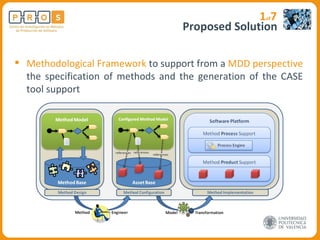
Proposed Solution 1 of 7 Methodological Framework  to support from a  MDD perspective  the specification of methods and the generation of the CASE tool support
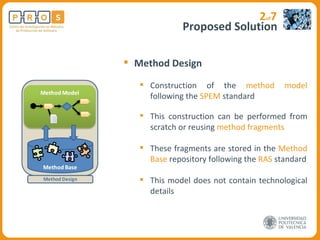
Proposed Solution 2 of 7 Method Design Construction of the  method model  following the  SPEM  standard This construction can be performed from scratch or reusing  method fragments These fragments are stored in the  Method Base  repository following the  RAS  standard This model does not contain technological details
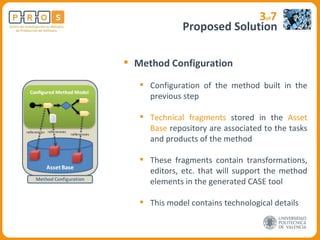
Proposed Solution 3 of 7 Method Configuration Configuration of the method built in the previous step Technical fragments  stored in the  Asset Base  repository are associated to the tasks and products of the method These fragments contain transformations, editors, etc. that will support the method elements in the generated CASE tool This model contains technological details
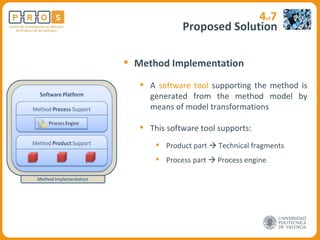
Proposed Solution 4 of 7 Method Implementation A  software tool  supporting the method is generated from the method model by means of model transformations This software tool supports: Product part    Technical fragments Process part    Process engine
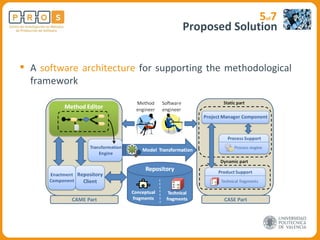
Proposed Solution 5 of 7 A  software architecture  for supporting the methodological framework
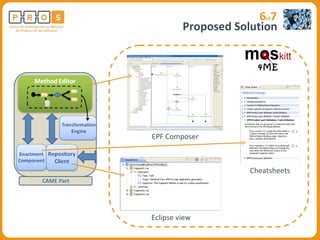
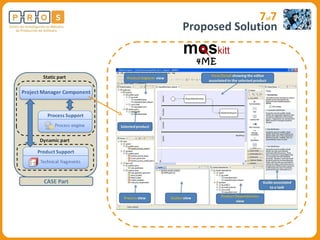
Proposed Solution 6 of 7 EPF Composer Cheatsheets Eclipse view 4ME
Proposed Solution 7 of 7 4ME
Agenda Motivation State of the Art Problem Statement Proposed Solution Case Study Conclusions Main Contributions Future Work Publications
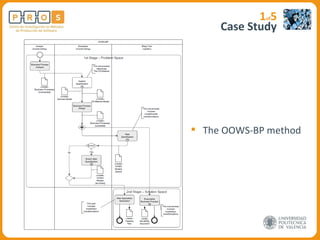
Case Study 1 of 5 The OOWS-BP method
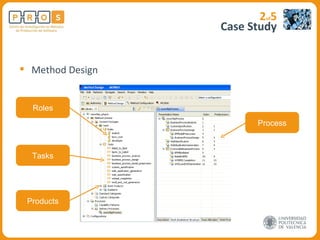
Case Study 2 of 5 Method Design Process Roles Products Tasks
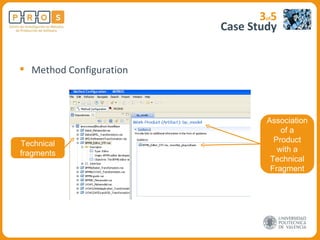
Case Study 3 of 5 Method Configuration Technical fragments Association of a Product with a Technical Fragment
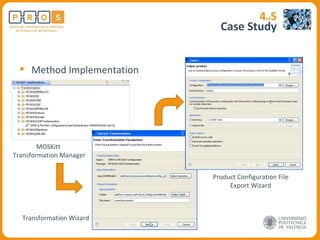
Case Study 4 of 5 Method Implementation MOSKitt  Transformation Manager Transformation Wizard Product Configuration File Export Wizard
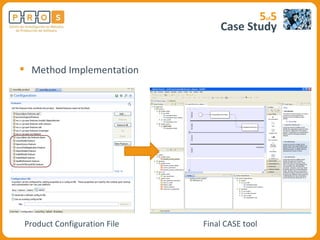
Case Study 5 of 5 Method Implementation Final CASE tool Product Configuration File
Agenda Motivation State of the Art Problem Statement Proposed Solution Case Study Conclusions Main Contributions Future Work Publications
Main Contributions 1 of 1 Application of the  MDD paradigm  in the Method Engineering field Method definition    Models CASE tool generation    Model transformations Definition of a methodological approach and development of a prototype that make use of an standard language (SPEM) Coverage of the four dimensions of methods Coverage of both the method design and implementation Definition of a software architecture that establishes the required components to support  Model Driven Method Engineering
Agenda Motivation State of the Art Problem Statement Proposed Solution Case Study Conclusions Main Contributions Future Work Publications
Future Work 1 of 1 Process engine Integration with Method as a Service Method variability Megamodeling
Agenda Motivation State of the Art Problem Statement Proposed Solution Case Study Conclusions Main Contributions Future Work Publications
Publications 1 of 1 Cervera, M. , Albert, M., Torres, V., Pelechano, V.:  A Methodological Framework and Software Infrastructure for the Construction of Software Production Methods . International Conference on Software Processes (2010) ICSP is classified as  A  in the  CORE  australian ranking Cervera, M. , Albert, M., Torres, V., Pelechano, V., Cano, J., Bonet, B.:  A Technological Framework to support Model Driven Method Engineering .  7th Taller sobre Desarrollo de Software Dirigido por Modelos (2010) Cervera, M. , Albert, M., Torres, V., Pelechano, V.:  Turning Method Engineering Support into Reality . To be published in: the 4th IFIP WG8.1 Working Conference on Method Engineering (2011)
Thanks Model Driven Method Engineering. A Supporting Infrastructure Mario Cervera Úbeda– mcervera@pros.upv.es

Model Driven Method Engineering. A Supporting Infrastructure

  • 1.
    Centro de InvestigaciónProS Model Driven Method Engineering. A Supporting Infrastructure MARIO CERVERA ÚBEDA
  • 2.
    Agenda Motivation Stateof the Art Problem Statement Proposed Solution Case Study Conclusions Main Contributions Future Work Publications
  • 3.
    Agenda Motivation Stateof the Art Problem Statement Proposed Solution Case Study Conclusions Main Contributions Future Work Publications
  • 4.
    Motivation Software developmentprojects High diversity Economic resources, duration, etc. 1 of 2 Software production methods Must be adapted to project needs Software support CASE environments  Little flexibility
  • 5.
    Motivation Method Engineering2 of 2 The engineering discipline to design, construct and adapt methods, techniques and tools for the development of information systems (Brinkkemper, 1996)
  • 6.
    Agenda Motivation Stateof the Art Problem Statement Proposed Solution Case Study Conclusions Main Contributions Future Work Publications
  • 7.
    State of theArt Method Engineering approaches Assembly-based, paradigm-based and extension-based Method Engineering languages ASDM, GOPRR, MEL, MRSL, NATURE, SPEM and ISO/IEC 24744 Method Engineering tools MERET, Decamerone, MENTOR, Method Editor, MetaEdit+ and MERU 1 of 4
  • 8.
    State of theArt 2 of 4 Method Engineering approaches The assembly-based approach is the most common Modular vision of methods  Facilitates reusability Usually used in combination with the paradigm-based approach There is no approach that takes all the 4 method dimensions ( product , process , people and tool ) into account together
  • 9.
    State of theArt 3 of 4 Method Engineering languages Most of them are product-oriented and defined by means of a meta-model Latest standardization efforts: SPEM and ISO/IEC 24744 Method Engineering proposals that make use of these standards are still non-existent
  • 10.
    State of theArt 4 of 4 Method Engineering tools Two types: CAME 1 and metaCASE environments Most of them are non-commercial prototypes They provide inadequate coverage of the Method Engineering lifecycle CAME tools focus on the method design metaCASE tools focus on CASE tool construction 1 Computer Aided Method Engineering
  • 11.
    Agenda Motivation Stateof the Art Problem Statement Proposed Solution Case Study Conclusions Main Contributions Future Work Publications
  • 12.
    Problem Statement Manytheoretical proposals in Method Engineering Standards are hardly used Lack of software support Incomplete prototypes Only one tool (MetaEdit+) has been commercialized High complexity 1 of 1
  • 13.
    Agenda Motivation Stateof the Art Problem Statement Proposed Solution Case Study Conclusions Main Contributions Future Work Publications
  • 14.
    Proposed Solution 1of 7 Methodological Framework to support from a MDD perspective the specification of methods and the generation of the CASE tool support
  • 15.
    Proposed Solution 2of 7 Method Design Construction of the method model following the SPEM standard This construction can be performed from scratch or reusing method fragments These fragments are stored in the Method Base repository following the RAS standard This model does not contain technological details
  • 16.
    Proposed Solution 3of 7 Method Configuration Configuration of the method built in the previous step Technical fragments stored in the Asset Base repository are associated to the tasks and products of the method These fragments contain transformations, editors, etc. that will support the method elements in the generated CASE tool This model contains technological details
  • 17.
    Proposed Solution 4of 7 Method Implementation A software tool supporting the method is generated from the method model by means of model transformations This software tool supports: Product part  Technical fragments Process part  Process engine
  • 18.
    Proposed Solution 5of 7 A software architecture for supporting the methodological framework
  • 19.
    Proposed Solution 6of 7 EPF Composer Cheatsheets Eclipse view 4ME
  • 20.
  • 21.
    Agenda Motivation Stateof the Art Problem Statement Proposed Solution Case Study Conclusions Main Contributions Future Work Publications
  • 22.
    Case Study 1of 5 The OOWS-BP method
  • 23.
    Case Study 2of 5 Method Design Process Roles Products Tasks
  • 24.
    Case Study 3of 5 Method Configuration Technical fragments Association of a Product with a Technical Fragment
  • 25.
    Case Study 4of 5 Method Implementation MOSKitt Transformation Manager Transformation Wizard Product Configuration File Export Wizard
  • 26.
    Case Study 5of 5 Method Implementation Final CASE tool Product Configuration File
  • 27.
    Agenda Motivation Stateof the Art Problem Statement Proposed Solution Case Study Conclusions Main Contributions Future Work Publications
  • 28.
    Main Contributions 1of 1 Application of the MDD paradigm in the Method Engineering field Method definition  Models CASE tool generation  Model transformations Definition of a methodological approach and development of a prototype that make use of an standard language (SPEM) Coverage of the four dimensions of methods Coverage of both the method design and implementation Definition of a software architecture that establishes the required components to support Model Driven Method Engineering
  • 29.
    Agenda Motivation Stateof the Art Problem Statement Proposed Solution Case Study Conclusions Main Contributions Future Work Publications
  • 30.
    Future Work 1of 1 Process engine Integration with Method as a Service Method variability Megamodeling
  • 31.
    Agenda Motivation Stateof the Art Problem Statement Proposed Solution Case Study Conclusions Main Contributions Future Work Publications
  • 32.
    Publications 1 of1 Cervera, M. , Albert, M., Torres, V., Pelechano, V.: A Methodological Framework and Software Infrastructure for the Construction of Software Production Methods . International Conference on Software Processes (2010) ICSP is classified as A in the CORE australian ranking Cervera, M. , Albert, M., Torres, V., Pelechano, V., Cano, J., Bonet, B.: A Technological Framework to support Model Driven Method Engineering . 7th Taller sobre Desarrollo de Software Dirigido por Modelos (2010) Cervera, M. , Albert, M., Torres, V., Pelechano, V.: Turning Method Engineering Support into Reality . To be published in: the 4th IFIP WG8.1 Working Conference on Method Engineering (2011)
  • 33.
    Thanks Model DrivenMethod Engineering. A Supporting Infrastructure Mario Cervera Úbeda– mcervera@pros.upv.es