Module 4 Lesson 29 Multi­Step Problems—All Operations.notebook
1
April 23, 2015
Nov 17­2:28 PM
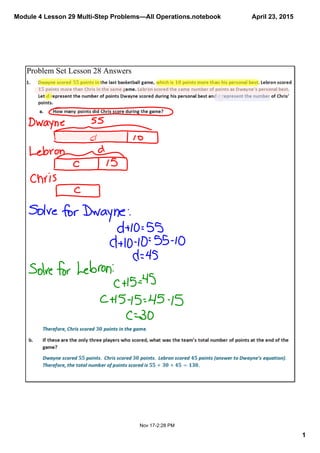
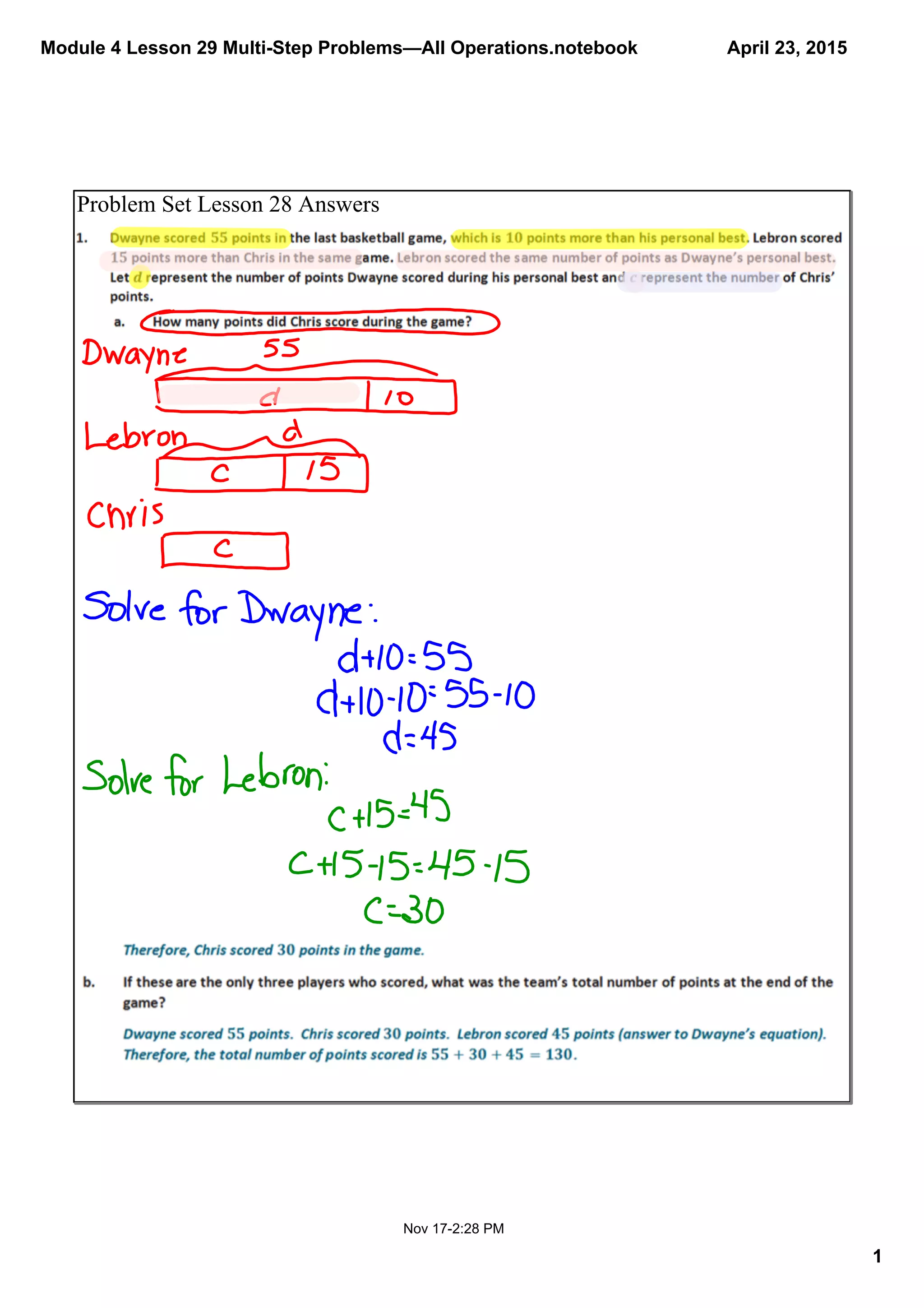
Problem Set Lesson 28 Answers
Module 4 Lesson 29 Multi­Step Problems—All Operations.notebook
2
April 23, 2015
May 7­11:24 AM
Module 4 Lesson 29 Multi­Step Problems—All Operations.notebook
3
April 23, 2015
May 7­11:26 AM
Module 4 Lesson 29 Multi­Step Problems—All Operations.notebook
4
April 23, 2015
May 7­11:26 AM
Module 4 Lesson 29 Multi­Step Problems—All Operations.notebook
5
April 23, 2015
May 7­11:27 AM
Module 4 Lesson 29 Multi­Step Problems—All Operations.notebook
6
April 23, 2015
Aug 26­5:45 PM
 
MODULE 4 Expressions and Equations
Topic G: Solving Equations
Lesson 29:  Multi‐Step Problems—All Operations 
Student Outcomes  
§ Students use their knowledge of simplifying expressions, order of operations and properties of equality to calculate the solution 
of multi‐step equations.  Students use tables to determine their answer.
§ Students check to determine if their solution makes the equation true.
Module 4 Lesson 29 Multi­Step Problems—All Operations.notebook
7
April 23, 2015
Nov 17­2:29 PM
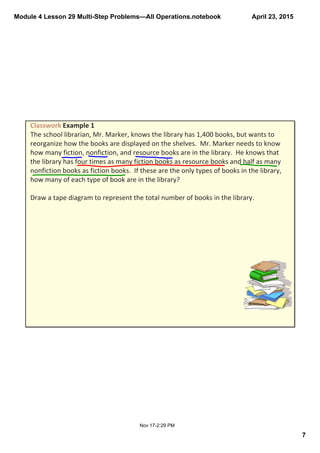
Classwork Example 1
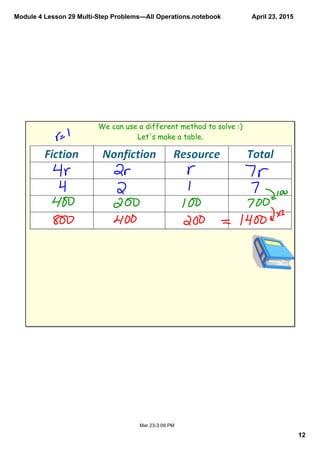
The school librarian, Mr. Marker, knows the library has 1,400 books, but wants to 
reorganize how the books are displayed on the shelves.  Mr. Marker needs to know 
how many fiction, nonfiction, and resource books are in the library.  He knows that 
the library has four times as many fiction books as resource books and half as many 
nonfiction books as fiction books.  If these are the only types of books in the library, 
how many of each type of book are in the library?
Draw a tape diagram to represent the total number of books in the library.
Module 4 Lesson 29 Multi­Step Problems—All Operations.notebook
8
April 23, 2015
Nov 17­2:29 PM
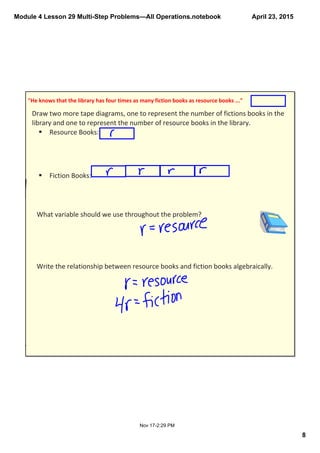
Draw two more tape diagrams, one to represent the number of fictions books in the 
library and one to represent the number of resource books in the library.
§ Resource Books:
§ Fiction Books:
"He knows that the library has four times as many fiction books as resource books ..."
What variable should we use throughout the problem? 
Write the relationship between resource books and fiction books algebraically.
Module 4 Lesson 29 Multi­Step Problems—All Operations.notebook
9
April 23, 2015
Nov 17­2:28 PM
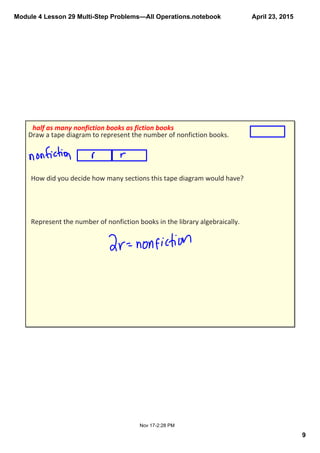
Draw a tape diagram to represent the number of nonfiction books.
How did you decide how many sections this tape diagram would have?
Represent the number of nonfiction books in the library algebraically.
half as many nonfiction books as fiction books
Module 4 Lesson 29 Multi­Step Problems—All Operations.notebook
10
April 23, 2015
Mar 23­3:08 PM
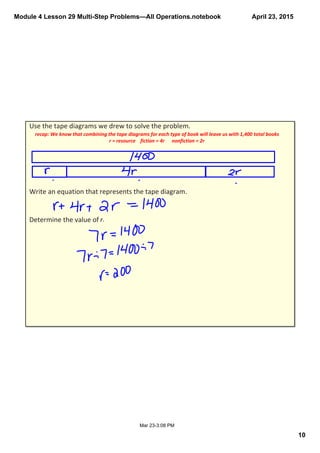
Use the tape diagrams we drew to solve the problem.
Write an equation that represents the tape diagram.
Determine the value of r. 
recap: We know that combining the tape diagrams for each type of book will leave us with 1,400 total books
r = resource    fiction = 4r      nonfiction = 2r
Module 4 Lesson 29 Multi­Step Problems—All Operations.notebook
11
April 23, 2015
Mar 23­3:09 PM
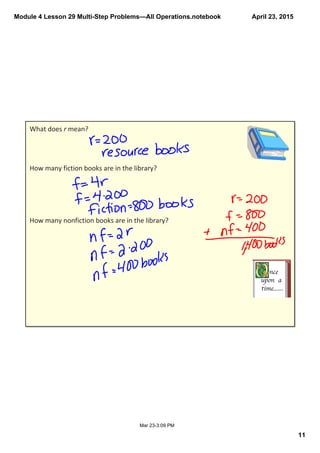
What does r mean?
How many fiction books are in the library?
How many nonfiction books are in the library?
Module 4 Lesson 29 Multi­Step Problems—All Operations.notebook
12
April 23, 2015
Mar 23­3:09 PM
We can use a different method to solve :)
Let's make a table.
Module 4 Lesson 29 Multi­Step Problems—All Operations.notebook
13
April 23, 2015
Mar 23­3:09 PM
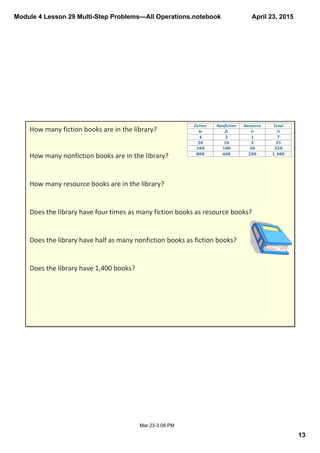
How many fiction books are in the library?
How many nonfiction books are in the library?
How many resource books are in the library?
Does the library have four times as many fiction books as resource books?
Does the library have half as many nonfiction books as fiction books?
Does the library have 1,400 books?
Module 4 Lesson 29 Multi­Step Problems—All Operations.notebook
14
April 23, 2015
Mar 23­3:09 PM
Exercises
Solve each problem below.  Then check your answer with the word problem.
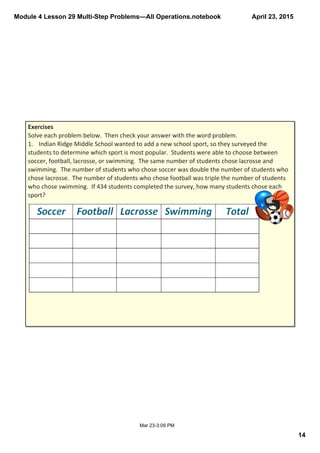
1. Indian Ridge Middle School wanted to add a new school sport, so they surveyed the 
students to determine which sport is most popular.  Students were able to choose between 
soccer, football, lacrosse, or swimming.  The same number of students chose lacrosse and 
swimming.  The number of students who chose soccer was double the number of students who 
chose lacrosse.  The number of students who chose football was triple the number of students 
who chose swimming.  If 434 students completed the survey, how many students chose each 
sport?
Module 4 Lesson 29 Multi­Step Problems—All Operations.notebook
15
April 23, 2015
Mar 23­3:09 PM
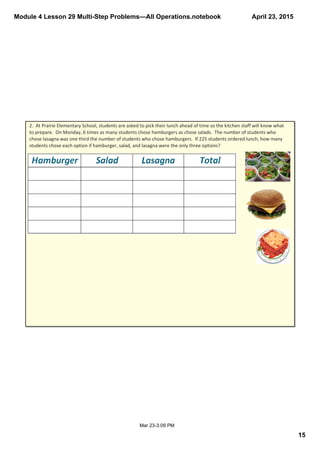
2.  At Prairie Elementary School, students are asked to pick their lunch ahead of time so the kitchen staff will know what 
to prepare.  On Monday, 6 times as many students chose hamburgers as chose salads.  The number of students who 
chose lasagna was one third the number of students who chose hamburgers.  If 225 students ordered lunch, how many 
students chose each option if hamburger, salad, and lasagna were the only three options?
Module 4 Lesson 29 Multi­Step Problems—All Operations.notebook
16
April 23, 2015
Mar 23­3:22 PM
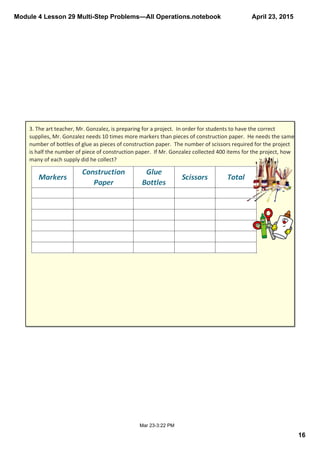
3. The art teacher, Mr. Gonzalez, is preparing for a project.  In order for students to have the correct 
supplies, Mr. Gonzalez needs 10 times more markers than pieces of construction paper.  He needs the same 
number of bottles of glue as pieces of construction paper.  The number of scissors required for the project 
is half the number of piece of construction paper.  If Mr. Gonzalez collected 400 items for the project, how 
many of each supply did he collect?
Module 4 Lesson 29 Multi­Step Problems—All Operations.notebook
17
April 23, 2015
Mar 23­3:26 PM
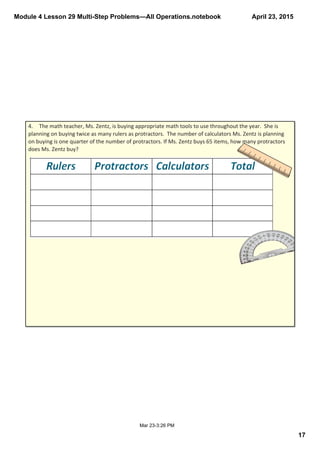
4. The math teacher, Ms. Zentz, is buying appropriate math tools to use throughout the year.  She is 
planning on buying twice as many rulers as protractors.  The number of calculators Ms. Zentz is planning 
on buying is one quarter of the number of protractors. If Ms. Zentz buys 65 items, how many protractors 
does Ms. Zentz buy?
Module 4 Lesson 29 Multi­Step Problems—All Operations.notebook
18
April 23, 2015
Aug 26­8:21 PM
Closing
Please take out your exit ticket for Lesson 29, close your
binder, and complete the exit ticket. This will be collected.
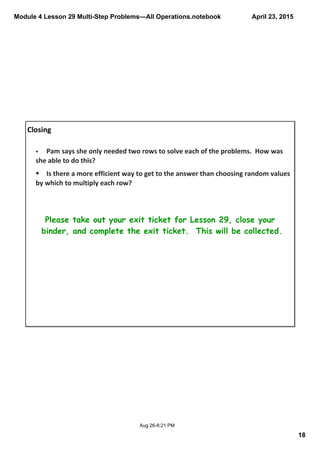
§ Pam says she only needed two rows to solve each of the problems.  How was 
she able to do this?
§ Is there a more efficient way to get to the answer than choosing random values 
by which to multiply each row?
Module 4 Lesson 29 Multi­Step Problems—All Operations.notebook
19
April 23, 2015
Mar 23­3:40 PM

Mod 4 lesson 29