MockServer-driven
testing
Alexey Alter-Pesotskiy
Stream
2
in/testableapple
testableapple
testableapple.com
Me, Myself & I
3
Mobile Automation Newsletter
testableapple.com/newsletter
4
How They Automate on Mobile
testableapple.com/big-tech
5
6
1. Introduction to «MockServer-driven testing» methodology
1. Proof of Concept
❏ Creating Native Mock Server
❏ Creating Standalone Mock Server
1. Showcasing the methodology on the real project
Contents
7
MockServer-Driven Testing
MockServer-Driven Testing (MSDT) is a methodology for developing automated UI tests,
which is a custom branch of the Test Driven Development (TDD) methodology.
8
MockServer-Driven Testing
MockServer-Driven Testing (MSDT) is a methodology for developing automated UI tests,
which is a custom branch of the Test Driven Development (TDD) methodology.
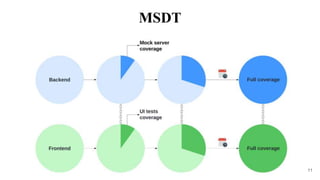
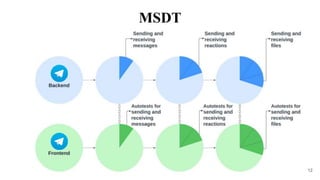
The main idea is:
❏ To create a mock server that completely replaces the real backend
❏ To cover the features supported by a mock server with automated UI tests
9
MockServer-Driven Testing
MockServer-Driven Testing (MSDT) is a methodology for developing automated UI tests,
which is a custom branch of the Test Driven Development (TDD) methodology.
The main idea is:
❏ To create a mock server that completely replaces the real backend
❏ To cover the features supported by a mock server with automated UI tests
TDD vs MSDT:
❏ TDD: developing unit tests to write application source code
❏ MSDT: developing mock server to write UI tests
10
MockServer-Driven Testing
11
MSDT
12
MSDT
13
Pros
14
● Automated testing of the frontend does not depend on the backend state
Pros
15
● Automated testing of the frontend does not depend on the backend state
● The tests’ speed is much higher because:
○ What requires a lot of hustle on the UI can be eliminated from the tests
○ What requires customizations on the backend can be driven from tests
○ What weighs a lot from the network perspective can work instantly
Pros
16
● Automated testing of the frontend does not depend on the backend state
● The tests’ speed is much higher because:
○ What requires a lot of hustle on the UI can be eliminated from the tests
○ What requires customizations on the backend can be driven from tests
○ What weighs a lot from the network perspective can work instantly
● Mock server can "open up" the opportunity to write interesting test scenarios (mostly
negative ones though)
Pros
17
● Automated testing of the frontend does not depend on the backend state
● The tests’ speed is much higher because:
○ What requires a lot of hustle on the UI can be eliminated from the tests
○ What requires customizations on the backend can be driven from tests
○ What weighs a lot from the network perspective can work instantly
● Mock server can "open up" the opportunity to write interesting test scenarios (mostly
negative ones though)
● Tests can check not only the UI reflection of responses from the server, but also the
requests to the server itself
Pros
18
● Automated testing of the frontend does not depend on the backend state
● The tests’ speed is much higher because:
○ What requires a lot of hustle on the UI can be eliminated from the tests
○ What requires customizations on the backend can be driven from tests
○ What weighs a lot from the network perspective can work instantly
● Mock server can "open up" the opportunity to write interesting test scenarios (mostly
negative ones though)
● Tests can check not only the UI reflection of responses from the server, but also the
requests to the server itself
● Developers can participate/assist in creating both the mock server and the tests
Pros
19
Cons
20
● 👷♂️ We need to consider the costs of creating/implementing/maintaining a mock
server
Cons
21
● 👷♂️ We need to consider the costs of creating/implementing/maintaining a mock
server
● 🐛 There's a possibility of bugs in the mock server
Cons
22
● 👷♂️ We need to consider the costs of creating/implementing/maintaining a mock
server
● 🐛 There's a possibility of bugs in the mock server
● 🏃♂️ There's a chance the real backend will run off ahead
Cons
23
Use cases
1. You're only interested in testing the frontend
24
Use cases
1. You're only interested in testing the frontend
1. You want to manage the backend on the fly
○ e.g.: mock images, banner ads, etc.
Use cases
25
1. You're only interested in testing the frontend
1. You want to manage the backend on the fly
○ e.g.: mock images, banner ads, etc.
1. In tests you’d like to see/catch requests flying off the device
○ e.g.: analytics, custom events, etc.
26
Use cases
1. You're only interested in testing the frontend
1. You want to manage the backend on the fly
○ e.g.: mock images, banner ads, etc.
1. In tests you’d like to see/catch requests flying off the device
○ e.g.: analytics, custom events, etc.
1. You need to emulate the interaction of several users
○ e.g.: chat, games, etc.
27
Use cases
1. You're only interested in testing the frontend
1. You want to manage the backend on the fly
○ e.g.: mock images, banner ads, etc.
1. In tests you’d like to see/catch requests flying off the device
○ e.g.: analytics, custom events, etc.
1. You need to emulate the interaction of several users
○ e.g.: chat, games, etc.
1. ...
28
Use cases
29
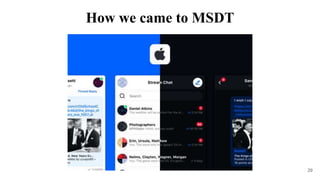
How we came to MSDT
30
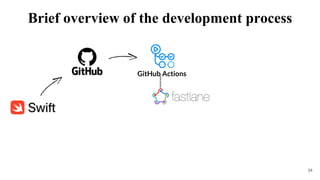
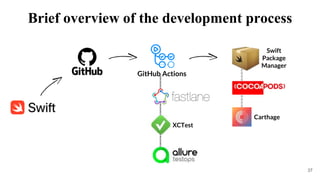
Brief overview of the development process
31
Brief overview of the development process
32
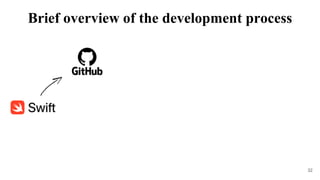
Brief overview of the development process
33
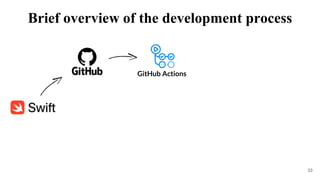
GitHub Actions
Brief overview of the development process
34
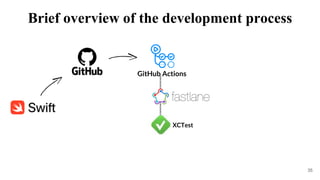
GitHub Actions
Brief overview of the development process
35
GitHub Actions
XCTest
Brief overview of the development process
36
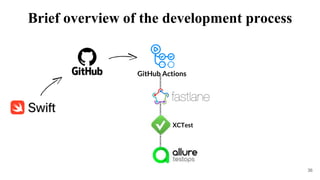
GitHub Actions
XCTest
Brief overview of the development process
37
GitHub Actions
Swift
Package
Manager
Carthage
XCTest
Brief overview of the development process
We need autotests covering the UI:
a. Incoming/outgoing messages, reactions, attachments, etc.
b. Online/offline
c. In background/foreground
d. On all supported iOS versions
38
Problem statement
39
Proposed solutions
1. Use two devices/simulators at the same time
40
Proposed solutions
1. Use two devices/simulators at the same time
1. Create an autoresponder on the backend
41
Proposed solutions
1. Use two devices/simulators at the same time
1. Create an autoresponder on the backend
1. Develop a mock server to simulate the backend and the second participant in chat
42
Proposed solutions
1. Use two devices/simulators at the same time
1. Create an autoresponder on the backend
1. Develop a mock server to simulate the backend and the second participant in chat
43
Proposed solutions
44
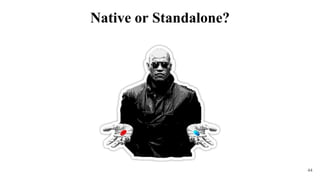
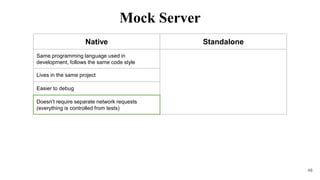
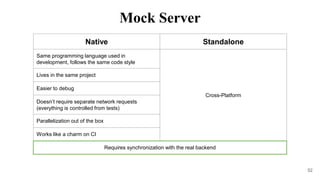
Native or Standalone?
45
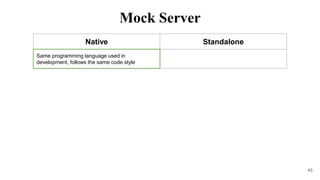
Native Standalone
Same programming language used in
development, follows the same code style
Mock Server
46
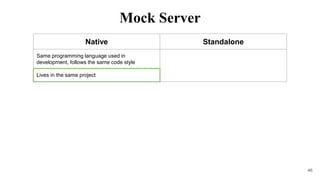
Native Standalone
Same programming language used in
development, follows the same code style
Lives in the same project
Mock Server
47
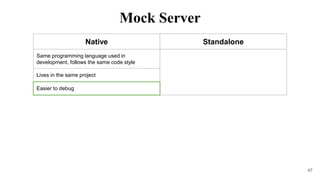
Native Standalone
Same programming language used in
development, follows the same code style
Lives in the same project
Easier to debug
Mock Server
48
Native Standalone
Same programming language used in
development, follows the same code style
Lives in the same project
Easier to debug
Doesn’t require separate network requests
(everything is controlled from tests)
Mock Server
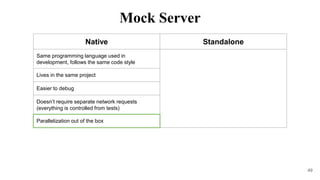
49
Native Standalone
Same programming language used in
development, follows the same code style
Lives in the same project
Easier to debug
Doesn’t require separate network requests
(everything is controlled from tests)
Parallelization out of the box
Mock Server
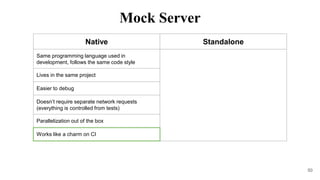
50
Native Standalone
Same programming language used in
development, follows the same code style
Lives in the same project
Easier to debug
Doesn’t require separate network requests
(everything is controlled from tests)
Parallelization out of the box
Works like a charm on CI
Mock Server
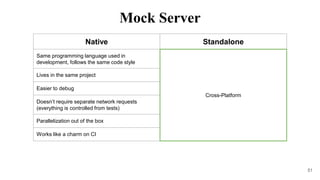
51
Native Standalone
Same programming language used in
development, follows the same code style
Cross-Platform
Lives in the same project
Easier to debug
Doesn’t require separate network requests
(everything is controlled from tests)
Parallelization out of the box
Works like a charm on CI
Mock Server
52
Native Standalone
Same programming language used in
development, follows the same code style
Cross-Platform
Lives in the same project
Easier to debug
Doesn’t require separate network requests
(everything is controlled from tests)
Parallelization out of the box
Works like a charm on CI
Requires synchronization with the real backend
Mock Server
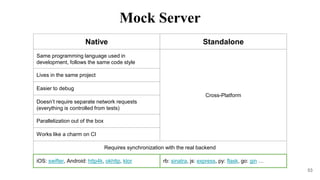
53
Native Standalone
Same programming language used in
development, follows the same code style
Cross-Platform
Lives in the same project
Easier to debug
Doesn’t require separate network requests
(everything is controlled from tests)
Parallelization out of the box
Works like a charm on CI
Requires synchronization with the real backend
iOS: swifter, Android: http4k, okhttp, ktor rb: sinatra, js: express, py: flask, go: gin …
Mock Server
54
Mock Server
55
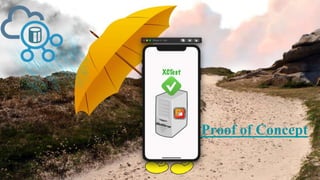
Proof of Concept
56
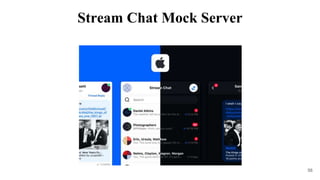
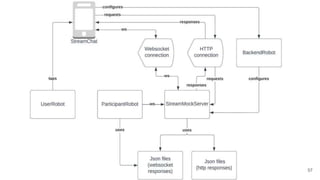
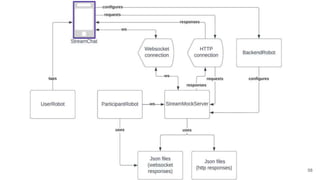
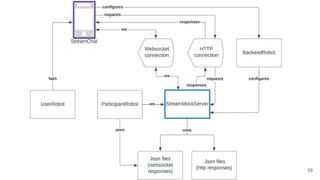
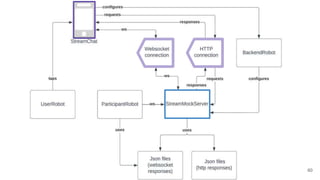
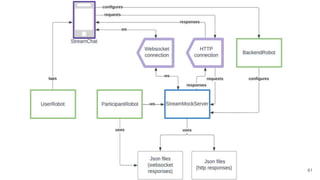
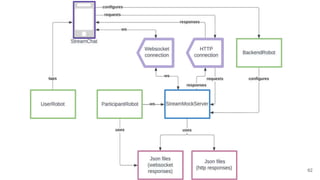
Stream Chat Mock Server
57
58
59
60
61
62
63
Key points of implementation
● Mock server
○ crafted using swifter
64
Key points of implementation
● Mock server
○ crafted using swifter
○ works with HTTP as well as with Websocket
65
Key points of implementation
● Mock server
○ crafted using swifter
○ works with HTTP as well as with Websocket
○ runs on localhost
66
Key points of implementation
● Mock server
○ crafted using swifter
○ works with HTTP as well as with Websocket
○ runs on localhost
● Tests
○ do not look at the real backend
67
Key points of implementation
● Mock server
○ crafted using swifter
○ works with HTTP as well as with Websocket
○ runs on localhost
● Tests
○ do not look at the real backend
○ independent from each other because the mock server turns on before and
turns off after every test
68
Key points of implementation
● Mock server
○ crafted using swifter
○ works with HTTP as well as with Websocket
○ runs on localhost
● Tests
○ do not look at the real backend
○ independent from each other because the mock server turns on before and
turns off after every test
● We
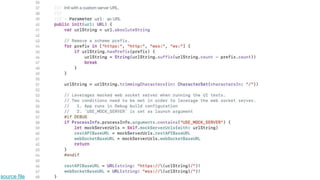
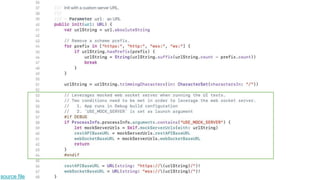
○ use Launch arguments and Environment variables to redirect the app to the
correct server (the mock or production one)
69
Key points of implementation
● Mock server
○ crafted using swifter
○ works with HTTP as well as with Websocket
○ runs on localhost
● Tests
○ do not look at the real backend
○ independent from each other because the mock server turns on before and
turns off after every test
● We
○ use Launch arguments and Environment variables to redirect the app to the
correct server (the mock or production one)
○ keep golden responses from the backend in the repo and use them as
templates, to change/update on the fly during the tests
70
Key points of implementation
Challenge
Redirect SDK to the mock server
71
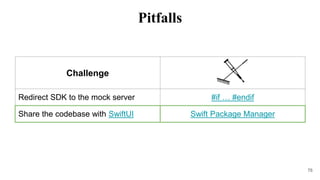
Pitfalls
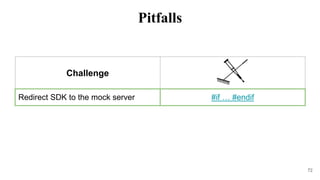
Challenge
Redirect SDK to the mock server #if … #endif
72
Pitfalls
73
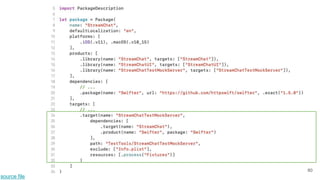
source file
74
source file
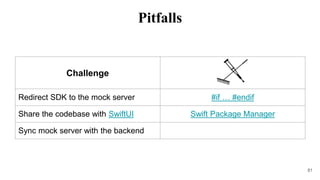
Challenge
Redirect SDK to the mock server #if … #endif
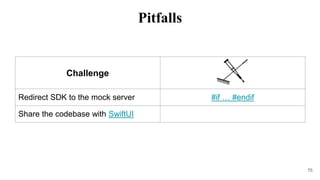
Share the codebase with SwiftUI
75
Pitfalls
Challenge
Redirect SDK to the mock server #if … #endif
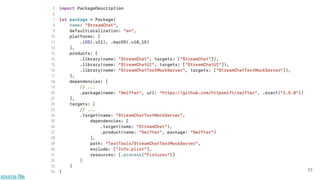
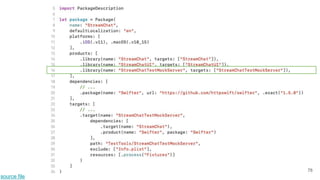
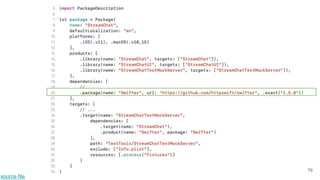
Share the codebase with SwiftUI Swift Package Manager
76
Pitfalls
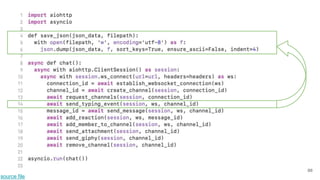
77
source file
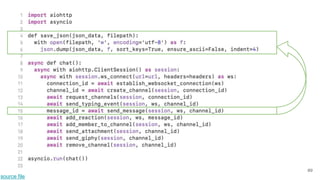
78
source file
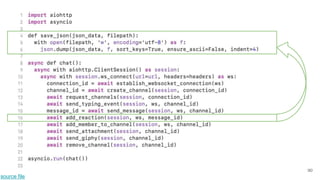
79
source file
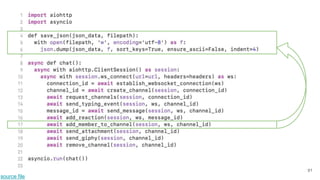
80
source file
Challenge
Redirect SDK to the mock server #if … #endif
Share the codebase with SwiftUI Swift Package Manager
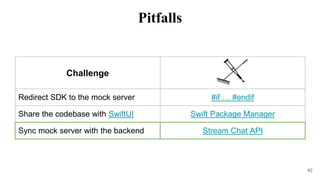
Sync mock server with the backend
81
Pitfalls
Challenge
Redirect SDK to the mock server #if … #endif
Share the codebase with SwiftUI Swift Package Manager
Sync mock server with the backend Stream Chat API
82
Pitfalls
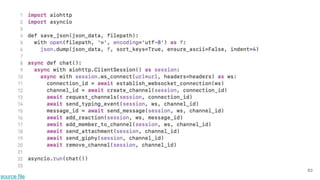
83
source file
84
source file
85
source file
86
source file
87
source file
88
source file
89
source file
90
source file
91
source file
92
source file
93
source file
94
source file
95
source file
96
source file
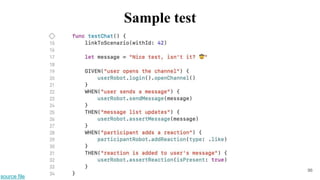
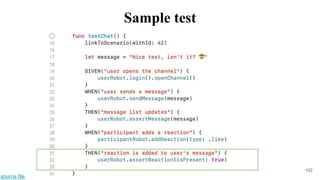
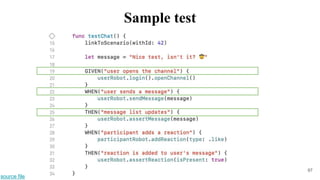
Sample test
97
source file
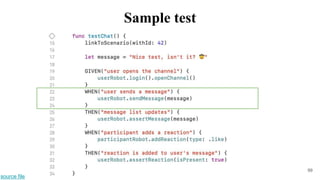
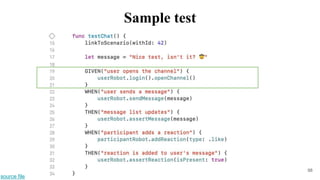
Sample test
98
source file
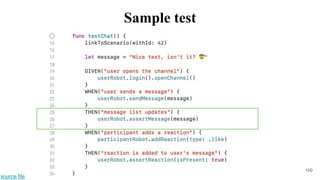
Sample test
99
source file
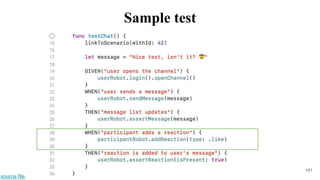
Sample test
100
source file
Sample test
101
source file
Sample test
102
source file
Sample test
103
Android
104
Android
swifter
105
Android
swifter
❏ http4k
❏ okhttp
❏ ktor
106
Android
● testableapple.com/native-mock-server-inside-xctest
● github.com/testableapple/mockserver-driven-testing
● github.com/GetStream/stream-chat-swift
● github.com/GetStream/stream-chat-swiftui
107
Useful links
Cheers!
in/testableapple
testableapple
testableapple.com

MockServer-driven testing

  • 1.
  • 2.
  • 3.
  • 4.
    4 How They Automateon Mobile testableapple.com/big-tech
  • 5.
  • 6.
    6 1. Introduction to«MockServer-driven testing» methodology 1. Proof of Concept ❏ Creating Native Mock Server ❏ Creating Standalone Mock Server 1. Showcasing the methodology on the real project Contents
  • 7.
  • 8.
    MockServer-Driven Testing (MSDT)is a methodology for developing automated UI tests, which is a custom branch of the Test Driven Development (TDD) methodology. 8 MockServer-Driven Testing
  • 9.
    MockServer-Driven Testing (MSDT)is a methodology for developing automated UI tests, which is a custom branch of the Test Driven Development (TDD) methodology. The main idea is: ❏ To create a mock server that completely replaces the real backend ❏ To cover the features supported by a mock server with automated UI tests 9 MockServer-Driven Testing
  • 10.
    MockServer-Driven Testing (MSDT)is a methodology for developing automated UI tests, which is a custom branch of the Test Driven Development (TDD) methodology. The main idea is: ❏ To create a mock server that completely replaces the real backend ❏ To cover the features supported by a mock server with automated UI tests TDD vs MSDT: ❏ TDD: developing unit tests to write application source code ❏ MSDT: developing mock server to write UI tests 10 MockServer-Driven Testing
  • 11.
  • 12.
  • 13.
  • 14.
    14 ● Automated testingof the frontend does not depend on the backend state Pros
  • 15.
    15 ● Automated testingof the frontend does not depend on the backend state ● The tests’ speed is much higher because: ○ What requires a lot of hustle on the UI can be eliminated from the tests ○ What requires customizations on the backend can be driven from tests ○ What weighs a lot from the network perspective can work instantly Pros
  • 16.
    16 ● Automated testingof the frontend does not depend on the backend state ● The tests’ speed is much higher because: ○ What requires a lot of hustle on the UI can be eliminated from the tests ○ What requires customizations on the backend can be driven from tests ○ What weighs a lot from the network perspective can work instantly ● Mock server can "open up" the opportunity to write interesting test scenarios (mostly negative ones though) Pros
  • 17.
    17 ● Automated testingof the frontend does not depend on the backend state ● The tests’ speed is much higher because: ○ What requires a lot of hustle on the UI can be eliminated from the tests ○ What requires customizations on the backend can be driven from tests ○ What weighs a lot from the network perspective can work instantly ● Mock server can "open up" the opportunity to write interesting test scenarios (mostly negative ones though) ● Tests can check not only the UI reflection of responses from the server, but also the requests to the server itself Pros
  • 18.
    18 ● Automated testingof the frontend does not depend on the backend state ● The tests’ speed is much higher because: ○ What requires a lot of hustle on the UI can be eliminated from the tests ○ What requires customizations on the backend can be driven from tests ○ What weighs a lot from the network perspective can work instantly ● Mock server can "open up" the opportunity to write interesting test scenarios (mostly negative ones though) ● Tests can check not only the UI reflection of responses from the server, but also the requests to the server itself ● Developers can participate/assist in creating both the mock server and the tests Pros
  • 19.
  • 20.
    20 ● 👷♂️ Weneed to consider the costs of creating/implementing/maintaining a mock server Cons
  • 21.
    21 ● 👷♂️ Weneed to consider the costs of creating/implementing/maintaining a mock server ● 🐛 There's a possibility of bugs in the mock server Cons
  • 22.
    22 ● 👷♂️ Weneed to consider the costs of creating/implementing/maintaining a mock server ● 🐛 There's a possibility of bugs in the mock server ● 🏃♂️ There's a chance the real backend will run off ahead Cons
  • 23.
  • 24.
    1. You're onlyinterested in testing the frontend 24 Use cases
  • 25.
    1. You're onlyinterested in testing the frontend 1. You want to manage the backend on the fly ○ e.g.: mock images, banner ads, etc. Use cases 25
  • 26.
    1. You're onlyinterested in testing the frontend 1. You want to manage the backend on the fly ○ e.g.: mock images, banner ads, etc. 1. In tests you’d like to see/catch requests flying off the device ○ e.g.: analytics, custom events, etc. 26 Use cases
  • 27.
    1. You're onlyinterested in testing the frontend 1. You want to manage the backend on the fly ○ e.g.: mock images, banner ads, etc. 1. In tests you’d like to see/catch requests flying off the device ○ e.g.: analytics, custom events, etc. 1. You need to emulate the interaction of several users ○ e.g.: chat, games, etc. 27 Use cases
  • 28.
    1. You're onlyinterested in testing the frontend 1. You want to manage the backend on the fly ○ e.g.: mock images, banner ads, etc. 1. In tests you’d like to see/catch requests flying off the device ○ e.g.: analytics, custom events, etc. 1. You need to emulate the interaction of several users ○ e.g.: chat, games, etc. 1. ... 28 Use cases
  • 29.
  • 30.
    30 Brief overview ofthe development process
  • 31.
    31 Brief overview ofthe development process
  • 32.
    32 Brief overview ofthe development process
  • 33.
    33 GitHub Actions Brief overviewof the development process
  • 34.
    34 GitHub Actions Brief overviewof the development process
  • 35.
    35 GitHub Actions XCTest Brief overviewof the development process
  • 36.
    36 GitHub Actions XCTest Brief overviewof the development process
  • 37.
  • 38.
    We need autotestscovering the UI: a. Incoming/outgoing messages, reactions, attachments, etc. b. Online/offline c. In background/foreground d. On all supported iOS versions 38 Problem statement
  • 39.
  • 40.
    1. Use twodevices/simulators at the same time 40 Proposed solutions
  • 41.
    1. Use twodevices/simulators at the same time 1. Create an autoresponder on the backend 41 Proposed solutions
  • 42.
    1. Use twodevices/simulators at the same time 1. Create an autoresponder on the backend 1. Develop a mock server to simulate the backend and the second participant in chat 42 Proposed solutions
  • 43.
    1. Use twodevices/simulators at the same time 1. Create an autoresponder on the backend 1. Develop a mock server to simulate the backend and the second participant in chat 43 Proposed solutions
  • 44.
  • 45.
    45 Native Standalone Same programminglanguage used in development, follows the same code style Mock Server
  • 46.
    46 Native Standalone Same programminglanguage used in development, follows the same code style Lives in the same project Mock Server
  • 47.
    47 Native Standalone Same programminglanguage used in development, follows the same code style Lives in the same project Easier to debug Mock Server
  • 48.
    48 Native Standalone Same programminglanguage used in development, follows the same code style Lives in the same project Easier to debug Doesn’t require separate network requests (everything is controlled from tests) Mock Server
  • 49.
    49 Native Standalone Same programminglanguage used in development, follows the same code style Lives in the same project Easier to debug Doesn’t require separate network requests (everything is controlled from tests) Parallelization out of the box Mock Server
  • 50.
    50 Native Standalone Same programminglanguage used in development, follows the same code style Lives in the same project Easier to debug Doesn’t require separate network requests (everything is controlled from tests) Parallelization out of the box Works like a charm on CI Mock Server
  • 51.
    51 Native Standalone Same programminglanguage used in development, follows the same code style Cross-Platform Lives in the same project Easier to debug Doesn’t require separate network requests (everything is controlled from tests) Parallelization out of the box Works like a charm on CI Mock Server
  • 52.
    52 Native Standalone Same programminglanguage used in development, follows the same code style Cross-Platform Lives in the same project Easier to debug Doesn’t require separate network requests (everything is controlled from tests) Parallelization out of the box Works like a charm on CI Requires synchronization with the real backend Mock Server
  • 53.
    53 Native Standalone Same programminglanguage used in development, follows the same code style Cross-Platform Lives in the same project Easier to debug Doesn’t require separate network requests (everything is controlled from tests) Parallelization out of the box Works like a charm on CI Requires synchronization with the real backend iOS: swifter, Android: http4k, okhttp, ktor rb: sinatra, js: express, py: flask, go: gin … Mock Server
  • 54.
  • 55.
  • 56.
  • 57.
  • 58.
  • 59.
  • 60.
  • 61.
  • 62.
  • 63.
    63 Key points ofimplementation
  • 64.
    ● Mock server ○crafted using swifter 64 Key points of implementation
  • 65.
    ● Mock server ○crafted using swifter ○ works with HTTP as well as with Websocket 65 Key points of implementation
  • 66.
    ● Mock server ○crafted using swifter ○ works with HTTP as well as with Websocket ○ runs on localhost 66 Key points of implementation
  • 67.
    ● Mock server ○crafted using swifter ○ works with HTTP as well as with Websocket ○ runs on localhost ● Tests ○ do not look at the real backend 67 Key points of implementation
  • 68.
    ● Mock server ○crafted using swifter ○ works with HTTP as well as with Websocket ○ runs on localhost ● Tests ○ do not look at the real backend ○ independent from each other because the mock server turns on before and turns off after every test 68 Key points of implementation
  • 69.
    ● Mock server ○crafted using swifter ○ works with HTTP as well as with Websocket ○ runs on localhost ● Tests ○ do not look at the real backend ○ independent from each other because the mock server turns on before and turns off after every test ● We ○ use Launch arguments and Environment variables to redirect the app to the correct server (the mock or production one) 69 Key points of implementation
  • 70.
    ● Mock server ○crafted using swifter ○ works with HTTP as well as with Websocket ○ runs on localhost ● Tests ○ do not look at the real backend ○ independent from each other because the mock server turns on before and turns off after every test ● We ○ use Launch arguments and Environment variables to redirect the app to the correct server (the mock or production one) ○ keep golden responses from the backend in the repo and use them as templates, to change/update on the fly during the tests 70 Key points of implementation
  • 71.
    Challenge Redirect SDK tothe mock server 71 Pitfalls
  • 72.
    Challenge Redirect SDK tothe mock server #if … #endif 72 Pitfalls
  • 73.
  • 74.
  • 75.
    Challenge Redirect SDK tothe mock server #if … #endif Share the codebase with SwiftUI 75 Pitfalls
  • 76.
    Challenge Redirect SDK tothe mock server #if … #endif Share the codebase with SwiftUI Swift Package Manager 76 Pitfalls
  • 77.
  • 78.
  • 79.
  • 80.
  • 81.
    Challenge Redirect SDK tothe mock server #if … #endif Share the codebase with SwiftUI Swift Package Manager Sync mock server with the backend 81 Pitfalls
  • 82.
    Challenge Redirect SDK tothe mock server #if … #endif Share the codebase with SwiftUI Swift Package Manager Sync mock server with the backend Stream Chat API 82 Pitfalls
  • 83.
  • 84.
  • 85.
  • 86.
  • 87.
  • 88.
  • 89.
  • 90.
  • 91.
  • 92.
  • 93.
  • 94.
  • 95.
  • 96.
  • 97.
  • 98.
  • 99.
  • 100.
  • 101.
  • 102.
  • 103.
  • 104.
  • 105.
  • 106.
  • 107.
    ● testableapple.com/native-mock-server-inside-xctest ● github.com/testableapple/mockserver-driven-testing ●github.com/GetStream/stream-chat-swift ● github.com/GetStream/stream-chat-swiftui 107 Useful links
  • 108.