International Research Journal of Engineering and Technology (IRJET) e-ISSN: 2395-0056
Volume: 09 Issue: 05 | May 2022 www.irjet.net p-ISSN: 2395-0072
© 2022, IRJET | Impact Factor value: 7.529 | ISO 9001:2008 Certified Journal | Page 3453
MOBILE CHARGING SYSTEM USING COIN AND RFID
Mrs.A.Sunantha1, Ms.P.Akshaya2, Ms.R.Adilakshmi3, Mr.D.Naveen4
1Assistant Professor, Dept of Electrical and Electronics Engineering from ACE Engineering College, JNTUH., (T.S.),
INDIA.
234 UG Scholar, Dept of Electrical and Electronics Engineering from ACE Engineering College, JNTUH.,(T.S.),
INDIA.
---------------------------------------------------------------------***---------------------------------------------------------------------
Abstract - This document describes coin and RFID-based
mobile chargers that use solar system for maintenance in
public areas. In rural areas, grid power is partially available
in one day. Solar charging is a good way to overcome this.
This technique can be used at train stations, bus stops, and
markets. The basic design of this system is to provide users
with uninterrupted communication if the user forgets to
charge the battery or if the battery runs out. You can insert
coins, Rs 1 coins, Rs 2 coins, Rs 5 coins and use the RFID
reader to charge your mobile phone. Arduino NANO is used
to detect the inserted coin and RFID with a laser and control
the charging time for a certain period of time that the user
can continue by inserting more coins. With the Arduino
software installed on your computer, you can edit and
upload programs to suit your application.
Keywords: Arduino Nano, solar panel, mobile phone
1.INTRODUCTION
This work aims to design a mobile charging system using
coins and RFID. Today, the mobile industry is growing
rapidly and technology is changing every year. There is a
growing need for mobile phones for communication and bill
payments. This system is used to charge in an emergency or
when the batteries andare emptiedwithoutbeingconnected
to the mains. Urban people have enough grid power and
alternatives to charge their cell phones, while rural people
experience power outages and the cell phone's battery
drains easily. This system works with both solar and grid
power. This system works in two ways: insert a coin or
register with an RFID tag. First, open the RFID tag to be
registered. Users want to connect their phones and scan
RFID tags. After registration, the door will close and the
phone will start charging. Another possibility for an
unregistered user to insert a coin and charge the mobile
phone depends on the coin to be inserted, and the charging
time of the mobile phone will be different.
1.1 METHODOLOGY
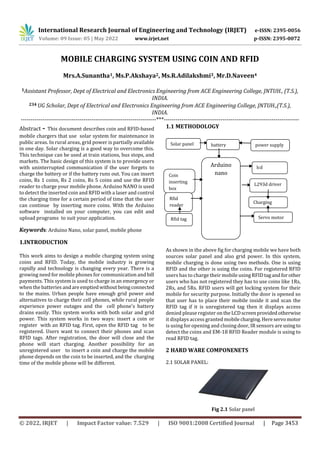
As shown in the above fig for charging mobile we have both
sources solar panel and also grid power. In this system,
mobile charging is done using two methods. One is using
RFID and the other is using the coins. For registered RFID
users has to charge their mobile using RFID tagandforother
users who has not registered they has to use coins like 1Rs,
2Rs, and 5Rs. RFID users will get locking system for their
mobile for security purpose. Initially the door is opened so
that user has to place their mobile inside it and scan the
RFID tag if it is unregistered tag then it displays access
denied please register onthe LCDscreenprovidedotherwise
it displays access granted mobilecharging.Hereservomotor
is using for opening and closing door, IR sensors are using to
detect the coins and EM-18 RFID Reader module is using to
read RFID tag.
2 HARD WARE COMPONENETS
2.1 SOLAR PANEL:
Fig 2.1 Solar panel
Solar panel
pppanel
battery power supply
Arduino
nano
Coin
inserting
box
Rfid
reader
lcd
L293d driver
Servo motor
Charging
port
Rfid tag
International Research Journal of Engineering and Technology (IRJET) e-ISSN: 2395-0056
Volume: 09 Issue: 05 | May 2022 www.irjet.net p-ISSN: 2395-0072
© 2022, IRJET | Impact Factor value: 7.529 | ISO 9001:2008 Certified Journal | Page 3454
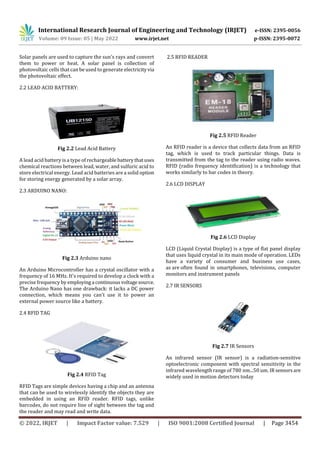
Solar panels are used to capture the sun's rays and convert
them to power or heat. A solar panel is collection of
photovoltaic cells that can be used to generate electricityvia
the photovoltaic effect.
2.2 LEAD ACID BATTERY:
Fig 2.2 Lead Acid Battery
A lead acid battery is a type of rechargeable batterythatuses
chemical reactions between lead, water, and sulfuric acid to
store electrical energy. Lead acid batteries are a solid option
for storing energy generated by a solar array.
2.3 ARDUINO NANO:
Fig 2.3 Arduino nano
An Arduino Microcontroller has a crystal oscillator with a
frequency of 16 MHz. It's required to develop a clock with a
precise frequency by employinga continuousvoltagesource.
The Arduino Nano has one drawback: it lacks a DC power
connection, which means you can't use it to power an
external power source like a battery.
2.4 RFID TAG
Fig 2.4 RFID Tag
RFID Tags are simple devices having a chip and an antenna
that can be used to wirelessly identify the objects they are
embedded in using an RFID reader. RFID tags, unlike
barcodes, do not require line of sight between the tag and
the reader and may read and write data.
2.5 RFID READER
Fig 2.5 RFID Reader
An RFID reader is a device that collects data from an RFID
tag, which is used to track particular things. Data is
transmitted from the tag to the reader using radio waves.
RFID (radio frequency identification) is a technology that
works similarly to bar codes in theory.
2.6 LCD DISPLAY
Fig 2.6 LCD Display
LCD (Liquid Crystal Display) is a type of flat panel display
that uses liquid crystal in its main mode of operation. LEDs
have a variety of consumer and business use cases,
as are often found in smartphones, televisions, computer
monitors and instrument panels
2.7 IR SENSORS
Fig 2.7 IR Sensors
An infrared sensor (IR sensor) is a radiation-sensitive
optoelectronic component with spectral sensitivity in the
infrared wavelength range of 780 nm...50 um. IRsensorsare
widely used in motion detectors today
International Research Journal of Engineering and Technology (IRJET) e-ISSN: 2395-0056
Volume: 09 Issue: 05 | May 2022 www.irjet.net p-ISSN: 2395-0072
© 2022, IRJET | Impact Factor value: 7.529 | ISO 9001:2008 Certified Journal | Page 3455
2.8 SERVO MOTOR
Fig 2.8 Servo motor
The length of the pulse applied to the control PIN of the
servo motor controls the angle of rotation. Servo motors are
DC motors with variable resistors (potentiometers) and
gearboxes. The main advantage of using servos is that they
provide angular accuracy. That is, it only rotates as much as
it needs before stopping and waiting for the next input.
Servomotors are linear or rotary actuators that can
accurately control linear or angular position, acceleration,
and velocity. It consists of a motor with a position feedback
sensor. You also need to use advanced controls.
2.9 L293d DRIVER
Fig 2.9 L293D Driver
The L293D is a 16-pin IC with 8 pins on both sides dedicated
to motor control. Each motor has two INPUT pins, two
OUTPUT pins, and one ENABLE pin. It receives signals from
the Arduino and sends it to motor.
3 FUTURE SCOPE
The tickets bought on the trains and buses in the fast-
moving society by this idea the reductionof queues in public
places and it also reduces human power.
With some modification of this system we can use the same
system for safe keeping of luggage in shopping malls instead
of allotting security personnel to guard the luggage. In
colleges this system can be used for keeping mobile phones
of students during examinations and also some industrial
applications.
4 CONCLUSION
A system for charging mobile batteries of different
manufacturer using solar power is proposed. The system is
proposed for rural and remote areas where the current
supply is not available all the time or for sufficient time. This
project is very useful at such locations where people are
facing power crisis. Since, necessity of communication is
very important now days, cell phone charging is one of the
problem faced by users. The proposedsystemshall providea
source of charging the cell phone in emergency conditions
without the electric supply
RESULTS
REFERNCE
[1]. P. Goyal and P. S. Sharma, "Coin Detection based Mobile
Charging System", 2019 6th International Conference on
Computing for Sustainable Global Development (INDIA
Com), pp. 60-63, 2019
[2]. Khushbo Sharma, Kavita Gade, Chitrakala Manimar,
Harsha Gadhave and Naresh Pund, "Universal Coin based
Mobile Charger", International Jour nal on Recent and
Innovation Trends in Computing and Communication,vol. 4,
no. 1, pp. 66-68, Jan 2016.
[3]. K.N. Patil, Agar Patil, Harshavardhan Kamble and Kshitij
Kumar Sawant, "Mobile Battery charger on Coin
Insertion", International Research Journal of Engineering
and Technology (IRJET), vol. 4, no. 1, pp. 1384-1386, Jan
2017
International Research Journal of Engineering and Technology (IRJET) e-ISSN: 2395-0056
Volume: 09 Issue: 05 | May 2022 www.irjet.net p-ISSN: 2395-0072
© 2022, IRJET | Impact Factor value: 7.529 | ISO 9001:2008 Certified Journal | Page 3456
[4]. S.B. Sridevi1, A. Sai Suneel2, K. Nalini3, Coin Based
Mobile Charger Using Solar Tracking System, ISSN: 2278-
909X Volume 2, Issue 9, September 2013.
BIOGRAPHIES
Mrs. A. Sunantha, Assistant
professor, EEE Department, ACE
Engineering college, Hyderabad. She
did her B. tech from government
engineering college Trissur, Kerala
and M. tech from TIST, cochin, Kerala.
Ms. P. Akshaya student of EEE
Department. She did her intermediate
from Alphores junior college,
Karimnagar Telangana, pursuing B.
Tech from Ace Engineering College,
Hyderabad
Ms. R. Adi Lakshmi student of EEE
Department. She did her
intermediate from Sri Vidya junior
College, Kodad, Suryapet, Telangana,
pursuing B. Tech from Ace
Engineering College, Hyderaba
Mr. D. Naveen student of EEE
Department. He did his intermediate
from Shivani Junior
College, Bheemaram,Hanamkonda,
Telangana, pursuingB. TechfromAce
Engineering College,
Hyderabad.

MOBILE CHARGING SYSTEM USING COIN AND RFID

  • 1.
    International Research Journalof Engineering and Technology (IRJET) e-ISSN: 2395-0056 Volume: 09 Issue: 05 | May 2022 www.irjet.net p-ISSN: 2395-0072 © 2022, IRJET | Impact Factor value: 7.529 | ISO 9001:2008 Certified Journal | Page 3453 MOBILE CHARGING SYSTEM USING COIN AND RFID Mrs.A.Sunantha1, Ms.P.Akshaya2, Ms.R.Adilakshmi3, Mr.D.Naveen4 1Assistant Professor, Dept of Electrical and Electronics Engineering from ACE Engineering College, JNTUH., (T.S.), INDIA. 234 UG Scholar, Dept of Electrical and Electronics Engineering from ACE Engineering College, JNTUH.,(T.S.), INDIA. ---------------------------------------------------------------------***--------------------------------------------------------------------- Abstract - This document describes coin and RFID-based mobile chargers that use solar system for maintenance in public areas. In rural areas, grid power is partially available in one day. Solar charging is a good way to overcome this. This technique can be used at train stations, bus stops, and markets. The basic design of this system is to provide users with uninterrupted communication if the user forgets to charge the battery or if the battery runs out. You can insert coins, Rs 1 coins, Rs 2 coins, Rs 5 coins and use the RFID reader to charge your mobile phone. Arduino NANO is used to detect the inserted coin and RFID with a laser and control the charging time for a certain period of time that the user can continue by inserting more coins. With the Arduino software installed on your computer, you can edit and upload programs to suit your application. Keywords: Arduino Nano, solar panel, mobile phone 1.INTRODUCTION This work aims to design a mobile charging system using coins and RFID. Today, the mobile industry is growing rapidly and technology is changing every year. There is a growing need for mobile phones for communication and bill payments. This system is used to charge in an emergency or when the batteries andare emptiedwithoutbeingconnected to the mains. Urban people have enough grid power and alternatives to charge their cell phones, while rural people experience power outages and the cell phone's battery drains easily. This system works with both solar and grid power. This system works in two ways: insert a coin or register with an RFID tag. First, open the RFID tag to be registered. Users want to connect their phones and scan RFID tags. After registration, the door will close and the phone will start charging. Another possibility for an unregistered user to insert a coin and charge the mobile phone depends on the coin to be inserted, and the charging time of the mobile phone will be different. 1.1 METHODOLOGY As shown in the above fig for charging mobile we have both sources solar panel and also grid power. In this system, mobile charging is done using two methods. One is using RFID and the other is using the coins. For registered RFID users has to charge their mobile using RFID tagandforother users who has not registered they has to use coins like 1Rs, 2Rs, and 5Rs. RFID users will get locking system for their mobile for security purpose. Initially the door is opened so that user has to place their mobile inside it and scan the RFID tag if it is unregistered tag then it displays access denied please register onthe LCDscreenprovidedotherwise it displays access granted mobilecharging.Hereservomotor is using for opening and closing door, IR sensors are using to detect the coins and EM-18 RFID Reader module is using to read RFID tag. 2 HARD WARE COMPONENETS 2.1 SOLAR PANEL: Fig 2.1 Solar panel Solar panel pppanel battery power supply Arduino nano Coin inserting box Rfid reader lcd L293d driver Servo motor Charging port Rfid tag
  • 2.
    International Research Journalof Engineering and Technology (IRJET) e-ISSN: 2395-0056 Volume: 09 Issue: 05 | May 2022 www.irjet.net p-ISSN: 2395-0072 © 2022, IRJET | Impact Factor value: 7.529 | ISO 9001:2008 Certified Journal | Page 3454 Solar panels are used to capture the sun's rays and convert them to power or heat. A solar panel is collection of photovoltaic cells that can be used to generate electricityvia the photovoltaic effect. 2.2 LEAD ACID BATTERY: Fig 2.2 Lead Acid Battery A lead acid battery is a type of rechargeable batterythatuses chemical reactions between lead, water, and sulfuric acid to store electrical energy. Lead acid batteries are a solid option for storing energy generated by a solar array. 2.3 ARDUINO NANO: Fig 2.3 Arduino nano An Arduino Microcontroller has a crystal oscillator with a frequency of 16 MHz. It's required to develop a clock with a precise frequency by employinga continuousvoltagesource. The Arduino Nano has one drawback: it lacks a DC power connection, which means you can't use it to power an external power source like a battery. 2.4 RFID TAG Fig 2.4 RFID Tag RFID Tags are simple devices having a chip and an antenna that can be used to wirelessly identify the objects they are embedded in using an RFID reader. RFID tags, unlike barcodes, do not require line of sight between the tag and the reader and may read and write data. 2.5 RFID READER Fig 2.5 RFID Reader An RFID reader is a device that collects data from an RFID tag, which is used to track particular things. Data is transmitted from the tag to the reader using radio waves. RFID (radio frequency identification) is a technology that works similarly to bar codes in theory. 2.6 LCD DISPLAY Fig 2.6 LCD Display LCD (Liquid Crystal Display) is a type of flat panel display that uses liquid crystal in its main mode of operation. LEDs have a variety of consumer and business use cases, as are often found in smartphones, televisions, computer monitors and instrument panels 2.7 IR SENSORS Fig 2.7 IR Sensors An infrared sensor (IR sensor) is a radiation-sensitive optoelectronic component with spectral sensitivity in the infrared wavelength range of 780 nm...50 um. IRsensorsare widely used in motion detectors today
  • 3.
    International Research Journalof Engineering and Technology (IRJET) e-ISSN: 2395-0056 Volume: 09 Issue: 05 | May 2022 www.irjet.net p-ISSN: 2395-0072 © 2022, IRJET | Impact Factor value: 7.529 | ISO 9001:2008 Certified Journal | Page 3455 2.8 SERVO MOTOR Fig 2.8 Servo motor The length of the pulse applied to the control PIN of the servo motor controls the angle of rotation. Servo motors are DC motors with variable resistors (potentiometers) and gearboxes. The main advantage of using servos is that they provide angular accuracy. That is, it only rotates as much as it needs before stopping and waiting for the next input. Servomotors are linear or rotary actuators that can accurately control linear or angular position, acceleration, and velocity. It consists of a motor with a position feedback sensor. You also need to use advanced controls. 2.9 L293d DRIVER Fig 2.9 L293D Driver The L293D is a 16-pin IC with 8 pins on both sides dedicated to motor control. Each motor has two INPUT pins, two OUTPUT pins, and one ENABLE pin. It receives signals from the Arduino and sends it to motor. 3 FUTURE SCOPE The tickets bought on the trains and buses in the fast- moving society by this idea the reductionof queues in public places and it also reduces human power. With some modification of this system we can use the same system for safe keeping of luggage in shopping malls instead of allotting security personnel to guard the luggage. In colleges this system can be used for keeping mobile phones of students during examinations and also some industrial applications. 4 CONCLUSION A system for charging mobile batteries of different manufacturer using solar power is proposed. The system is proposed for rural and remote areas where the current supply is not available all the time or for sufficient time. This project is very useful at such locations where people are facing power crisis. Since, necessity of communication is very important now days, cell phone charging is one of the problem faced by users. The proposedsystemshall providea source of charging the cell phone in emergency conditions without the electric supply RESULTS REFERNCE [1]. P. Goyal and P. S. Sharma, "Coin Detection based Mobile Charging System", 2019 6th International Conference on Computing for Sustainable Global Development (INDIA Com), pp. 60-63, 2019 [2]. Khushbo Sharma, Kavita Gade, Chitrakala Manimar, Harsha Gadhave and Naresh Pund, "Universal Coin based Mobile Charger", International Jour nal on Recent and Innovation Trends in Computing and Communication,vol. 4, no. 1, pp. 66-68, Jan 2016. [3]. K.N. Patil, Agar Patil, Harshavardhan Kamble and Kshitij Kumar Sawant, "Mobile Battery charger on Coin Insertion", International Research Journal of Engineering and Technology (IRJET), vol. 4, no. 1, pp. 1384-1386, Jan 2017
  • 4.
    International Research Journalof Engineering and Technology (IRJET) e-ISSN: 2395-0056 Volume: 09 Issue: 05 | May 2022 www.irjet.net p-ISSN: 2395-0072 © 2022, IRJET | Impact Factor value: 7.529 | ISO 9001:2008 Certified Journal | Page 3456 [4]. S.B. Sridevi1, A. Sai Suneel2, K. Nalini3, Coin Based Mobile Charger Using Solar Tracking System, ISSN: 2278- 909X Volume 2, Issue 9, September 2013. BIOGRAPHIES Mrs. A. Sunantha, Assistant professor, EEE Department, ACE Engineering college, Hyderabad. She did her B. tech from government engineering college Trissur, Kerala and M. tech from TIST, cochin, Kerala. Ms. P. Akshaya student of EEE Department. She did her intermediate from Alphores junior college, Karimnagar Telangana, pursuing B. Tech from Ace Engineering College, Hyderabad Ms. R. Adi Lakshmi student of EEE Department. She did her intermediate from Sri Vidya junior College, Kodad, Suryapet, Telangana, pursuing B. Tech from Ace Engineering College, Hyderaba Mr. D. Naveen student of EEE Department. He did his intermediate from Shivani Junior College, Bheemaram,Hanamkonda, Telangana, pursuingB. TechfromAce Engineering College, Hyderabad.