MOBILE APPLICATION
DEVELOPMENT
Overview ofMobile App Development, Development Approaches (Native, Hybrid
(Native, Hybrid & Cross Platform).
Course: Mobile Application Development (ITEC-524)
Uzair Anees Bhutto - TA IT | UMPK
2.
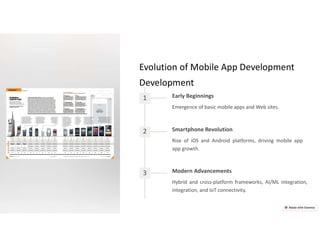
Evolution of MobileApp Development
Development
1 Early Beginnings
Emergence of basic mobile apps and Web sites.
2 Smartphone Revolution
Rise of iOS and Android platforms, driving mobile app
app growth.
3 Modern Advancements
Hybrid and cross-platform frameworks, AI/ML integration,
integration, and IoT connectivity.
3.
Mobile Platforms: iOSand Android
iOS
Apple's closed ecosystem with high-
high-end device integration.
Android
Google's open-source platform with
widespread device compatibility.
Platform Differences
Varying development tools,
languages, and user experiences.
4.
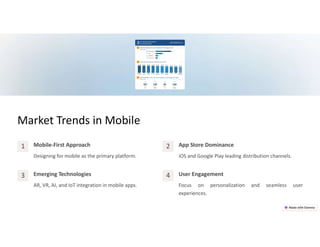
Market Trends inMobile
1 Mobile-First Approach
Designing for mobile as the primary platform.
2 App Store Dominance
iOS and Google Play leading distribution channels.
3 Emerging Technologies
AR, VR, AI, and IoT integration in mobile apps.
4 User Engagement
Focus on personalization and seamless user
experiences.
5.
Native App Development
Platform-Specific
Optimizedfor iOS or Android devices.
Enhanced Performance
Leveraging native device features and APIs.
Tailored UX
Adhering to platform-specific design guidelines.
Longer Development
Maintaining separate codebases for each platform.
• Building an app specifically for one platform (e.g., iOS or Android) using platform-specific tools and languages like Swift
for iOS or Kotlin for Android.
6.
Hybrid App Development
Cross-Platform
Singlecodebase for multiple
platforms.
Performance
Improved with native-like UI
components.
Cost-Effective
Reduced development and
maintenance costs.
Faster Updates
Simultaneous updates across
platforms.
• Creating an app with web technologies (HTML, CSS, JavaScript),
allowing it to work on multiple platforms with one codebase.
7.
Cross-Platform Development
React Native
Facebook'sopen-source framework for iOS and Android.
Flutter
Google's open-source SDK for cross-platform apps.
Xamarin
Microsoft's .NET-based framework for cross-platform
development.
• Developing an app using a single codebase (e.g., with Flutter or React
Native) that can be compiled to run natively on multiple platforms.
8.
Comparing
Development Approaches
Native HybridCross-Platform
Optimal performance Balanced performance
performance
Varied performance
Platform-specific UI
UI
Native-like UI Consistent UI
Longer development Faster development Fastest development
Higher cost Medium cost Lower cost
9.
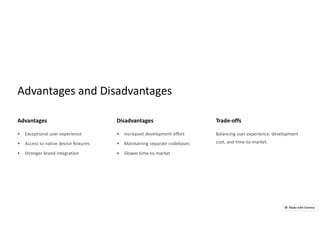
Advantages and Disadvantages
Advantages
•Exceptional user experience
• Access to native device features
• Stronger brand integration
Disadvantages
• Increased development effort
• Maintaining separate codebases
• Slower time-to-market
Trade-offs
Balancing user experience, development
cost, and time-to-market.
10.
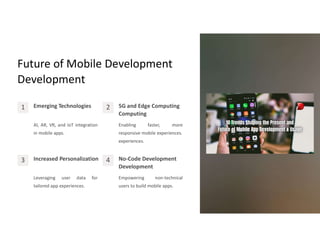
Future of MobileDevelopment
Development
1 Emerging Technologies
AI, AR, VR, and IoT integration
in mobile apps.
2 5G and Edge Computing
Computing
Enabling faster, more
responsive mobile experiences.
experiences.
3 Increased Personalization
Leveraging user data for
tailored app experiences.
4 No-Code Development
Development
Empowering non-technical
users to build mobile apps.