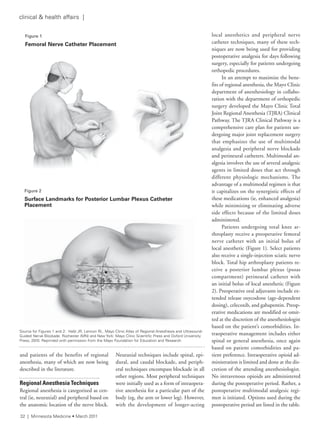
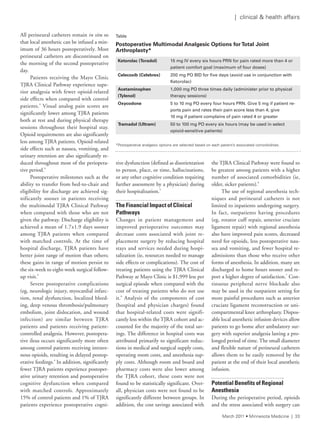
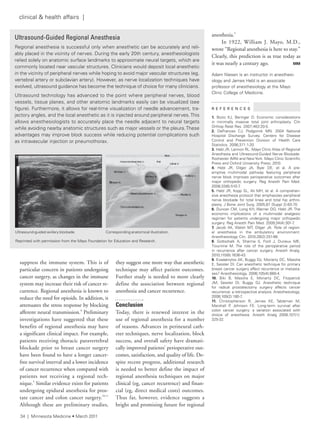
Minnesota Medical association February 2011Minnesota Medical association February 2011edical association February 2011
a l s o i n s i d e :
A Sleeper Career:
Rural Anesthesiology Practice
Smoking and Chronic Pain
Ultrasound-Guided
Regional Anesthesia
Minnesota Medical association March 2011
March 2011 • Minnesota Medicine | 1
CliniCal & HealtH affairs
31	 Multimodal	Clinical	Pathways,	Perineural	Catheters,	
and	Ultrasound-Guided	Regional	Anesthesia:	The	
Anesthesiologist’s	Repertoire	for	the	21st	Century
By adam D. niesen, M.D., and James r. Hebl, M.D.
35	 Smoking	and	Chronic	Pain:	A	Real-but-Puzzling	
Relationship
By toby n. Weingarten, M.D., Yu shi, M.D., M.P.H., Carlos B. Mantilla, M.D.,
Ph.D., W. Michael Hooten, M.D., and David O. Warner, M.D
38		Postoperative	Nausea	and	Vomiting	in	Pediatric	Patients
Discomfort, Delirium, and POnV in infants and Young Children Undergoing
strabismus surgery
By anne M. stowman, erick D. Bothun, M.D., and Kumar G. Belani,
M.B.B.s., M.s.
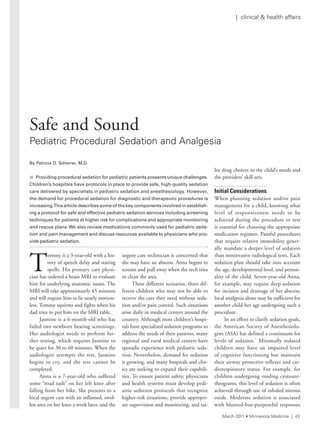
Postoperative nausea and Vomiting in infants and Young Children following
Urologic surgery
By Preeta George, M.B.B.s., M.D., Kumar G. Belani, M.B.B.s., M.s., and
aseem shukla, M.D.
43		Safe	and	Sound:	Pediatric	Procedural	Sedation		
and	Analgesia	
By Patricia D. scherrer, M.D.
48	 Pediatric	Chronic	Pain:	There	Is	Hope
By tracy Harrison, M.D.
MinnesOta MeDiCal assOCiatiOn
taBle Of COntents
COVer stOrY
	 Safety	First
By Kate ledger
How anesthesiologists launched the patient-
safety movement.
COMMentarY
27	 The	Evolution	of	Safety		
in	Anesthesiology
By Mark a. Warner, M.D.
Standardized anesthesia care and patient
monitoring have made surgery safer. The
next step is for anesthesiologists, surgeons,
and hospital staff to work together on pre-
and postoperative care.
29	 Anesthesiology	Education:	A	New	
Emphasis
By Mojca remskar Konia, M.D., and Kumar G.
Belani, M.B.B.s., M.s.
Why medical schools and residency programs
are having to rethink their approach to train-
ing future anethesiologists.
MarCH 2011
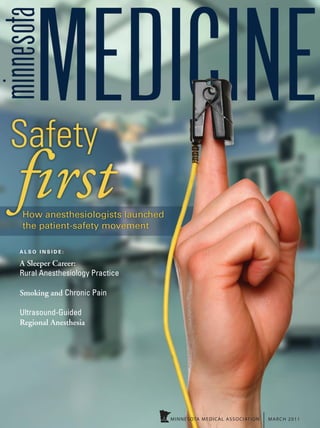
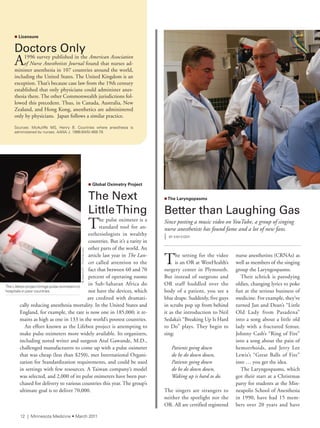
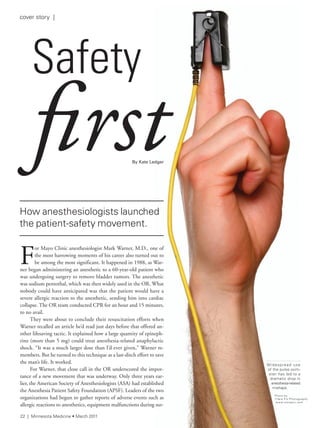
th e i nve n -
tion of the pulse
oximeter was a major
step forward in patient safety,
as it allows anesthesiologists to monitor oxygen satura-
tion in a patient’s blood and quickly prevent a crisis.
Photo by Clare Pix Photography • www.clarepix.com
enD nOtes
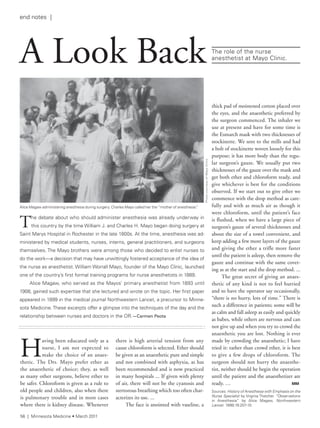
56		A	Look	Back
The role of the
nurse anesthetist at
Mayo Clinic.
the Mayo brothers
entrusted the task of
administering anes-
thesia to nurses. alice
Magaw was their
primary anesthetist
for many years. Charles Mayo eventually
dubbed her the “mother of anesthesia.”
PhotocourtesyofMayoClinic
22
2 | Minnesota Medicine • March 2011
taBle Of COntents
Minnesota Medicine is intended to serve as a credible
forum for presenting information and ideas affecting
Minnesota physicians and their practices. The content of
articles and the opinions expressed in Minnesota Medicine
do not represent the official policy of the Minnesota
Medical Association unless this is specified. The
publication of an advertisement does not imply
MMA endorsement or sponsorship.
MarCH 2011
PUlse 6-15
Sleeper	Career
Not many anesthesiologists practice in rural
areas. Mark Gujer is trying to change that.
Anti-Smoking	Prophet
David Warner believes anesthesiologists should
help patients quit.
Better	than	Laughing	Gas
Since posting a music video on YouTube, a group
of singing nurse anesthetists has found fame and
a lot of new fans.
Abbott’s	Pain	Patrol
Anesthesiologists at one Twin Cities hospital now
routinely use regional anesthesia to control pain
during and after surgery.
MMa neWs 20-21
• Dayton Budget avoids Clinic Payment Cuts
• MMa releases review of Medica’s associate
Clinic Participation agreement
• Board approves Physician Wellness
recommendations
• lawmakers learn about the MMa
alsO insiDe
4 . . . . . . . . . . . . . . . . . . . . . . . . . . . . . . . . . . editor’s note
18 . . . . . . . . . . . . . . . . . . . . . . . . . . . . . . . . . . . . Viewpoint
50 . . . . . . . . . . . . . . . . . . . . . employment Opportunities
minnesota
MEDICINE2011 MMA Officers
President
Patricia J. lindholm, M.D.
President-Elect
lyle J. swenson, M.D.
Chair, Board of Trustees
David C. thorson, M.D.
Secretary/Treasurer
David e. Westgard, M.D.
Speaker of the House
Mark liebow, M.D.
Vice Speaker of the House
robert Moravec, M.D.
Past President
Benjamin H. Whitten, M.D.
MMA Chief Executive Officer
robert K. Meiches, M.D.
MMA Board of Trustees
Northwest District
robert a. Koshnick Jr., M.D.
Northeast District
Michael P. Heck, M.D.
Paul B. sanford, M.D.
North Central District
Wade t. swenson, M.D., M.P.H.
Patrick J. Zook, M.D.
Twin Cities District
Michael B. ainslie, M.D.
Beth a. Baker, M.D., M.P.H.
Carl e. Burkland, M.D.
Benjamin W. Chaska, M.D.
V. stuart Cox iii, M.D.
Donald M. Jacobs, M.D.
roger G. Kathol, M.D.
Charles G. terzian, M.D.
David C. thorson, M.D.
Southwest District
Cindy firkins smith, M.D.
Keith l. stelter, M.D.
Southeast District
David C. agerter, M.D.
Daniel e. Maddox, M.D.
Gabriel f. sciallis, M.D.
Douglas l. Wood, M.D.
At-Large
fatima r. Jiwa, M.B. ChB.
Resident
Maya Babu, M.D.
Student
Carolyn t. Bramante
AMA Delegates
raymond G. Christensen, M.D.
Kenneth W. Crabb, M.D.
stephen f. Darrow, M.D.
anthony C. Jaspers, M.D.
sally J. trippel, M.D., M.P.H.
John M. Van etta, M.D.
AMA Alternate Delegates
John P. abenstein, M.D., M.s.e.e.
Blanton Bessinger, M.D., M.B.a.
Maya Babu, M.D.
David l. estrin, M.D.
Paul C. Matson, M.D.
Benjamin H. Whitten, M.D.
MMA Alliance
Co-presidents
Candy adams
Dianne fenyk
Contact Us
Minnesota Medicine, 1300 Godward street,
ste 2500, Minneapolis, Mn 55413. Phone:
612/378-1875 or 800/Dial MMa
email: mm@mnmed.org
Website: www.mnmed.org
Owner and Publisher
Minnesota Medical association
Editor in Chief
Charles r. Meyer, M.D.
Managing Editor
Carmen Peota
Associate Editor
Kim Kiser
MMA News
scott smith
Graphic Designers
Janna netland lover
Michael start
Publications Assistant
Kristin Drews
Advisory Committee
Zubin argawal
Maria Carrow
Donald l. Deye, M.D.
Barbara elliott, Ph.D.
Jon s. Hallberg, M.D.
neal Holtan, M.D.
Peter J. Kernahan, M.D.
robert K. Meiches, M.D.
Gregory Plotnikoff, M.D.
Martin stillman, M.D., J.D.
Barbara P. Yawn, M.D.
anjali Wilcox
therese Zink, M.D., M.P.H.
Copyright & Post Office Entry
Minnesota Medicine (issn 0026-556X) is
published each month by the Minnesota
Medical association, 1300 Godward
street ne, suite 2500, Minneapolis, Mn
55413. Copyright 2011. Permission to
reproduce editorial material in this maga-
zine must be obtained from Minnesota
Medicine. Periodicals postage paid at
Minneapolis, Minnesota, and at addi-
tional mailing offices. POstMaster,
send address changes to Minnesota
Medicine, 1300 Godward street, ste
2500, Minneapolis, Mn 55413.
Subscriptions
annual subscription - $45 (U.s.), $80 (all
international)
Missing Issues and Back Issues
Missing issues will be replaced for paid
subscribers at no additional charge if
notification is received within six months
of the publication date. replacement
of any issues more than six months old
will be charged the appropriate single
back issue price. single back issues of
Minnesota Medicine can be purchased
for $25 (U.s.) and $30 (Canada, Mexico,
and other international). send a copy of
your mailing label and orders to Kristin
Drews, 1300 Godward street, ste 2500,
Minneapolis, Mn 55413 or fax it to
612/378-3875.
To Advertise
Contact Jocelyn Cox at 612/623-2880
or jcox@mnmed.org.
To Submit an Article
Contact Carmen Peota at
cpeota@mnmed.org.
the editors reserve the right to reject
editorial, scientific, or advertising
material submitted for publication
in Minnesota Medicine. the views
expressed in this journal do not
necessarily represent those of the
Minnesota Medical association, its
editors, or any of its constituents.
4 | Minnesota Medicine • March 2011
PhotobyscottWalker
“Y
ou saved my life.” Anybody
who has practiced medicine
for any length of time has
heard those dramatic words. Although I
frequently think the comment is the result
more of perception than reality, it is true
that our patients sometimes walk the preci-
pice between life and death and that some-
times we successfully yank them back. But
occasionally, we put them on that cliff only
to, we hope, pull them back to safety.
I remember the first time I partici-
pated in the cardioversion of a patient with
atrial flutter. Clearly, the patient needed to
be “rescued” from the rapid heart rhythm
that was causing his dropping blood pres-
sure and shortness of breath. Yet, I shud-
dered when, after the electrical shock was
applied, his EKG showed a flat line for
what seemed like an eternity. Finally, his
heart kicked in with a normal rhythm that
restored his blood pressure and cleared his
symptoms. A few seconds of jeopardy fol-
lowed by a “save.”
Luckily, primary care internists
don’t have to endure too many of these
heart-stopping, anxiety-riling, gray-hair-
promoting moments. But for anesthesi-
ologists, this is their daily fare. Consider
what happens with general anesthesia:
A conscious and alert person lies down
on a bed and allows a masked person in
a funny-looking shower cap, whom they
just met, to place them in a state of deep
sleep for the next minutes or hours using
toxic chemicals. They trust that this same
person will have the skill, knowledge, and
inclination to wake them up and restore
them to their previous self. A recent New
England Journal of Medicine review of the
physiology of general anesthesia put it in
stark terms: “At levels appropriate for sur-
gery, general anesthesia can functionally
approximate brainstem death, because
patients are unconscious, have depressed
brain-stem reflexes, do not respond to
nociceptive stimuli, have no apneic drive,
and require cardiorespiratory and thermo-
regulatory support.”
Placing a patient in a state of brain-
stem death is quite a responsibility. So it’s
no wonder that anesthesiology has been at
the leading edge of the patient safety move-
ment. Long before “patient safety” was the
buzzword it is today, anesthesiologists bor-
rowed lessons from the airline industry and
looked at what they did each day, analyzed
when and why things went wrong, and
built systems to prevent things from going
wrong. Those systems have cut the rate of
complication and death associated with all
forms of anesthesia, which should make
patients a whole lot more comfortable with
that doctor behind the mask.
Increasingly, those masked doctors
do a whole lot more than put people to
sleep. Using ultrasound to find nerves long
since forgotten from anatomy lessons, they
administer innovative regional anesthesia,
which minimizes narcotic use and short-
ens recovery time. The mushrooming of
outpatient procedures has forced anesthe-
siologists to adjust and adapt, retooling the
education of students and residents and
bringing their equipment and skills into
new environments such as interventional
radiology suites and pain clinics.
Part of the drama of saving lives is the
very undramatic focus on patient safety.
Whether they are sitting in the OR squeez-
ing the bag or in the clinic tackling pain,
anesthesiologists will continue to teach,
preach, and practice safe medicine.
To the Edge and Back
Primary care internists
don’t have to endure
many heart-stopping,
anxiety-riling,
gray-hair-promoting
moments. But for
anesthesiologists,
this is their daily fare.
editor’s note |
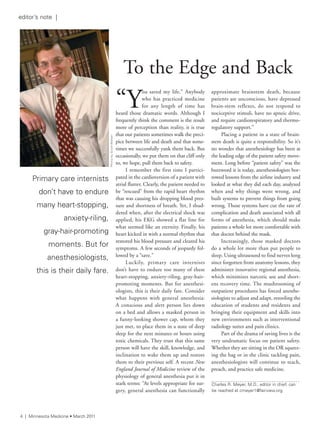
Charles r. Meyer, M.D., editor in chief, can
be reached at cmeyer1@fairview.org
esthesiologists (ASA), only 5
percent of practicing anesthe-
siologists work in rural parts
of the United States. Gujer
wants to see that number in-
crease and touts the merits of
rural practice to job candi-
dates, residents, and medical
students.
Whether that 5 percent
figure represents a shortage
of anesthesiologists in rural
America isn’t exactly clear. A
2010 report by RAND Health
found that the United States
and Minnesota are experienc-
ing a shortage of anesthesia
providers including both an-
esthesiologists and certified
registered nurse anesthetists
(CRNAs). But the RAND re-
port tells only part of the story.
“In Minnesota, on paper there’s
no real shortage of rural anes-
thesiologists because no one’s
putting jobs out there for them
to apply for,” Gujer says. “Peo-
ple put their hands up a long
time ago and said, ‘We can’t get
them’ and stopped trying.”
Instead, most hospitals in
greater Minnesota (most an-
esthesiologists in rural areas
work for hospitals) began rely-
ing on CRNAs after Gov. Jesse
Ventura in 2002 took advan-
tage of a change in the federal
Medicare rules that allowed
states to exempt hospitals
from requiring that physicians
supervise CRNAs. Currently,
16 states have adopted the
exemption.
Gujer believes the use of
CRNAs doesn’t alleviate the
need for anesthesiologists. “If
a hospital’s goal is to build its
surgical capabilities and do
more complex cases so they
don’t have to transfer patients
to tertiary care facilities, they
will have to have an anesthesi-
ologist,” he says.
And that’s precisely what
Cuyuna’s administration
wanted to do in 2006 when it
hired Gujer.
Staying Close
to	Home
At the time, Cuyuna was be-
coming known as a regional
leader in minimally invasive
surgery. Although its sur-
geons had the expertise to
perform complex procedures,
they were limited in the ex-
tent to which they could do
them, as the hospital served
a largely elderly population,
many of whom had comor-
bidities. “They may have car-
diac challenges or other health
problems that make them an
operative risk,” says Howard
McCollister, M.D., chief of
surgery and co-director of the
hospital’s minimally invasive
surgery center.
McCollister approached the
hospital’s board and adminis-
tration about hiring an anes-
thesiologist who was experi-
enced with medically complex
patients—in particular those
with cardiac problems—so
that they wouldn’t have to
send them to the Twin Cities
for surgery. “We needed an
M.D. to bring a broader focus
in dealing with people who
have physiologic problems, so
we could safely do operations
on people that most rural fa-
cilities, including bigger ones
close to us, can’t do,” he says.
But making the financial
case for hiring an anesthesiolo-
gist to serve a rural hospital can
be tricky. “They have to find a
way to get more bang for the
buck out of you because you
might not generate the revenue
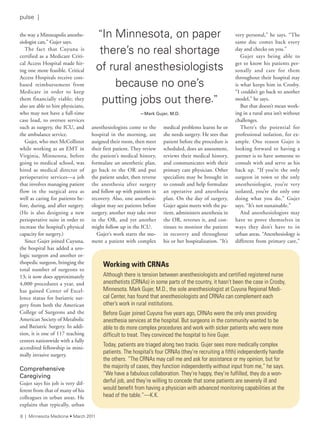
Having served as the only anesthesi-
ologist in Crosby, Minnesota, since
2006, Mark Gujer is looking forward to
having a colleague.
n Rural Anesthesiology
Sleeper	Career
Not many anesthesiologists practice in rural areas. Mark
Gujer is trying to change that. | BY KiM Kiser
Mark Gujer, M.D., is preparing to sell the merits of Crosby,
Minnesota. On a Friday in early January, he is getting
ready to drive to Brainerd to pick up a physician from Anchor-
age, Alaska, who is interviewing for an anesthesiology position at
Cuyuna Regional Medical Center, a 25-bed hospital in the town
of 2,000.
Gujer has his work cut out for him. “We had 30 applicants
and extended four interviews, which in our industry is doing
quite well for a rural practice. These [positions] are difficult to
recruit for,” he explains.
As the only anesthesiologist in Crosby—and for that matter,
one of only a handful in northern Minnesota—Gujer is some-
what of a lone wolf. According to the American Society of An-
PhotocourtesyofCuyunaregionalMedicalCenter
6 | Minnesota Medicine • March 2011
pulse |
the way a Minneapolis anesthe-
siologist can,” Gujer says.
The fact that Cuyuna is
certified as a Medicare Criti-
cal Access Hospital made hir-
ing one more feasible. Critical
Access Hospitals receive cost-
based reimbursement from
Medicare in order to keep
them financially viable; they
also are able to hire physicians,
who may not have a full-time
case load, to oversee services
such as surgery, the ICU, and
the ambulance service.
Gujer, who met McCollister
while working as an EMT in
Virginia, Minnesota, before
going to medical school, was
hired as medical director of
perioperative services—a job
that involves managing patient
flow in the surgical area as
well as caring for patients be-
fore, during, and after surgery.
(He is also designing a new
perioperative suite in order to
increase the hospital’s physical
capacity for surgery.)
Since Gujer joined Cuyuna,
the hospital has added a uro-
logic surgeon and another or-
thopedic surgeon, bringing the
total number of surgeons to
13; it now does approximately
4,000 procedures a year, and
has gained Center of Excel-
lence status for bariatric sur-
gery from both the American
College of Surgeons and the
American Society of Metabolic
and Bariatric Surgery. In addi-
tion, it is one of 117 teaching
centers nationwide with a fully
accredited fellowship in mini-
mally invasive surgery.
Comprehensive
Caregiving
Gujer says his job is very dif-
ferent from that of many of his
colleagues in urban areas. He
explains that typically, urban
anesthesiologists come to the
hospital in the morning, are
assigned their room, then meet
their first patient. They review
the patient’s medical history,
formulate an anesthetic plan,
go back to the OR and put
the patient under, then reverse
the anesthesia after surgery
and follow up with patients in
recovery. Also, one anesthesi-
ologist may see patients before
surgery, another may take over
in the OR, and yet another
might follow up in the ICU.
Gujer’s work starts the mo-
ment a patient with complex
medical problems learns he or
she needs surgery. He sees that
patient before the procedure is
scheduled, does an assessment,
reviews their medical history,
and communicates with their
primary care physician. Other
specialists may be brought in
to consult and help formulate
an operative and anesthesia
plan. On the day of surgery,
Gujer again meets with the pa-
tient, administers anesthesia in
the OR, reverses it, and con-
tinues to monitor the patient
in recovery and throughout
his or her hospitalization. “It’s
very personal,” he says. “The
same doc comes back every
day and checks on you.”
Gujer says being able to
get to know his patients per-
sonally and care for them
throughout their hospital stay
is what keeps him in Crosby.
“I couldn’t go back to another
model,” he says.
But that doesn’t mean work-
ing in a rural area isn’t without
challenges.
There’s the potential for
professional isolation, for ex-
ample. One reason Gujer is
looking forward to having a
partner is to have someone to
consult with and serve as his
back up. “If you’re the only
surgeon in town or the only
anesthesiologist, you’re very
isolated, you’re the only one
doing what you do,” Gujer
says. “It’s not sustainable.”
And anesthesiologists may
have to prove themselves in
ways they don’t have to in
urban areas. “Anesthesiology is
different from primary care,”
Working with CRNAs
although there is tension between anesthesiologists and certified registered nurse
anesthetists (Crnas) in some parts of the country, it hasn’t been the case in Crosby,
Minnesota. Mark Gujer, M.d., the sole anesthesiologist at Cuyuna regional Medi-
cal Center, has found that anesthesiologists and Crnas can complement each
other’s work in rural institutions.
Before Gujer joined Cuyuna five years ago, Crnas were the only ones providing
anesthesia services at the hospital. But surgeons in the community wanted to be
able to do more complex procedures and work with sicker patients who were more
difficult to treat. they convinced the hospital to hire Gujer.
today, patients are triaged along two tracks. Gujer sees more medically complex
patients. the hospital’s four Crnas (they’re recruiting a fifth) independently handle
the others. “the Crnas may call me and ask for assistance or my opinion, but for
the majority of cases, they function independently without input from me,” he says.
“We have a fabulous collaboration. they’re happy, they’re fulfilled, they do a won-
derful job, and they’re willing to concede that some patients are severely ill and
would benefit from having a physician with advanced monitoring capabilities at the
head of the table.”—K.K.
“in Minnesota, on paper
there’s no real shortage
of rural anesthesiologists
because no one’s
putting jobs out there.”
—Mark	Gujer,	M.D.
8 | Minnesota Medicine • March 2011
pulse |
says David Beebe, M.D., di-
rector of the anesthesiology
residency program at the Uni-
versity of Minnesota. “You
might go into an area and be
the first anesthesiologist, and
you’re dealing with nurse anes-
thetists, surgeons, and other
doctors you don’t know. You
need to show that you’re add-
ing something.”
Spreading the Word
Gujer, however, remains com-
mitted to promoting the posi-
tives of practicing in a rural
community. Three years ago,
he joined the ASA’s Rural Ac-
cess to Anesthesia Committee,
which established a fellowship
for medical students interested
in rural anesthesiology. Gujer
is one of five mentors. During
the last two years, he has had
two medical students shadow
him for four-week periods.
The idea, he says, is to expose
students to a side of anesthesi-
ology they otherwise may not
experience.
Jake Eiler, M.D., a 2010
University of Minnesota
Medical School graduate, did
a fellowship with Gujer in the
fall of 2009. Eiler, who grew
up in Morris, Minnesota, and
is now doing his residency at
the University of Wisconsin,
said the experience opened his
eyes to the idea of working in
a rural area. “If that experience
is never one that’s provided
or even available in medical
school and residency, it’s hard
for a person to think of it as a
viable option when in actual-
ity for me it might be the best
option given the quality of life
and kind of practice I want to
have,” he says.
Eiler was so impressed with
the experience that he and
Gujer convinced the medi-
cal school to award credit to
students who do the fellow-
ship. Gujer also has worked
with the university to create a
rural anesthesiology rotation
for residents. The three- to
four-week rotation has been
approved, Beebe says. He ex-
pects residents to sign up for it
starting next fall.
“My goal is to reach out and
get even more people inter-
ested in rural anesthesiology,”
Gujer says. “I need to convince
anesthesiologists that this is
a viable, rewarding place to
practice, and that they should
be out there selling themselves
to hospitals.” n
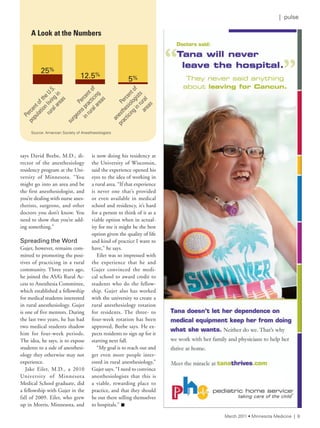
A Look at the Numbers
25%
12.5%
5%
Percentoftheu.s.
populationlivingin
ruralareas
Percentof
surgeonspracticing
inruralareas
Percentof
anesthesiologists
practicinginruralareas
source: american society of anesthesiologists
March 2011 • Minnesota Medicine | 9
| pulse
pulse |
other drugs such as opioids following sur-
gery.
Warner says patients are motivated
to abstain when they learn that it will
speed their recovery. Research—the best
of which comes from Scandinavia—has
shown for some time that bones heal
more slowly and wounds are more likely
to become infected in people who smoke.
“What’s relatively new is the knowledge
that if you can get people to quit, the com-
plication rate goes down,” he says, adding
that even if they quit for a brief period,
their outcomes can improve.
Warner is now working to convince
fellow physicians to start talking to surgi-
cal patients about quitting smoking. He
says anesthesiologists and surgeons often
think discussing smoking is not their job;
that they don’t have time for it; that they
don’t know how to help; that what they
say isn’t going to have an effect; and that
patients will be offended if they try to
bring it up. “I spend most of my time in
my research trying to knock down those
misconceptions,” he says.
His research has shown that patients
aren’t offended when surgeons and anes-
thesiologists talk to them about smoking.
“In fact,” he says, “if there’s something
they can do to improve their chances of
having a good outcome after surgery, they
want us as physicians to tell them.” And
he’s identified an approach that is effective
and simple for busy physicians to do. You
simply ask patients about smoking, advise
them to quit for as long as possible (he
recommends at least a week starting the
Mayo Clinic anesthesiologist David
Warner, M.D., has a message for
his fellow physicians: Use the time just
before surgery to encourage patients who
smoke to quit.
Warner says his thinking about this
began about 12 years ago when he started
researching ways to reduce risk factors
for lung problems in surgical patients.
He quickly realized that stopping smok-
ing before surgery was the single best
thing they could do. He also learned
something else: If a smoker underwent a
major surgical procedure, his chances of
successfully quitting were doubled, even
without assistance. “There’s something
very powerful about the surgical experi-
ence that motivates patients to take that
step that most of them want to take any-
way,” he says.
Just why that is isn’t entirely clear.
But Warner thinks it’s probably because of
a combination of factors, one of which is
that people facing surgery are more aware
of their health and willing to take steps to
improve it. Also, his research has shown
that smokers have fewer cravings and with-
drawal symptoms when they quit around
the time of surgery compared with when
they quit at other times. He speculates this
might be because they are removed from
things in the environment that normally
cue them to smoke or because they take
n Smoking and Surgery
Anti-Smoking	Prophet
David Warner believes anesthesiologists can help patients quit. | BY CarMen PeOta
Smoke Free for Surgery
in 2006, david Warner, M.d., convinced the american society of anesthesiolo-
gists (asa) to encourage its members to talk to patients about quitting smok-
ing before surgery. With the help of a task force led by Warner, the asa has
made a number of resources for patients available on its website including
brochures and information cards, a PowerPoint presentation, and a video that
explain the benefits of quitting smoking. there’s also a brochure for physicians
that explains how to talk to patients about smoking. for more information, go
to www.asahq.org/stopsmoking.
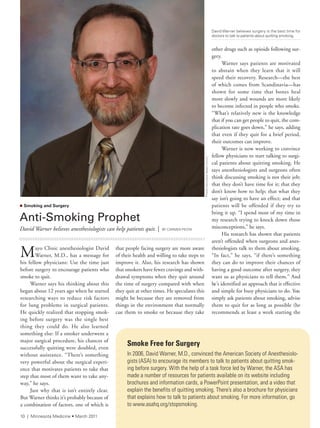
David Warner believes surgery is the best time for
doctors to talk to patients about quitting smoking.
PhotocourtesyMayoClinic
10 | Minnesota Medicine • March 2011
| pulse
night before surgery), and refer them to
smoking-cessation services.
About five years ago, Warner took
his ideas to the American Society of Anes-
thesiologists (ASA), which then launched
the Be Smoke-Free for Surgery initiative.
Although the ASA has embraced his ideas
and a pilot study involving several private
anesthesiology practices in Minnesota and
around the country showed they were fea-
sible, individual anesthesiologists haven’t
necessarily adopted them. “I’m not the
lone voice crying in the wilderness,” War-
ner says, but he acknowledges that the idea
that anesthesiologists can help patients
quit smoking is not widely accepted.
Yet Warner remains convinced that
talking to patients is the right thing to do.
And he’s hoping that he and others can
spread this message within and beyond the
anesthesiology community. He notes that
patients have at least five points of contact
with health care providers around the time
of surgery. He’d like to see the nurses, pri-
mary care doctors, surgeons, and anesthe-
siologists who see them at those points all
deliver the message about quitting. “It’s a
matter of having an opportunity at a time
when we know that people are more recep-
tive to these messages,” he says. n
n Local Anesthesia
Warmer	Welcome
Your patient will thank you for warming up that local anesthetic before injecting it.
Why? The injection will hurt less. So concluded researchers from the University of
Toronto, who recently studied the issue.
The researchers looked at 18 studies involving more than 800 patients and found
warming an anesthetic prior to injecting it consistently reduced patients’ pain, regardless
of whether the anesthetic had been buffered or not, whether the shot was administered
subcutaneously or intradermally, or whether the amount of anesthetic was large or small.
The authors did not recommend the best way to warm an anesthetic. But they listed
using a baby food warmer, a warming tray, and water baths among the methods used in
the studies they analyzed. The study was published in the February 11, 2011, issue of the
Annals of Emergency Medicine.
What To Say
anesthesiologist david Warner, M.d., knows that physicians sometimes strug-
gle with how to talk to patients about quitting smoking. he starts by asking if
they smoke, even if he already knows the answer. if they say yes, he advises
them to quit for as long as possible before and after surgery, or to at least try
to fast from cigarettes the morning of surgery and the week after. he explains
that this will help them avoid complications such as infection and lung prob-
lems. then he tells them, “if you’ve thought about quitting for good, surgery is
an excellent time to do it because you may be more motivated to do things to
improve your health, and you may even find it easier to quit.” he then hands
patients a card with the telephone number 800/QuitnOW, which can connect
them with free counseling. Warner says the conversation takes no more than a
minute.—C.P.
March 2011 • Minnesota Medicine | 11
n Global Oximetry Project
The	Next	
Little	Thing
The pulse oximeter is a
standard tool for an-
esthesiologists in wealthy
countries. But it’s a rarity in
other parts of the world. An
article last year in The Lan-
cet called attention to the
fact that between 60 and 70
percent of operating rooms
in Sub-Saharan Africa do
not have the devices, which
are credited with dramati-
cally reducing anesthesia mortality. In the United States and
England, for example, the rate is now one in 185,000; it re-
mains as high as one in 133 in the world’s poorest countries.
An effort known as the Lifebox project is attempting to
make pulse oximeters more widely available. Its organizers,
including noted writer and surgeon Atul Gawande, M.D.,
challenged manufacturers to come up with a pulse oximeter
that was cheap (less than $250), met International Organi-
zation for Standardization requirements, and could be used
in settings with few resources. A Taiwan company’s model
was selected, and 2,000 of its pulse oximeters have been pur-
chased for delivery to various countries this year. The group’s
ultimate goal is to deliver 70,000.
The setting for the video
is an OR at WestHealth’s
surgery center in Plymouth.
But instead of surgeons and
OR staff huddled over the
body of a patient, you see a
blue drape. Suddenly, five guys
in scrubs pop up from behind
it as the introduction to Neil
Sedaka’s “Breaking Up Is Hard
to Do” plays. They begin to
sing:
Patients going down
do be do down down,
Patients going down
do be do down down,
Waking up is hard to do.
The singers are strangers to
neither the spotlight nor the
OR. All are certified registered
nurse anesthetists (CRNAs) as
well as members of the singing
group the Laryngospasms.
Their schtick is parodying
oldies, changing lyrics to poke
fun at the serious business of
medicine. For example, they’ve
turned Jan and Dean’s “Little
Old Lady from Pasadena”
into a song about a little old
lady with a fractured femur,
Johnny Cash’s “Ring of Fire”
into a song about the pain of
hemorrhoids, and Jerry Lee
Lewis’s “Great Balls of Fire”
into … you get the idea.
The Laryngospasms, which
got their start at a Christmas
party for students at the Min-
neapolis School of Anesthesia
in 1990, have had 15 mem-
bers over 20 years and have
the lifebox project brings pulse oximeters to
hospitals in poor countries.
n Licensure
Doctors	Only
A1996 survey published in the American Association
of Nurse Anesthetists Journal found that nurses ad-
minister anesthesia in 107 countries around the world,
including the United States. The United Kingdom is an
exception. That’s because case law from the 19th century
established that only physicians could administer anes-
thesia there. The other Commonwealth jurisdictions fol-
lowed this precedent. Thus, in Canada, Australia, New
Zealand, and Hong Kong, anesthetics are administered
only by physicians. Japan follows a similar practice.
sources: Mcauliffe Ms, Henry B. Countries where anesthesia is
administered by nurses, aana J. 1996;64(5):469-79.
©beerkoff-fotolia.com
nThe Laryngopasms
Better	than	Laughing	Gas
Since posting a music video on YouTube, a group of singing
nurse anesthetists has found fame and a lot of new fans.
| BY KiM Kiser
12 | Minnesota Medicine • March 2011
performed at meetings and
conferences across the United
States. The group gained a
wider following after posting
the “Waking Up Is Hard to
Do” video on YouTube two
years ago. “It went viral,” says
Richard Leyh, CRNA, who
has been with the group since
1998, explaining that it’s had
more than 8 million views.
That led to appearances on
CNN and CBS as well as on
local television stations. They
auditioned for “America’s Got
Talent” in 2009, and 3,700
people are following them on
Facebook.
This year, the Laryngo-
spasms are scheduled to play
for the American Association
of Nurse Anesthetists in Wash-
ington, D.C., the Operating
Nurses Association of Can-
ada—their first international
performance—in Regina, Sas-
katchewan, and the OR Man-
agers’ Conference in Chicago.
Leyh says they plan on releas-
ing their third album in the
spring. And they’ll perform
their first gig in front of a non-
medical audience. “We’ll test
the market to see how much it
appeals to the general public,”
he says, adding that the group
gets a lot of emails from people
who come across their videos.
So what keeps four middle-
aged guys, who spend their
days watching over sedated pa-
tients, writing lyrics and prac-
ticing their dance moves? “You
get to be rock stars for a day,”
Leyh says. n
Waking Up Is Hard to Do
don’t take my tube away from me
i’m trying to breathe, oh can’t you see
take it out and i’ll turn blue
‘Cuz waking up is hard to do
i beg of you, please give me one more try
i’m only 90 much too young to die
i put all my faith in you
‘Cuz waking up is hard to do
(Chorus)
They say that waking up is hard to do
Now I know, I know that it’s true
Don’t say that this is the end
Instead of waking up I think my incision’s opened
up again.
i am in such misery
feels like my eyes are taped and i can’t see
if i wake i’m going to sue
‘Cuz waking up is hard to do
(Repeat Chorus)
now i’m awake, i can breathe and see
My bladder’s full and i’ve got to pee
now i think i’ll throw upon on you
Cuz waking up is hard to do
The Current
Members…
and where you might find them
when they’re not on stage
Richard Leyh, lakeview Hospital
Gary Cozine, the only
original member, now works
in Meriden, Ct
Doug Meuwissen,
Woodwinds Hospital
Keith Larson, northfield Hospital
n Global Warming
Anesthesia	Contributes	
to	Climate	Change
Anesthesia has an effect on the earth’s atmosphere each
year similar to that of CO2 emissions from a coal plant
or a million cars, according to research published in the online
version of the British Journal of Anaesthesia last October.
Researchers detailed properties of gases commonly used in anesthe-
sia to calculate their effect on global warming. Three—isoflurane, desflurane, and sevoflurane—
were found to have climate-changing potential.
The worst offender was desflurane, which is used in inhaled general anesthesia. The effect of
each pound that enters the atmosphere is equal to that of 1,620 lbs. of carbon dioxide. The other
two gases had much less impact.
source: sulbaek andersen MP, sander sP, nielsen OJ, Wagner Ds, sanford tJ, Wallington tJ. inhalation anaesethics and
climate change. British J Anaesthesia. Published online October 8, 2010.
PhotobyJaneMcMullen,lakeviewHospital
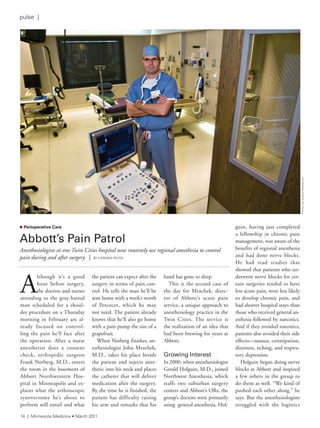
from left: richard leyh, Gary Cozine,
Keith larson, and Doug Meuwissen ham
it up before shooting the video for “ring
of fire” at lakeview Hospital.
©istockphoto/imagePixel
March 2011 • Minnesota Medicine | 13
| pulse
A
lthough it’s a good
hour before surgery,
the doctors and nurses
attending to the gray-haired
man scheduled for a shoul-
der procedure on a Thursday
morning in February are al-
ready focused on control-
ling the pain he’ll face after
the operation. After a nurse
anesthetist does a consent
check, orthopedic surgeon
Frank Norberg, M.D., enters
the room in the basement of
Abbott Northwestern Hos-
pital in Minneapolis and ex-
plains what the arthroscopic
synovectomy he’s about to
perform will entail and what
the patient can expect after the
surgery in terms of pain con-
trol. He tells the man he’ll be
sent home with a week’s worth
of Percocet, which he may
not need. The patient already
knows that he’ll also go home
with a pain pump the size of a
grapefruit.
When Norberg finishes, an-
esthesiologist John Mrachek,
M.D., takes his place beside
the patient and injects anes-
thetic into his neck and places
the catheter that will deliver
medication after the surgery.
By the time he is finished, the
patient has difficulty raising
his arm and remarks that his
hand has gone to sleep.
This is the second case of
the day for Mrachek, direc-
tor of Abbott’s acute pain
service, a unique approach to
anesthesiology practice in the
Twin Cities. The service is
the realization of an idea that
had been brewing for years at
Abbott.
Growing Interest
In 2000, when anesthesiologist
Gerald Holguin, M.D., joined
Northwest Anesthesia, which
staffs two suburban surgery
centers and Abbott’s ORs, the
group’s doctors were primarily
using general anesthesia. Hol-
guin, having just completed
a fellowship in chronic pain
management, was aware of the
benefits of regional anesthesia
and had done nerve blocks.
He had read studies that
showed that patients who un-
derwent nerve blocks for cer-
tain surgeries tended to have
less acute pain, were less likely
to develop chronic pain, and
had shorter hospital stays than
those who received general an-
esthesia followed by narcotics.
And if they avoided narcotics,
patients also avoided their side
effects—nausea, constipation,
dizziness, itching, and respira-
tory depression.
Holguin began doing nerve
blocks at Abbott and inspired
a few others in the group to
do them as well. “We kind of
pushed each other along,” he
says. But the anesthesiologists
struggled with the logistics
n Perioperative Care
Abbott’s	Pain	Patrol
Anesthesiologists at one Twin Cities hospital now routinely use regional anesthesia to control
pain during and after surgery. | BY CarMen PeOta
PhotobysteveWewerka
14 | Minnesota Medicine • March 2011
pulse |
of both doing nerve blocks,
which required them to attend
to patients ahead of their sur-
gery, and directing the care of
patients during surgery. Hol-
guin realized they needed a
better system.
Mrachek, who joined the
group in 2006, was also inter-
ested in doing nerve blocks.
By this time, anesthesiolo-
gists elsewhere were doing
ultrasound-guided blocks with
good results. In addition, he
was interested in doing more
patient care. “We put them
to sleep, we woke them up,
we gave them to a nurse to
take care of them afterward,
and that was it,” he says of
the way anesthesiologists had
long worked. As he saw it, an-
esthesiologists were uniquely
equipped to help patients with
pain, not just during surgery
but after. The others in the
group encouraged him to take
what Holguin had started to
the next level.
A Matter of Logistics
Mrachek, fresh out of resi-
dency, agreed to take on the
project, which turned out
to be a tremendous amount
of work. The first issue was
finding space. The anesthesi-
ologists would need procedure
rooms where they could have
their equipment and do the
blocks. Abbott offered a for-
mer cardiac intensive care unit
next to its operating suites. In
addition, the hospital agreed
to purchase ultrasound equip-
ment for the group and hire
nurses to support the physi-
cians.
The next step was to bring
all the members of the group
up to speed on regional anes-
thesia techniques. At first, only
Mrachek, Holguin, and a few
other anesthesiologists were
confident in their abilities to
do ultrasound-guided nerve
blocks. “If we were going to
deliver this service, we needed
to deliver it around the clock
every day of the week. To get
to that point, we had to have
a critical mass of docs doing
this,” Mrachek says. He,
Holguin, and others worked
elbow-to-elbow with col-
leagues who were less skilled,
showing them what they had
learned. Mrachek also devel-
oped a four-hour session that
included having his colleagues
use ultrasound on live mod-
els to practice finding certain
nerves.
The anesthesiologists soon
realized they needed to in-
form the surgeons, hospital-
ists, and nurses who cared for
patients after surgery that pa-
tients weren’t going to need
as many narcotics as they had
in the past. “If you’re used to
always giving a lot of narcot-
ics to patients who’ve had their
knee replaced, and now we’ve
done a nerve block and they
don’t require hardly any nar-
cotics, that’s a major change
from what they’re used to,”
Mrachek says. Furthermore,
the other staff needed to know
that many patients would be
sent home immediately after
their surgeries.
Mrachek and his team also
had to make changes in their
processes, one of which was
related to scheduling. Because
patients would need their re-
gional anesthetic to take ef-
fect just before their surgeons
were ready to begin operating,
the anesthesiologists needed to
sync the timing of the nerve
blocks to the timing of the
surgeries. Even now, Holguin
says, “it can be very stress-
ful in terms of time manage-
ment.” To make it work, the
nurses, doctors, and other
staff intently watch monitors
that track the progress of cases
in each of Abbott’s 45 ORs.
When they see that a surgeon
is within 30 to 40 minutes
of starting a new case, they’ll
start the nerve block for that
patient.
In addition, the acute pain
service team has had to figure
out how to inform patients
about this new style of anesthe-
sia. “A lot of patients who are
coming to Abbott to have their
shoulder work done might be
caught off guard by an anes-
thesiologist who tells them he
wants to stick a needle in their
neck and make their shoulder
numb,” Mrachek says. “If you
weren’t anticipating that, you’d
say, ‘Why are you going to do
that, and tell me more about
it.’”
And there were a host of
other smaller changes that had
to be made such as revamp-
ing order sets, updating forms,
and figuring out how to man a
phone line 24/7.
A Model to Replicate
anesthesiologist John Mrachek, M.d., says any
hospital in the twin Cities could create a pro-
gram similar to the acute pain service at abbott
northwestern. But he cautions that it requires a
commitment from the anesthesiologists. “taking
on the responsibility of these patients while the
nerve catheters are in place means being available
24/7,” he says. “it sounds burdensome. if i were
talking to colleagues across town, this is the part
where they’d be like, ‘i don’t know if we want to
do this.’” But Mrachek says that on average, he
and his colleagues receive less than one page per
night (for both inpatients and outpatients). he says
that’s because of the extensive patient education
the nurses on the team do before patients are sent
home or to the wards.
his colleague Gerald holguin, M.d., agrees. “the
one thing i can’t overemphasize is that this kind
of a service can’t happen without the help of
dedicated acute pain service nurses,” he says. the
three nurses who support the anesthesiologists
at abbott educate new nurses on the floors about
how to manage patients with peripheral nerve
catheters and pain pumps, assist with pain rounds,
and troubleshoot peripheral catheters that may
not be providing adequate pain relief. “they allow
us to efficiently manage the service in a safe and
comprehensive manner,” he says. “they act as our
advocates and educators.”—C.P.
John Mrachek, M.D., in one of the
rooms where he and other anesthesi-
ologists from northwest anesthesia
do ultrasound-guided nerve blocks.
9
March 2011 • Minnesota Medicine | 15
| pulse
AWin-Win-Win
Mrachek was confident the
new system would work. But
other anesthesiologists needed
to be convinced. He says it
wasn’t until many of his col-
leagues began to do “pain
rounds” (they now visit all pa-
tients in the recovery room or
on the wards, not just those
who had a problem in the OR)
and saw how well their patients
were doing that they fully
bought into the new approach.
He describes patient satisfac-
tion as “through the roof.”
Holguin says the benefits
to patients are “huge.” “You
minimize all the side effects
of general anesthesia,” he says.
He explains that patients who
have regional anesthesia are less
likely to develop blood clots or
emboli relative to those who
have general anesthesia. He
says it is especially appropri-
ate for patients with heart and
lung diseases. “When you in-
tubate someone who smokes,
has COPD, or has asthma,
there is greater potential for
bronchospasms during or after
surgery,” he explains.
Holguin adds that pain
control is much better under
regional anesthesia, and that
patients who receive it need
fewer narcotics afterward.
Thus they avoid the danger-
ous side effects of those drugs
such as respiratory depres-
sion, which can be particu-
larly troublesome for people
with respiratory problems.
Mrachek points out that
payers and the hospital have
been supportive of the new
acute pain service because it
reduces the length of hospital
stays. He says patients require
less physical therapy because
they’re able to do more sooner
because they have less pain.
And they are less likely to de-
velop chronic pain. Mrachek
explains that in sedated pa-
tients or those under general
anesthesia, the cellular signal-
ing that can damage nerves
and cause chronic pain is still
occurring. Doing the blocks
stops those mechanisms. “If
you give a 30-year-old a nerve
block, you can save millions
over a lifetime,” he says.
“We’re doing what every-
one in the world wants us to
do right now—physicians,
policymakers, payers. We’re
delivering high-quality care
that is safer and is costing less.
It’s a win-win-win situation,”
Mrachek says. And he thinks
it simply makes sense: “Instead
of putting a drug through your
whole body, if your knee hurts,
why not put the medicine in
your knee instead?” n
n National Leader
Safety
Advocate
AMinnesotan is heading the
American Society of An-
esthesiologists (ASA) this year.
Mark A. Warner, M.D., dean of
the Mayo School of Graduate
Medical Education and a pro-
fessor of anesthesiology at the
Mayo Clinic College of Medi-
cine, was installed as president
of the ASA during the organization’s annual meeting last
October.
Warner’s focus during his term is advancing the cause of
patient safety (see p. 27). He currently directs both the An-
esthesia Patient Safety Foundation and the Foundation for
Anesthesia Education and Research.
Warner has also served as the president of the Minnesota
Society of Anesthesiology, president of the American Board
of Anesthesiology, and editor of the journal Anesthesiology.
PhotocourtesyAmericanSocietyofAnesthesiologists
Mayo Clinic’s MarkWarner, M.D.
SPS
safe and sound
SOCIETY FOR PEDIATRIC SEDATION
Please visit www.pedsedation.org
for submission guidelines and registration information
C
M
Y
CM
MY
CY
CMY
K
“A lot of patients might
be caught off guard by an
anesthesiologist who tells
them he wants to stick a
needle in their neck and make
their shoulder numb.”
—John Mrachek, M.D.
16 | Minnesota Medicine • March 2011
pulse |
18 | Minnesota Medicine • March 2011
viewpoint |
T
his winter has been colder and
snowier than average in Min-
nesota. A good thing about this
weather is that it reminds us that only
by relying on each other and pulling to-
gether—as neighbors and as larger com-
munities—are we able to thrive in this
climate. That’s a lesson we as doctors can
apply as we anticipate upcoming budget
battles.
We face a foreboding forecast with
regard to the state and federal budgets, es-
pecially in the area of health and human
services. We must confront the reality of
billion-dollar state and trillion-dollar fed-
eral budget deficits. The economy is slowly
recovering, but we’re not likely to see huge
increases in tax revenues this year. What to
do? It would be nice to have the wisdom of
Solomon at such a time.
Although we may not feel we have
that kind of wisdom, we doctors do have
unique knowledge and a valuable perspec-
tive. We need to make sure that our voices
are heard and that we share our insights
in order to help our legislators make wise
decisions.
In January, a number of MMA mem-
bers participated in the MMA Day at the
Capitol in St. Paul. It was heartening to
see so many physicians, residents, and
medical students making time to go to
St. Paul to weigh in on these and other is-
sues that affect patients and health profes-
sionals in this difficult time.
We met many newly elected freshman
legislators, who need our advice in order
to make decisions about health care fund-
ing priorities. We told them the MMA is
concerned about the potential weakening
of social and health care safety net pro-
grams. We are concerned about the regres-
sive “provider tax” that has funded health
care and been used in the past to balance
the budget. We are concerned also that we
may not be able to afford to care for Medi-
cal Assistance patients because of the low
payments we receive.
In February, several MMA leaders at-
tended the AMA National Advocacy Con-
ference in Washington, D.C. We met with
members of our congressional delegation.
We advocated for eliminating the SGR for-
mula that causes the yearly anxiety about
Medicare payments and access to care for
our senior citizens. Tort reform was also on
the agenda. It is clear that Congress will
not tackle Medicare reform in this session.
But we will be watching carefully as the
Affordable Care Act is challenged in the
courts and the political arena.
I have been impressed with the large
number of students and residents who are
engaged in the political process at both the
state and national levels this year. These
future colleagues have wisdom and leader-
ship skills that bode well for the future of
our profession. I encourage us all to get en-
gaged in the discussions that will affect our
state and nation. And I further encourage
us veteran physicians to mentor a student,
resident, or new physician as we advocate
for our patients.
Together we can support innovative
policies that will help us deliver high-qual-
ity health care fairly and cost-efficiently to
all of our neighbors. Don’t allow yourself
to be marginalized as important decisions
are being made. The MMA is counting on
all of you. Let us hear your voices.
Patricia J. Lindholm, M.D.
MMA President
PhotobysteveWewerka
We must confront
the reality of billion-
dollar state and
trillion-dollar federal
budget deficits.
The Times Demand
We All Weigh In
G
ov. Mark Dayton’s proposed
budget, released in February,
cuts payments to hospitals, nurs-
ing homes, and managed care plans but
maintains current MinnesotaCare and
Medical Assistance reimbursement levels
for clinics. The budget plan relies heavily
on tax increases to minimize the cuts and
preserve programs and services.
The MMA commended Dayton for
proposing a budget that took a balanced
approach to resolving the state’s $6.2 bil-
lion deficit. “The governor’s proposal
seeks to balance the state budget by using
a combination of new revenues and cuts—
an approach that the MMA believes is
preferable to a cuts-only budget fix,” says
President Patricia Lindholm, M.D.
The MMA is concerned, however,
that Dayton’s budget plan disproportion-
ately cuts spending on health care com-
pared with other areas. The governor’s
proposal includes $12 billion for health
and human services in fiscal year 2012-13,
which is about 3 percent or $350 million
less than what was forecast in November.
Health and human services account for
about 30 percent of the state’s general fund
expenditures.
The budget plan also eliminates ac-
cess to MinnesotaCare for 7,200 adults
with incomes above 200 percent of pov-
erty or an annual income of $21,780.
“It is disappointing the governor
did not do more to protect the health
care safety net, since his proposal is the
starting point for the budget discus-
sion,” says Dave Renner, the MMA’s
director of state and federal legislation.
“It is likely that Republican lawmakers
will propose even larger cuts to health and
human services.”
Indirect Effects
Although physician reimbursements were
not directly affected in the budget outline,
reductions in other areas could result in
lower payments for doctors who provide
care to people enrolled in public health in-
surance programs.
Specifically, the budget proposes
reforms to the Medical Assistance and
MinnesotaCare managed care programs
that would generate savings of $115 mil-
lion over the biennium. It also includes
a 2.75 percent cut in payments to health
plans starting in 2012 with the assumption
that the plans can recoup their losses by
implementing provider payment reforms.
The proposed budget also would withhold
some money from health plans that would
be returned to them if they reduce hospital
readmissions. It is not clear whether health
plans would ultimately pass along those
cuts to providers.
In addition, the governor’s budget
would reduce payments to hospitals and
nursing homes. Nursing facilities would see
payment rates reduced by 2 percent. Home
and community-based services would face
a 4.5 percent rate cut. Hospitals would
lose about $130 million due to a delay
of the rebasing of payment rates in 2013-
2015. The state also would cut hospitals’
current outpatient service payments by
0.5 percent.
Hospitals, nursing facilities, and
health plans also would face increased
Medical Assistance surcharges that would
generate $627 million for the state. Pro-
viders would recoup some, but not all, of
those surcharges through higher Medical
Assistance reimbursement rates.
Dayton Budget Avoids
Clinic Payment Cuts
Health Care Reform
dayton’s proposed budget
includes
$2.5 million in state matching
dollars to jumpstart a health
insurance exchange
$20 million a year for the
statewide health improve-
ment Program, a state public
health initiative aimed at re-
ducing smoking and obesity
“the governor’s
proposal seeks to
balance the state
budget by using a
combination of new
revenues and cuts—
an approach that the
MMa believes is
preferable to a cuts-
only budget fix.”
—Patricia lindholm, M.D.
MMa President
Gov. Mark Dayton
20 | Minnesota Medicine • March 2011
mma news |
Lawmakers Learn
About the MMA
MMA Director of Health Policy Janet Silversmith testified
before the House Health and Human Services Finance
Committee last month about the MMA’s twin goals of making
Minnesota the healthiest state in the nation and the best place in
the country to practice medicine.
In an effort to educate lawmakers, Silversmith shared a brief
overview of physician demographics in the state and the MMA’s
history and mission. She also described the MMA’s goals of re-
forming the care delivery system, promoting access to care by
ensuring the financial viability of public health programs, and
creating a payment system that rewards value rather than volume.
Board Approves
Physician Wellness
Recommendations
The MMA Board of Trustees approved a recommendation
at its January meeting that the MMA develop a plan for
promoting physician wellness. The recommendation was made
by the 20-member Physician Well-Being Task Force, which was
charged with exploring the topics of physician burnout, unsup-
portive or abusive work environments, work-life balance, and
resilience, and developing recommendations on how the MMA
can support, foster, and promote health and well-being among
Minnesota physicians.
The plan will likely include:
• Work to improve the culture of medicine and prevent
breakdowns in collegiality among medical students, resi-
dents, and physicians;
• Efforts to promote awareness of the prevalence of physi-
cian burnout and ways to prevent it and help physicians
cope; and
• Educational programs for members about the importance
of physician well-being.
MMA President Patricia Lindholm, M.D., who has made
promoting physician health and wellness a focus of her presi-
dency, says now that the board has taken action, the next step is
to figure out the specifics of the plan.
“For me, this means that physician well-being is going
to be an ongoing focus and activity of the MMA, and people
who are looking for resources and help can go to the MMA,”
she says.
Areview of Medica’s asso-
ciate clinic participation
agreement is now available
to MMA members online at
www.mnmed.org/medicacon-
tract.
Medica requires providers to
accept the agreement as a con-
dition of joining its network.
The agreement automatically
renews every two years unless
it is otherwise terminated.
The agreement encompasses
all of Medica’s fully insured
group and individual products
and some self-insured group
products.
The MMA worked with the
Twin Cities Medical Society
and the Minnesota Medical
Group Management Associa-
tion to review the agreement.
They found several items of
concern:
• Language saying provid-
ers must refer members to
other providers within the
network;
• A prohibition against clinics
contracting with or employ-
ing individuals or entities ex-
cluded from participating in
Medicaid and Medicare;
• Medica’s having access to
patient records 10 years after
the contract is terminated;
and
• A requirement that clin-
ics wanting to renegotiate
or terminate their contract
notify Medica at least 125
days prior to the end of the
contract.
Five Facts about Physicians
in Minnesota
1. Minnesota has about 19,600 physicians.
2. Minnesota is ranked 13th in the nation in terms of num-
ber of physicians per capita, with a rate of 264 practic-
ing doctors per 100,000 residents.
3. Minnesota’s office-based physicians directly and indi-
rectly contributed $16.3 billion to the state’s economy
in 2009.
4. each office-based physician in Minnesota supports
5.8 jobs (including his or her own).
5. sixty-three percent of the state’s physicians are in prac-
tices with more than 100 doctors.
sources: Minnesota Board of Medical Practice; 2009 state Physician
Workforce Data Book;the lewin Group; “the economic impact of Office-
Based Physicians in Minnesota;” and MMa Physician Database.
MMA Releases Review of Medica’s Associate Clinic
Participation Agreement
March 2011 • Minnesota Medicine | 21
| mma news
How anesthesiologists launched
the patient-safety movement.
F
or Mayo Clinic anesthesiologist Mark Warner, M.D., one of
the most harrowing moments of his career also turned out to
be among the most significant. It happened in 1988, as War-
ner began administering an anesthetic to a 60-year-old patient who
was undergoing surgery to remove bladder tumors. The anesthetic
was sodium pentothal, which was then widely used in the OR. What
nobody could have anticipated was that the patient would have a
severe allergic reaction to the anesthetic, sending him into cardiac
collapse. The OR team conducted CPR for an hour and 15 minutes,
to no avail.
They were about to conclude their resuscitation efforts when
Warner recalled an article he’d read just days before that offered an-
other lifesaving tactic. It explained how a large quantity of epineph-
rine (more than 5 mg) could treat anesthesia-related anaphylactic
shock. “It was a much larger dose than I’d ever given,” Warner re-
members. But he turned to this technique as a last-ditch effort to save
the man’s life. It worked.
For Warner, that close call in the OR underscored the impor-
tance of a new movement that was underway. Only three years ear-
lier, the American Society of Anesthesiologists (ASA) had established
the Anesthesia Patient Safety Foundation (APSF). Leaders of the two
organizations had begun to gather reports of adverse events such as
allergic reactions to anesthetics, equipment malfunctions during sur-
safety
firstBy Kate Ledger
How anesthesiologists launched
or Mayo Clinic anesthesiologist Mark Warner, M.D., one of
the most harrowing moments of his career also turned out to
be among the most significant. It happened in 1988, as War-
ner began administering an anesthetic to a 60-year-old patient who
was undergoing surgery to remove bladder tumors. The anesthetic
was sodium pentothal, which was then widely used in the OR. What
nobody could have anticipated was that the patient would have a
severe allergic reaction to the anesthetic, sending him into cardiac
collapse. The OR team conducted CPR for an hour and 15 minutes,
They were about to conclude their resuscitation efforts when
Warner recalled an article he’d read just days before that offered an-
other lifesaving tactic. It explained how a large quantity of epineph-
rine (more than 5 mg) could treat anesthesia-related anaphylactic
shock. “It was a much larger dose than I’d ever given,” Warner re-
members. But he turned to this technique as a last-ditch effort to save
For Warner, that close call in the OR underscored the impor-
tance of a new movement that was underway. Only three years ear-
lier, the American Society of Anesthesiologists (ASA) had established
the Anesthesia Patient Safety Foundation (APSF). Leaders of the two
organizations had begun to gather reports of adverse events such as
allergic reactions to anesthetics, equipment malfunctions during sur-
firstfirstedger
first
Widespread use
of the pulse oxim-
eter has led to a
dramatic drop in
anesthesia-related
mishaps.
Photo by
Clare Pix Photography
www.clarepix.com
22 | Minnesota Medicine • March 2011
cover story |
gery, and tragic medical errors and oversights. They had begun to
publish articles about those events and see them as trends requir-
ing rigorous study. “Until then,” says Warner, who recently be-
came president of the ASA, “incidents would happen in isolated
settings. Each event might prompt a change in an approach; but
nobody was pulling all the cases together and looking at entire
systems and asking, What can we do better?” He recognized that
unprecedented, and potentially life-saving, information was be-
coming available to the field. What he only could have guessed
at the time was that the new focus on patient safety would have
a major impact not only on the practice of anesthesiology but on
other medical specialties as well.
An Age-Old Hazard
The notable dangers of anesthesia go back to the beginning of
modern surgery. In the 1920s, a patient had a one in 10 chance
of surviving a procedure such as an appendectomy because of
the risks of anesthesia as well
as of postoperative infections.
Survival rates eventually im-
proved. But even 40 years ago,
anesthesia-related mishaps
in Minnesota and across the
country were more common
than anyone wished.
Some were the result of
human mistakes. In one case
from the late 1970s, a 45-year-
old woman with severely dis-
figuring rheumatoid arthritis
died on the operating table
during an orthopedic procedure on her shoulder. The anesthe-
siologist had placed an oxygen tube through her nose into her
trachea. At the time, physicians ascertained placement of the tube
by listening with a stethoscope for the flow of air. Despite what
sounded like air going in and out of the woman’s lungs, the tube
was misplaced.
Other problems arose from equipment in the OR. Some had
components that made it possible for an anesthesiologist to in-
advertently turn on two potent anesthetic gases at once. In the
1980s, such a mishap caused the death of a 20-year-old patient
who received both enflurane and halothane at once. In another
case, a canister of volatile gas was knocked over and then put back
on a shelf. The tipping caused too much gas to flow into the can-
ister’s vaporizing compartment; as a result, a pediatric patient re-
ceived an excessive dose of anesthesia. Similar adverse events were
happening throughout the country. (In some cases, they resulted
in the manufacturer swiftly making improvements to anesthesia
machinery.) By some accounts, as many as 6,000 people in the
United States were being harmed each year.
More common than accidental deaths were “near misses,”
recalls Richard Prielipp, M.D., chair of anesthesiology at the Uni-
versity of Minnesota. Most anesthesiologists had stories about
narrowly avoiding an incident during surgery. “Often, patients
didn’t actually suffer permanent harm, but they were very close
to it,” he says, noting that the day-to-day work environment for
anesthesiologists was markedly tense. “I think we had a sense that
you were always close to the edge [of something unwanted hap-
pening], or not knowing how close to the edge you really were.”
Adding to the tension was the fact that liability payouts
from anesthesia accidents were exorbitant. The cost of malprac-
tice insurance for anesthesiologists was among the highest of all
medical fields, ranging from $35,000 to $50,000 a year across
the country in the mid-1980s. “Insurance was in range of other
specialties that were considered high-risk, including neurosurgery
and obstetrics,” says Steve Sanford, president of Preferred Physi-
cians Medical, a Kansas company that specializes in coverage for
anesthesiologists. What many anesthesiologists realized was that
the burdensome rates turned talented medical students off to the
discipline.
Bringing the Worst
to	Light
The turning point for the
field occurred in 1982, when
then-president of the ASA,
Harvard’s Ellison “Jeep”
Pierce, M.D., focused atten-
tion on what had long been
an unspoken issue. Pierce
had an interest in patient
safety, stemming from a lec-
ture he delivered as a junior
faculty member in 1962.
He had even saved clippings over the years about anesthesia ac-
cidents. But when the prime time television program “20/20”
warned consumers in 1982 about the great risks of dying or suf-
fering brain damage from modern-day anesthesia, Pierce took the
opportunity to show that his field could step up. He pushed for
the creation of a safety committee within the ASA.
That same year, a seminal article appeared. It compared
human error in aviation accidents to errors in anesthesia. When
the paper was presented at an international conference in Boston,
anesthesiologists from all over the world were captivated. A group
of them, including Pierce, gathered after the conference ended
and decided to create the APSF, which would be funded by the
ASA along with companies that produced machines and drugs
for anesthesia. The new organization would sponsor studies of
anesthetic injuries, encourage the creation of programs aimed at
reducing accidents, and get the word out swiftly about the causes
of injuries and ways to prevent them.
A subcommittee of the ASA also established what was called
the Closed Claim Project, working with insurance companies to
release anesthesia information from malpractice cases. The com-
mittee reviewed hundreds of disastrous anesthesia events and
began to publish articles about recurrent problems. Suddenly, in-
“nobody was pulling all the
cases together and looking
at entire systems and asking,
What can we do better?”
—Mark	Warner,	M.D.
March 2011 • Minnesota Medicine | 23
| cover story
formation was becoming available, such as the article about high-
dose epinephrine that Warner had encountered.
The newly abundant and unflinching literature also led to
the development of new technology designed to improve patient
monitoring and safety. Two critical breakthroughs immediately
became the standard of care. One was the introduction of the
pulse oximeter, which had been in production for several years
but hadn’t yet been introduced to clinical settings. The finger-
clip that detects the percentage of oxygen saturation in the blood
enabled anesthesiologists to easily monitor a patient and stem a
crisis quickly. The second was a device that could measure the
quantity of carbon dioxide in a patient’s exhalation, finally offer-
ing a scientific means to determine whether breathing tubes had
been properly placed. “The decrease in the number of adverse
events was dramatic,” Warner notes of the introduction of these
devices.
Information from the Closed Claim Project also led to
new studies. One at Mayo, for instance, investigated more than
200,000 nationally reported occurrences of pulmonary aspira-
tion during surgery, looking at the frequency of food and acidic
fluid from the stomach entering the airways and blocking breath-
ing or causing inflammation in the lungs. Researchers looked
specifically at timing: When, in the process of surgery, did aspira-
tion occur? They established guidelines to determine how long
before surgery patients could safely eat and also found, contrary
to previously held beliefs, that drinking water before surgery can
be helpful for patients. In a range of anesthesia journals, research-
ers began publishing articles about safety issues, from dangerous,
I
n the mid-1990s, anes-
thesiologists in San Fran-
cisco began developing
high-fidelity computerized
mannequins that stand in for
patients and can be used for
training. More sophisticated
than the familiar resuscita-
tion dummies used for First
Aid training, these computer-
ized models have a pulse, can
open their eyes, and can make
breathing motions. And they
react with physical responses
such as plummeting blood
pressure, which can be modi-
fied by computer to represent
crisis scenarios.
Use of such technology is
taking off at many academic
institutions around the coun-
try, and Minnesota is home to
a number of simulation centers
including one at Mayo Clinic,
one at the University of Minne-
sota, and one at Regions Hospi-
tal in St. Paul, which is owned
by HealthPartners.
The idea of simulation—
actually practicing how to
respond in the rarest of ad-
verse events—has broadened
beyond anesthesia to include
entire health care teams. At the
university, a simulation lab of-
fers OR personnel the oppor-
tunity to run through patient
crises. The university is work-
ing to get approval from the
American Society of Anesthesi-
ologists to make the site a na-
tionally recognized simulation
training center that will draw
physicians and nurses from
around the country to run
through worst-case scenarios.
One event that can be simu-
lated is a patient experiencing
anaphylaxis. Another is a fire
in the surgical suite caused by
gases igniting in the presence
of electricity. “We have a sce-
nario that specifically teaches
people how to prevent fires by
avoiding certain solutions or to
employ precautionary measures
like using lower oxygen flows,
and then, in spite of all preven-
tative efforts, if it happens, to
react by turning the oxygen off,
disconnecting the source of ox-
ygen, and putting the fire out,”
says anesthesiologist Mojca
Simulating Surgery
PhotocourtesyofsimPOrtal
in the University of Minnesota’s simPOrtal (simulation PeriOperative resource forteaching and learning) lab, medical
students, residents, and trainees in other fields practice skills that can save lives.
24 | Minnesota Medicine • March 2011
cover story |
volatile gas interactions to infections caused by anesthesia equip-
ment.
Organized and Diligent
In 1999, the Institute of Medicine recognized the APSF as an or-
ganization that had made significant advances in patient safety; in
fact, the APSF became the model for the National Patient Safety
Foundation, a similar organization touching all disciplines that
was founded that same year.
In Minnesota, the growing national push to improve safety
measures turned into specific statewide expectations for hospi-
tals. In 2000, a committee that included representatives from the
Minnesota Medical Association, the Minnesota Hospital Associa-
tion, and the Minnesota Department of Health gathered to form
the Minnesota Alliance for Patient Safety and began meeting to
determine what could be done to reduce accidents and adverse
events. Three years later, Minnesota became the first state in the
country to require hospitals to report occurrences of 28 different
adverse events (26 states have since adopted a mandatory report-
ing system; one has a voluntary system). “The reporting system
serves to hold facilities’ feet to the fire,” says Diane Rydrych, as-
sistant director of the Minnesota Department of Health’s division
of health policy. “It also gives consumers information that they
can use to ask questions about what’s being done about events
and what’s being done to prevent them. But we really look at what
we can learn from the data all the time; we’re always looking to
see if there are trends.”
One unfortunate problem that turned up in Minnesota in
recent years is conducting surgery on the wrong part of the body.
Across the state last year, 31 wrong-site procedures took place.
Approximately 30 percent of them were anesthesia-related prob-
lems such as performing a regional block for pain on the wrong
knee. A statewide initiative is now in place to work on eliminat-
ing wrong-site procedures. More than 100 hospitals and surgery
centers are currently involved.
In the past, surgeons typically marked the operating site with
initials. Now, anesthesia is being brought into the loop, with an-
esthesiologists viewing documentation before surgery and also
marking the location where drugs will be administered. What’s
more, the entire OR team—surgeons, anesthesiologists, and
nurses—now conduct periodic “time out” pauses in which mem-
bers of the team stop what they’re doing to review the identity of
the patient and the location of the procedure site.
Since the collaborative effort known as the Safe Site State-
wide Initiative was launched three years ago, hospital adherence
to “best practices” (the steps to reduce wrong-site procedures) has
increased: The percentage of hospitals with safety steps now in
place has jumped from 59 percent to 96 percent. Many believe
the reason the number of adverse events has not yet dropped is
that heightened awareness of the problem has increased hospi-
tal reporting of these incidents, particularly those involving an-
esthesia. “There’s more awareness that wrong-site anesthesia is a
reportable occurrence and that we can learn from it and to try to
eliminate it,” says Julie Apold, director of patient safety for the
Minnesota Hospital Association.
“there’s more awareness that
wrong-site anesthesia is a
reportable occurrence.”
—Julie	Apold,	
Minnesota	Hospital	Association
Konia, M.D., clinical direc-
tor of the anesthesiology and
critical care simulation lab.
Fidelity to realism is criti-
cal, says Mayo anesthesiolo-
gist Laurence Torsher, M.D.,
co-director of the Mayo
Clinic Multidisciplinary
Simulation Center. Since it
opened in 2005, approxi-
mately 31,000 health care
practitioners from through-
out the Mayo system have
been trained at the center,
which has six standard pa-
tient rooms, a task-trainer
room, and three rooms that
can be set up as exact repli-
cas of an OR, an emergency
room, or an intensive care
unit, complete with the clin-
ical equipment and medica-
tions found in each site. “You
can read about what to do in
an adverse event, but when
you’re in that situation, your
hands need to know how to
open the medication you
need,” Torsher says.
In addition to offering
training in its 7,000-square-
foot simulation center, called
HealthPartners Clinical
Simulation, HealthPartners
has taken its high-fidelity
mannequins and equipment
to other locations including
hospitals in western Wiscon-
sin and Maple Grove to run
teams through simulated
emergencies. “Besides clinical
skills, we’re testing teams’ ap-
proaches to communication
and how their system of care
is designed in order to make it
more efficient and safe,” says
Carl Patow, M.D., M.P.H.,
executive director of Health-
Partners Institute for Medical
Education. Last year, Health-
Partners used its simulation
resources to train more than
4,300 providers and students.
Although data about
whether simulation reduces
adverse events is still being
collected, Torsher and a
team from Mayo recently
published a case study in
the journal Anesthesia and
Analgesia describing what
happened when a sedated
patient suddenly experienced
cardiac toxicity and required
resuscitation in the recov-
ery room. The team had re-
cently practiced exactly that
scenario in the simulation
center. “The resuscitation of
the patient went seamlessly,”
Torsher says.—K.L.
9
March 2011 • Minnesota Medicine | 25
| cover story
Practicing Safety
There’s no doubt anesthesia’s focus on patient safety has pro-
duced improvements: Nationally, the number of deaths per an-
esthesia administration plummeted from one in 10,000 in the
mid-1980s to one in nearly 200,000 today. In addition, surgeries
have become safer because the drugs have improved. “We have
better, shorter-acting anesthetic and adjuvant drugs with fewer
side effects,” says the University of Minnesota’s Prielipp. With
agents such as propofol that induce anesthesia quickly and nar-
cotics and muscle relaxants that don’t linger, “we can now titrate
the endpoints of anesthesia much more precisely,” he says. The
technological advances in patient monitoring have decreased the
“near misses” and improved the tenor of the work environment.
And annual malpractice insurance premiums for anesthesiolo-
gists have plummeted since the mid-1980s; they now average
about $18,000 nationally. Prielipp says that has boosted interest
in the field among trainees.
As an organization, the ASA has continued to actively spread
its message about patient safety. As part of the World Federation
of Societies of Anesthesiology, it has been trying to raise approxi-
mately $80 million to make life-saving devices such as the pulse
oximeter available in hospitals all over the world.
In this country, guidelines that involve the use of checklists,
preoperative team meetings, and periodic time outs in the OR
are now in place in many operating rooms, including those at the
University of Minnesota, says Barbara Gold, M.D., vice presi-
dent of clinical safety with University of Minnesota Physicians.
“We’ve adopted many proven methodologies, borrowing heavily
from the aviation industry and others that have a narrow margin
for safety. We’ve also looked to human factors analysis, a branch
of industrial engineering that looks at the interface of humans
and machines, how the behavior of humans can be managed to
reduce error,” she says. Teamwork, which anesthesia has always
promoted, has evolved as a necessity for safety.
Aiming Low
Anesthesiologists agree that there’s still work that needs to be done
to improve patient safety. Some changes that need to happen are
simple ones such as having mandatory preoperative meetings—a
sort of team huddle to review the surgical plan and to discuss
any comorbidities the patient has that may complicate the case.
Others are more complex such as using a bar-code reader (still in
development) that verifies drugs in order to prevent the delivery
of the wrong medication. “We’re shooting for a zero-defect ser-
vice, using the language of industry,” Prielipp says, “and we won’t
be satisfied until no patients suffer any harm or injury associated
with surgical and perioperative anesthesia.” MM
Kate ledger is a st. Paul writer and frequent contributor to
Minnesota Medicine.
Bridging the Transition to Life
after Cancer Treatment
Featuring Keynote Speakers:
Patricia Ganz, MD
Professor of Health Services, School of Public Health and
Professor of Medicine, David Geffen School of Medicine at
UCLA and Vice Chair of the Department of Health Services
Jon Hallberg, MD
Assistant professor, Department of Family Medicine and
Community Health, University of Minnesota Medical School
This conference will focus on helping you assist your patients as they bridge the transition from active patient care
to life beyond cancer treatment. This conference is ideal for oncologists, primary care and family practice physicians,
mid-level practitioners, nurses and other healthcare professionals.
Cancer TreatmentCancer TreatmentCancer
Cancer Survivorship Conference
April 29 - 30, 2011
Marriott Minneapolis Airport
2020 East American Boulevard
Bloomington, MN 55425
Presented by:
University of Minnesota and
Minnesota Cancer Alliance
For additional information contact the University of Minnesota Office of Continuing Medical Education at 612-626-7600 or 800-776-8636
Please share this information with others who may be interested in this information.
Don’t miss your chance to participate!!
Discounted fee if you register by March 24, 2011
Visit the website at: http://www.cme.edu/cancersurvivorship
Or call the University of Minnesota Office of Continuing
Medical Education at 612-626-7600
26 | Minnesota Medicine • March 2011
cover story |
W
hen I first started in medicine during the mid-
1970s, the risk of a relatively healthy patient dying
within 24 hours of a surgical procedure was ap-
proximately one in 10,000.1
That risk has since decreased at
least 12-fold; the best estimates now suggest that the frequency
is one in 120,000 or better.2
In fact, a large Minnesota study
published in the Journal of the American Medical Association in
1993 found that it was safer to undergo outpatient anesthesia
and surgery than it was to travel to and from the surgical center
by car.3
I believe the increased safety of anesthesia and surgery
during this period is one of the great achievements in modern
medicine.
There are many reasons why safety has improved so
steadily. Surgical procedures have become less invasive, and
many surgical techniques now result in much less blood loss
and tissue trauma and fewer postoperative complications. The
drugs used intraoperatively for anesthesia, postoperatively for
analgesia, and perioperatively for infection prevention and
treatment also have improved remarkably. However, one sig-
nificant effort stands out for its contribution to better patient
safety—the work of the American Society of Anesthesiologists
(ASA) to standardize anesthesia care and patient monitoring.
The society’s contributions were noted by the Institute of Med-
icine (IOM) in its 2000 treatise “To Err is Human: Building a
Safer Health System.”4
In fact, the ASA was the only specialty
organization recognized by the IOM for its success in improv-
ing patient safety.
In 1985, the ASA instituted the Anesthesia Patient Safety
Foundation (APSF). The work of the foundation and the ASA
has resulted in a number of standardized practices, including
the use of pulse oximetry and end-tidal carbon dioxide moni-
toring for anesthetized patients. These now-required practices
have markedly reduced the frequency of anoxic brain injury
and other major complications.
The APSF is now in its 25th year and continues to spon-
sor workshops in which key stakeholders meet to share ideas
on topics such as medication errors and fire safety. Through
the APSF, government agencies, equipment and pharmaceuti-
cal manufacturers, surgeons, anesthesiologists, other anesthesia
providers, nurses, and patients work together to review prob-
lems, develop innovative processes, and make recommenda-
tions that will likely result in safety improvements.
Unfinished Business
With all of these efforts and the resulting improvements, why
do we continue to focus on patient safety? Because we still have
a ways to go. For example, each year, hundreds of patients in
the United States either die or suffer anoxic brain injury from
opioid-related postoperative respiratory depression. This is a
problem we can solve: 1) We know many of the patient charac-
teristics and surgical and anesthetic risk factors associated with
postoperative respiratory depression; 2) we know that opioid
analgesics play a role in nearly all instances of postoperative
respiratory arrest; and 3) we have equipment and systems that
can detect postoperative respiratory depression. Despite our
knowledge and the availability of needed technology, we still
have patients dying from or significantly impaired as a result of
this problem. Sadly, we are missing the union of forces that is
necessary to address it.
Resolution of postoperative respiratory depression will
require anesthesiologists to work with surgeons, nurses, phar-
macists, and health care facility administrators, as each group is
responsible for overlapping pieces of the process. Anesthesiolo-
gists often use opioid analgesics intraoperatively while closely
The Evolution of Safety
in Anesthesiology
standardized anesthesia care and patient monitoring have made surgery safer. the next step is for
anesthesiologists, surgeons, and hospital staff to work together on pre- and postoperative care.
By Mark A. Warner, M.D.
March 2011 • Minnesota Medicine | 27
| commentary
monitoring patients but then do not insist on similar postopera-
tive monitoring for patients who continue to receive these anal-
gesics. Surgeons often provide oversight of postoperative analge-
sia, frequently using delivery systems such as patient-controlled
pumps, but they do not require the use of technologies to moni-
tor respiration. Administrators may not support the purchase, de-
ployment, and upkeep of the number and array of monitors that
would detect early respiratory depression. The problem is that no
single group owns the entire perioperative period or is responsible
for the entire set of steps associated with preventing postoperative
respiratory depression.
We need to change that for a number of compelling reasons.
First, it will prevent injuries and save lives. Second, it will save
money. Complications are costly. A simple case of postoperative
pneumonia has recently been estimated to cost the health care
system more than $25,000 on average.5
Care for a patient who
survives a pulmonary embolism has been projected to cost more
than $80,000 in the first year.6
And complications matter to facilities and health systems.
It is estimated that there are now more than 1,000 online health
care quality or safety rating sites. Although the validity of many
of these sites is questionable, and it appears that anyone who
can afford a website can establish a rating system for physicians
and health care facilities and systems, there is no doubt that the
public reads and uses this information. Publicly reported rates
of complications are significant components of many rating sys-
tems—and they do influence patients’ perception of physicians,
hospitals, and clinics.
Minnesota anesthesiologists are committed to furthering ef-
forts to reduce the complications of surgery and improve patient
safety. The 350 practicing members of the Minnesota Society of
Anesthesiologists strongly support the discovery of novel thera-
pies, improvements in perioperative care, and studies that will
allow the prediction of postoperative complications and devel-
opment of effective interventions. They are also applying their
expertise in new ways. At our major academic centers and some
community hospitals, anesthesiologists are now involved in pre-
operative and postoperative care and work in intensive care units,
hospice medicine, and palliative care programs. For example, at
Mayo Clinic, 17 anesthesiologists provide primary intensive care
for more than 100 patients daily. These same anesthesiologists
also respond to all rapid response requests and cardiac arrests, 24
hours a day, seven days a week. Over the next several years, addi-
tional anesthesiology intensivists will begin to provide electronic
oversight of critical care services throughout Mayo Health Sys-
tem’s hospitals. This new service will provide continuous expertise
in the care of critically ill patients, even in rural hospitals. Initial
studies of this remote oversight model suggest that the frequency
of death and severe complications such as ventilator-associated
pneumonia and sepsis can be reduced by more than half.7
In addition, the ASA and APSF have made perioperative
safety a priority and will start a three-year initiative this year to
reduce—or, even better, eliminate—postoperative respiratory
depression, surgical site infections, postoperative thromboembo-
lism, and medication errors. Eliminating these preventable com-
plications will require nurses, surgeons, anesthesiologists, and
others to work together in ways they have not before. No one
wants patients to develop disabling or life-threatening complica-
tions. That’s why we can, and we must, do better. MM
Mark Warner is a professor of anesthesiology at Mayo Medical school
and dean of the Mayo school of Graduate Medical education. He also
is president of the american society of anesthesiologists.
R E F E R E N C E S
1. tiret l, Desmonts JM, Hatton f, Vourc’h G: Complications associated with
anaesthesia—a prospective survey in france. Can anaesth soc J. 1986;33:
336-44.
2. liu G, Warner M, lang B, Huang l, sun l: epidemiology of anesthesia-related
mortality in the United states, 1999-2005. anesthesiology. 2009;110:759-65.
3. Warner Ma, shields se, Chute CG: Morbidity and mortality after ambulatory
surgery. JaMa. 1993;270:1437-41.
4. Kohn l, Corrigan JM, Donaldson Ms (eds): to err is Human: Building a safer
Health system. institute of Medicine, national academy Press, Washington, DC,
2000.
5. thompson Da, Makary Ma, Dorman t, Pronovost PJ: Clinical and economic
outcomes of hospital-acquired pneumonia in intra-abdominal surgery patients.
ann surg. 2006;243:547-52.
6. MacDougall Da, feliu al, Boccuzzi sJ, lin J: economic burden of deep-vein
thrombosis, pulmonary embolism, and post-thrombotic syndrome. am J Health
system Pharmacy. 2006;63:s5-15.
7. Groves rH, Holcomb BW, smith Ml: intensive care telemedicine: evaluating
a model for proactive remote monitoring and intervention in the critical care set-
ting. stud Health technol inform 2008;131:131-46
 REGISTER NOW
Questions? Call our Education Department at 800-533-1710 or
507-266-3074 or e-mail our office at mmleducation@mayo.edu.
For complete conference information
and to register, visit the course Web site:
Laboratory Diagnosis
of Fungal Infections:
The Last Course
November 16–18, 2011
Kahler Grand Hotel
Rochester, Minnesota
MayoMedicalLaboratories.com/education/mycology
28 | Minnesota Medicine • March 2011
commentary |
A
nesthesiology has long been closely linked to surgery.
Major advances in surgical care have prompted major
advances in anesthesia care and vice versa. Thus, for
years training in anesthesiology focused mainly on intraopera-
tive care. Now, however, both advances in surgery and changing
dynamics in health care delivery are dictating that anesthesi-
ologists play a broader role—that they serve as perioperative
physicians.1
As a result, anesthesia training programs have had
to change. The American Board of Anesthesiology has offered
subspecialty certification in critical care since 1985 and in pain
management since 1991. (Both are components of periopera-
tive medicine.) There are now fellowships in cardiothoracic an-
esthesia and pediatric anesthesia, and the Board is considering
allowing specialty certification in these fields as well. Recently,
the Society for Ambulatory Anesthesia approved a competency-
based curriculum for a fellowship program in ambulatory and
office-based anesthesia that includes training in business man-
agement, leadership, and informatics, as anesthesiologists often
serve as directors of free-standing facilities.2
Both the specialty
and the programs that educate providers are having to evolve in
order to adapt to changing times.3,4
One change in medical practice that has had a huge impact
on the practice of anesthesiology is the patient safety move-
ment. Anesthesiology has long been a champion of patient
safety. The Anesthesia Patient Safety Foundation was the first
multidisciplinary organization to focus solely on uncovering,
analyzing, and eliminating risks to patients including those re-
lated to human error. To equip future anesthesiologists to fur-
ther that work, anesthesiology training now stresses the value
of dynamic patient monitoring, the importance of verification
of drug dosing, better communication among members of the
surgical team, and other practices that minimize the risk of
error and improve the quality of care. In addition, as hospitals
and health systems have looked for practical solutions to safety
concerns that are unique to their environment, educational
programs have sought to help students and residents learn the
skills involved in process and quality improvement.
Another change in medical practice that has had an impact
on anesthesiology education is an emphasis on interdisciplinary
teamwork and communication.5
Teamwork is especially impor-
tant in high-acuity environments such as critical care units and
emergency and operating rooms. Thus, in the department of
anesthesiology at the University of Minnesota, we are exploring
ways to teach students and residents how to be valued team
members. We have found one of the most effective ways of
doing this is through simulation.
Simulation as a Teaching Tool
Anesthesiologists were among the first in medicine to use com-
puterized simulation, including interactive, high-fidelity man-
nequins, to train medical students, residents, and faculty. One
advantage of simulation training is that it exposes students to
realistic clinical situations without posing any risk to a real pa-
tient. Participants can learn techniques and practice new skills
without feeling pressed for time. With repetition, they can
develop proficiency that they can then transfer into real clini-
cal environments.6
In addition, students can see what happens
when a situation goes awry and what they can do about it with-
out putting the patient’s life in danger.
Ourdepartmenthasdesigneditsownexercisesthatreplicate
real-world clinical scenarios. In addition, our residents take part
insimulationexercisesdevelopedbyotherdepartmentsincluding
surgery, critical care, emergency medicine, interventional radiol-
ogy, pediatrics, and neonatology. Thus, simulation is a key tool
for exposing students and residents to the unique skills of other
professionals and helping them understand the importance of
interdisciplinary teamwork.
We also use simulation to teach providers what to do in
Anesthesiology Education
a new emphasis
Why medical schools and residency programs are having to rethink their approach
to training future anesthesiologists.
By	Mojca	Remskar	Konia,	M.D.,	and	Kumar	G.	Belani,	M.B.B.S.,	M.S.
March 2011 • Minnesota Medicine | 29
| commentary
emergencies such as when a fire breaks out in the operating room.
We have developed a simulated exercise about fire during trache-
ostomy that explores factors that might lead to this problem, ac-
tions that can decrease the likelihood of it happening, and what
to do if such a complication occurs. We include attending physi-
cians, medical students, nurses, anesthesia technicians, and others
in this exercise.
Another benefit of simulation exercises is that they show
students, residents, and physicians the importance of clear and
respectful communication in high-pressure situations. Commu-
nication is especially important in settings such as the operating
room, where decisions often must be made quickly.
Changing the Culture
Our department is striving to make a culture shift. We are try-
ing to move from having a single-specialty focus to having an
interdisciplinary view. We are making changes to adapt to what
is happening in the practice of anesthesiology and in medicine
as a whole. We know future anesthesiologists will be periopera-
tive medicine physicians who will need to understand their role
in promoting patient safety and preventing problems. They will
need to be able to work as members of teams and to communicate
clearly and effectively with the other physicians and staff involved
in a patient’s care. To ensure that these things happen, anesthesia
training programs must continue to change with the times. MM
Mojca remskar Konia is program director and Kumar Belani is a
professor in the department of anesthesiology at the University of
Minnesota.
R E F E R E N C E S
1. adesanya aO, Joshi GP. Hospitalists and anesthesiologists as periop-
erative physicians: are their roles complementary? Proc Bayl Univ Med Cent.
2007;20(2):140-2.
2. Coursin DB, Maccioli Ga, Murray MJ. Critical care and perioperative medicine.
How goes the flow? anesthesiol Clin north america. 2000;18(3):527-38.
3. Beattie C. training perioperative physicians. anesthesiol Clin north america.
2000;18(3):515-25, v-vi.
4. shangraw re, Whitten CW. Managing intergenerational differences in aca-
demic anesthesiology. Curr Opin anaesthesiol. 2007;20(6):558-63.
5. Boulet Jr, Murray DJ. simulation-based assessment in anesthesiology:
requirements for practical implementation. anesthesiology. 2010;112(4):
1041-52.
6. nishisaki a, Keren r, nadkarni V. Does simulation improve patient safety? self-
efficacy, competence, operational performance, and patient safety. anesthesiol
Clin. 2007;25(2):225-36.
reTHINK your
Build the business foundation you need to
impact your career and create positive change
in the system.
The Health Care MBA program at the University
of St. Thomas offers the executive-style format
and flexibility you need to achieve your leadership
goals while continuing to meet your professional
and personal commitments.
Application deadline for Fall 2011: June 1
Learn more at
http://cob.stthomas.edu/HealthCareLeadership
leadership role
Jeff Schiff, M.D.
’05 M.B.A.,
medical director,
Health Care
Programs,
Minnesota
Department of
Human Services.
OCB088611 HC MBA Medicine_Layout1c_Layout 1 2/22/11 10:24 AM Page 1
30 | Minnesota Medicine • March 2011
commentary |
T
otal hip and total knee ar-
throplasty are two of the
most commonly performed
surgeries in the United
States. Medicare pays for more of these
procedures than any others.1,2
Patients
undergoing total joint arthroplasty ex-
perience significant postoperative pain.
Failure to provide adequate analgesia
impedes the start of physical therapy,
which is important for maintaining
joint range-of-motion, prolongs hospital
stays, and increases hospital expendi-
tures. Traditionally, analgesia following
total joint replacement surgery has been
provided by patient-controlled intrave-
nous analgesia. However, the new stan-
dard for managing pain in these patients
is through multimodal clinical pathways
with an emphasis on regional anesthesia
and the use of perineural catheters.
Spinal blocks and epidurals are
probably the first techniques that come
to mind when reading the words “re-
gional anesthesia.” Although these
techniques are still essential tools, anes-
thesiologists now have at their disposal
an array of options. As technology and
techniques have improved and as both
clinical use and indications have ex-
panded, regional anesthesia has under-
gone a renaissance of sorts. The most
significant advancements have occurred
in the use of continuous peripheral nerve
catheters (for both inpatients and outpa-
tients) and ultrasound-guided regional
anesthesia techniques.
Historical Perspective
Regional anesthesia and the use of pe-
ripheral nerve blockade have evolved
greatly since the discovery of cocaine as
an effective local anesthetic by Austrian
ophthalmologist Carl Koller, M.D., in
1884. In 1920, Charles Mayo, M.D.,
traveled to Paris to visit his surgical col-
league Victor Pauchet, M.D., and to
learn new surgical techniques.3
Pauchet
had mastered the German technique
of transcutaneous regional anesthetic
blockade. Pauchet’s pupil, Gaston Labat,
M.D., was finishing his training and
provided anesthesia while Mayo and
Pauchet operated. Mayo was so im-
pressed with these regional techniques
that he recruited Labat to Mayo Clinic.
In October 1920, Labat began his work
in Rochester, where he taught regional
anesthesia to physicians at Mayo Clinic
and wrote the book Regional Anesthesia:
Its Technic and Clinical Application. The
popular book helped propagate interest
in regional anesthesia across the United
States.
Use of regional anesthesia waxed
and waned during the ensuing decades;
but during the 21st century it has again
become popular as both the technol-
ogy and the reliability of the equipment
used for its administration have im-
proved. With this resurgence has come
an awareness on the part of clinicians
Multimodal Clinical Pathways, Perineural
Catheters, and Ultrasound-Guided Regional
Anesthesia
the anesthesiologist’s repertoire for the 21st Century
By	Adam	D.	Niesen,	M.D.,	and	James	R.	Hebl,	M.D.
n Regional anesthesia is making a comeback because of improved technology and research that shows that its use results in
less	discomfort	for	patients	and	shorter	hospital	stays.		This	article	provides	a	brief	history	of	regional	anesthesia,	describes	
current	techniques	for	administering	it,	and	discusses	potential	benefits	associated	with	it.	It	also	describes	Mayo	Clinic’s		Total	
Joint	Regional	Anesthesia	Clinical	Pathway,	a	comprehensive	care	plan	for	patients	undergoing	joint	replacement	surgery	that	
uses	peripheral	nerve	blockade	and	multimodal	analgesia.
March 2011 • Minnesota Medicine | 31
| clinical & health affairs
Figure 1
Femoral Nerve Catheter Placement
Figure	2
Surface Landmarks for Posterior Lumbar Plexus Catheter
Placement
and patients of the benefits of regional
anesthesia, many of which are now being
described in the literature.
Regional Anesthesia Techniques
Regional anesthesia is categorized as cen-
tral (ie, neuraxial) and peripheral based on
the anatomic location of the nerve block.
Neuraxial techniques include spinal, epi-
dural, and caudal blockade, and periph-
eral techniques encompass blockade in all
other regions. Most peripheral techniques
were initially used as a form of intraopera-
tive anesthesia for a particular part of the
body (eg, the arm or lower leg). However,
with the development of longer-acting
local anesthetics and peripheral nerve
catheter techniques, many of these tech-
niques are now being used for providing
postoperative analgesia for days following
surgery, especially for patients undergoing
orthopedic procedures.
In an attempt to maximize the bene-
fits of regional anesthesia, the Mayo Clinic
department of anesthesiology in collabo-
ration with the department of orthopedic
surgery developed the Mayo Clinic Total
Joint Regional Anesthesia (TJRA) Clinical
Pathway. The TJRA Clinical Pathway is a
comprehensive care plan for patients un-
dergoing major joint replacement surgery
that emphasizes the use of multimodal
analgesia and peripheral nerve blockade
and perineural catheters. Multimodal an-
algesia involves the use of several analgesic
agents in limited doses that act through
different physiologic mechanisms. The
advantage of a multimodal regimen is that
it capitalizes on the synergistic effects of
these medications (ie, enhanced analgesia)
while minimizing or eliminating adverse
side effects because of the limited doses
administered.
Patients undergoing total knee ar-
throplasty receive a preoperative femoral
nerve catheter with an initial bolus of
local anesthetic (Figure 1). Select patients
also receive a single-injection sciatic nerve
block. Total hip arthroplasty patients re-
ceive a posterior lumbar plexus (psoas
compartment) perineural catheter with
an initial bolus of local anesthetic (Figure
2). Preoperative oral adjuvants include ex-
tended release oxycodone (age-dependent
dosing), celecoxib, and gabapentin. Preop-
erative medications are modified or omit-
ted at the discretion of the anesthesiologist
based on the patient’s comorbidities. In-
traoperative management includes either
spinal or general anesthesia, once again
based on patient comorbidities and pa-
tient preference. Intraoperative opioid ad-
ministration is limited and done at the dis-
cretion of the attending anesthesiologist.
No intravenous opioids are administered
during the postoperative period. Rather, a
postoperative multimodal analgesic regi-
men is initiated. Options used during the
postoperative period are listed in the table.
source for figures 1 and 2: Hebl Jr, lennon rl. Mayo Clinic atlas of regional anesthesia and Ultrasound-
Guided nerve Blockade. rochester (Mn) and new York: Mayo Clinic scientific Press and Oxford University
Press; 2010. reprinted with permission from the Mayo foundation for education and research.
32 | Minnesota Medicine • March 2011
clinical & health affairs |
All perineural catheters remain in situ so
that local anesthetic can be infused a min-
imum of 36 hours postoperatively. Most
perineural catheters are discontinued on
the morning of the second postoperative
day.
Patients receiving the Mayo Clinic
TJRA Clinical Pathway experience supe-
rior analgesia with fewer opioid-related
side effects when compared with control
patients.4
Visual analog pain scores are
significantly lower among TJRA patients
both at rest and during physical therapy
sessions throughout their hospital stay.
Opioid requirements are also significantly
less among TJRA patients. Opioid-related
side effects such as nausea, vomiting, and
urinary retention are also significantly re-
duced throughout most of the periopera-
tive period.4
Postoperative milestones such as the
ability to transfer from bed-to-chair and
eligibility for discharge are achieved sig-
nificantly sooner in patients receiving
the multimodal TJRA Clinical Pathway
when compared with those who are not
given the pathway. Discharge eligibility is
achieved a mean of 1.7±1.9 days sooner
among TJRA patients when compared
with matched controls. At the time of
hospital discharge, TJRA patients have
better joint range of motion than others;
these gains in range of motion persist to
the six-week to eight-week surgical follow-
up visit.4
Severe postoperative complications
(eg, neurologic injury, myocardial infarc-
tion, renal dysfunction, localized bleed-
ing, deep venous thrombosis/pulmonary
embolism, joint dislocation, and wound
infection) are similar between TJRA
patients and patients receiving patient-
controlled analgesia. However, postopera-
tive ileus occurs significantly more often
among control patients receiving intrave-
nous opioids, resulting in delayed postop-
erative feedings.4
In addition, significantly
fewer TJRA patients experience postoper-
ative urinary retention and postoperative
cognitive dysfunction when compared
with matched controls. Approximately
15% of control patients and 1% of TJRA
patients experience postoperative cogni-
tive dysfunction (defined as disorientation
to person, place, or time, hallucinations,
or any other cognitive condition requiring
further assessment by a physician) during
their hospitalization.5
The Financial Impact of Clinical
Pathways
Changes in patient management and
improved perioperative outcomes may
decrease costs associated with joint re-
placement surgery by reducing hospital
stays and services needed during hospi-
talization (ie, resources needed to manage
side effects or complications). The cost of
treating patients using the TJRA Clinical
Pathway at Mayo Clinic is $1,999 less per
surgical episode when compared with the
cost of treating patients who do not use
it.6
Analysis of the components of cost
(hospital and physician charges) found
that hospital-related costs were signifi-
cantly less within the TJRA cohort and ac-
counted for the majority of the total sav-
ings. The difference in hospital costs was
attributed primarily to significant reduc-
tions in medical and surgical supply costs,
operating room costs, and anesthesia sup-
ply costs. Although room and board and
pharmacy costs were also lower among
the TJRA cohort, these costs were not
found to be statistically significant. Over-
all, physician costs were not found to be
significantly different between groups. In
addition, the cost savings associated with
the TJRA Clinical Pathway were found to
be greatest among patients with a higher
number of associated comorbidities (ie,
older, sicker patients).6
The use of regional anesthesia tech-
niques and perineural catheters is not
limited to inpatients undergoing surgery.
In fact, outpatients having procedures
(eg, rotator cuff repair, anterior cruciate
ligament repair) with regional anesthesia
also have improved pain scores, decreased
need for opioids, less postoperative nau-
sea and vomiting, and fewer hospital re-
admissions than those who receive other
forms of anesthesia. In addition, many are
discharged to home hours sooner and re-
port a higher degree of satisfaction.7
Con-
tinuous peripheral nerve blockade also
may be used in the outpatient setting for
more painful procedures such as anterior
cruciate ligament reconstruction or uni-
compartmental knee arthroplasty. Dispos-
able local anesthetic infusion devices allow
patients to go home after ambulatory sur-
gery with superior analgesia lasting a pro-
longed period of time. The small diameter
and flexible nature of perineural catheters
allows them to be easily removed by the
patient at the end of their local anesthetic
infusion.
Potential Benefits of Regional
Anesthesia
During the perioperative period, opioids
and the stress associated with surgery can
Table	
Postoperative Multimodal Analgesic Options for Total Joint
Arthroplasty*
Ketorolac (Toradol) 15	mg	IV	every	six	hours	PRN	for	pain	rated	more	than	4	or	
patient	comfort	goal	(maximum	of	four	doses)
Celecoxib (Celebrex) 200	mg	PO	BID	for	five	days	(avoid	use	in	conjunction	with	
Ketorolac)
Acetaminophen
(Tylenol)
1,000	mg	PO	three	times	daily	(administer	prior	to	physical	
therapy	sessions)
Oxycodone 5	to	10	mg	PO	every	four	hours	PRN.	Give	5	mg	if	patient	re-
ports	pain	and	rates	their	pain	score	less	than	4;	give		
10	mg	if	patient	complains	of	pain	rated	4	or	greater
Tramadol (Ultram) 50	to	100	mg	PO	every	six	hours	(may	be	used	in	select		
opioid-sensitive	patients)
*Postoperative analgesic options are selected based on each patient’s associated comorbidities.
March 2011 • Minnesota Medicine | 33
| clinical & health affairs
suppress the immune system. This is of
particular concern in patients undergoing
cancer surgery, as changes in the immune
system may increase their risk of cancer re-
currence. Regional anesthesia is known to
reduce the need for opioids. In addition, it
attenuates the stress response by blocking
afferent neural transmission.8
Preliminary
investigations have suggested that these
benefits of regional anesthesia may have
a significant clinical impact. For example,
patients receiving thoracic paravertebral
blockade prior to breast cancer surgery
have been found to have a longer cancer-
free survival interval and a lower incidence
of cancer recurrence when compared with
patients not receiving a regional tech-
nique.9
Similar evidence exists for patients
undergoing epidural anesthesia for pros-
tate cancer and colon cancer surgery.10,11
Although these are preliminary studies,
they suggest one more way that anesthetic
technique may affect patient outcomes.
Further study is needed to more clearly
define the association between regional
anesthesia and cancer recurrence.
Conclusion
Today, there is renewed interest in the
use of regional anesthesia for a number
of reasons. Advances in perineural cath-
eter techniques, nerve localization, block
success, and overall safety have dramati-
cally improved patients’ perioperative out-
comes, satisfaction, and quality of life. De-
spite recent progress, additional research
is needed to better define the impact of
regional anesthesia techniques on major
clinical (eg, cancer recurrence) and finan-
cial (eg, direct medical costs) outcomes.
Thus far, however, evidence suggests a
bright and promising future for regional
anesthesia.3
In 1922, William J. Mayo, M.D.,
wrote “Regional anesthesia is here to stay.”
Clearly, this prediction is as true today as
it was nearly a century ago. MM
adam niesen is an instructor in anesthesi-
ology and James Hebl is an associate
professor of anesthesiology at the Mayo
Clinic College of Medicine.
R E F E R E N C E S
1. Bozic KJ, Beringer D. economic considerations
in minimally invasive total joint arthroplasty. Clin
Orthop relat res. 2007;463:20-5.
2. Defrances CJ, Podgomik Mn. 2004 national
Hospital Discharge survey. Centers for Disease
Control and Prevention Division of Health Care
statistics. 2006;371:1-20.
3. Hebl Jr, lennon rl. Mayo Clinic atlas of regional
anesthesia and Ultrasound-Guided nerve Blockade.
rochester (Mn) and newYork: Mayo Clinic scientific
Press and Oxford University Press; 2010.
4. Hebl Jr, Dilger Ja, Byer De, et al. a pre-
emptive multimodal pathway featuring peripheral
nerve block improves perioperative outcomes after
major orthopedic surgery. reg anesth Pain Med.
2008;33(6):510-7.
5. Hebl Jr, Kopp sl, ali MH, et al. a comprehen-
sive anesthesia protocol that emphasizes peripheral
nerve blockade for total knee and total hip arthro-
plasty. J Bone Joint surg. 2005;87 (suppl 2):63-70.
6. Duncan CM, long KH, Warner DO, Hebl Jr. the
economic implications of a multimodal analgesic
regimen for patients undergoing major orthopedic
surgery. reg anesth Pain Med. 2009;34(4):301-7.
7. Jacob aK, Walsh Mt, Dilger Ja. role of region-
al anesthesia in the ambulatory environment.
anesthesiology Clin. 2010;28(2):251-66.
8. Gottschalk a, sharma s, ford J, Durieux Me,
tiouririne M. the role of the perioperative period
in recurrence after cancer surgery. anesth analg.
2010;110(6):1636-43.
9. exadaktylos aK, Buggy DJ, Moriarty DC, Mascha
e, sessler Di. Can anesthetic technique for primary
breast cancer surgery affect recurrence or metasta-
ses? anesthesiology. 2006;105(4):660-4.
10. Biki B, Mascha e, Moriarty DC, fitzpatrick
JM, sessler Di, Buggy DJ. anesthetic technique
for radical prostatectomy surgery affects cancer
recurrence: a retrospective analysis. anesthesiology.
2008;109(2):180-7.
11. Christopherson r, James Ke, tableman M,
Marshall P, Johnson fe. long-term survival after
colon cancer surgery: a variation associated with
choice of anesthesia. anesth analg 2008;107(1):
325-32.
Ultrasound-Guided Regional Anesthesia
regional anesthesia is successful only when anesthetic can be accurately and reli-
ably placed in the vicinity of nerves. During the early 20th century, anesthesiologists
relied solely on anatomic surface landmarks to approximate neural targets, which are
commonly located near vascular structures. Clinicians would deposit local anesthetic
in the vicinity of peripheral nerves while hoping to avoid major vascular structures (eg,
vertebral artery or subclavian artery). However, as nerve localization techniques have
evolved, ultrasound guidance has become the technique of choice for many clinicians.
Ultrasound technology has advanced to the point where peripheral nerves, blood
vessels, tissue planes, and other anatomic landmarks easily can be visualized (see
figure). furthermore, it allows for real-time visualization of needle advancement, tra-
jectory angles, and the local anesthetic as it is injected around peripheral nerves.this
allows anesthesiologists to accurately place the needle adjacent to neural targets
while avoiding nearby anatomic structures such as major vessels or the pleura.these
advantages may improve block success while reducing potential complications such
as intravascular injection or pneumothorax.
reprinted with permission from the Mayo foundation for education and research.
Ultrasound-guided axillary blockade. Corresponding anatomical illustration.
34 | Minnesota Medicine • March 2011
clinical & health affairs |
R
ecent evidence suggests that smokers are more
likely than nonsmokers to experience chronic
pain.1-6
In fact, it appears that chronic pain is even
more prevalent among former smokers than it is
among those who have never smoked.6
In addition, smokers
with chronic pain indicate that their pain is more intense than
that of nonsmokers and say that their pain is associated with
more occupational and social impairment.7-10
These observa-
tions are even more interesting given that they are contrary to
what would be expected because of nicotine’s known analgesic
properties. Thus, the relationship between pain and smoking
is a fascinating phenomenon that has a considerable number
of clinical implications. Although it is not fully understood,
research is beginning to shed light on how smoking and pain
interact.
The Many Interactions between Smoking
and Chronic Pain
Findings from recent prospective studies suggest a causal re-
lationship between smoking and chronic pain. For example,
one study found that Finnish adolescents who smoke at age
16 were more likely to develop pain symptoms by age 18.4
Another one found that adolescent smokers were at increased
risk for hospitalization for low-back pain later in life and that
male smokers were at increased risk for lumbar discectomy.3
A
longitudinal study of 9,600 twins found a dose-response re-
lationship between the number of cigarettes smoked and the
development of back pain.1
Smokers with chronic pain are more adversely affected
by their pain than nonsmokers with chronic pain. Studies of
patients presenting to the Mayo Clinic Pain Rehabilitation
Center, Outpatient Pain Clinic, Orofacial Pain Clinic, and Fi-
bromyalgia and Chronic Fatigue Clinic consistently show that
smokers report greater pain intensity and greater functional
impairment than nonsmokers.7-10
In addition, their scores on
measures of life interference were worse. For example, smokers
with fibromyalgia missed more days of work; reported worse
sleep, greater anxiety, and depression; and had more pain, stiff-
ness, and fatigue than nonsmokers with fibromyalgia.9
Because nicotine has analgesic properties and smoking a
cigarette can blunt pain perception,11
the higher prevalence and
increased severity of chronic pain in smokers as compared with
nonsmokers may seem surprising. Researchers are exploring
this apparent paradox. They have found that nicotine-habitu-
ated animals undergoing nicotine withdrawal demonstrate in-
creased sensitivity to pain stimuli.12
They have also found that
when human smokers are deprived of nicotine, they perceive
pain stimuli earlier and have reduced tolerance for pain.13,14
Thus, some postulate that nicotine withdrawal could increase
a smoker’s perception of pain and even the intensity of chronic
pain.
Heightened awareness of pain in response to nicotine
withdrawal could, in turn, further encourage smoking because
it reduces a person’s perception of pain and/or helps them cope
with the pain or mitigates anxiety associated with increased
pain. For example, in at least one study, smokers reported that
feeling pain made them want to smoke.15
Current research at
Mayo Clinic is examining if and how pain motivates female
smokers with fibromyalgia to smoke.
Researchers are also attempting to identify the mecha-
nisms that might lead to increased pain in smokers. Some
point to the changes that occur in the neuroendocrine system
Smoking and Chronic Pain
a real-but-Puzzling relationship
By Toby N. Weingarten, M.D.,Yu Shi, M.D., M.P.H., Carlos B. Mantilla, M.D., Ph.D., W. Michael
Hooten, M.D., and David O. Warner, M.D.
n Smoking produces profound changes in physiology beyond those associated with the deliv-
ery	of	nicotine	to	the	bloodstream.	It	has	long	been	known	that	these	changes	put	patients	at	risk	
for	heart	disease,	cancers,	and	lung	diseases.	More	recently,	it	has	been	discovered	that	smoking	
is	a	risk	factor	for	chronic	pain.	Robust	epidemiological	evidence	is	showing	that	smokers	not	
only	have	higher	rates	of	chronic	pain	but	also	rate	their	pain	as	more	intense	than	nonsmokers.		
Because	the	relationship	between	smoking	and	pain	is	of	relevance	to	clinicians	in	many	special-
ties,	researchers	at	Mayo	Clinic	are	examining	this	relationship	in	depth.	This	article	describes	
some	of	what	they	and	others	have	discovered	in	recent	years	about	the	interactions	between	
smoking	and	chronic	pain.	
March 2011 • Minnesota Medicine | 35
| clinical & health affairs
in response to long-term smoking. In the nonsmoker, the physi-
ologic stress that results from pain activates the sympathetic ner-
vous system and the hypothalamic-pituitary-adrenal (HPA) axis.
The increased sympathetic output blunts pain perception. How-
ever, the HPA system is down-regulated in smokers, which may
increase their perception of pain.
Another potential explanation may be that smoking accel-
erates degenerative changes such as those from osteoporosis and
lumbar disc disease, and impairs bone healing. Such changes
could predispose smokers to injury, impede healing, and subse-
quently increase their risk for future chronic pain.
Psychosocial factors also may have an effect. Current scien-
tific understanding of biological processes and neural pathways
suggests a link between depression and pain. It is known that
smokers have higher rates of mood disorders such as depression
and anxiety than nonsmokers and that patients with these mood
disorders have more chronic pain. We also know that patients
with chronic pain have higher rates of mood disorders. We re-
cently reviewed a national data set and found that smoking in-
creased the likelihood of pain in older adults but only in those
who were also depressed.16
However, in a recent analysis of pa-
tients treated at our Pain Rehabilitation Center, we found that
pain severity was independently associated with depression sever-
ity but not smoking status.17
Obviously, the interactions between
smoking, depression, and chronic pain are not completely under-
stood and are complex. However, the clinician who encounters
a smoker with chronic pain should strongly consider that mood
disorders also may be present.
Research is also examining how income and marital status
play into this issue. Smokers tend to be less educated, poorer, and
more likely to be unemployed and divorced than nonsmokers. In
addition, as smoking rates decline, smokers are becoming increas-
ingly marginalized in society. Weingarten et al. reported that 50%
of smokers presenting to our outpatient tertiary pain clinic were
unemployed or disabled, compared with 18% of nonsmokers.8
These differences suggest smokers are more isolated and lacking
in social support than nonsmokers. It is thought that these factors
could contribute to functional impairment from chronic pain.
Another consideration is that current and former heavy
smokers are more likely to use prescription analgesics.18
We ob-
served that more smokers than nonsmokers admitted to our Pain
Rehabilitation Center used opioid analgesics and used them at
higher doses.18
In addition, we discovered that male smokers con-
sumed the greatest quantities of opioid analgesics.19
Smokers are
known to have higher rates of drug abuse, and smoking is almost
ubiquitous among opioid abusers.
We also know that smoking alters the pharmacokinetics of
opioids. A study comparing the effects of hydrocodone on both
smokers and nonsmokers with back pain found that the smokers
used more hydrocodone tablets yet continued to report greater
pain. Interestingly, despite taking higher doses of hydrocodone,
they had lower serum hydrocodone levels.20
An explanation for
this may be that the polycyclic aromatic hydrocarbons, substances
in cigarette smoke, induce P450 enzymes involved in morphine
metabolism. This could account for the higher consumption of
opioids in male smokers with chronic pain.
Tobacco Cessation in Chronic Pain Patients
Current guidelines recommend that clinicians advise tobacco
users to quit and provide them with the assistance to do so at
every encounter. Certainly chronic pain patients would benefit
from stopping smoking. However, given the imperfectly under-
stood relationship between pain and smoking, it is not clear how
tobacco abstinence affects chronic pain. In the short term, nico-
tine abstinence has the potential to make it worse, and stopping
smoking would remove a mechanism that smokers perceive as
useful in coping with anxiety. Yet, in the long term, recovery from
the effects of smoking might improve chronic pain.
Smokers who suffer from chronic pain have the same moti-
vation to quit as smokers who do not have pain.21
However, we
found that very few patients enrolled in our Pain Rehabilitation
Center who smoked could successfully quit despite receiving to-
bacco-intervention services.10
We need to find ways to help smok-
ers with chronic pain quit successfully. One approach might be to
help them adopt coping strategies other than smoking such as re-
laxation techniques and behavior modifications. Clearly, we need
additional research to better understand the effects of nicotine
abstinence on chronic pain in order to develop effective interven-
tions that can be readily applied in the clinical setting.
Conclusion
Chronic pain is among the many health problems associated with
smoking. When smokers develop chronic pain, their symptoms
and disability are often worse than those of nonsmokers with
chronic pain. The reasons for these observations are likely multi-
factorial; but as yet they are not clear. Clinicians should provide
tobacco-cessation interventions to their patients with chronic
pain who use tobacco even though more research is needed re-
garding how smoking cessation might affect their pain and how
best to help them quit. MM
The Benefits of Cognitive Behavioral Therapy
smokers respond as well as nonsmokers to cognitive behav-
ioral therapy for the treatment of chronic pain. for example,
smokers who completed an intense three-week cognitive be-
havioral therapy rehabilitative program for patients with severe
chronic pain at Mayo Clinic’s Pain rehabilitation Center experi-
enced equal or better responses than nonsmokers and were as
able to successfully taper off opioids, despite greater pain and
functional impairment at program entry.
1
similar observations
have been made in smokers with fibromyalgia and who were
treated with cognitive behavioral therapy at Mayo’s fibromyal-
gia and Chronic fatigue Clinic.
1. Hooten WM, townsend CO, Bruce BK, Warner DO. the effects of smoking
status on opioid tapering among patients with chronic pain. anesth analg.
2009;108(1):308-15.
36 | Minnesota Medicine • March 2011
clinical & health affairs |
toby Weingarten is an assistant professor of anesthesiology, Yu shi
is a research fellow, Carlos Mantilla is an associate professor of
anesthesiology and physiology, W. Michael Hooten is an assistant
professor of anesthesiology, and David Warner is a professor of
anesthesiology at Mayo Clinic.
The authors’ research is funded by the Mayo Foundation.
R E F E R E N C E S	
1. Hestbaek l, leboeuf-Yde C, Kyvik KO. are lifestyle-factors in adolescence
predictors for adult low back pain? a cross-sectional and prospective study of
young twins. BMC Musculoskelet Disord. 2006;7:27.
2. leboeuf-Yde C. smoking and low back pain. a systematic literature review
of 41 journal articles reporting 47 epidemiologic studies. spine. 1999;24(14):
1463-70.
3. Mattila VM, saarni l, Parkkari J, Koivusilta l, rimpela a. Predictors of low
back pain hospitalization--a prospective follow-up of 57,408 adolescents. Pain.
2008;139(1):209-17.
4. Mikkonen P, leino-arjas P, remes J, Zitting P, taimela s, Karppinen J. is smok-
ing a risk factor for low back pain in adolescents? a prospective cohort study.
spine. 2008;33(5):527-32.
5. Miranda H, Viikari-Juntura e, Punnett l, riihimaki H. Occupational loading,
health behavior and sleep disturbance as predictors of low-back pain. scand J
Work environ Health. 2008; 34(6):411-9.
6. Palmer Kt, syddall H, Cooper C, Coggon D. smoking and musculoskeletal dis-
orders: findings from a British national survey. ann rheum Dis. 2003;62(1):33-6.
7. Weingarten tn, iverson BC, shi Y, schroeder Dr, Warner DO, reid Ki. impact
of tobacco use on the symptoms of painful temporomandibular joint disorders.
Pain. 2009;147(1-3):67-71.
8. Weingartentn, Moeschler sM, Ptaszynski ae, Hooten WM, BeebetJ, Warner
DO. an assessment of the association between smoking status, pain inten-
sity, and functional interference in patients with chronic pain. Pain Physician.
2008;11(5):643-53.
9. Weingarten tn, Podduturu Vr, Hooten WM, thompson JM, luedtke Ca, Oh
tH. impact of tobacco use in patients presenting to a multidisciplinary outpatient
treatment program for fibromyalgia. Clin J Pain. 2009;25(1):39-43.
10. Hooten WM, townsend CO, Bruce BK, et al. effects of smoking status on
immediate treatment outcomes of multidisciplinary pain rehabilitation. Pain Med.
2009;10(2):347-55.
11. Girdler ss, Maixner W, naftel Ha, stewart PW, Moretz rl, light KC. Cigarette
smoking, stress-induced analgesia and pain perception in men and women. Pain.
2005;114(3):372-85.
12. Biala G, Budzynska B, Kruk M. naloxone precipitates nicotine abstinence
syndrome and attenuates nicotine-induced antinociception in mice. Pharmacol
rep. 2005;57(6):755-60.
13. Perkins Ka, Grobe Je, stiller rl, et al. effects of nicotine on thermal pain
detection in humans. exper Clin Psychopharmacol. 1994;2(1):95-106.
14. silverstein B. Cigarette smoking, nicotine addiction, and relaxation. J Pers
soc Psychol. 1982; 42(42):946-50.
15. Ditre JW, Brandon tH. Pain as a motivator of smoking: effects of pain induc-
tion on smoking urge and behavior. J abnorm Psychol. 2008;117(2):467-72.
16. shi Y, Hooten WM, roberts rO, Warner DO. Modifiable risk factors for inci-
dence of pain in older adults. Pain. 2010;151(2):366-71.
17. Hooten WM, shi Y, Gazelka HM, Warner DO. the effects of depression and
smoking on pain severity and opioid use in patients with chronic pain. Pain.
2011;152(1):223-9.
18. John U, alte D, Hanke M, Meyer C, Volzke H, schumann a. tobacco smok-
ing in relation to analgesic drug use in a national adult population sample. Drug
alcohol Depend. 2006;85(1):49-55.
19. Hooten WM, townsend CO, Bruce BK, Warner DO. the effects of smok-
ing status on opioid tapering among patients with chronic pain. anesth analg.
2009;108(1):308-15.
20. ackerman We 3rd, ahmad M. effect of cigarette smoking on serum hydroco-
done levels in chronic pain patients. J ark Med soc. 2007;104(1):19-21.
21. Hahn eJ, rayens MK, Kirsh Kl, Passik sD. Brief report: pain and readiness to
quit smoking cigarettes. nicotine tob res. 2006;8(3):473-80.
The Minnesota Medical Association offers a variety of free presentations on issues that
impact clinic practices and physicians directly. Delivered by MMA leaders or staff with subject
matter expertise, each presentation is tailored to meet your needs.
Current presentation topics include:
Federal Reform Implications for MN Physicians
Health Care Homes
Quality Reporting and Pay for Performance
Baskets of Care
Provider Peer Grouping & Tiering
Physician Public Program Payment Rates
Health Information Technology
Medicare: Recovery Audit Contractors Program
Obesity
Interpreter Training Workshop
BRINGING
IMPACTFUL
EDUCATION TO
YOUR CLINIC
www.mnmed.org/MMARounds
MMA ROUNDS
March 2011 • Minnesota Medicine | 37
| clinical & health affairs
P
ostoperative nausea and vomiting (PONV) is a
common problem following surgery. In addi-
tion to making the patient feel uncomfortable,
it can lead to dehydration, electrolyte imbalance,
and longer hospital stays. Despite new guidelines, treatment
strategies, and better anesthetics, the incidence of PONV in
children and adults has remained constant (20% to 35%)
over the past 30 years.1-3
Postoperative nausea and vomiting encompasses three
main symptoms that may occur separately or in combina-
tion: nausea, vomiting or emesis, and retching. One of the
goals of anesthesia care is to minimize the likelihood that pa-
tients will experience these symptoms.To achieve that, efforts
are being made to minimize the use of opioids by adopting
regional analgesic techniques and nonopioid medications for
perioperative pain control, use a total intravenous anesthesia
plan for those with a history of severe PONV, and adopt a
prophylactic strategy for PONV prevention.3,4
In addition, antiemetics are also being widely used. Be-
cause no single drug effectively blocks all the neural inputs
that may trigger nausea and vomiting, practitioners com-
monly prescribe two or more in combination, for example, a
serotinin antagonist (ondansetron) with an inhibitor of pros-
taglandin synthesis (dexamethasone).
Although our understanding of PONV risk factors has
improved dramatically since the early 1990s, we still have
much to learn about the pathophysiology of PONV. We
have even more to learn about PONV in children. Thus,
it has been a focus of recent research at the University of
Minnesota. The following brief articles present the findings
from two studies, one of children up to 2 years of age who
underwent strabismus surgery and the other of children ages
1 month to 16 years who underwent urologic procedures.
These studies looked at the incidence of PONV in
both groups during the first 24 hours following surgery. The
strabismus study also looked at the incidence of discom-
fort and emergence agitation/delirium in infants and young
children. —Kumar Belani, M.B.B.S., M.S.
Professor, Department of Anesthesiology
University of Minnesota
R E F E R E N C E S
1. White Pf. Prevention of postoperative nausea and vomiting—-a multimo-
dal solution to a persistent problem. n engl J Med. 2004;350(24):2511-2.
2. Gan tJ, Meyer ta, apfel CC, et al. society for ambulatory anesthesia
guidelines for the management of postoperative nausea and vomiting.
anesth analg. 2007;105(6):1615-28.
3. Collins Ce, everett ll. Challenges in pediatric ambulatory anesthesia:
kids are different. anesthesiol Clin. 2010:28:315-28.
4. Habib as, White WD, eubanks s, Pappas tn, Gan tJ: a randomized
comparison of a multimodal management strategy versus combination
antiemetics for the prevention of postoperative nausea and vomiting.
anesth analg. 2004;99(1):77-81.
Postoperative Nausea and
Vomiting in Pediatric Patients
38 | Minnesota Medicine • March 2011
clinical & health affairs |
P
revious studies have reported
that up to 80% of children
who are treated surgically for
strabismus suffer from post-
operative nausea and vomiting (PONV),1
a serious complication that can lead to
discomfort, dehydration, electrolyte im-
balance, and delayed hospital discharge.
Although efforts have focused on reducing
the incidence of PONV in children ages 3
through 8 years, there are no published re-
ports detailing perioperative outcomes in
younger children undergoing ambulatory
strabismus surgery. The purpose of our
study was to summarize perioperative out-
comes—namely discomfort, emergence
agitation/delirium, and PONV follow-
ing strabismus surgery in children up to
2 years of age.
Methods
Our study was conducted after it was ap-
proved by the Institutional Review Board
at the University of Minnesota and found
to meet all applicable Health Informa-
tion Portability and Accountability Act
requirements. We conducted a cohort
chart review of all patients up to 2 years
of age who underwent outpatient strabis-
mus surgery at the University of Minne-
sota Amplatz Children’s Hospital between
August 1, 2004, and July 29, 2009.
Detailed patient information was ex-
tracted from the medical record including
the anesthesia record, post-anesthesia care
unit (PACU) report, phase II recovery
room report, and 24-hour post-discharge
information obtained by telephone. The
extracted information included the pa-
tient’s age, gender, weight, past medical
history, and American Society of Anesthe-
siologists physical status; laterality of the
surgery; duration of surgery and anesthe-
sia; time in the operating room, PACU,
and phase II recovery room; presence of a
parent during induction; medications and
dosages administered including induction
agents, antiemetics, neuromuscular block-
ers and reversal drugs, and anti-anxiety
medications; method of induction; pres-
ence of pain, PONV, and emergence
agitation/delirium; blood pressure and
heart rate; other significant side effects;
medications given; and hospital admission
following surgery. Because the patients
in this study were too young to report
symptoms, discomfort was recorded as
crying and irritation that responded to an-
algesic administration. Emergence agita-
tion/delirium was recorded from nursing
notes in the PACU and phase II recovery
charts. Emergence agitation/delirium was
graded according to noted observations
and translated to the Pediatric Anesthe-
sia Emergence Delirium (PAED) scale,
which takes into consideration the extent
to which 1) the child makes eye contact
with the caregiver, 2) the child’s actions are
purposeful, 3) the child is aware of his or
her surroundings, 4) the child is restless,
and 5) the child is inconsolable.2
Statistical analysis was performed
using tables of descriptive frequencies with
basic measures of mean, minimum, maxi-
mum, count, and standard deviation. The
Student’s T-test was used for evaluation of
statistical significance (P <0.05).
Results
We analyzed the records of 74 infants
younger than 2 years of age who under-
went strabismus procedures. Sixty percent
were female and 40% were male, with a
mean age of 14.8±5.0 months (range:
5 to 23 months). All patients came to the
hospital on the day of surgery with their
caregivers understanding that they would
be discharged that same day.
The anesthesiology care team evalu-
ated all of the patients before surgery in
order to develop an anesthesia care plan.
All patients followed the ASA’s NPO
guidelines prior to surgery. Twenty-nine
(39.2%) received midazolam for anxiety
orally; another 9.5% received it intrave-
nously intraoperatively, and 9.5% received
it postoperatively in the PACU to treat
emergence agitation/delerium. Only three
were given the antinausea drug ondanse-
Discomfort, Delirium, and POnV in
infants and Young Children Undergoing
strabismus surgery
By Anne M. Stowman, Erick D. Bothun, M.D., and Kumar G. Belani, M.B.B.S., M.S.
n This article presents the results of a retrospective analysis of anesthesia care and
perioperative	outcomes	in	children	up	to	2	years	of	age	who	underwent	strabismus	
surgery	during	a	five-year	period	at	the	University	of	Minnesota	Amplatz	Children’s	
Hospital.		We	reviewed	the	charts	of	74	children	to	determine	perioperative	outcomes—
namely	discomfort,	emergence	agitation/delirium,	and	postoperative	nausea	and	
vomiting	(PONV).	We	found	that although	PONV	was	not	an	issue	in	this	age	group,	as	
it	was	with	older	children,	discomfort	and	emergence	agitation/delirium	do	need	to	be	
considered	during	their	care.	
March 2011 • Minnesota Medicine | 39
| clinical & health affairs
tron prior to surgery.
Anesthesia was induced with sevo-
flurane in all but one child. That child
received nontriggering agents (total intra-
venous anesthesia with propofol, fentanyl
and rocuronium) because of a family his-
tory of malignant hyperthermia. Desflu-
rane was used as the maintainence agent
in 53% of the children; sevoflurane was
used in 35%; and isoflurane in 12%.
Fifty-one patients received glycopyrrolate,
and 12 received atropine at the onset of
the procedure. The majority of children
were intubated. Cuffed endotracheal tubes
were used in 62 children (age 14.3±5.1
months); 10 (age 16.7±7.3 months) had
uncuffed endotracheal tubes (P >0.05). A
laryngeal mask airway (LMA) device was
used in two babies. Nondepolarizing mus-
cle relaxants were used in 47 (64%) chil-
dren (rocuronium in 25; cisatracurium in
17; vecuronium in five). Of those, only 36
were reversed with neostigmine and glyco-
pyrrolate. The ophthalmologists provided
topical analgesia with tetracaine 0.5% to
30 children; six received topical lidocaine,
and one received tropicamide 0.17% plus
cyclopentolate.
Prior to awakening and extubation,
68 (92%) received prophylaxis for PONV.
Fifty-eight of those patients received
ondansetron; of those, 37 also received
dexamethasone and one received dexa-
methasone and droperidol. Eight patients
received only dexamethasone and two re-
ceived only droperidol.
Intraoperatively, the anesthesia care
team used fentanyl in the majority of pa-
tients (95%) for pain. Morphine and al-
fentanil were also used. Forty-nine percent
of the patients received rectal acetamino-
phen postinduction. Despite receiving
opioids intraoperatively, two-thirds of the
children (67.1%) required additional an-
algesics (fentanyl 27%, morphine 23%,
and acetaminophen 17%).
During emergence from anesthesia,
36 of the 47 patients given nondepolariz-
ers were reversed in the OR and, with the
exception of two patients, were extubated
in the OR. Those two were extubated in
the PACU.
Pain and discomfort and emergence
agitation/delerium were noted in the
PACU. Discomfort was noted in 53 chil-
dren (Table). None had emergence agita-
tion/delirium. There were no episodes of
vomiting.
Discussion
We found a much lower incidence of
PONV in our group than earlier studies of
older children. This may have been due in
part to the age of our patients and because
of the use of prophylactic antiemetics.
In addition to PONV, our study
examined both emergence agitation/de-
lirium and discomfort following strabis-
mus repair. In all instances, nursing notes
differentiated between crying and discom-
fort, restlessness, inconsolability, and agi-
tation. We interpreted crying and irrita-
bility without agitation as discomfort. In
most cases, over-the-counter medications
alleviated the patients’ discomfort. We de-
termined a child was agitated when rest-
lessness and inconsolability (part of the
emergence delirium determination crite-
ria) were indicated in the nursing notes.
None of the infants and young chil-
dren experienced PONV. Although we
cannot be sure that none of the patients
experienced nausea because of their in-
ability to communicate such a sensation,
no obvious signs or symptoms of nausea
such as retching, gagging, or vomiting
were documented by the nursing staff in
the perioperative care units or reported by
caregivers at home during the telephone
follow-up. We believe the low incidence
of PONV may have been the result of ad-
ministration of antiemetics. Nearly all of
the patients (92%) received prophylaxis
for postoperative nausea and vomiting.
Use of antiemetics prophylactically should
be considered in future studies.
Emergence delirium was determined
by the PAED scale. Although a number of
patients displayed restlessness (n=12) and
inconsolability (n=9), all had purposeful
movement, seemed aware of their sur-
roundings, and were able to identify their
caregiver through eye contact.
Discomfort and agitation were most
prevalent postoperatively. Agitation was
experienced by 44.6% of patients, but it
was never a reason for hospital admission,
nor did it ever extend beyond the time
in the PACU. Although all patients were
administered analgesics intraoperatively
(n=74), nearly half (n=33) experienced
agitation postoperatively despite adminis-
tration of opioids and/or acetaminophen
intraoperatively. The absence of hypother-
mia, as indicated by intraoperative and
postoperative arrival and departure tem-
perature averages, discounts the idea that
lowered body temperature was the reason
for agitation. The idea that it may be as-
sociated with the use of a particular anes-
thetic agent is also less relevant, as 81% of
our patients received sevoflurane. We were
unable to determine whether there was a
correlation between IV induction versus
mask induction and agitation, as only one
of our patients underwent an IV induc-
tion. The reason for high rates of agitation
needs to be further investigated.
Discomfort was perhaps the biggest
Table
Postoperative Problems Noted following Strabismus Surgery in
Infants and Young Children (N=74)
Outcomes Number % Patients
Pain and discomfort 53	 71.6
Emergence agitation/delerium 33	 44.6
Respiratory symptoms 12	 16.2
Needing	supplemental	O2 6	 8
Severe	laryngospasm 2	 2.7
Postextubation	pulmonary	edema 1	 1.3
Hospital admission 5	 6.8
Tachycardia 3	 4.1
40 | Minnesota Medicine • March 2011
clinical & health affairs |
concern for patients. Seventy-two percent
cried on and off, were fussy, and were eas-
ily consoled by being held or rocked or
having a parent present. These patients
were given analgesics postoperatively and
had a predictable response.
One of the limitations of our study
was lack of thorough documentation in
the patients’ charts. Because our review
was done retrospectively, details regard-
ing the care a patient received and a pa-
tient’s behavior had to be extracted from
the notes taken by staff. In future studies,
it would be prudent to have staff watch
for certain symptoms and behaviors and
consistently document them as well as the
status of the patient throughout the opera-
tive and postoperative phases.
Conclusion
This study of infants and young children
demonstrates that PONV was not com-
mon following strabismus surgery and
that the incidence may have been reduced
through the prophylactic use of antiemet-
ics along with insoluble newer anesthetic
agents. We found that discomfort and
emergence agitation/delerium during the
postoperative period are of greater con-
cern.
anne stowman is in the department
of anesthesiology, erick Bothun is in
the departments of ophthalmology and
pediatrics, and Kumar Belani is a professor
in the department of anesthesiology at the
University of Minnesota.
R E F E R E N C E S
1. Madan r, Bhatia a, Chakithandy s, et al.
Prophylactic dexamethasone for postoperative nau-
sea and vomiting in pediatric strabismus surgery: a
dose ranging and safety evaluation study. anesth
analg 2005;100(6):1622-6.
2. sikich n, lerman J. Development and psychomet-
ric evaluation of the pediatric anesthesia emergence
delirium scale. anesthesiology 2004;100(5): 1138-45.
P
ostoperative nausea and vom-
iting (PONV) is a distress-
ing postsurgical problem in
children. Despite new guide-
lines, treatment strategies, and better
anesthetics, the incidence of PONV has
remained constant (20% to 35%) over
the past three decades.1,2
We studied the
incidence of PONV in a segment of pa-
tients undergoing ambulatory urologic
surgery who received a combination of
general and regional anesthesia. The goal
of this study was to identify cases in which
PONV occurred within the first 24 hours
after surgery. The presence of PONV was
defined as at least one episode of nausea
(any degree, including mild) or vomiting
or retching, or any combination of these
symptoms.3
Methods
Following approval by our Institution Re-
view Board, we analyzed data from a group
of pediatric patients who underwent am-
bulatory circumcision or hypospadias re-
pair at the University of Minnesota Am-
platz Children’s Hospital between July
1, 2006, and January 2, 2009. Patients
received a combination of general and re-
gional anesthesia.
Included were all infants and children
between the ages of 1 month and 16 years
who underwent hypospadias repair or cir-
cumcision. All surgeries were performed
by the same surgeon. Excluded from the
study were those patients who were not
ambulatory patients. Anesthesia and post-
anesthesia care records were reviewed in
detail to record the anesthesia plan and
the use of antiemetics. All patients had
a complete clinical evaluation at least 30
days prior to surgery and were assessed
on the day of surgery by an anesthesiolo-
gist. The 24-hour postoperative phone call
notes by our ambulatory nurse specialist
were reviewed for instances of nausea and
vomiting.
Results
A total of 72 children (ages 40±46 months)
underwent circumcision and another 51
(26±43 months) had hypospadias repair.
All followed the American Society of Anes-
thesiologists’ NPO guidelines; the major-
ity received a general anesthetic that con-
sisted of mask induction with sevoflurane.
Nine patients had intravenous induction
with propofol. Desflurane or sevoflurane
Postoperative nausea and Vomiting in
infants and Young Children following
Urologic surgery
By	Preeta	George,	M.B.B.S.,	M.D.,	Kumar	G.	Belani,	M.B.B.S.,	M.S.,		
and	Aseem	Shukla,	M.D.
n 	This	article	presents	a	cohort	review	of	anesthesia-related	perioperative	outcomes	
of	children	undergoing	ambulatory	urologic	surgery	using	a	combination	of	general	
and	regional	anesthesia.	We	analyzed	the	charts	of	123	patients	who	underwent	hypo-
spadias	repair	and	circumcision	between	July	1,	2006,	and	January	2,	2009,	for	cases	
of	postoperative	nausea	and	vomiting.	We	found	the	incidence	to	be	quite	low.		We	
believe	the	low	incidence	may	have	been	related	to	the	prophylactic	use	of	antiemetics	
along	with	an	opioid-sparing	technique	for	anesthesia	care.
March 2011 • Minnesota Medicine | 41
| clinical & health affairs
were used for maintenance. Nitrous oxide
was used in 16 patients in the circumci-
sion group and seven in the hypospadias
group for induction only. In the circum-
cised group, 26 children had a laryngeal
mask airway (LMA) device, 32 were in-
tubated, and 14 were managed with a
facemask. All but two of the children who
were circumcised received a penile block.
One did not receive a caudal; the other
had no regional block. Opioids were used
sparingly. Sixty-five children received in-
traoperative fentanyl (2.27±1.28 mcg/kg).
In the hypospadias group, five children
had an LMA, three received mask ventila-
tion, and 43 were intubated. Twenty-eight
received a caudal and 23 were given a pe-
nile block. Forty-three received fentanyl
(2.88±3.13 mcg/kg).
Seventy-five percent of the children
in each group were given the antiemetic
ondansetron intraoperatively. Thirty-three
percent of the children in the circumci-
sion group and 51% in the hypospadias
group also received dexamethasone. Post-
operative nausea in the recovery room
and before discharge was noted in four of
72 (5.6%) circumcised children and five
of 51 (9.8%) children who underwent
hypospadias repair (Table). No episodes
of vomiting were reported. All children
were discharged home. During the first
24 hours after surgery, one child in the
hypospadias group had both nausea and
vomiting. None returned to the hospital
for PONV. Postoperative pain was mainly
controlled with acetaminophen. Narcot-
ics were given only if the pain was severe.
Postoperatively, five circumcised children
received fentanyl, five received morphine,
and two received both. Ten of the chil-
dren who underwent hypospadias repair
received fentanyl, six received morphine,
and one received both. Upon discharge, all
were given a prescription for acetamino-
phen/hydrocodone (500/7.5 mg per 15
mL) elixir or acetaminophen alone to be
used as needed every four to six hours.
Discussion
The cohort review in this subset of pedi-
atric patients was carried out because the
incidence of PONV had not been exclu-
sively studied in such children. We found
the incidence of PONV to be lower than
had been previously reported in infants
and children.2
Several factors may be re-
sponsible for this. For one thing, the use
of opioids was minimized for the majority
of patients because simple regional tech-
niques were used instead. Pain and opi-
oids work through different pathways to
potentiate PONV. Hence, incorporating
a regional anesthetic would circumvent
both factors. In addition, approximately
75% of patients received the antiemetic
ondansetron, and a good number received
dexamethasone intraoperatively, both of
which may have contributed to the low
incidence of PONV. The majority of in-
fants and young children received the an-
tiemetic during the first half of surgery.
Even though nitrous oxide was used in
23 infants, it was used only for induction;
this may be the reason only two of those
patients experienced PONV. We did not
find any association between the use of re-
versal and PONV.
Following surgery, patients and their
families had access to a 24-hour telephone
follow-up service. During the 24 hours
following discharge, only one patient had
an episode of nausea and vomiting. He
was not treated with any medication and
was managed conservatively. We also did
not find a relationship between the time
of antiemetic administration and the in-
cidence of PONV. Patients who received
antiemetics during the first half of the sur-
gery had a similar incidence of PONV as
those who received them during the latter
half of the surgery.
Conclusion
We found the incidence of PONV follow-
ing ambulatory urologic surgery in infants
and young children to be quite low. The
low incidence was most likely related to
the prophylactic use of antiemetics along
with limited use of opioids during anes-
thesia care as well as use of a caudal or
penile block for perioperative pain
control. MM
Preeta George and Kumar Belani are in
the department of anesthesia, and aseem
shukla is in the department of urology at the
University of Minnesota.
R E F E R E N C E S
1. Kovac al. Management of postoperative nau-
sea and vomiting in children. Paediatr Drugs.
2007;9(1):47-69.
2. Drake r, anderson BJ, Persson Ma, tHompson
JM. impact of an antiemetic protocol on postop-
erative nausea and vomiting in children. Paediatr
anaesth. 2001;11(1):85-91.
3. apfel CC, roewer n, Korttila K. How to study post-
operative nausea and vomiting. acta anaesthesiol
scand. 2002;46(1):921-928.
Table
Incidence of Postoperative Nausea and Vomiting (PONV) following
Urologic Surgery
Time
Total number of
patients
PONV during
first six hours
postop
PONV six to 24
hours postop
Hypospadias group 51
Nausea *5 1
Vomiting 0 1
Circumcision group 72
Nausea 4 0
Vomiting 0 0
*P=0.487 versus circumcision group (not significant)
42 | Minnesota Medicine • March 2011
clinical & health affairs |
| clinical & health affairs
T
ommy is a 3-year-old with a his-
tory of speech delay and staring
spells. His primary care physi-
cian has ordered a brain MRI to evaluate
him for underlying anatomic issues. The
MRI will take approximately 45 minutes
and will require him to lie nearly motion-
less. Tommy squirms and fights when his
dad tries to put him on the MRI table.
Jasmine is a 6-month-old who has
failed two newborn hearing screenings.
Her audiologist needs to perform fur-
ther testing, which requires Jasmine to
be quiet for 30 to 60 minutes. When the
audiologist attempts the test, Jasmine
begins to cry, and the test cannot be
completed.
Anna is a 7-year-old who suffered
some “road rash” on her left knee after
falling from her bike. She presents to a
local urgent care with an inflamed, swol-
len area on her knee a week later, and the
urgent care technician is concerned that
she may have an abscess. Anna begins to
scream and pull away when the tech tries
to clean the area.
Three different scenarios, three dif-
ferent children who may not be able to
receive the care they need without seda-
tion and/or pain control. Such situations
arise daily in medical centers around the
country. Although most children’s hospi-
tals have specialized sedation programs to
address the needs of their patients, many
regional and rural medical centers have
sporadic experience with pediatric seda-
tion. Nevertheless, demand for sedation
is growing, and many hospitals and clin-
ics are seeking to expand their capabili-
ties. To ensure patient safety, physicians
and health systems must develop pedi-
atric sedation protocols that recognize
higher-risk situations, provide appropri-
ate supervision and monitoring, and tai-
lor drug choices to the child’s needs and
the providers’ skill sets.
Initial Considerations
When planning sedation and/or pain
management for a child, knowing what
level of responsiveness needs to be
achieved during the procedure or test
is essential for choosing the appropriate
medication regimen. Painful procedures
that require relative immobility gener-
ally mandate a deeper level of sedation
than noninvasive radiological tests. Each
sedation plan should take into account
the age, developmental level, and person-
ality of the child. Seven-year-old Anna,
for example, may require deep sedation
for incision and drainage of her abscess;
local analgesia alone may be sufficient for
another child her age undergoing such a
procedure.
In an effort to clarify sedation goals,
the American Society of Anesthesiolo-
gists (ASA) has defined a continuum for
levels of sedation.1
Minimally sedated
children may have an impaired level
of cognitive functioning but maintain
their airway protective reflexes and car-
diorespiratory status. For example, for
children undergoing voiding cystoure-
thrograms, this level of sedation is often
achieved through use of inhaled nitrous
oxide. Moderate sedation is associated
with blunted-but-purposeful responses
By Patricia D. Scherrer, M.D.
n Providing procedural sedation for pediatric patients presents unique challenges.
Children’s	hospitals	have	protocols	in	place	to	provide	safe,	high-quality	sedation	
care	delivered	by	specialists	in	pediatric	sedation	and	anesthesiology.	However,	
the	demand	for	procedural	sedation	for	diagnostic	and	therapeutic	procedures	is	
increasing.	This	article	describes	some	of	the	key	components	involved	in	establish-
ing	a	protocol	for	safe	and	effective	pediatric	sedation	services	including	screening	
techniques	for	patients	at	higher	risk	for	complications	and	appropriate	monitoring	
and	rescue	plans.	We	also	review	medications	commonly	used	for	pediatric	seda-
tion	and	pain	management	and	discuss	resources	available	to	physicians	who	pro-
vide	pediatric	sedation.
Safe and Sound
Pediatric Procedural sedation and analgesia
March 2011 • Minnesota Medicine | 43
clinical & health affairs |
to verbal or tactile stimulation. There may
be subtle alterations in ventilation, but
airway reflexes and cardiovascular func-
tion are generally unchanged. Infants who
receive chloral hydrate often reach a mod-
erate level of sedation. In contrast, deeply
sedated children may have inadequate
spontaneous ventilatory drive and/or sig-
nificant upper airway obstruction and
may require airway intervention. During
deep sedation (as opposed to general an-
esthesia), purposeful responses to painful
stimulation remain intact. The combina-
tion of an opioid and a benzodiazepine
often results in deep sedation.
The definitions of these levels of se-
dation remain somewhat arbitrary. Unfor-
tunately, there is no clear physiologic de-
marcation between each level. Because the
various levels of sedation are not specific
to any particular drug or regimen, physi-
cians must understand that it is impossible
to reliably predict the effect that a given
dose of a particular drug will have on a
patient. Because of the potential altera-
tions in airway and respiratory mechanics
that may occur, the different levels of se-
dation require different levels of expertise
in patient management. Therefore, Joint
Commission guidelines state that a seda-
tion provider should be able to “rescue”
a patient from sedation one level deeper
than that which is intended.2
For most children, titration between
moderate and deep sedation can be tricky.
Pediatric sedation providers should be
prepared to provide airway intervention
maneuvers such as bag mask ventilation
(BMV) and even endotracheal intubation
in order to rescue deeply sedated children.
A hospital’s sedation protocol should
clearly define standards of performance
and competencies for sedation providers,
and these skills should be demonstrated
by satisfactory performance in an observed
clinical or simulation setting.3
Perhaps the most important factor
for ensuring safety during pediatric proce-
dural sedation is the immediate availabil-
ity of skilled rescue resources. Adverse pe-
diatric sedation events are most common
in facilities that lack adequately trained
personnel and reliable emergency response
support.4,5
Physicians should carefully
consider the following questions before
embarking on a sedation plan: What is
the skill set of the team that will be with
the child at all times? If the primary team
needs help, who will respond? How long
will it take the rescue team to arrive? Is a
member of the rescue team an anesthesia
specialist who is capable of providing reli-
able advanced airway support to children?
Satisfactory answers are critical to ensur-
ing safety.
Patient Evaluation
What “red flags” should providers look
for when evaluating a child who would
benefit from sedation for a painful or
anxiety-provoking procedure? Although
identifying every possible risk factor can
be challenging even for the most seasoned
pediatric anesthesiologist, there are spe-
cific patient characteristics that have been
associated with increased complications. A
thorough health history and physical ex-
amination can reveal many of them.
First, the provider should find out
why the child is having the procedure or
test. The provider should then find out
whether the child has medical issues that
could put him or her at increased risk for
complications. Recent upper respiratory
illness symptoms, especially coughing,
wheezing, or nasal congestion, can increase
the risk of airway irritability and respira-
tory complications, including hypoven-
tilation, desaturation, and laryngospasm.
Similarly, a history of recent vomiting or
symptomatic gastroesophageal reflux can
be cause for concern, as emesis during
sedation, when airway protective reflexes
may be blunted, could lead to aspiration
and initiate laryngospasm. Significant
obesity, an increasing problem in the pe-
diatric population, may be associated with
an increased risk of airway obstruction,
especially with deeper levels of sedation.
Overt obstructive sleep apnea symptoms
are clearly associated with airway obstruc-
tion during sedation; however, many fam-
ilies are unable to say how frequently or
how badly their children snore. Even occa-
sional audible snoring makes the need for
airway repositioning and nasopharyngeal
airway placement more likely.
Physicians should also be aware of
underlying medical conditions that in-
crease the potential for airway compro-
mise during sedation. A number of genetic
syndromes are associated with anatomic
and/or developmental airway differences
as well as altered respiratory mechanics;
several excellent articles describe these.6,7
Infants born prematurely have immature
respiratory drive physiology, increasing
the likelihood of sedation-related apnea in
the first months of life. Currently, many
sedation programs choose to monitor in-
fants less than 60 weeks post conceptual
age for a longer time period than they do
older children prior to discharge. For ex-
ample, at Children’s Hospitals and Clinics
of Minnesota, we monitor these infants
for a 12-hour period, discharging them to
home only if they have not had any epi-
sodes of apnea during that time. Changes
in respiratory physiology during proce-
dural sedation can aggravate underlying
asthma or bronchopulmonary dysplasia,
potentially leading to bronchospasm and/
or desaturation.
Physical examination should focus
on findings that could affect the course of
the child’s sedation. The physician should
look for craniofacial abnormalities that
could be problematic if the patient would
need BMV or endotracheal intubation.
These include, but are not limited to, fa-
cial anomalies such as retrognathia that can
prevent good mask seal and interfere with
airway visualization, tonsillar hypertrophy
that can prevent adequate air entry, and
limited neck mobility that can prevent ad-
equate airway positioning. Physicians also
should remember to look for braces and
other orthodontia. Many neuromuscular
disorders are associated with decreased
ability to handle oral secretions; these se-
cretions can pool in the hypopharynx and
lead to coughing, laryngospasm, or aspi-
ration when airway reflexes are blunted.
Children who have obvious wheezing or
other respiratory difficulties should have
their test or procedure rescheduled. If the
procedure or test is deemed to be emer-
gent, an anesthesia consultation should be
sought. Significant abdominal distension
44 | Minnesota Medicine • March 2011
| clinical & health affairs
can increase the risk of vomiting and as-
piration.
Although the need for strict NPO
guidelines for urgent and emergent seda-
tions continues to be a topic of debate,
most physicians should plan to adhere to
the recommended ASA guidelines.1
These
suggest the following NPO times:
• Clear liquids—two hours
• Breast milk—four hours
• Infant formula, other nonhuman
milk, solids—six hours
• Full meal—eight hours
For children requiring sedation who
do not meet the ASA NPO guidelines,
recommended options include delaying
the procedure or seeking an anesthesia
consultation.
Monitoring, Equipment, and
Documentation
The single best way to monitor a sedated
child is continuous direct observation by
one or more trained providers not directly
involved with the procedure itself. Beyond
this basic tenet, the frequency and inten-
sity of monitoring depend on the depth of
the sedation being performed. At a mini-
mum, all sedated patients should be mon-
itored with continuous pulse oximetry.
The ASA also recommends that respira-
tory function be continuously monitored
by observation, auscultation, and/or cap-
nography. Electrocardiography should be
used, and blood pressure should be mea-
sured intermittently during deep sedation.
Equipment needs are based on pa-
tient management and rescue. A number
of mnemonics can help the sedation pro-
vider remember the essentials; one of the
most popular is “SOAPME”:
SUCTION—appropriately sized large-
bore suction catheters, smaller catheters
for nasal or endotracheal suctioning, func-
tional vacuum apparatus;
OxYGEN—adequate supply, func-
tioning flow meters;
AIRWAY EqUIPMENT—appropriately
sized masks, self-inflating or anesthesia
BVM systems, nasopharyngeal and oro-
pharyngeal airways, laryngeal mask air-
ways, laryngoscope blades and handles,
endotracheal tubes;
PHARMACY—sedative analgesic
medications, reversal agents, emergency
resuscitation and airway medications;
MONITORS—pulse oximetry, cardio-
respiratory monitor with ECG and BP
capability, stethoscope, end tidal carbon
dioxide monitor; and
ExTRAS—intravenous access cath-
eters, isotonic resuscitation fluid, emer-
gency drug sheet, calculator.
The type of procedure being per-
formed may also dictate other equipment
needs.
Documentation of sedation encoun-
ters should include informed consent,
postsedation instructions, and contact
information for the parent or guardian. A
focused history and physical examination
should be performed and documented at
the time of the sedation. The plan for pro-
cedural sedation as well as an assessment
of the child’s sedation risks and ASA clas-
sification should be included in the docu-
mentation.8
Time-based recording of vital
signs, sedation scores, and administered
medications is required. Also, any adverse
events and associated interventions should
be noted.
Sedatives and Analgesics—
A Potpourri of Choices
A number of medications are used for pe-
diatric procedural sedation. There is rarely
a right or wrong choice with regard to
medication selection; however, the physi-
cian’s familiarity and experience with vari-
ous agents are important considerations.
Many of the more commonly used seda-
tion agents have no analgesic component,
so adding a medication for pain control or
choosing a different regimen may be more
appropriate for painful procedures.
Benzodiazepines have been a main-
stay of procedural sedation for years. A
drug in this class can be used as a single
agent for brief, nonpainful procedures and
as an adjunct in combination with opioids
or ketamine for more painful ones. The
pharmacokinetics of midazolam make
it most suited for procedural sedation.
Onset of action occurs in less than 60
seconds when administered intravenously
(IV), and its duration is usually 15 to 30
minutes. Midazolam may be administered
via many different routes: IV, orally, rec-
tally, intramuscularly, or intranasally. Al-
though the combination of midazolam
and an opioid analgesic can provide ex-
cellent sedation and analgesia for painful
procedures, the combination is also associ-
ated with a higher incidence of respiratory
depression.
Nitrous oxide, a longtime favorite
sedative/analgesic agent for dental proce-
dures, is becoming increasingly popular
as a minimally sedating agent for a vari-
ety of pediatric procedures, including IV
catheter placements, VCUGs, lumbar
punctures, and other brief, painful proce-
dures. Nitrous is delivered as either a fixed
50/50 mixture with oxygen or in titratable
concentrations of 30% to 70%. Onset of
action generally takes place within two to
three minutes, and its effect rapidly ends
when the gas is discontinued. Nitrous may
also be combined with an opioid analgesic
for more painful procedures such as joint
taps; but this combination can induce
moderate or even deep levels of sedation.
The incidence of nausea and vomiting
following nitrous administration is ap-
proximately 5%.9
Challenges with inhala-
tion equipment and appropriate waste gas
scavenging have limited the use of nitrous
oxide in some locations.
Chloral hydrate has been employed
as a sedative hypnotic agent for more than
100 years. It is particularly useful for in-
ducing a sleep state in children younger
than 2 years of age for a nonpainful proce-
dure such as a CT/MRI scan or an audi-
tory brainstem response test for hearing.
Chloral hydrate is administered orally,
with an onset of action usually within
20 to 30 minutes, although onset can be
somewhat variable. Duration of action
can be even more unpredictable. Most
children sleep for 60 to 120 minutes, but
the long elimination half life of chloral hy-
drate occasionally can result in prolonged
sedation states that can last more than 12
hours. Because of the unpredictable du-
ration of action, there have been reports
of serious adverse events and even death
following discharge for children who
received chloral hydrate for sedation.10
March 2011 • Minnesota Medicine | 45
clinical & health affairs |
Rates for successful sedations are between
85% and 95%. In rare instances, younger
children never achieve the depth of seda-
tion required to complete the associated
procedure. The rate of failed sedation
increases markedly for children over the
age of 3 years. Although chloral hydrate
administration is generally associated with
a moderate level of sedation and rarely
with respiratory depression, the incidence
of respiratory complications is higher in
infants, especially those younger than 2
months of age.11
Barbiturates, most commonly pento-
barbital, have also been mainstays of seda-
tion for nonpainful pediatric procedures
in the past. Although the use of pentobar-
bital has been largely supplanted by newer
agents such as propofol and dexmedetomi-
dine, it is still used for moderate sedation
for procedures such as MRI scans. Advan-
tages of pentobarbital include its one- to
two-minute IV onset time, the ability to
provide repeat dosing in as little as five to
10 minutes, and limited respiratory and
hemodynamic effects in otherwise healthy
children. However, children with under-
lying respiratory or cardiovascular issues
may be more susceptible to associated
cardiopulmonary instability. Although
children can become quite deeply sedated,
and even anesthetized, with pentobarbital,
it does not provide any analgesic effects.
The disadvantages of using pentobarbital
for procedural sedation include its po-
tential for prolonged deep sedation and
unpredictable recovery time, which can
range from 60 minutes to more than 12
hours, as well as its association with recov-
ery dysphoria and agitation (unaffection-
ately labeled “pentobarb rage”).12
Dexmedetomidine is a relatively new
highly selective central alpha 2 agonist
with both sedative and analgesic proper-
ties. Already in use as an ICU sedative an-
algesic, dexmedetomidine has migrated to
the procedural sedation arena, where it is
a preferred agent for many providers be-
cause of its limited effects on respiration.
Dexmedetomidine is generally associated
with a moderate level of sedation that, ac-
cording to electroencephalogram, mimics
normal sleep. Therefore, many pediatric
neurologists prefer dexmedetomidine for
children who require sedation for success-
ful completion of EEGs. Dexmedetomi-
dine has also proven to be useful for se-
dation of children with autism or other
developmental concerns; as the recovery
period seems to be associated with a much
less troublesome emergence.13
Most often,
dexmedetomidine is administered as an IV
agent, with a slow initial bolus over five to
10 minutes followed by a continuous infu-
sion; it also can be given orally or buccally
with good success. Dexmedetomidine can
be associated with clinically significant
cardiovascular effects, especially bradycar-
dia, because of its effects on cardiac con-
duction times.
Many children’s hospitals have built
their sedation programs around the seda-
tive/anesthetic agent propofol. By far the
most commonly utilized agent for pediat-
ric procedural sedation, it is used both as
a single agent for nonpainful procedures
such as CT, MRI, and ABR testing, and in
combination with analgesics such as ket-
amine and fentanyl for a variety of pain-
ful procedures. Propofol is administered
intravenously, and its many advantages
include onset in 30 to 60 seconds, offset
generally in five to 15 minutes, and ease of
titration to effect. For longer procedures,
bolus propofol is used for induction, and
deep sedation is maintained by a continu-
ous IV infusion. Propofol use is associated
with a high incidence of respiratory de-
pression, and induction can easily lead to
rapid loss of airway reflexes and apnea.14
Physicians who administer propofol must
be able to rescue patients from a general
anesthetic state and have expertise in
both BVM ventilation and endotracheal
intubation. Because of the risk of rapid
respiratory decompensation, some hospi-
tals restrict use of propofol to anesthesia
providers. In addition, propofol can lead
to bradycardia and hypotension, although
these effects are typically mild and do not
become clinically significant in otherwise
healthy children.
For decades, opioids have been the
most commonly administered analge-
sic medications. Although they have no
inherent amnestic qualities and limited
sedative effects when used independently,
they may be used in combination with
sedative/hypnotic agents to facilitate deep
sedation for painful procedures. Fentanyl
is the most commonly used procedural
opioid because of its pharmacokinetic
profile and low cost. The onset of an IV
dose of fentanyl occurs within two to three
minutes, with peak effect at five minutes,.
This more rapid onset allows for more
titratable dosing for procedural analgesia
than morphine, which has an onset of
action of five to 10 minutes. As with all
opioids, fentanyl leads to dose-dependent
respiratory depression, especially when
used in combination with another seda-
tive agent.
Ketamine is a favorite medication to
facilitate sedation for painful procedures
in the emergency department. Ketamine
Resources for Physicians
Pediatric sedation is an evolving
specialty. Currently, the practice
of sedating children crosses many
disciplines, and this can generate
confusion, fear, and even conflict
within medical systems. in an effort
to provide multidisciplinary leader-
ship in the advancement of pediat-
ric sedation practice, the society
for Pediatric sedation was formed
in 2007 to promote safe, high-
quality care, innovative research,
and quality professional education.
the society’s membership is com-
posed of physicians and nurses
from pediatric anesthesiology, pedi-
atric emergency medicine, pediatric
critical care medicine, and pediatric
hospital medicine. it also includes
pediatric dentists, child life special-
ists, and a variety of other individu-
als. its website, www.pedsedation.
org, offers a number of resources
for providers and parents including
article reviews, practice guidelines,
and links to other programs and ref-
erences.the society’s 2011 meeting
will be held in Minneapolis in May
and is co-sponsored by Children’s
Hospitals and Clinics of Minnesota.
46 | Minnesota Medicine • March 2011
| clinical & health affairs
analysis of medications used for sedation. Pediatrics.
2000;106(4):633-44.
11. litman rs, soin K, salam a. Chloral hydrate
sedation in term and preterm infants: an analysis
of efficacy and complications. anesth analg. 2010;
110(3):739-46.
12. Mallory MD, Baxter al, Kost si, et al. Propofol
vs pentobarbital for sedation of children undergo-
ing magnetic resonance imaging: results from the
Pediatric sedation research Consortium. Pediatr
anesth. 2009; 19(6):610-11.
13. lubisch n, roskos r, Berkenbosch JW.
Dexmedetomidine for procedural sedation in children
with autism and other behavior disorders. Pediatr
neurol. 2009; 41(2):88-94.
14. Cravero JP, Beach Ml, Blike Gt, et al. the inci-
dence and nature of adverse events during pediatric
sedation/anesthesia with propofol for procedures
outside the operating room: a report from the
Pediatric sedation research Consortium. anesth
analg. 2009; 108(3):795-804.
15. Wathen Je, roback MG, Mackenzie t, et al. Does
midazolam alter the clinical effects of intravenous
ketamine sedation in children? a double-blind, ran-
domized, controlled emergency department trial.
ann emerg Med. 2000; 36(6):579-88.
16. langston Wt, Wathen Je, roback MG, et al.
effect of ondansetron on the incidence of vomiting
associated with ketamine sedation in children: a
double-blind, randomized, placebo-controlled trial.
ann emerg Med. 2008; 52(1):30-4.
is a derivative of phencyclidine, and it
is uniquely associated with sedative, dis-
sociative, amnestic, and analgesic prop-
erties. At lower doses, ketamine leads
primarily to anxiolytic and analgesic ef-
fects. With higher doses, ketamine pro-
duces antegrade amnesia and a dissocia-
tive state of sedation/anesthesia. Upon
awakening, children often report having
experienced very vivid dreams or halluci-
nations. Ketamine may be administered
via IV, intramural, oral, rectal, or nasal
routes. Deep levels of sedation are gen-
erally achieved. Typically, patients main-
tain spontaneous respiratory drive and
adequate airway protective reflexes, al-
though ketamine is a sialagogue, and the
additional saliva it produces can increase
the risk for laryngospasm. Ketamine also
leads to increased heart rate, blood pres-
sure, and cardiac output in previously
hemodynamically stable children. Unique
side effects associated with ketamine in-
clude a potential increase in intracranial
and intraocular pressure as well as nega-
tive neuropsychiatric effects with emer-
gence delirium and significant agitation.
The incidence of vomiting with ket-
amine sedation ranges from 12% to 25%
but does seem to be decreased with co-
administration of midazolam and/or
ondansetron.15,16
Postsedation Recovery and
Discharge
Ongoing monitoring and observation are
critical during recovery from procedural
sedation and should continue until the
child’s vital signs and level of interaction
have returned to their presedation base-
lines. Significant adverse events can occur
during emergence, especially if medica-
tions with longer half lives were used. The
recovery area should be equipped with
the same monitoring and resuscitation
equipment as the sedation and procedural
area itself, and the same rescue resources
should be available. Children should
be discharged only when they have met
specific pre-established recovery criteria
and after the family has received detailed
instructions for postsedation care, in-
cluding instructions about how to seek
Call	for	Papers
Minnesota Medicine is seeking sub-
missions from readers on the fol-
lowing topics:
Aviation Medicine
articles due april 20
Medicine and the Arts
articles due May 20
Diabetes
articles due June 20
Hospitals
articles due July 20
Drugs
articles due august 20
Ears, Noses,Throats
articles due september 200
Communication
articles due October 20
Send your manuscripts to cpeota@
mnmed.org. For more informa-
tion, go to www.minnesota
medicine.com or call Carmen
Peota at 612/362-3724.
follow-up medical care if needed.
Conclusion
Pediatric sedation requires careful con-
sideration of the balance between the
patient’s risk factors, the procedure being
performed, and the provider’s experience
and expertise. With appropriate prepara-
tion, physicians can offer safe and effec-
tive procedural sedation to meet the needs
of their pediatric patients. Minnesota is
home to a number of institutions whose
physicians have extensive expertise in pe-
diatric sedation and anesthesiology. These
specialists should be considered a resource
for providers who seek to establish a pedi-
atric sedation protocol or who wish con-
sultation for a specific pediatric sedation
case. MM
Patricia scherrer is a pediatric intensivist
with Children’s respiratory and Critical Care
specialists, P.a., and medical director for
pediatric sedation services at Children’s
Hospitals and Clinics of Minnesota. she
is also a member of the executive board
of directors of the society for Pediatric
sedation.
R E F E R E N C E S
1. Gross JB, Bailey Pl, Caplan ra, et al. Practice
guidelines for sedation and analgesia by non-anes-
thesiologists: a report by the american society
of anesthesiologists task force on sedation and
analgesia by non-anesthesiologists. anesthesiology.
2002; 96(4):1004-17.
2. Joint Commission on accreditation of Healthcare
Organizations. Comprehensive accreditation manual
for hospitals. Oakbrookterrace, il: Joint Commission
on accreditation of Healthcare Organizations, 2005.
3. Cravero JP, Blike Gt. review of pediatric sedation.
anesth analg. 2004;99(5)1355-64.
4. Coté CJ, notterman Da, Karl HW, et al. adverse
sedation events in pediatrics: a critical incident
analysis of contributing factors. Pediatrics. 2000;
105(4):805-14.
5. Blike Gt, Christoffersen K, Cravero JP. a method
for measuring system safety and latent errors asso-
ciated with pediatric procedural sedation. anesth
analg. 2005; 101(1):48-58.
6. Butler MG, Hayes BG, Hathaway MM, et al.
specific genetic diseases at risk for sedation/anes-
thesia complications. anesth analg. 2000; 91(4):837-
55.
7. Butler MG, Hayes BG, Hathaway MM, et al.
Congenital malformations: the usual and the
unusual. asa refresher Courses in anesthesiology.
2001;29123-33.
8. Coté CJ, Wilson s, et al. Guidelines for monitoring
and management of pediatric patients during and
after sedation for diagnostic and therapeutic proce-
dures: an update. Pediatrics. 2006; 118(6):2587-602.
9. Zier Jl, tarrago r, liu M. level of sedation
with nitrous oxide for pediatric medical procedures.
anesth analg 2010; 110(5):1399-1405.
10. Coté CJ, Karl HW, notterman Da, Weinberg Ja,
McCloskey C. adverse sedation events in pediatrics:
March 2011 • Minnesota Medicine | 47
C
hronic pain is prevalent in
the pediatric population.
It has been estimated that
between 25% and 46% of
patients younger than 18 years of age
throughout the world have experienced
pain on a daily basis for more than three
months.1
Although no specific figure is
available regarding the cost associated
with treating chronic pain in the pedi-
atric population, it is reasonable to es-
timate that it is significant because the
medical cost for adults with chronic
pain is nearly $70 billion per year. When
factoring in the lost productivity that re-
sults from their inability to work, the an-
nual overall cost for adults with chronic
pain climbs to $140 billion per year.2
Research on children who were seen
at a pediatric chronic pain clinic suggests
headache, abdominal pain, and muscu-
loskeletal pain are the most common
complaints.3
In addition, investigators
found that adolescents who experienced
pain for more than one year also had
anxiety and depression.3
The quality of
life for children with chronic pain has
been compared to that of young people
with cancer and other chronic diseases.4
Suffering from pain daily can limit
a child’s ability to attend school, social-
ize with peers, and participate in physi-
cal activity. In fact, well-meaning health
care providers and school personnel
often recommend that children not at-
tend school or participate in other activi-
ties while they are attempting to manage
their pain. Ironically, this can exacerbate
the child’s pain. When children don’t at-
tend school, they can feel stress both be-
cause they are isolated and because they
are worried about keeping up with their
schoolwork. The added stress can make
their pain worse. In addition, for chil-
dren who are used to being active, physi-
cal inactivity can lead to deconditioning,
which may cause a child to feel dizzy and
lightheaded when moving from a supine
to upright position. This subsequent in-
crease in sympathetic nervous system ac-
tivity may cause pain to increase as well.
Clearly, chronic pain often starts a
vicious cycle of social isolation, avoid-
ance of school and physical activity, and
further pain. Thus, it is not surprising
that evaluating and treating a patient
with chronic pain can be challenging.
Evaluating Chronic Pain
Children with pain usually present first
to their primary care physician. If their
pain proves to be chronic and is beyond
the scope of their primary care provider,
they should be seen by a specialist with
experience in evaluating and treat-
ing particular pain syndromes to rule
out life-threatening or readily treatable
conditions. For example, children with
chronic headaches should be evaluated
by a neurologist, those with abdominal
pain by a gastroenterologist, and those
with musculoskeletal pain by a rheuma-
tologist or neurologist. If pain continues
despite a negative workup, patients and
providers often may insist on further
evaluation with the thought that a treat-
able condition may have been missed.
Thus begins a cycle of extensive workup
and more medical treatment that may
prolong debility and further convince
the patient that he or she is sick.
One of the challenges in dealing
with patients who have chronic pain is
that the symptoms may not have a spe-
cific physical cause. For that reason, they
may benefit from being seen at a pediat-
ric chronic pain center, where they can
be evaluated by an interdisciplinary team
of specialists who view pain and disabil-
ity as a complex and dynamic interac-
tion among physiologic, psychologic,
and social factors.2
At Mayo Clinic, for
example, pediatric chronic pain patients
Pediatric Chronic Pain
there is Hope
ByTracy Harrison, M.D.
n Chronic pain is prevalent in children and can limit their ability to attend school,
socialize	with	peers,	and	participate	in	physical	activity.		This	article	describes	the	
advantages	of	using	a	multidisciplinary	approach	to	evaluating	and	treating	chil-
dren	with	chronic	pain	and	discusses	medications	and	techniques	for	managing	
pain	and	restoring	functionality.
48 | Minnesota Medicine • March 2011
clinical & health affairs |
may be evaluated and treated by a team
that includes pain physicians, clinical psy-
chologists, clinical practice nurses, physi-
cal therapists, pharmacists, biofeedback
technicians, and occupational therapists
(see box).
A Multimodal Approach
to Treatment
Medications alone are unlikely to signifi-
cantly benefit children with chronic pain.
For that reason, it is important to take a
multidisciplinary approach to treatment
early on. A number of modalities from
various specialties can benefit patients
with chronic pain. These modalities need
to be applied concurrently for the greatest
effect.
A number of medications can be
used to manage chronic pain. A physi-
cian initially should try over-the-counter
medicines before prescribing more potent
drugs. The World Health Organization
analgesic ladder recommends starting
with over-the-counter analgesics such as
acetaminophen and nonsteroidal anti-
inflammatory medications for mild pain.
It is important to remember that these
medications may not eliminate pain. In
addition, with some pain syndromes such
as headache, continuous use of these med-
ications may contribute to rebound pain
and, in effect, perpetuate the problem.
Studies of adults have found opioids
such as oxycodone, hydrocodone, ultram,
fentanyl, and morphine can lead to a 40%
to 50% improvement in chronic pain.5
However, opioid medications may affect
the patient’s short-term memory, abil-
ity to retain information, and reflexes.
Patients also can become physiologically
dependent on these medications. There
is currently controversy among pain man-
agement providers regarding the use of
opioids for chronic nonmalignant pain in
adults (there is no literature pertaining to
opioid use for chronic pain in children).
These medications appear to be benefi-
cial for some adult patients. However, few
studies have looked at whether their use
leads to improvement in functioning (ie,
return to gainful employment, ability to
perform activities of daily living). There-
fore, before prescribing opioids, the ben-
efits and the risks need to be evaluated for
each patient—both adult and pediatric.
Medications such as tricyclic anti-
depressants and anticonvulsants can be
safely used for analgesic purposes in the
pediatric population under the guidance
of an experienced provider. (Their use
may be beyond the scope of many pro-
viders.) Patients using these medications
must be monitored, as these drugs can
be associated with side effects such as in-
creased suicidal thinking. A thorough his-
tory should be obtained before prescribing
them. In addition, these medications take
time to work. Usually, a six-month trial is
prescribed. During that time, health care
providers and family members should be
vigilant about watching for development
of adverse side effects.
In addition to oral medications, ste-
roid injections may be indicated to mini-
mize suspected inflammation around a
nerve that may be responsible for pain.
These are usually performed by pain
physicians, primarily anesthesiologists,
physiatrists, or neurologists. Injections
are often used in conjunction with physi-
cal therapy to lessen pain so patients can
work on gaining mobility and strength.
In a subgroup of patients with complex
regional pain syndrome, for example,
epidural infusions may facilitate more ac-
tive involvement in physical therapy. For
headaches, supraorbital or occipital nerve
injections may be considered. Patients
with abdominal pain often have a mus-
culoskeletal component to their pain and
may benefit from a trigger point injection.
Various nonpharmacologic strate-
gies also can be helpful to children who
have chronic pain. Techniques including
diaphragmatic breathing, guided imagery,
progressive muscle relaxation, and bio-
feedback have proven helpful for alleviat-
ing headache, nausea and vomiting, and
other conditions.6
These make use of the
patient’s own ability to alter their physi-
ology to minimize their pain and involve
bringing the sympathetic and parasym-
pathetic nervous systems into balance. It
is recommended that a consultation with
a psychologist take place to introduce
these strategies and that patients practice
them daily.
Finally, returning the patient to
physical activity is an important part of
treating their chronic pain, as it reverses
deconditioning caused by inactivity and
results in improved functioning. Activity
should be reintroduced gradually under
the supervision of a physical therapist so
that the patient does not overdo it.
Treating Pediatric Chronic Pain
Patients at Mayo Clinic
Children with chronic pain who come to
Mayo Clinic are evaluated by providers
with a special interest in pediatric pain
management. Children whose pain is rel-
atively new and who may not have been
exposed to many treatment modalities
are usually seen in the Pediatric Chronic
Pain Clinic by a team that includes a pe-
diatric anesthesiologist who completed a
pain fellowship, an adolescent psycholo-
gist, and a physiatrist in an outpatient
setting.
those patients who are more functionally
disabled from their pain may be referred
to the Pediatric Pain rehabilitation Pro-
gram. staffed by a team that includes a
pain physician, clinical psychologist, clini-
cal practice nurses, physical therapists,
pharmacists, biofeedback technicians,
and occupational therapists, the pro-
gram primarily serves patients between
the ages of 13 and 20 years whose pain
has limited their ability to attend school
and participate in physical activity and
negatively affected their mood and psy-
chological functioning. the three-week
hospital-based outpatient program intro-
duces a variety of strategies and activi-
ties to restore functionality and minimize
the effect of pain on patients’ lives. Of
the 150 patients who successfully com-
pleted the program during the past three
years, virtually all returned to school full
time immediately after. they also report
improvement in measures of depres-
sion, anxiety, and pain catastrophizing,
and increased activity.
9
March 2011 • Minnesota Medicine | 49
| clinical & health affairs
Conclusion
Chronic pain can have a significant im-
pact on a child’s ability to attend school,
interact with peers, participate in regular
physical activity, and lead the kind of life
he or she wishes. It cannot be treated in
the same way as acute pain. Waiting for
the complete resolution of pain before
having a child return to school or regular
physical activity can lead to great debility
and increased stress, which increases pain.
Chronic pain is best approached by
a multidisciplinary team that specializes
in treating pediatric pain patients. In all
cases, parental involvement is imperative
and attention should be paid to other
stressors that may affect pain. Pain and
disability should be viewed as a complex
and dynamic interaction among physi-
ological, psychological, and social fac-
tors, and the goal of treatment should be
restoring function, rather than alleviating
pain. MM
tracy Harrison is an instructor in the
department of anesthesiology, director of
the pediatric acute pain and palliative care
service, and medical director of the pediatric
pain rehabilitation center at Mayo Clinic.
R E F E R E N C E S
1. Perquin CW, Hazebroek-Kampschreur aa, Hunfeld
Ja, et al. Pain in children and adolescents: a com-
mon experience. Pain. 2000;87(1):51-8.
2. Gatchel rJ, Okifuji a. evidence-based scientific
data documenting the treatment and cost-effective-
ness of comprehensive pain programs for chronic
nonmalignant pain. J Pain. 2006;7(11):779-93.
3. Vetter tr. a clinical profile of a cohort of patients
referred to an anesthesiology-based pediatric
chronic pain medicine program. anesth analg.
2008;106(3):786-94.
4. Gold Ji. Pediatric chronic pain and health-related
quality of life. J Ped nursing. 2009;24(2):141-50.
5. turk DC. Clinical effectiveness and cost-effective-
ness of treatments for patients with chronic pain.
Clin J Pain. 2002;18(6):355-65.
6. Penzien DB. Behavioral management of recurrent
headache: three decades of experience and empir-
icism. applied Psychophys Biofeed. 2002;27(2):
163-83.
St. Cloud VA Medical Center
is accepting applications for the
following full or part-time positions:
Interested applicants can mail or email your CV to VAMC
Sharon Schmitz (Sharon.schmitz@va.gov)
4801 Veterans Drive
St. Cloud, MN 56303
Or fax: 320-255-6436 or
Telephone: 320-252-1670, extension 6618
• Dermatology
(St. Cloud)
• ENT
(St. Cloud)
• Family Practice
(Montevideo & St. Cloud)
US Citizenship required or candidates must have proper
authorization to work in the US.
Physician applicants should be BC/BE. Applicant(s) selected for a position may
be eligible for an award up to the maximum limitation under the provision of the
Education Dept Reduction Program.
Possible relocation bonus. EEO Employer.
Favorable lifestyle
26 days vacation
CME days
Competitive salary
13 days sick leave
Liability insurance
Excellent benefit package including:
• Geriatrician
(St. Cloud)
• Hematology/Oncology
(St. Cloud)
• Internal Medicine
(Montevideo & St. Cloud)
• Neurology
(St. Cloud)
• Psychiatry
(St. Cloud)
*Positions available in Internal Medicine or Family Practice for one time disability
assessments (compensation and pension exams)
WithWapiti Medical Group
It is...
Your Practice
Your Life
• Earn $180,000/yr working just six
24 hour ER shifts per month.
• Low to MediumVolume ER’s.
• Flexible Scheduling.
• NO Need to RELOCATE.
• Physician Owned/Physician Run.
• Paid Malpractice.
Contact:
Dr.Brad McDonald,CEO
888-733-4428 or
brad@erstaff.com
www.erstaff.com
Connecting Quality Healthcare to Rural America
Full and PartTime ER opportunities in
Minnesota,Wisconsin,Iowa & the Dakotas
Wapiti
Medical
Group
What Do You Believe?
Join our team of Hospitalists in Minnesota
and Wisconsin with no need to relocate.
You’ll enjoy working again...and get your
life back!
We believe that highly rewarded physicians
produce outstanding results. Making you
happy, our patients well cared for, and our
company sound.
Receive Top Compensation
Leadership on your side
Humane Workloads
Flexible Schedules
Paid Malpractice
No Need to Relocate
For More Information Contact:
Troy Kastrup 888-733-4428
troy@erstaff.com
www.connecthealthinc.com
50 | Minnesota Medicine • March 2011
clinical & health affairs |
H
aving been educated only as a
nurse, I am not expected to
make the choice of an anaes-
thetic. The Drs. Mayo prefer ether as
the anaesthetic of choice; they, as well
as many other surgeons, believe ether to
be safer. Chloroform is given as a rule to
old people and children, also when there
is pulmonary trouble and in most cases
where there is kidney disease. Whenever
there is high arterial tension from any
cause chloroform is selected. Ether should
be given as an anaesthetic pure and simple
and not combined with asphyxia, as has
been recommended and is now practiced
in many hospitals ... If given with plenty
of air, there will not be the cyanosis and
stertorous breathing which too often char-
acterizes its use. ...
The face is anointed with vaseline, a
The debate about who should administer anesthesia was already underway in
this country by the time William J. and Charles H. Mayo began doing surgery at
saint Marys Hospital in rochester in the late 1800s. at the time, anesthesia was ad-
ministered by medical students, nurses, interns, general practitioners, and surgeons
themselves. the Mayo brothers were among those who decided to enlist nurses to
do the work—a decision that may have unwittingly fostered acceptance of the idea of
the nurse as anesthetist. William Worrall Mayo, founder of the Mayo Clinic, launched
one of the country’s first formal training programs for nurse anesthetists in 1889.
alice Magaw, who served as the Mayos’ primary anesthetist from 1893 until
1908, gained such expertise that she lectured and wrote on the topic. Her first paper
appeared in 1899 in the medical journal northwestern lancet, a precursor to Minne-
sota Medicine. these excerpts offer a glimpse into the techniques of the day and the
relationship between nurses and doctors in the Or.—Carmen	Peota
alice Magaw administering anesthesia during surgery. Charles Mayo called her the “mother of anesthesia.”
A Look Back the role of the nurse
anesthetist at Mayo Clinic.
PhotocourtesyofMayoClinic
thick pad of moistened cotton placed over
the eyes, and the anaesthetic preferred by
the surgeon commenced. The inhaler we
use at present and have for some time is
the Esmarch mask with two thicknesses of
stockinette. We sent to the mills and had
a bolt of stockinette woven loosely for this
purpose; it has more body than the regu-
lar surgeon’s gauze. We usually put two
thicknesses of the gauze over the mask and
get both ether and chloroform ready, and
give whichever is best for the conditions
observed. If we start out to give ether we
commence with the drop method as care-
fully and with as much air as though it
were chloroform, until the patient’s face
is flushed, when we have a large piece of
surgeon’s gauze of several thicknesses and
about the size of a towel convenient, and
keep adding a few more layers of the gauze
and giving the ether a trifle more faster
until the patient is asleep, then remove the
gauze and continue with the same cover-
ing as at the start and the drop method. ...
The great secret of giving an anaes-
thetic of any kind is not to feel hurried
and to have the operator say occasionally,
“there is no hurry, lots of time.” There is
such a difference in patients; some will be
as calm and fall asleep as easily and quickly
as babes, while others are nervous and can
not give up and when you try to crowd the
anaesthetic you are lost. Nothing is ever
made by crowding the anaesthetic; I have
tried it: rather than crowd ether, it is best
to give a few drops of chloroform. The
surgeon should not hurry the anaesthe-
tist, neither should he begin the operation
until the patient and the anaesthetizer are
ready. … MM
sources: History of Anesthesia with Emphasis on the
Nurse Specialist by Virginia thatcher. “Observations
in anesthesia” by alice Magaw, Northwestern
Lancet. 1899;19:207-10.
56 | Minnesota Medicine • March 2011
end notes |

Mn Med March-2011-Web

  • 1.
    Minnesota Medical associationFebruary 2011Minnesota Medical association February 2011edical association February 2011 a l s o i n s i d e : A Sleeper Career: Rural Anesthesiology Practice Smoking and Chronic Pain Ultrasound-Guided Regional Anesthesia Minnesota Medical association March 2011
  • 2.
    March 2011 •Minnesota Medicine | 1 CliniCal & HealtH affairs 31 Multimodal Clinical Pathways, Perineural Catheters, and Ultrasound-Guided Regional Anesthesia: The Anesthesiologist’s Repertoire for the 21st Century By adam D. niesen, M.D., and James r. Hebl, M.D. 35 Smoking and Chronic Pain: A Real-but-Puzzling Relationship By toby n. Weingarten, M.D., Yu shi, M.D., M.P.H., Carlos B. Mantilla, M.D., Ph.D., W. Michael Hooten, M.D., and David O. Warner, M.D 38 Postoperative Nausea and Vomiting in Pediatric Patients Discomfort, Delirium, and POnV in infants and Young Children Undergoing strabismus surgery By anne M. stowman, erick D. Bothun, M.D., and Kumar G. Belani, M.B.B.s., M.s. Postoperative nausea and Vomiting in infants and Young Children following Urologic surgery By Preeta George, M.B.B.s., M.D., Kumar G. Belani, M.B.B.s., M.s., and aseem shukla, M.D. 43 Safe and Sound: Pediatric Procedural Sedation and Analgesia By Patricia D. scherrer, M.D. 48 Pediatric Chronic Pain: There Is Hope By tracy Harrison, M.D. MinnesOta MeDiCal assOCiatiOn taBle Of COntents COVer stOrY Safety First By Kate ledger How anesthesiologists launched the patient- safety movement. COMMentarY 27 The Evolution of Safety in Anesthesiology By Mark a. Warner, M.D. Standardized anesthesia care and patient monitoring have made surgery safer. The next step is for anesthesiologists, surgeons, and hospital staff to work together on pre- and postoperative care. 29 Anesthesiology Education: A New Emphasis By Mojca remskar Konia, M.D., and Kumar G. Belani, M.B.B.s., M.s. Why medical schools and residency programs are having to rethink their approach to train- ing future anethesiologists. MarCH 2011 th e i nve n - tion of the pulse oximeter was a major step forward in patient safety, as it allows anesthesiologists to monitor oxygen satura- tion in a patient’s blood and quickly prevent a crisis. Photo by Clare Pix Photography • www.clarepix.com enD nOtes 56 A Look Back The role of the nurse anesthetist at Mayo Clinic. the Mayo brothers entrusted the task of administering anes- thesia to nurses. alice Magaw was their primary anesthetist for many years. Charles Mayo eventually dubbed her the “mother of anesthesia.” PhotocourtesyofMayoClinic 22
  • 3.
    2 | MinnesotaMedicine • March 2011 taBle Of COntents Minnesota Medicine is intended to serve as a credible forum for presenting information and ideas affecting Minnesota physicians and their practices. The content of articles and the opinions expressed in Minnesota Medicine do not represent the official policy of the Minnesota Medical Association unless this is specified. The publication of an advertisement does not imply MMA endorsement or sponsorship. MarCH 2011 PUlse 6-15 Sleeper Career Not many anesthesiologists practice in rural areas. Mark Gujer is trying to change that. Anti-Smoking Prophet David Warner believes anesthesiologists should help patients quit. Better than Laughing Gas Since posting a music video on YouTube, a group of singing nurse anesthetists has found fame and a lot of new fans. Abbott’s Pain Patrol Anesthesiologists at one Twin Cities hospital now routinely use regional anesthesia to control pain during and after surgery. MMa neWs 20-21 • Dayton Budget avoids Clinic Payment Cuts • MMa releases review of Medica’s associate Clinic Participation agreement • Board approves Physician Wellness recommendations • lawmakers learn about the MMa alsO insiDe 4 . . . . . . . . . . . . . . . . . . . . . . . . . . . . . . . . . . editor’s note 18 . . . . . . . . . . . . . . . . . . . . . . . . . . . . . . . . . . . . Viewpoint 50 . . . . . . . . . . . . . . . . . . . . . employment Opportunities minnesota MEDICINE2011 MMA Officers President Patricia J. lindholm, M.D. President-Elect lyle J. swenson, M.D. Chair, Board of Trustees David C. thorson, M.D. Secretary/Treasurer David e. Westgard, M.D. Speaker of the House Mark liebow, M.D. Vice Speaker of the House robert Moravec, M.D. Past President Benjamin H. Whitten, M.D. MMA Chief Executive Officer robert K. Meiches, M.D. MMA Board of Trustees Northwest District robert a. Koshnick Jr., M.D. Northeast District Michael P. Heck, M.D. Paul B. sanford, M.D. North Central District Wade t. swenson, M.D., M.P.H. Patrick J. Zook, M.D. Twin Cities District Michael B. ainslie, M.D. Beth a. Baker, M.D., M.P.H. Carl e. Burkland, M.D. Benjamin W. Chaska, M.D. V. stuart Cox iii, M.D. Donald M. Jacobs, M.D. roger G. Kathol, M.D. Charles G. terzian, M.D. David C. thorson, M.D. Southwest District Cindy firkins smith, M.D. Keith l. stelter, M.D. Southeast District David C. agerter, M.D. Daniel e. Maddox, M.D. Gabriel f. sciallis, M.D. Douglas l. Wood, M.D. At-Large fatima r. Jiwa, M.B. ChB. Resident Maya Babu, M.D. Student Carolyn t. Bramante AMA Delegates raymond G. Christensen, M.D. Kenneth W. Crabb, M.D. stephen f. Darrow, M.D. anthony C. Jaspers, M.D. sally J. trippel, M.D., M.P.H. John M. Van etta, M.D. AMA Alternate Delegates John P. abenstein, M.D., M.s.e.e. Blanton Bessinger, M.D., M.B.a. Maya Babu, M.D. David l. estrin, M.D. Paul C. Matson, M.D. Benjamin H. Whitten, M.D. MMA Alliance Co-presidents Candy adams Dianne fenyk Contact Us Minnesota Medicine, 1300 Godward street, ste 2500, Minneapolis, Mn 55413. Phone: 612/378-1875 or 800/Dial MMa email: mm@mnmed.org Website: www.mnmed.org Owner and Publisher Minnesota Medical association Editor in Chief Charles r. Meyer, M.D. Managing Editor Carmen Peota Associate Editor Kim Kiser MMA News scott smith Graphic Designers Janna netland lover Michael start Publications Assistant Kristin Drews Advisory Committee Zubin argawal Maria Carrow Donald l. Deye, M.D. Barbara elliott, Ph.D. Jon s. Hallberg, M.D. neal Holtan, M.D. Peter J. Kernahan, M.D. robert K. Meiches, M.D. Gregory Plotnikoff, M.D. Martin stillman, M.D., J.D. Barbara P. Yawn, M.D. anjali Wilcox therese Zink, M.D., M.P.H. Copyright & Post Office Entry Minnesota Medicine (issn 0026-556X) is published each month by the Minnesota Medical association, 1300 Godward street ne, suite 2500, Minneapolis, Mn 55413. Copyright 2011. Permission to reproduce editorial material in this maga- zine must be obtained from Minnesota Medicine. Periodicals postage paid at Minneapolis, Minnesota, and at addi- tional mailing offices. POstMaster, send address changes to Minnesota Medicine, 1300 Godward street, ste 2500, Minneapolis, Mn 55413. Subscriptions annual subscription - $45 (U.s.), $80 (all international) Missing Issues and Back Issues Missing issues will be replaced for paid subscribers at no additional charge if notification is received within six months of the publication date. replacement of any issues more than six months old will be charged the appropriate single back issue price. single back issues of Minnesota Medicine can be purchased for $25 (U.s.) and $30 (Canada, Mexico, and other international). send a copy of your mailing label and orders to Kristin Drews, 1300 Godward street, ste 2500, Minneapolis, Mn 55413 or fax it to 612/378-3875. To Advertise Contact Jocelyn Cox at 612/623-2880 or jcox@mnmed.org. To Submit an Article Contact Carmen Peota at cpeota@mnmed.org. the editors reserve the right to reject editorial, scientific, or advertising material submitted for publication in Minnesota Medicine. the views expressed in this journal do not necessarily represent those of the Minnesota Medical association, its editors, or any of its constituents.
  • 4.
    4 | MinnesotaMedicine • March 2011 PhotobyscottWalker “Y ou saved my life.” Anybody who has practiced medicine for any length of time has heard those dramatic words. Although I frequently think the comment is the result more of perception than reality, it is true that our patients sometimes walk the preci- pice between life and death and that some- times we successfully yank them back. But occasionally, we put them on that cliff only to, we hope, pull them back to safety. I remember the first time I partici- pated in the cardioversion of a patient with atrial flutter. Clearly, the patient needed to be “rescued” from the rapid heart rhythm that was causing his dropping blood pres- sure and shortness of breath. Yet, I shud- dered when, after the electrical shock was applied, his EKG showed a flat line for what seemed like an eternity. Finally, his heart kicked in with a normal rhythm that restored his blood pressure and cleared his symptoms. A few seconds of jeopardy fol- lowed by a “save.” Luckily, primary care internists don’t have to endure too many of these heart-stopping, anxiety-riling, gray-hair- promoting moments. But for anesthesi- ologists, this is their daily fare. Consider what happens with general anesthesia: A conscious and alert person lies down on a bed and allows a masked person in a funny-looking shower cap, whom they just met, to place them in a state of deep sleep for the next minutes or hours using toxic chemicals. They trust that this same person will have the skill, knowledge, and inclination to wake them up and restore them to their previous self. A recent New England Journal of Medicine review of the physiology of general anesthesia put it in stark terms: “At levels appropriate for sur- gery, general anesthesia can functionally approximate brainstem death, because patients are unconscious, have depressed brain-stem reflexes, do not respond to nociceptive stimuli, have no apneic drive, and require cardiorespiratory and thermo- regulatory support.” Placing a patient in a state of brain- stem death is quite a responsibility. So it’s no wonder that anesthesiology has been at the leading edge of the patient safety move- ment. Long before “patient safety” was the buzzword it is today, anesthesiologists bor- rowed lessons from the airline industry and looked at what they did each day, analyzed when and why things went wrong, and built systems to prevent things from going wrong. Those systems have cut the rate of complication and death associated with all forms of anesthesia, which should make patients a whole lot more comfortable with that doctor behind the mask. Increasingly, those masked doctors do a whole lot more than put people to sleep. Using ultrasound to find nerves long since forgotten from anatomy lessons, they administer innovative regional anesthesia, which minimizes narcotic use and short- ens recovery time. The mushrooming of outpatient procedures has forced anesthe- siologists to adjust and adapt, retooling the education of students and residents and bringing their equipment and skills into new environments such as interventional radiology suites and pain clinics. Part of the drama of saving lives is the very undramatic focus on patient safety. Whether they are sitting in the OR squeez- ing the bag or in the clinic tackling pain, anesthesiologists will continue to teach, preach, and practice safe medicine. To the Edge and Back Primary care internists don’t have to endure many heart-stopping, anxiety-riling, gray-hair-promoting moments. But for anesthesiologists, this is their daily fare. editor’s note | Charles r. Meyer, M.D., editor in chief, can be reached at cmeyer1@fairview.org
  • 5.
    esthesiologists (ASA), only5 percent of practicing anesthe- siologists work in rural parts of the United States. Gujer wants to see that number in- crease and touts the merits of rural practice to job candi- dates, residents, and medical students. Whether that 5 percent figure represents a shortage of anesthesiologists in rural America isn’t exactly clear. A 2010 report by RAND Health found that the United States and Minnesota are experienc- ing a shortage of anesthesia providers including both an- esthesiologists and certified registered nurse anesthetists (CRNAs). But the RAND re- port tells only part of the story. “In Minnesota, on paper there’s no real shortage of rural anes- thesiologists because no one’s putting jobs out there for them to apply for,” Gujer says. “Peo- ple put their hands up a long time ago and said, ‘We can’t get them’ and stopped trying.” Instead, most hospitals in greater Minnesota (most an- esthesiologists in rural areas work for hospitals) began rely- ing on CRNAs after Gov. Jesse Ventura in 2002 took advan- tage of a change in the federal Medicare rules that allowed states to exempt hospitals from requiring that physicians supervise CRNAs. Currently, 16 states have adopted the exemption. Gujer believes the use of CRNAs doesn’t alleviate the need for anesthesiologists. “If a hospital’s goal is to build its surgical capabilities and do more complex cases so they don’t have to transfer patients to tertiary care facilities, they will have to have an anesthesi- ologist,” he says. And that’s precisely what Cuyuna’s administration wanted to do in 2006 when it hired Gujer. Staying Close to Home At the time, Cuyuna was be- coming known as a regional leader in minimally invasive surgery. Although its sur- geons had the expertise to perform complex procedures, they were limited in the ex- tent to which they could do them, as the hospital served a largely elderly population, many of whom had comor- bidities. “They may have car- diac challenges or other health problems that make them an operative risk,” says Howard McCollister, M.D., chief of surgery and co-director of the hospital’s minimally invasive surgery center. McCollister approached the hospital’s board and adminis- tration about hiring an anes- thesiologist who was experi- enced with medically complex patients—in particular those with cardiac problems—so that they wouldn’t have to send them to the Twin Cities for surgery. “We needed an M.D. to bring a broader focus in dealing with people who have physiologic problems, so we could safely do operations on people that most rural fa- cilities, including bigger ones close to us, can’t do,” he says. But making the financial case for hiring an anesthesiolo- gist to serve a rural hospital can be tricky. “They have to find a way to get more bang for the buck out of you because you might not generate the revenue Having served as the only anesthesi- ologist in Crosby, Minnesota, since 2006, Mark Gujer is looking forward to having a colleague. n Rural Anesthesiology Sleeper Career Not many anesthesiologists practice in rural areas. Mark Gujer is trying to change that. | BY KiM Kiser Mark Gujer, M.D., is preparing to sell the merits of Crosby, Minnesota. On a Friday in early January, he is getting ready to drive to Brainerd to pick up a physician from Anchor- age, Alaska, who is interviewing for an anesthesiology position at Cuyuna Regional Medical Center, a 25-bed hospital in the town of 2,000. Gujer has his work cut out for him. “We had 30 applicants and extended four interviews, which in our industry is doing quite well for a rural practice. These [positions] are difficult to recruit for,” he explains. As the only anesthesiologist in Crosby—and for that matter, one of only a handful in northern Minnesota—Gujer is some- what of a lone wolf. According to the American Society of An- PhotocourtesyofCuyunaregionalMedicalCenter 6 | Minnesota Medicine • March 2011 pulse |
  • 6.
    the way aMinneapolis anesthe- siologist can,” Gujer says. The fact that Cuyuna is certified as a Medicare Criti- cal Access Hospital made hir- ing one more feasible. Critical Access Hospitals receive cost- based reimbursement from Medicare in order to keep them financially viable; they also are able to hire physicians, who may not have a full-time case load, to oversee services such as surgery, the ICU, and the ambulance service. Gujer, who met McCollister while working as an EMT in Virginia, Minnesota, before going to medical school, was hired as medical director of perioperative services—a job that involves managing patient flow in the surgical area as well as caring for patients be- fore, during, and after surgery. (He is also designing a new perioperative suite in order to increase the hospital’s physical capacity for surgery.) Since Gujer joined Cuyuna, the hospital has added a uro- logic surgeon and another or- thopedic surgeon, bringing the total number of surgeons to 13; it now does approximately 4,000 procedures a year, and has gained Center of Excel- lence status for bariatric sur- gery from both the American College of Surgeons and the American Society of Metabolic and Bariatric Surgery. In addi- tion, it is one of 117 teaching centers nationwide with a fully accredited fellowship in mini- mally invasive surgery. Comprehensive Caregiving Gujer says his job is very dif- ferent from that of many of his colleagues in urban areas. He explains that typically, urban anesthesiologists come to the hospital in the morning, are assigned their room, then meet their first patient. They review the patient’s medical history, formulate an anesthetic plan, go back to the OR and put the patient under, then reverse the anesthesia after surgery and follow up with patients in recovery. Also, one anesthesi- ologist may see patients before surgery, another may take over in the OR, and yet another might follow up in the ICU. Gujer’s work starts the mo- ment a patient with complex medical problems learns he or she needs surgery. He sees that patient before the procedure is scheduled, does an assessment, reviews their medical history, and communicates with their primary care physician. Other specialists may be brought in to consult and help formulate an operative and anesthesia plan. On the day of surgery, Gujer again meets with the pa- tient, administers anesthesia in the OR, reverses it, and con- tinues to monitor the patient in recovery and throughout his or her hospitalization. “It’s very personal,” he says. “The same doc comes back every day and checks on you.” Gujer says being able to get to know his patients per- sonally and care for them throughout their hospital stay is what keeps him in Crosby. “I couldn’t go back to another model,” he says. But that doesn’t mean work- ing in a rural area isn’t without challenges. There’s the potential for professional isolation, for ex- ample. One reason Gujer is looking forward to having a partner is to have someone to consult with and serve as his back up. “If you’re the only surgeon in town or the only anesthesiologist, you’re very isolated, you’re the only one doing what you do,” Gujer says. “It’s not sustainable.” And anesthesiologists may have to prove themselves in ways they don’t have to in urban areas. “Anesthesiology is different from primary care,” Working with CRNAs although there is tension between anesthesiologists and certified registered nurse anesthetists (Crnas) in some parts of the country, it hasn’t been the case in Crosby, Minnesota. Mark Gujer, M.d., the sole anesthesiologist at Cuyuna regional Medi- cal Center, has found that anesthesiologists and Crnas can complement each other’s work in rural institutions. Before Gujer joined Cuyuna five years ago, Crnas were the only ones providing anesthesia services at the hospital. But surgeons in the community wanted to be able to do more complex procedures and work with sicker patients who were more difficult to treat. they convinced the hospital to hire Gujer. today, patients are triaged along two tracks. Gujer sees more medically complex patients. the hospital’s four Crnas (they’re recruiting a fifth) independently handle the others. “the Crnas may call me and ask for assistance or my opinion, but for the majority of cases, they function independently without input from me,” he says. “We have a fabulous collaboration. they’re happy, they’re fulfilled, they do a won- derful job, and they’re willing to concede that some patients are severely ill and would benefit from having a physician with advanced monitoring capabilities at the head of the table.”—K.K. “in Minnesota, on paper there’s no real shortage of rural anesthesiologists because no one’s putting jobs out there.” —Mark Gujer, M.D. 8 | Minnesota Medicine • March 2011 pulse |
  • 7.
    says David Beebe,M.D., di- rector of the anesthesiology residency program at the Uni- versity of Minnesota. “You might go into an area and be the first anesthesiologist, and you’re dealing with nurse anes- thetists, surgeons, and other doctors you don’t know. You need to show that you’re add- ing something.” Spreading the Word Gujer, however, remains com- mitted to promoting the posi- tives of practicing in a rural community. Three years ago, he joined the ASA’s Rural Ac- cess to Anesthesia Committee, which established a fellowship for medical students interested in rural anesthesiology. Gujer is one of five mentors. During the last two years, he has had two medical students shadow him for four-week periods. The idea, he says, is to expose students to a side of anesthesi- ology they otherwise may not experience. Jake Eiler, M.D., a 2010 University of Minnesota Medical School graduate, did a fellowship with Gujer in the fall of 2009. Eiler, who grew up in Morris, Minnesota, and is now doing his residency at the University of Wisconsin, said the experience opened his eyes to the idea of working in a rural area. “If that experience is never one that’s provided or even available in medical school and residency, it’s hard for a person to think of it as a viable option when in actual- ity for me it might be the best option given the quality of life and kind of practice I want to have,” he says. Eiler was so impressed with the experience that he and Gujer convinced the medi- cal school to award credit to students who do the fellow- ship. Gujer also has worked with the university to create a rural anesthesiology rotation for residents. The three- to four-week rotation has been approved, Beebe says. He ex- pects residents to sign up for it starting next fall. “My goal is to reach out and get even more people inter- ested in rural anesthesiology,” Gujer says. “I need to convince anesthesiologists that this is a viable, rewarding place to practice, and that they should be out there selling themselves to hospitals.” n A Look at the Numbers 25% 12.5% 5% Percentoftheu.s. populationlivingin ruralareas Percentof surgeonspracticing inruralareas Percentof anesthesiologists practicinginruralareas source: american society of anesthesiologists March 2011 • Minnesota Medicine | 9 | pulse
  • 8.
    pulse | other drugssuch as opioids following sur- gery. Warner says patients are motivated to abstain when they learn that it will speed their recovery. Research—the best of which comes from Scandinavia—has shown for some time that bones heal more slowly and wounds are more likely to become infected in people who smoke. “What’s relatively new is the knowledge that if you can get people to quit, the com- plication rate goes down,” he says, adding that even if they quit for a brief period, their outcomes can improve. Warner is now working to convince fellow physicians to start talking to surgi- cal patients about quitting smoking. He says anesthesiologists and surgeons often think discussing smoking is not their job; that they don’t have time for it; that they don’t know how to help; that what they say isn’t going to have an effect; and that patients will be offended if they try to bring it up. “I spend most of my time in my research trying to knock down those misconceptions,” he says. His research has shown that patients aren’t offended when surgeons and anes- thesiologists talk to them about smoking. “In fact,” he says, “if there’s something they can do to improve their chances of having a good outcome after surgery, they want us as physicians to tell them.” And he’s identified an approach that is effective and simple for busy physicians to do. You simply ask patients about smoking, advise them to quit for as long as possible (he recommends at least a week starting the Mayo Clinic anesthesiologist David Warner, M.D., has a message for his fellow physicians: Use the time just before surgery to encourage patients who smoke to quit. Warner says his thinking about this began about 12 years ago when he started researching ways to reduce risk factors for lung problems in surgical patients. He quickly realized that stopping smok- ing before surgery was the single best thing they could do. He also learned something else: If a smoker underwent a major surgical procedure, his chances of successfully quitting were doubled, even without assistance. “There’s something very powerful about the surgical experi- ence that motivates patients to take that step that most of them want to take any- way,” he says. Just why that is isn’t entirely clear. But Warner thinks it’s probably because of a combination of factors, one of which is that people facing surgery are more aware of their health and willing to take steps to improve it. Also, his research has shown that smokers have fewer cravings and with- drawal symptoms when they quit around the time of surgery compared with when they quit at other times. He speculates this might be because they are removed from things in the environment that normally cue them to smoke or because they take n Smoking and Surgery Anti-Smoking Prophet David Warner believes anesthesiologists can help patients quit. | BY CarMen PeOta Smoke Free for Surgery in 2006, david Warner, M.d., convinced the american society of anesthesiolo- gists (asa) to encourage its members to talk to patients about quitting smok- ing before surgery. With the help of a task force led by Warner, the asa has made a number of resources for patients available on its website including brochures and information cards, a PowerPoint presentation, and a video that explain the benefits of quitting smoking. there’s also a brochure for physicians that explains how to talk to patients about smoking. for more information, go to www.asahq.org/stopsmoking. David Warner believes surgery is the best time for doctors to talk to patients about quitting smoking. PhotocourtesyMayoClinic 10 | Minnesota Medicine • March 2011
  • 9.
    | pulse night beforesurgery), and refer them to smoking-cessation services. About five years ago, Warner took his ideas to the American Society of Anes- thesiologists (ASA), which then launched the Be Smoke-Free for Surgery initiative. Although the ASA has embraced his ideas and a pilot study involving several private anesthesiology practices in Minnesota and around the country showed they were fea- sible, individual anesthesiologists haven’t necessarily adopted them. “I’m not the lone voice crying in the wilderness,” War- ner says, but he acknowledges that the idea that anesthesiologists can help patients quit smoking is not widely accepted. Yet Warner remains convinced that talking to patients is the right thing to do. And he’s hoping that he and others can spread this message within and beyond the anesthesiology community. He notes that patients have at least five points of contact with health care providers around the time of surgery. He’d like to see the nurses, pri- mary care doctors, surgeons, and anesthe- siologists who see them at those points all deliver the message about quitting. “It’s a matter of having an opportunity at a time when we know that people are more recep- tive to these messages,” he says. n n Local Anesthesia Warmer Welcome Your patient will thank you for warming up that local anesthetic before injecting it. Why? The injection will hurt less. So concluded researchers from the University of Toronto, who recently studied the issue. The researchers looked at 18 studies involving more than 800 patients and found warming an anesthetic prior to injecting it consistently reduced patients’ pain, regardless of whether the anesthetic had been buffered or not, whether the shot was administered subcutaneously or intradermally, or whether the amount of anesthetic was large or small. The authors did not recommend the best way to warm an anesthetic. But they listed using a baby food warmer, a warming tray, and water baths among the methods used in the studies they analyzed. The study was published in the February 11, 2011, issue of the Annals of Emergency Medicine. What To Say anesthesiologist david Warner, M.d., knows that physicians sometimes strug- gle with how to talk to patients about quitting smoking. he starts by asking if they smoke, even if he already knows the answer. if they say yes, he advises them to quit for as long as possible before and after surgery, or to at least try to fast from cigarettes the morning of surgery and the week after. he explains that this will help them avoid complications such as infection and lung prob- lems. then he tells them, “if you’ve thought about quitting for good, surgery is an excellent time to do it because you may be more motivated to do things to improve your health, and you may even find it easier to quit.” he then hands patients a card with the telephone number 800/QuitnOW, which can connect them with free counseling. Warner says the conversation takes no more than a minute.—C.P. March 2011 • Minnesota Medicine | 11
  • 10.
    n Global OximetryProject The Next Little Thing The pulse oximeter is a standard tool for an- esthesiologists in wealthy countries. But it’s a rarity in other parts of the world. An article last year in The Lan- cet called attention to the fact that between 60 and 70 percent of operating rooms in Sub-Saharan Africa do not have the devices, which are credited with dramati- cally reducing anesthesia mortality. In the United States and England, for example, the rate is now one in 185,000; it re- mains as high as one in 133 in the world’s poorest countries. An effort known as the Lifebox project is attempting to make pulse oximeters more widely available. Its organizers, including noted writer and surgeon Atul Gawande, M.D., challenged manufacturers to come up with a pulse oximeter that was cheap (less than $250), met International Organi- zation for Standardization requirements, and could be used in settings with few resources. A Taiwan company’s model was selected, and 2,000 of its pulse oximeters have been pur- chased for delivery to various countries this year. The group’s ultimate goal is to deliver 70,000. The setting for the video is an OR at WestHealth’s surgery center in Plymouth. But instead of surgeons and OR staff huddled over the body of a patient, you see a blue drape. Suddenly, five guys in scrubs pop up from behind it as the introduction to Neil Sedaka’s “Breaking Up Is Hard to Do” plays. They begin to sing: Patients going down do be do down down, Patients going down do be do down down, Waking up is hard to do. The singers are strangers to neither the spotlight nor the OR. All are certified registered nurse anesthetists (CRNAs) as well as members of the singing group the Laryngospasms. Their schtick is parodying oldies, changing lyrics to poke fun at the serious business of medicine. For example, they’ve turned Jan and Dean’s “Little Old Lady from Pasadena” into a song about a little old lady with a fractured femur, Johnny Cash’s “Ring of Fire” into a song about the pain of hemorrhoids, and Jerry Lee Lewis’s “Great Balls of Fire” into … you get the idea. The Laryngospasms, which got their start at a Christmas party for students at the Min- neapolis School of Anesthesia in 1990, have had 15 mem- bers over 20 years and have the lifebox project brings pulse oximeters to hospitals in poor countries. n Licensure Doctors Only A1996 survey published in the American Association of Nurse Anesthetists Journal found that nurses ad- minister anesthesia in 107 countries around the world, including the United States. The United Kingdom is an exception. That’s because case law from the 19th century established that only physicians could administer anes- thesia there. The other Commonwealth jurisdictions fol- lowed this precedent. Thus, in Canada, Australia, New Zealand, and Hong Kong, anesthetics are administered only by physicians. Japan follows a similar practice. sources: Mcauliffe Ms, Henry B. Countries where anesthesia is administered by nurses, aana J. 1996;64(5):469-79. ©beerkoff-fotolia.com nThe Laryngopasms Better than Laughing Gas Since posting a music video on YouTube, a group of singing nurse anesthetists has found fame and a lot of new fans. | BY KiM Kiser 12 | Minnesota Medicine • March 2011
  • 11.
    performed at meetingsand conferences across the United States. The group gained a wider following after posting the “Waking Up Is Hard to Do” video on YouTube two years ago. “It went viral,” says Richard Leyh, CRNA, who has been with the group since 1998, explaining that it’s had more than 8 million views. That led to appearances on CNN and CBS as well as on local television stations. They auditioned for “America’s Got Talent” in 2009, and 3,700 people are following them on Facebook. This year, the Laryngo- spasms are scheduled to play for the American Association of Nurse Anesthetists in Wash- ington, D.C., the Operating Nurses Association of Can- ada—their first international performance—in Regina, Sas- katchewan, and the OR Man- agers’ Conference in Chicago. Leyh says they plan on releas- ing their third album in the spring. And they’ll perform their first gig in front of a non- medical audience. “We’ll test the market to see how much it appeals to the general public,” he says, adding that the group gets a lot of emails from people who come across their videos. So what keeps four middle- aged guys, who spend their days watching over sedated pa- tients, writing lyrics and prac- ticing their dance moves? “You get to be rock stars for a day,” Leyh says. n Waking Up Is Hard to Do don’t take my tube away from me i’m trying to breathe, oh can’t you see take it out and i’ll turn blue ‘Cuz waking up is hard to do i beg of you, please give me one more try i’m only 90 much too young to die i put all my faith in you ‘Cuz waking up is hard to do (Chorus) They say that waking up is hard to do Now I know, I know that it’s true Don’t say that this is the end Instead of waking up I think my incision’s opened up again. i am in such misery feels like my eyes are taped and i can’t see if i wake i’m going to sue ‘Cuz waking up is hard to do (Repeat Chorus) now i’m awake, i can breathe and see My bladder’s full and i’ve got to pee now i think i’ll throw upon on you Cuz waking up is hard to do The Current Members… and where you might find them when they’re not on stage Richard Leyh, lakeview Hospital Gary Cozine, the only original member, now works in Meriden, Ct Doug Meuwissen, Woodwinds Hospital Keith Larson, northfield Hospital n Global Warming Anesthesia Contributes to Climate Change Anesthesia has an effect on the earth’s atmosphere each year similar to that of CO2 emissions from a coal plant or a million cars, according to research published in the online version of the British Journal of Anaesthesia last October. Researchers detailed properties of gases commonly used in anesthe- sia to calculate their effect on global warming. Three—isoflurane, desflurane, and sevoflurane— were found to have climate-changing potential. The worst offender was desflurane, which is used in inhaled general anesthesia. The effect of each pound that enters the atmosphere is equal to that of 1,620 lbs. of carbon dioxide. The other two gases had much less impact. source: sulbaek andersen MP, sander sP, nielsen OJ, Wagner Ds, sanford tJ, Wallington tJ. inhalation anaesethics and climate change. British J Anaesthesia. Published online October 8, 2010. PhotobyJaneMcMullen,lakeviewHospital from left: richard leyh, Gary Cozine, Keith larson, and Doug Meuwissen ham it up before shooting the video for “ring of fire” at lakeview Hospital. ©istockphoto/imagePixel March 2011 • Minnesota Medicine | 13 | pulse
  • 12.
    A lthough it’s agood hour before surgery, the doctors and nurses attending to the gray-haired man scheduled for a shoul- der procedure on a Thursday morning in February are al- ready focused on control- ling the pain he’ll face after the operation. After a nurse anesthetist does a consent check, orthopedic surgeon Frank Norberg, M.D., enters the room in the basement of Abbott Northwestern Hos- pital in Minneapolis and ex- plains what the arthroscopic synovectomy he’s about to perform will entail and what the patient can expect after the surgery in terms of pain con- trol. He tells the man he’ll be sent home with a week’s worth of Percocet, which he may not need. The patient already knows that he’ll also go home with a pain pump the size of a grapefruit. When Norberg finishes, an- esthesiologist John Mrachek, M.D., takes his place beside the patient and injects anes- thetic into his neck and places the catheter that will deliver medication after the surgery. By the time he is finished, the patient has difficulty raising his arm and remarks that his hand has gone to sleep. This is the second case of the day for Mrachek, direc- tor of Abbott’s acute pain service, a unique approach to anesthesiology practice in the Twin Cities. The service is the realization of an idea that had been brewing for years at Abbott. Growing Interest In 2000, when anesthesiologist Gerald Holguin, M.D., joined Northwest Anesthesia, which staffs two suburban surgery centers and Abbott’s ORs, the group’s doctors were primarily using general anesthesia. Hol- guin, having just completed a fellowship in chronic pain management, was aware of the benefits of regional anesthesia and had done nerve blocks. He had read studies that showed that patients who un- derwent nerve blocks for cer- tain surgeries tended to have less acute pain, were less likely to develop chronic pain, and had shorter hospital stays than those who received general an- esthesia followed by narcotics. And if they avoided narcotics, patients also avoided their side effects—nausea, constipation, dizziness, itching, and respira- tory depression. Holguin began doing nerve blocks at Abbott and inspired a few others in the group to do them as well. “We kind of pushed each other along,” he says. But the anesthesiologists struggled with the logistics n Perioperative Care Abbott’s Pain Patrol Anesthesiologists at one Twin Cities hospital now routinely use regional anesthesia to control pain during and after surgery. | BY CarMen PeOta PhotobysteveWewerka 14 | Minnesota Medicine • March 2011 pulse |
  • 13.
    of both doingnerve blocks, which required them to attend to patients ahead of their sur- gery, and directing the care of patients during surgery. Hol- guin realized they needed a better system. Mrachek, who joined the group in 2006, was also inter- ested in doing nerve blocks. By this time, anesthesiolo- gists elsewhere were doing ultrasound-guided blocks with good results. In addition, he was interested in doing more patient care. “We put them to sleep, we woke them up, we gave them to a nurse to take care of them afterward, and that was it,” he says of the way anesthesiologists had long worked. As he saw it, an- esthesiologists were uniquely equipped to help patients with pain, not just during surgery but after. The others in the group encouraged him to take what Holguin had started to the next level. A Matter of Logistics Mrachek, fresh out of resi- dency, agreed to take on the project, which turned out to be a tremendous amount of work. The first issue was finding space. The anesthesi- ologists would need procedure rooms where they could have their equipment and do the blocks. Abbott offered a for- mer cardiac intensive care unit next to its operating suites. In addition, the hospital agreed to purchase ultrasound equip- ment for the group and hire nurses to support the physi- cians. The next step was to bring all the members of the group up to speed on regional anes- thesia techniques. At first, only Mrachek, Holguin, and a few other anesthesiologists were confident in their abilities to do ultrasound-guided nerve blocks. “If we were going to deliver this service, we needed to deliver it around the clock every day of the week. To get to that point, we had to have a critical mass of docs doing this,” Mrachek says. He, Holguin, and others worked elbow-to-elbow with col- leagues who were less skilled, showing them what they had learned. Mrachek also devel- oped a four-hour session that included having his colleagues use ultrasound on live mod- els to practice finding certain nerves. The anesthesiologists soon realized they needed to in- form the surgeons, hospital- ists, and nurses who cared for patients after surgery that pa- tients weren’t going to need as many narcotics as they had in the past. “If you’re used to always giving a lot of narcot- ics to patients who’ve had their knee replaced, and now we’ve done a nerve block and they don’t require hardly any nar- cotics, that’s a major change from what they’re used to,” Mrachek says. Furthermore, the other staff needed to know that many patients would be sent home immediately after their surgeries. Mrachek and his team also had to make changes in their processes, one of which was related to scheduling. Because patients would need their re- gional anesthetic to take ef- fect just before their surgeons were ready to begin operating, the anesthesiologists needed to sync the timing of the nerve blocks to the timing of the surgeries. Even now, Holguin says, “it can be very stress- ful in terms of time manage- ment.” To make it work, the nurses, doctors, and other staff intently watch monitors that track the progress of cases in each of Abbott’s 45 ORs. When they see that a surgeon is within 30 to 40 minutes of starting a new case, they’ll start the nerve block for that patient. In addition, the acute pain service team has had to figure out how to inform patients about this new style of anesthe- sia. “A lot of patients who are coming to Abbott to have their shoulder work done might be caught off guard by an anes- thesiologist who tells them he wants to stick a needle in their neck and make their shoulder numb,” Mrachek says. “If you weren’t anticipating that, you’d say, ‘Why are you going to do that, and tell me more about it.’” And there were a host of other smaller changes that had to be made such as revamp- ing order sets, updating forms, and figuring out how to man a phone line 24/7. A Model to Replicate anesthesiologist John Mrachek, M.d., says any hospital in the twin Cities could create a pro- gram similar to the acute pain service at abbott northwestern. But he cautions that it requires a commitment from the anesthesiologists. “taking on the responsibility of these patients while the nerve catheters are in place means being available 24/7,” he says. “it sounds burdensome. if i were talking to colleagues across town, this is the part where they’d be like, ‘i don’t know if we want to do this.’” But Mrachek says that on average, he and his colleagues receive less than one page per night (for both inpatients and outpatients). he says that’s because of the extensive patient education the nurses on the team do before patients are sent home or to the wards. his colleague Gerald holguin, M.d., agrees. “the one thing i can’t overemphasize is that this kind of a service can’t happen without the help of dedicated acute pain service nurses,” he says. the three nurses who support the anesthesiologists at abbott educate new nurses on the floors about how to manage patients with peripheral nerve catheters and pain pumps, assist with pain rounds, and troubleshoot peripheral catheters that may not be providing adequate pain relief. “they allow us to efficiently manage the service in a safe and comprehensive manner,” he says. “they act as our advocates and educators.”—C.P. John Mrachek, M.D., in one of the rooms where he and other anesthesi- ologists from northwest anesthesia do ultrasound-guided nerve blocks. 9 March 2011 • Minnesota Medicine | 15 | pulse
  • 14.
    AWin-Win-Win Mrachek was confidentthe new system would work. But other anesthesiologists needed to be convinced. He says it wasn’t until many of his col- leagues began to do “pain rounds” (they now visit all pa- tients in the recovery room or on the wards, not just those who had a problem in the OR) and saw how well their patients were doing that they fully bought into the new approach. He describes patient satisfac- tion as “through the roof.” Holguin says the benefits to patients are “huge.” “You minimize all the side effects of general anesthesia,” he says. He explains that patients who have regional anesthesia are less likely to develop blood clots or emboli relative to those who have general anesthesia. He says it is especially appropri- ate for patients with heart and lung diseases. “When you in- tubate someone who smokes, has COPD, or has asthma, there is greater potential for bronchospasms during or after surgery,” he explains. Holguin adds that pain control is much better under regional anesthesia, and that patients who receive it need fewer narcotics afterward. Thus they avoid the danger- ous side effects of those drugs such as respiratory depres- sion, which can be particu- larly troublesome for people with respiratory problems. Mrachek points out that payers and the hospital have been supportive of the new acute pain service because it reduces the length of hospital stays. He says patients require less physical therapy because they’re able to do more sooner because they have less pain. And they are less likely to de- velop chronic pain. Mrachek explains that in sedated pa- tients or those under general anesthesia, the cellular signal- ing that can damage nerves and cause chronic pain is still occurring. Doing the blocks stops those mechanisms. “If you give a 30-year-old a nerve block, you can save millions over a lifetime,” he says. “We’re doing what every- one in the world wants us to do right now—physicians, policymakers, payers. We’re delivering high-quality care that is safer and is costing less. It’s a win-win-win situation,” Mrachek says. And he thinks it simply makes sense: “Instead of putting a drug through your whole body, if your knee hurts, why not put the medicine in your knee instead?” n n National Leader Safety Advocate AMinnesotan is heading the American Society of An- esthesiologists (ASA) this year. Mark A. Warner, M.D., dean of the Mayo School of Graduate Medical Education and a pro- fessor of anesthesiology at the Mayo Clinic College of Medi- cine, was installed as president of the ASA during the organization’s annual meeting last October. Warner’s focus during his term is advancing the cause of patient safety (see p. 27). He currently directs both the An- esthesia Patient Safety Foundation and the Foundation for Anesthesia Education and Research. Warner has also served as the president of the Minnesota Society of Anesthesiology, president of the American Board of Anesthesiology, and editor of the journal Anesthesiology. PhotocourtesyAmericanSocietyofAnesthesiologists Mayo Clinic’s MarkWarner, M.D. SPS safe and sound SOCIETY FOR PEDIATRIC SEDATION Please visit www.pedsedation.org for submission guidelines and registration information C M Y CM MY CY CMY K “A lot of patients might be caught off guard by an anesthesiologist who tells them he wants to stick a needle in their neck and make their shoulder numb.” —John Mrachek, M.D. 16 | Minnesota Medicine • March 2011 pulse |
  • 15.
    18 | MinnesotaMedicine • March 2011 viewpoint | T his winter has been colder and snowier than average in Min- nesota. A good thing about this weather is that it reminds us that only by relying on each other and pulling to- gether—as neighbors and as larger com- munities—are we able to thrive in this climate. That’s a lesson we as doctors can apply as we anticipate upcoming budget battles. We face a foreboding forecast with regard to the state and federal budgets, es- pecially in the area of health and human services. We must confront the reality of billion-dollar state and trillion-dollar fed- eral budget deficits. The economy is slowly recovering, but we’re not likely to see huge increases in tax revenues this year. What to do? It would be nice to have the wisdom of Solomon at such a time. Although we may not feel we have that kind of wisdom, we doctors do have unique knowledge and a valuable perspec- tive. We need to make sure that our voices are heard and that we share our insights in order to help our legislators make wise decisions. In January, a number of MMA mem- bers participated in the MMA Day at the Capitol in St. Paul. It was heartening to see so many physicians, residents, and medical students making time to go to St. Paul to weigh in on these and other is- sues that affect patients and health profes- sionals in this difficult time. We met many newly elected freshman legislators, who need our advice in order to make decisions about health care fund- ing priorities. We told them the MMA is concerned about the potential weakening of social and health care safety net pro- grams. We are concerned about the regres- sive “provider tax” that has funded health care and been used in the past to balance the budget. We are concerned also that we may not be able to afford to care for Medi- cal Assistance patients because of the low payments we receive. In February, several MMA leaders at- tended the AMA National Advocacy Con- ference in Washington, D.C. We met with members of our congressional delegation. We advocated for eliminating the SGR for- mula that causes the yearly anxiety about Medicare payments and access to care for our senior citizens. Tort reform was also on the agenda. It is clear that Congress will not tackle Medicare reform in this session. But we will be watching carefully as the Affordable Care Act is challenged in the courts and the political arena. I have been impressed with the large number of students and residents who are engaged in the political process at both the state and national levels this year. These future colleagues have wisdom and leader- ship skills that bode well for the future of our profession. I encourage us all to get en- gaged in the discussions that will affect our state and nation. And I further encourage us veteran physicians to mentor a student, resident, or new physician as we advocate for our patients. Together we can support innovative policies that will help us deliver high-qual- ity health care fairly and cost-efficiently to all of our neighbors. Don’t allow yourself to be marginalized as important decisions are being made. The MMA is counting on all of you. Let us hear your voices. Patricia J. Lindholm, M.D. MMA President PhotobysteveWewerka We must confront the reality of billion- dollar state and trillion-dollar federal budget deficits. The Times Demand We All Weigh In
  • 16.
    G ov. Mark Dayton’sproposed budget, released in February, cuts payments to hospitals, nurs- ing homes, and managed care plans but maintains current MinnesotaCare and Medical Assistance reimbursement levels for clinics. The budget plan relies heavily on tax increases to minimize the cuts and preserve programs and services. The MMA commended Dayton for proposing a budget that took a balanced approach to resolving the state’s $6.2 bil- lion deficit. “The governor’s proposal seeks to balance the state budget by using a combination of new revenues and cuts— an approach that the MMA believes is preferable to a cuts-only budget fix,” says President Patricia Lindholm, M.D. The MMA is concerned, however, that Dayton’s budget plan disproportion- ately cuts spending on health care com- pared with other areas. The governor’s proposal includes $12 billion for health and human services in fiscal year 2012-13, which is about 3 percent or $350 million less than what was forecast in November. Health and human services account for about 30 percent of the state’s general fund expenditures. The budget plan also eliminates ac- cess to MinnesotaCare for 7,200 adults with incomes above 200 percent of pov- erty or an annual income of $21,780. “It is disappointing the governor did not do more to protect the health care safety net, since his proposal is the starting point for the budget discus- sion,” says Dave Renner, the MMA’s director of state and federal legislation. “It is likely that Republican lawmakers will propose even larger cuts to health and human services.” Indirect Effects Although physician reimbursements were not directly affected in the budget outline, reductions in other areas could result in lower payments for doctors who provide care to people enrolled in public health in- surance programs. Specifically, the budget proposes reforms to the Medical Assistance and MinnesotaCare managed care programs that would generate savings of $115 mil- lion over the biennium. It also includes a 2.75 percent cut in payments to health plans starting in 2012 with the assumption that the plans can recoup their losses by implementing provider payment reforms. The proposed budget also would withhold some money from health plans that would be returned to them if they reduce hospital readmissions. It is not clear whether health plans would ultimately pass along those cuts to providers. In addition, the governor’s budget would reduce payments to hospitals and nursing homes. Nursing facilities would see payment rates reduced by 2 percent. Home and community-based services would face a 4.5 percent rate cut. Hospitals would lose about $130 million due to a delay of the rebasing of payment rates in 2013- 2015. The state also would cut hospitals’ current outpatient service payments by 0.5 percent. Hospitals, nursing facilities, and health plans also would face increased Medical Assistance surcharges that would generate $627 million for the state. Pro- viders would recoup some, but not all, of those surcharges through higher Medical Assistance reimbursement rates. Dayton Budget Avoids Clinic Payment Cuts Health Care Reform dayton’s proposed budget includes $2.5 million in state matching dollars to jumpstart a health insurance exchange $20 million a year for the statewide health improve- ment Program, a state public health initiative aimed at re- ducing smoking and obesity “the governor’s proposal seeks to balance the state budget by using a combination of new revenues and cuts— an approach that the MMa believes is preferable to a cuts- only budget fix.” —Patricia lindholm, M.D. MMa President Gov. Mark Dayton 20 | Minnesota Medicine • March 2011 mma news |
  • 17.
    Lawmakers Learn About theMMA MMA Director of Health Policy Janet Silversmith testified before the House Health and Human Services Finance Committee last month about the MMA’s twin goals of making Minnesota the healthiest state in the nation and the best place in the country to practice medicine. In an effort to educate lawmakers, Silversmith shared a brief overview of physician demographics in the state and the MMA’s history and mission. She also described the MMA’s goals of re- forming the care delivery system, promoting access to care by ensuring the financial viability of public health programs, and creating a payment system that rewards value rather than volume. Board Approves Physician Wellness Recommendations The MMA Board of Trustees approved a recommendation at its January meeting that the MMA develop a plan for promoting physician wellness. The recommendation was made by the 20-member Physician Well-Being Task Force, which was charged with exploring the topics of physician burnout, unsup- portive or abusive work environments, work-life balance, and resilience, and developing recommendations on how the MMA can support, foster, and promote health and well-being among Minnesota physicians. The plan will likely include: • Work to improve the culture of medicine and prevent breakdowns in collegiality among medical students, resi- dents, and physicians; • Efforts to promote awareness of the prevalence of physi- cian burnout and ways to prevent it and help physicians cope; and • Educational programs for members about the importance of physician well-being. MMA President Patricia Lindholm, M.D., who has made promoting physician health and wellness a focus of her presi- dency, says now that the board has taken action, the next step is to figure out the specifics of the plan. “For me, this means that physician well-being is going to be an ongoing focus and activity of the MMA, and people who are looking for resources and help can go to the MMA,” she says. Areview of Medica’s asso- ciate clinic participation agreement is now available to MMA members online at www.mnmed.org/medicacon- tract. Medica requires providers to accept the agreement as a con- dition of joining its network. The agreement automatically renews every two years unless it is otherwise terminated. The agreement encompasses all of Medica’s fully insured group and individual products and some self-insured group products. The MMA worked with the Twin Cities Medical Society and the Minnesota Medical Group Management Associa- tion to review the agreement. They found several items of concern: • Language saying provid- ers must refer members to other providers within the network; • A prohibition against clinics contracting with or employ- ing individuals or entities ex- cluded from participating in Medicaid and Medicare; • Medica’s having access to patient records 10 years after the contract is terminated; and • A requirement that clin- ics wanting to renegotiate or terminate their contract notify Medica at least 125 days prior to the end of the contract. Five Facts about Physicians in Minnesota 1. Minnesota has about 19,600 physicians. 2. Minnesota is ranked 13th in the nation in terms of num- ber of physicians per capita, with a rate of 264 practic- ing doctors per 100,000 residents. 3. Minnesota’s office-based physicians directly and indi- rectly contributed $16.3 billion to the state’s economy in 2009. 4. each office-based physician in Minnesota supports 5.8 jobs (including his or her own). 5. sixty-three percent of the state’s physicians are in prac- tices with more than 100 doctors. sources: Minnesota Board of Medical Practice; 2009 state Physician Workforce Data Book;the lewin Group; “the economic impact of Office- Based Physicians in Minnesota;” and MMa Physician Database. MMA Releases Review of Medica’s Associate Clinic Participation Agreement March 2011 • Minnesota Medicine | 21 | mma news
  • 18.
    How anesthesiologists launched thepatient-safety movement. F or Mayo Clinic anesthesiologist Mark Warner, M.D., one of the most harrowing moments of his career also turned out to be among the most significant. It happened in 1988, as War- ner began administering an anesthetic to a 60-year-old patient who was undergoing surgery to remove bladder tumors. The anesthetic was sodium pentothal, which was then widely used in the OR. What nobody could have anticipated was that the patient would have a severe allergic reaction to the anesthetic, sending him into cardiac collapse. The OR team conducted CPR for an hour and 15 minutes, to no avail. They were about to conclude their resuscitation efforts when Warner recalled an article he’d read just days before that offered an- other lifesaving tactic. It explained how a large quantity of epineph- rine (more than 5 mg) could treat anesthesia-related anaphylactic shock. “It was a much larger dose than I’d ever given,” Warner re- members. But he turned to this technique as a last-ditch effort to save the man’s life. It worked. For Warner, that close call in the OR underscored the impor- tance of a new movement that was underway. Only three years ear- lier, the American Society of Anesthesiologists (ASA) had established the Anesthesia Patient Safety Foundation (APSF). Leaders of the two organizations had begun to gather reports of adverse events such as allergic reactions to anesthetics, equipment malfunctions during sur- safety firstBy Kate Ledger How anesthesiologists launched or Mayo Clinic anesthesiologist Mark Warner, M.D., one of the most harrowing moments of his career also turned out to be among the most significant. It happened in 1988, as War- ner began administering an anesthetic to a 60-year-old patient who was undergoing surgery to remove bladder tumors. The anesthetic was sodium pentothal, which was then widely used in the OR. What nobody could have anticipated was that the patient would have a severe allergic reaction to the anesthetic, sending him into cardiac collapse. The OR team conducted CPR for an hour and 15 minutes, They were about to conclude their resuscitation efforts when Warner recalled an article he’d read just days before that offered an- other lifesaving tactic. It explained how a large quantity of epineph- rine (more than 5 mg) could treat anesthesia-related anaphylactic shock. “It was a much larger dose than I’d ever given,” Warner re- members. But he turned to this technique as a last-ditch effort to save For Warner, that close call in the OR underscored the impor- tance of a new movement that was underway. Only three years ear- lier, the American Society of Anesthesiologists (ASA) had established the Anesthesia Patient Safety Foundation (APSF). Leaders of the two organizations had begun to gather reports of adverse events such as allergic reactions to anesthetics, equipment malfunctions during sur- firstfirstedger first Widespread use of the pulse oxim- eter has led to a dramatic drop in anesthesia-related mishaps. Photo by Clare Pix Photography www.clarepix.com 22 | Minnesota Medicine • March 2011 cover story |
  • 19.
    gery, and tragicmedical errors and oversights. They had begun to publish articles about those events and see them as trends requir- ing rigorous study. “Until then,” says Warner, who recently be- came president of the ASA, “incidents would happen in isolated settings. Each event might prompt a change in an approach; but nobody was pulling all the cases together and looking at entire systems and asking, What can we do better?” He recognized that unprecedented, and potentially life-saving, information was be- coming available to the field. What he only could have guessed at the time was that the new focus on patient safety would have a major impact not only on the practice of anesthesiology but on other medical specialties as well. An Age-Old Hazard The notable dangers of anesthesia go back to the beginning of modern surgery. In the 1920s, a patient had a one in 10 chance of surviving a procedure such as an appendectomy because of the risks of anesthesia as well as of postoperative infections. Survival rates eventually im- proved. But even 40 years ago, anesthesia-related mishaps in Minnesota and across the country were more common than anyone wished. Some were the result of human mistakes. In one case from the late 1970s, a 45-year- old woman with severely dis- figuring rheumatoid arthritis died on the operating table during an orthopedic procedure on her shoulder. The anesthe- siologist had placed an oxygen tube through her nose into her trachea. At the time, physicians ascertained placement of the tube by listening with a stethoscope for the flow of air. Despite what sounded like air going in and out of the woman’s lungs, the tube was misplaced. Other problems arose from equipment in the OR. Some had components that made it possible for an anesthesiologist to in- advertently turn on two potent anesthetic gases at once. In the 1980s, such a mishap caused the death of a 20-year-old patient who received both enflurane and halothane at once. In another case, a canister of volatile gas was knocked over and then put back on a shelf. The tipping caused too much gas to flow into the can- ister’s vaporizing compartment; as a result, a pediatric patient re- ceived an excessive dose of anesthesia. Similar adverse events were happening throughout the country. (In some cases, they resulted in the manufacturer swiftly making improvements to anesthesia machinery.) By some accounts, as many as 6,000 people in the United States were being harmed each year. More common than accidental deaths were “near misses,” recalls Richard Prielipp, M.D., chair of anesthesiology at the Uni- versity of Minnesota. Most anesthesiologists had stories about narrowly avoiding an incident during surgery. “Often, patients didn’t actually suffer permanent harm, but they were very close to it,” he says, noting that the day-to-day work environment for anesthesiologists was markedly tense. “I think we had a sense that you were always close to the edge [of something unwanted hap- pening], or not knowing how close to the edge you really were.” Adding to the tension was the fact that liability payouts from anesthesia accidents were exorbitant. The cost of malprac- tice insurance for anesthesiologists was among the highest of all medical fields, ranging from $35,000 to $50,000 a year across the country in the mid-1980s. “Insurance was in range of other specialties that were considered high-risk, including neurosurgery and obstetrics,” says Steve Sanford, president of Preferred Physi- cians Medical, a Kansas company that specializes in coverage for anesthesiologists. What many anesthesiologists realized was that the burdensome rates turned talented medical students off to the discipline. Bringing the Worst to Light The turning point for the field occurred in 1982, when then-president of the ASA, Harvard’s Ellison “Jeep” Pierce, M.D., focused atten- tion on what had long been an unspoken issue. Pierce had an interest in patient safety, stemming from a lec- ture he delivered as a junior faculty member in 1962. He had even saved clippings over the years about anesthesia ac- cidents. But when the prime time television program “20/20” warned consumers in 1982 about the great risks of dying or suf- fering brain damage from modern-day anesthesia, Pierce took the opportunity to show that his field could step up. He pushed for the creation of a safety committee within the ASA. That same year, a seminal article appeared. It compared human error in aviation accidents to errors in anesthesia. When the paper was presented at an international conference in Boston, anesthesiologists from all over the world were captivated. A group of them, including Pierce, gathered after the conference ended and decided to create the APSF, which would be funded by the ASA along with companies that produced machines and drugs for anesthesia. The new organization would sponsor studies of anesthetic injuries, encourage the creation of programs aimed at reducing accidents, and get the word out swiftly about the causes of injuries and ways to prevent them. A subcommittee of the ASA also established what was called the Closed Claim Project, working with insurance companies to release anesthesia information from malpractice cases. The com- mittee reviewed hundreds of disastrous anesthesia events and began to publish articles about recurrent problems. Suddenly, in- “nobody was pulling all the cases together and looking at entire systems and asking, What can we do better?” —Mark Warner, M.D. March 2011 • Minnesota Medicine | 23 | cover story
  • 20.
    formation was becomingavailable, such as the article about high- dose epinephrine that Warner had encountered. The newly abundant and unflinching literature also led to the development of new technology designed to improve patient monitoring and safety. Two critical breakthroughs immediately became the standard of care. One was the introduction of the pulse oximeter, which had been in production for several years but hadn’t yet been introduced to clinical settings. The finger- clip that detects the percentage of oxygen saturation in the blood enabled anesthesiologists to easily monitor a patient and stem a crisis quickly. The second was a device that could measure the quantity of carbon dioxide in a patient’s exhalation, finally offer- ing a scientific means to determine whether breathing tubes had been properly placed. “The decrease in the number of adverse events was dramatic,” Warner notes of the introduction of these devices. Information from the Closed Claim Project also led to new studies. One at Mayo, for instance, investigated more than 200,000 nationally reported occurrences of pulmonary aspira- tion during surgery, looking at the frequency of food and acidic fluid from the stomach entering the airways and blocking breath- ing or causing inflammation in the lungs. Researchers looked specifically at timing: When, in the process of surgery, did aspira- tion occur? They established guidelines to determine how long before surgery patients could safely eat and also found, contrary to previously held beliefs, that drinking water before surgery can be helpful for patients. In a range of anesthesia journals, research- ers began publishing articles about safety issues, from dangerous, I n the mid-1990s, anes- thesiologists in San Fran- cisco began developing high-fidelity computerized mannequins that stand in for patients and can be used for training. More sophisticated than the familiar resuscita- tion dummies used for First Aid training, these computer- ized models have a pulse, can open their eyes, and can make breathing motions. And they react with physical responses such as plummeting blood pressure, which can be modi- fied by computer to represent crisis scenarios. Use of such technology is taking off at many academic institutions around the coun- try, and Minnesota is home to a number of simulation centers including one at Mayo Clinic, one at the University of Minne- sota, and one at Regions Hospi- tal in St. Paul, which is owned by HealthPartners. The idea of simulation— actually practicing how to respond in the rarest of ad- verse events—has broadened beyond anesthesia to include entire health care teams. At the university, a simulation lab of- fers OR personnel the oppor- tunity to run through patient crises. The university is work- ing to get approval from the American Society of Anesthesi- ologists to make the site a na- tionally recognized simulation training center that will draw physicians and nurses from around the country to run through worst-case scenarios. One event that can be simu- lated is a patient experiencing anaphylaxis. Another is a fire in the surgical suite caused by gases igniting in the presence of electricity. “We have a sce- nario that specifically teaches people how to prevent fires by avoiding certain solutions or to employ precautionary measures like using lower oxygen flows, and then, in spite of all preven- tative efforts, if it happens, to react by turning the oxygen off, disconnecting the source of ox- ygen, and putting the fire out,” says anesthesiologist Mojca Simulating Surgery PhotocourtesyofsimPOrtal in the University of Minnesota’s simPOrtal (simulation PeriOperative resource forteaching and learning) lab, medical students, residents, and trainees in other fields practice skills that can save lives. 24 | Minnesota Medicine • March 2011 cover story |
  • 21.
    volatile gas interactionsto infections caused by anesthesia equip- ment. Organized and Diligent In 1999, the Institute of Medicine recognized the APSF as an or- ganization that had made significant advances in patient safety; in fact, the APSF became the model for the National Patient Safety Foundation, a similar organization touching all disciplines that was founded that same year. In Minnesota, the growing national push to improve safety measures turned into specific statewide expectations for hospi- tals. In 2000, a committee that included representatives from the Minnesota Medical Association, the Minnesota Hospital Associa- tion, and the Minnesota Department of Health gathered to form the Minnesota Alliance for Patient Safety and began meeting to determine what could be done to reduce accidents and adverse events. Three years later, Minnesota became the first state in the country to require hospitals to report occurrences of 28 different adverse events (26 states have since adopted a mandatory report- ing system; one has a voluntary system). “The reporting system serves to hold facilities’ feet to the fire,” says Diane Rydrych, as- sistant director of the Minnesota Department of Health’s division of health policy. “It also gives consumers information that they can use to ask questions about what’s being done about events and what’s being done to prevent them. But we really look at what we can learn from the data all the time; we’re always looking to see if there are trends.” One unfortunate problem that turned up in Minnesota in recent years is conducting surgery on the wrong part of the body. Across the state last year, 31 wrong-site procedures took place. Approximately 30 percent of them were anesthesia-related prob- lems such as performing a regional block for pain on the wrong knee. A statewide initiative is now in place to work on eliminat- ing wrong-site procedures. More than 100 hospitals and surgery centers are currently involved. In the past, surgeons typically marked the operating site with initials. Now, anesthesia is being brought into the loop, with an- esthesiologists viewing documentation before surgery and also marking the location where drugs will be administered. What’s more, the entire OR team—surgeons, anesthesiologists, and nurses—now conduct periodic “time out” pauses in which mem- bers of the team stop what they’re doing to review the identity of the patient and the location of the procedure site. Since the collaborative effort known as the Safe Site State- wide Initiative was launched three years ago, hospital adherence to “best practices” (the steps to reduce wrong-site procedures) has increased: The percentage of hospitals with safety steps now in place has jumped from 59 percent to 96 percent. Many believe the reason the number of adverse events has not yet dropped is that heightened awareness of the problem has increased hospi- tal reporting of these incidents, particularly those involving an- esthesia. “There’s more awareness that wrong-site anesthesia is a reportable occurrence and that we can learn from it and to try to eliminate it,” says Julie Apold, director of patient safety for the Minnesota Hospital Association. “there’s more awareness that wrong-site anesthesia is a reportable occurrence.” —Julie Apold, Minnesota Hospital Association Konia, M.D., clinical direc- tor of the anesthesiology and critical care simulation lab. Fidelity to realism is criti- cal, says Mayo anesthesiolo- gist Laurence Torsher, M.D., co-director of the Mayo Clinic Multidisciplinary Simulation Center. Since it opened in 2005, approxi- mately 31,000 health care practitioners from through- out the Mayo system have been trained at the center, which has six standard pa- tient rooms, a task-trainer room, and three rooms that can be set up as exact repli- cas of an OR, an emergency room, or an intensive care unit, complete with the clin- ical equipment and medica- tions found in each site. “You can read about what to do in an adverse event, but when you’re in that situation, your hands need to know how to open the medication you need,” Torsher says. In addition to offering training in its 7,000-square- foot simulation center, called HealthPartners Clinical Simulation, HealthPartners has taken its high-fidelity mannequins and equipment to other locations including hospitals in western Wiscon- sin and Maple Grove to run teams through simulated emergencies. “Besides clinical skills, we’re testing teams’ ap- proaches to communication and how their system of care is designed in order to make it more efficient and safe,” says Carl Patow, M.D., M.P.H., executive director of Health- Partners Institute for Medical Education. Last year, Health- Partners used its simulation resources to train more than 4,300 providers and students. Although data about whether simulation reduces adverse events is still being collected, Torsher and a team from Mayo recently published a case study in the journal Anesthesia and Analgesia describing what happened when a sedated patient suddenly experienced cardiac toxicity and required resuscitation in the recov- ery room. The team had re- cently practiced exactly that scenario in the simulation center. “The resuscitation of the patient went seamlessly,” Torsher says.—K.L. 9 March 2011 • Minnesota Medicine | 25 | cover story
  • 22.
    Practicing Safety There’s nodoubt anesthesia’s focus on patient safety has pro- duced improvements: Nationally, the number of deaths per an- esthesia administration plummeted from one in 10,000 in the mid-1980s to one in nearly 200,000 today. In addition, surgeries have become safer because the drugs have improved. “We have better, shorter-acting anesthetic and adjuvant drugs with fewer side effects,” says the University of Minnesota’s Prielipp. With agents such as propofol that induce anesthesia quickly and nar- cotics and muscle relaxants that don’t linger, “we can now titrate the endpoints of anesthesia much more precisely,” he says. The technological advances in patient monitoring have decreased the “near misses” and improved the tenor of the work environment. And annual malpractice insurance premiums for anesthesiolo- gists have plummeted since the mid-1980s; they now average about $18,000 nationally. Prielipp says that has boosted interest in the field among trainees. As an organization, the ASA has continued to actively spread its message about patient safety. As part of the World Federation of Societies of Anesthesiology, it has been trying to raise approxi- mately $80 million to make life-saving devices such as the pulse oximeter available in hospitals all over the world. In this country, guidelines that involve the use of checklists, preoperative team meetings, and periodic time outs in the OR are now in place in many operating rooms, including those at the University of Minnesota, says Barbara Gold, M.D., vice presi- dent of clinical safety with University of Minnesota Physicians. “We’ve adopted many proven methodologies, borrowing heavily from the aviation industry and others that have a narrow margin for safety. We’ve also looked to human factors analysis, a branch of industrial engineering that looks at the interface of humans and machines, how the behavior of humans can be managed to reduce error,” she says. Teamwork, which anesthesia has always promoted, has evolved as a necessity for safety. Aiming Low Anesthesiologists agree that there’s still work that needs to be done to improve patient safety. Some changes that need to happen are simple ones such as having mandatory preoperative meetings—a sort of team huddle to review the surgical plan and to discuss any comorbidities the patient has that may complicate the case. Others are more complex such as using a bar-code reader (still in development) that verifies drugs in order to prevent the delivery of the wrong medication. “We’re shooting for a zero-defect ser- vice, using the language of industry,” Prielipp says, “and we won’t be satisfied until no patients suffer any harm or injury associated with surgical and perioperative anesthesia.” MM Kate ledger is a st. Paul writer and frequent contributor to Minnesota Medicine. Bridging the Transition to Life after Cancer Treatment Featuring Keynote Speakers: Patricia Ganz, MD Professor of Health Services, School of Public Health and Professor of Medicine, David Geffen School of Medicine at UCLA and Vice Chair of the Department of Health Services Jon Hallberg, MD Assistant professor, Department of Family Medicine and Community Health, University of Minnesota Medical School This conference will focus on helping you assist your patients as they bridge the transition from active patient care to life beyond cancer treatment. This conference is ideal for oncologists, primary care and family practice physicians, mid-level practitioners, nurses and other healthcare professionals. Cancer TreatmentCancer TreatmentCancer Cancer Survivorship Conference April 29 - 30, 2011 Marriott Minneapolis Airport 2020 East American Boulevard Bloomington, MN 55425 Presented by: University of Minnesota and Minnesota Cancer Alliance For additional information contact the University of Minnesota Office of Continuing Medical Education at 612-626-7600 or 800-776-8636 Please share this information with others who may be interested in this information. Don’t miss your chance to participate!! Discounted fee if you register by March 24, 2011 Visit the website at: http://www.cme.edu/cancersurvivorship Or call the University of Minnesota Office of Continuing Medical Education at 612-626-7600 26 | Minnesota Medicine • March 2011 cover story |
  • 23.
    W hen I firststarted in medicine during the mid- 1970s, the risk of a relatively healthy patient dying within 24 hours of a surgical procedure was ap- proximately one in 10,000.1 That risk has since decreased at least 12-fold; the best estimates now suggest that the frequency is one in 120,000 or better.2 In fact, a large Minnesota study published in the Journal of the American Medical Association in 1993 found that it was safer to undergo outpatient anesthesia and surgery than it was to travel to and from the surgical center by car.3 I believe the increased safety of anesthesia and surgery during this period is one of the great achievements in modern medicine. There are many reasons why safety has improved so steadily. Surgical procedures have become less invasive, and many surgical techniques now result in much less blood loss and tissue trauma and fewer postoperative complications. The drugs used intraoperatively for anesthesia, postoperatively for analgesia, and perioperatively for infection prevention and treatment also have improved remarkably. However, one sig- nificant effort stands out for its contribution to better patient safety—the work of the American Society of Anesthesiologists (ASA) to standardize anesthesia care and patient monitoring. The society’s contributions were noted by the Institute of Med- icine (IOM) in its 2000 treatise “To Err is Human: Building a Safer Health System.”4 In fact, the ASA was the only specialty organization recognized by the IOM for its success in improv- ing patient safety. In 1985, the ASA instituted the Anesthesia Patient Safety Foundation (APSF). The work of the foundation and the ASA has resulted in a number of standardized practices, including the use of pulse oximetry and end-tidal carbon dioxide moni- toring for anesthetized patients. These now-required practices have markedly reduced the frequency of anoxic brain injury and other major complications. The APSF is now in its 25th year and continues to spon- sor workshops in which key stakeholders meet to share ideas on topics such as medication errors and fire safety. Through the APSF, government agencies, equipment and pharmaceuti- cal manufacturers, surgeons, anesthesiologists, other anesthesia providers, nurses, and patients work together to review prob- lems, develop innovative processes, and make recommenda- tions that will likely result in safety improvements. Unfinished Business With all of these efforts and the resulting improvements, why do we continue to focus on patient safety? Because we still have a ways to go. For example, each year, hundreds of patients in the United States either die or suffer anoxic brain injury from opioid-related postoperative respiratory depression. This is a problem we can solve: 1) We know many of the patient charac- teristics and surgical and anesthetic risk factors associated with postoperative respiratory depression; 2) we know that opioid analgesics play a role in nearly all instances of postoperative respiratory arrest; and 3) we have equipment and systems that can detect postoperative respiratory depression. Despite our knowledge and the availability of needed technology, we still have patients dying from or significantly impaired as a result of this problem. Sadly, we are missing the union of forces that is necessary to address it. Resolution of postoperative respiratory depression will require anesthesiologists to work with surgeons, nurses, phar- macists, and health care facility administrators, as each group is responsible for overlapping pieces of the process. Anesthesiolo- gists often use opioid analgesics intraoperatively while closely The Evolution of Safety in Anesthesiology standardized anesthesia care and patient monitoring have made surgery safer. the next step is for anesthesiologists, surgeons, and hospital staff to work together on pre- and postoperative care. By Mark A. Warner, M.D. March 2011 • Minnesota Medicine | 27 | commentary
  • 24.
    monitoring patients butthen do not insist on similar postopera- tive monitoring for patients who continue to receive these anal- gesics. Surgeons often provide oversight of postoperative analge- sia, frequently using delivery systems such as patient-controlled pumps, but they do not require the use of technologies to moni- tor respiration. Administrators may not support the purchase, de- ployment, and upkeep of the number and array of monitors that would detect early respiratory depression. The problem is that no single group owns the entire perioperative period or is responsible for the entire set of steps associated with preventing postoperative respiratory depression. We need to change that for a number of compelling reasons. First, it will prevent injuries and save lives. Second, it will save money. Complications are costly. A simple case of postoperative pneumonia has recently been estimated to cost the health care system more than $25,000 on average.5 Care for a patient who survives a pulmonary embolism has been projected to cost more than $80,000 in the first year.6 And complications matter to facilities and health systems. It is estimated that there are now more than 1,000 online health care quality or safety rating sites. Although the validity of many of these sites is questionable, and it appears that anyone who can afford a website can establish a rating system for physicians and health care facilities and systems, there is no doubt that the public reads and uses this information. Publicly reported rates of complications are significant components of many rating sys- tems—and they do influence patients’ perception of physicians, hospitals, and clinics. Minnesota anesthesiologists are committed to furthering ef- forts to reduce the complications of surgery and improve patient safety. The 350 practicing members of the Minnesota Society of Anesthesiologists strongly support the discovery of novel thera- pies, improvements in perioperative care, and studies that will allow the prediction of postoperative complications and devel- opment of effective interventions. They are also applying their expertise in new ways. At our major academic centers and some community hospitals, anesthesiologists are now involved in pre- operative and postoperative care and work in intensive care units, hospice medicine, and palliative care programs. For example, at Mayo Clinic, 17 anesthesiologists provide primary intensive care for more than 100 patients daily. These same anesthesiologists also respond to all rapid response requests and cardiac arrests, 24 hours a day, seven days a week. Over the next several years, addi- tional anesthesiology intensivists will begin to provide electronic oversight of critical care services throughout Mayo Health Sys- tem’s hospitals. This new service will provide continuous expertise in the care of critically ill patients, even in rural hospitals. Initial studies of this remote oversight model suggest that the frequency of death and severe complications such as ventilator-associated pneumonia and sepsis can be reduced by more than half.7 In addition, the ASA and APSF have made perioperative safety a priority and will start a three-year initiative this year to reduce—or, even better, eliminate—postoperative respiratory depression, surgical site infections, postoperative thromboembo- lism, and medication errors. Eliminating these preventable com- plications will require nurses, surgeons, anesthesiologists, and others to work together in ways they have not before. No one wants patients to develop disabling or life-threatening complica- tions. That’s why we can, and we must, do better. MM Mark Warner is a professor of anesthesiology at Mayo Medical school and dean of the Mayo school of Graduate Medical education. He also is president of the american society of anesthesiologists. R E F E R E N C E S 1. tiret l, Desmonts JM, Hatton f, Vourc’h G: Complications associated with anaesthesia—a prospective survey in france. Can anaesth soc J. 1986;33: 336-44. 2. liu G, Warner M, lang B, Huang l, sun l: epidemiology of anesthesia-related mortality in the United states, 1999-2005. anesthesiology. 2009;110:759-65. 3. Warner Ma, shields se, Chute CG: Morbidity and mortality after ambulatory surgery. JaMa. 1993;270:1437-41. 4. Kohn l, Corrigan JM, Donaldson Ms (eds): to err is Human: Building a safer Health system. institute of Medicine, national academy Press, Washington, DC, 2000. 5. thompson Da, Makary Ma, Dorman t, Pronovost PJ: Clinical and economic outcomes of hospital-acquired pneumonia in intra-abdominal surgery patients. ann surg. 2006;243:547-52. 6. MacDougall Da, feliu al, Boccuzzi sJ, lin J: economic burden of deep-vein thrombosis, pulmonary embolism, and post-thrombotic syndrome. am J Health system Pharmacy. 2006;63:s5-15. 7. Groves rH, Holcomb BW, smith Ml: intensive care telemedicine: evaluating a model for proactive remote monitoring and intervention in the critical care set- ting. stud Health technol inform 2008;131:131-46  REGISTER NOW Questions? Call our Education Department at 800-533-1710 or 507-266-3074 or e-mail our office at mmleducation@mayo.edu. For complete conference information and to register, visit the course Web site: Laboratory Diagnosis of Fungal Infections: The Last Course November 16–18, 2011 Kahler Grand Hotel Rochester, Minnesota MayoMedicalLaboratories.com/education/mycology 28 | Minnesota Medicine • March 2011 commentary |
  • 25.
    A nesthesiology has longbeen closely linked to surgery. Major advances in surgical care have prompted major advances in anesthesia care and vice versa. Thus, for years training in anesthesiology focused mainly on intraopera- tive care. Now, however, both advances in surgery and changing dynamics in health care delivery are dictating that anesthesi- ologists play a broader role—that they serve as perioperative physicians.1 As a result, anesthesia training programs have had to change. The American Board of Anesthesiology has offered subspecialty certification in critical care since 1985 and in pain management since 1991. (Both are components of periopera- tive medicine.) There are now fellowships in cardiothoracic an- esthesia and pediatric anesthesia, and the Board is considering allowing specialty certification in these fields as well. Recently, the Society for Ambulatory Anesthesia approved a competency- based curriculum for a fellowship program in ambulatory and office-based anesthesia that includes training in business man- agement, leadership, and informatics, as anesthesiologists often serve as directors of free-standing facilities.2 Both the specialty and the programs that educate providers are having to evolve in order to adapt to changing times.3,4 One change in medical practice that has had a huge impact on the practice of anesthesiology is the patient safety move- ment. Anesthesiology has long been a champion of patient safety. The Anesthesia Patient Safety Foundation was the first multidisciplinary organization to focus solely on uncovering, analyzing, and eliminating risks to patients including those re- lated to human error. To equip future anesthesiologists to fur- ther that work, anesthesiology training now stresses the value of dynamic patient monitoring, the importance of verification of drug dosing, better communication among members of the surgical team, and other practices that minimize the risk of error and improve the quality of care. In addition, as hospitals and health systems have looked for practical solutions to safety concerns that are unique to their environment, educational programs have sought to help students and residents learn the skills involved in process and quality improvement. Another change in medical practice that has had an impact on anesthesiology education is an emphasis on interdisciplinary teamwork and communication.5 Teamwork is especially impor- tant in high-acuity environments such as critical care units and emergency and operating rooms. Thus, in the department of anesthesiology at the University of Minnesota, we are exploring ways to teach students and residents how to be valued team members. We have found one of the most effective ways of doing this is through simulation. Simulation as a Teaching Tool Anesthesiologists were among the first in medicine to use com- puterized simulation, including interactive, high-fidelity man- nequins, to train medical students, residents, and faculty. One advantage of simulation training is that it exposes students to realistic clinical situations without posing any risk to a real pa- tient. Participants can learn techniques and practice new skills without feeling pressed for time. With repetition, they can develop proficiency that they can then transfer into real clini- cal environments.6 In addition, students can see what happens when a situation goes awry and what they can do about it with- out putting the patient’s life in danger. Ourdepartmenthasdesigneditsownexercisesthatreplicate real-world clinical scenarios. In addition, our residents take part insimulationexercisesdevelopedbyotherdepartmentsincluding surgery, critical care, emergency medicine, interventional radiol- ogy, pediatrics, and neonatology. Thus, simulation is a key tool for exposing students and residents to the unique skills of other professionals and helping them understand the importance of interdisciplinary teamwork. We also use simulation to teach providers what to do in Anesthesiology Education a new emphasis Why medical schools and residency programs are having to rethink their approach to training future anesthesiologists. By Mojca Remskar Konia, M.D., and Kumar G. Belani, M.B.B.S., M.S. March 2011 • Minnesota Medicine | 29 | commentary
  • 26.
    emergencies such aswhen a fire breaks out in the operating room. We have developed a simulated exercise about fire during trache- ostomy that explores factors that might lead to this problem, ac- tions that can decrease the likelihood of it happening, and what to do if such a complication occurs. We include attending physi- cians, medical students, nurses, anesthesia technicians, and others in this exercise. Another benefit of simulation exercises is that they show students, residents, and physicians the importance of clear and respectful communication in high-pressure situations. Commu- nication is especially important in settings such as the operating room, where decisions often must be made quickly. Changing the Culture Our department is striving to make a culture shift. We are try- ing to move from having a single-specialty focus to having an interdisciplinary view. We are making changes to adapt to what is happening in the practice of anesthesiology and in medicine as a whole. We know future anesthesiologists will be periopera- tive medicine physicians who will need to understand their role in promoting patient safety and preventing problems. They will need to be able to work as members of teams and to communicate clearly and effectively with the other physicians and staff involved in a patient’s care. To ensure that these things happen, anesthesia training programs must continue to change with the times. MM Mojca remskar Konia is program director and Kumar Belani is a professor in the department of anesthesiology at the University of Minnesota. R E F E R E N C E S 1. adesanya aO, Joshi GP. Hospitalists and anesthesiologists as periop- erative physicians: are their roles complementary? Proc Bayl Univ Med Cent. 2007;20(2):140-2. 2. Coursin DB, Maccioli Ga, Murray MJ. Critical care and perioperative medicine. How goes the flow? anesthesiol Clin north america. 2000;18(3):527-38. 3. Beattie C. training perioperative physicians. anesthesiol Clin north america. 2000;18(3):515-25, v-vi. 4. shangraw re, Whitten CW. Managing intergenerational differences in aca- demic anesthesiology. Curr Opin anaesthesiol. 2007;20(6):558-63. 5. Boulet Jr, Murray DJ. simulation-based assessment in anesthesiology: requirements for practical implementation. anesthesiology. 2010;112(4): 1041-52. 6. nishisaki a, Keren r, nadkarni V. Does simulation improve patient safety? self- efficacy, competence, operational performance, and patient safety. anesthesiol Clin. 2007;25(2):225-36. reTHINK your Build the business foundation you need to impact your career and create positive change in the system. The Health Care MBA program at the University of St. Thomas offers the executive-style format and flexibility you need to achieve your leadership goals while continuing to meet your professional and personal commitments. Application deadline for Fall 2011: June 1 Learn more at http://cob.stthomas.edu/HealthCareLeadership leadership role Jeff Schiff, M.D. ’05 M.B.A., medical director, Health Care Programs, Minnesota Department of Human Services. OCB088611 HC MBA Medicine_Layout1c_Layout 1 2/22/11 10:24 AM Page 1 30 | Minnesota Medicine • March 2011 commentary |
  • 27.
    T otal hip andtotal knee ar- throplasty are two of the most commonly performed surgeries in the United States. Medicare pays for more of these procedures than any others.1,2 Patients undergoing total joint arthroplasty ex- perience significant postoperative pain. Failure to provide adequate analgesia impedes the start of physical therapy, which is important for maintaining joint range-of-motion, prolongs hospital stays, and increases hospital expendi- tures. Traditionally, analgesia following total joint replacement surgery has been provided by patient-controlled intrave- nous analgesia. However, the new stan- dard for managing pain in these patients is through multimodal clinical pathways with an emphasis on regional anesthesia and the use of perineural catheters. Spinal blocks and epidurals are probably the first techniques that come to mind when reading the words “re- gional anesthesia.” Although these techniques are still essential tools, anes- thesiologists now have at their disposal an array of options. As technology and techniques have improved and as both clinical use and indications have ex- panded, regional anesthesia has under- gone a renaissance of sorts. The most significant advancements have occurred in the use of continuous peripheral nerve catheters (for both inpatients and outpa- tients) and ultrasound-guided regional anesthesia techniques. Historical Perspective Regional anesthesia and the use of pe- ripheral nerve blockade have evolved greatly since the discovery of cocaine as an effective local anesthetic by Austrian ophthalmologist Carl Koller, M.D., in 1884. In 1920, Charles Mayo, M.D., traveled to Paris to visit his surgical col- league Victor Pauchet, M.D., and to learn new surgical techniques.3 Pauchet had mastered the German technique of transcutaneous regional anesthetic blockade. Pauchet’s pupil, Gaston Labat, M.D., was finishing his training and provided anesthesia while Mayo and Pauchet operated. Mayo was so im- pressed with these regional techniques that he recruited Labat to Mayo Clinic. In October 1920, Labat began his work in Rochester, where he taught regional anesthesia to physicians at Mayo Clinic and wrote the book Regional Anesthesia: Its Technic and Clinical Application. The popular book helped propagate interest in regional anesthesia across the United States. Use of regional anesthesia waxed and waned during the ensuing decades; but during the 21st century it has again become popular as both the technol- ogy and the reliability of the equipment used for its administration have im- proved. With this resurgence has come an awareness on the part of clinicians Multimodal Clinical Pathways, Perineural Catheters, and Ultrasound-Guided Regional Anesthesia the anesthesiologist’s repertoire for the 21st Century By Adam D. Niesen, M.D., and James R. Hebl, M.D. n Regional anesthesia is making a comeback because of improved technology and research that shows that its use results in less discomfort for patients and shorter hospital stays. This article provides a brief history of regional anesthesia, describes current techniques for administering it, and discusses potential benefits associated with it. It also describes Mayo Clinic’s Total Joint Regional Anesthesia Clinical Pathway, a comprehensive care plan for patients undergoing joint replacement surgery that uses peripheral nerve blockade and multimodal analgesia. March 2011 • Minnesota Medicine | 31 | clinical & health affairs
  • 28.
    Figure 1 Femoral NerveCatheter Placement Figure 2 Surface Landmarks for Posterior Lumbar Plexus Catheter Placement and patients of the benefits of regional anesthesia, many of which are now being described in the literature. Regional Anesthesia Techniques Regional anesthesia is categorized as cen- tral (ie, neuraxial) and peripheral based on the anatomic location of the nerve block. Neuraxial techniques include spinal, epi- dural, and caudal blockade, and periph- eral techniques encompass blockade in all other regions. Most peripheral techniques were initially used as a form of intraopera- tive anesthesia for a particular part of the body (eg, the arm or lower leg). However, with the development of longer-acting local anesthetics and peripheral nerve catheter techniques, many of these tech- niques are now being used for providing postoperative analgesia for days following surgery, especially for patients undergoing orthopedic procedures. In an attempt to maximize the bene- fits of regional anesthesia, the Mayo Clinic department of anesthesiology in collabo- ration with the department of orthopedic surgery developed the Mayo Clinic Total Joint Regional Anesthesia (TJRA) Clinical Pathway. The TJRA Clinical Pathway is a comprehensive care plan for patients un- dergoing major joint replacement surgery that emphasizes the use of multimodal analgesia and peripheral nerve blockade and perineural catheters. Multimodal an- algesia involves the use of several analgesic agents in limited doses that act through different physiologic mechanisms. The advantage of a multimodal regimen is that it capitalizes on the synergistic effects of these medications (ie, enhanced analgesia) while minimizing or eliminating adverse side effects because of the limited doses administered. Patients undergoing total knee ar- throplasty receive a preoperative femoral nerve catheter with an initial bolus of local anesthetic (Figure 1). Select patients also receive a single-injection sciatic nerve block. Total hip arthroplasty patients re- ceive a posterior lumbar plexus (psoas compartment) perineural catheter with an initial bolus of local anesthetic (Figure 2). Preoperative oral adjuvants include ex- tended release oxycodone (age-dependent dosing), celecoxib, and gabapentin. Preop- erative medications are modified or omit- ted at the discretion of the anesthesiologist based on the patient’s comorbidities. In- traoperative management includes either spinal or general anesthesia, once again based on patient comorbidities and pa- tient preference. Intraoperative opioid ad- ministration is limited and done at the dis- cretion of the attending anesthesiologist. No intravenous opioids are administered during the postoperative period. Rather, a postoperative multimodal analgesic regi- men is initiated. Options used during the postoperative period are listed in the table. source for figures 1 and 2: Hebl Jr, lennon rl. Mayo Clinic atlas of regional anesthesia and Ultrasound- Guided nerve Blockade. rochester (Mn) and new York: Mayo Clinic scientific Press and Oxford University Press; 2010. reprinted with permission from the Mayo foundation for education and research. 32 | Minnesota Medicine • March 2011 clinical & health affairs |
  • 29.
    All perineural cathetersremain in situ so that local anesthetic can be infused a min- imum of 36 hours postoperatively. Most perineural catheters are discontinued on the morning of the second postoperative day. Patients receiving the Mayo Clinic TJRA Clinical Pathway experience supe- rior analgesia with fewer opioid-related side effects when compared with control patients.4 Visual analog pain scores are significantly lower among TJRA patients both at rest and during physical therapy sessions throughout their hospital stay. Opioid requirements are also significantly less among TJRA patients. Opioid-related side effects such as nausea, vomiting, and urinary retention are also significantly re- duced throughout most of the periopera- tive period.4 Postoperative milestones such as the ability to transfer from bed-to-chair and eligibility for discharge are achieved sig- nificantly sooner in patients receiving the multimodal TJRA Clinical Pathway when compared with those who are not given the pathway. Discharge eligibility is achieved a mean of 1.7±1.9 days sooner among TJRA patients when compared with matched controls. At the time of hospital discharge, TJRA patients have better joint range of motion than others; these gains in range of motion persist to the six-week to eight-week surgical follow- up visit.4 Severe postoperative complications (eg, neurologic injury, myocardial infarc- tion, renal dysfunction, localized bleed- ing, deep venous thrombosis/pulmonary embolism, joint dislocation, and wound infection) are similar between TJRA patients and patients receiving patient- controlled analgesia. However, postopera- tive ileus occurs significantly more often among control patients receiving intrave- nous opioids, resulting in delayed postop- erative feedings.4 In addition, significantly fewer TJRA patients experience postoper- ative urinary retention and postoperative cognitive dysfunction when compared with matched controls. Approximately 15% of control patients and 1% of TJRA patients experience postoperative cogni- tive dysfunction (defined as disorientation to person, place, or time, hallucinations, or any other cognitive condition requiring further assessment by a physician) during their hospitalization.5 The Financial Impact of Clinical Pathways Changes in patient management and improved perioperative outcomes may decrease costs associated with joint re- placement surgery by reducing hospital stays and services needed during hospi- talization (ie, resources needed to manage side effects or complications). The cost of treating patients using the TJRA Clinical Pathway at Mayo Clinic is $1,999 less per surgical episode when compared with the cost of treating patients who do not use it.6 Analysis of the components of cost (hospital and physician charges) found that hospital-related costs were signifi- cantly less within the TJRA cohort and ac- counted for the majority of the total sav- ings. The difference in hospital costs was attributed primarily to significant reduc- tions in medical and surgical supply costs, operating room costs, and anesthesia sup- ply costs. Although room and board and pharmacy costs were also lower among the TJRA cohort, these costs were not found to be statistically significant. Over- all, physician costs were not found to be significantly different between groups. In addition, the cost savings associated with the TJRA Clinical Pathway were found to be greatest among patients with a higher number of associated comorbidities (ie, older, sicker patients).6 The use of regional anesthesia tech- niques and perineural catheters is not limited to inpatients undergoing surgery. In fact, outpatients having procedures (eg, rotator cuff repair, anterior cruciate ligament repair) with regional anesthesia also have improved pain scores, decreased need for opioids, less postoperative nau- sea and vomiting, and fewer hospital re- admissions than those who receive other forms of anesthesia. In addition, many are discharged to home hours sooner and re- port a higher degree of satisfaction.7 Con- tinuous peripheral nerve blockade also may be used in the outpatient setting for more painful procedures such as anterior cruciate ligament reconstruction or uni- compartmental knee arthroplasty. Dispos- able local anesthetic infusion devices allow patients to go home after ambulatory sur- gery with superior analgesia lasting a pro- longed period of time. The small diameter and flexible nature of perineural catheters allows them to be easily removed by the patient at the end of their local anesthetic infusion. Potential Benefits of Regional Anesthesia During the perioperative period, opioids and the stress associated with surgery can Table Postoperative Multimodal Analgesic Options for Total Joint Arthroplasty* Ketorolac (Toradol) 15 mg IV every six hours PRN for pain rated more than 4 or patient comfort goal (maximum of four doses) Celecoxib (Celebrex) 200 mg PO BID for five days (avoid use in conjunction with Ketorolac) Acetaminophen (Tylenol) 1,000 mg PO three times daily (administer prior to physical therapy sessions) Oxycodone 5 to 10 mg PO every four hours PRN. Give 5 mg if patient re- ports pain and rates their pain score less than 4; give 10 mg if patient complains of pain rated 4 or greater Tramadol (Ultram) 50 to 100 mg PO every six hours (may be used in select opioid-sensitive patients) *Postoperative analgesic options are selected based on each patient’s associated comorbidities. March 2011 • Minnesota Medicine | 33 | clinical & health affairs
  • 30.
    suppress the immunesystem. This is of particular concern in patients undergoing cancer surgery, as changes in the immune system may increase their risk of cancer re- currence. Regional anesthesia is known to reduce the need for opioids. In addition, it attenuates the stress response by blocking afferent neural transmission.8 Preliminary investigations have suggested that these benefits of regional anesthesia may have a significant clinical impact. For example, patients receiving thoracic paravertebral blockade prior to breast cancer surgery have been found to have a longer cancer- free survival interval and a lower incidence of cancer recurrence when compared with patients not receiving a regional tech- nique.9 Similar evidence exists for patients undergoing epidural anesthesia for pros- tate cancer and colon cancer surgery.10,11 Although these are preliminary studies, they suggest one more way that anesthetic technique may affect patient outcomes. Further study is needed to more clearly define the association between regional anesthesia and cancer recurrence. Conclusion Today, there is renewed interest in the use of regional anesthesia for a number of reasons. Advances in perineural cath- eter techniques, nerve localization, block success, and overall safety have dramati- cally improved patients’ perioperative out- comes, satisfaction, and quality of life. De- spite recent progress, additional research is needed to better define the impact of regional anesthesia techniques on major clinical (eg, cancer recurrence) and finan- cial (eg, direct medical costs) outcomes. Thus far, however, evidence suggests a bright and promising future for regional anesthesia.3 In 1922, William J. Mayo, M.D., wrote “Regional anesthesia is here to stay.” Clearly, this prediction is as true today as it was nearly a century ago. MM adam niesen is an instructor in anesthesi- ology and James Hebl is an associate professor of anesthesiology at the Mayo Clinic College of Medicine. R E F E R E N C E S 1. Bozic KJ, Beringer D. economic considerations in minimally invasive total joint arthroplasty. Clin Orthop relat res. 2007;463:20-5. 2. Defrances CJ, Podgomik Mn. 2004 national Hospital Discharge survey. Centers for Disease Control and Prevention Division of Health Care statistics. 2006;371:1-20. 3. Hebl Jr, lennon rl. Mayo Clinic atlas of regional anesthesia and Ultrasound-Guided nerve Blockade. rochester (Mn) and newYork: Mayo Clinic scientific Press and Oxford University Press; 2010. 4. Hebl Jr, Dilger Ja, Byer De, et al. a pre- emptive multimodal pathway featuring peripheral nerve block improves perioperative outcomes after major orthopedic surgery. reg anesth Pain Med. 2008;33(6):510-7. 5. Hebl Jr, Kopp sl, ali MH, et al. a comprehen- sive anesthesia protocol that emphasizes peripheral nerve blockade for total knee and total hip arthro- plasty. J Bone Joint surg. 2005;87 (suppl 2):63-70. 6. Duncan CM, long KH, Warner DO, Hebl Jr. the economic implications of a multimodal analgesic regimen for patients undergoing major orthopedic surgery. reg anesth Pain Med. 2009;34(4):301-7. 7. Jacob aK, Walsh Mt, Dilger Ja. role of region- al anesthesia in the ambulatory environment. anesthesiology Clin. 2010;28(2):251-66. 8. Gottschalk a, sharma s, ford J, Durieux Me, tiouririne M. the role of the perioperative period in recurrence after cancer surgery. anesth analg. 2010;110(6):1636-43. 9. exadaktylos aK, Buggy DJ, Moriarty DC, Mascha e, sessler Di. Can anesthetic technique for primary breast cancer surgery affect recurrence or metasta- ses? anesthesiology. 2006;105(4):660-4. 10. Biki B, Mascha e, Moriarty DC, fitzpatrick JM, sessler Di, Buggy DJ. anesthetic technique for radical prostatectomy surgery affects cancer recurrence: a retrospective analysis. anesthesiology. 2008;109(2):180-7. 11. Christopherson r, James Ke, tableman M, Marshall P, Johnson fe. long-term survival after colon cancer surgery: a variation associated with choice of anesthesia. anesth analg 2008;107(1): 325-32. Ultrasound-Guided Regional Anesthesia regional anesthesia is successful only when anesthetic can be accurately and reli- ably placed in the vicinity of nerves. During the early 20th century, anesthesiologists relied solely on anatomic surface landmarks to approximate neural targets, which are commonly located near vascular structures. Clinicians would deposit local anesthetic in the vicinity of peripheral nerves while hoping to avoid major vascular structures (eg, vertebral artery or subclavian artery). However, as nerve localization techniques have evolved, ultrasound guidance has become the technique of choice for many clinicians. Ultrasound technology has advanced to the point where peripheral nerves, blood vessels, tissue planes, and other anatomic landmarks easily can be visualized (see figure). furthermore, it allows for real-time visualization of needle advancement, tra- jectory angles, and the local anesthetic as it is injected around peripheral nerves.this allows anesthesiologists to accurately place the needle adjacent to neural targets while avoiding nearby anatomic structures such as major vessels or the pleura.these advantages may improve block success while reducing potential complications such as intravascular injection or pneumothorax. reprinted with permission from the Mayo foundation for education and research. Ultrasound-guided axillary blockade. Corresponding anatomical illustration. 34 | Minnesota Medicine • March 2011 clinical & health affairs |
  • 31.
    R ecent evidence suggeststhat smokers are more likely than nonsmokers to experience chronic pain.1-6 In fact, it appears that chronic pain is even more prevalent among former smokers than it is among those who have never smoked.6 In addition, smokers with chronic pain indicate that their pain is more intense than that of nonsmokers and say that their pain is associated with more occupational and social impairment.7-10 These observa- tions are even more interesting given that they are contrary to what would be expected because of nicotine’s known analgesic properties. Thus, the relationship between pain and smoking is a fascinating phenomenon that has a considerable number of clinical implications. Although it is not fully understood, research is beginning to shed light on how smoking and pain interact. The Many Interactions between Smoking and Chronic Pain Findings from recent prospective studies suggest a causal re- lationship between smoking and chronic pain. For example, one study found that Finnish adolescents who smoke at age 16 were more likely to develop pain symptoms by age 18.4 Another one found that adolescent smokers were at increased risk for hospitalization for low-back pain later in life and that male smokers were at increased risk for lumbar discectomy.3 A longitudinal study of 9,600 twins found a dose-response re- lationship between the number of cigarettes smoked and the development of back pain.1 Smokers with chronic pain are more adversely affected by their pain than nonsmokers with chronic pain. Studies of patients presenting to the Mayo Clinic Pain Rehabilitation Center, Outpatient Pain Clinic, Orofacial Pain Clinic, and Fi- bromyalgia and Chronic Fatigue Clinic consistently show that smokers report greater pain intensity and greater functional impairment than nonsmokers.7-10 In addition, their scores on measures of life interference were worse. For example, smokers with fibromyalgia missed more days of work; reported worse sleep, greater anxiety, and depression; and had more pain, stiff- ness, and fatigue than nonsmokers with fibromyalgia.9 Because nicotine has analgesic properties and smoking a cigarette can blunt pain perception,11 the higher prevalence and increased severity of chronic pain in smokers as compared with nonsmokers may seem surprising. Researchers are exploring this apparent paradox. They have found that nicotine-habitu- ated animals undergoing nicotine withdrawal demonstrate in- creased sensitivity to pain stimuli.12 They have also found that when human smokers are deprived of nicotine, they perceive pain stimuli earlier and have reduced tolerance for pain.13,14 Thus, some postulate that nicotine withdrawal could increase a smoker’s perception of pain and even the intensity of chronic pain. Heightened awareness of pain in response to nicotine withdrawal could, in turn, further encourage smoking because it reduces a person’s perception of pain and/or helps them cope with the pain or mitigates anxiety associated with increased pain. For example, in at least one study, smokers reported that feeling pain made them want to smoke.15 Current research at Mayo Clinic is examining if and how pain motivates female smokers with fibromyalgia to smoke. Researchers are also attempting to identify the mecha- nisms that might lead to increased pain in smokers. Some point to the changes that occur in the neuroendocrine system Smoking and Chronic Pain a real-but-Puzzling relationship By Toby N. Weingarten, M.D.,Yu Shi, M.D., M.P.H., Carlos B. Mantilla, M.D., Ph.D., W. Michael Hooten, M.D., and David O. Warner, M.D. n Smoking produces profound changes in physiology beyond those associated with the deliv- ery of nicotine to the bloodstream. It has long been known that these changes put patients at risk for heart disease, cancers, and lung diseases. More recently, it has been discovered that smoking is a risk factor for chronic pain. Robust epidemiological evidence is showing that smokers not only have higher rates of chronic pain but also rate their pain as more intense than nonsmokers. Because the relationship between smoking and pain is of relevance to clinicians in many special- ties, researchers at Mayo Clinic are examining this relationship in depth. This article describes some of what they and others have discovered in recent years about the interactions between smoking and chronic pain. March 2011 • Minnesota Medicine | 35 | clinical & health affairs
  • 32.
    in response tolong-term smoking. In the nonsmoker, the physi- ologic stress that results from pain activates the sympathetic ner- vous system and the hypothalamic-pituitary-adrenal (HPA) axis. The increased sympathetic output blunts pain perception. How- ever, the HPA system is down-regulated in smokers, which may increase their perception of pain. Another potential explanation may be that smoking accel- erates degenerative changes such as those from osteoporosis and lumbar disc disease, and impairs bone healing. Such changes could predispose smokers to injury, impede healing, and subse- quently increase their risk for future chronic pain. Psychosocial factors also may have an effect. Current scien- tific understanding of biological processes and neural pathways suggests a link between depression and pain. It is known that smokers have higher rates of mood disorders such as depression and anxiety than nonsmokers and that patients with these mood disorders have more chronic pain. We also know that patients with chronic pain have higher rates of mood disorders. We re- cently reviewed a national data set and found that smoking in- creased the likelihood of pain in older adults but only in those who were also depressed.16 However, in a recent analysis of pa- tients treated at our Pain Rehabilitation Center, we found that pain severity was independently associated with depression sever- ity but not smoking status.17 Obviously, the interactions between smoking, depression, and chronic pain are not completely under- stood and are complex. However, the clinician who encounters a smoker with chronic pain should strongly consider that mood disorders also may be present. Research is also examining how income and marital status play into this issue. Smokers tend to be less educated, poorer, and more likely to be unemployed and divorced than nonsmokers. In addition, as smoking rates decline, smokers are becoming increas- ingly marginalized in society. Weingarten et al. reported that 50% of smokers presenting to our outpatient tertiary pain clinic were unemployed or disabled, compared with 18% of nonsmokers.8 These differences suggest smokers are more isolated and lacking in social support than nonsmokers. It is thought that these factors could contribute to functional impairment from chronic pain. Another consideration is that current and former heavy smokers are more likely to use prescription analgesics.18 We ob- served that more smokers than nonsmokers admitted to our Pain Rehabilitation Center used opioid analgesics and used them at higher doses.18 In addition, we discovered that male smokers con- sumed the greatest quantities of opioid analgesics.19 Smokers are known to have higher rates of drug abuse, and smoking is almost ubiquitous among opioid abusers. We also know that smoking alters the pharmacokinetics of opioids. A study comparing the effects of hydrocodone on both smokers and nonsmokers with back pain found that the smokers used more hydrocodone tablets yet continued to report greater pain. Interestingly, despite taking higher doses of hydrocodone, they had lower serum hydrocodone levels.20 An explanation for this may be that the polycyclic aromatic hydrocarbons, substances in cigarette smoke, induce P450 enzymes involved in morphine metabolism. This could account for the higher consumption of opioids in male smokers with chronic pain. Tobacco Cessation in Chronic Pain Patients Current guidelines recommend that clinicians advise tobacco users to quit and provide them with the assistance to do so at every encounter. Certainly chronic pain patients would benefit from stopping smoking. However, given the imperfectly under- stood relationship between pain and smoking, it is not clear how tobacco abstinence affects chronic pain. In the short term, nico- tine abstinence has the potential to make it worse, and stopping smoking would remove a mechanism that smokers perceive as useful in coping with anxiety. Yet, in the long term, recovery from the effects of smoking might improve chronic pain. Smokers who suffer from chronic pain have the same moti- vation to quit as smokers who do not have pain.21 However, we found that very few patients enrolled in our Pain Rehabilitation Center who smoked could successfully quit despite receiving to- bacco-intervention services.10 We need to find ways to help smok- ers with chronic pain quit successfully. One approach might be to help them adopt coping strategies other than smoking such as re- laxation techniques and behavior modifications. Clearly, we need additional research to better understand the effects of nicotine abstinence on chronic pain in order to develop effective interven- tions that can be readily applied in the clinical setting. Conclusion Chronic pain is among the many health problems associated with smoking. When smokers develop chronic pain, their symptoms and disability are often worse than those of nonsmokers with chronic pain. The reasons for these observations are likely multi- factorial; but as yet they are not clear. Clinicians should provide tobacco-cessation interventions to their patients with chronic pain who use tobacco even though more research is needed re- garding how smoking cessation might affect their pain and how best to help them quit. MM The Benefits of Cognitive Behavioral Therapy smokers respond as well as nonsmokers to cognitive behav- ioral therapy for the treatment of chronic pain. for example, smokers who completed an intense three-week cognitive be- havioral therapy rehabilitative program for patients with severe chronic pain at Mayo Clinic’s Pain rehabilitation Center experi- enced equal or better responses than nonsmokers and were as able to successfully taper off opioids, despite greater pain and functional impairment at program entry. 1 similar observations have been made in smokers with fibromyalgia and who were treated with cognitive behavioral therapy at Mayo’s fibromyal- gia and Chronic fatigue Clinic. 1. Hooten WM, townsend CO, Bruce BK, Warner DO. the effects of smoking status on opioid tapering among patients with chronic pain. anesth analg. 2009;108(1):308-15. 36 | Minnesota Medicine • March 2011 clinical & health affairs |
  • 33.
    toby Weingarten isan assistant professor of anesthesiology, Yu shi is a research fellow, Carlos Mantilla is an associate professor of anesthesiology and physiology, W. Michael Hooten is an assistant professor of anesthesiology, and David Warner is a professor of anesthesiology at Mayo Clinic. The authors’ research is funded by the Mayo Foundation. R E F E R E N C E S 1. Hestbaek l, leboeuf-Yde C, Kyvik KO. are lifestyle-factors in adolescence predictors for adult low back pain? a cross-sectional and prospective study of young twins. BMC Musculoskelet Disord. 2006;7:27. 2. leboeuf-Yde C. smoking and low back pain. a systematic literature review of 41 journal articles reporting 47 epidemiologic studies. spine. 1999;24(14): 1463-70. 3. Mattila VM, saarni l, Parkkari J, Koivusilta l, rimpela a. Predictors of low back pain hospitalization--a prospective follow-up of 57,408 adolescents. Pain. 2008;139(1):209-17. 4. Mikkonen P, leino-arjas P, remes J, Zitting P, taimela s, Karppinen J. is smok- ing a risk factor for low back pain in adolescents? a prospective cohort study. spine. 2008;33(5):527-32. 5. Miranda H, Viikari-Juntura e, Punnett l, riihimaki H. Occupational loading, health behavior and sleep disturbance as predictors of low-back pain. scand J Work environ Health. 2008; 34(6):411-9. 6. Palmer Kt, syddall H, Cooper C, Coggon D. smoking and musculoskeletal dis- orders: findings from a British national survey. ann rheum Dis. 2003;62(1):33-6. 7. Weingarten tn, iverson BC, shi Y, schroeder Dr, Warner DO, reid Ki. impact of tobacco use on the symptoms of painful temporomandibular joint disorders. Pain. 2009;147(1-3):67-71. 8. Weingartentn, Moeschler sM, Ptaszynski ae, Hooten WM, BeebetJ, Warner DO. an assessment of the association between smoking status, pain inten- sity, and functional interference in patients with chronic pain. Pain Physician. 2008;11(5):643-53. 9. Weingarten tn, Podduturu Vr, Hooten WM, thompson JM, luedtke Ca, Oh tH. impact of tobacco use in patients presenting to a multidisciplinary outpatient treatment program for fibromyalgia. Clin J Pain. 2009;25(1):39-43. 10. Hooten WM, townsend CO, Bruce BK, et al. effects of smoking status on immediate treatment outcomes of multidisciplinary pain rehabilitation. Pain Med. 2009;10(2):347-55. 11. Girdler ss, Maixner W, naftel Ha, stewart PW, Moretz rl, light KC. Cigarette smoking, stress-induced analgesia and pain perception in men and women. Pain. 2005;114(3):372-85. 12. Biala G, Budzynska B, Kruk M. naloxone precipitates nicotine abstinence syndrome and attenuates nicotine-induced antinociception in mice. Pharmacol rep. 2005;57(6):755-60. 13. Perkins Ka, Grobe Je, stiller rl, et al. effects of nicotine on thermal pain detection in humans. exper Clin Psychopharmacol. 1994;2(1):95-106. 14. silverstein B. Cigarette smoking, nicotine addiction, and relaxation. J Pers soc Psychol. 1982; 42(42):946-50. 15. Ditre JW, Brandon tH. Pain as a motivator of smoking: effects of pain induc- tion on smoking urge and behavior. J abnorm Psychol. 2008;117(2):467-72. 16. shi Y, Hooten WM, roberts rO, Warner DO. Modifiable risk factors for inci- dence of pain in older adults. Pain. 2010;151(2):366-71. 17. Hooten WM, shi Y, Gazelka HM, Warner DO. the effects of depression and smoking on pain severity and opioid use in patients with chronic pain. Pain. 2011;152(1):223-9. 18. John U, alte D, Hanke M, Meyer C, Volzke H, schumann a. tobacco smok- ing in relation to analgesic drug use in a national adult population sample. Drug alcohol Depend. 2006;85(1):49-55. 19. Hooten WM, townsend CO, Bruce BK, Warner DO. the effects of smok- ing status on opioid tapering among patients with chronic pain. anesth analg. 2009;108(1):308-15. 20. ackerman We 3rd, ahmad M. effect of cigarette smoking on serum hydroco- done levels in chronic pain patients. J ark Med soc. 2007;104(1):19-21. 21. Hahn eJ, rayens MK, Kirsh Kl, Passik sD. Brief report: pain and readiness to quit smoking cigarettes. nicotine tob res. 2006;8(3):473-80. The Minnesota Medical Association offers a variety of free presentations on issues that impact clinic practices and physicians directly. Delivered by MMA leaders or staff with subject matter expertise, each presentation is tailored to meet your needs. Current presentation topics include: Federal Reform Implications for MN Physicians Health Care Homes Quality Reporting and Pay for Performance Baskets of Care Provider Peer Grouping & Tiering Physician Public Program Payment Rates Health Information Technology Medicare: Recovery Audit Contractors Program Obesity Interpreter Training Workshop BRINGING IMPACTFUL EDUCATION TO YOUR CLINIC www.mnmed.org/MMARounds MMA ROUNDS March 2011 • Minnesota Medicine | 37 | clinical & health affairs
  • 34.
    P ostoperative nausea andvomiting (PONV) is a common problem following surgery. In addi- tion to making the patient feel uncomfortable, it can lead to dehydration, electrolyte imbalance, and longer hospital stays. Despite new guidelines, treatment strategies, and better anesthetics, the incidence of PONV in children and adults has remained constant (20% to 35%) over the past 30 years.1-3 Postoperative nausea and vomiting encompasses three main symptoms that may occur separately or in combina- tion: nausea, vomiting or emesis, and retching. One of the goals of anesthesia care is to minimize the likelihood that pa- tients will experience these symptoms.To achieve that, efforts are being made to minimize the use of opioids by adopting regional analgesic techniques and nonopioid medications for perioperative pain control, use a total intravenous anesthesia plan for those with a history of severe PONV, and adopt a prophylactic strategy for PONV prevention.3,4 In addition, antiemetics are also being widely used. Be- cause no single drug effectively blocks all the neural inputs that may trigger nausea and vomiting, practitioners com- monly prescribe two or more in combination, for example, a serotinin antagonist (ondansetron) with an inhibitor of pros- taglandin synthesis (dexamethasone). Although our understanding of PONV risk factors has improved dramatically since the early 1990s, we still have much to learn about the pathophysiology of PONV. We have even more to learn about PONV in children. Thus, it has been a focus of recent research at the University of Minnesota. The following brief articles present the findings from two studies, one of children up to 2 years of age who underwent strabismus surgery and the other of children ages 1 month to 16 years who underwent urologic procedures. These studies looked at the incidence of PONV in both groups during the first 24 hours following surgery. The strabismus study also looked at the incidence of discom- fort and emergence agitation/delirium in infants and young children. —Kumar Belani, M.B.B.S., M.S. Professor, Department of Anesthesiology University of Minnesota R E F E R E N C E S 1. White Pf. Prevention of postoperative nausea and vomiting—-a multimo- dal solution to a persistent problem. n engl J Med. 2004;350(24):2511-2. 2. Gan tJ, Meyer ta, apfel CC, et al. society for ambulatory anesthesia guidelines for the management of postoperative nausea and vomiting. anesth analg. 2007;105(6):1615-28. 3. Collins Ce, everett ll. Challenges in pediatric ambulatory anesthesia: kids are different. anesthesiol Clin. 2010:28:315-28. 4. Habib as, White WD, eubanks s, Pappas tn, Gan tJ: a randomized comparison of a multimodal management strategy versus combination antiemetics for the prevention of postoperative nausea and vomiting. anesth analg. 2004;99(1):77-81. Postoperative Nausea and Vomiting in Pediatric Patients 38 | Minnesota Medicine • March 2011 clinical & health affairs |
  • 35.
    P revious studies havereported that up to 80% of children who are treated surgically for strabismus suffer from post- operative nausea and vomiting (PONV),1 a serious complication that can lead to discomfort, dehydration, electrolyte im- balance, and delayed hospital discharge. Although efforts have focused on reducing the incidence of PONV in children ages 3 through 8 years, there are no published re- ports detailing perioperative outcomes in younger children undergoing ambulatory strabismus surgery. The purpose of our study was to summarize perioperative out- comes—namely discomfort, emergence agitation/delirium, and PONV follow- ing strabismus surgery in children up to 2 years of age. Methods Our study was conducted after it was ap- proved by the Institutional Review Board at the University of Minnesota and found to meet all applicable Health Informa- tion Portability and Accountability Act requirements. We conducted a cohort chart review of all patients up to 2 years of age who underwent outpatient strabis- mus surgery at the University of Minne- sota Amplatz Children’s Hospital between August 1, 2004, and July 29, 2009. Detailed patient information was ex- tracted from the medical record including the anesthesia record, post-anesthesia care unit (PACU) report, phase II recovery room report, and 24-hour post-discharge information obtained by telephone. The extracted information included the pa- tient’s age, gender, weight, past medical history, and American Society of Anesthe- siologists physical status; laterality of the surgery; duration of surgery and anesthe- sia; time in the operating room, PACU, and phase II recovery room; presence of a parent during induction; medications and dosages administered including induction agents, antiemetics, neuromuscular block- ers and reversal drugs, and anti-anxiety medications; method of induction; pres- ence of pain, PONV, and emergence agitation/delirium; blood pressure and heart rate; other significant side effects; medications given; and hospital admission following surgery. Because the patients in this study were too young to report symptoms, discomfort was recorded as crying and irritation that responded to an- algesic administration. Emergence agita- tion/delirium was recorded from nursing notes in the PACU and phase II recovery charts. Emergence agitation/delirium was graded according to noted observations and translated to the Pediatric Anesthe- sia Emergence Delirium (PAED) scale, which takes into consideration the extent to which 1) the child makes eye contact with the caregiver, 2) the child’s actions are purposeful, 3) the child is aware of his or her surroundings, 4) the child is restless, and 5) the child is inconsolable.2 Statistical analysis was performed using tables of descriptive frequencies with basic measures of mean, minimum, maxi- mum, count, and standard deviation. The Student’s T-test was used for evaluation of statistical significance (P <0.05). Results We analyzed the records of 74 infants younger than 2 years of age who under- went strabismus procedures. Sixty percent were female and 40% were male, with a mean age of 14.8±5.0 months (range: 5 to 23 months). All patients came to the hospital on the day of surgery with their caregivers understanding that they would be discharged that same day. The anesthesiology care team evalu- ated all of the patients before surgery in order to develop an anesthesia care plan. All patients followed the ASA’s NPO guidelines prior to surgery. Twenty-nine (39.2%) received midazolam for anxiety orally; another 9.5% received it intrave- nously intraoperatively, and 9.5% received it postoperatively in the PACU to treat emergence agitation/delerium. Only three were given the antinausea drug ondanse- Discomfort, Delirium, and POnV in infants and Young Children Undergoing strabismus surgery By Anne M. Stowman, Erick D. Bothun, M.D., and Kumar G. Belani, M.B.B.S., M.S. n This article presents the results of a retrospective analysis of anesthesia care and perioperative outcomes in children up to 2 years of age who underwent strabismus surgery during a five-year period at the University of Minnesota Amplatz Children’s Hospital. We reviewed the charts of 74 children to determine perioperative outcomes— namely discomfort, emergence agitation/delirium, and postoperative nausea and vomiting (PONV). We found that although PONV was not an issue in this age group, as it was with older children, discomfort and emergence agitation/delirium do need to be considered during their care. March 2011 • Minnesota Medicine | 39 | clinical & health affairs
  • 36.
    tron prior tosurgery. Anesthesia was induced with sevo- flurane in all but one child. That child received nontriggering agents (total intra- venous anesthesia with propofol, fentanyl and rocuronium) because of a family his- tory of malignant hyperthermia. Desflu- rane was used as the maintainence agent in 53% of the children; sevoflurane was used in 35%; and isoflurane in 12%. Fifty-one patients received glycopyrrolate, and 12 received atropine at the onset of the procedure. The majority of children were intubated. Cuffed endotracheal tubes were used in 62 children (age 14.3±5.1 months); 10 (age 16.7±7.3 months) had uncuffed endotracheal tubes (P >0.05). A laryngeal mask airway (LMA) device was used in two babies. Nondepolarizing mus- cle relaxants were used in 47 (64%) chil- dren (rocuronium in 25; cisatracurium in 17; vecuronium in five). Of those, only 36 were reversed with neostigmine and glyco- pyrrolate. The ophthalmologists provided topical analgesia with tetracaine 0.5% to 30 children; six received topical lidocaine, and one received tropicamide 0.17% plus cyclopentolate. Prior to awakening and extubation, 68 (92%) received prophylaxis for PONV. Fifty-eight of those patients received ondansetron; of those, 37 also received dexamethasone and one received dexa- methasone and droperidol. Eight patients received only dexamethasone and two re- ceived only droperidol. Intraoperatively, the anesthesia care team used fentanyl in the majority of pa- tients (95%) for pain. Morphine and al- fentanil were also used. Forty-nine percent of the patients received rectal acetamino- phen postinduction. Despite receiving opioids intraoperatively, two-thirds of the children (67.1%) required additional an- algesics (fentanyl 27%, morphine 23%, and acetaminophen 17%). During emergence from anesthesia, 36 of the 47 patients given nondepolariz- ers were reversed in the OR and, with the exception of two patients, were extubated in the OR. Those two were extubated in the PACU. Pain and discomfort and emergence agitation/delerium were noted in the PACU. Discomfort was noted in 53 chil- dren (Table). None had emergence agita- tion/delirium. There were no episodes of vomiting. Discussion We found a much lower incidence of PONV in our group than earlier studies of older children. This may have been due in part to the age of our patients and because of the use of prophylactic antiemetics. In addition to PONV, our study examined both emergence agitation/de- lirium and discomfort following strabis- mus repair. In all instances, nursing notes differentiated between crying and discom- fort, restlessness, inconsolability, and agi- tation. We interpreted crying and irrita- bility without agitation as discomfort. In most cases, over-the-counter medications alleviated the patients’ discomfort. We de- termined a child was agitated when rest- lessness and inconsolability (part of the emergence delirium determination crite- ria) were indicated in the nursing notes. None of the infants and young chil- dren experienced PONV. Although we cannot be sure that none of the patients experienced nausea because of their in- ability to communicate such a sensation, no obvious signs or symptoms of nausea such as retching, gagging, or vomiting were documented by the nursing staff in the perioperative care units or reported by caregivers at home during the telephone follow-up. We believe the low incidence of PONV may have been the result of ad- ministration of antiemetics. Nearly all of the patients (92%) received prophylaxis for postoperative nausea and vomiting. Use of antiemetics prophylactically should be considered in future studies. Emergence delirium was determined by the PAED scale. Although a number of patients displayed restlessness (n=12) and inconsolability (n=9), all had purposeful movement, seemed aware of their sur- roundings, and were able to identify their caregiver through eye contact. Discomfort and agitation were most prevalent postoperatively. Agitation was experienced by 44.6% of patients, but it was never a reason for hospital admission, nor did it ever extend beyond the time in the PACU. Although all patients were administered analgesics intraoperatively (n=74), nearly half (n=33) experienced agitation postoperatively despite adminis- tration of opioids and/or acetaminophen intraoperatively. The absence of hypother- mia, as indicated by intraoperative and postoperative arrival and departure tem- perature averages, discounts the idea that lowered body temperature was the reason for agitation. The idea that it may be as- sociated with the use of a particular anes- thetic agent is also less relevant, as 81% of our patients received sevoflurane. We were unable to determine whether there was a correlation between IV induction versus mask induction and agitation, as only one of our patients underwent an IV induc- tion. The reason for high rates of agitation needs to be further investigated. Discomfort was perhaps the biggest Table Postoperative Problems Noted following Strabismus Surgery in Infants and Young Children (N=74) Outcomes Number % Patients Pain and discomfort 53 71.6 Emergence agitation/delerium 33 44.6 Respiratory symptoms 12 16.2 Needing supplemental O2 6 8 Severe laryngospasm 2 2.7 Postextubation pulmonary edema 1 1.3 Hospital admission 5 6.8 Tachycardia 3 4.1 40 | Minnesota Medicine • March 2011 clinical & health affairs |
  • 37.
    concern for patients.Seventy-two percent cried on and off, were fussy, and were eas- ily consoled by being held or rocked or having a parent present. These patients were given analgesics postoperatively and had a predictable response. One of the limitations of our study was lack of thorough documentation in the patients’ charts. Because our review was done retrospectively, details regard- ing the care a patient received and a pa- tient’s behavior had to be extracted from the notes taken by staff. In future studies, it would be prudent to have staff watch for certain symptoms and behaviors and consistently document them as well as the status of the patient throughout the opera- tive and postoperative phases. Conclusion This study of infants and young children demonstrates that PONV was not com- mon following strabismus surgery and that the incidence may have been reduced through the prophylactic use of antiemet- ics along with insoluble newer anesthetic agents. We found that discomfort and emergence agitation/delerium during the postoperative period are of greater con- cern. anne stowman is in the department of anesthesiology, erick Bothun is in the departments of ophthalmology and pediatrics, and Kumar Belani is a professor in the department of anesthesiology at the University of Minnesota. R E F E R E N C E S 1. Madan r, Bhatia a, Chakithandy s, et al. Prophylactic dexamethasone for postoperative nau- sea and vomiting in pediatric strabismus surgery: a dose ranging and safety evaluation study. anesth analg 2005;100(6):1622-6. 2. sikich n, lerman J. Development and psychomet- ric evaluation of the pediatric anesthesia emergence delirium scale. anesthesiology 2004;100(5): 1138-45. P ostoperative nausea and vom- iting (PONV) is a distress- ing postsurgical problem in children. Despite new guide- lines, treatment strategies, and better anesthetics, the incidence of PONV has remained constant (20% to 35%) over the past three decades.1,2 We studied the incidence of PONV in a segment of pa- tients undergoing ambulatory urologic surgery who received a combination of general and regional anesthesia. The goal of this study was to identify cases in which PONV occurred within the first 24 hours after surgery. The presence of PONV was defined as at least one episode of nausea (any degree, including mild) or vomiting or retching, or any combination of these symptoms.3 Methods Following approval by our Institution Re- view Board, we analyzed data from a group of pediatric patients who underwent am- bulatory circumcision or hypospadias re- pair at the University of Minnesota Am- platz Children’s Hospital between July 1, 2006, and January 2, 2009. Patients received a combination of general and re- gional anesthesia. Included were all infants and children between the ages of 1 month and 16 years who underwent hypospadias repair or cir- cumcision. All surgeries were performed by the same surgeon. Excluded from the study were those patients who were not ambulatory patients. Anesthesia and post- anesthesia care records were reviewed in detail to record the anesthesia plan and the use of antiemetics. All patients had a complete clinical evaluation at least 30 days prior to surgery and were assessed on the day of surgery by an anesthesiolo- gist. The 24-hour postoperative phone call notes by our ambulatory nurse specialist were reviewed for instances of nausea and vomiting. Results A total of 72 children (ages 40±46 months) underwent circumcision and another 51 (26±43 months) had hypospadias repair. All followed the American Society of Anes- thesiologists’ NPO guidelines; the major- ity received a general anesthetic that con- sisted of mask induction with sevoflurane. Nine patients had intravenous induction with propofol. Desflurane or sevoflurane Postoperative nausea and Vomiting in infants and Young Children following Urologic surgery By Preeta George, M.B.B.S., M.D., Kumar G. Belani, M.B.B.S., M.S., and Aseem Shukla, M.D. n This article presents a cohort review of anesthesia-related perioperative outcomes of children undergoing ambulatory urologic surgery using a combination of general and regional anesthesia. We analyzed the charts of 123 patients who underwent hypo- spadias repair and circumcision between July 1, 2006, and January 2, 2009, for cases of postoperative nausea and vomiting. We found the incidence to be quite low. We believe the low incidence may have been related to the prophylactic use of antiemetics along with an opioid-sparing technique for anesthesia care. March 2011 • Minnesota Medicine | 41 | clinical & health affairs
  • 38.
    were used formaintenance. Nitrous oxide was used in 16 patients in the circumci- sion group and seven in the hypospadias group for induction only. In the circum- cised group, 26 children had a laryngeal mask airway (LMA) device, 32 were in- tubated, and 14 were managed with a facemask. All but two of the children who were circumcised received a penile block. One did not receive a caudal; the other had no regional block. Opioids were used sparingly. Sixty-five children received in- traoperative fentanyl (2.27±1.28 mcg/kg). In the hypospadias group, five children had an LMA, three received mask ventila- tion, and 43 were intubated. Twenty-eight received a caudal and 23 were given a pe- nile block. Forty-three received fentanyl (2.88±3.13 mcg/kg). Seventy-five percent of the children in each group were given the antiemetic ondansetron intraoperatively. Thirty-three percent of the children in the circumci- sion group and 51% in the hypospadias group also received dexamethasone. Post- operative nausea in the recovery room and before discharge was noted in four of 72 (5.6%) circumcised children and five of 51 (9.8%) children who underwent hypospadias repair (Table). No episodes of vomiting were reported. All children were discharged home. During the first 24 hours after surgery, one child in the hypospadias group had both nausea and vomiting. None returned to the hospital for PONV. Postoperative pain was mainly controlled with acetaminophen. Narcot- ics were given only if the pain was severe. Postoperatively, five circumcised children received fentanyl, five received morphine, and two received both. Ten of the chil- dren who underwent hypospadias repair received fentanyl, six received morphine, and one received both. Upon discharge, all were given a prescription for acetamino- phen/hydrocodone (500/7.5 mg per 15 mL) elixir or acetaminophen alone to be used as needed every four to six hours. Discussion The cohort review in this subset of pedi- atric patients was carried out because the incidence of PONV had not been exclu- sively studied in such children. We found the incidence of PONV to be lower than had been previously reported in infants and children.2 Several factors may be re- sponsible for this. For one thing, the use of opioids was minimized for the majority of patients because simple regional tech- niques were used instead. Pain and opi- oids work through different pathways to potentiate PONV. Hence, incorporating a regional anesthetic would circumvent both factors. In addition, approximately 75% of patients received the antiemetic ondansetron, and a good number received dexamethasone intraoperatively, both of which may have contributed to the low incidence of PONV. The majority of in- fants and young children received the an- tiemetic during the first half of surgery. Even though nitrous oxide was used in 23 infants, it was used only for induction; this may be the reason only two of those patients experienced PONV. We did not find any association between the use of re- versal and PONV. Following surgery, patients and their families had access to a 24-hour telephone follow-up service. During the 24 hours following discharge, only one patient had an episode of nausea and vomiting. He was not treated with any medication and was managed conservatively. We also did not find a relationship between the time of antiemetic administration and the in- cidence of PONV. Patients who received antiemetics during the first half of the sur- gery had a similar incidence of PONV as those who received them during the latter half of the surgery. Conclusion We found the incidence of PONV follow- ing ambulatory urologic surgery in infants and young children to be quite low. The low incidence was most likely related to the prophylactic use of antiemetics along with limited use of opioids during anes- thesia care as well as use of a caudal or penile block for perioperative pain control. MM Preeta George and Kumar Belani are in the department of anesthesia, and aseem shukla is in the department of urology at the University of Minnesota. R E F E R E N C E S 1. Kovac al. Management of postoperative nau- sea and vomiting in children. Paediatr Drugs. 2007;9(1):47-69. 2. Drake r, anderson BJ, Persson Ma, tHompson JM. impact of an antiemetic protocol on postop- erative nausea and vomiting in children. Paediatr anaesth. 2001;11(1):85-91. 3. apfel CC, roewer n, Korttila K. How to study post- operative nausea and vomiting. acta anaesthesiol scand. 2002;46(1):921-928. Table Incidence of Postoperative Nausea and Vomiting (PONV) following Urologic Surgery Time Total number of patients PONV during first six hours postop PONV six to 24 hours postop Hypospadias group 51 Nausea *5 1 Vomiting 0 1 Circumcision group 72 Nausea 4 0 Vomiting 0 0 *P=0.487 versus circumcision group (not significant) 42 | Minnesota Medicine • March 2011 clinical & health affairs |
  • 39.
    | clinical &health affairs T ommy is a 3-year-old with a his- tory of speech delay and staring spells. His primary care physi- cian has ordered a brain MRI to evaluate him for underlying anatomic issues. The MRI will take approximately 45 minutes and will require him to lie nearly motion- less. Tommy squirms and fights when his dad tries to put him on the MRI table. Jasmine is a 6-month-old who has failed two newborn hearing screenings. Her audiologist needs to perform fur- ther testing, which requires Jasmine to be quiet for 30 to 60 minutes. When the audiologist attempts the test, Jasmine begins to cry, and the test cannot be completed. Anna is a 7-year-old who suffered some “road rash” on her left knee after falling from her bike. She presents to a local urgent care with an inflamed, swol- len area on her knee a week later, and the urgent care technician is concerned that she may have an abscess. Anna begins to scream and pull away when the tech tries to clean the area. Three different scenarios, three dif- ferent children who may not be able to receive the care they need without seda- tion and/or pain control. Such situations arise daily in medical centers around the country. Although most children’s hospi- tals have specialized sedation programs to address the needs of their patients, many regional and rural medical centers have sporadic experience with pediatric seda- tion. Nevertheless, demand for sedation is growing, and many hospitals and clin- ics are seeking to expand their capabili- ties. To ensure patient safety, physicians and health systems must develop pedi- atric sedation protocols that recognize higher-risk situations, provide appropri- ate supervision and monitoring, and tai- lor drug choices to the child’s needs and the providers’ skill sets. Initial Considerations When planning sedation and/or pain management for a child, knowing what level of responsiveness needs to be achieved during the procedure or test is essential for choosing the appropriate medication regimen. Painful procedures that require relative immobility gener- ally mandate a deeper level of sedation than noninvasive radiological tests. Each sedation plan should take into account the age, developmental level, and person- ality of the child. Seven-year-old Anna, for example, may require deep sedation for incision and drainage of her abscess; local analgesia alone may be sufficient for another child her age undergoing such a procedure. In an effort to clarify sedation goals, the American Society of Anesthesiolo- gists (ASA) has defined a continuum for levels of sedation.1 Minimally sedated children may have an impaired level of cognitive functioning but maintain their airway protective reflexes and car- diorespiratory status. For example, for children undergoing voiding cystoure- thrograms, this level of sedation is often achieved through use of inhaled nitrous oxide. Moderate sedation is associated with blunted-but-purposeful responses By Patricia D. Scherrer, M.D. n Providing procedural sedation for pediatric patients presents unique challenges. Children’s hospitals have protocols in place to provide safe, high-quality sedation care delivered by specialists in pediatric sedation and anesthesiology. However, the demand for procedural sedation for diagnostic and therapeutic procedures is increasing. This article describes some of the key components involved in establish- ing a protocol for safe and effective pediatric sedation services including screening techniques for patients at higher risk for complications and appropriate monitoring and rescue plans. We also review medications commonly used for pediatric seda- tion and pain management and discuss resources available to physicians who pro- vide pediatric sedation. Safe and Sound Pediatric Procedural sedation and analgesia March 2011 • Minnesota Medicine | 43
  • 40.
    clinical & healthaffairs | to verbal or tactile stimulation. There may be subtle alterations in ventilation, but airway reflexes and cardiovascular func- tion are generally unchanged. Infants who receive chloral hydrate often reach a mod- erate level of sedation. In contrast, deeply sedated children may have inadequate spontaneous ventilatory drive and/or sig- nificant upper airway obstruction and may require airway intervention. During deep sedation (as opposed to general an- esthesia), purposeful responses to painful stimulation remain intact. The combina- tion of an opioid and a benzodiazepine often results in deep sedation. The definitions of these levels of se- dation remain somewhat arbitrary. Unfor- tunately, there is no clear physiologic de- marcation between each level. Because the various levels of sedation are not specific to any particular drug or regimen, physi- cians must understand that it is impossible to reliably predict the effect that a given dose of a particular drug will have on a patient. Because of the potential altera- tions in airway and respiratory mechanics that may occur, the different levels of se- dation require different levels of expertise in patient management. Therefore, Joint Commission guidelines state that a seda- tion provider should be able to “rescue” a patient from sedation one level deeper than that which is intended.2 For most children, titration between moderate and deep sedation can be tricky. Pediatric sedation providers should be prepared to provide airway intervention maneuvers such as bag mask ventilation (BMV) and even endotracheal intubation in order to rescue deeply sedated children. A hospital’s sedation protocol should clearly define standards of performance and competencies for sedation providers, and these skills should be demonstrated by satisfactory performance in an observed clinical or simulation setting.3 Perhaps the most important factor for ensuring safety during pediatric proce- dural sedation is the immediate availabil- ity of skilled rescue resources. Adverse pe- diatric sedation events are most common in facilities that lack adequately trained personnel and reliable emergency response support.4,5 Physicians should carefully consider the following questions before embarking on a sedation plan: What is the skill set of the team that will be with the child at all times? If the primary team needs help, who will respond? How long will it take the rescue team to arrive? Is a member of the rescue team an anesthesia specialist who is capable of providing reli- able advanced airway support to children? Satisfactory answers are critical to ensur- ing safety. Patient Evaluation What “red flags” should providers look for when evaluating a child who would benefit from sedation for a painful or anxiety-provoking procedure? Although identifying every possible risk factor can be challenging even for the most seasoned pediatric anesthesiologist, there are spe- cific patient characteristics that have been associated with increased complications. A thorough health history and physical ex- amination can reveal many of them. First, the provider should find out why the child is having the procedure or test. The provider should then find out whether the child has medical issues that could put him or her at increased risk for complications. Recent upper respiratory illness symptoms, especially coughing, wheezing, or nasal congestion, can increase the risk of airway irritability and respira- tory complications, including hypoven- tilation, desaturation, and laryngospasm. Similarly, a history of recent vomiting or symptomatic gastroesophageal reflux can be cause for concern, as emesis during sedation, when airway protective reflexes may be blunted, could lead to aspiration and initiate laryngospasm. Significant obesity, an increasing problem in the pe- diatric population, may be associated with an increased risk of airway obstruction, especially with deeper levels of sedation. Overt obstructive sleep apnea symptoms are clearly associated with airway obstruc- tion during sedation; however, many fam- ilies are unable to say how frequently or how badly their children snore. Even occa- sional audible snoring makes the need for airway repositioning and nasopharyngeal airway placement more likely. Physicians should also be aware of underlying medical conditions that in- crease the potential for airway compro- mise during sedation. A number of genetic syndromes are associated with anatomic and/or developmental airway differences as well as altered respiratory mechanics; several excellent articles describe these.6,7 Infants born prematurely have immature respiratory drive physiology, increasing the likelihood of sedation-related apnea in the first months of life. Currently, many sedation programs choose to monitor in- fants less than 60 weeks post conceptual age for a longer time period than they do older children prior to discharge. For ex- ample, at Children’s Hospitals and Clinics of Minnesota, we monitor these infants for a 12-hour period, discharging them to home only if they have not had any epi- sodes of apnea during that time. Changes in respiratory physiology during proce- dural sedation can aggravate underlying asthma or bronchopulmonary dysplasia, potentially leading to bronchospasm and/ or desaturation. Physical examination should focus on findings that could affect the course of the child’s sedation. The physician should look for craniofacial abnormalities that could be problematic if the patient would need BMV or endotracheal intubation. These include, but are not limited to, fa- cial anomalies such as retrognathia that can prevent good mask seal and interfere with airway visualization, tonsillar hypertrophy that can prevent adequate air entry, and limited neck mobility that can prevent ad- equate airway positioning. Physicians also should remember to look for braces and other orthodontia. Many neuromuscular disorders are associated with decreased ability to handle oral secretions; these se- cretions can pool in the hypopharynx and lead to coughing, laryngospasm, or aspi- ration when airway reflexes are blunted. Children who have obvious wheezing or other respiratory difficulties should have their test or procedure rescheduled. If the procedure or test is deemed to be emer- gent, an anesthesia consultation should be sought. Significant abdominal distension 44 | Minnesota Medicine • March 2011
  • 41.
    | clinical &health affairs can increase the risk of vomiting and as- piration. Although the need for strict NPO guidelines for urgent and emergent seda- tions continues to be a topic of debate, most physicians should plan to adhere to the recommended ASA guidelines.1 These suggest the following NPO times: • Clear liquids—two hours • Breast milk—four hours • Infant formula, other nonhuman milk, solids—six hours • Full meal—eight hours For children requiring sedation who do not meet the ASA NPO guidelines, recommended options include delaying the procedure or seeking an anesthesia consultation. Monitoring, Equipment, and Documentation The single best way to monitor a sedated child is continuous direct observation by one or more trained providers not directly involved with the procedure itself. Beyond this basic tenet, the frequency and inten- sity of monitoring depend on the depth of the sedation being performed. At a mini- mum, all sedated patients should be mon- itored with continuous pulse oximetry. The ASA also recommends that respira- tory function be continuously monitored by observation, auscultation, and/or cap- nography. Electrocardiography should be used, and blood pressure should be mea- sured intermittently during deep sedation. Equipment needs are based on pa- tient management and rescue. A number of mnemonics can help the sedation pro- vider remember the essentials; one of the most popular is “SOAPME”: SUCTION—appropriately sized large- bore suction catheters, smaller catheters for nasal or endotracheal suctioning, func- tional vacuum apparatus; OxYGEN—adequate supply, func- tioning flow meters; AIRWAY EqUIPMENT—appropriately sized masks, self-inflating or anesthesia BVM systems, nasopharyngeal and oro- pharyngeal airways, laryngeal mask air- ways, laryngoscope blades and handles, endotracheal tubes; PHARMACY—sedative analgesic medications, reversal agents, emergency resuscitation and airway medications; MONITORS—pulse oximetry, cardio- respiratory monitor with ECG and BP capability, stethoscope, end tidal carbon dioxide monitor; and ExTRAS—intravenous access cath- eters, isotonic resuscitation fluid, emer- gency drug sheet, calculator. The type of procedure being per- formed may also dictate other equipment needs. Documentation of sedation encoun- ters should include informed consent, postsedation instructions, and contact information for the parent or guardian. A focused history and physical examination should be performed and documented at the time of the sedation. The plan for pro- cedural sedation as well as an assessment of the child’s sedation risks and ASA clas- sification should be included in the docu- mentation.8 Time-based recording of vital signs, sedation scores, and administered medications is required. Also, any adverse events and associated interventions should be noted. Sedatives and Analgesics— A Potpourri of Choices A number of medications are used for pe- diatric procedural sedation. There is rarely a right or wrong choice with regard to medication selection; however, the physi- cian’s familiarity and experience with vari- ous agents are important considerations. Many of the more commonly used seda- tion agents have no analgesic component, so adding a medication for pain control or choosing a different regimen may be more appropriate for painful procedures. Benzodiazepines have been a main- stay of procedural sedation for years. A drug in this class can be used as a single agent for brief, nonpainful procedures and as an adjunct in combination with opioids or ketamine for more painful ones. The pharmacokinetics of midazolam make it most suited for procedural sedation. Onset of action occurs in less than 60 seconds when administered intravenously (IV), and its duration is usually 15 to 30 minutes. Midazolam may be administered via many different routes: IV, orally, rec- tally, intramuscularly, or intranasally. Al- though the combination of midazolam and an opioid analgesic can provide ex- cellent sedation and analgesia for painful procedures, the combination is also associ- ated with a higher incidence of respiratory depression. Nitrous oxide, a longtime favorite sedative/analgesic agent for dental proce- dures, is becoming increasingly popular as a minimally sedating agent for a vari- ety of pediatric procedures, including IV catheter placements, VCUGs, lumbar punctures, and other brief, painful proce- dures. Nitrous is delivered as either a fixed 50/50 mixture with oxygen or in titratable concentrations of 30% to 70%. Onset of action generally takes place within two to three minutes, and its effect rapidly ends when the gas is discontinued. Nitrous may also be combined with an opioid analgesic for more painful procedures such as joint taps; but this combination can induce moderate or even deep levels of sedation. The incidence of nausea and vomiting following nitrous administration is ap- proximately 5%.9 Challenges with inhala- tion equipment and appropriate waste gas scavenging have limited the use of nitrous oxide in some locations. Chloral hydrate has been employed as a sedative hypnotic agent for more than 100 years. It is particularly useful for in- ducing a sleep state in children younger than 2 years of age for a nonpainful proce- dure such as a CT/MRI scan or an audi- tory brainstem response test for hearing. Chloral hydrate is administered orally, with an onset of action usually within 20 to 30 minutes, although onset can be somewhat variable. Duration of action can be even more unpredictable. Most children sleep for 60 to 120 minutes, but the long elimination half life of chloral hy- drate occasionally can result in prolonged sedation states that can last more than 12 hours. Because of the unpredictable du- ration of action, there have been reports of serious adverse events and even death following discharge for children who received chloral hydrate for sedation.10 March 2011 • Minnesota Medicine | 45
  • 42.
    clinical & healthaffairs | Rates for successful sedations are between 85% and 95%. In rare instances, younger children never achieve the depth of seda- tion required to complete the associated procedure. The rate of failed sedation increases markedly for children over the age of 3 years. Although chloral hydrate administration is generally associated with a moderate level of sedation and rarely with respiratory depression, the incidence of respiratory complications is higher in infants, especially those younger than 2 months of age.11 Barbiturates, most commonly pento- barbital, have also been mainstays of seda- tion for nonpainful pediatric procedures in the past. Although the use of pentobar- bital has been largely supplanted by newer agents such as propofol and dexmedetomi- dine, it is still used for moderate sedation for procedures such as MRI scans. Advan- tages of pentobarbital include its one- to two-minute IV onset time, the ability to provide repeat dosing in as little as five to 10 minutes, and limited respiratory and hemodynamic effects in otherwise healthy children. However, children with under- lying respiratory or cardiovascular issues may be more susceptible to associated cardiopulmonary instability. Although children can become quite deeply sedated, and even anesthetized, with pentobarbital, it does not provide any analgesic effects. The disadvantages of using pentobarbital for procedural sedation include its po- tential for prolonged deep sedation and unpredictable recovery time, which can range from 60 minutes to more than 12 hours, as well as its association with recov- ery dysphoria and agitation (unaffection- ately labeled “pentobarb rage”).12 Dexmedetomidine is a relatively new highly selective central alpha 2 agonist with both sedative and analgesic proper- ties. Already in use as an ICU sedative an- algesic, dexmedetomidine has migrated to the procedural sedation arena, where it is a preferred agent for many providers be- cause of its limited effects on respiration. Dexmedetomidine is generally associated with a moderate level of sedation that, ac- cording to electroencephalogram, mimics normal sleep. Therefore, many pediatric neurologists prefer dexmedetomidine for children who require sedation for success- ful completion of EEGs. Dexmedetomi- dine has also proven to be useful for se- dation of children with autism or other developmental concerns; as the recovery period seems to be associated with a much less troublesome emergence.13 Most often, dexmedetomidine is administered as an IV agent, with a slow initial bolus over five to 10 minutes followed by a continuous infu- sion; it also can be given orally or buccally with good success. Dexmedetomidine can be associated with clinically significant cardiovascular effects, especially bradycar- dia, because of its effects on cardiac con- duction times. Many children’s hospitals have built their sedation programs around the seda- tive/anesthetic agent propofol. By far the most commonly utilized agent for pediat- ric procedural sedation, it is used both as a single agent for nonpainful procedures such as CT, MRI, and ABR testing, and in combination with analgesics such as ket- amine and fentanyl for a variety of pain- ful procedures. Propofol is administered intravenously, and its many advantages include onset in 30 to 60 seconds, offset generally in five to 15 minutes, and ease of titration to effect. For longer procedures, bolus propofol is used for induction, and deep sedation is maintained by a continu- ous IV infusion. Propofol use is associated with a high incidence of respiratory de- pression, and induction can easily lead to rapid loss of airway reflexes and apnea.14 Physicians who administer propofol must be able to rescue patients from a general anesthetic state and have expertise in both BVM ventilation and endotracheal intubation. Because of the risk of rapid respiratory decompensation, some hospi- tals restrict use of propofol to anesthesia providers. In addition, propofol can lead to bradycardia and hypotension, although these effects are typically mild and do not become clinically significant in otherwise healthy children. For decades, opioids have been the most commonly administered analge- sic medications. Although they have no inherent amnestic qualities and limited sedative effects when used independently, they may be used in combination with sedative/hypnotic agents to facilitate deep sedation for painful procedures. Fentanyl is the most commonly used procedural opioid because of its pharmacokinetic profile and low cost. The onset of an IV dose of fentanyl occurs within two to three minutes, with peak effect at five minutes,. This more rapid onset allows for more titratable dosing for procedural analgesia than morphine, which has an onset of action of five to 10 minutes. As with all opioids, fentanyl leads to dose-dependent respiratory depression, especially when used in combination with another seda- tive agent. Ketamine is a favorite medication to facilitate sedation for painful procedures in the emergency department. Ketamine Resources for Physicians Pediatric sedation is an evolving specialty. Currently, the practice of sedating children crosses many disciplines, and this can generate confusion, fear, and even conflict within medical systems. in an effort to provide multidisciplinary leader- ship in the advancement of pediat- ric sedation practice, the society for Pediatric sedation was formed in 2007 to promote safe, high- quality care, innovative research, and quality professional education. the society’s membership is com- posed of physicians and nurses from pediatric anesthesiology, pedi- atric emergency medicine, pediatric critical care medicine, and pediatric hospital medicine. it also includes pediatric dentists, child life special- ists, and a variety of other individu- als. its website, www.pedsedation. org, offers a number of resources for providers and parents including article reviews, practice guidelines, and links to other programs and ref- erences.the society’s 2011 meeting will be held in Minneapolis in May and is co-sponsored by Children’s Hospitals and Clinics of Minnesota. 46 | Minnesota Medicine • March 2011
  • 43.
    | clinical &health affairs analysis of medications used for sedation. Pediatrics. 2000;106(4):633-44. 11. litman rs, soin K, salam a. Chloral hydrate sedation in term and preterm infants: an analysis of efficacy and complications. anesth analg. 2010; 110(3):739-46. 12. Mallory MD, Baxter al, Kost si, et al. Propofol vs pentobarbital for sedation of children undergo- ing magnetic resonance imaging: results from the Pediatric sedation research Consortium. Pediatr anesth. 2009; 19(6):610-11. 13. lubisch n, roskos r, Berkenbosch JW. Dexmedetomidine for procedural sedation in children with autism and other behavior disorders. Pediatr neurol. 2009; 41(2):88-94. 14. Cravero JP, Beach Ml, Blike Gt, et al. the inci- dence and nature of adverse events during pediatric sedation/anesthesia with propofol for procedures outside the operating room: a report from the Pediatric sedation research Consortium. anesth analg. 2009; 108(3):795-804. 15. Wathen Je, roback MG, Mackenzie t, et al. Does midazolam alter the clinical effects of intravenous ketamine sedation in children? a double-blind, ran- domized, controlled emergency department trial. ann emerg Med. 2000; 36(6):579-88. 16. langston Wt, Wathen Je, roback MG, et al. effect of ondansetron on the incidence of vomiting associated with ketamine sedation in children: a double-blind, randomized, placebo-controlled trial. ann emerg Med. 2008; 52(1):30-4. is a derivative of phencyclidine, and it is uniquely associated with sedative, dis- sociative, amnestic, and analgesic prop- erties. At lower doses, ketamine leads primarily to anxiolytic and analgesic ef- fects. With higher doses, ketamine pro- duces antegrade amnesia and a dissocia- tive state of sedation/anesthesia. Upon awakening, children often report having experienced very vivid dreams or halluci- nations. Ketamine may be administered via IV, intramural, oral, rectal, or nasal routes. Deep levels of sedation are gen- erally achieved. Typically, patients main- tain spontaneous respiratory drive and adequate airway protective reflexes, al- though ketamine is a sialagogue, and the additional saliva it produces can increase the risk for laryngospasm. Ketamine also leads to increased heart rate, blood pres- sure, and cardiac output in previously hemodynamically stable children. Unique side effects associated with ketamine in- clude a potential increase in intracranial and intraocular pressure as well as nega- tive neuropsychiatric effects with emer- gence delirium and significant agitation. The incidence of vomiting with ket- amine sedation ranges from 12% to 25% but does seem to be decreased with co- administration of midazolam and/or ondansetron.15,16 Postsedation Recovery and Discharge Ongoing monitoring and observation are critical during recovery from procedural sedation and should continue until the child’s vital signs and level of interaction have returned to their presedation base- lines. Significant adverse events can occur during emergence, especially if medica- tions with longer half lives were used. The recovery area should be equipped with the same monitoring and resuscitation equipment as the sedation and procedural area itself, and the same rescue resources should be available. Children should be discharged only when they have met specific pre-established recovery criteria and after the family has received detailed instructions for postsedation care, in- cluding instructions about how to seek Call for Papers Minnesota Medicine is seeking sub- missions from readers on the fol- lowing topics: Aviation Medicine articles due april 20 Medicine and the Arts articles due May 20 Diabetes articles due June 20 Hospitals articles due July 20 Drugs articles due august 20 Ears, Noses,Throats articles due september 200 Communication articles due October 20 Send your manuscripts to cpeota@ mnmed.org. For more informa- tion, go to www.minnesota medicine.com or call Carmen Peota at 612/362-3724. follow-up medical care if needed. Conclusion Pediatric sedation requires careful con- sideration of the balance between the patient’s risk factors, the procedure being performed, and the provider’s experience and expertise. With appropriate prepara- tion, physicians can offer safe and effec- tive procedural sedation to meet the needs of their pediatric patients. Minnesota is home to a number of institutions whose physicians have extensive expertise in pe- diatric sedation and anesthesiology. These specialists should be considered a resource for providers who seek to establish a pedi- atric sedation protocol or who wish con- sultation for a specific pediatric sedation case. MM Patricia scherrer is a pediatric intensivist with Children’s respiratory and Critical Care specialists, P.a., and medical director for pediatric sedation services at Children’s Hospitals and Clinics of Minnesota. she is also a member of the executive board of directors of the society for Pediatric sedation. R E F E R E N C E S 1. Gross JB, Bailey Pl, Caplan ra, et al. Practice guidelines for sedation and analgesia by non-anes- thesiologists: a report by the american society of anesthesiologists task force on sedation and analgesia by non-anesthesiologists. anesthesiology. 2002; 96(4):1004-17. 2. Joint Commission on accreditation of Healthcare Organizations. Comprehensive accreditation manual for hospitals. Oakbrookterrace, il: Joint Commission on accreditation of Healthcare Organizations, 2005. 3. Cravero JP, Blike Gt. review of pediatric sedation. anesth analg. 2004;99(5)1355-64. 4. Coté CJ, notterman Da, Karl HW, et al. adverse sedation events in pediatrics: a critical incident analysis of contributing factors. Pediatrics. 2000; 105(4):805-14. 5. Blike Gt, Christoffersen K, Cravero JP. a method for measuring system safety and latent errors asso- ciated with pediatric procedural sedation. anesth analg. 2005; 101(1):48-58. 6. Butler MG, Hayes BG, Hathaway MM, et al. specific genetic diseases at risk for sedation/anes- thesia complications. anesth analg. 2000; 91(4):837- 55. 7. Butler MG, Hayes BG, Hathaway MM, et al. Congenital malformations: the usual and the unusual. asa refresher Courses in anesthesiology. 2001;29123-33. 8. Coté CJ, Wilson s, et al. Guidelines for monitoring and management of pediatric patients during and after sedation for diagnostic and therapeutic proce- dures: an update. Pediatrics. 2006; 118(6):2587-602. 9. Zier Jl, tarrago r, liu M. level of sedation with nitrous oxide for pediatric medical procedures. anesth analg 2010; 110(5):1399-1405. 10. Coté CJ, Karl HW, notterman Da, Weinberg Ja, McCloskey C. adverse sedation events in pediatrics: March 2011 • Minnesota Medicine | 47
  • 44.
    C hronic pain isprevalent in the pediatric population. It has been estimated that between 25% and 46% of patients younger than 18 years of age throughout the world have experienced pain on a daily basis for more than three months.1 Although no specific figure is available regarding the cost associated with treating chronic pain in the pedi- atric population, it is reasonable to es- timate that it is significant because the medical cost for adults with chronic pain is nearly $70 billion per year. When factoring in the lost productivity that re- sults from their inability to work, the an- nual overall cost for adults with chronic pain climbs to $140 billion per year.2 Research on children who were seen at a pediatric chronic pain clinic suggests headache, abdominal pain, and muscu- loskeletal pain are the most common complaints.3 In addition, investigators found that adolescents who experienced pain for more than one year also had anxiety and depression.3 The quality of life for children with chronic pain has been compared to that of young people with cancer and other chronic diseases.4 Suffering from pain daily can limit a child’s ability to attend school, social- ize with peers, and participate in physi- cal activity. In fact, well-meaning health care providers and school personnel often recommend that children not at- tend school or participate in other activi- ties while they are attempting to manage their pain. Ironically, this can exacerbate the child’s pain. When children don’t at- tend school, they can feel stress both be- cause they are isolated and because they are worried about keeping up with their schoolwork. The added stress can make their pain worse. In addition, for chil- dren who are used to being active, physi- cal inactivity can lead to deconditioning, which may cause a child to feel dizzy and lightheaded when moving from a supine to upright position. This subsequent in- crease in sympathetic nervous system ac- tivity may cause pain to increase as well. Clearly, chronic pain often starts a vicious cycle of social isolation, avoid- ance of school and physical activity, and further pain. Thus, it is not surprising that evaluating and treating a patient with chronic pain can be challenging. Evaluating Chronic Pain Children with pain usually present first to their primary care physician. If their pain proves to be chronic and is beyond the scope of their primary care provider, they should be seen by a specialist with experience in evaluating and treat- ing particular pain syndromes to rule out life-threatening or readily treatable conditions. For example, children with chronic headaches should be evaluated by a neurologist, those with abdominal pain by a gastroenterologist, and those with musculoskeletal pain by a rheuma- tologist or neurologist. If pain continues despite a negative workup, patients and providers often may insist on further evaluation with the thought that a treat- able condition may have been missed. Thus begins a cycle of extensive workup and more medical treatment that may prolong debility and further convince the patient that he or she is sick. One of the challenges in dealing with patients who have chronic pain is that the symptoms may not have a spe- cific physical cause. For that reason, they may benefit from being seen at a pediat- ric chronic pain center, where they can be evaluated by an interdisciplinary team of specialists who view pain and disabil- ity as a complex and dynamic interac- tion among physiologic, psychologic, and social factors.2 At Mayo Clinic, for example, pediatric chronic pain patients Pediatric Chronic Pain there is Hope ByTracy Harrison, M.D. n Chronic pain is prevalent in children and can limit their ability to attend school, socialize with peers, and participate in physical activity. This article describes the advantages of using a multidisciplinary approach to evaluating and treating chil- dren with chronic pain and discusses medications and techniques for managing pain and restoring functionality. 48 | Minnesota Medicine • March 2011 clinical & health affairs |
  • 45.
    may be evaluatedand treated by a team that includes pain physicians, clinical psy- chologists, clinical practice nurses, physi- cal therapists, pharmacists, biofeedback technicians, and occupational therapists (see box). A Multimodal Approach to Treatment Medications alone are unlikely to signifi- cantly benefit children with chronic pain. For that reason, it is important to take a multidisciplinary approach to treatment early on. A number of modalities from various specialties can benefit patients with chronic pain. These modalities need to be applied concurrently for the greatest effect. A number of medications can be used to manage chronic pain. A physi- cian initially should try over-the-counter medicines before prescribing more potent drugs. The World Health Organization analgesic ladder recommends starting with over-the-counter analgesics such as acetaminophen and nonsteroidal anti- inflammatory medications for mild pain. It is important to remember that these medications may not eliminate pain. In addition, with some pain syndromes such as headache, continuous use of these med- ications may contribute to rebound pain and, in effect, perpetuate the problem. Studies of adults have found opioids such as oxycodone, hydrocodone, ultram, fentanyl, and morphine can lead to a 40% to 50% improvement in chronic pain.5 However, opioid medications may affect the patient’s short-term memory, abil- ity to retain information, and reflexes. Patients also can become physiologically dependent on these medications. There is currently controversy among pain man- agement providers regarding the use of opioids for chronic nonmalignant pain in adults (there is no literature pertaining to opioid use for chronic pain in children). These medications appear to be benefi- cial for some adult patients. However, few studies have looked at whether their use leads to improvement in functioning (ie, return to gainful employment, ability to perform activities of daily living). There- fore, before prescribing opioids, the ben- efits and the risks need to be evaluated for each patient—both adult and pediatric. Medications such as tricyclic anti- depressants and anticonvulsants can be safely used for analgesic purposes in the pediatric population under the guidance of an experienced provider. (Their use may be beyond the scope of many pro- viders.) Patients using these medications must be monitored, as these drugs can be associated with side effects such as in- creased suicidal thinking. A thorough his- tory should be obtained before prescribing them. In addition, these medications take time to work. Usually, a six-month trial is prescribed. During that time, health care providers and family members should be vigilant about watching for development of adverse side effects. In addition to oral medications, ste- roid injections may be indicated to mini- mize suspected inflammation around a nerve that may be responsible for pain. These are usually performed by pain physicians, primarily anesthesiologists, physiatrists, or neurologists. Injections are often used in conjunction with physi- cal therapy to lessen pain so patients can work on gaining mobility and strength. In a subgroup of patients with complex regional pain syndrome, for example, epidural infusions may facilitate more ac- tive involvement in physical therapy. For headaches, supraorbital or occipital nerve injections may be considered. Patients with abdominal pain often have a mus- culoskeletal component to their pain and may benefit from a trigger point injection. Various nonpharmacologic strate- gies also can be helpful to children who have chronic pain. Techniques including diaphragmatic breathing, guided imagery, progressive muscle relaxation, and bio- feedback have proven helpful for alleviat- ing headache, nausea and vomiting, and other conditions.6 These make use of the patient’s own ability to alter their physi- ology to minimize their pain and involve bringing the sympathetic and parasym- pathetic nervous systems into balance. It is recommended that a consultation with a psychologist take place to introduce these strategies and that patients practice them daily. Finally, returning the patient to physical activity is an important part of treating their chronic pain, as it reverses deconditioning caused by inactivity and results in improved functioning. Activity should be reintroduced gradually under the supervision of a physical therapist so that the patient does not overdo it. Treating Pediatric Chronic Pain Patients at Mayo Clinic Children with chronic pain who come to Mayo Clinic are evaluated by providers with a special interest in pediatric pain management. Children whose pain is rel- atively new and who may not have been exposed to many treatment modalities are usually seen in the Pediatric Chronic Pain Clinic by a team that includes a pe- diatric anesthesiologist who completed a pain fellowship, an adolescent psycholo- gist, and a physiatrist in an outpatient setting. those patients who are more functionally disabled from their pain may be referred to the Pediatric Pain rehabilitation Pro- gram. staffed by a team that includes a pain physician, clinical psychologist, clini- cal practice nurses, physical therapists, pharmacists, biofeedback technicians, and occupational therapists, the pro- gram primarily serves patients between the ages of 13 and 20 years whose pain has limited their ability to attend school and participate in physical activity and negatively affected their mood and psy- chological functioning. the three-week hospital-based outpatient program intro- duces a variety of strategies and activi- ties to restore functionality and minimize the effect of pain on patients’ lives. Of the 150 patients who successfully com- pleted the program during the past three years, virtually all returned to school full time immediately after. they also report improvement in measures of depres- sion, anxiety, and pain catastrophizing, and increased activity. 9 March 2011 • Minnesota Medicine | 49 | clinical & health affairs
  • 46.
    Conclusion Chronic pain canhave a significant im- pact on a child’s ability to attend school, interact with peers, participate in regular physical activity, and lead the kind of life he or she wishes. It cannot be treated in the same way as acute pain. Waiting for the complete resolution of pain before having a child return to school or regular physical activity can lead to great debility and increased stress, which increases pain. Chronic pain is best approached by a multidisciplinary team that specializes in treating pediatric pain patients. In all cases, parental involvement is imperative and attention should be paid to other stressors that may affect pain. Pain and disability should be viewed as a complex and dynamic interaction among physi- ological, psychological, and social fac- tors, and the goal of treatment should be restoring function, rather than alleviating pain. MM tracy Harrison is an instructor in the department of anesthesiology, director of the pediatric acute pain and palliative care service, and medical director of the pediatric pain rehabilitation center at Mayo Clinic. R E F E R E N C E S 1. Perquin CW, Hazebroek-Kampschreur aa, Hunfeld Ja, et al. Pain in children and adolescents: a com- mon experience. Pain. 2000;87(1):51-8. 2. Gatchel rJ, Okifuji a. evidence-based scientific data documenting the treatment and cost-effective- ness of comprehensive pain programs for chronic nonmalignant pain. J Pain. 2006;7(11):779-93. 3. Vetter tr. a clinical profile of a cohort of patients referred to an anesthesiology-based pediatric chronic pain medicine program. anesth analg. 2008;106(3):786-94. 4. Gold Ji. Pediatric chronic pain and health-related quality of life. J Ped nursing. 2009;24(2):141-50. 5. turk DC. Clinical effectiveness and cost-effective- ness of treatments for patients with chronic pain. Clin J Pain. 2002;18(6):355-65. 6. Penzien DB. Behavioral management of recurrent headache: three decades of experience and empir- icism. applied Psychophys Biofeed. 2002;27(2): 163-83. St. Cloud VA Medical Center is accepting applications for the following full or part-time positions: Interested applicants can mail or email your CV to VAMC Sharon Schmitz (Sharon.schmitz@va.gov) 4801 Veterans Drive St. Cloud, MN 56303 Or fax: 320-255-6436 or Telephone: 320-252-1670, extension 6618 • Dermatology (St. Cloud) • ENT (St. Cloud) • Family Practice (Montevideo & St. Cloud) US Citizenship required or candidates must have proper authorization to work in the US. Physician applicants should be BC/BE. Applicant(s) selected for a position may be eligible for an award up to the maximum limitation under the provision of the Education Dept Reduction Program. Possible relocation bonus. EEO Employer. Favorable lifestyle 26 days vacation CME days Competitive salary 13 days sick leave Liability insurance Excellent benefit package including: • Geriatrician (St. Cloud) • Hematology/Oncology (St. Cloud) • Internal Medicine (Montevideo & St. Cloud) • Neurology (St. Cloud) • Psychiatry (St. Cloud) *Positions available in Internal Medicine or Family Practice for one time disability assessments (compensation and pension exams) WithWapiti Medical Group It is... Your Practice Your Life • Earn $180,000/yr working just six 24 hour ER shifts per month. • Low to MediumVolume ER’s. • Flexible Scheduling. • NO Need to RELOCATE. • Physician Owned/Physician Run. • Paid Malpractice. Contact: Dr.Brad McDonald,CEO 888-733-4428 or brad@erstaff.com www.erstaff.com Connecting Quality Healthcare to Rural America Full and PartTime ER opportunities in Minnesota,Wisconsin,Iowa & the Dakotas Wapiti Medical Group What Do You Believe? Join our team of Hospitalists in Minnesota and Wisconsin with no need to relocate. You’ll enjoy working again...and get your life back! We believe that highly rewarded physicians produce outstanding results. Making you happy, our patients well cared for, and our company sound. Receive Top Compensation Leadership on your side Humane Workloads Flexible Schedules Paid Malpractice No Need to Relocate For More Information Contact: Troy Kastrup 888-733-4428 troy@erstaff.com www.connecthealthinc.com 50 | Minnesota Medicine • March 2011 clinical & health affairs |
  • 47.
    H aving been educatedonly as a nurse, I am not expected to make the choice of an anaes- thetic. The Drs. Mayo prefer ether as the anaesthetic of choice; they, as well as many other surgeons, believe ether to be safer. Chloroform is given as a rule to old people and children, also when there is pulmonary trouble and in most cases where there is kidney disease. Whenever there is high arterial tension from any cause chloroform is selected. Ether should be given as an anaesthetic pure and simple and not combined with asphyxia, as has been recommended and is now practiced in many hospitals ... If given with plenty of air, there will not be the cyanosis and stertorous breathing which too often char- acterizes its use. ... The face is anointed with vaseline, a The debate about who should administer anesthesia was already underway in this country by the time William J. and Charles H. Mayo began doing surgery at saint Marys Hospital in rochester in the late 1800s. at the time, anesthesia was ad- ministered by medical students, nurses, interns, general practitioners, and surgeons themselves. the Mayo brothers were among those who decided to enlist nurses to do the work—a decision that may have unwittingly fostered acceptance of the idea of the nurse as anesthetist. William Worrall Mayo, founder of the Mayo Clinic, launched one of the country’s first formal training programs for nurse anesthetists in 1889. alice Magaw, who served as the Mayos’ primary anesthetist from 1893 until 1908, gained such expertise that she lectured and wrote on the topic. Her first paper appeared in 1899 in the medical journal northwestern lancet, a precursor to Minne- sota Medicine. these excerpts offer a glimpse into the techniques of the day and the relationship between nurses and doctors in the Or.—Carmen Peota alice Magaw administering anesthesia during surgery. Charles Mayo called her the “mother of anesthesia.” A Look Back the role of the nurse anesthetist at Mayo Clinic. PhotocourtesyofMayoClinic thick pad of moistened cotton placed over the eyes, and the anaesthetic preferred by the surgeon commenced. The inhaler we use at present and have for some time is the Esmarch mask with two thicknesses of stockinette. We sent to the mills and had a bolt of stockinette woven loosely for this purpose; it has more body than the regu- lar surgeon’s gauze. We usually put two thicknesses of the gauze over the mask and get both ether and chloroform ready, and give whichever is best for the conditions observed. If we start out to give ether we commence with the drop method as care- fully and with as much air as though it were chloroform, until the patient’s face is flushed, when we have a large piece of surgeon’s gauze of several thicknesses and about the size of a towel convenient, and keep adding a few more layers of the gauze and giving the ether a trifle more faster until the patient is asleep, then remove the gauze and continue with the same cover- ing as at the start and the drop method. ... The great secret of giving an anaes- thetic of any kind is not to feel hurried and to have the operator say occasionally, “there is no hurry, lots of time.” There is such a difference in patients; some will be as calm and fall asleep as easily and quickly as babes, while others are nervous and can not give up and when you try to crowd the anaesthetic you are lost. Nothing is ever made by crowding the anaesthetic; I have tried it: rather than crowd ether, it is best to give a few drops of chloroform. The surgeon should not hurry the anaesthe- tist, neither should he begin the operation until the patient and the anaesthetizer are ready. … MM sources: History of Anesthesia with Emphasis on the Nurse Specialist by Virginia thatcher. “Observations in anesthesia” by alice Magaw, Northwestern Lancet. 1899;19:207-10. 56 | Minnesota Medicine • March 2011 end notes |