July-August 2012
rics.org/journals
Residential Property Journal
Mixed-use development
A regeneration option with special challenges for developers and managers
Editor: Roz Wrottesley T +44 (0)20 7334 3860 rwrottesley@rics.org Advisory group: David Dalby, Peter Bolton King and Georgiana Hibberd (RICS),
Graham Ellis (RICS and Greenhouse Surveyors), Philip Santo (Philip Santo & Co), Tony Bowron (Bromford Housing), Paul Cutbill (Countrywide), Chris
Rispin (BlueBox Partners), David Smith (Anthony Gold Solicitors), Michael Day (Integra Property Services) Editorial and production manager: Toni Gill
Sub-editor: Rita Som Advertising: Lucie Inns T +44 (0)20 7871 2906 lucie@sundaypublishing.com Designed and printed by: Abstract Annodata
Published by: The Royal Institution of Chartered Surveyors, Parliament Square, London SW1P 3AD T +44 (0)870 333 1600 www.rics.org ISSN: 1754-9116
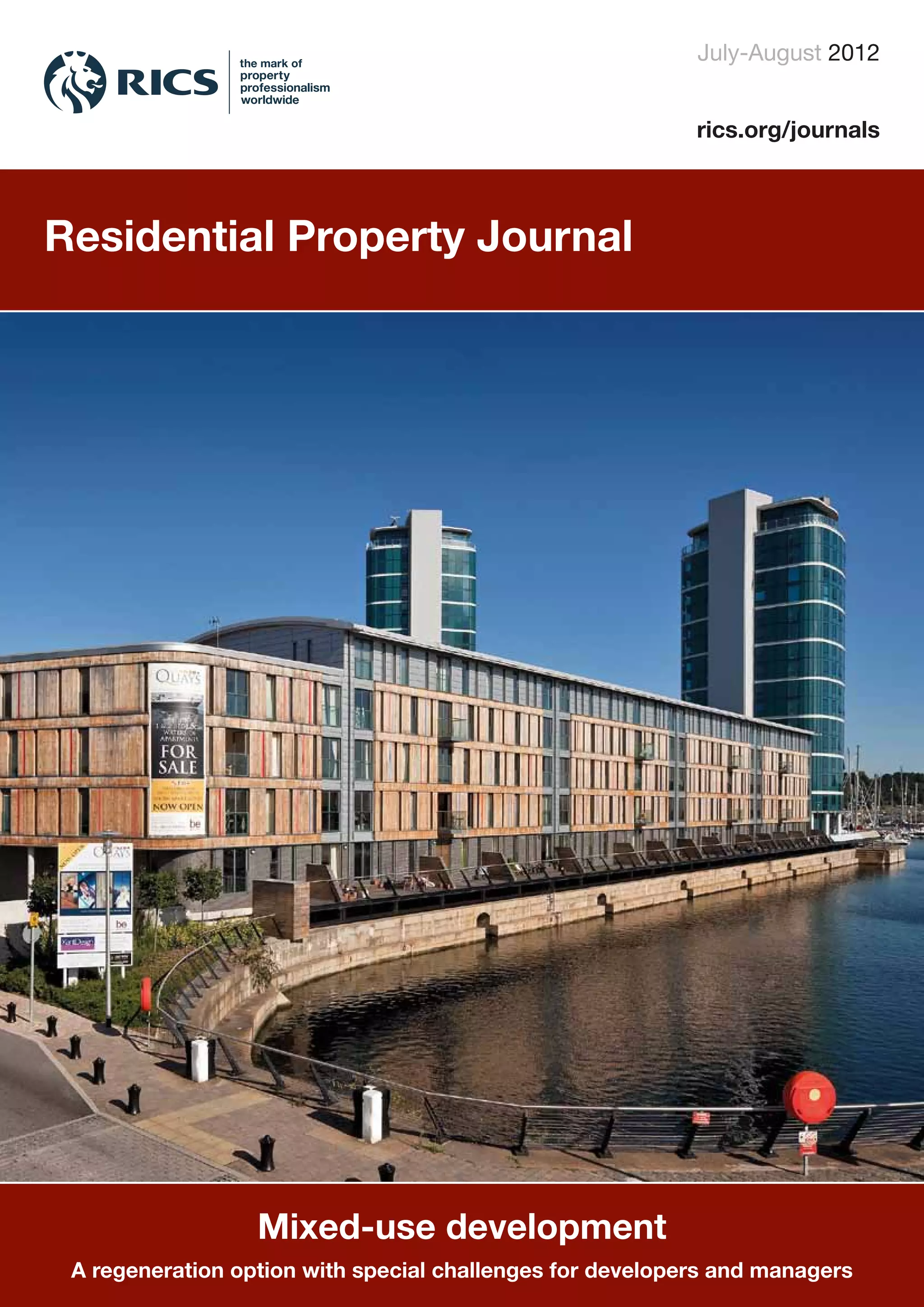
(Print) 1754-9124 (Online) Front cover: © Ardmore Construction: Chatham Quays
While every reasonable effort has been made to ensure the accuracy of all content in the journal, RICS will have no responsibility for any errors or omissions in the content. The views
expressed in the journal are not necessarily those of RICS. RICS cannot accept any liability for any loss or damage suffered by any person as a result of the content and the opinions
expressed in the journal, or by any person acting or refraining to act as a result of the material included in the journal. All rights in the journal, including full copyright or publishing right,
content and design, are owned by RICS, except where otherwise described. Any dispute arising out of the journal is subject to the law and jurisdiction of England and Wales. Crown
copyright material is reproduced under the Open Government Licence v1.0 for public sector information: www.nationalarchives.gov.uk/doc/open-government-licence
4
10
Contents
	14	 A work in progress
The all-important RICS Residential Policy has
been published, but the job is not over yet.
By Mary Thorogood
	16	 Shorter, simpler, clearer
New regulations and statutory guidance on the
contaminated land regime came into effect on
6 April 2012. By Anne Harrison
	19	 Wales leads the way
The forthcoming Housing Bill in Wales is likely to
introduce the licensing and regulation of letting
agents. By Tony Filice
	20	 Lettings update
When is a deposit not a deposit? And will
landlords lose the right of accelerated possession?
By David Smith
	22	 Top of the range
The new RICS Building Survey is on the way,
providing members with the flagship service in
the RICS Home Survey suite. By Graham Ellis
	24	 Claim or no claim?
The Case Notes series considers the tenuousness of
some negligence claims and the test of ‘reasonable
competence’. By Philip Santo
	26	 In your own words
A Case Notes reader challenges the use of
standard text in lender mortgage valuation forms.
By Philip Santo
	 Cover story
	4	 Mixed assets
There is no single development solution to the
decline of town centres. By Paul Crook
	 7	 New dimensions of management
Running complex mixed-use buildings calls for a
range of skills not acquired through training alone.
By David Clark
	 8	 At your service
The new Management of Mixed-use Development
guidance note explores best practice when the legal
positions and interests of commercial and residential
tenants collide. By Jeff Platt
	 9	 Time for action
A measured programme of investment in the housing
market would help to control the risk of further
economic decline. By Simon Rubinsohn
	10	 Greening the surveyor
Thanks to a very important client, the RICS President
has had a fast-track education in the planning of an
energy-efficient home. By Alan Collett
	12	 And it’s goodbye from him…
Four years is a long time in the residential property
sector and no-one knows that better than the
outgoing RICS Residential Director. By David Dalby
10
4 Residential Property Journal July-August 2012
Commercial-led mixed-use development is attractive to developers, but Paul Crook argues that it is only part of
the solution to the problem of declining town centres
Mixed assets
Mixed-used development
T
here has been steady growth in the number of mixed-use
developments in recent years, fuelling a continuing debate
over the extent to which they are the solution to town-centre
regeneration. Given the volatility of the commercial property market
and, by comparison, the relatively high yields on offer when residential
elements are included in the development mix, it is no wonder that
commercial developers have seen an opportunity and that mixed-use
developments now dominate the market.
Clearly, such developments have a contribution to make to town
centres and the regeneration of the wider area around them, but it’s
a question of scale. While the odd mixed-use scheme can have a
positive impact, such developments can hardly be regarded as the
whole solution.
some who believe that business and residential uses are generally
incompatible at every level: construction/design, management and the
living/working experience. Equally, others believe that residential units
positioned above retail/leisure facilities can be more successful than most
people think.
Another controversial question is whether the most common small,
separate mixed-use developments – those not part of the wider
regeneration of an area – are becoming too bland and generic in
both format and appearance. During a discussion at last year’s RESI
conference, one speaker asked if “we are truly regenerating town
centres, or just condemning them to mediocrity through the stresses
imposed by planning law and economics”. For example, when it comes
to retail, the rush to sign up mainstream outlets ahead of completion
prevents distinctive, independent retailers from taking up space gradually
and organically. This is a pertinent question that needs to be addressed
by the planning authorities in relation to the wider planning context and
the building of sustainable communities.
There is also a legitimate question concerning the extent to which
pre-existing indigenous communies stand to benefit from such schemes;
all too often the price of new residential units is out of reach of local
people, which results in the character of the community changing.
And whatever the planning and technical constraints, ultimately the
post-construction management regime needs to be fit for purpose if
long-term asset value and community harmony is to be achieved.
Configuration and phasing
Optimising configuration and getting the development phasing
right is essential to maximising value. Balancing the various elements
– commercial with residential spaces and market housing with
affordable housing – is more of an art than a science. The challenge
is to achieve a sustainable community that can co-exist in the long
term. The factors that affect configuration and development include
the following:
Physical
•	 plot size and footprint
•	 adjoining uses
•	 site access arrangements
•	 previous uses and site contamination issues
•	 ground conditions
Technical
•	 construction method
•	 construction materials
•	 central plant and building services configuration
•	 health and safety considerations
Financial
•	 funding availability
•	 funding conditions
•	 cashflow
Planning
•	 site control conditions
•	 Section 106 agreements
While the odd mixed-use scheme
can make a positive contribution
to the regeneration of town
centres, such developments
can hardly be regarded as the
whole solution
Nor are they a simple solution, as RICS has acknowledged with
the forthcoming publication of a new guidance note, Management of
Mixed-use Development (see page 8). Experience, particularly over the
last decade, suggests that a long-term vision and careful planning and
management are essential to achieving maximum benefit in terms of
regeneration and community development. The challenges facing
those planning and executing such schemes fall broadly under the
following headings:
•	 negotiating the planning process
•	 optimising configuration and development phasing
•	 maximising value
•	 getting the long-term management strategy right.
Planning and process
Delay is inherent in the planning system, but the permission process
is further encumbered by the multiplicity of reports and assessments
required to support applications. On top of this, local planning authorities
have their own ideas about the optimisation of development, visual
impact, the nature, extent and future control of the commercial elements,
and the extent to which affordable housing should be provided.
Views differ on the comparative merits of the different styles of mixed
use: full integration within a single structure, versus separate structures
with different uses positioned in close proximity to each other. There are continued on page 6
Mixed-used development
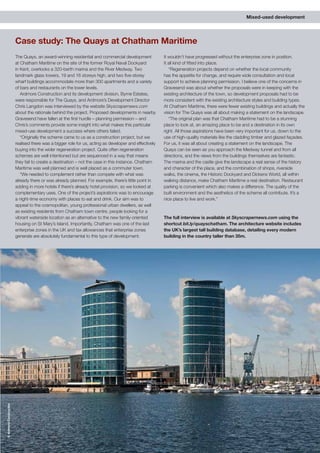
The Quays, an award-winning residential and commercial development
at Chatham Maritime on the site of the former Royal Naval Dockyard
in Kent, overlooks a 320-berth marina and the River Medway. Two
landmark glass towers, 19 and 16 storeys high, and two five-storey
wharf buildings accommodate more than 300 apartments and a variety
of bars and restaurants on the lower levels.
Ardmore Construction and its development division, Byrne Estates,
were responsible for The Quays, and Ardmore’s Development Director
Chris Langdon was interviewed by the website Skyscrapernews.com
about the rationale behind the project. Proposed developments in nearby
Gravesend have fallen at the first hurdle – planning permission – and
Chris’s comments provide some insight into what makes this particular
mixed-use development a success where others failed.
“Originally the scheme came to us as a construction project, but we
realised there was a bigger role for us, acting as developer and effectively
buying into the wider regeneration project. Quite often regeneration
schemes are well intentioned but are sequenced in a way that means
they fail to create a destination – not the case in this instance. Chatham
Maritime was well planned and is well placed as a commuter town.
“We needed to complement rather than compete with what was
already there or was already planned. For example, there’s little point in
adding in more hotels if there’s already hotel provision, so we looked at
complementary uses. One of the project’s aspirations was to encourage
a night-time economy with places to eat and drink. Our aim was to
appeal to the cosmopolitan, young professional urban dwellers, as well
as existing residents from Chatham town centre, people looking for a
vibrant waterside location as an alternative to the new family-oriented
housing on St Mary’s Island. Importantly, Chatham was one of the last
enterprise zones in the UK and tax allowances that enterprise zones
generate are absolutely fundamental to this type of development.
It wouldn’t have progressed without the enterprise zone in position.
It all kind of fitted into place.
“Regeneration projects depend on whether the local community
has the appetite for change, and require wide consultation and local
support to achieve planning permission. I believe one of the concerns in
Gravesend was about whether the proposals were in keeping with the
existing architecture of the town, so development proposals had to be
more consistent with the existing architecture styles and building types.
At Chatham Maritime, there were fewer existing buildings and actually the
vision for The Quays was all about making a statement on the landscape.
“The original plan was that Chatham Maritime had to be a stunning
place to look at, an amazing place to be and a destination in its own
right. All those aspirations have been very important for us, down to the
use of high-quality materials like the cladding timber and glazed façades.
For us, it was all about creating a statement on the landscape. The
Quays can be seen as you approach the Medway tunnel and from all
directions, and the views from the buildings themselves are fantastic.
The marina and the castle give the landscape a real sense of the history
and character of the place, and the combination of shops, riverside
walks, the cinema, the Historic Dockyard and Dickens World, all within
walking distance, make Chatham Maritime a real destination. Restaurant
parking is convenient which also makes a difference. The quality of the
built environment and the aesthetics of the scheme all contribute. It’s a
nice place to live and work.”
The full interview is available at Skyscrapernews.com using the
shortcut bit.ly/quayschatham. The architecture website includes
the UK’s largest tall building database, detailing every modern
building in the country taller than 35m.
Case study: The Quays at Chatham Maritime
©ArdmoreConstruction
6 Residential Property Journal July-August 2012
A new pathway to Associate membership in the UK equips candidates
to work across the residential and commercial property sectors. Real
Estate Agency replaces the Residential Estate Agency pathway and
broadens the scope of the competencies.
Advantages
The new pathway offers a broad range of competencies that qualify
candidates to work across the residential, commercial and mixed-use
property sectors:
•	 It includes competence in ‘Legal/regulatory compliance’ so
that Associates are better equipped to advise customers in
the increasingly legislation-driven environment of property sales
and lettings
•	 ‘Measurement’ and ‘Inspection’ are combined in one competency
•	 ‘Landlord and tenant’ is a required competency, since landlord and
tenant law is becoming increasingly complex.
Technical competencies
Associates must complete six of the following:
•	 Landlord and tenant
•	 Leasing/letting
•	 Legal/regulatory compliance
•	 Market appraisal
•	 Measurement and inspection of land and property
•	 Property records/information systems
•	 Purchase and sale.
AssocRICS offers new competency mix
Mandatory competencies
Eight competencies demonstrating the essential, softer skills that all
responsible surveyors need, regardless of their technical specialism,
are included:
•	 Client care
•	 Communication and negotiation
•	 Conduct rules, ethics and professional practice
•	 Conflict avoidance, management and dispute resolution procedures
•	 Data management
•	 Health and safety
•	 Sustainability
•	 Teamworking.
Entry requirements
There are no minimum requirements to enrol for the Associate
qualification. Anyone working in the field of real estate agency can join
RICS and start working towards the qualification now. Experienced
practitioners who hold the NFOPP Level 5, accredited by the
Association of Residential Letting Agents (ARLA)/National Association of
Estate Agents (NAEA), in Residential Estate Agency or Residential
Letting and Management are eligible for direct entry to the Associate
qualification. Apart from proof of qualification, applicants need only
complete the RICS online ethics module to gain AssocRICS designation.
More information is available at rics.org/associate
Maximising value
From the point of view of investors, maximising value can be challenging
on a development of any scale. The uncertainty of not knowing who/
what will occupy the commercial space can hinder the sale of residential
units and thereby constrain a development’s progress. Conversely,
focusing too much attention on the residential elements can lead to
long-term vacancies in the commercial units. An understanding of the
local market conditions and the anticipated impact of the development
on these is essential, as values will also be affected by development
phasing. The complex cashflow for a scheme needs to be modelled to
address the impact of configuration and phasing and the subsequent
extraction of value from the development.
Long-term management
Getting the long-term management strategy right is fundamental to the
success of any development. It is important that a clear plan is agreed
well in advance of the first brick being laid and that the approach to the
various occupants and tenure types is demonstrably equitable.
Will there be separate commercial and residential managing agents?
If so, will the residential agent be contracted through the commercial
agent, or vice versa? Or will a single agent manage both categories
of management? Who will be responsible for the maintenance of the
external fabric of the building? How will the various elements of service
charge be administered? What lease structure will apply to each of the
tenure types and how will they influence each other? All these issues
need to be fully thought through at the design and planning stage. All too
often, these considerations are left too late in the project and the coherent
long-term management of the development is prejudiced as a result.
It is becoming more common for freeholders to offer ‘licences to
occupy’, rather than traditional leases, to commercial tenants, so that
they have a means of controlling the nature of the commercial use in
the first instance and thereafter. From the residential leaseholder’s
perspective this would seem highly desirable, to ensure that future uses
are consistent with the original scheme and that there is a mechanism to
prevent the introduction of the kind of antisocial activities that might affect
the value and/or saleability of the units at some future date.
In summary, commercial-led mixed-use schemes have a role to play
in the development of town centres and wider regeneration but, in truth,
they are too complex to form more than part of the solution. And if
they are done badly, they can detract from an otherwise successful
regeneration initiative. Since they are not immune to the impact of the
wider economy, it is difficult to see them featuring to any appreciable
extent outside the economic environment of London and the South East
for the foreseeable future.
Paul Crook is Managing Director of the Mainstay Group
Mixed-used development

Mixed Use Scheme Management London

  • 1.
    July-August 2012 rics.org/journals Residential PropertyJournal Mixed-use development A regeneration option with special challenges for developers and managers
  • 2.
    Editor: Roz WrottesleyT +44 (0)20 7334 3860 rwrottesley@rics.org Advisory group: David Dalby, Peter Bolton King and Georgiana Hibberd (RICS), Graham Ellis (RICS and Greenhouse Surveyors), Philip Santo (Philip Santo & Co), Tony Bowron (Bromford Housing), Paul Cutbill (Countrywide), Chris Rispin (BlueBox Partners), David Smith (Anthony Gold Solicitors), Michael Day (Integra Property Services) Editorial and production manager: Toni Gill Sub-editor: Rita Som Advertising: Lucie Inns T +44 (0)20 7871 2906 lucie@sundaypublishing.com Designed and printed by: Abstract Annodata Published by: The Royal Institution of Chartered Surveyors, Parliament Square, London SW1P 3AD T +44 (0)870 333 1600 www.rics.org ISSN: 1754-9116 (Print) 1754-9124 (Online) Front cover: © Ardmore Construction: Chatham Quays While every reasonable effort has been made to ensure the accuracy of all content in the journal, RICS will have no responsibility for any errors or omissions in the content. The views expressed in the journal are not necessarily those of RICS. RICS cannot accept any liability for any loss or damage suffered by any person as a result of the content and the opinions expressed in the journal, or by any person acting or refraining to act as a result of the material included in the journal. All rights in the journal, including full copyright or publishing right, content and design, are owned by RICS, except where otherwise described. Any dispute arising out of the journal is subject to the law and jurisdiction of England and Wales. Crown copyright material is reproduced under the Open Government Licence v1.0 for public sector information: www.nationalarchives.gov.uk/doc/open-government-licence 4 10 Contents 14 A work in progress The all-important RICS Residential Policy has been published, but the job is not over yet. By Mary Thorogood 16 Shorter, simpler, clearer New regulations and statutory guidance on the contaminated land regime came into effect on 6 April 2012. By Anne Harrison 19 Wales leads the way The forthcoming Housing Bill in Wales is likely to introduce the licensing and regulation of letting agents. By Tony Filice 20 Lettings update When is a deposit not a deposit? And will landlords lose the right of accelerated possession? By David Smith 22 Top of the range The new RICS Building Survey is on the way, providing members with the flagship service in the RICS Home Survey suite. By Graham Ellis 24 Claim or no claim? The Case Notes series considers the tenuousness of some negligence claims and the test of ‘reasonable competence’. By Philip Santo 26 In your own words A Case Notes reader challenges the use of standard text in lender mortgage valuation forms. By Philip Santo Cover story 4 Mixed assets There is no single development solution to the decline of town centres. By Paul Crook 7 New dimensions of management Running complex mixed-use buildings calls for a range of skills not acquired through training alone. By David Clark 8 At your service The new Management of Mixed-use Development guidance note explores best practice when the legal positions and interests of commercial and residential tenants collide. By Jeff Platt 9 Time for action A measured programme of investment in the housing market would help to control the risk of further economic decline. By Simon Rubinsohn 10 Greening the surveyor Thanks to a very important client, the RICS President has had a fast-track education in the planning of an energy-efficient home. By Alan Collett 12 And it’s goodbye from him… Four years is a long time in the residential property sector and no-one knows that better than the outgoing RICS Residential Director. By David Dalby 10
  • 3.
    4 Residential PropertyJournal July-August 2012 Commercial-led mixed-use development is attractive to developers, but Paul Crook argues that it is only part of the solution to the problem of declining town centres Mixed assets Mixed-used development T here has been steady growth in the number of mixed-use developments in recent years, fuelling a continuing debate over the extent to which they are the solution to town-centre regeneration. Given the volatility of the commercial property market and, by comparison, the relatively high yields on offer when residential elements are included in the development mix, it is no wonder that commercial developers have seen an opportunity and that mixed-use developments now dominate the market. Clearly, such developments have a contribution to make to town centres and the regeneration of the wider area around them, but it’s a question of scale. While the odd mixed-use scheme can have a positive impact, such developments can hardly be regarded as the whole solution. some who believe that business and residential uses are generally incompatible at every level: construction/design, management and the living/working experience. Equally, others believe that residential units positioned above retail/leisure facilities can be more successful than most people think. Another controversial question is whether the most common small, separate mixed-use developments – those not part of the wider regeneration of an area – are becoming too bland and generic in both format and appearance. During a discussion at last year’s RESI conference, one speaker asked if “we are truly regenerating town centres, or just condemning them to mediocrity through the stresses imposed by planning law and economics”. For example, when it comes to retail, the rush to sign up mainstream outlets ahead of completion prevents distinctive, independent retailers from taking up space gradually and organically. This is a pertinent question that needs to be addressed by the planning authorities in relation to the wider planning context and the building of sustainable communities. There is also a legitimate question concerning the extent to which pre-existing indigenous communies stand to benefit from such schemes; all too often the price of new residential units is out of reach of local people, which results in the character of the community changing. And whatever the planning and technical constraints, ultimately the post-construction management regime needs to be fit for purpose if long-term asset value and community harmony is to be achieved. Configuration and phasing Optimising configuration and getting the development phasing right is essential to maximising value. Balancing the various elements – commercial with residential spaces and market housing with affordable housing – is more of an art than a science. The challenge is to achieve a sustainable community that can co-exist in the long term. The factors that affect configuration and development include the following: Physical • plot size and footprint • adjoining uses • site access arrangements • previous uses and site contamination issues • ground conditions Technical • construction method • construction materials • central plant and building services configuration • health and safety considerations Financial • funding availability • funding conditions • cashflow Planning • site control conditions • Section 106 agreements While the odd mixed-use scheme can make a positive contribution to the regeneration of town centres, such developments can hardly be regarded as the whole solution Nor are they a simple solution, as RICS has acknowledged with the forthcoming publication of a new guidance note, Management of Mixed-use Development (see page 8). Experience, particularly over the last decade, suggests that a long-term vision and careful planning and management are essential to achieving maximum benefit in terms of regeneration and community development. The challenges facing those planning and executing such schemes fall broadly under the following headings: • negotiating the planning process • optimising configuration and development phasing • maximising value • getting the long-term management strategy right. Planning and process Delay is inherent in the planning system, but the permission process is further encumbered by the multiplicity of reports and assessments required to support applications. On top of this, local planning authorities have their own ideas about the optimisation of development, visual impact, the nature, extent and future control of the commercial elements, and the extent to which affordable housing should be provided. Views differ on the comparative merits of the different styles of mixed use: full integration within a single structure, versus separate structures with different uses positioned in close proximity to each other. There are continued on page 6
  • 4.
    Mixed-used development The Quays,an award-winning residential and commercial development at Chatham Maritime on the site of the former Royal Naval Dockyard in Kent, overlooks a 320-berth marina and the River Medway. Two landmark glass towers, 19 and 16 storeys high, and two five-storey wharf buildings accommodate more than 300 apartments and a variety of bars and restaurants on the lower levels. Ardmore Construction and its development division, Byrne Estates, were responsible for The Quays, and Ardmore’s Development Director Chris Langdon was interviewed by the website Skyscrapernews.com about the rationale behind the project. Proposed developments in nearby Gravesend have fallen at the first hurdle – planning permission – and Chris’s comments provide some insight into what makes this particular mixed-use development a success where others failed. “Originally the scheme came to us as a construction project, but we realised there was a bigger role for us, acting as developer and effectively buying into the wider regeneration project. Quite often regeneration schemes are well intentioned but are sequenced in a way that means they fail to create a destination – not the case in this instance. Chatham Maritime was well planned and is well placed as a commuter town. “We needed to complement rather than compete with what was already there or was already planned. For example, there’s little point in adding in more hotels if there’s already hotel provision, so we looked at complementary uses. One of the project’s aspirations was to encourage a night-time economy with places to eat and drink. Our aim was to appeal to the cosmopolitan, young professional urban dwellers, as well as existing residents from Chatham town centre, people looking for a vibrant waterside location as an alternative to the new family-oriented housing on St Mary’s Island. Importantly, Chatham was one of the last enterprise zones in the UK and tax allowances that enterprise zones generate are absolutely fundamental to this type of development. It wouldn’t have progressed without the enterprise zone in position. It all kind of fitted into place. “Regeneration projects depend on whether the local community has the appetite for change, and require wide consultation and local support to achieve planning permission. I believe one of the concerns in Gravesend was about whether the proposals were in keeping with the existing architecture of the town, so development proposals had to be more consistent with the existing architecture styles and building types. At Chatham Maritime, there were fewer existing buildings and actually the vision for The Quays was all about making a statement on the landscape. “The original plan was that Chatham Maritime had to be a stunning place to look at, an amazing place to be and a destination in its own right. All those aspirations have been very important for us, down to the use of high-quality materials like the cladding timber and glazed façades. For us, it was all about creating a statement on the landscape. The Quays can be seen as you approach the Medway tunnel and from all directions, and the views from the buildings themselves are fantastic. The marina and the castle give the landscape a real sense of the history and character of the place, and the combination of shops, riverside walks, the cinema, the Historic Dockyard and Dickens World, all within walking distance, make Chatham Maritime a real destination. Restaurant parking is convenient which also makes a difference. The quality of the built environment and the aesthetics of the scheme all contribute. It’s a nice place to live and work.” The full interview is available at Skyscrapernews.com using the shortcut bit.ly/quayschatham. The architecture website includes the UK’s largest tall building database, detailing every modern building in the country taller than 35m. Case study: The Quays at Chatham Maritime ©ArdmoreConstruction
  • 5.
    6 Residential PropertyJournal July-August 2012 A new pathway to Associate membership in the UK equips candidates to work across the residential and commercial property sectors. Real Estate Agency replaces the Residential Estate Agency pathway and broadens the scope of the competencies. Advantages The new pathway offers a broad range of competencies that qualify candidates to work across the residential, commercial and mixed-use property sectors: • It includes competence in ‘Legal/regulatory compliance’ so that Associates are better equipped to advise customers in the increasingly legislation-driven environment of property sales and lettings • ‘Measurement’ and ‘Inspection’ are combined in one competency • ‘Landlord and tenant’ is a required competency, since landlord and tenant law is becoming increasingly complex. Technical competencies Associates must complete six of the following: • Landlord and tenant • Leasing/letting • Legal/regulatory compliance • Market appraisal • Measurement and inspection of land and property • Property records/information systems • Purchase and sale. AssocRICS offers new competency mix Mandatory competencies Eight competencies demonstrating the essential, softer skills that all responsible surveyors need, regardless of their technical specialism, are included: • Client care • Communication and negotiation • Conduct rules, ethics and professional practice • Conflict avoidance, management and dispute resolution procedures • Data management • Health and safety • Sustainability • Teamworking. Entry requirements There are no minimum requirements to enrol for the Associate qualification. Anyone working in the field of real estate agency can join RICS and start working towards the qualification now. Experienced practitioners who hold the NFOPP Level 5, accredited by the Association of Residential Letting Agents (ARLA)/National Association of Estate Agents (NAEA), in Residential Estate Agency or Residential Letting and Management are eligible for direct entry to the Associate qualification. Apart from proof of qualification, applicants need only complete the RICS online ethics module to gain AssocRICS designation. More information is available at rics.org/associate Maximising value From the point of view of investors, maximising value can be challenging on a development of any scale. The uncertainty of not knowing who/ what will occupy the commercial space can hinder the sale of residential units and thereby constrain a development’s progress. Conversely, focusing too much attention on the residential elements can lead to long-term vacancies in the commercial units. An understanding of the local market conditions and the anticipated impact of the development on these is essential, as values will also be affected by development phasing. The complex cashflow for a scheme needs to be modelled to address the impact of configuration and phasing and the subsequent extraction of value from the development. Long-term management Getting the long-term management strategy right is fundamental to the success of any development. It is important that a clear plan is agreed well in advance of the first brick being laid and that the approach to the various occupants and tenure types is demonstrably equitable. Will there be separate commercial and residential managing agents? If so, will the residential agent be contracted through the commercial agent, or vice versa? Or will a single agent manage both categories of management? Who will be responsible for the maintenance of the external fabric of the building? How will the various elements of service charge be administered? What lease structure will apply to each of the tenure types and how will they influence each other? All these issues need to be fully thought through at the design and planning stage. All too often, these considerations are left too late in the project and the coherent long-term management of the development is prejudiced as a result. It is becoming more common for freeholders to offer ‘licences to occupy’, rather than traditional leases, to commercial tenants, so that they have a means of controlling the nature of the commercial use in the first instance and thereafter. From the residential leaseholder’s perspective this would seem highly desirable, to ensure that future uses are consistent with the original scheme and that there is a mechanism to prevent the introduction of the kind of antisocial activities that might affect the value and/or saleability of the units at some future date. In summary, commercial-led mixed-use schemes have a role to play in the development of town centres and wider regeneration but, in truth, they are too complex to form more than part of the solution. And if they are done badly, they can detract from an otherwise successful regeneration initiative. Since they are not immune to the impact of the wider economy, it is difficult to see them featuring to any appreciable extent outside the economic environment of London and the South East for the foreseeable future. Paul Crook is Managing Director of the Mainstay Group Mixed-used development