Research paper1
Testing the Dynamic Efficiency of
Extractive of Natural Resources
Abdoul Latif SOKOUNDOU
Supervisor : Pr. Didier TATOUTCHOUP
2023
1
I am deeply grateful to Mitacs for generously funding my research internship, allowing me to successfully complete my work. I am truly thankful
for the opportunity to explore and learn more about Canada. Special thanks to my supervisor, Pr. Didier TATOUTCHOUP, for selecting my
application among a competitive pool. I also want to express my sincere thanks to my academic advisor, Pr. Pascale Motel COMBES, who
recommended me for this internship program.
Testing the Dynamic Efficiency of Extractive of
Natural Resources.
Abdoul Latif SOKOUNDOU∗†
August 23, 2023
Abstract
This paper examines the dynamics of oil exploitation in nine (09) African countries,
with the aim of verifying whether they follow the optimal extraction trajectory predicted
by the Hotelling model. The data used for this analysis consists of annual data from
1980 to 2021, sourced from the databases of OPEC, EIA, and WDI. By utilizing the
nonlinear least squares estimator on both basic and extended models, divergent outcomes
are observed within each group. In Group 1, comprising Nigeria, Angola, and Algeria,
the results demonstrate that these three countries follow the optimal extraction path
dictated by the basic Hotelling model that incorporates technological progress. For Group
2, consisting of Egypt, Libya, and Congo, the findings reveal that the oil extraction
trajectory of Libya and Congo adheres to the basic and extended Hotelling models, which
take into account technological progress and stock effects. Lastly, Group 3, consisting of
Cameroon, Gabon, and Chad, validates Hotelling’s rule in the basic model but rejects it
when cumulative production is included, capturing stock effects. In light of these results,
recommendations for environmental and economic policies have been made to promote
optimal management of this non-renewable resource.
Keywords: Hotelling Model, Nonlinear Least Squares, Stock Effects
JEL Codes: D224, O113, Q332
∗
University of Clermont Auvergne, Ecole d’Économie, Clermont Ferrand, France
†
University of Moncton, 18 Avenue Antoine-Maillet Moncton NB E1A 3E9, Canada.
Mail: abdoul.latif.sokoundou@umoncton.ca
1
1 Introduction
Since the advent of the first oil shock in 1973, there has been a significant increase in attention to
studies on the optimal management of non-renewable natural resources. Indeed, the dependence
of states on natural resources is largely explained by the fact that export revenues from these
products contribute significantly to their Gross Domestic Product. Although the prices of these
resources are unstable in the market and their impact on development is uncertain, natural
resources have proven to be a blessing in some countries where this sector has been optimally
managed. In 1931, Harold Hotelling published an article titled "The Economics of Exhaustible
Resources," in which he described the key factors that explain the evolution of prices of non-
renewable resources. This article gained significant attention following the first oil shock in
1973.
The focus of this paper is on the accelerated depletion of non-renewable natural resources.
Hotelling (1931) determines the value of a depletable resource stock, the evolution of this value,
and the extraction rate of the resource based on the prevailing economic regime. The problem
to solve is finding the optimal extraction path, such that the value of the resource is maximized
over time. Non-renewable natural resources are considered those whose economic use inevitably
diminishes the reserves of the resource, and their extraction rate is faster than the geological
production rate (Alier and Jusmet, 2015)
The third and fourth decades of the 20th century were marked by a series of explorations
and discoveries of non-renewable resources in Africa, notably oil and gas. The continent ac-
counts for about 10% of global oil production and holds nearly 7.5% of proven oil and gas
reserves (Statistical Review of World Energy, 2021). In North Africa, Algeria and Libya re-
main the largest oil producers on the continent, while in the west, Nigeria and Angola drive the
continent’s production. Due to their low domestic consumption, these African states export
a significant portion of their production. The revenues generated from oil exports contribute
substantially to their Gross Domestic Product.
Given the growing concerns about extraction dynamics and oil price fluctuations, our paper
aims to empirically verify the validity of Hotelling’s rule in nine (09) African oil-producing
countries. In other words, we seek to determine whether there is conformity between the oil
extraction trajectory in these countries and the optimal extraction path predicted by Hotelling.
To better understand the issue of optimal oil extraction, our paper is structured as follows: sec-
tion 2 reviews the literature related to the topic. Section 3 presents the basic Hotelling model
2
as well as an extended version of it. Section 4 focuses on data and statistics, as well as some
stylized facts related to our variables. Section 5 outlines the methodology, including model
specification and chosen estimation method. Section 6 presents the results of our econometric
estimations, including the test of the Hotelling model. Section 7 concludes by summarizing the
main findings and highlighting the implications of our discoveries.
2 Literature review
Nowadays, the literature on the extraction and optimal management of non-renewable re-
sources is abundant. An recurrent theme in this literature is the empirical validation of the
Hotelling rule. In a recent study conducted by Tatoutchoup et al. (2022), the dynamic efficiency
of non-renewable resource extraction is examined using the Hotelling model on data from oil
and natural gas exploitation in Cameroon from 1977 to 2018. Their model takes into account
technological changes that have reduced the extraction costs of these resources. Utilizing linear
cost functions for oil and log-linear cost functions for gas, estimated respectively using nonlinear
least squares and ordinary least squares methods, the study’s results demonstrate coherence
between the basic Hotelling model incorporating technological progress and the trajectory of
oil and gas extraction.
Another study conducted by Livernois et al. (2006) tests the Hotelling rule using data from
timber extraction in the northwestern United States. Their estimations based on the basic
model (without stock effects) reveal a positive and significant discount rate that responds to
the Hotelling test, although the adjustments are minor, not warranting the rejection of the
Hotelling rule. They thereby confirm that the standing timber extraction trajectory adheres to
the Hotelling rule.
Over time, several authors have extended the basic Hotelling model to incorporate current
market realities. For instance, Herfindahl and Kneese (1974) and Zimmerman (1977) attempted
to capture a stock effect by including cumulative production in the production cost function.
Gaudet (2007) justified this extension by emphasizing that the depletion of the resource stock
leads to an increase in marginal extraction cost, as the resource becomes less accessible and of
lower quality. Other researchers, such as Cairns (1990), modeled mines with different material
qualities and concluded that extraction costs increase exponentially with well depth. Scholars
like (Dasgupta and Stiglitz, 1980; Devarajan and Fisher, 1981; Gilbert, 1979; Pindyck, 1978;
Slade, 1982) , also made specific adjustments to account for factors such as discoveries, uncer-
3
tainty about reserve size, technological effects, taxation, and exploration.
Nevertheless, in the literature regarding testing the Hotelling model, other authors have
found results that invalidate the Hotelling rule. Farrow (1985) examined a basic model of
mining extraction using monthly data from 1975 to 1981. The estimation results showed a
negative and significant discount rate, thereby rejecting the empirical validity of the Hotelling
model. Chermak and Patrick (1995) utilized a dataset of time series from 29 natural gas wells
to estimate a production cost function. Their results highlighted increasing production costs
with the depletion of the resource stock, revealing a stock effect. Moreover, the temporal trend
parameter displayed a negative and significant value, indicating that marginal costs decrease
over time.
3 Hotelling model
An exhaustible resource stock can be regarded as a distinct asset yielding income over
time. The extraction and subsequent consumption of a unit of resource imply the impossibility
of extracting and consuming that unit at a later time, as the stock1
is depleted following this
decision. Extracting today thus entails the loss of future income that could have been generated
from the unit just extracted. Hotelling (1931) posits that the depletion of non-renewable
natural resources is driven by the low prices they command, leading to an acceleration in their
extraction. Therefore, in order to decelerate this process, higher prices are necessary, further
compounded by their escalation over the years. In this manner, mine or deposit owners can
weigh the profits from present extraction against those from future extraction. In a perfectly
competitive market, the fundamental economic model assumes that the objective of the operator
is to maximize the present value of benefits from the extraction of a known resource stock. The
profit function of the operator is given by the following equation:
Max π =
T
X
t=0
δt
[P(t)q(t) − C(q(t), X(t), t)] S/C R(t + 1) = R(t) − q(t) (1)
In (1), P(t) represents the price of the resource in the market, q(t) the current production, X(t)
the cumulative production, t the time trend, R(t) the remaining reserve, and δ is the discount
rate of the firm exploiting the resource. We employ the Lagrange method to solve the profit
maximization problem.
1
The stock in this context is assumed to be finite and accurately known.
4
L(q(t), R(t + 1), λ(t)) =
T
X
t=0
δt
[P(t)q(t) − C(q(t), X(t), t) + λ(t)(R(t) − q(t) − R(t + 1))] (2)
We have chosen to derive the parameters that we will need in our paper. To this effect, the
first-order conditions are as follows:
∂L
∂q(t)
= 0 ⇒ δt
[P(t) − C′
q(t) − λ(t)] = 0 ⇒ P(t) − C′
q(t) = λ(t) (3)
∂L
∂R(t + 1)
= 0 ⇒ δt
[−λ(t) + δt+1
λ(t + 1)] = 0 ⇒ λ(t + 1) = (1 + r)λ(t) (4)
Let’s assume that: m(t) = λ(t) and m(t + 1) = λ(t + 1). After changing variables, (3) and (4)
become:
m(t) = P(t) − Cq(t) (5)
m(t + 1) = (1 + r) [P(t) − Cq(t)] (6)
(5) and (6) respectively represent the static and dynamic models of Hotelling. A firm aiming to
maximize the present value of its profits faces an opportunity cost, a consequence of the trade-
off between extracting and selling today versus losing the future income it could have derived
from the resource if it had not been extracted. If the firm or operator decides to extract one
unit, the value of that extracted unit equals its market sale price minus the extraction cost. If it
chooses not to extract, it means that the value of the resource in the ground is more significant
to it than the extraction value. This non-extraction value is the opportunity cost of resource
depletion (Chavy, 2007). In the literature, authors use various terms to identify it: shadow
price, in-situ value, ground value, or scarcity rent, because we have just seen that it’s equal to
the difference between the resource’s market price and its extraction cost. In our paper, this
scarcity rent is represented by m(t), as observed in (5).
When the firm or operator decides not to extract (5) at time t, it implies that the resource
will have a value of m(t+1) in the following period, yielding a rate of return of m(t+1)− m(t)
m(t)
.
5
The rate of return for another asset in equilibrium is equal to the interest rate r when we are
in a situation of pure and perfect competition. After transformation, we obtain (6), which is
the expression of Hotelling’s Rule. It states that the scarcity rent should grow at the rate of
the interest rate.
4 Data, statistics and stylized facts
4.1 Data
The dataset used in this paper is a panel of nine (09) countries and comes from three (03)
different sources. For countries such as Algeria, Angola, Cameroon, Nigeria, Libya, Egypt,
Congo, and Gabon, the data covers the period 1980-2021, and for Chad, it covers 2003-2022.
Data on current oil production (qt) and cumulative production (Xt) are extracted from the
database of the Organization of the Petroleum Exporting Countries (OPEC) and are expressed
in million barrels per day. Data on oil prices (Pt) comes from the Energy Information Adminis-
tration (EIA) and is expressed in dollars per barrel. The unit rent is calculated by dividing the
oil rent by current production. The unit production cost is obtained by subtracting the unit
rent from the oil price. The total production cost is calculated by multiplying the unit rent
by the unit cost. Data on the interest rate (r) comes from the World Development Indicators
(WDI) database. It is important to note that the data have been adjusted to account for infla-
tion in each country using the Consumer Price Index (CPI) available in the World Development
Indicators (WDI).
4.2 Descriptive statistics
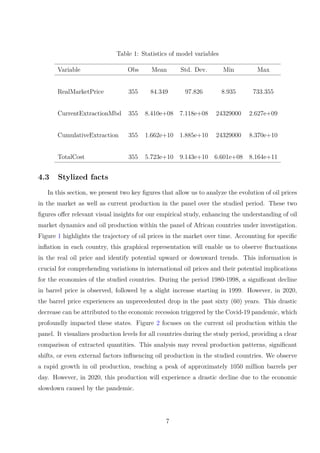
The table 1 below provides a descriptive statistic of the data that we will subsequently use
to estimate the production cost function. In the panel, it is observed that the average real oil
price in the market is $84.34 per barrel. The value of the standard deviation, close to that of the
mean, suggests that oil prices are clustered around the average price. This indicates that the
real oil price in the market is relatively homogeneous within our sample. The average current
production in the panel amounts to 841.0 million barrels per day, with a minimum production
of 24.32 million barrels per day recorded in Chad in 2003 and a maximum production of 2627
million barrels per day recorded in Nigeria in 2005. As for the average value of the total
extraction or production cost, it amounts to $57.23 billion across the entire sample.
6
Table 1: Statistics of model variables
Variable Obs Mean Std. Dev. Min Max
RealMarketPrice 355 84.349 97.826 8.935 733.355
CurrentExtractionMbd 355 8.410e+08 7.118e+08 24329000 2.627e+09
CumulativeExtraction 355 1.662e+10 1.885e+10 24329000 8.370e+10
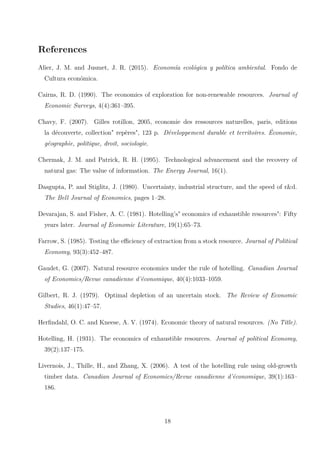
TotalCost 355 5.723e+10 9.143e+10 6.601e+08 8.164e+11
4.3 Stylized facts
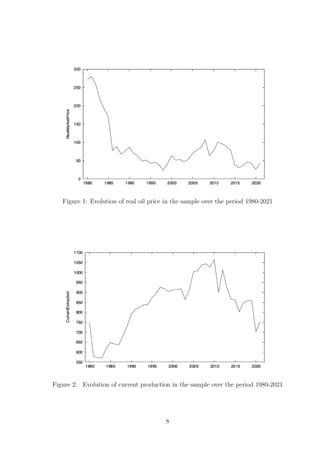
In this section, we present two key figures that allow us to analyze the evolution of oil prices
in the market as well as current production in the panel over the studied period. These two
figures offer relevant visual insights for our empirical study, enhancing the understanding of oil
market dynamics and oil production within the panel of African countries under investigation.
Figure 1 highlights the trajectory of oil prices in the market over time. Accounting for specific
inflation in each country, this graphical representation will enable us to observe fluctuations
in the real oil price and identify potential upward or downward trends. This information is
crucial for comprehending variations in international oil prices and their potential implications
for the economies of the studied countries. During the period 1980-1998, a significant decline
in barrel price is observed, followed by a slight increase starting in 1999. However, in 2020,
the barrel price experiences an unprecedented drop in the past sixty (60) years. This drastic
decrease can be attributed to the economic recession triggered by the Covid-19 pandemic, which
profoundly impacted these states. Figure 2 focuses on the current oil production within the
panel. It visualizes production levels for all countries during the study period, providing a clear
comparison of extracted quantities. This analysis may reveal production patterns, significant
shifts, or even external factors influencing oil production in the studied countries. We observe
a rapid growth in oil production, reaching a peak of approximately 1050 million barrels per
day. However, in 2020, this production will experience a drastic decline due to the economic
slowdown caused by the pandemic.
7
Figure 1: Evolution of real oil price in the sample over the period 1980-2021
Figure 2: Evolution of current production in the sample over the period 1980-2021
8
5 Methodology
In this section, we will delve into the three crucial steps for conducting the Hotelling model
test in detail. Our approach involves adopting a direct test to assess the empirical validity of
the Hotelling model. These steps will be elaborated upon to provide a comprehensive analysis
of the model.
5.1 Model specification
The initial step entails specifying the production or extraction cost function. It is vital
to emphasize that the total production cost depends on the current production, cumulative
production, and temporal trend. Various functional forms have been employed for this speci-
fication in the literature. Following the approach of Tatoutchoup et al. (2022) , we opt for a
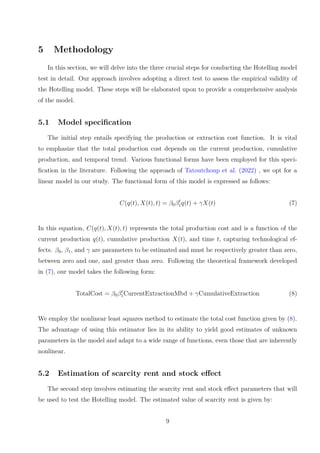
linear model in our study. The functional form of this model is expressed as follows:
C(q(t), X(t), t) = β0βt
1q(t) + γX(t) (7)
In this equation, C(q(t), X(t), t) represents the total production cost and is a function of the
current production q(t), cumulative production X(t), and time t, capturing technological ef-
fects. β0, β1, and γ are parameters to be estimated and must be respectively greater than zero,
between zero and one, and greater than zero. Following the theoretical framework developed
in (7), our model takes the following form:
TotalCost = β0βt
1CurrentExtractionMbd + γCumulativeExtraction (8)
We employ the nonlinear least squares method to estimate the total cost function given by (8).
The advantage of using this estimator lies in its ability to yield good estimates of unknown
parameters in the model and adapt to a wide range of functions, even those that are inherently
nonlinear.
5.2 Estimation of scarcity rent and stock effect
The second step involves estimating the scarcity rent and stock effect parameters that will
be used to test the Hotelling model. The estimated value of scarcity rent is given by:
9
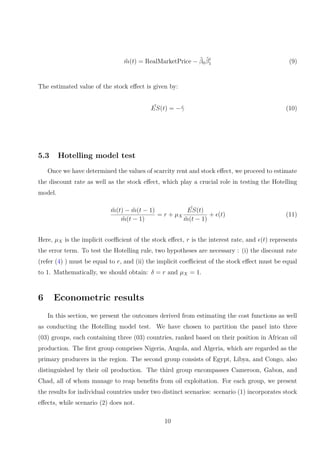
m̂(t) = RealMarketPrice − β̂0β̂t
1 (9)
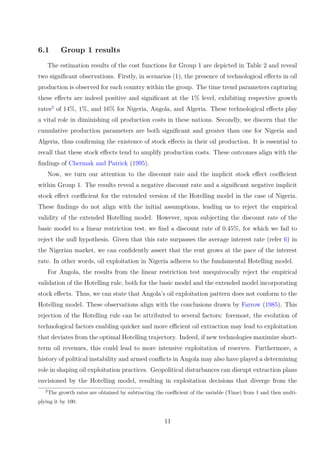
The estimated value of the stock effect is given by:
ˆ
ES(t) = −γ̂ (10)
5.3 Hotelling model test
Once we have determined the values of scarcity rent and stock effect, we proceed to estimate
the discount rate as well as the stock effect, which play a crucial role in testing the Hotelling
model.
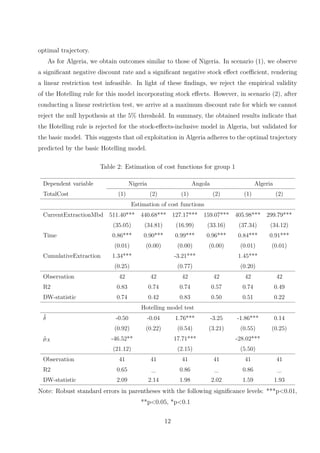
m̂(t) − m̂(t − 1)
m̂(t − 1)
= r + µX
ˆ
ES(t)
m̂(t − 1)
+ ϵ(t) (11)
Here, µX is the implicit coefficient of the stock effect, r is the interest rate, and ϵ(t) represents
the error term. To test the Hotelling rule, two hypotheses are necessary : (i) the discount rate
(refer (4) ) must be equal to r, and (ii) the implicit coefficient of the stock effect must be equal
to 1. Mathematically, we should obtain: δ = r and µX = 1.
6 Econometric results
In this section, we present the outcomes derived from estimating the cost functions as well
as conducting the Hotelling model test. We have chosen to partition the panel into three
(03) groups, each containing three (03) countries, ranked based on their position in African oil
production. The first group comprises Nigeria, Angola, and Algeria, which are regarded as the
primary producers in the region. The second group consists of Egypt, Libya, and Congo, also
distinguished by their oil production. The third group encompasses Cameroon, Gabon, and
Chad, all of whom manage to reap benefits from oil exploitation. For each group, we present
the results for individual countries under two distinct scenarios: scenario (1) incorporates stock
effects, while scenario (2) does not.
10
6.1 Group 1 results
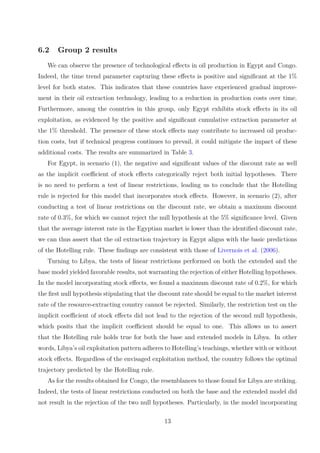
The estimation results of the cost functions for Group 1 are depicted in Table 2 and reveal
two significant observations. Firstly, in scenarios (1), the presence of technological effects in oil
production is observed for each country within the group. The time trend parameters capturing
these effects are indeed positive and significant at the 1% level, exhibiting respective growth
rates2
of 14%, 1%, and 16% for Nigeria, Angola, and Algeria. These technological effects play
a vital role in diminishing oil production costs in these nations. Secondly, we discern that the
cumulative production parameters are both significant and greater than one for Nigeria and
Algeria, thus confirming the existence of stock effects in their oil production. It is essential to
recall that these stock effects tend to amplify production costs. These outcomes align with the
findings of Chermak and Patrick (1995).
Now, we turn our attention to the discount rate and the implicit stock effect coefficient
within Group 1. The results reveal a negative discount rate and a significant negative implicit
stock effect coefficient for the extended version of the Hotelling model in the case of Nigeria.
These findings do not align with the initial assumptions, leading us to reject the empirical
validity of the extended Hotelling model. However, upon subjecting the discount rate of the
basic model to a linear restriction test, we find a discount rate of 0.45%, for which we fail to
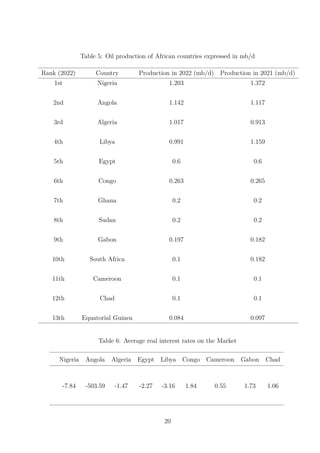
reject the null hypothesis. Given that this rate surpasses the average interest rate (refer 6) in
the Nigerian market, we can confidently assert that the rent grows at the pace of the interest
rate. In other words, oil exploitation in Nigeria adheres to the fundamental Hotelling model.
For Angola, the results from the linear restriction test unequivocally reject the empirical
validation of the Hotelling rule, both for the basic model and the extended model incorporating
stock effects. Thus, we can state that Angola’s oil exploitation pattern does not conform to the
Hotelling model. These observations align with the conclusions drawn by Farrow (1985). This
rejection of the Hotelling rule can be attributed to several factors: foremost, the evolution of
technological factors enabling quicker and more efficient oil extraction may lead to exploitation
that deviates from the optimal Hotelling trajectory. Indeed, if new technologies maximize short-
term oil revenues, this could lead to more intensive exploitation of reserves. Furthermore, a
history of political instability and armed conflicts in Angola may also have played a determining
role in shaping oil exploitation practices. Geopolitical disturbances can disrupt extraction plans
envisioned by the Hotelling model, resulting in exploitation decisions that diverge from the
2
The growth rates are obtained by subtracting the coefficient of the variable (Time) from 1 and then multi-
plying it by 100.
11
optimal trajectory.
As for Algeria, we obtain outcomes similar to those of Nigeria. In scenario (1), we observe
a significant negative discount rate and a significant negative stock effect coefficient, rendering
a linear restriction test infeasible. In light of these findings, we reject the empirical validity
of the Hotelling rule for this model incorporating stock effects. However, in scenario (2), after
conducting a linear restriction test, we arrive at a maximum discount rate for which we cannot
reject the null hypothesis at the 5% threshold. In summary, the obtained results indicate that
the Hotelling rule is rejected for the stock-effects-inclusive model in Algeria, but validated for
the basic model. This suggests that oil exploitation in Algeria adheres to the optimal trajectory
predicted by the basic Hotelling model.
Table 2: Estimation of cost functions for group 1
Dependent variable Nigeria Angola Algeria
TotalCost (1) (2) (1) (2) (1) (2)
Estimation of cost functions
CurrentExtractionMbd 511.40*** 440.68*** 127.17*** 159.07*** 405.98*** 299.79***
(35.05) (34.81) (16.99) (33.16) (37.34) (34.12)
Time 0.86*** 0.90*** 0.99*** 0.96*** 0.84*** 0.91***
(0.01) (0.00) (0.00) (0.00) (0.01) (0.01)
CumulativeExtraction 1.34*** -3.21*** 1.45***
(0.25) (0.77) (0.20)
Observation 42 42 42 42 42 42
R2 0.83 0.74 0.74 0.57 0.74 0.49
DW-statistic 0.74 0.42 0.83 0.50 0.51 0.22
Hotelling model test
δ̂ -0.50 -0.04 1.76*** -3.25 -1.86*** 0.14
(0.92) (0.22) (0.54) (3.21) (0.55) (0.25)
µ̂X -46.52** 17.71*** -28.02***
(21.12) (2.15) (5.50)
Observation 41 41 41 41 41 41
R2 0.65 _ 0.86 _ 0.86 _
DW-statistic 2.09 2.14 1.98 2.02 1.59 1.93
Note: Robust standard errors in parentheses with the following significance levels: ***p<0.01,
**p<0.05, *p<0.1
12
6.2 Group 2 results
We can observe the presence of technological effects in oil production in Egypt and Congo.
Indeed, the time trend parameter capturing these effects is positive and significant at the 1%
level for both states. This indicates that these countries have experienced gradual improve-
ment in their oil extraction technology, leading to a reduction in production costs over time.
Furthermore, among the countries in this group, only Egypt exhibits stock effects in its oil
exploitation, as evidenced by the positive and significant cumulative extraction parameter at
the 1% threshold. The presence of these stock effects may contribute to increased oil produc-
tion costs, but if technical progress continues to prevail, it could mitigate the impact of these
additional costs. The results are summarized in Table 3.
For Egypt, in scenario (1), the negative and significant values of the discount rate as well
as the implicit coefficient of stock effects categorically reject both initial hypotheses. There
is no need to perform a test of linear restrictions, leading us to conclude that the Hotelling
rule is rejected for this model that incorporates stock effects. However, in scenario (2), after
conducting a test of linear restrictions on the discount rate, we obtain a maximum discount
rate of 0.3%, for which we cannot reject the null hypothesis at the 5% significance level. Given
that the average interest rate in the Egyptian market is lower than the identified discount rate,
we can thus assert that the oil extraction trajectory in Egypt aligns with the basic predictions
of the Hotelling rule. These findings are consistent with those of Livernois et al. (2006).
Turning to Libya, the tests of linear restrictions performed on both the extended and the
base model yielded favorable results, not warranting the rejection of either Hotelling hypotheses.
In the model incorporating stock effects, we found a maximum discount rate of 0.2%, for which
the first null hypothesis stipulating that the discount rate should be equal to the market interest
rate of the resource-extracting country cannot be rejected. Similarly, the restriction test on the
implicit coefficient of stock effects did not lead to the rejection of the second null hypothesis,
which posits that the implicit coefficient should be equal to one. This allows us to assert
that the Hotelling rule holds true for both the base and extended models in Libya. In other
words, Libya’s oil exploitation pattern adheres to Hotelling’s teachings, whether with or without
stock effects. Regardless of the envisaged exploitation method, the country follows the optimal
trajectory predicted by the Hotelling rule.
As for the results obtained for Congo, the resemblances to those found for Libya are striking.
Indeed, the tests of linear restrictions conducted on both the base and the extended model did
not result in the rejection of the two null hypotheses. Particularly, in the model incorporating
13
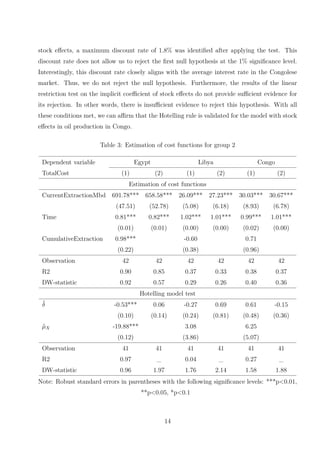
stock effects, a maximum discount rate of 1.8% was identified after applying the test. This
discount rate does not allow us to reject the first null hypothesis at the 1% significance level.
Interestingly, this discount rate closely aligns with the average interest rate in the Congolese
market. Thus, we do not reject the null hypothesis. Furthermore, the results of the linear
restriction test on the implicit coefficient of stock effects do not provide sufficient evidence for
its rejection. In other words, there is insufficient evidence to reject this hypothesis. With all
these conditions met, we can affirm that the Hotelling rule is validated for the model with stock
effects in oil production in Congo.
Table 3: Estimation of cost functions for group 2
Dependent variable Egypt Libya Congo
TotalCost (1) (2) (1) (2) (1) (2)
Estimation of cost functions
CurrentExtractionMbd 691.78*** 658.58*** 26.09*** 27.23*** 30.03*** 30.67***
(47.51) (52.78) (5.08) (6.18) (8.93) (6.78)
Time 0.81*** 0.82*** 1.02*** 1.01*** 0.99*** 1.01***
(0.01) (0.01) (0.00) (0.00) (0.02) (0.00)
CumulativeExtraction 0.98*** -0.60 0.71
(0.22) (0.38) (0.96)
Observation 42 42 42 42 42 42
R2 0.90 0.85 0.37 0.33 0.38 0.37
DW-statistic 0.92 0.57 0.29 0.26 0.40 0.36
Hotelling model test
δ̂ -0.53*** 0.06 -0.27 0.69 0.61 -0.15
(0.10) (0.14) (0.24) (0.81) (0.48) (0.36)
µ̂X -19.88*** 3.08 6.25
(0.12) (3.86) (5.07)
Observation 41 41 41 41 41 41
R2 0.97 _ 0.04 _ 0.27 _
DW-statistic 0.96 1.97 1.76 2.14 1.58 1.88
Note: Robust standard errors in parentheses with the following significance levels: ***p<0.01,
**p<0.05, *p<0.1
14
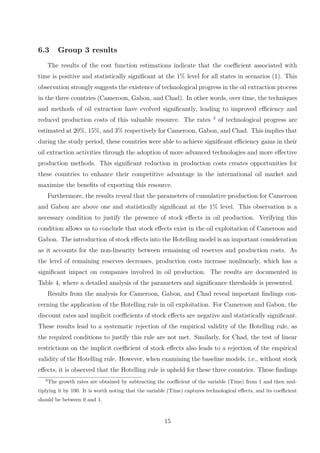
6.3 Group 3 results
The results of the cost function estimations indicate that the coefficient associated with
time is positive and statistically significant at the 1% level for all states in scenarios (1). This
observation strongly suggests the existence of technological progress in the oil extraction process
in the three countries (Cameroon, Gabon, and Chad). In other words, over time, the techniques
and methods of oil extraction have evolved significantly, leading to improved efficiency and
reduced production costs of this valuable resource. The rates 3
of technological progress are
estimated at 20%, 15%, and 3% respectively for Cameroon, Gabon, and Chad. This implies that
during the study period, these countries were able to achieve significant efficiency gains in their
oil extraction activities through the adoption of more advanced technologies and more effective
production methods. This significant reduction in production costs creates opportunities for
these countries to enhance their competitive advantage in the international oil market and
maximize the benefits of exporting this resource.
Furthermore, the results reveal that the parameters of cumulative production for Cameroon
and Gabon are above one and statistically significant at the 1% level. This observation is a
necessary condition to justify the presence of stock effects in oil production. Verifying this
condition allows us to conclude that stock effects exist in the oil exploitation of Cameroon and
Gabon. The introduction of stock effects into the Hotelling model is an important consideration
as it accounts for the non-linearity between remaining oil reserves and production costs. As
the level of remaining reserves decreases, production costs increase nonlinearly, which has a
significant impact on companies involved in oil production. The results are documented in
Table 4, where a detailed analysis of the parameters and significance thresholds is presented.
Results from the analysis for Cameroon, Gabon, and Chad reveal important findings con-
cerning the application of the Hotelling rule in oil exploitation. For Cameroon and Gabon, the
discount rates and implicit coefficients of stock effects are negative and statistically significant.
These results lead to a systematic rejection of the empirical validity of the Hotelling rule, as
the required conditions to justify this rule are not met. Similarly, for Chad, the test of linear
restrictions on the implicit coefficient of stock effects also leads to a rejection of the empirical
validity of the Hotelling rule. However, when examining the baseline models, i.e., without stock
effects, it is observed that the Hotelling rule is upheld for these three countries. These findings
3
The growth rates are obtained by subtracting the coefficient of the variable (Time) from 1 and then mul-
tiplying it by 100. It is worth noting that the variable (Time) captures technological effects, and its coefficient
should be between 0 and 1.
15
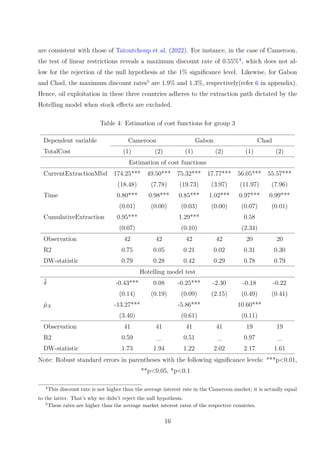
are consistent with those of Tatoutchoup et al. (2022). For instance, in the case of Cameroon,
the test of linear restrictions reveals a maximum discount rate of 0.55%4
, which does not al-
low for the rejection of the null hypothesis at the 1% significance level. Likewise, for Gabon
and Chad, the maximum discount rates5
are 1.9% and 1.3%, respectively(refer 6 in appendix).
Hence, oil exploitation in these three countries adheres to the extraction path dictated by the
Hotelling model when stock effects are excluded.
Table 4: Estimation of cost functions for group 3
Dependent variable Cameroon Gabon Chad
TotalCost (1) (2) (1) (2) (1) (2)
Estimation of cost functions
CurrentExtractionMbd 174.25*** 49.50*** 75.32*** 17.77*** 56.05*** 55.57***
(18.48) (7.78) (19.73) (3.97) (11.97) (7.96)
Time 0.80*** 0.98*** 0.85*** 1.02*** 0.97*** 0.99***
(0.01) (0.00) (0.03) (0.00) (0.07) (0.01)
CumulativeExtraction 0.95*** 1.29*** 0.58
(0.07) (0.10) (2.34)
Observation 42 42 42 42 20 20
R2 0.75 0.05 0.21 0.02 0.31 0.30
DW-statistic 0.79 0.28 0.42 0.29 0.78 0.79
Hotelling model test
δ̂ -0.43*** 0.08 -0.25*** -2.30 -0.18 -0.22
(0.14) (0.19) (0.09) (2.15) (0.49) (0.41)
µ̂X -13.27*** -5.86*** 10.60***
(3.40) (0.61) (0.11)
Observation 41 41 41 41 19 19
R2 0.59 _ 0.51 _ 0.97 _
DW-statistic 1.73 1.94 1.22 2.02 2.17 1.61
Note: Robust standard errors in parentheses with the following significance levels: ***p<0.01,
**p<0.05, *p<0.1
4
This discount rate is not higher than the average interest rate in the Cameroon market; it is actually equal
to the latter. That’s why we didn’t reject the null hypothesis.
5
These rates are higher than the average market interest rates of the respective countries.
16
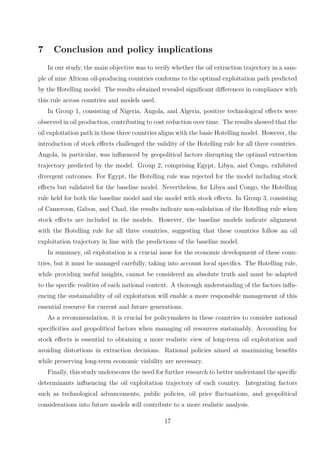
7 Conclusion and policy implications
In our study, the main objective was to verify whether the oil extraction trajectory in a sam-
ple of nine African oil-producing countries conforms to the optimal exploitation path predicted
by the Hotelling model. The results obtained revealed significant differences in compliance with
this rule across countries and models used.
In Group 1, consisting of Nigeria, Angola, and Algeria, positive technological effects were
observed in oil production, contributing to cost reduction over time. The results showed that the
oil exploitation path in these three countries aligns with the basic Hotelling model. However, the
introduction of stock effects challenged the validity of the Hotelling rule for all three countries.
Angola, in particular, was influenced by geopolitical factors disrupting the optimal extraction
trajectory predicted by the model. Group 2, comprising Egypt, Libya, and Congo, exhibited
divergent outcomes. For Egypt, the Hotelling rule was rejected for the model including stock
effects but validated for the baseline model. Nevertheless, for Libya and Congo, the Hotelling
rule held for both the baseline model and the model with stock effects. In Group 3, consisting
of Cameroon, Gabon, and Chad, the results indicate non-validation of the Hotelling rule when
stock effects are included in the models. However, the baseline models indicate alignment
with the Hotelling rule for all three countries, suggesting that these countries follow an oil
exploitation trajectory in line with the predictions of the baseline model.
In summary, oil exploitation is a crucial issue for the economic development of these coun-
tries, but it must be managed carefully, taking into account local specifics. The Hotelling rule,
while providing useful insights, cannot be considered an absolute truth and must be adapted
to the specific realities of each national context. A thorough understanding of the factors influ-
encing the sustainability of oil exploitation will enable a more responsible management of this
essential resource for current and future generations.
As a recommendation, it is crucial for policymakers in these countries to consider national
specificities and geopolitical factors when managing oil resources sustainably. Accounting for
stock effects is essential to obtaining a more realistic view of long-term oil exploitation and
avoiding distortions in extraction decisions. Rational policies aimed at maximizing benefits
while preserving long-term economic viability are necessary.
Finally, this study underscores the need for further research to better understand the specific
determinants influencing the oil exploitation trajectory of each country. Integrating factors
such as technological advancements, public policies, oil price fluctuations, and geopolitical
considerations into future models will contribute to a more realistic analysis.
17
References
Alier, J. M. and Jusmet, J. R. (2015). Economía ecológica y política ambiental. Fondo de
Cultura económica.
Cairns, R. D. (1990). The economics of exploration for non-renewable resources. Journal of
Economic Surveys, 4(4):361–395.
Chavy, F. (2007). Gilles rotillon, 2005, economie des ressources naturelles, paris, editions
la découverte, collection" repères", 123 p. Développement durable et territoires. Économie,
géographie, politique, droit, sociologie.
Chermak, J. M. and Patrick, R. H. (1995). Technological advancement and the recovery of
natural gas: The value of information. The Energy Journal, 16(1).
Dasgupta, P. and Stiglitz, J. (1980). Uncertainty, industrial structure, and the speed of r&d.
The Bell Journal of Economics, pages 1–28.
Devarajan, S. and Fisher, A. C. (1981). Hotelling’s" economics of exhaustible resources": Fifty
years later. Journal of Economic Literature, 19(1):65–73.
Farrow, S. (1985). Testing the efficiency of extraction from a stock resource. Journal of Political
Economy, 93(3):452–487.
Gaudet, G. (2007). Natural resource economics under the rule of hotelling. Canadian Journal
of Economics/Revue canadienne d’économique, 40(4):1033–1059.
Gilbert, R. J. (1979). Optimal depletion of an uncertain stock. The Review of Economic
Studies, 46(1):47–57.
Herfindahl, O. C. and Kneese, A. V. (1974). Economic theory of natural resources. (No Title).
Hotelling, H. (1931). The economics of exhaustible resources. Journal of political Economy,
39(2):137–175.
Livernois, J., Thille, H., and Zhang, X. (2006). A test of the hotelling rule using old-growth
timber data. Canadian Journal of Economics/Revue canadienne d’économique, 39(1):163–
186.
18
Pindyck, R. S. (1978). The optimal exploration and production of nonrenewable resources.
Journal of political economy, 86(5):841–861.
Slade, M. E. (1982). Trends in natural-resource commodity prices: an analysis of the time
domain. Journal of Environmental Economics and Management, 9(2):122–137.
Tatoutchoup, F. D., Keutiben, O., and Bahel, E. (2022). 623Testing the Dynamic Efficiency
of Extraction of Nonrenewable Resources. In The Oxford Handbook of the Economy of
Cameroon. Oxford University Press.
Zimmerman, M. B. (1977). Modeling depletion in a mineral industry: The case of coal. The
Bell Journal of Economics, pages 41–65.
Appendix
.
Figure 3: Frequency distribution for the real oil price in the market over the period 1980-2021.
19
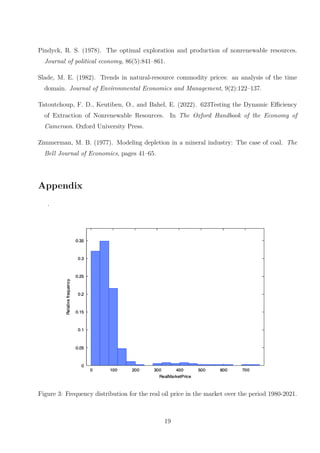
Table 5: Oil production of African countries expressed in mb/d
Rank (2022) Country Production in 2022 (mb/d) Production in 2021 (mb/d)
1st Nigeria 1.203 1.372
2nd Angola 1.142 1.117
3rd Algeria 1.017 0.913
4th Libya 0.991 1.159
5th Egypt 0.6 0.6
6th Congo 0.263 0.265
7th Ghana 0.2 0.2
8th Sudan 0.2 0.2
9th Gabon 0.197 0.182
10th South Africa 0.1 0.182
11th Cameroon 0.1 0.1
12th Chad 0.1 0.1
13th Equatorial Guinea 0.084 0.097
Table 6: Average real interest rates on the Market
Nigeria Angola Algeria Egypt Libya Congo Cameroon Gabon Chad
-7.84 -503.59 -1.47 -2.27 -3.16 1.84 0.55 1.73 1.06
20

MitacsCanada_AbdoulLatif_Project31606.pdf

  • 1.
    Research paper1 Testing theDynamic Efficiency of Extractive of Natural Resources Abdoul Latif SOKOUNDOU Supervisor : Pr. Didier TATOUTCHOUP 2023 1 I am deeply grateful to Mitacs for generously funding my research internship, allowing me to successfully complete my work. I am truly thankful for the opportunity to explore and learn more about Canada. Special thanks to my supervisor, Pr. Didier TATOUTCHOUP, for selecting my application among a competitive pool. I also want to express my sincere thanks to my academic advisor, Pr. Pascale Motel COMBES, who recommended me for this internship program.
  • 2.
    Testing the DynamicEfficiency of Extractive of Natural Resources. Abdoul Latif SOKOUNDOU∗† August 23, 2023 Abstract This paper examines the dynamics of oil exploitation in nine (09) African countries, with the aim of verifying whether they follow the optimal extraction trajectory predicted by the Hotelling model. The data used for this analysis consists of annual data from 1980 to 2021, sourced from the databases of OPEC, EIA, and WDI. By utilizing the nonlinear least squares estimator on both basic and extended models, divergent outcomes are observed within each group. In Group 1, comprising Nigeria, Angola, and Algeria, the results demonstrate that these three countries follow the optimal extraction path dictated by the basic Hotelling model that incorporates technological progress. For Group 2, consisting of Egypt, Libya, and Congo, the findings reveal that the oil extraction trajectory of Libya and Congo adheres to the basic and extended Hotelling models, which take into account technological progress and stock effects. Lastly, Group 3, consisting of Cameroon, Gabon, and Chad, validates Hotelling’s rule in the basic model but rejects it when cumulative production is included, capturing stock effects. In light of these results, recommendations for environmental and economic policies have been made to promote optimal management of this non-renewable resource. Keywords: Hotelling Model, Nonlinear Least Squares, Stock Effects JEL Codes: D224, O113, Q332 ∗ University of Clermont Auvergne, Ecole d’Économie, Clermont Ferrand, France † University of Moncton, 18 Avenue Antoine-Maillet Moncton NB E1A 3E9, Canada. Mail: abdoul.latif.sokoundou@umoncton.ca 1
  • 3.
    1 Introduction Since theadvent of the first oil shock in 1973, there has been a significant increase in attention to studies on the optimal management of non-renewable natural resources. Indeed, the dependence of states on natural resources is largely explained by the fact that export revenues from these products contribute significantly to their Gross Domestic Product. Although the prices of these resources are unstable in the market and their impact on development is uncertain, natural resources have proven to be a blessing in some countries where this sector has been optimally managed. In 1931, Harold Hotelling published an article titled "The Economics of Exhaustible Resources," in which he described the key factors that explain the evolution of prices of non- renewable resources. This article gained significant attention following the first oil shock in 1973. The focus of this paper is on the accelerated depletion of non-renewable natural resources. Hotelling (1931) determines the value of a depletable resource stock, the evolution of this value, and the extraction rate of the resource based on the prevailing economic regime. The problem to solve is finding the optimal extraction path, such that the value of the resource is maximized over time. Non-renewable natural resources are considered those whose economic use inevitably diminishes the reserves of the resource, and their extraction rate is faster than the geological production rate (Alier and Jusmet, 2015) The third and fourth decades of the 20th century were marked by a series of explorations and discoveries of non-renewable resources in Africa, notably oil and gas. The continent ac- counts for about 10% of global oil production and holds nearly 7.5% of proven oil and gas reserves (Statistical Review of World Energy, 2021). In North Africa, Algeria and Libya re- main the largest oil producers on the continent, while in the west, Nigeria and Angola drive the continent’s production. Due to their low domestic consumption, these African states export a significant portion of their production. The revenues generated from oil exports contribute substantially to their Gross Domestic Product. Given the growing concerns about extraction dynamics and oil price fluctuations, our paper aims to empirically verify the validity of Hotelling’s rule in nine (09) African oil-producing countries. In other words, we seek to determine whether there is conformity between the oil extraction trajectory in these countries and the optimal extraction path predicted by Hotelling. To better understand the issue of optimal oil extraction, our paper is structured as follows: sec- tion 2 reviews the literature related to the topic. Section 3 presents the basic Hotelling model 2
  • 4.
    as well asan extended version of it. Section 4 focuses on data and statistics, as well as some stylized facts related to our variables. Section 5 outlines the methodology, including model specification and chosen estimation method. Section 6 presents the results of our econometric estimations, including the test of the Hotelling model. Section 7 concludes by summarizing the main findings and highlighting the implications of our discoveries. 2 Literature review Nowadays, the literature on the extraction and optimal management of non-renewable re- sources is abundant. An recurrent theme in this literature is the empirical validation of the Hotelling rule. In a recent study conducted by Tatoutchoup et al. (2022), the dynamic efficiency of non-renewable resource extraction is examined using the Hotelling model on data from oil and natural gas exploitation in Cameroon from 1977 to 2018. Their model takes into account technological changes that have reduced the extraction costs of these resources. Utilizing linear cost functions for oil and log-linear cost functions for gas, estimated respectively using nonlinear least squares and ordinary least squares methods, the study’s results demonstrate coherence between the basic Hotelling model incorporating technological progress and the trajectory of oil and gas extraction. Another study conducted by Livernois et al. (2006) tests the Hotelling rule using data from timber extraction in the northwestern United States. Their estimations based on the basic model (without stock effects) reveal a positive and significant discount rate that responds to the Hotelling test, although the adjustments are minor, not warranting the rejection of the Hotelling rule. They thereby confirm that the standing timber extraction trajectory adheres to the Hotelling rule. Over time, several authors have extended the basic Hotelling model to incorporate current market realities. For instance, Herfindahl and Kneese (1974) and Zimmerman (1977) attempted to capture a stock effect by including cumulative production in the production cost function. Gaudet (2007) justified this extension by emphasizing that the depletion of the resource stock leads to an increase in marginal extraction cost, as the resource becomes less accessible and of lower quality. Other researchers, such as Cairns (1990), modeled mines with different material qualities and concluded that extraction costs increase exponentially with well depth. Scholars like (Dasgupta and Stiglitz, 1980; Devarajan and Fisher, 1981; Gilbert, 1979; Pindyck, 1978; Slade, 1982) , also made specific adjustments to account for factors such as discoveries, uncer- 3
  • 5.
    tainty about reservesize, technological effects, taxation, and exploration. Nevertheless, in the literature regarding testing the Hotelling model, other authors have found results that invalidate the Hotelling rule. Farrow (1985) examined a basic model of mining extraction using monthly data from 1975 to 1981. The estimation results showed a negative and significant discount rate, thereby rejecting the empirical validity of the Hotelling model. Chermak and Patrick (1995) utilized a dataset of time series from 29 natural gas wells to estimate a production cost function. Their results highlighted increasing production costs with the depletion of the resource stock, revealing a stock effect. Moreover, the temporal trend parameter displayed a negative and significant value, indicating that marginal costs decrease over time. 3 Hotelling model An exhaustible resource stock can be regarded as a distinct asset yielding income over time. The extraction and subsequent consumption of a unit of resource imply the impossibility of extracting and consuming that unit at a later time, as the stock1 is depleted following this decision. Extracting today thus entails the loss of future income that could have been generated from the unit just extracted. Hotelling (1931) posits that the depletion of non-renewable natural resources is driven by the low prices they command, leading to an acceleration in their extraction. Therefore, in order to decelerate this process, higher prices are necessary, further compounded by their escalation over the years. In this manner, mine or deposit owners can weigh the profits from present extraction against those from future extraction. In a perfectly competitive market, the fundamental economic model assumes that the objective of the operator is to maximize the present value of benefits from the extraction of a known resource stock. The profit function of the operator is given by the following equation: Max π = T X t=0 δt [P(t)q(t) − C(q(t), X(t), t)] S/C R(t + 1) = R(t) − q(t) (1) In (1), P(t) represents the price of the resource in the market, q(t) the current production, X(t) the cumulative production, t the time trend, R(t) the remaining reserve, and δ is the discount rate of the firm exploiting the resource. We employ the Lagrange method to solve the profit maximization problem. 1 The stock in this context is assumed to be finite and accurately known. 4
  • 6.
    L(q(t), R(t +1), λ(t)) = T X t=0 δt [P(t)q(t) − C(q(t), X(t), t) + λ(t)(R(t) − q(t) − R(t + 1))] (2) We have chosen to derive the parameters that we will need in our paper. To this effect, the first-order conditions are as follows: ∂L ∂q(t) = 0 ⇒ δt [P(t) − C′ q(t) − λ(t)] = 0 ⇒ P(t) − C′ q(t) = λ(t) (3) ∂L ∂R(t + 1) = 0 ⇒ δt [−λ(t) + δt+1 λ(t + 1)] = 0 ⇒ λ(t + 1) = (1 + r)λ(t) (4) Let’s assume that: m(t) = λ(t) and m(t + 1) = λ(t + 1). After changing variables, (3) and (4) become: m(t) = P(t) − Cq(t) (5) m(t + 1) = (1 + r) [P(t) − Cq(t)] (6) (5) and (6) respectively represent the static and dynamic models of Hotelling. A firm aiming to maximize the present value of its profits faces an opportunity cost, a consequence of the trade- off between extracting and selling today versus losing the future income it could have derived from the resource if it had not been extracted. If the firm or operator decides to extract one unit, the value of that extracted unit equals its market sale price minus the extraction cost. If it chooses not to extract, it means that the value of the resource in the ground is more significant to it than the extraction value. This non-extraction value is the opportunity cost of resource depletion (Chavy, 2007). In the literature, authors use various terms to identify it: shadow price, in-situ value, ground value, or scarcity rent, because we have just seen that it’s equal to the difference between the resource’s market price and its extraction cost. In our paper, this scarcity rent is represented by m(t), as observed in (5). When the firm or operator decides not to extract (5) at time t, it implies that the resource will have a value of m(t+1) in the following period, yielding a rate of return of m(t+1)− m(t) m(t) . 5
  • 7.
    The rate ofreturn for another asset in equilibrium is equal to the interest rate r when we are in a situation of pure and perfect competition. After transformation, we obtain (6), which is the expression of Hotelling’s Rule. It states that the scarcity rent should grow at the rate of the interest rate. 4 Data, statistics and stylized facts 4.1 Data The dataset used in this paper is a panel of nine (09) countries and comes from three (03) different sources. For countries such as Algeria, Angola, Cameroon, Nigeria, Libya, Egypt, Congo, and Gabon, the data covers the period 1980-2021, and for Chad, it covers 2003-2022. Data on current oil production (qt) and cumulative production (Xt) are extracted from the database of the Organization of the Petroleum Exporting Countries (OPEC) and are expressed in million barrels per day. Data on oil prices (Pt) comes from the Energy Information Adminis- tration (EIA) and is expressed in dollars per barrel. The unit rent is calculated by dividing the oil rent by current production. The unit production cost is obtained by subtracting the unit rent from the oil price. The total production cost is calculated by multiplying the unit rent by the unit cost. Data on the interest rate (r) comes from the World Development Indicators (WDI) database. It is important to note that the data have been adjusted to account for infla- tion in each country using the Consumer Price Index (CPI) available in the World Development Indicators (WDI). 4.2 Descriptive statistics The table 1 below provides a descriptive statistic of the data that we will subsequently use to estimate the production cost function. In the panel, it is observed that the average real oil price in the market is $84.34 per barrel. The value of the standard deviation, close to that of the mean, suggests that oil prices are clustered around the average price. This indicates that the real oil price in the market is relatively homogeneous within our sample. The average current production in the panel amounts to 841.0 million barrels per day, with a minimum production of 24.32 million barrels per day recorded in Chad in 2003 and a maximum production of 2627 million barrels per day recorded in Nigeria in 2005. As for the average value of the total extraction or production cost, it amounts to $57.23 billion across the entire sample. 6
  • 8.
    Table 1: Statisticsof model variables Variable Obs Mean Std. Dev. Min Max RealMarketPrice 355 84.349 97.826 8.935 733.355 CurrentExtractionMbd 355 8.410e+08 7.118e+08 24329000 2.627e+09 CumulativeExtraction 355 1.662e+10 1.885e+10 24329000 8.370e+10 TotalCost 355 5.723e+10 9.143e+10 6.601e+08 8.164e+11 4.3 Stylized facts In this section, we present two key figures that allow us to analyze the evolution of oil prices in the market as well as current production in the panel over the studied period. These two figures offer relevant visual insights for our empirical study, enhancing the understanding of oil market dynamics and oil production within the panel of African countries under investigation. Figure 1 highlights the trajectory of oil prices in the market over time. Accounting for specific inflation in each country, this graphical representation will enable us to observe fluctuations in the real oil price and identify potential upward or downward trends. This information is crucial for comprehending variations in international oil prices and their potential implications for the economies of the studied countries. During the period 1980-1998, a significant decline in barrel price is observed, followed by a slight increase starting in 1999. However, in 2020, the barrel price experiences an unprecedented drop in the past sixty (60) years. This drastic decrease can be attributed to the economic recession triggered by the Covid-19 pandemic, which profoundly impacted these states. Figure 2 focuses on the current oil production within the panel. It visualizes production levels for all countries during the study period, providing a clear comparison of extracted quantities. This analysis may reveal production patterns, significant shifts, or even external factors influencing oil production in the studied countries. We observe a rapid growth in oil production, reaching a peak of approximately 1050 million barrels per day. However, in 2020, this production will experience a drastic decline due to the economic slowdown caused by the pandemic. 7
  • 9.
    Figure 1: Evolutionof real oil price in the sample over the period 1980-2021 Figure 2: Evolution of current production in the sample over the period 1980-2021 8
  • 10.
    5 Methodology In thissection, we will delve into the three crucial steps for conducting the Hotelling model test in detail. Our approach involves adopting a direct test to assess the empirical validity of the Hotelling model. These steps will be elaborated upon to provide a comprehensive analysis of the model. 5.1 Model specification The initial step entails specifying the production or extraction cost function. It is vital to emphasize that the total production cost depends on the current production, cumulative production, and temporal trend. Various functional forms have been employed for this speci- fication in the literature. Following the approach of Tatoutchoup et al. (2022) , we opt for a linear model in our study. The functional form of this model is expressed as follows: C(q(t), X(t), t) = β0βt 1q(t) + γX(t) (7) In this equation, C(q(t), X(t), t) represents the total production cost and is a function of the current production q(t), cumulative production X(t), and time t, capturing technological ef- fects. β0, β1, and γ are parameters to be estimated and must be respectively greater than zero, between zero and one, and greater than zero. Following the theoretical framework developed in (7), our model takes the following form: TotalCost = β0βt 1CurrentExtractionMbd + γCumulativeExtraction (8) We employ the nonlinear least squares method to estimate the total cost function given by (8). The advantage of using this estimator lies in its ability to yield good estimates of unknown parameters in the model and adapt to a wide range of functions, even those that are inherently nonlinear. 5.2 Estimation of scarcity rent and stock effect The second step involves estimating the scarcity rent and stock effect parameters that will be used to test the Hotelling model. The estimated value of scarcity rent is given by: 9
  • 11.
    m̂(t) = RealMarketPrice− β̂0β̂t 1 (9) The estimated value of the stock effect is given by: ˆ ES(t) = −γ̂ (10) 5.3 Hotelling model test Once we have determined the values of scarcity rent and stock effect, we proceed to estimate the discount rate as well as the stock effect, which play a crucial role in testing the Hotelling model. m̂(t) − m̂(t − 1) m̂(t − 1) = r + µX ˆ ES(t) m̂(t − 1) + ϵ(t) (11) Here, µX is the implicit coefficient of the stock effect, r is the interest rate, and ϵ(t) represents the error term. To test the Hotelling rule, two hypotheses are necessary : (i) the discount rate (refer (4) ) must be equal to r, and (ii) the implicit coefficient of the stock effect must be equal to 1. Mathematically, we should obtain: δ = r and µX = 1. 6 Econometric results In this section, we present the outcomes derived from estimating the cost functions as well as conducting the Hotelling model test. We have chosen to partition the panel into three (03) groups, each containing three (03) countries, ranked based on their position in African oil production. The first group comprises Nigeria, Angola, and Algeria, which are regarded as the primary producers in the region. The second group consists of Egypt, Libya, and Congo, also distinguished by their oil production. The third group encompasses Cameroon, Gabon, and Chad, all of whom manage to reap benefits from oil exploitation. For each group, we present the results for individual countries under two distinct scenarios: scenario (1) incorporates stock effects, while scenario (2) does not. 10
  • 12.
    6.1 Group 1results The estimation results of the cost functions for Group 1 are depicted in Table 2 and reveal two significant observations. Firstly, in scenarios (1), the presence of technological effects in oil production is observed for each country within the group. The time trend parameters capturing these effects are indeed positive and significant at the 1% level, exhibiting respective growth rates2 of 14%, 1%, and 16% for Nigeria, Angola, and Algeria. These technological effects play a vital role in diminishing oil production costs in these nations. Secondly, we discern that the cumulative production parameters are both significant and greater than one for Nigeria and Algeria, thus confirming the existence of stock effects in their oil production. It is essential to recall that these stock effects tend to amplify production costs. These outcomes align with the findings of Chermak and Patrick (1995). Now, we turn our attention to the discount rate and the implicit stock effect coefficient within Group 1. The results reveal a negative discount rate and a significant negative implicit stock effect coefficient for the extended version of the Hotelling model in the case of Nigeria. These findings do not align with the initial assumptions, leading us to reject the empirical validity of the extended Hotelling model. However, upon subjecting the discount rate of the basic model to a linear restriction test, we find a discount rate of 0.45%, for which we fail to reject the null hypothesis. Given that this rate surpasses the average interest rate (refer 6) in the Nigerian market, we can confidently assert that the rent grows at the pace of the interest rate. In other words, oil exploitation in Nigeria adheres to the fundamental Hotelling model. For Angola, the results from the linear restriction test unequivocally reject the empirical validation of the Hotelling rule, both for the basic model and the extended model incorporating stock effects. Thus, we can state that Angola’s oil exploitation pattern does not conform to the Hotelling model. These observations align with the conclusions drawn by Farrow (1985). This rejection of the Hotelling rule can be attributed to several factors: foremost, the evolution of technological factors enabling quicker and more efficient oil extraction may lead to exploitation that deviates from the optimal Hotelling trajectory. Indeed, if new technologies maximize short- term oil revenues, this could lead to more intensive exploitation of reserves. Furthermore, a history of political instability and armed conflicts in Angola may also have played a determining role in shaping oil exploitation practices. Geopolitical disturbances can disrupt extraction plans envisioned by the Hotelling model, resulting in exploitation decisions that diverge from the 2 The growth rates are obtained by subtracting the coefficient of the variable (Time) from 1 and then multi- plying it by 100. 11
  • 13.
    optimal trajectory. As forAlgeria, we obtain outcomes similar to those of Nigeria. In scenario (1), we observe a significant negative discount rate and a significant negative stock effect coefficient, rendering a linear restriction test infeasible. In light of these findings, we reject the empirical validity of the Hotelling rule for this model incorporating stock effects. However, in scenario (2), after conducting a linear restriction test, we arrive at a maximum discount rate for which we cannot reject the null hypothesis at the 5% threshold. In summary, the obtained results indicate that the Hotelling rule is rejected for the stock-effects-inclusive model in Algeria, but validated for the basic model. This suggests that oil exploitation in Algeria adheres to the optimal trajectory predicted by the basic Hotelling model. Table 2: Estimation of cost functions for group 1 Dependent variable Nigeria Angola Algeria TotalCost (1) (2) (1) (2) (1) (2) Estimation of cost functions CurrentExtractionMbd 511.40*** 440.68*** 127.17*** 159.07*** 405.98*** 299.79*** (35.05) (34.81) (16.99) (33.16) (37.34) (34.12) Time 0.86*** 0.90*** 0.99*** 0.96*** 0.84*** 0.91*** (0.01) (0.00) (0.00) (0.00) (0.01) (0.01) CumulativeExtraction 1.34*** -3.21*** 1.45*** (0.25) (0.77) (0.20) Observation 42 42 42 42 42 42 R2 0.83 0.74 0.74 0.57 0.74 0.49 DW-statistic 0.74 0.42 0.83 0.50 0.51 0.22 Hotelling model test δ̂ -0.50 -0.04 1.76*** -3.25 -1.86*** 0.14 (0.92) (0.22) (0.54) (3.21) (0.55) (0.25) µ̂X -46.52** 17.71*** -28.02*** (21.12) (2.15) (5.50) Observation 41 41 41 41 41 41 R2 0.65 _ 0.86 _ 0.86 _ DW-statistic 2.09 2.14 1.98 2.02 1.59 1.93 Note: Robust standard errors in parentheses with the following significance levels: ***p<0.01, **p<0.05, *p<0.1 12
  • 14.
    6.2 Group 2results We can observe the presence of technological effects in oil production in Egypt and Congo. Indeed, the time trend parameter capturing these effects is positive and significant at the 1% level for both states. This indicates that these countries have experienced gradual improve- ment in their oil extraction technology, leading to a reduction in production costs over time. Furthermore, among the countries in this group, only Egypt exhibits stock effects in its oil exploitation, as evidenced by the positive and significant cumulative extraction parameter at the 1% threshold. The presence of these stock effects may contribute to increased oil produc- tion costs, but if technical progress continues to prevail, it could mitigate the impact of these additional costs. The results are summarized in Table 3. For Egypt, in scenario (1), the negative and significant values of the discount rate as well as the implicit coefficient of stock effects categorically reject both initial hypotheses. There is no need to perform a test of linear restrictions, leading us to conclude that the Hotelling rule is rejected for this model that incorporates stock effects. However, in scenario (2), after conducting a test of linear restrictions on the discount rate, we obtain a maximum discount rate of 0.3%, for which we cannot reject the null hypothesis at the 5% significance level. Given that the average interest rate in the Egyptian market is lower than the identified discount rate, we can thus assert that the oil extraction trajectory in Egypt aligns with the basic predictions of the Hotelling rule. These findings are consistent with those of Livernois et al. (2006). Turning to Libya, the tests of linear restrictions performed on both the extended and the base model yielded favorable results, not warranting the rejection of either Hotelling hypotheses. In the model incorporating stock effects, we found a maximum discount rate of 0.2%, for which the first null hypothesis stipulating that the discount rate should be equal to the market interest rate of the resource-extracting country cannot be rejected. Similarly, the restriction test on the implicit coefficient of stock effects did not lead to the rejection of the second null hypothesis, which posits that the implicit coefficient should be equal to one. This allows us to assert that the Hotelling rule holds true for both the base and extended models in Libya. In other words, Libya’s oil exploitation pattern adheres to Hotelling’s teachings, whether with or without stock effects. Regardless of the envisaged exploitation method, the country follows the optimal trajectory predicted by the Hotelling rule. As for the results obtained for Congo, the resemblances to those found for Libya are striking. Indeed, the tests of linear restrictions conducted on both the base and the extended model did not result in the rejection of the two null hypotheses. Particularly, in the model incorporating 13
  • 15.
    stock effects, amaximum discount rate of 1.8% was identified after applying the test. This discount rate does not allow us to reject the first null hypothesis at the 1% significance level. Interestingly, this discount rate closely aligns with the average interest rate in the Congolese market. Thus, we do not reject the null hypothesis. Furthermore, the results of the linear restriction test on the implicit coefficient of stock effects do not provide sufficient evidence for its rejection. In other words, there is insufficient evidence to reject this hypothesis. With all these conditions met, we can affirm that the Hotelling rule is validated for the model with stock effects in oil production in Congo. Table 3: Estimation of cost functions for group 2 Dependent variable Egypt Libya Congo TotalCost (1) (2) (1) (2) (1) (2) Estimation of cost functions CurrentExtractionMbd 691.78*** 658.58*** 26.09*** 27.23*** 30.03*** 30.67*** (47.51) (52.78) (5.08) (6.18) (8.93) (6.78) Time 0.81*** 0.82*** 1.02*** 1.01*** 0.99*** 1.01*** (0.01) (0.01) (0.00) (0.00) (0.02) (0.00) CumulativeExtraction 0.98*** -0.60 0.71 (0.22) (0.38) (0.96) Observation 42 42 42 42 42 42 R2 0.90 0.85 0.37 0.33 0.38 0.37 DW-statistic 0.92 0.57 0.29 0.26 0.40 0.36 Hotelling model test δ̂ -0.53*** 0.06 -0.27 0.69 0.61 -0.15 (0.10) (0.14) (0.24) (0.81) (0.48) (0.36) µ̂X -19.88*** 3.08 6.25 (0.12) (3.86) (5.07) Observation 41 41 41 41 41 41 R2 0.97 _ 0.04 _ 0.27 _ DW-statistic 0.96 1.97 1.76 2.14 1.58 1.88 Note: Robust standard errors in parentheses with the following significance levels: ***p<0.01, **p<0.05, *p<0.1 14
  • 16.
    6.3 Group 3results The results of the cost function estimations indicate that the coefficient associated with time is positive and statistically significant at the 1% level for all states in scenarios (1). This observation strongly suggests the existence of technological progress in the oil extraction process in the three countries (Cameroon, Gabon, and Chad). In other words, over time, the techniques and methods of oil extraction have evolved significantly, leading to improved efficiency and reduced production costs of this valuable resource. The rates 3 of technological progress are estimated at 20%, 15%, and 3% respectively for Cameroon, Gabon, and Chad. This implies that during the study period, these countries were able to achieve significant efficiency gains in their oil extraction activities through the adoption of more advanced technologies and more effective production methods. This significant reduction in production costs creates opportunities for these countries to enhance their competitive advantage in the international oil market and maximize the benefits of exporting this resource. Furthermore, the results reveal that the parameters of cumulative production for Cameroon and Gabon are above one and statistically significant at the 1% level. This observation is a necessary condition to justify the presence of stock effects in oil production. Verifying this condition allows us to conclude that stock effects exist in the oil exploitation of Cameroon and Gabon. The introduction of stock effects into the Hotelling model is an important consideration as it accounts for the non-linearity between remaining oil reserves and production costs. As the level of remaining reserves decreases, production costs increase nonlinearly, which has a significant impact on companies involved in oil production. The results are documented in Table 4, where a detailed analysis of the parameters and significance thresholds is presented. Results from the analysis for Cameroon, Gabon, and Chad reveal important findings con- cerning the application of the Hotelling rule in oil exploitation. For Cameroon and Gabon, the discount rates and implicit coefficients of stock effects are negative and statistically significant. These results lead to a systematic rejection of the empirical validity of the Hotelling rule, as the required conditions to justify this rule are not met. Similarly, for Chad, the test of linear restrictions on the implicit coefficient of stock effects also leads to a rejection of the empirical validity of the Hotelling rule. However, when examining the baseline models, i.e., without stock effects, it is observed that the Hotelling rule is upheld for these three countries. These findings 3 The growth rates are obtained by subtracting the coefficient of the variable (Time) from 1 and then mul- tiplying it by 100. It is worth noting that the variable (Time) captures technological effects, and its coefficient should be between 0 and 1. 15
  • 17.
    are consistent withthose of Tatoutchoup et al. (2022). For instance, in the case of Cameroon, the test of linear restrictions reveals a maximum discount rate of 0.55%4 , which does not al- low for the rejection of the null hypothesis at the 1% significance level. Likewise, for Gabon and Chad, the maximum discount rates5 are 1.9% and 1.3%, respectively(refer 6 in appendix). Hence, oil exploitation in these three countries adheres to the extraction path dictated by the Hotelling model when stock effects are excluded. Table 4: Estimation of cost functions for group 3 Dependent variable Cameroon Gabon Chad TotalCost (1) (2) (1) (2) (1) (2) Estimation of cost functions CurrentExtractionMbd 174.25*** 49.50*** 75.32*** 17.77*** 56.05*** 55.57*** (18.48) (7.78) (19.73) (3.97) (11.97) (7.96) Time 0.80*** 0.98*** 0.85*** 1.02*** 0.97*** 0.99*** (0.01) (0.00) (0.03) (0.00) (0.07) (0.01) CumulativeExtraction 0.95*** 1.29*** 0.58 (0.07) (0.10) (2.34) Observation 42 42 42 42 20 20 R2 0.75 0.05 0.21 0.02 0.31 0.30 DW-statistic 0.79 0.28 0.42 0.29 0.78 0.79 Hotelling model test δ̂ -0.43*** 0.08 -0.25*** -2.30 -0.18 -0.22 (0.14) (0.19) (0.09) (2.15) (0.49) (0.41) µ̂X -13.27*** -5.86*** 10.60*** (3.40) (0.61) (0.11) Observation 41 41 41 41 19 19 R2 0.59 _ 0.51 _ 0.97 _ DW-statistic 1.73 1.94 1.22 2.02 2.17 1.61 Note: Robust standard errors in parentheses with the following significance levels: ***p<0.01, **p<0.05, *p<0.1 4 This discount rate is not higher than the average interest rate in the Cameroon market; it is actually equal to the latter. That’s why we didn’t reject the null hypothesis. 5 These rates are higher than the average market interest rates of the respective countries. 16
  • 18.
    7 Conclusion andpolicy implications In our study, the main objective was to verify whether the oil extraction trajectory in a sam- ple of nine African oil-producing countries conforms to the optimal exploitation path predicted by the Hotelling model. The results obtained revealed significant differences in compliance with this rule across countries and models used. In Group 1, consisting of Nigeria, Angola, and Algeria, positive technological effects were observed in oil production, contributing to cost reduction over time. The results showed that the oil exploitation path in these three countries aligns with the basic Hotelling model. However, the introduction of stock effects challenged the validity of the Hotelling rule for all three countries. Angola, in particular, was influenced by geopolitical factors disrupting the optimal extraction trajectory predicted by the model. Group 2, comprising Egypt, Libya, and Congo, exhibited divergent outcomes. For Egypt, the Hotelling rule was rejected for the model including stock effects but validated for the baseline model. Nevertheless, for Libya and Congo, the Hotelling rule held for both the baseline model and the model with stock effects. In Group 3, consisting of Cameroon, Gabon, and Chad, the results indicate non-validation of the Hotelling rule when stock effects are included in the models. However, the baseline models indicate alignment with the Hotelling rule for all three countries, suggesting that these countries follow an oil exploitation trajectory in line with the predictions of the baseline model. In summary, oil exploitation is a crucial issue for the economic development of these coun- tries, but it must be managed carefully, taking into account local specifics. The Hotelling rule, while providing useful insights, cannot be considered an absolute truth and must be adapted to the specific realities of each national context. A thorough understanding of the factors influ- encing the sustainability of oil exploitation will enable a more responsible management of this essential resource for current and future generations. As a recommendation, it is crucial for policymakers in these countries to consider national specificities and geopolitical factors when managing oil resources sustainably. Accounting for stock effects is essential to obtaining a more realistic view of long-term oil exploitation and avoiding distortions in extraction decisions. Rational policies aimed at maximizing benefits while preserving long-term economic viability are necessary. Finally, this study underscores the need for further research to better understand the specific determinants influencing the oil exploitation trajectory of each country. Integrating factors such as technological advancements, public policies, oil price fluctuations, and geopolitical considerations into future models will contribute to a more realistic analysis. 17
  • 19.
    References Alier, J. M.and Jusmet, J. R. (2015). Economía ecológica y política ambiental. Fondo de Cultura económica. Cairns, R. D. (1990). The economics of exploration for non-renewable resources. Journal of Economic Surveys, 4(4):361–395. Chavy, F. (2007). Gilles rotillon, 2005, economie des ressources naturelles, paris, editions la découverte, collection" repères", 123 p. Développement durable et territoires. Économie, géographie, politique, droit, sociologie. Chermak, J. M. and Patrick, R. H. (1995). Technological advancement and the recovery of natural gas: The value of information. The Energy Journal, 16(1). Dasgupta, P. and Stiglitz, J. (1980). Uncertainty, industrial structure, and the speed of r&d. The Bell Journal of Economics, pages 1–28. Devarajan, S. and Fisher, A. C. (1981). Hotelling’s" economics of exhaustible resources": Fifty years later. Journal of Economic Literature, 19(1):65–73. Farrow, S. (1985). Testing the efficiency of extraction from a stock resource. Journal of Political Economy, 93(3):452–487. Gaudet, G. (2007). Natural resource economics under the rule of hotelling. Canadian Journal of Economics/Revue canadienne d’économique, 40(4):1033–1059. Gilbert, R. J. (1979). Optimal depletion of an uncertain stock. The Review of Economic Studies, 46(1):47–57. Herfindahl, O. C. and Kneese, A. V. (1974). Economic theory of natural resources. (No Title). Hotelling, H. (1931). The economics of exhaustible resources. Journal of political Economy, 39(2):137–175. Livernois, J., Thille, H., and Zhang, X. (2006). A test of the hotelling rule using old-growth timber data. Canadian Journal of Economics/Revue canadienne d’économique, 39(1):163– 186. 18
  • 20.
    Pindyck, R. S.(1978). The optimal exploration and production of nonrenewable resources. Journal of political economy, 86(5):841–861. Slade, M. E. (1982). Trends in natural-resource commodity prices: an analysis of the time domain. Journal of Environmental Economics and Management, 9(2):122–137. Tatoutchoup, F. D., Keutiben, O., and Bahel, E. (2022). 623Testing the Dynamic Efficiency of Extraction of Nonrenewable Resources. In The Oxford Handbook of the Economy of Cameroon. Oxford University Press. Zimmerman, M. B. (1977). Modeling depletion in a mineral industry: The case of coal. The Bell Journal of Economics, pages 41–65. Appendix . Figure 3: Frequency distribution for the real oil price in the market over the period 1980-2021. 19
  • 21.
    Table 5: Oilproduction of African countries expressed in mb/d Rank (2022) Country Production in 2022 (mb/d) Production in 2021 (mb/d) 1st Nigeria 1.203 1.372 2nd Angola 1.142 1.117 3rd Algeria 1.017 0.913 4th Libya 0.991 1.159 5th Egypt 0.6 0.6 6th Congo 0.263 0.265 7th Ghana 0.2 0.2 8th Sudan 0.2 0.2 9th Gabon 0.197 0.182 10th South Africa 0.1 0.182 11th Cameroon 0.1 0.1 12th Chad 0.1 0.1 13th Equatorial Guinea 0.084 0.097 Table 6: Average real interest rates on the Market Nigeria Angola Algeria Egypt Libya Congo Cameroon Gabon Chad -7.84 -503.59 -1.47 -2.27 -3.16 1.84 0.55 1.73 1.06 20