







Mission Possible – Mobile App
Testing for A Seamless User
Experience
Select Mobile App Testing To Propel Your Business
• Mobile apps play a crucial role in everyday lives in today’s
digital world.
• Such rigorous mobile app testing is important in order to
ensure a seamless user experience.
• It can focus on the Significance of delivering a user-friendly
and bug-free app.
• The present presentation explores the Significance of key
strategies and mobile app testing for success.
Significance Of Mobile App Testing
• Mobile app testing is important for delivering
user-friendly and reliable apps.
• It ensures performance, functionality, usability,
compatibility, and security, resulting reduced risks,
enhanced user satisfaction, and a competitive
advantage in the market.
Mobile App Testing Process
Performance
testing
Functional testing Compatibility
testing
Usability testing Security testing
Different stages of mobile app testing have unique characteristics.
This presentation explains the benefits and specific purpose of each testing phase.
Performance and Functional Testing
• Performance testing emphasizes evaluating
the scalability, speed, and responsiveness of
a mobile app under different conditions by
ensuring optimal performance.
• On the hand, functional testing helps to
verify the features, user interactions, and
functionality of the app to ensure it meets
the expected work and the intended
requirements.
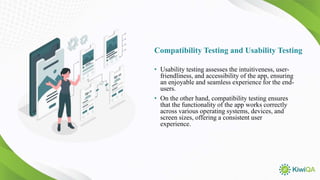
Compatibility Testing and Usability Testing
• Usability testing assesses the intuitiveness, user-
friendliness, and accessibility of the app, ensuring
an enjoyable and seamless experience for the end-
users.
• On the other hand, compatibility testing ensures
that the functionality of the app works correctly
across various operating systems, devices, and
screen sizes, offering a consistent user
experience.
Security Testing
• Security testing assesses the vulnerability of the
mobile app to potential security threats and
risks.
• It aims to address and identify security
vulnerabilities like data breaches, unauthorized
access, and malicious attacks.
• Organizations can maintain privacy, protect user
data, and ensure the overall security of the
mobile app by conducting security testing.
Conclusion
Every stage of mobile app testing helps to give a
user-friendly experience to the users. Choosing
the right mobile app testing can help to deliver a
user-centric and high-quality app.
Mission Possible – Mobile App Testing for A Seamless User Experience

Mission Possible – Mobile App Testing for A Seamless User Experience

  • 1.
    Mission Possible –Mobile App Testing for A Seamless User Experience
  • 2.
    Select Mobile AppTesting To Propel Your Business • Mobile apps play a crucial role in everyday lives in today’s digital world. • Such rigorous mobile app testing is important in order to ensure a seamless user experience. • It can focus on the Significance of delivering a user-friendly and bug-free app. • The present presentation explores the Significance of key strategies and mobile app testing for success.
  • 3.
    Significance Of MobileApp Testing • Mobile app testing is important for delivering user-friendly and reliable apps. • It ensures performance, functionality, usability, compatibility, and security, resulting reduced risks, enhanced user satisfaction, and a competitive advantage in the market.
  • 4.
    Mobile App TestingProcess Performance testing Functional testing Compatibility testing Usability testing Security testing Different stages of mobile app testing have unique characteristics. This presentation explains the benefits and specific purpose of each testing phase.
  • 5.
    Performance and FunctionalTesting • Performance testing emphasizes evaluating the scalability, speed, and responsiveness of a mobile app under different conditions by ensuring optimal performance. • On the hand, functional testing helps to verify the features, user interactions, and functionality of the app to ensure it meets the expected work and the intended requirements.
  • 6.
    Compatibility Testing andUsability Testing • Usability testing assesses the intuitiveness, user- friendliness, and accessibility of the app, ensuring an enjoyable and seamless experience for the end- users. • On the other hand, compatibility testing ensures that the functionality of the app works correctly across various operating systems, devices, and screen sizes, offering a consistent user experience.
  • 7.
    Security Testing • Securitytesting assesses the vulnerability of the mobile app to potential security threats and risks. • It aims to address and identify security vulnerabilities like data breaches, unauthorized access, and malicious attacks. • Organizations can maintain privacy, protect user data, and ensure the overall security of the mobile app by conducting security testing.
  • 8.
    Conclusion Every stage ofmobile app testing helps to give a user-friendly experience to the users. Choosing the right mobile app testing can help to deliver a user-centric and high-quality app.