MIS an overview
Group Members.(No.8)
Sanket Vijaykumar Jagare. -201020
Ishan Janabandhu. -201022
Sneha Gharat. -201015
Priyanka Patil. -201037
Sneha Patil. -201039
Vivek Raj. -201057
MIS an overview & application of MIS
in Logistic Industry.
Content.
Case studies of advance MIS systems.
Overview of MIS.
MIS Application example with excel demo.
Demonstration of report Generation of MIS
application.
Advanced Applications of MIS
Case Studies…
Case study 1 ERP
Company details:
Colgate is one of the leading MNC in the world in producing toothpaste. Being one of
the oldest toothpaste producers Colgate enjoyed a wide spread consumers all over
the world.
Problem faced:
Since Colgate centers were distributed all over the worlds they faced a serious
problem regarding maintenance of process and single central repository of
information. Even though before implementation Colgate had database but the
efficiency was not enough to maintain the complex real world process. As a result
Colgate found that:
1.90% of times it gave mis-delivery to customers.
2.98 % times the goods were not delivered on time.
SAP Implementation:
Colgate then decided to implement ERP for maintaining their business flow
and decision. They decided upon and implemented the SAP R/3 ERP.
Results:
Within a short span of implementing ERP Colgate found:
1.Now deliveries were on time and to the correct consumer
2.The decision making capabilities increased manifold.
Case study 2 Procurement Management
Client:
The US Department of Housing and Urban Development's (HUD) Federal Housing
Administration (FHA) is an agency which looks after the housing development in U.S.
Problem faced:
Since the above company was dealing with respect to housing and development, the
company was finding difficulty in maintaining various commitments and obligations
regarding various contracts.
As a result the organization was facing various problems with respect to maintaining
various procurements.
Procurement Management Implementation:
To solve the above problem of procurement the HUD implemented a
centralized procurement management system.
This centralized procurement management system was connected to
various logical centers of HUD and used to collect various data at
various intervals.
The main job of the PMS was to monitors commitments and obligations
for Federal contracts and Contract information.
Result of implementation
Within 2 months after implementation HUD was able to successfully
handle all details
They got following advantages:
•Monthly, quarterly, and annual reporting at the detail and summary
levels for budget execution and business analysis
•Automated reconciliation between the contract management system
•Elimination of manual steps, data re-entry, and reconciliation problems.
•Simplified reporting through repurposed data.
Case study 3 Customer Relationship Management (CRM):
Company details:
Telestra is a leading company in electronics and networking in Australia.
Problem faced
The company having its headquarters in Melbourne has faced serious problems with
respect to customer related services.
The problem was that was potential users of Telestra products were widely spread
but their were no enough centers available to support them as a result they were loosing
certain good amount of customer from areas which were far away from Melbourne.
Seibel CRM Implementation:
In order to solve the above problem Telestra implemented the Seibel
CRM.
They established 20 centers all over Australia and had nearly 120
people working in call centers to provide customer oriented service.
Result of Implementation:
After few months of implementation the CEO of Telestra came out with
the news that the customer base has increased by many times the initial
capacity and profit and revenue of the company has increased manifold.
Conclusion:
Thus by implementing Seibel CRM across various parts of the country,
Telestra earned good profit and increased customer base.
Case study4 Supply Chain Management (SCM):
Supply chain management is used to streamline traditional supply chain
process. Supply chain process consists of chain distributors, dealers, retailers
or resellers and final link of this chain is the customer who receives goods
through this chain. Efficient delivery of goods with effective logistics
management is carried in SCM process. Consider example of pizza outlets. If
efficient delivery is not followed, nobody will bye it again. If customer is
made happy with proper sales and service, he can become potential
customer for future for the company.
MIS
An MIS gives information through data analysis. The
foundation of MIS is the principles of management and its
practices.
The basic components of CBIS are as follows:
Hardware: a set of devices such as processor, monitor, mouse,
keyboard, printer etc. that accepts data, processes and displays it.
Software: a set of computer programs that enables the hardware to
process data.
Database: an organized collection of related files or records that stores
data and the association amongst them.
Network: a connecting system that permits sharing of resources among
different computers.
Procedures: the strategies, policies, methods, and rules for using the
information system.
People: the most important element in information systems; includes
those people who work with the information system or use its output.
Capabilities of Information System:
Information systems must be able to do the following:
Provide fast and accurate transaction processing.
Provide large-capacity, fast-access storage.
Provide fast communications (machine to machine, human to human).
Reduce information overload.
Span boundaries.
Provide support for decision making.
Provide a competitive weapon
MIS and Decision Making Concepts:
Decision making concepts has following characteristics:
1. Sequential in nature.
2. Exceedingly complex due to risks and trade offs.
3. Influenced by personal values.
4. Made in institutional settings and business environment.
A decision making process has following
phases:
*Intelligence
*Design
*Choice
MIS has more than one definition.
1.The MIS is defined as a system, which provides information support for
decision making in the organization.
2.The MIS is an integrated system of man and machine for providing
information to support the operations, the management and the decision
making function in the organization.
3.The MIS is defined as a system based on the database of the organization
evolved for purpose of providing information to the people in the
organization.
4.The MIS is defined as a Computer-based Information System.
MIS is an arrangement of data processing and information system in an
orderly manner to support the management in achieving the business
objectives. The MIS concentrate on the quality of input satisfying the
parameters like impartiality, validity, reliability, consistency and age. The
MIS provides a system for data processing and data analysis. The MIS is
a combination of the deterministic and the closed systems and the
probabilistic and the open systems.
The MIS as an open system supports the organization in the functioning of
the other systems. Irrespective of the organization structure, the industry
or the business, public or private sector the MIS is a model consisting of
the various subsystems. The subsystems are shown as follows:
SCM in MEARKES…
Objectives:-
• Maintenance of processes and single repository of database.
• Monthly, quarterly, and annual reporting at the detail and
summary levels for budget execution and business analysis
• Decision supports in operational level.
• Control and track flaws.(miss delivery and time delays)
• Supports in CRM.
• Support the management in achieving the business objectives.
• Quality Assurance.
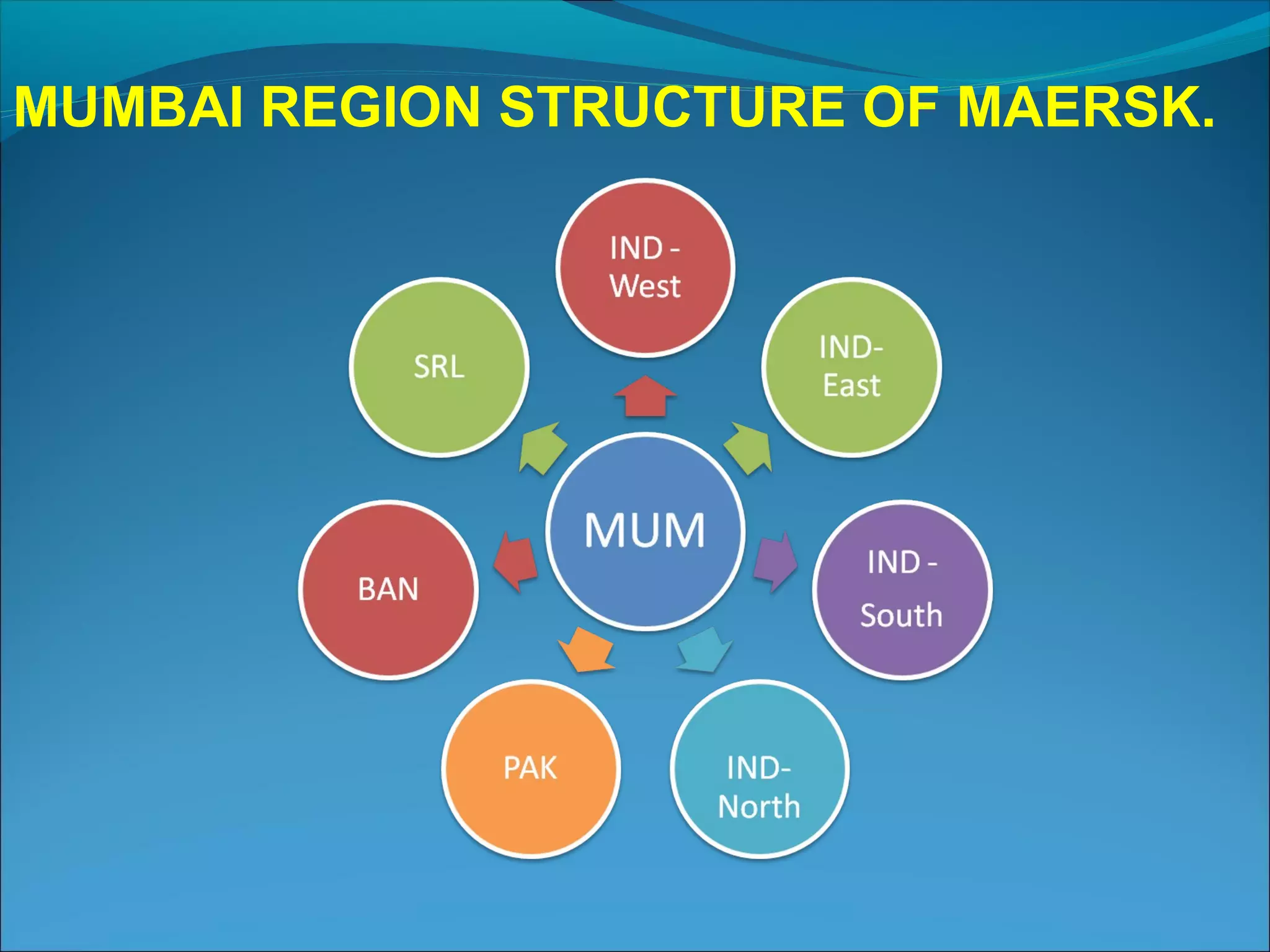
MUMBAI REGION STRUCTURE OF MAERSK.
SCREEN-SHOT OF REPORT MACRO PAGE
QUALITY CONTROL REPORT
Mis finl
Mis finl

Mis finl

  • 1.
  • 2.
    Group Members.(No.8) Sanket VijaykumarJagare. -201020 Ishan Janabandhu. -201022 Sneha Gharat. -201015 Priyanka Patil. -201037 Sneha Patil. -201039 Vivek Raj. -201057 MIS an overview & application of MIS in Logistic Industry.
  • 3.
    Content. Case studies ofadvance MIS systems. Overview of MIS. MIS Application example with excel demo. Demonstration of report Generation of MIS application.
  • 4.
    Advanced Applications ofMIS Case Studies…
  • 5.
    Case study 1ERP Company details: Colgate is one of the leading MNC in the world in producing toothpaste. Being one of the oldest toothpaste producers Colgate enjoyed a wide spread consumers all over the world. Problem faced: Since Colgate centers were distributed all over the worlds they faced a serious problem regarding maintenance of process and single central repository of information. Even though before implementation Colgate had database but the efficiency was not enough to maintain the complex real world process. As a result Colgate found that: 1.90% of times it gave mis-delivery to customers. 2.98 % times the goods were not delivered on time.
  • 6.
    SAP Implementation: Colgate thendecided to implement ERP for maintaining their business flow and decision. They decided upon and implemented the SAP R/3 ERP. Results: Within a short span of implementing ERP Colgate found: 1.Now deliveries were on time and to the correct consumer 2.The decision making capabilities increased manifold.
  • 7.
    Case study 2Procurement Management Client: The US Department of Housing and Urban Development's (HUD) Federal Housing Administration (FHA) is an agency which looks after the housing development in U.S. Problem faced: Since the above company was dealing with respect to housing and development, the company was finding difficulty in maintaining various commitments and obligations regarding various contracts. As a result the organization was facing various problems with respect to maintaining various procurements.
  • 8.
    Procurement Management Implementation: Tosolve the above problem of procurement the HUD implemented a centralized procurement management system. This centralized procurement management system was connected to various logical centers of HUD and used to collect various data at various intervals. The main job of the PMS was to monitors commitments and obligations for Federal contracts and Contract information. Result of implementation Within 2 months after implementation HUD was able to successfully handle all details They got following advantages: •Monthly, quarterly, and annual reporting at the detail and summary levels for budget execution and business analysis •Automated reconciliation between the contract management system •Elimination of manual steps, data re-entry, and reconciliation problems. •Simplified reporting through repurposed data.
  • 9.
    Case study 3Customer Relationship Management (CRM): Company details: Telestra is a leading company in electronics and networking in Australia. Problem faced The company having its headquarters in Melbourne has faced serious problems with respect to customer related services. The problem was that was potential users of Telestra products were widely spread but their were no enough centers available to support them as a result they were loosing certain good amount of customer from areas which were far away from Melbourne.
  • 10.
    Seibel CRM Implementation: Inorder to solve the above problem Telestra implemented the Seibel CRM. They established 20 centers all over Australia and had nearly 120 people working in call centers to provide customer oriented service. Result of Implementation: After few months of implementation the CEO of Telestra came out with the news that the customer base has increased by many times the initial capacity and profit and revenue of the company has increased manifold. Conclusion: Thus by implementing Seibel CRM across various parts of the country, Telestra earned good profit and increased customer base.
  • 11.
    Case study4 SupplyChain Management (SCM): Supply chain management is used to streamline traditional supply chain process. Supply chain process consists of chain distributors, dealers, retailers or resellers and final link of this chain is the customer who receives goods through this chain. Efficient delivery of goods with effective logistics management is carried in SCM process. Consider example of pizza outlets. If efficient delivery is not followed, nobody will bye it again. If customer is made happy with proper sales and service, he can become potential customer for future for the company.
  • 12.
    MIS An MIS givesinformation through data analysis. The foundation of MIS is the principles of management and its practices.
  • 13.
    The basic componentsof CBIS are as follows:
  • 14.
    Hardware: a setof devices such as processor, monitor, mouse, keyboard, printer etc. that accepts data, processes and displays it. Software: a set of computer programs that enables the hardware to process data. Database: an organized collection of related files or records that stores data and the association amongst them. Network: a connecting system that permits sharing of resources among different computers. Procedures: the strategies, policies, methods, and rules for using the information system. People: the most important element in information systems; includes those people who work with the information system or use its output.
  • 15.
    Capabilities of InformationSystem: Information systems must be able to do the following: Provide fast and accurate transaction processing. Provide large-capacity, fast-access storage. Provide fast communications (machine to machine, human to human). Reduce information overload. Span boundaries. Provide support for decision making. Provide a competitive weapon
  • 16.
    MIS and DecisionMaking Concepts: Decision making concepts has following characteristics: 1. Sequential in nature. 2. Exceedingly complex due to risks and trade offs. 3. Influenced by personal values. 4. Made in institutional settings and business environment. A decision making process has following phases: *Intelligence *Design *Choice
  • 17.
    MIS has morethan one definition. 1.The MIS is defined as a system, which provides information support for decision making in the organization. 2.The MIS is an integrated system of man and machine for providing information to support the operations, the management and the decision making function in the organization. 3.The MIS is defined as a system based on the database of the organization evolved for purpose of providing information to the people in the organization. 4.The MIS is defined as a Computer-based Information System.
  • 19.
    MIS is anarrangement of data processing and information system in an orderly manner to support the management in achieving the business objectives. The MIS concentrate on the quality of input satisfying the parameters like impartiality, validity, reliability, consistency and age. The MIS provides a system for data processing and data analysis. The MIS is a combination of the deterministic and the closed systems and the probabilistic and the open systems. The MIS as an open system supports the organization in the functioning of the other systems. Irrespective of the organization structure, the industry or the business, public or private sector the MIS is a model consisting of the various subsystems. The subsystems are shown as follows:
  • 20.
    SCM in MEARKES… Objectives:- •Maintenance of processes and single repository of database. • Monthly, quarterly, and annual reporting at the detail and summary levels for budget execution and business analysis • Decision supports in operational level. • Control and track flaws.(miss delivery and time delays) • Supports in CRM. • Support the management in achieving the business objectives. • Quality Assurance.
  • 21.
  • 24.
  • 25.