Mining Online Catalogs!

The Genealogical Society of Pennsylvania,!
          September 10, 2011!


              Holly Mengel
      PACSCL/CLIR Hidden Collections 
           Processing Project
PACSCL
Philadelphia Area Consortium of Special Collections Libraries

•  Cooperative group of special collections libraries with shared goals for
   their collections
•  Founded in 1985 with 16 member libraries 
•  Today, PACSCL is composed of 35 member libraries
   –  4,000,000 rare books
   –  260,000 linear feet of manuscripts and archival material
   –  9,000,000 photographs, maps, architectural drawings, and works of art on
      paper 
   –  But, PACSCL itself, does not own collections


                                www.pacscl.org
Backlog: Everyone has it.

  This is not a
 PACSCL problem
 or a Philadelphia
     problem.
This is a national
     problem.
Backlog exists because:
            •  Processing
               archival material
               is a time-intensive
               skill.
            •  Archival
               repositories are,
               generally
               speaking,
               underfunded and
               understaffed.
            •  Collections are
               acquired faster
               than they are
               processed.
Hidden Collections are …
•  Materials in a repository’s holdings that are
  – Un-arranged
  – Un-described
  – Under-described
•  Not physically or intellectually accessible to
   researchers or repository staff
•  Not advertised to researchers
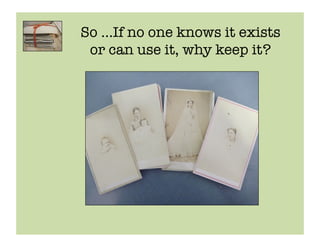
So …If no one knows it exists !
 or can use it, why keep it?

Efforts to Eliminate Backlog

•  Minimal processing:
  – Introduced as “More Product, Less
    Process” in 2005 by Greene & Meissner
  – Recommends 4 hours per linear foot
    (versus 8 to 15)
  – Less intensive processing: processors do
    not alphabetize material in folders,
    sometimes do not re-house material and
    describe collections only to the collection,
    series or folder level (NEVER item level).
Pros & Cons !
         of Minimal Processing

•  Arguments against minimal processing:
  –  The collection is not “finished”
  –  It is not as easy for researchers to find material
  –  It is not as easy for reference staff to find materials
•  Arguments for minimal processing:
  –  The collection is available to researchers in
     significantly less time than if traditionally processed.
  –  Staff is able to identify the most “valuable” segments of
     the collections and further process them
  –  Documented use of collections may result in grant
     funding for traditional processing
Efforts to Reveal !
          Hidden Collections

Council on Library and Information
         Resources (CLIR)

Cataloging Hidden Special Collections
        and Archives Initiative

 www.clir.org/hiddencollections/
PACSCL/CLIR Hidden Collections
          Processing Project
•  Follow up to the PACSCL Consortial
   Survey Initiative Project
   (www.pacsclsurvey.org)
•  27 month project
•  Process and make accessible to
   researchers approximately 120
   currently “hidden collections” in
   PACSCL repositories (nearly 4,000
   linear feet)
25 Participating Repositories
•    Academy of Natural Sciences
•    Bryn Mawr College
•    Chester County Historical Society
•    City of Philadelphia Department of Records
•    College of Physicians of Philadelphia
•    Drexel University Archives and Special Collections
•    Drexel University College of Medicine
•    Free Library of Philadelphia, Rare Books
•    German Society of Pennsylvania
•    Haverford College
•    Historical Society of Pennsylvania
•    Independence Seaport Museum
•    Library Company of Philadelphia
•    Lutheran Theological Seminary at Philadelphia
•    National Archives and Records Administration,
     Mid Atlantic Region
•    Pennsylvania Horticultural Society
•    Philadelphia Museum of Art
•    Presbyterian Historical Society
•    Rosenbach Museum and Library
•    Temple University Special Collections
•    Temple University Urban Archives
•    Union League of Philadelphia
•    University of Delaware
•    University of Pennsylvania
•    Wagner Free Institute of Science
Methodology

•  Minimal Processing (at 2 hours per
   linear foot)
•  Team processing by archival studies
   graduate students (trained via project
   “Bootcamp”)
•  The Archivists’ Toolkit computer
   program for creation of 
   standardized finding aids.
The Finding Aid
•  Guide to a collection
•  Includes
  – Administrative information about the
    repository and donor
  – Biographical/historical note
  – Scope and content note
  – Related collections
  – Name & subject headings (authorized
    terms)
  – Inventory of contents
Example of an electronic
    finding aid …
Making Collections Available
                  Project website:
                http://clir.pacscl.org


• Blog
• Collections by
  Topic
Family Histories and Genealogy
PACSCL Finding Aids Site !
      http://findingaids.pacscl.org
•  Provide a single access point for all of the
   region’s research collections, and therefore,
   present insight into the country’s political,
   economic, social, religious and cultural
   experiences, as well as Philadelphia’s role in
   shaping America and its citizens
•  Developed by the University of Pennsylvania
   Libraries
•  Finding aids from all 25 repositories in one
   place
•  We are NOT digitizing collections
PACSCL Finding Aids
    findingaids.pacscl.org
The Searches
•  Cross-repository searching
  – Useful for finding related material in multiple
    repositories 
•  Keyword searching
  – Useful for finding every instance of a name
    or topic 
•  Faceted searching
  – Useful in finding collections with
    concentrated focus in a certain name or topic
The Searches

The Searches
The Searches
Impact on Genealogists
•  We are not sure …
  – Are minimally processed collections
    sufficient for detail-oriented genealogical
    research?
  – Do finding aids created at this speed provide
    the necessary description for research?
•  Your help …
  – If you use one of our collections, LET US
    KNOW!
  – Participate in a user study to be conducted in
    future!
Now available …
– 125 collections (just over 4000 linear feet)
– Part time student processors worked for 1
  year and 11 months
– At 8 hours per linear foot (traditional
  processing), this same linear footage would
  take a full-time archivist 15 years to
  complete.
Historical Genealogists
Albert Cook Myers !
(aka William Penn’s stalker)


   Albert Cook Myers collection of William Penn material, 
             Chester County Historical Society
Biographies …


Bradford collection of biographies of homeopathic physicians, 
            Drexel University College of Medicine
In their mother’s words,


Nicholson and Taylor family papers,         Logan family papers, 
        Haverford College
            Library Company of Philadelphia
in their own words,


Diaries and letters, Bryn Mawr College and Haverford College
Through photographs and
                        sketches


Alma A. Clarke papers, 
                                     Rush family papers, 
  Bryn Mawr College
                                         Library Company of
                                                                 Philadelphia
                            Ministerium of Pennsylvania, 
                           Lutheran Theological Seminary
                                   at Philadelphia
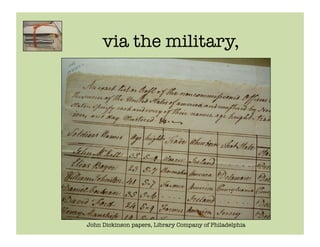
via the military,


John Dickinson papers, Library Company of Philadelphia
and by the land


Logan family papers, Historical Society of Pennsylvania
In sickness …


                                       Alma A. Clark papers, 
                                        Bryn Mawr College


      Rush family papers, 
Library Company of Philadelphia
                                         Rush family papers, 
                                   Library Company of Philadelphia
… in death …


    Elizabeth Graham
Fergusson papers, Library
 Company of Philadelphia


Philadelphia Memorial Park       Philadelphia Memorial Park records, 
 records, Chester County          Chester County Historical Society
     Historical Society
… and in the heavens!


 Read family papers, Library Company of Philadelphia
Check us out!
              •  Project website and blog: 
                 
http://clir.pacscl.org

             •  PACSCL Finding Aid Site: 
              http://findingaids.pacscl.org

                  •  PACSCL website:
                     http://pacscl.org

•  Contact us with input, suggestions, complaints, etc.!

Mining Online Catalogs

  • 1.
    Mining Online Catalogs! TheGenealogical Society of Pennsylvania,! September 10, 2011! Holly Mengel PACSCL/CLIR Hidden Collections Processing Project
  • 2.
    PACSCL Philadelphia Area Consortiumof Special Collections Libraries •  Cooperative group of special collections libraries with shared goals for their collections •  Founded in 1985 with 16 member libraries •  Today, PACSCL is composed of 35 member libraries –  4,000,000 rare books –  260,000 linear feet of manuscripts and archival material –  9,000,000 photographs, maps, architectural drawings, and works of art on paper –  But, PACSCL itself, does not own collections www.pacscl.org
  • 3.
    Backlog: Everyone hasit. This is not a PACSCL problem or a Philadelphia problem. This is a national problem.
  • 4.
    Backlog exists because: •  Processing archival material is a time-intensive skill. •  Archival repositories are, generally speaking, underfunded and understaffed. •  Collections are acquired faster than they are processed.
  • 5.
    Hidden Collections are… •  Materials in a repository’s holdings that are – Un-arranged – Un-described – Under-described •  Not physically or intellectually accessible to researchers or repository staff •  Not advertised to researchers
  • 6.
    So …If noone knows it exists ! or can use it, why keep it?

  • 7.
    Efforts to EliminateBacklog
 •  Minimal processing: – Introduced as “More Product, Less Process” in 2005 by Greene & Meissner – Recommends 4 hours per linear foot (versus 8 to 15) – Less intensive processing: processors do not alphabetize material in folders, sometimes do not re-house material and describe collections only to the collection, series or folder level (NEVER item level).
  • 8.
    Pros & Cons! of Minimal Processing
 •  Arguments against minimal processing: –  The collection is not “finished” –  It is not as easy for researchers to find material –  It is not as easy for reference staff to find materials •  Arguments for minimal processing: –  The collection is available to researchers in significantly less time than if traditionally processed. –  Staff is able to identify the most “valuable” segments of the collections and further process them –  Documented use of collections may result in grant funding for traditional processing
  • 9.
    Efforts to Reveal! Hidden Collections Council on Library and Information Resources (CLIR) Cataloging Hidden Special Collections and Archives Initiative www.clir.org/hiddencollections/
  • 10.
    PACSCL/CLIR Hidden Collections Processing Project •  Follow up to the PACSCL Consortial Survey Initiative Project (www.pacsclsurvey.org) •  27 month project •  Process and make accessible to researchers approximately 120 currently “hidden collections” in PACSCL repositories (nearly 4,000 linear feet)
  • 11.
    25 Participating Repositories •  Academy of Natural Sciences •  Bryn Mawr College •  Chester County Historical Society •  City of Philadelphia Department of Records •  College of Physicians of Philadelphia •  Drexel University Archives and Special Collections •  Drexel University College of Medicine •  Free Library of Philadelphia, Rare Books •  German Society of Pennsylvania •  Haverford College •  Historical Society of Pennsylvania •  Independence Seaport Museum •  Library Company of Philadelphia •  Lutheran Theological Seminary at Philadelphia •  National Archives and Records Administration, Mid Atlantic Region •  Pennsylvania Horticultural Society •  Philadelphia Museum of Art •  Presbyterian Historical Society •  Rosenbach Museum and Library •  Temple University Special Collections •  Temple University Urban Archives •  Union League of Philadelphia •  University of Delaware •  University of Pennsylvania •  Wagner Free Institute of Science
  • 12.
    Methodology
 •  Minimal Processing(at 2 hours per linear foot) •  Team processing by archival studies graduate students (trained via project “Bootcamp”) •  The Archivists’ Toolkit computer program for creation of standardized finding aids.
  • 13.
    The Finding Aid • Guide to a collection •  Includes – Administrative information about the repository and donor – Biographical/historical note – Scope and content note – Related collections – Name & subject headings (authorized terms) – Inventory of contents
  • 14.
    Example of anelectronic finding aid …
  • 15.
    Making Collections Available Project website: http://clir.pacscl.org • Blog • Collections by Topic
  • 16.
  • 17.
    PACSCL Finding AidsSite ! http://findingaids.pacscl.org •  Provide a single access point for all of the region’s research collections, and therefore, present insight into the country’s political, economic, social, religious and cultural experiences, as well as Philadelphia’s role in shaping America and its citizens •  Developed by the University of Pennsylvania Libraries •  Finding aids from all 25 repositories in one place •  We are NOT digitizing collections
  • 18.
    PACSCL Finding Aids findingaids.pacscl.org
  • 19.
    The Searches •  Cross-repositorysearching – Useful for finding related material in multiple repositories •  Keyword searching – Useful for finding every instance of a name or topic •  Faceted searching – Useful in finding collections with concentrated focus in a certain name or topic
  • 20.
  • 21.
  • 22.
  • 23.
    Impact on Genealogists • We are not sure … – Are minimally processed collections sufficient for detail-oriented genealogical research? – Do finding aids created at this speed provide the necessary description for research? •  Your help … – If you use one of our collections, LET US KNOW! – Participate in a user study to be conducted in future!
  • 24.
    Now available … – 125collections (just over 4000 linear feet) – Part time student processors worked for 1 year and 11 months – At 8 hours per linear foot (traditional processing), this same linear footage would take a full-time archivist 15 years to complete.
  • 25.
  • 26.
    Albert Cook Myers! (aka William Penn’s stalker) Albert Cook Myers collection of William Penn material, Chester County Historical Society
  • 27.
    Biographies … Bradford collectionof biographies of homeopathic physicians, Drexel University College of Medicine
  • 28.
    In their mother’swords, Nicholson and Taylor family papers, Logan family papers, Haverford College Library Company of Philadelphia
  • 29.
    in their ownwords, Diaries and letters, Bryn Mawr College and Haverford College
  • 30.
    Through photographs and sketches Alma A. Clarke papers, Rush family papers, Bryn Mawr College Library Company of Philadelphia Ministerium of Pennsylvania, Lutheran Theological Seminary at Philadelphia
  • 31.
    via the military, JohnDickinson papers, Library Company of Philadelphia
  • 32.
    and by theland Logan family papers, Historical Society of Pennsylvania
  • 33.
    In sickness … Alma A. Clark papers, Bryn Mawr College Rush family papers, Library Company of Philadelphia Rush family papers, Library Company of Philadelphia
  • 34.
    … in death… Elizabeth Graham Fergusson papers, Library Company of Philadelphia Philadelphia Memorial Park Philadelphia Memorial Park records, records, Chester County Chester County Historical Society Historical Society
  • 35.
    … and inthe heavens! Read family papers, Library Company of Philadelphia
  • 36.
    Check us out! •  Project website and blog: http://clir.pacscl.org •  PACSCL Finding Aid Site: http://findingaids.pacscl.org •  PACSCL website: http://pacscl.org •  Contact us with input, suggestions, complaints, etc.!