Minimal Processing  with  Maximal Description  Holly Mengel, Project Manager and Courtney Smerz, Project Archivist PACSCL/CLIR “Hidden Collections” Processing Project
“ Hidden Collections”  Processing Project Mission Process and make accessible to researchers approximately 200 currently “hidden collections” in PACSCL repositories Provide a single access point for all of the region’s research collections, and therefore, present insight into the country’s political, economic, social, religious and cultural experiences, as well as Philadelphia’s role in shaping America and its citizens
“ Hidden Collections”  Processing Project Minimally process 114 collections (roughly 4,000 linear feet) in roughly 2 hours per linear foot Create EAD finding aids for 82 additional collections (roughly 6,000 linear feet) Use the Archivists’ Toolkit and Describing Archives:  A Content Standard to create “standardized” and compatible finding aids across 23 repositories in the Philadelphia Area
Experiment with large scale minimal processing for collections ranging from the 15 th  the 21 st  centuries Develop new workflows for repositories who need help with backlog Build consortial cooperation in order to reveal Philadelphia’s papery treasures to researchers across the country and the globe
The Standards Committee Composed of several archivists, librarians and catalogers who gave their time to create a group of standards that all project participants accepted Met regularly to address questions as they arose and to oversee my work in relation to a cross repository acceptance
Q:  What does minimal processing mean in a large processing project with pre 20 th  century non-institutional records? Much of this work was completed by Matthew Lyons and Carey Majewicz of the Historical Society of Pennsylvania Guidelines for minimal processing (available in Processing Manual on-line) which include dealing with folded material, paper clips, rubber bands, mold, damaged items, volumes, binders, etc.
Minimal Processing at 2 hours per linear foot Main guidelines for minimally processing pre-20 th  century materials Place loose items in archival folders, otherwise, do not re-folder. In each folder: DO NOT organize the material  DO NOT unfold papers DO NOT remove letters from envelopes DO NOT remove paper clips or metal fasteners, etc. Place all materials in archival boxes. Make notes of damaged materials and other concerns.
Q:  How do we create standards that the project AND 23 repositories can agree on and will result in consistent finding aids? Require all repositories to install and use the Archivists’ Toolkit throughout the project (and hopefully in future) Use Describing Archives:  A Content Standard (DACS) Develop a standardized group of authorities for all collections processed during the project (AAT for genre forms; LOC for other subjects)
Other Efforts for Standardization Create a manual for the Archivists’ Toolkit Create a Processing Manual for student processors Address issues such as writing effective folder titles and notes
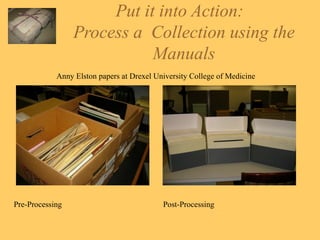
Put it into Action:  Process a  Collection using the Manuals Post-Processing Pre-Processing Anny Elston papers at Drexel University College of Medicine
Lesson Learned: 2 hours per linear foot is FAST! (too fast)
Solutions: Develop a structure of providing information so that the 2 hours per linear foot allotted to the students could be used for processing, not discovering what a collection contains or is about … Create processing plans Use this newly discovered problem to determine what parts of processing take the most time and then make realistic recommendations for funding of future processing projects. Create a processing worksheet to track what works and what does not in a minimal processing world
Project Archivist,  Courtney Smerz In her first two weeks, we: Reviewed the processing manual and the Archivists’ Toolkit manual Developed training manual and training exercises Selected candidates for student processors Interviewed and hired student processors
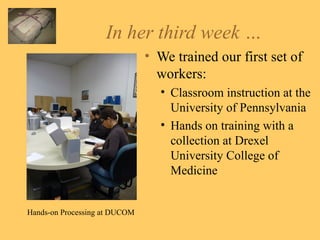
In her third week … We trained our first set of workers: Classroom instruction at the University of Pennsylvania Hands on training with a collection at Drexel University College of Medicine Hands-on Processing at DUCOM
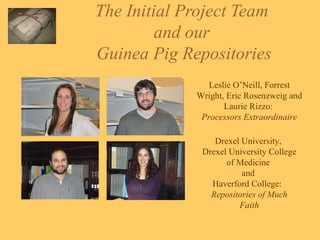
The Initial Project Team  and our  Guinea Pig Repositories Leslie O’Neill, Forrest Wright, Eric Rosenzweig and Laurie Rizzo:  Processors Extraordinaire Drexel University,  Drexel University College of Medicine  and  Haverford College:  Repositories of Much Faith
Initial Lessons Learned Each Repository has its own unique concerns regarding the project and the final product Technology is a many-headed beast Space is hard to come by 10% of staff time is not an easy request
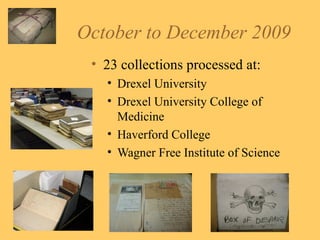
October to December 2009 23 collections processed at: Drexel University Drexel University College of Medicine Haverford College Wagner Free Institute of Science
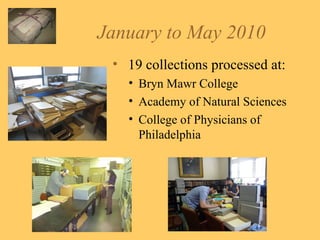
January to May 2010  19 collections processed at: Bryn Mawr College Academy of Natural Sciences College of Physicians of Philadelphia
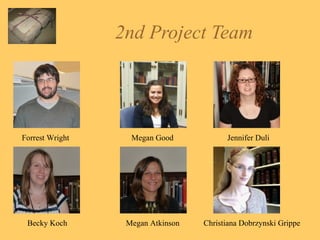
2nd Project Team Forrest Wright Megan Good Jennifer Duli Christiana Dobrzynski Grippe Megan Atkinson Becky Koch
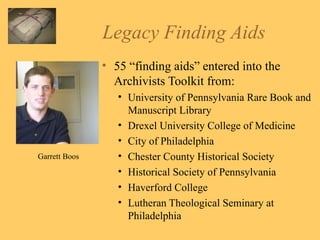
Legacy Finding Aids 55 “finding aids” entered into the Archivists Toolkit from: University of Pennsylvania Rare Book and Manuscript Library Drexel University College of Medicine City of Philadelphia  Chester County Historical Society Historical Society of Pennsylvania Haverford College Lutheran Theological Seminary at Philadelphia  Garrett Boos
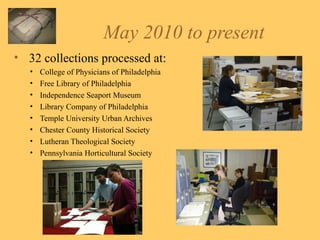
May 2010 to present 32 collections processed at: College of Physicians of Philadelphia Free Library of Philadelphia Independence Seaport Museum Library Company of Philadelphia Temple University Urban Archives Chester County Historical Society Lutheran Theological Society Pennsylvania Horticultural Society
Processing Lessons Learned #1:  This project could not be accomplished without the preceding PACSCL Survey Project The research value rating allows for a systematic and fair approach for prioritizing the thousands of “hidden collections” in Philadelphia for inclusion in this project The survey records are critical for the creation of processing plans in a project with a limited time frame.
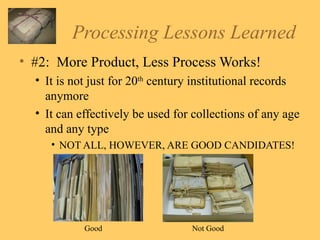
Processing Lessons Learned #2:  More Product, Less Process Works! It is not just for 20 th  century institutional records anymore It can effectively be used for collections of any age and any type NOT ALL, HOWEVER, ARE GOOD CANDIDATES! Good Not Good
Processing Lessons Learned #3: Standardization is VITAL to the success of a project (particularly this one which crosses repositories) Methods of processing Methods of data entry Methods of editing Authority control
Processing Lessons Learned #4:  Up-sides to Minimal Processing Awareness of the content of collection can result in further processing initiatives of entire collections or even just series Collections are available to researchers MUCH more quickly than if processed traditionally (generally 8 hours per linear foot)
#5:  Down-sides to Minimal Processing 2 hours per linear foot is entirely too fast (we think 4 would be more realistic) If collections are shortchanged, it is generally in terms of description—making certain that researchers can find the collection is more than half the battle It is not possible to create acceptable finding aids at this speed without first developing the processing plan, biographical/historical note, and authorities
Legacy Finding Aids Lessons Learned Due to lack of standards in the archival field, each repository’s finding aids were as unique as their collections The project promised to upgrade any “substandard” finding aid, but many of these guides are not finding aids at all … If an original finding aid is not good, the EAD finding aid will not be very good either. Many complications due to varying degrees of completeness and OVER completeness.
Our Community of Support Grows Group of staff from repositories where project processing has been completed meet to discuss future of minimal processing in PACSCL and will continue to meet and grow Plans to develop an Archivists’ Toolkit Support Network for the Philadelphia area Plans to develop system for training the trainers and processors
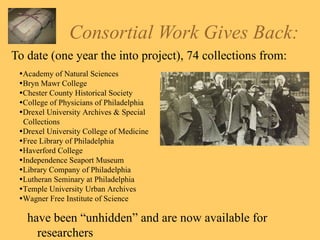
Consortial Work Gives Back: To date (one year the into project), 74 collections from: have been “unhidden” and are now available for researchers   Academy of Natural Sciences  Bryn Mawr College  Chester County Historical Society  College of Physicians of Philadelphia  Drexel University Archives & Special Collections  Drexel University College of Medicine  Free Library of Philadelphia  Haverford College  Independence Seaport Museum  Library Company of Philadelphia  Lutheran Seminary at Philadelphia  Temple University Urban Archives  Wagner Free Institute of Science
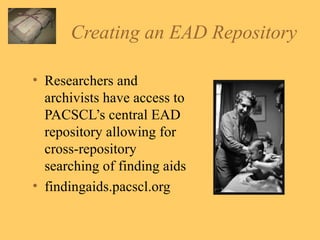
Creating an EAD Repository Researchers and archivists have access to PACSCL’s central EAD repository allowing for cross-repository searching of finding aids findingaids.pacscl.org
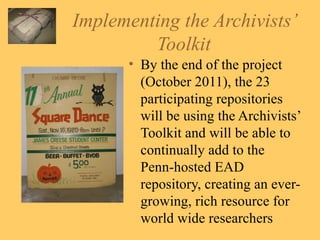
Implementing the Archivists’ Toolkit By the end of the project (October 2011), the 23 participating repositories will be using the Archivists’ Toolkit and will be able to continually add to the Penn-hosted EAD repository, creating an ever-growing, rich resource for world wide researchers
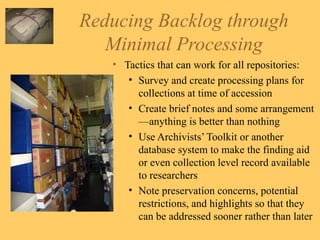
Reducing Backlog through Minimal Processing Tactics that can work for all repositories: Survey and create processing plans for collections at time of accession Create brief notes and some arrangement—anything is better than nothing Use Archivists’ Toolkit or another database system to make the finding aid or even collection level record available to researchers Note preservation concerns, potential restrictions, and highlights so that they can be addressed sooner rather than later
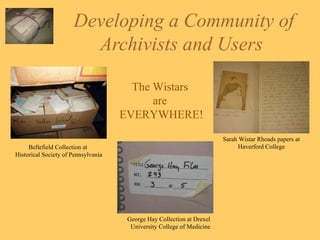
Developing a Community of Archivists and Users  Bellefield Collection at  Historical Society of Pennsylvania Sarah Wistar Rhoads papers at Haverford College George Hay Collection at Drexel University College of Medicine The Wistars  are  EVERYWHERE!
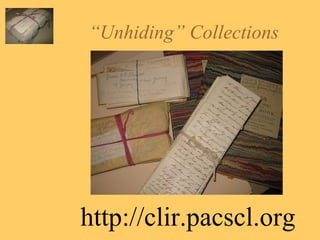
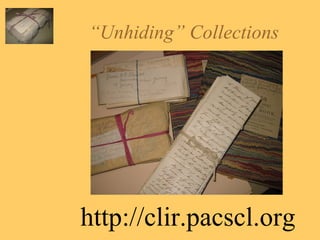
“ Unhiding” Collections http://clir.pacscl.org
Putting Theory into Practice:   How we have a ctually  implemented our cross-repository  Minimal Processing Program  Processing Plans Training Students Supervising Students Quality Control Consortial Benefits
The Processing Plan Essential to our success Enables Holly and me to plan ahead  It serves as a starting point and guide to our inexperienced student processors Makes it possible for our students to process a collection in the 2 hours per linear foot timeframe
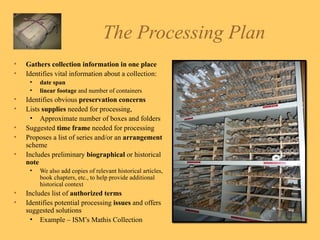
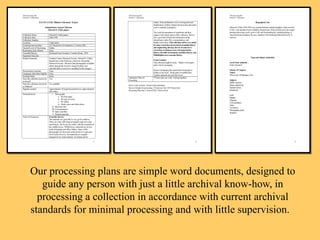
The Processing Plan Gathers collection information in one place Identifies vital information about a collection: date span   linear footage  and number of containers  Identifies obvious  preservation concerns Lists  supplies  needed for processing,  Approximate number of boxes and folders Suggested  time frame  needed for processing Proposes a list of series and/or an  arrangement  scheme Includes preliminary  biographical  or historical  note  We also add copies of relevant historical articles, book chapters, etc., to help provide additional historical context Includes list of  authorized terms Identifies potential processing  issues  and offers suggested solutions  Example – ISM’s Mathis Collection
Our processing plans are simple word documents, designed to guide any person with just a little archival know-how, in processing a collection in accordance with current archival standards for minimal processing and with little supervision.
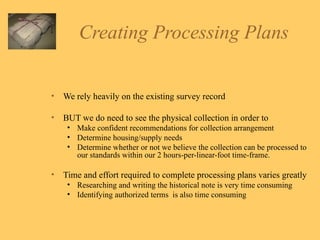
Creating Processing Plans We rely heavily on the existing survey record BUT we do need to see the physical collection in order to Make confident recommendations for collection arrangement  Determine housing/supply needs Determine whether or not we believe the collection can be processed to our standards within our 2 hours-per-linear-foot time-frame.  Time and effort required to complete processing plans varies greatly Researching and writing the historical note is very time consuming Identifying authorized terms  is also time consuming
Training We consider student training to be on-going and a work in progress.  However, we do have a required formal training program for our project team. Minimal Processing Manual Archivist’s Toolkit Manual Archival “Boot Camp” Supervision and Quality Control
Minimal Processing Manual Designed to be a general source of reference The manuals have already evolved and will probably continue to be refined until the end of the project. 26 pages Explains archival basics Original order and provenance Series, subseries Finding aid Provides step by step instructions on how to arrange and describe a collection in a minimal processing environment.  specifies the “DOs” and “DON'Ts” of minimal processing. Suggests solutions for problematic situations.  Also included is a glossary and copies of our processing worksheets
Archivist’s Toolkit Manual 7 page manual Simply  step by step instructions  for entering collection level information, series, sub-series, folders and box and folder numbers into the database in a standardized manner Instructions on how to edit the finding aid
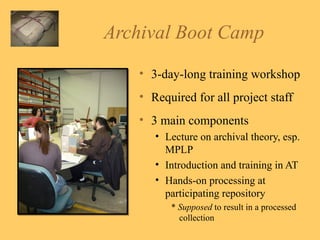
Archival Boot Camp 3-day-long training workshop Required for all project staff 3 main components Lecture on archival theory, esp. MPLP Introduction and training in AT Hands-on processing at participating repository *  Supposed  to result in a processed collection
Boot Camp  We have held three boot camps Each one has been a little different…  Our next boot camp is January 4 to 6 One day of “lecture” Two days of hands-on training Day 1 – Arrangement and re-housing Day 2 – Description and data entry We want this to be a team exercise with plenty of time for questions and discussion
On-going training  and supervision We spent the first two weeks on site with our teams Once our teams started to work independently, it became apparent that  follow-up training  was necessary We had one formal follow-up training Writing and formatting abstracts and scope and content notes – take a more formulaic approach Constructing folder titles We amended our training manual and boot camp to hopefully avoid this in the future
Quality Control Finding Aids are our primary tangible product Rigorous editing for each finding aid Looking for clarity and readability, quality of information, spelling and grammar, and general errors Four editing cycles Peer review, Review by Courtney, Review by Holly, Repository review
Benefits to the Consortium Processing Plan creation Can be incorporated into regular accessioning work flow Easy to do in Archivist’s Toolkit OR simple word document Theoretically you can create this document today and in five years someone else can pick it up and know exactly what to do We DO recommend combining the survey and processing plan step Repository staff are welcome and encouraged to attend boot camp Offered every semester Training in MPLP Training in the use of Archivist’s Toolkit Learn from the successes and failures of our student processing program Adapt our program to fit institutional needs and maximize the potential of student workers and interns.
“ Unhiding” Collections http://clir.pacscl.org

Minimal Processing with Maximal Description

  • 1.
    Minimal Processing with Maximal Description Holly Mengel, Project Manager and Courtney Smerz, Project Archivist PACSCL/CLIR “Hidden Collections” Processing Project
  • 2.
    “ Hidden Collections” Processing Project Mission Process and make accessible to researchers approximately 200 currently “hidden collections” in PACSCL repositories Provide a single access point for all of the region’s research collections, and therefore, present insight into the country’s political, economic, social, religious and cultural experiences, as well as Philadelphia’s role in shaping America and its citizens
  • 3.
    “ Hidden Collections” Processing Project Minimally process 114 collections (roughly 4,000 linear feet) in roughly 2 hours per linear foot Create EAD finding aids for 82 additional collections (roughly 6,000 linear feet) Use the Archivists’ Toolkit and Describing Archives: A Content Standard to create “standardized” and compatible finding aids across 23 repositories in the Philadelphia Area
  • 4.
    Experiment with largescale minimal processing for collections ranging from the 15 th the 21 st centuries Develop new workflows for repositories who need help with backlog Build consortial cooperation in order to reveal Philadelphia’s papery treasures to researchers across the country and the globe
  • 5.
    The Standards CommitteeComposed of several archivists, librarians and catalogers who gave their time to create a group of standards that all project participants accepted Met regularly to address questions as they arose and to oversee my work in relation to a cross repository acceptance
  • 6.
    Q: Whatdoes minimal processing mean in a large processing project with pre 20 th century non-institutional records? Much of this work was completed by Matthew Lyons and Carey Majewicz of the Historical Society of Pennsylvania Guidelines for minimal processing (available in Processing Manual on-line) which include dealing with folded material, paper clips, rubber bands, mold, damaged items, volumes, binders, etc.
  • 7.
    Minimal Processing at2 hours per linear foot Main guidelines for minimally processing pre-20 th century materials Place loose items in archival folders, otherwise, do not re-folder. In each folder: DO NOT organize the material DO NOT unfold papers DO NOT remove letters from envelopes DO NOT remove paper clips or metal fasteners, etc. Place all materials in archival boxes. Make notes of damaged materials and other concerns.
  • 8.
    Q: Howdo we create standards that the project AND 23 repositories can agree on and will result in consistent finding aids? Require all repositories to install and use the Archivists’ Toolkit throughout the project (and hopefully in future) Use Describing Archives: A Content Standard (DACS) Develop a standardized group of authorities for all collections processed during the project (AAT for genre forms; LOC for other subjects)
  • 9.
    Other Efforts forStandardization Create a manual for the Archivists’ Toolkit Create a Processing Manual for student processors Address issues such as writing effective folder titles and notes
  • 10.
    Put it intoAction: Process a Collection using the Manuals Post-Processing Pre-Processing Anny Elston papers at Drexel University College of Medicine
  • 11.
    Lesson Learned: 2hours per linear foot is FAST! (too fast)
  • 12.
    Solutions: Develop astructure of providing information so that the 2 hours per linear foot allotted to the students could be used for processing, not discovering what a collection contains or is about … Create processing plans Use this newly discovered problem to determine what parts of processing take the most time and then make realistic recommendations for funding of future processing projects. Create a processing worksheet to track what works and what does not in a minimal processing world
  • 13.
    Project Archivist, Courtney Smerz In her first two weeks, we: Reviewed the processing manual and the Archivists’ Toolkit manual Developed training manual and training exercises Selected candidates for student processors Interviewed and hired student processors
  • 14.
    In her thirdweek … We trained our first set of workers: Classroom instruction at the University of Pennsylvania Hands on training with a collection at Drexel University College of Medicine Hands-on Processing at DUCOM
  • 15.
    The Initial ProjectTeam and our Guinea Pig Repositories Leslie O’Neill, Forrest Wright, Eric Rosenzweig and Laurie Rizzo: Processors Extraordinaire Drexel University, Drexel University College of Medicine and Haverford College: Repositories of Much Faith
  • 16.
    Initial Lessons LearnedEach Repository has its own unique concerns regarding the project and the final product Technology is a many-headed beast Space is hard to come by 10% of staff time is not an easy request
  • 17.
    October to December2009 23 collections processed at: Drexel University Drexel University College of Medicine Haverford College Wagner Free Institute of Science
  • 18.
    January to May2010 19 collections processed at: Bryn Mawr College Academy of Natural Sciences College of Physicians of Philadelphia
  • 19.
    2nd Project TeamForrest Wright Megan Good Jennifer Duli Christiana Dobrzynski Grippe Megan Atkinson Becky Koch
  • 20.
    Legacy Finding Aids55 “finding aids” entered into the Archivists Toolkit from: University of Pennsylvania Rare Book and Manuscript Library Drexel University College of Medicine City of Philadelphia Chester County Historical Society Historical Society of Pennsylvania Haverford College Lutheran Theological Seminary at Philadelphia Garrett Boos
  • 21.
    May 2010 topresent 32 collections processed at: College of Physicians of Philadelphia Free Library of Philadelphia Independence Seaport Museum Library Company of Philadelphia Temple University Urban Archives Chester County Historical Society Lutheran Theological Society Pennsylvania Horticultural Society
  • 22.
    Processing Lessons Learned#1: This project could not be accomplished without the preceding PACSCL Survey Project The research value rating allows for a systematic and fair approach for prioritizing the thousands of “hidden collections” in Philadelphia for inclusion in this project The survey records are critical for the creation of processing plans in a project with a limited time frame.
  • 23.
    Processing Lessons Learned#2: More Product, Less Process Works! It is not just for 20 th century institutional records anymore It can effectively be used for collections of any age and any type NOT ALL, HOWEVER, ARE GOOD CANDIDATES! Good Not Good
  • 24.
    Processing Lessons Learned#3: Standardization is VITAL to the success of a project (particularly this one which crosses repositories) Methods of processing Methods of data entry Methods of editing Authority control
  • 25.
    Processing Lessons Learned#4: Up-sides to Minimal Processing Awareness of the content of collection can result in further processing initiatives of entire collections or even just series Collections are available to researchers MUCH more quickly than if processed traditionally (generally 8 hours per linear foot)
  • 26.
    #5: Down-sidesto Minimal Processing 2 hours per linear foot is entirely too fast (we think 4 would be more realistic) If collections are shortchanged, it is generally in terms of description—making certain that researchers can find the collection is more than half the battle It is not possible to create acceptable finding aids at this speed without first developing the processing plan, biographical/historical note, and authorities
  • 27.
    Legacy Finding AidsLessons Learned Due to lack of standards in the archival field, each repository’s finding aids were as unique as their collections The project promised to upgrade any “substandard” finding aid, but many of these guides are not finding aids at all … If an original finding aid is not good, the EAD finding aid will not be very good either. Many complications due to varying degrees of completeness and OVER completeness.
  • 28.
    Our Community ofSupport Grows Group of staff from repositories where project processing has been completed meet to discuss future of minimal processing in PACSCL and will continue to meet and grow Plans to develop an Archivists’ Toolkit Support Network for the Philadelphia area Plans to develop system for training the trainers and processors
  • 29.
    Consortial Work GivesBack: To date (one year the into project), 74 collections from: have been “unhidden” and are now available for researchers  Academy of Natural Sciences  Bryn Mawr College  Chester County Historical Society  College of Physicians of Philadelphia  Drexel University Archives & Special Collections  Drexel University College of Medicine  Free Library of Philadelphia  Haverford College  Independence Seaport Museum  Library Company of Philadelphia  Lutheran Seminary at Philadelphia  Temple University Urban Archives  Wagner Free Institute of Science
  • 30.
    Creating an EADRepository Researchers and archivists have access to PACSCL’s central EAD repository allowing for cross-repository searching of finding aids findingaids.pacscl.org
  • 31.
    Implementing the Archivists’Toolkit By the end of the project (October 2011), the 23 participating repositories will be using the Archivists’ Toolkit and will be able to continually add to the Penn-hosted EAD repository, creating an ever-growing, rich resource for world wide researchers
  • 32.
    Reducing Backlog throughMinimal Processing Tactics that can work for all repositories: Survey and create processing plans for collections at time of accession Create brief notes and some arrangement—anything is better than nothing Use Archivists’ Toolkit or another database system to make the finding aid or even collection level record available to researchers Note preservation concerns, potential restrictions, and highlights so that they can be addressed sooner rather than later
  • 33.
    Developing a Communityof Archivists and Users Bellefield Collection at Historical Society of Pennsylvania Sarah Wistar Rhoads papers at Haverford College George Hay Collection at Drexel University College of Medicine The Wistars are EVERYWHERE!
  • 34.
    “ Unhiding” Collectionshttp://clir.pacscl.org
  • 35.
    Putting Theory intoPractice: How we have a ctually implemented our cross-repository Minimal Processing Program Processing Plans Training Students Supervising Students Quality Control Consortial Benefits
  • 36.
    The Processing PlanEssential to our success Enables Holly and me to plan ahead It serves as a starting point and guide to our inexperienced student processors Makes it possible for our students to process a collection in the 2 hours per linear foot timeframe
  • 37.
    The Processing PlanGathers collection information in one place Identifies vital information about a collection: date span linear footage and number of containers Identifies obvious preservation concerns Lists supplies needed for processing, Approximate number of boxes and folders Suggested time frame needed for processing Proposes a list of series and/or an arrangement scheme Includes preliminary biographical or historical note We also add copies of relevant historical articles, book chapters, etc., to help provide additional historical context Includes list of authorized terms Identifies potential processing issues and offers suggested solutions  Example – ISM’s Mathis Collection
  • 38.
    Our processing plansare simple word documents, designed to guide any person with just a little archival know-how, in processing a collection in accordance with current archival standards for minimal processing and with little supervision.
  • 39.
    Creating Processing PlansWe rely heavily on the existing survey record BUT we do need to see the physical collection in order to Make confident recommendations for collection arrangement Determine housing/supply needs Determine whether or not we believe the collection can be processed to our standards within our 2 hours-per-linear-foot time-frame. Time and effort required to complete processing plans varies greatly Researching and writing the historical note is very time consuming Identifying authorized terms is also time consuming
  • 40.
    Training We considerstudent training to be on-going and a work in progress.  However, we do have a required formal training program for our project team. Minimal Processing Manual Archivist’s Toolkit Manual Archival “Boot Camp” Supervision and Quality Control
  • 41.
    Minimal Processing ManualDesigned to be a general source of reference The manuals have already evolved and will probably continue to be refined until the end of the project. 26 pages Explains archival basics Original order and provenance Series, subseries Finding aid Provides step by step instructions on how to arrange and describe a collection in a minimal processing environment. specifies the “DOs” and “DON'Ts” of minimal processing. Suggests solutions for problematic situations. Also included is a glossary and copies of our processing worksheets
  • 42.
    Archivist’s Toolkit Manual7 page manual Simply step by step instructions for entering collection level information, series, sub-series, folders and box and folder numbers into the database in a standardized manner Instructions on how to edit the finding aid
  • 43.
    Archival Boot Camp3-day-long training workshop Required for all project staff 3 main components Lecture on archival theory, esp. MPLP Introduction and training in AT Hands-on processing at participating repository * Supposed to result in a processed collection
  • 44.
    Boot Camp We have held three boot camps Each one has been a little different… Our next boot camp is January 4 to 6 One day of “lecture” Two days of hands-on training Day 1 – Arrangement and re-housing Day 2 – Description and data entry We want this to be a team exercise with plenty of time for questions and discussion
  • 45.
    On-going training and supervision We spent the first two weeks on site with our teams Once our teams started to work independently, it became apparent that follow-up training was necessary We had one formal follow-up training Writing and formatting abstracts and scope and content notes – take a more formulaic approach Constructing folder titles We amended our training manual and boot camp to hopefully avoid this in the future
  • 46.
    Quality Control FindingAids are our primary tangible product Rigorous editing for each finding aid Looking for clarity and readability, quality of information, spelling and grammar, and general errors Four editing cycles Peer review, Review by Courtney, Review by Holly, Repository review
  • 47.
    Benefits to theConsortium Processing Plan creation Can be incorporated into regular accessioning work flow Easy to do in Archivist’s Toolkit OR simple word document Theoretically you can create this document today and in five years someone else can pick it up and know exactly what to do We DO recommend combining the survey and processing plan step Repository staff are welcome and encouraged to attend boot camp Offered every semester Training in MPLP Training in the use of Archivist’s Toolkit Learn from the successes and failures of our student processing program Adapt our program to fit institutional needs and maximize the potential of student workers and interns.
  • 48.
    “ Unhiding” Collectionshttp://clir.pacscl.org