Minimum need Programme
Debalina Ghosh
Tutor/ Clinical Instructor
AIIMS Kalyani
Minimum need Programme
The Minimum Needs Programme (MNP) was introduced in the first year of
the Fifth Five-Year Plan (1974-78). The objective of the programme is to provide
certain basic minimum needs and thereby improve the living standards of the
people. It is the expression of the commitment of the government for the "social and
economic development of the community, particularly the underprivileged and
underserved population“.
Minimum need Programme
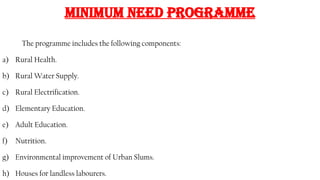
The programme includes the following components:
a) Rural Health.
b) Rural Water Supply.
c) Rural Electrification.
d) Elementary Education.
e) Adult Education.
f) Nutrition.
g) Environmental improvement of Urban Slums.
h) Houses for landless labourers.
Minimum need Programme
Two basic principles are to be observed in the implementation of MNP:
1. The facilities under MNP are to be first provided to those areas that are at present
underserved to remove disparities between different areas.
2. The facilities under MNP should be provided as a package to an area through intersectoral
area projects, to have a greater impact.
In the field of rural health, the objectives to be achieved by the end of the Eighth Five
Year Plan, under the minimum needs programme were: one PHC for 30,000 population in plains
and 20,000 population in tribal and hilly areas; one sub-centre for a population of 5,000 people in
the plains and 3000 in tribal and hilly areas,
Minimum need Programme
one community health centre (rural hospital) for a population of one lakh or one C.D.
Block by the year 2000. The establishment of PHCs, sub-centres, upgradation of PHCs, and
construction of buildings thereof are all included in the State sector of the minimum needs
programme.
In the field of nutrition, the objectives are:
1. to extend nutrition support to 11 million eligible persons;
2. to expand the “special nutrition programme” to all the ICDS projects; and
3. To consolidate the mid-day meal programme and link it to health, potable water, and
sanitation.
Minimum Need Programme community health nursing

Minimum Need Programme community health nursing

  • 2.
    Minimum need Programme DebalinaGhosh Tutor/ Clinical Instructor AIIMS Kalyani
  • 3.
    Minimum need Programme TheMinimum Needs Programme (MNP) was introduced in the first year of the Fifth Five-Year Plan (1974-78). The objective of the programme is to provide certain basic minimum needs and thereby improve the living standards of the people. It is the expression of the commitment of the government for the "social and economic development of the community, particularly the underprivileged and underserved population“.
  • 4.
    Minimum need Programme Theprogramme includes the following components: a) Rural Health. b) Rural Water Supply. c) Rural Electrification. d) Elementary Education. e) Adult Education. f) Nutrition. g) Environmental improvement of Urban Slums. h) Houses for landless labourers.
  • 5.
    Minimum need Programme Twobasic principles are to be observed in the implementation of MNP: 1. The facilities under MNP are to be first provided to those areas that are at present underserved to remove disparities between different areas. 2. The facilities under MNP should be provided as a package to an area through intersectoral area projects, to have a greater impact. In the field of rural health, the objectives to be achieved by the end of the Eighth Five Year Plan, under the minimum needs programme were: one PHC for 30,000 population in plains and 20,000 population in tribal and hilly areas; one sub-centre for a population of 5,000 people in the plains and 3000 in tribal and hilly areas,
  • 6.
    Minimum need Programme onecommunity health centre (rural hospital) for a population of one lakh or one C.D. Block by the year 2000. The establishment of PHCs, sub-centres, upgradation of PHCs, and construction of buildings thereof are all included in the State sector of the minimum needs programme. In the field of nutrition, the objectives are: 1. to extend nutrition support to 11 million eligible persons; 2. to expand the “special nutrition programme” to all the ICDS projects; and 3. To consolidate the mid-day meal programme and link it to health, potable water, and sanitation.