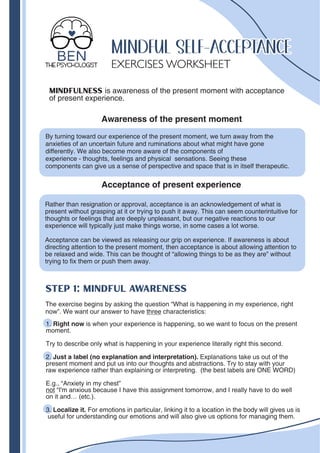
Awareness of the present moment
By turning toward our experience of the present moment, we turn away from the
anxieties of an uncertain future and ruminations about what might have gone
differently. We also become more aware of the components of
experience - thoughts, feelings and physical sensations. Seeing these
components can give us a sense of perspective and space that is in itself therapeutic.
Acceptance of present experience
Rather than resignation or approval, acceptance is an acknowledgement of what is
present without grasping at it or trying to push it away. This can seem counterintuitive for
thoughts or feelings that are deeply unpleasant, but our negative reactions to our
experience will typically just make things worse, in some cases a lot worse.
Acceptance can be viewed as releasing our grip on experience. If awareness is about
directing attention to the present moment, then acceptance is about allowing attention to
be relaxed and wide. This can be thought of “allowing things to be as they are” without
trying to fix them or push them away.
STEP 1: Mindful Awareness
MINDFUL SELF-ACCEPTANCE
EXERCISES WORKSHEET
Mindfulness is awareness of the present moment with acceptance
of present experience.
Mindfulness is awareness of the present moment with acceptance
of present experience.
The exercise begins by asking the question “What is happening in my experience, right
now”. We want our answer to have three characteristics:
1. Right now is when your experience is happening, so we want to focus on the present
moment.
Try to describe only what is happening in your experience literally right this second.
2. Just a label (no explanation and interpretation). Explanations take us out of the
present moment and put us into our thoughts and abstractions. Try to stay with your
raw experience rather than explaining or interpreting. (the best labels are ONE WORD)
E.g., “Anxiety in my chest”
not “I'm anxious because I have this assignment tomorrow, and I really have to do well
on it and… (etc.).
3. Localize it. For emotions in particular, linking it to a location in the body will gives us is
useful for understanding our emotions and will also give us options for managing them.
ACTION: Please answer these questions for the present moment
(right now).
Do your best to just give a label and refrain from offering interpretation
or explanation.
It is typically best to go in order (sensations then emotions then thoughts)
than to skip around.
1. Physical sensations (e.g., belly ache)
2. Emotions and locations (e.g., anxiety (stomach), frustration (shoulders), joy (chest))
3. Thoughts and Mental Patterns (e.g., “worrying about work”, “my todo list”)
Basic emotions include: anger, frustration, fear, anxiety, joy, motivation/enthusiasm,
safety/connectedness, grief/sadness, shame, guilt, and perhaps a few others.
Step 2: Mindful Acceptance
ACTION: So now, if you're willing, please take 5-10 breaths with the intention to just
be with your experience as it is - giving yourself permission to 'give up the fight' and
just feel how you feel.
“Breathe with your thoughts, feelings, and sensations, and give them space
to be as they are”
Having gotten in touch with what is going on for you, now it's time to take a moment to
relax and just be with what you found. This means giving yourself permission to simply
feel how you feel, allowing your experience to be as pleasant or unpleasant as it is.
This means not judging or trying to fix your thoughts or feelings. It means not even
trying to understand them. Instead, simply try to let go of your need for things to be any
way but as they are, just for a moment. Everything will still be there to fix and/or
understand once the exercise is done.

Mindful Self Acceptance Worksheet.pdf

  • 1.
    Awareness of thepresent moment By turning toward our experience of the present moment, we turn away from the anxieties of an uncertain future and ruminations about what might have gone differently. We also become more aware of the components of experience - thoughts, feelings and physical sensations. Seeing these components can give us a sense of perspective and space that is in itself therapeutic. Acceptance of present experience Rather than resignation or approval, acceptance is an acknowledgement of what is present without grasping at it or trying to push it away. This can seem counterintuitive for thoughts or feelings that are deeply unpleasant, but our negative reactions to our experience will typically just make things worse, in some cases a lot worse. Acceptance can be viewed as releasing our grip on experience. If awareness is about directing attention to the present moment, then acceptance is about allowing attention to be relaxed and wide. This can be thought of “allowing things to be as they are” without trying to fix them or push them away. STEP 1: Mindful Awareness MINDFUL SELF-ACCEPTANCE MINDFUL SELF-ACCEPTANCE MINDFUL SELF-ACCEPTANCE EXERCISES WORKSHEET Mindfulness is awareness of the present moment with acceptance Mindfulness is awareness of the present moment with acceptance of present experience. of present experience. Mindfulness is awareness of the present moment with acceptance of present experience. The exercise begins by asking the question “What is happening in my experience, right now”. We want our answer to have three characteristics: 1. Right now is when your experience is happening, so we want to focus on the present moment. Try to describe only what is happening in your experience literally right this second. 2. Just a label (no explanation and interpretation). Explanations take us out of the present moment and put us into our thoughts and abstractions. Try to stay with your raw experience rather than explaining or interpreting. (the best labels are ONE WORD) E.g., “Anxiety in my chest” not “I'm anxious because I have this assignment tomorrow, and I really have to do well on it and… (etc.). 3. Localize it. For emotions in particular, linking it to a location in the body will gives us is useful for understanding our emotions and will also give us options for managing them.
  • 2.
    ACTION: Please answerthese questions for the present moment (right now). Do your best to just give a label and refrain from offering interpretation or explanation. It is typically best to go in order (sensations then emotions then thoughts) than to skip around. 1. Physical sensations (e.g., belly ache) 2. Emotions and locations (e.g., anxiety (stomach), frustration (shoulders), joy (chest)) 3. Thoughts and Mental Patterns (e.g., “worrying about work”, “my todo list”) Basic emotions include: anger, frustration, fear, anxiety, joy, motivation/enthusiasm, safety/connectedness, grief/sadness, shame, guilt, and perhaps a few others. Step 2: Mindful Acceptance ACTION: So now, if you're willing, please take 5-10 breaths with the intention to just be with your experience as it is - giving yourself permission to 'give up the fight' and just feel how you feel. “Breathe with your thoughts, feelings, and sensations, and give them space to be as they are” Having gotten in touch with what is going on for you, now it's time to take a moment to relax and just be with what you found. This means giving yourself permission to simply feel how you feel, allowing your experience to be as pleasant or unpleasant as it is. This means not judging or trying to fix your thoughts or feelings. It means not even trying to understand them. Instead, simply try to let go of your need for things to be any way but as they are, just for a moment. Everything will still be there to fix and/or understand once the exercise is done.