GEC 527
ENGINEERING MANAGEMENT(3 UNITS)
MODULE 2
Formation of Company
Sources of Finance, Money and Credit
Insurance, National Policies, GNP Growth Rates
Organizational Management by Objectives.
Personnel Management-selection, Recruitment and Training
Introduction to Auto-cad Detailing in Structural Elements
Instructor: Engr. Justin D. Lazarus
2.
MODULE OVERVIEW ANDDESCRIPTION
The module centres on;
Explicit knowledge on company formations and
Effective management approaches for a successful and continuous
management of a company or business.
This will give a broad background on engineering practice that
focuses on Finance, decision making techniques, policies, resource
management.
31/05/2025 2
3.
31/05/2025
3
Week 4 outline
Formationof company,
sources of finance
money and credit
The objectives are to;
Discuss company formation process and the
characteristics of different types of companies.
Discuss the concepts of finance, money and credit
and the different sources of finance
4.
31/05/2025
4
At the endof this week, students should be able to;
Describe a company and distinguish the different types of
companies using their characteristics
describe the stages in the formation of a company,
Identify the various company formation documents and their
significance in commencement of business operation
Distinguish between finance, money and credits and identify
how to source for finance for the running of a company/business
Course Learning Outcomes (CLO)
5.
• DELIVERY METHOD:Lecturing (Teaching) and Educator-student Interaction Method.
• TEACHING AIDS: Visual Aids (Use of PowerPoint Slides, Lecture Notes), Audio-visual Aids (Use
of Video)
• PREREQUISITE: GEC 321, EDS512
• RECOMMENDED TEXT:
1. Nwafor, O. (2020). Comparative Company Law. African Books Collective. books.google.com
2. Micheler, E. (2024). Separate Legal Personality–an Explanation And A Defence. Journal Of
Corporate Law Studies, 24(1), 301-329.
3. JOMBO, F. (2018). Current Approaches To Separate Legal Personality Of A Company In Ireland,
The State Of Delaware In The United States Of America And Nigeria (Doctoral Dissertation,
University Of Limerick).
4. Chidi E. Halliday and Briggs, Nelson K.K. (2018). Formation of Companies Under Company Law
Jurisprudence in Nigeria: Lessons from other Jurisdictions. The Journal of Jurisprudence and
Contemporary Issues Vol 10 No. 1, March 2018
5. Haney, L. H. (1921). Business Organization And Combination. Macmillan
6. Peter Stokes, Neil Moore, et al. (2016). Organizational Management (1st Ed. Kogan Page). Https://
Www.Perlego.Com/Book/1589652/Organizational-management-approaches-and-solutions-pdf
31/05/2025 5
6.
6
INTRODUCTION
Generally, a companyor a business firm is an
organization owned and operated by individuals that
specialize in production where the product could be goods
or services or both.
Examples of business firms whose products are in the
form of goods include: wapco, cadbury and peugeot.
31/05/2025
7.
31/05/2025 7
Examplesof businesses whose products are pure
services include: CMFB and Covenant University, etc.
The engineering business cuts across many
dimensions. It could render services. It could also
produce goods that would be marketed. It could also be
a combination of goods and services.
8.
31/05/2025 8
Definitions ofcompany
A Company is a person or a body of persons who pool their resources
together in other to form a business for profit maximization or social
responsibility – Halliday & Okara, 2021
A company is a artificial legal entity formed under law by a group of
individuals to work together & operate towards achieving a common
objective - L.H. Haney
It may also be defined as an incorporated association which is an
artificial Person created by law, having a separate legal entity with a
perpetual succession and a common seal- Gower and Davies, 2021
In Nigeria, a company can be form by doing legal registration under
the companies act (CAMA 2020)
ONE PERSON COMPANY
Thisis more like a processed version of proprietorship.
In a sole proprietorship, a single individual starts the firm, owns
it, and is entitled to all of the profit after taxes.
Most business firms are sole proprietorships. this is because they
are the easiest form of business to start. in many cases, the owner
just begins doing business.
For tax purposes, the firm’s profit is simply treated as part of the
owner’s personal income and is subject to the personal income
tax.
31/05/2025 10
11.
31/05/2025 11
Characteristics
I. Singleownership
Ii. One man control
Iii. Undivided risk
Advantages of Sole Proprietorship:
• Simplicity
• Quick Decisions
• High Secrecy
V. No Separate entity of the business
Vi. No government regulations
Iv. Unlimited liability
Disadvantages
Limited funds
Limited skills
All Profits Are Subject To The Owner
12.
• Unlimited liability-owner is 100% liable for business debts
• Equity is limited to the owner’s personal resources
• Ownership of proprietorship is difficult to transfer
• No distinction between personal and business income
• Uncertain life of the business
In summary,
• There is very little regulation for proprietorships
• Owners have total flexibility when running the business
• Very few requirements for starting; often Only A Business License
But they are limited in availability of funds, skills and ultimately unlimited
liability
31/05/2025 12
13.
13
PRIVATE COMPANIES
These arecompanies whose articles of association restrict the free
transferability of shares. In terms of members, private companies
need to have a minimum of 2 and a maximum of 200. They are
usually referred to as partnership businesses.
Partnership: This is an association of two or more persons —
maximum 10 in banking business and 20 in non-banking business.
A partnership requires a formal agreement known as “partnership
deed” to be signed between the partners.
31/05/2025
14.
14
• in apartnership, responsibilities are shared among several co-
owners. partnerships are common among professionals, such as
doctors, lawyers, and architects.
• larger financial resources - shared resources provides more capital
for the business
• Ease of formation- a partnership is easy to form as no
cumbersome legal formalities are involved
• similar flexibility and simple design of a proprietorship
Although sole proprietorships and partnerships are easy to create,
they share two problems that ultimately make many owners decide
against them.
31/05/2025
15.
• Unlimited liability:In either of these types of businesses, each
owner is held personally responsible for the obligations of the firm.
if the business runs up debts and closes down, or is successfully sued
for a large sum of money, the owners will usually have to honor
these obligations out of their own pockets.
• The second problem is the difficulty of raising money to expand the
business. others demerits include;
• limited resources
• public distrust
• lack of harmony
• selling the business is difficult—requires finding new partner
• lack of continuity /partnership ends when any partner decides to end
it 31/05/2025 15
16.
PUBLIC COMPANIES:
• Incontrast to private companies, public companies allow their
members to freely transfer their shares to others.
• Secondly, they need to have a minimum of 7 members, but the
maximum number of members they can have is unlimited.
• They usually referred to as corporations
Corporation:
• In this type of firm, ownership is divided among those who buy
shares of stock. each share of stock entitles its owner to a vote for
the board of directors, which in turn hires the corporation’s top
managers. and each share of stock entitles its owner to a share of the
corporation’s profit— some of which is paid out as dividends.
31/05/2025 16
17.
31/05/2025 17
Characteristics ofa corporations
Incorporated association
Artificial person
Separate legal entity
Perpetual succession
Common seal
Limited liability
Number of members
Transferability of shares
18.
18
Incorporated association:Under the companies act, it is necessary for a
company to be registered, i.e., it needs to be incorporated.
Artificial person: A company is an artificial person because its birth is
not natural, but created by law. Like a natural person, a company can buy
and sell properties, make agreements or enter into a contract.
Separate legal entity: A company is separate from its members, it can
enter into any contract without any of its members, buy property in its
name, borrow or lend money or file a suit in the court of law against any
third party.
19.
31/05/2025 19
Perpetualsuccession: members may come and go, but the company
continues as the same. Its existence is not dependent upon that its
share holders or directors. The shareholders or the directors might
change but the company goes on.
Common seal: a common seal is the metallic seal of the company. It
is the signature of the company to any document. Each is required to
have only one seal on its incorporation. It is to be used in the manner
prescribed by CAMA
Limited liability: The liability of the share holders of a company is
limited. In the case of financial loss, the liability of members will be
limited to the amount of unpaid of their shares and their personal
property cannot be used to pay off the debts.
20.
31/05/2025 20
Numberof members: The minimum number of members in a
public company is seven and maximum can be infinite. However,
for private company, the minimum is 2 and maximum is up to
200.
Transferability of shares: In a public company, the shares can be
transferred freely and in private company also the shares can be
transferred but with some restrictions (shares are not freely
transferrable).
21.
Advantages
• the corporateform of organization makes it easier to raise
additional funds: the corporation simply sells additional shares of
stock, thereby bringing in new owners.
• limited liability: the owners (stockholders) of a corporation can
lose only what they have paid for the stock they own;
• public trust: people are less hesitant to become co-owners.
• can be transferred to new owners fairly easily
• profits and losses belong to the corporation
31/05/2025
21
22.
31/05/2025
22
Disadvantages of corporations
It has additional costs. To set up a corporation, government
documents must be filed, and lawyers and accountants are
usually hired to help with the job. And once you incorporate, you
are subject to a variety of laws and regulations that apply only to
corporations.
Corporate operations are costly and more complex
To start a corporate business requires complex paperwork
23.
31/05/2025
23
Finally, ownersof corporations suffer multiple taxation. First, the corporation
pays taxes on its total profit (corporate tax). Then, shareholders pay with-
holding tax; finally, employees must pay income taxes on the portion of profit
they receive as dividends.
Each Naira of profits is thus taxed at least twice: once as corporate profits and
again as household income.
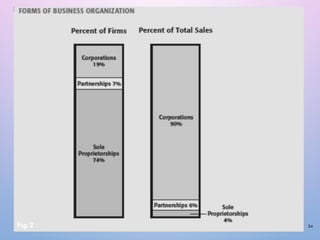
NOTE: For the largest firms, the advantages of incorporating out weigh the
disadvantages. Although only a minority—about 20 percent of businesses choose
to be corporations, they tend to be large firms, producing about 90 percent of our
national output (see Figure2).
ASSIGNMENT
i. Identify 10engineering projects that adversely impact on the natural environment
ii. Discuss the possible CSR that an engineering firm could embark upon?
ii. The imposition of CSR on companies is justified judging from the fact that these firms already
pay heavy income tax to government? Discuss.
31/05/2025 25
26.
31/05/2025 26
What isformation of company
- Group of people forming an association to exploit the business
opportunities
- bringing together; men, material, money and management.
27.
31/05/2025 27
STAGES INTHE FORMATION OF A COMPANY
The formation of a company is a lengthy process. It involves the
following three stages:
1 Promotion
2 Registration or incorporation, and
3 Commencement of business
Each of the above stages comprises specific activities to be
undertaken.
28.
31/05/2025 28
1. Promotionof a company:
The promotion of a company refers to all those steps which are
taken from the time of having an idea of starting a company to
the time of actual starting of the company business.
Usually carried out by Company Promoters
Promotion stage includes;
Discovery of business opportunities
Detailed investigation
Assembly of necessary requirements e.g Name selection
Financing of proposition
29.
31/05/2025 29
Selecting companyname
To be identified for legal and business purpose (Ltd,
Plc, etc), the name should be unique and not similar to
an existing
30.
31/05/2025 30
2. Incorporation
Acompany becomes incorporated when the necessary documents; MoA,
AoA and written consent of all the directors have been delivered to the
Registrar, scrutinized and the requisite fees paid, obtains Certificate of
Incorporation.
31.
31/05/2025 31
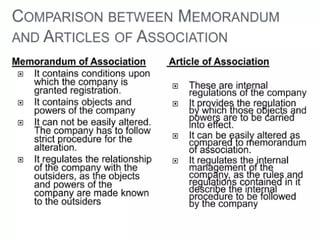
Memorandum ofAssociation
It defines the objectives for which the company is being formed. The
memorandum by its clauses, describes the whole character of the company. This
includes its objectives, its name, the nature of its liability, the address of its
registered office etc.
The memorandum defines the powers of a company and its relations with third
parties.
Its regulates the external affairs of the company
NOTE: The MOA must be signed by at least seven persons in the case of
public company and two in the case of private company
32.
31/05/2025 32
Articles ofAssociation
The articles of association contain the rules and regulations for managing the
internal affairs of the company and, therefore, govern the relationship between
the company and its members.
A private company must prepare its own articles because the articles impose
restrictions on the right to transfer shares, prohibit invitation to the public to
subscribe to its share capital and limits membership.
Whereas, there are exceptions with clauses for public companies
AoA should be signed separately by subscribers and they should also be attested by a
witness.
33.
31/05/2025 33
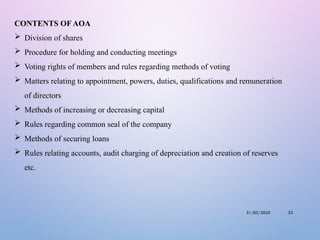
CONTENTS OFAOA
Division of shares
Procedure for holding and conducting meetings
Voting rights of members and rules regarding methods of voting
Matters relating to appointment, powers, duties, qualifications and remuneration
of directors
Methods of increasing or decreasing capital
Rules regarding common seal of the company
Methods of securing loans
Rules relating accounts, audit charging of depreciation and creation of reserves
etc.
31/05/2025 35
Raising ofShare capital
• Entering onto an agreement with underwriters
• Applying to the stock exchange for listing of shares
• Issues of prospectus inviting public to subscribe
• Allotting shares
Prospectus of association: This refers to any document described or issued
as a prospectus inviting deposits from public or inviting offer from public
for the subscription or purchase of shares or debentures of the company.
36.
31/05/2025 36
Contents ofProspectus of Associations
• Date of issue of prospectus
• Name and register office
• Consent of central govt. for the present issue in compliance with guidelines
• Voting rights, dividends, expenses on issues
• Name of stock exchange
• Punishment for fictitious application
• Refund of issue if 90% minimum subscription not received
• Names and addresses of leading managers
37.
31/05/2025 37
3. COMMENCEMENTOF BUSINESS
Basically a company comes into existence when it receives the certificate of
incorporation.
A private company can commence its business immediately after receiving
the certificate of incorporation. But, a public company will have to obtain
another certificate known as the 'certificate to commence business' before it
can start its business.
However, a public company having no share capital can also commence
business immediately on receiving the certificate of incorporation. It, therefore,
follows that a public company having share capital, is required to fulfil some
more formalities before it obtains the certificate to commence business.