Hands- On
Azure ML
• Getting started with Cloud
• Hands- On Azure ML Studio
Speaker: Yash Yadav (Microsoft Student Partner)
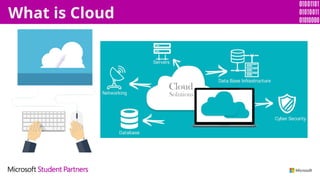
What is Cloud
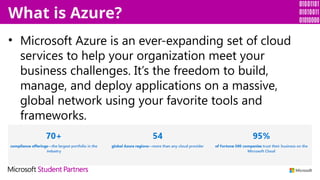
• Microsoft Azure is an ever-expanding set of cloud
services to help your organization meet your
business challenges. It’s the freedom to build,
manage, and deploy applications on a massive,
global network using your favorite tools and
frameworks.
What is Azure?
“The goal of machine learning is to build
computer systems that can
adapt and learn from their experience.”
-Tom
Dietterich
What is Machine Learning ?
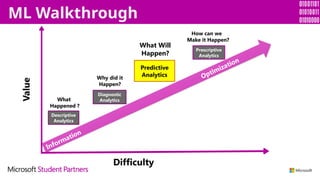
ML Walkthrough
Information
Optimization
Value
Difficulty
What
Happened ?
Descriptive
Analytics
Diagnostic
Analytics
Predictive
Analytics
Prescriptive
Analytics
Why did it
Happen?
What Will
Happen?
How can we
Make it Happen?
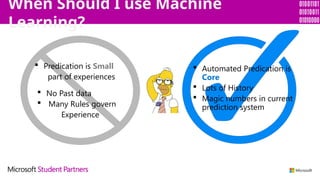
When Should I use Machine
Learning?
 Predication is Small
part of experiences
 No Past data
 Many Rules govern
Experience
 Automated Predication is
Core
 Lots of History
 Magic numbers in current
prediction system
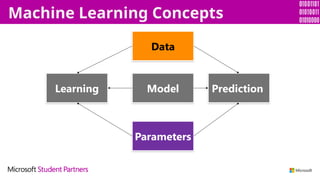
Machine Learning Concepts
Data
Model
Parameters
Learning Prediction
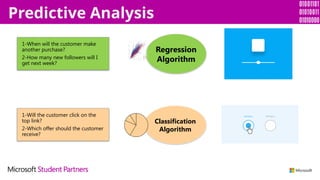
Classification
Algorithm
Regression
Algorithm
1-When will the customer make
another purchase?
2-How many new followers will I
get next week?
1-Will the customer click on the
top link?
2-Which offer should the customer
receive?
Predictive Analysis
Regression
Regression
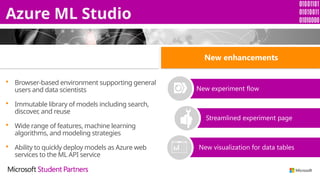
Azure ML Studio
 Browser-based environment supporting general
users and data scientists
 Immutable library of models including search,
discover, and reuse
 Wide range of features, machine learning
algorithms, and modeling strategies
 Ability to quickly deploy models as Azure web
services to the ML API service
New experiment flow
Streamlined experiment page
New visualization for data tables
ML Studio New enhancements
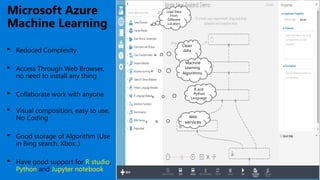
Microsoft Azure
Machine Learning
 Reduced Complexity
 Access Through Web Browser,
no need to install any thing
 Collaborate work with anyone
 Visual composition, easy to use,
No Coding
 Good storage of Algorithm (Use
in Bing search, Xbox..)
 Have good support for R studio,
Python and Jupyter notebook
Load Data
From
Different
Location
Clean
data
Machine
Learning
Algorithms
R and
Python
Language
Web
services
Hands-On Begins!!!
Playing with Data
Training a Predictive Model
Q/A
• docs.microsoft.com/learn/azure/
• edX Courses on Machine learning with Microsoft
Azure ML Studio
Self Learning Resources
Presentation Attribution and References:
• Microsoft Ignite (New Zealand)
• ML by Akshay and few others…
Microsoft Azure is a cloud computing platform and service provided by Microsoft.

Microsoft Azure is a cloud computing platform and service provided by Microsoft.

Editor's Notes

  • #2 It is simply understood as there are computers, which can be accessed remotely over the Internet and one can compute(be it: Data storage, process, manage, or any other activity) on that computer remotely. Simply a Computer away from us, and using that Computer is known as Cloud Computing
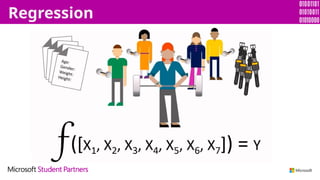
  • #9 Regression: Let’s suppose We are running a Gym, there is a person A over here and he/she is enrolled in it for exercise. We have his/her data at the Time of registration and some other data which we will be getting right from the Sensors from the Work benches. And the Data like Age, Gender, Weight, Height, Heartbeat, etc. are going to be the features for a particular label value let’s say 231 But to make the program or Model Robust we have to train with huge data… Like we do while studying Mathematics (Practice, Practice & Practice...)
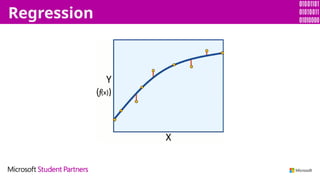
  • #10 After plotting the Enormous data we get this pretty simple Curve So we use only half (Random) of the existing data to Train the Model to predict the value of ‘y’ for a given value of ‘x’. And we use the remaining data to evaluate the accuracy of the Model. The Difference between the Predicted and Actual labels are known as Residuals. And they tell us about the level of error in the Model.