Bringing
Micro XRCE-DDS µ-ROS
to PX4-based flying systems
PX4 Developer Summit Virtual 2020
07/07/2020
Jaime Martin Losa
eProsima - CEO
jaimemartin@eprosima.com
www.eprosima.com
Nuno Marques
Founder and Lead Developer
nuno.marques@dronesolutions.io
dronesolutions.io
2.
Presentation Overview
● AbouteProsima
● Concepts
○ DDS
○ XRCE-DDS
○ Integration Service
○ Micro-ROS
● PX4-Fast RTPS bridge
● PX4-ROS 2 bridge
● Bridge new features and bug fixes
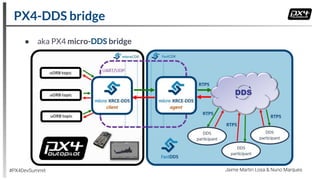
● PX4-DDS bridge
● PX4-ROS 2 bridge V2
○ Using the Integration Services or using micro-ROS
● Bridge migration
#PX4DevSummit Jaime Martin Losa & Nuno Marques
3.
About eProsima
● Expertson middleware, focused on DDS & ROS2
● OMG Members – DDS Standard Contributors
● ROS2 TSC Members: Key ROS2 Contributors
● ROS Industrial Contributors
● PX4 Contributors: Micro-RTPS Bridge
○ uORB <-> DDS & ROS2
#PX4DevSummit Jaime Martin Losa & Nuno Marques
4.
eProsima Products
● eProsimaFast DDS:
○ Data Distribution Service (DDS) implementation
○ Adopted by ROS2
● eProsima Micro XRCE-DDS:
○ DDS for eXtreme Resource Constrained Environments:
Microcontrollers
○ Base of Micro-ROS
● eProsima Integration Service:
○ Connect DDS with other protocols, such as ROS1, ROS2, Web
Sockets, Orion Context Broker, etc.
○ Base of ROS Integration Service - SOSS
#PX4DevSummit Jaime Martin Losa & Nuno Marques
5.
DDS (& ROS2)
#PX4DevSummitJaime Martin Losa & Nuno Marques
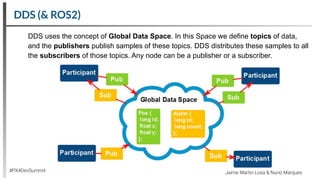
DDS uses the concept of Global Data Space. In this Space we define topics of data,
and the publishers publish samples of these topics. DDS distributes these samples to all
the subscribers of those topics. Any node can be a publisher or a subscriber.
6.
Fast DDS: DefaultMiddleware for ROS2
#PX4DevSummit Jaime Martin Losa & Nuno Marques
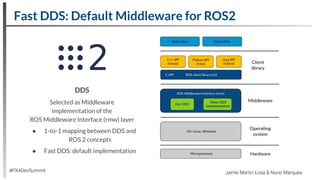
DDS
Selected as Middleware
implementation of the
ROS Middleware Interface (rmw) layer
● 1-to-1 mapping between DDS and
ROS 2 concepts
● Fast DDS: default implementation
7.
Why bring DDSto PX4
#PX4DevSummit Jaime Martin Losa & Nuno Marques
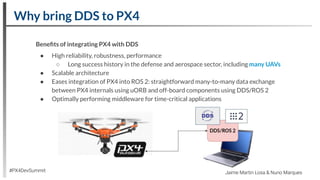
Benefits of integrating PX4 with DDS
● High reliability, robustness, performance
○ Long success history in the defense and aerospace sector, including many UAVs
● Scalable architecture
● Eases integration of PX4 into ROS 2: straightforward many-to-many data exchange
between PX4 internals using uORB and off-board components using DDS/ROS 2
● Optimally performing middleware for time-critical applications
8.
XRCE-DDS: DDS forMicrocontrollers
#PX4DevSummit Jaime Martin Losa & Nuno Marques
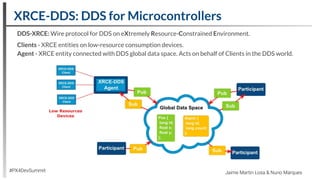
DDS-XRCE: Wire protocol for DDS on eXtremely Resource-Constrained Environment.
Clients - XRCE entities on low-resource consumption devices.
Agent - XRCE entity connected with DDS global data space. Acts on behalf of Clients in the DDS world.
9.
Benefits of MicroXRCE-DDS
#PX4DevSummit Jaime Martin Losa & Nuno Marques
● All the power of DDS available from the micro-controller
○ It is not a bridge, but a proxy.
● Compliant with DDS-XRCE standard: general-purpose product in spite of dedicated bridge
● Supports NuttX: reference RTOS for the project
○ FreeRTOS & Zephyr too. Easy to port.
● External dependencies-free Client library: only depends on transport and a single POSIX
time-related function
● Additional features:
○ Fragmentation: allows exchanging big-size messages
○ Services
○ IPv6
○ Best effort and reliable streams of communication
○ Time synchronization
10.
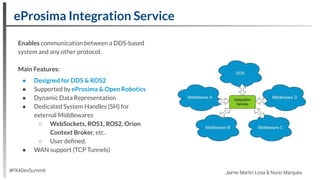
eProsima Integration Service
#PX4DevSummitJaime Martin Losa & Nuno Marques
Enables communication between a DDS-based
system and any other protocol.
Main Features:
● Designed for DDS & ROS2
● Supported by eProsima & Open Robotics
● Dynamic Data Representation
● Dedicated System Handles (SH) for
external Middlewares
○ WebSockets, ROS1, ROS2, Orion
Context Broker, etc.
○ User defined.
● WAN support (TCP Tunnels)
microCDR FastCDR
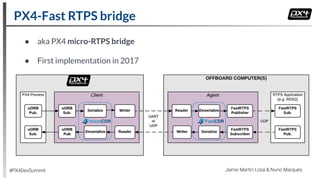
● akaPX4 micro-RTPS bridge
● First implementation in 2017
PX4-Fast RTPS bridge
#PX4DevSummit Jaime Martin Losa & Nuno Marques
13.
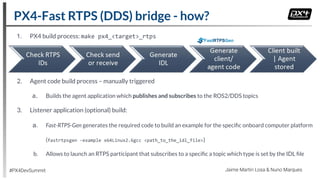
1. PX4 buildprocess: make px4_<target>_rtps
2. Agent code build process – manually triggered
a. Builds the agent application which publishes and subscribes to the ROS2/DDS topics
3. Listener application (optional) build:
a. Fast-RTPS-Gen generates the required code to build an example for the specific onboard computer platform
(fastrtpsgen -example x64Linux2.6gcc <path_to_the_idl_file>)
b. Allows to launch an RTPS participant that subscribes to a specific a topic which type is set by the IDL file
FastRTPSGen
PX4-Fast RTPS (DDS) bridge - how?
#PX4DevSummit Jaime Martin Losa & Nuno Marques
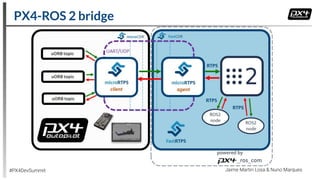
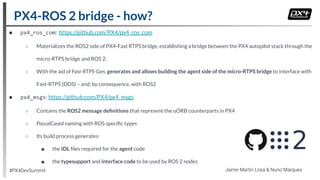
● px4_ros_com: https://github.com/PX4/px4_ros_com
○Materializes the ROS2 side of PX4-Fast RTPS bridge, establishing a bridge between the PX4 autopilot stack through the
micro-RTPS bridge and ROS 2;
○ With the aid of Fast-RTPS-Gen, generates and allows building the agent side of the micro-RTPS bridge to interface with
Fast-RTPS (DDS) – and, by consequence, with ROS2
● px4_msgs: https://github.com/PX4/px4_msgs
○ Contains the ROS2 message definitions that represent the uORB counterparts in PX4
○ PascalCased naming with ROS specific types
○ Its build process generates:
■ the IDL files required for the agent code
■ the typesupport and interface code to be used by ROS 2 nodes
PX4-ROS 2 bridge - how?
#PX4DevSummit Jaime Martin Losa & Nuno Marques
16.
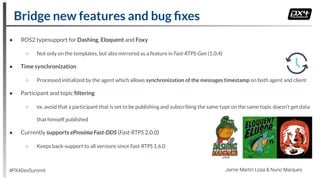
● ROS2 typesupportfor Dashing, Eloquent and Foxy
○ Not only on the templates, but also mirrored as a feature in Fast-RTPS-Gen (1.0.4)
● Time synchronization
○ Processed initialized by the agent which allows synchronization of the messages timestamp on both agent and client
● Participant and topic filtering
○ ex. avoid that a participant that is set to be publishing and subscribing the same type on the same topic doesn’t get data
that himself published
● Currently supports eProsima Fast-DDS (Fast-RTPS 2.0.0)
○ Keeps back-support to all versions since Fast-RTPS 1.6.0
Bridge new features and bug fixes
#PX4DevSummit Jaime Martin Losa & Nuno Marques
● Straightforward many-to-manydata exchange between PX4 internals and DDS/ROS 2
● Takes full advantage of XRCE-DDS standard communication protocol from the OMG consortium
○ Brings full DDS capabilities to the the microcontroller
● The client library is dynamic and static memory free
● The client is built with a profiles concept
● Uses a generator tool specific to the client called micro XRCE-DDS Gen that simplifies the generation of serialization
and deserialization code using micro-CDR
○ Uses as input IDL files
○ Removes the need for custom templates
micro-RTPS to micro-DDS migration - why?
#PX4DevSummit Jaime Martin Losa & Nuno Marques
19.
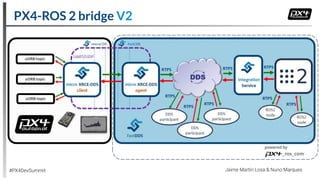
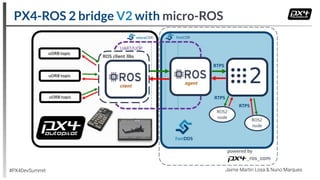
PX4-ROS 2 bridgeV2
#PX4DevSummit Jaime Martin Losa & Nuno Marques
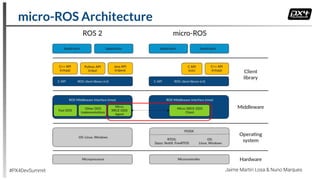
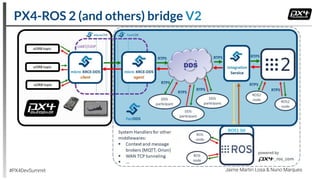
PX4-ROS 2 bridgeV2 with micro-ROS
#PX4DevSummit Jaime Martin Losa & Nuno Marques
22.
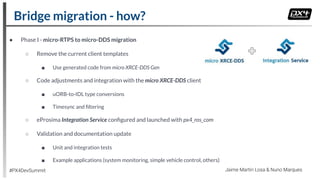
● Phase I- micro-RTPS to micro-DDS migration
○ Remove the current client templates
■ Use generated code from micro XRCE-DDS Gen
○ Code adjustments and integration with the micro XRCE-DDS client
■ uORB-to-IDL type conversions
■ Timesync and filtering
○ eProsima Integration Service configured and launched with px4_ros_com
○ Validation and documentation update
■ Unit and integration tests
■ Example applications (system monitoring, simple vehicle control, others)
Bridge migration - how?
#PX4DevSummit Jaime Martin Losa & Nuno Marques
23.
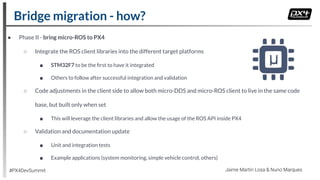
● Phase II- bring micro-ROS to PX4
○ Integrate the ROS client libraries into the different target platforms
■ STM32F7 to be the first to have it integrated
■ Others to follow after successful integration and validation
○ Code adjustments in the client side to allow both micro-DDS and micro-ROS client to live in the same code
base, but built only when set
■ This will leverage the client libraries and allow the usage of the ROS API inside PX4
○ Validation and documentation update
■ Unit and integration tests
■ Example applications (system monitoring, simple vehicle control, others)
Bridge migration - how?
#PX4DevSummit Jaime Martin Losa & Nuno Marques
24.
Thank you!
Jaime MartinLosa
eProsima - CEO
jaimemartin@eprosima.com
www.eprosima.com
Nuno Marques
Founder and Lead Developer
nuno.marques@dronesolutions.io
dronesolutions.io
PX4 Developer Summit Virtual 2020
07/07/2020



![Hypha ROS X 星火計畫 ROS 2.0 Introduction [haochih, English ver]](https://cdn.slidesharecdn.com/ss_thumbnails/hypharosros2introductionreleased1226haochih-171227134403-thumbnail.jpg?width=640&height=640&fit=bounds)


![Getting Started with Apache Spark: Big Data Made Simple [Free Meetup]](https://cdn.slidesharecdn.com/ss_thumbnails/apachesparkgettingstarted-260203175547-8361bcc3-thumbnail.jpg?width=640&height=640&fit=bounds)


