RAKESH KUMAR
ASSOCIATE PROFESSOR (DAIRY MICROBIOLOGY)
FACULTY OF DAIRY TECHNOLOGY
S.G.I.D.T., BVC CAMPUS,
P.O.- BVC, DIST.-PATNA-800014
COURSE TITLE: FOOD AND INDUSTRIAL
MICROBIOLOGY
COURSE NO. - DTM-321: CREDIT HRS-3 (2+1)
MICROBIOLOGY OF FRUIT AND
VEGETABLES
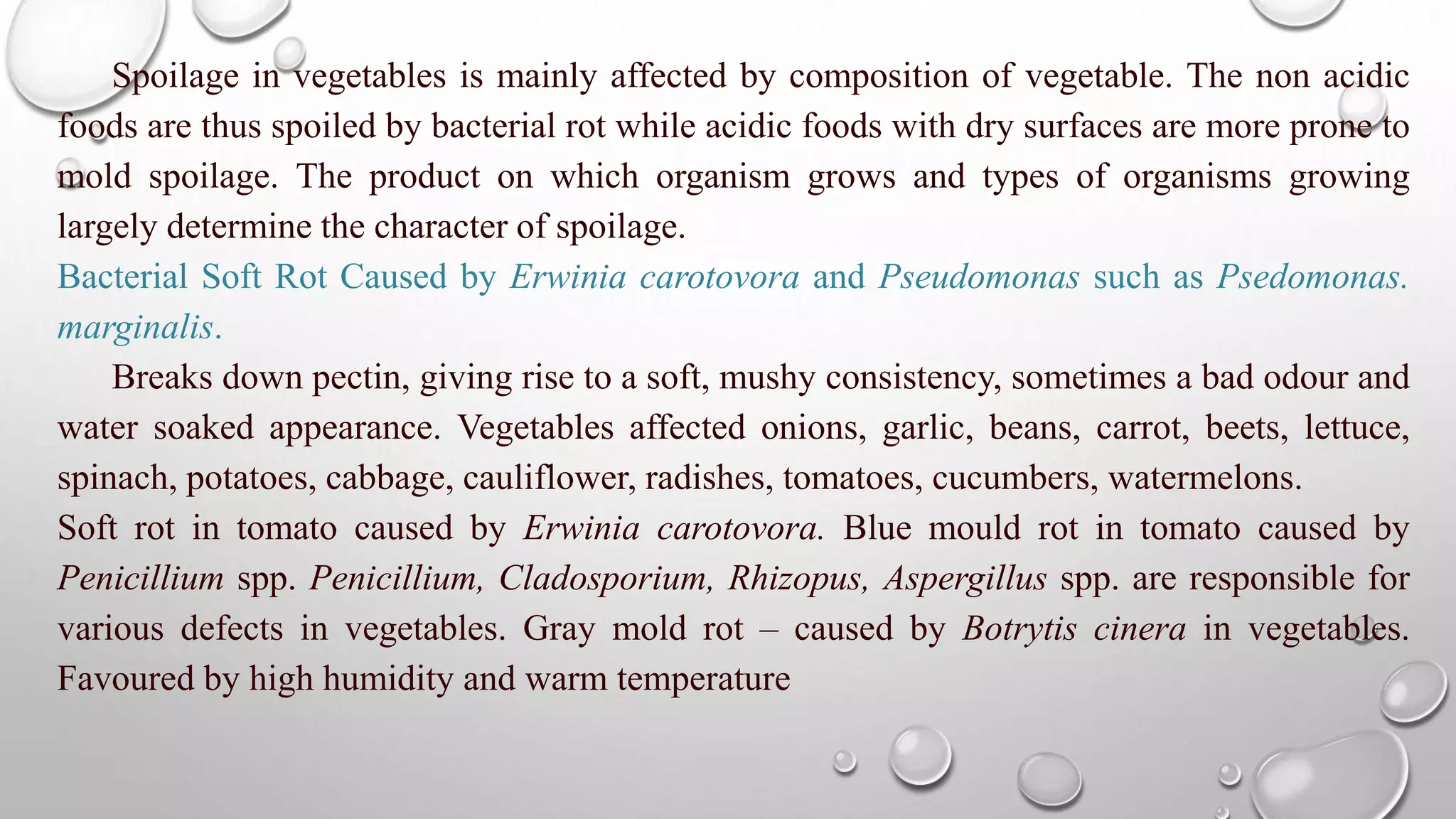
Vegetables form an integral part of diet due to their role in providing various types of vital
nutrients such as carbohydrates, minerals, vitamins, roughage etc. Vegetables being a part of
fresh produce, contain high moisture which makes them highly perishable foods and hence
more prone to spoilage. Microorganisms gain entry into vegetables from various sources.
These sources include:
 Soil
 Water
 Diseased plant
 Harvesting and processing equipments
 Handlers
 Packaging and packing material
 Contact with spoiled vegetables
The conditions in which vegetables are stored and transported after harvesting also contribute
to rate of spoilage. Other than microbial, sources, the spoilage of vegetables can also occur
due to the activity of native enzymes.
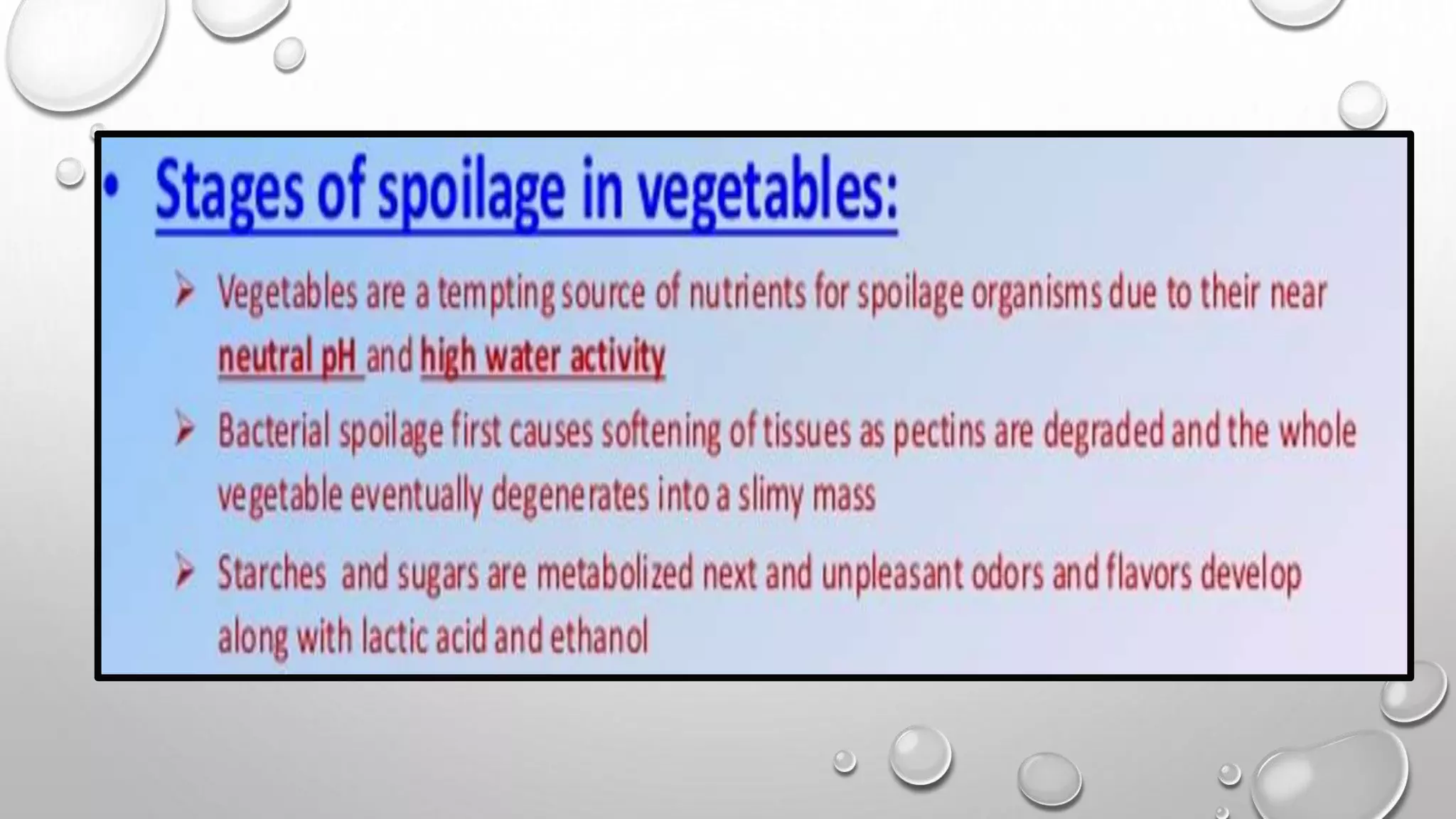
Spoilage in vegetables is mainly affected by composition of vegetable. The non acidic
foods are thus spoiled by bacterial rot while acidic foods with dry surfaces are more prone to
mold spoilage. The product on which organism grows and types of organisms growing
largely determine the character of spoilage.
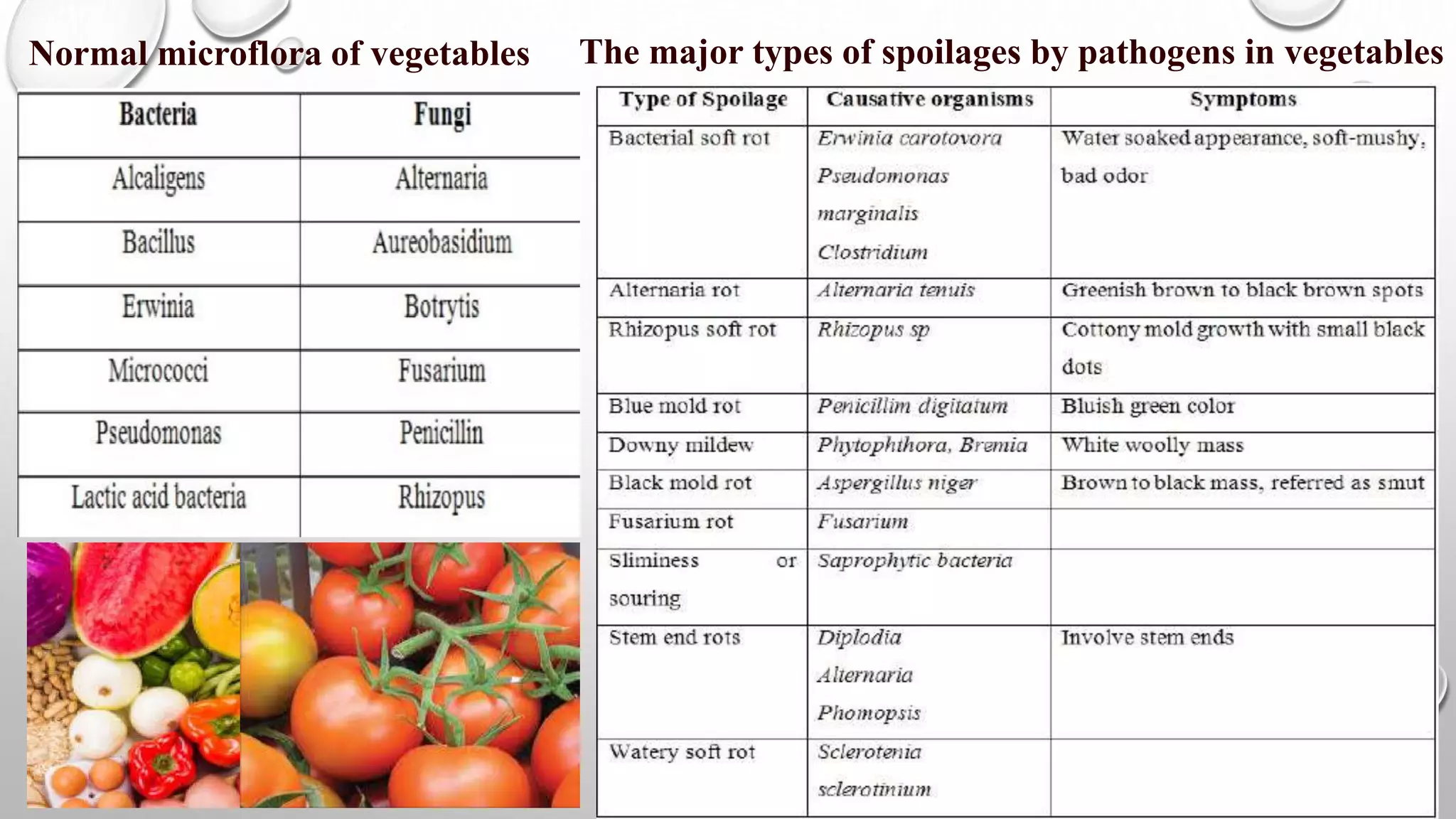
Bacterial Soft Rot Caused by Erwinia carotovora and Pseudomonas such as Psedomonas.
marginalis.
Breaks down pectin, giving rise to a soft, mushy consistency, sometimes a bad odour and
water soaked appearance. Vegetables affected onions, garlic, beans, carrot, beets, lettuce,
spinach, potatoes, cabbage, cauliflower, radishes, tomatoes, cucumbers, watermelons.
Soft rot in tomato caused by Erwinia carotovora. Blue mould rot in tomato caused by
Penicillium spp. Penicillium, Cladosporium, Rhizopus, Aspergillus spp. are responsible for
various defects in vegetables. Gray mold rot – caused by Botrytis cinera in vegetables.
Favoured by high humidity and warm temperature
Normal microflora of vegetables The major types of spoilages by pathogens in vegetables
Method of Preservation
Fruits are natural sources of minerals, vitamins besides carbohydrates
and other essential substances. Naturally fresh fruits and juices made out
of them contain high amount of water thereby making them highly prone
to attack by microorganisms. While most of the fruits are naturally
provided with coatings and coverings in the form of skins, but these are
fragile enough to be easily disturbed by various biological and
mechanical factors. Like vegetables, fruits being produce of plants get
contaminated through different sources by a variety of microorganisms
which may play significant role in their spoilage. These are soil, water,
diseased plant, harvesting and processing equipments, handlers,
packaging and packing material and contact with spoiled fruits.
Microorganisms Associated with Spoilage in Fruits and
Juices
The microorganisms associated with fruits depend on the structure of fruit. The fruits contain
different organic acids in varying amounts. The types of acids which are predominately
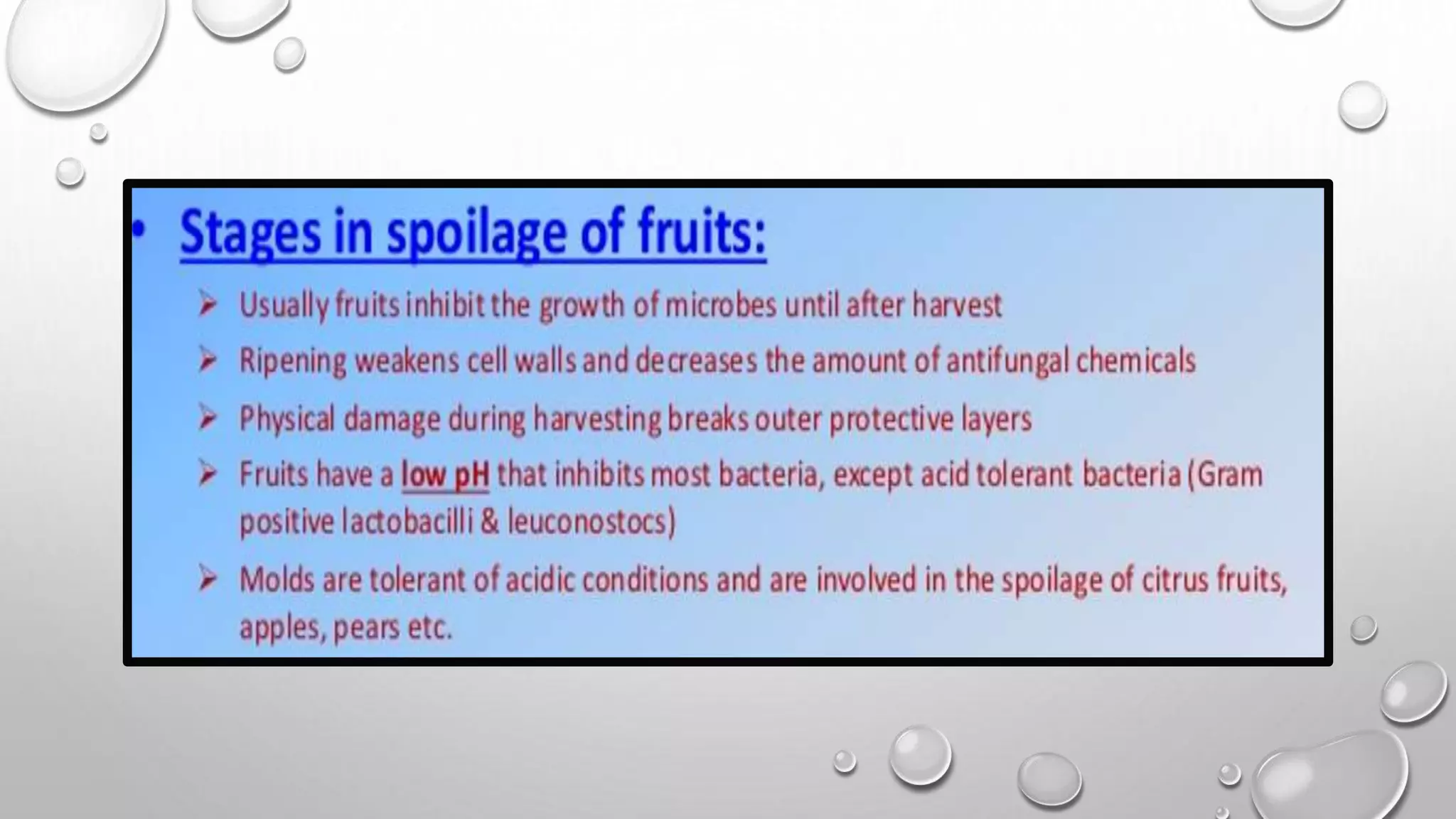
found are citric acid, malic acid and tartaric acid. The low pH of fruits restricts the
proliferation of various types of organisms. Due to the low pH, a large number of
microorganisms are restricted to grow on fruits. Fungi are most dominating organisms to
grow on fruits because of the ability of yeasts and molds to grow under acidic conditions. A
small number of bacteria which are aciduric (ability to resist acidic conditions) also grow.
Also the dry conditions prevailing on the skin and surface do not allow the growth of certain
microorganisms. Besides, these plants also produce certain antimicrobial components too.
Despite the high water activity of most fruits, the low pH leads to their spoilage being
dominated by fungi, both yeasts and molds but especially the latter.
Type of acid associated with fruits and their pH
Yeasts
Yeasts are unicellular fungi which normally reproduce by budding. Of the 215 species
important in foods, about 32 genera are associated with fruits and fruit products . Only a few
species of yeasts are pathogenic for man and other animals. None of the pathogenic species are
common contaminants of fruits and fruit products. Fruit that has been damaged by birds,
insects, or pathogenic fungi usually contain very high yeast populations. The yeasts are
introduced into the exposed tissue, often via insects and are able to use the sugars and other
nutrients to support their growth. Types of yeasts growing in fruits depend upon the nature of
the fruit and the strain of yeast.
While carbon dioxide and ethanol are the predominant metabolic products of yeasts, other
products such as glycerol, acetaldehyde, pyruvic acid, and a keto glutaric acid are also formed.
Oxidative yeasts such as species of Brettanomyces produce acetic acid in wines and other fruit
products.
Molds
These are filamentous fungi which are important group of microflora of fruit products due to
following reasons
1. Some of the members are xerophilic, thereby having potential to spoil foods of low water
activity such as dried fruits and fruit juice concentrates.
2. Some of the species have heat resistant spores such as ascospores which can survive the
commercial pasteurization treatments that are given to most fruit products.
3. Growth of molds on processing equipment such as wooden tanks can result in the generation
of off flavors in wines, juices, and other fruit products.
4. Mold infected raw fruit may become soft after processing because pectinases were not
inactivated by the thermal treatment.
5. The metabolic products of many molds are toxic to humans. Of these toxins, mycotoxins are
important components. Molds are aerobic microorganisms, but many of them are very efficient
scavengers of oxygen. Due to this property of molds, processed fruits, including those
hermetically sealed in cans or glass, are susceptible to spoilage. Penicillium italicum (blue
mold) and Penicillium digitatum (green mold) seen in oranges, lemons and citrus fruits.
Bacteria
Various groups of bacteria have ability to grow on fruits and its juices. These bacteria by virtue
of their diversity in metabolism row on fruits and produce different types of compounds. The
major group of bacteria which are involved are:
 Lactic acid bacteria
 Acetic acid bacteria
 Spore formers
Lactic acid bacteria
The lactic acid bacteria are Gram positive, catalase negative organisms which can grow under
anaerobic conditions. These are rod shaped (lactobacilli), or cocci (pediococci and
leuconostocs). The homo fermentative species produce mainly lactic acid from hexose sugars.
The heterofermenters produce one molecule of lactic acid, one molecule of carbon dioxide,
and a two carbon compound, which is usually acetic acid or ethanol or a combination of the
two.
Growth of lactic acid bacteria in juices and other fruit products cause the formation of haze,
gas, acid, and a number of other changes.
Acetic acid bacteria
These are Gram negative, aerobic rods having two genera, viz. Acetobacter and
Gluconobacter. Both of these species oxidize ethanol to acetic acid under acidic condition,
Acetobacter species can oxidize acetic acid to carbon dioxide thus, the genus is called as
over oxidizer. Because the bacteria are obligate aerobes, juices, wines, and cider are most
susceptible to spoilage while held in tanks prior to bottling. Some strains of Acetobacter
pasteurianus and Gluconobacter oxydans produce microfibrils composed of cellulose,
which leads to formation of flocs in different fruit juice beverages.
Spore formers
Spores are heat resistant, so role of organisms producing spores is important in heat treated
juices and beverages. Variuos spore formers such as Bacillus coagulans, B. subtilis, B.
macerans, B. pumilis, B. sphaericus , and B. pantothenticus have been found to grow in
different types of wines. Some of these organisms have also been involved in canned
fruits. Spore forming bacilli that actually prefer a low pH have been responsible for
spoilage of apple juice and a blend of fruit juices.
Method of Preservation

Microbiology-of-Fruit-and-vegetables.pptx

  • 1.
    RAKESH KUMAR ASSOCIATE PROFESSOR(DAIRY MICROBIOLOGY) FACULTY OF DAIRY TECHNOLOGY S.G.I.D.T., BVC CAMPUS, P.O.- BVC, DIST.-PATNA-800014 COURSE TITLE: FOOD AND INDUSTRIAL MICROBIOLOGY COURSE NO. - DTM-321: CREDIT HRS-3 (2+1) MICROBIOLOGY OF FRUIT AND VEGETABLES
  • 2.
    Vegetables form anintegral part of diet due to their role in providing various types of vital nutrients such as carbohydrates, minerals, vitamins, roughage etc. Vegetables being a part of fresh produce, contain high moisture which makes them highly perishable foods and hence more prone to spoilage. Microorganisms gain entry into vegetables from various sources. These sources include:  Soil  Water  Diseased plant  Harvesting and processing equipments  Handlers  Packaging and packing material  Contact with spoiled vegetables The conditions in which vegetables are stored and transported after harvesting also contribute to rate of spoilage. Other than microbial, sources, the spoilage of vegetables can also occur due to the activity of native enzymes.
  • 4.
    Spoilage in vegetablesis mainly affected by composition of vegetable. The non acidic foods are thus spoiled by bacterial rot while acidic foods with dry surfaces are more prone to mold spoilage. The product on which organism grows and types of organisms growing largely determine the character of spoilage. Bacterial Soft Rot Caused by Erwinia carotovora and Pseudomonas such as Psedomonas. marginalis. Breaks down pectin, giving rise to a soft, mushy consistency, sometimes a bad odour and water soaked appearance. Vegetables affected onions, garlic, beans, carrot, beets, lettuce, spinach, potatoes, cabbage, cauliflower, radishes, tomatoes, cucumbers, watermelons. Soft rot in tomato caused by Erwinia carotovora. Blue mould rot in tomato caused by Penicillium spp. Penicillium, Cladosporium, Rhizopus, Aspergillus spp. are responsible for various defects in vegetables. Gray mold rot – caused by Botrytis cinera in vegetables. Favoured by high humidity and warm temperature
  • 6.
    Normal microflora ofvegetables The major types of spoilages by pathogens in vegetables
  • 8.
  • 9.
    Fruits are naturalsources of minerals, vitamins besides carbohydrates and other essential substances. Naturally fresh fruits and juices made out of them contain high amount of water thereby making them highly prone to attack by microorganisms. While most of the fruits are naturally provided with coatings and coverings in the form of skins, but these are fragile enough to be easily disturbed by various biological and mechanical factors. Like vegetables, fruits being produce of plants get contaminated through different sources by a variety of microorganisms which may play significant role in their spoilage. These are soil, water, diseased plant, harvesting and processing equipments, handlers, packaging and packing material and contact with spoiled fruits.
  • 10.
    Microorganisms Associated withSpoilage in Fruits and Juices The microorganisms associated with fruits depend on the structure of fruit. The fruits contain different organic acids in varying amounts. The types of acids which are predominately found are citric acid, malic acid and tartaric acid. The low pH of fruits restricts the proliferation of various types of organisms. Due to the low pH, a large number of microorganisms are restricted to grow on fruits. Fungi are most dominating organisms to grow on fruits because of the ability of yeasts and molds to grow under acidic conditions. A small number of bacteria which are aciduric (ability to resist acidic conditions) also grow. Also the dry conditions prevailing on the skin and surface do not allow the growth of certain microorganisms. Besides, these plants also produce certain antimicrobial components too. Despite the high water activity of most fruits, the low pH leads to their spoilage being dominated by fungi, both yeasts and molds but especially the latter.
  • 11.
    Type of acidassociated with fruits and their pH
  • 12.
    Yeasts Yeasts are unicellularfungi which normally reproduce by budding. Of the 215 species important in foods, about 32 genera are associated with fruits and fruit products . Only a few species of yeasts are pathogenic for man and other animals. None of the pathogenic species are common contaminants of fruits and fruit products. Fruit that has been damaged by birds, insects, or pathogenic fungi usually contain very high yeast populations. The yeasts are introduced into the exposed tissue, often via insects and are able to use the sugars and other nutrients to support their growth. Types of yeasts growing in fruits depend upon the nature of the fruit and the strain of yeast. While carbon dioxide and ethanol are the predominant metabolic products of yeasts, other products such as glycerol, acetaldehyde, pyruvic acid, and a keto glutaric acid are also formed. Oxidative yeasts such as species of Brettanomyces produce acetic acid in wines and other fruit products.
  • 13.
    Molds These are filamentousfungi which are important group of microflora of fruit products due to following reasons 1. Some of the members are xerophilic, thereby having potential to spoil foods of low water activity such as dried fruits and fruit juice concentrates. 2. Some of the species have heat resistant spores such as ascospores which can survive the commercial pasteurization treatments that are given to most fruit products. 3. Growth of molds on processing equipment such as wooden tanks can result in the generation of off flavors in wines, juices, and other fruit products. 4. Mold infected raw fruit may become soft after processing because pectinases were not inactivated by the thermal treatment. 5. The metabolic products of many molds are toxic to humans. Of these toxins, mycotoxins are important components. Molds are aerobic microorganisms, but many of them are very efficient scavengers of oxygen. Due to this property of molds, processed fruits, including those hermetically sealed in cans or glass, are susceptible to spoilage. Penicillium italicum (blue mold) and Penicillium digitatum (green mold) seen in oranges, lemons and citrus fruits.
  • 14.
    Bacteria Various groups ofbacteria have ability to grow on fruits and its juices. These bacteria by virtue of their diversity in metabolism row on fruits and produce different types of compounds. The major group of bacteria which are involved are:  Lactic acid bacteria  Acetic acid bacteria  Spore formers Lactic acid bacteria The lactic acid bacteria are Gram positive, catalase negative organisms which can grow under anaerobic conditions. These are rod shaped (lactobacilli), or cocci (pediococci and leuconostocs). The homo fermentative species produce mainly lactic acid from hexose sugars. The heterofermenters produce one molecule of lactic acid, one molecule of carbon dioxide, and a two carbon compound, which is usually acetic acid or ethanol or a combination of the two. Growth of lactic acid bacteria in juices and other fruit products cause the formation of haze, gas, acid, and a number of other changes.
  • 15.
    Acetic acid bacteria Theseare Gram negative, aerobic rods having two genera, viz. Acetobacter and Gluconobacter. Both of these species oxidize ethanol to acetic acid under acidic condition, Acetobacter species can oxidize acetic acid to carbon dioxide thus, the genus is called as over oxidizer. Because the bacteria are obligate aerobes, juices, wines, and cider are most susceptible to spoilage while held in tanks prior to bottling. Some strains of Acetobacter pasteurianus and Gluconobacter oxydans produce microfibrils composed of cellulose, which leads to formation of flocs in different fruit juice beverages. Spore formers Spores are heat resistant, so role of organisms producing spores is important in heat treated juices and beverages. Variuos spore formers such as Bacillus coagulans, B. subtilis, B. macerans, B. pumilis, B. sphaericus , and B. pantothenticus have been found to grow in different types of wines. Some of these organisms have also been involved in canned fruits. Spore forming bacilli that actually prefer a low pH have been responsible for spoilage of apple juice and a blend of fruit juices.
  • 18.