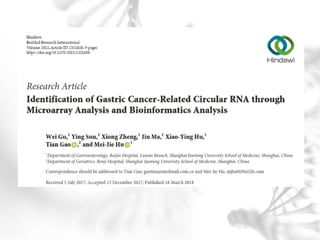
Microarray
Case Study
Md. Hafijur Rahman
ID: 23121216
Bangladesh Agricultural University
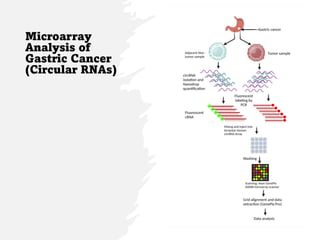
Microarray
Analysis of
Gastric Cancer
(Circular RNAs)
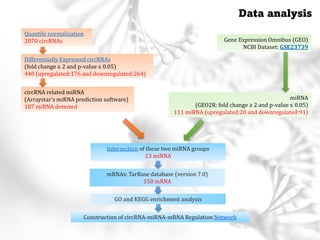
Quantile normalization
2070 circRNAs
Differentially Expressed circRNAs
(fold change ≥ 2 and p-value ≤ 0.05)
440 (upregulated:176 and downregulated:264)
Gene Expression Omnibus (GEO)
NCBI Dataset: GSE23739
miRNA
(GEO2R: fold change ≥ 2 and p-value ≤ 0.05)
111 miRNA (upregulated:20 and downregulated:91)
Intersection of these two miRNA groups
23 miRNA
circRNA related miRNA
(Arraystar’s miRNA prediction software)
187 miRNA detected
mRNAs: TarBase database (version 7.0)
150 mRNA
Construction of circRNA-miRNA-mRNA Regulation Network
GO and KEGG enrichment analysis
Data analysis
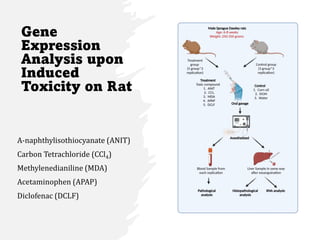
Gene
Expression
Analysis upon
Induced
Toxicity on Rat
A-naphthylisothiocyanate (ANIT)
Carbon Tetrachloride (CCl4)
Methylenedianiline (MDA)
Acetaminophen (APAP)
Diclofenac (DCLF)
Data analysis
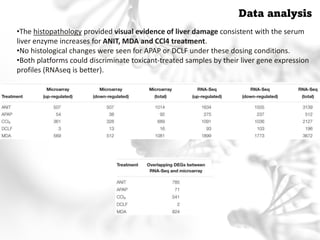
•The histopathology provided visual evidence of liver damage consistent with the serum
liver enzyme increases for ANIT, MDA and CCl4 treatment.
•No histological changes were seen for APAP or DCLF under these dosing conditions.
•Both platforms could discriminate toxicant-treated samples by their liver gene expression
profiles (RNAseq is better).
Prenatal
Cardiac
Abnormality
Diagnosis
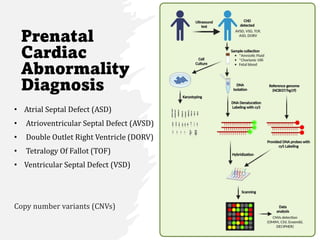
• Atrial Septal Defect (ASD)
• Atrioventricular Septal Defect (AVSD)
• Double Outlet Right Ventricle (DORV)
• Tetralogy Of Fallot (TOF)
• Ventricular Septal Defect (VSD)
Copy number variants (CNVs)
Data analysis
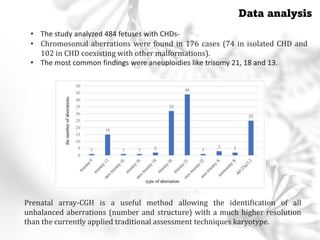
• The study analyzed 484 fetuses with CHDs-
• Chromosomal aberrations were found in 176 cases (74 in isolated CHD and
102 in CHD coexisting with other malformations).
• The most common findings were aneuploidies like trisomy 21, 18 and 13.
Prenatal array-CGH is a useful method allowing the identification of all
unbalanced aberrations (number and structure) with a much higher resolution
than the currently applied traditional assessment techniques karyotype.
Thank you
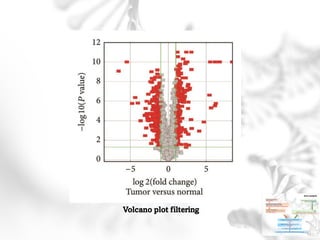
Volcano plot filtering
Microarray Case Study  (analysis)

Microarray Case Study (analysis)

  • 1.
    Microarray Case Study Md. HafijurRahman ID: 23121216 Bangladesh Agricultural University
  • 3.
  • 4.
    Quantile normalization 2070 circRNAs DifferentiallyExpressed circRNAs (fold change ≥ 2 and p-value ≤ 0.05) 440 (upregulated:176 and downregulated:264) Gene Expression Omnibus (GEO) NCBI Dataset: GSE23739 miRNA (GEO2R: fold change ≥ 2 and p-value ≤ 0.05) 111 miRNA (upregulated:20 and downregulated:91) Intersection of these two miRNA groups 23 miRNA circRNA related miRNA (Arraystar’s miRNA prediction software) 187 miRNA detected mRNAs: TarBase database (version 7.0) 150 mRNA Construction of circRNA-miRNA-mRNA Regulation Network GO and KEGG enrichment analysis Data analysis
  • 6.
    Gene Expression Analysis upon Induced Toxicity onRat A-naphthylisothiocyanate (ANIT) Carbon Tetrachloride (CCl4) Methylenedianiline (MDA) Acetaminophen (APAP) Diclofenac (DCLF)
  • 8.
    Data analysis •The histopathologyprovided visual evidence of liver damage consistent with the serum liver enzyme increases for ANIT, MDA and CCl4 treatment. •No histological changes were seen for APAP or DCLF under these dosing conditions. •Both platforms could discriminate toxicant-treated samples by their liver gene expression profiles (RNAseq is better).
  • 10.
    Prenatal Cardiac Abnormality Diagnosis • Atrial SeptalDefect (ASD) • Atrioventricular Septal Defect (AVSD) • Double Outlet Right Ventricle (DORV) • Tetralogy Of Fallot (TOF) • Ventricular Septal Defect (VSD) Copy number variants (CNVs)
  • 11.
    Data analysis • Thestudy analyzed 484 fetuses with CHDs- • Chromosomal aberrations were found in 176 cases (74 in isolated CHD and 102 in CHD coexisting with other malformations). • The most common findings were aneuploidies like trisomy 21, 18 and 13. Prenatal array-CGH is a useful method allowing the identification of all unbalanced aberrations (number and structure) with a much higher resolution than the currently applied traditional assessment techniques karyotype.
  • 12.
  • 14.