SUBMITTED BY:
DARATHY ROSELIN C
1ST
M.SC
PG & RESEARCH DEPARTMENT
OF MICROBIOLOGY , SPKC
MICROALGAL BIOFETRILIZER
SUBMITTED TO:
DR. G. RAMANADHAN
ASSIST.PROFESSOR
DEPARTMENT OF
MICROBIOLOGY , SPKC
SUBJECT :MICROALGAL TECHNOLOGY
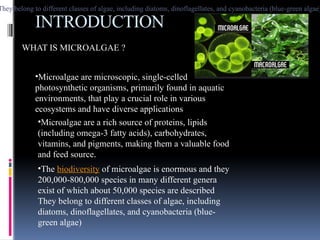
INTRODUCTION
WHAT IS MICROALGAE ?
•Microalgae are microscopic, single-celled
photosynthetic organisms, primarily found in aquatic
environments, that play a crucial role in various
ecosystems and have diverse applications
•Microalgae are a rich source of proteins, lipids
(including omega-3 fatty acids), carbohydrates,
vitamins, and pigments, making them a valuable food
and feed source.
•The biodiversity of microalgae is enormous and they
200,000-800,000 species in many different genera
exist of which about 50,000 species are described
They belong to different classes of algae, including
diatoms, dinoflagellates, and cyanobacteria (blue-
green algae)
They belong to different classes of algae, including diatoms, dinoflagellates, and cyanobacteria (blue-green algae)
MICROALGAL BIOFERTILIZER
ae to enhance soil fertility and promote plant growth. These biofertilizers offer several benefits, including nutrien
• Microalgal biofertilizers are a sustainable alternative to conventional
chemical fertilizers, utilizing microalgae to enhance soil fertility and
promote plant growth.
•These biofertilizers offer several benefits, including nutrient addition,
biostimulant effects, and carbon sequestration, while also contributing to a
circular bioeconomy.
•They are known to be a more sustainable option compared to
agrochemicals due to their ability to decrease the usage of synthetic
fertilizers, improve soil fertility, and optimize nutrients.
•Microalgae are seen as valuable biofertilizers because they help to
improve both plant growth and soil fertilization
SYNTHESIS OF MICROALGAL
BIOFERTILIZER
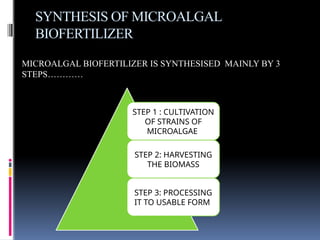
MICROALGAL BIOFERTILIZER IS SYNTHESISED MAINLY BY 3
STEPS…………
STEP 1 : CULTIVATION
OF STRAINS OF
MICROALGAE
STEP 2: HARVESTING
THE BIOMASS
STEP 3: PROCESSING
IT TO USABLE FORM
SYNTHESIS :
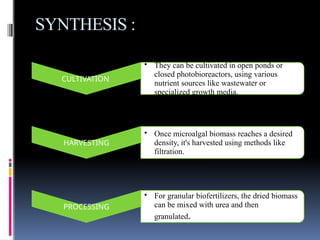
CULTIVATION
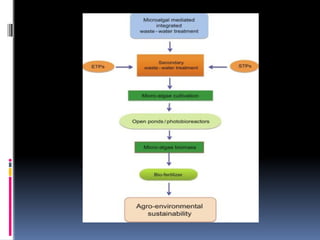
• They can be cultivated in open ponds or
closed photobioreactors, using various
nutrient sources like wastewater or
specialized growth media.
HARVESTING
• Once microalgal biomass reaches a desired
density, it's harvested using methods like
filtration.
PROCESSING
• For granular biofertilizers, the dried biomass
can be mixed with urea and then
granulated.
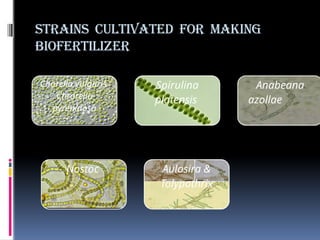
STRAINS CULTIVATED FOR MAKING
BIOFERTILIZER
Chorella vulgaris
Chrorella
pyrenidosa
Spirulina
platensis
Anabeana
azollae
Nostoc Aulosira &
Tolypothrix
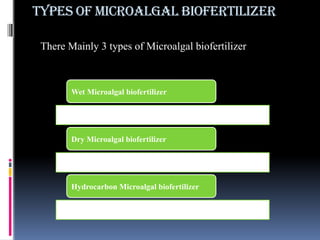
TYPES OF MICROALGAL BIOFERTILIZER
There Mainly 3 types of Microalgal biofertilizer
Wet Microalgal biofertilizer
Dry Microalgal biofertilizer
Hydrocarbon Microalgal biofertilizer
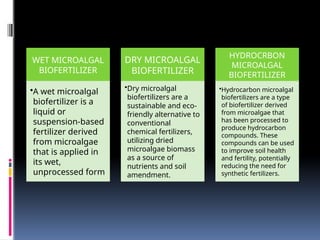
WET MICROALGAL
BIOFERTILIZER
•A wet microalgal
biofertilizer is a
liquid or
suspension-based
fertilizer derived
from microalgae
that is applied in
its wet,
unprocessed form
DRY MICROALGAL
BIOFERTILIZER
•Dry microalgal
biofertilizers are a
sustainable and eco-
friendly alternative to
conventional
chemical fertilizers,
utilizing dried
microalgae biomass
as a source of
nutrients and soil
amendment.
HYDROCRBON
MICROALGAL
BIOFERTILIZER
•Hydrocarbon microalgal
biofertilizers are a type
of biofertilizer derived
from microalgae that
has been processed to
produce hydrocarbon
compounds. These
compounds can be used
to improve soil health
and fertility, potentially
reducing the need for
synthetic fertilizers.
ECONOMIC IMPORTANCE OF
MICROALGAL BIOFERTILIZER
 Reduced Dependency on Synthetic Fertilizers:
 Increased Crop Yields
 Farmers can potentially generate revenue by
producing and selling microalgae-based
biofertilizers, especially if they are using
wastewater treatment systems.
 The production of microalgae-based
biofertilizers can create new jobs in the
agricultural sector, particularly in rural area
CHALLENGES OF MAKING MICROALGAL
BIOFERTILIZER
 High Production Costs
 Contamination Risks
 Environmental Factors:
Microalgae cultivation can be affected By environmental
factors like temperature, light, and pH, which can impact
biomass production and quality.
Wastewater Use: While using wastewater for microalgae
cultivation can reduce costs, it also carries the risk of
introducing heavy metals and other pollutants into
agricultural soil, potentially affecting crop health and
human safety.
APPLICATION OFMICROALGAL
BIOFERTILIZER
 Increase soil organic carbon content by sequestering atmospheric
carbon dioxide (CO2) and utilizing CO2 through photosynthesis to
generate nutrient-rich biomass.
 Seed Treatment:
Microalgae can be used to coat seeds before planting, promoting
germination and early seedling growth.
 Soil Drenching:
Applying a liquid suspension of microalgae directly to the soil allows for
nutrient absorption by plant roots and improved soil microbial activity
 Foliar Spray:
 Spraying microalgal solutions onto plant leaves can enhance nutrient
uptake, improve photosynthetic efficiency, and potentially increase
resistance to diseases
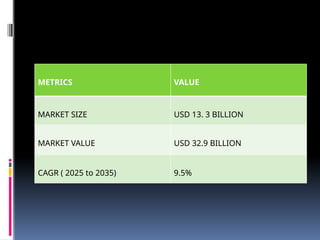
Microalgal biofertilizer market
value
 The market is projected to
reach USD 13.3 Billion in 2025
and is expected to grow to USD
32.9 Billion by 2035, registering a
CAGR of 9.5% over the forecast
period.
METRICS VALUE
MARKET SIZE USD 13. 3 BILLION
MARKET VALUE USD 32.9 BILLION
CAGR ( 2025 to 2035) 9.5%
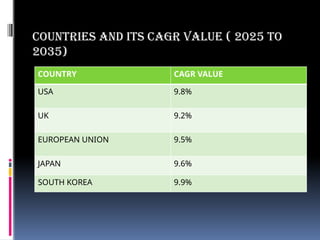
COUNTRY CAGR VALUE
USA 9.8%
UK 9.2%
EUROPEAN UNION 9.5%
JAPAN 9.6%
SOUTH KOREA 9.9%
COUNTRIES AND ITS CAGR VALUE ( 2025 TO
2035)
MICROALGAL BIOFERTILIZER AND IT'S TYPES.

MICROALGAL BIOFERTILIZER AND IT'S TYPES.

  • 1.
    SUBMITTED BY: DARATHY ROSELINC 1ST M.SC PG & RESEARCH DEPARTMENT OF MICROBIOLOGY , SPKC MICROALGAL BIOFETRILIZER SUBMITTED TO: DR. G. RAMANADHAN ASSIST.PROFESSOR DEPARTMENT OF MICROBIOLOGY , SPKC SUBJECT :MICROALGAL TECHNOLOGY
  • 2.
    INTRODUCTION WHAT IS MICROALGAE? •Microalgae are microscopic, single-celled photosynthetic organisms, primarily found in aquatic environments, that play a crucial role in various ecosystems and have diverse applications •Microalgae are a rich source of proteins, lipids (including omega-3 fatty acids), carbohydrates, vitamins, and pigments, making them a valuable food and feed source. •The biodiversity of microalgae is enormous and they 200,000-800,000 species in many different genera exist of which about 50,000 species are described They belong to different classes of algae, including diatoms, dinoflagellates, and cyanobacteria (blue- green algae) They belong to different classes of algae, including diatoms, dinoflagellates, and cyanobacteria (blue-green algae) They belong to different classes of algae, including diatoms, dinoflagellates, and cyanobacteria (blue-green algae) They belong to different classes of algae, including diatoms, dinoflagellates, and cyanobacteria (blue-green algae) They belong to different classes of algae, including diatoms, dinoflagellates, and cyanobacteria (blue-green algae) They belong to different classes of algae, including diatoms, dinoflagellates, and cyanobacteria (blue-green algae) They belong to different classes of algae, including diatoms, dinoflagellates, and cyanobacteria (blue-green algae) They belong to different classes of algae, including diatoms, dinoflagellates, and cyanobacteria (blue-green algae) They belong to different classes of algae, including diatoms, dinoflagellates, and cyanobacteria (blue-green algae) They belong to different classes of algae, including diatoms, dinoflagellates, and cyanobacteria (blue-green algae) They belong to different classes of algae, including diatoms, dinoflagellates, and cyanobacteria (blue-green algae)
  • 3.
    MICROALGAL BIOFERTILIZER ae toenhance soil fertility and promote plant growth. These biofertilizers offer several benefits, including nutrien ae to enhance soil fertility and promote plant growth. These biofertilizers offer several benefits, including nutrien • Microalgal biofertilizers are a sustainable alternative to conventional chemical fertilizers, utilizing microalgae to enhance soil fertility and promote plant growth. •These biofertilizers offer several benefits, including nutrient addition, biostimulant effects, and carbon sequestration, while also contributing to a circular bioeconomy. •They are known to be a more sustainable option compared to agrochemicals due to their ability to decrease the usage of synthetic fertilizers, improve soil fertility, and optimize nutrients. •Microalgae are seen as valuable biofertilizers because they help to improve both plant growth and soil fertilization
  • 4.
    SYNTHESIS OF MICROALGAL BIOFERTILIZER MICROALGALBIOFERTILIZER IS SYNTHESISED MAINLY BY 3 STEPS………… STEP 1 : CULTIVATION OF STRAINS OF MICROALGAE STEP 2: HARVESTING THE BIOMASS STEP 3: PROCESSING IT TO USABLE FORM
  • 5.
    SYNTHESIS : CULTIVATION • Theycan be cultivated in open ponds or closed photobioreactors, using various nutrient sources like wastewater or specialized growth media. HARVESTING • Once microalgal biomass reaches a desired density, it's harvested using methods like filtration. PROCESSING • For granular biofertilizers, the dried biomass can be mixed with urea and then granulated.
  • 7.
    STRAINS CULTIVATED FORMAKING BIOFERTILIZER Chorella vulgaris Chrorella pyrenidosa Spirulina platensis Anabeana azollae Nostoc Aulosira & Tolypothrix
  • 8.
    TYPES OF MICROALGALBIOFERTILIZER There Mainly 3 types of Microalgal biofertilizer Wet Microalgal biofertilizer Dry Microalgal biofertilizer Hydrocarbon Microalgal biofertilizer
  • 9.
    WET MICROALGAL BIOFERTILIZER •A wetmicroalgal biofertilizer is a liquid or suspension-based fertilizer derived from microalgae that is applied in its wet, unprocessed form DRY MICROALGAL BIOFERTILIZER •Dry microalgal biofertilizers are a sustainable and eco- friendly alternative to conventional chemical fertilizers, utilizing dried microalgae biomass as a source of nutrients and soil amendment. HYDROCRBON MICROALGAL BIOFERTILIZER •Hydrocarbon microalgal biofertilizers are a type of biofertilizer derived from microalgae that has been processed to produce hydrocarbon compounds. These compounds can be used to improve soil health and fertility, potentially reducing the need for synthetic fertilizers.
  • 10.
    ECONOMIC IMPORTANCE OF MICROALGALBIOFERTILIZER  Reduced Dependency on Synthetic Fertilizers:  Increased Crop Yields  Farmers can potentially generate revenue by producing and selling microalgae-based biofertilizers, especially if they are using wastewater treatment systems.  The production of microalgae-based biofertilizers can create new jobs in the agricultural sector, particularly in rural area
  • 11.
    CHALLENGES OF MAKINGMICROALGAL BIOFERTILIZER  High Production Costs  Contamination Risks  Environmental Factors: Microalgae cultivation can be affected By environmental factors like temperature, light, and pH, which can impact biomass production and quality. Wastewater Use: While using wastewater for microalgae cultivation can reduce costs, it also carries the risk of introducing heavy metals and other pollutants into agricultural soil, potentially affecting crop health and human safety.
  • 12.
    APPLICATION OFMICROALGAL BIOFERTILIZER  Increasesoil organic carbon content by sequestering atmospheric carbon dioxide (CO2) and utilizing CO2 through photosynthesis to generate nutrient-rich biomass.  Seed Treatment: Microalgae can be used to coat seeds before planting, promoting germination and early seedling growth.  Soil Drenching: Applying a liquid suspension of microalgae directly to the soil allows for nutrient absorption by plant roots and improved soil microbial activity  Foliar Spray:  Spraying microalgal solutions onto plant leaves can enhance nutrient uptake, improve photosynthetic efficiency, and potentially increase resistance to diseases
  • 13.
    Microalgal biofertilizer market value The market is projected to reach USD 13.3 Billion in 2025 and is expected to grow to USD 32.9 Billion by 2035, registering a CAGR of 9.5% over the forecast period.
  • 14.
    METRICS VALUE MARKET SIZEUSD 13. 3 BILLION MARKET VALUE USD 32.9 BILLION CAGR ( 2025 to 2035) 9.5%
  • 15.
    COUNTRY CAGR VALUE USA9.8% UK 9.2% EUROPEAN UNION 9.5% JAPAN 9.6% SOUTH KOREA 9.9% COUNTRIES AND ITS CAGR VALUE ( 2025 TO 2035)