MHA690 Health Care Capstone
  Professor Sherry Grover
    December, 5, 2012
      Catherine Vitale
 HIPAA


Health Insurance Portability & Accountability Act of 1996
   Confidentiality
   HIPAA
   Ethics
   Employee Responsibility
   Employee Monitoring
   Consequences for a violation of privacy
   The Health Insurance
                   Portability and
CONTENT            Accountability Act of 1996
 EMR SYSTEMS
                   (HIPAA), Public Law 104-
                   191, was enacted on August
                   21, 1996.
                   Sections 261 through 264 of
                   HIPAA require the Secretary
                   of HHS to publicize
                   standards for the electronic
                   exchange, privacy and
                   security of health
                   information.
HIPAA required the Secretary to issue privacy regulations governing
individually identifiable health information, if Congress did not enact privacy
legislation within three years of the passage of HIPAA.
Because Congress did not enact privacy legislation, HHS developed a proposed
rule and released it for public comment on November 3, 1999.
The Department received over 52,000 public comments. The final regulation, the
Privacy Rule, was published December 28, 2000.2
In March 2002, the Department proposed and released for public comment
modifications to the Privacy Rule. The Department received over 11,000
comments. The final modifications were published in final form on August 14,
2002.3
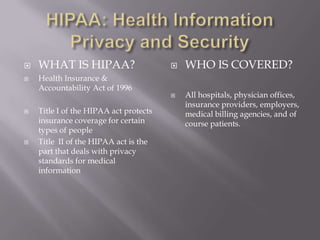
   WHAT IS HIPAA?                         WHO IS COVERED?
   Health Insurance &
    Accountability Act of 1996
                                           All hospitals, physician offices,
                                            insurance providers, employers,
   Title I of the HIPAA act protects       medical billing agencies, and of
    insurance coverage for certain          course patients.
    types of people
   Title II of the HIPAA act is the
    part that deals with privacy
    standards for medical
    information
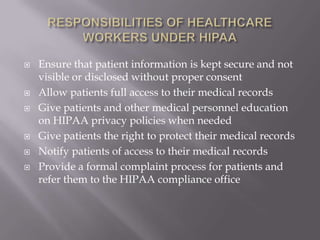
   Ensure that patient information is kept secure and not
    visible or disclosed without proper consent
   Allow patients full access to their medical records
   Give patients and other medical personnel education
    on HIPAA privacy policies when needed
   Give patients the right to protect their medical records
   Notify patients of access to their medical records
   Provide a formal complaint process for patients and
    refer them to the HIPAA compliance office
Mha690 slideshare [autosaved]

Mha690 slideshare [autosaved]

  • 1.
    MHA690 Health CareCapstone Professor Sherry Grover December, 5, 2012 Catherine Vitale
  • 2.
     HIPAA Health InsurancePortability & Accountability Act of 1996
  • 3.
    Confidentiality  HIPAA  Ethics  Employee Responsibility  Employee Monitoring  Consequences for a violation of privacy
  • 4.
    The Health Insurance Portability and CONTENT Accountability Act of 1996 EMR SYSTEMS (HIPAA), Public Law 104- 191, was enacted on August 21, 1996.  Sections 261 through 264 of HIPAA require the Secretary of HHS to publicize standards for the electronic exchange, privacy and security of health information.
  • 5.
    HIPAA required theSecretary to issue privacy regulations governing individually identifiable health information, if Congress did not enact privacy legislation within three years of the passage of HIPAA. Because Congress did not enact privacy legislation, HHS developed a proposed rule and released it for public comment on November 3, 1999. The Department received over 52,000 public comments. The final regulation, the Privacy Rule, was published December 28, 2000.2 In March 2002, the Department proposed and released for public comment modifications to the Privacy Rule. The Department received over 11,000 comments. The final modifications were published in final form on August 14, 2002.3
  • 6.
    WHAT IS HIPAA?  WHO IS COVERED?  Health Insurance & Accountability Act of 1996  All hospitals, physician offices, insurance providers, employers,  Title I of the HIPAA act protects medical billing agencies, and of insurance coverage for certain course patients. types of people  Title II of the HIPAA act is the part that deals with privacy standards for medical information
  • 7.
    Ensure that patient information is kept secure and not visible or disclosed without proper consent  Allow patients full access to their medical records  Give patients and other medical personnel education on HIPAA privacy policies when needed  Give patients the right to protect their medical records  Notify patients of access to their medical records  Provide a formal complaint process for patients and refer them to the HIPAA compliance office