CHICAGO LONDON NEW DELHI PARIS SEOUL SYDNEY TAIPEI TOKYO
MY FIRST BRITANNICA
People in History
4
© 2008 by Encyclopædia Britannica, Inc.
International Standard Book Number: 978-1-59339-476-9 (set)
No part of this work may be reproduced or utilized in any form or by any means, electronic or mechanical,
including photocopying, recording, or by any information storage and retrieval system, without permission
in writing from the publisher.
My First Britannica:
Volume 4: People in History 2008
Britannica.com may be accessed on the Internet at http://www.britannica.com.
Encyclopædia Britannica, Britannica, and the Thistle logo are registered trademarks of Encyclopædia Britannica, Inc.
People in History
TABLE OF CONTENTS
INTRODUCTION. . . . . . . . . . . . . . . . . . . . . . . . . . . . . . . . 5
Creators
Isabel Allende: The Letter Writer’s Stories. . . . . . . . . . . . . 6
Count Basie: An Aristocrat of Jazz . . . . . . . . . . . . . . . . . . 8
Charles Dickens: Writer of Life-Changing Stories. . . . . . . 10
Fanny Elssler: Theatrical Ballerina. . . . . . . . . . . . . . . . . 12
Francisco de Goya:
Painter to the King and to the People. . . . . . . . . . . . . . 14
Wolfgang Amadeus Mozart: A Life Filled with Music . . . . 16
I.M. Pei: Grand Architect . . . . . . . . . . . . . . . . . . . . . . . . . 18
Pablo Picasso: Exploring with an Artist. . . . . . . . . . . . . . 20
William Shakespeare: Plays That Never Grow Old . . . . . . 22
Socrates: Teaching People to Think. . . . . . . . . . . . . . . . . 24
Joan Sutherland: Australia’s Golden Voice. . . . . . . . . . . . 26
Mark Twain: The Writer and the Mississippi River . . . . . 28
Leaders and Conquerors
Yasir Arafat: Leader of the Palestinians . . . . . . . . . . . . . 30
Ashoka: The Emperor and the Right Way of Living . . . . . 32
Menachem Begin: Struggling for Israel . . . . . . . . . . . . . . 34
Julius Caesar:
Rome’s Remarkable General and Statesman . . . . . . . . 36
Fidel Castro: The Man Who Changed Cuba. . . . . . . . . . . . 38
Charlemagne: The Father of Europe. . . . . . . . . . . . . . . . . 40
Cleopatra: Queen of Egypt . . . . . . . . . . . . . . . . . . . . . . . . 42
Elizabeth I: A Clever, Courageous Queen. . . . . . . . . . . . . . 44
Empress of China: The Dragon Empress . . . . . . . . . . . . . 46
Hirohito: Emperor of Japan . . . . . . . . . . . . . . . . . . . . . . . 48
Mohammed Ali Jinnah: Founder of Pakistan . . . . . . . . . . 50
Nelson Mandela: A Fighter for Rights . . . . . . . . . . . . . . . 52
Mao Zedong: Architect of Modern China. . . . . . . . . . . . . . 54
Golda Meir: Israel’s First Woman Prime Minister . . . . . . 56
Anwar el-Sadat: Egypt’s Man of Peace. . . . . . . . . . . . . . . 58
U Thant: World Peacemaker . . . . . . . . . . . . . . . . . . . . . . 60
Vikings: Men in Dragon Ships . . . . . . . . . . . . . . . . . . . . . 62
Scientists and Doctors
Elizabeth Blackwell: The First Modern Woman Doctor. . . 64
Luther Burbank: Inventing New Plants . . . . . . . . . . . . . . 66
Nicolaus Copernicus: Student of the Sky . . . . . . . . . . . . . 68
Marie Curie: Discovering a New Kind of Science. . . . . . . . 70
Charles Darwin: The Theory of Evolution. . . . . . . . . . . . . 72
Albert Einstein: A Brilliant Wonderer. . . . . . . . . . . . . . . . 74
Galileo Galilei: The Man Who Discovered Outer Space . . . 76
Jane Goodall:
The Woman Who Lived with Chimpanzees . . . . . . . . . . 78
Johannes Kepler: Stargazer. . . . . . . . . . . . . . . . . . . . . . . 80
Sir Isaac Newton: An Apple, an Idea . . . . . . . . . . . . . . . . 82
Louis Pasteur: The Man Who Conquered Disease. . . . . . . 84
Extraordinary Lives
American Indians: The First Native North Americans . . . 86
Simón Bolívar: Hero of Many Nations . . . . . . . . . . . . . . . 88
Anne Frank: A Young Girl and Her Diary . . . . . . . . . . . . . 90
Cathy Freeman: Gold Medalist in Track. . . . . . . . . . . . . . 92
Mahatma Gandhi: Salt and Empires . . . . . . . . . . . . . . . . 94
Helen Keller: Woman of Courage . . . . . . . . . . . . . . . . . . . 96
Martin Luther King, Jr.: Civil Rights Leader. . . . . . . . . . . 98
Ferdinand Magellan: Around-the-World Voyager . . . . . . 100
Mayan Civilization:
Writers, Mathematicians, and Architects . . . . . . . . . . 102
Pelé: Football Star. . . . . . . . . . . . . . . . . . . . . . . . . . . . . 104
Mother Teresa: Mother of the Poor and Dying. . . . . . . . . 106
Tenzing Norgay: On Top of the World . . . . . . . . . . . . . . . 108
GLOSSARY. . . . . . . . . . . . . . . . . . . . . . . . . . . . . . . . . . 110
INDEX . . . . . . . . . . . . . . . . . . . . . . . . . . . . . . . . . . . . . 111
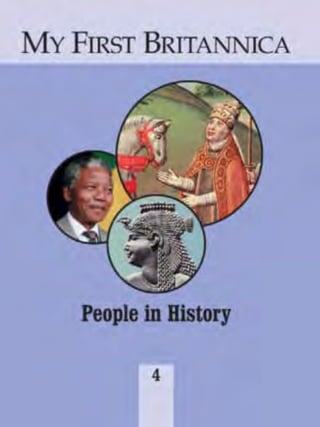
Cover photos (top): illuminated manuscript showing Charlemagne meeting Pope Adrian I, © Archivo Iconografico, S.A./Corbis; (center): Nelson Mandela, © David
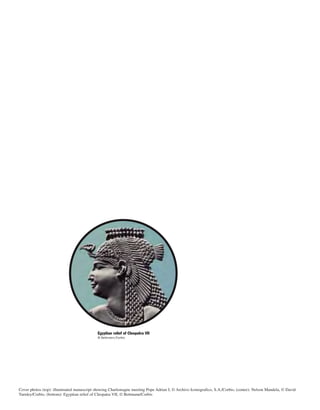
Turnley/Corbis; (bottom): Egyptian relief of Cleopatra VII, © Bettmann/Corbis
Egyptian relief of Cleopatra VII
© Bettmann/Corbis
People in History
MY FIRST BRITANNICA
Have a great trip!
In Volume 4, People
in History,
you’ll discover answers
to these questions and
many more. Through
pictures, articles, and
fun facts, you’ll learn
about the extraordinary
people who have changed
the course of history.
I N T R O D U C T I O N
Who is known as the Father of Europe?
What writer’s name means “two fathoms deep”?
How did Cleopatra die? Why did Gandhi march to the sea?
To help you on your journey, we’ve provided the following guideposts in
People in History:
■ Subject Tabs—The colored box in the upper corner of each right-hand
page will quickly tell you the article subject.
■ Search Lights—Try these mini-quizzes before and after you read the
article and see how much—and how quickly—you can learn. You can even
make this a game with a reading partner. (Answers are upside down at the
bottom of one of the pages.)
■ Did You Know?—Check out these fun facts about the article subject.
With these surprising “factoids,” you can entertain your friends, impress
your teachers, and amaze your parents.
■ Picture Captions—Read the captions that go with the photos. They
provide useful information about the article subject.
■ Vocabulary—New or difficult words are in bold type. You’ll find
them explained in the Glossary at the back of this volume. And there’s a
complete listing of all Glossary terms in the set in the Reference Guide
and Index, Volume 13.
■ Learn More!—Follow these pointers to related articles throughout the set.
And don’t forget: If you’re not sure where to start, where you saw something
before, or where to go next, the Index at the back of this volume and the
Reference Guide and Index (Volume 13) will point the way.
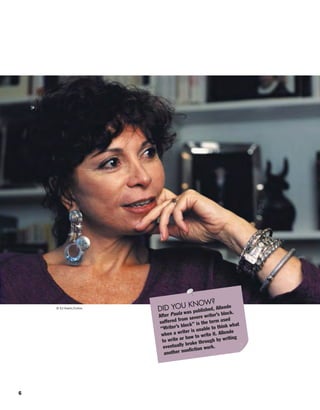
© Ed Kashi/Corbis
DID YOU KNOW?
After Paula was published, Allende
suffered from severe writer’s block.
“Writer’s block” is the term used
when a writer is unable to think what
to write or how to write it. Allende
eventually broke through by writing
another nonfiction work.
6
I S A B E L A L L E N D E
7
Answer:Allendeandherfamilybecameexilesthemselves.
It’snotunusualforwriterstodrawontheirownexperiences
fortheirwork—evenifit’sfiction.
★
Latin American writer Isabel Allende was born in 1942, in Lima,
Peru. Her many books, in Spanish, have been translated into
several languages. Her works feature a technique called “magic
realism”—the use of fantasy and myth in realistic fiction. Her
stories reflect her own experiences and also look at the role of
women in Latin America.
Isabel Allende’s uncle was Salvador Allende, president of Chile.
She was a journalist there, as well as a short-story writer. In 1973
Salvador Allende was murdered during a time of political
problems. Under the new government, Isabel Allende was
threatened, and she and her husband and children were forced to
flee to Venezuela. They ended up spending 13 years there.
In 1981, while still in exile, she started writing a letter to her dying
grandfather. She wrote about childhood memories and of the people who
had touched their lives. This letter turned into her first novel, La casa de
los espíritus (1982; The House of the Spirits). It was followed by the
novels De amor y de sombra (1984; Of Love and Shadows), Eva Luna
(1987), and El plan infinito (1991; The Infinite Plan).
Most of Allende’s stories have a political aspect and include
a number of exiles. Allende calls these people “the marginals.” She says
they are exiled from the big umbrella of society. They have the courage to
stand on the edge of life and not be sheltered or protected.
In 1990 Allende was able to return to Chile. But she was heartbroken
when her young daughter became sick and died of a terrible blood disease.
Out of her sorrow came a book, Paula (1994). It was Allende’s first
nonfiction book, and it went on to become a best-seller.
LEARN MORE! READ THESE ARTICLES…
JORGE LUIS BORGES (VOLUME 3) • CHILE (VOLUME 9)
MYTHS AND LEGENDS, FOLKTALES AND FABLES (VOLUME 5)
The Letter
Writer’s Stories
Why do
you suppose
that Allende
often writes
about people
who are exiles?
SEA
RCH LI
GHT
8
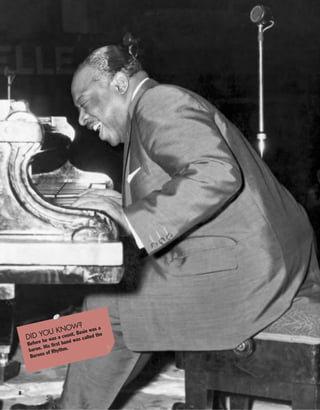
DID YOU KNOW?
Before he was a count, Basie was a
baron. His first band was called the
Barons of Rhythm.
C O U N T B A S I E
9
Young William Basie began studying music with his mother.
He later learned to play the organ from pianist Fats Waller.
Waller himself was a well-known jazz player.
Basie started his career playing piano on the vaudeville
stage. Vaudeville was performed in a chain of theaters in the
United States during the late 19th and early 20th centuries.
Vaudeville shows provided an
entertaining mixture of dancing,
singing, comedy, and magic acts.
When Basie was about 23 years old, he went
to Kansas City, Missouri. It was there that he
formed his first jazz band. Basie’s nine-piece
band was distinct because it highlighted the
rhythm instruments. The bass fiddle, drums,
guitar, and Basie’s piano became the core sound
of his music. Basie had once played bass himself,
and he developed a four-beat “walking” style of
rhythm. This even beat provided a light, simple,
and relaxed musical foundation. It also helped
the harmonies and melodies in his songs stand out. Basie’s rhythm section
set the pattern that modern jazz accompanying styles would follow.
Basie and his band played at many nightclubs and often did radio
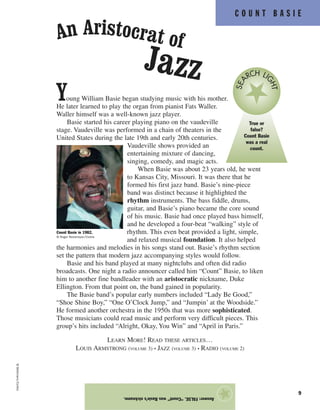
broadcasts. One night a radio announcer called him “Count” Basie, to liken
him to another fine bandleader with an aristocratic nickname, Duke
Ellington. From that point on, the band gained in popularity.
The Basie band’s popular early numbers included “Lady Be Good,”
“Shoe Shine Boy,” “One O’Clock Jump,” and “Jumpin’ at the Woodside.”
He formed another orchestra in the 1950s that was more sophisticated.
Those musicians could read music and perform very difficult pieces. This
group’s hits included “Alright, Okay, You Win” and “April in Paris.”
LEARN MORE! READ THESE ARTICLES…
LOUIS ARMSTRONG (VOLUME 3) • JAZZ (VOLUME 3) • RADIO (VOLUME 2)
Answer:FALSE.“Count”wasBasie’snickname.
★
©Bettmann/Corbis
An Aristocrat of
Jazz
Count Basie in 1982.
© Roger Ressmeyer/Corbis
True or
false?
Count Basie
was a real
count.
SEA
RCH LI
GHT
10
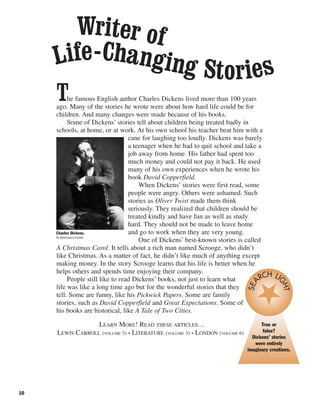
The famous English author Charles Dickens lived more than 100 years
ago. Many of the stories he wrote were about how hard life could be for
children. And many changes were made because of his books.
Some of Dickens’ stories tell about children being treated badly in
schools, at home, or at work. At his own school his teacher beat him with a
cane for laughing too loudly. Dickens was barely
a teenager when he had to quit school and take a
job away from home. His father had spent too
much money and could not pay it back. He used
many of his own experiences when he wrote his
book David Copperfield.
When Dickens’ stories were first read, some
people were angry. Others were ashamed. Such
stories as Oliver Twist made them think
seriously. They realized that children should be
treated kindly and have fun as well as study
hard. They should not be made to leave home
and go to work when they are very young.
One of Dickens’ best-known stories is called
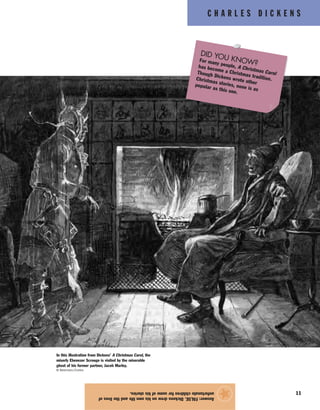
A Christmas Carol. It tells about a rich man named Scrooge, who didn’t
like Christmas. As a matter of fact, he didn’t like much of anything except
making money. In the story Scrooge learns that his life is better when he
helps others and spends time enjoying their company.
People still like to read Dickens’ books, not just to learn what
life was like a long time ago but for the wonderful stories that they
tell. Some are funny, like his Pickwick Papers. Some are family
stories, such as David Copperfield and Great Expectations. Some of
his books are historical, like A Tale of Two Cities.
LEARN MORE! READ THESE ARTICLES…
LEWIS CARROLL (VOLUME 3) • LITERATURE (VOLUME 3) • LONDON (VOLUME 6)
Writer of
Life-Changing Stories
Charles Dickens.
© Bettmann/Corbis
True or
false?
Dickens’ stories
were entirely
imaginary creations.
SEA
RCH LIGHT
11
Answer:FALSE.Dickensdrewonhisownlifeandthelivesof
unfortunatechildrenforsomeofhisstories.
★
C H A R L E S D I C K E N S
In this illustration from Dickens’ A Christmas Carol, the
miserly Ebenezer Scrooge is visited by the miserable
ghost of his former partner, Jacob Marley.
© Bettmann/Corbis
DID YOU KNOW?For many people, A Christmas Carol
has become a Christmas tradition.
Though Dickens wrote other
Christmas stories, none is as
popular as this one.
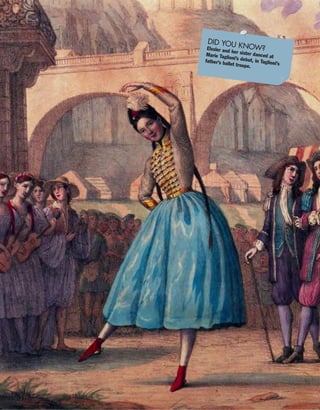
DID YOU KNOW?Elssler and her sister danced atMarie Taglioni’s debut, in Taglioni’s
father’s ballet troupe.
F A N N Y E L S S L E R
13
Fanny Elssler was a famous Austrian dancer who brought
energy and drama to her performances. She was born in 1810, in
Vienna, Austria, and studied ballet from a young age. As a child,
Elssler appeared with her sister in several ballets at Vienna’s
Kärntnerthor Theatre.
When she was a young adult, Elssler became famous worldwide
thanks to her energetic spirit onstage and her remarkable pointe
work (dancing on the points of the toes). She made her Paris
Opéra debut in 1834 in Jean Coralli’s ballet La Tempête, a dance
version of William Shakespeare’s play The Tempest.
Before Elssler came along, most ballet was “classical
ballet,” which featured light graceful dance, like that performed by
Elssler’s greatest rival dancer, Marie Taglioni. But Elssler introduced
theatrical, or “character,” ballet, which borrowed from folk dance traditions
and even mime. She performed a Polish folk dance called the
“cracovienne” in the ballet La Gypsy. And because some Gypsies were
associated with Spain, she got the nickname “the Spaniard from the north.”
Elssler spent the later part of her career touring the United States,
England, Germany, Italy, and Russia. Because of her long world tours,
Elssler had to break her agreement with the Paris Opéra, and so she could
not return to dance in France. Her worldwide tour ended up lasting more
than ten years.
Elssler retired from the ballet in 1851. Her last years were spent in
her native Vienna. During her career she was unequaled as a “character”
dancer with amazing dramatic powers.
LEARN MORE! READ THESE ARTICLES…
AUSTRIA (VOLUME 6) • DANCE (VOLUME 3) • MARIA TALLCHIEF (VOLUME 3)
Answer:Elssler’sstyleofballetborrowedfromfolkdance
traditions.
★
Find and
correct the
error in the
following sentence:
Elssler’s style of
ballet borrowed
from break dance
traditions.
SEA
RCH LI
GHT
Theatrical
Ballerina
Fanny Elssler was known for her great dramatic skill.
She was one of the first ballerinas to tour the United
States. She was noted for her Spanish dances and
often performed with her sister Therese.
© Archivo Iconografico, S.A./Corbis
As a young man in Spain, Francisco de Goya worked as a bullfighter.
But his great love was painting. After studying art in Rome, Goya returned
to Spain and worked as a tapestry designer. Soon his talents drew
attention, and he began painting portraits of wealthy Spaniards. By 1786
Goya had become a “painter to the king of Spain.”
But Goya became tired of painting pictures of dukes and duchesses and
the royal family. Most of the people of Spain were poor and often hungry.
Constant wars made their lives worse. Wanting
to portray this “everyday” world, Goya began to
draw and paint images of the poor and
hardworking people of Spain.
Goya didn’t make the men and women in his
art look prettier or more important than they
were. His paintings show people as they looked
after a life of hard work. Goya included the
lines in their faces and the sadness in their lives.
He showed their bent backs and their worn
clothes. This style of painting people and scenes
from daily life is called “realism.”
The subjects of Goya’s paintings did not
always please the king and the people of the
royal court. They thought he should paint only famous people and
beautiful things. In fact, his “Disasters of War” series of etchings
was so realistic and gory that it was not shown until over 35
years after Goya’s death. But today, hundreds of years later, the
power and honesty of Goya’s “everyday” paintings still impress
and move viewers.
LEARN MORE! READ THESE ARTICLES…
MADRID (VOLUME 6) • PAINTING (VOLUME 3) • PABLO PICASSO (VOLUME 4)
14
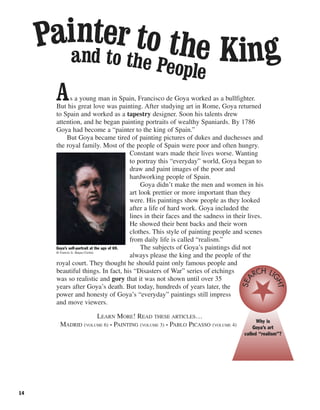
Goya’s self-portrait at the age of 69.
© Francis G. Mayer/Corbis
Painter to the Kingand to the People
Why is
Goya’s art
called “realism”?
SEA
RCH LIGHT
F R A N C I S C O D E G O Y A
15
Answer:Goya’spaintingstylewascalled“realism”becausehe
showedordinarypeopleastheyreallywere.
★
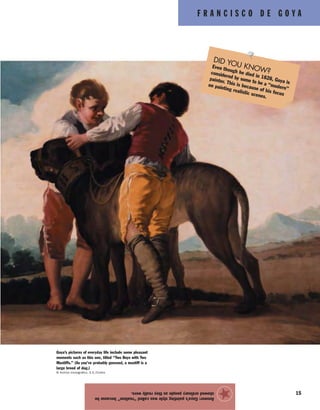
Goya’s pictures of everyday life include some pleasant
moments such as this one, titled “Two Boys with Two
Mastiffs.” (As you’ve probably guessed, a mastiff is a
large breed of dog.)
© Archivo Iconografico, S.A./Corbis
DID YOU KNOW?
Even though he died in 1828, Goya is
considered by some to be a “modern”
painter. This is because of his focus
on painting realistic scenes.
16
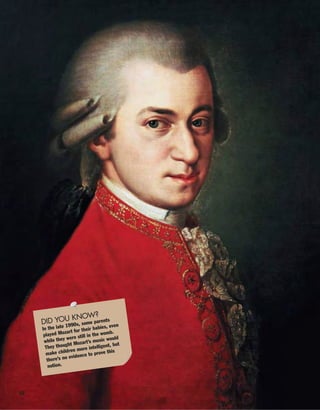
DID YOU KNOW?
In the late 1990s, some parents
played Mozart for their babies, even
while they were still in the womb.
They thought Mozart’s music would
make children more intelligent, but
there’s no evidence to prove this
notion.
W O L F G A N G A M A D E U S M O Z A R T
17
When he was only three years old in Salzburg, Austria,
Wolfgang Amadeus Mozart used to join his elder sister, Maria
Anna, for her music lessons. But by the time he was five,
Mozart was making up his own music.
In the 18th century, when Mozart lived, most people didn’t
believe that a little boy could write such beautiful music.
They thought Mozart’s father had secretly written it.
So to test him, they asked young Mozart to stay in a
room alone for a week. At the end of the week, Mozart
had written a new piece of choir music. People agreed
that this child was a musical genius.
Mozart studied, taught, played, and wrote music all his life. His music
was often joyous, sometimes grim. But it was always beautiful. Mozart used
the orchestra’s players and instruments in ways no one else had before.
Mozart often blended popular
and classical music to create new
styles of music, especially in the
opera. He could compose in many
musical styles and could play equally
well on the organ, the harpsichord,
the piano, and the violin. Mozart
could hear a piece once and then play
it from memory, sometimes rewriting
and improving it as he played.
Although he died when he was
still a young man, Mozart wrote 16
operas, 41 symphonies, and more than 500 other pieces of music. Some of
his most famous works include the operas The Marriage of Figaro, Don
Giovanni, and The Magic Flute and the “Jupiter” Symphony.
LEARN MORE! READ THESE ARTICLES…
LUDWIG VAN BEETHOVEN (VOLUME 3) • CLASSICAL MUSIC (VOLUME 3)
JOAN SUTHERLAND (VOLUME 4)
©ArchivoIconografico,S.A./Corbis
A Life Filled with
Music
How old was
Mozart when
he began writing
his own music?
a) 15
b) 5
c) 8
SEA
RCH LI
GHT
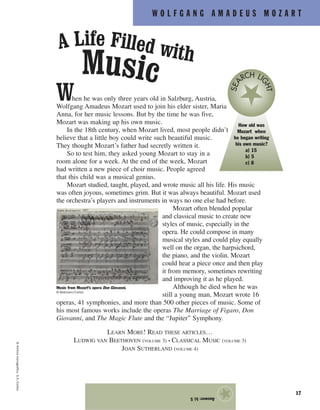
Music from Mozart’s opera Don Giovanni.
© Bettmann/Corbis
Answer:b)5
★
18
Ieoh Ming Pei is one of the most important modern architects. He has
created many major buildings throughout the world. And his style and
ideas have strongly influenced the work of many other architects. He has
specialized in building multistory
structures in cities.
I.M. Pei was born in Canton,
China, in 1917. He went to
America to study but couldn’t
return to China when World War
II started. So most of his work
has been in North America and
Europe.
In the 1940s Pei began
working as a professional
architect. He worked on such important projects as the Mile High Center in
Denver, Colorado.
In 1955 Pei formed his own architectural company, I.M. Pei &
Associates. The company’s early work included a museum in Syracuse, New
York, that was actually four buildings joined by bridges. He also created a
design for a new type of airport control tower that was widely used.
Pei’s buildings are often tall, with lots of glass and steel. The designs
combine simple geometric shapes, especially rectangles and triangles.
But his buildings are not dull or simple. In many of them, you can see
the building’s supports or building materials, and these are its only
decoration. The way that concrete, glass, and steel look together creates
interesting designs on the sides of Pei’s buildings. Special reflective glass
also adds to the designs. He often combines different shapes and
emphasizes the picture these shapes make in the skyline.
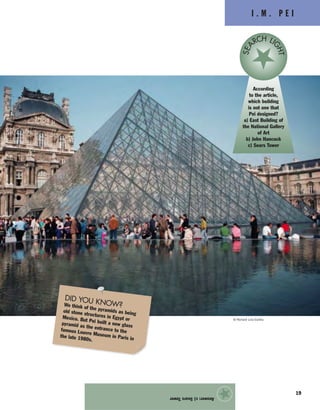
Some of Pei’s most famous work includes the John Hancock Tower in
Boston, the East Building of the National Gallery of Art in Washington,
D.C., and the glass pyramid at the Louvre Museum in Paris, shown in the
photograph here.
LEARN MORE! READ THESE ARTICLES…
ARCHITECTURE (VOLUME 3) • HASSAN FATHY (VOLUME 3)
MAYAN CIVILIZATION (VOLUME 4)
Grand Architect
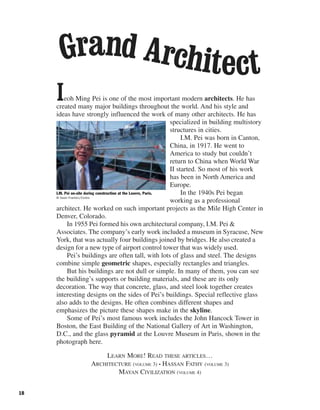
I.M. Pei on-site during construction at the Louvre, Paris.
© Owen Franken/Corbis
© Richard List/Corbis
I . M . P E I
Answer:c)SearsTower
★
19
According
to the article,
which building
is not one that
Pei designed?
a) East Building of
the National Gallery
of Art
b) John Hancock
c) Sears Tower
SEA
RCH LI
GHT
DID YOU KNOW?We think of the pyramids as beingold stone structures in Egypt orMexico. But Pei built a new glasspyramid as the entrance to thefamous Louvre Museum in Paris inthe late 1980s.
20
There’s a story that says the artist Pablo Picasso started to draw
before he learned to speak. While this is probably only a story, it
does suggest how important art was to Picasso.
Picasso was born in Spain in 1881 but lived much of his life in
France. He was an inventor and an explorer. But he didn’t invent
machines or explore strange places. He explored and invented with
art. He painted with his
fingers, made drawings
with a rusty nail, and
even made a bull’s
head from the handlebars and
seat of a bicycle. He was able to
work anywhere at any time of
the day or night.
Picasso’s big studio was a
sort of jungle—a jungle of paint
cans, brushes, chalk, pottery,
colored pencils, and crayons,
among many other things. Rolls of heavy paper and canvas, picture frames
and easels, and tools for cutting designs on heavy board lay scattered about
like rubbish. But to Picasso it was all inspiration.
He painted Spanish bullfighting, horse races, and clowns. He painted
happy pictures in warm colors (such as pink) and sad, lonely ones in cool
colors (such as dark blue). He sometimes painted people and animals the
way they looked. But more often he painted them from his imagination.
The art style that Picasso and fellow artist Georges Braque invented is
called Cubism. They painted people and things so that all parts and sides
could be seen at the same time. Cubists often created pictures from simple
shapes such as squares or cubes.
LEARN MORE! READ THESE ARTICLES…
FRANCISCO DE GOYA (VOLUME 4) • PAINTING (VOLUME 3) • SPAIN (VOLUME 6)
Exploringwith an Artist
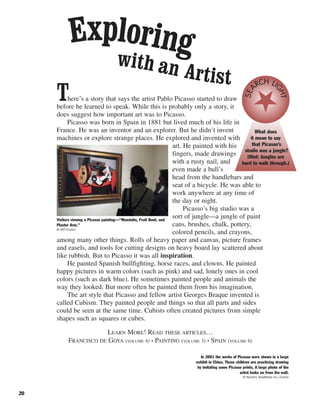
Visitors viewing a Picasso painting—“Mandolin, Fruit Bowl, and
Plaster Arm.”
© AFP/Corbis
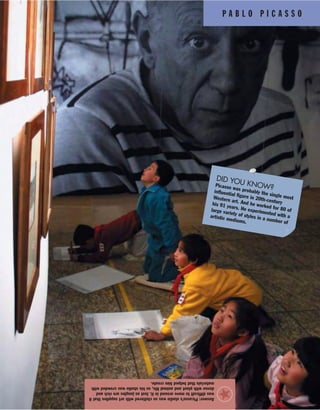
In 2001 the works of Picasso were shown in a large
exhibit in China. These children are practicing drawing
by imitating some Picasso prints. A large photo of the
artist looks on from the wall.
© Reuters NewMedia Inc./Corbis
What does
it mean to say
that Picasso’s
studio was a jungle?
(Hint: Jungles are
hard to walk through.)
SEA
RCH LI
GHT
P A B L O P I C A S S O
Answer:Picasso’sstudiowassoclutteredwithartsuppliesthatit
wasdifficulttomovearoundinit.Justasjunglesarerichand
densewithplantandanimallife,sohisstudiowascrowdedwith
materialsthathelpedhimcreate.
DID YOU KNOW?Picasso was probably the single most
influential figure in 20th-century
Western art. And he worked for 80 of
his 91 years. He experimented with a
large variety of styles in a number of
artistic mediums.
★
DID YOU KNOW?
Shakespeare was so imaginative in
his use of language that he created,
or “coined,” more than 2,000 words
or sayings that people have used
ever since.
W I L L I A M S H A K E S P E A R E
23
William Shakespeare is considered to be the greatest playwright in the
English language and one of the most beloved playwrights in the world.
Not much is known about Shakespeare’s life. He was born in
Stratford-upon-Avon, England, in 1564. This was during the reign of
Queen Elizabeth I. In his late 20s, Shakespeare went to the city of London
to write and act. He joined a theater troupe and began to write plays.
Over the next 20 years, Shakespeare wrote 38 plays and many poems.
From his writing we can tell that he knew a lot about human feelings, as
well as both city and country life. Most of
the stories that Shakespeare told were
known to his audience. But his characters
and the way he told their stories in his
plays attracted crowds of people to the
Globe Theatre, where his troupe often
performed.
Four hundred years later, people still
enjoy reading Shakespeare’s plays and
seeing them onstage and in films. They
quote his most famous lines (such as “To be or not to be”) and laugh and
cry along with his characters. Shakespeare’s plays have remained popular
for several reasons. His characters show realistic human emotions. His
plots are often complicated, but they always hold the audience’s attention.
And his language is powerful and poetic.
Some of Shakespeare’s plays, such as Hamlet, have very sad
endings. They are called “tragedies.” Others, such as A Midsummer
Night’s Dream, are full of silly plots and have happy endings. They
are the “comedies.” Other Shakespeare plays, such as Julius Caesar or
Henry V, are based on real-life figures and events. These are the
“histories.” And some plays, such as Romeo and Juliet, have a little bit
of everything: romance, comedy, and tragedy.
LEARN MORE! READ THESE ARTICLES…
ELIZABETH I (VOLUME 4) • ENGLAND (VOLUME 6) • THEATER (VOLUME 3)
Answer:b)comedy
★
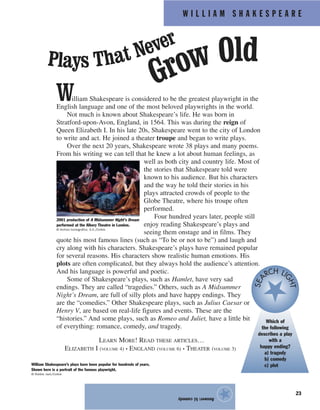
2001 production of A Midsummer Night’s Dream
performed at the Albery Theatre in London.
© Archivo Iconografico, S.A./Corbis
Plays That Never
Grow Old
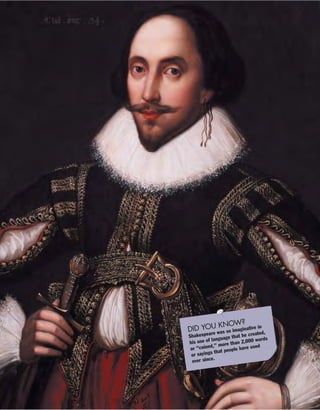
William Shakespeare’s plays have been popular for hundreds of years.
Shown here is a portrait of the famous playwright.
© Robbie Jack/Corbis
Which of
the following
describes a play
with a
happy ending?
a) tragedy
b) comedy
c) plot
SEA
RCH LI
GHT
24
Socrates was a thinker and teacher who lived in Athens,
Greece, almost 2,500 years ago. Socrates knew all the famous
people and leaders in Athens, but he never wanted to be famous
or rich himself. He just wanted to think and to talk about ideas.
Socrates didn’t give lectures or tell people what to think.
Instead, he asked questions. He thought it was very important to
“know yourself” and to learn how to be a good person and how to
live a good life. Socrates talked to many people who thought they
knew what was good and what was right. By asking them
questions, Socrates helped them realize that they really didn’t
understand these things.
Some people said that Socrates thought too much.
Sometimes Socrates would stand in one spot and think for many hours
without moving or saying a word. Socrates never wrote down his thoughts,
and he was never paid for his teaching. Socrates often angered people
because he made them feel embarrassed when they could not answer his
questions.
Eventually the leaders of Athens put Socrates in prison because they
thought that he made young people misbehave and that he did not believe
in the gods of Athens. As a punishment, they made Socrates drink a deadly
poison. Socrates could have run away, but he chose to stay and accept his
punishment. He believed he had a duty to obey the law. One of Socrates’
students, Plato, became a famous teacher himself. He wrote down many of
Socrates’ conversations so that his ideas would be preserved for many
future generations.
LEARN MORE! READ THESE ARTICLES…
ATHENS (VOLUME 6) • CONFUCIUS (VOLUME 5) • ALBERT EINSTEIN (VOLUME 4)
Teaching Peopleto Think
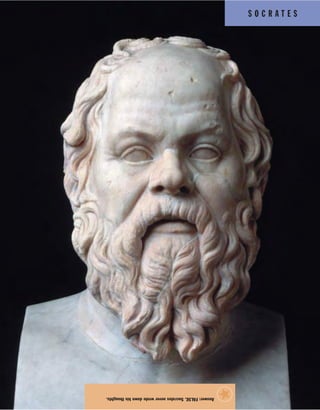
Socrates is often admired for holding on to his views
even though it cost him his life. Sometimes, as here,
the great thinker is celebrated in art.
© Araldo de Luca/Corbis
True or
false?
Socrates
wrote
many books.
SEA
RCH LI
GHT
DID YOU KNOW?
Socrates’ method of asking questions
to teach new ideas is still used in
schools today. It is called the
“Socratic method.”
S O C R A T E S
Answer:FALSE.Socratesneverwrotedownhisthoughts.
★
True
or false?
Joan Sutherland
never needed any
training to become a
great singer.
SEA
RCH LI
GHT
J O A N S U T H E R L A N D
27
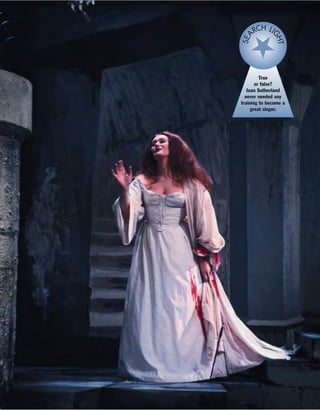
Opera singer Joan Sutherland was born in Sydney, Australia, on
November 7, 1926. She was a musical child and studied piano and music
with her mother. At about age 20 Sutherland won a singing competition
and began studying professionally.
A year later Sutherland made her first appearance as a singer in a
performance of Henry Purcell’s opera Dido and Aeneas. She played the
lead female role of Dido.
Sutherland won many prizes in singing competitions, and she used the
money to move to London. There she studied at the Royal College of
Music. In 1952 she became a member of the company of the Royal Opera,
Covent Garden. She made her first appearance there in Wolfgang Amadeus
Mozart’s The Magic Flute.
In 1961 Sutherland performed in Gaetano Donizetti’s Lucia di
Lammermoor at the Metropolitan Opera, New York City. Lucia was a
difficult role. On one hand, it required the singer to do some extremely
tricky vocal gymnastics. In addition to that, it was a major acting
challenge. Sutherland performed it so well that her fame spread around the
world. She was soon performing in major opera houses all over Europe.
Sutherland was admired as a coloratura soprano. Sopranos are female
singers with very high voices. Coloratura singers have to have a very light
and flexible voice. They must be able to sing complex series of notes very
rapidly.
Sutherland was one of the most successful opera stars of her day. In
1978 she was knighted as a Dame Commander of the British Empire. She
retired from the stage in 1990, at the age of 64.
LEARN MORE! READ THESE ARTICLES…
AUSTRALIA (VOLUME 7) • OPERA (VOLUME 3)
KIRI TE KANAWA (VOLUME 3)
Answer:FALSE.Sutherlandcontinuedtotrainthroughouther
career.
★
©Bettmann/Corbis
Australia’s
Golden Voice
DID YOU KNOW?
Sutherland’s nickname to her fans
was “La Stupenda,” because of her
stupendous (fantastic) talent.
28
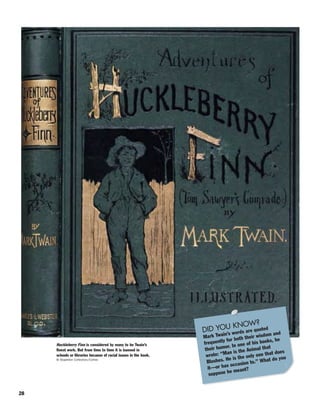
Huckleberry Finn is considered by many to be Twain’s
finest work. But from time to time it is banned in
schools or libraries because of racial issues in the book.
© Stapleton Collection/Corbis
DID YOU KNOW?
Mark Twain’s words are quoted
frequently for both their wisdom and
their humor. In one of his books, he
wrote: “Man is the Animal that
Blushes. He is the only one that does
it—or has occasion to.” What do you
suppose he meant?
M A R K T W A I N
29
Answer:Amarkequals6feet.Marktwain,12feet,istwomarks.
Halftwainis21/2marks,or15feet.
★
Aonetime Mississippi River boat pilot, Mark Twain became one of
America’s greatest authors. His Tom Sawyer, Huckleberry Finn, and Life
on the Mississippi rank high on any list of great American books.
Mark Twain was born Samuel Langhorne Clemens in 1835. He grew
up in Hannibal, Missouri, on the Mississippi River. From this river town he
gathered the material for his most famous stories. Young Tom Sawyer, for
instance, was a combination of several boys—
including himself.
During his life, he held jobs that he would
turn into material for his writing. His work as a
steamboat pilot gave him experience he used to
write Life on the Mississippi. When he began
working as a newspaper reporter, he began using
the pen name Mark Twain. It is an old river term
meaning two fathoms, or 12 feet, of water—a
depth that was not very safe for riverboats.
One of his stories, “The Celebrated Jumping
Frog of Calaveras County,” was printed in
many newspapers. It was a popular story,
and Twain traveled as a roving reporter and then on a lecture tour.
After these travels he wrote The Innocents Abroad, which made
him famous.
Twain was known as a humorist. But behind his mask of humor
lay a serious view of life. He had known the sadness of poverty, the
early death of his father and later his brother Henry, and the loss of a
daughter. One of his most famous novels, Huckleberry Finn, is
sometimes thought of as a child’s book. But its heartbreak and
wisdom are appreciated best by adults. Another of his famous
novels, Tom Sawyer, is mostly a young person’s book that adults
can also read with pleasure.
LEARN MORE! READ THESE ARTICLES…
CHARLES DICKENS (VOLUME 4) • FROGS (VOLUME 11) • SHIPS (VOLUME 2)
The Writer and the
Mississippi River
Mark Twain.
© Bettmann/Corbis
“Half twain”
means “mark
twain plus half a
mark” and equals
15 feet. So how much
is a mark?
SEA
RCH LI
GHT
30
From the time he was a teenager in the 1940s, Yasir Arafat was
involved with the Palestinian movement. Israel was formed after
World War II to give the Jewish people a homeland. But it was
formed in a region called Palestine, where many other people lived.
After Israel was created hundreds of thousands of Palestinian Arabs
left or were forced off their land.After 1948 Palestinians such as
Arafat wanted to get that land back by fighting against Israel. To do
this they formed the Palestine Liberation Organization (PLO).
For years the PLO carried out deadly attacks on Israel.
Israel responded by attacking the Palestinians. Arafat became
chairman of the PLO in 1969. He wanted the
PLO to work for change through discussion and
bargaining more than by force. Arafat worked to
get countries around the world to accept the idea
of a Palestinian homeland.
In 1993, with help from other countries,
Arafat and Israeli Prime Minister Yitzhak Rabin
signed agreements to make peace between the
two sides. The next year Arafat, Rabin, and
Israeli Foreign Minister Shimon Peres shared the
Nobel Prize for Peace for their work together.
As part of the peace plan the Palestinians
recognized Israel’s right to exist as a country. The
Israelis agreed that the Palestinians would be
allowed to rule certain areas that had been
controlled by Israel. To do this the Palestinians set up a group called the
Palestinian Authority. Arafat was elected president of the authority in 1996.
But there were other Palestinians who did not agree with the peace
agreement. They continued to fight against Israel. Some world leaders tried
to get Arafat to stop the violence, but the fighting continued. Arafat died in
2004.
LEARN MORE! READ THESE ARTICLES…
MENACHEM BEGIN (VOLUME 4) • ISRAEL (VOLUME 7)
MOHAMMED ALI JINNAH (VOLUME 4)
Fill in
the blanks:
PLO stands for
_______ _______
_______.
SEA
RCH LI
GHTYasir Arafat in 1990.
© David Turnley/Corbis
Leader of the
Palestinians
Y A S I R A R A F A T
31
Answer:PLOstandsforPalestineLiberationOrganization.
★
These Palestinian policemen carry a poster of
Yasir Arafat. To many Palestinians, Arafat long
symbolized their hope for a return to the land
that became Israel after World War II.
© AFP/Corbis
DID YOU KNOW?Arafat’s full name was Muhammad‘Abd al-Ra’uf al-Qudwah al-Husayni.Yasir is a nickname that means“easy.”
32
Some 2,200 years ago, the emperor Ashoka ruled India.
Like many ancient rulers, he expanded his empire by
conquering new lands. But unlike most rulers, Ashoka
suddenly turned his back on warfare and began to govern
according to the nonviolent beliefs of Buddhism.
It is said that Ashoka became a Buddhist when he saw the
horrors caused by the wars he’d led. After that, he decided to
serve his subjects and all humanity instead of conquering
others. He called this “conquest by dharma.” In India
dharma means the “right way of living” and “universal
truth.” This included being honest, truthful, and kind. It
also meant being merciful, generous, and thoughtful.
The emperor himself would often tour the countryside, preaching his
belief in dharma to the people. Ashoka also appointed “dharma ministers”
to help relieve people’s sufferings. These ministers were assigned to look
after the special needs of women and people living in religious communities.
Ashoka passed laws to prevent cruelty to animals and had hospitals
built for both people and animals. He also started construction projects to
make all people’s lives easier. Trees were planted on roadsides, wells were
dug, and watering sheds and rest houses were built.
The only recognition Ashoka wanted was for people to remember that
he had ruled according to dharma. To preserve his ideas, Ashoka had his
teachings carved on rocks and pillars (columns) in public areas. These
inscriptions are called the Rock Edicts and Pillar Edicts. The most famous is
the lion pillar found at Sarnath, which has become India’s national emblem.
LEARN MORE! READ THESE ARTICLES…
BUDDHISM (VOLUME 5)
CHARLEMAGNE (VOLUME 4) • INDIA (VOLUME 7)
The Emperorand the Right Way of Living
Ashoka
was an
Indian
a) mathematician.
b) emperor.
c) priest.
SEA
RCH LI
GHT
Sarnath, an archaeological site in northern India, is
said to be the place where the Buddha first preached
to his followers. Ashoka built this stupa (shrine) and
others, as well as pillars, to honor the event.
© Brian A. Vikander/Corbis
DID YOU KNOW?
Despite his reputation as a kind and
generous ruler, some stories describe
Ashoka as cruel and ruthless.
According to one story, he had all his
brothers killed in order to seize the
throne.
A S H O K A
Answer:b)emperor.
★
A Zionist
believes in
a) having Europeans
in the government.
b) an independent
Jewish state.
c) making Poland part
of Israel.
SEA
RCH LI
GHT
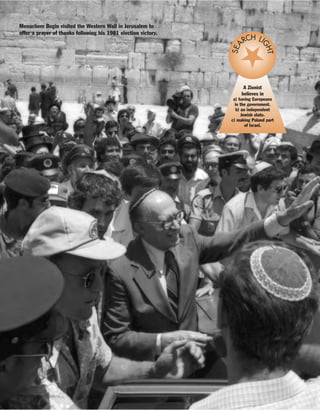
Menachem Begin visited the Western Wall in Jerusalem to
offer a prayer of thanks following his 1981 election victory.
M E N A C H E M B E G I N
35
When Menachem Begin was a little boy growing up in Poland, he
probably never imagined that someday he would lead a Jewish nation and
win a Nobel Prize for Peace.
As a young man, Menachem earned a law degree and became an active
Zionist. Members of the Zionist movement wanted to create a Jewish
community in the Middle Eastern region
of Palestine.
Germany invaded Poland early in
World War II, and the Nazis began to
persecute the Jews. Begin joined the
Polish army in exile. He went with them
to Palestine in 1942. There Begin joined a
group fighting to create a Jewish state.
However, after the creation of the State of
Israel in 1948, hundreds of thousands of
Palestinian Arabs either left or were forced off their land. This led to many
years of trouble between Israel and the Arab countries that surround it.
Begin was active in Israeli politics in the 1950s and ’60s, and in 1977
he became the country’s prime minister. By that time Israel had fought
several wars with the Arabs and had captured some Arab land. Begin
reached a peace agreement with Egyptian leader Anwar el-Sadat, returning
Egypt’s land. This earned Begin and Sadat the Nobel Prize for Peace in
1978. But Begin refused to accept the demands by Palestinians for a return
of lands that he considered part of Israel.
Four years later he ordered Israeli troops to invade
Lebanon and attack Palestinian guerrillas. The war in
Lebanon was very unpopular in Israel, and Begin stepped
down as prime minister in 1983.
LEARN MORE! READ THESE ARTICLES…
ISRAEL (VOLUME 7) • GOLDA MEIR (VOLUME 4)
ANWAR EL-SADAT (VOLUME 4)
Answer:b)anindependentJewishstate.
★
Menachem Begin in 1981.
© Bettmann/Corbis
Struggling for Israel
DID YOU KNOW?Menachem Begin and Anwar el-Sadat’s 1978 peace agreementis known as the Camp DavidAccords. Camp David is thegetaway spot where U.S.
President Jimmy Carter took thetwo men to help them worktoward peace.
©DavidRubinger/Corbis
DID YOU KNOW?
In William Shakespeare’s play Julius
Caesar, Caesar is told to “beware the
ides of March.” The ides refers to the
time around the 15th of the month.
Today those famous words are
sometimes used as a warning.
J U L I U S C A E S A R
37
Julius Caesar was a brilliant general and a gifted writer. But most
important, he helped create the ancient Roman Empire.
Early in his career Caesar formed a bond with the two most powerful
men in Rome, the wealthy Crassus and the general Pompey. In 59 BC they
helped elect Caesar as one of Rome’s two consuls,
the government’s highest rank. After a year as
consul, Caesar left Rome to govern Gaul (now
France). There he earned a reputation as a military
leader. He stopped uprisings and invasions, and he
even landed in Britain. Caesar also wrote detailed
accounts of his battles.
While Caesar was in Gaul, Crassus was killed.
Pompey now controlled Rome, and he turned against
Caesar. He declared Caesar a criminal and ordered
him to break up his army. Instead, Caesar declared
war and marched to Rome. Pompey fled to Greece.
At that time Rome was governed by a senate (a
supreme council). But Caesar felt the government was corrupt and needed
a strong leader. In 49 BC he declared himself dictator, and he spent five
years fighting a civil war against Pompey to make his rule secure. Some
of the Roman senators worried that Caesar had too much power. On
March 15, 44 BC, they murdered Caesar on the floor of the Senate.
In the short time he led Rome, Caesar proved to be a great
statesman. The changes he made helped begin the 500-year Roman
Empire. And for almost 2,000 years after his death, some world
leaders used a form of the title “caesar” (such as “Kaiser” in Germany
and “czar” in Russia).
LEARN MORE! READ THESE ARTICLES…
CHARLEMAGNE (VOLUME 4) • ITALY (VOLUME 6) • ROME (VOLUME 6)
Answer:CaesartookpowerinRomeafterdefeatingPompey,his
formerpoliticalsupporter.
★
General and Statesman
Rome’s Remarkable
By crossing over the stream known as the Rubicon in 49 BC, Caesar
basically declared war against the Roman Senate. “Crossing the
Rubicon,” the subject of this engraving, became a phrase that
means taking a step from which there’s no turning back.
© Bettmann/Corbis
Sculpture of Julius Caesar, in the
National Museum in Naples.
© Bettmann/Corbis
Fill in
the blank:
Caesar took
power in Rome
after defeating
___________,
his former
political supporter.
SEA RCH LI
GHT
DID YOU KNOW?
Castro was a very good baseball
player. It is said he once even tried
out for the Senators, a professional
baseball team in Washington, D.C.
38
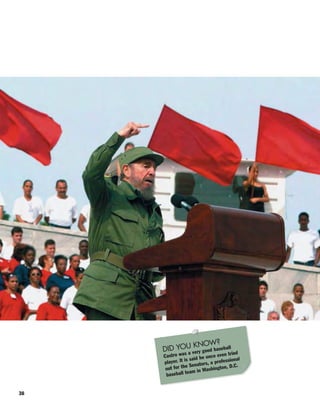
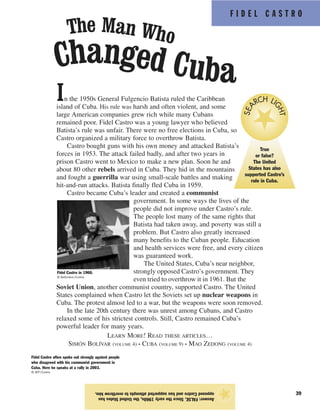
Fidel Castro often spoke out strongly against people
who disagreed with his communist government in
Cuba. Here he speaks at a rally in 2003.
© AFP/Corbis
F I D E L C A S T R O
39
In the 1950s General Fulgencio Batista ruled the Caribbean
island of Cuba. His rule was harsh and often violent, and some
large American companies grew rich while many Cubans
remained poor. Fidel Castro was a young lawyer who believed
Batista’s rule was unfair. There were no free elections in Cuba, so
Castro organized a military force to overthrow Batista.
Castro bought guns with his own money and attacked Batista’s
forces in 1953. The attack failed badly, and after two years in
prison Castro went to Mexico to make a new plan. Soon he and
about 80 other rebels arrived in Cuba. They hid in the mountains
and fought a guerrilla war using small-scale battles and making
hit-and-run attacks. Batista finally fled Cuba in 1959.
Castro became Cuba’s leader and created a communist
government. In some ways the lives of the
people did not improve under Castro’s rule.
The people lost many of the same rights that
Batista had taken away, and poverty was still a
problem. But Castro also greatly increased
many benefits to the Cuban people. Education
and health services were free, and every citizen
was guaranteed work.
The United States, Cuba’s near neighbor,
strongly opposed Castro’s government. They
even tried to overthrow it in 1961. But the
Soviet Union, another communist country, supported Castro. The United
States complained when Castro let the Soviets set up nuclear weapons in
Cuba. The protest almost led to a war, but the weapons were soon removed.
In the late 20th century there was unrest among Cubans, and Castro
relaxed some of his strictest controls. Still, Castro remained Cuba’s
powerful leader for many years.
LEARN MORE! READ THESE ARTICLES…
SIMÓN BOLÍVAR (VOLUME 4) • CUBA (VOLUME 9) • MAO ZEDONG (VOLUME 4)
Answer:FALSE.Sincetheearly1960s,theUnitedStateshas
opposedCastroandhassupportedattemptstooverthrowhim.
★
Fidel Castro in 1960.
© Bettmann/Corbis
True
or false?
The United
States has also
supported Castro’s
rule in Cuba.
SEA
RCH LI
GHT
Changed Cuba
The Man Who
DID YOU KNOW?
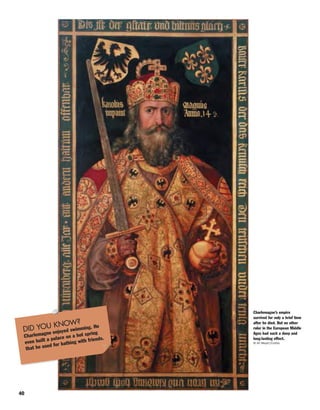
Charlemagne enjoyed swimming. He
even built a palace on a hot spring
that he used for bathing with friends.
Charlemagne’s empire
survived for only a brief time
after he died. But no other
ruler in the European Middle
Ages had such a deep and
long-lasting effect.
© Ali Meyer/Corbis
40
C H A R L E M A G N E
41
During the Middle Ages (about AD 500-1500) one of the most
powerful European kings was Charlemagne. Charlemagne was a
Frank. The Franks were a people who lived in parts of what are
now France and Germany. When he became the one and only
ruler of the Frankish lands in AD 771, Charlemagne wanted to
make his kingdom bigger and stronger. He also wanted to spread
Christianity and protect the Roman Catholic church.
With this plan in mind, Charlemagne spent 30 years battling
the Saxons, another Germanic people. In these and many other
wars, Charlemagne gained control over much of western
Europe, including what is now France, Switzerland, Belgium,
the Netherlands, and half of Italy and Germany.
In 794 Charlemagne established his capital at Aachen in western
Germany. In the year 800, the pope
crowned him emperor of the whole region.
He worked with leaders of the church to
improve the church and government. And
he sent out special agents to make sure
that his laws were being obeyed.
Charlemagne brought about many
improvements in the empire. He set up a
new money system and reformed the law
courts. He built a large court library and
set up a school at his palace court. He was
concerned with educating the ordinary people and improving the learning
of priests. He hoped education would make his people better Christians.
Charlemagne died in 814. Today he is remembered as one of the most
important rulers in European history. In fact, he’s sometimes called the
father of Europe.
LEARN MORE! READ THESE ARTICLES…
ASHOKA (VOLUME 4) • EUROPE (VOLUME 6) • MUHAMMAD (VOLUME 5)
Answer:a)pyramids
★
Which of
these did
Charlemagne
not build?
a) pyramids
b) schools
c) libraries
SEA
RCH LI
GHT
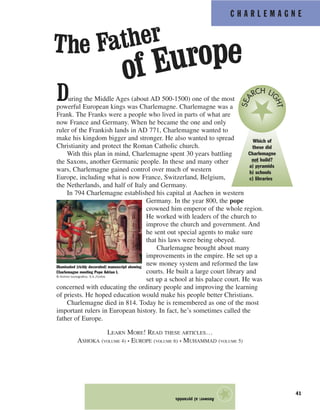
Illuminated (richly decorated) manuscript showing
Charlemagne meeting Pope Adrian I.
© Archivo Iconografico, S.A./Corbis
The Father
of Europe
42
C L E O P A T R A
43
Answer:CleopatraruledEgypttwice.
★
She spoke nine languages, was a good mathematician, and had
a great head for business. And she would use both her intelligence
and her beauty to hold on to power. Today, Cleopatra VII Thea
Philopator of Egypt is still an amazing historical figure.
Cleopatra was the second daughter of King Ptolemy XII. When
her father died in 51 BC, 18-year-old Cleopatra was supposed to rule
Egypt with her 15-year-old brother, Ptolemy XIII. In a few years,
her brother’s supporters drove Cleopatra from power. But later the
Roman leader Julius Caesar helped her get her throne back. War
soon broke out. In 47 BC Cleopatra’s brother and co-ruler
drowned. By law she couldn’t rule alone, so she married her 11-
year-old brother.
Cleopatra returned to Rome to live with Caesar and had a son by him
named Caesarion. But Caesar was murdered in 44 BC, and Cleopatra lost
her strongest supporter. She soon went back to Egypt. With Caesar dead,
the two most powerful men in Rome were Octavian and Mark Antony.
When Antony wanted to invade Persia, he invited Cleopatra to meet him.
Antony quickly fell in love with Cleopatra and married her. But he was
also married to Octavian’s sister. An angry Octavian declared war against
Antony and eventually defeated him. Antony died in Cleopatra’s arms.
Cleopatra did not want to live without Antony. The story is that she had
an asp (a kind of snake) brought to her, and when it bit her, Cleopatra died
at the age of 39. The Egyptians believed that death by snakebite made you
immortal. Cleopatra didn’t live forever, but her legend has lasted more
than 2,000 years.
Queen of Egypt
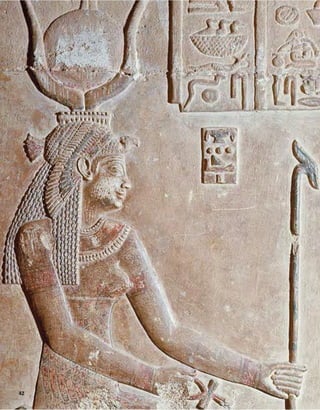
This image of the Egyptian queen Cleopatra appears on a
temple of the goddess Hathor in Dandarah, Egypt. Hathor
was the goddess of the sky, of women, and of love.
The Art Archive
How many
times did
Cleopatra
rule Egypt?
SEA
RCH LI
GHT
LEARN MORE! READ THESE ARTICLES…
JULIUS CAESAR (VOLUME 4) • EGYPT (VOLUME 8)
WILLIAM SHAKESPEARE (VOLUME 4)
DID YOU KNOW?
William Shakespeare wrote a play
about Egypt’s most famous queen,
called Antony and Cleopatra.
44
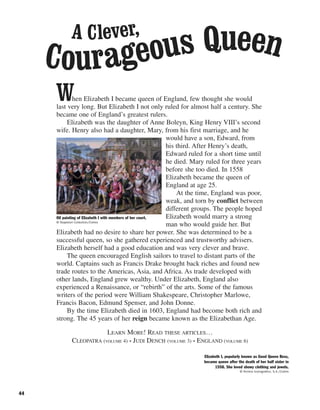
When Elizabeth I became queen of England, few thought she would
last very long. But Elizabeth I not only ruled for almost half a century. She
became one of England’s greatest rulers.
Elizabeth was the daughter of Anne Boleyn, King Henry VIII’s second
wife. Henry also had a daughter, Mary, from his first marriage, and he
would have a son, Edward, from
his third. After Henry’s death,
Edward ruled for a short time until
he died. Mary ruled for three years
before she too died. In 1558
Elizabeth became the queen of
England at age 25.
At the time, England was poor,
weak, and torn by conflict between
different groups. The people hoped
Elizabeth would marry a strong
man who would guide her. But
Elizabeth had no desire to share her power. She was determined to be a
successful queen, so she gathered experienced and trustworthy advisers.
Elizabeth herself had a good education and was very clever and brave.
The queen encouraged English sailors to travel to distant parts of the
world. Captains such as Francis Drake brought back riches and found new
trade routes to the Americas, Asia, and Africa. As trade developed with
other lands, England grew wealthy. Under Elizabeth, England also
experienced a Renaissance, or “rebirth” of the arts. Some of the famous
writers of the period were William Shakespeare, Christopher Marlowe,
Francis Bacon, Edmund Spenser, and John Donne.
By the time Elizabeth died in 1603, England had become both rich and
strong. The 45 years of her reign became known as the Elizabethan Age.
LEARN MORE! READ THESE ARTICLES…
CLEOPATRA (VOLUME 4) • JUDI DENCH (VOLUME 3) • ENGLAND (VOLUME 6)
Oil painting of Elizabeth I with members of her court.
© Stapleton Collection/Corbis
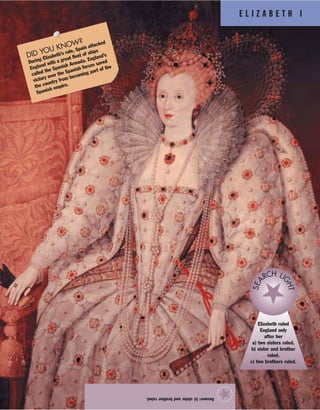
Elizabeth I, popularly known as Good Queen Bess,
became queen after the death of her half sister in
1558. She loved showy clothing and jewels.
© Archivo Iconografico, S.A./Corbis
A Clever,
Courageous Queen
E L I Z A B E T H I
Answer:b)sisterandbrotherruled.
★
Elizabeth ruled
England only
after her
a) two sisters ruled.
b) sister and brother
ruled.
c) two brothers ruled.
SEA
RCH LI
GHT
DID YOU KNOW?
During Elizabeth’s rule, Spain attacked
England with a great fleet of ships
called the Spanish Armada. England’s
victory over the Spanish forces saved
the country from becoming part of the
Spanish empire.
E M P R E S S O F C H I N A
47
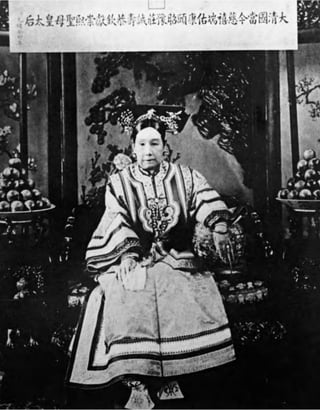
One of the most powerful women in Chinese history was
Cixi. She played a major role in ruling China for more than 40
years in the late 1800s.
Cixi lived in a group of palace buildings called the
Forbidden City, within the city of Beijing. She spoke to all her
visitors from a large red throne shaped like a dragon that was
hidden behind a silk screen. Every one of her orders ended with
the warning “Hear and obey.”
Cixi was never really an empress. She was, however, the
mother of the emperor’s only son. When the emperor died,
she helped her 6-year-old son, who was heir to the throne,
rule China. She still had power when her son was old
enough to rule by himself. Then he died, and the Dragon
Empress made sure her 3-year-old nephew became the
new emperor. Cixi helped him rule too.
During Cixi’s time the Chinese government became very dishonest.
But she did not rule alone during this time. A group of
dishonest officials helped her make decisions. When her
nephew grew up he tried to make some changes to improve
life in China. The officials were against such changes. Only
after foreign armies captured Beijing in 1900 did Cixi begin to
make things better. In 1908, when the Dragon Empress was
dying, her nephew, the emperor, also died. Some say that she
was ruthless and did not want him to rule without her so she
poisoned him. But this was never proved.
Answer:OneofthemostpowerfulwomeninChinesehistorywas
Cixi.
★
The Dragon Empress
Cixi wore solid
gold shields
on her very long
fingernails to
keep them
from breaking.
DID YOU
KNOW?
Known in the West as the Empress Dowager, Cixi controlled the
political life of China for many decades. The nation was fairly
stable under her influence, but the government was dishonest
and did not make changes that were needed to benefit the people.
© Hulton-Deutsch Collection/Corbis
LEARN MORE! READ THESE ARTICLES…
CHINA (VOLUME 7) • CLEOPATRA (VOLUME 4)
MAO ZEDONG (VOLUME 4)
Find and
correct the
error in the
following sentence:
One of the most
powerful women
in Japanese
history was Cixi.
SEA
RCH LI
GHT
48
Hirohito
ruled over the
island nation of
a) Britain.
b) Indonesia.
c) Japan.
SEA
RCH LI
GHT
H I R O H I T O
49
Michinomiya Hirohito was the last of the old-style emperors of Japan.
He helped usher in a new age for the Japanese people. He was born in
1901, and he was the first Japanese crown prince to travel abroad.
Hirohito became emperor on December 25, 1926,
after his father’s death. At that time the military was
gaining control of the government and would soon take
Japan into a major war in Asia. Eventually Japan
attacked Hawaii and the Philippines, which brought the
United States into World War II. Historians still don’t
agree about whether the emperor actually wanted a war
with the United States or if he just couldn’t stop the
military chiefs.
By 1945 Japan was nearing defeat, and Hirohito
favored ending the war. On August 15, 1945, he broadcast his country’s
surrender on the radio. It was the first time the Japanese people had heard
their emperor’s voice.
After the war Hirohito made many changes. Until then, Japanese
emperors had claimed to be descended from gods. Hirohito now gave up
this claim. The old constitution had also given the emperor highest
authority. A new constitution gave power to the people.
The emperor also started appearing before the Japanese public. He
allowed the press to photograph and write about him and his family. In
1959 he permitted his son, Crown Prince Akihito, to marry a commoner,
which was a major break with tradition. Hirohito helped
Japan build relationships with countries all over the world.
Hirohito’s health began to fail as he grew older. He died
on January 7, 1989.
LEARN MORE! READ THESE ARTICLES…
EMPRESS OF CHINA (VOLUME 4)
JAPAN: MODERN NATION OF ANCIENT TRADITIONS (VOLUME 7)
SHINTO (VOLUME 5)
Answer:c)Japan.
★
Emperor of Japan
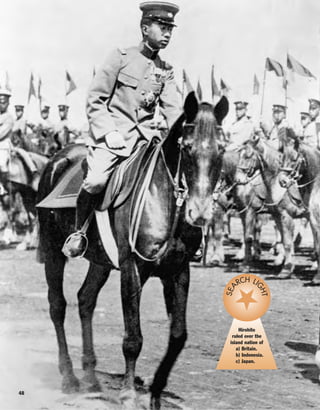
After World War II, Emperor Hirohito tried to bring the imperial family closer
to the Japanese people. He began to appear in public more often and
allowed pictures and stories of his personal and family life to be published.
© Corbis
Emperor Hirohito in 1982.
© Bettmann/Corbis
DID YOU KNOW?According to tradition, 123emperors ruled over Japanbefore Hirohito. Yet Hirohitoruled the longest—he wasthe emperor of Japan for63 years.
M O H A M M E D A L I J I N N A H
51
Mohammed Ali Jinnah was born in Karachi
in 1876. At that time the city was part of India,
and India was controlled by the British. When
Jinnah was a young man, his parents sent him to
London to gain business experience. Instead, he
studied law and learned about the British system of
government. After his studies, he returned to India and began to practice
law in Bombay (now Mumbai). It was about this time that the people of
India began to seek freedom from British rule.
For hundreds of years, Muslims and Hindus—the
area’s two major religious groups—had lived together
peacefully in India. But there were many more Hindus
than Muslims. Because of this, many Muslims feared
that they might not be treated equally once India
became an independent country.
Although Jinnah was Muslim, at first he didn’t
think there was anything to be afraid of. But as time
passed, he began to feel that the Muslims in India
should have their own country. So Jinnah began to work hard to make a
Muslim nation out of part of India’s land. The new country would be
called Pakistan.
In 1947 the British government agreed to the formation of
Pakistan. India became independent from Britain in August of that
year, and a section of the country became Pakistan. Jinnah was
chosen as Pakistan’s first head of state, but he served for only a year
before he died. Still, Jinnah’s people loved him. And because he
helped create Pakistan, Jinnah is considered the Father of Pakistan.
LEARN MORE! READ THESE ARTICLES…
MAHATMA GANDHI (VOLUME 4) • ISLAM (VOLUME 5) • PAKISTAN (VOLUME 7)
Answer:JinnahwantedtobuildacountryforMuslims.
★
Founder of Pakistan
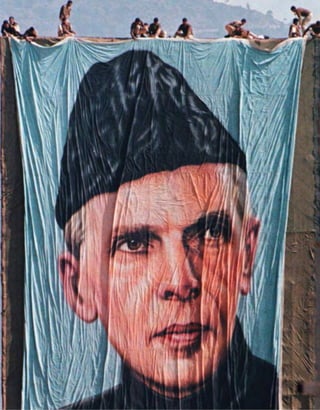
Mohammed Ali Jinnah founded the state of Pakistan in 1947.
Here, Pakistani soldiers in 1993 hang a portrait of Jinnah as
part of preparations for Pakistan Day in March.
© Reuters NewMedia Inc./Corbis
Mohammed Ali Jinnah.
© Bettmann/Corbis
For which
people did
Jinnah
want to build
a country?
SEA RCH LI
GHT
DID YOU KNOW?
When Jinnah was a law student in
London, he worked to help Dadabhai
Naoroji become the first Indian
member of the British Parliament.
DID YOU KNOW?
In 1993 Nelson Mandela and F.W. de
Klerk were jointly awarded the Nobel
Prize for Peace for getting rid of the
apartheid system.
N E L S O N M A N D E L A
53
South African leader Nelson Mandela was a fighter. He
fought against apartheid. Apartheid was an official policy of
the government of South Africa that separated people
according to their race and color.
During World War II, Mandela joined the African National
Congress (ANC), and he later became one of its leaders. This
organization had one aim: to fight for the freedom of the
black people in South Africa.
Mandela hadn’t wanted to use violence in the ANC’s
fight against the government. However, after the police
killed unarmed Africans, Mandela changed his mind. He argued for using
sabotage against the government—that is, secretly working to undermine
and destroy it. At the same time, the South African
government outlawed the ANC. In 1962 the
government decided that Mandela was guilty of acts
against the government. He was sentenced to five
years in prison. The next year, he was found guilty on
more charges and sentenced to life imprisonment.
By the 1980s more and more people had heard of
Mandela’s hopes for South Africa. They began to
campaign for his release from prison. Countries and
organizations all over the world got involved. Early in
1990 South Africa’s president, F.W. de Klerk, ordered
Mandela’s release. President de Klerk, together with Mandela, worked to
change South Africa into a country where all races would have equal rights.
South Africa held its first elections open to people of all races in 1994.
Mandela and the ANC won the elections, and Mandela became the
country’s first black president.
LEARN MORE! READ THESE ARTICLES…
MAHATMA GANDHI (VOLUME 4) • MARTIN LUTHER KING, JR. (VOLUME 4)
SOUTH AFRICA: A PEOPLE APART (VOLUME 8)
Answer:FALSE.Heservedalargepartofalifesentence—almost
30years.
★
A Fighter for
Rights
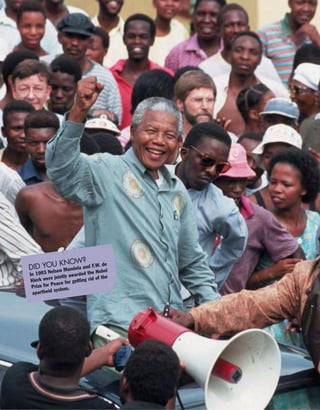
Nelson Mandela spent nearly 30 years of his life as a
political prisoner. Four years after his release, he ran for
president of South Africa. He was elected in April 1994.
© Peter Turnley/Corbis
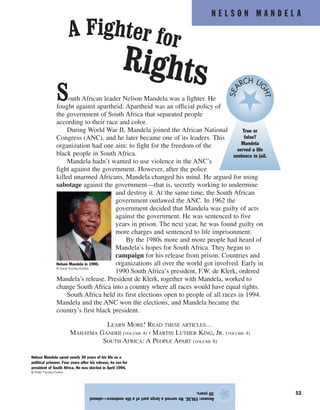
Nelson Mandela in 1990.
© David Turnley/Corbis
True or
false?
Mandela
served a life
sentence in jail.
SEA
RCH LI
GHT
54
Mao Zedong was born in 1893, in China’s Hunan province. Mao’s
father had been born a poor peasant, but he became wealthy as a farmer
and grain dealer. Only limited education was available where Mao grew
up. So at age 13 Mao left school to work on his family’s farm. He later ran
away to attend school in the provincial capital,
where he discovered new ideas from Chinese and
Western thinkers.
Mao briefly served in the army during the
Chinese Revolution (1911-12). This uprising
overthrew the ruling Manchu dynasty and turned
China into a republic. After that there were many
years of fighting between different groups who
wanted to rule China. This time was known as
the “warlord period.”
After the war, Mao returned to school, ending
up at Beijing University, where he worked in the
library. There he became involved in the May Fourth Movement of 1919.
This was the beginning of China’s turn toward communism. In
communism, property is owned by the state or community, and all citizens
are supposed to share in the nation’s wealth.
In the 1920s Mao helped found the Chinese Communist Party (CCP).
He started a communist revolution among peasants in the countryside.
The CCP split off from the Nationalist Party. The Nationalists
thought the Chinese should decide their own future, but they were
against communism. The Red Army, Mao’s military force, began
fighting them and gathering strength in the late 1920s.
Mao finally took control of the whole country in 1949 and
became the chairman of the People’s Republic of China. Although
many poor people’s lives were better under Mao, many others
suffered and died during his efforts at reform and improvement. He
died on September 9, 1976.
LEARN MORE! READ THESE ARTICLES…
CHARLEMAGNE (VOLUME 4) • CHINA (VOLUME 7)
CONFUCIUS (VOLUME 5)
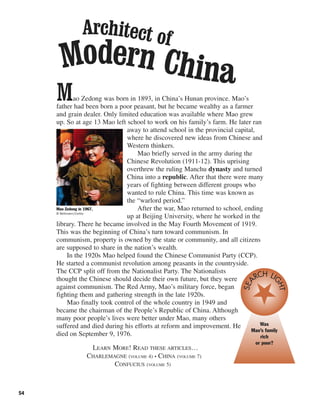
Mao Zedong in 1967.
© Bettmann/Corbis
Was
Mao’s family
rich
or poor?
SEA
RCH LI
GHT
Architect of
Modern China
M A O Z E D O N G
55
Answer:Actuallytheywereboth.Hisfatherwasbornpoorbut
laterbecameawealthyfarmerandmerchant.
★
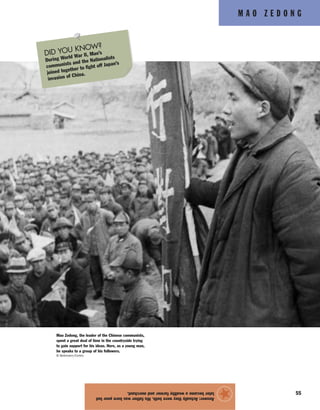
Mao Zedong, the leader of the Chinese communists,
spent a great deal of time in the countryside trying
to gain support for his ideas. Here, as a young man,
he speaks to a group of his followers.
© Bettmann/Corbis
DID YOU KNOW?
During World War II, Mao’s
communists and the Nationalists
joined together to fight off Japan’s
invasion of China.
Unscramble
the
words.
- nestseK
- stiPlateen
- rasleI
SEA
RCH LI
GHT
G O L D A M E I R
57
In 1906, when Goldie Mabovitch was a child, poverty forced her family
to move from Russia to the United States to find work. In high school, she
joined a group that wanted Jews to have their own
country. This was known as Zionism. A few years
later she and her husband, Morris Myerson, moved
to Palestine, a Middle Eastern region then under
British control.
Goldie Myerson became involved in political
activities in Palestine. She negotiated protection for
Jews who fled from Nazi Europe during World War
II. After the war, she worked to help Jewish war
refugees.
In 1948 part of Palestine became the State of
Israel, and Goldie Myerson was one of the signers of
Israel’s declaration of independence. The surrounding Arab countries attacked
Israel, but the new country defended itself and remained independent.
The next year she was elected to the Knesset, the Israeli parliament.
Later she changed her last name from Myerson to “Meir,” a Hebrew word
meaning “to burn brightly.” She also became known as “Golda” instead of
“Goldie.” Meir became the prime minister of Israel in February 1969. As
prime minister, she worked hard for peace in the Middle East and traveled
widely to meet with the leaders of many other countries.
But in 1973 Egypt and Syria’s invasion of Israel led to another Arab-
Israeli war. Though Israel eventually won the war, the whole country was
stunned by the attack. Many Israelis felt Meir’s
government was to blame, and so she resigned as
prime minister the next year.
LEARN MORE! READ THESE ARTICLES…
MENACHEM BEGIN (VOLUME 4) • ISRAEL (VOLUME 7)
JUDAISM (VOLUME 5)
Answer:Knesset,Palestine,Israel
★
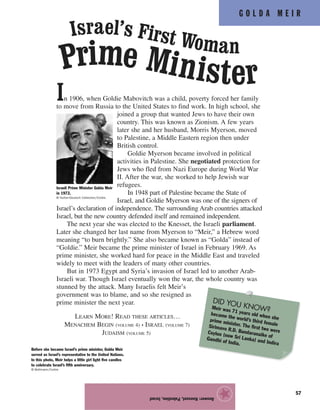
Israeli Prime Minister Golda Meir
in 1972.
© Hulton-Deutsch Collection/Corbis
Israel’s First Woman
Prime Minister
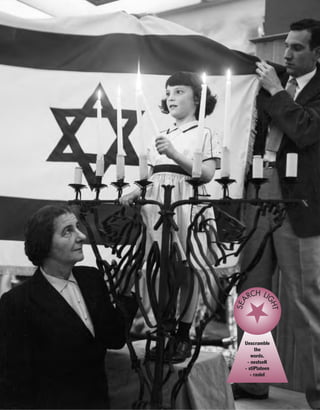
Before she became Israel’s prime minister, Golda Meir
served as Israel’s representative to the United Nations.
In this photo, Meir helps a little girl light five candles
to celebrate Israel’s fifth anniversary.
© Bettmann/Corbis
DID YOU KNOW?Meir was 71 years old when she
became the world’s third female
prime minister. The first two were
Sirimavo R.D. Bandaranaike of
Ceylon (now Sri Lanka) and Indira
Gandhi of India.
58
True or
false?
Sadat did
not want
Egypt to be run
by a king.
SEA
RCH LI
GHT
A N W A R E L - S A D A T
59
When Muhammad Anwar el-Sadat was born in 1918, Egypt was
controlled by the British and was ruled by a sultan. But Sadat would rise
to one day become Egypt’s president.
Sadat was in the military during World War II. After that he joined an
organization that wanted to overthrow the Egyptian monarchy and drive
out the British. The organization was led by
Gamal Abdel Nasser. In 1952 Nasser’s group
was successful, and Egypt gained its
independence. Nasser became the country’s
first president, and Sadat twice served as his
vice president. When Nasser died in 1970,
Sadat became president.
Egypt had lost control of the land lying
between Egypt and Israel during a war with
Israel in 1967. The two countries remained
enemies after that. In six years Sadat ordered Egyptian forces to retake this
land. Israel won the war that followed. But Sadat’s actions made him very
popular in Egypt and in other Arab countries.
Four years after the war, Sadat tried for peace with Israel. He visited
there to share his peace plan. Later he held peace talks in the United States
with the Israeli prime minister, Menachem Begin. Because of their efforts,
Sadat and Begin shared the 1978 Nobel Prize for Peace.
The next year Egypt and Israel signed a peace treaty—Israel’s first with
an Arab country. Sadat’s actions were praised around the world. But many
Egyptians and other Arabs opposed the treaty. In
1981 Sadat was killed by religious extremists
during a military parade.
LEARN MORE! READ THESE ARTICLES…
MENACHEM BEGIN (VOLUME 4) • EGYPT (VOLUME 8)
HASSAN FATHY (VOLUME 3)
Answer:TRUE.
★
Egypt’s
Man of Peace
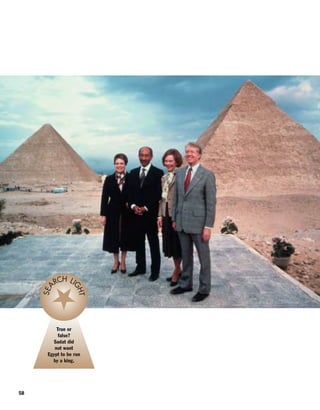
When Egypt and Israel were working to make peace, U.S.
President Jimmy Carter was a great help. Here (from left to
right) you see Sadat’s wife, Jehan, and Sadat himself, with
the U.S. first lady, Rosalynn Carter, and President Carter.
© Wally McNamee/Corbis
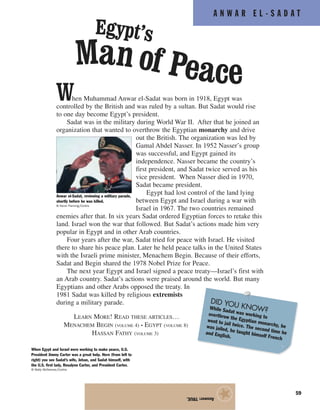
Anwar el-Sadat, reviewing a military parade,
shortly before he was killed.
© Kevin Fleming/Corbis
DID YOU KNOW?While Sadat was working to
overthrow the Egyptian monarchy, he
went to jail twice. The second time he
was jailed, he taught himself French
and English.
60
Apeacemaker has to be impartial—that is, be fair and not
take sides. U Thant was a true peacemaker. As the secretary-
general of the United Nations between 1961 and 1971, he
had the job of peacemaker among many warring countries.
U Thant was born in 1909 in Burma (now called
Myanmar). “U” is not a name but a term of respect similar to
the English “Mister.” Thant means “pure.” Thant got his
education at the University of Rangoon. It was here that he
met Thakin Nu, later called U Nu. U Nu went on to become
the prime minister of Burma after World War II.
Nu recognized Thant’s abilities and appointed him as
a spokesman for the government. Later Thant became a diplomat when he
was appointed a member of the Burmese representatives to the United
Nations (UN). In 1957 he became his country’s permanent representative
to the UN, and he later served as vice president of the UN General
Assembly.
When the UN’s leader, the secretary-general, died in 1961, the United
States and the Soviet Union could not agree on a new leader for the body.
Though neither country got their first choice, they were able
to settle on Thant as acceptable.
As secretary-general, Thant worked for peace around the
world. In 1962 he aided in the removal of Soviet missiles
from Cuba. He helped end the civil war in Congo, and he
established a peacekeeping force on Cyprus in the
Mediterranean Sea. When India and Pakistan went to war in
1965, Thant flew to India to help negotiate the cease-fire.
LEARN MORE! READ THESE ARTICLES…
NELSON MANDELA (VOLUME 4) • YANGON (VOLUME 7)
MAO ZEDONG (VOLUME 4)
World Peacemaker
True or
false?
U is
U Thant’s
first name.
SEA
RCH LI
GHT
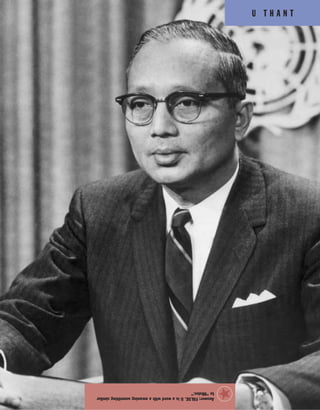
U Thant was a faithful Buddhist, and he applied a
Buddhist attitude of focus and open-mindedness
to his work at the United Nations.
© Bettmann/Corbis
In 1976 an
island in New
York’s East
River, near UN
headquarters,
was redecorated
with trees and
flowers and
named U Thant.
DID YOU
KNOW?
U T H A N T
Answer:FALSE.Uisawordwithameaningsomethingsimilar
to“Mister.”
★
62
The Vikings are coming!”
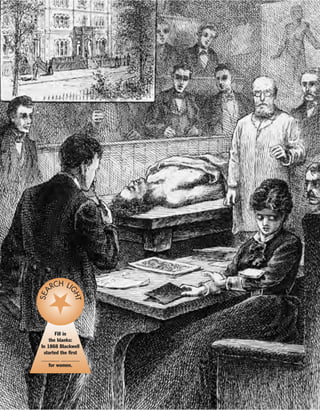
When people in the seacoast towns of northern Europe
heard this cry, some of them prepared to fight. Others took
their children, grabbed anything they could carry, and quickly
fled. A thousand years ago the arrival of Viking invaders in
a coastal town caused great fear.
The Vikings were also called Norsemen (Northmen),
because they came from Scandinavia—the area of
northern Europe that includes the modern countries of
Denmark, Norway, and Sweden. The Norsemen were
made up of pagan warriors who wanted adventure and treasures. Like
pirates, they sailed around northern Europe, fighting, killing, and stealing
in towns and villages.
Sometimes the Vikings even took captives and sailed away with them.
These captives had to serve their masters, but they often found that the
Norsemen were not so fierce at home. When they weren’t sailing on raids,
many Norsemen were farmers.
The Vikings didn’t always raid villages. Sometimes they traded with
them. The Norsemen built special large boats called longships, or “dragon
ships,” to carry goods to people in faraway lands. Vikings were brave
sailors who would sometimes sail great distances with only the Sun, Moon,
and stars to guide them.
In addition to pirating and trading, the Vikings also used their
longships for exploring. It is believed that around the year AD 1000 a
Viking named Leif Ericson sailed across the Atlantic Ocean and spent a
winter in what is now Newfoundland, Canada. This would make him the
first European to have landed in North America—about 500 years before
Christopher Columbus!
LEARN MORE! READ THESE ARTICLES…
NORTH AMERICA (VOLUME 9) • NORWAY (VOLUME 6) • SHIPS (VOLUME 2)
Men in
Dragon Ships
True or
false?
Vikings
were always
fierce.
SEA
RCH LI
GHT
“
V I K I N G S
63
Answer:FALSE.Vikingswereusuallypeacefulathome.
★
Vikings were skilled sailors who used the position
of the Sun and the stars to find their way on the sea.
Their longships, made from the wood of oak trees,
carried their goods to foreign lands.
© Bettmann/Corbis
DID YOU KNOW?A “berserker” was a Viking warrior
who wrapped himself in bearskin (or
a “bear shirt”) and fought as if he
couldn’t be harmed. Today if someone
says you’ve “gone berserk,” they
mean you’re acting crazy.
Fill in
the blanks:
In 1868 Blackwell
started the first
_______ _______
for women.
SEA
RCH LI
GHT
Elizabeth Blackwell was born in England in 1821,
but she moved to the United States with her family
when she was 11. By the time she was 23, Blackwell
had decided that she wanted to be a doctor. But at this
time there were no female doctors in the United States.
It wasn’t easy for Blackwell to study medicine.
Most of the medical colleges she applied to turned
her down. The men who taught medicine didn’t think it was right for a
woman to be a doctor. Finally Blackwell was admitted to Geneva Medical
College in New York. She was the only woman in a class of 150.
The other medical students made things difficult for Blackwell. They
criticized her, refused to talk to her, and kept her from taking part in the
classroom medical demonstrations. However, two years
later Blackwell was the best student in her class. In
1849 she became the first female doctor in the
United States.
Despite this training, Blackwell could not get a
job in any of the city hospitals. So she opened her
own hospital, the New York Infirmary for Women
and Children, in a district where many poor people
lived. When the American Civil War broke out in
1861, Blackwell’s hospital became a relief center
for wounded soldiers. She also helped select and
train nurses for the war.
Blackwell worked to establish a medical school for women so that
other women could become doctors. In 1868 she opened the Woman’s
Medical College, the first of its kind in America.
LEARN MORE! READ THESE ARTICLES…
MARIE CURIE (VOLUME 4) • MEDICINE (VOLUME 2) • LOUIS PASTEUR (VOLUME 4)
E L I Z A B E T H B L A C K W E L L
65
Answer:In1868Blackwellstartedthefirstmedicalschool(or
medicalcollege)forwomen.
★
The First Modern
Woman Doctor
Elizabeth Blackwell was not only the first American woman
doctor. She also became the first woman to have her name
placed on the British medical register. This meant she was
allowed to practice medicine in Great Britain.
© Bettmann/Corbis
DID YOU KNOW?A year after Blackwell opened her
hospital, her sister Emily went to
work with her. She too had become
a doctor.
Elizabeth Blackwell in later years.
Courtesy, Hobart and William Smith Colleges
©Corbis
66
Luther Burbank grew up on a farm in the United States. Though he had
only a high school education, he had read Charles Darwin’s ideas about
how living things change over time. Burbank wanted
to understand why different plants had their own kind of fruit and
flowers—and how they might be changed to grow better ones.
In the 1870s most people didn’t think it was possible to make new
kinds of plants. But Burbank surprised them by creating hundreds of new
varieties, including a white
blackberry so clear that you could
see its seeds through its skin.
Burbank grew a tomato on a
potato vine and called it a
“pomato.” He combined a plum
tree and an apricot tree to make a
new fruit called a “plumcot.”
Burbank produced many of
these plants by “grafting.” He
took a small twig from one plant
and put it into a cut he had made on a different plant. The plant with roots
controlled the size of the new plant, while the twig grew into
branches with flowers and fruit. Sometimes he produced
completely new kinds of plants by cross-pollination. He did this
by putting pollen from the flowers of one type of plant onto the
sticky part of the flowers of another type of plant.
Getting the new plants he wanted was not easy. The white
blackberry took Burbank 65,000 tries to get right. And he spent
eight years cross-pollinating different types of daisy to turn a
small yellowish daisy into a tall snow-white flower with a
yellow center. The result was the famous Shasta daisy.
Burbank’s work produced many useful plants. And his
experiments added greatly to the knowledge of how features
pass from parents to offspring.
LEARN MORE! READ THESE ARTICLES…
CHARLES DARWIN (VOLUME 4) • FOSSILS (VOLUME 1)
ROSE (VOLUME 10)
Inventing New Plants
Benefiting today from Burbank’s work with plants.
© Lynda Richardson/Corbis
Find and
correct the
error in the
following sentence:
Rafting is a way of
making new plants by
sticking a twig of one
plant into a cut on
another plant.
SEA
RCH LI
GHT
L U T H E R B U R B A N K
67
Answer:Graftingisawayofmakingnewplantsbystickingatwig
ofoneplantintoacutonanotherplant.
★
Do you like
french fries?
Then thank Mr.
Burbank. He
invented the
Idaho potato, a
favorite source
of fries.
DID YOU
KNOW?
68
Find and
correct the
error in the
following sentence:
Copernicus studied
the skies and finally
decided that the Sun
circles the Earth.
SEA
RCH LI
G
HT
N I C O L A U S C O P E R N I C U S
69
Hundreds of years ago many people thought that
the Earth stayed still and the Sun went around it. Then
came a man named Nicolaus Copernicus, who said that
it was the Sun that stayed still and the Earth that moved.
And he was mostly right.
Copernicus was born on February 19, 1473, in Poland.
His father died a few years after Copernicus was born,
and a wealthy uncle brought the young boy up. He sent him to the
University of Kraków to study mathematics. There Copernicus also studied
the stars and planets.
Copernicus didn’t believe that the Earth was the center of the universe
and that all the other planets and stars circled around it. He studied the sky
for years and finally decided that
the Sun sat at the center of the
universe. The Earth and the other
planets spun around the Sun.
Some of what Copernicus said
wasn’t correct. We know today
that all the planets and the stars,
including the Sun, move
constantly. We also know that the
Sun is the center not of the
universe but rather of the solar
system. Yet Copernicus was right
in some ways. It is true that the
Earth circles the Sun.
Copernicus presented his ideas in a book called On the Revolutions of
the Celestial Spheres. The book wasn’t published for 13 years because the
Roman Catholic church opposed it. It is said that Copernicus received the
first copy as he was dying, on May 24, 1543.
Answer:Copernicusstudiedtheskiesandfinallydecidedthatthe
EarthcirclestheSun.
★
Student of the Sky
An image of the solar system as Copernicus imagined it.
© Stefano Bianchetti/Corbis
Unlike most people in his day, Nicolaus
Copernicus didn’t believe that the Earth
was the center of the universe. And his
studies eventually showed that he was right.
© Bettmann/Corbis
DID YOU KNOW?
Andreas Osiander, who was in charge
of getting Copernicus’ last book
printed, made some changes and
added a note to the front saying that
the book wasn’t meant to be true—
all without the author’s permission!
LEARN MORE! READ THESE ARTICLES…
ASTRONOMY (VOLUME 2) • GALILEO (VOLUME 4)
JOHANNES KEPLER (VOLUME 4)
DID YOU KNOW?
Not only did Marie Curie win the
Nobel Prize twice, but her daughter
and son-in-law, Irène and Frédéric
Joliot-Curie, shared the Nobel Prize
in 1935.
M A R I E C U R I E
71
The French scientist Marie Curie became the first woman to
win the Nobel Prize, one of the greatest honors in the world.
What’s more, she was the first person ever to win the prize
two times.
Marie, who was born in Poland, studied science at the
Sorbonne, the great French university. She was one of the best
students there. She worked very hard, often late into the night,
sometimes eating little more than bread, butter, and tea day
after day.
Marie married Pierre Curie after completing her science
course. Pierre was also a scientist, and the two worked
together. Another scientist, named Henri Becquerel, had
already discovered that certain types of material send out tiny “bullets”
of energy all the time. Marie called this action “radioactivity.”
These strange radioactive particles were far too small to be seen,
but it was possible to take a kind of photograph of them. Marie studied
radioactivity and discovered two new elements that were radioactive,
polonium and radium.
Over the years Marie Curie’s discoveries about radioactivity have
proved extremely important in many ways. Radioactivity helps doctors
identify and treat diseases. A major form of power generation based on
nuclear energy has been developed, a process involving radioactivity. And
in geology, radioactivity is used to determine the age of ancient rocks.
Marie’s entire life was spent working for science. She fell ill and
eventually died because of working so closely with radioactive materials.
She knew about this risk, but she felt her work was too important to stop.
Marie Curie was awarded the Nobel Prize in 1903 for her work on
radioactivity and in 1911 for discovering radium.
LEARN MORE! READ THESE ARTICLES…
ATOMS (VOLUME 2) • ELIZABETH BLACKWELL (VOLUME 4)
NUCLEAR ENERGY (VOLUME 2)
Answer:TRUE.MarieCurie’sworkwithradioactivematerials
damagedherbloodandcausedherdeath.
★
©Bettmann/Corbis
Discovering a New
Kind of Science
True
or false?
Marie Curie’s
research led to
her death.
SEA
RCH LI
GHT
72
DID YOU KNOW?A skull that may be from the earliest
human ancestor was recently found in
the Sahel region of Africa. The skull is
somewhere between 6 million and 7
million years old, more than a million
years older than any found before.
C H A R L E S D A R W I N
73
All cultures tell a story about how life came to be on Earth.
Most traditions and religions tell of creation happening in a
particular event. But what does science tell us? A scientist
named Charles Darwin came up with a very different idea
about how humans and other creatures
came to be.
In 1831, at age 22, Darwin set out
from England on a scientific expedition
aboard a ship called the Beagle. He
sailed to the coast of South America
and to some Pacific islands, such as
the Galapagos.
On the trip, Darwin studied
many species, or groups, of plants and animals. He
also studied fossils—rocks that carry imprints of
ancient plants and animals. The fossils showed that
plants and animals living on Earth long ago were
different from the same types of plants and animals
that lived in his own time. Darwin wondered why
these old species had disappeared and the new species had developed.
After much thought, here’s what Darwin decided: Living things must
work hard for food and shelter, so only those that do this best will survive.
Small individual strengths, such as being bigger or faster, can be the keys
to survival. And these strengths are passed on to the individuals’ offspring.
Helpful individual differences add up over time to make the whole species
change, or evolve.
This was Darwin’s famous theory of evolution. He also believed that
over time the same species living in different surroundings could evolve
into two separate species.
Darwin published his theory in his books On the Origin of Species and
The Descent of Man. He proposed that all living things, including humans,
have slowly evolved from earlier species. Many people do not accept
Darwin’s theory. But it remains the most widely accepted scientific theory.
LEARN MORE! READ THESE ARTICLES…
LUTHER BURBANK (VOLUME 4) • FOSSILS (VOLUME 1) • GALAPAGOS ISLANDS (VOLUME 9)
Answer:Darwin’stheoryofevolutionsaysthatspeciesofliving
thingschange(orevolve)overtime.
★
©Bettmann/Corbis
The Theory of
Evolution
Darwin and his ideas being made
fun of in a magazine.
© Archivo Iconografico S.A./Corbis
Fill in
the blank:
Darwin’s theory
of evolution says
that species of living
things __________
over time.
SEA
RCH LI
GHT
74
Young Albert Einstein didn’t always do well in school. His teachers
thought he took too long to answer questions. And often they got upset
because Albert thought of questions they couldn’t answer.
The more Albert learned, the more things he
thought about. The more he thought, the more
questions he had. By age 12 he had decided
that he would solve the riddle of the “huge
world,” the universe.
Einstein thought there must be some
rules to explain why everything in the
universe, big and little, acts as it does.
How can gravity attract distant objects
through empty space? What makes tiny
atoms stick together to form all the different things there are?
He thought and thought until he believed he had some of the
answers for things that scientists had long tried to figure out,
such as what makes gravity work and how fast light can travel.
Einstein even proved such unexpected things as the fact that
light bends under the force of gravity.
You may have heard of Einstein’s famous formula E = mc2
. This
stands for a complex idea called “relativity.” But in the simplest terms
it shows that a small particle of matter is equal to an enormous quantity
of energy.
Einstein introduced entirely new ways of thinking about time, space,
matter, energy, and gravity. His ideas guided such scientific advances as
space exploration and the control of atomic energy. One of the concepts
he explained, the photoelectric effect, led to something most people enjoy
daily: television.
A Brilliant Wonderer
DID YOU KNOW?
One story about Einstein has it that
he once used a check for $1,500 as
a bookmark—and lost it.
Albert Einstein, shown here in his study, introduced
entirely new ways of thinking about time, space,
matter, energy, and gravity.
© Bettmann/Corbis
The Einstein Memorial, a sculpture
honoring the great scientist, in
Washington, D.C., U.S.
© Roman Soumar/Corbis
LEARN MORE! READ THESE ARTICLES…
ATOMS (VOLUME 2) • NUCLEAR ENERGY (VOLUME 2)
UNIVERSE (VOLUME 2)
Find and
correct the
error in the
following
sentence:
Albert Einstein
invented gravity.
SEA
RCH LI
GHT
T I T L E H E R E
75
★
Answer:AlbertEinsteinexplainedgravity.
A L B E R T E I N S T E I N
76
This fresco (a painting created on wet plaster) shows
Galileo demonstrating his version of the telescope.
© Archivo Iconografico, S.A./Corbis
DID YOU KNOW?Galileo agreed with NicolausCopernicus and Johannes Keplerthat the Earth orbits the Sun. Thisupset the Roman Catholic church,and Galileo was forced to telleveryone he was wrong.
77
G A L I L E O G A L I L E I
Galileo Galilei was born in Pisa, Italy, in 1564. As a young man he
became interested in mathematics and astronomy. He loved to experiment
and try out new ideas.
A story claims that Galileo once dropped objects of different weights
from the top of the famous Leaning Tower of Pisa. He wanted to prove that
things fall at the same speed, no matter how much they weigh. But some of
Galileo’s ideas angered other scientists, so he left
Pisa and went to Padua.
For years Galileo taught mathematics at the
University of Padua. But in 1609 his career changed
direction. Galileo heard about the telescope, a Dutch
invention that could make distant objects appear
closer. Galileo figured out how such a device would
work and then used lenses from eyeglass makers’
shops to make his own telescopes. Galileo’s
telescopes were better than most and could make
objects appear up to 20 times larger than what the
naked eye could see.
Galileo began to look up into the night sky. In
December 1609, with the help of his telescope,
Galileo learned that the Moon’s surface is rough and uneven. A
month later he discovered four moons orbiting the planet Jupiter.
Also, when Galileo studied Saturn, he noticed something
mysterious about its appearance. Later scientists would learn that
the planet’s strange look was due to its large rings.
Using his telescopes, Galileo helped change how people
looked up at space. Likewise, much of the modern science of
physics is based on his ideas—especially his ideas about how
objects of all sizes move and how helpful it is to test scientific
ideas by experimenting.
LEARN MORE! READ THESE ARTICLES…
ASTRONOMY (VOLUME 2)
NICOLAUS COPERNICUS (VOLUME 4) • ITALY (VOLUME 6)
Answer:Galileobuilthisowntelescope,whichwasan
improvementonothersbuiltearlier.
The Man Who DiscoveredOuter Space
Galileo.
© Bettmann/Corbis
Fill in
the blank:
Galileo built
his own
_____________,
which was an
improvement on
others built earlier.
SEA
RCH LI
GHT
★
In the 1940s a young English girl named Jane Goodall dreamed of living
in the African forests among the animals she’d read about. As she grew
older, Goodall began to make her dream come true.
In 1957, when she was about 23
years old, a school friend invited
Goodall to Kenya, Africa. While in
Africa, Goodall met the famous
scientist Dr. Louis Leakey. At the time,
Leakey was studying wild chimpanzees
in order to find out more about the
origins of human life. He was
impressed by Goodall’s interest in
animals and encouraged her to study
chimpanzees in Tanzania.
Some people thought that Goodall
wouldn’t last for more than a few months in the jungle among the wild
animals. But Goodall proved them wrong and ended up living in Tanzania
for 15 years. During that time, the chimpanzees slowly became used to
Goodall and finally allowed her to spend hours around them.
Being able to watch the chimpanzees up close allowed Goodall to
discover many things about the animals that people did not know. Goodall
saw chimpanzees use sticks as simple tools to draw termites and ants out of
their nests. Goodall also found that all chimpanzees are different from each
other in their behavior and natures, just like human beings.
As a child, Jane Goodall grew up reading about wild
animals. But as an adult, she ended up writing many books
of her own. In them she shared what she learned from 15
years of living with the wild chimpanzees of Africa.
LEARN MORE! READ THESE ARTICLES…
AFRICA (VOLUME 8) • APES (VOLUME 12)
CHARLES DARWIN (VOLUME 4)
78
Jane Goodall presenting a stuffed toy monkey to
United Nations Secretary-General Kofi Annan in 2002.
© AFP/Corbis
The Woman Who Lived with
Chimpanzees
Jane Goodall spent many years in Africa studying
chimpanzees. She encountered this curious chimp at the
Gombe Stream Research Center in Tanzania in 1972.
© Bettmann/Corbis
DID YOU KNOW?
Before Goodall’s studies,
scientists believed
chimpanzees were
vegetarians. But Goodall
learned that they do
sometimes hunt and eat
meat.
J A N E G O O D A L L
Answer:Tarzan,Mowgli,andDr.Dolittlealllivedwithanimals.
★
Jane Goodall
liked to
read about Tarzan,
Mowgli, and
Dr. Dolittle.
What do all three
storybook characters
have in common?
SEA
RCH LI
GHT
DID YOU KNOW?Kepler’s grave was lost during a war, but the
words he composed for his gravestone survive:
I used to measure the heavens,now I shall measure the shadows of the earth.
Although my soul was from heaven,the shadow of my body lies here.
J O H A N N E S K E P L E R
81
Johannes Kepler was born on December 27, 1571, in Germany.
He was to grow up to be an important astronomer who made many
discoveries by studying the stars. Astronomers study the movements of
planets, stars, comets, and meteors. However, for most of his life Kepler
studied and taught mathematics.
When he was 23 years old, Kepler became an official calendar maker.
Calendar making was a difficult job because certain church holy days
had to happen just as a particular star was in
a particular spot in the sky. It took a lot of
complicated math to make a calendar come
out right.
In 1597 Kepler published his first important
work, The Cosmographic Mystery. Kepler’s book
explained the distance of the planets from the
Sun. Kepler also said that all the planets revolve
around the Sun and that the Sun remains in one
position—an idea that built on those of the earlier
astronomer Nicolaus Copernicus.
In 1600 Kepler moved to Prague, where he
soon became Emperor Rudolf II’s imperial
mathematician, the most important mathematics post in Europe.
Kepler discovered that Mars’s orbit is an ellipse (an oval-like
shape) rather than a circle. He also gave important laws for the
motion of all of the planets around the Sun.
Kepler’s scientific work was focused on astronomy. But he
also studied other sciences and mathematics so he could learn
everything possible about the stars.
LEARN MORE! READ THESE ARTICLES…
CALENDAR (VOLUME 2) • NICOLAUS COPERNICUS (VOLUME 4)
GALILEO (VOLUME 4)
Answer:c)math.
★
Stargazer
Diagram of Kepler’s first model of the
universe.
© Bettmann/Corbis
Johannes Kepler became the official mathematician
to Emperor Rudolf II. This picture shows him explaining
some of his discoveries to the emperor.
© Bettmann/Corbis
Kepler was
teacher of
a) science.
b) German.
c) math.
d) astronomy.
SEA
RCH LI
GHT
DID YOU KNOW?
The story of Newton and the apple
is a good one, but it is not true. Like
George Washington and his cherry
tree, the apple story is just a good
way to remember something
important about someone famous.
S I R I S A A C N E W T O N
83
When you throw a ball into the air, do you wonder why it always comes
back down? Why doesn’t it keep going up?
One man did more than wonder. He was Sir Isaac Newton.
There is a story that as Newton sat under an apple tree, an apple struck
him on the head. He wondered why the apple fell down instead of up. Was
some force that no one could see pulling the apple to the ground?
Actually, it was Newton’s observation of the
motions of the planets that contributed most
importantly to his great discovery: the Law of
Universal Gravitation. This “natural law” helps
explain how the Earth and the Moon and the planets
keep from bumping into each other. It explains why
things feel light or heavy and what makes them fall
to the ground.
What Newton decided was that everything has
gravity. And every object’s gravity has a pull on
everything else around it. Heavy things pull harder
than light ones.
Newton figured out many other things too. Did you know that
white light is actually made of seven colors? They are the colors that
make up a rainbow. Newton discovered that. He let the light pass
through a prism, and the seven colors all came out separately. He
then let the colors pass through another prism and they combined
back into white light.
Newton’s investigations also led him to invent the first reflecting
telescope, which uses mirrors to gather light to improve a telescope’s
capability. His design is still used by amateur telescope makers.
Isaac Newton, one of the greatest scientists who ever lived, died
in 1727 and was buried in Westminster Abbey in London, England.
He was the first scientist to be honored this way.
LEARN MORE! READ THESE ARTICLES…
GRAVITY (VOLUME 2) • RAINBOWS (VOLUME 1) • TELESCOPES (VOLUME 2)
Answer:Newton’stheoryofgravitation(orgravity)helpedexplain
howtheplanetskeepfrombumpingintoeachother.
★
An Apple, an Idea
Newton’s reflecting telescope,
made in 1668.
© James A. Sugar/Corbis
Sir Isaac Newton’s theory of gravity
contributed to his lasting reputation as
one of the greatest scientists of all time.
© Bettmann/Corbis
Find and
correct the
error in the
following sentence:
Newton’s theory of
reflecting telescopes
helped explain how
the planets keep
from bumping into
each other.
SEA
RCH LI
GHT
DID YOU KNOW?
In 1868 Pasteur saved the French
silk industry. These businesses were
facing ruin because a mysterious
disease was attacking the silkworms.
Pasteur worked out a way of detecting
the disease and preventing it from
spreading.
85
In the 1800s, the bite of a rabid dog meant certain death for
the person bitten. In 1885, when a rabid dog bit a boy named
Joseph Meister, his mother was desperate. She went to Louis
Pasteur, a French chemist and biologist, the only man who she
thought might be able to cure her son.
Pasteur had found that rabies was caused by a virus—a
disease-causing agent so small it could not be seen even
under a microscope. He had already figured out a way to
defeat the rabies virus in animals. But he had never tried
his treatment on humans. Pasteur treated the child, and
Joseph was the first person to be cured of rabies.
Pasteur had devoted his life to solving the problems of industry,
farming, and medicine. He figured out that if a liquid like milk is heated to
a certain temperature for a few minutes, it takes
longer to spoil. If milk is not treated in this way,
tiny living organisms called “bacteria” cause it to
rot. These organisms are killed with heat in a
process that came to be known as “pasteurization.”
Pasteur also discovered that other diseases are
caused by germs that enter the body from outside.
In 1877 he sought a cure for anthrax, a disease that
affects the lungs and kills cattle and sheep. Pasteur
successfully developed the method known as
“immunization.” Immunization means giving the
patient a weak dose of a virus that the patient can
fight off. Then the patient’s body knows how to stop an actual case of the
disease.
LEARN MORE! READ THESE ARTICLES…
ELIZABETH BLACKWELL (VOLUME 4) • MARIE CURIE (VOLUME 4)
MEDICINE (VOLUME 2)
The Man Who Conquered
Disease
Scientist Louis Pasteur.
© Hulton-Deutsch Collection/Corbis
Louis Pasteur’s discoveries are among the most important
in the history of medical science. He is often known as the
founder of microbiology—the study of simple life forms
too small to be seen with the naked eye.
© Hulton-Deutsch Collection/Corbis
Pasteurization
refers to
a) a disease-
causing organism.
b) a weak dose
of a disease.
c) heating something
to kill bacteria.
SEA
RCH LI
GHT
L O U I S P A S T E U R
Answer:c)heatingsomethingtokillbacteria.
★
86
When gold was discovered near the Cherokee Indian territory
in Georgia, the U.S. government drove the Native Americans
from their land to new territory. Here, Cherokee dancers
perform at a modern gathering that preserves Indian traditions,
the Chehaw National Indian Festival in Albany, Georgia.
© Kevin Fleming/Corbis
Which
Native American
group uses adobe
to build houses?
a) Plains Indians
b) Pueblo Indians
c) Northwest Coast
Indians
SEA
RCH LI
GHT
DID YOU KNOW?
It was Christopher Columbus
who gave the Native Americans
the mistaken label “Indians.”
When he landed in what are
now the Bahamas, he thought
he had reached the area of
south and southeast Asia called
India, the Indies, or the Indias.
A M E R I C A N I N D I A N S
87
Indians, or Native Americans, lived in North America long before
Europeans even knew the continent existed. The Indians lived everywhere,
and today many places such as Michigan, Illinois, Lake Huron, and the
Mississippi River are known by their Indian names.
Each group of Indians lived differently, depending on the land around
them. Eastern America had many lakes, rivers, and vast forests. The
Indians there lived in villages, often in wooden
houses. The men were hunters, and the women
were farmers.
In the West, the Plains Indians lived on
large rolling areas of grassland. Bison
(sometimes called “buffalo”) wandered the
plains in large herds, and hunting them gave
the Indians everything they needed to survive.
These Indians didn’t stay in one place but
followed the bison’s migration.
The Southwestern states were dry and
mountainous. The Pueblo Indians were farmers
and lived in stone and adobe (sun-dried clay)
houses. They also built cave houses on the sides of cliffs, high on the faces
of mesas.
The Northwest Indians lived along the northern coast of the Pacific
Ocean and fished in the ocean and rivers. They created tall painted totem
poles showing important animals and ancestors.
When Europeans arrived in the Americas, they wanted the New
World’s land, so they often betrayed and attacked the Indians and stole
their lands. For many years, many descendants of the original Native
Americans have lived on reservations—areas put aside by the government
for Indians to live on. But this arrangement has mostly served to isolate
Native Americans. Today Indians must work hard to keep their ancient
culture and traditions alive.
LEARN MORE! READ THESE ARTICLES…
AKLAVIK (VOLUME 9)
A CHEROKEE STORY: WHY POSSUM’S TAIL IS BARE (VOLUME 5)
UNITED STATES: A YOUNG AND POWERFUL NATION (VOLUME 9)
Answer:b)PuebloIndians
★(Left) Native American children in traditional dress.
(Right) Portrait of Cherokee warrior Austenaco.
The First Native
North Americans
©PeterTurnley/Corbis
©Corbis
DID YOU KNOW?The money in Venezuela is named for
the South American liberator Simón
Bolívar. It’s called the bolívar.
S I M Ó N B O L Í V A R
89
In the early 1800s, in the country that would become
Venezuela, there lived a man with a big dream. He wanted the
countries of Spanish South America to become independent from
Spain and join together as one strong country.
This man was Simón Bolívar. For years he fought the Spanish in
support of this dream, and many people came to help him from
around the world. Many of them sailed from Europe and searched
all over South America to find him.
Bolívar was born in 1783. His liberation of New Granada—
now Colombia, Ecuador, and parts of several other countries—
is one of the most daring acts in the history of war. In the
spring of 1819, he led a small army of 2,500 men through floodwaters and
across icy mountain passes, through places where
there were no paths at all. Tired and hungry, they
finally arrived in Boyacá, near Bogotá, the capital of
New Granada. There they surprised a big Spanish
army. Fighting fiercely, they beat the Spanish and
freed New Granada.
Bolívar fought many battles to free other
countries in South America, including his native
Venezuela. His dream of freeing the South American
countries from Spain came true. But even if he was
never able to join all the different countries together
as one nation, he was one of the most important
heroes in South America. The South American country of Bolivia was
named in his honor.
LEARN MORE! READ THESE ARTICLES…
FIDEL CASTRO (VOLUME 4) • COLOMBIA (VOLUME 9) • SOUTH AMERICA (VOLUME 9)
Answer:FALSE.Hedid,however,helpfreemanynationsfrom
Spanishrule.
★
Hero of
Many Nations
In addition to the countries that are now Colombia
and Ecuador, Simón Bolívar and his troops won the
independence of Venezuela and Peru.
© Bettmann/Corbis
Portrait of Simón Bolívar
by M.N. Bate.
© Bettmann/Corbis
True or
false?
Bolívar made all
of South America
come together
as one nation.
SEA
RCH LI
GHT
A new English
translation of
Anne Frank’s
diary was
published in
1995. The new
edition has
material that was
not in the
original version,
making it nearly
one-third longer.
DID YOU
KNOW?
True
or false?
Anne Frank
went on to
write many other
famous books.
SEA
RCH LI
GHT
A N N E F R A N K
91
During World War II in Europe, the Nazis of Germany tried to destroy
the Jewish people and their culture. The Nazis had taken control of many
countries, including the Netherlands. In
the city of Amsterdam, the Nazi threat
meant that a young Jewish girl and her
family had to spend two years in hiding.
Anne Frank’s moving diary of those years
in hiding has since become a classic book.
Halfway through the war, the Nazis
began sending Jews to prison camps. So
in July 1942, Anne’s family went into
hiding in the back-room office and
warehouse of Anne’s father’s business.
Four other Jews hid with them in the small space, and non-Jewish friends
smuggled food and other supplies to them.
Anne was 13 when she went into hiding. In her diary, she describes
daily life in the secret rooms. She also writes about her own dreams and
feelings while growing up in hiding.
The family never once left their hideout until the Nazi police
discovered them in August 1944. Then the Frank family was moved to the
concentration camp at Auschwitz in Poland, where Anne’s mother died in
1945. Anne and her sister were sent to another camp, Bergen-Belsen,
where they both died of typhus. Anne’s father, Otto Frank, was the only
family member who survived.
Friends had found Anne’s diary in the hiding space. After the war, they
gave it to her father, and he published it in 1947. Since then, Anne’s story
of courage and hope has inspired millions of readers. Today, the Frank
family’s hiding place in Amsterdam is a museum.
LEARN MORE! READ THESE ARTICLES…
AMSTERDAM (VOLUME 6) • GERMANY (VOLUME 6) • JUDAISM (VOLUME 5)
Answer:FALSE.AnnediedduringWorldWarII,andherdiaryis
theonlywritingofhersthatsurvived.
★
Anne Frank.
Anne Frank House, Amsterdam and Anne Frank-Fonds,
Basel—Hulton/Archive by Getty Images
Anne Frank sits at her desk at school in 1940.
She left school at the age of 13 to go into hiding.
Anne Frank House, Amsterdam and Anne Frank-Fonds,
Basel—Hulton/Archive by Getty Images
A Young Girl
and Her Diary
92
When she won the 400-meter world championship in 1997, Cathy
Freeman ran a victory lap carrying two flags. One was the flag of her
country, Australia. The other was that of her people, the Aboriginals.
The Aboriginals are the original people of Australia, who have
suffered great mistreatment and injustice since the Europeans came
to their country. Her choice to carry both flags was controversial.
But it showed Freeman’s strong sense of national and ethnic pride.
While Freeman was growing up in
Queensland, her father encouraged her
to start running. By the time she was 17,
Freeman had won a gold medal at the 1990
Commonwealth Games and been named Young
Australian of the Year. In 1992 she was the first
Australian Aboriginal woman to compete in the
Olympic Games.
At the 1994 Commonwealth Games,
Freeman took home gold medals in the 400-
meter and 200-meter races. Her win in the 200-
meter race set a national record. Perhaps
Freeman’s greatest race was at the 1996 Olympic
Games in Atlanta, Georgia, U.S. She ran against the world record holder,
Marie-José Pérec of France. The two champions raced neck and neck.
Finally, it was Pérec who shot ahead to the finish line.
In 1997 Freeman was named Australian of the Year. A year later,
however, she injured her foot and had to withdraw from the
Commonwealth Games. Freeman didn’t let the injury stop her, and in
1999 she was running again. She came back and successfully defended
her 400-meter world championship title. At the Sydney Olympics in 2000,
Freeman had the great honor of lighting the Olympic torch. A week later
her dream of Olympic gold came true when she won the 400-meter race in
front of her fellow Australians. Again she took her victory lap proudly
carrying both the Australian and Aboriginal flags.
LEARN MORE! READ THESE ARTICLES…
AUSTRALIA (VOLUME 7) • PELÉ (VOLUME 4) • KATH WALKER (VOLUME 3)
Cathy Freeman holding the Olympic
torch in 2000.
© Reuters NewMedia Inc./Corbis
Cathy Freeman was the first Aboriginal to win an individual
medal in an Olympic event. She won the 400-meter race at the
2000 Olympics in Sydney, Australia.
© Duomo/Corbis
Gold Medalistin Track
How many
Olympic Games
has Freeman
competed in?
a) 1
b) 2
c) 3
SEA
RCH LI
GHT
C A T H Y F R E E M A N
93
Answer:c)3
★
DID YOU KNOW?
In a rush to get to her first track
race, 8-year-old Cathy Freeman ran
into a post and hurt her eye. She ran
her first race with one eye closed and
won it easily.
True or
false?
Gandhi’s
real name was
Mahatma.
SEA
RCH LI
GHT
M A H A T M A G A N D H I
95
In March of 1930, a 61-year-old Indian man started
out on a long walk to the ocean. When people asked
where he was going, Mohandas (“Mahatma”) Gandhi
replied, “I am going to the ocean to get some salt.”
Soon thousands joined him in a trip that lasted a
month and became known as the Salt March.
Mohandas K. Gandhi was a Hindu Indian who
had studied law in London. India was controlled by Britain, and when
Gandhi returned home he was angered by the poverty and inequality he
saw in his country. Rather than fight the British with guns or bombs,
Gandhi believed in simply refusing to obey unjust
laws. For example, he urged Indians to make their
own clothing so they wouldn’t have to buy British
goods. Hindus began to call Gandhi “Mahatma,”
which means “great soul.”
Most Indians could not afford to buy expensive
British salt, but it was against the law for them to
make their own. So Gandhi walked 200 miles to the
ocean to make salt from seawater. After the Salt
March, the British put Gandhi in jail. It wasn’t the
first or the last time he was jailed for leading
nonviolent protests. Gandhi went to jail cheerfully. When he came out, he
went back to teaching Indians how to get back control of their country by
peaceful actions. India finally won independence from Britain in 1947.
After India became independent, there was violence between the
country’s Hindu and Muslim populations. During the last year of his life,
Gandhi worked to build peace between all the peoples of India.
LEARN MORE! READ THESE ARTICLES…
INDIA (VOLUME 7) • MARTIN LUTHER KING, JR. (VOLUME 4)
RABINDRANATH TAGORE (VOLUME 3)
Answer:FALSE.Mohandaswashisname.Mahatmawasatitleof
respect.
★
Mahatma Gandhi.
© Bettmann/Corbis
Salt and Empires
Mahatma Gandhi, leader of the Indian nonviolent protest,
marches with supporters to the shore at Dandi to collect salt
in violation of the law. Following this action, he was jailed.
© Bettmann/Corbis
DID YOU KNOW?In the Hindi language, Gandhi’s
principle of nonviolence is known as
satyagraha. The word means “truth
force.”
96
True or
false?
Helen Keller
was born deaf
and blind.
SEA
RCH LI
GHT
Helen Keller (on the left) is shown here
reading the lips of her teacher, Anne Sullivan
(on the right). Sullivan stayed with her pupil
from 1887 until her own death in 1936.
© Corbis
Woman of Courage
H E L E N K E L L E R
97
Helen Keller became blind and deaf soon after she was born, but she
still managed to learn to read, write, and speak.
Helen was born in Alabama in the United States in 1880. At 19 months
old she fell ill, probably with scarlet fever. She recovered, but lost her
eyesight and hearing. Since she couldn’t hear other
people, she didn’t learn to speak.
When Helen was 6 years old, Alexander
Graham Bell examined her. He was a doctor for
speech correction as well as being the inventor of
the telephone. Bell sent a special teacher, Anne
Sullivan, to stay with Helen as her governess.
Sullivan was herself a remarkable woman. She
was very patient and taught Helen that things had
names. She taught Helen to finger spell the
alphabet. By using finger spelling on Helen’s palm,
Sullivan helped Helen understand names for things
that she could feel.
Helen was a hard worker and soon learned to
read a form of the alphabet with her fingers. She started to read by feeling
raised letters and words on cardboard. Later she learned Braille, a system
of writing that many blind people use. Another teacher, Sarah Fuller, taught
Helen to speak by having her feel people’s lips and throats as they were
talking.
Despite her blindness, Helen Keller wrote numerous articles and
several books, including The Story of My Life and
Helen Keller’s Journal. Her early life with Anne
Sullivan is the subject of a well-known play and film
called The Miracle Worker.
Helen Keller died when she was 88 years old.
She is remembered as a woman of great courage
and intelligence.
Answer:FALSE.HelenKellerbecamedeafandblindafteran
illnesswhenshewasalmost2yearsold.
★
DID YOU KNOW?As an adult, Helen Keller lectured
all over the world. And her efforts
to improve the treatment of deaf
and blind people helped to stop the
practice of putting people with
physical disabilities into asylums
for the mentally ill.
Helen Keller in her later years.
EB Inc.
LEARN MORE! READ THESE ARTICLES…
ELIZABETH BLACKWELL (VOLUME 4)
BRAILLE (VOLUME 2) • SIGHT AND SOUND (VOLUME 2)
On December 1, 1955, in Montgomery, Alabama, U.S., an
African American woman named Rosa Parks was arrested. She had
refused to give up her seat on a bus to a white man. At that time
the law said that black people had to sit only in certain sections of
trains and buses and use different
bathrooms and even drinking
fountains from the ones white
people used. Rosa Parks’s action
sparked protests by black
residents of the city. And Martin
Luther King, Jr., was chosen to
lead the protests.
King was a Baptist minister and a
student of the Indian leader Mahatma
Gandhi. He believed that nonviolence
was the most powerful way for people to make their point. This meant
demanding one’s rights through peaceful means, such as strikes and
protests, not by fighting. The protests he led became known as the
Montgomery bus boycott. The law was changed after a year of protests.
However, black people still didn’t receive the same rights and
privileges as white people. In 1963 King and his supporters were jailed
because of their protests against this discrimination. When he was freed,
King and other civil rights leaders organized a march on Washington,
D.C., the national capital. There, King delivered a powerful speech to
hundreds of thousands of people, saying, “I have a dream.” His dream was
that someday all people would be equal, like brothers.
For his work on civil rights, King was awarded the Nobel Prize for
Peace in 1964. Through all his struggles, King used only peaceful
methods of protest. But in April 1968, King was shot dead in Memphis,
Tennessee, by James Earl Ray.
LEARN MORE! READ THESE ARTICLES…
GWENDOLYN BROOKS (VOLUME 3) • NELSON MANDELA (VOLUME 4)
UNITED STATES: A YOUNG AND POWERFUL NATION (VOLUME 9)
98
True
or false?
Martin Luther
King, Jr., sparked
the Montgomery
bus boycott.
SEA
RCH LI
GHT
Civil Rights Leader
Martin Luther King, Jr., riding a bus in Montgomery,
Alabama, U.S., in 1956.
© Bettmann/Corbis
©Bettmann/Corbis
M A R T I N L U T H E R K I N G , J R .
Answer:FALSE.RosaParkssparkedtheboycottwhensherefused
togiveupherseat.
★
Martin Luther King, Jr., led the march on
Washington in 1963. His protests helped
win important rights for African Americans.
DID YOU KNOW?
In 1977, King was posthumously (after
his death) awarded the Presidential
Medal of Freedom. This is the U.S.
government’s highest honor awarded
to a person not in the military.
DID YOU KNOW?
The Strait of Magellan isn’t all that’s
been named for the famous explorer.
Magellan’s name remains a popular
choice for other things. For instance,
the space mission begun in 1989
to explore planet Venus was called
Magellan.
F E R D I N A N D M A G E L L A N
101
Hundreds of years ago, only the very brave took the risk of traveling the
open seas to reach unknown lands. Ferdinand Magellan was one such man.
Magellan was born to a noble family in Portugal in about 1480. At
about age 25, he joined the Portuguese navy, where he fought in numerous
battles and saw many new places. When
the king of Portugal refused to raise his
wages after a decade of service, Magellan
went to work for the Spanish king.
At that time Portugal controlled the
sea route around Africa to the Indian
Ocean to reach the rich Spice Islands (now
called the East Indies). Magellan decided
to avoid that route, and instead he sailed
west to find a new way to the islands. He
set out in 1519, sailing across the Atlantic
Ocean and down the coast of South America. He hoped to discover a
passage to the ocean beyond South America. He found it, and it became
known as the Strait of Magellan. The ocean on the other side
appeared calm and peaceful, so it was named the Pacific, from the
Latin word for “peaceful.”
After 99 more days, Magellan’s ship reached the island now
known as Guam. Landing in the islands that became the
Philippines, Magellan and his men fought with islanders. Magellan
was killed there April 27, 1521.
A crewman, Juan Sebastián de Elcano, took command. The
remaining crew sailed to the Spice Islands, loaded up with spices,
and returned to Spain. In a voyage of more than three years that
saw the death of many sailors, Magellan’s expedition became the
first to circle the globe.
LEARN MORE! READ THESE ARTICLES…
PACIFIC OCEAN (VOLUME 1) • PHILIPPINES (VOLUME 7) • PORTUGAL (VOLUME 6)
Answer:utgroPal=Portugal
ciSpesladIns=SpiceIslands
fiPicacnOace=PacificOcean
★
An illustration of Ferdinand Magellan’s ship
Victoria.
Collection of the Bibliotheque Nationale; photo, © Erich
Lessing/Art Resource, New York
Around-the-World
Voyager
Unscramble
these words:
- utgroPal
- ciSpe sladIns
- fiPicac nOace
SEA
RCH LI
GHT
This painting from 1970 shows the Portuguese
explorer Ferdinand Magellan. He led an expedition that
was the first to travel all the way around the Earth.
The Art Archive/Marine Museum, Lisbon/Dagli Orti
102
Thousands of years ago there were people who built huge pyramids
and temples. They had accurate calendars, did complex mathematics, and
developed a writing system. They weren’t the Egyptians, however. They
were the Maya. They were the only
Central Americans of their time to
develop writing.
Mayan culture grew up in a
region of Mexico and Central
America called Mesoamerica. This
includes the Yucatán Peninsula,
parts of southern Mexico,
Guatemala, Belize, and western
Honduras and El Salvador.
Between about AD 200 and 900,
the Maya built religious centers and cities from the jungles of Guatemala
to the dry northern Yucatán in Mexico. These included Tikal, Uaxactún,
and Palenque. The cities had populations of 5,000 to 50,000 people.
The Maya worshiped several gods and even offered human sacrifices.
Many of their buildings are decorated with the face of Chac, the rain god.
He was an important god in their farming society. Mayan rulers were
considered to be the descendants of gods.
Most of the Maya were corn farmers. The upper classes were artists,
writers, and architects. They developed a hieroglyphic (picture-based)
writing system and a 365-day solar calendar. They were good
astronomers, charting the movements of the planets through the night sky.
No one knows why Mayan culture faded. The cities began emptying
out after AD 900, and they were entirely empty by the time the Spaniards
arrived in the 16th century. They stood overgrown by jungle until they
were rediscovered in the 19th century. The decline may have been because
of overuse of the farmland, overpopulation, weather changes, disease, or
war—or a combination of these things.
LEARN MORE! READ THESE ARTICLES…
AMERICAN INDIANS (VOLUME 4) • CENTRAL AMERICA (VOLUME 9)
MEXICO (VOLUME 9)
Temple of the Giant Jaguar at Tikal, Guatemala.
© Jan Butchofsky-Houser/Corbis
Writers, Mathematicians,
and Architects
M A Y A N C I V I L I Z A T I O N
103
Answer:Nooneisreallysure.However,itmayhavebeenbecause
ofoveruseoffarmland,overpopulation,climatechanges,disease,
orwar—orperhapsacombinationofthese.
★
Why did the
ancient Mayan
civilization fade?
SEA
RCH LI
GHT
The Mayan civilization had more than 40 cities at the height of
its power. Those cities were all abandoned by the early 16th
century. Their remains can be seen in the jungles of Guatemala.
© Charles and Josette Lenars/Corbis
DID YOU KNOW?
Today many Maya Indians live in
northern Yucatán, Mexico, and in
highland Guatemala, just as their
ancestors did.
104
More than any other player, Pelé helped make association
football, also known as soccer, popular over the whole world. Pelé,
whose real name is Edson Arantes do Nascimento, was born in 1940
in Brazil.
Pelé made his debut with the Santos Football Club in 1956.
With him playing forward, the team won several South American
cups. In 1962 the team won the
first world club championship.
Pelé also played on Brazil’s national team
and helped it win the World Cup
championship in 1958, 1962, and 1970.
Pelé was a brilliant player who
possessed great speed and balance. He
could guess the moves of other players and
had good control of the ball. In addition to
all this, he could powerfully shoot a ball
straight into the goal with either foot or
with his head.
Pelé scored a career total of 1,281
goals in 1,363 matches, with 139 in one
year alone. He scored his thousandth goal in 1969. Pelé’s career made
him a national hero in Brazil. His fans called him Pérola Negra, meaning
“Black Pearl.”
Although Pelé retired in 1974, he made a comeback the next year with
a New York team, the Cosmos. He said he returned to “make soccer truly
popular in the United States.” He succeeded, becoming a star in the United
States as well.
Pelé’s skills did not stop with football. He also wrote best-selling
autobiographies, starred in several films, and composed music, including
the whole soundtrack to the 1977 film Pelé.
LEARN MORE! READ THESE ARTICLES…
BRAZIL (VOLUME 9) • CATHY FREEMAN (VOLUME 4) • TENZING NORGAY (VOLUME 4)
Pelé holding international football award for
“Footballer of the Century.”
© AFP/Corbis
Football Star
Pelé played
for which
country?
a) Brazil
b) Peru
c) Colombia
SEA
RCH LI
GHT
P E L É
105
Answer:a)Brazil
★
DID YOU KNOW?When Pelé first tried out for the topfootball teams in Brazil, he wasturned down repeatedly.Pelé in action was so magical to watch that once two
armies stopped fighting just to watch him play.
© AFP/Corbis
M O T H E R T E R E S A
107
Answer:No.MotherTeresawasborninMacedonia,nearGreece.
ButshelivedandworkedinIndiaandbecameanIndiancitizen.
★
During her lifetime Mother Teresa became known worldwide for
her kindness and her charitable work.
Mother Teresa was born Agnes Gonxha Bojaxhiu in Macedonia
in 1910. When she was 18 years old, she decided to become a nun in
the Roman Catholic church. She traveled to Ireland, and there she
entered the Institute of the Blessed Virgin Mary. She took vows
promising to live a simple life and not to marry, and she became
Sister Teresa.
The Institute had charity missions in India, and soon Sister
Teresa sailed to the country to work as a teacher. Over the next
17 years, she taught in two schools in India, one of which was in Calcutta
(now Kolkata). She saw firsthand the poverty and suffering of the people.
She often said that she was inspired to make two important decisions in her
life. One was to become a nun, and in 1946 the other was to devote her life
to helping the sick and the poor.
As soon as her studies in nursing were finished, she began working
with the people living in Calcutta’s slums. She became an Indian citizen.
And she became Mother Teresa when she founded the Missionaries of
Charity. This was a new order of Roman Catholic nuns who wanted to
help the sick, especially the dying and disabled.
Under Mother Teresa’s guidance, the Missionaries of Charity opened
centers all over the world. In these centers anyone could receive care, no
matter what their religion. In 1979 Mother Teresa was awarded the Nobel
Prize for Peace. Soon after her death, in 1997, the Roman Catholic church
began the process to have Mother Teresa declared a saint.
LEARN MORE! READ THESE ARTICLES…
ELIZABETH BLACKWELL (VOLUME 4)
INDIA (VOLUME 7) • MEDICINE (VOLUME 2)
Mother Teresa lived in poverty with some of India’s
poorest people. She made it her life’s work to care
for the country’s poor and dying.
© Bettmann/Corbis
DID YOU KNOW?When Mother Teresa founded herreligious order, the Missionaries ofCharity, her Indian nuns adopted thesari as their habit, or official dress.The sari is a garment worn by mostwomen of India, Pakistan, andBangladesh.
Mother
of the Poor and Dying
Was
Mother Teresa
Indian
by birth?
SEA
RCH LI
GHT
108
On May 29, 1953, at 11:30 AM, Tenzing Norgay
and Edmund Hillary became the first people to
reach the summit of the highest mountain on
Earth, Mount Everest.
Tenzing Norgay was born in 1914 in Tibet (a
region of China). He later moved to Nepal and lived with
the Sherpa people. Sherpas, who moved from Tibet to Nepal hundreds of
years ago, have lived in high mountains for hundreds of years. Not far
from Tenzing’s adopted village rises the majestic
Everest. It is part of the Himalaya Mountains and lies on
the border between Nepal and Tibet. When Europeans
go to Nepal to climb mountains, they often hire Sherpas
to carry supplies and to show them the way up the
mountains. Because of their experience living in high
mountains, the Sherpas have proved to be excellent
guides and mountaineers.
At age 18 Tenzing moved to Darjeeling (now spelled
Darjiling), India. He hoped to make his fortune carrying loads of supplies
for mountaineering expeditions. Three years later he accompanied a survey
team on an expedition to Mount Everest as a porter. In the next few years,
he took part in more Everest expeditions than any other climber.
Working with so many different people, Tenzing learned to speak seven
languages. Later he became a sirdar, or an organizer of porters. He
continued to guide expeditions to Everest and inspired many mountaineers.
During their historic climb of Mount Everest in 1953, Edmund Hillary
lost his footing and nearly died. Tenzing did not panic. He held the rope
line tightly and planted his ax firmly in the ice. Later he simply said,
“Mountain climbers always help one another.”
For his courage and heroism and for having been one of the first people
to scale Mount Everest, Tenzing was awarded the British George Cross and
the Star of Nepal.
LEARN MORE! READ THESE ARTICLES…
FERDINAND MAGELLAN (VOLUME 4) • MOUNTAINS (VOLUME 1) • NEPAL (VOLUME 7)
On Top of
theWorld
Here, Edmund Hillary (on the left) and
Tenzing Norgay prepare for one part of
their climb to the top of Mount Everest.
Royal Geographical Society; photo, Alfred Gregory
Tenzing Norgay.
UPI—EB Inc.
DID YOU KNOW?Tenzing Norgay was the first man to
be photographed on the summit of
Everest. Since Tenzing could not
operate a camera, Edmund Hillary
took the photograph.
T E N Z I N G N O R G A Y
Answer:Someonewhoorganizesportersformountainclimbing
intheHimalayasiscalledasirdar.
★
Fill in
the blank:
Someone who
organizes porters
for mountain climbing
in the Himalayas is
called a _________.
SEA
RCH LI
GHT
agent something that produces an
effect
architect person who designs
buildings and advises in their
construction
aristocratic having to do with the
upper social classes
aspect part, feature, or quality of
something
astronomy the science of the
heavenly bodies and of their sizes,
motions, and composition
autobiography life story written
by the person it is about
betray to lie to or go back on
one’s word
biologist person who studies
living organisms and life processes
bond connection or friendship
boycott the refusal to deal with a
person, group, or country, usually
in order to show disapproval or to
force a change in behavior
Braille a system of writing for the
blind in which letters are
represented by raised dots
campaign planned activities
designed to lead to a particular
result
captive one who has been taken or
held in a cage or as a prisoner
chairman person who leads a
meeting or an organization
charitable done to serve the needs
of the poor or sick
chemist scientist who studies the
makeup and properties of physical
substances and the changes that
they go through
civil rights the social and personal
rights of a citizen
commoner person who is not of
the noble or upper classes
communism system of
government in which all property is
owned by the state or community
and all citizens are supposed to
have a share in the total wealth
conflict disagreement, struggle, or
fighting
constitution document containing
the basic beliefs and laws of a
nation, state, or social group
controversial causing division or
disagreement
crown prince (feminine: crown
princess) the prince next in line for
a crown or throne
culture the ways of life, traditions,
and behaviors of a specific group
of people
debut first formal public
appearance
descendant member of a recent
age group of a family or similar
division that began years earlier
dictator person who rules with
total power, often in a cruel or
brutal way
diplomat person who works to
keep up friendly relations between
the governments of different
countries
discrimination the treatment of
some individuals or groups
differently from others without any
fair or proper reason
dynasty series of rulers of the
same family
edict law or order given by a ruler
or leader
element in science, one of the
basic unique substances that make
up all matter
emperor (feminine: empress) the
ruler of an empire
evolution the process of changing,
especially over time
exile (noun) banishment or official
separation
extremist person who holds
unusually strong opinions or beliefs
foundation the support on which
something rests; also, the base from
which an idea or creation grows
geometric based on straight lines,
curves, and simple shapes such as
circles and squares
gory violent and bloody
governess woman who teaches
and trains a child in a private home
guerrilla person who is part of an
independent fighting force that
makes surprise raids behind enemy
lines
gymnastics difficult physical
exercises, often performed as a
sport in competitions
immortal living or lasting forever
imperial having to do with an
empire or emperor
inspiration something that causes
a particular thought, feeling, or idea
lens (plural: lenses) curved piece of
glass that concentrates rays of light
liberation freedom
marginal lying at or near the outer
edge (margin) of some larger place,
object, or group
mesa flat-topped hill or small
upland with steep sides
metropolitan having to do with a
city and its heavily populated
surrounding areas
migration movement from one
country or place to another
monarchy form of government in
which the ruler inherits the position
and rules for life; monarchs include
kings, queens, emperors, and tsars
mountaineer mountain climber
nature inborn or instinctive way
of behaving or thinking
negotiate to discuss and bargain
with another in order to reach an
agreement
noble of upper-class birth or rank
nonfiction literature that is based
on fact rather than imagination
nuclear weapon explosive device
that produces enormous power by
splitting apart the centers of the
tiny particles called “atoms”
pagan (adjective) non-religious;
especially, used disapprovingly to
describe a form of worship very
different from a familiar and
socially acceptable religion
parliament the lawmaking
division of some governments
particle tiny bit or piece
persecute to treat cruelly or
harmfully for an extended period
of time; especially, to make a
person or group suffer because of
their beliefs
photoelectric effect electrical
effect produced when light strikes a
metal surface
physics the science that deals with
matter and energy and the way they
interact
plot the main story of a work of
literature
pollen very fine dusty substance
that comes from flowers; it is
important in reproduction of other
plants
pope the leader of the Roman
Catholic church
porter person who carries
baggage
prime minister the chief officer of
the government in some countries
prism piece of many-sided clear
crystal
pyramid structure with a square
base and four sloping triangle sides
that meet in a point at the top
rebel person who fights against an
existing power or way of doing
things
reign the time during which a
ruler is in power
republic form of government in
which citizens who are allowed to
vote elect officials and
representatives responsible for
governing by law
rhythm regular pattern of sound
ruthless without pity
sabotage damage or destruction of
property that interferes with an
enemy’s use of it
sacrifice valuable offering made to
a god; especially, a human or
animal victim killed on an altar
skyline outline of buildings or
other large objects against the
background of the sky
solar having to do with the Sun
sophisticated complicated or
stylish
Soviet Union country of eastern
Europe and northern Asia that
existed from 1922 to 1991 and
consisted of Russia and 14 other
republics
species group of living things that
have certain characteristics in
common and share a name
strike temporary stopping of
normal activities in protest against
an act or condition
summit top or highest point
tapestry heavy cloth that has
designs or pictures woven into it
and is often used as a wall hanging
technique special way of doing
something; especially, the way a
skilled individual handles the
details of an art or craft
theory in science, an idea or
reasoned explanation for why
things are as they are or why things
happen as they do
troupe company or group;
especially, a working group of
stage performers
vow solemn promise or statement
wages payment for work or
services
G L O S S A R Y
110
111
I N D E X
Allende, Isabel (Chilean writer) page 7
American Indians, also called First
Nations, or Native Americans page 87
LEARN MORE look under Mayan
civilization
Antony, Mark (Roman official)
Cleopatra page 43
Arafat, Yasir (Palestinian leader)
page 30
architecture: look under Pei, I. M.
Ashoka (emperor of India) page 32
astronomy (science)
Mayan civilization page 103
LEARN MORE look under Copernicus,
Nicolaus; Galileo Galilei; Kepler,
Johannes
athletes: look under Freeman, Cathy;
Pelé
Australian Aboriginals (people)
Cathy Freeman page 92
bacteria
Louis Pasteur page 85
ballet (dance): look under Elssler, Fanny
Basie, Count, also called William Basie
(American musician) page 9
Begin, Menachem (Israeli leader)
page 35
Anwar el-Sadat page 59
Bell, Alexander Graham (American
inventor)
Helen Keller page 97
Blackwell, Elizabeth (American
doctor) page 65
blindness
Helen Keller page 97
Bojaxhiu, Agnes Gonxha (nun): look
under Teresa, Mother
Bolívar, Simón (Latin American
leader) page 89
Burbank, Luther (American plant
breeder) page 66
Caesar, Julius (Roman leader) page 37
Cleopatra page 43
calendars
Mayan civilization page 103
Castro, Fidel (Cuban leader) page 39
Charlemagne (Holy Roman emperor)
page 41
chimpanzees (animals)
Jane Goodall page 78, photograph
page 79
civil rights
Martin Luther King page 98
LEARN MORE look under Gandhi,
Mahatma; Mandela, Nelson
Cixi (empress of China): look under
Empress of China
Clemens, Samuel Langhorne
(American writer): look under Twain,
Mark
Cleopatra (queen of Egypt) page 43
Columbus, Christopher (Italian
explorer)
Did you know? page 86
communism
Fidel Castro page 39
Mao Zedong page 54
Copernicus, Nicolaus (Polish
astronomer) page 69
Cubism (art)
Pablo Picasso page 20
Curie, Marie (French scientist) page 71
dance: look under Elssler, Fanny
Darwin, Charles (British scientist)
page 73
deafness, also called hearing
impairment
Helen Keller page 97
Dickens, Charles (British writer)
page 10
Dragon Empress, The (empress of
China): look under Empress of China
education
Charlemagne page 41
Socrates page 24
Einstein, Albert (German-American
scientist) page 74
Elizabeth I, also called Good Queen
Bess (queen of England) page 44
LEARN MORE look under Shakespeare,
William
Elssler, Fanny (Austrian ballerina)
page 13
Empress of China, also called Cixi, or
Empress Dowager, or The Dragon Lady
page 47
Ericson, Leif, also called Leif Eriksson
(explorer)
Vikings page 62
Everest, Mount, also called Sagarmatha
(mountain in Asia)
Tenzing Norgay page 108, photograph
page 109
evolution (scientific theory)
Charles Darwin page 73
exploration: look under Magellan,
Ferdinand; Tenzing Norgay; Vikings
Frank, Anne (German diarist) page 91
Freeman, Cathy (Australian athlete)
page 92
Galileo Galilei (Italian astronomer,
mathematician, and philosopher)
page 77
Gandhi, Mahatma, also called
Mohandas K. Gandhi (Indian leader)
page 95
Good Queen Bess (queen of England):
look under Elizabeth I
Goodall, Jane (British scientist)
page 78
Goya, Francisco de (Spanish painter)
page 14
grafting (horticulture)
Luther Burbank page 66
gravity
Albert Einstein page 74
Sir Isaac Newton page 83
Hirohito, also called Michinomiya
Hirohito (emperor of Japan) page 49
Holy Roman Empire (historic empire)
Charlemagne page 41
112
immunization
Louis Pasteur page 85
Indians (Native Americans): look under
American Indians
Jinnah, Mohammed Ali (Pakistani
leader) page 51
Keller, Helen (American writer)
page 97
Kepler, Johannes (German astronomer
and mathematician) page 81
King, Martin Luther, Jr. (American
civil rights leader) page 98
leaders: look under Arafat, Yasir;
Ashoka; Begin, Menachem; Bolívar,
Simón; Caesar, Julius; Castro, Fidel;
Charlemagne; Cleopatra; Elizabeth I;
Empress of China; Hirohito; Jinnah,
Mohammed Ali; Mandela, Nelson;
Mao Zedong; Meir, Golda; Sadat,
Anwar el-; Thant, U
literature (art): look under Allende,
Isabel; Dickens, Charles; Frank, Anne;
Keller, Helen; Shakespeare, William;
Twain, Mark
Louvre (museum in Paris, France)
I. M. Pei page 18, photograph page 18,
photograph page 19
Magellan, Ferdinand (Portuguese
explorer) page 101
Mandela, Nelson (South African
leader) page 53
Mao Zedong (Chinese leader) page 54
Mayan civilization page 103
medicine (science)
Marie Curie page 71
LEARN MORE look under Blackwell,
Elizabeth; Pasteur, Louis
Meir, Golda, also called Goldie
Mabovitch, or Goldie Myerson (Israeli
leader) page 57
Michinomiya Hirohito (emperor of
Japan): look under Hirohito
milk (food)
Louis Pasteur page 85
Mozart, Wolfgang Amadeus
(Austrian composer) page 17
music: look under Basie, Count;
Mozart, Wolfgang Amadeus
Nascimento, Edson Arantes do
(Brazilian football player): look under
Pelé
Native Americans: look under
American Indians
natural selection, also called survival
of the fittest (biology)
Charles Darwin page 73
Newton, Sir Isaac (English scientist
and mathematician) page 83
Nobel Prizes (awards): look under
Arafat, Yasir; Begin, Menachem; Curie,
Marie; King, Martin Luther, Jr.;
Mandela, Nelson; Sadat, Anwar el-;
Teresa, Mother
nonviolence
Mahatma Gandhi page 95
Martin Luther King page 98
Norgay, Tenzing (Nepalese mountain
climber): look under Tenzing Norgay
Norsemen: look under Vikings
painting (art): look under Goya,
Francisco de; Picasso, Pablo
Pasteur, Louis (French scientist)
page 85
pasteurization
Louis Pasteur page 85
Pei, I. M., also called Ieoh Ming Pei
(Chinese-American architect) page 18
Pelé, also called Edson Arantes do
Nascimento (Brazilian athlete) page 104
Picasso, Pablo (Spanish artist) page 20
plants
Luther Burbank page 66
Plato (Greek philosopher)
Socrates page 24
rabies (disease)
Louis Pasteur page 85
radioactivity
Marie Curie page 71
relativity (science)
Albert Einstein page 74
Sadat, Anwar el- (Egyptian leader)
page 59
Menachem Begin page 35
science: look under Burbank, Luther;
Copernicus, Nicolaus; Curie, Marie;
Darwin, Charles; Einstein, Albert;
Galileo Galilei; Goodall, Jane; Kepler,
Johannes; Newton, Sir Isaac; Pasteur,
Louis
sculpture: look under Picasso, Pablo
Shakespeare, William (English writer)
page 23
Did you know? page 36, page 43
LEARN MORE look under Elizabeth I
Socrates (Greek philosopher) page 24
solar system
Johannes Kepler page 81
Nicolaus Copernicus page 69,
illustration page 69
survival of the fittest (biology): look
under natural selection
Sutherland, Joan, also called “La
Stupenda” (Australian opera singer)
page 27
telescopes
Galileo Galilei page 77, illustration
page 76
Sir Isaac Newton page 83, illustration
page 83
Tenzing Norgay (Nepalese mountain
climber) page 108
Teresa, Mother, also called Agnes
Gonxha Bojaxhiu (Roman Catholic
nun) page 107
Thant, U (leader of the United
Nations) page 60
Twain, Mark, also called Samuel
Langhorne Clemens (American writer)
page 29
United Nations (international
organization)
U Thant page 60
universe
Albert Einstein page 74
Kepler’s model illustration page 81
Vikings, also called Norsemen (Norse
people) page 62
World War II
Anne Frank page 91
Hirohito page 49
writing
Mayan civilization page 103
Zionism (nationalistic movement)
Golda Meir page 57
Menachem Begin page 35

Mfb 04

  • 2.
    CHICAGO LONDON NEWDELHI PARIS SEOUL SYDNEY TAIPEI TOKYO MY FIRST BRITANNICA People in History 4
  • 3.
    © 2008 byEncyclopædia Britannica, Inc. International Standard Book Number: 978-1-59339-476-9 (set) No part of this work may be reproduced or utilized in any form or by any means, electronic or mechanical, including photocopying, recording, or by any information storage and retrieval system, without permission in writing from the publisher. My First Britannica: Volume 4: People in History 2008 Britannica.com may be accessed on the Internet at http://www.britannica.com. Encyclopædia Britannica, Britannica, and the Thistle logo are registered trademarks of Encyclopædia Britannica, Inc.
  • 4.
    People in History TABLEOF CONTENTS INTRODUCTION. . . . . . . . . . . . . . . . . . . . . . . . . . . . . . . . 5 Creators Isabel Allende: The Letter Writer’s Stories. . . . . . . . . . . . . 6 Count Basie: An Aristocrat of Jazz . . . . . . . . . . . . . . . . . . 8 Charles Dickens: Writer of Life-Changing Stories. . . . . . . 10 Fanny Elssler: Theatrical Ballerina. . . . . . . . . . . . . . . . . 12 Francisco de Goya: Painter to the King and to the People. . . . . . . . . . . . . . 14 Wolfgang Amadeus Mozart: A Life Filled with Music . . . . 16 I.M. Pei: Grand Architect . . . . . . . . . . . . . . . . . . . . . . . . . 18 Pablo Picasso: Exploring with an Artist. . . . . . . . . . . . . . 20 William Shakespeare: Plays That Never Grow Old . . . . . . 22 Socrates: Teaching People to Think. . . . . . . . . . . . . . . . . 24 Joan Sutherland: Australia’s Golden Voice. . . . . . . . . . . . 26 Mark Twain: The Writer and the Mississippi River . . . . . 28 Leaders and Conquerors Yasir Arafat: Leader of the Palestinians . . . . . . . . . . . . . 30 Ashoka: The Emperor and the Right Way of Living . . . . . 32 Menachem Begin: Struggling for Israel . . . . . . . . . . . . . . 34 Julius Caesar: Rome’s Remarkable General and Statesman . . . . . . . . 36 Fidel Castro: The Man Who Changed Cuba. . . . . . . . . . . . 38 Charlemagne: The Father of Europe. . . . . . . . . . . . . . . . . 40 Cleopatra: Queen of Egypt . . . . . . . . . . . . . . . . . . . . . . . . 42 Elizabeth I: A Clever, Courageous Queen. . . . . . . . . . . . . . 44 Empress of China: The Dragon Empress . . . . . . . . . . . . . 46 Hirohito: Emperor of Japan . . . . . . . . . . . . . . . . . . . . . . . 48 Mohammed Ali Jinnah: Founder of Pakistan . . . . . . . . . . 50 Nelson Mandela: A Fighter for Rights . . . . . . . . . . . . . . . 52 Mao Zedong: Architect of Modern China. . . . . . . . . . . . . . 54 Golda Meir: Israel’s First Woman Prime Minister . . . . . . 56 Anwar el-Sadat: Egypt’s Man of Peace. . . . . . . . . . . . . . . 58 U Thant: World Peacemaker . . . . . . . . . . . . . . . . . . . . . . 60 Vikings: Men in Dragon Ships . . . . . . . . . . . . . . . . . . . . . 62 Scientists and Doctors Elizabeth Blackwell: The First Modern Woman Doctor. . . 64 Luther Burbank: Inventing New Plants . . . . . . . . . . . . . . 66 Nicolaus Copernicus: Student of the Sky . . . . . . . . . . . . . 68 Marie Curie: Discovering a New Kind of Science. . . . . . . . 70 Charles Darwin: The Theory of Evolution. . . . . . . . . . . . . 72 Albert Einstein: A Brilliant Wonderer. . . . . . . . . . . . . . . . 74 Galileo Galilei: The Man Who Discovered Outer Space . . . 76 Jane Goodall: The Woman Who Lived with Chimpanzees . . . . . . . . . . 78 Johannes Kepler: Stargazer. . . . . . . . . . . . . . . . . . . . . . . 80 Sir Isaac Newton: An Apple, an Idea . . . . . . . . . . . . . . . . 82 Louis Pasteur: The Man Who Conquered Disease. . . . . . . 84 Extraordinary Lives American Indians: The First Native North Americans . . . 86 Simón Bolívar: Hero of Many Nations . . . . . . . . . . . . . . . 88 Anne Frank: A Young Girl and Her Diary . . . . . . . . . . . . . 90 Cathy Freeman: Gold Medalist in Track. . . . . . . . . . . . . . 92 Mahatma Gandhi: Salt and Empires . . . . . . . . . . . . . . . . 94 Helen Keller: Woman of Courage . . . . . . . . . . . . . . . . . . . 96 Martin Luther King, Jr.: Civil Rights Leader. . . . . . . . . . . 98 Ferdinand Magellan: Around-the-World Voyager . . . . . . 100 Mayan Civilization: Writers, Mathematicians, and Architects . . . . . . . . . . 102 Pelé: Football Star. . . . . . . . . . . . . . . . . . . . . . . . . . . . . 104 Mother Teresa: Mother of the Poor and Dying. . . . . . . . . 106 Tenzing Norgay: On Top of the World . . . . . . . . . . . . . . . 108 GLOSSARY. . . . . . . . . . . . . . . . . . . . . . . . . . . . . . . . . . 110 INDEX . . . . . . . . . . . . . . . . . . . . . . . . . . . . . . . . . . . . . 111
  • 5.
    Cover photos (top):illuminated manuscript showing Charlemagne meeting Pope Adrian I, © Archivo Iconografico, S.A./Corbis; (center): Nelson Mandela, © David Turnley/Corbis; (bottom): Egyptian relief of Cleopatra VII, © Bettmann/Corbis Egyptian relief of Cleopatra VII © Bettmann/Corbis
  • 6.
    People in History MYFIRST BRITANNICA Have a great trip! In Volume 4, People in History, you’ll discover answers to these questions and many more. Through pictures, articles, and fun facts, you’ll learn about the extraordinary people who have changed the course of history. I N T R O D U C T I O N Who is known as the Father of Europe? What writer’s name means “two fathoms deep”? How did Cleopatra die? Why did Gandhi march to the sea? To help you on your journey, we’ve provided the following guideposts in People in History: ■ Subject Tabs—The colored box in the upper corner of each right-hand page will quickly tell you the article subject. ■ Search Lights—Try these mini-quizzes before and after you read the article and see how much—and how quickly—you can learn. You can even make this a game with a reading partner. (Answers are upside down at the bottom of one of the pages.) ■ Did You Know?—Check out these fun facts about the article subject. With these surprising “factoids,” you can entertain your friends, impress your teachers, and amaze your parents. ■ Picture Captions—Read the captions that go with the photos. They provide useful information about the article subject. ■ Vocabulary—New or difficult words are in bold type. You’ll find them explained in the Glossary at the back of this volume. And there’s a complete listing of all Glossary terms in the set in the Reference Guide and Index, Volume 13. ■ Learn More!—Follow these pointers to related articles throughout the set. And don’t forget: If you’re not sure where to start, where you saw something before, or where to go next, the Index at the back of this volume and the Reference Guide and Index (Volume 13) will point the way.
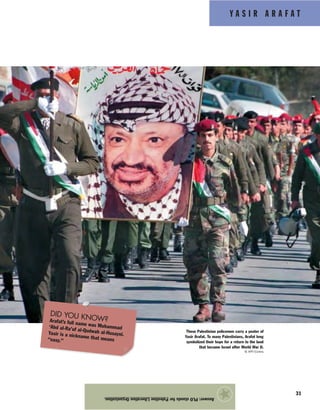
  • 7.
    © Ed Kashi/Corbis DIDYOU KNOW? After Paula was published, Allende suffered from severe writer’s block. “Writer’s block” is the term used when a writer is unable to think what to write or how to write it. Allende eventually broke through by writing another nonfiction work. 6
  • 8.
    I S AB E L A L L E N D E 7 Answer:Allendeandherfamilybecameexilesthemselves. It’snotunusualforwriterstodrawontheirownexperiences fortheirwork—evenifit’sfiction. ★ Latin American writer Isabel Allende was born in 1942, in Lima, Peru. Her many books, in Spanish, have been translated into several languages. Her works feature a technique called “magic realism”—the use of fantasy and myth in realistic fiction. Her stories reflect her own experiences and also look at the role of women in Latin America. Isabel Allende’s uncle was Salvador Allende, president of Chile. She was a journalist there, as well as a short-story writer. In 1973 Salvador Allende was murdered during a time of political problems. Under the new government, Isabel Allende was threatened, and she and her husband and children were forced to flee to Venezuela. They ended up spending 13 years there. In 1981, while still in exile, she started writing a letter to her dying grandfather. She wrote about childhood memories and of the people who had touched their lives. This letter turned into her first novel, La casa de los espíritus (1982; The House of the Spirits). It was followed by the novels De amor y de sombra (1984; Of Love and Shadows), Eva Luna (1987), and El plan infinito (1991; The Infinite Plan). Most of Allende’s stories have a political aspect and include a number of exiles. Allende calls these people “the marginals.” She says they are exiled from the big umbrella of society. They have the courage to stand on the edge of life and not be sheltered or protected. In 1990 Allende was able to return to Chile. But she was heartbroken when her young daughter became sick and died of a terrible blood disease. Out of her sorrow came a book, Paula (1994). It was Allende’s first nonfiction book, and it went on to become a best-seller. LEARN MORE! READ THESE ARTICLES… JORGE LUIS BORGES (VOLUME 3) • CHILE (VOLUME 9) MYTHS AND LEGENDS, FOLKTALES AND FABLES (VOLUME 5) The Letter Writer’s Stories Why do you suppose that Allende often writes about people who are exiles? SEA RCH LI GHT
  • 9.
    8 DID YOU KNOW? Beforehe was a count, Basie was a baron. His first band was called the Barons of Rhythm.
  • 10.
    C O UN T B A S I E 9 Young William Basie began studying music with his mother. He later learned to play the organ from pianist Fats Waller. Waller himself was a well-known jazz player. Basie started his career playing piano on the vaudeville stage. Vaudeville was performed in a chain of theaters in the United States during the late 19th and early 20th centuries. Vaudeville shows provided an entertaining mixture of dancing, singing, comedy, and magic acts. When Basie was about 23 years old, he went to Kansas City, Missouri. It was there that he formed his first jazz band. Basie’s nine-piece band was distinct because it highlighted the rhythm instruments. The bass fiddle, drums, guitar, and Basie’s piano became the core sound of his music. Basie had once played bass himself, and he developed a four-beat “walking” style of rhythm. This even beat provided a light, simple, and relaxed musical foundation. It also helped the harmonies and melodies in his songs stand out. Basie’s rhythm section set the pattern that modern jazz accompanying styles would follow. Basie and his band played at many nightclubs and often did radio broadcasts. One night a radio announcer called him “Count” Basie, to liken him to another fine bandleader with an aristocratic nickname, Duke Ellington. From that point on, the band gained in popularity. The Basie band’s popular early numbers included “Lady Be Good,” “Shoe Shine Boy,” “One O’Clock Jump,” and “Jumpin’ at the Woodside.” He formed another orchestra in the 1950s that was more sophisticated. Those musicians could read music and perform very difficult pieces. This group’s hits included “Alright, Okay, You Win” and “April in Paris.” LEARN MORE! READ THESE ARTICLES… LOUIS ARMSTRONG (VOLUME 3) • JAZZ (VOLUME 3) • RADIO (VOLUME 2) Answer:FALSE.“Count”wasBasie’snickname. ★ ©Bettmann/Corbis An Aristocrat of Jazz Count Basie in 1982. © Roger Ressmeyer/Corbis True or false? Count Basie was a real count. SEA RCH LI GHT
  • 11.
    10 The famous Englishauthor Charles Dickens lived more than 100 years ago. Many of the stories he wrote were about how hard life could be for children. And many changes were made because of his books. Some of Dickens’ stories tell about children being treated badly in schools, at home, or at work. At his own school his teacher beat him with a cane for laughing too loudly. Dickens was barely a teenager when he had to quit school and take a job away from home. His father had spent too much money and could not pay it back. He used many of his own experiences when he wrote his book David Copperfield. When Dickens’ stories were first read, some people were angry. Others were ashamed. Such stories as Oliver Twist made them think seriously. They realized that children should be treated kindly and have fun as well as study hard. They should not be made to leave home and go to work when they are very young. One of Dickens’ best-known stories is called A Christmas Carol. It tells about a rich man named Scrooge, who didn’t like Christmas. As a matter of fact, he didn’t like much of anything except making money. In the story Scrooge learns that his life is better when he helps others and spends time enjoying their company. People still like to read Dickens’ books, not just to learn what life was like a long time ago but for the wonderful stories that they tell. Some are funny, like his Pickwick Papers. Some are family stories, such as David Copperfield and Great Expectations. Some of his books are historical, like A Tale of Two Cities. LEARN MORE! READ THESE ARTICLES… LEWIS CARROLL (VOLUME 3) • LITERATURE (VOLUME 3) • LONDON (VOLUME 6) Writer of Life-Changing Stories Charles Dickens. © Bettmann/Corbis True or false? Dickens’ stories were entirely imaginary creations. SEA RCH LIGHT
  • 12.
    11 Answer:FALSE.Dickensdrewonhisownlifeandthelivesof unfortunatechildrenforsomeofhisstories. ★ C H AR L E S D I C K E N S In this illustration from Dickens’ A Christmas Carol, the miserly Ebenezer Scrooge is visited by the miserable ghost of his former partner, Jacob Marley. © Bettmann/Corbis DID YOU KNOW?For many people, A Christmas Carol has become a Christmas tradition. Though Dickens wrote other Christmas stories, none is as popular as this one.
  • 13.
    DID YOU KNOW?Elsslerand her sister danced atMarie Taglioni’s debut, in Taglioni’s father’s ballet troupe.
  • 14.
    F A NN Y E L S S L E R 13 Fanny Elssler was a famous Austrian dancer who brought energy and drama to her performances. She was born in 1810, in Vienna, Austria, and studied ballet from a young age. As a child, Elssler appeared with her sister in several ballets at Vienna’s Kärntnerthor Theatre. When she was a young adult, Elssler became famous worldwide thanks to her energetic spirit onstage and her remarkable pointe work (dancing on the points of the toes). She made her Paris Opéra debut in 1834 in Jean Coralli’s ballet La Tempête, a dance version of William Shakespeare’s play The Tempest. Before Elssler came along, most ballet was “classical ballet,” which featured light graceful dance, like that performed by Elssler’s greatest rival dancer, Marie Taglioni. But Elssler introduced theatrical, or “character,” ballet, which borrowed from folk dance traditions and even mime. She performed a Polish folk dance called the “cracovienne” in the ballet La Gypsy. And because some Gypsies were associated with Spain, she got the nickname “the Spaniard from the north.” Elssler spent the later part of her career touring the United States, England, Germany, Italy, and Russia. Because of her long world tours, Elssler had to break her agreement with the Paris Opéra, and so she could not return to dance in France. Her worldwide tour ended up lasting more than ten years. Elssler retired from the ballet in 1851. Her last years were spent in her native Vienna. During her career she was unequaled as a “character” dancer with amazing dramatic powers. LEARN MORE! READ THESE ARTICLES… AUSTRIA (VOLUME 6) • DANCE (VOLUME 3) • MARIA TALLCHIEF (VOLUME 3) Answer:Elssler’sstyleofballetborrowedfromfolkdance traditions. ★ Find and correct the error in the following sentence: Elssler’s style of ballet borrowed from break dance traditions. SEA RCH LI GHT Theatrical Ballerina Fanny Elssler was known for her great dramatic skill. She was one of the first ballerinas to tour the United States. She was noted for her Spanish dances and often performed with her sister Therese. © Archivo Iconografico, S.A./Corbis
  • 15.
    As a youngman in Spain, Francisco de Goya worked as a bullfighter. But his great love was painting. After studying art in Rome, Goya returned to Spain and worked as a tapestry designer. Soon his talents drew attention, and he began painting portraits of wealthy Spaniards. By 1786 Goya had become a “painter to the king of Spain.” But Goya became tired of painting pictures of dukes and duchesses and the royal family. Most of the people of Spain were poor and often hungry. Constant wars made their lives worse. Wanting to portray this “everyday” world, Goya began to draw and paint images of the poor and hardworking people of Spain. Goya didn’t make the men and women in his art look prettier or more important than they were. His paintings show people as they looked after a life of hard work. Goya included the lines in their faces and the sadness in their lives. He showed their bent backs and their worn clothes. This style of painting people and scenes from daily life is called “realism.” The subjects of Goya’s paintings did not always please the king and the people of the royal court. They thought he should paint only famous people and beautiful things. In fact, his “Disasters of War” series of etchings was so realistic and gory that it was not shown until over 35 years after Goya’s death. But today, hundreds of years later, the power and honesty of Goya’s “everyday” paintings still impress and move viewers. LEARN MORE! READ THESE ARTICLES… MADRID (VOLUME 6) • PAINTING (VOLUME 3) • PABLO PICASSO (VOLUME 4) 14 Goya’s self-portrait at the age of 69. © Francis G. Mayer/Corbis Painter to the Kingand to the People Why is Goya’s art called “realism”? SEA RCH LIGHT
  • 16.
    F R AN C I S C O D E G O Y A 15 Answer:Goya’spaintingstylewascalled“realism”becausehe showedordinarypeopleastheyreallywere. ★ Goya’s pictures of everyday life include some pleasant moments such as this one, titled “Two Boys with Two Mastiffs.” (As you’ve probably guessed, a mastiff is a large breed of dog.) © Archivo Iconografico, S.A./Corbis DID YOU KNOW? Even though he died in 1828, Goya is considered by some to be a “modern” painter. This is because of his focus on painting realistic scenes.
  • 17.
    16 DID YOU KNOW? Inthe late 1990s, some parents played Mozart for their babies, even while they were still in the womb. They thought Mozart’s music would make children more intelligent, but there’s no evidence to prove this notion.
  • 18.
    W O LF G A N G A M A D E U S M O Z A R T 17 When he was only three years old in Salzburg, Austria, Wolfgang Amadeus Mozart used to join his elder sister, Maria Anna, for her music lessons. But by the time he was five, Mozart was making up his own music. In the 18th century, when Mozart lived, most people didn’t believe that a little boy could write such beautiful music. They thought Mozart’s father had secretly written it. So to test him, they asked young Mozart to stay in a room alone for a week. At the end of the week, Mozart had written a new piece of choir music. People agreed that this child was a musical genius. Mozart studied, taught, played, and wrote music all his life. His music was often joyous, sometimes grim. But it was always beautiful. Mozart used the orchestra’s players and instruments in ways no one else had before. Mozart often blended popular and classical music to create new styles of music, especially in the opera. He could compose in many musical styles and could play equally well on the organ, the harpsichord, the piano, and the violin. Mozart could hear a piece once and then play it from memory, sometimes rewriting and improving it as he played. Although he died when he was still a young man, Mozart wrote 16 operas, 41 symphonies, and more than 500 other pieces of music. Some of his most famous works include the operas The Marriage of Figaro, Don Giovanni, and The Magic Flute and the “Jupiter” Symphony. LEARN MORE! READ THESE ARTICLES… LUDWIG VAN BEETHOVEN (VOLUME 3) • CLASSICAL MUSIC (VOLUME 3) JOAN SUTHERLAND (VOLUME 4) ©ArchivoIconografico,S.A./Corbis A Life Filled with Music How old was Mozart when he began writing his own music? a) 15 b) 5 c) 8 SEA RCH LI GHT Music from Mozart’s opera Don Giovanni. © Bettmann/Corbis Answer:b)5 ★
  • 19.
    18 Ieoh Ming Peiis one of the most important modern architects. He has created many major buildings throughout the world. And his style and ideas have strongly influenced the work of many other architects. He has specialized in building multistory structures in cities. I.M. Pei was born in Canton, China, in 1917. He went to America to study but couldn’t return to China when World War II started. So most of his work has been in North America and Europe. In the 1940s Pei began working as a professional architect. He worked on such important projects as the Mile High Center in Denver, Colorado. In 1955 Pei formed his own architectural company, I.M. Pei & Associates. The company’s early work included a museum in Syracuse, New York, that was actually four buildings joined by bridges. He also created a design for a new type of airport control tower that was widely used. Pei’s buildings are often tall, with lots of glass and steel. The designs combine simple geometric shapes, especially rectangles and triangles. But his buildings are not dull or simple. In many of them, you can see the building’s supports or building materials, and these are its only decoration. The way that concrete, glass, and steel look together creates interesting designs on the sides of Pei’s buildings. Special reflective glass also adds to the designs. He often combines different shapes and emphasizes the picture these shapes make in the skyline. Some of Pei’s most famous work includes the John Hancock Tower in Boston, the East Building of the National Gallery of Art in Washington, D.C., and the glass pyramid at the Louvre Museum in Paris, shown in the photograph here. LEARN MORE! READ THESE ARTICLES… ARCHITECTURE (VOLUME 3) • HASSAN FATHY (VOLUME 3) MAYAN CIVILIZATION (VOLUME 4) Grand Architect I.M. Pei on-site during construction at the Louvre, Paris. © Owen Franken/Corbis
  • 20.
    © Richard List/Corbis I. M . P E I Answer:c)SearsTower ★ 19 According to the article, which building is not one that Pei designed? a) East Building of the National Gallery of Art b) John Hancock c) Sears Tower SEA RCH LI GHT DID YOU KNOW?We think of the pyramids as beingold stone structures in Egypt orMexico. But Pei built a new glasspyramid as the entrance to thefamous Louvre Museum in Paris inthe late 1980s.
  • 21.
    20 There’s a storythat says the artist Pablo Picasso started to draw before he learned to speak. While this is probably only a story, it does suggest how important art was to Picasso. Picasso was born in Spain in 1881 but lived much of his life in France. He was an inventor and an explorer. But he didn’t invent machines or explore strange places. He explored and invented with art. He painted with his fingers, made drawings with a rusty nail, and even made a bull’s head from the handlebars and seat of a bicycle. He was able to work anywhere at any time of the day or night. Picasso’s big studio was a sort of jungle—a jungle of paint cans, brushes, chalk, pottery, colored pencils, and crayons, among many other things. Rolls of heavy paper and canvas, picture frames and easels, and tools for cutting designs on heavy board lay scattered about like rubbish. But to Picasso it was all inspiration. He painted Spanish bullfighting, horse races, and clowns. He painted happy pictures in warm colors (such as pink) and sad, lonely ones in cool colors (such as dark blue). He sometimes painted people and animals the way they looked. But more often he painted them from his imagination. The art style that Picasso and fellow artist Georges Braque invented is called Cubism. They painted people and things so that all parts and sides could be seen at the same time. Cubists often created pictures from simple shapes such as squares or cubes. LEARN MORE! READ THESE ARTICLES… FRANCISCO DE GOYA (VOLUME 4) • PAINTING (VOLUME 3) • SPAIN (VOLUME 6) Exploringwith an Artist Visitors viewing a Picasso painting—“Mandolin, Fruit Bowl, and Plaster Arm.” © AFP/Corbis In 2001 the works of Picasso were shown in a large exhibit in China. These children are practicing drawing by imitating some Picasso prints. A large photo of the artist looks on from the wall. © Reuters NewMedia Inc./Corbis What does it mean to say that Picasso’s studio was a jungle? (Hint: Jungles are hard to walk through.) SEA RCH LI GHT
  • 22.
    P A BL O P I C A S S O Answer:Picasso’sstudiowassoclutteredwithartsuppliesthatit wasdifficulttomovearoundinit.Justasjunglesarerichand densewithplantandanimallife,sohisstudiowascrowdedwith materialsthathelpedhimcreate. DID YOU KNOW?Picasso was probably the single most influential figure in 20th-century Western art. And he worked for 80 of his 91 years. He experimented with a large variety of styles in a number of artistic mediums. ★
  • 23.
    DID YOU KNOW? Shakespearewas so imaginative in his use of language that he created, or “coined,” more than 2,000 words or sayings that people have used ever since.
  • 24.
    W I LL I A M S H A K E S P E A R E 23 William Shakespeare is considered to be the greatest playwright in the English language and one of the most beloved playwrights in the world. Not much is known about Shakespeare’s life. He was born in Stratford-upon-Avon, England, in 1564. This was during the reign of Queen Elizabeth I. In his late 20s, Shakespeare went to the city of London to write and act. He joined a theater troupe and began to write plays. Over the next 20 years, Shakespeare wrote 38 plays and many poems. From his writing we can tell that he knew a lot about human feelings, as well as both city and country life. Most of the stories that Shakespeare told were known to his audience. But his characters and the way he told their stories in his plays attracted crowds of people to the Globe Theatre, where his troupe often performed. Four hundred years later, people still enjoy reading Shakespeare’s plays and seeing them onstage and in films. They quote his most famous lines (such as “To be or not to be”) and laugh and cry along with his characters. Shakespeare’s plays have remained popular for several reasons. His characters show realistic human emotions. His plots are often complicated, but they always hold the audience’s attention. And his language is powerful and poetic. Some of Shakespeare’s plays, such as Hamlet, have very sad endings. They are called “tragedies.” Others, such as A Midsummer Night’s Dream, are full of silly plots and have happy endings. They are the “comedies.” Other Shakespeare plays, such as Julius Caesar or Henry V, are based on real-life figures and events. These are the “histories.” And some plays, such as Romeo and Juliet, have a little bit of everything: romance, comedy, and tragedy. LEARN MORE! READ THESE ARTICLES… ELIZABETH I (VOLUME 4) • ENGLAND (VOLUME 6) • THEATER (VOLUME 3) Answer:b)comedy ★ 2001 production of A Midsummer Night’s Dream performed at the Albery Theatre in London. © Archivo Iconografico, S.A./Corbis Plays That Never Grow Old William Shakespeare’s plays have been popular for hundreds of years. Shown here is a portrait of the famous playwright. © Robbie Jack/Corbis Which of the following describes a play with a happy ending? a) tragedy b) comedy c) plot SEA RCH LI GHT
  • 25.
    24 Socrates was athinker and teacher who lived in Athens, Greece, almost 2,500 years ago. Socrates knew all the famous people and leaders in Athens, but he never wanted to be famous or rich himself. He just wanted to think and to talk about ideas. Socrates didn’t give lectures or tell people what to think. Instead, he asked questions. He thought it was very important to “know yourself” and to learn how to be a good person and how to live a good life. Socrates talked to many people who thought they knew what was good and what was right. By asking them questions, Socrates helped them realize that they really didn’t understand these things. Some people said that Socrates thought too much. Sometimes Socrates would stand in one spot and think for many hours without moving or saying a word. Socrates never wrote down his thoughts, and he was never paid for his teaching. Socrates often angered people because he made them feel embarrassed when they could not answer his questions. Eventually the leaders of Athens put Socrates in prison because they thought that he made young people misbehave and that he did not believe in the gods of Athens. As a punishment, they made Socrates drink a deadly poison. Socrates could have run away, but he chose to stay and accept his punishment. He believed he had a duty to obey the law. One of Socrates’ students, Plato, became a famous teacher himself. He wrote down many of Socrates’ conversations so that his ideas would be preserved for many future generations. LEARN MORE! READ THESE ARTICLES… ATHENS (VOLUME 6) • CONFUCIUS (VOLUME 5) • ALBERT EINSTEIN (VOLUME 4) Teaching Peopleto Think Socrates is often admired for holding on to his views even though it cost him his life. Sometimes, as here, the great thinker is celebrated in art. © Araldo de Luca/Corbis True or false? Socrates wrote many books. SEA RCH LI GHT DID YOU KNOW? Socrates’ method of asking questions to teach new ideas is still used in schools today. It is called the “Socratic method.”
  • 26.
    S O CR A T E S Answer:FALSE.Socratesneverwrotedownhisthoughts. ★
  • 27.
    True or false? Joan Sutherland neverneeded any training to become a great singer. SEA RCH LI GHT
  • 28.
    J O AN S U T H E R L A N D 27 Opera singer Joan Sutherland was born in Sydney, Australia, on November 7, 1926. She was a musical child and studied piano and music with her mother. At about age 20 Sutherland won a singing competition and began studying professionally. A year later Sutherland made her first appearance as a singer in a performance of Henry Purcell’s opera Dido and Aeneas. She played the lead female role of Dido. Sutherland won many prizes in singing competitions, and she used the money to move to London. There she studied at the Royal College of Music. In 1952 she became a member of the company of the Royal Opera, Covent Garden. She made her first appearance there in Wolfgang Amadeus Mozart’s The Magic Flute. In 1961 Sutherland performed in Gaetano Donizetti’s Lucia di Lammermoor at the Metropolitan Opera, New York City. Lucia was a difficult role. On one hand, it required the singer to do some extremely tricky vocal gymnastics. In addition to that, it was a major acting challenge. Sutherland performed it so well that her fame spread around the world. She was soon performing in major opera houses all over Europe. Sutherland was admired as a coloratura soprano. Sopranos are female singers with very high voices. Coloratura singers have to have a very light and flexible voice. They must be able to sing complex series of notes very rapidly. Sutherland was one of the most successful opera stars of her day. In 1978 she was knighted as a Dame Commander of the British Empire. She retired from the stage in 1990, at the age of 64. LEARN MORE! READ THESE ARTICLES… AUSTRALIA (VOLUME 7) • OPERA (VOLUME 3) KIRI TE KANAWA (VOLUME 3) Answer:FALSE.Sutherlandcontinuedtotrainthroughouther career. ★ ©Bettmann/Corbis Australia’s Golden Voice DID YOU KNOW? Sutherland’s nickname to her fans was “La Stupenda,” because of her stupendous (fantastic) talent.
  • 29.
    28 Huckleberry Finn isconsidered by many to be Twain’s finest work. But from time to time it is banned in schools or libraries because of racial issues in the book. © Stapleton Collection/Corbis DID YOU KNOW? Mark Twain’s words are quoted frequently for both their wisdom and their humor. In one of his books, he wrote: “Man is the Animal that Blushes. He is the only one that does it—or has occasion to.” What do you suppose he meant?
  • 30.
    M A RK T W A I N 29 Answer:Amarkequals6feet.Marktwain,12feet,istwomarks. Halftwainis21/2marks,or15feet. ★ Aonetime Mississippi River boat pilot, Mark Twain became one of America’s greatest authors. His Tom Sawyer, Huckleberry Finn, and Life on the Mississippi rank high on any list of great American books. Mark Twain was born Samuel Langhorne Clemens in 1835. He grew up in Hannibal, Missouri, on the Mississippi River. From this river town he gathered the material for his most famous stories. Young Tom Sawyer, for instance, was a combination of several boys— including himself. During his life, he held jobs that he would turn into material for his writing. His work as a steamboat pilot gave him experience he used to write Life on the Mississippi. When he began working as a newspaper reporter, he began using the pen name Mark Twain. It is an old river term meaning two fathoms, or 12 feet, of water—a depth that was not very safe for riverboats. One of his stories, “The Celebrated Jumping Frog of Calaveras County,” was printed in many newspapers. It was a popular story, and Twain traveled as a roving reporter and then on a lecture tour. After these travels he wrote The Innocents Abroad, which made him famous. Twain was known as a humorist. But behind his mask of humor lay a serious view of life. He had known the sadness of poverty, the early death of his father and later his brother Henry, and the loss of a daughter. One of his most famous novels, Huckleberry Finn, is sometimes thought of as a child’s book. But its heartbreak and wisdom are appreciated best by adults. Another of his famous novels, Tom Sawyer, is mostly a young person’s book that adults can also read with pleasure. LEARN MORE! READ THESE ARTICLES… CHARLES DICKENS (VOLUME 4) • FROGS (VOLUME 11) • SHIPS (VOLUME 2) The Writer and the Mississippi River Mark Twain. © Bettmann/Corbis “Half twain” means “mark twain plus half a mark” and equals 15 feet. So how much is a mark? SEA RCH LI GHT
  • 31.
    30 From the timehe was a teenager in the 1940s, Yasir Arafat was involved with the Palestinian movement. Israel was formed after World War II to give the Jewish people a homeland. But it was formed in a region called Palestine, where many other people lived. After Israel was created hundreds of thousands of Palestinian Arabs left or were forced off their land.After 1948 Palestinians such as Arafat wanted to get that land back by fighting against Israel. To do this they formed the Palestine Liberation Organization (PLO). For years the PLO carried out deadly attacks on Israel. Israel responded by attacking the Palestinians. Arafat became chairman of the PLO in 1969. He wanted the PLO to work for change through discussion and bargaining more than by force. Arafat worked to get countries around the world to accept the idea of a Palestinian homeland. In 1993, with help from other countries, Arafat and Israeli Prime Minister Yitzhak Rabin signed agreements to make peace between the two sides. The next year Arafat, Rabin, and Israeli Foreign Minister Shimon Peres shared the Nobel Prize for Peace for their work together. As part of the peace plan the Palestinians recognized Israel’s right to exist as a country. The Israelis agreed that the Palestinians would be allowed to rule certain areas that had been controlled by Israel. To do this the Palestinians set up a group called the Palestinian Authority. Arafat was elected president of the authority in 1996. But there were other Palestinians who did not agree with the peace agreement. They continued to fight against Israel. Some world leaders tried to get Arafat to stop the violence, but the fighting continued. Arafat died in 2004. LEARN MORE! READ THESE ARTICLES… MENACHEM BEGIN (VOLUME 4) • ISRAEL (VOLUME 7) MOHAMMED ALI JINNAH (VOLUME 4) Fill in the blanks: PLO stands for _______ _______ _______. SEA RCH LI GHTYasir Arafat in 1990. © David Turnley/Corbis Leader of the Palestinians
  • 32.
    Y A SI R A R A F A T 31 Answer:PLOstandsforPalestineLiberationOrganization. ★ These Palestinian policemen carry a poster of Yasir Arafat. To many Palestinians, Arafat long symbolized their hope for a return to the land that became Israel after World War II. © AFP/Corbis DID YOU KNOW?Arafat’s full name was Muhammad‘Abd al-Ra’uf al-Qudwah al-Husayni.Yasir is a nickname that means“easy.”
  • 33.
    32 Some 2,200 yearsago, the emperor Ashoka ruled India. Like many ancient rulers, he expanded his empire by conquering new lands. But unlike most rulers, Ashoka suddenly turned his back on warfare and began to govern according to the nonviolent beliefs of Buddhism. It is said that Ashoka became a Buddhist when he saw the horrors caused by the wars he’d led. After that, he decided to serve his subjects and all humanity instead of conquering others. He called this “conquest by dharma.” In India dharma means the “right way of living” and “universal truth.” This included being honest, truthful, and kind. It also meant being merciful, generous, and thoughtful. The emperor himself would often tour the countryside, preaching his belief in dharma to the people. Ashoka also appointed “dharma ministers” to help relieve people’s sufferings. These ministers were assigned to look after the special needs of women and people living in religious communities. Ashoka passed laws to prevent cruelty to animals and had hospitals built for both people and animals. He also started construction projects to make all people’s lives easier. Trees were planted on roadsides, wells were dug, and watering sheds and rest houses were built. The only recognition Ashoka wanted was for people to remember that he had ruled according to dharma. To preserve his ideas, Ashoka had his teachings carved on rocks and pillars (columns) in public areas. These inscriptions are called the Rock Edicts and Pillar Edicts. The most famous is the lion pillar found at Sarnath, which has become India’s national emblem. LEARN MORE! READ THESE ARTICLES… BUDDHISM (VOLUME 5) CHARLEMAGNE (VOLUME 4) • INDIA (VOLUME 7) The Emperorand the Right Way of Living Ashoka was an Indian a) mathematician. b) emperor. c) priest. SEA RCH LI GHT Sarnath, an archaeological site in northern India, is said to be the place where the Buddha first preached to his followers. Ashoka built this stupa (shrine) and others, as well as pillars, to honor the event. © Brian A. Vikander/Corbis DID YOU KNOW? Despite his reputation as a kind and generous ruler, some stories describe Ashoka as cruel and ruthless. According to one story, he had all his brothers killed in order to seize the throne.
  • 34.
    A S HO K A Answer:b)emperor. ★
  • 35.
    A Zionist believes in a)having Europeans in the government. b) an independent Jewish state. c) making Poland part of Israel. SEA RCH LI GHT Menachem Begin visited the Western Wall in Jerusalem to offer a prayer of thanks following his 1981 election victory.
  • 36.
    M E NA C H E M B E G I N 35 When Menachem Begin was a little boy growing up in Poland, he probably never imagined that someday he would lead a Jewish nation and win a Nobel Prize for Peace. As a young man, Menachem earned a law degree and became an active Zionist. Members of the Zionist movement wanted to create a Jewish community in the Middle Eastern region of Palestine. Germany invaded Poland early in World War II, and the Nazis began to persecute the Jews. Begin joined the Polish army in exile. He went with them to Palestine in 1942. There Begin joined a group fighting to create a Jewish state. However, after the creation of the State of Israel in 1948, hundreds of thousands of Palestinian Arabs either left or were forced off their land. This led to many years of trouble between Israel and the Arab countries that surround it. Begin was active in Israeli politics in the 1950s and ’60s, and in 1977 he became the country’s prime minister. By that time Israel had fought several wars with the Arabs and had captured some Arab land. Begin reached a peace agreement with Egyptian leader Anwar el-Sadat, returning Egypt’s land. This earned Begin and Sadat the Nobel Prize for Peace in 1978. But Begin refused to accept the demands by Palestinians for a return of lands that he considered part of Israel. Four years later he ordered Israeli troops to invade Lebanon and attack Palestinian guerrillas. The war in Lebanon was very unpopular in Israel, and Begin stepped down as prime minister in 1983. LEARN MORE! READ THESE ARTICLES… ISRAEL (VOLUME 7) • GOLDA MEIR (VOLUME 4) ANWAR EL-SADAT (VOLUME 4) Answer:b)anindependentJewishstate. ★ Menachem Begin in 1981. © Bettmann/Corbis Struggling for Israel DID YOU KNOW?Menachem Begin and Anwar el-Sadat’s 1978 peace agreementis known as the Camp DavidAccords. Camp David is thegetaway spot where U.S. President Jimmy Carter took thetwo men to help them worktoward peace. ©DavidRubinger/Corbis
  • 37.
    DID YOU KNOW? InWilliam Shakespeare’s play Julius Caesar, Caesar is told to “beware the ides of March.” The ides refers to the time around the 15th of the month. Today those famous words are sometimes used as a warning.
  • 38.
    J U LI U S C A E S A R 37 Julius Caesar was a brilliant general and a gifted writer. But most important, he helped create the ancient Roman Empire. Early in his career Caesar formed a bond with the two most powerful men in Rome, the wealthy Crassus and the general Pompey. In 59 BC they helped elect Caesar as one of Rome’s two consuls, the government’s highest rank. After a year as consul, Caesar left Rome to govern Gaul (now France). There he earned a reputation as a military leader. He stopped uprisings and invasions, and he even landed in Britain. Caesar also wrote detailed accounts of his battles. While Caesar was in Gaul, Crassus was killed. Pompey now controlled Rome, and he turned against Caesar. He declared Caesar a criminal and ordered him to break up his army. Instead, Caesar declared war and marched to Rome. Pompey fled to Greece. At that time Rome was governed by a senate (a supreme council). But Caesar felt the government was corrupt and needed a strong leader. In 49 BC he declared himself dictator, and he spent five years fighting a civil war against Pompey to make his rule secure. Some of the Roman senators worried that Caesar had too much power. On March 15, 44 BC, they murdered Caesar on the floor of the Senate. In the short time he led Rome, Caesar proved to be a great statesman. The changes he made helped begin the 500-year Roman Empire. And for almost 2,000 years after his death, some world leaders used a form of the title “caesar” (such as “Kaiser” in Germany and “czar” in Russia). LEARN MORE! READ THESE ARTICLES… CHARLEMAGNE (VOLUME 4) • ITALY (VOLUME 6) • ROME (VOLUME 6) Answer:CaesartookpowerinRomeafterdefeatingPompey,his formerpoliticalsupporter. ★ General and Statesman Rome’s Remarkable By crossing over the stream known as the Rubicon in 49 BC, Caesar basically declared war against the Roman Senate. “Crossing the Rubicon,” the subject of this engraving, became a phrase that means taking a step from which there’s no turning back. © Bettmann/Corbis Sculpture of Julius Caesar, in the National Museum in Naples. © Bettmann/Corbis Fill in the blank: Caesar took power in Rome after defeating ___________, his former political supporter. SEA RCH LI GHT
  • 39.
    DID YOU KNOW? Castrowas a very good baseball player. It is said he once even tried out for the Senators, a professional baseball team in Washington, D.C. 38
  • 40.
    Fidel Castro oftenspoke out strongly against people who disagreed with his communist government in Cuba. Here he speaks at a rally in 2003. © AFP/Corbis F I D E L C A S T R O 39 In the 1950s General Fulgencio Batista ruled the Caribbean island of Cuba. His rule was harsh and often violent, and some large American companies grew rich while many Cubans remained poor. Fidel Castro was a young lawyer who believed Batista’s rule was unfair. There were no free elections in Cuba, so Castro organized a military force to overthrow Batista. Castro bought guns with his own money and attacked Batista’s forces in 1953. The attack failed badly, and after two years in prison Castro went to Mexico to make a new plan. Soon he and about 80 other rebels arrived in Cuba. They hid in the mountains and fought a guerrilla war using small-scale battles and making hit-and-run attacks. Batista finally fled Cuba in 1959. Castro became Cuba’s leader and created a communist government. In some ways the lives of the people did not improve under Castro’s rule. The people lost many of the same rights that Batista had taken away, and poverty was still a problem. But Castro also greatly increased many benefits to the Cuban people. Education and health services were free, and every citizen was guaranteed work. The United States, Cuba’s near neighbor, strongly opposed Castro’s government. They even tried to overthrow it in 1961. But the Soviet Union, another communist country, supported Castro. The United States complained when Castro let the Soviets set up nuclear weapons in Cuba. The protest almost led to a war, but the weapons were soon removed. In the late 20th century there was unrest among Cubans, and Castro relaxed some of his strictest controls. Still, Castro remained Cuba’s powerful leader for many years. LEARN MORE! READ THESE ARTICLES… SIMÓN BOLÍVAR (VOLUME 4) • CUBA (VOLUME 9) • MAO ZEDONG (VOLUME 4) Answer:FALSE.Sincetheearly1960s,theUnitedStateshas opposedCastroandhassupportedattemptstooverthrowhim. ★ Fidel Castro in 1960. © Bettmann/Corbis True or false? The United States has also supported Castro’s rule in Cuba. SEA RCH LI GHT Changed Cuba The Man Who
  • 41.
    DID YOU KNOW? Charlemagneenjoyed swimming. He even built a palace on a hot spring that he used for bathing with friends. Charlemagne’s empire survived for only a brief time after he died. But no other ruler in the European Middle Ages had such a deep and long-lasting effect. © Ali Meyer/Corbis 40
  • 42.
    C H AR L E M A G N E 41 During the Middle Ages (about AD 500-1500) one of the most powerful European kings was Charlemagne. Charlemagne was a Frank. The Franks were a people who lived in parts of what are now France and Germany. When he became the one and only ruler of the Frankish lands in AD 771, Charlemagne wanted to make his kingdom bigger and stronger. He also wanted to spread Christianity and protect the Roman Catholic church. With this plan in mind, Charlemagne spent 30 years battling the Saxons, another Germanic people. In these and many other wars, Charlemagne gained control over much of western Europe, including what is now France, Switzerland, Belgium, the Netherlands, and half of Italy and Germany. In 794 Charlemagne established his capital at Aachen in western Germany. In the year 800, the pope crowned him emperor of the whole region. He worked with leaders of the church to improve the church and government. And he sent out special agents to make sure that his laws were being obeyed. Charlemagne brought about many improvements in the empire. He set up a new money system and reformed the law courts. He built a large court library and set up a school at his palace court. He was concerned with educating the ordinary people and improving the learning of priests. He hoped education would make his people better Christians. Charlemagne died in 814. Today he is remembered as one of the most important rulers in European history. In fact, he’s sometimes called the father of Europe. LEARN MORE! READ THESE ARTICLES… ASHOKA (VOLUME 4) • EUROPE (VOLUME 6) • MUHAMMAD (VOLUME 5) Answer:a)pyramids ★ Which of these did Charlemagne not build? a) pyramids b) schools c) libraries SEA RCH LI GHT Illuminated (richly decorated) manuscript showing Charlemagne meeting Pope Adrian I. © Archivo Iconografico, S.A./Corbis The Father of Europe
  • 43.
  • 44.
    C L EO P A T R A 43 Answer:CleopatraruledEgypttwice. ★ She spoke nine languages, was a good mathematician, and had a great head for business. And she would use both her intelligence and her beauty to hold on to power. Today, Cleopatra VII Thea Philopator of Egypt is still an amazing historical figure. Cleopatra was the second daughter of King Ptolemy XII. When her father died in 51 BC, 18-year-old Cleopatra was supposed to rule Egypt with her 15-year-old brother, Ptolemy XIII. In a few years, her brother’s supporters drove Cleopatra from power. But later the Roman leader Julius Caesar helped her get her throne back. War soon broke out. In 47 BC Cleopatra’s brother and co-ruler drowned. By law she couldn’t rule alone, so she married her 11- year-old brother. Cleopatra returned to Rome to live with Caesar and had a son by him named Caesarion. But Caesar was murdered in 44 BC, and Cleopatra lost her strongest supporter. She soon went back to Egypt. With Caesar dead, the two most powerful men in Rome were Octavian and Mark Antony. When Antony wanted to invade Persia, he invited Cleopatra to meet him. Antony quickly fell in love with Cleopatra and married her. But he was also married to Octavian’s sister. An angry Octavian declared war against Antony and eventually defeated him. Antony died in Cleopatra’s arms. Cleopatra did not want to live without Antony. The story is that she had an asp (a kind of snake) brought to her, and when it bit her, Cleopatra died at the age of 39. The Egyptians believed that death by snakebite made you immortal. Cleopatra didn’t live forever, but her legend has lasted more than 2,000 years. Queen of Egypt This image of the Egyptian queen Cleopatra appears on a temple of the goddess Hathor in Dandarah, Egypt. Hathor was the goddess of the sky, of women, and of love. The Art Archive How many times did Cleopatra rule Egypt? SEA RCH LI GHT LEARN MORE! READ THESE ARTICLES… JULIUS CAESAR (VOLUME 4) • EGYPT (VOLUME 8) WILLIAM SHAKESPEARE (VOLUME 4) DID YOU KNOW? William Shakespeare wrote a play about Egypt’s most famous queen, called Antony and Cleopatra.
  • 45.
    44 When Elizabeth Ibecame queen of England, few thought she would last very long. But Elizabeth I not only ruled for almost half a century. She became one of England’s greatest rulers. Elizabeth was the daughter of Anne Boleyn, King Henry VIII’s second wife. Henry also had a daughter, Mary, from his first marriage, and he would have a son, Edward, from his third. After Henry’s death, Edward ruled for a short time until he died. Mary ruled for three years before she too died. In 1558 Elizabeth became the queen of England at age 25. At the time, England was poor, weak, and torn by conflict between different groups. The people hoped Elizabeth would marry a strong man who would guide her. But Elizabeth had no desire to share her power. She was determined to be a successful queen, so she gathered experienced and trustworthy advisers. Elizabeth herself had a good education and was very clever and brave. The queen encouraged English sailors to travel to distant parts of the world. Captains such as Francis Drake brought back riches and found new trade routes to the Americas, Asia, and Africa. As trade developed with other lands, England grew wealthy. Under Elizabeth, England also experienced a Renaissance, or “rebirth” of the arts. Some of the famous writers of the period were William Shakespeare, Christopher Marlowe, Francis Bacon, Edmund Spenser, and John Donne. By the time Elizabeth died in 1603, England had become both rich and strong. The 45 years of her reign became known as the Elizabethan Age. LEARN MORE! READ THESE ARTICLES… CLEOPATRA (VOLUME 4) • JUDI DENCH (VOLUME 3) • ENGLAND (VOLUME 6) Oil painting of Elizabeth I with members of her court. © Stapleton Collection/Corbis Elizabeth I, popularly known as Good Queen Bess, became queen after the death of her half sister in 1558. She loved showy clothing and jewels. © Archivo Iconografico, S.A./Corbis A Clever, Courageous Queen
  • 46.
    E L IZ A B E T H I Answer:b)sisterandbrotherruled. ★ Elizabeth ruled England only after her a) two sisters ruled. b) sister and brother ruled. c) two brothers ruled. SEA RCH LI GHT DID YOU KNOW? During Elizabeth’s rule, Spain attacked England with a great fleet of ships called the Spanish Armada. England’s victory over the Spanish forces saved the country from becoming part of the Spanish empire.
  • 48.
    E M PR E S S O F C H I N A 47 One of the most powerful women in Chinese history was Cixi. She played a major role in ruling China for more than 40 years in the late 1800s. Cixi lived in a group of palace buildings called the Forbidden City, within the city of Beijing. She spoke to all her visitors from a large red throne shaped like a dragon that was hidden behind a silk screen. Every one of her orders ended with the warning “Hear and obey.” Cixi was never really an empress. She was, however, the mother of the emperor’s only son. When the emperor died, she helped her 6-year-old son, who was heir to the throne, rule China. She still had power when her son was old enough to rule by himself. Then he died, and the Dragon Empress made sure her 3-year-old nephew became the new emperor. Cixi helped him rule too. During Cixi’s time the Chinese government became very dishonest. But she did not rule alone during this time. A group of dishonest officials helped her make decisions. When her nephew grew up he tried to make some changes to improve life in China. The officials were against such changes. Only after foreign armies captured Beijing in 1900 did Cixi begin to make things better. In 1908, when the Dragon Empress was dying, her nephew, the emperor, also died. Some say that she was ruthless and did not want him to rule without her so she poisoned him. But this was never proved. Answer:OneofthemostpowerfulwomeninChinesehistorywas Cixi. ★ The Dragon Empress Cixi wore solid gold shields on her very long fingernails to keep them from breaking. DID YOU KNOW? Known in the West as the Empress Dowager, Cixi controlled the political life of China for many decades. The nation was fairly stable under her influence, but the government was dishonest and did not make changes that were needed to benefit the people. © Hulton-Deutsch Collection/Corbis LEARN MORE! READ THESE ARTICLES… CHINA (VOLUME 7) • CLEOPATRA (VOLUME 4) MAO ZEDONG (VOLUME 4) Find and correct the error in the following sentence: One of the most powerful women in Japanese history was Cixi. SEA RCH LI GHT
  • 49.
    48 Hirohito ruled over the islandnation of a) Britain. b) Indonesia. c) Japan. SEA RCH LI GHT
  • 50.
    H I RO H I T O 49 Michinomiya Hirohito was the last of the old-style emperors of Japan. He helped usher in a new age for the Japanese people. He was born in 1901, and he was the first Japanese crown prince to travel abroad. Hirohito became emperor on December 25, 1926, after his father’s death. At that time the military was gaining control of the government and would soon take Japan into a major war in Asia. Eventually Japan attacked Hawaii and the Philippines, which brought the United States into World War II. Historians still don’t agree about whether the emperor actually wanted a war with the United States or if he just couldn’t stop the military chiefs. By 1945 Japan was nearing defeat, and Hirohito favored ending the war. On August 15, 1945, he broadcast his country’s surrender on the radio. It was the first time the Japanese people had heard their emperor’s voice. After the war Hirohito made many changes. Until then, Japanese emperors had claimed to be descended from gods. Hirohito now gave up this claim. The old constitution had also given the emperor highest authority. A new constitution gave power to the people. The emperor also started appearing before the Japanese public. He allowed the press to photograph and write about him and his family. In 1959 he permitted his son, Crown Prince Akihito, to marry a commoner, which was a major break with tradition. Hirohito helped Japan build relationships with countries all over the world. Hirohito’s health began to fail as he grew older. He died on January 7, 1989. LEARN MORE! READ THESE ARTICLES… EMPRESS OF CHINA (VOLUME 4) JAPAN: MODERN NATION OF ANCIENT TRADITIONS (VOLUME 7) SHINTO (VOLUME 5) Answer:c)Japan. ★ Emperor of Japan After World War II, Emperor Hirohito tried to bring the imperial family closer to the Japanese people. He began to appear in public more often and allowed pictures and stories of his personal and family life to be published. © Corbis Emperor Hirohito in 1982. © Bettmann/Corbis DID YOU KNOW?According to tradition, 123emperors ruled over Japanbefore Hirohito. Yet Hirohitoruled the longest—he wasthe emperor of Japan for63 years.
  • 52.
    M O HA M M E D A L I J I N N A H 51 Mohammed Ali Jinnah was born in Karachi in 1876. At that time the city was part of India, and India was controlled by the British. When Jinnah was a young man, his parents sent him to London to gain business experience. Instead, he studied law and learned about the British system of government. After his studies, he returned to India and began to practice law in Bombay (now Mumbai). It was about this time that the people of India began to seek freedom from British rule. For hundreds of years, Muslims and Hindus—the area’s two major religious groups—had lived together peacefully in India. But there were many more Hindus than Muslims. Because of this, many Muslims feared that they might not be treated equally once India became an independent country. Although Jinnah was Muslim, at first he didn’t think there was anything to be afraid of. But as time passed, he began to feel that the Muslims in India should have their own country. So Jinnah began to work hard to make a Muslim nation out of part of India’s land. The new country would be called Pakistan. In 1947 the British government agreed to the formation of Pakistan. India became independent from Britain in August of that year, and a section of the country became Pakistan. Jinnah was chosen as Pakistan’s first head of state, but he served for only a year before he died. Still, Jinnah’s people loved him. And because he helped create Pakistan, Jinnah is considered the Father of Pakistan. LEARN MORE! READ THESE ARTICLES… MAHATMA GANDHI (VOLUME 4) • ISLAM (VOLUME 5) • PAKISTAN (VOLUME 7) Answer:JinnahwantedtobuildacountryforMuslims. ★ Founder of Pakistan Mohammed Ali Jinnah founded the state of Pakistan in 1947. Here, Pakistani soldiers in 1993 hang a portrait of Jinnah as part of preparations for Pakistan Day in March. © Reuters NewMedia Inc./Corbis Mohammed Ali Jinnah. © Bettmann/Corbis For which people did Jinnah want to build a country? SEA RCH LI GHT DID YOU KNOW? When Jinnah was a law student in London, he worked to help Dadabhai Naoroji become the first Indian member of the British Parliament.
  • 53.
    DID YOU KNOW? In1993 Nelson Mandela and F.W. de Klerk were jointly awarded the Nobel Prize for Peace for getting rid of the apartheid system.
  • 54.
    N E LS O N M A N D E L A 53 South African leader Nelson Mandela was a fighter. He fought against apartheid. Apartheid was an official policy of the government of South Africa that separated people according to their race and color. During World War II, Mandela joined the African National Congress (ANC), and he later became one of its leaders. This organization had one aim: to fight for the freedom of the black people in South Africa. Mandela hadn’t wanted to use violence in the ANC’s fight against the government. However, after the police killed unarmed Africans, Mandela changed his mind. He argued for using sabotage against the government—that is, secretly working to undermine and destroy it. At the same time, the South African government outlawed the ANC. In 1962 the government decided that Mandela was guilty of acts against the government. He was sentenced to five years in prison. The next year, he was found guilty on more charges and sentenced to life imprisonment. By the 1980s more and more people had heard of Mandela’s hopes for South Africa. They began to campaign for his release from prison. Countries and organizations all over the world got involved. Early in 1990 South Africa’s president, F.W. de Klerk, ordered Mandela’s release. President de Klerk, together with Mandela, worked to change South Africa into a country where all races would have equal rights. South Africa held its first elections open to people of all races in 1994. Mandela and the ANC won the elections, and Mandela became the country’s first black president. LEARN MORE! READ THESE ARTICLES… MAHATMA GANDHI (VOLUME 4) • MARTIN LUTHER KING, JR. (VOLUME 4) SOUTH AFRICA: A PEOPLE APART (VOLUME 8) Answer:FALSE.Heservedalargepartofalifesentence—almost 30years. ★ A Fighter for Rights Nelson Mandela spent nearly 30 years of his life as a political prisoner. Four years after his release, he ran for president of South Africa. He was elected in April 1994. © Peter Turnley/Corbis Nelson Mandela in 1990. © David Turnley/Corbis True or false? Mandela served a life sentence in jail. SEA RCH LI GHT
  • 55.
    54 Mao Zedong wasborn in 1893, in China’s Hunan province. Mao’s father had been born a poor peasant, but he became wealthy as a farmer and grain dealer. Only limited education was available where Mao grew up. So at age 13 Mao left school to work on his family’s farm. He later ran away to attend school in the provincial capital, where he discovered new ideas from Chinese and Western thinkers. Mao briefly served in the army during the Chinese Revolution (1911-12). This uprising overthrew the ruling Manchu dynasty and turned China into a republic. After that there were many years of fighting between different groups who wanted to rule China. This time was known as the “warlord period.” After the war, Mao returned to school, ending up at Beijing University, where he worked in the library. There he became involved in the May Fourth Movement of 1919. This was the beginning of China’s turn toward communism. In communism, property is owned by the state or community, and all citizens are supposed to share in the nation’s wealth. In the 1920s Mao helped found the Chinese Communist Party (CCP). He started a communist revolution among peasants in the countryside. The CCP split off from the Nationalist Party. The Nationalists thought the Chinese should decide their own future, but they were against communism. The Red Army, Mao’s military force, began fighting them and gathering strength in the late 1920s. Mao finally took control of the whole country in 1949 and became the chairman of the People’s Republic of China. Although many poor people’s lives were better under Mao, many others suffered and died during his efforts at reform and improvement. He died on September 9, 1976. LEARN MORE! READ THESE ARTICLES… CHARLEMAGNE (VOLUME 4) • CHINA (VOLUME 7) CONFUCIUS (VOLUME 5) Mao Zedong in 1967. © Bettmann/Corbis Was Mao’s family rich or poor? SEA RCH LI GHT Architect of Modern China
  • 56.
    M A OZ E D O N G 55 Answer:Actuallytheywereboth.Hisfatherwasbornpoorbut laterbecameawealthyfarmerandmerchant. ★ Mao Zedong, the leader of the Chinese communists, spent a great deal of time in the countryside trying to gain support for his ideas. Here, as a young man, he speaks to a group of his followers. © Bettmann/Corbis DID YOU KNOW? During World War II, Mao’s communists and the Nationalists joined together to fight off Japan’s invasion of China.
  • 57.
  • 58.
    G O LD A M E I R 57 In 1906, when Goldie Mabovitch was a child, poverty forced her family to move from Russia to the United States to find work. In high school, she joined a group that wanted Jews to have their own country. This was known as Zionism. A few years later she and her husband, Morris Myerson, moved to Palestine, a Middle Eastern region then under British control. Goldie Myerson became involved in political activities in Palestine. She negotiated protection for Jews who fled from Nazi Europe during World War II. After the war, she worked to help Jewish war refugees. In 1948 part of Palestine became the State of Israel, and Goldie Myerson was one of the signers of Israel’s declaration of independence. The surrounding Arab countries attacked Israel, but the new country defended itself and remained independent. The next year she was elected to the Knesset, the Israeli parliament. Later she changed her last name from Myerson to “Meir,” a Hebrew word meaning “to burn brightly.” She also became known as “Golda” instead of “Goldie.” Meir became the prime minister of Israel in February 1969. As prime minister, she worked hard for peace in the Middle East and traveled widely to meet with the leaders of many other countries. But in 1973 Egypt and Syria’s invasion of Israel led to another Arab- Israeli war. Though Israel eventually won the war, the whole country was stunned by the attack. Many Israelis felt Meir’s government was to blame, and so she resigned as prime minister the next year. LEARN MORE! READ THESE ARTICLES… MENACHEM BEGIN (VOLUME 4) • ISRAEL (VOLUME 7) JUDAISM (VOLUME 5) Answer:Knesset,Palestine,Israel ★ Israeli Prime Minister Golda Meir in 1972. © Hulton-Deutsch Collection/Corbis Israel’s First Woman Prime Minister Before she became Israel’s prime minister, Golda Meir served as Israel’s representative to the United Nations. In this photo, Meir helps a little girl light five candles to celebrate Israel’s fifth anniversary. © Bettmann/Corbis DID YOU KNOW?Meir was 71 years old when she became the world’s third female prime minister. The first two were Sirimavo R.D. Bandaranaike of Ceylon (now Sri Lanka) and Indira Gandhi of India.
  • 59.
    58 True or false? Sadat did notwant Egypt to be run by a king. SEA RCH LI GHT
  • 60.
    A N WA R E L - S A D A T 59 When Muhammad Anwar el-Sadat was born in 1918, Egypt was controlled by the British and was ruled by a sultan. But Sadat would rise to one day become Egypt’s president. Sadat was in the military during World War II. After that he joined an organization that wanted to overthrow the Egyptian monarchy and drive out the British. The organization was led by Gamal Abdel Nasser. In 1952 Nasser’s group was successful, and Egypt gained its independence. Nasser became the country’s first president, and Sadat twice served as his vice president. When Nasser died in 1970, Sadat became president. Egypt had lost control of the land lying between Egypt and Israel during a war with Israel in 1967. The two countries remained enemies after that. In six years Sadat ordered Egyptian forces to retake this land. Israel won the war that followed. But Sadat’s actions made him very popular in Egypt and in other Arab countries. Four years after the war, Sadat tried for peace with Israel. He visited there to share his peace plan. Later he held peace talks in the United States with the Israeli prime minister, Menachem Begin. Because of their efforts, Sadat and Begin shared the 1978 Nobel Prize for Peace. The next year Egypt and Israel signed a peace treaty—Israel’s first with an Arab country. Sadat’s actions were praised around the world. But many Egyptians and other Arabs opposed the treaty. In 1981 Sadat was killed by religious extremists during a military parade. LEARN MORE! READ THESE ARTICLES… MENACHEM BEGIN (VOLUME 4) • EGYPT (VOLUME 8) HASSAN FATHY (VOLUME 3) Answer:TRUE. ★ Egypt’s Man of Peace When Egypt and Israel were working to make peace, U.S. President Jimmy Carter was a great help. Here (from left to right) you see Sadat’s wife, Jehan, and Sadat himself, with the U.S. first lady, Rosalynn Carter, and President Carter. © Wally McNamee/Corbis Anwar el-Sadat, reviewing a military parade, shortly before he was killed. © Kevin Fleming/Corbis DID YOU KNOW?While Sadat was working to overthrow the Egyptian monarchy, he went to jail twice. The second time he was jailed, he taught himself French and English.
  • 61.
    60 Apeacemaker has tobe impartial—that is, be fair and not take sides. U Thant was a true peacemaker. As the secretary- general of the United Nations between 1961 and 1971, he had the job of peacemaker among many warring countries. U Thant was born in 1909 in Burma (now called Myanmar). “U” is not a name but a term of respect similar to the English “Mister.” Thant means “pure.” Thant got his education at the University of Rangoon. It was here that he met Thakin Nu, later called U Nu. U Nu went on to become the prime minister of Burma after World War II. Nu recognized Thant’s abilities and appointed him as a spokesman for the government. Later Thant became a diplomat when he was appointed a member of the Burmese representatives to the United Nations (UN). In 1957 he became his country’s permanent representative to the UN, and he later served as vice president of the UN General Assembly. When the UN’s leader, the secretary-general, died in 1961, the United States and the Soviet Union could not agree on a new leader for the body. Though neither country got their first choice, they were able to settle on Thant as acceptable. As secretary-general, Thant worked for peace around the world. In 1962 he aided in the removal of Soviet missiles from Cuba. He helped end the civil war in Congo, and he established a peacekeeping force on Cyprus in the Mediterranean Sea. When India and Pakistan went to war in 1965, Thant flew to India to help negotiate the cease-fire. LEARN MORE! READ THESE ARTICLES… NELSON MANDELA (VOLUME 4) • YANGON (VOLUME 7) MAO ZEDONG (VOLUME 4) World Peacemaker True or false? U is U Thant’s first name. SEA RCH LI GHT U Thant was a faithful Buddhist, and he applied a Buddhist attitude of focus and open-mindedness to his work at the United Nations. © Bettmann/Corbis In 1976 an island in New York’s East River, near UN headquarters, was redecorated with trees and flowers and named U Thant. DID YOU KNOW?
  • 62.
    U T HA N T Answer:FALSE.Uisawordwithameaningsomethingsimilar to“Mister.” ★
  • 63.
    62 The Vikings arecoming!” When people in the seacoast towns of northern Europe heard this cry, some of them prepared to fight. Others took their children, grabbed anything they could carry, and quickly fled. A thousand years ago the arrival of Viking invaders in a coastal town caused great fear. The Vikings were also called Norsemen (Northmen), because they came from Scandinavia—the area of northern Europe that includes the modern countries of Denmark, Norway, and Sweden. The Norsemen were made up of pagan warriors who wanted adventure and treasures. Like pirates, they sailed around northern Europe, fighting, killing, and stealing in towns and villages. Sometimes the Vikings even took captives and sailed away with them. These captives had to serve their masters, but they often found that the Norsemen were not so fierce at home. When they weren’t sailing on raids, many Norsemen were farmers. The Vikings didn’t always raid villages. Sometimes they traded with them. The Norsemen built special large boats called longships, or “dragon ships,” to carry goods to people in faraway lands. Vikings were brave sailors who would sometimes sail great distances with only the Sun, Moon, and stars to guide them. In addition to pirating and trading, the Vikings also used their longships for exploring. It is believed that around the year AD 1000 a Viking named Leif Ericson sailed across the Atlantic Ocean and spent a winter in what is now Newfoundland, Canada. This would make him the first European to have landed in North America—about 500 years before Christopher Columbus! LEARN MORE! READ THESE ARTICLES… NORTH AMERICA (VOLUME 9) • NORWAY (VOLUME 6) • SHIPS (VOLUME 2) Men in Dragon Ships True or false? Vikings were always fierce. SEA RCH LI GHT “
  • 64.
    V I KI N G S 63 Answer:FALSE.Vikingswereusuallypeacefulathome. ★ Vikings were skilled sailors who used the position of the Sun and the stars to find their way on the sea. Their longships, made from the wood of oak trees, carried their goods to foreign lands. © Bettmann/Corbis DID YOU KNOW?A “berserker” was a Viking warrior who wrapped himself in bearskin (or a “bear shirt”) and fought as if he couldn’t be harmed. Today if someone says you’ve “gone berserk,” they mean you’re acting crazy.
  • 65.
    Fill in the blanks: In1868 Blackwell started the first _______ _______ for women. SEA RCH LI GHT
  • 66.
    Elizabeth Blackwell wasborn in England in 1821, but she moved to the United States with her family when she was 11. By the time she was 23, Blackwell had decided that she wanted to be a doctor. But at this time there were no female doctors in the United States. It wasn’t easy for Blackwell to study medicine. Most of the medical colleges she applied to turned her down. The men who taught medicine didn’t think it was right for a woman to be a doctor. Finally Blackwell was admitted to Geneva Medical College in New York. She was the only woman in a class of 150. The other medical students made things difficult for Blackwell. They criticized her, refused to talk to her, and kept her from taking part in the classroom medical demonstrations. However, two years later Blackwell was the best student in her class. In 1849 she became the first female doctor in the United States. Despite this training, Blackwell could not get a job in any of the city hospitals. So she opened her own hospital, the New York Infirmary for Women and Children, in a district where many poor people lived. When the American Civil War broke out in 1861, Blackwell’s hospital became a relief center for wounded soldiers. She also helped select and train nurses for the war. Blackwell worked to establish a medical school for women so that other women could become doctors. In 1868 she opened the Woman’s Medical College, the first of its kind in America. LEARN MORE! READ THESE ARTICLES… MARIE CURIE (VOLUME 4) • MEDICINE (VOLUME 2) • LOUIS PASTEUR (VOLUME 4) E L I Z A B E T H B L A C K W E L L 65 Answer:In1868Blackwellstartedthefirstmedicalschool(or medicalcollege)forwomen. ★ The First Modern Woman Doctor Elizabeth Blackwell was not only the first American woman doctor. She also became the first woman to have her name placed on the British medical register. This meant she was allowed to practice medicine in Great Britain. © Bettmann/Corbis DID YOU KNOW?A year after Blackwell opened her hospital, her sister Emily went to work with her. She too had become a doctor. Elizabeth Blackwell in later years. Courtesy, Hobart and William Smith Colleges
  • 67.
    ©Corbis 66 Luther Burbank grewup on a farm in the United States. Though he had only a high school education, he had read Charles Darwin’s ideas about how living things change over time. Burbank wanted to understand why different plants had their own kind of fruit and flowers—and how they might be changed to grow better ones. In the 1870s most people didn’t think it was possible to make new kinds of plants. But Burbank surprised them by creating hundreds of new varieties, including a white blackberry so clear that you could see its seeds through its skin. Burbank grew a tomato on a potato vine and called it a “pomato.” He combined a plum tree and an apricot tree to make a new fruit called a “plumcot.” Burbank produced many of these plants by “grafting.” He took a small twig from one plant and put it into a cut he had made on a different plant. The plant with roots controlled the size of the new plant, while the twig grew into branches with flowers and fruit. Sometimes he produced completely new kinds of plants by cross-pollination. He did this by putting pollen from the flowers of one type of plant onto the sticky part of the flowers of another type of plant. Getting the new plants he wanted was not easy. The white blackberry took Burbank 65,000 tries to get right. And he spent eight years cross-pollinating different types of daisy to turn a small yellowish daisy into a tall snow-white flower with a yellow center. The result was the famous Shasta daisy. Burbank’s work produced many useful plants. And his experiments added greatly to the knowledge of how features pass from parents to offspring. LEARN MORE! READ THESE ARTICLES… CHARLES DARWIN (VOLUME 4) • FOSSILS (VOLUME 1) ROSE (VOLUME 10) Inventing New Plants Benefiting today from Burbank’s work with plants. © Lynda Richardson/Corbis Find and correct the error in the following sentence: Rafting is a way of making new plants by sticking a twig of one plant into a cut on another plant. SEA RCH LI GHT
  • 68.
    L U TH E R B U R B A N K 67 Answer:Graftingisawayofmakingnewplantsbystickingatwig ofoneplantintoacutonanotherplant. ★ Do you like french fries? Then thank Mr. Burbank. He invented the Idaho potato, a favorite source of fries. DID YOU KNOW?
  • 69.
    68 Find and correct the errorin the following sentence: Copernicus studied the skies and finally decided that the Sun circles the Earth. SEA RCH LI G HT
  • 70.
    N I CO L A U S C O P E R N I C U S 69 Hundreds of years ago many people thought that the Earth stayed still and the Sun went around it. Then came a man named Nicolaus Copernicus, who said that it was the Sun that stayed still and the Earth that moved. And he was mostly right. Copernicus was born on February 19, 1473, in Poland. His father died a few years after Copernicus was born, and a wealthy uncle brought the young boy up. He sent him to the University of Kraków to study mathematics. There Copernicus also studied the stars and planets. Copernicus didn’t believe that the Earth was the center of the universe and that all the other planets and stars circled around it. He studied the sky for years and finally decided that the Sun sat at the center of the universe. The Earth and the other planets spun around the Sun. Some of what Copernicus said wasn’t correct. We know today that all the planets and the stars, including the Sun, move constantly. We also know that the Sun is the center not of the universe but rather of the solar system. Yet Copernicus was right in some ways. It is true that the Earth circles the Sun. Copernicus presented his ideas in a book called On the Revolutions of the Celestial Spheres. The book wasn’t published for 13 years because the Roman Catholic church opposed it. It is said that Copernicus received the first copy as he was dying, on May 24, 1543. Answer:Copernicusstudiedtheskiesandfinallydecidedthatthe EarthcirclestheSun. ★ Student of the Sky An image of the solar system as Copernicus imagined it. © Stefano Bianchetti/Corbis Unlike most people in his day, Nicolaus Copernicus didn’t believe that the Earth was the center of the universe. And his studies eventually showed that he was right. © Bettmann/Corbis DID YOU KNOW? Andreas Osiander, who was in charge of getting Copernicus’ last book printed, made some changes and added a note to the front saying that the book wasn’t meant to be true— all without the author’s permission! LEARN MORE! READ THESE ARTICLES… ASTRONOMY (VOLUME 2) • GALILEO (VOLUME 4) JOHANNES KEPLER (VOLUME 4)
  • 71.
    DID YOU KNOW? Notonly did Marie Curie win the Nobel Prize twice, but her daughter and son-in-law, Irène and Frédéric Joliot-Curie, shared the Nobel Prize in 1935.
  • 72.
    M A RI E C U R I E 71 The French scientist Marie Curie became the first woman to win the Nobel Prize, one of the greatest honors in the world. What’s more, she was the first person ever to win the prize two times. Marie, who was born in Poland, studied science at the Sorbonne, the great French university. She was one of the best students there. She worked very hard, often late into the night, sometimes eating little more than bread, butter, and tea day after day. Marie married Pierre Curie after completing her science course. Pierre was also a scientist, and the two worked together. Another scientist, named Henri Becquerel, had already discovered that certain types of material send out tiny “bullets” of energy all the time. Marie called this action “radioactivity.” These strange radioactive particles were far too small to be seen, but it was possible to take a kind of photograph of them. Marie studied radioactivity and discovered two new elements that were radioactive, polonium and radium. Over the years Marie Curie’s discoveries about radioactivity have proved extremely important in many ways. Radioactivity helps doctors identify and treat diseases. A major form of power generation based on nuclear energy has been developed, a process involving radioactivity. And in geology, radioactivity is used to determine the age of ancient rocks. Marie’s entire life was spent working for science. She fell ill and eventually died because of working so closely with radioactive materials. She knew about this risk, but she felt her work was too important to stop. Marie Curie was awarded the Nobel Prize in 1903 for her work on radioactivity and in 1911 for discovering radium. LEARN MORE! READ THESE ARTICLES… ATOMS (VOLUME 2) • ELIZABETH BLACKWELL (VOLUME 4) NUCLEAR ENERGY (VOLUME 2) Answer:TRUE.MarieCurie’sworkwithradioactivematerials damagedherbloodandcausedherdeath. ★ ©Bettmann/Corbis Discovering a New Kind of Science True or false? Marie Curie’s research led to her death. SEA RCH LI GHT
  • 73.
    72 DID YOU KNOW?Askull that may be from the earliest human ancestor was recently found in the Sahel region of Africa. The skull is somewhere between 6 million and 7 million years old, more than a million years older than any found before.
  • 74.
    C H AR L E S D A R W I N 73 All cultures tell a story about how life came to be on Earth. Most traditions and religions tell of creation happening in a particular event. But what does science tell us? A scientist named Charles Darwin came up with a very different idea about how humans and other creatures came to be. In 1831, at age 22, Darwin set out from England on a scientific expedition aboard a ship called the Beagle. He sailed to the coast of South America and to some Pacific islands, such as the Galapagos. On the trip, Darwin studied many species, or groups, of plants and animals. He also studied fossils—rocks that carry imprints of ancient plants and animals. The fossils showed that plants and animals living on Earth long ago were different from the same types of plants and animals that lived in his own time. Darwin wondered why these old species had disappeared and the new species had developed. After much thought, here’s what Darwin decided: Living things must work hard for food and shelter, so only those that do this best will survive. Small individual strengths, such as being bigger or faster, can be the keys to survival. And these strengths are passed on to the individuals’ offspring. Helpful individual differences add up over time to make the whole species change, or evolve. This was Darwin’s famous theory of evolution. He also believed that over time the same species living in different surroundings could evolve into two separate species. Darwin published his theory in his books On the Origin of Species and The Descent of Man. He proposed that all living things, including humans, have slowly evolved from earlier species. Many people do not accept Darwin’s theory. But it remains the most widely accepted scientific theory. LEARN MORE! READ THESE ARTICLES… LUTHER BURBANK (VOLUME 4) • FOSSILS (VOLUME 1) • GALAPAGOS ISLANDS (VOLUME 9) Answer:Darwin’stheoryofevolutionsaysthatspeciesofliving thingschange(orevolve)overtime. ★ ©Bettmann/Corbis The Theory of Evolution Darwin and his ideas being made fun of in a magazine. © Archivo Iconografico S.A./Corbis Fill in the blank: Darwin’s theory of evolution says that species of living things __________ over time. SEA RCH LI GHT
  • 75.
    74 Young Albert Einsteindidn’t always do well in school. His teachers thought he took too long to answer questions. And often they got upset because Albert thought of questions they couldn’t answer. The more Albert learned, the more things he thought about. The more he thought, the more questions he had. By age 12 he had decided that he would solve the riddle of the “huge world,” the universe. Einstein thought there must be some rules to explain why everything in the universe, big and little, acts as it does. How can gravity attract distant objects through empty space? What makes tiny atoms stick together to form all the different things there are? He thought and thought until he believed he had some of the answers for things that scientists had long tried to figure out, such as what makes gravity work and how fast light can travel. Einstein even proved such unexpected things as the fact that light bends under the force of gravity. You may have heard of Einstein’s famous formula E = mc2 . This stands for a complex idea called “relativity.” But in the simplest terms it shows that a small particle of matter is equal to an enormous quantity of energy. Einstein introduced entirely new ways of thinking about time, space, matter, energy, and gravity. His ideas guided such scientific advances as space exploration and the control of atomic energy. One of the concepts he explained, the photoelectric effect, led to something most people enjoy daily: television. A Brilliant Wonderer DID YOU KNOW? One story about Einstein has it that he once used a check for $1,500 as a bookmark—and lost it. Albert Einstein, shown here in his study, introduced entirely new ways of thinking about time, space, matter, energy, and gravity. © Bettmann/Corbis The Einstein Memorial, a sculpture honoring the great scientist, in Washington, D.C., U.S. © Roman Soumar/Corbis LEARN MORE! READ THESE ARTICLES… ATOMS (VOLUME 2) • NUCLEAR ENERGY (VOLUME 2) UNIVERSE (VOLUME 2) Find and correct the error in the following sentence: Albert Einstein invented gravity. SEA RCH LI GHT
  • 76.
    T I TL E H E R E 75 ★ Answer:AlbertEinsteinexplainedgravity. A L B E R T E I N S T E I N
  • 77.
    76 This fresco (apainting created on wet plaster) shows Galileo demonstrating his version of the telescope. © Archivo Iconografico, S.A./Corbis DID YOU KNOW?Galileo agreed with NicolausCopernicus and Johannes Keplerthat the Earth orbits the Sun. Thisupset the Roman Catholic church,and Galileo was forced to telleveryone he was wrong.
  • 78.
    77 G A LI L E O G A L I L E I Galileo Galilei was born in Pisa, Italy, in 1564. As a young man he became interested in mathematics and astronomy. He loved to experiment and try out new ideas. A story claims that Galileo once dropped objects of different weights from the top of the famous Leaning Tower of Pisa. He wanted to prove that things fall at the same speed, no matter how much they weigh. But some of Galileo’s ideas angered other scientists, so he left Pisa and went to Padua. For years Galileo taught mathematics at the University of Padua. But in 1609 his career changed direction. Galileo heard about the telescope, a Dutch invention that could make distant objects appear closer. Galileo figured out how such a device would work and then used lenses from eyeglass makers’ shops to make his own telescopes. Galileo’s telescopes were better than most and could make objects appear up to 20 times larger than what the naked eye could see. Galileo began to look up into the night sky. In December 1609, with the help of his telescope, Galileo learned that the Moon’s surface is rough and uneven. A month later he discovered four moons orbiting the planet Jupiter. Also, when Galileo studied Saturn, he noticed something mysterious about its appearance. Later scientists would learn that the planet’s strange look was due to its large rings. Using his telescopes, Galileo helped change how people looked up at space. Likewise, much of the modern science of physics is based on his ideas—especially his ideas about how objects of all sizes move and how helpful it is to test scientific ideas by experimenting. LEARN MORE! READ THESE ARTICLES… ASTRONOMY (VOLUME 2) NICOLAUS COPERNICUS (VOLUME 4) • ITALY (VOLUME 6) Answer:Galileobuilthisowntelescope,whichwasan improvementonothersbuiltearlier. The Man Who DiscoveredOuter Space Galileo. © Bettmann/Corbis Fill in the blank: Galileo built his own _____________, which was an improvement on others built earlier. SEA RCH LI GHT ★
  • 79.
    In the 1940sa young English girl named Jane Goodall dreamed of living in the African forests among the animals she’d read about. As she grew older, Goodall began to make her dream come true. In 1957, when she was about 23 years old, a school friend invited Goodall to Kenya, Africa. While in Africa, Goodall met the famous scientist Dr. Louis Leakey. At the time, Leakey was studying wild chimpanzees in order to find out more about the origins of human life. He was impressed by Goodall’s interest in animals and encouraged her to study chimpanzees in Tanzania. Some people thought that Goodall wouldn’t last for more than a few months in the jungle among the wild animals. But Goodall proved them wrong and ended up living in Tanzania for 15 years. During that time, the chimpanzees slowly became used to Goodall and finally allowed her to spend hours around them. Being able to watch the chimpanzees up close allowed Goodall to discover many things about the animals that people did not know. Goodall saw chimpanzees use sticks as simple tools to draw termites and ants out of their nests. Goodall also found that all chimpanzees are different from each other in their behavior and natures, just like human beings. As a child, Jane Goodall grew up reading about wild animals. But as an adult, she ended up writing many books of her own. In them she shared what she learned from 15 years of living with the wild chimpanzees of Africa. LEARN MORE! READ THESE ARTICLES… AFRICA (VOLUME 8) • APES (VOLUME 12) CHARLES DARWIN (VOLUME 4) 78 Jane Goodall presenting a stuffed toy monkey to United Nations Secretary-General Kofi Annan in 2002. © AFP/Corbis The Woman Who Lived with Chimpanzees Jane Goodall spent many years in Africa studying chimpanzees. She encountered this curious chimp at the Gombe Stream Research Center in Tanzania in 1972. © Bettmann/Corbis DID YOU KNOW? Before Goodall’s studies, scientists believed chimpanzees were vegetarians. But Goodall learned that they do sometimes hunt and eat meat.
  • 80.
    J A NE G O O D A L L Answer:Tarzan,Mowgli,andDr.Dolittlealllivedwithanimals. ★ Jane Goodall liked to read about Tarzan, Mowgli, and Dr. Dolittle. What do all three storybook characters have in common? SEA RCH LI GHT
  • 81.
    DID YOU KNOW?Kepler’sgrave was lost during a war, but the words he composed for his gravestone survive: I used to measure the heavens,now I shall measure the shadows of the earth. Although my soul was from heaven,the shadow of my body lies here.
  • 82.
    J O HA N N E S K E P L E R 81 Johannes Kepler was born on December 27, 1571, in Germany. He was to grow up to be an important astronomer who made many discoveries by studying the stars. Astronomers study the movements of planets, stars, comets, and meteors. However, for most of his life Kepler studied and taught mathematics. When he was 23 years old, Kepler became an official calendar maker. Calendar making was a difficult job because certain church holy days had to happen just as a particular star was in a particular spot in the sky. It took a lot of complicated math to make a calendar come out right. In 1597 Kepler published his first important work, The Cosmographic Mystery. Kepler’s book explained the distance of the planets from the Sun. Kepler also said that all the planets revolve around the Sun and that the Sun remains in one position—an idea that built on those of the earlier astronomer Nicolaus Copernicus. In 1600 Kepler moved to Prague, where he soon became Emperor Rudolf II’s imperial mathematician, the most important mathematics post in Europe. Kepler discovered that Mars’s orbit is an ellipse (an oval-like shape) rather than a circle. He also gave important laws for the motion of all of the planets around the Sun. Kepler’s scientific work was focused on astronomy. But he also studied other sciences and mathematics so he could learn everything possible about the stars. LEARN MORE! READ THESE ARTICLES… CALENDAR (VOLUME 2) • NICOLAUS COPERNICUS (VOLUME 4) GALILEO (VOLUME 4) Answer:c)math. ★ Stargazer Diagram of Kepler’s first model of the universe. © Bettmann/Corbis Johannes Kepler became the official mathematician to Emperor Rudolf II. This picture shows him explaining some of his discoveries to the emperor. © Bettmann/Corbis Kepler was teacher of a) science. b) German. c) math. d) astronomy. SEA RCH LI GHT
  • 83.
    DID YOU KNOW? Thestory of Newton and the apple is a good one, but it is not true. Like George Washington and his cherry tree, the apple story is just a good way to remember something important about someone famous.
  • 84.
    S I RI S A A C N E W T O N 83 When you throw a ball into the air, do you wonder why it always comes back down? Why doesn’t it keep going up? One man did more than wonder. He was Sir Isaac Newton. There is a story that as Newton sat under an apple tree, an apple struck him on the head. He wondered why the apple fell down instead of up. Was some force that no one could see pulling the apple to the ground? Actually, it was Newton’s observation of the motions of the planets that contributed most importantly to his great discovery: the Law of Universal Gravitation. This “natural law” helps explain how the Earth and the Moon and the planets keep from bumping into each other. It explains why things feel light or heavy and what makes them fall to the ground. What Newton decided was that everything has gravity. And every object’s gravity has a pull on everything else around it. Heavy things pull harder than light ones. Newton figured out many other things too. Did you know that white light is actually made of seven colors? They are the colors that make up a rainbow. Newton discovered that. He let the light pass through a prism, and the seven colors all came out separately. He then let the colors pass through another prism and they combined back into white light. Newton’s investigations also led him to invent the first reflecting telescope, which uses mirrors to gather light to improve a telescope’s capability. His design is still used by amateur telescope makers. Isaac Newton, one of the greatest scientists who ever lived, died in 1727 and was buried in Westminster Abbey in London, England. He was the first scientist to be honored this way. LEARN MORE! READ THESE ARTICLES… GRAVITY (VOLUME 2) • RAINBOWS (VOLUME 1) • TELESCOPES (VOLUME 2) Answer:Newton’stheoryofgravitation(orgravity)helpedexplain howtheplanetskeepfrombumpingintoeachother. ★ An Apple, an Idea Newton’s reflecting telescope, made in 1668. © James A. Sugar/Corbis Sir Isaac Newton’s theory of gravity contributed to his lasting reputation as one of the greatest scientists of all time. © Bettmann/Corbis Find and correct the error in the following sentence: Newton’s theory of reflecting telescopes helped explain how the planets keep from bumping into each other. SEA RCH LI GHT
  • 85.
    DID YOU KNOW? In1868 Pasteur saved the French silk industry. These businesses were facing ruin because a mysterious disease was attacking the silkworms. Pasteur worked out a way of detecting the disease and preventing it from spreading.
  • 86.
    85 In the 1800s,the bite of a rabid dog meant certain death for the person bitten. In 1885, when a rabid dog bit a boy named Joseph Meister, his mother was desperate. She went to Louis Pasteur, a French chemist and biologist, the only man who she thought might be able to cure her son. Pasteur had found that rabies was caused by a virus—a disease-causing agent so small it could not be seen even under a microscope. He had already figured out a way to defeat the rabies virus in animals. But he had never tried his treatment on humans. Pasteur treated the child, and Joseph was the first person to be cured of rabies. Pasteur had devoted his life to solving the problems of industry, farming, and medicine. He figured out that if a liquid like milk is heated to a certain temperature for a few minutes, it takes longer to spoil. If milk is not treated in this way, tiny living organisms called “bacteria” cause it to rot. These organisms are killed with heat in a process that came to be known as “pasteurization.” Pasteur also discovered that other diseases are caused by germs that enter the body from outside. In 1877 he sought a cure for anthrax, a disease that affects the lungs and kills cattle and sheep. Pasteur successfully developed the method known as “immunization.” Immunization means giving the patient a weak dose of a virus that the patient can fight off. Then the patient’s body knows how to stop an actual case of the disease. LEARN MORE! READ THESE ARTICLES… ELIZABETH BLACKWELL (VOLUME 4) • MARIE CURIE (VOLUME 4) MEDICINE (VOLUME 2) The Man Who Conquered Disease Scientist Louis Pasteur. © Hulton-Deutsch Collection/Corbis Louis Pasteur’s discoveries are among the most important in the history of medical science. He is often known as the founder of microbiology—the study of simple life forms too small to be seen with the naked eye. © Hulton-Deutsch Collection/Corbis Pasteurization refers to a) a disease- causing organism. b) a weak dose of a disease. c) heating something to kill bacteria. SEA RCH LI GHT L O U I S P A S T E U R Answer:c)heatingsomethingtokillbacteria. ★
  • 87.
    86 When gold wasdiscovered near the Cherokee Indian territory in Georgia, the U.S. government drove the Native Americans from their land to new territory. Here, Cherokee dancers perform at a modern gathering that preserves Indian traditions, the Chehaw National Indian Festival in Albany, Georgia. © Kevin Fleming/Corbis Which Native American group uses adobe to build houses? a) Plains Indians b) Pueblo Indians c) Northwest Coast Indians SEA RCH LI GHT DID YOU KNOW? It was Christopher Columbus who gave the Native Americans the mistaken label “Indians.” When he landed in what are now the Bahamas, he thought he had reached the area of south and southeast Asia called India, the Indies, or the Indias.
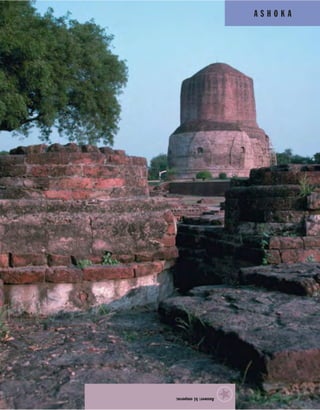
  • 88.
    A M ER I C A N I N D I A N S 87 Indians, or Native Americans, lived in North America long before Europeans even knew the continent existed. The Indians lived everywhere, and today many places such as Michigan, Illinois, Lake Huron, and the Mississippi River are known by their Indian names. Each group of Indians lived differently, depending on the land around them. Eastern America had many lakes, rivers, and vast forests. The Indians there lived in villages, often in wooden houses. The men were hunters, and the women were farmers. In the West, the Plains Indians lived on large rolling areas of grassland. Bison (sometimes called “buffalo”) wandered the plains in large herds, and hunting them gave the Indians everything they needed to survive. These Indians didn’t stay in one place but followed the bison’s migration. The Southwestern states were dry and mountainous. The Pueblo Indians were farmers and lived in stone and adobe (sun-dried clay) houses. They also built cave houses on the sides of cliffs, high on the faces of mesas. The Northwest Indians lived along the northern coast of the Pacific Ocean and fished in the ocean and rivers. They created tall painted totem poles showing important animals and ancestors. When Europeans arrived in the Americas, they wanted the New World’s land, so they often betrayed and attacked the Indians and stole their lands. For many years, many descendants of the original Native Americans have lived on reservations—areas put aside by the government for Indians to live on. But this arrangement has mostly served to isolate Native Americans. Today Indians must work hard to keep their ancient culture and traditions alive. LEARN MORE! READ THESE ARTICLES… AKLAVIK (VOLUME 9) A CHEROKEE STORY: WHY POSSUM’S TAIL IS BARE (VOLUME 5) UNITED STATES: A YOUNG AND POWERFUL NATION (VOLUME 9) Answer:b)PuebloIndians ★(Left) Native American children in traditional dress. (Right) Portrait of Cherokee warrior Austenaco. The First Native North Americans ©PeterTurnley/Corbis ©Corbis
  • 89.
    DID YOU KNOW?Themoney in Venezuela is named for the South American liberator Simón Bolívar. It’s called the bolívar.
  • 90.
    S I MÓ N B O L Í V A R 89 In the early 1800s, in the country that would become Venezuela, there lived a man with a big dream. He wanted the countries of Spanish South America to become independent from Spain and join together as one strong country. This man was Simón Bolívar. For years he fought the Spanish in support of this dream, and many people came to help him from around the world. Many of them sailed from Europe and searched all over South America to find him. Bolívar was born in 1783. His liberation of New Granada— now Colombia, Ecuador, and parts of several other countries— is one of the most daring acts in the history of war. In the spring of 1819, he led a small army of 2,500 men through floodwaters and across icy mountain passes, through places where there were no paths at all. Tired and hungry, they finally arrived in Boyacá, near Bogotá, the capital of New Granada. There they surprised a big Spanish army. Fighting fiercely, they beat the Spanish and freed New Granada. Bolívar fought many battles to free other countries in South America, including his native Venezuela. His dream of freeing the South American countries from Spain came true. But even if he was never able to join all the different countries together as one nation, he was one of the most important heroes in South America. The South American country of Bolivia was named in his honor. LEARN MORE! READ THESE ARTICLES… FIDEL CASTRO (VOLUME 4) • COLOMBIA (VOLUME 9) • SOUTH AMERICA (VOLUME 9) Answer:FALSE.Hedid,however,helpfreemanynationsfrom Spanishrule. ★ Hero of Many Nations In addition to the countries that are now Colombia and Ecuador, Simón Bolívar and his troops won the independence of Venezuela and Peru. © Bettmann/Corbis Portrait of Simón Bolívar by M.N. Bate. © Bettmann/Corbis True or false? Bolívar made all of South America come together as one nation. SEA RCH LI GHT
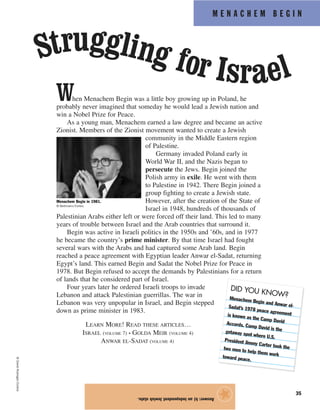
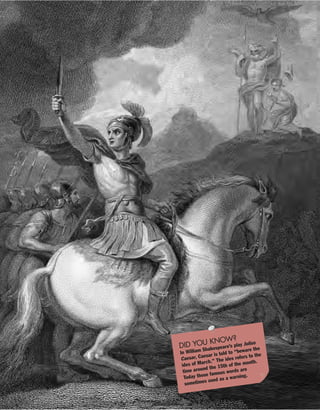
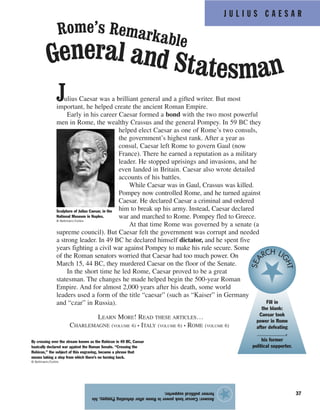
  • 91.
    A new English translationof Anne Frank’s diary was published in 1995. The new edition has material that was not in the original version, making it nearly one-third longer. DID YOU KNOW? True or false? Anne Frank went on to write many other famous books. SEA RCH LI GHT
  • 92.
    A N NE F R A N K 91 During World War II in Europe, the Nazis of Germany tried to destroy the Jewish people and their culture. The Nazis had taken control of many countries, including the Netherlands. In the city of Amsterdam, the Nazi threat meant that a young Jewish girl and her family had to spend two years in hiding. Anne Frank’s moving diary of those years in hiding has since become a classic book. Halfway through the war, the Nazis began sending Jews to prison camps. So in July 1942, Anne’s family went into hiding in the back-room office and warehouse of Anne’s father’s business. Four other Jews hid with them in the small space, and non-Jewish friends smuggled food and other supplies to them. Anne was 13 when she went into hiding. In her diary, she describes daily life in the secret rooms. She also writes about her own dreams and feelings while growing up in hiding. The family never once left their hideout until the Nazi police discovered them in August 1944. Then the Frank family was moved to the concentration camp at Auschwitz in Poland, where Anne’s mother died in 1945. Anne and her sister were sent to another camp, Bergen-Belsen, where they both died of typhus. Anne’s father, Otto Frank, was the only family member who survived. Friends had found Anne’s diary in the hiding space. After the war, they gave it to her father, and he published it in 1947. Since then, Anne’s story of courage and hope has inspired millions of readers. Today, the Frank family’s hiding place in Amsterdam is a museum. LEARN MORE! READ THESE ARTICLES… AMSTERDAM (VOLUME 6) • GERMANY (VOLUME 6) • JUDAISM (VOLUME 5) Answer:FALSE.AnnediedduringWorldWarII,andherdiaryis theonlywritingofhersthatsurvived. ★ Anne Frank. Anne Frank House, Amsterdam and Anne Frank-Fonds, Basel—Hulton/Archive by Getty Images Anne Frank sits at her desk at school in 1940. She left school at the age of 13 to go into hiding. Anne Frank House, Amsterdam and Anne Frank-Fonds, Basel—Hulton/Archive by Getty Images A Young Girl and Her Diary
  • 93.
    92 When she wonthe 400-meter world championship in 1997, Cathy Freeman ran a victory lap carrying two flags. One was the flag of her country, Australia. The other was that of her people, the Aboriginals. The Aboriginals are the original people of Australia, who have suffered great mistreatment and injustice since the Europeans came to their country. Her choice to carry both flags was controversial. But it showed Freeman’s strong sense of national and ethnic pride. While Freeman was growing up in Queensland, her father encouraged her to start running. By the time she was 17, Freeman had won a gold medal at the 1990 Commonwealth Games and been named Young Australian of the Year. In 1992 she was the first Australian Aboriginal woman to compete in the Olympic Games. At the 1994 Commonwealth Games, Freeman took home gold medals in the 400- meter and 200-meter races. Her win in the 200- meter race set a national record. Perhaps Freeman’s greatest race was at the 1996 Olympic Games in Atlanta, Georgia, U.S. She ran against the world record holder, Marie-José Pérec of France. The two champions raced neck and neck. Finally, it was Pérec who shot ahead to the finish line. In 1997 Freeman was named Australian of the Year. A year later, however, she injured her foot and had to withdraw from the Commonwealth Games. Freeman didn’t let the injury stop her, and in 1999 she was running again. She came back and successfully defended her 400-meter world championship title. At the Sydney Olympics in 2000, Freeman had the great honor of lighting the Olympic torch. A week later her dream of Olympic gold came true when she won the 400-meter race in front of her fellow Australians. Again she took her victory lap proudly carrying both the Australian and Aboriginal flags. LEARN MORE! READ THESE ARTICLES… AUSTRALIA (VOLUME 7) • PELÉ (VOLUME 4) • KATH WALKER (VOLUME 3) Cathy Freeman holding the Olympic torch in 2000. © Reuters NewMedia Inc./Corbis Cathy Freeman was the first Aboriginal to win an individual medal in an Olympic event. She won the 400-meter race at the 2000 Olympics in Sydney, Australia. © Duomo/Corbis Gold Medalistin Track How many Olympic Games has Freeman competed in? a) 1 b) 2 c) 3 SEA RCH LI GHT
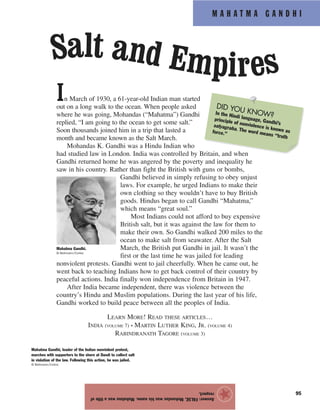
  • 94.
    C A TH Y F R E E M A N 93 Answer:c)3 ★ DID YOU KNOW? In a rush to get to her first track race, 8-year-old Cathy Freeman ran into a post and hurt her eye. She ran her first race with one eye closed and won it easily.
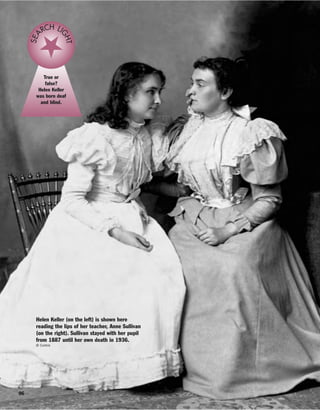
  • 95.
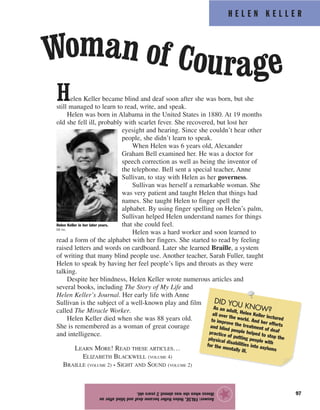
    True or false? Gandhi’s real namewas Mahatma. SEA RCH LI GHT
  • 96.
    M A HA T M A G A N D H I 95 In March of 1930, a 61-year-old Indian man started out on a long walk to the ocean. When people asked where he was going, Mohandas (“Mahatma”) Gandhi replied, “I am going to the ocean to get some salt.” Soon thousands joined him in a trip that lasted a month and became known as the Salt March. Mohandas K. Gandhi was a Hindu Indian who had studied law in London. India was controlled by Britain, and when Gandhi returned home he was angered by the poverty and inequality he saw in his country. Rather than fight the British with guns or bombs, Gandhi believed in simply refusing to obey unjust laws. For example, he urged Indians to make their own clothing so they wouldn’t have to buy British goods. Hindus began to call Gandhi “Mahatma,” which means “great soul.” Most Indians could not afford to buy expensive British salt, but it was against the law for them to make their own. So Gandhi walked 200 miles to the ocean to make salt from seawater. After the Salt March, the British put Gandhi in jail. It wasn’t the first or the last time he was jailed for leading nonviolent protests. Gandhi went to jail cheerfully. When he came out, he went back to teaching Indians how to get back control of their country by peaceful actions. India finally won independence from Britain in 1947. After India became independent, there was violence between the country’s Hindu and Muslim populations. During the last year of his life, Gandhi worked to build peace between all the peoples of India. LEARN MORE! READ THESE ARTICLES… INDIA (VOLUME 7) • MARTIN LUTHER KING, JR. (VOLUME 4) RABINDRANATH TAGORE (VOLUME 3) Answer:FALSE.Mohandaswashisname.Mahatmawasatitleof respect. ★ Mahatma Gandhi. © Bettmann/Corbis Salt and Empires Mahatma Gandhi, leader of the Indian nonviolent protest, marches with supporters to the shore at Dandi to collect salt in violation of the law. Following this action, he was jailed. © Bettmann/Corbis DID YOU KNOW?In the Hindi language, Gandhi’s principle of nonviolence is known as satyagraha. The word means “truth force.”
  • 97.
    96 True or false? Helen Keller wasborn deaf and blind. SEA RCH LI GHT Helen Keller (on the left) is shown here reading the lips of her teacher, Anne Sullivan (on the right). Sullivan stayed with her pupil from 1887 until her own death in 1936. © Corbis
  • 98.
    Woman of Courage HE L E N K E L L E R 97 Helen Keller became blind and deaf soon after she was born, but she still managed to learn to read, write, and speak. Helen was born in Alabama in the United States in 1880. At 19 months old she fell ill, probably with scarlet fever. She recovered, but lost her eyesight and hearing. Since she couldn’t hear other people, she didn’t learn to speak. When Helen was 6 years old, Alexander Graham Bell examined her. He was a doctor for speech correction as well as being the inventor of the telephone. Bell sent a special teacher, Anne Sullivan, to stay with Helen as her governess. Sullivan was herself a remarkable woman. She was very patient and taught Helen that things had names. She taught Helen to finger spell the alphabet. By using finger spelling on Helen’s palm, Sullivan helped Helen understand names for things that she could feel. Helen was a hard worker and soon learned to read a form of the alphabet with her fingers. She started to read by feeling raised letters and words on cardboard. Later she learned Braille, a system of writing that many blind people use. Another teacher, Sarah Fuller, taught Helen to speak by having her feel people’s lips and throats as they were talking. Despite her blindness, Helen Keller wrote numerous articles and several books, including The Story of My Life and Helen Keller’s Journal. Her early life with Anne Sullivan is the subject of a well-known play and film called The Miracle Worker. Helen Keller died when she was 88 years old. She is remembered as a woman of great courage and intelligence. Answer:FALSE.HelenKellerbecamedeafandblindafteran illnesswhenshewasalmost2yearsold. ★ DID YOU KNOW?As an adult, Helen Keller lectured all over the world. And her efforts to improve the treatment of deaf and blind people helped to stop the practice of putting people with physical disabilities into asylums for the mentally ill. Helen Keller in her later years. EB Inc. LEARN MORE! READ THESE ARTICLES… ELIZABETH BLACKWELL (VOLUME 4) BRAILLE (VOLUME 2) • SIGHT AND SOUND (VOLUME 2)
  • 99.
    On December 1,1955, in Montgomery, Alabama, U.S., an African American woman named Rosa Parks was arrested. She had refused to give up her seat on a bus to a white man. At that time the law said that black people had to sit only in certain sections of trains and buses and use different bathrooms and even drinking fountains from the ones white people used. Rosa Parks’s action sparked protests by black residents of the city. And Martin Luther King, Jr., was chosen to lead the protests. King was a Baptist minister and a student of the Indian leader Mahatma Gandhi. He believed that nonviolence was the most powerful way for people to make their point. This meant demanding one’s rights through peaceful means, such as strikes and protests, not by fighting. The protests he led became known as the Montgomery bus boycott. The law was changed after a year of protests. However, black people still didn’t receive the same rights and privileges as white people. In 1963 King and his supporters were jailed because of their protests against this discrimination. When he was freed, King and other civil rights leaders organized a march on Washington, D.C., the national capital. There, King delivered a powerful speech to hundreds of thousands of people, saying, “I have a dream.” His dream was that someday all people would be equal, like brothers. For his work on civil rights, King was awarded the Nobel Prize for Peace in 1964. Through all his struggles, King used only peaceful methods of protest. But in April 1968, King was shot dead in Memphis, Tennessee, by James Earl Ray. LEARN MORE! READ THESE ARTICLES… GWENDOLYN BROOKS (VOLUME 3) • NELSON MANDELA (VOLUME 4) UNITED STATES: A YOUNG AND POWERFUL NATION (VOLUME 9) 98 True or false? Martin Luther King, Jr., sparked the Montgomery bus boycott. SEA RCH LI GHT Civil Rights Leader Martin Luther King, Jr., riding a bus in Montgomery, Alabama, U.S., in 1956. © Bettmann/Corbis ©Bettmann/Corbis
  • 100.
    M A RT I N L U T H E R K I N G , J R . Answer:FALSE.RosaParkssparkedtheboycottwhensherefused togiveupherseat. ★ Martin Luther King, Jr., led the march on Washington in 1963. His protests helped win important rights for African Americans. DID YOU KNOW? In 1977, King was posthumously (after his death) awarded the Presidential Medal of Freedom. This is the U.S. government’s highest honor awarded to a person not in the military.
  • 101.
    DID YOU KNOW? TheStrait of Magellan isn’t all that’s been named for the famous explorer. Magellan’s name remains a popular choice for other things. For instance, the space mission begun in 1989 to explore planet Venus was called Magellan.
  • 102.
    F E RD I N A N D M A G E L L A N 101 Hundreds of years ago, only the very brave took the risk of traveling the open seas to reach unknown lands. Ferdinand Magellan was one such man. Magellan was born to a noble family in Portugal in about 1480. At about age 25, he joined the Portuguese navy, where he fought in numerous battles and saw many new places. When the king of Portugal refused to raise his wages after a decade of service, Magellan went to work for the Spanish king. At that time Portugal controlled the sea route around Africa to the Indian Ocean to reach the rich Spice Islands (now called the East Indies). Magellan decided to avoid that route, and instead he sailed west to find a new way to the islands. He set out in 1519, sailing across the Atlantic Ocean and down the coast of South America. He hoped to discover a passage to the ocean beyond South America. He found it, and it became known as the Strait of Magellan. The ocean on the other side appeared calm and peaceful, so it was named the Pacific, from the Latin word for “peaceful.” After 99 more days, Magellan’s ship reached the island now known as Guam. Landing in the islands that became the Philippines, Magellan and his men fought with islanders. Magellan was killed there April 27, 1521. A crewman, Juan Sebastián de Elcano, took command. The remaining crew sailed to the Spice Islands, loaded up with spices, and returned to Spain. In a voyage of more than three years that saw the death of many sailors, Magellan’s expedition became the first to circle the globe. LEARN MORE! READ THESE ARTICLES… PACIFIC OCEAN (VOLUME 1) • PHILIPPINES (VOLUME 7) • PORTUGAL (VOLUME 6) Answer:utgroPal=Portugal ciSpesladIns=SpiceIslands fiPicacnOace=PacificOcean ★ An illustration of Ferdinand Magellan’s ship Victoria. Collection of the Bibliotheque Nationale; photo, © Erich Lessing/Art Resource, New York Around-the-World Voyager Unscramble these words: - utgroPal - ciSpe sladIns - fiPicac nOace SEA RCH LI GHT This painting from 1970 shows the Portuguese explorer Ferdinand Magellan. He led an expedition that was the first to travel all the way around the Earth. The Art Archive/Marine Museum, Lisbon/Dagli Orti
  • 103.
    102 Thousands of yearsago there were people who built huge pyramids and temples. They had accurate calendars, did complex mathematics, and developed a writing system. They weren’t the Egyptians, however. They were the Maya. They were the only Central Americans of their time to develop writing. Mayan culture grew up in a region of Mexico and Central America called Mesoamerica. This includes the Yucatán Peninsula, parts of southern Mexico, Guatemala, Belize, and western Honduras and El Salvador. Between about AD 200 and 900, the Maya built religious centers and cities from the jungles of Guatemala to the dry northern Yucatán in Mexico. These included Tikal, Uaxactún, and Palenque. The cities had populations of 5,000 to 50,000 people. The Maya worshiped several gods and even offered human sacrifices. Many of their buildings are decorated with the face of Chac, the rain god. He was an important god in their farming society. Mayan rulers were considered to be the descendants of gods. Most of the Maya were corn farmers. The upper classes were artists, writers, and architects. They developed a hieroglyphic (picture-based) writing system and a 365-day solar calendar. They were good astronomers, charting the movements of the planets through the night sky. No one knows why Mayan culture faded. The cities began emptying out after AD 900, and they were entirely empty by the time the Spaniards arrived in the 16th century. They stood overgrown by jungle until they were rediscovered in the 19th century. The decline may have been because of overuse of the farmland, overpopulation, weather changes, disease, or war—or a combination of these things. LEARN MORE! READ THESE ARTICLES… AMERICAN INDIANS (VOLUME 4) • CENTRAL AMERICA (VOLUME 9) MEXICO (VOLUME 9) Temple of the Giant Jaguar at Tikal, Guatemala. © Jan Butchofsky-Houser/Corbis Writers, Mathematicians, and Architects
  • 104.
    M A YA N C I V I L I Z A T I O N 103 Answer:Nooneisreallysure.However,itmayhavebeenbecause ofoveruseoffarmland,overpopulation,climatechanges,disease, orwar—orperhapsacombinationofthese. ★ Why did the ancient Mayan civilization fade? SEA RCH LI GHT The Mayan civilization had more than 40 cities at the height of its power. Those cities were all abandoned by the early 16th century. Their remains can be seen in the jungles of Guatemala. © Charles and Josette Lenars/Corbis DID YOU KNOW? Today many Maya Indians live in northern Yucatán, Mexico, and in highland Guatemala, just as their ancestors did.
  • 105.
    104 More than anyother player, Pelé helped make association football, also known as soccer, popular over the whole world. Pelé, whose real name is Edson Arantes do Nascimento, was born in 1940 in Brazil. Pelé made his debut with the Santos Football Club in 1956. With him playing forward, the team won several South American cups. In 1962 the team won the first world club championship. Pelé also played on Brazil’s national team and helped it win the World Cup championship in 1958, 1962, and 1970. Pelé was a brilliant player who possessed great speed and balance. He could guess the moves of other players and had good control of the ball. In addition to all this, he could powerfully shoot a ball straight into the goal with either foot or with his head. Pelé scored a career total of 1,281 goals in 1,363 matches, with 139 in one year alone. He scored his thousandth goal in 1969. Pelé’s career made him a national hero in Brazil. His fans called him Pérola Negra, meaning “Black Pearl.” Although Pelé retired in 1974, he made a comeback the next year with a New York team, the Cosmos. He said he returned to “make soccer truly popular in the United States.” He succeeded, becoming a star in the United States as well. Pelé’s skills did not stop with football. He also wrote best-selling autobiographies, starred in several films, and composed music, including the whole soundtrack to the 1977 film Pelé. LEARN MORE! READ THESE ARTICLES… BRAZIL (VOLUME 9) • CATHY FREEMAN (VOLUME 4) • TENZING NORGAY (VOLUME 4) Pelé holding international football award for “Footballer of the Century.” © AFP/Corbis Football Star Pelé played for which country? a) Brazil b) Peru c) Colombia SEA RCH LI GHT
  • 106.
    P E LÉ 105 Answer:a)Brazil ★ DID YOU KNOW?When Pelé first tried out for the topfootball teams in Brazil, he wasturned down repeatedly.Pelé in action was so magical to watch that once two armies stopped fighting just to watch him play. © AFP/Corbis
  • 108.
    M O TH E R T E R E S A 107 Answer:No.MotherTeresawasborninMacedonia,nearGreece. ButshelivedandworkedinIndiaandbecameanIndiancitizen. ★ During her lifetime Mother Teresa became known worldwide for her kindness and her charitable work. Mother Teresa was born Agnes Gonxha Bojaxhiu in Macedonia in 1910. When she was 18 years old, she decided to become a nun in the Roman Catholic church. She traveled to Ireland, and there she entered the Institute of the Blessed Virgin Mary. She took vows promising to live a simple life and not to marry, and she became Sister Teresa. The Institute had charity missions in India, and soon Sister Teresa sailed to the country to work as a teacher. Over the next 17 years, she taught in two schools in India, one of which was in Calcutta (now Kolkata). She saw firsthand the poverty and suffering of the people. She often said that she was inspired to make two important decisions in her life. One was to become a nun, and in 1946 the other was to devote her life to helping the sick and the poor. As soon as her studies in nursing were finished, she began working with the people living in Calcutta’s slums. She became an Indian citizen. And she became Mother Teresa when she founded the Missionaries of Charity. This was a new order of Roman Catholic nuns who wanted to help the sick, especially the dying and disabled. Under Mother Teresa’s guidance, the Missionaries of Charity opened centers all over the world. In these centers anyone could receive care, no matter what their religion. In 1979 Mother Teresa was awarded the Nobel Prize for Peace. Soon after her death, in 1997, the Roman Catholic church began the process to have Mother Teresa declared a saint. LEARN MORE! READ THESE ARTICLES… ELIZABETH BLACKWELL (VOLUME 4) INDIA (VOLUME 7) • MEDICINE (VOLUME 2) Mother Teresa lived in poverty with some of India’s poorest people. She made it her life’s work to care for the country’s poor and dying. © Bettmann/Corbis DID YOU KNOW?When Mother Teresa founded herreligious order, the Missionaries ofCharity, her Indian nuns adopted thesari as their habit, or official dress.The sari is a garment worn by mostwomen of India, Pakistan, andBangladesh. Mother of the Poor and Dying Was Mother Teresa Indian by birth? SEA RCH LI GHT
  • 109.
    108 On May 29,1953, at 11:30 AM, Tenzing Norgay and Edmund Hillary became the first people to reach the summit of the highest mountain on Earth, Mount Everest. Tenzing Norgay was born in 1914 in Tibet (a region of China). He later moved to Nepal and lived with the Sherpa people. Sherpas, who moved from Tibet to Nepal hundreds of years ago, have lived in high mountains for hundreds of years. Not far from Tenzing’s adopted village rises the majestic Everest. It is part of the Himalaya Mountains and lies on the border between Nepal and Tibet. When Europeans go to Nepal to climb mountains, they often hire Sherpas to carry supplies and to show them the way up the mountains. Because of their experience living in high mountains, the Sherpas have proved to be excellent guides and mountaineers. At age 18 Tenzing moved to Darjeeling (now spelled Darjiling), India. He hoped to make his fortune carrying loads of supplies for mountaineering expeditions. Three years later he accompanied a survey team on an expedition to Mount Everest as a porter. In the next few years, he took part in more Everest expeditions than any other climber. Working with so many different people, Tenzing learned to speak seven languages. Later he became a sirdar, or an organizer of porters. He continued to guide expeditions to Everest and inspired many mountaineers. During their historic climb of Mount Everest in 1953, Edmund Hillary lost his footing and nearly died. Tenzing did not panic. He held the rope line tightly and planted his ax firmly in the ice. Later he simply said, “Mountain climbers always help one another.” For his courage and heroism and for having been one of the first people to scale Mount Everest, Tenzing was awarded the British George Cross and the Star of Nepal. LEARN MORE! READ THESE ARTICLES… FERDINAND MAGELLAN (VOLUME 4) • MOUNTAINS (VOLUME 1) • NEPAL (VOLUME 7) On Top of theWorld Here, Edmund Hillary (on the left) and Tenzing Norgay prepare for one part of their climb to the top of Mount Everest. Royal Geographical Society; photo, Alfred Gregory Tenzing Norgay. UPI—EB Inc. DID YOU KNOW?Tenzing Norgay was the first man to be photographed on the summit of Everest. Since Tenzing could not operate a camera, Edmund Hillary took the photograph.
  • 110.
    T E NZ I N G N O R G A Y Answer:Someonewhoorganizesportersformountainclimbing intheHimalayasiscalledasirdar. ★ Fill in the blank: Someone who organizes porters for mountain climbing in the Himalayas is called a _________. SEA RCH LI GHT
  • 111.
    agent something thatproduces an effect architect person who designs buildings and advises in their construction aristocratic having to do with the upper social classes aspect part, feature, or quality of something astronomy the science of the heavenly bodies and of their sizes, motions, and composition autobiography life story written by the person it is about betray to lie to or go back on one’s word biologist person who studies living organisms and life processes bond connection or friendship boycott the refusal to deal with a person, group, or country, usually in order to show disapproval or to force a change in behavior Braille a system of writing for the blind in which letters are represented by raised dots campaign planned activities designed to lead to a particular result captive one who has been taken or held in a cage or as a prisoner chairman person who leads a meeting or an organization charitable done to serve the needs of the poor or sick chemist scientist who studies the makeup and properties of physical substances and the changes that they go through civil rights the social and personal rights of a citizen commoner person who is not of the noble or upper classes communism system of government in which all property is owned by the state or community and all citizens are supposed to have a share in the total wealth conflict disagreement, struggle, or fighting constitution document containing the basic beliefs and laws of a nation, state, or social group controversial causing division or disagreement crown prince (feminine: crown princess) the prince next in line for a crown or throne culture the ways of life, traditions, and behaviors of a specific group of people debut first formal public appearance descendant member of a recent age group of a family or similar division that began years earlier dictator person who rules with total power, often in a cruel or brutal way diplomat person who works to keep up friendly relations between the governments of different countries discrimination the treatment of some individuals or groups differently from others without any fair or proper reason dynasty series of rulers of the same family edict law or order given by a ruler or leader element in science, one of the basic unique substances that make up all matter emperor (feminine: empress) the ruler of an empire evolution the process of changing, especially over time exile (noun) banishment or official separation extremist person who holds unusually strong opinions or beliefs foundation the support on which something rests; also, the base from which an idea or creation grows geometric based on straight lines, curves, and simple shapes such as circles and squares gory violent and bloody governess woman who teaches and trains a child in a private home guerrilla person who is part of an independent fighting force that makes surprise raids behind enemy lines gymnastics difficult physical exercises, often performed as a sport in competitions immortal living or lasting forever imperial having to do with an empire or emperor inspiration something that causes a particular thought, feeling, or idea lens (plural: lenses) curved piece of glass that concentrates rays of light liberation freedom marginal lying at or near the outer edge (margin) of some larger place, object, or group mesa flat-topped hill or small upland with steep sides metropolitan having to do with a city and its heavily populated surrounding areas migration movement from one country or place to another monarchy form of government in which the ruler inherits the position and rules for life; monarchs include kings, queens, emperors, and tsars mountaineer mountain climber nature inborn or instinctive way of behaving or thinking negotiate to discuss and bargain with another in order to reach an agreement noble of upper-class birth or rank nonfiction literature that is based on fact rather than imagination nuclear weapon explosive device that produces enormous power by splitting apart the centers of the tiny particles called “atoms” pagan (adjective) non-religious; especially, used disapprovingly to describe a form of worship very different from a familiar and socially acceptable religion parliament the lawmaking division of some governments particle tiny bit or piece persecute to treat cruelly or harmfully for an extended period of time; especially, to make a person or group suffer because of their beliefs photoelectric effect electrical effect produced when light strikes a metal surface physics the science that deals with matter and energy and the way they interact plot the main story of a work of literature pollen very fine dusty substance that comes from flowers; it is important in reproduction of other plants pope the leader of the Roman Catholic church porter person who carries baggage prime minister the chief officer of the government in some countries prism piece of many-sided clear crystal pyramid structure with a square base and four sloping triangle sides that meet in a point at the top rebel person who fights against an existing power or way of doing things reign the time during which a ruler is in power republic form of government in which citizens who are allowed to vote elect officials and representatives responsible for governing by law rhythm regular pattern of sound ruthless without pity sabotage damage or destruction of property that interferes with an enemy’s use of it sacrifice valuable offering made to a god; especially, a human or animal victim killed on an altar skyline outline of buildings or other large objects against the background of the sky solar having to do with the Sun sophisticated complicated or stylish Soviet Union country of eastern Europe and northern Asia that existed from 1922 to 1991 and consisted of Russia and 14 other republics species group of living things that have certain characteristics in common and share a name strike temporary stopping of normal activities in protest against an act or condition summit top or highest point tapestry heavy cloth that has designs or pictures woven into it and is often used as a wall hanging technique special way of doing something; especially, the way a skilled individual handles the details of an art or craft theory in science, an idea or reasoned explanation for why things are as they are or why things happen as they do troupe company or group; especially, a working group of stage performers vow solemn promise or statement wages payment for work or services G L O S S A R Y 110
  • 112.
    111 I N DE X Allende, Isabel (Chilean writer) page 7 American Indians, also called First Nations, or Native Americans page 87 LEARN MORE look under Mayan civilization Antony, Mark (Roman official) Cleopatra page 43 Arafat, Yasir (Palestinian leader) page 30 architecture: look under Pei, I. M. Ashoka (emperor of India) page 32 astronomy (science) Mayan civilization page 103 LEARN MORE look under Copernicus, Nicolaus; Galileo Galilei; Kepler, Johannes athletes: look under Freeman, Cathy; Pelé Australian Aboriginals (people) Cathy Freeman page 92 bacteria Louis Pasteur page 85 ballet (dance): look under Elssler, Fanny Basie, Count, also called William Basie (American musician) page 9 Begin, Menachem (Israeli leader) page 35 Anwar el-Sadat page 59 Bell, Alexander Graham (American inventor) Helen Keller page 97 Blackwell, Elizabeth (American doctor) page 65 blindness Helen Keller page 97 Bojaxhiu, Agnes Gonxha (nun): look under Teresa, Mother Bolívar, Simón (Latin American leader) page 89 Burbank, Luther (American plant breeder) page 66 Caesar, Julius (Roman leader) page 37 Cleopatra page 43 calendars Mayan civilization page 103 Castro, Fidel (Cuban leader) page 39 Charlemagne (Holy Roman emperor) page 41 chimpanzees (animals) Jane Goodall page 78, photograph page 79 civil rights Martin Luther King page 98 LEARN MORE look under Gandhi, Mahatma; Mandela, Nelson Cixi (empress of China): look under Empress of China Clemens, Samuel Langhorne (American writer): look under Twain, Mark Cleopatra (queen of Egypt) page 43 Columbus, Christopher (Italian explorer) Did you know? page 86 communism Fidel Castro page 39 Mao Zedong page 54 Copernicus, Nicolaus (Polish astronomer) page 69 Cubism (art) Pablo Picasso page 20 Curie, Marie (French scientist) page 71 dance: look under Elssler, Fanny Darwin, Charles (British scientist) page 73 deafness, also called hearing impairment Helen Keller page 97 Dickens, Charles (British writer) page 10 Dragon Empress, The (empress of China): look under Empress of China education Charlemagne page 41 Socrates page 24 Einstein, Albert (German-American scientist) page 74 Elizabeth I, also called Good Queen Bess (queen of England) page 44 LEARN MORE look under Shakespeare, William Elssler, Fanny (Austrian ballerina) page 13 Empress of China, also called Cixi, or Empress Dowager, or The Dragon Lady page 47 Ericson, Leif, also called Leif Eriksson (explorer) Vikings page 62 Everest, Mount, also called Sagarmatha (mountain in Asia) Tenzing Norgay page 108, photograph page 109 evolution (scientific theory) Charles Darwin page 73 exploration: look under Magellan, Ferdinand; Tenzing Norgay; Vikings Frank, Anne (German diarist) page 91 Freeman, Cathy (Australian athlete) page 92 Galileo Galilei (Italian astronomer, mathematician, and philosopher) page 77 Gandhi, Mahatma, also called Mohandas K. Gandhi (Indian leader) page 95 Good Queen Bess (queen of England): look under Elizabeth I Goodall, Jane (British scientist) page 78 Goya, Francisco de (Spanish painter) page 14 grafting (horticulture) Luther Burbank page 66 gravity Albert Einstein page 74 Sir Isaac Newton page 83 Hirohito, also called Michinomiya Hirohito (emperor of Japan) page 49 Holy Roman Empire (historic empire) Charlemagne page 41
  • 113.
    112 immunization Louis Pasteur page85 Indians (Native Americans): look under American Indians Jinnah, Mohammed Ali (Pakistani leader) page 51 Keller, Helen (American writer) page 97 Kepler, Johannes (German astronomer and mathematician) page 81 King, Martin Luther, Jr. (American civil rights leader) page 98 leaders: look under Arafat, Yasir; Ashoka; Begin, Menachem; Bolívar, Simón; Caesar, Julius; Castro, Fidel; Charlemagne; Cleopatra; Elizabeth I; Empress of China; Hirohito; Jinnah, Mohammed Ali; Mandela, Nelson; Mao Zedong; Meir, Golda; Sadat, Anwar el-; Thant, U literature (art): look under Allende, Isabel; Dickens, Charles; Frank, Anne; Keller, Helen; Shakespeare, William; Twain, Mark Louvre (museum in Paris, France) I. M. Pei page 18, photograph page 18, photograph page 19 Magellan, Ferdinand (Portuguese explorer) page 101 Mandela, Nelson (South African leader) page 53 Mao Zedong (Chinese leader) page 54 Mayan civilization page 103 medicine (science) Marie Curie page 71 LEARN MORE look under Blackwell, Elizabeth; Pasteur, Louis Meir, Golda, also called Goldie Mabovitch, or Goldie Myerson (Israeli leader) page 57 Michinomiya Hirohito (emperor of Japan): look under Hirohito milk (food) Louis Pasteur page 85 Mozart, Wolfgang Amadeus (Austrian composer) page 17 music: look under Basie, Count; Mozart, Wolfgang Amadeus Nascimento, Edson Arantes do (Brazilian football player): look under Pelé Native Americans: look under American Indians natural selection, also called survival of the fittest (biology) Charles Darwin page 73 Newton, Sir Isaac (English scientist and mathematician) page 83 Nobel Prizes (awards): look under Arafat, Yasir; Begin, Menachem; Curie, Marie; King, Martin Luther, Jr.; Mandela, Nelson; Sadat, Anwar el-; Teresa, Mother nonviolence Mahatma Gandhi page 95 Martin Luther King page 98 Norgay, Tenzing (Nepalese mountain climber): look under Tenzing Norgay Norsemen: look under Vikings painting (art): look under Goya, Francisco de; Picasso, Pablo Pasteur, Louis (French scientist) page 85 pasteurization Louis Pasteur page 85 Pei, I. M., also called Ieoh Ming Pei (Chinese-American architect) page 18 Pelé, also called Edson Arantes do Nascimento (Brazilian athlete) page 104 Picasso, Pablo (Spanish artist) page 20 plants Luther Burbank page 66 Plato (Greek philosopher) Socrates page 24 rabies (disease) Louis Pasteur page 85 radioactivity Marie Curie page 71 relativity (science) Albert Einstein page 74 Sadat, Anwar el- (Egyptian leader) page 59 Menachem Begin page 35 science: look under Burbank, Luther; Copernicus, Nicolaus; Curie, Marie; Darwin, Charles; Einstein, Albert; Galileo Galilei; Goodall, Jane; Kepler, Johannes; Newton, Sir Isaac; Pasteur, Louis sculpture: look under Picasso, Pablo Shakespeare, William (English writer) page 23 Did you know? page 36, page 43 LEARN MORE look under Elizabeth I Socrates (Greek philosopher) page 24 solar system Johannes Kepler page 81 Nicolaus Copernicus page 69, illustration page 69 survival of the fittest (biology): look under natural selection Sutherland, Joan, also called “La Stupenda” (Australian opera singer) page 27 telescopes Galileo Galilei page 77, illustration page 76 Sir Isaac Newton page 83, illustration page 83 Tenzing Norgay (Nepalese mountain climber) page 108 Teresa, Mother, also called Agnes Gonxha Bojaxhiu (Roman Catholic nun) page 107 Thant, U (leader of the United Nations) page 60 Twain, Mark, also called Samuel Langhorne Clemens (American writer) page 29 United Nations (international organization) U Thant page 60 universe Albert Einstein page 74 Kepler’s model illustration page 81 Vikings, also called Norsemen (Norse people) page 62 World War II Anne Frank page 91 Hirohito page 49 writing Mayan civilization page 103 Zionism (nationalistic movement) Golda Meir page 57 Menachem Begin page 35