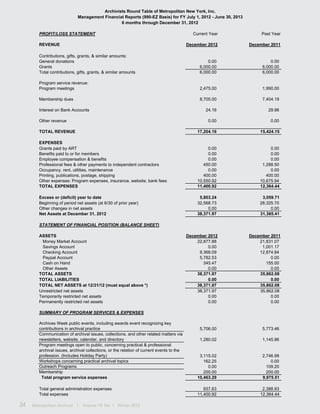
2 Metropolitan Archivist | Volume 19, No. 1 Winter 2013
BOARD OF DIRECTORS
Rachel Chatalbash
President
Pamela Cruz
Vice President
Mitchell Brodsky
Treasurer
Melissa Bowling
Secretary
Karen Murphy
Director, Education Committee
Ryan Anthony Donaldson
Director, Communications
Committee
Anne Petrimoulx
Director, Membership Committee
Janet Bunde
Director, Outreach & Advocacy
Committees
Nick Pavlik
Director, Programming Committee
Editor-in-Chief
Ryan Anthony Donaldson
Managing Editors
Rachel L. Conrad
Madeline Rogers
Mary Ann Quinn
Features Editor
Rachel Greer
Interview Editor
Ellen Mehling
Book Review Editor
Lindsey Wyckoff
ART News Editor
Will Andersen
Layout Design
Shirin Khaki
New Members
Clifford Allen
Erin Allsop
Lauren Barnes
Michala Biondi
Mary Brown
Anna Ciepiela
Ioannides
Matthew Coody
Cara Dellatte
Honora Drohan
Deborah Falik
Caitlin Goodman
Yevgeniya Gribov
Kate Jadwin
John Joseph
Miriam Kahn
Brigette C. Kamsler
Michael Kemezis
Natalie Milbrodt
Virginia Millington
Nancy Palley
Gregory Raml
Haley Richardson
Stephanie Satalino
Natalka Sawchuk
Christopher Smith
Marc Steinberg
Susie Tofte
Bleakley McDowell
Emily Nabasny
Deborah Nitka
Robin Preiss
Rachel Ann Schimke
Erin Shaw
Erica Titkemeyer
Pamela Vizner Oyarce
Pratt Institute,
School of Information
and Library Sciences
Erin Barsan
Sophia Dahab
Nik Dragovic
Elizabeth Kaufer
Megan Koontz
Leanora Lange
Richard Lee
Heather Lember
Carolyn Li-Madeo
Barbarajean Majewski
Aria Marco
Rossy Mendez
Christina Neckles
Ngozi Okoro
Hallie Olson
Abby Rubin
Anna Rybakov
Walter Schlect
WELCOME
The following individuals have joined the Archivists Round Table of Metropolitan
New York since June 2012
The mission of Metropolitan Archivist is to serve members of the Archivists RoundTable of Metropolitan
New York (ART) by:
	 • Informing them of ART activities through reports of monthly meetings
and committee activities
	 • Relating important announcements about individual members and
member repositories
	 • Reporting important news related to the New York metropolitan area
archival profession
	 • Providing a forum to discuss archival issues
Metropolitan Archivist (ISSN 1546-3125) is issued semi-annually to the members of ART. Comments,
questions, or submissions for features should be directed to the editor at outreach@nycarchivists.org.
Deadlines for submissions are April 30 and November 15. Similar inquiries and submissions for reviews
should be directed to outreach@nycarchivists.org.
Preferred length of submissions is 800–1000 words for feature articles and 400–500 words for reviews.
Metropolitan Archivist and ART assume no responsibility for statements made by contributors.
John Tomasicchio
Chris Ventura
Miwa Yokoyama
New Student
Members
Long Island
University, Palmer
School of Library
and Information
Science
Meagan Doodian
Michael Leverett
Dorn
Tina Edell
Daniel Frett
Marina Rosenfield
Marie Stark
New York University
Rachel Corbman
Alyssa DesRochers
Bonnie Gordon
Nicole Greenhouse
Rebecca Hernandez-
Gerber
Salome Jeronimo
Stephanie Krom
Alexsandra Mitchell
Taylor McBride
Abril Siqueiros
Robert Smith
Theo Roth
Queens College
Shira Bistricer
Caroline Curtin
Bridget Jivanelli
Leeroy Kang
Deborah Marks
Minda Matz
Hallie McNeill
Meg Milewski
Evelyn Shunaman
Other
Lauren Alpher
Sarah Bost
Caitlin Christian-
Lamb
Wanett Clyde
CJ Donson
Annamarie Klose
Martie McNabb
Christina Orozco
Ethan Patch
Emily Reynolds
Twila Rios
Jim Rush
We extend a special thank you to the following members for their support as
Friends of ART:	 Sustaining Members:		 Sponsors of ART:::
Timothy Conley		 J. E. Molly Seegers		 Gina Pollara
Stephanie Gellis
Letter from the President / Editor’s Note ........................................................................................... 4
On Semi-permanence & History: New Museum Digital Archive by Tara Hart ......................................... 5
Picture Perfect: Surveying Photographs of the Manuscripts and Archives Division,
Special Collections, New York Public Library by Valerie Wingfield ....................................................... 8
Archive Notebook: “Writing to the Scrap” as Qualitative Crowdsourcing
by Jane Greenway Carr and Cecily Swanson ........................................................................................ 10
“Human Skin Color” and the Challenges of Using LCSH to Describe Oral Histories by Margaret Fraser ... 12
iPads in the Reading Room: Broadening the Reference Horizon by Melanie Meyers ............................... 14
Saving a Memory: Verrazano Narrows Bridge Construction
by Laura DeMuro, Alexandra Janvery & Ann Christiansen .................................................................. 15
INTERVIEW WITH THE ARCHIVIST: An lnterview with Rebecca Goldman by Nick Pavlik ....................... 16
BOOK REVIEWS: Rare Book Librarianship: An Introduction and Guide review by Matthew Flaherty /
How to Manage Processing in Archives and Special Collections review by Michael D. Montalbano ......... 18
CITING COLLECTIONS submitted by Jim Moske ................................................................................ 19
EXHIBITIONS REVIEW: Straight to Hell: 20 Years of Dyke Action Machine ............................................. 20
ART News ........................................................................................................................................ 21
Programming Committee Report by Pamela Cruz ................................................................................ 32
Education Committee Report by Karen Murphy ................................................................................... 33
Treasurer’s Report ............................................................................................................................. 34
TABLE of CONTENTS
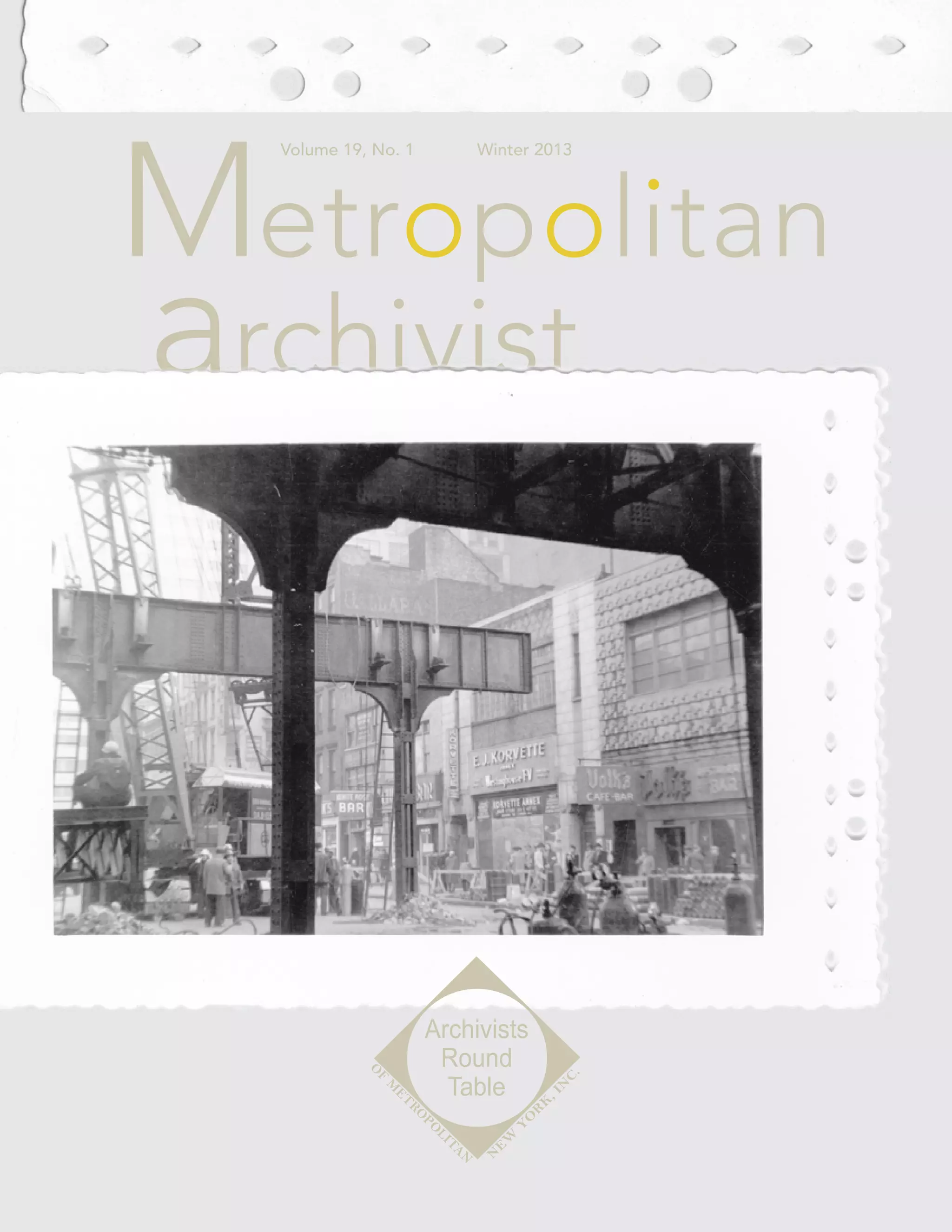
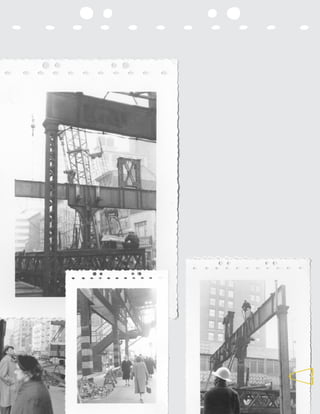
Front and Back Cover: Images depicting the demolition of the Third Avenue “El” train tracks at the intersec-
tion of East 42nd Street and Third Avenue. Photographs taken in summer 1955, photographer unidentified.
The photographs vividly convey the changing nature of transportation in New York, a theme of this year’s
New York Archives Week K-12 Archives Education Institute. Courtesy The Durst Organization Archives.
Volume 19, No. 1 Winter 2013 | Metropolitan Archivist 3
Dear Members,
Welcome to 2013!
Over the course of the past year, ART grew to number over 550
members. With this expansion, our programming has signifi-
cantly increased to meet member needs and new community
partnerships. We revised the ART by-laws by member vote to
ensure that they reflect ART’s actual structure and operations.
This revised structure allows the organization to continue to
provide strong member services such as educational workshops
and symposia, networking tools and events, and our mentor-
ship program. ART can now prioritize outreach activities,
such as archives-focused programming for local educators, and
strengthen our advocacy work on both the local and national
level.
The arrival of Hurricane Sandy in our region devastated homes,
caused serious damage to archival collections and buildings,
and disrupted the lives of many New Yorkers. The storm af-
fected many ART members. ART coordinated with numerous
local organizations and the New York State Archives to provide
disaster support. The willingness of ART members to volun-
teer time and services to help others in need was heartening.
The ART Board plans to develop a
series of tools — on our website and
through programming — to help
members improve disaster plans and
emergency preparations for the fu-
ture.
We are lucky to have such a vibrant,
concerned, and committed profes-
sional community of archivists in
New York City. I’m reminded of this
every time we run a program, launch
a new initiative, and, sometimes, are forced to meet significant
challenges. I look forward to working with you all in the year
ahead.
Best wishes,
Rachel Chatalbash
President
Archivists Round Table of Metropolitan New York, Inc.
president@nycarchivists.org
2013 And Beyond
As Rachel Chatalbash notes, the Archivists Round Table has ex-
perienced a great expansion in our membership. We are proud
to report an all-time high of more than 550 current members.
We welcome all our new members, from students to those in a
career transition, and we thank our longtime members for their
ongoing support.
In addition to ramping up our programming, we are also con-
sidering the future of our organization and our profession. As
part of this process, we have begun a brand identity redesign
to better reflect ART’s growth and direction. We will be shar-
ing details with you in the new year, and we welcome your
thoughts and comments as we look ahead.
The theme of this issue of Metro Archivist is contemplating per-
manence, with articles that explore digital archives and projects
at the New Museum, Carnegie Hall, New-York Historical So-
ciety, and elsewhere. We celebrate the enduring success of the
Winthrop Group, and welcome the
National Archives at New York City
to their new home at One Bowling
Green.
As Hurricane Sandy so forcefully re-
minded us, our profession calls on us
to develop flexible strategies, against
all odds, for the long-term preserva-
tion of, and access to, our reposito-
ries’ collections. ART looks to assist
our members affected by Hurricane
Sandy, and share the lessons learned as we all pursue this noble
goal.
Thank you, as always, for your readership!
Ryan Anthony Donaldson
10 December 2012
LETTER FROM THE PRESIDENT
EDITOR’S NOTE
4 Metropolitan Archivist | Volume 19, No. 1 Winter 2013
Volume 19, No. 1 Winter 2013 | Metropolitan Archivist 5
On Semi-permanence & History:
New Museum Digital Archive
by Tara Hart
Digital Archivist, New Museum
“The New Museum of Contemporary Art was founded on the premise that works
of art are not only objects for visual delectation and assessment, but are reposito-
ries for ideas that reverberate in the larger context of our culture.” — Brian Wallis,
New Museum Curator, 1984
When New Museum was founded in
1977, there was a limited commercial
market for emerging and avant-garde
works, and the New York contempo-
rary art scene revolved around alterna-
tive spaces such as Artists Space, White
Columns, and P.S. 1. Founding Director
Marcia Tucker envisioned an institution
positioned between a traditional mu-
seum and an alternative space focusing
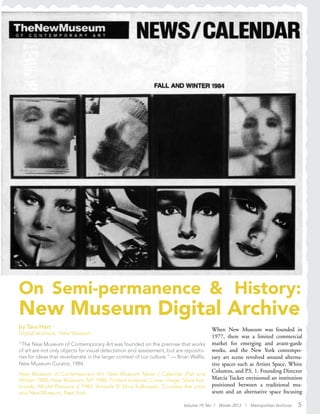
New Museum of Contemporary Art. New Museum News / Calendar (Fall and
Winter 1984). New Museum, NY: 1984. Printed material. Cover image: Silvia Kol-
bowski, Model Pleasure V, 1983. Artwork © Silvia Kolbowski. Courtesy the artist
and New Museum, New York.
on the work of living artists. Against the
standards of tradition, permanence, and
connoisseurship generally associated with
museum collections, the New Museum’s
stated mission was “to provide a forum
for contemporary art, especially work that
has received little or no public exposure
or critical attention, or that might other-
wise be inaccessible to a broad-based
audience; to share new issues that are con-
stantly raised in current artistic inquiry;
and to challenge the context of historical
precedent and museum practice.” This
early mission aimed to support recent art
made by less established artists through
exhibitions, events, interpretation, and
documentation. One of the most radical
innovations was the museum’s approach
to collecting: in 1978, the New Museum initiated a “Semi-Permanent” collection
policy that allowed the Museum to critically examine and deaccession works from its
collection after ten years to make room for new additions, though the idea was never
fully implemented.
Over the years, the Museum’s approach to history has progressed to consider
how the New Museum’s own institutional past might inform its current program.
Seventeen years after the Semi-Permanent Collection was introduced, the exhibi-
tion’s organizers re-evaluated the Museum’s initial collection policy in the exhibition
“Temporarily Possessed: The Semi-Permanent Collection” (1995). In the exhibition
catalogue, former New Museum curator Alice Yang asked, “How does one maintain
the forward trajectory towards innovation without rendering an absolute rupture
between the old and the new and losing sight of the histories that contextualize
recent developments?” We might ask today: How do we represent and activate the
Museum’s history in light of its present for particular histories to be remobilized,
or brought to critical scrutiny? In 1999, Director Lisa Phillips implemented an ex-
panded vision for the Museum, which included collaborative partnerships and new
digital initiatives. As part of this vision, plans for a digital archive began in 2002 with
the announcement that the Museum would construct a new building. Preparation
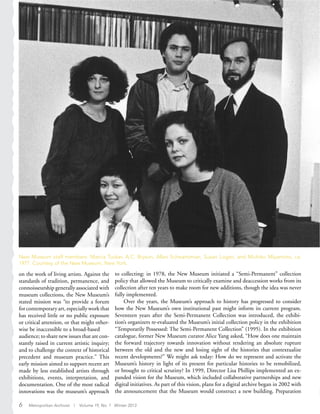
New Museum staff members: Marcia Tucker, A.C. Bryson, Allan Schwartzman, Susan Logan, and Michiko Miyamoto, ca.
1977. Courtesy of the New Museum, New York.
6 Metropolitan Archivist | Volume 19, No. 1 Winter 2013
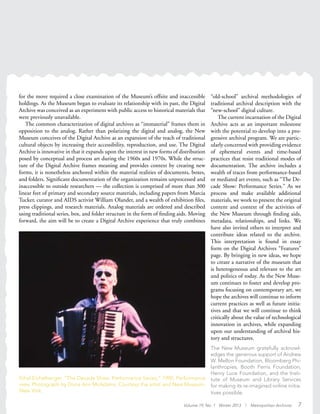
Ethyl Eichelberger, “The Decade Show: Performance Series,” 1990. Performance
view. Photograph by Dona Ann McAdams. Courtesy the artist and New Museum,
New York.
for the move required a close examination of the Museum’s offsite and inaccessible
holdings. As the Museum began to evaluate its relationship with its past, the Digital
Archive was conceived as an experiment with public access to historical materials that
were previously unavailable.
The common characterization of digital archives as “immaterial” frames them in
opposition to the analog. Rather than polarizing the digital and analog, the New
Museum conceives of the Digital Archive as an expansion of the reach of traditional
cultural objects by increasing their accessibility, reproduction, and use. The Digital
Archive is innovative in that it expands upon the interest in new forms of distribution
posed by conceptual and process art during the 1960s and 1970s. While the struc-
ture of the Digital Archive frames meaning and provides context by creating new
forms, it is nonetheless anchored within the material realities of documents, boxes,
and folders. Significant documentation of the organization remains unprocessed and
inaccessible to outside researchers — the collection is comprised of more than 300
linear feet of primary and secondary source materials, including papers from Marcia
Tucker, curator and AIDS activist William Olander, and a wealth of exhibition files,
press clippings, and research materials. Analog materials are ordered and described
using traditional series, box, and folder structure in the form of finding aids. Moving
forward, the aim will be to create a Digital Archive experience that truly combines
“old-school” archival methodologies of
traditional archival description with the
“new-school” digital culture.
The current incarnation of the Digital
Archive acts as an important milestone
with the potential to develop into a pro-
gressive archival program. We are partic-
ularly concerned with providing evidence
of ephemeral events and time-based
practices that resist traditional modes of
documentation. The archive includes a
wealth of traces from performance-based
or mediated art events, such as “The De-
cade Show: Performance Series.” As we
process and make available additional
materials, we work to present the original
content and context of the activities of
the New Museum through finding aids,
metadata, relationships, and links. We
have also invited others to interpret and
contribute ideas related to the archive.
This interpretation is found in essay
form on the Digital Archives “Features”
page. By bringing in new ideas, we hope
to create a narrative of the museum that
is heterogeneous and relevant to the art
and politics of today. As the New Muse-
um continues to foster and develop pro-
grams focusing on contemporary art, we
hope the archives will continue to inform
current practices as well as future initia-
tives and that we will continue to think
critically about the value of technological
innovation in archives, while expanding
upon our understanding of archival his-
tory and structures.
The New Museum gratefully acknowl-
edges the generous support of Andrew
W. Mellon Foundation, Bloomberg Phi-
lanthropies, Booth Ferris Foundation,
Henry Luce Foundation, and the Insti-
tute of Museum and Library Services
for making its re-imagined online initia-
tives possible.
Volume 19, No. 1 Winter 2013 | Metropolitan Archivist 7
Picture Perfect: Surveying
Photographs of the Manuscripts
and Archives Division, Special Collections,
New York Public Library
by Valerie Wingfield
Manuscripts Specialist, Manuscripts and
Archives Division, New York Public Library
The Manuscripts and Archives Division
of the New York Public Library (NYPL),
located at the Stephen A. Schwarzman
Building on Fifth Avenue and 42nd
Street, holds over 29,000 linear feet of
archival material in over 3,000 collec-
tions. These paper collections at NYPL
inlude many photographic images. Prior
to 2010, the division lacked comprehen-
sive information about its photographic
holdings. The library needed updated in-
formation about the exact types and cur-
rent conditions of these images. Thus, I
was assigned to undertake a complete a
survey of these materials in 2010.
I conducted the survey in two stages
over a period of seven months. In Stage
I, I examined nineteenth-century hard
images such as the daguerreotype and
tintype. In Stage II, I examined modern
prints, defined as those developed from
current photo-mechanical processes that
produce multiple prints. Melanie Yolles,
Manager of Manuscripts and Archives,
created the database used for the project.
The database for Stage I recorded the
title of the collection in which the image
was found, along with the image’s loca-
tion, a description, notes on the image’s
condition, and notes on the condition of
the case or the glass, if any, that held and
protected it. The database also included
general notes and recommendations for
further preservation actions. The data-
base for Stage II, the modern prints, re-
corded the same basic information but
on the collection level.
Our survey defined “hard images” as
positive images on non-paper support. In
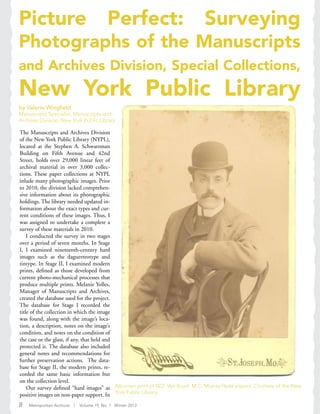
Albumen print of W.Z. Van Brunt. M.C. Murray Hyde papers. Courtesy of the New
York Public Library.
8 Metropolitan Archivist | Volume 19, No. 1 Winter 2013
Volume 19, No. 1 Winter 2013 | Metropolitan Archivist 9
the survey, a number of materials fit into this category, including the daguerrotype,
tintype or ferrotype, and the ambrotype. Created by different mechanical methods,
these images are distinctive in both the type of image they produce and the way they
are enclosed.
The Stage I hard-image survey documented all of the single images made using
these photographic processes — a number that grew in 2008, when the New York
Genealogy and Biographical Society (NYG&B) donated their archives and books to
the New York Public Library. Tintypes comprised the majority of the images donated
by NYG&B. However, these early nineteenth-century photographic processes ac-
count for less than 2 percent of the total photographs in the division.
Results for this part of the survey showed that the division holds more than 200
of these early images: mostly tintypes, followed in number by daguerreotypes and
then ambrotypes. The final count for the hard images included 23 ambrotypes, 64
daguerreotypes, and 134 tintypes. One of the collections with largest number of
hard images is the Joseph H. Brewer Genealogical papers, with 68, mostly tintypes.
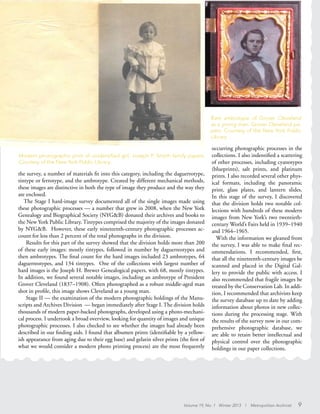
In addition, we found several notable images, including an ambrotype of President
Grover Cleveland (1837–1908). Often photographed as a robust middle-aged man
shot in profile, this image shows Cleveland as a young man.
Stage II — the examination of the modern photographic holdings of the Manu-
scripts and Archives Division — began immediately after Stage I. The division holds
thousands of modern paper-backed photographs, developed using a photo-mechani-
cal process. I undertook a broad overview, looking for quantity of images and unique
photographic processes. I also checked to see whether the images had already been
described in our finding aids. I found that albumen prints (identifiable by a yellow-
ish appearance from aging due to their egg base) and gelatin silver prints (the first of
what we would consider a modern photo printing process) are the most frequently
occurring photographic processes in the
collections. I also indentified a scattering
of other processes, including cyanotypes
(blueprints), salt prints, and platinum
prints. I also recorded several other phys-
ical formats, including the panoramic
print, glass plates, and lantern slides.
In this stage of the survey, I discovered
that the division holds two notable col-
lections with hundreds of these modern
images from New York’s two twentieth-
century World’s Fairs held in 1939–1940
and 1964–1965.
With the information we gleaned from
the survey, I was able to make final rec-
ommendations. I recommended, first,
that all the nineteenth-century images be
scanned and placed in the Digital Gal-
lery to provide the public with access. I
also recommended that fragile images be
treated by the Conservation Lab. In addi-
tion, I recommended that archivists keep
the survey database up to date by adding
information about photos in new collec-
tions during the processing stage. With
the results of the survey now in our com-
prehensive photographic database, we
are able to retain better intellectual and
physical control over the photographic
holdings in our paper collections.
Modern photographic print of unidentified girl. Joseph P. Smyth family papers.
Courtesy of the New York Public Library.
Rare ambrotype of Grover Cleveland
as a young man. Grover Cleveland pa-
pers. Courtesy of the New York Public
Library.
Archive Notebook:
“Writing to the Scrap”
as Qualitative Crowdsourcing
by Jane Greenway Carr and Cecily Swanson
Speaking to a group of NYU students
and faculty in Spring 2011 about her
most recent book, Black Gotham: A
Family History of African Americans in
the Nineteenth Century, Carla Peterson
described her process as “writing to the
scrap.” Out of an obituary found among
old clippings collected in the 1960s and
deposited at the Schomburg Center, Pe-
terson spun her story of free blacks in
antebellum New York. For her, “writing
to the scrap” meant creating a narrative
out of items discovered unexpectedly and
gleaning insight from research that has fallen out of fashion. Peterson advised stu-
dents doing archival scholarship to “talk to strangers” and “remember the grandpar-
ents” — in other words, to share their interests broadly and to seek motivation from
overlooked sources. This injunction to attend to discards and engage with a range of
interlocutors serves as a founding principle for Archive Notebook, a new project run
by two advanced graduate students in English with sponsorship from the New York
University English Department’s Digital Commons Initiative.
Archive Notebook is an online space for both short-form writing about archival
detritus and for speculation about the in-between materials that our research tends to
neglect. Too often we abandon the pleasure of the scrap for the certainty of the bigger
picture, sacrificing the potential of our half-formed ideas, which may help illuminate
our cast of mind or provide an opportunity for dialogue. Drawing inspiration from
archive columns in peer-reviewed publications like PMLA and Common-place and
Reference: Women’s studies manuscript collections from the Schlesinger
Library, Radcliffe College. Series 1, Woman’s suf-
frage [microform] /
consulting editor, Anne Firor Scott. Bethesda, MD: University
Publications of America, <c1990-Reel
B15>.

Read Archive Notebook Post:
http://archivenotebook.tumblr.com/post/32667271081/election-returns-the-enemy-
prefers-blondes.
10 Metropolitan Archivist | Volume 19, No. 1 Winter 2013
Volume 19, No. 1 Winter 2013 | Metropolitan Archivist 11
individually curated blogs like Ephemeral New York,
we hope to continue these discussions of the overlap between archive studies and
digital humanities through a forum that sheds light on abandoned research — both
within library repositories and born-digital collections. Our project, currently operat-
ing as a blog with a more robust web design in process, seeks to show how libraries and
online collections may sustain and support each other. We are particularly interested
in exploring alternative uses for the research scraps that animate archival encounters
but rarely find voice in finished scholarly products like the article or monograph.
Thus far, we have written imaginatively about our own leftover research on topics
ranging from Jean Toomer’s first experience of sushi to amateur suffrage cartoons. We
are inviting other scholars, archivists, and students to join us as guest contributors,
thus demonstrating the scholarly, pedagogical, and community applications of Archive
Notebook’s aggregation of hybrid genres. Scholars can share the unused “trash” of their
research, the notebook scribblings that may be promisingly refocused through online
discussion or recycled by fellow readers, for whom others’ scholarly errata may spark
new pathways for intellectual experimentation. For students, the item-level focus and
short format of the blog post helps to stimulate research vitality while sharpening
skills in description and document analysis. A recent NYU graduate seminar on Afri-
can American collecting and archival history used a pilot version of Archive Notebook
successfully for these purposes and we will be adapting the pilot for an upcoming
undergraduate course on the role of archives in mapping the digital commons. In
our experience, students exposed early and often to archival research display more
intellectual ownership of their projects and carry out higher levels of textual analysis.
By shifting their attention to what gets discarded, we also heighten their awareness of
the process of selection and the role of the curator in building a collection. Because
blog posts allow for both informal explorations of source materials and the analysis of
communicative networks, we believe that Archive Notebook can enable more dynamic
undergraduate engagement with material and digital archives. We also hope that by
featuring shorter pieces organized around particular artifacts, Archive Notebook will
provide an outreach platform for archivists to productively highlight a collection or
item, either by linking to our posts or contributing themselves. In short, our site seeks
to perform qualitative crowdsourcing of archival research for the benefit of the com-
munity generated around it, a community we hope to expand.
By publically presenting the objects that have not seemed worthy of our appraisal
or that have resisted our interpretive frameworks, Archive Notebook makes private acts
of critical selection available for wider scrutiny. We hope to foster debate about the
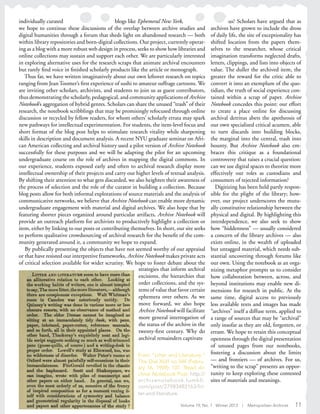
From “Litter and Literature,”
The Dial XLVI no.544 (Febru-
ary 16, 1909): 107.

Read Ar-
chive Notebook Post:
http://
archivenotebook.tumblr.
com/post/27983482163/lit-
ter-and-literature.
strategies that inform archival
excisions, the hierarchies that
order collections, and the sys-
tems of value that favor certain
ephemera over others. As we
move forward, we also hope
Archive Notebook will facilitate
more general interrogation of
the status of the archive in the
twenty-first century. Why do
archival remainders captivate
us? Scholars have argued that as
archives have grown to include the dross
of daily life, the site of exceptionality has
shifted location from the papers them-
selves to the researcher, whose critical
imagination transforms neglected drafts,
letters, clippings, and lists into objects of
value. The duller the archived item, the
greater the reward for the critic able to
convert it into an exemplum of the quo-
tidian, the truth of social experience con-
tained within a scrap of paper. Archive
Notebook concedes this point: our effort
to create a place online for discussing
archival detritus abets the apotheosis of
our own specialized critical acumen, able
to turn discards into building blocks,
the marginal into the central, trash into
bounty. But Archive Notebook also em-
braces this critique as a foundational
controversy that raises a crucial question:
can we use digital spaces to theorize more
effectively our roles as custodians and
consumers of rejected information?
Digitizing has been held partly respon-
sible for the plight of the library; how-
ever, our project underscores the mutu-
ally constitutive relationship between the
physical and digital. By highlighting this
interdependence, we also seek to show
how “hiddenness” — usually considered
a concern of the library archives — also
exists online, in the wealth of uploaded
but untagged material, which needs sub-
stantial uncovering through forums like
our own. Using the notebook as an orga-
nizing metaphor prompts us to consider
how collaboration between, across, and
beyond institutions may enable new di-
mensions for research in public. At the
same time, digital access to previously
less available texts and images has made
“archives” itself a diffuse term, applied to
a range of sources that may be “archival”
only insofar as they are old, forgotten, or
errant. We hope to retain this conceptual
openness through the digital presentation
of unused pages from our notebooks,
fostering a discussion about the limits
— and frontiers — of archives. For us,
“writing to the scrap” presents an oppor-
tunity to keep exploring these contested
sites of materials and meanings.
“Human Skin Color”
and the Challenges of Using
LCSH to Describe Oral Histories
by Margaret Fraser
Adjunct Assistant Curator,
Tamiment Library &
Robert F. Wagner Labor Archives
I began working as the archivist for
Crossing Borders, Bridging Generations
(CBBG), an oral history project and
public programming series at Brooklyn
Historical Society (BHS), in the fall of
2011. The goal of the project is to exam-
ine the history and experiences of mixed-
heritage people and families, cultural hy-
bridity, race, ethnicity, and identity in the
diverse borough of Brooklyn. The project
builds on a legacy of oral history collect-
ing at the Brooklyn Historical Society
— which began with the Puerto Rican
Oral History Collection in 1973. Since
then most oral history projects at BHS
have focused on a specific neighborhood,
workplace, or ethnic group. Part of my
task for this project was to describe these
records in Archivists’ Toolkit, which led
to unique challenges of using controlled
vocabularies and showed how oral histo-
ries can augment our archival holdings.
The Project
CBBG is the first BHS oral history proj-
ect to have open parameters for narra-
tors: narrators self-nominate to be inter-
viewed, self-identifying as being of mixed
heritage and/or a member of a mixed-
heritage family — however they choose
to define the word “mixed.” In the thirty-
eight interviews that have been collected
to date, this includes couples from differ-
ent religious, cultural, ethnic, and racial
backgrounds, and individuals who have
parents or ancestors who came from dif-
ferent backgrounds. The only parameter for CBBG narrators is a significant connec-
tion to Brooklyn — meaning individuals must have lived or worked in Brooklyn.
To find narrators, we relied on a team of twenty-five interviewers as well as the con-
nections that were made at thematic public programs that took place each month in
different locations around New York City. The collection now includes narrators who
range in age from nineteen to eighty with interviews of individuals and couples, and
spans the numerous and distinct neighborhoods that comprise Brooklyn. The first
year of CBBG was the planning year, in which we collected thirty-eight interviews. It
was decided at our first meeting with advising scholars to avoid advertising a call for
narrators, since the funds or means to interview everyone who showed interest might
not be available and we did not want to turn people away. As the project progresses
through 2015, CBBG might focus or broaden its outreach to potential interviewees
in order to collect stories that reflect the evolving diversity of cultures, languages, and
ethnicities within the most populated borough of New York City.
Crossing the Borders of LCSH
I struggled with how to use standardized language to describe interviews whose very
purpose was to give individuals the space to describe themselves in their own words.
Most librarians and archivists are well aware of the limitations of Library of Congress
Subject Headings (LCSH) in describing resources about race, ethnicity, gender, and
sexuality.1 However, oral histories hold their own specific challenges with regards to
standardized language due to their intimate nature. It has always been more challeng-
ing to categorize and describe a narrator’s voice, stories, emotions, and expressions,
than to categorize textual records. In the case of CBBG, this challenge was amplified
by the goals of the project: to create a space within the community and within the
archives for Brooklynites to describe their own heritage. Many narrators used this
space to redefine ideas and stereotypes of ethnicity, race, and religion through their
lived experiences, illustrating the creation and understanding of their own unique
and hybrid cultures, colors, bodies, and families.
The most jarring example of a problematic subject heading is “human skin color.”
Many narrators in this collection discuss the color of their skin, the texture of their
hair, and the shape of their bodies as an embodiment of a particular side of their eth-
nic ancestry, a mix of their heritage, or something entirely unclassifiable. Headings
like “Body image,” “Human skin color,” and “Racially mixed people” are inadequate
to represent these narratives. In one example, a woman of white-American and Pe-
ruvian descent and light skin explains, “I had a lot of racial confusion for a while.
When I was younger I actually thought of myself — and this is interesting — in
self-portraits that I would do for school, I would color my skin in black, or very dark
brown, and I often would think of myself that way ... I think I had a lot of confusion
about that, and just about who I looked like.”2 Another woman, of Scottish and
1
For further reading on this topic, I would suggest starting with Sanford Berman’s Prejudices and Antipathies: A Tract on the LC Subject Heads Concern-
ing People (1993), H.A. Olson’s The Power to Name: Locating the Limits of Subject Representation in Libraries (2002), and Margaret Rogers’ article Are
We on Equal Terms Yet? Subject Headings Concerning Women in ‘LCSH,’ 1975–1991 (Library Resources and Technical Sevices), 37(2).
2
Katherine Ambia, Oral History interview, 2012, Crossing Borders Bridging Generations Oral History Collection, 2011.019.009; Brooklyn Historical
Society.
12 Metropolitan Archivist | Volume 19, No. 1 Winter 2013
Chinese heritage, explains that, “you know, that’s what you have in the world — your
face, your eyes, your nose, your hair, your skin tone. So, people observe that, and
sometimes they wonder, they want to place you. And I guess we all kind of want to
place ourselves too.”3 Many narrators spent time talking about what traits they had
inherited from the different sides of their families, recognizing their heritage within
their own bodies and through the color of their skin.
In the struggle to categorize narrators into ethnic groups and topical terms, I found
that through these interviews, BHS’s list of subject headings for all collections in
Archivists’ Toolkit expanded to include terms such as “Friendship,” “Bilingualism,”
“Motherhood,” and “Interfaith families.” I cannot think of a better way to show how
important oral history collections are to the historical record and our archival hold-
ings. These interviews amplified BHS’s archive, providing more intimate connections
between researchers and history. Oral history is much more than filling the gaps of
the confined collecting of the past. It now takes on a central role in recording that
which is easily lost in the ephemeral nature of modern communication and docu-
mentation, bringing with it the depth and freedom provided by emotions, storytell-
ing, and expression.
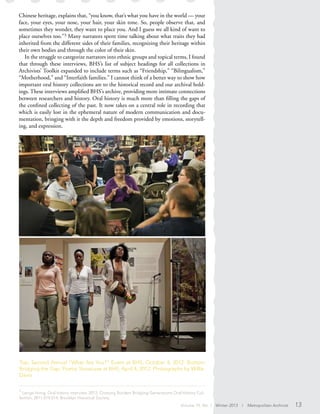
Top: Second Annual “What Are You?” Event at BHS, October 4, 2012. Bottom:
Bridging the Gap: Poetry Showcase at BHS, April 4, 2012. Photographs by Willie
Davis.
3
Lenge Hong, Oral history interview, 2012, Crossing Borders Bridging Generations Oral History Col-
lection, 2011.019.014; Brooklyn Historical Society.
Volume 19, No. 1 Winter 2013 | Metropolitan Archivist 13
iPads in the Reading Room:
Broadening the Reference Horizon
by Melanie Meyers
Senior Reference Services Librarian,
The Center for Jewish History
The Center for Jewish History recently
used iPads for the first time as an accom-
paniment to an exhibit. Having digital
images of the items on exhibit allowed us
to introduce an interactive component to
the standard display format. Once we no
longer needed the devices in the exhibit
hall, senior administration approached
the reference staff for ideas on how to
re-purpose these items in the reference
setting. We first considered lending them
out to patrons for use, a fine idea in the-
ory, but one that had substantial practi-
cal drawbacks. Four iPads were simply
too few to serve an average of twenty to
thirty visitors a day in our two reading
rooms (during busy times we easily see
twice that number). We were anxious that
this limited availability would only cause
waiting lists and consternation among
patrons. Moreover, reference staff would
have to monitor the use of a high-value
portable item that could easily vanish,
and because we are open to the public,
we would have limited recourse in the
case of damage or theft. So, we decided
to use the devices for patron reference
and bibliographic instruction in the two
reading rooms. The staff in the genealogy
reading room received two of the iPads,
and the staff in the inner reading room,
where collection materials are paged
from the stacks, received the other two.
The iPads are encased in Lucite frames
that have a stand on the back, so they are
easily displayed on the service desk or at
a study carrel.
The addition of this device to the refer-
ence toolkit has been a great asset for the
librarians. It allows the staff to provide
a very high quality ambulatory reference
service that is far more collaborative and
interactive than traditional reference. At
most institutions, including CJH, the
conventional reference interaction takes place with the librarian or archivist on one
side of the counter and the patron on the other. The patron asks a question, the
library professional searches on the computer for the answer and then informs the
patron of the result. When a patron sees neither the screen nor the searching process,
it greatly diminishes the educational aspect of reference. At its core, reference should
be patron education performed in a one-on-one setting.
The introduction of the iPad into the reference setting allows us to search together
with patrons, working on the same screen and looking at results together. Put sim-
ply, the iPad allows us to “show our work” to the patrons, so they may understand
the process and then implement these strategies into their own research experience.
While this same instruction could take place on a patron’s own computer, it is not
always feasible; not every patron brings a laptop or device, and some patrons do not
want a stranger working on their computer or possibly seeing their work or personal
information. Because the iPad is on a stand, several people can view the screen at
once, making it especially successful for students researching a group project, or for
family members coming in together to work on family history and genealogy. It is
also very effective with older patrons who are not as technologically savvy, as the iPad
is very user-friendly. And since it allows us to be ambulatory, the iPad encourages us
to step out from behind the desk and interact with patrons in a more personal and
engaging manner.
The CJH is a high-volume reference environment that includes library, archives,
manuscript, and artifact collections, and the use of archival materials accounts for a
large percentage of our circulation and patron activity. We are also aggressively digi-
tizing finding aids and a large quantity of archival materials, and we have very robust
digital collections. The iPad has been invaluable for archival reference, because it
allows us to review the finding aids with the patron and provide more of a running
commentary. The inexperienced user often needs some one-on-one explaining of
the finding aids, particularly in these days of “more product, less process,” where the
finding aids are not always very detailed and items can be difficult to find.
We have only been using the iPads for about a month, but so far it has been a wel-
come innovation for both staff and patrons. We are looking for new ways to use the
devices with patrons, for example, by creating interactive forms available through the
iPad in place of paper forms for patron registration or photocopy requests. This kind
of electronic delivery would reduce the amount of paper we use and discard. The iPad
is also a lovely tool for assessing the use of our digital collections, as we can see pre-
cisely how patrons interact with the digital surrogates versus the artifact. These obser-
Two of the iPads currently used by CJH reference staff.
Courtesy of the Center for Jewish History.
vations could prove in-
valuable to shaping our
digital collections in the
future. The iPad has al-
ready been a great addi-
tion for reference work,
and we are looking for-
ward to exploring what
other avenues this tech-
nology can open for both
staff and readers.
14 Metropolitan Archivist | Volume 19, No. 1 Winter 2013
Last year, the MTA Bridges and Tunnels Special Archive received a grant from the
New York State Archives under the Local Government Records Management Im-
provement Fund. The grant was used to hire three project archivists who processed,
re-housed, and created an item-level inventory of the original Verrazano-Narrows
Bridge photograph collection. They also wrote a finding aid.
The Verrazano-Narrows Bridge, which opened on November 21, 1964, connects
the boroughs of Brooklyn and Staten Island and is currently the longest suspension
bridge in the United States. It was named after Giovanni da Verrazzano, the Italian
explorer who first entered New York Harbor in 1524.
The bridge’s designer, Othmar H. Ammann (1879–1965), faced unique chal-
lenges with this project. The bridge’s towers were so far apart that he had to account
for the curvature of the earth during construction. He also had to plan for the pos-
sibility that the span might become a target during war, and to consider whether its
massive size would block ship access to the New York Harbor. Othmar had previously
designed other great New York City bridges — most notably, the George Washington
and Throgs Neck Bridges; this would be his final project.
The Verrazano-Narrows Bridge proved to be the largest undertaking in the his-
tory of the Triborough Bridge and Tunnel Authority. It not only binds the boroughs
together, but also links the entire northeast — allowing traffic to flow between New
England, New Jersey, and Long Island while bypassing Manhattan with its already
choked traffic.
The collection consists of approximately 5,800 original photographs of the Ver-
razano-Narrows Bridge construction and the surrounding areas. The construction
photos include: cofferdam and caisson construction, tower construction, erection
of cables and suspenders, and anchorage construction. Photos of the surrounding
areas show the demolition of buildings that once stood where the bridge would rise,
including Fort Lafayette — built in 1812 and used as a military prison during the
Civil War — which is where the Brooklyn tower now stands. There are also photos
depicting the construction of the Verrazano-Narrows Bridge Monument and Fort
Hamilton Park.
The collection’s photographs were in decent condition at the start of the project,
but were dusty from disuse and had been crammed into expandable file folders. This
caused bending and some minor cracking. The archivists also found correspondence,
separated into a series, in the expandable file folders along with the photographs.
Gaining intellectual access to this collection whose contents were unknown, was
critical. The photographs were cleaned, placed into Mylar sleeves, put in acid-free
folders in groupings of fifteen, and then re-housed in acid-free boxes. The collection
was arranged in order of contract number, which was the original numbering system
created by the Triborough Bridge and Tunnel Authority. All available information
pertaining to each photograph (description, condition, date, and photographer) was
recorded in a spreadsheet to create a detailed inventory.
The project was somewhat delayed because of problems in ordering and receiving
the Mylar sleeves, so the project had to move forward without putting the photo-
graphs in Mylar sleeves — a task that was
completed later, once supplies arrived.
Available information for each photo-
graph was entered in an Excel spread-
sheet as work proceeded, except for the
final folder and box numbers. This in-
formation had to wait, as final resleeving
would affect the overall thickness of each
folder, and therefore the photograph’s fi-
nal location. There was still a back-order
of Mylar sleeves at the project’s end date,
and a summer intern was trained to com-
plete the remaining tasks.
After finishing the main project of
re-housing the photograph collection,
there was time left to work on additional
projects, including processing small pho-
tographic collections, creating a master
inventory of the entire archives, per-
forming inventories of the audio-visual
and art collections, and reorganizing the
archives to make more efficient use of
available space.
The New York Archives grant made
this project possible. These grants are
vital to the growth of the archival com-
munity. They open up employment
positions that otherwise would not be
available and provide the necessary tools
to make archival collections accessible.
MTA Bridges and Tunnels could not
have completed these projects without
the grant: the preservation and inventory
of the Verrazano-Narrows Bridge photo-
graph collection, several inventories of
smaller collections, and the organization
of the archives. The MTA Bridges and
Tunnels Special Archive can now provide
easy access to the Verrazano-Narrows
Bridge photograph collection, which is
critical to maintaining a bridge that is
still used today.
Saving a Memory: Verrazano
Narrows Bridge Construction
By Laura DeMuro, Alexandra Janvey & Ann Christiansen
Volume 19, No. 1 Winter 2013 | Metropolitan Archivist 15
INTERVIEW WITH THE ARCHIVIST
An Interview with Rebecca Goldman
by Nick Pavlik
Archivist, 92nd Street Y
This interview was first published on
the New York History: Historical News
and Views from the Empire State web-
site, http://www.newyorkhistoryblog.
com/2012/06/q-rebecca-goldman-of-
saas-snap.html.
In January 2012, the Society of Ameri-
can Archivists (SAA), the national pro-
fessional association for archivists and
other information professionals respon-
sible for historical records, approved the
formation of the Students and New Ar-
chives Professionals Roundtable (SNAP).
A much-needed and welcome resource
for those considering, actively pursuing,
or transitioning into the archives profes-
sion, SNAP was founded by its current
chair, Rebecca Goldman, who is also Me-
dia and Digital Services Librarian at La
Salle University in Philadelphia and the
author of the popular archives webcomic
Derangement and Description.
The Archivists Round Table of Met-
ropolitan New York recently chatted
with Goldman about her decision to
form SNAP, SNAP’s goals and future
direction(s), archival education and pro-
fessional involvement, opportunities for
students and new professionals in the
tight job market, and other SNAP-ish
themes.
ART: What was the main impetus for your
establishing the SNAP Roundtable?
RG: Ever since my first Annual Meeting
in 2010, I’ve been thinking about the
representation of new archivists within
SAA and within the profession. I put up
a comic that summarized all the things
I was thinking about, and it generated
some good discussion, but nothing really
came of it. Then, about a year ago, I read
that ALA had started a Young Profession-
als Working Group and thought, hey,
why doesn’t SAA have a group like that?
I posted my question to Twitter, Council
member Kate Theimer saw it and sug-
gested I try to start a roundtable, and
the rest, I suppose, is history. Any SAA
member can propose a new roundtable,
but until Kate suggested it, it hadn’t re-
ally occurred to me as something that I
could do.
ART: The SNAP website features an im-
pressive listing of its many goals as an orga-
nization. Looking just at SNAP’s first year,
is there any goal in particular that has been
or will be the main priority? What proj-
ects or initiatives reflecting this goal would
you like to see happen during SNAP’s first
year?
RG: When I first raised the idea of form-
ing a roundtable for new archivists, I had
the following goals in mind:
• Advocate for new archivists within
SAA and within the archival profes-
sion
• Provide a space for discussion of is-
sues affecting new archivists
• Allow new archivists to gain leader-
ship experience through roundtable
service
I think we’ve met that second goal already
— the SNAP list is both a very active dis-
cussion area and a welcoming commu-
nity for new archivists. We’ve also made
some progress in reaching out to other
SAA groups (our Liaison Coordinator,
Sasha Griffin, has been really instrumen-
tal here). And SAA is definitely taking
note of us. If you take a look at the agen-
da items for SAA’s next Council meet-
ing, an awful lot of them mention SNAP.
What’s proving more difficult is taking
all the great ideas generated on our list
and turning these into projects for SNAP
to work on. So my goal for our first year
would be to come up with a process for
starting new projects: appointing leaders,
documentation, tracking progress, etc. I
also feel that much of the discussion has
been focused on students and un(der)-
employed new archivists, and that our
goal of supporting well-employed new
archivists, as they move from entry-level
16 Metropolitan Archivist | Volume 19, No. 1 Winter 2013
INTERVIEW WITH THE ARCHIVIST
to mid-career or managerial positions,
has been overlooked. I’d like to keep a
broader definition of new archivist in
mind as SNAP moves forward.
ART: As SAA’s representative student agen-
cy, it would seem that SNAP is uniquely
suited to advocate for changes and/or im-
provements to graduate archival education
programs. Has there been any discussion
along these lines thus far among the SNAP
leadership? If so, in what ways does SNAP
envision that archival education programs
could better serve their students?
RG: Judging from recent conversations
on the SNAP list, one of the biggest ar-
eas of concern is archival internships —
both publicizing the need for internship
or other work experience during grad
school, and making sure that internships
are conducted in a way that’s ethical and
educational. I would love to see SNAP
produce guidelines for graduate student
internships. As far as changes to the edu-
cational programs themselves, we could
certainly advocate for changes, but SAA
doesn’t accredit archives programs, and
its Guidelines for a Graduate Program
in Archival Studies were just revised in
2011. Right now, I don’t see a whole lot
of room for SNAP contributions in this
area.
ART: Although SNAP primarily serves stu-
dents and early professionals who are already
pursuing careers as archivists, do you also
intend for SNAP to play a leading role in
SAA’s outreach efforts to recruit new profes-
sionals to the archives field? What potential
strategies do you think might be effective in
better promoting the archives profession as
a career option?
RG: I don’t know too many new archi-
vists who would recommend entering
the archives field right now. There aren’t
even enough jobs for all the recent grads.
I’d rather see SAA do one or both of the
following things:
• Recruit related professionals —
people working in jobs with archives-
related responsibilities who may not
identify as archivists or see the need
for SAA membership. These related
professionals are one of the target
audiences for SNAP, because their
work-related needs are similar to
those of archives students and new
archives professionals.
• Promote the importance of ar-
chives to organizations and commu-
nities that don’t already have them. If
you’re an organization and you want
to start an archives or hire an archi-
val consultant, SAA has you covered.
But that assumes you know enough
about archivists to know why you’d
need one. What about outreach to
the people with the power to create
job opportunities for new archivists?
ART: As SNAP’s Chair, what would your
advice be to students and early-career archi-
vists looking to become more involved in the
professional archives community, either at
the local, regional, or national level? Aside
from joining SNAP, of course.
RG: SAA (and, to a lesser extent, the lo-
cal and regional archives organizations)
can absolutely seem intimidating as a
newcomer. If you want to get involved
with a group or project, just ask! Every
SAA section and roundtable lists its lead-
ers, and if you’re an SAA member you
can log in to get their contact informa-
tion. All the SAA leaders I’ve met would
love to get more new archivists involved
in their groups. I can’t speak for every re-
gional group, but I’ve found MARAC to
be pretty friendly, and they had a great
session at their spring meeting explaining
all the ways new members and new ar-
chivists could get involved. Local groups:
I’ve tried and failed multiple times to get
involved with mine. Some are awesome
(like ART!), but I’ve found that small
local orgs can be clique-y and very dif-
ficult to break into. As a general piece of
advice, if you’re ever in a situation where
you’re networking with other archivists
— like a conference or a local meeting
— assume that people are shy rather than
unfriendly.
I’d also recommend starting a Twitter
account and following some archivists on
Twitter (Kate Theimer has a good list to
start off on Twitter). The relative merits
of Twitter versus the Archives and Archi-
vists List has been much debated, but
I will say that as a new archivist I find
asking questions via Twitter to be quick,
easy, and not too intimidating.
Volume 19, No. 1 Winter 2013 | Metropolitan Archivist 17
BOOK REVIEWS
Rare Book Librarianship: An
Introduction and Guide
by Steven K. Galbraith
and Geoffrey D. Smith
and Foreward by Joel B. Silver
Libraries Unlimited,
2012. 185 pp.
ISBN: 1591588812.
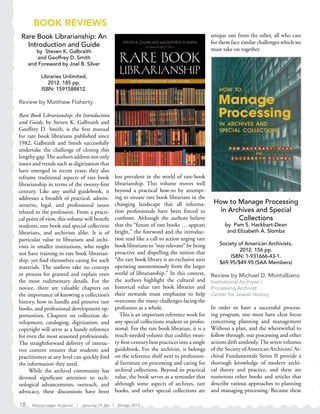
Review by Matthew Flaherty
Rare Book Librarianship: An Introduction
and Guide, by Steven K. Galbraith and
Geoffrey D. Smith, is the first manual
for rare book librarians published since
1982. Galbraith and Smith successfully
undertake the challenge of closing this
lengthy gap.The authors address not only
issues and trends such as digitization that
have emerged in recent years; they also
reframe traditional aspects of rare book
librarianship in terms of the twenty-first
century. Like any useful guidebook, it
addresses a breadth of practical, admin-
istrative, legal, and professional issues
related to the profession. From a practi-
cal point of view, this volume will benefit
students, rare book and special collection
librarians, and archivists alike. It is of
particular value to librarians and archi-
vists in smaller institutions, who might
not have training in rare book librarian-
ship, yet find themselves caring for such
materials. The authors take no concept
or process for granted and explain even
the most rudimentary details. For the
novice, there are valuable chapters on
the importance of knowing a collection’s
history, how to handle and preserve rare
books, and professional development op-
portunities. Chapters on collection de-
velopment, cataloging, digitization, and
copyright will serve as a handy reference
for even the most seasoned professionals.
The straightforward delivery of instruc-
tive content ensures that students and
practitioners at any level can quickly find
the information they need.
While the archival community has
devoted significant attention to tech-
nological advancements, outreach, and
advocacy, these discussions have been
less prevalent in the world of rare-book
librarianship. This volume moves well
beyond a practical how-to by attempt-
ing to situate rare book librarians in the
changing landscape that all informa-
tion professionals have been forced to
confront. Although the authors believe
that the “future of rare books … appears
bright,” the foreword and the introduc-
tion read like a call to action urging rare
book librarians to “stay relevant” by being
proactive and dispelling the notion that
“the rare book library is an exclusive unit
operating autonomously from the larger
world of librarianship.” In this context,
the authors highlight the cultural and
historical value rare book libraries and
their stewards must emphasize to help
overcome the many challenges facing the
profession as a whole.
This is an important reference work for
any special collections student or profes-
sional. For the rare book librarian, it is a
much-needed volume that codifies twen-
ty-first-century best practices into a single
guidebook. For the archivist, it belongs
on the reference shelf next to profession-
al literature on processing and caring for
archival collections. Beyond its practical
value, the book serves as a reminder that
although some aspects of archives, rare
books, and other special collections are
unique one from the other, all who care
for them face similar challenges which we
must take on together.
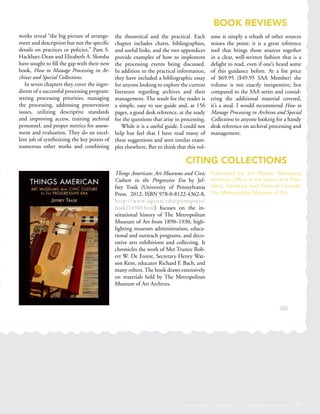
How to Manage Processing
in Archives and Special
Collections
by Pam S. Hackbart-Dean
and Elizabeth A. Slomba
Society of American Archivists,
2012. 156 pp.
ISBN: 1-931666-43-1.
$69.95/$49.95 (SAA Members)
Review by Michael D. Montalbano
Institutional Archivist /
Processing Archivist
Center for Jewish History
In order to have a successful process-
ing program, one must have clear focus
concerning planning and management
Without a plan, and the wherewithal to
follow through, our processing and other
actions drift aimlessly.The seven volumes
of the Society of American Archivists’ Ar-
chival Fundamentals Series II provide a
thorough knowledge of modern archi-
val theory and practice, and there are
numerous other books and articles that
describe various approaches to planning
and managing processing. Because these
18 Metropolitan Archivist | Volume 19, No. 1 Winter 2013
Volume 19 No. 1 Winter 2012 | Metropolitan Archivist 19
BOOK REVIEWS
CITING COLLECTIONS
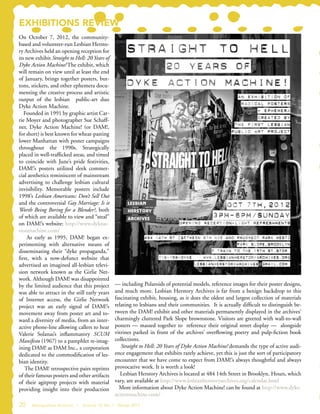
Things American: Art Museums and Civic
Culture in the Progressive Era by Jef-
frey Trask (University of Pennsylvania
Press, 2012, ISBN 978-0-8122-4362-8,
http://www.upenn.edu/pennpress/
book/14940.html) focuses on the in-
stitutional history of The Metropolitan
Museum of Art from 1890–1930, high-
lighting museum administration, educa-
tional and outreach programs, and deco-
rative arts exhibitions and collecting. It
chronicles the work of Met Trustee Rob-
ert W. De Forest, Secretary Henry Wat-
son Kent, educator Richard F. Bach, and
many others. The book draws extensively
on materials held by The Metropolitan
Museum of Art Archives.
Submitted by Jim Moske, Managing
Archivist, Office of the Senior Vice Pres-
ident, Secretary and General Counsel,
The Metropolitan Museum of Art
works reveal “the big picture of arrange-
ment and description but not the specific
details on practices or policies,” Pam S.
Hackbart-Dean and Elizabeth A. Slomba
have sought to fill the gap with their new
book, How to Manage Processing in Ar-
chives and Special Collections.
In seven chapters they cover the ingre-
dients of a successful processing program:
setting processing priorities, managing
the processing, addressing preservation
issues, utilizing descriptive standards
and improving access, training archival
personnel, and proper metrics for assess-
ment and evaluation. They do an excel-
lent job of synthesizing the key points of
numerous other works and combining
the theoretical and the practical. Each
chapter includes charts, bibliographies,
and useful links, and the two appendices
provide examples of how to implement
the processing events being discussed.
In addition to the practical information,
they have included a bibliographic essay
for anyone looking to explore the current
literature regarding archives and their
management. The result for the reader is
a simple, easy to use guide and, at 156
pages, a good desk reference, at the ready
for the questions that arise in processing.
While it is a useful guide, I could not
help but feel that I have read many of
these suggestions and seen similar exam-
ples elsewhere. But to think that this vol-
ume is simply a rehash of other sources
misses the point: it is a great reference
tool that brings those sources together
in a clear, well-written fashion that is a
delight to read, even if one’s heard some
of this guidance before. At a list price
of $69.95 ($49.95 SAA Member) the
volume is not exactly inexpensive; but
compared to the SAA series and consid-
ering the additional material covered,
it’s a steal. I would recommend How to
Manage Processing in Archives and Special
Collections to anyone looking for a handy
desk reference on archival processing and
management.
EXHIBITIONS REVIEW
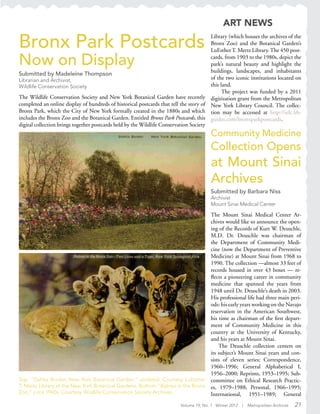
On October 7, 2012, the community-
based and volunteer-run Lesbian Hersto-
ry Archives held an opening reception for
its new exhibit Straight to Hell: 20 Years of
Dyke Action Machine! The exhibit, which
will remain on view until at least the end
of January, brings together posters, but-
tons, stickers, and other ephemera docu-
menting the creative process and artistic
output of the lesbian public-art duo
Dyke Action Machine.
Founded in 1991 by graphic artist Car-
rie Moyer and photographer Sue Schaff-
ner, Dyke Action Machine! (or DAM!,
for short) is best known for wheat-pasting
lower Manhattan with poster campaigns
throughout the 1990s. Strategically
placed in well-trafficked areas, and timed
to coincide with June’s pride festivities,
DAM!’s posters utilized sleek commer-
cial aesthetics reminiscent of mainstream
advertising to challenge lesbian cultural
invisibility. Memorable posters include
1998’s Lesbian Americans: Don’t Sell Out
and the controversial Gay Marriage: Is it
Worth Being Boring for a Blender?, both
of which are available to view and “steal”
on DAM!’s website: http://www.dykeac-
tionmachine.com/
As early as 1995, DAM! began ex-
perimenting with alternative means of
disseminating their “dyke propaganda,”
first, with a now-defunct website that
advertised an imagined all-lesbian televi-
sion network known as the Girlie Net-
work. Although DAM! was disappointed
by the limited audience that this project
was able to attract in the still early years
of Internet access, the Girlie Network
project was an early signal of DAM!’s
movement away from poster art and to-
ward a diversity of media, from an inter-
active phone-line allowing callers to hear
Valerie Solanas’s inflammatory SCUM
Manifesto (1967) to a pamphlet re-imag-
ining DAM! as DAM Inc., a corporation
dedicated to the commodification of les-
bian identity.
The DAM! retrospective pairs reprints
of their famous posters and other artifacts
of their agitprop projects with material
providing insight into their production
— including Polaroids of potential models, reference images for their poster designs,
and much more. Lesbian Herstory Archives is far from a benign backdrop to this
fascinating exhibit, housing, as it does the oldest and largest collection of materials
relating to lesbians and their communities. It is actually difficult to distinguish be-
tween the DAM! exhibit and other materials permanently displayed in the archives’
charmingly cluttered Park Slope brownstone. Visitors are greeted with wall-to-wall
posters — massed together to reference their original street display — alongside
vitrines parked in front of the archives’ overflowing poetry and pulp-fiction book
collections.
Straight to Hell: 20 Years of Dyke Action Machine! demands the type of active audi-
ence engagement that exhibits rarely achieve, yet this is just the sort of participatory
encounter that we have come to expect from DAM!’s always thoughtful and always
provocative work. It is worth a look!
Lesbian Herstory Archives is located at 484 14th Street in Brooklyn. Hours, which
vary, are available at http://www.lesbianherstoryarchives.org/calendar.html
More information about Dyke Action Machine! can be found at http://www.dyke-
actionmachine.com/
20 Metropolitan Archivist | Volume 19, No. 1 Winter 2013
Volume 19, No. 1 Winter 2012 | Metropolitan Archivist 21
Top: “Dahlia Border, New York Botanical Garden,” undated. Courtesy LuEsther
T. Mertz Library at the New York Botanical Gardens. Bottom:“Babies in the Bronx
Zoo,” circa 1940s. Courtesy Wildlife Conservation Society Archives.
Community Medicine
Collection Opens
at Mount Sinai
Archives
Submitted by Barbara Niss
Archivist
Mount Sinai Medical Center
The Mount Sinai Medical Center Ar-
chives would like to announce the open-
ing of the Records of Kurt W. Deuschle,
M.D. Dr. Deuschle was chairman of
the Department of Community Medi-
cine (now the Department of Preventive
Medicine) at Mount Sinai from 1968 to
1990. The collection —almost 33 feet of
records housed in over 43 boxes — re-
flects a pioneering career in community
medicine that spanned the years from
1948 until Dr. Deuschle’s death in 2003.
His professional life had three main peri-
ods: his early years working on the Navajo
reservation in the American Southwest,
his time as chairman of the first depart-
ment of Community Medicine in this
country at the University of Kentucky,
and his years at Mount Sinai.
The Deuschle collection centers on
its subject’s Mount Sinai years and con-
sists of eleven series: Correspondence,
1960–1996; General Alphabetical I,
1956–2000; Reprints, 1953–1995; Sub-
committee on Ethical Research Practic-
es, 1979–1988; Personal, 1966–1995;
International, 1951–1989; General
ART NEWS
Bronx Park Postcards
Now on Display
Submitted by Madeleine Thompson
Librarian and Archivist,
Wildlife Conservation Society
The Wildlife Conservation Society and New York Botanical Garden have recently
completed an online display of hundreds of historical postcards that tell the story of
Bronx Park, which the City of New York formally created in the 1880s and which
includes the Bronx Zoo and the Botanical Garden. Entitled Bronx Park Postcards, this
digital collection brings together postcards held by the Wildlife Conservation Society
Library (which houses the archives of the
Bronx Zoo) and the Botanical Garden’s
LuEstherT. Mertz Library.The 450 post-
cards, from 1903 to the 1980s, depict the
park’s natural beauty and highlight the
buildings, landscapes, and inhabitants
of the two iconic institutions located on
this land.
The project was funded by a 2011
digitization grant from the Metropolitan
New York Library Council. The collec-
tion may be accessed at http://ielc.lib-
guides.com/bronxparkpostcards.
22 Metropolitan Archivist | Volume 19, No. 1 Winter 2013
Alphabetical II, 1954–1995; Founda-
tions, 1968–1995; Faculty, 1948–1993;
References, 1968–1994; and Slides,
1952–1981.
This collection would be of interest
to anyone studying the fields of commu-
nity and preventive medicine or health-
care in New York, particularly in East
Harlem. Dr. Deuschle also took study
trips abroad, and there are files on vis-
its to Turkey (1962–1965, 1984), China
(1978, 1986), Lagos, Nigeria (1977), and
other places. The Slides Series includes
images from some of his trips, as well as
many slides taken around East Harlem
in the 1970s. The finding aid is available
at http://library.mssm.edu/services/ar-
chives/archives_collections/community-
med.shtml.
Questions may be addressed to Barbara
Niss at barbara.niss@mssm.edu.
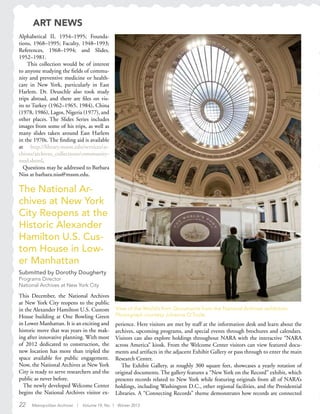
View of the World’s Port: Documents from the National Archives exhibition.
Photograph courtesy Johanna O’Toole.
The National Ar-
chives at New York
City Reopens at the
Historic Alexander
Hamilton U.S. Cus-
tom House in Low-
er Manhattan
Submitted by Dorothy Dougherty
Programs Director
National Archives at New York City
This December, the National Archives
at New York City reopens to the public
in the Alexander Hamilton U.S. Custom
House building at One Bowling Green
in Lower Manhattan. It is an exciting and
historic move that was years in the mak-
ing after innovative planning. With most
of 2012 dedicated to construction, the
new location has more than tripled the
space available for public engagement.
Now, the National Archives at New York
City is ready to serve researchers and the
public as never before.
The newly developed Welcome Center
begins the National Archives visitor ex-
perience. Here visitors are met by staff at the information desk and learn about the
archives, upcoming programs, and special events through brochures and calendars.
Visitors can also explore holdings throughout NARA with the interactive “NARA
across America” kiosk. From the Welcome Center visitors can view featured docu-
ments and artifacts in the adjacent Exhibit Gallery or pass through to enter the main
Research Center.
The Exhibit Gallery, at roughly 300 square feet, showcases a yearly rotation of
original documents. The gallery features a “New York on the Record” exhibit, which
presents records related to New York while featuring originals from all of NARA’s
holdings, including Washington D.C., other regional facilities, and the Presidential
Libraries. A “Connecting Records” theme demonstrates how records are connected
ART NEWS
Volume 19, No. 1 Winter 2013 | Metropolitan Archivist 23
Carnegie Hall Archives
Launches Digital Archives Project
Submitted by Miwa Yokoyama
Digital Project Manager
Carnegie Hall
The Carnegie Hall Archives has begun a multiyear project to digitize archival collec-
tions documenting the hall’s 120-year history, ensuring that they are preserved for
future generations and made increasingly accessible to the public, both on-site and
online. The project includes the selection and implementation of a new digital asset
management system, as well as the creation of a new digital repository. The Carnegie
Corporation of New York, the Andrew W. Mellon Foundation, the Susan and Elihu
Rose Foundation, and the Grammy Foundation have generously provided funding
Program from Richard Strauss’s Ameri-
can debut at Carnegie Hall in 1904.
Courtesy Carnegie Hall Archives.
nationwide and through history. One example is the photographic record of Assistant
Secretary of the Navy Franklin Delano Roosevelt visiting the Brooklyn Navy Yard
for inspection and the keel laying of the USS Arizona in 1913. The written docu-
ment next to it is then President Roosevelt’s Declaration of War against Japan for the
bombing of Pearl Harbor and the destruction of the USS Arizona on December 7,
1941. These records, like many others, demonstrate the ways the records are con-
nected across the National Archives nationwide system.
The Research Center has expanded to include twenty-four public access comput-
ers and three microfilm reader/printers. In addition to online databases, visitors are
given free access to subscription services such as Ancestry, Fold3, HeritageQuest,
and ProQuest. The Textual Research room accommodates up to twelve patrons for
researching the archival collections covering federal agencies from New York, New
Jersey, Puerto Rico, and the U.S. Virgin Islands. While patrons seeking records useful
for documenting their entitlements — such as citizenship papers — can be accom-
modated, there are many other records available for research, including immigrant
arrival records, major federal district court cases (including civil, criminal, and equity
cases), records from World War I and II and the home front, the Civil War era (in-
cluding prize cases and draft records), and the U.S. Customs Service.
The newly dedicated Learning Center offers year-round activities that illuminate
our nation’s history and New York’s role in shaping the nation by focusing on histori-
cal records. Mornings in the Learning Center are dedicated to workshops and lec-
tures for pre-registered groups such as educators, student field trips, genealogists, and
community groups. In the afternoon, the space is open to the public for free family
activities and interactive engagement with records. The Learning Center at Custom
House was modeled on the Washington, D.C., ReSource Room so that the public
can discover holdings by pulling boxes off the shelf, opening map drawers and engag-
ing directly with select facsimile records. Access to computers allows for additional
research and learning. Thanks to a partnership with the Foundation for the National
Archives, visitors can also make free copies of documents to take with them and share
with others.
In addition, the National Archives at New York will provide an annual exhibit in
the public rotunda of the Custom House to further showcase its holdings, attract
visitors, and promote an awareness of the National Archives’ tremendous value and
importance to people everywhere. The first installation, “The World’s Port: Docu-
ments from the National Archives,” which ran through November 25, featured re-
cords from the New York holdings.
for the project.
The Northeast Document Conserva-
tion Center is currently at work conserv-
ing and digitizing the first twenty years’
worth of programs for performances and
other events on all three stages at Carn-
egie Hall. Highlights from the early years
include programs from the hall’s first
opening night with Tchaikovsky con-
ducting in 1891, the world premiere of
Dvorák’s New World Symphony in 1893,
and Richard Strauss’s American debut in
1904.
The Digital Archives Project will en-
able Carnegie Hall to preserve its legacy
and make its collection materials—many
of which are now available only on pa-
per or in media formats likely to become
obsolete — accessible to the widest pos-
sible audience. For more information on
the project visit http://www.carnegiehall.
org/digitalarchivesproject/.
ART NEWS
˘
24 Metropolitan Archivist | Volume 19, No. 1 Winter 2012
ART NEWS
The last remaining Jewish refugees leaving the Cyprus detention camps for
emigration to Israel, 1949. Bottom: JDC oversaw the delivery and distribution
of religious supplies in the detention camps. Cyprus, 1947. Photos by Al Taylor,
Courtesy American Jewish Joint Distribution Committee Archives.
JDC Cyprus
Collection
Now Available Online
Submitted by Tamar Zeffren
Processing Archivist
American Jewish Joint Distribution
Committee Archives
The historic Cyprus Collection of the
American Jewish Joint Distribution Com-
mittee (JDC) Archives is now available
digitally for the first time. Consisting
of 16,667 pages of textual files digitized
from nineteen microfilm reels, the collec-
tion contains a wide array of materials that
shed light on the lives of Jewish deportees
to Cyprus in the aftermath of World War
II, including personal letters, group peti-
tions, and newspapers published by the
deportees themselves. This collection will
be a welcome resource for researchers in-
terested in the postwar era, early Israeli his-
tory, and refugee resettlement. Highlights
are viewable at http://search.archives.jdc.
org/query_ext.asp?query=101204_27&si
te=ideaalm&lang=ENG.
From 1946 until after the establishment
of the State of Israel in 1948, the British
confined some 53,000 Jews — nearly all
of them Holocaust survivors — on the
island of Cyprus. From August 1946 to
February 1949, the deportees lived be-
hind barbed wire in twelve camps on the
island. During this period, 2,200 children
were born there, and 150 Jews died. These
Jewish refugees benefited from JDC’s ex-
tensive relief program, which provided
supplementary food and clothing, medi-
cal services, educational resources, cultural
activities, vocational training, emigration
assistance, and legal representation.
The Cyprus Collection offers a unique
window into this pivotal period of twen-
tieth-century history by documenting the
dramatic events in Cyprus against the
backdrop of the birth of the State of Israel.
In addition, the JDC Archives photograph
collection contains over 180 images from
the Cyprus detention camps, likewise
available online, at http://search.archives.jdc.org/notebook_ext.asp?item=26214&sit
e=ideaalm&lang=ENG&menu=1. Seventy-two of these images are also featured in a
photo gallery on the website Our Shared Legacy: World War II and “The Joint” (http://
archives.jdc.org/sharedlegacy/photo-galleries/gallery-cyprus-detention-camps.html).
JDC’s records, beginning with the organization’s founding in 1914, are accessible
on its recently launched website (http://archives.jdc.org/). Materials up through the
post-World War II period are currently available, and newly digitized resources are
regularly added.
Volume 19, No. 1 Winter 2013 | Metropolitan Archivist 25
Victor D’Amico Papers Open
at The Museum of Modern
Art Archives
Submitted by Celia Hartmann
Project Assistant Archivist
Museum of Modern Art Archives
The Victor D’Amico Papers are now processed and open for researchers to use on-
site at The Museum of Modern Art (MoMA)’s Archives reading room in Long Is-
land City, Queens (by appointment only, http://www.moma.org/learn/resources/
archives/archives_visiting). The collection’s finding aid is searchable online (http://
www.moma.org/learn/resources/archives/EAD/damicof), along with MoMA’s other
archival collections (http://www.moma.org/learn/resources/archives). As founding
director of MoMA’s Department of Education (http://www.moma.org/learn/index)
from 1937 to 1969, Victor D’Amico championed art education in the museum set-
ting through innovations that are now standard offerings in museums around the
world. At MoMA these offerings included classes for servicepersons at the War Veter-
ans Art Center and for children and families at the People’s Art Center; participatory
experiences at the Children’s Art Carnival in its many versions at MoMA, and in
Milan, Brussels, Barcelona, Delhi, and its eventual home in Harlem; and summer art
instruction programs at the Art Barge, on eastern Long Island. Under his auspices,
MoMA published instructional books for home use, introducing the layperson to
artistic expression through woodworking, ceramics, jewelrymaking, and metal-
working.
The collection includes correspondence, audio- and videotapes, clippings, draft
and completed publications, as well as personal documents, awards, and honors. It is
especially rich in photographic documentation of D’Amico’s best-known programs
at MoMA: classes and exhibitions of artwork created at the War Veterans Art Center,
People’s Art Center, Art Barge, and Children’s Art Carnival (both at MoMA and over-
seas) in the 1950s and 1960s, and the extensive program of circulating exhibitions
distributed through MoMA’s New York City High Schools Program from the 1940s
into the early 1970s. The range and variety of photographs are evidence of the exten-
sive publicity that introduced and promoted these programs worldwide, helping to
promulgate D’Amico’s progressive ideal of art education for a range of populations:
children, adults, families, veterans, and seniors. During D’Amico’s tenure at MoMA,
the Department of Education organized a wide range of exhibitions, both at the
museum and in other locations. Some were curated by students involved in MoMA’s
High Schools Program; others showcased works created by students in the depart-
ment’s various programs. Unique installation views found in the D’Amico Papers will
be digitized and added to MAID, the Museum Archives Image Database, for use by
researchers in MoMA’s Manhattan and Queens Reading Rooms.
The Museum Archives received the bulk of the Victor D’Amico Papers in 2011 from
Teachers’ College, to which Mabel D’Amico had donated the papers after her hus-
band’s death in 1987. Some additional materials were received from former MoMA
art teacher Arlette Buchman in January 2012. Also that year, we determined that
various materials the Education Department and Photographic Archive had stored at
MoMA had been previously separated from the D’Amico records, and we were able
to include them for processing with the Victor D’Amico Papers.
Photograph Courtesy The Museum of
Modern Art Archives.
The D’Amico Papers were organized pri-
marily by material type when we received
them from Teachers’ College in 2011.
Correspondence, photographs, audiovi-
sual items, and published materials were
grouped in storage cartons, without re-
gard for their original creation, use, or ac-
cess. Many of the photographs had been
removed from their original housing and
numbered for other purposes, again dis-
rupting their original context. The col-
lection is now arranged in eleven series
that are chronological within two orga-
nizational groupings: Series I–VII docu-
ment Education Department projects
and programs initiated while D’Amico
served as director; Series VIII–XI docu-
ment his professional and personal ac-
tivities during and after his tenure at
MoMA. These materials, which include
many unpublished manuscripts, under-
score D’Amico’s influence and prestige as
an educator and writer on art education
and document his long involvement in
organizations such as the National Com-
mittee on Art Education.
Processing of the Victor D’Amico Papers
was made possible by generous funding
from Ann L. Freedman; the Contem-
porary Arts Council of The Museum of
Modern Art; the Lily Auchincloss Foun-
dation, Inc.; the Gladys Krieble Delmas
Foundation; Trustee Committee on Ar-
ART NEWS
26 Metropolitan Archivist | Volume 19, No. 1 Winter 2013
Luce Foundation Grant Processing
Exposes Collections at Burke Theological
Library
Submitted by Brigette Kamsler
Luce Project Archivist
Burke Theological Library, Union Theological Seminary
The Burke Theological Library at Union Theological Seminary, one of twenty-two li-
braries in the Columbia University Libraries system, was awarded a three-year project
grant by the Henry Luce Foundation. This grant will be used to preserve, catalogue,
and make accessible the collections of the Mission Research Library (MRL) Archives
and the William Adams Brown (WAB) Ecumenical Library Archives.
MRL contains over 160 unique collections from missionaries and missionary or-
ganizations from six continents in the late nineteenth and early twentieth centuries,
with special strength in early twentieth-century China, Japan, and Korea. The collec-
tion contains a broad range of field reports, demographic surveys, and other analyti-
cal data. As a result, the MRL Archives documents the cultural and social realities of
indigenous populations in substantive detail, and will amply serve scholars of religion,
historians, anthropologists, economists, and medical researchers, among others.
WAB contains more than thirty collections, including records of local (New York
City), national, and international ecumenical organizations and communities, as well
as records from ecumenical conferences (Protestant and Catholic dialogue) that have
shaped global Christianity.
Since the grant began in August 2011, the project archivist, Brigette C. Kamsler,
has processed and made available over sixty collections totaling close to 300 linear
feet. The completed collections can be found at http://library.columbia.edu/indiv/
burke/archives.html. Detailed information and progress is also posted on the Burke
Archives blog, The Hidden Archival Collections of the Burke Library (https://blogs.
cul.columbia.edu/burkearchives/), which is dedicated solely to the work on the Luce
project. Questions or comments on the project may be directed to the project archi-
vist at bck2115@columbia.edu.
Revolution
at the General
Theological
Seminary Library
Submitted by Mary Robison
Reference Librarian
Christoph Keller, Jr. Library,
General Theological Seminary
Revolution! is the current exhibit at
the Christoph Keller, Jr. Library of the
General Theological Seminary. Drawn
from the library’s rich collections of
eighteenth–century materials, the items
displayed document the American Rev-
olution from its causes in the 1760s to
its aftermath in the Confederation and
Early Republic eras, and reflect the po-
litical, social, and religious context of the
period in Britain and America. Both Pa-
triots and Loyalists are represented: doc-
uments from the life of Samuel Seabury,
who after the war became the first bishop
of the American Episcopal Church, illus-
trate his actions during the war and shed
light on the difficult position of Anglican
clergymen during the Revolution. Works
owned by James Wilson, signer of the
Declaration of Independence and one
of the original justices of the Supreme
Court of the United States, are evidence
ART NEWS
chives, Library, and Research; the Cowles
Charitable Trust; Ngaere Macray; Bever-
ley M. Galban; Lori and Eric Friedman;
Jean Long Ostrow; and Anne and John
McAlinden. For more information on
the Victor D’Amico Papers and the Ar-
chives at The Museum of Modern Art,
go to http://www.moma.org/learn/re-
sources/archives/archives_about or
e-mail: archives@moma.org.
Celia Hartmann is a project archivist with
experience appraising, arranging, describ-
ing, preserving, and providing reference
for collections of personal papers, busi-
ness records, and cultural heritage ma-
terials. She can be reached by e-mail at
mailto:chartmann@nyedit.com.
of the political thought of the Founding Fathers.
The exhibit is curated by head cataloger and rare book specialist Patrick Cates
with assistance from reference librarian and archivist Mary Robison. Patrick notes,
“As a theological library, it’s easy to get pigeonholed as a collection of ‘Bibles and
stuff.’ Putting together this exhibit, we sought to highlight some lesser-known, non-
theological items of interest to a broad community. At the same time, we wanted to
demonstrate these items’ relevance to our theological patrons, which we did by using
items from the Seabury Papers, for example.”
The Keller Library began collecting in 1820, with patristic texts purchased by civic
leader John Pintard and other prominent New Yorkers for the fledgling seminary,
established only three years earlier. General Theological Seminary has been in its cur-
rent location in the Chelsea neighborhood of Manhattan since the 1820s. Included
in the library’s Special Collections are important collections of the Bible and the
Anglican Book of Common Prayer, more than 150 incunabula, and significant col-
lections of continental, English, and American early printing, along with several me-
dieval manuscripts. The Seminary Archives includes a major collection of papers of
Samuel Seabury, along with papers of many Episcopal bishops from the eighteenth to
the twenty-first centuries. Also included are faculty, student papers, and institutional
records and materials from throughout the seminary’s nearly 200–year history.
Volume 19, No. 1 Winter 2013 | Metropolitan Archivist 27
Digitized Henry G. Marquand Papers Now
Available Online
Submitted by James Moske
Managing Archivist
Metropolitan Museum of Art
The Metropolitan Museum of Art Archives is pleased to announce the appearance
online of the digital Henry Gurdon Marquand Papers. New York financier Marquand
(1819–1902) was a member of the Provisional Committee to establish a museum of
art in New York City (1869), an early trustee of the Metropolitan (1871–1902),
treasurer (1883–1889), and its second president (1889–1902). For more than three
decades Marquand spent his fortune carefully acquiring artwork to decorate his Mad-
ison Avenue mansion and to enlarge the Met’s then modest holdings. The papers,
dating from1852 to 1903, contain correspondence with artists and dealers, receipts,
inventories, and notes, and document his activity as an art collector and patron of
the museum. The bulk of the correspondence is with the British artists George Henry
Boughton and Frederic Leighton, and dealers Martin Colnaghi, Charles W. Des-
champs, Wolfgang Helbig, Robert Jenkins Nevin, John Charles Robinson, H. Her-
bert Smith, and Thomas Humphry Ward. Most of this correspondence dates from
1868 to 1898, Marquand’s most active period of commissioning and collecting for
his home and for eventual donation to the Metropolitan. In addition to the original
handwritten letters, the collection also includes a complete set of typed transcripts
that is fully digitized and searchable. The digital files are accessible via live links in
the container list of the collection finding aid, available at http://libmma.contentdm.
oclc.org/cdm/singleitem/collection/p15324coll3/id/628.
Digital Projects
at the New-York Historical Society
Submitted by Maurita Baldock
Curator of Manuscripts
New-York Historical Society
The New-York Historical Society is pleased to announce that many of its special col-
lections are now available online. A private foundation awarded the library a five-year
grant to digitize four major areas of the library’s collections, including selected records
of child welfare organizations, personal papers relating to women’s history, endan-
gered photographic negatives and prints, and personal papers from the Revolutionary
War and Early Republic eras. The project is now in its second year, and the library has
scanned over 6,000 photographs of New York City and several major manuscript col-
lections. To access these collections, see the Digital Collections section of the society’s
library website (http://www.nyhistory.org/library/collections) and view the projects
“Historical Manuscripts” and “Photographs of New York City and Beyond.”
The New-York Historical Society has also recently partnered with EBSCO on two
major digital products based on its collections: Gateway to North America: The People,
Places, and Organizations of 19th-Century New York, containing over 800,000 pages
from directories, membership lists, and other name-rich sources; and Revolutionary
War Era Orderly Books from the New-York Historical Society, containing over 30,000
pages from the library’s collection of manuscripts documenting soldiers’ lives from
1748 to 1817. Access to the EBSCO online collections is available on-site in the
library or at any other subscribing institution.
New Home for AAA
New York Research
Center
Submitted by Joy Weiner
Archives Specialist
Archives of American
The Archives of American Art’s (AAA)
New York Research Center is pleased to
announce its new location at 300 Park
Avenue South between 22nd and 23rd
Streets.
Now on one floor, the Research Center
includes staff from Reference Services,
the collector for the New York Region,
and the Office of Advancement. Liza
Kirwin, interim director of the Archives
of America Art, spearheaded the proj-
ect with input from staff members. The
Research Center was designed to create
an inviting space for patrons as well as
provide functional working areas for ac-
cessioning and processing incoming col-
lections.
With approximately 9,000 square feet,
the Research Center includes a reception
area, staff offices, and climate-controlled
rooms for collections. A spacious confer-
ence room, with surrounding views of
Park Avenue South and Lower Broadway,
is equipped with state-of-the-art audiovi-
sual equipment and will serve as a center
for meetings, presentations, and semi-
nars. The office is complete with Knoll
furniture, which has special significance
as AAA houses the papers of Florence
Knoll Bassett, Eero Saarinen, and other
Knoll designers.
At the New York Research Center,
patrons can consult AAA’s microfilmed
collections and oral history interviews.
Access is also available to AAA’s online
catalog. Users will be pleased to learn
that the older cumbersome microfilm
readers have been replaced with easy-to-
use ScanPro 2000 readers.
Visit AAA’s website (www.aaa.si.edu)
for the official reopening date and visi-
tor information. The archives staff looks
forward to welcoming new and returning
patrons.
ART NEWS
28 Metropolitan Archivist | Volume 19, No. 1 Winter 2013
New IMLS–Funded
Grant Project Brings
Pratt Interns to Art
Libraries
Submitted by Emily Atwater
Project/Intern Coordinator
Brooklyn Museum
Pratt Institute’s School of Information
and Library Science (SILS) has received
an Institute of Museum and Library Ser-
vices (IMLS) grant through the Laura
Bush 21st Century Librarians Program to
prepare cultural heritage professionals for
careers in museum libraries and archives
in the digital age. Called M-LEAD-
TWO (for Museum Library Education
and Digitization — Technology, Web,
Online), the grant program extends the
original M-LEAD project of 2008–2011,
another IMLS–funded program which
supported internships by SILS students
in librarianship, archival processing, and
digitization at the Brooklyn Museum.
The three-year project involves the
New York Art Resources Consortium
(NYARC), comprised of the libraries of
the Brooklyn Museum, the Frick Collec-
tion, and the Museum of Modern Art.
Fifteen M-LEAD-TWO interns (five per
year) will support the initiatives of two of
these libraries while furthering NYARC’s
mission of enhancing collaboration
among the member institutions and pro-
viding increased access to their research
materials.
Each year two interns apiece will be
based at the Brooklyn Museum and the
Frick, working with projects involving
auction catalogues, while one will work
consortium-wide. At the Frick, interns
will employ Archive-It for potential web
archiving of born-digital auction cata-
logues. This task presents a myriad of
challenges in the context of the digital
environment, and the students will help
to discover solutions that allow access
to these important scholarly materials.
Meanwhile, Brooklyn Museum interns
will carry out more traditional collection
Met Museum Archives Receives Leon Levy
Foundation Grant
Submitted by James Moske
Managing Archivist
Metropolitan Museum of Art
The Metropolitan Museum of Art has received a generous grant from the Leon Levy
Foundation to support a twenty-seven-month project to arrange, describe, and cata-
logue fifteen collections of records of past museum directors, senior administrative
staff, and curatorial offices. The collections document 130 years of the museum’s
history and operations and provide an incomparable glimpse into the Metropolitan’s
operations.
Records include those of Luigi Palma di Cesnola, the first salaried director of
the museum (1879-1904). In addition to papers documenting the Met’s early days,
Cesnola’s records include letters written during his service as a Union officer in the
United States Civil War. The project will also allow us to process the files of Francis
Henry Taylor, director from 1940 to 1955. Taylor was highly regarded for strength-
ening the Metropolitan’s educational programming and public outreach, expanding
audiences through the use of media, and initiating off-site exhibitions. He also over-
saw an ambitious program of wartime loan exhibitions that enabled thousands of
Met visitors to view masterworks from European collections.
More recent files include those of James Rorimer (director, 1955-1966), who was
head of the U.S. Army’s Monuments, Fine Arts, and Archives Section during World
War II. His records contain important material related to many of his accomplish-
ments, including his discovery of portions of collections looted by Nazi officials,
and his negotiations for the landmark loan of the Mona Lisa to the Met in 1963.
The grant will also allow us to prepare for access records from the office of Thomas
Hoving (director, 1966-1977). Hoving arguably masterminded the creation of the
contemporary museum as a tourist and entertainment center, and expanded many of
the Metropolitan’s activities including exhibitions, acquisitions, buildings, publicity,
fundraising, and merchandising.
Another significant component of the project is 165 linear feet of curatorial files
from the Costume Institute. Providing an unmatched view of the workings of the
department from 1946, when the Museum of Costume Art merged with the Met-
ropolitan as the Costume Institute, through the 1990s, the records offer abundant
information to engage scholars in new dialogues and studies on costume history,
fashion design, and associated fields. These files chronicle groundbreaking exhibi-
tions coordinated by the legendary Diana Vreeland, including The World of Balen-
ciaga (1973), Hollywood Design (1974), The Glory of Russian Costume (1976), and
Vanity Fair (1977).
assessment, evaluating and ultimately cataloguing auction catalogues not currently
found in Arcade, the NYARC common online catalogue (http://arcade.nyarc.org/).
Auction catalogues that are duplicated elsewhere within the consortium and do not
otherwise support the Brooklyn Museum collection will be donated to other institu-
tions, making room for new acquisitions. Finally, the NYARC intern will focus on
facilitating the use of shared resources within the consortium, giving special atten-
tion to the Latin American collections of each institution, ultimately surveying these
materials for future digitization efforts.
The partner institutions are thrilled to welcome these talented interns to the proj-
ect!
ART NEWS
Volume 19, No. 1 Winter 2013 | Metropolitan Archivist 29
Mellon Foundation Grant for Born-Digital
Materials in Art Collections
Submitted by Deborah Kempe
Chief, Collections Management and Access, Frick Art Reference Library
The adjective “born-digital” now dominates discussions at libraries and publishers
worldwide. The usage example for “born digital” in the oxforddictionaries.com entry
certainly nails the issues: “as research libraries are discovering, born-digital materials
are more complicated and costly to preserve than anticipated.”
The New York Art Resources Consortium (NYARC), comprising the libraries of
the Brooklyn Museum, the Frick Collection, and the Museum of Modern Art, felt
the shifting sands two years ago, and realized that for art and image libraries, born-
digital materials bring special challenges for larger academic libraries, given their his-
torical patterns of collecting.
All three partners have traditionally collected museum, exhibition, auction, and
dealer catalogues, along with related pricelists. We also acquire catalogues raison-
nés, photographs, and related ephemera such as invitations and gallery checklists, all
of which are rapidly going digital, with no printed equivalents. This “long tail” of
the wider publishing landscape presents unique challenges for capturing, collecting,
cataloguing, preserving, and providing access to digital formats, largely due to the
complicated arena of image rights.
The Andrew W. Mellon Foundation recognized the distinct nature of our col-
lections and awarded NYARC a grant for a twelve-month study called Reframing
Collections for a Digital Age. Three consultants and a lawyer have been engaged
to investigate key topics: where the “tipping point” lies for the transition from ana-
Historic Preservation
Archival Workshop
Series Inaugurated
Submitted by Matthew Coody
Administrator
New York Preservation Archive Project
This fall, the New York Preservation
Archive Project hosted the first of a se-
ries of interactive workshops for historic
preservation organizations. The goal of
these workshops, part of the Archive
Project’s Archival Outreach, Education,
and Technical Assistance Initiative, is to
educate local preservation not-for-profits
on the importance of their organization-
al records and provide assistance in the
identification and management of their
archival resources. Martha Foley, who
has over twenty-five years of archival
experience throughout New York City,
from the Trinity Church archives to the
New York Public Library’s, led the first
workshop. Participants had the opportu-
nity to speak with Ms. Foley about their
organization’s specific needs, network
with similarly sized groups from across
the five boroughs, understand how oth-
er groups have begun to implement the
archival process, and learn the basics of
proper records management. The organi-
zations that took part are now potentially
qualified to receive financial or technical
assistance to help implement archival ini-
tiatives.
The New York Preservation Archive
Project is a not-for-profit organization
dedicated to documenting, preserving,
ART NEWS
Leo Baeck Institute Launches DigiBaeck
Submitted by Hermann Teifer
Archivist
Leo Baeck Institute
The Leo Baeck Institute (LBI), the premier research library and archives devoted to
documenting the history of German-speaking Jewry, has launched DigiBaeck (www.
lbi.org/digibaeck), an online gateway to its collections. LBI now provides free online
access to primary source materials documenting five centuries of Jewish life, thus
facilitating the work of academics, genealogists, and the wider public, who are inter-
ested in life in Central Europe.
DigiBaeck already includes 3.5 million pages of materials ranging from the personal
papers and photographs of numerous luminaries such as Albert Einstein, to letters,
diaries, recipes, and ephemera chronicling the lives of everyday people. The collec-
tion, which will continue to grow, encompasses documents in German and over a
dozen other languages; many pieces in the collection include English translations.
LBI partnered on the project with Internet Archive, the non-profit digital library,
which allowed the digitization of most documents. Says Brewster Kahle, founder of
the Internet Archive: “I found like-minded partners among the leadership of the Leo
Baeck Institute who keenly understood that digital access is essential in fostering not
simply the ease of scholarship, but a general heightened awareness of the culture that
they have so painstakingly preserved for more than half a century.”
In addition, some 3,000 memoirs, biographies, and manuscripts, as well as photo-
graphs, works of art, oral histories, and other archival materials, were digitized at the
Center for Jewish History and in cooperation with other vendors.
log to digital formats for specialized art
resources; a review of existing web ar-
chiving projects; what can and should
be collected; the best methods of web
archiving; potential partners; and ways
to address intellectual property, ethical,
and access issues. The final stage will be a
technical review with recommendations
for future solutions. The grant concludes
in January 2013 and NYARC will share
results of the study with the wider library
and archives community.
30 Metropolitan Archivist | Volume 19, No. 1 Winter 2013
New DHP Project
at METRO
Submitted by Jefferson Bailey
Strategic Initiatives Manager
Metropolitan New York Library Council
Starting in 2013, the Metropolitan New
York Library Council (METRO) is initi-
ating the Keeping Collections project in
order to ensure the sustainability and ac-
cessibility of historical records as part of
the New York State Archives Documen-
tary Heritage Program. Keeping Collec-
tions will provide a variety of free and
affordable services to any not-for-profit
organization in the metropolitan area
that collects, maintains, and provides ac-
cess to historical records.
As part of the project, METRO will
hold a number of half- and full-day
workshops throughout 2013 focusing
specifically on the tools, technologies,
and topics essential to the management,
description, and preservation of archival
collections in both physical and digital
Winthrop Group Marks Three
Decades of Success
Submitted by Sylvia Kollar
Archivist
Winthrop Group
The year 2012 marks the Winthrop Group’s thirtieth anniversary. Founded in 1982,
historians at Winthrop began attracting an impressive list of clients, preparing analy-
ses of corporate organization and processes, developing tools for drawing on corpo-
rate experience, supporting litigation, and writing books and articles. Meanwhile,
Linda Edgerly, an independent consultant, established archives for businesses, orga-
nizations, and families and focused on identifying, organizing, managing, and using
historically significant information and documentation. The two businesses merged
in 1989 and Winthrop opened an office in Manhattan. Here are just some of our
most recent projects and initiatives:
The Winthrop Group blog, Intersections, reflects on current events and trends
while considering the historical record (http://www.winthropgroup.com/blogs/
intersections).
At Trinity School, Winthrop archivists installed 120 Years of Print Culture at
Trinity School, an exhibit drawn from the school’s archives, featuring students’
literary and artistic magazines and chapbooks, newspapers, journals, and news-
letters regarding the community and wider world.
Jazz at Lincoln Center recently opened the R. Theodore Ammon Archives and
Music Library with a private ribbon cutting ceremony at its new 3 Columbus
Circle offices. Now in its twenty-fifth year, Jazz at Lincoln Center selected Win-
throp Group to consult with its own staff and help establish the organization’s
archival collections.
More than 180 collections (with EAD finding aids and MARC records) will
soon be available to researchers through Winthrop’s efforts, allowing access to
800 cubic feet of historical documents and photographs. The Ford Foundation
Archives began to be transferred to the Rockefeller Archive Center in Sleepy Hol-
low, New York, and processing of the records of the American Stock Exchange,
which engaged Winthrop in 2008, will be complete.
and celebrating the history of historic
preservation in New York City. Recogniz-
ing the instructive and inspirational im-
portance of this history to the continued
health, success, and growth of preserva-
tion, the Archive Project hopes to bring
these stories to light through public pro-
grams, oral histories, and the creation of
public access to information.The Archive
Project is devoted to celebrating neglect-
ed preservation narratives by drawing on
the archives that hold these stories.
With the targeted Archival Outreach,
Education, and Technical Assistance
Initiative workshop series, the Archive
Project hopes to instill a lasting archival
mindset in the New York City preserva-
tion civic sector. A generous grant from
the Robert A. and Elizabeth R. Jeffe
Foundation has made this series possible.
Contact Matthew Coody at mcoody@
nypap.org for information on future
workshops.
formats. In addition, Keeping Collections will feature recurring online sessions dur-
ing which expert archivists, technologists, and information professionals will be avail-
able to answer questions, explain standards and best practices, and provide assistance
on a variety of archival topics. Keeping Collections will also offer site visits with area
archives and collecting institutions to provide individual collection assessments and
advice on specific matters of acquisition, management, outreach, and preservation.
On-demand, personalized e-mail, and telephone consultations will also be available.
Working in conjunction with AudioVisual Preservation Solutions and the Archivists
Round Table of Metropolitan New York, Keeping Collections aims to improve the
collection, preservation, and availability of records of historical importance, includ-
ing those of the region’s under-documented communities. More information can be
found at the project’s webpage (www.keepingcollections.nycdigital.org). Questions
about the program can be directed to Jefferson Bailey at jbailey@metro.org.
ART NEWS
Volume 19, No. 1 Winter 2013 | Metropolitan Archivist 31
ART NEWS
Catholic Responses to 9/11 Documented
Submitted by Joseph Coen
Archivist
Roman Catholic Diocese of Brooklyn
The Roman Catholic Diocese of Brooklyn Archives recently completed a two-year
effort, the Brooklyn and Queens County Catholic Responses to World Trade Center
Attacks Documentation Project. The work was done under separate New York State
Archives Documentary Heritage Program grants. In the initial project, completed
in 2011, the diocesan archives identified several categories of official and unoffi-
Museum at Eldridge Street:
A Landmark Year for a Landmark Site
Submitted by Nancy Johnson
Archivist
Museum at Eldridge Street
For the past year, the Museum at Eldridge Street has been celebrating the 125th anni-
versary of its home, the 1887 Eldridge Street Synagogue, the first great house of wor-
ship built by Eastern European Jews in America. It’s an anniversary that almost didn’t
happen. By the 1950s, a dwindling congregation had sealed off the synagogue’s main
sanctuary and left it to the mercy of the elements. When the building was “rediscov-
ered” by preservationists in the 1970s, it was on the verge of collapse. A twenty-year,
$20-million restoration, completed in 2007, revitalized the landmark and preserved
it for generations to come.
For our archives and other collections, it’s been a landmark year. We were thrilled
to receive a grant from the New York State Archives Documentary Heritage Program,
which enabled us to process the Eldridge Street Synagogue Restoration Collection.
This unique collection documents the synagogue’s restoration in rich detail, includ-
ing architectural plans; correspondence with contractors and artisans; and photo-
graphs and video taken before, during, and after the restoration. It’s an unparalleled
resource for students of historic preservation and architecture, as well as for other
organizations planning major restoration projects.
Also in recognition of our anniversary, we launched a new collections section on
our website (www.eldridgestreet.org/collections), a virtual exhibition showcasing a
selection of our favorite archival items and artifacts. It has proven to be a nice way for
a museum with limited exhibition space to share more of its materials.
In December 2012, we launched Storywalks, a cutting-edge smartphone app fea-
turing voices from our oral history archive. It’s been quite a year!
For more information, contact Nancy Johnson at njohnson@eldridgestreet.org.
cial responders and responses. Official
responders included the chaplains the
Bishop of Brooklyn had assigned to the
New York City Police and Fire Depart-
ments and other agencies, and Catholic
Charities Brooklyn and Queens, which
was an emergency responder on the day
of the attacks and which afterward pro-
vided counseling and financial and other
assistance. Unofficial responders and re-
sponses included priests and parish and
school staff members, as well as various
individuals who ministered to persons
in need on the day of the disaster, who
stepped forward in many different ways
to offer support during the recovery, and
who also helped perpetuate the memory
of those who were lost in the attacks.
The follow-up grant project saw the
completion of a survey that project direc-
tor Joseph Coen and consultant Diane
Strock-Lynskey sent to a pilot group of
twenty-six parishes and other organiza-
tions, which had been previously identi-
fied under the first grant. MARC reposi-
tory description records (for inclusion in
the state Historical Documents Inven-
tory) were created for the five organiza-
tions that responded to the survey and
the seven collections identified. A review
of the literature and available collections
concerning 9/11 revealed very little in-
formation about religious and spiritual
responses to the event in general, much
less about Catholic responses in particu-
lar. Nevertheless, the results are a signifi-
cant increase in information about the
historical records available on this under-
documented topic.
For further information, contact Jo-
seph Coen at archives@diobrook.org or
718-965-7301.
32 Metropolitan Archivist | Volume 19, No. 1 Winter 2013
Glass blower Herman O. Mueller
and photographer Charles H. Coles,
photographing radiolarian at the
American Museum of Natural History,
October 1942. Credit: Photo by Thane
L. Bierwert, Collection of American Mu-
seum of Natural History.
June 2012: ART Annual Business Meeting
by Pamela Cruz
ART Vice President The ART annual business meeting and June programming event, co-sponsored and
hosted by the American Museum of Natural History (AMNH) Research Library
took place on June 19, 2012, at the AMNH Library Reading Room. The featured
program, “The American Museum of Natural History Archive Project,” attended
by a capacity crowd, was preceded by a social. The business portion of the meeting
included the election of the ART board of directors, with members voting by ballot
and by proxy, via e-mail. ART President Rachel Chatalbash reviewed the past year’s
business initiatives and accomplishments, including changes associated with revisions
to the by-laws, approved by member vote in May 2012. Election results were an-
nounced, including those for new board positions created by the by-laws revisions:
Director of the Programming Committee, Director of the Communications Com-
mittee, and Director of the Outreach and Advocacy Committees.
AMNH Museum Archivist Barbara Mathé and Project Archivists Iris Lee and
Rebecca Morgan made a presentation about two grant-funded projects awarded to
the American Museum of Natural History. They discussed their methodology, which
included the use of student teams to gather, batch, and repurpose data to allow online
discovery of collection resources. ART thanks AMNH for generously co-sponsoring
the annual business meeting and for providing a wonderful program. Learn more
about the AMNH project at http://images.library.amnh.org/hiddencollections/
September 2012: New York City Department
of Records and Information Services
ART’s September 2012 programming
event was co-sponsored by the NYC De-
partment of Records and Information
Services (DORIS). The opening social
took place in the beautiful marble lobby
of the Surrogate’s Court Building at 31
Chambers Street, DORIS’s home. An
audience of over 100 listened to presen-
October 2012: New York Archives Week
The Archivists Round Table, along with
hundreds of other archival organizations
from across New York State, celebrated
New York Archives Week, October 7–13,
2012, with activities throughout New
York City. New York Archives Week is
an annual celebration designed to raise
public awareness of archival materials
available in the Metropolitan New York
City region. Many of the events were free
and open to the public, including sym-
posia, lectures, workshops, and behind-
tations by DORIS Deputy Commissioner Eileen Flannelly; Assistant Commissioner
Ken Cobb; and Curator of Photography Michael Lorenzini. Following the presenta-
tions, attendees toured the new DORIS Visitor Center and renovated City Hall Li-
brary. DORIS staff also offered exclusive tours of the Conservation Lab and discussed
ongoing projects. Many of those in attendance were impressed by the transformation
that had taken place. For a glimpse of what’s on view at the new Visitor Center, visit
the DORIS YouTube Channel http://www.youtube.com/nycdeptofrecords.
the-scenes tours of archives throughout the city. More than twenty-five archives, mu-
seums, and libraries participated this year.
New York Archives Week’s premier event is the ART Awards Ceremony, the only
awards program in the metropolitan New York City region dedicated to honoring the
work of archivists and those who support archival programs. This year’s ceremony
took place at the New York Junior League on October 11, 2012. Honorees included:
NYPL Labs for Innovative Use of Archives, accepted by Ben Vershbow, manager;
Outstanding Support of Archives to Art Spaces Archives Project, accepted by Project
Director Ann Butler; Achievement in the Archival Profession awarded to Stephen E.
Novak; and Educational Use of Archives awarded to the Museum of the Moving Im-
age for the Living Room Candidate Project, accepted by Director Carl Goodman.
New York Archives Week also featured the third annual K-12 Archives Education
PROGRAMMING COMMITTEE REPORT
Volume 19, No. 1 Winter 2013 | Metropolitan Archivist 33
November 2012: SAA’s Students and New
Archives Professionals Roundtable
ART’s November 2012 programming event was co-sponsored by the Students and
New Archives Professionals Roundtable (SNAP) of the Society of American Ar-
chivists (SAA). The event was held at the Metropolitan New York Library Council
(METRO). Established in January 2012, SAA’s SNAP Roundtable advocates for and
addresses the needs of new archivists within SAA and the archives profession.
The program provided an opportunity for New York City–area archivists to learn
more about SNAP and its New York chapter, NY SNAP. The event was also streamed
live. The discussion centered on the current climate and future directions of the ar-
chives profession. SNAP Chair Rebecca Goldman discussed her efforts to establish
SNAP, and issues facing new archivists today. She was joined by Rebecca Weintraub
from Queens College’s Graduate School of Library and Information Studies, who
is focusing her capstone research project on SNAP, and Alexander Duryee of NY
SNAP.
Award winners (left to right): Ann Butler, Carl Goodman, Stephen Novak, and Ben
Vershbow. Photograph courtesy Michael Lorenzini.
EDUCATION COMMITTEE REPORT
by Karen Murphy
ART Education Committee Director
The ART Education Committee is looking forward to offering a wide variety of
workshops and educational opportunities for 2013. ART will be hosting two work-
shops at the New York Archives Conference on June 5, namely, “How to Imple-
ment a Social Media Strategy” and a “Career Preparation Workshop.” In addition,
by popular demand, ART will hold a follow-up “Project Management for Archivists”
workshop this spring in response to the success of last year’s sold-out program. ART
will also partner with our sister institu-
tions METRO, NARA, and SAA, to
bring additional high-quality educational
programming to our members. Included
among these programs will be a follow-
up Archivists’ Toolkit Workshop and
SAA DAS certificate workshops.
Following the presentations, a lively
discussion ensued, among students, pro-
fessors, and seasoned archivists. Those
following the live stream contributed
questions and thoughts to Twitter, and
the Twitter feed was projected to allow
for responses from the speakers and the
audience.
More information about SNAP can be
found in this issue’s Interview with the
Archivist featuring Rebecca Goldman,
on page 16.
Institute (AEI). The AEI was held at the new home of the National Archives at New
York City (NARA-NYC) at the Alexander Hamilton U.S. Custom House, located at
One Bowling Green, on October 13, 2012. Sponsored by ART in partnership with
the Association of Teachers of Social Studies/United Federation of Teachers (ATSS/
UFT) and NARA-NYC, the AEI is designed to bring together local K-12 educators
and archivists to discuss strategies for teaching with primary source materials, draw-
ing from the rich collections of ART member repositories and other metropolitan
area archives, museums, and libraries.
Christopher Zarr, Education Specialist at
NARA-NYC, led a panel discussion ad-
dressing teachable documents.
Following lunch and a tour of the build-
ing, archivists presented selected items
from their collections. The AEI culmi-
nated in a collaborative exercise with
participants forming groups to develop
questions and activities for the teachers
to bring back to the classroom. At the
conclusion of the event, participants re-
ceived certificates, with eligibility for Ar-
chival Recertification Credits (ARCs), as
well as professional development hours
for teachers and educators. ART thanks
MetLife for their generous support of the
AEI.
More information about New York Ar-
chives 2012, including an event calendar,
is available at http://nycarchivists.org/
archivesweek.
PROGRAMMING COMMITTEE REPORT
34 Metropolitan Archivist | Volume 19, No. 1 Winter 2012
PROFIT/LOSS STATEMENT Current Year Past Year
REVENUE December 2012 December 2011
Contributions, gifts, grants, & similar amounts:
General donations 0.00 0.00
Grants 6,000.00 6,000.00
Total contributions, gifts, grants, & similar amounts 6,000.00 6,000.00
Program service revenue:
Program meetings 2,475.00 1,990.00
Membership dues 8,705.00 7,404.19
Interest on Bank Accounts 24.16 29.96
Other revenue 0.00 0.00
TOTAL REVENUE 17,204.16 15,424.15
EXPENSES
Grants paid by ART 0.00 0.00
Benefits paid to or for members 0.00 0.00
Employee compensation & benefits 0.00 0.00
Professional fees & other payments to independent contractors 450.00 1,288.50
Occupancy, rent, utilities, maintenance 0.00 0.00
Printing, publications, postage, shipping 400.00 400.00
Other expenses: Program expenses, insurance, website, bank fees 10,550.92 10,675.94
TOTAL EXPENSES 11,400.92 12,364.44
Excess or (deficit) year to date 5,803.24 3,059.71
Beginning of period net assets (at 6/30 of prior year) 32,568.73 28,325.70
Other changes in net assets 0.00 0.00
Net Assets at December 31, 2012 38,371.97 31,385.41
STATEMENT OF FINANCIAL POSITION (BALANCE SHEET)
ASSETS December 2012 December 2011
Money Market Account 22,877.88 21,831.07
Savings Account 0.00 1,001.17
Checking Account 9,366.09 12,874.84
Paypal Account 5,782.53 0.00
Cash on Hand 345.47 155.00
Other Assets 0.00 0.00
TOTAL ASSETS 38,371.97 35,862.08
TOTAL LIABILITIES 0.00 0.00
TOTAL NET ASSETS at 12/31/12 (must equal above *) 38,371.97 35,862.08
Unrestricted net assets 38,371.97 35,862.08
Temporarily restricted net assets 0.00 0.00
Permanently restricted net assets 0.00 0.00
SUMMARY OF PROGRAM SERVICES & EXPENSES
Archives Week public events, including awards event recognizing key
contributions in archival practice 5,706.00 5,773.46
Communication of archival issues, collections, and other related matters via
newsletters, website, calendar, and directory 1,280.02 1,145.86
Program meetings open to public, concerning practical & professional
archival issues, archival collections, or the relation of current events to the
profession. (Includes Holiday Party) 3,115.02 2,746.99
Workshops concerning practical archival topics 162.25 0.00
Outreach Programs 0.00 109.20
Membership 200.00 200.00
Total program service expenses 10,463.29 9,975.51
Total general administration expenses 937.63 2,388.93
Total expenses 11,400.92 12,364.44
Archivists Round Table of Metropolitan New York, Inc.
Management Financial Reports (990-EZ Basis) for FY July 1, 2012 - June 30, 2013
6 months through December 31, 2012
Archivists Round Table of Metropolitan New York
P.O. Box 151
New York, NY 10274-0154
* Your donation is tax-deductible to the extent allowed by law. Donors receive no goods or services in return for their
donation. A copy of ART’s latest annual report may be obtained, upon request, from the organization or from the New York
State Attorney General’s Charities Bureau, Attn: FOIL Officer, 120 Broadway, New York, New York 10271.
Membership Form 2012-2013
Membership year runs from July 1, 2012 to June 30, 2013
PLEASE TYPE OR PRINT CLEARLY
Name:
Position or Title:
Institution:
Institution Address:
City: State: Zip Code:
Home Address:
City: State: Zip Code:
Business Telephone: Home Telephone:
*To receive meeting announcements and other information you MUST provide a valid email address*
Preferred E-mail Address::
Are you a new member? Yes No Are you a student? Yes No
My directory
listing should
be:
Home Institution None
My mailing
address
should be:
Home Institution
Monthly Meetings
and/or Holiday Event
Awards Ceremony
Board Nominations
Committee
Newsletter Education/Workshops
Mentoring (being a
mentor)
I am
interested in
volunteering
with:
Membership
Communications &
Outreach
Donating space for
meetings & programs
Advocacy
To complete membership: Send the completed form with a check for $25 plus any additional tax-
deductible donation* you would like to make to the address indicated below. Make checks payable to the
Archivists Round Table of Metropolitan New York, Inc. (ART). Note: Membership is FREE for students.
ART Membership
P.O Box 151
New York, NY 10274-0154
Metropolitan-Archivist-Vol-19-No-1

Metropolitan-Archivist-Vol-19-No-1

  • 2.
    2 Metropolitan Archivist| Volume 19, No. 1 Winter 2013 BOARD OF DIRECTORS Rachel Chatalbash President Pamela Cruz Vice President Mitchell Brodsky Treasurer Melissa Bowling Secretary Karen Murphy Director, Education Committee Ryan Anthony Donaldson Director, Communications Committee Anne Petrimoulx Director, Membership Committee Janet Bunde Director, Outreach & Advocacy Committees Nick Pavlik Director, Programming Committee Editor-in-Chief Ryan Anthony Donaldson Managing Editors Rachel L. Conrad Madeline Rogers Mary Ann Quinn Features Editor Rachel Greer Interview Editor Ellen Mehling Book Review Editor Lindsey Wyckoff ART News Editor Will Andersen Layout Design Shirin Khaki New Members Clifford Allen Erin Allsop Lauren Barnes Michala Biondi Mary Brown Anna Ciepiela Ioannides Matthew Coody Cara Dellatte Honora Drohan Deborah Falik Caitlin Goodman Yevgeniya Gribov Kate Jadwin John Joseph Miriam Kahn Brigette C. Kamsler Michael Kemezis Natalie Milbrodt Virginia Millington Nancy Palley Gregory Raml Haley Richardson Stephanie Satalino Natalka Sawchuk Christopher Smith Marc Steinberg Susie Tofte Bleakley McDowell Emily Nabasny Deborah Nitka Robin Preiss Rachel Ann Schimke Erin Shaw Erica Titkemeyer Pamela Vizner Oyarce Pratt Institute, School of Information and Library Sciences Erin Barsan Sophia Dahab Nik Dragovic Elizabeth Kaufer Megan Koontz Leanora Lange Richard Lee Heather Lember Carolyn Li-Madeo Barbarajean Majewski Aria Marco Rossy Mendez Christina Neckles Ngozi Okoro Hallie Olson Abby Rubin Anna Rybakov Walter Schlect WELCOME The following individuals have joined the Archivists Round Table of Metropolitan New York since June 2012 The mission of Metropolitan Archivist is to serve members of the Archivists RoundTable of Metropolitan New York (ART) by: • Informing them of ART activities through reports of monthly meetings and committee activities • Relating important announcements about individual members and member repositories • Reporting important news related to the New York metropolitan area archival profession • Providing a forum to discuss archival issues Metropolitan Archivist (ISSN 1546-3125) is issued semi-annually to the members of ART. Comments, questions, or submissions for features should be directed to the editor at outreach@nycarchivists.org. Deadlines for submissions are April 30 and November 15. Similar inquiries and submissions for reviews should be directed to outreach@nycarchivists.org. Preferred length of submissions is 800–1000 words for feature articles and 400–500 words for reviews. Metropolitan Archivist and ART assume no responsibility for statements made by contributors. John Tomasicchio Chris Ventura Miwa Yokoyama New Student Members Long Island University, Palmer School of Library and Information Science Meagan Doodian Michael Leverett Dorn Tina Edell Daniel Frett Marina Rosenfield Marie Stark New York University Rachel Corbman Alyssa DesRochers Bonnie Gordon Nicole Greenhouse Rebecca Hernandez- Gerber Salome Jeronimo Stephanie Krom Alexsandra Mitchell Taylor McBride Abril Siqueiros Robert Smith Theo Roth Queens College Shira Bistricer Caroline Curtin Bridget Jivanelli Leeroy Kang Deborah Marks Minda Matz Hallie McNeill Meg Milewski Evelyn Shunaman Other Lauren Alpher Sarah Bost Caitlin Christian- Lamb Wanett Clyde CJ Donson Annamarie Klose Martie McNabb Christina Orozco Ethan Patch Emily Reynolds Twila Rios Jim Rush We extend a special thank you to the following members for their support as Friends of ART: Sustaining Members: Sponsors of ART::: Timothy Conley J. E. Molly Seegers Gina Pollara Stephanie Gellis
  • 3.
    Letter from thePresident / Editor’s Note ........................................................................................... 4 On Semi-permanence & History: New Museum Digital Archive by Tara Hart ......................................... 5 Picture Perfect: Surveying Photographs of the Manuscripts and Archives Division, Special Collections, New York Public Library by Valerie Wingfield ....................................................... 8 Archive Notebook: “Writing to the Scrap” as Qualitative Crowdsourcing by Jane Greenway Carr and Cecily Swanson ........................................................................................ 10 “Human Skin Color” and the Challenges of Using LCSH to Describe Oral Histories by Margaret Fraser ... 12 iPads in the Reading Room: Broadening the Reference Horizon by Melanie Meyers ............................... 14 Saving a Memory: Verrazano Narrows Bridge Construction by Laura DeMuro, Alexandra Janvery & Ann Christiansen .................................................................. 15 INTERVIEW WITH THE ARCHIVIST: An lnterview with Rebecca Goldman by Nick Pavlik ....................... 16 BOOK REVIEWS: Rare Book Librarianship: An Introduction and Guide review by Matthew Flaherty / How to Manage Processing in Archives and Special Collections review by Michael D. Montalbano ......... 18 CITING COLLECTIONS submitted by Jim Moske ................................................................................ 19 EXHIBITIONS REVIEW: Straight to Hell: 20 Years of Dyke Action Machine ............................................. 20 ART News ........................................................................................................................................ 21 Programming Committee Report by Pamela Cruz ................................................................................ 32 Education Committee Report by Karen Murphy ................................................................................... 33 Treasurer’s Report ............................................................................................................................. 34 TABLE of CONTENTS Front and Back Cover: Images depicting the demolition of the Third Avenue “El” train tracks at the intersec- tion of East 42nd Street and Third Avenue. Photographs taken in summer 1955, photographer unidentified. The photographs vividly convey the changing nature of transportation in New York, a theme of this year’s New York Archives Week K-12 Archives Education Institute. Courtesy The Durst Organization Archives. Volume 19, No. 1 Winter 2013 | Metropolitan Archivist 3
  • 4.
    Dear Members, Welcome to2013! Over the course of the past year, ART grew to number over 550 members. With this expansion, our programming has signifi- cantly increased to meet member needs and new community partnerships. We revised the ART by-laws by member vote to ensure that they reflect ART’s actual structure and operations. This revised structure allows the organization to continue to provide strong member services such as educational workshops and symposia, networking tools and events, and our mentor- ship program. ART can now prioritize outreach activities, such as archives-focused programming for local educators, and strengthen our advocacy work on both the local and national level. The arrival of Hurricane Sandy in our region devastated homes, caused serious damage to archival collections and buildings, and disrupted the lives of many New Yorkers. The storm af- fected many ART members. ART coordinated with numerous local organizations and the New York State Archives to provide disaster support. The willingness of ART members to volun- teer time and services to help others in need was heartening. The ART Board plans to develop a series of tools — on our website and through programming — to help members improve disaster plans and emergency preparations for the fu- ture. We are lucky to have such a vibrant, concerned, and committed profes- sional community of archivists in New York City. I’m reminded of this every time we run a program, launch a new initiative, and, sometimes, are forced to meet significant challenges. I look forward to working with you all in the year ahead. Best wishes, Rachel Chatalbash President Archivists Round Table of Metropolitan New York, Inc. president@nycarchivists.org 2013 And Beyond As Rachel Chatalbash notes, the Archivists Round Table has ex- perienced a great expansion in our membership. We are proud to report an all-time high of more than 550 current members. We welcome all our new members, from students to those in a career transition, and we thank our longtime members for their ongoing support. In addition to ramping up our programming, we are also con- sidering the future of our organization and our profession. As part of this process, we have begun a brand identity redesign to better reflect ART’s growth and direction. We will be shar- ing details with you in the new year, and we welcome your thoughts and comments as we look ahead. The theme of this issue of Metro Archivist is contemplating per- manence, with articles that explore digital archives and projects at the New Museum, Carnegie Hall, New-York Historical So- ciety, and elsewhere. We celebrate the enduring success of the Winthrop Group, and welcome the National Archives at New York City to their new home at One Bowling Green. As Hurricane Sandy so forcefully re- minded us, our profession calls on us to develop flexible strategies, against all odds, for the long-term preserva- tion of, and access to, our reposito- ries’ collections. ART looks to assist our members affected by Hurricane Sandy, and share the lessons learned as we all pursue this noble goal. Thank you, as always, for your readership! Ryan Anthony Donaldson 10 December 2012 LETTER FROM THE PRESIDENT EDITOR’S NOTE 4 Metropolitan Archivist | Volume 19, No. 1 Winter 2013
  • 5.
    Volume 19, No.1 Winter 2013 | Metropolitan Archivist 5 On Semi-permanence & History: New Museum Digital Archive by Tara Hart Digital Archivist, New Museum “The New Museum of Contemporary Art was founded on the premise that works of art are not only objects for visual delectation and assessment, but are reposito- ries for ideas that reverberate in the larger context of our culture.” — Brian Wallis, New Museum Curator, 1984 When New Museum was founded in 1977, there was a limited commercial market for emerging and avant-garde works, and the New York contempo- rary art scene revolved around alterna- tive spaces such as Artists Space, White Columns, and P.S. 1. Founding Director Marcia Tucker envisioned an institution positioned between a traditional mu- seum and an alternative space focusing New Museum of Contemporary Art. New Museum News / Calendar (Fall and Winter 1984). New Museum, NY: 1984. Printed material. Cover image: Silvia Kol- bowski, Model Pleasure V, 1983. Artwork © Silvia Kolbowski. Courtesy the artist and New Museum, New York.
  • 6.
    on the workof living artists. Against the standards of tradition, permanence, and connoisseurship generally associated with museum collections, the New Museum’s stated mission was “to provide a forum for contemporary art, especially work that has received little or no public exposure or critical attention, or that might other- wise be inaccessible to a broad-based audience; to share new issues that are con- stantly raised in current artistic inquiry; and to challenge the context of historical precedent and museum practice.” This early mission aimed to support recent art made by less established artists through exhibitions, events, interpretation, and documentation. One of the most radical innovations was the museum’s approach to collecting: in 1978, the New Museum initiated a “Semi-Permanent” collection policy that allowed the Museum to critically examine and deaccession works from its collection after ten years to make room for new additions, though the idea was never fully implemented. Over the years, the Museum’s approach to history has progressed to consider how the New Museum’s own institutional past might inform its current program. Seventeen years after the Semi-Permanent Collection was introduced, the exhibi- tion’s organizers re-evaluated the Museum’s initial collection policy in the exhibition “Temporarily Possessed: The Semi-Permanent Collection” (1995). In the exhibition catalogue, former New Museum curator Alice Yang asked, “How does one maintain the forward trajectory towards innovation without rendering an absolute rupture between the old and the new and losing sight of the histories that contextualize recent developments?” We might ask today: How do we represent and activate the Museum’s history in light of its present for particular histories to be remobilized, or brought to critical scrutiny? In 1999, Director Lisa Phillips implemented an ex- panded vision for the Museum, which included collaborative partnerships and new digital initiatives. As part of this vision, plans for a digital archive began in 2002 with the announcement that the Museum would construct a new building. Preparation New Museum staff members: Marcia Tucker, A.C. Bryson, Allan Schwartzman, Susan Logan, and Michiko Miyamoto, ca. 1977. Courtesy of the New Museum, New York. 6 Metropolitan Archivist | Volume 19, No. 1 Winter 2013
  • 7.
    Ethyl Eichelberger, “TheDecade Show: Performance Series,” 1990. Performance view. Photograph by Dona Ann McAdams. Courtesy the artist and New Museum, New York. for the move required a close examination of the Museum’s offsite and inaccessible holdings. As the Museum began to evaluate its relationship with its past, the Digital Archive was conceived as an experiment with public access to historical materials that were previously unavailable. The common characterization of digital archives as “immaterial” frames them in opposition to the analog. Rather than polarizing the digital and analog, the New Museum conceives of the Digital Archive as an expansion of the reach of traditional cultural objects by increasing their accessibility, reproduction, and use. The Digital Archive is innovative in that it expands upon the interest in new forms of distribution posed by conceptual and process art during the 1960s and 1970s. While the struc- ture of the Digital Archive frames meaning and provides context by creating new forms, it is nonetheless anchored within the material realities of documents, boxes, and folders. Significant documentation of the organization remains unprocessed and inaccessible to outside researchers — the collection is comprised of more than 300 linear feet of primary and secondary source materials, including papers from Marcia Tucker, curator and AIDS activist William Olander, and a wealth of exhibition files, press clippings, and research materials. Analog materials are ordered and described using traditional series, box, and folder structure in the form of finding aids. Moving forward, the aim will be to create a Digital Archive experience that truly combines “old-school” archival methodologies of traditional archival description with the “new-school” digital culture. The current incarnation of the Digital Archive acts as an important milestone with the potential to develop into a pro- gressive archival program. We are partic- ularly concerned with providing evidence of ephemeral events and time-based practices that resist traditional modes of documentation. The archive includes a wealth of traces from performance-based or mediated art events, such as “The De- cade Show: Performance Series.” As we process and make available additional materials, we work to present the original content and context of the activities of the New Museum through finding aids, metadata, relationships, and links. We have also invited others to interpret and contribute ideas related to the archive. This interpretation is found in essay form on the Digital Archives “Features” page. By bringing in new ideas, we hope to create a narrative of the museum that is heterogeneous and relevant to the art and politics of today. As the New Muse- um continues to foster and develop pro- grams focusing on contemporary art, we hope the archives will continue to inform current practices as well as future initia- tives and that we will continue to think critically about the value of technological innovation in archives, while expanding upon our understanding of archival his- tory and structures. The New Museum gratefully acknowl- edges the generous support of Andrew W. Mellon Foundation, Bloomberg Phi- lanthropies, Booth Ferris Foundation, Henry Luce Foundation, and the Insti- tute of Museum and Library Services for making its re-imagined online initia- tives possible. Volume 19, No. 1 Winter 2013 | Metropolitan Archivist 7
  • 8.
    Picture Perfect: Surveying Photographsof the Manuscripts and Archives Division, Special Collections, New York Public Library by Valerie Wingfield Manuscripts Specialist, Manuscripts and Archives Division, New York Public Library The Manuscripts and Archives Division of the New York Public Library (NYPL), located at the Stephen A. Schwarzman Building on Fifth Avenue and 42nd Street, holds over 29,000 linear feet of archival material in over 3,000 collec- tions. These paper collections at NYPL inlude many photographic images. Prior to 2010, the division lacked comprehen- sive information about its photographic holdings. The library needed updated in- formation about the exact types and cur- rent conditions of these images. Thus, I was assigned to undertake a complete a survey of these materials in 2010. I conducted the survey in two stages over a period of seven months. In Stage I, I examined nineteenth-century hard images such as the daguerreotype and tintype. In Stage II, I examined modern prints, defined as those developed from current photo-mechanical processes that produce multiple prints. Melanie Yolles, Manager of Manuscripts and Archives, created the database used for the project. The database for Stage I recorded the title of the collection in which the image was found, along with the image’s loca- tion, a description, notes on the image’s condition, and notes on the condition of the case or the glass, if any, that held and protected it. The database also included general notes and recommendations for further preservation actions. The data- base for Stage II, the modern prints, re- corded the same basic information but on the collection level. Our survey defined “hard images” as positive images on non-paper support. In Albumen print of W.Z. Van Brunt. M.C. Murray Hyde papers. Courtesy of the New York Public Library. 8 Metropolitan Archivist | Volume 19, No. 1 Winter 2013
  • 9.
    Volume 19, No.1 Winter 2013 | Metropolitan Archivist 9 the survey, a number of materials fit into this category, including the daguerrotype, tintype or ferrotype, and the ambrotype. Created by different mechanical methods, these images are distinctive in both the type of image they produce and the way they are enclosed. The Stage I hard-image survey documented all of the single images made using these photographic processes — a number that grew in 2008, when the New York Genealogy and Biographical Society (NYG&B) donated their archives and books to the New York Public Library. Tintypes comprised the majority of the images donated by NYG&B. However, these early nineteenth-century photographic processes ac- count for less than 2 percent of the total photographs in the division. Results for this part of the survey showed that the division holds more than 200 of these early images: mostly tintypes, followed in number by daguerreotypes and then ambrotypes. The final count for the hard images included 23 ambrotypes, 64 daguerreotypes, and 134 tintypes. One of the collections with largest number of hard images is the Joseph H. Brewer Genealogical papers, with 68, mostly tintypes. In addition, we found several notable images, including an ambrotype of President Grover Cleveland (1837–1908). Often photographed as a robust middle-aged man shot in profile, this image shows Cleveland as a young man. Stage II — the examination of the modern photographic holdings of the Manu- scripts and Archives Division — began immediately after Stage I. The division holds thousands of modern paper-backed photographs, developed using a photo-mechani- cal process. I undertook a broad overview, looking for quantity of images and unique photographic processes. I also checked to see whether the images had already been described in our finding aids. I found that albumen prints (identifiable by a yellow- ish appearance from aging due to their egg base) and gelatin silver prints (the first of what we would consider a modern photo printing process) are the most frequently occurring photographic processes in the collections. I also indentified a scattering of other processes, including cyanotypes (blueprints), salt prints, and platinum prints. I also recorded several other phys- ical formats, including the panoramic print, glass plates, and lantern slides. In this stage of the survey, I discovered that the division holds two notable col- lections with hundreds of these modern images from New York’s two twentieth- century World’s Fairs held in 1939–1940 and 1964–1965. With the information we gleaned from the survey, I was able to make final rec- ommendations. I recommended, first, that all the nineteenth-century images be scanned and placed in the Digital Gal- lery to provide the public with access. I also recommended that fragile images be treated by the Conservation Lab. In addi- tion, I recommended that archivists keep the survey database up to date by adding information about photos in new collec- tions during the processing stage. With the results of the survey now in our com- prehensive photographic database, we are able to retain better intellectual and physical control over the photographic holdings in our paper collections. Modern photographic print of unidentified girl. Joseph P. Smyth family papers. Courtesy of the New York Public Library. Rare ambrotype of Grover Cleveland as a young man. Grover Cleveland pa- pers. Courtesy of the New York Public Library.
  • 10.
    Archive Notebook: “Writing tothe Scrap” as Qualitative Crowdsourcing by Jane Greenway Carr and Cecily Swanson Speaking to a group of NYU students and faculty in Spring 2011 about her most recent book, Black Gotham: A Family History of African Americans in the Nineteenth Century, Carla Peterson described her process as “writing to the scrap.” Out of an obituary found among old clippings collected in the 1960s and deposited at the Schomburg Center, Pe- terson spun her story of free blacks in antebellum New York. For her, “writing to the scrap” meant creating a narrative out of items discovered unexpectedly and gleaning insight from research that has fallen out of fashion. Peterson advised stu- dents doing archival scholarship to “talk to strangers” and “remember the grandpar- ents” — in other words, to share their interests broadly and to seek motivation from overlooked sources. This injunction to attend to discards and engage with a range of interlocutors serves as a founding principle for Archive Notebook, a new project run by two advanced graduate students in English with sponsorship from the New York University English Department’s Digital Commons Initiative. Archive Notebook is an online space for both short-form writing about archival detritus and for speculation about the in-between materials that our research tends to neglect. Too often we abandon the pleasure of the scrap for the certainty of the bigger picture, sacrificing the potential of our half-formed ideas, which may help illuminate our cast of mind or provide an opportunity for dialogue. Drawing inspiration from archive columns in peer-reviewed publications like PMLA and Common-place and Reference: Women’s studies manuscript collections from the Schlesinger
Library, Radcliffe College. Series 1, Woman’s suf- frage [microform] /
consulting editor, Anne Firor Scott. Bethesda, MD: University
Publications of America, <c1990-Reel B15>.

Read Archive Notebook Post:
http://archivenotebook.tumblr.com/post/32667271081/election-returns-the-enemy- prefers-blondes. 10 Metropolitan Archivist | Volume 19, No. 1 Winter 2013
  • 11.
    Volume 19, No.1 Winter 2013 | Metropolitan Archivist 11 individually curated blogs like Ephemeral New York, we hope to continue these discussions of the overlap between archive studies and digital humanities through a forum that sheds light on abandoned research — both within library repositories and born-digital collections. Our project, currently operat- ing as a blog with a more robust web design in process, seeks to show how libraries and online collections may sustain and support each other. We are particularly interested in exploring alternative uses for the research scraps that animate archival encounters but rarely find voice in finished scholarly products like the article or monograph. Thus far, we have written imaginatively about our own leftover research on topics ranging from Jean Toomer’s first experience of sushi to amateur suffrage cartoons. We are inviting other scholars, archivists, and students to join us as guest contributors, thus demonstrating the scholarly, pedagogical, and community applications of Archive Notebook’s aggregation of hybrid genres. Scholars can share the unused “trash” of their research, the notebook scribblings that may be promisingly refocused through online discussion or recycled by fellow readers, for whom others’ scholarly errata may spark new pathways for intellectual experimentation. For students, the item-level focus and short format of the blog post helps to stimulate research vitality while sharpening skills in description and document analysis. A recent NYU graduate seminar on Afri- can American collecting and archival history used a pilot version of Archive Notebook successfully for these purposes and we will be adapting the pilot for an upcoming undergraduate course on the role of archives in mapping the digital commons. In our experience, students exposed early and often to archival research display more intellectual ownership of their projects and carry out higher levels of textual analysis. By shifting their attention to what gets discarded, we also heighten their awareness of the process of selection and the role of the curator in building a collection. Because blog posts allow for both informal explorations of source materials and the analysis of communicative networks, we believe that Archive Notebook can enable more dynamic undergraduate engagement with material and digital archives. We also hope that by featuring shorter pieces organized around particular artifacts, Archive Notebook will provide an outreach platform for archivists to productively highlight a collection or item, either by linking to our posts or contributing themselves. In short, our site seeks to perform qualitative crowdsourcing of archival research for the benefit of the com- munity generated around it, a community we hope to expand. By publically presenting the objects that have not seemed worthy of our appraisal or that have resisted our interpretive frameworks, Archive Notebook makes private acts of critical selection available for wider scrutiny. We hope to foster debate about the From “Litter and Literature,” The Dial XLVI no.544 (Febru- ary 16, 1909): 107.

Read Ar- chive Notebook Post:
http:// archivenotebook.tumblr. com/post/27983482163/lit- ter-and-literature. strategies that inform archival excisions, the hierarchies that order collections, and the sys- tems of value that favor certain ephemera over others. As we move forward, we also hope Archive Notebook will facilitate more general interrogation of the status of the archive in the twenty-first century. Why do archival remainders captivate us? Scholars have argued that as archives have grown to include the dross of daily life, the site of exceptionality has shifted location from the papers them- selves to the researcher, whose critical imagination transforms neglected drafts, letters, clippings, and lists into objects of value. The duller the archived item, the greater the reward for the critic able to convert it into an exemplum of the quo- tidian, the truth of social experience con- tained within a scrap of paper. Archive Notebook concedes this point: our effort to create a place online for discussing archival detritus abets the apotheosis of our own specialized critical acumen, able to turn discards into building blocks, the marginal into the central, trash into bounty. But Archive Notebook also em- braces this critique as a foundational controversy that raises a crucial question: can we use digital spaces to theorize more effectively our roles as custodians and consumers of rejected information? Digitizing has been held partly respon- sible for the plight of the library; how- ever, our project underscores the mutu- ally constitutive relationship between the physical and digital. By highlighting this interdependence, we also seek to show how “hiddenness” — usually considered a concern of the library archives — also exists online, in the wealth of uploaded but untagged material, which needs sub- stantial uncovering through forums like our own. Using the notebook as an orga- nizing metaphor prompts us to consider how collaboration between, across, and beyond institutions may enable new di- mensions for research in public. At the same time, digital access to previously less available texts and images has made “archives” itself a diffuse term, applied to a range of sources that may be “archival” only insofar as they are old, forgotten, or errant. We hope to retain this conceptual openness through the digital presentation of unused pages from our notebooks, fostering a discussion about the limits — and frontiers — of archives. For us, “writing to the scrap” presents an oppor- tunity to keep exploring these contested sites of materials and meanings.
  • 12.
    “Human Skin Color” andthe Challenges of Using LCSH to Describe Oral Histories by Margaret Fraser Adjunct Assistant Curator, Tamiment Library & Robert F. Wagner Labor Archives I began working as the archivist for Crossing Borders, Bridging Generations (CBBG), an oral history project and public programming series at Brooklyn Historical Society (BHS), in the fall of 2011. The goal of the project is to exam- ine the history and experiences of mixed- heritage people and families, cultural hy- bridity, race, ethnicity, and identity in the diverse borough of Brooklyn. The project builds on a legacy of oral history collect- ing at the Brooklyn Historical Society — which began with the Puerto Rican Oral History Collection in 1973. Since then most oral history projects at BHS have focused on a specific neighborhood, workplace, or ethnic group. Part of my task for this project was to describe these records in Archivists’ Toolkit, which led to unique challenges of using controlled vocabularies and showed how oral histo- ries can augment our archival holdings. The Project CBBG is the first BHS oral history proj- ect to have open parameters for narra- tors: narrators self-nominate to be inter- viewed, self-identifying as being of mixed heritage and/or a member of a mixed- heritage family — however they choose to define the word “mixed.” In the thirty- eight interviews that have been collected to date, this includes couples from differ- ent religious, cultural, ethnic, and racial backgrounds, and individuals who have parents or ancestors who came from dif- ferent backgrounds. The only parameter for CBBG narrators is a significant connec- tion to Brooklyn — meaning individuals must have lived or worked in Brooklyn. To find narrators, we relied on a team of twenty-five interviewers as well as the con- nections that were made at thematic public programs that took place each month in different locations around New York City. The collection now includes narrators who range in age from nineteen to eighty with interviews of individuals and couples, and spans the numerous and distinct neighborhoods that comprise Brooklyn. The first year of CBBG was the planning year, in which we collected thirty-eight interviews. It was decided at our first meeting with advising scholars to avoid advertising a call for narrators, since the funds or means to interview everyone who showed interest might not be available and we did not want to turn people away. As the project progresses through 2015, CBBG might focus or broaden its outreach to potential interviewees in order to collect stories that reflect the evolving diversity of cultures, languages, and ethnicities within the most populated borough of New York City. Crossing the Borders of LCSH I struggled with how to use standardized language to describe interviews whose very purpose was to give individuals the space to describe themselves in their own words. Most librarians and archivists are well aware of the limitations of Library of Congress Subject Headings (LCSH) in describing resources about race, ethnicity, gender, and sexuality.1 However, oral histories hold their own specific challenges with regards to standardized language due to their intimate nature. It has always been more challeng- ing to categorize and describe a narrator’s voice, stories, emotions, and expressions, than to categorize textual records. In the case of CBBG, this challenge was amplified by the goals of the project: to create a space within the community and within the archives for Brooklynites to describe their own heritage. Many narrators used this space to redefine ideas and stereotypes of ethnicity, race, and religion through their lived experiences, illustrating the creation and understanding of their own unique and hybrid cultures, colors, bodies, and families. The most jarring example of a problematic subject heading is “human skin color.” Many narrators in this collection discuss the color of their skin, the texture of their hair, and the shape of their bodies as an embodiment of a particular side of their eth- nic ancestry, a mix of their heritage, or something entirely unclassifiable. Headings like “Body image,” “Human skin color,” and “Racially mixed people” are inadequate to represent these narratives. In one example, a woman of white-American and Pe- ruvian descent and light skin explains, “I had a lot of racial confusion for a while. When I was younger I actually thought of myself — and this is interesting — in self-portraits that I would do for school, I would color my skin in black, or very dark brown, and I often would think of myself that way ... I think I had a lot of confusion about that, and just about who I looked like.”2 Another woman, of Scottish and 1 For further reading on this topic, I would suggest starting with Sanford Berman’s Prejudices and Antipathies: A Tract on the LC Subject Heads Concern- ing People (1993), H.A. Olson’s The Power to Name: Locating the Limits of Subject Representation in Libraries (2002), and Margaret Rogers’ article Are We on Equal Terms Yet? Subject Headings Concerning Women in ‘LCSH,’ 1975–1991 (Library Resources and Technical Sevices), 37(2). 2 Katherine Ambia, Oral History interview, 2012, Crossing Borders Bridging Generations Oral History Collection, 2011.019.009; Brooklyn Historical Society. 12 Metropolitan Archivist | Volume 19, No. 1 Winter 2013
  • 13.
    Chinese heritage, explainsthat, “you know, that’s what you have in the world — your face, your eyes, your nose, your hair, your skin tone. So, people observe that, and sometimes they wonder, they want to place you. And I guess we all kind of want to place ourselves too.”3 Many narrators spent time talking about what traits they had inherited from the different sides of their families, recognizing their heritage within their own bodies and through the color of their skin. In the struggle to categorize narrators into ethnic groups and topical terms, I found that through these interviews, BHS’s list of subject headings for all collections in Archivists’ Toolkit expanded to include terms such as “Friendship,” “Bilingualism,” “Motherhood,” and “Interfaith families.” I cannot think of a better way to show how important oral history collections are to the historical record and our archival hold- ings. These interviews amplified BHS’s archive, providing more intimate connections between researchers and history. Oral history is much more than filling the gaps of the confined collecting of the past. It now takes on a central role in recording that which is easily lost in the ephemeral nature of modern communication and docu- mentation, bringing with it the depth and freedom provided by emotions, storytell- ing, and expression. Top: Second Annual “What Are You?” Event at BHS, October 4, 2012. Bottom: Bridging the Gap: Poetry Showcase at BHS, April 4, 2012. Photographs by Willie Davis. 3 Lenge Hong, Oral history interview, 2012, Crossing Borders Bridging Generations Oral History Col- lection, 2011.019.014; Brooklyn Historical Society. Volume 19, No. 1 Winter 2013 | Metropolitan Archivist 13
  • 14.
    iPads in theReading Room: Broadening the Reference Horizon by Melanie Meyers Senior Reference Services Librarian, The Center for Jewish History The Center for Jewish History recently used iPads for the first time as an accom- paniment to an exhibit. Having digital images of the items on exhibit allowed us to introduce an interactive component to the standard display format. Once we no longer needed the devices in the exhibit hall, senior administration approached the reference staff for ideas on how to re-purpose these items in the reference setting. We first considered lending them out to patrons for use, a fine idea in the- ory, but one that had substantial practi- cal drawbacks. Four iPads were simply too few to serve an average of twenty to thirty visitors a day in our two reading rooms (during busy times we easily see twice that number). We were anxious that this limited availability would only cause waiting lists and consternation among patrons. Moreover, reference staff would have to monitor the use of a high-value portable item that could easily vanish, and because we are open to the public, we would have limited recourse in the case of damage or theft. So, we decided to use the devices for patron reference and bibliographic instruction in the two reading rooms. The staff in the genealogy reading room received two of the iPads, and the staff in the inner reading room, where collection materials are paged from the stacks, received the other two. The iPads are encased in Lucite frames that have a stand on the back, so they are easily displayed on the service desk or at a study carrel. The addition of this device to the refer- ence toolkit has been a great asset for the librarians. It allows the staff to provide a very high quality ambulatory reference service that is far more collaborative and interactive than traditional reference. At most institutions, including CJH, the conventional reference interaction takes place with the librarian or archivist on one side of the counter and the patron on the other. The patron asks a question, the library professional searches on the computer for the answer and then informs the patron of the result. When a patron sees neither the screen nor the searching process, it greatly diminishes the educational aspect of reference. At its core, reference should be patron education performed in a one-on-one setting. The introduction of the iPad into the reference setting allows us to search together with patrons, working on the same screen and looking at results together. Put sim- ply, the iPad allows us to “show our work” to the patrons, so they may understand the process and then implement these strategies into their own research experience. While this same instruction could take place on a patron’s own computer, it is not always feasible; not every patron brings a laptop or device, and some patrons do not want a stranger working on their computer or possibly seeing their work or personal information. Because the iPad is on a stand, several people can view the screen at once, making it especially successful for students researching a group project, or for family members coming in together to work on family history and genealogy. It is also very effective with older patrons who are not as technologically savvy, as the iPad is very user-friendly. And since it allows us to be ambulatory, the iPad encourages us to step out from behind the desk and interact with patrons in a more personal and engaging manner. The CJH is a high-volume reference environment that includes library, archives, manuscript, and artifact collections, and the use of archival materials accounts for a large percentage of our circulation and patron activity. We are also aggressively digi- tizing finding aids and a large quantity of archival materials, and we have very robust digital collections. The iPad has been invaluable for archival reference, because it allows us to review the finding aids with the patron and provide more of a running commentary. The inexperienced user often needs some one-on-one explaining of the finding aids, particularly in these days of “more product, less process,” where the finding aids are not always very detailed and items can be difficult to find. We have only been using the iPads for about a month, but so far it has been a wel- come innovation for both staff and patrons. We are looking for new ways to use the devices with patrons, for example, by creating interactive forms available through the iPad in place of paper forms for patron registration or photocopy requests. This kind of electronic delivery would reduce the amount of paper we use and discard. The iPad is also a lovely tool for assessing the use of our digital collections, as we can see pre- cisely how patrons interact with the digital surrogates versus the artifact. These obser- Two of the iPads currently used by CJH reference staff. Courtesy of the Center for Jewish History. vations could prove in- valuable to shaping our digital collections in the future. The iPad has al- ready been a great addi- tion for reference work, and we are looking for- ward to exploring what other avenues this tech- nology can open for both staff and readers. 14 Metropolitan Archivist | Volume 19, No. 1 Winter 2013
  • 15.
    Last year, theMTA Bridges and Tunnels Special Archive received a grant from the New York State Archives under the Local Government Records Management Im- provement Fund. The grant was used to hire three project archivists who processed, re-housed, and created an item-level inventory of the original Verrazano-Narrows Bridge photograph collection. They also wrote a finding aid. The Verrazano-Narrows Bridge, which opened on November 21, 1964, connects the boroughs of Brooklyn and Staten Island and is currently the longest suspension bridge in the United States. It was named after Giovanni da Verrazzano, the Italian explorer who first entered New York Harbor in 1524. The bridge’s designer, Othmar H. Ammann (1879–1965), faced unique chal- lenges with this project. The bridge’s towers were so far apart that he had to account for the curvature of the earth during construction. He also had to plan for the pos- sibility that the span might become a target during war, and to consider whether its massive size would block ship access to the New York Harbor. Othmar had previously designed other great New York City bridges — most notably, the George Washington and Throgs Neck Bridges; this would be his final project. The Verrazano-Narrows Bridge proved to be the largest undertaking in the his- tory of the Triborough Bridge and Tunnel Authority. It not only binds the boroughs together, but also links the entire northeast — allowing traffic to flow between New England, New Jersey, and Long Island while bypassing Manhattan with its already choked traffic. The collection consists of approximately 5,800 original photographs of the Ver- razano-Narrows Bridge construction and the surrounding areas. The construction photos include: cofferdam and caisson construction, tower construction, erection of cables and suspenders, and anchorage construction. Photos of the surrounding areas show the demolition of buildings that once stood where the bridge would rise, including Fort Lafayette — built in 1812 and used as a military prison during the Civil War — which is where the Brooklyn tower now stands. There are also photos depicting the construction of the Verrazano-Narrows Bridge Monument and Fort Hamilton Park. The collection’s photographs were in decent condition at the start of the project, but were dusty from disuse and had been crammed into expandable file folders. This caused bending and some minor cracking. The archivists also found correspondence, separated into a series, in the expandable file folders along with the photographs. Gaining intellectual access to this collection whose contents were unknown, was critical. The photographs were cleaned, placed into Mylar sleeves, put in acid-free folders in groupings of fifteen, and then re-housed in acid-free boxes. The collection was arranged in order of contract number, which was the original numbering system created by the Triborough Bridge and Tunnel Authority. All available information pertaining to each photograph (description, condition, date, and photographer) was recorded in a spreadsheet to create a detailed inventory. The project was somewhat delayed because of problems in ordering and receiving the Mylar sleeves, so the project had to move forward without putting the photo- graphs in Mylar sleeves — a task that was completed later, once supplies arrived. Available information for each photo- graph was entered in an Excel spread- sheet as work proceeded, except for the final folder and box numbers. This in- formation had to wait, as final resleeving would affect the overall thickness of each folder, and therefore the photograph’s fi- nal location. There was still a back-order of Mylar sleeves at the project’s end date, and a summer intern was trained to com- plete the remaining tasks. After finishing the main project of re-housing the photograph collection, there was time left to work on additional projects, including processing small pho- tographic collections, creating a master inventory of the entire archives, per- forming inventories of the audio-visual and art collections, and reorganizing the archives to make more efficient use of available space. The New York Archives grant made this project possible. These grants are vital to the growth of the archival com- munity. They open up employment positions that otherwise would not be available and provide the necessary tools to make archival collections accessible. MTA Bridges and Tunnels could not have completed these projects without the grant: the preservation and inventory of the Verrazano-Narrows Bridge photo- graph collection, several inventories of smaller collections, and the organization of the archives. The MTA Bridges and Tunnels Special Archive can now provide easy access to the Verrazano-Narrows Bridge photograph collection, which is critical to maintaining a bridge that is still used today. Saving a Memory: Verrazano Narrows Bridge Construction By Laura DeMuro, Alexandra Janvey & Ann Christiansen Volume 19, No. 1 Winter 2013 | Metropolitan Archivist 15
  • 16.
    INTERVIEW WITH THEARCHIVIST An Interview with Rebecca Goldman by Nick Pavlik Archivist, 92nd Street Y This interview was first published on the New York History: Historical News and Views from the Empire State web- site, http://www.newyorkhistoryblog. com/2012/06/q-rebecca-goldman-of- saas-snap.html. In January 2012, the Society of Ameri- can Archivists (SAA), the national pro- fessional association for archivists and other information professionals respon- sible for historical records, approved the formation of the Students and New Ar- chives Professionals Roundtable (SNAP). A much-needed and welcome resource for those considering, actively pursuing, or transitioning into the archives profes- sion, SNAP was founded by its current chair, Rebecca Goldman, who is also Me- dia and Digital Services Librarian at La Salle University in Philadelphia and the author of the popular archives webcomic Derangement and Description. The Archivists Round Table of Met- ropolitan New York recently chatted with Goldman about her decision to form SNAP, SNAP’s goals and future direction(s), archival education and pro- fessional involvement, opportunities for students and new professionals in the tight job market, and other SNAP-ish themes. ART: What was the main impetus for your establishing the SNAP Roundtable? RG: Ever since my first Annual Meeting in 2010, I’ve been thinking about the representation of new archivists within SAA and within the profession. I put up a comic that summarized all the things I was thinking about, and it generated some good discussion, but nothing really came of it. Then, about a year ago, I read that ALA had started a Young Profession- als Working Group and thought, hey, why doesn’t SAA have a group like that? I posted my question to Twitter, Council member Kate Theimer saw it and sug- gested I try to start a roundtable, and the rest, I suppose, is history. Any SAA member can propose a new roundtable, but until Kate suggested it, it hadn’t re- ally occurred to me as something that I could do. ART: The SNAP website features an im- pressive listing of its many goals as an orga- nization. Looking just at SNAP’s first year, is there any goal in particular that has been or will be the main priority? What proj- ects or initiatives reflecting this goal would you like to see happen during SNAP’s first year? RG: When I first raised the idea of form- ing a roundtable for new archivists, I had the following goals in mind: • Advocate for new archivists within SAA and within the archival profes- sion • Provide a space for discussion of is- sues affecting new archivists • Allow new archivists to gain leader- ship experience through roundtable service I think we’ve met that second goal already — the SNAP list is both a very active dis- cussion area and a welcoming commu- nity for new archivists. We’ve also made some progress in reaching out to other SAA groups (our Liaison Coordinator, Sasha Griffin, has been really instrumen- tal here). And SAA is definitely taking note of us. If you take a look at the agen- da items for SAA’s next Council meet- ing, an awful lot of them mention SNAP. What’s proving more difficult is taking all the great ideas generated on our list and turning these into projects for SNAP to work on. So my goal for our first year would be to come up with a process for starting new projects: appointing leaders, documentation, tracking progress, etc. I also feel that much of the discussion has been focused on students and un(der)- employed new archivists, and that our goal of supporting well-employed new archivists, as they move from entry-level 16 Metropolitan Archivist | Volume 19, No. 1 Winter 2013
  • 17.
    INTERVIEW WITH THEARCHIVIST to mid-career or managerial positions, has been overlooked. I’d like to keep a broader definition of new archivist in mind as SNAP moves forward. ART: As SAA’s representative student agen- cy, it would seem that SNAP is uniquely suited to advocate for changes and/or im- provements to graduate archival education programs. Has there been any discussion along these lines thus far among the SNAP leadership? If so, in what ways does SNAP envision that archival education programs could better serve their students? RG: Judging from recent conversations on the SNAP list, one of the biggest ar- eas of concern is archival internships — both publicizing the need for internship or other work experience during grad school, and making sure that internships are conducted in a way that’s ethical and educational. I would love to see SNAP produce guidelines for graduate student internships. As far as changes to the edu- cational programs themselves, we could certainly advocate for changes, but SAA doesn’t accredit archives programs, and its Guidelines for a Graduate Program in Archival Studies were just revised in 2011. Right now, I don’t see a whole lot of room for SNAP contributions in this area. ART: Although SNAP primarily serves stu- dents and early professionals who are already pursuing careers as archivists, do you also intend for SNAP to play a leading role in SAA’s outreach efforts to recruit new profes- sionals to the archives field? What potential strategies do you think might be effective in better promoting the archives profession as a career option? RG: I don’t know too many new archi- vists who would recommend entering the archives field right now. There aren’t even enough jobs for all the recent grads. I’d rather see SAA do one or both of the following things: • Recruit related professionals — people working in jobs with archives- related responsibilities who may not identify as archivists or see the need for SAA membership. These related professionals are one of the target audiences for SNAP, because their work-related needs are similar to those of archives students and new archives professionals. • Promote the importance of ar- chives to organizations and commu- nities that don’t already have them. If you’re an organization and you want to start an archives or hire an archi- val consultant, SAA has you covered. But that assumes you know enough about archivists to know why you’d need one. What about outreach to the people with the power to create job opportunities for new archivists? ART: As SNAP’s Chair, what would your advice be to students and early-career archi- vists looking to become more involved in the professional archives community, either at the local, regional, or national level? Aside from joining SNAP, of course. RG: SAA (and, to a lesser extent, the lo- cal and regional archives organizations) can absolutely seem intimidating as a newcomer. If you want to get involved with a group or project, just ask! Every SAA section and roundtable lists its lead- ers, and if you’re an SAA member you can log in to get their contact informa- tion. All the SAA leaders I’ve met would love to get more new archivists involved in their groups. I can’t speak for every re- gional group, but I’ve found MARAC to be pretty friendly, and they had a great session at their spring meeting explaining all the ways new members and new ar- chivists could get involved. Local groups: I’ve tried and failed multiple times to get involved with mine. Some are awesome (like ART!), but I’ve found that small local orgs can be clique-y and very dif- ficult to break into. As a general piece of advice, if you’re ever in a situation where you’re networking with other archivists — like a conference or a local meeting — assume that people are shy rather than unfriendly. I’d also recommend starting a Twitter account and following some archivists on Twitter (Kate Theimer has a good list to start off on Twitter). The relative merits of Twitter versus the Archives and Archi- vists List has been much debated, but I will say that as a new archivist I find asking questions via Twitter to be quick, easy, and not too intimidating. Volume 19, No. 1 Winter 2013 | Metropolitan Archivist 17
  • 18.
    BOOK REVIEWS Rare BookLibrarianship: An Introduction and Guide by Steven K. Galbraith and Geoffrey D. Smith and Foreward by Joel B. Silver Libraries Unlimited, 2012. 185 pp. ISBN: 1591588812. Review by Matthew Flaherty Rare Book Librarianship: An Introduction and Guide, by Steven K. Galbraith and Geoffrey D. Smith, is the first manual for rare book librarians published since 1982. Galbraith and Smith successfully undertake the challenge of closing this lengthy gap.The authors address not only issues and trends such as digitization that have emerged in recent years; they also reframe traditional aspects of rare book librarianship in terms of the twenty-first century. Like any useful guidebook, it addresses a breadth of practical, admin- istrative, legal, and professional issues related to the profession. From a practi- cal point of view, this volume will benefit students, rare book and special collection librarians, and archivists alike. It is of particular value to librarians and archi- vists in smaller institutions, who might not have training in rare book librarian- ship, yet find themselves caring for such materials. The authors take no concept or process for granted and explain even the most rudimentary details. For the novice, there are valuable chapters on the importance of knowing a collection’s history, how to handle and preserve rare books, and professional development op- portunities. Chapters on collection de- velopment, cataloging, digitization, and copyright will serve as a handy reference for even the most seasoned professionals. The straightforward delivery of instruc- tive content ensures that students and practitioners at any level can quickly find the information they need. While the archival community has devoted significant attention to tech- nological advancements, outreach, and advocacy, these discussions have been less prevalent in the world of rare-book librarianship. This volume moves well beyond a practical how-to by attempt- ing to situate rare book librarians in the changing landscape that all informa- tion professionals have been forced to confront. Although the authors believe that the “future of rare books … appears bright,” the foreword and the introduc- tion read like a call to action urging rare book librarians to “stay relevant” by being proactive and dispelling the notion that “the rare book library is an exclusive unit operating autonomously from the larger world of librarianship.” In this context, the authors highlight the cultural and historical value rare book libraries and their stewards must emphasize to help overcome the many challenges facing the profession as a whole. This is an important reference work for any special collections student or profes- sional. For the rare book librarian, it is a much-needed volume that codifies twen- ty-first-century best practices into a single guidebook. For the archivist, it belongs on the reference shelf next to profession- al literature on processing and caring for archival collections. Beyond its practical value, the book serves as a reminder that although some aspects of archives, rare books, and other special collections are unique one from the other, all who care for them face similar challenges which we must take on together. How to Manage Processing in Archives and Special Collections by Pam S. Hackbart-Dean and Elizabeth A. Slomba Society of American Archivists, 2012. 156 pp. ISBN: 1-931666-43-1. $69.95/$49.95 (SAA Members) Review by Michael D. Montalbano Institutional Archivist / Processing Archivist Center for Jewish History In order to have a successful process- ing program, one must have clear focus concerning planning and management Without a plan, and the wherewithal to follow through, our processing and other actions drift aimlessly.The seven volumes of the Society of American Archivists’ Ar- chival Fundamentals Series II provide a thorough knowledge of modern archi- val theory and practice, and there are numerous other books and articles that describe various approaches to planning and managing processing. Because these 18 Metropolitan Archivist | Volume 19, No. 1 Winter 2013
  • 19.
    Volume 19 No.1 Winter 2012 | Metropolitan Archivist 19 BOOK REVIEWS CITING COLLECTIONS Things American: Art Museums and Civic Culture in the Progressive Era by Jef- frey Trask (University of Pennsylvania Press, 2012, ISBN 978-0-8122-4362-8, http://www.upenn.edu/pennpress/ book/14940.html) focuses on the in- stitutional history of The Metropolitan Museum of Art from 1890–1930, high- lighting museum administration, educa- tional and outreach programs, and deco- rative arts exhibitions and collecting. It chronicles the work of Met Trustee Rob- ert W. De Forest, Secretary Henry Wat- son Kent, educator Richard F. Bach, and many others. The book draws extensively on materials held by The Metropolitan Museum of Art Archives. Submitted by Jim Moske, Managing Archivist, Office of the Senior Vice Pres- ident, Secretary and General Counsel, The Metropolitan Museum of Art works reveal “the big picture of arrange- ment and description but not the specific details on practices or policies,” Pam S. Hackbart-Dean and Elizabeth A. Slomba have sought to fill the gap with their new book, How to Manage Processing in Ar- chives and Special Collections. In seven chapters they cover the ingre- dients of a successful processing program: setting processing priorities, managing the processing, addressing preservation issues, utilizing descriptive standards and improving access, training archival personnel, and proper metrics for assess- ment and evaluation. They do an excel- lent job of synthesizing the key points of numerous other works and combining the theoretical and the practical. Each chapter includes charts, bibliographies, and useful links, and the two appendices provide examples of how to implement the processing events being discussed. In addition to the practical information, they have included a bibliographic essay for anyone looking to explore the current literature regarding archives and their management. The result for the reader is a simple, easy to use guide and, at 156 pages, a good desk reference, at the ready for the questions that arise in processing. While it is a useful guide, I could not help but feel that I have read many of these suggestions and seen similar exam- ples elsewhere. But to think that this vol- ume is simply a rehash of other sources misses the point: it is a great reference tool that brings those sources together in a clear, well-written fashion that is a delight to read, even if one’s heard some of this guidance before. At a list price of $69.95 ($49.95 SAA Member) the volume is not exactly inexpensive; but compared to the SAA series and consid- ering the additional material covered, it’s a steal. I would recommend How to Manage Processing in Archives and Special Collections to anyone looking for a handy desk reference on archival processing and management.
  • 20.
    EXHIBITIONS REVIEW On October7, 2012, the community- based and volunteer-run Lesbian Hersto- ry Archives held an opening reception for its new exhibit Straight to Hell: 20 Years of Dyke Action Machine! The exhibit, which will remain on view until at least the end of January, brings together posters, but- tons, stickers, and other ephemera docu- menting the creative process and artistic output of the lesbian public-art duo Dyke Action Machine. Founded in 1991 by graphic artist Car- rie Moyer and photographer Sue Schaff- ner, Dyke Action Machine! (or DAM!, for short) is best known for wheat-pasting lower Manhattan with poster campaigns throughout the 1990s. Strategically placed in well-trafficked areas, and timed to coincide with June’s pride festivities, DAM!’s posters utilized sleek commer- cial aesthetics reminiscent of mainstream advertising to challenge lesbian cultural invisibility. Memorable posters include 1998’s Lesbian Americans: Don’t Sell Out and the controversial Gay Marriage: Is it Worth Being Boring for a Blender?, both of which are available to view and “steal” on DAM!’s website: http://www.dykeac- tionmachine.com/ As early as 1995, DAM! began ex- perimenting with alternative means of disseminating their “dyke propaganda,” first, with a now-defunct website that advertised an imagined all-lesbian televi- sion network known as the Girlie Net- work. Although DAM! was disappointed by the limited audience that this project was able to attract in the still early years of Internet access, the Girlie Network project was an early signal of DAM!’s movement away from poster art and to- ward a diversity of media, from an inter- active phone-line allowing callers to hear Valerie Solanas’s inflammatory SCUM Manifesto (1967) to a pamphlet re-imag- ining DAM! as DAM Inc., a corporation dedicated to the commodification of les- bian identity. The DAM! retrospective pairs reprints of their famous posters and other artifacts of their agitprop projects with material providing insight into their production — including Polaroids of potential models, reference images for their poster designs, and much more. Lesbian Herstory Archives is far from a benign backdrop to this fascinating exhibit, housing, as it does the oldest and largest collection of materials relating to lesbians and their communities. It is actually difficult to distinguish be- tween the DAM! exhibit and other materials permanently displayed in the archives’ charmingly cluttered Park Slope brownstone. Visitors are greeted with wall-to-wall posters — massed together to reference their original street display — alongside vitrines parked in front of the archives’ overflowing poetry and pulp-fiction book collections. Straight to Hell: 20 Years of Dyke Action Machine! demands the type of active audi- ence engagement that exhibits rarely achieve, yet this is just the sort of participatory encounter that we have come to expect from DAM!’s always thoughtful and always provocative work. It is worth a look! Lesbian Herstory Archives is located at 484 14th Street in Brooklyn. Hours, which vary, are available at http://www.lesbianherstoryarchives.org/calendar.html More information about Dyke Action Machine! can be found at http://www.dyke- actionmachine.com/ 20 Metropolitan Archivist | Volume 19, No. 1 Winter 2013
  • 21.
    Volume 19, No.1 Winter 2012 | Metropolitan Archivist 21 Top: “Dahlia Border, New York Botanical Garden,” undated. Courtesy LuEsther T. Mertz Library at the New York Botanical Gardens. Bottom:“Babies in the Bronx Zoo,” circa 1940s. Courtesy Wildlife Conservation Society Archives. Community Medicine Collection Opens at Mount Sinai Archives Submitted by Barbara Niss Archivist Mount Sinai Medical Center The Mount Sinai Medical Center Ar- chives would like to announce the open- ing of the Records of Kurt W. Deuschle, M.D. Dr. Deuschle was chairman of the Department of Community Medi- cine (now the Department of Preventive Medicine) at Mount Sinai from 1968 to 1990. The collection —almost 33 feet of records housed in over 43 boxes — re- flects a pioneering career in community medicine that spanned the years from 1948 until Dr. Deuschle’s death in 2003. His professional life had three main peri- ods: his early years working on the Navajo reservation in the American Southwest, his time as chairman of the first depart- ment of Community Medicine in this country at the University of Kentucky, and his years at Mount Sinai. The Deuschle collection centers on its subject’s Mount Sinai years and con- sists of eleven series: Correspondence, 1960–1996; General Alphabetical I, 1956–2000; Reprints, 1953–1995; Sub- committee on Ethical Research Practic- es, 1979–1988; Personal, 1966–1995; International, 1951–1989; General ART NEWS Bronx Park Postcards Now on Display Submitted by Madeleine Thompson Librarian and Archivist, Wildlife Conservation Society The Wildlife Conservation Society and New York Botanical Garden have recently completed an online display of hundreds of historical postcards that tell the story of Bronx Park, which the City of New York formally created in the 1880s and which includes the Bronx Zoo and the Botanical Garden. Entitled Bronx Park Postcards, this digital collection brings together postcards held by the Wildlife Conservation Society Library (which houses the archives of the Bronx Zoo) and the Botanical Garden’s LuEstherT. Mertz Library.The 450 post- cards, from 1903 to the 1980s, depict the park’s natural beauty and highlight the buildings, landscapes, and inhabitants of the two iconic institutions located on this land. The project was funded by a 2011 digitization grant from the Metropolitan New York Library Council. The collec- tion may be accessed at http://ielc.lib- guides.com/bronxparkpostcards.
  • 22.
    22 Metropolitan Archivist| Volume 19, No. 1 Winter 2013 Alphabetical II, 1954–1995; Founda- tions, 1968–1995; Faculty, 1948–1993; References, 1968–1994; and Slides, 1952–1981. This collection would be of interest to anyone studying the fields of commu- nity and preventive medicine or health- care in New York, particularly in East Harlem. Dr. Deuschle also took study trips abroad, and there are files on vis- its to Turkey (1962–1965, 1984), China (1978, 1986), Lagos, Nigeria (1977), and other places. The Slides Series includes images from some of his trips, as well as many slides taken around East Harlem in the 1970s. The finding aid is available at http://library.mssm.edu/services/ar- chives/archives_collections/community- med.shtml. Questions may be addressed to Barbara Niss at barbara.niss@mssm.edu. View of the World’s Port: Documents from the National Archives exhibition. Photograph courtesy Johanna O’Toole. The National Ar- chives at New York City Reopens at the Historic Alexander Hamilton U.S. Cus- tom House in Low- er Manhattan Submitted by Dorothy Dougherty Programs Director National Archives at New York City This December, the National Archives at New York City reopens to the public in the Alexander Hamilton U.S. Custom House building at One Bowling Green in Lower Manhattan. It is an exciting and historic move that was years in the mak- ing after innovative planning. With most of 2012 dedicated to construction, the new location has more than tripled the space available for public engagement. Now, the National Archives at New York City is ready to serve researchers and the public as never before. The newly developed Welcome Center begins the National Archives visitor ex- perience. Here visitors are met by staff at the information desk and learn about the archives, upcoming programs, and special events through brochures and calendars. Visitors can also explore holdings throughout NARA with the interactive “NARA across America” kiosk. From the Welcome Center visitors can view featured docu- ments and artifacts in the adjacent Exhibit Gallery or pass through to enter the main Research Center. The Exhibit Gallery, at roughly 300 square feet, showcases a yearly rotation of original documents. The gallery features a “New York on the Record” exhibit, which presents records related to New York while featuring originals from all of NARA’s holdings, including Washington D.C., other regional facilities, and the Presidential Libraries. A “Connecting Records” theme demonstrates how records are connected ART NEWS
  • 23.
    Volume 19, No.1 Winter 2013 | Metropolitan Archivist 23 Carnegie Hall Archives Launches Digital Archives Project Submitted by Miwa Yokoyama Digital Project Manager Carnegie Hall The Carnegie Hall Archives has begun a multiyear project to digitize archival collec- tions documenting the hall’s 120-year history, ensuring that they are preserved for future generations and made increasingly accessible to the public, both on-site and online. The project includes the selection and implementation of a new digital asset management system, as well as the creation of a new digital repository. The Carnegie Corporation of New York, the Andrew W. Mellon Foundation, the Susan and Elihu Rose Foundation, and the Grammy Foundation have generously provided funding Program from Richard Strauss’s Ameri- can debut at Carnegie Hall in 1904. Courtesy Carnegie Hall Archives. nationwide and through history. One example is the photographic record of Assistant Secretary of the Navy Franklin Delano Roosevelt visiting the Brooklyn Navy Yard for inspection and the keel laying of the USS Arizona in 1913. The written docu- ment next to it is then President Roosevelt’s Declaration of War against Japan for the bombing of Pearl Harbor and the destruction of the USS Arizona on December 7, 1941. These records, like many others, demonstrate the ways the records are con- nected across the National Archives nationwide system. The Research Center has expanded to include twenty-four public access comput- ers and three microfilm reader/printers. In addition to online databases, visitors are given free access to subscription services such as Ancestry, Fold3, HeritageQuest, and ProQuest. The Textual Research room accommodates up to twelve patrons for researching the archival collections covering federal agencies from New York, New Jersey, Puerto Rico, and the U.S. Virgin Islands. While patrons seeking records useful for documenting their entitlements — such as citizenship papers — can be accom- modated, there are many other records available for research, including immigrant arrival records, major federal district court cases (including civil, criminal, and equity cases), records from World War I and II and the home front, the Civil War era (in- cluding prize cases and draft records), and the U.S. Customs Service. The newly dedicated Learning Center offers year-round activities that illuminate our nation’s history and New York’s role in shaping the nation by focusing on histori- cal records. Mornings in the Learning Center are dedicated to workshops and lec- tures for pre-registered groups such as educators, student field trips, genealogists, and community groups. In the afternoon, the space is open to the public for free family activities and interactive engagement with records. The Learning Center at Custom House was modeled on the Washington, D.C., ReSource Room so that the public can discover holdings by pulling boxes off the shelf, opening map drawers and engag- ing directly with select facsimile records. Access to computers allows for additional research and learning. Thanks to a partnership with the Foundation for the National Archives, visitors can also make free copies of documents to take with them and share with others. In addition, the National Archives at New York will provide an annual exhibit in the public rotunda of the Custom House to further showcase its holdings, attract visitors, and promote an awareness of the National Archives’ tremendous value and importance to people everywhere. The first installation, “The World’s Port: Docu- ments from the National Archives,” which ran through November 25, featured re- cords from the New York holdings. for the project. The Northeast Document Conserva- tion Center is currently at work conserv- ing and digitizing the first twenty years’ worth of programs for performances and other events on all three stages at Carn- egie Hall. Highlights from the early years include programs from the hall’s first opening night with Tchaikovsky con- ducting in 1891, the world premiere of Dvorák’s New World Symphony in 1893, and Richard Strauss’s American debut in 1904. The Digital Archives Project will en- able Carnegie Hall to preserve its legacy and make its collection materials—many of which are now available only on pa- per or in media formats likely to become obsolete — accessible to the widest pos- sible audience. For more information on the project visit http://www.carnegiehall. org/digitalarchivesproject/. ART NEWS ˘
  • 24.
    24 Metropolitan Archivist| Volume 19, No. 1 Winter 2012 ART NEWS The last remaining Jewish refugees leaving the Cyprus detention camps for emigration to Israel, 1949. Bottom: JDC oversaw the delivery and distribution of religious supplies in the detention camps. Cyprus, 1947. Photos by Al Taylor, Courtesy American Jewish Joint Distribution Committee Archives. JDC Cyprus Collection Now Available Online Submitted by Tamar Zeffren Processing Archivist American Jewish Joint Distribution Committee Archives The historic Cyprus Collection of the American Jewish Joint Distribution Com- mittee (JDC) Archives is now available digitally for the first time. Consisting of 16,667 pages of textual files digitized from nineteen microfilm reels, the collec- tion contains a wide array of materials that shed light on the lives of Jewish deportees to Cyprus in the aftermath of World War II, including personal letters, group peti- tions, and newspapers published by the deportees themselves. This collection will be a welcome resource for researchers in- terested in the postwar era, early Israeli his- tory, and refugee resettlement. Highlights are viewable at http://search.archives.jdc. org/query_ext.asp?query=101204_27&si te=ideaalm&lang=ENG. From 1946 until after the establishment of the State of Israel in 1948, the British confined some 53,000 Jews — nearly all of them Holocaust survivors — on the island of Cyprus. From August 1946 to February 1949, the deportees lived be- hind barbed wire in twelve camps on the island. During this period, 2,200 children were born there, and 150 Jews died. These Jewish refugees benefited from JDC’s ex- tensive relief program, which provided supplementary food and clothing, medi- cal services, educational resources, cultural activities, vocational training, emigration assistance, and legal representation. The Cyprus Collection offers a unique window into this pivotal period of twen- tieth-century history by documenting the dramatic events in Cyprus against the backdrop of the birth of the State of Israel. In addition, the JDC Archives photograph collection contains over 180 images from the Cyprus detention camps, likewise available online, at http://search.archives.jdc.org/notebook_ext.asp?item=26214&sit e=ideaalm&lang=ENG&menu=1. Seventy-two of these images are also featured in a photo gallery on the website Our Shared Legacy: World War II and “The Joint” (http:// archives.jdc.org/sharedlegacy/photo-galleries/gallery-cyprus-detention-camps.html). JDC’s records, beginning with the organization’s founding in 1914, are accessible on its recently launched website (http://archives.jdc.org/). Materials up through the post-World War II period are currently available, and newly digitized resources are regularly added.
  • 25.
    Volume 19, No.1 Winter 2013 | Metropolitan Archivist 25 Victor D’Amico Papers Open at The Museum of Modern Art Archives Submitted by Celia Hartmann Project Assistant Archivist Museum of Modern Art Archives The Victor D’Amico Papers are now processed and open for researchers to use on- site at The Museum of Modern Art (MoMA)’s Archives reading room in Long Is- land City, Queens (by appointment only, http://www.moma.org/learn/resources/ archives/archives_visiting). The collection’s finding aid is searchable online (http:// www.moma.org/learn/resources/archives/EAD/damicof), along with MoMA’s other archival collections (http://www.moma.org/learn/resources/archives). As founding director of MoMA’s Department of Education (http://www.moma.org/learn/index) from 1937 to 1969, Victor D’Amico championed art education in the museum set- ting through innovations that are now standard offerings in museums around the world. At MoMA these offerings included classes for servicepersons at the War Veter- ans Art Center and for children and families at the People’s Art Center; participatory experiences at the Children’s Art Carnival in its many versions at MoMA, and in Milan, Brussels, Barcelona, Delhi, and its eventual home in Harlem; and summer art instruction programs at the Art Barge, on eastern Long Island. Under his auspices, MoMA published instructional books for home use, introducing the layperson to artistic expression through woodworking, ceramics, jewelrymaking, and metal- working. The collection includes correspondence, audio- and videotapes, clippings, draft and completed publications, as well as personal documents, awards, and honors. It is especially rich in photographic documentation of D’Amico’s best-known programs at MoMA: classes and exhibitions of artwork created at the War Veterans Art Center, People’s Art Center, Art Barge, and Children’s Art Carnival (both at MoMA and over- seas) in the 1950s and 1960s, and the extensive program of circulating exhibitions distributed through MoMA’s New York City High Schools Program from the 1940s into the early 1970s. The range and variety of photographs are evidence of the exten- sive publicity that introduced and promoted these programs worldwide, helping to promulgate D’Amico’s progressive ideal of art education for a range of populations: children, adults, families, veterans, and seniors. During D’Amico’s tenure at MoMA, the Department of Education organized a wide range of exhibitions, both at the museum and in other locations. Some were curated by students involved in MoMA’s High Schools Program; others showcased works created by students in the depart- ment’s various programs. Unique installation views found in the D’Amico Papers will be digitized and added to MAID, the Museum Archives Image Database, for use by researchers in MoMA’s Manhattan and Queens Reading Rooms. The Museum Archives received the bulk of the Victor D’Amico Papers in 2011 from Teachers’ College, to which Mabel D’Amico had donated the papers after her hus- band’s death in 1987. Some additional materials were received from former MoMA art teacher Arlette Buchman in January 2012. Also that year, we determined that various materials the Education Department and Photographic Archive had stored at MoMA had been previously separated from the D’Amico records, and we were able to include them for processing with the Victor D’Amico Papers. Photograph Courtesy The Museum of Modern Art Archives. The D’Amico Papers were organized pri- marily by material type when we received them from Teachers’ College in 2011. Correspondence, photographs, audiovi- sual items, and published materials were grouped in storage cartons, without re- gard for their original creation, use, or ac- cess. Many of the photographs had been removed from their original housing and numbered for other purposes, again dis- rupting their original context. The col- lection is now arranged in eleven series that are chronological within two orga- nizational groupings: Series I–VII docu- ment Education Department projects and programs initiated while D’Amico served as director; Series VIII–XI docu- ment his professional and personal ac- tivities during and after his tenure at MoMA. These materials, which include many unpublished manuscripts, under- score D’Amico’s influence and prestige as an educator and writer on art education and document his long involvement in organizations such as the National Com- mittee on Art Education. Processing of the Victor D’Amico Papers was made possible by generous funding from Ann L. Freedman; the Contem- porary Arts Council of The Museum of Modern Art; the Lily Auchincloss Foun- dation, Inc.; the Gladys Krieble Delmas Foundation; Trustee Committee on Ar- ART NEWS
  • 26.
    26 Metropolitan Archivist| Volume 19, No. 1 Winter 2013 Luce Foundation Grant Processing Exposes Collections at Burke Theological Library Submitted by Brigette Kamsler Luce Project Archivist Burke Theological Library, Union Theological Seminary The Burke Theological Library at Union Theological Seminary, one of twenty-two li- braries in the Columbia University Libraries system, was awarded a three-year project grant by the Henry Luce Foundation. This grant will be used to preserve, catalogue, and make accessible the collections of the Mission Research Library (MRL) Archives and the William Adams Brown (WAB) Ecumenical Library Archives. MRL contains over 160 unique collections from missionaries and missionary or- ganizations from six continents in the late nineteenth and early twentieth centuries, with special strength in early twentieth-century China, Japan, and Korea. The collec- tion contains a broad range of field reports, demographic surveys, and other analyti- cal data. As a result, the MRL Archives documents the cultural and social realities of indigenous populations in substantive detail, and will amply serve scholars of religion, historians, anthropologists, economists, and medical researchers, among others. WAB contains more than thirty collections, including records of local (New York City), national, and international ecumenical organizations and communities, as well as records from ecumenical conferences (Protestant and Catholic dialogue) that have shaped global Christianity. Since the grant began in August 2011, the project archivist, Brigette C. Kamsler, has processed and made available over sixty collections totaling close to 300 linear feet. The completed collections can be found at http://library.columbia.edu/indiv/ burke/archives.html. Detailed information and progress is also posted on the Burke Archives blog, The Hidden Archival Collections of the Burke Library (https://blogs. cul.columbia.edu/burkearchives/), which is dedicated solely to the work on the Luce project. Questions or comments on the project may be directed to the project archi- vist at bck2115@columbia.edu. Revolution at the General Theological Seminary Library Submitted by Mary Robison Reference Librarian Christoph Keller, Jr. Library, General Theological Seminary Revolution! is the current exhibit at the Christoph Keller, Jr. Library of the General Theological Seminary. Drawn from the library’s rich collections of eighteenth–century materials, the items displayed document the American Rev- olution from its causes in the 1760s to its aftermath in the Confederation and Early Republic eras, and reflect the po- litical, social, and religious context of the period in Britain and America. Both Pa- triots and Loyalists are represented: doc- uments from the life of Samuel Seabury, who after the war became the first bishop of the American Episcopal Church, illus- trate his actions during the war and shed light on the difficult position of Anglican clergymen during the Revolution. Works owned by James Wilson, signer of the Declaration of Independence and one of the original justices of the Supreme Court of the United States, are evidence ART NEWS chives, Library, and Research; the Cowles Charitable Trust; Ngaere Macray; Bever- ley M. Galban; Lori and Eric Friedman; Jean Long Ostrow; and Anne and John McAlinden. For more information on the Victor D’Amico Papers and the Ar- chives at The Museum of Modern Art, go to http://www.moma.org/learn/re- sources/archives/archives_about or e-mail: archives@moma.org. Celia Hartmann is a project archivist with experience appraising, arranging, describ- ing, preserving, and providing reference for collections of personal papers, busi- ness records, and cultural heritage ma- terials. She can be reached by e-mail at mailto:chartmann@nyedit.com. of the political thought of the Founding Fathers. The exhibit is curated by head cataloger and rare book specialist Patrick Cates with assistance from reference librarian and archivist Mary Robison. Patrick notes, “As a theological library, it’s easy to get pigeonholed as a collection of ‘Bibles and stuff.’ Putting together this exhibit, we sought to highlight some lesser-known, non- theological items of interest to a broad community. At the same time, we wanted to demonstrate these items’ relevance to our theological patrons, which we did by using items from the Seabury Papers, for example.” The Keller Library began collecting in 1820, with patristic texts purchased by civic leader John Pintard and other prominent New Yorkers for the fledgling seminary, established only three years earlier. General Theological Seminary has been in its cur- rent location in the Chelsea neighborhood of Manhattan since the 1820s. Included in the library’s Special Collections are important collections of the Bible and the Anglican Book of Common Prayer, more than 150 incunabula, and significant col- lections of continental, English, and American early printing, along with several me- dieval manuscripts. The Seminary Archives includes a major collection of papers of Samuel Seabury, along with papers of many Episcopal bishops from the eighteenth to the twenty-first centuries. Also included are faculty, student papers, and institutional records and materials from throughout the seminary’s nearly 200–year history.
  • 27.
    Volume 19, No.1 Winter 2013 | Metropolitan Archivist 27 Digitized Henry G. Marquand Papers Now Available Online Submitted by James Moske Managing Archivist Metropolitan Museum of Art The Metropolitan Museum of Art Archives is pleased to announce the appearance online of the digital Henry Gurdon Marquand Papers. New York financier Marquand (1819–1902) was a member of the Provisional Committee to establish a museum of art in New York City (1869), an early trustee of the Metropolitan (1871–1902), treasurer (1883–1889), and its second president (1889–1902). For more than three decades Marquand spent his fortune carefully acquiring artwork to decorate his Mad- ison Avenue mansion and to enlarge the Met’s then modest holdings. The papers, dating from1852 to 1903, contain correspondence with artists and dealers, receipts, inventories, and notes, and document his activity as an art collector and patron of the museum. The bulk of the correspondence is with the British artists George Henry Boughton and Frederic Leighton, and dealers Martin Colnaghi, Charles W. Des- champs, Wolfgang Helbig, Robert Jenkins Nevin, John Charles Robinson, H. Her- bert Smith, and Thomas Humphry Ward. Most of this correspondence dates from 1868 to 1898, Marquand’s most active period of commissioning and collecting for his home and for eventual donation to the Metropolitan. In addition to the original handwritten letters, the collection also includes a complete set of typed transcripts that is fully digitized and searchable. The digital files are accessible via live links in the container list of the collection finding aid, available at http://libmma.contentdm. oclc.org/cdm/singleitem/collection/p15324coll3/id/628. Digital Projects at the New-York Historical Society Submitted by Maurita Baldock Curator of Manuscripts New-York Historical Society The New-York Historical Society is pleased to announce that many of its special col- lections are now available online. A private foundation awarded the library a five-year grant to digitize four major areas of the library’s collections, including selected records of child welfare organizations, personal papers relating to women’s history, endan- gered photographic negatives and prints, and personal papers from the Revolutionary War and Early Republic eras. The project is now in its second year, and the library has scanned over 6,000 photographs of New York City and several major manuscript col- lections. To access these collections, see the Digital Collections section of the society’s library website (http://www.nyhistory.org/library/collections) and view the projects “Historical Manuscripts” and “Photographs of New York City and Beyond.” The New-York Historical Society has also recently partnered with EBSCO on two major digital products based on its collections: Gateway to North America: The People, Places, and Organizations of 19th-Century New York, containing over 800,000 pages from directories, membership lists, and other name-rich sources; and Revolutionary War Era Orderly Books from the New-York Historical Society, containing over 30,000 pages from the library’s collection of manuscripts documenting soldiers’ lives from 1748 to 1817. Access to the EBSCO online collections is available on-site in the library or at any other subscribing institution. New Home for AAA New York Research Center Submitted by Joy Weiner Archives Specialist Archives of American The Archives of American Art’s (AAA) New York Research Center is pleased to announce its new location at 300 Park Avenue South between 22nd and 23rd Streets. Now on one floor, the Research Center includes staff from Reference Services, the collector for the New York Region, and the Office of Advancement. Liza Kirwin, interim director of the Archives of America Art, spearheaded the proj- ect with input from staff members. The Research Center was designed to create an inviting space for patrons as well as provide functional working areas for ac- cessioning and processing incoming col- lections. With approximately 9,000 square feet, the Research Center includes a reception area, staff offices, and climate-controlled rooms for collections. A spacious confer- ence room, with surrounding views of Park Avenue South and Lower Broadway, is equipped with state-of-the-art audiovi- sual equipment and will serve as a center for meetings, presentations, and semi- nars. The office is complete with Knoll furniture, which has special significance as AAA houses the papers of Florence Knoll Bassett, Eero Saarinen, and other Knoll designers. At the New York Research Center, patrons can consult AAA’s microfilmed collections and oral history interviews. Access is also available to AAA’s online catalog. Users will be pleased to learn that the older cumbersome microfilm readers have been replaced with easy-to- use ScanPro 2000 readers. Visit AAA’s website (www.aaa.si.edu) for the official reopening date and visi- tor information. The archives staff looks forward to welcoming new and returning patrons. ART NEWS
  • 28.
    28 Metropolitan Archivist| Volume 19, No. 1 Winter 2013 New IMLS–Funded Grant Project Brings Pratt Interns to Art Libraries Submitted by Emily Atwater Project/Intern Coordinator Brooklyn Museum Pratt Institute’s School of Information and Library Science (SILS) has received an Institute of Museum and Library Ser- vices (IMLS) grant through the Laura Bush 21st Century Librarians Program to prepare cultural heritage professionals for careers in museum libraries and archives in the digital age. Called M-LEAD- TWO (for Museum Library Education and Digitization — Technology, Web, Online), the grant program extends the original M-LEAD project of 2008–2011, another IMLS–funded program which supported internships by SILS students in librarianship, archival processing, and digitization at the Brooklyn Museum. The three-year project involves the New York Art Resources Consortium (NYARC), comprised of the libraries of the Brooklyn Museum, the Frick Collec- tion, and the Museum of Modern Art. Fifteen M-LEAD-TWO interns (five per year) will support the initiatives of two of these libraries while furthering NYARC’s mission of enhancing collaboration among the member institutions and pro- viding increased access to their research materials. Each year two interns apiece will be based at the Brooklyn Museum and the Frick, working with projects involving auction catalogues, while one will work consortium-wide. At the Frick, interns will employ Archive-It for potential web archiving of born-digital auction cata- logues. This task presents a myriad of challenges in the context of the digital environment, and the students will help to discover solutions that allow access to these important scholarly materials. Meanwhile, Brooklyn Museum interns will carry out more traditional collection Met Museum Archives Receives Leon Levy Foundation Grant Submitted by James Moske Managing Archivist Metropolitan Museum of Art The Metropolitan Museum of Art has received a generous grant from the Leon Levy Foundation to support a twenty-seven-month project to arrange, describe, and cata- logue fifteen collections of records of past museum directors, senior administrative staff, and curatorial offices. The collections document 130 years of the museum’s history and operations and provide an incomparable glimpse into the Metropolitan’s operations. Records include those of Luigi Palma di Cesnola, the first salaried director of the museum (1879-1904). In addition to papers documenting the Met’s early days, Cesnola’s records include letters written during his service as a Union officer in the United States Civil War. The project will also allow us to process the files of Francis Henry Taylor, director from 1940 to 1955. Taylor was highly regarded for strength- ening the Metropolitan’s educational programming and public outreach, expanding audiences through the use of media, and initiating off-site exhibitions. He also over- saw an ambitious program of wartime loan exhibitions that enabled thousands of Met visitors to view masterworks from European collections. More recent files include those of James Rorimer (director, 1955-1966), who was head of the U.S. Army’s Monuments, Fine Arts, and Archives Section during World War II. His records contain important material related to many of his accomplish- ments, including his discovery of portions of collections looted by Nazi officials, and his negotiations for the landmark loan of the Mona Lisa to the Met in 1963. The grant will also allow us to prepare for access records from the office of Thomas Hoving (director, 1966-1977). Hoving arguably masterminded the creation of the contemporary museum as a tourist and entertainment center, and expanded many of the Metropolitan’s activities including exhibitions, acquisitions, buildings, publicity, fundraising, and merchandising. Another significant component of the project is 165 linear feet of curatorial files from the Costume Institute. Providing an unmatched view of the workings of the department from 1946, when the Museum of Costume Art merged with the Met- ropolitan as the Costume Institute, through the 1990s, the records offer abundant information to engage scholars in new dialogues and studies on costume history, fashion design, and associated fields. These files chronicle groundbreaking exhibi- tions coordinated by the legendary Diana Vreeland, including The World of Balen- ciaga (1973), Hollywood Design (1974), The Glory of Russian Costume (1976), and Vanity Fair (1977). assessment, evaluating and ultimately cataloguing auction catalogues not currently found in Arcade, the NYARC common online catalogue (http://arcade.nyarc.org/). Auction catalogues that are duplicated elsewhere within the consortium and do not otherwise support the Brooklyn Museum collection will be donated to other institu- tions, making room for new acquisitions. Finally, the NYARC intern will focus on facilitating the use of shared resources within the consortium, giving special atten- tion to the Latin American collections of each institution, ultimately surveying these materials for future digitization efforts. The partner institutions are thrilled to welcome these talented interns to the proj- ect! ART NEWS
  • 29.
    Volume 19, No.1 Winter 2013 | Metropolitan Archivist 29 Mellon Foundation Grant for Born-Digital Materials in Art Collections Submitted by Deborah Kempe Chief, Collections Management and Access, Frick Art Reference Library The adjective “born-digital” now dominates discussions at libraries and publishers worldwide. The usage example for “born digital” in the oxforddictionaries.com entry certainly nails the issues: “as research libraries are discovering, born-digital materials are more complicated and costly to preserve than anticipated.” The New York Art Resources Consortium (NYARC), comprising the libraries of the Brooklyn Museum, the Frick Collection, and the Museum of Modern Art, felt the shifting sands two years ago, and realized that for art and image libraries, born- digital materials bring special challenges for larger academic libraries, given their his- torical patterns of collecting. All three partners have traditionally collected museum, exhibition, auction, and dealer catalogues, along with related pricelists. We also acquire catalogues raison- nés, photographs, and related ephemera such as invitations and gallery checklists, all of which are rapidly going digital, with no printed equivalents. This “long tail” of the wider publishing landscape presents unique challenges for capturing, collecting, cataloguing, preserving, and providing access to digital formats, largely due to the complicated arena of image rights. The Andrew W. Mellon Foundation recognized the distinct nature of our col- lections and awarded NYARC a grant for a twelve-month study called Reframing Collections for a Digital Age. Three consultants and a lawyer have been engaged to investigate key topics: where the “tipping point” lies for the transition from ana- Historic Preservation Archival Workshop Series Inaugurated Submitted by Matthew Coody Administrator New York Preservation Archive Project This fall, the New York Preservation Archive Project hosted the first of a se- ries of interactive workshops for historic preservation organizations. The goal of these workshops, part of the Archive Project’s Archival Outreach, Education, and Technical Assistance Initiative, is to educate local preservation not-for-profits on the importance of their organization- al records and provide assistance in the identification and management of their archival resources. Martha Foley, who has over twenty-five years of archival experience throughout New York City, from the Trinity Church archives to the New York Public Library’s, led the first workshop. Participants had the opportu- nity to speak with Ms. Foley about their organization’s specific needs, network with similarly sized groups from across the five boroughs, understand how oth- er groups have begun to implement the archival process, and learn the basics of proper records management. The organi- zations that took part are now potentially qualified to receive financial or technical assistance to help implement archival ini- tiatives. The New York Preservation Archive Project is a not-for-profit organization dedicated to documenting, preserving, ART NEWS Leo Baeck Institute Launches DigiBaeck Submitted by Hermann Teifer Archivist Leo Baeck Institute The Leo Baeck Institute (LBI), the premier research library and archives devoted to documenting the history of German-speaking Jewry, has launched DigiBaeck (www. lbi.org/digibaeck), an online gateway to its collections. LBI now provides free online access to primary source materials documenting five centuries of Jewish life, thus facilitating the work of academics, genealogists, and the wider public, who are inter- ested in life in Central Europe. DigiBaeck already includes 3.5 million pages of materials ranging from the personal papers and photographs of numerous luminaries such as Albert Einstein, to letters, diaries, recipes, and ephemera chronicling the lives of everyday people. The collec- tion, which will continue to grow, encompasses documents in German and over a dozen other languages; many pieces in the collection include English translations. LBI partnered on the project with Internet Archive, the non-profit digital library, which allowed the digitization of most documents. Says Brewster Kahle, founder of the Internet Archive: “I found like-minded partners among the leadership of the Leo Baeck Institute who keenly understood that digital access is essential in fostering not simply the ease of scholarship, but a general heightened awareness of the culture that they have so painstakingly preserved for more than half a century.” In addition, some 3,000 memoirs, biographies, and manuscripts, as well as photo- graphs, works of art, oral histories, and other archival materials, were digitized at the Center for Jewish History and in cooperation with other vendors. log to digital formats for specialized art resources; a review of existing web ar- chiving projects; what can and should be collected; the best methods of web archiving; potential partners; and ways to address intellectual property, ethical, and access issues. The final stage will be a technical review with recommendations for future solutions. The grant concludes in January 2013 and NYARC will share results of the study with the wider library and archives community.
  • 30.
    30 Metropolitan Archivist| Volume 19, No. 1 Winter 2013 New DHP Project at METRO Submitted by Jefferson Bailey Strategic Initiatives Manager Metropolitan New York Library Council Starting in 2013, the Metropolitan New York Library Council (METRO) is initi- ating the Keeping Collections project in order to ensure the sustainability and ac- cessibility of historical records as part of the New York State Archives Documen- tary Heritage Program. Keeping Collec- tions will provide a variety of free and affordable services to any not-for-profit organization in the metropolitan area that collects, maintains, and provides ac- cess to historical records. As part of the project, METRO will hold a number of half- and full-day workshops throughout 2013 focusing specifically on the tools, technologies, and topics essential to the management, description, and preservation of archival collections in both physical and digital Winthrop Group Marks Three Decades of Success Submitted by Sylvia Kollar Archivist Winthrop Group The year 2012 marks the Winthrop Group’s thirtieth anniversary. Founded in 1982, historians at Winthrop began attracting an impressive list of clients, preparing analy- ses of corporate organization and processes, developing tools for drawing on corpo- rate experience, supporting litigation, and writing books and articles. Meanwhile, Linda Edgerly, an independent consultant, established archives for businesses, orga- nizations, and families and focused on identifying, organizing, managing, and using historically significant information and documentation. The two businesses merged in 1989 and Winthrop opened an office in Manhattan. Here are just some of our most recent projects and initiatives: The Winthrop Group blog, Intersections, reflects on current events and trends while considering the historical record (http://www.winthropgroup.com/blogs/ intersections). At Trinity School, Winthrop archivists installed 120 Years of Print Culture at Trinity School, an exhibit drawn from the school’s archives, featuring students’ literary and artistic magazines and chapbooks, newspapers, journals, and news- letters regarding the community and wider world. Jazz at Lincoln Center recently opened the R. Theodore Ammon Archives and Music Library with a private ribbon cutting ceremony at its new 3 Columbus Circle offices. Now in its twenty-fifth year, Jazz at Lincoln Center selected Win- throp Group to consult with its own staff and help establish the organization’s archival collections. More than 180 collections (with EAD finding aids and MARC records) will soon be available to researchers through Winthrop’s efforts, allowing access to 800 cubic feet of historical documents and photographs. The Ford Foundation Archives began to be transferred to the Rockefeller Archive Center in Sleepy Hol- low, New York, and processing of the records of the American Stock Exchange, which engaged Winthrop in 2008, will be complete. and celebrating the history of historic preservation in New York City. Recogniz- ing the instructive and inspirational im- portance of this history to the continued health, success, and growth of preserva- tion, the Archive Project hopes to bring these stories to light through public pro- grams, oral histories, and the creation of public access to information.The Archive Project is devoted to celebrating neglect- ed preservation narratives by drawing on the archives that hold these stories. With the targeted Archival Outreach, Education, and Technical Assistance Initiative workshop series, the Archive Project hopes to instill a lasting archival mindset in the New York City preserva- tion civic sector. A generous grant from the Robert A. and Elizabeth R. Jeffe Foundation has made this series possible. Contact Matthew Coody at mcoody@ nypap.org for information on future workshops. formats. In addition, Keeping Collections will feature recurring online sessions dur- ing which expert archivists, technologists, and information professionals will be avail- able to answer questions, explain standards and best practices, and provide assistance on a variety of archival topics. Keeping Collections will also offer site visits with area archives and collecting institutions to provide individual collection assessments and advice on specific matters of acquisition, management, outreach, and preservation. On-demand, personalized e-mail, and telephone consultations will also be available. Working in conjunction with AudioVisual Preservation Solutions and the Archivists Round Table of Metropolitan New York, Keeping Collections aims to improve the collection, preservation, and availability of records of historical importance, includ- ing those of the region’s under-documented communities. More information can be found at the project’s webpage (www.keepingcollections.nycdigital.org). Questions about the program can be directed to Jefferson Bailey at jbailey@metro.org. ART NEWS
  • 31.
    Volume 19, No.1 Winter 2013 | Metropolitan Archivist 31 ART NEWS Catholic Responses to 9/11 Documented Submitted by Joseph Coen Archivist Roman Catholic Diocese of Brooklyn The Roman Catholic Diocese of Brooklyn Archives recently completed a two-year effort, the Brooklyn and Queens County Catholic Responses to World Trade Center Attacks Documentation Project. The work was done under separate New York State Archives Documentary Heritage Program grants. In the initial project, completed in 2011, the diocesan archives identified several categories of official and unoffi- Museum at Eldridge Street: A Landmark Year for a Landmark Site Submitted by Nancy Johnson Archivist Museum at Eldridge Street For the past year, the Museum at Eldridge Street has been celebrating the 125th anni- versary of its home, the 1887 Eldridge Street Synagogue, the first great house of wor- ship built by Eastern European Jews in America. It’s an anniversary that almost didn’t happen. By the 1950s, a dwindling congregation had sealed off the synagogue’s main sanctuary and left it to the mercy of the elements. When the building was “rediscov- ered” by preservationists in the 1970s, it was on the verge of collapse. A twenty-year, $20-million restoration, completed in 2007, revitalized the landmark and preserved it for generations to come. For our archives and other collections, it’s been a landmark year. We were thrilled to receive a grant from the New York State Archives Documentary Heritage Program, which enabled us to process the Eldridge Street Synagogue Restoration Collection. This unique collection documents the synagogue’s restoration in rich detail, includ- ing architectural plans; correspondence with contractors and artisans; and photo- graphs and video taken before, during, and after the restoration. It’s an unparalleled resource for students of historic preservation and architecture, as well as for other organizations planning major restoration projects. Also in recognition of our anniversary, we launched a new collections section on our website (www.eldridgestreet.org/collections), a virtual exhibition showcasing a selection of our favorite archival items and artifacts. It has proven to be a nice way for a museum with limited exhibition space to share more of its materials. In December 2012, we launched Storywalks, a cutting-edge smartphone app fea- turing voices from our oral history archive. It’s been quite a year! For more information, contact Nancy Johnson at njohnson@eldridgestreet.org. cial responders and responses. Official responders included the chaplains the Bishop of Brooklyn had assigned to the New York City Police and Fire Depart- ments and other agencies, and Catholic Charities Brooklyn and Queens, which was an emergency responder on the day of the attacks and which afterward pro- vided counseling and financial and other assistance. Unofficial responders and re- sponses included priests and parish and school staff members, as well as various individuals who ministered to persons in need on the day of the disaster, who stepped forward in many different ways to offer support during the recovery, and who also helped perpetuate the memory of those who were lost in the attacks. The follow-up grant project saw the completion of a survey that project direc- tor Joseph Coen and consultant Diane Strock-Lynskey sent to a pilot group of twenty-six parishes and other organiza- tions, which had been previously identi- fied under the first grant. MARC reposi- tory description records (for inclusion in the state Historical Documents Inven- tory) were created for the five organiza- tions that responded to the survey and the seven collections identified. A review of the literature and available collections concerning 9/11 revealed very little in- formation about religious and spiritual responses to the event in general, much less about Catholic responses in particu- lar. Nevertheless, the results are a signifi- cant increase in information about the historical records available on this under- documented topic. For further information, contact Jo- seph Coen at archives@diobrook.org or 718-965-7301.
  • 32.
    32 Metropolitan Archivist| Volume 19, No. 1 Winter 2013 Glass blower Herman O. Mueller and photographer Charles H. Coles, photographing radiolarian at the American Museum of Natural History, October 1942. Credit: Photo by Thane L. Bierwert, Collection of American Mu- seum of Natural History. June 2012: ART Annual Business Meeting by Pamela Cruz ART Vice President The ART annual business meeting and June programming event, co-sponsored and hosted by the American Museum of Natural History (AMNH) Research Library took place on June 19, 2012, at the AMNH Library Reading Room. The featured program, “The American Museum of Natural History Archive Project,” attended by a capacity crowd, was preceded by a social. The business portion of the meeting included the election of the ART board of directors, with members voting by ballot and by proxy, via e-mail. ART President Rachel Chatalbash reviewed the past year’s business initiatives and accomplishments, including changes associated with revisions to the by-laws, approved by member vote in May 2012. Election results were an- nounced, including those for new board positions created by the by-laws revisions: Director of the Programming Committee, Director of the Communications Com- mittee, and Director of the Outreach and Advocacy Committees. AMNH Museum Archivist Barbara Mathé and Project Archivists Iris Lee and Rebecca Morgan made a presentation about two grant-funded projects awarded to the American Museum of Natural History. They discussed their methodology, which included the use of student teams to gather, batch, and repurpose data to allow online discovery of collection resources. ART thanks AMNH for generously co-sponsoring the annual business meeting and for providing a wonderful program. Learn more about the AMNH project at http://images.library.amnh.org/hiddencollections/ September 2012: New York City Department of Records and Information Services ART’s September 2012 programming event was co-sponsored by the NYC De- partment of Records and Information Services (DORIS). The opening social took place in the beautiful marble lobby of the Surrogate’s Court Building at 31 Chambers Street, DORIS’s home. An audience of over 100 listened to presen- October 2012: New York Archives Week The Archivists Round Table, along with hundreds of other archival organizations from across New York State, celebrated New York Archives Week, October 7–13, 2012, with activities throughout New York City. New York Archives Week is an annual celebration designed to raise public awareness of archival materials available in the Metropolitan New York City region. Many of the events were free and open to the public, including sym- posia, lectures, workshops, and behind- tations by DORIS Deputy Commissioner Eileen Flannelly; Assistant Commissioner Ken Cobb; and Curator of Photography Michael Lorenzini. Following the presenta- tions, attendees toured the new DORIS Visitor Center and renovated City Hall Li- brary. DORIS staff also offered exclusive tours of the Conservation Lab and discussed ongoing projects. Many of those in attendance were impressed by the transformation that had taken place. For a glimpse of what’s on view at the new Visitor Center, visit the DORIS YouTube Channel http://www.youtube.com/nycdeptofrecords. the-scenes tours of archives throughout the city. More than twenty-five archives, mu- seums, and libraries participated this year. New York Archives Week’s premier event is the ART Awards Ceremony, the only awards program in the metropolitan New York City region dedicated to honoring the work of archivists and those who support archival programs. This year’s ceremony took place at the New York Junior League on October 11, 2012. Honorees included: NYPL Labs for Innovative Use of Archives, accepted by Ben Vershbow, manager; Outstanding Support of Archives to Art Spaces Archives Project, accepted by Project Director Ann Butler; Achievement in the Archival Profession awarded to Stephen E. Novak; and Educational Use of Archives awarded to the Museum of the Moving Im- age for the Living Room Candidate Project, accepted by Director Carl Goodman. New York Archives Week also featured the third annual K-12 Archives Education PROGRAMMING COMMITTEE REPORT
  • 33.
    Volume 19, No.1 Winter 2013 | Metropolitan Archivist 33 November 2012: SAA’s Students and New Archives Professionals Roundtable ART’s November 2012 programming event was co-sponsored by the Students and New Archives Professionals Roundtable (SNAP) of the Society of American Ar- chivists (SAA). The event was held at the Metropolitan New York Library Council (METRO). Established in January 2012, SAA’s SNAP Roundtable advocates for and addresses the needs of new archivists within SAA and the archives profession. The program provided an opportunity for New York City–area archivists to learn more about SNAP and its New York chapter, NY SNAP. The event was also streamed live. The discussion centered on the current climate and future directions of the ar- chives profession. SNAP Chair Rebecca Goldman discussed her efforts to establish SNAP, and issues facing new archivists today. She was joined by Rebecca Weintraub from Queens College’s Graduate School of Library and Information Studies, who is focusing her capstone research project on SNAP, and Alexander Duryee of NY SNAP. Award winners (left to right): Ann Butler, Carl Goodman, Stephen Novak, and Ben Vershbow. Photograph courtesy Michael Lorenzini. EDUCATION COMMITTEE REPORT by Karen Murphy ART Education Committee Director The ART Education Committee is looking forward to offering a wide variety of workshops and educational opportunities for 2013. ART will be hosting two work- shops at the New York Archives Conference on June 5, namely, “How to Imple- ment a Social Media Strategy” and a “Career Preparation Workshop.” In addition, by popular demand, ART will hold a follow-up “Project Management for Archivists” workshop this spring in response to the success of last year’s sold-out program. ART will also partner with our sister institu- tions METRO, NARA, and SAA, to bring additional high-quality educational programming to our members. Included among these programs will be a follow- up Archivists’ Toolkit Workshop and SAA DAS certificate workshops. Following the presentations, a lively discussion ensued, among students, pro- fessors, and seasoned archivists. Those following the live stream contributed questions and thoughts to Twitter, and the Twitter feed was projected to allow for responses from the speakers and the audience. More information about SNAP can be found in this issue’s Interview with the Archivist featuring Rebecca Goldman, on page 16. Institute (AEI). The AEI was held at the new home of the National Archives at New York City (NARA-NYC) at the Alexander Hamilton U.S. Custom House, located at One Bowling Green, on October 13, 2012. Sponsored by ART in partnership with the Association of Teachers of Social Studies/United Federation of Teachers (ATSS/ UFT) and NARA-NYC, the AEI is designed to bring together local K-12 educators and archivists to discuss strategies for teaching with primary source materials, draw- ing from the rich collections of ART member repositories and other metropolitan area archives, museums, and libraries. Christopher Zarr, Education Specialist at NARA-NYC, led a panel discussion ad- dressing teachable documents. Following lunch and a tour of the build- ing, archivists presented selected items from their collections. The AEI culmi- nated in a collaborative exercise with participants forming groups to develop questions and activities for the teachers to bring back to the classroom. At the conclusion of the event, participants re- ceived certificates, with eligibility for Ar- chival Recertification Credits (ARCs), as well as professional development hours for teachers and educators. ART thanks MetLife for their generous support of the AEI. More information about New York Ar- chives 2012, including an event calendar, is available at http://nycarchivists.org/ archivesweek. PROGRAMMING COMMITTEE REPORT
  • 34.
    34 Metropolitan Archivist| Volume 19, No. 1 Winter 2012 PROFIT/LOSS STATEMENT Current Year Past Year REVENUE December 2012 December 2011 Contributions, gifts, grants, & similar amounts: General donations 0.00 0.00 Grants 6,000.00 6,000.00 Total contributions, gifts, grants, & similar amounts 6,000.00 6,000.00 Program service revenue: Program meetings 2,475.00 1,990.00 Membership dues 8,705.00 7,404.19 Interest on Bank Accounts 24.16 29.96 Other revenue 0.00 0.00 TOTAL REVENUE 17,204.16 15,424.15 EXPENSES Grants paid by ART 0.00 0.00 Benefits paid to or for members 0.00 0.00 Employee compensation & benefits 0.00 0.00 Professional fees & other payments to independent contractors 450.00 1,288.50 Occupancy, rent, utilities, maintenance 0.00 0.00 Printing, publications, postage, shipping 400.00 400.00 Other expenses: Program expenses, insurance, website, bank fees 10,550.92 10,675.94 TOTAL EXPENSES 11,400.92 12,364.44 Excess or (deficit) year to date 5,803.24 3,059.71 Beginning of period net assets (at 6/30 of prior year) 32,568.73 28,325.70 Other changes in net assets 0.00 0.00 Net Assets at December 31, 2012 38,371.97 31,385.41 STATEMENT OF FINANCIAL POSITION (BALANCE SHEET) ASSETS December 2012 December 2011 Money Market Account 22,877.88 21,831.07 Savings Account 0.00 1,001.17 Checking Account 9,366.09 12,874.84 Paypal Account 5,782.53 0.00 Cash on Hand 345.47 155.00 Other Assets 0.00 0.00 TOTAL ASSETS 38,371.97 35,862.08 TOTAL LIABILITIES 0.00 0.00 TOTAL NET ASSETS at 12/31/12 (must equal above *) 38,371.97 35,862.08 Unrestricted net assets 38,371.97 35,862.08 Temporarily restricted net assets 0.00 0.00 Permanently restricted net assets 0.00 0.00 SUMMARY OF PROGRAM SERVICES & EXPENSES Archives Week public events, including awards event recognizing key contributions in archival practice 5,706.00 5,773.46 Communication of archival issues, collections, and other related matters via newsletters, website, calendar, and directory 1,280.02 1,145.86 Program meetings open to public, concerning practical & professional archival issues, archival collections, or the relation of current events to the profession. (Includes Holiday Party) 3,115.02 2,746.99 Workshops concerning practical archival topics 162.25 0.00 Outreach Programs 0.00 109.20 Membership 200.00 200.00 Total program service expenses 10,463.29 9,975.51 Total general administration expenses 937.63 2,388.93 Total expenses 11,400.92 12,364.44 Archivists Round Table of Metropolitan New York, Inc. Management Financial Reports (990-EZ Basis) for FY July 1, 2012 - June 30, 2013 6 months through December 31, 2012
  • 35.
    Archivists Round Tableof Metropolitan New York P.O. Box 151 New York, NY 10274-0154 * Your donation is tax-deductible to the extent allowed by law. Donors receive no goods or services in return for their donation. A copy of ART’s latest annual report may be obtained, upon request, from the organization or from the New York State Attorney General’s Charities Bureau, Attn: FOIL Officer, 120 Broadway, New York, New York 10271. Membership Form 2012-2013 Membership year runs from July 1, 2012 to June 30, 2013 PLEASE TYPE OR PRINT CLEARLY Name: Position or Title: Institution: Institution Address: City: State: Zip Code: Home Address: City: State: Zip Code: Business Telephone: Home Telephone: *To receive meeting announcements and other information you MUST provide a valid email address* Preferred E-mail Address:: Are you a new member? Yes No Are you a student? Yes No My directory listing should be: Home Institution None My mailing address should be: Home Institution Monthly Meetings and/or Holiday Event Awards Ceremony Board Nominations Committee Newsletter Education/Workshops Mentoring (being a mentor) I am interested in volunteering with: Membership Communications & Outreach Donating space for meetings & programs Advocacy To complete membership: Send the completed form with a check for $25 plus any additional tax- deductible donation* you would like to make to the address indicated below. Make checks payable to the Archivists Round Table of Metropolitan New York, Inc. (ART). Note: Membership is FREE for students. ART Membership P.O Box 151 New York, NY 10274-0154