Why Preserve Microorganisms?
Inindustrial microbiology, preserving microorganisms is essential for ensuring a stable supply of specific strains used in
various processes.
Stable Supply
Ensures a consistent source of
specific microbial strains.
Product Quality
Maintains consistent product
quality in manufacturing.
Efficiency
Boosts production efficiency across
various applications.
3.
Freeze Drying (Lyophilization)
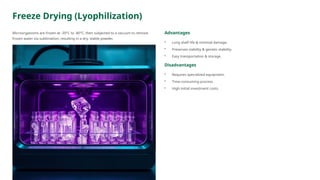
Microorganismsare frozen at -20°C to -80°C, then subjected to a vacuum to remove
frozen water via sublimation, resulting in a dry, stable powder.
Advantages
• Long shelf life & minimal damage.
• Preserves viability & genetic stability.
• Easy transportation & storage.
Disadvantages
• Requires specialized equipment.
• Time-consuming process.
• High initial investment costs.
4.
Cryopreservation
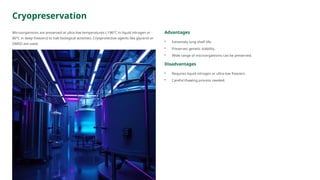
Microorganisms are preservedat ultra-low temperatures (-196°C in liquid nitrogen or -
80°C in deep freezers) to halt biological activities. Cryoprotective agents like glycerol or
DMSO are used.
Advantages
• Extremely long shelf life.
• Preserves genetic stability.
• Wide range of microorganisms can be preserved.
Disadvantages
• Requires liquid nitrogen or ultra-low freezers.
• Careful thawing process needed.
5.
Bead Freezing
Microorganisms aresuspended in a cryoprotective solution, quickly frozen with
liquid nitrogen, and stored as small beads.
Advantages
• Quick and easy to use.
• Ready-to-use state.
• Allows repeated sampling.
Disadvantages
• Requires continuous -80°C storage.
• Risk of contamination if mishandled.
6.
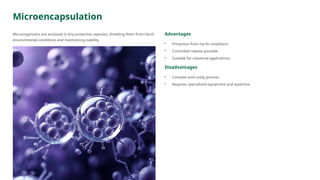
Microencapsulation
Microorganisms are enclosedin tiny protective capsules, shielding them from harsh
environmental conditions and maintaining viability.
Advantages
• Protection from harsh conditions.
• Controlled release possible.
• Suitable for industrial applications.
Disadvantages
• Complex and costly process.
• Requires specialized equipment and expertise.
7.
Agar Slants/Stabs
Microorganisms arestreaked on or stabbed into solidified agar in tubes, then stored
in a refrigerator at 4°C for short-term preservation.
Advantages
• Simple and inexpensive.
• Easy to prepare.
• Suitable for short-term storage.
Disadvantages
• Limited shelf life.
• Risk of desiccation over time.
8.
Drying Techniques
Water contentis removed from microorganisms using methods like spray drying or
vacuum drying, preserving them in a dried state.
Advantages
• Relatively low-cost.
• Suitable for large-scale applications.
• Longer shelf life than fresh cultures.
Disadvantages
• Sensitive strains may not survive.
• Rehydration can affect viability.
• Requires specialized equipment.
9.
Continuous Culture Systems
Microorganismsare cultured in a continuous flow of fresh growth medium, maintaining
optimal conditions and providing a constant biomass supply.
Advantages
• Continuous growth & maintenance.
• Constant biomass supply.
• Suitable for large-scale processes.
Disadvantages
• Complex setup & maintenance.
• Risk of contamination.
• Requires strict control & monitoring.
10.
Choosing the RightMethod
The optimal preservation method depends on the microorganism, storage duration, usage frequency, and available
resources. Industries often use multiple techniques.
Microorganism Type
Different strains have varying preservation needs.
Storage Duration
Short-term vs. long-term viability requirements.
Usage Frequency
How often the preserved culture will be accessed.
Available Resources
Equipment, expertise, and cost considerations.