GOVERNMENT OF GHANA


MEDIUM TERM AGRICULTURE SECTOR
   INVESTMENT PLAN (METASIP)

           2011 – 2015


 Ministry of Food and Agriculture


            September, 2010
TABLE OF CONTENTS

ACKNOWLEDGEMENT…………………………………………………………...……………………III
FOREWORD...............................................................................................................................................IV
LIST OF ACRONYMS……………………………………………………..……………………..VI
EXECUTIVE SUMMARY………………………………………………..……………………….XI

CHAPTER ONE: BACKGROUND AND CONTEXT………………………………………………..1
1.1    RATIONALE FOR A SECTOR PLAN ................................................................................................ 1
1.2            THE PROCESS OF DEVELOPMENT OF THE SECTOR PLAN ............................................................. 1
1.3            ORGANIZATION OF THE DOCUMENT ............................................................................................ 2
1.4            VISION AND OBJECTIVES ............................................................................................................. 3
1.5            ALIGNMENT WITH NATIONAL AND INTERNATIONAL FRAMEWORKS .......................................... 3
1.6            SCOPE OF THE METASIP ............................................................................................................ 4
CHAPTER TWO: REVIEW OF AGRICULTURE SECTOR PERFORMANCE .................................. 5
2.1    GENERAL TRENDS ....................................................................................................................... 5
2.2            AGRICULTURAL PRODUCTION TRENDS ....................................................................................... 6
2.3            FOOD CONSUMPTION AND NUTRITION TRENDS ........................................................................ 11
2.4            CONSTRAINTS TO AGRICULTURE SECTOR DEVELOPMENT ....................................................... 14
2.5            AGRICULTURAL FINANCE, IMPLEMENTATION AND MONITORING AND EVALUATION SITUATION
               ................................................................................................................................................... 16
CHAPTER THREE: DESCRIPTION OF PROGRAMMES AND JUSTIFICATION FOR PRIORITIES
…………………………………………………………………………………………… ........................ 22
3.1    INTRODUCTION .......................................................................................................................... 22
3.2            SYNERGY AMONG THE PROGRAMMES ....................................................................................... 22
3.3            PROGRAMME 1: FOOD SECURITY AND EMERGENCY PREPAREDNESS ................... 22
3.4            PROGRAMME 2: INCREASED GROWTH IN INCOMES .................................................... 36
3.5    PROGRAMME 3: INCREASED COMPETITIVENESS AND ENHANCED INTEGRATION
INTO DOMESTIC AND INTERNATIONAL MARKETS ....................................................................... 43
3.6            PROGRAMME 4: SUSTAINABLE MANAGEMENT OF LAND AND ENVIRONMENT . 46
3.7    PROGRAMME 5: SCIENCE AND TECHNOLOGY APPLIED IN FOOD AND
AGRICULTURE DEVELOPMENT .......................................................................................................... 49
3.8             PROGRAMME 6: IMPROVED INSTITUTIONAL COORDINATION ................................ 52
CHAPTER FOUR: RESULTS FRAMEWORK ………………………………………………... ….57
CHAPTER FIVE: COST EVALUATION AND FINANCING PLAN                                                 ......................................... 66
5. 1   INTRODUCTION .......................................................................................................................... 66
5.2            IMPLEMENTATION COST ............................................................................................................ 66
5.3            FUNDING SOURCES .................................................................................................................... 68

                                                                                i
5.4           PRIORITY INVESTMENTS ............................................................................................................ 69
CHAPTER SIX: FINANCIAL AND ECONOMIC ANALYSIS ……………………………….……70
CHAPTER SEVEN: IMPLEMENTATION MECHANISM ………………………………………...71
7.1    THE OBJECTIVE OF THE IMPLEMENTATION STRATEGY ............................................................. 71
7.2           IMPLEMENTATION GOVERNANCE .............................................................................................. 72
CHAPTER EIGHT: POLICY IMPLICATIONS …………………………………………………....76
CHAPTER NINE: SAFEGUARD MEASURES ……………………………………………………79
9.1    INTRODUCTION .......................................................................................................................... 79
9.2           FINDINGS AND RECOMMENDATIONS OF THE SEA..................................................................... 79
CHAPTER TEN: INSTITUTIONAL ASSESSMENT ……………………………………………... 83
CHAPTER ELEVEN: MONITORING AND EVALUATION …………………………………….. 85
11.1   INTRODUCTION .......................................................................................................................... 85
11.2          REVIEW OF THE MONITORING AND EVALUATION SYSTEM IN THE AGRICULTURAL SECTOR .......
              ................................................................................................................................................... 85
11.3          STRENGTHENING THE CURRENT M&E SYSTEM UNDER THE SECTOR PLAN ............................. 85
CHAPTER TWELVE: RISK ASSESSMENT …………………………………………………….. 88
APPENDIX 1: LEAD AND COLLABORATING/IMPLEMENTING AGENCIES ………………... 91
APPENDIX 2: SUMMARY OF INVESTMENT COSTS …………………………………………. 94
REFERENCES ……………………………………………………………………………….…..96

                                                               LIST OF TABLES

TABLE 1: SHARE OF AGRICULTURE IN GROSS DOMESTIC PRODUCT: 2000-2008 ............................... 5
TABLE 2: PRODUCTION OF INDUSTRIAL CROPS (MT) ........................................................................ 7
TABLE 3: AREA AND PRODUCTION OF SELECTED HORTICULTURAL CROPS IN GHANA ...................... 8
TABLE 4A: DOMESTIC MEAT PRODUCTION: 2003-2008 ................................................................... 9
TABLE 4B: MEAT IMPORTS INTO GHANA: 2003-2008 ...................................................................... 9
TABLE 5: ANNUAL FISH PRODUCTION BY SOURCE, MT ................................................................. 10
TABLE 6: DOMESTIC FOOD SUPPLY AND DEMAND OF KEY STAPLES (2005 -2008), 000 MT ........... 13
TABLE 7: AVERAGE YIELDS OF SELECTED FOOD CROP AND COMPARISON WITH ACHIEVABLE
   YIELDS ................................................................................................................................... 15
TABLE 8: FASDEP OBJECTIVES AND ON-GOING AND PLANNED PROJECTS ..................................... 20
TABLE 9: LEVELS OF POST-HARVEST LOSSES AND REDUCTION TARGETS ....................................... 25
TABLE 10: RESULTS FRAMEWORK ................................................................................................ 57
TABLE 11: METASIP EXPENDITURE ESTIMATE, (GHC MILLION) ................................................... 67
TABLE 12: METASIP FUNDING PROPOSAL, (GHC MILLION) .......................................................... 68
TABLE 13: PRIORITY INVESTMENTS ............................................................................................... 69
TABLE 14: LIST OF ISSUES THAT REQUIRE LEGISLATION ................................................................. 76
TABLE 15: RISK ASSESSMENT OF METASIP .................................................................................. 88

                                                                               ii
ACKNOWLEDGEMENT


We acknowledge the contribution and support of all Ministries Departments and Agencies
(MDAs) and Metropolitan, Municipal and District Assemblies (MMDAs) who participated in the
preparation of the Medium Term Agriculture Sector Investment Plan (METASIP) and our
partners both local and international that provided technical and financial support. Our special
thanks go to the consultants Prof. Saa Ditto of the University for Development Studies and Prof.
Ramatu M. Al-Hassan of the University of Ghana, Legon.


                                               iii
FOREWORD

The agriculture sector is key to overall economic growth and development of Ghana. In the
national development agenda, agriculture is expected to lead the growth and structural
transformation of the economy and maximize the benefits of accelerated growth. Significant
improvements in the productivity of the agriculture sector are required to raise the average real
incomes of Ghanaians as a whole. The food and agriculture sector also has direct impact on the
attainment of at least five of the Millennium Development Goals (MDGs).

The Ministry of Food and Agriculture (MOFA) is the lead agency responsible for the agricultural
sector within the context of a coordinated Government Programme. To carry out its function,
plans and programmes are coordinated through policy and strategy frameworks. In this regard,
MOFA facilitated the preparation of the Food and Agriculture Sector Development Policy
(FASDEP II) and the Medium Term Agriculture Sector Investment Plan (METASIP), 2011-
2015. The FASDEP II states the long term policy objectives of government in relation to the
development of the agriculture sector aimed at ensuring that the sector‟s stakeholders are best
positioned to take advantage of the emerging opportunities.

The METASIP is the investment plan to implement the medium term (2011-2015) programmes
of the policy. It has been developed to achieve a target agricultural GDP growth of at least 6%
annually, halving poverty by 2015 in consonance with MDG 1 and based on government
expenditure allocation of at least 10% within the Plan period (2011–2015). The METASIP is
consistent with the ECOWAS Agriculture Policy and NEPAD´s Comprehensive Africa
Agriculture Development Programme (ECOWAP/CAADP) which provide an integrated
framework to support agricultural growth, rural development and food security in the African
region.

The METASIP, a result of a consultative, technical and budgetary process, identifies results and
resource requirements and roles that the stakeholders in the sector will play in its
implementation. It takes into account ongoing projects and will adopt the Sector-Wide Approach
(SWAp) in its implementation bringing on board sector stakeholders in effective coordination
and participation.

Greater involvement of the private sector is planned for the growth and development of the
sector and its transformation in service delivery, as well as investment and management of the
sector as a whole. A second level of stakeholder participation is that between MOFA and other
Ministries, Departments and Agencies (MDA´s) whose policies impact on the agricultural sector.
A third level of participation relates to service delivery to smallholders, especially the poor, by
reducing transaction costs. Various types of linkages are outlined to be established between
smallholders and agribusiness, to facilitate access to input, research, technology and product
markets, as well as other essential services. Agricultural sector policies are supported with
technical and financial assistance from development partners and financial institutions and this
forms a fourth level of participation. A key aspect of the objective of coordination of stakeholder
participation is the harmonisation of actions of government and partners for synergy of
operations and maximum results for accelerated growth.
                                                iv
At the decentralized levels, programmes and activities have been prioritized according to the
relative needs, importance and competitive advantage of the respective regions and districts. This
will inform decentralized level planning, budget determination and contributions by
stakeholders.

Through cooperation, coordination and commitment of all sector stakeholders (MDAs, Private
Sector, including Farmers, Processors, Traders, NGOs, Traditional Rulers and Civil Society,
Development Partners, among others), who signed the Ghana CAADP Compact in October
2009, the country can overcome most of the challenges facing the food and agriculture sector to
enhance growth, create employment, increase incomes, reduce poverty and achieve food security
for its people within the context of an environmentally sustainable and transformed rural
economy.


                                                v
LIST OF ACRONYMS

ADB            Agricultural Development Bank
AfDB           African Development Bank
AEA            Agricultural Extension Agent
AESD           Agricultural Engineering Services Directorate
AgGDP          Agriculture Gross Domestic Product
AgSSIP         Agriculture Services Sub-sector Investment Programme
AMA            Accra Metropolitan Assembly
APD            Animal Production Directorate
APFOG          Apex Farmers Organisation of Ghana
APR            Annual Progress Report
ARI            Animal Research Institute
ASWG           Agriculture Sector Working Group
BNARI          Biotechnology and Nuclear Agriculture Research Institute
BOG            Bank of Ghana
BOPP           Benso Oil Palm Plantation
CAADP          Comprehensive African Agricultural Development Programme
CAHWs          Community Animal Health Workers
CARGS          Competitive Agricultural Research Grant Scheme
CBFMC          Community Based Fisheries Management Committee
CEPS           Customs Excise and Preventive Service
CFSVA          Comprehensive Food Security and Vulnerability Analysis
CGE            Computable General Equilibrium
CGIAR          Consultative Group for International Agricultural Research
CGS            Competitive Grants Scheme
CLWs           Community Livestock Workers
COCOBOD        Cocoa Board
WECARD/CORAF   West and Central Africa Council for Agricultural Research and
               Development/Counseil Ouest et Centre Africain pour la Recherche et le
               Développement Agricoles
CSD            Crop Services Directorate
CSIR           Council for Scientific and Industrial Research
DADU           District Agricultural Development Unit
DAES           Directorate of Agricultural Extension Services
DCGE Model     Dynamic Computable General Equilibrium Model
DOF            Directorate of Fisheries
DPO            Development Policy Operation
                                      vi
DPs        Development Partners
DVD        Digital Video Disc
ECOWAP     ECOWAS Agricultural Policy
ECOWAS     Economic Community of West African States
EDIF       Export Development and Investment Fund
EEZ        Exclusive Economic Zone
EMQAP      Export Marketing and Quality Awareness Project
EPA        Environmental Protection Agency
FABS       Food and Agriculture Budget Support
FAO        Food and Agriculture Organization of United Nations
FARA       Forum for Agricultural Research in Africa
FASDEP     Food and Agriculture Sector Development Policy
FBO        Farmer Based Organization
FC         Fisheries Commission
FFA        Fish Farmers‟ Association
FFS        Farmer Field School
FOODSPAN   Food Security and Advocacy Network
FONG       Farmers Organisation Network in Ghana
FRI        Food Research Institute
GAEC       Ghana Atomic Energy Commission
GAPs       Good Agricultural Practices
GAFSP      Global Agriculture and Food Security Programme
GAWU       Ghana Agricultural Workers Union
GDP        Gross Domestic Product
GEPC       Ghana Export Promotion Council
GES        Ghana Education Service
GHS        Ghana Health Service
GIDA       Ghana Irrigation Development Authority
GIMPA      Ghana Institute of Management and Public Administration
GLSS V     Ghana Living Standards Survey V
GMPs       Good Manufacturing Practices
GNAFF      Ghana National Association of Farmers and Fishermen
GoG        Government of Ghana
GOPDC      Ghana Oil Palm Development Company
GPRS I     Ghana Poverty Reduction Strategy I
GPRS II    Growth and Poverty Reduction Strategy II
GRATIS     Ghana Regional Appropriate Technology and Industrial Service
GREL       Ghana Rubber Estate Limited
GSB        Ghana Standard Board
                                  vii
GSGDA      Ghana Shared Growth and Development Agenda
GSS        Ghana Statistical Service
GSSP       Ghana Strategy Support Programme
GTZ        Gesellschaft fur Technische Zusammenarbeit (German Technical
           Development Agency)
Ha         Hectare
HACCP      Hazard Analysis and Critical Control Point
HIV/AIDS   Human Immune Virus/Acquired Immune Deficiency Syndrome
HRDM       Human Resource Development and Management
ICPM       Integrated Crop Pest Management
ICT        Information Communication Technology
IDAF       International Development of Artisanal Fisheries
IEC        Information Education Campaign
IFAD       International Fund for Agricultural Development
IFPRI      International Food Policy Research Institute
IGF        Internally Generated Fund
IMT        Intermediate Means of Transport
ISSER      Institute of Statistical, Social and Economic Research
ITD        International Trade Desk
ITTU       Intermediate Technology Transfer Unit
IWMI       International Water Management Institute
LAP        Land Administration Project
LPIU       Livestock Production and Information Unit
M&E        Monitoring and Evaluation
MDAs       Ministries, Departments and Agencies
MDGs       Millennium Development Goals
METASIP    Medium Term Agriculture Sector Investment Plan
MiDA       Millennium Development Authority
MLF        Ministry of Lands and Forestry
MLGRD      Ministry of Local Government, and Rural Development
MDAs       Ministries Departments and Agencies
MMDAs      Metropolitan, Municipal and District Assemblies
MOAP       Market Oriented Agriculture Programme
MOFA       Ministry of Food and Agriculture
MOH        Ministry of Health
MOI        Ministry of Information
MOTI       Ministry of Trade & Industries
MOU        Memorandum of Understanding
MRT        Ministry of Road and Transport
                                 viii
Mt        Metric Tonne
MTEF      Medium Term Expenditure Framework
NAAC      National Agricultural Advisory Committee
NADMO     National Disaster Management Organisation
NAFCO     National Food Buffer Stock Company
NBSSI     National Board for Small Scale Industries
NDPC      National Development Planning Commission
ND        Newcastle Disease
NEPAD     New Partnership for African Development
NGOs      Non-Governmental Organizations
NOPL      Norwegian Oil Palm Limited
NR        Northern Region
NRGP      Northern Rural Growth Programme
OIE       World Organisation for Animal Health
PANVAC    Pan African Vaccine Centre
PEF       Private Enterprise Foundation
POCC      Potential, Opportunities, Constraints and Challenges
PPME      Policy, Planning, Monitoring and Evaluation
PPMED     Policy, Planning, Monitoring and Evaluation Directorate
PPP       Public Private Partnership
PPRSD     Plant Protection and Regulatory Services Directorate
PSIA      Poverty and Social Impact Analysis
RADU      Regional Agricultural Development Unit
RELCs     Research Extension Liaison Committees
ReSAKSS   Regional Strategic Analysis and Knowledge Support System
SAKSS     Strategic Analysis and Knowledge Support System
SEA       Strategic Environmental Assessment
SLM       Sustainable Land Management
SMEs      Small Micro Enterprises
SPS       Sanitary and Phytosanitary
SRID      Statistics, Research and Information Directorate
SWAp      Sector Wide Approach
TFP       Total Factor Productivity
TOPP      Twifo Oil Palm Plantation
TIPCEE    Trade and Investment Programme for a Competitive Export Economy
UER       Upper East Region
UPA       Urban and Peri-urban Agriculture
USAID     United States Agency for International Development
UWR       Upper West Region
                                ix
VSD     Veterinary Services Directorate
WAAPP   West Africa Agricultural Productivity Programme
WFP     World Food Programme
WHO     World Health Organisation
WIAD    Women in Agriculture Development
WTO     World Trade Organisation


                               x
EXECUTIVE SUMMARY


The Plan
The Medium Term Agriculture Sector Investment Plan (METASIP), 2011–2015 has been
developed using a largely participatory process and based on FASDEP II objectives with a target
for agriculture sector GDP growth of at least 6% annually and government expenditure
allocation of at least 10% of the national budget within the plan period. These targets are in
conformity with agricultural performance targets of the Ghana Shared Growth and Development
Agenda (GSGDA), the ECOWAP of ECOWAS and the CAADP of NEPAD and are expected to
contribute significantly to the achievement of the MDGs of the United Nations.
As a sector investment plan, emphasis throughout the Plan has been on concerted consultations
and actions by all stakeholders of the sector. The key stakeholders include MOFA, other relevant
MDAs, DPs, NGOs, academia, civil society, farmers and other on-farm and off-farm private
sector operators, researchers and service providers.
Agriculture continues to be the largest sector of Ghana‟s economy, contributing about 39% of
GDP compared to about 26% for the industry sector and 31% for the services sector. Arable and
industrial crop production has increased only marginally over the last 10 years with the only
exception being cocoa which increased significantly between 2000 and 2005. Cotton and coffee
production declined very significantly in the last decade. Available information on the livestock
sub-sector indicates that the country‟s meat situation is in deficit to the tune of over 95,000Mt
annually. Similarly, a deficit of about 460,000 Mt is recorded for fish.
The identified basic problems of the agriculture sector include: reliance on rainfed agriculture
and low level and low performing irrigated agriculture; low level of mechanization in production
and processing; high post harvest losses as a result of poor post harvest management; low level
and ineffective agricultural finance; poor extension services as a result of several institutional
and structural inefficiencies; inadequate markets and processing facilities; low performing
breeds of livestock; poor feeding of livestock; high cost of feed for poultry; poor livestock
housing and husbandry management; competition from imports and poor post-production
management of livestock products; over-fishing of natural water bodies; undeveloped fish value
chain and inadequate skills in aquaculture. Strategies in the Plan to improve agricultural
performance in contribution to the vision for a modernised agriculture, structurally transformed
economy, food security, employment opportunities and poverty reduction, focus on investments
to address sector constraints on productivity, market access, sustainable production and
institutional coordination.
The six Programmes of the Plan which correspond to the six FASDEP II objectives have each
been presented along development themes termed Components. POCC analysis was applied to
the development issues of the themes to derive outputs and activities.


                                                xi
It is envisaged that the Plan will be implemented through existing structures in the MDAs and
other stakeholder organizations and that the Policy Coordinating and Monitoring Unit of the
Office of the President and the NDPC will play key oversight roles during implementation.
MOFA will play the lead role in coordinating partnerships at all levels and in the monitoring and
evaluation of the Plan.

Cost Estimates

Implementation of the plan to reach the goals set for the agriculture sector requires a significant
financial commitment from the public sector. The cost estimates for implementing METASIP are
public sector expenditure to be incurred above existing commitments to recurrent and investment
costs for ongoing programmes. They do not include operational costs such as personal
emoluments and administration of the implementing agencies.
The costing structure corresponds to the hierarchy of programmes, components, sub components
and activities, providing clear analytical links from the principal goal for the agriculture sector to
objectives for the six programmes, to expected outcomes for activities and to inputs. The cost
estimates for the investment plan are indicative; precise estimates can become available only
when detailed plans and feasibility studies for projects and programmes are completed.
The estimated incremental cost of implementation for all six programmes of the agriculture
sector investment plan for both MoFA and other Agriculture related MDAs for the five years is
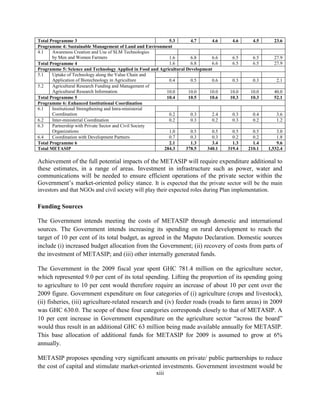
GHC 1,532.4 million. The table below summarises the METASIP expenditure estimate by
programmes and components.


METASIP Expenditure Estimate, (GHC million, constant 2010 prices)
                                                                             Year
Programme/ Component                                                                                        Total
                                                              2011    2012     2013      2014      2015
Programme 1: Food Security and Emergency Preparedness
1.1    Productivity Improvement                            33.3       72.2      14.5      14.0       2.1    136.1
1.2    Improved Nutrition                                   2.3        4.2       4.2       0.2       0.2     11.1
1.3    Diversification of Livelihood Options for the Poor   2.2        7.3       6.5       5.5       0.5     22.0
1.4    Food Storage and Distribution                        0.1        0.4       0.7       0.3       0.0      1.4
1.5    Early Warning Systems and Emergency
       Preparedness                                         3.4        1.3       1.3       1.3       1.3      8.7
1.6    Irrigation and Water Management                     11.1       64.9      85.0    103.6       21.6    286.2
1.7    Mechanization Services                              20.0       20.0      20.0      20.0      20.0    100.0
Total Programme 1                                          72.3      170.4     132.3    144.9       45.6    565.6
Programme 2: Increased Growth in Incomes
2.1    Promotion of Crop, Livestock and Fishery
       Production for income                               53.2       43.8      52.6      22.7      12.9    185.1
2.2    Development of New Products                          2.1        2.0       2.0       2.0       2.0     10.2
2.3    Pilot Value Chain Development                       40.7       40.5      40.5      40.4      40.3    202.4
2.4    Intensification of FBOs and Out-grower Concepts      1.5        1.5       0.9       0.2       0.2      4.3
2.5    Development of Rural Infrastructure                 94.9       96.6      86.4      86.4      86.2    450.3
2.6    Urban and Peri-urban Agriculture                     0.3        0.3       0.2       0.2       0.2      1.4
Total Programme 2                                         192.6      184.8     182.6    151.8     141.8    853.70
Programme 3: Increased Competitiveness and Enhanced Integration into Domestic and International Markets
3.1    Marketing of Ghanaian Produce in Domestic and
       International Markets                                5.3        4.7       4.6       4.6       4.5     23.6

                                                        xii
Total Programme 3                                           5.3        4.7      4.6     4.6     4.5     23.6
Programme 4: Sustainable Management of Land and Environment
4.1    Awareness Creation and Use of SLM Technologies
       by Men and Women Farmers                             1.6        6.8      6.6     6.5     6.5     27.9
Total Programme 4                                           1.6        6.8      6.6     6.5     6.5     27.9
Programme 5: Science and Technology Applied in Food and Agricultural Development
5.1    Uptake of Technology along the Value Chain and
       Application of Biotechnology in Agriculture          0.4        0.5      0.6     0.3     0.3       2.1
5.2    Agricultural Research Funding and Management of
       Agricultural Research Information                   10.0       10.0     10.0    10.0    10.0     40.0
Total Programme 5                                          10.4       10.5     10.6    10.3    10.3     52.1
Programme 6: Enhanced Institutional Coordination
6.1    Institutional Strengthening and Intra-ministerial
       Coordination                                         0.2        0.3      2.4     0.3     0.4       3.6
6.2    Inter-ministerial Coordination                       0.2        0.3      0.2     0.3     0.2       1.2
6.3    Partnership with Private Sector and Civil Society
       Organizations                                        1.0        0.5      0.5     0.5     0.5       3.0
6.4    Coordination with Development Partners               0.7        0.3      0.3     0.2     0.2       1.8
Total Programme 6                                           2.1        1.3      3.4     1.3     1.4       9.6
Total METASIP                                             284.3      378.5    340.1   319.4   210.1   1,532.4

Achievement of the full potential impacts of the METASIP will require expenditure additional to
these estimates, in a range of areas. Investment in infrastructure such as power, water and
communications will be needed to ensure efficient operations of the private sector within the
Government‟s market-oriented policy stance. It is expected that the private sector will be the main
investors and that NGOs and civil society will play their expected roles during Plan implementation.

Funding Sources

The Government intends meeting the costs of METASIP through domestic and international
sources. The Government intends increasing its spending on rural development to reach the
target of 10 per cent of its total budget, as agreed in the Maputo Declaration. Domestic sources
include (i) increased budget allocation from the Government; (ii) recovery of costs from parts of
the investment of METASIP; and (iii) other internally generated funds.

The Government in the 2009 fiscal year spent GHC 781.4 million on the agriculture sector,
which represented 9.0 per cent of its total spending. Lifting the proportion of its spending going
to agriculture to 10 per cent would therefore require an increase of about 10 per cent over the
2009 figure. Government expenditure on four categories of (i) agriculture (crops and livestock),
(ii) fisheries, (iii) agriculture-related research and (iv) feeder roads (roads to farm areas) in 2009
was GHC 630.0. The scope of these four categories corresponds closely to that of METASIP. A
10 per cent increase in Government expenditure on the agriculture sector “across the board”
would thus result in an additional GHC 63 million being made available annually for METASIP.
This base allocation of additional funds for METASIP for 2009 is assumed to grow at 6%
annually.

METASIP proposes spending very significant amounts on private/ public partnerships to reduce
the cost of capital and stimulate market-oriented investments. Government investment would be
                                                      xiii
recovered, at least in part, from the private sector partners who would include FBOs. The volume
of outlays to be recovered will be determined as agreements are reached with private sector
partners. The investments concerned would include development of facilities for agribusiness in
storage and processing (to cost about GHC 200 million) and equipment for mechanization
services to be operated by entrepreneurs and FBOs (to cost about GHC 100 million). Assuming
that cost recovery runs at 30 per cent of the total in the first year after investment and at 20 per
cent in each of the next two years (thus averaging 70 per cent of all outlays), the Government
would recover about GHC 132 million from its partners within the life of METASIP.

MOFA recovers costs of providing goods and services as “internally generated funds (IGF)”
which currently run at some GHC 5 million per year. An assumption that IGF will increase in
proportion to the increase in expenditure resulting from METASIP is suitably conservative.
METASIP would add, on average, about 30 per cent to MOFA spending, suggesting that IGF
would rise by about GHC 1.5 million annually from 2011.

Likely sources of funds and the commitment to METASIP are shown in the Table below. It is
estimated that the funding gap for the investment programme is about GHC 1,016 million.


                             METASIP Funding Proposal, (GHC million)

                                                                      Year
Source                                                2011    2012     2013    2014    2015
                                                                                               Total

Government of Ghana Increased Allocation               66.8    70.8     75.0    79.5    84.3     376.4
Cost Recovery: Private/ Public Partnerships                    18.0     30.0    42.0    42.0     132.0
Other Internally Generated Fund                         1.5     1.6      1.7     1.8     1.9       8.5
Total Funds from Domestic Sources                      68.3    90.4    106.7   123.3   128.2     516.9
Estimated METASIP Cost                                284.3   378.5    340.1   319.4   210.1    1532.4
Funding Gap                                           216.0   288.1    233.4   196.1    81.9    1015.5


Priority Investments

A set of priorities is drawn from the overall investment plan. Highest priority is given to actions
which directly impact farm production to achieve the objectives of Programmes 1 and 2 and the
outcomes of their components. Only those activities in Programmes 3, 4, 5 and 6 considered
urgent to support Programmes 1 and 2 are included in the priority investment plan. The priority
investments and their tentative cost estimates are listed by programme and component in the
Table below. The listing is to show priority thematic areas and subjects for consideration by DPs
and the Government. In practice, packaging of projects and programmes would result in the
combination of some of activities and the inclusion of activities listed in other parts of
METASIP.


                                                xiv
Priority Investments, (GHC million)
                                                                            Year
                                                                                                     Total
                                                            2011    2012      2013    2014    2015
Programme 1: Food Security and Emergency Preparedness
1.1    Productivity Improvement                            19.1       18.2      2.4     0.4    0.4       40.5
1.2    Improved Nutrition                                   4.0        4.0      2.0       0      0       10.0
1.3    Off-farm Livelihoods                                 2.2        7.2      6.2     5.2    0.2       21.0
1.5    Early Warning Systems and Emergency
       Preparedness                                         1.0        2.3      0.3     0.3    0.3        4.2
1.6    Irrigation and Water Management                      8.0       51.0     53.0    69.0   27.0      208.0
1.7    Mechanization Services                              20.0       20.0     20.0    20.0   20.0      100.0
Total Programme 1                                          54.3      102.7     83.9    94.9   47.9      383.7
Programme 2: Increased Growth in Incomes
2.1    Promotion of Crop, Livestock and Fishery
       Production for income                               45.0       30.0     35.0    15.3    0.5      125.8
2.3    Pilot Value Chain Development                       40.0       40.0     40.0    40.0   40.0      200.0
Total Programme 2                                          85.0       70.0     75.0    55.3   40.5      325.7
Programme 4: Sustainable Management of Land and Environment
4.1    Awareness Creation and Use of SLM Technologies
       by Men and Women Farmers                             1.2        6.6      6.0     5.8    5.4       25.0
Total Programme 4                                           1.2        6.6      6.0     5.8    5.4       25.0
Programme 5: Science and Technology Applied in Food and Agricultural Development
5.1    Uptake of Technology along the Value Chain and
       Application of Biotechnology in Agriculture         10.0       10.0     10.0    10.0   10.0       50.0
Total Programme 5                                          10.0       10.0     10.0    10.0   10.0       50.0
Total METASIP Priority Investments                        150.5      189.3    181.9   166.0   96.8      784.5


                                                       xv
Chapter one: Background and context


1.1    Rationale for a Sector Plan
Ghana‟s economy has been largely dependent on agriculture and its growth is key to overall
economic growth and development. The first Ghana Poverty Reduction Strategy (GPRS I), 2003-
2005 set out that agriculture was to be modernised to spur rural development. Similarly, in the
Growth and Poverty Reduction Strategy (GPRS II), 2006-2009, and its sequel the Ghana Shared
Growth and Development Agenda I (GSGDA), 2010-2013, agriculture is expected to lead the
growth and structural transformation of the economy and maximize the benefits of accelerated
growth. GRPS II recognized that no significant progress can be made in raising the average real
incomes of Ghanaians as a whole without significant improvements in the productivity of the
agriculture sector and agro-based/processing industry (NDPC, 2005).

The Ministry of Food and Agriculture (MOFA) as the lead ministry responsible for policy and
planning for the agriculture sector has always responded to the national development initiatives
with policies and strategies that address the sector‟s responsibilities in the national goals.
Realising that the agriculture sector encompasses activities of several Ministries, Departments
and Agencies (MDAs) as well as those of many non-governmental organizations and the private
sector, MOFA has, as a matter of policy, involved all these agencies in policy formulation and
implementation over the years. MOFA, with these stakeholders, in 2007 completed the revision
of its Food and Agriculture Sector Development Policy (FASDEP). As the policy itself is a
statement of intent, the next step towards the realisation of the policy objectives is the
development of a Medium Term Agriculture Sector Investment Plan (METASIP) for the
implementation of the broad strategies specified in the policy.

This Sector Plan has been developed based on a target agriculture sector GDP growth of at least
6% annually and government expenditure allocation of at least 10% within the Plan period
(2011–2015). These are in conformity with national, regional and international agricultural
performance targets.

1.2    The Process of Development of the Sector Plan
The approach to the development of the sector investment plan was both technical and
consultative through technical committees and workshops for participation from a wide cross-
section of sector stakeholders at the national and regional levels. A technical committee,
consisting of MOFA and other MDAs, was inaugurated in July 2007. A stocktaking of sector
programmes, strategies and performance from a historical perspective was carried out,
concurrently with an analysis of options for agricultural sector growth. Value chain analysis of
priority commodities, reports from commissioned studies as well as investment projects
informed the analytical work. This was facilitated by MOFA with technical and financial support
from the New Partnership for African Development (NEPAD) the Economic Community of
West African States (ECOWAS) and the Food and Agriculture Organisation (FAO).


                                               1
Regional Directors of Agriculture convened decentralised consultations and the Chief Director‟s
office convened central level consultations and national validation of both the policy and plan.
The stakeholder groups engaged, included sector related ministries, researchers, NGOs, private
sector operators along the value chains (input suppliers, processors, traders, exporters, financial
institutions, warehouses operators, transporters), academia, regional and district level officers.
Criteria for stakeholder selection included a fair balance between the number of private and
public sector participants, selection of farmers based on major commodities grown in the specific
region (for regional consultations) and gender balance among participants. Reports were
prepared on all stakeholder consultations at national, regional and district levels, as inputs into
the process.

The above processes informed the preparation of a zero draft of the plan, which was further
discussed by many more sector stakeholder groups including private sector, civil society
organisations, Parliamentary Select Committee on Agriculture and Cocoa Affairs and DPs. The
final draft was the basis for the ECOWAS/CAADP compact signed in Ghana in October 2009.
The final draft was subjected to a technical review organised by ECOWAS, after which this final
document was prepared.

1.3    Organization of the Document
The METASIP consists of 12 chapters. This introductory Chapter concludes with three sections.
The first presents the statement of the Vision, Mission, Goal and Objectives that guide the plan;
the second describes how the plan goals and objectives are aligned with those of the National
Development Plan and the pillars of CAADP; and the last section describes the scope of the plan.
Chapter 2 provides a summary review of the performance of the agriculture sector, including
trends in crop production and productivity, livestock and fish production, imports and exports of
agricultural commodities, and nutrition levels. The section also discusses the constraints in the
agricultural sector, as well as analysis of the potential and sources of growth.

Chapter 3 presents the six programmes of the METASIP, which have been organized along the
six objectives of FASDEP II. The results framework and the cost evaluation and financing of the
plan are presented in Chapters 4 and 5 respectively.

Results of the financial and economic analysis undertaken to inform the METASIP is presented
in Chapter 6, while the Implementation Framework for the plan is presented in Chapter 7.
Chapter 8 describes the policy implications of the plan, whilst Chapter 9 presents the safeguard
measures adopted by the Plan.

The last three chapters present the results of the Institutional Assessment to inform
implementation of the plan; the Monitoring and Evaluation Framework and Risk Assessment of
the plan.

Working documents used in the development of the METASIP have been compiled separately.
The documents include:


                                                2
   A stocktaking report
         A computable general equilibrium (CGE) modeling report
         Stakeholder consultation reports
         Potential, Opportunities, Constraints and Challenges (POCC Analyses)
         Institutions and Roles to leverage skills and build on synergies
         Agricultural Sector M&E Indicator Matrix (2011-2015)
         Commodity Programmes
         Priority Roads for rehabilitation
         A matrix of infrastructural facilities to remove constraints to selected agricultural
          commodities.
         Costing report

1.4       Vision and Objectives


1.4.1 Vision

The Vision for Ghana‟s Agriculture Sector is “a modernised agriculture culminating in a
structurally transformed economy and evident in food security, employment opportunities
and reduced poverty”.


1.4.2 FASDEP II Objectives

The strategic objectives for the agricultural policy (FASDEP II) are as given below. They also
form the programme areas in this Sector Plan document.
    Food security and emergency preparedness
    Increased growth in incomes
    Increased competitiveness and enhanced integration into domestic and international
       markets
    Sustainable management of land and environment
    Science and technology applied in food an agriculture development
    Improved institutional coordination

1.5       Alignment with National and International Frameworks
According to the FASDEP II document, the “vision for the food and agriculture sector is linked
to the national vision in GPRS II, NEPAD‟s CAADP and the MDGs” (MOFA, 2007 p.15). Both
the GSGDA and the Comprehensive African Agricultural Development Programme (CAADP)
framework have targets for agriculture sector performance that will contribute to the attainment
of the broader goals. The GSGDA expects agriculture to spur industrial growth. Also, in the
GSGDA the economy (non-oil) is expected to grow at 6.5% by 2010 and 8.2% by 2013. This
level of growth demands higher growth performance than the average of 5.6% recorded over the
2000-2006. Agriculture growth target under CAADP is at least 6% and governments are urged to
raise budgetary allocation to agriculture to at least 10%.

                                                3
The ECOWAS Agricultural Policy (ECOWAP) and the CAADP of NEPAD are the key efforts
with the overriding goal of helping African countries increase their economic growth through
agriculture-based development, which eradicates hunger, reduces poverty and food and nutrition
insecurity and makes it possible to increase exports. This goal is in close harmony with GSGDA
I (2010-2013) and e FASDEP II.

1.6    Scope of the METASIP
The METASIP is a sector wide investment plan and includes activities of agriculture related
Ministries, Departments and Agencies (MDAs) based on the classification of functions for the
sector. It also anticipates activities of the private sector and civil society and takes into account
ongoing projects. As a sector investment plan, emphasis throughout the Plan has been on
concerted consultations and actions by all stakeholders of the sector. The key stakeholders
include MOFA, other relevant MDAs, Development Partners (DPs), NGOs, academia, civil
society, farmers and other on-farm and off-farm private sector operators, researchers and service
providers.

The implementation of the METASIP adopted the application of a Sector-Wide Approach
(SWAp) to bring on board sector stakeholders in effective coordination and participation.
Extensive consultation with all stakeholders was undertaken at the central and decentralised
levels for the preparation of the investment plan.


                                                 4
CHAPTER TWO: REVIEW OF AGRICULTURE SECTOR PERFORMANCE


2.1    General Trends
Economic growth in Ghana has been quite impressive since 2000. There has been relative
economic stability and indications are that income poverty has reduced in Accra and in the rural
forest zone, especially among export crop farmers (ISSER, 2007). There are, however,
indications of growing inequality between social groups, occupational groups and geographical
areas in the country (Ibid). The situation points to structural problems that need to be addressed.
Some of the structural problems relate to the dominant agriculture sector which is responsible for
about 39% of Gross Domestic Product (GDP), provides employment to about 50.6% of the
labour force (4.2 million people) and is the largest foreign exchange earner.

The general performance of the agriculture sector relative to other sectors since 2000 is as given
in Table 1. It shows that the sector has been and still is the largest contributor to GDP even
though service is the fastest growing sector. While the average agriculture sector GDP growth
rate between 2000 and 2008 has been about 4.7% that of the service sector has been about 6.0%.
The faster growth in the service sector is not likely to drive agricultural growth significantly
because of weak linkages between the two sectors in Ghana.

              Table 1: Share of Agriculture in Gross Domestic Product: 2000-2008

                                                     Sector, (%)
              Year            Agriculture    Industry    Services         Other (Net
                                                                          Indirect Taxes)
                      2000            39.6          27.8           32.7                  **

                      2001            39.6          27.4           33.0                  **

                      2002            39.8          27.4           33.0                  **

                      2003            38.8          24.9           29.8                 6.5

                      2004            40.3          24.7           29.9                 5.1

                      2005            39.5          25.1           30.0                 5.4

                      2006            39.3          25.9           30.0                 4.8

                      2007            38.0          25.7           31.2                 5.1

                      2008            33.6          25.9           31.8                 8.7

       Average Sectoral
        shares in GDP                38.7          26.1            31.3                 5.9
       (2000 – 2008)
       Source: Ghana Statistical Service (GSS), 2008
                                                5
2.2    Agricultural Production Trends


2.2.1 Crop Production

Areas planted to different crops have increased only marginally since 2000. Overall percentage
increase in cultivated area between 2000 and 2008 is about 17.3% or an average of about 1.9%
per year over the period (SRID, 2008). Overall increase in production of all arable crops between
2000 and 2008 is also about 41.1% or 4.6% per year over the period (SRID, 2008). Recent
studies of the components of agricultural growth suggest that most agricultural growth has been
mainly due to land area expansion as opposed to yield increases (Diao, 2005). A World Bank
study has, however, indicated that total factor productivity (TFP) accounted for 60% of
agricultural sector growth between 2001 and 2005 and some of that growth can be “traced to
specific, productivity-enhancing measures and results in the cocoa sector” (World Bank, 2007).
For example, while land for cocoa trees expanded at an annual 5% growth rate, it had a yield
growth rate of 17%. While fibre crops declined in acreages they maintained an annual yield
growth rate of 6%.


2.2.2 Industrial Crop Production and Exports

Ghana‟s industrial crops include cocoa, oil palm, cotton, sheanut, coffee, rubber and coconut.
Table 2 clearly indicates the dominant role of cocoa and oil palm in the industrial crop sub-
sector. The cocoa sub-sector experienced phenomenal growth between 2003 and 2005. The oil
palm sub-sector has also been growing steadily. The rubber and coconut sub-sectors have also
grown but only marginally. As indicated in Table 2, rubber production increased by 28.1%
between 2000 and 2006 while coconut production increased by only 6.7% within the same
period.

The production of cotton and coffee has however declined very significantly over the years. The
seed cotton industry has had serious problems largely related to unguided liberalization of the
sub-sector as well as the downturn in world market prices since the beginning of the new
millennium. The indebtedness of cotton companies to the Agricultural Development Bank
coupled with the influx of a large number of unproductive private cotton companies has brought
the industry to a near collapse.

About 30,000 Mt of sheanuts were collected in 2000 and that increased to 105,000Mt in 2003
before falling again to 30,000Mt in 2005. The shea industry is currently largely unorganized
partly because there are no sheanut farms. Shea trees are semi-wild and the nuts are gathered,
mainly by women. At the moment the Ghana Cocoa Board oversees the sheanut industry but the
industry has not shown any significant growth or development over the years. The research
centre for shea in Bole has, for example, had no researcher for over 10 years. Virtually anybody
can market and/or process sheanuts. That means there is hardly any control over standards. There
is need for a Sheanut Development Board to develop the shea industry especially as it has the

                                               6
potential for poverty alleviation of the most marginalized, rural women, and the uplifting of the
poorest and most deprived parts of the country, the Guinea and Sudan savannah areas.


                           Table 2: Production of Industrial Crops (Mt)


                                               Seed
       Year       Cocoa (1)     Sheanut       Cotton        Oil Palm    Rubber      Coconut
                                  (1)           (2)            (3)        (4)         (5)
        2000        436,534       30,771        35,503      1,066,426    11,081      300,000
        2001        389,591       19,882        17,506      1,586,500      9,784     300,000
        2002        340,562       27,160        22,851      1,612,700    10,240      300,000
        2003        496,846      105,000        16,822      1,640,100    10,924      300,000

        2004        736,975           n.a.      20,155      1,686,800     12,347      316,000

        2005        599,318        30,000       21,000      1,712,600     13,619      316,000

        2006        740,458           n.a.           n.a    1,737,900     14,196      320,000

        2007        614,532           n.a.           n.a.   1,684,500        n.a.         n.a.

        2008         680,800          n.a.           n.a.   1,219,260        n.a.         n.a.
Sources: 1. COCOBOD, 2. Agricultural Development Bank. 3. Oil Palm Companies (GOPDC, TOPP,
BOPP, NOPL) and Individual Plantations. 4. GREL, Ghana Rubber Master Plan, 2007. 5. Estimates by
Coconut Sector Development Project and Tree Crops Development Unit, MOFA.

The main agricultural exports of Ghana have been cocoa and timber and timber products. The
contributions of cocoa and cocoa products to total merchandise exports have been very
substantial, ranging from 20.5% in 2001 to 37.9% in 2004 (Bank of Ghana, 2006). There is
presently a policy to increase the percentage of cocoa beans processed locally from about 18%-
20% to 40%-50%. The percentage contribution of timber and timber products to total
merchandise exports ranged from 6.8% in 2003 to 9.1 in previous years (Ibid).

The country has encouraged the export of other agricultural commodities over the years as a
strategy to diversify exports. The main commodities have been pineapple, yam, banana, fish,
cashew, mango, papaya and sheanut. The indication is that there is considerable potential for the
export of non-traditional agricultural commodities and an enabling environment should be
created for their production.


2.2.3 Horticultural Crops Production

Horticultural crops (fruits and vegetables) play a major role in food and nutrition security as they
are not only sources of income but they are also good sources of vitamins, minerals and dietary
                                                 7
fibre. Although FAO and WHO recommend a daily intake of at least 400g/person
(146kg/person/year) of fruits and vegetables, Africa has been put on record as the least nourished
of all the continents in the world with fruit and vegetable intake of 100g/day or lower compared
to 300g/day for those in developed countries.
The horticulture industry is export-oriented and statistics on domestic production and trade are
scanty. Only a small percentage of horticultural crop farmers are engaged in production for
export. Table 3 presents production levels of major horticultural produce in 2008. There is need
to improve on productivity and reduction of postharvest losses through improved harvesting and
post harvest handling practices of horticultural crops. Consistent promotion of the regular
consumption of adequate amounts of varieties of fruits and vegetables would also improve
nutrition and income generation.


             Table 3: Area and production of selected horticultural crops in Ghana

              Crop          Cropped Area                 Estimated           Crop Yield
                                    (Ha)            Production (Mt)            (Mt/Ha)
       Tomato                     16,130                    284,000                17.6
       Pepper                      9,570                    134,000                14.0
       Okra                        2,330                     46,600                20.0
       Garden Eggs                 3,870                     38,700                10.0
       Shallots                    4,900                     39,300                 8.0
       Citrus                     15,700                    550,000                35.0
       Mango                       6,360                     70,000                11.0
       Pineapple                   8,000                    400,000                50.0
       Pawpaw                        880                     40,000                45.0
       Source: MOFA (SRID), 2009


2.2.4 Livestock Production

The livestock sub-sector is dominated by small scale operators who are mainly crop farmers
keeping livestock to supplement their incomes and/or for security purposes. There are few well-
organized commercial poultry and pig operations.
There has been no livestock census for several decades and this has affected the credibility of
livestock population statistics. MOFA has been relying on projections, which do not accurately
portray the livestock situation. There is urgent need for a comprehensive livestock census and
the institution of a livestock monitoring system thereafter to ensure that credible information on
livestock is made available continuously.
According to available data, total domestic meat production increased from about 77,235 Mt in
2003 to 101,895 Mt in 2008 (Table 4a). That is about 132% increase over the period. Poultry
contributed the greatest proportion of total domestic meat production followed by beef.

                                                8
Table 4A: Domestic Meat Production: 2003-2008

                                               Domestic meat production, Mt

   Livestock/year                                                                         % by
                         2003         2004      2005        2006    2007       2008       type
   Cattle/Beef          18,486       18,686     18,874     19,140   19,346      19,553       21.7

   Sheep/Mutton         13,568       14,004     14,450     14,913   15,390      15,831       16.7

   Goats/Chevon         13,884       15,308     15,300     15,588   16,364      17,180       17.8

   Pigs/Pork            10,181        9,979      9,744     16,027   16,498      17,002       15.1

   Poultry/Chicken      21,116       22,982     22,709     27,224   29,630      32,249       29.6

   Total                77,235       80,959     76,582     92,893   97,229     101,895     100.0
Sources: (i) MOFA (SRID), 2009 and (ii) Computations from livestock production data.


Available statistics on livestock imports cover dressed or processed livestock, dairy products and
animals imported live for slaughter (Table 4B). It is estimated that a high percentage of cattle
slaughtered annually are imported from the northern Sahelian countries in the West African sub-
region.
                         Table 4B: Meat Imports into Ghana: 2003-2008

                                                 Meat imports (Mt)
                          2003           2004     2005      2006               2007       2008
  Cattle/Beef              1,112           2,587   6,332     10,586            16,250      13,135

  Sheep/Mutton              2,122             2,053        3,640     4,839      6,887       5,961

  Goats/Chevon                   -                -            -           -          -          -

  Pigs/Pork                 9,882             7,756       10,287    13291      10,552       5,487

  Poultry/Chicken         32,939          39,089          40,591    44,758     63,276     89,889

                                                      9
Total                     46,055        51,485        60,850          73,474     96,965        114,472

         Sources: MOFA, VSD.

 Total meat available for domestic consumption in Ghana as at 2008 (domestic production and
 imports) amounted to 189,784 Mt, while FAO‟s recommended level for the whole population is
 285,430 Mt/year. This leaves a deficit of 95,646 Mt. Pragmatic efforts are therefore needed to
 bridge this gap by increasing meat production and consumption.


 2.2.5 Fish Production

 Fish is consumed by most Ghanaians daily. It is recognized as the most important source of
 animal protein and it is expected to provide 60 percent of animal protein needs of consumers in
 all regions of the country. National per person fish consumption is estimated to average at 23 kg,
 much higher than the global average of 13 kg.
 The country‟s total annual fish requirement is estimated at 880,000 Mt while annual production
 averages only 420,000 Mt (see Table 5), leaving an annual deficit of 460,000 tonnes (DOF,
 2007). Part of this deficit is made up for, through fish imports which in 2007 was 212,945 Mt
 and valued at US$262 million (DOF, 2007). The actual net deficit of 247,055 Mt is left
 unattended. Ghana is therefore not able to meet its national fish demand even with importation.
 With prospects for higher landings from the capture fisheries being limited due to dwindling
 stocks as a result of over exploitation of the resource, the net deficit is expected to worsen over
 time.
 The Ghana Statistical Service (GSS) 2002 estimates that about 2 million people depend on the
 fisheries sub-sector for livelihood. More specific estimates account for 110,000 small-scale
 fishers in the marine sector with many, mostly women, being involved in processing, marketing
 and ancillary activities. For Lake Volta, these figures are respectively, 71,000 small-scale fishers
 and 20,000 people involved in processing and marketing (IDAF, 1993).


                            Table 5: Annual Fish Production by Source, Mt

                                                                                       Total     %      by
           2002      2003       2004      2005       2006         2007       2008      (2002-08) Source

Marine     290,000 331,412 352,405 322,790 323,619 290,706 343,962 2,254,894                                79.5


Inland      88,000    75,450     79,000    82,654        83,168    84,757     87,096    580,125             20.5


Total      378,000 406,862 431,405 405,444 406,787 375,463 431,058 2,835,019                           100.0

                                                    10
Source: MOFA (Fisheries Commission)

2.3    Food Consumption and Nutrition Trends


2.3.1 Levels of Food Consumption

The World Food Programme sponsored a Comprehensive Food Security and Vulnerability
Analysis (CFSVA) in 2009, the first nationwide household food consumption survey in Ghana
since 1977. This survey gives an indication of how foods are purchased or home produced and
categorizes households based on their dietary patterns. Food consumption measurement reflects
the diversity of the diet and the frequency staple and non-staple foods are consumed.

The survey results indicate that consumption of cereals and tubers is seven days across all
regions, with consumption of fish, meat and fruit consumption varying substantially. While
people living in the coastal zone eat fish more frequently, those in the savannah area consume
meat two days per week on average. Maize and millet are the cereals most frequently consumed,
followed by bread and rice. The impact of wealth plays a key role in the frequency with which
meat, fruit and oil are consumed by households. Households who are self-employed or with
stable salary consume varied diet as compared with farming households or households engaged
in unskilled labour (WFP, 2009).

The survey also showed that almost all the food products sold to consumers have very limited
value addition. Cereals and grain legumes are only threshed, while roots and tubers and plantains
are sold mostly in their raw form. Recent attempts to produce cassava, plantain and yam flour are
yielding results but it will take time for markets to be created. Low income levels are also a
source of restrained demand for the well packaged cassava, plantain and yam flour. It is pertinent
to note that there are hardly any statistics on processed agricultural products in the country. A
critical element of modernization of the agriculture sector is value addition to primary produce.
Without reliable statistics on the supply of and demand for processed agricultural products, it
will be difficult to convince investors to consider investing in agro-processing.

As indicated in Table 6, Ghana experiences deficits with regard to rice, maize, sorghum and
millet. To make up for the shortfalls in cereal production some quantities of maize, rice and
sorghum are imported. Ghana imports all its domestic requirements of wheat. Information from
the Ministry of Trade and Industry indicates that wheat and rice have been the main cereal
imports since 2000. Rice imports have consistently been the highest since 2001. Despite the
efforts made in production of rice, cost of production is high and it cannot compete with cheaper
imported rice.

Significant quantities of livestock and livestock products are also imported to make up for
production shortfalls. The main livestock product imported has been frozen chicken. Over
89,000 Mt of frozen chicken was imported in 2008 alone (VSD, 2009). Pork and beef imports
have also been quite substantial. Over 5,000 Mt of pork and over 13,000 Mt of beef were
imported in 2008 (Ibid). The massive importation of frozen chicken, just like rice, has adverse

                                               11
consequences on the local poultry industry. With the high cost of feed, poultry produced locally
cannot compete with the imported poultry products.


                                              12
Table 6: Domestic Food Supply and Demand of Key Staples (2005 -2008), 000 Mt

Commodity                   Total Domestic Production                 Production Available for Human                                                   2          Deficit/Surplus ('000 MT)
                                                                                                                    Estimated National Consumption
                                                                                             1
                                                                               Consumption

                     2005        2006       2007          2008       2005       2006       2007           2008      2005      2006      2007       2008       2005      2006      2007          2008

Maize                1,158.0    1,189.0     1,219.6     1,207.0     810.0      832.0      854.0          905.9     894.0     939.0     998.6     1,024.5      -84.0    -107.0   -144.9        -118.6

                3     145.0       250.0      185.3       124.0      116.0      120.0      148.0          107.9     305.0     320.5     344.3      561.4     -189.0     -200.5   -196.0        -453.5
Rice (milled)

Millet                144.0       165.0      113.0       119.0      101.0      115.5       79.0          103.5     189.0     199.0     145.9       23.4       -88.0     -83.4     -66.8         80.1

Sorghum               287.0       315.0      154.8       163.0      201.0      220.5      108.0          141.8     311.0     327.1     230.3       11.7     -110.0     -106.6   -121.9         130.1

Cassava              9,739.0    9,638.0    10,217.9   10,321.0     6,817.0    6,746.6    7,153.0        7,224.7   3,186.0   3,346.0   3,486.1    3,576.3    3,632.0   3,400.6   3,666.4       3,648.4

Yam                  3,892.0    4,288.0     4,376.0     4,490.0    3,114.0    3,430.4    3,501.0        3,592.0    890.0     934.8     955.3      980.0     2,224.0   2,495.6   2,545.5       2,612.0

Plantain             2,381.0    2,900.0     3,233.7     3,330.0    2,024.0    2,465.0    2,749.0        2,830.5   1,767.0   1,856.4   1,933.4    1,983.5     257.0     608.6     815.2         847.0

Cocoyam              1,716.0    1,660.0     1,609.1     1,746.0    1,373.0    1,328.0    1,352.0        1,658.7   1,178.0   1,237.6   1,301.9    1,335.6     195.0      90.4      50.2         323.1

Groundnut             390.0       520.0      301.8       314.0      332.0      442.0      257.0          282.6     421.0     265.2     273.6      280.7       -89.0    176.8      -17.1           1.9

Cowpea                141.0       167.0      119.0       127.0      120.0      141.9      101.0          108.0      19.0     110.5     114.0      117.0      101.0      31.5      -12.9          -9.0

Soybean             -N/A           52.0       52.8    -N/A        -N/A          44.2       45.0     -N/A          -N/A        15.5      79.8    -N/A       -N/A         28.7      -34.9   -N/A

Total               19,993.0   21,144.0    21,583.0   21,941.0    15,008.0   15,886.1   16,347.0    16,955.6      9,160.0   9,551.6   9,863.2    9,894.1    5,849.0   6,334.7   6,482.8       7,061.5

Source: MOFA (SRID)


1
  70% of domestic production for maize and cassava, 87% for rice, millet and sorghum; 80% for yam; 95% for cocoyam; 90% for groundnuts; 85% for plantain and cowpea. Livestock feed, wastage and
seed account for the discount

2
 Population estimated based on 2000 census figures and growth rate of 2.7% for 2005=21.6m, 2006=22.2m, 2007=22.8, 2008=23.39m
3
 60% of paddy rice
N/A – Data not Available
                                                                                                   13
2.3.2 Nutrition Trends

The 2008 Ghana Demographic and Health Survey indicate that about 28% of Ghanaian
children are stunted, 8.5% are wasted and 13.9% are underweight. All three indicators
decreased between 2003 and 2008. In terms of regional distribution, the Northern, Upper
East, Upper West and Central Regions continue to be the areas of high malnutrition.
Stunting and underweight values are very high in these regions compared to the others.

Micronutrient malnutrition has been termed the “silent killer”. The consumption of
inadequate amounts of iron, iodine and vitamin „A‟, can cause serious disorders
especially for women and children. The 2008 Ghana Demographic and Health Survey
indicate that the prevalence of anaemia in children has increased slightly from 76% in
2003 to 78% in 2008. Micronutrients are particularly important for pregnant and lactating
women in ensuring proper development of the brain of the yet-to-be-born and
breastfeeding children. Growing children also need to take adequate amounts of the
nutrients to ensure normal growth.

The 2003 Demographic and Health Survey results show that 83.4% rural and 56.3% of
urban Ghanaian households do not consume adequate iodine. The Northern, Upper East
and Upper West Regions of Ghana have the highest incidence of iodine deficiency.
Similarly, over 80% of children and about 48% of women are anaemic in rural Ghana.
The figures for urban Ghana are 67.8% for children and 41.6% for women. The regions
of the country that are most iron deficient include the Northern (82.5% for children),
Western (80.1%), Upper East (79.1%), Ashanti (79.0%), Upper West (78.3%) and
Central (76.8%). These figures indicate that children born in these areas grow with a lot
of nutritional inadequacies retarding brain and body development. This has significant
negative impact on human capital development and future growth of the economy.

2.4    Constraints to Agriculture Sector Development
Ghana‟s agriculture is dominated by small scale producers, with average farm size of
about 1.2 hectares and low use of improved technology. Small farmers account for about
80% of domestic production. The country‟s agriculture is also characterized by low crop
and animal productivity. Yields of most crops are generally low and as indicated in Table
7, they have remained almost constant between 2002 and 2008. Most yields are about
60% of achievable yields. Improvements in yields are possible and would be pursued.

A major reason for the non-attainment of achievable yields is low fertility of the soils
which is partly due to low use of fertilizers. The average food crop producer is resource-
poor and therefore uses little fertilizer, insecticides, high yielding varieties or irrigation-
based cultivation. High prices of fertilizer contribute to the low use of the input in Sub-
Sahara Africa and Ghana in particular. Fertilizer use in the country is about 5kg/ha,
which is only half of the rate in the Sub-Saharan Africa which is also far less than in
other developing countries. However, fertilizer use is generally profitable (IFPRI, 2007;
FAO, 2005). Value cost ratios of fertiliser use range from 2.7 for maize, to 10 for
irrigated rice (FAO, 2005), compared to a minimum acceptable ratio of 2.0. Yet estimates


                                              14
of crop nutrient balances (quantity removed less nutrient applied) are in deficit for all
            crops and reflect loss of potential yield and progressive soil impoverishment.

            Table 7: Average Yields of Selected Food Crop and Comparison with Achievable Yields

                 Yield (Mt/Ha)                                                   Average       Achievable   %       of
                                                                                 yield(2002–   Yield        Achievable
                 2002     2003     2004     2005     2006     2007       2008    2008)         (Mt/Ha)      (A/B     x
Crop                                                                             (A)           (B)          100)
Roots and
Tubers
Cassava            12.3    12.7     12.4     12.8     12.2        12.8    13.5          12.7         28.0        45.3
Cocoyam             6.6     6.5      6.4      6.6      6.4         6.6     6.7           6.5          8.0         81.8
Yam                13.0    11.9     12.5     13.0     13.2        13.5    14.1          13.0         20.0         63.5
Sweet potato                                           8.0         8.1     8.1           8.0         18.0         45.2
Plantain            8.3     8.1      8.5      9.6      9.7        10.6    10.7           9.7         10.0         93.6
Cereals
Maize               1.5     1.6      1.6      1.6      1.5         1.5     1.7           1.6          2.5         62.9
Millet              1.1     0.9      0.8      1.0      0.8         0.7     1.1           0.9          1.5         61.0
Sorghum             0.8     1.0      1.0      1.0      1.0         0.7     1.2           0.9          1.5         63.8
Rice (Paddy)        2.3     2.0      2.0      1.9      2.0         1.7     2.3           2.0          3.5         58.0

Legumes
Cowpeas            n.a.     n.a.     n.a.     n.a.     0.8         0.9     1.1           0.9         1.25         74.7
Soybean            n.a.     n.a.     n.a.     n.a.     0.8         1.1     1.2           1.0          1.0        103.3
Groundnut          n.a.     n.a.     n.a.     n.a.     0.9         0.9     1.3           1.0          1.0        103.3

Others
Pawpaw              n.a.   n.a.     n.a.     n.a.   25.0   25.0      25.0               26.0         40.0         62.5
Pineapple           n.a.   n.a.     n.a.     n.a.   60.0   60.0      60.0               65.0        100.0         60.0
Tomato
(Rainfed)           n.a.   n.a.     n.a.     n.a.   25.0   25.0      25.0               25.0         35.0         71.4
Tomato
(Irrigated)         n.a.   n.a.     n.a.     n.a.   30.0   30.0      30.0               30.0         65.0         46.2
Garden eggs         n.a.   n.a.     n.a.     n.a.    8.0     8.0      8.0                8.0         15.0         53.3
Pepper              n.a.   n.a.     n.a.     n.a.    6.5   12.1      12.4               10.3         15.0         68.9
            Source: SRID, Calculations from 2002-2008 production data

            Another major determinant of crop productivity is the use of improved seeds and planting
            material. Most farmers still reserve some of their produce to be used as seed even when
            they use improved seeds. It clearly indicates the lack of understanding of seed technology
            by farmers. For increase in productivity it is very necessary that certified seed production
            is intensified. Indeed, many farmers can be empowered to produce certified seed of
            various crops. Research has indicated that production of improved seed is not profitable
                                                             15
because of farmer practices of recycling the seed (IFPRI, 2007). Use of insecticides and
other disease preventing chemicals can also increase crop productivity. Their use by
farmers in Ghana are however very minimal.

Inadequate data on virtually every sub-sector, especially livestock, is a major constrain to
policy planning and must be tackled with seriousness. Inadequate agricultural finance
and difficulties in accessing agricultural credit has also contributed very significantly to
low agricultural productivity.

In summary, the low agricultural productivity in the country can be attributed to the
following factors, among others: reliance on rain fed agriculture and the low level and
low performing irrigated agriculture; low level of mechanization in production and
processing; high post harvest losses as a result of poor post harvest management; low
level and ineffective agricultural finance; poor extension services as a result of several
institutional and structural inefficiencies; inadequate markets and processing facilities;
low performing breeds of livestock; poor feeding of livestock; high cost of feed for
poultry; poor livestock housing and husbandry management; competition from imports
and poor post-production management of livestock products; over-fishing of natural
water bodies; undeveloped fish value chain (e.g. inadequate supply systems for
fingerlings and feed) and lack of skills in aquaculture.

The overall outcome of these constraints is a very slow rate of transformation of the
agriculture sector with persistent low productivity and competitiveness in markets
especially international markets. Strategies to improve agricultural performance should
therefore include investments that improve productivity and enhance market access.
These include rural infrastructure (production and post-production), upgrading skills of
operators in the value chain, research to improve livestock breeds and crop varieties,
market information, and appropriate policies to facilitate supply and access to
productivity enhancing inputs.

2.5    Agricultural Finance, Implementation and Monitoring and Evaluation
       Situation


2. 5.1 Agricultural Financing Situation

Investing in agriculture is key to achieving poverty reduction and food security in
developing countries. Studies have shown that public spending provides leverage for
other investments. Ghana Government expenditure on agriculture decreased from 12.2%
of its budget in 1980 to 4.1% in 1990 when subsidies for agriculture were phased out.
Since the late 1990s, the share of government expenditure going through the MOFA has
been less than 2%. If however the expenditure of the cocoa sector is added it raises it
considerably to about 5%.

The distribution of MOFA‟s expenditure has historically been biased towards recurrent
expenditure. However, the share of development expenditure has been increasing from

                                            16
about the year 2000. It increased from about 30-35% in the period 1990-2000 to about
46% in 2005-2006. The Government of Ghana (GoG) has been striving to achieve the
Maputo Declaration of allocating at least 10% of annual government expenditure to the
agricultural sector. The share of government expenditure in the sector has risen from
2.4% in 2001 to 9% of total spending in the 2009 fiscal year.

The agriculture sector is dominated by private sector activity therefore it is expected that
much of the investment in the sector will be led by the private sector. These operators in
the agriculture sector, in addition to equity funds, source funds from formal and informal
financial institutions to finance their activities. Funds from informal sources, such as
money lenders, traders and rotating credit associations, tend to be small with limited
scope and are short-term. However, informal sources are more easily accessible than
formal financial institutions. Allocation of credit to agriculture from the formal financial
institutions has been on the decline since 1998; it fell from levels close to 20% that
prevailed prior to the financial sector reforms of the late 1980s and since 2000, allocation
to agriculture has been below 10%, falling to just above 6% in 2006.

Foreign direct investment is another source of finance to the agricultural sector; but this
has been very low. Data from the Ghana Investment Promotion Centre (GIPC, 2007)
show that not only has the number of agricultural projects registered been the least among
all investment sectors, but this number has consistently declined since 2001 from 15 to 6
projects in 2006.

There is no crop insurance although much of the country‟s agriculture is rain-fed and is
therefore subject to shocks of drought and floods.


2.5.2 Implementation and M & E Situation

With inadequate and irregular funding, implementation of agricultural programmes over
the years has been a challenge, but even more challenging has been the difficulty in
taking equity concerns into consideration in programmes implementation. Even though
the aim is not to achieve equal incomes across regions of the country, there is need to
raise the overall level of income gains and poverty reduction across the regions and
especially among households at the lower end of the poverty spectrum.

MOFA has developed an elaborate M&E system to monitor activities of the sector,
review performance, and ultimately feedback into policy and decision making. The
inadequacy of the agricultural data collection process and the unreliability of available
data has been a serious challenge over the years. The database and statistics on the sector
have to be reviewed to make them more current, accurate and streamlined for credibility.


2.5.3 Growth Potential and Sources of Growth

A dynamic computable general equilibrium (DCGE) model applied to the Ghanaian
agriculture sector indicates that by closing crop yield gaps, together with reasonable
                                            17
growth in the livestock, fishery and forestry sectors, Ghana will be able to reach a target
of 6 percent annual agricultural growth. Under this scenario, the economy-wide GDP
growth rate rises to 5.8 percent per year over the next 10 years. However, increased
productivity rather than land expansion has to be the main source of this growth.
Productivity will explain 47 and 56 percent of GDP and AgGDP growth, respectively.
The GDP growth rate of 5.8% falls short of the 8.2% growth projected under the current
medium-term development plan. This implies either a higher growth in agriculture or the
service and industry sectors.
The contribution of the agricultural sector to total GDP growth rises to 39.4 percent, from
the base-run‟s 31.8 percent. Growth accelerates in all the sub-sectors and is driven by
productivity improvements rather than by land expansion, which has been the main
contributor to growth in the past. The three staple crop groups grow at an additional 1.4 –
2.0 percent per year, while the additional annual growth is 3.7 percent for export crops,
1.8 percent for livestock and 0.6 percent for fishery/ forestry. The contribution of the
combined staple crops to agricultural growth remains a dominant factor in the higher
productivity scenario, but its role declines slightly compared to the current growth
patterns. While 52.4 percent of agricultural growth in the current pattern is attributed to
growth in staple crops, this share falls to 46.4 percent under the higher productivity
scenario. Export crops fill this gap and their contributions to agricultural growth rises
from 20.4 percent to 31.6 percent.
Growth stimulated from closing yield gaps leads to a lower contribution of factor
accumulation of 37.5% to agricultural GDP compared to 56.4 percent under the current
growth patterns. At the crop level, productivity growth becomes the dominant factor in
the production growth for maize, sorghum, cassava and yam, contributing 60 – 80 percent
of output growth in these crops.
The sub-sector contribution to agricultural growth within agro-ecological zones varies
across the zones. Fishery and forestry contribute the most to additional agricultural
growth in the coastal zone, while export crops are the most important contributors to the
forest zone‟s additional agricultural growth. In the North, additional growth in agriculture
mainly comes from the three staple crop groups (cereals, root crops and legumes); while
in the Southern Savannah, the root crops are the most important factors for additional
agricultural growth.

2.5.4 Experiences from immediate Past and Current Agricultural Programmes
and Projects

2.5.4.1 AgSSIP Experiences

Between 2002 and 2006 the Ministry of Food and Agriculture implemented the
Agriculture Services Sub-sector Investment Programme (AgSSIP). AgSSIP which
comprised four inter-related thematic sub-programmes was supporting and reinforcing
the development of improved demand driven agricultural services for rapid agricultural
growth and poverty reduction. The main sub-programmes were;
          Strengthening the agricultural technology generation and diffusion systems
                                            18
   Restructuring and strengthening of MOFA and devolving responsibility for
           planning and implementing of agricultural extension/ development
           programmes to the district assemblies
          Development of farmer-based organizations
          Strengthening agricultural education and training

A joint mid-term review of AgSSIP recommended the re-allocation of funds to other
initiatives after the end of an extended period of AgSSIP to October 2006. The new
activities funded under restructured AgSSIP were:
          Development of horticulture export industry
          Rehabilitation of irrigation schemes
          Development of oil palm industry
          Community fisheries infrastructure development, and
          Agricultural mechanization service centres

The lessons learned in the implementation of AgSSIP and structures put in place such as
establishment of FBOs, the FBOs development fund, Competitive Agriculture Research
Grant Scheme (CARGS), challenges in institutional reforms and coordination, a focus on
agro-processing, improvement in programme management and strengthening of
technology delivery systems will be addressed in implementing this sector strategy. The
West African Agricultural Productivity Programme (WAAPP) which operates along the
same principles of CARGS has been established and Ghana will have US$15m available
for competitive grants scheme but mainly focusing on roots and tubers. This Fund could
be expanded to cover other commodities, policy and related research initiatives that
would spur the growth of the agriculture sector in the country.

Under AgSSIP, a National Agricultural Advisory Committee (NAAC) was established;
although it met irregularly, the project completion report recommended that such a body
should be maintained. The NAAC or its restructured hybrid could be adopted for
managing implementation of the METASIP.

The level of Government and development partners sector support along the lines of
sector wide approach through the revised FASDEP must be maintained. Difficulties
associated with institutional reforms need to be appropriately and painstakingly tackled.
There is the need to coordinate with other agencies that deal with infrastructure, district
level planning, private sector, health and others to increase agricultural growth and
facilitate transition from production to value addition and thereby unleash the potential of
agriculture as an engine of overall growth in the economy. Lessons from AgSSIP
implementation also point to the need for broad ownership of programmes from the onset
and building in mechanisms for regular consultations.

Agriculture credit seen as key to promotion of intensification rather than extensification
of agriculture production was found to be limited despite numerous rural financial
institutions. The current World Bank Development Policy Operation (DPO) has


                                            19
earmarked rural financial services as an important area for support. International Funds
for Agriculture Development (IFAD) is also investing in rural financial services.


2.5.4.2 Current Programmes and Projects

There are currently thirteen development partners funding agriculture sector related
projects and programmes in Ghana. In total there are sixty three interventions, of which
two are budget support. Most of the projects support objectives one and two of FASDEP
II as shown in Table 8. The time frame for the ongoing programmes, projects and budget
support funding are between 2000 and 2012. Planned programmes/ projects are for the
period 2006/2007 – 2012.
Some of the on-going projects include the Northern Rural Growth Programme, funded by
IFAD, AfDB and GoG, covering the Northern, Upper East and Upper West Regions plus
five districts in the Brong Ahafo Region that share boundary with the Northern Region.
There are also 13 on-going rice development projects in the country funded by various
donors. The World Bank has also signed a DPO for 2008-2011 which is a follow up to
AgSSIP and responding to FASDEP II.

Sheanut has been identified as an important crop for income generation in the three
northern regions but there is currently no project promoting the crop. Cotton production
is also an important cash crop for the north and raw material for textiles and garments
industry but has been neglected in the past and currently no project in the country is
promoting it. The GSGDA I (2010 -2013) however envisages a revitalised cotton
industry to provide raw materials for the textile industry in the country. Under this plan,
cotton will be promoted among targeted crops and commodities for income generation.

            Table 8: FASDEP Objectives and On-going and Planned Projects

                                                                   Share of Entries (%)
                    FASDEP II Objectives
                                                                   Ongoing       Planned

 1. Food Security and Emergency Preparedness                              29.3       22.2
 2. Increased Growth in Incomes                                           34.6       27.8
 3. Increased Competitiveness and Integration into Domestic               14.3       19.4
 and International Markets
 4. Sustainable Management of Land and Environment                         3.0        5.6
 5. Science and Technology applied in Food and Agric.                      5.2       11.1
 Development
 6. Improved Institutional Coordination                                   13.6       13.9
 Total                                                                    100         100
DP database 2008
                                            20
The majority of ongoing DP interventions concentrates on the FASDEP II Objective One
(39 interventions, 29.3%) and Objective Two (46 interventions, 34.6%). A significant
number of activities potentially contribute to FASDEP Objective Three (19 interventions,
14.3%) and Objective Six (18 interventions, 13.6%). Objective Four (3.0%) and
Objective Five (5.2%) are covered by DP interventions only to a very limited extent.
DP interventions at the regional level have over time been skewed towards the three
northern regions probably because of the higher relative poverty of the area compared to
other regions. Regional ongoing DP interventions are distributed as follows: about 80
percent (79.4%) for the countries‟ ten regions, 18.5% on national level, and 1.9% are
regional interventions. Out of the regions, the three Northern Regions are mentioned most
often as regional focus of DP activities (all three with 48.2%, with 16.7% for UW, 13.9%
for UE, and 17.6% for NR).
Some regions, such as Eastern (2.8%), Ashanti, Greater Accra and Western (all 3.7%),
receive a very low share of regional entries from DP interventions.


                                           21
CHAPTER THREE: DESCRIPTION OF PROGRAMMES AND
               JUSTIFICATION FOR PRIORITIES
3.1    Introduction
The situation analysis undertaken in Chapter Two makes it possible to identify various
priority development issues. These development issues have been categorised into six key
programmes with components. The programmes correspond to FASDEP II strategic
objectives and they are further broken down into components which are basically
development themes. A Potential, Opportunities, Constraints and Challenges (POCC)
analysis was applied to each development issue (under the various components) and
outputs and activities derived. The development issues, outputs and activities under each
programme and component are presented in this Chapter. MOFA is the overall lead
agency in the implementation of the METASIP but various MDAs, organisations, groups,
and individuals will actively collaborate to implement the Plan. Collaborators required
for each component are given in Appendix 1.

3.2    Synergy among the Programmes

All six programmes and their components are inter-related. The food security and income
growth programmes promote selected commodities. The programmes for access to
markets, science and technology, environmental sustainability and institutional capacity
support value chain issues for the promotion of the commodities. Ongoing projects are
considered along the six programme areas and will be reviewed further at component and
activity levels to determine areas for adjustment, up scaling or gaps for new support.

A critical review of the logic model for the Investment Programme reveals that there is a
high degree of synergy between the 6 programmes. In particular, they all contribute to the
attainment of the programme development objective, i.e. modernised agriculture,
structurally transformed economy, food security, employment and reduced poverty.
Institutional capacity building across the various program components is in sync with the
need for learning and innovation which will provide the basis for higher technology
adoption and subsequent high productivity and income growth.

The plan takes note of the need to collaborate with institutions to leverage skills and build
on synergies between programmes to ensure successful implementation. Details of areas
of collaboration with relevant institutions and organisations to ensure synergy are
provided in Appendix 1of this document.

3.3    PROGRAMME 1: FOOD SECURITY AND EMERGENCY
       PREPAREDNESS
Statistics indicate that about 18.2% of Ghanaians who fall below the extreme poverty line
are chronically food insecure (GSS, 2007). About 10.3% classified as poor, but who fall
above the extreme poverty line, are vulnerable to food insecurity; this group may suffer
from transient food insecurity, due to, for example, seasonal food shortages linked to
production variability. The Upper East Region, for example, is the most vulnerable to
transient food insecurity. The programme for enhancing food security and emergency
                                             22
preparedness will increase productivity and total production and improve food
distribution to vulnerable groups and enhance nutrition. The nutrition aspect of food
security will also be promoted through research, education and advocacy on choice of
foods, and handling for food quality and safety. Groups most vulnerable to food
insecurity will also be supported with income diversification opportunities to enable them
cope better with adverse food supply situations and production risk and enhance their
incomes for better access to food.
The components under the food security and emergency preparedness programme are:

    1. Productivity improvement
Priority staple crops as defined in FASDEP II for support are maize, cassava, rice, yam
and cowpea. Maize and cassava are grown by most producers, largely cutting across
differences in land holding and geography. There is a growing excess demand for rice.
Per capita consumption has increased from about 12kg in 1980 to 24kg in 2009. Between
2006 and 2008, Ghana imported an average of 409,000 Mt of rice worth US$168 million.
Yam is a high energy crop and is generally preferred to cassava. Cowpea is the most
widely consumed legume.

Gaps between achievable yields (under best farmer practices) and actual yields range
from about 37% for maize, 55% for cassava, 25% for cowpea, 42% for rice and 36% for
yam. Opportunity therefore exists to increase the production of these crops through
intensive methods such as use of certified seed and Good Agricultural Practices (GAPs).
Use of improved agro-inputs is generally low in Ghana but this is more so among
smallholder subsistence farmers. Data from the GLSS V shows that only 5-10% of
smallholders with up to 1 ha used fertiliser, compared to 30% of holders with more than
5ha. Twenty percent of the very small subsistence farmers used improved seed compared
to 30% of the relatively larger smallholders. The reasons for low use of agro-inputs are
high cost and limited availability in remote production areas. There is also the problem of
adulteration which lowers confidence of users in the inputs.
The strategy to increase productivity at the farm level will include continued research on
improvement of priority commodities, sustainable land and water management,
integration of crop and small ruminant development, access to irrigation, improved
access to appropriate mechanisation, improved access to extension services, increased
adoption of Integrated Crop Pest Management (ICPM) measures and linkage to markets.
2. Support to improved nutrition
The ultimate goal of food production and consumption is adequate nutrition of the human
body for higher productivity and reproduction. Thus, emphasis on production that ensures
adequate nutrition of farm and non-farm household members is necessary.

It is known that nutritional improvements are closely associated with decrease in poverty.
However, according to the Ghana Demographic and Health Surveys of 1998 and 2003,
the level of malnutrition (stunting of children) increased between 1998 and 2003 even
when poverty levels decreased quite significantly. Micronutrient malnutrition levels are
also quite high. This suggests that increase in incomes may be a necessary condition for
                                            23
decrease in malnutrition but it is not a sufficient condition. In view of this, nutrition
education and advocacy will be pursued to ensure that people have adequate knowledge
and appreciate the importance of both macronutrient and micronutrient malnutrition. Also
food production systems will take into consideration foodstuffs with good levels of both
macro and micronutrients. Food fortification would be an important component of food
processing.
3. Support for diversification of livelihood options of the poor with off-farm
   activities linked to agriculture

An analysis of the GLSS V data on smallholder production patterns by IFPRI Ghana
Strategy Support Programme (GSSP) shows that subsistence farmers are less diversified
in agriculture than relatively larger smallholders. Mean number of crops grown by
households with up to 1 hectare was 3 compared to 5 for households with more than 5
hectares. Fewer crops in the portfolios of producers with smaller farms implies they that
are not as diversified as large farmers and therefore are more vulnerable to the risk of
crop failure. However, MOFA‟s livelihood study in 2005 also concluded that these
vulnerable subsistence farmers, if given a windfall, will rather invest in off-farm activities
than in farming. These findings suggest that poor subsistence farmers need to diversify
their production systems but support for diversification should look beyond farming to
alternative livelihoods off-farm. Success in these off-farm livelihood strategies, which
could still be in agriculture, can help reduce the vulnerability of the poor and thereby give
them the confidence to invest in farming.

4. Food storage and distribution

Available data (Table 9) shows that up to 35% of maize and 34% of cassava produced is
lost along the chain (MOFA, 2009). This is a major loss and potential cause of food
insecurity. Factors associated with losses include limited knowledge on post-harvest
handling, poor harvesting methods, poor storage systems, poor access to information on
pest control methods and poor transportation methods and equipment. In general Ghana
is considered food secure, but there are pockets of regional disparities in food availability
in some regions such as the northern regions being food insecure. This regional disparity
will be addressed through improved food distribution network.

A major focus to reduce post-harvest losses will include capacity building of producers in
better harvesting, transportation and storage methods, introduction of grading methods
and linkages between producers and markets. A core team of extension staff will be
trained in post-harvest technologies to provide a reservoir of specialized extension agents
in each region for training of producers and other actors (grain traders and distributors)
along the value chain.


                                             24
Table 9: Levels of Post-harvest Losses and Reduction Targets

      Crop                Current level      Targets by          Percentage
                          of post-harvest    2015 (in %)         reduction from
                          losses (in %)                          baseline

      Maize                           35.1               25.0                30.0

      Cassava                         34.6               20.0                40.0

      Yam                             24.4               12.0                50.0

     Rice                              6.9                 4.0               35.0
   Source: MOFA, 2007
Distribution systems will be improved to balance food deficit and food surplus areas
through improved information gathering and dissemination and development of an
efficient grain trade system. Efforts will also be directed at improving the transportation
system and roads in major producing areas.
Value addition increases the economic value as well as increase shelf life of food
commodities. Various interventions for value addition will be pursued including
warehousing, agro-processing, packaging and distributing. Investment in warehousing
will be promoted to improve the quality of staples along the chain and to increase trade in
legumes and cereals. Warehousing is also expected to contribute to commodity price
stabilization. Existing warehouses will be upgraded by installing appropriate equipment,
while new ones will be established in strategic areas in the country. MOFA and relevant
agencies will put in place and enforce grading standards to be applied in all warehousing
centres.
The Directorate of Agricultural Extension Services will be expected to a play major role
in linking smallholders with warehousing investments. Market information gathering and
intelligence will be improved to provide up to date information on commodity trade in
order to make the linkages between producers and smallholders efficient and transparent.
Information collected will include production forecasting, actual production data, market
prices and food supply situation of major food crops in all the regions.

Agro-processing will be promoted through support to individual and group initiatives
aimed at adding value to major food staples. Priority will be given to maize (milling and
packaging), rice (milling and packaging), cassava (gari, flour, etc), yam (flour), cowpea
(grading and packaging) etc. The support includes targeted training in value addition and
linkages with relevant service providers and markets. Use of appropriate grades and
standards will be emphasised to improve quality, improve market penetration and reduce
post-harvest losses. In promoting agro-processing, care will be taken to ensure that the
activities are carried out in an environmentally safe and sustainable manner. Thus all
agro-processing interventions will be required to put in place environmental mitigation
measures. Gender equity will be emphasised in all activities along the value chain to
                                             25
ensure that the disadvantaged, especially women and youth play a major role in all
activities. Women in Agriculture (WIAD) will play a leading role in these initiatives.

5. Early warning systems and emergency preparedness
FASDEP II defines emergency preparedness as the assessment of the country‟s readiness
to respond to the needs of victims of natural hazards and other calamities including
climate change impacts. In the case of food it is the ability to provide food to affected
persons in times of disaster.
Outbreaks of diseases and pests and poor weather (drought and floods) are the main
natural causes of emergency food insecurity. Outbreaks of diseases and pests can have
major negative effects on livestock and crop production. The capacity to respond to these
emergencies is currently limited.
The ability to respond to pests and disease outbreaks depends on timely forecasts and
preparedness. The capacity of Plant Protection and Regulatory Services Directorate, the
Veterinary Services Directorate and allied institutions will be strengthened to monitor
pest and disease incidence (including border controls). Linkages with international
centres will be strengthened to provide pest and disease surveillance and weather
forecasts. Routine and occasional control of pests and diseases will also be carried out.

The Ghana Meteorological Agency will be encouraged to provide more localised weather
forecast information (including expected rainfall onset, and duration) for each of the
regions in the country, and especially the most vulnerable regions. This information will
be communicated to the farmers through the media (electronic and print) and by the
Directorate of Agricultural Extension Services to ensure timely land preparation and
planting.

National strategic stocks are important in an economy that is prone to natural disasters
and emergencies. Thus there is need to establish and efficiently manage buffer stocks of
major agricultural commodities such as maize, rice and gari. There should be at least a 6-
month supply of food strategic stocks to ensure that emergencies related to annual
climate variabilities can be effectively managed.
6. Irrigation and water management

Irrigation development has been recognised globally as very important in overcoming
climate uncertainty with regard to agricultural production and productivity. It is also
important in increasing the utilization of the same piece of land several times in a year,
thus increasing production and productivity. Irrigation development also ensures that
there is good drainage of flood prone areas.

Weather uncertainties have had great adverse impact on the nation‟s agriculture over the
years and even though irrigated agriculture is well known to be important it is yet to be
significant in Ghana. It contributes only about 0.5% of the country‟s agricultural
production (Breisinger et al, 2008). Only about 11,000 hectares of land (out of
identifiable irrigable area of 500,000 hectares) have been developed for formal irrigation
                                           26
and even the developed area is largely underutilized due to institutional, management,
input and other constraints. On the other hand, 17,636 hectares are under informal
irrigation.

Large scale irrigated agriculture in particular has had problems mainly because of
management constraints, which are being addressed. Emphasis should now be placed on
micro and small scale irrigation systems in the short- and medium-term, since most of
these have been largely successful. It is however necessary to also plan in the long term
to develop large scale irrigation systems in large irrigable areas such as the Afram Plains,
several valleys in the northern and southern savannas and accelerate the ongoing
development efforts in the Accra Plains. Irrigated agriculture is largely capital intensive
and investments take a long time to bring returns thus it is not an attractive area for
private investors. It is thus necessary that the Government regards irrigated agricultural
infrastructure as a public good, which can be leased to water users‟ associations and/or
private management bodies to ensure efficiency through better management practices.

Water harvesting for human, animal and plant use needs to be instituted as a policy and
implemented with some priority especially in the savanna areas of the country. It may
turn out to be the most cost effective method of irrigation in the area. It is recognised that
irrigated agriculture can only be viable if there are backward linkages to infrastructure,
inputs and research and forward linkages to agro-processing and marketing. Thus other
components within the Food Security and Emergency Preparedness Programme as well
as in the Increased Income Growth Programme complement this component.

7. Mechanisation services

According to MOFA`s 2005 baseline survey, about 40% of farmers used some form of
mechanisation. The most mechanised farm activity is land preparation. There is therefore
scope to expand mechanisation to other farm activities such as planting, cultivation,
harvesting and primary processing such as threshing, shelling and milling. Mechanised
equipment for milling is available but processors have limited access to them. Also, the
efficiency of the equipment is low and needs to be improved. The quality of locally
manufactured equipment and machinery is not up to food grade standard.

Specific areas where rain water harvest is a major source of water for farming include
Fumbisi, Katanga, Nasia, Nabogu and Soo valleys. Such areas which are also suitable for
rice get inundated quickly after the first few rains thereby making the fields unworkable.
Because they are large open areas, they are highly susceptible to bushfires. Access to
mechanised services in these areas will expedite land preparation before the rains and
facilitate timely crop harvest.

Component 1.1: PRODUCTIVITY IMPROVEMENT

Development issues:
   1. Low use of improved technology and practices in crops, livestock and fisheries by
      men and women farmers/fishers.

                                             27
2. Low access (in quantity and quality) to agriculture extension services by men and
      women farmers.
   3. Low use of inputs by smallholder men and women farmers (5-10% fertilizers,
      30% improved seeds – GLSS V).


Output 1.1.1: Improved technologies adopted by smallholder farmers and yields of
maize, rice, sorghum, cassava and yam increased by 50% and cowpea by 25% by 2015
(from the base yields shown in Table 7).
The set of interventions which have been planned to improve upon the use of improved
technology in agriculture include:
       a) Identify, update and disseminate existing technological packages.
       b) Introduce improved crop varieties (high yielding, short duration, disease and
          pest resistance, and nutrient-fortified).
       c) Intensify the use of mass communication systems and electronic media for
          extension delivery (radio programmes, information vans, posters etc.)
          Disseminate extension information through FBOs.
       d) Translate technical packages and information into six (6) major local
          languages as new technologies are generated.
       e) Increase access to fertiliser.
       f) Monitor the prices of agro-inputs in relation to tax waivers to ensure that
          waivers are enjoyed by producers.
       g) Facilitate the development and enforcement of the Plant and Fertilizer Act
          2010, (Act 803).
       h) Strengthen surveillance of agriculture input trade and use (including capacity
          of PPRSD).
       i) Develop targeted extension messages on input use to avoid misapplication of
          fertilizers and agro-chemicals.
       j) Seed/planting material
              - Expand infrastructure for seed/planting materials production,
                   processing, storage and marketing to facilitate private sector
                   seed/planting materials production.
              - Review the role of the various institutions involved in the seed
                   industry to improve interface management.
              - Advocate for a regional seed/planting material policy under West
                   Africa Agricultural Productivity programme (WAAPP).


Output 1.1.2: Production of poultry (including guinea fowl) increased by 20% and small
ruminants and pigs by 25% by 2015 through adoption of improved technologies

The following set of activities have been planned to increase the productivity of poultry
small ruminants and pigs:

       a) Identify, update and disseminate improved livestock technological packages.

                                           28
b) Undertake genetic characterisation and improvement of local livestock
          species.
       c) Introduce improved livestock breeds.
       d) Train farmers on livestock disease management
       e) Use mass communication methods for livestock extension delivery that
          responds to practical gender needs (radio programmes, information vans).
       f) Disseminate extension information through FBOs.
       g) Translate technical packages and information into the 6 major local languages
          as new technologies are generated.
       h) Train community livestock workers (health and production) to act as service
          agents.
       i) Conduct active diseases surveillance in both domestic and wild animals and
          birds.
       j) Produce or procure relevant vaccines for livestock.
       k) Organise nationwide campaign for prophylactic treatment of livestock
          diseases.
       l) Strengthen the capacity of VSD to carry out regulatory activities.
       m) Control the local movement of animals and local slaughter of livestock for
          food.
       n) Alleviate the suffering of animals through timely veterinary interventions.
       o) Strengthening institutional capacity for improved animal healthcare
          management and technical services delivery.
       p) Strengthen the diagnostic capacity of the regional veterinary laboratories.
       q) Equip and provide logistics for animal health clinics in all district capitals.
       r) Rehabilitate and equip all the quarantine stations.
       s) Collaborate with the neighbouring countries of Togo, Benin, Nigeria, Burkina
          Faso and Ivory Coast on emerging and re-immerging diseases.


Output 1.1.3: Productivity of cultured fish increased by 50% from 10,000mt in 2010 to
15,000 by 2013
In order to address the issue of low productivity of cultured fish, the following sets of
interventions have been planned:

       a) Disseminate existing fish culture technological packages in all parts of the
          country by end of 2011 (not all parts have potential for culture).
       b) Train farmers on stock management and good fishing practices.
       c) Promote the use of communal small water bodies for fish production.
       d) Train farmers on how to manage disease problems in fish production.
       e) Establish fish health unit.
       f) Use mass communication methods for culture fish extension delivery (radio
          programmes, information vans).
       g) Disseminate extension information through fishery FBOs.
       h) Translate technical packages and information into the 6 major local languages
          as new technologies are generated.

                                           29
Component 1.2: SUPPORT FOR NUTRITION IMPROVEMENT
Development issue:
 High levels of stunting and high deficiency levels of vitamin A, iron and iodine in many
parts of the country

Output 1.2.1: Stunting and underweight (in children) as well as Vitamin A, iron and
iodine deficiencies (in children and women of reproductive age) reduced by 50% by
2015.

In order to address the issue of stunting and high deficiency levels of vitamin A, iron and
iodine the following activities have been planned.
        a) Promote the production and consumption of High Quality Protein Maize,
            Orange-flesh sweet potato (for vitamin A) as well as moringa and other leafy
            vegetables.
        b) Develop other high quality staples through breeding – cassava, yam, rice etc.
        c) Promote fortification of staples during processing (micronutrient fortification
            and blending products) and link to the school feeding programme.
        d) Educate and train consumers on appropriate food combination of available
            foods to improve nutrition.
        e) Promote the consumption of micro-nutrient rich foods (e.g. eggs, meat/fish,
            leafy vegetables, fruits) by children and women of reproductive age especially
            in rural areas.


Component 1.3: SUPPORT FOR OFF-FARM (ALTERNATIVE) LIVELIHOOD
ACTIVITIES
Development issue:
Limited capacity of the poor to engage in income generating activities (the vulnerable
will invest in off-farm activities rather than farming).

Output1.3.1: Five percent of people falling below extreme poverty line supported to
engage in off-farm livelihood alternatives by 2015 (use the GLSS 5 of 2005/06 as the
basis)
The set of activities that have been planned to improve the capacity of farmers to engage
in income generating activities include the following:
   a) Promote off-farm activities with particular focus to supporting establishment of
      agro processing Micro and Small Enterprises (MSEs), and targeting women and
      the youth.
   b) Identify and train vulnerable groups within communities in entrepreneurial skills.
   c) Identify viable markets for off-farm livelihood opportunities (e.g. soap and
      creams from agricultural by-products, special herbs, honey, snail, mushroom,
      grass-cutter etc).Conduct value chain analysis on viable livelihood opportunities.
   d) Develop value chain for the products/commodities.
                                            30
e) Identify NGOs in microfinance to promote and sustain community based savings
      and credit schemes.
   f) Introduce targeted grants and subsidies on inputs to poor farmers to improve farm
      level production and marketing activities.
   g) Support Veterinary in the diagnosis, prevention and treatment of diseases
      associated with bees, grasscutters and snails.

Component 1.4: FOOD STORAGE AND DISTRIBUTION
Development issues:
   1. High post-harvest losses along the value chain
   2. Low integration of commodity markets


Output 1.4.1: Post-harvest losses along the maize, rice, sorghum, cassava, yam, and fish
value chains reduced by 30%, 35%, 20%, 40%, 50% and 30% respectively by 2015
(based on baseline in MOFA 2007 post-harvest study).
The following set of activities has been programmed to reduce high post harvest losses
along the value chain:
       a)   Train and resource extension staff in post-harvest handling technologies.
       b)   Train producers, processors and marketers in post-harvest handling.
       c)   Improve storage facilities along the value chain.
       d)   Promote appropriate transportation systems.
       e)   Provide regular market information (deficit/ surplus areas) to improve
            distribution of food stuffs.


Output 1.4.2: Private sector capacity (including FBOs) developed to store 50,000Mt of
grain annually and to process (mill and/or package) 25,000 Mt of maize, cassava, yam,
sorghum and cowpea products annually.
 The following set of activities have been planned to achieve higher integration of
commodity markets.
       i) Warehousing:
       a) Facilitate the establishment of a regulated warehousing system by 2011.
       b) Rehabilitate existing warehouses and silos and establish private-public-
           partnership (PPP) management by 2011
       c) Link smallholders to warehousing system in the grain supply chain
       d) Improve market information (increase level of analysis and frequency of
           dissemination)
       e) Identify selected road network for improvement to enhance food distribution.

       ii) Processing:
       a) Identify potential private sector food processors (individuals and groups).
       b) Build capacity of food processors in value addition (value chain concept,
            packaging, branding, quality control, environmental hygiene etc.).
                                            31
c) Facilitate linkages with relevant service providers and markets (input and
           output).
        d) Create awareness about utilisation of processed food.

Component 1.5: EARLY WARNING SYSTEM AND EMERGENCY
            PREPAREDNESS

Development issues:
   1. Non existence of a holistic early warning system.
   2. Inadequate systems, knowledge and capacities at household, community and
      national levels to respond to emergencies.
   3. Susceptibility of crops/livestock to pests and diseases.

Output 1.5.1: Numbers of food insecure (vulnerable) households reduced by 20% by
2015 (GLSS 5 2005/06 as the basis)
In order to develop a holistic early warning system, the following set of activities will be
undertaken
   a) Identify vulnerable households in disaster prone areas of the country.
   b) Construct vulnerability maps to support targeting of food security and emergency
      preparedness interventions.
   c) Support vulnerable households and communities to establish household and
      community systems that can respond to emergencies (with regards to food
      insecurity).
   d) Monitoring of crops, livestock and fish pests and diseases.
   e) Use weather forecasting to inform farmer decisions.
   f) Build capacity of National Food Buffer Stock Company to manage national
      strategic reserves:
          - Establish a 6-month supply of food strategic stocks (maize, sorghum, gari
              etc.).
          - Use market and price information for managing the stocks and price
              stabilization.
   g) Establish a National Seed Security stock for emergencies.

Component 1.6: IRRIGATION AND WATER MANAGEMENT
Development issues:
   1. Dependence of agriculture on poor and erratic rainfall.
   2. Inefficient use of available irrigation systems.
   3. High development and running costs of irrigation systems.
   4. Low productivity on existing irrigation schemes.
   5. Delay in completion of design and implementation of some large irrigation
      schemes.
   6. Low capacity of relevant staff in irrigated agriculture.


                                             32
Output 1.6.1: Irrigation schemes‟ productivity increased by 25% and intensification by
50% by 2015
In order to increase efficiency of irrigation schemes, the following set of activities have
been planned for implementation:

   a) Complete rehabilitation of Tono Irrigation Scheme.
   b) Rehabilitate Vea, Mankesim and Anum Valley Irrigation Schemes.
   c) Rehabilitate 50 breached dams in Greater Accra and Volta Region.
   d) Enhance the skills of GIDA staff for consultative participatory project
      identification, planning, implementation, monitoring and evaluation.
   e) Train extension workers on irrigation and water management technologies and
      skills to enable them undertake irrigation extension, participatory methods in
      dealing with farmers as well as market extension.
   f) Build the capacity of water user associations in agricultural water management
      and their obligations as major beneficiaries (group formation and benefits,
      irrigation methods and maintenance, Multiple use of water – Culture based
      fisheries, business management skills, etc).
   g) Undertake comprehensive management needs assessment of existing large
      irrigations schemes
   h) Establish participatory management systems in large scale irrigation schemes.
   i) Procure three basic maintenance equipment (backhoe, dragline and grader)
   j) Undertake lake-front protection.
   k) Provide required training. Provide necessary logistics and equipment for the
      efficient management of the systems.
   l) Establish links to input and output markets and service providers (strengthen
      value chain)
   m) Build capacity of service providers especially in small dam construction.

Output 1.6.2: 22,590 ha of micro irrigation schemes developed by 2015 to benefit
50,000 households.
Activities planned to reduce dependence on rain fed agriculture include the following:

      Micro schemes:
   a) Identify sites in various river flood plains for micro irrigation systems.
   b) Train selected farmers in the installation, operation and maintenance of
      recommended irrigation technologies.
   c) Facilitate procurement and delivery of equipment through suppliers who can
      provide technical backstopping and training of local artisans.
   d) Facilitate installation and establishment of pump irrigation schemes.
   e) Facilitate the formation of water users‟ associations at the irrigation sites.

      Small scale schemes:
   a) Promote use of existing small community and small scale dams.
   b) Identify suitable areas for the construction of community small scale irrigation
      dams and establish small scale furrow irrigation systems.
                                            33
c) Liaise with Ministry of Roads and Highways to identify suitable areas for culvert
      diversion weirs during road construction to be used for irrigation purposes.
   d) Train selected farmers in the operation and maintenance of recommended small
      scale irrigation technologies.
   e) Facilitate the formation of water users‟ associations at the irrigation sites.

Output 1.6.3: 62,000ha of sustainable water harvesting and agricultural water
management schemes in Northern and Southern Savannah zones identified and developed
to benefit 10,000 households.
Activities to develop water management schemes to reduce dependence on rainfall
include:
   a) Identify suitable areas for rain water harvesting and agricultural water
      management schemes.
   b) Train selected farmers/household members in water harvesting and agriculture
      water management technologies.
   c) Facilitate the construction of water harvesting structures at house hold and
      community levels.
   d) Study and construct culvert diversion weirs on feeder roads.

Output 1.6.4: Feasibility studies for large scale irrigation projects in the country updated
by 2012 and funds for implementation sourced by 2012.

The following activities are planned to accelerate the pace of development of schemes:

   a) Update feasibility study of 500,000ha of large-scale irrigation projects and
      undertake detailed studies and design for 200,000ha.
   b) Conduct studies into mapping irrigation potential and prepare bankable projects
      for the country.
   c) Prepare investment plans for irrigation of the Accra Plains Irrigation Project.
   d) Source funds for implementation of the projects by 2012.
   e) Start construction of projects by 2013.

Component 1.7: MECHANIZATION
Development issues
   1. Low access to mechanization services along the value chain (production,
      processing, etc).
   2. Low use of intermediate technology (animal traction).
   3. Inadequate production (in quality and quantity) of processing equipment.
   4. Inadequate skills training in agro-processing technologies.
   5. Limited information on demand for agro-industrial machinery and equipment in
      Ghana and the West African sub-region.


                                            34
Output 1.7.1: At least one (private sector led) mechanisation centre established in each
district by 2015 to provide diversified services to all types of farmers and agro-processors
(small, medium and large).

In order to improve access to mechanization services along the value chain, the following
activities have been planned:

       a) Collaborate with NGOs to intensify use of animal traction by smallholder men
          and women farmers operating on fragile soils.
       b) Promote diversified mechanisation services along the value chain.
       c) Promote FBO ownership of large capacity machinery/equipment
       d) Promote usage of IMTs.
       e) Facilitate access to credit facilities.
       f) Train more agricultural mechanisation technicians (e.g. tractor operators).

Output 1.7.2: Private sector facilitated to establish mechanisation service centres (for
production and processing) in specific areas where rain water harvest is major source of
water for farming (e.g. Fumbisi, Katanga, Nasia, Nabogu and Soo valleys).
(Such areas which are also suitable for rice get inundated quickly after the first few rains
thereby making the fields unworkable. Because they are large open areas, they are highly
susceptible to bushfires. Access to mechanised services in these areas will expedite land
preparation before the rains and facilitate timely crop harvest).
Activities aimed at establishing mechanization centres in specific areas of the North
where rain water harvest is a major source of water for farming includes:

       a)   Prepare investment plans for mechanisation centres.
       b)   Identify potential investors.
       c)   Develop necessary infrastructure to attract private investors.
       d)   Provide necessary support to private sector investors (credit lines, land,
            capacity building, and links with farmers groups).

Output 1.7.3: Incentives provided for agro-processing industries to adopt food grade
processing technologies by 2012.

Activities aimed at improving quality of food processing include:

       a) Undertake an assessment of quality of agro-processing technologies used in
          food processing.
       b) Develop standards for agro-processing equipment for various types of food
          products.
       c) Facilitate the use of food grade equipment in agro-processing.
       d) Equip GRATIS, and ITTUs to offer training to potential agro-processing
          equipment and spare parts manufacturers.
       e) Facilitate access to credit facilities.

                                            35
3.4      PROGRAMME 2: INCREASED GROWTH IN INCOMES
National, sub-regional, continental and global policy documents all emphasize on poverty
reduction and wealth creation by the poor as critical for national and global development
and security. Ghana‟s agricultural sector policy points out the need for enhanced growth
in incomes in the agricultural sector through diversification into cash crops and livestock,
and for value addition. The policy indicates that enhanced incomes will reinforce food
security through financial access to food. This implies that there is need to diversify into
cash crops and livestock in a more business oriented fashion. There is also the need to
add value to commodities being produced and to develop new products. It is also
important that markets are found for existing, diversified and new products to ensure that
incomes are increased and variability reduced from year to year within farming
communities and between rural and urban areas.
Priority cash crops identified in FASDEP II include mango, oil palm, rubber, plantain and
citrus. It is also necessary to promote cotton, soybean and sheanuts in the northern
savannah area where poverty is endemic and the income generating potential of these
crops is high. Breisinger et. al (2008) have concluded from their analysis of Ghana‟s
agricultural sector, that targeted policy and investment is needed to lift the poorest of the
poor out of poverty. It means interventions to increase incomes should pay special
attention to poor areas for more meaningful poverty reduction.
Livestock continues to be the largest non-land asset of many rural households in Africa,
including Ghana. It is known to contribute significantly to household food security and
incomes, especially in the rural areas. There is need therefore to promote smallholder
livestock business enterprises. FASDEP II has identified small ruminants and poultry
(including guinea fowls) as priority livestock types to be promoted for income growth.
Both small ruminants (sheep and goats) and domestic poultry are reared in all parts of the
country. Guinea fowl rearing is however concentrated in the northern savannah areas.
There is a growing demand for guinea fowl meat all over the country and the potential for
increased production is high.

Components under this programme are:
  1. Promotion of cash crop, livestock and fisheries production for income in all
     ecological zones.
  2. Development of new products.
  3. Development of pilot value chains for one selected commodity in each ecological
     zone.
      4. Intensification of FBOs and out-grower concept.
      5. Development of rural infrastructure.
      6. Support to urban and peri-urban agriculture.


                                               36
Component 2.1: PROMOTION OF CASH CROP, LIVESTOCK AND FISHERIES
PRODUCTION FOR INCOME IN ALL ECOLOGICAL ZONES
Development issues:
   1. Low levels of income from cash crop production by men and women smallholder
      farmers.
   2. Low productivity of animal breeds and low production of improved breeds to
      meet demand.
   3. High levels of animal diseases and inadequate feed and water for animals.
   4. Limited market linkages for livestock and livestock products.
   5. Low production of culture fish to meet the increasing demand.
   6. Limited exploitation of potential income generating production systems.

Output 2.1.1: Income from cash crop production by men and women increased by 20%
and 30% respectively by 2015.

The set of interventions aimed at improving incomes of cash crop farmers includes:

   a) Build capacity of nursery operators in all tree crop growing areas and support
      them (certify and assist to obtain resources) to expand and improve quality of
      seedlings.
   b) Build capacity of certified seed growers and support them (to obtain resources) to
      expand and improve quality of seed.
   c) Strengthen the capacity of PPRSD and allied institutions for monitoring and
      certification of seed and seedlings.
   d) Disseminate information on improved production technologies through ICT.
   e) Build capacity of cash crop farmers to improve productivity and produce quality.
   f) Link cash crop farmers to credit sources (rural banks, NGOs, outgrower schemes
      etc.).
   g) Facilitate contractual arrangements between cash crop producers and
      marketers/industry.

Output 2.1.2: Income from livestock rearing by men and women increased by 10% and
25% respectively by 2015.

The following set of activities have been planned to improve the incomes of livestock
farmers:

   a) Rehabilitate, re-stock and build capacity of livestock breeding stations to produce
      improved breeds of livestock for farmers.
   b) Facilitate and support the acquisition of improved breeding stocks by men and
      women farmers.
   c) Provide adequate and effective extension knowledge in livestock management,
      record keeping and financial management to men and women farmers.
   d) Introduce efficient animal health interventions.
   e) Establish a sustainable artificial insemination services.
                                           37
f) Resource veterinary laboratories in Pong-Tamale and Accra for local production
      of bacterial vaccines and thermostable New Castle Disease I2.
   g) Facilitate linkage of livestock FBOs to credit sources and markets.
   h) Identify areas with acute problems of water for livestock and construct water
      points (at least 50 per year starting from 2011).
   i) Promote communal grazing lands.
   j) Facilitate and support establishment of pastures and fodder crops by farmers.
   k) Facilitate and support improvements in livestock housing by farmers.
   l) Advocate for the construction of slaughter houses/slabs in all districts.
   m) Genetic characterization of sheep, goat and guinea fowl.
   n) Review and sensitization of livestock policy.
   o) Facilitate the linkage of producers to marketers.
   p) Promote value addition in livestock.

Output 2.1.3: Production of culture fisheries by men and women increased by at least
60% by 2013 (from 10,000mt in 2011 to 16,000mt in 2013).

The set of activities planned to increase incomes of fish farmers include:

   a)   Facilitate the production of fingerlings by private sector
   b)   Identify active private fish culture producers as nucleus producers.
   c)   Identify potential fingerlings producers in various ecological areas.
   d)   Support construction of ponds, training in fingerlings production and pond
        management and production of fish feed.
   e)   Introduce new fish breeds.
   f)   Reduce post harvest losses of fish by providing cold storage and processing
        infrastructure.
   g)   Promote value addition in fisheries along the value chain.
   h)   Increase productivity of culture fish through adequate and effective fish farming
        extension services.
   i)   Procure fish hatchery equipment.

Output 2.1.4: Post harvest losses of mango, plantain, tomato, pineapple, papaya and
citrus reduced by between 25 and 50% by 2015.

The following activities have been planned to reduce post harvest losses of plantain,
mango, pineapple and citrus:

   a) Train and resource extension staff in post-harvest handling technologies.
   b) Train producers, processors and marketers in post-harvest handling.
   c) Provide improved storage facilities along the value chain.
   d) Promote appropriate transportation systems.
   e) Generate and provide regular market information (deficit/ surplus areas) to
      improve distribution of food stuffs.
   f) Establish cold chain handling of commodities.
   g) Promote appropriate handling containers for produce, especially tomato.

                                            38
Output 2.1.5: Products from bee keeping, mushroom and snail farming and production
of small stocks increased by 20 to 50% by 2015.
In order to explore the potential of other non-traditional products for income generation,
the following activities will be implemented:

   a) Document lessons learnt by relevant stakeholders in current and previous
      interventions in promoting the commodities.
   b) Update technical and management information on the production and marketing
      of the commodities.
   c) Build the capacity (training and resources) of producers and potential producers in
      technologies.
   d) Promote value addition (support for market research, processing, blending,
      packaging and commercialization).
   e) Identify markets for the products and link to producers.

Component 2.2: DEVELOPMENT OF NEW PRODUCTS
Development issue:
Many agricultural products are sold in their raw form and are thus bulky, with short shelf
lives and inconvenient to use.

Output 2.2.1: At least two new commercially viable products developed from each of
staple crops, horticultural crops, livestock and fisheries by 2015.
The following set of activities have been planned to develop new agricultural products:

   a) Source funds for research into new product development.
   b) Develop products that are not bulky, have long shelf life, are safe and convenient
      to use.
   c) Institute competitive grant scheme for research into new products.
   d) Identify existing value addition technologies and promote to the private sector.
   e) Assess demand for value addition technologies.

Component 2.3: DEVELOPMENT OF PILOT VALUE CHAINS FOR TWO
SELECTED COMMODITIES IN EACH AGRO-ECOLOGICAL ZONE.
Development issues:
   1. Limited value chains development and mainstreaming.
   2. Disjointed value chains with regards to most agricultural commodities.

Output 2.3.1: Efficient pilot value chains developed for two selected commodities in
each agro-ecological zone (pineapple and chillies in Coastal Savanna, commercial
poultry and pig in the Forest, maize and tomato in transitional and guinea fowl and
tomato in Guinea/Sudan Savanna).


                                           39
The set of interventions which have been planned to depend and harmonise value chain
development include:

   a)   Establish regional core teams for value chain development backstopping.
   b)   Upscale training in value chain analysis for MOFA and MDA staff.
   c)   Identify and build capacity of actors in value chain concept and processes
   d)   Undertake advanced market feasibility studies to promote demand for the selected
        commodities.
   e)   Facilitate linkage to markets for the selected commodities.
   f)   Sensitize actors along the value chain on the importance of value addition.
   g)   Sensitize actors in the value chain on the need for collaboration.
   h)   Build capacity of actors along the value chain on GAPs, GMPs and HACCPs.
   i)   Carry out epidemiological surveillance on poultry and pigs in the designated
        ecological zones.
   j)   Provide preventive and curative measures to safeguard the health and production
        of the selected animals.

Component 2.4: INTENSIFICATION OF FBOS AND OUT-GROWER CONCEPT
Development issues:
   1. Many scattered small producers.
   2. Limited access to input and output markets.

Output 2.4.1: Development of out-grower schemes and FBOs intensified and three-tier
FBO structure achieved in all districts by 2015.

The following set of interventions have been planned to expand access to input and
output markets and also achieve focused interaction with farmers:

   a) Establish a mentoring system for developing new out-grower schemes (nucleus
      farmers and award winners).
   b) Sensitize FBOs and out-growers in the value chain concept.
   c) Support provision of embedded services through FBO and nucleus-out grower
      systems and input/crop traders.
   d) Facilitate the development of FBOs to the level of input and service providers.
   e) Facilitate linkage to credit sources and industry.
   f) Facilitate the building of FBOs from primary to tertiary level at the district level.
   g) Facilitate and establish arbitration systems in the out grower schemes.

Output 2.4.2: Fish Farmers Associations (FFAs) and Community Based Fisheries
Management Committees (CBFMCs) fully developed by 2015.

The following activities are scheduled for implementation in order to ensure focused
interaction with fishermen and fish farmers:

   a) Sensitise FFAs in service provision in aqua-culture districts.
   b) Form and strengthen CBFMCs for co-management with government in coastal
      and lake districts.
                                           40
Component 2.5: DEVELOPMENT OF RURAL INFRASTRUCTURE
Development issue:
Poor rural infrastructure (poor road network, limited rural industries, inadequate energy
and access to portable water etc.).

Output 2.5.1: Cost of transportation of agriculture produce in rural areas reduced by at
least 5% in areas where infrastructure has been improved by 2015.

Priority interventions which have been planned to overcome infrastructural bottlenecks in
agriculture are:

   a)   Link all district capitals to each other with tarred roads.
   b)   Link at least 70% of communities in districts by feeder roads to district capitals.
   c)   Construct farm tracks in farming areas.
   d)   Facilitate the establishment of marketing centres with appropriate infrastructure.

Output 2.5.2: Rural industrial processing of cassava, oil palm, sheanuts, cashew nuts,
soybeans and groundnut increased by 20%, 20%, 40%, 30%, 30% and 30% respectively
by 2015.
Activities to develop rural industries in crop processing include:

   a) Identify potential investors and support them to set up cottage industries.
   b) Identify suitable sites and provide necessary utilities.
   c) Build capacity and facilitate ITTU and other fabricators to fabricate appropriate
      machinery.
   d) Enhance importation of appropriate agro-processing equipment.
   e) Enforce byelaws on hygienic environment and food safety within the cottage
      industry (Packaging and waste disposal).

Output 2.5.3: Rural industrial processing of livestock and fish increased by 20% and
30% respectively.
Activities to develop rural industries in processing of livestock and fisheries include:

   a) Identify potential investors and support them to set up livestock and fishery
      cottage industries.
   b) Identify suitable sites and provide necessary utilities/facilities (District
      Assemblies).
   c) Build capacity and facilitate ITTU and other fabricators to fabricate appropriate
      machinery for livestock and fish processing.
   d) Enforce byelaws on hygienic environment and food safety within the cottage
      industry (Packaging and waste disposal).


                                             41
Component 2.6: SUPPORT TO URBAN AND PERI-URBAN AGRICULTURE
Urban agriculture using waste water and water bodies in cities and towns is common in
Ghana as in other countries of the world. Intensive urban farming in open spaces is taking
place all-year-round in Ghana‟s three main cities of Accra, Kumasi and Tamale and it is
market-oriented.

Urban and peri-urban agriculture (UPA) makes a significant contribution to a variety of
foods in urban markets. In Kumasi, 90% of all lettuce and spring onions consumed are
produced from open-space vegetable farming in the city and in Tamale and Accra, about
80% and 10% respectively of cabbage found on the markets are produced from the open-
space farming in the cities (IWMI, 2002). UPA also contributes to employment,
livelihoods and poverty alleviation. Plot sizes range between 0.01ha and 0.2 ha in urban
areas and 0.1 to 0.8 ha in peri-urban areas. The plot sizes in urban agriculture are, in
general, diminishing as a result of the action of estate developers and dredging of main
drains. Declining soil fertility due to lack of fallow periods is another problem. The main
source of irrigation water is untreated wastewater from open drains or polluted water
from streams and rivers and also shallow wells.

Although many benefits are derived from UPA, the production is often associated with
health risks, and as a result, there are restrictions on farmers. Section 51, subsection 3 of
the local government act 462 (1993) generally allows urban farming activities without
prior permit from the District/Metropolitan) Planning Authority. However, city bye-laws,
e.g., the Accra Metropolitan Assembly (AMA) bye-laws (growing and sale of crops)
1995, restrict urban agriculture on land outside one‟s premises (open-space farming) to a
mandatory registration with the metropolitan officer of health with the intention to
maintaining good sanitary conditions in the city.

Farmers face constraints of access to land and quality water for irrigation. Restrictive
regulations from local government authorities and rapid urbanisation pose significant
challenges to UPA as a means of livelihood. Fresh vegetables produced from UPA are
often contaminated with pesticides because of improper application.

Development issue:
Potential for urban and peri-urban agriculture (UPA) as source of income is under-
exploited and threatened.

Output 2.6.1: Output from peri-urban agriculture increased by 20%.

Activities earmarked to increase generation from urban and peri-urban agriculture include
the following:

   a) Liaise with Metropolitan, Municipal and District authorities to zone areas within
      urban and peri-urban areas for agricultural activities.
   b) Identify owners and potential users of such lands for agricultural purposes and
      discuss and agree on conditions of use.
   c) Monitor and enforce the use of the lands as per agreements.
                                             42
d) Train peri-urban producers in good agricultural practices (GAPs).
   e) Conduct Tuberculosis and Brucellosis screening in the peri-urban milk collection
      areas.
   f) Organise mass vaccination, endo and ectoparasitic interventions against the
      endemic diseases in the peri-urban areas.

3.5 PROGRAMME 3: INCREASED COMPETITIVENESS AND ENHANCED
    INTEGRATION INTO DOMESTIC AND INTERNATIONAL MARKETS
Ghana‟s economy has performed relatively well over the years and with the discovery of
oil in commercial quantities, disposable incomes of the people are likely to increase
substantially. Ghanaians and residents are therefore likely to demand more and better
products. The agricultural sector will thus need to position itself to take advantage of the
situation to improve its competitiveness. There are also several new opportunities
emerging in the international market. The global food crisis can be turned into an
opportunity for the agricultural sector to turn its comparative advantage in the production
of several products into competitive advantage. The essence of this programme is to
enhance the capacity of semi-commercial and commercial smallholders and other
operators to produce for the international and expanding domestic markets, including
agro-industry.

The degree of commercialisation varies according to type of crop or livestock and agro-
ecological zone. Commercialisation refers to the proportion of the quantity of commodity
produced that is sold. Analysis of commercialisation levels among producers of selected
staple crops; based on the GLSS V data shows that groundnut has the highest rate of
commercialisation of 69%. Sorghum and millet have low rates of 25% each. Market
participation for households with small holdings, while generally less than that of large
holders, has been shown to be significant. That notwithstanding, there is no doubt that
levels of commercialization of most agricultural commodities in the country are very low.
Most livestock owners, for cultural and security reasons, do not have a commercial
orientation for keeping livestock.

The market access constraints that producers of staple crops and livestock face are poor
infrastructure such as bad roads and decrepit market structures, limited access to
information, and rudimentary processing facilities. Stiff competition from imported
produce also limits the domestic market for Ghanaian produce.

Ghana‟s export diversification strategy in agriculture is based on the horticulture
industry, of which the key commodities are pineapples, chillies, Asian vegetables,
mangoes, papayas and bananas. The market access challenges for this industry are
competitiveness in price, quality and volumes; the changing trends in sourcing by
international buyers; and increasing number of quality standards. Other challenges
include limited production and post-production infrastructure; and poor management,
logistics, and promotion.

Smallholder participation in export crop production supports the country‟s export
diversification drive; for example prior to the introduction of MD2 pineapple variety,
                                            43
about 40% of pineapple exports were from smallholder farmers. The trends in
international agricultural trade pose a challenge to participation of smallholders
(because of the small-scale and scattered nature of production, the low use of inputs,
limited access to required technology, and limited access to market information).

Interventions for domestic markets have been suggested under the rural infrastructure
component of Programme 2 of this Plan. Those interventions will also support production
for export markets. In addition, staple crops will have to be promoted strongly.
There are several initiatives from government, donors and the private sector to meet the
export market challenges. These initiatives such as Export Marketing and Quality
Awareness Project (EMQAP) and Export Development and Investment Fund (EDIF)
need to be scaled up to meet changing needs of the industry. The integration of
smallholders into international markets will have to be through lead firms that have
access to markets. Government will need to facilitate that linkage and provide the
enabling environment for the industry, plus linkages to firms that have the technical
capacity for production and exports. The industry is private sector-led and government
will provide infrastructure of public goods nature and facilitate export trade through
promotion, information generation and dissemination, support for meeting quality
standards, appropriate legal framework and enforcement of regulations.
This programme has one component and complements interventions to be pursued under
rural infrastructure, food storage and distribution, and mechanisation elaborated under
Programmes 1 and 2.

Component 3.1: MARKETING OF GHANAIAN PRODUCE IN DOMESTIC AND
INTERNATIONAL MARKETS

Development issues:
   1. Low levels of local market penetration by smallholder men and women farmers.
   2. Low capitalization of traders (especially those who bulk produce at the local
      level).
   3. Poor grading and standardization system.
   4. High consumer preference for imported commodities that have local substitutes.
   5. Inadequate volumes with the required specifications and quality to supply the
      international markets.
   6. Limited capacity to fully comply with international Sanitary and Phytosanitary
      (SPS) standards.

Output 3.1.1: Marketed output of staple crops by smallholders increased by 50% by
2015.

In order to address the issue of low levels of domestic market penetration by small holder
farmers the following set of activities will be implemented:


                                           44
a) Identify successful lead firms/agro-industries and apply viable model(s) of
      linkage with smallholders that have been developed by USAID-TIPCEE, GTZ-
      MOAP and others.
   b) Facilitate capacity building of farmers on market driven production.
   c) Develop realistic GAPs for domestic marketing of agricultural produce, especially
      for stakeholders in the linkage models.
   d) Collaborate with Metropolitan, Municipal and District Assemblies, traders etc. to
      implement GAPs.
   e) Design and launch a market promotion programme for import substitution
      commodities (e.g. rice, chicken, cooking oil etc).
   f) Lobby supermarkets, hotels and restaurants to participate in selected commodity
      value chains with a smallholder production base.
   g) Enforce anti-dumping regulations.
   h) Develop Ghana GAP.
   i) Educate farmers on demand driven production.

Output 3.1.2: Export of non-traditional agricultural commodities by men and women
smallholders increased by 50% by 2015.
 In order to address the issue of low levels of export market penetration the following set
of activities will be implemented:
   a) Identify successful lead firms with access to assured export markets and apply
      viable model(s) of linkage with smallholders that have been developed by
      USAID-TIPCEE, GTZ-MOAP and others.
   b) Design sustainable programmes to support the certification of smallholders for
      export markets.
   c) Establish a channel of communication to discuss and find solutions to the
      concerns of private sector (appropriate infrastructure and incentives).
   d) Develop branding of Ghanaian produce for international markets.
   e) Make information on Ghanaian firms widely available on the web.
   f) Build capacity of PPRSD and allied institutions to ensure compliance with
      international standards.
   g) Strengthen the ITD in MOFA especially as a link to MOTI and the GEPC.
   h) Build capacity and adequately resource relevant stakeholders for international
      trade negotiations.

Output 3.1.3: Grading and standardization systems of agricultural commodities (crops,
livestock and fish) made functional and effective by 2012.

The set of interventions which are programmed to address the issue of poor grading and
standardisation systems in the country include the following:

   a) Develop grading and standardization systems for commodities that do not have
      grades and standards.
   b) Promote the adoption of grading and standardization systems for all commodities
      for both domestic and export markets.
                                            45
c) Enforce laws and regulation on standards and grading:
                 - Liaise with relevant agencies to enforce grades and standards.
                 - Strengthen capacity of enforcing agents.
                 - Create awareness on grades and standards.
                 - Review penalties for violations of laws and regulations.
   d) Develop effective processing and packaging systems for crops, livestock and
      fisheries.
   e) Promote the use of marks and labels in the identification and marketing of
      standardized produce.
   f) Regulate and certify the export/import of pets, animals in the wild (reptiles, fishes
      and birds) and their products such as skins and hides.
   g) Strengthen the capacity of VSD to carry out regulatory activities and to ensure
      compliance with international trade and safety standards of OIE and SPS etc.

3.6 PROGRAMME 4: SUSTAINABLE MANAGEMENT OF LAND AND
    ENVIRONMENT
In an agrarian economy, such as that of Ghana, Sustainable Land Management (SLM) is
a prerequisite for an enhanced production, food security, incomes and livelihoods for its
present and future generations and the maintenance of ecosystem integrity. However,
land degradation has been, and continues to be, a major threat to the estimated
150,000km2 agricultural land, which is about 63% of the total land area of Ghana. Indeed
land degradation has since the 1990s become a major developmental issue in terms of its
impacts on poverty alleviation, food security and economic growth.

Ghana‟s agriculture is natural resource-based, with extensive crop and livestock
production systems, hunting, rain-fed agriculture, and fish from natural water bodies.
Traditional practices such as bush burning, and the improper use of technologies such as
irrigation and agro-chemicals do not engender sustainability of resource use. Severe
erosion also occurs in all the agro-ecological zones and the savannah regions are affected
the most. This is a result of the intensity of rainfall and soil factors.

In order for agricultural production to be sufficient to meet the demands of the ever-
growing population in the country, the impact of the climate must be understood and
integrated into the sector activities. Better information improves knowledge and helps
devise good policies and sound agricultural management practices. This in turn would
increase the resilience of production systems to inter- and intra-seasonal climatic
variations and to global climate change. Forums for communicating progress on data
collection and availability on climate related issues would be strengthened. This will be
done in collaboration with Ghana Meteorological Agency.
Efforts should not only be to assist farmers to adapt to climate change impacts but should
also encourage them to undertake mitigation measures (e.g. minimize or reduce the
sector‟s emission of green house gases into the atmosphere). This can be achieved
through a suite of technologies and management practices such as no-till, cropland
management, planting of perennials, etc. Responses to the impacts of climate change on
agriculture needs to include not only the development of new agro technologies, water
management systems and farm practices, but also investment in infrastructure and
                                           46
logistics to facilitate the development of these adaptive agricultural systems. There
should be capacity building programmes for extension officers and subject specialists on
current climate related issues. Soil improvement technologies should be given high
consideration and the introduction of extreme weather (drought/flood) tolerant crop
species in all agro- ecological zones in addition to the introduction of high-yielding and
short-duration crops varieties.
Past efforts by governments and its partners at promoting land management and
conservation have yielded some positive results; however, scaling up of these SLM
practices has been faced with a number of barriers, including cost and limited access to
relevant inputs within an environment of limited credit, and land tenure systems that do
not favour investments in improvements to land. An Agricultural Land Management
Strategy has been developed as a tool to address these barriers so as to better integrate
land management practices in the programmes of the agricultural sector. The present
sector plan therefore adopts the Agricultural Sustainable Land Management Strategy for
implementation. This programme consists of one component. The objectives and outputs
are presented here.

Component 4.1: AWARENESS CREATION AND USE OF SLM
TECHNOLOGIES BY MEN AND WOMEN FARMERS

Development issues:
1. Weak policy environment for sustainable land management at the community level
2. Low capacity at all levels for implementation of SLM policies as they affect
   agriculture.
3. Low adoption of SLM technologies at community level.
4. Most SLM activities in communities are of pilot nature.
5. Weak collaboration of relevant agencies to ensure SLM mainstreaming.

Output 4.1.1: Policies and regulations to support SLM at all levels reviewed and
strengthened by 2012.

The set of interventions programmed to improve on the policy environment for
sustainable land management at various levels are:

   a) Subject all new policies, programmes, projects and plans to sustainability test
      using strategic environment approach (SEA).
   b) Review and update Land Planning and Soil Conservation Ordinance 2 (1953) and
      its amended Act of 1957.
   c) Strengthen and pass bye-laws to support community level SLM activities
   d) Mainstream sustainable fisheries management into the design of policies and
      programmes.
   e) Monitor compliance with management measures.

Output 4.1.2: Institutional capacity at all levels within the food and agriculture sector
built to support the promotion of SLM by 2015.

                                           47
The following set of activities will be implemented to address the issue of weak
institutional capacity for sustainable land management at all levels:

   a) Strengthen capacity of the Environment and Land Management Unit of MOFA to
      take the lead and responsibility for promoting and implementing SLM agenda.
   b) Establish technical position for environment and land management at the regional
      level within MOFA.
   c) Establish cross – sectoral SLM coordination mechanisms at all levels
      (governmental, DPs and civil society).
   d) Establish mechanisms for joint planning and implementation for SLM at district
      level.
   e) Enhance the capacities of private extension service providers in approaches to
      climate change adaptation and mitigation processes.
   f) Train staff at all levels on rudiments of integrated watershed management.
   g) Develop and pilot SLM based farmer-field-school curriculum.
   h) Integrate SLM principles into curriculum of Agriculture Colleges by 2012.
   i) Train at least 12 land management specialists at post graduate level by 2015.

Output 4.1.3: Technology dissemination and adoption for scaling-up of SLM promoted
by 2015.

The set of interventions programmed to address the issue of low adoption of Sustainable
land management technologies at the community level are:

   a) Develop and implement sustained awareness creation programme on environment
      and land degradation at all levels.
   b) Facilitate the development and implementation of 50 community land
      improvement plans annually.
   c) Facilitate the dissemination and adoption of SLM technologies at the farm level in
      all regions.
   d) Facilitate the implementation of 40 integrated watershed development
      programmes in selected micro-catchments by 2015.

Output 4.1.4: SLM knowledge to support policy and investment decision making
generated and adequately managed by 2015.

Activities to strengthen the policy environment include:

   a) Establish baseline information (disaggregated) database on land degradation and
      SLM practices.
   b) Establish and update baseline information for fisheries management.
   c) Establish an integrated natural resource management, and monitoring and
      evaluations system.
   d) Produce at least 12 SLM related research findings by 2015.
   e) Document and publicize successful SLM interventions.


                                            48
Output 4.1.5: An effective, efficient and motivating incentive system for SLM
established by 2012.

In order to transform Sustainable Land Management interventions from pilot schemes
into full-fledge interventions, the following set of activities are programmed for
implementation:

      a) Targeted grants available to support farmers switching to SLM.
      b) Existing credit systems expanded to support SLM investments.
      c) A comprehensive payment scheme for environmental services provided through
         adoption of SLM technologies developed and functional.

3.7      PROGRAMME 5: SCIENCE AND TECHNOLOGY APPLIED IN FOOD
         AND AGRICULTURE DEVELOPMENT
Sustainable modernisation of the food and agriculture sector can only occur when
productivity and production improvements are based on strategic thinking, science and
technology. However, uptake of research output has been low partly due to top-down
approach to research. The introductions of the RELC concept and the Competitive
Agriculture Research Grant Scheme (CARGS) have proven to be effective ways of
promoting demand driven research. However, low levels of funding have constrained the
success of participatory research. Under this Programme, the GoG will improve the level
of funding to agriculture research. The funds will be targeted at key development areas
(crops, livestock, fisheries and socio-economic research) through Competitive Grant
Scheme (CGS).

In 2001, the Government of Ghana legislated changes to CSIR‟s mandate and operations
with a view to addressing private-sector issues and introducing market principles. The
legislation introduced a private-sector funding target of 30 percent of each agency‟s
budget. To date, only the Oil Palm Research Institute (OPRI) reached this goal. Socially
oriented agencies under CSIR are significantly less well-placed to generate their own
funds than the more commercially oriented agencies. Government and donor
contributions remain the primary sources of funding for agricultural research in Ghana.
Private-sector involvement in agricultural research would be enhanced to improve
funding and demand driven research.
The National Agricultural Research System (NARS) in Ghana is comprised of the
research institutes under the Council for Scientific and Industrial Research, the Cocoa
Research Institute, and the Faculties and Schools of Agriculture, as well as the
departments of botany, zoology and food sciences of the country‟s universities. CSIR has
the formal responsibility for advising government on science and technology policy. The
establishment of a competitive grant scheme since the National Agricultural Research
Project has increased collaboration across the various CSIR agencies and between CSIR
agencies and the universities. Cooperation also exists between the government and
higher-education agencies on the one hand, and regional and international agencies on the
other. CSIR also undertakes several collaborative research projects with various centers
of the Consultative Group on International Agricultural Research (CGIAR). The NARS

                                           49
has the benefit of other research work from the West Africa sub-region through
WECARD/CORAF and the Africa region as a whole through FARA.
This programme has two components.

Component 5.1: UPTAKE OF TECHNOLOGY ALONG THE VALUE CHAIN
            AND APPLICATION OF BIOTECHNOLOGY IN AGRICULTURE

Development issues:
1. Low uptake of agricultural technology.
2. Limited application of biotechnology and its benefits.
3. Poor coordination/collaboration of institutions/disciplines involved in research along
the agriculture value chains.

Output 5.1.1: Adoption of improved technologies by men and women along the value
chain increased by 25% by 2015.
The set of interventions which are programmed to address the issues of low uptake of
agricultural technology along the value chain are:

   a) Conduct participatory research work that is informed by needs of new technology
      users along the value chain.
   b) Build the capacity of field officers, producers and other stakeholders in the use of
      new technologies.
   c) Conduct on-farm research into low cost appropriate technologies and deliver them
      as packages.
   d) Deliver existing technologies as packages to farmers.
   e) Support development of private sector input distribution network.
   f) Intensify field demonstrations/field days/study tours to enhance adoption of
      improved technologies.

Output 5.1.2: Laws and regulations to enhance the application of biotechnology in
agriculture in place and assessment of the country‟s biotechnology research potential by
2015.
In order to address the issues of limited application of biotechnology, it is programmed to
carry out the following activities:

   a) Dialogue with relevant MDA for passage of bio-safety bill.
   b) Assess the biotechnology research potential of the country‟s research system.
   c) Conduct Information Education Campaign (IEC) on biotechnology application.
Component 5.2: AGRICULTURAL RESEARCH FUNDING AND
MANAGEMENT OF AGRICULTURAL RESEARCH INFORMATION

Development issues:
  1. Limited funding of agricultural research.
  2. Poor management of agricultural research information.
                                            50
Output 5.2.1: Increased number of agricultural technologies developed by 2015.

In order to address issues related to low funding of agricultural research, the following
sets of interventions are programmed:

   a) Dialogue with DPs and Ministry of Finance and Economic Planning to agree on
      appropriate funding mechanism for agricultural research (e.g. CGS).
   b) Dialogue with private sector to fund agricultural research.
   c) Facilitate for the establishment of an Agricultural Research Fund.
   d) Revise the Science and Technology policy in line with current agriculture policy
      framework.

Output 5.2.2: Research Extension Linkage strengthened and made functional by 2012.

The set of interventions which are programmed to address the issue of poor management
of agricultural research information include:
   a) Establish a platform for discussion on the modalities for mainstreaming.
   b) Develop and implement a sustainable funding mechanism for RELC activities.
   c) Review present RELC guidelines to make them more functional as a two way
      information exchange.
   d) Design and implement a program to sensitize researchers on gender
      mainstreaming in research.
   e) Identify and resource an appropriate unit to house a modernised (ICT-based)
      agriculture library.
   f) Contact all agricultural research outfits in the country for information of on-going
      research and outputs of completed research and continue to link with them for the
      purpose of sharing research output.
   g) Mandate District Directors to periodically supply information on all research
      activities being undertaken in the district (by local and foreign researchers) and to
      obtain outputs of such research for the agriculture library.
   h) Make information accessible to interested stakeholders using ICT.
   i) Strengthen the veterinary laboratories in Accra and Pong Tamale to conduct
      research into the production of bivalent New Castle Disease (ND) and fowl pox
      vaccine in order to improve rural poultry production.
   j) Carry out potency test on all vaccines imported and locally produced at PANVAC
      in Ethiopia.


                                           51
3.8        PROGRAMME 6: IMPROVED INSTITUTIONAL COORDINATION
Programmes and projects perform below expectations due to ineffective institutional
partnering and coordination. The agricultural sector is a very wide one involving several
MDAs and non-MDAs. There is, thus, need for effective partnering, collaboration and
coordination. Institutions and agencies within and outside MOFA need to partner and
network to be able to successfully implement the Plan.
Directorates and agencies within MOFA as well as other MDAs, non-governmental
organizations, DPs, civil society and the private sector need to strengthen their linkages.
A communication strategy is essential to facilitate information sharing and formalise
regular meetings between directorates, agencies and others within and outside MOFA.
With respect to MOFA, the following key issues are being addressed:

          Upgrading of the MOFA Resource Centre to serve as a reference library.
          Establishment of a clearing house of technical reports.
          Strengthening MOFA‟s website.
          Institutionalising regular meetings between directorates. Linkages between the
           national, regional and district levels will be strengthened through definition of
           clear lines of reporting and internet connectivity.

The components under this programme are:
      1.   Institutional Strengthening and intra-Ministerial Coordination.
      2.   Inter-Ministerial Coordination.
      3.   Partnership with Private Sector and Civil Society Organizations.
      4.   Coordination with Development Partners.

Component 6.1: INSTITUTIONAL STRENGTHENING AND INTRA-
MINISTERIAL COORDINATION
Development issues:
   1. Low capacity for planning, execution, policy analysis and M&E at national,
      regional and district level.
   2. Ineffective communication within and between directorates at the national,
      regional and district levels.
   3. Poor management of commissioned studies and their results.
   4. Weak financial and asset management and reporting.
   5. Weak human resource management within MOFA and other MDAs.

Output 6.1.1: Capacity for planning, policy analysis, M&E and data collection and
analysis at national, regional and district level strengthened by 2015.
The set of interventions programmed to address the issue of weak capacity for policy
development, planning, implementation, monitoring and evaluation at the national,
regional and district levels of MOFA are:

                                               52
a) Strengthen the plan implementation, monitoring and evaluation at national,
      regional and district levels.
   b) Train MOFA staff in decentralised planning.
   c) Build policy review and analytical capacity at all levels (national, regional and
      district).

Output 6.1.2 A communications strategy within MOFA is developed and implemented
by 2012.
In order to improve upon inter-directoral communications at the national, regional and
district levels, the following set of interventions have been programmed.
       (i) Communication within and between directorates:
       a) Improve access to ICT within MOFA (including efficient connectivity and
          staff skills).
       b) Develop and implement an intra communications strategy within MOFA.
       c) Sensitize all MOFA staff on the communications strategy and the civil service
          code.
       d) Implement communications strategy and conform to civil service guidelines
          especially with regards to regular meetings.

   ii) Communication plan for: (1) the sector policy and plan and (2) commissioned
   studies and annual reports:
       a) Establish a framework for disseminating the sector policy and plan as well as
          annual reports and studies and receiving feedback.
       b) Formalise a review system for reports of commissioned studies.
       c) Establish a clearing house for accepted reports.
       d) Create awareness about the sector policy and plan.
       e) Review the functioning of the District Agricultural Information Centres,
          upscale and link to the proposed central agriculture library.
       f) Improve ICT within MOFA (including efficient connectivity and staff skills).

   iii) Communication plan for coordination at national, regional and district levels:
        a) Establish clear lines of responsibilities and reporting (Finalise the
           organisational manual for MOFA).
        b) Implement the establishment (human and material resourcing) of District
           Agriculture Directorates under the decentralised system.
        c) Develop a scheme for agriculture staff development under the decentralised
           system.

Output 6.1.3: All cost centres within MOFA and relevant MDAs are adequately
resourced and capacities for electronic financial data capture and reporting and asset
management are built by 2012.
In order to overcome the issue of weak financial and asset management and reporting, the
following interventions are programmed
                                          53
a) Develop an electronic framework for financial data capturing, analysis and
      reporting.
   b) Strengthen the cost centres in terms of financial management and reporting:
           Train accounting staff at cost centres on use of electronic framework.
           Upgrade accounting staff in financial management.
           Introduce consistency in follow-up on training.
   c) Institute a system to take inventory of all MOFA assets with their status and
      report annually (Directorate and District annual reports must include asset
      inventories).
Output 6.1.4: The human, material, logistics, and skills resource capacity of all
directorates of MOFA and relevant MDAs are built by 2012.
The set of interventions which have been programmed to improve upon the weak human
resource development situation in the sector includes:
   a) Urgently recruit appropriate staff for the HRDM directorate.
   b) Upgrade HRDM staff in human resource management.
   c) Adequately resource the HRDM directorate in terms of material and financial
      resources.
   d) Adapt appropriate human resource management software to provide information
      on staffing levels (with qualifications) at all levels.
   e) Make proposals to training institutions (Universities etc) to review curricula in
      line with sector needs.
   f) Establish a system of succession in all directorates.
   g) Undertake a needs assessment of the human, material, logistics and skills resource
      requirements of all directorates (national, regional and district) of MOFA.
   h) Develop a scheme for agriculture staff development under the decentralised
      system.
   i) Recruit required staff of directorates.
   j) Procure necessary material and logistics requirements of directorates.
   k) Undertake required training according to needs assessment in all directorates.
   l) Facilitate and coordinate youth in agriculture training programmes in the country.
   m) Provide vocational agricultural training to prospective farmers at the Farm
      Institute.
   n) Coordinate, monitor and evaluate all MOFA staff training programs to ensure
      relevance and cost effectiveness.
   o) Incorporate irrigation training into prospective farmer and staff of MOFA
      training.
   p) Provide agricultural technical training to middle level managers at the agricultural
      colleges.
   q) Collaborate with local university agricultural faculties for MOFA staff graduate
      and post graduate training.
   r) Coordinate and monitor agricultural training in private sector agricultural
      institutions.

Component 6.2: INTER-MINISTERIAL COORDINATION
                                           54
Development issue:
Weak inter-MDA and MMDA coordination.
Output 6.2.1: A joint platform for collaboration between MOFA and other MDAs
established and strengthened by end of 2012.
   The set of interventions which have been programmed to address the issue of weak
   inter-agency collaboration include:
   a) Develop and implement an inter-ministerial communications strategy and
      conform to civil service guidelines with respect to inter-ministerial coordination.
   b) Train staff to use existing framework at policy and technical level, (NDPC, Local
      Government Service and Civil Service) for coordination.
   c) Introduce at least bi-annual joint planning and review sessions to ensure
      alignment of plan and budgets across MDAs.
   d) Strengthen collaboration with Ghana Health Service (GHS), the security agencies
      such as the police, immigration, and CEPS.
   e) Train sector MDAs in budgeting and allocation of resources for the
      implementation of the sector plan.

Component 6.3: PARTNERSHIP WITH PRIVATE SECTOR AND CIVIL
SOCIETY ORGANIZATIONS

The strategy of government is to have a private sector led agricultural development.
However, despite pronouncement of intent, there is no formal link or platform of
engagement of private sector with MOFA. Similarly there are a number of NGOs
implementing agriculture projects and programmes in the country that have no formal
working relationship with MDAs, but interact extensively with extension staff. In line
with Sector Wide approach there is the need to bring this vital group on board and in
particular to align their activities in order to constructively contribute to sector goals and
targets.
Development issue:
No formal platform for engagement of private sector and civil society with agriculture
sector agencies.

Output 6.3.1: A platform for private sector and civil society engagement with MDAs
established by end of 2011.
The set of activities which have been planned to improve upon engagement between the
public and private sectors include the following:

   a) Organise consultative meetings with private sector and civil service organisation
      on policy and in planning processes.
   b) Publicise policy and sector plan to private sector and civil society entities.
   c) Facilitate the review and enactment of relevant laws and regulations that provide
      an enabling environment for private sector and civil society agricultural activities.
                                             55
d) Establish communication channels for consultations between private sector and
      civil society with MDAs at the national, regional and district levels.

Component 4: COORDINATION WITH DEVELOPMENT PARTNERS
Development issues:
   1. Varied financial management, procurement, monitoring and evaluation systems.
   2. Weak domestic ownership of intervention.
   3. Agricultural SWAp not fully effective to attract DP support (even though
      FASDEP II and METASIP are acceptable to DPs, procurement and financial
      management procedures are yet to be negotiated. That needs urgent attention).

Output 6.4.1: MOFA-DPs coordination and collaboration strengthened and DPs and
MDAs fund a common agriculture strategy by 2011.
In order to harmonise financial management and procurement arrangements of donor
partners the following activities have been programmed:
   a) Apply the Ghana Aid Policy for Sector-DP coordination meetings (MOFA co-
      chairs).
   b) Institutionalise joint planning and sector review.
   c) Negotiate and conclude procurement and financial management procedures by
      2011.
   d) Sign MOU on SWAp with development partners by 2011 and implement road
      map.
   e) Formalise and strengthen MOFA-DP quarterly meetings.


                                        56
CHAPTER FOUR: RESULTS FRAMEWORK

       The results framework captures the completed matrix of the first, second and third level
       of results, indicators, baselines and targets for the plan implementation period i.e. 2011-
       2015. The effective implementation of the framework will ensure that information is
       provided on whether interim targets are being achieved on the way to the longer-term
       outcome. The results framework will thus provide the basis for planning, resource
       allocation and will be frequently consulted and considered during the process of
       managing towards the desired outcomes.
       In the current plan, 2008 and 2009 information was used. This was derived from various
       data collection across the sector. Where baseline data is not available for a particular
       indicator, it is stated as such and efforts will be made to fill these data gaps by PPMED
       through further review of secondary data.

       Details of the Results framework are shown below.


                                  Table 10: RESULTS FRAMEWORK


 Programme               Outcome          Baseline (2008)        Target (2011-      Frequency
 Development            Indicators                                  2015)            of Data
  Objective                                                                         Collection

Modernized          % agricultural    5.1%                     At least 6% Annual
agriculture,        sector GDP growth                          annual  growth
structurally        rate                                       rate
transformed
economy,     food   Change in food                             Achieve at least Annual
security,           self-sufficiency                           85% food self
employment and      levels                                     sufficiency
reduced poverty
                    % Value of non-     196.5 million          50%      increase Annual
attained.                               dollars
                    traditional                                over baseline
                    agricultural
                    exports


                                                   57
Results Indicator                                          Frequency
  Intermediate
                        for each             Baseline (2008)        Target      of data
     Results
                      component                                                collection

Programme 1: Food Security and Emergency Preparedness

Increased yields    Quantity of produce
of smallholder      per ha:
farmers
                    Maize                    1.7mt/ha          50% increase    Annual
                                                               over baseline

                    Sorghum                  1.2mt/ha          50% increase    Annual
                                                               over baseline

                    Cassava                  13.5 mt/ha        50% increase    Annual
                                                               over baseline
                    Yam                      14.1mt/ha         5% increase     Annual
                                                               over baseline
                    Cowpea                   1.1mt/ha          25% increase    Annual
                                                               over baseline
Production      of Quantity of poultry 31,853mt                20% increase    Annual
poultry increased produced                                     over baseline

Production   of Quantity of small
small ruminants ruminants and pigs
and        pigs produced.
increased
                Pig                17,002mt                    25% increase    Annual
                                                               over baseline

                                             15,831mt          25% increase
                    Sheep
                                                               over baseline   Annual

                                             17,180mt          25% increase    Annual
                    goats                                      over baseline

Production of       Quantity             of 10,000mt           50% increase    Annual
cultured fish       cultured           fish                    over baseline
increased           produced

Reduced levels of   %       decrease    in                     Underweight and Annual

                                                        58
underweight and       levels            of                     stunting reduced
stunting in           underweight      and                     by 50%
children              stunting in children
                      under five years
                                              28%
                      Stunted                 10%
                      Severely stunted        14%
                      Under weight            3%
                      Severely under-
                      weight

Increased number      % increase in           GLSS 5 indicator 5% of people      Annual
of people below       number of people        as baseline      below the poverty
the poverty line      below poverty line                       line supported to
engaged in off-       engaged in off-farm                      engage in off-
farm livelihood       livelihood activities                    farm livelihood
activities                                                     activities.


Reduced        post   % reduction in post
harvest      losses   harvest losses along
along the maize       the value chain:
rice,    sorghum,
cassava, yam and                                               30% decrease       Annual
                      Maize                   35.1%
fish value chains                                              from baseline
                      Rice                    6.9%             35% decrease
                                                               from baseline      Annual

                      Cassava                 34.6%            40 % decrease
                                                               from baseline
                                                                                  Annual
                      Yam                     24.4%
                                                               50% decrease
                                                               from baseline
                      Sorghum
                                                               20% decrease       Annual
                                                               from baseline
                      Fish
                                                               30% decrease       Annual
                                                               from baseline


                                                      59
Private sector     Quantity of grains                     50,000 Mt of       Half Yearly
capacity           stored by private                      grains stored
developed for      sector                                 annually           Half yearly
grain storage
                                                          25,000 Mt of
                                                          grains processed
                                                          annually

Reduced number     % reduction in food GLSS 5 indicator   20%      decrease Half Yearly
of food insecure   insecure households as baseline        over baseline
households

Improved water        Area of                            Develop            Annual
management             small/micro-                       additional
systems                scale irrigation    27,702.5ha     22,590ha by
developed              systems                            2011
                       developed

                      Area of
                       sustainable
                       water
                       harvesting                         62,000ha
                       schemes                            developed by       Annual
                       developed in                       2011
                       Ghana

                      Number of
                       feasibility
                       studies for large      13                             Annual
                       scale irrigation
                       schemes
                       developed

Mechanisation      Number of                       69     170                Half Yearly
centers            mechanization
established and centers established
functional in each
administrative
district

                                                   60
A    system     of   Number of
incentives     for   incentive packages
agro-processing      developed for agro-                                  Half Yearly
industries           processing
developed            industries

Programme 2: Increased Growth In Incomes

Increased income     % increase in                     30% increase       Annually
from cash crop       incomes from crop                 over baseline
production           production

Increased income % increase in                         25% increase       Annually
from     livestock incomes from                        over baseline
rearing            livestock

Increased income % increase in             10,000Mt    60% increase       Annually
from fish culture incomes from fish                    over baseline
                  culture

Reduced      post    % reduction in post               25% to 50%         Annually
harvest losses of    harvest losses of                 decrease over
mango, plantain      selected                          baseline
pineapples,          horticultural crops
tomatoes, papaya     and plantain
and citrus

Increased            Number of products                20% to 50%         Annually
production from      developed from bee                increase over
bee       keeping,   keeping, mushroom                 baseline
mushroom      and    and snail farming
snail farming

New                  Number of new                     8 new products     Annually
commercially         products developed                developed ( 2
viable products      from agricultural                 each from staple
developed from       products                          crops,
staple,                                                horticultural
horticultural,                                         crops, livestock
livestock and fish                                     and fisheries)
products


                                                  61
Pilot value chains   Number of pilot             2 selected        Annual
developed            value chains                commodities in
                     developed in each           each agro-
                     ecological zone             ecological zone

Outgrower        Number and output                                 Annual
schemes          of outgrower
developed    and schemes developed
FBOs
strengthened     Number of FBOs
                 strengthened and
                 access services –
                 financial services,
                 market information,
                 etc

Fish farmers         Number of fish                                Annual
Associations         farmers
developed and        Associations
Community based      developed
fisheries
management           Number of
committees           Community based
established          fisheries
                     management
                     committees
                     established

Reduced cost of      % reduction in cost         5% reduction      Annual
transportation of    of transportation of        over baseline
agricultural         agricultural produce        situation
produce

                     % increase in                                 Annual
                     industrial
Increased            processing of
industrial           agricultural
processing of        produce:
agricultural
produce                    cassava                    20%
                           oil                        20%
                            sheanuts                  40%
                                            62
 cashew                              30%
                         soybeans                            30%
                         Groundnut                           30%
                         Livestock                           20%
                                                              30%
                         Fish
Increased output     % increase in                     20% increase         Annual
from peri-urban      output from peri                  over baseline
agriculture          urban agriculture

Programme 3 : Increased Competitiveness and Enhanced Integration into Domestic and
International Markets

Increased product    % increase in                     50% increase         Annual
marketing of         marketed output of                over baseline
staple crops by      staple crops                      situation
smallholders

Increased export     % increase in                     50 % increase of     Annual
of non-traditional   export of non-                    (all exports)over
export crops         traditional export                baseline situation
                     crops
                                           35,134mt
                     Pineapple
                                           20,842mt
                     yam
                     Mango                 858mt
                     Pawpaw                968mt
                     Banana                69,779mt
                     Fish and sea food     40,025mt
Grading and          Number of grading                 3 for crop sub-      Annual
standardization      and standardization               sector
systems of           systems made
agricultural         functional                        1 for fisheries
commodities                                            sub-sector
made functional
                                                       2 for livestock
                                                       sub-sector

Programme 4: Sustainable Management of Land and Environment

Enabling             Number of policies,               All existing laws,   By end of
environment for      laws and                          policies and         2011
sustainable land     regulations                       regulations
                                                       reviewed
management

                                                  63
created               reviewed.

Institutional      Number of staff                      All district staff   Half Yearly
capacity           trained for SLM
developed      for
SLM at all levels Number of people
                                                        100% increase
                   to whom
                                                        over baseline
                   technologies have                    situation
                   been disseminated
                   in respect of SLM

Programme 5: Science and Technology Applied in Food and Agriculture Development

Increased             % increase in                     25% increase         Annual
adoption of           technology                        over baseline
technologies          adoption along the                situation
along the value       value chain
chain

Laws and              Number of laws       Nil          2                    Annual
regulations to        enacted to enhance
enhance the           application of
application of        biotechnology
biotechnology
passed

Increased number      Number of                         15                   Annual
of     agricultural   Agricultural
technologies          technologies
                      developed
developed

Programme 6: Improved Institutional coordination

Capacities of staff   Number of staff                   All district         Half Yearly
developed at          trained in policy                 MOFA technical
national, district    analysis, planning                staff
levels for            and M&E.
planning, policy                                        All Regional
analysis                                                MOFA technical
implementation,                                         staff
monitoring and
evaluation                                              All technical
                                                        staff of MOFA

                                                   64
National
                                                  Directorates

Capacities of staff   Number of staff             All financial        Half Yearly
developed in          trained in financial        management staff
financial and         and procurement
procurement           management                  All Directors at
management            processes                   District, Regional
processes.                                        and National
                                                  levels.

Communications        Number of                   Number per           Half Yearly
strategy              messages packaged           month
developed   and       for dissemination
implemented           by the
                      communications
                      Unit

Joint platform for    Number of joint             Number per           Half Yearly
collaboration         planning sessions           quarter
between MOFA          organised
and other MDAs
established

A platform for        Number of joint             One per quarter      Half Yearly
collaboration         planning sessions
between MDAs          organised between
and civil society     MDAs and civil
created               society

MOFA –                Number of joint             One per quarter      Half Yearly
Development           planning and
Partner               decision making
collaboration         sessions organised
strengthened


                                             65
CHAPTER FIVE: COST EVALUATION AND FINANCING PLAN
5. 1   Introduction
Implementation of the plan to reach the goals set for the agriculture sector requires a significant
financial commitment from the public sector. This chapter presents estimates of the cost of
implementing the programmes set out for METASIP. The cost estimates are public sector
expenditure to be incurred above existing commitments to recurrent costs and investment for
ongoing programmes. They do not include operational cost such as personal emoluments and
administration of the implementing agencies. The cost of private sector response to the
investment opportunities created by Government initiatives is excluded. The plan, however, does
provide an indication of the extent of collaboration and expected responsiveness of the private
sector and can be used as a basis for estimating private sector responsive cost. It also provides
the direction of proactive responsibility expected from all directorates under MoFA and related
MDAs towards the development of agriculture in Ghana. The plan, however, excludes the cost
of the cocoa subsector.

5.2    Implementation Cost
The costs of implementing the investment plan were estimated by analyzing the activities set out
in Chapter 3. The costing structure corresponds to the hierarchy of programmes, components,
sub components and activities, providing clear analytical links from the principal goal for the
agriculture sector to objectives for the six programmes, to expected outcomes for activities and
to inputs. Input costing was applied wherever possible using inputs estimated by lead agencies
(MOFA). Where input costing was not possible, judgement was applied to estimate costs for
activities. The resulting cost estimates for the investment plan are indicative, precise estimates
will become available only when detailed implementation plans and feasibility studies are
completed.
Table 11 shows the incremental cost of implementation for all six programmes of the agriculture
sector investment plan for both MoFA and other agricultural related MDAs. The estimates are
expressed in constant 2010 prices.


                                                66
Table 11: METASIP Expenditure Estimate, (GHC million)

Programme/ Component                                                         Year
                                                                                                          Total
                                                            2011     2012      2013      2014     2015
Programme 1: Food Security and Emergency Preparedness
1.1    Productivity Improvement                            33.3       72.2      14.5     14.0       2.1      136.1
1.2    Improved Nutrition                                   2.3        4.2       4.2       0.2      0.2       11.1
1.3    Diversification of Livelihood Options for the Poor   2.2        7.3       6.5       5.5      0.5       22.0
1.4    Food Storage and Distribution                        0.1        0.4       0.7       0.3      0.0        1.4
1.5    Early Warning Systems and Emergency
       Preparedness                                         3.4        1.3       1.3       1.3      1.3        8.7
1.6    Irrigation and Water Management                     11.1       64.9      85.0    103.6      21.6      286.2
1.7    Mechanization Services                              20.0       20.0      20.0     20.0      20.0      100.0
Total Programme 1                                          72.3      170.4     132.3    144.9      45.6      565.6
Programme 2: Increased Growth in Incomes
2.1    Promotion of Crop, Livestock and Fishery
       Production for income                               53.2       43.8      52.6     22.7      12.9      185.1
2.2    Development of New Products                          2.1        2.0       2.0       2.0      2.0       10.2
2.3    Pilot Value Chain Development                       40.7       40.5      40.5     40.4      40.3      202.4
2.4    Intensification of FBOs and Out-grower Concepts      1.5        1.5       0.9       0.2      0.2        4.3
2.5    Development of Rural Infrastructure                 94.9       96.6      86.4     86.4      86.2      450.3
2.6    Urban and Peri-urban Agriculture                     0.3        0.3       0.2       0.2      0.2        1.4
Total Programme 2                                         192.6      184.8     182.6    151.8     141.8     853.70
Programme 3: Increased Competitiveness and Enhanced Integration into Domestic and International Markets
3.1    Marketing of Ghanaian Produce in Domestic and
       International Markets                                5.3        4.7       4.6       4.6      4.5       23.6
Total Programme 3                                           5.3        4.7       4.6       4.6      4.5       23.6
Programme 4: Sustainable Management of Land and Environment
4.1    Awareness Creation and Use of SLM Technologies
       by Men and Women Farmers                             1.6        6.8       6.6       6.5      6.5       27.9
Total Programme 4                                           1.6        6.8       6.6       6.5      6.5       27.9
Programme 5: Science and Technology Applied in Food and Agricultural Development
5.1    Uptake of Technology along the Value Chain and
       Application of Biotechnology in Agriculture          0.4        0.5       0.6       0.3      0.3           2.1
5.2    Agricultural Research Funding and Management of
       Agricultural Research Information                   10.0       10.0      10.0     10.0      10.0       40.0
Total Programme 5                                          10.4       10.5      10.6     10.3      10.3       52.1
Programme 6: Enhanced Institutional Coordination
6.1    Institutional Strengthening for Intra-ministerial
       Coordination                                         0.2        0.3       2.4       0.3      0.4           3.6
6.2    Inter-ministerial Coordination                       0.2        0.3       0.2       0.3      0.2           1.2
6.3    Partnership with Private Sector and Civil Society
       Organizations                                        1.0        0.5       0.5       0.5      0.5        3.0
6.4    Coordination with Development Partners               0.7        0.3       0.3       0.2      0.2        1.8
Total Programme 6                                           2.1        1.3       3.4       1.3      1.4        9.6
Total METASIP                                             284.3      378.5     340.1    319.4     210.1    1,532.4

Total Investment Cost                                       282.1   375.9     337.6     316.9    207.6     1,520.1
Total Recurrent Cost                                          2.2     2.6       2.5       2.5      2.5        12.3


Achievement of the full potential impacts will require expenditure additional to that estimates for
METASIP, in a range of areas. Investment in infrastructure such as power, water and
communications will be needed to ensure efficient operations of the private sector within the
Government‟s market-oriented policy stance.


                                                       67
5.3      Funding Sources
The funding requirement for METASIP is estimated as GHC 1,532.4 million over five years.
The Government intends meeting the costs through domestic and international sources. Domestic
sources include (i) increased budget allocation from the Government; (ii) recovery of costs for
parts of the METASIP; and (iii) other internally generated funds.

The Government intends increasing its spending on rural development to reach the target of 10
per cent of its total budget, as agreed in the Maputo Declaration.

In the 2009 fiscal year, Government spent GHC 781.4 million for the agriculture sector, which
represented 9.0 per cent of its total spending. Lifting the proportion of its spending going to
agriculture to 10 per cent would therefore require an increase of about 10 per cent over the 2009
figure. Government budget allocation for expenditure categories of agriculture (crops and
livestock), fisheries, agriculture-related research and feeder roads (roads to farmer areas) in 2009
was GHC 630.0. The scope of those four categories corresponds closely to that of METASIP. A
10 per cent increase in Government expenditure on the agriculture sector “across the board”
would thus result in an additional GHC 63 million being made available annually for METASIP.
This base allocation of additional funds for METASIP for 2009 is assumed to grow
conservatively at 6% annually.

METASIP proposes spending very significant amounts on private/ public partnerships to reduce
the cost of capital and stimulate market-oriented investments. Government investment would be
recovered, at least in part, from the private sector partners who would include FBOs. The volume
of outlays to be recovered will be determined as agreements are reached with private sector
partners. The investments concerned would include development of facilities for agribusiness in
storage and processing (to cost about GHC 200 million) and equipment for mechanization
services to be operated by entrepreneurs and FBOs (to cost about GHC 100 million). Assuming
that cost recovery runs at 30 per cent of the total in the first year after investment and at 20 per
cent in each of the next two years (thus averaging 70 per cent of all outlays), the Government
would recover about GHC 132 million from its partners within the life of METASIP (Table 12)..

MOFA recovers costs of providing goods and services as “internally generated funds (IGF)”
which currently run at some GHC 5 million per year. An assumption that IGF will increase in
proportion to the increase in expenditure resulting from METASIP is suitably conservative.
METASIP would add, on average, about 30 per cent to MOFA spending, suggesting that IGF
would rise by about GHC 1.5 million annually from 2011.

Likely sources of funds and the commitment to METASIP are shown in Table 12. It is estimated
that the funding gap for the investment programme is about GHC 1,016 million (Table 12).


                     Table 12: METASIP Funding Proposal, (GHC million)

                                                                    Year
Source                                                                                       Total
                                                     2011    2012     2013    2014    2015


                                                68
Government of Ghana Increased Allocation                         66.8    70.8     75.0    79.5    84.3      376.4
Cost Recovery: Private/ Public Partnerships                                                       42.0
                                                                         18.0     30.0    42.0              132.0
Other Internally Generated Revenue                                1.5     1.6      1.7     1.8     1.9        8.5
Total Funds from Domestic Sources                                68.3    90.4    106.7   123.3   128.2      516.9
Estimated METASIP cost                                          284.3   378.5    340.1   319.4   210.1     1532.4
Funding Gap                                                     216.0   288.1    233.4   196.1    81.9     1015.5


5.4      Priority Investments
A set of priorities is drawn from the overall investment plan. Highest priority is given to actions
which directly impact on farm production to achieve the objectives of Programmes 1 and 2 and
the outcomes of their components. Only those activities in Programmes 3, 4, 5 and 6 considered
urgent to support Programmes 1 and 2 are included in the priority investment plan. The priority
investments and their tentative cost estimates are listed by programme and component in the
costing working document and summarized in Table 13. The listing is to show priority thematic
areas and subjects for consideration by Government and the DPs. In practice, packaging of
projects and programmes would result in the combination of some activities and the inclusion of
activities listed in other parts of METASIP. Consideration is also given to the fact that there are
ongoing activities from components not prioritised that support the prioirities.

                                              Table 13: Priority Investments

                                                                                Year
                                                                                                         Total
                                                                2011    2012      2013   2014    2015
Programme 1: Food Security and Emergency Preparedness
1.1    Productivity Improvement                            19.1       18.2      2.4        0.4     0.4       40.5
1.2    Improved Nutrition                                   4.0        4.0      2.0          0       0       10.0
1.3    Off-farm Livelihoods                                 2.2        7.2      6.2        5.2     0.2       21.0
1.5    Early Warning Systems and Emergency
       Preparedness                                         1.0        2.3      0.3        0.3     0.3        4.2
1.6    Irrigation and Water Management                      8.0       51.0     53.0       69.0    27.0      208.0
1.7    Mechanization Services                              20.0       20.0     20.0       20.0    20.0      100.0
Total Programme 1                                          54.3      102.7     83.9       94.9    47.9      383.7
Programme 2: Increased Growth in Incomes
2.1    Promotion of Crop, Livestock and Fishery
       Production for income                               45.0       30.0     35.0       15.3     0.5      125.8
2.3    Pilot Value Chain Development                       40.0       40.0     40.0       40.0    40.0      200.0
Total Programme 2                                          85.0       70.0     75.0       55.3    40.5      325.7
Programme 4: Sustainable Management of Land and Environment
4.1    Awareness Creation and Use of SLM Technologies
       by Men and Women Farmers                             1.2        6.6      6.0        5.8     5.4       25.0
Total Programme 4                                           1.2        6.6      6.0        5.8     5.4       25.0
Programme 5: Science and Technology Applied in Food and Agricultural Development
5.1    Uptake of Technology along the Value Chain and
       Application of Biotechnology in Agriculture         10.0       10.0     10.0       10.0    10.0       50.0
Total Programme 5                                          10.0       10.0     10.0       10.0    10.0       50.0
Total METASIP Priority Investments                        150.5      189.3    181.9      166.0    96.8      784.5


                                                           69
CHAPTER SIX: Financial and economic analysis


At this stage of the METASIP development, the conduct of a financial and economic analysis is
not appropriate and not for such a central level document. A detailed financial and economic
analysis will therefore be developed at project level when implementation plans are being rolled
out.
It suffices to acknowledge that agricultural growth potentials exist in Ghana, exemplified by
significant gaps of about 50% between achievable and current yields for many crops. Results of
analysis to determine growth points show that by closing the yield gaps, together with reasonable
growth achieved in all sub- sectors, Ghana will be able to reach the goal of 6 percent annual
agricultural growth and more with emphasis on increased productivity rather than land
expansion.
Inputs for the design of the METASIP included stocktaking, value chain analysis of selected
commodities and modelling for growth points. Results of studies commissioned in 2008 were
also used. The studies were to inform the implementation of FASDEP II and included Economic
and Financial Analysis.

Observations and recommendations from that study include the need for continuous capacity
building to address operational challenges and enhancing commitment and encouragement from
Government to stay on course on project objectives. Some benefits are difficult to quantify
whilst others take a longer time to materialize. Continuous support of agriculture by
strengthening program management structures and systems, including extension and research
linkages will help sustain the gains. The major factors that are likely to affect the sustainability
of interventions include the following:

          Ability of farmers to earn alternate income during gestation periods;
          Availability of credit to finance counterpart funds and purchase of inputs;
          Availability of affordable complementary services; and
          Stability of market prices for agriculture products.


                                                70
CHAPTER SEVEN: IMPLEMENTATION MECHANISM


 7.1 The Objective of the Implementation Strategy
The objective for operation and implementation is to create a performance based system with the
participation of key stakeholders based on principles of effective policy dialogue, review and
shared responsibility, and strengthened and expanded partnerships and alliances including
regional (ECOWAS and AU) complementarities and cooperation to boost growth.
The review and dialogue processes under the CAADP agenda operate at three different levels:
1. Mutual Review at the Continental Level: There are two main mechanisms for review and
dialogue at the continental level. The first is the African Partnership Forum (APF), which targets
African leaders and their G8 partners and is supported by a technical secretariat at the
Organisation for Economic Co-operation and Development (OECD). It is a forum for dialogue
and review, at the highest level, with respect to programme performance and progress across the
broad NEPAD agenda. The second mechanism, the CAADP Partnership Platform, focuses more
specifically on the CAADP agenda. It brings together representatives of the leading RECs and
other regional organisations dealing with agriculture, major bilateral and multilateral
development agencies, and private-sector and farmers‟ organisations.
2. Peer Review at the Regional Level: The leading RECs facilitate dialogue on and review of the
CAADP implementation agenda through two distinct processes. The first regroups country
representatives at the level of permanent secretaries and directors of planning. It focuses
primarily on a collective review of implementation performance in individual countries and
mutual learning to spread and accelerate progress toward CAADP goals and targets. The second
process allows the leadership of the RECs and representatives from the private sector, farmers‟
organisations, and development agencies to track program progress and performance at the
regional level and align development assistance and country policies and strategies with the
CAADP targets and principles.
3. Progress Review at the National Level: Country-level implementation requires a transparent,
broad, and inclusive dialogue and review process to ensure that policies and programmes,
including budgetary policies and development assistance, are aligned with the sector policy and
investment plan and are on track to meet objectives.
The Implementation Strategy at the national level identifies the various stakeholders that will be
responsible for ensuring the effective implementation of the METASIP, the various levels of
governance, the arrangement for engaging stakeholders at the various levels and the functions of
the levels in implementation.
In order to ensure effective stakeholder participation and coordination, a country team, policy
dialogue fora and a Strategic Analysis and Knowledge Support System (SAKSS) will be
established. Participation will include organisations who were signatory to the CAADP
Compact. The Compact stipulates the agreement of the signatories to coordinate their activities
for the implementation of the Food and Agriculture Sector Development Policy (FASDEP II)

                                               71
agenda in the six policy objectives through the interventions in its Medium Term Agriculture
Sector Investment Plan (METASIP) to achieve and exceed the 6% Comprehensive African
Agriculture Development Programme (CAADP) growth target by 2015. The FASDEP II spells
out policy principles and expected roles of stakeholder groups for implementation.
Based on the national decentralisation policy, MOFA will facilitate coordination of partnerships
at the national, regional and district levels in a framework of regular dialogue, planning and
reviews.

Four (4) levels of implementation governance are proposed to ensure the smooth implementation
of the Medium Term Agriculture Sector Investment Plan (METASIP). These are:

   a)   Steering Committee
   b)   Policy Dialogue
   c)   A National Strategic Analysis and Knowledge Support System (SAKSS)
   d)   A Secretariat.


The guiding principles for implementation governance are:
   a)           Building on existing institutional provisions
   b) Not to create parallel structures
   c) Using as much as possible mainstream mechanisms for sustainability
   d) Ownership by the lead Ministry (MOFA) to ensure sustainability
   e) Participation of key groups under the compact
   f) Enhancement of complementarities among partners
   g) Stakeholder groups will facilitate networking of their members and grassroot
      participation
   h) Institutional roles and capacities to leverage skills and build on synergies

 7.2 Implementation governance
7.2.1. Steering Committee

The composition of the Steering Committee includes the signatories to the Ghana CAADP
Compact:
   a) Key Ministries (represented by MOFA , MOFEP and NDPC)
   b) Parliamentary Select Committee on Agriculture and Cocoa Affairs
   c) Key Private sector (signatories to CAADP Compact – National House of Chiefs, Food
      Security and Advocacy Network (FOODSPAN), Ghana Agricultural Workers‟ Union
      (GAWU), FBOs, & PEF).
   d) Agriculture Sector Development Partners
   e) Financial institution
   f) Research/academia

The roles and responsibilities of the Steering Committee include:

                                               72
a) Promote and facilitate agriculture related awareness and participation of stakeholder
      groups.
   b) Adopt annual work plans.
   c) Identify opportunities and constraints to improve impact of strategic analysis and
      knowledge support system (SAKSS) node on the sector.
   d) Support resource mobilization for the sector.
   e) Advise Sector Minister on adjustments in policy direction, planning objectives and
      operational strategies.


7.2.2 Policy Dialogue

This will include the expanded membership of the Steering Committee
The TOR for Policy Dialogue includes:
   a)   Mid term review of annual workplan.
   b)   Dialogue on challenges and arrive at consensus to guide planning and implementation.
   c)   Build competencies to make growth happen in the sector
   d)   Facilitate networking of members and grassroot participation
   e)   Review internal processes to become efficient
   f)   Enhance capacity of organisations to cooperate and complement each other
   g)   Facilitate transfer of technology and innovation

Stakeholder groups

For the purpose of METASIP implementation, the interests of the public sector (government) in
the implementation of the plan under the compact will be represented by:
   a) Development Partners – currently represented by 13 agencies who endorsed the signing
      of the Compact.
   b) Parliament – through the Parliamentary Select Committee on Agriculture and Cocoa
      Affairs who also endorsed the compact.
   c) Government – represented by MOFA and MOFEP with a larger membership of
      agriculture sector related ministries – MLGRD, MOTI, MES, MRT, MLF, MOH, MOE,
      National Development Planning Commission (NDPC).
   d) Research and Development Institutions – through the Council for Scientific and
      Industrial Research (CSIR), Kwame Nkrumah University of Science and Technology
      (KNUST), University of Ghana and University and the University of Cape Coast and
      other institutions and the NARS, CORAF, FARA and CGIAR systems.
For the purpose of METASIP implementation, the interests of the private sector in the
implementation of the plan under the compact will be represented by:
   a) Farmer Based Organisations, led by the Ghana National Association of Farmers and
      Fishermen (GNAFF), Peasant Farmers Assosciation, Farmers Organisation Network of
      Ghana (FONG), Apex Farmers Organisation of Ghana (APFOG), National farmers and
      Fishermen Award Winners Association. These organisations will facilitate the
                                              73
strengthening of FBO‟s in the country including formalizing an apex body to participate
        in effective dialogue with government and other partners and at the regional and
        international level.
   b) Private sector enterprises – through the Private enterprises Foundation (PEF) and its 6
      associations and their members – Federation of Agricultural Growers and Exporters,
      Association of Bankers, Ghana Employers Association, Chamber of Commerce,
      Chamber of Mines and Association of Ghana Industries.
   c) Civil Society – through the Food Security and Advocacy Network (FOODSPAN),
      representing (at the time of compact signing) 40 organisations across the country
      including NGOs and think tanks and the Ghana Agricultural Workers Union which has
      membership across the 10 regions of Ghana.
   d) Traditional Rulers - through the National House of Chiefs representing all the 10 regions
      of Ghana and also through the Regional House of Chiefs each representing the traditional
      authorities in each political region of Ghana.
Detailed institutional roles will be defined to leverage skills and build on synergies and
agreements will subsequently be established such as a SWAp MoU to manage partnerships.
7.2.3 Strategic Analysis and Knowledge Support System (SAKSS)

The SAKSS will include institutions in the National Agriculture Research System, local think
tanks and others. In accordance with the founding principles of CAADP, the national node will
be built around networks of institutions and existing experts. Lead Institutions will be identified
to coordinate thematic groups on the issues for implementation and enhancement of the 6
METASIP programmes and activities.


The fundamental principle in constituting these thematic groups is to ensure the adherence to
quadruple helix representation i.e. representation from policy institution, knowledge institution,
private sector and civil society. The aim is to forge collaborative linkages among the
stakeholders and to enhance complementarities of roles. Furthermore, the key criteria for
proposing institutions to address the tasks of the key components include (i) the mandate/
functions of the institution or organisation, (ii) the availability of experts (iii) institutional
experience and competence. In order to effectively address the SAKSS Node tasks the working
groups‟ tasks will cut across four main components of strategic analysis, knowledge
management, capacity building and coordination and governance.
The roles and responsibilities of the SAKSS will include the following:
   a) Draft and adopt TORs
   b) Adopt technical reports
   c) Ensure that work plan is implemented
   d) Ensure that the SAKSS program remains relevant to the planning and implementation of
      METASIP
   e) Provide input to the sector planning process
                                                74
f)   Improve the quality of design and implementation of policies and strategies
   g)   Link up with ReSAKSS West Africa
   h)   Identify information gap for implementation
   i)   Conduct studies to improve on strategic objectives and options
   j)   Enhance thematic area dialogue.


7.2.4 Secretariat

The Secretariat will facilitate coordination, information generation, processing and dissemination
for the Board, the SAKSS and the Policy Dialogue Group. The composition will include
professionals and administrative support.
The Secretariat will manage the day- to-day operations in close liaison with the implementing
entities.


                                               75
CHAPTER EIGHT: POLICY IMPLICATIONS


Policy implications for changing the thrust of agricultural growth require that some existing
agricultural policies be reviewed, new policies formulated, and corresponding regulations and
laws enacted to facilitate private sector participation in the sector. In this respect, discussions are
ongoing with relevant agencies on the commitment strategy for a number of laws and
regulations, policy actions and coordination issues. A participatory process, involving relevant
stakeholders will be adopted. Issues that require legislation are presented below:

                       Table 14: List of issues that require legislative action

 Subsector         New areas identified requiring legislation

 Crops             Regulation of the horticulture industry

                   Agriculture germ- plasm conservation and protection

                   Agriculture land management

                   Ornamental agriculture

                   Regulation for domestic market requirements

                   Regulation to ensure data collection from private sector

 Livestock         Animal feed quality control

                     • Specification of poultry feed
                     • Monitoring of animal feed quality internally
                     • Sampling of imported animal feed ingredients,
                     • inspection of imported poultry and dairy
                     •     equipment at the entry points of the country
                   Monitoring of hatcheries, Production of quality day-old chicks

                   Range utilization and management

                   Livestock and poultry welfare

                       •  Mode of transporting live animals over short and long distances
                       •  Housing of livestock
                       •  Cruelty to work animals (especially donkeys and bullocks) used for ploughing
                          and ridging
                      • Tethering pigs to graze (especially in Northern Ghana)
                   Meat inspection


                                                   76
An Act or Legislative Instrument on veterinary service fees and charges and
              establishment of a revolving fund for vaccine bank at the Veterinary Headquarters in
              Accra

              Animal Feed Quality Control

Fisheries     Hatcheries Policy

Engineering   Standardization of food processing plants including food grade machinery and
              equipment

              Standardization of power/implement according to soil types/ecological zones

              Standardization of machinery and equipment spare parts to facilitate repairs and
              maintenance

              Certification of operators of agricultural machines to safe guard against environmental
              degradation

              Use of cooling vans for the transportation of perishable crops

              Standardization of pack houses

              Water quality for peri-urban agriculture

Irrigation    Quality standards for irrigation dams

              Regulation of importation of irrigation equipment

              Regulation of the design of dams by individuals, design certification and ensuring
              they are constructed to the specifications.

Food          Legislative Instrument (LI) to establish WIAD

              Regulate display of produce at the market, e.g. food to be displayed on platforms or
              tables and not on the floor

              Ensuring Packaging of ready to eat foods. E.g. gari, sugar

              Food should be prepared under strict hygienic conditions

              The packaged products should be well labelled with content of ingredients and
              marked with production and expiry dates

              Discouraging/banning selling of rotten vegetables and fruits

Human         Accreditation of private agriculture colleges
Resource

                                               77
Statistics   Collection and use of data within the agriculture sector


                                             78
CHAPTER NINE: SAFEGUARD MEASURES


9.1       Introduction
Agriculture influences considerably the management of natural resources, including land, forest,
water and genetic biodiversity. Land degradation through poor agricultural practices reduces land
productivity and limits poverty reduction. An effective policy would enhance the positive
influences through carbon sequestration, contribution of tree cover for conservation and
improved quality of soil, protection of watersheds, and enhancement of the beauty of natural
landscapes.

Against this background, there is the need to mainstream environmental issues in policies, plans,
programmes and other strategies through the conduct of a strategic environmental assessment
(SEA). This is aimed at addressing the impacts of these interventions at the earliest stage of
development, to avoid the consequences at a later period. In view of this, a SEA was conducted
on FASDEP II. The assessment focused on the four main areas of sustainability, i.e. natural
resources, socio-cultural issues, economic issues and institutional issues.

9.2       Findings and Recommendations of the SEA
The SEA made a number of findings and recommendations including the following:

9.2.1 Policy Objectives Inconsistencies

A number of inconsistencies between some of the policy objectives were identified. These have
the potential to undermine the sustainability of the benefits of FASDEP II. The following are
recommended to address such inconsistencies:

             Sustainable land management practices should be strictly adhered to
             Training of extension officers and farmers in Sustainable Land Management practices
              should be carried out.
             There is the need for a comprehensive land use plan and the use of the crop suitability
              map during the implementation of FASDEP II

9.2.2 Policy Objectives and the Poor

         Value addition and price increases

The strategies for achieving food security and emergency preparedness as has been proposed will
benefit the poor. However, when there is value addition to food, the cost is likely to go up to
levels that the poor may not be able to afford. Strategies must be put in place to cushion the poor
and the vulnerable against such high cost regimes.


                                                  79
 Resistance to Relocation
The preparedness of the poor to move when there is an early warning may not be guaranteed due
to potential resistance to relocation in many situations.

     Access to Credit
Increased growth in incomes is expected to improve the livelihoods of the poor and vulnerable.
However the poor have no access to credit in order to expand their farms and or livestock.
Strategies, for ensuring that the poor have access to credit, and other farming inputs will benefit
the poor. Access of the poor to market must also be enhanced.

    Capacity of the Poor to Compete
The capacity of the poor to compete at the domestic and international levels must be enhanced.
The policy to increase competitiveness will not benefit the poor and the vulnerable unless several
programmes are put in place to enhance their competitiveness.

    Sustainable Land Management
Sustainable Land Management will enhance the quality of life of the poor and vulnerable. The
implementation of this policy is key to sustainable agriculture and has the potential to minimise
waste in the sector.

     Application of Science and Technology
The application of science and technology will enhance agriculture production through the use of
modern equipment, crop varieties and irrigation facilities. Science and technology will also
make it easier for large tracts of land to be put under cultivation which may result in pushing the
poor to marginal and unproductive or degraded lands. This is likely to affect the quality of life
of the poor.

      Institutionalization of environmental management issues
Policy strategies principally directed at institutional improvements have very weak linkages with
poverty and environment. This has serious implications for sustaining or institutionalizing
measures to improve sustainable use of environmental resources and poverty reduction.
Measures must be adopted to institutionalize environmental management issues particularly
through procedures, requirements, and management units.

9.2.3 Skills Development

Strategies for improving institutional coordination are generally not targeted at people perhaps
due to its intention to strengthening institutional structures and improving the legal and
regulatory regime for food and agricultural development. There is however the need to ensure
that the skills of personnel in key institutions are enhanced to ensure the achievement of this
objective.


                                                80
9.2.4. Land Use Planning and Agricultural Development

Poor land use planning posses a challenge to agriculture development among others. Conflicting
land use practices are being implemented, for example prime agricultural land are being used for
housing projects, sand and gravel winning for road and building construction and land fill sites.
This is a grey area in our Ghana‟s development process. It is therefore important that the
linkages between agriculture and land use are well established and strategies devised to
strengthen such linkages.

9.2.5. Policy Strategies and Environment

Policy strategies linked to proper environmental management were limited; it is therefore
important to mainstream environmental issues across all policy objectives.

9.2.6. Cross Sectoral Linkages

The effective implementation of the FASDEP II is dependent on the strength of critical linkages
between the agriculture sector and other sectors such as health, energy, transport, water etc
which is recognized in policy formulation. Effective consultation and institutional mechanisms
and procedures are required to ensure that such cross-sectoral overlaps are properly addressed
during implementation
9.2.7. Climate Change and FASDEP II

Climate change is not only an environmental problem but also a developmental issue. Since the
climate change impacts will be felt now and in the future, the implementation of all policies
strategies under FASDEP II should seriously give consideration to these impacts. Appropriate
adaptation and mitigation measures should be given serious consideration during the formulation
and implementation of future sector policies. In order to ensure sustainability of projects to meet
national goals, it is strongly recommended that national projects should take advantage of the
benefits of the Clean Development Mechanism.

The SEA of the FASDEP II provided an important vehicle for mainstreaming environmental
issues within the Agricultural Sector policy, plans and programmes. The success of
mainstreaming requires institutional changes to accommodate environmental management within
the sector.

There is also the need to build adequate capacity for environmental management within the
sector. The SEA has built some initial capacity in mainstreaming environment into sector
policies, plans and programmes. It is important that a programme be designed to build upon and
update this capacity.
It is also imperative to further strengthen collaboration between stakeholders both within and
outside the sector in order to address cross sectoral issues and linkages.


                                                81
Comprehensive monitoring and evaluation plan has to be developed with the sector institutions
to determine the level of mainstreaming.


                                             82
CHAPTER TEN: INSTITUTIONAL ASSESSMENT

Agricultural sector in Ghana faces a new set of emerging challenges which the FASDEP II seeks
to address. The linear approach to technology generation and dissemination is giving way to
innovation systems approach to agricultural research for development impacts. The productivity
focus of individual commodities has broadened to include their value chains. Subsistence
farmers are increasingly seeking to connect with regional and international markets. Private
sector is playing a greater role in input and output markets and in food processing. MOFA is
operating under a decentralized system which is yet to operate fully. Development partners are
changing their funding strategy accordingly from program support to budgetary support. All
these changes call for reorientation of institutions in the Agricultural Sector - individual units,
departments, and agencies of MOFA to effectively contribute to its mission and goals.

In view of the above, a Public Expenditure and Institutional Review (PEIR) was conducted and
completed in 2008 as one of the studies to inform implementation of the FASDEP II with
recommendations for follow-up. It is intended that this exercise will be updated annually. This
has also been reinforced under the MDBS process and an inter-agency committee has been set up
to report on agriculture expenditure.

Additionally, a functional review is ongoing in MOFA and is intended to be carried out also for
sector agencies under the METASIP programme 6 on enhanced institutional coordination.

The result will be a capacity-building plan, identifying the main human resource gaps and the
scale and scope of capacity building required. There are also efforts in public financial
management to computerise and link expenditure reporting to planned activities.

In the framework used for the institutional assessment of MoFA in the PEIR, the organizational
capacity and incentives of the ministry were seen as constituted by three key elements: 1) its
institutional relationships, 2) the resources it has at its disposal, and 3) its management. In
conclusion, the review suggests that MoFA should address constraints in four key areas:
   •   Strategic direction and results orientation in the ministry that focuses on closing
       productivity gaps of key crops in the sector to strengthen competitiveness and improve
       natural resource management;
   •   Improved intra and inter-organizational linkages and processes to strengthen
       development, assessment and dissemination of technologies to more effectively bring
       science and technology to bear on the problems and opportunities in the sector;
   •   Improved human resource management practices that make better use of capabilities,
       enhance organizational learning, and offer opportunities for professional growth; and
       increased thrust on demonstrating the returns to investments, which will help in
       articulating the need for expenditures in the sector.

                                                83
As part of the capacity building arrangements for the current plan, activities have been
programmed to address the four areas outlined above in Chapter 3 of this document under
programme 6 “Institutional Capacity Building”.


                                          84
CHAPTER ELEVEN: MONITORING AND EVALUATION

11.1 Introduction
Monitoring and evaluation of the performance of sector public programmes and institutions helps
increase their effectiveness and provides increased accountability and transparency during
programme implementation. With respect to this Agriculture Sector Plan, there is need to
provide adequate, accurate and timely information on activities by all the different stakeholders
to ensure that Plan implementation achieves the desired objectives and/or that changes are made
on time to ensure that the desired objectives are pursued.

11.2   Review of the Monitoring and Evaluation System in the Agricultural Sector
An elaborate M&E system for the agriculture sector was designed in 2007 for the Ghanaian
agriculture sector and has been in use since then. The system was formulated to support the
implementation of all programmes and projects in the agricultural sector and establish their
impact.

The M & E system has been used to assist in undertaking the following actions at the national
level:
       a)   Preparation and dissemination of annual reports
       b)   MOFA-DP joint performance reviews
       c)   Support of programmes and Project implementation and policy formulation.
       d)   Serves as inputs for NDPC‟s Annual Progress Report (APR).

The agriculture sector M & E system has faced a number of challenges among which are:
       a) Inadequate skilled staff in implementing the M&E system
       b) The M&E system is based on a technology which is unreliable (Poor Internet
          connectivity).
       c) High staff attrition
       d) Inadequate computers and software for data capture.

11.3   Strengthening the Current M&E System under the Sector Plan
11.3.1 Overall goal and specific objectives

The overall goal of the sector M&E system is to facilitate the tracking of progress and
effectiveness as well as identify implementation challenges associated with the sector plan.
Specifically, the objectives are;
   a) To enhance institutional arrangement with adequate capacity to support effective
      monitoring and evaluation of the plan.
   b) To strengthen and effectively coordinate the current system for Monitoring and
      Evaluating the effectiveness of the sector service delivery.
                                               85
c) To evolve an effective system for collecting reliable, relevant and timely data for
      information generating information for planning and budgeting.
   d) To manage an effective feedback system that makes information available in usable
      systems.
   e) To improve coordination of all stakeholders including private sector in the plan
      implementation.
   f) To design a holistic approach to M&E which captures all stakeholders including the
      private sector.


11.3.2 Institutional Arrangements

The main institutions involved in the M&E system include; the office of the President,
Parliament, NDPC, MOFEP, Ghana Statistical Service, MDAs, Civil Society and NGOs
The responsibility for coordinating the sector M&E system rests with the PPMED of MOFA in
collaboration with other PPMEs of the other MDAs in the sector.

11.3.3 Co-ordination

Information flow is necessary for effective monitoring at all levels. It therefore requires effective
and efficient coordination among all key stakeholders as mentioned above. The existing system
will therefore be upgraded to support the Sector Plan implementation.

11.3.4 Evidence based M&E

Essentially, evidence based M&E system ensures holistic approach to M&E that monitors input,
processes, outputs and outcomes of programmes/projects. The indicators are disaggregated to
various levels for proper tracking of sector plan results. During implementation, data, reports and
surveys will form the bases for developing of additional indicators for the sector plan.
PPMED of MOFA together with the Ghana Statistical Service will lead in the collection and
collation of data across all the institutions.
The current feedback mechanism through Statistical service, Ghana has some flaws in producing
the statistics to meet the wide range of needs. The limited data available through census and
surveys are underutilized.
The current feedback system will be strengthened to make information available to all end users.
The Excel software will be used for the compilation and dissemination of indicators required for
monitoring the plan

11.3.5 Participatory M&E

In the implementation of the METASIP, a participatory M&E approach will be used by
deploying all the knowledge and resources of a wide range of stakeholders including MDAs,
MMDAs, Private sector, CSOs. Regular bulletins will be prepared and disseminated in addition

                                                 86
to APRs. The report will summarise the movement of significant indicators during the plan
implementation period.

11.3.6. Data Quality Assessment/Review

A multi-pronged approach would be adopted to ensure data quality. MOFA Data Quality
Reviews will assess data collection, analysis, and dissemination systems to determine the utility,
objectivity, and integrity of the information. The recommendations resulting from the reviews
will help to constantly improve collection, processing, and dissemination of data. Additional
elements will include capacity building efforts for program implementers and others responsible
for collecting and reporting data. The capacity building initiatives will be upstream interventions
aimed at strengthening implementers‟ data collection systems and controls to reduce the
possibility of data quality problems occurring when data are actually collected and reported. A
third element is encouraging constant use of data that are gathered and reported to the Ministry
of Food and Agriculture. Widespread use will quickly highlight data discrepancies thereby
identifying areas where improvements are required.

Data Quality Reviews will cover all data reported in the M&E Plan, including data submitted by
implementers and any surveys financed through the Ministry of Food and Agriculture and donor
supported MOFA programs. Generally, both ex-ante and ex-post data quality reviews will be
conducted. The ex-ante will examine data collection, processing, storage, analysis and
dissemination systems that Implementing Entities and secondary data providers have put in
place. Weaknesses identified will be documented and recommendations for improvement will be
made. Ex-ante reviews, for instance, will be done for Implementing Agencies before they start
any serious data collection and will involve at a minimum an assessment of the readiness of these
establishments to collect and report quality data. Baseline data will be validated as part of ex-
ante through feasibility studies, surveys and implementer data collection.

The ex-post reviews will examine processes and mechanisms put in place by Implementing
Entities and secondary data providers in the collection, processing and storage of data for
analysis and dissemination of results on Program activities. Data quality issues identified will be
documented and recommendations will be made for improvement to assure data quality in future.

Services of independent Data Quality Reviewers will be sought when necessary to enhance the
data quail review process. The PPME Directorate will lead the Data Quality Review process.


                                                87
CHAPTER TWELVE: RISK ASSESSMENT


Table 15 shows the identified principal risks to components for all six programmes of the
agriculture sector investment plan. Further detailed risks will be identified as projects and
activities are planned in detail prior to their implementation.
No risks that are severe enough to result in the failure of a component are identified at this stage.
The plan includes measures to mitigate risks which are classified as medium (M) and low (L).


                                      Table 15: Risk Assessment of METASIP

     Risk                                               Severity
Programme/ Component                                     of Risk   Mitigation Measures
Programme 1: Food Security and Emergency Preparedness
1.1 Productivity Improvement
a.   Farmers might not accept improved crop                        -   Improvement to extension services
                                                           M
     technologies                                                  -   Strengthening FBOs
b.   Degradation of land and water resources might                     Sustainable land management programmes
                                                            L      -
     constrain productivity increases                                  (Programme 4)
c.   Crop pests and diseases might prevent productivity            -   Disease monitoring and early warning system
                                                           M
     raising                                                           development (Component 1.5)
d.   Farmers might not accept improved livestock                   -   Improvement to extension services
                                                           M
     technologies                                                  -   Research to find best technology packages
e.   Animal diseases might prevent increase in                     -   Vaccination services
                                                           M
     productivity                                                  -   Improved monitoring and diagnosis
f.   Farmers might not adopt fish culture                          -   Provision of advisory services
                                                            L          Assistance to farmers to use communal waters and to
                                                                   -
                                                                       create ponds
g.    Introduction of short duration and high yielding                 Bio- diversity conservation strategies should be put
                                                           M
      varieties may lead to loss of indigenous varieties               in place
h     Risk of glut due to high production volumes          M           Development of marketing systems
                                                                       Development of entire value chain
1.2   Improved Nutrition
a.    Suitable nutritious foods might not be available     L       -   Assistance and extension services for producers
b.    Underweight and stunted children might not be                -   National nutrition campaign
                                                           L
      provided with nutritious food                                -   Schools food programmes
1.3   Diversification of Livelihood Options for the Poor
a.    Suitable enterprises opportunities might not be              -   Extensive market research and product studies
                                                           L
      available
b.    Farmers might lack funds for investment              M       -   Direct support for reducing the cost of capital
1.4   Food Storage and Distribution
a.    Post harvest losses might remain high                M       -   Research into handling methods
                                                                   -   Training for value chain actors
                                                                   -   Investment in value chain development
b.    Markets might not be integrated                      M       -   Investment in value chain development
                                                                   -   Improvements to roads
                                                                   -   Investment in market centres
c.    High cost of post management practises could lead                Promotion of affordable post management
                                                           L
      to low adoption                                                  technologies
d     Chemical use in post harvest management could
                                                           M           Promotion of safe handling and use of chemicals
      pose a threat to human health

                                                           88
1.5   Early Warning Systems and Emergency Preparedness
a.    Information of pest and disease threats might not be          -   Creation of pest and disease monitoring system
                                                             L
      available for dissemination
b.    Farmers might not receive information on pest and             -   Creation of dissemination system through all media
                                                             L
      disease threats
c.    Resistance of the poor to relocate when there is
                                                             L          Education and awareness creation
      early warning
1.6   Irrigation and Water Management
a.    Irrigation facilities might be inadequate              L      -   Rehabilitate Tono and Vea schemes
                                                                    -   Construct new facilities for 25,000 hectares
                                                                    -   Rehabilitate dams in Great Accra and Volta
                                                                    -   Water harvesting programmes
                                                                    -   Construct large schemes if proven feasible
b.    Incidence of water borne diseases                      M          Education on risk of water borne diseases
c.    Potential aquatic weeds infestation                    M
d.    Conflict from unfair distribution of irrigated lands              Ensure equity and transparency in the distribution of
                                                             L
                                                                        land
b.    Maintenance of facilities might be inadequate          L      -   Programmes to build maintenance capacity of FBOs
1.7   Mechanization Services
a.    Mechanization equipment might be insufficient          L      -   Private/ public partnerships for mechanization
                                                                    -   Partnership with FBOs for mechanization
Programme 2: Increased Growth in Incomes
2.1 Promotion of Crop, Livestock and Fishery Production for Cash
a.   Crop production might not be profitable for farmers    L       -   Fertilizer support programme
                                                                    -   Targeted extension services
                                                                    -   Value chain development to improve markets
                                                                    -   Market development programme
b.    Livestock production might not be profitable           L      -   Research to improve genetic quality of animals
                                                                    -   Animal supply programmes to reduce capital cost
                                                                    -   Diagnostic services to monitor diseases
                                                                    -   Vaccination services
                                                                    -   Value chain development to improve markets
b.    Fish production might not be profitable                L      -   Investment in ponds and communal waters
                                                                    -   Fingerling supply programme
2.2   Development of New Products
a.    Niche crops might not find markets                     L      -   Intensive market and product research
b.    Niche crops might not be profitable                    M      -   Grant funding to reduce capital cost
                                                                    -   Advisory services for growers and processors
2.3   Pilot Value Chain Development
a.    Enterprises might not be profitable to investors       M      -   Government investment through private/ public
                                                                        partnerships
b.    Crop commodity supply might not justify new            L      -   Substantial farmer support programmes
      investment in agribusinesses
2.4   Intensification of FBOs and Out-grower Concepts
a.    High instability of farmer groups                                 Development and implementation of a sustained
                                                             M
                                                                        programme for the development of FBO
2.5   Development of Rural Infrastructure
a.    Infrastructure might not match need                    L      -   Road improvements would be screened to match
                                                                        farmers‟ needs
2.6  Urban and Peri-urban Agriculture
a.   Land earmarked for urban agriculture may be                       Enforcement of regulation on land use plans and
                                                           M
     competed for by other social services                             environmental management practises
Programme 3: Increased Competitiveness and Enhanced Integration into Domestic and International Markets
3.1 Marketing of Ghanaian Produce in Domestic and International Markets
a.   Domestic market opportunities might be limited        L       - Intensive market and product research
b.   International markets might not be found              L       - Intensive market and product research
                                                           L       - Predominant private sector responsibility
c    Capacity of poor farmers to compete at domestic       M           Implementation of Programmes to enhance the

                                                             89
and international levels                                          competitiveness of the poor and vulnerable
Programme 4: Sustainable Management of Land and Environment
4.1 Awareness Creation and Use of SLM Technologies by Men and Women Farmers
a.   Farmers might not adopt technologies because
     benefits of sound environmental take long to be            M   - Extensive demonstrations and advisory services
     realised
                                                                    - Grants for preparing and implementing management
                                                                       plans
.                                                                      Education and awareness would be sustained and be
                                                                       accompanied by some motivational measures
b.   Sustainable technologies might not be available            L   - Substantial research and development programme to
                                                                       identify technologies
c.   Development projects and policy strategies
                                                                       Conduct environmental impact analysis on projects
     emanating from the plan may have adverse effect            M
                                                                       before they are implemented
     on the environment
                                                                       Mainstream environmental issues across all policy
                                                                       objectives.
d.   Poor land use planning                                            Develop a comprehensive land use plan and the use
                                                                M
                                                                       of crop suitability map
Programme 5: Science and Technology for Food and Agricultural Development
5.1 Uptake of Technology along the Value Chain and Application of Biotechnology in Agriculture
a.   Technologies might not be available                        L   - Substantial research for technology development
b.   Technologies might not be adopted                          L   - Private/ public partnerships for value chain
                                                                       development
                                                                    - Training for value chain actors
                                                                       Sensitisation and awareness creation on advantages
                                                                       `and constraints of all technologies and good
                                                                       agricultural practises
c.   Science and technology would encourage use of
     large tracts of land which can result in pushing the       M      Develop regulations to protect the poor
     poor to marginal and degraded land
5.2 Agricultural Research Funding and Management of Agricultural Research Information
     No significant risk
Programme 6: Institutional Coordination
6.1 Institutional Strengthening for Intra-ministerial Coordination
     No significant risk
6.2 Inter-ministerial Coordination
     No significant risk
6.3 Partnership with Private Sector and Civil Society Organizations
     No significant risk
6.4 Coordination with Development Partners
     No significant risk


                                                           90
APPENDIX 1: LEAD AND COLLABORATING/IMPLEMENTING AGENCIES

Programme      Components              Lead Agency           Collaborating MDAs and
                                                             MMDAs
1. FOOD        1. Productivity         MOFA (PPRSD, CSD, Universities, Attorney
SECURITY AND   Improvement             DAES, APD, VSD)       General‟s Department,
EMERGENCY                                                    Ministry of Employment and
PREPAREDNESS                                                 Social Welfare, Ghana Input
                                                             Dealers Association, Ministry
                                                             of Information, Local
                                                             Authorities
               2. Support to           MOFA (WIAD, DAES) CSIR (FRI), Ministry of
               improved nutrition                            Health (Nutrition Unit),
                                                             Ministry of Education, GHS,
                                                             GES
               3. Support for          MOFA (WIAD, AESD, MMDAs, MOTI, NBSSI,
               diversification of      Fisheries Commission, NGOs,MESW
               livelihood options of   APD, DAES)
               the poor.
               4. Food storage and     MOFA (DAES, CSD,       MOTI, , NBSSI, MMDAs,
               distribution            PPRSD, NAFCO, FC,      Ministry of Transportation,
                                       AESD)                  Ministry of Information and
                                                              NGOs
               5. Early warning        MOFA (PPRSD, SRID,     Ghana Meteorological
               systems and             DAES, VSD,WIAD,        Agency, Ministry of
               emergency               NAFCO,)                Information, MMDAs, CSIR,
               preparedness                                   MOTI,NADMO, GAEC
               6. Irrigation and       MOFA (GIDA, AESD       Water Resources Commission,
               water management        and DAES, CSD)         Ministry of Road and High
                                                              Ways, MMDAs, EPA
               7. Mechanization        MOFA (DAES,            MOTI, Financial
                                       AESD, WIAD, FC,        Institutions, NGOs involved
                                       CSD, APD)              in Agriculture
2. INCREASED   1. Promotion of cash    MOFA (DAES,            CSIR, Universities, MLF,
GROWTH IN      crop, livestock and     CSD,AESD, VSD,         MOTI, MMDAs, NGOs,
INCOMES        fisheries production    APD, WIAD, FC)         Private Companies (e.g. oil
               for income                                     palm and cotton
                                                              companies), Private sector
                                                              operators, livestock
                                                              producers
               2. Development of       MOFA (WIAD,            CSIR, Universities, MOTI,
               new products            DAES,, CSD, AESD ,     MMDAs, NGOs
                                       VSD , APD, FC)
               3. Development of       MOFA (CSD, DAES,       MOTI , MMDAs, NGOs,
               pilot value chains      VSD APD, PPMED)        Private sector and GTZ-
                                                              MOAP
                                         91
Programme        Components               Lead Agency        Collaborating MDAs and
                                                             MMDAs
                 4. Intensification of    MOFA (DAES, AESD   MOTI, MMDAs, NGOs,
                 FBOs and out-grower      FC, GIDA, PPMED)   Private sector
                 concept
                 5. Development of        MOFA (GIDA,        Ministry of Roads and
                 rural infrastructure     AESD, APD)         Highways, MOTI, MMDAs

                 6. Support to urban      MOFA (CSD, DAES,   Local Authorities, IWMI
                 and peri-urban           AESD, WIAD,
                 agriculture              GIDA, APD, FC,
                                          VSD)
3. INCREASED     1. Marketing of          MOFA (PPRSD,       CSIR, Universities,
COMPETITIVE-     Ghanaian Produce in      CSD, DAES,         Attorney General‟s,
NESS AND         Domestic and             PPMED, SRID)       Ministry of Trade and
ENHANCED         International Markets                       Industries, Ghana Export
INTEGRATION                                                  Promotion Council, Input
INTO DOMESTIC                                                Dealers Association, Min.
AND INTERNA-                                                 of Information, Ghana
TIONAL                                                       Standard Board, MMDAs
MARKETS                                                      etc

4. SUSTAINABLE   1. Awareness             MOFA (CSD, APD     EPA, MLF, MLGRD, LAP,
MANAGEMENT       Creation and Use of      DAES, GIDA,        DPs, NGOs, Local
OF LAND AND      SLM Technologies         AESD)              Authorities, CSIR,
ENVIRONMENT      by Men and                                  Universities, IFPRI, GSS,
                 Women Farmers                               Financial Institutions
5. SCIENCE AND   1.     Uptake       of   MOFA ( DAES,       CSIR, Universities, Local
TECHNOLOGY       Technology     Along     APD, WIAD, VSD,    Authorities, GAEC
APPLIED IN       the Value Chain and      FC, AESD,GIDA,
FOOD AND         Application of           PPRSD)
AGRICULTURE      Biotechnology in
                 Agriculture
                 2.        Agricultural   MOFA( PPMED,       CSIR, Universities, Local
                 Research     Funding     DAES)              Authorities
                 and Management of
                 Agricultural Research
                 Information

6. IMPROVED      1. Institutional         MOFA (PPMED)       All MOFA Directorates;
INSTITUTIONAL    Strengthening and                           Headquarters, Regions and
COORDINA TION    Intra-Ministerial                           Districts
                 Coordination

                 2. Inter-Ministerial     MOFA (PPMED)       Agriculture Sector MDAs
                                            92
Programme   Components             Lead Agency    Collaborating MDAs and
                                                  MMDAs
            Coordination                          including MOFA.
            3. Partnership with    MOFA (PPMED)   MOFA, Other MDAs, Men
            Private Sector and                    and women farmers, Private
            Civil Society                         sector groups and
            Organizations                         companies, NGOs etc
            4. Coordination with   MOFA (PPMED)   MOFA, Other MDAs, DPs
            Development
            Partners


                                     93
APPENDIX 2: SUMMARY OF INVESTMENT COSTS

                                                                      (GHC '000)                            (USD '000)
                                                                                                                                   % Foreign   % Total
                                                          Local          Foreign        Total     Local      Foreign     Total     Exchange    Base Cost
A. Food Security and Emergency Preparedness
1. Productivity Improvement                                136,148                 -    136,148    95,208           -     95,208           -           9
2. Nutrition Improvement                                    11,120                 -     11,120     7,776           -      7,776           -           1
3. Off-farm Livelihoods                                     21,993                 -     21,993    15,380           -     15,380           -           1
4. Food Storage and Distribution                              1,438                -      1,438     1,006           -      1,006           -           -
5. Early Warning System and Preparedness                      8,665                -      8,665     6,059           -      6,059           -           1
6. Irrigation and Water Management                         286,190                 -    286,190   200,133           -    200,133           -         19
7. Mechanization                                           100,000                 -    100,000    69,930           -     69,930           -           7
Subtotal Food Security and Emergency Preparedness          565,554                 -    565,554   395,492           -    395,492           -         37
B. Increased Growth in Incomes
1. Promotion of Rural Incomes                              185,147                 -    185,147   129,473           -    129,473           -         12
2. Develop New Products                                     10,176                 -     10,176     7,116           -      7,116           -           1
3. Value Chain Development                                 202,395                 -    202,395   141,535           -    141,535           -         13
4. Farmer Organizations and Outgrowers                        4,305                -      4,305     3,010           -      3,010           -           -
5. Develop Rural Infrastructure                            450,315                 -    450,315   314,906           -    314,906           -         29
6. Urban and Peri Urban Agriculture                           1,360                -      1,360       951           -       951            -           -
Subtotal Increase incomes                                  853,698                 -    853,698   596,992           -    596,992           -         56
C. Increased Competitiveness
1. Domestic and International Marketing                     23,573                 -     23,573    16,484           -     16,484           -           2
Subtotal Increased Competitiveness                          23,573                 -     23,573    16,484           -     16,484           -           2
D. Sustainable Management of Land and Environment
1. Land and Environment Sustainably Managed                 27,930                 -     27,930    19,531           -     19,531           -           2
Subtotal Sustainable Management of Land and Environment     27,930                 -     27,930    19,531           -     19,531           -           2
E. Science and Technology for Food and Agriculture

                                                                                   94
(GHC '000)                                  (USD '000)
                                                                                                                                            % Foreign   % Total
                                                          Local          Foreign         Total        Local        Foreign      Total       Exchange    Base Cost
1. Uptake of Technology Along Value Chains                    2,090                -       2,090        1,462             -       1,462             -           -
2. Management of Agriculture Research Information           50,000                 -      50,000       34,965             -      34,965             -           3
Subtoal Science and Technology for Food and Agriculture     52,090                 -      52,090       36,427             -      36,427             -           3
F. Improved Institutional coordination
1. Institutional Strengthening                                3,615                -       3,615        2,528             -       2,528             -           -
2. Interministerial Coordination                              1,200                -       1,200          839             -         839             -           -
3. Engagement with Private Sector                             3,000                -       3,000        2,098             -       2,098             -           -
4. Engagement with Development Partners                       1,750                -       1,750        1,224             -       1,224             -           -
Subtotal Improved Institutional coordination                  9,565                -       9,565        6,689             -       6,689             -           1
Total Baseline Costs                                      1,532,409                -    1,532,409    1,071,615            -    1,071,615            -        100
Physical Contingencies                                            -                -             -            -           -             -           -           -
Price Contingencies                                               -                -             -            -           -             -           -           -
TOTAL BASELINE COSTS                                      1,532,409                -    1,532,409    1,071,615            -    1,071,615            -        100


                                                                                   95
REFERENCES

  1. Al-Hassan Ramatu and Xinshen Diao (2007). Regional Disparities in Ghana. Policy
     Options and Public Investment Implications IFPRI Discussion Paper No. 00693.
     Development Strategy and Governance Division, Washington D.C.

  2. Benin, Samuel and Josee Randriamamonjy (2007). Reaching middle-income status in
     Ghana by 2015: What are the constraints and opportunities for raising agriculture
     productivity? Background research paper prepared for the World Bank Country
     Economic Memorandum. International Food Policy Research Institute Ghana Strategy
     Support Program, Accra.

  3. Food and Agriculture Organisation (2005). Fertiliser Use by Crop in Ghana. Land and
     Plant Nutrition Management Service. Land and Water Development Division, Rome

  4. Ghana Statistical Service and Ghana Health Service. Ghana Demographic and Health
     Survey 1998.

  5. Ghana Statistical Service and Ghana Health Service. Ghana Demographic and health
     Survey 2003.

  6. Ghana Statistical Service and Ghana Health Service. Ghana Demographic and health
     Survey 2008.

  7. Ghana Statistical Service (2007). Pattern and Trends of Poverty in Ghana. Ghana.
     Statistical Service. Accra.

  8. Government of Ghana (2003). Ghana Poverty Reduction Strategy. Agenda for Growth
     and prosperity. Volume I. Analysis and Policy Statement. National Development
     Planning Commission, Accra.

  9. Government of Ghana (2003). Ghana Poverty Reduction Strategy. Agenda for Growth
     and prosperity. Volume II Costing and Financing of Programmes and Projects. National
     Development Planning Commission, Accra.

  10. Institute of Statistical Social and Economic Research (2006). The State of the Ghanaian
      Economy in 2005. ISSER, University of Ghana, Legon.

  11. Institute of Statistical Social and Economic Research (2005). The State of the Ghanaian
      Economy in 2004. ISSER, University of Ghana, Legon

  12. Institute of Statistical Social and Economic Research (2004). The State of the Ghanaian
      Economy in 2003. ISSER, University of Ghana, Legon.
                                             96
13. International Food Policy Research Institute (2007). Aiming for Middle Income Country
    Status: What are the Growth Options? Ghana Strategy Support Programme Discussion
    Brief 1.

14. Ministry of Food and Agriculture (2009). Agriculture in Ghana. Facts and Figures.
    Statistics, Research and Information Directorate (SRID), Accra.

15. Ministry of Food and Agriculture (2006). Agriculture in Ghana. Facts and Figures.
    Statistics, Research and Information Directorate (SRID), Accra

16. Ministry of Food and Agriculture (2002). Food and Agriculture Sector Development
    Policy. Ministry of Food and Agriculture, Accra.

17. Ministry of Food and Agriculture (FASDEP II (2007). Food and Agriculture Sector
    Development Policy. Draft, Ministry of Food and Agriculture, Accra.

18. Ministry of Agriculture (1990). Medium Term Agriculture Development Programme
    (MTADP). An Agenda for Sustained Agricultural Growth and Development (1991 –
    2000). Ministry of Agriculture, Accra.

19. National Development Planning Commission (2007). Medium-Long Term National
    Development Plan. Draft of Technical Report on Modernising Agriculture. NDPC,
    Accra.

20. National Development Planning Commission (2007). Medium-Long term National
    Development Plan. Draft Technical Report for Chapter One: Making a case for a New
    Development Plan. NDPC, Accra.

21. Republic of Ghana (1997). Ghana Vision 2020. The First Medium-Term Development
   Plan (1997 – 2000). National Development Planning Commission, Accra.

22. Republic of Ghana (2001). Accelerated Agriculture Growth and Development Strategy in Support
    of Ghana‟s Vision 2020. Ministry of Food and Agriculture, Accra.

23. Republic of Ghana (2005). Growth and Poverty Reduction Strategy (GPRS II) 2006 – 2009.
    Volume I Policy Framework. National Development Planning Commission, Accra.

24. Republic of Ghana (2005). Growth and Poverty reduction Strategy (GPRS II) 2006 – 2009.
    Volume II Costing framework, National Development Planning Commission, Accra.

25. Republic of Ghana (2007). Implementation of the Growth and Poverty Reduction Strategy 2006-
   2009. 2006 Annual Progress Report.


                                            97
26. Stads, Gert-Jan and Joseph O. Gogo (2004). Agriculture Science and Technology
    Indicators. Ghana. ASTI Country Brief No. 13. International Food Policy Research
    Institute, Washington DC and International Service for Agricultural Research.

27. Oteng, Samuel Boateng (2007). An Assessment of the Performance of Okyereko and
    Ashaiman Irrigation Schemes Under GIDA and JICA Technical Cooperation. Draft
    M.Phil Thesis. Department of Agricultural Economics & Agribusiness, University of
    Ghana, Legon.

28. Oxford Policy Management (2007). The Decline in Public Spending to Agriculture: Does
    it matter? Briefing note 2007 – 2.

29. WFP (2009). Comprehensive Food Security and Vulnerability Analysis.

30. World Bank (2001). Performance Audit Reports and Sectoral Overview, Ghana: Report
   No. 22439. Sector and Thematic Studies Group, Operations Evaluation Department.

31. World Bank. (2007). Ghana: Meeting the Challenge of Accelerated and Shared Growth. Country
    Economic Memorandum. Volume i. Synthesis. PREM 4 Africa Region.


                                           98

Metasip final1

  • 1.
    GOVERNMENT OF GHANA MEDIUMTERM AGRICULTURE SECTOR INVESTMENT PLAN (METASIP) 2011 – 2015 Ministry of Food and Agriculture September, 2010
  • 2.
    TABLE OF CONTENTS ACKNOWLEDGEMENT…………………………………………………………...……………………III FOREWORD...............................................................................................................................................IV LISTOF ACRONYMS……………………………………………………..……………………..VI EXECUTIVE SUMMARY………………………………………………..……………………….XI CHAPTER ONE: BACKGROUND AND CONTEXT………………………………………………..1 1.1 RATIONALE FOR A SECTOR PLAN ................................................................................................ 1 1.2 THE PROCESS OF DEVELOPMENT OF THE SECTOR PLAN ............................................................. 1 1.3 ORGANIZATION OF THE DOCUMENT ............................................................................................ 2 1.4 VISION AND OBJECTIVES ............................................................................................................. 3 1.5 ALIGNMENT WITH NATIONAL AND INTERNATIONAL FRAMEWORKS .......................................... 3 1.6 SCOPE OF THE METASIP ............................................................................................................ 4 CHAPTER TWO: REVIEW OF AGRICULTURE SECTOR PERFORMANCE .................................. 5 2.1 GENERAL TRENDS ....................................................................................................................... 5 2.2 AGRICULTURAL PRODUCTION TRENDS ....................................................................................... 6 2.3 FOOD CONSUMPTION AND NUTRITION TRENDS ........................................................................ 11 2.4 CONSTRAINTS TO AGRICULTURE SECTOR DEVELOPMENT ....................................................... 14 2.5 AGRICULTURAL FINANCE, IMPLEMENTATION AND MONITORING AND EVALUATION SITUATION ................................................................................................................................................... 16 CHAPTER THREE: DESCRIPTION OF PROGRAMMES AND JUSTIFICATION FOR PRIORITIES …………………………………………………………………………………………… ........................ 22 3.1 INTRODUCTION .......................................................................................................................... 22 3.2 SYNERGY AMONG THE PROGRAMMES ....................................................................................... 22 3.3 PROGRAMME 1: FOOD SECURITY AND EMERGENCY PREPAREDNESS ................... 22 3.4 PROGRAMME 2: INCREASED GROWTH IN INCOMES .................................................... 36 3.5 PROGRAMME 3: INCREASED COMPETITIVENESS AND ENHANCED INTEGRATION INTO DOMESTIC AND INTERNATIONAL MARKETS ....................................................................... 43 3.6 PROGRAMME 4: SUSTAINABLE MANAGEMENT OF LAND AND ENVIRONMENT . 46 3.7 PROGRAMME 5: SCIENCE AND TECHNOLOGY APPLIED IN FOOD AND AGRICULTURE DEVELOPMENT .......................................................................................................... 49 3.8 PROGRAMME 6: IMPROVED INSTITUTIONAL COORDINATION ................................ 52 CHAPTER FOUR: RESULTS FRAMEWORK ………………………………………………... ….57 CHAPTER FIVE: COST EVALUATION AND FINANCING PLAN ......................................... 66 5. 1 INTRODUCTION .......................................................................................................................... 66 5.2 IMPLEMENTATION COST ............................................................................................................ 66 5.3 FUNDING SOURCES .................................................................................................................... 68 i
  • 3.
    5.4 PRIORITY INVESTMENTS ............................................................................................................ 69 CHAPTER SIX: FINANCIAL AND ECONOMIC ANALYSIS ……………………………….……70 CHAPTER SEVEN: IMPLEMENTATION MECHANISM ………………………………………...71 7.1 THE OBJECTIVE OF THE IMPLEMENTATION STRATEGY ............................................................. 71 7.2 IMPLEMENTATION GOVERNANCE .............................................................................................. 72 CHAPTER EIGHT: POLICY IMPLICATIONS …………………………………………………....76 CHAPTER NINE: SAFEGUARD MEASURES ……………………………………………………79 9.1 INTRODUCTION .......................................................................................................................... 79 9.2 FINDINGS AND RECOMMENDATIONS OF THE SEA..................................................................... 79 CHAPTER TEN: INSTITUTIONAL ASSESSMENT ……………………………………………... 83 CHAPTER ELEVEN: MONITORING AND EVALUATION …………………………………….. 85 11.1 INTRODUCTION .......................................................................................................................... 85 11.2 REVIEW OF THE MONITORING AND EVALUATION SYSTEM IN THE AGRICULTURAL SECTOR ....... ................................................................................................................................................... 85 11.3 STRENGTHENING THE CURRENT M&E SYSTEM UNDER THE SECTOR PLAN ............................. 85 CHAPTER TWELVE: RISK ASSESSMENT …………………………………………………….. 88 APPENDIX 1: LEAD AND COLLABORATING/IMPLEMENTING AGENCIES ………………... 91 APPENDIX 2: SUMMARY OF INVESTMENT COSTS …………………………………………. 94 REFERENCES ……………………………………………………………………………….…..96 LIST OF TABLES TABLE 1: SHARE OF AGRICULTURE IN GROSS DOMESTIC PRODUCT: 2000-2008 ............................... 5 TABLE 2: PRODUCTION OF INDUSTRIAL CROPS (MT) ........................................................................ 7 TABLE 3: AREA AND PRODUCTION OF SELECTED HORTICULTURAL CROPS IN GHANA ...................... 8 TABLE 4A: DOMESTIC MEAT PRODUCTION: 2003-2008 ................................................................... 9 TABLE 4B: MEAT IMPORTS INTO GHANA: 2003-2008 ...................................................................... 9 TABLE 5: ANNUAL FISH PRODUCTION BY SOURCE, MT ................................................................. 10 TABLE 6: DOMESTIC FOOD SUPPLY AND DEMAND OF KEY STAPLES (2005 -2008), 000 MT ........... 13 TABLE 7: AVERAGE YIELDS OF SELECTED FOOD CROP AND COMPARISON WITH ACHIEVABLE YIELDS ................................................................................................................................... 15 TABLE 8: FASDEP OBJECTIVES AND ON-GOING AND PLANNED PROJECTS ..................................... 20 TABLE 9: LEVELS OF POST-HARVEST LOSSES AND REDUCTION TARGETS ....................................... 25 TABLE 10: RESULTS FRAMEWORK ................................................................................................ 57 TABLE 11: METASIP EXPENDITURE ESTIMATE, (GHC MILLION) ................................................... 67 TABLE 12: METASIP FUNDING PROPOSAL, (GHC MILLION) .......................................................... 68 TABLE 13: PRIORITY INVESTMENTS ............................................................................................... 69 TABLE 14: LIST OF ISSUES THAT REQUIRE LEGISLATION ................................................................. 76 TABLE 15: RISK ASSESSMENT OF METASIP .................................................................................. 88 ii
  • 4.
    ACKNOWLEDGEMENT We acknowledge thecontribution and support of all Ministries Departments and Agencies (MDAs) and Metropolitan, Municipal and District Assemblies (MMDAs) who participated in the preparation of the Medium Term Agriculture Sector Investment Plan (METASIP) and our partners both local and international that provided technical and financial support. Our special thanks go to the consultants Prof. Saa Ditto of the University for Development Studies and Prof. Ramatu M. Al-Hassan of the University of Ghana, Legon. iii
  • 5.
    FOREWORD The agriculture sectoris key to overall economic growth and development of Ghana. In the national development agenda, agriculture is expected to lead the growth and structural transformation of the economy and maximize the benefits of accelerated growth. Significant improvements in the productivity of the agriculture sector are required to raise the average real incomes of Ghanaians as a whole. The food and agriculture sector also has direct impact on the attainment of at least five of the Millennium Development Goals (MDGs). The Ministry of Food and Agriculture (MOFA) is the lead agency responsible for the agricultural sector within the context of a coordinated Government Programme. To carry out its function, plans and programmes are coordinated through policy and strategy frameworks. In this regard, MOFA facilitated the preparation of the Food and Agriculture Sector Development Policy (FASDEP II) and the Medium Term Agriculture Sector Investment Plan (METASIP), 2011- 2015. The FASDEP II states the long term policy objectives of government in relation to the development of the agriculture sector aimed at ensuring that the sector‟s stakeholders are best positioned to take advantage of the emerging opportunities. The METASIP is the investment plan to implement the medium term (2011-2015) programmes of the policy. It has been developed to achieve a target agricultural GDP growth of at least 6% annually, halving poverty by 2015 in consonance with MDG 1 and based on government expenditure allocation of at least 10% within the Plan period (2011–2015). The METASIP is consistent with the ECOWAS Agriculture Policy and NEPAD´s Comprehensive Africa Agriculture Development Programme (ECOWAP/CAADP) which provide an integrated framework to support agricultural growth, rural development and food security in the African region. The METASIP, a result of a consultative, technical and budgetary process, identifies results and resource requirements and roles that the stakeholders in the sector will play in its implementation. It takes into account ongoing projects and will adopt the Sector-Wide Approach (SWAp) in its implementation bringing on board sector stakeholders in effective coordination and participation. Greater involvement of the private sector is planned for the growth and development of the sector and its transformation in service delivery, as well as investment and management of the sector as a whole. A second level of stakeholder participation is that between MOFA and other Ministries, Departments and Agencies (MDA´s) whose policies impact on the agricultural sector. A third level of participation relates to service delivery to smallholders, especially the poor, by reducing transaction costs. Various types of linkages are outlined to be established between smallholders and agribusiness, to facilitate access to input, research, technology and product markets, as well as other essential services. Agricultural sector policies are supported with technical and financial assistance from development partners and financial institutions and this forms a fourth level of participation. A key aspect of the objective of coordination of stakeholder participation is the harmonisation of actions of government and partners for synergy of operations and maximum results for accelerated growth. iv
  • 6.
    At the decentralizedlevels, programmes and activities have been prioritized according to the relative needs, importance and competitive advantage of the respective regions and districts. This will inform decentralized level planning, budget determination and contributions by stakeholders. Through cooperation, coordination and commitment of all sector stakeholders (MDAs, Private Sector, including Farmers, Processors, Traders, NGOs, Traditional Rulers and Civil Society, Development Partners, among others), who signed the Ghana CAADP Compact in October 2009, the country can overcome most of the challenges facing the food and agriculture sector to enhance growth, create employment, increase incomes, reduce poverty and achieve food security for its people within the context of an environmentally sustainable and transformed rural economy. v
  • 7.
    LIST OF ACRONYMS ADB Agricultural Development Bank AfDB African Development Bank AEA Agricultural Extension Agent AESD Agricultural Engineering Services Directorate AgGDP Agriculture Gross Domestic Product AgSSIP Agriculture Services Sub-sector Investment Programme AMA Accra Metropolitan Assembly APD Animal Production Directorate APFOG Apex Farmers Organisation of Ghana APR Annual Progress Report ARI Animal Research Institute ASWG Agriculture Sector Working Group BNARI Biotechnology and Nuclear Agriculture Research Institute BOG Bank of Ghana BOPP Benso Oil Palm Plantation CAADP Comprehensive African Agricultural Development Programme CAHWs Community Animal Health Workers CARGS Competitive Agricultural Research Grant Scheme CBFMC Community Based Fisheries Management Committee CEPS Customs Excise and Preventive Service CFSVA Comprehensive Food Security and Vulnerability Analysis CGE Computable General Equilibrium CGIAR Consultative Group for International Agricultural Research CGS Competitive Grants Scheme CLWs Community Livestock Workers COCOBOD Cocoa Board WECARD/CORAF West and Central Africa Council for Agricultural Research and Development/Counseil Ouest et Centre Africain pour la Recherche et le Développement Agricoles CSD Crop Services Directorate CSIR Council for Scientific and Industrial Research DADU District Agricultural Development Unit DAES Directorate of Agricultural Extension Services DCGE Model Dynamic Computable General Equilibrium Model DOF Directorate of Fisheries DPO Development Policy Operation vi
  • 8.
    DPs Development Partners DVD Digital Video Disc ECOWAP ECOWAS Agricultural Policy ECOWAS Economic Community of West African States EDIF Export Development and Investment Fund EEZ Exclusive Economic Zone EMQAP Export Marketing and Quality Awareness Project EPA Environmental Protection Agency FABS Food and Agriculture Budget Support FAO Food and Agriculture Organization of United Nations FARA Forum for Agricultural Research in Africa FASDEP Food and Agriculture Sector Development Policy FBO Farmer Based Organization FC Fisheries Commission FFA Fish Farmers‟ Association FFS Farmer Field School FOODSPAN Food Security and Advocacy Network FONG Farmers Organisation Network in Ghana FRI Food Research Institute GAEC Ghana Atomic Energy Commission GAPs Good Agricultural Practices GAFSP Global Agriculture and Food Security Programme GAWU Ghana Agricultural Workers Union GDP Gross Domestic Product GEPC Ghana Export Promotion Council GES Ghana Education Service GHS Ghana Health Service GIDA Ghana Irrigation Development Authority GIMPA Ghana Institute of Management and Public Administration GLSS V Ghana Living Standards Survey V GMPs Good Manufacturing Practices GNAFF Ghana National Association of Farmers and Fishermen GoG Government of Ghana GOPDC Ghana Oil Palm Development Company GPRS I Ghana Poverty Reduction Strategy I GPRS II Growth and Poverty Reduction Strategy II GRATIS Ghana Regional Appropriate Technology and Industrial Service GREL Ghana Rubber Estate Limited GSB Ghana Standard Board vii
  • 9.
    GSGDA Ghana Shared Growth and Development Agenda GSS Ghana Statistical Service GSSP Ghana Strategy Support Programme GTZ Gesellschaft fur Technische Zusammenarbeit (German Technical Development Agency) Ha Hectare HACCP Hazard Analysis and Critical Control Point HIV/AIDS Human Immune Virus/Acquired Immune Deficiency Syndrome HRDM Human Resource Development and Management ICPM Integrated Crop Pest Management ICT Information Communication Technology IDAF International Development of Artisanal Fisheries IEC Information Education Campaign IFAD International Fund for Agricultural Development IFPRI International Food Policy Research Institute IGF Internally Generated Fund IMT Intermediate Means of Transport ISSER Institute of Statistical, Social and Economic Research ITD International Trade Desk ITTU Intermediate Technology Transfer Unit IWMI International Water Management Institute LAP Land Administration Project LPIU Livestock Production and Information Unit M&E Monitoring and Evaluation MDAs Ministries, Departments and Agencies MDGs Millennium Development Goals METASIP Medium Term Agriculture Sector Investment Plan MiDA Millennium Development Authority MLF Ministry of Lands and Forestry MLGRD Ministry of Local Government, and Rural Development MDAs Ministries Departments and Agencies MMDAs Metropolitan, Municipal and District Assemblies MOAP Market Oriented Agriculture Programme MOFA Ministry of Food and Agriculture MOH Ministry of Health MOI Ministry of Information MOTI Ministry of Trade & Industries MOU Memorandum of Understanding MRT Ministry of Road and Transport viii
  • 10.
    Mt Metric Tonne MTEF Medium Term Expenditure Framework NAAC National Agricultural Advisory Committee NADMO National Disaster Management Organisation NAFCO National Food Buffer Stock Company NBSSI National Board for Small Scale Industries NDPC National Development Planning Commission ND Newcastle Disease NEPAD New Partnership for African Development NGOs Non-Governmental Organizations NOPL Norwegian Oil Palm Limited NR Northern Region NRGP Northern Rural Growth Programme OIE World Organisation for Animal Health PANVAC Pan African Vaccine Centre PEF Private Enterprise Foundation POCC Potential, Opportunities, Constraints and Challenges PPME Policy, Planning, Monitoring and Evaluation PPMED Policy, Planning, Monitoring and Evaluation Directorate PPP Public Private Partnership PPRSD Plant Protection and Regulatory Services Directorate PSIA Poverty and Social Impact Analysis RADU Regional Agricultural Development Unit RELCs Research Extension Liaison Committees ReSAKSS Regional Strategic Analysis and Knowledge Support System SAKSS Strategic Analysis and Knowledge Support System SEA Strategic Environmental Assessment SLM Sustainable Land Management SMEs Small Micro Enterprises SPS Sanitary and Phytosanitary SRID Statistics, Research and Information Directorate SWAp Sector Wide Approach TFP Total Factor Productivity TOPP Twifo Oil Palm Plantation TIPCEE Trade and Investment Programme for a Competitive Export Economy UER Upper East Region UPA Urban and Peri-urban Agriculture USAID United States Agency for International Development UWR Upper West Region ix
  • 11.
    VSD Veterinary Services Directorate WAAPP West Africa Agricultural Productivity Programme WFP World Food Programme WHO World Health Organisation WIAD Women in Agriculture Development WTO World Trade Organisation x
  • 12.
    EXECUTIVE SUMMARY The Plan TheMedium Term Agriculture Sector Investment Plan (METASIP), 2011–2015 has been developed using a largely participatory process and based on FASDEP II objectives with a target for agriculture sector GDP growth of at least 6% annually and government expenditure allocation of at least 10% of the national budget within the plan period. These targets are in conformity with agricultural performance targets of the Ghana Shared Growth and Development Agenda (GSGDA), the ECOWAP of ECOWAS and the CAADP of NEPAD and are expected to contribute significantly to the achievement of the MDGs of the United Nations. As a sector investment plan, emphasis throughout the Plan has been on concerted consultations and actions by all stakeholders of the sector. The key stakeholders include MOFA, other relevant MDAs, DPs, NGOs, academia, civil society, farmers and other on-farm and off-farm private sector operators, researchers and service providers. Agriculture continues to be the largest sector of Ghana‟s economy, contributing about 39% of GDP compared to about 26% for the industry sector and 31% for the services sector. Arable and industrial crop production has increased only marginally over the last 10 years with the only exception being cocoa which increased significantly between 2000 and 2005. Cotton and coffee production declined very significantly in the last decade. Available information on the livestock sub-sector indicates that the country‟s meat situation is in deficit to the tune of over 95,000Mt annually. Similarly, a deficit of about 460,000 Mt is recorded for fish. The identified basic problems of the agriculture sector include: reliance on rainfed agriculture and low level and low performing irrigated agriculture; low level of mechanization in production and processing; high post harvest losses as a result of poor post harvest management; low level and ineffective agricultural finance; poor extension services as a result of several institutional and structural inefficiencies; inadequate markets and processing facilities; low performing breeds of livestock; poor feeding of livestock; high cost of feed for poultry; poor livestock housing and husbandry management; competition from imports and poor post-production management of livestock products; over-fishing of natural water bodies; undeveloped fish value chain and inadequate skills in aquaculture. Strategies in the Plan to improve agricultural performance in contribution to the vision for a modernised agriculture, structurally transformed economy, food security, employment opportunities and poverty reduction, focus on investments to address sector constraints on productivity, market access, sustainable production and institutional coordination. The six Programmes of the Plan which correspond to the six FASDEP II objectives have each been presented along development themes termed Components. POCC analysis was applied to the development issues of the themes to derive outputs and activities. xi
  • 13.
    It is envisagedthat the Plan will be implemented through existing structures in the MDAs and other stakeholder organizations and that the Policy Coordinating and Monitoring Unit of the Office of the President and the NDPC will play key oversight roles during implementation. MOFA will play the lead role in coordinating partnerships at all levels and in the monitoring and evaluation of the Plan. Cost Estimates Implementation of the plan to reach the goals set for the agriculture sector requires a significant financial commitment from the public sector. The cost estimates for implementing METASIP are public sector expenditure to be incurred above existing commitments to recurrent and investment costs for ongoing programmes. They do not include operational costs such as personal emoluments and administration of the implementing agencies. The costing structure corresponds to the hierarchy of programmes, components, sub components and activities, providing clear analytical links from the principal goal for the agriculture sector to objectives for the six programmes, to expected outcomes for activities and to inputs. The cost estimates for the investment plan are indicative; precise estimates can become available only when detailed plans and feasibility studies for projects and programmes are completed. The estimated incremental cost of implementation for all six programmes of the agriculture sector investment plan for both MoFA and other Agriculture related MDAs for the five years is GHC 1,532.4 million. The table below summarises the METASIP expenditure estimate by programmes and components. METASIP Expenditure Estimate, (GHC million, constant 2010 prices) Year Programme/ Component Total 2011 2012 2013 2014 2015 Programme 1: Food Security and Emergency Preparedness 1.1 Productivity Improvement 33.3 72.2 14.5 14.0 2.1 136.1 1.2 Improved Nutrition 2.3 4.2 4.2 0.2 0.2 11.1 1.3 Diversification of Livelihood Options for the Poor 2.2 7.3 6.5 5.5 0.5 22.0 1.4 Food Storage and Distribution 0.1 0.4 0.7 0.3 0.0 1.4 1.5 Early Warning Systems and Emergency Preparedness 3.4 1.3 1.3 1.3 1.3 8.7 1.6 Irrigation and Water Management 11.1 64.9 85.0 103.6 21.6 286.2 1.7 Mechanization Services 20.0 20.0 20.0 20.0 20.0 100.0 Total Programme 1 72.3 170.4 132.3 144.9 45.6 565.6 Programme 2: Increased Growth in Incomes 2.1 Promotion of Crop, Livestock and Fishery Production for income 53.2 43.8 52.6 22.7 12.9 185.1 2.2 Development of New Products 2.1 2.0 2.0 2.0 2.0 10.2 2.3 Pilot Value Chain Development 40.7 40.5 40.5 40.4 40.3 202.4 2.4 Intensification of FBOs and Out-grower Concepts 1.5 1.5 0.9 0.2 0.2 4.3 2.5 Development of Rural Infrastructure 94.9 96.6 86.4 86.4 86.2 450.3 2.6 Urban and Peri-urban Agriculture 0.3 0.3 0.2 0.2 0.2 1.4 Total Programme 2 192.6 184.8 182.6 151.8 141.8 853.70 Programme 3: Increased Competitiveness and Enhanced Integration into Domestic and International Markets 3.1 Marketing of Ghanaian Produce in Domestic and International Markets 5.3 4.7 4.6 4.6 4.5 23.6 xii
  • 14.
    Total Programme 3 5.3 4.7 4.6 4.6 4.5 23.6 Programme 4: Sustainable Management of Land and Environment 4.1 Awareness Creation and Use of SLM Technologies by Men and Women Farmers 1.6 6.8 6.6 6.5 6.5 27.9 Total Programme 4 1.6 6.8 6.6 6.5 6.5 27.9 Programme 5: Science and Technology Applied in Food and Agricultural Development 5.1 Uptake of Technology along the Value Chain and Application of Biotechnology in Agriculture 0.4 0.5 0.6 0.3 0.3 2.1 5.2 Agricultural Research Funding and Management of Agricultural Research Information 10.0 10.0 10.0 10.0 10.0 40.0 Total Programme 5 10.4 10.5 10.6 10.3 10.3 52.1 Programme 6: Enhanced Institutional Coordination 6.1 Institutional Strengthening and Intra-ministerial Coordination 0.2 0.3 2.4 0.3 0.4 3.6 6.2 Inter-ministerial Coordination 0.2 0.3 0.2 0.3 0.2 1.2 6.3 Partnership with Private Sector and Civil Society Organizations 1.0 0.5 0.5 0.5 0.5 3.0 6.4 Coordination with Development Partners 0.7 0.3 0.3 0.2 0.2 1.8 Total Programme 6 2.1 1.3 3.4 1.3 1.4 9.6 Total METASIP 284.3 378.5 340.1 319.4 210.1 1,532.4 Achievement of the full potential impacts of the METASIP will require expenditure additional to these estimates, in a range of areas. Investment in infrastructure such as power, water and communications will be needed to ensure efficient operations of the private sector within the Government‟s market-oriented policy stance. It is expected that the private sector will be the main investors and that NGOs and civil society will play their expected roles during Plan implementation. Funding Sources The Government intends meeting the costs of METASIP through domestic and international sources. The Government intends increasing its spending on rural development to reach the target of 10 per cent of its total budget, as agreed in the Maputo Declaration. Domestic sources include (i) increased budget allocation from the Government; (ii) recovery of costs from parts of the investment of METASIP; and (iii) other internally generated funds. The Government in the 2009 fiscal year spent GHC 781.4 million on the agriculture sector, which represented 9.0 per cent of its total spending. Lifting the proportion of its spending going to agriculture to 10 per cent would therefore require an increase of about 10 per cent over the 2009 figure. Government expenditure on four categories of (i) agriculture (crops and livestock), (ii) fisheries, (iii) agriculture-related research and (iv) feeder roads (roads to farm areas) in 2009 was GHC 630.0. The scope of these four categories corresponds closely to that of METASIP. A 10 per cent increase in Government expenditure on the agriculture sector “across the board” would thus result in an additional GHC 63 million being made available annually for METASIP. This base allocation of additional funds for METASIP for 2009 is assumed to grow at 6% annually. METASIP proposes spending very significant amounts on private/ public partnerships to reduce the cost of capital and stimulate market-oriented investments. Government investment would be xiii
  • 15.
    recovered, at leastin part, from the private sector partners who would include FBOs. The volume of outlays to be recovered will be determined as agreements are reached with private sector partners. The investments concerned would include development of facilities for agribusiness in storage and processing (to cost about GHC 200 million) and equipment for mechanization services to be operated by entrepreneurs and FBOs (to cost about GHC 100 million). Assuming that cost recovery runs at 30 per cent of the total in the first year after investment and at 20 per cent in each of the next two years (thus averaging 70 per cent of all outlays), the Government would recover about GHC 132 million from its partners within the life of METASIP. MOFA recovers costs of providing goods and services as “internally generated funds (IGF)” which currently run at some GHC 5 million per year. An assumption that IGF will increase in proportion to the increase in expenditure resulting from METASIP is suitably conservative. METASIP would add, on average, about 30 per cent to MOFA spending, suggesting that IGF would rise by about GHC 1.5 million annually from 2011. Likely sources of funds and the commitment to METASIP are shown in the Table below. It is estimated that the funding gap for the investment programme is about GHC 1,016 million. METASIP Funding Proposal, (GHC million) Year Source 2011 2012 2013 2014 2015 Total Government of Ghana Increased Allocation 66.8 70.8 75.0 79.5 84.3 376.4 Cost Recovery: Private/ Public Partnerships 18.0 30.0 42.0 42.0 132.0 Other Internally Generated Fund 1.5 1.6 1.7 1.8 1.9 8.5 Total Funds from Domestic Sources 68.3 90.4 106.7 123.3 128.2 516.9 Estimated METASIP Cost 284.3 378.5 340.1 319.4 210.1 1532.4 Funding Gap 216.0 288.1 233.4 196.1 81.9 1015.5 Priority Investments A set of priorities is drawn from the overall investment plan. Highest priority is given to actions which directly impact farm production to achieve the objectives of Programmes 1 and 2 and the outcomes of their components. Only those activities in Programmes 3, 4, 5 and 6 considered urgent to support Programmes 1 and 2 are included in the priority investment plan. The priority investments and their tentative cost estimates are listed by programme and component in the Table below. The listing is to show priority thematic areas and subjects for consideration by DPs and the Government. In practice, packaging of projects and programmes would result in the combination of some of activities and the inclusion of activities listed in other parts of METASIP. xiv
  • 16.
    Priority Investments, (GHCmillion) Year Total 2011 2012 2013 2014 2015 Programme 1: Food Security and Emergency Preparedness 1.1 Productivity Improvement 19.1 18.2 2.4 0.4 0.4 40.5 1.2 Improved Nutrition 4.0 4.0 2.0 0 0 10.0 1.3 Off-farm Livelihoods 2.2 7.2 6.2 5.2 0.2 21.0 1.5 Early Warning Systems and Emergency Preparedness 1.0 2.3 0.3 0.3 0.3 4.2 1.6 Irrigation and Water Management 8.0 51.0 53.0 69.0 27.0 208.0 1.7 Mechanization Services 20.0 20.0 20.0 20.0 20.0 100.0 Total Programme 1 54.3 102.7 83.9 94.9 47.9 383.7 Programme 2: Increased Growth in Incomes 2.1 Promotion of Crop, Livestock and Fishery Production for income 45.0 30.0 35.0 15.3 0.5 125.8 2.3 Pilot Value Chain Development 40.0 40.0 40.0 40.0 40.0 200.0 Total Programme 2 85.0 70.0 75.0 55.3 40.5 325.7 Programme 4: Sustainable Management of Land and Environment 4.1 Awareness Creation and Use of SLM Technologies by Men and Women Farmers 1.2 6.6 6.0 5.8 5.4 25.0 Total Programme 4 1.2 6.6 6.0 5.8 5.4 25.0 Programme 5: Science and Technology Applied in Food and Agricultural Development 5.1 Uptake of Technology along the Value Chain and Application of Biotechnology in Agriculture 10.0 10.0 10.0 10.0 10.0 50.0 Total Programme 5 10.0 10.0 10.0 10.0 10.0 50.0 Total METASIP Priority Investments 150.5 189.3 181.9 166.0 96.8 784.5 xv
  • 17.
    Chapter one: Backgroundand context 1.1 Rationale for a Sector Plan Ghana‟s economy has been largely dependent on agriculture and its growth is key to overall economic growth and development. The first Ghana Poverty Reduction Strategy (GPRS I), 2003- 2005 set out that agriculture was to be modernised to spur rural development. Similarly, in the Growth and Poverty Reduction Strategy (GPRS II), 2006-2009, and its sequel the Ghana Shared Growth and Development Agenda I (GSGDA), 2010-2013, agriculture is expected to lead the growth and structural transformation of the economy and maximize the benefits of accelerated growth. GRPS II recognized that no significant progress can be made in raising the average real incomes of Ghanaians as a whole without significant improvements in the productivity of the agriculture sector and agro-based/processing industry (NDPC, 2005). The Ministry of Food and Agriculture (MOFA) as the lead ministry responsible for policy and planning for the agriculture sector has always responded to the national development initiatives with policies and strategies that address the sector‟s responsibilities in the national goals. Realising that the agriculture sector encompasses activities of several Ministries, Departments and Agencies (MDAs) as well as those of many non-governmental organizations and the private sector, MOFA has, as a matter of policy, involved all these agencies in policy formulation and implementation over the years. MOFA, with these stakeholders, in 2007 completed the revision of its Food and Agriculture Sector Development Policy (FASDEP). As the policy itself is a statement of intent, the next step towards the realisation of the policy objectives is the development of a Medium Term Agriculture Sector Investment Plan (METASIP) for the implementation of the broad strategies specified in the policy. This Sector Plan has been developed based on a target agriculture sector GDP growth of at least 6% annually and government expenditure allocation of at least 10% within the Plan period (2011–2015). These are in conformity with national, regional and international agricultural performance targets. 1.2 The Process of Development of the Sector Plan The approach to the development of the sector investment plan was both technical and consultative through technical committees and workshops for participation from a wide cross- section of sector stakeholders at the national and regional levels. A technical committee, consisting of MOFA and other MDAs, was inaugurated in July 2007. A stocktaking of sector programmes, strategies and performance from a historical perspective was carried out, concurrently with an analysis of options for agricultural sector growth. Value chain analysis of priority commodities, reports from commissioned studies as well as investment projects informed the analytical work. This was facilitated by MOFA with technical and financial support from the New Partnership for African Development (NEPAD) the Economic Community of West African States (ECOWAS) and the Food and Agriculture Organisation (FAO). 1
  • 18.
    Regional Directors ofAgriculture convened decentralised consultations and the Chief Director‟s office convened central level consultations and national validation of both the policy and plan. The stakeholder groups engaged, included sector related ministries, researchers, NGOs, private sector operators along the value chains (input suppliers, processors, traders, exporters, financial institutions, warehouses operators, transporters), academia, regional and district level officers. Criteria for stakeholder selection included a fair balance between the number of private and public sector participants, selection of farmers based on major commodities grown in the specific region (for regional consultations) and gender balance among participants. Reports were prepared on all stakeholder consultations at national, regional and district levels, as inputs into the process. The above processes informed the preparation of a zero draft of the plan, which was further discussed by many more sector stakeholder groups including private sector, civil society organisations, Parliamentary Select Committee on Agriculture and Cocoa Affairs and DPs. The final draft was the basis for the ECOWAS/CAADP compact signed in Ghana in October 2009. The final draft was subjected to a technical review organised by ECOWAS, after which this final document was prepared. 1.3 Organization of the Document The METASIP consists of 12 chapters. This introductory Chapter concludes with three sections. The first presents the statement of the Vision, Mission, Goal and Objectives that guide the plan; the second describes how the plan goals and objectives are aligned with those of the National Development Plan and the pillars of CAADP; and the last section describes the scope of the plan. Chapter 2 provides a summary review of the performance of the agriculture sector, including trends in crop production and productivity, livestock and fish production, imports and exports of agricultural commodities, and nutrition levels. The section also discusses the constraints in the agricultural sector, as well as analysis of the potential and sources of growth. Chapter 3 presents the six programmes of the METASIP, which have been organized along the six objectives of FASDEP II. The results framework and the cost evaluation and financing of the plan are presented in Chapters 4 and 5 respectively. Results of the financial and economic analysis undertaken to inform the METASIP is presented in Chapter 6, while the Implementation Framework for the plan is presented in Chapter 7. Chapter 8 describes the policy implications of the plan, whilst Chapter 9 presents the safeguard measures adopted by the Plan. The last three chapters present the results of the Institutional Assessment to inform implementation of the plan; the Monitoring and Evaluation Framework and Risk Assessment of the plan. Working documents used in the development of the METASIP have been compiled separately. The documents include: 2
  • 19.
    A stocktaking report  A computable general equilibrium (CGE) modeling report  Stakeholder consultation reports  Potential, Opportunities, Constraints and Challenges (POCC Analyses)  Institutions and Roles to leverage skills and build on synergies  Agricultural Sector M&E Indicator Matrix (2011-2015)  Commodity Programmes  Priority Roads for rehabilitation  A matrix of infrastructural facilities to remove constraints to selected agricultural commodities.  Costing report 1.4 Vision and Objectives 1.4.1 Vision The Vision for Ghana‟s Agriculture Sector is “a modernised agriculture culminating in a structurally transformed economy and evident in food security, employment opportunities and reduced poverty”. 1.4.2 FASDEP II Objectives The strategic objectives for the agricultural policy (FASDEP II) are as given below. They also form the programme areas in this Sector Plan document.  Food security and emergency preparedness  Increased growth in incomes  Increased competitiveness and enhanced integration into domestic and international markets  Sustainable management of land and environment  Science and technology applied in food an agriculture development  Improved institutional coordination 1.5 Alignment with National and International Frameworks According to the FASDEP II document, the “vision for the food and agriculture sector is linked to the national vision in GPRS II, NEPAD‟s CAADP and the MDGs” (MOFA, 2007 p.15). Both the GSGDA and the Comprehensive African Agricultural Development Programme (CAADP) framework have targets for agriculture sector performance that will contribute to the attainment of the broader goals. The GSGDA expects agriculture to spur industrial growth. Also, in the GSGDA the economy (non-oil) is expected to grow at 6.5% by 2010 and 8.2% by 2013. This level of growth demands higher growth performance than the average of 5.6% recorded over the 2000-2006. Agriculture growth target under CAADP is at least 6% and governments are urged to raise budgetary allocation to agriculture to at least 10%. 3
  • 20.
    The ECOWAS AgriculturalPolicy (ECOWAP) and the CAADP of NEPAD are the key efforts with the overriding goal of helping African countries increase their economic growth through agriculture-based development, which eradicates hunger, reduces poverty and food and nutrition insecurity and makes it possible to increase exports. This goal is in close harmony with GSGDA I (2010-2013) and e FASDEP II. 1.6 Scope of the METASIP The METASIP is a sector wide investment plan and includes activities of agriculture related Ministries, Departments and Agencies (MDAs) based on the classification of functions for the sector. It also anticipates activities of the private sector and civil society and takes into account ongoing projects. As a sector investment plan, emphasis throughout the Plan has been on concerted consultations and actions by all stakeholders of the sector. The key stakeholders include MOFA, other relevant MDAs, Development Partners (DPs), NGOs, academia, civil society, farmers and other on-farm and off-farm private sector operators, researchers and service providers. The implementation of the METASIP adopted the application of a Sector-Wide Approach (SWAp) to bring on board sector stakeholders in effective coordination and participation. Extensive consultation with all stakeholders was undertaken at the central and decentralised levels for the preparation of the investment plan. 4
  • 21.
    CHAPTER TWO: REVIEWOF AGRICULTURE SECTOR PERFORMANCE 2.1 General Trends Economic growth in Ghana has been quite impressive since 2000. There has been relative economic stability and indications are that income poverty has reduced in Accra and in the rural forest zone, especially among export crop farmers (ISSER, 2007). There are, however, indications of growing inequality between social groups, occupational groups and geographical areas in the country (Ibid). The situation points to structural problems that need to be addressed. Some of the structural problems relate to the dominant agriculture sector which is responsible for about 39% of Gross Domestic Product (GDP), provides employment to about 50.6% of the labour force (4.2 million people) and is the largest foreign exchange earner. The general performance of the agriculture sector relative to other sectors since 2000 is as given in Table 1. It shows that the sector has been and still is the largest contributor to GDP even though service is the fastest growing sector. While the average agriculture sector GDP growth rate between 2000 and 2008 has been about 4.7% that of the service sector has been about 6.0%. The faster growth in the service sector is not likely to drive agricultural growth significantly because of weak linkages between the two sectors in Ghana. Table 1: Share of Agriculture in Gross Domestic Product: 2000-2008 Sector, (%) Year Agriculture Industry Services Other (Net Indirect Taxes) 2000 39.6 27.8 32.7 ** 2001 39.6 27.4 33.0 ** 2002 39.8 27.4 33.0 ** 2003 38.8 24.9 29.8 6.5 2004 40.3 24.7 29.9 5.1 2005 39.5 25.1 30.0 5.4 2006 39.3 25.9 30.0 4.8 2007 38.0 25.7 31.2 5.1 2008 33.6 25.9 31.8 8.7 Average Sectoral shares in GDP 38.7 26.1 31.3 5.9 (2000 – 2008) Source: Ghana Statistical Service (GSS), 2008 5
  • 22.
    2.2 Agricultural Production Trends 2.2.1 Crop Production Areas planted to different crops have increased only marginally since 2000. Overall percentage increase in cultivated area between 2000 and 2008 is about 17.3% or an average of about 1.9% per year over the period (SRID, 2008). Overall increase in production of all arable crops between 2000 and 2008 is also about 41.1% or 4.6% per year over the period (SRID, 2008). Recent studies of the components of agricultural growth suggest that most agricultural growth has been mainly due to land area expansion as opposed to yield increases (Diao, 2005). A World Bank study has, however, indicated that total factor productivity (TFP) accounted for 60% of agricultural sector growth between 2001 and 2005 and some of that growth can be “traced to specific, productivity-enhancing measures and results in the cocoa sector” (World Bank, 2007). For example, while land for cocoa trees expanded at an annual 5% growth rate, it had a yield growth rate of 17%. While fibre crops declined in acreages they maintained an annual yield growth rate of 6%. 2.2.2 Industrial Crop Production and Exports Ghana‟s industrial crops include cocoa, oil palm, cotton, sheanut, coffee, rubber and coconut. Table 2 clearly indicates the dominant role of cocoa and oil palm in the industrial crop sub- sector. The cocoa sub-sector experienced phenomenal growth between 2003 and 2005. The oil palm sub-sector has also been growing steadily. The rubber and coconut sub-sectors have also grown but only marginally. As indicated in Table 2, rubber production increased by 28.1% between 2000 and 2006 while coconut production increased by only 6.7% within the same period. The production of cotton and coffee has however declined very significantly over the years. The seed cotton industry has had serious problems largely related to unguided liberalization of the sub-sector as well as the downturn in world market prices since the beginning of the new millennium. The indebtedness of cotton companies to the Agricultural Development Bank coupled with the influx of a large number of unproductive private cotton companies has brought the industry to a near collapse. About 30,000 Mt of sheanuts were collected in 2000 and that increased to 105,000Mt in 2003 before falling again to 30,000Mt in 2005. The shea industry is currently largely unorganized partly because there are no sheanut farms. Shea trees are semi-wild and the nuts are gathered, mainly by women. At the moment the Ghana Cocoa Board oversees the sheanut industry but the industry has not shown any significant growth or development over the years. The research centre for shea in Bole has, for example, had no researcher for over 10 years. Virtually anybody can market and/or process sheanuts. That means there is hardly any control over standards. There is need for a Sheanut Development Board to develop the shea industry especially as it has the 6
  • 23.
    potential for povertyalleviation of the most marginalized, rural women, and the uplifting of the poorest and most deprived parts of the country, the Guinea and Sudan savannah areas. Table 2: Production of Industrial Crops (Mt) Seed Year Cocoa (1) Sheanut Cotton Oil Palm Rubber Coconut (1) (2) (3) (4) (5) 2000 436,534 30,771 35,503 1,066,426 11,081 300,000 2001 389,591 19,882 17,506 1,586,500 9,784 300,000 2002 340,562 27,160 22,851 1,612,700 10,240 300,000 2003 496,846 105,000 16,822 1,640,100 10,924 300,000 2004 736,975 n.a. 20,155 1,686,800 12,347 316,000 2005 599,318 30,000 21,000 1,712,600 13,619 316,000 2006 740,458 n.a. n.a 1,737,900 14,196 320,000 2007 614,532 n.a. n.a. 1,684,500 n.a. n.a. 2008 680,800 n.a. n.a. 1,219,260 n.a. n.a. Sources: 1. COCOBOD, 2. Agricultural Development Bank. 3. Oil Palm Companies (GOPDC, TOPP, BOPP, NOPL) and Individual Plantations. 4. GREL, Ghana Rubber Master Plan, 2007. 5. Estimates by Coconut Sector Development Project and Tree Crops Development Unit, MOFA. The main agricultural exports of Ghana have been cocoa and timber and timber products. The contributions of cocoa and cocoa products to total merchandise exports have been very substantial, ranging from 20.5% in 2001 to 37.9% in 2004 (Bank of Ghana, 2006). There is presently a policy to increase the percentage of cocoa beans processed locally from about 18%- 20% to 40%-50%. The percentage contribution of timber and timber products to total merchandise exports ranged from 6.8% in 2003 to 9.1 in previous years (Ibid). The country has encouraged the export of other agricultural commodities over the years as a strategy to diversify exports. The main commodities have been pineapple, yam, banana, fish, cashew, mango, papaya and sheanut. The indication is that there is considerable potential for the export of non-traditional agricultural commodities and an enabling environment should be created for their production. 2.2.3 Horticultural Crops Production Horticultural crops (fruits and vegetables) play a major role in food and nutrition security as they are not only sources of income but they are also good sources of vitamins, minerals and dietary 7
  • 24.
    fibre. Although FAOand WHO recommend a daily intake of at least 400g/person (146kg/person/year) of fruits and vegetables, Africa has been put on record as the least nourished of all the continents in the world with fruit and vegetable intake of 100g/day or lower compared to 300g/day for those in developed countries. The horticulture industry is export-oriented and statistics on domestic production and trade are scanty. Only a small percentage of horticultural crop farmers are engaged in production for export. Table 3 presents production levels of major horticultural produce in 2008. There is need to improve on productivity and reduction of postharvest losses through improved harvesting and post harvest handling practices of horticultural crops. Consistent promotion of the regular consumption of adequate amounts of varieties of fruits and vegetables would also improve nutrition and income generation. Table 3: Area and production of selected horticultural crops in Ghana Crop Cropped Area Estimated Crop Yield (Ha) Production (Mt) (Mt/Ha) Tomato 16,130 284,000 17.6 Pepper 9,570 134,000 14.0 Okra 2,330 46,600 20.0 Garden Eggs 3,870 38,700 10.0 Shallots 4,900 39,300 8.0 Citrus 15,700 550,000 35.0 Mango 6,360 70,000 11.0 Pineapple 8,000 400,000 50.0 Pawpaw 880 40,000 45.0 Source: MOFA (SRID), 2009 2.2.4 Livestock Production The livestock sub-sector is dominated by small scale operators who are mainly crop farmers keeping livestock to supplement their incomes and/or for security purposes. There are few well- organized commercial poultry and pig operations. There has been no livestock census for several decades and this has affected the credibility of livestock population statistics. MOFA has been relying on projections, which do not accurately portray the livestock situation. There is urgent need for a comprehensive livestock census and the institution of a livestock monitoring system thereafter to ensure that credible information on livestock is made available continuously. According to available data, total domestic meat production increased from about 77,235 Mt in 2003 to 101,895 Mt in 2008 (Table 4a). That is about 132% increase over the period. Poultry contributed the greatest proportion of total domestic meat production followed by beef. 8
  • 25.
    Table 4A: DomesticMeat Production: 2003-2008 Domestic meat production, Mt Livestock/year % by 2003 2004 2005 2006 2007 2008 type Cattle/Beef 18,486 18,686 18,874 19,140 19,346 19,553 21.7 Sheep/Mutton 13,568 14,004 14,450 14,913 15,390 15,831 16.7 Goats/Chevon 13,884 15,308 15,300 15,588 16,364 17,180 17.8 Pigs/Pork 10,181 9,979 9,744 16,027 16,498 17,002 15.1 Poultry/Chicken 21,116 22,982 22,709 27,224 29,630 32,249 29.6 Total 77,235 80,959 76,582 92,893 97,229 101,895 100.0 Sources: (i) MOFA (SRID), 2009 and (ii) Computations from livestock production data. Available statistics on livestock imports cover dressed or processed livestock, dairy products and animals imported live for slaughter (Table 4B). It is estimated that a high percentage of cattle slaughtered annually are imported from the northern Sahelian countries in the West African sub- region. Table 4B: Meat Imports into Ghana: 2003-2008 Meat imports (Mt) 2003 2004 2005 2006 2007 2008 Cattle/Beef 1,112 2,587 6,332 10,586 16,250 13,135 Sheep/Mutton 2,122 2,053 3,640 4,839 6,887 5,961 Goats/Chevon - - - - - - Pigs/Pork 9,882 7,756 10,287 13291 10,552 5,487 Poultry/Chicken 32,939 39,089 40,591 44,758 63,276 89,889 9
  • 26.
    Total 46,055 51,485 60,850 73,474 96,965 114,472 Sources: MOFA, VSD. Total meat available for domestic consumption in Ghana as at 2008 (domestic production and imports) amounted to 189,784 Mt, while FAO‟s recommended level for the whole population is 285,430 Mt/year. This leaves a deficit of 95,646 Mt. Pragmatic efforts are therefore needed to bridge this gap by increasing meat production and consumption. 2.2.5 Fish Production Fish is consumed by most Ghanaians daily. It is recognized as the most important source of animal protein and it is expected to provide 60 percent of animal protein needs of consumers in all regions of the country. National per person fish consumption is estimated to average at 23 kg, much higher than the global average of 13 kg. The country‟s total annual fish requirement is estimated at 880,000 Mt while annual production averages only 420,000 Mt (see Table 5), leaving an annual deficit of 460,000 tonnes (DOF, 2007). Part of this deficit is made up for, through fish imports which in 2007 was 212,945 Mt and valued at US$262 million (DOF, 2007). The actual net deficit of 247,055 Mt is left unattended. Ghana is therefore not able to meet its national fish demand even with importation. With prospects for higher landings from the capture fisheries being limited due to dwindling stocks as a result of over exploitation of the resource, the net deficit is expected to worsen over time. The Ghana Statistical Service (GSS) 2002 estimates that about 2 million people depend on the fisheries sub-sector for livelihood. More specific estimates account for 110,000 small-scale fishers in the marine sector with many, mostly women, being involved in processing, marketing and ancillary activities. For Lake Volta, these figures are respectively, 71,000 small-scale fishers and 20,000 people involved in processing and marketing (IDAF, 1993). Table 5: Annual Fish Production by Source, Mt Total % by 2002 2003 2004 2005 2006 2007 2008 (2002-08) Source Marine 290,000 331,412 352,405 322,790 323,619 290,706 343,962 2,254,894 79.5 Inland 88,000 75,450 79,000 82,654 83,168 84,757 87,096 580,125 20.5 Total 378,000 406,862 431,405 405,444 406,787 375,463 431,058 2,835,019 100.0 10
  • 27.
    Source: MOFA (FisheriesCommission) 2.3 Food Consumption and Nutrition Trends 2.3.1 Levels of Food Consumption The World Food Programme sponsored a Comprehensive Food Security and Vulnerability Analysis (CFSVA) in 2009, the first nationwide household food consumption survey in Ghana since 1977. This survey gives an indication of how foods are purchased or home produced and categorizes households based on their dietary patterns. Food consumption measurement reflects the diversity of the diet and the frequency staple and non-staple foods are consumed. The survey results indicate that consumption of cereals and tubers is seven days across all regions, with consumption of fish, meat and fruit consumption varying substantially. While people living in the coastal zone eat fish more frequently, those in the savannah area consume meat two days per week on average. Maize and millet are the cereals most frequently consumed, followed by bread and rice. The impact of wealth plays a key role in the frequency with which meat, fruit and oil are consumed by households. Households who are self-employed or with stable salary consume varied diet as compared with farming households or households engaged in unskilled labour (WFP, 2009). The survey also showed that almost all the food products sold to consumers have very limited value addition. Cereals and grain legumes are only threshed, while roots and tubers and plantains are sold mostly in their raw form. Recent attempts to produce cassava, plantain and yam flour are yielding results but it will take time for markets to be created. Low income levels are also a source of restrained demand for the well packaged cassava, plantain and yam flour. It is pertinent to note that there are hardly any statistics on processed agricultural products in the country. A critical element of modernization of the agriculture sector is value addition to primary produce. Without reliable statistics on the supply of and demand for processed agricultural products, it will be difficult to convince investors to consider investing in agro-processing. As indicated in Table 6, Ghana experiences deficits with regard to rice, maize, sorghum and millet. To make up for the shortfalls in cereal production some quantities of maize, rice and sorghum are imported. Ghana imports all its domestic requirements of wheat. Information from the Ministry of Trade and Industry indicates that wheat and rice have been the main cereal imports since 2000. Rice imports have consistently been the highest since 2001. Despite the efforts made in production of rice, cost of production is high and it cannot compete with cheaper imported rice. Significant quantities of livestock and livestock products are also imported to make up for production shortfalls. The main livestock product imported has been frozen chicken. Over 89,000 Mt of frozen chicken was imported in 2008 alone (VSD, 2009). Pork and beef imports have also been quite substantial. Over 5,000 Mt of pork and over 13,000 Mt of beef were imported in 2008 (Ibid). The massive importation of frozen chicken, just like rice, has adverse 11
  • 28.
    consequences on thelocal poultry industry. With the high cost of feed, poultry produced locally cannot compete with the imported poultry products. 12
  • 29.
    Table 6: DomesticFood Supply and Demand of Key Staples (2005 -2008), 000 Mt Commodity Total Domestic Production Production Available for Human 2 Deficit/Surplus ('000 MT) Estimated National Consumption 1 Consumption 2005 2006 2007 2008 2005 2006 2007 2008 2005 2006 2007 2008 2005 2006 2007 2008 Maize 1,158.0 1,189.0 1,219.6 1,207.0 810.0 832.0 854.0 905.9 894.0 939.0 998.6 1,024.5 -84.0 -107.0 -144.9 -118.6 3 145.0 250.0 185.3 124.0 116.0 120.0 148.0 107.9 305.0 320.5 344.3 561.4 -189.0 -200.5 -196.0 -453.5 Rice (milled) Millet 144.0 165.0 113.0 119.0 101.0 115.5 79.0 103.5 189.0 199.0 145.9 23.4 -88.0 -83.4 -66.8 80.1 Sorghum 287.0 315.0 154.8 163.0 201.0 220.5 108.0 141.8 311.0 327.1 230.3 11.7 -110.0 -106.6 -121.9 130.1 Cassava 9,739.0 9,638.0 10,217.9 10,321.0 6,817.0 6,746.6 7,153.0 7,224.7 3,186.0 3,346.0 3,486.1 3,576.3 3,632.0 3,400.6 3,666.4 3,648.4 Yam 3,892.0 4,288.0 4,376.0 4,490.0 3,114.0 3,430.4 3,501.0 3,592.0 890.0 934.8 955.3 980.0 2,224.0 2,495.6 2,545.5 2,612.0 Plantain 2,381.0 2,900.0 3,233.7 3,330.0 2,024.0 2,465.0 2,749.0 2,830.5 1,767.0 1,856.4 1,933.4 1,983.5 257.0 608.6 815.2 847.0 Cocoyam 1,716.0 1,660.0 1,609.1 1,746.0 1,373.0 1,328.0 1,352.0 1,658.7 1,178.0 1,237.6 1,301.9 1,335.6 195.0 90.4 50.2 323.1 Groundnut 390.0 520.0 301.8 314.0 332.0 442.0 257.0 282.6 421.0 265.2 273.6 280.7 -89.0 176.8 -17.1 1.9 Cowpea 141.0 167.0 119.0 127.0 120.0 141.9 101.0 108.0 19.0 110.5 114.0 117.0 101.0 31.5 -12.9 -9.0 Soybean -N/A 52.0 52.8 -N/A -N/A 44.2 45.0 -N/A -N/A 15.5 79.8 -N/A -N/A 28.7 -34.9 -N/A Total 19,993.0 21,144.0 21,583.0 21,941.0 15,008.0 15,886.1 16,347.0 16,955.6 9,160.0 9,551.6 9,863.2 9,894.1 5,849.0 6,334.7 6,482.8 7,061.5 Source: MOFA (SRID) 1 70% of domestic production for maize and cassava, 87% for rice, millet and sorghum; 80% for yam; 95% for cocoyam; 90% for groundnuts; 85% for plantain and cowpea. Livestock feed, wastage and seed account for the discount 2 Population estimated based on 2000 census figures and growth rate of 2.7% for 2005=21.6m, 2006=22.2m, 2007=22.8, 2008=23.39m 3 60% of paddy rice N/A – Data not Available 13
  • 30.
    2.3.2 Nutrition Trends The2008 Ghana Demographic and Health Survey indicate that about 28% of Ghanaian children are stunted, 8.5% are wasted and 13.9% are underweight. All three indicators decreased between 2003 and 2008. In terms of regional distribution, the Northern, Upper East, Upper West and Central Regions continue to be the areas of high malnutrition. Stunting and underweight values are very high in these regions compared to the others. Micronutrient malnutrition has been termed the “silent killer”. The consumption of inadequate amounts of iron, iodine and vitamin „A‟, can cause serious disorders especially for women and children. The 2008 Ghana Demographic and Health Survey indicate that the prevalence of anaemia in children has increased slightly from 76% in 2003 to 78% in 2008. Micronutrients are particularly important for pregnant and lactating women in ensuring proper development of the brain of the yet-to-be-born and breastfeeding children. Growing children also need to take adequate amounts of the nutrients to ensure normal growth. The 2003 Demographic and Health Survey results show that 83.4% rural and 56.3% of urban Ghanaian households do not consume adequate iodine. The Northern, Upper East and Upper West Regions of Ghana have the highest incidence of iodine deficiency. Similarly, over 80% of children and about 48% of women are anaemic in rural Ghana. The figures for urban Ghana are 67.8% for children and 41.6% for women. The regions of the country that are most iron deficient include the Northern (82.5% for children), Western (80.1%), Upper East (79.1%), Ashanti (79.0%), Upper West (78.3%) and Central (76.8%). These figures indicate that children born in these areas grow with a lot of nutritional inadequacies retarding brain and body development. This has significant negative impact on human capital development and future growth of the economy. 2.4 Constraints to Agriculture Sector Development Ghana‟s agriculture is dominated by small scale producers, with average farm size of about 1.2 hectares and low use of improved technology. Small farmers account for about 80% of domestic production. The country‟s agriculture is also characterized by low crop and animal productivity. Yields of most crops are generally low and as indicated in Table 7, they have remained almost constant between 2002 and 2008. Most yields are about 60% of achievable yields. Improvements in yields are possible and would be pursued. A major reason for the non-attainment of achievable yields is low fertility of the soils which is partly due to low use of fertilizers. The average food crop producer is resource- poor and therefore uses little fertilizer, insecticides, high yielding varieties or irrigation- based cultivation. High prices of fertilizer contribute to the low use of the input in Sub- Sahara Africa and Ghana in particular. Fertilizer use in the country is about 5kg/ha, which is only half of the rate in the Sub-Saharan Africa which is also far less than in other developing countries. However, fertilizer use is generally profitable (IFPRI, 2007; FAO, 2005). Value cost ratios of fertiliser use range from 2.7 for maize, to 10 for irrigated rice (FAO, 2005), compared to a minimum acceptable ratio of 2.0. Yet estimates 14
  • 31.
    of crop nutrientbalances (quantity removed less nutrient applied) are in deficit for all crops and reflect loss of potential yield and progressive soil impoverishment. Table 7: Average Yields of Selected Food Crop and Comparison with Achievable Yields Yield (Mt/Ha) Average Achievable % of yield(2002– Yield Achievable 2002 2003 2004 2005 2006 2007 2008 2008) (Mt/Ha) (A/B x Crop (A) (B) 100) Roots and Tubers Cassava 12.3 12.7 12.4 12.8 12.2 12.8 13.5 12.7 28.0 45.3 Cocoyam 6.6 6.5 6.4 6.6 6.4 6.6 6.7 6.5 8.0 81.8 Yam 13.0 11.9 12.5 13.0 13.2 13.5 14.1 13.0 20.0 63.5 Sweet potato 8.0 8.1 8.1 8.0 18.0 45.2 Plantain 8.3 8.1 8.5 9.6 9.7 10.6 10.7 9.7 10.0 93.6 Cereals Maize 1.5 1.6 1.6 1.6 1.5 1.5 1.7 1.6 2.5 62.9 Millet 1.1 0.9 0.8 1.0 0.8 0.7 1.1 0.9 1.5 61.0 Sorghum 0.8 1.0 1.0 1.0 1.0 0.7 1.2 0.9 1.5 63.8 Rice (Paddy) 2.3 2.0 2.0 1.9 2.0 1.7 2.3 2.0 3.5 58.0 Legumes Cowpeas n.a. n.a. n.a. n.a. 0.8 0.9 1.1 0.9 1.25 74.7 Soybean n.a. n.a. n.a. n.a. 0.8 1.1 1.2 1.0 1.0 103.3 Groundnut n.a. n.a. n.a. n.a. 0.9 0.9 1.3 1.0 1.0 103.3 Others Pawpaw n.a. n.a. n.a. n.a. 25.0 25.0 25.0 26.0 40.0 62.5 Pineapple n.a. n.a. n.a. n.a. 60.0 60.0 60.0 65.0 100.0 60.0 Tomato (Rainfed) n.a. n.a. n.a. n.a. 25.0 25.0 25.0 25.0 35.0 71.4 Tomato (Irrigated) n.a. n.a. n.a. n.a. 30.0 30.0 30.0 30.0 65.0 46.2 Garden eggs n.a. n.a. n.a. n.a. 8.0 8.0 8.0 8.0 15.0 53.3 Pepper n.a. n.a. n.a. n.a. 6.5 12.1 12.4 10.3 15.0 68.9 Source: SRID, Calculations from 2002-2008 production data Another major determinant of crop productivity is the use of improved seeds and planting material. Most farmers still reserve some of their produce to be used as seed even when they use improved seeds. It clearly indicates the lack of understanding of seed technology by farmers. For increase in productivity it is very necessary that certified seed production is intensified. Indeed, many farmers can be empowered to produce certified seed of various crops. Research has indicated that production of improved seed is not profitable 15
  • 32.
    because of farmerpractices of recycling the seed (IFPRI, 2007). Use of insecticides and other disease preventing chemicals can also increase crop productivity. Their use by farmers in Ghana are however very minimal. Inadequate data on virtually every sub-sector, especially livestock, is a major constrain to policy planning and must be tackled with seriousness. Inadequate agricultural finance and difficulties in accessing agricultural credit has also contributed very significantly to low agricultural productivity. In summary, the low agricultural productivity in the country can be attributed to the following factors, among others: reliance on rain fed agriculture and the low level and low performing irrigated agriculture; low level of mechanization in production and processing; high post harvest losses as a result of poor post harvest management; low level and ineffective agricultural finance; poor extension services as a result of several institutional and structural inefficiencies; inadequate markets and processing facilities; low performing breeds of livestock; poor feeding of livestock; high cost of feed for poultry; poor livestock housing and husbandry management; competition from imports and poor post-production management of livestock products; over-fishing of natural water bodies; undeveloped fish value chain (e.g. inadequate supply systems for fingerlings and feed) and lack of skills in aquaculture. The overall outcome of these constraints is a very slow rate of transformation of the agriculture sector with persistent low productivity and competitiveness in markets especially international markets. Strategies to improve agricultural performance should therefore include investments that improve productivity and enhance market access. These include rural infrastructure (production and post-production), upgrading skills of operators in the value chain, research to improve livestock breeds and crop varieties, market information, and appropriate policies to facilitate supply and access to productivity enhancing inputs. 2.5 Agricultural Finance, Implementation and Monitoring and Evaluation Situation 2. 5.1 Agricultural Financing Situation Investing in agriculture is key to achieving poverty reduction and food security in developing countries. Studies have shown that public spending provides leverage for other investments. Ghana Government expenditure on agriculture decreased from 12.2% of its budget in 1980 to 4.1% in 1990 when subsidies for agriculture were phased out. Since the late 1990s, the share of government expenditure going through the MOFA has been less than 2%. If however the expenditure of the cocoa sector is added it raises it considerably to about 5%. The distribution of MOFA‟s expenditure has historically been biased towards recurrent expenditure. However, the share of development expenditure has been increasing from 16
  • 33.
    about the year2000. It increased from about 30-35% in the period 1990-2000 to about 46% in 2005-2006. The Government of Ghana (GoG) has been striving to achieve the Maputo Declaration of allocating at least 10% of annual government expenditure to the agricultural sector. The share of government expenditure in the sector has risen from 2.4% in 2001 to 9% of total spending in the 2009 fiscal year. The agriculture sector is dominated by private sector activity therefore it is expected that much of the investment in the sector will be led by the private sector. These operators in the agriculture sector, in addition to equity funds, source funds from formal and informal financial institutions to finance their activities. Funds from informal sources, such as money lenders, traders and rotating credit associations, tend to be small with limited scope and are short-term. However, informal sources are more easily accessible than formal financial institutions. Allocation of credit to agriculture from the formal financial institutions has been on the decline since 1998; it fell from levels close to 20% that prevailed prior to the financial sector reforms of the late 1980s and since 2000, allocation to agriculture has been below 10%, falling to just above 6% in 2006. Foreign direct investment is another source of finance to the agricultural sector; but this has been very low. Data from the Ghana Investment Promotion Centre (GIPC, 2007) show that not only has the number of agricultural projects registered been the least among all investment sectors, but this number has consistently declined since 2001 from 15 to 6 projects in 2006. There is no crop insurance although much of the country‟s agriculture is rain-fed and is therefore subject to shocks of drought and floods. 2.5.2 Implementation and M & E Situation With inadequate and irregular funding, implementation of agricultural programmes over the years has been a challenge, but even more challenging has been the difficulty in taking equity concerns into consideration in programmes implementation. Even though the aim is not to achieve equal incomes across regions of the country, there is need to raise the overall level of income gains and poverty reduction across the regions and especially among households at the lower end of the poverty spectrum. MOFA has developed an elaborate M&E system to monitor activities of the sector, review performance, and ultimately feedback into policy and decision making. The inadequacy of the agricultural data collection process and the unreliability of available data has been a serious challenge over the years. The database and statistics on the sector have to be reviewed to make them more current, accurate and streamlined for credibility. 2.5.3 Growth Potential and Sources of Growth A dynamic computable general equilibrium (DCGE) model applied to the Ghanaian agriculture sector indicates that by closing crop yield gaps, together with reasonable 17
  • 34.
    growth in thelivestock, fishery and forestry sectors, Ghana will be able to reach a target of 6 percent annual agricultural growth. Under this scenario, the economy-wide GDP growth rate rises to 5.8 percent per year over the next 10 years. However, increased productivity rather than land expansion has to be the main source of this growth. Productivity will explain 47 and 56 percent of GDP and AgGDP growth, respectively. The GDP growth rate of 5.8% falls short of the 8.2% growth projected under the current medium-term development plan. This implies either a higher growth in agriculture or the service and industry sectors. The contribution of the agricultural sector to total GDP growth rises to 39.4 percent, from the base-run‟s 31.8 percent. Growth accelerates in all the sub-sectors and is driven by productivity improvements rather than by land expansion, which has been the main contributor to growth in the past. The three staple crop groups grow at an additional 1.4 – 2.0 percent per year, while the additional annual growth is 3.7 percent for export crops, 1.8 percent for livestock and 0.6 percent for fishery/ forestry. The contribution of the combined staple crops to agricultural growth remains a dominant factor in the higher productivity scenario, but its role declines slightly compared to the current growth patterns. While 52.4 percent of agricultural growth in the current pattern is attributed to growth in staple crops, this share falls to 46.4 percent under the higher productivity scenario. Export crops fill this gap and their contributions to agricultural growth rises from 20.4 percent to 31.6 percent. Growth stimulated from closing yield gaps leads to a lower contribution of factor accumulation of 37.5% to agricultural GDP compared to 56.4 percent under the current growth patterns. At the crop level, productivity growth becomes the dominant factor in the production growth for maize, sorghum, cassava and yam, contributing 60 – 80 percent of output growth in these crops. The sub-sector contribution to agricultural growth within agro-ecological zones varies across the zones. Fishery and forestry contribute the most to additional agricultural growth in the coastal zone, while export crops are the most important contributors to the forest zone‟s additional agricultural growth. In the North, additional growth in agriculture mainly comes from the three staple crop groups (cereals, root crops and legumes); while in the Southern Savannah, the root crops are the most important factors for additional agricultural growth. 2.5.4 Experiences from immediate Past and Current Agricultural Programmes and Projects 2.5.4.1 AgSSIP Experiences Between 2002 and 2006 the Ministry of Food and Agriculture implemented the Agriculture Services Sub-sector Investment Programme (AgSSIP). AgSSIP which comprised four inter-related thematic sub-programmes was supporting and reinforcing the development of improved demand driven agricultural services for rapid agricultural growth and poverty reduction. The main sub-programmes were;  Strengthening the agricultural technology generation and diffusion systems 18
  • 35.
    Restructuring and strengthening of MOFA and devolving responsibility for planning and implementing of agricultural extension/ development programmes to the district assemblies  Development of farmer-based organizations  Strengthening agricultural education and training A joint mid-term review of AgSSIP recommended the re-allocation of funds to other initiatives after the end of an extended period of AgSSIP to October 2006. The new activities funded under restructured AgSSIP were:  Development of horticulture export industry  Rehabilitation of irrigation schemes  Development of oil palm industry  Community fisheries infrastructure development, and  Agricultural mechanization service centres The lessons learned in the implementation of AgSSIP and structures put in place such as establishment of FBOs, the FBOs development fund, Competitive Agriculture Research Grant Scheme (CARGS), challenges in institutional reforms and coordination, a focus on agro-processing, improvement in programme management and strengthening of technology delivery systems will be addressed in implementing this sector strategy. The West African Agricultural Productivity Programme (WAAPP) which operates along the same principles of CARGS has been established and Ghana will have US$15m available for competitive grants scheme but mainly focusing on roots and tubers. This Fund could be expanded to cover other commodities, policy and related research initiatives that would spur the growth of the agriculture sector in the country. Under AgSSIP, a National Agricultural Advisory Committee (NAAC) was established; although it met irregularly, the project completion report recommended that such a body should be maintained. The NAAC or its restructured hybrid could be adopted for managing implementation of the METASIP. The level of Government and development partners sector support along the lines of sector wide approach through the revised FASDEP must be maintained. Difficulties associated with institutional reforms need to be appropriately and painstakingly tackled. There is the need to coordinate with other agencies that deal with infrastructure, district level planning, private sector, health and others to increase agricultural growth and facilitate transition from production to value addition and thereby unleash the potential of agriculture as an engine of overall growth in the economy. Lessons from AgSSIP implementation also point to the need for broad ownership of programmes from the onset and building in mechanisms for regular consultations. Agriculture credit seen as key to promotion of intensification rather than extensification of agriculture production was found to be limited despite numerous rural financial institutions. The current World Bank Development Policy Operation (DPO) has 19
  • 36.
    earmarked rural financialservices as an important area for support. International Funds for Agriculture Development (IFAD) is also investing in rural financial services. 2.5.4.2 Current Programmes and Projects There are currently thirteen development partners funding agriculture sector related projects and programmes in Ghana. In total there are sixty three interventions, of which two are budget support. Most of the projects support objectives one and two of FASDEP II as shown in Table 8. The time frame for the ongoing programmes, projects and budget support funding are between 2000 and 2012. Planned programmes/ projects are for the period 2006/2007 – 2012. Some of the on-going projects include the Northern Rural Growth Programme, funded by IFAD, AfDB and GoG, covering the Northern, Upper East and Upper West Regions plus five districts in the Brong Ahafo Region that share boundary with the Northern Region. There are also 13 on-going rice development projects in the country funded by various donors. The World Bank has also signed a DPO for 2008-2011 which is a follow up to AgSSIP and responding to FASDEP II. Sheanut has been identified as an important crop for income generation in the three northern regions but there is currently no project promoting the crop. Cotton production is also an important cash crop for the north and raw material for textiles and garments industry but has been neglected in the past and currently no project in the country is promoting it. The GSGDA I (2010 -2013) however envisages a revitalised cotton industry to provide raw materials for the textile industry in the country. Under this plan, cotton will be promoted among targeted crops and commodities for income generation. Table 8: FASDEP Objectives and On-going and Planned Projects Share of Entries (%) FASDEP II Objectives Ongoing Planned 1. Food Security and Emergency Preparedness 29.3 22.2 2. Increased Growth in Incomes 34.6 27.8 3. Increased Competitiveness and Integration into Domestic 14.3 19.4 and International Markets 4. Sustainable Management of Land and Environment 3.0 5.6 5. Science and Technology applied in Food and Agric. 5.2 11.1 Development 6. Improved Institutional Coordination 13.6 13.9 Total 100 100 DP database 2008 20
  • 37.
    The majority ofongoing DP interventions concentrates on the FASDEP II Objective One (39 interventions, 29.3%) and Objective Two (46 interventions, 34.6%). A significant number of activities potentially contribute to FASDEP Objective Three (19 interventions, 14.3%) and Objective Six (18 interventions, 13.6%). Objective Four (3.0%) and Objective Five (5.2%) are covered by DP interventions only to a very limited extent. DP interventions at the regional level have over time been skewed towards the three northern regions probably because of the higher relative poverty of the area compared to other regions. Regional ongoing DP interventions are distributed as follows: about 80 percent (79.4%) for the countries‟ ten regions, 18.5% on national level, and 1.9% are regional interventions. Out of the regions, the three Northern Regions are mentioned most often as regional focus of DP activities (all three with 48.2%, with 16.7% for UW, 13.9% for UE, and 17.6% for NR). Some regions, such as Eastern (2.8%), Ashanti, Greater Accra and Western (all 3.7%), receive a very low share of regional entries from DP interventions. 21
  • 38.
    CHAPTER THREE: DESCRIPTIONOF PROGRAMMES AND JUSTIFICATION FOR PRIORITIES 3.1 Introduction The situation analysis undertaken in Chapter Two makes it possible to identify various priority development issues. These development issues have been categorised into six key programmes with components. The programmes correspond to FASDEP II strategic objectives and they are further broken down into components which are basically development themes. A Potential, Opportunities, Constraints and Challenges (POCC) analysis was applied to each development issue (under the various components) and outputs and activities derived. The development issues, outputs and activities under each programme and component are presented in this Chapter. MOFA is the overall lead agency in the implementation of the METASIP but various MDAs, organisations, groups, and individuals will actively collaborate to implement the Plan. Collaborators required for each component are given in Appendix 1. 3.2 Synergy among the Programmes All six programmes and their components are inter-related. The food security and income growth programmes promote selected commodities. The programmes for access to markets, science and technology, environmental sustainability and institutional capacity support value chain issues for the promotion of the commodities. Ongoing projects are considered along the six programme areas and will be reviewed further at component and activity levels to determine areas for adjustment, up scaling or gaps for new support. A critical review of the logic model for the Investment Programme reveals that there is a high degree of synergy between the 6 programmes. In particular, they all contribute to the attainment of the programme development objective, i.e. modernised agriculture, structurally transformed economy, food security, employment and reduced poverty. Institutional capacity building across the various program components is in sync with the need for learning and innovation which will provide the basis for higher technology adoption and subsequent high productivity and income growth. The plan takes note of the need to collaborate with institutions to leverage skills and build on synergies between programmes to ensure successful implementation. Details of areas of collaboration with relevant institutions and organisations to ensure synergy are provided in Appendix 1of this document. 3.3 PROGRAMME 1: FOOD SECURITY AND EMERGENCY PREPAREDNESS Statistics indicate that about 18.2% of Ghanaians who fall below the extreme poverty line are chronically food insecure (GSS, 2007). About 10.3% classified as poor, but who fall above the extreme poverty line, are vulnerable to food insecurity; this group may suffer from transient food insecurity, due to, for example, seasonal food shortages linked to production variability. The Upper East Region, for example, is the most vulnerable to transient food insecurity. The programme for enhancing food security and emergency 22
  • 39.
    preparedness will increaseproductivity and total production and improve food distribution to vulnerable groups and enhance nutrition. The nutrition aspect of food security will also be promoted through research, education and advocacy on choice of foods, and handling for food quality and safety. Groups most vulnerable to food insecurity will also be supported with income diversification opportunities to enable them cope better with adverse food supply situations and production risk and enhance their incomes for better access to food. The components under the food security and emergency preparedness programme are: 1. Productivity improvement Priority staple crops as defined in FASDEP II for support are maize, cassava, rice, yam and cowpea. Maize and cassava are grown by most producers, largely cutting across differences in land holding and geography. There is a growing excess demand for rice. Per capita consumption has increased from about 12kg in 1980 to 24kg in 2009. Between 2006 and 2008, Ghana imported an average of 409,000 Mt of rice worth US$168 million. Yam is a high energy crop and is generally preferred to cassava. Cowpea is the most widely consumed legume. Gaps between achievable yields (under best farmer practices) and actual yields range from about 37% for maize, 55% for cassava, 25% for cowpea, 42% for rice and 36% for yam. Opportunity therefore exists to increase the production of these crops through intensive methods such as use of certified seed and Good Agricultural Practices (GAPs). Use of improved agro-inputs is generally low in Ghana but this is more so among smallholder subsistence farmers. Data from the GLSS V shows that only 5-10% of smallholders with up to 1 ha used fertiliser, compared to 30% of holders with more than 5ha. Twenty percent of the very small subsistence farmers used improved seed compared to 30% of the relatively larger smallholders. The reasons for low use of agro-inputs are high cost and limited availability in remote production areas. There is also the problem of adulteration which lowers confidence of users in the inputs. The strategy to increase productivity at the farm level will include continued research on improvement of priority commodities, sustainable land and water management, integration of crop and small ruminant development, access to irrigation, improved access to appropriate mechanisation, improved access to extension services, increased adoption of Integrated Crop Pest Management (ICPM) measures and linkage to markets. 2. Support to improved nutrition The ultimate goal of food production and consumption is adequate nutrition of the human body for higher productivity and reproduction. Thus, emphasis on production that ensures adequate nutrition of farm and non-farm household members is necessary. It is known that nutritional improvements are closely associated with decrease in poverty. However, according to the Ghana Demographic and Health Surveys of 1998 and 2003, the level of malnutrition (stunting of children) increased between 1998 and 2003 even when poverty levels decreased quite significantly. Micronutrient malnutrition levels are also quite high. This suggests that increase in incomes may be a necessary condition for 23
  • 40.
    decrease in malnutritionbut it is not a sufficient condition. In view of this, nutrition education and advocacy will be pursued to ensure that people have adequate knowledge and appreciate the importance of both macronutrient and micronutrient malnutrition. Also food production systems will take into consideration foodstuffs with good levels of both macro and micronutrients. Food fortification would be an important component of food processing. 3. Support for diversification of livelihood options of the poor with off-farm activities linked to agriculture An analysis of the GLSS V data on smallholder production patterns by IFPRI Ghana Strategy Support Programme (GSSP) shows that subsistence farmers are less diversified in agriculture than relatively larger smallholders. Mean number of crops grown by households with up to 1 hectare was 3 compared to 5 for households with more than 5 hectares. Fewer crops in the portfolios of producers with smaller farms implies they that are not as diversified as large farmers and therefore are more vulnerable to the risk of crop failure. However, MOFA‟s livelihood study in 2005 also concluded that these vulnerable subsistence farmers, if given a windfall, will rather invest in off-farm activities than in farming. These findings suggest that poor subsistence farmers need to diversify their production systems but support for diversification should look beyond farming to alternative livelihoods off-farm. Success in these off-farm livelihood strategies, which could still be in agriculture, can help reduce the vulnerability of the poor and thereby give them the confidence to invest in farming. 4. Food storage and distribution Available data (Table 9) shows that up to 35% of maize and 34% of cassava produced is lost along the chain (MOFA, 2009). This is a major loss and potential cause of food insecurity. Factors associated with losses include limited knowledge on post-harvest handling, poor harvesting methods, poor storage systems, poor access to information on pest control methods and poor transportation methods and equipment. In general Ghana is considered food secure, but there are pockets of regional disparities in food availability in some regions such as the northern regions being food insecure. This regional disparity will be addressed through improved food distribution network. A major focus to reduce post-harvest losses will include capacity building of producers in better harvesting, transportation and storage methods, introduction of grading methods and linkages between producers and markets. A core team of extension staff will be trained in post-harvest technologies to provide a reservoir of specialized extension agents in each region for training of producers and other actors (grain traders and distributors) along the value chain. 24
  • 41.
    Table 9: Levelsof Post-harvest Losses and Reduction Targets Crop Current level Targets by Percentage of post-harvest 2015 (in %) reduction from losses (in %) baseline Maize 35.1 25.0 30.0 Cassava 34.6 20.0 40.0 Yam 24.4 12.0 50.0 Rice 6.9 4.0 35.0 Source: MOFA, 2007 Distribution systems will be improved to balance food deficit and food surplus areas through improved information gathering and dissemination and development of an efficient grain trade system. Efforts will also be directed at improving the transportation system and roads in major producing areas. Value addition increases the economic value as well as increase shelf life of food commodities. Various interventions for value addition will be pursued including warehousing, agro-processing, packaging and distributing. Investment in warehousing will be promoted to improve the quality of staples along the chain and to increase trade in legumes and cereals. Warehousing is also expected to contribute to commodity price stabilization. Existing warehouses will be upgraded by installing appropriate equipment, while new ones will be established in strategic areas in the country. MOFA and relevant agencies will put in place and enforce grading standards to be applied in all warehousing centres. The Directorate of Agricultural Extension Services will be expected to a play major role in linking smallholders with warehousing investments. Market information gathering and intelligence will be improved to provide up to date information on commodity trade in order to make the linkages between producers and smallholders efficient and transparent. Information collected will include production forecasting, actual production data, market prices and food supply situation of major food crops in all the regions. Agro-processing will be promoted through support to individual and group initiatives aimed at adding value to major food staples. Priority will be given to maize (milling and packaging), rice (milling and packaging), cassava (gari, flour, etc), yam (flour), cowpea (grading and packaging) etc. The support includes targeted training in value addition and linkages with relevant service providers and markets. Use of appropriate grades and standards will be emphasised to improve quality, improve market penetration and reduce post-harvest losses. In promoting agro-processing, care will be taken to ensure that the activities are carried out in an environmentally safe and sustainable manner. Thus all agro-processing interventions will be required to put in place environmental mitigation measures. Gender equity will be emphasised in all activities along the value chain to 25
  • 42.
    ensure that thedisadvantaged, especially women and youth play a major role in all activities. Women in Agriculture (WIAD) will play a leading role in these initiatives. 5. Early warning systems and emergency preparedness FASDEP II defines emergency preparedness as the assessment of the country‟s readiness to respond to the needs of victims of natural hazards and other calamities including climate change impacts. In the case of food it is the ability to provide food to affected persons in times of disaster. Outbreaks of diseases and pests and poor weather (drought and floods) are the main natural causes of emergency food insecurity. Outbreaks of diseases and pests can have major negative effects on livestock and crop production. The capacity to respond to these emergencies is currently limited. The ability to respond to pests and disease outbreaks depends on timely forecasts and preparedness. The capacity of Plant Protection and Regulatory Services Directorate, the Veterinary Services Directorate and allied institutions will be strengthened to monitor pest and disease incidence (including border controls). Linkages with international centres will be strengthened to provide pest and disease surveillance and weather forecasts. Routine and occasional control of pests and diseases will also be carried out. The Ghana Meteorological Agency will be encouraged to provide more localised weather forecast information (including expected rainfall onset, and duration) for each of the regions in the country, and especially the most vulnerable regions. This information will be communicated to the farmers through the media (electronic and print) and by the Directorate of Agricultural Extension Services to ensure timely land preparation and planting. National strategic stocks are important in an economy that is prone to natural disasters and emergencies. Thus there is need to establish and efficiently manage buffer stocks of major agricultural commodities such as maize, rice and gari. There should be at least a 6- month supply of food strategic stocks to ensure that emergencies related to annual climate variabilities can be effectively managed. 6. Irrigation and water management Irrigation development has been recognised globally as very important in overcoming climate uncertainty with regard to agricultural production and productivity. It is also important in increasing the utilization of the same piece of land several times in a year, thus increasing production and productivity. Irrigation development also ensures that there is good drainage of flood prone areas. Weather uncertainties have had great adverse impact on the nation‟s agriculture over the years and even though irrigated agriculture is well known to be important it is yet to be significant in Ghana. It contributes only about 0.5% of the country‟s agricultural production (Breisinger et al, 2008). Only about 11,000 hectares of land (out of identifiable irrigable area of 500,000 hectares) have been developed for formal irrigation 26
  • 43.
    and even thedeveloped area is largely underutilized due to institutional, management, input and other constraints. On the other hand, 17,636 hectares are under informal irrigation. Large scale irrigated agriculture in particular has had problems mainly because of management constraints, which are being addressed. Emphasis should now be placed on micro and small scale irrigation systems in the short- and medium-term, since most of these have been largely successful. It is however necessary to also plan in the long term to develop large scale irrigation systems in large irrigable areas such as the Afram Plains, several valleys in the northern and southern savannas and accelerate the ongoing development efforts in the Accra Plains. Irrigated agriculture is largely capital intensive and investments take a long time to bring returns thus it is not an attractive area for private investors. It is thus necessary that the Government regards irrigated agricultural infrastructure as a public good, which can be leased to water users‟ associations and/or private management bodies to ensure efficiency through better management practices. Water harvesting for human, animal and plant use needs to be instituted as a policy and implemented with some priority especially in the savanna areas of the country. It may turn out to be the most cost effective method of irrigation in the area. It is recognised that irrigated agriculture can only be viable if there are backward linkages to infrastructure, inputs and research and forward linkages to agro-processing and marketing. Thus other components within the Food Security and Emergency Preparedness Programme as well as in the Increased Income Growth Programme complement this component. 7. Mechanisation services According to MOFA`s 2005 baseline survey, about 40% of farmers used some form of mechanisation. The most mechanised farm activity is land preparation. There is therefore scope to expand mechanisation to other farm activities such as planting, cultivation, harvesting and primary processing such as threshing, shelling and milling. Mechanised equipment for milling is available but processors have limited access to them. Also, the efficiency of the equipment is low and needs to be improved. The quality of locally manufactured equipment and machinery is not up to food grade standard. Specific areas where rain water harvest is a major source of water for farming include Fumbisi, Katanga, Nasia, Nabogu and Soo valleys. Such areas which are also suitable for rice get inundated quickly after the first few rains thereby making the fields unworkable. Because they are large open areas, they are highly susceptible to bushfires. Access to mechanised services in these areas will expedite land preparation before the rains and facilitate timely crop harvest. Component 1.1: PRODUCTIVITY IMPROVEMENT Development issues: 1. Low use of improved technology and practices in crops, livestock and fisheries by men and women farmers/fishers. 27
  • 44.
    2. Low access(in quantity and quality) to agriculture extension services by men and women farmers. 3. Low use of inputs by smallholder men and women farmers (5-10% fertilizers, 30% improved seeds – GLSS V). Output 1.1.1: Improved technologies adopted by smallholder farmers and yields of maize, rice, sorghum, cassava and yam increased by 50% and cowpea by 25% by 2015 (from the base yields shown in Table 7). The set of interventions which have been planned to improve upon the use of improved technology in agriculture include: a) Identify, update and disseminate existing technological packages. b) Introduce improved crop varieties (high yielding, short duration, disease and pest resistance, and nutrient-fortified). c) Intensify the use of mass communication systems and electronic media for extension delivery (radio programmes, information vans, posters etc.) Disseminate extension information through FBOs. d) Translate technical packages and information into six (6) major local languages as new technologies are generated. e) Increase access to fertiliser. f) Monitor the prices of agro-inputs in relation to tax waivers to ensure that waivers are enjoyed by producers. g) Facilitate the development and enforcement of the Plant and Fertilizer Act 2010, (Act 803). h) Strengthen surveillance of agriculture input trade and use (including capacity of PPRSD). i) Develop targeted extension messages on input use to avoid misapplication of fertilizers and agro-chemicals. j) Seed/planting material - Expand infrastructure for seed/planting materials production, processing, storage and marketing to facilitate private sector seed/planting materials production. - Review the role of the various institutions involved in the seed industry to improve interface management. - Advocate for a regional seed/planting material policy under West Africa Agricultural Productivity programme (WAAPP). Output 1.1.2: Production of poultry (including guinea fowl) increased by 20% and small ruminants and pigs by 25% by 2015 through adoption of improved technologies The following set of activities have been planned to increase the productivity of poultry small ruminants and pigs: a) Identify, update and disseminate improved livestock technological packages. 28
  • 45.
    b) Undertake geneticcharacterisation and improvement of local livestock species. c) Introduce improved livestock breeds. d) Train farmers on livestock disease management e) Use mass communication methods for livestock extension delivery that responds to practical gender needs (radio programmes, information vans). f) Disseminate extension information through FBOs. g) Translate technical packages and information into the 6 major local languages as new technologies are generated. h) Train community livestock workers (health and production) to act as service agents. i) Conduct active diseases surveillance in both domestic and wild animals and birds. j) Produce or procure relevant vaccines for livestock. k) Organise nationwide campaign for prophylactic treatment of livestock diseases. l) Strengthen the capacity of VSD to carry out regulatory activities. m) Control the local movement of animals and local slaughter of livestock for food. n) Alleviate the suffering of animals through timely veterinary interventions. o) Strengthening institutional capacity for improved animal healthcare management and technical services delivery. p) Strengthen the diagnostic capacity of the regional veterinary laboratories. q) Equip and provide logistics for animal health clinics in all district capitals. r) Rehabilitate and equip all the quarantine stations. s) Collaborate with the neighbouring countries of Togo, Benin, Nigeria, Burkina Faso and Ivory Coast on emerging and re-immerging diseases. Output 1.1.3: Productivity of cultured fish increased by 50% from 10,000mt in 2010 to 15,000 by 2013 In order to address the issue of low productivity of cultured fish, the following sets of interventions have been planned: a) Disseminate existing fish culture technological packages in all parts of the country by end of 2011 (not all parts have potential for culture). b) Train farmers on stock management and good fishing practices. c) Promote the use of communal small water bodies for fish production. d) Train farmers on how to manage disease problems in fish production. e) Establish fish health unit. f) Use mass communication methods for culture fish extension delivery (radio programmes, information vans). g) Disseminate extension information through fishery FBOs. h) Translate technical packages and information into the 6 major local languages as new technologies are generated. 29
  • 46.
    Component 1.2: SUPPORTFOR NUTRITION IMPROVEMENT Development issue: High levels of stunting and high deficiency levels of vitamin A, iron and iodine in many parts of the country Output 1.2.1: Stunting and underweight (in children) as well as Vitamin A, iron and iodine deficiencies (in children and women of reproductive age) reduced by 50% by 2015. In order to address the issue of stunting and high deficiency levels of vitamin A, iron and iodine the following activities have been planned. a) Promote the production and consumption of High Quality Protein Maize, Orange-flesh sweet potato (for vitamin A) as well as moringa and other leafy vegetables. b) Develop other high quality staples through breeding – cassava, yam, rice etc. c) Promote fortification of staples during processing (micronutrient fortification and blending products) and link to the school feeding programme. d) Educate and train consumers on appropriate food combination of available foods to improve nutrition. e) Promote the consumption of micro-nutrient rich foods (e.g. eggs, meat/fish, leafy vegetables, fruits) by children and women of reproductive age especially in rural areas. Component 1.3: SUPPORT FOR OFF-FARM (ALTERNATIVE) LIVELIHOOD ACTIVITIES Development issue: Limited capacity of the poor to engage in income generating activities (the vulnerable will invest in off-farm activities rather than farming). Output1.3.1: Five percent of people falling below extreme poverty line supported to engage in off-farm livelihood alternatives by 2015 (use the GLSS 5 of 2005/06 as the basis) The set of activities that have been planned to improve the capacity of farmers to engage in income generating activities include the following: a) Promote off-farm activities with particular focus to supporting establishment of agro processing Micro and Small Enterprises (MSEs), and targeting women and the youth. b) Identify and train vulnerable groups within communities in entrepreneurial skills. c) Identify viable markets for off-farm livelihood opportunities (e.g. soap and creams from agricultural by-products, special herbs, honey, snail, mushroom, grass-cutter etc).Conduct value chain analysis on viable livelihood opportunities. d) Develop value chain for the products/commodities. 30
  • 47.
    e) Identify NGOsin microfinance to promote and sustain community based savings and credit schemes. f) Introduce targeted grants and subsidies on inputs to poor farmers to improve farm level production and marketing activities. g) Support Veterinary in the diagnosis, prevention and treatment of diseases associated with bees, grasscutters and snails. Component 1.4: FOOD STORAGE AND DISTRIBUTION Development issues: 1. High post-harvest losses along the value chain 2. Low integration of commodity markets Output 1.4.1: Post-harvest losses along the maize, rice, sorghum, cassava, yam, and fish value chains reduced by 30%, 35%, 20%, 40%, 50% and 30% respectively by 2015 (based on baseline in MOFA 2007 post-harvest study). The following set of activities has been programmed to reduce high post harvest losses along the value chain: a) Train and resource extension staff in post-harvest handling technologies. b) Train producers, processors and marketers in post-harvest handling. c) Improve storage facilities along the value chain. d) Promote appropriate transportation systems. e) Provide regular market information (deficit/ surplus areas) to improve distribution of food stuffs. Output 1.4.2: Private sector capacity (including FBOs) developed to store 50,000Mt of grain annually and to process (mill and/or package) 25,000 Mt of maize, cassava, yam, sorghum and cowpea products annually. The following set of activities have been planned to achieve higher integration of commodity markets. i) Warehousing: a) Facilitate the establishment of a regulated warehousing system by 2011. b) Rehabilitate existing warehouses and silos and establish private-public- partnership (PPP) management by 2011 c) Link smallholders to warehousing system in the grain supply chain d) Improve market information (increase level of analysis and frequency of dissemination) e) Identify selected road network for improvement to enhance food distribution. ii) Processing: a) Identify potential private sector food processors (individuals and groups). b) Build capacity of food processors in value addition (value chain concept, packaging, branding, quality control, environmental hygiene etc.). 31
  • 48.
    c) Facilitate linkageswith relevant service providers and markets (input and output). d) Create awareness about utilisation of processed food. Component 1.5: EARLY WARNING SYSTEM AND EMERGENCY PREPAREDNESS Development issues: 1. Non existence of a holistic early warning system. 2. Inadequate systems, knowledge and capacities at household, community and national levels to respond to emergencies. 3. Susceptibility of crops/livestock to pests and diseases. Output 1.5.1: Numbers of food insecure (vulnerable) households reduced by 20% by 2015 (GLSS 5 2005/06 as the basis) In order to develop a holistic early warning system, the following set of activities will be undertaken a) Identify vulnerable households in disaster prone areas of the country. b) Construct vulnerability maps to support targeting of food security and emergency preparedness interventions. c) Support vulnerable households and communities to establish household and community systems that can respond to emergencies (with regards to food insecurity). d) Monitoring of crops, livestock and fish pests and diseases. e) Use weather forecasting to inform farmer decisions. f) Build capacity of National Food Buffer Stock Company to manage national strategic reserves: - Establish a 6-month supply of food strategic stocks (maize, sorghum, gari etc.). - Use market and price information for managing the stocks and price stabilization. g) Establish a National Seed Security stock for emergencies. Component 1.6: IRRIGATION AND WATER MANAGEMENT Development issues: 1. Dependence of agriculture on poor and erratic rainfall. 2. Inefficient use of available irrigation systems. 3. High development and running costs of irrigation systems. 4. Low productivity on existing irrigation schemes. 5. Delay in completion of design and implementation of some large irrigation schemes. 6. Low capacity of relevant staff in irrigated agriculture. 32
  • 49.
    Output 1.6.1: Irrigationschemes‟ productivity increased by 25% and intensification by 50% by 2015 In order to increase efficiency of irrigation schemes, the following set of activities have been planned for implementation: a) Complete rehabilitation of Tono Irrigation Scheme. b) Rehabilitate Vea, Mankesim and Anum Valley Irrigation Schemes. c) Rehabilitate 50 breached dams in Greater Accra and Volta Region. d) Enhance the skills of GIDA staff for consultative participatory project identification, planning, implementation, monitoring and evaluation. e) Train extension workers on irrigation and water management technologies and skills to enable them undertake irrigation extension, participatory methods in dealing with farmers as well as market extension. f) Build the capacity of water user associations in agricultural water management and their obligations as major beneficiaries (group formation and benefits, irrigation methods and maintenance, Multiple use of water – Culture based fisheries, business management skills, etc). g) Undertake comprehensive management needs assessment of existing large irrigations schemes h) Establish participatory management systems in large scale irrigation schemes. i) Procure three basic maintenance equipment (backhoe, dragline and grader) j) Undertake lake-front protection. k) Provide required training. Provide necessary logistics and equipment for the efficient management of the systems. l) Establish links to input and output markets and service providers (strengthen value chain) m) Build capacity of service providers especially in small dam construction. Output 1.6.2: 22,590 ha of micro irrigation schemes developed by 2015 to benefit 50,000 households. Activities planned to reduce dependence on rain fed agriculture include the following: Micro schemes: a) Identify sites in various river flood plains for micro irrigation systems. b) Train selected farmers in the installation, operation and maintenance of recommended irrigation technologies. c) Facilitate procurement and delivery of equipment through suppliers who can provide technical backstopping and training of local artisans. d) Facilitate installation and establishment of pump irrigation schemes. e) Facilitate the formation of water users‟ associations at the irrigation sites. Small scale schemes: a) Promote use of existing small community and small scale dams. b) Identify suitable areas for the construction of community small scale irrigation dams and establish small scale furrow irrigation systems. 33
  • 50.
    c) Liaise withMinistry of Roads and Highways to identify suitable areas for culvert diversion weirs during road construction to be used for irrigation purposes. d) Train selected farmers in the operation and maintenance of recommended small scale irrigation technologies. e) Facilitate the formation of water users‟ associations at the irrigation sites. Output 1.6.3: 62,000ha of sustainable water harvesting and agricultural water management schemes in Northern and Southern Savannah zones identified and developed to benefit 10,000 households. Activities to develop water management schemes to reduce dependence on rainfall include: a) Identify suitable areas for rain water harvesting and agricultural water management schemes. b) Train selected farmers/household members in water harvesting and agriculture water management technologies. c) Facilitate the construction of water harvesting structures at house hold and community levels. d) Study and construct culvert diversion weirs on feeder roads. Output 1.6.4: Feasibility studies for large scale irrigation projects in the country updated by 2012 and funds for implementation sourced by 2012. The following activities are planned to accelerate the pace of development of schemes: a) Update feasibility study of 500,000ha of large-scale irrigation projects and undertake detailed studies and design for 200,000ha. b) Conduct studies into mapping irrigation potential and prepare bankable projects for the country. c) Prepare investment plans for irrigation of the Accra Plains Irrigation Project. d) Source funds for implementation of the projects by 2012. e) Start construction of projects by 2013. Component 1.7: MECHANIZATION Development issues 1. Low access to mechanization services along the value chain (production, processing, etc). 2. Low use of intermediate technology (animal traction). 3. Inadequate production (in quality and quantity) of processing equipment. 4. Inadequate skills training in agro-processing technologies. 5. Limited information on demand for agro-industrial machinery and equipment in Ghana and the West African sub-region. 34
  • 51.
    Output 1.7.1: Atleast one (private sector led) mechanisation centre established in each district by 2015 to provide diversified services to all types of farmers and agro-processors (small, medium and large). In order to improve access to mechanization services along the value chain, the following activities have been planned: a) Collaborate with NGOs to intensify use of animal traction by smallholder men and women farmers operating on fragile soils. b) Promote diversified mechanisation services along the value chain. c) Promote FBO ownership of large capacity machinery/equipment d) Promote usage of IMTs. e) Facilitate access to credit facilities. f) Train more agricultural mechanisation technicians (e.g. tractor operators). Output 1.7.2: Private sector facilitated to establish mechanisation service centres (for production and processing) in specific areas where rain water harvest is major source of water for farming (e.g. Fumbisi, Katanga, Nasia, Nabogu and Soo valleys). (Such areas which are also suitable for rice get inundated quickly after the first few rains thereby making the fields unworkable. Because they are large open areas, they are highly susceptible to bushfires. Access to mechanised services in these areas will expedite land preparation before the rains and facilitate timely crop harvest). Activities aimed at establishing mechanization centres in specific areas of the North where rain water harvest is a major source of water for farming includes: a) Prepare investment plans for mechanisation centres. b) Identify potential investors. c) Develop necessary infrastructure to attract private investors. d) Provide necessary support to private sector investors (credit lines, land, capacity building, and links with farmers groups). Output 1.7.3: Incentives provided for agro-processing industries to adopt food grade processing technologies by 2012. Activities aimed at improving quality of food processing include: a) Undertake an assessment of quality of agro-processing technologies used in food processing. b) Develop standards for agro-processing equipment for various types of food products. c) Facilitate the use of food grade equipment in agro-processing. d) Equip GRATIS, and ITTUs to offer training to potential agro-processing equipment and spare parts manufacturers. e) Facilitate access to credit facilities. 35
  • 52.
    3.4 PROGRAMME 2: INCREASED GROWTH IN INCOMES National, sub-regional, continental and global policy documents all emphasize on poverty reduction and wealth creation by the poor as critical for national and global development and security. Ghana‟s agricultural sector policy points out the need for enhanced growth in incomes in the agricultural sector through diversification into cash crops and livestock, and for value addition. The policy indicates that enhanced incomes will reinforce food security through financial access to food. This implies that there is need to diversify into cash crops and livestock in a more business oriented fashion. There is also the need to add value to commodities being produced and to develop new products. It is also important that markets are found for existing, diversified and new products to ensure that incomes are increased and variability reduced from year to year within farming communities and between rural and urban areas. Priority cash crops identified in FASDEP II include mango, oil palm, rubber, plantain and citrus. It is also necessary to promote cotton, soybean and sheanuts in the northern savannah area where poverty is endemic and the income generating potential of these crops is high. Breisinger et. al (2008) have concluded from their analysis of Ghana‟s agricultural sector, that targeted policy and investment is needed to lift the poorest of the poor out of poverty. It means interventions to increase incomes should pay special attention to poor areas for more meaningful poverty reduction. Livestock continues to be the largest non-land asset of many rural households in Africa, including Ghana. It is known to contribute significantly to household food security and incomes, especially in the rural areas. There is need therefore to promote smallholder livestock business enterprises. FASDEP II has identified small ruminants and poultry (including guinea fowls) as priority livestock types to be promoted for income growth. Both small ruminants (sheep and goats) and domestic poultry are reared in all parts of the country. Guinea fowl rearing is however concentrated in the northern savannah areas. There is a growing demand for guinea fowl meat all over the country and the potential for increased production is high. Components under this programme are: 1. Promotion of cash crop, livestock and fisheries production for income in all ecological zones. 2. Development of new products. 3. Development of pilot value chains for one selected commodity in each ecological zone. 4. Intensification of FBOs and out-grower concept. 5. Development of rural infrastructure. 6. Support to urban and peri-urban agriculture. 36
  • 53.
    Component 2.1: PROMOTIONOF CASH CROP, LIVESTOCK AND FISHERIES PRODUCTION FOR INCOME IN ALL ECOLOGICAL ZONES Development issues: 1. Low levels of income from cash crop production by men and women smallholder farmers. 2. Low productivity of animal breeds and low production of improved breeds to meet demand. 3. High levels of animal diseases and inadequate feed and water for animals. 4. Limited market linkages for livestock and livestock products. 5. Low production of culture fish to meet the increasing demand. 6. Limited exploitation of potential income generating production systems. Output 2.1.1: Income from cash crop production by men and women increased by 20% and 30% respectively by 2015. The set of interventions aimed at improving incomes of cash crop farmers includes: a) Build capacity of nursery operators in all tree crop growing areas and support them (certify and assist to obtain resources) to expand and improve quality of seedlings. b) Build capacity of certified seed growers and support them (to obtain resources) to expand and improve quality of seed. c) Strengthen the capacity of PPRSD and allied institutions for monitoring and certification of seed and seedlings. d) Disseminate information on improved production technologies through ICT. e) Build capacity of cash crop farmers to improve productivity and produce quality. f) Link cash crop farmers to credit sources (rural banks, NGOs, outgrower schemes etc.). g) Facilitate contractual arrangements between cash crop producers and marketers/industry. Output 2.1.2: Income from livestock rearing by men and women increased by 10% and 25% respectively by 2015. The following set of activities have been planned to improve the incomes of livestock farmers: a) Rehabilitate, re-stock and build capacity of livestock breeding stations to produce improved breeds of livestock for farmers. b) Facilitate and support the acquisition of improved breeding stocks by men and women farmers. c) Provide adequate and effective extension knowledge in livestock management, record keeping and financial management to men and women farmers. d) Introduce efficient animal health interventions. e) Establish a sustainable artificial insemination services. 37
  • 54.
    f) Resource veterinarylaboratories in Pong-Tamale and Accra for local production of bacterial vaccines and thermostable New Castle Disease I2. g) Facilitate linkage of livestock FBOs to credit sources and markets. h) Identify areas with acute problems of water for livestock and construct water points (at least 50 per year starting from 2011). i) Promote communal grazing lands. j) Facilitate and support establishment of pastures and fodder crops by farmers. k) Facilitate and support improvements in livestock housing by farmers. l) Advocate for the construction of slaughter houses/slabs in all districts. m) Genetic characterization of sheep, goat and guinea fowl. n) Review and sensitization of livestock policy. o) Facilitate the linkage of producers to marketers. p) Promote value addition in livestock. Output 2.1.3: Production of culture fisheries by men and women increased by at least 60% by 2013 (from 10,000mt in 2011 to 16,000mt in 2013). The set of activities planned to increase incomes of fish farmers include: a) Facilitate the production of fingerlings by private sector b) Identify active private fish culture producers as nucleus producers. c) Identify potential fingerlings producers in various ecological areas. d) Support construction of ponds, training in fingerlings production and pond management and production of fish feed. e) Introduce new fish breeds. f) Reduce post harvest losses of fish by providing cold storage and processing infrastructure. g) Promote value addition in fisheries along the value chain. h) Increase productivity of culture fish through adequate and effective fish farming extension services. i) Procure fish hatchery equipment. Output 2.1.4: Post harvest losses of mango, plantain, tomato, pineapple, papaya and citrus reduced by between 25 and 50% by 2015. The following activities have been planned to reduce post harvest losses of plantain, mango, pineapple and citrus: a) Train and resource extension staff in post-harvest handling technologies. b) Train producers, processors and marketers in post-harvest handling. c) Provide improved storage facilities along the value chain. d) Promote appropriate transportation systems. e) Generate and provide regular market information (deficit/ surplus areas) to improve distribution of food stuffs. f) Establish cold chain handling of commodities. g) Promote appropriate handling containers for produce, especially tomato. 38
  • 55.
    Output 2.1.5: Productsfrom bee keeping, mushroom and snail farming and production of small stocks increased by 20 to 50% by 2015. In order to explore the potential of other non-traditional products for income generation, the following activities will be implemented: a) Document lessons learnt by relevant stakeholders in current and previous interventions in promoting the commodities. b) Update technical and management information on the production and marketing of the commodities. c) Build the capacity (training and resources) of producers and potential producers in technologies. d) Promote value addition (support for market research, processing, blending, packaging and commercialization). e) Identify markets for the products and link to producers. Component 2.2: DEVELOPMENT OF NEW PRODUCTS Development issue: Many agricultural products are sold in their raw form and are thus bulky, with short shelf lives and inconvenient to use. Output 2.2.1: At least two new commercially viable products developed from each of staple crops, horticultural crops, livestock and fisheries by 2015. The following set of activities have been planned to develop new agricultural products: a) Source funds for research into new product development. b) Develop products that are not bulky, have long shelf life, are safe and convenient to use. c) Institute competitive grant scheme for research into new products. d) Identify existing value addition technologies and promote to the private sector. e) Assess demand for value addition technologies. Component 2.3: DEVELOPMENT OF PILOT VALUE CHAINS FOR TWO SELECTED COMMODITIES IN EACH AGRO-ECOLOGICAL ZONE. Development issues: 1. Limited value chains development and mainstreaming. 2. Disjointed value chains with regards to most agricultural commodities. Output 2.3.1: Efficient pilot value chains developed for two selected commodities in each agro-ecological zone (pineapple and chillies in Coastal Savanna, commercial poultry and pig in the Forest, maize and tomato in transitional and guinea fowl and tomato in Guinea/Sudan Savanna). 39
  • 56.
    The set ofinterventions which have been planned to depend and harmonise value chain development include: a) Establish regional core teams for value chain development backstopping. b) Upscale training in value chain analysis for MOFA and MDA staff. c) Identify and build capacity of actors in value chain concept and processes d) Undertake advanced market feasibility studies to promote demand for the selected commodities. e) Facilitate linkage to markets for the selected commodities. f) Sensitize actors along the value chain on the importance of value addition. g) Sensitize actors in the value chain on the need for collaboration. h) Build capacity of actors along the value chain on GAPs, GMPs and HACCPs. i) Carry out epidemiological surveillance on poultry and pigs in the designated ecological zones. j) Provide preventive and curative measures to safeguard the health and production of the selected animals. Component 2.4: INTENSIFICATION OF FBOS AND OUT-GROWER CONCEPT Development issues: 1. Many scattered small producers. 2. Limited access to input and output markets. Output 2.4.1: Development of out-grower schemes and FBOs intensified and three-tier FBO structure achieved in all districts by 2015. The following set of interventions have been planned to expand access to input and output markets and also achieve focused interaction with farmers: a) Establish a mentoring system for developing new out-grower schemes (nucleus farmers and award winners). b) Sensitize FBOs and out-growers in the value chain concept. c) Support provision of embedded services through FBO and nucleus-out grower systems and input/crop traders. d) Facilitate the development of FBOs to the level of input and service providers. e) Facilitate linkage to credit sources and industry. f) Facilitate the building of FBOs from primary to tertiary level at the district level. g) Facilitate and establish arbitration systems in the out grower schemes. Output 2.4.2: Fish Farmers Associations (FFAs) and Community Based Fisheries Management Committees (CBFMCs) fully developed by 2015. The following activities are scheduled for implementation in order to ensure focused interaction with fishermen and fish farmers: a) Sensitise FFAs in service provision in aqua-culture districts. b) Form and strengthen CBFMCs for co-management with government in coastal and lake districts. 40
  • 57.
    Component 2.5: DEVELOPMENTOF RURAL INFRASTRUCTURE Development issue: Poor rural infrastructure (poor road network, limited rural industries, inadequate energy and access to portable water etc.). Output 2.5.1: Cost of transportation of agriculture produce in rural areas reduced by at least 5% in areas where infrastructure has been improved by 2015. Priority interventions which have been planned to overcome infrastructural bottlenecks in agriculture are: a) Link all district capitals to each other with tarred roads. b) Link at least 70% of communities in districts by feeder roads to district capitals. c) Construct farm tracks in farming areas. d) Facilitate the establishment of marketing centres with appropriate infrastructure. Output 2.5.2: Rural industrial processing of cassava, oil palm, sheanuts, cashew nuts, soybeans and groundnut increased by 20%, 20%, 40%, 30%, 30% and 30% respectively by 2015. Activities to develop rural industries in crop processing include: a) Identify potential investors and support them to set up cottage industries. b) Identify suitable sites and provide necessary utilities. c) Build capacity and facilitate ITTU and other fabricators to fabricate appropriate machinery. d) Enhance importation of appropriate agro-processing equipment. e) Enforce byelaws on hygienic environment and food safety within the cottage industry (Packaging and waste disposal). Output 2.5.3: Rural industrial processing of livestock and fish increased by 20% and 30% respectively. Activities to develop rural industries in processing of livestock and fisheries include: a) Identify potential investors and support them to set up livestock and fishery cottage industries. b) Identify suitable sites and provide necessary utilities/facilities (District Assemblies). c) Build capacity and facilitate ITTU and other fabricators to fabricate appropriate machinery for livestock and fish processing. d) Enforce byelaws on hygienic environment and food safety within the cottage industry (Packaging and waste disposal). 41
  • 58.
    Component 2.6: SUPPORTTO URBAN AND PERI-URBAN AGRICULTURE Urban agriculture using waste water and water bodies in cities and towns is common in Ghana as in other countries of the world. Intensive urban farming in open spaces is taking place all-year-round in Ghana‟s three main cities of Accra, Kumasi and Tamale and it is market-oriented. Urban and peri-urban agriculture (UPA) makes a significant contribution to a variety of foods in urban markets. In Kumasi, 90% of all lettuce and spring onions consumed are produced from open-space vegetable farming in the city and in Tamale and Accra, about 80% and 10% respectively of cabbage found on the markets are produced from the open- space farming in the cities (IWMI, 2002). UPA also contributes to employment, livelihoods and poverty alleviation. Plot sizes range between 0.01ha and 0.2 ha in urban areas and 0.1 to 0.8 ha in peri-urban areas. The plot sizes in urban agriculture are, in general, diminishing as a result of the action of estate developers and dredging of main drains. Declining soil fertility due to lack of fallow periods is another problem. The main source of irrigation water is untreated wastewater from open drains or polluted water from streams and rivers and also shallow wells. Although many benefits are derived from UPA, the production is often associated with health risks, and as a result, there are restrictions on farmers. Section 51, subsection 3 of the local government act 462 (1993) generally allows urban farming activities without prior permit from the District/Metropolitan) Planning Authority. However, city bye-laws, e.g., the Accra Metropolitan Assembly (AMA) bye-laws (growing and sale of crops) 1995, restrict urban agriculture on land outside one‟s premises (open-space farming) to a mandatory registration with the metropolitan officer of health with the intention to maintaining good sanitary conditions in the city. Farmers face constraints of access to land and quality water for irrigation. Restrictive regulations from local government authorities and rapid urbanisation pose significant challenges to UPA as a means of livelihood. Fresh vegetables produced from UPA are often contaminated with pesticides because of improper application. Development issue: Potential for urban and peri-urban agriculture (UPA) as source of income is under- exploited and threatened. Output 2.6.1: Output from peri-urban agriculture increased by 20%. Activities earmarked to increase generation from urban and peri-urban agriculture include the following: a) Liaise with Metropolitan, Municipal and District authorities to zone areas within urban and peri-urban areas for agricultural activities. b) Identify owners and potential users of such lands for agricultural purposes and discuss and agree on conditions of use. c) Monitor and enforce the use of the lands as per agreements. 42
  • 59.
    d) Train peri-urbanproducers in good agricultural practices (GAPs). e) Conduct Tuberculosis and Brucellosis screening in the peri-urban milk collection areas. f) Organise mass vaccination, endo and ectoparasitic interventions against the endemic diseases in the peri-urban areas. 3.5 PROGRAMME 3: INCREASED COMPETITIVENESS AND ENHANCED INTEGRATION INTO DOMESTIC AND INTERNATIONAL MARKETS Ghana‟s economy has performed relatively well over the years and with the discovery of oil in commercial quantities, disposable incomes of the people are likely to increase substantially. Ghanaians and residents are therefore likely to demand more and better products. The agricultural sector will thus need to position itself to take advantage of the situation to improve its competitiveness. There are also several new opportunities emerging in the international market. The global food crisis can be turned into an opportunity for the agricultural sector to turn its comparative advantage in the production of several products into competitive advantage. The essence of this programme is to enhance the capacity of semi-commercial and commercial smallholders and other operators to produce for the international and expanding domestic markets, including agro-industry. The degree of commercialisation varies according to type of crop or livestock and agro- ecological zone. Commercialisation refers to the proportion of the quantity of commodity produced that is sold. Analysis of commercialisation levels among producers of selected staple crops; based on the GLSS V data shows that groundnut has the highest rate of commercialisation of 69%. Sorghum and millet have low rates of 25% each. Market participation for households with small holdings, while generally less than that of large holders, has been shown to be significant. That notwithstanding, there is no doubt that levels of commercialization of most agricultural commodities in the country are very low. Most livestock owners, for cultural and security reasons, do not have a commercial orientation for keeping livestock. The market access constraints that producers of staple crops and livestock face are poor infrastructure such as bad roads and decrepit market structures, limited access to information, and rudimentary processing facilities. Stiff competition from imported produce also limits the domestic market for Ghanaian produce. Ghana‟s export diversification strategy in agriculture is based on the horticulture industry, of which the key commodities are pineapples, chillies, Asian vegetables, mangoes, papayas and bananas. The market access challenges for this industry are competitiveness in price, quality and volumes; the changing trends in sourcing by international buyers; and increasing number of quality standards. Other challenges include limited production and post-production infrastructure; and poor management, logistics, and promotion. Smallholder participation in export crop production supports the country‟s export diversification drive; for example prior to the introduction of MD2 pineapple variety, 43
  • 60.
    about 40% ofpineapple exports were from smallholder farmers. The trends in international agricultural trade pose a challenge to participation of smallholders (because of the small-scale and scattered nature of production, the low use of inputs, limited access to required technology, and limited access to market information). Interventions for domestic markets have been suggested under the rural infrastructure component of Programme 2 of this Plan. Those interventions will also support production for export markets. In addition, staple crops will have to be promoted strongly. There are several initiatives from government, donors and the private sector to meet the export market challenges. These initiatives such as Export Marketing and Quality Awareness Project (EMQAP) and Export Development and Investment Fund (EDIF) need to be scaled up to meet changing needs of the industry. The integration of smallholders into international markets will have to be through lead firms that have access to markets. Government will need to facilitate that linkage and provide the enabling environment for the industry, plus linkages to firms that have the technical capacity for production and exports. The industry is private sector-led and government will provide infrastructure of public goods nature and facilitate export trade through promotion, information generation and dissemination, support for meeting quality standards, appropriate legal framework and enforcement of regulations. This programme has one component and complements interventions to be pursued under rural infrastructure, food storage and distribution, and mechanisation elaborated under Programmes 1 and 2. Component 3.1: MARKETING OF GHANAIAN PRODUCE IN DOMESTIC AND INTERNATIONAL MARKETS Development issues: 1. Low levels of local market penetration by smallholder men and women farmers. 2. Low capitalization of traders (especially those who bulk produce at the local level). 3. Poor grading and standardization system. 4. High consumer preference for imported commodities that have local substitutes. 5. Inadequate volumes with the required specifications and quality to supply the international markets. 6. Limited capacity to fully comply with international Sanitary and Phytosanitary (SPS) standards. Output 3.1.1: Marketed output of staple crops by smallholders increased by 50% by 2015. In order to address the issue of low levels of domestic market penetration by small holder farmers the following set of activities will be implemented: 44
  • 61.
    a) Identify successfullead firms/agro-industries and apply viable model(s) of linkage with smallholders that have been developed by USAID-TIPCEE, GTZ- MOAP and others. b) Facilitate capacity building of farmers on market driven production. c) Develop realistic GAPs for domestic marketing of agricultural produce, especially for stakeholders in the linkage models. d) Collaborate with Metropolitan, Municipal and District Assemblies, traders etc. to implement GAPs. e) Design and launch a market promotion programme for import substitution commodities (e.g. rice, chicken, cooking oil etc). f) Lobby supermarkets, hotels and restaurants to participate in selected commodity value chains with a smallholder production base. g) Enforce anti-dumping regulations. h) Develop Ghana GAP. i) Educate farmers on demand driven production. Output 3.1.2: Export of non-traditional agricultural commodities by men and women smallholders increased by 50% by 2015. In order to address the issue of low levels of export market penetration the following set of activities will be implemented: a) Identify successful lead firms with access to assured export markets and apply viable model(s) of linkage with smallholders that have been developed by USAID-TIPCEE, GTZ-MOAP and others. b) Design sustainable programmes to support the certification of smallholders for export markets. c) Establish a channel of communication to discuss and find solutions to the concerns of private sector (appropriate infrastructure and incentives). d) Develop branding of Ghanaian produce for international markets. e) Make information on Ghanaian firms widely available on the web. f) Build capacity of PPRSD and allied institutions to ensure compliance with international standards. g) Strengthen the ITD in MOFA especially as a link to MOTI and the GEPC. h) Build capacity and adequately resource relevant stakeholders for international trade negotiations. Output 3.1.3: Grading and standardization systems of agricultural commodities (crops, livestock and fish) made functional and effective by 2012. The set of interventions which are programmed to address the issue of poor grading and standardisation systems in the country include the following: a) Develop grading and standardization systems for commodities that do not have grades and standards. b) Promote the adoption of grading and standardization systems for all commodities for both domestic and export markets. 45
  • 62.
    c) Enforce lawsand regulation on standards and grading: - Liaise with relevant agencies to enforce grades and standards. - Strengthen capacity of enforcing agents. - Create awareness on grades and standards. - Review penalties for violations of laws and regulations. d) Develop effective processing and packaging systems for crops, livestock and fisheries. e) Promote the use of marks and labels in the identification and marketing of standardized produce. f) Regulate and certify the export/import of pets, animals in the wild (reptiles, fishes and birds) and their products such as skins and hides. g) Strengthen the capacity of VSD to carry out regulatory activities and to ensure compliance with international trade and safety standards of OIE and SPS etc. 3.6 PROGRAMME 4: SUSTAINABLE MANAGEMENT OF LAND AND ENVIRONMENT In an agrarian economy, such as that of Ghana, Sustainable Land Management (SLM) is a prerequisite for an enhanced production, food security, incomes and livelihoods for its present and future generations and the maintenance of ecosystem integrity. However, land degradation has been, and continues to be, a major threat to the estimated 150,000km2 agricultural land, which is about 63% of the total land area of Ghana. Indeed land degradation has since the 1990s become a major developmental issue in terms of its impacts on poverty alleviation, food security and economic growth. Ghana‟s agriculture is natural resource-based, with extensive crop and livestock production systems, hunting, rain-fed agriculture, and fish from natural water bodies. Traditional practices such as bush burning, and the improper use of technologies such as irrigation and agro-chemicals do not engender sustainability of resource use. Severe erosion also occurs in all the agro-ecological zones and the savannah regions are affected the most. This is a result of the intensity of rainfall and soil factors. In order for agricultural production to be sufficient to meet the demands of the ever- growing population in the country, the impact of the climate must be understood and integrated into the sector activities. Better information improves knowledge and helps devise good policies and sound agricultural management practices. This in turn would increase the resilience of production systems to inter- and intra-seasonal climatic variations and to global climate change. Forums for communicating progress on data collection and availability on climate related issues would be strengthened. This will be done in collaboration with Ghana Meteorological Agency. Efforts should not only be to assist farmers to adapt to climate change impacts but should also encourage them to undertake mitigation measures (e.g. minimize or reduce the sector‟s emission of green house gases into the atmosphere). This can be achieved through a suite of technologies and management practices such as no-till, cropland management, planting of perennials, etc. Responses to the impacts of climate change on agriculture needs to include not only the development of new agro technologies, water management systems and farm practices, but also investment in infrastructure and 46
  • 63.
    logistics to facilitatethe development of these adaptive agricultural systems. There should be capacity building programmes for extension officers and subject specialists on current climate related issues. Soil improvement technologies should be given high consideration and the introduction of extreme weather (drought/flood) tolerant crop species in all agro- ecological zones in addition to the introduction of high-yielding and short-duration crops varieties. Past efforts by governments and its partners at promoting land management and conservation have yielded some positive results; however, scaling up of these SLM practices has been faced with a number of barriers, including cost and limited access to relevant inputs within an environment of limited credit, and land tenure systems that do not favour investments in improvements to land. An Agricultural Land Management Strategy has been developed as a tool to address these barriers so as to better integrate land management practices in the programmes of the agricultural sector. The present sector plan therefore adopts the Agricultural Sustainable Land Management Strategy for implementation. This programme consists of one component. The objectives and outputs are presented here. Component 4.1: AWARENESS CREATION AND USE OF SLM TECHNOLOGIES BY MEN AND WOMEN FARMERS Development issues: 1. Weak policy environment for sustainable land management at the community level 2. Low capacity at all levels for implementation of SLM policies as they affect agriculture. 3. Low adoption of SLM technologies at community level. 4. Most SLM activities in communities are of pilot nature. 5. Weak collaboration of relevant agencies to ensure SLM mainstreaming. Output 4.1.1: Policies and regulations to support SLM at all levels reviewed and strengthened by 2012. The set of interventions programmed to improve on the policy environment for sustainable land management at various levels are: a) Subject all new policies, programmes, projects and plans to sustainability test using strategic environment approach (SEA). b) Review and update Land Planning and Soil Conservation Ordinance 2 (1953) and its amended Act of 1957. c) Strengthen and pass bye-laws to support community level SLM activities d) Mainstream sustainable fisheries management into the design of policies and programmes. e) Monitor compliance with management measures. Output 4.1.2: Institutional capacity at all levels within the food and agriculture sector built to support the promotion of SLM by 2015. 47
  • 64.
    The following setof activities will be implemented to address the issue of weak institutional capacity for sustainable land management at all levels: a) Strengthen capacity of the Environment and Land Management Unit of MOFA to take the lead and responsibility for promoting and implementing SLM agenda. b) Establish technical position for environment and land management at the regional level within MOFA. c) Establish cross – sectoral SLM coordination mechanisms at all levels (governmental, DPs and civil society). d) Establish mechanisms for joint planning and implementation for SLM at district level. e) Enhance the capacities of private extension service providers in approaches to climate change adaptation and mitigation processes. f) Train staff at all levels on rudiments of integrated watershed management. g) Develop and pilot SLM based farmer-field-school curriculum. h) Integrate SLM principles into curriculum of Agriculture Colleges by 2012. i) Train at least 12 land management specialists at post graduate level by 2015. Output 4.1.3: Technology dissemination and adoption for scaling-up of SLM promoted by 2015. The set of interventions programmed to address the issue of low adoption of Sustainable land management technologies at the community level are: a) Develop and implement sustained awareness creation programme on environment and land degradation at all levels. b) Facilitate the development and implementation of 50 community land improvement plans annually. c) Facilitate the dissemination and adoption of SLM technologies at the farm level in all regions. d) Facilitate the implementation of 40 integrated watershed development programmes in selected micro-catchments by 2015. Output 4.1.4: SLM knowledge to support policy and investment decision making generated and adequately managed by 2015. Activities to strengthen the policy environment include: a) Establish baseline information (disaggregated) database on land degradation and SLM practices. b) Establish and update baseline information for fisheries management. c) Establish an integrated natural resource management, and monitoring and evaluations system. d) Produce at least 12 SLM related research findings by 2015. e) Document and publicize successful SLM interventions. 48
  • 65.
    Output 4.1.5: Aneffective, efficient and motivating incentive system for SLM established by 2012. In order to transform Sustainable Land Management interventions from pilot schemes into full-fledge interventions, the following set of activities are programmed for implementation: a) Targeted grants available to support farmers switching to SLM. b) Existing credit systems expanded to support SLM investments. c) A comprehensive payment scheme for environmental services provided through adoption of SLM technologies developed and functional. 3.7 PROGRAMME 5: SCIENCE AND TECHNOLOGY APPLIED IN FOOD AND AGRICULTURE DEVELOPMENT Sustainable modernisation of the food and agriculture sector can only occur when productivity and production improvements are based on strategic thinking, science and technology. However, uptake of research output has been low partly due to top-down approach to research. The introductions of the RELC concept and the Competitive Agriculture Research Grant Scheme (CARGS) have proven to be effective ways of promoting demand driven research. However, low levels of funding have constrained the success of participatory research. Under this Programme, the GoG will improve the level of funding to agriculture research. The funds will be targeted at key development areas (crops, livestock, fisheries and socio-economic research) through Competitive Grant Scheme (CGS). In 2001, the Government of Ghana legislated changes to CSIR‟s mandate and operations with a view to addressing private-sector issues and introducing market principles. The legislation introduced a private-sector funding target of 30 percent of each agency‟s budget. To date, only the Oil Palm Research Institute (OPRI) reached this goal. Socially oriented agencies under CSIR are significantly less well-placed to generate their own funds than the more commercially oriented agencies. Government and donor contributions remain the primary sources of funding for agricultural research in Ghana. Private-sector involvement in agricultural research would be enhanced to improve funding and demand driven research. The National Agricultural Research System (NARS) in Ghana is comprised of the research institutes under the Council for Scientific and Industrial Research, the Cocoa Research Institute, and the Faculties and Schools of Agriculture, as well as the departments of botany, zoology and food sciences of the country‟s universities. CSIR has the formal responsibility for advising government on science and technology policy. The establishment of a competitive grant scheme since the National Agricultural Research Project has increased collaboration across the various CSIR agencies and between CSIR agencies and the universities. Cooperation also exists between the government and higher-education agencies on the one hand, and regional and international agencies on the other. CSIR also undertakes several collaborative research projects with various centers of the Consultative Group on International Agricultural Research (CGIAR). The NARS 49
  • 66.
    has the benefitof other research work from the West Africa sub-region through WECARD/CORAF and the Africa region as a whole through FARA. This programme has two components. Component 5.1: UPTAKE OF TECHNOLOGY ALONG THE VALUE CHAIN AND APPLICATION OF BIOTECHNOLOGY IN AGRICULTURE Development issues: 1. Low uptake of agricultural technology. 2. Limited application of biotechnology and its benefits. 3. Poor coordination/collaboration of institutions/disciplines involved in research along the agriculture value chains. Output 5.1.1: Adoption of improved technologies by men and women along the value chain increased by 25% by 2015. The set of interventions which are programmed to address the issues of low uptake of agricultural technology along the value chain are: a) Conduct participatory research work that is informed by needs of new technology users along the value chain. b) Build the capacity of field officers, producers and other stakeholders in the use of new technologies. c) Conduct on-farm research into low cost appropriate technologies and deliver them as packages. d) Deliver existing technologies as packages to farmers. e) Support development of private sector input distribution network. f) Intensify field demonstrations/field days/study tours to enhance adoption of improved technologies. Output 5.1.2: Laws and regulations to enhance the application of biotechnology in agriculture in place and assessment of the country‟s biotechnology research potential by 2015. In order to address the issues of limited application of biotechnology, it is programmed to carry out the following activities: a) Dialogue with relevant MDA for passage of bio-safety bill. b) Assess the biotechnology research potential of the country‟s research system. c) Conduct Information Education Campaign (IEC) on biotechnology application. Component 5.2: AGRICULTURAL RESEARCH FUNDING AND MANAGEMENT OF AGRICULTURAL RESEARCH INFORMATION Development issues: 1. Limited funding of agricultural research. 2. Poor management of agricultural research information. 50
  • 67.
    Output 5.2.1: Increasednumber of agricultural technologies developed by 2015. In order to address issues related to low funding of agricultural research, the following sets of interventions are programmed: a) Dialogue with DPs and Ministry of Finance and Economic Planning to agree on appropriate funding mechanism for agricultural research (e.g. CGS). b) Dialogue with private sector to fund agricultural research. c) Facilitate for the establishment of an Agricultural Research Fund. d) Revise the Science and Technology policy in line with current agriculture policy framework. Output 5.2.2: Research Extension Linkage strengthened and made functional by 2012. The set of interventions which are programmed to address the issue of poor management of agricultural research information include: a) Establish a platform for discussion on the modalities for mainstreaming. b) Develop and implement a sustainable funding mechanism for RELC activities. c) Review present RELC guidelines to make them more functional as a two way information exchange. d) Design and implement a program to sensitize researchers on gender mainstreaming in research. e) Identify and resource an appropriate unit to house a modernised (ICT-based) agriculture library. f) Contact all agricultural research outfits in the country for information of on-going research and outputs of completed research and continue to link with them for the purpose of sharing research output. g) Mandate District Directors to periodically supply information on all research activities being undertaken in the district (by local and foreign researchers) and to obtain outputs of such research for the agriculture library. h) Make information accessible to interested stakeholders using ICT. i) Strengthen the veterinary laboratories in Accra and Pong Tamale to conduct research into the production of bivalent New Castle Disease (ND) and fowl pox vaccine in order to improve rural poultry production. j) Carry out potency test on all vaccines imported and locally produced at PANVAC in Ethiopia. 51
  • 68.
    3.8 PROGRAMME 6: IMPROVED INSTITUTIONAL COORDINATION Programmes and projects perform below expectations due to ineffective institutional partnering and coordination. The agricultural sector is a very wide one involving several MDAs and non-MDAs. There is, thus, need for effective partnering, collaboration and coordination. Institutions and agencies within and outside MOFA need to partner and network to be able to successfully implement the Plan. Directorates and agencies within MOFA as well as other MDAs, non-governmental organizations, DPs, civil society and the private sector need to strengthen their linkages. A communication strategy is essential to facilitate information sharing and formalise regular meetings between directorates, agencies and others within and outside MOFA. With respect to MOFA, the following key issues are being addressed:  Upgrading of the MOFA Resource Centre to serve as a reference library.  Establishment of a clearing house of technical reports.  Strengthening MOFA‟s website.  Institutionalising regular meetings between directorates. Linkages between the national, regional and district levels will be strengthened through definition of clear lines of reporting and internet connectivity. The components under this programme are: 1. Institutional Strengthening and intra-Ministerial Coordination. 2. Inter-Ministerial Coordination. 3. Partnership with Private Sector and Civil Society Organizations. 4. Coordination with Development Partners. Component 6.1: INSTITUTIONAL STRENGTHENING AND INTRA- MINISTERIAL COORDINATION Development issues: 1. Low capacity for planning, execution, policy analysis and M&E at national, regional and district level. 2. Ineffective communication within and between directorates at the national, regional and district levels. 3. Poor management of commissioned studies and their results. 4. Weak financial and asset management and reporting. 5. Weak human resource management within MOFA and other MDAs. Output 6.1.1: Capacity for planning, policy analysis, M&E and data collection and analysis at national, regional and district level strengthened by 2015. The set of interventions programmed to address the issue of weak capacity for policy development, planning, implementation, monitoring and evaluation at the national, regional and district levels of MOFA are: 52
  • 69.
    a) Strengthen theplan implementation, monitoring and evaluation at national, regional and district levels. b) Train MOFA staff in decentralised planning. c) Build policy review and analytical capacity at all levels (national, regional and district). Output 6.1.2 A communications strategy within MOFA is developed and implemented by 2012. In order to improve upon inter-directoral communications at the national, regional and district levels, the following set of interventions have been programmed. (i) Communication within and between directorates: a) Improve access to ICT within MOFA (including efficient connectivity and staff skills). b) Develop and implement an intra communications strategy within MOFA. c) Sensitize all MOFA staff on the communications strategy and the civil service code. d) Implement communications strategy and conform to civil service guidelines especially with regards to regular meetings. ii) Communication plan for: (1) the sector policy and plan and (2) commissioned studies and annual reports: a) Establish a framework for disseminating the sector policy and plan as well as annual reports and studies and receiving feedback. b) Formalise a review system for reports of commissioned studies. c) Establish a clearing house for accepted reports. d) Create awareness about the sector policy and plan. e) Review the functioning of the District Agricultural Information Centres, upscale and link to the proposed central agriculture library. f) Improve ICT within MOFA (including efficient connectivity and staff skills). iii) Communication plan for coordination at national, regional and district levels: a) Establish clear lines of responsibilities and reporting (Finalise the organisational manual for MOFA). b) Implement the establishment (human and material resourcing) of District Agriculture Directorates under the decentralised system. c) Develop a scheme for agriculture staff development under the decentralised system. Output 6.1.3: All cost centres within MOFA and relevant MDAs are adequately resourced and capacities for electronic financial data capture and reporting and asset management are built by 2012. In order to overcome the issue of weak financial and asset management and reporting, the following interventions are programmed 53
  • 70.
    a) Develop anelectronic framework for financial data capturing, analysis and reporting. b) Strengthen the cost centres in terms of financial management and reporting:  Train accounting staff at cost centres on use of electronic framework.  Upgrade accounting staff in financial management.  Introduce consistency in follow-up on training. c) Institute a system to take inventory of all MOFA assets with their status and report annually (Directorate and District annual reports must include asset inventories). Output 6.1.4: The human, material, logistics, and skills resource capacity of all directorates of MOFA and relevant MDAs are built by 2012. The set of interventions which have been programmed to improve upon the weak human resource development situation in the sector includes: a) Urgently recruit appropriate staff for the HRDM directorate. b) Upgrade HRDM staff in human resource management. c) Adequately resource the HRDM directorate in terms of material and financial resources. d) Adapt appropriate human resource management software to provide information on staffing levels (with qualifications) at all levels. e) Make proposals to training institutions (Universities etc) to review curricula in line with sector needs. f) Establish a system of succession in all directorates. g) Undertake a needs assessment of the human, material, logistics and skills resource requirements of all directorates (national, regional and district) of MOFA. h) Develop a scheme for agriculture staff development under the decentralised system. i) Recruit required staff of directorates. j) Procure necessary material and logistics requirements of directorates. k) Undertake required training according to needs assessment in all directorates. l) Facilitate and coordinate youth in agriculture training programmes in the country. m) Provide vocational agricultural training to prospective farmers at the Farm Institute. n) Coordinate, monitor and evaluate all MOFA staff training programs to ensure relevance and cost effectiveness. o) Incorporate irrigation training into prospective farmer and staff of MOFA training. p) Provide agricultural technical training to middle level managers at the agricultural colleges. q) Collaborate with local university agricultural faculties for MOFA staff graduate and post graduate training. r) Coordinate and monitor agricultural training in private sector agricultural institutions. Component 6.2: INTER-MINISTERIAL COORDINATION 54
  • 71.
    Development issue: Weak inter-MDAand MMDA coordination. Output 6.2.1: A joint platform for collaboration between MOFA and other MDAs established and strengthened by end of 2012. The set of interventions which have been programmed to address the issue of weak inter-agency collaboration include: a) Develop and implement an inter-ministerial communications strategy and conform to civil service guidelines with respect to inter-ministerial coordination. b) Train staff to use existing framework at policy and technical level, (NDPC, Local Government Service and Civil Service) for coordination. c) Introduce at least bi-annual joint planning and review sessions to ensure alignment of plan and budgets across MDAs. d) Strengthen collaboration with Ghana Health Service (GHS), the security agencies such as the police, immigration, and CEPS. e) Train sector MDAs in budgeting and allocation of resources for the implementation of the sector plan. Component 6.3: PARTNERSHIP WITH PRIVATE SECTOR AND CIVIL SOCIETY ORGANIZATIONS The strategy of government is to have a private sector led agricultural development. However, despite pronouncement of intent, there is no formal link or platform of engagement of private sector with MOFA. Similarly there are a number of NGOs implementing agriculture projects and programmes in the country that have no formal working relationship with MDAs, but interact extensively with extension staff. In line with Sector Wide approach there is the need to bring this vital group on board and in particular to align their activities in order to constructively contribute to sector goals and targets. Development issue: No formal platform for engagement of private sector and civil society with agriculture sector agencies. Output 6.3.1: A platform for private sector and civil society engagement with MDAs established by end of 2011. The set of activities which have been planned to improve upon engagement between the public and private sectors include the following: a) Organise consultative meetings with private sector and civil service organisation on policy and in planning processes. b) Publicise policy and sector plan to private sector and civil society entities. c) Facilitate the review and enactment of relevant laws and regulations that provide an enabling environment for private sector and civil society agricultural activities. 55
  • 72.
    d) Establish communicationchannels for consultations between private sector and civil society with MDAs at the national, regional and district levels. Component 4: COORDINATION WITH DEVELOPMENT PARTNERS Development issues: 1. Varied financial management, procurement, monitoring and evaluation systems. 2. Weak domestic ownership of intervention. 3. Agricultural SWAp not fully effective to attract DP support (even though FASDEP II and METASIP are acceptable to DPs, procurement and financial management procedures are yet to be negotiated. That needs urgent attention). Output 6.4.1: MOFA-DPs coordination and collaboration strengthened and DPs and MDAs fund a common agriculture strategy by 2011. In order to harmonise financial management and procurement arrangements of donor partners the following activities have been programmed: a) Apply the Ghana Aid Policy for Sector-DP coordination meetings (MOFA co- chairs). b) Institutionalise joint planning and sector review. c) Negotiate and conclude procurement and financial management procedures by 2011. d) Sign MOU on SWAp with development partners by 2011 and implement road map. e) Formalise and strengthen MOFA-DP quarterly meetings. 56
  • 73.
    CHAPTER FOUR: RESULTSFRAMEWORK The results framework captures the completed matrix of the first, second and third level of results, indicators, baselines and targets for the plan implementation period i.e. 2011- 2015. The effective implementation of the framework will ensure that information is provided on whether interim targets are being achieved on the way to the longer-term outcome. The results framework will thus provide the basis for planning, resource allocation and will be frequently consulted and considered during the process of managing towards the desired outcomes. In the current plan, 2008 and 2009 information was used. This was derived from various data collection across the sector. Where baseline data is not available for a particular indicator, it is stated as such and efforts will be made to fill these data gaps by PPMED through further review of secondary data. Details of the Results framework are shown below. Table 10: RESULTS FRAMEWORK Programme Outcome Baseline (2008) Target (2011- Frequency Development Indicators 2015) of Data Objective Collection Modernized % agricultural 5.1% At least 6% Annual agriculture, sector GDP growth annual growth structurally rate rate transformed economy, food Change in food Achieve at least Annual security, self-sufficiency 85% food self employment and levels sufficiency reduced poverty % Value of non- 196.5 million 50% increase Annual attained. dollars traditional over baseline agricultural exports 57
  • 74.
    Results Indicator Frequency Intermediate for each Baseline (2008) Target of data Results component collection Programme 1: Food Security and Emergency Preparedness Increased yields Quantity of produce of smallholder per ha: farmers Maize 1.7mt/ha 50% increase Annual over baseline Sorghum 1.2mt/ha 50% increase Annual over baseline Cassava 13.5 mt/ha 50% increase Annual over baseline Yam 14.1mt/ha 5% increase Annual over baseline Cowpea 1.1mt/ha 25% increase Annual over baseline Production of Quantity of poultry 31,853mt 20% increase Annual poultry increased produced over baseline Production of Quantity of small small ruminants ruminants and pigs and pigs produced. increased Pig 17,002mt 25% increase Annual over baseline 15,831mt 25% increase Sheep over baseline Annual 17,180mt 25% increase Annual goats over baseline Production of Quantity of 10,000mt 50% increase Annual cultured fish cultured fish over baseline increased produced Reduced levels of % decrease in Underweight and Annual 58
  • 75.
    underweight and levels of stunting reduced stunting in underweight and by 50% children stunting in children under five years 28% Stunted 10% Severely stunted 14% Under weight 3% Severely under- weight Increased number % increase in GLSS 5 indicator 5% of people Annual of people below number of people as baseline below the poverty the poverty line below poverty line line supported to engaged in off- engaged in off-farm engage in off- farm livelihood livelihood activities farm livelihood activities activities. Reduced post % reduction in post harvest losses harvest losses along along the maize the value chain: rice, sorghum, cassava, yam and 30% decrease Annual Maize 35.1% fish value chains from baseline Rice 6.9% 35% decrease from baseline Annual Cassava 34.6% 40 % decrease from baseline Annual Yam 24.4% 50% decrease from baseline Sorghum 20% decrease Annual from baseline Fish 30% decrease Annual from baseline 59
  • 76.
    Private sector Quantity of grains 50,000 Mt of Half Yearly capacity stored by private grains stored developed for sector annually Half yearly grain storage 25,000 Mt of grains processed annually Reduced number % reduction in food GLSS 5 indicator 20% decrease Half Yearly of food insecure insecure households as baseline over baseline households Improved water  Area of Develop Annual management small/micro- additional systems scale irrigation 27,702.5ha 22,590ha by developed systems 2011 developed  Area of sustainable water harvesting 62,000ha schemes developed by Annual developed in 2011 Ghana  Number of feasibility studies for large 13 Annual scale irrigation schemes developed Mechanisation Number of 69 170 Half Yearly centers mechanization established and centers established functional in each administrative district 60
  • 77.
    A system of Number of incentives for incentive packages agro-processing developed for agro- Half Yearly industries processing developed industries Programme 2: Increased Growth In Incomes Increased income % increase in 30% increase Annually from cash crop incomes from crop over baseline production production Increased income % increase in 25% increase Annually from livestock incomes from over baseline rearing livestock Increased income % increase in 10,000Mt 60% increase Annually from fish culture incomes from fish over baseline culture Reduced post % reduction in post 25% to 50% Annually harvest losses of harvest losses of decrease over mango, plantain selected baseline pineapples, horticultural crops tomatoes, papaya and plantain and citrus Increased Number of products 20% to 50% Annually production from developed from bee increase over bee keeping, keeping, mushroom baseline mushroom and and snail farming snail farming New Number of new 8 new products Annually commercially products developed developed ( 2 viable products from agricultural each from staple developed from products crops, staple, horticultural horticultural, crops, livestock livestock and fish and fisheries) products 61
  • 78.
    Pilot value chains Number of pilot 2 selected Annual developed value chains commodities in developed in each each agro- ecological zone ecological zone Outgrower Number and output Annual schemes of outgrower developed and schemes developed FBOs strengthened Number of FBOs strengthened and access services – financial services, market information, etc Fish farmers Number of fish Annual Associations farmers developed and Associations Community based developed fisheries management Number of committees Community based established fisheries management committees established Reduced cost of % reduction in cost 5% reduction Annual transportation of of transportation of over baseline agricultural agricultural produce situation produce % increase in Annual industrial Increased processing of industrial agricultural processing of produce: agricultural produce  cassava  20%  oil  20%  sheanuts  40% 62
  • 79.
     cashew  30%  soybeans  30%  Groundnut  30%  Livestock  20%  30%  Fish Increased output % increase in 20% increase Annual from peri-urban output from peri over baseline agriculture urban agriculture Programme 3 : Increased Competitiveness and Enhanced Integration into Domestic and International Markets Increased product % increase in 50% increase Annual marketing of marketed output of over baseline staple crops by staple crops situation smallholders Increased export % increase in 50 % increase of Annual of non-traditional export of non- (all exports)over export crops traditional export baseline situation crops 35,134mt Pineapple 20,842mt yam Mango 858mt Pawpaw 968mt Banana 69,779mt Fish and sea food 40,025mt Grading and Number of grading 3 for crop sub- Annual standardization and standardization sector systems of systems made agricultural functional 1 for fisheries commodities sub-sector made functional 2 for livestock sub-sector Programme 4: Sustainable Management of Land and Environment Enabling Number of policies, All existing laws, By end of environment for laws and policies and 2011 sustainable land regulations regulations reviewed management 63
  • 80.
    created reviewed. Institutional Number of staff All district staff Half Yearly capacity trained for SLM developed for SLM at all levels Number of people 100% increase to whom over baseline technologies have situation been disseminated in respect of SLM Programme 5: Science and Technology Applied in Food and Agriculture Development Increased % increase in 25% increase Annual adoption of technology over baseline technologies adoption along the situation along the value value chain chain Laws and Number of laws Nil 2 Annual regulations to enacted to enhance enhance the application of application of biotechnology biotechnology passed Increased number Number of 15 Annual of agricultural Agricultural technologies technologies developed developed Programme 6: Improved Institutional coordination Capacities of staff Number of staff All district Half Yearly developed at trained in policy MOFA technical national, district analysis, planning staff levels for and M&E. planning, policy All Regional analysis MOFA technical implementation, staff monitoring and evaluation All technical staff of MOFA 64
  • 81.
    National Directorates Capacities of staff Number of staff All financial Half Yearly developed in trained in financial management staff financial and and procurement procurement management All Directors at management processes District, Regional processes. and National levels. Communications Number of Number per Half Yearly strategy messages packaged month developed and for dissemination implemented by the communications Unit Joint platform for Number of joint Number per Half Yearly collaboration planning sessions quarter between MOFA organised and other MDAs established A platform for Number of joint One per quarter Half Yearly collaboration planning sessions between MDAs organised between and civil society MDAs and civil created society MOFA – Number of joint One per quarter Half Yearly Development planning and Partner decision making collaboration sessions organised strengthened 65
  • 82.
    CHAPTER FIVE: COSTEVALUATION AND FINANCING PLAN 5. 1 Introduction Implementation of the plan to reach the goals set for the agriculture sector requires a significant financial commitment from the public sector. This chapter presents estimates of the cost of implementing the programmes set out for METASIP. The cost estimates are public sector expenditure to be incurred above existing commitments to recurrent costs and investment for ongoing programmes. They do not include operational cost such as personal emoluments and administration of the implementing agencies. The cost of private sector response to the investment opportunities created by Government initiatives is excluded. The plan, however, does provide an indication of the extent of collaboration and expected responsiveness of the private sector and can be used as a basis for estimating private sector responsive cost. It also provides the direction of proactive responsibility expected from all directorates under MoFA and related MDAs towards the development of agriculture in Ghana. The plan, however, excludes the cost of the cocoa subsector. 5.2 Implementation Cost The costs of implementing the investment plan were estimated by analyzing the activities set out in Chapter 3. The costing structure corresponds to the hierarchy of programmes, components, sub components and activities, providing clear analytical links from the principal goal for the agriculture sector to objectives for the six programmes, to expected outcomes for activities and to inputs. Input costing was applied wherever possible using inputs estimated by lead agencies (MOFA). Where input costing was not possible, judgement was applied to estimate costs for activities. The resulting cost estimates for the investment plan are indicative, precise estimates will become available only when detailed implementation plans and feasibility studies are completed. Table 11 shows the incremental cost of implementation for all six programmes of the agriculture sector investment plan for both MoFA and other agricultural related MDAs. The estimates are expressed in constant 2010 prices. 66
  • 83.
    Table 11: METASIPExpenditure Estimate, (GHC million) Programme/ Component Year Total 2011 2012 2013 2014 2015 Programme 1: Food Security and Emergency Preparedness 1.1 Productivity Improvement 33.3 72.2 14.5 14.0 2.1 136.1 1.2 Improved Nutrition 2.3 4.2 4.2 0.2 0.2 11.1 1.3 Diversification of Livelihood Options for the Poor 2.2 7.3 6.5 5.5 0.5 22.0 1.4 Food Storage and Distribution 0.1 0.4 0.7 0.3 0.0 1.4 1.5 Early Warning Systems and Emergency Preparedness 3.4 1.3 1.3 1.3 1.3 8.7 1.6 Irrigation and Water Management 11.1 64.9 85.0 103.6 21.6 286.2 1.7 Mechanization Services 20.0 20.0 20.0 20.0 20.0 100.0 Total Programme 1 72.3 170.4 132.3 144.9 45.6 565.6 Programme 2: Increased Growth in Incomes 2.1 Promotion of Crop, Livestock and Fishery Production for income 53.2 43.8 52.6 22.7 12.9 185.1 2.2 Development of New Products 2.1 2.0 2.0 2.0 2.0 10.2 2.3 Pilot Value Chain Development 40.7 40.5 40.5 40.4 40.3 202.4 2.4 Intensification of FBOs and Out-grower Concepts 1.5 1.5 0.9 0.2 0.2 4.3 2.5 Development of Rural Infrastructure 94.9 96.6 86.4 86.4 86.2 450.3 2.6 Urban and Peri-urban Agriculture 0.3 0.3 0.2 0.2 0.2 1.4 Total Programme 2 192.6 184.8 182.6 151.8 141.8 853.70 Programme 3: Increased Competitiveness and Enhanced Integration into Domestic and International Markets 3.1 Marketing of Ghanaian Produce in Domestic and International Markets 5.3 4.7 4.6 4.6 4.5 23.6 Total Programme 3 5.3 4.7 4.6 4.6 4.5 23.6 Programme 4: Sustainable Management of Land and Environment 4.1 Awareness Creation and Use of SLM Technologies by Men and Women Farmers 1.6 6.8 6.6 6.5 6.5 27.9 Total Programme 4 1.6 6.8 6.6 6.5 6.5 27.9 Programme 5: Science and Technology Applied in Food and Agricultural Development 5.1 Uptake of Technology along the Value Chain and Application of Biotechnology in Agriculture 0.4 0.5 0.6 0.3 0.3 2.1 5.2 Agricultural Research Funding and Management of Agricultural Research Information 10.0 10.0 10.0 10.0 10.0 40.0 Total Programme 5 10.4 10.5 10.6 10.3 10.3 52.1 Programme 6: Enhanced Institutional Coordination 6.1 Institutional Strengthening for Intra-ministerial Coordination 0.2 0.3 2.4 0.3 0.4 3.6 6.2 Inter-ministerial Coordination 0.2 0.3 0.2 0.3 0.2 1.2 6.3 Partnership with Private Sector and Civil Society Organizations 1.0 0.5 0.5 0.5 0.5 3.0 6.4 Coordination with Development Partners 0.7 0.3 0.3 0.2 0.2 1.8 Total Programme 6 2.1 1.3 3.4 1.3 1.4 9.6 Total METASIP 284.3 378.5 340.1 319.4 210.1 1,532.4 Total Investment Cost 282.1 375.9 337.6 316.9 207.6 1,520.1 Total Recurrent Cost 2.2 2.6 2.5 2.5 2.5 12.3 Achievement of the full potential impacts will require expenditure additional to that estimates for METASIP, in a range of areas. Investment in infrastructure such as power, water and communications will be needed to ensure efficient operations of the private sector within the Government‟s market-oriented policy stance. 67
  • 84.
    5.3 Funding Sources The funding requirement for METASIP is estimated as GHC 1,532.4 million over five years. The Government intends meeting the costs through domestic and international sources. Domestic sources include (i) increased budget allocation from the Government; (ii) recovery of costs for parts of the METASIP; and (iii) other internally generated funds. The Government intends increasing its spending on rural development to reach the target of 10 per cent of its total budget, as agreed in the Maputo Declaration. In the 2009 fiscal year, Government spent GHC 781.4 million for the agriculture sector, which represented 9.0 per cent of its total spending. Lifting the proportion of its spending going to agriculture to 10 per cent would therefore require an increase of about 10 per cent over the 2009 figure. Government budget allocation for expenditure categories of agriculture (crops and livestock), fisheries, agriculture-related research and feeder roads (roads to farmer areas) in 2009 was GHC 630.0. The scope of those four categories corresponds closely to that of METASIP. A 10 per cent increase in Government expenditure on the agriculture sector “across the board” would thus result in an additional GHC 63 million being made available annually for METASIP. This base allocation of additional funds for METASIP for 2009 is assumed to grow conservatively at 6% annually. METASIP proposes spending very significant amounts on private/ public partnerships to reduce the cost of capital and stimulate market-oriented investments. Government investment would be recovered, at least in part, from the private sector partners who would include FBOs. The volume of outlays to be recovered will be determined as agreements are reached with private sector partners. The investments concerned would include development of facilities for agribusiness in storage and processing (to cost about GHC 200 million) and equipment for mechanization services to be operated by entrepreneurs and FBOs (to cost about GHC 100 million). Assuming that cost recovery runs at 30 per cent of the total in the first year after investment and at 20 per cent in each of the next two years (thus averaging 70 per cent of all outlays), the Government would recover about GHC 132 million from its partners within the life of METASIP (Table 12).. MOFA recovers costs of providing goods and services as “internally generated funds (IGF)” which currently run at some GHC 5 million per year. An assumption that IGF will increase in proportion to the increase in expenditure resulting from METASIP is suitably conservative. METASIP would add, on average, about 30 per cent to MOFA spending, suggesting that IGF would rise by about GHC 1.5 million annually from 2011. Likely sources of funds and the commitment to METASIP are shown in Table 12. It is estimated that the funding gap for the investment programme is about GHC 1,016 million (Table 12). Table 12: METASIP Funding Proposal, (GHC million) Year Source Total 2011 2012 2013 2014 2015 68
  • 85.
    Government of GhanaIncreased Allocation 66.8 70.8 75.0 79.5 84.3 376.4 Cost Recovery: Private/ Public Partnerships 42.0 18.0 30.0 42.0 132.0 Other Internally Generated Revenue 1.5 1.6 1.7 1.8 1.9 8.5 Total Funds from Domestic Sources 68.3 90.4 106.7 123.3 128.2 516.9 Estimated METASIP cost 284.3 378.5 340.1 319.4 210.1 1532.4 Funding Gap 216.0 288.1 233.4 196.1 81.9 1015.5 5.4 Priority Investments A set of priorities is drawn from the overall investment plan. Highest priority is given to actions which directly impact on farm production to achieve the objectives of Programmes 1 and 2 and the outcomes of their components. Only those activities in Programmes 3, 4, 5 and 6 considered urgent to support Programmes 1 and 2 are included in the priority investment plan. The priority investments and their tentative cost estimates are listed by programme and component in the costing working document and summarized in Table 13. The listing is to show priority thematic areas and subjects for consideration by Government and the DPs. In practice, packaging of projects and programmes would result in the combination of some activities and the inclusion of activities listed in other parts of METASIP. Consideration is also given to the fact that there are ongoing activities from components not prioritised that support the prioirities. Table 13: Priority Investments Year Total 2011 2012 2013 2014 2015 Programme 1: Food Security and Emergency Preparedness 1.1 Productivity Improvement 19.1 18.2 2.4 0.4 0.4 40.5 1.2 Improved Nutrition 4.0 4.0 2.0 0 0 10.0 1.3 Off-farm Livelihoods 2.2 7.2 6.2 5.2 0.2 21.0 1.5 Early Warning Systems and Emergency Preparedness 1.0 2.3 0.3 0.3 0.3 4.2 1.6 Irrigation and Water Management 8.0 51.0 53.0 69.0 27.0 208.0 1.7 Mechanization Services 20.0 20.0 20.0 20.0 20.0 100.0 Total Programme 1 54.3 102.7 83.9 94.9 47.9 383.7 Programme 2: Increased Growth in Incomes 2.1 Promotion of Crop, Livestock and Fishery Production for income 45.0 30.0 35.0 15.3 0.5 125.8 2.3 Pilot Value Chain Development 40.0 40.0 40.0 40.0 40.0 200.0 Total Programme 2 85.0 70.0 75.0 55.3 40.5 325.7 Programme 4: Sustainable Management of Land and Environment 4.1 Awareness Creation and Use of SLM Technologies by Men and Women Farmers 1.2 6.6 6.0 5.8 5.4 25.0 Total Programme 4 1.2 6.6 6.0 5.8 5.4 25.0 Programme 5: Science and Technology Applied in Food and Agricultural Development 5.1 Uptake of Technology along the Value Chain and Application of Biotechnology in Agriculture 10.0 10.0 10.0 10.0 10.0 50.0 Total Programme 5 10.0 10.0 10.0 10.0 10.0 50.0 Total METASIP Priority Investments 150.5 189.3 181.9 166.0 96.8 784.5 69
  • 86.
    CHAPTER SIX: Financialand economic analysis At this stage of the METASIP development, the conduct of a financial and economic analysis is not appropriate and not for such a central level document. A detailed financial and economic analysis will therefore be developed at project level when implementation plans are being rolled out. It suffices to acknowledge that agricultural growth potentials exist in Ghana, exemplified by significant gaps of about 50% between achievable and current yields for many crops. Results of analysis to determine growth points show that by closing the yield gaps, together with reasonable growth achieved in all sub- sectors, Ghana will be able to reach the goal of 6 percent annual agricultural growth and more with emphasis on increased productivity rather than land expansion. Inputs for the design of the METASIP included stocktaking, value chain analysis of selected commodities and modelling for growth points. Results of studies commissioned in 2008 were also used. The studies were to inform the implementation of FASDEP II and included Economic and Financial Analysis. Observations and recommendations from that study include the need for continuous capacity building to address operational challenges and enhancing commitment and encouragement from Government to stay on course on project objectives. Some benefits are difficult to quantify whilst others take a longer time to materialize. Continuous support of agriculture by strengthening program management structures and systems, including extension and research linkages will help sustain the gains. The major factors that are likely to affect the sustainability of interventions include the following:  Ability of farmers to earn alternate income during gestation periods;  Availability of credit to finance counterpart funds and purchase of inputs;  Availability of affordable complementary services; and  Stability of market prices for agriculture products. 70
  • 87.
    CHAPTER SEVEN: IMPLEMENTATIONMECHANISM 7.1 The Objective of the Implementation Strategy The objective for operation and implementation is to create a performance based system with the participation of key stakeholders based on principles of effective policy dialogue, review and shared responsibility, and strengthened and expanded partnerships and alliances including regional (ECOWAS and AU) complementarities and cooperation to boost growth. The review and dialogue processes under the CAADP agenda operate at three different levels: 1. Mutual Review at the Continental Level: There are two main mechanisms for review and dialogue at the continental level. The first is the African Partnership Forum (APF), which targets African leaders and their G8 partners and is supported by a technical secretariat at the Organisation for Economic Co-operation and Development (OECD). It is a forum for dialogue and review, at the highest level, with respect to programme performance and progress across the broad NEPAD agenda. The second mechanism, the CAADP Partnership Platform, focuses more specifically on the CAADP agenda. It brings together representatives of the leading RECs and other regional organisations dealing with agriculture, major bilateral and multilateral development agencies, and private-sector and farmers‟ organisations. 2. Peer Review at the Regional Level: The leading RECs facilitate dialogue on and review of the CAADP implementation agenda through two distinct processes. The first regroups country representatives at the level of permanent secretaries and directors of planning. It focuses primarily on a collective review of implementation performance in individual countries and mutual learning to spread and accelerate progress toward CAADP goals and targets. The second process allows the leadership of the RECs and representatives from the private sector, farmers‟ organisations, and development agencies to track program progress and performance at the regional level and align development assistance and country policies and strategies with the CAADP targets and principles. 3. Progress Review at the National Level: Country-level implementation requires a transparent, broad, and inclusive dialogue and review process to ensure that policies and programmes, including budgetary policies and development assistance, are aligned with the sector policy and investment plan and are on track to meet objectives. The Implementation Strategy at the national level identifies the various stakeholders that will be responsible for ensuring the effective implementation of the METASIP, the various levels of governance, the arrangement for engaging stakeholders at the various levels and the functions of the levels in implementation. In order to ensure effective stakeholder participation and coordination, a country team, policy dialogue fora and a Strategic Analysis and Knowledge Support System (SAKSS) will be established. Participation will include organisations who were signatory to the CAADP Compact. The Compact stipulates the agreement of the signatories to coordinate their activities for the implementation of the Food and Agriculture Sector Development Policy (FASDEP II) 71
  • 88.
    agenda in thesix policy objectives through the interventions in its Medium Term Agriculture Sector Investment Plan (METASIP) to achieve and exceed the 6% Comprehensive African Agriculture Development Programme (CAADP) growth target by 2015. The FASDEP II spells out policy principles and expected roles of stakeholder groups for implementation. Based on the national decentralisation policy, MOFA will facilitate coordination of partnerships at the national, regional and district levels in a framework of regular dialogue, planning and reviews. Four (4) levels of implementation governance are proposed to ensure the smooth implementation of the Medium Term Agriculture Sector Investment Plan (METASIP). These are: a) Steering Committee b) Policy Dialogue c) A National Strategic Analysis and Knowledge Support System (SAKSS) d) A Secretariat. The guiding principles for implementation governance are: a) Building on existing institutional provisions b) Not to create parallel structures c) Using as much as possible mainstream mechanisms for sustainability d) Ownership by the lead Ministry (MOFA) to ensure sustainability e) Participation of key groups under the compact f) Enhancement of complementarities among partners g) Stakeholder groups will facilitate networking of their members and grassroot participation h) Institutional roles and capacities to leverage skills and build on synergies 7.2 Implementation governance 7.2.1. Steering Committee The composition of the Steering Committee includes the signatories to the Ghana CAADP Compact: a) Key Ministries (represented by MOFA , MOFEP and NDPC) b) Parliamentary Select Committee on Agriculture and Cocoa Affairs c) Key Private sector (signatories to CAADP Compact – National House of Chiefs, Food Security and Advocacy Network (FOODSPAN), Ghana Agricultural Workers‟ Union (GAWU), FBOs, & PEF). d) Agriculture Sector Development Partners e) Financial institution f) Research/academia The roles and responsibilities of the Steering Committee include: 72
  • 89.
    a) Promote andfacilitate agriculture related awareness and participation of stakeholder groups. b) Adopt annual work plans. c) Identify opportunities and constraints to improve impact of strategic analysis and knowledge support system (SAKSS) node on the sector. d) Support resource mobilization for the sector. e) Advise Sector Minister on adjustments in policy direction, planning objectives and operational strategies. 7.2.2 Policy Dialogue This will include the expanded membership of the Steering Committee The TOR for Policy Dialogue includes: a) Mid term review of annual workplan. b) Dialogue on challenges and arrive at consensus to guide planning and implementation. c) Build competencies to make growth happen in the sector d) Facilitate networking of members and grassroot participation e) Review internal processes to become efficient f) Enhance capacity of organisations to cooperate and complement each other g) Facilitate transfer of technology and innovation Stakeholder groups For the purpose of METASIP implementation, the interests of the public sector (government) in the implementation of the plan under the compact will be represented by: a) Development Partners – currently represented by 13 agencies who endorsed the signing of the Compact. b) Parliament – through the Parliamentary Select Committee on Agriculture and Cocoa Affairs who also endorsed the compact. c) Government – represented by MOFA and MOFEP with a larger membership of agriculture sector related ministries – MLGRD, MOTI, MES, MRT, MLF, MOH, MOE, National Development Planning Commission (NDPC). d) Research and Development Institutions – through the Council for Scientific and Industrial Research (CSIR), Kwame Nkrumah University of Science and Technology (KNUST), University of Ghana and University and the University of Cape Coast and other institutions and the NARS, CORAF, FARA and CGIAR systems. For the purpose of METASIP implementation, the interests of the private sector in the implementation of the plan under the compact will be represented by: a) Farmer Based Organisations, led by the Ghana National Association of Farmers and Fishermen (GNAFF), Peasant Farmers Assosciation, Farmers Organisation Network of Ghana (FONG), Apex Farmers Organisation of Ghana (APFOG), National farmers and Fishermen Award Winners Association. These organisations will facilitate the 73
  • 90.
    strengthening of FBO‟sin the country including formalizing an apex body to participate in effective dialogue with government and other partners and at the regional and international level. b) Private sector enterprises – through the Private enterprises Foundation (PEF) and its 6 associations and their members – Federation of Agricultural Growers and Exporters, Association of Bankers, Ghana Employers Association, Chamber of Commerce, Chamber of Mines and Association of Ghana Industries. c) Civil Society – through the Food Security and Advocacy Network (FOODSPAN), representing (at the time of compact signing) 40 organisations across the country including NGOs and think tanks and the Ghana Agricultural Workers Union which has membership across the 10 regions of Ghana. d) Traditional Rulers - through the National House of Chiefs representing all the 10 regions of Ghana and also through the Regional House of Chiefs each representing the traditional authorities in each political region of Ghana. Detailed institutional roles will be defined to leverage skills and build on synergies and agreements will subsequently be established such as a SWAp MoU to manage partnerships. 7.2.3 Strategic Analysis and Knowledge Support System (SAKSS) The SAKSS will include institutions in the National Agriculture Research System, local think tanks and others. In accordance with the founding principles of CAADP, the national node will be built around networks of institutions and existing experts. Lead Institutions will be identified to coordinate thematic groups on the issues for implementation and enhancement of the 6 METASIP programmes and activities. The fundamental principle in constituting these thematic groups is to ensure the adherence to quadruple helix representation i.e. representation from policy institution, knowledge institution, private sector and civil society. The aim is to forge collaborative linkages among the stakeholders and to enhance complementarities of roles. Furthermore, the key criteria for proposing institutions to address the tasks of the key components include (i) the mandate/ functions of the institution or organisation, (ii) the availability of experts (iii) institutional experience and competence. In order to effectively address the SAKSS Node tasks the working groups‟ tasks will cut across four main components of strategic analysis, knowledge management, capacity building and coordination and governance. The roles and responsibilities of the SAKSS will include the following: a) Draft and adopt TORs b) Adopt technical reports c) Ensure that work plan is implemented d) Ensure that the SAKSS program remains relevant to the planning and implementation of METASIP e) Provide input to the sector planning process 74
  • 91.
    f) Improve the quality of design and implementation of policies and strategies g) Link up with ReSAKSS West Africa h) Identify information gap for implementation i) Conduct studies to improve on strategic objectives and options j) Enhance thematic area dialogue. 7.2.4 Secretariat The Secretariat will facilitate coordination, information generation, processing and dissemination for the Board, the SAKSS and the Policy Dialogue Group. The composition will include professionals and administrative support. The Secretariat will manage the day- to-day operations in close liaison with the implementing entities. 75
  • 92.
    CHAPTER EIGHT: POLICYIMPLICATIONS Policy implications for changing the thrust of agricultural growth require that some existing agricultural policies be reviewed, new policies formulated, and corresponding regulations and laws enacted to facilitate private sector participation in the sector. In this respect, discussions are ongoing with relevant agencies on the commitment strategy for a number of laws and regulations, policy actions and coordination issues. A participatory process, involving relevant stakeholders will be adopted. Issues that require legislation are presented below: Table 14: List of issues that require legislative action Subsector New areas identified requiring legislation Crops Regulation of the horticulture industry Agriculture germ- plasm conservation and protection Agriculture land management Ornamental agriculture Regulation for domestic market requirements Regulation to ensure data collection from private sector Livestock Animal feed quality control • Specification of poultry feed • Monitoring of animal feed quality internally • Sampling of imported animal feed ingredients, • inspection of imported poultry and dairy • equipment at the entry points of the country Monitoring of hatcheries, Production of quality day-old chicks Range utilization and management Livestock and poultry welfare • Mode of transporting live animals over short and long distances • Housing of livestock • Cruelty to work animals (especially donkeys and bullocks) used for ploughing and ridging • Tethering pigs to graze (especially in Northern Ghana) Meat inspection 76
  • 93.
    An Act orLegislative Instrument on veterinary service fees and charges and establishment of a revolving fund for vaccine bank at the Veterinary Headquarters in Accra Animal Feed Quality Control Fisheries Hatcheries Policy Engineering Standardization of food processing plants including food grade machinery and equipment Standardization of power/implement according to soil types/ecological zones Standardization of machinery and equipment spare parts to facilitate repairs and maintenance Certification of operators of agricultural machines to safe guard against environmental degradation Use of cooling vans for the transportation of perishable crops Standardization of pack houses Water quality for peri-urban agriculture Irrigation Quality standards for irrigation dams Regulation of importation of irrigation equipment Regulation of the design of dams by individuals, design certification and ensuring they are constructed to the specifications. Food Legislative Instrument (LI) to establish WIAD Regulate display of produce at the market, e.g. food to be displayed on platforms or tables and not on the floor Ensuring Packaging of ready to eat foods. E.g. gari, sugar Food should be prepared under strict hygienic conditions The packaged products should be well labelled with content of ingredients and marked with production and expiry dates Discouraging/banning selling of rotten vegetables and fruits Human Accreditation of private agriculture colleges Resource 77
  • 94.
    Statistics Collection and use of data within the agriculture sector 78
  • 95.
    CHAPTER NINE: SAFEGUARDMEASURES 9.1 Introduction Agriculture influences considerably the management of natural resources, including land, forest, water and genetic biodiversity. Land degradation through poor agricultural practices reduces land productivity and limits poverty reduction. An effective policy would enhance the positive influences through carbon sequestration, contribution of tree cover for conservation and improved quality of soil, protection of watersheds, and enhancement of the beauty of natural landscapes. Against this background, there is the need to mainstream environmental issues in policies, plans, programmes and other strategies through the conduct of a strategic environmental assessment (SEA). This is aimed at addressing the impacts of these interventions at the earliest stage of development, to avoid the consequences at a later period. In view of this, a SEA was conducted on FASDEP II. The assessment focused on the four main areas of sustainability, i.e. natural resources, socio-cultural issues, economic issues and institutional issues. 9.2 Findings and Recommendations of the SEA The SEA made a number of findings and recommendations including the following: 9.2.1 Policy Objectives Inconsistencies A number of inconsistencies between some of the policy objectives were identified. These have the potential to undermine the sustainability of the benefits of FASDEP II. The following are recommended to address such inconsistencies:  Sustainable land management practices should be strictly adhered to  Training of extension officers and farmers in Sustainable Land Management practices should be carried out.  There is the need for a comprehensive land use plan and the use of the crop suitability map during the implementation of FASDEP II 9.2.2 Policy Objectives and the Poor  Value addition and price increases The strategies for achieving food security and emergency preparedness as has been proposed will benefit the poor. However, when there is value addition to food, the cost is likely to go up to levels that the poor may not be able to afford. Strategies must be put in place to cushion the poor and the vulnerable against such high cost regimes. 79
  • 96.
     Resistance toRelocation The preparedness of the poor to move when there is an early warning may not be guaranteed due to potential resistance to relocation in many situations.  Access to Credit Increased growth in incomes is expected to improve the livelihoods of the poor and vulnerable. However the poor have no access to credit in order to expand their farms and or livestock. Strategies, for ensuring that the poor have access to credit, and other farming inputs will benefit the poor. Access of the poor to market must also be enhanced.  Capacity of the Poor to Compete The capacity of the poor to compete at the domestic and international levels must be enhanced. The policy to increase competitiveness will not benefit the poor and the vulnerable unless several programmes are put in place to enhance their competitiveness.  Sustainable Land Management Sustainable Land Management will enhance the quality of life of the poor and vulnerable. The implementation of this policy is key to sustainable agriculture and has the potential to minimise waste in the sector.  Application of Science and Technology The application of science and technology will enhance agriculture production through the use of modern equipment, crop varieties and irrigation facilities. Science and technology will also make it easier for large tracts of land to be put under cultivation which may result in pushing the poor to marginal and unproductive or degraded lands. This is likely to affect the quality of life of the poor.  Institutionalization of environmental management issues Policy strategies principally directed at institutional improvements have very weak linkages with poverty and environment. This has serious implications for sustaining or institutionalizing measures to improve sustainable use of environmental resources and poverty reduction. Measures must be adopted to institutionalize environmental management issues particularly through procedures, requirements, and management units. 9.2.3 Skills Development Strategies for improving institutional coordination are generally not targeted at people perhaps due to its intention to strengthening institutional structures and improving the legal and regulatory regime for food and agricultural development. There is however the need to ensure that the skills of personnel in key institutions are enhanced to ensure the achievement of this objective. 80
  • 97.
    9.2.4. Land UsePlanning and Agricultural Development Poor land use planning posses a challenge to agriculture development among others. Conflicting land use practices are being implemented, for example prime agricultural land are being used for housing projects, sand and gravel winning for road and building construction and land fill sites. This is a grey area in our Ghana‟s development process. It is therefore important that the linkages between agriculture and land use are well established and strategies devised to strengthen such linkages. 9.2.5. Policy Strategies and Environment Policy strategies linked to proper environmental management were limited; it is therefore important to mainstream environmental issues across all policy objectives. 9.2.6. Cross Sectoral Linkages The effective implementation of the FASDEP II is dependent on the strength of critical linkages between the agriculture sector and other sectors such as health, energy, transport, water etc which is recognized in policy formulation. Effective consultation and institutional mechanisms and procedures are required to ensure that such cross-sectoral overlaps are properly addressed during implementation 9.2.7. Climate Change and FASDEP II Climate change is not only an environmental problem but also a developmental issue. Since the climate change impacts will be felt now and in the future, the implementation of all policies strategies under FASDEP II should seriously give consideration to these impacts. Appropriate adaptation and mitigation measures should be given serious consideration during the formulation and implementation of future sector policies. In order to ensure sustainability of projects to meet national goals, it is strongly recommended that national projects should take advantage of the benefits of the Clean Development Mechanism. The SEA of the FASDEP II provided an important vehicle for mainstreaming environmental issues within the Agricultural Sector policy, plans and programmes. The success of mainstreaming requires institutional changes to accommodate environmental management within the sector. There is also the need to build adequate capacity for environmental management within the sector. The SEA has built some initial capacity in mainstreaming environment into sector policies, plans and programmes. It is important that a programme be designed to build upon and update this capacity. It is also imperative to further strengthen collaboration between stakeholders both within and outside the sector in order to address cross sectoral issues and linkages. 81
  • 98.
    Comprehensive monitoring andevaluation plan has to be developed with the sector institutions to determine the level of mainstreaming. 82
  • 99.
    CHAPTER TEN: INSTITUTIONALASSESSMENT Agricultural sector in Ghana faces a new set of emerging challenges which the FASDEP II seeks to address. The linear approach to technology generation and dissemination is giving way to innovation systems approach to agricultural research for development impacts. The productivity focus of individual commodities has broadened to include their value chains. Subsistence farmers are increasingly seeking to connect with regional and international markets. Private sector is playing a greater role in input and output markets and in food processing. MOFA is operating under a decentralized system which is yet to operate fully. Development partners are changing their funding strategy accordingly from program support to budgetary support. All these changes call for reorientation of institutions in the Agricultural Sector - individual units, departments, and agencies of MOFA to effectively contribute to its mission and goals. In view of the above, a Public Expenditure and Institutional Review (PEIR) was conducted and completed in 2008 as one of the studies to inform implementation of the FASDEP II with recommendations for follow-up. It is intended that this exercise will be updated annually. This has also been reinforced under the MDBS process and an inter-agency committee has been set up to report on agriculture expenditure. Additionally, a functional review is ongoing in MOFA and is intended to be carried out also for sector agencies under the METASIP programme 6 on enhanced institutional coordination. The result will be a capacity-building plan, identifying the main human resource gaps and the scale and scope of capacity building required. There are also efforts in public financial management to computerise and link expenditure reporting to planned activities. In the framework used for the institutional assessment of MoFA in the PEIR, the organizational capacity and incentives of the ministry were seen as constituted by three key elements: 1) its institutional relationships, 2) the resources it has at its disposal, and 3) its management. In conclusion, the review suggests that MoFA should address constraints in four key areas: • Strategic direction and results orientation in the ministry that focuses on closing productivity gaps of key crops in the sector to strengthen competitiveness and improve natural resource management; • Improved intra and inter-organizational linkages and processes to strengthen development, assessment and dissemination of technologies to more effectively bring science and technology to bear on the problems and opportunities in the sector; • Improved human resource management practices that make better use of capabilities, enhance organizational learning, and offer opportunities for professional growth; and increased thrust on demonstrating the returns to investments, which will help in articulating the need for expenditures in the sector. 83
  • 100.
    As part ofthe capacity building arrangements for the current plan, activities have been programmed to address the four areas outlined above in Chapter 3 of this document under programme 6 “Institutional Capacity Building”. 84
  • 101.
    CHAPTER ELEVEN: MONITORINGAND EVALUATION 11.1 Introduction Monitoring and evaluation of the performance of sector public programmes and institutions helps increase their effectiveness and provides increased accountability and transparency during programme implementation. With respect to this Agriculture Sector Plan, there is need to provide adequate, accurate and timely information on activities by all the different stakeholders to ensure that Plan implementation achieves the desired objectives and/or that changes are made on time to ensure that the desired objectives are pursued. 11.2 Review of the Monitoring and Evaluation System in the Agricultural Sector An elaborate M&E system for the agriculture sector was designed in 2007 for the Ghanaian agriculture sector and has been in use since then. The system was formulated to support the implementation of all programmes and projects in the agricultural sector and establish their impact. The M & E system has been used to assist in undertaking the following actions at the national level: a) Preparation and dissemination of annual reports b) MOFA-DP joint performance reviews c) Support of programmes and Project implementation and policy formulation. d) Serves as inputs for NDPC‟s Annual Progress Report (APR). The agriculture sector M & E system has faced a number of challenges among which are: a) Inadequate skilled staff in implementing the M&E system b) The M&E system is based on a technology which is unreliable (Poor Internet connectivity). c) High staff attrition d) Inadequate computers and software for data capture. 11.3 Strengthening the Current M&E System under the Sector Plan 11.3.1 Overall goal and specific objectives The overall goal of the sector M&E system is to facilitate the tracking of progress and effectiveness as well as identify implementation challenges associated with the sector plan. Specifically, the objectives are; a) To enhance institutional arrangement with adequate capacity to support effective monitoring and evaluation of the plan. b) To strengthen and effectively coordinate the current system for Monitoring and Evaluating the effectiveness of the sector service delivery. 85
  • 102.
    c) To evolvean effective system for collecting reliable, relevant and timely data for information generating information for planning and budgeting. d) To manage an effective feedback system that makes information available in usable systems. e) To improve coordination of all stakeholders including private sector in the plan implementation. f) To design a holistic approach to M&E which captures all stakeholders including the private sector. 11.3.2 Institutional Arrangements The main institutions involved in the M&E system include; the office of the President, Parliament, NDPC, MOFEP, Ghana Statistical Service, MDAs, Civil Society and NGOs The responsibility for coordinating the sector M&E system rests with the PPMED of MOFA in collaboration with other PPMEs of the other MDAs in the sector. 11.3.3 Co-ordination Information flow is necessary for effective monitoring at all levels. It therefore requires effective and efficient coordination among all key stakeholders as mentioned above. The existing system will therefore be upgraded to support the Sector Plan implementation. 11.3.4 Evidence based M&E Essentially, evidence based M&E system ensures holistic approach to M&E that monitors input, processes, outputs and outcomes of programmes/projects. The indicators are disaggregated to various levels for proper tracking of sector plan results. During implementation, data, reports and surveys will form the bases for developing of additional indicators for the sector plan. PPMED of MOFA together with the Ghana Statistical Service will lead in the collection and collation of data across all the institutions. The current feedback mechanism through Statistical service, Ghana has some flaws in producing the statistics to meet the wide range of needs. The limited data available through census and surveys are underutilized. The current feedback system will be strengthened to make information available to all end users. The Excel software will be used for the compilation and dissemination of indicators required for monitoring the plan 11.3.5 Participatory M&E In the implementation of the METASIP, a participatory M&E approach will be used by deploying all the knowledge and resources of a wide range of stakeholders including MDAs, MMDAs, Private sector, CSOs. Regular bulletins will be prepared and disseminated in addition 86
  • 103.
    to APRs. Thereport will summarise the movement of significant indicators during the plan implementation period. 11.3.6. Data Quality Assessment/Review A multi-pronged approach would be adopted to ensure data quality. MOFA Data Quality Reviews will assess data collection, analysis, and dissemination systems to determine the utility, objectivity, and integrity of the information. The recommendations resulting from the reviews will help to constantly improve collection, processing, and dissemination of data. Additional elements will include capacity building efforts for program implementers and others responsible for collecting and reporting data. The capacity building initiatives will be upstream interventions aimed at strengthening implementers‟ data collection systems and controls to reduce the possibility of data quality problems occurring when data are actually collected and reported. A third element is encouraging constant use of data that are gathered and reported to the Ministry of Food and Agriculture. Widespread use will quickly highlight data discrepancies thereby identifying areas where improvements are required. Data Quality Reviews will cover all data reported in the M&E Plan, including data submitted by implementers and any surveys financed through the Ministry of Food and Agriculture and donor supported MOFA programs. Generally, both ex-ante and ex-post data quality reviews will be conducted. The ex-ante will examine data collection, processing, storage, analysis and dissemination systems that Implementing Entities and secondary data providers have put in place. Weaknesses identified will be documented and recommendations for improvement will be made. Ex-ante reviews, for instance, will be done for Implementing Agencies before they start any serious data collection and will involve at a minimum an assessment of the readiness of these establishments to collect and report quality data. Baseline data will be validated as part of ex- ante through feasibility studies, surveys and implementer data collection. The ex-post reviews will examine processes and mechanisms put in place by Implementing Entities and secondary data providers in the collection, processing and storage of data for analysis and dissemination of results on Program activities. Data quality issues identified will be documented and recommendations will be made for improvement to assure data quality in future. Services of independent Data Quality Reviewers will be sought when necessary to enhance the data quail review process. The PPME Directorate will lead the Data Quality Review process. 87
  • 104.
    CHAPTER TWELVE: RISKASSESSMENT Table 15 shows the identified principal risks to components for all six programmes of the agriculture sector investment plan. Further detailed risks will be identified as projects and activities are planned in detail prior to their implementation. No risks that are severe enough to result in the failure of a component are identified at this stage. The plan includes measures to mitigate risks which are classified as medium (M) and low (L). Table 15: Risk Assessment of METASIP Risk Severity Programme/ Component of Risk Mitigation Measures Programme 1: Food Security and Emergency Preparedness 1.1 Productivity Improvement a. Farmers might not accept improved crop - Improvement to extension services M technologies - Strengthening FBOs b. Degradation of land and water resources might Sustainable land management programmes L - constrain productivity increases (Programme 4) c. Crop pests and diseases might prevent productivity - Disease monitoring and early warning system M raising development (Component 1.5) d. Farmers might not accept improved livestock - Improvement to extension services M technologies - Research to find best technology packages e. Animal diseases might prevent increase in - Vaccination services M productivity - Improved monitoring and diagnosis f. Farmers might not adopt fish culture - Provision of advisory services L Assistance to farmers to use communal waters and to - create ponds g. Introduction of short duration and high yielding Bio- diversity conservation strategies should be put M varieties may lead to loss of indigenous varieties in place h Risk of glut due to high production volumes M Development of marketing systems Development of entire value chain 1.2 Improved Nutrition a. Suitable nutritious foods might not be available L - Assistance and extension services for producers b. Underweight and stunted children might not be - National nutrition campaign L provided with nutritious food - Schools food programmes 1.3 Diversification of Livelihood Options for the Poor a. Suitable enterprises opportunities might not be - Extensive market research and product studies L available b. Farmers might lack funds for investment M - Direct support for reducing the cost of capital 1.4 Food Storage and Distribution a. Post harvest losses might remain high M - Research into handling methods - Training for value chain actors - Investment in value chain development b. Markets might not be integrated M - Investment in value chain development - Improvements to roads - Investment in market centres c. High cost of post management practises could lead Promotion of affordable post management L to low adoption technologies d Chemical use in post harvest management could M Promotion of safe handling and use of chemicals pose a threat to human health 88
  • 105.
    1.5 Early Warning Systems and Emergency Preparedness a. Information of pest and disease threats might not be - Creation of pest and disease monitoring system L available for dissemination b. Farmers might not receive information on pest and - Creation of dissemination system through all media L disease threats c. Resistance of the poor to relocate when there is L Education and awareness creation early warning 1.6 Irrigation and Water Management a. Irrigation facilities might be inadequate L - Rehabilitate Tono and Vea schemes - Construct new facilities for 25,000 hectares - Rehabilitate dams in Great Accra and Volta - Water harvesting programmes - Construct large schemes if proven feasible b. Incidence of water borne diseases M Education on risk of water borne diseases c. Potential aquatic weeds infestation M d. Conflict from unfair distribution of irrigated lands Ensure equity and transparency in the distribution of L land b. Maintenance of facilities might be inadequate L - Programmes to build maintenance capacity of FBOs 1.7 Mechanization Services a. Mechanization equipment might be insufficient L - Private/ public partnerships for mechanization - Partnership with FBOs for mechanization Programme 2: Increased Growth in Incomes 2.1 Promotion of Crop, Livestock and Fishery Production for Cash a. Crop production might not be profitable for farmers L - Fertilizer support programme - Targeted extension services - Value chain development to improve markets - Market development programme b. Livestock production might not be profitable L - Research to improve genetic quality of animals - Animal supply programmes to reduce capital cost - Diagnostic services to monitor diseases - Vaccination services - Value chain development to improve markets b. Fish production might not be profitable L - Investment in ponds and communal waters - Fingerling supply programme 2.2 Development of New Products a. Niche crops might not find markets L - Intensive market and product research b. Niche crops might not be profitable M - Grant funding to reduce capital cost - Advisory services for growers and processors 2.3 Pilot Value Chain Development a. Enterprises might not be profitable to investors M - Government investment through private/ public partnerships b. Crop commodity supply might not justify new L - Substantial farmer support programmes investment in agribusinesses 2.4 Intensification of FBOs and Out-grower Concepts a. High instability of farmer groups Development and implementation of a sustained M programme for the development of FBO 2.5 Development of Rural Infrastructure a. Infrastructure might not match need L - Road improvements would be screened to match farmers‟ needs 2.6 Urban and Peri-urban Agriculture a. Land earmarked for urban agriculture may be Enforcement of regulation on land use plans and M competed for by other social services environmental management practises Programme 3: Increased Competitiveness and Enhanced Integration into Domestic and International Markets 3.1 Marketing of Ghanaian Produce in Domestic and International Markets a. Domestic market opportunities might be limited L - Intensive market and product research b. International markets might not be found L - Intensive market and product research L - Predominant private sector responsibility c Capacity of poor farmers to compete at domestic M Implementation of Programmes to enhance the 89
  • 106.
    and international levels competitiveness of the poor and vulnerable Programme 4: Sustainable Management of Land and Environment 4.1 Awareness Creation and Use of SLM Technologies by Men and Women Farmers a. Farmers might not adopt technologies because benefits of sound environmental take long to be M - Extensive demonstrations and advisory services realised - Grants for preparing and implementing management plans . Education and awareness would be sustained and be accompanied by some motivational measures b. Sustainable technologies might not be available L - Substantial research and development programme to identify technologies c. Development projects and policy strategies Conduct environmental impact analysis on projects emanating from the plan may have adverse effect M before they are implemented on the environment Mainstream environmental issues across all policy objectives. d. Poor land use planning Develop a comprehensive land use plan and the use M of crop suitability map Programme 5: Science and Technology for Food and Agricultural Development 5.1 Uptake of Technology along the Value Chain and Application of Biotechnology in Agriculture a. Technologies might not be available L - Substantial research for technology development b. Technologies might not be adopted L - Private/ public partnerships for value chain development - Training for value chain actors Sensitisation and awareness creation on advantages `and constraints of all technologies and good agricultural practises c. Science and technology would encourage use of large tracts of land which can result in pushing the M Develop regulations to protect the poor poor to marginal and degraded land 5.2 Agricultural Research Funding and Management of Agricultural Research Information No significant risk Programme 6: Institutional Coordination 6.1 Institutional Strengthening for Intra-ministerial Coordination No significant risk 6.2 Inter-ministerial Coordination No significant risk 6.3 Partnership with Private Sector and Civil Society Organizations No significant risk 6.4 Coordination with Development Partners No significant risk 90
  • 107.
    APPENDIX 1: LEADAND COLLABORATING/IMPLEMENTING AGENCIES Programme Components Lead Agency Collaborating MDAs and MMDAs 1. FOOD 1. Productivity MOFA (PPRSD, CSD, Universities, Attorney SECURITY AND Improvement DAES, APD, VSD) General‟s Department, EMERGENCY Ministry of Employment and PREPAREDNESS Social Welfare, Ghana Input Dealers Association, Ministry of Information, Local Authorities 2. Support to MOFA (WIAD, DAES) CSIR (FRI), Ministry of improved nutrition Health (Nutrition Unit), Ministry of Education, GHS, GES 3. Support for MOFA (WIAD, AESD, MMDAs, MOTI, NBSSI, diversification of Fisheries Commission, NGOs,MESW livelihood options of APD, DAES) the poor. 4. Food storage and MOFA (DAES, CSD, MOTI, , NBSSI, MMDAs, distribution PPRSD, NAFCO, FC, Ministry of Transportation, AESD) Ministry of Information and NGOs 5. Early warning MOFA (PPRSD, SRID, Ghana Meteorological systems and DAES, VSD,WIAD, Agency, Ministry of emergency NAFCO,) Information, MMDAs, CSIR, preparedness MOTI,NADMO, GAEC 6. Irrigation and MOFA (GIDA, AESD Water Resources Commission, water management and DAES, CSD) Ministry of Road and High Ways, MMDAs, EPA 7. Mechanization MOFA (DAES, MOTI, Financial AESD, WIAD, FC, Institutions, NGOs involved CSD, APD) in Agriculture 2. INCREASED 1. Promotion of cash MOFA (DAES, CSIR, Universities, MLF, GROWTH IN crop, livestock and CSD,AESD, VSD, MOTI, MMDAs, NGOs, INCOMES fisheries production APD, WIAD, FC) Private Companies (e.g. oil for income palm and cotton companies), Private sector operators, livestock producers 2. Development of MOFA (WIAD, CSIR, Universities, MOTI, new products DAES,, CSD, AESD , MMDAs, NGOs VSD , APD, FC) 3. Development of MOFA (CSD, DAES, MOTI , MMDAs, NGOs, pilot value chains VSD APD, PPMED) Private sector and GTZ- MOAP 91
  • 108.
    Programme Components Lead Agency Collaborating MDAs and MMDAs 4. Intensification of MOFA (DAES, AESD MOTI, MMDAs, NGOs, FBOs and out-grower FC, GIDA, PPMED) Private sector concept 5. Development of MOFA (GIDA, Ministry of Roads and rural infrastructure AESD, APD) Highways, MOTI, MMDAs 6. Support to urban MOFA (CSD, DAES, Local Authorities, IWMI and peri-urban AESD, WIAD, agriculture GIDA, APD, FC, VSD) 3. INCREASED 1. Marketing of MOFA (PPRSD, CSIR, Universities, COMPETITIVE- Ghanaian Produce in CSD, DAES, Attorney General‟s, NESS AND Domestic and PPMED, SRID) Ministry of Trade and ENHANCED International Markets Industries, Ghana Export INTEGRATION Promotion Council, Input INTO DOMESTIC Dealers Association, Min. AND INTERNA- of Information, Ghana TIONAL Standard Board, MMDAs MARKETS etc 4. SUSTAINABLE 1. Awareness MOFA (CSD, APD EPA, MLF, MLGRD, LAP, MANAGEMENT Creation and Use of DAES, GIDA, DPs, NGOs, Local OF LAND AND SLM Technologies AESD) Authorities, CSIR, ENVIRONMENT by Men and Universities, IFPRI, GSS, Women Farmers Financial Institutions 5. SCIENCE AND 1. Uptake of MOFA ( DAES, CSIR, Universities, Local TECHNOLOGY Technology Along APD, WIAD, VSD, Authorities, GAEC APPLIED IN the Value Chain and FC, AESD,GIDA, FOOD AND Application of PPRSD) AGRICULTURE Biotechnology in Agriculture 2. Agricultural MOFA( PPMED, CSIR, Universities, Local Research Funding DAES) Authorities and Management of Agricultural Research Information 6. IMPROVED 1. Institutional MOFA (PPMED) All MOFA Directorates; INSTITUTIONAL Strengthening and Headquarters, Regions and COORDINA TION Intra-Ministerial Districts Coordination 2. Inter-Ministerial MOFA (PPMED) Agriculture Sector MDAs 92
  • 109.
    Programme Components Lead Agency Collaborating MDAs and MMDAs Coordination including MOFA. 3. Partnership with MOFA (PPMED) MOFA, Other MDAs, Men Private Sector and and women farmers, Private Civil Society sector groups and Organizations companies, NGOs etc 4. Coordination with MOFA (PPMED) MOFA, Other MDAs, DPs Development Partners 93
  • 110.
    APPENDIX 2: SUMMARYOF INVESTMENT COSTS (GHC '000) (USD '000) % Foreign % Total Local Foreign Total Local Foreign Total Exchange Base Cost A. Food Security and Emergency Preparedness 1. Productivity Improvement 136,148 - 136,148 95,208 - 95,208 - 9 2. Nutrition Improvement 11,120 - 11,120 7,776 - 7,776 - 1 3. Off-farm Livelihoods 21,993 - 21,993 15,380 - 15,380 - 1 4. Food Storage and Distribution 1,438 - 1,438 1,006 - 1,006 - - 5. Early Warning System and Preparedness 8,665 - 8,665 6,059 - 6,059 - 1 6. Irrigation and Water Management 286,190 - 286,190 200,133 - 200,133 - 19 7. Mechanization 100,000 - 100,000 69,930 - 69,930 - 7 Subtotal Food Security and Emergency Preparedness 565,554 - 565,554 395,492 - 395,492 - 37 B. Increased Growth in Incomes 1. Promotion of Rural Incomes 185,147 - 185,147 129,473 - 129,473 - 12 2. Develop New Products 10,176 - 10,176 7,116 - 7,116 - 1 3. Value Chain Development 202,395 - 202,395 141,535 - 141,535 - 13 4. Farmer Organizations and Outgrowers 4,305 - 4,305 3,010 - 3,010 - - 5. Develop Rural Infrastructure 450,315 - 450,315 314,906 - 314,906 - 29 6. Urban and Peri Urban Agriculture 1,360 - 1,360 951 - 951 - - Subtotal Increase incomes 853,698 - 853,698 596,992 - 596,992 - 56 C. Increased Competitiveness 1. Domestic and International Marketing 23,573 - 23,573 16,484 - 16,484 - 2 Subtotal Increased Competitiveness 23,573 - 23,573 16,484 - 16,484 - 2 D. Sustainable Management of Land and Environment 1. Land and Environment Sustainably Managed 27,930 - 27,930 19,531 - 19,531 - 2 Subtotal Sustainable Management of Land and Environment 27,930 - 27,930 19,531 - 19,531 - 2 E. Science and Technology for Food and Agriculture 94
  • 111.
    (GHC '000) (USD '000) % Foreign % Total Local Foreign Total Local Foreign Total Exchange Base Cost 1. Uptake of Technology Along Value Chains 2,090 - 2,090 1,462 - 1,462 - - 2. Management of Agriculture Research Information 50,000 - 50,000 34,965 - 34,965 - 3 Subtoal Science and Technology for Food and Agriculture 52,090 - 52,090 36,427 - 36,427 - 3 F. Improved Institutional coordination 1. Institutional Strengthening 3,615 - 3,615 2,528 - 2,528 - - 2. Interministerial Coordination 1,200 - 1,200 839 - 839 - - 3. Engagement with Private Sector 3,000 - 3,000 2,098 - 2,098 - - 4. Engagement with Development Partners 1,750 - 1,750 1,224 - 1,224 - - Subtotal Improved Institutional coordination 9,565 - 9,565 6,689 - 6,689 - 1 Total Baseline Costs 1,532,409 - 1,532,409 1,071,615 - 1,071,615 - 100 Physical Contingencies - - - - - - - - Price Contingencies - - - - - - - - TOTAL BASELINE COSTS 1,532,409 - 1,532,409 1,071,615 - 1,071,615 - 100 95
  • 112.
    REFERENCES 1.Al-Hassan Ramatu and Xinshen Diao (2007). Regional Disparities in Ghana. Policy Options and Public Investment Implications IFPRI Discussion Paper No. 00693. Development Strategy and Governance Division, Washington D.C. 2. Benin, Samuel and Josee Randriamamonjy (2007). Reaching middle-income status in Ghana by 2015: What are the constraints and opportunities for raising agriculture productivity? Background research paper prepared for the World Bank Country Economic Memorandum. International Food Policy Research Institute Ghana Strategy Support Program, Accra. 3. Food and Agriculture Organisation (2005). Fertiliser Use by Crop in Ghana. Land and Plant Nutrition Management Service. Land and Water Development Division, Rome 4. Ghana Statistical Service and Ghana Health Service. Ghana Demographic and Health Survey 1998. 5. Ghana Statistical Service and Ghana Health Service. Ghana Demographic and health Survey 2003. 6. Ghana Statistical Service and Ghana Health Service. Ghana Demographic and health Survey 2008. 7. Ghana Statistical Service (2007). Pattern and Trends of Poverty in Ghana. Ghana. Statistical Service. Accra. 8. Government of Ghana (2003). Ghana Poverty Reduction Strategy. Agenda for Growth and prosperity. Volume I. Analysis and Policy Statement. National Development Planning Commission, Accra. 9. Government of Ghana (2003). Ghana Poverty Reduction Strategy. Agenda for Growth and prosperity. Volume II Costing and Financing of Programmes and Projects. National Development Planning Commission, Accra. 10. Institute of Statistical Social and Economic Research (2006). The State of the Ghanaian Economy in 2005. ISSER, University of Ghana, Legon. 11. Institute of Statistical Social and Economic Research (2005). The State of the Ghanaian Economy in 2004. ISSER, University of Ghana, Legon 12. Institute of Statistical Social and Economic Research (2004). The State of the Ghanaian Economy in 2003. ISSER, University of Ghana, Legon. 96
  • 113.
    13. International FoodPolicy Research Institute (2007). Aiming for Middle Income Country Status: What are the Growth Options? Ghana Strategy Support Programme Discussion Brief 1. 14. Ministry of Food and Agriculture (2009). Agriculture in Ghana. Facts and Figures. Statistics, Research and Information Directorate (SRID), Accra. 15. Ministry of Food and Agriculture (2006). Agriculture in Ghana. Facts and Figures. Statistics, Research and Information Directorate (SRID), Accra 16. Ministry of Food and Agriculture (2002). Food and Agriculture Sector Development Policy. Ministry of Food and Agriculture, Accra. 17. Ministry of Food and Agriculture (FASDEP II (2007). Food and Agriculture Sector Development Policy. Draft, Ministry of Food and Agriculture, Accra. 18. Ministry of Agriculture (1990). Medium Term Agriculture Development Programme (MTADP). An Agenda for Sustained Agricultural Growth and Development (1991 – 2000). Ministry of Agriculture, Accra. 19. National Development Planning Commission (2007). Medium-Long Term National Development Plan. Draft of Technical Report on Modernising Agriculture. NDPC, Accra. 20. National Development Planning Commission (2007). Medium-Long term National Development Plan. Draft Technical Report for Chapter One: Making a case for a New Development Plan. NDPC, Accra. 21. Republic of Ghana (1997). Ghana Vision 2020. The First Medium-Term Development Plan (1997 – 2000). National Development Planning Commission, Accra. 22. Republic of Ghana (2001). Accelerated Agriculture Growth and Development Strategy in Support of Ghana‟s Vision 2020. Ministry of Food and Agriculture, Accra. 23. Republic of Ghana (2005). Growth and Poverty Reduction Strategy (GPRS II) 2006 – 2009. Volume I Policy Framework. National Development Planning Commission, Accra. 24. Republic of Ghana (2005). Growth and Poverty reduction Strategy (GPRS II) 2006 – 2009. Volume II Costing framework, National Development Planning Commission, Accra. 25. Republic of Ghana (2007). Implementation of the Growth and Poverty Reduction Strategy 2006- 2009. 2006 Annual Progress Report. 97
  • 114.
    26. Stads, Gert-Janand Joseph O. Gogo (2004). Agriculture Science and Technology Indicators. Ghana. ASTI Country Brief No. 13. International Food Policy Research Institute, Washington DC and International Service for Agricultural Research. 27. Oteng, Samuel Boateng (2007). An Assessment of the Performance of Okyereko and Ashaiman Irrigation Schemes Under GIDA and JICA Technical Cooperation. Draft M.Phil Thesis. Department of Agricultural Economics & Agribusiness, University of Ghana, Legon. 28. Oxford Policy Management (2007). The Decline in Public Spending to Agriculture: Does it matter? Briefing note 2007 – 2. 29. WFP (2009). Comprehensive Food Security and Vulnerability Analysis. 30. World Bank (2001). Performance Audit Reports and Sectoral Overview, Ghana: Report No. 22439. Sector and Thematic Studies Group, Operations Evaluation Department. 31. World Bank. (2007). Ghana: Meeting the Challenge of Accelerated and Shared Growth. Country Economic Memorandum. Volume i. Synthesis. PREM 4 Africa Region. 98