Recommended
PPTX
PROPERTIES OF METALS AND NON METALS
PPTX
Ch 4 Metals _ Non-Metals 1.pptx metal and
PPTX
All about every Metals and Non- metals.pptx
PPTX
Physical-Properties-of-Metals-and-Nonmetals.pptx
PPTX
Chapter 4 materials metals and non metals.pptx
PPTX
Metals_and_NonMetals_StudentFriendly.pptx
PDF
Metals_and_NonMetals_Notes_Grade8.ppt good
PPTX
PPTX
Properties of Structures Metal and Non-metal for Year 7
PPTX
CH-3 METALS AND NON-METALS CLASS 10 .pptx
PPTX
pt.pptxhstkztjstjdtjdtjdtjsysykdtisykdykdyyd
PPTX
PPTX
Metals and non metals gaurav
PPTX
Metals and non metals without animatiopn
PPTX
METALS AND NON METALS for chemistry class 10 science cbse.pptx
PPTX
Metals_and_Non_metals_Chapter3_Class10.pptx
PPT
Metals-and-Non-metals.ppt
PPTX
PPT
metals-and-non-metals.ppt
PPTX
Metals_and_NonMetals_Class10.pptx about how metal are reactive
PPTX
Metals and Non-Metals (Reactivity order and Extraction)
PPTX
Presentation METAL AND NON Metal property
PPTX
NON METALS/Materials: Metals and Non-Metals Chapter- 4 Class 8 - CBSE
PPTX
Understanding Matter and Its property.pptx
PPTX
metals-non-metals-metalloids ppt LearnatHome.pptx
PPTX
METALS AND NON-METAL.pptx
PPTX
metals and non-metals SCIENCE SCEINCE.pptx
PDF
Metals_and_NonMetals_Detailed_10Pages.pdf
PPTX
Chapter-11 IT Environment Protection And conservation .pptx
PDF
Evaluation of yield, some growth features, economic index and competitive ind...
More Related Content
PPTX
PROPERTIES OF METALS AND NON METALS
PPTX
Ch 4 Metals _ Non-Metals 1.pptx metal and
PPTX
All about every Metals and Non- metals.pptx
PPTX
Physical-Properties-of-Metals-and-Nonmetals.pptx
PPTX
Chapter 4 materials metals and non metals.pptx
PPTX
Metals_and_NonMetals_StudentFriendly.pptx
PDF
Metals_and_NonMetals_Notes_Grade8.ppt good
PPTX
Similar to Metals_and_NonMetals_Class8_Presentation.pptx
PPTX
Properties of Structures Metal and Non-metal for Year 7
PPTX
CH-3 METALS AND NON-METALS CLASS 10 .pptx
PPTX
pt.pptxhstkztjstjdtjdtjdtjsysykdtisykdykdyyd
PPTX
PPTX
Metals and non metals gaurav
PPTX
Metals and non metals without animatiopn
PPTX
METALS AND NON METALS for chemistry class 10 science cbse.pptx
PPTX
Metals_and_Non_metals_Chapter3_Class10.pptx
PPT
Metals-and-Non-metals.ppt
PPTX
PPT
metals-and-non-metals.ppt
PPTX
Metals_and_NonMetals_Class10.pptx about how metal are reactive
PPTX
Metals and Non-Metals (Reactivity order and Extraction)
PPTX
Presentation METAL AND NON Metal property
PPTX
NON METALS/Materials: Metals and Non-Metals Chapter- 4 Class 8 - CBSE
PPTX
Understanding Matter and Its property.pptx
PPTX
metals-non-metals-metalloids ppt LearnatHome.pptx
PPTX
METALS AND NON-METAL.pptx
PPTX
metals and non-metals SCIENCE SCEINCE.pptx
PDF
Metals_and_NonMetals_Detailed_10Pages.pdf
Recently uploaded
PPTX
Chapter-11 IT Environment Protection And conservation .pptx
PDF
Evaluation of yield, some growth features, economic index and competitive ind...
PPTX
Clean-Water-and-Energy/Single-step-for-s
PDF
Nature's Gifts. .. By Ivo Arrey Mbongaya
PDF
Watching the Earth in Real Time_ Data-Driven Paths to Environmental Sustainab...
PDF
Growth and yield characteristics of upland rice cultivar NERICA-4 grown under...
PDF
Post-COVID Tourism Recovery in Sri Lanka
PDF
From production to end-of-life: understanding fluoropolymers across the life ...
PPTX
5S_Methodology_Professional_Presentation.pptx
PDF
Drought as new Reality - What this means for our Homes and Landscaping
PDF
Urban Open Spaces – multi-scalar reading from city to the plots
DOCX
Regional Planning and Urban Planning.docx
PPTX
Tissue Culture.pptx used to help learn about propogation
PDF
How an Air Purifier Saves Your Lungs - Aller Air
Metals_and_NonMetals_Class8_Presentation.pptx 1. 2. Introduction
• All substances are made of elements. These
are classified as metals, non-metals, and
metalloids. This presentation focuses on the
properties and uses of metals and non-metals.
3. What are Metals?
• Metals are shiny, hard, and good conductors
of heat and electricity. Examples include iron,
copper, and gold.
4. Physical Properties of Metals
• • Lustrous (shiny)
• • Hard
• • Malleable
• • Ductile
• • Good conductors
• • Sonorous
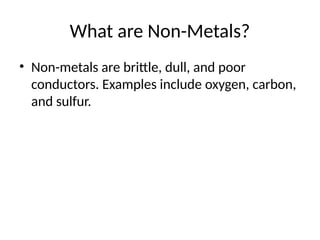
5. What are Non-Metals?
• Non-metals are brittle, dull, and poor
conductors. Examples include oxygen, carbon,
and sulfur.
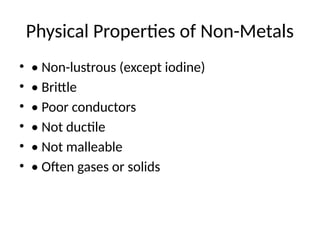
6. Physical Properties of Non-Metals
• • Non-lustrous (except iodine)
• • Brittle
• • Poor conductors
• • Not ductile
• • Not malleable
• • Often gases or solids
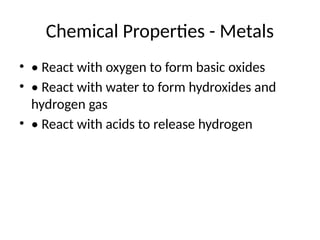
7. Chemical Properties - Metals
• • React with oxygen to form basic oxides
• • React with water to form hydroxides and
hydrogen gas
• • React with acids to release hydrogen
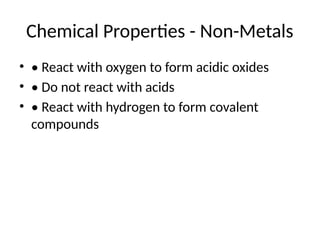
8. Chemical Properties - Non-Metals
• • React with oxygen to form acidic oxides
• • Do not react with acids
• • React with hydrogen to form covalent
compounds
9. Differences Between Metals and
Non-Metals
• Metals are lustrous, malleable, ductile, and
good conductors. Non-metals are dull, brittle,
and poor conductors.
10. Uses of Metals
• • Iron – Construction
• • Aluminium – Aircrafts
• • Copper – Wires
• • Gold/Silver – Jewellery
11. Uses of Non-Metals
• • Oxygen – Breathing
• • Nitrogen – Fertilizers
• • Carbon – Fuels
• • Chlorine – Water purification
12. Fun Facts
• • Mercury is the only liquid metal
• • Diamond is the hardest natural substance
• • Graphite is a non-metal that conducts
electricity
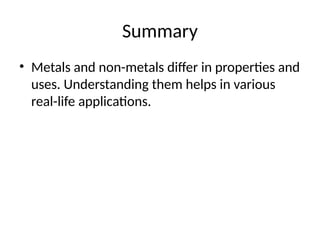
13. Summary
• Metals and non-metals differ in properties and
uses. Understanding them helps in various
real-life applications.
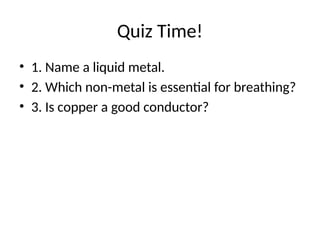
14. Quiz Time!
• 1. Name a liquid metal.
• 2. Which non-metal is essential for breathing?
• 3. Is copper a good conductor?
15.