Menstrual cycle
Masouda Asaira
10/5/2024 Masouda Asaira 1
Menstruation
Puberty is a broad term that denote the entire
transitional stage between childhood and sexual
maturity.
Menarche: first menstruation.
Msouda Asaira
10/5/2024 2
A menstrual cycle (a female reproductive cycle) is
episodic uterine bleeding in response to cyclic
hormonal changes.
The menstrual cycle prepares the uterus for pregnancy.
When pregnancy does not occur, menstruation
follows.
Msouda Asaira
10/5/2024 3
Menstruation: is the periodic uterine bleeding that
begins approximately 14 days after ovulation.
•The average length of a menstrual cycle is 28 days, but
variations are normal.
•The first day of bleeding is designated as day 1 of the
menses.
•The average duration of menstrual flow is 5 days
(range of 3 to 8 days)
•The average blood loss is 50ml (range of 20 to 80 ml)
Msouda Asaira
10/5/2024 4
Menstrual Cycle
A woman’s menstrual cycle is influenced by the ovarian
cycle and endometrial cycle.
Msouda Asaira
10/5/2024 5
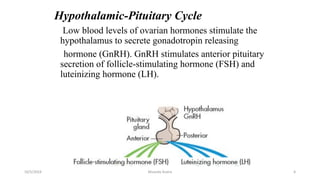
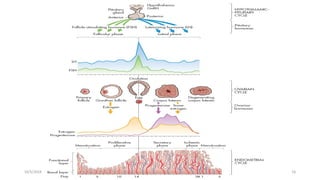
Hypothalamic-Pituitary Cycle
Low blood levels of ovarian hormones stimulate the
hypothalamus to secrete gonadotropin releasing
hormone (GnRH). GnRH stimulates anterior pituitary
secretion of follicle-stimulating hormone (FSH) and
luteinizing hormone (LH).
Msouda Asaira
10/5/2024 6
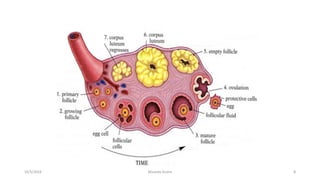
Ovarian Cycle
The ovarian cycle pertains to the maturation of ova and
consists of three phases:
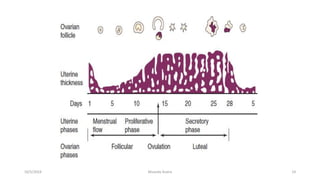
1. The follicular phase begins the first day of
menstruation and last 12–14 days. During this phase, the
graafian follicle is maturing under the influence of two
pituitary hormones:
luteinizing hormone (LH) and follicle-stimulating
hormone (FSH). The maturing graafian follicle
produces estrogen.
10/5/2024 Msouda Asaira 7
Msouda Asaira
10/5/2024 8
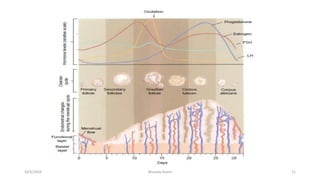
2. The ovulatory phase begins when estrogen levels
peak and ends with the release of the oocyte (egg) from
the mature graafian follicle. The release of the oocyte is
referred to as ovulation.
■ There is a surge in LH levels 12–36 hours before
ovulation.
■ There is a decrease in estrogen levels and an increase
in progesterone levels before the LH surge.
10/5/2024 Msouda Asaira 9
3. The luteal phase begins after ovulation and lasts approximately
14 days. During this phase, the cells of the empty follicle undergo
changes and form into the corpus luteum.
■ The corpus luteum produces high levels of progesterone along
with low levels of estrogen.
■ If pregnancy occurs, the corpus luteum continues to release
progesterone and estrogen until the placenta matures and assumes
this function.
■ If pregnancy does not occur, the corpus luteum degenerates and
results in a decrease in progesterone and the beginning of
menstruation.
10/5/2024 Msouda Asaira 10
10/5/2024 Msouda Asaira 11
Endometrial Cycle
The endometrial cycle pertains to the changes in the
endometrium of the uterus in responses to the hormonal
changes that occur during the ovarian cycle. This cycle
consists of three phases:
10/5/2024 Msouda Asaira 12
■ The proliferative phase occurs following menstruation and
ends with ovulation. During this phase, the endometrium is
preparing for implantation by becoming thicker and more vascular.
These changes are in response to the increasing levels of estrogen
produced by the graafian follicle.
10/5/2024 Msouda Asaira 13
Msouda Asaira
10/5/2024 14
■ The secretory phase begins after ovulation and ends with the
onset of menstruation. During this phase, the
endometrium continues to thicken. The primary hormone during this
phase is progesterone, which is secreted from the corpus luteum.
■ If pregnancy occurs, the endometrium continues to develop and
begins to secrete glycogen.
■ If pregnancy does not occur, the corpus luteum begins to
degenerate and the endometrial tissue degenerates.
10/5/2024 Msouda Asaira 15
Msouda Asaira
10/5/2024 16
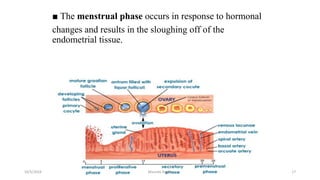
■ The menstrual phase occurs in response to hormonal
changes and results in the sloughing off of the
endometrial tissue.
Msouda Asaira
10/5/2024 17
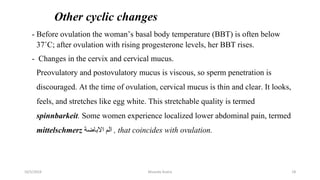
Other cyclic changes
- Before ovulation the woman’s basal body temperature (BBT) is often below
37˚C; after ovulation with rising progesterone levels, her BBT rises.
- Changes in the cervix and cervical mucus.
Preovulatory and postovulatory mucus is viscous, so sperm penetration is
discouraged. At the time of ovulation, cervical mucus is thin and clear. It looks,
feels, and stretches like egg white. This stretchable quality is termed
spinnbarkeit. Some women experience localized lower abdominal pain, termed
mittelschmerz ‫اﻻﺑﺎﺿﺔ‬ ‫اﻟﻢ‬ , that coincides with ovulation.
Msouda Asaira
10/5/2024 18
Msouda Asaira
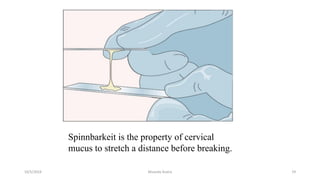
Spinnbarkeit is the property of cervical
mucus to stretch a distance before breaking.
10/5/2024 19
Oogenesis
Oogenesis is the formation of a mature ovum (egg).
■ Oogenesis is regulated by two primary hormones.
■ Follicle-stimulating hormone (FSH) secreted from the anterior
pituitary gland stimulates growth of the ovarian follicles and stimulates
the follicles to secrete
estrogen.
■ Estrogen secreted from the follicle cells promotes the maturation of
the ovum.
10/5/2024 Msouda Asaira 20
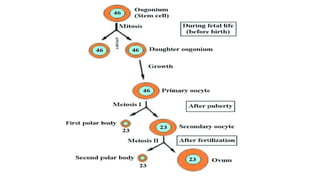
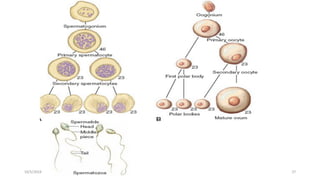
■ Process of oogenesis
-FSH stimulates the growth of ovarian follicle which contains an
oogonium (stem cell).
■ Through the process of mitosis, the oogonium within the ovary forms
into two daughter cells: the primary oocyte and a new stem cell.
■ Mitosis is the process by which a cell divides and forms two
genetically identical cells (daughter cells) each containing the diploid
number of chromosomes.
10/5/2024 Msouda Asaira 21
■ Through the process of meiosis, the primary oocyte forms into the secondary
oocyte and a polar body. The polar body forms into two polar bodies. The
secondary oocyte forms into a polar body and a mature ovum.
■ Meiosis‫اﻻﺧﺘﺰاﻟﻲ‬ ‫او‬ ‫اﻟﻤﻨﺼﻒ‬ ‫اﻻﻧﻘﺴﺎم‬ is a process of two successive cell divisions that
produces cells that contain half the number of chromosomes .
All the cells that may undergo meiosis in a woman’s lifetime are contained in her
ovaries at birth. The majority of the estimated 2 million primary oocytes
degenerate spontaneously . Only 400 to 500 ova will mature during the
approximately 35 years of a woman’s reproductive life.
10/5/2024 Msouda Asaira 23
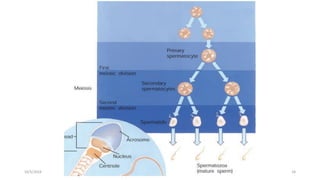
Spermatogenesis is the formation of mature spermatozoa (sperm).
■ Process of spermatogenesis :
-Through the process of mitosis, the spermatogonium (stem cell)
within the seminiferous tubules of the testis forms into two
daughter cells: a new spermatogonia and a spermatogonium.
■ The spermatogonium differentiates and is referred to as the
primary spermatocyte.
10/5/2024 Msouda Asaira 24
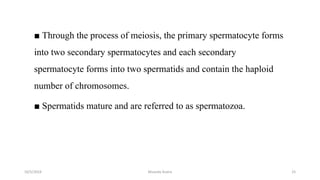
■ Through the process of meiosis, the primary spermatocyte forms
into two secondary spermatocytes and each secondary
spermatocyte forms into two spermatids and contain the haploid
number of chromosomes.
■ Spermatids mature and are referred to as spermatozoa.
10/5/2024 Msouda Asaira 25
10/5/2024 Msouda Asaira 26
Msouda Asaira
10/5/2024 27
Msouda Asaira
10/5/2024 28
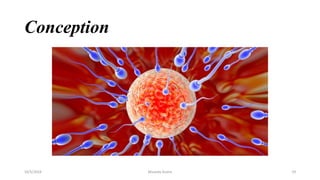
Conception
Msouda Asaira
10/5/2024 29
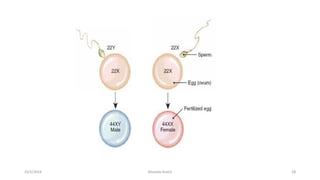
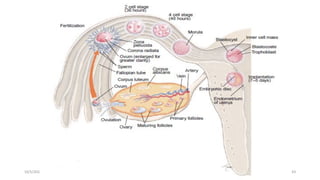
Conception, also known as fertilization, occurs when a sperm
nucleus enters the nucleus of the oocyte.
■ Fertilization normally occurs in the outer third of the
fallopian tube.
■ The fertilized oocyte is called a zygote and contains the diploid
number of chromosomes (46).
10/5/2024 Msouda Asaira 30
Union of a single egg and sperm, marks the beginning of a pregnancy.
Conception occurs in a sequential process. This process includes
gamete (egg and sperm) formation, ovulation (release of the egg),
union of the gametes (which results in an embryo), and implantation
in the uterus.
Msouda Asaira
10/5/2024 31
1. Preembryonic stage: fertilization through the second
week
2. Embryonic stage: end of the second week through
the eighth week
3. Fetal stage: end of the eighth week until birth
Msouda Asaira
The three stages of fetal development during pregnancy
are:
10/5/2024 32
Terms Used to Denote Fetal Growth
Name Time Period
•Ovum From ovulation to fertilization
•Zygote From fertilization to implantation
•Embryo From implantation to 5–8 weeks
•Fetus From 5–8 weeks until term
Msouda Asaira
10/5/2024 33
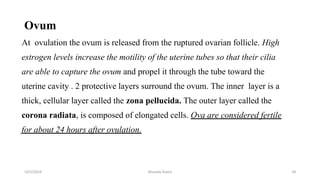
Ovum
At ovulation the ovum is released from the ruptured ovarian follicle. High
estrogen levels increase the motility of the uterine tubes so that their cilia
are able to capture the ovum and propel it through the tube toward the
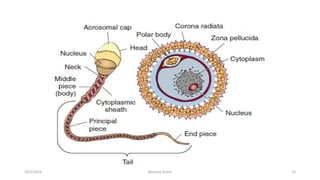
uterine cavity . 2 protective layers surround the ovum. The inner layer is a
thick, cellular layer called the zona pellucida. The outer layer called the
corona radiata, is composed of elongated cells. Ova are considered fertile
for about 24 hours after ovulation.
Msouda Asaira
10/5/2024 34
Msouda Asaira
10/5/2024 35
Sperm
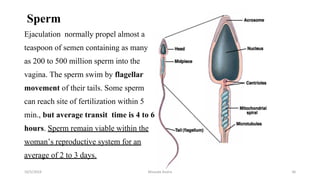
Ejaculation normally propel almost a
teaspoon of semen containing as many
as 200 to 500 million sperm into the
vagina. The sperm swim by flagellar
movement of their tails. Some sperm
can reach site of fertilization within 5
min., but average transit time is 4 to 6
hours. Sperm remain viable within the
woman’s reproductive system for an
average of 2 to 3 days.
Msouda Asaira
10/5/2024 36
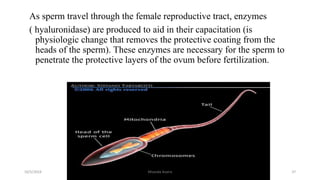
As sperm travel through the female reproductive tract, enzymes
( hyaluronidase) are produced to aid in their capacitation (is
physiologic change that removes the protective coating from the
heads of the sperm). These enzymes are necessary for the sperm to
penetrate the protective layers of the ovum before fertilization.
Msouda Asaira
10/5/2024 37
Msouda Asaira
10/5/2024 38
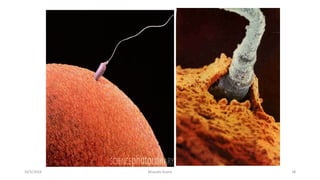
Fertilization
Fertilization takes place in the ampulla ( the outer third) of the
uterine tube. When a sperm successfully penetrates the membrane
surrounding the ovum, both sperm and ovum are enclosed within
the membrane, and the membrane becomes impenetrable to other
sperm; this process is termed the zona reaction.
The nuclei from sperm and egg fuse and the chromosomes combine,
restoring the diploid number (46).
Msouda Asaira
10/5/2024 39
Pregnancy lasts approximately 10 lunar months, 9 calendar months, 40
weeks, or 280 days. Length of pregnancy is computed from the first
day of the last menstrual period (LMP) until the day of birth.
Conception occurs approx. 2 weeks after the day of the LMP.
Intrauterine development is divided into three stages: ovum or
preembryonic, embryo, and fetus.
10/5/2024 Msouda Asaira 40
Msouda Asaira
10/5/2024 41
Cell Division
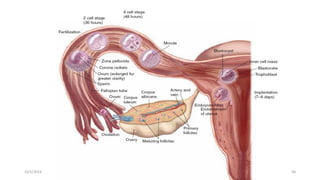
■ The single-cell zygote undergoes mitotic cell division
known as cleavage.
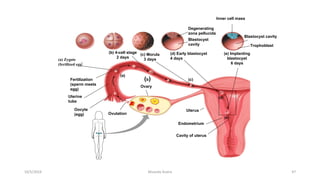
■ Three days after fertilization, the zygote forms into a
16-cell, solid sphere that is called a morula.
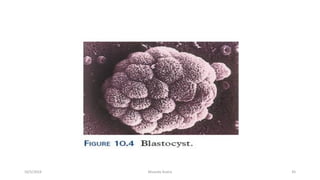
■ Mitosis continues, and around day 5 the developing human is
known as the blastocyst and enters the uterus.
■ The blastocyst is composed of an inner cell mass known as the
embryoblast, which will develop into the embryo, and an outer cell
mass known as the trophoblast, which will assist in implantation and
become part of the placenta.
10/5/2024 Msouda Asaira 42
10/5/2024 Msouda Asaira 43
Msouda Asaira
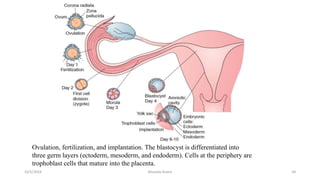
Ovulation, fertilization, and implantation. The blastocyst is differentiated into
three germ layers (ectoderm, mesoderm, and endoderm). Cells at the periphery are
trophoblast cells that mature into the placenta.
10/5/2024 44
Msouda Asaira
10/5/2024 45
Msouda Asaira
10/5/2024 46
(b) 4-cell stage
2 days
(c) Morula
3 days
(d) Early blastocyst
4 days
(e) Implanting
blastocyst
6 days
Fertilization
(sperm meets
egg)
Uterine
tube
Oocyte
(egg) Ovulation
Ovary
Blastocyst
cavity
Degenerating
zona pellucida
Uterus
Endometrium
Cavity of uterus
Trophoblast
Blastocyst cavity
Inner cell mass
(a)
(b) (c)
(d)
(e)
(a) Zygote
(fertilized egg
Msouda Asaira
10/5/2024 47
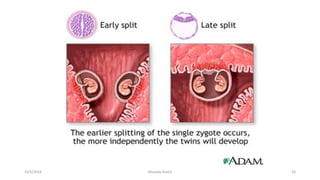
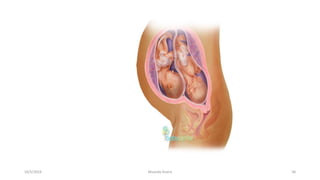
■ Multiple gestation refers to more than one developing embryo such
as twins and triplets.
Twins can be either monozygotic or dizygotic.
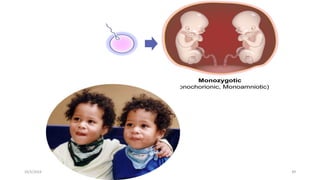
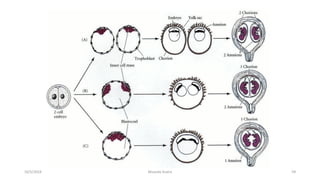
■ Monozygotic twins, also referred to as identical twins, are the result
of one fertilized ovum splitting during the early stages of cell division
and forming two identical embryos.
These developing fetuses are genetically the same.
10/5/2024 Msouda Asaira 48
Msouda Asaira
10/5/2024 49
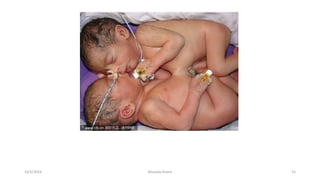
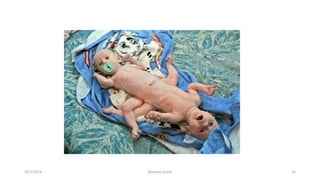
If division occurs very late, cleavage may not be complete, and
conjoined or “ Siamese” twins could result.
Monozygotic twinning rate is between 3.5 and per 1000 births. No
association with race, heredity, maternal age, or parity has been
found. Use of fertility drugs increases the incidence of
monozygotic twinning.
10/5/2024 Msouda Asaira 50
Msouda Asaira
10/5/2024 51
Msouda Asaira
10/5/2024 52
Dizygotic twins, also referred to as fraternal twins, are the result of
two separate ova being fertilized by two separate sperm.
These developing fetuses are not genetically the same.
The results of dizygotic twins (two amnions, two chorions, and two
placentas.
These dizygotic twins may be the same sex or different sexes and are
genetically no more alike than siblings born at different times.
Dizygotic twinning increases in frequency with maternal age up to 35
years, with parity, and with the use of fertility drugs.
10/5/2024 Msouda Asaira 53
Msouda Asaira
10/5/2024 54
Msouda Asaira
10/5/2024 55
Msouda Asaira
10/5/2024 56
Msouda Asaira
10/5/2024 57
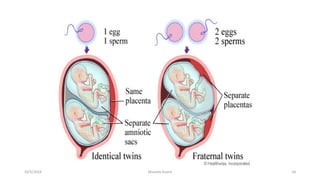
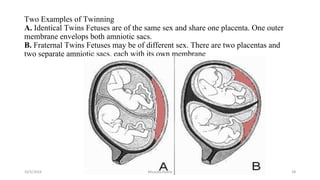
Two Examples of Twinning
A. Identical Twins Fetuses are of the same sex and share one placenta. One outer
membrane envelops both amniotic sacs.
B. Fraternal Twins Fetuses may be of different sex. There are two placentas and
two separate amniotic sacs, each with its own membrane
Msouda Asaira
10/5/2024 58
Msouda Asaira
10/5/2024 59
Other multifetal pregnancies
The occurrence of multifetal pregnancies with three or more fetuses
has increased with the use of fertility drugs and IVF.
Triplets occur in approx. 1 of 1341 pregnancies. They can occur from
the division of one zygote into two, with one of the two dividing
again, producing identical triplets. Triplets can also be produced
from two zygotes, one dividing into a set of identical twins and the
second zygote a single fraternal sibling, or from three zygotes.
Quadruplets, quintuplets, sextuplets have similar possible
derivations.
Msouda Asaira
10/5/2024 60
Thanks

Menstrual cycle.pdfKAI SOADO ASODJK JSDF

  • 1.
  • 2.
    Menstruation Puberty is abroad term that denote the entire transitional stage between childhood and sexual maturity. Menarche: first menstruation. Msouda Asaira 10/5/2024 2
  • 3.
    A menstrual cycle(a female reproductive cycle) is episodic uterine bleeding in response to cyclic hormonal changes. The menstrual cycle prepares the uterus for pregnancy. When pregnancy does not occur, menstruation follows. Msouda Asaira 10/5/2024 3
  • 4.
    Menstruation: is theperiodic uterine bleeding that begins approximately 14 days after ovulation. •The average length of a menstrual cycle is 28 days, but variations are normal. •The first day of bleeding is designated as day 1 of the menses. •The average duration of menstrual flow is 5 days (range of 3 to 8 days) •The average blood loss is 50ml (range of 20 to 80 ml) Msouda Asaira 10/5/2024 4
  • 5.
    Menstrual Cycle A woman’smenstrual cycle is influenced by the ovarian cycle and endometrial cycle. Msouda Asaira 10/5/2024 5
  • 6.
    Hypothalamic-Pituitary Cycle Low bloodlevels of ovarian hormones stimulate the hypothalamus to secrete gonadotropin releasing hormone (GnRH). GnRH stimulates anterior pituitary secretion of follicle-stimulating hormone (FSH) and luteinizing hormone (LH). Msouda Asaira 10/5/2024 6
  • 7.
    Ovarian Cycle The ovariancycle pertains to the maturation of ova and consists of three phases: 1. The follicular phase begins the first day of menstruation and last 12–14 days. During this phase, the graafian follicle is maturing under the influence of two pituitary hormones: luteinizing hormone (LH) and follicle-stimulating hormone (FSH). The maturing graafian follicle produces estrogen. 10/5/2024 Msouda Asaira 7
  • 8.
  • 9.
    2. The ovulatoryphase begins when estrogen levels peak and ends with the release of the oocyte (egg) from the mature graafian follicle. The release of the oocyte is referred to as ovulation. ■ There is a surge in LH levels 12–36 hours before ovulation. ■ There is a decrease in estrogen levels and an increase in progesterone levels before the LH surge. 10/5/2024 Msouda Asaira 9
  • 10.
    3. The lutealphase begins after ovulation and lasts approximately 14 days. During this phase, the cells of the empty follicle undergo changes and form into the corpus luteum. ■ The corpus luteum produces high levels of progesterone along with low levels of estrogen. ■ If pregnancy occurs, the corpus luteum continues to release progesterone and estrogen until the placenta matures and assumes this function. ■ If pregnancy does not occur, the corpus luteum degenerates and results in a decrease in progesterone and the beginning of menstruation. 10/5/2024 Msouda Asaira 10
  • 11.
  • 12.
    Endometrial Cycle The endometrialcycle pertains to the changes in the endometrium of the uterus in responses to the hormonal changes that occur during the ovarian cycle. This cycle consists of three phases: 10/5/2024 Msouda Asaira 12
  • 13.
    ■ The proliferativephase occurs following menstruation and ends with ovulation. During this phase, the endometrium is preparing for implantation by becoming thicker and more vascular. These changes are in response to the increasing levels of estrogen produced by the graafian follicle. 10/5/2024 Msouda Asaira 13
  • 14.
  • 15.
    ■ The secretoryphase begins after ovulation and ends with the onset of menstruation. During this phase, the endometrium continues to thicken. The primary hormone during this phase is progesterone, which is secreted from the corpus luteum. ■ If pregnancy occurs, the endometrium continues to develop and begins to secrete glycogen. ■ If pregnancy does not occur, the corpus luteum begins to degenerate and the endometrial tissue degenerates. 10/5/2024 Msouda Asaira 15
  • 16.
  • 17.
    ■ The menstrualphase occurs in response to hormonal changes and results in the sloughing off of the endometrial tissue. Msouda Asaira 10/5/2024 17
  • 18.
    Other cyclic changes -Before ovulation the woman’s basal body temperature (BBT) is often below 37˚C; after ovulation with rising progesterone levels, her BBT rises. - Changes in the cervix and cervical mucus. Preovulatory and postovulatory mucus is viscous, so sperm penetration is discouraged. At the time of ovulation, cervical mucus is thin and clear. It looks, feels, and stretches like egg white. This stretchable quality is termed spinnbarkeit. Some women experience localized lower abdominal pain, termed mittelschmerz ‫اﻻﺑﺎﺿﺔ‬ ‫اﻟﻢ‬ , that coincides with ovulation. Msouda Asaira 10/5/2024 18
  • 19.
    Msouda Asaira Spinnbarkeit isthe property of cervical mucus to stretch a distance before breaking. 10/5/2024 19
  • 20.
    Oogenesis Oogenesis is theformation of a mature ovum (egg). ■ Oogenesis is regulated by two primary hormones. ■ Follicle-stimulating hormone (FSH) secreted from the anterior pituitary gland stimulates growth of the ovarian follicles and stimulates the follicles to secrete estrogen. ■ Estrogen secreted from the follicle cells promotes the maturation of the ovum. 10/5/2024 Msouda Asaira 20
  • 21.
    ■ Process ofoogenesis -FSH stimulates the growth of ovarian follicle which contains an oogonium (stem cell). ■ Through the process of mitosis, the oogonium within the ovary forms into two daughter cells: the primary oocyte and a new stem cell. ■ Mitosis is the process by which a cell divides and forms two genetically identical cells (daughter cells) each containing the diploid number of chromosomes. 10/5/2024 Msouda Asaira 21
  • 23.
    ■ Through theprocess of meiosis, the primary oocyte forms into the secondary oocyte and a polar body. The polar body forms into two polar bodies. The secondary oocyte forms into a polar body and a mature ovum. ■ Meiosis‫اﻻﺧﺘﺰاﻟﻲ‬ ‫او‬ ‫اﻟﻤﻨﺼﻒ‬ ‫اﻻﻧﻘﺴﺎم‬ is a process of two successive cell divisions that produces cells that contain half the number of chromosomes . All the cells that may undergo meiosis in a woman’s lifetime are contained in her ovaries at birth. The majority of the estimated 2 million primary oocytes degenerate spontaneously . Only 400 to 500 ova will mature during the approximately 35 years of a woman’s reproductive life. 10/5/2024 Msouda Asaira 23
  • 24.
    Spermatogenesis is theformation of mature spermatozoa (sperm). ■ Process of spermatogenesis : -Through the process of mitosis, the spermatogonium (stem cell) within the seminiferous tubules of the testis forms into two daughter cells: a new spermatogonia and a spermatogonium. ■ The spermatogonium differentiates and is referred to as the primary spermatocyte. 10/5/2024 Msouda Asaira 24
  • 25.
    ■ Through theprocess of meiosis, the primary spermatocyte forms into two secondary spermatocytes and each secondary spermatocyte forms into two spermatids and contain the haploid number of chromosomes. ■ Spermatids mature and are referred to as spermatozoa. 10/5/2024 Msouda Asaira 25
  • 26.
  • 27.
  • 28.
  • 29.
  • 30.
    Conception, also knownas fertilization, occurs when a sperm nucleus enters the nucleus of the oocyte. ■ Fertilization normally occurs in the outer third of the fallopian tube. ■ The fertilized oocyte is called a zygote and contains the diploid number of chromosomes (46). 10/5/2024 Msouda Asaira 30
  • 31.
    Union of asingle egg and sperm, marks the beginning of a pregnancy. Conception occurs in a sequential process. This process includes gamete (egg and sperm) formation, ovulation (release of the egg), union of the gametes (which results in an embryo), and implantation in the uterus. Msouda Asaira 10/5/2024 31
  • 32.
    1. Preembryonic stage:fertilization through the second week 2. Embryonic stage: end of the second week through the eighth week 3. Fetal stage: end of the eighth week until birth Msouda Asaira The three stages of fetal development during pregnancy are: 10/5/2024 32
  • 33.
    Terms Used toDenote Fetal Growth Name Time Period •Ovum From ovulation to fertilization •Zygote From fertilization to implantation •Embryo From implantation to 5–8 weeks •Fetus From 5–8 weeks until term Msouda Asaira 10/5/2024 33
  • 34.
    Ovum At ovulation theovum is released from the ruptured ovarian follicle. High estrogen levels increase the motility of the uterine tubes so that their cilia are able to capture the ovum and propel it through the tube toward the uterine cavity . 2 protective layers surround the ovum. The inner layer is a thick, cellular layer called the zona pellucida. The outer layer called the corona radiata, is composed of elongated cells. Ova are considered fertile for about 24 hours after ovulation. Msouda Asaira 10/5/2024 34
  • 35.
  • 36.
    Sperm Ejaculation normally propelalmost a teaspoon of semen containing as many as 200 to 500 million sperm into the vagina. The sperm swim by flagellar movement of their tails. Some sperm can reach site of fertilization within 5 min., but average transit time is 4 to 6 hours. Sperm remain viable within the woman’s reproductive system for an average of 2 to 3 days. Msouda Asaira 10/5/2024 36
  • 37.
    As sperm travelthrough the female reproductive tract, enzymes ( hyaluronidase) are produced to aid in their capacitation (is physiologic change that removes the protective coating from the heads of the sperm). These enzymes are necessary for the sperm to penetrate the protective layers of the ovum before fertilization. Msouda Asaira 10/5/2024 37
  • 38.
  • 39.
    Fertilization Fertilization takes placein the ampulla ( the outer third) of the uterine tube. When a sperm successfully penetrates the membrane surrounding the ovum, both sperm and ovum are enclosed within the membrane, and the membrane becomes impenetrable to other sperm; this process is termed the zona reaction. The nuclei from sperm and egg fuse and the chromosomes combine, restoring the diploid number (46). Msouda Asaira 10/5/2024 39
  • 40.
    Pregnancy lasts approximately10 lunar months, 9 calendar months, 40 weeks, or 280 days. Length of pregnancy is computed from the first day of the last menstrual period (LMP) until the day of birth. Conception occurs approx. 2 weeks after the day of the LMP. Intrauterine development is divided into three stages: ovum or preembryonic, embryo, and fetus. 10/5/2024 Msouda Asaira 40
  • 41.
  • 42.
    Cell Division ■ Thesingle-cell zygote undergoes mitotic cell division known as cleavage. ■ Three days after fertilization, the zygote forms into a 16-cell, solid sphere that is called a morula. ■ Mitosis continues, and around day 5 the developing human is known as the blastocyst and enters the uterus. ■ The blastocyst is composed of an inner cell mass known as the embryoblast, which will develop into the embryo, and an outer cell mass known as the trophoblast, which will assist in implantation and become part of the placenta. 10/5/2024 Msouda Asaira 42
  • 43.
  • 44.
    Msouda Asaira Ovulation, fertilization,and implantation. The blastocyst is differentiated into three germ layers (ectoderm, mesoderm, and endoderm). Cells at the periphery are trophoblast cells that mature into the placenta. 10/5/2024 44
  • 45.
  • 46.
  • 47.
    (b) 4-cell stage 2days (c) Morula 3 days (d) Early blastocyst 4 days (e) Implanting blastocyst 6 days Fertilization (sperm meets egg) Uterine tube Oocyte (egg) Ovulation Ovary Blastocyst cavity Degenerating zona pellucida Uterus Endometrium Cavity of uterus Trophoblast Blastocyst cavity Inner cell mass (a) (b) (c) (d) (e) (a) Zygote (fertilized egg Msouda Asaira 10/5/2024 47
  • 48.
    ■ Multiple gestationrefers to more than one developing embryo such as twins and triplets. Twins can be either monozygotic or dizygotic. ■ Monozygotic twins, also referred to as identical twins, are the result of one fertilized ovum splitting during the early stages of cell division and forming two identical embryos. These developing fetuses are genetically the same. 10/5/2024 Msouda Asaira 48
  • 49.
  • 50.
    If division occursvery late, cleavage may not be complete, and conjoined or “ Siamese” twins could result. Monozygotic twinning rate is between 3.5 and per 1000 births. No association with race, heredity, maternal age, or parity has been found. Use of fertility drugs increases the incidence of monozygotic twinning. 10/5/2024 Msouda Asaira 50
  • 51.
  • 52.
  • 53.
    Dizygotic twins, alsoreferred to as fraternal twins, are the result of two separate ova being fertilized by two separate sperm. These developing fetuses are not genetically the same. The results of dizygotic twins (two amnions, two chorions, and two placentas. These dizygotic twins may be the same sex or different sexes and are genetically no more alike than siblings born at different times. Dizygotic twinning increases in frequency with maternal age up to 35 years, with parity, and with the use of fertility drugs. 10/5/2024 Msouda Asaira 53
  • 54.
  • 55.
  • 56.
  • 57.
  • 58.
    Two Examples ofTwinning A. Identical Twins Fetuses are of the same sex and share one placenta. One outer membrane envelops both amniotic sacs. B. Fraternal Twins Fetuses may be of different sex. There are two placentas and two separate amniotic sacs, each with its own membrane Msouda Asaira 10/5/2024 58
  • 59.
  • 60.
    Other multifetal pregnancies Theoccurrence of multifetal pregnancies with three or more fetuses has increased with the use of fertility drugs and IVF. Triplets occur in approx. 1 of 1341 pregnancies. They can occur from the division of one zygote into two, with one of the two dividing again, producing identical triplets. Triplets can also be produced from two zygotes, one dividing into a set of identical twins and the second zygote a single fraternal sibling, or from three zygotes. Quadruplets, quintuplets, sextuplets have similar possible derivations. Msouda Asaira 10/5/2024 60
  • 61.