Chapter 1
Getting Started
Introductory Concepts and Definitions
Chapter 1 – Introductory Concepts and
Definitions – Outline
1.1) Using Thermodynamics
1.2) Defining Systems
1.3) Describing Systems and Their Behavior
1.4) Measuring Mass, Length, Time, and Force
1.5) Specific Volume
1.6) Pressure
1.7) Temperature
1.8) Engineering Design and Analysis
Learning Outcomes
►Explain several fundamental concepts
used throughout this book including closed
system, control volume, boundary and
surroundings, property, state, process, the
distinction between extensive and intensive
properties, and equilibrium.
►Identify SI and English Engineering units,
including units for specific volume,
pressure, and temperature.
Learning Outcomes, cont.
►Describe the relationship among the
Kelvin, Rankine, Celsius, and Fahrenheit
temperature scales.
►Apply appropriate unit conversion factors
during calculations.
Chapter 1 – Introductory Concepts and
Definitions – Outline
1.1) Using Thermodynamics
1.2) Defining Systems
1.3) Describing Systems and Their Behavior
1.4) Measuring Mass, Length, Time, and Force
1.5) Specific Volume
1.6) Pressure
1.7) Temperature
1.8) Engineering Design and Analysis
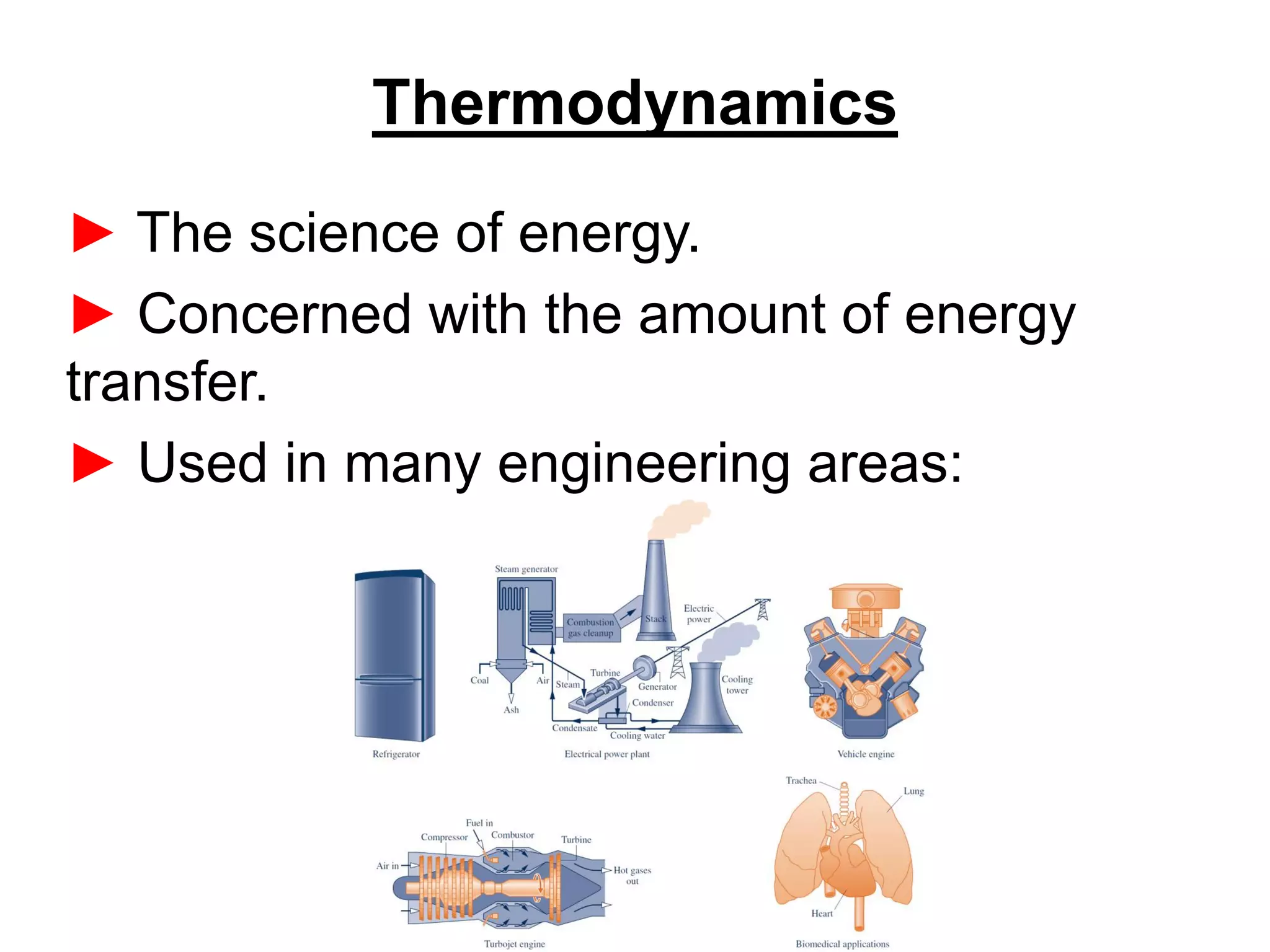
Thermodynamics
► The science of energy.
► Concerned with the amount of energy
transfer.
► Used in many engineering areas:
Chapter 1 – Introductory Concepts and
Definitions – Outline
1.1) Using Thermodynamics
1.2) Defining Systems
1.3) Describing Systems and Their Behavior
1.4) Measuring Mass, Length, Time, and Force
1.5) Specific Volume
1.6) Pressure
1.7) Temperature
1.8) Engineering Design and Analysis
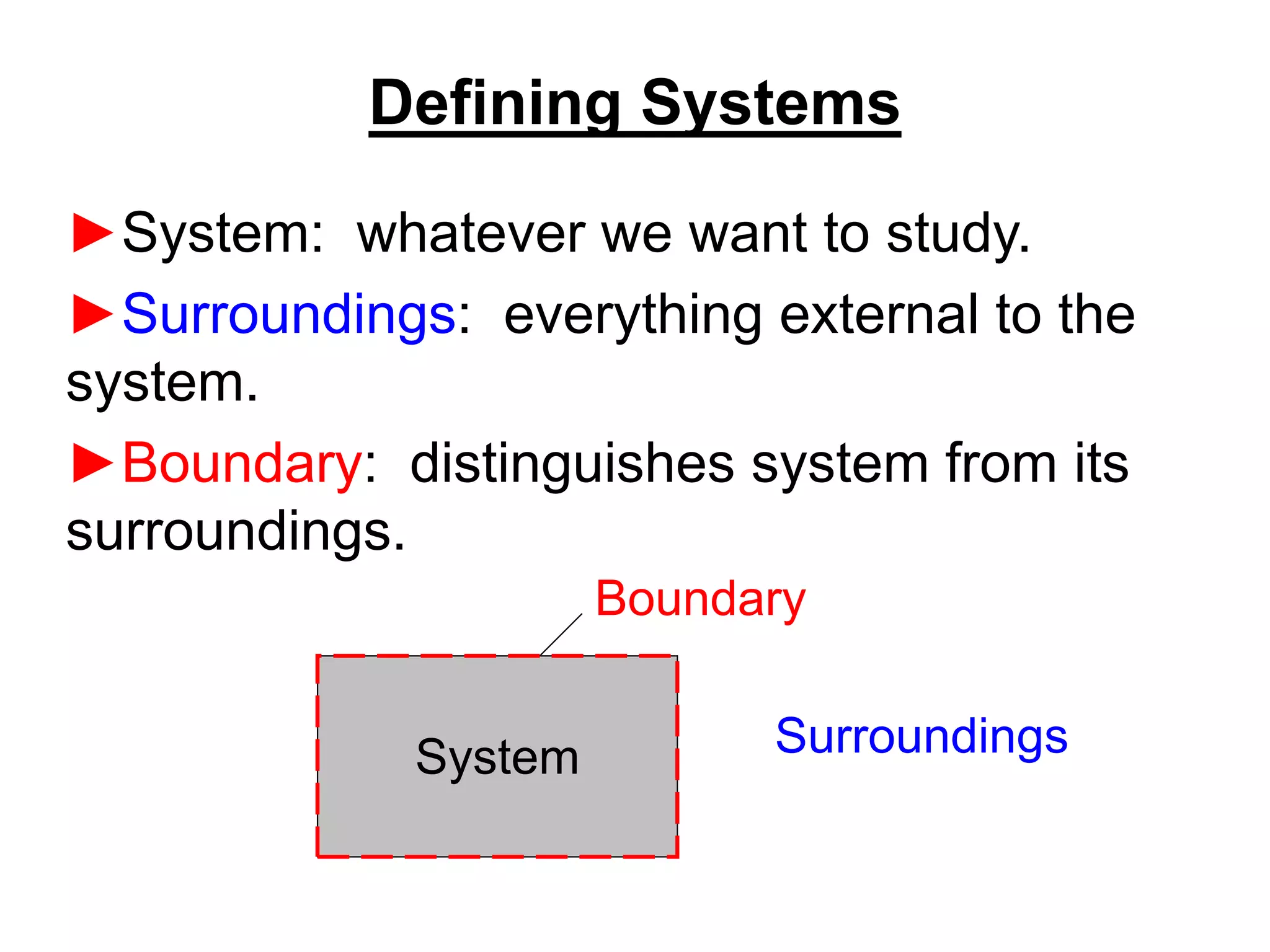
Defining Systems
►System: whatever we want to study.
►Surroundings: everything external to the
system.
►Boundary: distinguishes system from its
surroundings.
System Surroundings
Boundary
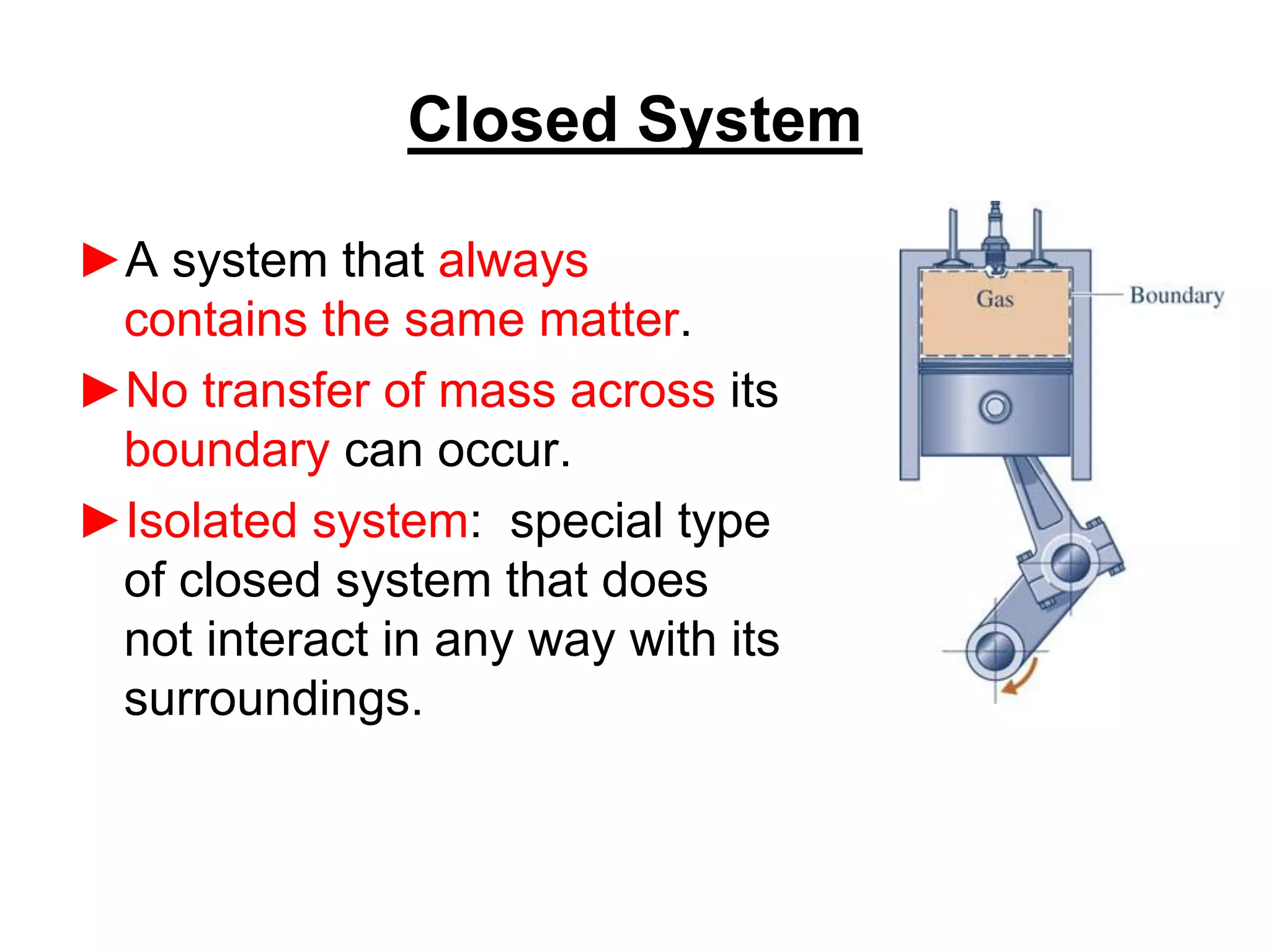
Closed System
►A system that always
contains the same matter.
►No transfer of mass across its
boundary can occur.
►Isolated system: special type
of closed system that does
not interact in any way with its
surroundings.
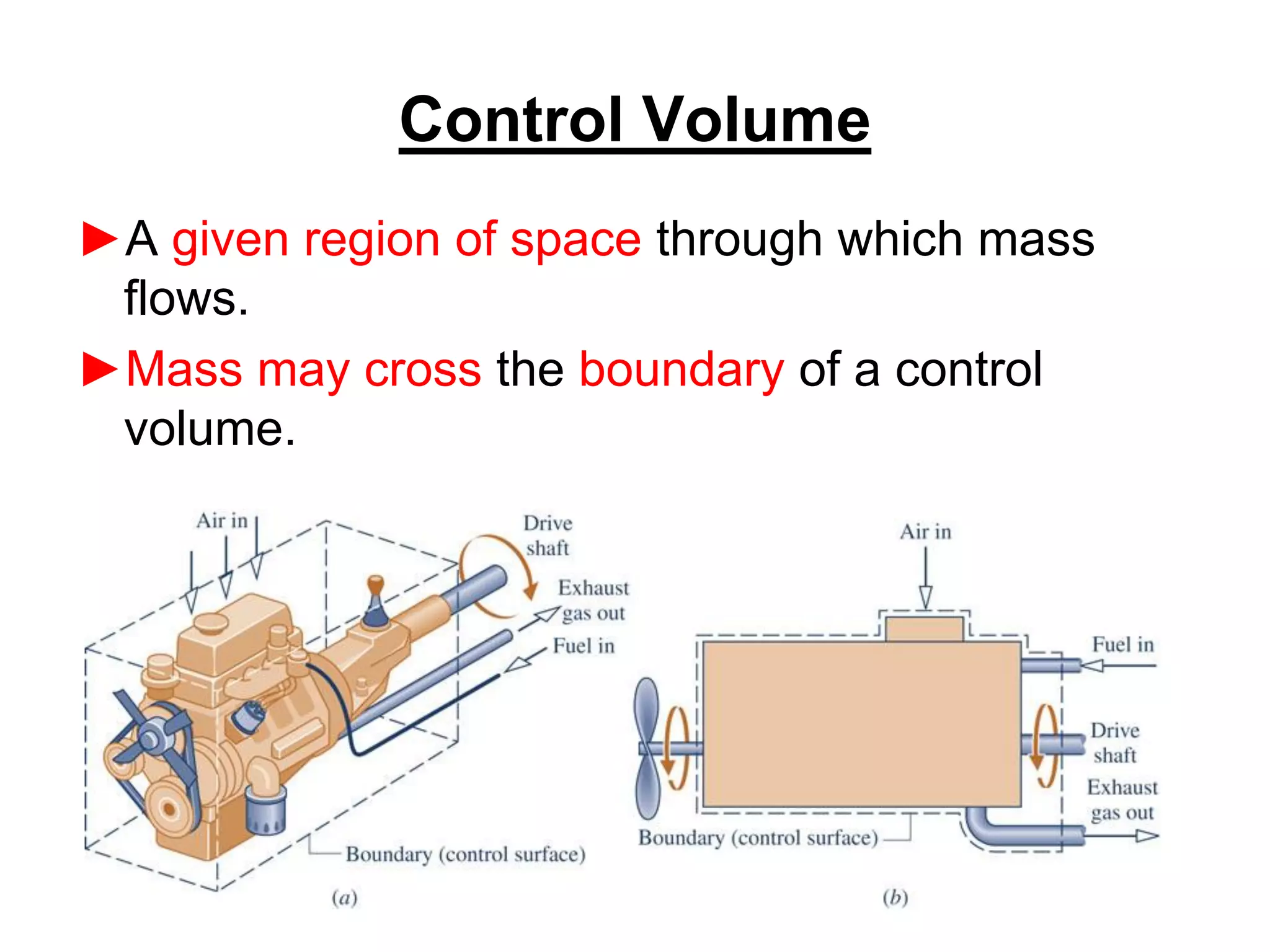
Control Volume
►A given region of space through which mass
flows.
►Mass may cross the boundary of a control
volume.
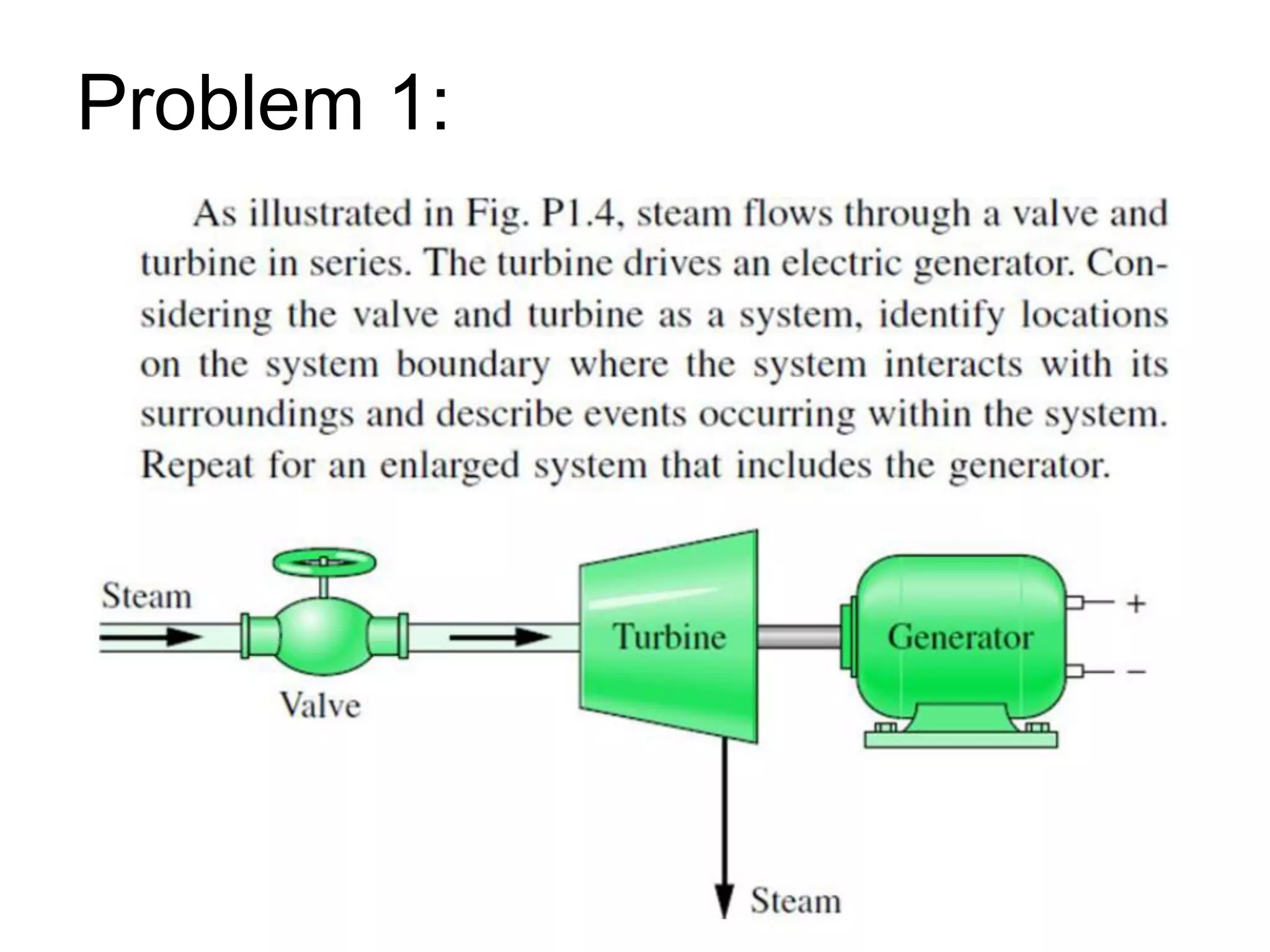
Problem 1:
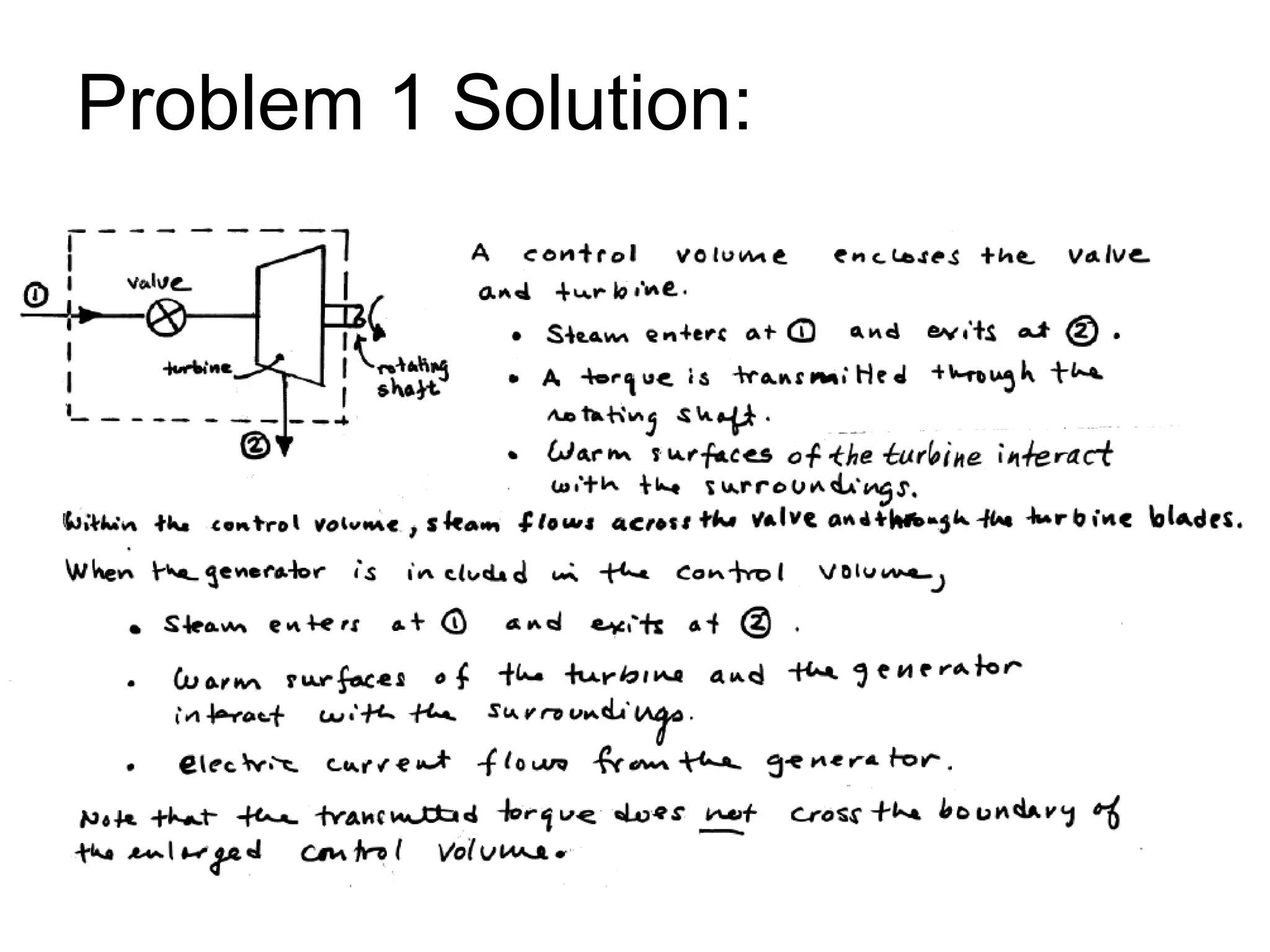
Problem 1 Solution:
Chapter 1 – Introductory Concepts and
Definitions – Outline
1.1) Using Thermodynamics
1.2) Defining Systems
1.3) Describing Systems and Their Behavior
1.4) Measuring Mass, Length, Time, and Force
1.5) Specific Volume
1.6) Pressure
1.7) Temperature
1.8) Engineering Design and Analysis
Macroscopic and Microscopic Views
►Systems can be described from the macroscopic and
microscopic points of view.
►The microscopic approach aims to characterize by statistical
means the average behavior of the particles making up a
system and use this information to describe the overall
behavior of the system.
►The macroscopic approach describes system behavior in
terms of the gross effects of the particles making up the
system – specifically, effects that can be measured by
instruments such a pressure gages and thermometers.
►Engineering thermodynamics predominately uses the
macroscopic approach.
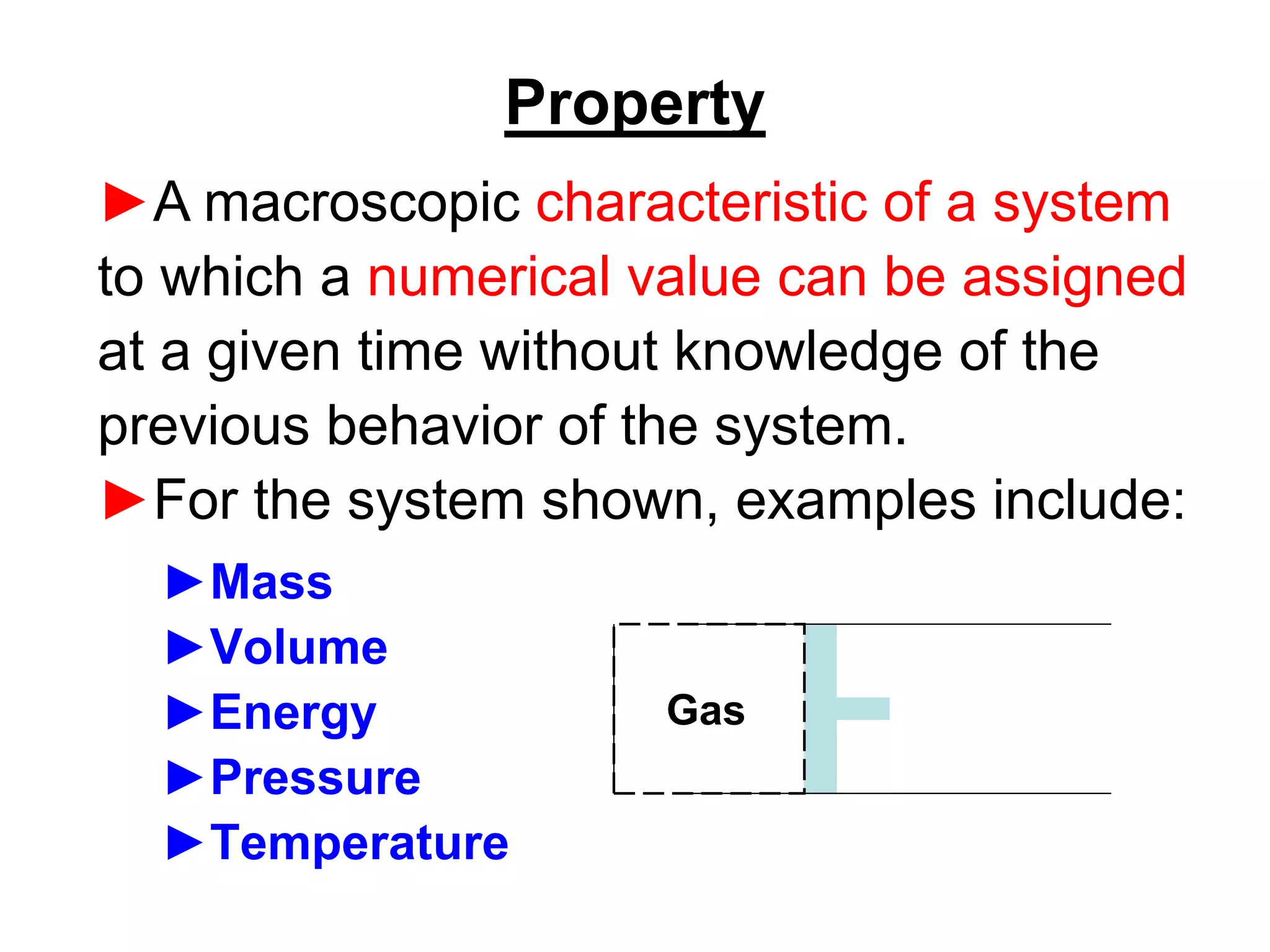
Property
►Mass
►Volume
►Energy
►Pressure
►Temperature
►A macroscopic characteristic of a system
to which a numerical value can be assigned
at a given time without knowledge of the
previous behavior of the system.
►For the system shown, examples include:
Gas
State
►The condition of a system as described by its
properties.
►Example: The state of the system shown is
described by p, V, T,….
►The state often can be specified by providing the
values of a subset of its properties. All other
properties can be determined in terms of these few.
Gas
State: p, V, T, …
Process
►A transformation from one state to another.
►When any of the properties of a system
changes, the state changes, and the system is
said to have undergone a process.
►Example: Since V2 > V1, at least one property
value changed, and the gas has undergone a
process from State 1 to State 2.
State 1: p1, V1, T1, … State 2: p2, V2, T2, …
Gas Gas
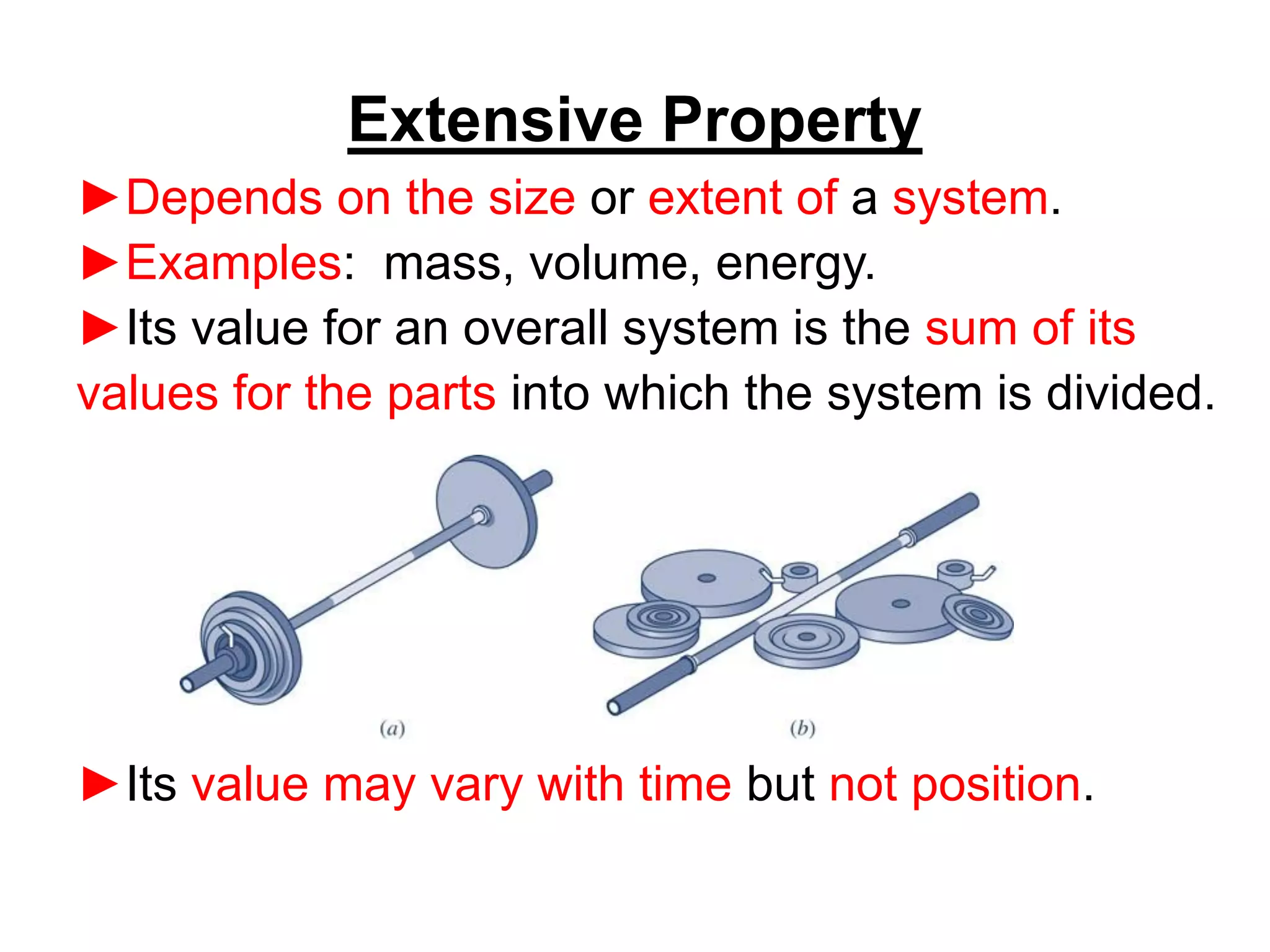
►Depends on the size or extent of a system.
►Examples: mass, volume, energy.
►Its value for an overall system is the sum of its
values for the parts into which the system is divided.
►Its value may vary with time but not position.
Extensive Property
Intensive Property
►Independent of the size or extent of a system.
►Examples: pressure, temperature.
►Its value is not additive as for extensive
properties.
►May vary from place to place within the system
at any moment – function of both position and
time.
Equilibrium
►When a system is isolated, it does not interact with
its surroundings; however, its state can change as a
consequence of spontaneous events occurring
internally as its intensive properties such as
temperature and pressure tend toward uniform
values. When all such changes cease, the system is
at an equilibrium state.
►Equilibrium states and processes from one
equilibrium state to another equilibrium state play
important roles in thermodynamic analysis.
In Class Question
►I ask a question in class
►You email your answer to gakiki@ndu.edu.lb
►Use your NDU email
►Subject line: ICQ
►This will serve as your attendance
Is Temperature an intensive or extensive
property?
Chapter 1 – Introductory Concepts and
Definitions – Outline
1.1) Using Thermodynamics
1.2) Defining Systems
1.3) Describing Systems and Their Behavior
1.4) Measuring Mass, Length, Time, and Force
1.5) Specific Volume
1.6) Pressure
1.7) Temperature
1.8) Engineering Design and Analysis
Units
►A unit is any specified amount of a quantity
by comparison with which any other quantity
of the same kind is measured (e.g., meter,
kilometers, feet, and miles are all units of
length).
►Primary units such as time and length can
compose secondary units such as velocity
and area.
►Two systems of units:
►SI (Système International d’Unités)
►English Engineering units.
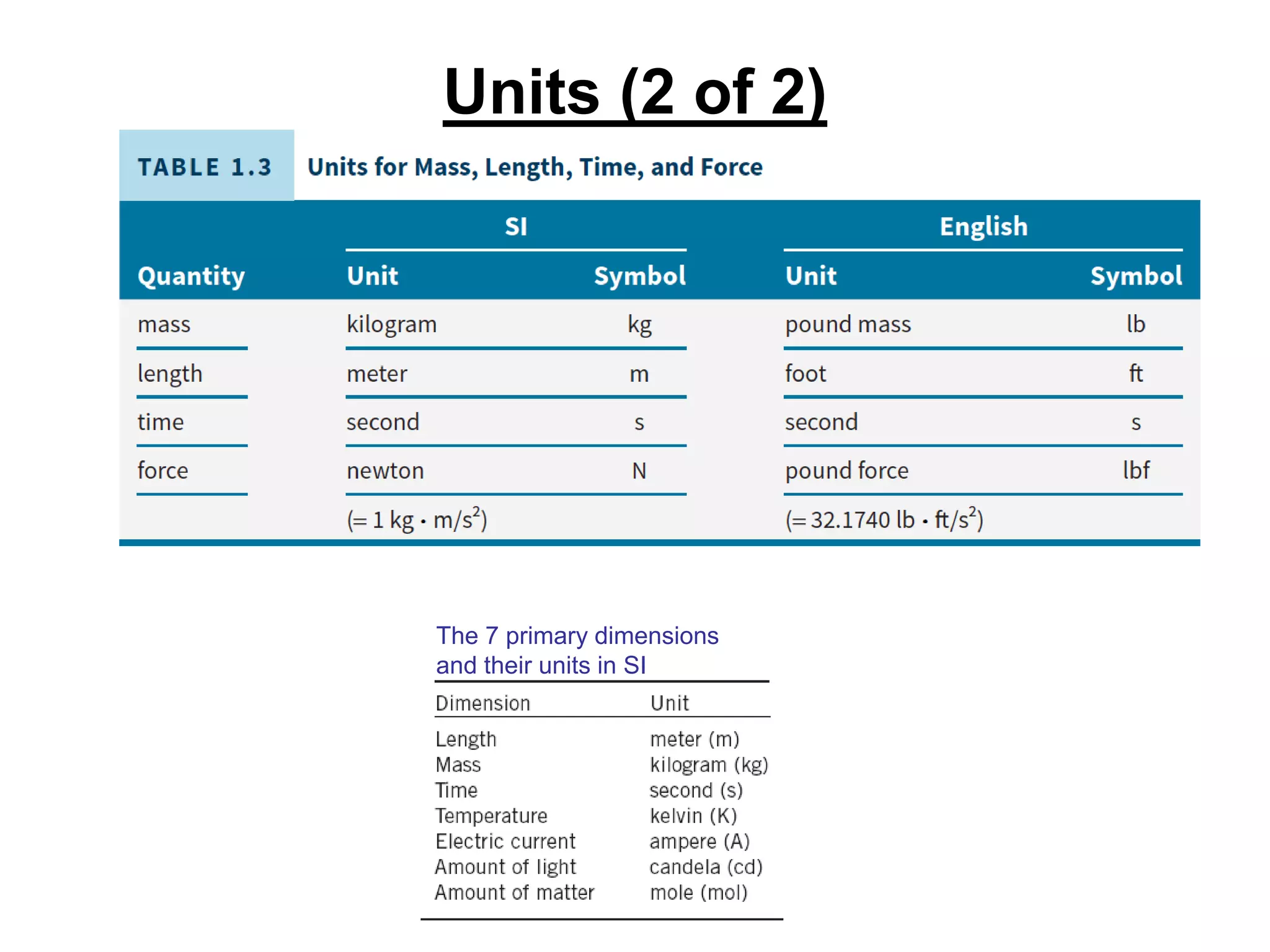
Units (2 of 2)
The 7 primary dimensions
and their units in SI
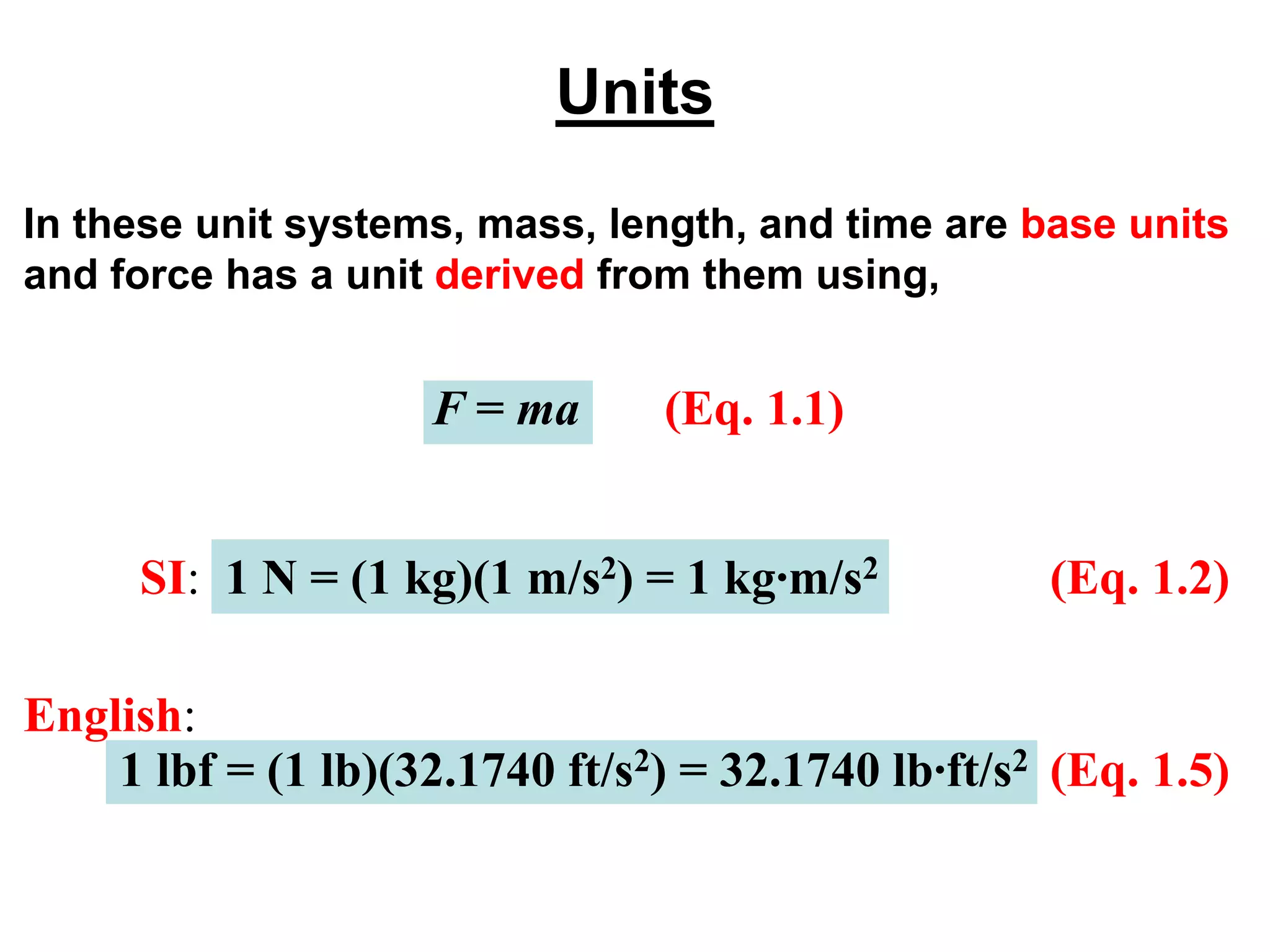
Units
In these unit systems, mass, length, and time are base units
and force has a unit derived from them using,
F = ma (Eq. 1.1)
SI: 1 N = (1 kg)(1 m/s2) = 1 kg∙m/s2 (Eq. 1.2)
English:
(Eq. 1.5)
1 lbf = (1 lb)(32.1740 ft/s2) = 32.1740 lb∙ft/s2
Chapter 1 – Introductory Concepts and
Definitions – Outline
1.1) Using Thermodynamics
1.2) Defining Systems
1.3) Describing Systems and Their Behavior
1.4) Measuring Mass, Length, Time, and Force
1.5) Specific Volume
1.6) Pressure
1.7) Temperature
1.8) Engineering Design and Analysis
Density (r) and Specific Volume (v)
(1 of 3)
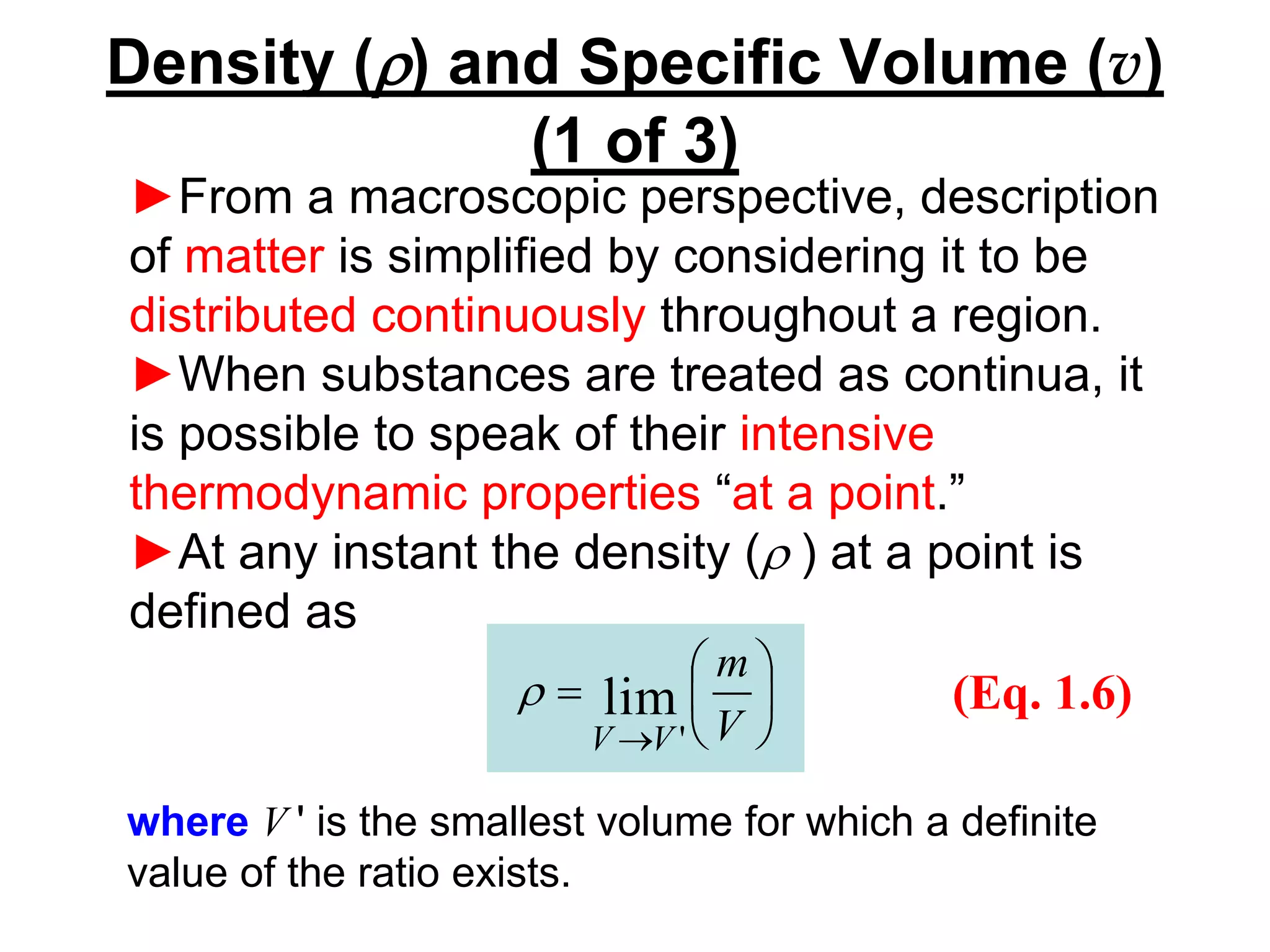
►From a macroscopic perspective, description
of matter is simplified by considering it to be
distributed continuously throughout a region.
►When substances are treated as continua, it
is possible to speak of their intensive
thermodynamic properties “at a point.”
►At any instant the density (r ) at a point is
defined as






=
→ V
m
V
V
lim
'
r (Eq. 1.6)
where V ' is the smallest volume for which a definite
value of the ratio exists.
Density (r) and Specific Volume (v) (2 of 3)
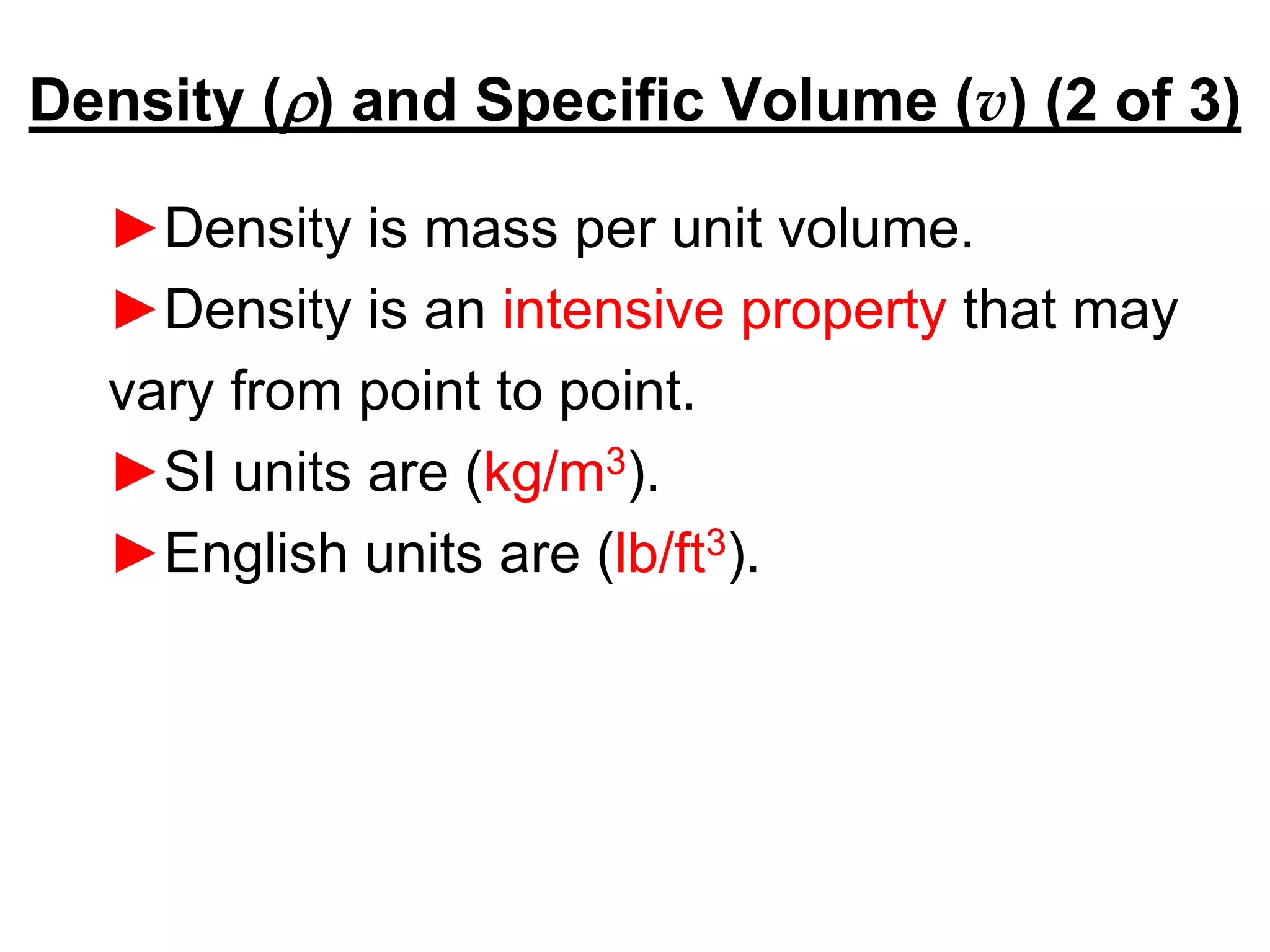
►Density is mass per unit volume.
►Density is an intensive property that may
vary from point to point.
►SI units are (kg/m3).
►English units are (lb/ft3).
Density (r) and Specific Volume (v) (3 of 3)
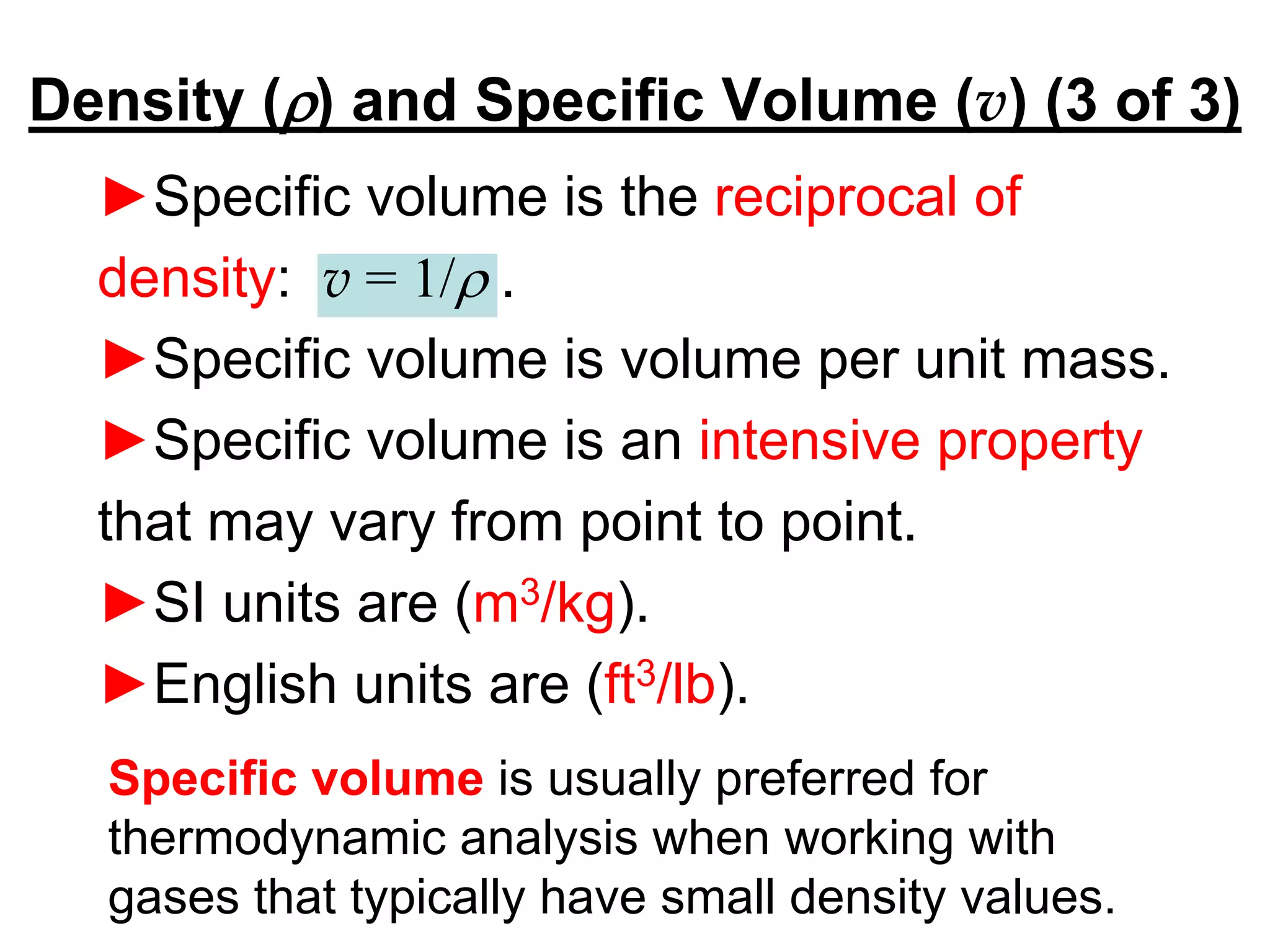
►Specific volume is the reciprocal of
density: v = 1/r .
►Specific volume is volume per unit mass.
►Specific volume is an intensive property
that may vary from point to point.
►SI units are (m3/kg).
►English units are (ft3/lb).
Specific volume is usually preferred for
thermodynamic analysis when working with
gases that typically have small density values.
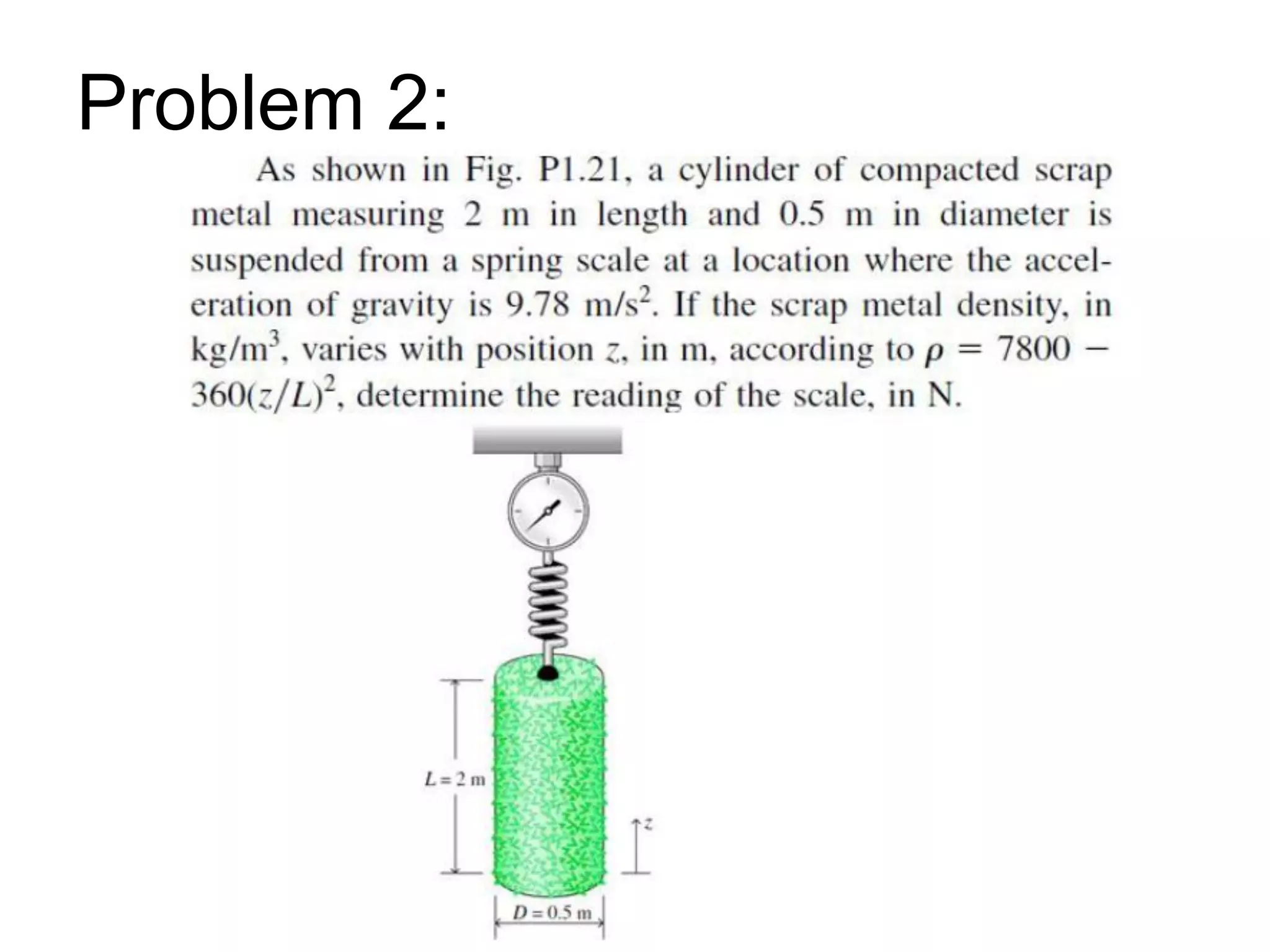
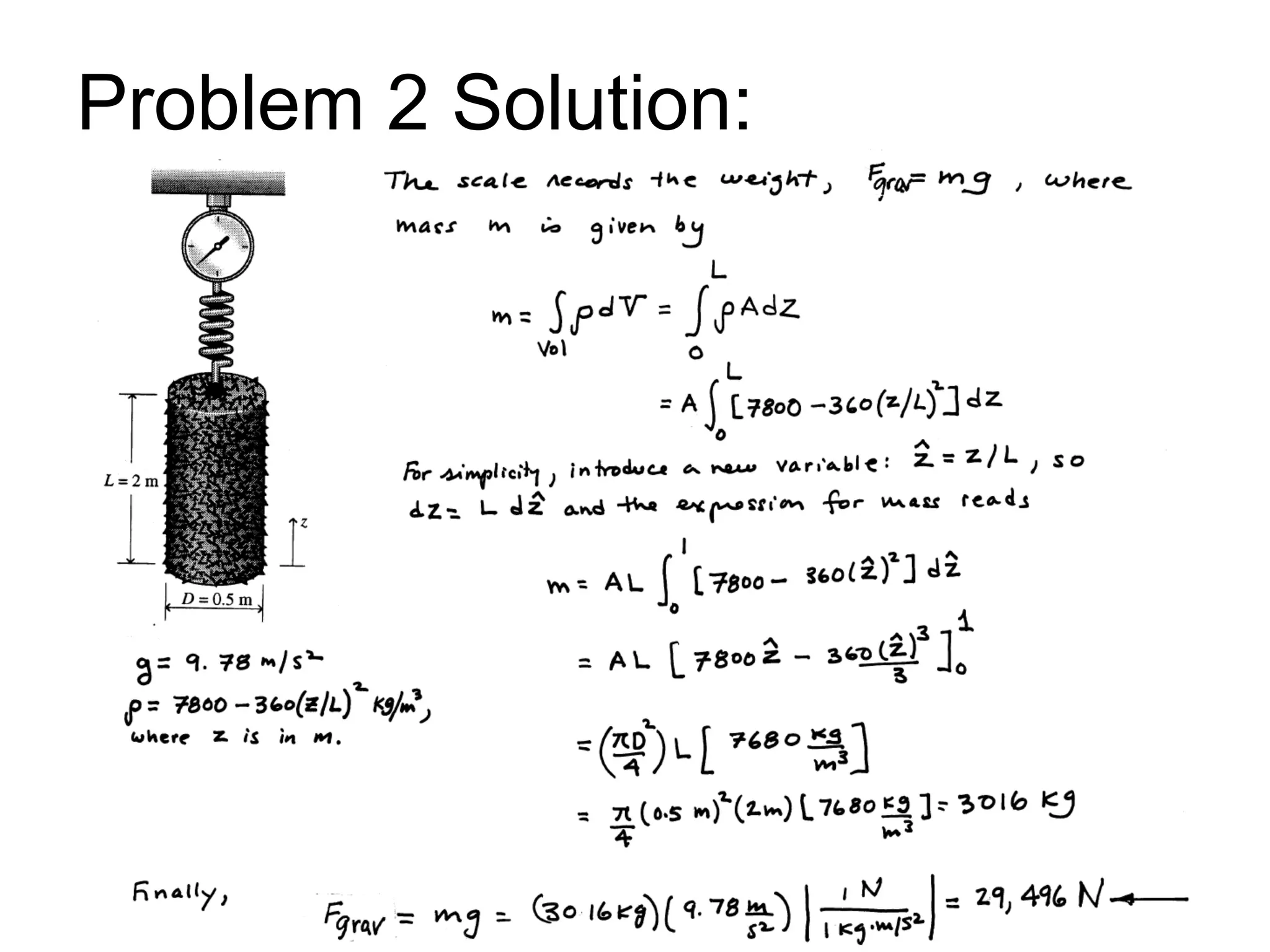
Problem 2:
Problem 2 Solution:
Chapter 1 – Introductory Concepts and
Definitions – Outline
1.1) Using Thermodynamics
1.2) Defining Systems
1.3) Describing Systems and Their Behavior
1.4) Measuring Mass, Length, Time, and Force
1.5) Specific Volume
1.6) Pressure
1.7) Temperature
1.8) Engineering Design and Analysis
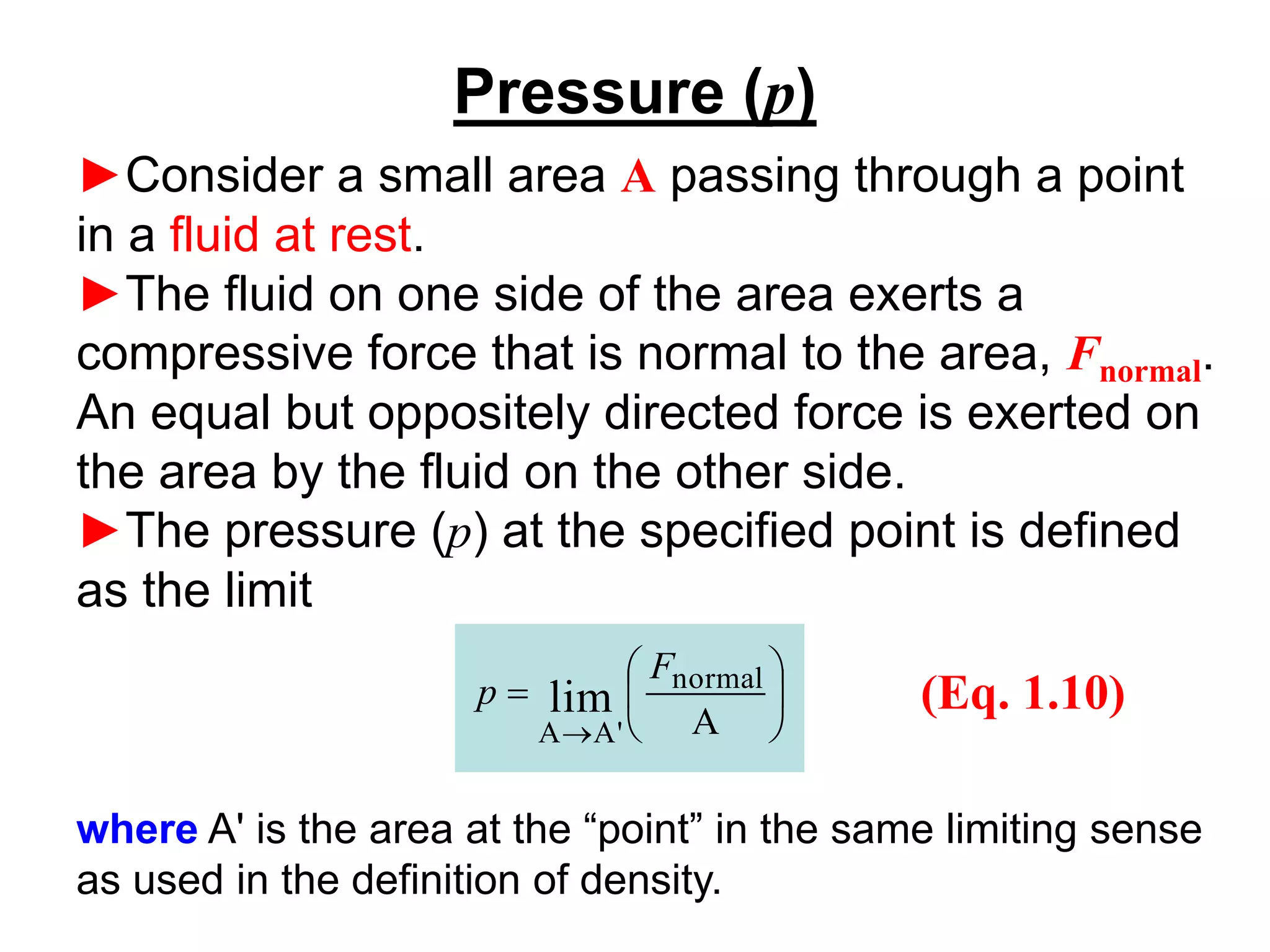
Pressure (p)
►Consider a small area A passing through a point
in a fluid at rest.
►The fluid on one side of the area exerts a
compressive force that is normal to the area, Fnormal.
An equal but oppositely directed force is exerted on
the area by the fluid on the other side.
►The pressure (p) at the specified point is defined
as the limit






=
→ A
normal
'
A
A
lim
F
p (Eq. 1.10)
where A' is the area at the “point” in the same limiting sense
as used in the definition of density.
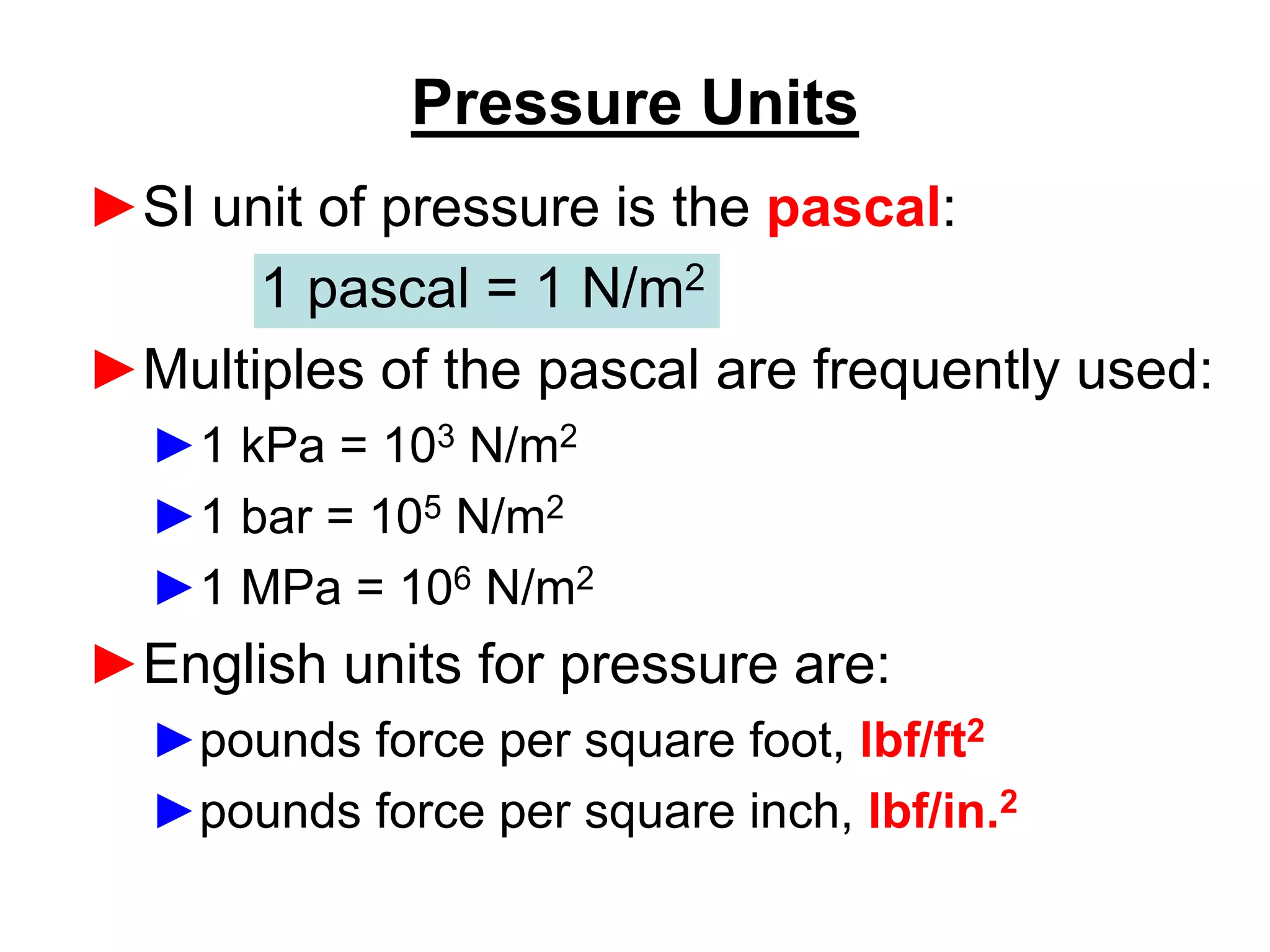
Pressure Units
►SI unit of pressure is the pascal:
1 pascal = 1 N/m2
►Multiples of the pascal are frequently used:
►1 kPa = 103 N/m2
►1 bar = 105 N/m2
►1 MPa = 106 N/m2
►English units for pressure are:
►pounds force per square foot, lbf/ft2
►pounds force per square inch, lbf/in.2
►Absolute pressure: Pressure with respect to
the zero pressure of a complete vacuum.
►Absolute pressure must be used in
thermodynamic relations.
►Pressure-measuring devices often indicate
the difference between the absolute pressure of
a system and the absolute pressure of the
atmosphere outside the measuring device.
Absolute Pressure
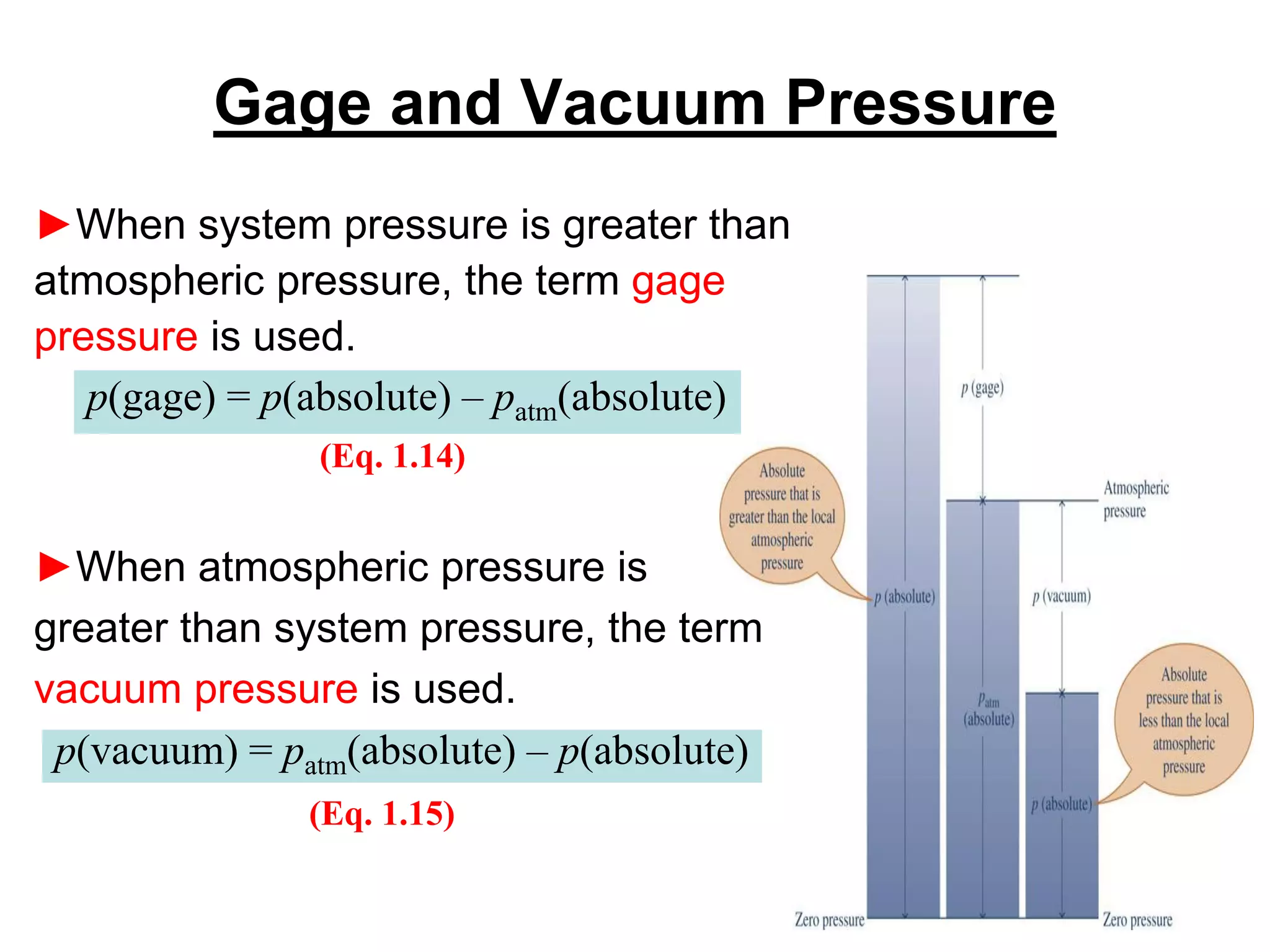
►When system pressure is greater than
atmospheric pressure, the term gage
pressure is used.
p(gage) = p(absolute) – patm(absolute)
(Eq. 1.14)
►When atmospheric pressure is
greater than system pressure, the term
vacuum pressure is used.
p(vacuum) = patm(absolute) – p(absolute)
(Eq. 1.15)
Gage and Vacuum Pressure
Problem 3:
Problem 3 Solution:
Chapter 1 – Introductory Concepts and
Definitions – Outline
1.1) Using Thermodynamics
1.2) Defining Systems
1.3) Describing Systems and Their Behavior
1.4) Measuring Mass, Length, Time, and Force
1.5) Specific Volume
1.6) Pressure
1.7) Temperature
1.8) Engineering Design and Analysis
Temperature (T)
►If two blocks (one warmer than the other) are
brought into contact and isolated from their
surroundings, they would interact thermally with
changes in observable properties.
►When all changes in observable properties cease,
the two blocks are in thermal equilibrium.
►Temperature is a physical property that
determines whether the two objects are in thermal
equilibrium.
►Zeroth Law of thermodynamics: When two
objects are in thermal equilibrium with a third
object, they are in thermal equilibrium with one
another.
►Any object with at least one measurable property
that changes as its temperature changes can be
used as a thermometer.
►Such a property is called a thermometric
property.
►The substance that exhibits changes in the
thermometric property is known as a thermometric
substance.
Thermometers (1 of 2)
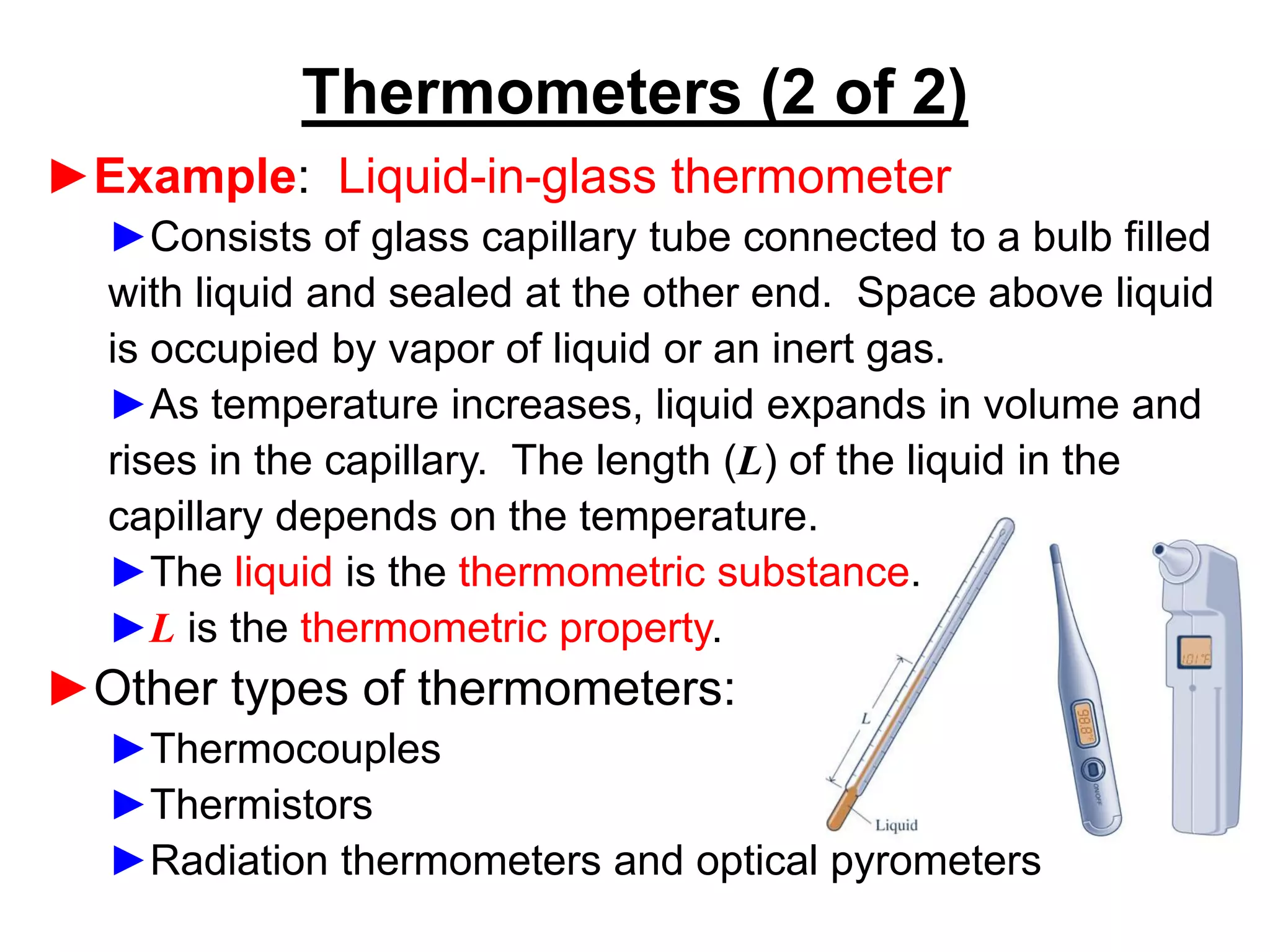
►Example: Liquid-in-glass thermometer
►Consists of glass capillary tube connected to a bulb filled
with liquid and sealed at the other end. Space above liquid
is occupied by vapor of liquid or an inert gas.
►As temperature increases, liquid expands in volume and
rises in the capillary. The length (L) of the liquid in the
capillary depends on the temperature.
►The liquid is the thermometric substance.
►L is the thermometric property.
►Other types of thermometers:
►Thermocouples
►Thermistors
►Radiation thermometers and optical pyrometers
Thermometers (2 of 2)
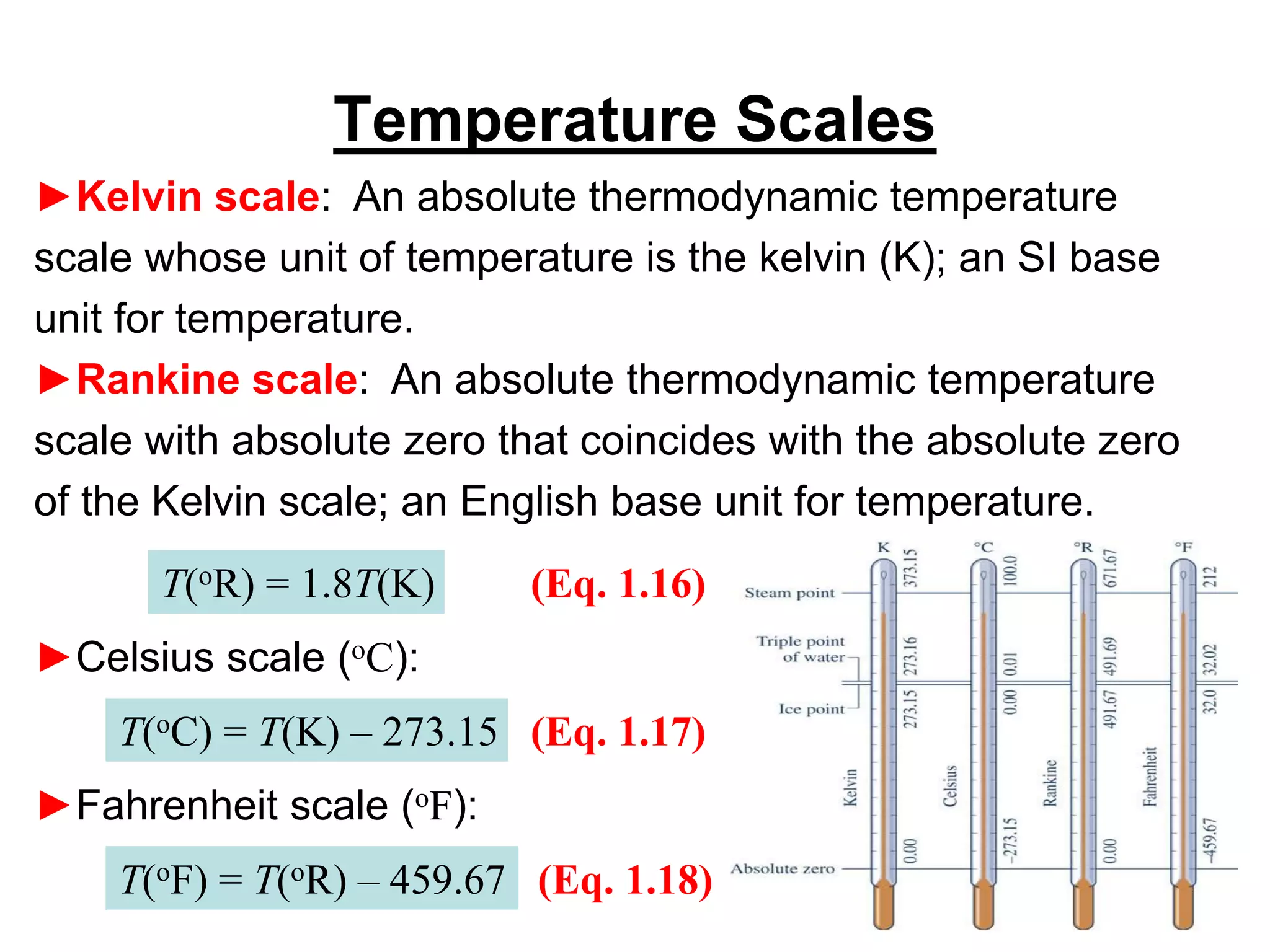
►Kelvin scale: An absolute thermodynamic temperature
scale whose unit of temperature is the kelvin (K); an SI base
unit for temperature.
►Rankine scale: An absolute thermodynamic temperature
scale with absolute zero that coincides with the absolute zero
of the Kelvin scale; an English base unit for temperature.
Temperature Scales
T(oR) = 1.8T(K) (Eq. 1.16)
►Celsius scale (oC):
T(oC) = T(K) – 273.15 (Eq. 1.17)
►Fahrenheit scale (oF):
T(oF) = T(oR) – 459.67 (Eq. 1.18)
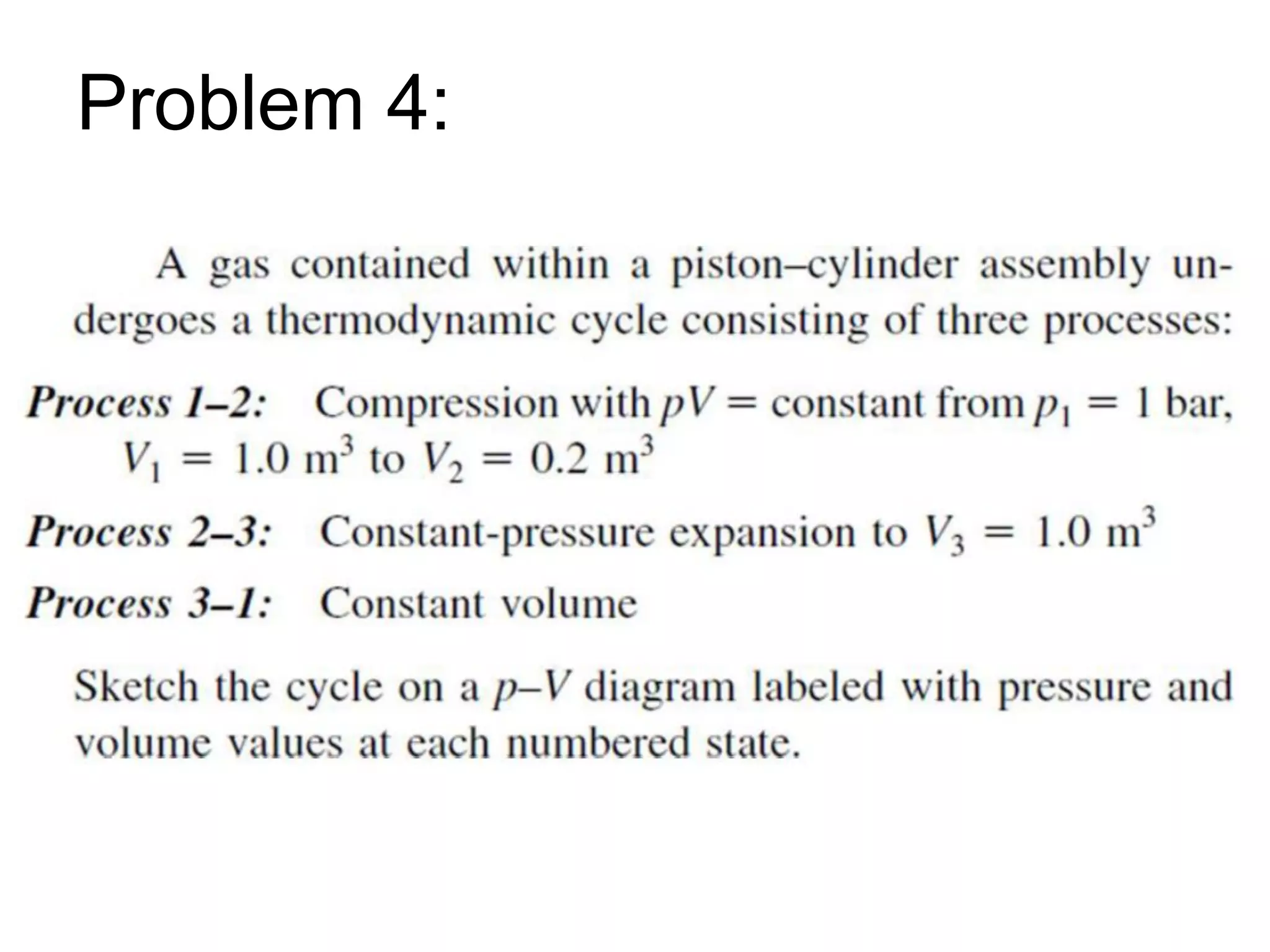
Problem 4:
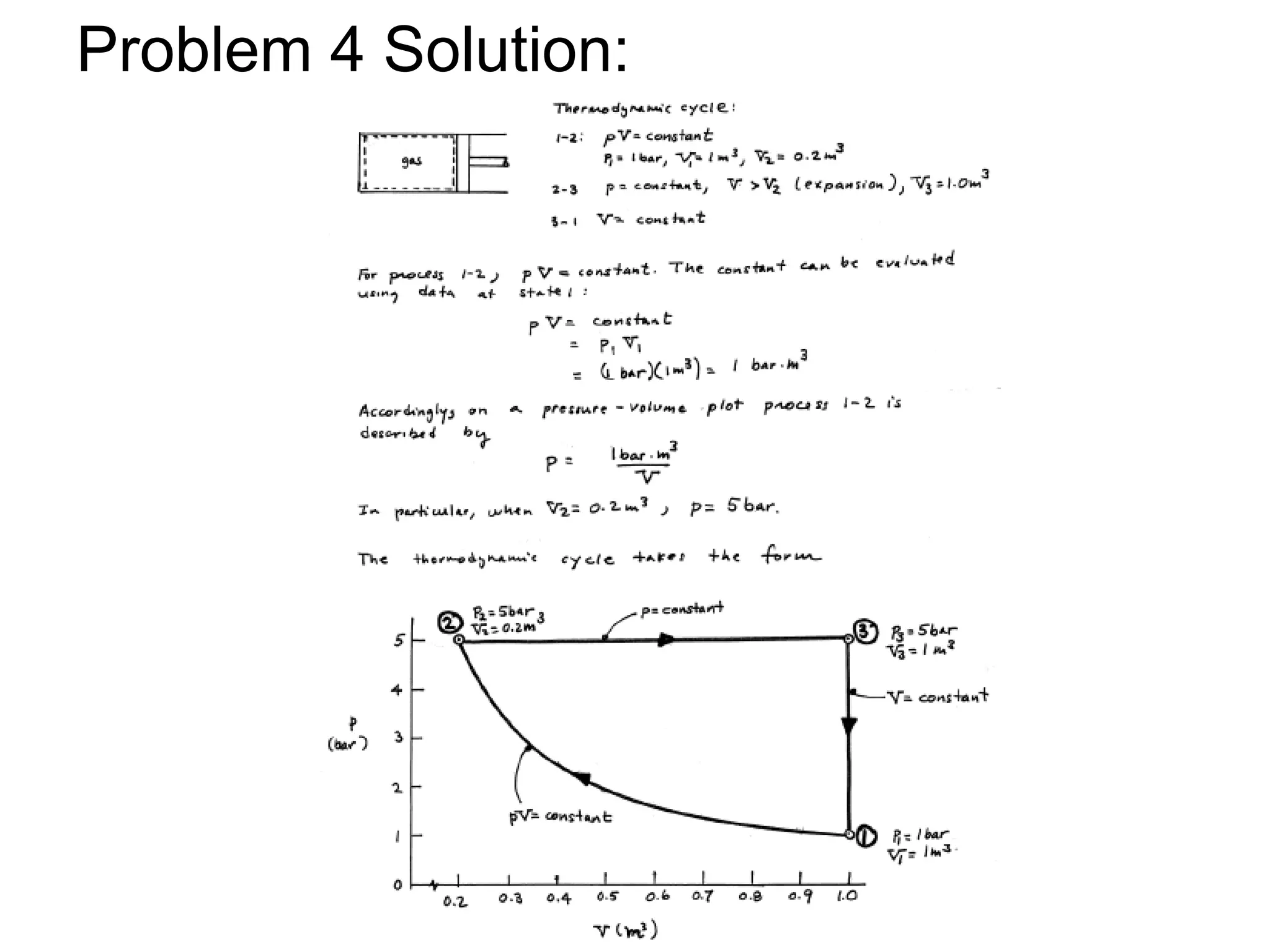
Problem 4 Solution:
Chapter 1 – Introductory Concepts and
Definitions – Outline
1.1) Using Thermodynamics
1.2) Defining Systems
1.3) Describing Systems and Their Behavior
1.4) Measuring Mass, Length, Time, and Force
1.5) Specific Volume
1.6) Pressure
1.7) Temperature
1.8) Engineering Design and Analysis
Design
➢Engineering design is a decision-making
process that draws principles from
engineering and fields
➢Fundamental elements include
establishment of objectives, synthesis,
analysis, construction, testing, and
evaluation.
➢Designs are typically subject to
constraints including economics, safety,
and environmental impact.

MEN210ch01-GA.pdf

  • 1.
  • 2.
    Chapter 1 –Introductory Concepts and Definitions – Outline 1.1) Using Thermodynamics 1.2) Defining Systems 1.3) Describing Systems and Their Behavior 1.4) Measuring Mass, Length, Time, and Force 1.5) Specific Volume 1.6) Pressure 1.7) Temperature 1.8) Engineering Design and Analysis
  • 3.
    Learning Outcomes ►Explain severalfundamental concepts used throughout this book including closed system, control volume, boundary and surroundings, property, state, process, the distinction between extensive and intensive properties, and equilibrium. ►Identify SI and English Engineering units, including units for specific volume, pressure, and temperature.
  • 4.
    Learning Outcomes, cont. ►Describethe relationship among the Kelvin, Rankine, Celsius, and Fahrenheit temperature scales. ►Apply appropriate unit conversion factors during calculations.
  • 5.
    Chapter 1 –Introductory Concepts and Definitions – Outline 1.1) Using Thermodynamics 1.2) Defining Systems 1.3) Describing Systems and Their Behavior 1.4) Measuring Mass, Length, Time, and Force 1.5) Specific Volume 1.6) Pressure 1.7) Temperature 1.8) Engineering Design and Analysis
  • 6.
    Thermodynamics ► The scienceof energy. ► Concerned with the amount of energy transfer. ► Used in many engineering areas:
  • 7.
    Chapter 1 –Introductory Concepts and Definitions – Outline 1.1) Using Thermodynamics 1.2) Defining Systems 1.3) Describing Systems and Their Behavior 1.4) Measuring Mass, Length, Time, and Force 1.5) Specific Volume 1.6) Pressure 1.7) Temperature 1.8) Engineering Design and Analysis
  • 8.
    Defining Systems ►System: whateverwe want to study. ►Surroundings: everything external to the system. ►Boundary: distinguishes system from its surroundings. System Surroundings Boundary
  • 9.
    Closed System ►A systemthat always contains the same matter. ►No transfer of mass across its boundary can occur. ►Isolated system: special type of closed system that does not interact in any way with its surroundings.
  • 10.
    Control Volume ►A givenregion of space through which mass flows. ►Mass may cross the boundary of a control volume.
  • 11.
  • 12.
  • 13.
    Chapter 1 –Introductory Concepts and Definitions – Outline 1.1) Using Thermodynamics 1.2) Defining Systems 1.3) Describing Systems and Their Behavior 1.4) Measuring Mass, Length, Time, and Force 1.5) Specific Volume 1.6) Pressure 1.7) Temperature 1.8) Engineering Design and Analysis
  • 14.
    Macroscopic and MicroscopicViews ►Systems can be described from the macroscopic and microscopic points of view. ►The microscopic approach aims to characterize by statistical means the average behavior of the particles making up a system and use this information to describe the overall behavior of the system. ►The macroscopic approach describes system behavior in terms of the gross effects of the particles making up the system – specifically, effects that can be measured by instruments such a pressure gages and thermometers. ►Engineering thermodynamics predominately uses the macroscopic approach.
  • 15.
    Property ►Mass ►Volume ►Energy ►Pressure ►Temperature ►A macroscopic characteristicof a system to which a numerical value can be assigned at a given time without knowledge of the previous behavior of the system. ►For the system shown, examples include: Gas
  • 16.
    State ►The condition ofa system as described by its properties. ►Example: The state of the system shown is described by p, V, T,…. ►The state often can be specified by providing the values of a subset of its properties. All other properties can be determined in terms of these few. Gas State: p, V, T, …
  • 17.
    Process ►A transformation fromone state to another. ►When any of the properties of a system changes, the state changes, and the system is said to have undergone a process. ►Example: Since V2 > V1, at least one property value changed, and the gas has undergone a process from State 1 to State 2. State 1: p1, V1, T1, … State 2: p2, V2, T2, … Gas Gas
  • 18.
    ►Depends on thesize or extent of a system. ►Examples: mass, volume, energy. ►Its value for an overall system is the sum of its values for the parts into which the system is divided. ►Its value may vary with time but not position. Extensive Property
  • 19.
    Intensive Property ►Independent ofthe size or extent of a system. ►Examples: pressure, temperature. ►Its value is not additive as for extensive properties. ►May vary from place to place within the system at any moment – function of both position and time.
  • 20.
    Equilibrium ►When a systemis isolated, it does not interact with its surroundings; however, its state can change as a consequence of spontaneous events occurring internally as its intensive properties such as temperature and pressure tend toward uniform values. When all such changes cease, the system is at an equilibrium state. ►Equilibrium states and processes from one equilibrium state to another equilibrium state play important roles in thermodynamic analysis.
  • 21.
    In Class Question ►Iask a question in class ►You email your answer to gakiki@ndu.edu.lb ►Use your NDU email ►Subject line: ICQ ►This will serve as your attendance Is Temperature an intensive or extensive property?
  • 22.
    Chapter 1 –Introductory Concepts and Definitions – Outline 1.1) Using Thermodynamics 1.2) Defining Systems 1.3) Describing Systems and Their Behavior 1.4) Measuring Mass, Length, Time, and Force 1.5) Specific Volume 1.6) Pressure 1.7) Temperature 1.8) Engineering Design and Analysis
  • 23.
    Units ►A unit isany specified amount of a quantity by comparison with which any other quantity of the same kind is measured (e.g., meter, kilometers, feet, and miles are all units of length). ►Primary units such as time and length can compose secondary units such as velocity and area. ►Two systems of units: ►SI (Système International d’Unités) ►English Engineering units.
  • 24.
    Units (2 of2) The 7 primary dimensions and their units in SI
  • 25.
    Units In these unitsystems, mass, length, and time are base units and force has a unit derived from them using, F = ma (Eq. 1.1) SI: 1 N = (1 kg)(1 m/s2) = 1 kg∙m/s2 (Eq. 1.2) English: (Eq. 1.5) 1 lbf = (1 lb)(32.1740 ft/s2) = 32.1740 lb∙ft/s2
  • 26.
    Chapter 1 –Introductory Concepts and Definitions – Outline 1.1) Using Thermodynamics 1.2) Defining Systems 1.3) Describing Systems and Their Behavior 1.4) Measuring Mass, Length, Time, and Force 1.5) Specific Volume 1.6) Pressure 1.7) Temperature 1.8) Engineering Design and Analysis
  • 27.
    Density (r) andSpecific Volume (v) (1 of 3) ►From a macroscopic perspective, description of matter is simplified by considering it to be distributed continuously throughout a region. ►When substances are treated as continua, it is possible to speak of their intensive thermodynamic properties “at a point.” ►At any instant the density (r ) at a point is defined as       = → V m V V lim ' r (Eq. 1.6) where V ' is the smallest volume for which a definite value of the ratio exists.
  • 28.
    Density (r) andSpecific Volume (v) (2 of 3) ►Density is mass per unit volume. ►Density is an intensive property that may vary from point to point. ►SI units are (kg/m3). ►English units are (lb/ft3).
  • 29.
    Density (r) andSpecific Volume (v) (3 of 3) ►Specific volume is the reciprocal of density: v = 1/r . ►Specific volume is volume per unit mass. ►Specific volume is an intensive property that may vary from point to point. ►SI units are (m3/kg). ►English units are (ft3/lb). Specific volume is usually preferred for thermodynamic analysis when working with gases that typically have small density values.
  • 30.
  • 31.
  • 32.
    Chapter 1 –Introductory Concepts and Definitions – Outline 1.1) Using Thermodynamics 1.2) Defining Systems 1.3) Describing Systems and Their Behavior 1.4) Measuring Mass, Length, Time, and Force 1.5) Specific Volume 1.6) Pressure 1.7) Temperature 1.8) Engineering Design and Analysis
  • 33.
    Pressure (p) ►Consider asmall area A passing through a point in a fluid at rest. ►The fluid on one side of the area exerts a compressive force that is normal to the area, Fnormal. An equal but oppositely directed force is exerted on the area by the fluid on the other side. ►The pressure (p) at the specified point is defined as the limit       = → A normal ' A A lim F p (Eq. 1.10) where A' is the area at the “point” in the same limiting sense as used in the definition of density.
  • 34.
    Pressure Units ►SI unitof pressure is the pascal: 1 pascal = 1 N/m2 ►Multiples of the pascal are frequently used: ►1 kPa = 103 N/m2 ►1 bar = 105 N/m2 ►1 MPa = 106 N/m2 ►English units for pressure are: ►pounds force per square foot, lbf/ft2 ►pounds force per square inch, lbf/in.2
  • 35.
    ►Absolute pressure: Pressurewith respect to the zero pressure of a complete vacuum. ►Absolute pressure must be used in thermodynamic relations. ►Pressure-measuring devices often indicate the difference between the absolute pressure of a system and the absolute pressure of the atmosphere outside the measuring device. Absolute Pressure
  • 36.
    ►When system pressureis greater than atmospheric pressure, the term gage pressure is used. p(gage) = p(absolute) – patm(absolute) (Eq. 1.14) ►When atmospheric pressure is greater than system pressure, the term vacuum pressure is used. p(vacuum) = patm(absolute) – p(absolute) (Eq. 1.15) Gage and Vacuum Pressure
  • 37.
  • 38.
  • 39.
    Chapter 1 –Introductory Concepts and Definitions – Outline 1.1) Using Thermodynamics 1.2) Defining Systems 1.3) Describing Systems and Their Behavior 1.4) Measuring Mass, Length, Time, and Force 1.5) Specific Volume 1.6) Pressure 1.7) Temperature 1.8) Engineering Design and Analysis
  • 40.
    Temperature (T) ►If twoblocks (one warmer than the other) are brought into contact and isolated from their surroundings, they would interact thermally with changes in observable properties. ►When all changes in observable properties cease, the two blocks are in thermal equilibrium. ►Temperature is a physical property that determines whether the two objects are in thermal equilibrium. ►Zeroth Law of thermodynamics: When two objects are in thermal equilibrium with a third object, they are in thermal equilibrium with one another.
  • 41.
    ►Any object withat least one measurable property that changes as its temperature changes can be used as a thermometer. ►Such a property is called a thermometric property. ►The substance that exhibits changes in the thermometric property is known as a thermometric substance. Thermometers (1 of 2)
  • 42.
    ►Example: Liquid-in-glass thermometer ►Consistsof glass capillary tube connected to a bulb filled with liquid and sealed at the other end. Space above liquid is occupied by vapor of liquid or an inert gas. ►As temperature increases, liquid expands in volume and rises in the capillary. The length (L) of the liquid in the capillary depends on the temperature. ►The liquid is the thermometric substance. ►L is the thermometric property. ►Other types of thermometers: ►Thermocouples ►Thermistors ►Radiation thermometers and optical pyrometers Thermometers (2 of 2)
  • 43.
    ►Kelvin scale: Anabsolute thermodynamic temperature scale whose unit of temperature is the kelvin (K); an SI base unit for temperature. ►Rankine scale: An absolute thermodynamic temperature scale with absolute zero that coincides with the absolute zero of the Kelvin scale; an English base unit for temperature. Temperature Scales T(oR) = 1.8T(K) (Eq. 1.16) ►Celsius scale (oC): T(oC) = T(K) – 273.15 (Eq. 1.17) ►Fahrenheit scale (oF): T(oF) = T(oR) – 459.67 (Eq. 1.18)
  • 44.
  • 45.
  • 46.
    Chapter 1 –Introductory Concepts and Definitions – Outline 1.1) Using Thermodynamics 1.2) Defining Systems 1.3) Describing Systems and Their Behavior 1.4) Measuring Mass, Length, Time, and Force 1.5) Specific Volume 1.6) Pressure 1.7) Temperature 1.8) Engineering Design and Analysis
  • 47.
    Design ➢Engineering design isa decision-making process that draws principles from engineering and fields ➢Fundamental elements include establishment of objectives, synthesis, analysis, construction, testing, and evaluation. ➢Designs are typically subject to constraints including economics, safety, and environmental impact.