INTRODUCTORY CONCEPTS AND DEFINITIONS
MEG 212 Week 1 Lecture
At the end of this lecture, you will be able to,
• Discuss the importance of thermodynamics in meeting human needs
• Identify application areas of thermodynamics
• Discuss the differences between closed and open systems
• Define fundamental concepts used in thermodynamic analysis such
as property, state and process
• Identify the difference between the macroscopic and microscopic
views of thermodynamics
Lecture Learning Outcomes
What is Thermodynamics?
It is the science concerned
with the relations between heat
and mechanical energy or
work, and the conversion of
one into the other
From two Greek Words
• “Therme” meaning Heat
• “Dynamis” meaning Motion or Power
Importance of Thermodynamics?
21st Century Challenges
• Using fossil fuels more effectively
• Advancing renewable energy technologies
• Developing more energy-efficient
transportation systems, buildings and
industrial practices
• Mitigating global climate change, air pollution
and water pollution
Engineers use principles drawn
from thermodynamics and other
engineering sciences which include
fluid mechanics, heat & mass
transfer to analyze and design
devices used to meet human needs
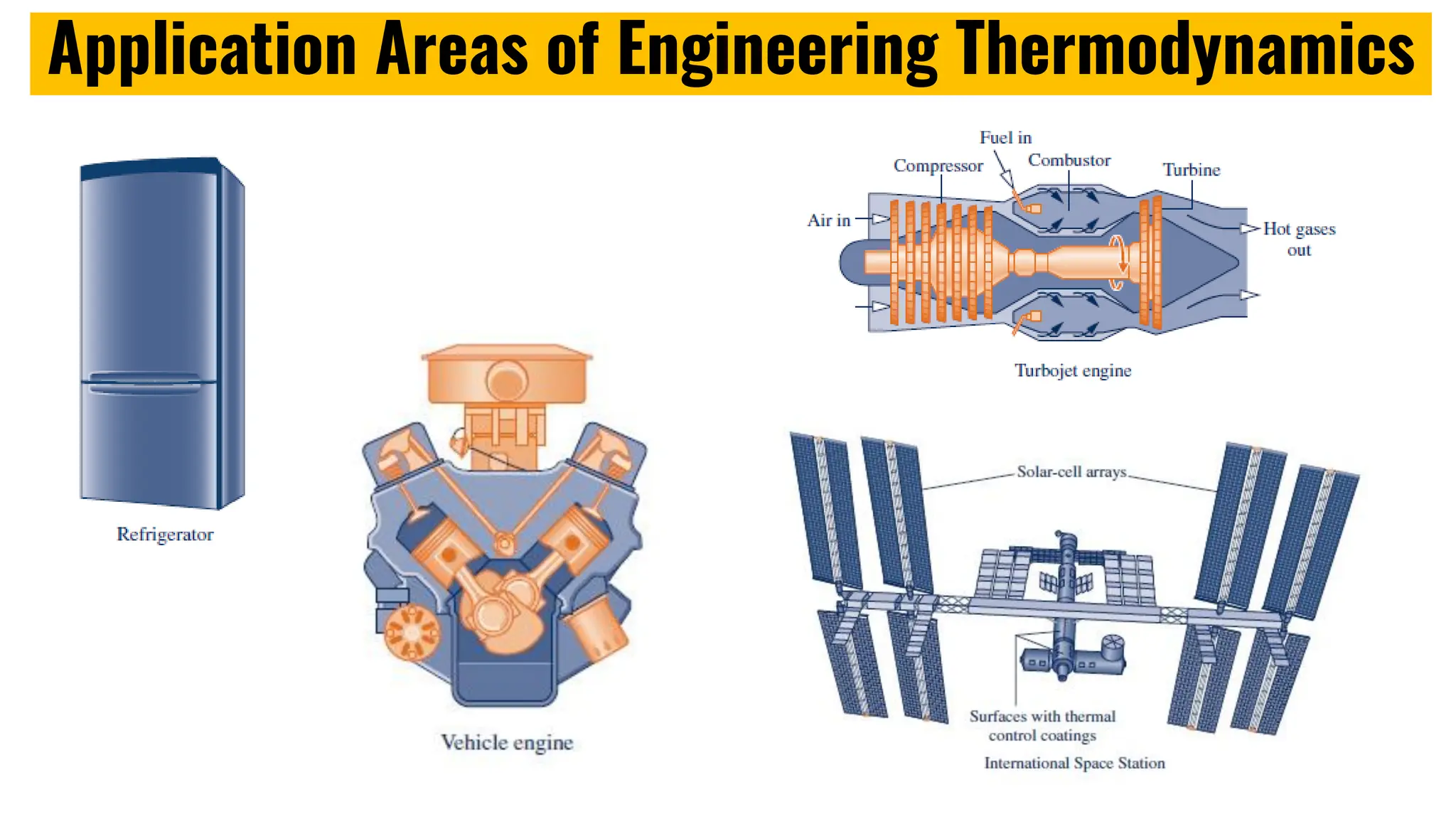
Application Areas of Engineering Thermodynamics
Combustion systems
Compressors & Pumps
Cooling of electronic equipment
Heating, ventilating and air-conditioning systems
Steam and gas turbines
Aircraft and rocket propulsion
Alternative energy systems
Automobile engines
Bioengineering applications
Biomedical applications
Application Areas of Engineering Thermodynamics
System, Boundary and Surrounding
For example, we may want to study a
quantity of matter contained within a
closed rigid-walled tank or a pipeline
through which natural gas flows
The system is whatever we want to
study which could be as simple as
a free body diagram or as complex
as an entire chemical refinery
In thermodynamics, the system is used to identify the subject of analysis
System, Boundary and Surrounding
The system is distinct from the
surrounding by means of a specified
boundary
Everything external to the system
is considered to be part of the
system’s surroundings
Difference between Closed and Open Systems
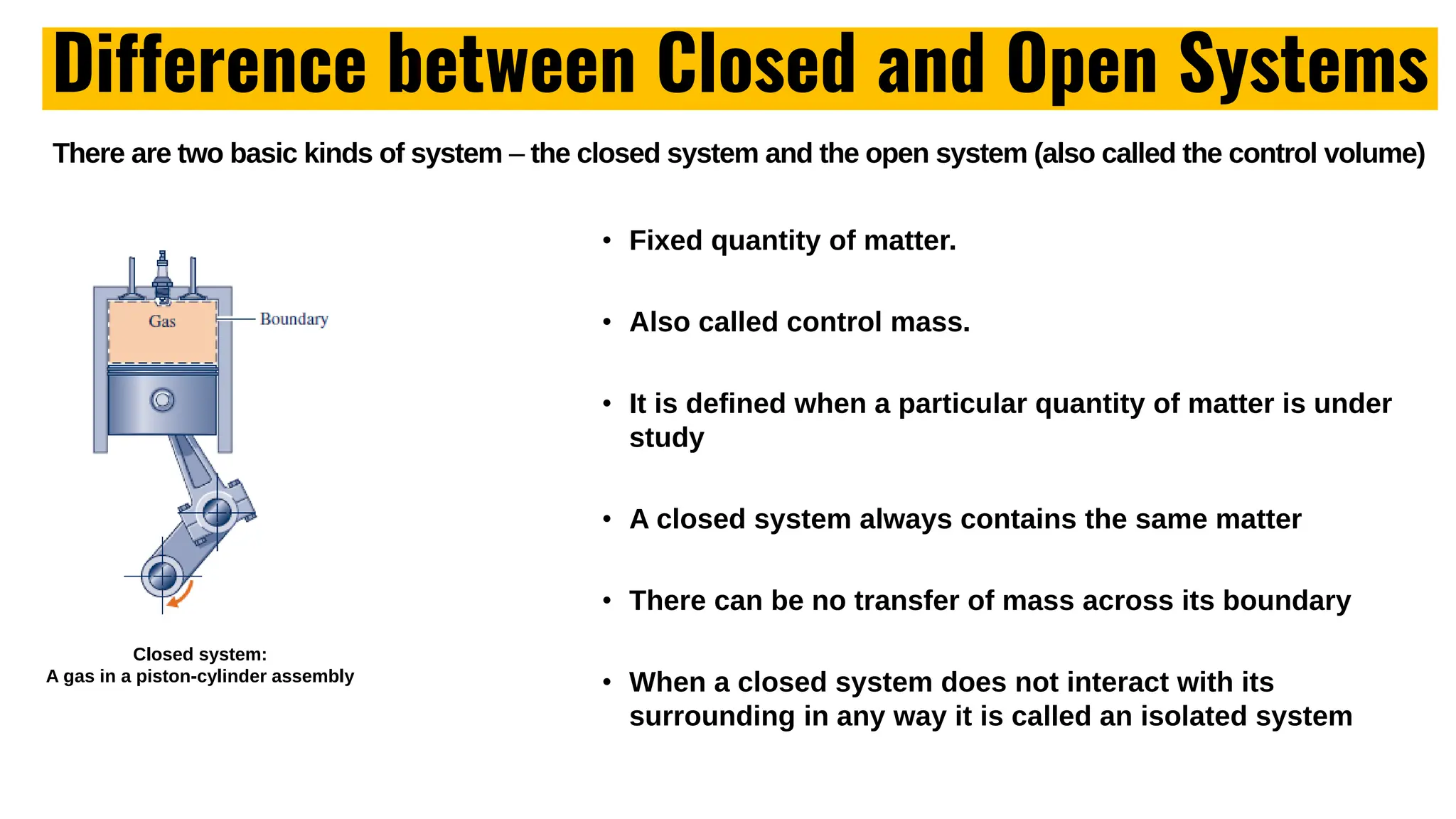
There are two basic kinds of system – the closed system and the open system (also called the control volume)
Closed system:
A gas in a piston-cylinder assembly
• Fixed quantity of matter.
• Also called control mass.
• It is defined when a particular quantity of matter is under
study
• A closed system always contains the same matter
• There can be no transfer of mass across its boundary
• When a closed system does not interact with its
surrounding in any way it is called an isolated system
Difference between Closed and Open Systems
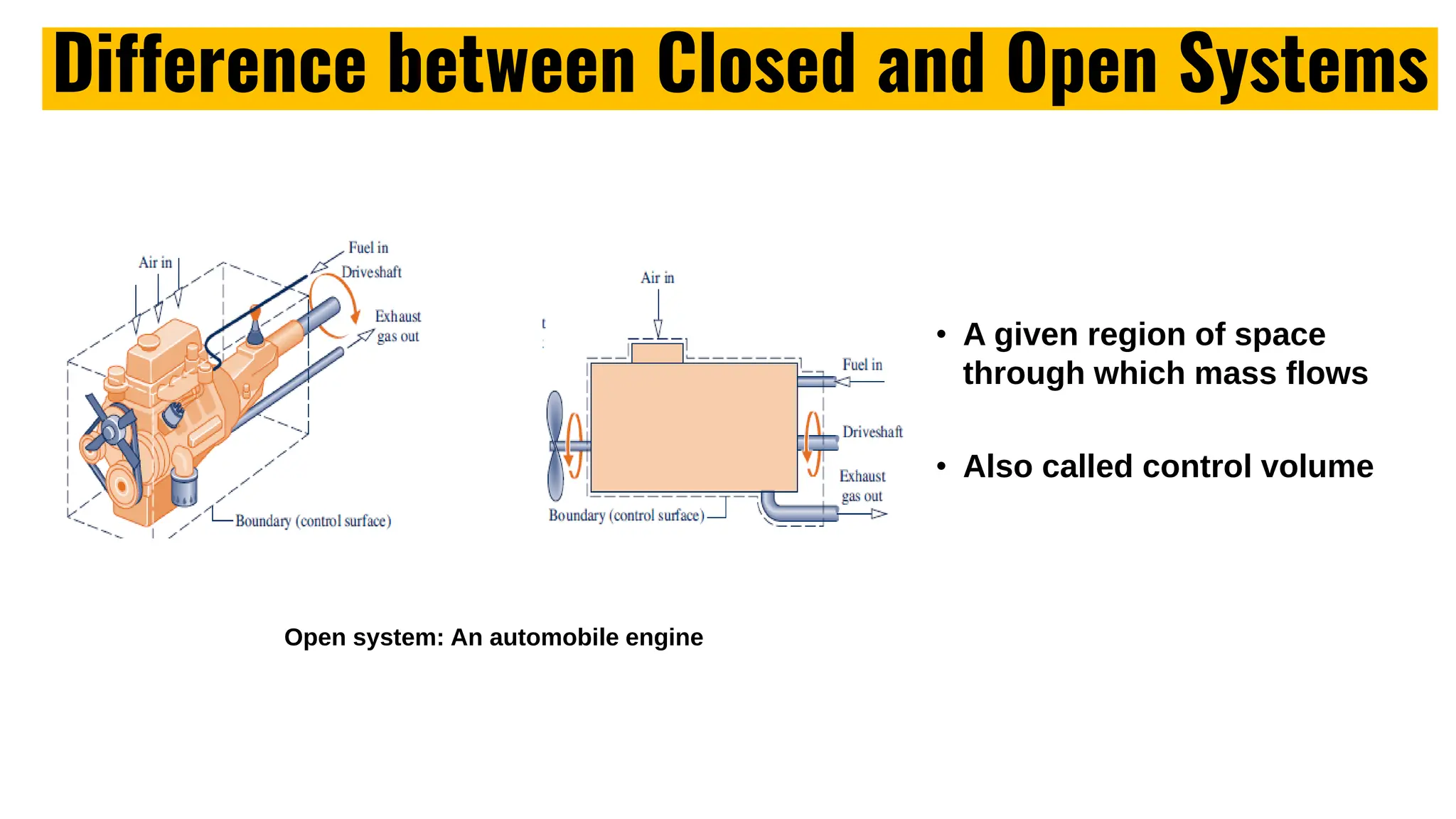
Open system: An automobile engine
• A given region of space
through which mass flows
• Also called control volume
How to select a System Boundary?
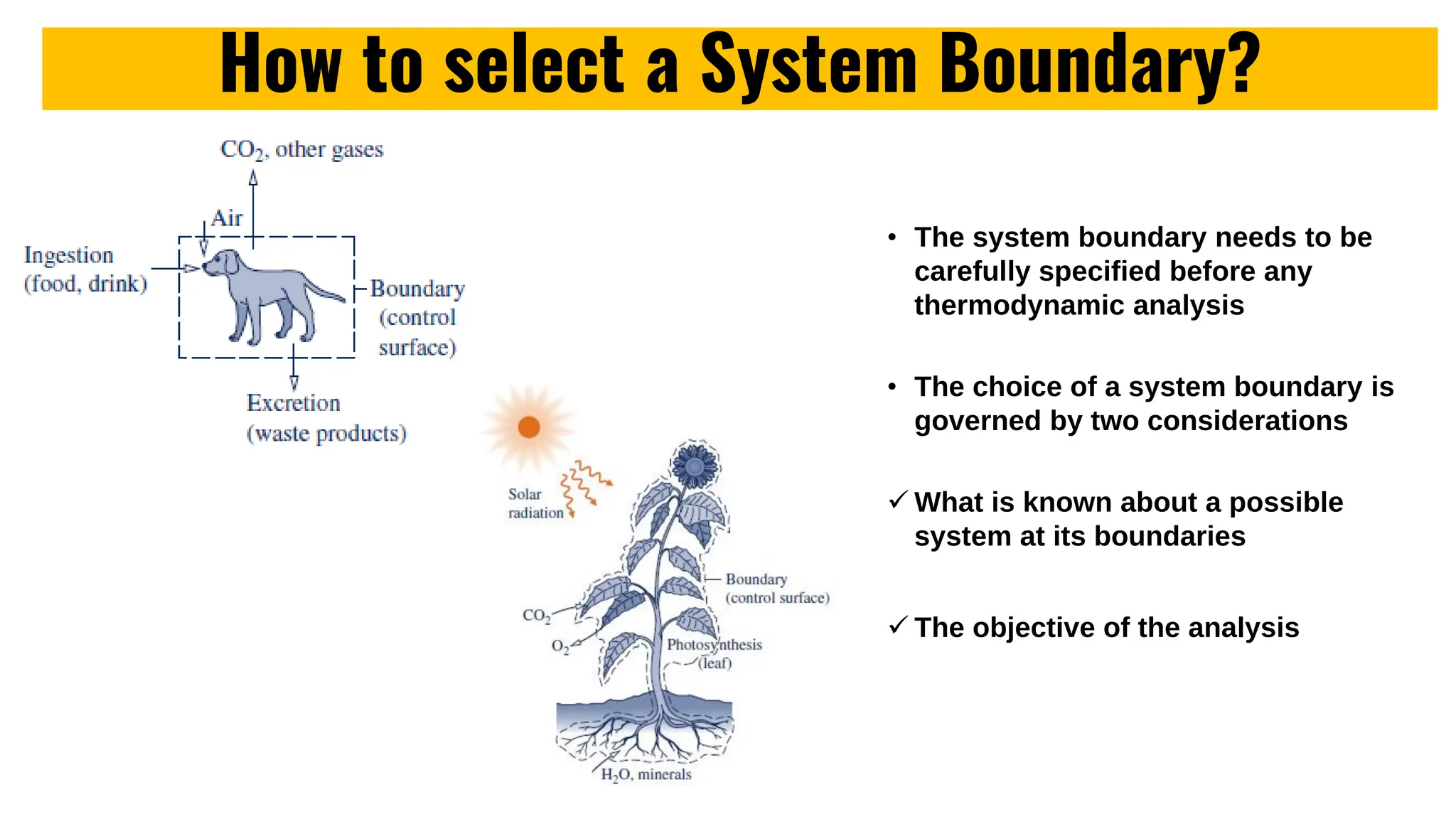
• The system boundary needs to be
carefully specified before any
thermodynamic analysis
• The choice of a system boundary is
governed by two considerations
 What is known about a possible
system at its boundaries
 The objective of the analysis
Macroscopic Versus Microscopic View of Thermodynamics
Microscopic view
Sometimes called statistical
thermodynamics
Objective is to characterize by
statistical means the average behavior
of particles making up the system of
interest
Macroscopic view
Sometimes called classical
thermodynamics
Concerned with the gross or overall
behavior of the system
For this course, we are adopting the macroscopic view point
Property, State and Process
State
Refers to the condition of a system
described by its properties.
When any of the properties of the
system changes, the state changes
and the system is said to undergo a
process
Property
Is a macroscopic characteristic of a
system such as mass, volume, energy,
pressure, and temperature to which a
numerical value can be assigned at a
given time without knowledge of the
previous behavior of the system
To describe a system and predict its behavior requires knowledge of the system
properties and how they are related
Property, State and Process
Extensive and Intensive Properties
Extensive: depend on the size of the
system e.g. mass, volume, energy etc.
Intensive: values are independent of
the size of the system e.g. specific
volume, pressure, temperature etc.
Process
Is a transformation from one state to
another.
If a system exhibits the same values of its
properties at two different times, it is in the
same state at these times.
If none of the properties change with time
then the system is said to be at steady
state
A quantity is a property if and only if its change in value between two states is
independent of the process.
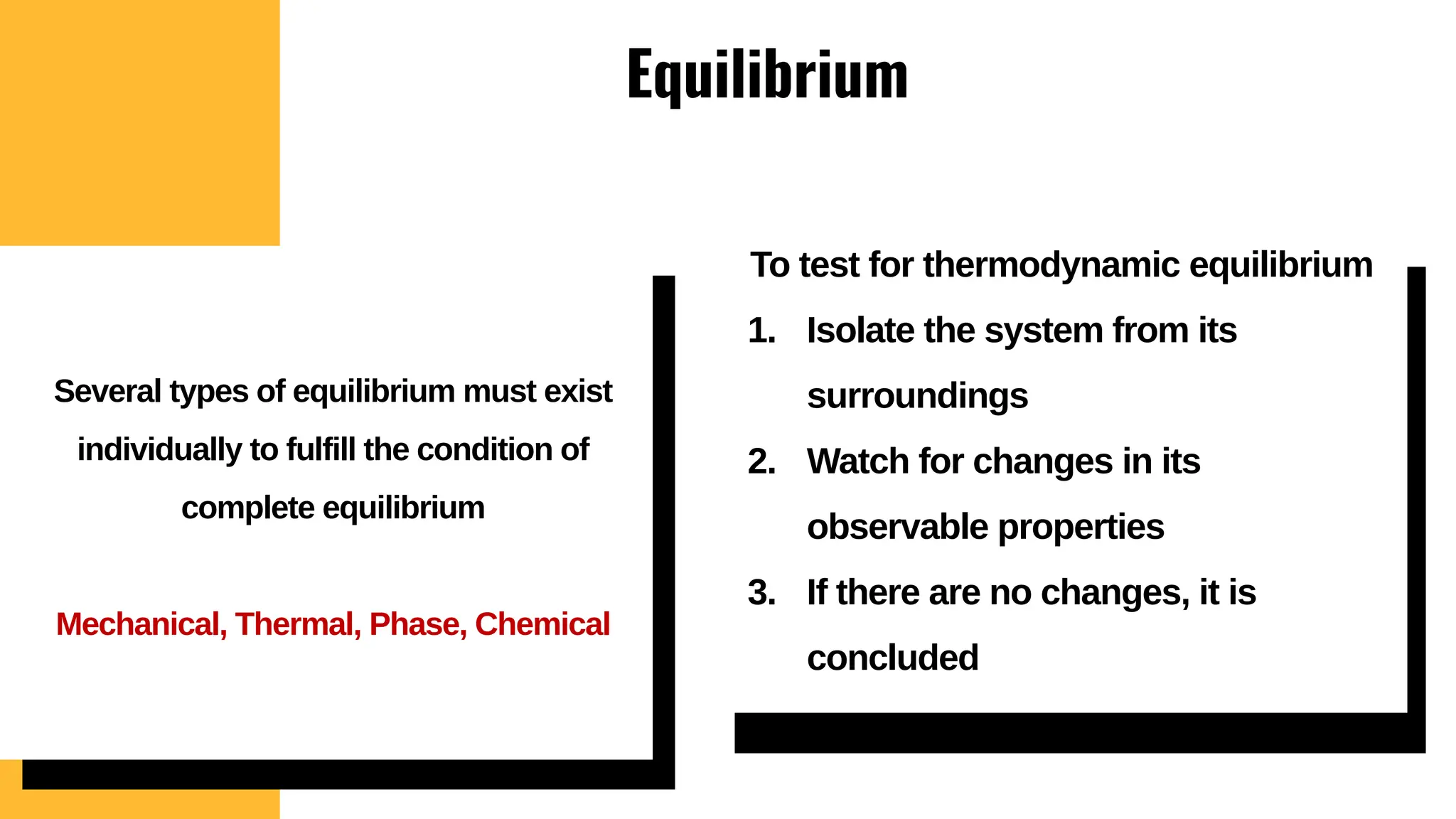
Equilibrium
To test for thermodynamic equilibrium
1. Isolate the system from its
surroundings
2. Watch for changes in its
observable properties
3. If there are no changes, it is
concluded
Several types of equilibrium must exist
individually to fulfill the condition of
complete equilibrium
Mechanical, Thermal, Phase, Chemical
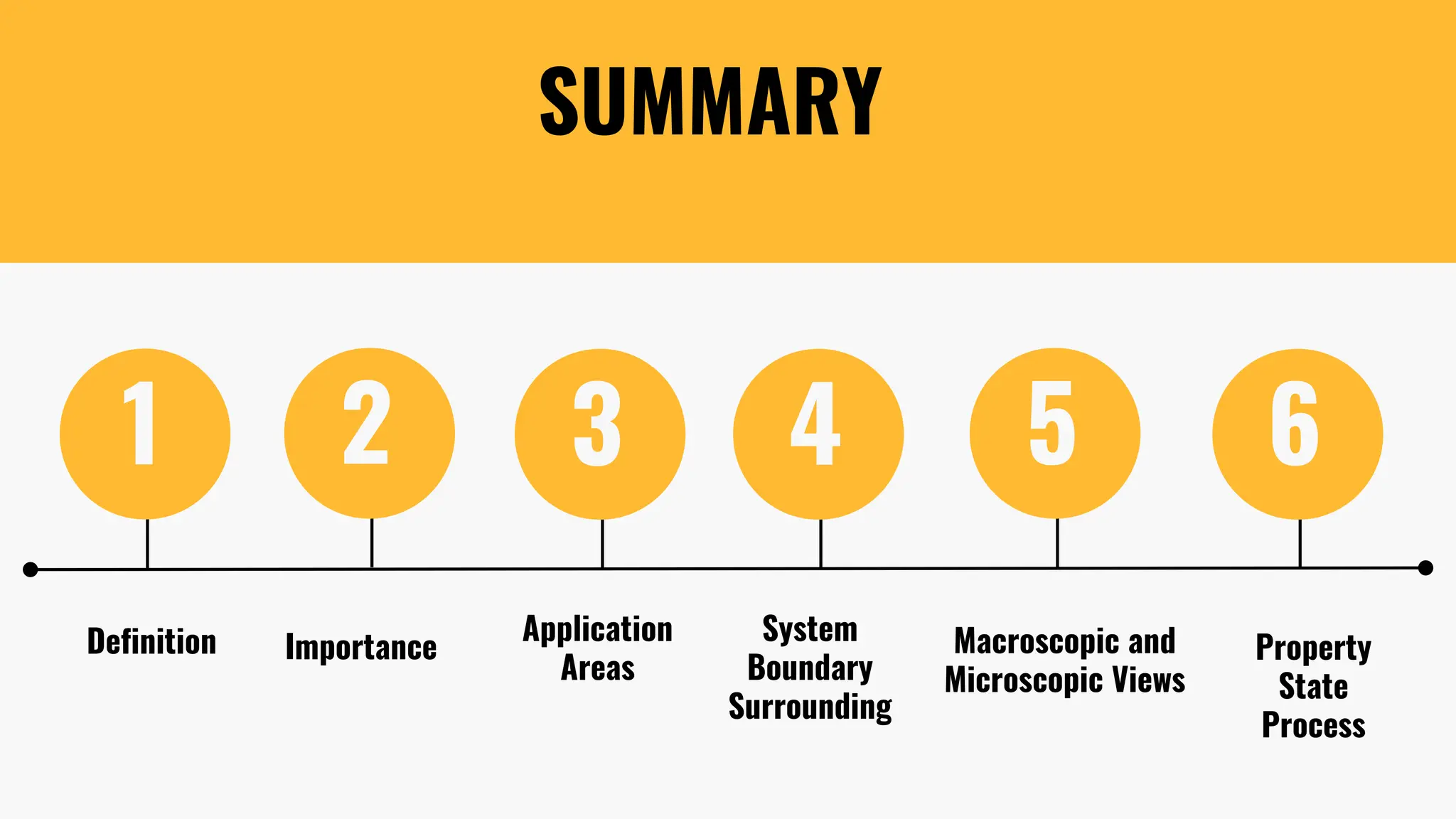
SUMMARY
1 2 3 4 5 6
Definition Application
Areas
Importance Macroscopic and
Microscopic Views
System
Boundary
Surrounding
Property
State
Process
 Reading assignment: pages 11 to 14, 18/19 to 22
 Measuring Mass, Length and Time: S.I Units and British Metric
Units
 Rankine and Kelvin Temperature scales
 Celcius and Fahrenheit scales
 Engineering Design
Next Lecture

MEG 212 Lecture 1 (2024) Engineering Thermodynamics

  • 1.
    INTRODUCTORY CONCEPTS ANDDEFINITIONS MEG 212 Week 1 Lecture
  • 2.
    At the endof this lecture, you will be able to, • Discuss the importance of thermodynamics in meeting human needs • Identify application areas of thermodynamics • Discuss the differences between closed and open systems • Define fundamental concepts used in thermodynamic analysis such as property, state and process • Identify the difference between the macroscopic and microscopic views of thermodynamics Lecture Learning Outcomes
  • 3.
    What is Thermodynamics? Itis the science concerned with the relations between heat and mechanical energy or work, and the conversion of one into the other From two Greek Words • “Therme” meaning Heat • “Dynamis” meaning Motion or Power
  • 4.
    Importance of Thermodynamics? 21stCentury Challenges • Using fossil fuels more effectively • Advancing renewable energy technologies • Developing more energy-efficient transportation systems, buildings and industrial practices • Mitigating global climate change, air pollution and water pollution Engineers use principles drawn from thermodynamics and other engineering sciences which include fluid mechanics, heat & mass transfer to analyze and design devices used to meet human needs
  • 5.
    Application Areas ofEngineering Thermodynamics Combustion systems Compressors & Pumps Cooling of electronic equipment Heating, ventilating and air-conditioning systems Steam and gas turbines Aircraft and rocket propulsion Alternative energy systems Automobile engines Bioengineering applications Biomedical applications
  • 6.
    Application Areas ofEngineering Thermodynamics
  • 7.
    System, Boundary andSurrounding For example, we may want to study a quantity of matter contained within a closed rigid-walled tank or a pipeline through which natural gas flows The system is whatever we want to study which could be as simple as a free body diagram or as complex as an entire chemical refinery In thermodynamics, the system is used to identify the subject of analysis
  • 8.
    System, Boundary andSurrounding The system is distinct from the surrounding by means of a specified boundary Everything external to the system is considered to be part of the system’s surroundings
  • 9.
    Difference between Closedand Open Systems There are two basic kinds of system – the closed system and the open system (also called the control volume) Closed system: A gas in a piston-cylinder assembly • Fixed quantity of matter. • Also called control mass. • It is defined when a particular quantity of matter is under study • A closed system always contains the same matter • There can be no transfer of mass across its boundary • When a closed system does not interact with its surrounding in any way it is called an isolated system
  • 10.
    Difference between Closedand Open Systems Open system: An automobile engine • A given region of space through which mass flows • Also called control volume
  • 11.
    How to selecta System Boundary? • The system boundary needs to be carefully specified before any thermodynamic analysis • The choice of a system boundary is governed by two considerations  What is known about a possible system at its boundaries  The objective of the analysis
  • 12.
    Macroscopic Versus MicroscopicView of Thermodynamics Microscopic view Sometimes called statistical thermodynamics Objective is to characterize by statistical means the average behavior of particles making up the system of interest Macroscopic view Sometimes called classical thermodynamics Concerned with the gross or overall behavior of the system For this course, we are adopting the macroscopic view point
  • 13.
    Property, State andProcess State Refers to the condition of a system described by its properties. When any of the properties of the system changes, the state changes and the system is said to undergo a process Property Is a macroscopic characteristic of a system such as mass, volume, energy, pressure, and temperature to which a numerical value can be assigned at a given time without knowledge of the previous behavior of the system To describe a system and predict its behavior requires knowledge of the system properties and how they are related
  • 14.
    Property, State andProcess Extensive and Intensive Properties Extensive: depend on the size of the system e.g. mass, volume, energy etc. Intensive: values are independent of the size of the system e.g. specific volume, pressure, temperature etc. Process Is a transformation from one state to another. If a system exhibits the same values of its properties at two different times, it is in the same state at these times. If none of the properties change with time then the system is said to be at steady state A quantity is a property if and only if its change in value between two states is independent of the process.
  • 15.
    Equilibrium To test forthermodynamic equilibrium 1. Isolate the system from its surroundings 2. Watch for changes in its observable properties 3. If there are no changes, it is concluded Several types of equilibrium must exist individually to fulfill the condition of complete equilibrium Mechanical, Thermal, Phase, Chemical
  • 16.
    SUMMARY 1 2 34 5 6 Definition Application Areas Importance Macroscopic and Microscopic Views System Boundary Surrounding Property State Process
  • 17.
     Reading assignment:pages 11 to 14, 18/19 to 22  Measuring Mass, Length and Time: S.I Units and British Metric Units  Rankine and Kelvin Temperature scales  Celcius and Fahrenheit scales  Engineering Design Next Lecture