ME2320 Thermodynamics I
Summer I 2016
Instructor: Dr. William W. Liou
Syllabus
http://homepages.wmich.edu/~liou/wp_course.htm
3
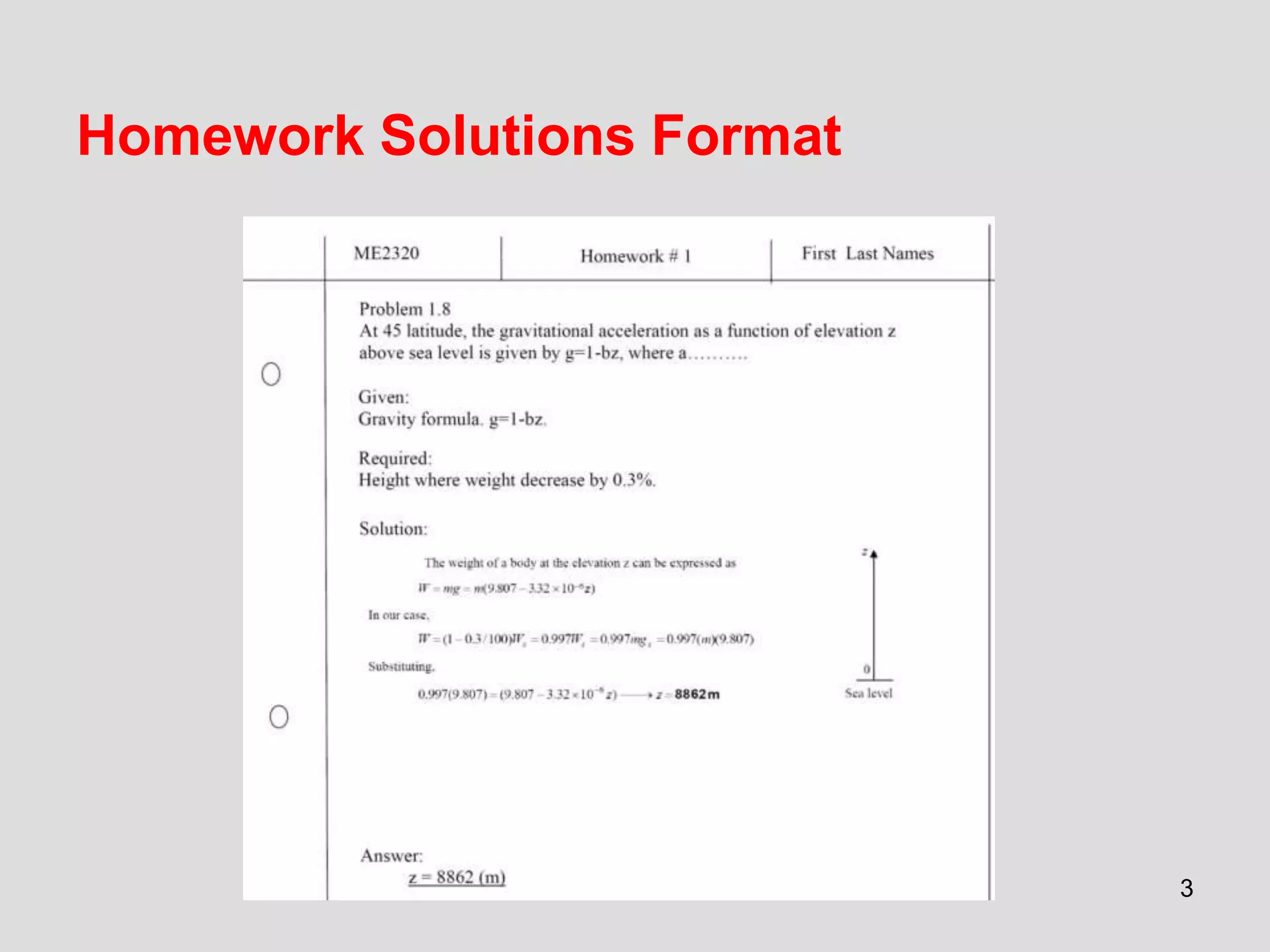
Homework Solutions Format
How to get, and stay, ahead in this class?
 Preview
 Book to Class
 Review
 Homework
Will it work if I “Preview”, but not “Book to Class” ?
Well, yes, maybe, but…
Chapter 1
INTRODUCTION AND
BASIC CONCEPTS
Objectives
6
• Identify the unique thermodynamics vocabulary.
• Review the metric SI and the English unit systems.
• Explain the basic concepts of thermodynamics such
as system, state, state postulate, equilibrium,
process, and cycle.
• Review temperature, temperature scales, pressure,
and absolute and gage pressure.
• Introduce an intuitive systematic problem-solving
technique and the format of homework solution.
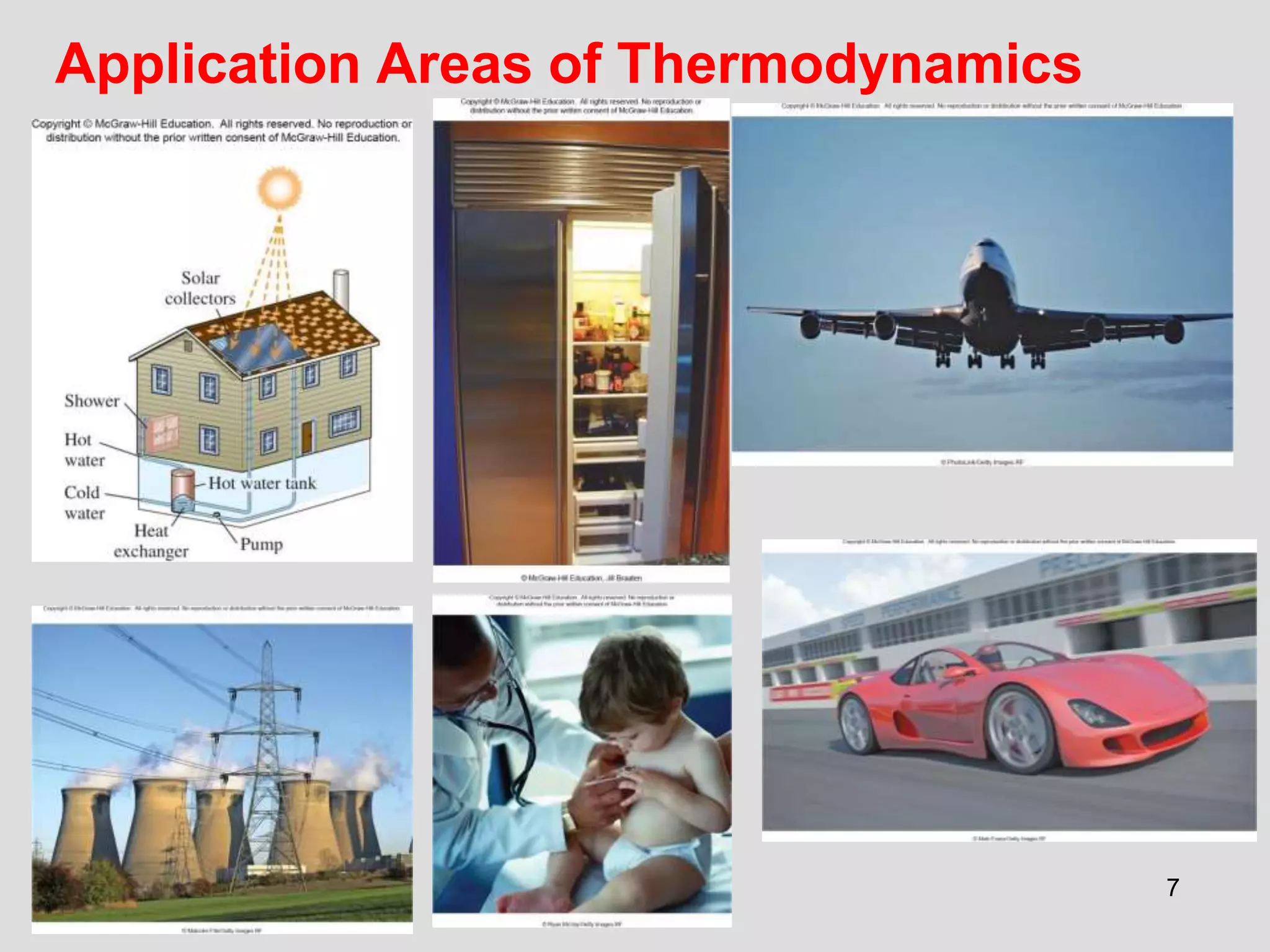
Application Areas of Thermodynamics
7
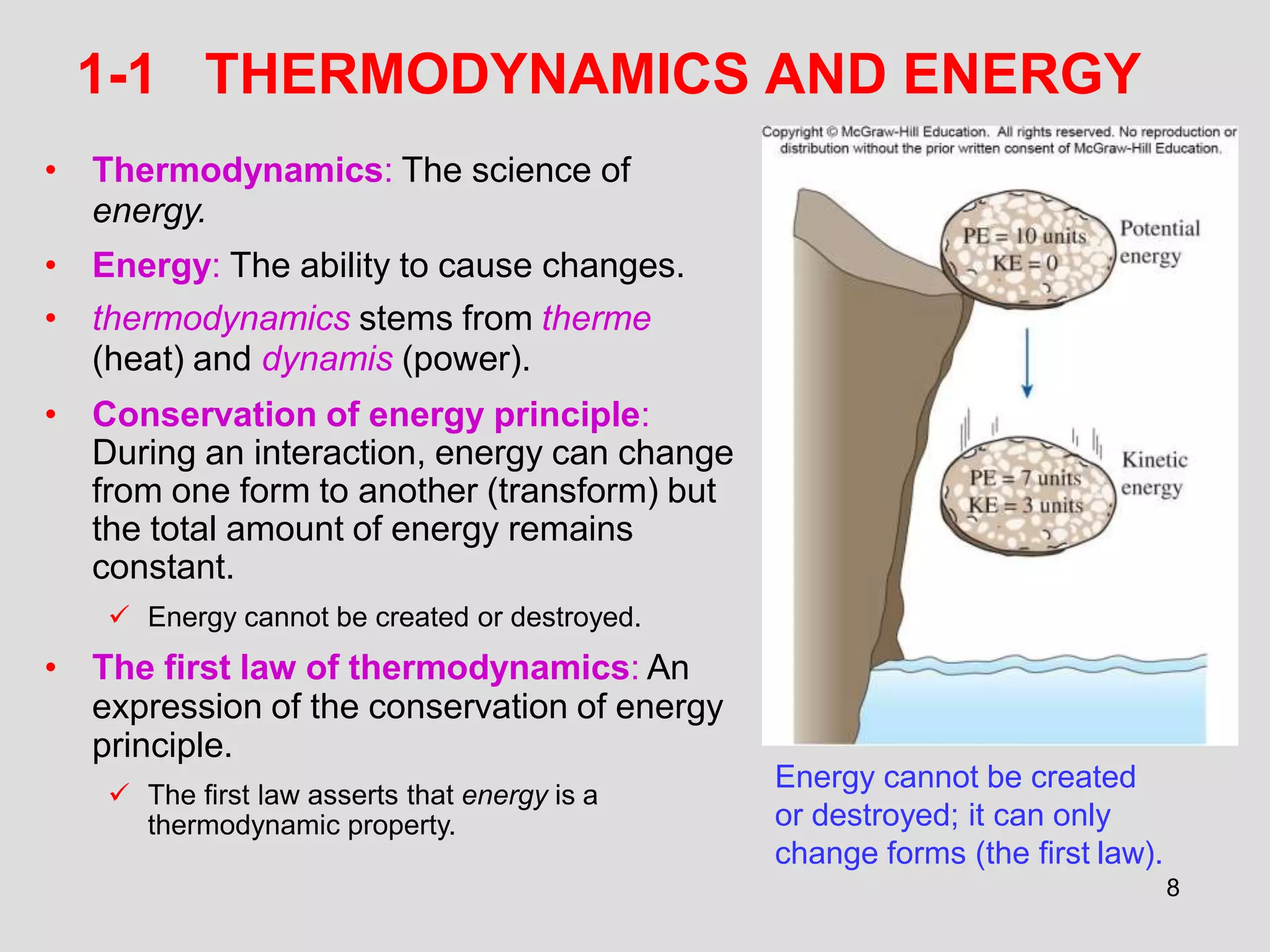
1-1 THERMODYNAMICS AND ENERGY
• Thermodynamics: The science of
energy.
• Energy: The ability to cause changes.
• thermodynamics stems from therme
(heat) and dynamis (power).
• Conservation of energy principle:
During an interaction, energy can change
from one form to another (transform) but
the total amount of energy remains
constant.
 Energy cannot be created or destroyed.
• The first law of thermodynamics: An
expression of the conservation of energy
principle.
 The first law asserts that energy is a
thermodynamic property.
Energy cannot be created
or destroyed; it can only
change forms (the first law).
8
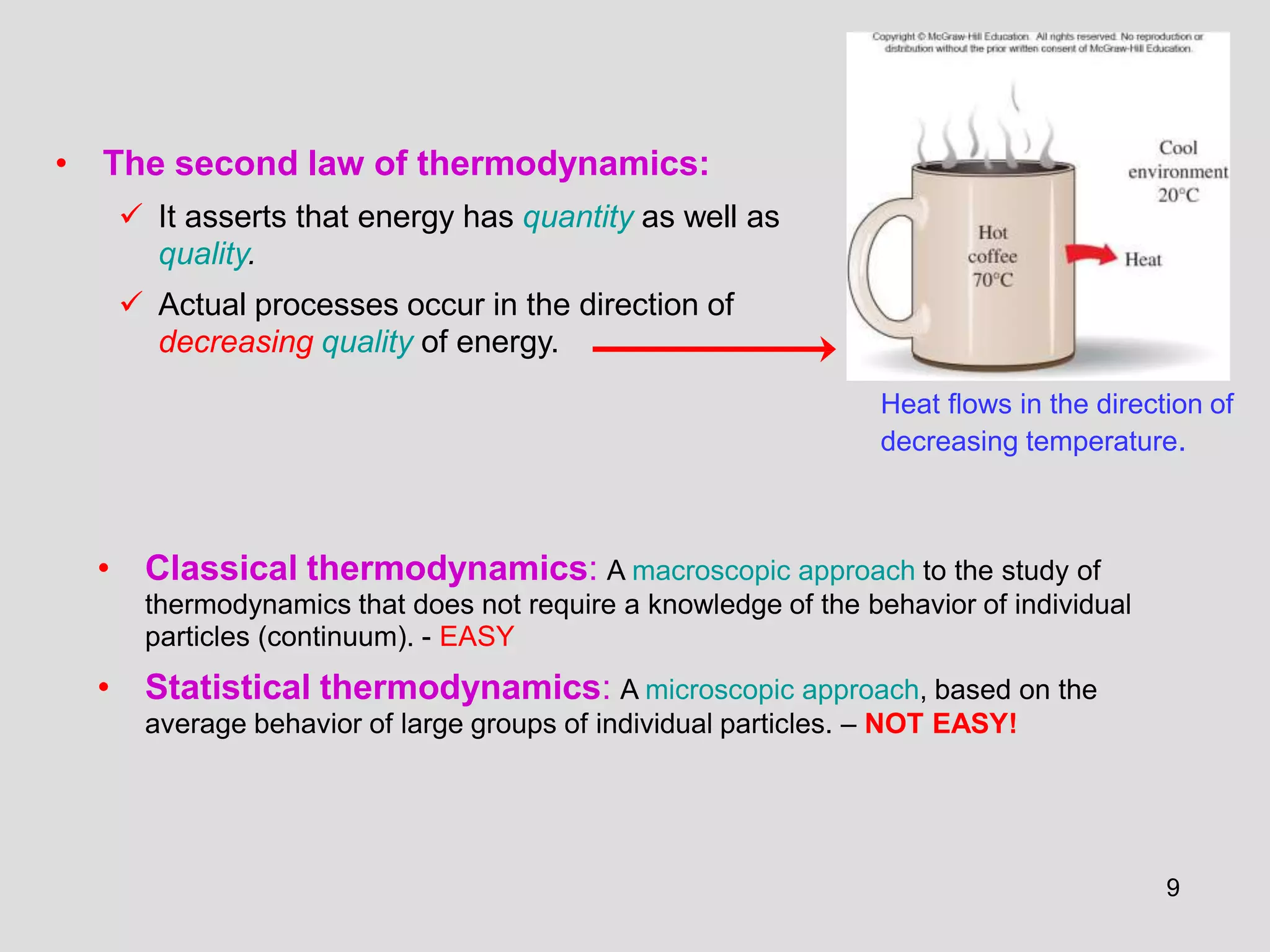
• The second law of thermodynamics:
 It asserts that energy has quantity as well as
quality.
 Actual processes occur in the direction of
decreasing quality of energy.
Heat flows in the direction of
decreasing temperature.
• Classical thermodynamics: A macroscopic approach to the study of
thermodynamics that does not require a knowledge of the behavior of individual
particles (continuum). - EASY
• Statistical thermodynamics: A microscopic approach, based on the
average behavior of large groups of individual particles. – NOT EASY!
9
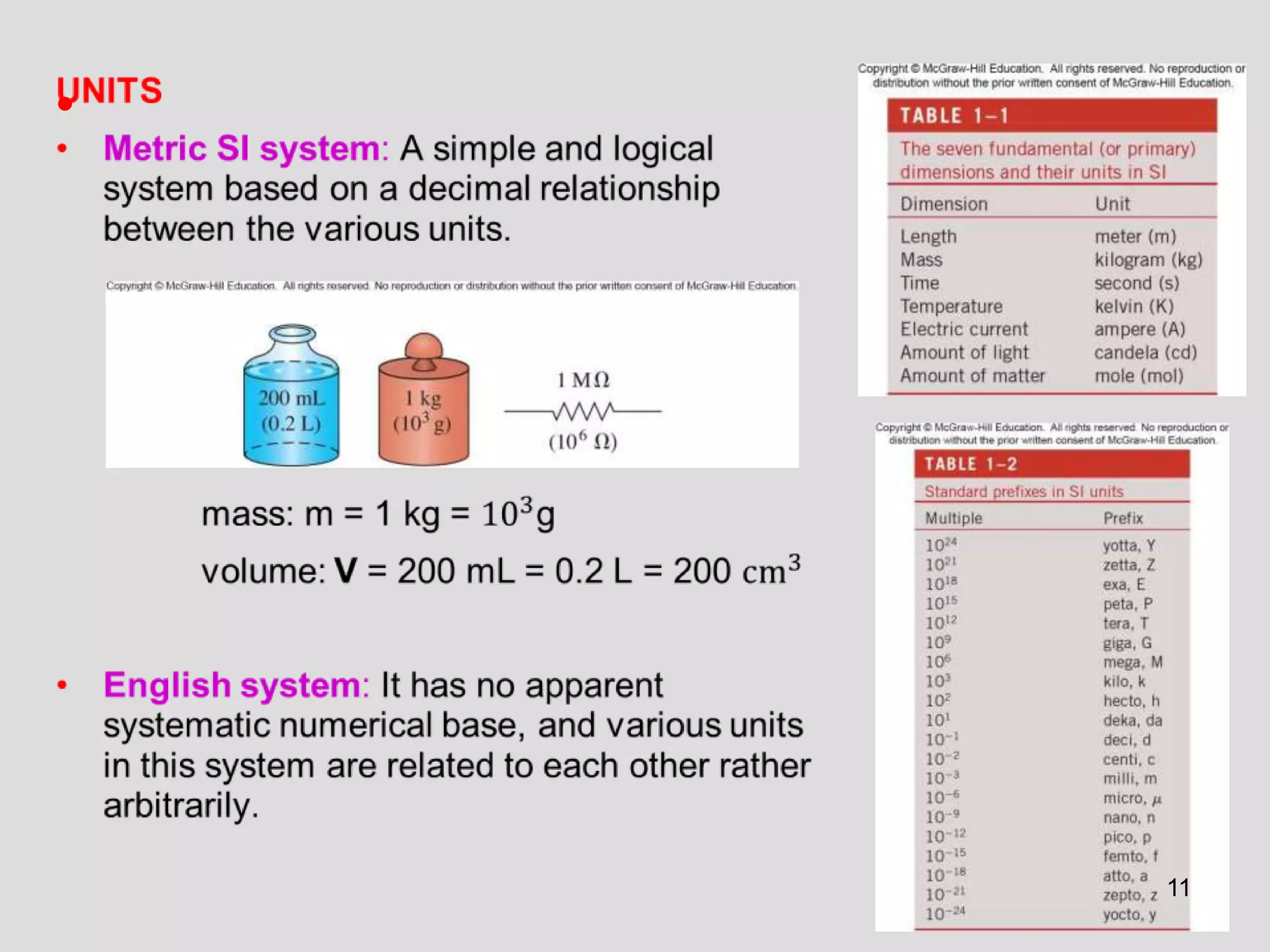
1-2 IMPORTANCE OF DIMENSIONS AND UNITS
10
• Any physical quantity can be characterized by dimensions.
• Primary or fundamental dimensions
Basic dimensions, such as
mass m,
length L,
time t,
temperature T
• secondary or derived dimensions
such as
velocity V,
energy E,
volume V
are expressed in terms of the primary dimensions.
• The magnitudes assigned to the dimensions are called units.
•
11
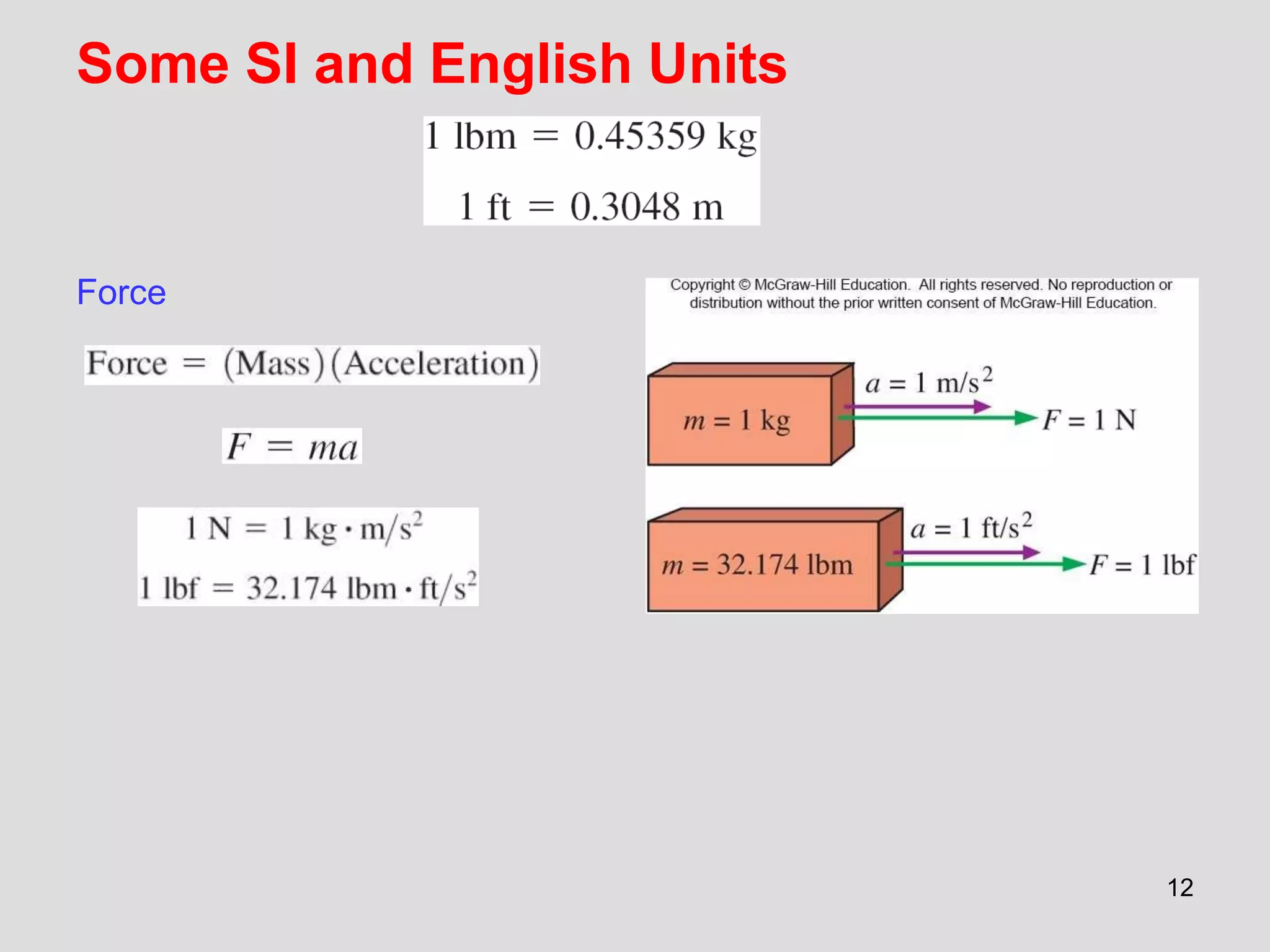
Some SI and English Units
Force
12
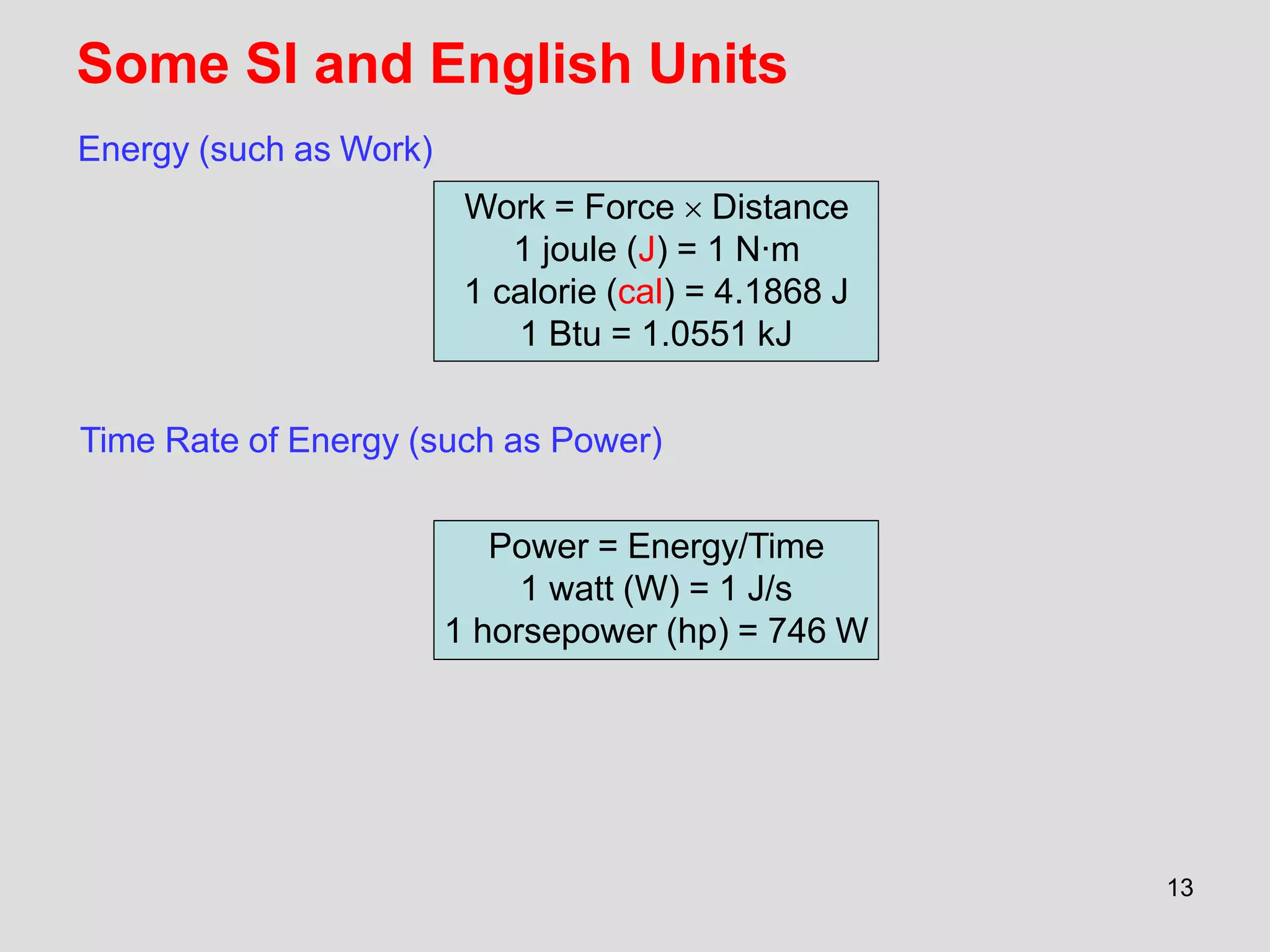
Some SI and English Units
13
Time Rate of Energy (such as Power)
Work = Force  Distance
1 joule (J) = 1 N∙m
1 calorie (cal) = 4.1868 J
1 Btu = 1.0551 kJ
Energy (such as Work)
Power = Energy/Time
1 watt (W) = 1 J/s
1 horsepower (hp) = 746 W
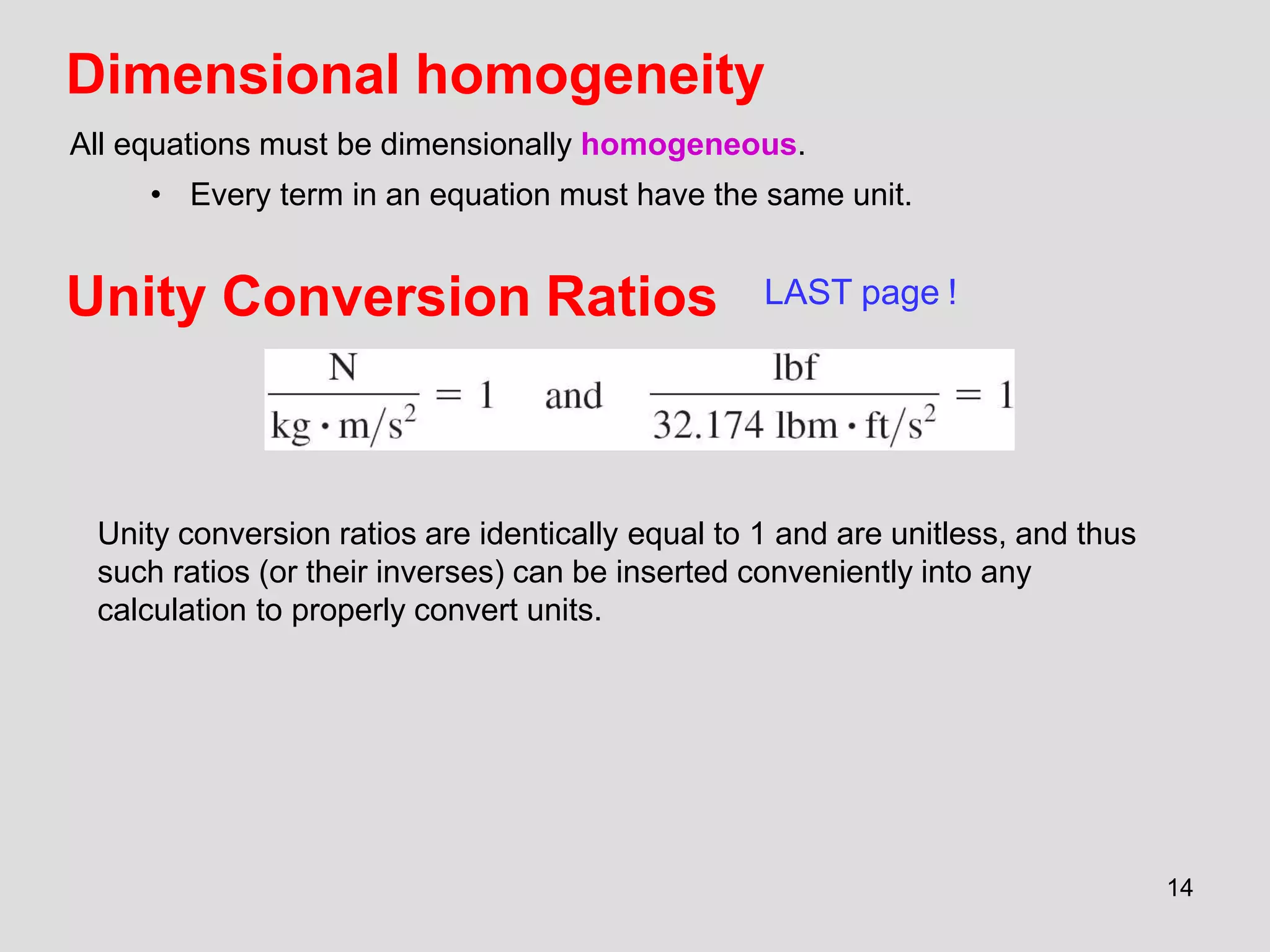
Unity Conversion Ratios
Unity conversion ratios are identically equal to 1 and are unitless, and thus
such ratios (or their inverses) can be inserted conveniently into any
calculation to properly convert units.
14
Dimensional homogeneity
All equations must be dimensionally homogeneous.
• Every term in an equation must have the same unit.
LAST page !
15
1-3 SYSTEMS AND CONTROL VOLUMES
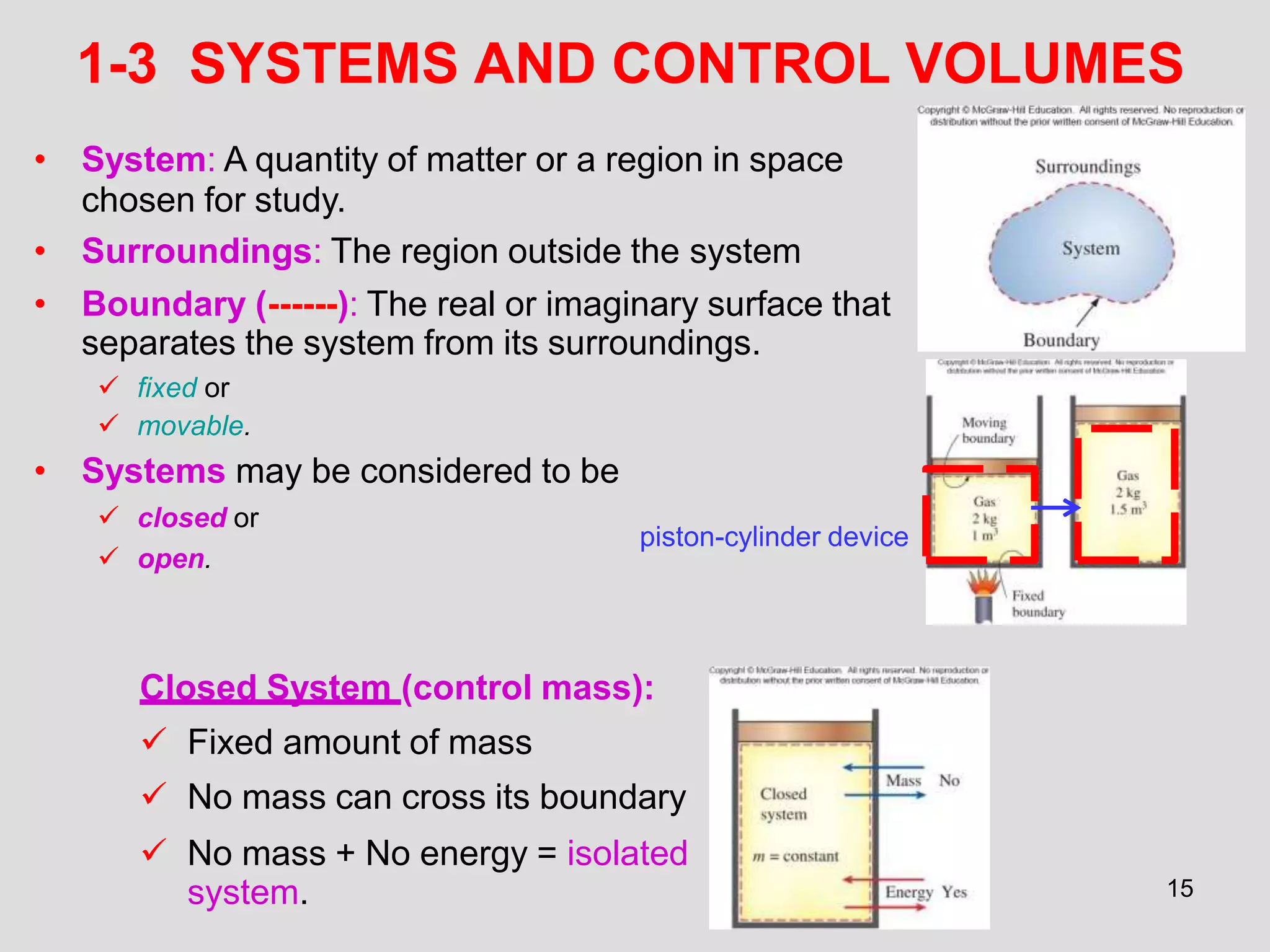
• System: A quantity of matter or a region in space
chosen for study.
• Surroundings: The region outside the system
• Boundary (------): The real or imaginary surface that
separates the system from its surroundings.
 fixed or
 movable.
• Systems may be considered to be
 closed or
 open.
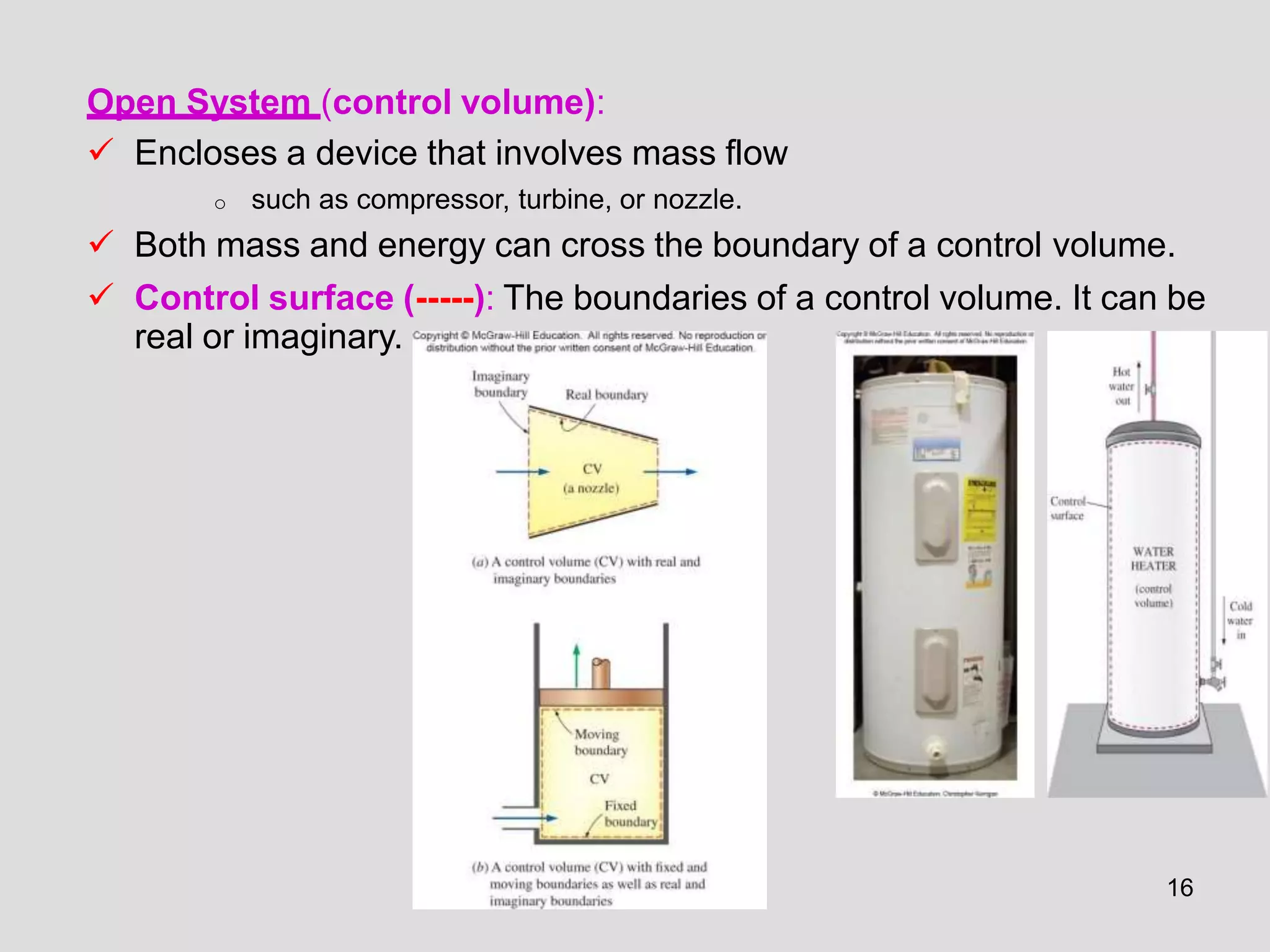
Closed System (control mass):
 Fixed amount of mass
 No mass can cross its boundary
 No mass + No energy = isolated
system.
piston-cylinder device
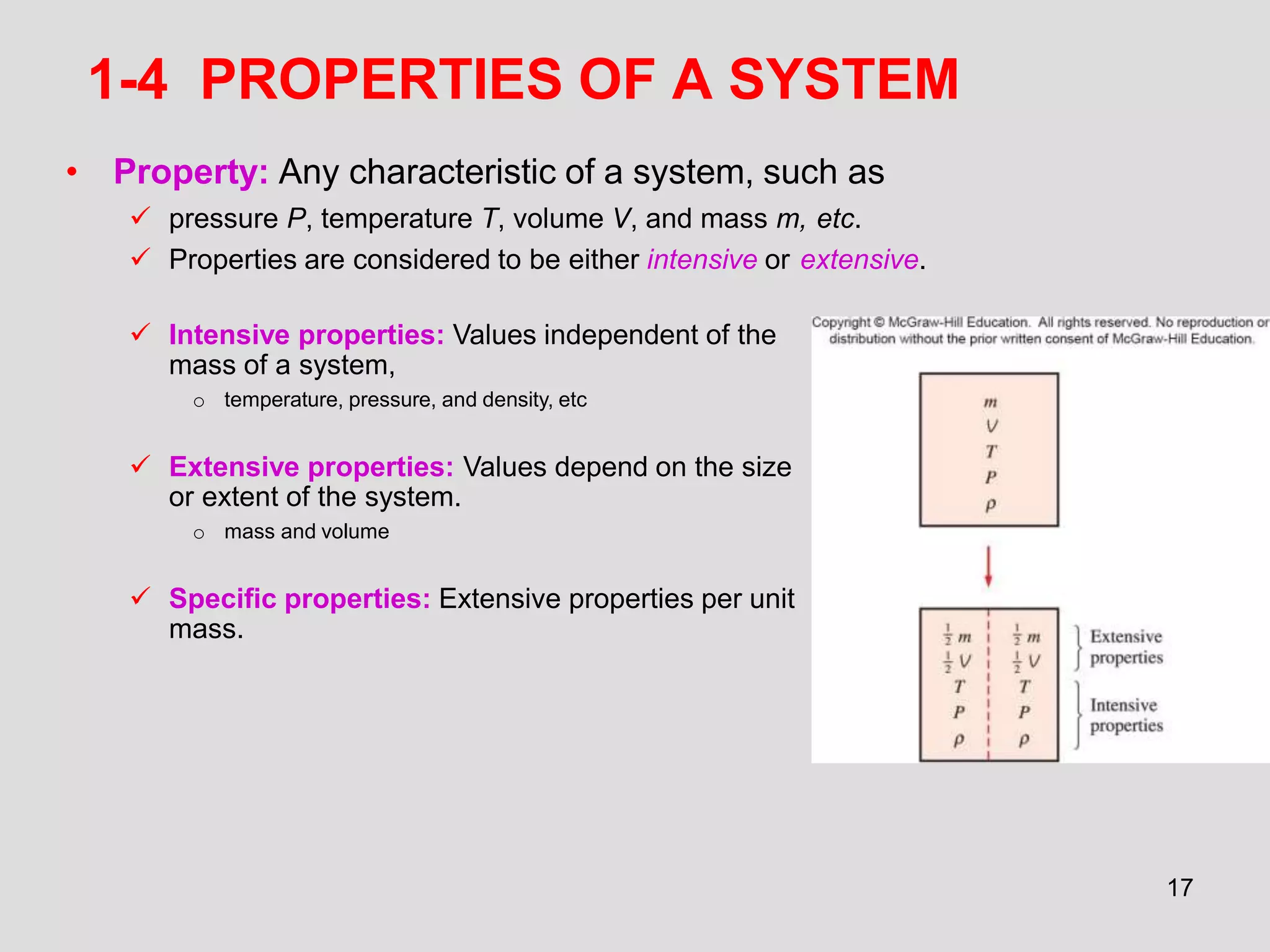
Open System (control volume):
 Encloses a device that involves mass flow
o such as compressor, turbine, or nozzle.
 Both mass and energy can cross the boundary of a control volume.
 Control surface (-----): The boundaries of a control volume. It can be
real or imaginary.
16
1-4 PROPERTIES OF A SYSTEM
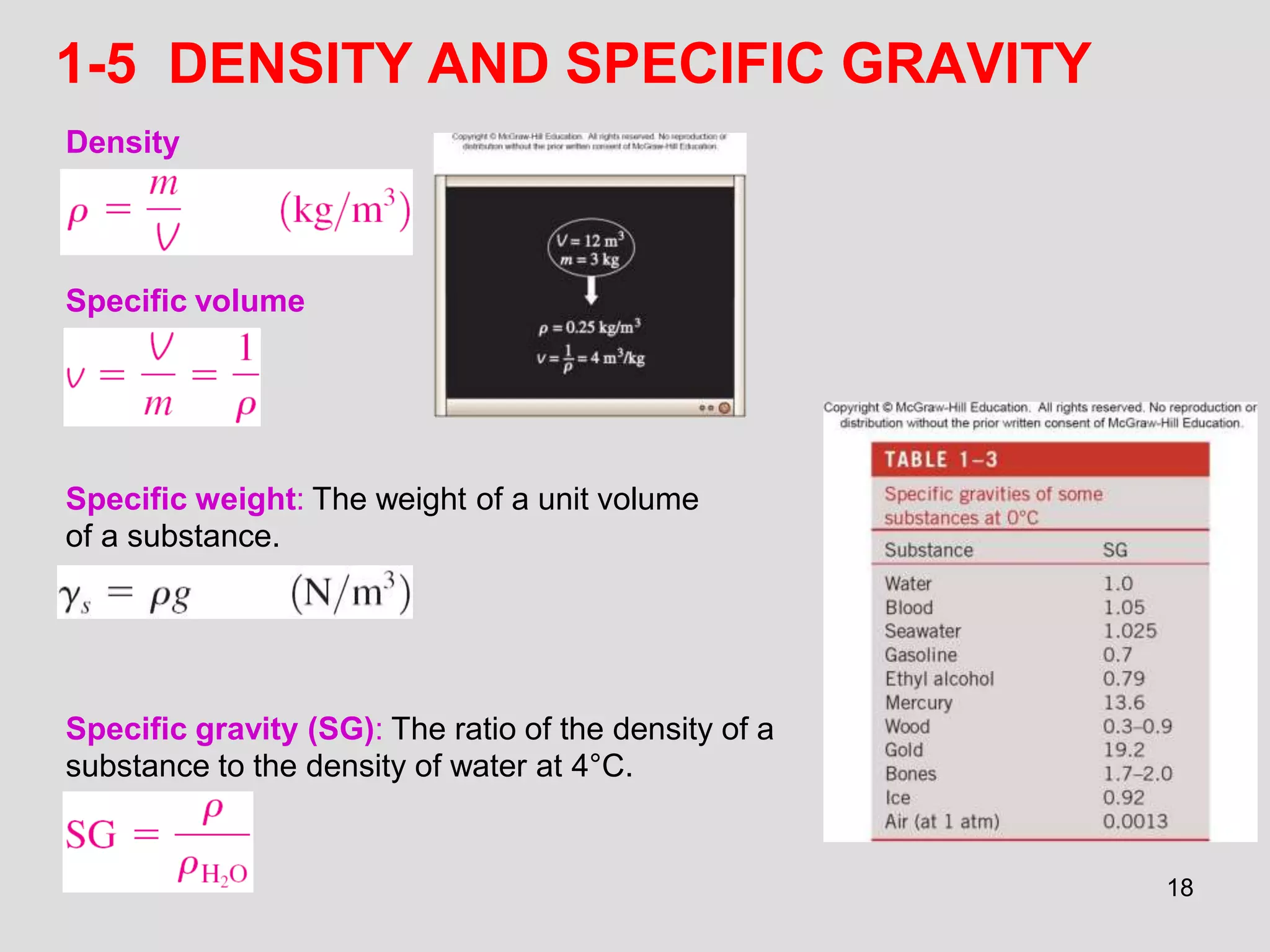
• Property: Any characteristic of a system, such as
 pressure P, temperature T, volume V, and mass m, etc.
 Properties are considered to be either intensive or extensive.
 Intensive properties: Values independent of the
mass of a system,
o temperature, pressure, and density, etc
 Extensive properties: Values depend on the size
or extent of the system.
o mass and volume
 Specific properties: Extensive properties per unit
mass.
17
1-5 DENSITY AND SPECIFIC GRAVITY
Specific gravity (SG): The ratio of the density of a
substance to the density of water at 4°C.
Density
Specific weight: The weight of a unit volume
of a substance.
Specific volume
18
1-6 STATE AND EQUILIBRIUM
• State: Condition of a system
 Thermodynamics deals with equilibrium states.
• Equilibrium: A state of balance with no unbalanced
potentials (or driving forces) within the system.
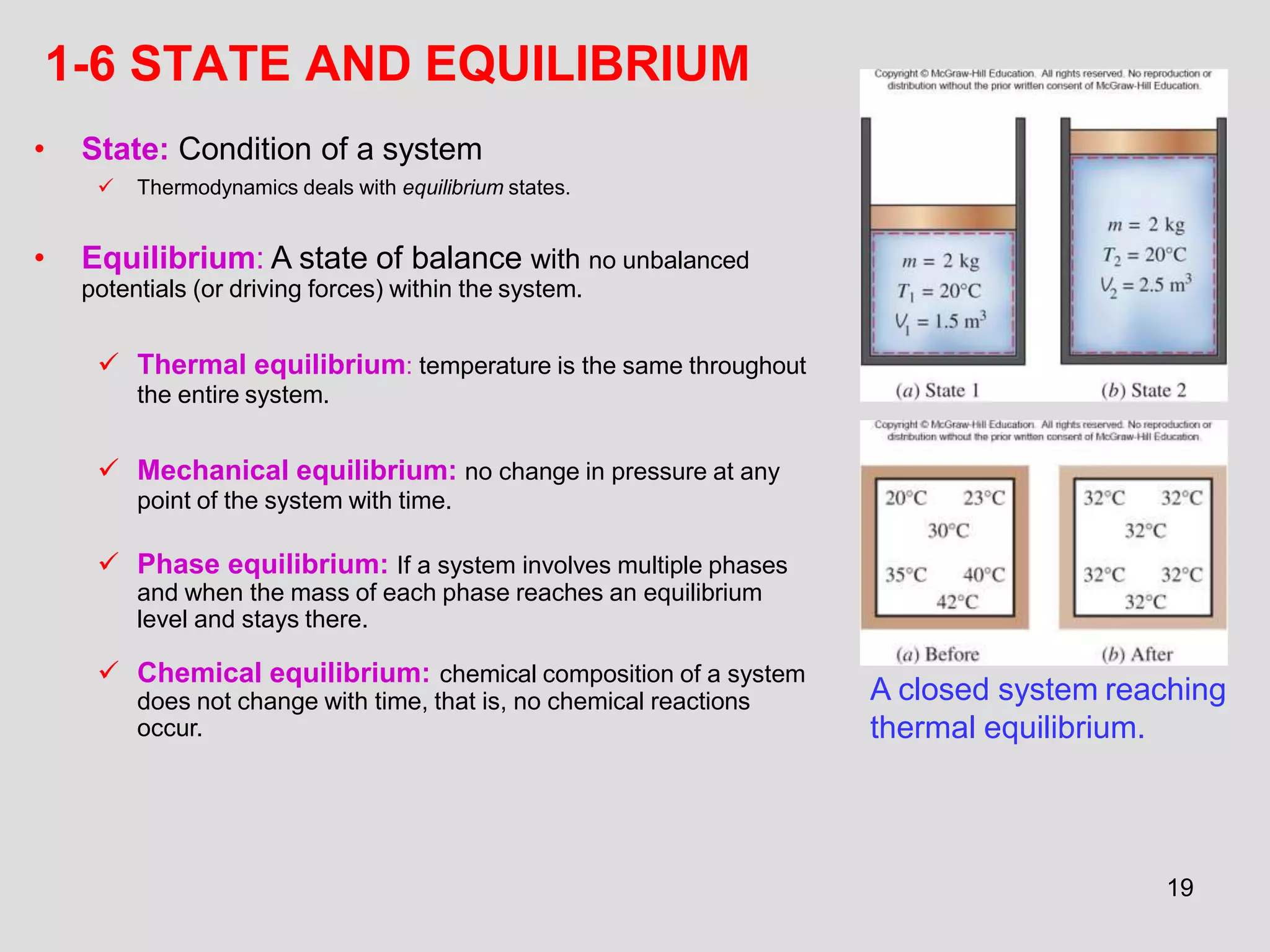
 Thermal equilibrium: temperature is the same throughout
the entire system.
 Mechanical equilibrium: no change in pressure at any
point of the system with time.
 Phase equilibrium: If a system involves multiple phases
and when the mass of each phase reaches an equilibrium
level and stays there.
 Chemical equilibrium: chemical composition of a system
does not change with time, that is, no chemical reactions
occur.
A closed system reaching
thermal equilibrium.
19
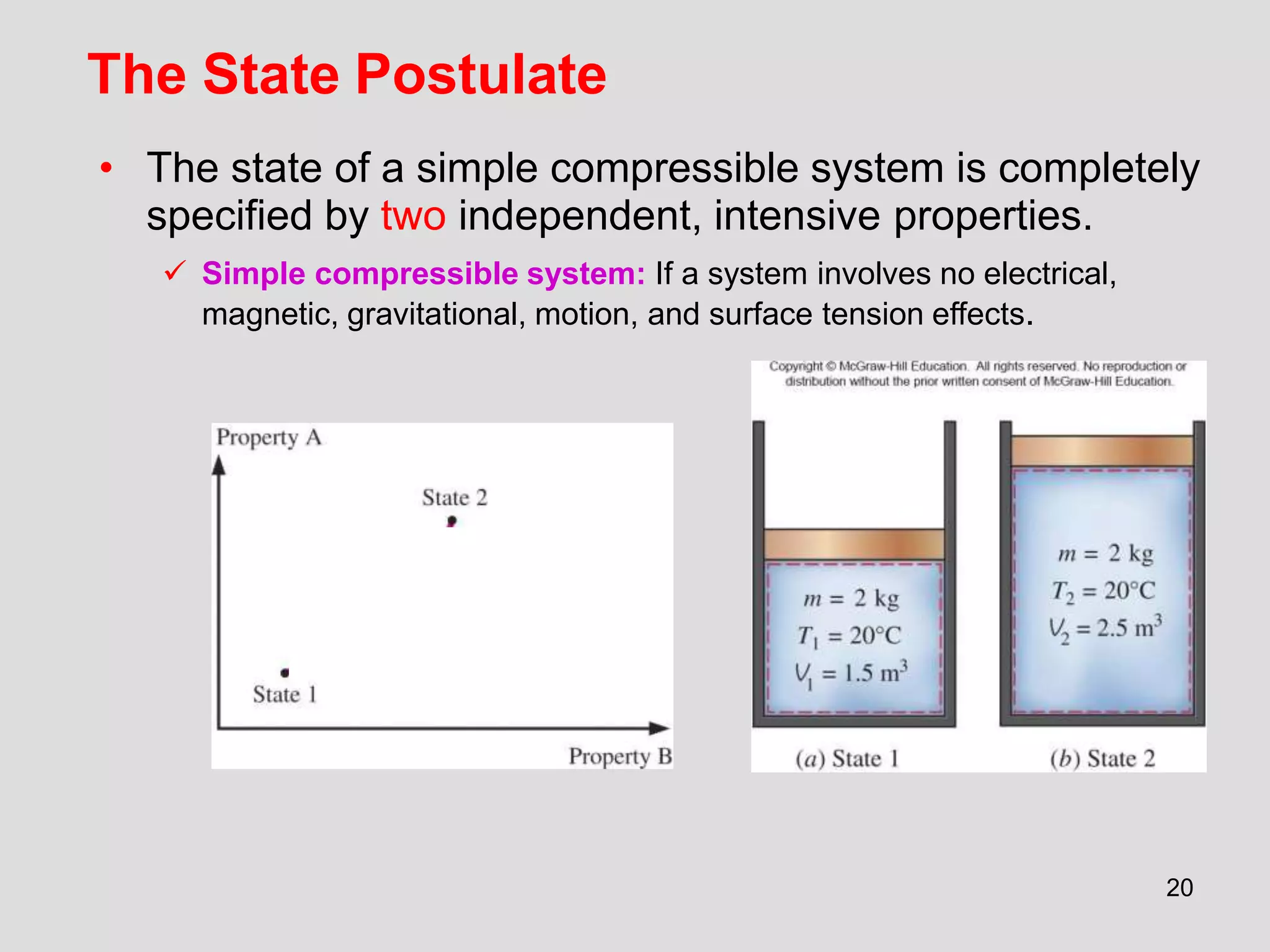
The State Postulate
• The state of a simple compressible system is completely
specified by two independent, intensive properties.
 Simple compressible system: If a system involves no electrical,
magnetic, gravitational, motion, and surface tension effects.
20
1-7 PROCESSES AND CYCLES
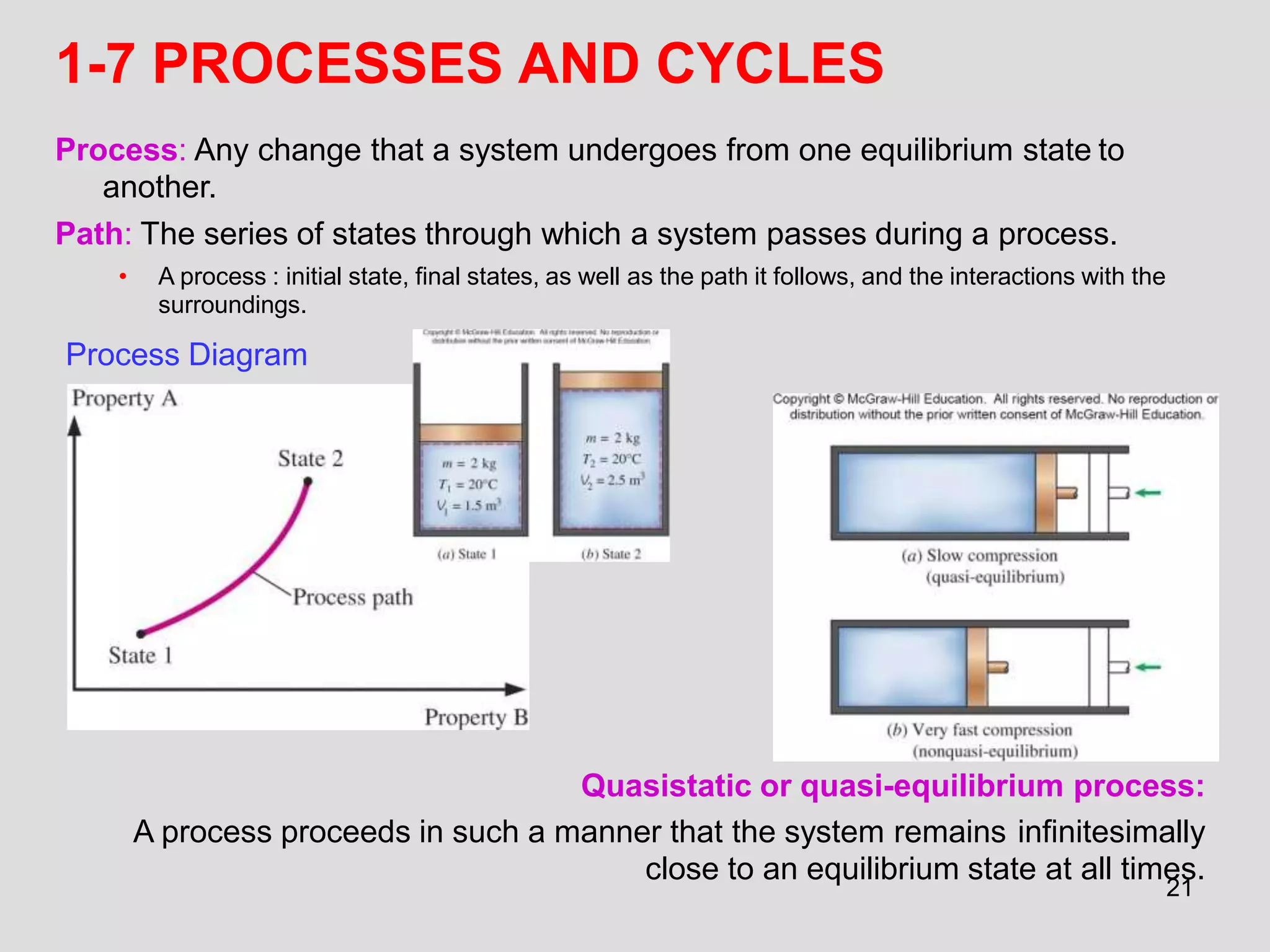
Quasistatic or quasi-equilibrium process:
A process proceeds in such a manner that the system remains infinitesimally
close to an equilibrium state at all times.
Process: Any change that a system undergoes from one equilibrium state to
another.
Path: The series of states through which a system passes during a process.
• A process : initial state, final states, as well as the path it follows, and the interactions with the
surroundings.
Process Diagram
21
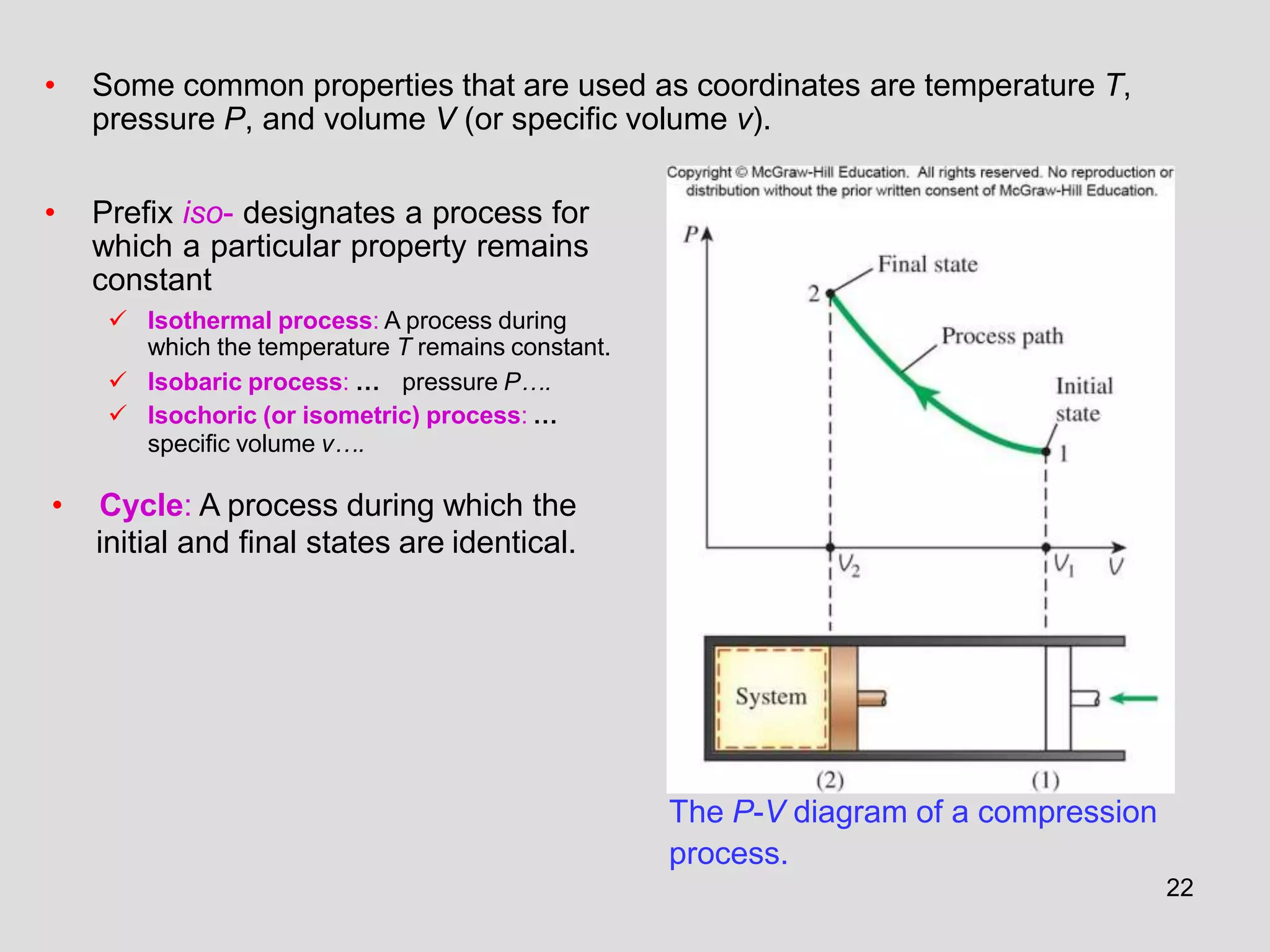
The P-V diagram of a compression
process.
• Some common properties that are used as coordinates are temperature T,
pressure P, and volume V (or specific volume v).
• Prefix iso- designates a process for
which a particular property remains
constant
 Isothermal process: A process during
which the temperature T remains constant.
 Isobaric process: … pressure P….
 Isochoric (or isometric) process: …
specific volume v….
• Cycle: A process during which the
initial and final states are identical.
22
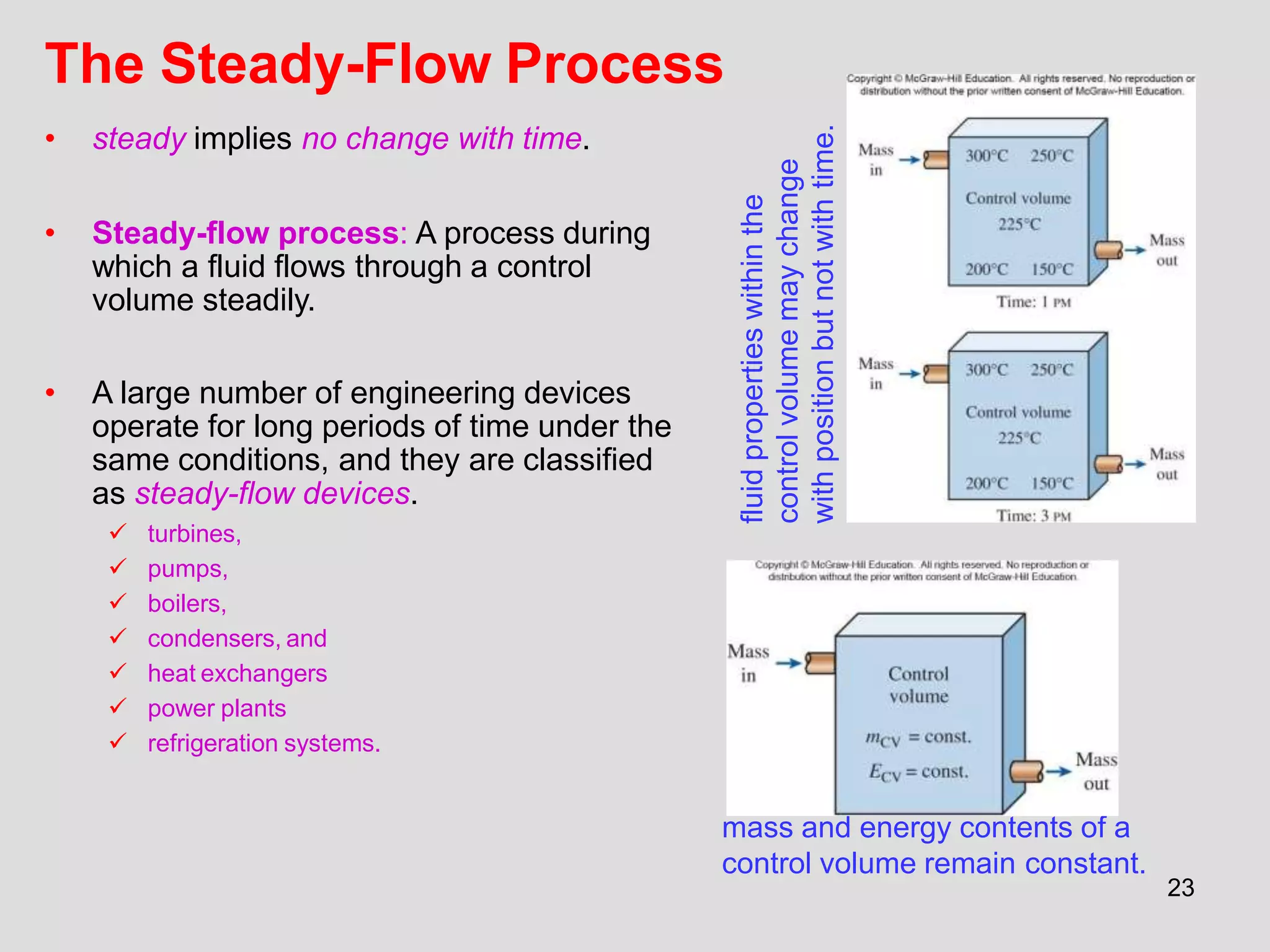
The Steady-Flow Process
fluid
properties
within
the
control
volume
may
change
with
position
but
not
with
time.
• steady implies no change with time.
• Steady-flow process: A process during
which a fluid flows through a control
volume steadily.
• A large number of engineering devices
operate for long periods of time under the
same conditions, and they are classified
as steady-flow devices.
 turbines,
 pumps,
 boilers,
 condensers, and
 heat exchangers
 power plants
 refrigeration systems.
mass and energy contents of a
control volume remain constant.
23
24
1-8 TEMPERATURE AND THE ZEROTH LAW
OF THERMODYNAMICS
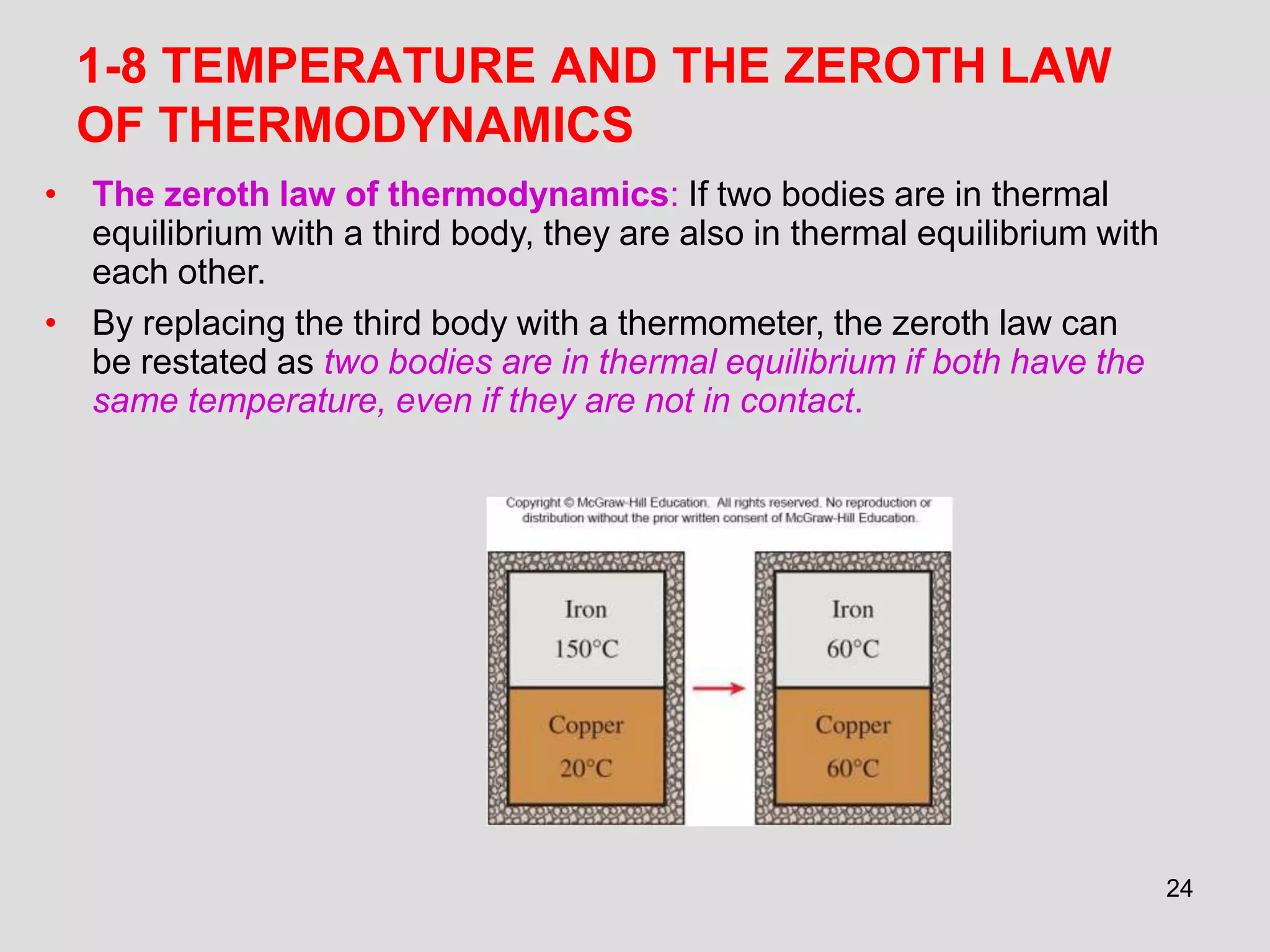
• The zeroth law of thermodynamics: If two bodies are in thermal
equilibrium with a third body, they are also in thermal equilibrium with
each other.
• By replacing the third body with a thermometer, the zeroth law can
be restated as two bodies are in thermal equilibrium if both have the
same temperature, even if they are not in contact.
25
Temperature Scales
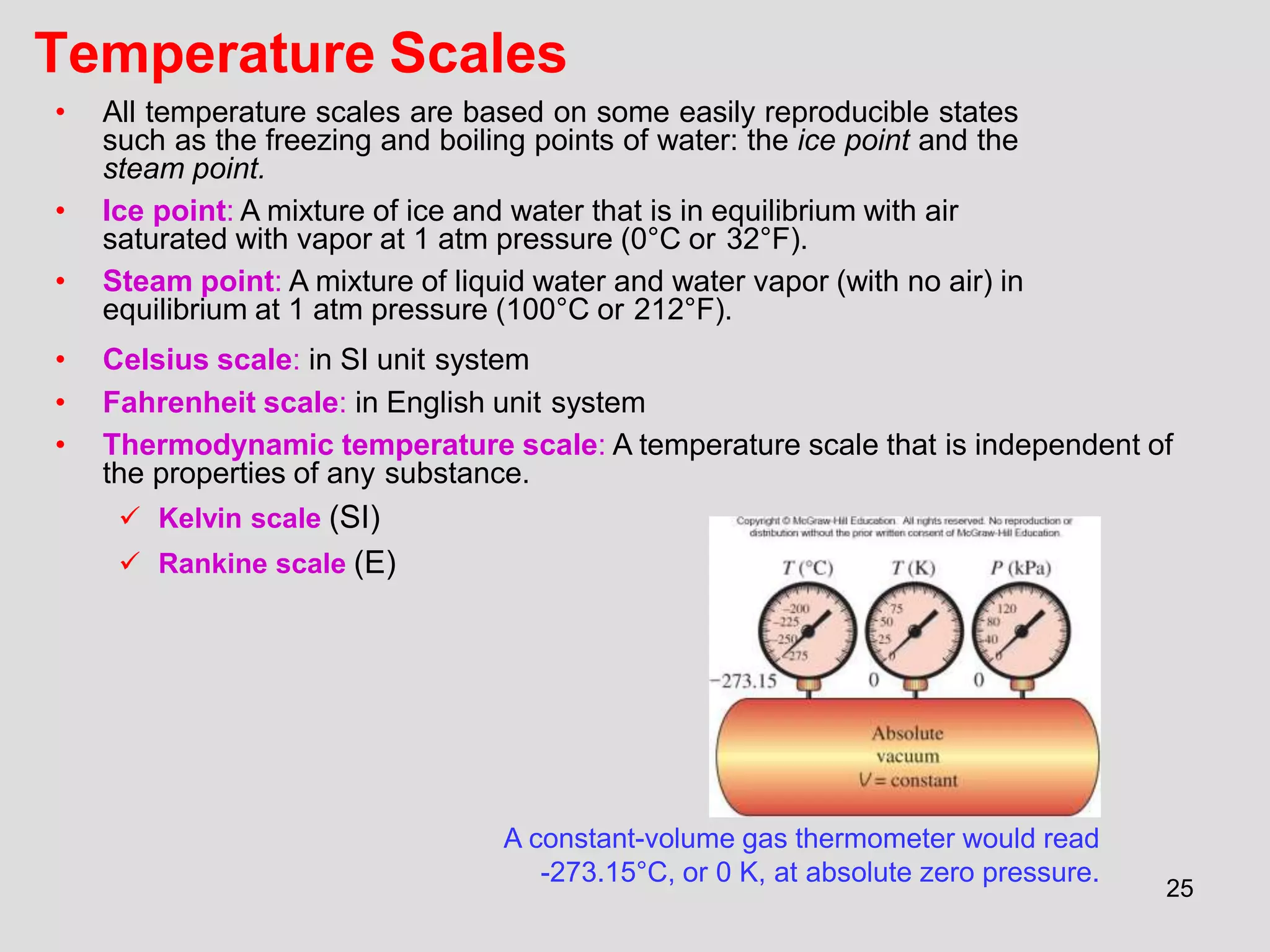
A constant-volume gas thermometer would read
-273.15°C, or 0 K, at absolute zero pressure.
• All temperature scales are based on some easily reproducible states
such as the freezing and boiling points of water: the ice point and the
steam point.
• Ice point: A mixture of ice and water that is in equilibrium with air
saturated with vapor at 1 atm pressure (0°C or 32°F).
• Steam point: A mixture of liquid water and water vapor (with no air) in
equilibrium at 1 atm pressure (100°C or 212°F).
• Celsius scale: in SI unit system
• Fahrenheit scale: in English unit system
• Thermodynamic temperature scale: A temperature scale that is independent of
the properties of any substance.
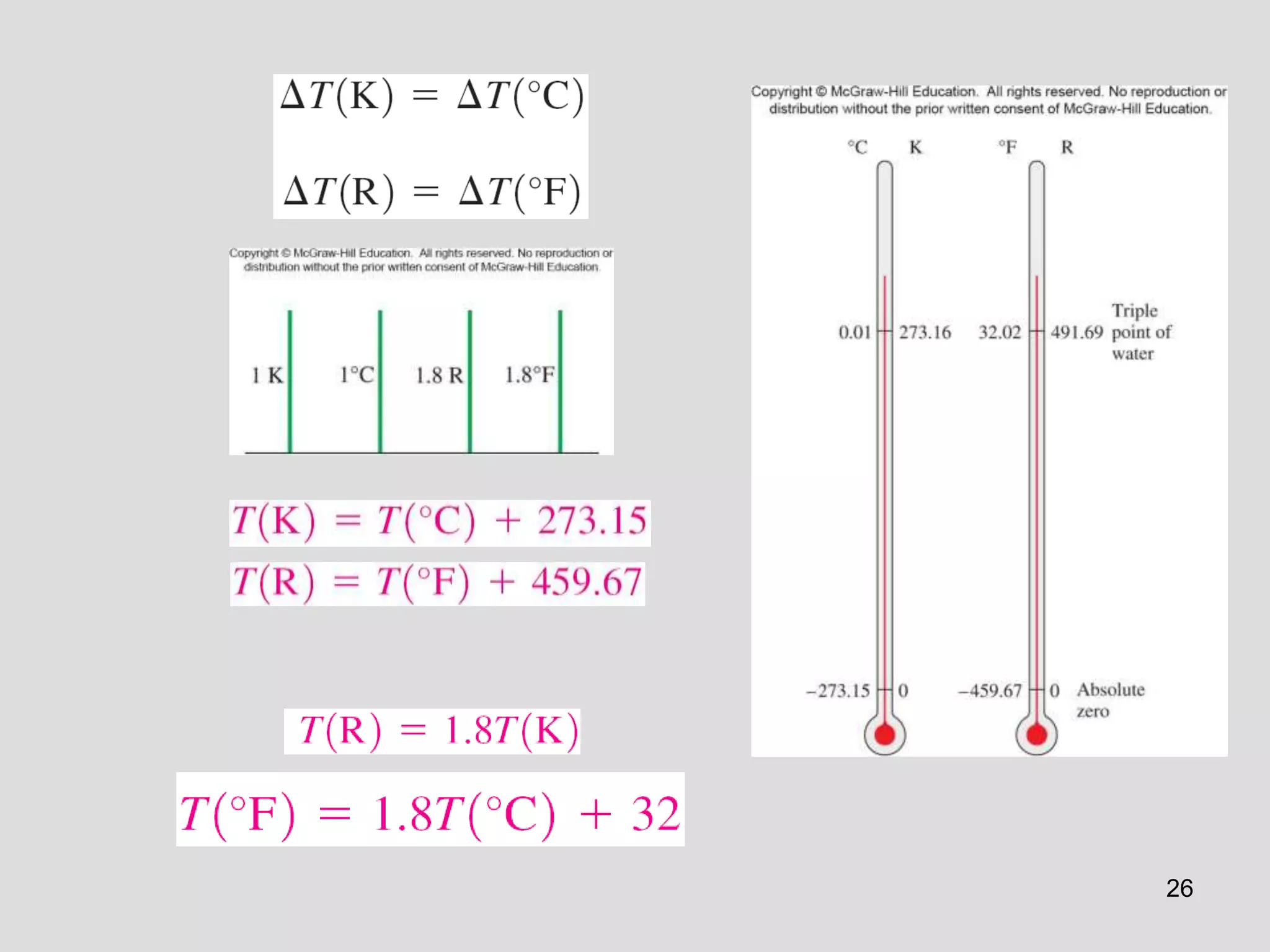
 Kelvin scale (SI)
 Rankine scale (E)
26
27
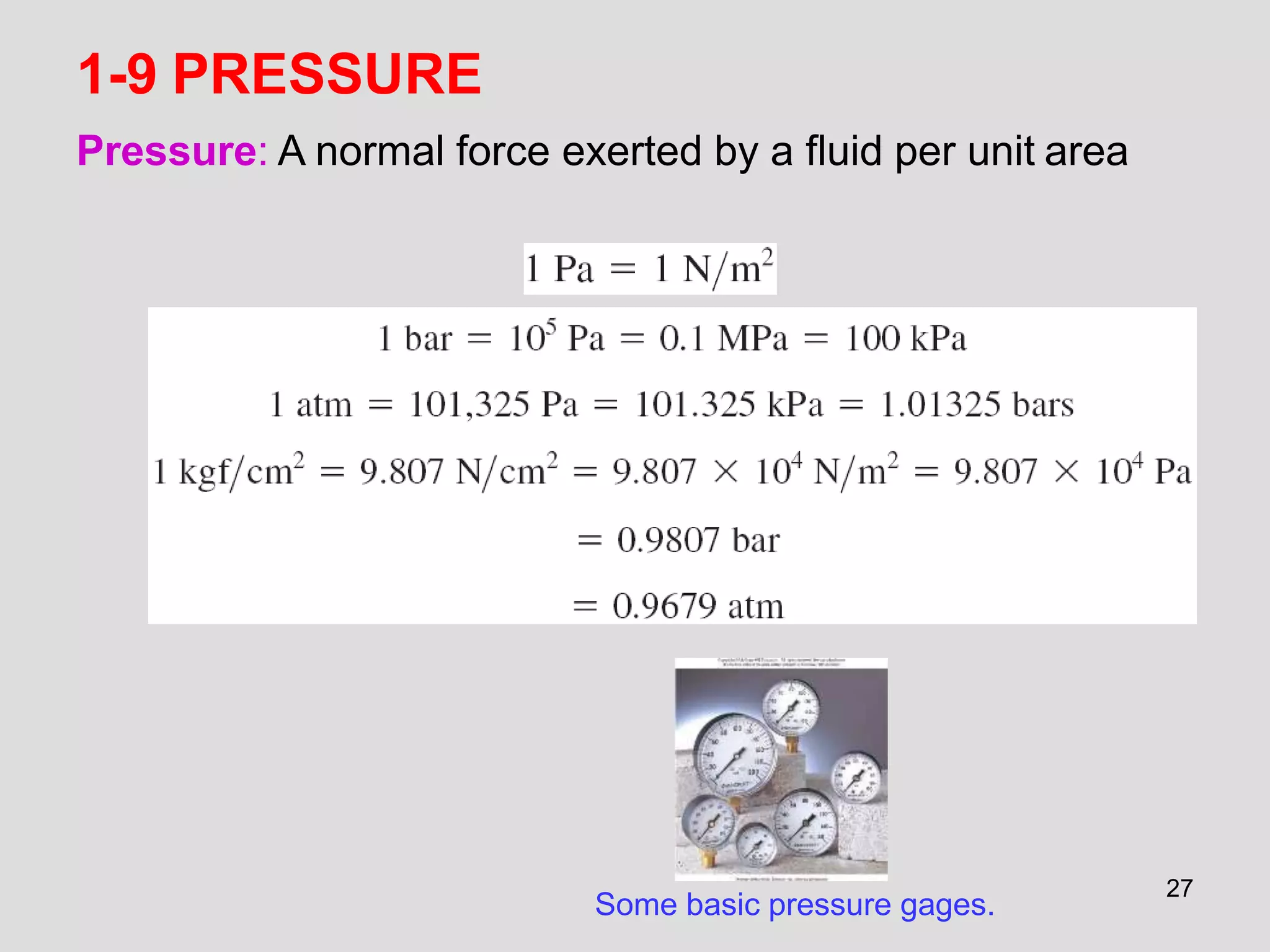
1-9 PRESSURE
Some basic pressure gages.
Pressure: A normal force exerted by a fluid per unit area
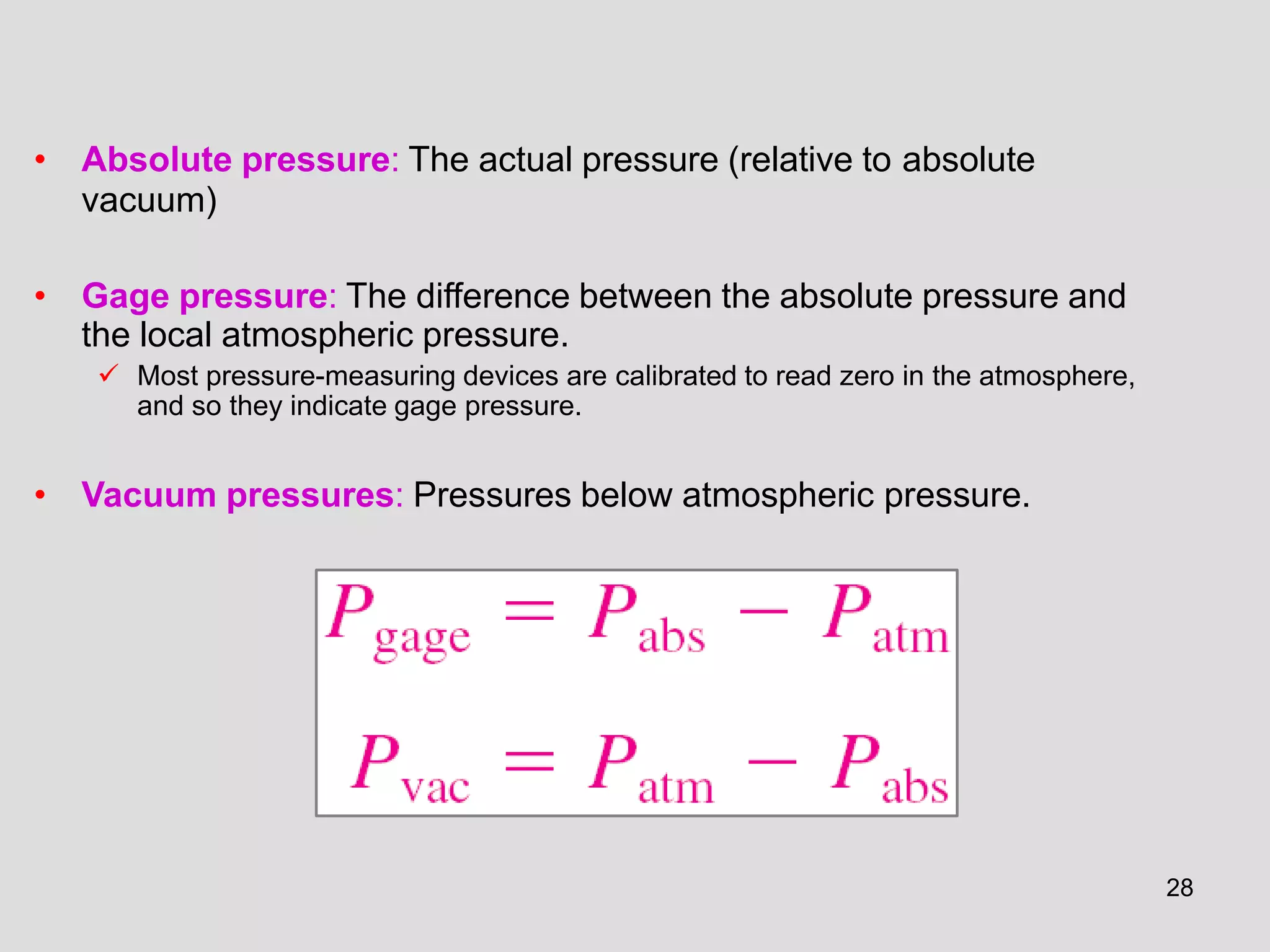
• Absolute pressure: The actual pressure (relative to absolute
vacuum)
• Gage pressure: The difference between the absolute pressure and
the local atmospheric pressure.
 Most pressure-measuring devices are calibrated to read zero in the atmosphere,
and so they indicate gage pressure.
• Vacuum pressures: Pressures below atmospheric pressure.
28
THE BAROMETER AND ATMOSPHERIC PRESSURE
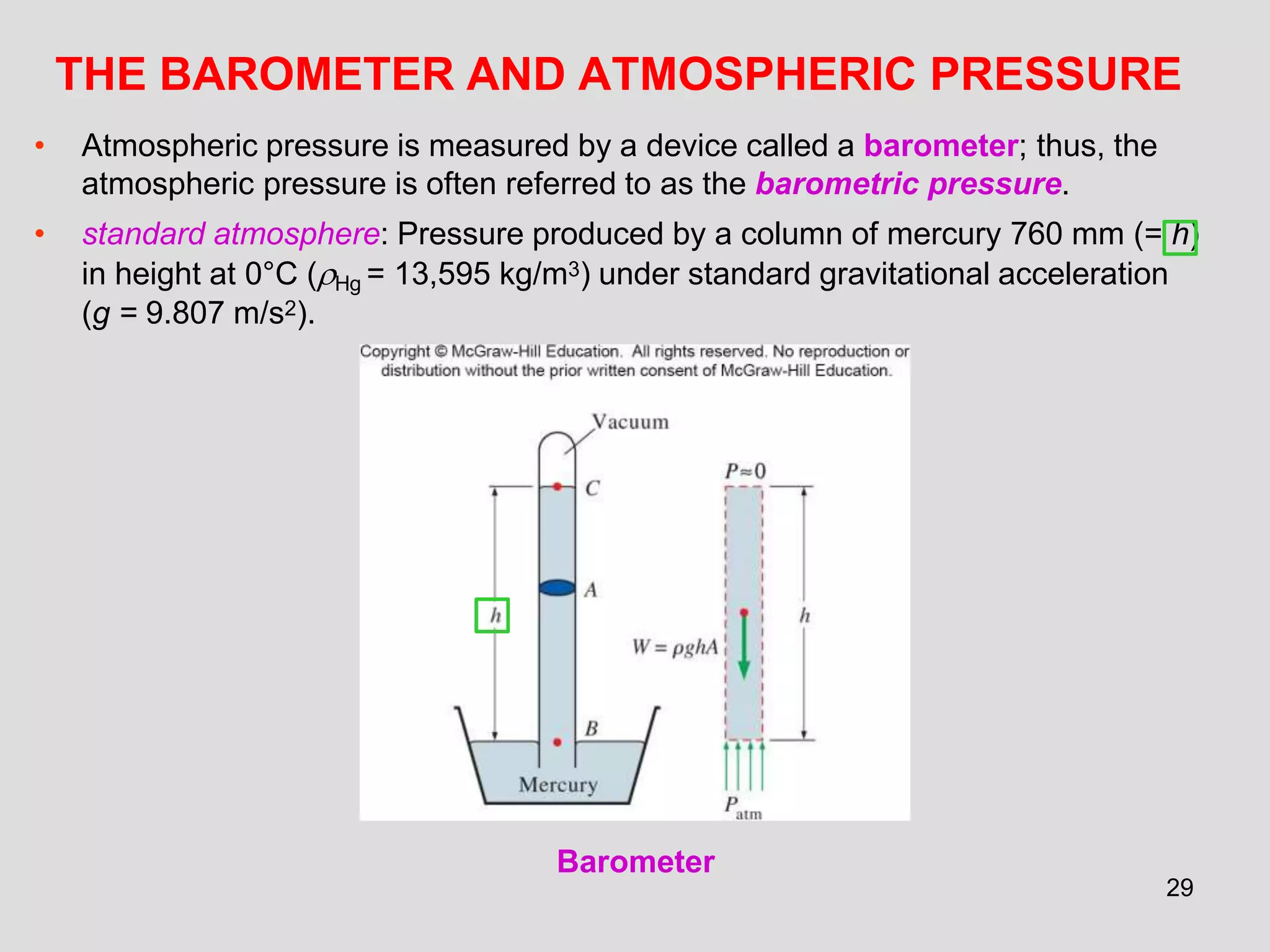
• Atmospheric pressure is measured by a device called a barometer; thus, the
atmospheric pressure is often referred to as the barometric pressure.
• standard atmosphere: Pressure produced by a column of mercury 760 mm (= h)
in height at 0°C (Hg = 13,595 kg/m3) under standard gravitational acceleration
(g = 9.807 m/s2).
Barometer
29
PROBLEM-SOLVING TECHNIQUE
30
• Step 1: Problem Statement
• Step 2: Schematic
• Step 3: Assumptions and Approximations
• Step 4: Physical Laws
• Step 5: Properties
• Step 6: Calculations
• Step 7: Reasoning, Verification, and Discussion

Wp me2320 2016-chapter-1_lecture-wwl-converted

  • 1.
    ME2320 Thermodynamics I SummerI 2016 Instructor: Dr. William W. Liou
  • 2.
  • 3.
  • 4.
    How to get,and stay, ahead in this class?  Preview  Book to Class  Review  Homework Will it work if I “Preview”, but not “Book to Class” ? Well, yes, maybe, but…
  • 5.
  • 6.
    Objectives 6 • Identify theunique thermodynamics vocabulary. • Review the metric SI and the English unit systems. • Explain the basic concepts of thermodynamics such as system, state, state postulate, equilibrium, process, and cycle. • Review temperature, temperature scales, pressure, and absolute and gage pressure. • Introduce an intuitive systematic problem-solving technique and the format of homework solution.
  • 7.
    Application Areas ofThermodynamics 7
  • 8.
    1-1 THERMODYNAMICS ANDENERGY • Thermodynamics: The science of energy. • Energy: The ability to cause changes. • thermodynamics stems from therme (heat) and dynamis (power). • Conservation of energy principle: During an interaction, energy can change from one form to another (transform) but the total amount of energy remains constant.  Energy cannot be created or destroyed. • The first law of thermodynamics: An expression of the conservation of energy principle.  The first law asserts that energy is a thermodynamic property. Energy cannot be created or destroyed; it can only change forms (the first law). 8
  • 9.
    • The secondlaw of thermodynamics:  It asserts that energy has quantity as well as quality.  Actual processes occur in the direction of decreasing quality of energy. Heat flows in the direction of decreasing temperature. • Classical thermodynamics: A macroscopic approach to the study of thermodynamics that does not require a knowledge of the behavior of individual particles (continuum). - EASY • Statistical thermodynamics: A microscopic approach, based on the average behavior of large groups of individual particles. – NOT EASY! 9
  • 10.
    1-2 IMPORTANCE OFDIMENSIONS AND UNITS 10 • Any physical quantity can be characterized by dimensions. • Primary or fundamental dimensions Basic dimensions, such as mass m, length L, time t, temperature T • secondary or derived dimensions such as velocity V, energy E, volume V are expressed in terms of the primary dimensions. • The magnitudes assigned to the dimensions are called units.
  • 11.
  • 12.
    Some SI andEnglish Units Force 12
  • 13.
    Some SI andEnglish Units 13 Time Rate of Energy (such as Power) Work = Force  Distance 1 joule (J) = 1 N∙m 1 calorie (cal) = 4.1868 J 1 Btu = 1.0551 kJ Energy (such as Work) Power = Energy/Time 1 watt (W) = 1 J/s 1 horsepower (hp) = 746 W
  • 14.
    Unity Conversion Ratios Unityconversion ratios are identically equal to 1 and are unitless, and thus such ratios (or their inverses) can be inserted conveniently into any calculation to properly convert units. 14 Dimensional homogeneity All equations must be dimensionally homogeneous. • Every term in an equation must have the same unit. LAST page !
  • 15.
    15 1-3 SYSTEMS ANDCONTROL VOLUMES • System: A quantity of matter or a region in space chosen for study. • Surroundings: The region outside the system • Boundary (------): The real or imaginary surface that separates the system from its surroundings.  fixed or  movable. • Systems may be considered to be  closed or  open. Closed System (control mass):  Fixed amount of mass  No mass can cross its boundary  No mass + No energy = isolated system. piston-cylinder device
  • 16.
    Open System (controlvolume):  Encloses a device that involves mass flow o such as compressor, turbine, or nozzle.  Both mass and energy can cross the boundary of a control volume.  Control surface (-----): The boundaries of a control volume. It can be real or imaginary. 16
  • 17.
    1-4 PROPERTIES OFA SYSTEM • Property: Any characteristic of a system, such as  pressure P, temperature T, volume V, and mass m, etc.  Properties are considered to be either intensive or extensive.  Intensive properties: Values independent of the mass of a system, o temperature, pressure, and density, etc  Extensive properties: Values depend on the size or extent of the system. o mass and volume  Specific properties: Extensive properties per unit mass. 17
  • 18.
    1-5 DENSITY ANDSPECIFIC GRAVITY Specific gravity (SG): The ratio of the density of a substance to the density of water at 4°C. Density Specific weight: The weight of a unit volume of a substance. Specific volume 18
  • 19.
    1-6 STATE ANDEQUILIBRIUM • State: Condition of a system  Thermodynamics deals with equilibrium states. • Equilibrium: A state of balance with no unbalanced potentials (or driving forces) within the system.  Thermal equilibrium: temperature is the same throughout the entire system.  Mechanical equilibrium: no change in pressure at any point of the system with time.  Phase equilibrium: If a system involves multiple phases and when the mass of each phase reaches an equilibrium level and stays there.  Chemical equilibrium: chemical composition of a system does not change with time, that is, no chemical reactions occur. A closed system reaching thermal equilibrium. 19
  • 20.
    The State Postulate •The state of a simple compressible system is completely specified by two independent, intensive properties.  Simple compressible system: If a system involves no electrical, magnetic, gravitational, motion, and surface tension effects. 20
  • 21.
    1-7 PROCESSES ANDCYCLES Quasistatic or quasi-equilibrium process: A process proceeds in such a manner that the system remains infinitesimally close to an equilibrium state at all times. Process: Any change that a system undergoes from one equilibrium state to another. Path: The series of states through which a system passes during a process. • A process : initial state, final states, as well as the path it follows, and the interactions with the surroundings. Process Diagram 21
  • 22.
    The P-V diagramof a compression process. • Some common properties that are used as coordinates are temperature T, pressure P, and volume V (or specific volume v). • Prefix iso- designates a process for which a particular property remains constant  Isothermal process: A process during which the temperature T remains constant.  Isobaric process: … pressure P….  Isochoric (or isometric) process: … specific volume v…. • Cycle: A process during which the initial and final states are identical. 22
  • 23.
    The Steady-Flow Process fluid properties within the control volume may change with position but not with time. •steady implies no change with time. • Steady-flow process: A process during which a fluid flows through a control volume steadily. • A large number of engineering devices operate for long periods of time under the same conditions, and they are classified as steady-flow devices.  turbines,  pumps,  boilers,  condensers, and  heat exchangers  power plants  refrigeration systems. mass and energy contents of a control volume remain constant. 23
  • 24.
    24 1-8 TEMPERATURE ANDTHE ZEROTH LAW OF THERMODYNAMICS • The zeroth law of thermodynamics: If two bodies are in thermal equilibrium with a third body, they are also in thermal equilibrium with each other. • By replacing the third body with a thermometer, the zeroth law can be restated as two bodies are in thermal equilibrium if both have the same temperature, even if they are not in contact.
  • 25.
    25 Temperature Scales A constant-volumegas thermometer would read -273.15°C, or 0 K, at absolute zero pressure. • All temperature scales are based on some easily reproducible states such as the freezing and boiling points of water: the ice point and the steam point. • Ice point: A mixture of ice and water that is in equilibrium with air saturated with vapor at 1 atm pressure (0°C or 32°F). • Steam point: A mixture of liquid water and water vapor (with no air) in equilibrium at 1 atm pressure (100°C or 212°F). • Celsius scale: in SI unit system • Fahrenheit scale: in English unit system • Thermodynamic temperature scale: A temperature scale that is independent of the properties of any substance.  Kelvin scale (SI)  Rankine scale (E)
  • 26.
  • 27.
    27 1-9 PRESSURE Some basicpressure gages. Pressure: A normal force exerted by a fluid per unit area
  • 28.
    • Absolute pressure:The actual pressure (relative to absolute vacuum) • Gage pressure: The difference between the absolute pressure and the local atmospheric pressure.  Most pressure-measuring devices are calibrated to read zero in the atmosphere, and so they indicate gage pressure. • Vacuum pressures: Pressures below atmospheric pressure. 28
  • 29.
    THE BAROMETER ANDATMOSPHERIC PRESSURE • Atmospheric pressure is measured by a device called a barometer; thus, the atmospheric pressure is often referred to as the barometric pressure. • standard atmosphere: Pressure produced by a column of mercury 760 mm (= h) in height at 0°C (Hg = 13,595 kg/m3) under standard gravitational acceleration (g = 9.807 m/s2). Barometer 29
  • 30.
    PROBLEM-SOLVING TECHNIQUE 30 • Step1: Problem Statement • Step 2: Schematic • Step 3: Assumptions and Approximations • Step 4: Physical Laws • Step 5: Properties • Step 6: Calculations • Step 7: Reasoning, Verification, and Discussion