Mediclaim Policy
consumer behaviour
•Saravanan
•Saurabh Tripathi
•Shankh Saxena
•Srikumar
•Surajkumar
Introduction
&
Objectives
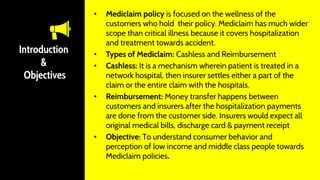
• Mediclaim policy is focused on the wellness of the
customers who hold their policy. Mediclaim has much wider
scope than critical illness because it covers hospitalization
and treatment towards accident.
• Types of Mediclaim: Cashless and Reimbursement
• Cashless: It is a mechanism wherein patient is treated in a
network hospital, then insurer settles either a part of the
claim or the entire claim with the hospitals.
• Reimbursement: Money transfer happens between
customers and insurers after the hospitalization payments
are done from the customer side. Insurers would expect all
original medical bills, discharge card & payment receipt
• Objective: To understand consumer behavior and
perception of low income and middle class people towards
Mediclaim policies.
Variables
Research
Methodology
Sample Size
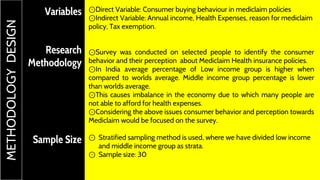
⊙Direct Variable: Consumer buying behaviour in mediclaim policies
⊙Indirect Variable: Annual income, Health Expenses, reason for mediclaim
policy, Tax exemption.
⊙Survey was conducted on selected people to identify the consumer
behavior and their perception about Mediclaim Health insurance policies.
⊙In India average percentage of Low income group is higher when
compared to worlds average. Middle income group percentage is lower
than worlds average.
⊙This causes imbalance in the economy due to which many people are
not able to afford for health expenses.
⊙Considering the above issues consumer behavior and perception towards
Mediclaim would be focused on the survey.
⊙ Stratified sampling method is used, where we have divided low income
and middle income group as strata.
⊙ Sample size: 30
METHODOLOGYDESIGN
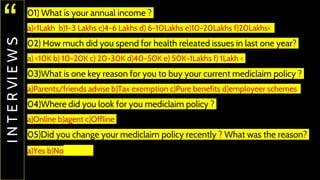
01) What is your annual income ?
a)<1Lakh b)1-3 Lakhs c)4-6 Lakhs d) 6-10Lakhs e)10-20Lakhs f)20Lakhs<
02) How much did you spend for health releated issues in last one year?
a) <10K b) 10-20K c) 20-30K d)40-50K e) 50K-1Lakhs f) 1Lakh <
03)What is one key reason for you to buy your current mediclaim policy ?
a)Parents/friends advise b)Tax exemption c)Pure benefits d)employeer schemes
04)Where did you look for you mediclaim policy ?
a)Online b)agent c)Offline
05)Did you change your mediclaim policy recently ? What was the reason?
a)Yes b)No
“INTERVIEWS
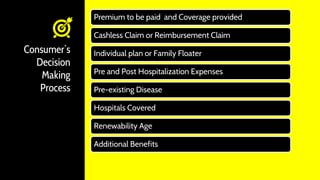
Consumer’s
Decision
Making
Process
Premium to be paid and Coverage provided
Cashless Claim or Reimbursement Claim
Individual plan or Family Floater
Pre and Post Hospitalization Expenses
Pre-existing Disease
Hospitals Covered
Renewability Age
Additional Benefits
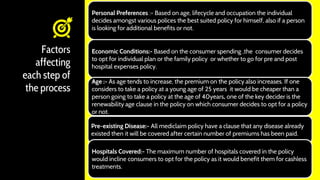
Factors
affecting
each step of
the process
Personal Preferences :- Based on age, lifecycle and occupation the individual
decides amongst various polices the best suited policy for himself, also if a person
is looking for additional benefits or not.
Economic Conditions:- Based on the consumer spending ,the consumer decides
to opt for individual plan or the family policy or whether to go for pre and post
hospital expenses policy.
Age :- As age tends to increase, the premium on the policy also increases. If one
considers to take a policy at a young age of 25 years it would be cheaper than a
person going to take a policy at the age of 40years, one of the key decider is the
renewability age clause in the policy on which consumer decides to opt for a policy
or not.
Pre-existing Disease:- All mediclaim policy have a clause that any disease already
existed then it will be covered after certain number of premiums has been paid.
Hospitals Covered:- The maximum number of hospitals covered in the policy
would incline consumers to opt for the policy as it would benefit them for cashless
treatments.
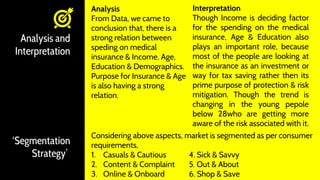
Analysis and
Interpretation
‘Segmentation
Strategy’
Analysis
From Data, we came to
conclusion that, there is a
strong relation between
speding on medical
insurance & Income, Age,
Education & Demographics.
Purpose for Insurance & Age
is also having a strong
relation.
Interpretation
Though Income is deciding factor
for the spending on the medical
insurance, Age & Education also
plays an important role, because
most of the people are looking at
the insurance as an investment or
way for tax saving rather then its
prime purpose of protection & risk
mitigation. Though the trend is
changing in the young pepole
below 28who are getting more
aware of the risk associated with it.
Considering above aspects, market is segmented as per consumer
requirements,
1. Casuals & Cautious 4. Sick & Savvy
2. Content & Complaint 5. Out & About
3. Online & Onboard 6. Shop & Save
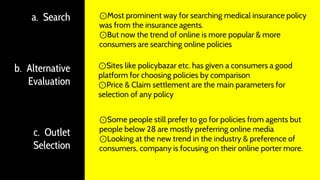
a. Search
b. Alternative
Evaluation
c. Outlet
Selection
⊙Most prominent way for searching medical insurance policy
was from the insurance agents.
⊙But now the trend of online is more popular & more
consumers are searching online policies
⊙Sites like policybazar etc. has given a consumers a good
platform for choosing policies by comparison
⊙Price & Claim settlement are the main parameters for
selection of any policy
⊙Some people still prefer to go for policies from agents but
people below 28 are mostly preferring online media
⊙Looking at the new trend in the industry & preference of
consumers, company is focusing on their online porter more.
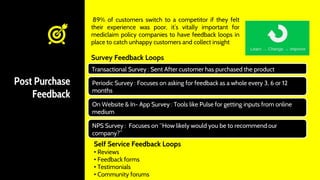
Post Purchase
Feedback
89% of customers switch to a competitor if they felt
their experience was poor, it’s vitally important for
mediclaim policy companies to have feedback loops in
place to catch unhappy customers and collect insight
Survey Feedback Loops
Transactional Survey : Sent After customer has purchased the product
Periodic Survey : Focuses on asking for feedback as a whole every 3, 6 or 12
months
On Website & In- App Survey : Tools like Pulse for getting inputs from online
medium
NPS Survey : Focuses on “How likely would you be to recommend our
company?”
Self Service Feedback Loops
• Reviews
• Feedback forms
• Testimonials
• Community forums
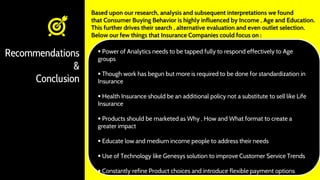
Recommendations
&
Conclusion
 Power of Analytics needs to be tapped fully to respond effectively to Age
groups
 Though work has begun but more is required to be done for standardization in
Insurance
 Health Insurance should be an additional policy not a substitute to sell like Life
Insurance
 Products should be marketed as Why , How and What format to create a
greater impact
 Educate low and medium income people to address their needs
 Use of Technology like Genesys solution to improve Customer Service Trends
 Constantly refine Product choices and introduce flexible payment options
Based upon our research, analysis and subsequent interpretations we found
that Consumer Buying Behavior is highly influenced by Income , Age and Education.
This further drives their search , alternative evaluation and even outlet selection.
Below our few things that Insurance Companies could focus on :

Mediclaim Policy : Consumer Behavior

  • 1.
    Mediclaim Policy consumer behaviour •Saravanan •SaurabhTripathi •Shankh Saxena •Srikumar •Surajkumar
  • 2.
    Introduction & Objectives • Mediclaim policyis focused on the wellness of the customers who hold their policy. Mediclaim has much wider scope than critical illness because it covers hospitalization and treatment towards accident. • Types of Mediclaim: Cashless and Reimbursement • Cashless: It is a mechanism wherein patient is treated in a network hospital, then insurer settles either a part of the claim or the entire claim with the hospitals. • Reimbursement: Money transfer happens between customers and insurers after the hospitalization payments are done from the customer side. Insurers would expect all original medical bills, discharge card & payment receipt • Objective: To understand consumer behavior and perception of low income and middle class people towards Mediclaim policies.
  • 3.
    Variables Research Methodology Sample Size ⊙Direct Variable:Consumer buying behaviour in mediclaim policies ⊙Indirect Variable: Annual income, Health Expenses, reason for mediclaim policy, Tax exemption. ⊙Survey was conducted on selected people to identify the consumer behavior and their perception about Mediclaim Health insurance policies. ⊙In India average percentage of Low income group is higher when compared to worlds average. Middle income group percentage is lower than worlds average. ⊙This causes imbalance in the economy due to which many people are not able to afford for health expenses. ⊙Considering the above issues consumer behavior and perception towards Mediclaim would be focused on the survey. ⊙ Stratified sampling method is used, where we have divided low income and middle income group as strata. ⊙ Sample size: 30 METHODOLOGYDESIGN
  • 4.
    01) What isyour annual income ? a)<1Lakh b)1-3 Lakhs c)4-6 Lakhs d) 6-10Lakhs e)10-20Lakhs f)20Lakhs< 02) How much did you spend for health releated issues in last one year? a) <10K b) 10-20K c) 20-30K d)40-50K e) 50K-1Lakhs f) 1Lakh < 03)What is one key reason for you to buy your current mediclaim policy ? a)Parents/friends advise b)Tax exemption c)Pure benefits d)employeer schemes 04)Where did you look for you mediclaim policy ? a)Online b)agent c)Offline 05)Did you change your mediclaim policy recently ? What was the reason? a)Yes b)No “INTERVIEWS
  • 5.
    Consumer’s Decision Making Process Premium to bepaid and Coverage provided Cashless Claim or Reimbursement Claim Individual plan or Family Floater Pre and Post Hospitalization Expenses Pre-existing Disease Hospitals Covered Renewability Age Additional Benefits
  • 6.
    Factors affecting each step of theprocess Personal Preferences :- Based on age, lifecycle and occupation the individual decides amongst various polices the best suited policy for himself, also if a person is looking for additional benefits or not. Economic Conditions:- Based on the consumer spending ,the consumer decides to opt for individual plan or the family policy or whether to go for pre and post hospital expenses policy. Age :- As age tends to increase, the premium on the policy also increases. If one considers to take a policy at a young age of 25 years it would be cheaper than a person going to take a policy at the age of 40years, one of the key decider is the renewability age clause in the policy on which consumer decides to opt for a policy or not. Pre-existing Disease:- All mediclaim policy have a clause that any disease already existed then it will be covered after certain number of premiums has been paid. Hospitals Covered:- The maximum number of hospitals covered in the policy would incline consumers to opt for the policy as it would benefit them for cashless treatments.
  • 7.
    Analysis and Interpretation ‘Segmentation Strategy’ Analysis From Data,we came to conclusion that, there is a strong relation between speding on medical insurance & Income, Age, Education & Demographics. Purpose for Insurance & Age is also having a strong relation. Interpretation Though Income is deciding factor for the spending on the medical insurance, Age & Education also plays an important role, because most of the people are looking at the insurance as an investment or way for tax saving rather then its prime purpose of protection & risk mitigation. Though the trend is changing in the young pepole below 28who are getting more aware of the risk associated with it. Considering above aspects, market is segmented as per consumer requirements, 1. Casuals & Cautious 4. Sick & Savvy 2. Content & Complaint 5. Out & About 3. Online & Onboard 6. Shop & Save
  • 8.
    a. Search b. Alternative Evaluation c.Outlet Selection ⊙Most prominent way for searching medical insurance policy was from the insurance agents. ⊙But now the trend of online is more popular & more consumers are searching online policies ⊙Sites like policybazar etc. has given a consumers a good platform for choosing policies by comparison ⊙Price & Claim settlement are the main parameters for selection of any policy ⊙Some people still prefer to go for policies from agents but people below 28 are mostly preferring online media ⊙Looking at the new trend in the industry & preference of consumers, company is focusing on their online porter more.
  • 9.
    Post Purchase Feedback 89% ofcustomers switch to a competitor if they felt their experience was poor, it’s vitally important for mediclaim policy companies to have feedback loops in place to catch unhappy customers and collect insight Survey Feedback Loops Transactional Survey : Sent After customer has purchased the product Periodic Survey : Focuses on asking for feedback as a whole every 3, 6 or 12 months On Website & In- App Survey : Tools like Pulse for getting inputs from online medium NPS Survey : Focuses on “How likely would you be to recommend our company?” Self Service Feedback Loops • Reviews • Feedback forms • Testimonials • Community forums
  • 10.
    Recommendations & Conclusion  Power ofAnalytics needs to be tapped fully to respond effectively to Age groups  Though work has begun but more is required to be done for standardization in Insurance  Health Insurance should be an additional policy not a substitute to sell like Life Insurance  Products should be marketed as Why , How and What format to create a greater impact  Educate low and medium income people to address their needs  Use of Technology like Genesys solution to improve Customer Service Trends  Constantly refine Product choices and introduce flexible payment options Based upon our research, analysis and subsequent interpretations we found that Consumer Buying Behavior is highly influenced by Income , Age and Education. This further drives their search , alternative evaluation and even outlet selection. Below our few things that Insurance Companies could focus on :