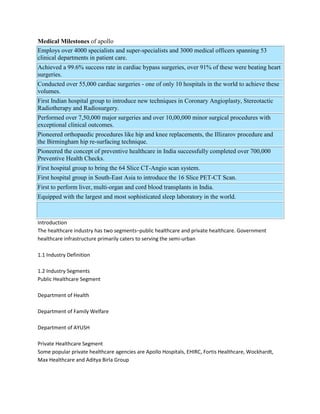
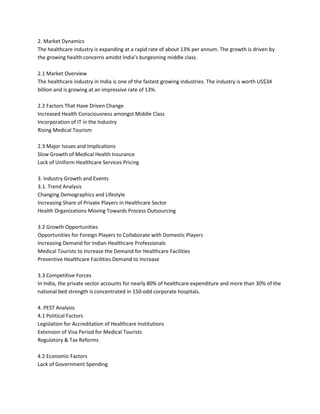
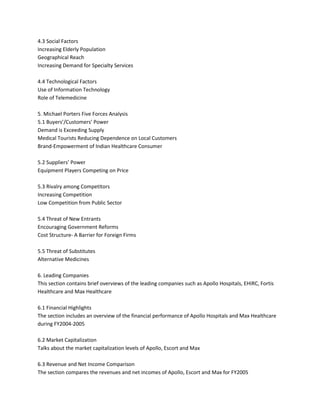
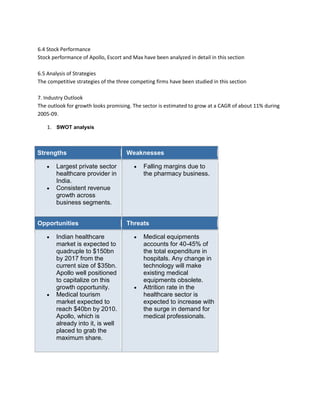
Medical Milestones  of apollo<br />Employs over 4000 specialists and super-specialists and 3000 medical officers spanning 53 clinical departments in patient care.Achieved a 99.6% success rate in cardiac bypass surgeries, over 91% of these were beating heart surgeries.Conducted over 55,000 cardiac surgeries - one of only 10 hospitals in the world to achieve these volumes.First Indian hospital group to introduce new techniques in Coronary Angioplasty, Stereotactic Radiotherapy and Radiosurgery.Performed over 7,50,000 major surgeries and over 10,00,000 minor surgical procedures with exceptional clinical outcomes.Pioneered orthopaedic procedures like hip and knee replacements, the Illizarov procedure and the Birmingham hip re-surfacing technique.Pioneered the concept of preventive healthcare in India successfully completed over 700,000 Preventive Health Checks.First hospital group to bring the 64 Slice CT-Angio scan system.First hospital group in South-East Asia to introduce the 16 Slice PET-CT Scan.First to perform liver, multi-organ and cord blood transplants in India.Equipped with the largest and most sophisticated sleep laboratory in the world.<br />IntroductionThe healthcare industry has two segments–public healthcare and private healthcare. Government healthcare infrastructure primarily caters to serving the semi-urban1.1 Industry Definition1.2 Industry SegmentsPublic Healthcare SegmentDepartment of HealthDepartment of Family WelfareDepartment of AYUSHPrivate Healthcare SegmentSome popular private healthcare agencies are Apollo Hospitals, EHIRC, Fortis Healthcare, Wockhardt, Max Healthcare and Aditya Birla Group2. Market DynamicsThe healthcare industry is expanding at a rapid rate of about 13% per annum. The growth is driven by the growing health concerns amidst India’s burgeoning middle class.2.1 Market Overview The healthcare industry in India is one of the fastest growing industries. The industry is worth US$34 billion and is growing at an impressive rate of 13%.2.2 Factors That Have Driven ChangeIncreased Health Consciousness amongst Middle ClassIncorporation of IT in the IndustryRising Medical Tourism2.3 Major Issues and ImplicationsSlow Growth of Medical Health InsuranceLack of Uniform Healthcare Services Pricing3. Industry Growth and Events 3.1. Trend AnalysisChanging Demographics and LifestyleIncreasing Share of Private Players in Healthcare SectorHealth Organizations Moving Towards Process Outsourcing 3.2 Growth Opportunities Opportunities for Foreign Players to Collaborate with Domestic PlayersIncreasing Demand for Indian Healthcare ProfessionalsMedical Tourists to Increase the Demand for Healthcare FacilitiesPreventive Healthcare Facilities Demand to Increase3.3 Competitive Forces In India, the private sector accounts for nearly 80% of healthcare expenditure and more than 30% of the national bed strength is concentrated in 150-odd corporate hospitals.4. PEST Analysis4.1 Political FactorsLegislation for Accreditation of Healthcare InstitutionsExtension of Visa Period for Medical TouristsRegulatory & Tax Reforms4.2 Economic FactorsLack of Government Spending4.3 Social FactorsIncreasing Elderly PopulationGeographical ReachIncreasing Demand for Specialty Services4.4 Technological FactorsUse of Information TechnologyRole of Telemedicine5. Michael Porters Five Forces Analysis5.1 Buyers’/Customers’ Power Demand is Exceeding SupplyMedical Tourists Reducing Dependence on Local CustomersBrand-Empowerment of Indian Healthcare Consumer5.2 Suppliers’ Power Equipment Players Competing on Price5.3 Rivalry among CompetitorsIncreasing CompetitionLow Competition from Public Sector5.4 Threat of New EntrantsEncouraging Government ReformsCost Structure- A Barrier for Foreign Firms5.5 Threat of SubstitutesAlternative Medicines6. Leading Companies This section contains brief overviews of the leading companies such as Apollo Hospitals, EHIRC, Fortis Healthcare and Max Healthcare6.1 Financial HighlightsThe section includes an overview of the financial performance of Apollo Hospitals and Max Healthcare during FY2004-20056.2 Market CapitalizationTalks about the market capitalization levels of Apollo, Escort and Max6.3 Revenue and Net Income ComparisonThe section compares the revenues and net incomes of Apollo, Escort and Max for FY20056.4 Stock PerformanceStock performance of Apollo, Escort and Max have been analyzed in detail in this section6.5 Analysis of StrategiesThe competitive strategies of the three competing firms have been studied in this section7. Industry OutlookThe outlook for growth looks promising. The sector is estimated to grow at a CAGR of about 11% during 2005-09.<br />SWOT analysis <br />StrengthsWeaknessesLargest private sector healthcare provider in India.Consistent revenue growth across business segments.Falling margins due to the pharmacy business. OpportunitiesThreatsIndian healthcare market is expected to quadruple to $150bn by 2017 from the current size of $35bn. Apollo well positioned to capitalize on this growth opportunity.Medical tourism market expected to reach $40bn by 2010. Apollo, which is already into it, is well placed to grab the maximum share.Medical equipments accounts for 40-45% of the total expenditure in hospitals. Any change in technology will make existing medical equipments obsolete. Attrition rate in the healthcare sector is expected to increase with the surge in demand for medical professionals.<br /> <br /> <br /> <br /> <br /> <br /> <br /> <br /> <br /> <br /> <br />1) Political Analysis: <br />• The government is reducing its hold on subsidies. <br />• There are particular pressure groups which tend to have an influence on <br />government hospitals <br />• The cost of medicines also tends to affect hospitals besides affecting the <br />pharmaceutical industries <br />• Relationships between neighboring countries also affect the hospital sector <br />2) Economic Analysis: <br />• Increase in income would lead to an increase in the standard of living. Thus people’s lifestyles changes and health is better understood. Thus there is a room for specialized treatment, doctors, and hospitals <br />• Government has made loans easily available and thus people with limited means <br />could avail better/specialized treatment <br />3) Social Environment Analysis: <br />• Medical facilities have increased since there is more awareness of healthcare among <br />the population <br />• Certain percentages of beds have to be kept for poor people. E.g. in Bombay 20% of <br />beds has to be kept reserved for poor people.• Look after the needs of local poor people.• Open counseling and relief centers.• Teach hygiene, sanitation among the poor masses.<br />• Safe disposal of hospitals wastes like used injection needles, waste blood etc. and <br />taking due care of environment. <br />• Spreading awareness about various diseases through campaigns and free medical <br />check ups. <br />4) Technological Environment Analysis: <br />• Breakthrough innovation in the field of specialized equipment <br />• Communication has managed to bridge the gap between places located at long <br />distances• Test tube babies• Mobility of medical services<br />3) PROBLEMS FACED BY THE INDUSTRY<br />Low public spending on health<br />Lack of adequate beds in the hospitals<br />Lack of emphasis on prevention<br />Enforcing standards of medical care rendered by hospitals and private health<br />practitioners<br />Extremely low bed : people ratio<br />Dominated by Government and Charitable Hospitals<br />Excessive overlap across primary, secondary and tertiary care<br />Skewed towards urban populace<br />Lack of adequate corporatization<br />Insurance to provide financial protection from catastrophic events<br />More research, awareness and communication and greater public involvement in<br />understanding health issues.<br />ADDITIONAL MATTER<br />1) MAJOR CORPORATE PLAYERS<br />The Apollo Group of Hospitals: The Apollo group is India's first corporate hospital, the<br />first to set-up hospital outside the country and the first to attract foreign investment. With 2600 beds, Apollo is one of Asia's largest healthcare players. The recent merger between its 3 group companies, Indian Hospitals Corporation Ltd., Deccan Hospitals Corporation Limited and Om Sindoori Hospitals Limited, will help the group raise money at a better rate and by consolidating inventory; it will save around 10% of the material cost. The group is planning to invest Rs.2000 crore, to build around 15 new hospitals in India, Sri Lanka, Nepal and Malaysia.<br />Fortis Healthcare: Fortis is the late Ranbaxy's Parvinder Singh's privately owned<br />company. The company is a 250 crore, 200 bed cardiac hospital, located in the town of Mohali. The company also has 12 cardiac and information centers in and around the town, to arrange travel and stay for patients and family. The company has plans of increasing the capacity to around 375 beds and also plans to tie up with an overseas partner.<br />Max India: After selling of his stake in Hutchison Max Telecom, Analjit Singh has<br />decided to invest around 200 crores, for setting up world class healthcare services in India. Max India plans a three tier structure of medical services - Max Consultation and Diagnostic Clinics, MaxMed, a 150 bed multi-specialty hospital and Max General, a 400 bed hospital. The company has already tied up with Harvard Medical International, to undertake clinical trials for drugs, under research abroad and setting up of Max University, for education and research.<br />Escorts: EHIRC located in New Delhi has more than 220 beds. The hospital has a total<br />77 Critical Care beds to provide intensive care to patients after surgery or angioplasty, emergency admissions or other patients needing highly specialized management including Telecardiology (ECG transmission through telephone). The EHIRC is unique in the field of Preventive Cardiology with a fully developed programme of Monitored Exercise, Yoga and Meditation for Life style management.<br />Wockhardt & Duncans Gleneagles International: They are South Asia's first Journal<br />of Clinical Investigation accredited super specialty hospitals. Have associations with Harvard Medical International, which gives them access to the best hospitals in the US for knowledge and research. Leader in medical tourism in India<br />
Medical milestones
Medical milestones
Medical milestones
Medical milestones
Medical milestones
Medical milestones

Medical milestones

  • 1.
    Medical Milestones of apollo<br />Employs over 4000 specialists and super-specialists and 3000 medical officers spanning 53 clinical departments in patient care.Achieved a 99.6% success rate in cardiac bypass surgeries, over 91% of these were beating heart surgeries.Conducted over 55,000 cardiac surgeries - one of only 10 hospitals in the world to achieve these volumes.First Indian hospital group to introduce new techniques in Coronary Angioplasty, Stereotactic Radiotherapy and Radiosurgery.Performed over 7,50,000 major surgeries and over 10,00,000 minor surgical procedures with exceptional clinical outcomes.Pioneered orthopaedic procedures like hip and knee replacements, the Illizarov procedure and the Birmingham hip re-surfacing technique.Pioneered the concept of preventive healthcare in India successfully completed over 700,000 Preventive Health Checks.First hospital group to bring the 64 Slice CT-Angio scan system.First hospital group in South-East Asia to introduce the 16 Slice PET-CT Scan.First to perform liver, multi-organ and cord blood transplants in India.Equipped with the largest and most sophisticated sleep laboratory in the world.<br />IntroductionThe healthcare industry has two segments–public healthcare and private healthcare. Government healthcare infrastructure primarily caters to serving the semi-urban1.1 Industry Definition1.2 Industry SegmentsPublic Healthcare SegmentDepartment of HealthDepartment of Family WelfareDepartment of AYUSHPrivate Healthcare SegmentSome popular private healthcare agencies are Apollo Hospitals, EHIRC, Fortis Healthcare, Wockhardt, Max Healthcare and Aditya Birla Group2. Market DynamicsThe healthcare industry is expanding at a rapid rate of about 13% per annum. The growth is driven by the growing health concerns amidst India’s burgeoning middle class.2.1 Market Overview The healthcare industry in India is one of the fastest growing industries. The industry is worth US$34 billion and is growing at an impressive rate of 13%.2.2 Factors That Have Driven ChangeIncreased Health Consciousness amongst Middle ClassIncorporation of IT in the IndustryRising Medical Tourism2.3 Major Issues and ImplicationsSlow Growth of Medical Health InsuranceLack of Uniform Healthcare Services Pricing3. Industry Growth and Events 3.1. Trend AnalysisChanging Demographics and LifestyleIncreasing Share of Private Players in Healthcare SectorHealth Organizations Moving Towards Process Outsourcing 3.2 Growth Opportunities Opportunities for Foreign Players to Collaborate with Domestic PlayersIncreasing Demand for Indian Healthcare ProfessionalsMedical Tourists to Increase the Demand for Healthcare FacilitiesPreventive Healthcare Facilities Demand to Increase3.3 Competitive Forces In India, the private sector accounts for nearly 80% of healthcare expenditure and more than 30% of the national bed strength is concentrated in 150-odd corporate hospitals.4. PEST Analysis4.1 Political FactorsLegislation for Accreditation of Healthcare InstitutionsExtension of Visa Period for Medical TouristsRegulatory & Tax Reforms4.2 Economic FactorsLack of Government Spending4.3 Social FactorsIncreasing Elderly PopulationGeographical ReachIncreasing Demand for Specialty Services4.4 Technological FactorsUse of Information TechnologyRole of Telemedicine5. Michael Porters Five Forces Analysis5.1 Buyers’/Customers’ Power Demand is Exceeding SupplyMedical Tourists Reducing Dependence on Local CustomersBrand-Empowerment of Indian Healthcare Consumer5.2 Suppliers’ Power Equipment Players Competing on Price5.3 Rivalry among CompetitorsIncreasing CompetitionLow Competition from Public Sector5.4 Threat of New EntrantsEncouraging Government ReformsCost Structure- A Barrier for Foreign Firms5.5 Threat of SubstitutesAlternative Medicines6. Leading Companies This section contains brief overviews of the leading companies such as Apollo Hospitals, EHIRC, Fortis Healthcare and Max Healthcare6.1 Financial HighlightsThe section includes an overview of the financial performance of Apollo Hospitals and Max Healthcare during FY2004-20056.2 Market CapitalizationTalks about the market capitalization levels of Apollo, Escort and Max6.3 Revenue and Net Income ComparisonThe section compares the revenues and net incomes of Apollo, Escort and Max for FY20056.4 Stock PerformanceStock performance of Apollo, Escort and Max have been analyzed in detail in this section6.5 Analysis of StrategiesThe competitive strategies of the three competing firms have been studied in this section7. Industry OutlookThe outlook for growth looks promising. The sector is estimated to grow at a CAGR of about 11% during 2005-09.<br />SWOT analysis <br />StrengthsWeaknessesLargest private sector healthcare provider in India.Consistent revenue growth across business segments.Falling margins due to the pharmacy business. OpportunitiesThreatsIndian healthcare market is expected to quadruple to $150bn by 2017 from the current size of $35bn. Apollo well positioned to capitalize on this growth opportunity.Medical tourism market expected to reach $40bn by 2010. Apollo, which is already into it, is well placed to grab the maximum share.Medical equipments accounts for 40-45% of the total expenditure in hospitals. Any change in technology will make existing medical equipments obsolete. Attrition rate in the healthcare sector is expected to increase with the surge in demand for medical professionals.<br /> <br /> <br /> <br /> <br /> <br /> <br /> <br /> <br /> <br /> <br />1) Political Analysis: <br />• The government is reducing its hold on subsidies. <br />• There are particular pressure groups which tend to have an influence on <br />government hospitals <br />• The cost of medicines also tends to affect hospitals besides affecting the <br />pharmaceutical industries <br />• Relationships between neighboring countries also affect the hospital sector <br />2) Economic Analysis: <br />• Increase in income would lead to an increase in the standard of living. Thus people’s lifestyles changes and health is better understood. Thus there is a room for specialized treatment, doctors, and hospitals <br />• Government has made loans easily available and thus people with limited means <br />could avail better/specialized treatment <br />3) Social Environment Analysis: <br />• Medical facilities have increased since there is more awareness of healthcare among <br />the population <br />• Certain percentages of beds have to be kept for poor people. E.g. in Bombay 20% of <br />beds has to be kept reserved for poor people.• Look after the needs of local poor people.• Open counseling and relief centers.• Teach hygiene, sanitation among the poor masses.<br />• Safe disposal of hospitals wastes like used injection needles, waste blood etc. and <br />taking due care of environment. <br />• Spreading awareness about various diseases through campaigns and free medical <br />check ups. <br />4) Technological Environment Analysis: <br />• Breakthrough innovation in the field of specialized equipment <br />• Communication has managed to bridge the gap between places located at long <br />distances• Test tube babies• Mobility of medical services<br />3) PROBLEMS FACED BY THE INDUSTRY<br />Low public spending on health<br />Lack of adequate beds in the hospitals<br />Lack of emphasis on prevention<br />Enforcing standards of medical care rendered by hospitals and private health<br />practitioners<br />Extremely low bed : people ratio<br />Dominated by Government and Charitable Hospitals<br />Excessive overlap across primary, secondary and tertiary care<br />Skewed towards urban populace<br />Lack of adequate corporatization<br />Insurance to provide financial protection from catastrophic events<br />More research, awareness and communication and greater public involvement in<br />understanding health issues.<br />ADDITIONAL MATTER<br />1) MAJOR CORPORATE PLAYERS<br />The Apollo Group of Hospitals: The Apollo group is India's first corporate hospital, the<br />first to set-up hospital outside the country and the first to attract foreign investment. With 2600 beds, Apollo is one of Asia's largest healthcare players. The recent merger between its 3 group companies, Indian Hospitals Corporation Ltd., Deccan Hospitals Corporation Limited and Om Sindoori Hospitals Limited, will help the group raise money at a better rate and by consolidating inventory; it will save around 10% of the material cost. The group is planning to invest Rs.2000 crore, to build around 15 new hospitals in India, Sri Lanka, Nepal and Malaysia.<br />Fortis Healthcare: Fortis is the late Ranbaxy's Parvinder Singh's privately owned<br />company. The company is a 250 crore, 200 bed cardiac hospital, located in the town of Mohali. The company also has 12 cardiac and information centers in and around the town, to arrange travel and stay for patients and family. The company has plans of increasing the capacity to around 375 beds and also plans to tie up with an overseas partner.<br />Max India: After selling of his stake in Hutchison Max Telecom, Analjit Singh has<br />decided to invest around 200 crores, for setting up world class healthcare services in India. Max India plans a three tier structure of medical services - Max Consultation and Diagnostic Clinics, MaxMed, a 150 bed multi-specialty hospital and Max General, a 400 bed hospital. The company has already tied up with Harvard Medical International, to undertake clinical trials for drugs, under research abroad and setting up of Max University, for education and research.<br />Escorts: EHIRC located in New Delhi has more than 220 beds. The hospital has a total<br />77 Critical Care beds to provide intensive care to patients after surgery or angioplasty, emergency admissions or other patients needing highly specialized management including Telecardiology (ECG transmission through telephone). The EHIRC is unique in the field of Preventive Cardiology with a fully developed programme of Monitored Exercise, Yoga and Meditation for Life style management.<br />Wockhardt & Duncans Gleneagles International: They are South Asia's first Journal<br />of Clinical Investigation accredited super specialty hospitals. Have associations with Harvard Medical International, which gives them access to the best hospitals in the US for knowledge and research. Leader in medical tourism in India<br />