Medical Malpractice:
A Neurosurgeon’s Perspective
Herbert Engelhard, M.D., Ph.D. – Chicago, IL
Note: All images and references used herein were publically available.
Background
https://www.youtube.com/watch?v=LqeC3BPYTmE
Of all specialists, neurosurgeons have the highest probability
of facing a malpractice claim. Most common: spinal procedure
1985-2015: Plaintiff verdict: 27% Defense verdict: 48%
Settlement: 24%
Median payout: $2,550,000 (Top: $217 million) Highest: peds
Top allegations: Procedural error, failure to dx, failure to treat,
lack of informed consent
Malpractice insurance
“Occurrence” versus “Claims-Made”
(need tail coverage)
Limits of coverage
Other points …
Malpractice: two components
Caused harm
Violated the standard of care
Therefore “negligent”
Usually a standard postop complication, like an infection,
is not sufficient grounds to be sued - it’s an “inherent risk”.
How you manage it though, could certainly be criticized.
Definition of “standard of care”
What a similarly-
trained physician would
have done under the
same circumstances.
Evidence-based guidelines may help to
inform us about the standard of care,
but currently it is usually imprecise – an
opinion.
“The level and type of care
that a reasonably competent
and skilled health care
professional, with a similar
background and in the same
medical community, would
have provided under the
circumstances that led to the
alleged malpractice.”
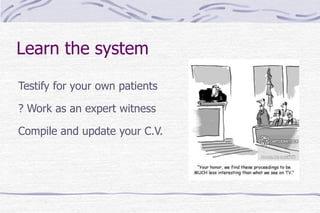
Learn the system
Testify for your own patients
? Work as an expert witness
Compile and update your C.V.
“Statute of Limitations”
According to Illinois malpractice law, a patient has up to two
years from the date the patient knew or should have known of the
injury to file a lawsuit against a medical professional.
Illinois has a special statute of limitations for patients who are
minors at the time medical malpractice occurs. Those under the
age of 18 have up to eight years to file a lawsuit, as long as the
suit is filed before the patient turns 22.
Events in a malpractice case - Part 1
Being served – “summons”
Informing employer / insurance – attorney assigned
to you (you may also engage your own attorney at
your own expense).
Phase: Records review and collecting information.
Identifying your experts.
Legal documents: Responses / Answers to
Interrogatories / Productions – lawyer will prepare.
Plaintiff’s “expert”
Emotional responses:
• worry-stress (even pre)
guilt job security
• shock-disbelief / anger
• bargaining
• betrayal
• more anger-frustration
(waste of time!)
• ?self-doubt / reconsideration
• acceptance
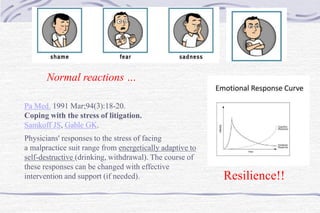
Resilience!!
Pa Med. 1991 Mar;94(3):18-20.
Coping with the stress of litigation.
Samkoff JS, Gable GK.
Physicians' responses to the stress of facing
a malpractice suit range from energetically adaptive to
self-destructive (drinking, withdrawal). The course of
these responses can be changed with effective
intervention and support (if needed).
Normal reactions …
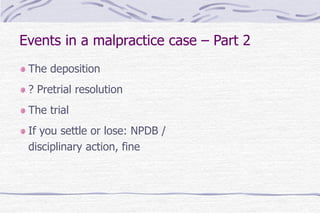
Events in a malpractice case – Part 2
The deposition
? Pretrial resolution
The trial
If you settle or lose: NPDB /
disciplinary action, fine
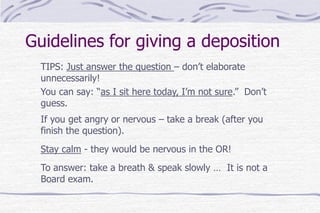
Guidelines for giving a deposition
TIPS: Just answer the question – don’t elaborate
unnecessarily!
You can say: “as I sit here today, I’m not sure.” Don’t
guess.
If you get angry or nervous – take a break (after you
finish the question).
Stay calm - they would be nervous in the OR!
To answer: take a breath & speak slowly … It is not a
Board exam.
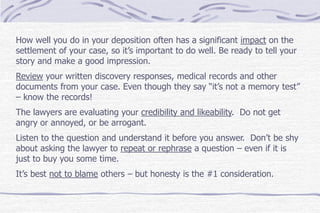
How well you do in your deposition often has a significant impact on the
settlement of your case, so it’s important to do well. Be ready to tell your
story and make a good impression.
Review your written discovery responses, medical records and other
documents from your case. Even though they say “it’s not a memory test”
– know the records!
The lawyers are evaluating your credibility and likeability. Do not get
angry or annoyed, or be arrogant.
Listen to the question and understand it before you answer. Don’t be shy
about asking the lawyer to repeat or rephrase a question – even if it is
just to buy you some time.
It’s best not to blame others – but honesty is the #1 consideration.
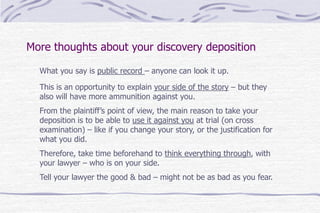
More thoughts about your discovery deposition
What you say is public record – anyone can look it up.
This is an opportunity to explain your side of the story – but they
also will have more ammunition against you.
From the plaintiff’s point of view, the main reason to take your
deposition is to be able to use it against you at trial (on cross
examination) – like if you change your story, or the justification for
what you did.
Therefore, take time beforehand to think everything through, with
your lawyer – who is on your side.
Tell your lawyer the good & bad – might not be as bad as you fear.
You can ask to look at records to refresh your memory.
If later in the deposition you realize that you made a mistake or need
to add something, mention it.
Don’t be bullied. If you are interrupted while giving a response, wait
for the examiner to finish the question, indicate that you were
interrupted, and finish your prior response.
Do not help your examiner. While things can be cordial, they are not
your friend.
Do not try to argue with (or win over) your examiner. Resist the
temptation to inflate yourself – your attorney should do that.
You can disclose more information when your attorney questions you.
Trial: Be confident and go into teaching mode.
Make comfortable eye
contact with the jury.
Speak slowly and use
understandable terms.
Malpractice cases are civil
cases – not criminal cases.
Proof is to “a reasonable
degree of medical certainty.”
When you lose or settle
Insurance company notifies:
National Practitioner Data Bank
Considered “an alert or flagging system”
State Board of Medical Licensure, ABNS
Usually ask for further information: Written report,
medical records
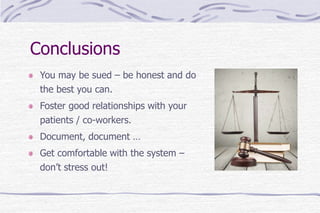
Conclusions
You may be sued – be honest and do
the best you can.
Foster good relationships with your
patients / co-workers.
Document, document …
Get comfortable with the system –
don’t stress out!

Medical malpractice neurosurgeon's perspective

  • 1.
    Medical Malpractice: A Neurosurgeon’sPerspective Herbert Engelhard, M.D., Ph.D. – Chicago, IL Note: All images and references used herein were publically available.
  • 2.
    Background https://www.youtube.com/watch?v=LqeC3BPYTmE Of all specialists,neurosurgeons have the highest probability of facing a malpractice claim. Most common: spinal procedure 1985-2015: Plaintiff verdict: 27% Defense verdict: 48% Settlement: 24% Median payout: $2,550,000 (Top: $217 million) Highest: peds Top allegations: Procedural error, failure to dx, failure to treat, lack of informed consent
  • 3.
    Malpractice insurance “Occurrence” versus“Claims-Made” (need tail coverage) Limits of coverage Other points …
  • 4.
    Malpractice: two components Causedharm Violated the standard of care Therefore “negligent” Usually a standard postop complication, like an infection, is not sufficient grounds to be sued - it’s an “inherent risk”. How you manage it though, could certainly be criticized.
  • 5.
    Definition of “standardof care” What a similarly- trained physician would have done under the same circumstances. Evidence-based guidelines may help to inform us about the standard of care, but currently it is usually imprecise – an opinion. “The level and type of care that a reasonably competent and skilled health care professional, with a similar background and in the same medical community, would have provided under the circumstances that led to the alleged malpractice.”
  • 6.
    Learn the system Testifyfor your own patients ? Work as an expert witness Compile and update your C.V.
  • 7.
    “Statute of Limitations” Accordingto Illinois malpractice law, a patient has up to two years from the date the patient knew or should have known of the injury to file a lawsuit against a medical professional. Illinois has a special statute of limitations for patients who are minors at the time medical malpractice occurs. Those under the age of 18 have up to eight years to file a lawsuit, as long as the suit is filed before the patient turns 22.
  • 8.
    Events in amalpractice case - Part 1 Being served – “summons” Informing employer / insurance – attorney assigned to you (you may also engage your own attorney at your own expense). Phase: Records review and collecting information. Identifying your experts. Legal documents: Responses / Answers to Interrogatories / Productions – lawyer will prepare. Plaintiff’s “expert” Emotional responses: • worry-stress (even pre) guilt job security • shock-disbelief / anger • bargaining • betrayal • more anger-frustration (waste of time!) • ?self-doubt / reconsideration • acceptance
  • 9.
    Resilience!! Pa Med. 1991Mar;94(3):18-20. Coping with the stress of litigation. Samkoff JS, Gable GK. Physicians' responses to the stress of facing a malpractice suit range from energetically adaptive to self-destructive (drinking, withdrawal). The course of these responses can be changed with effective intervention and support (if needed). Normal reactions …
  • 10.
    Events in amalpractice case – Part 2 The deposition ? Pretrial resolution The trial If you settle or lose: NPDB / disciplinary action, fine
  • 11.
    Guidelines for givinga deposition TIPS: Just answer the question – don’t elaborate unnecessarily! You can say: “as I sit here today, I’m not sure.” Don’t guess. If you get angry or nervous – take a break (after you finish the question). Stay calm - they would be nervous in the OR! To answer: take a breath & speak slowly … It is not a Board exam.
  • 12.
    How well youdo in your deposition often has a significant impact on the settlement of your case, so it’s important to do well. Be ready to tell your story and make a good impression. Review your written discovery responses, medical records and other documents from your case. Even though they say “it’s not a memory test” – know the records! The lawyers are evaluating your credibility and likeability. Do not get angry or annoyed, or be arrogant. Listen to the question and understand it before you answer. Don’t be shy about asking the lawyer to repeat or rephrase a question – even if it is just to buy you some time. It’s best not to blame others – but honesty is the #1 consideration.
  • 13.
    More thoughts aboutyour discovery deposition What you say is public record – anyone can look it up. This is an opportunity to explain your side of the story – but they also will have more ammunition against you. From the plaintiff’s point of view, the main reason to take your deposition is to be able to use it against you at trial (on cross examination) – like if you change your story, or the justification for what you did. Therefore, take time beforehand to think everything through, with your lawyer – who is on your side. Tell your lawyer the good & bad – might not be as bad as you fear.
  • 14.
    You can askto look at records to refresh your memory. If later in the deposition you realize that you made a mistake or need to add something, mention it. Don’t be bullied. If you are interrupted while giving a response, wait for the examiner to finish the question, indicate that you were interrupted, and finish your prior response. Do not help your examiner. While things can be cordial, they are not your friend. Do not try to argue with (or win over) your examiner. Resist the temptation to inflate yourself – your attorney should do that. You can disclose more information when your attorney questions you.
  • 15.
    Trial: Be confidentand go into teaching mode. Make comfortable eye contact with the jury. Speak slowly and use understandable terms. Malpractice cases are civil cases – not criminal cases. Proof is to “a reasonable degree of medical certainty.”
  • 16.
    When you loseor settle Insurance company notifies: National Practitioner Data Bank Considered “an alert or flagging system” State Board of Medical Licensure, ABNS Usually ask for further information: Written report, medical records
  • 18.
    Conclusions You may besued – be honest and do the best you can. Foster good relationships with your patients / co-workers. Document, document … Get comfortable with the system – don’t stress out!