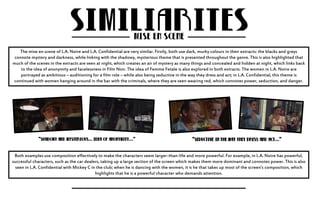
The mise en scene of L.A. Noire and L.A. Confidential are very similar. Firstly, both use dark, murky colours in their extracts: the blacks and greys 
connote mystery and darkness, while linking with the shadowy, mysterious theme that is presented throughout the genre. This is also highlighted that 
much of the scenes in the extracts are seen at night, which creates an air of mystery as many things and concealed and hidden at night, which links back 
to the idea of anonymity and facelessness in Film Noir. The idea of Femme Fetale is also explored in both extracts. The women in L.A. Noire are 
portrayed as ambitious – auditioning for a film role – while also being seductive in the way they dress and act; in L.A. Confidential, this theme is 
continued with women hanging around in the bar with the criminals, where they are seen wearing red, which connotes power, seduction, and danger. 
Both examples use composition effectively to make the characters seem larger-than-life and more powerful. For example, in L.A. Noire has powerful, 
successful characters, such as the car dealers, taking up a large section of the screen which makes them more dominant and connotes power. This is also 
seen in L.A. Confidential with Mickey C in the club; when he is dancing with the women, it is he that takes up most of the screen’s composition, which 
highlights that he is a powerful character who demands attention.
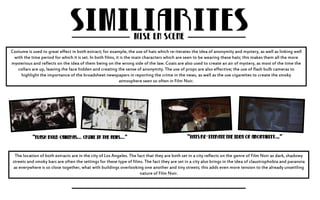
Costume is used to great effect in both extract; for example, the use of hats which re-iterates the idea of anonymity and mystery, as well as linking well 
with the time period for which it is set. In both films, it is the main characters which are seen to be wearing these hats; this makes them all the more 
mysterious and reflects on the idea of them being on the wrong side of the law. Coats are also used to create an air of mystery, as most of the time the 
collars are up, leaving the face hidden and creating the sense of anonymity. The use of props are also effective; the use of flash bulb cameras to 
highlight the importance of the broadsheet newspapers in reporting the crime in the news, as well as the use cigarettes to create the smoky 
atmosphere seen so often in Film Noir. 
The location of both extracts are in the city of Los Angeles. The fact that they are both set in a city reflects on the genre of Film Noir as dark, shadowy 
streets and smoky bars are often the settings for these type of films. The fact they are set in a city also brings in the idea of claustrophobia and paranoia 
as everywhere is so close together, what with buildings overlooking one another and tiny streets; this adds even more tension to the already unsettling 
nature of Film Noir.
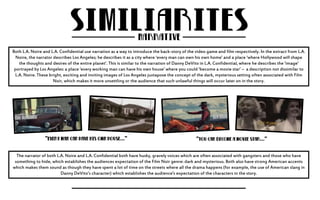
Both L.A. Noire and L.A. Confidential use narration as a way to introduce the back-story of the video game and film respectively. In the extract from L.A. 
Noire, the narrator describes Los Angeles; he describes it as a city where ‘every man can own his own home’ and a place ‘where Hollywood will shape 
the thoughts and desires of the entire planet’. This is similar to the narration of Danny DeVito in L.A. Confidential, where he describes the ‘image’ 
portrayed by Los Angeles: a place ‘every working man can have his own house’ where you could ‘become a movie star’ – a description not dissimilar to 
L.A. Noire. These bright, exciting and inviting images of Los Angeles juxtapose the concept of the dark, mysterious setting often associated with Film 
Noir, which makes it more unsettling or the audience that such unlawful things will occur later on in the story. 
The narrator of both L.A. Noire and L.A. Confidential both have husky, gravely voices which are often associated with gangsters and those who have 
something to hide, which establishes the audiences expectation of the Film Noir genre: dark and mysterious. Both also have strong American accents 
which makes them sound as though they have spent a lot of time on the streets where all the drama happens (for example, the use of American slang in 
Danny DeVito’s character) which establishes the audience's expectation of the characters in the story.
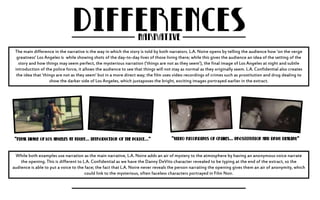
The main difference in the narrative is the way in which the story is told by both narrators. L.A. Noire opens by telling the audience how ‘on the verge 
greatness’ Los Angeles is while showing shots of the day-to-day lives of those living there; while this gives the audience an idea of the setting of the 
story and how things may seem perfect, the mysterious narration (‘things are not as they seem’), the final image of Los Angeles at night and subtle 
introduction of the police force, it allows the audience to see that things will not stay as normal as they originally seem. L.A. Confidential also creates 
the idea that ‘things are not as they seem’ but in a more direct way; the film uses video recordings of crimes such as prostitution and drug dealing to 
show the darker side of Los Angeles, which juxtaposes the bright, exciting images portrayed earlier in the extract. 
While both examples use narration as the main narrative, L.A. Noire adds an air of mystery to the atmosphere by having an anonymous voice narrate 
the opening. This is different to L.A. Confidential as we have the Danny DeVito character revealed to be typing at the end of the extract, so the 
audience is able to put a voice to the face; the fact that L.A. Noire never reveals the person narrating the opening gives them an air of anonymity, which 
could link to the mysterious, often faceless characters portrayed in Film Noir.
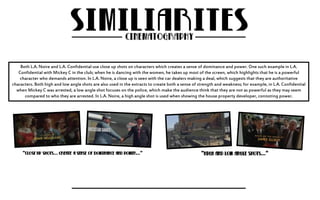
Both L.A. Noire and L.A. Confidential use close up shots on characters which creates a sense of dominance and power. One such example in L.A. 
Confidential with Mickey C in the club; when he is dancing with the women, he takes up most of the screen, which highlights that he is a powerful 
character who demands attention. In L.A. Noire, a close up is seen with the car dealers making a deal, which suggests that they are authoritative 
characters. Both high and low angle shots are also used in the extracts to create both a sense of strength and weakness; for example, in L.A. Confidential 
when Mickey C was arrested, a low angle shot focuses on the police, which make the audience think that they are not as powerful as they may seem 
compared to who they are arrested. In L.A. Noire, a high angle shot is used when showing the house property developer, connoting power.
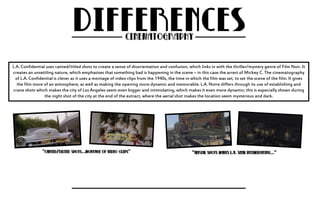
L.A. Confidential uses canted/titled shots to create a sense of disorientation and confusion, which links in with the thriller/mystery genre of Film Noir. It 
creates an unsettling nature, which emphasises that something bad is happening in the scene – in this case the arrest of Mickey C. The cinematography 
of L.A. Confidential is clever as it uses a montage of video clips from the 1940s, the time in which the film was set, to set the scene of the film. It gives 
the film more of an atmosphere, as well as making the opening more dynamic and memorable. L.A. Noire differs through its use of establishing and 
crane shots which makes the city of Los Angeles seem even bigger and intimidating, which makes it even more dynamic; this is especially shown during 
the night shot of the city at the end of the extract, where the aerial shot makes the location seem mysterious and dark.

Media: Film Noir

  • 2.
    The mise enscene of L.A. Noire and L.A. Confidential are very similar. Firstly, both use dark, murky colours in their extracts: the blacks and greys connote mystery and darkness, while linking with the shadowy, mysterious theme that is presented throughout the genre. This is also highlighted that much of the scenes in the extracts are seen at night, which creates an air of mystery as many things and concealed and hidden at night, which links back to the idea of anonymity and facelessness in Film Noir. The idea of Femme Fetale is also explored in both extracts. The women in L.A. Noire are portrayed as ambitious – auditioning for a film role – while also being seductive in the way they dress and act; in L.A. Confidential, this theme is continued with women hanging around in the bar with the criminals, where they are seen wearing red, which connotes power, seduction, and danger. Both examples use composition effectively to make the characters seem larger-than-life and more powerful. For example, in L.A. Noire has powerful, successful characters, such as the car dealers, taking up a large section of the screen which makes them more dominant and connotes power. This is also seen in L.A. Confidential with Mickey C in the club; when he is dancing with the women, it is he that takes up most of the screen’s composition, which highlights that he is a powerful character who demands attention.
  • 3.
    Costume is usedto great effect in both extract; for example, the use of hats which re-iterates the idea of anonymity and mystery, as well as linking well with the time period for which it is set. In both films, it is the main characters which are seen to be wearing these hats; this makes them all the more mysterious and reflects on the idea of them being on the wrong side of the law. Coats are also used to create an air of mystery, as most of the time the collars are up, leaving the face hidden and creating the sense of anonymity. The use of props are also effective; the use of flash bulb cameras to highlight the importance of the broadsheet newspapers in reporting the crime in the news, as well as the use cigarettes to create the smoky atmosphere seen so often in Film Noir. The location of both extracts are in the city of Los Angeles. The fact that they are both set in a city reflects on the genre of Film Noir as dark, shadowy streets and smoky bars are often the settings for these type of films. The fact they are set in a city also brings in the idea of claustrophobia and paranoia as everywhere is so close together, what with buildings overlooking one another and tiny streets; this adds even more tension to the already unsettling nature of Film Noir.
  • 4.
    Both L.A. Noireand L.A. Confidential use narration as a way to introduce the back-story of the video game and film respectively. In the extract from L.A. Noire, the narrator describes Los Angeles; he describes it as a city where ‘every man can own his own home’ and a place ‘where Hollywood will shape the thoughts and desires of the entire planet’. This is similar to the narration of Danny DeVito in L.A. Confidential, where he describes the ‘image’ portrayed by Los Angeles: a place ‘every working man can have his own house’ where you could ‘become a movie star’ – a description not dissimilar to L.A. Noire. These bright, exciting and inviting images of Los Angeles juxtapose the concept of the dark, mysterious setting often associated with Film Noir, which makes it more unsettling or the audience that such unlawful things will occur later on in the story. The narrator of both L.A. Noire and L.A. Confidential both have husky, gravely voices which are often associated with gangsters and those who have something to hide, which establishes the audiences expectation of the Film Noir genre: dark and mysterious. Both also have strong American accents which makes them sound as though they have spent a lot of time on the streets where all the drama happens (for example, the use of American slang in Danny DeVito’s character) which establishes the audience's expectation of the characters in the story.
  • 5.
    The main differencein the narrative is the way in which the story is told by both narrators. L.A. Noire opens by telling the audience how ‘on the verge greatness’ Los Angeles is while showing shots of the day-to-day lives of those living there; while this gives the audience an idea of the setting of the story and how things may seem perfect, the mysterious narration (‘things are not as they seem’), the final image of Los Angeles at night and subtle introduction of the police force, it allows the audience to see that things will not stay as normal as they originally seem. L.A. Confidential also creates the idea that ‘things are not as they seem’ but in a more direct way; the film uses video recordings of crimes such as prostitution and drug dealing to show the darker side of Los Angeles, which juxtaposes the bright, exciting images portrayed earlier in the extract. While both examples use narration as the main narrative, L.A. Noire adds an air of mystery to the atmosphere by having an anonymous voice narrate the opening. This is different to L.A. Confidential as we have the Danny DeVito character revealed to be typing at the end of the extract, so the audience is able to put a voice to the face; the fact that L.A. Noire never reveals the person narrating the opening gives them an air of anonymity, which could link to the mysterious, often faceless characters portrayed in Film Noir.
  • 6.
    Both L.A. Noireand L.A. Confidential use close up shots on characters which creates a sense of dominance and power. One such example in L.A. Confidential with Mickey C in the club; when he is dancing with the women, he takes up most of the screen, which highlights that he is a powerful character who demands attention. In L.A. Noire, a close up is seen with the car dealers making a deal, which suggests that they are authoritative characters. Both high and low angle shots are also used in the extracts to create both a sense of strength and weakness; for example, in L.A. Confidential when Mickey C was arrested, a low angle shot focuses on the police, which make the audience think that they are not as powerful as they may seem compared to who they are arrested. In L.A. Noire, a high angle shot is used when showing the house property developer, connoting power.
  • 7.
    L.A. Confidential usescanted/titled shots to create a sense of disorientation and confusion, which links in with the thriller/mystery genre of Film Noir. It creates an unsettling nature, which emphasises that something bad is happening in the scene – in this case the arrest of Mickey C. The cinematography of L.A. Confidential is clever as it uses a montage of video clips from the 1940s, the time in which the film was set, to set the scene of the film. It gives the film more of an atmosphere, as well as making the opening more dynamic and memorable. L.A. Noire differs through its use of establishing and crane shots which makes the city of Los Angeles seem even bigger and intimidating, which makes it even more dynamic; this is especially shown during the night shot of the city at the end of the extract, where the aerial shot makes the location seem mysterious and dark.

Editor's Notes

  • #3 Slick, dynamic, 63.96
  • #4 Slick, dynamic, 63.96
  • #5 Slick, dynamic,
  • #6 Slick, dynamic, 63.96
  • #8 Slick, dynamic, 40.63