Conventions and
representations
Genre of the film
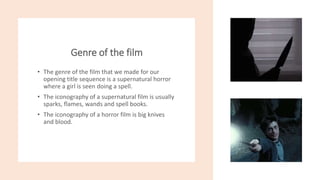
• The genre of the film that we made for our
opening title sequence is a supernatural horror
where a girl is seen doing a spell.
• The iconography of a supernatural film is usually
sparks, flames, wands and spell books.
• The iconography of a horror film is big knives
and blood.
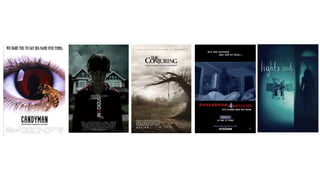
What other films we compared to:
1) Candyman (1992)- simple ariel shot of cars driving but the music tells audience that it
is a horror – Directed by Bernard Rose
2) Insidious (2010)- Shows the setting and a silhouette of man is seen – Directed by
Patrick Wilson, Adam Robitel, Leigh Whannell and James Wan
3) The conjuring (2013)- Gives a backstory about who the main character is and what his
job is. (seekers of the supernatural) – Directed by Michael Chaves and James Wan
4) Paranormal activity (2009) - Introduces setting, suggests home based film (Handheld
camera) – Directed by Oren Peli
5) Lights out (2016)- Titles appear over montage showing themes for the film – Directed
by David Sandberg
Characters:
• Teenage girl
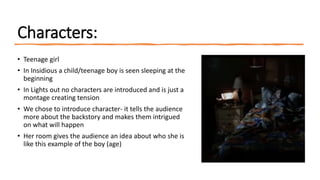
• In Insidious a child/teenage boy is seen sleeping at the
beginning
• In Lights out no characters are introduced and is just a
montage creating tension
• We chose to introduce character- it tells the audience
more about the backstory and makes them intrigued
on what will happen
• Her room gives the audience an idea about who she is
like this example of the boy (age)
Narrative:
• In The Conjuring pull focus is used to draw the audience
attention to poster (Seekers of the supernatural)
• We used techniques like this: montage of objects around
her room (spider and skull) and put posters in her room to
show what she is interested in
• Gives the audience background information about the
character so they will be able to follow the storyline better
• Editing pace changed throughout- keep audience interested
• Her makeup and clothes in our opening sequence told
audience that she was interested in spells.
Intended audience response
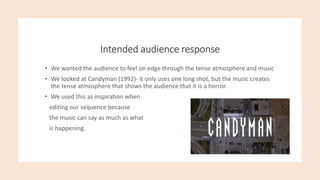
• We wanted the audience to feel on edge through the tense atmosphere and music
• We looked at Candyman (1992)- it only uses one long shot, but the music creates
the tense atmosphere that shows the audience that it is a horror.
• We used this as inspiration when
editing our sequence because
the music can say as much as what
is happening.
Titles- Font, colour and
animations
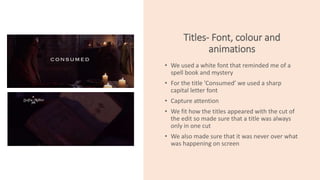
• We used a white font that reminded me of a
spell book and mystery
• For the title ’Consumed’ we used a sharp
capital letter font
• Capture attention
• We fit how the titles appeared with the cut of
the edit so made sure that a title was always
only in one cut
• We also made sure that it was never over what
was happening on screen
Titles- Order of the titles
• We looked at examples and used their
order to help ours
• Professional films
• I looked at The invisible mad and Cruella
• They are both high budget professional
films so we could refer to them when
editing the titles
Challenging
conventions
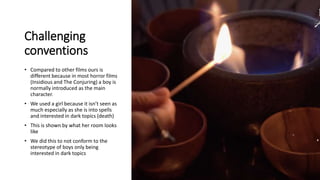
• Compared to other films ours is
different because in most horror films
(Insidious and The Conjuring) a boy is
normally introduced as the main
character.
• We used a girl because it isn’t seen as
much especially as she is into spells
and interested in dark topics (death)
• This is shown by what her room looks
like
• We did this to not conform to the
stereotype of boys only being
interested in dark topics
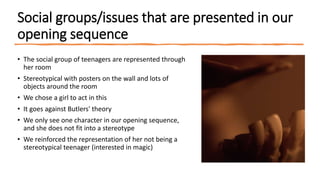
Social groups/issues that are presented in our
opening sequence
• The social group of teenagers are represented through
her room
• Stereotypical with posters on the wall and lots of
objects around the room
• We chose a girl to act in this
• It goes against Butlers' theory
• We only see one character in our opening sequence,
and she does not fit into a stereotype
• We reinforced the representation of her not being a
stereotypical teenager (interested in magic)
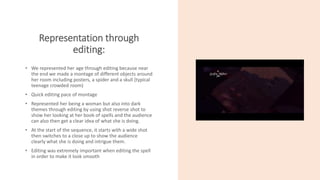
Representation through
editing:
• We represented her age through editing because near
the end we made a montage of different objects around
her room including posters, a spider and a skull (typical
teenage crowded room)
• Quick editing pace of montage
• Represented her being a woman but also into dark
themes through editing by using shot reverse shot to
show her looking at her book of spells and the audience
can also then get a clear idea of what she is doing.
• At the start of the sequence, it starts with a wide shot
then switches to a close up to show the audience
clearly what she is doing and intrigue them.
• Editing was extremely important when editing the spell
in order to make it look smooth
Representation through the camera:
• A wide shot was the first thing that the audience saw because it
represented that even though she is a girl her room isn't ‘girly’ which is
helping go against cultural hegemony.
• At the end of the opening sequence, her chanting went from a wide,
medium then a close up of her mouth then eyes opening at the end
• This gained the audience attention because it was a build up of
suspense
• It also reenforced the representation of her not conforming the the
usual teenage stereotype as she is interested in spells and Witcraft.
• We used POV shots so that the audience could start to relate to the
character from the beginning
Representation
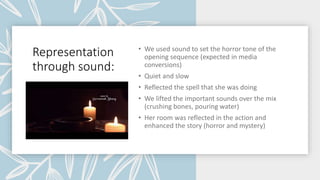
through sound:
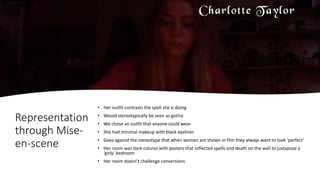
Representation
through Mise-
en-scene
• Her outfit contrasts the spell she is doing
• Would stereotypically be seen as gothic
• We chose an outfit that anyone could wear
• She had minimal makeup with black eyeliner
• Goes against the stereotype that when women are shown in film they always want to look ‘perfect’
• Her room was dark colures with posters that reflected spells and death on the wall to juxtapose a
‘girly’ bedroom
• Her room doesn’t challenge conversions
Theorists:
Our opening sequence is opposing Mulvey's theory of the male
gaze because she is not seen as an object or something to look
at, but she has interests and a passion for spells.
Butlers' theory of gender performativity is not shown in our
opening sequence because she is not a stereotypical girl with
perfect makeup that loves pink.
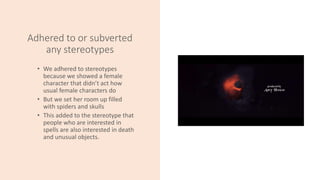
Adhered to or subverted
any stereotypes
• We adhered to stereotypes
because we showed a female
character that didn’t act how
usual female characters do
• But we set her room up filled
with spiders and skulls
• This added to the stereotype that
people who are interested in
spells are also interested in death
and unusual objects.

media ccr .pptx

  • 1.
  • 2.
    Genre of thefilm • The genre of the film that we made for our opening title sequence is a supernatural horror where a girl is seen doing a spell. • The iconography of a supernatural film is usually sparks, flames, wands and spell books. • The iconography of a horror film is big knives and blood.
  • 3.
    What other filmswe compared to: 1) Candyman (1992)- simple ariel shot of cars driving but the music tells audience that it is a horror – Directed by Bernard Rose 2) Insidious (2010)- Shows the setting and a silhouette of man is seen – Directed by Patrick Wilson, Adam Robitel, Leigh Whannell and James Wan 3) The conjuring (2013)- Gives a backstory about who the main character is and what his job is. (seekers of the supernatural) – Directed by Michael Chaves and James Wan 4) Paranormal activity (2009) - Introduces setting, suggests home based film (Handheld camera) – Directed by Oren Peli 5) Lights out (2016)- Titles appear over montage showing themes for the film – Directed by David Sandberg
  • 5.
    Characters: • Teenage girl •In Insidious a child/teenage boy is seen sleeping at the beginning • In Lights out no characters are introduced and is just a montage creating tension • We chose to introduce character- it tells the audience more about the backstory and makes them intrigued on what will happen • Her room gives the audience an idea about who she is like this example of the boy (age)
  • 6.
    Narrative: • In TheConjuring pull focus is used to draw the audience attention to poster (Seekers of the supernatural) • We used techniques like this: montage of objects around her room (spider and skull) and put posters in her room to show what she is interested in • Gives the audience background information about the character so they will be able to follow the storyline better • Editing pace changed throughout- keep audience interested • Her makeup and clothes in our opening sequence told audience that she was interested in spells.
  • 7.
    Intended audience response •We wanted the audience to feel on edge through the tense atmosphere and music • We looked at Candyman (1992)- it only uses one long shot, but the music creates the tense atmosphere that shows the audience that it is a horror. • We used this as inspiration when editing our sequence because the music can say as much as what is happening.
  • 8.
    Titles- Font, colourand animations • We used a white font that reminded me of a spell book and mystery • For the title ’Consumed’ we used a sharp capital letter font • Capture attention • We fit how the titles appeared with the cut of the edit so made sure that a title was always only in one cut • We also made sure that it was never over what was happening on screen
  • 9.
    Titles- Order ofthe titles • We looked at examples and used their order to help ours • Professional films • I looked at The invisible mad and Cruella • They are both high budget professional films so we could refer to them when editing the titles
  • 10.
    Challenging conventions • Compared toother films ours is different because in most horror films (Insidious and The Conjuring) a boy is normally introduced as the main character. • We used a girl because it isn’t seen as much especially as she is into spells and interested in dark topics (death) • This is shown by what her room looks like • We did this to not conform to the stereotype of boys only being interested in dark topics
  • 11.
    Social groups/issues thatare presented in our opening sequence • The social group of teenagers are represented through her room • Stereotypical with posters on the wall and lots of objects around the room • We chose a girl to act in this • It goes against Butlers' theory • We only see one character in our opening sequence, and she does not fit into a stereotype • We reinforced the representation of her not being a stereotypical teenager (interested in magic)
  • 12.
    Representation through editing: • Werepresented her age through editing because near the end we made a montage of different objects around her room including posters, a spider and a skull (typical teenage crowded room) • Quick editing pace of montage • Represented her being a woman but also into dark themes through editing by using shot reverse shot to show her looking at her book of spells and the audience can also then get a clear idea of what she is doing. • At the start of the sequence, it starts with a wide shot then switches to a close up to show the audience clearly what she is doing and intrigue them. • Editing was extremely important when editing the spell in order to make it look smooth
  • 13.
    Representation through thecamera: • A wide shot was the first thing that the audience saw because it represented that even though she is a girl her room isn't ‘girly’ which is helping go against cultural hegemony. • At the end of the opening sequence, her chanting went from a wide, medium then a close up of her mouth then eyes opening at the end • This gained the audience attention because it was a build up of suspense • It also reenforced the representation of her not conforming the the usual teenage stereotype as she is interested in spells and Witcraft. • We used POV shots so that the audience could start to relate to the character from the beginning
  • 14.
  • 15.
    Representation through Mise- en-scene • Heroutfit contrasts the spell she is doing • Would stereotypically be seen as gothic • We chose an outfit that anyone could wear • She had minimal makeup with black eyeliner • Goes against the stereotype that when women are shown in film they always want to look ‘perfect’ • Her room was dark colures with posters that reflected spells and death on the wall to juxtapose a ‘girly’ bedroom • Her room doesn’t challenge conversions
  • 16.
    Theorists: Our opening sequenceis opposing Mulvey's theory of the male gaze because she is not seen as an object or something to look at, but she has interests and a passion for spells. Butlers' theory of gender performativity is not shown in our opening sequence because she is not a stereotypical girl with perfect makeup that loves pink.
  • 17.
    Adhered to orsubverted any stereotypes • We adhered to stereotypes because we showed a female character that didn’t act how usual female characters do • But we set her room up filled with spiders and skulls • This added to the stereotype that people who are interested in spells are also interested in death and unusual objects.