T
CENTURY
•
BRAINSTORMIN
G ACTIVITY
• Jens Martensson
. .
PJ
. .
.
--- ---
cMY BEST OUTDOOR ACTIVITY
ACTIVITY
NAME:
REASONS REASONS REASON
S
Jens Martensson
•
LESSON 1: The K-12 Curriculum Framework
At the end of the lesson, you should he able
to:
•Discuss the salientfeatures of the K-12
Curriculum requiring 1CT-Pedagogy
integration skills.
•Analyze the learning competencies of every
year
level according to thefiel d of specialization of
the pre-service teachers.
•Review some units in the curriculum guide
with
focus on the development of 21st
Centitry skills.
.. .
Jens Martensson
•
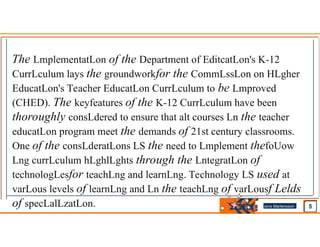
The LmplementatLon of the Department of EditcatLon's K-12
CurrLculum lays the groundworkfor the CommLssLon on HLgher
EducatLon's Teacher EducatLon CurrLculum to be Lmproved
(CHED). The keyfeatures of the K-12 CurrLculum have been
thoroughly consLdered to ensure that alt courses Ln the teacher
educatLon program meet the demands of 21st century classrooms.
One of the consLderatLons LS the need to Lmplement thefoUow
Lng currLculum hLghlLghts through the LntegratLon of
technologLesfor teachLng and learnLng. Technology LS used at
varLous levels of learnLng and Ln the teachLng of varLousf Lelds
of specLalLzatLon. Jens Martensson
•
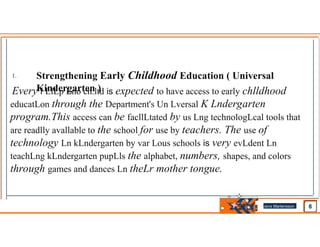
1. Strengthening Early Childhood Education ( Universal
Kindergarten )
Every f LlLp Lno ch.ltd is expected to have access to early chlldhood
educatLon through the Department's Un Lversal K Lndergarten
program.This access can be facllLtated by us Lng technologLcal tools that
are readlly avallable to the school for use by teachers. The use of
technology Ln kLndergarten by var Lous schools is very evLdent Ln
teachLng kLndergarten pupLls the alphabet, numbers, shapes, and colors
through games and dances Ln theLr mother tongue.
Jens Martensson
•
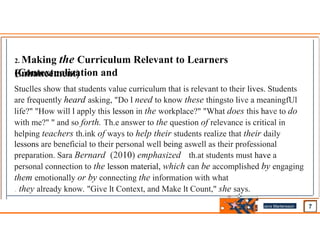
2. Making the Curriculum Relevant to Learners
(Contextualization and
Enhancement)
Stuclles show that students value curriculum that is relevant to their lives. Students
are frequently heard asking, "Do l need to know these thingsto live a meaningfUl
life?" "How will l apply this lesson in the workplace?" "What does this have to do
with me?" " and so forth. Th.e answer to the question of relevance is critical in
helping teachers th.ink of ways to help their students realize that their daily
lessons are beneficial to their personal well­being aswell as their professional
preparation. Sara Bernard (2010) emphasized th.at students must have a
personal connection to the lesson material, which can be accomplished by engaging
them emotionally or by connecting the information with what
. they already know. "Give lt Context, and Make lt Count," she says.
Jens Martensson
•
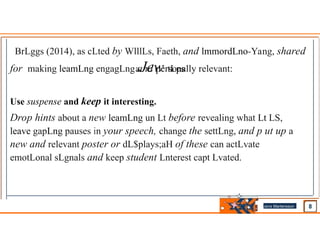
BrLggs (2014), as cLted by WlllLs, Faeth, and lmmordLno-Yang, shared
aJew tLps
for making leamLng engagLng and personally relevant:
Use suspense and keep it interesting.
Drop hints about a new leamLng un Lt before revealing what Lt LS,
leave gapLng pauses in your speech, change the settLng, and p ut up a
new and relevant poster or dL$plays;aH of these can actLvate
emotLonal sLgnals and keep student Lnterest capt Lvated.
Jens Martensson
•
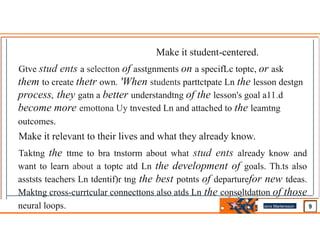
Make it student-centered.
Gtve stud ents a selectton of asstgnments on a specifLc toptc, or ask
them to create thetr own. 'When students parttctpate Ln the lesson destgn
process, they gatn a better understandtng of the lesson's goal a11.d
become more emottona Uy tnvested Ln and attached to the leamtng
outcomes.
Make it relevant to their lives and what they already know.
Taktng the ttme to bra tnstorm about what stud ents already know and
want to learn about a toptc atd Ln the development of goals. Th.ts also
asststs teachers Ln tdentif)r tng the best potnts of departurefor new tdeas.
Maktng cross-currtcular connecttons also atds Ln the consoltdatton of those
neural loops. Jens Martensson
•
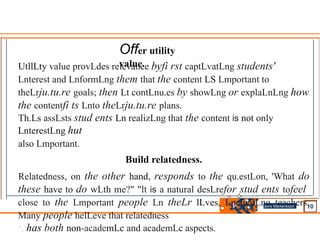
UtllLty value provLdes relevance byfi rst captLvatLng students'
Lnterest and LnformLng them that the content LS Lmportant to
theLrju.tu.re goals; then Lt contLnu.es by showLng or explaLnLng how
the contentfi ts Lnto theLrju.tu.re plans.
Th.Ls assLsts stud ents Ln realizLng that the content is not only
LnterestLng hut
also Lmportant.
Build relatedness.
Relatedness, on the other hand, responds to the qu.estLon, 'What do
these have to do wLth me?" "lt is a natural desLrefor stud ents tofeel
close to the Lmportant people Ln theLr lLves, Lnclu.dLng teachers.
Many people helLeve that relatedness
·. has both non-academLc and academLc aspects.
Offer utility
value.
Jens Martensson
•
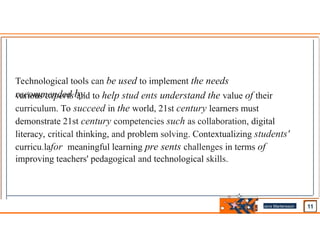
Technological tools can be used to implement the needs
recommended by
various experts and to help stud ents understand the value of their
curriculum. To succeed in the world, 21st century learners must
demonstrate 21st century competencies such as collaboration, digital
literacy, critical thinking, and problem solving. Contextualizing students'
curricu.lafor meaningful learning pre sents challenges in terms of
improving teachers' pedagogical and technological skills.
Jens Martensson
•
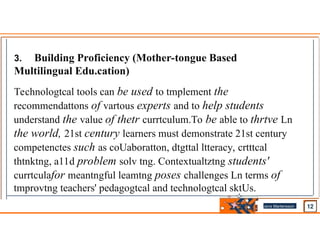
3. Building Proficiency (Mother-tongue Based
Multilingual Edu.cation)
Technologtcal tools can be used to tmplement the
recommendattons of vartous experts and to help students
understand the value of thetr currtculum.To be able to thrtve Ln
the world, 21st century learners must demonstrate 21st century
competenctes such as coUaboratton, dtgttal ltteracy, crtttcal
thtnktng, a11d problem solv tng. Contextualtztng students'
currtculafor meantngful leamtng poses challenges Ln terms of
tmprovtng teachers' pedagogtcal and technologtcal sktUs.
Jens Martensson
•
4. Ensuring lntegrated and Seamless Leaming (Spiral
Progression)
Learning.fundamental concepts that lead to a more complex
and
sophtsticated version of thefu ndamental concepts entail
TPACK:technological knowledge, pedagogical knowledge, and
content knowledge. if aU areas of specialization are aided by
technologiesfor
teaching and learning, students wiU befuUy supported in
redtscovering
previously presented concepts as they advance in grade leveL
ThiswiU improve retention and mastery of topics and skiUs relevant to
their
developmental and cognitive abilities.
Jens Martensson
•
5. Gearing Up f or the
Future.
The K to 12 Currtculum ensures coUege readtness by altgntng the
core and applted courses to the CoUege Readtness Standard (CRS)
and the neiv General Educatton Currtculum.As a result, the K to 12
Currtculumfocused on developtng appropr tate spectaltzatton
subjectsfor the Academtc, Sport s, Arts and Destgn, and Tech11tcal
Vocattonal Ltvelthood Tracks.To tmprove leamtng, aU of these
spectall2atton subjects must be supported by
educattonal technology.
Jens Martensson
•
6. Nurturing the Holistically Developed Filipino (Collegeand
Livelihood
Readiness, 21st Century Skills)
Every Kto 12 graduate ts expected to be ready to go tnto defje'
rent paths­htgher educatton, employment, or entrep reneurshtp -
tn order to nurture holtsttcaUy develop Flttptnos.Every graduate
ts expected to have
trefo' rmatton, med.ta, and technology skltls, as weU as lefe and
career sktUs.
Thts tsposstble wtth the proper tmplementatton of the
currtculum and the facltttatton of exceUent teachers. Teachers
requtre conttnuous support, one of whtch ts technologtcal
support , tn order to matntatn thetr exceUent
peeformance.
Jens Martensson
•
Teachersplay a signiflcant
role
in facilitating
student
learning
by
designing
,
implementing,
and
evaluatin
g
curriculum. ln the Philippines, teachers are expected
to actively participate in curriculum design in order to
ensure that the K-12 Curriculum is best delivered in order
to fully its
intended
learning outcomes. Teachers
make
ut how they will implement
their fi eld of
·wn.. They decide how to
esson's activities and
how to
manipulate student
responses and ideas. As a result, the
selection of a teacher is essential. lt has an
ejfect on the student's learning. Consider
the following points when identgying and
comprehending
teachers' roles as curriculum designers:
Jens Martensson
•
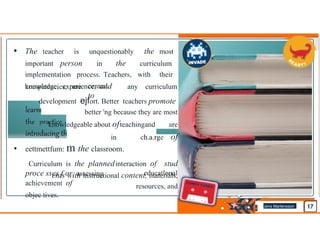
• The teacher is unquestionably the most
important person in the curriculum
implementation process. Teachers, with their
knowledge, experience, and
competencies, are central
to
any curriculum
development ejfort. Better teachers promote
better 'ng because they are most
knowledgeable about ofteachingand are
in ch.a.rge of
eettmettfum: m the classroom.
Curriculum is the plannedinteraction of stud
ents with instructional content, materials,
resources, and
•
proce sses f or assessing
achievement of
objec tives.
educatlonal
Jens Martensson
•
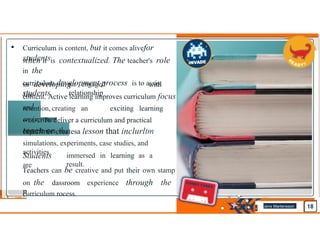
• Curriculum is content, but it comes alivefor
students
when it is contextualized. The teacher's role
in the
curriculum development process is to assist
students
in developing with
the
an engaged
relationship
content. Active learning improves curriculum focus
retention, creating an exciting learning
••.LL•Ll To deliver a curriculum and practical
teach.er createsa lesson that inclurltm
simulations, experiments, case studies, and
activities.
Students
are
immersed in learning as a
result.
Teachers can be creative and put their own stamp
on the dassroom experience through the
curriculum rocess.
Jens Martensson
•
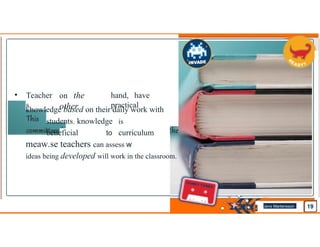
• Teacher
s,
on the
other
hand, have
practical
knowledge based on their daily work with
students. knowledge is
beneficial to curriculum
meaw.se teachers can assess w
ideas being developed will work in the classroom.
Jens Martensson
•
coL
•
LABoRATI
VE
TASI
<
PERFORMAN
CE
TASK
GUlDE QYESTIONS:
1
.
How w lll tech.nologLcal toolsfor teach.Lng and leamLng help
to pron1ote
the key elements of the K-12
CurrLculum?
2. What are the 21st Century skllls th.at yourfield of specLaL
Lzat Lon requLres you to develop ? Rank th.em Ln relat Lon to the
Ldentifled standards and competencLes Ln your currLculum gitLde?
Jens Martensson
•
LESSON 2:ICT Pedagogy Integration in
Language Learning Plan
At the end of the lesson,you should be able to:
• Discuss essential potnts to constder
when
tntegrattng any lCT tnfacllttattng
language
educat
ton.
• Present leamtng plans that
lntegrate 1CT
tn the leamtng procedures to he able to
attatn
the leamtng outcomes.
•Planfor some acttvtttes that wtll help
develop dtgttal ctttzenshtp and relate this
to the development of 21st century
skllls among learners.

LESSON
PLAN
Jens Martensson
•
Since knowledge has expanded and essential skills have increased
and changed, teaching has always been a challenging profession.
Teachers must use educational technologies to assist them in the
teaching-learning process in order to meet these challenges.
The use of educational technologies in the classroom isfo unded
on principles and ph ilosophies. Understanding these will assist
you in successfully integrating technologies to allow your students to
demonstrate the intended learning outcomes of yourfi eld of
.specialization.
Jens Martensson
•
lntegrating Technology in lnstruction
TheJollow btg concepts and prLncLples about LntegratLng
technology Ln LnstructLon were provLded by varLous
educators and researchers:
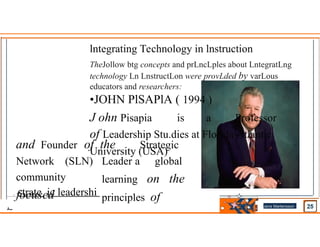
•JOHN PlSAPlA ( 1994 )
J ohn Pisapia is a Professor
of Leadership Stu.dies at Florida Atlantic
University (USA)
and Founder of
Network (SLN)
community
focused
the Strategic
Leader a global
learning on the
principles of
. strate ic leadershi
. Jens Martensson
•
•lNTERNATJONAL
SOClETY FOR
TEACHlNG lN EDUCATJON
( lSTE )
lSTE standsfor the lntemational
Societyfor Technology in Education. lt
is a non-profi t organization that seeks
to promote the
integration of technology in teaching
and learning.
Jens Martensson
•
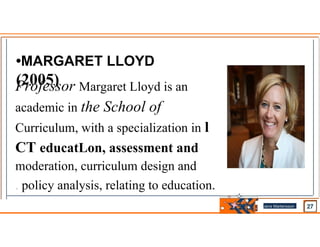
•MARGARET LLOYD
(2005)
Professor Margaret Lloyd is an
academic in the School of
Curriculum, with a specialization in l
CT educatLon, assessment and
moderation, curriculum design and
. policy analysis, relating to education.
Jens Martensson
•
• QLYUN WANG & HUAY LlTWOO
(2007)
lCT integration can happen in
three d
•BERNARDBAHATI (2006 )
erent areas:curriculum, topic, and
lesson.
The process of integrating lCT in teaching and learning must take place at
both. the pedagogical and technological levels, with. a strong emphasis on
the pedagogicaL
•UNESCO ( 2005 )
lCT integration involves more th.anj ust knowing how to use hardware and
software. Teach.ers must und erstand how to organize the classroom in
order to structure the learning tasks.
Jens Martensson
•
Before you can successfo.lly tntegrate lCTs tnto
your
language tnstrnctton,you mustftrst understand what
lnformatton and Communtcatton Technology (lCT) ls
all aboitt. There ls a sp eciftc need to tdentifY the
lCTs that are avatlablefor language educatton.
Thefollowtng are deftntttons of lCTfr om vartous
sources:
Jens Martensson
•
•• MOURSUND
( 2005 )
lCT encompasses the entire scope of computer hardware and software. ln
additio there are telecommunicationsfacilities. Computerized machinery and
computerized robots are also included.
•• TINlO ( 2009 )
lCT refers to a wide range of tech.no logical tools and resources th.at are used
to comntunicate, create, dissentinate, store, and manage ieformation. Hardware
devices, software applications, internet connectivity, broadcasting technologies,
and telephony are examples of these technologies.
Jens Martensson
•

Media and Information sources lesson 5 ppt

  • 1.
  • 2.
  • 3.
    . . PJ . . . ------ cMY BEST OUTDOOR ACTIVITY ACTIVITY NAME: REASONS REASONS REASON S Jens Martensson •
  • 4.
    LESSON 1: TheK-12 Curriculum Framework At the end of the lesson, you should he able to: •Discuss the salientfeatures of the K-12 Curriculum requiring 1CT-Pedagogy integration skills. •Analyze the learning competencies of every year level according to thefiel d of specialization of the pre-service teachers. •Review some units in the curriculum guide with focus on the development of 21st Centitry skills. .. . Jens Martensson •
  • 5.
    The LmplementatLon ofthe Department of EditcatLon's K-12 CurrLculum lays the groundworkfor the CommLssLon on HLgher EducatLon's Teacher EducatLon CurrLculum to be Lmproved (CHED). The keyfeatures of the K-12 CurrLculum have been thoroughly consLdered to ensure that alt courses Ln the teacher educatLon program meet the demands of 21st century classrooms. One of the consLderatLons LS the need to Lmplement thefoUow Lng currLculum hLghlLghts through the LntegratLon of technologLesfor teachLng and learnLng. Technology LS used at varLous levels of learnLng and Ln the teachLng of varLousf Lelds of specLalLzatLon. Jens Martensson •
  • 6.
    1. Strengthening EarlyChildhood Education ( Universal Kindergarten ) Every f LlLp Lno ch.ltd is expected to have access to early chlldhood educatLon through the Department's Un Lversal K Lndergarten program.This access can be facllLtated by us Lng technologLcal tools that are readlly avallable to the school for use by teachers. The use of technology Ln kLndergarten by var Lous schools is very evLdent Ln teachLng kLndergarten pupLls the alphabet, numbers, shapes, and colors through games and dances Ln theLr mother tongue. Jens Martensson •
  • 7.
    2. Making theCurriculum Relevant to Learners (Contextualization and Enhancement) Stuclles show that students value curriculum that is relevant to their lives. Students are frequently heard asking, "Do l need to know these thingsto live a meaningfUl life?" "How will l apply this lesson in the workplace?" "What does this have to do with me?" " and so forth. Th.e answer to the question of relevance is critical in helping teachers th.ink of ways to help their students realize that their daily lessons are beneficial to their personal well­being aswell as their professional preparation. Sara Bernard (2010) emphasized th.at students must have a personal connection to the lesson material, which can be accomplished by engaging them emotionally or by connecting the information with what . they already know. "Give lt Context, and Make lt Count," she says. Jens Martensson •
  • 8.
    BrLggs (2014), ascLted by WlllLs, Faeth, and lmmordLno-Yang, shared aJew tLps for making leamLng engagLng and personally relevant: Use suspense and keep it interesting. Drop hints about a new leamLng un Lt before revealing what Lt LS, leave gapLng pauses in your speech, change the settLng, and p ut up a new and relevant poster or dL$plays;aH of these can actLvate emotLonal sLgnals and keep student Lnterest capt Lvated. Jens Martensson •
  • 9.
    Make it student-centered. Gtvestud ents a selectton of asstgnments on a specifLc toptc, or ask them to create thetr own. 'When students parttctpate Ln the lesson destgn process, they gatn a better understandtng of the lesson's goal a11.d become more emottona Uy tnvested Ln and attached to the leamtng outcomes. Make it relevant to their lives and what they already know. Taktng the ttme to bra tnstorm about what stud ents already know and want to learn about a toptc atd Ln the development of goals. Th.ts also asststs teachers Ln tdentif)r tng the best potnts of departurefor new tdeas. Maktng cross-currtcular connecttons also atds Ln the consoltdatton of those neural loops. Jens Martensson •
  • 10.
    UtllLty value provLdesrelevance byfi rst captLvatLng students' Lnterest and LnformLng them that the content LS Lmportant to theLrju.tu.re goals; then Lt contLnu.es by showLng or explaLnLng how the contentfi ts Lnto theLrju.tu.re plans. Th.Ls assLsts stud ents Ln realizLng that the content is not only LnterestLng hut also Lmportant. Build relatedness. Relatedness, on the other hand, responds to the qu.estLon, 'What do these have to do wLth me?" "lt is a natural desLrefor stud ents tofeel close to the Lmportant people Ln theLr lLves, Lnclu.dLng teachers. Many people helLeve that relatedness ·. has both non-academLc and academLc aspects. Offer utility value. Jens Martensson •
  • 11.
    Technological tools canbe used to implement the needs recommended by various experts and to help stud ents understand the value of their curriculum. To succeed in the world, 21st century learners must demonstrate 21st century competencies such as collaboration, digital literacy, critical thinking, and problem solving. Contextualizing students' curricu.lafor meaningful learning pre sents challenges in terms of improving teachers' pedagogical and technological skills. Jens Martensson •
  • 12.
    3. Building Proficiency(Mother-tongue Based Multilingual Edu.cation) Technologtcal tools can be used to tmplement the recommendattons of vartous experts and to help students understand the value of thetr currtculum.To be able to thrtve Ln the world, 21st century learners must demonstrate 21st century competenctes such as coUaboratton, dtgttal ltteracy, crtttcal thtnktng, a11d problem solv tng. Contextualtztng students' currtculafor meantngful leamtng poses challenges Ln terms of tmprovtng teachers' pedagogtcal and technologtcal sktUs. Jens Martensson •
  • 13.
    4. Ensuring lntegratedand Seamless Leaming (Spiral Progression) Learning.fundamental concepts that lead to a more complex and sophtsticated version of thefu ndamental concepts entail TPACK:technological knowledge, pedagogical knowledge, and content knowledge. if aU areas of specialization are aided by technologiesfor teaching and learning, students wiU befuUy supported in redtscovering previously presented concepts as they advance in grade leveL ThiswiU improve retention and mastery of topics and skiUs relevant to their developmental and cognitive abilities. Jens Martensson •
  • 14.
    5. Gearing Upf or the Future. The K to 12 Currtculum ensures coUege readtness by altgntng the core and applted courses to the CoUege Readtness Standard (CRS) and the neiv General Educatton Currtculum.As a result, the K to 12 Currtculumfocused on developtng appropr tate spectaltzatton subjectsfor the Academtc, Sport s, Arts and Destgn, and Tech11tcal Vocattonal Ltvelthood Tracks.To tmprove leamtng, aU of these spectall2atton subjects must be supported by educattonal technology. Jens Martensson •
  • 15.
    6. Nurturing theHolistically Developed Filipino (Collegeand Livelihood Readiness, 21st Century Skills) Every Kto 12 graduate ts expected to be ready to go tnto defje' rent paths­htgher educatton, employment, or entrep reneurshtp - tn order to nurture holtsttcaUy develop Flttptnos.Every graduate ts expected to have trefo' rmatton, med.ta, and technology skltls, as weU as lefe and career sktUs. Thts tsposstble wtth the proper tmplementatton of the currtculum and the facltttatton of exceUent teachers. Teachers requtre conttnuous support, one of whtch ts technologtcal support , tn order to matntatn thetr exceUent peeformance. Jens Martensson •
  • 16.
    Teachersplay a signiflcant role infacilitating student learning by designing , implementing, and evaluatin g curriculum. ln the Philippines, teachers are expected to actively participate in curriculum design in order to ensure that the K-12 Curriculum is best delivered in order to fully its intended learning outcomes. Teachers make ut how they will implement their fi eld of ·wn.. They decide how to esson's activities and how to manipulate student responses and ideas. As a result, the selection of a teacher is essential. lt has an ejfect on the student's learning. Consider the following points when identgying and comprehending teachers' roles as curriculum designers: Jens Martensson •
  • 17.
    • The teacheris unquestionably the most important person in the curriculum implementation process. Teachers, with their knowledge, experience, and competencies, are central to any curriculum development ejfort. Better teachers promote better 'ng because they are most knowledgeable about ofteachingand are in ch.a.rge of eettmettfum: m the classroom. Curriculum is the plannedinteraction of stud ents with instructional content, materials, resources, and • proce sses f or assessing achievement of objec tives. educatlonal Jens Martensson •
  • 18.
    • Curriculum iscontent, but it comes alivefor students when it is contextualized. The teacher's role in the curriculum development process is to assist students in developing with the an engaged relationship content. Active learning improves curriculum focus retention, creating an exciting learning ••.LL•Ll To deliver a curriculum and practical teach.er createsa lesson that inclurltm simulations, experiments, case studies, and activities. Students are immersed in learning as a result. Teachers can be creative and put their own stamp on the dassroom experience through the curriculum rocess. Jens Martensson •
  • 19.
    • Teacher s, on the other hand,have practical knowledge based on their daily work with students. knowledge is beneficial to curriculum meaw.se teachers can assess w ideas being developed will work in the classroom. Jens Martensson •
  • 21.
  • 22.
    GUlDE QYESTIONS: 1 . How wlll tech.nologLcal toolsfor teach.Lng and leamLng help to pron1ote the key elements of the K-12 CurrLculum? 2. What are the 21st Century skllls th.at yourfield of specLaL Lzat Lon requLres you to develop ? Rank th.em Ln relat Lon to the Ldentifled standards and competencLes Ln your currLculum gitLde? Jens Martensson •
  • 23.
    LESSON 2:ICT PedagogyIntegration in Language Learning Plan At the end of the lesson,you should be able to: • Discuss essential potnts to constder when tntegrattng any lCT tnfacllttattng language educat ton. • Present leamtng plans that lntegrate 1CT tn the leamtng procedures to he able to attatn the leamtng outcomes. •Planfor some acttvtttes that wtll help develop dtgttal ctttzenshtp and relate this to the development of 21st century skllls among learners. LESSON PLAN Jens Martensson •
  • 24.
    Since knowledge hasexpanded and essential skills have increased and changed, teaching has always been a challenging profession. Teachers must use educational technologies to assist them in the teaching-learning process in order to meet these challenges. The use of educational technologies in the classroom isfo unded on principles and ph ilosophies. Understanding these will assist you in successfully integrating technologies to allow your students to demonstrate the intended learning outcomes of yourfi eld of .specialization. Jens Martensson •
  • 25.
    lntegrating Technology inlnstruction TheJollow btg concepts and prLncLples about LntegratLng technology Ln LnstructLon were provLded by varLous educators and researchers: •JOHN PlSAPlA ( 1994 ) J ohn Pisapia is a Professor of Leadership Stu.dies at Florida Atlantic University (USA) and Founder of Network (SLN) community focused the Strategic Leader a global learning on the principles of . strate ic leadershi . Jens Martensson •
  • 26.
    •lNTERNATJONAL SOClETY FOR TEACHlNG lNEDUCATJON ( lSTE ) lSTE standsfor the lntemational Societyfor Technology in Education. lt is a non-profi t organization that seeks to promote the integration of technology in teaching and learning. Jens Martensson •
  • 27.
    •MARGARET LLOYD (2005) Professor MargaretLloyd is an academic in the School of Curriculum, with a specialization in l CT educatLon, assessment and moderation, curriculum design and . policy analysis, relating to education. Jens Martensson •
  • 28.
    • QLYUN WANG& HUAY LlTWOO (2007) lCT integration can happen in three d •BERNARDBAHATI (2006 ) erent areas:curriculum, topic, and lesson. The process of integrating lCT in teaching and learning must take place at both. the pedagogical and technological levels, with. a strong emphasis on the pedagogicaL •UNESCO ( 2005 ) lCT integration involves more th.anj ust knowing how to use hardware and software. Teach.ers must und erstand how to organize the classroom in order to structure the learning tasks. Jens Martensson •
  • 29.
    Before you cansuccessfo.lly tntegrate lCTs tnto your language tnstrnctton,you mustftrst understand what lnformatton and Communtcatton Technology (lCT) ls all aboitt. There ls a sp eciftc need to tdentifY the lCTs that are avatlablefor language educatton. Thefollowtng are deftntttons of lCTfr om vartous sources: Jens Martensson •
  • 30.
    •• MOURSUND ( 2005) lCT encompasses the entire scope of computer hardware and software. ln additio there are telecommunicationsfacilities. Computerized machinery and computerized robots are also included. •• TINlO ( 2009 ) lCT refers to a wide range of tech.no logical tools and resources th.at are used to comntunicate, create, dissentinate, store, and manage ieformation. Hardware devices, software applications, internet connectivity, broadcasting technologies, and telephony are examples of these technologies. Jens Martensson •