UNIT IV
PLC
Programmable logic controller - Architecture –
Input / Output Processing – Ladder diagrams -
Latching, Sequencing, Timers, Counters and
Internal relays – Data Handling – Selection of
PLC - Application of PLCs for control
Programmable Logic Controller (PLC)
• It is a solid state digital electronics device,
design for the use in Industrial environment.
• It is a microprocessor based specialized
computer that carriers out control function of
many types and level of complexity.
• Purpose is to monitor crucial parameter
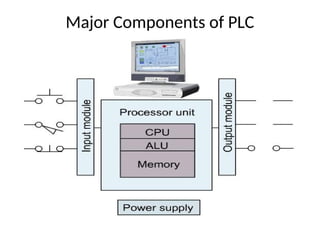
Major Components of PLC
Major Parts Of PLC
• Central Processing Unit
– Microprocessor
– Memory
– Power supply
• Programmer/ monitor
• I/O modules
Input/Output Interfaces:
• They provide isolation & signal conditioning.
• Input channel: Digital signal generally
compatible with
• Microprocessor of PLC is in range from 5V, 24
V, 110V to 240 V.
Output channel:
Sinking and sourcing operations
When choosing the type of input or output module
for your PLC system it is very important to have a
solid understanding of sinking and sourcing
concepts.
• Only applicable to dc load
• It refer to electrical configurations of the circuit in
the module & field input devices.
• When a device provides current when it is ON it is
said to be sourcing current.
• When a device receives current when it is ON it is
said to be sinking current.
Sinking and sourcing operations
• There are both sinking & sourcing field devices as
well as sinking & sourcing input module.
• But it’s a common practice to use input module in
sinking current mode.
PLC Architecture
PLC Programming
Most common languages encountered in PLC
programming are:
1) Ladder Logic
2) Functional Block Diagram
3) Sequential Function Chart
4) Boolean mnemonics
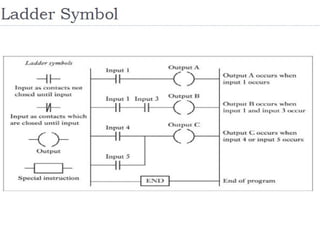
Ladder programming
• Ladder programming- form of graphical
language.
• Ladder programming- is a network of contacts
and coils are arranged on rungs between two
vertical lines called rails.
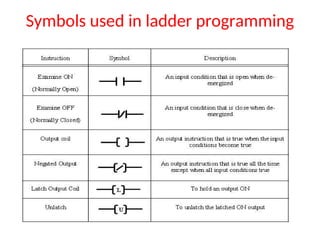
Symbols used in ladder programming
LADDER PROGRAMMING
• The sequence followed by PLC when carrying out
a program can be summarised:
– Scan the input associated with one rung of the ladder
program.
– Solve the logic operation involving those inputs.
– Set/reset the output for the rung.
– Move on to the next rung and repeat operation 1,2,3.
– And so on until the end of program,, the PLC then
goes back to the beginning of the program and start
again.
Logic gates
Latching
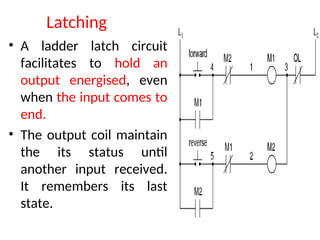
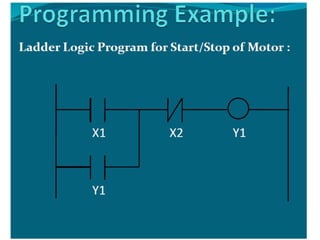
• A ladder latch circuit
facilitates to hold an
output energised, even
when the input comes to
end.
• The output coil maintain
the its status until
another input received.
It remembers its last
state.
Sequencing
• The logic circuit whose output at any instant
time depend not only on the present input
also but past output is called sequencing.
INTERNAL RELAY
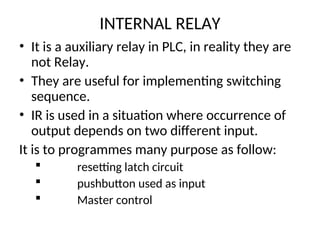
• It is a auxiliary relay in PLC, in reality they are
not Relay.
• They are useful for implementing switching
sequence.
• IR is used in a situation where occurrence of
output depends on two different input.
It is to programmes many purpose as follow:
 resetting latch circuit
 pushbutton used as input
 Master control
Timers
• Timer are commonly behave like a relay with
coil which when energised result in the
closure or opening of contact after some
preset time.
Counter
• Counters are used when there is a need to
count a specific number of contact operation.
• Up counters: count up starting form zero and
when a preset value is reached, the output of
the counter is ON
• Down counters: count down to zero from a
preset value and then the output of the
counter is ON
Jump
• Condition jump is function provides in PLC’S. If
a certain condition exists, then a section of
program is ignored and the program control is
jumped.
Selection of PLC
???????????????
Applications of PLC
Wherever automation is desired the PLCs are best
suited to meet the task.
Few examples of industries where PLCs are used:
• 1) Robots manufacturing and control
• 2) Car park control
• 3) Train control station system
• 4) Food processing
• 5) Materials handling
• 6)Machine tools
• 7)Conveyer system etc.
Mechatronics-PLCs, PLC - programming.ppt

Mechatronics-PLCs, PLC - programming.ppt

  • 1.
    UNIT IV PLC Programmable logiccontroller - Architecture – Input / Output Processing – Ladder diagrams - Latching, Sequencing, Timers, Counters and Internal relays – Data Handling – Selection of PLC - Application of PLCs for control
  • 2.
    Programmable Logic Controller(PLC) • It is a solid state digital electronics device, design for the use in Industrial environment. • It is a microprocessor based specialized computer that carriers out control function of many types and level of complexity. • Purpose is to monitor crucial parameter
  • 3.
  • 4.
  • 8.
    Major Parts OfPLC • Central Processing Unit – Microprocessor – Memory – Power supply • Programmer/ monitor • I/O modules
  • 10.
    Input/Output Interfaces: • Theyprovide isolation & signal conditioning. • Input channel: Digital signal generally compatible with • Microprocessor of PLC is in range from 5V, 24 V, 110V to 240 V.
  • 11.
  • 12.
    Sinking and sourcingoperations When choosing the type of input or output module for your PLC system it is very important to have a solid understanding of sinking and sourcing concepts. • Only applicable to dc load • It refer to electrical configurations of the circuit in the module & field input devices. • When a device provides current when it is ON it is said to be sourcing current. • When a device receives current when it is ON it is said to be sinking current.
  • 13.
    Sinking and sourcingoperations • There are both sinking & sourcing field devices as well as sinking & sourcing input module. • But it’s a common practice to use input module in sinking current mode.
  • 16.
  • 23.
    PLC Programming Most commonlanguages encountered in PLC programming are: 1) Ladder Logic 2) Functional Block Diagram 3) Sequential Function Chart 4) Boolean mnemonics
  • 24.
    Ladder programming • Ladderprogramming- form of graphical language. • Ladder programming- is a network of contacts and coils are arranged on rungs between two vertical lines called rails.
  • 25.
    Symbols used inladder programming
  • 28.
    LADDER PROGRAMMING • Thesequence followed by PLC when carrying out a program can be summarised: – Scan the input associated with one rung of the ladder program. – Solve the logic operation involving those inputs. – Set/reset the output for the rung. – Move on to the next rung and repeat operation 1,2,3. – Move on to the next rung and repeat operation 1,2,3. – And so on until the end of program,, the PLC then goes back to the beginning of the program and start again.
  • 36.
  • 44.
    Latching • A ladderlatch circuit facilitates to hold an output energised, even when the input comes to end. • The output coil maintain the its status until another input received. It remembers its last state.
  • 45.
    Sequencing • The logiccircuit whose output at any instant time depend not only on the present input also but past output is called sequencing.
  • 46.
    INTERNAL RELAY • Itis a auxiliary relay in PLC, in reality they are not Relay. • They are useful for implementing switching sequence. • IR is used in a situation where occurrence of output depends on two different input. It is to programmes many purpose as follow:  resetting latch circuit  pushbutton used as input  Master control
  • 47.
    Timers • Timer arecommonly behave like a relay with coil which when energised result in the closure or opening of contact after some preset time.
  • 48.
    Counter • Counters areused when there is a need to count a specific number of contact operation. • Up counters: count up starting form zero and when a preset value is reached, the output of the counter is ON • Down counters: count down to zero from a preset value and then the output of the counter is ON
  • 50.
    Jump • Condition jumpis function provides in PLC’S. If a certain condition exists, then a section of program is ignored and the program control is jumped.
  • 51.
  • 52.
    Applications of PLC Whereverautomation is desired the PLCs are best suited to meet the task. Few examples of industries where PLCs are used: • 1) Robots manufacturing and control • 2) Car park control • 3) Train control station system • 4) Food processing • 5) Materials handling • 6)Machine tools • 7)Conveyer system etc.