Deenbandhu Chhotu Ram University of Science & Technology,
Murthal, Sonepat (Haryana)
Professional Training
at
HMC MM AUTO LTD
Submitted by:
Name: Pratibha
Roll No: 22001002032
B.Tech. Electrical Engineering
Submitted to:
Dr. SK Gupta
Dr. AK Singh
Dr. Ravi Lathwal
HMC MM Auto Limited is a 60:40 joint venture between
India’s Hero MotoCorp Limited and Italy’s Marelli Europe
S.p.A., focused on designing, developing, and
manufacturing Electronic Fuel Injection (EFI) systems and
their components for two- and three-wheelers, particularly
for Hero MotoCorp. Established in 2013 with operations
starting in 2016, the company produces EFI systems,
Mechatronic Integrated Unit (MIU) systems, and Ride-by-
Wire (RIU) systems for engines ranging from 50cc to 850cc.
HMC MM Auto’s sole manufacturing plant is located in
Manesar, Haryana, and it serves as a strategic partner for
its parent company’s technology development, especially
in light of BS VI emission standards.
About the Company
EFI ( ELECTRONIC FUEL INJECTION
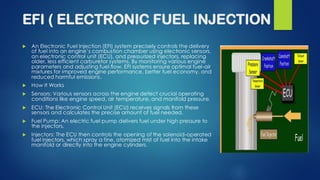
 An Electronic Fuel Injection (EFI) system precisely controls the delivery
of fuel into an engine’s combustion chamber using electronic sensors,
an electronic control unit (ECU), and pressurized injectors, replacing
older, less efficient carburetor systems. By monitoring various engine
parameters and adjusting fuel flow, EFI systems ensure optimal fuel-air
mixtures for improved engine performance, better fuel economy, and
reduced harmful emissions.
 How It Works
 Sensors: Various sensors across the engine detect crucial operating
conditions like engine speed, air temperature, and manifold pressure.
 ECU: The Electronic Control Unit (ECU) receives signals from these
sensors and calculates the precise amount of fuel needed.
 Fuel Pump: An electric fuel pump delivers fuel under high pressure to
the injectors.
 Injectors: The ECU then controls the opening of the solenoid-operated
fuel injectors, which spray a fine, atomized mist of fuel into the intake
manifold or directly into the engine cylinders.
MIU ( MECHATRONICS INTEGRATED
UNIT )
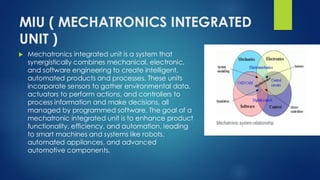
 Mechatronics integrated unit is a system that
synergistically combines mechanical, electronic,
and software engineering to create intelligent,
automated products and processes. These units
incorporate sensors to gather environmental data,
actuators to perform actions, and controllers to
process information and make decisions, all
managed by programmed software. The goal of a
mechatronic integrated unit is to enhance product
functionality, efficiency, and automation, leading
to smart machines and systems like robots,
automated appliances, and advanced
automotive components.
Ride by wire
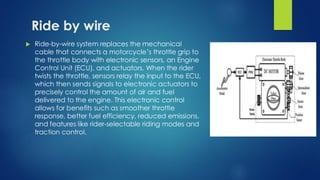
 Ride-by-wire system replaces the mechanical
cable that connects a motorcycle’s throttle grip to
the throttle body with electronic sensors, an Engine
Control Unit (ECU), and actuators. When the rider
twists the throttle, sensors relay the input to the ECU,
which then sends signals to electronic actuators to
precisely control the amount of air and fuel
delivered to the engine. This electronic control
allows for benefits such as smoother throttle
response, better fuel efficiency, reduced emissions,
and features like rider-selectable riding modes and
traction control.
Projects Overview
 Developing a motorcycle’s “ride by wire” and testing a gear
indicator system are important projects for an electrical engineer
because they provide practical experience in several core areas.
 Ride by wire
 This system replaces mechanical throttle cables with electronic
sensors and actuators, connecting the rider’s input to the engine’s
Engine Control Unit (ECU).
 It provides hands-on experience in sensor technology, embedded
systems, actuator control, and feedback loops.
 It also involves control theory and signal processing for optimizing
performance, fuel efficiency, and integrating safety features like
traction control and different riding modes.
 Gear indicator
 A custom-built gear indicator system for a motorcycle is an excellent
project for applying fundamental electronics principles.
 It involves designing and building a circuit to read input from gear
position sensors or the bike’s speed and RPM.
 This project covers sensor integration, microcontroller programming,
and display interface design, reinforcing skills in low-power circuit
design and fault detection.
 Both projects offer a concrete application of theoretical
knowledge, improving skills in system design, integration, and
troubleshooting for the automotive and electronics industries.
Projects :
 Titlle :project on ride by wire system
 Ride-by-wire system typically replaces mechanical linkages
with electronic sensors and actuators. In this example, we’ll
use a potentiometer as a simulated throttle input and a servo
motor to represent a throttle body actuator.
 Hardware Setup (Conceptual):
 Throttle Input: A potentiometer connected to an analog input
pin (e.g., A0).
 Throttle Actuator: A servo motor connected to a PWM pin (e.g.,
pin 9).
 Power Supply: Ensure adequate power for the Arduino and the
servo motor.
 Project on a ride-by-wire (RbW) system for a motorcycle involves replacing the
traditional mechanical throttle cable with electronic sensors, an Electronic
Control Unit (ECU), and actuators. This offers a powerful and comprehensive
project for students in mechanical, electronics, and mechatronics engineering.
 Project goals
 The primary goal is to demonstrate the principles and benefits of an RbW system
by developing and building a prototype.
 Fundamental Objective: To replace the mechanical linkage between the twist-
grip and the throttle body with an electronic system.
 Control and Optimization: To enable more precise control over the air-fuel
mixture entering the engine, improving performance and efficiency.
 System Integration: To facilitate the integration of advanced rider-assistance
features, such as different riding modes and traction control.
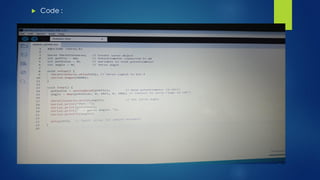
 Code :
Title : Testing gear indicator for motor
vehicle
 Testing a gear indicator for a motorcycle can be accomplished using several methods, ranging
from simple continuity checks to more complex system diagnostics. Your bike’s Engine Control
Unit (ECU) can be a central component in this process, both for testing existing indicators and for
integrating new or custom ones.Modern motorcycle ECUs are sophisticated computers that
monitor and control many engine functions. For a custom gear indicator project, the ECU offers a
more advanced and reliable method than a purely mechanical or sensor-based system.
 Accessing gear position data from the ECU:
 Direct ECU data: Many modern bikes already have a gear position sensor connected to the ECU.
The ECU receives a raw signal from this sensor and uses it for various functions, such as adjusting
the ignition timing or providing a signal for the dashboard. You can often tap into this signal
directly.
 CAN bus: High-end motorcycles use a Controller Area Network (CAN) bus to allow different
components to communicate. The ECU broadcasts information like the current gear over this
network. With the right hardware (a CAN bus reader) and some programming, you can read this
data directly.
 How the ECU improves accuracy and reliability:
 Built-in sensor: By using the data from the bike’s native gear
position sensor, your indicator can be more accurate and
less prone to mechanical error than one that relies on
external sensors attached to the shift lever.
 Signal stability: The ECU conditions and processes the raw
sensor signal, providing a clean, stable digital value. This
prevents the inaccurate readings that can occur with simple
external sensors due to vibration or intermittent contact.
 Advanced logic: You can program a microcontroller (like an
Arduino) to read the ECU’s gear signal and use it to drive
your custom display. This allows for advanced features, such
as displaying a different symbol for neutral or incorporating
logic to prevent false readings.
Thank You

MECHATRONICS INTEGRATED UNITsmart machines and systems like robot

  • 1.
    Deenbandhu Chhotu RamUniversity of Science & Technology, Murthal, Sonepat (Haryana) Professional Training at HMC MM AUTO LTD Submitted by: Name: Pratibha Roll No: 22001002032 B.Tech. Electrical Engineering Submitted to: Dr. SK Gupta Dr. AK Singh Dr. Ravi Lathwal
  • 2.
    HMC MM AutoLimited is a 60:40 joint venture between India’s Hero MotoCorp Limited and Italy’s Marelli Europe S.p.A., focused on designing, developing, and manufacturing Electronic Fuel Injection (EFI) systems and their components for two- and three-wheelers, particularly for Hero MotoCorp. Established in 2013 with operations starting in 2016, the company produces EFI systems, Mechatronic Integrated Unit (MIU) systems, and Ride-by- Wire (RIU) systems for engines ranging from 50cc to 850cc. HMC MM Auto’s sole manufacturing plant is located in Manesar, Haryana, and it serves as a strategic partner for its parent company’s technology development, especially in light of BS VI emission standards. About the Company
  • 3.
    EFI ( ELECTRONICFUEL INJECTION  An Electronic Fuel Injection (EFI) system precisely controls the delivery of fuel into an engine’s combustion chamber using electronic sensors, an electronic control unit (ECU), and pressurized injectors, replacing older, less efficient carburetor systems. By monitoring various engine parameters and adjusting fuel flow, EFI systems ensure optimal fuel-air mixtures for improved engine performance, better fuel economy, and reduced harmful emissions.  How It Works  Sensors: Various sensors across the engine detect crucial operating conditions like engine speed, air temperature, and manifold pressure.  ECU: The Electronic Control Unit (ECU) receives signals from these sensors and calculates the precise amount of fuel needed.  Fuel Pump: An electric fuel pump delivers fuel under high pressure to the injectors.  Injectors: The ECU then controls the opening of the solenoid-operated fuel injectors, which spray a fine, atomized mist of fuel into the intake manifold or directly into the engine cylinders.
  • 4.
    MIU ( MECHATRONICSINTEGRATED UNIT )  Mechatronics integrated unit is a system that synergistically combines mechanical, electronic, and software engineering to create intelligent, automated products and processes. These units incorporate sensors to gather environmental data, actuators to perform actions, and controllers to process information and make decisions, all managed by programmed software. The goal of a mechatronic integrated unit is to enhance product functionality, efficiency, and automation, leading to smart machines and systems like robots, automated appliances, and advanced automotive components.
  • 5.
    Ride by wire Ride-by-wire system replaces the mechanical cable that connects a motorcycle’s throttle grip to the throttle body with electronic sensors, an Engine Control Unit (ECU), and actuators. When the rider twists the throttle, sensors relay the input to the ECU, which then sends signals to electronic actuators to precisely control the amount of air and fuel delivered to the engine. This electronic control allows for benefits such as smoother throttle response, better fuel efficiency, reduced emissions, and features like rider-selectable riding modes and traction control.
  • 6.
    Projects Overview  Developinga motorcycle’s “ride by wire” and testing a gear indicator system are important projects for an electrical engineer because they provide practical experience in several core areas.  Ride by wire  This system replaces mechanical throttle cables with electronic sensors and actuators, connecting the rider’s input to the engine’s Engine Control Unit (ECU).  It provides hands-on experience in sensor technology, embedded systems, actuator control, and feedback loops.  It also involves control theory and signal processing for optimizing performance, fuel efficiency, and integrating safety features like traction control and different riding modes.
  • 7.
     Gear indicator A custom-built gear indicator system for a motorcycle is an excellent project for applying fundamental electronics principles.  It involves designing and building a circuit to read input from gear position sensors or the bike’s speed and RPM.  This project covers sensor integration, microcontroller programming, and display interface design, reinforcing skills in low-power circuit design and fault detection.  Both projects offer a concrete application of theoretical knowledge, improving skills in system design, integration, and troubleshooting for the automotive and electronics industries.
  • 8.
    Projects :  Titlle:project on ride by wire system  Ride-by-wire system typically replaces mechanical linkages with electronic sensors and actuators. In this example, we’ll use a potentiometer as a simulated throttle input and a servo motor to represent a throttle body actuator.  Hardware Setup (Conceptual):  Throttle Input: A potentiometer connected to an analog input pin (e.g., A0).  Throttle Actuator: A servo motor connected to a PWM pin (e.g., pin 9).  Power Supply: Ensure adequate power for the Arduino and the servo motor.
  • 9.
     Project ona ride-by-wire (RbW) system for a motorcycle involves replacing the traditional mechanical throttle cable with electronic sensors, an Electronic Control Unit (ECU), and actuators. This offers a powerful and comprehensive project for students in mechanical, electronics, and mechatronics engineering.  Project goals  The primary goal is to demonstrate the principles and benefits of an RbW system by developing and building a prototype.  Fundamental Objective: To replace the mechanical linkage between the twist- grip and the throttle body with an electronic system.  Control and Optimization: To enable more precise control over the air-fuel mixture entering the engine, improving performance and efficiency.  System Integration: To facilitate the integration of advanced rider-assistance features, such as different riding modes and traction control.
  • 10.
  • 11.
    Title : Testinggear indicator for motor vehicle  Testing a gear indicator for a motorcycle can be accomplished using several methods, ranging from simple continuity checks to more complex system diagnostics. Your bike’s Engine Control Unit (ECU) can be a central component in this process, both for testing existing indicators and for integrating new or custom ones.Modern motorcycle ECUs are sophisticated computers that monitor and control many engine functions. For a custom gear indicator project, the ECU offers a more advanced and reliable method than a purely mechanical or sensor-based system.  Accessing gear position data from the ECU:  Direct ECU data: Many modern bikes already have a gear position sensor connected to the ECU. The ECU receives a raw signal from this sensor and uses it for various functions, such as adjusting the ignition timing or providing a signal for the dashboard. You can often tap into this signal directly.  CAN bus: High-end motorcycles use a Controller Area Network (CAN) bus to allow different components to communicate. The ECU broadcasts information like the current gear over this network. With the right hardware (a CAN bus reader) and some programming, you can read this data directly.
  • 12.
     How theECU improves accuracy and reliability:  Built-in sensor: By using the data from the bike’s native gear position sensor, your indicator can be more accurate and less prone to mechanical error than one that relies on external sensors attached to the shift lever.  Signal stability: The ECU conditions and processes the raw sensor signal, providing a clean, stable digital value. This prevents the inaccurate readings that can occur with simple external sensors due to vibration or intermittent contact.  Advanced logic: You can program a microcontroller (like an Arduino) to read the ECU’s gear signal and use it to drive your custom display. This allows for advanced features, such as displaying a different symbol for neutral or incorporating logic to prevent false readings.
  • 13.