1
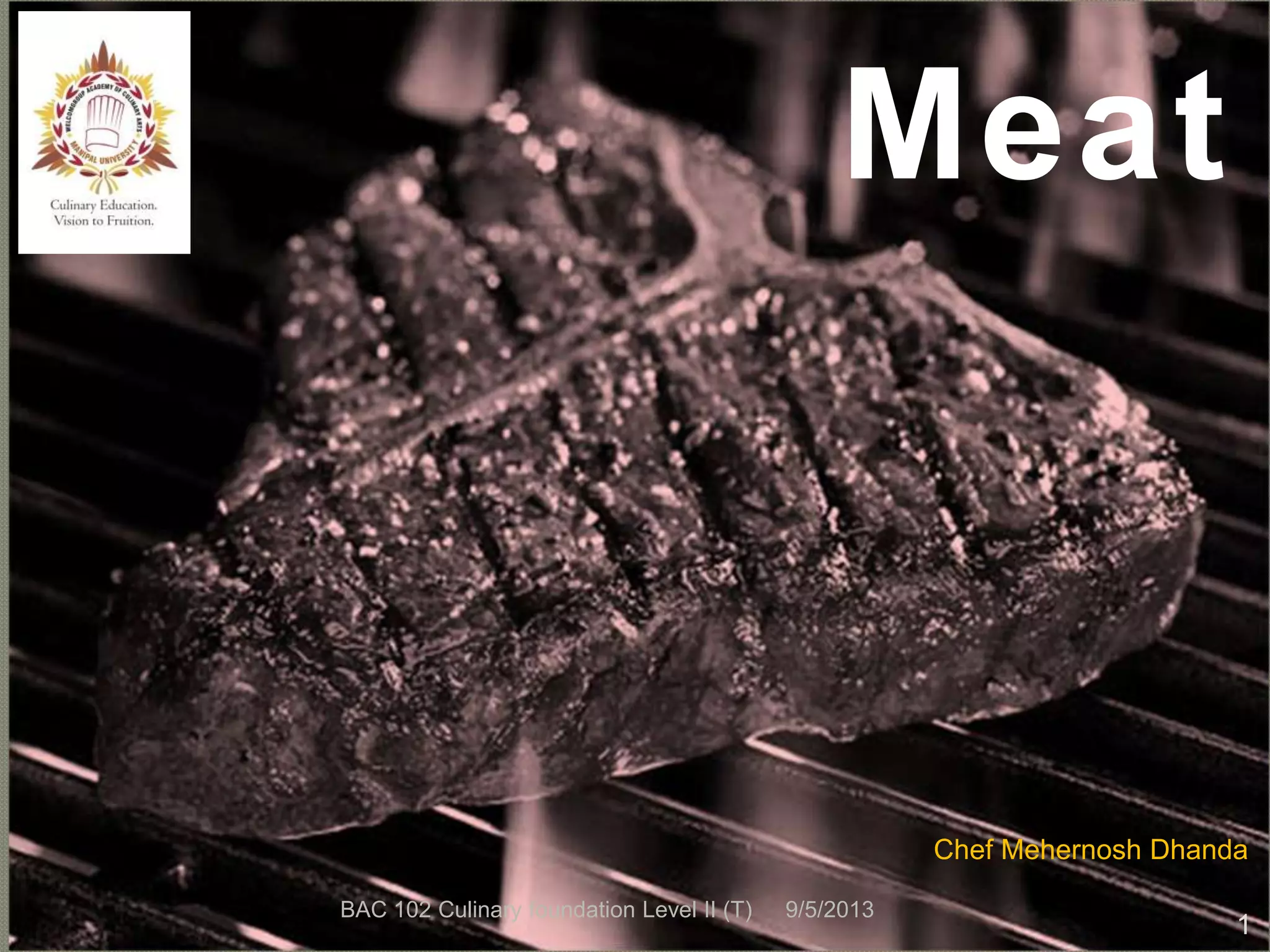
Meat
9/5/2013BAC 102 Culinary foundation Level II (T)
Chef Mehernosh Dhanda
 What is meat?
 Structure of muscle
 Composition of muscle
 “Green meat”
 Aging methods
 Understanding basic cuts
 Bone structure
 Parameters for meat selection
 Cooking meats
 Doneness
 Storage of meats
9/5/2013
2
BAC 102 Culinary foundation Level II (T)
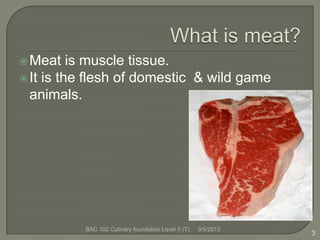
Meat is muscle tissue.
It is the flesh of domestic & wild game
animals.
3
9/5/2013BAC 102 Culinary foundation Level II (T)
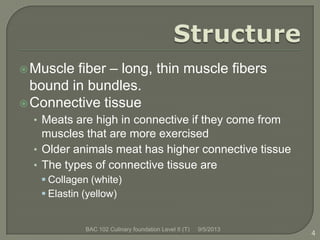
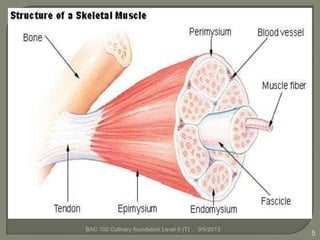
Muscle fiber – long, thin muscle fibers
bound in bundles.
Connective tissue
• Meats are high in connective if they come from
muscles that are more exercised
• Older animals meat has higher connective tissue
• The types of connective tissue are
 Collagen (white)
 Elastin (yellow)
9/5/2013BAC 102 Culinary foundation Level II (T)
4
9/5/2013BAC 102 Culinary foundation Level II (T)
5
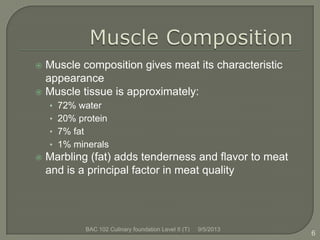
 Muscle composition gives meat its characteristic
appearance
 Muscle tissue is approximately:
• 72% water
• 20% protein
• 7% fat
• 1% minerals
 Marbling (fat) adds tenderness and flavor to meat
and is a principal factor in meat quality
6
9/5/2013BAC 102 Culinary foundation Level II (T)
When animals are slaughtered, their
muscles are soft and flabby.
Within 6-24 hours, rigor mortis sets in,
causing the muscles to contract and stiffen.
Rigor mortis dissipates in 48 – 72 hours
while under refrigeration. All meats are
allowed to age or rest long enough for rigor
mortis to dissipate.
7
9/5/2013BAC 102 Culinary foundation Level II (T)
Aging is done to bring out the texture and
flavor characteristic of the meat.
Wet Aging
• Smaller cuts enclosed in Cryovac® (plastic
vacuum packs)
Dry Aging
• Larger cuts of meat exposed to air in
controlled conditions. Can lose up to 20% of
weight during dry aging.
8
9/5/2013BAC 102 Culinary foundation Level II (T)
 Carcasses
The whole animal except
head, feet, entrails, and
hide (except pork, from
which only entrails and
head removed)
 Partial Carcasses
• Sides
• Quarters
• Foresaddles
• Hindsaddles
9/5/2013BAC 102 Culinary foundation Level II (T)
9
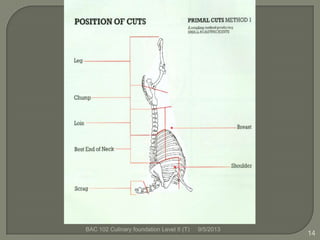
 Primal or Wholesale Cuts
 Fabricated Cuts - Smaller
cuts for roasts, steaks,
chops, cutlets, stewing
meat, and ground meat,
or to customer
specifications.
 Portion-controlled Cuts
Cuts ready-to-cook,
processed to customer
specifications.
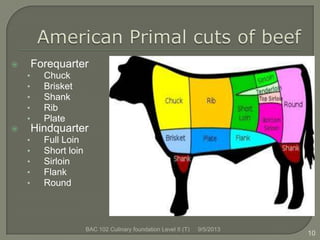
 Forequarter
• Chuck
• Brisket
• Shank
• Rib
• Plate
 Hindquarter
• Full Loin
• Short loin
• Sirloin
• Flank
• Round
9/5/2013BAC 102 Culinary foundation Level II (T)
10
Organ Meats/Offal
• Items such as heart, kidney, tongue, tripe,
and oxtail are in this category
11
9/5/2013BAC 102 Culinary foundation Level II (T)
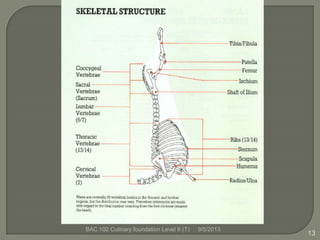
1. Identifying meat cuts
2. Boning and cutting meats
3. Carving cooked meats
12
9/5/2013BAC 102 Culinary foundation Level II (T)
13
9/5/2013BAC 102 Culinary foundation Level II (T)
14
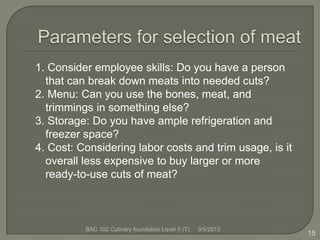
1. Consider employee skills: Do you have a person
that can break down meats into needed cuts?
2. Menu: Can you use the bones, meat, and
trimmings in something else?
3. Storage: Do you have ample refrigeration and
freezer space?
4. Cost: Considering labor costs and trim usage, is it
overall less expensive to buy larger or more
ready-to-use cuts of meat?
15
9/5/2013BAC 102 Culinary foundation Level II (T)
 Specifications are important to a
food service operation - they fully
describe the item in exact detail:
1. Item name
2. Grade
3. Weight range
4. State of refrigeration
5. Fat limitations
16
9/5/2013BAC 102 Culinary foundation Level II (T)
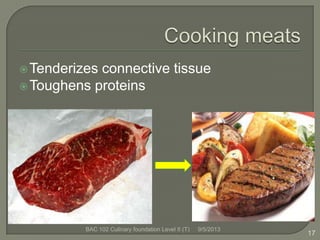
Tenderizes connective tissue
Toughens proteins
9/5/2013BAC 102 Culinary foundation Level II (T)
17
 High heat toughens and shrinks proteins
and results in high moisture loss.
 Broiling is very fast which is why #1 is
not contrary.
 Roasts cooked at lower temperatures
have better yields.
 Because liquid and steam are better
conductors than air, moist heat
penetrates quickly.
18
9/5/2013BAC 102 Culinary foundation Level II (T)
Remember that connective tissue is
highest in muscles that are frequently
used.
Long, slow cooking tenderizes collagen.
19
9/5/2013BAC 102 Culinary foundation Level II (T)
 Rib and Loin Cuts
• Very tender, used for roasts, steaks, and chops
 Leg or Round
• Less tender and cooked by braising
 Chuck or Shoulder
• Tougher; generally braised
 Shanks, Breast, Brisket, and Flank
• Less tender; cooked by moist heat
 Ground Meat, Cubed Steaks, and Stew Meat
• From any primal cut; cooked by dry or moist heat
20
9/5/2013BAC 102 Culinary foundation Level II (T)
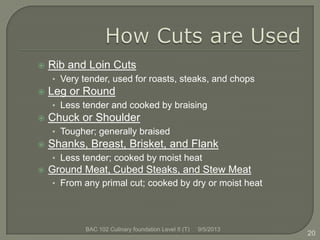
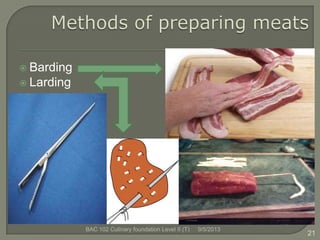
 Barding
 Larding
9/5/2013BAC 102 Culinary foundation Level II (T)
21
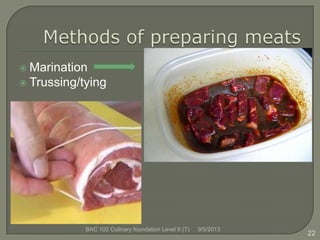
 Marination
 Trussing/tying
9/5/2013BAC 102 Culinary foundation Level II (T)
22
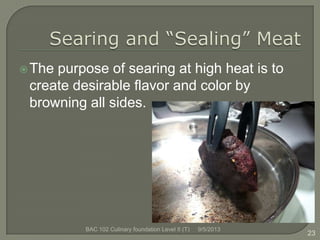
The purpose of searing at high heat is to
create desirable flavor and color by
browning all sides.
23
9/5/2013BAC 102 Culinary foundation Level II (T)
Some sources say to cook from frozen to
avoid “drip loss.”
Most meats are thawed first and then
prepared.
24
9/5/2013BAC 102 Culinary foundation Level II (T)
The internal temperature will continue to
rise after meat is removed from the source
of heat
Because the exterior is hotter than inside,
it will conduct heat to the inside.
25
9/5/2013BAC 102 Culinary foundation Level II (T)
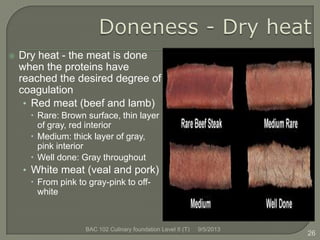
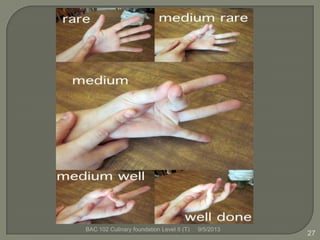
 Dry heat - the meat is done
when the proteins have
reached the desired degree of
coagulation
• Red meat (beef and lamb)
 Rare: Brown surface, thin layer
of gray, red interior
 Medium: thick layer of gray,
pink interior
 Well done: Gray throughout
• White meat (veal and pork)
 From pink to gray-pink to off-
white
9/5/2013BAC 102 Culinary foundation Level II (T)
26
9/5/2013BAC 102 Culinary foundation Level II (T)
27
9/5/2013BAC 102 Culinary foundation Level II (T)
28
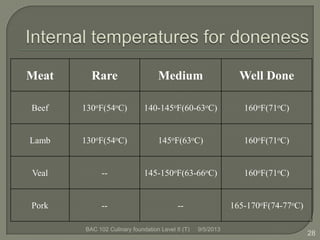
Meat Rare Medium Well Done
Beef 130oF(54oC) 140-145oF(60-63oC) 160oF(71oC)
Lamb 130oF(54oC) 145oF(63oC) 160oF(71oC)
Veal -- 145-150oF(63-66oC) 160oF(71oC)
Pork -- -- 165-170oF(74-77oC)
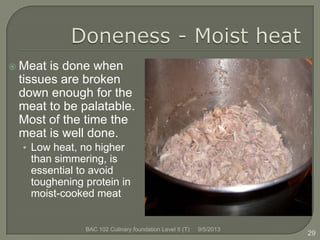
 Meat is done when
tissues are broken
down enough for the
meat to be palatable.
Most of the time the
meat is well done.
• Low heat, no higher
than simmering, is
essential to avoid
toughening protein in
moist-cooked meat
9/5/2013BAC 102 Culinary foundation Level II (T)
29
Meat products are highly perishable and
potentially hazardous, so temperature control
is highly essential.
Fresh meats should be stored at 32° to 36° F.
Frozen meats should be stored at 0° to 20° F
and well wrapped to prevent freezer burn.
Use as quickly as possible.
30
9/5/2013BAC 102 Culinary foundation Level II (T)
31

Meats

  • 1.
    1 Meat 9/5/2013BAC 102 Culinaryfoundation Level II (T) Chef Mehernosh Dhanda
  • 2.
     What ismeat?  Structure of muscle  Composition of muscle  “Green meat”  Aging methods  Understanding basic cuts  Bone structure  Parameters for meat selection  Cooking meats  Doneness  Storage of meats 9/5/2013 2 BAC 102 Culinary foundation Level II (T)
  • 3.
    Meat is muscletissue. It is the flesh of domestic & wild game animals. 3 9/5/2013BAC 102 Culinary foundation Level II (T)
  • 4.
    Muscle fiber –long, thin muscle fibers bound in bundles. Connective tissue • Meats are high in connective if they come from muscles that are more exercised • Older animals meat has higher connective tissue • The types of connective tissue are  Collagen (white)  Elastin (yellow) 9/5/2013BAC 102 Culinary foundation Level II (T) 4
  • 5.
    9/5/2013BAC 102 Culinaryfoundation Level II (T) 5
  • 6.
     Muscle compositiongives meat its characteristic appearance  Muscle tissue is approximately: • 72% water • 20% protein • 7% fat • 1% minerals  Marbling (fat) adds tenderness and flavor to meat and is a principal factor in meat quality 6 9/5/2013BAC 102 Culinary foundation Level II (T)
  • 7.
    When animals areslaughtered, their muscles are soft and flabby. Within 6-24 hours, rigor mortis sets in, causing the muscles to contract and stiffen. Rigor mortis dissipates in 48 – 72 hours while under refrigeration. All meats are allowed to age or rest long enough for rigor mortis to dissipate. 7 9/5/2013BAC 102 Culinary foundation Level II (T)
  • 8.
    Aging is doneto bring out the texture and flavor characteristic of the meat. Wet Aging • Smaller cuts enclosed in Cryovac® (plastic vacuum packs) Dry Aging • Larger cuts of meat exposed to air in controlled conditions. Can lose up to 20% of weight during dry aging. 8 9/5/2013BAC 102 Culinary foundation Level II (T)
  • 9.
     Carcasses The wholeanimal except head, feet, entrails, and hide (except pork, from which only entrails and head removed)  Partial Carcasses • Sides • Quarters • Foresaddles • Hindsaddles 9/5/2013BAC 102 Culinary foundation Level II (T) 9  Primal or Wholesale Cuts  Fabricated Cuts - Smaller cuts for roasts, steaks, chops, cutlets, stewing meat, and ground meat, or to customer specifications.  Portion-controlled Cuts Cuts ready-to-cook, processed to customer specifications.
  • 10.
     Forequarter • Chuck •Brisket • Shank • Rib • Plate  Hindquarter • Full Loin • Short loin • Sirloin • Flank • Round 9/5/2013BAC 102 Culinary foundation Level II (T) 10
  • 11.
    Organ Meats/Offal • Itemssuch as heart, kidney, tongue, tripe, and oxtail are in this category 11 9/5/2013BAC 102 Culinary foundation Level II (T)
  • 12.
    1. Identifying meatcuts 2. Boning and cutting meats 3. Carving cooked meats 12 9/5/2013BAC 102 Culinary foundation Level II (T)
  • 13.
    9/5/2013BAC 102 Culinaryfoundation Level II (T) 13
  • 14.
    9/5/2013BAC 102 Culinaryfoundation Level II (T) 14
  • 15.
    1. Consider employeeskills: Do you have a person that can break down meats into needed cuts? 2. Menu: Can you use the bones, meat, and trimmings in something else? 3. Storage: Do you have ample refrigeration and freezer space? 4. Cost: Considering labor costs and trim usage, is it overall less expensive to buy larger or more ready-to-use cuts of meat? 15 9/5/2013BAC 102 Culinary foundation Level II (T)
  • 16.
     Specifications areimportant to a food service operation - they fully describe the item in exact detail: 1. Item name 2. Grade 3. Weight range 4. State of refrigeration 5. Fat limitations 16 9/5/2013BAC 102 Culinary foundation Level II (T)
  • 17.
    Tenderizes connective tissue Toughensproteins 9/5/2013BAC 102 Culinary foundation Level II (T) 17
  • 18.
     High heattoughens and shrinks proteins and results in high moisture loss.  Broiling is very fast which is why #1 is not contrary.  Roasts cooked at lower temperatures have better yields.  Because liquid and steam are better conductors than air, moist heat penetrates quickly. 18 9/5/2013BAC 102 Culinary foundation Level II (T)
  • 19.
    Remember that connectivetissue is highest in muscles that are frequently used. Long, slow cooking tenderizes collagen. 19 9/5/2013BAC 102 Culinary foundation Level II (T)
  • 20.
     Rib andLoin Cuts • Very tender, used for roasts, steaks, and chops  Leg or Round • Less tender and cooked by braising  Chuck or Shoulder • Tougher; generally braised  Shanks, Breast, Brisket, and Flank • Less tender; cooked by moist heat  Ground Meat, Cubed Steaks, and Stew Meat • From any primal cut; cooked by dry or moist heat 20 9/5/2013BAC 102 Culinary foundation Level II (T)
  • 21.
     Barding  Larding 9/5/2013BAC102 Culinary foundation Level II (T) 21
  • 22.
     Marination  Trussing/tying 9/5/2013BAC102 Culinary foundation Level II (T) 22
  • 23.
    The purpose ofsearing at high heat is to create desirable flavor and color by browning all sides. 23 9/5/2013BAC 102 Culinary foundation Level II (T)
  • 24.
    Some sources sayto cook from frozen to avoid “drip loss.” Most meats are thawed first and then prepared. 24 9/5/2013BAC 102 Culinary foundation Level II (T)
  • 25.
    The internal temperaturewill continue to rise after meat is removed from the source of heat Because the exterior is hotter than inside, it will conduct heat to the inside. 25 9/5/2013BAC 102 Culinary foundation Level II (T)
  • 26.
     Dry heat- the meat is done when the proteins have reached the desired degree of coagulation • Red meat (beef and lamb)  Rare: Brown surface, thin layer of gray, red interior  Medium: thick layer of gray, pink interior  Well done: Gray throughout • White meat (veal and pork)  From pink to gray-pink to off- white 9/5/2013BAC 102 Culinary foundation Level II (T) 26
  • 27.
    9/5/2013BAC 102 Culinaryfoundation Level II (T) 27
  • 28.
    9/5/2013BAC 102 Culinaryfoundation Level II (T) 28 Meat Rare Medium Well Done Beef 130oF(54oC) 140-145oF(60-63oC) 160oF(71oC) Lamb 130oF(54oC) 145oF(63oC) 160oF(71oC) Veal -- 145-150oF(63-66oC) 160oF(71oC) Pork -- -- 165-170oF(74-77oC)
  • 29.
     Meat isdone when tissues are broken down enough for the meat to be palatable. Most of the time the meat is well done. • Low heat, no higher than simmering, is essential to avoid toughening protein in moist-cooked meat 9/5/2013BAC 102 Culinary foundation Level II (T) 29
  • 30.
    Meat products arehighly perishable and potentially hazardous, so temperature control is highly essential. Fresh meats should be stored at 32° to 36° F. Frozen meats should be stored at 0° to 20° F and well wrapped to prevent freezer burn. Use as quickly as possible. 30 9/5/2013BAC 102 Culinary foundation Level II (T)
  • 31.
    9/5/2013BAC 102 Culinaryfoundation Level II (T) 31