3/18/2022 1
BAC 102 Culinary Foundation Level II (T)
Chef Mehernosh Dhanda
 Definition
 Structure and composition of fish and shellfish
 Classification & identification of a variety of fish and
shellfish
 Processing fish
 Market forms
 Determining freshness of fish
 Purchasing terminology
 Cooking fish & seafood
 Other seafood categories
 Storage of fish & seafood
3/18/2022 2
BAC 102 Culinary Foundation Level II (T)
 Fish are aquatic
vertebrates with fins for
swimming and gills for
breathing
 Shellfish are aquatic
invertebrates with shells
or carapaces
3/18/2022 3
BAC 102 Culinary Foundation Level II (T)
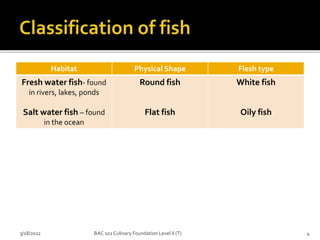
Habitat Physical Shape Flesh type
Fresh water fish- found
in rivers, lakes, ponds
Salt water fish – found
in the ocean
Round fish
Flat fish
White fish
Oily fish
3/18/2022 4
BAC 102 Culinary Foundation Level II (T)
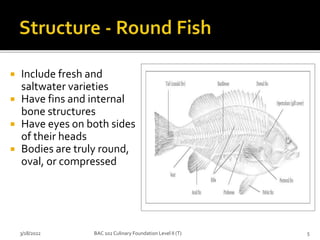
 Include fresh and
saltwater varieties
 Have fins and internal
bone structures
 Have eyes on both sides
of their heads
 Bodies are truly round,
oval, or compressed
3/18/2022 5
BAC 102 Culinary Foundation Level II (T)
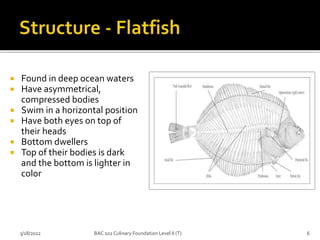
 Found in deep ocean waters
 Have asymmetrical,
compressed bodies
 Swim in a horizontal position
 Have both eyes on top of
their heads
 Bottom dwellers
 Top of their bodies is dark
and the bottom is lighter in
color
3/18/2022 6
BAC 102 Culinary Foundation Level II (T)
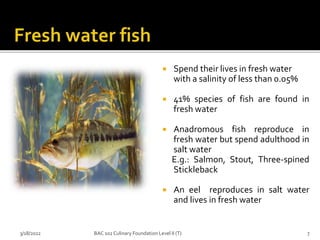
 Spend their lives in fresh water
with a salinity of less than 0.05%
 41% species of fish are found in
fresh water
 Anadromous fish reproduce in
fresh water but spend adulthood in
salt water
E.g.: Salmon, Stout, Three-spined
Stickleback
 An eel reproduces in salt water
and lives in fresh water
3/18/2022 7
BAC 102 Culinary Foundation Level II (T)
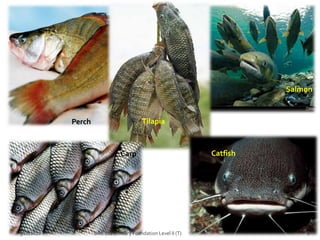
Perch Tilapia
Salmon
Catfish
Carp
3/18/2022 8
BAC 102 Culinary Foundation Level II (T)
 Spend their entire lives in oceanic waters
3/18/2022 9
BAC 102 Culinary Foundation Level II (T)
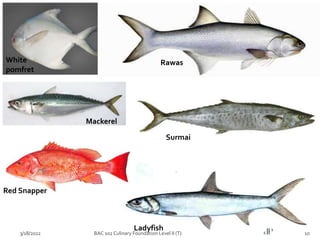
Mackerel
Red Snapper
Ladyfish
Surmai
White
pomfret
Rawas
3/18/2022 10
BAC 102 Culinary Foundation Level II (T)
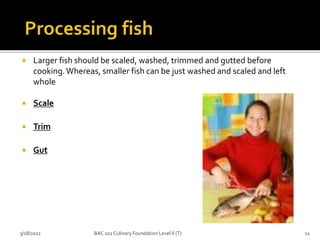
 Larger fish should be scaled, washed, trimmed and gutted before
cooking.Whereas, smaller fish can be just washed and scaled and left
whole
 Scale
 Trim
 Gut
3/18/2022 11
BAC 102 Culinary Foundation Level II (T)
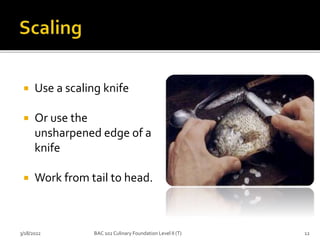
 Use a scaling knife
 Or use the
unsharpened edge of a
knife
 Work from tail to head.
3/18/2022 12
BAC 102 Culinary Foundation Level II (T)
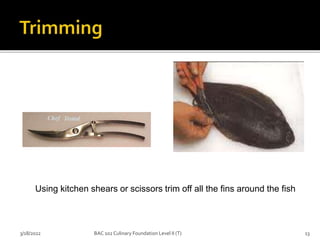
Using kitchen shears or scissors trim off all the fins around the fish
3/18/2022 13
BAC 102 Culinary Foundation Level II (T)
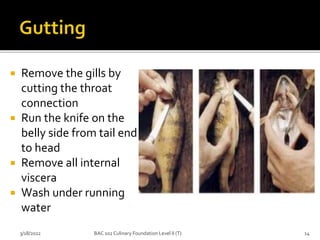
 Remove the gills by
cutting the throat
connection
 Run the knife on the
belly side from tail end
to head
 Remove all internal
viscera
 Wash under running
water
3/18/2022 14
BAC 102 Culinary Foundation Level II (T)
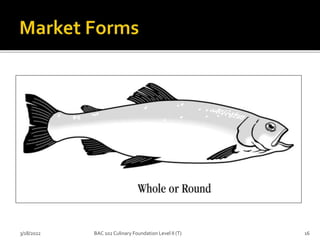
 Whole or round
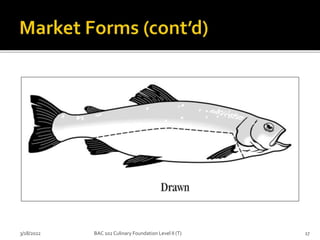
 Drawn
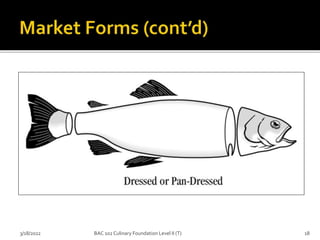
 Dressed
 Pan-dressed
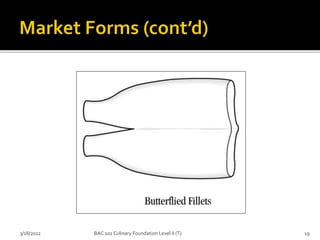
 Butterflied
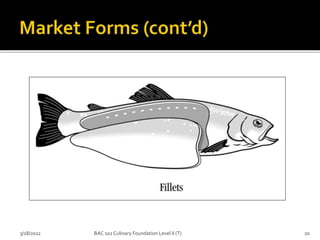
 Fillet
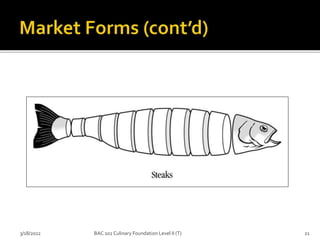
 Steak
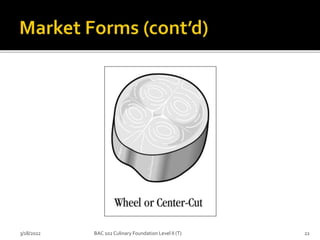
 Wheel or center-cut
3/18/2022 15
BAC 102 Culinary Foundation Level II (T)
3/18/2022 16
BAC 102 Culinary Foundation Level II (T)
3/18/2022 17
BAC 102 Culinary Foundation Level II (T)
3/18/2022 18
BAC 102 Culinary Foundation Level II (T)
3/18/2022 19
BAC 102 Culinary Foundation Level II (T)
3/18/2022 20
BAC 102 Culinary Foundation Level II (T)
3/18/2022 21
BAC 102 Culinary Foundation Level II (T)
3/18/2022 22
BAC 102 Culinary Foundation Level II (T)
 Smell
 No odor or the smell of the sea
 Eyes
 Clear and full
 Gills
 Intact and bright red
 Texture
 Flesh should be firm
 Fins and scales
 Moist and full
 Appearance
 Moist and glistening
 Movement
 Crustaceans purchased alive should show movement
 Oysters/clams should close their shells when tapped
3/18/2022 23
BAC 102 Culinary Foundation Level II (T)
 Fresh
 Never frozen- Directly used after being caught
 Chilled
 Fresh, held at 30°F to 34°F- Held till sent to local outlets
 Flash-frozen
 Quickly frozen onboard ship, within hours of being caught
 Fresh-frozen
 Frozen while fresh, but not quickly
 Frozen/ Blast frozen
 Subject to temperature below 0°F
 Glazed
 Dipped in water to form a protective shell of ice
 Fancy
 Code word for previously frozen
3/18/2022 24
BAC 102 Culinary Foundation Level II (T)
 All cooking methods can be used
 Seafood is inherently tender
 Should be cooked until just done
 Overcooking is the most common mistake
made in preparing seafood
3/18/2022 25
BAC 102 Culinary Foundation Level II (T)
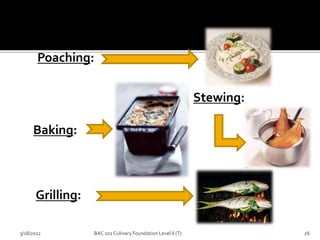
Poaching:
Baking:
Grilling:
Stewing:
3/18/2022 26
BAC 102 Culinary Foundation Level II (T)
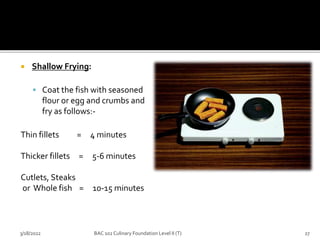
 Shallow Frying:
 Coat the fish with seasoned
flour or egg and crumbs and
fry as follows:-
Thin fillets = 4 minutes
Thicker fillets = 5-6 minutes
Cutlets, Steaks
or Whole fish = 10-15 minutes
3/18/2022 27
BAC 102 Culinary Foundation Level II (T)
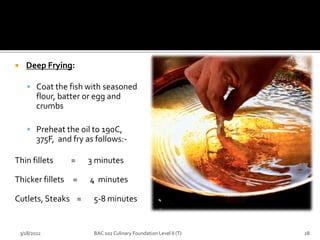
 Deep Frying:
 Coat the fish with seasoned
flour, batter or egg and
crumbs
 Preheat the oil to 190C,
375F, and fry as follows:-
Thin fillets = 3 minutes
Thicker fillets = 4 minutes
Cutlets, Steaks = 5-8 minutes
3/18/2022 28
BAC 102 Culinary Foundation Level II (T)
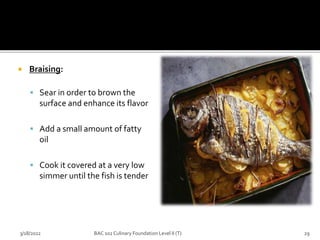
 Braising:
 Sear in order to brown the
surface and enhance its flavor
 Add a small amount of fatty
oil
 Cook it covered at a very low
simmer until the fish is tender
3/18/2022 29
BAC 102 Culinary Foundation Level II (T)
 Translucent flesh becomes opaque
 Flesh becomes firm
 Flesh separates from the bone easily
 Flesh begins to flake
3/18/2022 30
BAC 102 Culinary Foundation Level II (T)
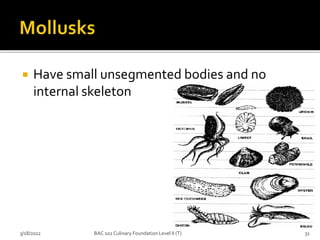
 Have small unsegmented bodies and no
internal skeleton
3/18/2022 31
BAC 102 Culinary Foundation Level II (T)
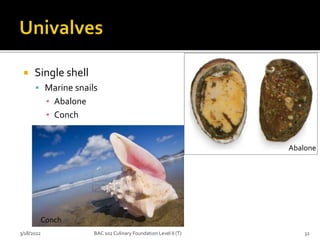
 Single shell
 Marine snails
▪ Abalone
▪ Conch
3/18/2022 32
BAC 102 Culinary Foundation Level II (T)
Abalone
Conch
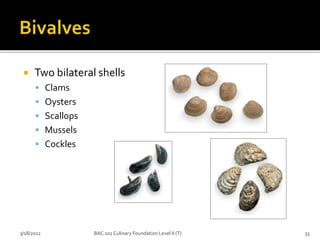
 Two bilateral shells
 Clams
 Oysters
 Scallops
 Mussels
 Cockles
3/18/2022 33
BAC 102 Culinary Foundation Level II (T)
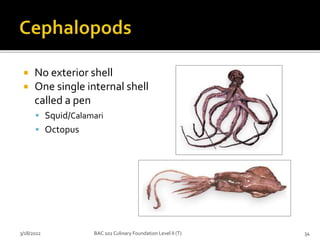
 No exterior shell
 One single internal shell
called a pen
 Squid/Calamari
 Octopus
3/18/2022 34
BAC 102 Culinary Foundation Level II (T)
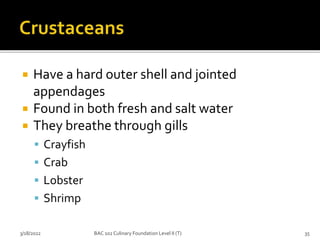
 Have a hard outer shell and jointed
appendages
 Found in both fresh and salt water
 They breathe through gills
 Crayfish
 Crab
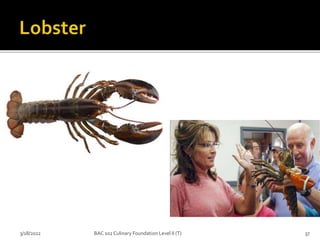
 Lobster
 Shrimp
3/18/2022 35
BAC 102 Culinary Foundation Level II (T)
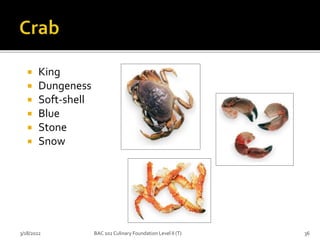
 King
 Dungeness
 Soft-shell
 Blue
 Stone
 Snow
3/18/2022 36
BAC 102 Culinary Foundation Level II (T)
3/18/2022 BAC 102 Culinary Foundation Level II (T) 37
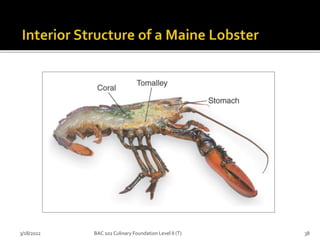
3/18/2022 38
BAC 102 Culinary Foundation Level II (T)
 Temperature between 30°F and 34°F
 If shipped in ice, store in ice
 Do not allow seafood to become dry
 Scallops and fish fillets should not be in direct contact
with ice
 Live animals should be stored in saltwater tanks or in
boxes with seaweed
 Bivalves should be stored in net bags or boxes at high
humidity
3/18/2022 39
BAC 102 Culinary Foundation Level II (T)
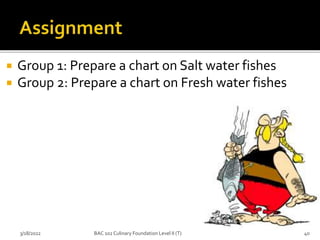
 Group 1: Prepare a chart on Salt water fishes
 Group 2: Prepare a chart on Fresh water fishes
3/18/2022 40
BAC 102 Culinary Foundation Level II (T)

Fish & seafood

  • 1.
    3/18/2022 1 BAC 102Culinary Foundation Level II (T) Chef Mehernosh Dhanda
  • 2.
     Definition  Structureand composition of fish and shellfish  Classification & identification of a variety of fish and shellfish  Processing fish  Market forms  Determining freshness of fish  Purchasing terminology  Cooking fish & seafood  Other seafood categories  Storage of fish & seafood 3/18/2022 2 BAC 102 Culinary Foundation Level II (T)
  • 3.
     Fish areaquatic vertebrates with fins for swimming and gills for breathing  Shellfish are aquatic invertebrates with shells or carapaces 3/18/2022 3 BAC 102 Culinary Foundation Level II (T)
  • 4.
    Habitat Physical ShapeFlesh type Fresh water fish- found in rivers, lakes, ponds Salt water fish – found in the ocean Round fish Flat fish White fish Oily fish 3/18/2022 4 BAC 102 Culinary Foundation Level II (T)
  • 5.
     Include freshand saltwater varieties  Have fins and internal bone structures  Have eyes on both sides of their heads  Bodies are truly round, oval, or compressed 3/18/2022 5 BAC 102 Culinary Foundation Level II (T)
  • 6.
     Found indeep ocean waters  Have asymmetrical, compressed bodies  Swim in a horizontal position  Have both eyes on top of their heads  Bottom dwellers  Top of their bodies is dark and the bottom is lighter in color 3/18/2022 6 BAC 102 Culinary Foundation Level II (T)
  • 7.
     Spend theirlives in fresh water with a salinity of less than 0.05%  41% species of fish are found in fresh water  Anadromous fish reproduce in fresh water but spend adulthood in salt water E.g.: Salmon, Stout, Three-spined Stickleback  An eel reproduces in salt water and lives in fresh water 3/18/2022 7 BAC 102 Culinary Foundation Level II (T)
  • 8.
    Perch Tilapia Salmon Catfish Carp 3/18/2022 8 BAC102 Culinary Foundation Level II (T)
  • 9.
     Spend theirentire lives in oceanic waters 3/18/2022 9 BAC 102 Culinary Foundation Level II (T)
  • 10.
  • 11.
     Larger fishshould be scaled, washed, trimmed and gutted before cooking.Whereas, smaller fish can be just washed and scaled and left whole  Scale  Trim  Gut 3/18/2022 11 BAC 102 Culinary Foundation Level II (T)
  • 12.
     Use ascaling knife  Or use the unsharpened edge of a knife  Work from tail to head. 3/18/2022 12 BAC 102 Culinary Foundation Level II (T)
  • 13.
    Using kitchen shearsor scissors trim off all the fins around the fish 3/18/2022 13 BAC 102 Culinary Foundation Level II (T)
  • 14.
     Remove thegills by cutting the throat connection  Run the knife on the belly side from tail end to head  Remove all internal viscera  Wash under running water 3/18/2022 14 BAC 102 Culinary Foundation Level II (T)
  • 15.
     Whole orround  Drawn  Dressed  Pan-dressed  Butterflied  Fillet  Steak  Wheel or center-cut 3/18/2022 15 BAC 102 Culinary Foundation Level II (T)
  • 16.
    3/18/2022 16 BAC 102Culinary Foundation Level II (T)
  • 17.
    3/18/2022 17 BAC 102Culinary Foundation Level II (T)
  • 18.
    3/18/2022 18 BAC 102Culinary Foundation Level II (T)
  • 19.
    3/18/2022 19 BAC 102Culinary Foundation Level II (T)
  • 20.
    3/18/2022 20 BAC 102Culinary Foundation Level II (T)
  • 21.
    3/18/2022 21 BAC 102Culinary Foundation Level II (T)
  • 22.
    3/18/2022 22 BAC 102Culinary Foundation Level II (T)
  • 23.
     Smell  Noodor or the smell of the sea  Eyes  Clear and full  Gills  Intact and bright red  Texture  Flesh should be firm  Fins and scales  Moist and full  Appearance  Moist and glistening  Movement  Crustaceans purchased alive should show movement  Oysters/clams should close their shells when tapped 3/18/2022 23 BAC 102 Culinary Foundation Level II (T)
  • 24.
     Fresh  Neverfrozen- Directly used after being caught  Chilled  Fresh, held at 30°F to 34°F- Held till sent to local outlets  Flash-frozen  Quickly frozen onboard ship, within hours of being caught  Fresh-frozen  Frozen while fresh, but not quickly  Frozen/ Blast frozen  Subject to temperature below 0°F  Glazed  Dipped in water to form a protective shell of ice  Fancy  Code word for previously frozen 3/18/2022 24 BAC 102 Culinary Foundation Level II (T)
  • 25.
     All cookingmethods can be used  Seafood is inherently tender  Should be cooked until just done  Overcooking is the most common mistake made in preparing seafood 3/18/2022 25 BAC 102 Culinary Foundation Level II (T)
  • 26.
  • 27.
     Shallow Frying: Coat the fish with seasoned flour or egg and crumbs and fry as follows:- Thin fillets = 4 minutes Thicker fillets = 5-6 minutes Cutlets, Steaks or Whole fish = 10-15 minutes 3/18/2022 27 BAC 102 Culinary Foundation Level II (T)
  • 28.
     Deep Frying: Coat the fish with seasoned flour, batter or egg and crumbs  Preheat the oil to 190C, 375F, and fry as follows:- Thin fillets = 3 minutes Thicker fillets = 4 minutes Cutlets, Steaks = 5-8 minutes 3/18/2022 28 BAC 102 Culinary Foundation Level II (T)
  • 29.
     Braising:  Searin order to brown the surface and enhance its flavor  Add a small amount of fatty oil  Cook it covered at a very low simmer until the fish is tender 3/18/2022 29 BAC 102 Culinary Foundation Level II (T)
  • 30.
     Translucent fleshbecomes opaque  Flesh becomes firm  Flesh separates from the bone easily  Flesh begins to flake 3/18/2022 30 BAC 102 Culinary Foundation Level II (T)
  • 31.
     Have smallunsegmented bodies and no internal skeleton 3/18/2022 31 BAC 102 Culinary Foundation Level II (T)
  • 32.
     Single shell Marine snails ▪ Abalone ▪ Conch 3/18/2022 32 BAC 102 Culinary Foundation Level II (T) Abalone Conch
  • 33.
     Two bilateralshells  Clams  Oysters  Scallops  Mussels  Cockles 3/18/2022 33 BAC 102 Culinary Foundation Level II (T)
  • 34.
     No exteriorshell  One single internal shell called a pen  Squid/Calamari  Octopus 3/18/2022 34 BAC 102 Culinary Foundation Level II (T)
  • 35.
     Have ahard outer shell and jointed appendages  Found in both fresh and salt water  They breathe through gills  Crayfish  Crab  Lobster  Shrimp 3/18/2022 35 BAC 102 Culinary Foundation Level II (T)
  • 36.
     King  Dungeness Soft-shell  Blue  Stone  Snow 3/18/2022 36 BAC 102 Culinary Foundation Level II (T)
  • 37.
    3/18/2022 BAC 102Culinary Foundation Level II (T) 37
  • 38.
    3/18/2022 38 BAC 102Culinary Foundation Level II (T)
  • 39.
     Temperature between30°F and 34°F  If shipped in ice, store in ice  Do not allow seafood to become dry  Scallops and fish fillets should not be in direct contact with ice  Live animals should be stored in saltwater tanks or in boxes with seaweed  Bivalves should be stored in net bags or boxes at high humidity 3/18/2022 39 BAC 102 Culinary Foundation Level II (T)
  • 40.
     Group 1:Prepare a chart on Salt water fishes  Group 2: Prepare a chart on Fresh water fishes 3/18/2022 40 BAC 102 Culinary Foundation Level II (T)