MEASUREMENT
• Act ofquantifying the performance of
Organizational units of goods and services
Processes, people and other business activities
• Provides a scorecard of performance
• Helps identify performance gaps
• Makes accomplishment visible to workforce, stock market, and other stake
holders.
3.
Performance measurement canbe classified into several
key categories:
1. FINANCIAL MEASURES
2. CUSTOMER SATISFACTION MEASUREMENT SYSTEM
3. SAFETY
4. QUALITY
5. TIME
6. FLEXIBILITY
7. INNOVATION AND LEARNING
2.CUSTOMER –SATISFACTION ANDMEASUREMENT
SYTEM
Provides a company with customer ratings of specific goods and service
features
Indicates the relationship between customer ratings and a customer’s likely
future buying behavior.
6.
3.SAFETY
Safety issuch a basic attribute that it is hardly notice. However,
when a safety issue arises, it captures the attention of everyone.
Measuring safety is vital to all organization, as the well-being of its
employees and customer should be organization’s principal
concern. Safety enhances employee productivity and morale in all
types of organization.
7.
4. QUALITY
measuresthe degree to which the output of a process meets customer
requirements. It applies to both goods and services.
a. GOOD QUALITY
Physical performance and characteristics of a good .
b. SERVICE QUALITY
is consistently meeting or exceeding customer expectations (external focus)
and service delivery system performance (internal focus) for all servicemen
counters.
8.
KEY DIMENSIONS TOASSESS SERVICE
QUALITY:
1. TANGIBLES: physical facilities, uniforms, equipment, vehicles, and
appearance of employees.
2. RELIABILITY: ability to perform the promised service dependably and
accurately.
3. RESPONSIVENESS: willingness to help customers and provide prompt
recovery to service upsets.
4. ASSURANCE: knowledge and courtesy of the service-providers and
their ability to inspire trust and confidence in customers.
5. EMPATHY: caring attitude and individual attention provided to its
customers.
9.
5. TIME
Timerelates to two types of performance measures-the speed of doing
something (such as the time to process a customer’s mortgage application)
and the variability of the process.
SPEED is usually measured in clock time, while RELIABILITY is usually
measured by quantifying the variance around average performance or targets.
10.
A simple metricis:
a. PROCESSING TIME: the time it takes to perform some tasks.
b. QUEUE TIME: fancy word for wait time, is the time spent waiting. An
important aspect of measuring time is the variance around the average time,
as unanticipated variability is what often leads to an unhappy customer
experience.
11.
6. FLEXIBILITY
isthe ability to adapt quickly and effectively to changing requirements.
A.GOODS AND SERVICE DESIGN FLEXIBILITY
is the ability to develop a wide range of customized goods or services to meet
different or changing customer needs.
b. VOLUME FLEXIBILITY
is the ability to respond quickly to changes in the volume and type of demand
12.
7. INNOVATION ANDLEARNING
INNOVATION - refers to the ability to create new and
unique goods and services that delight customers and
create competitive advantage.
LEARNING - refers to creating, designing and transferring
knowledge and modifying the behavior of employees in
response to internal and external change.
13.
PRODUCTIVITY
is the ratioof output of a process to the input
PRODUCTIVITY = Quantity of output
Quantity of input
As output increases for a constant level of input or as the
amount of input decreases for a constant level of output
productivity increases. Productivity measures are often used to
track trends over time.
14.
PRODUCTIVITY
SOLVED PROBLEM:
Considerthe decision of Miller Chemicals thatproduces water
purification crystals forswimming pools. The major inputs
used in theproduction process are labor, raw materials,and
energy. For Year 1, labor costs are$180,000, raw materials
cost $30,000, andenergy costs amount to $5,000.Labor cost
for Year 2 are $350,000, rawmaterials cost $40,000, and
energy costsamount to $6,000. Miller Chemicals
produced100,000 pounds of crystals in Year 1 and150,000
pounds of crystals in Year 2?
15.
SOLUTION:
Using theequation we have for Year 1
PRODUCTIVITY = Qty of output
Qty of input
= 100,000.00
($180,000+$30,000+$5,000)
= 0.465 lb/dollar
16.
SOLUTION
For Year2
PRODUCTIVITY = Qty of output
Qty of input
= 150,000.00
($350,000+$40,000+$6,000)
= 0.379 lb/dollar
17.
LINKING INTERNAL ANDEXTERNAL
MEASURES
Managers must understand the cause and effect of linkages between
key measures of performance. These relationships often explain the
impact of (internal)operational performance on external results, such
as profitability, market share or customer satisfaction.
The quantitative modelling of cause and effect relationships between
external and internal performance criteria is called interlinking.
Interlinking tries to quantify the performance relationships between
all parts of the value chain the processes (“how”), goods and
services(“what”), and customer’s experiences and outcome(“why”).
With interlinking models, managers can objectively make internal
decisions that impact external outcomes.
18.
INTERLINKING MODEL
a.THE VALUE OF A LOYAL CUSTOMER VALUE OF A LOYAL CUSTOMER (VLC)
quantifies the total revenue or profit each target market customer
generates over the buyer’s life cycle. It provides an understanding of how
customer satisfaction and loyalty affect the bottom line.
b. SOLVED PROBLEM: What is the value of a loyal customer (VLC) in the small
contractor target market segment who buys an electric drill on average
every 4 years or 0.25years for $100, when the gross margin on the drill
averages 50%, and the customer retention rate is60%? What if the
customer rate increases to 80%?What is a 1% change in market share
worth to the manufacturer if it represents 100,00 customers? What do you
conclude?
19.
SOLUTION:
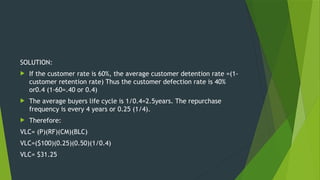
If thecustomer rate is 60%, the average customer detention rate =(1-
customer retention rate) Thus the customer defection rate is 40%
or0.4 (1-60=.40 or 0.4)
The average buyers life cycle is 1/0.4=2.5years. The repurchase
frequency is every 4 years or 0.25 (1/4).
Therefore:
VLC= (P)(RF)(CM)(BLC)
VLC=($100)(0.25)(0.50)(1/0.4)
VLC= $31.25
20.
SOLUTION:
The valueof 1% change in market share= (100,000
customers)($31.25/customer per year)= $3,125,000
If the customer retention rate is 80%, the average defection rate is 0.2 and
the average buyer’s life cycle is 1/0.2 = 5 years. Then,
VLC = (P)(RF)(CM)(BLC)
VLC = ($100)(0.25)(0.50)(1/0.2)
VLC = $62.50
Thus, the value of 1% change in market share
=(100,000 customers) ($62.50/customer/year)
=$62,250,000
21.
SOLUTION:
The economicsare clear: if customer retention can be increased from 60 to 80
percent through better value chain performance, the economic pay off is doubled.
VLC=(P)(CM)(RF)(BLC)
Where
P = the revenue per unit
CM = contribution margin to profit and overhead expressed as a fraction (i.e.; 0.45,0.5)
RF = repurchase frequency = number of purchases per year
BLC = buyers life cycle, computed as 1/defection rate, expressed in fraction
(1/0.2=5years 1/0.1=10years and so on)
By multiplying the VLC times the absolute number of customers gained or lost, the total
market value can be found.
22.
DESIGNING MEASUREMENT
SYSTEM INOPERATIONS
Good performance measures are actionable.
ACTIONABLE MEASURES – provide the basis for decisions at
the level at which they are applied – the value chain, or
organization, process, department, workstation, job and
service encounter.
They should be meaningful to the user, timely and reflect
how the organization generated value to customers.
Performance measures should support, not conflict with,
customer requirements.
23.
MODELS OF ORGANIZATIONAL
PERFORMANCE
1.Malcolm Baldridge National Quality Award
2. Balance Scorecard
3. Value Chain Model
4. Service Profit Chain
1ST TWO MODEL – provide more of a “big picture” of
organizational performance
LAST TWO MODEL – provide more detailed framework for
operations managers.
24.
MALCOLM BALDRIGENATIONAL QUALITYAWARD
FRAMEWORK
- now known as Baldrige National Quality
Program
- created to help stimulate American
organizations to improve quality, productivity, and over
all competitiveness, and to encourage the development
of high performance management practices through
innovation learning, and sharing the best practices.
25.
CRITERIA:
1. LEADERSHIP -focuses on how senior leaders
address values, directions, and performances
expectation as well as on customers and other
stakeholders, empowerment, innovation and learning.
2. STRATEGIC PLANNING - focuses on how the
organization develops strategic objectives and action
plans are implemented.
26.
3. CUSTOMER FOCUS- focus on how the organization
determines requirements, expectations & preferences of
customer and markets, how the organization builds
relationship with customers and determines the key factors
that lead to customer acquisition, satisfaction, loyalty, and
retention and to business expansions.
4. MEASUREMENT, ANALYSIS AND KNOWLEDGEMANAGEMENT -
focuses on how an organization selects, gathers, analyzes,
manage and improve its data, information, and knowledge
assets.
27.
5.WORKFORCE FOCUS –addresshow an organization’s work
systems and employees learning and motivation enable
employees to develop and utilize their full potential in alignment
with the organizations overall objective and action plans.
6. PROCESS MANAGEMENT - examine the key aspects of process
management, including product, service, and business processes
for creating customer and organizational value, as well as key
support processes.
7. BUSINESS RESULT - looks at the organizational performance
and improvement.
28.
THE BALANCESCORECARD
The purpose is “to translate strategy into measures
that uniquely communicate your vision to the organization”.
PERFORMANCE PERSPECTIVE:
1. FINANCIAL PERSPECTIVE - measures the ultimate value
that the business provides to its shareholders. This includes
profitability, revenue growth, stock price, cash flows, return
on investment, economic value added and shareholder value.
29.
2. CUSTOMER PERSPECTIVE– focuses on customer wants and
needs and satisfaction, as well as market share and growth in
market share.
3. INNOVATION AND LEARNING PERSPECTIVE - directs attention to
the basis of aa future success – the organization’s people and
infrastructure.
4. INTERNAL PERSPECTIVE - focuses attention on the
performance of the key internal process that drive the business.
30.
THE VALUECHAIN MODEL
TYPICAL MEASURES:
1. Supplier provide goods and services inputs to the value
chain that are used in the creation and delivery of value
chain outputs.
2. Synchronized information and feedback loops provide the
means of coordinating the value chains’ physical and
information flows, and for assessing whether the
organization is achieving its strategic objectives.






![PERFORMANCE MEASUREMENT SYSTEM [HR Paper 2 ] Module 4.pdf](https://cdn.slidesharecdn.com/ss_thumbnails/hrpaper2module4-240321042410-473848ce-thumbnail.jpg?width=640&height=640&fit=bounds)


