Text-Based Application & Collection API
  Objectives   •  Write a program that uses command-line arguments  •  Using String and StringBuffer class •  Collection Framework using Interface and  Implementation •  Interfaces List, Set, Queue, Map. •  Implementation of Set interface using HashSet,TreeSet and LinkedHashSet. •  Implementation of List interface using ArrayList and LinkedList. •  Implementation of Map interface using HashMap and TreeMap.
Command-Line Arguments  •  Any Java technology application can use  command-line arguments  •  These string arguments are placed on the command line to launch the Java interpreter, after the class name: java TestArgs arg1 arg2 "another arg“ •  Each command-line argument is placed in the args  array that is passed to the static main method:  public static main void(String[] args)
Command-Line Args public class TestArgs {  public static void main(String[] args) {  for ( int i = 0; i < args.length; i++ ) {  System.out.println(&quot;args[&quot; + i + &quot;] is ’&quot; + args[i] + &quot;’&quot;);  }   }  }  java TestArgs arg1 arg2 &quot;another arg&quot; Here is an excerpt of the output: args[0] is ’arg1’ args[1] is ’arg2’
Varargs With JDK 5.0 Java has included a feature that implifies the  creation of methods, that need to take variable number of arguments. This feature is called varargs and it short form for variable length  arguments. Prior to JDK5, variable length argument could be handled using arrays. Example  PassArray With variable length arguments A variable length argument is specified by three periods(…) To write a method using varargs static void vaTest (int …v)  Example  VarArgs
v is operated  as an array …  syntax simply tell the compiler that a variable number of arguments will be used. A method can have normal parameters along with variable length  parameters, however the variable length parameter must be last  parameter declared by the method. int doit(int a, int b, double c, int …vals) Overloading Vararg Methods Example  VarArgs2
String   is a sequence of characters. But, unlike many  other languages that implement strings as character arrays,  Java implements strings as objects of type  String . * Once a  String  object has been created, you cannot  change the characters that comprise that string. * Each time you need an altered version of an  existing string, a new  String  object is created that contains the modifications. The original string is  left unchanged.
* For those cases in which a modifiable string is desired,  there is a companion class to  String  called  StringBuffer ,  whose objects contain strings that can be modified after  they are created. * Both the  String  and  StringBuffer  classes are declared  final * The length of a string is the number of characters that it  contains. To obtain this value, call the  length( )  method, char chars[] = { 'a', 'b', 'c' }; String s = new String(chars); System.out.println(s.length());
What will be the output String s = &quot;four: &quot; + 2 + 2;   System.out.println(s); equals( ) Versus == The  equals( )  method compares the characters inside  a  String  object. The  ==  operator compares two object references to see whether they refer to the same instance.
// equals() vs == class EqualsNotEqualTo { public static void main(String args[]) { String s1 = &quot;Hello&quot;; String s2 = new String(s1); System.out.println(s1 + &quot; equals &quot; + s2 + &quot;  &quot; + s1.equals(s2)); System.out.println(s1 + &quot; == &quot; + s2 + &quot;  &quot; + (s1 == s2)); } }
Output Hello equals Hello -> true Hello == Hello -> false
Collection API A  collection  — is simply an object that groups  multiple elements into a single unit.  * They can dynamically grow and shrink, which is  their advantage over arrays.
All collection framework contain the following Interface These are the abstract data types that represent collection. Implementation These are the concrete implementation of  collection  interface
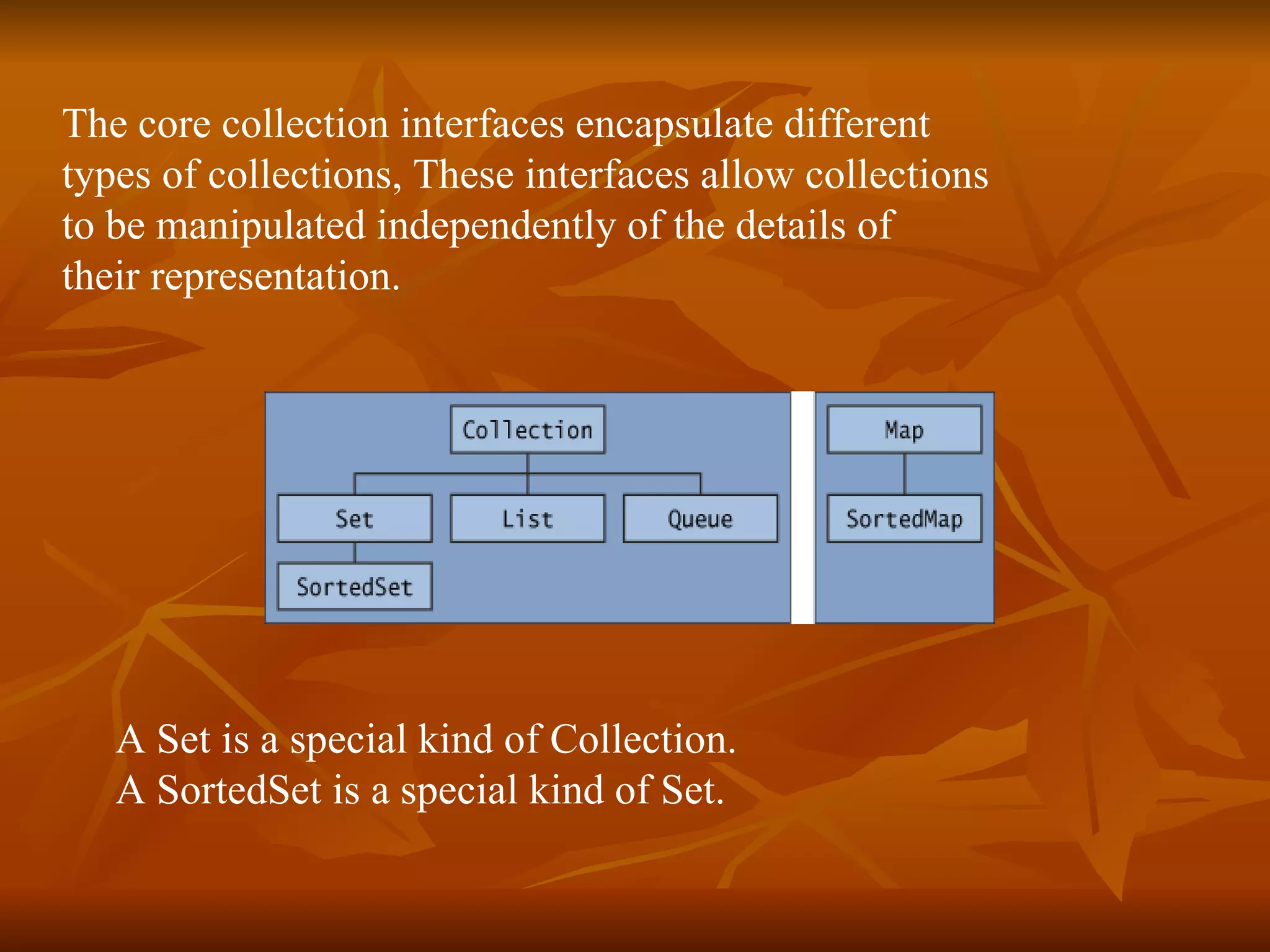
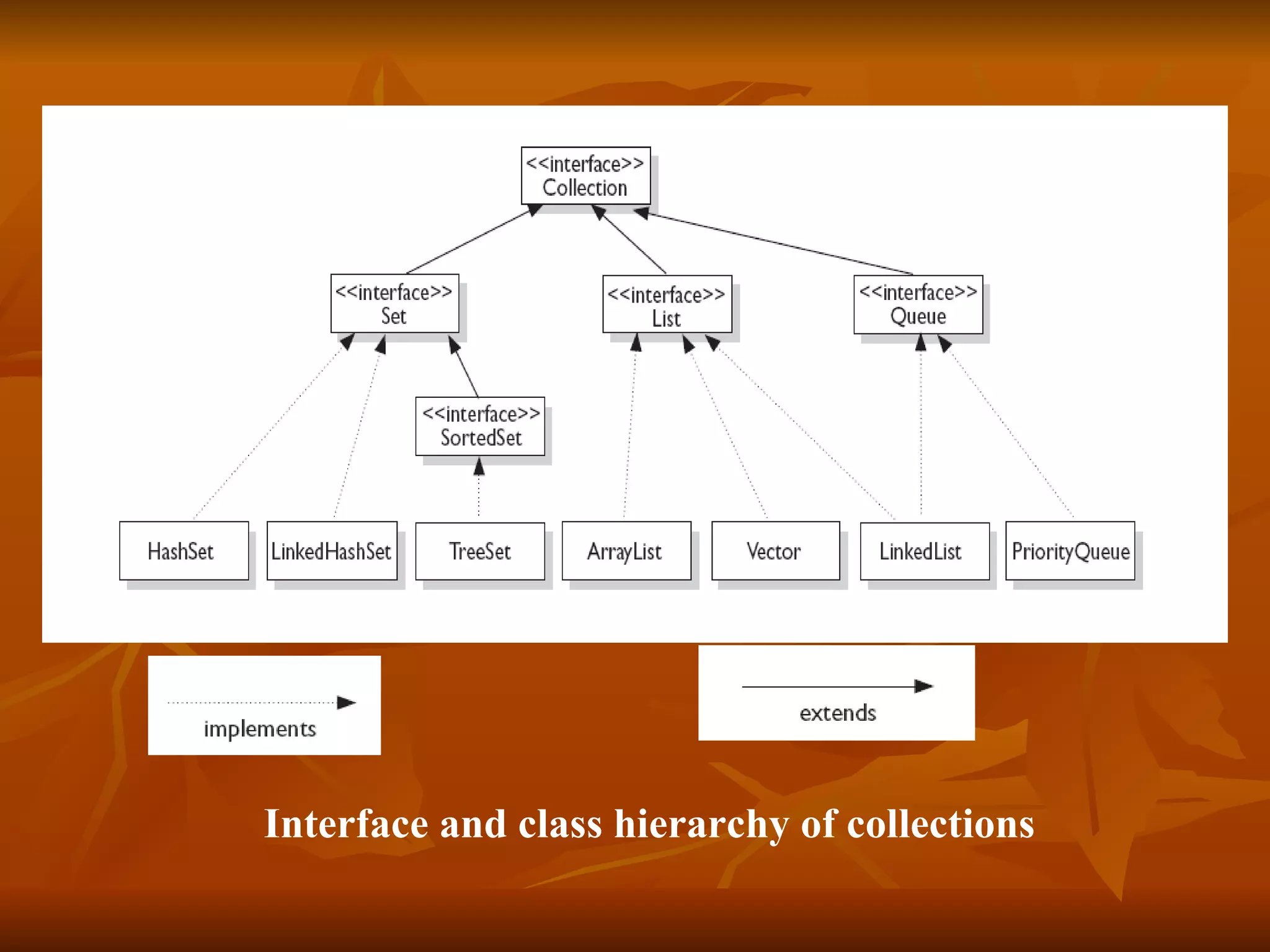
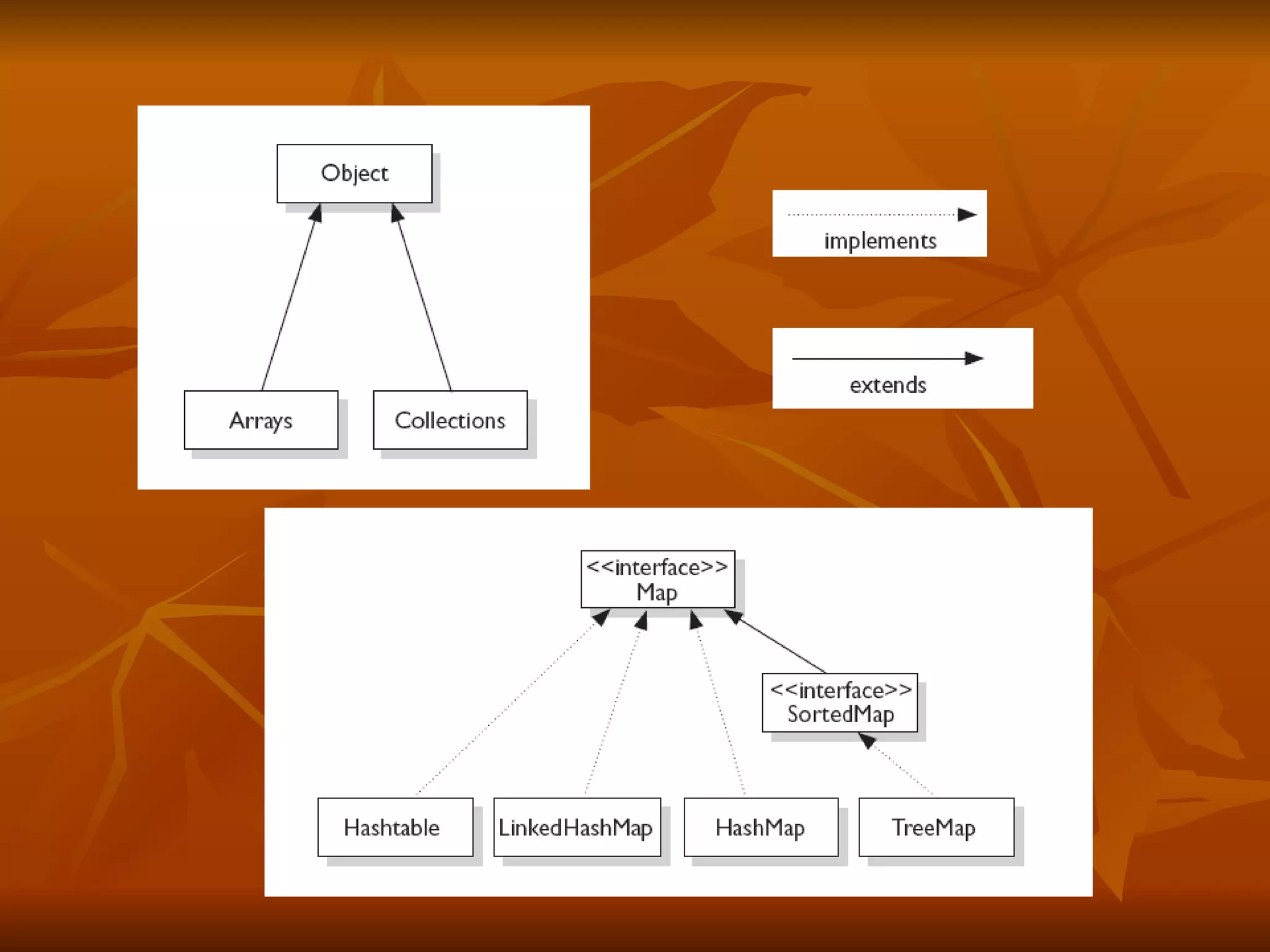
The core collection interfaces encapsulate different  types of collections, These interfaces allow collections to be manipulated independently of the details of  their representation.  A Set is a special kind of Collection.  A SortedSet is a special kind of Set.
The Collection interface is the least common  denominator that all collections implement  * The Java platform doesn't provide any direct  implementations of this interface but provides  implementations of more specific subinterfaces, such  as Set and List. Set  — a collection that cannot contain  duplicate   elements. This interface models the mathematical set  abstraction and is used to represent Sets.
List  — an ordered collection (sometimes called a  sequence ). Lists can contain duplicate elements. The user of a List  generally has precise control over where in the list each  element is inserted and can access elements by their integer  index (position). Queue  — a collection used to hold multiple elements  prior to processing. Besides basic Collection operations,  a Queue provides additional insertion, extraction,  and inspection operations. Map  — an object that maps keys to values. A Map cannot  contain duplicate keys: each key can map to at most one  value.
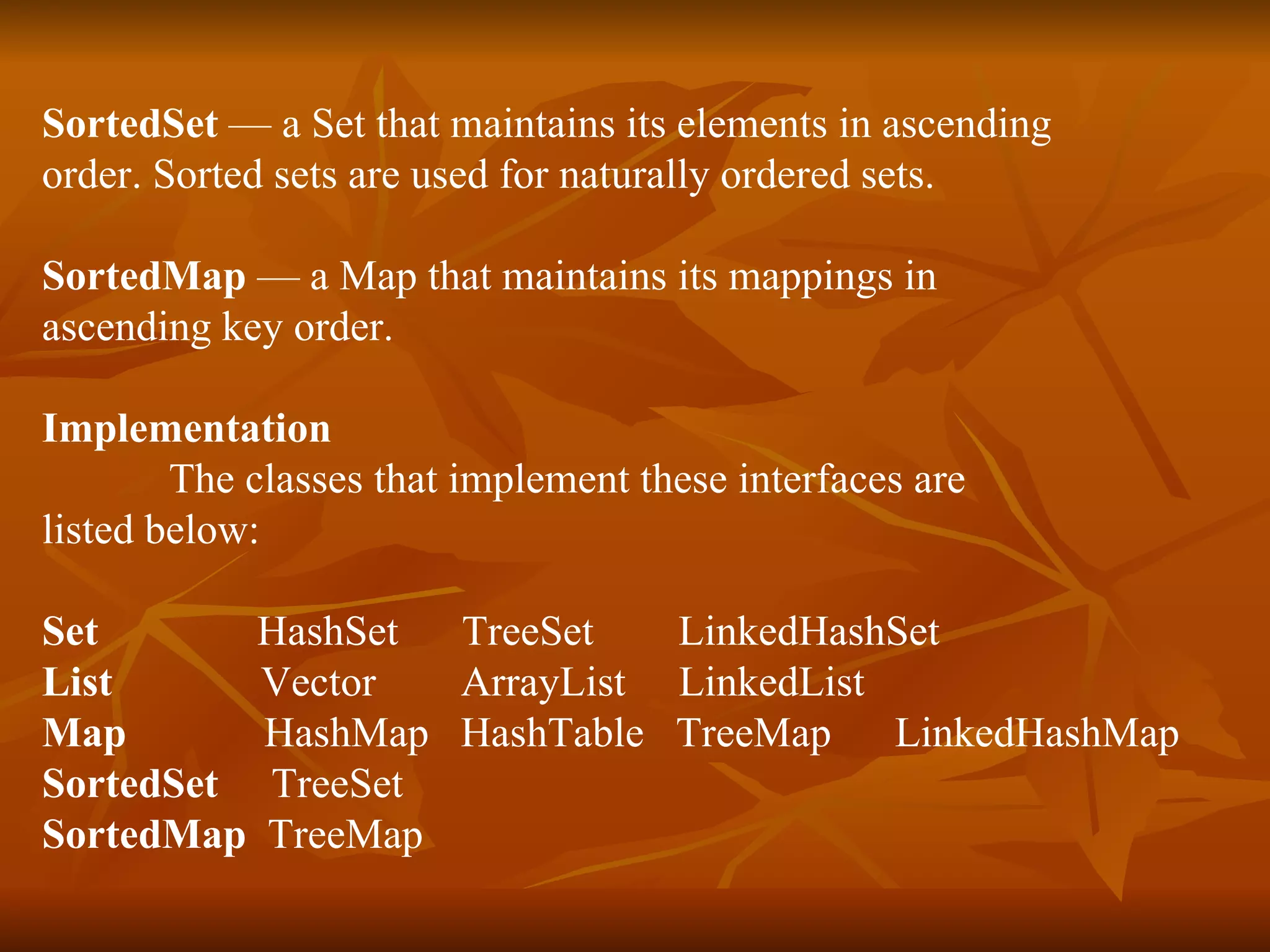
SortedSet  — a Set that maintains its elements in ascending  order. Sorted sets are used for naturally ordered sets. SortedMap  — a Map that maintains its mappings in  ascending key order. Implementation The classes that implement these interfaces are  listed below: Set  HashSet  TreeSet  LinkedHashSet List  Vector  ArrayList  LinkedList Map  HashMap  HashTable  TreeMap  LinkedHashMap SortedSet  TreeSet SortedMap   TreeMap
Interface and class hierarchy of collections
 
The ArrayList Class The ArrayList class extends AbstractList and implements the List  interface.  * ArrayList supports dynamic arrays that can grow as needed. * An  ArrayList  is a variable-length array of object references. * Since this implementation use an array to store the elements  of the list, so access to an element using an index is very fast. Example  ArrayListDemo.java Example  ArrayListToArray.java For obtaining an Array from an ArrayList.
The LinkedList Class The LinkedList class extends AbstractSequentialList  and implements the List interface. * Provides uniformly named methods to get, remove  and insert an element at the beginning and end of the list.  * This implementation is not synchronized ,if multiple  threads access a list concurrently, and at least one of the threads modifies the list structurally, it  must   be synchronized externally.  * LinkedList is implemented using doubly linked list so  access to an element requires the list to be traversed using  the links.
* This implementation of List interface produce the slowest  access to an element in the middle of list by means of an index. * This implementation of the List interface provides for the fastest  insertion of a new element into the middle of the list. The LinkedList is implemented using a doubly linked list;  an insertion requires only the updating of the links at the point of  insertion. Therefore, the LinkedList allows for fast insertions and  deletions.  * The LinkedList class provides methods such as addFirst, addLast,  getFirst, getLast, removeFirst and removeLast that facilitate the  implementation of stacks and queues.    Example  LinkedListDemo.java
Vector public class Vector extends AbstractList implements List. Vector is synchronized.  Vector constructors: Vector( ) The first form creates a default vector,which has an initial  size of 10.  Vector(int initialCapacity)   Constructs an empty vector with the specified initial  capacity and with its capacity increment equal to zero.  Vector(int initialCapacity, int capacityIncrement)              Constructs an empty vector with the specified initial  capacity and capacity increment.
Vector use an array to store the elements of the list; so  access to any element using an index is very fast.  Example  VectorDemo.java
The HashSet class HashSet extends AbstractSet and implements the  Set interface. * Each element must be unique. * Duplicate elements must not replace old elements. * Hash set does not guarantee the order of its elements, because the process of hashing doesn’t usually  lend itself to the creation of sorted sets. * This class permits the null element.  * Accessing an element can be almost as fast as  performing a similar operation on an array.  * This implementation is not synchronized. Example  HashSetDemo.java
LinkedHashSet  LinkedHashSet implements Set and extends HashSet. * Maintains a linked list of the entries in the set, in the order in  which they were inserted. In other words it allow elements to be accessed in the  order that they were added. * When cycling through a LinkedHashSet using an iterator, the  elements will be returned in the order in which they were inserted. * This implementation is not synchronized.  Example  LinkedHashSetDemo.java
The TreeSet Class * Duplicate elements are not accepted. * TreeSet provides an implementation of the SortedSet  interface that uses a tree for storage. * This class guarantees that the sorted set will be in  ascending element order  * This implementation provides guaranteed log(n)  time cost for the basic operations . * Access and retrieval times are quite fast,which  makes  TreeSet  an excellent choice when storing large  amounts of sorted information that must be found quickly. * This implementation is not synchronized  *  The entries can be sorted using the Comparable interface.  Example  TreeSetDemo.java
HashMap HashMap implements Map and extends AbstractMap. * A hash map does  not  guarantee the order of its elements. Therefore, the order in which elements are added to a hash map is not necessarily the order in which they are  read by an iterator. * The HashMap class is roughly equivalent to Hashtable, except  that it is unsynchronized and permits nulls. *  This implementation is not synchronized. *  HashMap lets you have null values as well as one null key Example  HashMapDemo.java
The TreeMap Class TreeMap implements SortedMap and extends AbstractMap. * A TreeMap provides an efficient means of storing  key/value pairs in sorted order. * Entries are sorted using Comparator or the Comparable  interface. * This implementation is not synchronized.  * Duplicate entries replace old entries. Example  TreeMapDemo.java
Hash Table * Like HashMap, Hashtable stores key/value pairs  in a hash table.  When using a Hashtable, you specify an object that is used  as a key, and the value that you want linked to that key. The key  is then hashed, and the resulting hash code is used as the index at  which the value is stored within the table. * A hash table can only store objects that override the  hashCode( ) and equals( ) methods that are defined by Object.  The hashCode( ) method must compute and return the hash code  for the object. * Hashtable is synchronized * Hashtable doesn't let you have anything that's null. Example  HTDemo.java
LinkedHashMap   LinkedHashMap implements Map and extends HashMap. *This implementation differs from HashMap in that  it maintains a doubly-linked list running through all of  its entries.
PriorityQueue  *  This class is new with Java 5.  * This class implements the Queue interface. * Since the LinkedList class has been enhanced to implement the  Queue interface, basic queues can be handled with a LinkedList.  * PriorityQueue create a &quot;priority-in, priority out&quot; queue as opposed  to a typical FIFO queue.  *A PriorityQueue's elements are ordered either by natural ordering  (in which case the elements that are sorted first will be accessed  first) or according to a Comparator.  * In either case, the elements' ordering represents their relative priority. * Queues have a few methods not found in other collection interfaces:  peek(), poll(), and offer().
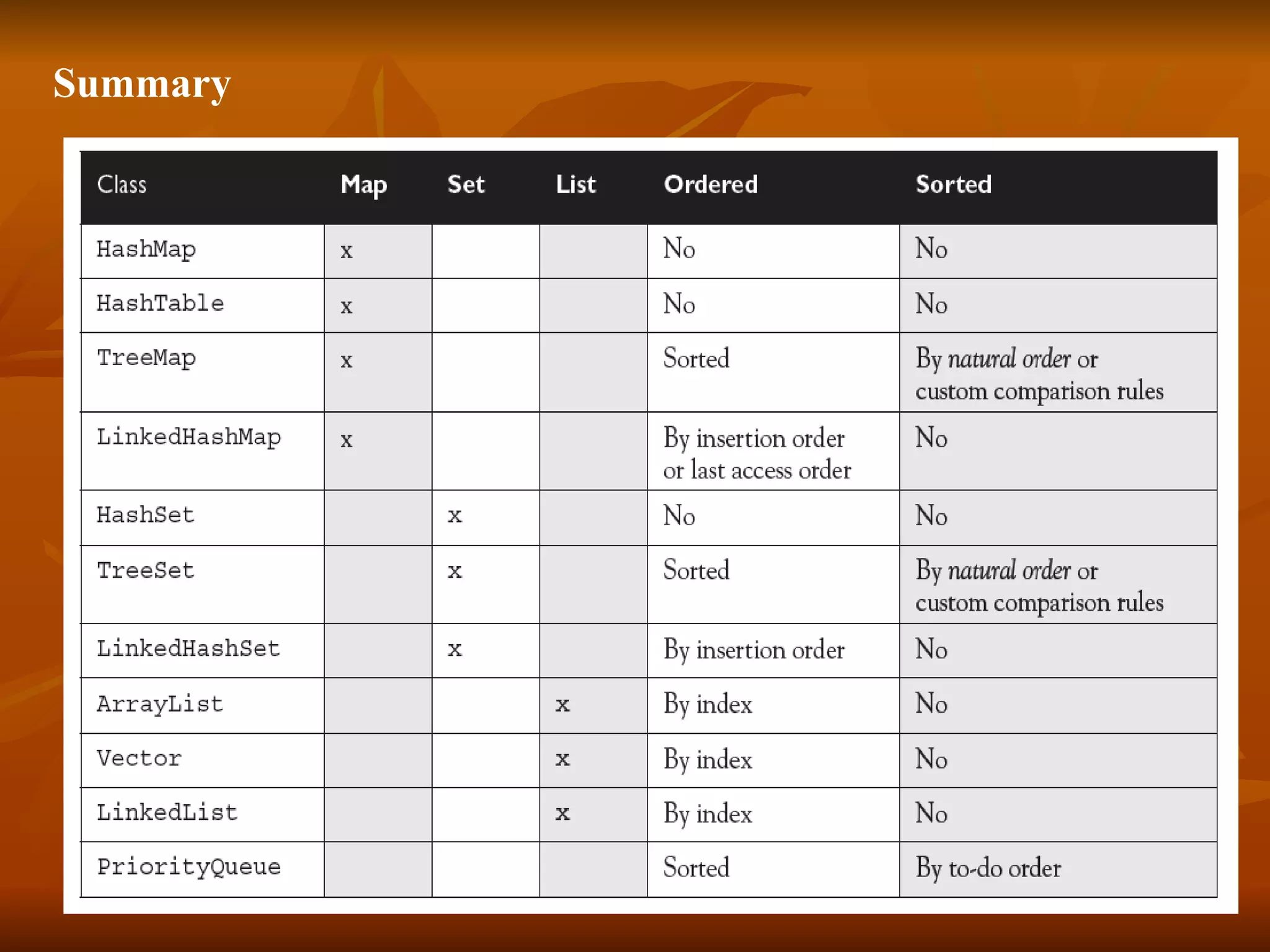
Summary
 
Sorting Collections and Arrays Sorting and searching topics have been added to the exam  for Java 5. Sorting Collections ArrayList doesn't give you any way to sort its contents, but the java.util.Collections class does: import java.util.*; class TestSort1 { public static void main(String[] args) { ArrayList<String> stuff = new ArrayList<String>(); // #1 stuff.add(&quot;Denver&quot;); stuff.add(&quot;Boulder&quot;); stuff.add(&quot;Vail&quot;); stuff.add(&quot;Aspen&quot;); stuff.add(&quot;Telluride&quot;); System.out.println(&quot;unsorted &quot; + stuff); Collections.sort(stuff); // #2 System.out.println(&quot;sorted &quot; + stuff);}}
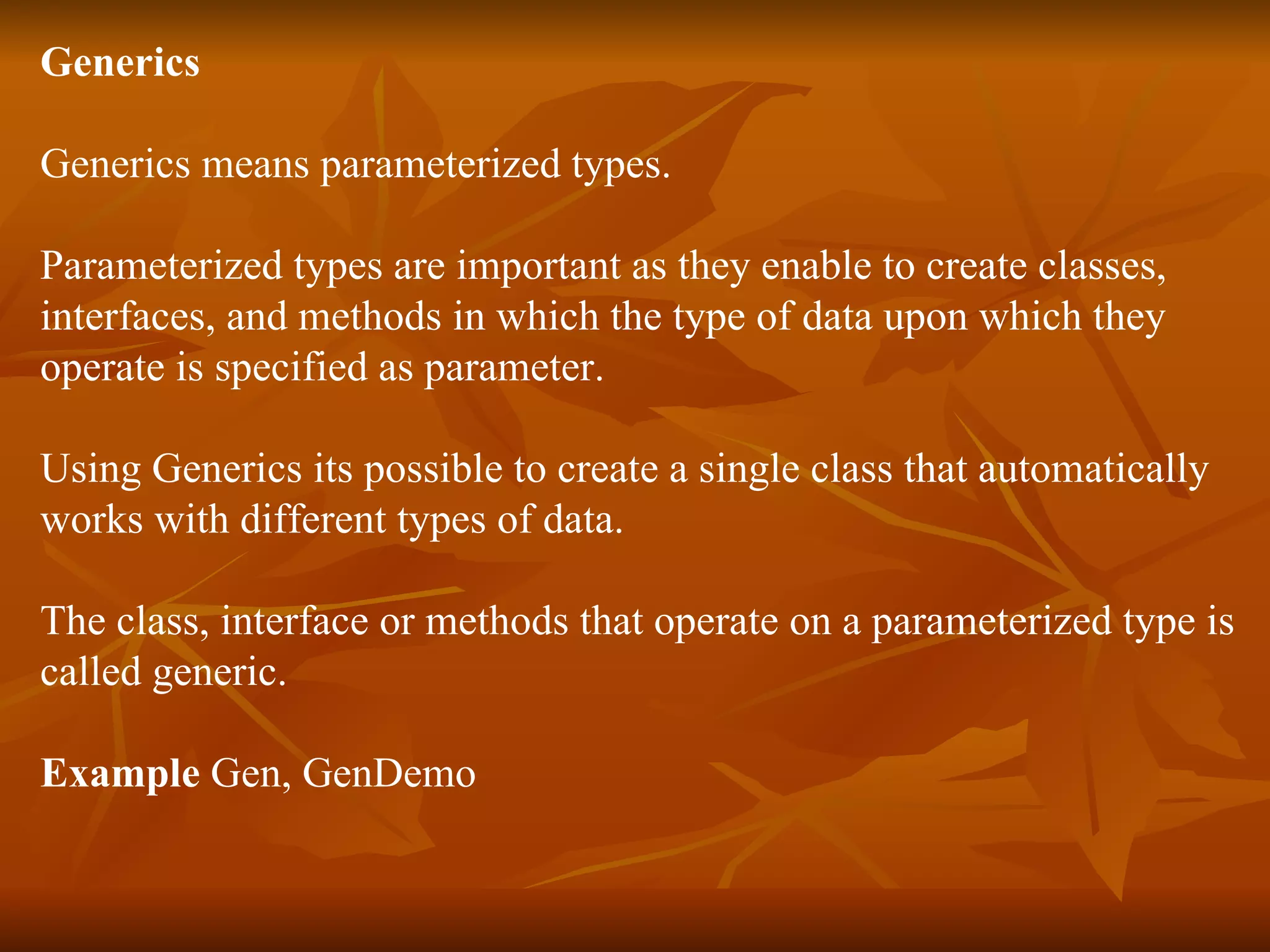
Generics Generics means parameterized types. Parameterized types are important as they enable to create classes, interfaces, and methods in which the type of data upon which they  operate is specified as parameter. Using Generics its possible to create a single class that automatically works with different types of data. The class, interface or methods that operate on a parameterized type is  called generic. Example  Gen, GenDemo
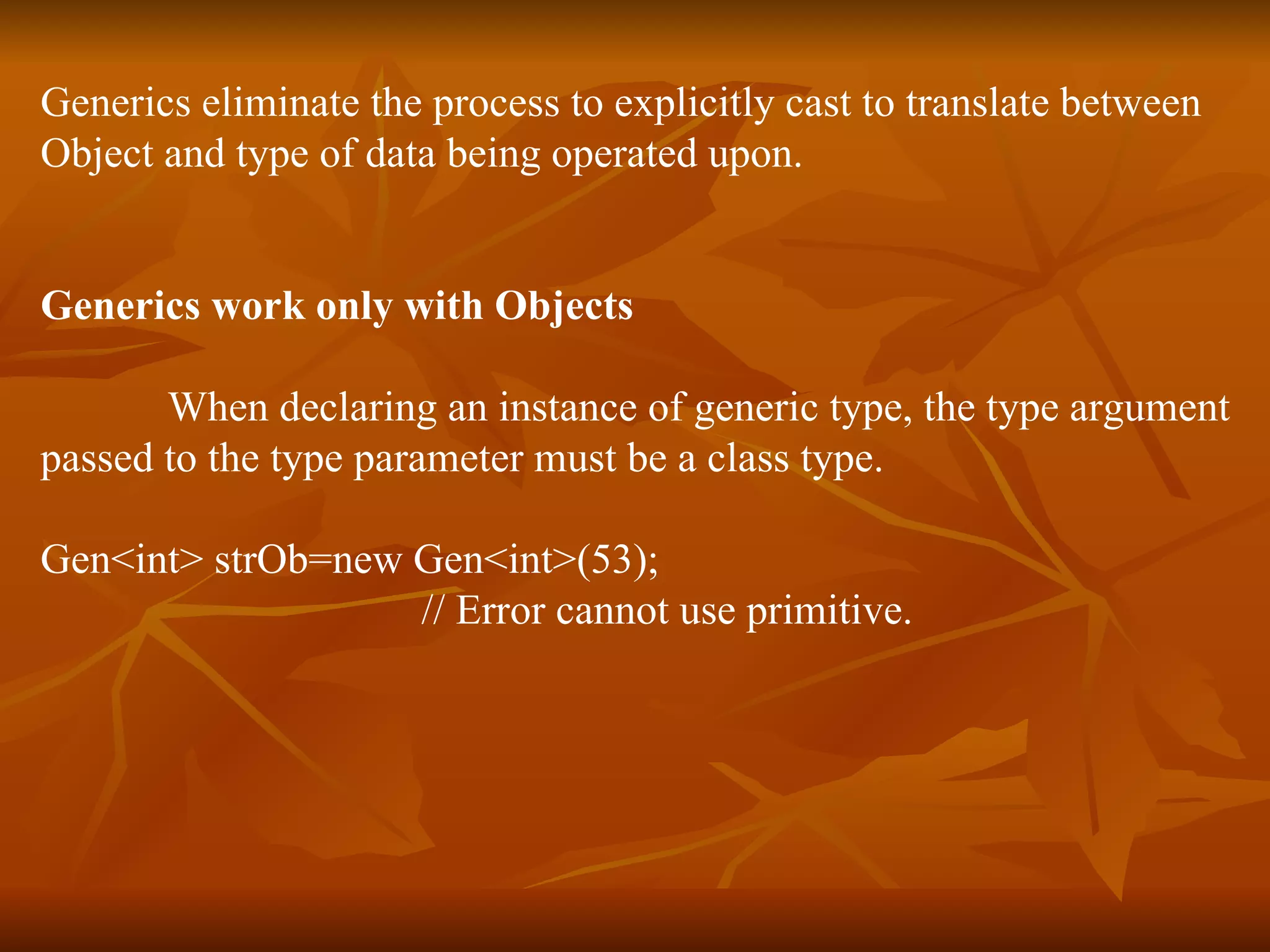
Generics eliminate the process to explicitly cast to translate between  Object and type of data being operated upon. Generics work only with Objects When declaring an instance of generic type, the type argument passed to the type parameter must be a class type. Gen<int> strOb=new Gen<int>(53);  // Error cannot use primitive.
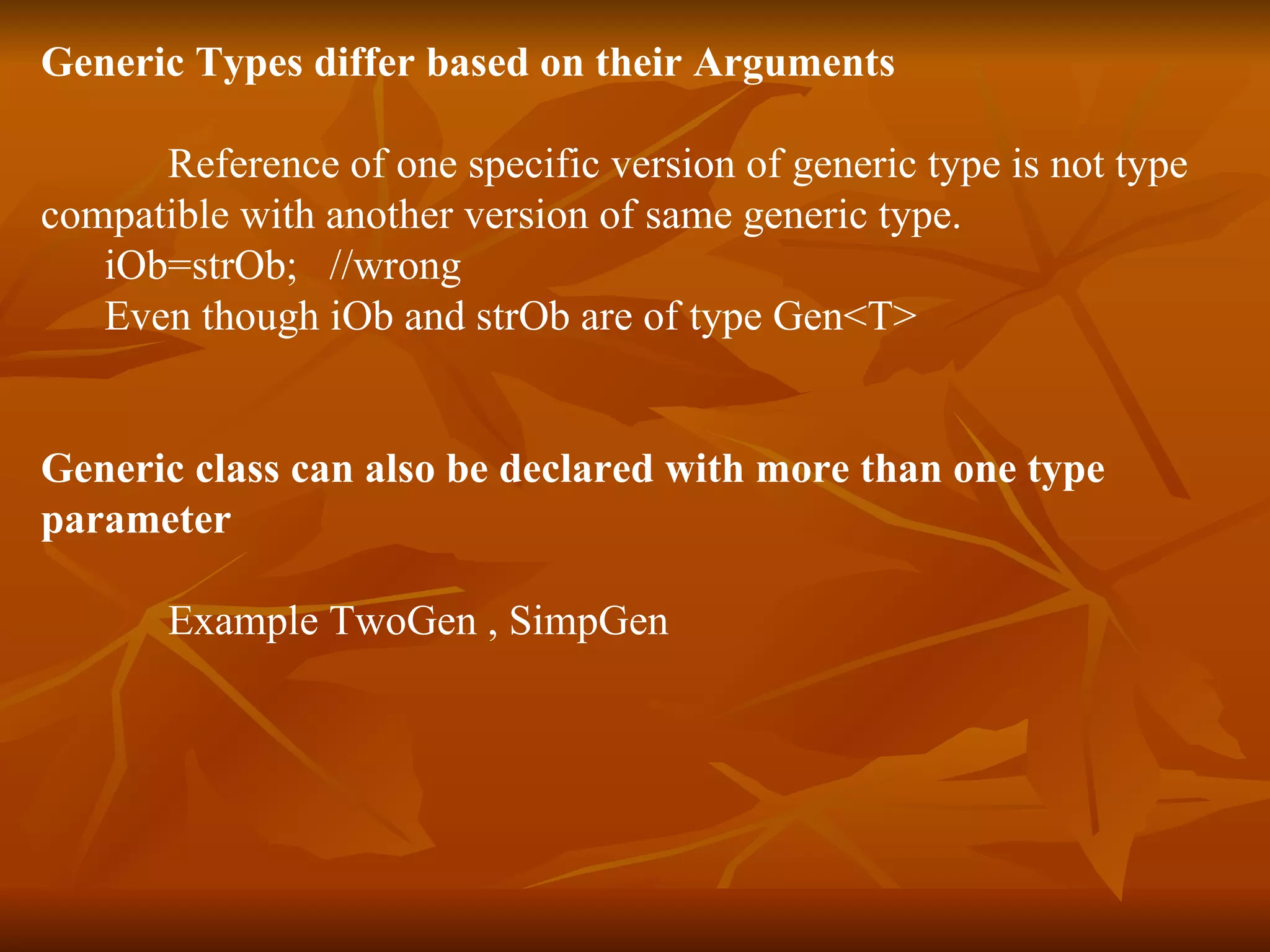
Generic Types differ based on their Arguments Reference of one specific version of generic type is not type  compatible with another version of same generic type. iOb=strOb;  //wrong Even though iOb and strOb are of type Gen<T> Generic class can also be declared with more than one type  parameter Example TwoGen , SimpGen
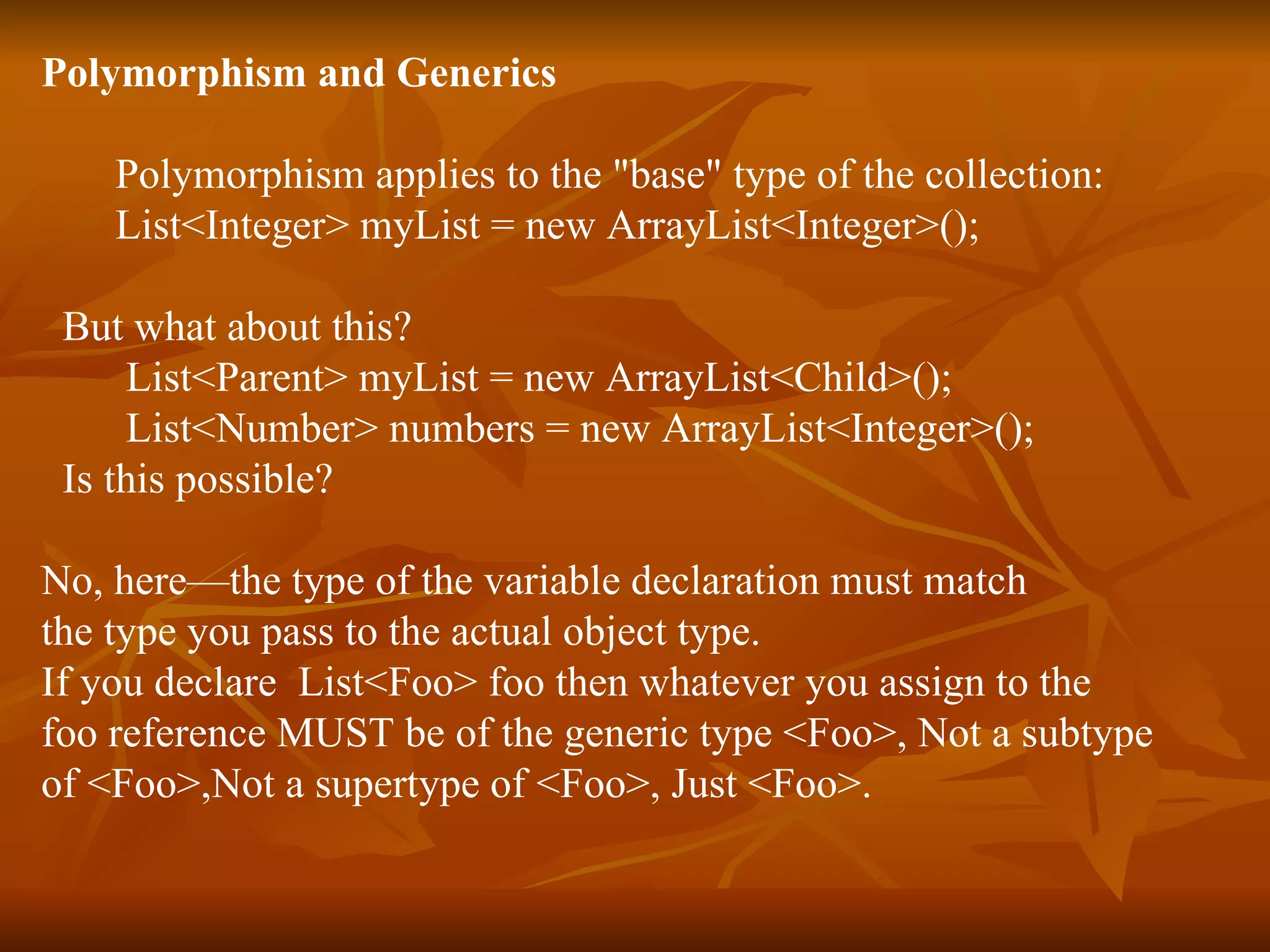
Polymorphism and Generics Polymorphism applies to the &quot;base&quot; type of the collection: List<Integer> myList = new ArrayList<Integer>(); But what about this? List<Parent> myList = new ArrayList<Child>(); List<Number> numbers = new ArrayList<Integer>(); Is this possible? No, here—the type of the variable declaration must match  the type you pass to the actual object type.  If you declare  List<Foo> foo then whatever you assign to the  foo reference MUST be of the generic type <Foo>, Not a subtype  of <Foo>,Not a supertype of <Foo>, Just <Foo>.

Md08 collection api

  • 1.
    Text-BasedApplication & Collection API
  • 2.
    Objectives • Write a program that uses command-line arguments • Using String and StringBuffer class • Collection Framework using Interface and Implementation • Interfaces List, Set, Queue, Map. • Implementation of Set interface using HashSet,TreeSet and LinkedHashSet. • Implementation of List interface using ArrayList and LinkedList. • Implementation of Map interface using HashMap and TreeMap.
  • 3.
    Command-Line Arguments • Any Java technology application can use command-line arguments • These string arguments are placed on the command line to launch the Java interpreter, after the class name: java TestArgs arg1 arg2 &quot;another arg“ • Each command-line argument is placed in the args array that is passed to the static main method: public static main void(String[] args)
  • 4.
    Command-Line Args publicclass TestArgs { public static void main(String[] args) { for ( int i = 0; i < args.length; i++ ) { System.out.println(&quot;args[&quot; + i + &quot;] is ’&quot; + args[i] + &quot;’&quot;); } } } java TestArgs arg1 arg2 &quot;another arg&quot; Here is an excerpt of the output: args[0] is ’arg1’ args[1] is ’arg2’
  • 5.
    Varargs With JDK5.0 Java has included a feature that implifies the creation of methods, that need to take variable number of arguments. This feature is called varargs and it short form for variable length arguments. Prior to JDK5, variable length argument could be handled using arrays. Example PassArray With variable length arguments A variable length argument is specified by three periods(…) To write a method using varargs static void vaTest (int …v) Example VarArgs
  • 6.
    v is operated as an array … syntax simply tell the compiler that a variable number of arguments will be used. A method can have normal parameters along with variable length parameters, however the variable length parameter must be last parameter declared by the method. int doit(int a, int b, double c, int …vals) Overloading Vararg Methods Example VarArgs2
  • 7.
    String is a sequence of characters. But, unlike many other languages that implement strings as character arrays, Java implements strings as objects of type String . * Once a String object has been created, you cannot change the characters that comprise that string. * Each time you need an altered version of an existing string, a new String object is created that contains the modifications. The original string is left unchanged.
  • 8.
    * For thosecases in which a modifiable string is desired, there is a companion class to String called StringBuffer , whose objects contain strings that can be modified after they are created. * Both the String and StringBuffer classes are declared final * The length of a string is the number of characters that it contains. To obtain this value, call the length( ) method, char chars[] = { 'a', 'b', 'c' }; String s = new String(chars); System.out.println(s.length());
  • 9.
    What will bethe output String s = &quot;four: &quot; + 2 + 2; System.out.println(s); equals( ) Versus == The equals( ) method compares the characters inside a String object. The == operator compares two object references to see whether they refer to the same instance.
  • 10.
    // equals() vs== class EqualsNotEqualTo { public static void main(String args[]) { String s1 = &quot;Hello&quot;; String s2 = new String(s1); System.out.println(s1 + &quot; equals &quot; + s2 + &quot; &quot; + s1.equals(s2)); System.out.println(s1 + &quot; == &quot; + s2 + &quot; &quot; + (s1 == s2)); } }
  • 11.
    Output Hello equalsHello -> true Hello == Hello -> false
  • 12.
    Collection API A collection — is simply an object that groups multiple elements into a single unit. * They can dynamically grow and shrink, which is their advantage over arrays.
  • 13.
    All collection frameworkcontain the following Interface These are the abstract data types that represent collection. Implementation These are the concrete implementation of collection interface
  • 14.
    The core collectioninterfaces encapsulate different types of collections, These interfaces allow collections to be manipulated independently of the details of their representation. A Set is a special kind of Collection. A SortedSet is a special kind of Set.
  • 15.
    The Collection interfaceis the least common denominator that all collections implement * The Java platform doesn't provide any direct implementations of this interface but provides implementations of more specific subinterfaces, such as Set and List. Set — a collection that cannot contain duplicate elements. This interface models the mathematical set abstraction and is used to represent Sets.
  • 16.
    List —an ordered collection (sometimes called a sequence ). Lists can contain duplicate elements. The user of a List generally has precise control over where in the list each element is inserted and can access elements by their integer index (position). Queue — a collection used to hold multiple elements prior to processing. Besides basic Collection operations, a Queue provides additional insertion, extraction, and inspection operations. Map — an object that maps keys to values. A Map cannot contain duplicate keys: each key can map to at most one value.
  • 17.
    SortedSet —a Set that maintains its elements in ascending order. Sorted sets are used for naturally ordered sets. SortedMap — a Map that maintains its mappings in ascending key order. Implementation The classes that implement these interfaces are listed below: Set HashSet TreeSet LinkedHashSet List Vector ArrayList LinkedList Map HashMap HashTable TreeMap LinkedHashMap SortedSet TreeSet SortedMap TreeMap
  • 18.
    Interface and classhierarchy of collections
  • 19.
  • 20.
    The ArrayList ClassThe ArrayList class extends AbstractList and implements the List interface. * ArrayList supports dynamic arrays that can grow as needed. * An ArrayList is a variable-length array of object references. * Since this implementation use an array to store the elements of the list, so access to an element using an index is very fast. Example ArrayListDemo.java Example ArrayListToArray.java For obtaining an Array from an ArrayList.
  • 21.
    The LinkedList ClassThe LinkedList class extends AbstractSequentialList and implements the List interface. * Provides uniformly named methods to get, remove and insert an element at the beginning and end of the list. * This implementation is not synchronized ,if multiple threads access a list concurrently, and at least one of the threads modifies the list structurally, it must be synchronized externally. * LinkedList is implemented using doubly linked list so access to an element requires the list to be traversed using the links.
  • 22.
    * This implementationof List interface produce the slowest access to an element in the middle of list by means of an index. * This implementation of the List interface provides for the fastest insertion of a new element into the middle of the list. The LinkedList is implemented using a doubly linked list; an insertion requires only the updating of the links at the point of insertion. Therefore, the LinkedList allows for fast insertions and deletions. * The LinkedList class provides methods such as addFirst, addLast, getFirst, getLast, removeFirst and removeLast that facilitate the implementation of stacks and queues.   Example LinkedListDemo.java
  • 23.
    Vector public classVector extends AbstractList implements List. Vector is synchronized. Vector constructors: Vector( ) The first form creates a default vector,which has an initial size of 10. Vector(int initialCapacity)   Constructs an empty vector with the specified initial capacity and with its capacity increment equal to zero. Vector(int initialCapacity, int capacityIncrement)            Constructs an empty vector with the specified initial capacity and capacity increment.
  • 24.
    Vector use anarray to store the elements of the list; so access to any element using an index is very fast. Example VectorDemo.java
  • 25.
    The HashSet classHashSet extends AbstractSet and implements the Set interface. * Each element must be unique. * Duplicate elements must not replace old elements. * Hash set does not guarantee the order of its elements, because the process of hashing doesn’t usually lend itself to the creation of sorted sets. * This class permits the null element. * Accessing an element can be almost as fast as performing a similar operation on an array. * This implementation is not synchronized. Example HashSetDemo.java
  • 26.
    LinkedHashSet LinkedHashSetimplements Set and extends HashSet. * Maintains a linked list of the entries in the set, in the order in which they were inserted. In other words it allow elements to be accessed in the order that they were added. * When cycling through a LinkedHashSet using an iterator, the elements will be returned in the order in which they were inserted. * This implementation is not synchronized. Example LinkedHashSetDemo.java
  • 27.
    The TreeSet Class* Duplicate elements are not accepted. * TreeSet provides an implementation of the SortedSet interface that uses a tree for storage. * This class guarantees that the sorted set will be in ascending element order * This implementation provides guaranteed log(n) time cost for the basic operations . * Access and retrieval times are quite fast,which makes TreeSet an excellent choice when storing large amounts of sorted information that must be found quickly. * This implementation is not synchronized * The entries can be sorted using the Comparable interface. Example TreeSetDemo.java
  • 28.
    HashMap HashMap implementsMap and extends AbstractMap. * A hash map does not guarantee the order of its elements. Therefore, the order in which elements are added to a hash map is not necessarily the order in which they are read by an iterator. * The HashMap class is roughly equivalent to Hashtable, except that it is unsynchronized and permits nulls. * This implementation is not synchronized. * HashMap lets you have null values as well as one null key Example HashMapDemo.java
  • 29.
    The TreeMap ClassTreeMap implements SortedMap and extends AbstractMap. * A TreeMap provides an efficient means of storing key/value pairs in sorted order. * Entries are sorted using Comparator or the Comparable interface. * This implementation is not synchronized. * Duplicate entries replace old entries. Example TreeMapDemo.java
  • 30.
    Hash Table *Like HashMap, Hashtable stores key/value pairs in a hash table. When using a Hashtable, you specify an object that is used as a key, and the value that you want linked to that key. The key is then hashed, and the resulting hash code is used as the index at which the value is stored within the table. * A hash table can only store objects that override the hashCode( ) and equals( ) methods that are defined by Object. The hashCode( ) method must compute and return the hash code for the object. * Hashtable is synchronized * Hashtable doesn't let you have anything that's null. Example HTDemo.java
  • 31.
    LinkedHashMap LinkedHashMap implements Map and extends HashMap. *This implementation differs from HashMap in that it maintains a doubly-linked list running through all of its entries.
  • 32.
    PriorityQueue * This class is new with Java 5. * This class implements the Queue interface. * Since the LinkedList class has been enhanced to implement the Queue interface, basic queues can be handled with a LinkedList. * PriorityQueue create a &quot;priority-in, priority out&quot; queue as opposed to a typical FIFO queue. *A PriorityQueue's elements are ordered either by natural ordering (in which case the elements that are sorted first will be accessed first) or according to a Comparator. * In either case, the elements' ordering represents their relative priority. * Queues have a few methods not found in other collection interfaces: peek(), poll(), and offer().
  • 33.
  • 34.
  • 35.
    Sorting Collections andArrays Sorting and searching topics have been added to the exam for Java 5. Sorting Collections ArrayList doesn't give you any way to sort its contents, but the java.util.Collections class does: import java.util.*; class TestSort1 { public static void main(String[] args) { ArrayList<String> stuff = new ArrayList<String>(); // #1 stuff.add(&quot;Denver&quot;); stuff.add(&quot;Boulder&quot;); stuff.add(&quot;Vail&quot;); stuff.add(&quot;Aspen&quot;); stuff.add(&quot;Telluride&quot;); System.out.println(&quot;unsorted &quot; + stuff); Collections.sort(stuff); // #2 System.out.println(&quot;sorted &quot; + stuff);}}
  • 36.
    Generics Generics meansparameterized types. Parameterized types are important as they enable to create classes, interfaces, and methods in which the type of data upon which they operate is specified as parameter. Using Generics its possible to create a single class that automatically works with different types of data. The class, interface or methods that operate on a parameterized type is called generic. Example Gen, GenDemo
  • 37.
    Generics eliminate theprocess to explicitly cast to translate between Object and type of data being operated upon. Generics work only with Objects When declaring an instance of generic type, the type argument passed to the type parameter must be a class type. Gen<int> strOb=new Gen<int>(53); // Error cannot use primitive.
  • 38.
    Generic Types differbased on their Arguments Reference of one specific version of generic type is not type compatible with another version of same generic type. iOb=strOb; //wrong Even though iOb and strOb are of type Gen<T> Generic class can also be declared with more than one type parameter Example TwoGen , SimpGen
  • 39.
    Polymorphism and GenericsPolymorphism applies to the &quot;base&quot; type of the collection: List<Integer> myList = new ArrayList<Integer>(); But what about this? List<Parent> myList = new ArrayList<Child>(); List<Number> numbers = new ArrayList<Integer>(); Is this possible? No, here—the type of the variable declaration must match the type you pass to the actual object type. If you declare List<Foo> foo then whatever you assign to the foo reference MUST be of the generic type <Foo>, Not a subtype of <Foo>,Not a supertype of <Foo>, Just <Foo>.