GOLDEN ARCHES
A Case Study on McDonald’s
Where It All Began
• Richard & Maurice McDonald built
hamburger stands with golden arches in
California. 15¢ hamburgers were very
popular.
• Ray Kroc, a milkshake machine
salesman, bought world franchise rights
from them and spread the golden
arches around the globe.
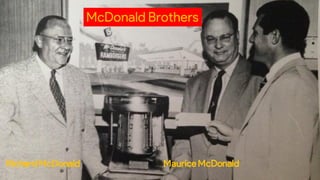
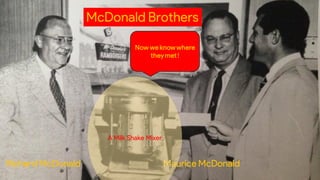
McDonald Brothers
RichardMcDonald MauriceMcDonald
RAY
KROC
Kroc was a
milk shake
mixer
salesman
McDonald Brothers
Richard McDonald Maurice McDonald
A Milk Shake Mixer
Now we know where
theymet !
Kroc became convinced that the setup of this small chain had the
potential to explode across the nation,
and he offered his services to the McDonald brothers.
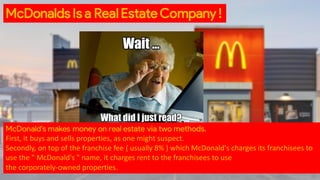
McDonald's makes money on real estate via two methods.
First, it buys and sells properties, as one might suspect.
Secondly, on top of the franchise fee ( usually 8% ) which McDonald's charges its franchisees to
use the " McDonald's " name, it charges rent to the franchisees to use
the corporately-owned properties.
McDonalds Is a Real Estate Company !
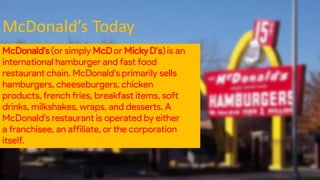
McDonald’s Today
McDonald's(or simply McDor MickyD's)is an
international hamburger and fast food
restaurant chain. McDonald's primarily sells
hamburgers, cheeseburgers, chicken
products, french fries, breakfast items, soft
drinks, milkshakes, wraps, and desserts. A
McDonald's restaurant is operated by either
a franchisee, an affiliate, or the corporation
itself.
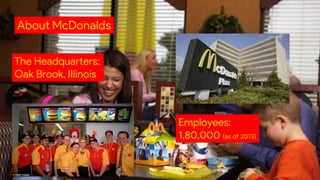
About McDonalds
The Headquarters:
Oak Brook, Illinois
Employees:
1,80,000 (as of 2013)
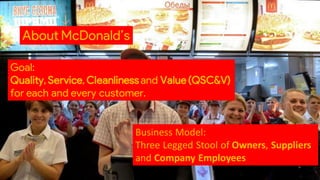
About McDonald’s
Goal:
Quality, Service, Cleanlinessand Value(QSC&V)
for each and every customer.
Business Model:
Three Legged Stool of Owners, Suppliers
and Company Employees
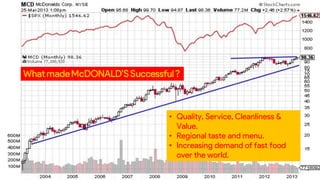
What madeMcDONALD’SSuccessful?
• Quality, Service, Cleanliness &
Value.
• Regional taste and menu.
• Increasing demand of fast food
over the world.
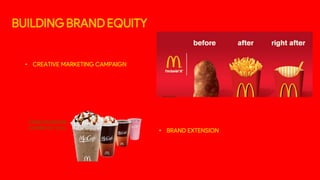
BUILDINGBRAND EQUITY
• CREATIVE MARKETING CAMPAIGN
• BRAND EXTENSION
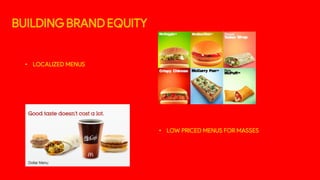
BUILDINGBRAND EQUITY
• LOCALIZED MENUS
• LOW PRICED MENUS FOR MASSES
BUILDINGBRAND EQUITY
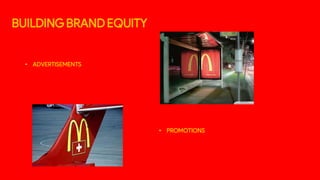
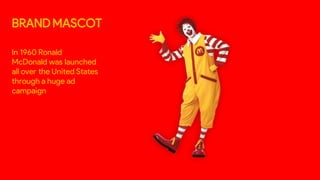
• ADVERTISEMENTS
• PROMOTIONS
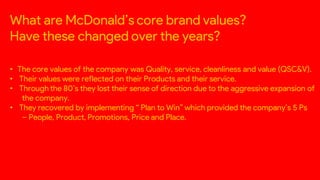
BRAND MASCOT
In 1960 Ronald
McDonald was launched
all over the United States
through a huge ad
campaign
What are McDonald’s core brand values?
Have these changed over the years?
• The core values of the company was Quality, service, cleanliness and value (QSC&V).
• Their values were reflected on their Products and their service.
• Through the 80’s they lost their sense of direction due to the aggressive expansion of
the company.
• They recovered by implementing “ Plan to Win” which provided the company’s 5 Ps
– People, Product, Promotions, Price and Place.
With the economy turning around for the better,
should McDonald’s change its strategy?
Why or why not?
• The product that is selling a product is consumed more when people have less money.
• The product it was selling would meet the requirements of people who are struggling
during the economic crisis by giving them food at a cheaper price than
most restaurants would.
• McDonalds should in fact change its strategy to keep its customers only slightly by
possibly improving the quality of their food broadening their menu.
What risks do you feel McDonald’s will face going
forward?
• McDonald’s should offer more premium options and establish itself as a provider of
normal goods while maintaining the value that its customers expect.
• Increasing health conscious consumers are opting for natural/healthier products.
• Increasing Competition in the fast food sector.
• Wider options for consumers to reach out for other than just Burgers and fries.
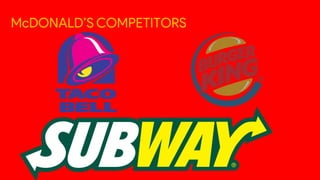
McDONALD’S COMPETITORS
Summary
• Richard & Maurice McDonald started 15¢ hamburger stands with golden arches in California.
• Ray Kroc, a milkshake machine salesman, bought world franchise rights.
He later purchased the company from the brothers for $2.7 million.
• Builds the most recognizable brand in the world.
• Diversifies its menu to stay in the competition.
• Low pricing and intensive marketing campaign fuels the growth of the company.
• Health conscious society might move on to healthier options.
• Needs to introduce healthier options to stay in the competition
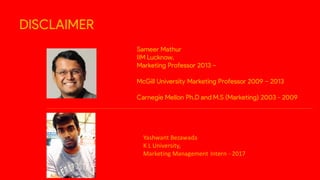
DISCLAIMER
Sameer Mathur
IIM Lucknow,
Marketing Professor 2013 –
McGill University Marketing Professor 2009 – 2013
Carnegie Mellon Ph.D and M.S (Marketing) 2003 - 2009
Yashwant Bezawada
K L University,
Marketing Management Intern - 2017

McDonald's Case Study

  • 1.
    GOLDEN ARCHES A CaseStudy on McDonald’s
  • 2.
    Where It AllBegan • Richard & Maurice McDonald built hamburger stands with golden arches in California. 15¢ hamburgers were very popular. • Ray Kroc, a milkshake machine salesman, bought world franchise rights from them and spread the golden arches around the globe.
  • 3.
  • 4.
    RAY KROC Kroc was a milkshake mixer salesman
  • 5.
    McDonald Brothers Richard McDonaldMaurice McDonald A Milk Shake Mixer Now we know where theymet !
  • 6.
    Kroc became convincedthat the setup of this small chain had the potential to explode across the nation, and he offered his services to the McDonald brothers.
  • 7.
    McDonald's makes moneyon real estate via two methods. First, it buys and sells properties, as one might suspect. Secondly, on top of the franchise fee ( usually 8% ) which McDonald's charges its franchisees to use the " McDonald's " name, it charges rent to the franchisees to use the corporately-owned properties. McDonalds Is a Real Estate Company !
  • 8.
    McDonald’s Today McDonald's(or simplyMcDor MickyD's)is an international hamburger and fast food restaurant chain. McDonald's primarily sells hamburgers, cheeseburgers, chicken products, french fries, breakfast items, soft drinks, milkshakes, wraps, and desserts. A McDonald's restaurant is operated by either a franchisee, an affiliate, or the corporation itself.
  • 9.
    About McDonalds The Headquarters: OakBrook, Illinois Employees: 1,80,000 (as of 2013)
  • 10.
    About McDonald’s Goal: Quality, Service,Cleanlinessand Value(QSC&V) for each and every customer. Business Model: Three Legged Stool of Owners, Suppliers and Company Employees
  • 11.
    What madeMcDONALD’SSuccessful? • Quality,Service, Cleanliness & Value. • Regional taste and menu. • Increasing demand of fast food over the world.
  • 12.
    BUILDINGBRAND EQUITY • CREATIVEMARKETING CAMPAIGN • BRAND EXTENSION
  • 13.
    BUILDINGBRAND EQUITY • LOCALIZEDMENUS • LOW PRICED MENUS FOR MASSES
  • 14.
  • 15.
    BRAND MASCOT In 1960Ronald McDonald was launched all over the United States through a huge ad campaign
  • 16.
    What are McDonald’score brand values? Have these changed over the years? • The core values of the company was Quality, service, cleanliness and value (QSC&V). • Their values were reflected on their Products and their service. • Through the 80’s they lost their sense of direction due to the aggressive expansion of the company. • They recovered by implementing “ Plan to Win” which provided the company’s 5 Ps – People, Product, Promotions, Price and Place.
  • 17.
    With the economyturning around for the better, should McDonald’s change its strategy? Why or why not? • The product that is selling a product is consumed more when people have less money. • The product it was selling would meet the requirements of people who are struggling during the economic crisis by giving them food at a cheaper price than most restaurants would. • McDonalds should in fact change its strategy to keep its customers only slightly by possibly improving the quality of their food broadening their menu.
  • 18.
    What risks doyou feel McDonald’s will face going forward? • McDonald’s should offer more premium options and establish itself as a provider of normal goods while maintaining the value that its customers expect. • Increasing health conscious consumers are opting for natural/healthier products. • Increasing Competition in the fast food sector. • Wider options for consumers to reach out for other than just Burgers and fries.
  • 19.
  • 20.
    Summary • Richard &Maurice McDonald started 15¢ hamburger stands with golden arches in California. • Ray Kroc, a milkshake machine salesman, bought world franchise rights. He later purchased the company from the brothers for $2.7 million. • Builds the most recognizable brand in the world. • Diversifies its menu to stay in the competition. • Low pricing and intensive marketing campaign fuels the growth of the company. • Health conscious society might move on to healthier options. • Needs to introduce healthier options to stay in the competition
  • 21.
    DISCLAIMER Sameer Mathur IIM Lucknow, MarketingProfessor 2013 – McGill University Marketing Professor 2009 – 2013 Carnegie Mellon Ph.D and M.S (Marketing) 2003 - 2009 Yashwant Bezawada K L University, Marketing Management Intern - 2017