Laura Misener, 
Western University 
David Legg, 
Mount Royal University 
Gayle McPherson & David 
McGillivray, University of 
the West of Scotland 
Leveraging Parasport Events for 
Sustainable Community 
Participation 
Prof. Gayle McPherson 
& Prof David McGillivray
Research context 
 Article 30 of UN Convention on the Rights of Persons with a Disability 
states that persons with a disability should have the right to participate 
on an equal basis in community life including recreational, leisure and 
sporting activities (UN, 2009) 
 But barriers include need for assistance, inaccessible facilities and 
transportation, the need for specialized equipment, and community 
attitudinal misperceptions about disability (HRSDC, 2010; WHO, 2011) 
 Hosting sporting events can offer an opportunity to: 
 access scarce resources to create more accessible infrastructure (e.g. 
sport and recreation facilities, transportation) 
 increase supportive services (i.e. coaching, volunteers, programs) 
 gain access to specialized equipment, and 
 potentially change attitudes about disability (Sherry et al., 2011) 
 However, little empirical evidence exists supporting these claims (Darcy 
& Appleby, 2011) and our project seeks to address this gap
Research aim & objectives 
Research Aim: 
 To examine how the hosting of different forms of sport events for 
persons with a disability are being leveraged to create opportunities for 
community participation, and influence community attitudes towards 
disability 
Research Objectives: 
 Compare and contrast social legacy tactics, strategies, and programmes 
 Analyze spectator, volunteer, and community members’ attitudes and 
awareness of disability 
 Develop framework for leveraging parasport events to benefit 
community participation opportunities, and influence attitudes
Glasgow 2014 & Parapan Am Games 2015 
➺July 23-Aug 3, 2014 
➺Glasgow, Scotland 
➺5 parasports, 22 parasport medal events 
➺Athletics, Swimming, Powerlifting, Lawn Bowls 
and Track Cycling 
➺Parasport athletes integrated 
➺Legacy planning as a general process 
➺Aug 7 – Aug 14, 2015 
➺Toronto, Canada 
➺15 parasport events 
➺Parasport athletes separated by time and space 
➺Legacy planning separate for Pan and Parapan Games
Research Methodology – G2014 
Type of Evidence Year of Data 
Collection 
Pre/during/po 
st 
Example Glasgow 2014 
Documentation 2013-14 Pre Bid Document 
Glasgow City Council/Scottish Legacy 
Framework, SDS Social Inclusion Model 
Physical Artifacts 2013-14 Pre/during Media Reports 
Marketing and Promotional Materials 
(Brochures, posters) 
Social media sentiment 
Direct Observation 2014 During Observation of 5 Glasgow 2014 sport venues 
and 3 live zones 
Semi-Structured Interviews 2013-14 Pre/post CEO, Glasgow 2014; Mgr of Accessibility 
G2014; Transport Scotland; CGS; Head of 
Engagement & Legacy G2014 etc 
Surveys w/ volunteers & 
spectators & general public 
pre/post post Games 
2014-15 Pr/during/po 
st 
Adapted Scale of Attitudes towards Disabled 
Persons (SADP) 
Glasgow Household Survey 
900 spectator surveys 
2878 volunteer surveys (pre-training)
Headline findings: Physical accessibility 
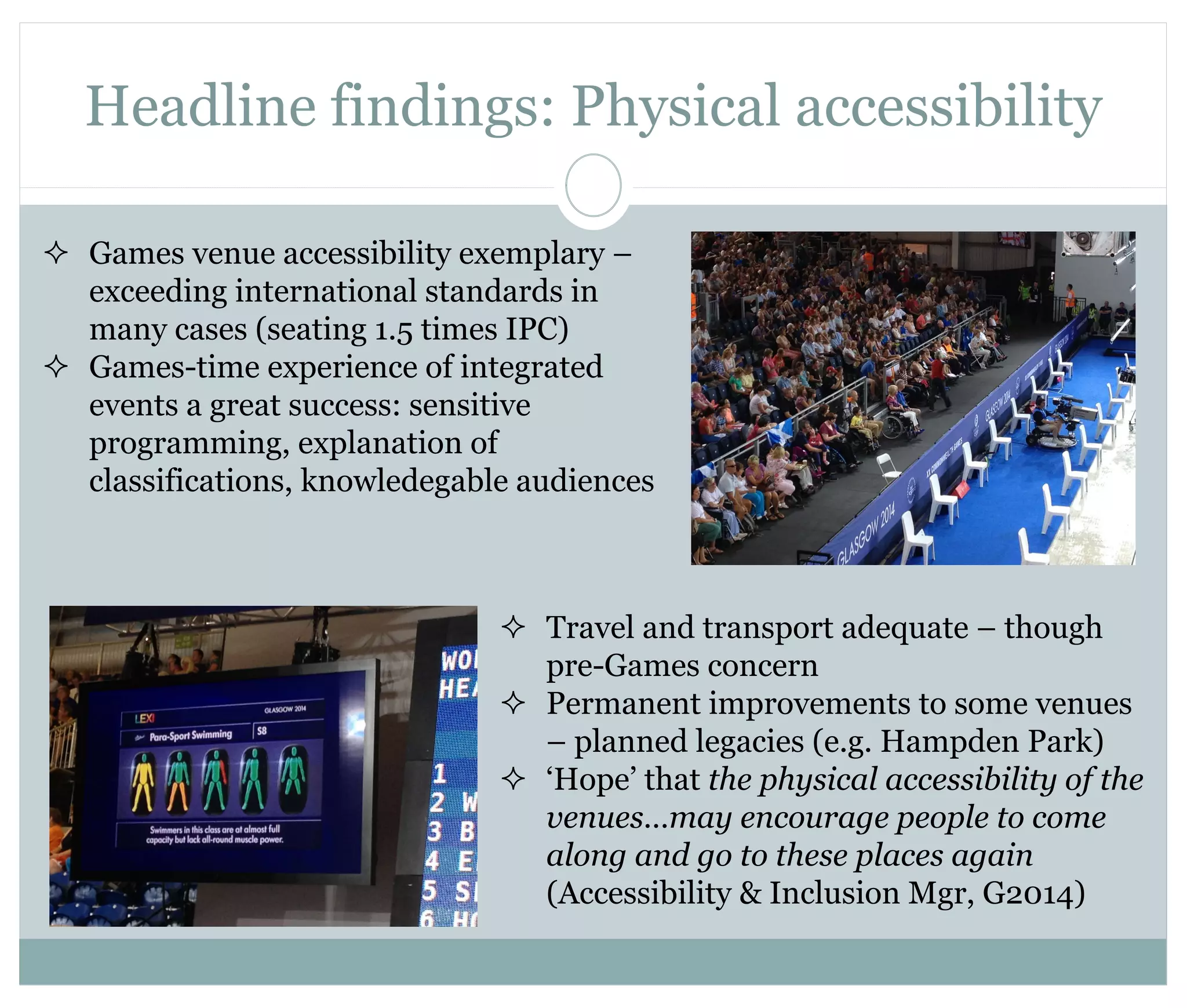
 Games venue accessibility exemplary – 
exceeding international standards in 
many cases (seating 1.5 times IPC) 
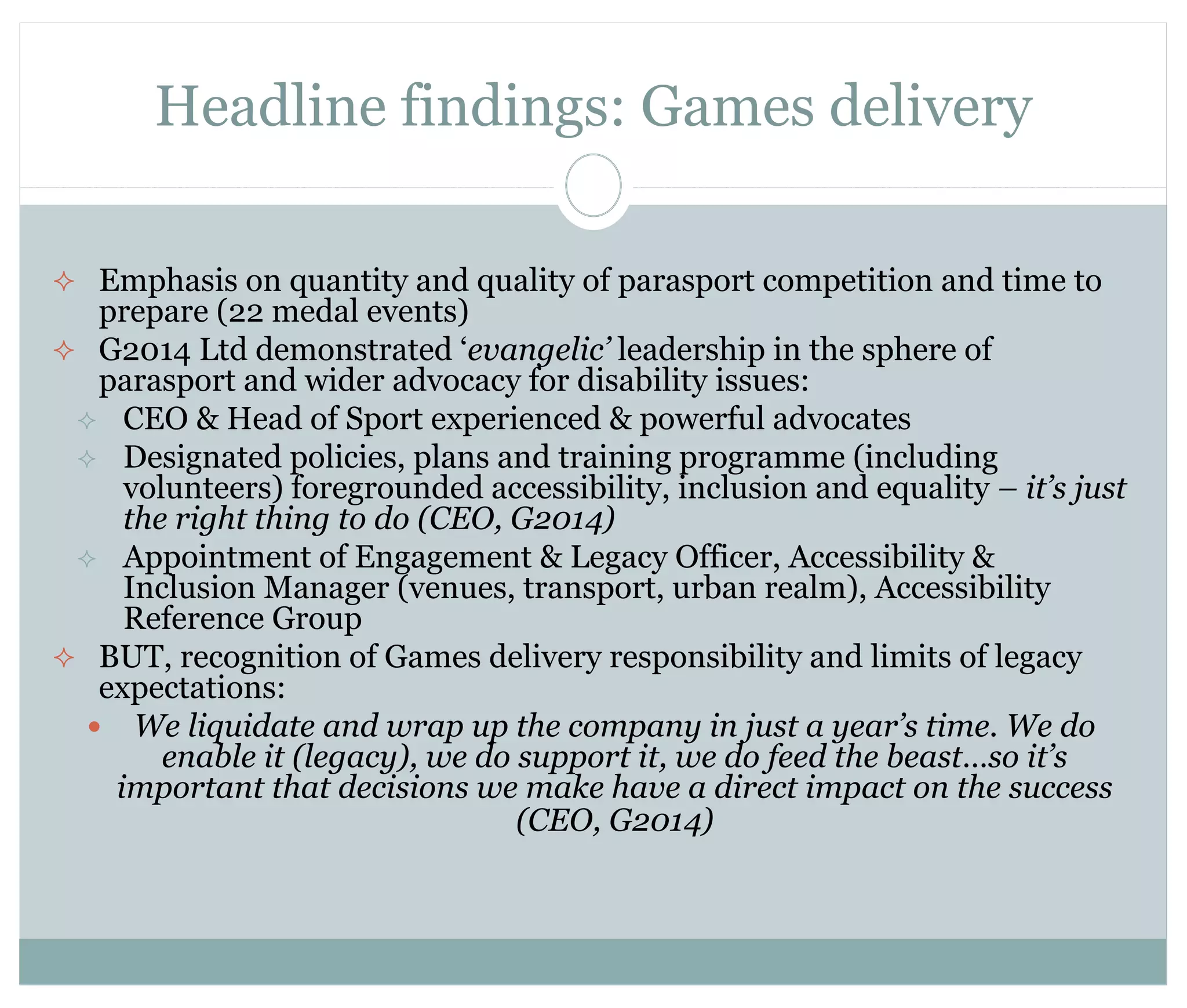
 Games-time experience of integrated 
events a great success: sensitive 
programming, explanation of 
classifications, knowledegable audiences 
 Travel and transport adequate – though 
pre-Games concern 
 Permanent improvements to some venues 
– planned legacies (e.g. Hampden Park) 
 ‘Hope’ that the physical accessibility of the 
venues…may encourage people to come 
along and go to these places again 
(Accessibility & Inclusion Mgr, G2014)
Headline findings: Games delivery 
 Emphasis on quantity and quality of parasport competition and time to 
prepare (22 medal events) 
 G2014 Ltd demonstrated ‘evangelic’ leadership in the sphere of 
parasport and wider advocacy for disability issues: 
 CEO & Head of Sport experienced & powerful advocates 
 Designated policies, plans and training programme (including 
volunteers) foregrounded accessibility, inclusion and equality – it’s just 
the right thing to do (CEO, G2014) 
 Appointment of Engagement & Legacy Officer, Accessibility & 
Inclusion Manager (venues, transport, urban realm), Accessibility 
Reference Group 
 BUT, recognition of Games delivery responsibility and limits of legacy 
expectations: 
 We liquidate and wrap up the company in just a year’s time. We do 
enable it (legacy), we do support it, we do feed the beast…so it’s 
important that decisions we make have a direct impact on the success 
(CEO, G2014)
Headline findings: Policy environment 
 Scottish Government, through Education Scotland, has provided 
Scottish Disability Sport (SDS) with £725,000 to deliver a Physical 
Education Disability Inclusion Training programme giving up to 1000 
teachers in Scottish schools the knowledge, skills and experience to 
fully include disabled young people in quality PE and sports provision 
by 2014, plus Legacy money Class2014 SS given 17 sports to support 
coaches in Disability training SDS, targeted the 5 parasports. 
 SDS are keen to ensure that the sport inclusion model from Scottish 
Disability Sport is widely adopted and incorporated into relevant 
continuing professional development for those working with young 
people in sport 
 Scottish Government provided £250,000 funding for recruitment of 8 
Regional Managers for SDS across Scotland to develop enhanced 
pathways, support local clubs and secure better monitoring/evaluation 
data 
 £6 million investment in dedicated parasport facility at Inverclyde
Headline Findings: Sustaining legacies 
 The absence of ‘specific’, ‘identifiable’ and ‘resourced’ strategies, 
tactics and programmes for persons with a disability beyond the 
Games mitigates against securing social legacies: 
 Need for clear plan for how ‘baton’ is handed over to national and local 
agencies post-Games and how demonstration effect is sustained 
 Crucial that knowledge transfer from Games experience is 
embedded locally and nationally (e.g. secondments, debriefs, 
dissemination) – currently only a CGF requirement 
 G2014 provided role models & positive media coverage BUT choice 
of parasports does not map easily onto host country sport 
participation or development pathways 
 Need for investment to address the ‘mundane’, ‘everyday’ barriers 
to sustained community participation: 
 Pathways, coaching, transport, pricing, equipment
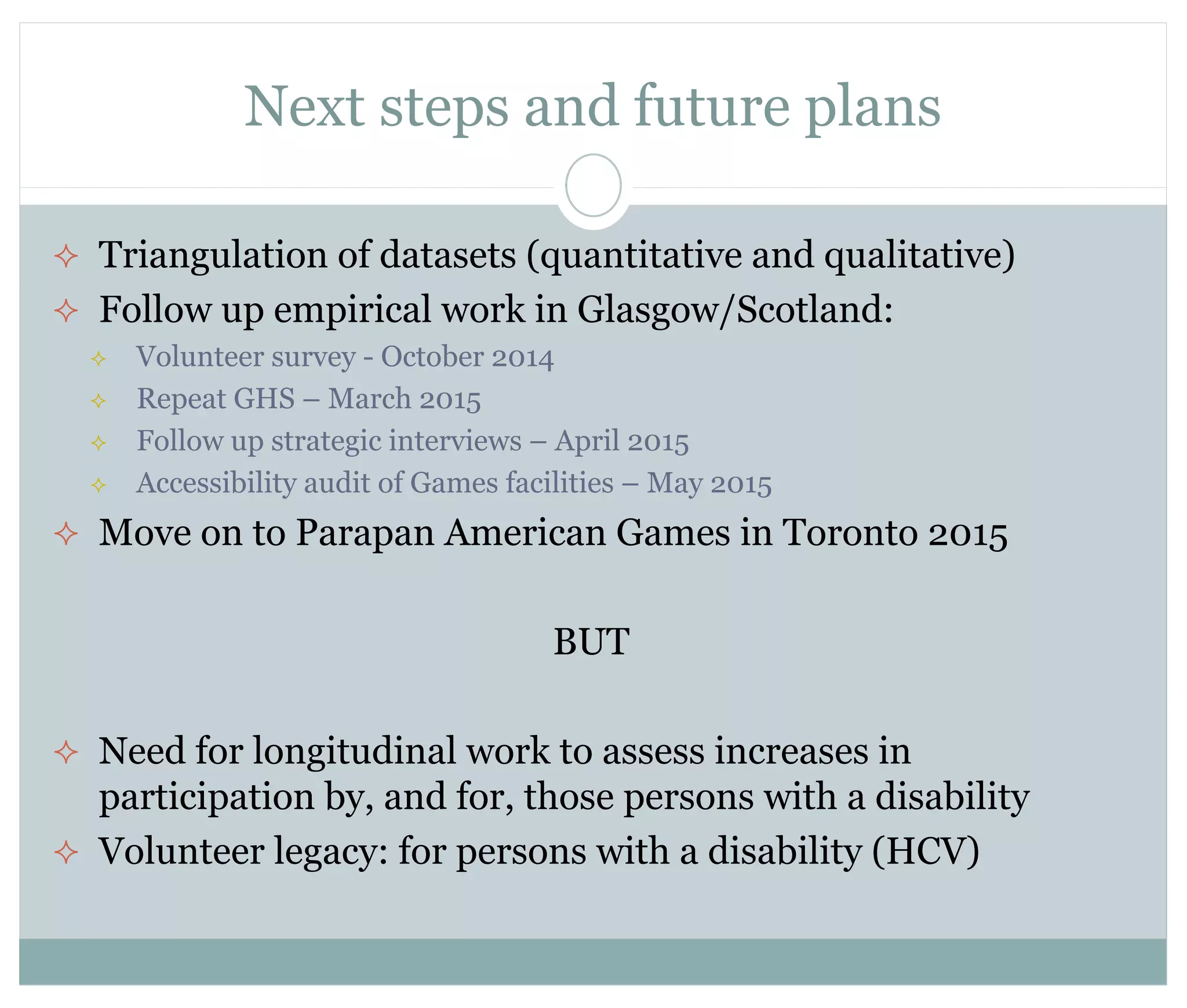
Next steps and future plans 
 Triangulation of datasets (quantitative and qualitative) 
 Follow up empirical work in Glasgow/Scotland: 
 Volunteer survey - October 2014 
 Repeat GHS – March 2015 
 Follow up strategic interviews – April 2015 
 Accessibility audit of Games facilities – May 2015 
 Move on to Parapan American Games in Toronto 2015 
BUT 
 Need for longitudinal work to assess increases in 
participation by, and for, those persons with a disability 
 Volunteer legacy: for persons with a disability (HCV)
Leveraging Parasport Events for Sustainable Community Participation

Leveraging Parasport Events for Sustainable Community Participation

  • 1.
    Laura Misener, WesternUniversity David Legg, Mount Royal University Gayle McPherson & David McGillivray, University of the West of Scotland Leveraging Parasport Events for Sustainable Community Participation Prof. Gayle McPherson & Prof David McGillivray
  • 2.
    Research context Article 30 of UN Convention on the Rights of Persons with a Disability states that persons with a disability should have the right to participate on an equal basis in community life including recreational, leisure and sporting activities (UN, 2009)  But barriers include need for assistance, inaccessible facilities and transportation, the need for specialized equipment, and community attitudinal misperceptions about disability (HRSDC, 2010; WHO, 2011)  Hosting sporting events can offer an opportunity to:  access scarce resources to create more accessible infrastructure (e.g. sport and recreation facilities, transportation)  increase supportive services (i.e. coaching, volunteers, programs)  gain access to specialized equipment, and  potentially change attitudes about disability (Sherry et al., 2011)  However, little empirical evidence exists supporting these claims (Darcy & Appleby, 2011) and our project seeks to address this gap
  • 3.
    Research aim &objectives Research Aim:  To examine how the hosting of different forms of sport events for persons with a disability are being leveraged to create opportunities for community participation, and influence community attitudes towards disability Research Objectives:  Compare and contrast social legacy tactics, strategies, and programmes  Analyze spectator, volunteer, and community members’ attitudes and awareness of disability  Develop framework for leveraging parasport events to benefit community participation opportunities, and influence attitudes
  • 4.
    Glasgow 2014 &Parapan Am Games 2015 ➺July 23-Aug 3, 2014 ➺Glasgow, Scotland ➺5 parasports, 22 parasport medal events ➺Athletics, Swimming, Powerlifting, Lawn Bowls and Track Cycling ➺Parasport athletes integrated ➺Legacy planning as a general process ➺Aug 7 – Aug 14, 2015 ➺Toronto, Canada ➺15 parasport events ➺Parasport athletes separated by time and space ➺Legacy planning separate for Pan and Parapan Games
  • 5.
    Research Methodology –G2014 Type of Evidence Year of Data Collection Pre/during/po st Example Glasgow 2014 Documentation 2013-14 Pre Bid Document Glasgow City Council/Scottish Legacy Framework, SDS Social Inclusion Model Physical Artifacts 2013-14 Pre/during Media Reports Marketing and Promotional Materials (Brochures, posters) Social media sentiment Direct Observation 2014 During Observation of 5 Glasgow 2014 sport venues and 3 live zones Semi-Structured Interviews 2013-14 Pre/post CEO, Glasgow 2014; Mgr of Accessibility G2014; Transport Scotland; CGS; Head of Engagement & Legacy G2014 etc Surveys w/ volunteers & spectators & general public pre/post post Games 2014-15 Pr/during/po st Adapted Scale of Attitudes towards Disabled Persons (SADP) Glasgow Household Survey 900 spectator surveys 2878 volunteer surveys (pre-training)
  • 6.
    Headline findings: Physicalaccessibility  Games venue accessibility exemplary – exceeding international standards in many cases (seating 1.5 times IPC)  Games-time experience of integrated events a great success: sensitive programming, explanation of classifications, knowledegable audiences  Travel and transport adequate – though pre-Games concern  Permanent improvements to some venues – planned legacies (e.g. Hampden Park)  ‘Hope’ that the physical accessibility of the venues…may encourage people to come along and go to these places again (Accessibility & Inclusion Mgr, G2014)
  • 7.
    Headline findings: Gamesdelivery  Emphasis on quantity and quality of parasport competition and time to prepare (22 medal events)  G2014 Ltd demonstrated ‘evangelic’ leadership in the sphere of parasport and wider advocacy for disability issues:  CEO & Head of Sport experienced & powerful advocates  Designated policies, plans and training programme (including volunteers) foregrounded accessibility, inclusion and equality – it’s just the right thing to do (CEO, G2014)  Appointment of Engagement & Legacy Officer, Accessibility & Inclusion Manager (venues, transport, urban realm), Accessibility Reference Group  BUT, recognition of Games delivery responsibility and limits of legacy expectations:  We liquidate and wrap up the company in just a year’s time. We do enable it (legacy), we do support it, we do feed the beast…so it’s important that decisions we make have a direct impact on the success (CEO, G2014)
  • 8.
    Headline findings: Policyenvironment  Scottish Government, through Education Scotland, has provided Scottish Disability Sport (SDS) with £725,000 to deliver a Physical Education Disability Inclusion Training programme giving up to 1000 teachers in Scottish schools the knowledge, skills and experience to fully include disabled young people in quality PE and sports provision by 2014, plus Legacy money Class2014 SS given 17 sports to support coaches in Disability training SDS, targeted the 5 parasports.  SDS are keen to ensure that the sport inclusion model from Scottish Disability Sport is widely adopted and incorporated into relevant continuing professional development for those working with young people in sport  Scottish Government provided £250,000 funding for recruitment of 8 Regional Managers for SDS across Scotland to develop enhanced pathways, support local clubs and secure better monitoring/evaluation data  £6 million investment in dedicated parasport facility at Inverclyde
  • 9.
    Headline Findings: Sustaininglegacies  The absence of ‘specific’, ‘identifiable’ and ‘resourced’ strategies, tactics and programmes for persons with a disability beyond the Games mitigates against securing social legacies:  Need for clear plan for how ‘baton’ is handed over to national and local agencies post-Games and how demonstration effect is sustained  Crucial that knowledge transfer from Games experience is embedded locally and nationally (e.g. secondments, debriefs, dissemination) – currently only a CGF requirement  G2014 provided role models & positive media coverage BUT choice of parasports does not map easily onto host country sport participation or development pathways  Need for investment to address the ‘mundane’, ‘everyday’ barriers to sustained community participation:  Pathways, coaching, transport, pricing, equipment
  • 10.
    Next steps andfuture plans  Triangulation of datasets (quantitative and qualitative)  Follow up empirical work in Glasgow/Scotland:  Volunteer survey - October 2014  Repeat GHS – March 2015  Follow up strategic interviews – April 2015  Accessibility audit of Games facilities – May 2015  Move on to Parapan American Games in Toronto 2015 BUT  Need for longitudinal work to assess increases in participation by, and for, those persons with a disability  Volunteer legacy: for persons with a disability (HCV)

Editor's Notes