www.auto2mation.com
Maximize Performance: Industrial Automation
Scanner Essentials
Introduction
Industrial automation is transforming how industries and production lines operate. Central to
this transformation are scanners, which play a crucial role in improving efficiency, accuracy, and
productivity. Scanners are devices that capture data and convert it into digital format, which
can be analyzed and utilized in various industrial applications. In this comprehensive guide, we
will explore the significant impact of scanners in industrial automation, covering their types,
applications, benefits, and future trends.
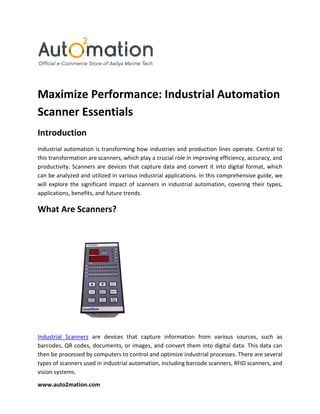
What Are Scanners?
Industrial Scanners are devices that capture information from various sources, such as
barcodes, QR codes, documents, or images, and convert them into digital data. This data can
then be processed by computers to control and optimize industrial processes. There are several
types of scanners used in industrial automation, including barcode scanners, RFID scanners, and
vision systems.
www.auto2mation.com
Types of Scanners Used in Industrial Automation
1. Barcode Scanners: Barcode scanners are widely used in industrial operations for tracking and
managing inventory. They read barcodes on products and materials, allowing for quick and
accurate data collection. There are several types of barcode scanners:
(A). Handheld Scanners: These are portable and used for manual scanning tasks.
(B). Fixed-Mount Scanners: These are mounted at specific locations and automatically scan
items that pass by.
(C). Mobile Computer Scanners: These combine barcode scanning with mobile computing,
allowing for more advanced data management.
2. RFID Scanners: Radio Frequency Identification (RFID) scanners use radio waves to read
information stored on RFID tags attached to objects. RFID technology offers several advantages
over traditional barcodes:
(A). Longer Read Range: RFID scanners can read tags from several meters away.
(B). Bulk Scanning: Multiple RFID tags can be read simultaneously.
(C). Data Capacity: RFID tags can store more information than barcodes.
3. Vision Scanners: Vision scanners use cameras and image processing software to capture and
analyze visual information. They are used for:
(A). Quality Control: Inspecting products for defects.
(B). Object Recognition: Identifying and sorting objects based on visual features.
(C). Measurement: Measuring dimensions and verifying correct assembly.
4. 3D Scanners: 3D scanners capture the shape and dimensions of objects in three dimensions.
They are used in industrial automation for:
(A). Quality Assurance: Ensuring parts meet specifications.
(B). Reverse Engineering: Creating digital models of existing parts.
(C). Rapid Prototyping: Producing accurate prototypes for testing and development.
Applications of Scanners in Industrial Automation
www.auto2mation.com
1. Inventory Management: Scanners are essential for efficient inventory management. They
enable real-time tracking of materials and products, reducing the chances of stock outs and
overstocking. Barcode and RFID scanners are particularly useful in warehouses and distribution
centers, where they streamline the process of receiving, storing, and shipping goods.
2. Quality Control: Maintaining high-quality standards is crucial in industrial automation. Vision
and 3D scanners are widely used for quality control, ensuring that products meet design
specifications and are free from defects. By automating the inspection process, scanners help
reduce human error and increase the consistency of quality checks.
3. Production Line Automation: In automated production lines, scanners play a vital role in
monitoring and controlling various processes. For example, barcode scanners can track the
movement of parts through different stages of production, while vision scanners can inspect
the alignment and assembly of components. This real-time data collection helps optimize
production workflows and reduce downtime.
4. Traceability: Traceability is important for tracking the origin and history of products,
especially in industries like food and pharmaceuticals. Scanners enable the precise tracking of
products from raw materials to finished goods. RFID scanners, in particular, are useful for
maintaining detailed records of production batches and ensuring compliance with regulatory
requirements.
5. Asset Tracking: In industrial settings, tracking the location and status of equipment and tools
is essential for maintaining operational efficiency. Scanners help monitor the usage and
condition of assets, ensuring they are available when needed and are properly maintained. This
reduces equipment downtime and extends the lifespan of critical assets.
6. Safety and Compliance: Scanners contribute to workplace safety and compliance by
monitoring hazardous materials and ensuring proper labeling. They can also be used to verify
that safety equipment is correctly positioned and functional. In regulated industries, scanners
help ensure that all processes and products comply with legal standards, reducing the risk of
non-compliance penalties.
Benefits of Using Scanners in Industrial Automation
1. Increased Efficiency: Scanners significantly enhance operational efficiency by automating
data collection and reducing manual labor. This speeds up various processes, such as inventory
counting, product inspection, and tracking. The real-time data provided by scanners allows for
quicker decision-making and immediate action on issues.
www.auto2mation.com
2. Improved Accuracy: Manual data entry is prone to errors, which can lead to costly mistakes
in industrial operations. Scanners provide high levels of accuracy, ensuring that data is captured
correctly and consistently. This reduces the possibility of errors in inventory management,
quality control, and production tracking.
3. Enhanced Productivity: By automating repetitive tasks, scanners free up human workers to
focus on more complex and value-added activities. This boosts overall productivity and allows
companies to achieve higher output levels without increasing labor costs. In production
environments, scanners help maintain a steady workflow, minimizing interruptions and delays.
4. Better Data Management: Scanners facilitate the seamless collection and integration of data
across different stages of industrial operations. This data can be analyzed to gain insights into
performance, identify trends, and optimize processes. Enhanced data management capabilities
enable companies to make informed decisions and improve overall operational efficiency.
5. Cost Savings: The use of scanners in industrial automation can lead to significant cost
savings. By improving efficiency, accuracy, and productivity, scanners help reduce operational
costs. They also minimize waste and rework by ensuring that products meet quality standards.
Additionally, effective asset tracking and maintenance can extend the lifespan of equipment,
reducing the need for costly replacements.
6. Enhanced Traceability: Traceability is crucial for ensuring product safety and compliance.
Scanners provide detailed records of product movements and transformations, enabling
companies to trace the history of each item. This is particularly important in industries where
recalls or quality issues can have severe consequences. Enhanced traceability also helps build
trust with customers and regulatory authorities.
Future Trends in Scanners for Industrial Automation
1. Integration with IoT: The Internet of Things (IoT) is revolutionizing industrial automation by
connecting various devices and systems. Scanners are becoming an integral part of IoT
networks, enabling real-time data exchange and remote monitoring. This integration allows for
more efficient and responsive industrial operations.
2. Advancements in AI and Machine Learning: Artificial intelligence (AI) and machine learning
are enhancing the capabilities of scanners. Vision scanners, in particular, are benefiting from
these technologies, which enable more advanced image analysis and defect detection. AI-
powered scanners can learn from data and improve their accuracy and performance over time.
3. Wireless and Mobile Scanning Solutions: Wireless and mobile scanning solutions are gaining
popularity in industrial automation. These solutions offer greater flexibility and mobility,
www.auto2mation.com
allowing workers to perform scanning tasks without being tethered to a fixed location. Mobile
scanning devices with integrated computing capabilities are becoming more common, enabling
on-the-go data collection and analysis.
4. Enhanced Data Security: As scanners become more connected and integrated into digital
networks, data security is a growing concern. Future scanner technologies will likely include
advanced encryption and security features to protect sensitive data from cyber threats.
Ensuring the integrity and confidentiality of scanned data is essential for maintaining trust and
compliance.
5. Increased Use of 3D Scanning: 3D scanning technology is advancing rapidly, and its
applications in industrial automation are expanding. Future developments will likely focus on
improving the speed, accuracy, and affordability of 3D scanners. This will enable more
widespread adoption of 3D scanning for quality control, reverse engineering, and prototyping.
6. Customization and Adaptability: Scanners are becoming more customizable and adaptable
to specific industrial needs. Manufacturers are developing scanners with modular designs and
configurable features, allowing companies to tailor scanning solutions to their unique
requirements. This trend will enable more effective and efficient use of scanners in diverse
industrial applications.
Conclusion
Scanners play a crucial role in industrial automation, offering many benefits such as enhanced
accuracy, increased speed, and improved inventory management. They are used in various
applications, from manufacturing to healthcare, and are becoming more advanced with the
integration of IoT, AI, and other technologies. While there are challenges to consider, the long-
term benefits of using scanners in industrial automation are clear. As technology continues to
evolve, scanners will become even more integral to industrial automation, helping businesses
to operate more efficiently, improve quality, and stay competitive in a rapidly changing world.

Maximize Performance Industrial Automation Scanner Essentials (1).pdf

  • 1.
    www.auto2mation.com Maximize Performance: IndustrialAutomation Scanner Essentials Introduction Industrial automation is transforming how industries and production lines operate. Central to this transformation are scanners, which play a crucial role in improving efficiency, accuracy, and productivity. Scanners are devices that capture data and convert it into digital format, which can be analyzed and utilized in various industrial applications. In this comprehensive guide, we will explore the significant impact of scanners in industrial automation, covering their types, applications, benefits, and future trends. What Are Scanners? Industrial Scanners are devices that capture information from various sources, such as barcodes, QR codes, documents, or images, and convert them into digital data. This data can then be processed by computers to control and optimize industrial processes. There are several types of scanners used in industrial automation, including barcode scanners, RFID scanners, and vision systems.
  • 2.
    www.auto2mation.com Types of ScannersUsed in Industrial Automation 1. Barcode Scanners: Barcode scanners are widely used in industrial operations for tracking and managing inventory. They read barcodes on products and materials, allowing for quick and accurate data collection. There are several types of barcode scanners: (A). Handheld Scanners: These are portable and used for manual scanning tasks. (B). Fixed-Mount Scanners: These are mounted at specific locations and automatically scan items that pass by. (C). Mobile Computer Scanners: These combine barcode scanning with mobile computing, allowing for more advanced data management. 2. RFID Scanners: Radio Frequency Identification (RFID) scanners use radio waves to read information stored on RFID tags attached to objects. RFID technology offers several advantages over traditional barcodes: (A). Longer Read Range: RFID scanners can read tags from several meters away. (B). Bulk Scanning: Multiple RFID tags can be read simultaneously. (C). Data Capacity: RFID tags can store more information than barcodes. 3. Vision Scanners: Vision scanners use cameras and image processing software to capture and analyze visual information. They are used for: (A). Quality Control: Inspecting products for defects. (B). Object Recognition: Identifying and sorting objects based on visual features. (C). Measurement: Measuring dimensions and verifying correct assembly. 4. 3D Scanners: 3D scanners capture the shape and dimensions of objects in three dimensions. They are used in industrial automation for: (A). Quality Assurance: Ensuring parts meet specifications. (B). Reverse Engineering: Creating digital models of existing parts. (C). Rapid Prototyping: Producing accurate prototypes for testing and development. Applications of Scanners in Industrial Automation
  • 3.
    www.auto2mation.com 1. Inventory Management:Scanners are essential for efficient inventory management. They enable real-time tracking of materials and products, reducing the chances of stock outs and overstocking. Barcode and RFID scanners are particularly useful in warehouses and distribution centers, where they streamline the process of receiving, storing, and shipping goods. 2. Quality Control: Maintaining high-quality standards is crucial in industrial automation. Vision and 3D scanners are widely used for quality control, ensuring that products meet design specifications and are free from defects. By automating the inspection process, scanners help reduce human error and increase the consistency of quality checks. 3. Production Line Automation: In automated production lines, scanners play a vital role in monitoring and controlling various processes. For example, barcode scanners can track the movement of parts through different stages of production, while vision scanners can inspect the alignment and assembly of components. This real-time data collection helps optimize production workflows and reduce downtime. 4. Traceability: Traceability is important for tracking the origin and history of products, especially in industries like food and pharmaceuticals. Scanners enable the precise tracking of products from raw materials to finished goods. RFID scanners, in particular, are useful for maintaining detailed records of production batches and ensuring compliance with regulatory requirements. 5. Asset Tracking: In industrial settings, tracking the location and status of equipment and tools is essential for maintaining operational efficiency. Scanners help monitor the usage and condition of assets, ensuring they are available when needed and are properly maintained. This reduces equipment downtime and extends the lifespan of critical assets. 6. Safety and Compliance: Scanners contribute to workplace safety and compliance by monitoring hazardous materials and ensuring proper labeling. They can also be used to verify that safety equipment is correctly positioned and functional. In regulated industries, scanners help ensure that all processes and products comply with legal standards, reducing the risk of non-compliance penalties. Benefits of Using Scanners in Industrial Automation 1. Increased Efficiency: Scanners significantly enhance operational efficiency by automating data collection and reducing manual labor. This speeds up various processes, such as inventory counting, product inspection, and tracking. The real-time data provided by scanners allows for quicker decision-making and immediate action on issues.
  • 4.
    www.auto2mation.com 2. Improved Accuracy:Manual data entry is prone to errors, which can lead to costly mistakes in industrial operations. Scanners provide high levels of accuracy, ensuring that data is captured correctly and consistently. This reduces the possibility of errors in inventory management, quality control, and production tracking. 3. Enhanced Productivity: By automating repetitive tasks, scanners free up human workers to focus on more complex and value-added activities. This boosts overall productivity and allows companies to achieve higher output levels without increasing labor costs. In production environments, scanners help maintain a steady workflow, minimizing interruptions and delays. 4. Better Data Management: Scanners facilitate the seamless collection and integration of data across different stages of industrial operations. This data can be analyzed to gain insights into performance, identify trends, and optimize processes. Enhanced data management capabilities enable companies to make informed decisions and improve overall operational efficiency. 5. Cost Savings: The use of scanners in industrial automation can lead to significant cost savings. By improving efficiency, accuracy, and productivity, scanners help reduce operational costs. They also minimize waste and rework by ensuring that products meet quality standards. Additionally, effective asset tracking and maintenance can extend the lifespan of equipment, reducing the need for costly replacements. 6. Enhanced Traceability: Traceability is crucial for ensuring product safety and compliance. Scanners provide detailed records of product movements and transformations, enabling companies to trace the history of each item. This is particularly important in industries where recalls or quality issues can have severe consequences. Enhanced traceability also helps build trust with customers and regulatory authorities. Future Trends in Scanners for Industrial Automation 1. Integration with IoT: The Internet of Things (IoT) is revolutionizing industrial automation by connecting various devices and systems. Scanners are becoming an integral part of IoT networks, enabling real-time data exchange and remote monitoring. This integration allows for more efficient and responsive industrial operations. 2. Advancements in AI and Machine Learning: Artificial intelligence (AI) and machine learning are enhancing the capabilities of scanners. Vision scanners, in particular, are benefiting from these technologies, which enable more advanced image analysis and defect detection. AI- powered scanners can learn from data and improve their accuracy and performance over time. 3. Wireless and Mobile Scanning Solutions: Wireless and mobile scanning solutions are gaining popularity in industrial automation. These solutions offer greater flexibility and mobility,
  • 5.
    www.auto2mation.com allowing workers toperform scanning tasks without being tethered to a fixed location. Mobile scanning devices with integrated computing capabilities are becoming more common, enabling on-the-go data collection and analysis. 4. Enhanced Data Security: As scanners become more connected and integrated into digital networks, data security is a growing concern. Future scanner technologies will likely include advanced encryption and security features to protect sensitive data from cyber threats. Ensuring the integrity and confidentiality of scanned data is essential for maintaining trust and compliance. 5. Increased Use of 3D Scanning: 3D scanning technology is advancing rapidly, and its applications in industrial automation are expanding. Future developments will likely focus on improving the speed, accuracy, and affordability of 3D scanners. This will enable more widespread adoption of 3D scanning for quality control, reverse engineering, and prototyping. 6. Customization and Adaptability: Scanners are becoming more customizable and adaptable to specific industrial needs. Manufacturers are developing scanners with modular designs and configurable features, allowing companies to tailor scanning solutions to their unique requirements. This trend will enable more effective and efficient use of scanners in diverse industrial applications. Conclusion Scanners play a crucial role in industrial automation, offering many benefits such as enhanced accuracy, increased speed, and improved inventory management. They are used in various applications, from manufacturing to healthcare, and are becoming more advanced with the integration of IoT, AI, and other technologies. While there are challenges to consider, the long- term benefits of using scanners in industrial automation are clear. As technology continues to evolve, scanners will become even more integral to industrial automation, helping businesses to operate more efficiently, improve quality, and stay competitive in a rapidly changing world.