Name : Ritesh Bhure
Roll no : 21HZL7142
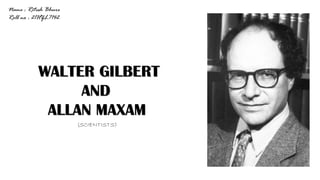
WALTER GILBERT
AND
ALLAN MAXAM
(SCIENTISTS)
Walter Gilbert and Allan Maxam are renowned scientists who made significant contributions to the field of
computational biology, particularly in the context of DNA sequencing and genome analysis.
Here's a detailed introduction to each of them and their contributions:
Walter Gilbert:
• Walter Gilbert is a prominent American physicist, biochemist, and molecular biology researcher, born in 1932.
• He is best known for his contributions to DNA sequencing and genomics, as well as his work in molecular biology.
• Gilbert, along with Sanger sequencing and Maxam-Gilbert sequencing (also known as chemical sequencing), played
a pivotal role in the early days of DNA sequencing.
• His work on developing the "first generation" DNA sequencing techniques, such as the Maxam-Gilbert method,
opened the doors to the field of genomics and revolutionized our ability to decode the genetic information within
DNA.
• His contributions also include significant work on the human genome project and the development of computational
tools for analyzing and interpreting genetic data.
• Walter Gilbert's research laid the foundation for modern computational biology by enabling large-scale DNA
sequencing and genome analysis.
Allan Maxam:
• Allan Maxam is an American biologist who, in collaboration with Walter Gilbert, made substantial contributions to
DNA sequencing methods and computational biology.
• Born in 1942, Maxam's early work in the 1970s focused on the development of the Maxam-Gilbert sequencing
method, a chemical approach to DNA sequencing.
• The Maxam-Gilbert method involved selectively cleaving DNA at specific bases using chemicals, which resulted in
the production of DNA fragments of varying lengths.
• This pioneering technique allowed for the determination of DNA sequences, and it was a precursor to Sanger
sequencing and later next-generation sequencing methods.
• Maxam's work significantly influenced the field of computational biology, as it involved the analysis of data
generated by sequencing techniques, laying the foundation for bioinformatics and computational tools for managing
and interpreting genomic data.
• The Maxam-Gilbert sequencing method played a crucial role in advancing our understanding of genetics, molecular
biology, and genomics.
✓ In summary, Walter Gilbert and Allan Maxam made pivotal contributions to computational biology by developing
early DNA sequencing methods, which not only enabled the sequencing of DNA but also spurred the development
of computational tools and techniques for analyzing and interpreting genetic information. Their work has had a
lasting impact on the field of genomics and molecular biology, making it possible to unravel the complexities of the
genetic code.

MAXAM & GILBERT_(scientists).pdf

  • 1.
    Name : RiteshBhure Roll no : 21HZL7142 WALTER GILBERT AND ALLAN MAXAM (SCIENTISTS)
  • 2.
    Walter Gilbert andAllan Maxam are renowned scientists who made significant contributions to the field of computational biology, particularly in the context of DNA sequencing and genome analysis. Here's a detailed introduction to each of them and their contributions: Walter Gilbert: • Walter Gilbert is a prominent American physicist, biochemist, and molecular biology researcher, born in 1932. • He is best known for his contributions to DNA sequencing and genomics, as well as his work in molecular biology. • Gilbert, along with Sanger sequencing and Maxam-Gilbert sequencing (also known as chemical sequencing), played a pivotal role in the early days of DNA sequencing. • His work on developing the "first generation" DNA sequencing techniques, such as the Maxam-Gilbert method, opened the doors to the field of genomics and revolutionized our ability to decode the genetic information within DNA. • His contributions also include significant work on the human genome project and the development of computational tools for analyzing and interpreting genetic data. • Walter Gilbert's research laid the foundation for modern computational biology by enabling large-scale DNA sequencing and genome analysis.
  • 3.
    Allan Maxam: • AllanMaxam is an American biologist who, in collaboration with Walter Gilbert, made substantial contributions to DNA sequencing methods and computational biology. • Born in 1942, Maxam's early work in the 1970s focused on the development of the Maxam-Gilbert sequencing method, a chemical approach to DNA sequencing. • The Maxam-Gilbert method involved selectively cleaving DNA at specific bases using chemicals, which resulted in the production of DNA fragments of varying lengths. • This pioneering technique allowed for the determination of DNA sequences, and it was a precursor to Sanger sequencing and later next-generation sequencing methods. • Maxam's work significantly influenced the field of computational biology, as it involved the analysis of data generated by sequencing techniques, laying the foundation for bioinformatics and computational tools for managing and interpreting genomic data. • The Maxam-Gilbert sequencing method played a crucial role in advancing our understanding of genetics, molecular biology, and genomics. ✓ In summary, Walter Gilbert and Allan Maxam made pivotal contributions to computational biology by developing early DNA sequencing methods, which not only enabled the sequencing of DNA but also spurred the development of computational tools and techniques for analyzing and interpreting genetic information. Their work has had a lasting impact on the field of genomics and molecular biology, making it possible to unravel the complexities of the genetic code.