Material Properties ofMaterial Properties of
MagnesiumMagnesium
Randy Beals
(A)(A)
FriendlyFriendly
MaterialMaterial
PropertiesProperties
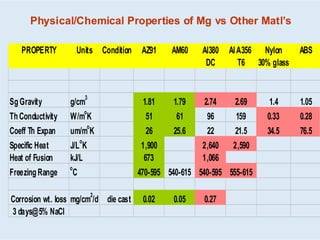
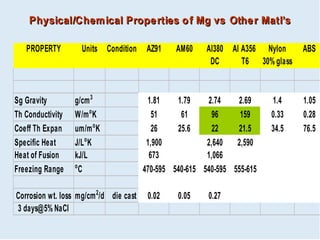
Physical/Chemical Properties of MgPhysical/Chemical Properties of Mg vsvs OtherOther Matl’sMatl’s
PROPERTY Units Condition AZ91 AM60 Al380 AlA356 Nylon ABS
DC T6 30% glass
SgGravity g/cm
3
1.81 1.79 2.74 2.69 1.4 1.05
ThConductivity W/m
o
K 51 61 96 159 0.33 0.28
Coeff Th Expan um/m
o
K 26 25.6 22 21.5 34.5 76.5
Specific Heat J/L
o
K 1,900 2,640 2,590
Heat of Fusion kJ/L 673 1,066
FreezingRange
o
C 470-595 540-615 540-595 555-615
Corrosion wt. loss mg/cm
2
/d die cast 0.02 0.05 0.27
3 days@5% NaCl
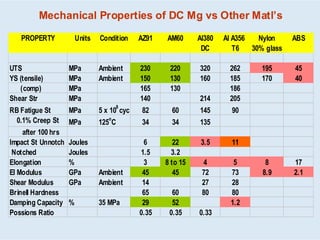
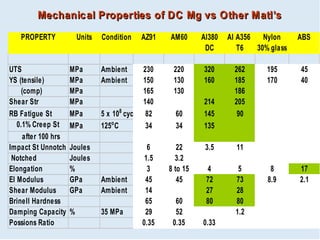
Mechanical Properties of DC MgMechanical Properties of DC Mg vsvs OtherOther Matl’sMatl’s
PROPERTY Units Condition AZ91 AM60 Al380 Al A356 Nylon ABS
DC T6 30% glass
UTS MPa Ambient 230 220 320 262 195 45
YS (tensile) MPa Ambient 150 130 160 185 170 40
(comp) MPa 165 130 186
Shear Str MPa 140 214 205
RB Fatigue St MPa 5 x 10
8
cyc 82 60 145 90
0.1% Creep St MPa 125
o
C 34 34 135
after 100 hrs
Impact St Unnotch Joules 6 22 3.5 11
Notched Joules 1.5 3.2
Elongation % 3 8 to 15 4 5 8 17
El Modulus GPa Ambient 45 45 72 73 8.9 2.1
Shear Modulus GPa Ambient 14 27 28
Brinell Hardness 65 60 80 80
Damping Capacity % 35 MPa 29 52 1.2
Possions Ratio 0.35 0.35 0.33
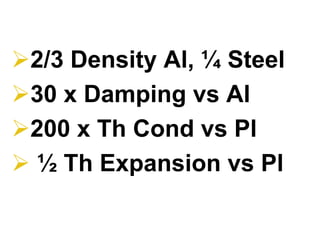
2/3 Density Al, ¼ Steel
30 x Damping vs Al
200 x Th Cond vs Pl
½ Th Expansion vs Pl
Higher Specific Strength
Ductility and
Impact Strength
vs HPDC Al.
Higher Stiffness vs
Plastic.
Higher Machinability vs
Al.
(B)(B)
Less FriendlyLess Friendly
MaterialMaterial
PropertiesProperties
Physical/Chemical Properties of MgPhysical/Chemical Properties of Mg vsvs OtherOther Matl’sMatl’s
PROPERTY Units Condition AZ91 AM60 Al380 Al A356 Nylon ABS
DC T6 30% glass
Sg Gravity g/cm3
1.81 1.79 2.74 2.69 1.4 1.05
Th Conductivity W/mo
K 51 61 96 159 0.33 0.28
Coeff Th Expan um/mo
K 26 25.6 22 21.5 34.5 76.5
Specific Heat J/Lo
K 1,900 2,640 2,590
Heat of Fusion kJ/L 673 1,066
Freezing Range o
C 470-595 540-615 540-595 555-615
Corrosion wt. loss mg/cm2
/d die cast 0.02 0.05 0.27
3 days@5% NaCl
Mechanical Properties of DC MgMechanical Properties of DC Mg vsvs OtherOther Matl’sMatl’s
PROPERTY Units Condition AZ91 AM60 Al380 Al A356 Nylon ABS
DC T6 30% glass
UTS MPa Ambient 230 220 320 262 195 45
YS (tensile) MPa Ambient 150 130 160 185 170 40
(comp) MPa 165 130 186
Shear Str MPa 140 214 205
RB Fatigue St MPa 5 x 10⁸
cyc 82 60 145 90
0.1% Creep St MPa 125o
C 34 34 135
after 100 hrs
Impact St Unnotch Joules 6 22 3.5 11
Notched Joules 1.5 3.2
Elongation % 3 8 to 15 4 5 8 17
El Modulus GPa Ambient 45 45 72 73 8.9 2.1
Shear Modulus GPa Ambient 14 27 28
Brinell Hardness 65 60 80 80
Damping Capacity % 35 MPa 29 52 1.2
Possions Ratio 0.35 0.35 0.33
ProcessingProcessing
AdvantagesAdvantages
of Mgof Mg
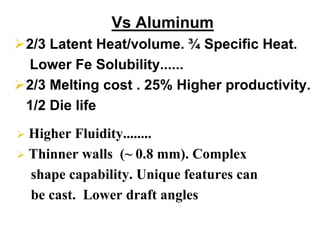
Vs Aluminum
2/3 Latent Heat/volume. ¾ Specific Heat.
Lower Fe Solubility......
2/3 Melting cost . 25% Higher productivity.
1/2 Die life
Higher Fluidity........
Thinner walls (~ 0.8 mm). Complex
shape capability. Unique features can
be cast. Lower draft angles
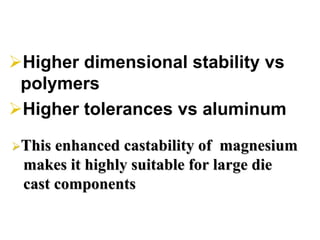
Higher dimensional stability vs
polymers
Higher tolerances vs aluminum
This enhancedThis enhanced castabilitycastability of magnesiumof magnesium
makes it highly suitable for large diemakes it highly suitable for large die
cast componentscast components

Material properties of magnesium

  • 1.
    Material Properties ofMaterialProperties of MagnesiumMagnesium Randy Beals
  • 2.
  • 3.
    Physical/Chemical Properties ofMgPhysical/Chemical Properties of Mg vsvs OtherOther Matl’sMatl’s PROPERTY Units Condition AZ91 AM60 Al380 AlA356 Nylon ABS DC T6 30% glass SgGravity g/cm 3 1.81 1.79 2.74 2.69 1.4 1.05 ThConductivity W/m o K 51 61 96 159 0.33 0.28 Coeff Th Expan um/m o K 26 25.6 22 21.5 34.5 76.5 Specific Heat J/L o K 1,900 2,640 2,590 Heat of Fusion kJ/L 673 1,066 FreezingRange o C 470-595 540-615 540-595 555-615 Corrosion wt. loss mg/cm 2 /d die cast 0.02 0.05 0.27 3 days@5% NaCl
  • 4.
    Mechanical Properties ofDC MgMechanical Properties of DC Mg vsvs OtherOther Matl’sMatl’s PROPERTY Units Condition AZ91 AM60 Al380 Al A356 Nylon ABS DC T6 30% glass UTS MPa Ambient 230 220 320 262 195 45 YS (tensile) MPa Ambient 150 130 160 185 170 40 (comp) MPa 165 130 186 Shear Str MPa 140 214 205 RB Fatigue St MPa 5 x 10 8 cyc 82 60 145 90 0.1% Creep St MPa 125 o C 34 34 135 after 100 hrs Impact St Unnotch Joules 6 22 3.5 11 Notched Joules 1.5 3.2 Elongation % 3 8 to 15 4 5 8 17 El Modulus GPa Ambient 45 45 72 73 8.9 2.1 Shear Modulus GPa Ambient 14 27 28 Brinell Hardness 65 60 80 80 Damping Capacity % 35 MPa 29 52 1.2 Possions Ratio 0.35 0.35 0.33
  • 5.
    2/3 Density Al,¼ Steel 30 x Damping vs Al 200 x Th Cond vs Pl ½ Th Expansion vs Pl
  • 6.
    Higher Specific Strength Ductilityand Impact Strength vs HPDC Al. Higher Stiffness vs Plastic. Higher Machinability vs Al.
  • 7.
  • 8.
    Physical/Chemical Properties ofMgPhysical/Chemical Properties of Mg vsvs OtherOther Matl’sMatl’s PROPERTY Units Condition AZ91 AM60 Al380 Al A356 Nylon ABS DC T6 30% glass Sg Gravity g/cm3 1.81 1.79 2.74 2.69 1.4 1.05 Th Conductivity W/mo K 51 61 96 159 0.33 0.28 Coeff Th Expan um/mo K 26 25.6 22 21.5 34.5 76.5 Specific Heat J/Lo K 1,900 2,640 2,590 Heat of Fusion kJ/L 673 1,066 Freezing Range o C 470-595 540-615 540-595 555-615 Corrosion wt. loss mg/cm2 /d die cast 0.02 0.05 0.27 3 days@5% NaCl
  • 9.
    Mechanical Properties ofDC MgMechanical Properties of DC Mg vsvs OtherOther Matl’sMatl’s PROPERTY Units Condition AZ91 AM60 Al380 Al A356 Nylon ABS DC T6 30% glass UTS MPa Ambient 230 220 320 262 195 45 YS (tensile) MPa Ambient 150 130 160 185 170 40 (comp) MPa 165 130 186 Shear Str MPa 140 214 205 RB Fatigue St MPa 5 x 10⁸ cyc 82 60 145 90 0.1% Creep St MPa 125o C 34 34 135 after 100 hrs Impact St Unnotch Joules 6 22 3.5 11 Notched Joules 1.5 3.2 Elongation % 3 8 to 15 4 5 8 17 El Modulus GPa Ambient 45 45 72 73 8.9 2.1 Shear Modulus GPa Ambient 14 27 28 Brinell Hardness 65 60 80 80 Damping Capacity % 35 MPa 29 52 1.2 Possions Ratio 0.35 0.35 0.33
  • 10.
  • 11.
    Vs Aluminum 2/3 LatentHeat/volume. ¾ Specific Heat. Lower Fe Solubility...... 2/3 Melting cost . 25% Higher productivity. 1/2 Die life Higher Fluidity........ Thinner walls (~ 0.8 mm). Complex shape capability. Unique features can be cast. Lower draft angles
  • 12.
    Higher dimensional stabilityvs polymers Higher tolerances vs aluminum This enhancedThis enhanced castabilitycastability of magnesiumof magnesium makes it highly suitable for large diemakes it highly suitable for large die cast componentscast components