Earthquakes
Technology-based Unit on a Natural
Disaster
Grade 4 Unit
By Danielle Moore
Technology Integration
Rationale
• Technology is a large part of children’s lives in today’s society. Whether
technology is being used for personal or academic gain, it is a tool that is being
utilized daily. Teachers can use technology to enhance students’ knowledge on
unfamiliar topics. Earthquakes may not be a Natural Disaster everyone faces so
technology allows us to become educated on a realistic topic. Technology can
allow students to understand what an earthquake is, where earthquakes occur,
and what the aftermath of an earthquake may look like, etc. Students will gain a
factual and visual understanding of earthquakes through various modes of
technology. The resources that are used in this presentation such as websites,
images, blogs, podcasts, apps, and worksheets can be used to conduct research
on earthquakes in a classroom setting.
Evaluation and Citation of Internet
Content
• All of the websites that are within this presentation are
reliable. In addition to the websites I have utilized, any of
the resources are reliable and can be used within a
classroom setting.
• The sources are clearly identified in the notes section of
each slide, making the sources easily accessible.
• In addition, the sites I have utilized are clearly identified
and I have cited what I have used in this presentation.
Teachers can take what I have presented and use it in
many ways within the classroom to enhance learning.
• The topic of earthquakes is present within each resource,
which strengthens the validity of this unit.
Blog
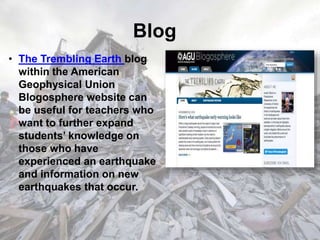
• The Trembling Earth blog
within the American
Geophysical Union
Blogosphere website can
be useful for teachers who
want to further expand
students’ knowledge on
those who have
experienced an earthquake
and information on new
earthquakes that occur.
Instructional Video
• Kahn Academy video about the San Andres Fault, which is a
boundary where earthquakes occur.
Topic related Video
• National Geographic provides a video that
breaks down the science of an earthquake.
This video relates the science behind an
earthquake to real events that have occurred.
• This video could be used as an introduction to
a Natural Disaster or earthquake unit.
Organizations related to Topic
• FEMA is the Federal Emergency Management
Agency and this website delves into earthquake
facts.
• EERI is the Earthquake Engineering Research
Institute, which focuses on reducing the risk of
earthquakes.
• NEHRP is the National Earthquake Hazards
Reduction Program, which focuses on research
and application.
Inspiration
Teaching Materials: App
• iQuakeLite is an app that keeps students and
teachers informed about recent earthquake
locations and happenings.
Teaching Materials: Book
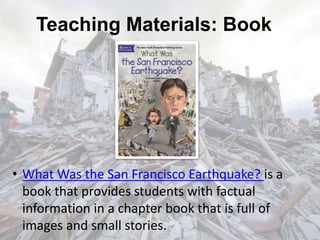
• What Was the San Francisco Earthquake? is a
book that provides students with factual
information in a chapter book that is full of
images and small stories.
Teaching Materials: Worksheet
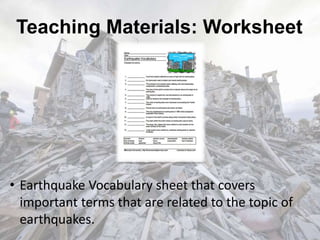
• Earthquake Vocabulary sheet that covers
important terms that are related to the topic of
earthquakes.
Teaching Materials: Worksheet
• Earthquake Word Search covers terms that
pertain to the topic of earthquakes.
Subject-Specific Resource
• The National Weather Service website
provides information about weather
occurrences within the United States.
• The website includes past and current
weather information. Also, the website
includes a function that can allow a person to
identify the exact weather in a desired
location.
Uses of the Internet
Online Reference Material
• The Encyclopedia houses information on specific topics
and events. This website allows users to search a topic and
discover a variety details related to that initial topic. This
online reference can allow students to expand their
knowledge on earthquakes through exploration of the topic.
Online Books
• The Online Books Page provides users with millions of free
books on the internet. This source can provide students
with free books on the topic of earthquakes or related
topics. This site allows students to access books without
having to go to the library.
Web 2.0
• Collaborize Classroom
can be used for teachers
and students to have
discussions about the
topic of earthquakes.
• Padlet is a way for
students and
teachers to share
ideas on a
common topic in
one online sheet
of paper.

MAT Modules Performance Task

  • 1.
    Earthquakes Technology-based Unit ona Natural Disaster Grade 4 Unit By Danielle Moore
  • 2.
    Technology Integration Rationale • Technologyis a large part of children’s lives in today’s society. Whether technology is being used for personal or academic gain, it is a tool that is being utilized daily. Teachers can use technology to enhance students’ knowledge on unfamiliar topics. Earthquakes may not be a Natural Disaster everyone faces so technology allows us to become educated on a realistic topic. Technology can allow students to understand what an earthquake is, where earthquakes occur, and what the aftermath of an earthquake may look like, etc. Students will gain a factual and visual understanding of earthquakes through various modes of technology. The resources that are used in this presentation such as websites, images, blogs, podcasts, apps, and worksheets can be used to conduct research on earthquakes in a classroom setting.
  • 3.
    Evaluation and Citationof Internet Content • All of the websites that are within this presentation are reliable. In addition to the websites I have utilized, any of the resources are reliable and can be used within a classroom setting. • The sources are clearly identified in the notes section of each slide, making the sources easily accessible. • In addition, the sites I have utilized are clearly identified and I have cited what I have used in this presentation. Teachers can take what I have presented and use it in many ways within the classroom to enhance learning. • The topic of earthquakes is present within each resource, which strengthens the validity of this unit.
  • 4.
    Blog • The TremblingEarth blog within the American Geophysical Union Blogosphere website can be useful for teachers who want to further expand students’ knowledge on those who have experienced an earthquake and information on new earthquakes that occur.
  • 5.
    Instructional Video • KahnAcademy video about the San Andres Fault, which is a boundary where earthquakes occur.
  • 6.
    Topic related Video •National Geographic provides a video that breaks down the science of an earthquake. This video relates the science behind an earthquake to real events that have occurred. • This video could be used as an introduction to a Natural Disaster or earthquake unit.
  • 7.
    Organizations related toTopic • FEMA is the Federal Emergency Management Agency and this website delves into earthquake facts. • EERI is the Earthquake Engineering Research Institute, which focuses on reducing the risk of earthquakes. • NEHRP is the National Earthquake Hazards Reduction Program, which focuses on research and application.
  • 8.
  • 9.
    Teaching Materials: App •iQuakeLite is an app that keeps students and teachers informed about recent earthquake locations and happenings.
  • 10.
    Teaching Materials: Book •What Was the San Francisco Earthquake? is a book that provides students with factual information in a chapter book that is full of images and small stories.
  • 11.
    Teaching Materials: Worksheet •Earthquake Vocabulary sheet that covers important terms that are related to the topic of earthquakes.
  • 12.
    Teaching Materials: Worksheet •Earthquake Word Search covers terms that pertain to the topic of earthquakes.
  • 13.
    Subject-Specific Resource • TheNational Weather Service website provides information about weather occurrences within the United States. • The website includes past and current weather information. Also, the website includes a function that can allow a person to identify the exact weather in a desired location.
  • 14.
    Uses of theInternet Online Reference Material • The Encyclopedia houses information on specific topics and events. This website allows users to search a topic and discover a variety details related to that initial topic. This online reference can allow students to expand their knowledge on earthquakes through exploration of the topic. Online Books • The Online Books Page provides users with millions of free books on the internet. This source can provide students with free books on the topic of earthquakes or related topics. This site allows students to access books without having to go to the library.
  • 15.
    Web 2.0 • CollaborizeClassroom can be used for teachers and students to have discussions about the topic of earthquakes. • Padlet is a way for students and teachers to share ideas on a common topic in one online sheet of paper.

Editor's Notes

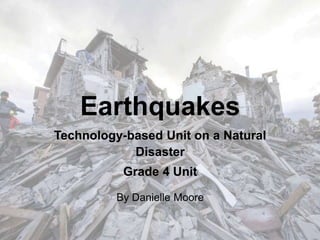
  • #2 Background Image Source: http://news.nationalgeographic.com/2016/08/science-behind-italy-myanmar-earthquakes-expert-view/#/01-italy-earthquake.ngsversion.1472064593305.jpg
  • #3 I am inspired to do this topic and grade level because in my field study, this past semester, I worked with a fourth grade reading group on the San Francisco Earthquake. Their eagerness and excitement towards the topic encouraged me to incorporate the topic into this assignment.
  • #4 Hyperlinks work once in Slide Show mode.
  • #5 Source: http://blogs.agu.org/tremblingearth/ Photo is a screenshot of the website itself. This blog will be helpful for teachers when teaching about this topic because this blog gives students access to personal experiences in regards to earthquakes. Also this blog originates from a passionate earthquake scientist so the reliability of this source is crucial since delivering earthquake information is Austin Elliot’s top priority.
  • #6 Source: https://www.khanacademy.org/partner-content/amnh/earthquakes-and-volcanoes/earthquakes/v/scientists-at-work-san-andres-fault Photo is a screenshot of the website itself. For teachers, this video can assist when teaching about the San Andres Fault. This subtopic to the larger topic of earthquakes is important to discuss so students understand how earthquakes occur.
  • #7 Source: http://video.nationalgeographic.com/video/101-videos/earthquake-101 This video can be a strong starting point for a teacher to begin delving into the topic of earthquakes. The science and real life application that is included within this video creates a basic foundation for students on the topic of earthquakes.
  • #8 Sources: All websites are factual and reliable for teachers as well as students. https://www.fema.gov/earthquake This website can be used in support of the topic of earthquakes because FEMA can provide teachers and students with facts on recent earthquakes. http://www.eeri.org/ This website can inform students on how risks of an earthquake are being reduced. http://www.nehrp.gov/index.htm This website can assist the overall topic of earthquakes by focusing on bringing attention to reducing occurrences of earthquakes.
  • #9 I have created a KWL diagram. I chose this diagram because it can be used before, during, and after the lesson. This diagram forces students to think during the entirety of the lesson. An actual lesson would utilize this diagram as follows: gather students on the rug and ask them what they know about earthquakes, then ask what they want to learn about earthquakes within the lesson, and then pose the question of what students have learned about earthquakes from the lesson. With the three points in mind, KWL, students will be thinking about their learning throughout the lesson. This visual diagram allows my visual learners to see what we have learned and know. Also for the entire class this visual can be revisited and organize an entire class’s thoughts on the earthquake topic.
  • #10 Source: https://itunes.apple.com/us/app/iquakelite/id364895287?mt=8%20&utm_campaign=elearningindustry.com&utm_source=%2F8-free-ipad-apps-for-exploring-environmental-earth-science&utm_medium=link This app is compatible with an iPhone and an iPad. Also the app is a great way for students to stay connected, long after the earthquake unit, to the natural disaster occurrences around the world.
  • #11 Source/Image Source: http://www.penguinrandomhouse.com/books/537018/what-was-the-san-francisco-earthquake-by-dorothy-and-thomas-hoobler-illustrated-by-ted-hammond/9780399541599/ I used this book with the reading group I conducted in field study. The book is full of facts and numerous small stories that cover various aspects of the earthquake. I saw how much my students enjoyed learning about this specific earthquake in an innovative text. This book can be used to accompany teaching students about the San Francisco Earthquake.
  • #12 Source/Image Source: http://homeschooling.about.com/library/earthquakevocab.pdf This worksheet can reinforce important terms that relate to the topic of earthquakes that students should understand by the end of the unit. This sheet can be utilized after going through the previous resources that cover the terms, such as videos and websites.
  • #13 Source/Image Source: http://homeschooling.about.com/library/earthquakeword.pdf This is a fun worksheet to provide to your students to reinforce the terms of the topic but in a creative manner. The terms provided align with the previous vocabulary worksheet.
  • #14 Source: http://www.weather.gov/# Teachers can use this website as a resource that solely focuses on weather across the country. Students can look up weather happenings anywhere in the country through this website. The website can expand students’ knowledge on weather as well as looking up earthquakes that have occurred in the past. Therefore, this subject-specific website can enhance students’ understandings on regional weather occurrences beyond the topic of earthquakes.
  • #15 Source: http://www.encyclopedia.com/ http://digital.library.upenn.edu/books/
  • #16 Source: http://library.collaborizeclassroom.com/ https://padlet.com/ Both resources provide teachers and students a place to freely express whatever they choose about any desired topic. For this presentation specifically, the topic of earthquakes can be discussed outside of school or when new information is found during or after the unit.